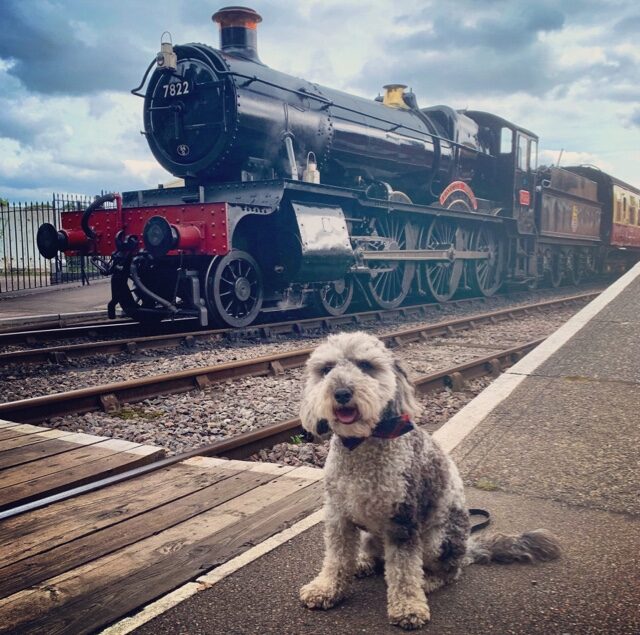
Yoshi celebrated his 5th birthday this week with lots of hugs and a new sweater – 12/01/2024
January 12th 2024 to January 19th 2024
Yoshi celebrated his 5th birthday on Friday January 12th 2024 – he posed for a few photographs so he could show off his new sweater (which would come in handy as temperatures plummeted over the course of the following week), cap and bandana. He didn’t really take to wearing the cap outside, so we put it away for another day. Lots of treats ensued.
Yoshi shows off his new sweater and cap on his 5th birthday – 12/01/2024
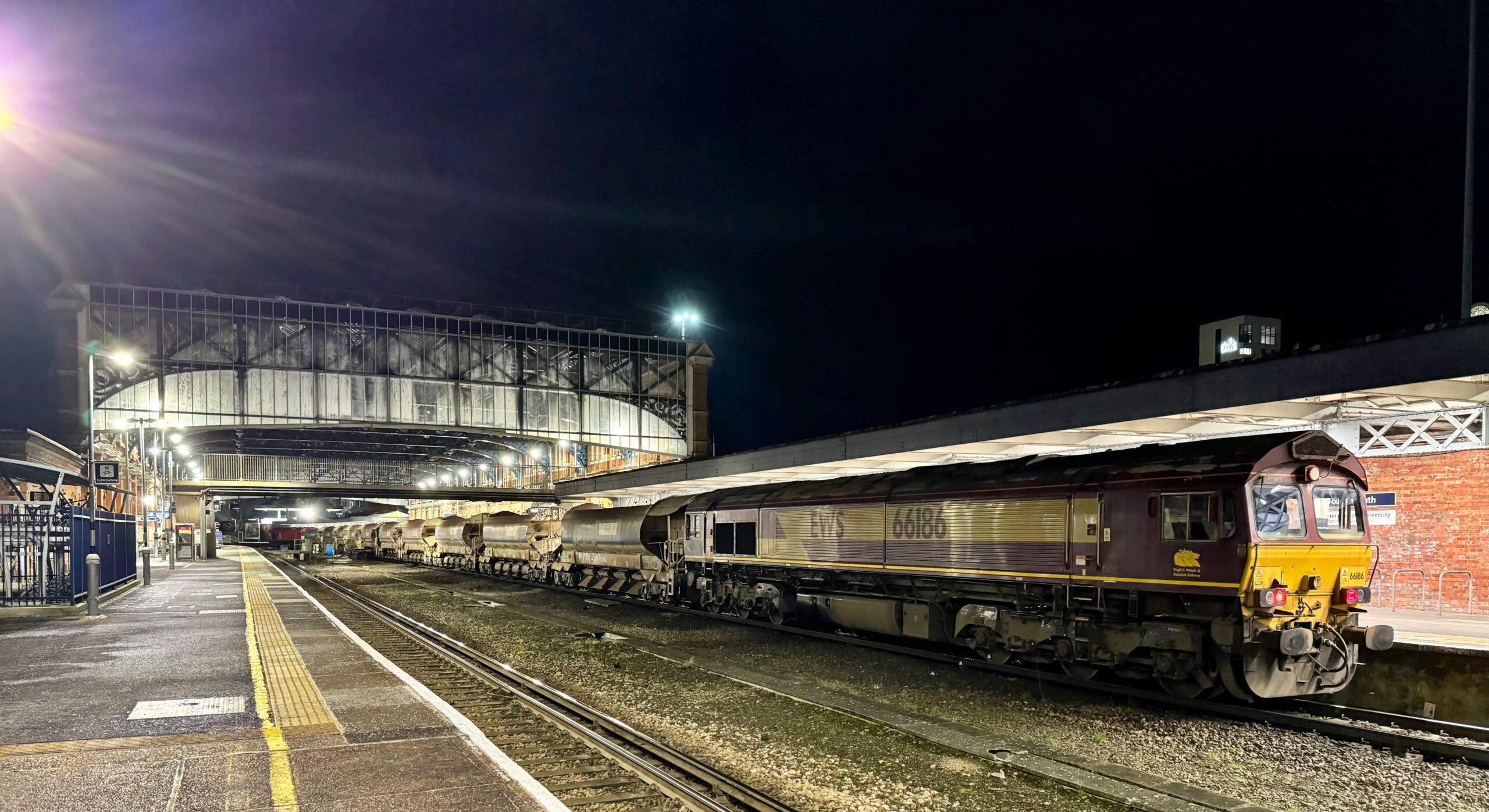
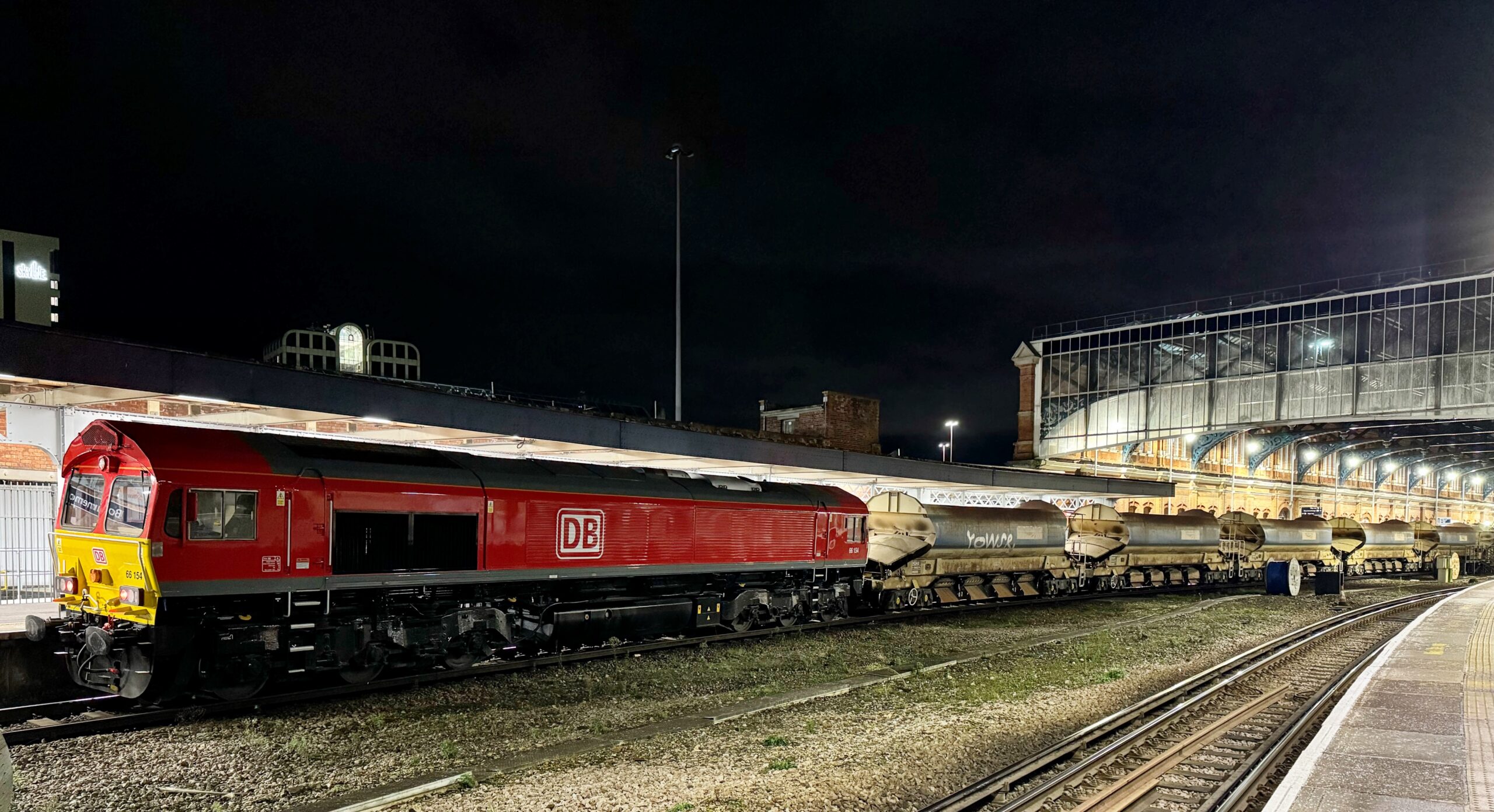
It has been a busy week or so in Dorset if, like me, you have a penchant for test and engineering trains. Yes, I’m late with this blog entry, yes, I’m obsessed with trains, and yes, I “enjoy” the solitude of a railway station platform at 0430 on a cold January morning with only the sound of waking birdsong, Network Rail staff opening gates to access the trackside and the distant call of a Class 66 locomotive tooting in the dark telegraphing its existence. This was my experience on the morning of Tuesday 16th January when I hauled myself out of bed in the early hours after a disturbed night because Yoshi had busied himself building a pillow fort as I tried to sleep. DB Cargo had two scheduled engineers trains running into Dorset on this day, one in the morning and one in the late evening – both in connection with engineering works around the Hinton Admiral, Hampshire area. The trains were scheduled to run from Eastleigh East Yard and reverse at Bournemouth before heading back in the direction they had come. Both trains employed the same locomotives, Class 66 No.’s 66154 and 66186.
DB Cargo Class 66 No. 66186 powers through Christchurch at the head of 6N60 0455 Christchurch to Eastleigh East Yard – 16/01/2024Having reversed at Bournemouth, 6N60 0455 Christchurch to Eastleigh East Yard is now in the charge of DB Cargo Class 66 No. 66154 which is seen heading back through Christchurch – 16/01/2024DB Cargo Class 66 No. 66186 having arrived at Bournemouth with 6N65 2304 Eastleigh East Yard to Hinton Admiral – 16/01/2024The driver of DB Cargo Class 66 No. 66154 prepares to depart Bournemouth with 6N65 2304 Eastleigh East Yard to Hinton Admiral – 16/01/2024
Video of DB Cargo engineers train workings 6N60 0455 Christchurch to Eastleigh East Yard at Christchurch and 6N65 2304 Eastleigh East Yard to Hinton Admiral at Bournemouth featuring Class 66 No.’s 66186 and 66154 – 16/01/2024
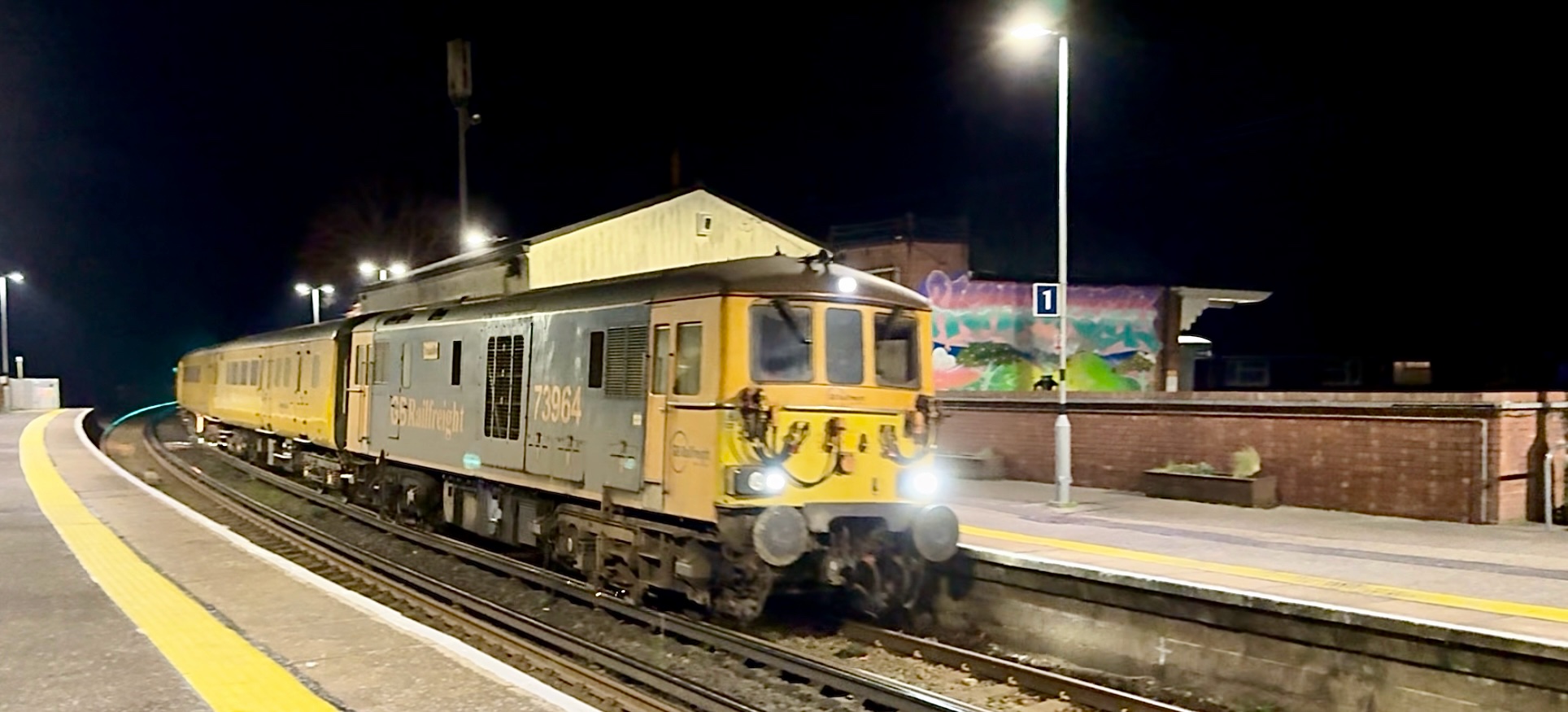
Monday 15th January and we welcomed the usual monthly Colas test train worked by a pair of GB Railfreight (GBRf) Class 73 Electro-Diesel locomotives. This time around No.’s 73965 ‘Des O’Brien’ and 73964 ‘Jeanette’ graced us with their presence top and tailing 1Q51 1115 Derby R.T.C.(Network Rail) to Eastleigh East Yard via Weymouth.
GBRf Class 73 No. 73965 ‘Des O’Brien’ leading on 1Q51 1115 Derby R.T.C.(Network Rail) to Eastleigh East Yard at Poole passing SWR Class 444 444023 which had arrived with 1B57 1835 London Waterloo to Poole service – 15/01/2024GBRf Class 73 No. 73964 ‘Jeanette’ heads up the return 1Q51 1115 Derby R.T.C.(Network Rail) to Eastleigh East Yard through Hamworthy – 15/01/2024
Video of GBRf Class 73 electro-diesels No.’s 73965 ‘Des O’Brien’ and 73964 ‘Jeanette’ top and tailing 1Q51 1115 Derby R.T.C.(Network Rail) to Eastleigh East Yard – 15/01/2024
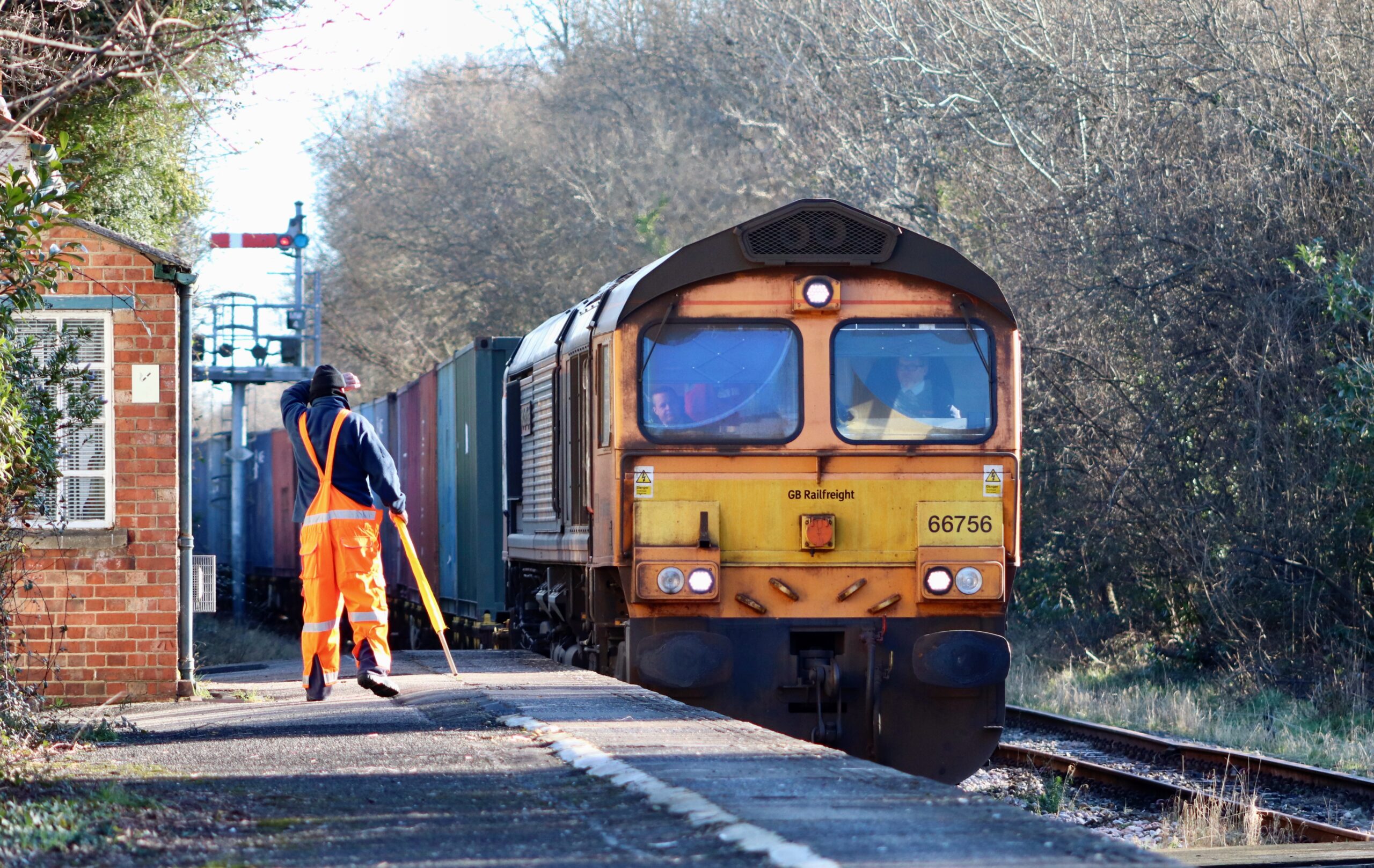
As I’ve mentioned numerous times previously, I have a short list of railway traction I would like to photograph. This can be because of a name carried by the locomotive or vehicle in question or perhaps a special livery variation. One GBRf Class 66 I’ve been keeping tabs on of late is No. 66756 ‘Royal Corps Of Signals’. The loco was out of sight on Doncaster Roberts Road depot in Doncaster, a stones throw from the Morrison’s petrol station I visited to refuel the car as we drove to Scarborough last month and seemed to spend a good deal of time rostered on duties in the North of the country. However, during January, No. 66756 found its way down south and eventually ended up at Eastleigh. Seeing online that she was stabled on Eastleigh East Yard on Saturday morning of the 13th January, Yoshi and I ventured over the border to Hampshire in the hope that this time the locomotive would be visible from a public space. Suffice to say, we were unable to see just where the loco had been parked, and we left without accomplishing our mission. It wasn’t a totally wasted journey however, as we took the opportunity to take some photos at Eastleigh and then stop off and take a look at Freightliner Southampton Maritime via a short break at St Denys.
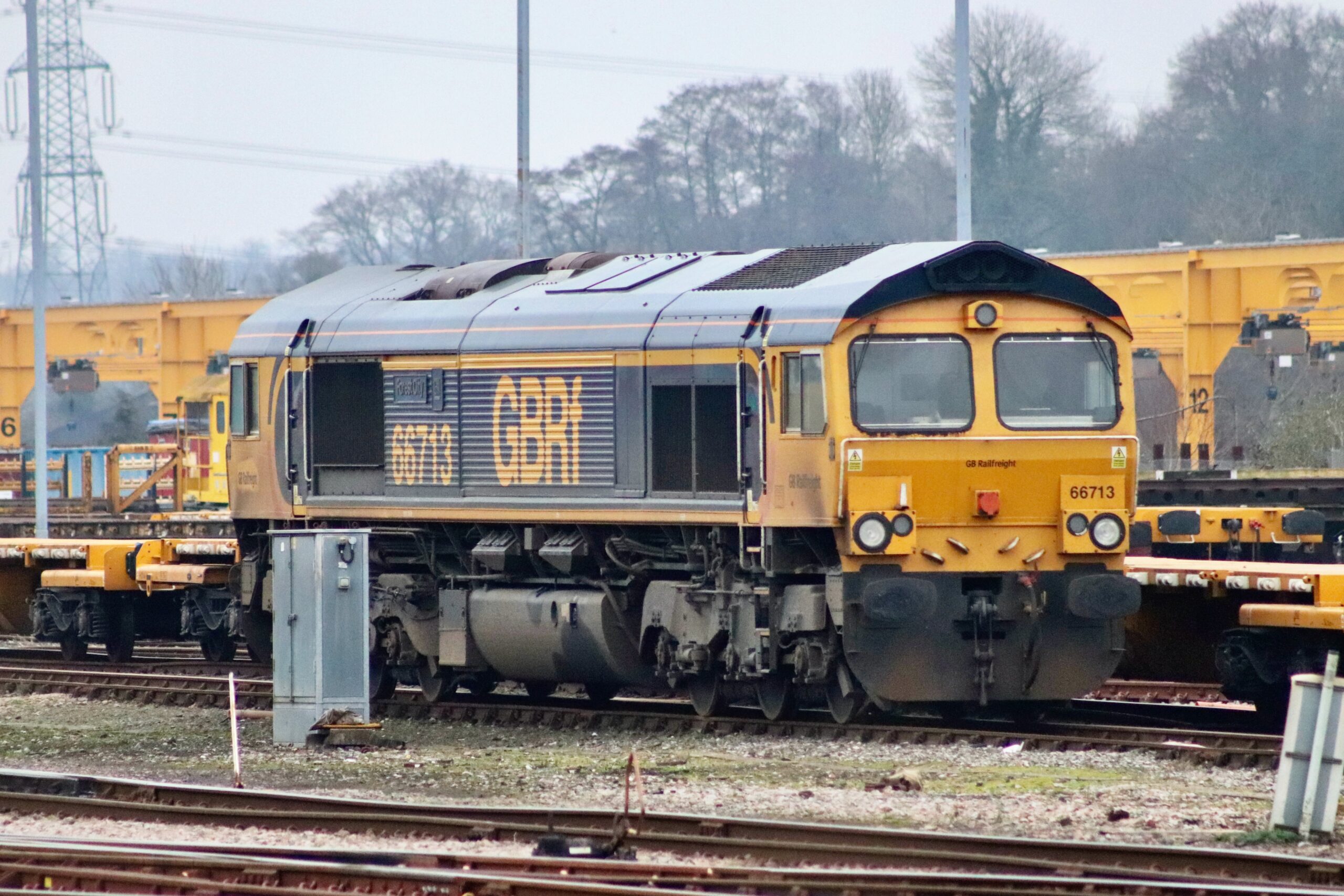
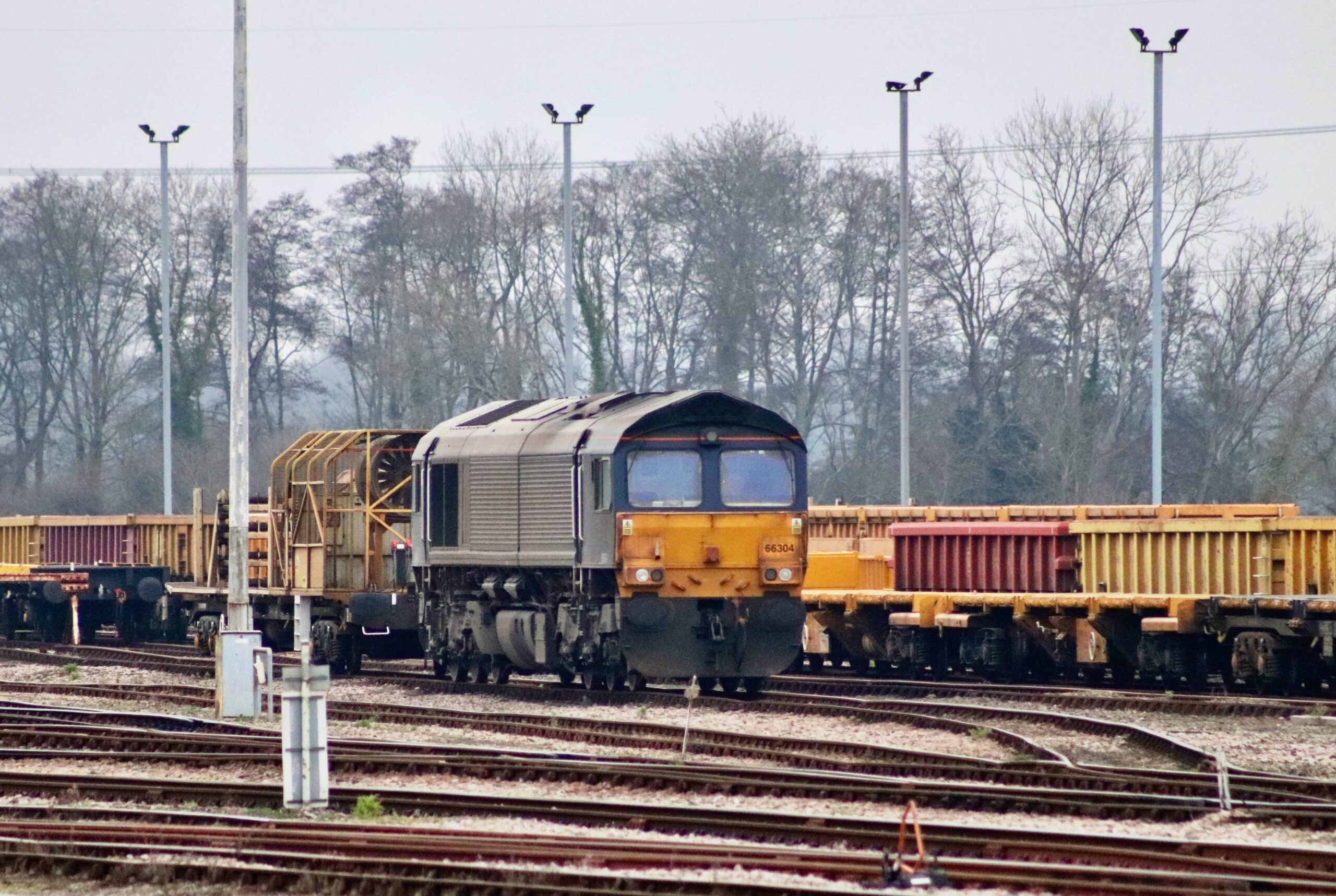
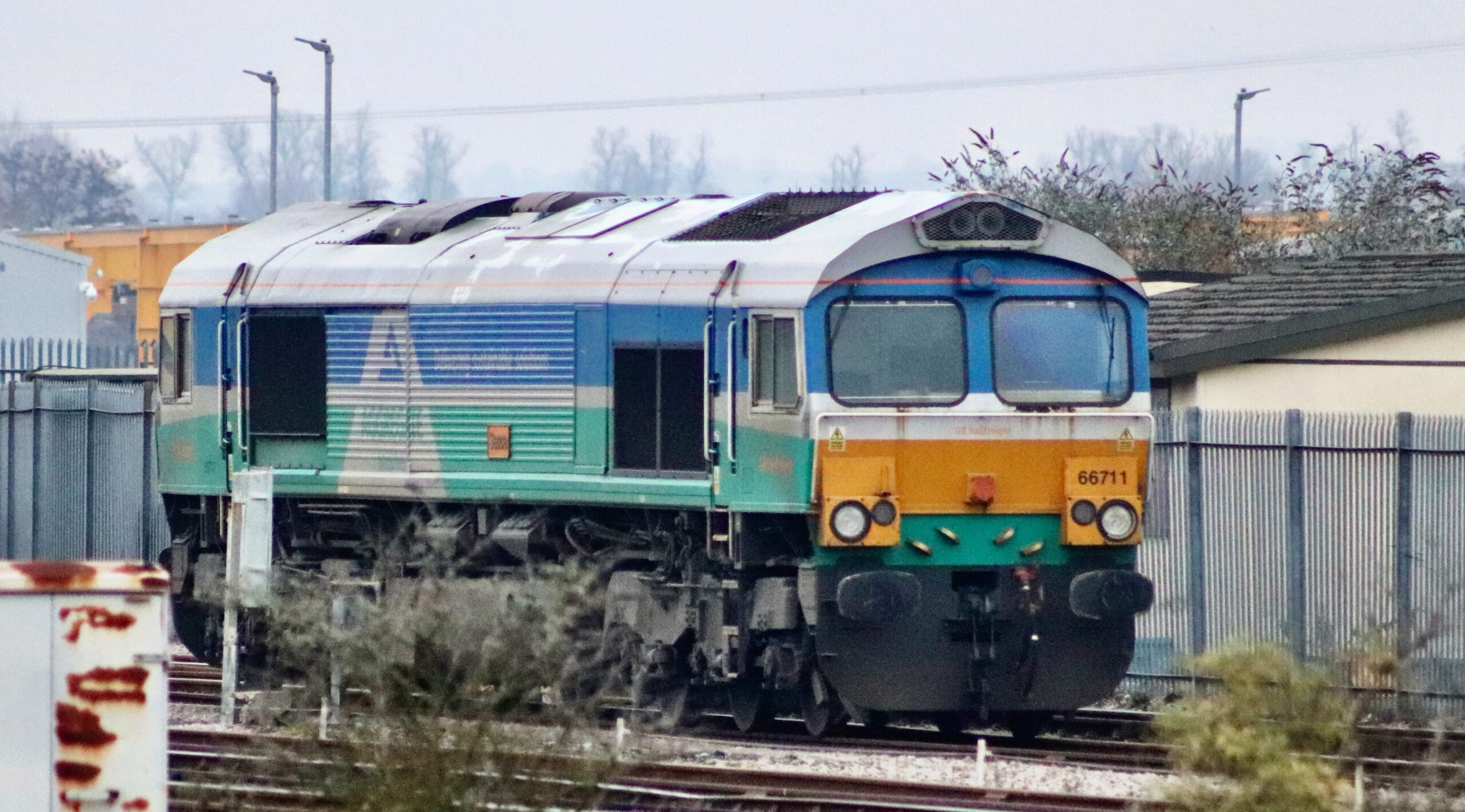
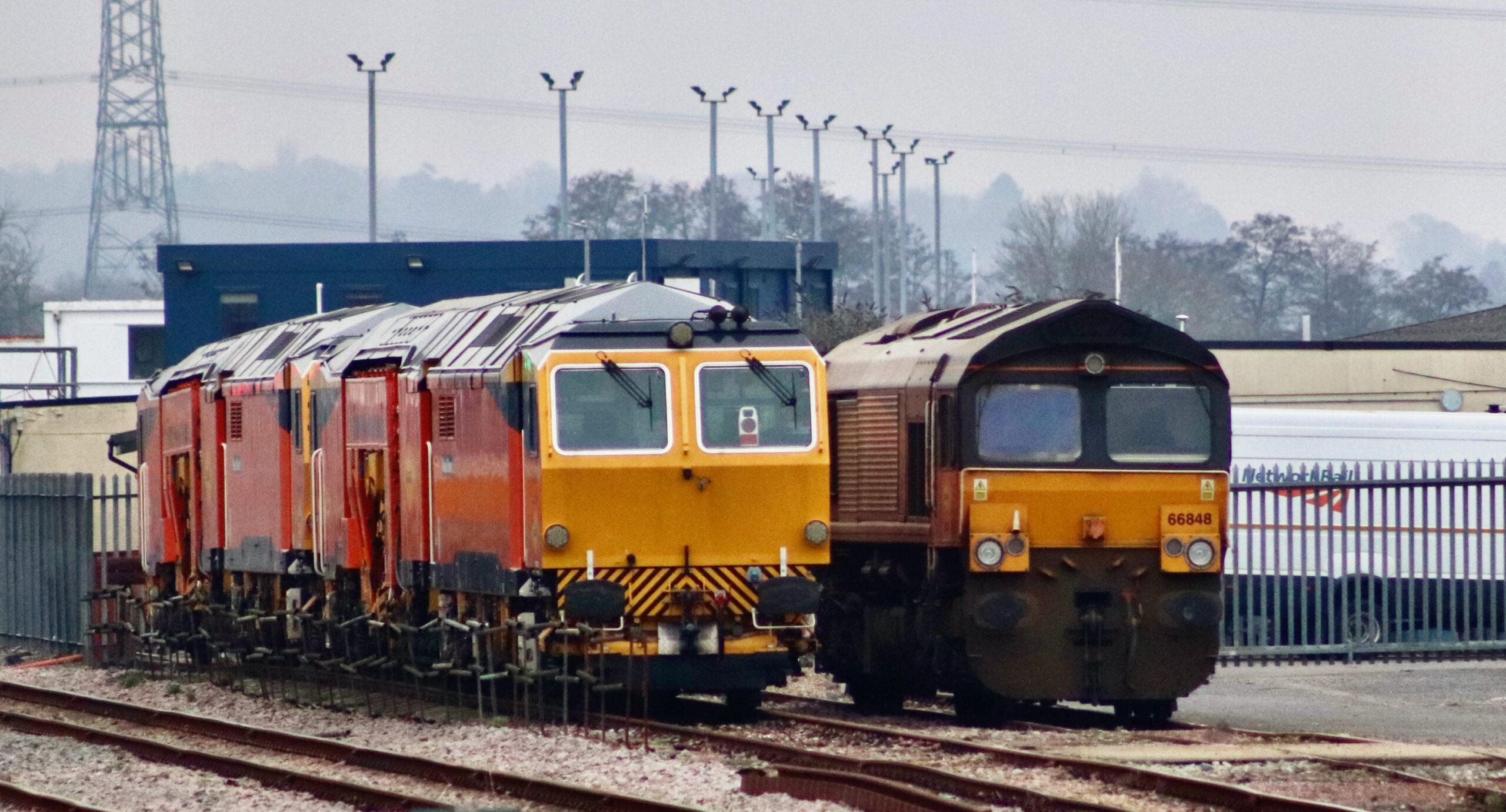
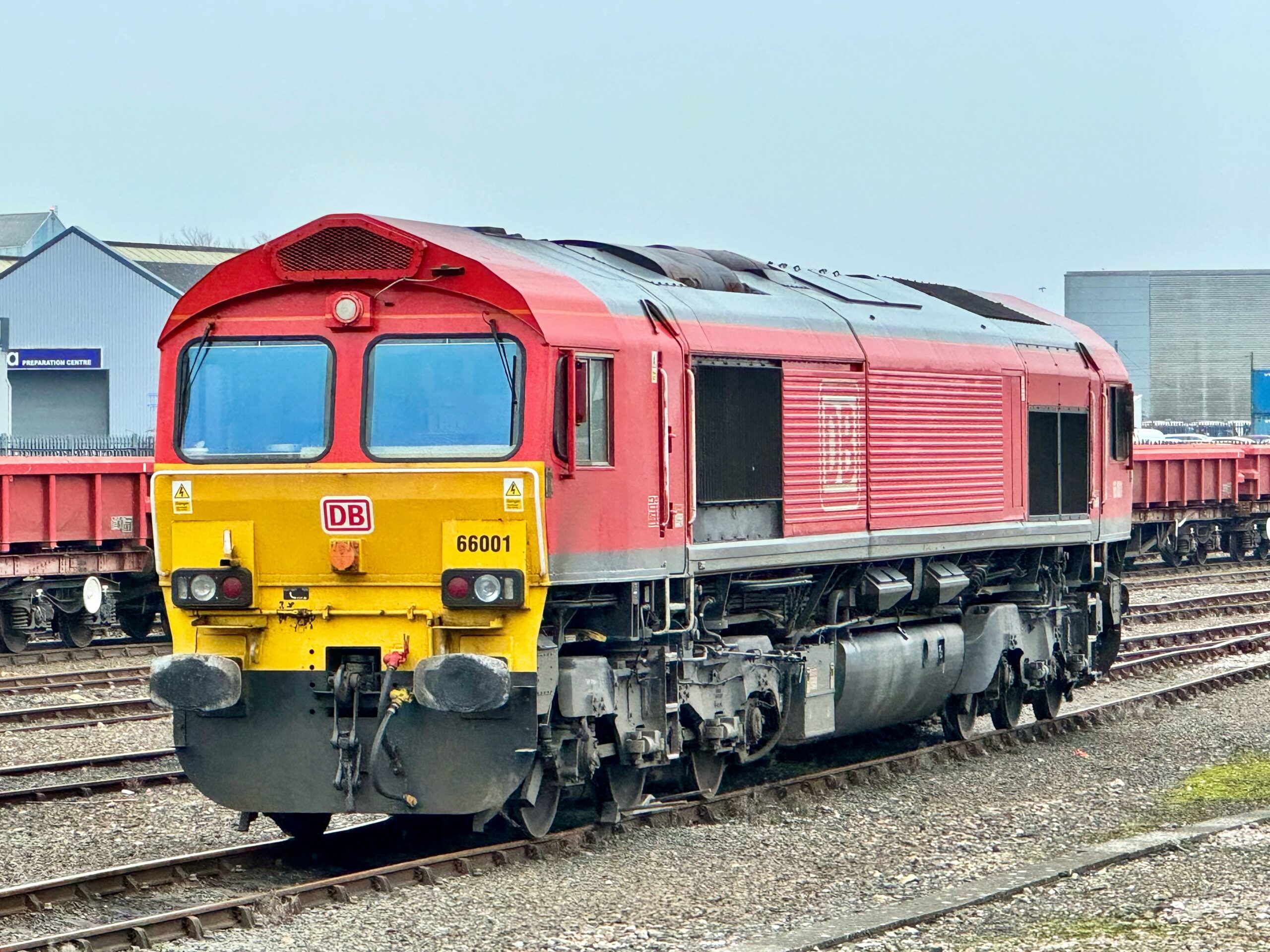
GBRf Class 66 No. 66713 ‘Forest City’ stands in Eastleigh East Yard – 13/01/2024Another view of GBRf Class 66 No. 66713 ‘Forest City’ at Eastleigh East Yard – 13/01/2024GBRf Class 66 No. 66304 at Eastleigh East Yard. The locomotive had arrived in the company of No. 66756 ‘Royal Corps Of Signals’ the previous night working light engine 0O44 1910 Kineton MOD GBRf to Eastleigh East Yard which had prompted my visit on this day – 13/01/202466711 ‘Sence’ painted in Aggregate Industries livery rests in-between duties at Eastleigh East Yard – 13/01/2024Colas Class 66 No. 66848 and track machines at Eastleigh CTT Forwardings – 13/01/2024Class 153 DMU No. 153311 which previously operated in passenger service with East Midlands Railway (EMR) but has now been converted by Network Rail into Video inspection Unit VIU 1 at Eastleigh. This unit had been scheduled to undertake two runs to Bournemouth on the previous day working as 2Q14 1312 Eastleigh East Yard to Eastleigh East Yard, but in the event both trips were cancelled – 13/01/2024Pioneer Class 66 No. 66001 part of the DB Cargo fleet stands adjacent to Eastleigh railway station. This locomotive was originally English Welsh & Scottish Railway’s (EWS) first General Motors (GM) 3,300hp Class 66 which arrived in the UK on Saturday April 18th 1998 at Immingham Dock – and according to Rail Magazine at the time was expected to start work on May 18th. More from Rail issue 330:
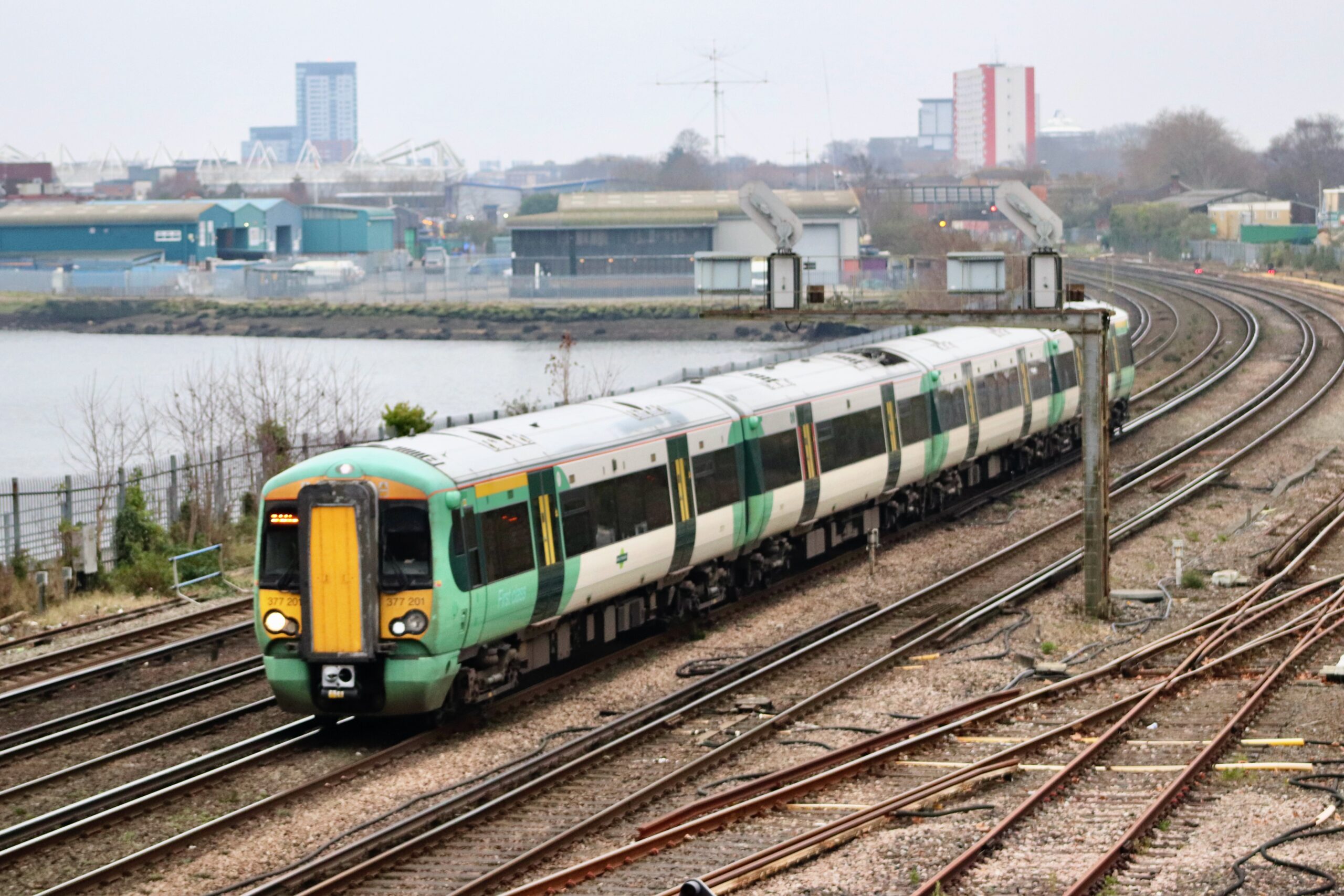
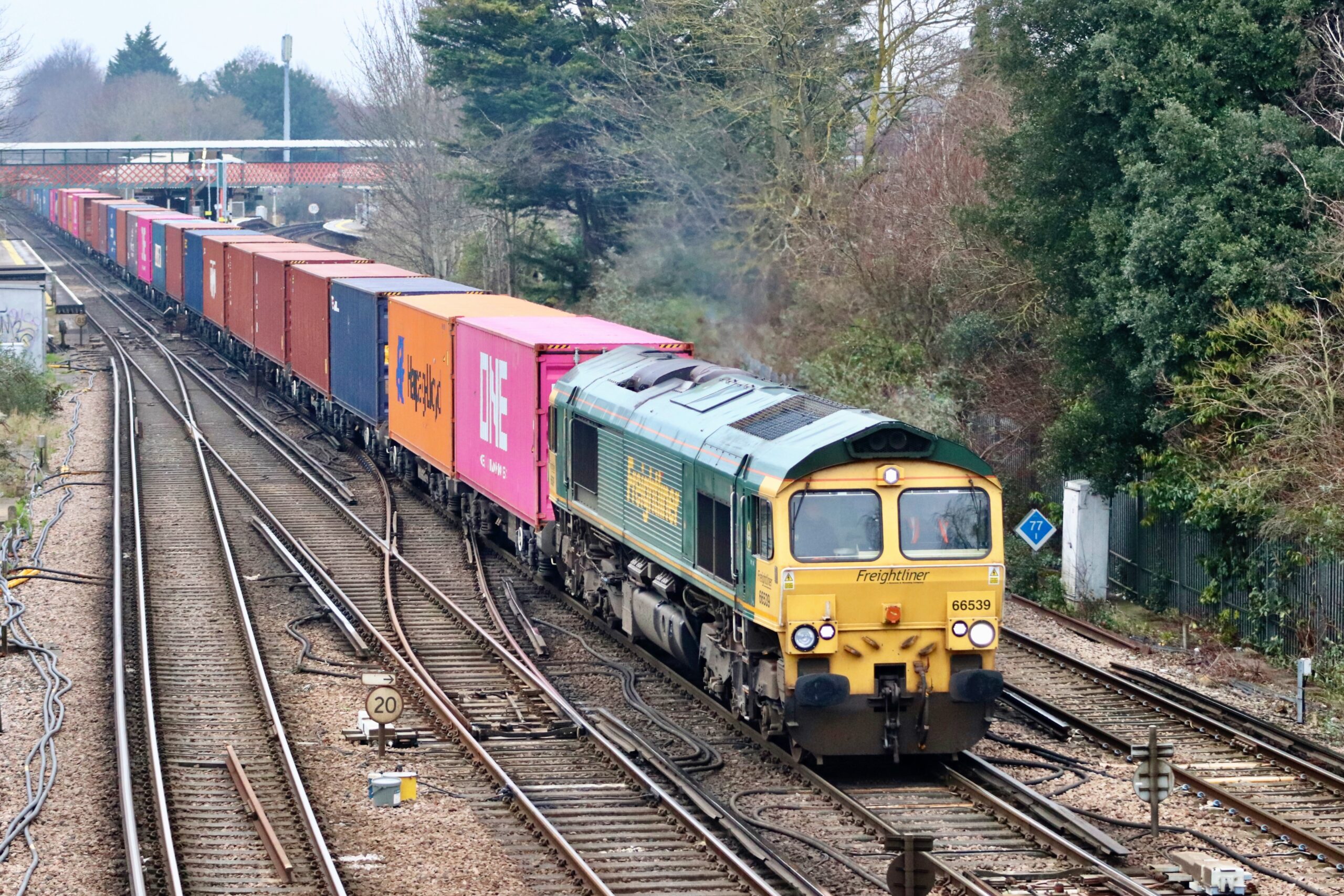
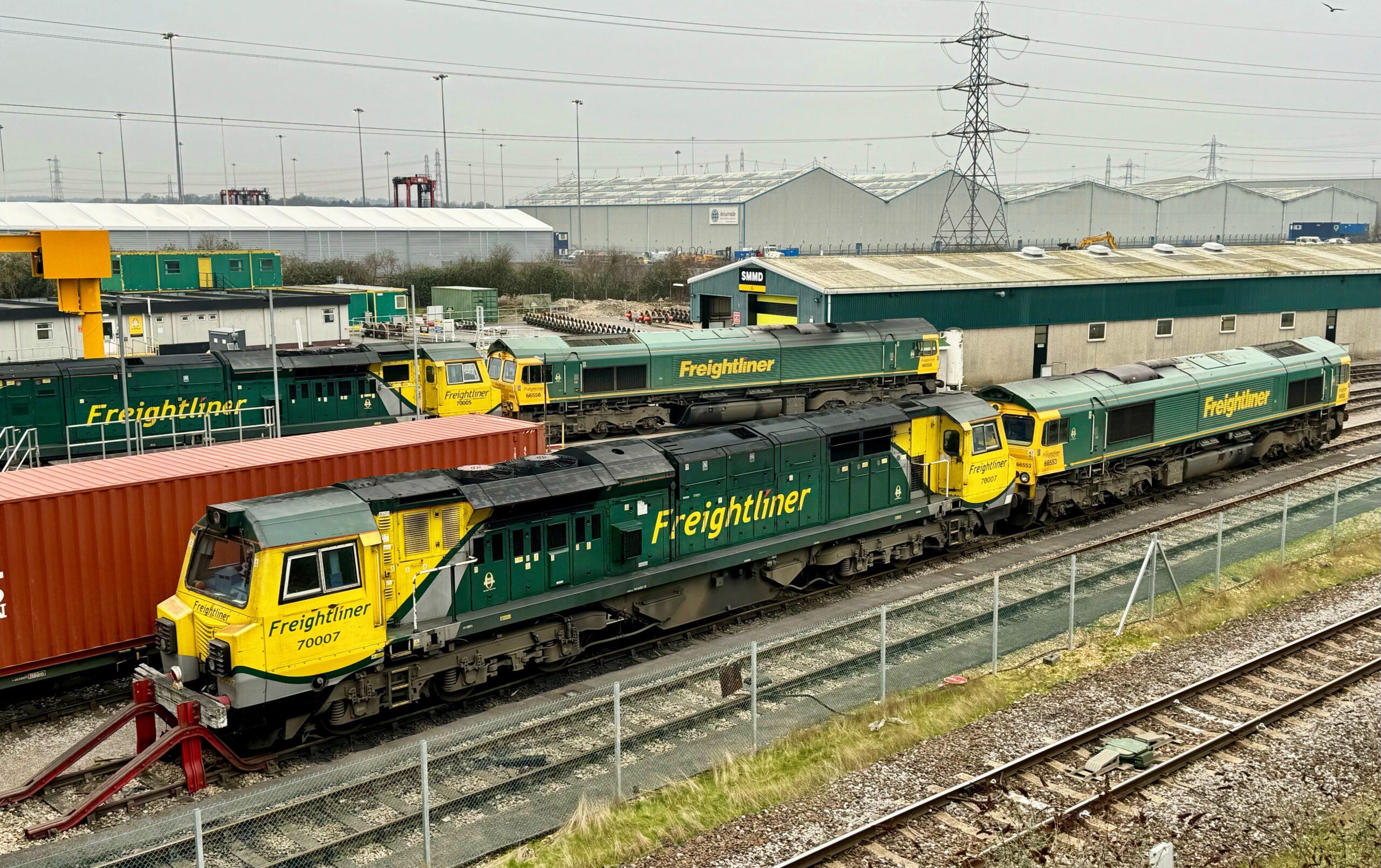
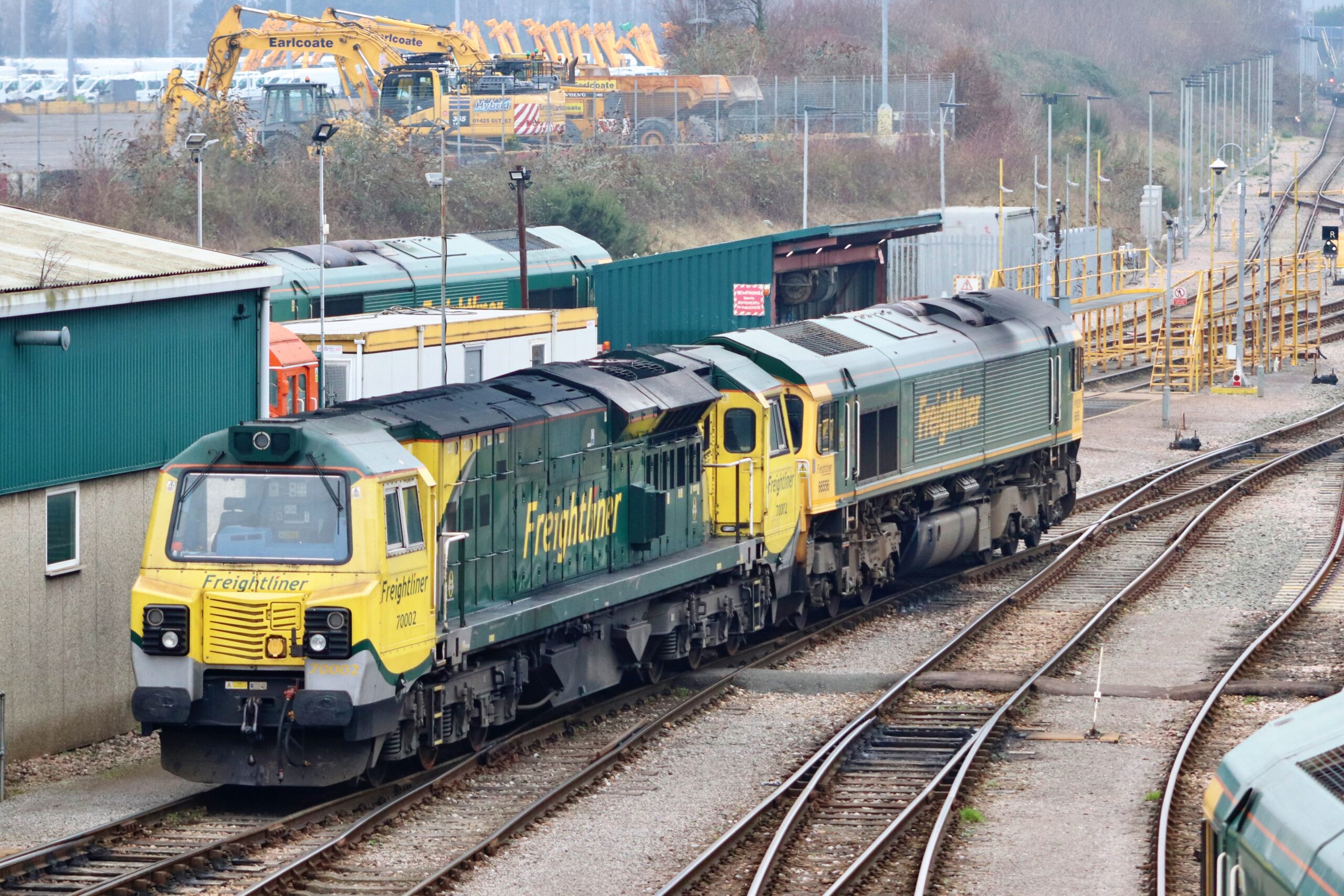
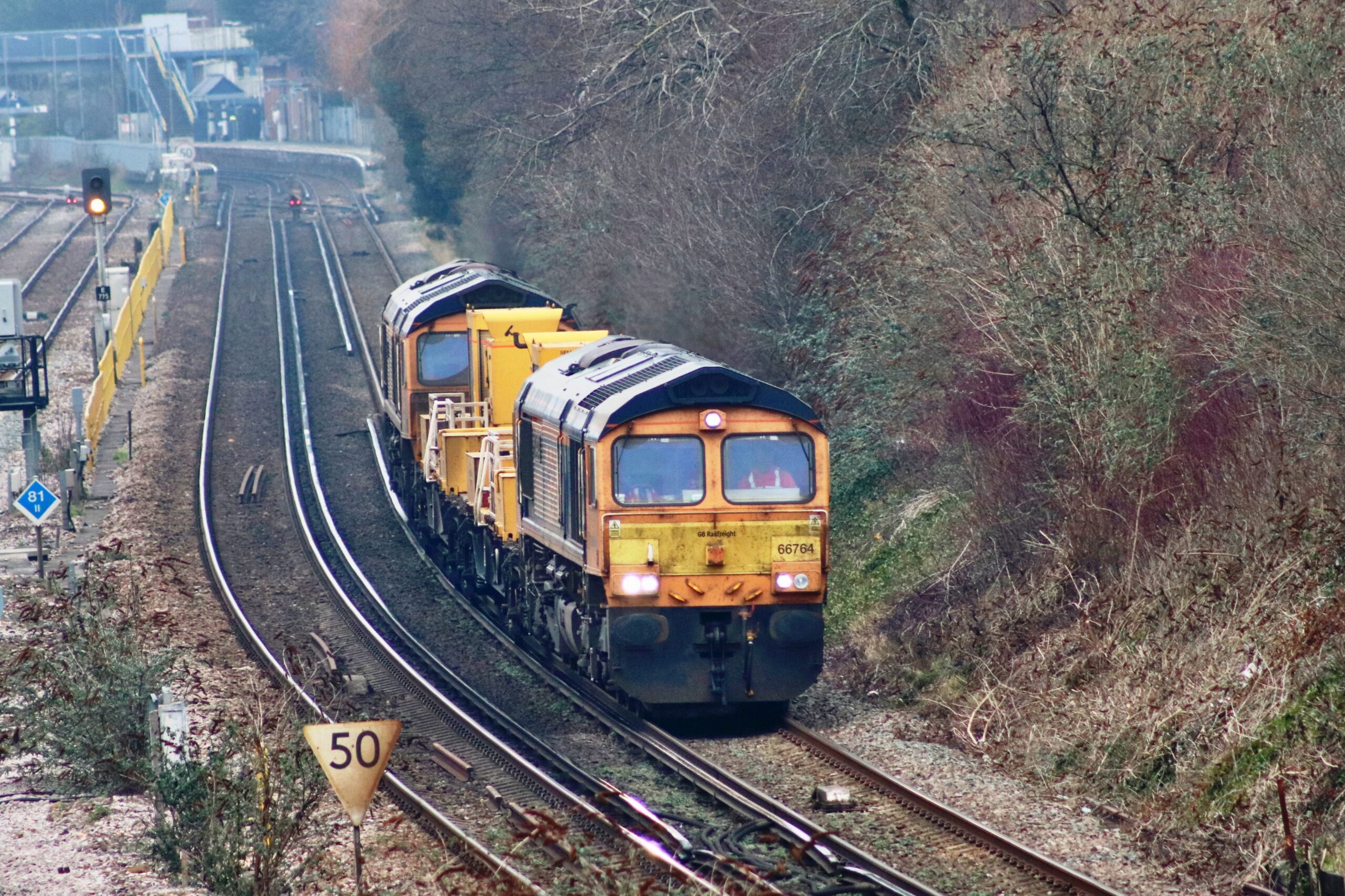
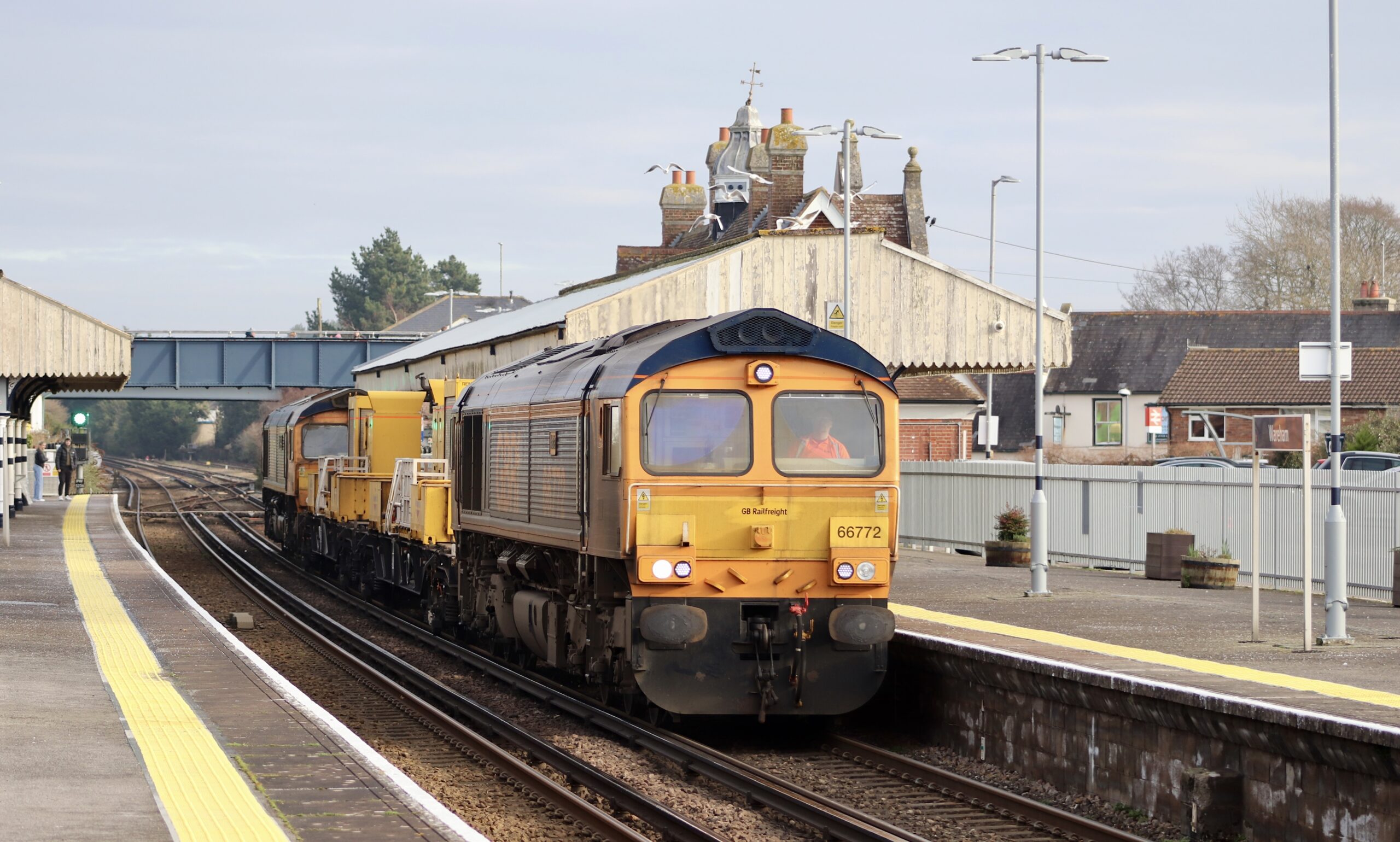
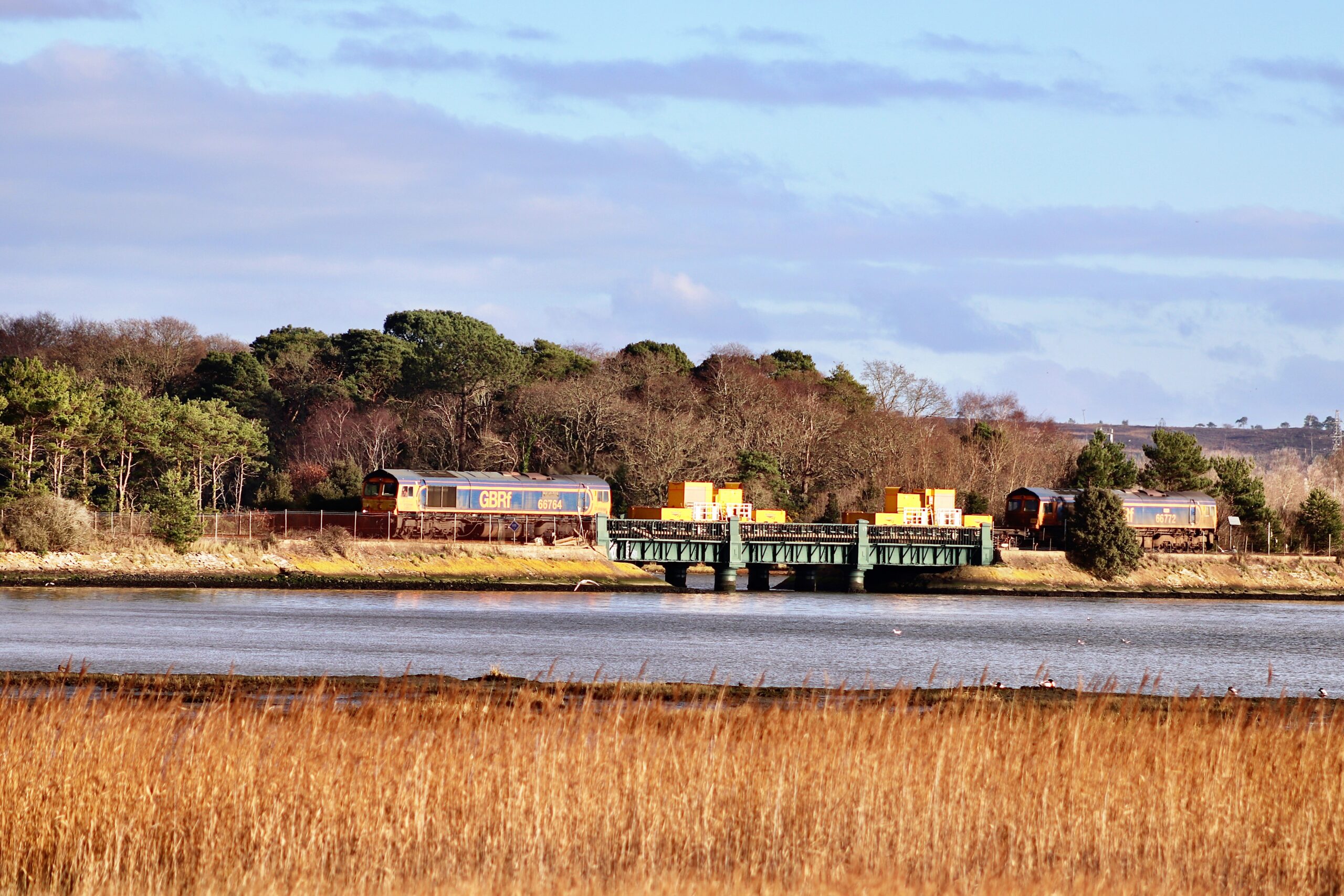
The pioneer locomotive of the 250-strong class was taken by rail to the nearby Immingham depot, fittingly hauled dead by Class 56 No. 56018, which itself arrived by sea at Harwich from Romania on January 22 1977. After unloading from heavy lift vessel Fairload, operated by Jumbo Shipping, it was inspected to ensure it was fit to move and the brake system tested. Widespread rumours that the locomotive was dropped as it was loaded in the USA were proved to be untrue. After No. 66001 was unloaded a delighted EWS Project Engineer Graham Preston told RAIL: “This is only the beginning – I’ll be even more happy when the rest have arrived. GM has made a cracking start with delivery well within the contract time and bang on schedule. “Our best estimate was for the locomotive to leave the factory in early March and it actually was finished at the end of March. It’s the fastest that GM has ever delivered a new locomotive design.” It was originally hoped that the locomotive would arrive a few weeks earlier, however the original plan, to use a fast seven-day crossing from Canada to Liverpool was scuppered when the price rose considerably. Instead No. 66001 was towed to Albany, New Jersey where it was loaded. The ship previously visited Sutton Bridge, Lincolnshire, to unload machinery, before arriving at Immingham. Deliveries of the production series, construction of which will start in earnest once EWS and Railtrack are satisfied with the prototype, will be made to Newport, South Wales. A ship, which can carry up to eleven locomotives each journey, has been chartered for two years and will take around 10 days for the crossing from Halifax, Nova Scotia, Canada. Once the Class has received Railtrack type approval and a safety case, (with completion of acceptance tests on No. 66001) there will not be a need for Railtrack to inspect each locomotive. Locomotives will arrive tested and ready to run. EWS will check lubricants, coolant, brake systems and all systems. This will take three hours per locomotive after which they will go directly into traffic. As production starts in May the first four production series (Nos. 66003-6) are expected in July, eight (Nos. 66007-14) in August and 11 (Nos. 66015-25) in September. Thereafter deliveries will be 11 locomotives a month. The other pre-production locomotive, No. 66002, which has yet to be painted, was due to move to the Association of American Railroads test track at Pueblo, Colorado in late May for a series of exhaustive tests. It will be delivered later this year once the work is complete. During the weekend of April 18/19 No. 66001 was inspected over a pit at Immingham depot, and on Monday April 20 was displayed to the press at the depot, where it made its first movements under its own power in Britain. This took place within the depot confines, which is EWS, not Railtrack infrastructure. One aspect of the Class 66 design is its radial steering bogies which slightly turn the leading axles on each bogie as the locomotive enters a curve. This results in no flange squeal, even on the sharpest curves and is expected to double the life of tyres. No. 66001 was towed to Toton by 60016 on Monday evening, where a further, very detailed inspection was made. Early on Friday April 24 it was towed to Chester where it was exhibited for a visit by Deputy Prime Minister John Prescott, returning to Toton the same day. It was moved on Monday April 27 to the Engineering Development Unit at Derby (former Research Department) for two weeks of static tests, to be followed by a week of loaded main line trials, probably over the Midland Main Line. After this it will enter service, and is expected to be based initially at Newport, South Wales. Three EWS staff have been trained in Canada to drive the Class 66. Conversion courses for other crews are being developed, but it is expected that Class 59 drivers will require a one-day course, and Class 58/60 drivers will need a three day course. The Class 66 can work in multiple with Class 59s and 67s (to be delivered in 1999). – 13/01/2024Southern Class 377 No. 377201 working 1N15 0928 Southampton Central to Brighton on the approach to St Denys – 13/01/2024SWR Class 450 No. 450057 working 2E20 0838 Portsmouth & Southsea to Southampton Central /at St Denys having passed Southern Class 377 No. 377201 forming 1N15 0928 Southampton Central to Brighton – 13/01/2024Freightliner Class 66 No. 66539 passing St Denys working 4018 0424 Lawley Street FLT to Southampton MCT – 13/01/2024Freightliner Maritime with Class 70 No. 70007, Class 66 No. 66553 in the foreground and Class 66 No. 66556 and Class 70 No. 70005 behind – 13/01/2024Class 70 No. 70002 being shunted around Southampton MCT by Class 66 No. 66556- 13/01/2024“Super Shunter” for the day Class 66 No. 66556 at Freightliner Southampton Maritime – 13/01/2024The Totton based Snow & Ice Treatment Train passes Southampton MCT, top and tailed by GBRf Class 66 No.’s 66764 ‘Major John Poyntz Engineer & Railwayman’ and 66772 ‘Maria’ – 13/01/2024Having shunted back at Southampton Maritime, Freightliner Class 66 No. 66539 arrives at the container terminal working 4018 0424 Lawley Street FLT to Southampton MCT – 13/01/2024
Video which consists mostly of Freightliner “Super Shunter” Class 66 No. 66556 moving things about at Southampton Maritime – 13/01/2024
Late on Saturday evening, Freightliner had the responsibiity of providing motive power for an engineers train to Hamworthy. Two of the FL Class 66 locos we had last seen at Maritime earlier in the day were provided on this working, which I saw at Poole on the outward trip as well as the return working which ran on Sunday morning. The work site was to the west of Hamworthy railway station and away from prying eyes. I did witness two Network Rail employees placing a temporary STOP sign – to protect the branch line – in front of the existing STOP sign which is fixed to a sleeper chained across the track just after the point where the Hamworthy branch leaves the main line. A case of belt and braces!
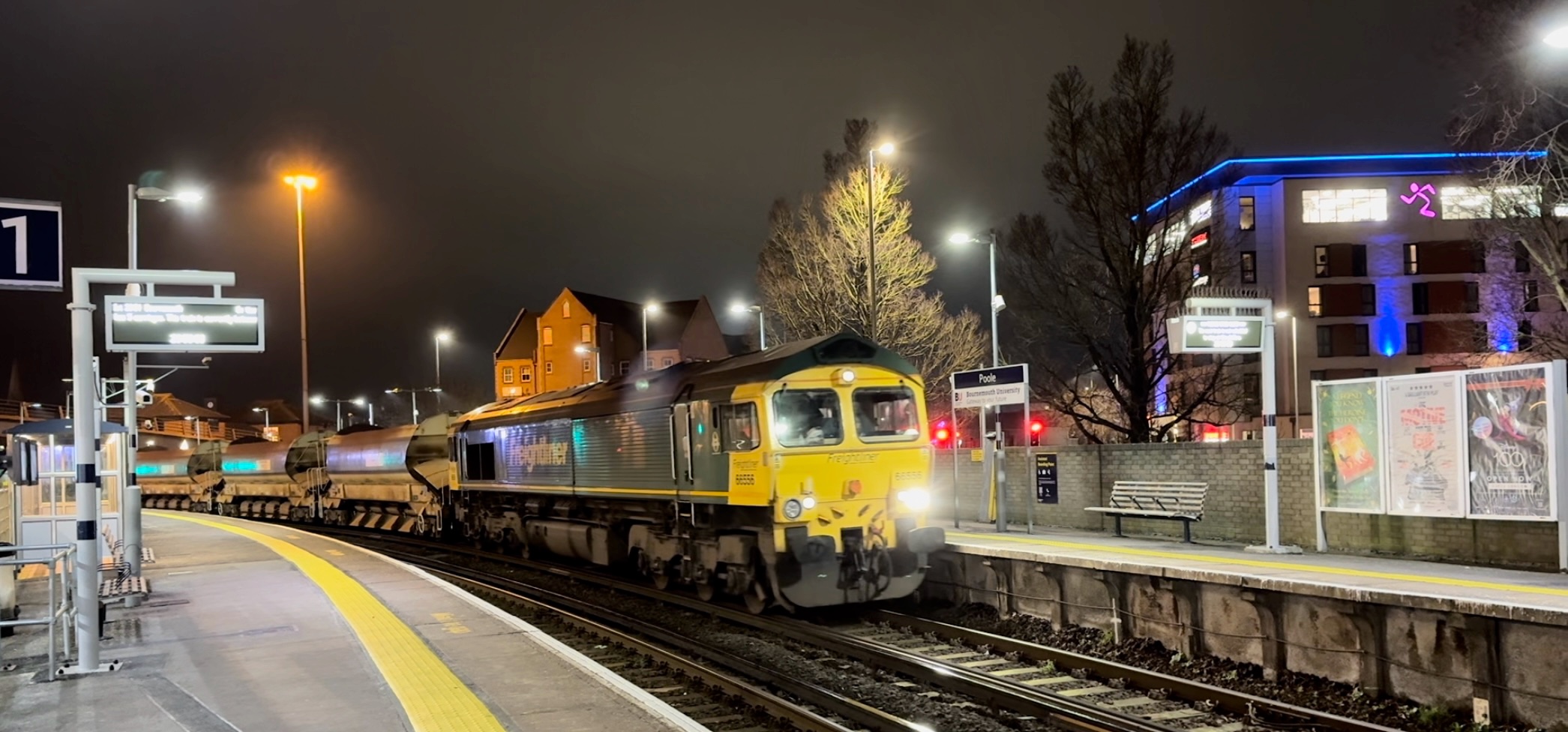
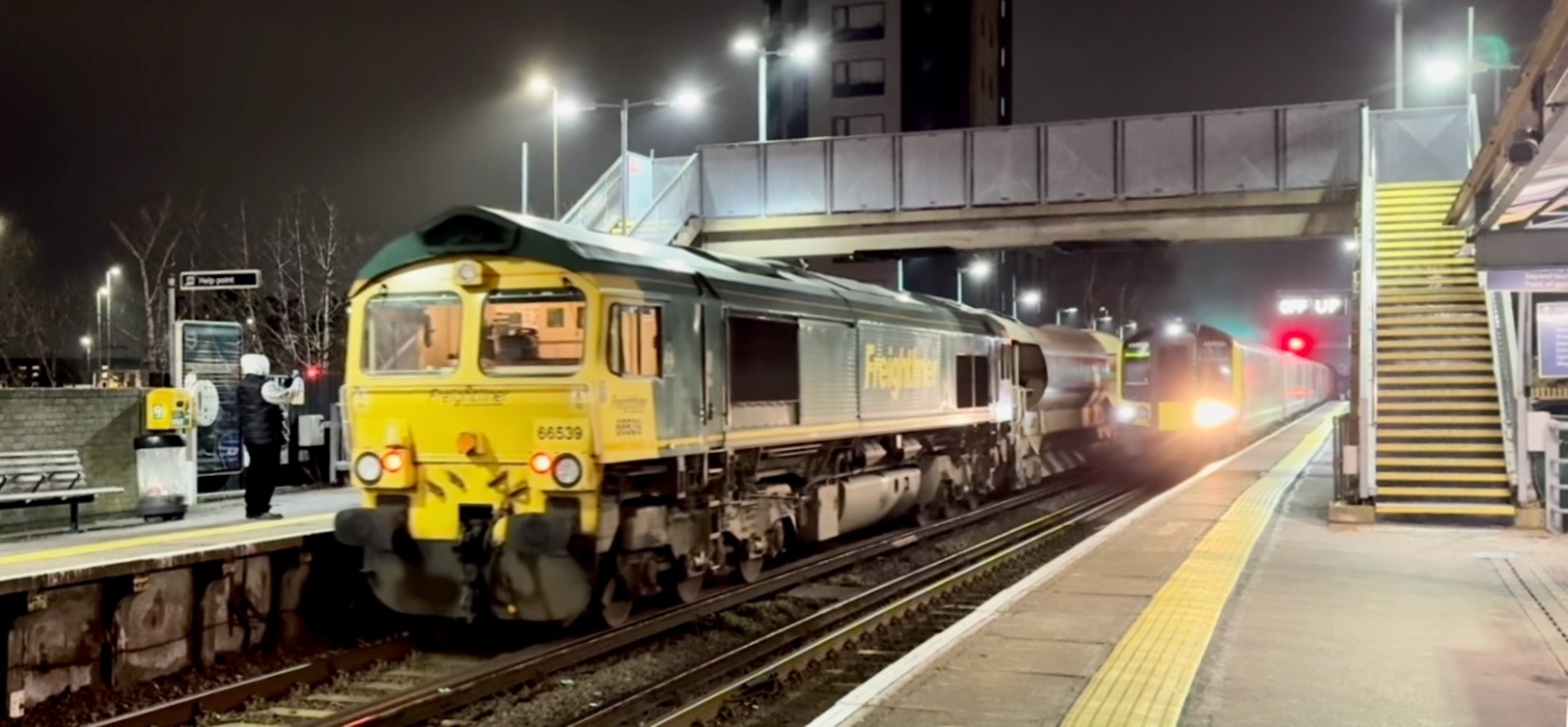
Freightliner Class No. 66556 crawls through Poole working 6Y85 22:44 Eastleigh East Yard to Hamworthy – 13/01/2024Freightliner Class No. 66539 at Poole on the rear of 6Y85 22:44 Eastleigh East Yard to Hamworthy as SWR Class 444 No. 444026 arrives with the 2W86 2310 Weymouth to Bournemouth service – 13/01/2024
Video of Freightliner Class No.’s 66 locomotives 66556 and 66539 at Poole working ballast train 6Y85 22:44 Eastleigh East Yard to Hamworthy (13/01/2024) and 6Y85 07:30 Poole to Eastleigh East Yard (14/01/2024)
Moving forward a few days to Thursday 18th January and having received confirmation from friend of this blog, Jamie, that the aforementioned No. 66756 was scheduled to be working down the Fawley branch to Marchwood near Southampton, and taking into consideration the beautiful sunny, but cold day, I made the last minute decision to drive over and wait for the train to cross at the manual level crossing adjacent to the former Marchwood railway station.
Looking from the level crossing at Marchwood down the line towards Totton, GBRf Class 66 No. 66756 ‘Royal Corps Of Signals’ can be seen approaching with 4O77 0256 London Gateway GBRf to Marchwood Mod GBRf – 18/01/2024GBRf Class 66 No. 66756 ‘Royal Corps Of Signals’ about to cross over the manual level crossing at Main Road, Marchwood hauling 4O77 0256 London Gateway GBRf to Marchwood Mod GBRf – 18/01/2024GBRf Class 66 No. 66756 ‘Royal Corps Of Signals’ on the associated return working (4Z47 1218 Marchwood MOD GBRf to Doncaster Down Decoy GBRf) from Marchwood MOD pauses in the former Marchwood railway station awaiting the ‘go ahead’ to proceed from the crossing gate keeper – 18/01/2024 Although semaphore signals remain in situ at Marchwood, they do not appear to be operational as GBRf Class 66 No. 66756 ‘Royal Corps Of Signals’ works 4Z47 1218 Marchwood Mod GBRf to Doncaster Down Decoy GBRf – 18/01/2024
Video of GBRf Class 66 No. 66756 ‘Royal Corps Of Signals’ at Marchwood working 4O77 0256 London Gateway GBRf to Marchwood Mod GBRf and 4Z47 1218 Marchwood Mod GBRf to Doncaster Down Decoy GBRf – 18/01/2024
Fawley oil refinery was established in 1921 with its construction starting in the spring of 1923, the contractors being Sir Robert McAlpine & Co Ltd. The Fawley railway branch line was built under provision of the Light Railways Act 1896 as the “Totton, Hythe and Fawley Light Railway”, opening on 20th July 1925. It branches off at the South West Main Line west of Totton station, running parallel with the line to Bournemouth and Weymouth for one mile before curving away to the south. Prior to the passenger service being withdrawn on 14th February 1966, stations were served at Marchwood, Hythe, and Fawley. Between Hythe and Fawley a station for workmen was opened briefly between 1958 and 1965 named Hardley Halt.
Railway traffic as far as Marchwood increased after a siding to Cracknore Hard was laid in 1939 for harbour defences. It was expanded to a full-blown military port in 1943, the slipway becoming a major assembly point for Mulberry floating harbour sections in 1944.
The passenger service to Fawley was always traditionally somewhat sparse with just three return trips and a long gap during the day when refinery staff were at work. There was an expansion in freight traffic as, for more than 80 years, ExxonMobil and its predecessors used rail to move oil products from the refinery, but all associated traffic ceased in September 2016. Railway Magazine reported the last DB Cargo train from Fawley; a rake of empty bogie tankers, ran on September 5th 2016. The line is now only used by freight to and from Marchwood Military Port as well as taking and removing SWR Class 701 EMU’s in storage.
Looking to the future, it is proposed to partly reopen the line with stations located at Marchwood and Hythe. On 23rd May 2020, the Department of Transport (DafT) announced that the line now marketed as the “Waterside Line” had been shortlisted for further funding to investigate the restoration of passenger services. The end of the 8-mile line would be unused, but a southern terminus, called Hythe and Fawley Parkway, would open on the site of the Hardley Halt station.
In March 2022, Rail Magazine reported that Network Rail would be taking the scheme to get the line reopened forward. However, the proposed Hythe & Fawley Parkway station will not now be included. The service that Network Rail is proposing is a 2 car Class 158/9, running every 30 minutes between Hythe and Southampton with passenger services starting in 2025 at the earliest if plans are accepted. Following public consultations held in August / September 2022, 84% of people backed the proposal to reinstate the line for passenger service.
The Totton Yard based Snow and Ice Treatment Train (SITT) saw multiple incursions into Dorset during the recent frosty January weather working:
12/01/2024 – 3Y89 2200 Totton Yard to Totton Yard
14/01/2024 – 3Y88 1009 Eastleigh East Yard to Eastleigh East Yard
17/01/2024 – 3Y89 2200 Totton Yard to Totton Yard
19/01/2024 – 3Y89 2200 Totton Yard to Totton Yard
Snow & Ice Treatment Train workings in January 2024 (additional video courtesy of G E Barrett)
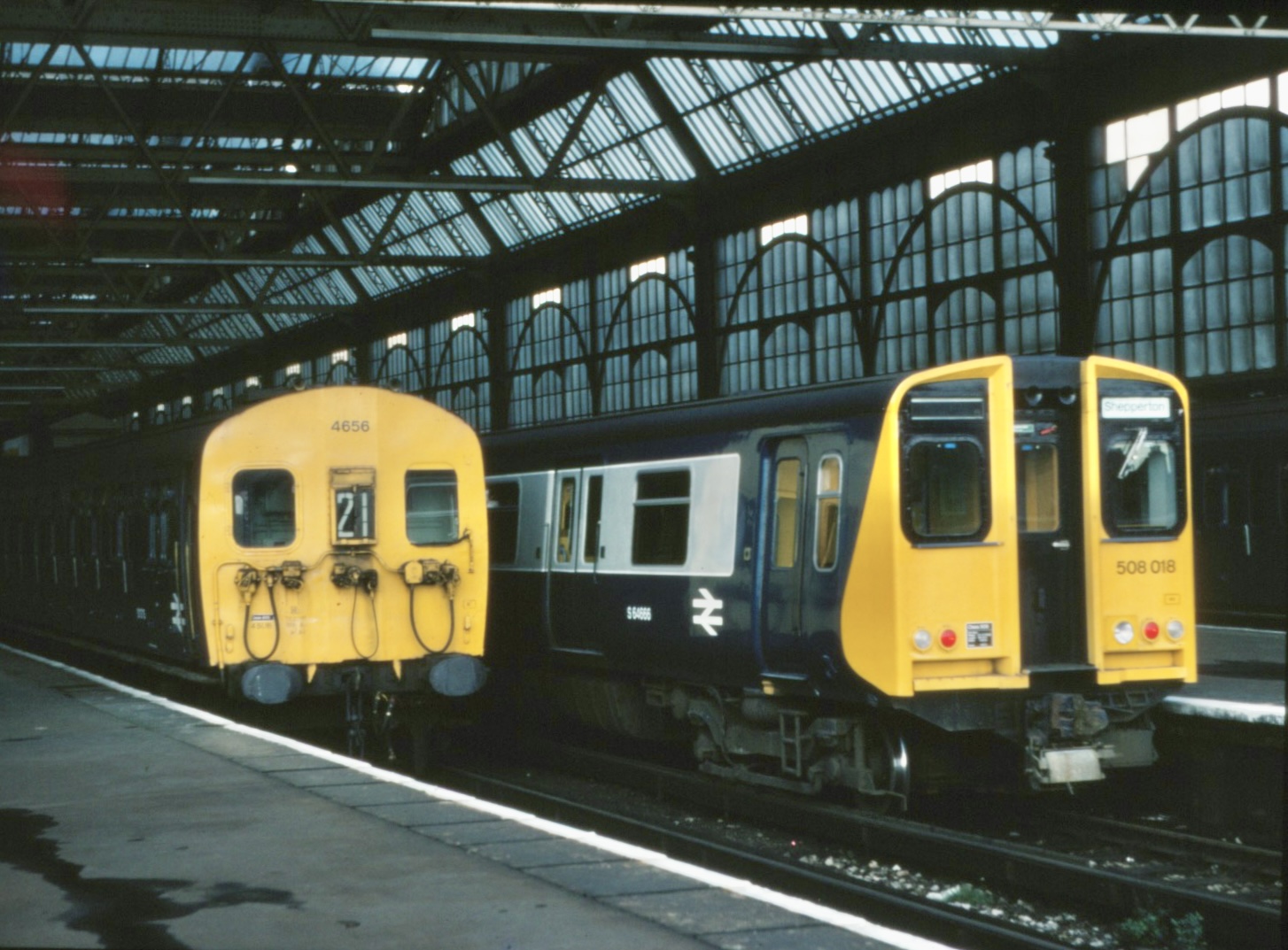
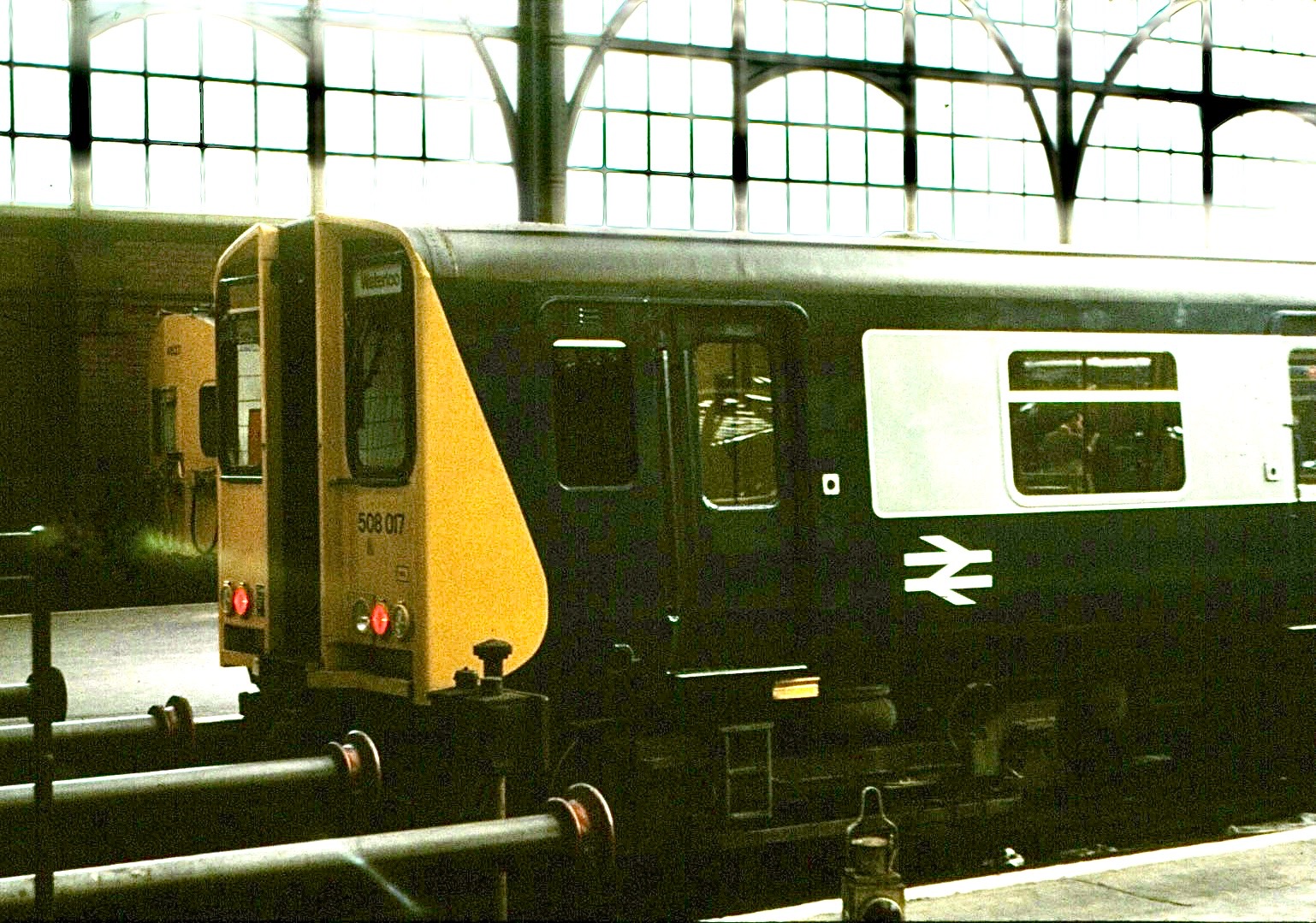
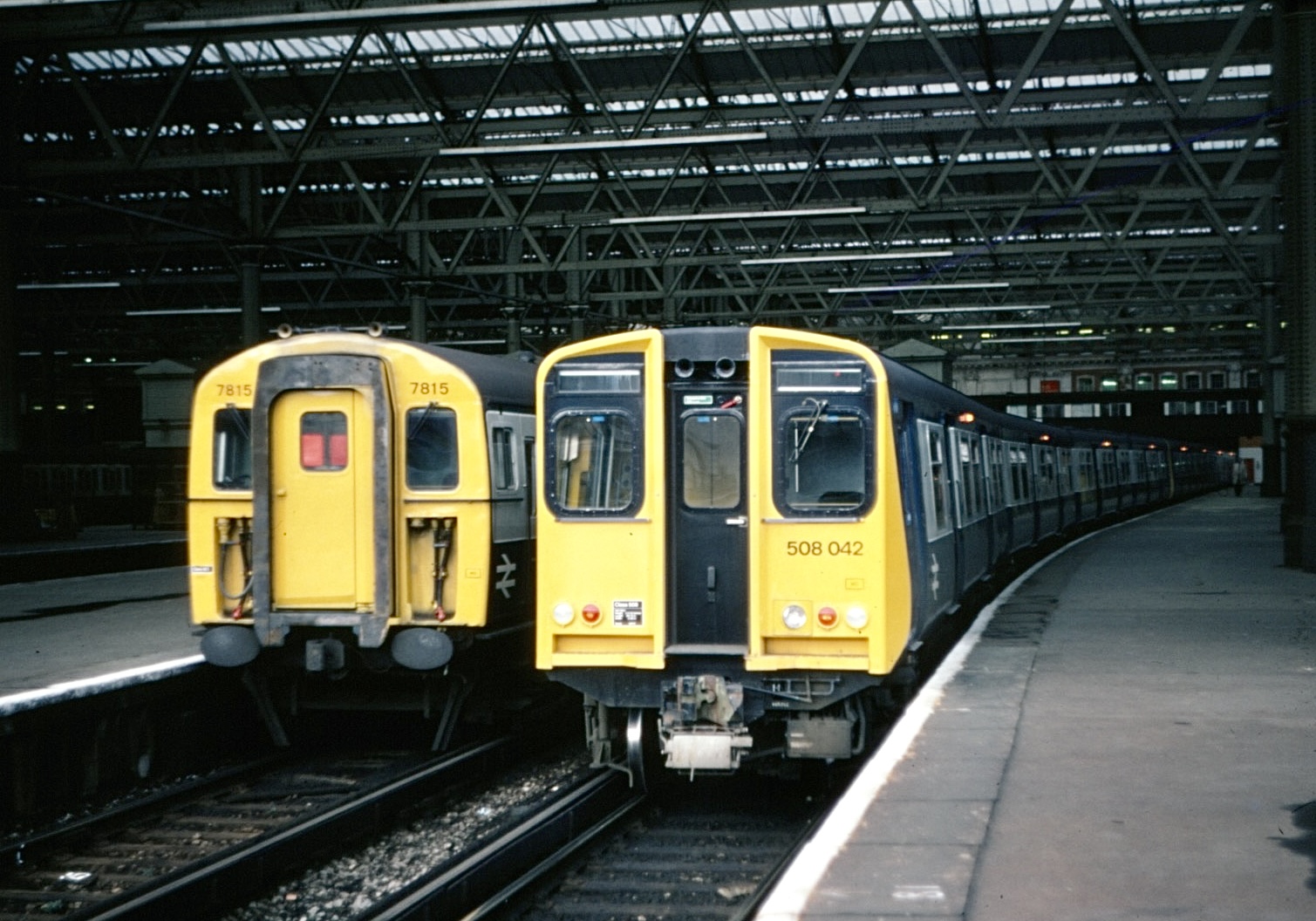
Elsewhere on the UK network, the final day of Class 508 workings took place on 16th January 2024 when Merseyrail withdrew the last operational example of the class, No. 508104 after 44 years of service. The Class 508 developed from the prototype PEP stock were built by British Rail Engineering Limited (BREL), at Holgate Road carriage works, York, between 1979 and 1980 and initially worked alongside much older first generation 4-SUB EMU’s in the London Waterloo area. The first Class 508 unit was delivered to Strawberry Hill depot on 9th August 1979.
Class 508 No. 508018 and 4-SUB No. 4656 at London Waterloo – 23/03/1981Class 508 No. 508017 at the buffer stops at London Waterloo – 23/03/1981Class 508 No. 508042 and 4-VEP 7815 at London Waterloo – 23/03/1981
Transfer to of the Class 508’s to Merseyside began in 1982 when they were reduced from 4-car to 3-car sets. The removed trailer cars live on as part of South Western Railway Class 455.
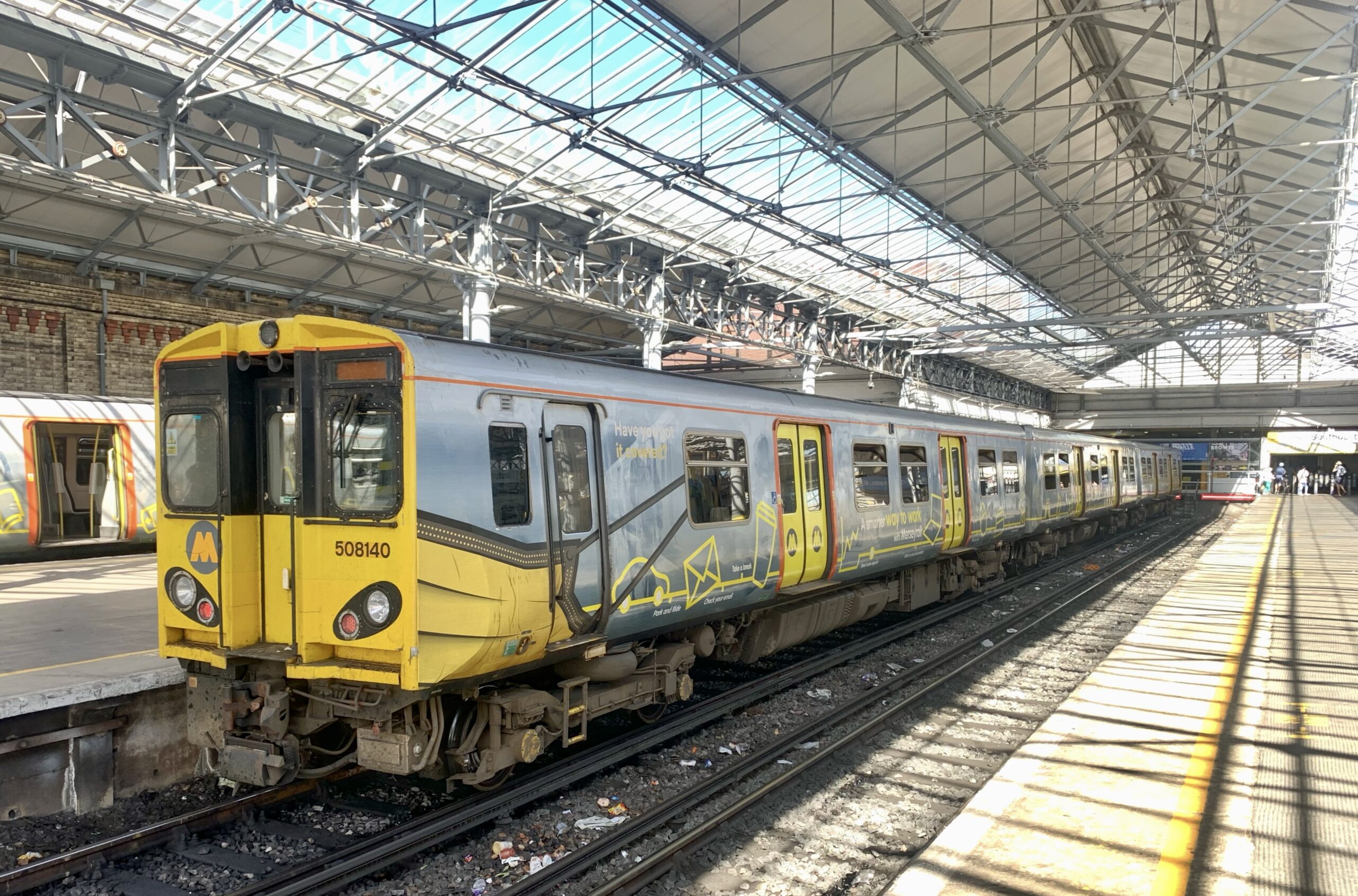
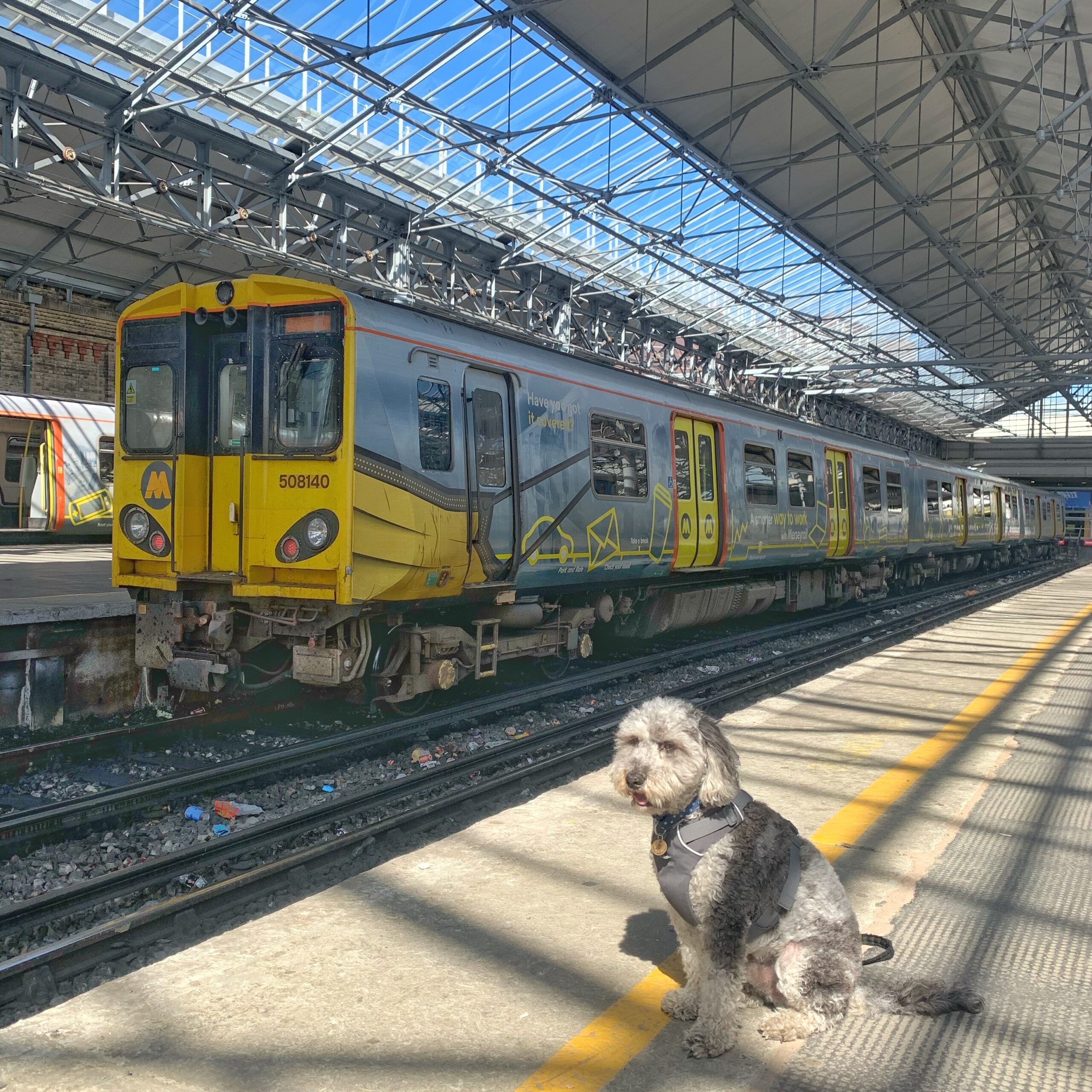
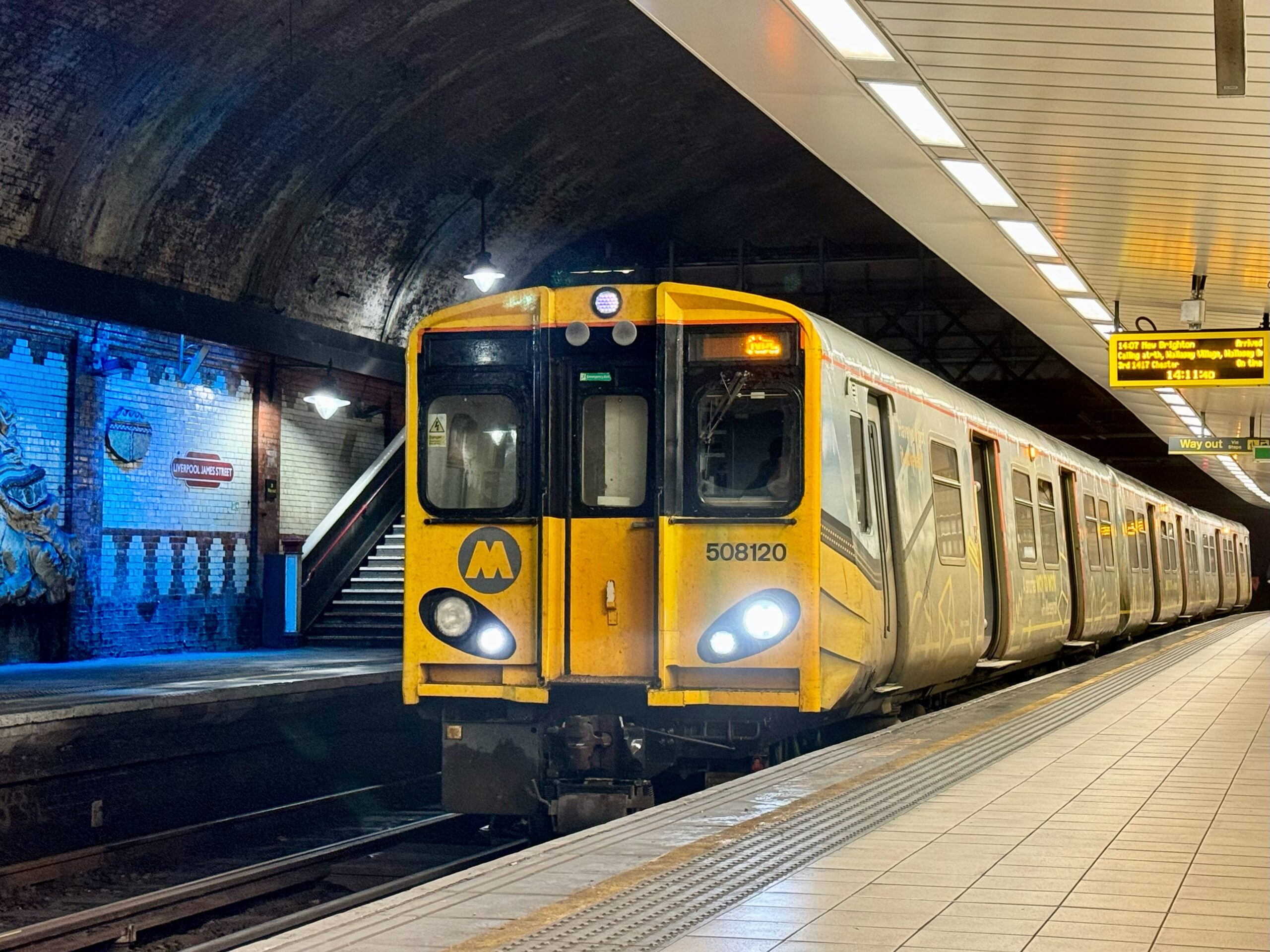
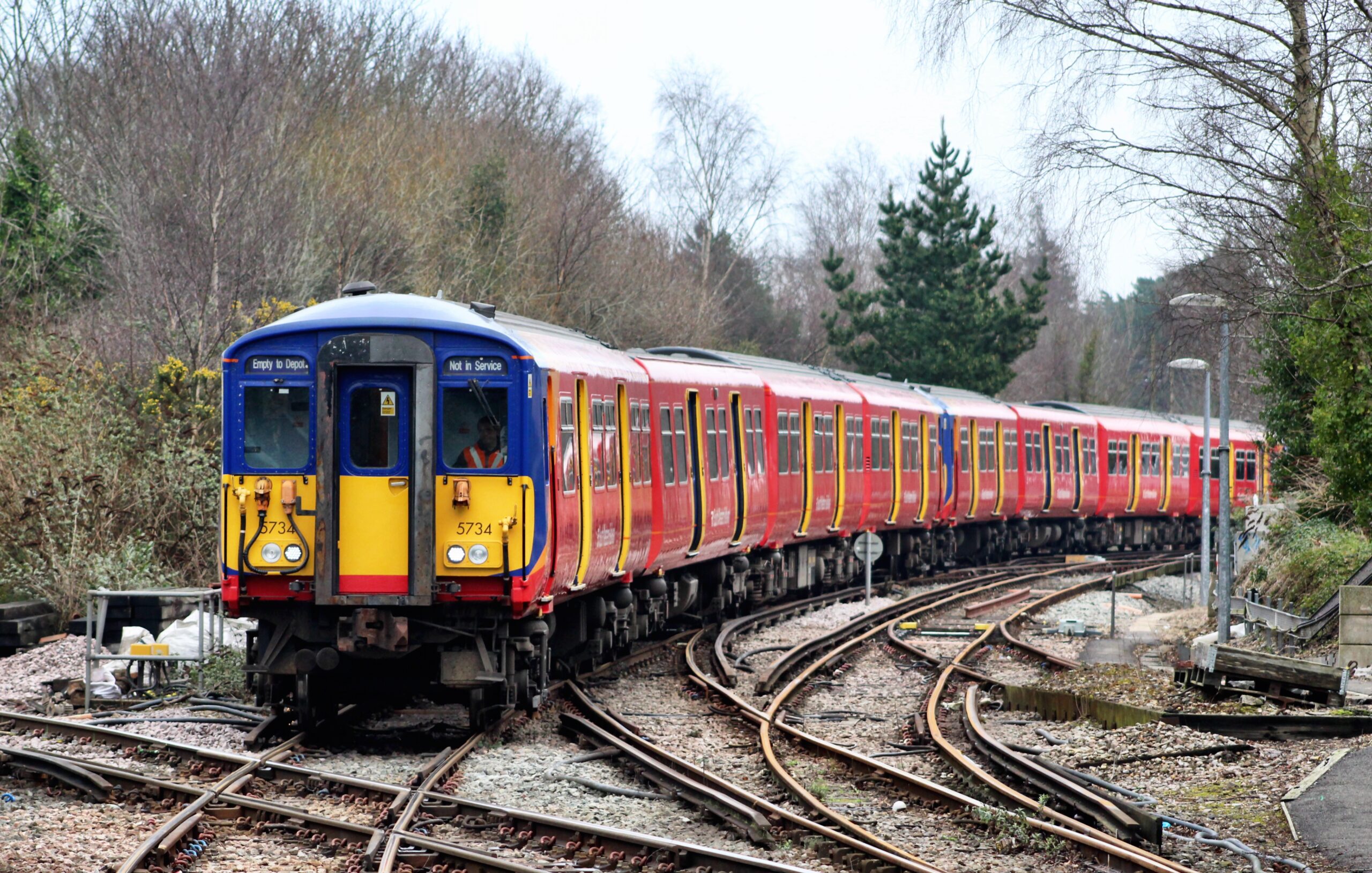
Class 508 No. 508140 at Southport – 13/07/2022Yoshi at Southport taking a look at Class 508 No. 508140 – 13/07/2022Class 508 No. 508120 at Liverpool James Street with the 1407 service to New Brighton – 09/12/2023Class 455 No. 455734 leading classmate No. 455708 towards Branksome working 5Y51 empty coaching stock movement 1431 Bournemouth Traction & Rolling Stock Depot to Wimbledon Depot Sidings. The second coach of each unit was taken from Class 508 units and the different height and shape of the carriage to the rest of the unit can be clearly seen – 02/03/2022
As you may be aware, train strikes are planned from Tuesday 30th January through to Monday 5th February 2024.
• Tuesday 30th January – Gatwick Express, Great Northern, South Western Railway (including Island Line), Southeastern, Southern, Thameslink
• Wednesday 31th January – Northern, TransPennine Express
• Friday 2nd February – c2c, Greater Anglia (including Stansted Express), LNER
• Saturday 3rd February – Avanti West Coast, East Midlands Railway, London Northwestern Railway, West Midlands Railway
• Monday 5th February – Chiltern Railways, CrossCountry, Great Western Railway
In addition, the above train operators will have an overtime ban between Monday 29th January and Tuesday 6th February.
Dorset Council and BCP Council have joined forces to develop a new transport plan for the whole of Dorset fit for the 21st Century and have launched a survey running until 3rd March. They would like our thoughts on the following:
• improving transport across rural and urban areas;
• ensuring all ages and abilities can access services;
• making it easier to be more physically active;
• enabling more opportunities for affordable, available and accessible public transport;
• helping people feel safer on our roads and on public transport;
• reducing congestion and carbon emissions; or
• improving digital and real-time travel information
You can find out more and complete the survey online here – paper copies are also available at Dorset Council and BCP Council libraries.
Many thanks for reading, for your comments and corrections. All being well, we’ll be back soon! Be seeing you.
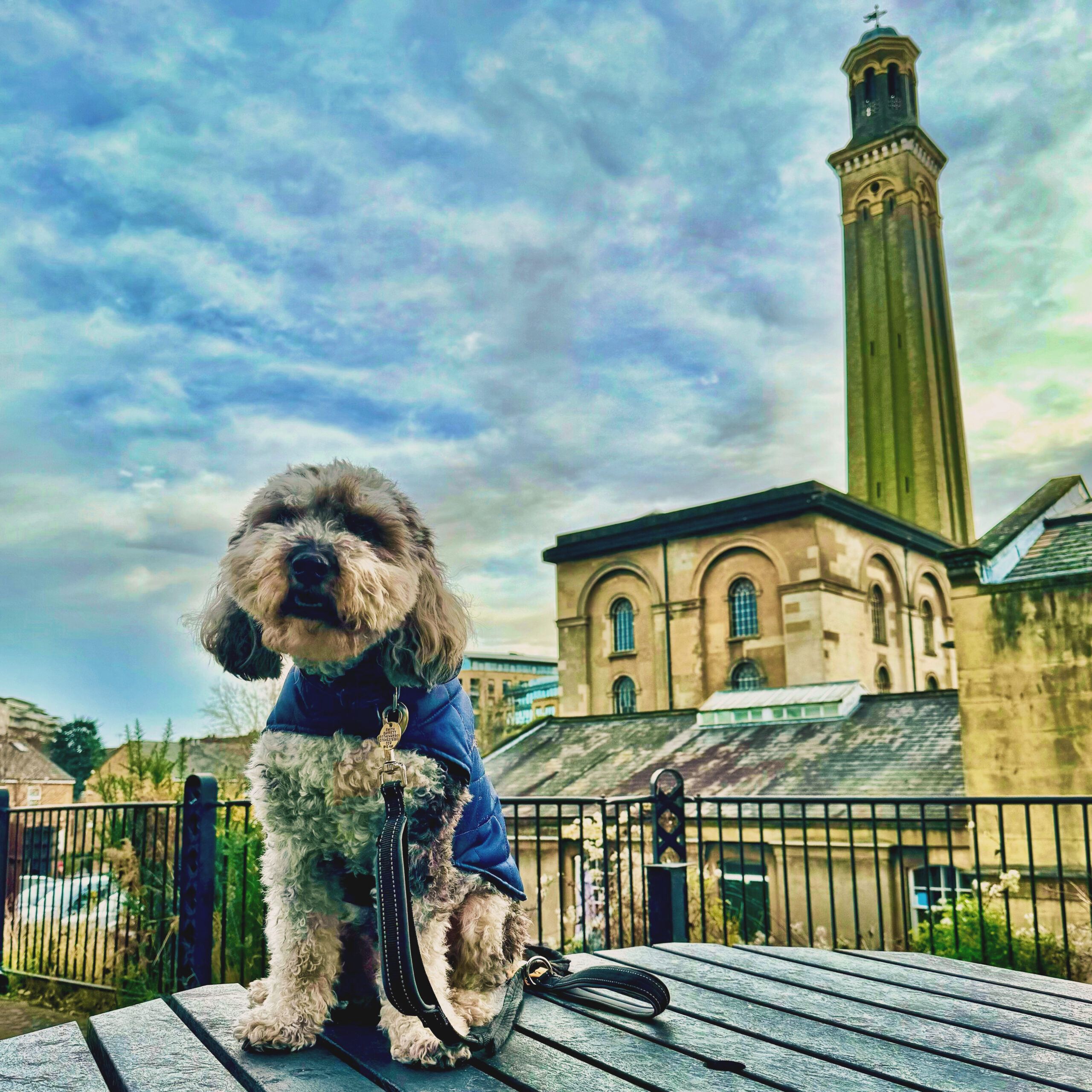
Yoshi visited The London Museum of Water & Steam to celebrate the New Year. In the background are the museum buildings and the impressive Victorian standpipe tower, which is not, as you might expect, a chimney but a brick winter coat for the two systems of vertical pipes – through which water was pumped before it entered the mains water supply – contained within to prevent freezing and is the museum’s most striking feature standing at 200 ft high. The Grade I brick tower, of Italianate design, was constructed in 1867 to replace an earlier open metal lattice structure – 01/01/2024
January 1st 2024 to January 11th 2024
We kicked off 2024 with a visit to the “New Years Steam Up” being held at the London Museum of Water & Steam in Brentford. The Steam Up weekend of celebrations was the first opportunity in two years for people to marvel at the monstrous working steam engines that once provided water to the millions living and working in London. In July 2022, the Museum’s 96 year old Lancashire Boiler failed an inspection when it was discovered one of the seventeen rivets which hold the crown valve mounting flange onto the main boiler shell had lost its heat inside the boiler’s steam space. This meant that the boiler could no longer be used and the steam engines fell silent and still while extensive repairs were carried out. Now, just in time to celebrate the museum’s 50th anniversary the boiler is steaming once again.
Situated on the site of the former Kew Bridge Pumping Station, close to Kew Bridge on the River Thames in West London, the museum is centred on a collection of stationary water pumping steam engines dating from 1820 to 1910. It is the home of the world’s largest collection of working Cornish engines, including the largest working beam engine in the world; the Grand Junction 90 inch.
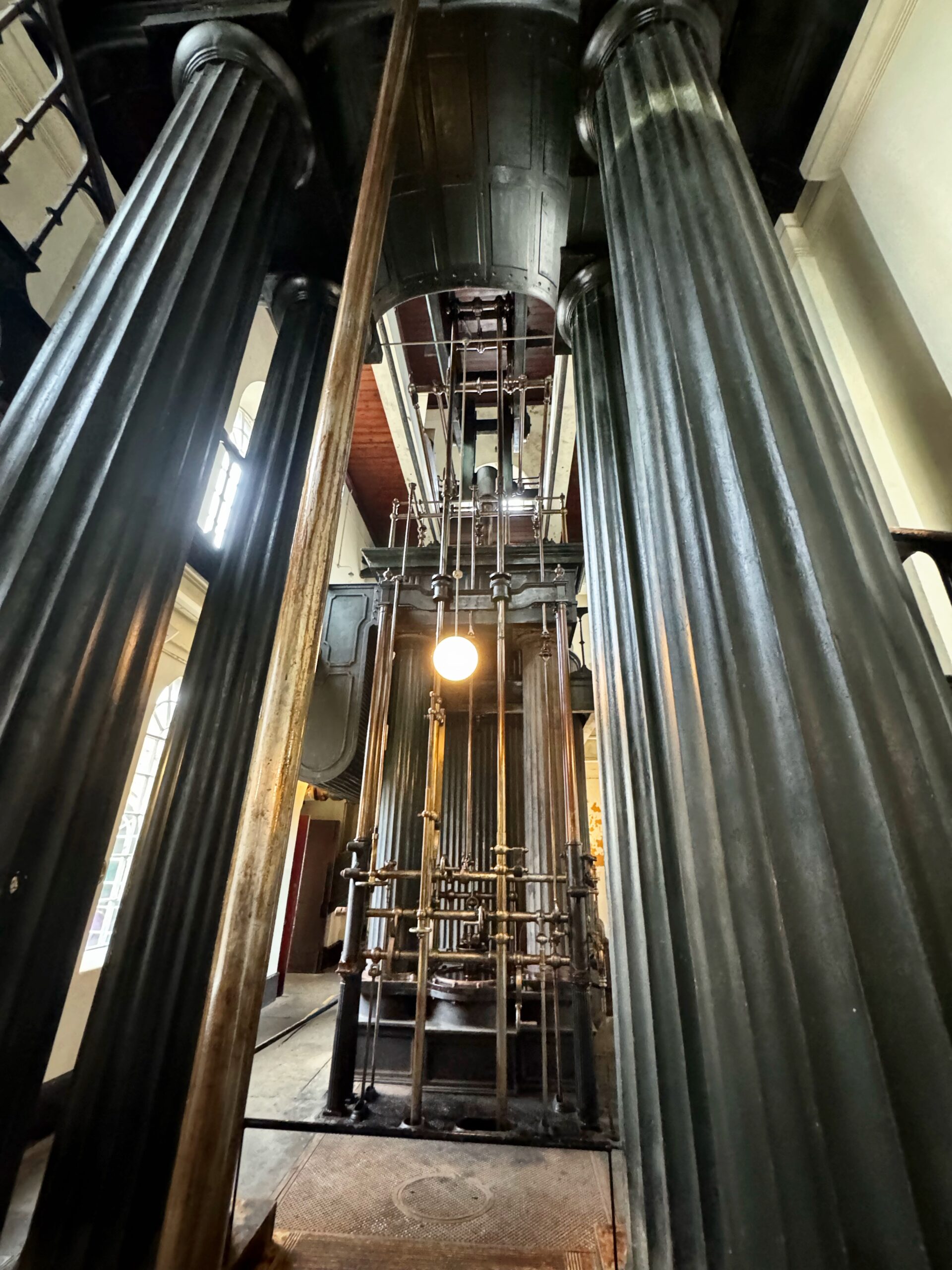
The Grand Junction 90 inch has a cylinder diameter of 90 inches (hence its name!) and was used to pump water to London for 98 years. This machine is over 40 feet high and weighs about 250 tons. It was described by Charles Dickens as “a monster”. It was built by Sandys, Carne & Vivian of Hayle in 1846 as the first Cornish beam engine specifically designed for water supplies and was powerful enough to supply water to the upper floors of buildings, allowing direct supply to upstairs bathrooms 01/01/2024
We arrived early after a good run in the car up from Dorset and luckily found parking on site in the small car park at the museum, although the site is only a 3 minute walk from Kew Bridge railway station if you chose to arrive by train. There were a number of families in evidence with young children during our visit and the museum is a great place to learn and have fun.
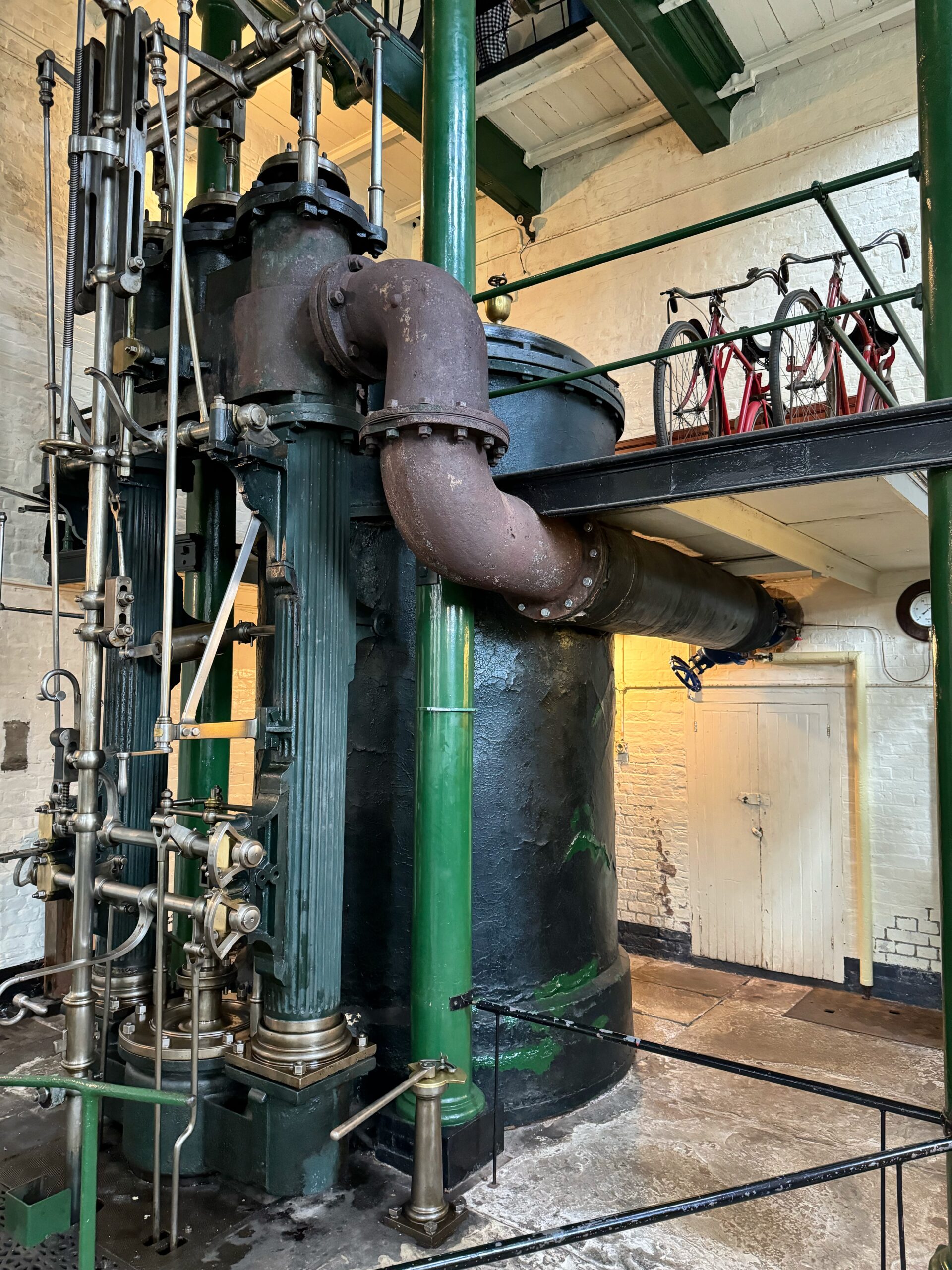
Exhibiting a plethora of steam, diesel and electric powered pumps, the London Museum of Water & Steam tells the story of London’s water supply housed in historic Georgian buildings and they very kindly allowed access to Yoshi, but explained that our boy may not like some of the steam engines when they are working. We duly followed this advice and Yoshi waited with one of his hoomans in the Pump and Grind Coffee Shop or explored the garden area while the machines were being operated. The coffee shop was very busy and served an excellent cuppa. It is run by “Our Barn Community”, a local charity working with young people with learning difficulties enabling a supported work placement.
We have shared just a small fraction of the engineering marvels housed at the museum below:
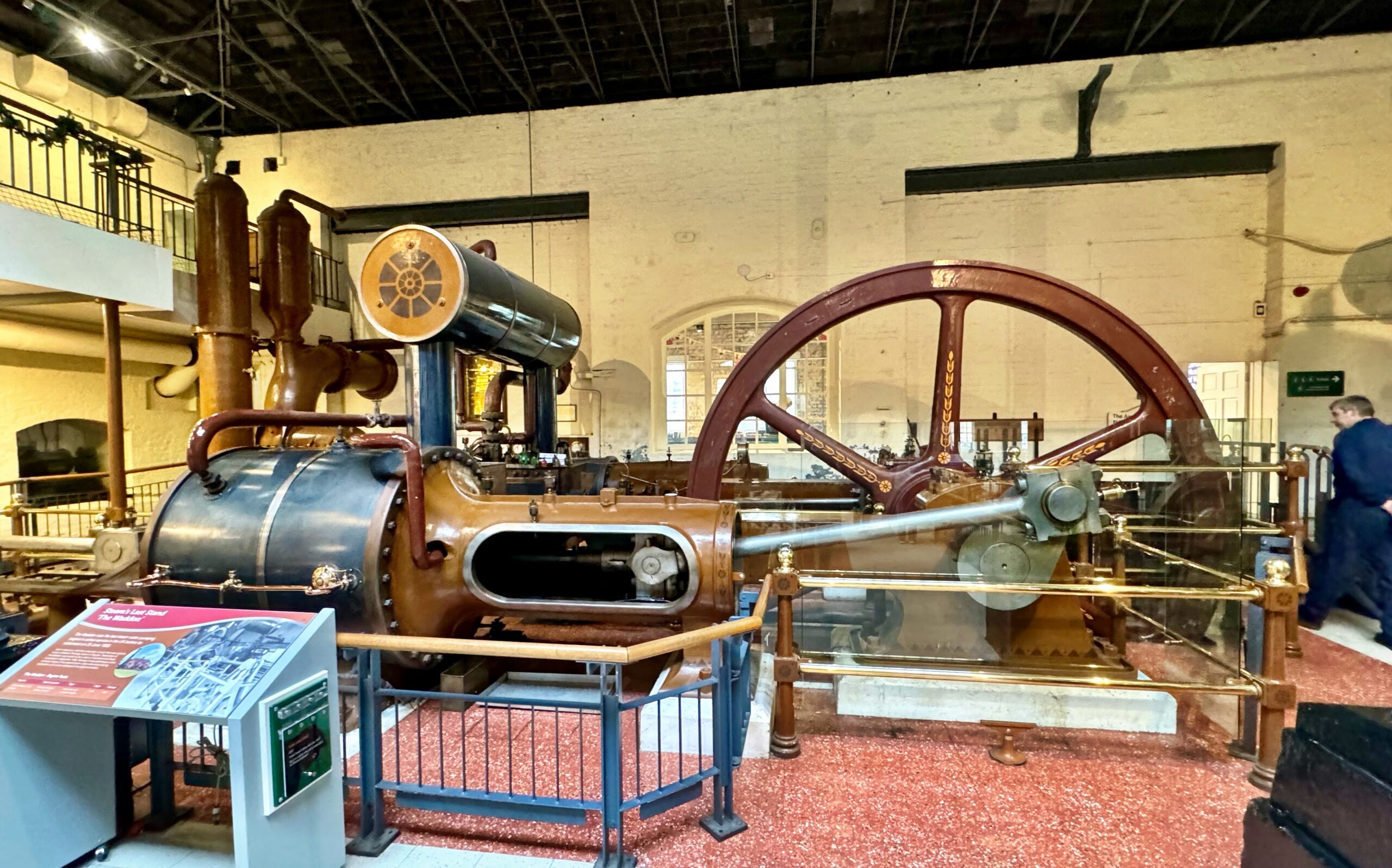
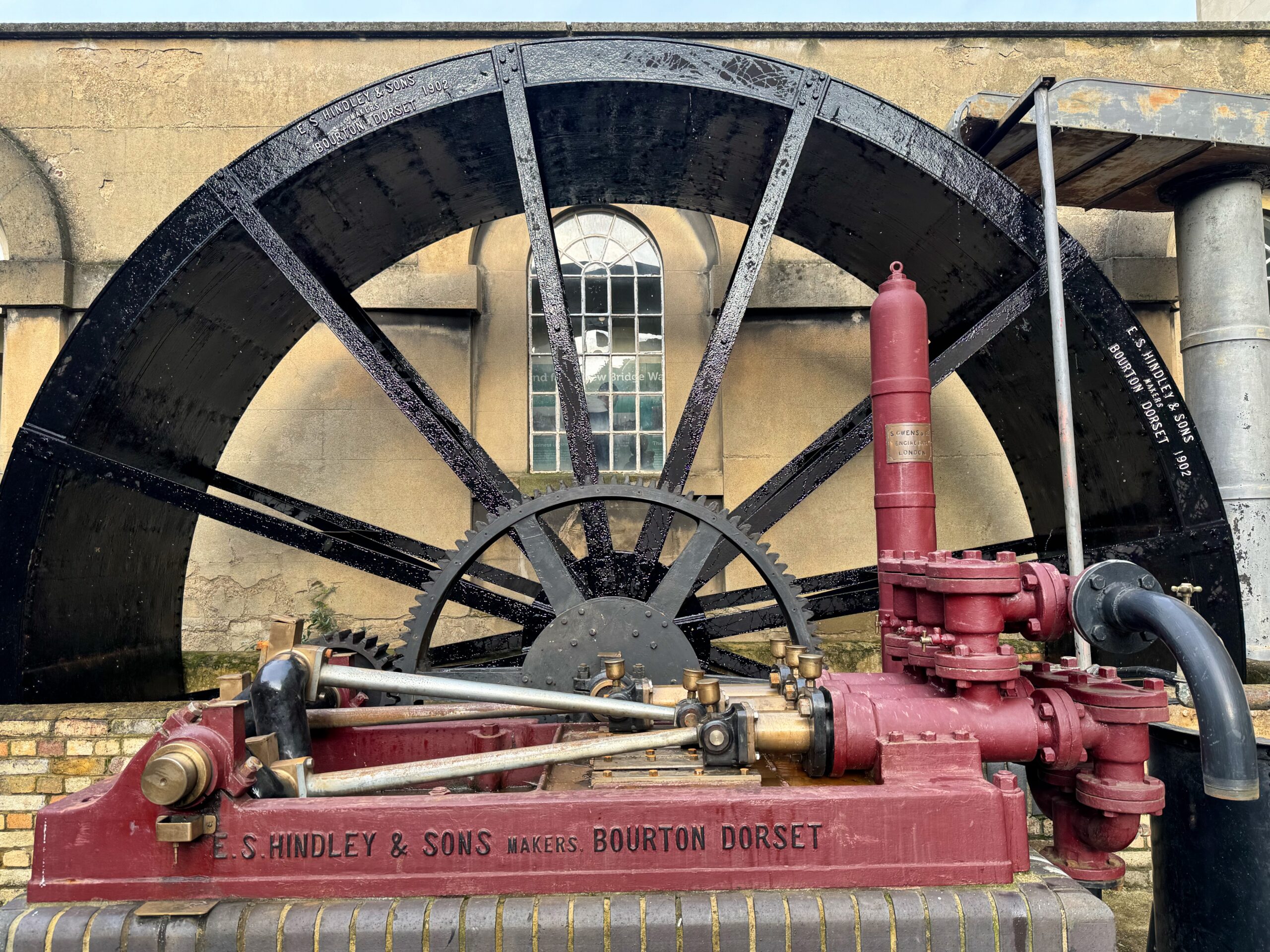
The Waddon Engine with drove 3 pumps was built by James Simpson & Co of Newarkin 1910 and originally found use at Waddon Pumping Station in Croydon. It was the last steam water-pumping engine in active UK service before being retired in June 1983. It was restored in 1990 and restored to original Edwardian colours for display at the museum – 01/01/2024This waterwheel was built in 1902 by S. Hindley & Sons in Bourton, Dorset for the Duke of Somerset to serve his estate at Maiden Bradley in Wiltshire and was one of the last waterwheels ever built to pump water in the UK – 01/01/2024The Boulton & Watt (West engine) is the oldest engine in the London Museum of Water & Steam having been built in Birmingham in 1820.It was one of a pair moved to Kew in 1840 which were then converted into a Cornish type between 1846 and 1848. Retired in 1944, this was the first engine to be returned to working order in 1975 – 01/01/2024
Kew Bridge Pumping Station was originally opened in 1838 by the Grand Junction Waterworks Company, expanding over the ensuing years and ultimately housing six steam pumping engines as well as four Allen diesel pumps and four electric pump sets. The steam engines were retired from service in 1944, although two were kept on standby until 1958. The Metropolitan Water Board thankfully decided not to scrap the resident steam pumping engines and set them aside to form the basis of a museum display at a later date which came to fruition in 1974 with the formation of the Kew Bridge Engines Trust.
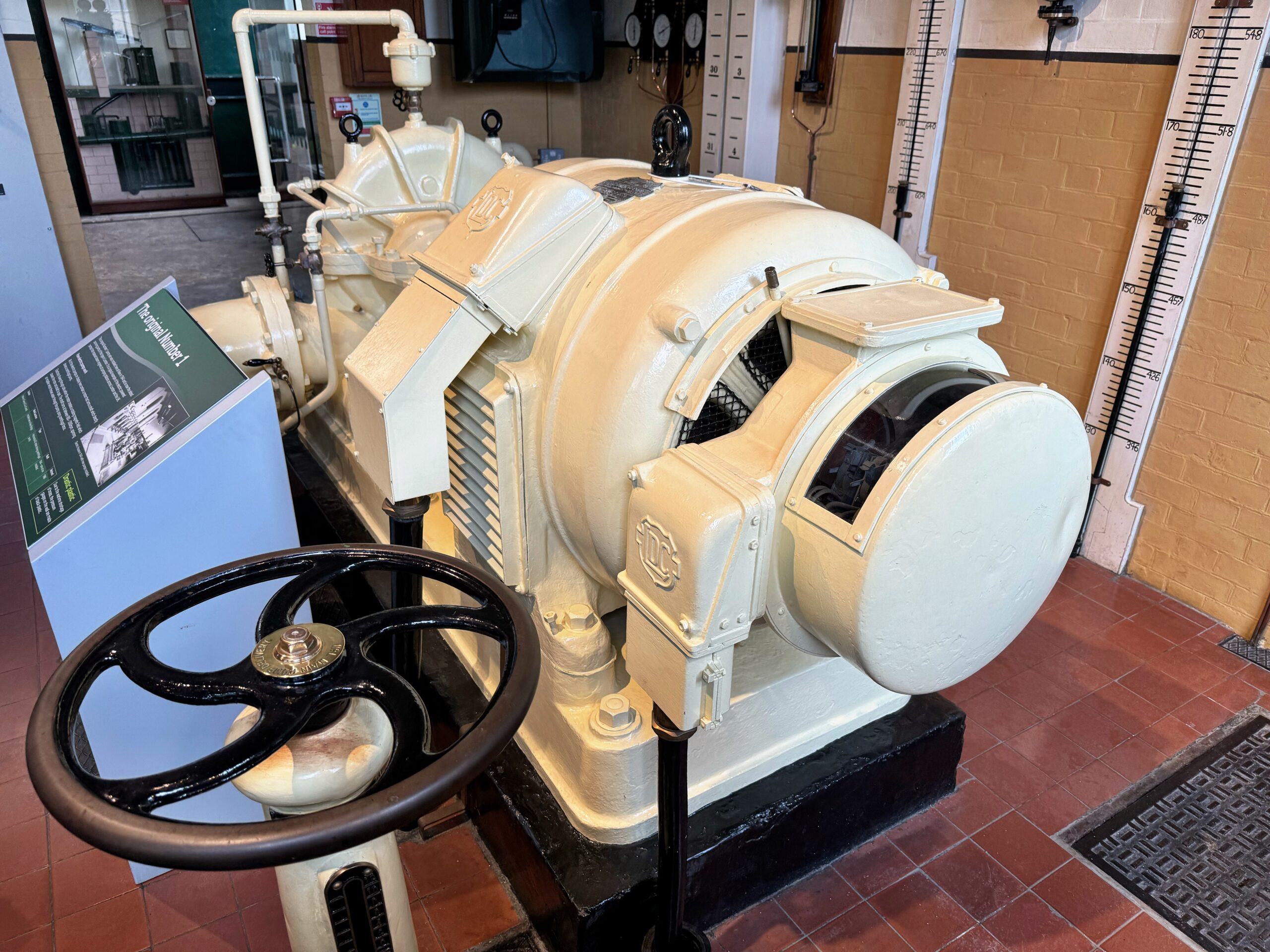
The original Number 1 horizontal AC motor driving centrifugal pump was built in 1944 by Hawthorn Davey & Co of Leeds. This type of electric pump replaced steam engines at pumping stations across the UK and this example is the oldest surviving pump of its kind. It was retired in the late 1980’s – 01/01/2024
The museum also runs a 2 ft narrow gauge railway, which despite being advertised as running over the weekend, was unfortunately not operating during our visit. The museum has been a filming location for many television programmes, including the Doctor Who serial “Remembrance of the Daleks” broadcast in 1988.
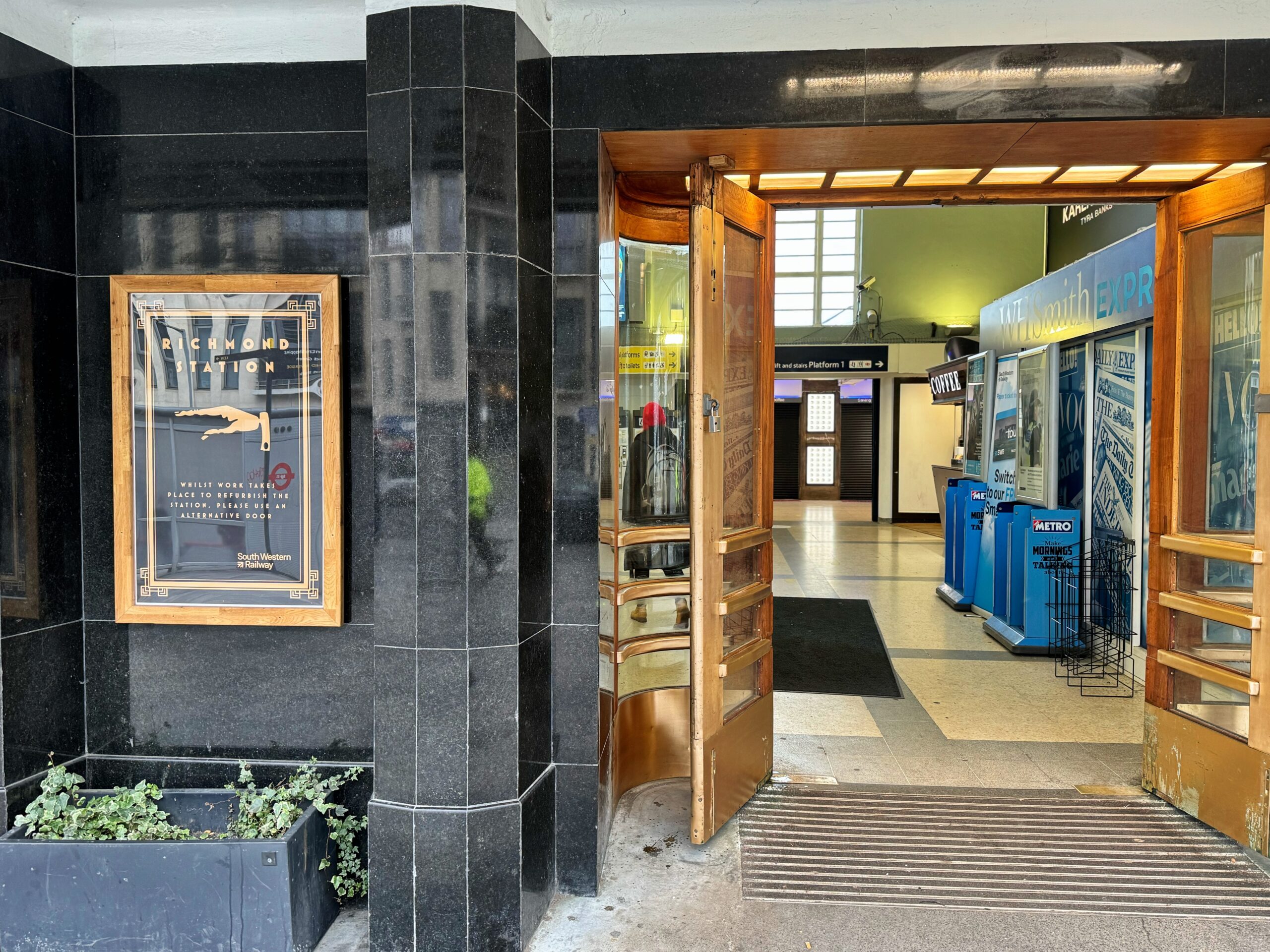
After our visit to the London Museum of Water & Steam, we had planned on taking a trip into central London by rail, but in the event decided against this and instead took a drive and a leisurely walk around nearby Richmond, including a visit to the railway station. Of course we did!
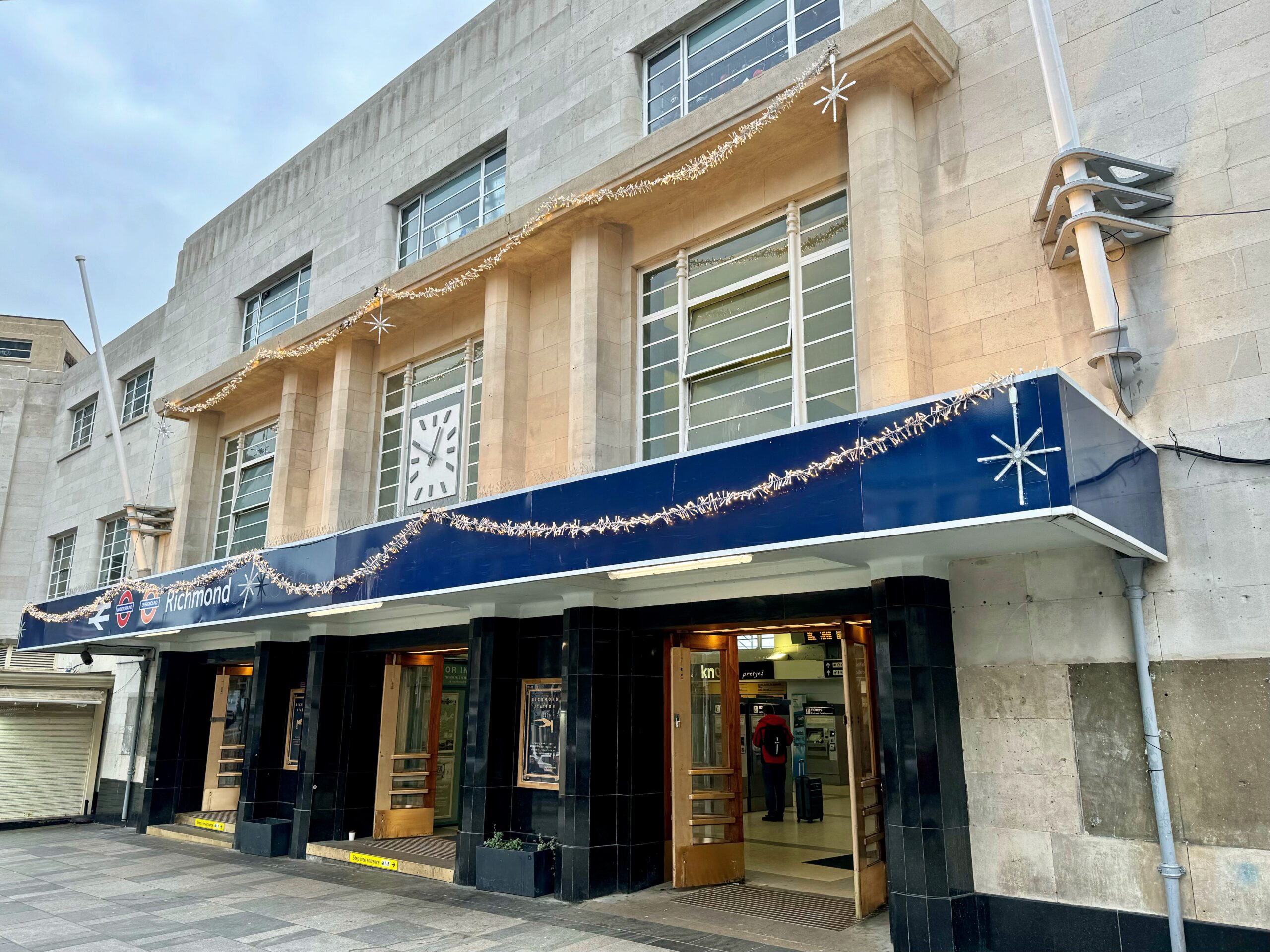
The Art Deco façade of Richmond railway station complete with its square clock centrepiece – 01/01/2024
The Art Deco station building in Richmond, designed by James Robb Scott (1882-1965) for the Southern Railway and constructed in Portland stone dates from 1937 and replaced an earlier station on the site. Scottish born Scott became the Chief Architect of the Southern Railway and is perhaps best known for his redesign of London Waterloo between 1910 and 1923 where he was chiefly responsible for the offices, main entrance and war memorial to the fallen employees of the railway known as the Victory Arch. Scott also designed Wimbledon and Surbiton railway stations – now part of the South Western Railway (SWR) network – the latter having recently celebrated 40 years since being bestowed Grade II listed status.
SWR, Network Rail (NR) and the Railway Heritage Trust are jointly funding a £325,000 programme of improvements with hopes of more refurbishment to come in the future, subject to additional funding being made available. Initial work includes cleaning the Portland stone façade, repairing the timber entrance doors and polishing its bronze embellishments, repairing flagpoles and refurbishing customer toilets.
The restored entrance doors to Richmond railway station which Yoshi unceremoniously christened on our visit…. 01/01/2024
The style of the building at Richmond is suggested as being inspired by the work of Charles Holden (1875-1960), the architect behind London Underground stations including South Wimbledon on the Northern line. Holden’s designs included multi-frame glazing, enamelled signage panels, the use of an iconic typeface for signage and brick and tile detailing. Similar features at Richmond have been lost or covered up over time, including during the station’s last major refurbishment in 1985. SWR, NR and the Railway Heritage Trust have worked with Benedict O’Looney Architects on designs that include restoring or replicating those features, and others, in future improvements. Paying close attention to detail, the station’s original, hand-drawn plans are being used together with promotional photographs from when the station first opened its doors to customers. Samples of the station’s original paint are also being analysed by the University of Lincoln, specialists in the conservation and restoration of the interior and exterior features of listed and historic buildings.
The area in front of Richmond station main entrance was pedestrianised in 2013 and includes a war memorial to soldier Bernard Freyberg, who was born in Richmond. As well as Sir trains, the station is served by the London Overground North London Line and Underground District Line trains.
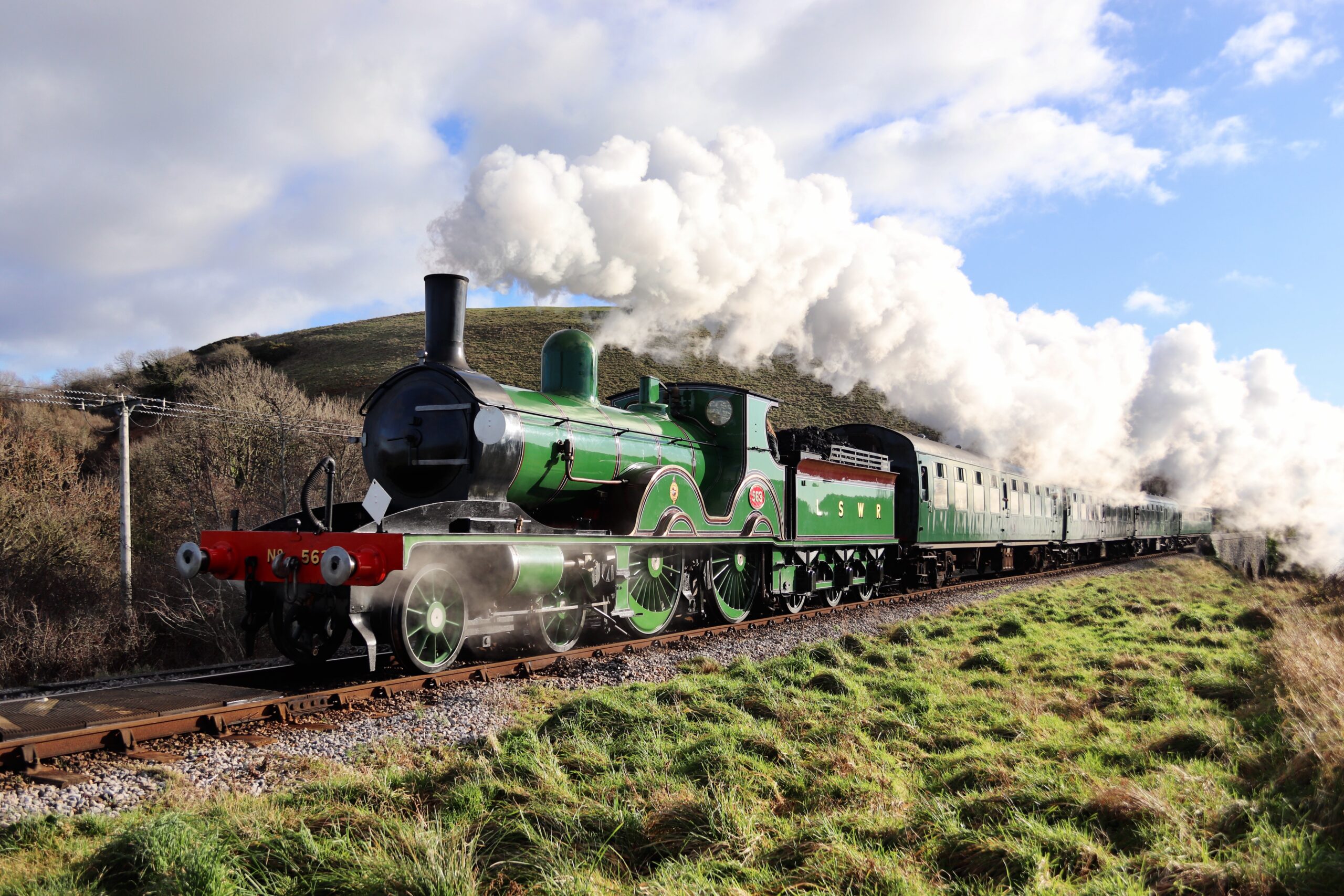
Star of the show, Adams 4-4-0 T3 No. 563 working the 1200 Swanage to Norden service approaches Corfe Common – 06/01/2024
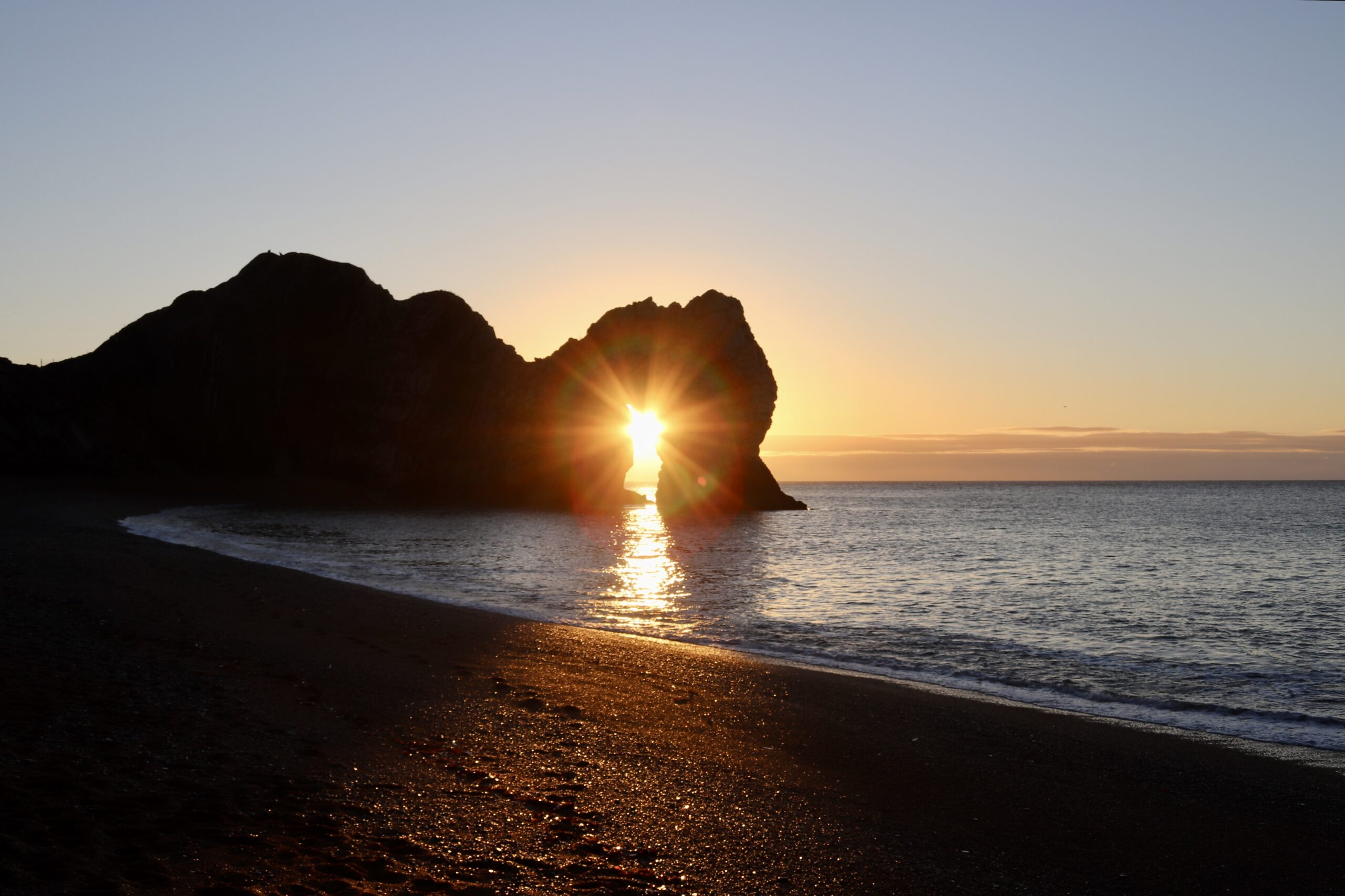
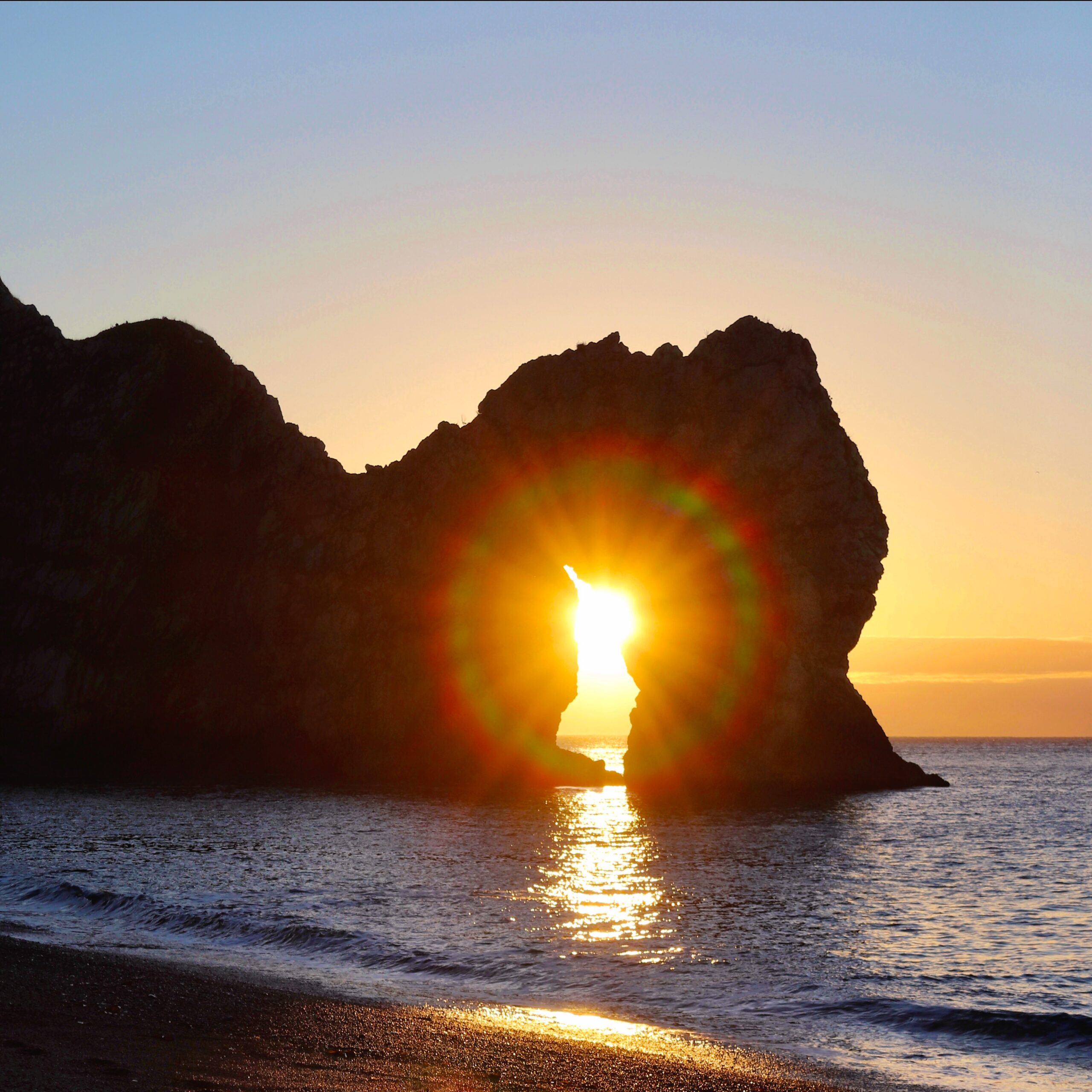
The Swanage Railway’s first event of 2024 was their annual “Winter Warm Up” weekend held on January 6th & 7th. With cold, but clear weather forecast, I decided on heading down to Swanage on the Saturday after taking a chance on a picturesque sunrise at Durdle Door on the way.
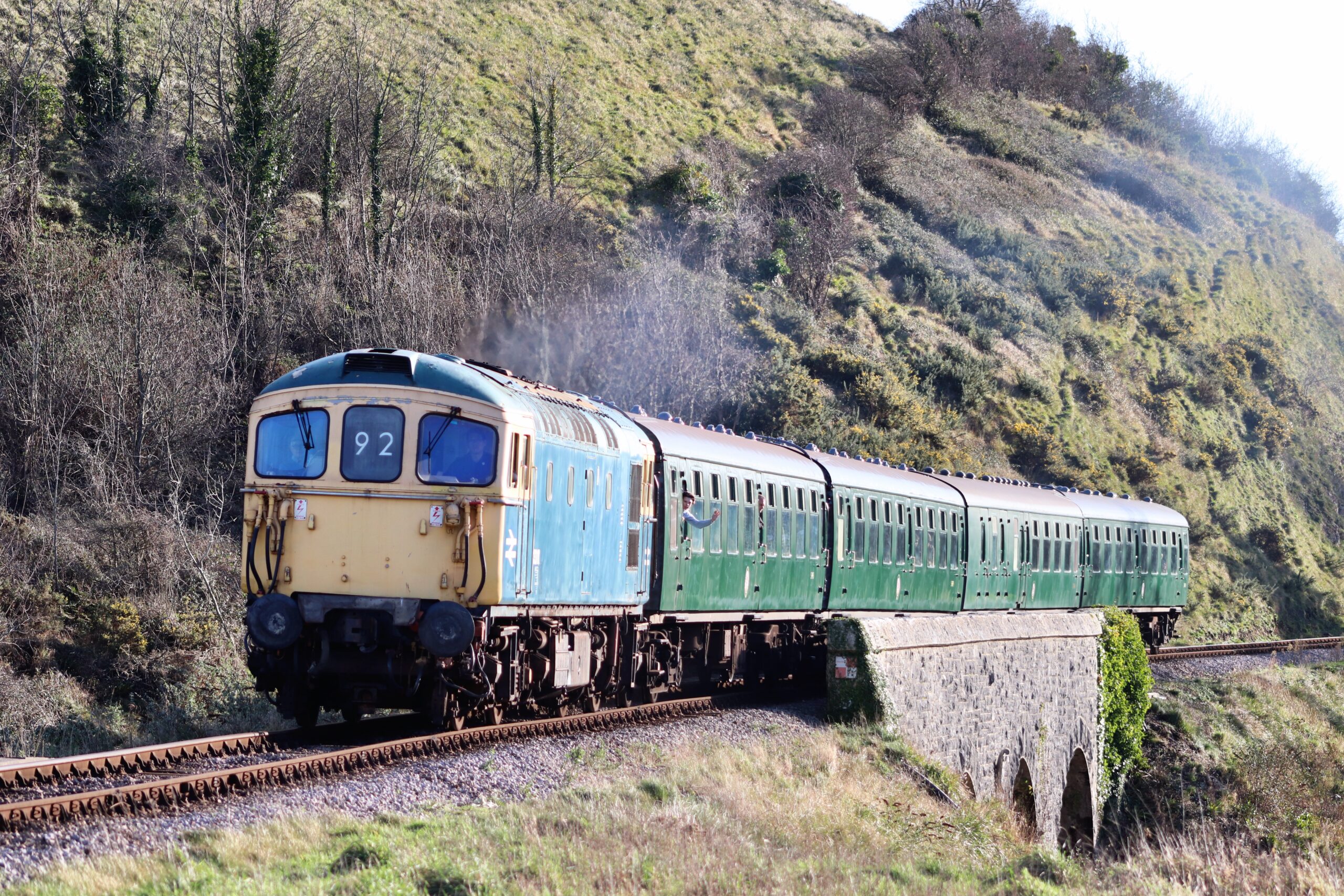
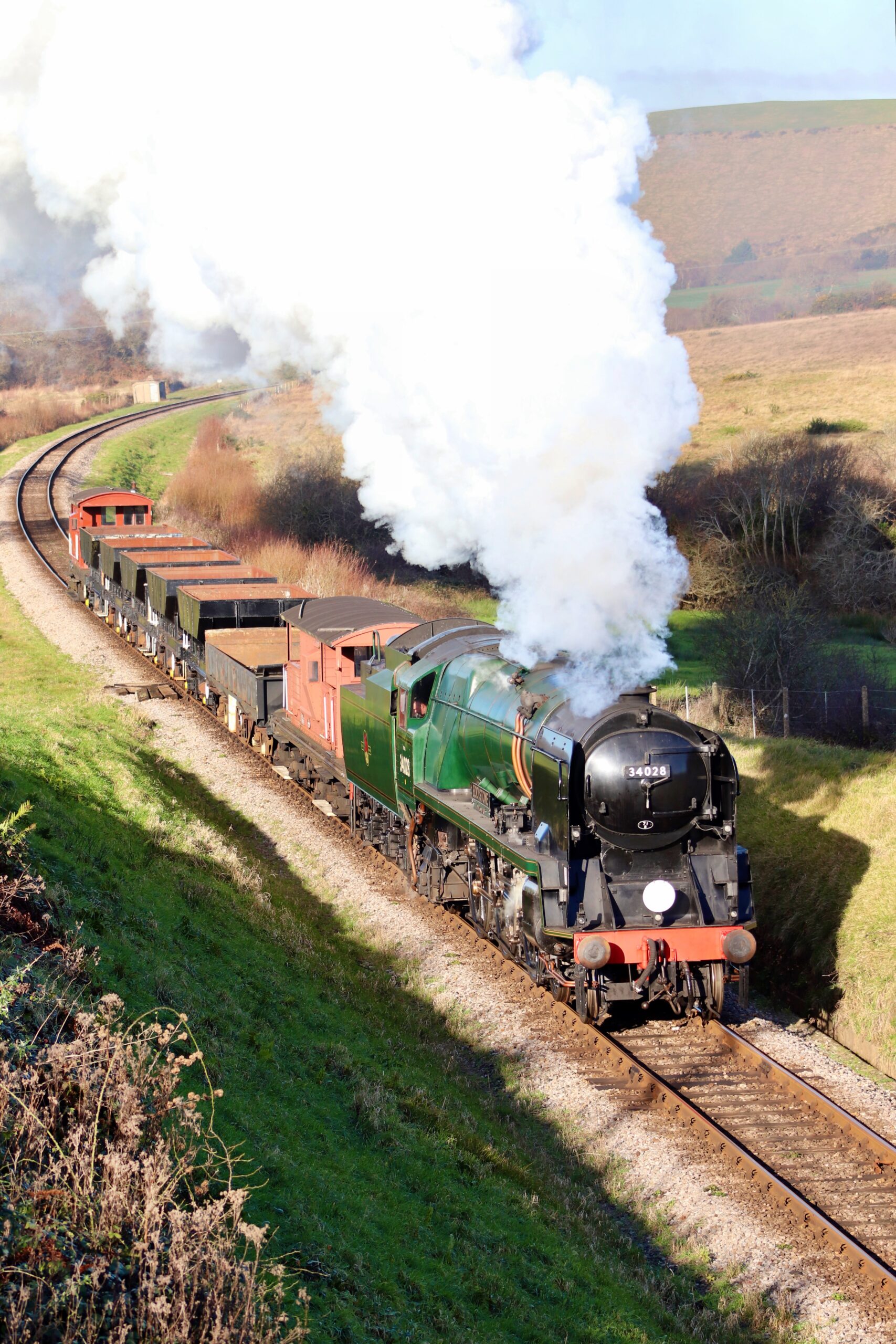
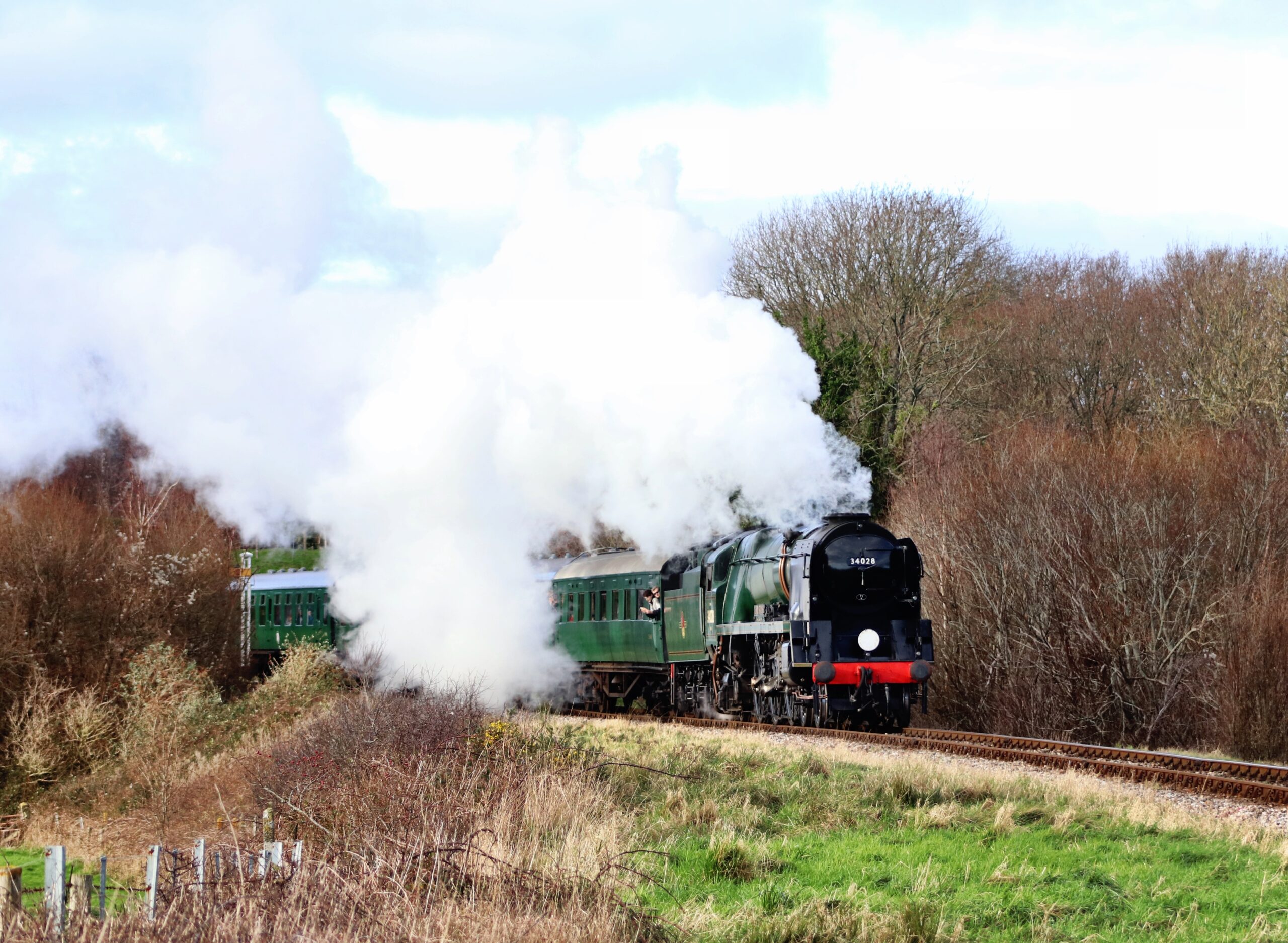
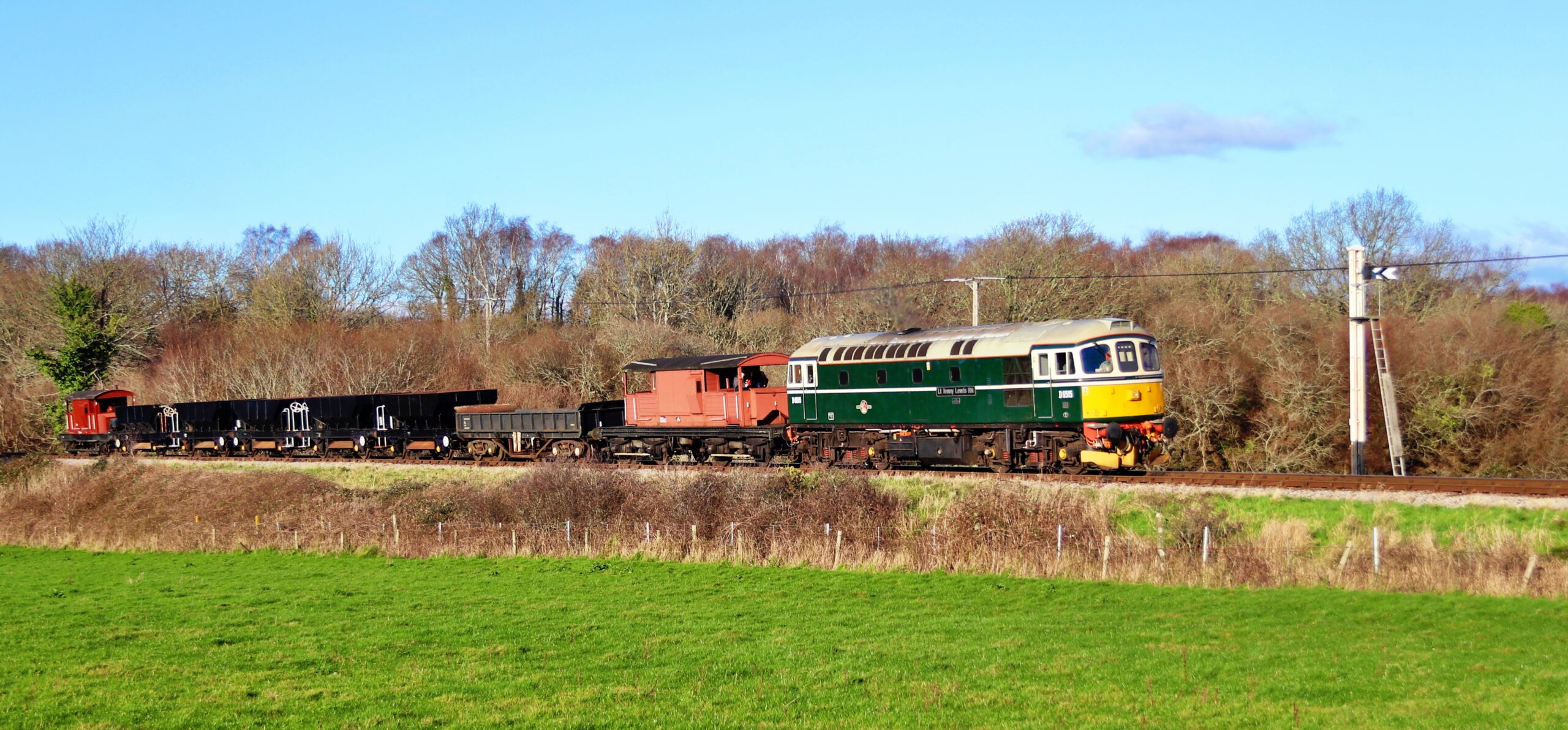
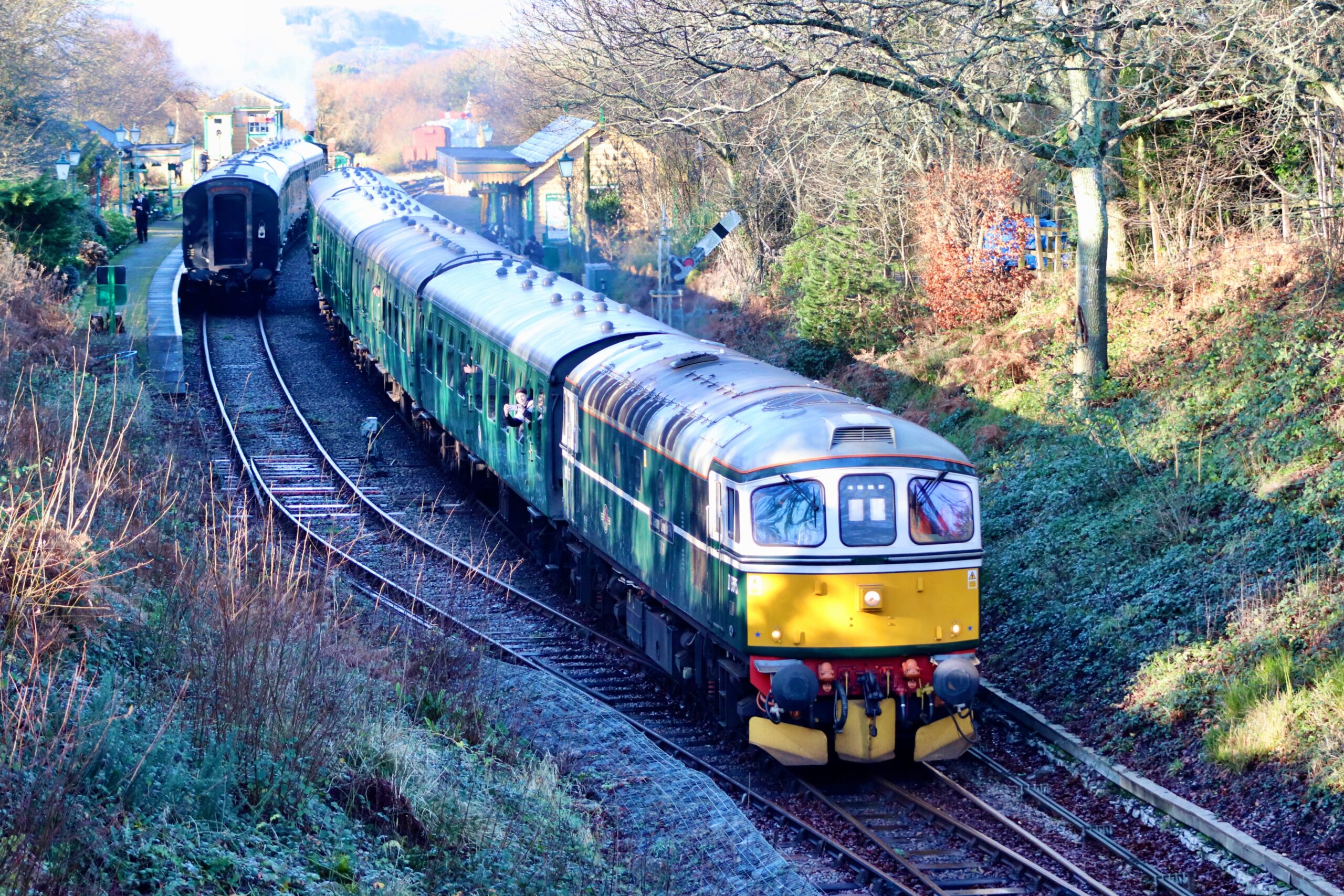
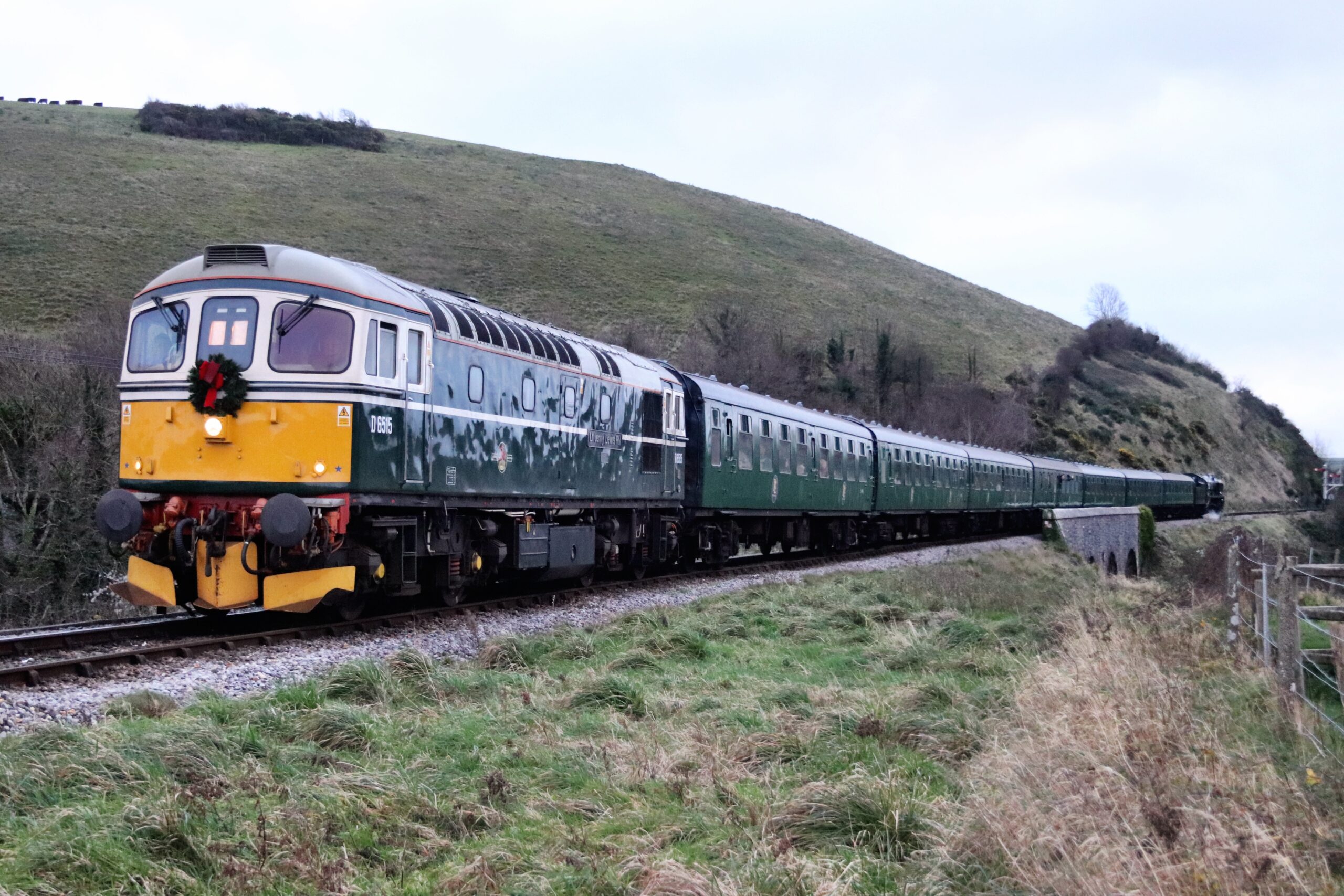
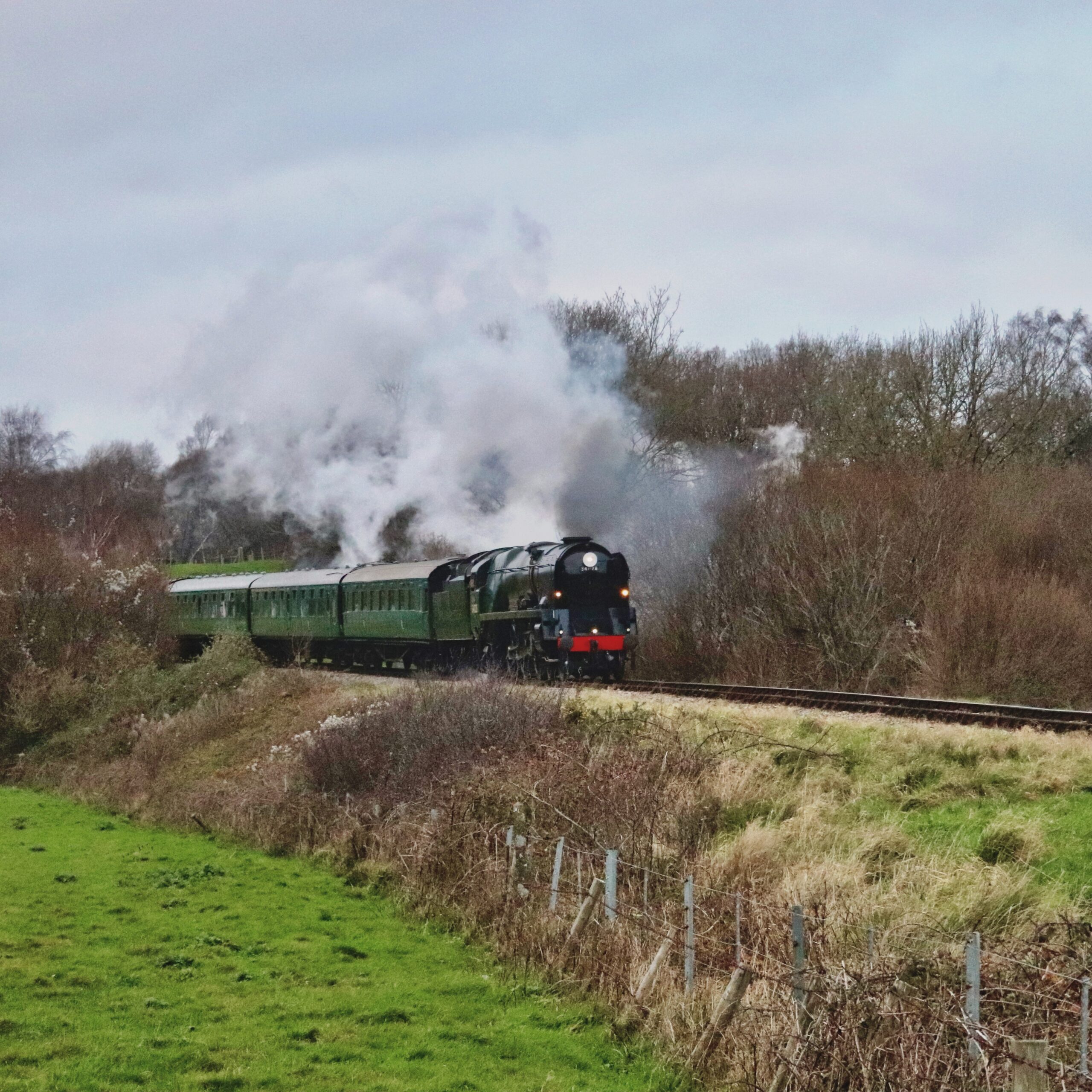
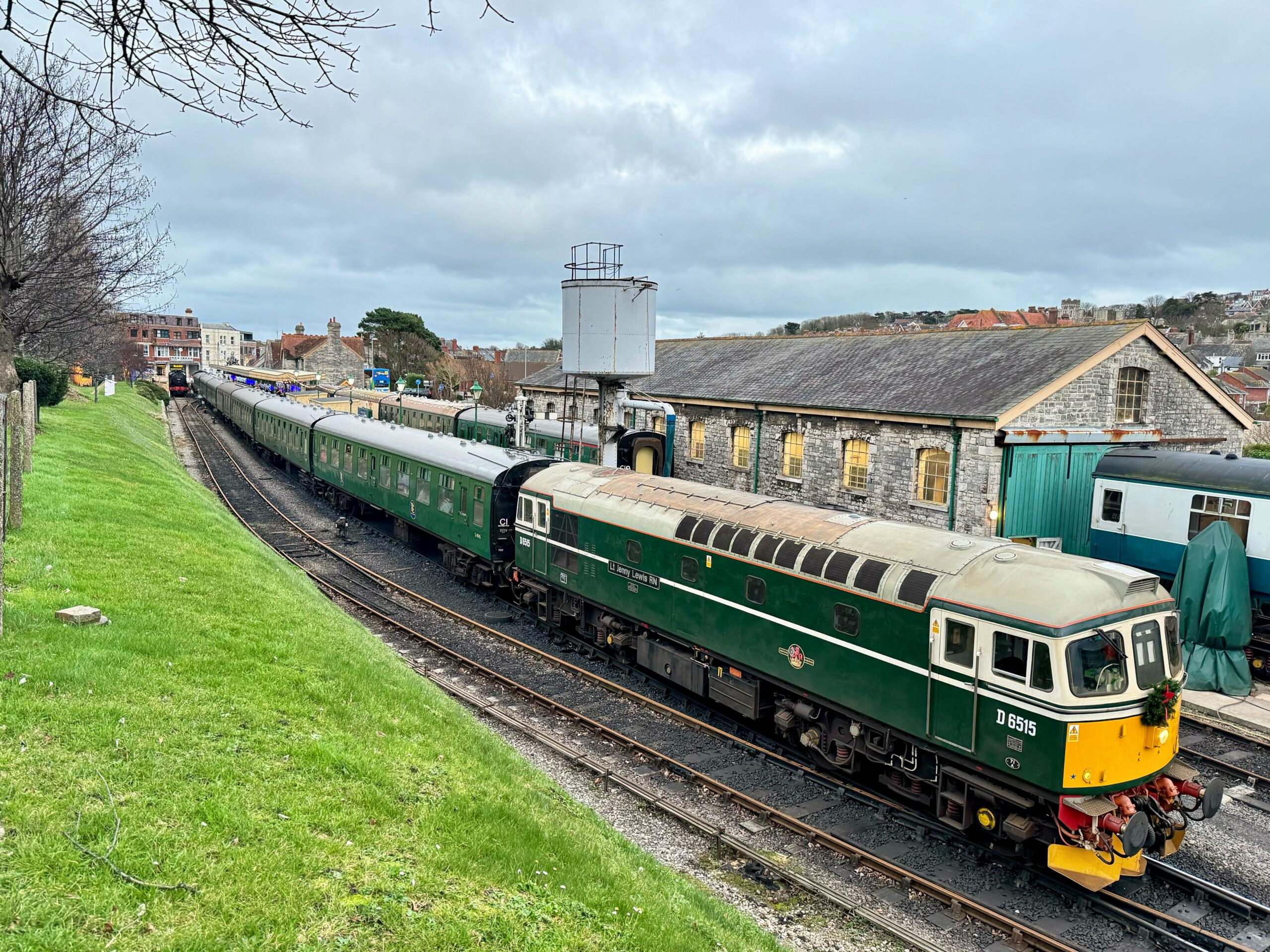
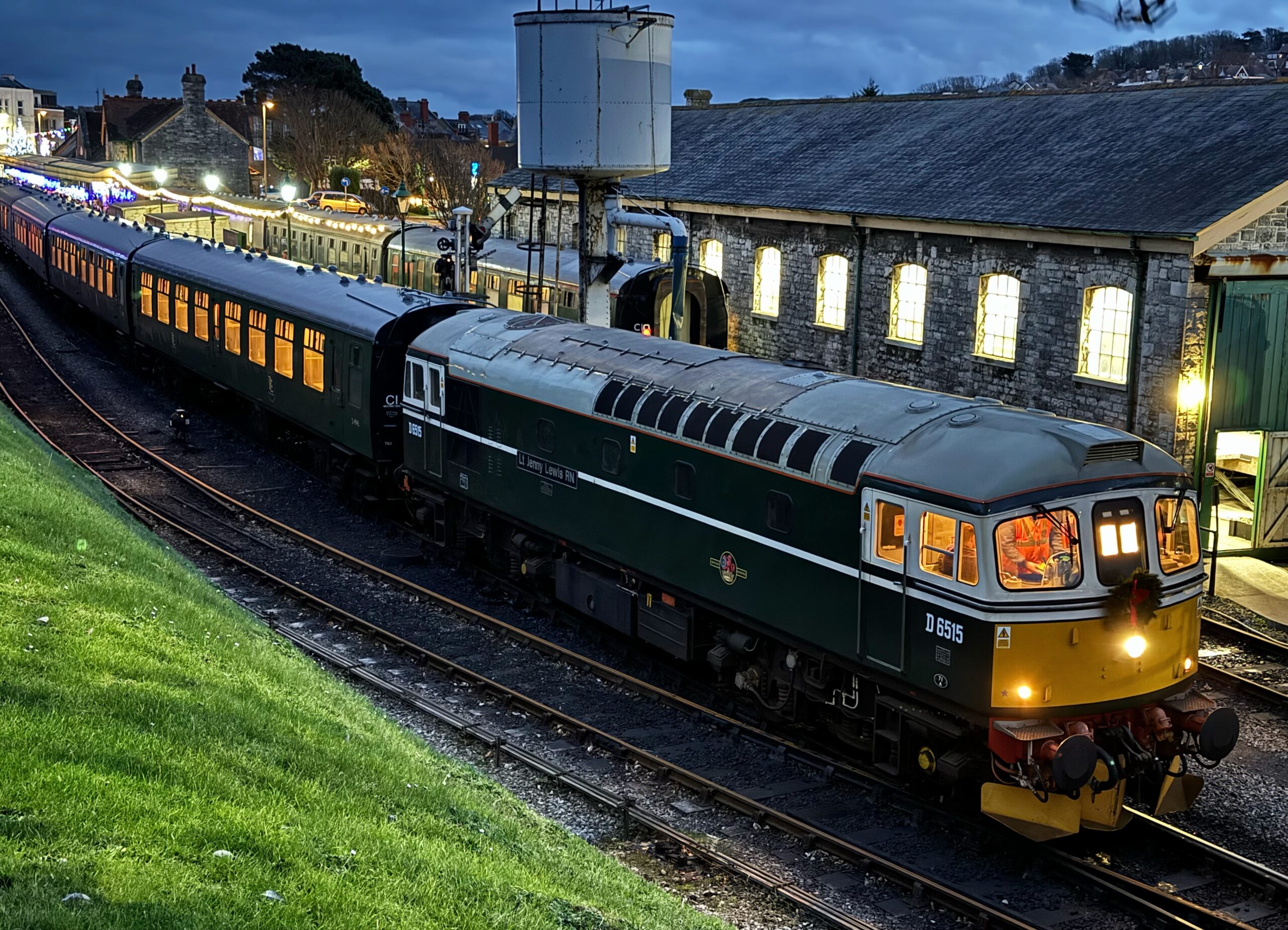
Resident Class 33 No. 33111 crosses Corfe Viaduct hauling the 1245 Swanage to Norden train – 06/01/2023SR West Country 4-6-2 No. 34028 ‘Eddystone’ takes her turn on the demonstration freight working the 1132 Norden to Swanage nearing Afflington. Later during the weekend, brake van rides were offered – 06/01/2024This time working a passenger train, SR West Country 4-6-2 No. 34028 ‘Eddystone’ has departed Norden with the 1415 service to Swanage – 06/01/2024Class 33 No.D6515 ‘Lt Jenny Lewis RN’ takes her turn on the freight wagons working 1302 Norden to Swanage – 06/01/2024Class 33 No.D6515 ‘Lt Jenny Lewis RN’ departs Harman’s Cross with the 1030 Norden to Swanage – 06/01/2024
In action this year was the recently restored Adams 4-4-0 T3 No. 563 hauling its first freight train since its return to service, SR West Country 4-6-2 No. 34028 ‘Eddystone’ and the resident Class 33 diesel locomotives no.’s 33111 and D6515 ‘Lt Jenny Lewis RN’
Adams 4-4-0 T3 No. 563 powers away from Corfe Castle at the head of the 1357 Swanage to Norden demonstration freight – 06/01/2024
The Swanage Railway Trust 563 Locomotive Group have been nominated for the “Steam Railway Magazine Award”. This award is decided by the public and will be announced at Heritage Railway Association’s annual ceremony on February 10th 2024 and you can now cast your vote online until the 18th January 2024: www.steamrailway.co.uk/read/hra-awards
Video from January 6th 2024 Swanage Winter Warm Up
Scheduled mainline action kicked off the year with a “no-show” as the HST powered New Measurement Train (NMT) failed to reach Weymouth on January 3rd after a points failure at Castle Cary curtailed 1Z22 1211 Derby RTC (Network Rail) to Bristol Kingsland Road – top and tailed by Class 43 power cars No.’s 43274 and 43257 – at Westbury. Interestingly three different paths were put in for this test train on this particular day. The one which finally ran was timed later than the usual working to Dorset, but not as late as one of the options given for the day!
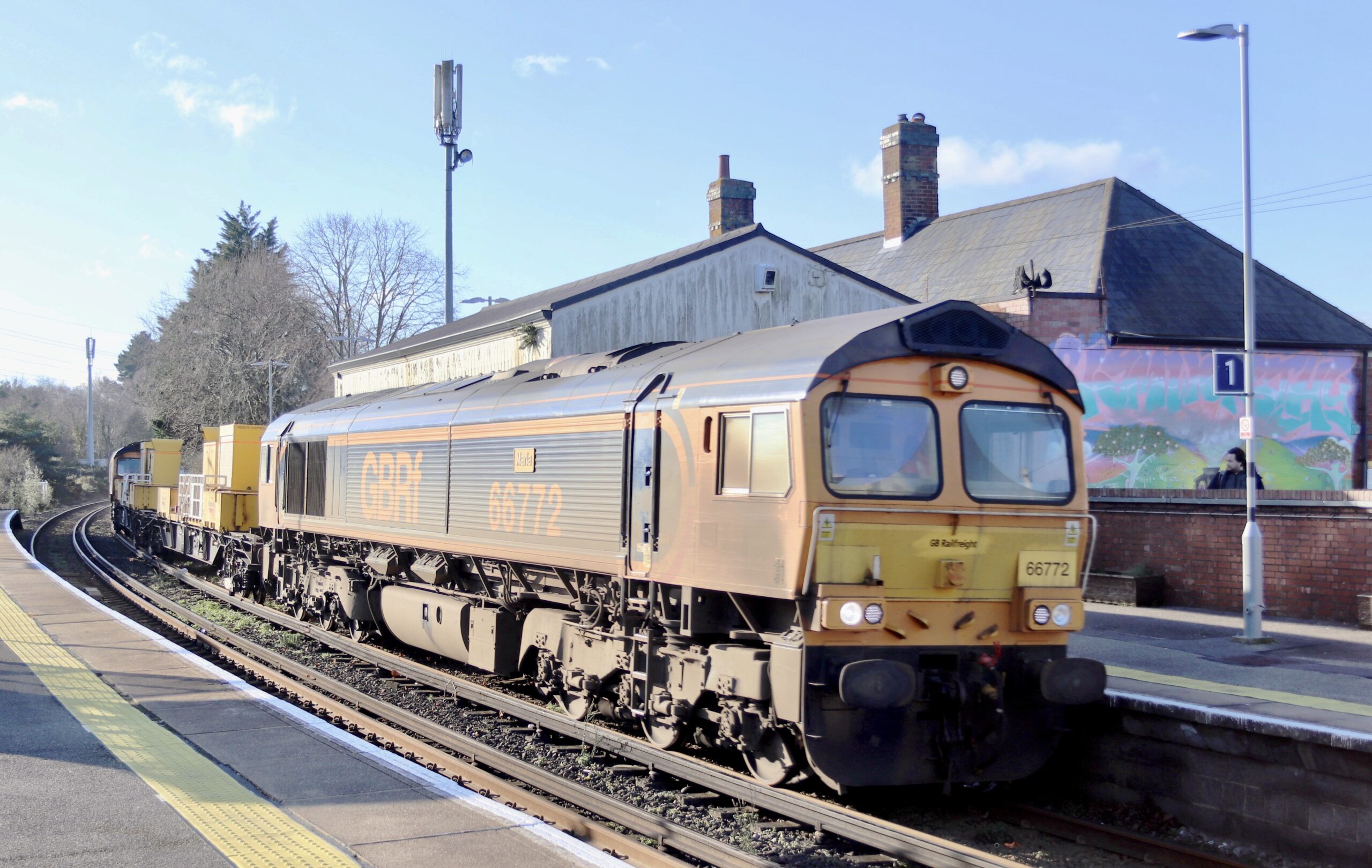
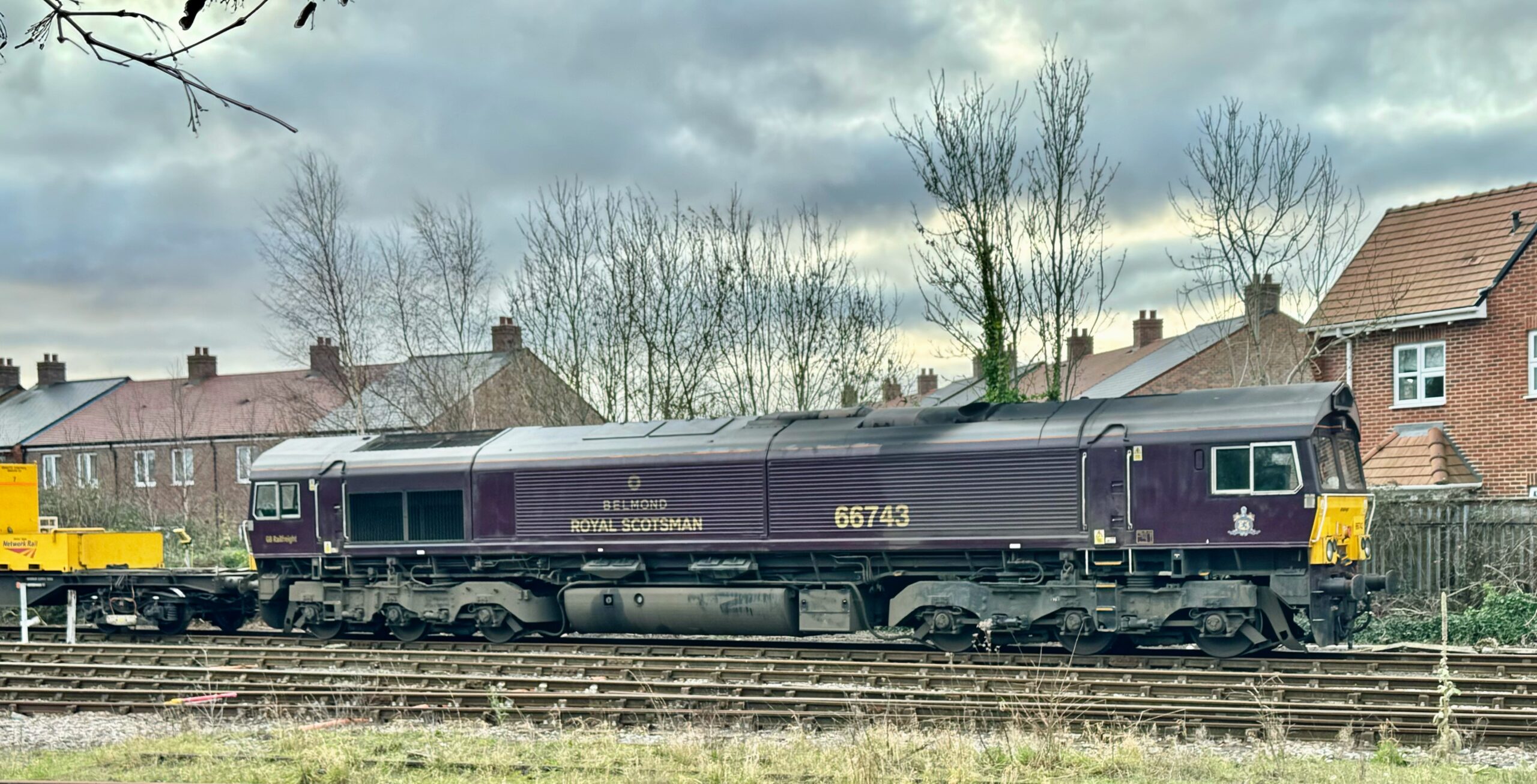
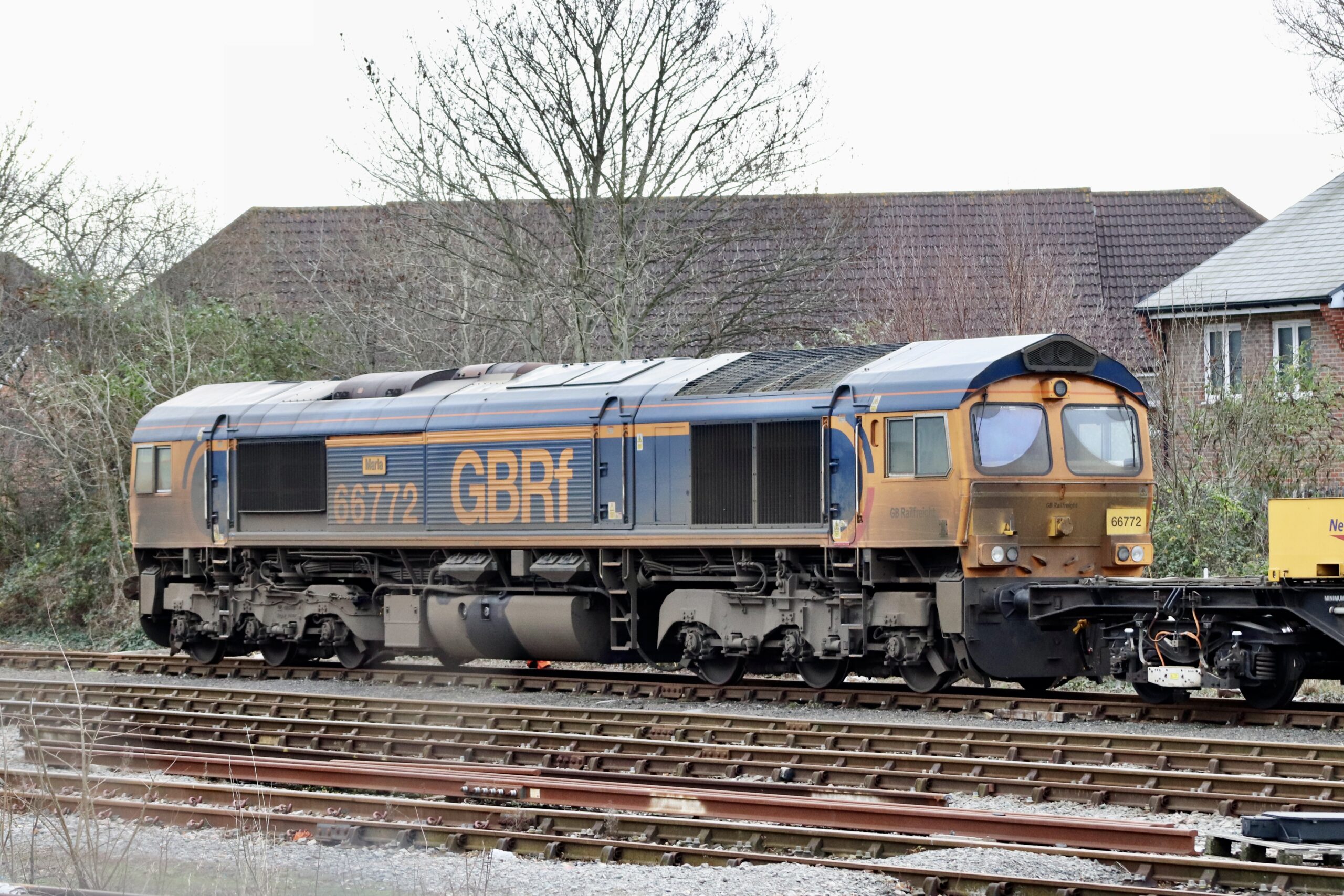
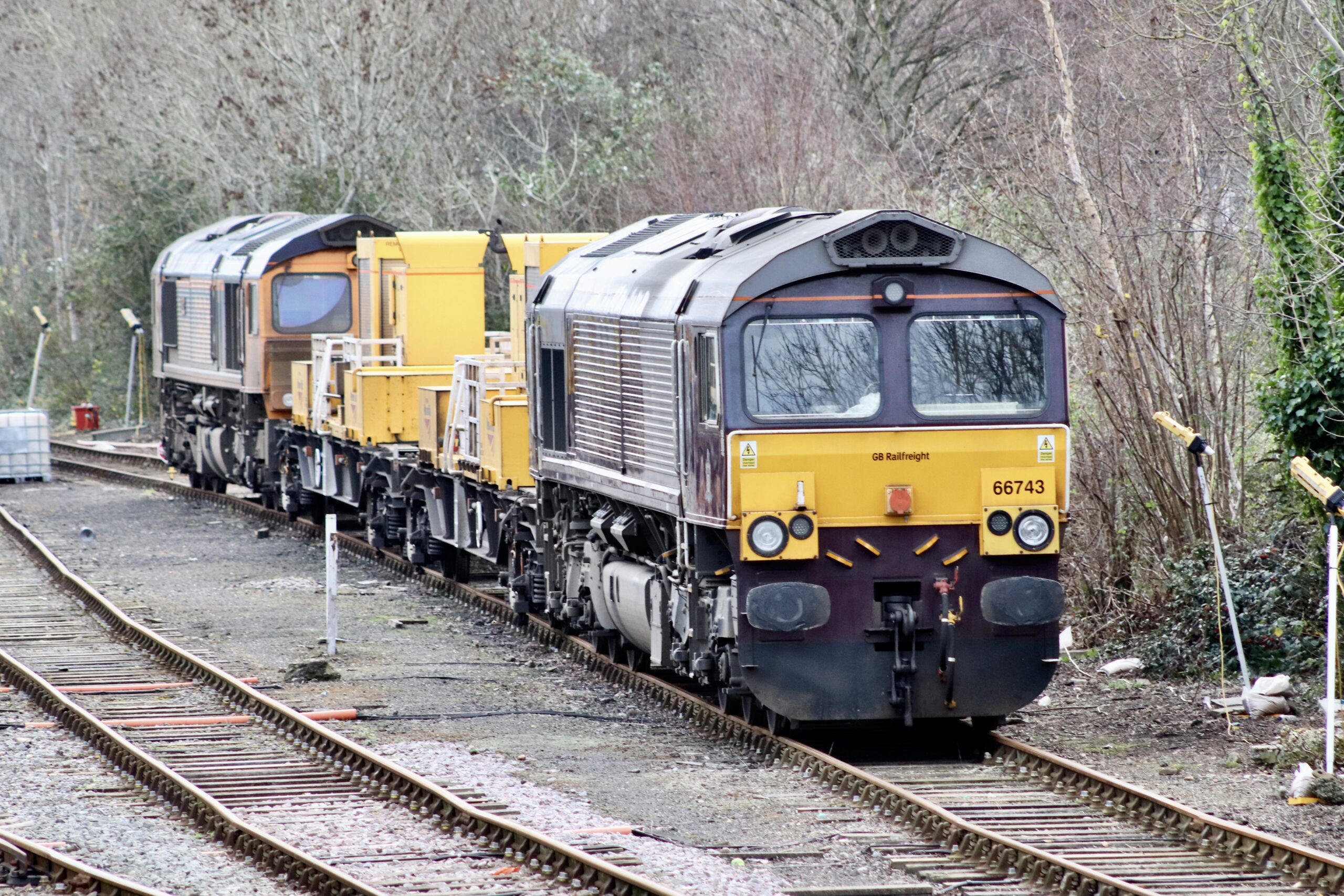
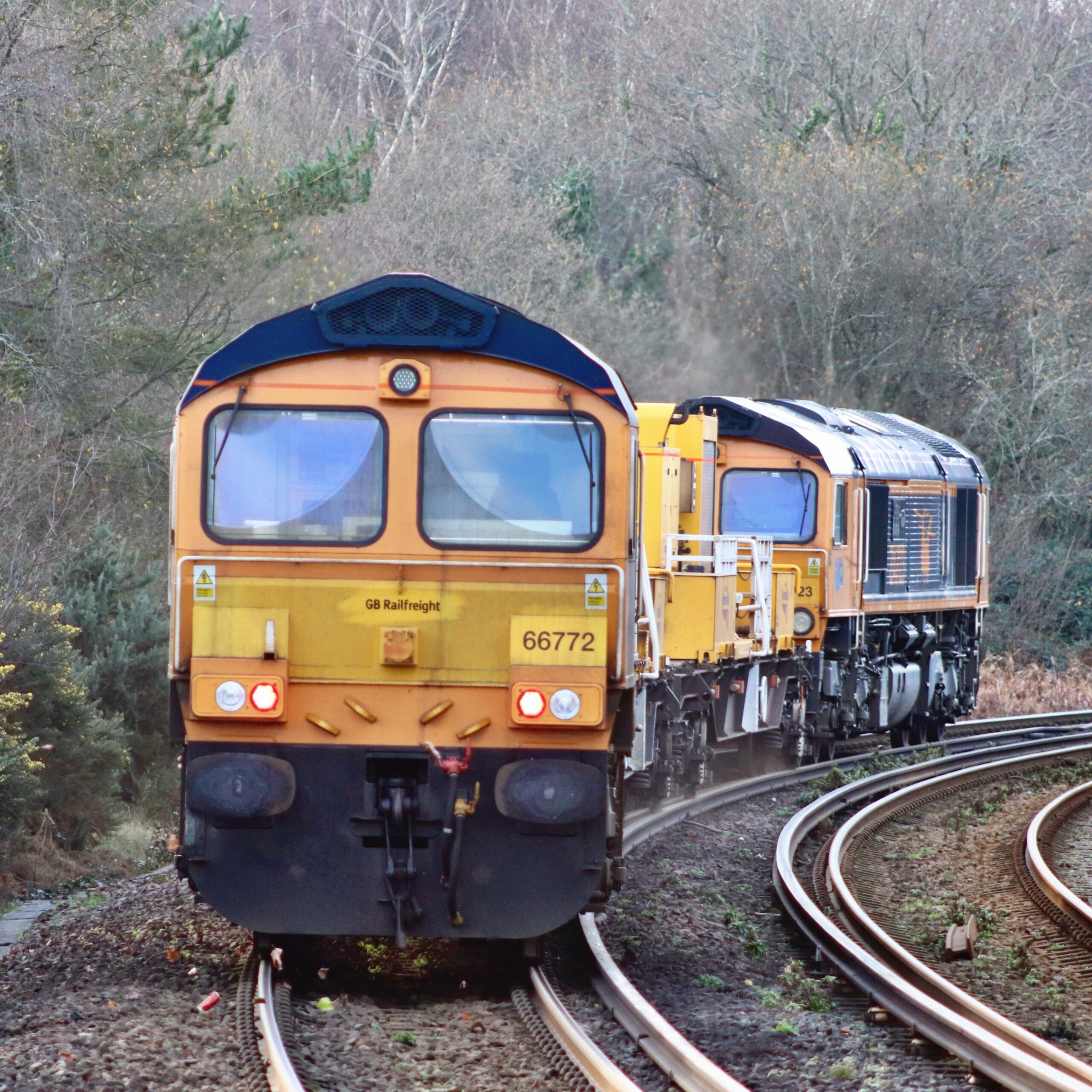
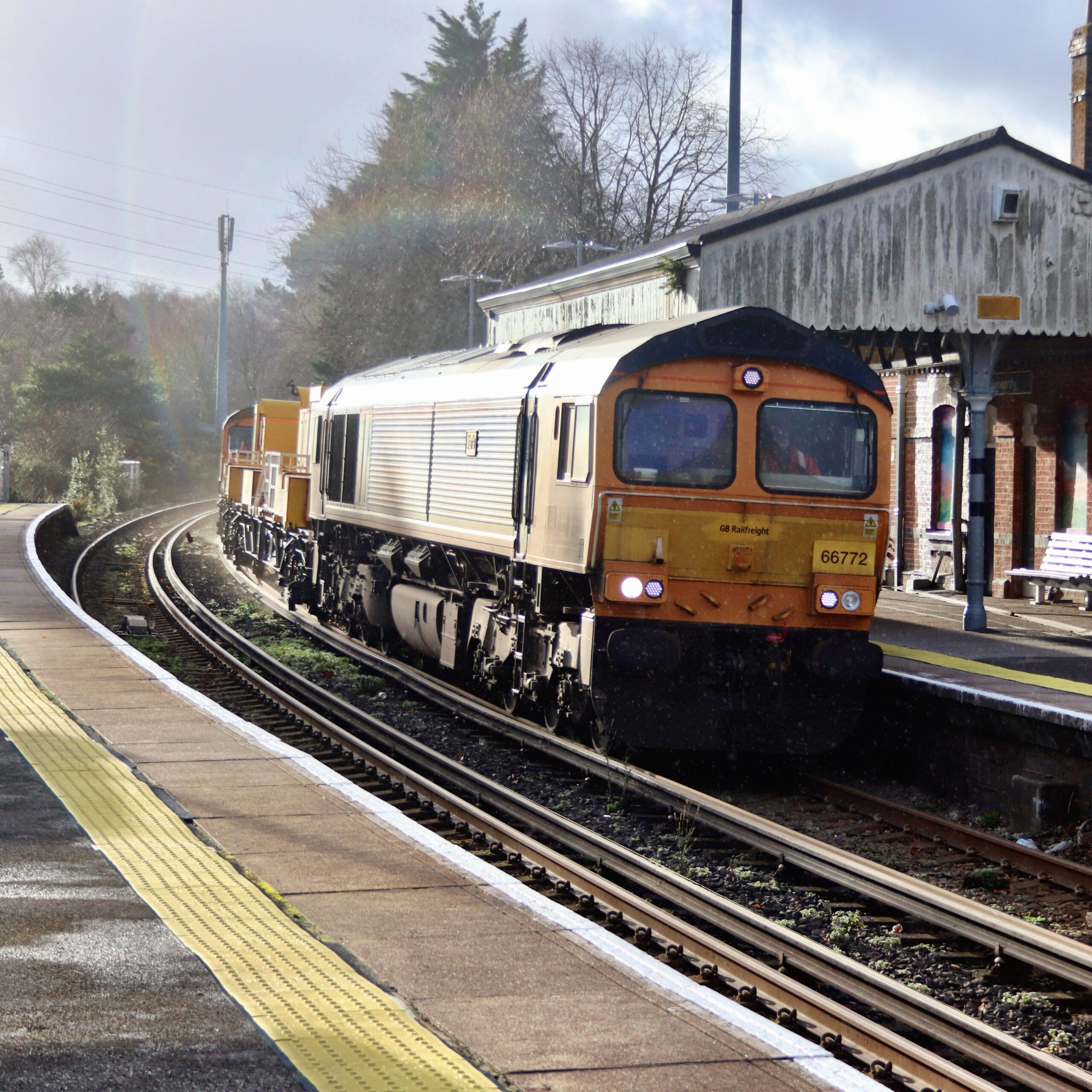
We did, however, get to experience a daylight Snow & Ice treatment Train (SITT) on Sunday 7th January as GBRf Class 66 locomotives No.’s 66764 ‘Major John Poyntz Engineer & Railwayman’ and 66772 ‘Maria’ in top and tail formation worked to Weymouth as 3Y88 1035 Totton Yard to Totton Yard. 66764 replaced No. 66723 ‘Chinook’ and No. 66743 which had both been previously paired up with No. 66772 on the Totton based SITT locomotive diagram.
Sunday morning tranquility is disturbed as GBRf Class 66 locomotives No.’s 66764 ‘Major John Poyntz Engineer & Railwayman’ and 66772 ‘Maria’ top and tail SITT 3Y88 1035 Totton Yard to Totton Yard across Upton Viaduct on the Holes Bay causeway – 07/01/2024GBRf Class 66 No. 66772 ‘Maria’ leads on the return 3Y88 1035 Totton Yard to Totton Yard Snow & Ice Treatment Train through Hamworthy with No. 66764 ‘Major John Poyntz Engineer & Railwayman’ at the rear – 07/01/2024GBRf Class 66 locomotives No.’s 66764 ‘Major John Poyntz Engineer & Railwayman’ and 66772 ‘Maria’ at Hamworthy working 3Y88 1035 Totton Yard to Totton Yard – 07/01/2024
Major John Poyntz served in the British army for 35 years, with the Royal Engineers and later the Royal Corps of Transport. After military service, he joined the Railway Inspectorate, now part of the Office of Rail and Road, and was the last Royal Engineer to take such a route, spending 25 years in the role as a Railway Inspector. His work included inspections of heritage railways and dealing with accidents and incidents such as the Severn Tunnel rail accident and the Cannon Street rail crash, both in 1991.
Overnight on Saturday 6th/Sunday 7th a ballast train headed to Moreton working as 6C03 2312 Eastleigh East Yard to Moreton (Dorset) in the hands of Colas locomotives Class 66 No. 66848 and Class 70 No. 70809. We saw the ensemble pass through Hamworthy on the outward leg and had planned to see the associated return 6C03 0810 Moreton (Dorset) to Eastleigh East Yard crossing Holes Bay, but as the train set off over an hour early and with the sun yet to rise, we played safe and returned once again to Hamworthy railway station to watch the train pass through.
January ballast train with Class 66 No. 66848 and Class 70 No. 70809
The SITT returned to the Bournemouth to Weymouth line under the cover of darkness on Monday 8th and Wednesday 10th January employing the same pair of Class 66’s as the previous Sunday run.
January 2024 Dorset Snow & Ice Treatment Train workings (additional video courtesy of G E Barrett)
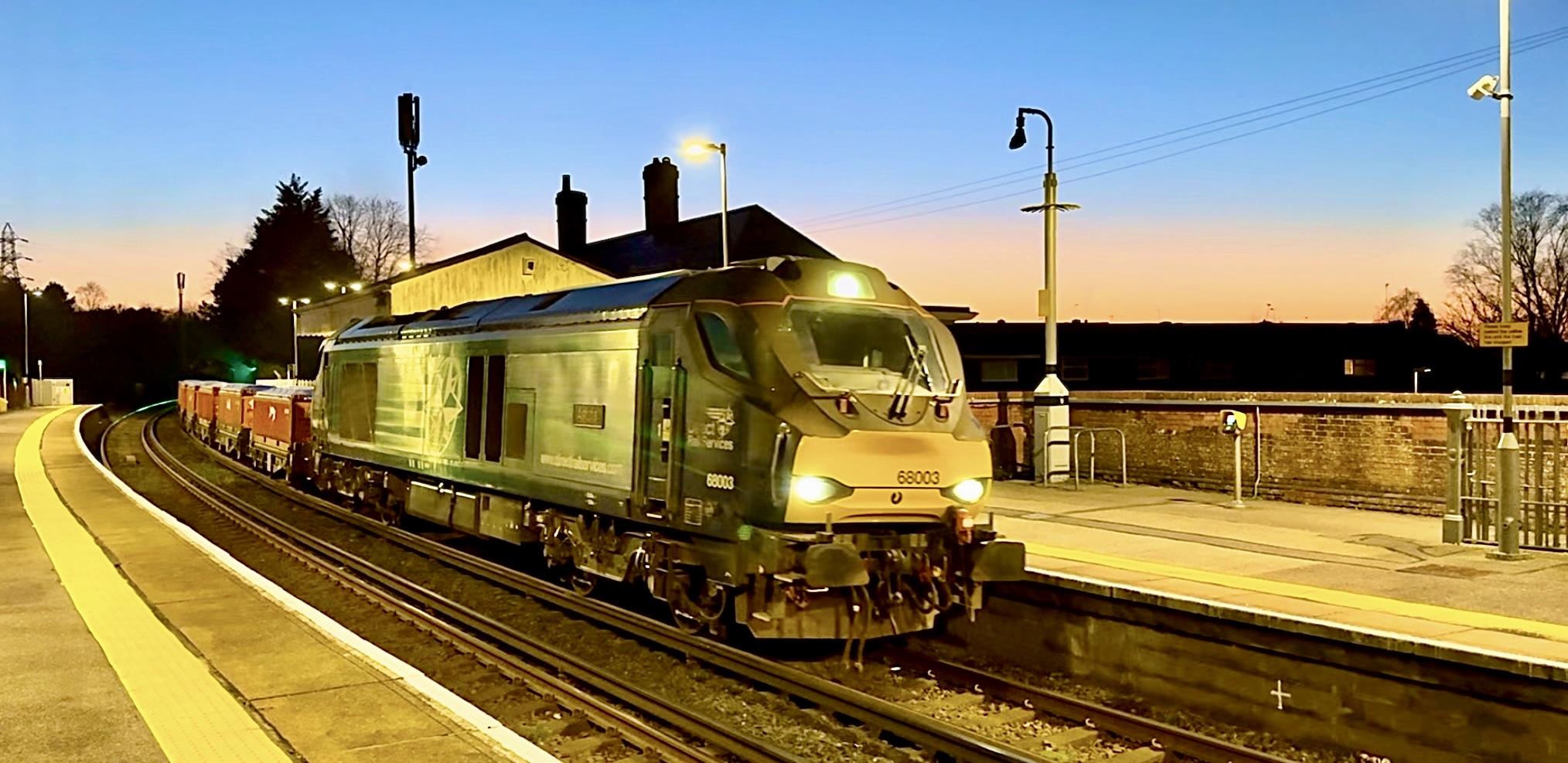
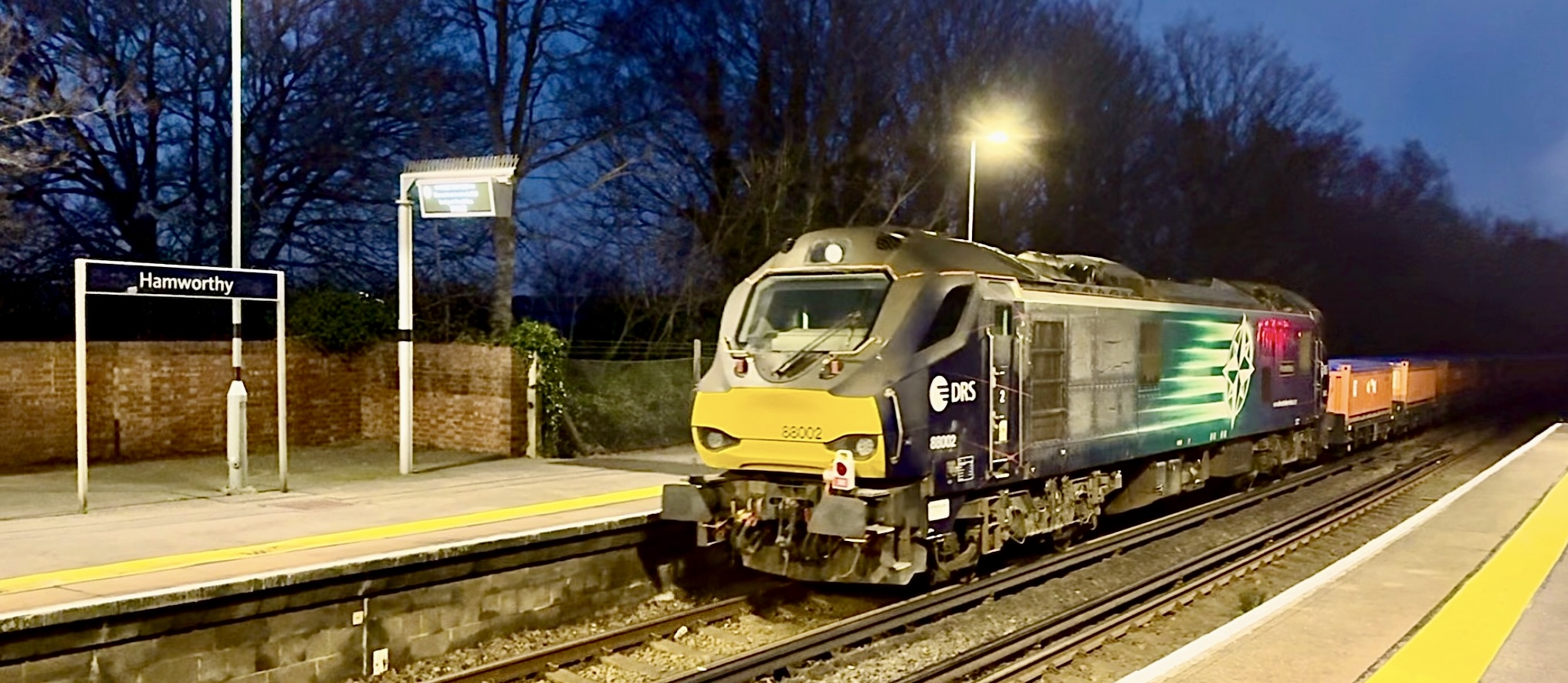
In between the SITT workings, on Tuesday 9th January, we saw a first for Dorset as Direct Rail Services (DRS) ran a service to Winfrith using a Class 88 locomotive No. 88002 ‘Prometheus’ which had replaced failed Class 68 No. 68004 (which itself had substituted for No. 68005) and No. 68003 ‘Astute’ in top an tail formation. This was the inaugural use a Class 88 on the Bournemouth to Weymouth line.
DRS Class 68 No. 68003 ‘Astute’ with Class 88 No. 88002 ‘Prometheus’ working the empties to Winfrith as 6Z62 0100 Crewe Coal Sidings (DRS) to Winfrith Sidings through Hamworthy – 09/01/2024DRS Class 68 No. 68003 ‘Astute’ leads the return 6Z95 1551 Winfrith Sdgs to Crewe Coal Sidings (DRS) at Hamworthy – 09/01/2024Class 88 No. 88002 ‘Prometheus’ at the rear of 6Z62 0100 Crewe Coal Sidings (DRS) to Winfrith Sidings having cleared Hamworthy railway station. Class 68 No. 68003 ‘Astute’ leads – 09/01/2024
The Class 88 is a mixed traffic electro-diesel locomotive manufactured by Stadler Rail and is part of the Stadler Euro Dual family.
Class 88 No. 88002 ‘Prometheus’ remained at the rear for the return 6Z95 1551 Winfrith Sidings to Crewe Coal Sidings (DRS) – 09/01/2024
During the development of the Class 68 diesel locomotive for DRS which was first announced in January 2012, the design team at Stadler proposed the concept of a dual-mode locomotive that could be alternatively powered by an onboard diesel engine or via electricity supplied from overhead lines (OHLE). In comparison to conventional diesel locomotives, this arrangement enables operational costs to be significantly reduced when diagrammed on routes partially or entirely under OHLE, under which the diesel engine can be deactivated.In September 2013, DRS placed an order for ten such locomitives which would become the Class 88. Having been developed alongside the Class 68, considerable similarities are shared between the two locomotive types, with an approximate 70% share of components.
Video of January 9th 2024 Winfrith run (additional video courtesy of G E Barrett)
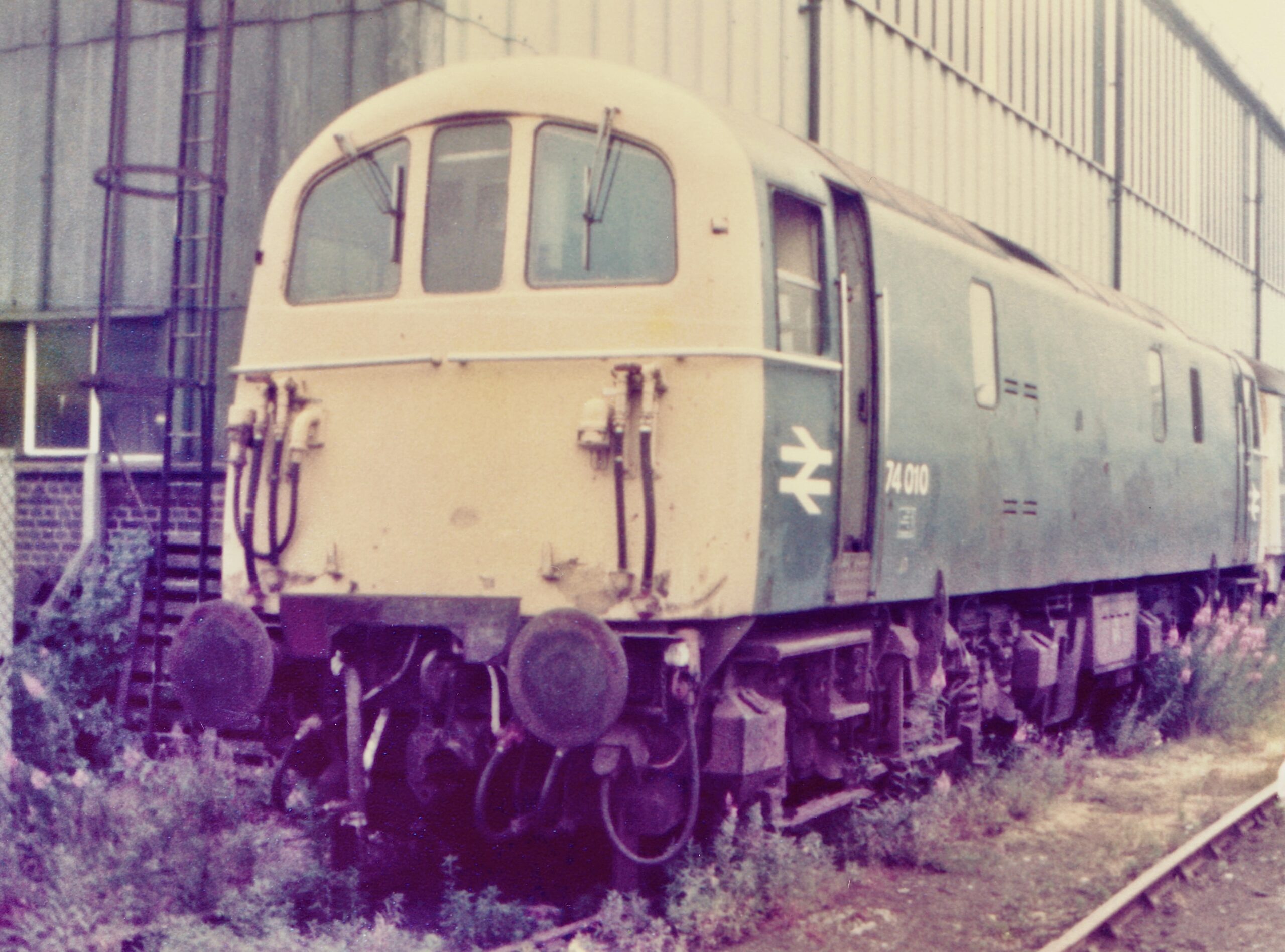
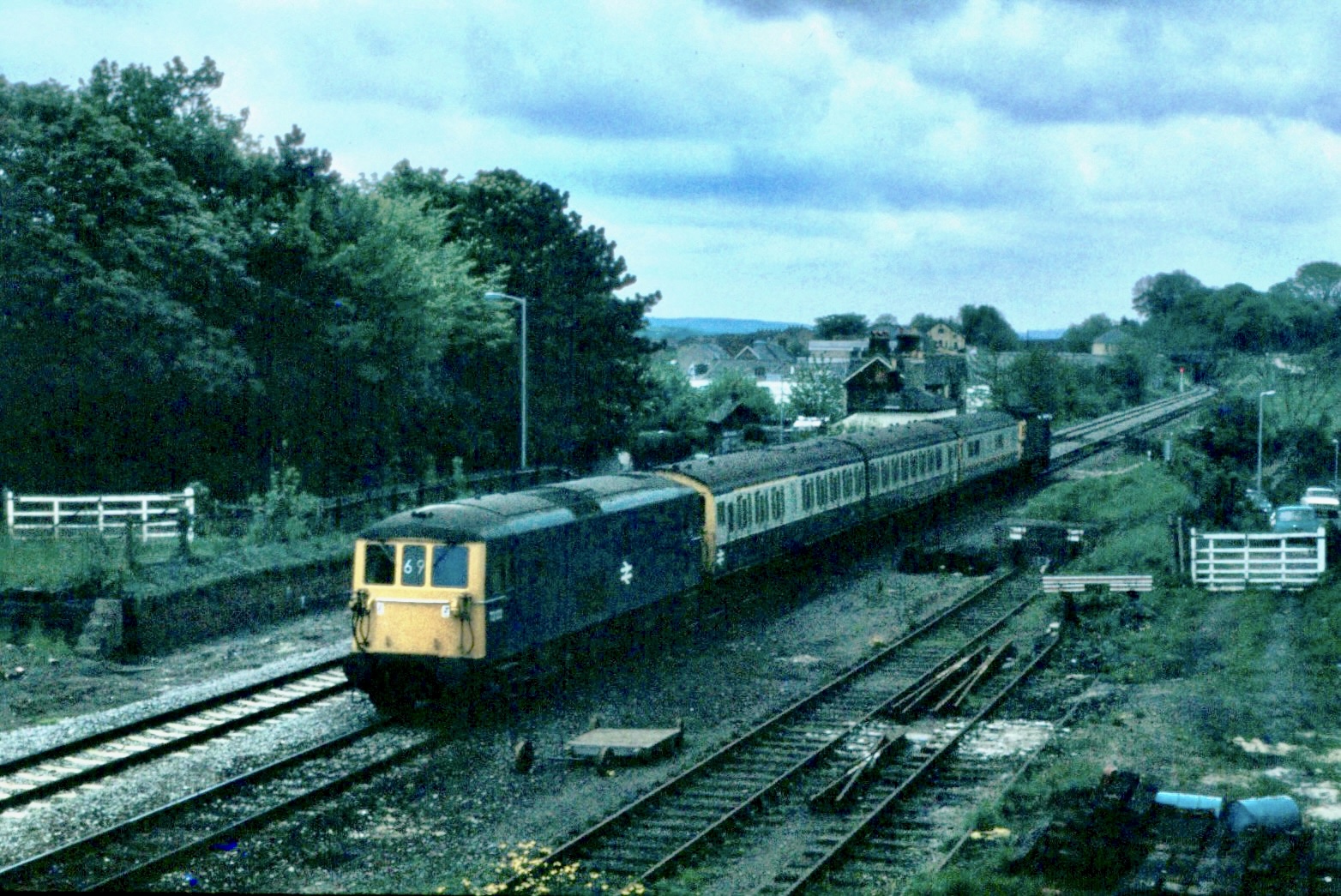
The Class 88 is the first dual-mode locomotive type in the UK to use the 25 kV AC electrification, as the only other electro-diesel locomotives to have entered service with British Railways are the Class 73’s and Class 74’s, which operated on the Southern Region using third rail electrification, and we’ve reached back into the archives to find some images to share:
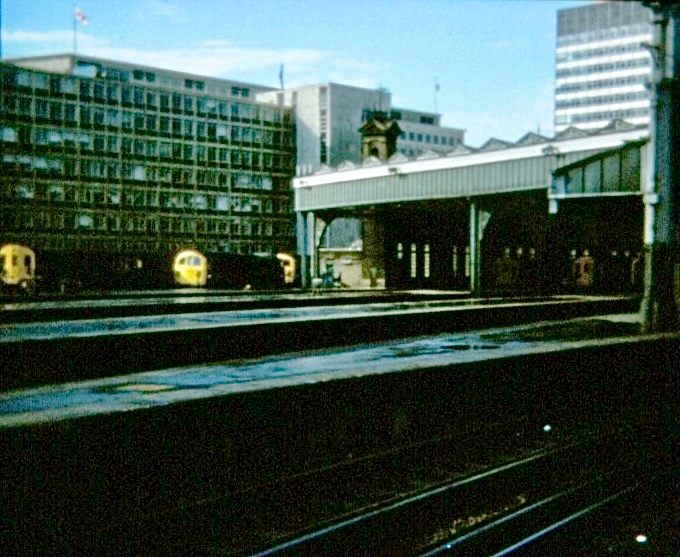
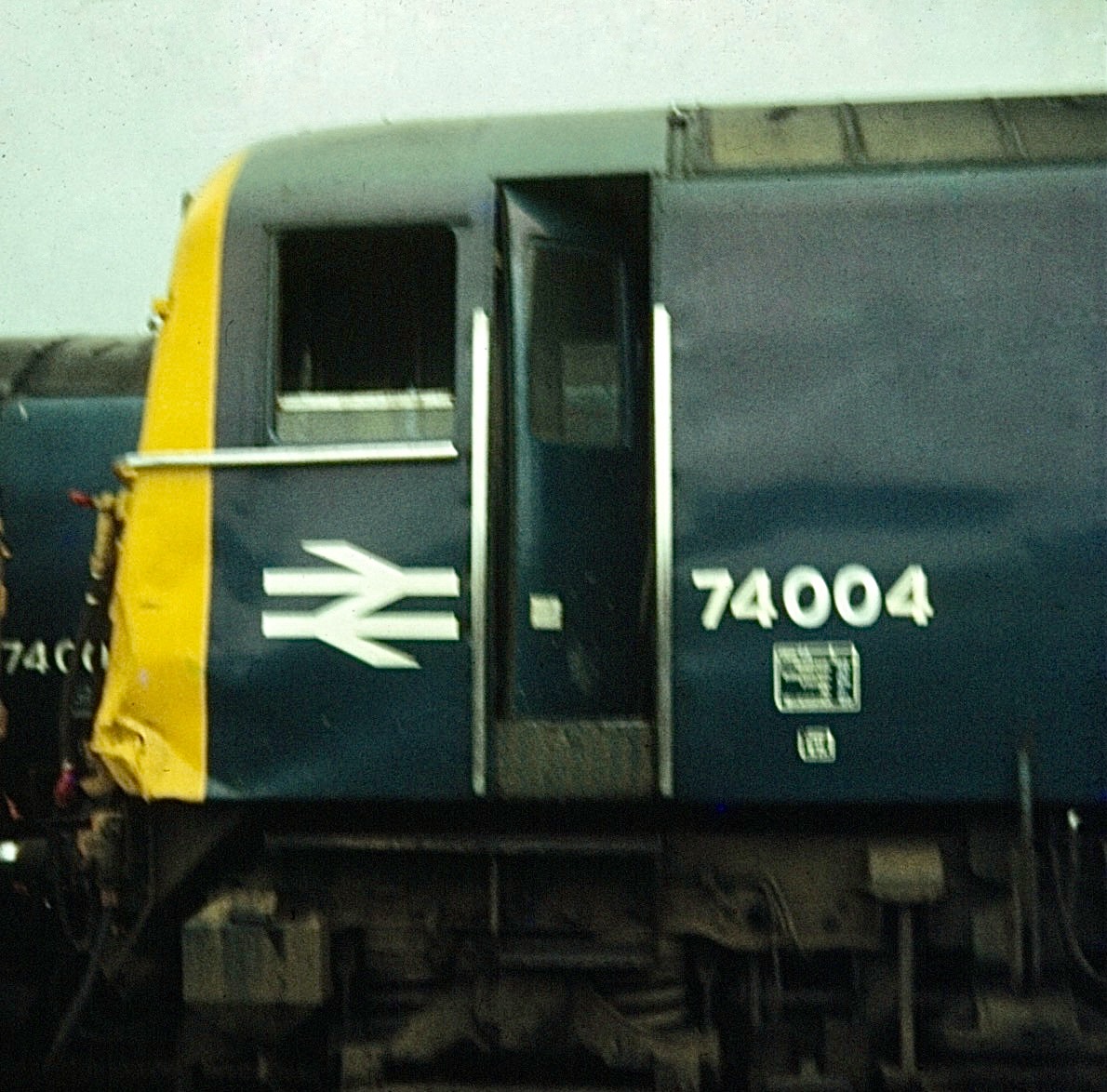
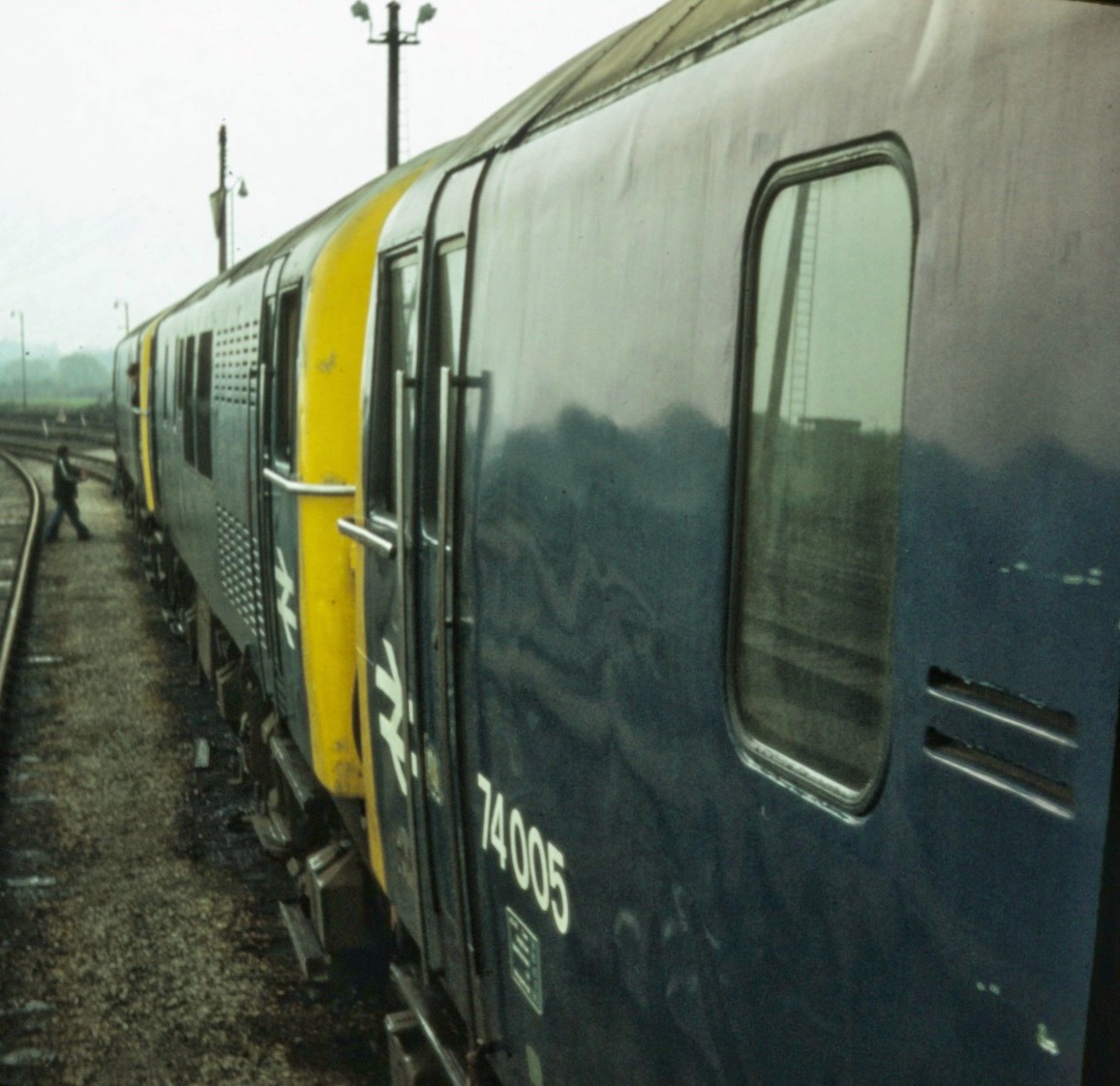
Class 74 No. 74010 at Doncaster Works. Withdrawn from service in December 1977, the locomotive was cut up here in October 1979 after being given a brief reprieve so that it could be for evaluated for departmental use by the Railway Technical Centre (RTC) in Derby. It was given a light overhaul at Eastleigh before being towed to Derby, where it was eventually deemed to be unsuitable and taken to Doncaster for scrapping – 22/07/1979A hastily taken photo of Class 74’s at London Waterloo taken from a departing train bound for Weymouth. This side of the station later became Waterloo International between 1994 and 2007 – July 1977Class 74 No. 74004 has had a bit of a bump (not helped by my camera shake!) as it stands forlorn at Eastleigh Diesel Depot during the 1978 Open Day. This locomotive was withdrawn from service in December 1977 and cut up at Birds in Long Marston. She was originally built as the pioneer Class 71 and numbered E5000 – 30/04/1978Withdrawn Class 74’s at Eastleigh Diesel Depot Open Day including No.’s 74005 and 74009 – 30/04/1978
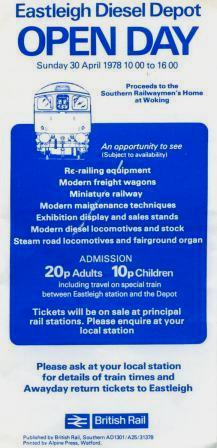
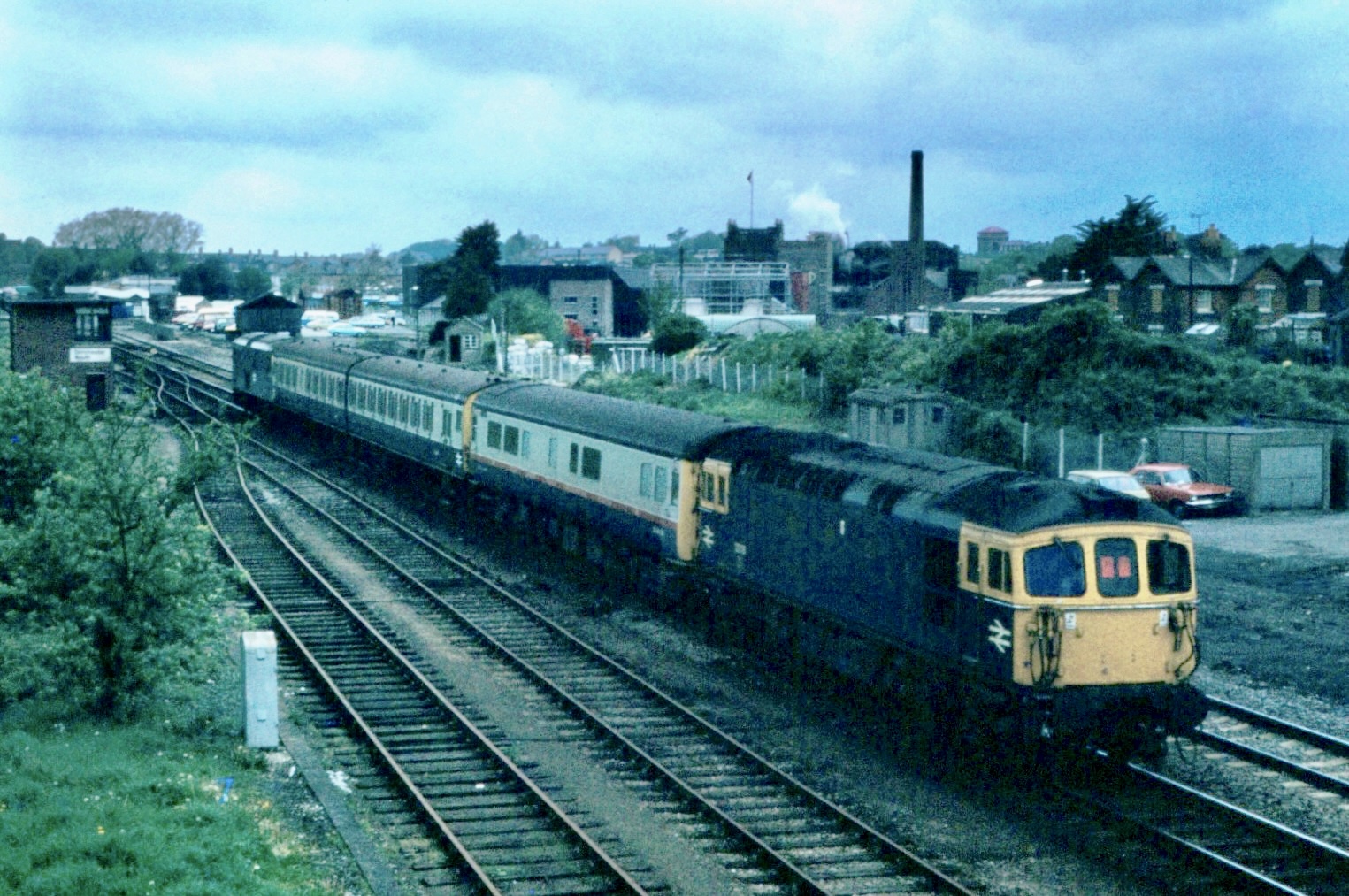
Eastleigh Open Day 1978 flyerClass 73 No. 73122 and 2-HAP Unit No. 6103 with a third unidentified carriage and Class 33 No. 33116 working a test train towards Dorchester South – 13/05/1981The same test train as in the image above focussing on Class 33 No. 33116 on the approach to Dorchester South – 13/05/1981
For The Record:
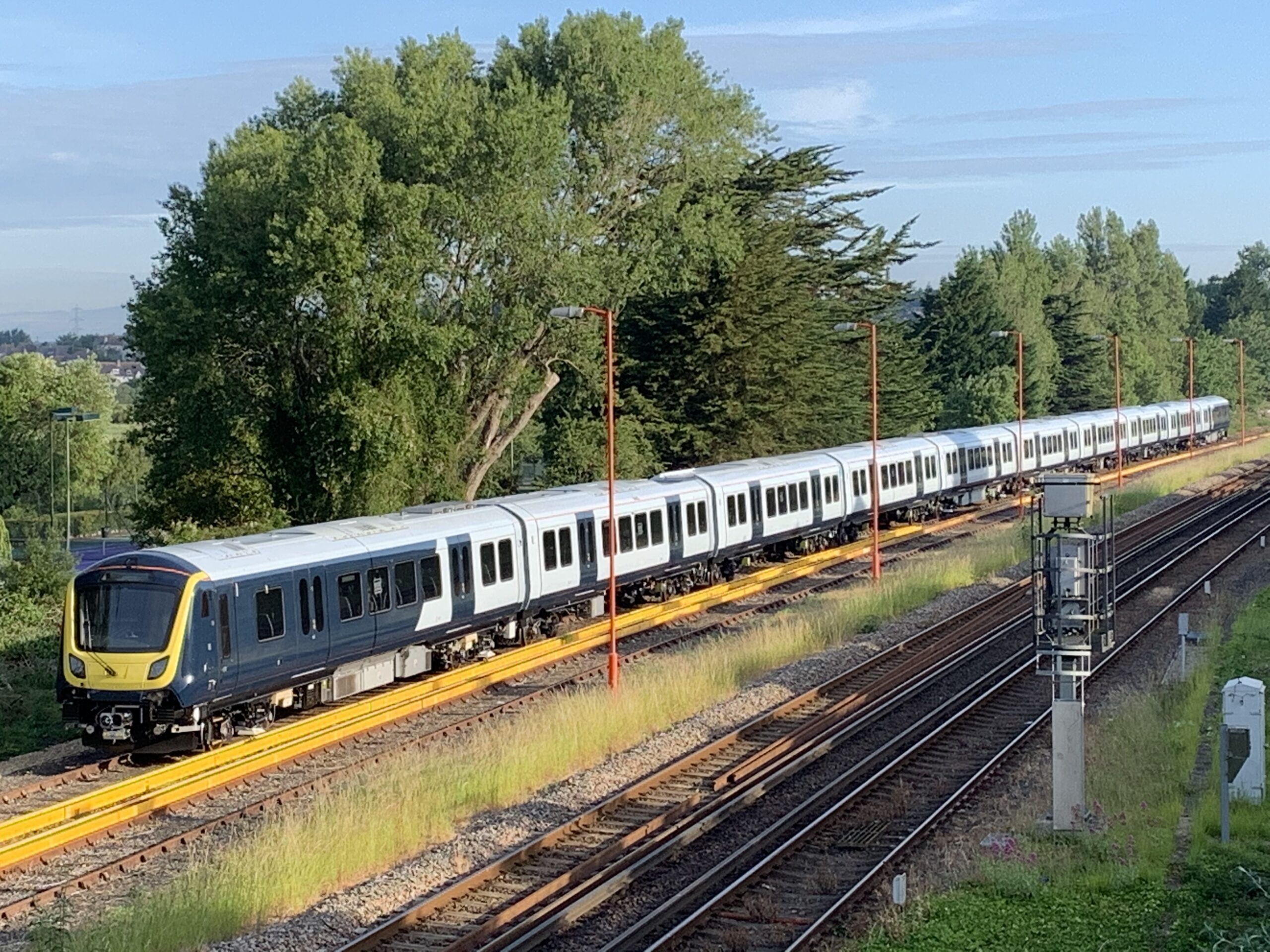
In other news, the SWR Class 701 Electric Multiple Units (EMU’s) finally entered revenue earning service on Tuesday 9th January 2024 when No. 701037 worked a single round trip between Waterloo and Windsor Eton Riverside. The Derby-built trains had been due to enter service in 2019. SWR have since promised the rolling stock would enter passenger service in 2023 – a promise echoed by the Department for Transport (DaFT) in a statement issued in May 2023, which said the trains would run “this calendar year”. It is intended a Class 701 will continue to run off-peak Monday to Friday between London Waterloo and Windsor, in order to fulfil that commitment, making one single round trip each day, or working between 1000 and 1600. The phased entry into service of the Class 701’s – which continue test runs to Poole and Bournemouth – will eventually allow for the withdrawal of SWR’s Class 455 units and the cascade of the Class 458 fleet to longer distance services.
Back in 2020, the first Class 701 to be delivered, No. 701002, was delivered to South Western Railway and somehow made its way to Weymouth where it is seen here in Jersey Sidings awaiting commissioning tests. Yoshi and I stumbled across it while out for our morning walkies – 16/06/200
The North Dorset NMT ran on Thursday 11th January 2024 – a week earlier than I expected – in the hands of HST Class 43 power cars No.’s 43013 and 43257.
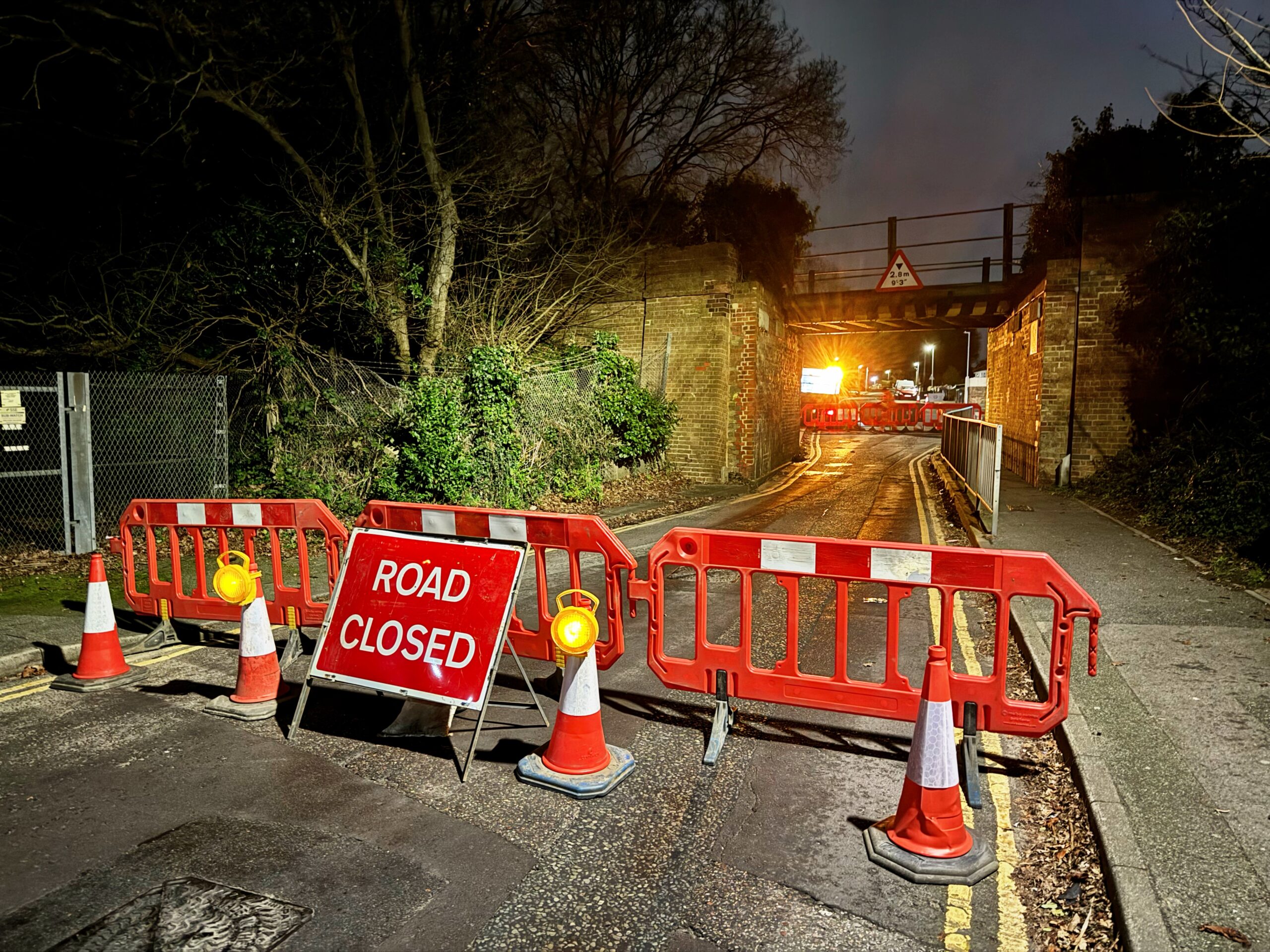
Lake Road was closed to road traffic from its junction with Lake Drive to its junction with Coles Avenue from Monday 8th January up to and including Friday 12th January 2024 – 2200 to 0600 daily to facilitate removal of material from a bridge strike and replace missing signage on Lake Road Bridge situated on the Hamworthy Branch. We popped by a couple of times, and although the road was indeed closed, there didn’t seem to be any activity taking place with regards to bridge repairs, which is disappointing to say the least.
Road closure at Lake Road bridge – but little sign of any repairs taking place – 08/01/2024Yoshi had his first grooming session of 2024 on Monday 8th January and couldn’t wait to show off his new cut to his grandmama – 08/01/2024
That brings us to the end of another blog entry. Next week, we’ll celebrate Yoshi’s birthday and hopefully have some more Dorset based railway images and video to bring you. Thank you for reading and for your comments, corrections and amendments. All very much appreciated. We’ll leave you with a couple of shots from that early morning trip to Durdle Door! Be seeing you!
Sunrise at Durdle Door – 06/01/2024Sunrise at Durdle Door – 06/01/2024
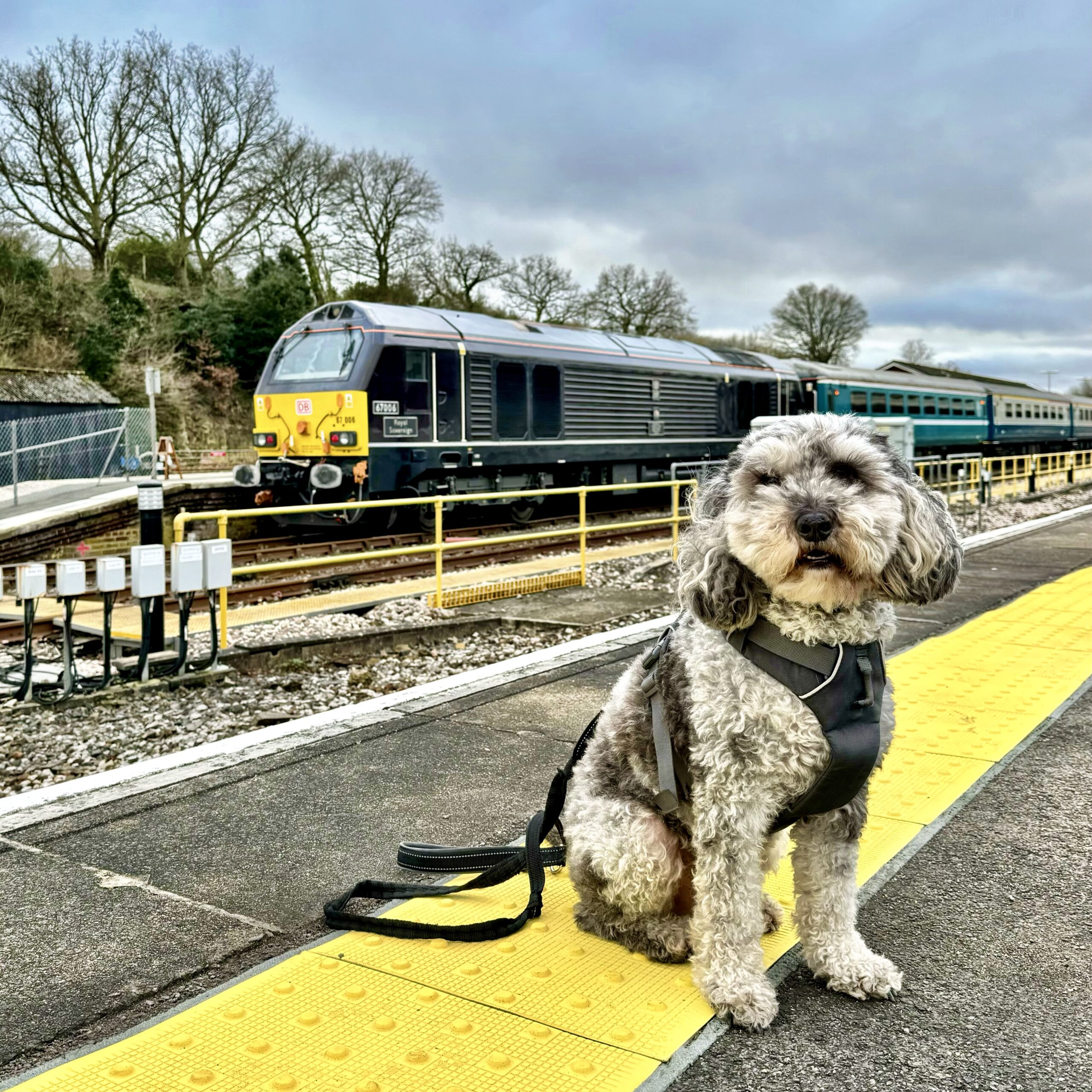
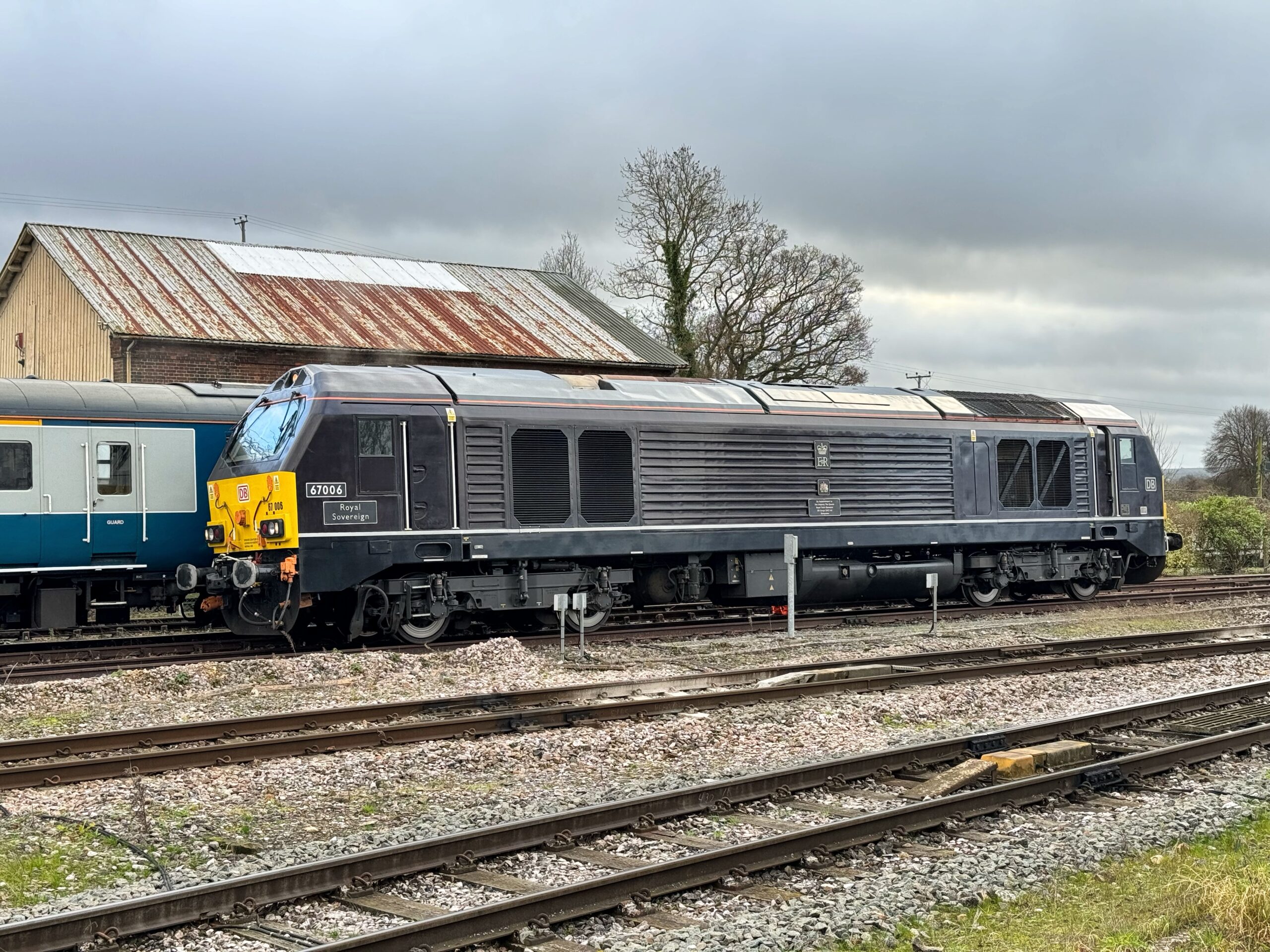
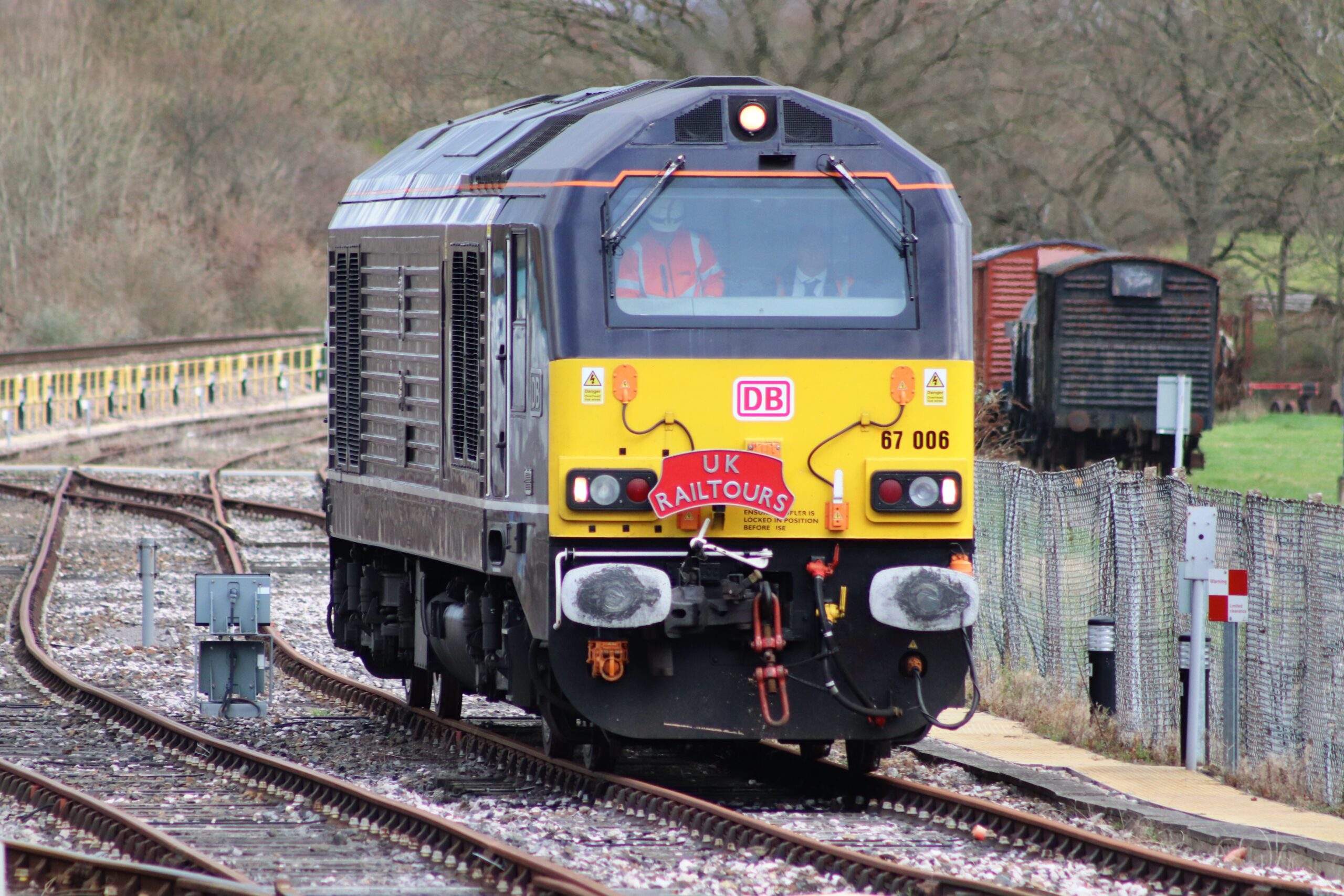
Yoshi at Yeovil Junction with Class 67 No. 67006 ‘Royal Sovereign’ was in charge of UK Railtours “Carols At Sherborne Abbey” 1Z15 0715 Peterborough to Yeovil Jn Heritage Platform. The Class 67 locomotives are a class of Bo-Bo diesel electric mainline locomotives which were built for the English, Welsh and Scottish Railway between 1999 to 2000 by Alstom at Meinfesa in Valencia, Spain with drive components (engine and transmission) from General Motors Diesel. Yoshi is a cockapoo dog, a miniature poodle and cocker spaniel mix produced in Wiltshire – 23/12/2023
December 11th 2023 to December 31st 2023
The second part of our December blog is finally here! After our trip to the North, we didn’t have to wait long for some local railway themed action as another Class 458 EMU drag from Widnes Transport Tech to Bournemouth depot took place on Wednesday 13th running as 5X73 0722 Wembley Receptions 1-7 to Bournemouth TRSMD. I kept one eye on its movement via the live maps available on the Open Time Trains website, and at one point almost left home early as the train was running well ahead of time.
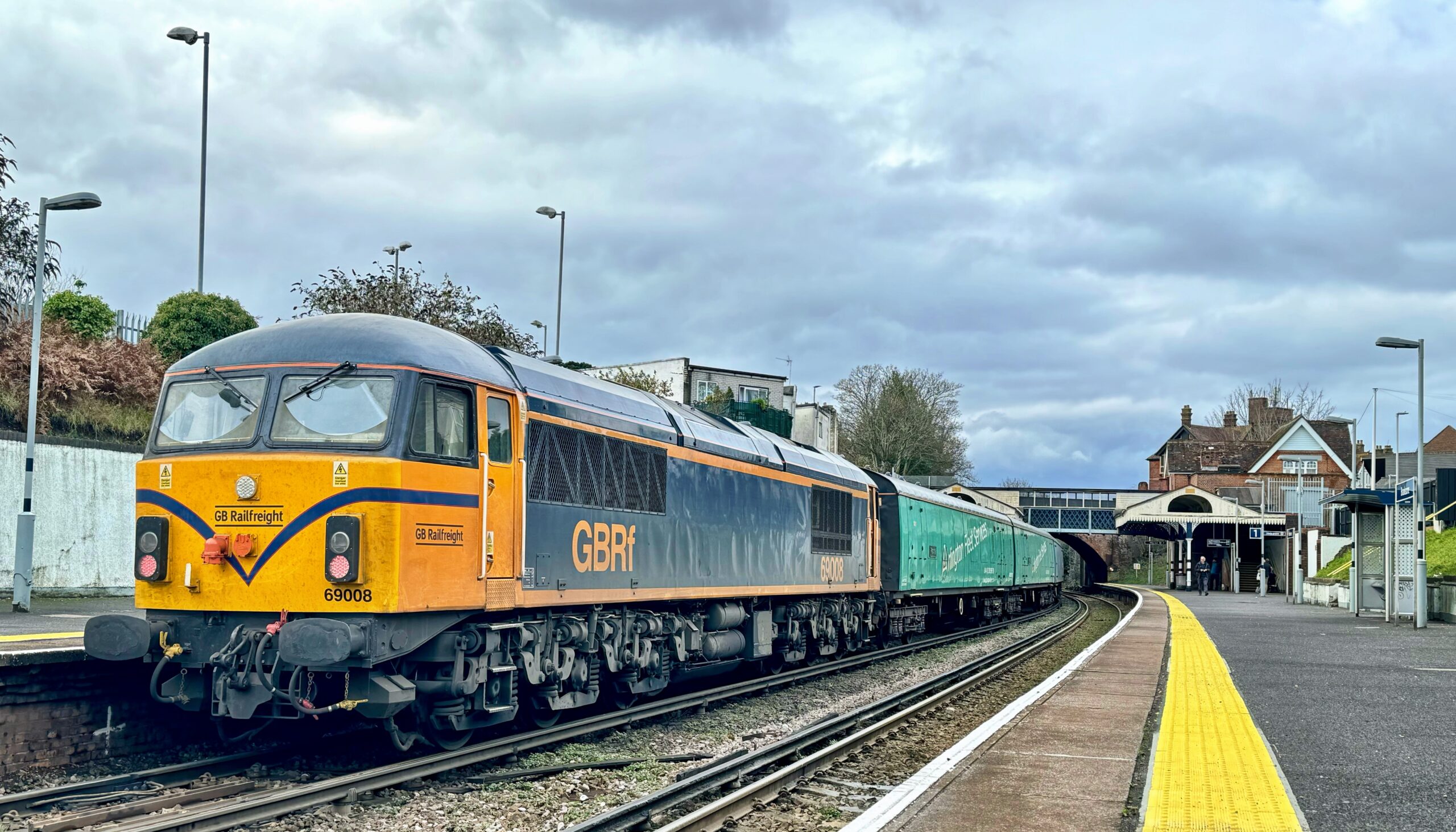
GBRf Class 69 No.69008 at Branksome preparing to reverse into the depot with 5X73 0722 Wembley Receptions 1-7 to Bournemouth TRSMD – 13/12/2023
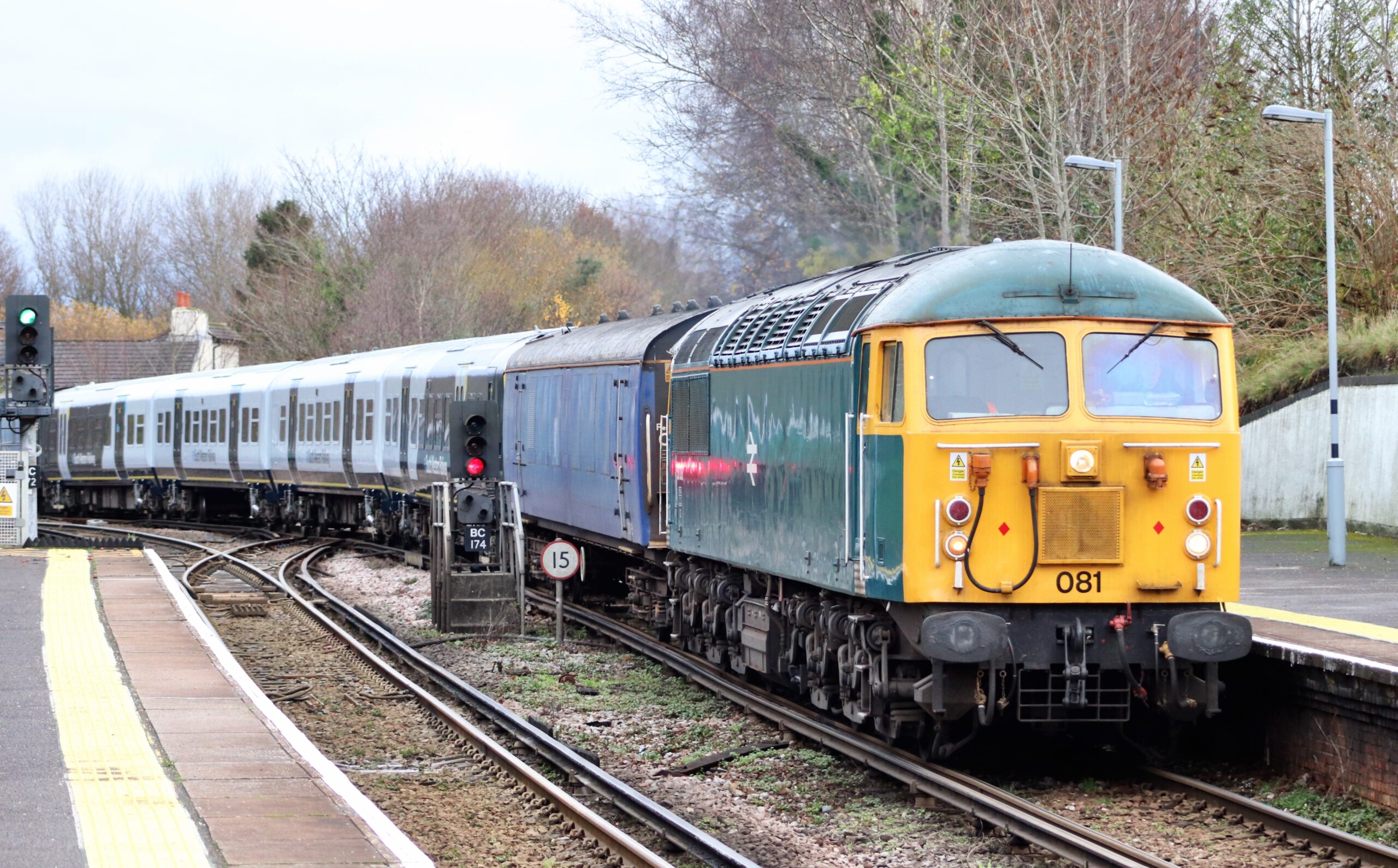
However, the train was held outside of Eastleigh for a while so I was able to get to Branksome on the train as planned just prior to the arrival of GBRf Class 56 No. 56081 and Class 69 No. 69008 with South Western Railway (SWR) Class 458 No. 458424 sandwiched in-between barrier coaches. The return run taking another Class 458 for refurbishment in Widnes was set for departure the afternoon of the same day, but was afforded three different paths out of the depot. Avoiding the possibility of picking the wrong working and either missing the departure or having a lengthy wait I decided just to remain at home instead!
GBRf Class 56 No. 56081 with SWR Class 458 No. 458424 in tow arrives at Branksome heading 5X73 0722 Wembley Receptions 1-7 to Bournemouth TRSMD – 13/12/2023
No. 56081 is to to be retired to Longport in the New Year. While the option for additional Class 69 conversions doesn’t appear to have been taken yet, the planned despatch of the Class 56 to Longport certainly places it in position for potential conversion to No. 69017.
Later on the same day, the Snow & Ice Treatment Train (SITT) ran from Totton to Dorchester South and back as 3Y89 2211 Totton Yard to Totton Yard with Class 66 No.’s 66743 and 66772 ‘Maria’. I toyed briefly with the notion of driving to Dorchester to get a photo of No. 66743 in its Belmond Royal Scotsman livery, but decided against it on this occasion.
GBRf Class 66 No.’s 66743 and 66772 ‘Maria’ passing Hamworthy with 3Y89 2211 Totton Yard to Totton Yard – 13/12/2023
Saturday 16th December was a bit of a road trip so I could see what could well be the final DB Cargo (DBC) Class 60 hauled railtour as the class are to be ‘retired’ in April 2024 by the Deutsche Bahn owned freight operator following an announcement it is to eliminate the use of its Class 60 locomotives by re-gearing ten of its Class 66 loco’s to provide an enhanced tractive effort. As most of its services are operated by Class 66 locomotives, with the Class 60’s only seeing limited use, DB Cargo concluded that if services operated by its Class 60 locomotives could be transferred to Class 66’s with a higher tractive effort, it would benefit its customers and the company.
DB Cargo has also said that in the future they are going to focus on contractual railtour operations, with the likes of the Belmond British Pullman trains, and less on the ‘ad hoc’ operations for other tour promoters, such as Pathfinder Railtours who were running “The Festive Midland-Ian” which was promoted as an attempt to try and cover as many freight lines, loops and locations as possible in the West Midlands, featuring some “rare track”. The requested motive power had been Top & Tail DBC Class 60’s but, due to the low numbers of the class remaining in service, on the day DBC were forced to substitute a Class 66 for one of them.
Pathfinder named the railtour “The Festive Midland-Ian” after Ian Loveday who devises and helps with many enthusiast rail based excursions. Ian often advises and assists with access to heavily sought after lines including this 16th December charter.
The route for the tour was confirmed as: GLOUCESTER, CHELTENHAM SPA, WORCESTER SHRUB HILL, Kidderminster DGL, STOURBRIDGE JUNCTION, Stourbridge DGL, Rowley Regis UGL, BIRMINGHAM SNOW HILL, Up & Down Small Health Goods, Caledonia Yard, Up & Down Small Heath Goods, Tyseley Up Through Siding, Dorridge UPL, Leamington Spa UCV, Fenny Compton UGL, Banbury DGL, Banbury Reservoir Sdgs – BANBURY (Break), Fenny Compton DGL, Kineton Branch NR Limit, Leamington Spa DCV, Hatton DGL, Dorridge UDGL, Birmingham New Street (non-stop), Wolverhampton Logistics Centre, Bescot Stadium, Bushbury DGL, Stafford RMT, Oxley Chord, Wolverhampton, Bescot Stadium, Bescot DGL, Aston, BIRMINGHAM NEW STREET, Rowley Regis DGL, STOURBRIDGE JUNCTION, WORCESTER SHRUB HILL, CHELTENHAM SPA, GLOUCESTER
I decided to head to Banbury as I remembered an accesible road bridge close to the Tarmac works which in turn is adjacent to Banbury Resevoir sidings. “The Festive Midland-Ian” is believed to be the first passenger train to visit to the Reservoir stone terminal sidings at Banbury. On the way, I took a slight detour so I could pick up @smithy.377 and looking at the timings available to us on real Time Trains, we realised we’d have a few passes of the train as it worked its way along Banbury Goods Loop and back before tackling the stone terminal sidings. We also enjoyed a few other passing passenger trains and a couple of freights.
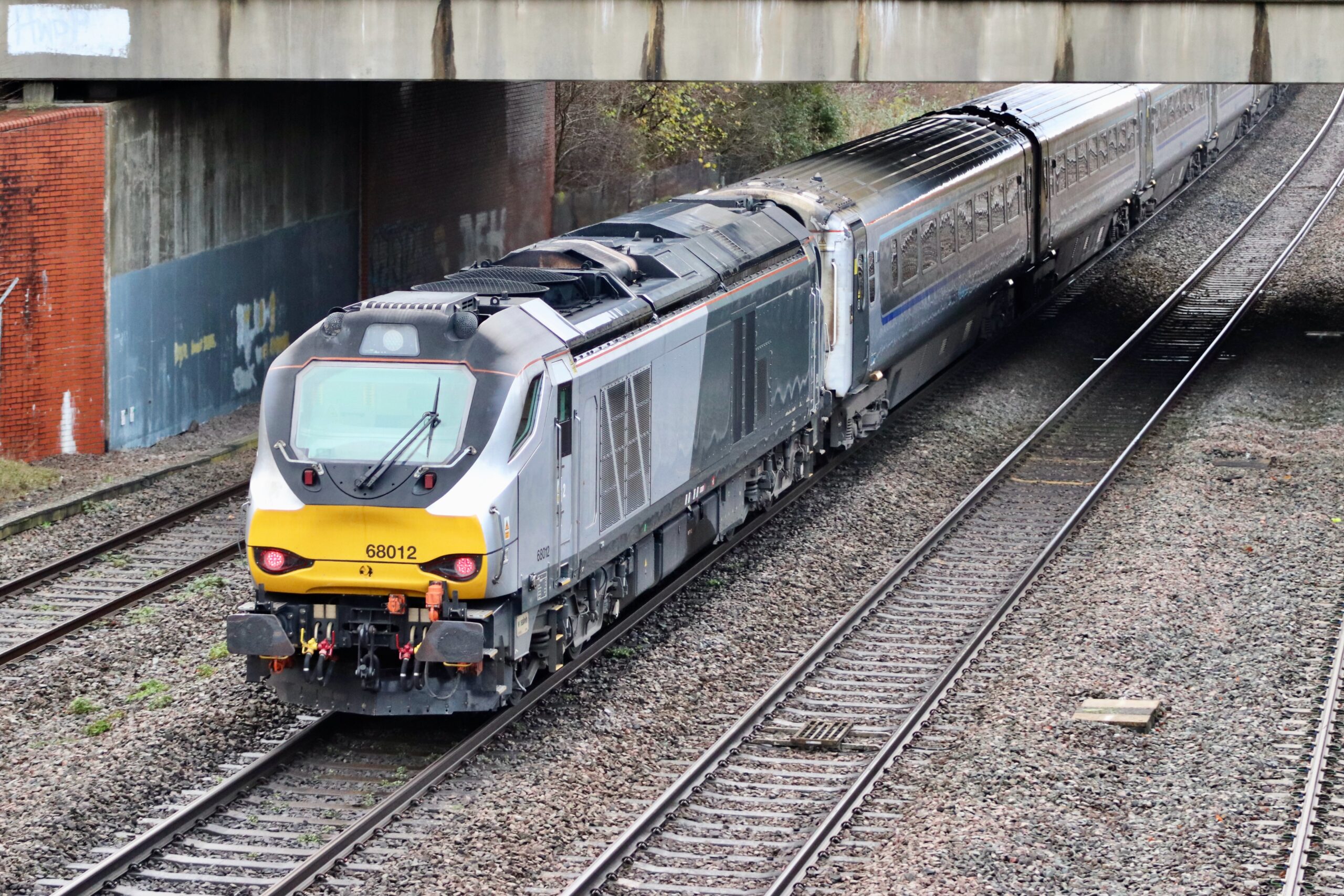
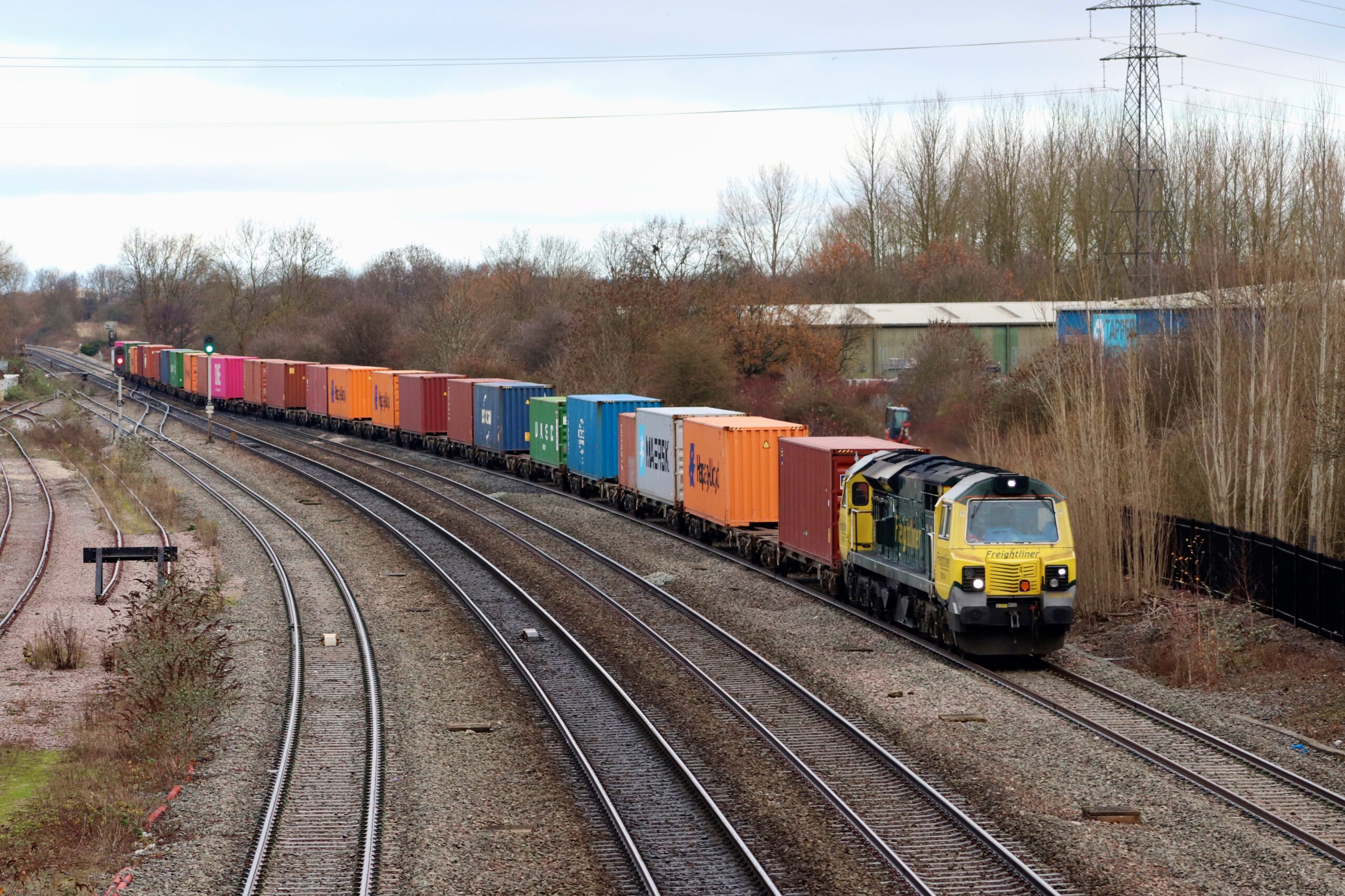
Chiltern Class 58 No. 68012 (set AL04/ DVT 82309) propels 1H27 08:19 Stourbridge Junction to Marylebone towards Banbury railway station – 16/12/2023Freightliner Class 70 No. 70014 working 4O27 06:49 Crewe Basford Hall SSM to Southampton Marine Container Terminal nears Banbury – 16/12/2023
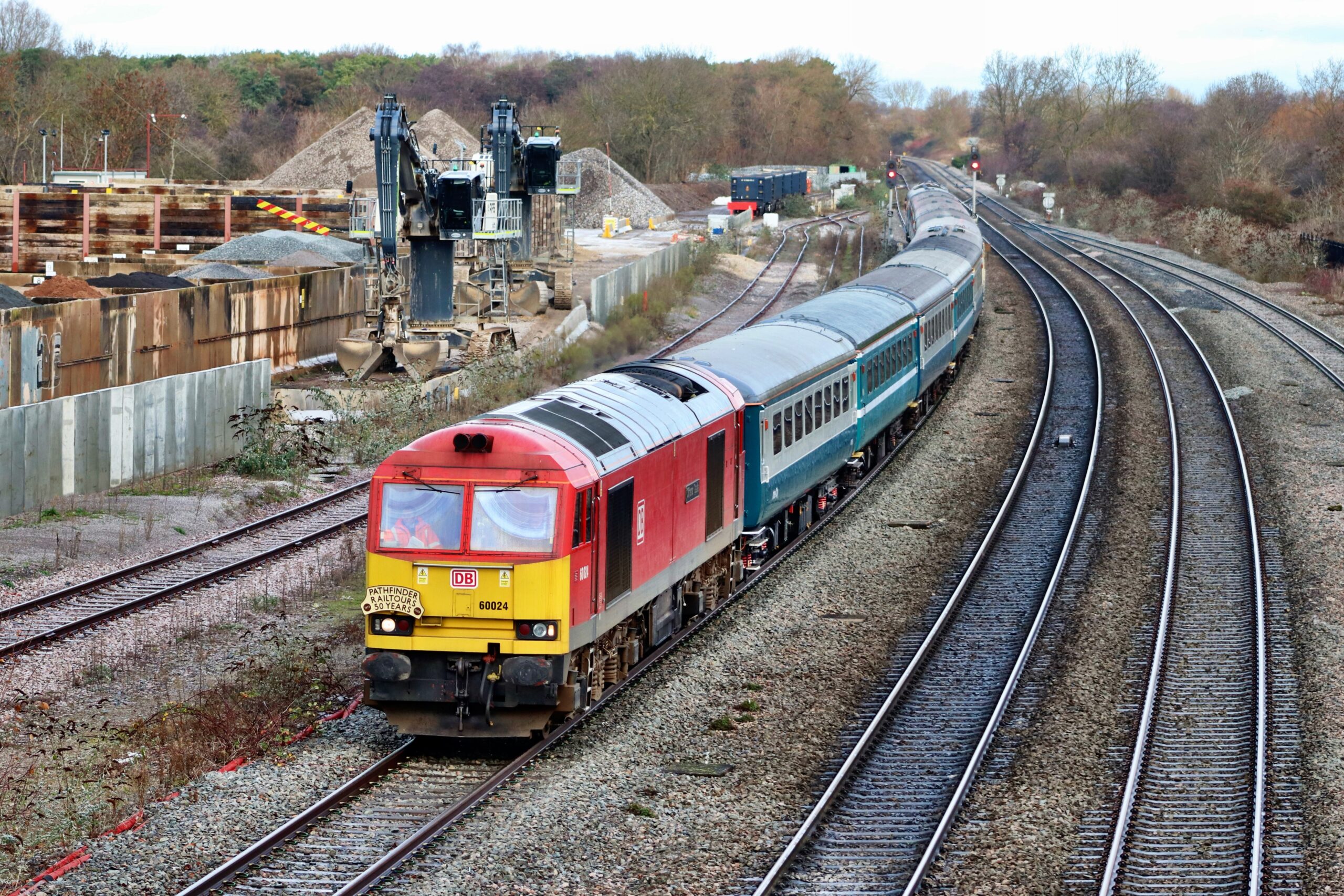
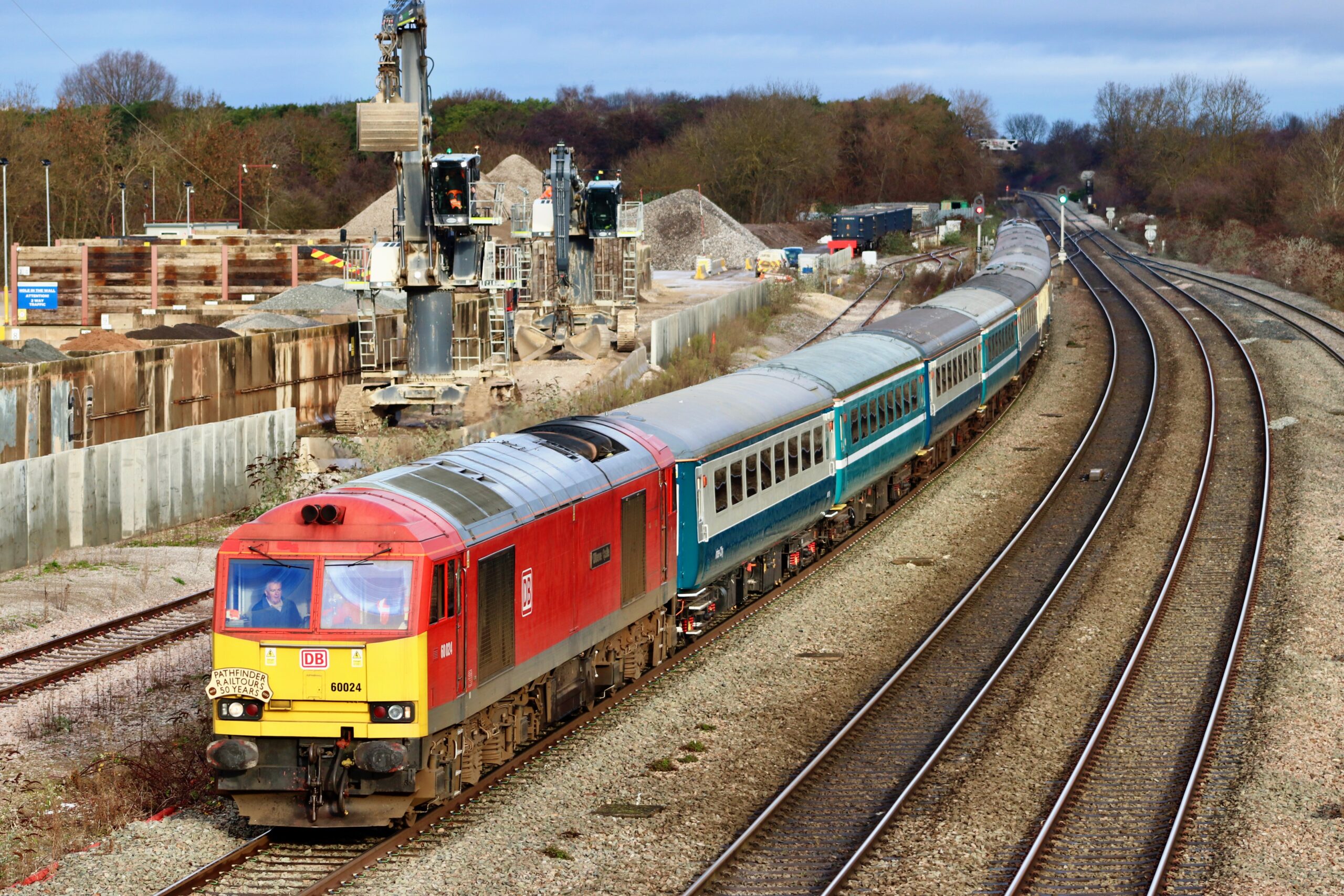
The railtour had to arrive at Resevoir Sidings prior to the arrival of a scheduled GBRf stone train which was confirmed as running on the 16th. The Pathfinder tour was then diagrammed to head into Banbury for a brief layover before heading back up the mainline towards Wolverhampton. I had read the previous day that the Class 66 would be leading towards Banbury, but I was very pleased to see the Class 60 at the front as it rounded the distant curve heading for down goods loop. This meant that we managed to get numerous shots of the leading locomotive and led me to abandon any thoughts of chasing the train up to Fenny Compton and possibly beyond.
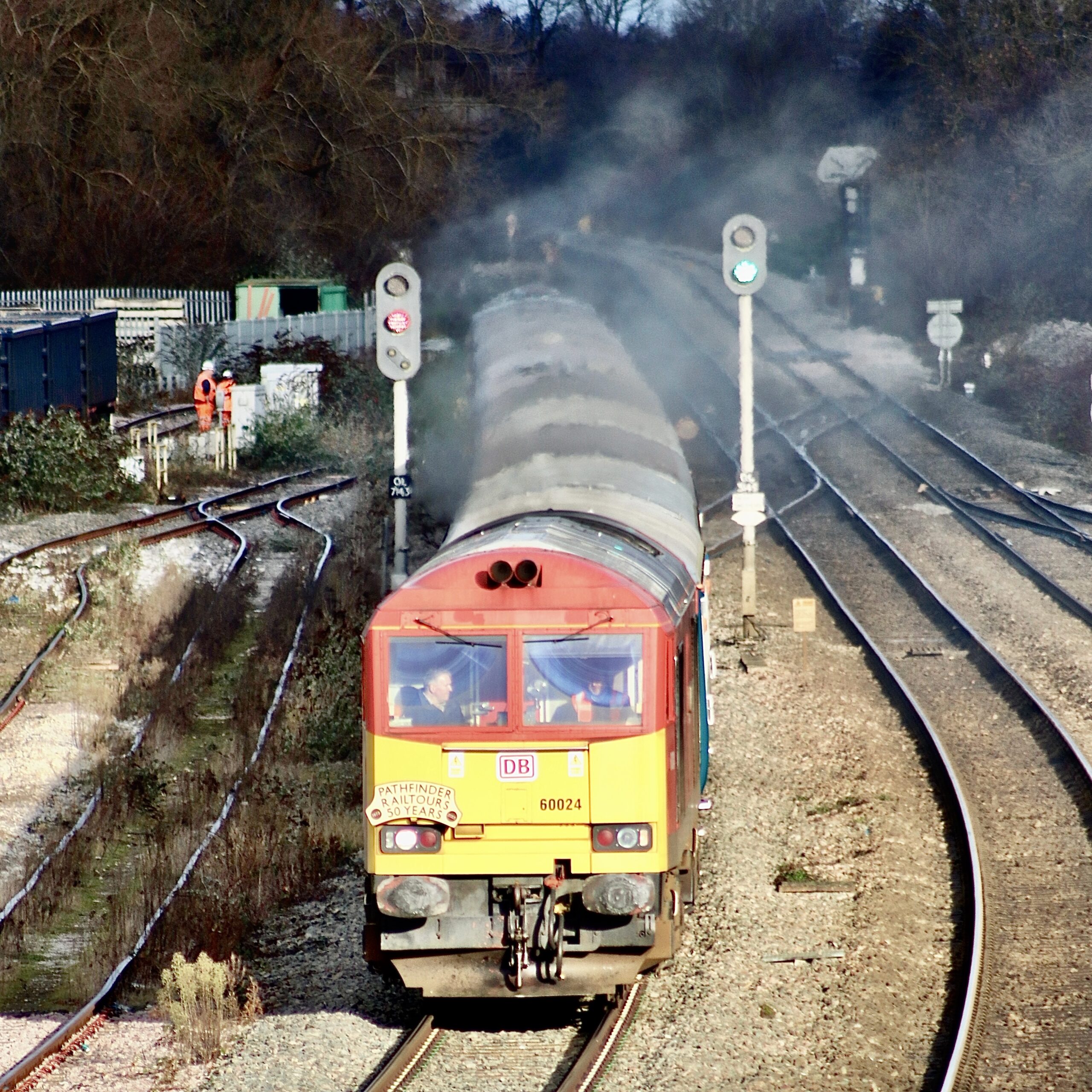
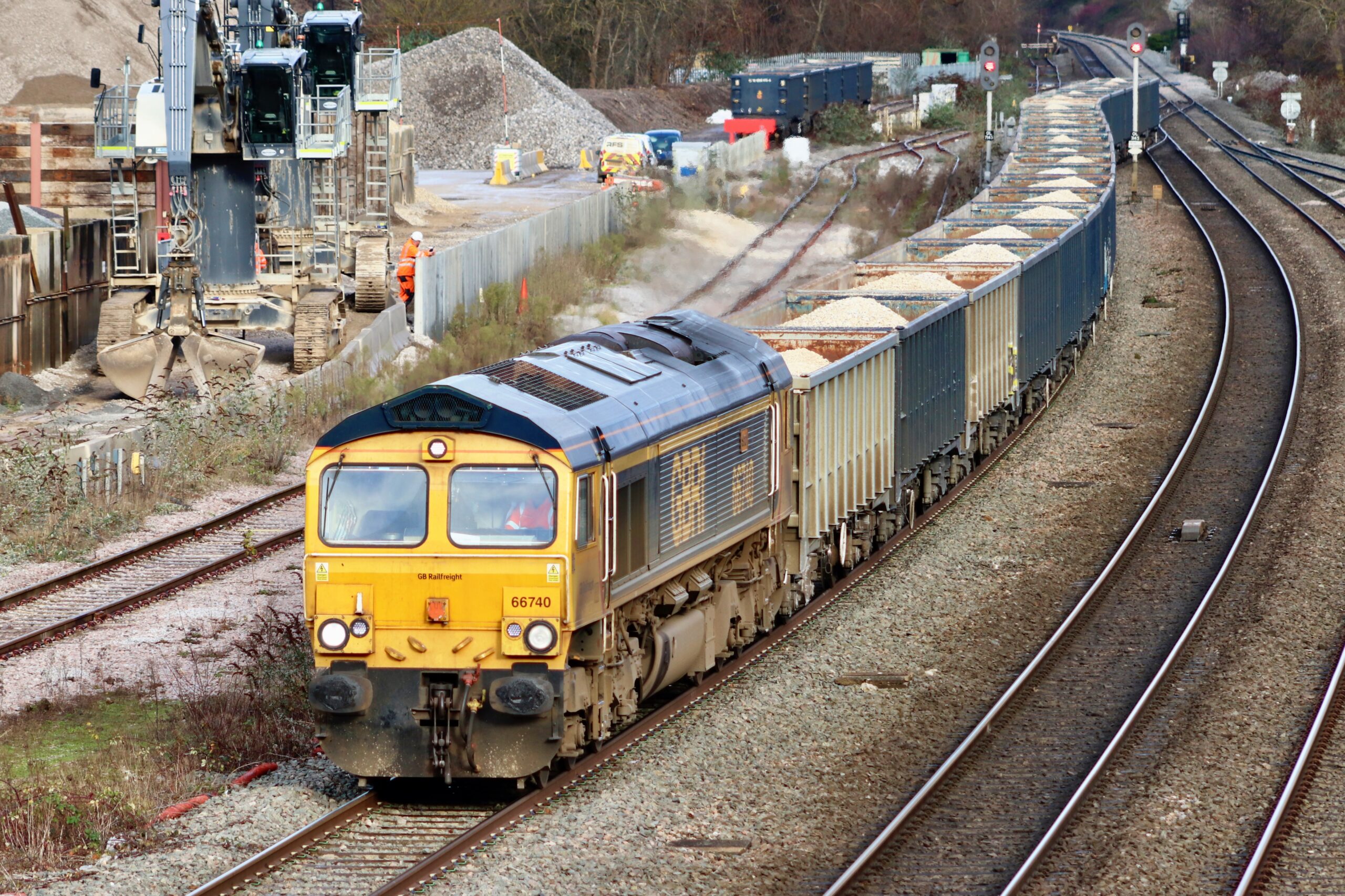
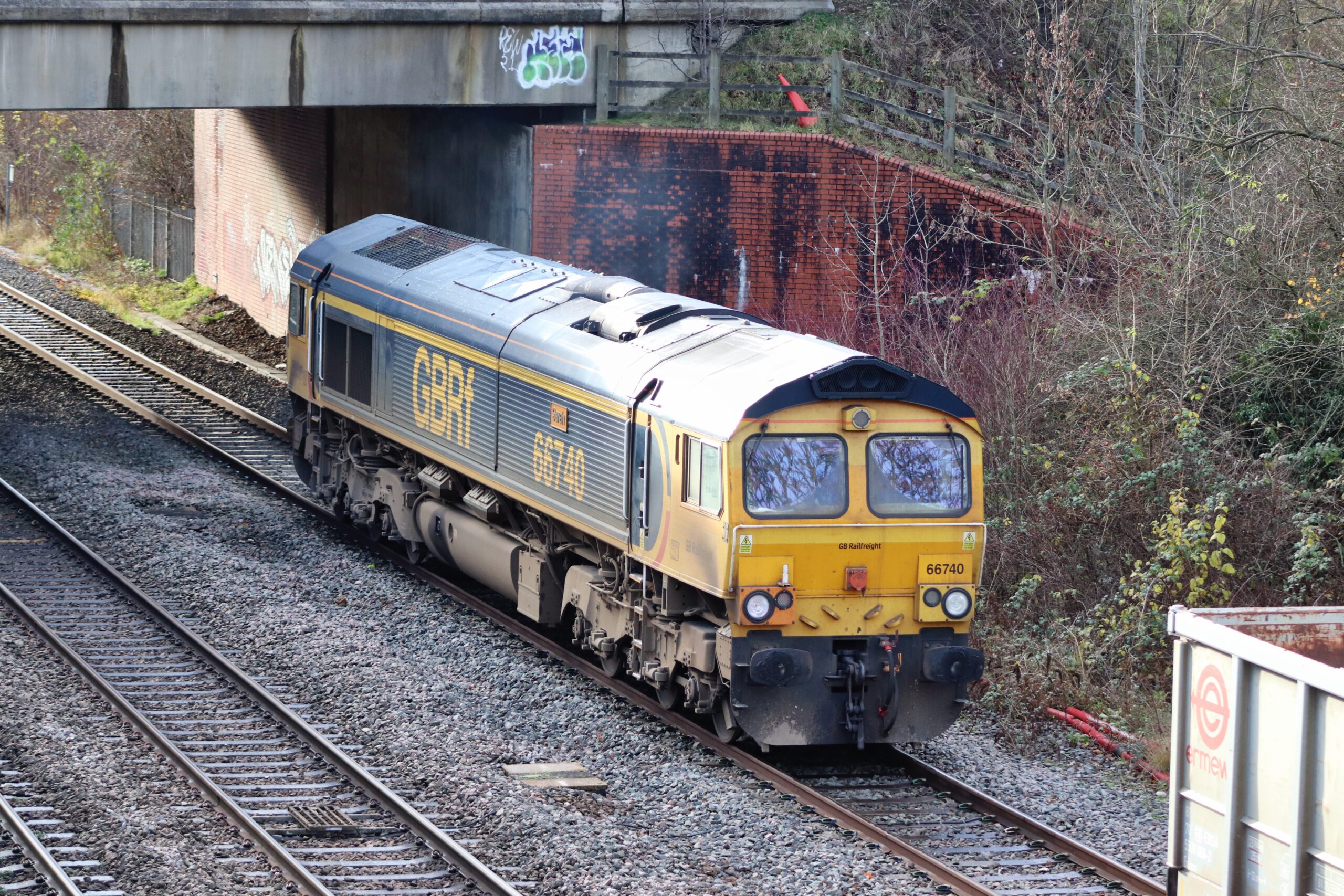
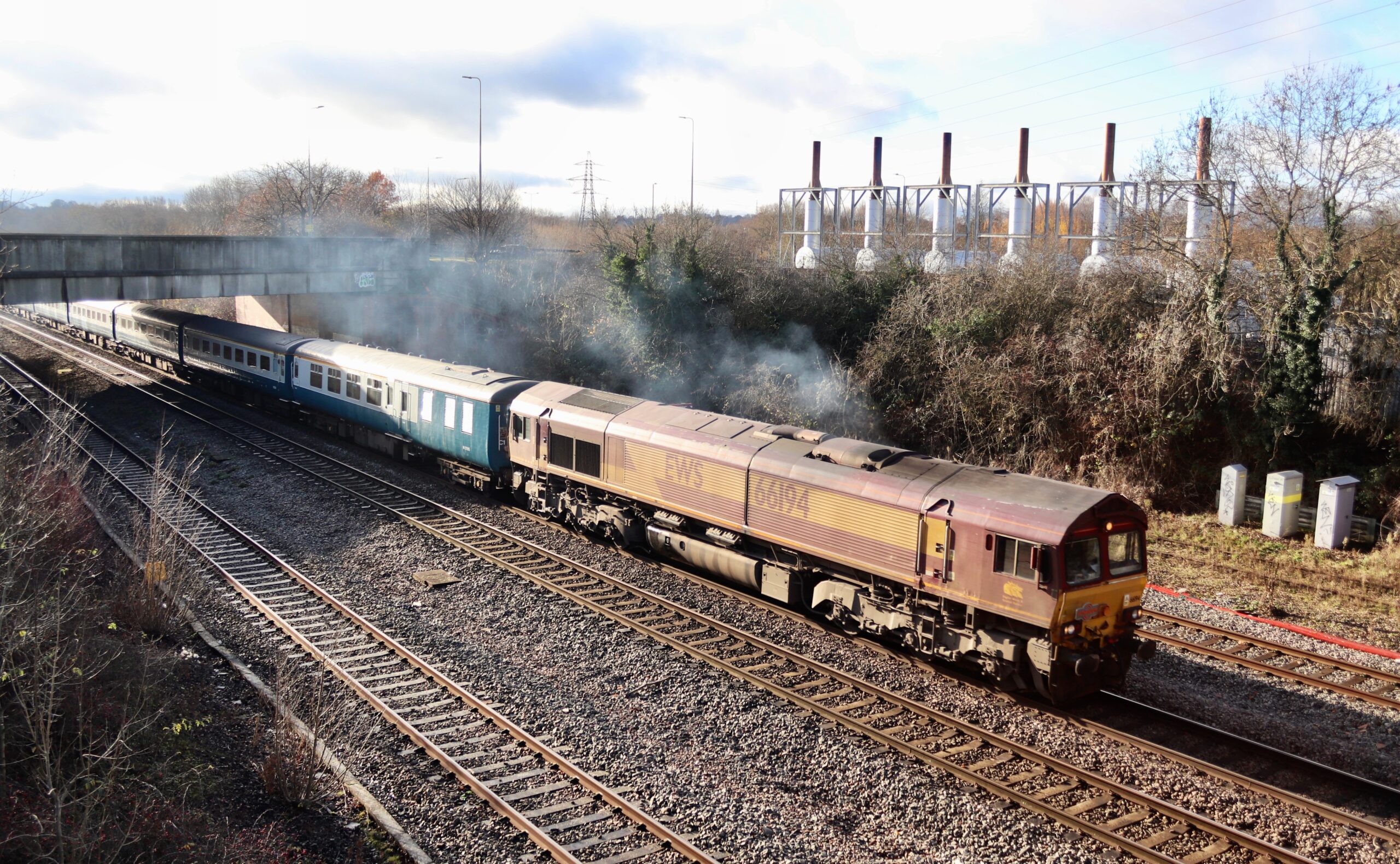
DB Cargo Class 60 No. 60024 hauling “The Festive Midland-Ian” 1Z60 0545 Gloucester to Banbury towards Banbury on the Down Goods Loop – 16/12/2023DB Cargo Class 60 No. 60024 hauling “The Festive Midland-Ian” 1Z60 0545 Gloucester to Banbury – 16/12/2023DB Cargo Class 60 No. 60024 hauling “The Festive Midland-Ian” 1Z60 0545 Gloucester to Banbury towards Banbury on the Down Goods Loop – 16/12/2023GBRf Class 66 No. 66740 ‘Sarah’ arrives with 6G34 02:59 HINDLOW GBRF to Banbury Reservoir Redland Aggregates – 16/12/2023GBRf Class 66 No. 66740 ‘Sarah’ prepares to run around her train; 6G34 02:59 HINDLOW GBRF to Banbury Reservoir Redland Aggregates – 16/12/2023Class 66 No. 66194 takes charge of the second leg of “The Festive Midland-Ian” 1Z61 1211 Banbury to Wolverhampton Walsall Street Steel Terminal – 16/12/2023
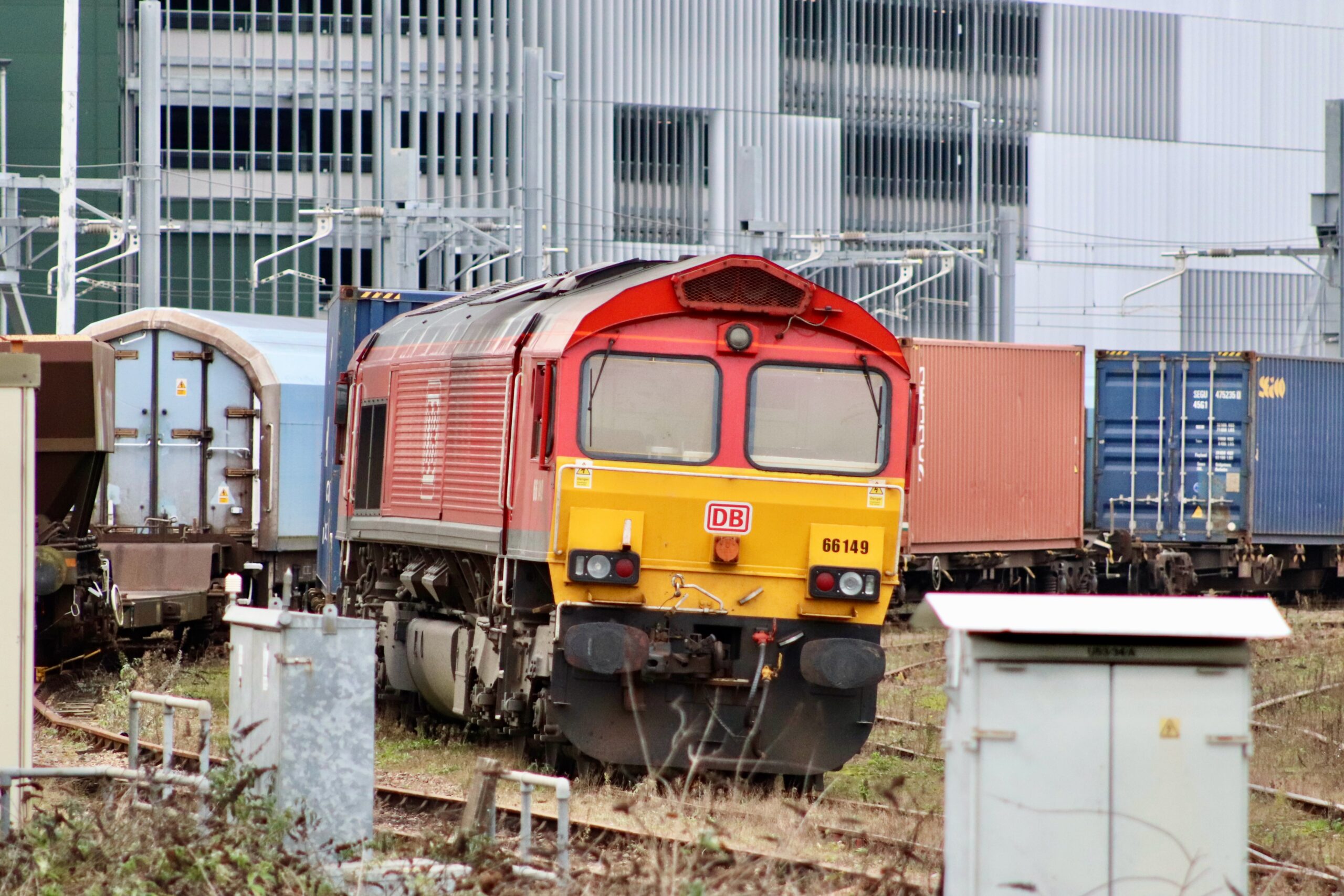
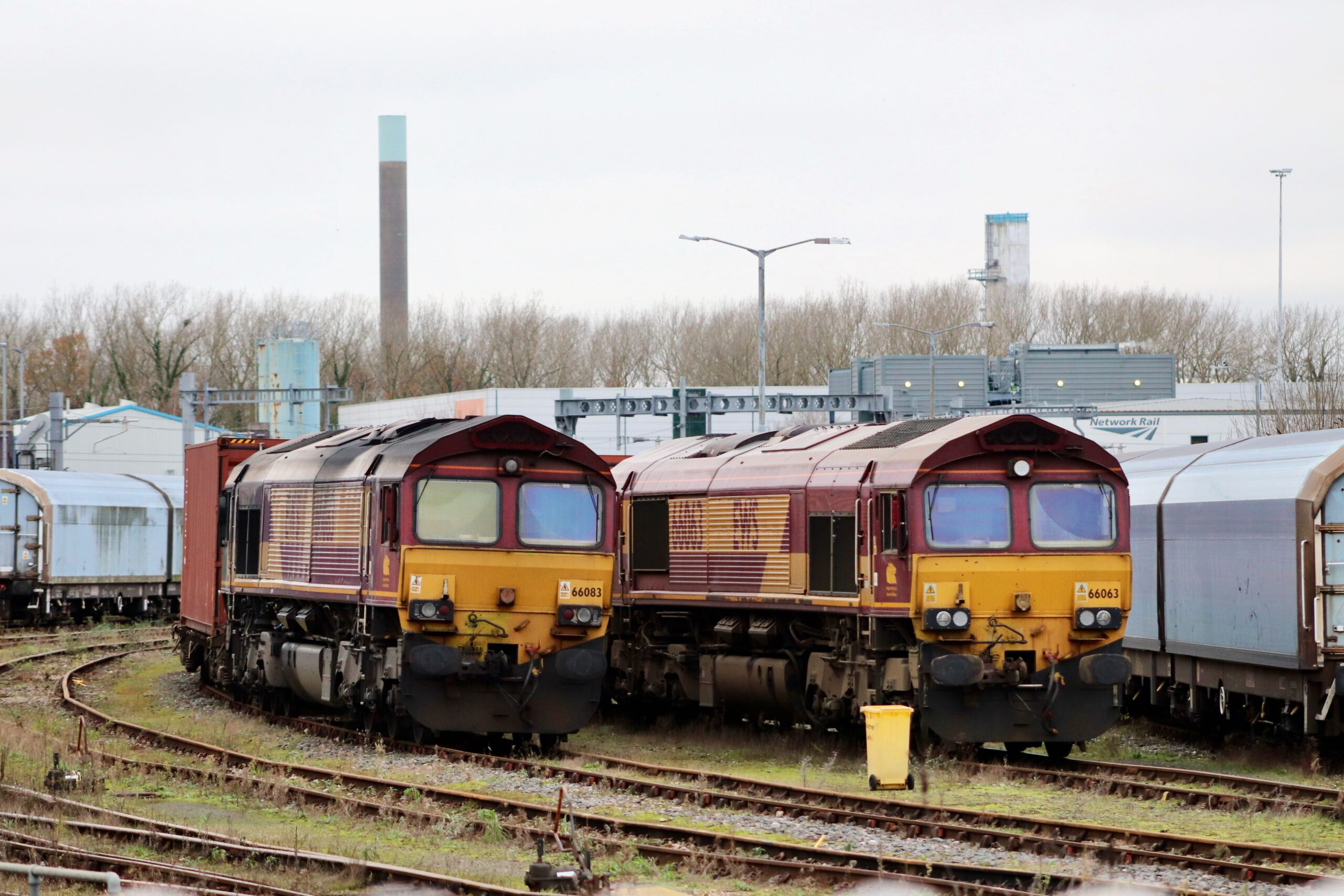
After seeing the Class 66 No. 66194 taking “The Festive Midland-Ian” back towards Wolverhampton, I opted to return home via Didcot in the hope that I could get a photo of special King Prince Charles Coronation liveried Class 66 No. 66023 which had been showing as being on Didcot Fuelling Point. On arrival at Didcot railway station, we were allowed up onto the platforms by Great Western Railway gateline staff, but unfortunately, the No. 66023 was nowhere to be seen. @smithy.377 later discovered the locomotive was inside a shed and therefore out of sight of our cameras. We were able to photograph a few other DBC Class 66 locomotives however.
In red DB Cargo livery Class 66 NO. 66149 in Didcot Yard – 16/12/2023Still carrying EWS livery, DB Cargo Class 66 locomotives No.’s 66083 and 66063 at Didcot – 16/12/2023
Video from Banbury on 16th December 2023 featuring DB Cargo Class 60 No. 60024 and Class 66 No. 66194 top and tail working “The Festive Midland-Ian” from Pathfinder Railtours; 1Z60 0545 Gloucester to Banbury & 1Z61 1211 Banbury to Wolverhampton Walsall Street Steel Terminal. Other trains featured include: 68012 (set AL04/ DVT 82309) – 1H27 08:19 Stourbridge Junction to Marylebone 221139 – 1M30 07:45 Bournemouth to Manchester Piccadilly 221137 – 1O08 07:25 Manchester Piccadilly to Bournemouth 70014 – 4O27 06:49 Crewe Basford Hall SSM to Southampton Marine Container Terminal 168108/168106 – 1R17 09:02 Marylebone to Birmingham Moor Street 168218/168328 – 1H28 09:13 Birmingham Moor Street to Marylebone 220031 – 1V83 06:23 Newcastle to Reading 168004 / 168xxx – 1H30 09:43 Birmingham Moor Street to Marylebone 168xxx/ 168107 – 1R19 09:32 Marylebone to Birmingham Moor Street 168xxx/ 168217 – 1R21 10:02 Marylebone to Birmingham Moor Street 66740 ‘Sarah’ – 6G34 02:59 HINDLOW GBRF to Banbury Reservoir Redland Aggregates 168001 ‘Adrian Shooter’/168xxx – 1H33 10:43 Birmingham Moor Street to Marylebone 220027 – 1O12 09:25 Manchester Piccadilly to Bournemouth 220033 – 1M38 09:45 Bournemouth to Manchester Piccadilly 168322/168215 – 1R25 11:02 Marylebone to Birmingham Moor Street
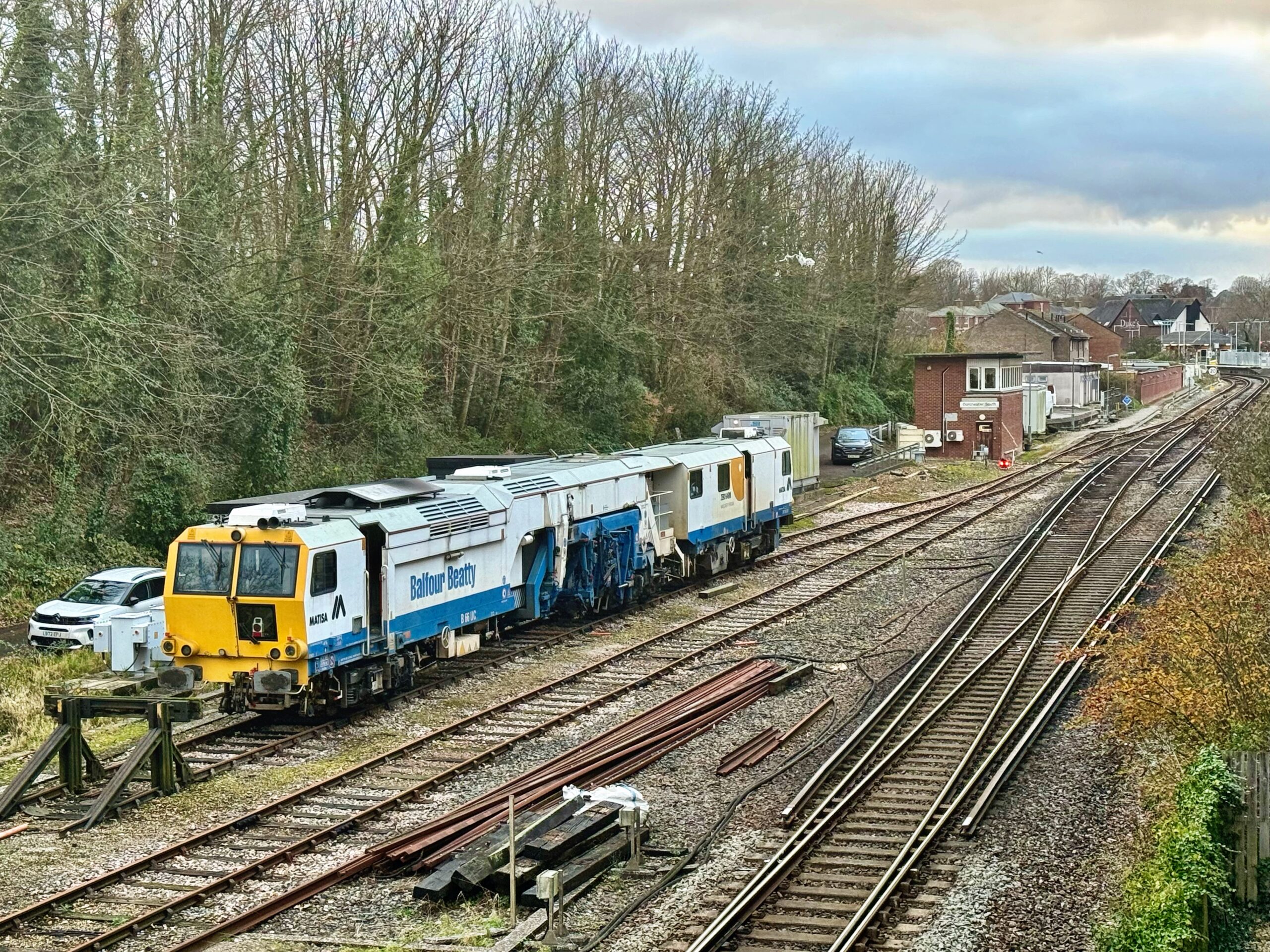
Engineering works at Middle Stream Bridge near Wool on Sunday 17th December meant there were no trains running in the area. Yoshi and I had a little “family” trip out to Weymouth and I grabbed a couple of photographs of track machines resting between duties on our way home.
Balfour Beatty Matisa B66UC Tamper No. DR75501 in the sidings at Dorchester South prior to working the following days 6Q66 05:00 Dorchester Junction to Eastleigh East Yard – 17/12/2023
A tamping machine or ballast tamper, informally simply a tamper, is a self-propelled, rail-mounted machine used to pack (or tamp) the track ballast under railway tracks to make the tracks and roadbed more durable and level. Prior to the introduction of mechanical tampers, this task was done by manual labour with the help of beaters. As well as being faster, more accurate, more efficient and less labour-intensive, tamping machines are essential for the use of concrete sleepers since they are too heavy to be lifted by hand.
At its most basic, a tamping machine only packs the ballast. Some modern machines, sometimes known as tamper-liners or tamping and lining machines, also correct the alignment of the rails to make them parallel and level, in order to achieve a more comfortable ride for passengers and freight and to reduce the mechanical strain applied to the rails by passing trains. This is done by finding places where the sleepers have sunk from the weight of the passing trains or frost action, causing the track to sag.
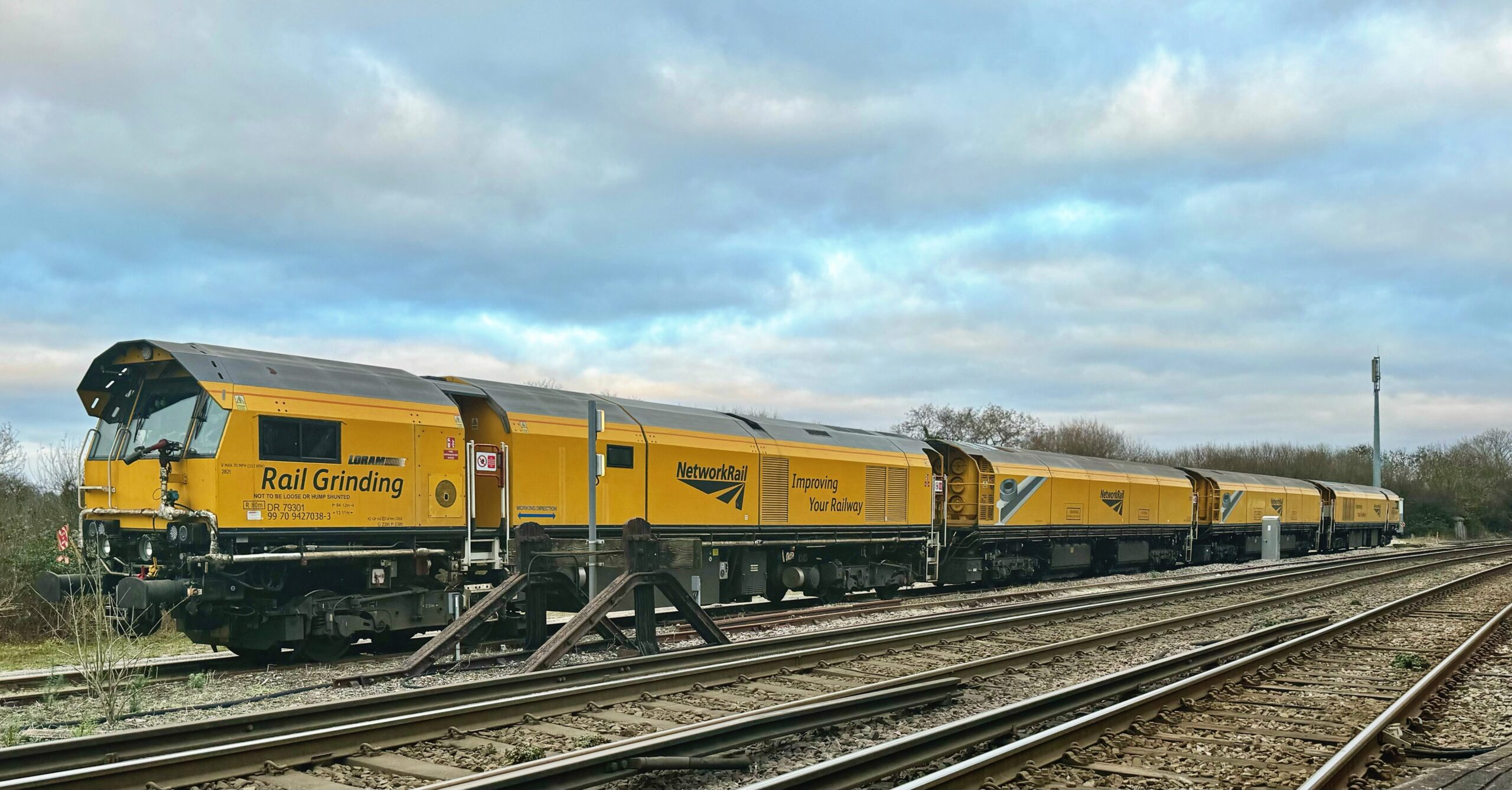
The B 66 UC is a high-performance universal continuous action tamping machine designed for normal and high-speed lines. In addition to the plain line, it can handle the heaviest switches and crossings, especially those with concrete sleepers. This machine has a tamping shuttle fitted with four tamping units and a lifting and slewing clamp. In addition to these tools, telescopic diverging track lifting devices can be used when handling heavy switches and crossings. The very responsive shuttle allows a substantial output on plain line despite the fact that this is a single-head machine. The longitudinal stroke of the tamping units is long enough to position the units in a way to easily and quickly tamp Y shaped sleepers. Located in the centre of the machine, the tamping cabin provides an excellent visibility on the tools and the track. Thanks to the machine’s user-friendliness and its ergonomic controls, only two operators are needed to operate the B 66 UC to its full potential. Loram C44 Rail Grinding Machine No. DR79301 in Wool Sidings. It will depart for Poole on 19/12/2023 as 4Q01 23:44 Wool MOD Siding Freightliner Heavy Haul to Poole – 17/12/2023
A railgrinder is a permanent way maintenance train used to restore the profile and remove irregularities from worn tracks to extend tracklife and to improve the ride of trains using it.
The C44 Series Rail Grinder is designed with advanced technology features that also meets stringent international standards, weights and clearances. The C44 Series complies with the W6A clearance diagram and the axle weights of international commuter lines and freight rail applications.
Loram’s C44 rail grinder delivers high-efficiency re-profiling of the railhead, removing or reducing rail corrugations, corrosion, joint mismatches and other railhead surface irregularities with industry-leading productivity.
Monday 18th December and with all lines re-opened, it was the turn of the monthly Colas test train from Derby RTC to Eastleigh East Yard via Weymouth running as 1Q51 1115 Derby R.T.C.(Network Rail) to Eastleigh East Yard employing the usual traction of GBRf Class 73 locomotives. This time it was the turn of No.’s 73964 ‘Jeanette’ and 73962 ‘Dick Mabbutt’.
GBRf Class 73’s No.’s 73964 ‘Jeanette’ and 73962 ‘Dick Mabbutt’ passing through Hamworthy working 1Q51 11:15 Derby RTC Serco to Eastleigh East Yard – 18/12/2023
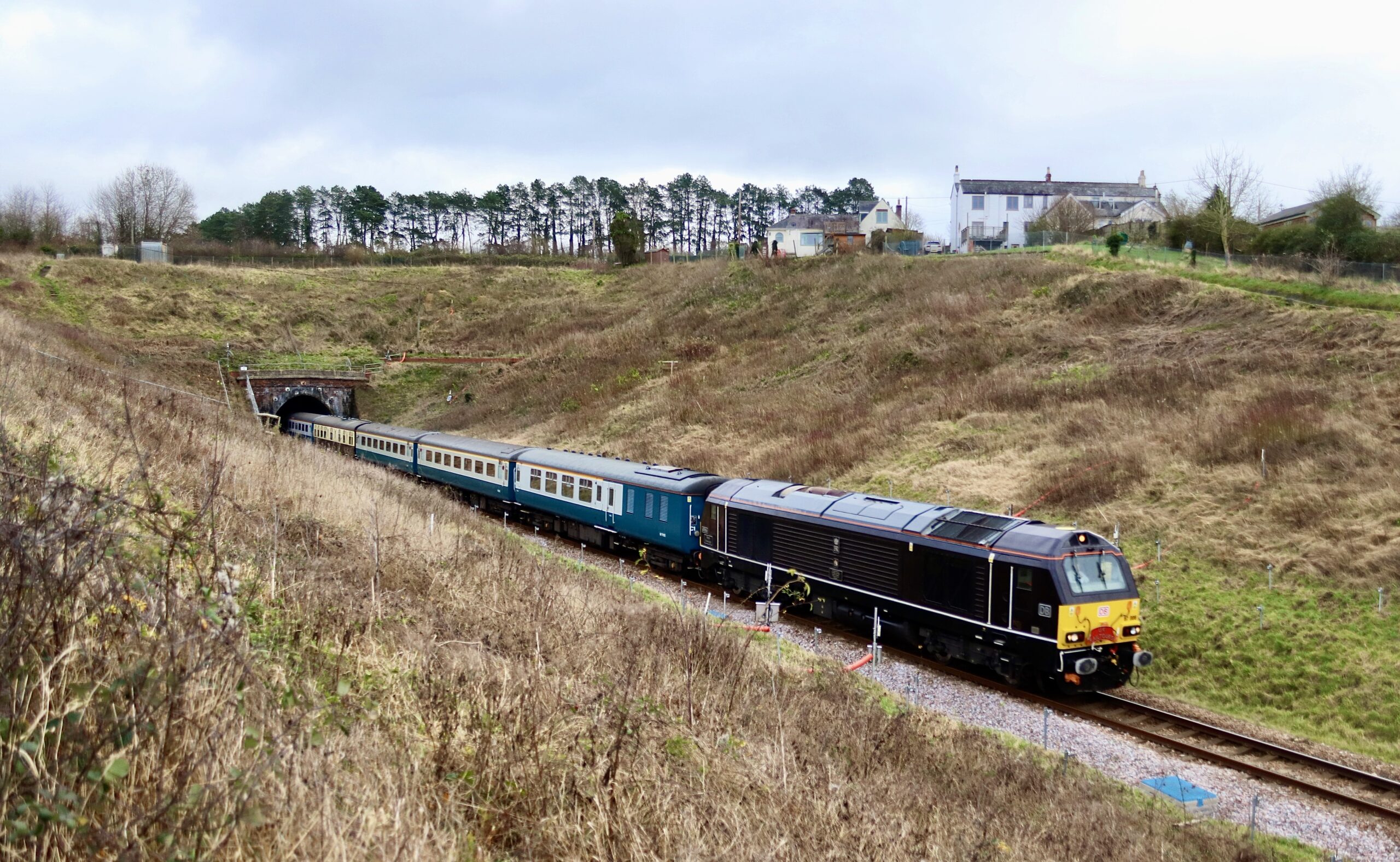
Another day out to see a railtour took place on Saturday 23rd December, this time closer to home as DB Cargo Class 67 No. 67006 ‘Royal Sovereign’ was in charge of UK Railtours “Carols At Sherborne Abbey” 1Z15 0715 Peterborough to Yeovil Jn Heritage Platform. No. 67006 is one of two class members painted in a special Royal Claret livery and as such would be primarily tasked with working the Royal Train. However, the locomotive is often used for special charter trains and other occasional passenger services when not fulfilling her Royal duties. We took a roundabout route to see the railtour, taking in Totton Yard so I could finally get a clear photograph of GBRf Class 66 No. 66743 in Belmond Royal Scotsman livery as it is was still being employed on the SITT along with No. 66772 ‘Maria’. I also popped in on Freightliner Southampton Maritime and Eastleigh (which admittedly was rather quiet!)
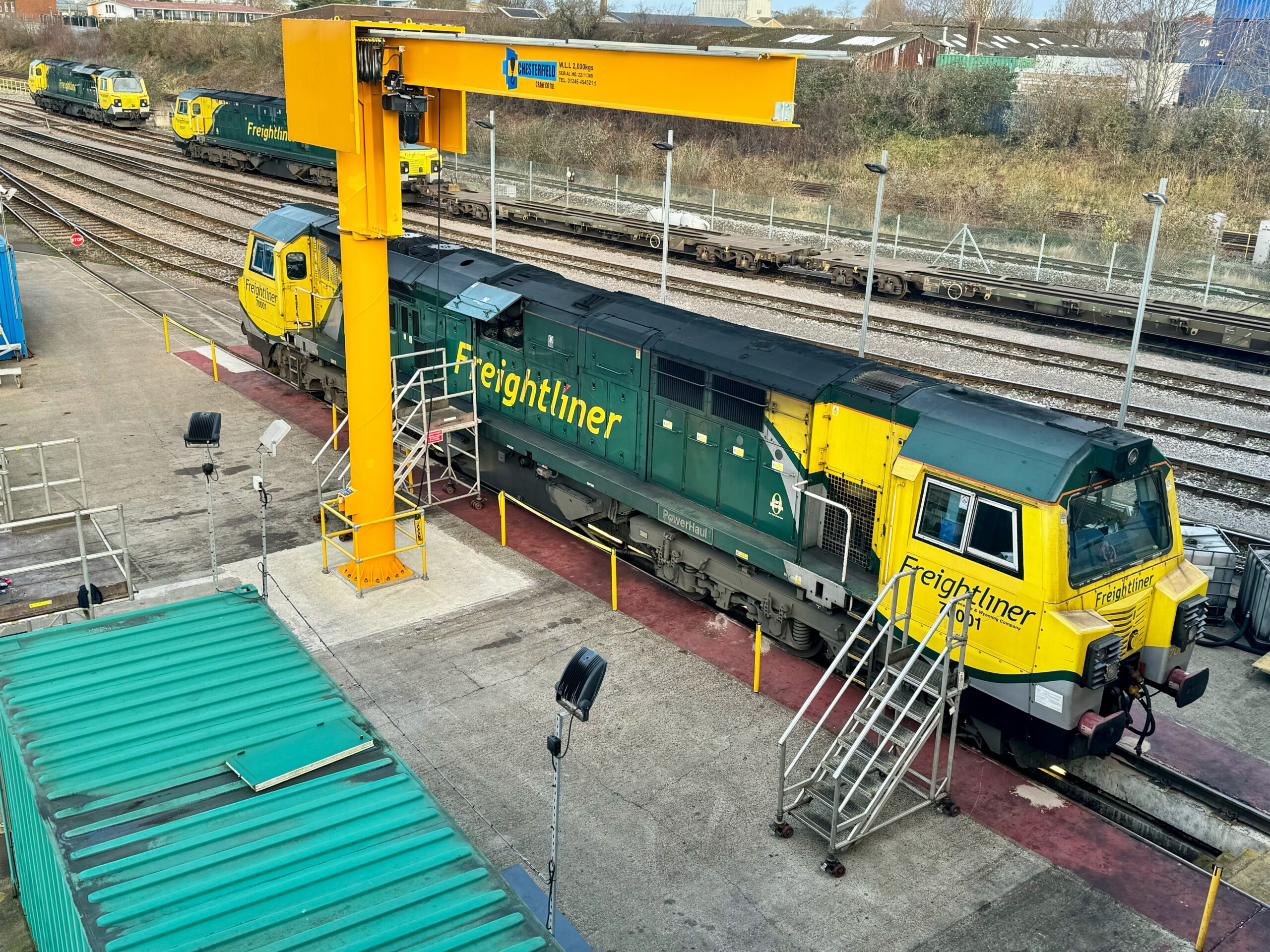
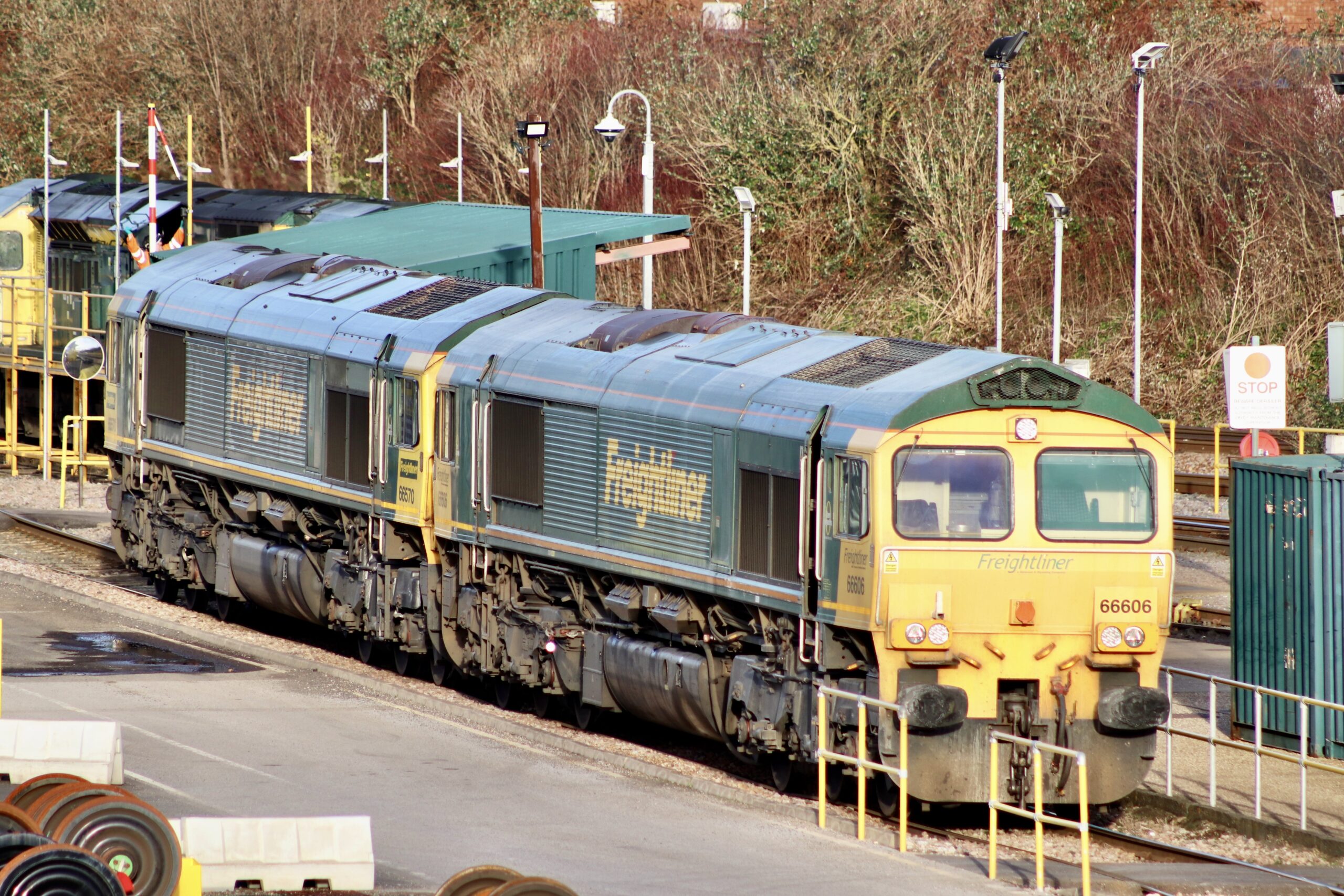
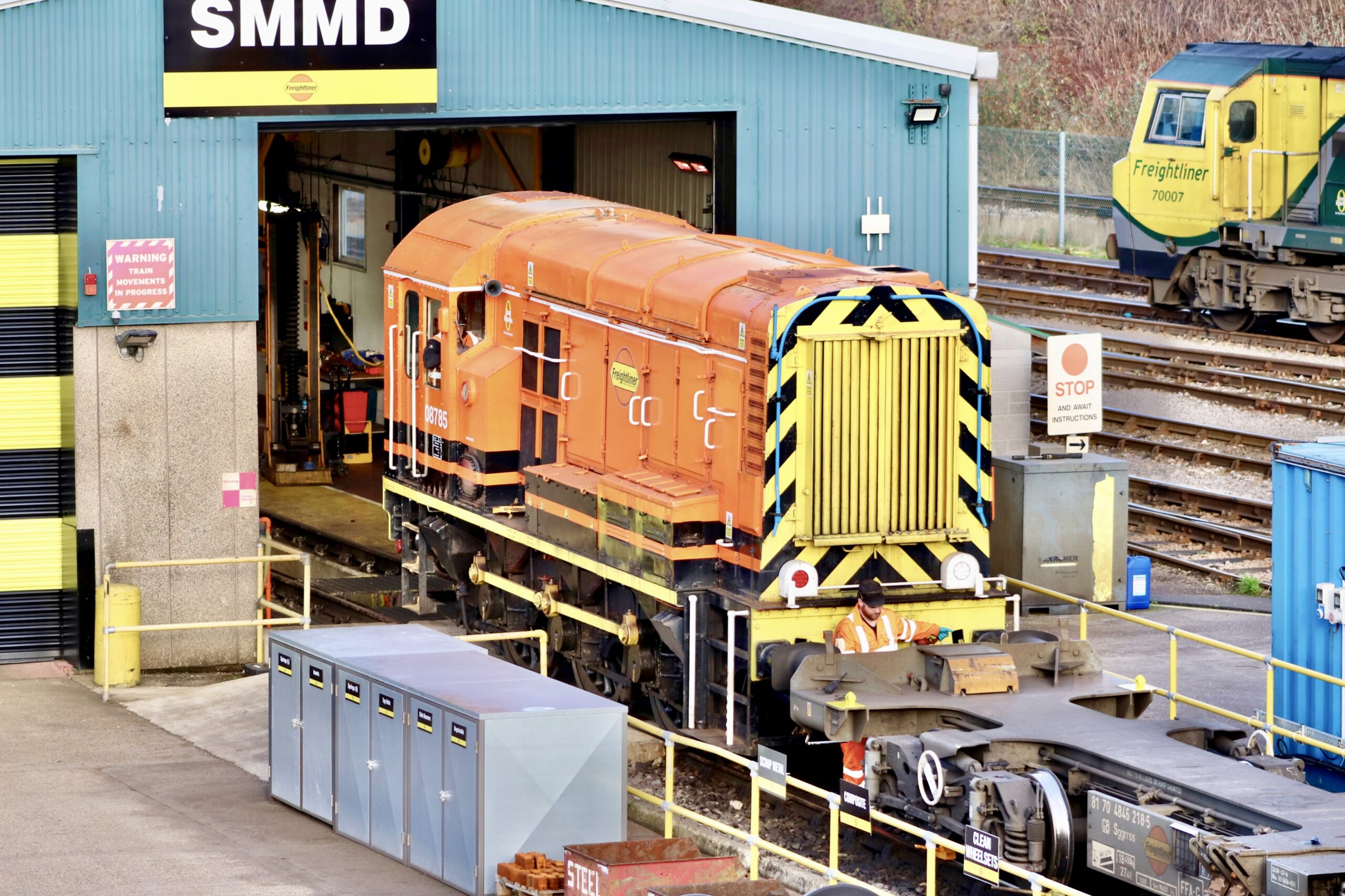
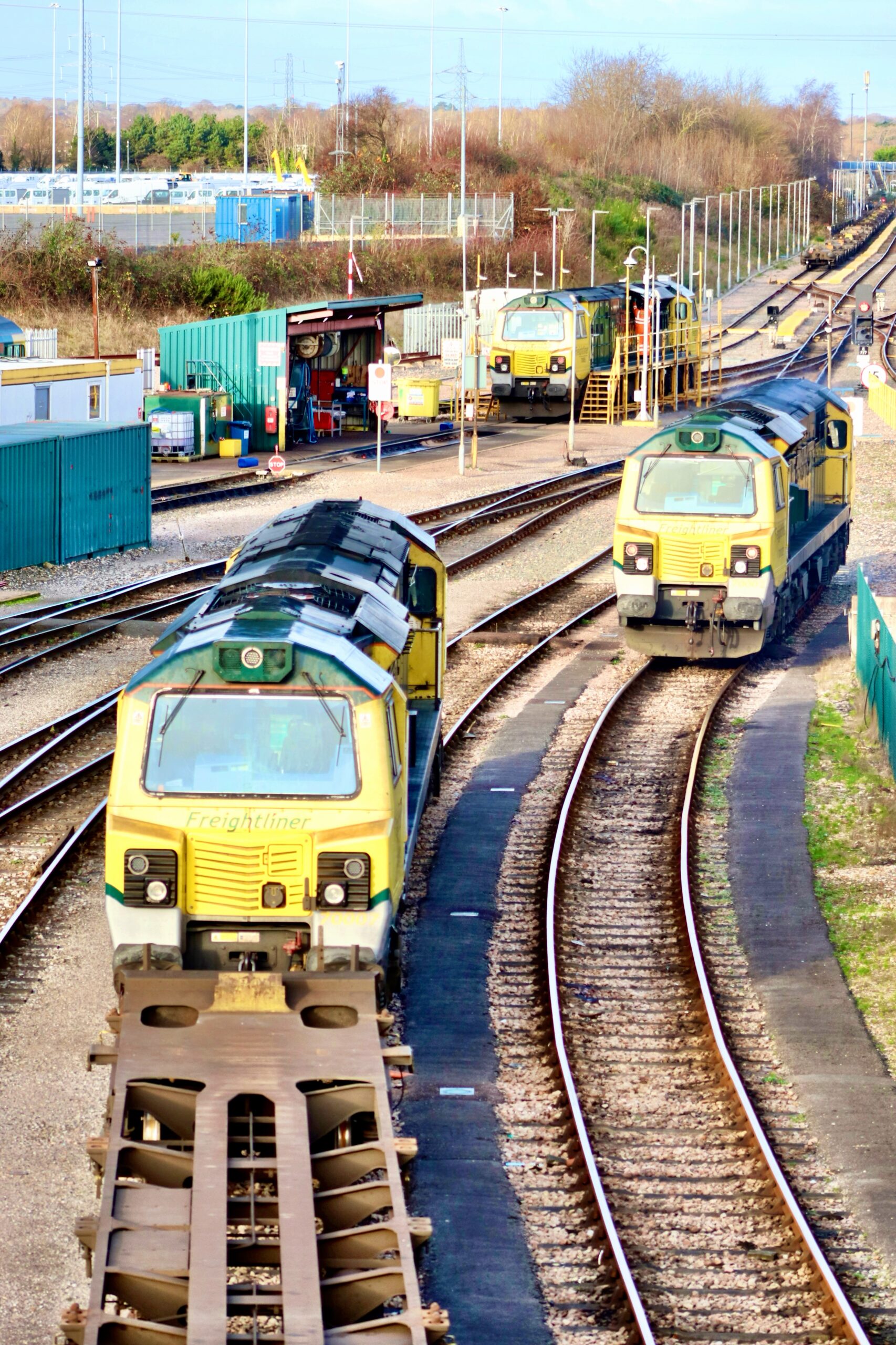
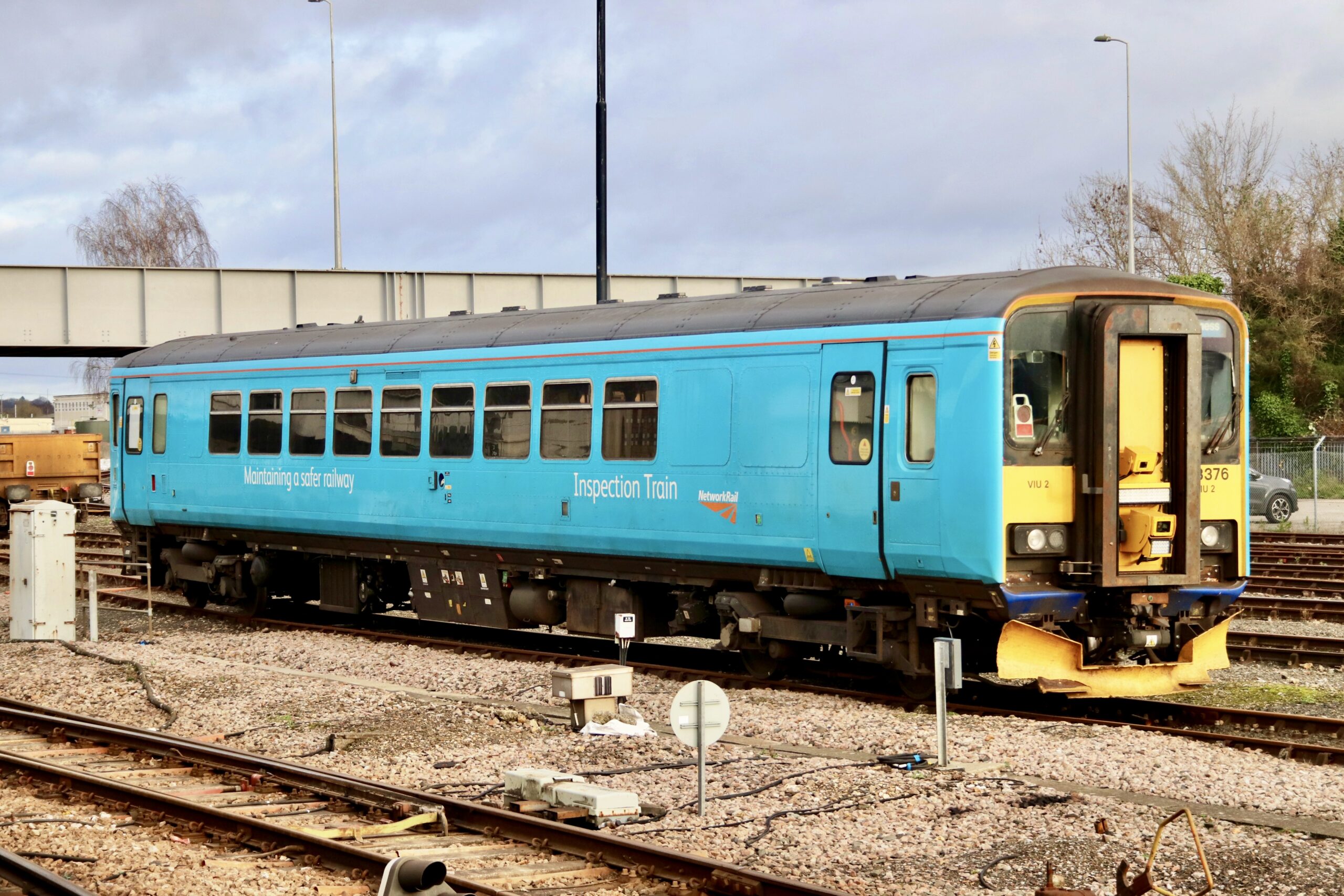
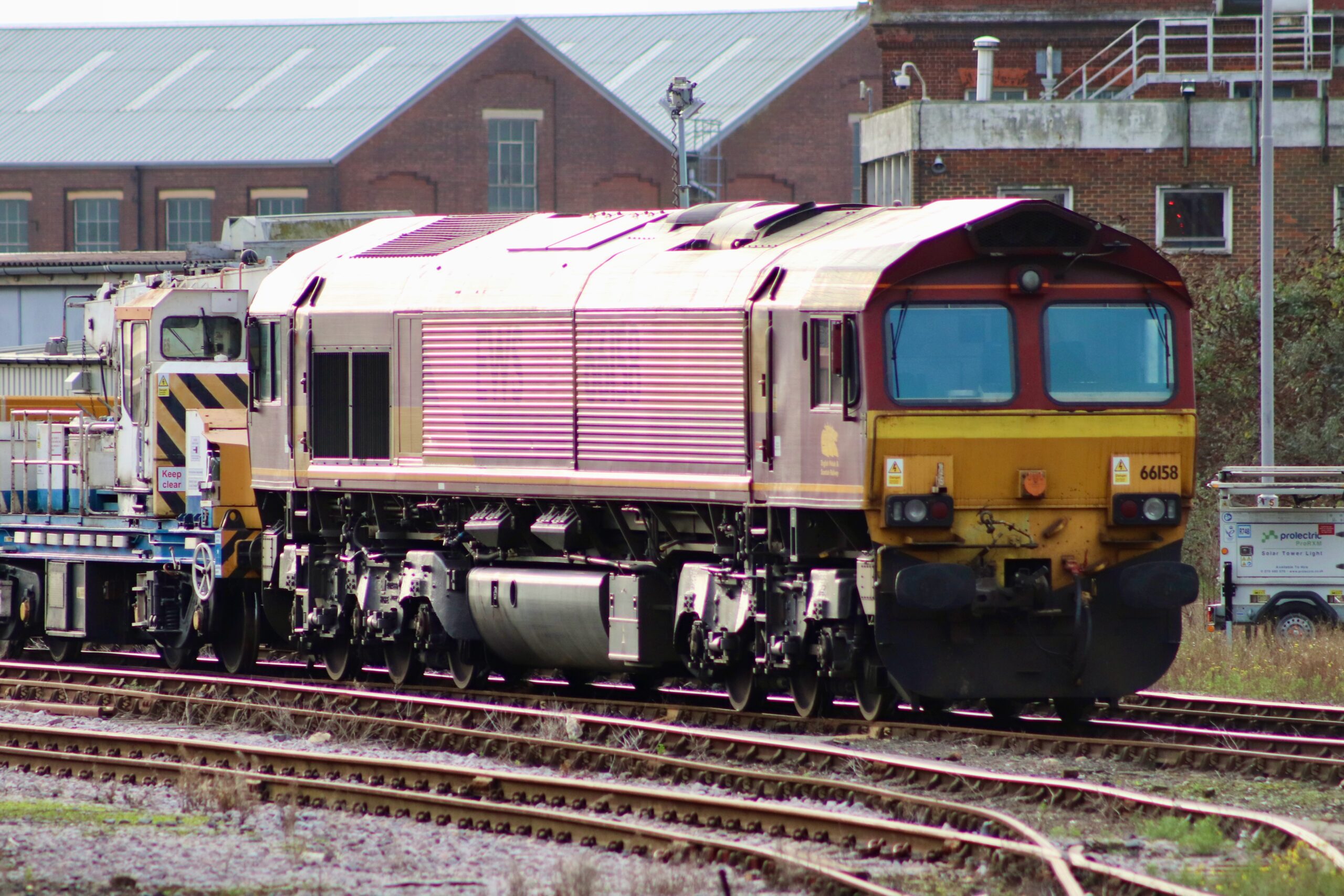
GBRf Class 66 No. 66743 at Totton Yard – 23/12/2023GBRf Class 66 No.66772 ‘Maria’ on the rear of the SITT at Totton Yard – 23/12/2023GBRf Class 66 No. 66743 and No.66772 ‘Maria’ in Totton Yard on the SITT. The train was scheduled to head to Eastleigh East Yard later that evening where it would remain over the Christmas period – 23/12/2023Freightliner Class 70 No. 70001 at Southampton Maritime – 23/12/2023FL Class 66 No.’s 66606 and 66570 at Southampton Maritime – 23/12/2023Class 08 diesel shunter No. 08785 at Southampton Maritime – 23/12/2023A trio of FL Class 70’s at Southampton Maritime; 70007, 70002 and 70005 – 23/12/2023Class 153 Video Inspection Unit (VIU2) No. 153376 at Eastleigh – 23/12/2023DB Cargo Class 66 No. 66158 on a DB Infrastructure Train destined for Abbey Street Junction for work over the Christmas period at Eastleigh – 23/12/2023
Always looking for a new photographic location, I had time to scout out the western portal of Gillingham tunnel. After parking up at the side of the road above the tunnel, Yoshi and I made our way along a public footpath through fields which are adjacent to the railway track. A trio of sheep were not too sure about our arrival and took off to the opposite corner to watch us from afar. Yoshi, thankfully, showed little interest in the ovine beasts and settled down at my feet as we waited for the Class 67 to turn up hauling its train.
Class 67 No. 67006 ‘Royal Sovereign’ emerges from Gillingham Tunnel hauling 1Z15 0715 Peterborough to Yeovil Jn Heritage Platform – 23/12/2023
After seeing the train at Gillingham tunnel, I popped into Yeovil Junction in time to see the locomotive running around her train which was being serviced after dropping off the passengers in Sherborne for the festive carol service at the Abbey the tour was named after.
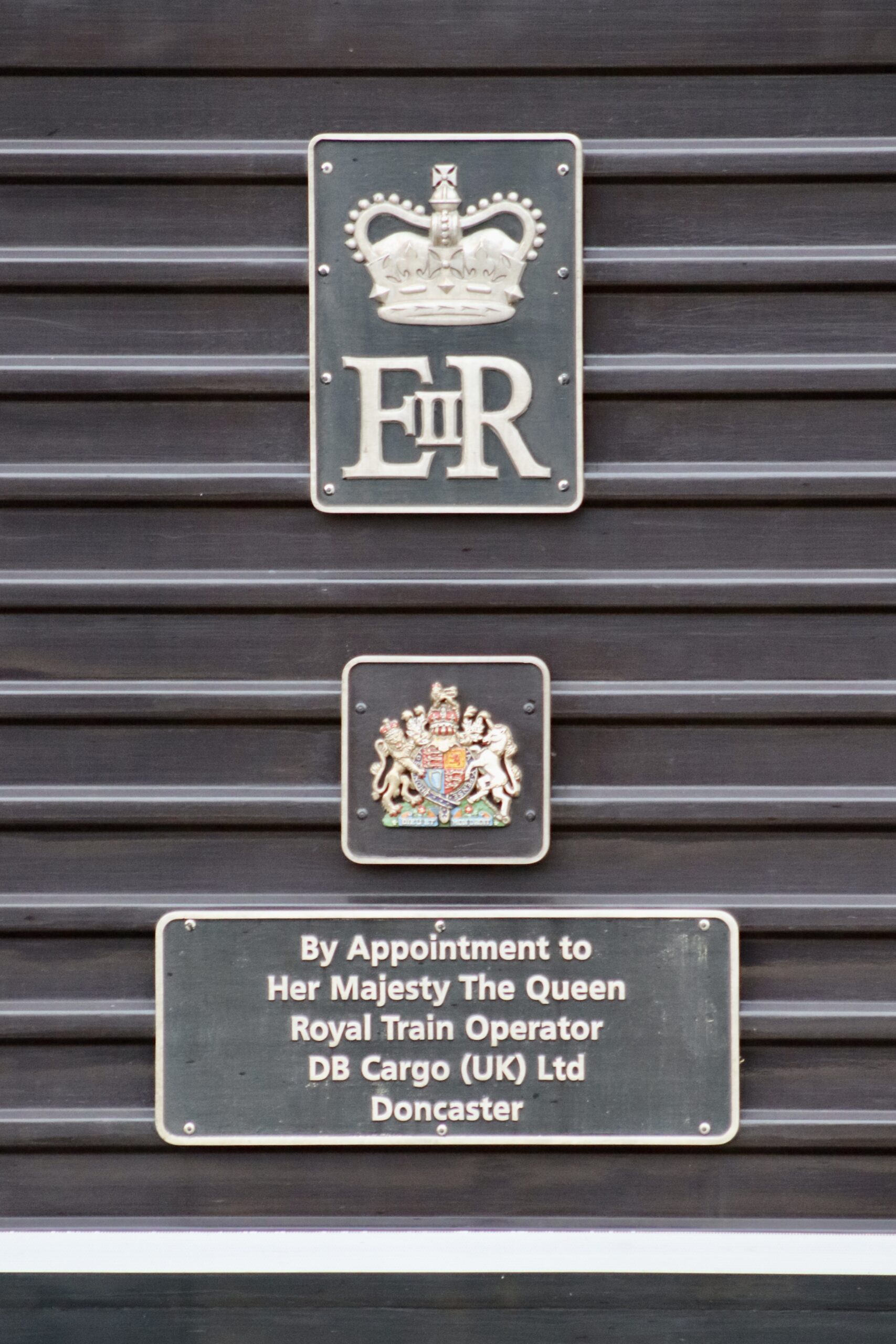
Class 67 No. 67006 ‘Royal Sovereign’ runs around its train at Yeovil Junction – 23/12/2023Crests applied to Class 67 No. 67006 ‘Royal Sovereign’ – 23/12/2023Class 67 No. 67006 ‘Royal Sovereign’ reversing back onto the coaching stock to form the return leg of the “Carols At Sherborne Abbey” railtour – 23/12/2023Class 67 No. 67006 ‘Royal Sovereign’ at Yeovil Junction whilst the coaching stock employed on the “Carols At Sherborne Abbey” railtour is serviced – 23/12/2023
Video of 67006 ‘Royal Sovereign’ working “Carols At Sherborne Abbey” 1Z15 0715 Peterborough to Yeovil Jn Heritage Platform Also includes the following passing trains: Gillingham Tunnel: 159020/159013 – 1L25 1021 London Waterloo to Exeter St Davids 159012/159105 – 1L44 1125 Exeter St Davids to London Waterloo Yeovil Junction: 159003/159015 1L29 1120 London Waterloo to Exeter St Davids
On my way home from Yeovil, I made another slight detour to take a look at the Swanage Railway’s “Polar Express” operation, this years seasonal offering from the Purbeck Heritage line, which I had so far not managed to see in 2023. “Polar Express” trains started running on 17th December and continued through to 30th December. With failing light which rendered photography of moving trains difficult, I waited for the late running 1445 trip from Swanage to show at Corfe Castle with resident Class 33 No. 33012 (D6515) ‘Lt Jenny Lewis RN’ hauling the outward run and Southern Railway 4-6-2 West Country Class No. 34028 ‘Eddystone’ with “Polar Express” emblazoned on her tender, working the return. I followed the train down to Swanage and as darkness fell this only enhanced the colourful lights within the carriages.
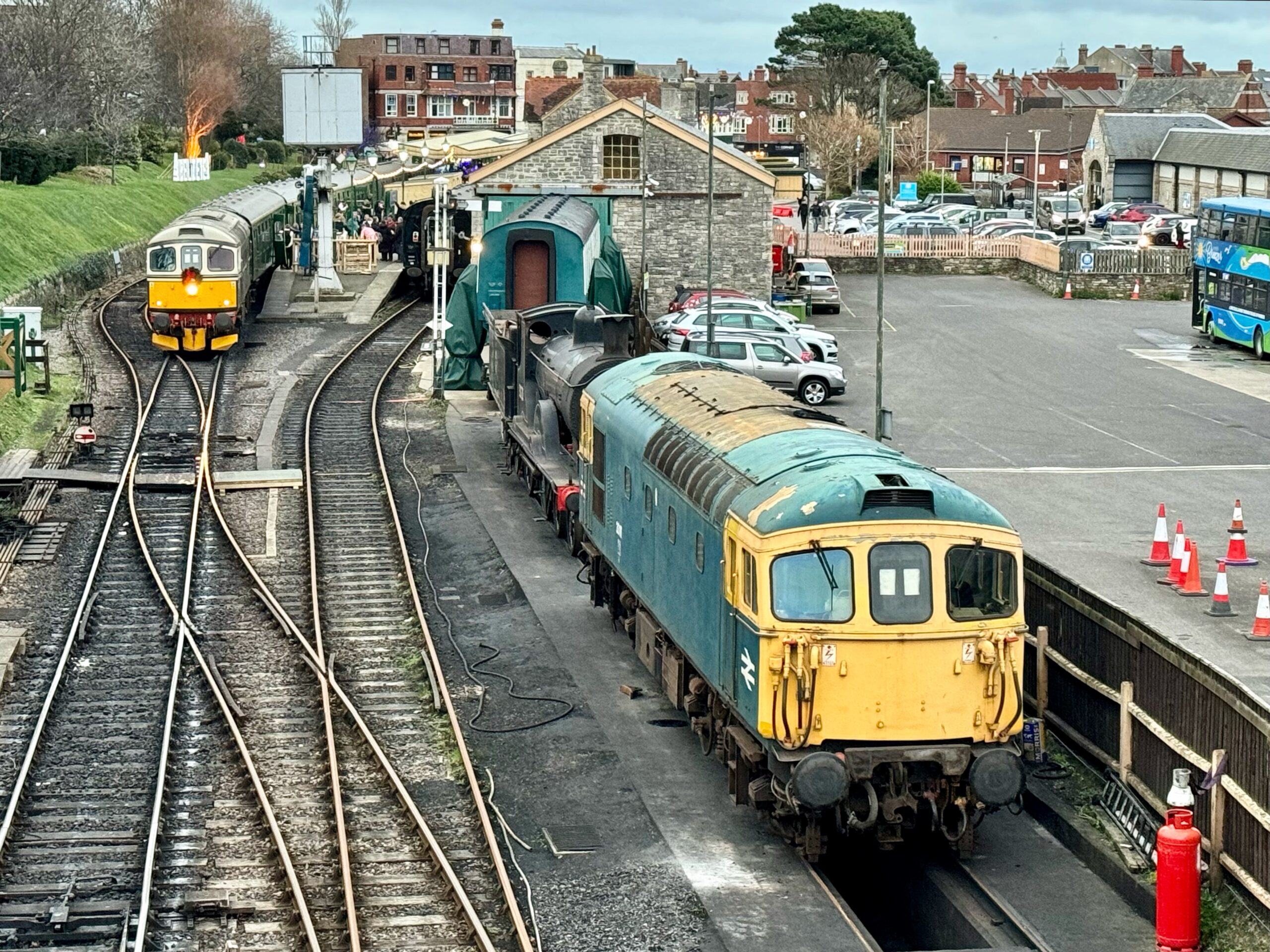
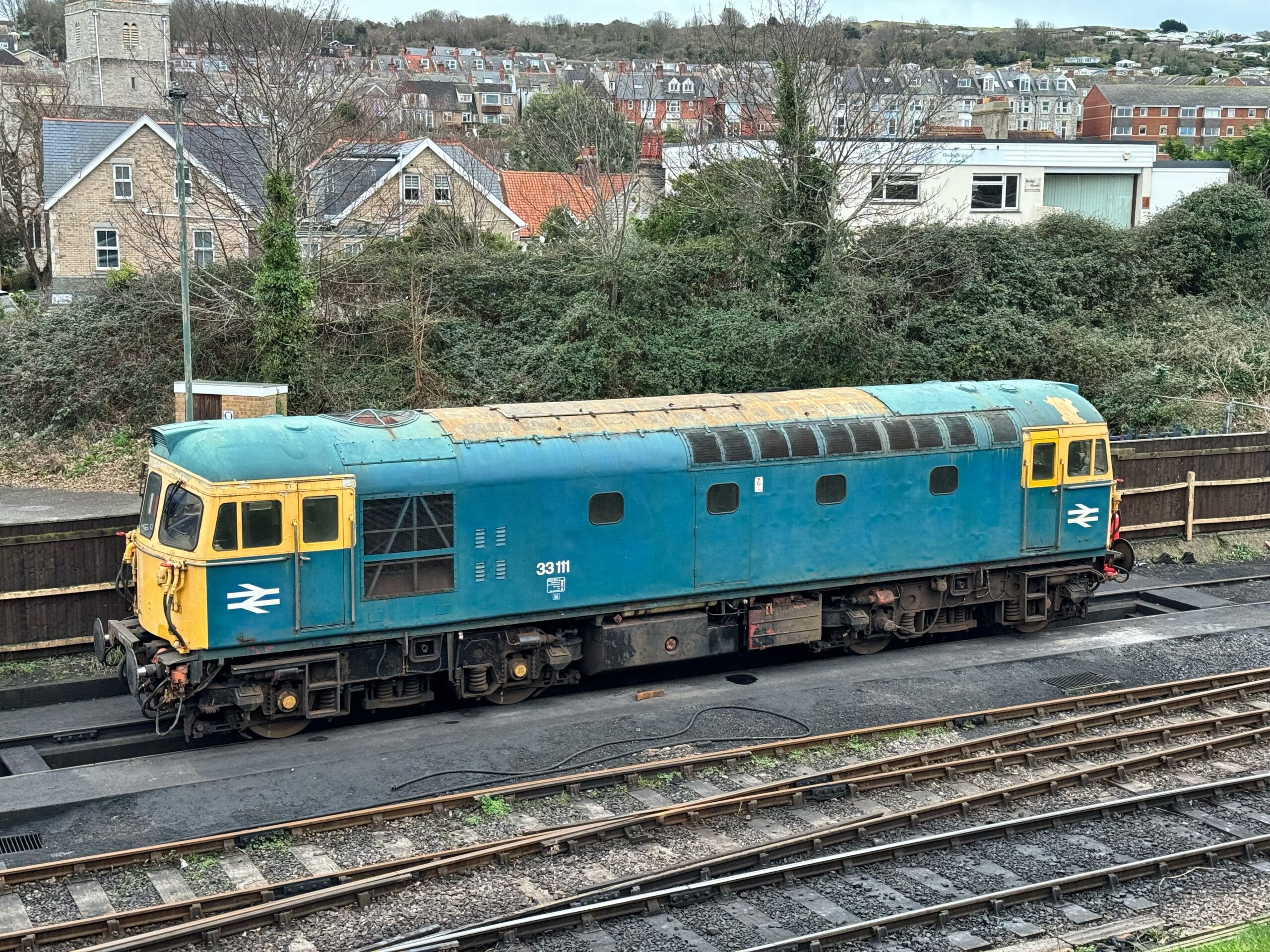
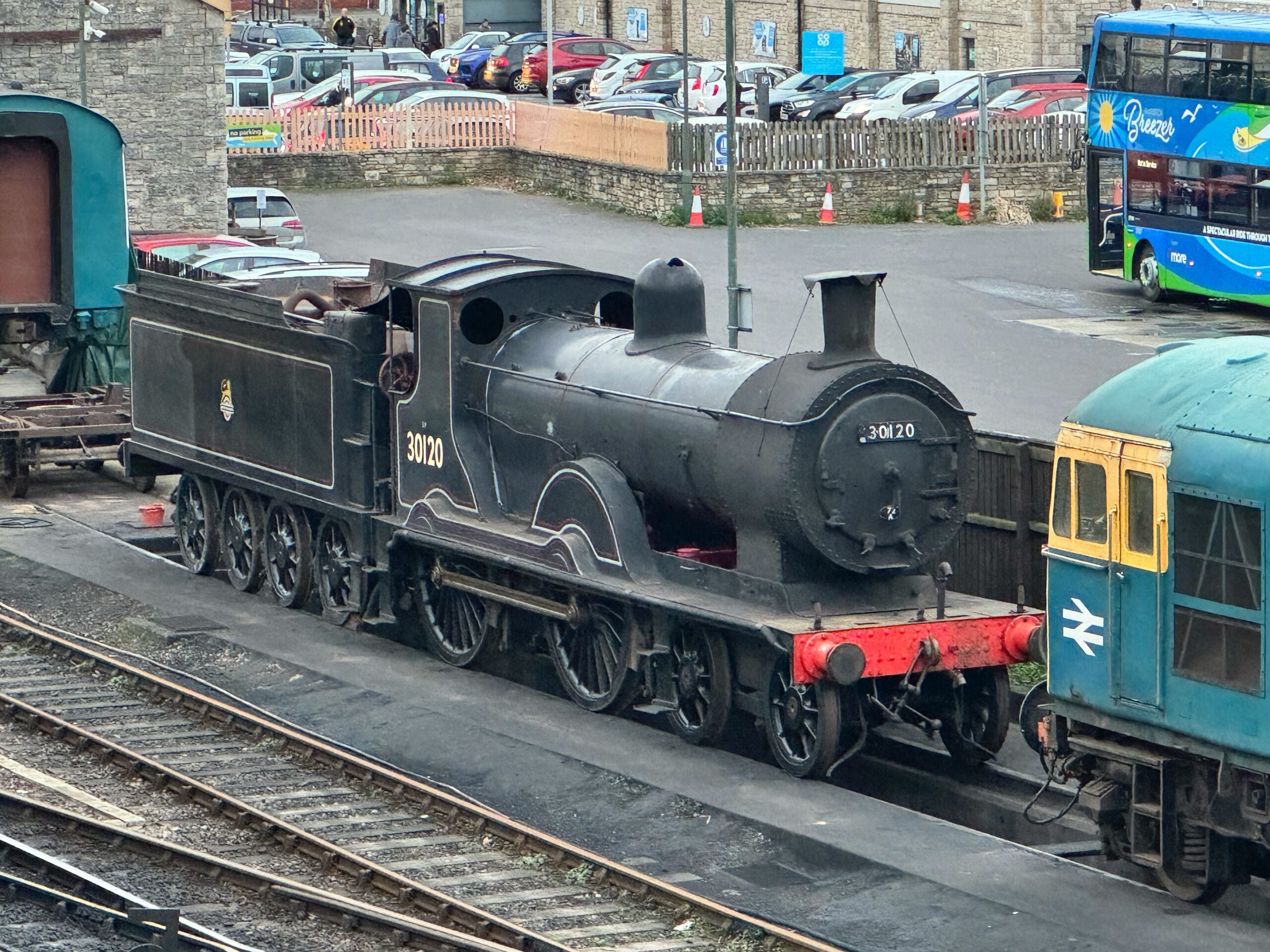
Class 33 No. 33012 (D6515) ‘Lt Jenny Lewis RN’ heads up the 1445 “Polar Express” service from Swanage – 23/12/2023SR 4-6-2 West Country Class No. 34028 ‘Eddystone’ heads towards Swanage after stopping at The North Pole (Norden) with a “Polar Express” train – 23/12/2023Class 33 No. 33111 and LSWR 4-4-0 T9 Class No. 30120 in the sidings at Swanage while Class 33 No. 33012 (D6515) ‘Lt Jenny Lewis RN’ waits with a “Polar Express” service in the station – 23/12/2023Class 33 No. 33111 at Swanage – 23/12/2023LSWR 4-4-0 T9 Class No. 30120 at Swanage – 23/12/2023Class 33 No. 33012 (D6515) ‘Lt Jenny Lewis RN’ awaits departure of the 1645 “Polar Express” service from Swanage – 23/12/2023Darkness falls on Class 33 No. 33012 (D6515) ‘Lt Jenny Lewis RN’ as she awaits departure of the 1645 “Polar Express” service from Swanage – 23/12/2023
Swanage Railway’s “Polar Express” – 23/12/2023
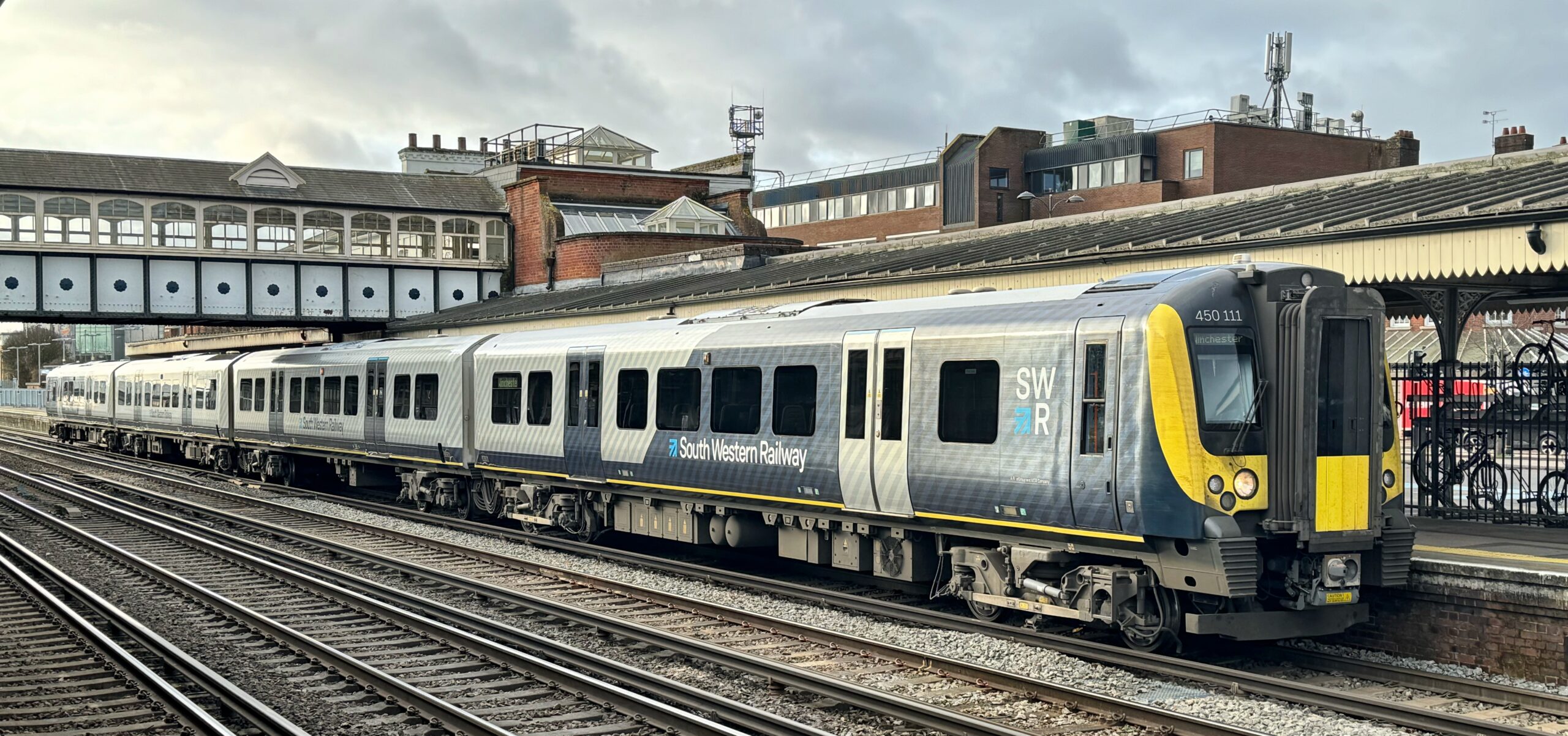
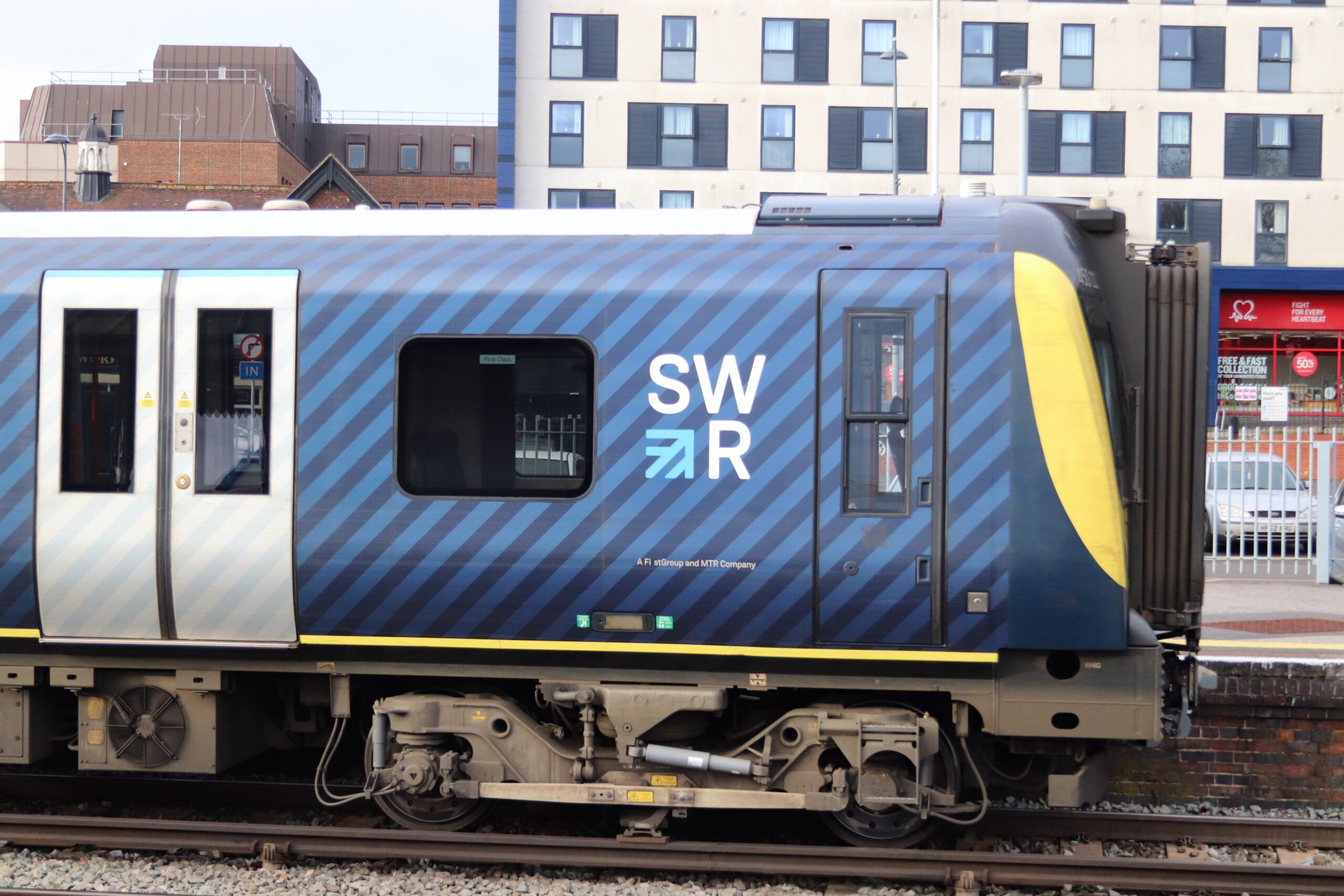
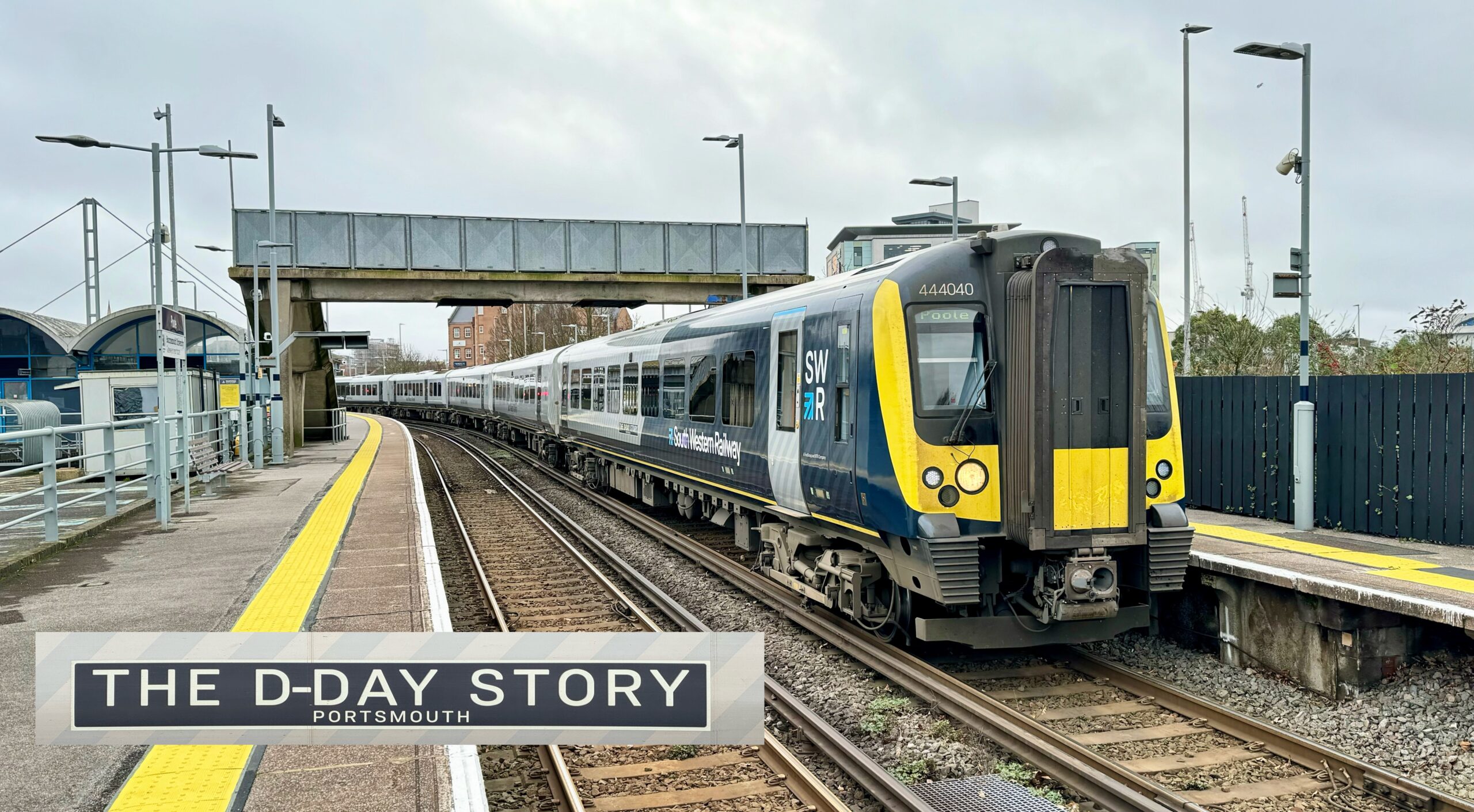
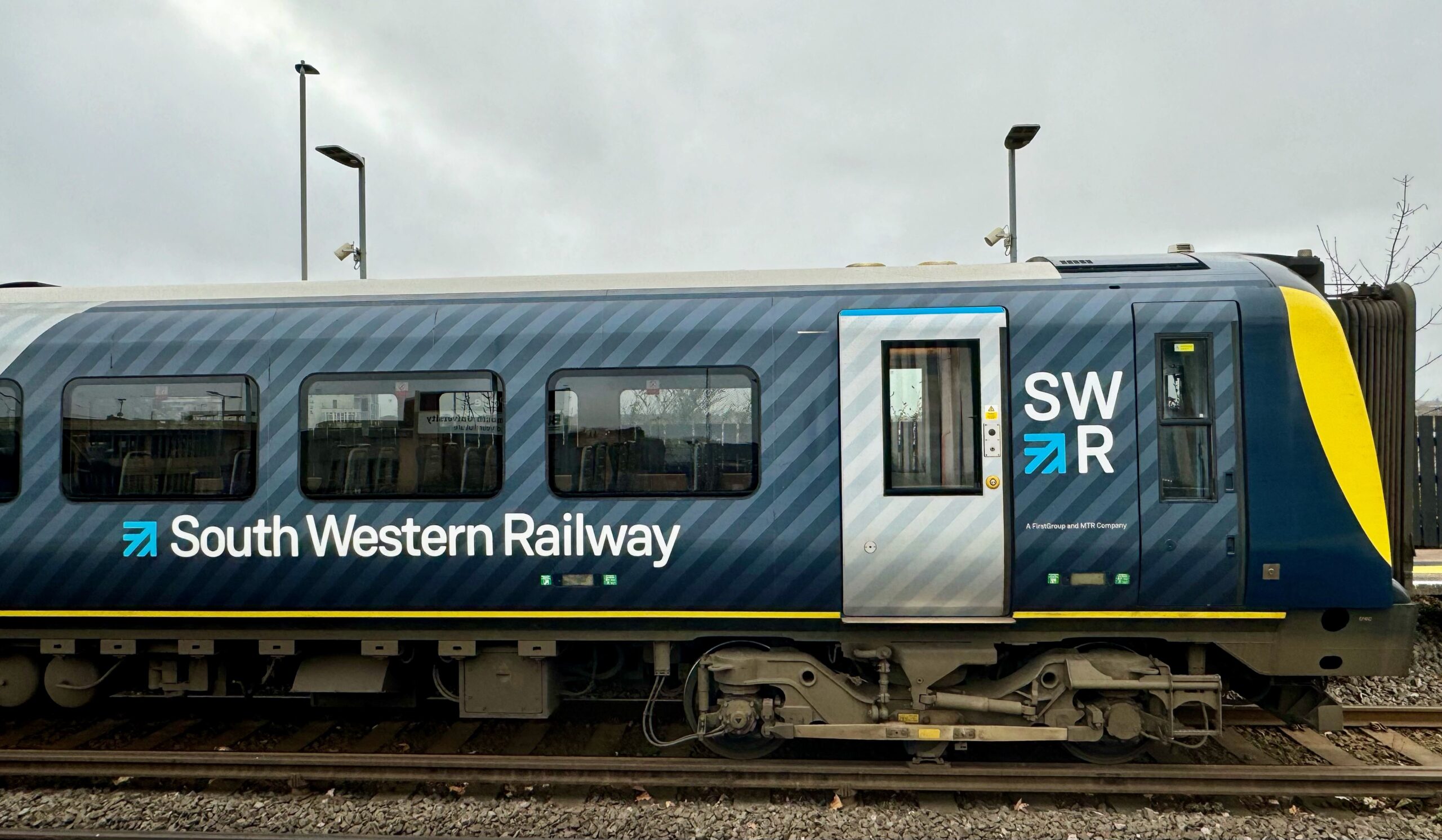
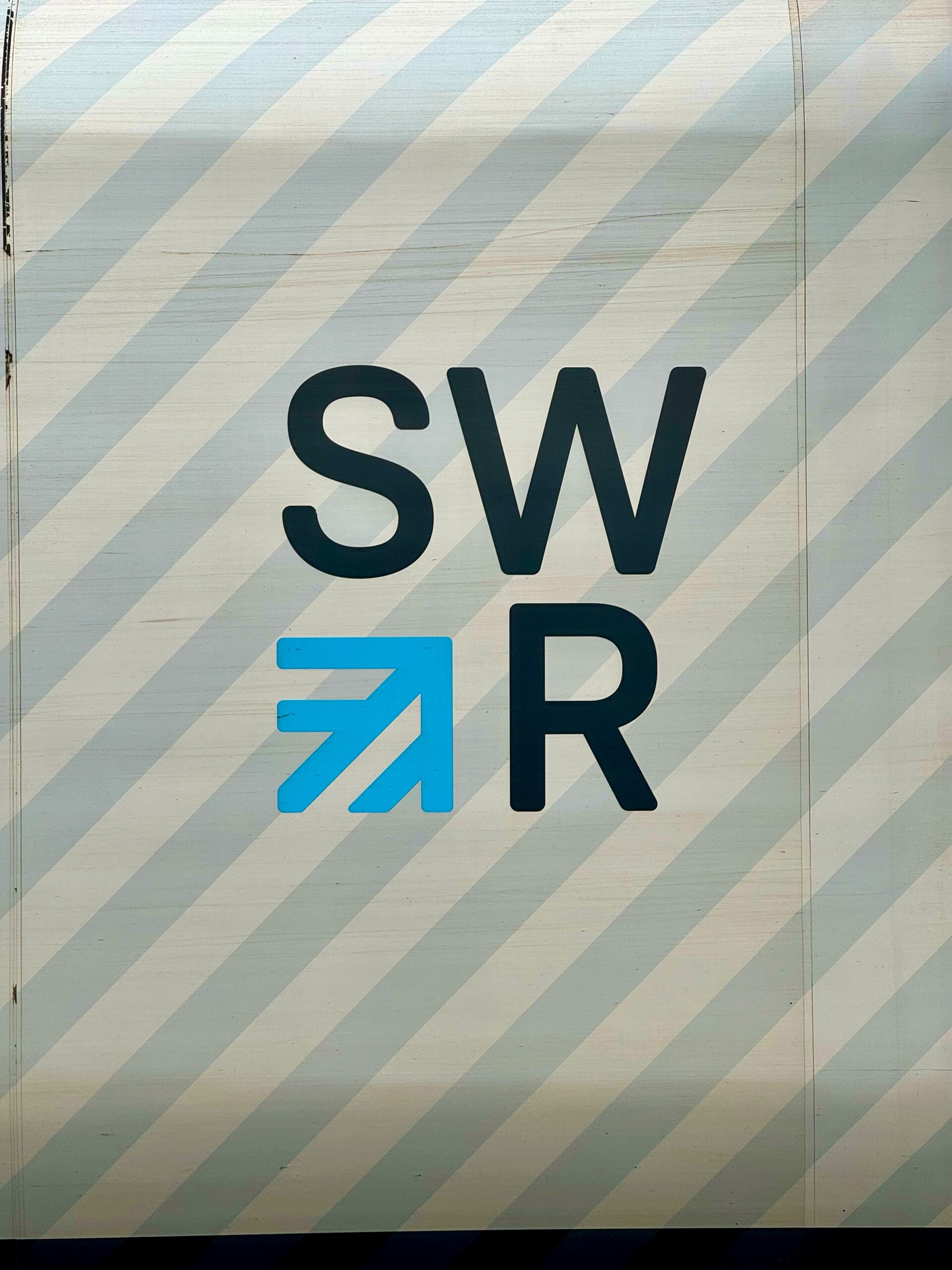
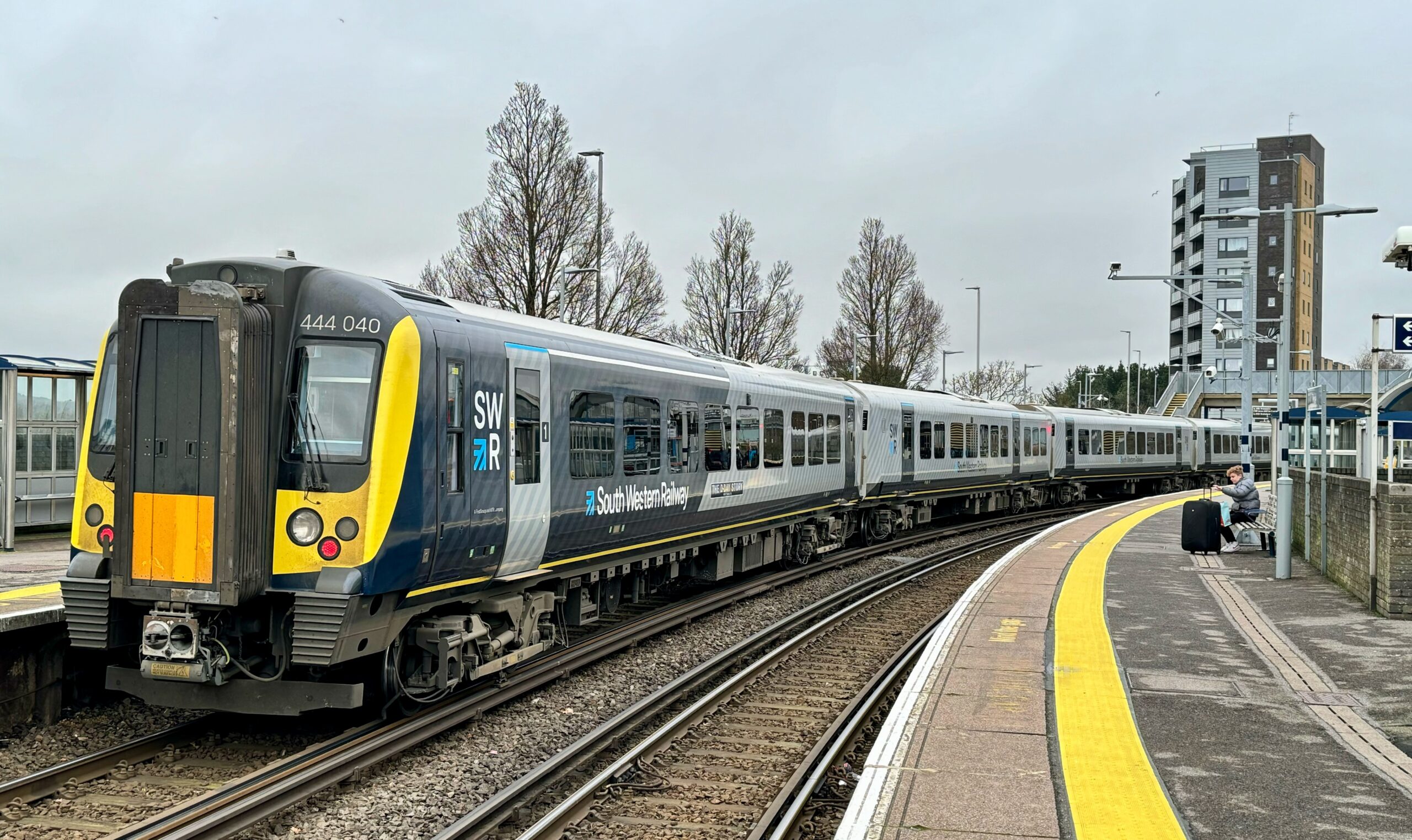
With SWR Desiro Electric Multiple Unit’s (EMU’s) remaining in the old South West Trains (SWT) livery now in single figures, it has been reported that Class 450 No. 450111 and Class 444 No. 444040 ‘The D-Day Experience Portsmouth’, both wrapped in a striped form of the South Western Railway grey livery, will be the last two units to be painted into standard SWR colours.
Class 450 No. 450111 at Eastleigh working 2B32 0902 Bournemouth to Winchester – 23/12/2023Side view showing the “stripey” South Western Railway livery carried by Class 450 No. 450111 at EastleighClass 444 No. 444040 ‘The D-Day Experience Portsmouth’ at Poole having arrived with 1B31 1357 Brockenhurst to Poole – 24/12/2023Side view of Class 444 No. 444040 ‘The D-Day Experience Portsmouth’ – 24/12/2023Bodyside detail of Class 444 No. 444040 ‘The D-Day Experience Portsmouth’ – 24/12/2023Class 444 No. 444040 ‘The D-Day Experience Portsmouth’ at Poole forming the 5B31 1437 Poole to Poole Storage Sidings ECS – 24/12/2023
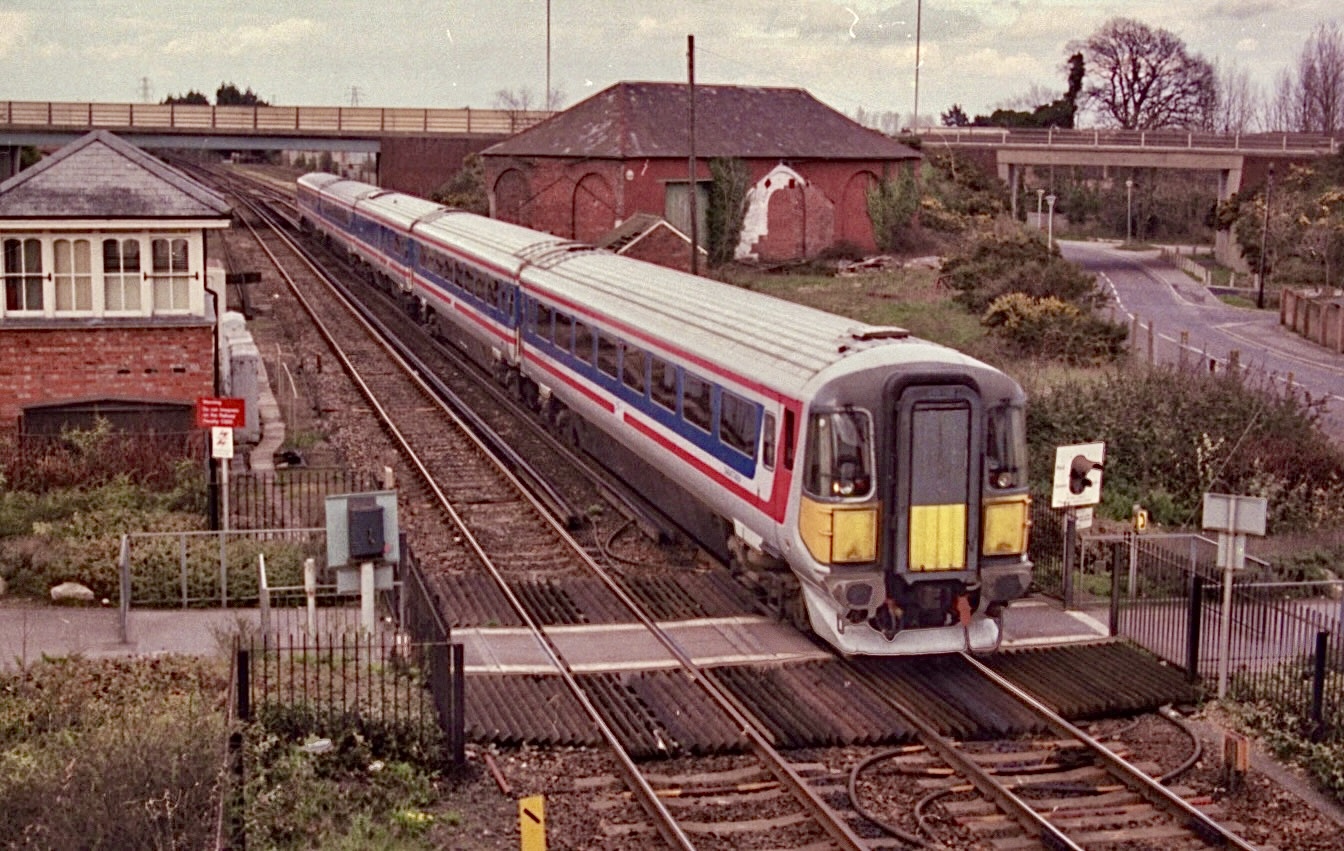
The original South West Trains train livery used the Stagecoach Group colours – red, blue and orange – in a similar style to the Network South East (NSE) livery. Some detail variations were introduced before a major updating of the group’s design identity in 2000. New logos and typefaces were developed, as well as new bus and train liveries.
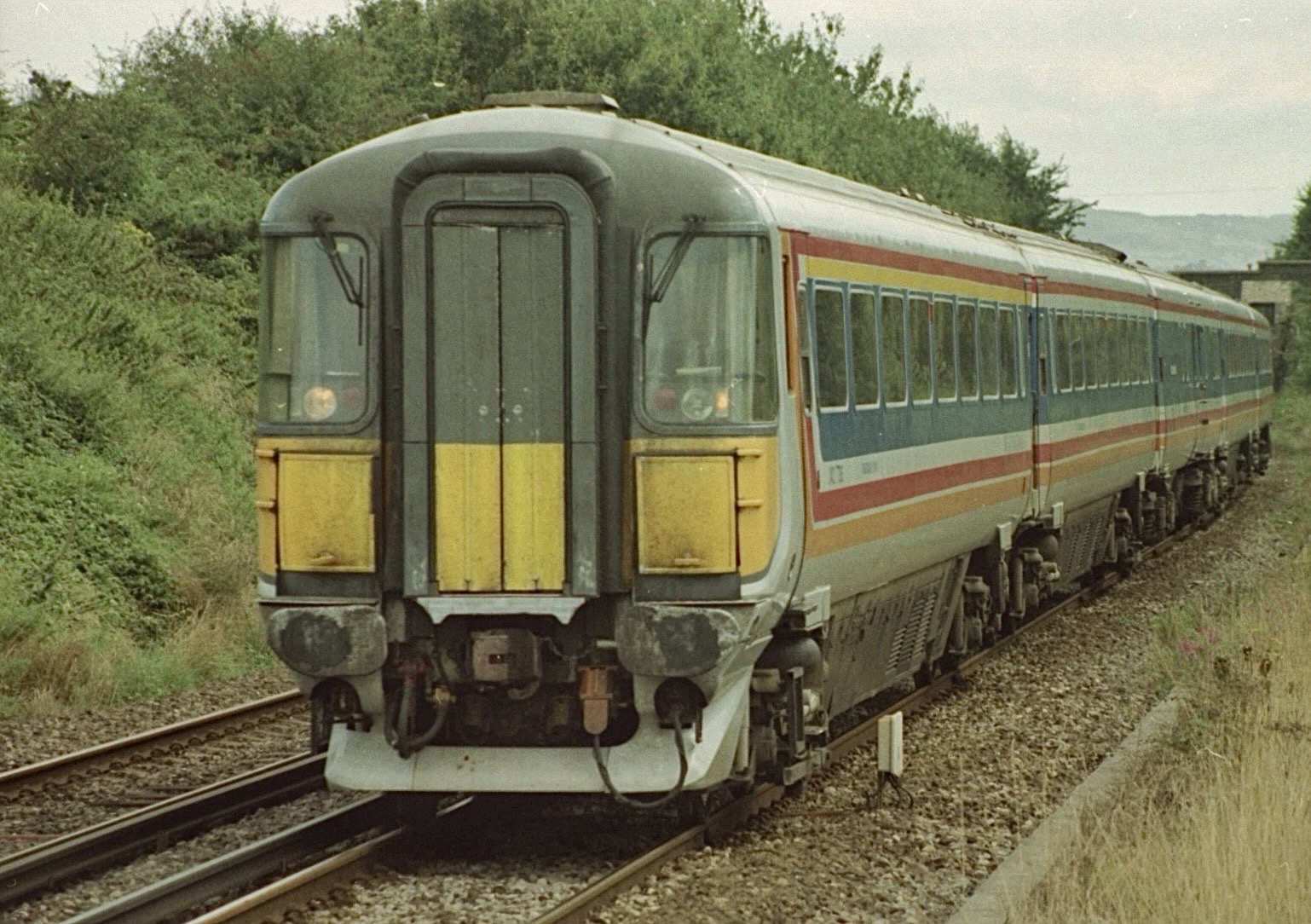
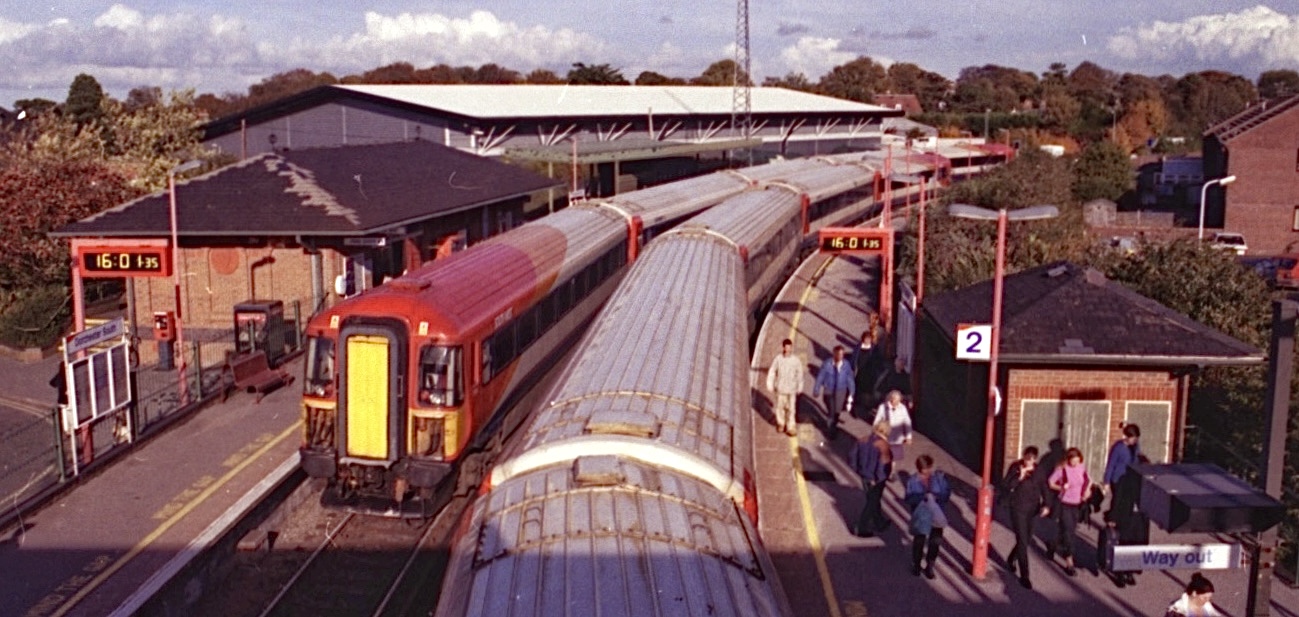
An unidentified Class 442 “Wessex Electric” EMU on the approach to Wareham in Network South East Livery at some point in the late 1990’sAnother unidentified Class 442 “Wessex Electric” EMU, carrying the original South West Trains livery based on the NSE style previously carried by the trains, nearing Upwey station – 05/09/1998Class 442’s at Dorchester South in the revised SWT livery in the early 2000’s
The second-generation South West Trains liveries, designed by industry specialist Best Impressions, have swooshes of the Stagecoach colours, which sweep back from the nose of the train to give an impression of movement. There were three versions of the livery employed – white on the Class 444 and 159 trains used on many longer-distance services, red on Class 455 and 456, and blue used on Class 458 and 450 trains.
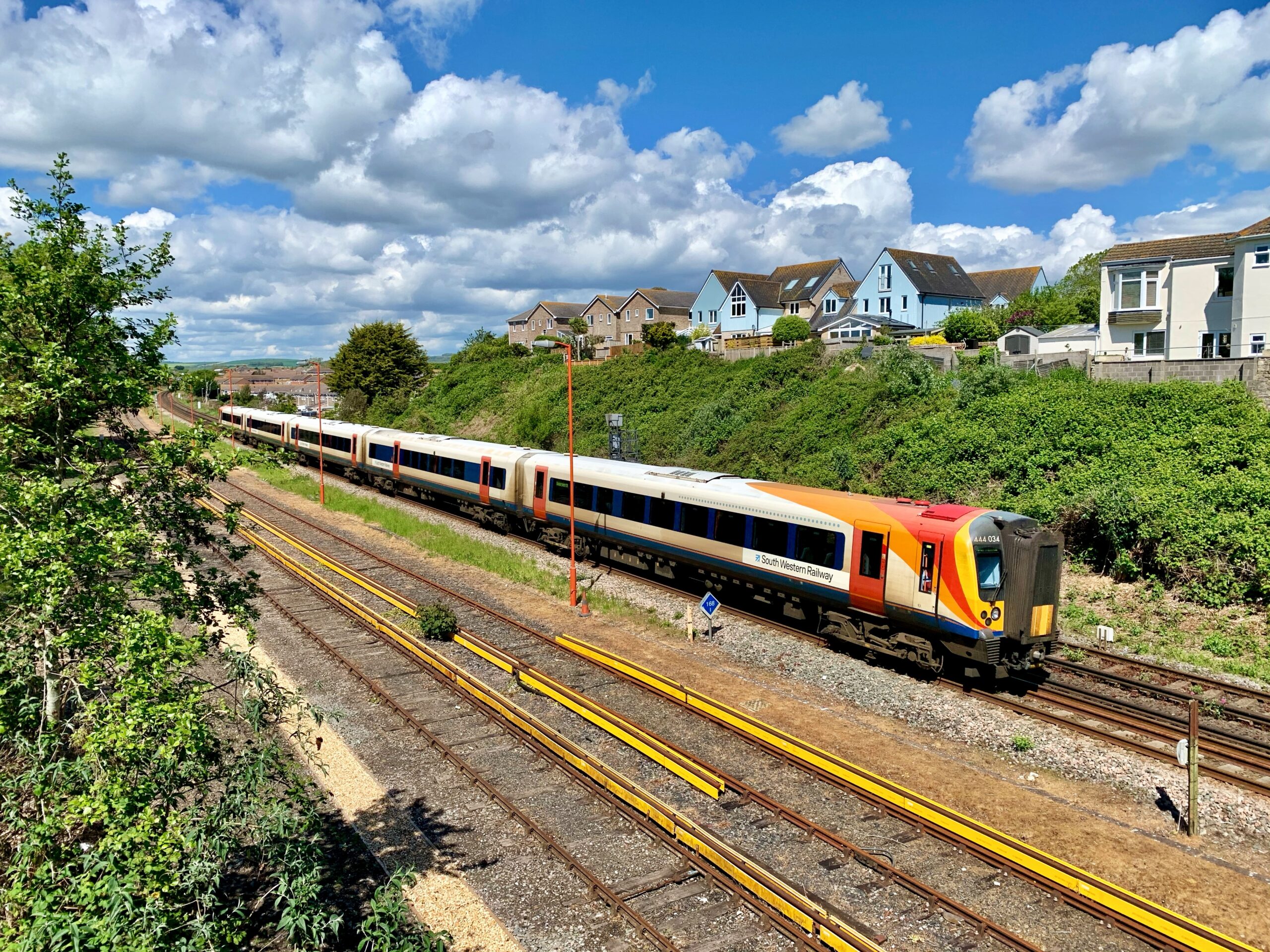
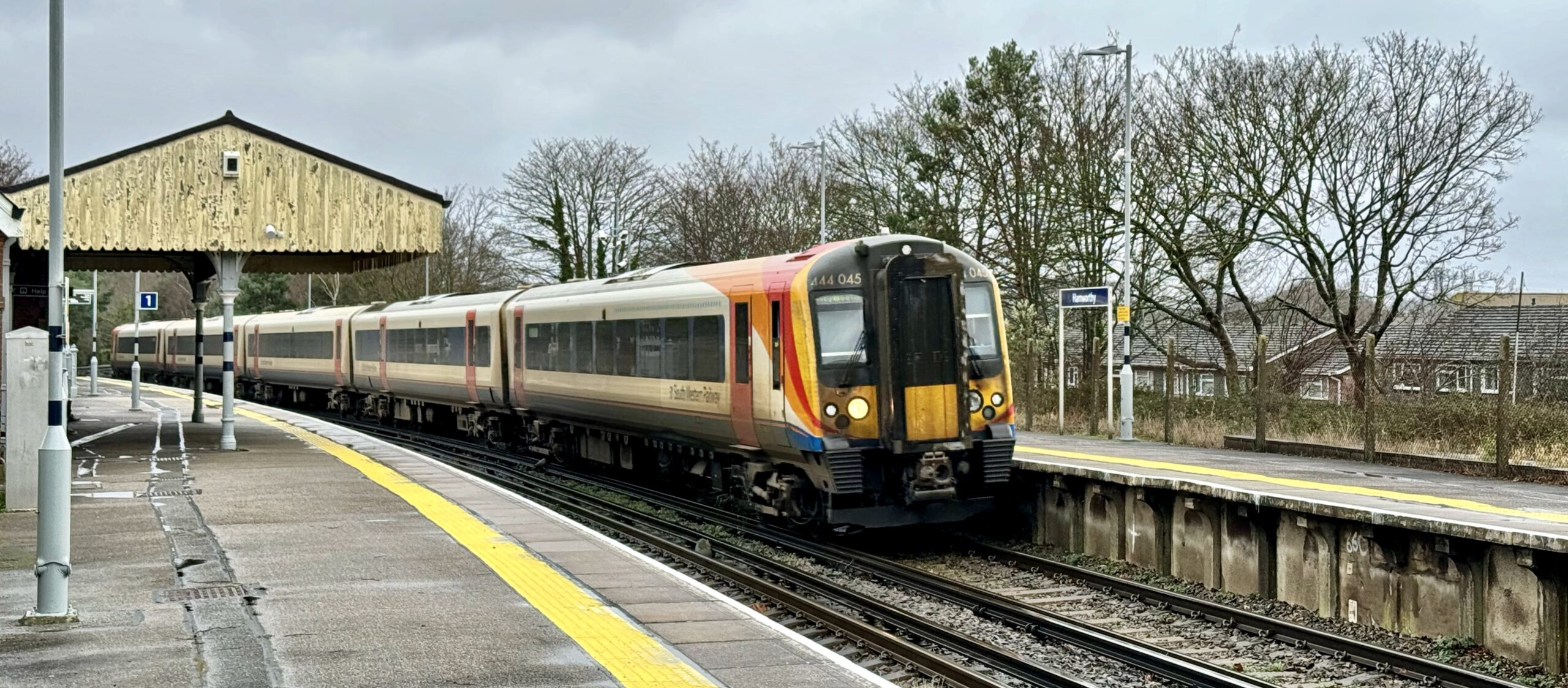
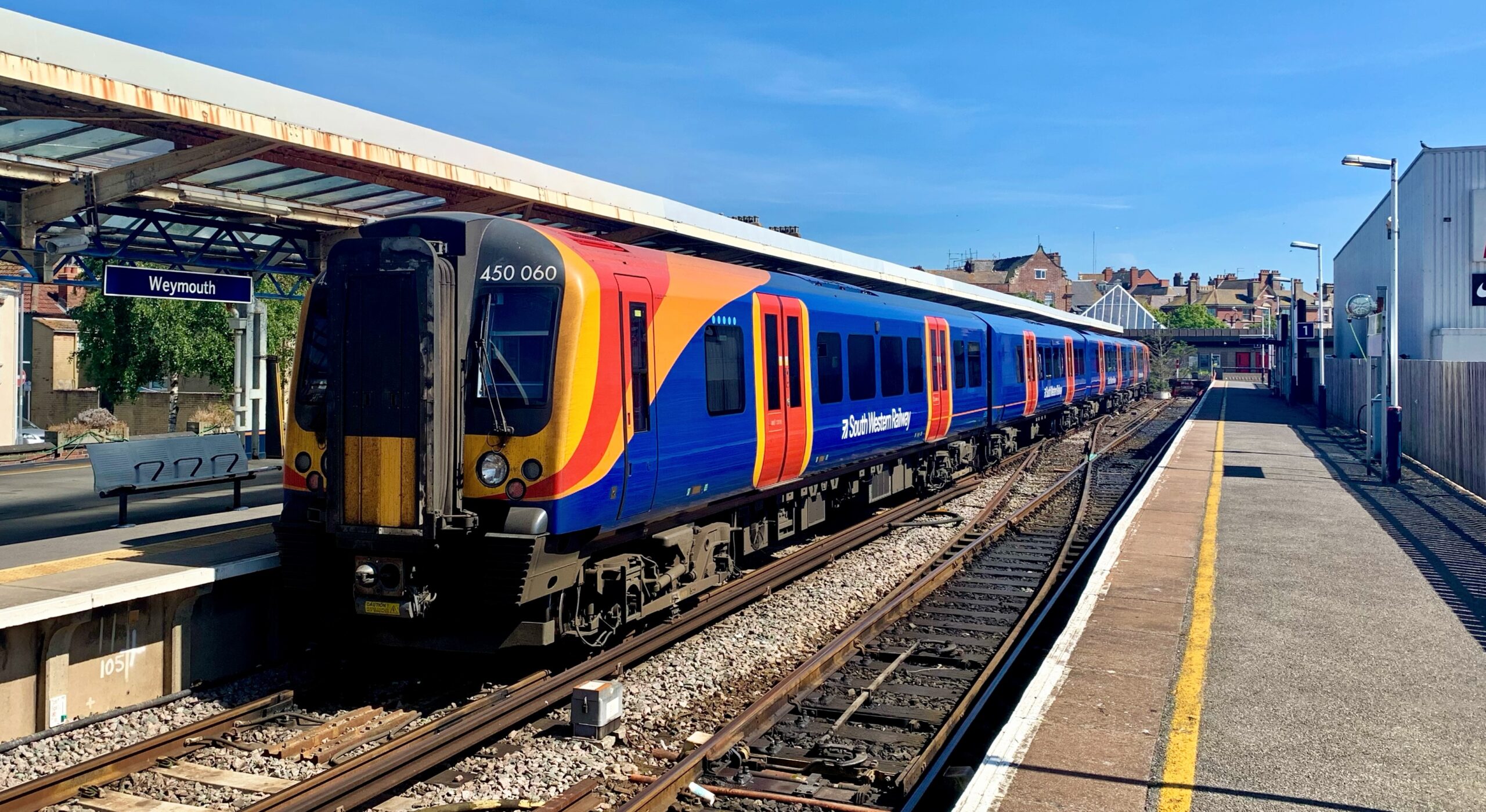
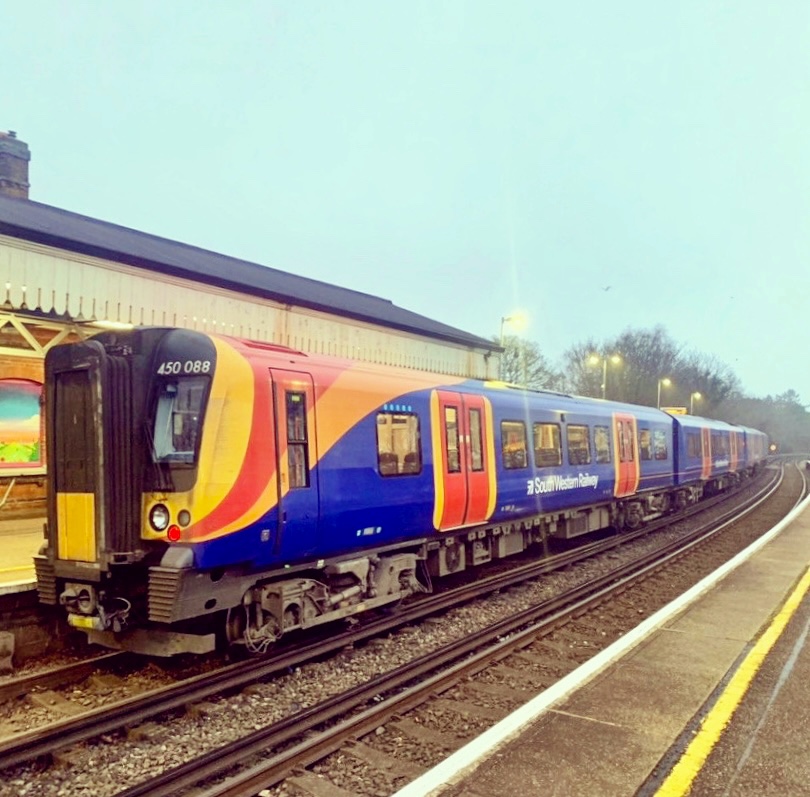
SWR Class 444 No. 444034 on the approach to Weymouth showing the colours of its former operator SWT – 01/05/2020The final South Western Railway Class 444 in South Western Trains livery No. 444045 arrives at Hamworthy working 1W55 0735 London Waterloo to Weymouth – 30/12/2023SWR Class 450 No. 450060 in blue SWT colours at Weymouth – 20/05/2020Class 450 No. 450088 departing Hamworthy with an early morning Weymouth to Brockenhurst stopping service – 23/12/2021
The final Desiro’s to be re-liveried from former SWT colours into SWR grey are No.’s 450031, 450099, 450116 and 444045.
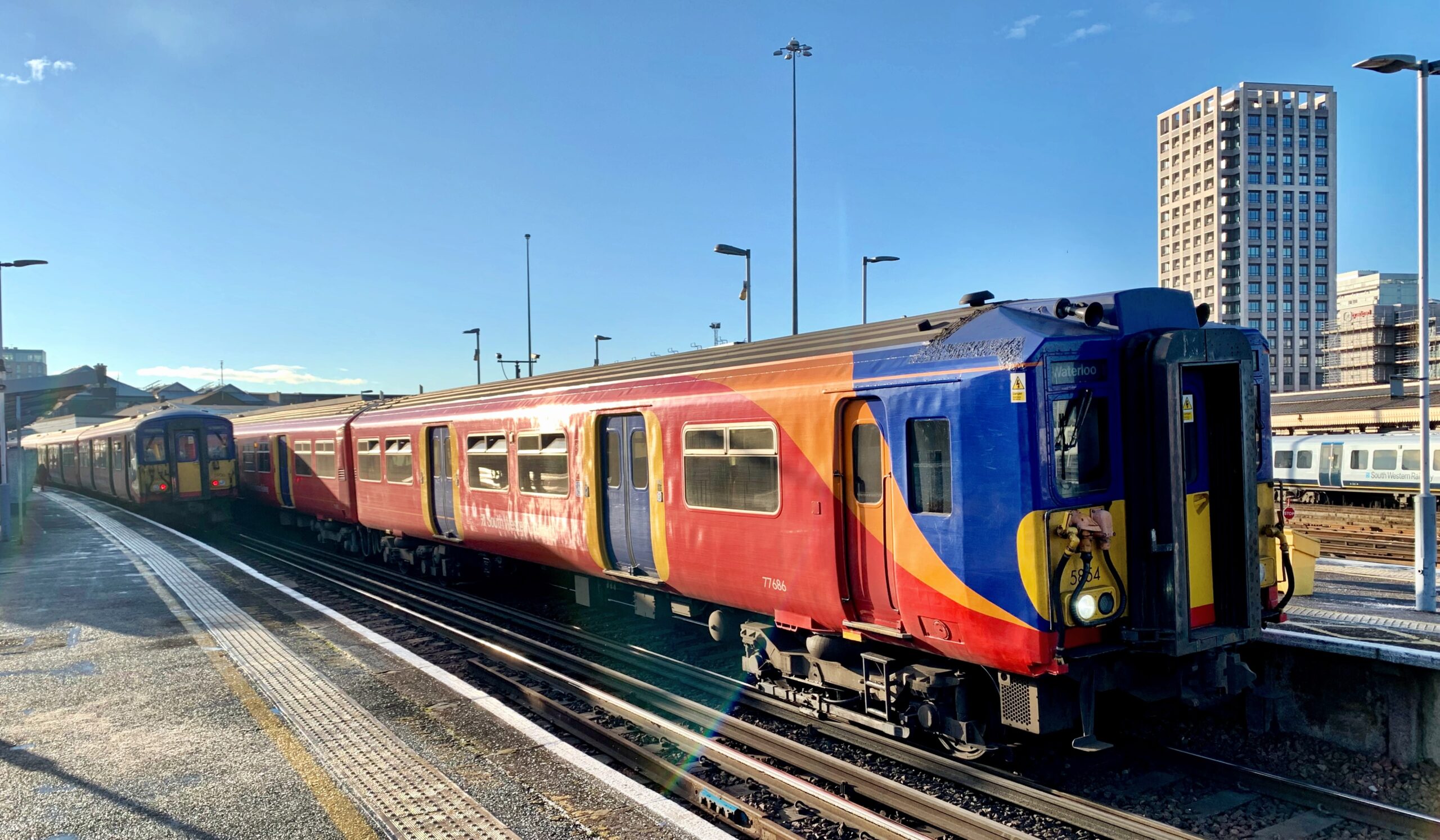
For completion: a Class 455 No. 455854 in the SWT red livery with a London Waterloo bound service at Clapham Junction – 10/12/2022
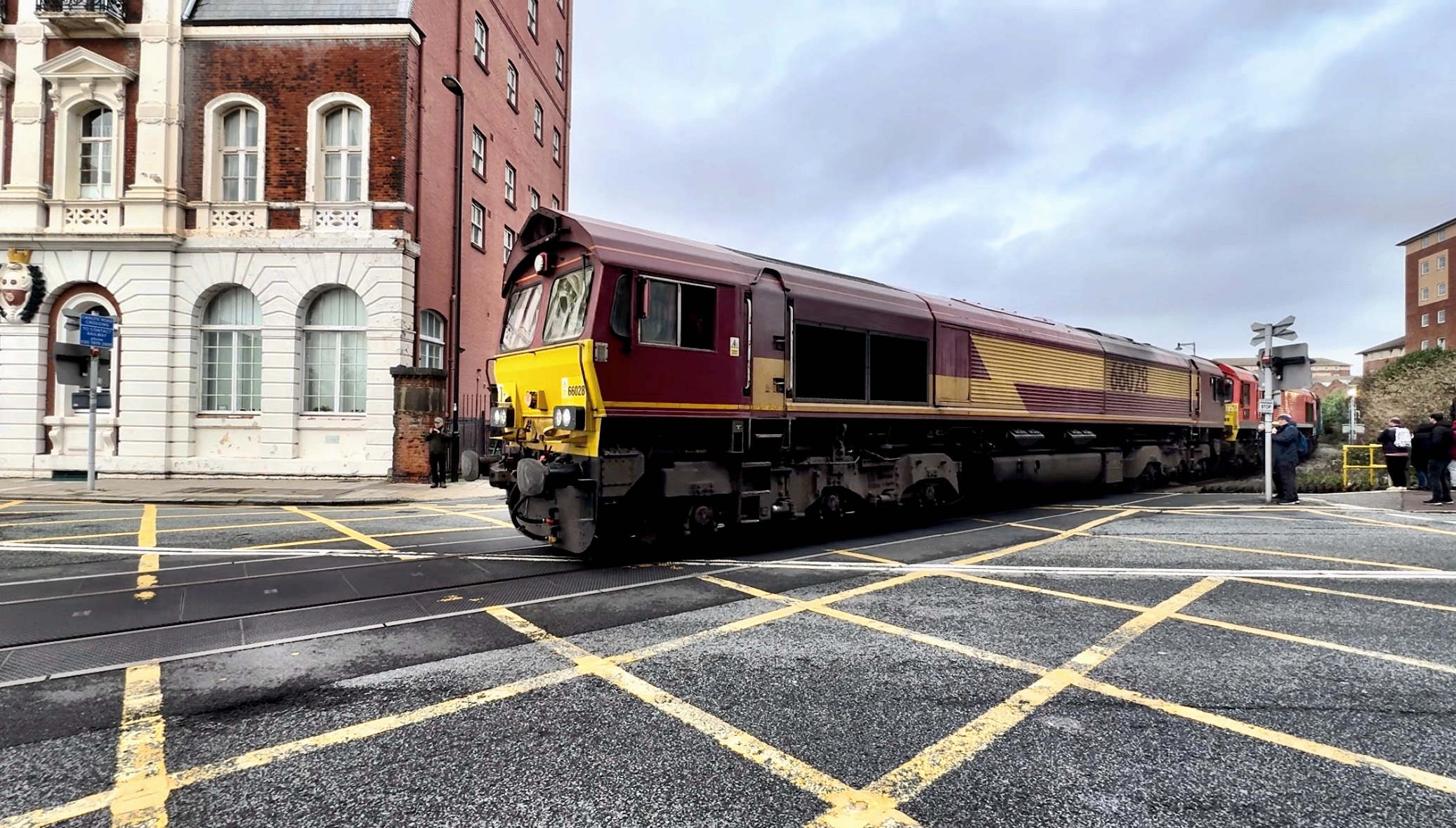
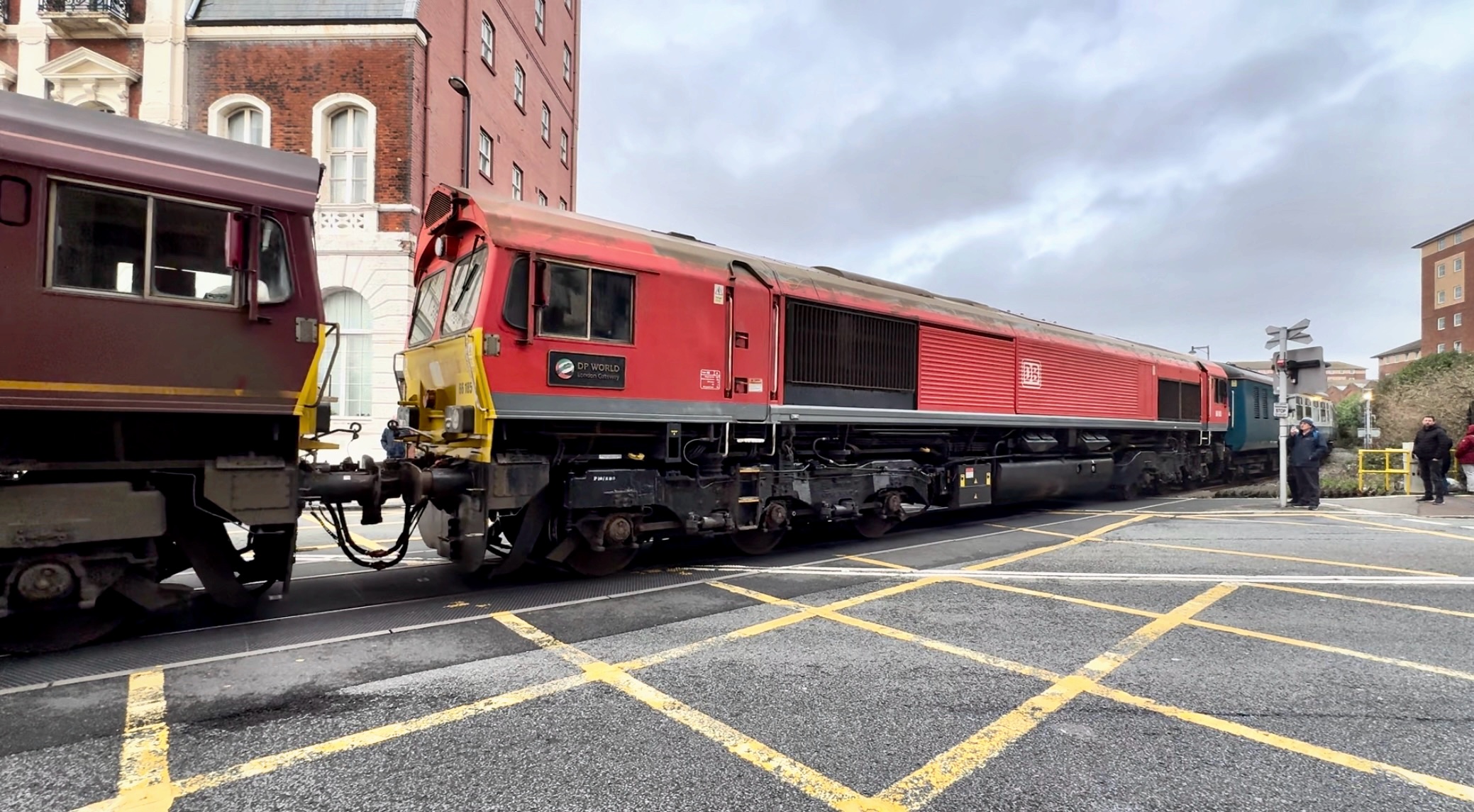
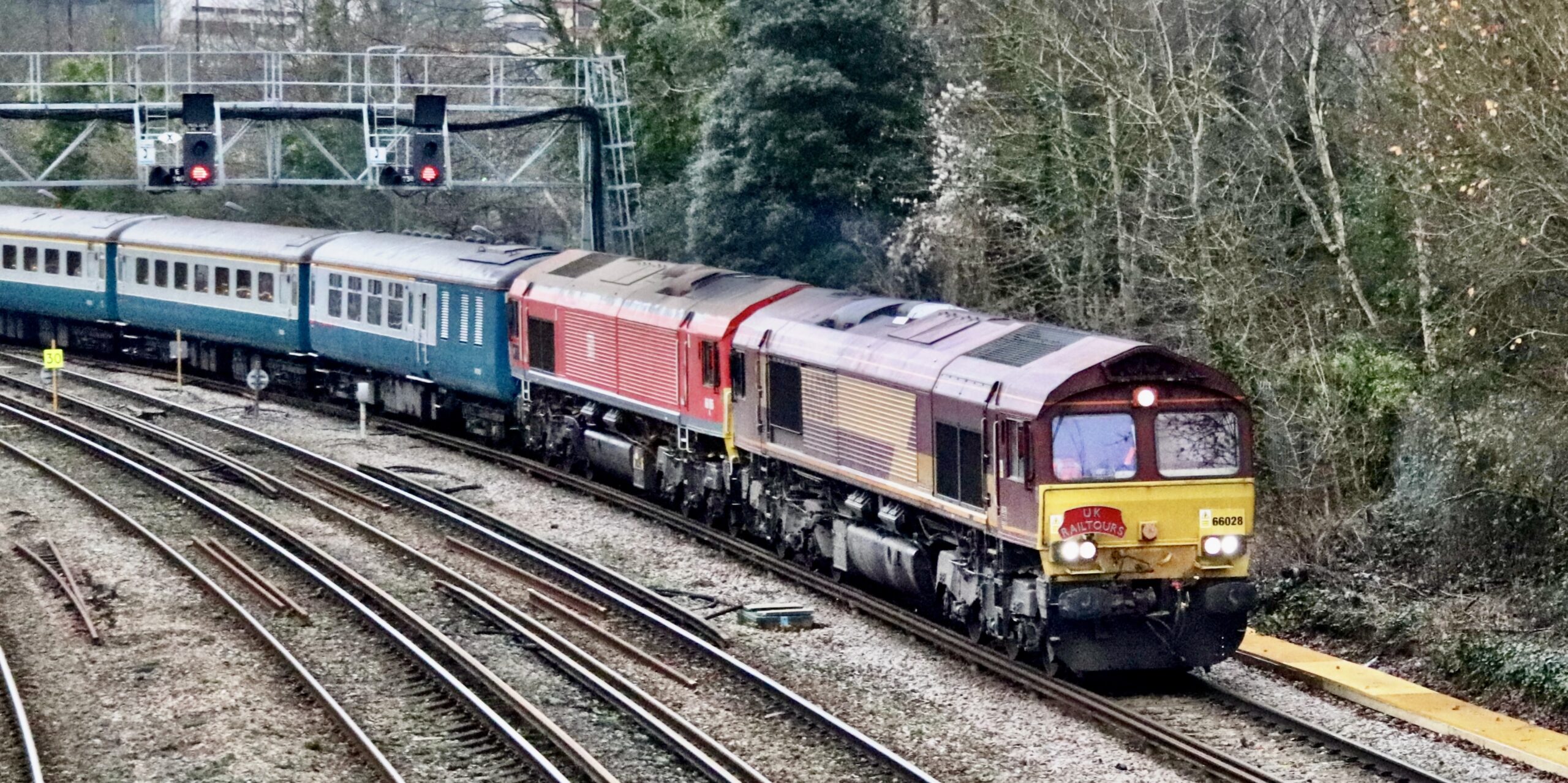
The final railtour of 2023 bordering on the Dorset area was run by UK Railtours employing DB Cargo Class 66 locomotives booked for use in a top and tail formation. “Another Awkward Week Adventure”, named because of those so called awkward days between Christmas and New Year originated in Peterborough. Problems with one of the locomotives; No. 66185 meant the railtour left 60 minutes late from its originating station after No. 66028, which had been the rear locomotive, was removed from the back of the train and re-attached to the front with No. 66185 remaining inside. This was how Yoshi and I saw the train after it had passed through Winchester on its way to Eastleigh. Here passengers had the option to detrain and take a bus to the National Motor Museum at Beaulieu or remain onboard for some rare track miles into Southampton Eastern and Western Docks.
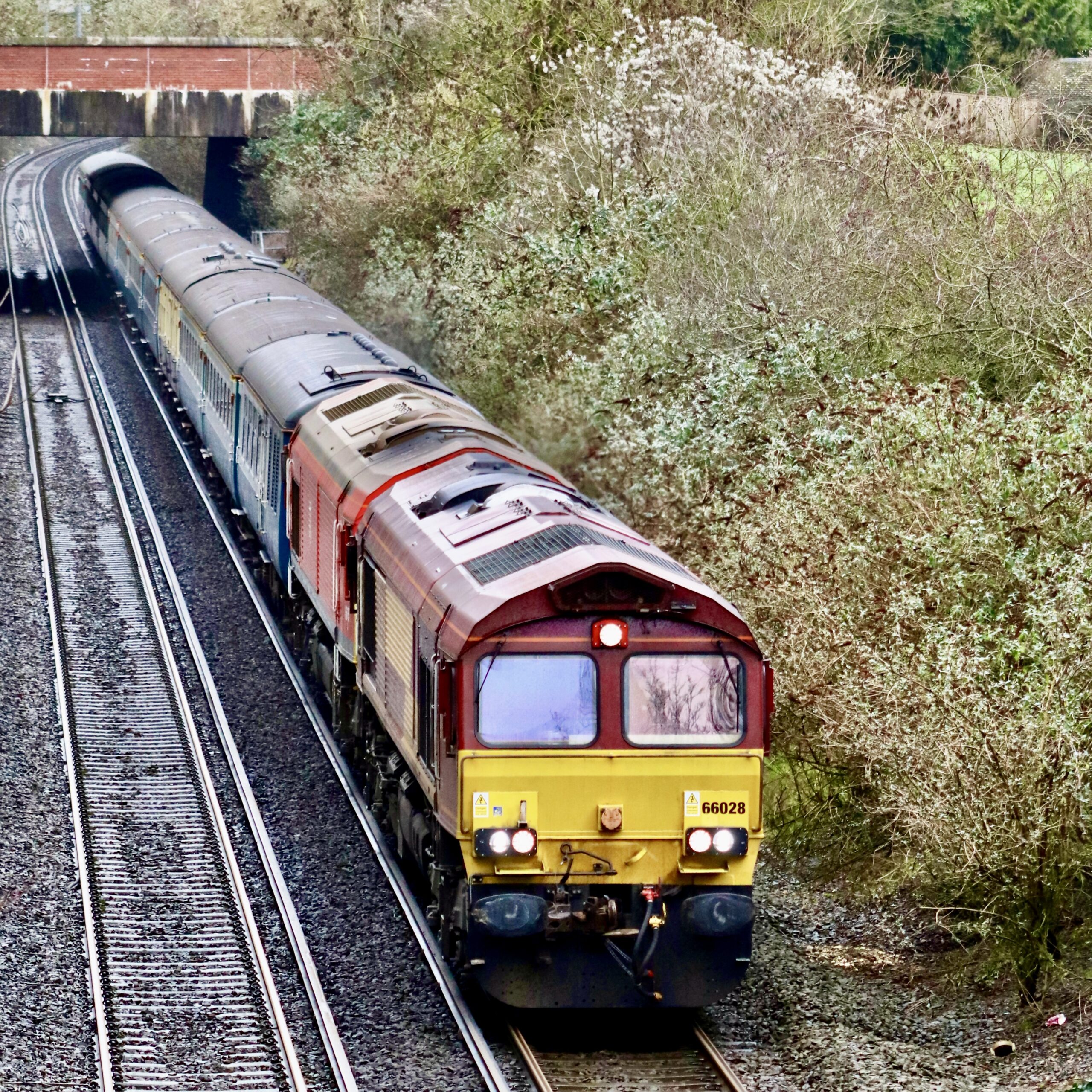
DB Cargo Class 66 No.’s 66028 and 66185 ‘DP WORLD London Gateway’ double heading 1Z66 0730 Peterborough to Southampton Eastern Docks “Another Awkward Week Adventure” railtour west of Winchester – 30/12/2023
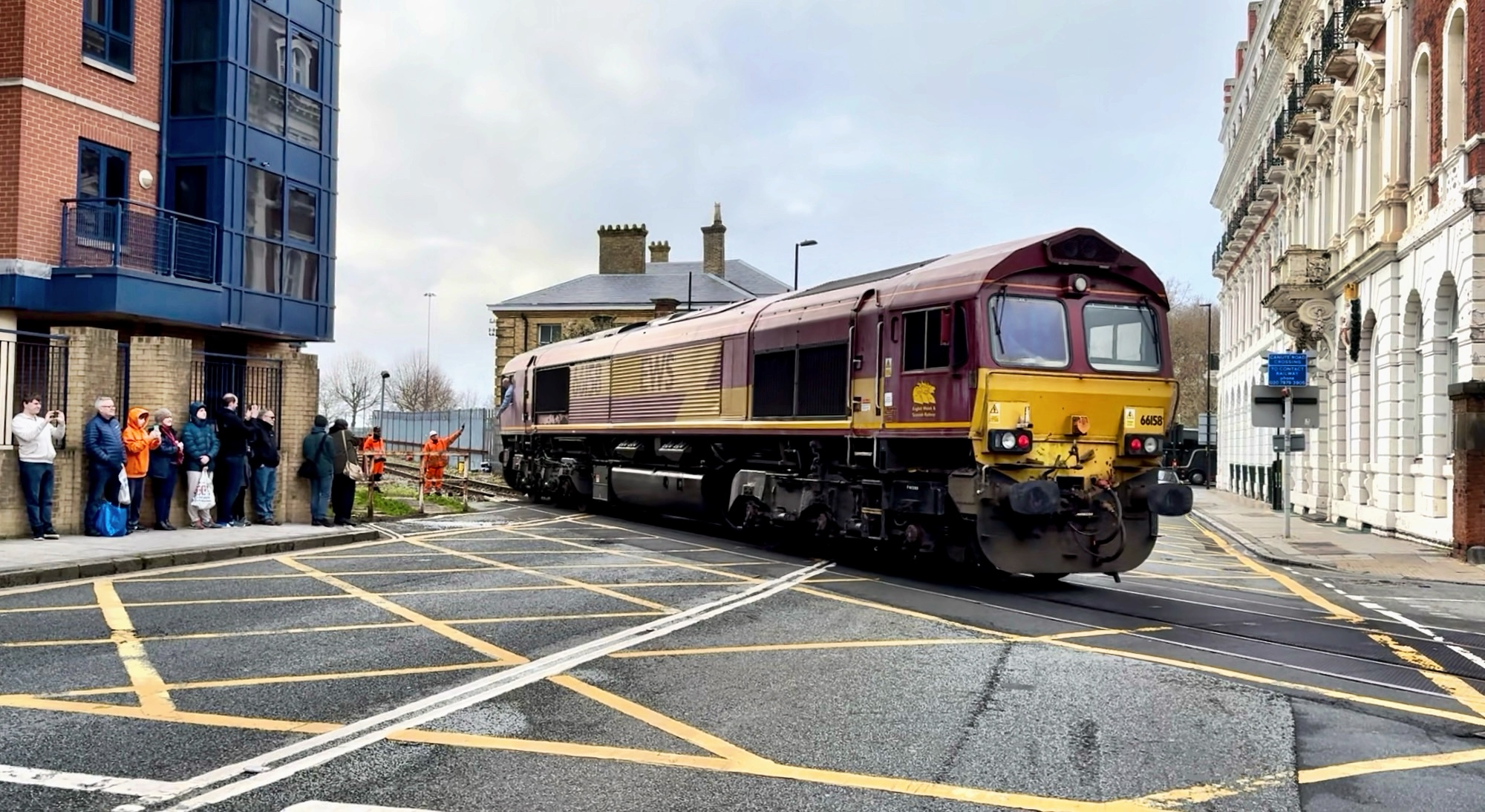
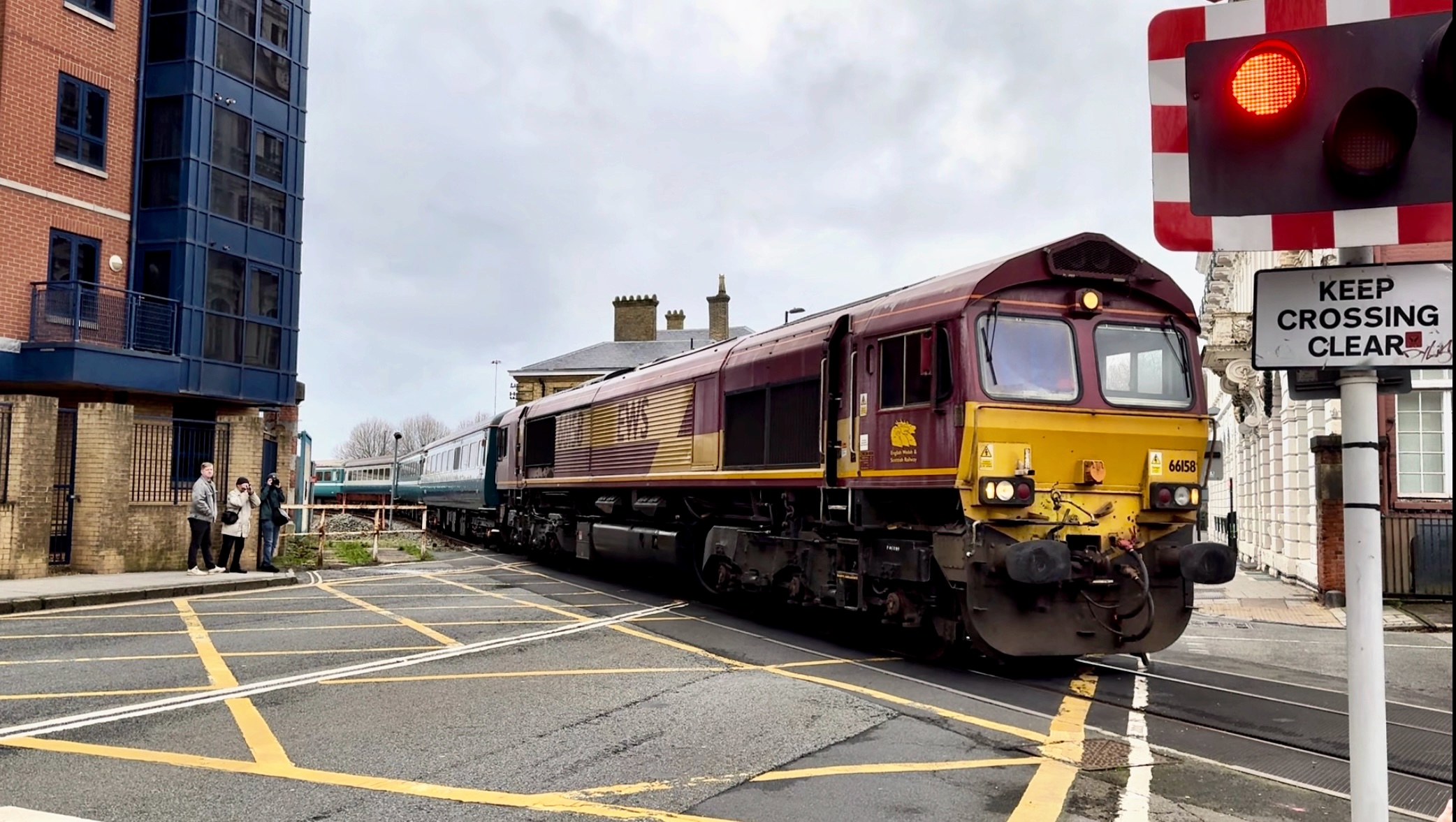
I next moved onto Southampton where I fancied filming the excursion crossing Canute Road which is adjacent to the former Southampton Terminus railway station which served the Port of Southampton and Southampton City Centre from 1839 until 1966. The former Terminus station building is now a casino and The South Western Hotel opened by the LSWR in 1872 has been converted into private apartments. Of the station platforms, all that remains is the glass canopy and a single line that runs from Northam junction to the Queen Elizabeth II Cruise Terminal. The private road into where the platforms once stood is now a car park.
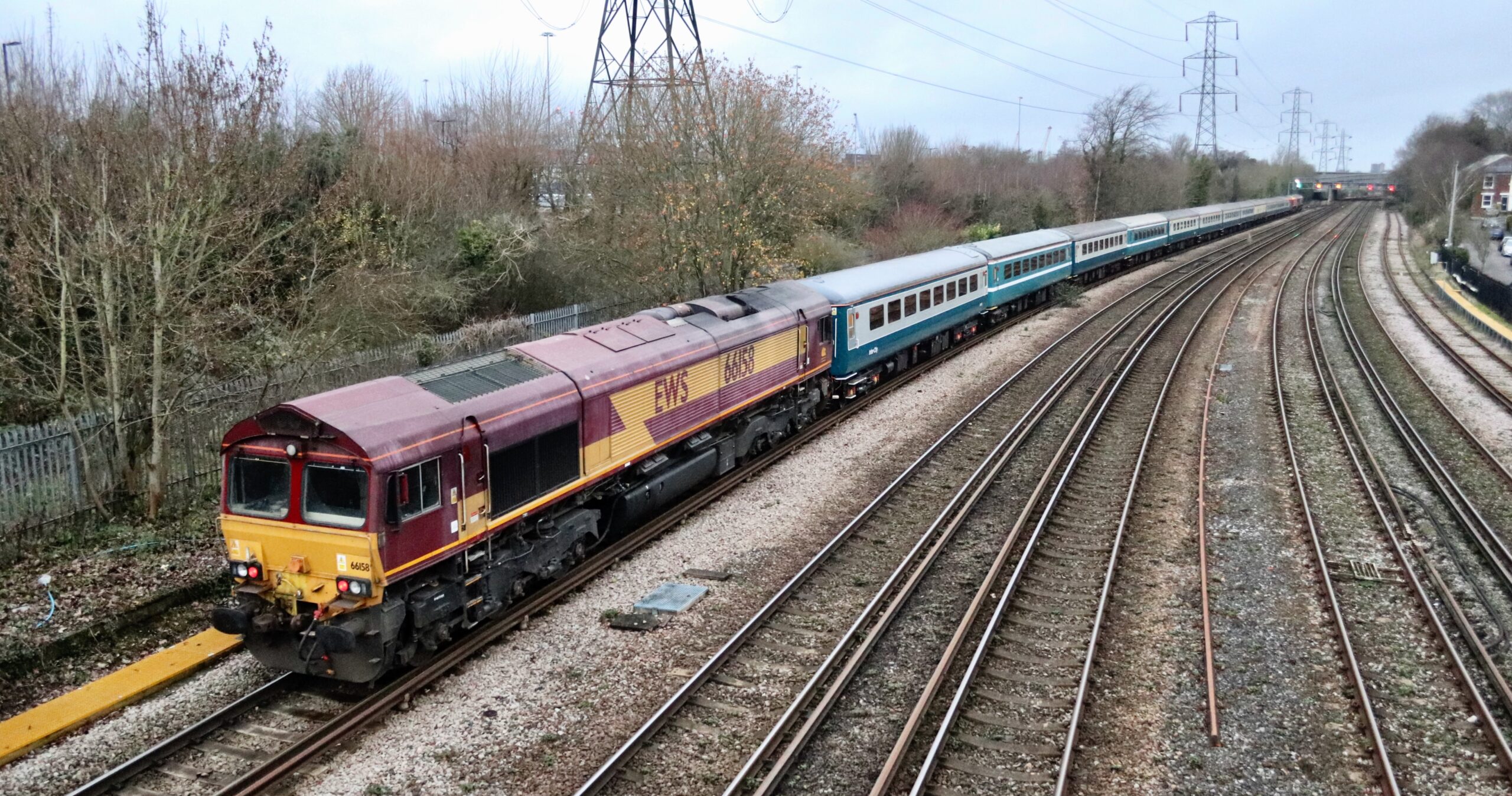
DB Cargo Class 66 No. 66028 crossing Canute Road, Southampton with 1Z66 0730 Peterborough to Southampton Eastern Docks – 30/12/2023Disgraced DB Cargo Class 66 No. 66185 ‘DP WORLD London Gateway’ dead in the consist of 1Z66 0730 Peterborough to Southampton Eastern Docks – 30/12/2023DB Cargo Class 66 No. 66158 runs light engine across Canute Road, Southampton as 0Z66 1340 Eastleigh Down Carriage Shed to Southampton Eastern Docks – 30/12/2023After running light into the docks, DB Cargo Class 66 No. 66158 leads out working 1Z67 1402 Southampton Eastern Docks to Southampton Western Docks – 30/12/2023
Our final location was the footbridge over the railway line between Southampton Central and Millbrook ready to catch the train head towards Western Docks and out again Yoshi waited in the car as the weather, already very windy, turned increasingly wet! I photographed the railtour on its outward leg into Western Docks, but by the time it returned (running late) the light had gone and I didn’t want another DSLR to fall foul of water damage in 2023! Instead I managed some dodgy video which can be seen lower down the page.
Back leading the tour again; DB Cargo Class 66 No.’s 66028 and 66185 ‘DP WORLD London Gateway’ on the approach to Millbrook heading up 1Z67 1402 Southampton Eastern Docks to Southampton Western Docks – 30/12/2023DB Cargo Class 66 No. 66158 at the rear of 1Z67 1402 Southampton Eastern Docks to Southampton Western Docks on the approach to Millbrook – 30/12/2023
“Another Awkward Week Adventure” DB Cargo Class 66 No.’s 66028 and 66185 ‘DP WORLD London Gateway’ and 66158: 1Z66 0730 Peterborough to Southampton Eastern Docks / 0Z66 1340 Eastleigh Down Carriage Shed to Southampton Eastern Docks / 1Z67 1402 Southampton Eastern Docks to Southampton Western Docks / 1Z68 1531 Southampton Western Docks to Eastleigh – 30/12/2023
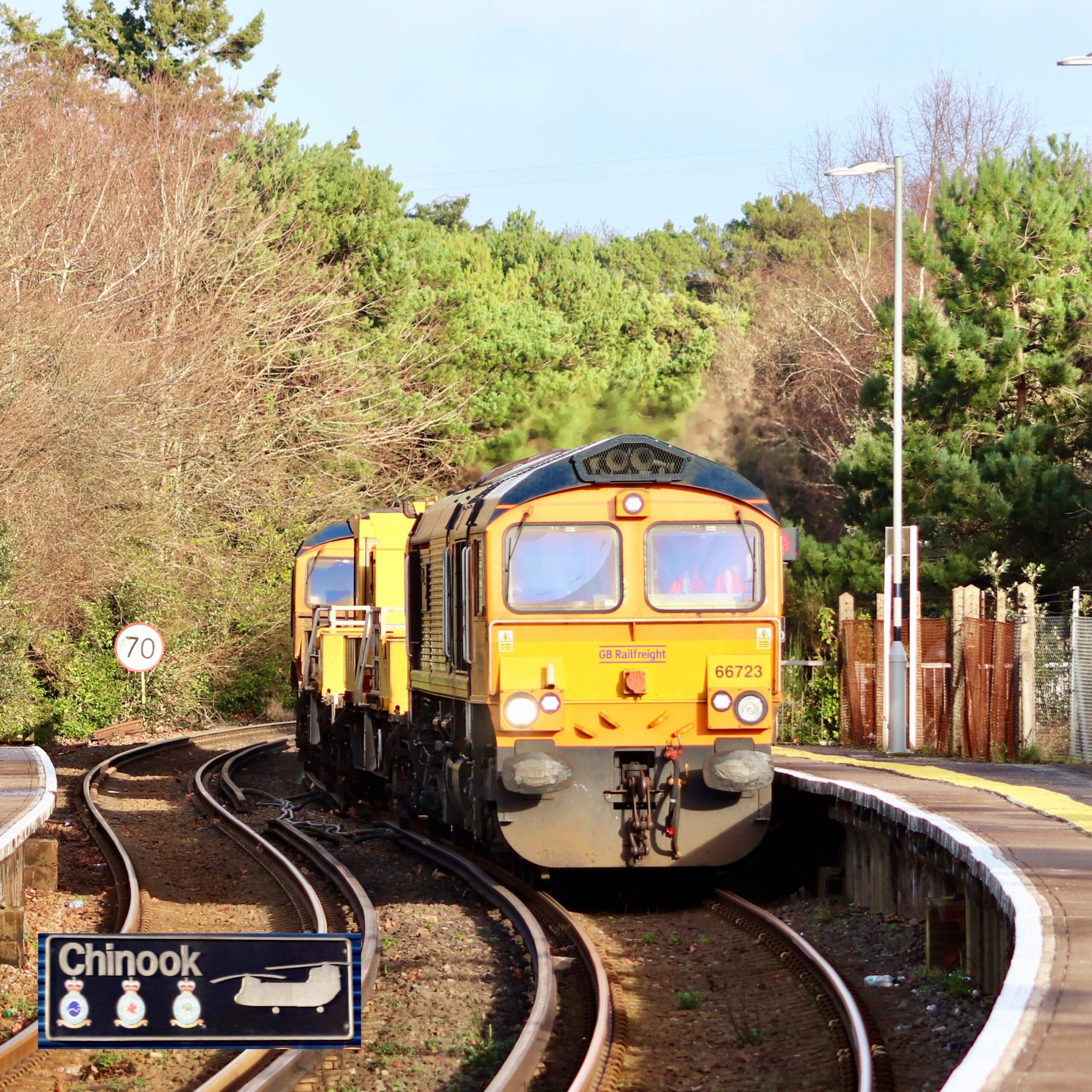
One final festive gift courtesy of GB Railfreight saw the SITT run to Weymouth on New Years Eve as 3Y88 1200 Totton Yard to Totton Yard, top and tailed by Class 66 locomotives No.’s 66723 ‘Chinook’ and 66772 ‘Maria’. The SITT with the same two Class 66’s in charge was also the first locomotive hauled train into Dorset early on New Years Day 2024 when it returned as far as Bournemouth in the early hours working as 3Y89 0100 Totton Yard to Totton Yard.
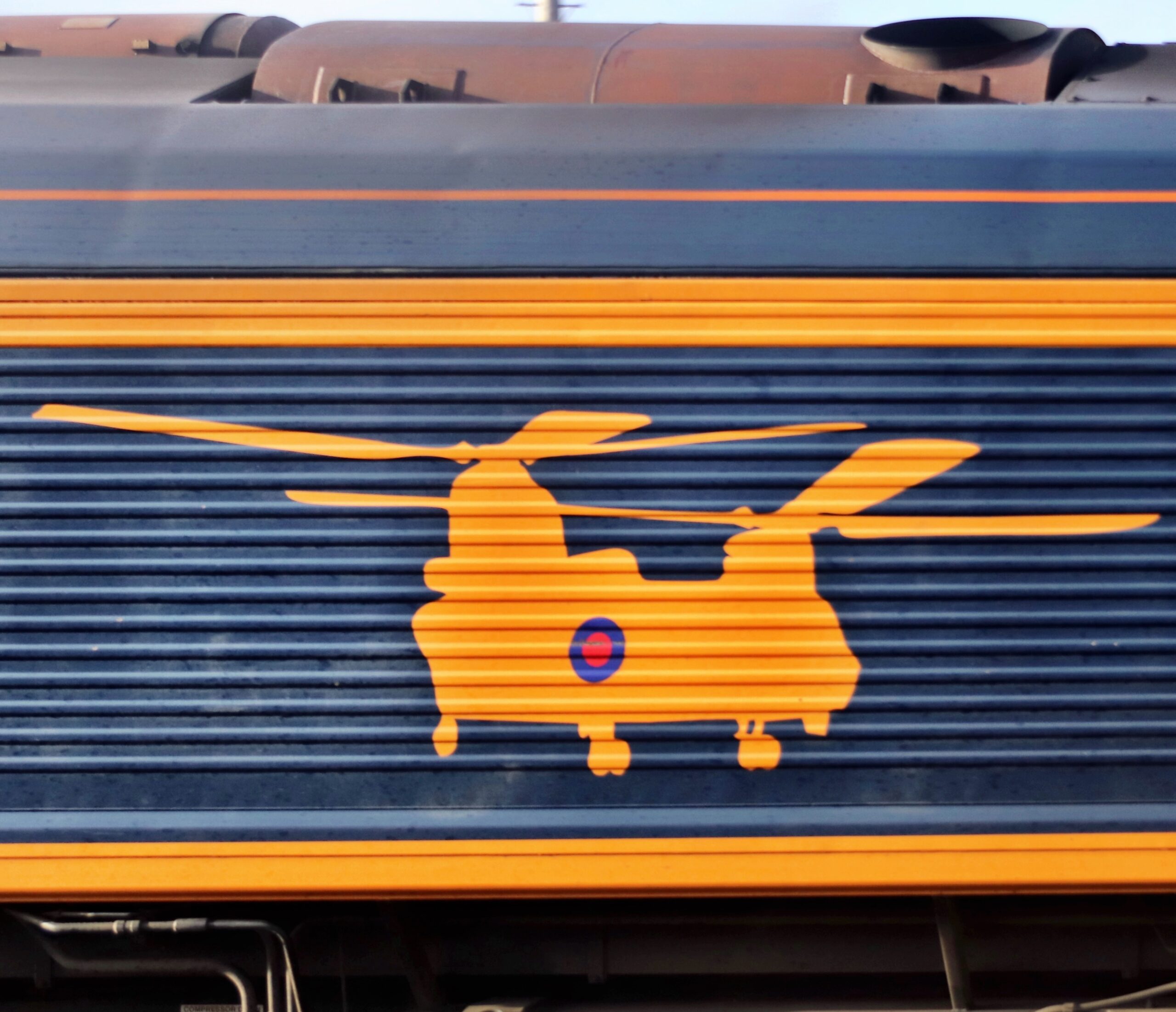
GBRf Class 66 No.’s 66723 ‘Chinook’ and 66772 ‘Maria’ at Hamworthy on SITT 3Y88 1200 Totton Yard to Totton Yard – 31/12/2023Close up of the helicopter decal on the side of GBRf Class 66 No. 66723 ‘Chinook’ – 31/12/2023GBRf Class 66 No. 66772 ‘Maria’ at the rear of the SITT 3Y88 1200 Totton Yard to Totton Yard. Classmate No. 66723 ‘Chinook’ leads – 31/12/2023GBRf Class 66 No.’s 66772 ‘Maria’ 66723 ‘Chinook’ passing Hamworthy working the return SITT 3Y88 1200 Totton Yard to Totton Yard – 31/12/2023
GBRf Class 66 No.’s 66772 ‘Maria’ 66723 ‘Chinook’ working the return SITT 3Y88 1200 Totton Yard to Totton Yard (Dorchester South video courtesy of G E Barrett) – 31/12/2023
For The Record
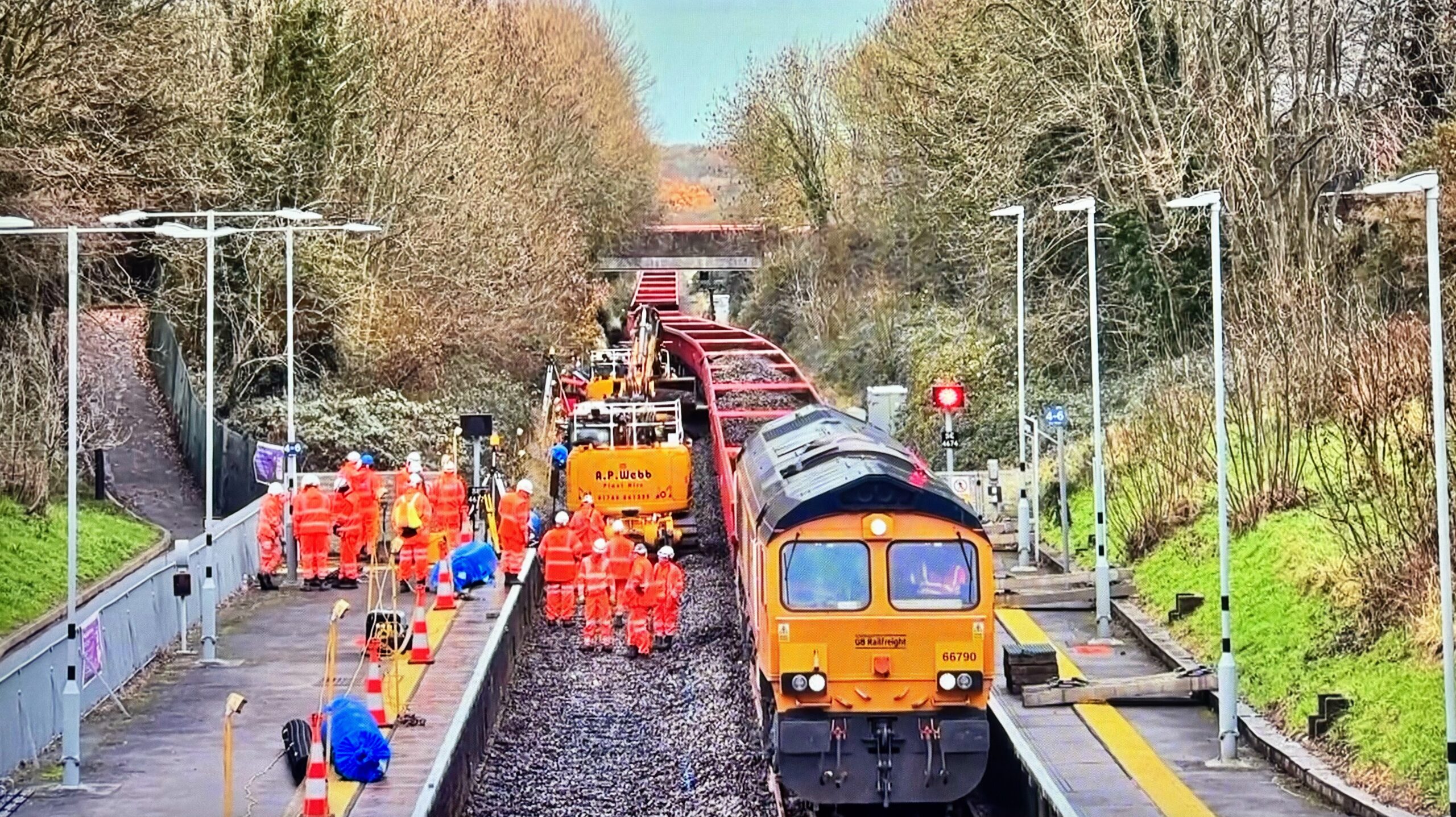
Following 16 days closure for engineering work on the West of England Line, the line between Salisbury and Yeovil Junction re-opened on Monday 11th December while landslip repairs were affected by flooding at Crewkerne tunnel which extended the duration required for work to be completed with SWR advising customers not to attempt to travel between Yeovil Junction and Exeter St David’s until Wednesday 13th December.
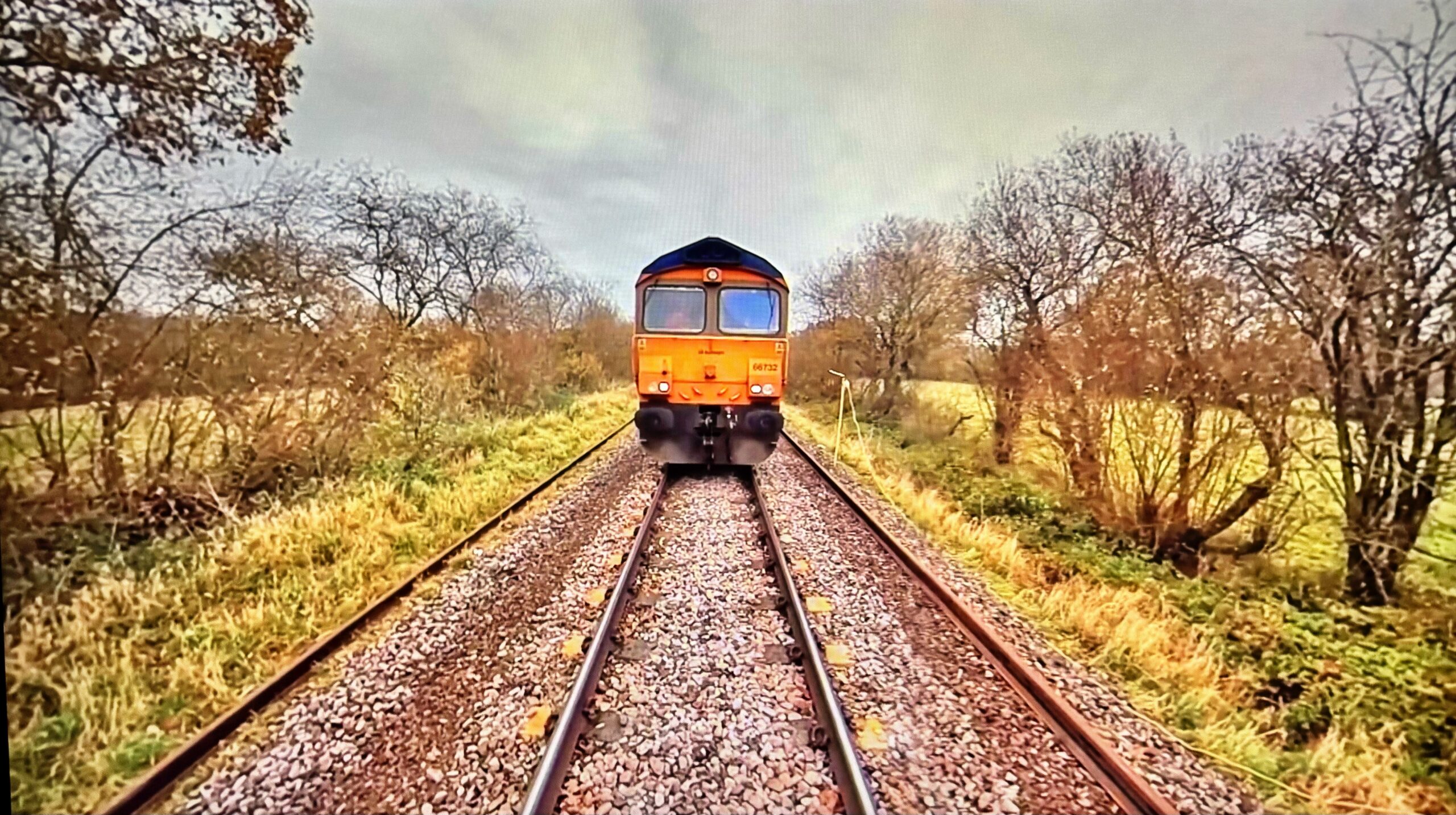
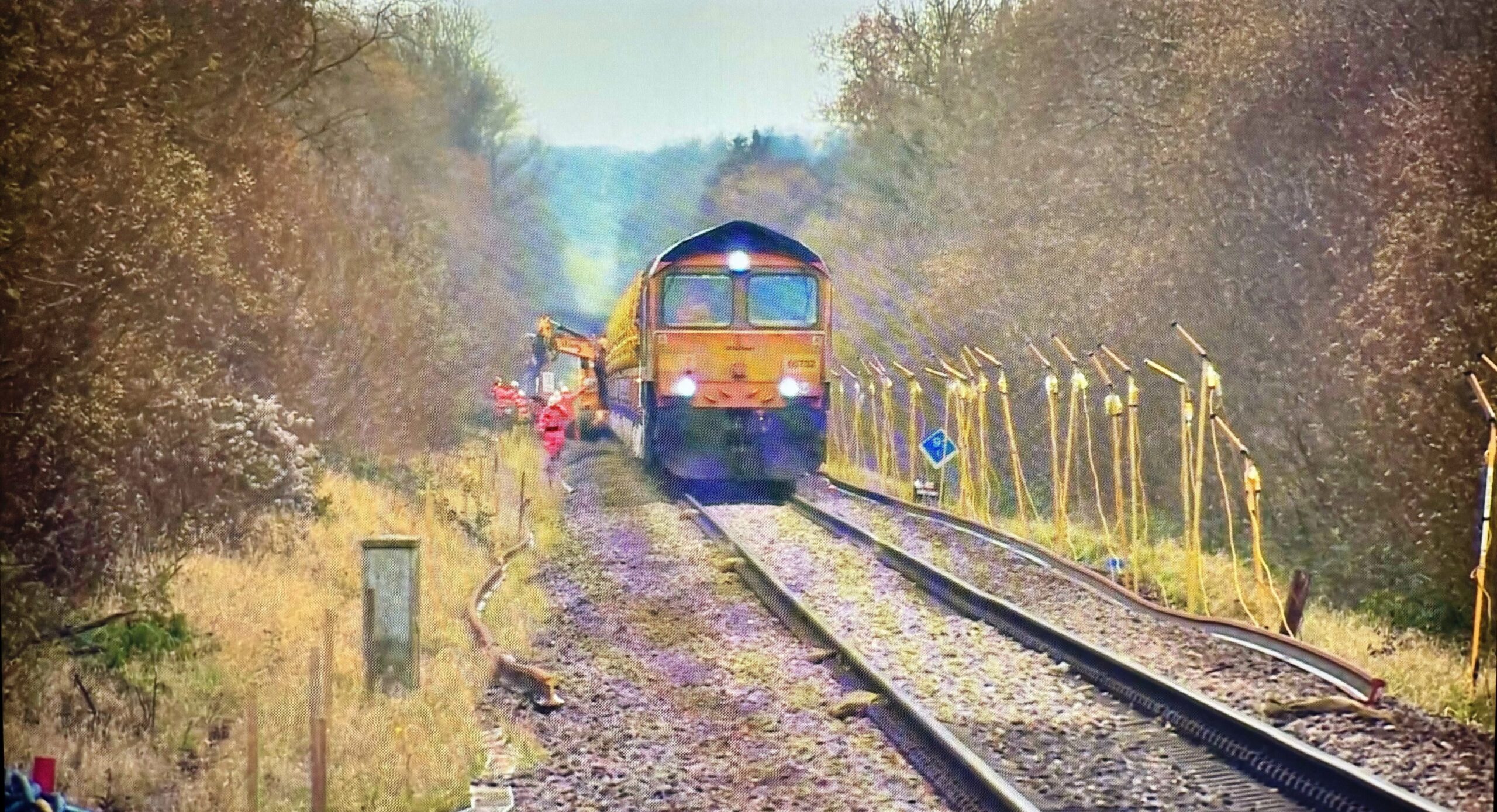
Class 66 No. 66732 ‘GBRf The First Decade 1999-2009 John Smith – MD’ at Dinton near Salisbury during the 16 day engineering possession. TV screen grab from BBC South Today – 01/12/2023Class 66 No. 66732 ‘GBRf The First Decade 1999-2009 John Smith – MD’ at Dinton near Salisbury. TV screen grab from BBC South Today – 01/12/2023Class 66 No. 66790 ‘Louise’ at Gillingham. TV screen grab from BBC South Today – 01/12/2023
Thanks for reading, that’s it for 2023! Wishing everyone a very Happy New Year. We’ll leave you with a pic of Yoshi at Durdle Door. Be seeing you!
Yoshi took an early morning trip to Durdle Door to see the sunrise – 22/12/2023