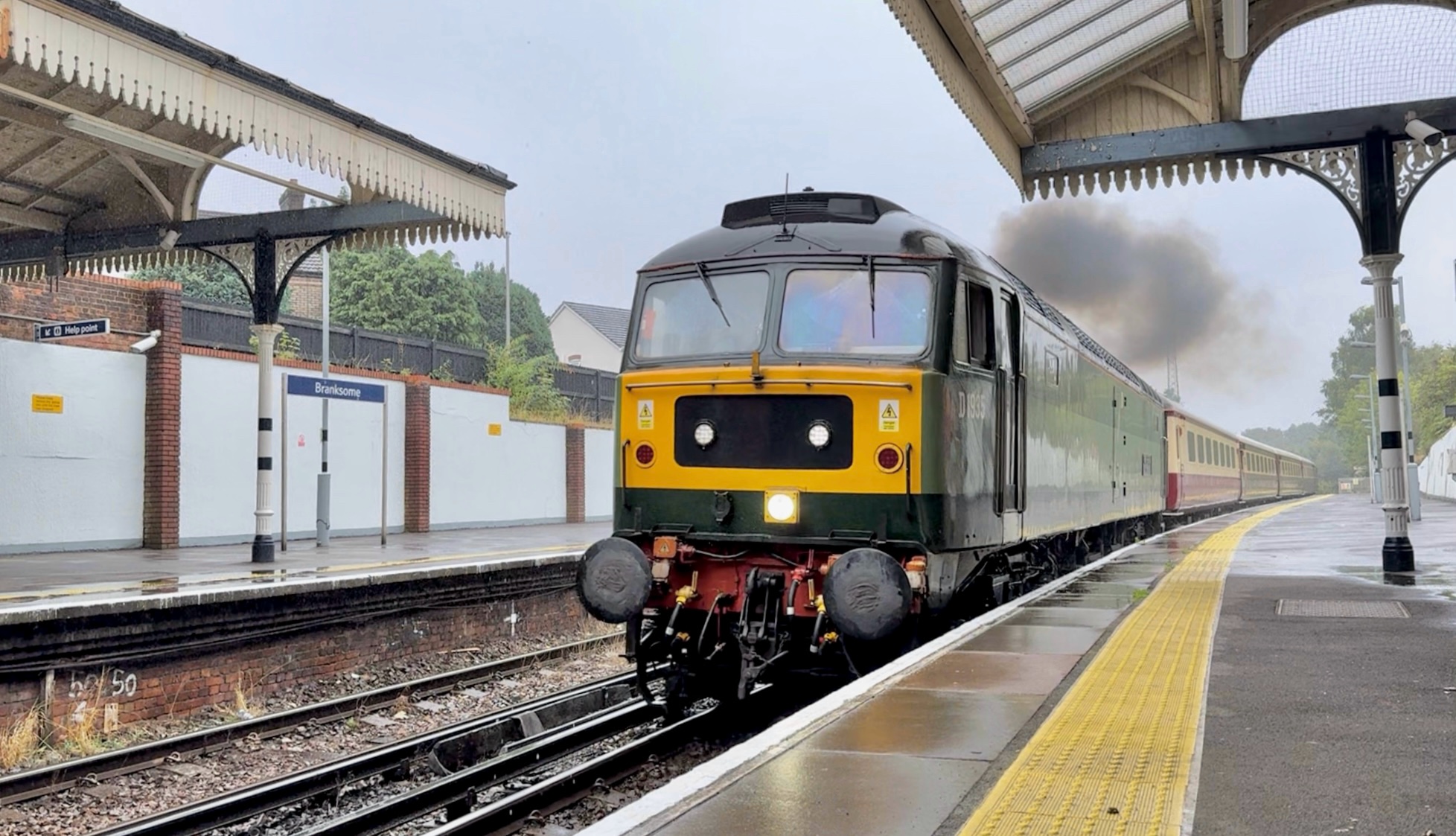
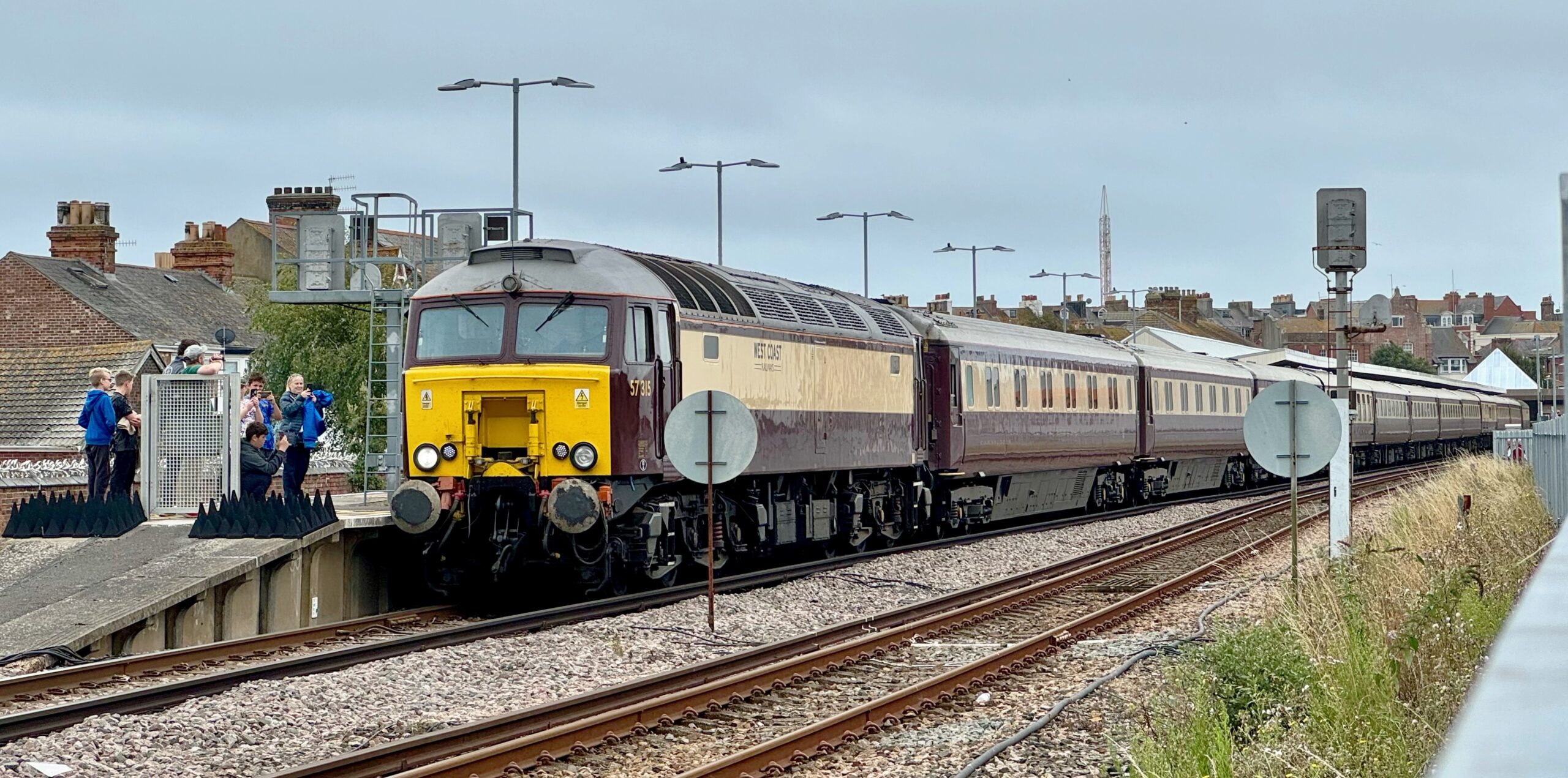
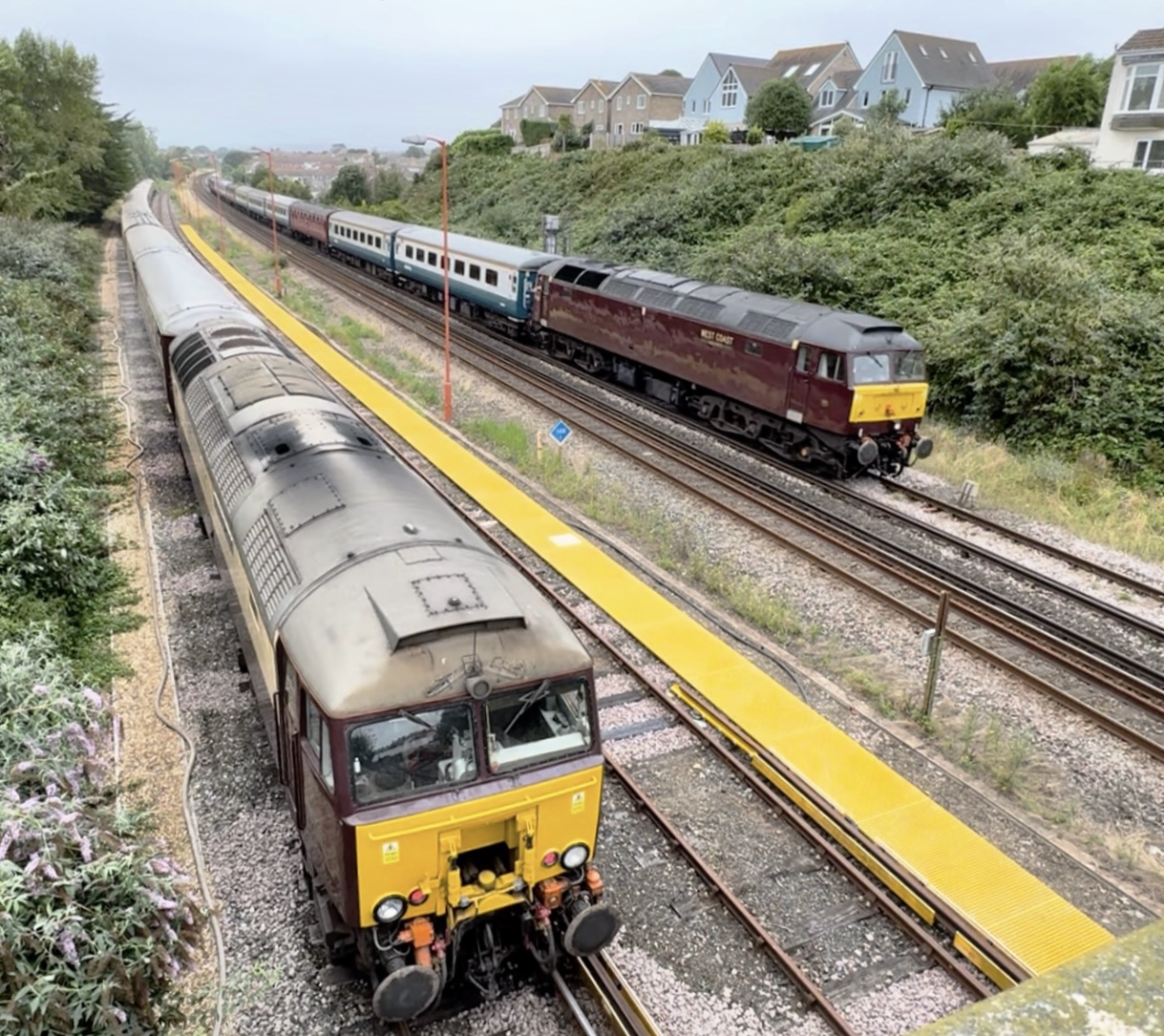
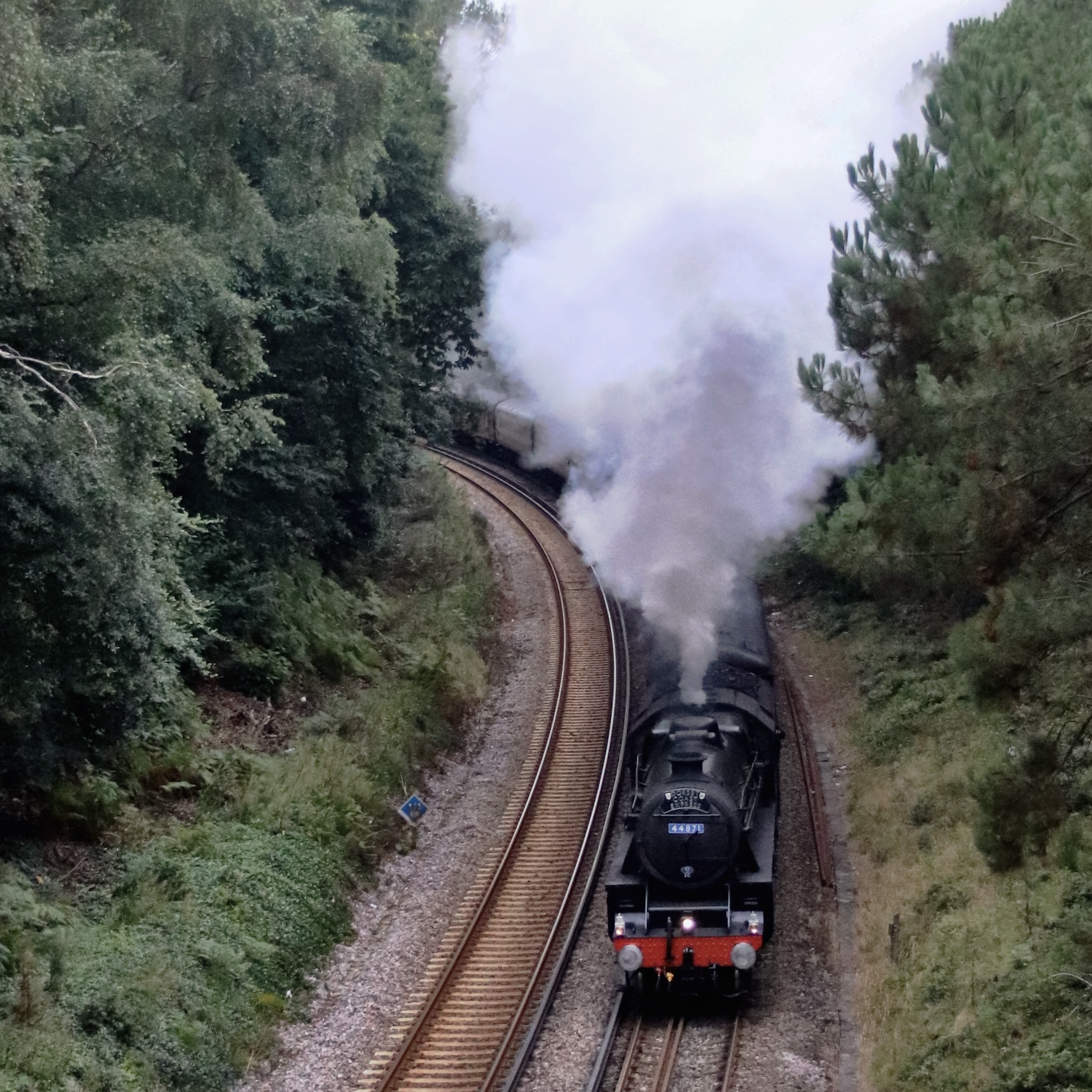
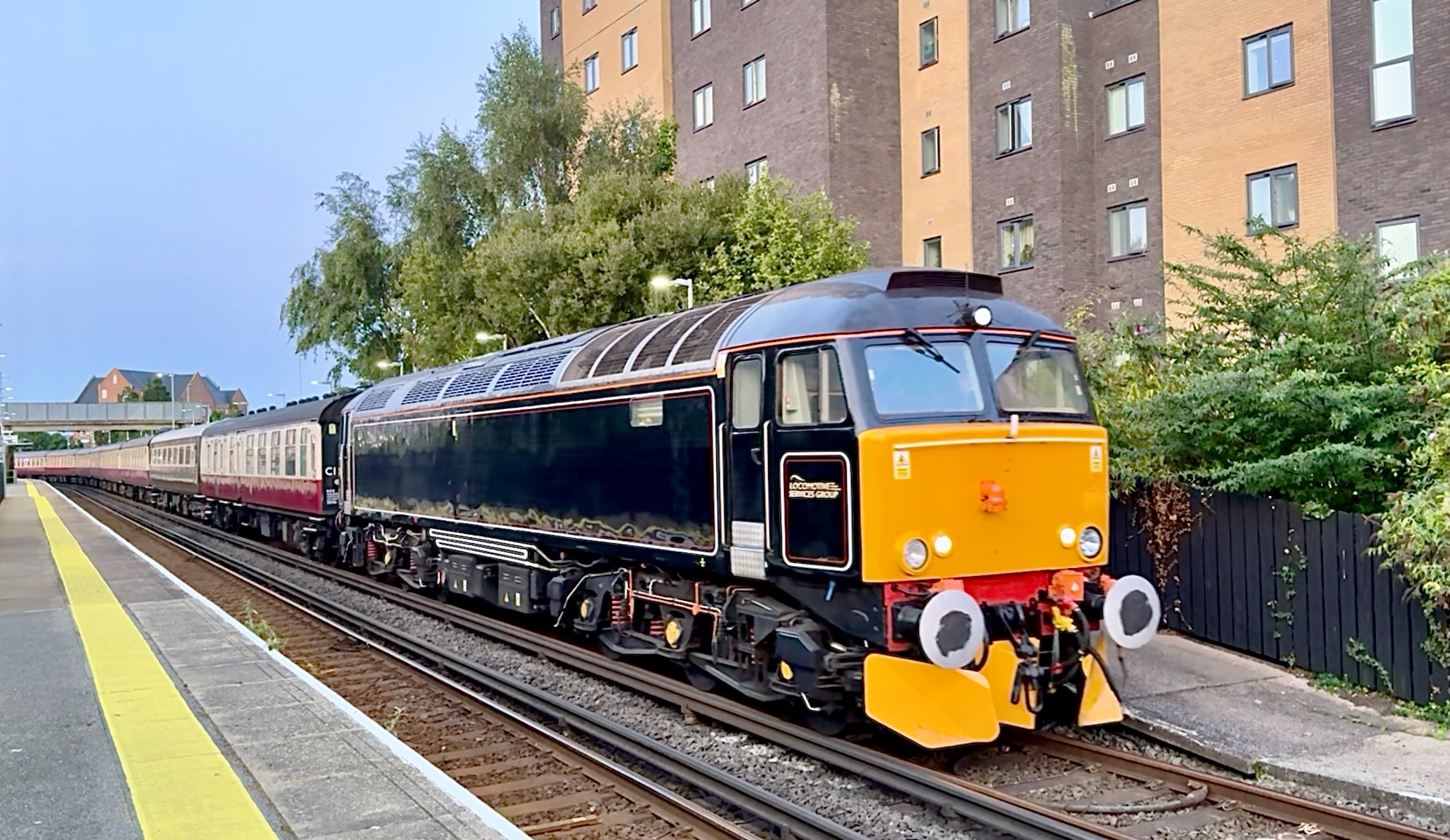
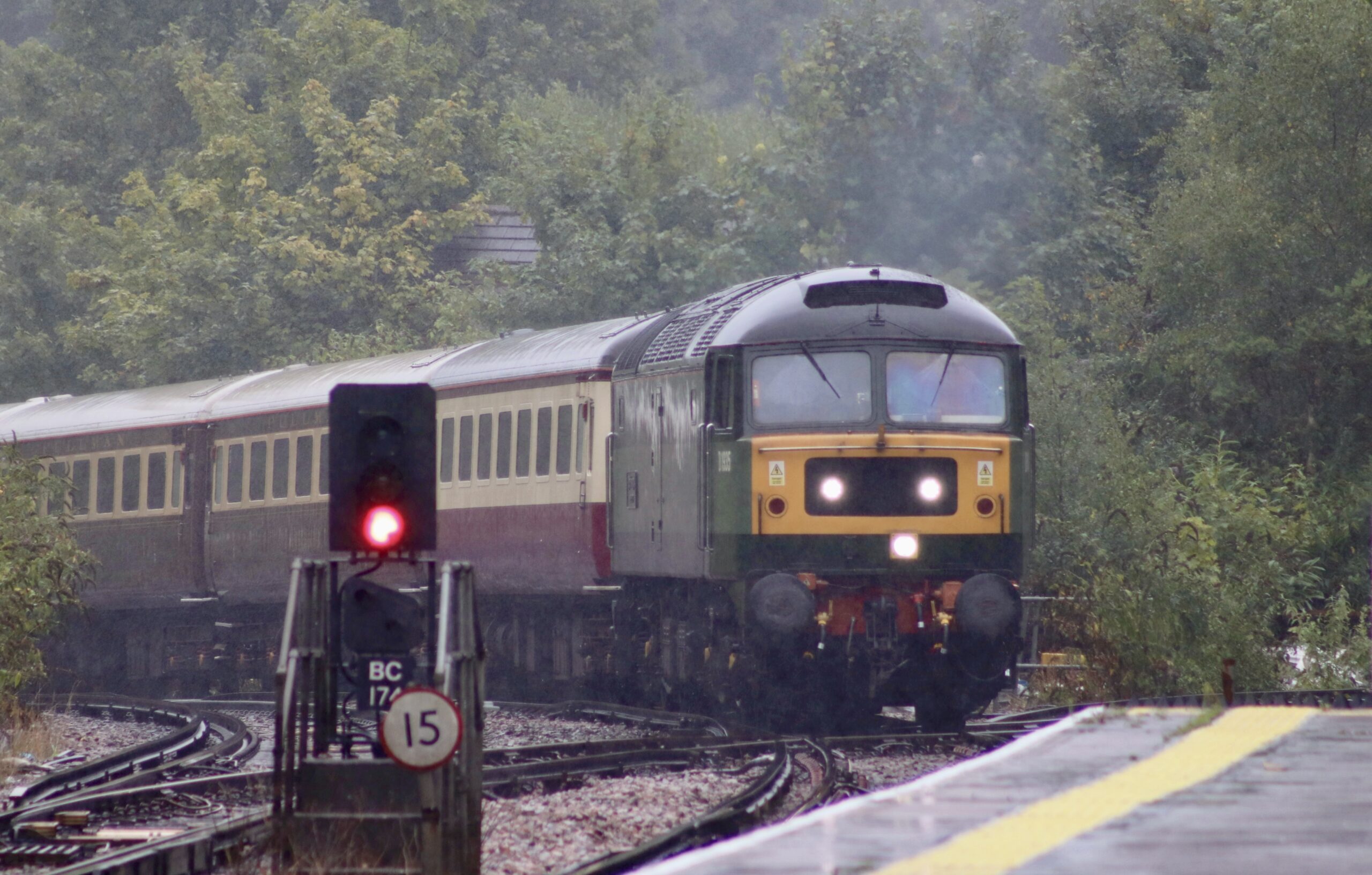
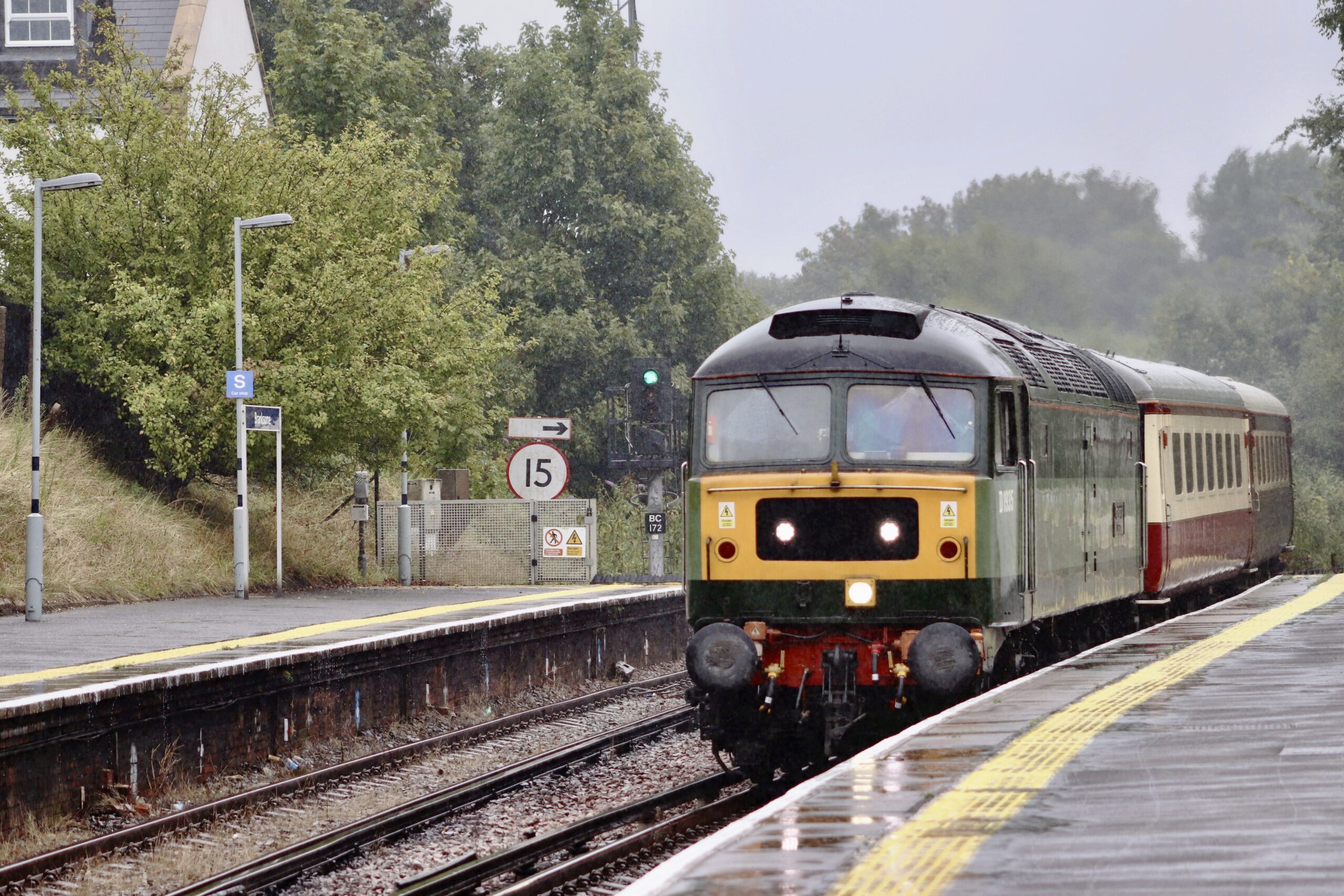
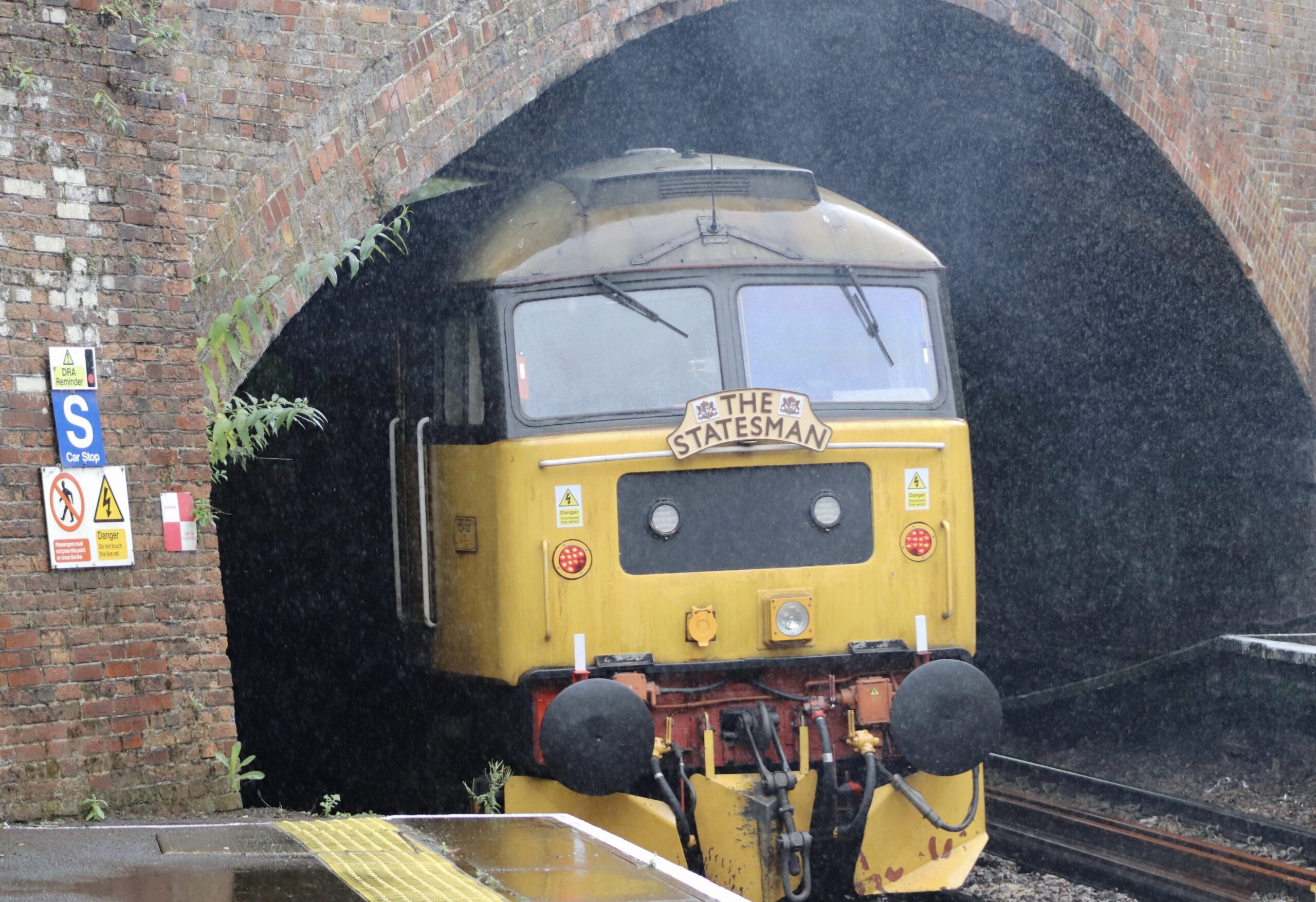
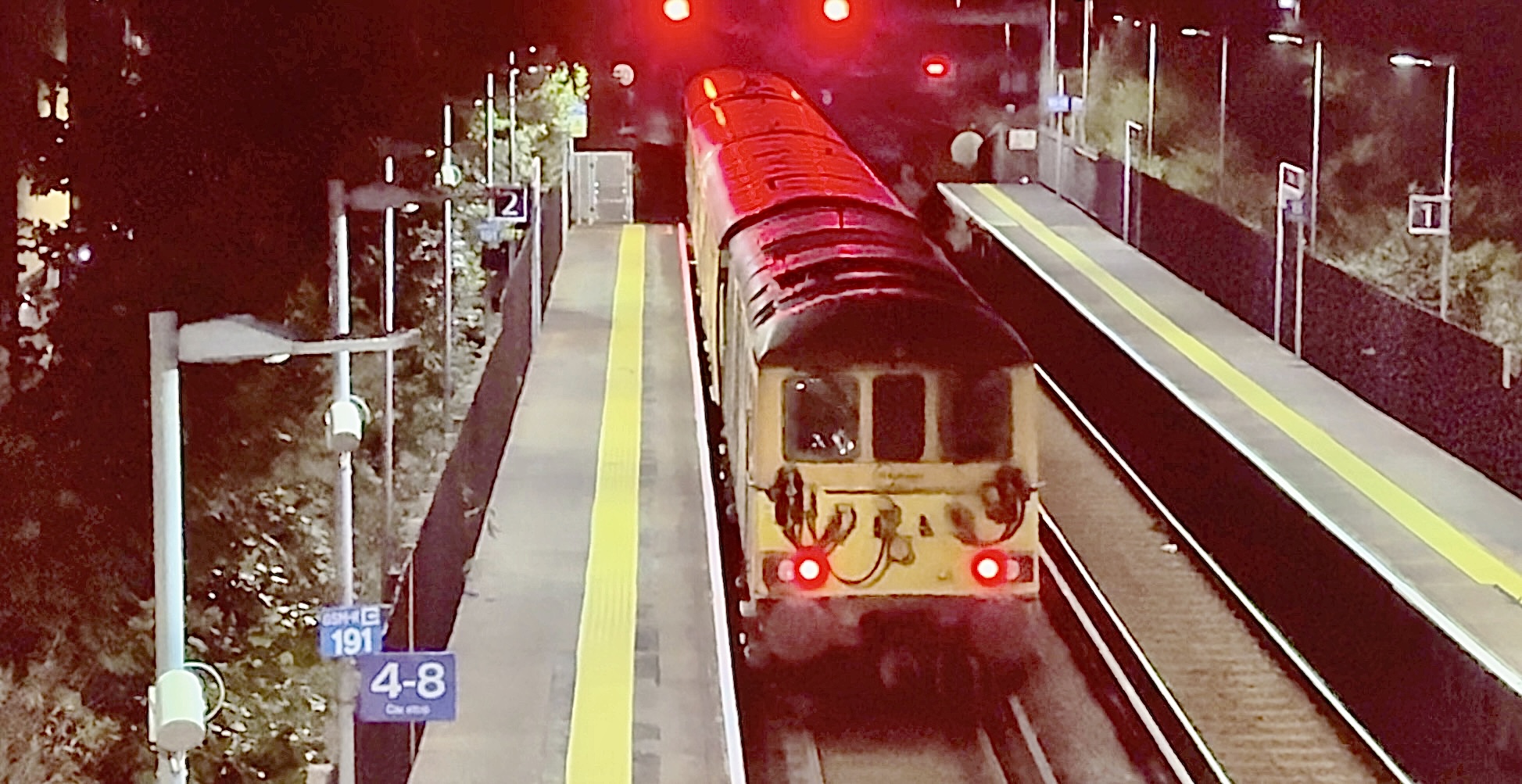
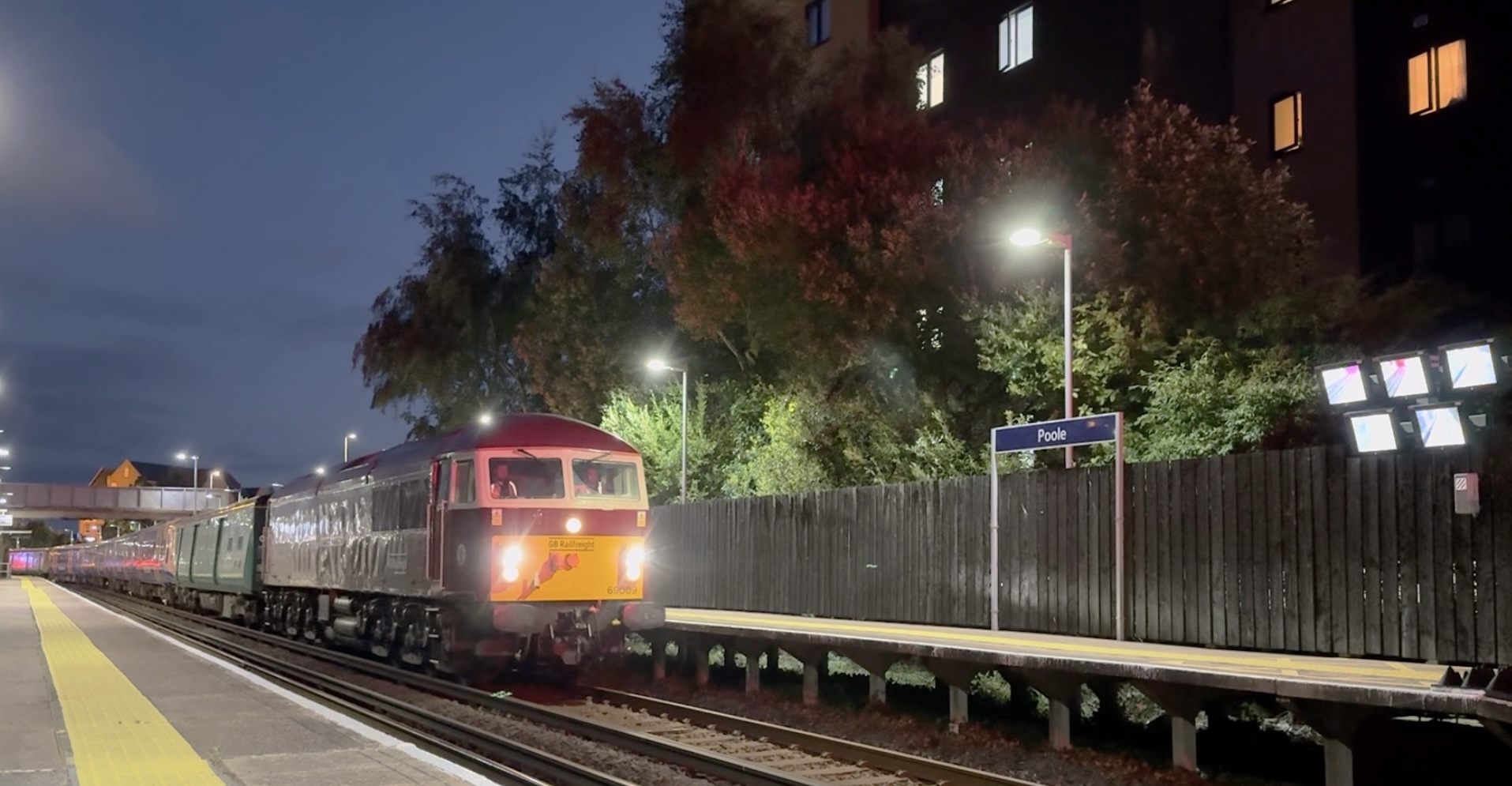
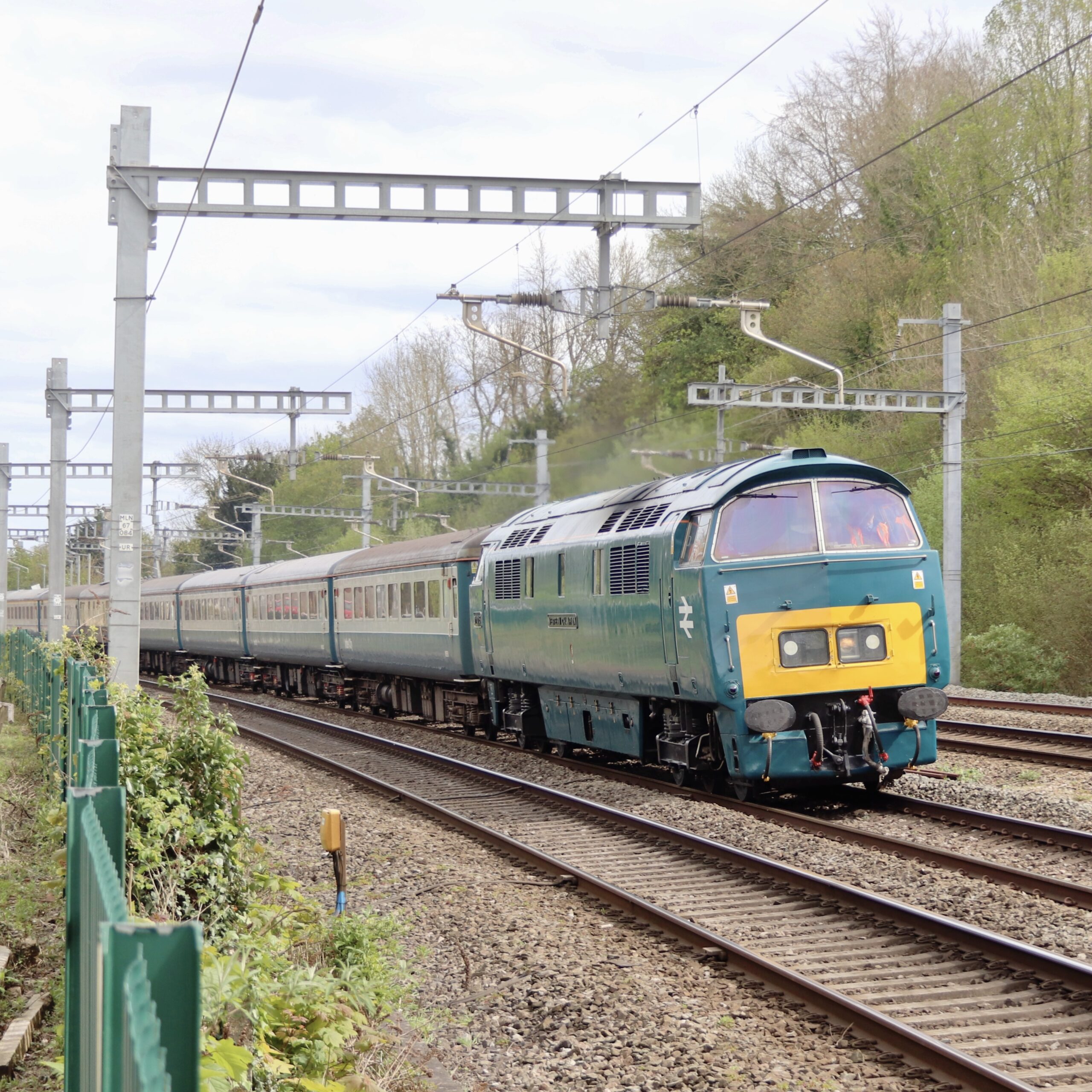
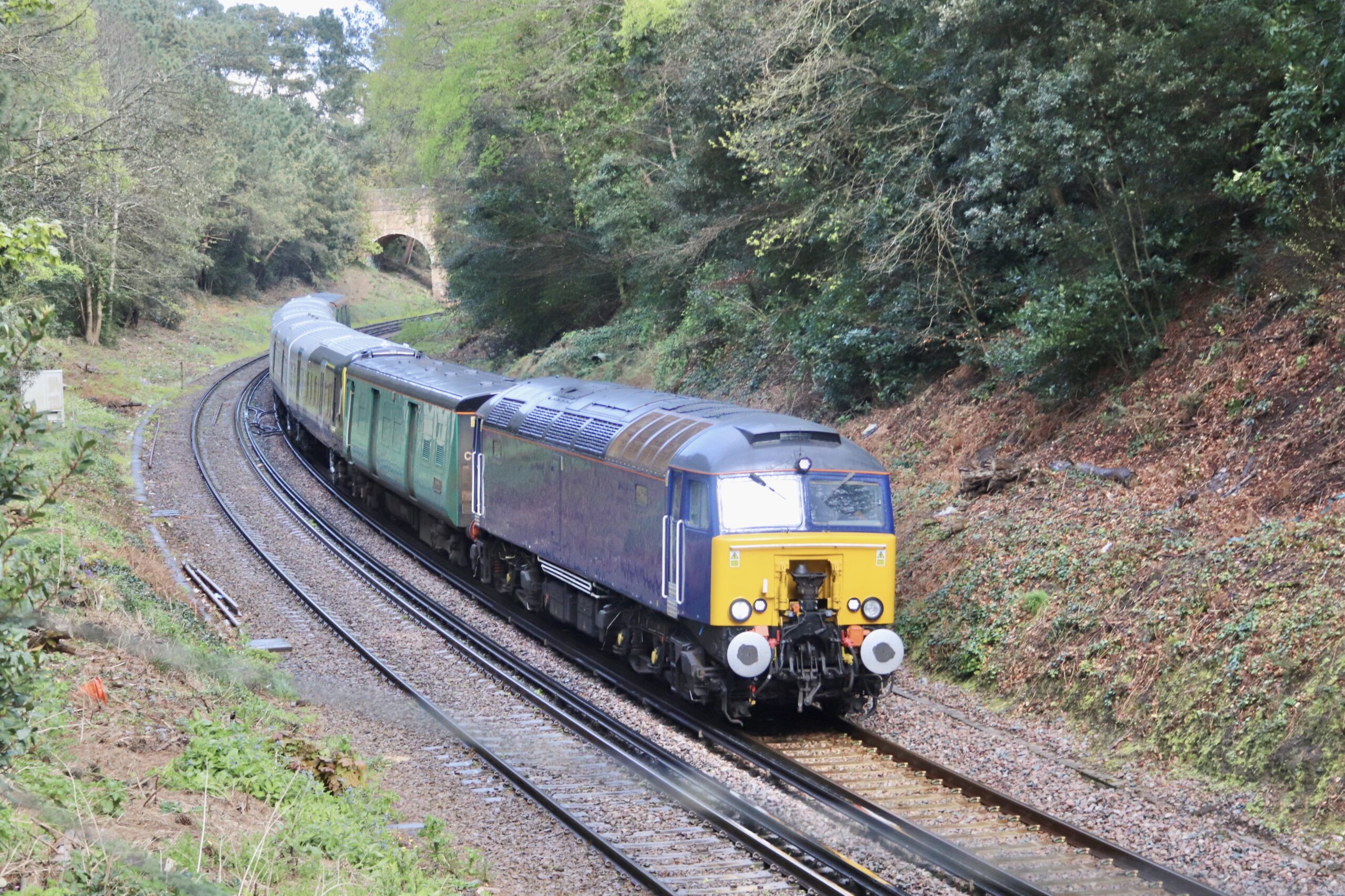
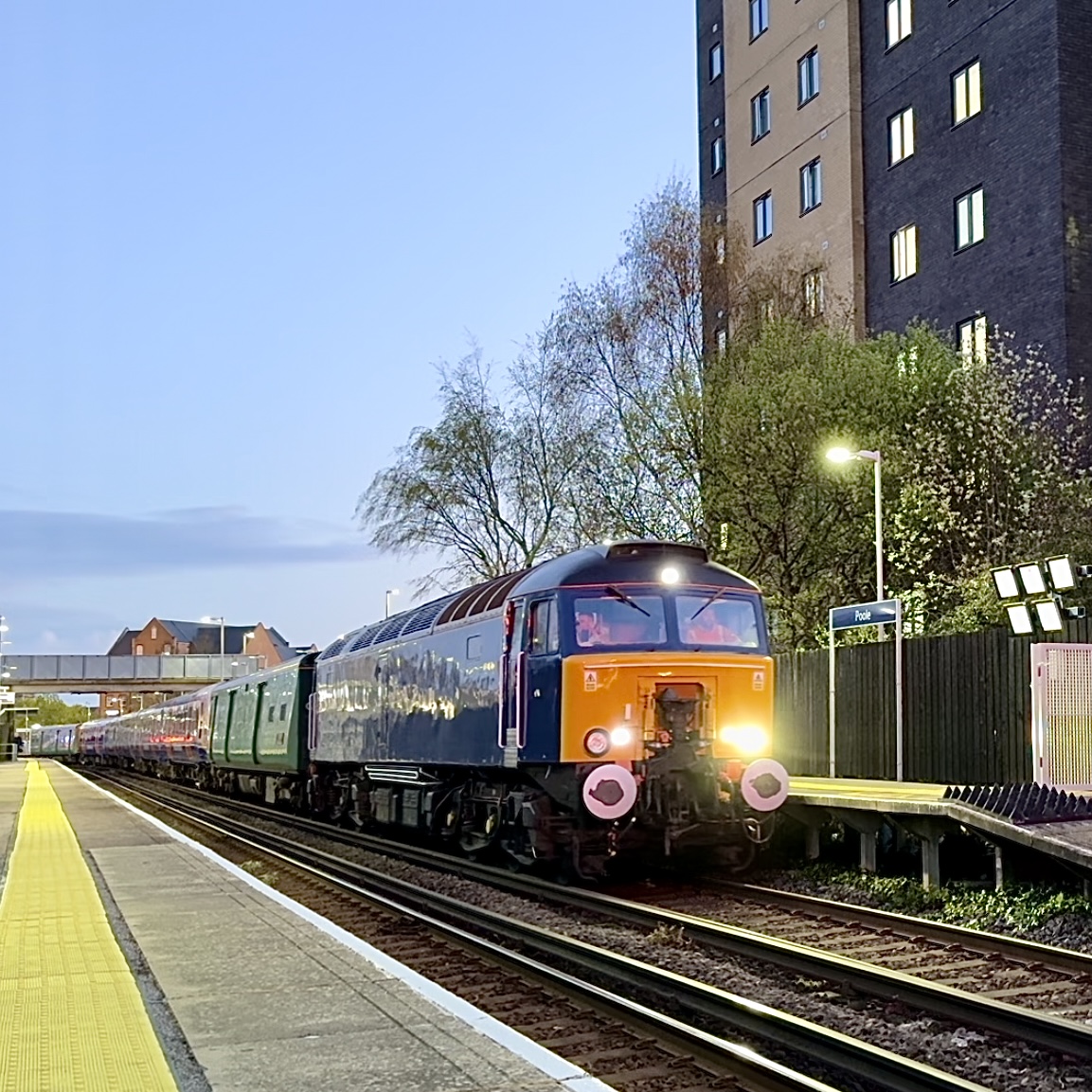
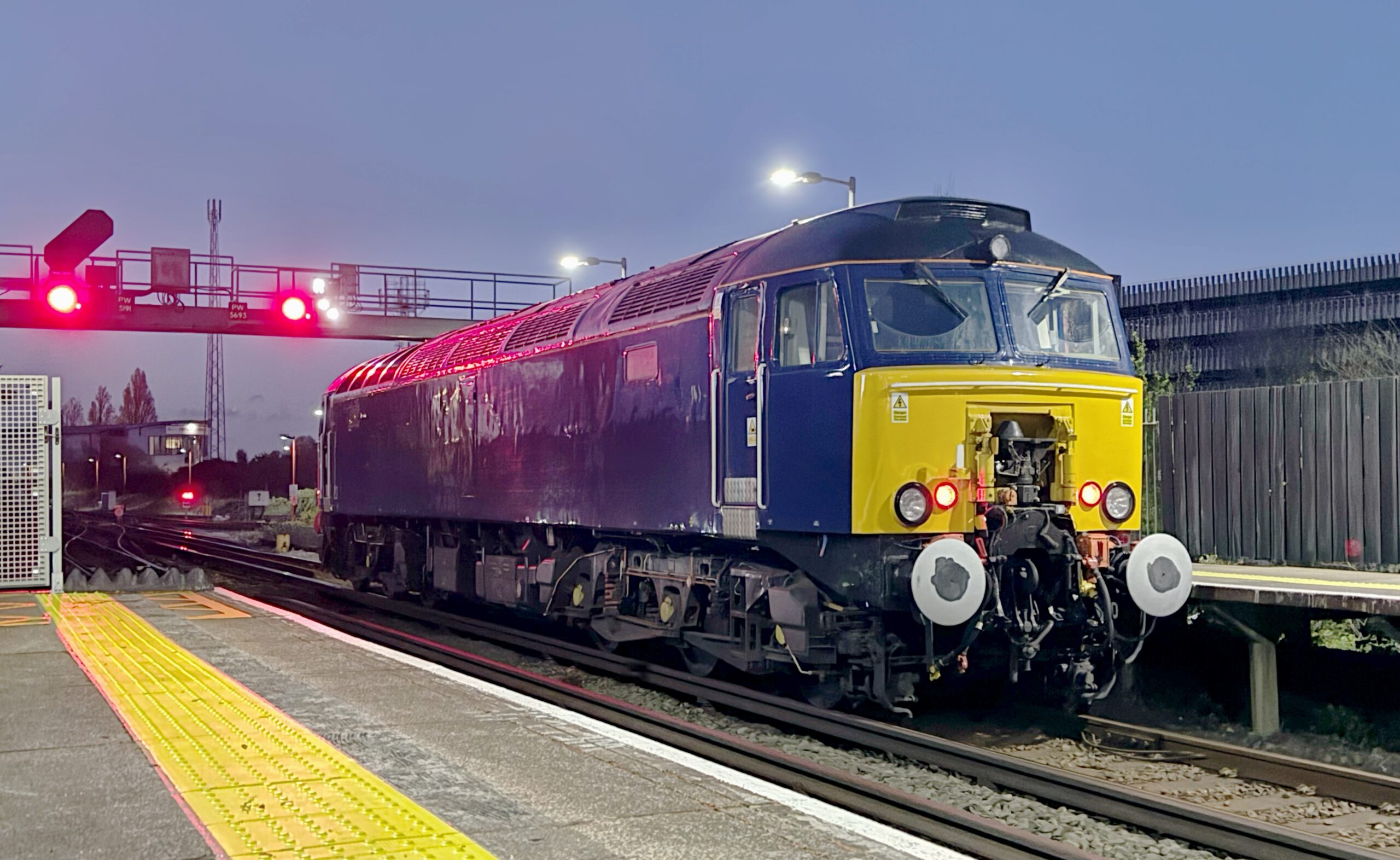
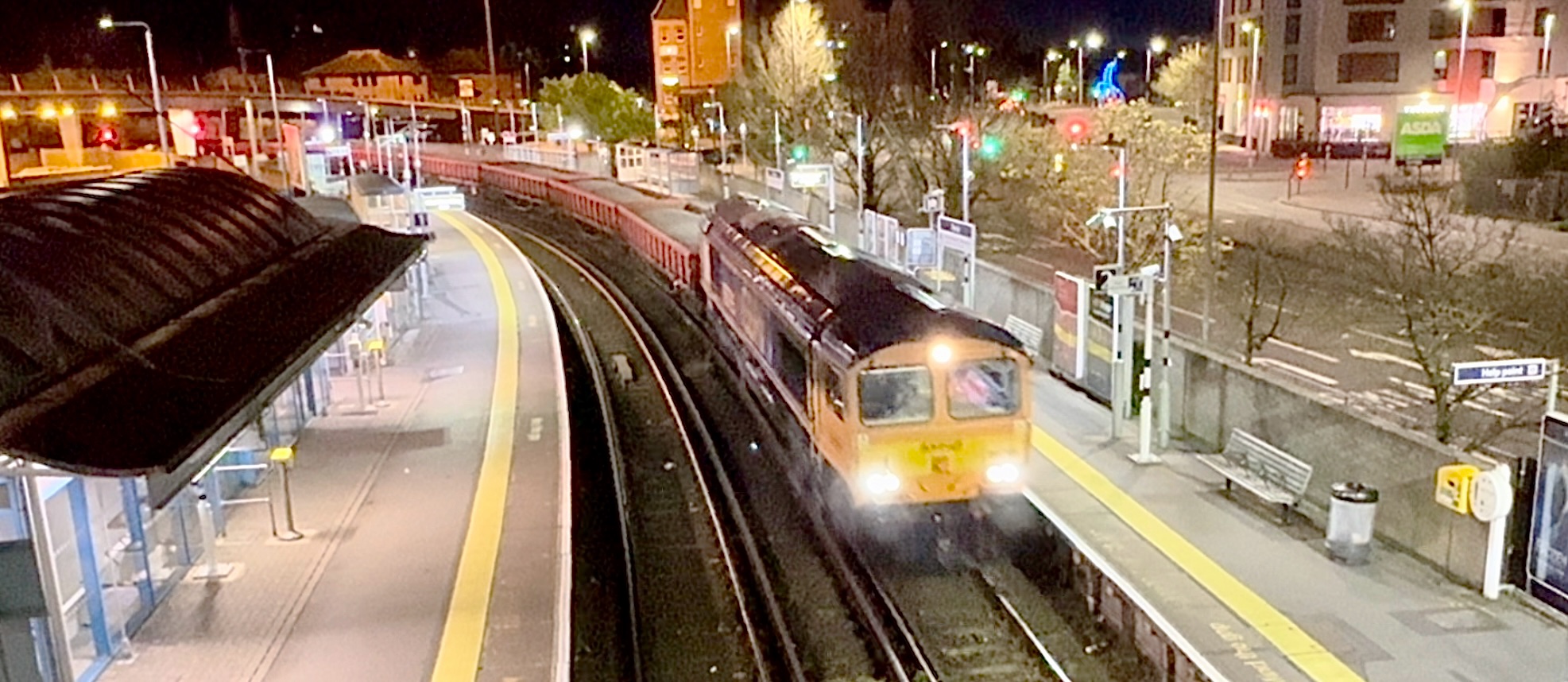
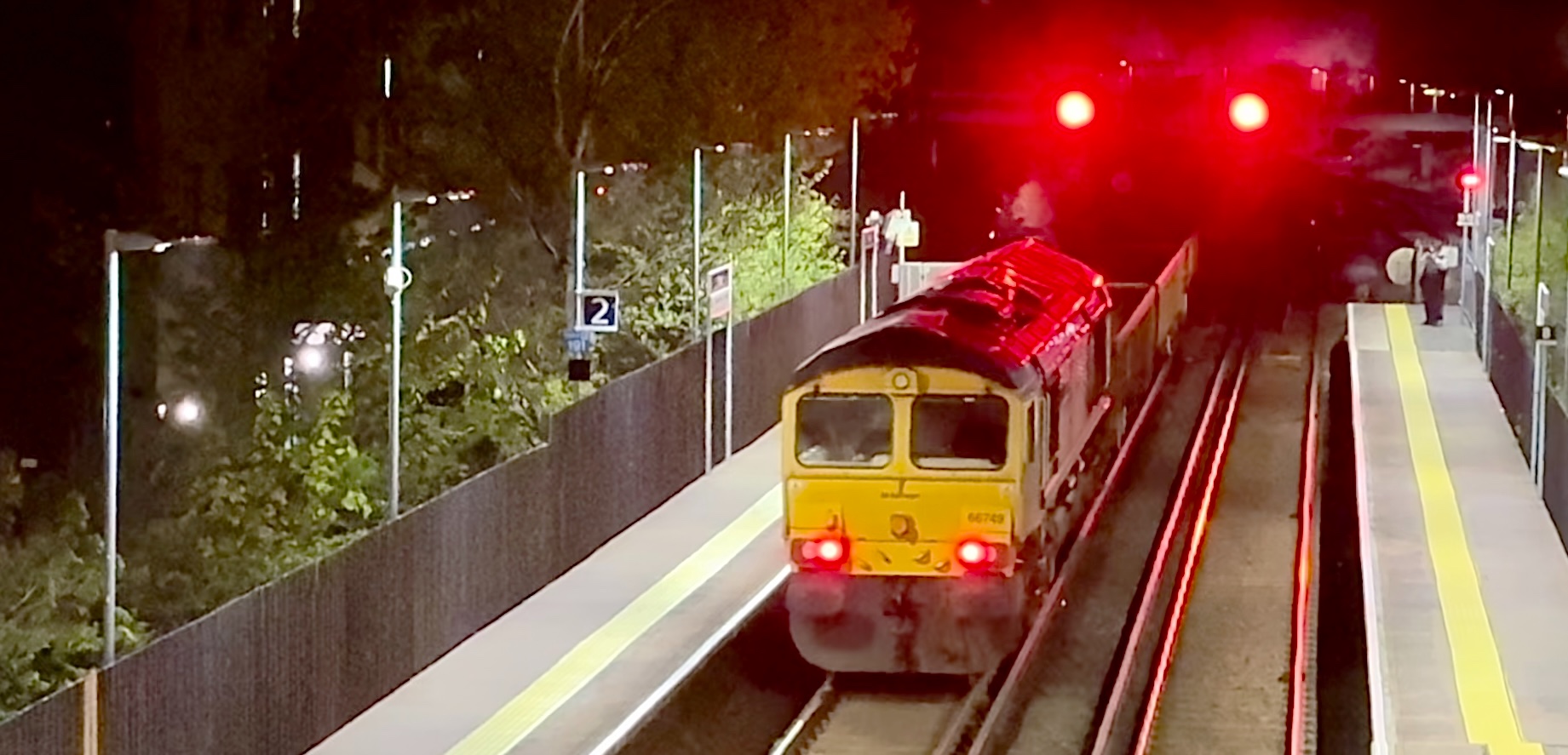
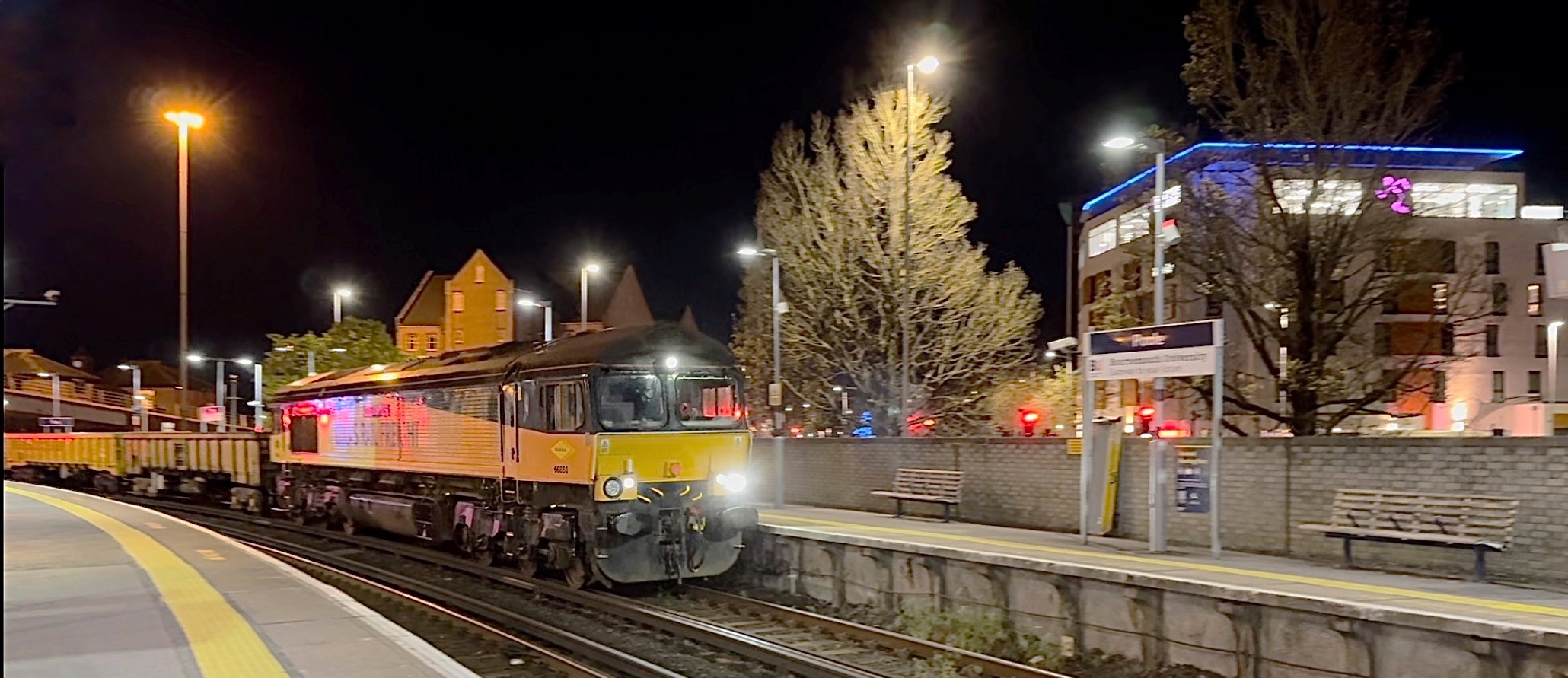
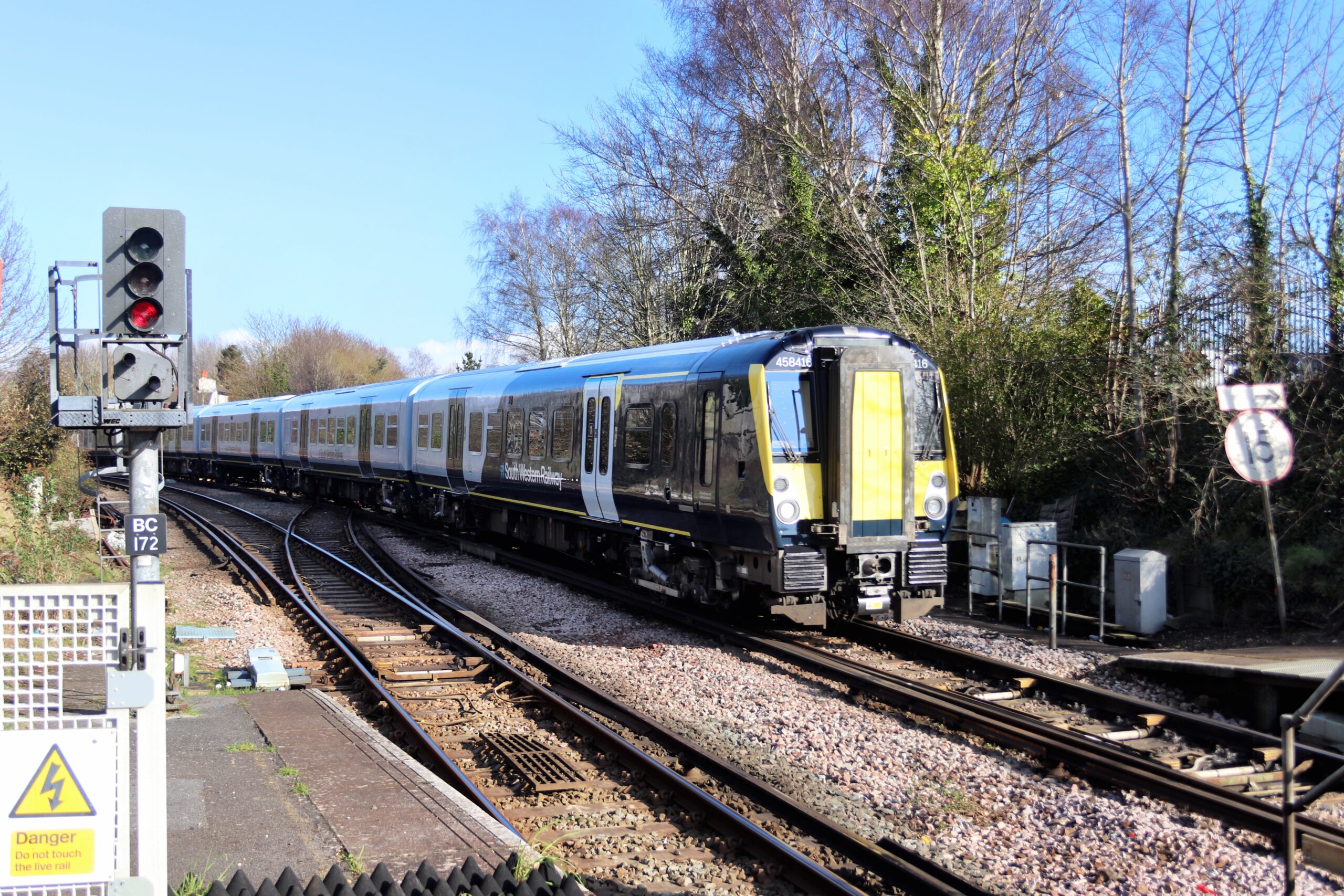
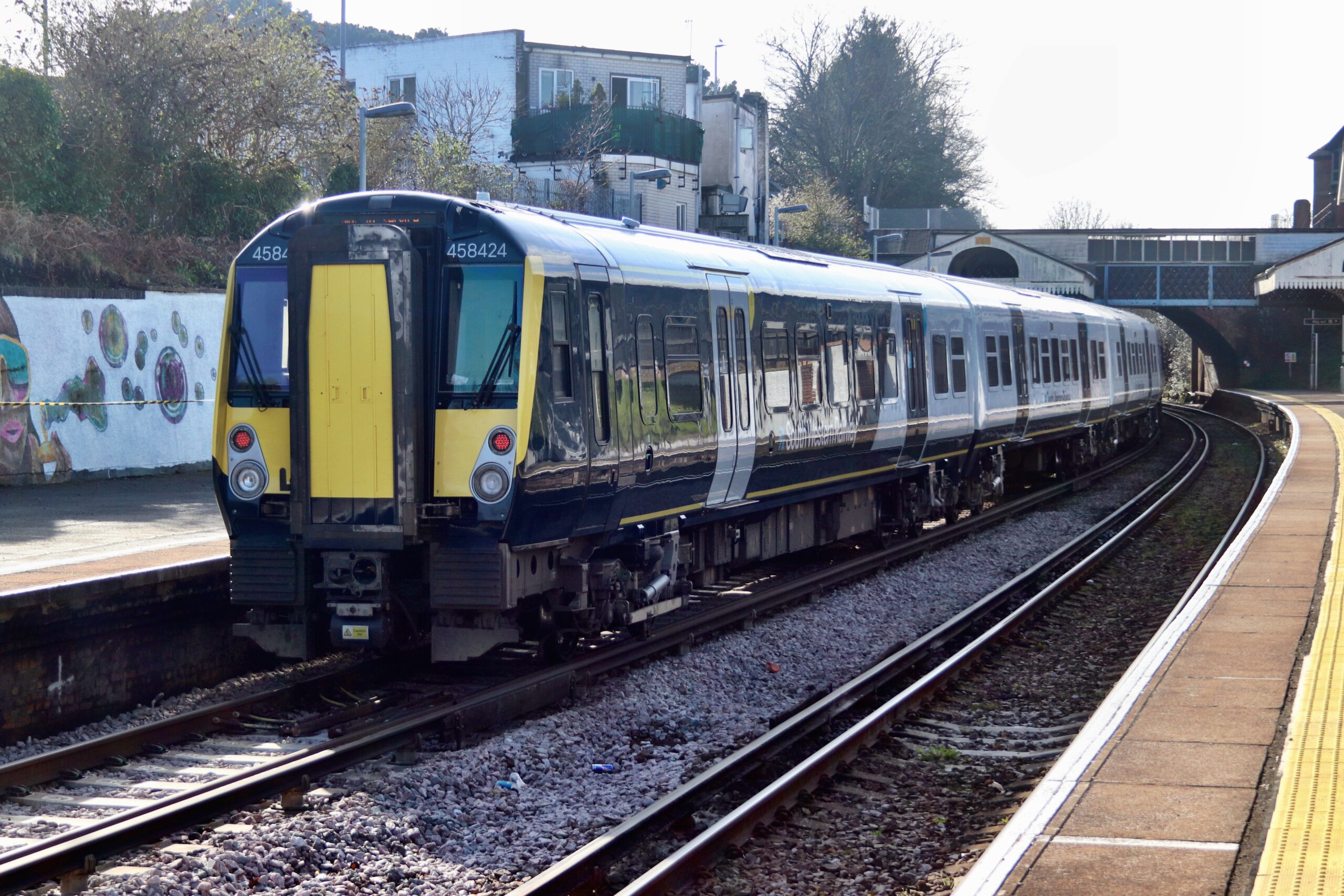
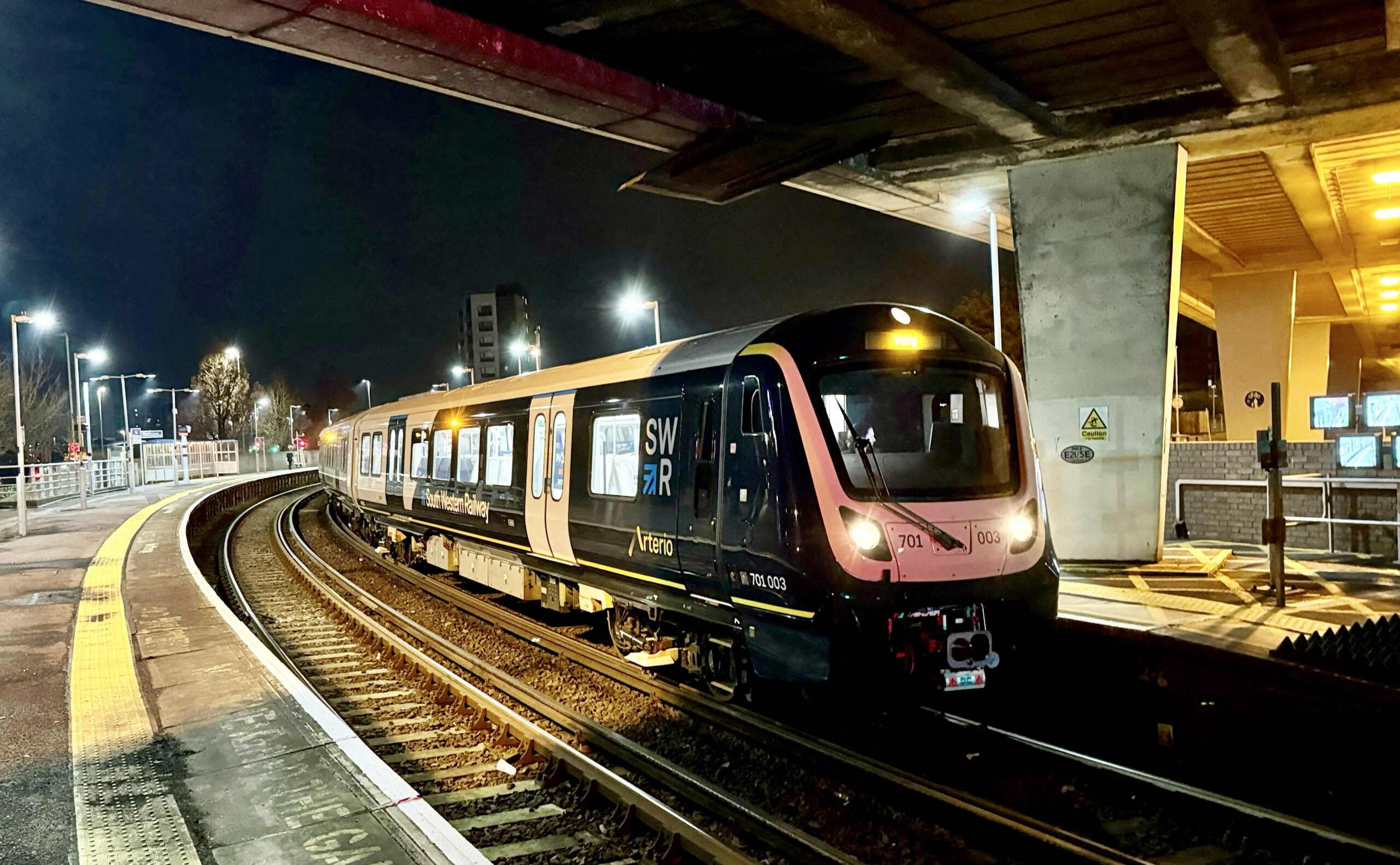
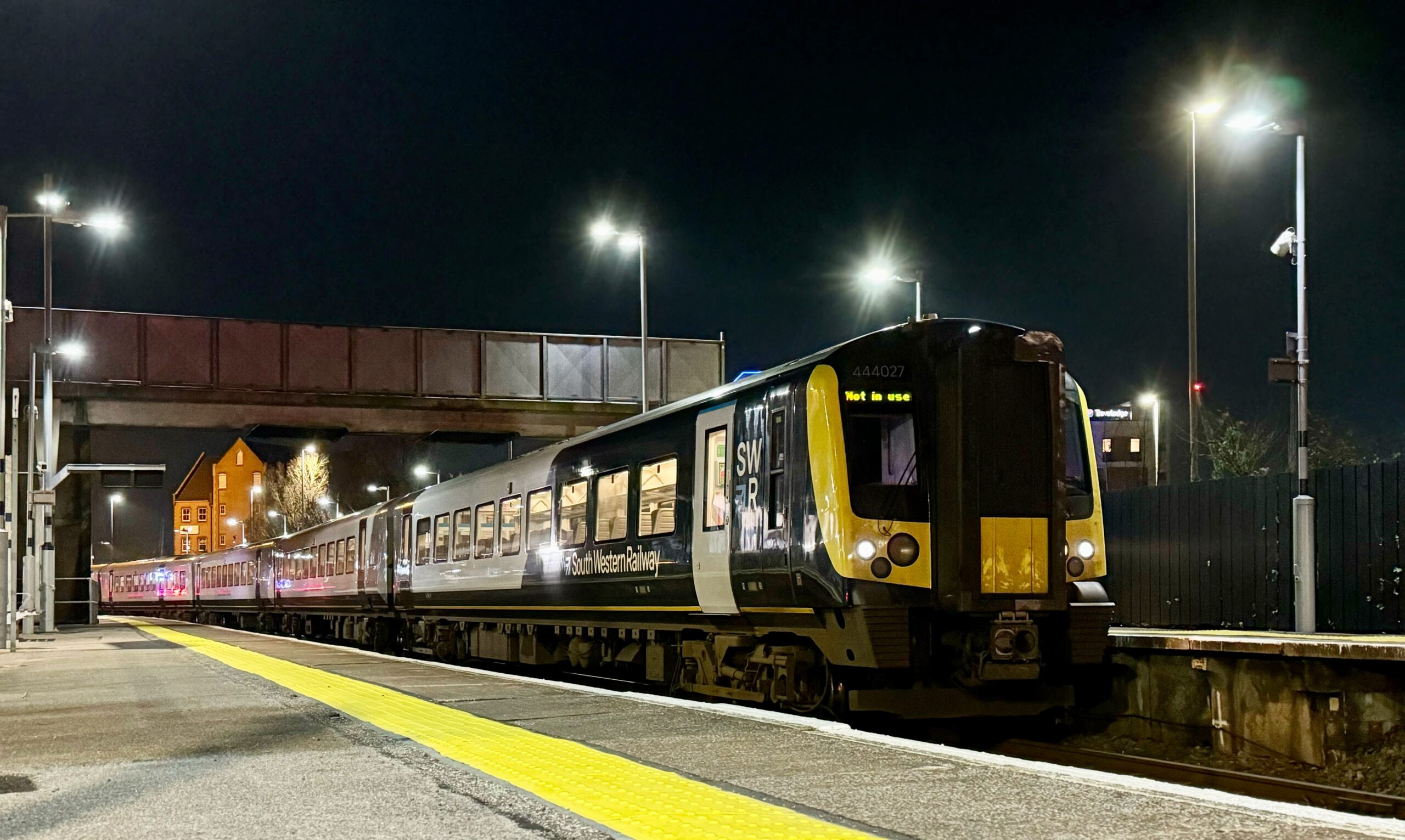
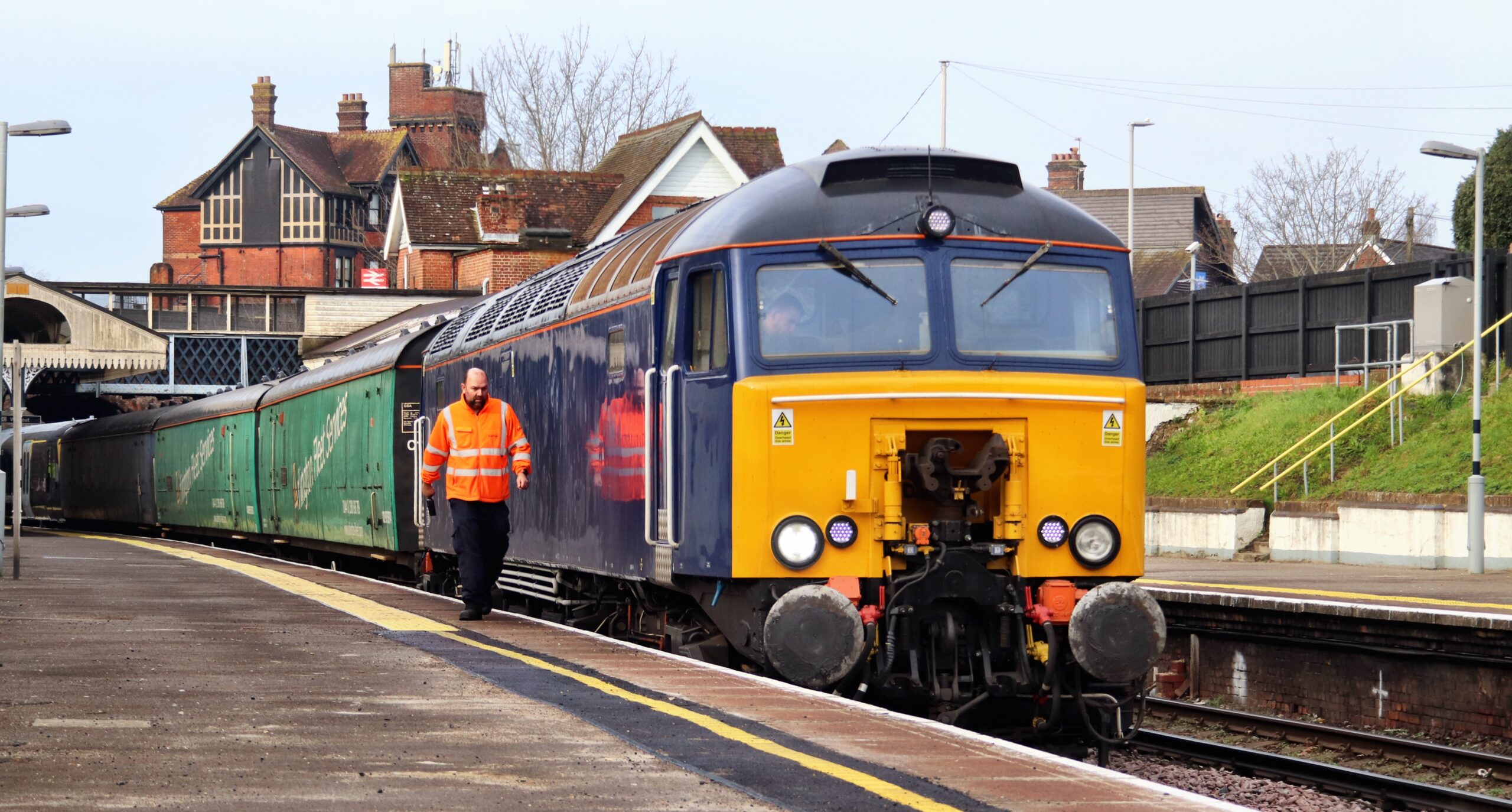
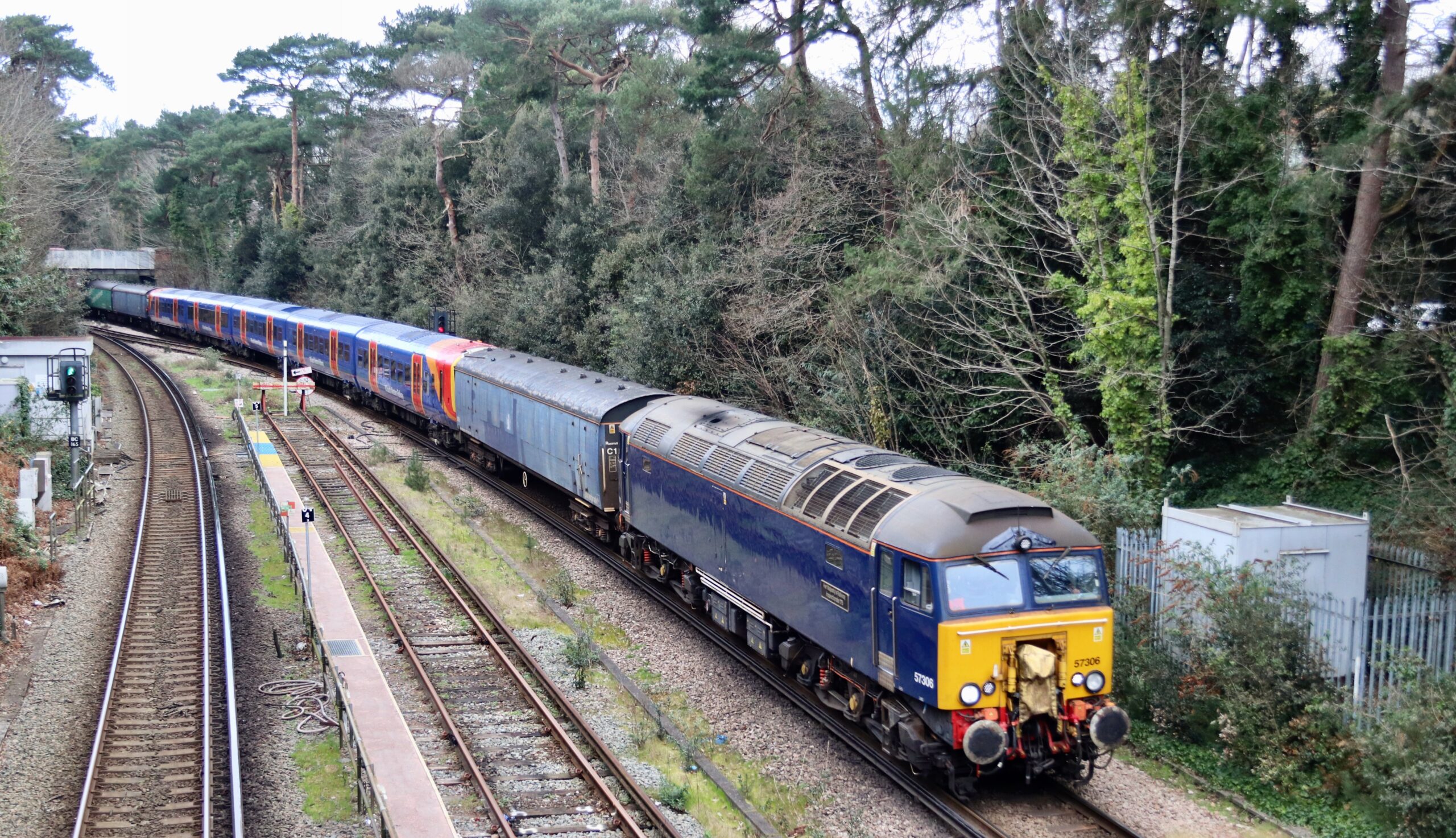
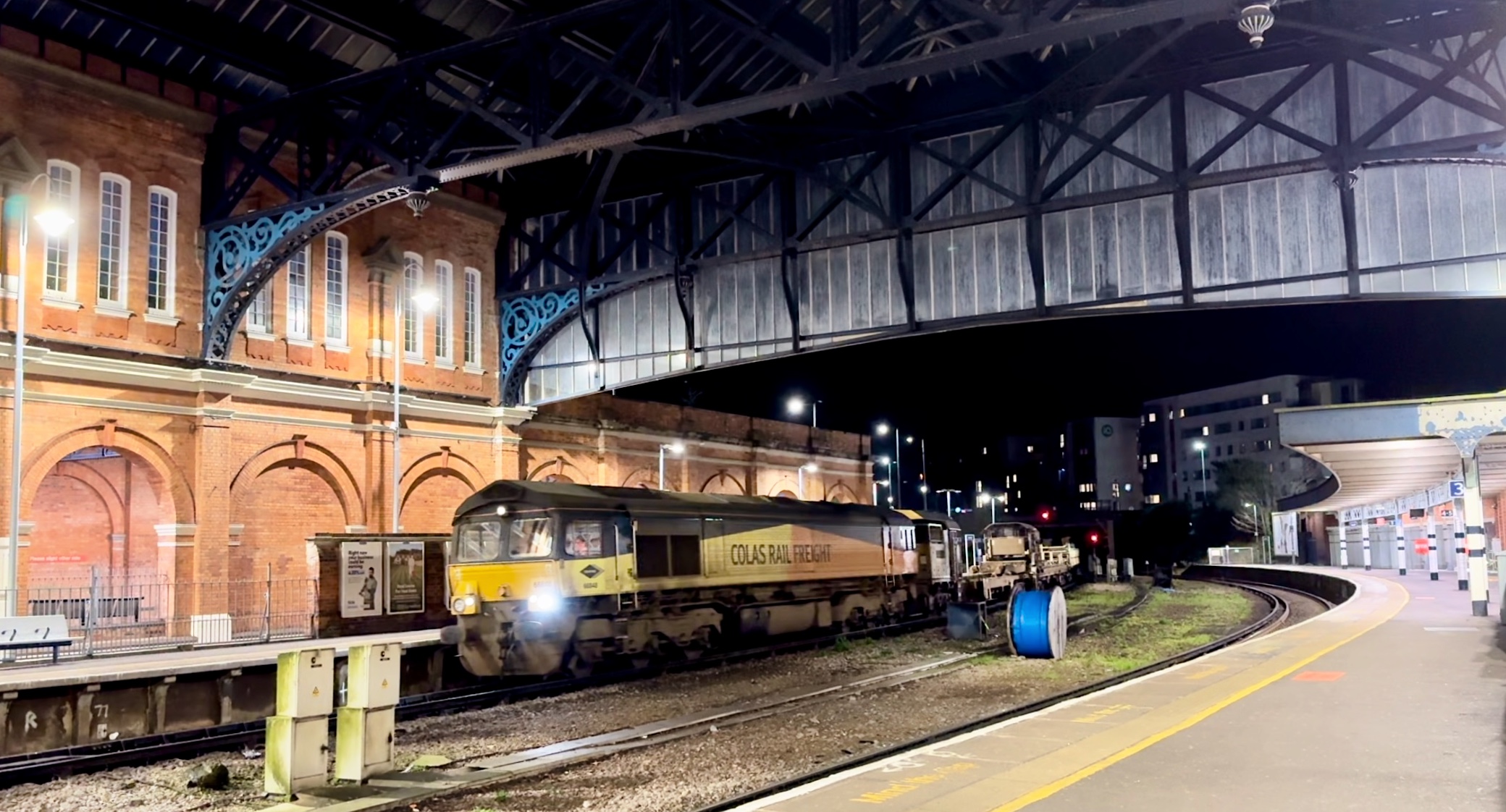
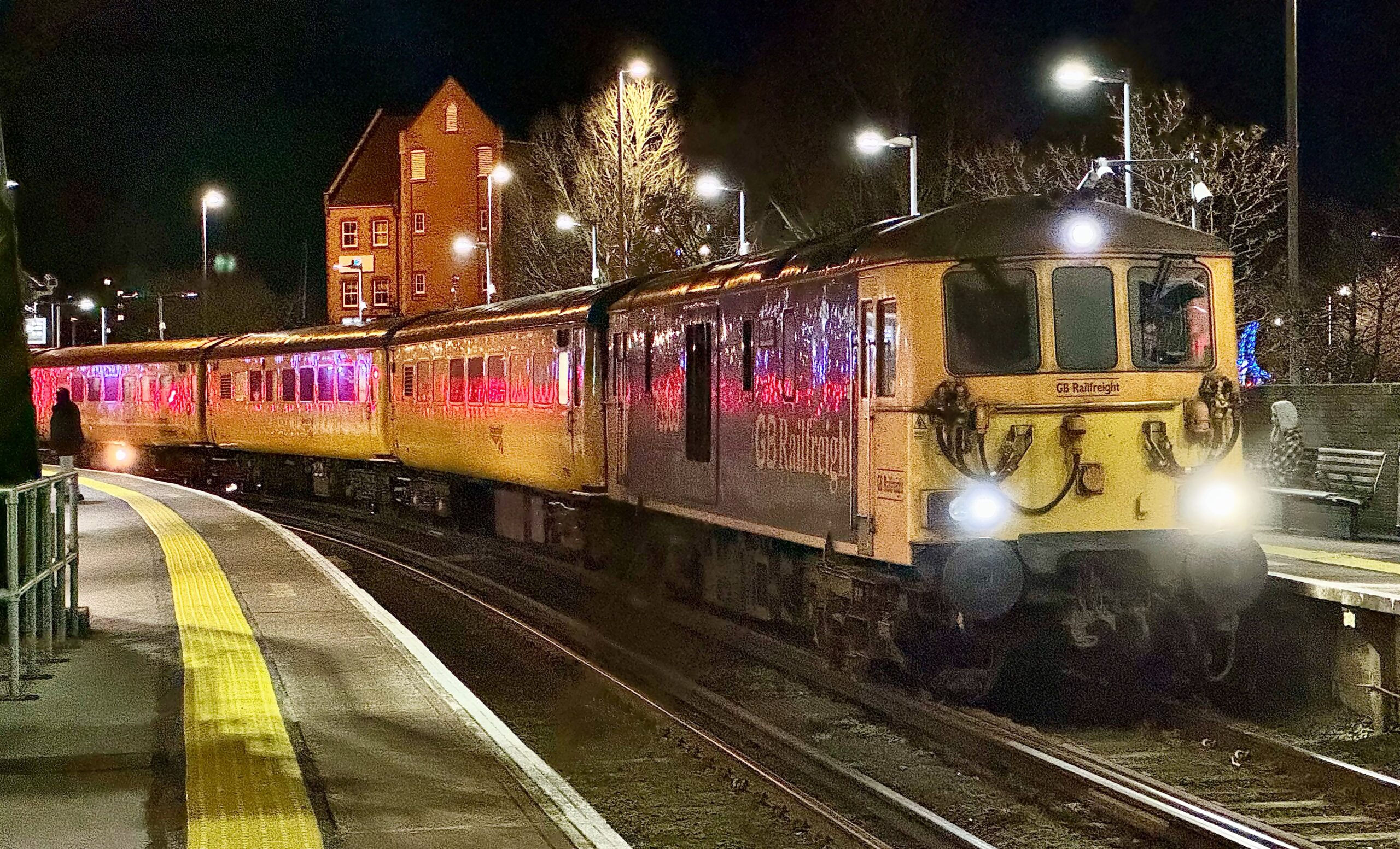
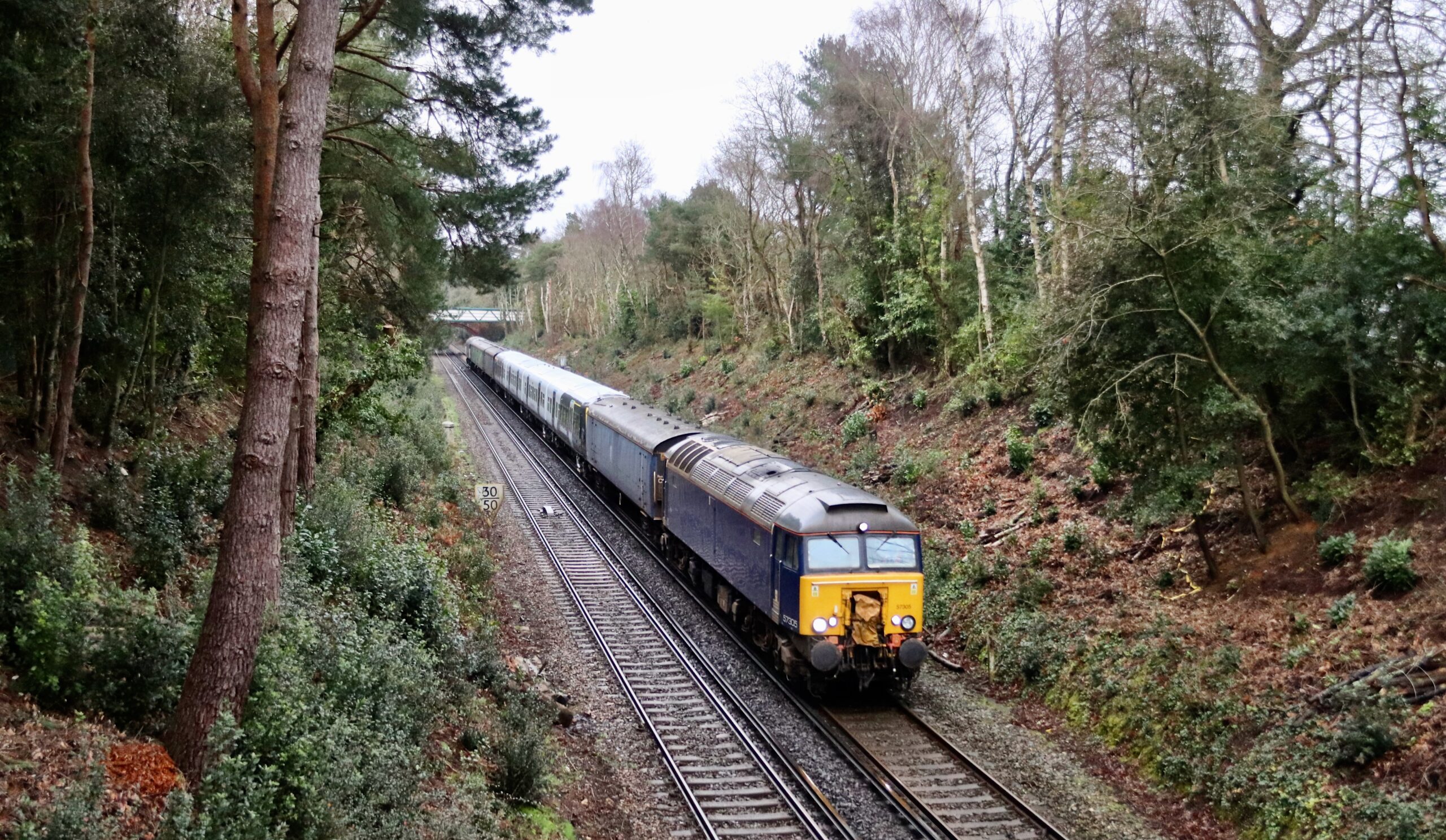
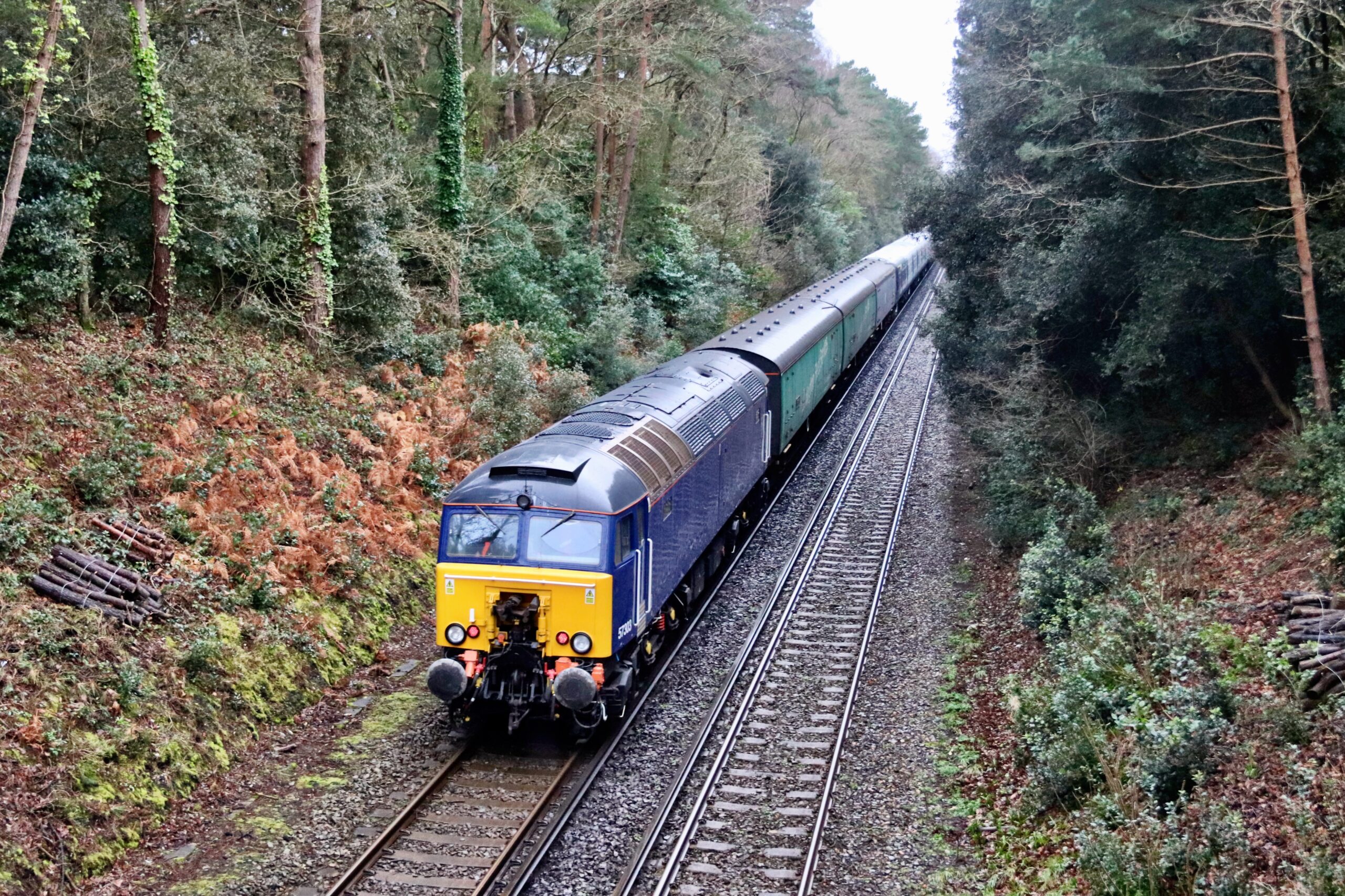
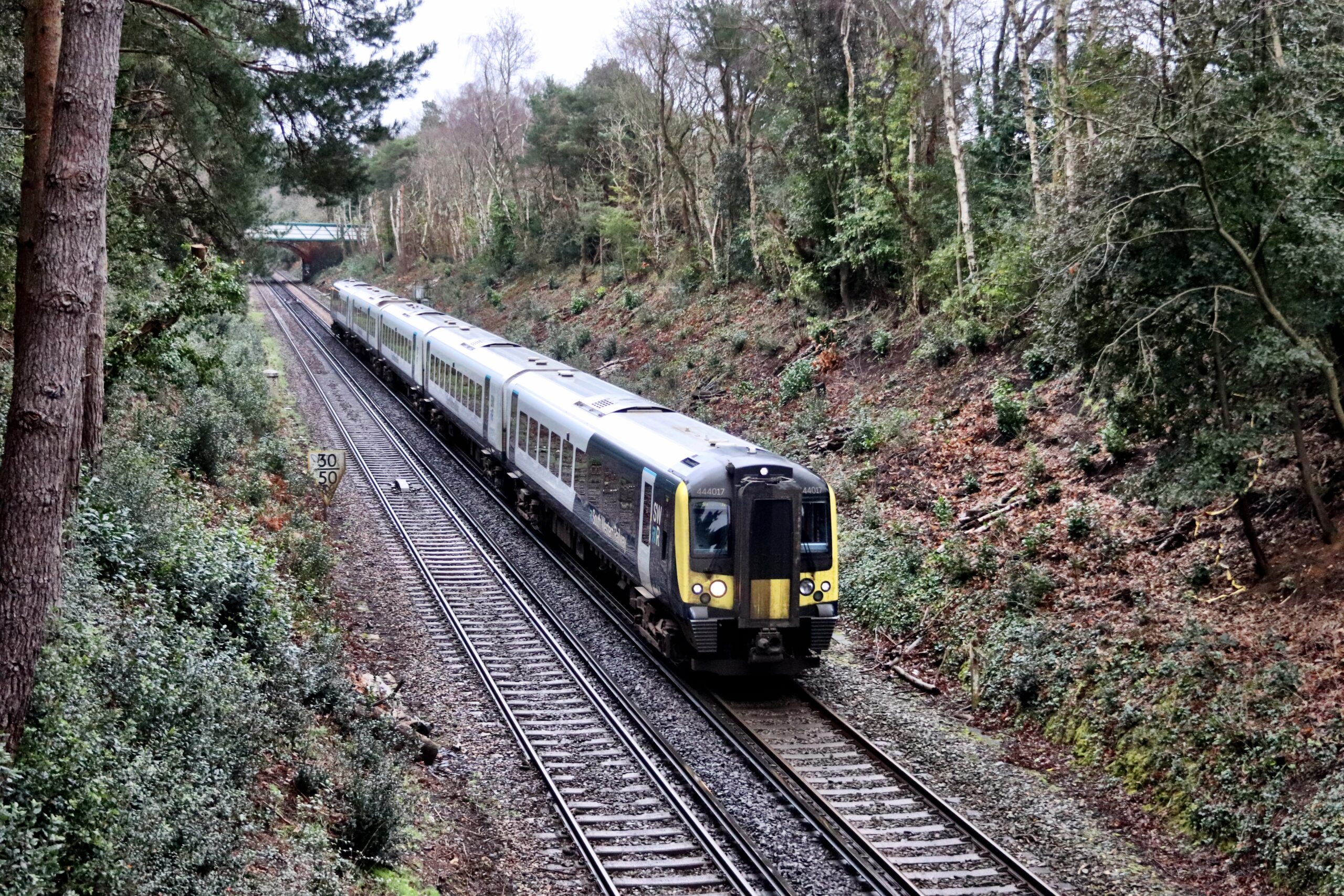
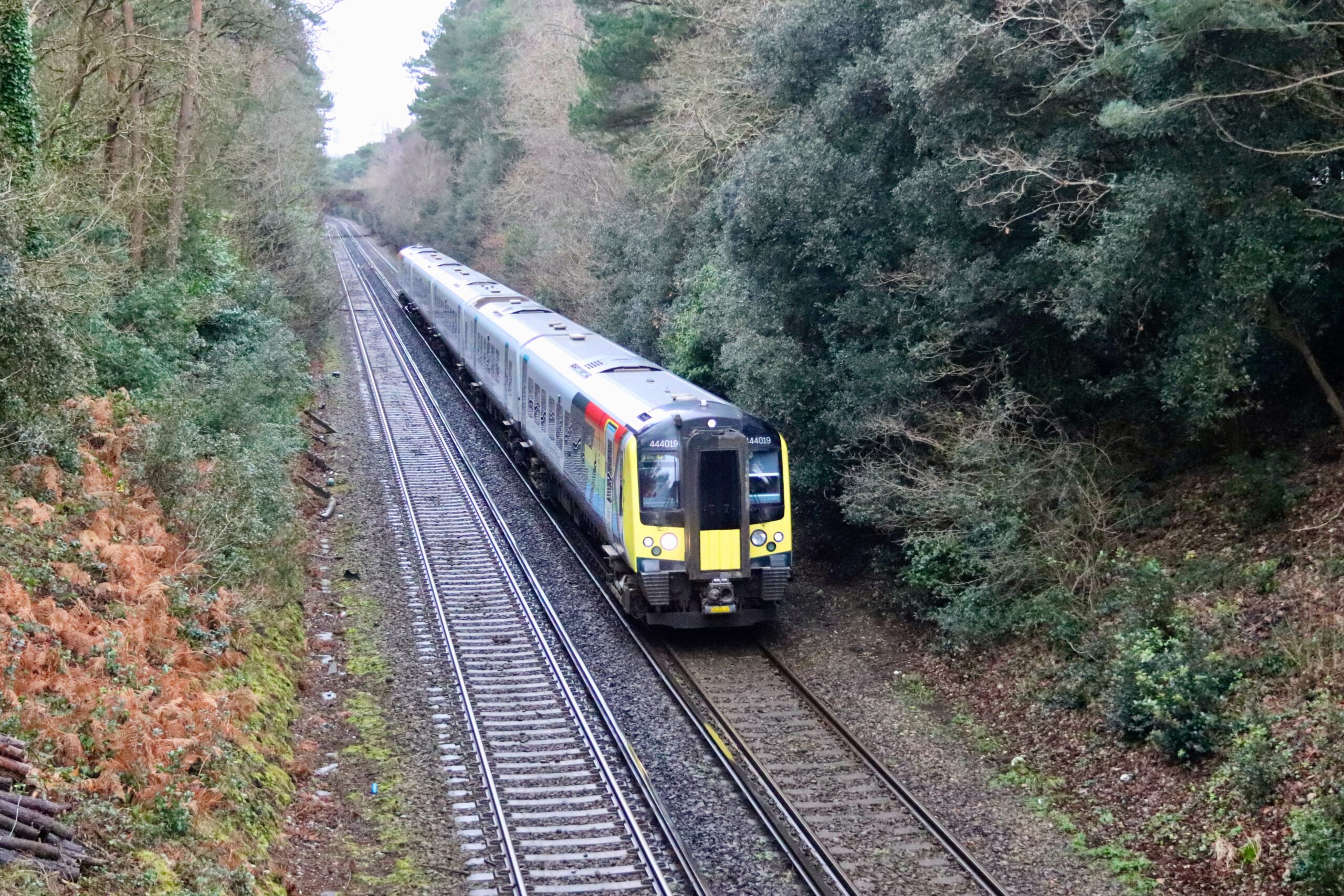
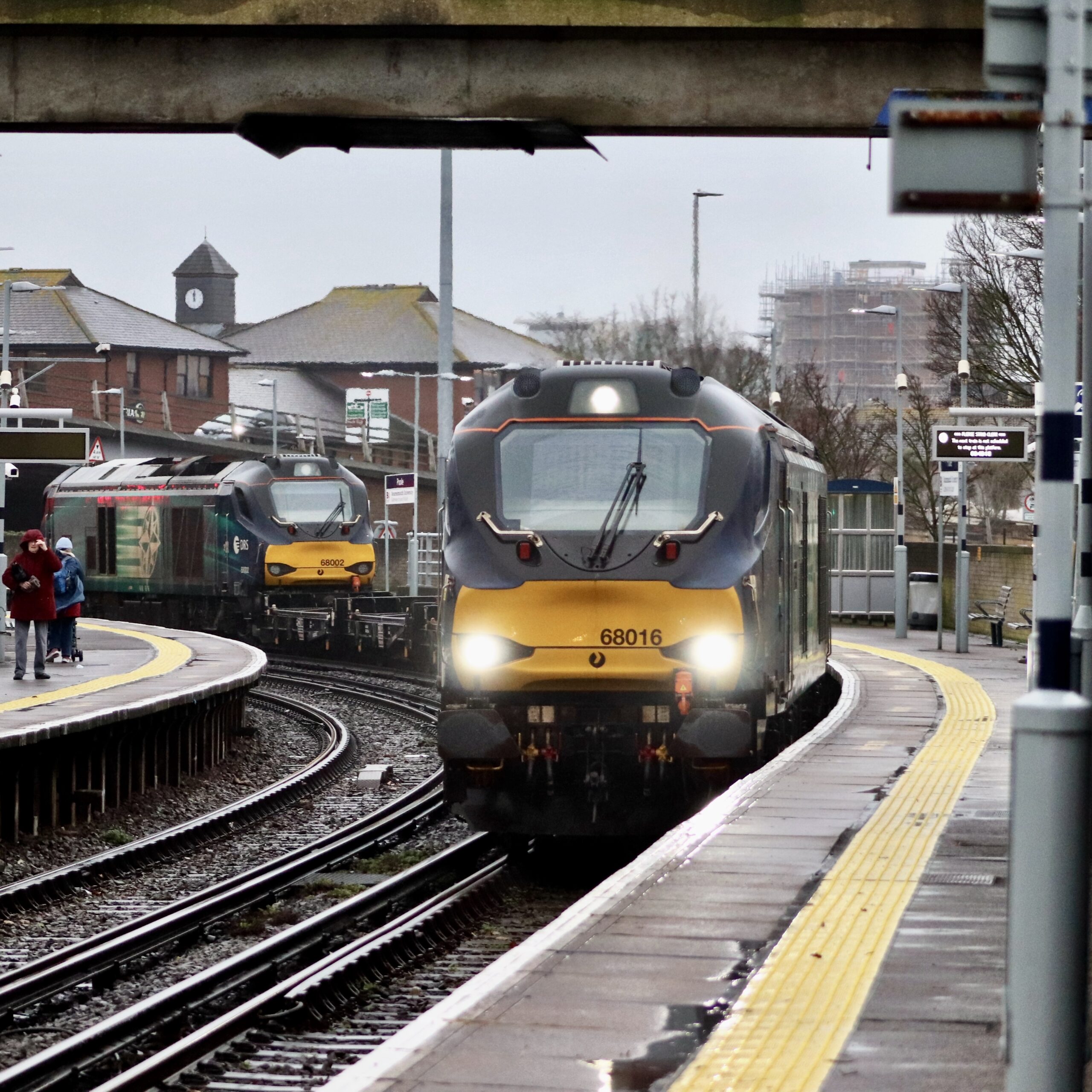
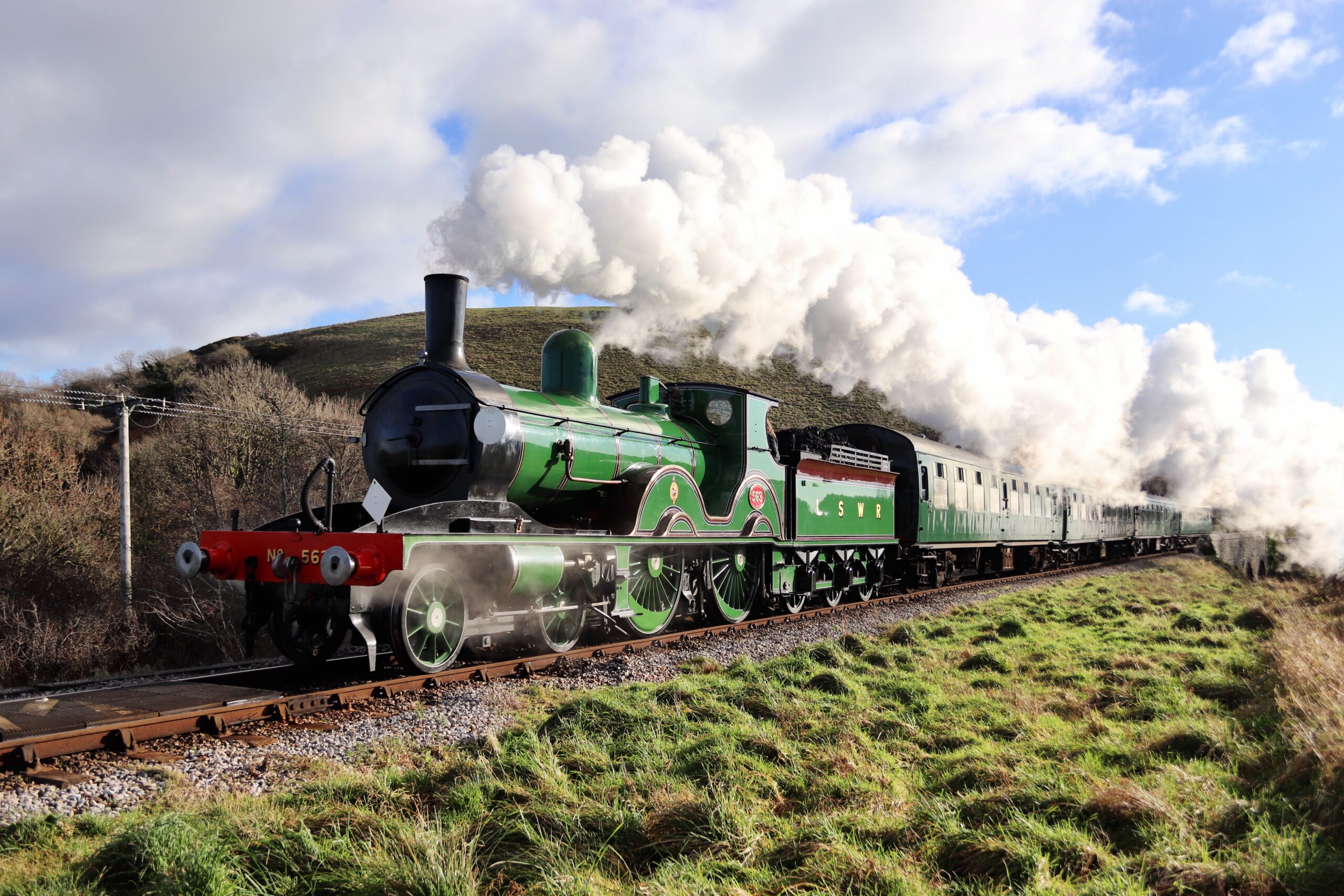
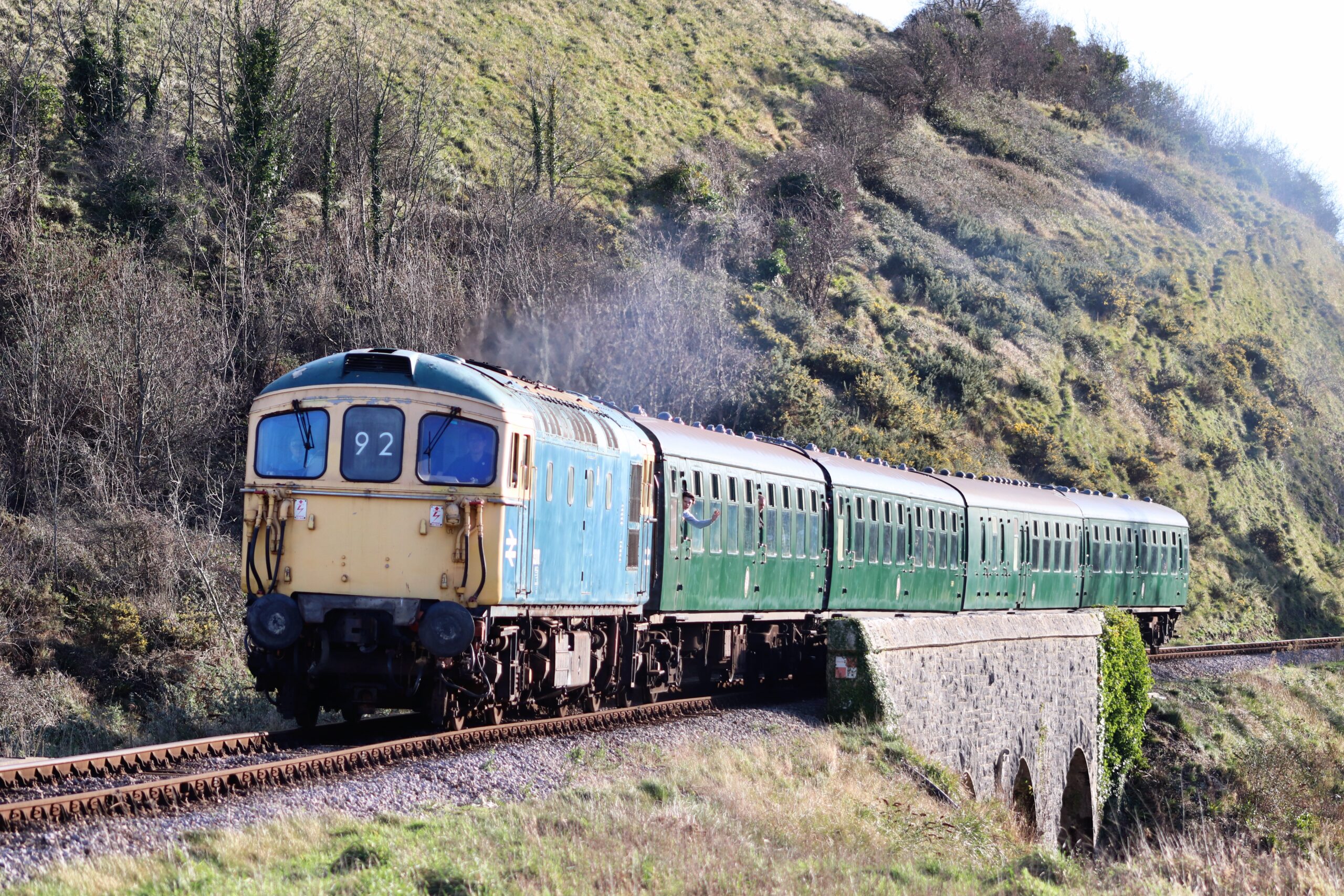
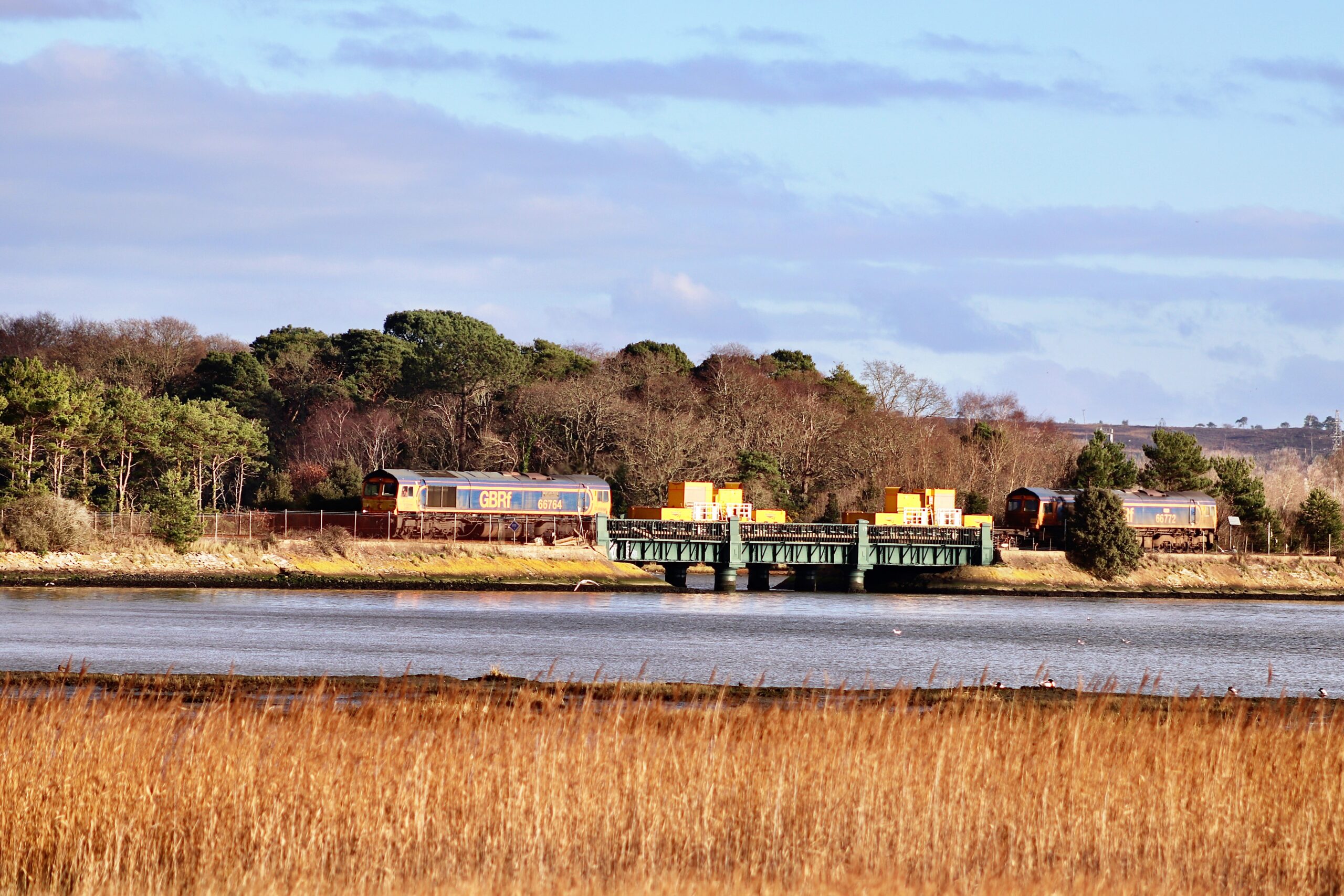
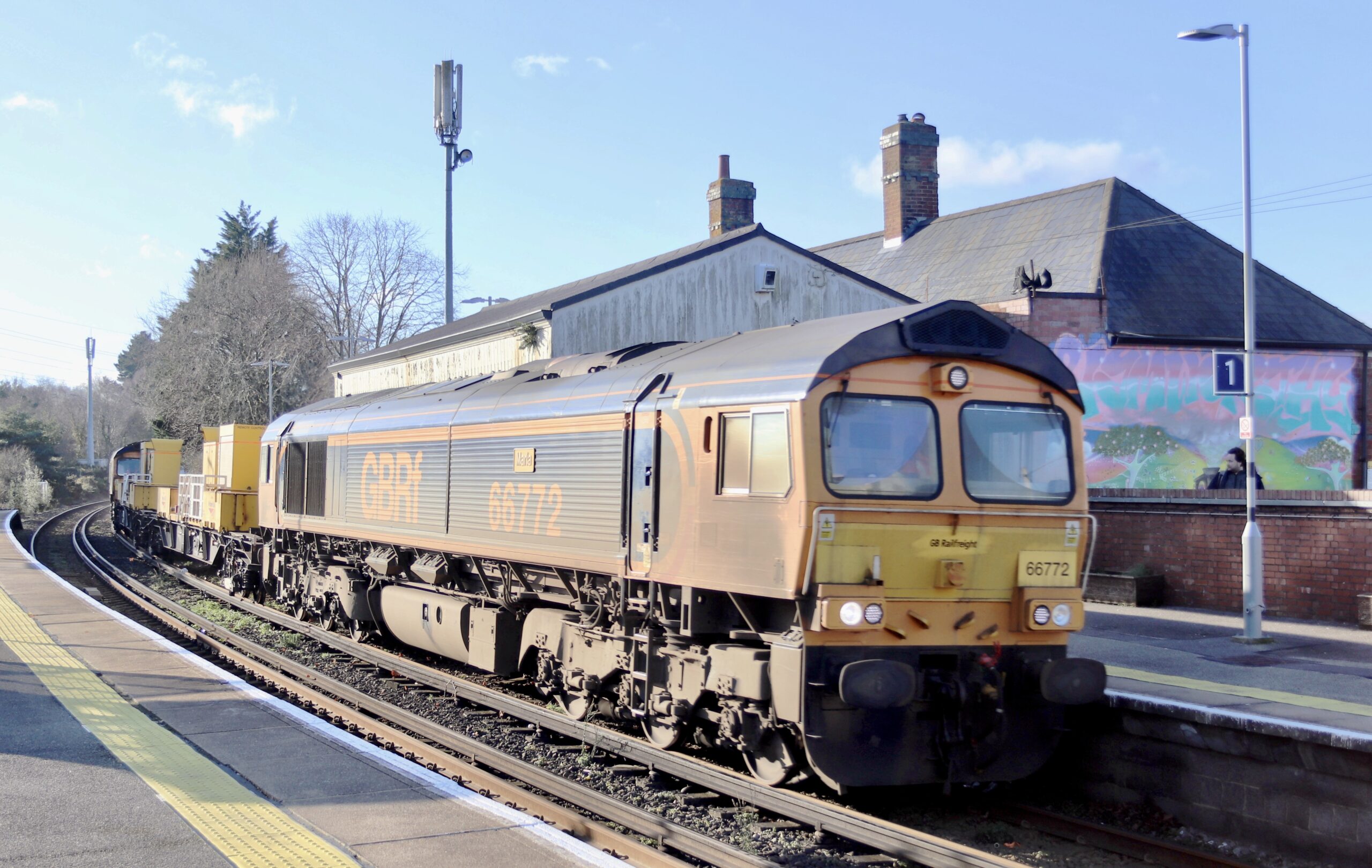
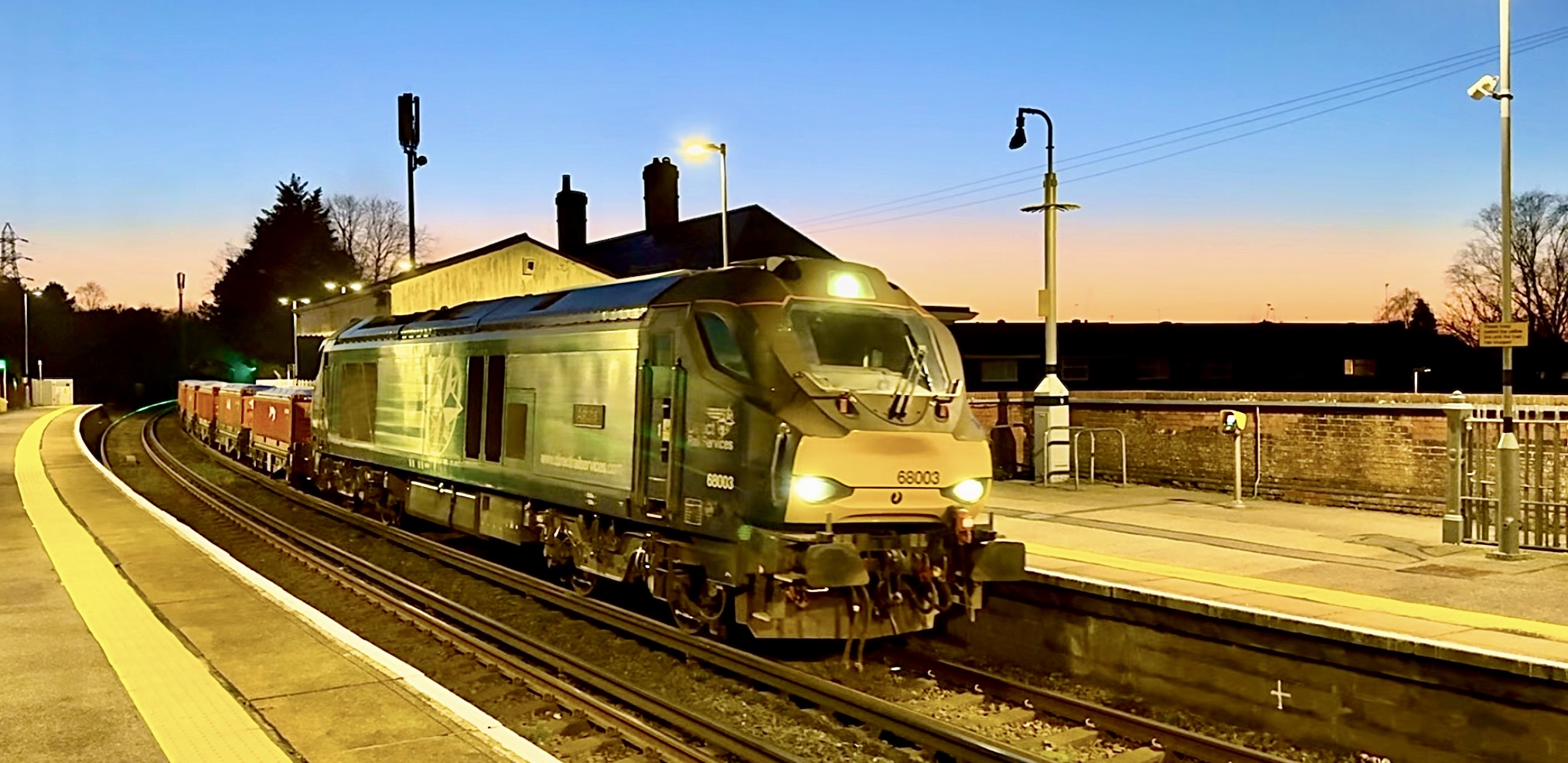
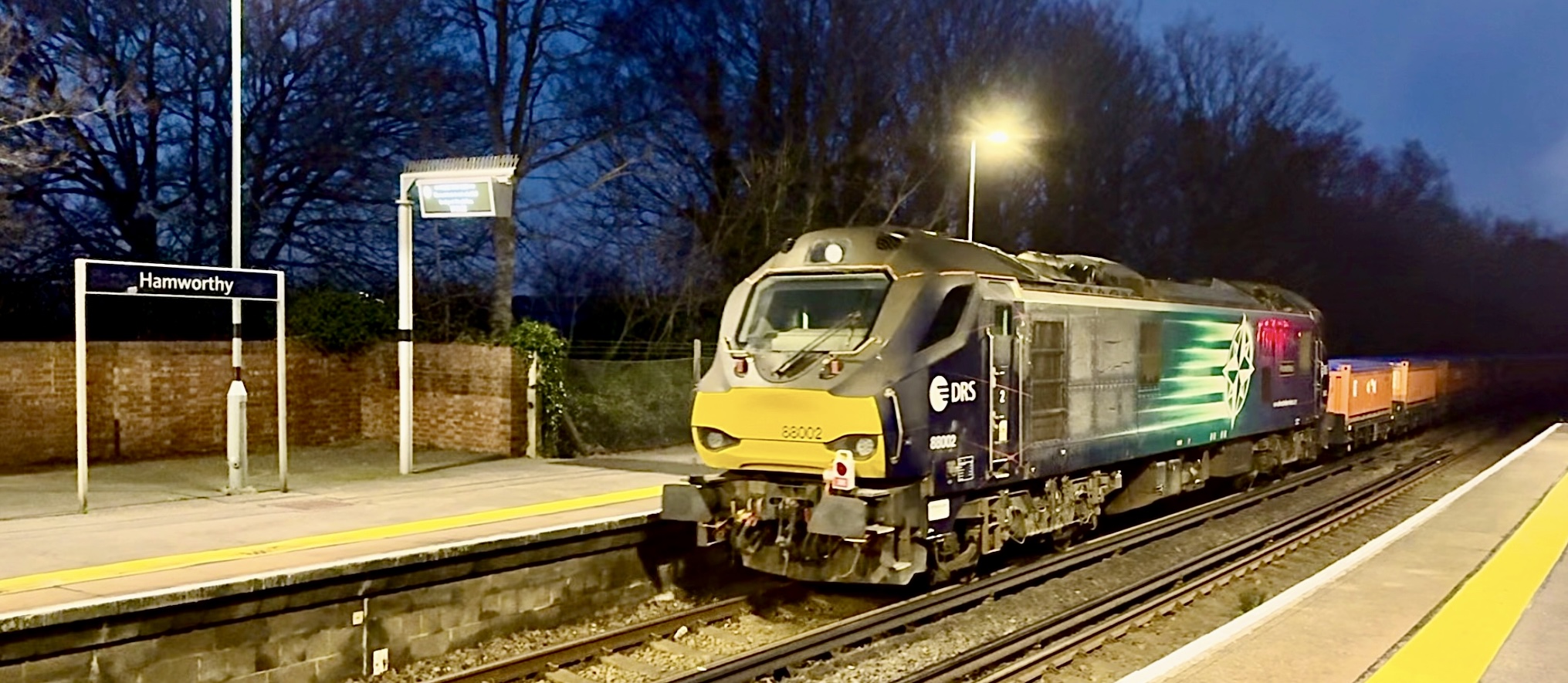
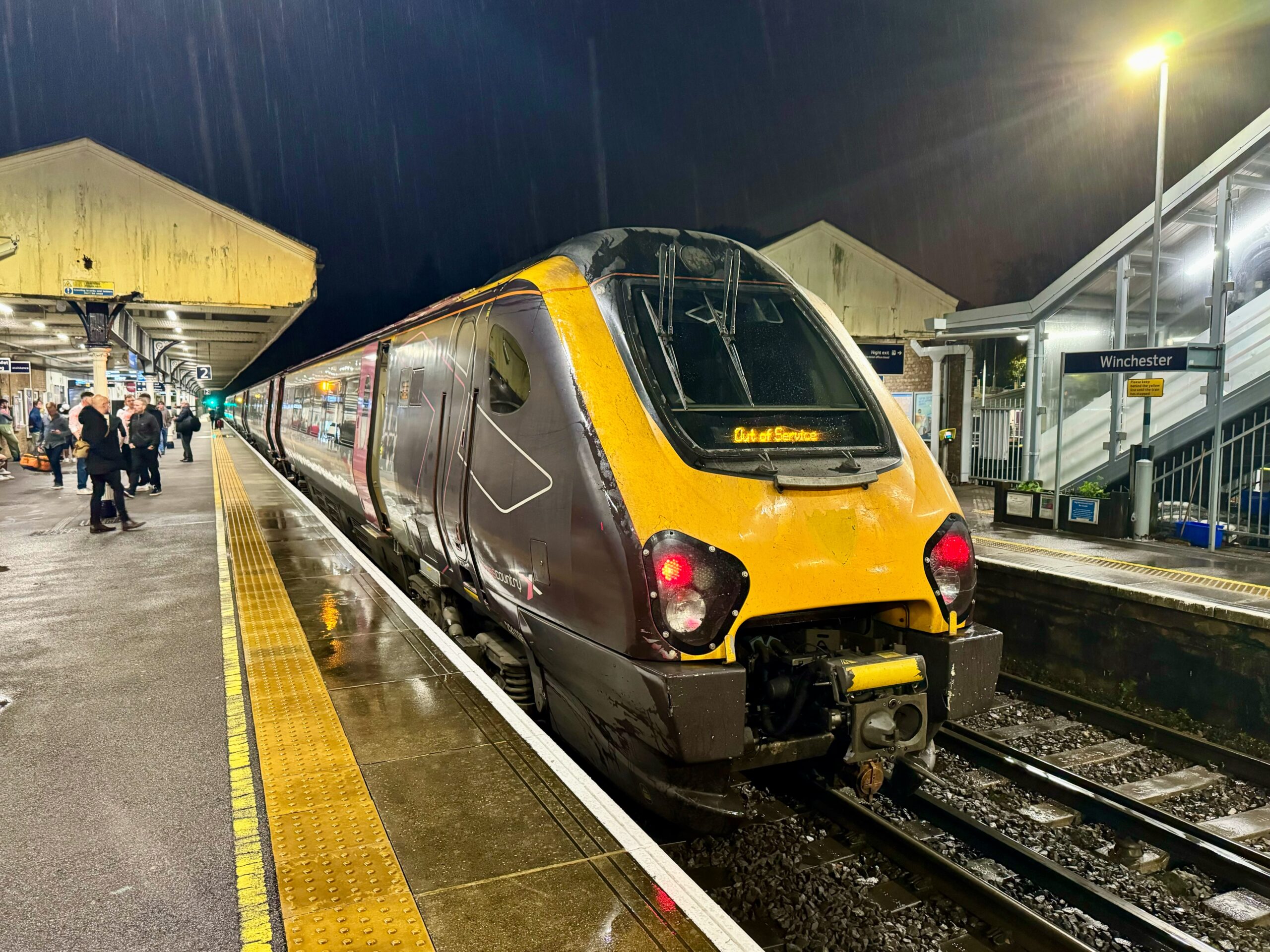
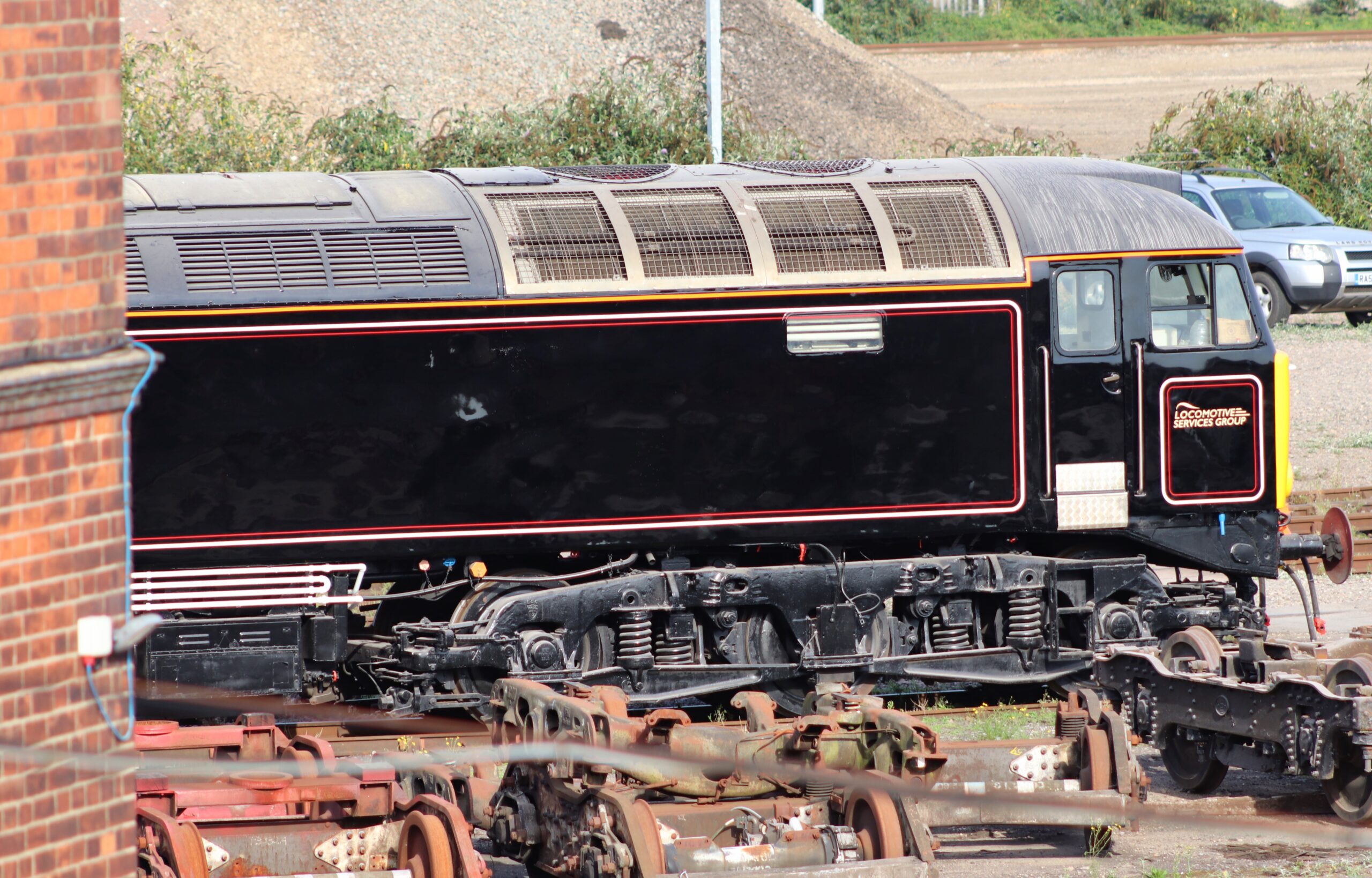
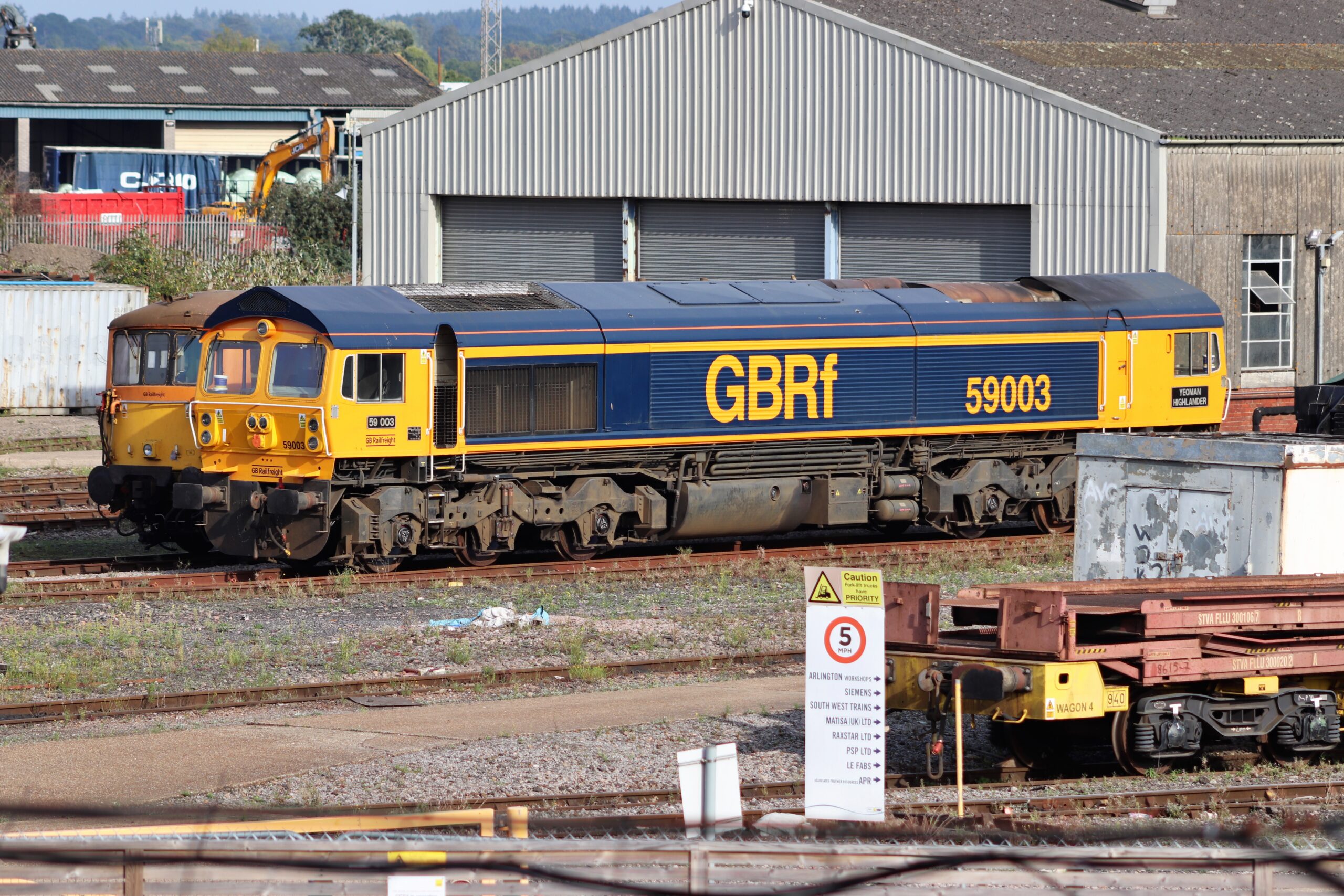
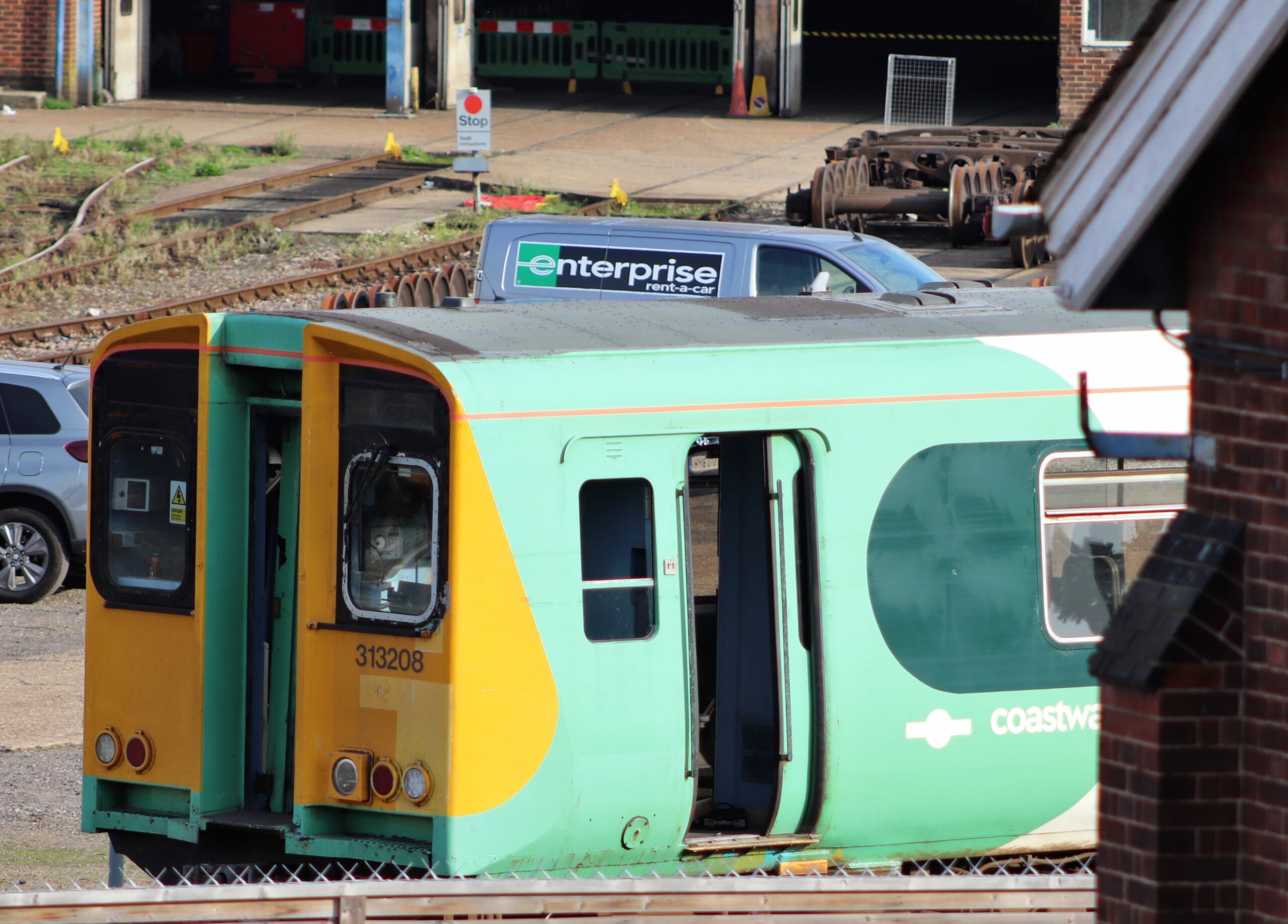
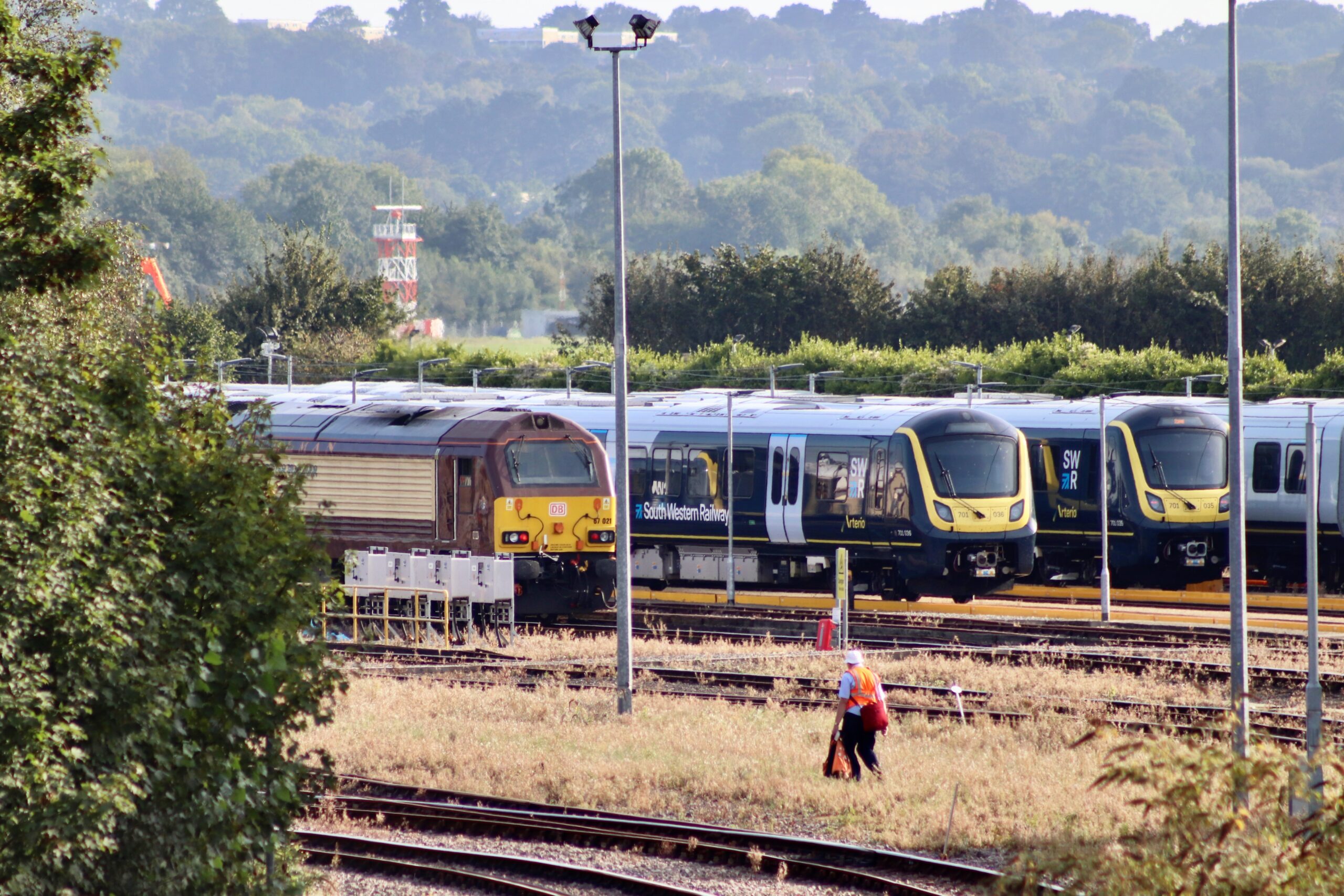
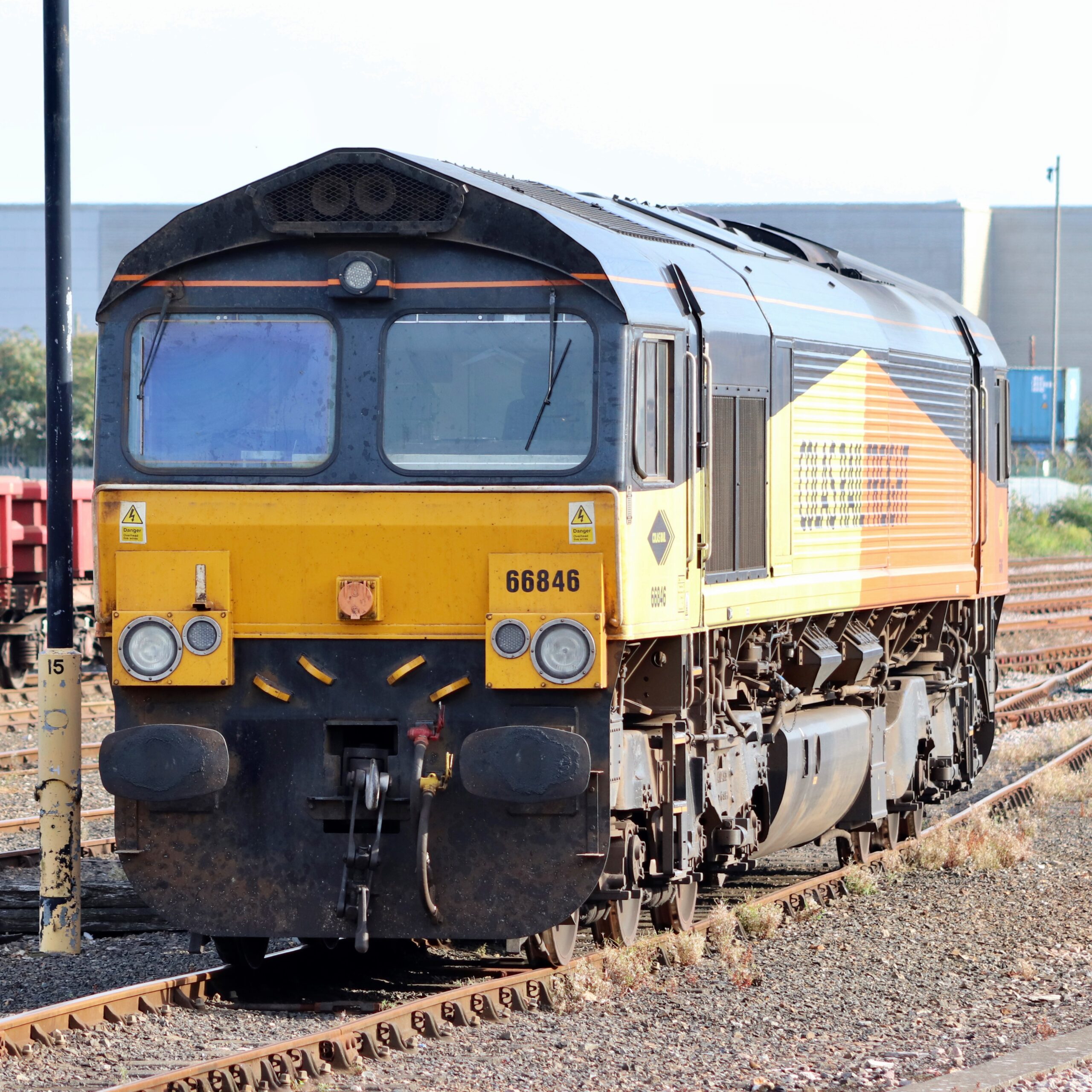
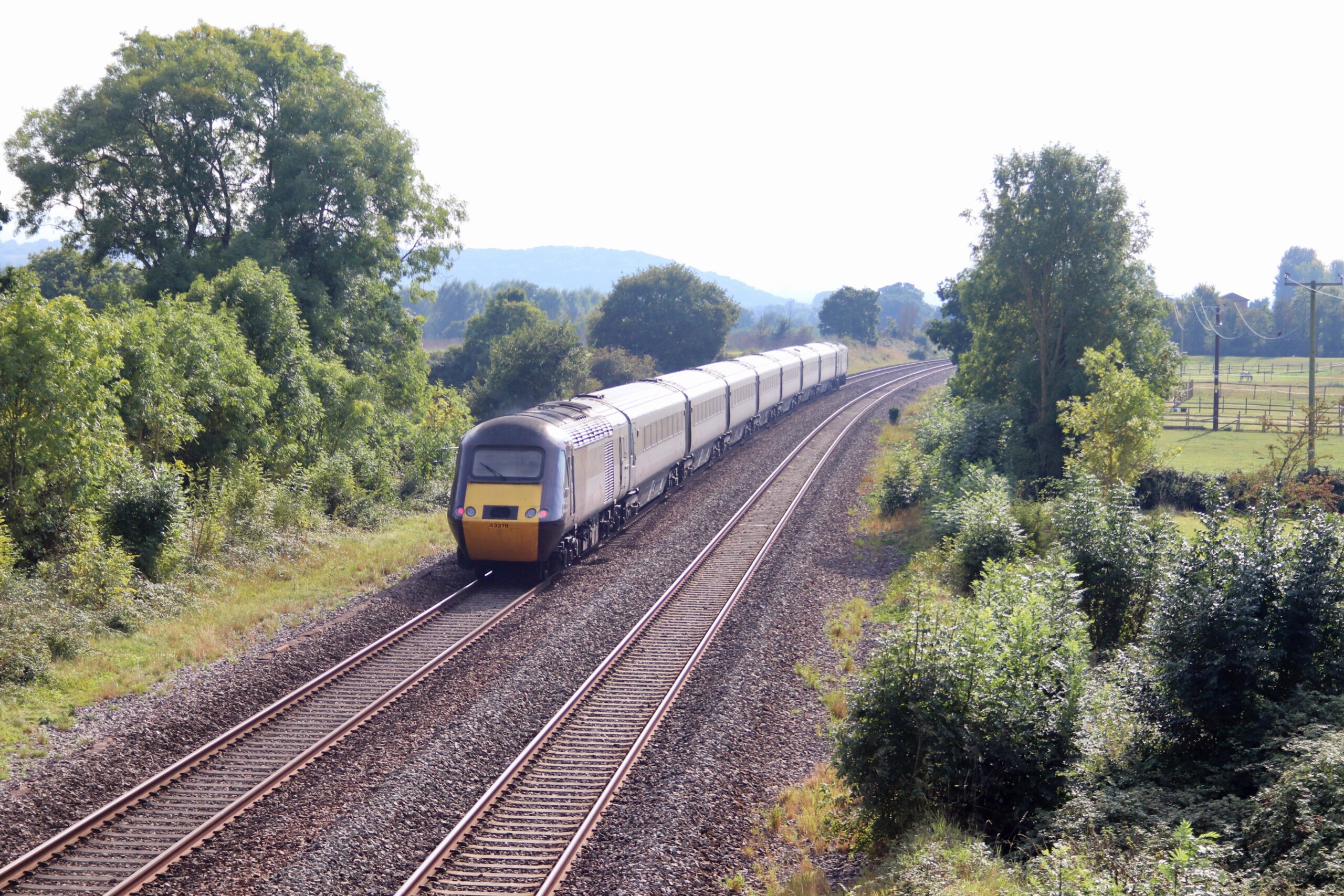
I rather like this video screenshot of LSL Class 47 No. 47805 ‘Roger Hosking MA 1925-2013’ as she opened up while passing through Branksome during a heavy rain storm heading “The Dorset Coast Statesman” 1Z48 0416 Nantwich to Weymouth – 24/08/2024
North Dorset Railway
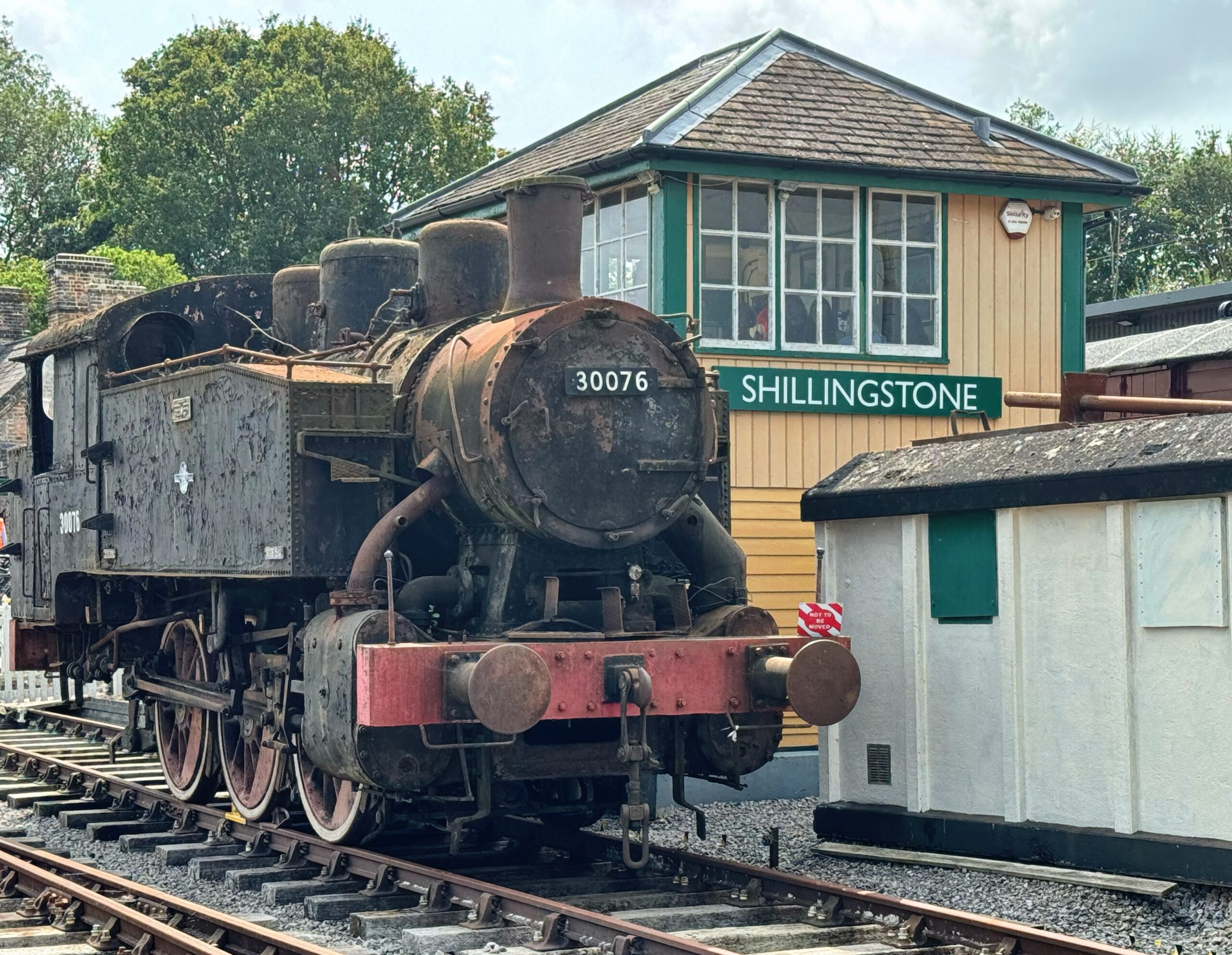
Class 62 No. 30076 and the Shillingstone signal box – 26/08/2024
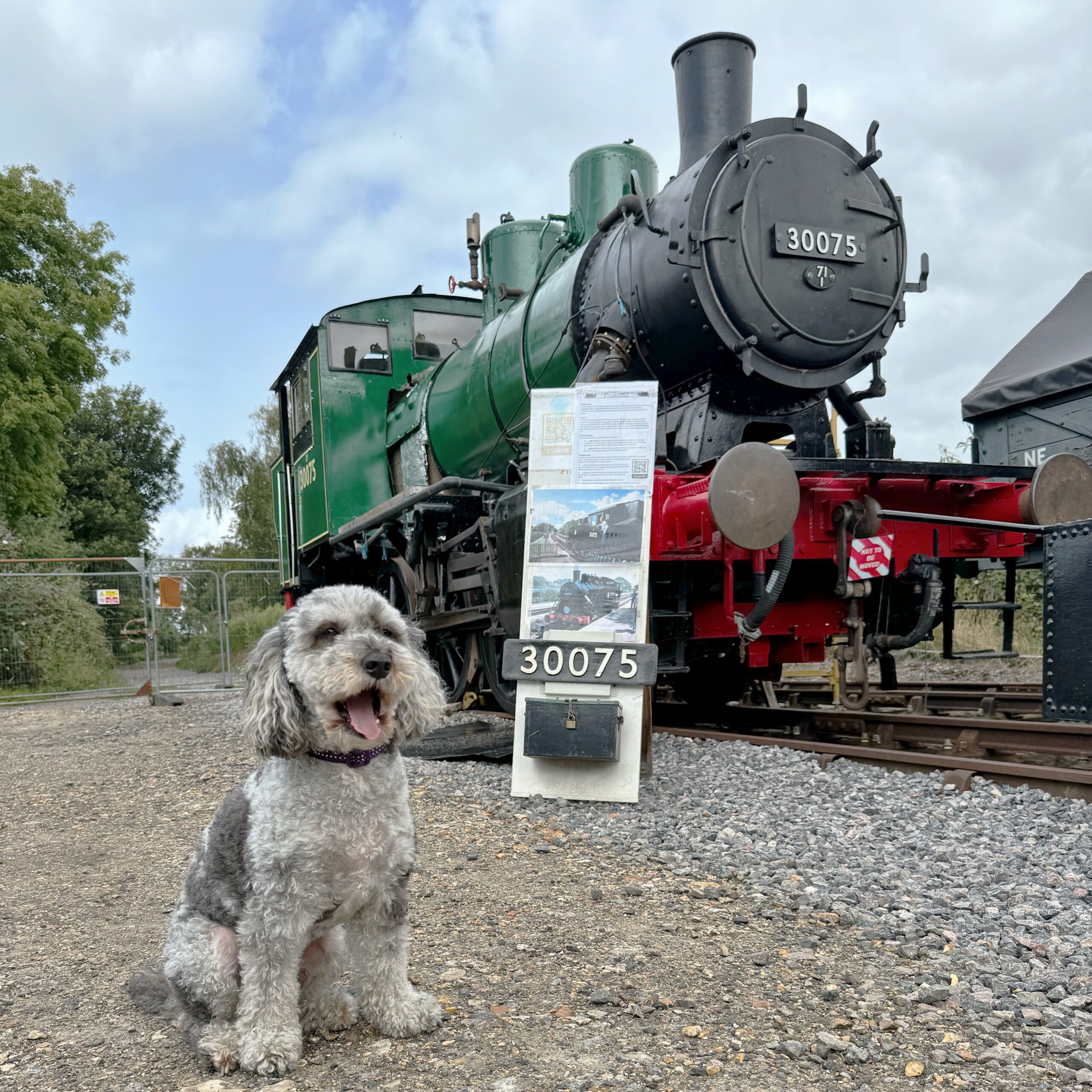
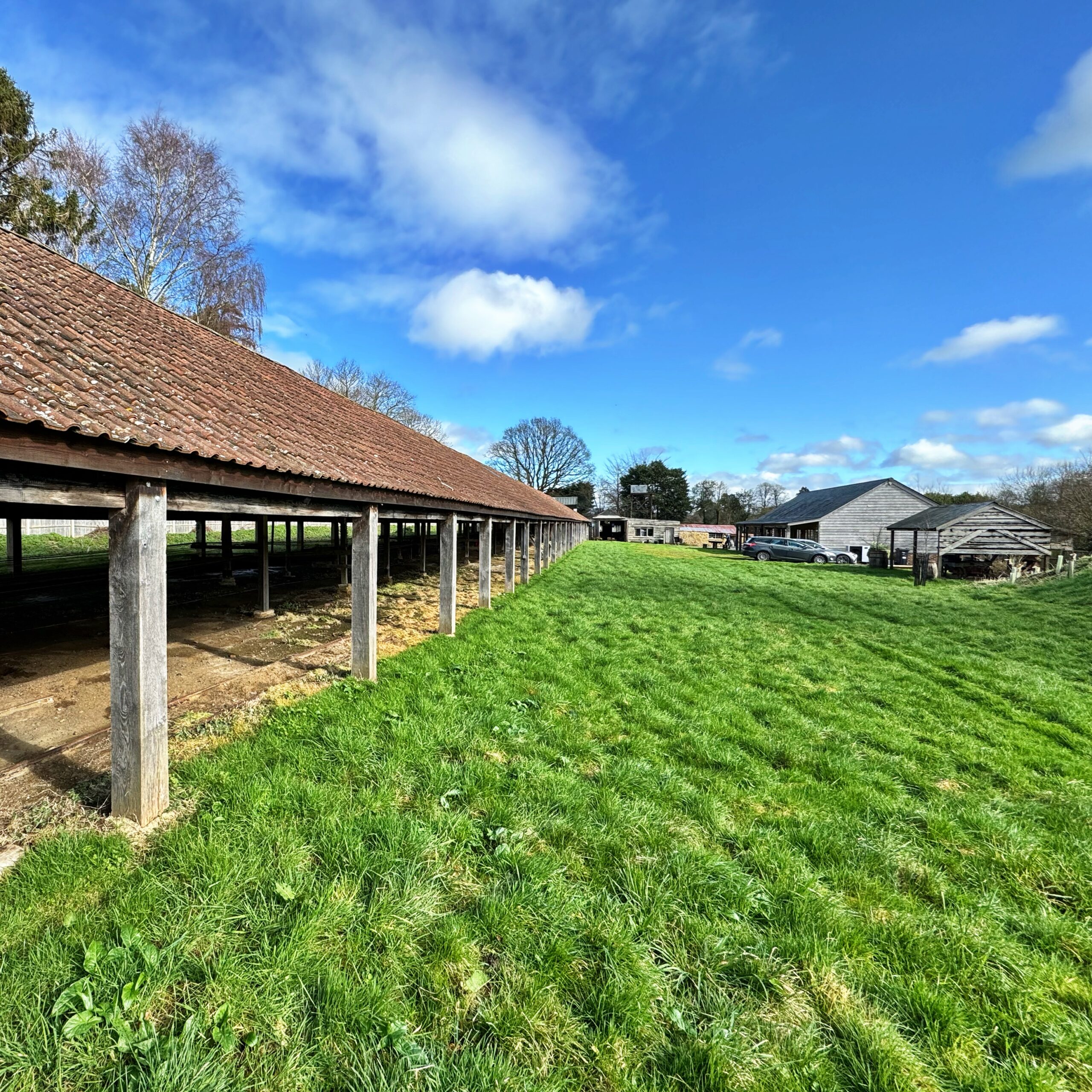
On Bank Holiday Monday, the North Dorset Railway operated behind the scenes guided tours at Shillingstone allowing visitors to get a close up view of the projects currently being worked on by railway volunteers. This included the signal box and Project 62 which is working towards the restoration of Yugoslavian built Class 62 USA type 0-6-0 tank steam locomotives No.’s 30075 and 30076.
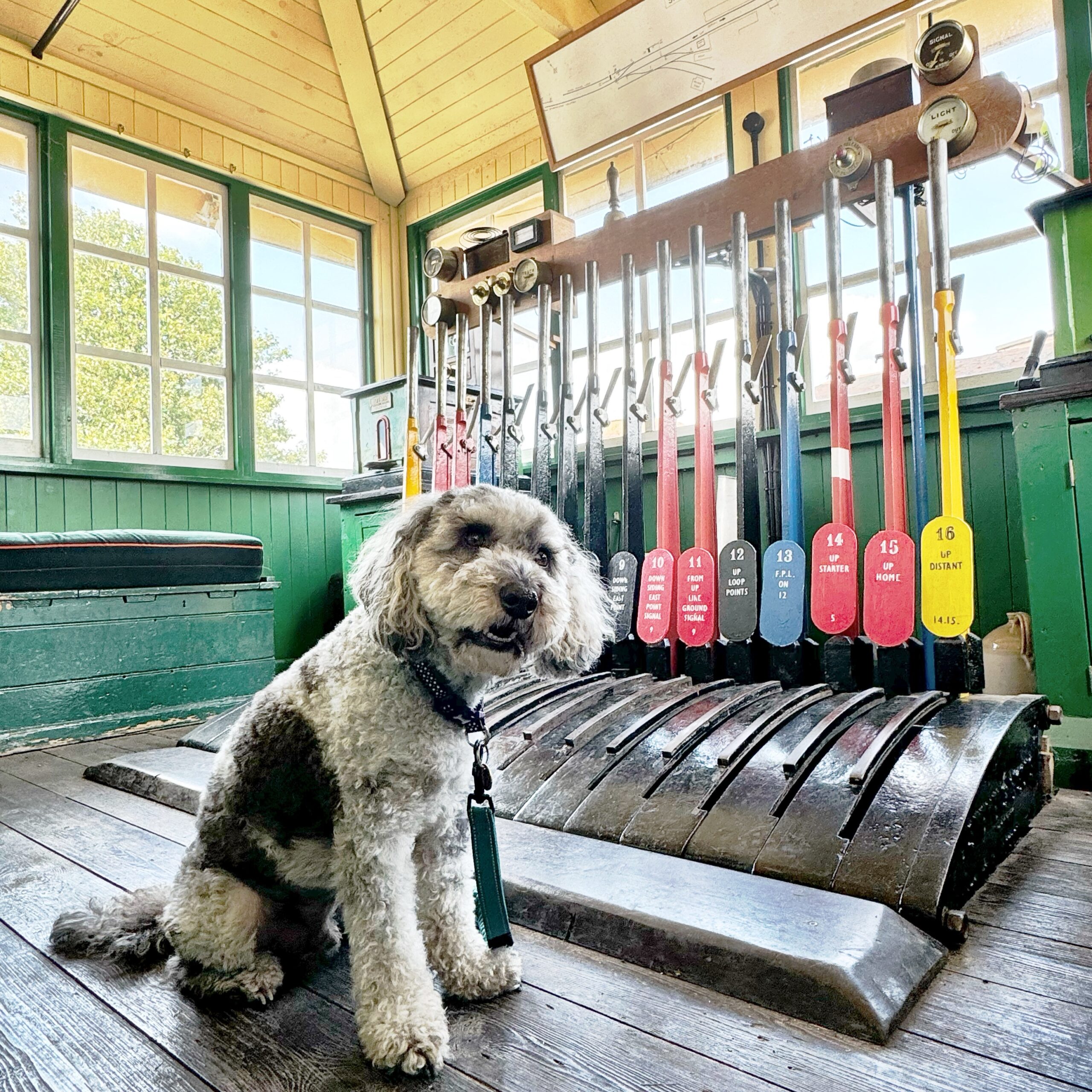
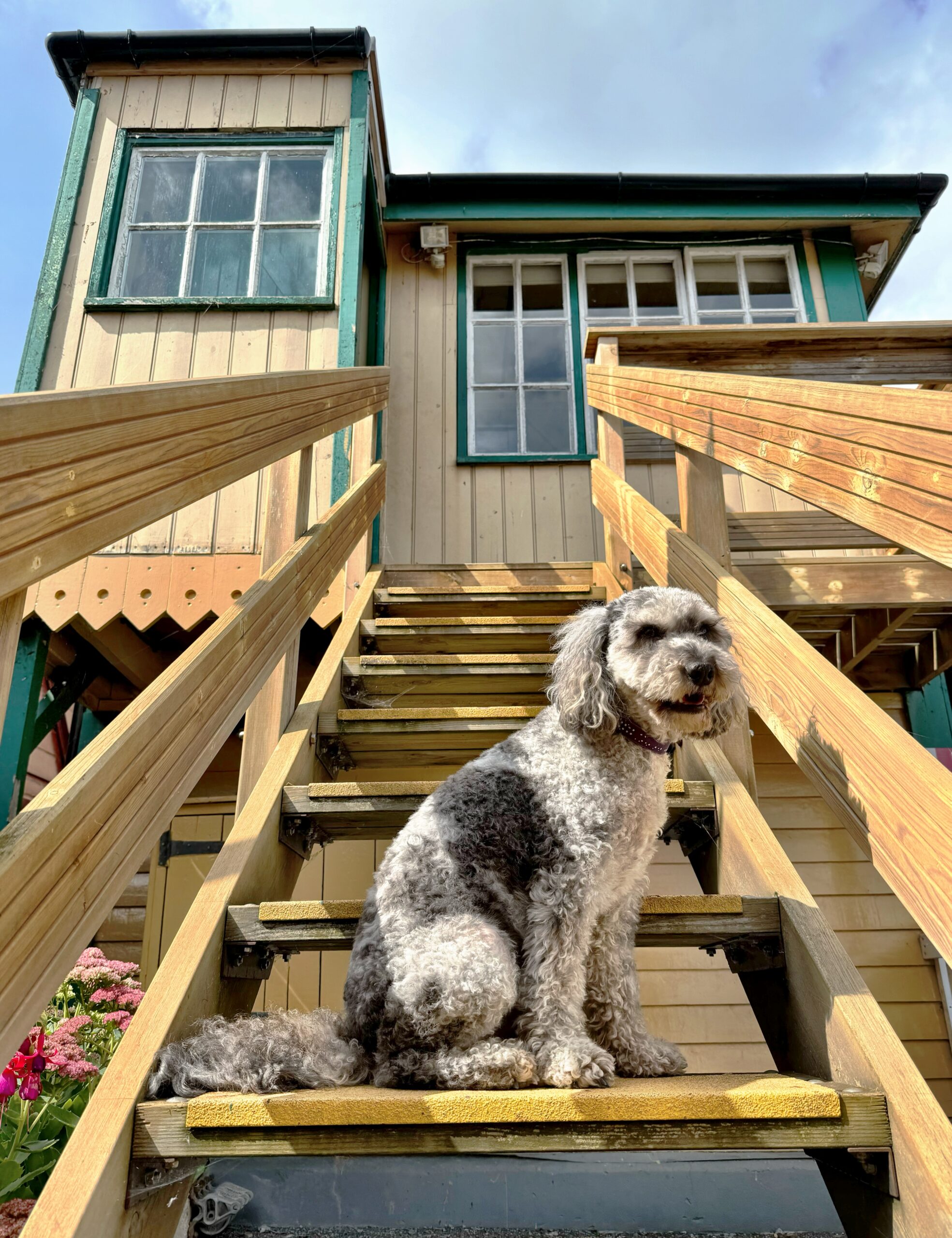
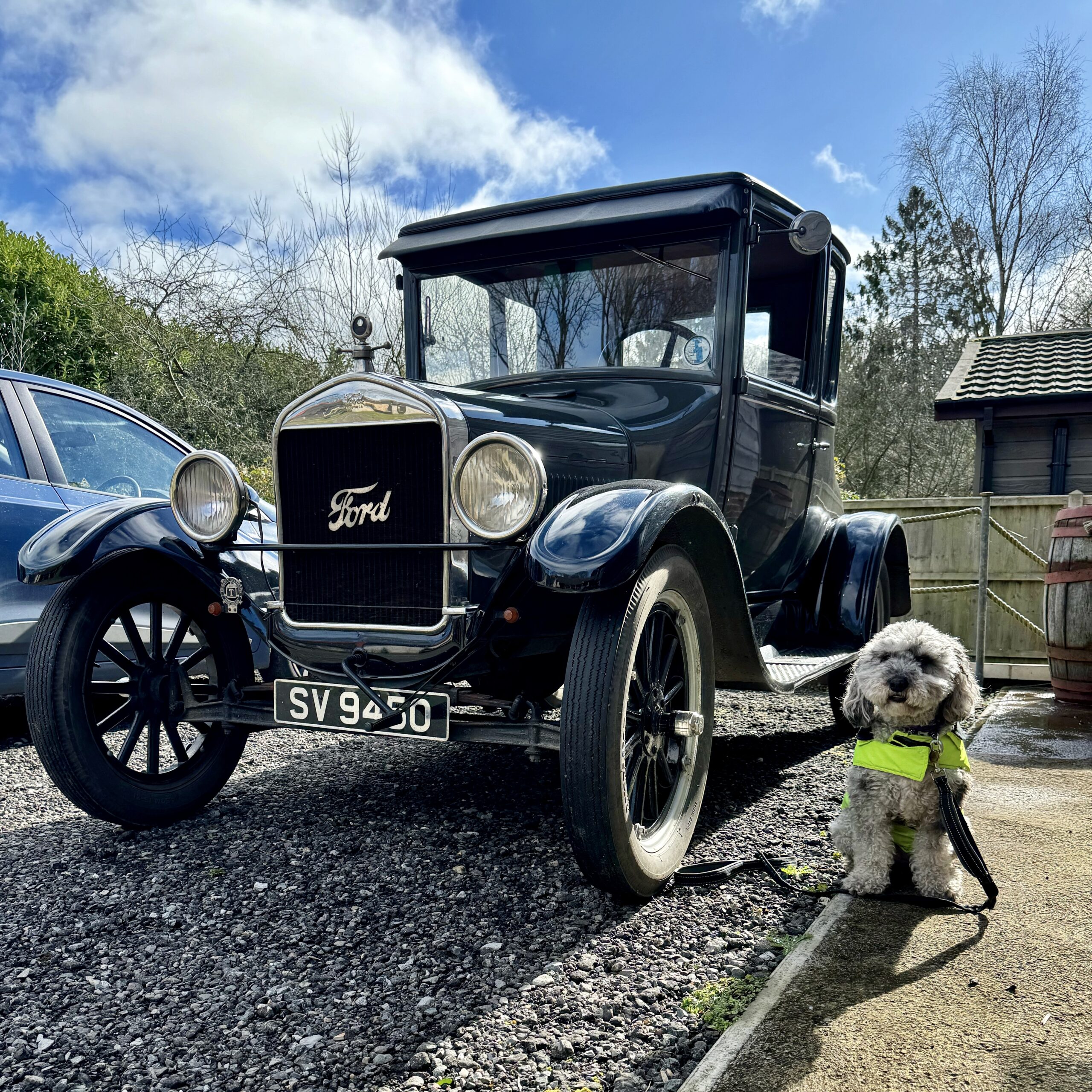
Yoshi enjoyed his tour of the replica signal box at Shillingstone – 26/08/2024Yoshi on the steps to the signal cabin – 26/08/2024Project 62 represents the owners of Yugoslavian built Class 62 USA type 0-6-0 tank steam locomotive No. 30075 (formerly JZ 62-669 acquired from Store Steel in Slovenia in 1990) which, having been most recently operational since June 2004, was out of service pending firebox repairs and full overhaul – 26/08/2024The group is also involved in the current project to construct No. 30076 from 62-521, which was acquired from ArcelorMittal Zenica in Bosnia & Herzegovina in December 2006 – 26/08/2024
Class 62 “Yankee Tank” steam locomotives are a pattern build of the World War II USATC S100 Class 0-6-0T Switcher/Shunters designed by Colonel Howard G Hill. Many of these locomotives saw service in the UK – including 14 on the Southern Railway plus a number in industrial service with Austin Motors/BMC at Longbridge, the NCB in the North East and on the Longmoor Military Railway. Four original US built and two Yugoslavian built locomotives are preserved in the UK.
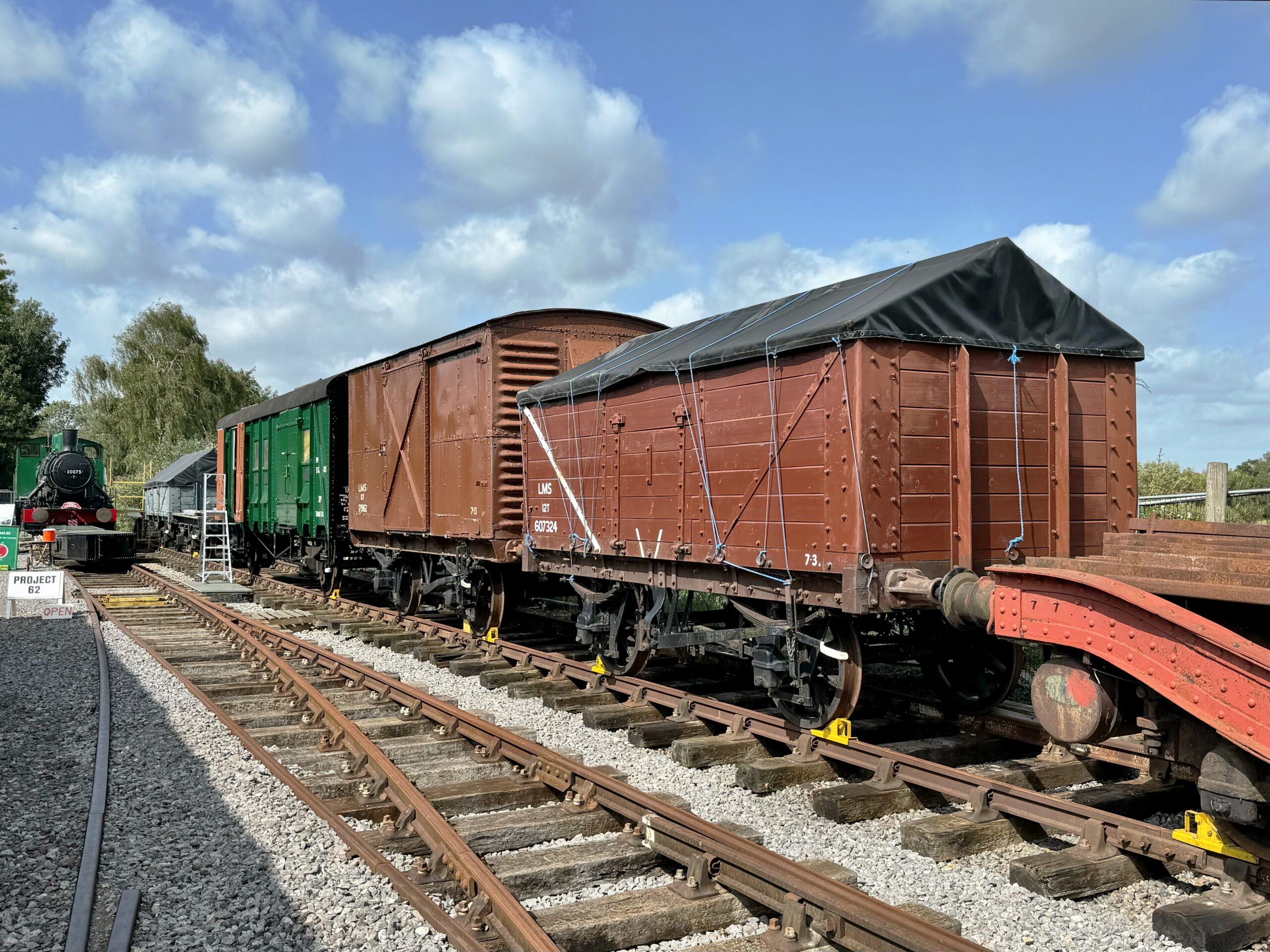
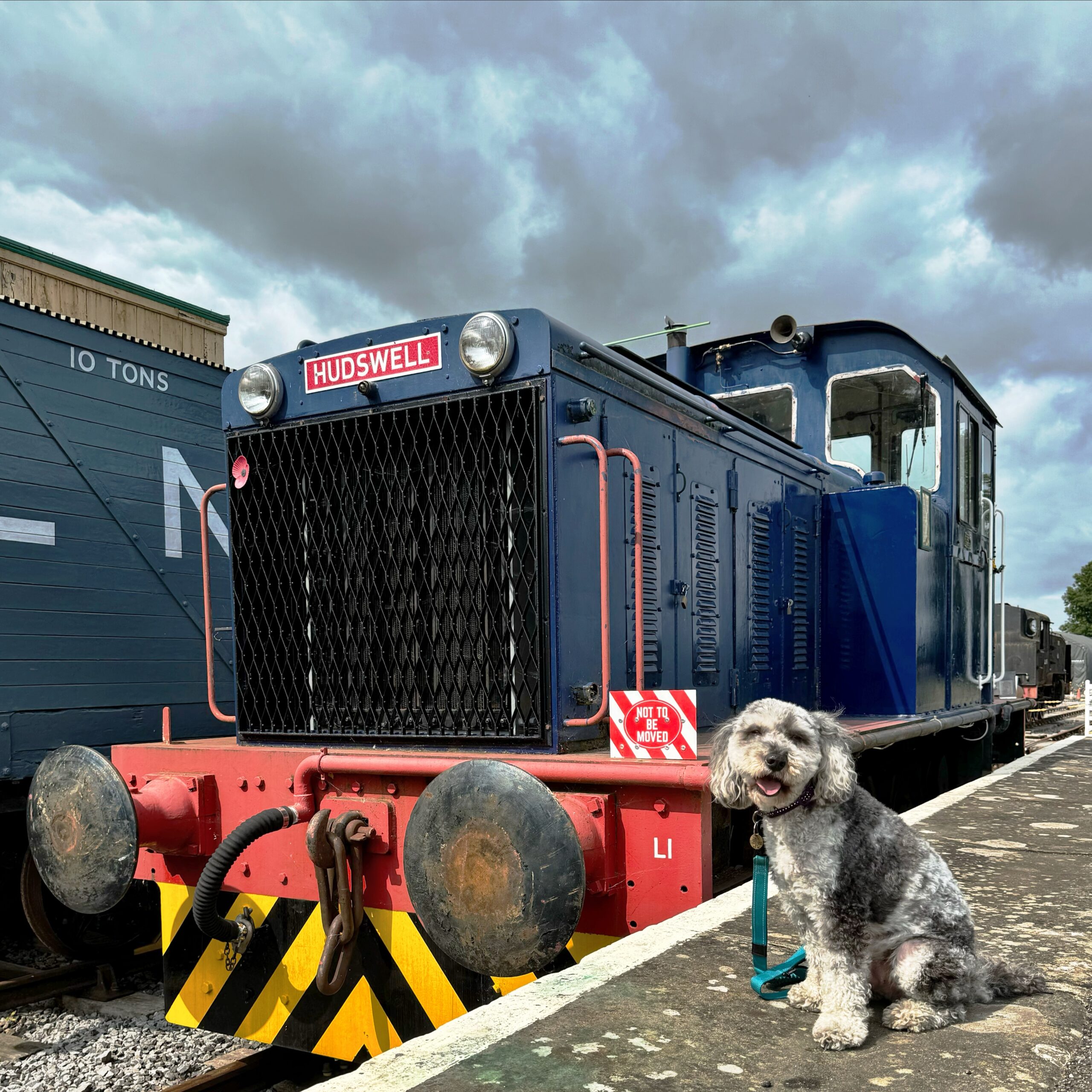
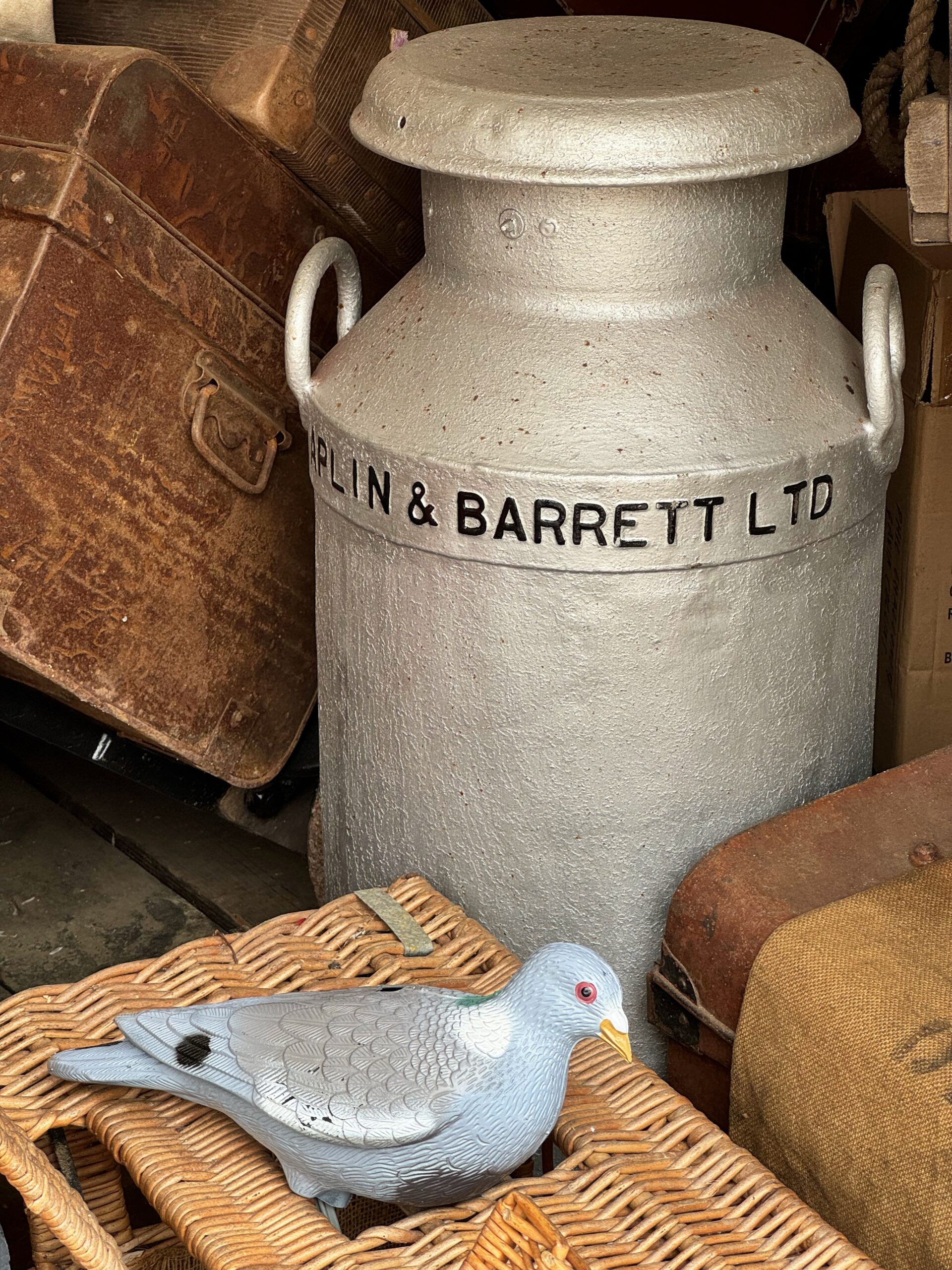
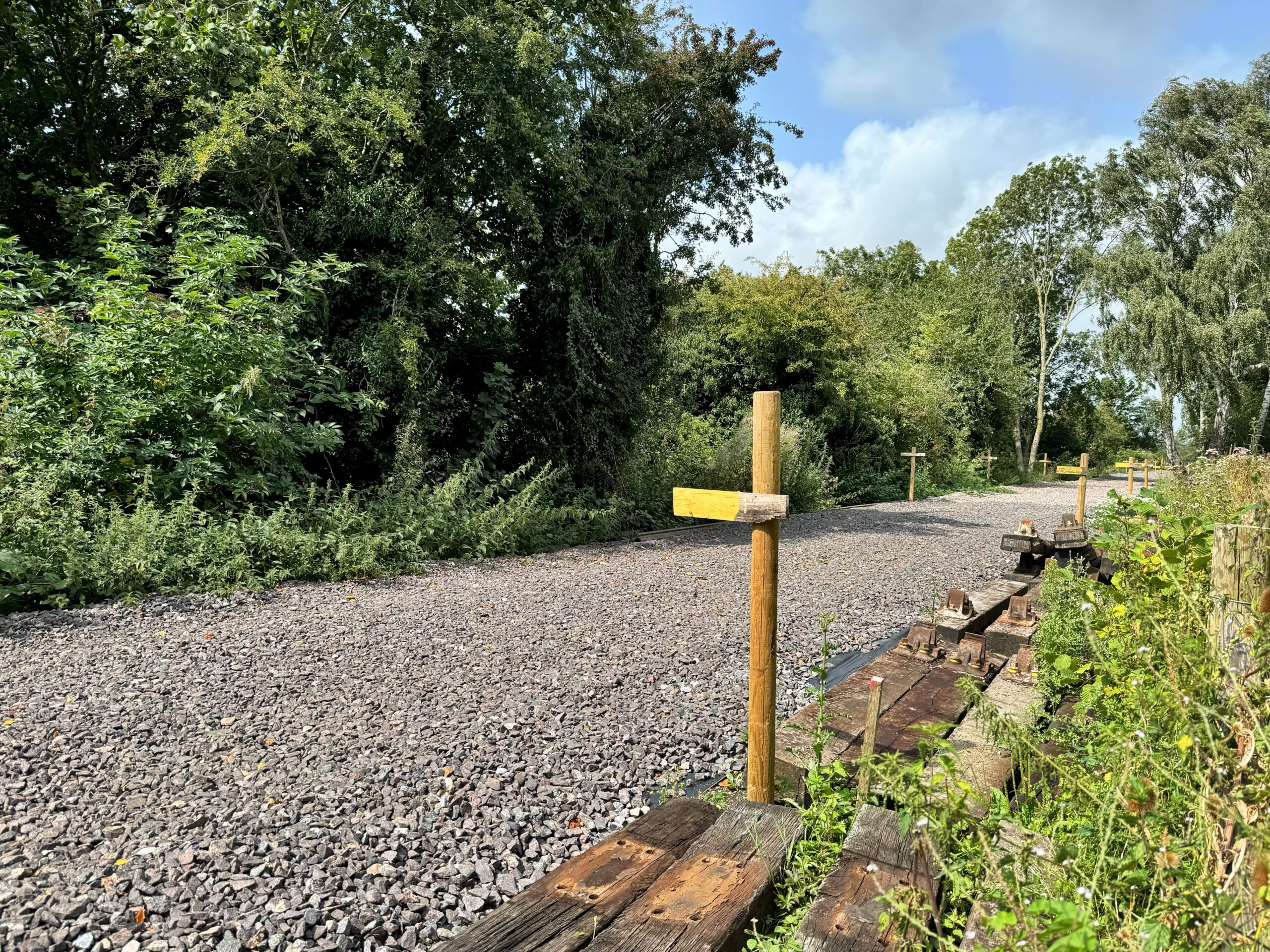
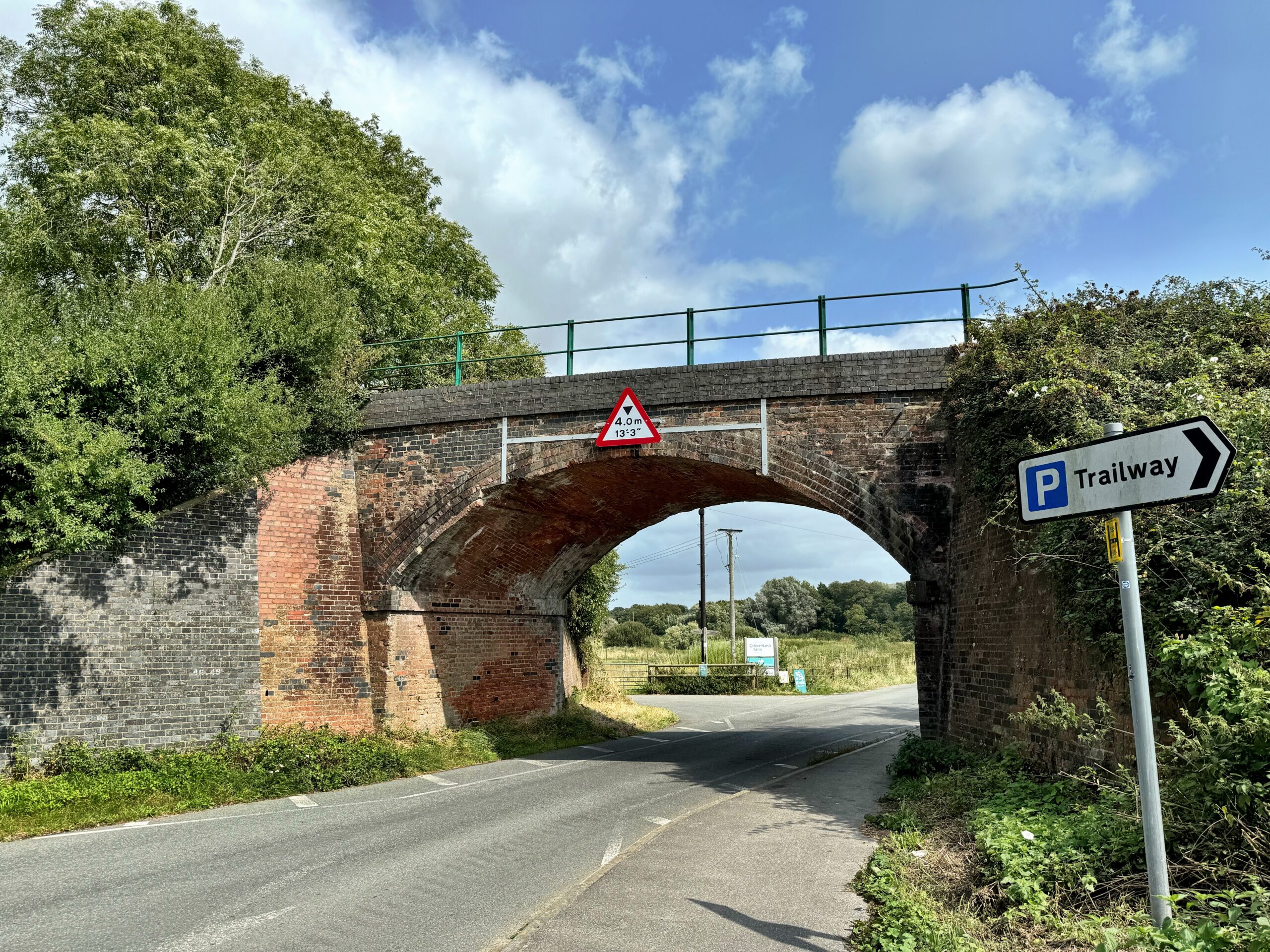
Some of the impressive retired wagons at the North Dorset Railway – 26/08/2024Hudswell Clarke 0-6-0 Diesel Loco ‘Ashdown’ was built by Hudswell Clarke, Leeds in 1959 for the Manchester Ship Canal Railway. After working at several locations, it arrived at Shillingstone in Sept 2020 – 26/08/2024Shillingstone station running board – 26/08/2024It’s the small detail! – 26/08/2024Reconstruction of the embankment and trackbed at Shillingstone is going well by the looks of things and it is hoped they can soon commence tracklaying on the northern extension towards cattle creep over Haywards Lane bridge – 26/08/2024Haywards Lane bridge which one day soon may see trains running over it once again – 26/08/2024
We had a lovely weekend at Shillingstone, everyone we spoke to was friendly, welcoming and knowledgeable and we look forward to more visits to see developments in the future.
Shieldhall
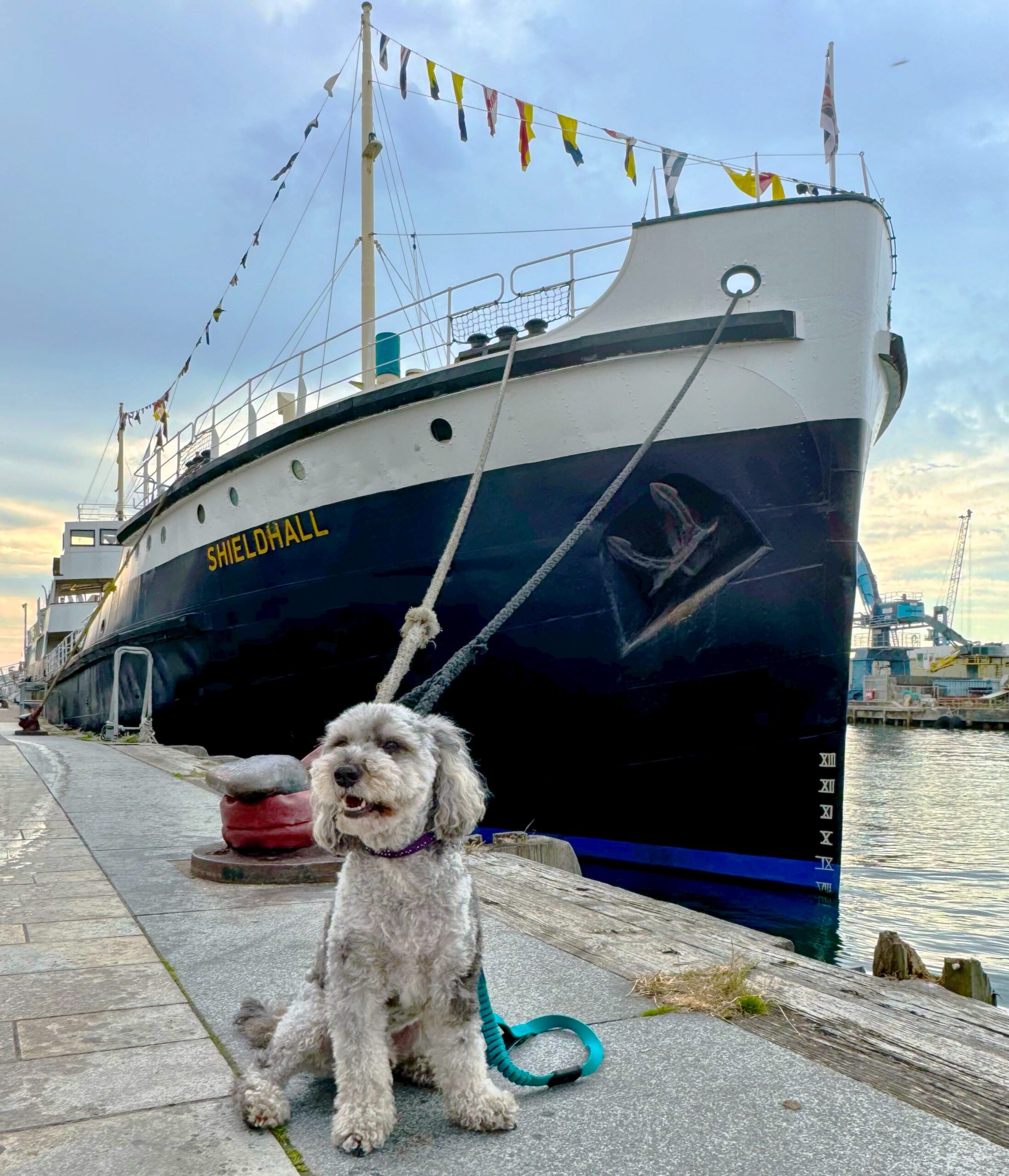
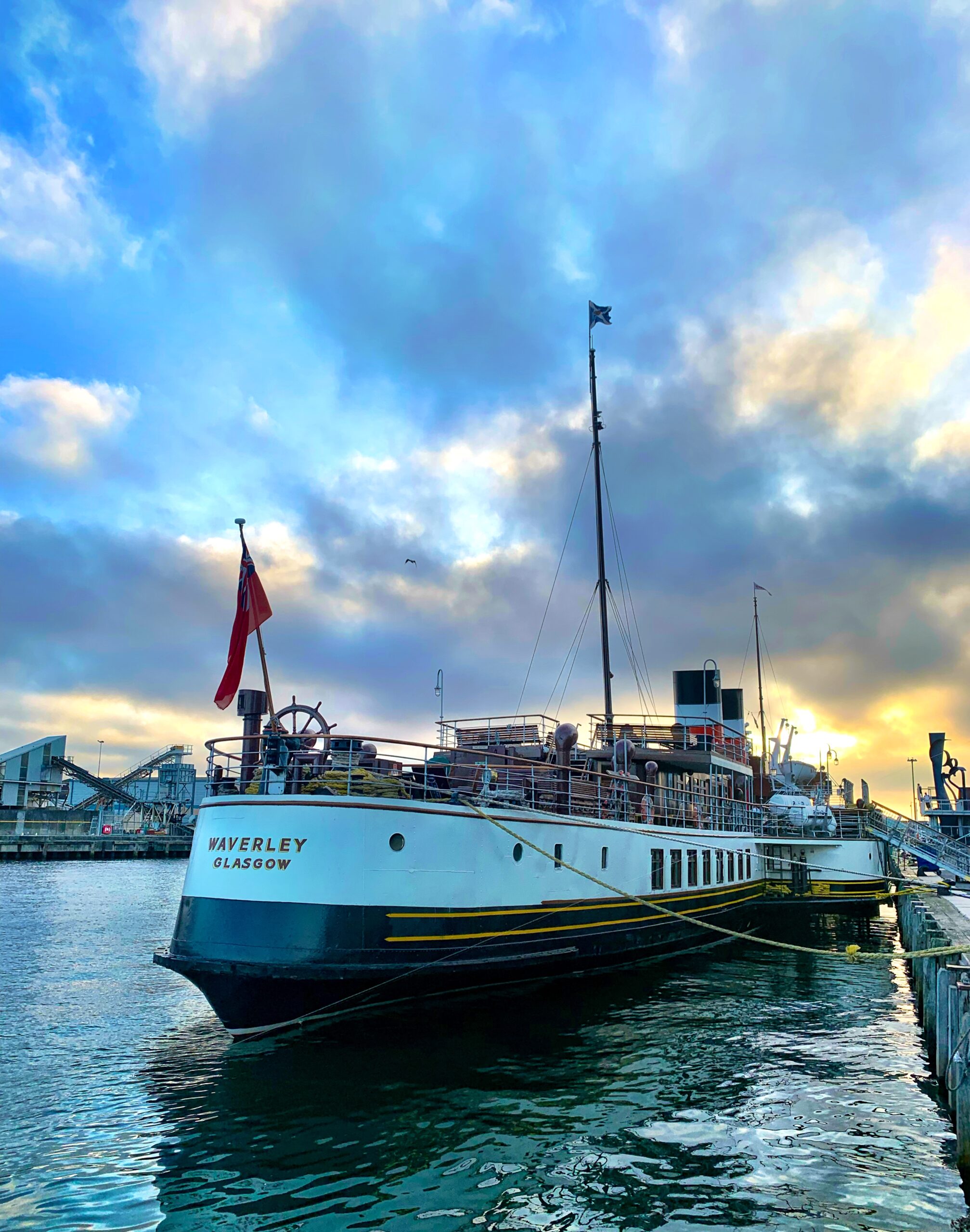
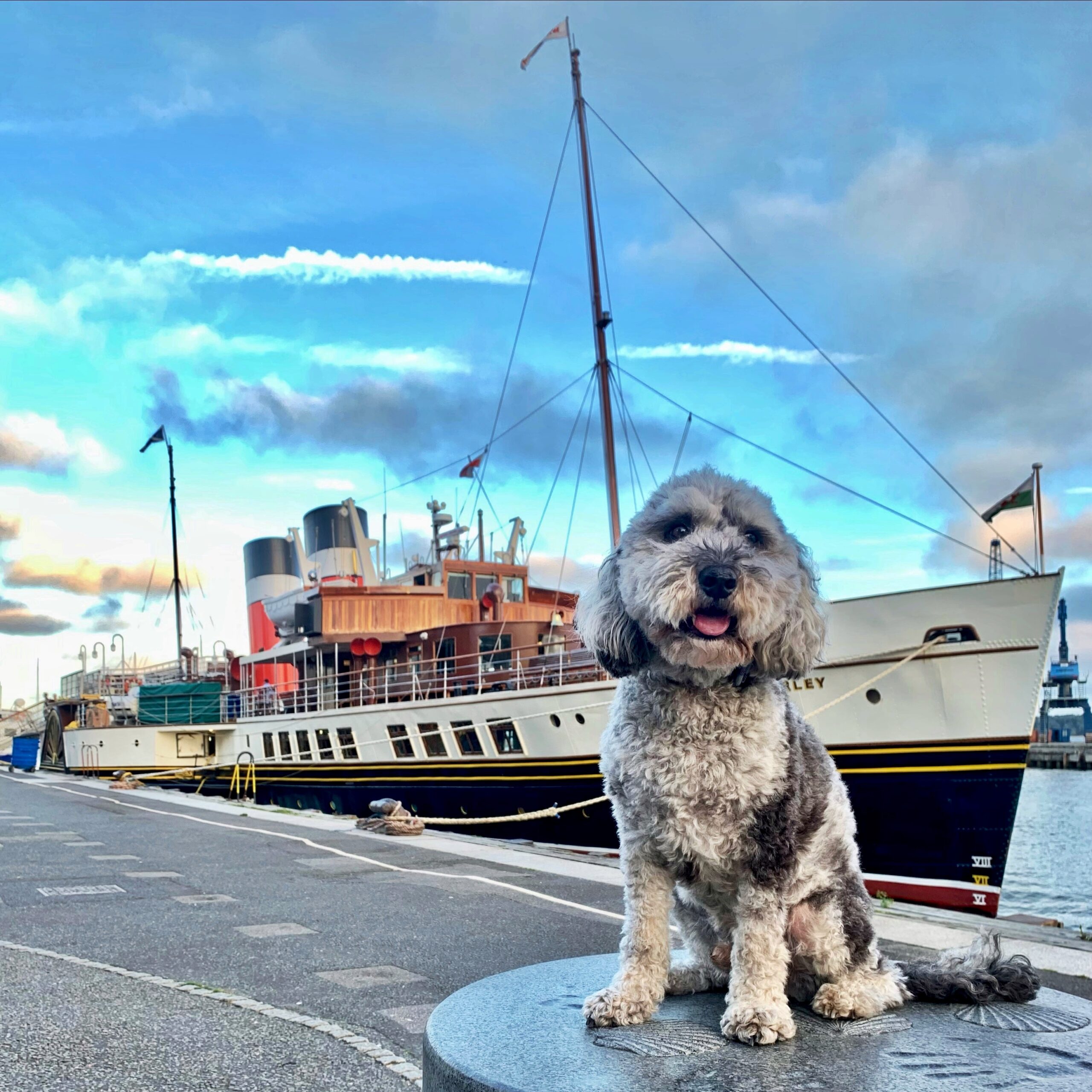
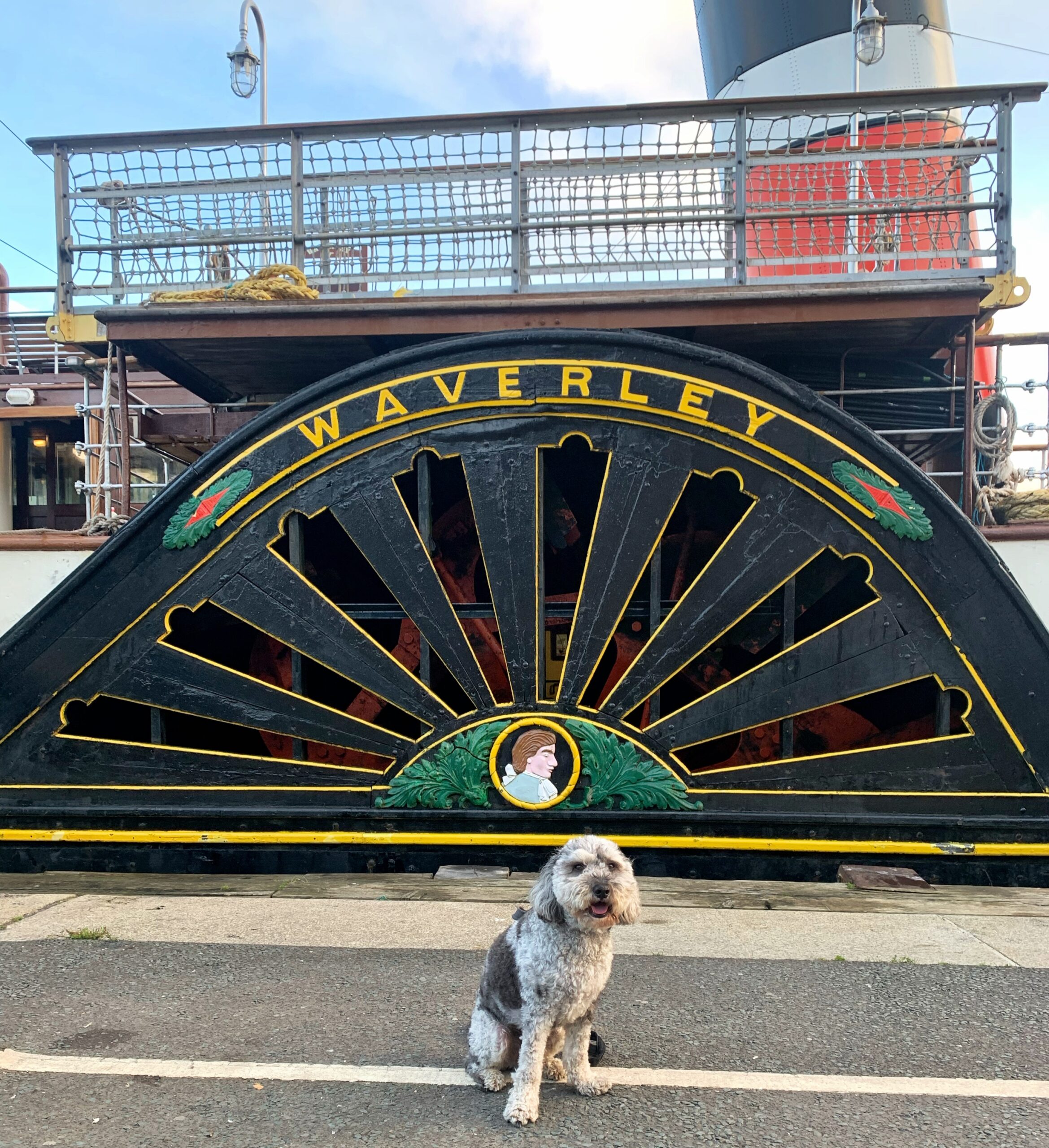
Yoshi takes a look at Steamship Shieldhall – 28/08/2024
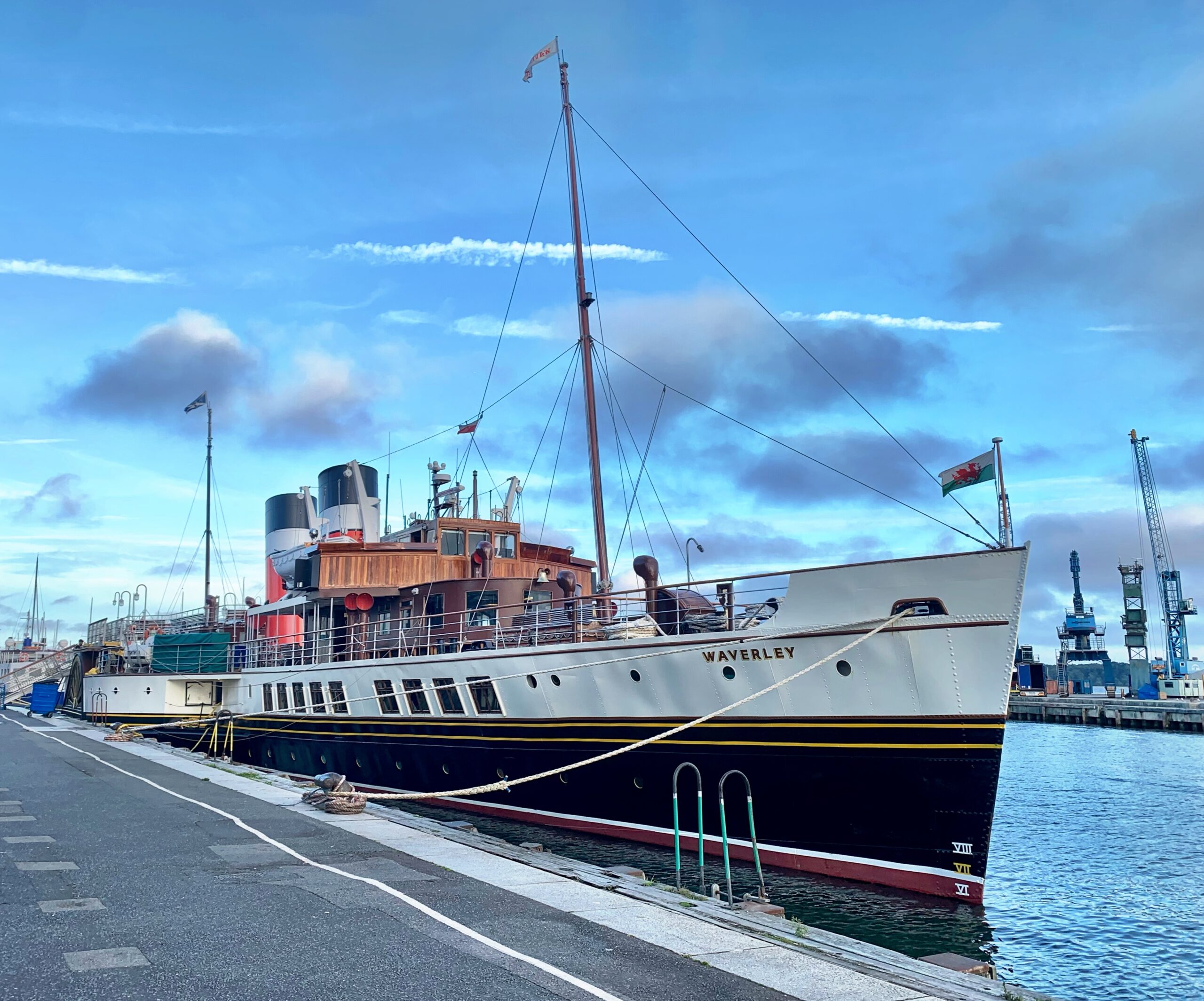
Yoshi took the opportunity to pop down to Poole Quay to see the Steamship Shieldhall, the largest working steamship in Britain, on her annual visit to the town.
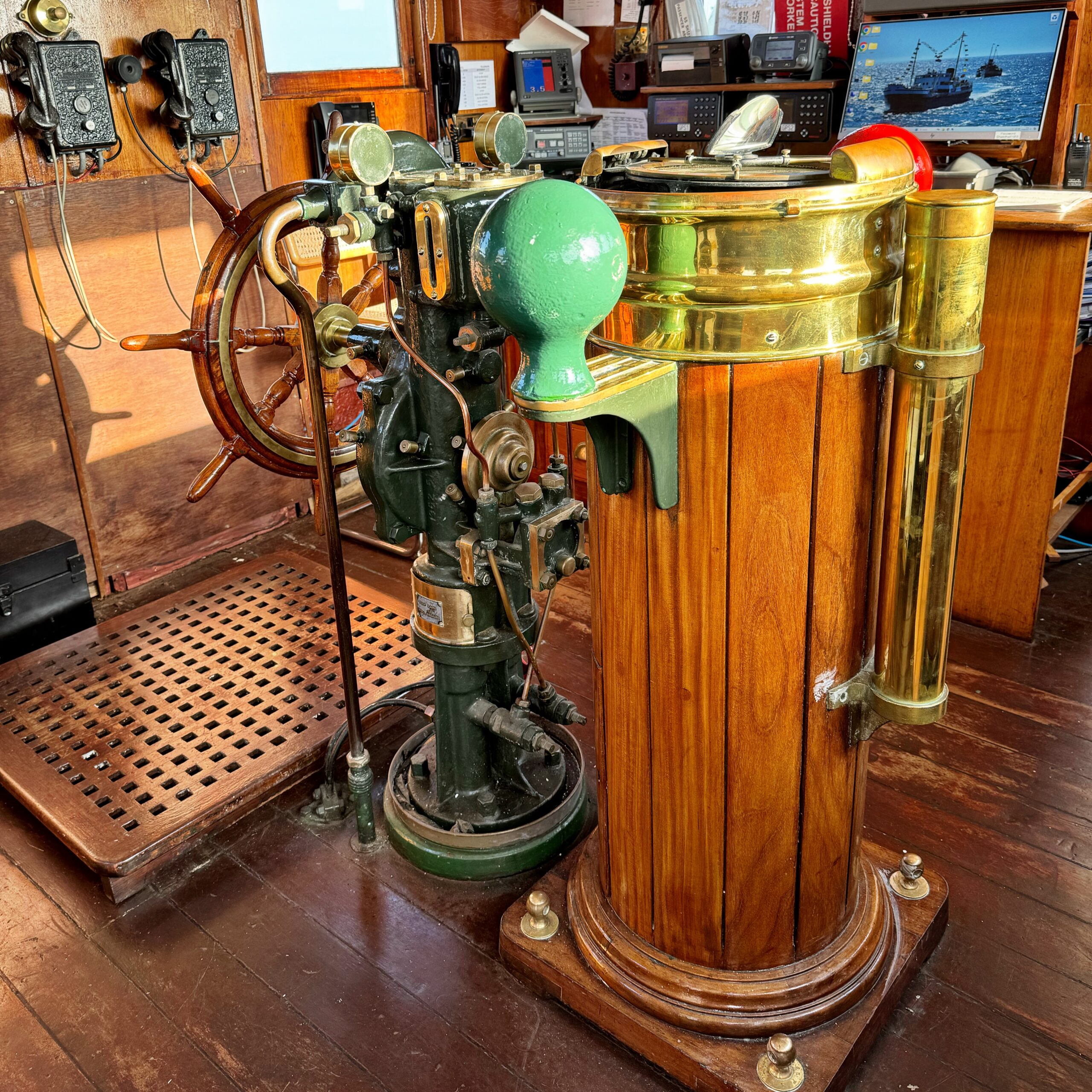
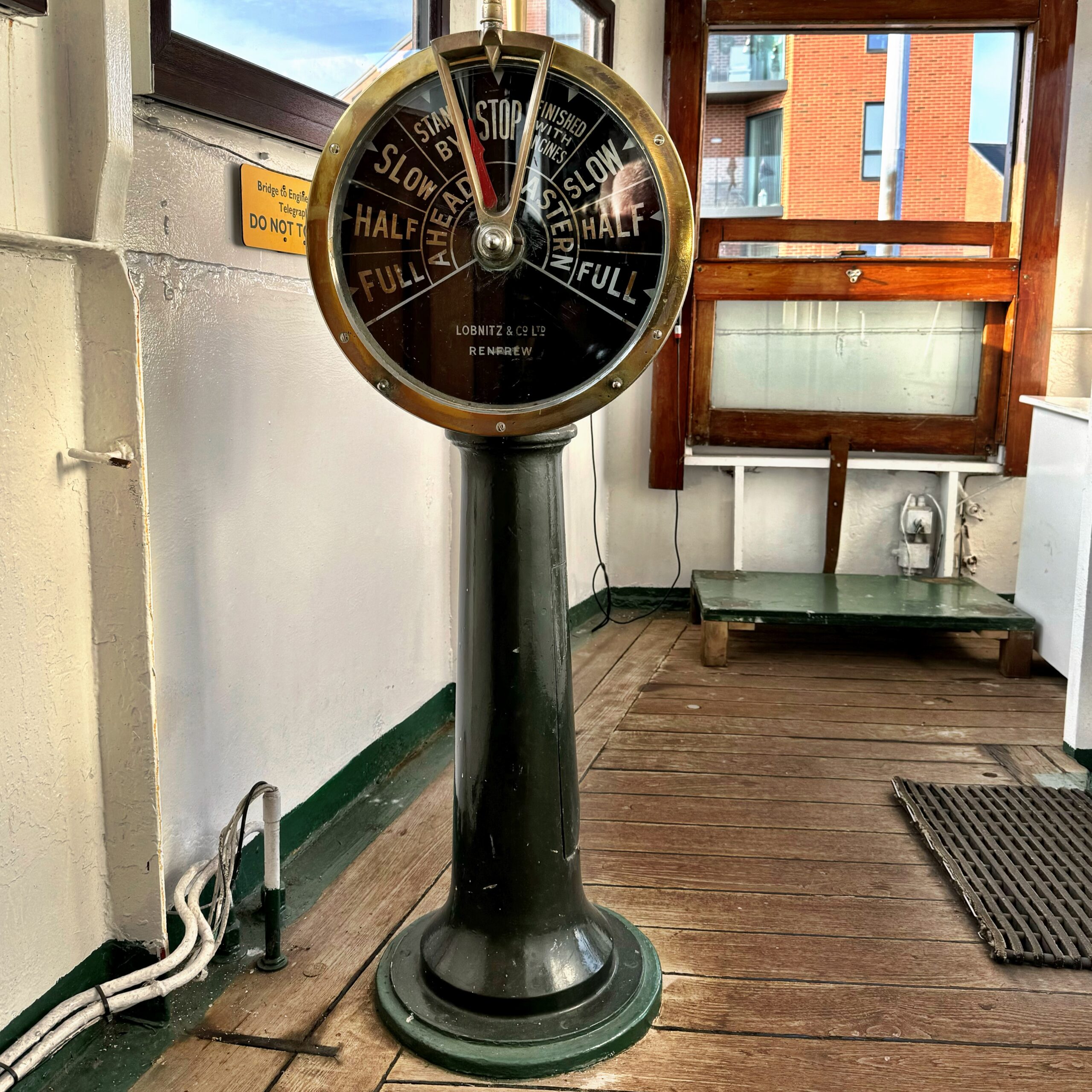
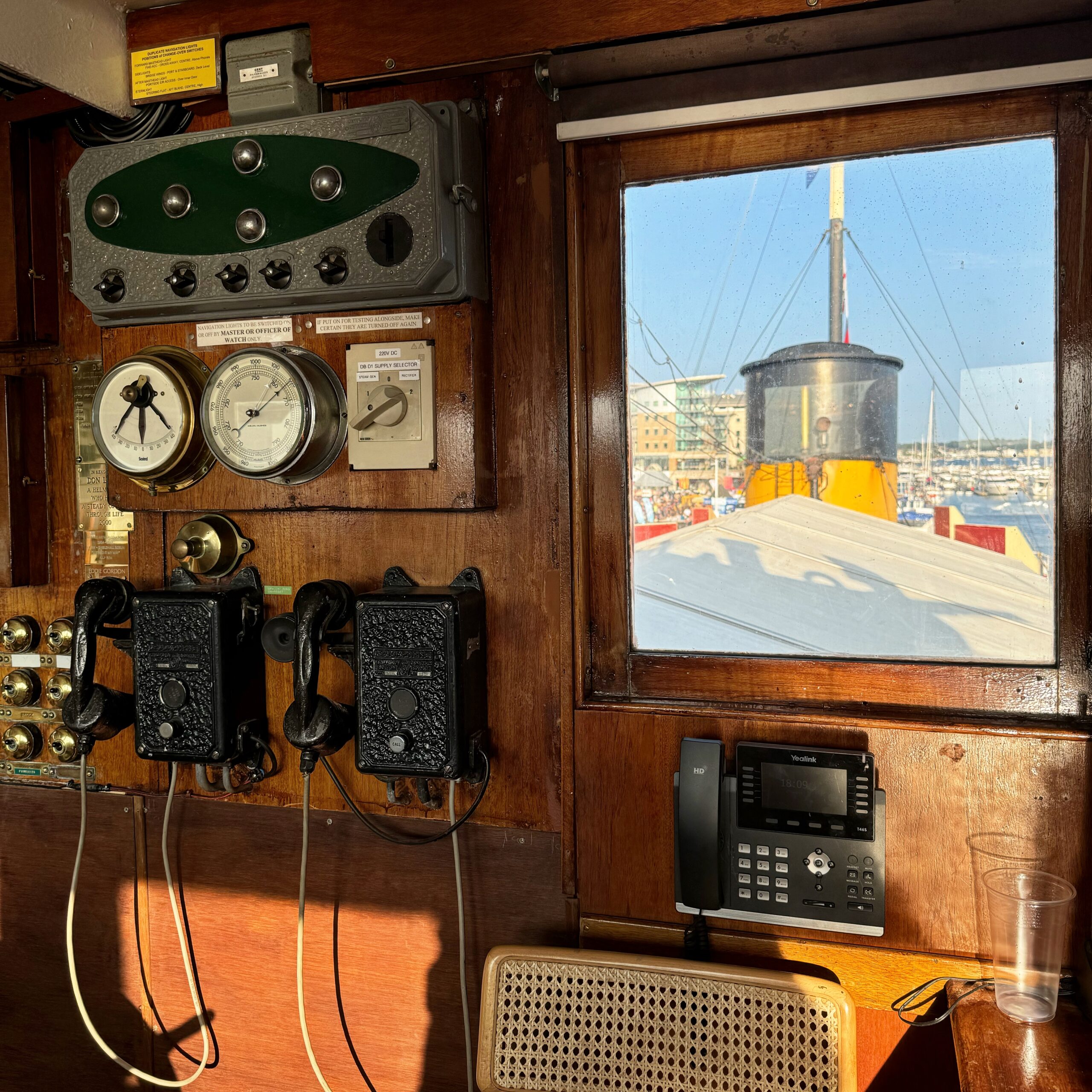
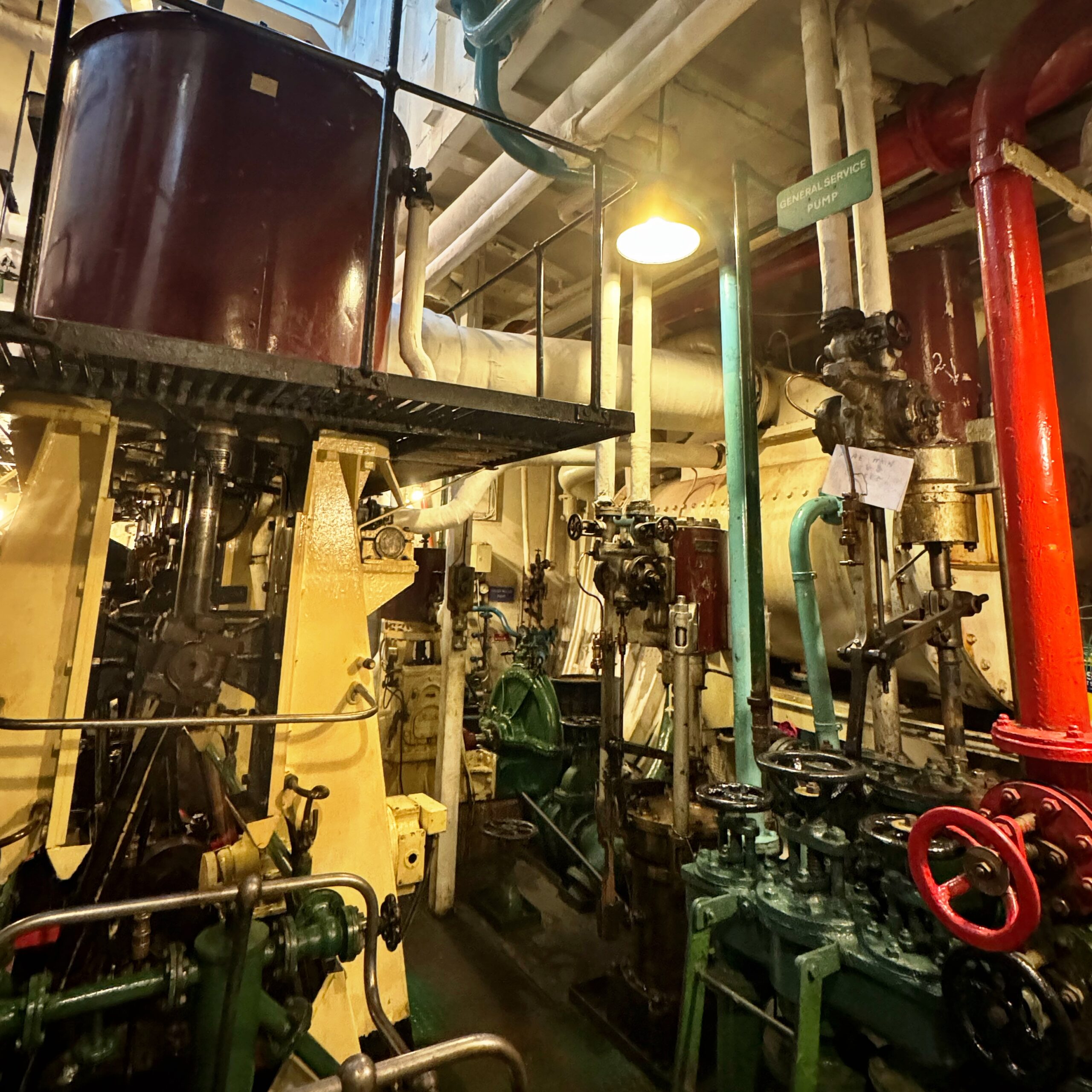
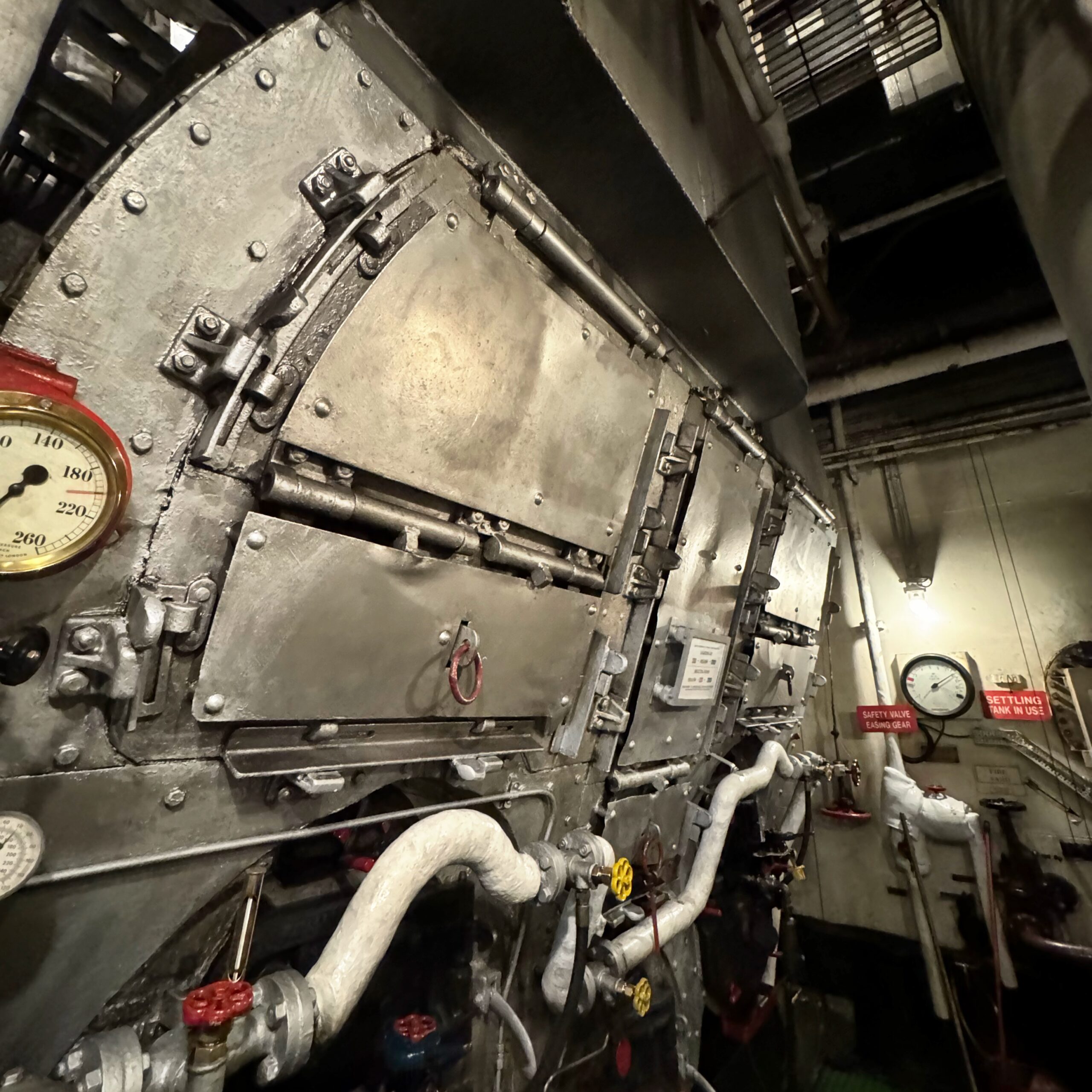
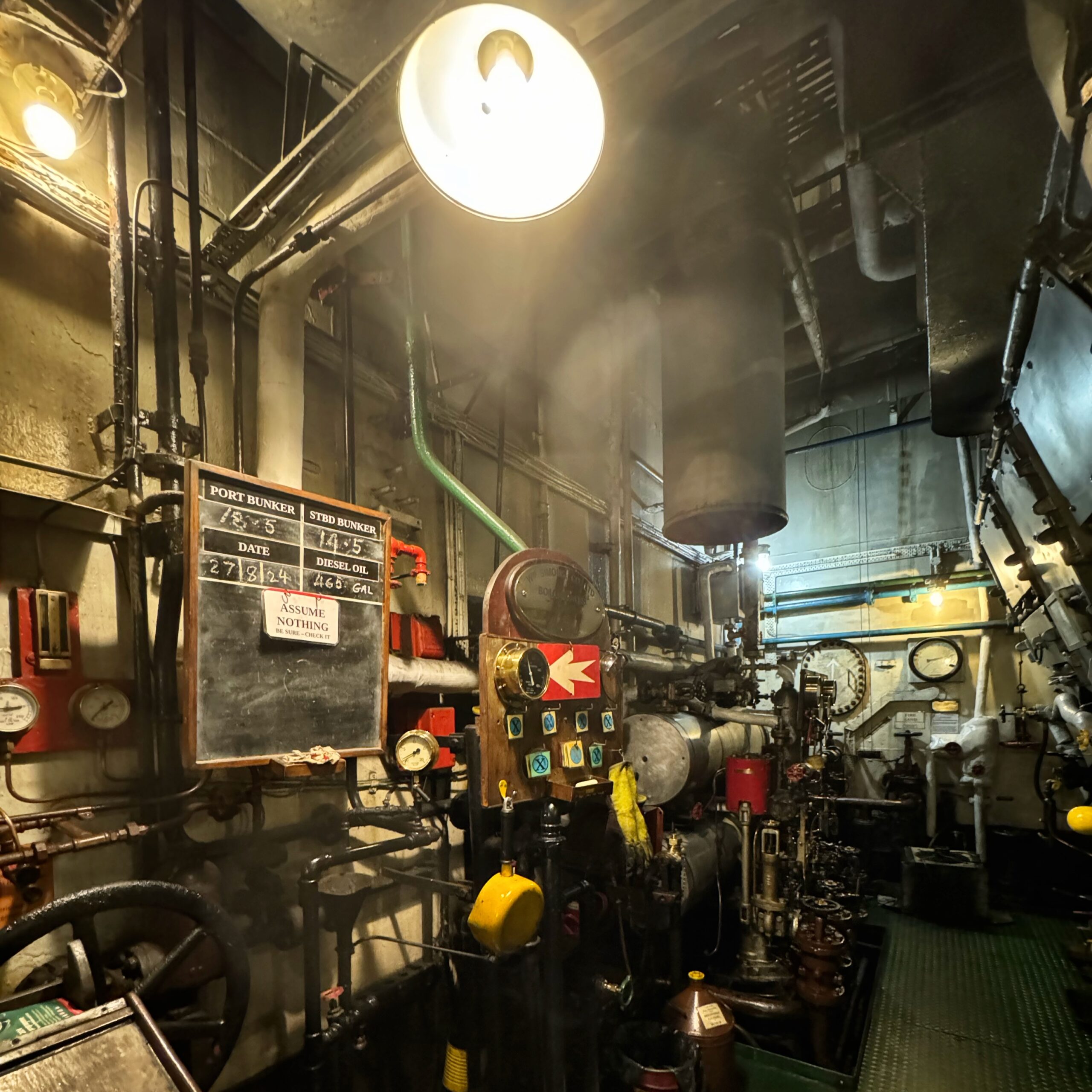
Thanks to Shieldhall, PHC and Caroline, I had a look around the impressive vessel, visiting the engine room with its original steam engines and the bridge, with its traditional instruments and gleaming brasswork. You can discover more about how you can see Sheildhall here.
15/08/2024 – “Weymouth Harbour – The Dorset Coast” and “The Dorset Coast Express”
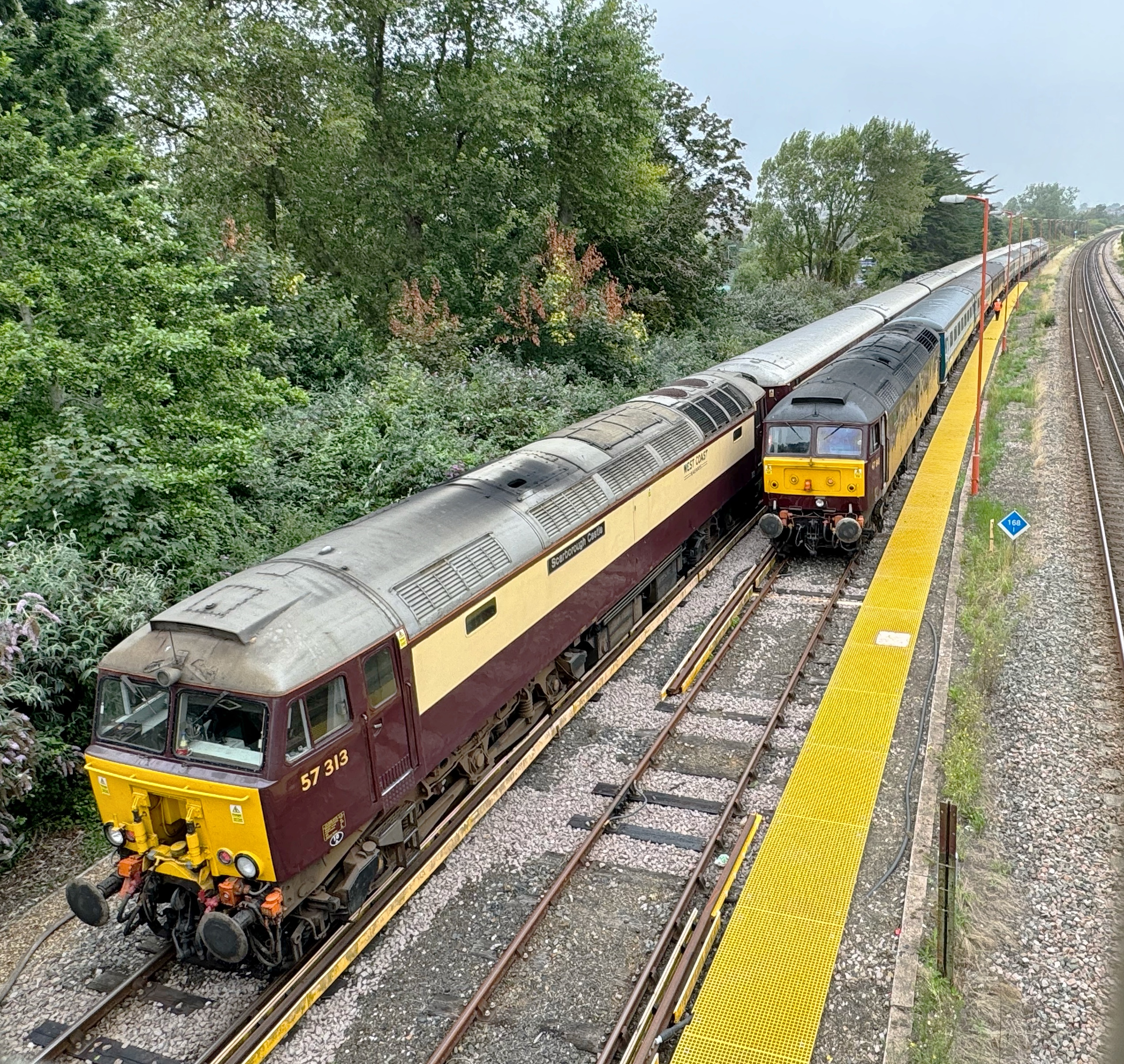
Class 57 No. 57313 ‘Scarborough Castle’ at the stops in Weymouth having arrived with The Northern Belle operated “Weymouth Harbour – The Dorset Coast” 1Z82 0743 Birmingham International to Weymouth – 15/08/2024
With two railtours scheduled to visit Weymouth on Thursday 15th August, it was set to be a busy afternoon in the Dorset seaside town. First up was The Northern Belle operated “Weymouth Harbour – The Dorset Coast” special which originated from Birmingham International and was top and tailed by two West Coast Railway Company (WCRC) Class 57 locomotives. I intended to catch train to Weymouth to see the ensemble arrive, but problems with crossing gates in the Wool area resulted in my train being delayed and I arrived in Weymouth over 15 minutes late and behind the arrival of the “Northern Belle”.
Class 57 No. 57315 prepares to depart Weymouth station and head to Jersey Sidings with the ECS of The Northern Belle operated “Weymouth Harbour – The Dorset Coast” 5Z82 1340 Weymouth to Weymouth Jersey Sidings – 15/08/2024
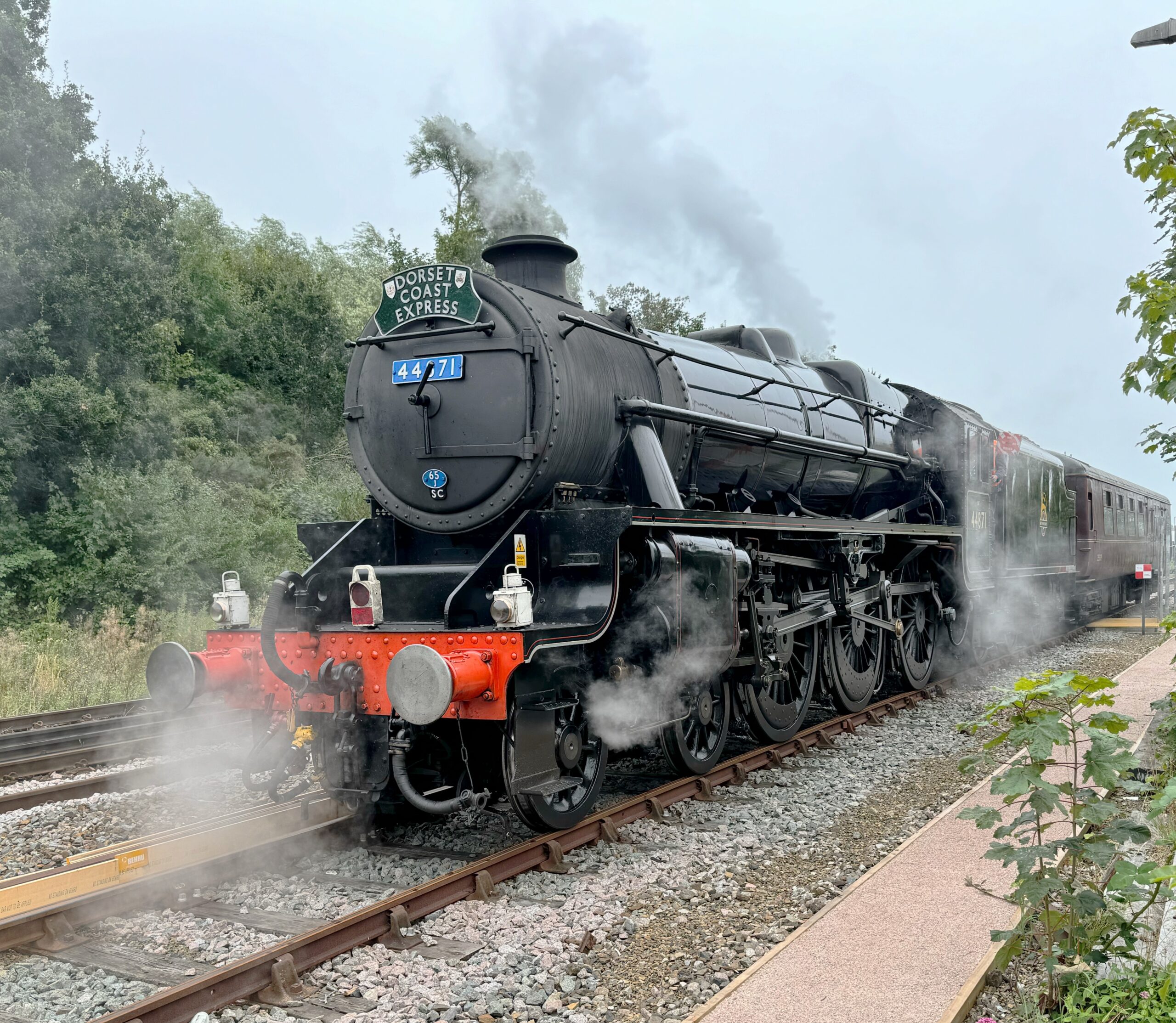
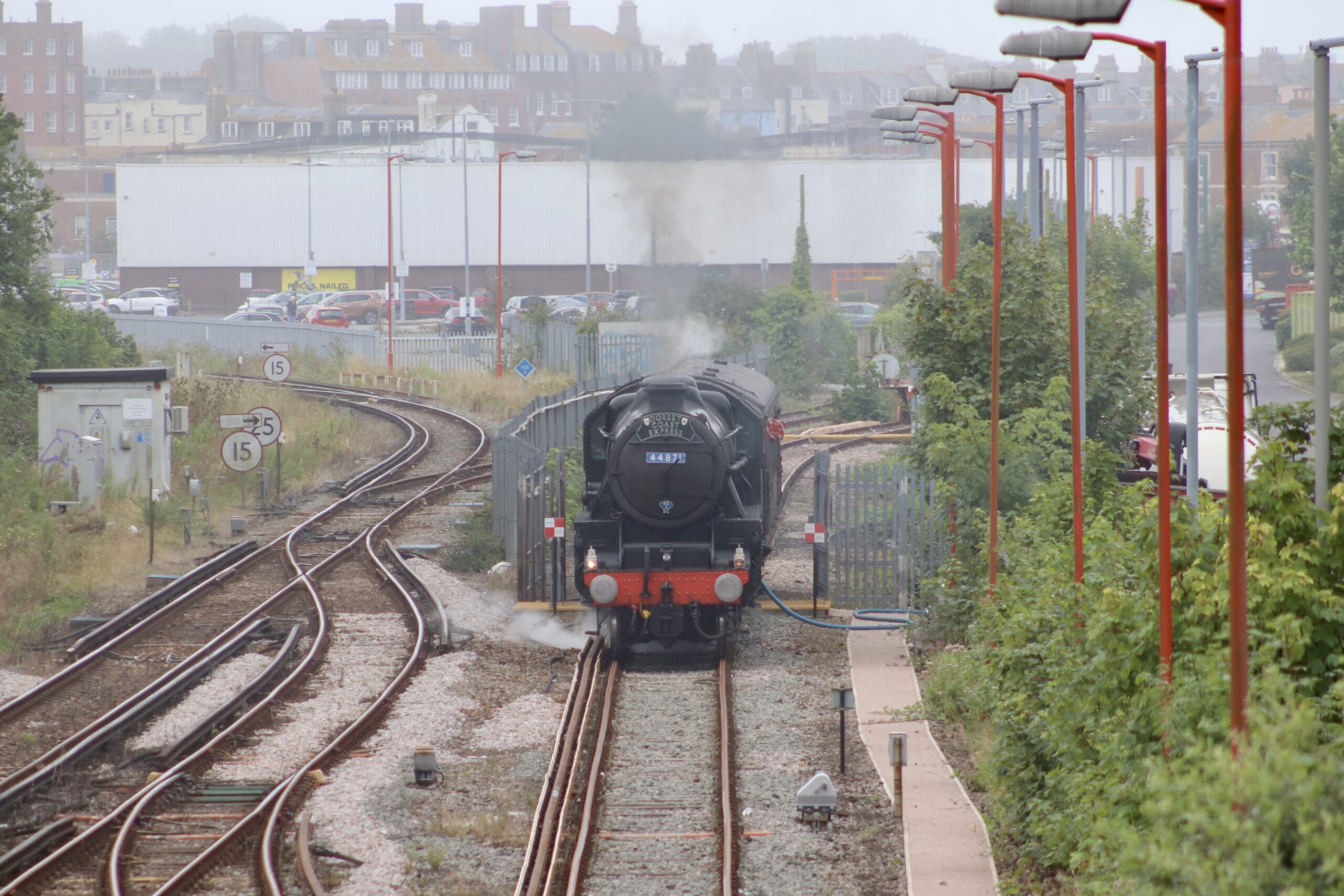
Following the arrival and shifting into the sidings of the “Northern Belle”, around an hour later we saw the arrival of The Railway Touring Company’s “The Dorset Coast Express” hauled into Weymouth by another WCRC locomotive, this time Class 47 No. 47848. This excursion, however, enjoyed the sight and sound of a steam locomotive on the return working in the form of London Midland Scottish (LMS) Stanier Class 5 No. 44871. I stayed in Weymouth to watch the steam locomotive being serviced and the stock being shunted out to Jersey sidings to rest alongside that of the earlier arrival from Birmingham International.
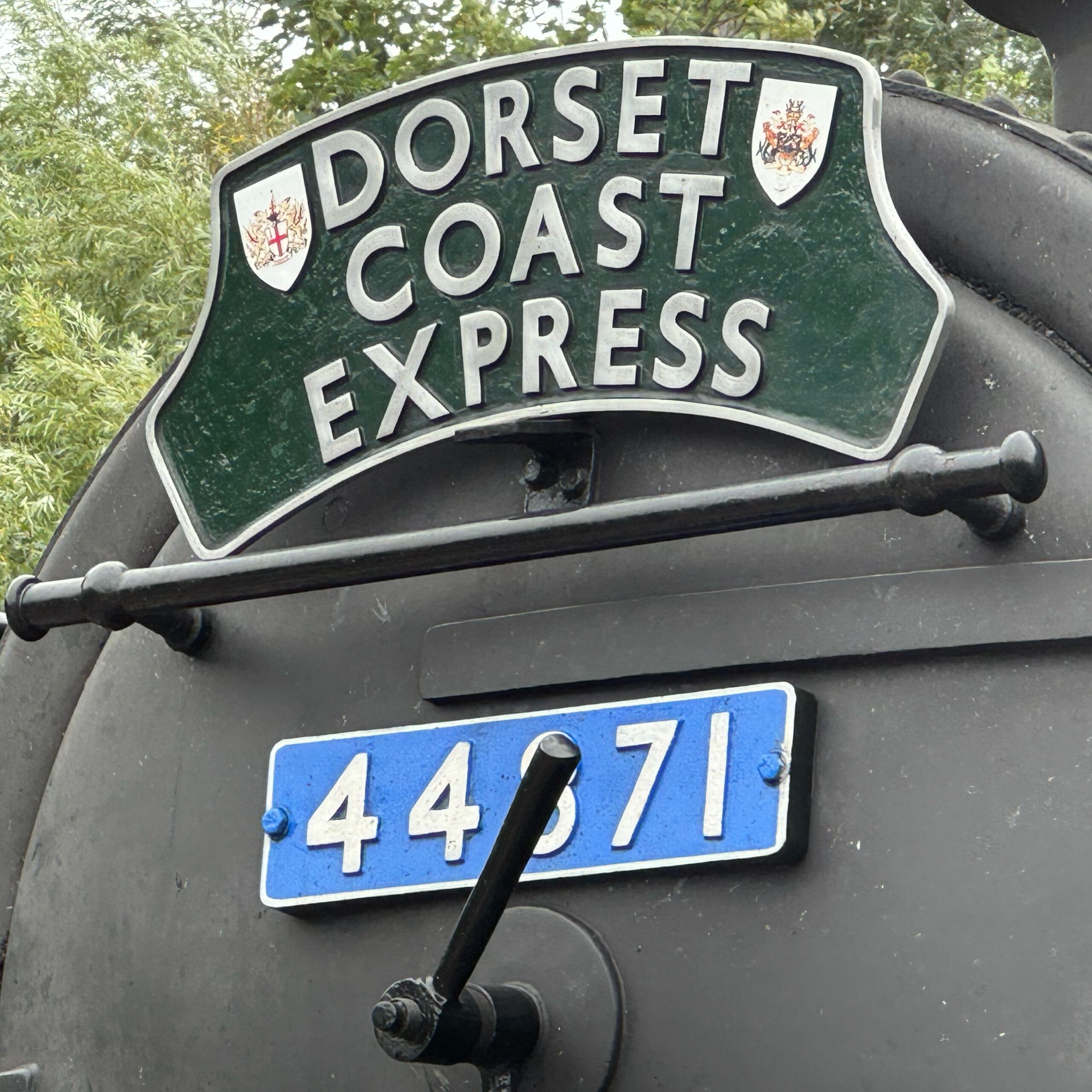
Class 57 No. 57313 ‘Scarborough Castle’ rests in Jersey Sidings, Weymouth with the ECS for The Northern Belle operated “Weymouth Harbour – The Dorset Coast” while Class 47 No. 47848 passes leading The Railway Touring Company’s “The Dorset Coast Express” 1Z91 0845 London Victoria to Weymouth – 15/08/2024LMS Stanier Class 5 4-6-0 No. 44871 in Jubilee Sidings, Weymouth awaiting coaling and watering in preparation for hauling “The Dorset Coast Express” to London Waterloo – 15/08/2024Close up of the “Dorset Coast Express” headboard carried by LMS Stanier Class 5 4-6-0 No. 44871 – 15/08/2024LMS Stanier Class 5 4-6-0 No. 44871 in Jubilee Sidings – 15/08/2024Class 57 No. 57313 ‘Scarborough Castle’ with Class 47 No. 47848 alongside in Jersey Sidings, Weymouth – 15/08/2024
For the return steam hauled “Dorset Coast Express”, I opted for Parkstone bank. I was disappointed with my photographic efforts, but the sound of the LMS Black 5 climbing the bank made it worthwhile all the same.
LMS Stanier Class 5 4-6-0 No. 44871 makes the climb to the top of Parkstone Bank at the head of “The Dorset Coast Express” 1Z96 1736 Weymouth to London Waterloo – 15/08/2024
Video from Thursday 15th August Railtours to / from Weymouth – 15/08/2024
17/08/2024 – “English Riviera Express”
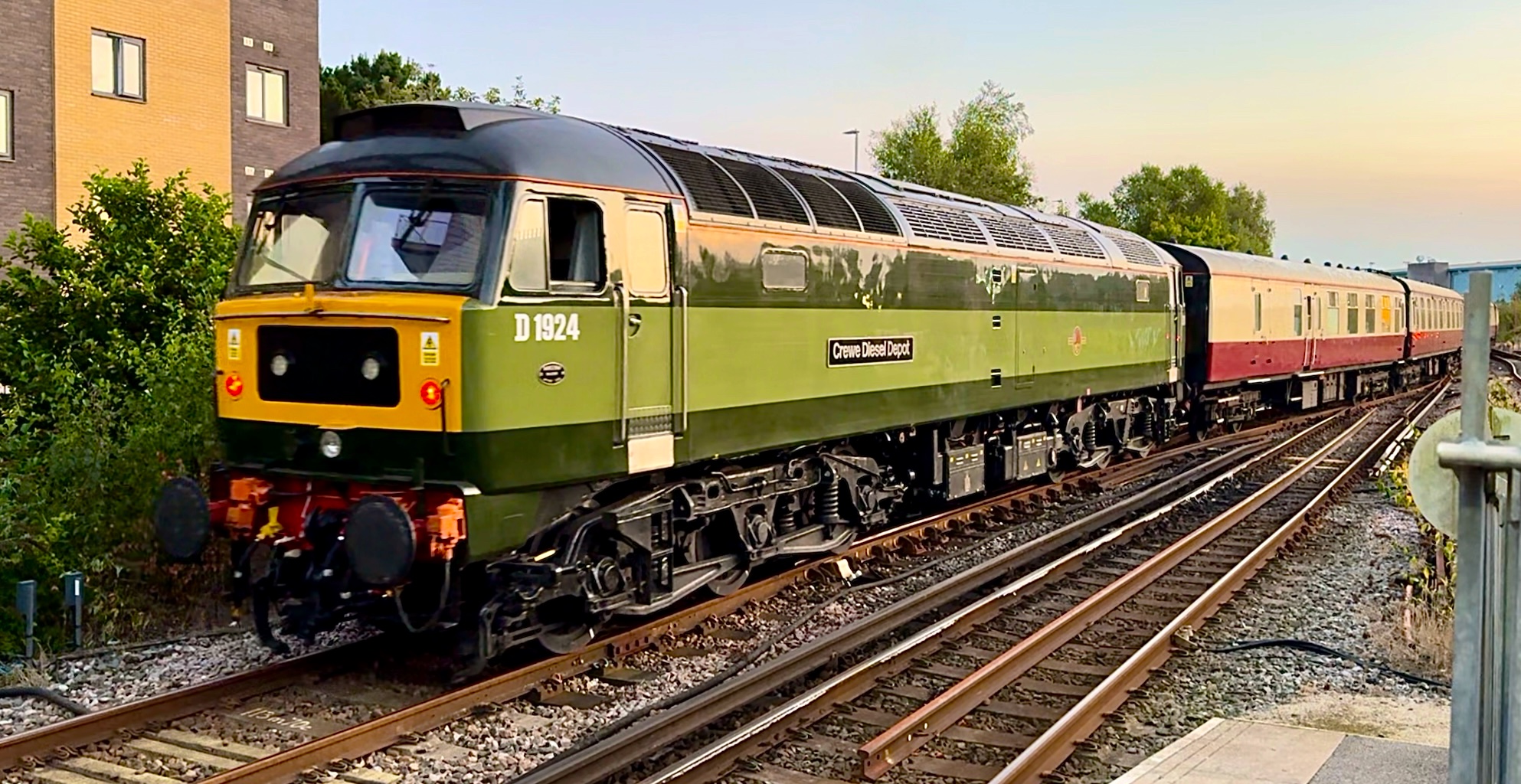
A couple of days after the Weymouth bound excursion trains, Locomotive Services Limited (LSL) Class 57 No. 57311 and Class 47 No. D1924 (47810) ‘Crewe Diesel Depot’ passed through Poole with the empty coaching stock for Saphos Trains “English Riviera Express” reporting as 3Z28 0432 Eastleigh Arlington (ZG) to Poole. The top and tail formation ran to Poole Storage Sidings before returning to platform 1 in order to pick up passengers who were off to Devon. The train departed with the Class 47 leading working 1Z29 0634 Poole to Kingswear (For Dartmouth). I declined popping out later in the day to see the return working, which was around an hour late back into Poole following a fatality further up the line.
Screenshot of LSL Class 57 No. 57311 passing through Poole with 3Z28 0432 Eastleigh Arlington (ZG) to Poole ECS 3Z28 0432 Eastleigh Arlington (ZG) to Poole (via Poole Storage Sidings) for Saphos Trains “English Riviera Express” – 17/08/2024Screenshot of Class 47 No. No. D1924 (47810) ‘Crewe Diesel Depot’ at the rear of the empty coaching stock for Saphos Trains “English Riviera Express” – 17/08/2024Having reversed at Poole Storage Sidings, Class 47 No. D1924 (47810) ‘Crewe Diesel Depot’ is now at the head of Saphos Trains “English Riviera Express” 1Z29 0634 Poole to Kingswear (For Dartmouth) – 17/08/2024
Video of Saphos Trains “English Riviera Express” departing Poole – 17/08/2024
19/08/2024 – Track Recording Unit (TRU) at Yeovil
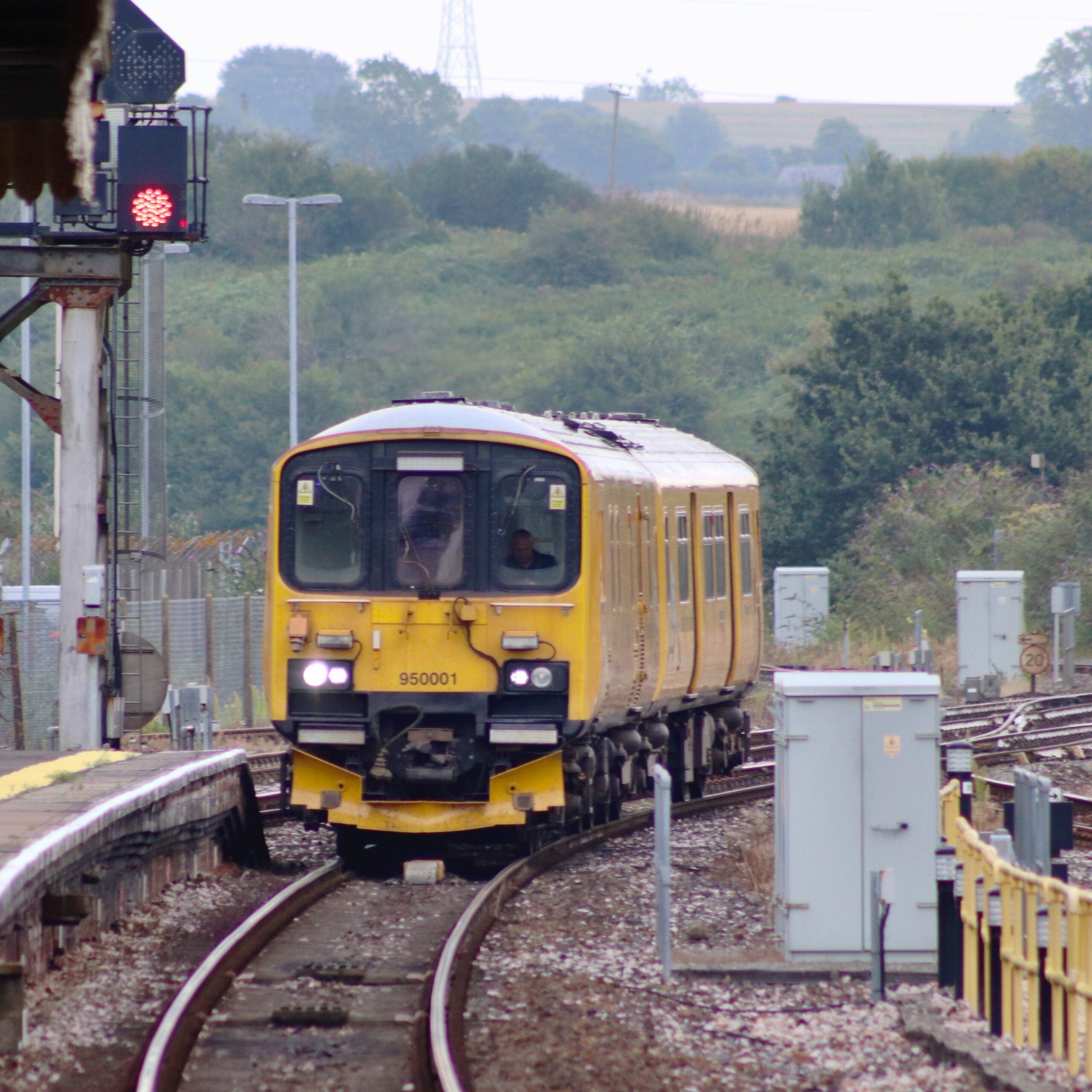
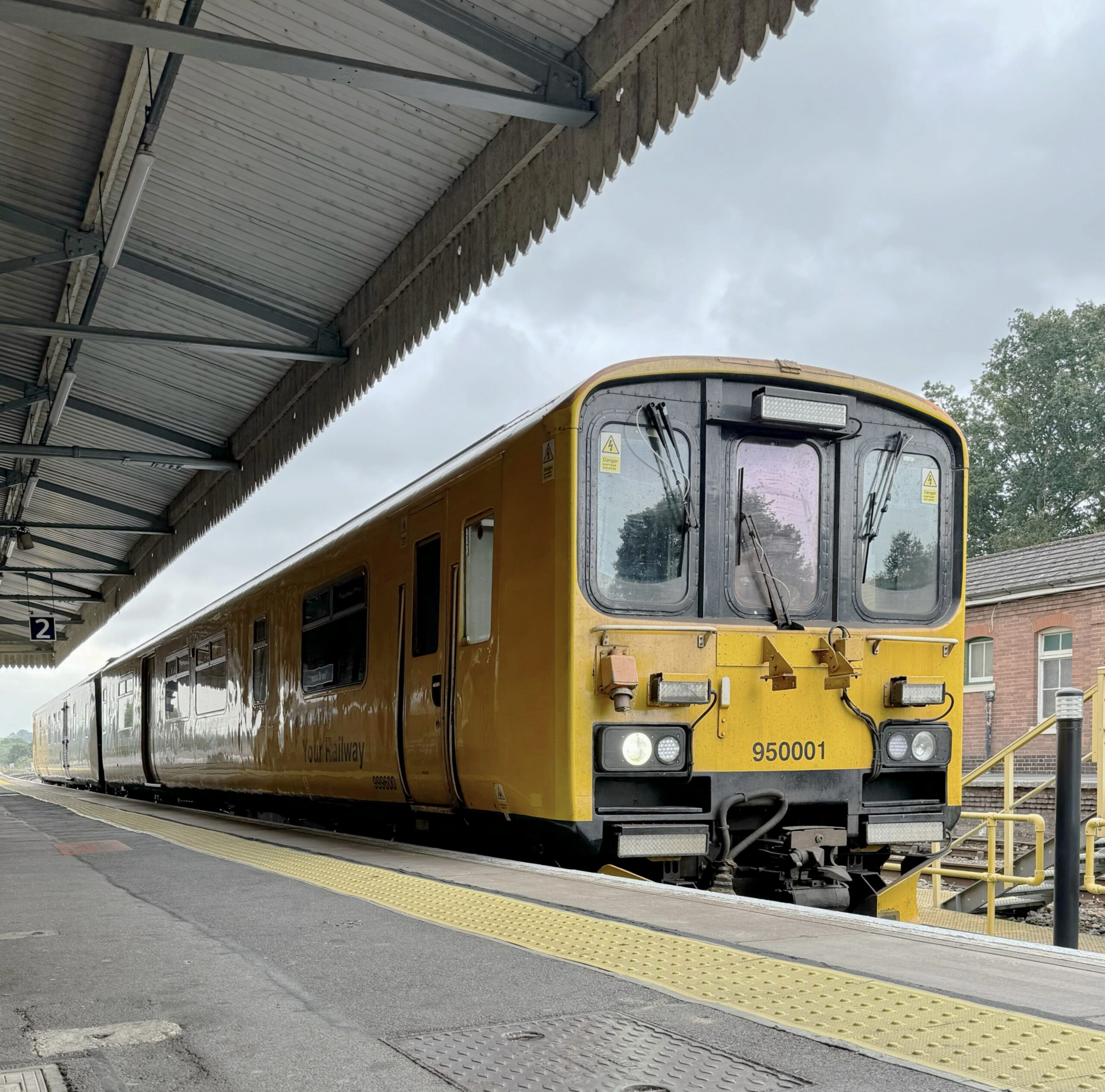
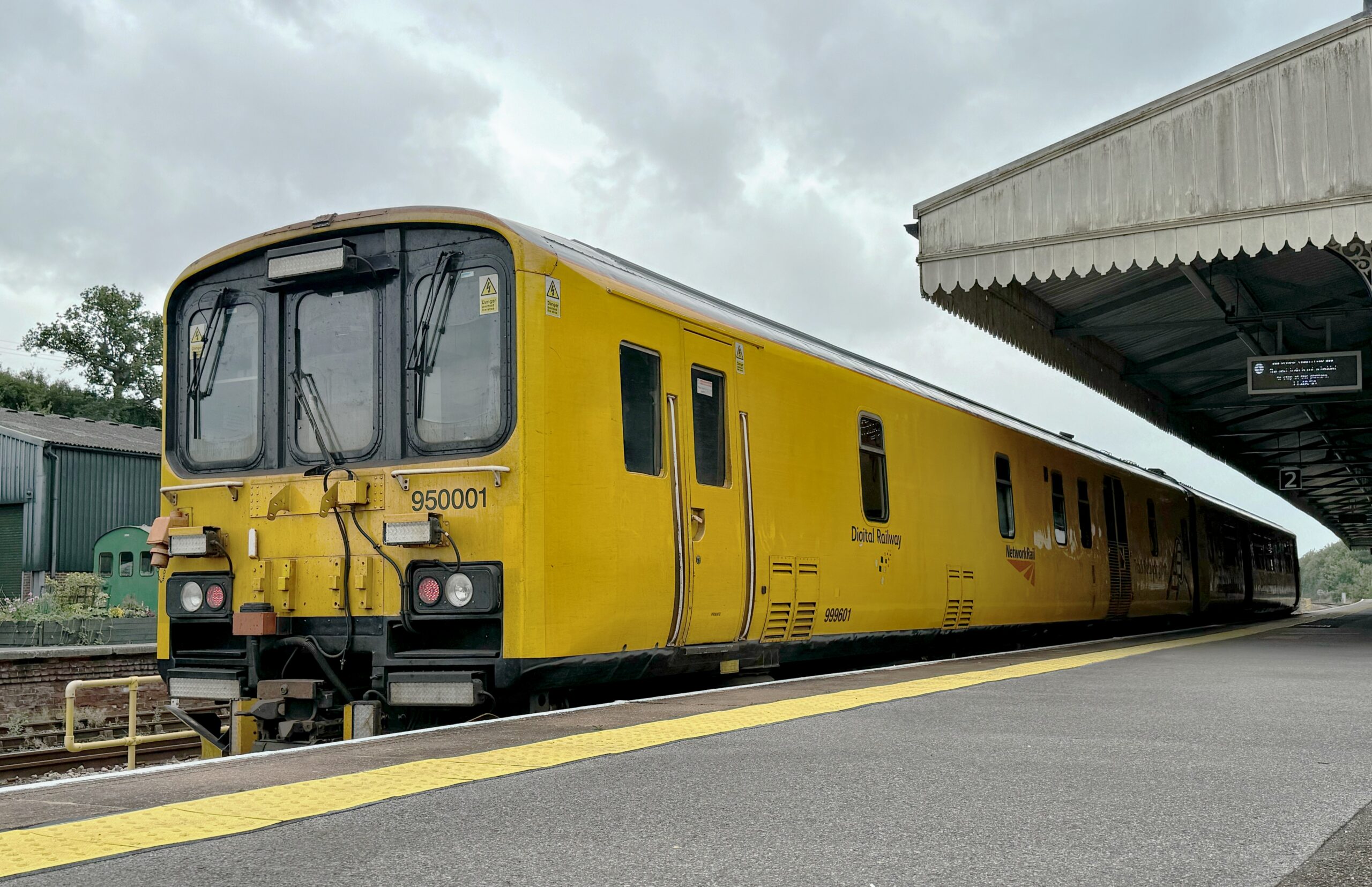
Monday 19th August and we had a little trip just over the border into Somerset so I could see the Network Rail Track Recording Unit No. 950001. I’ve not seen this purpose-built unit previously, so took the opportunity while it was passing reasonably close to us on its way to Devon and Cornwall.
Owned and operated by Network Rail, the Track Recording Unit (TRU) was built by British Rail Engineering Limited’s Holgate Road carriage works in York during 1987 for the British Rail Research Division for use as a track assessment unit. It utilised the final class 150/1 from the original batch built at York. The TRU is formed of two driving motor vehicles, numbered 999600 and 999601 and is designed to monitor and record track geometry. On Monday August 19th 2024, No.950001 worked 2Q08 0352 Derby RTC (Network Rail) to Plymouth. I had planned on seeing the TRU trundle through Yeovil Pen Mill, however because of road traffic delays and the train running 16 minutes early on departure from Castle Cary, I instead opted for Yeovil Junction. The unit was held in the station to allow a late running passenger service to make headway on the single line section west of Yeovil Junction. The driver took the opportunity to visit the buffet on platform 2, hence stopping the train short of the signal, catching me out! The unit is currently painted in a plain overall yellow livery with Network Rail branding. It mostly works on branch lines, where the track quality is not good enough for larger and heavier track assessment stock. It is able to operate over most railway lines around Great Britain. The unit is based at the Railway Technical Centre in Derby.
Network Rail’s Class 150 Track Recording Unit No. 950001 working 2Q08 0352 Derby RTC (Network Rail) to Plymouth arrives at Yeovil Junction – 19/08/2024Network Rail’s Class 150 Track Recording Unit No. 950001 working 2Q08 0352 Derby RTC (Network Rail) to Plymouth awaits the “Off” at Yeovil Junction – 19/08/2024Network Rail’s Class 150 Track Recording Unit No. 950001 working 2Q08 0352 Derby RTC (Network Rail) to Plymouth at Yeovil Junction – 19/08/2024
Video of Network Rail’s Class 150 Track Recording Unit No. 950001 working 2Q08 0352 Derby RTC (Network Rail) to Plymouth at Yeovil Junction – 19/08/2024
20/08/2024 – Balfour Beatty Class 20’s to Eastleigh
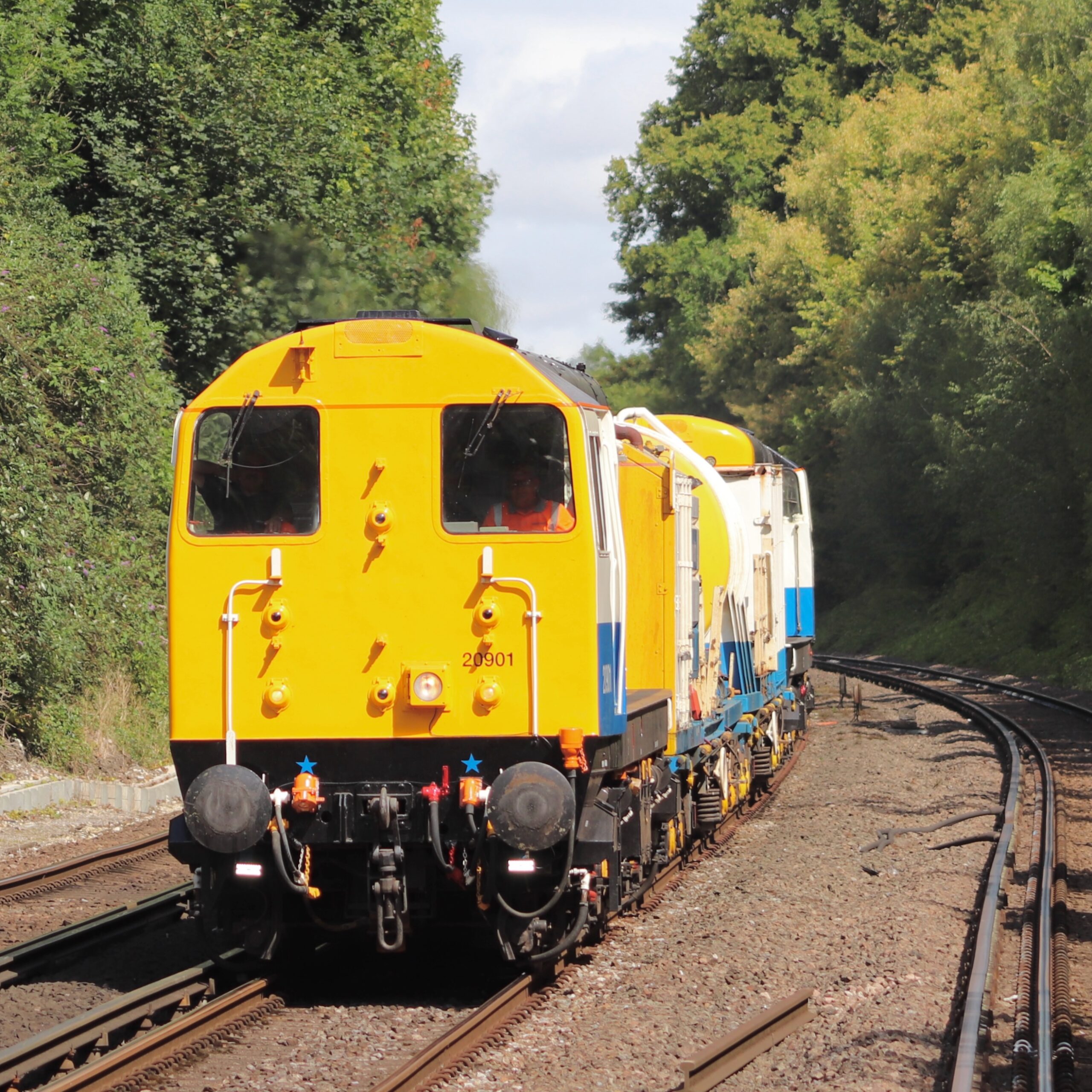
Much excitement was generated on the enthusiasts grapevine recently when it was discovered two Class 20 locomotives were being dispatched to Woking, following their use in Scotland, as cover for unavailable motive power for the “drain train”. The move which was carried out on the 12th/13th August was well covered and I considered making the journey up to Woking Yard the following Saturday in the hope of photographing the Balfour Beatty liveried Class 20’s No. 20901 & 20905 where they were being stabled since their arrival. I’m pleased I held off as the internet railgen was buzzing again when the pair were diagrammed to run from Woking to Eastleigh and back on Tuesday 20th August reporting as 6J09 1100 Woking Up Yard Reception to Woking Up Yard Reception. This was too much of a temptation for me, and I set off for Shawford to capture the outward and return runs. Despite a few spots of rain, the sun shone when the Class 20’s appeared on their outward run.
Class 20 No. 20901 leads on 6J09 1100 Woking Up Yard Reception to Woking Up Yard Reception approaching Shawford on the outward leg to Eastleigh – 20/08/2024Balfour Beatty liveried Class 20 No.’s 20905 and 20901 at Shawford working 6J09 1100 Woking Up Yard Reception to Woking Up Yard Reception having reversed at Eastleigh – 20/08/2024
Video of Balfour Beatty liveried Class 20 No.’s 20901 and 20905 passing Shawford operating 6J09 1100 Woking Up Yard Reception to Woking Up Yard Reception – 20/08/2024
24/08/2024 – “Dorset Coast Statesman”
Saturday 24th August 2024 saw Statesman Rail run a railtour from Nantwich to Weymouth initially top and tailed by two Locomotive Services Limited Class 47 diesel locomotives No.’s 47805 ‘Roger Hosking MA 1925-2013’ and 47593 ‘Galloway Princess’. The train named the “Dorset Coast Statesman” experienced problems with 47593 leading on the outbound journey which forced a change of route in the Newport area so the train could turn and 47805 could lead. This configuration is how I saw the train passing through Branksome in the pouring rain.
Class 47 No. 47805 ‘Roger Hosking MA 1925-2013’ rounds the curve leading into Branksome at the head of the “Dorset Coast Statesman” 1Z48 0416 Nantwich to Weymouth – 24/08/2024Class 47 No. 47805 ‘Roger Hosking MA 1925-2013’ passing Branksome in the rain hauling the “Dorset Coast Statesman” 1Z48 0416 Nantwich to Weymouth – 24/08/2024 LSL’s Class 47 No. 47593 ‘Galloway Princess’ disappears through the road bridge situated at the country end of Branksome railway station at the rear of the “Dorset Coast Statesman” 1Z48 0416 Nantwich to Weymouth. This locomotive carries “The Statesman” headboard as before developing motive power issues she was leading on departure from Nantwich. The train was reversed in the Newport area to allow No. 47805 to lead – 24/08/2024
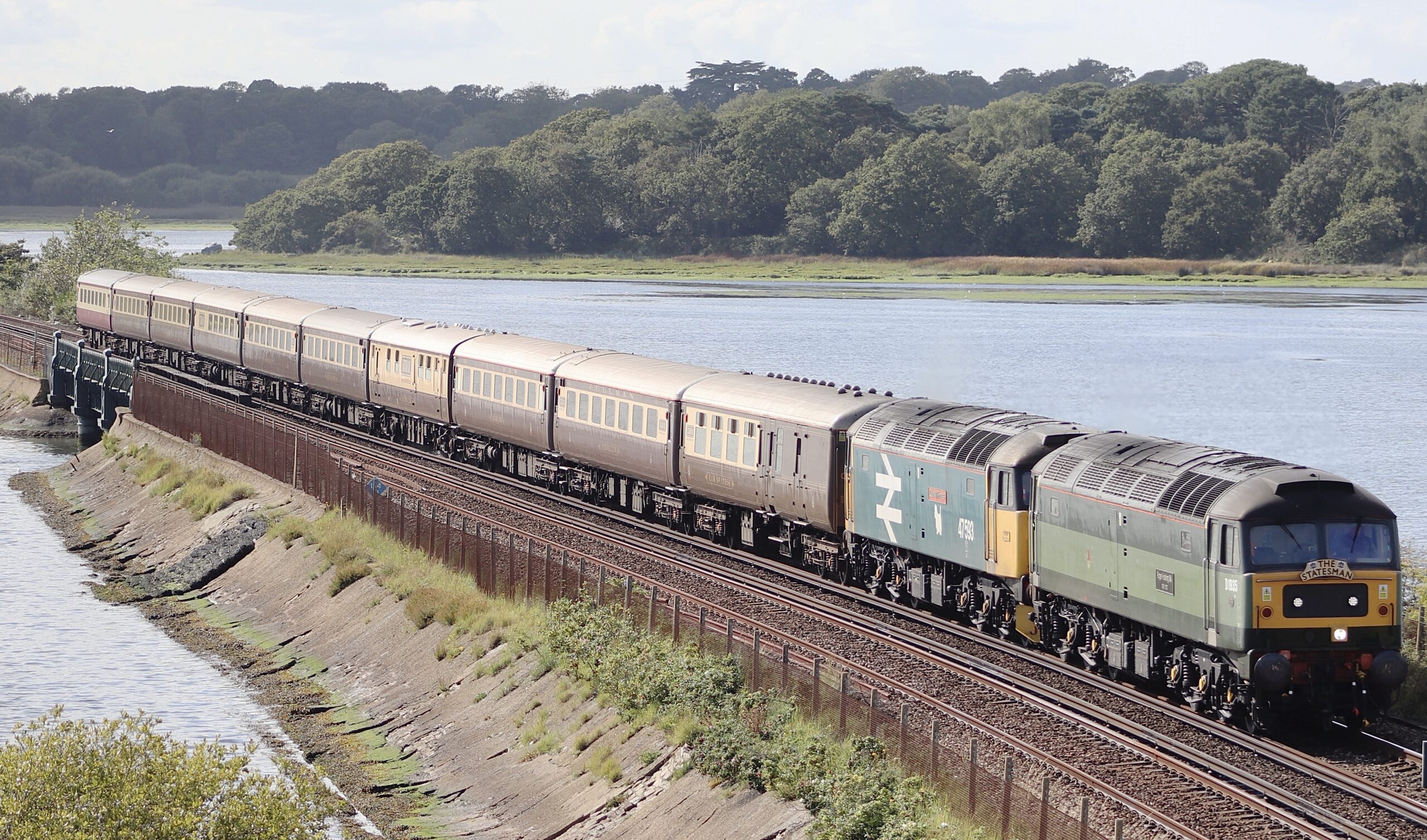
For the return journey from Weymouth to Nantwich, the train was rearranged and both Class 47’s were marshalled to the front of the carriages and the train departed double-headed. I went to Holes Bay to see the “Statesman” pass over the causeway. As I was driving back towards Poole, I noticed the train was standing in the station, so pulled into the car park area behind the down platform and was able to get a bonus shot of the “Dorset Coast Statesman” pulling away. Hurrah!
Class 47 No.’s 47805 ‘Roger Hosking MA 1925-2013’ and 47593 ‘Galloway Princess’ cross the Holes Bay causeway, Poole with the return “Dorset Coast Statesman” 1Z49 1537 Weymouth to Nantwich – 24/08/2024The train was held at Poole which enabled me to get another shot of the pair of Class 47’s with No. 47805 ‘Roger Hosking MA 1925-2013’ leading No. 47593 ‘Galloway Princess’ on 1Z49 1537 Weymouth to Nantwich – 24/08/2024
Video of “The Dorset Coast Statesman” in Dorset – 24/08/2024
26/08/2024 – Network Rail Plain Line Pattern Recognition Train
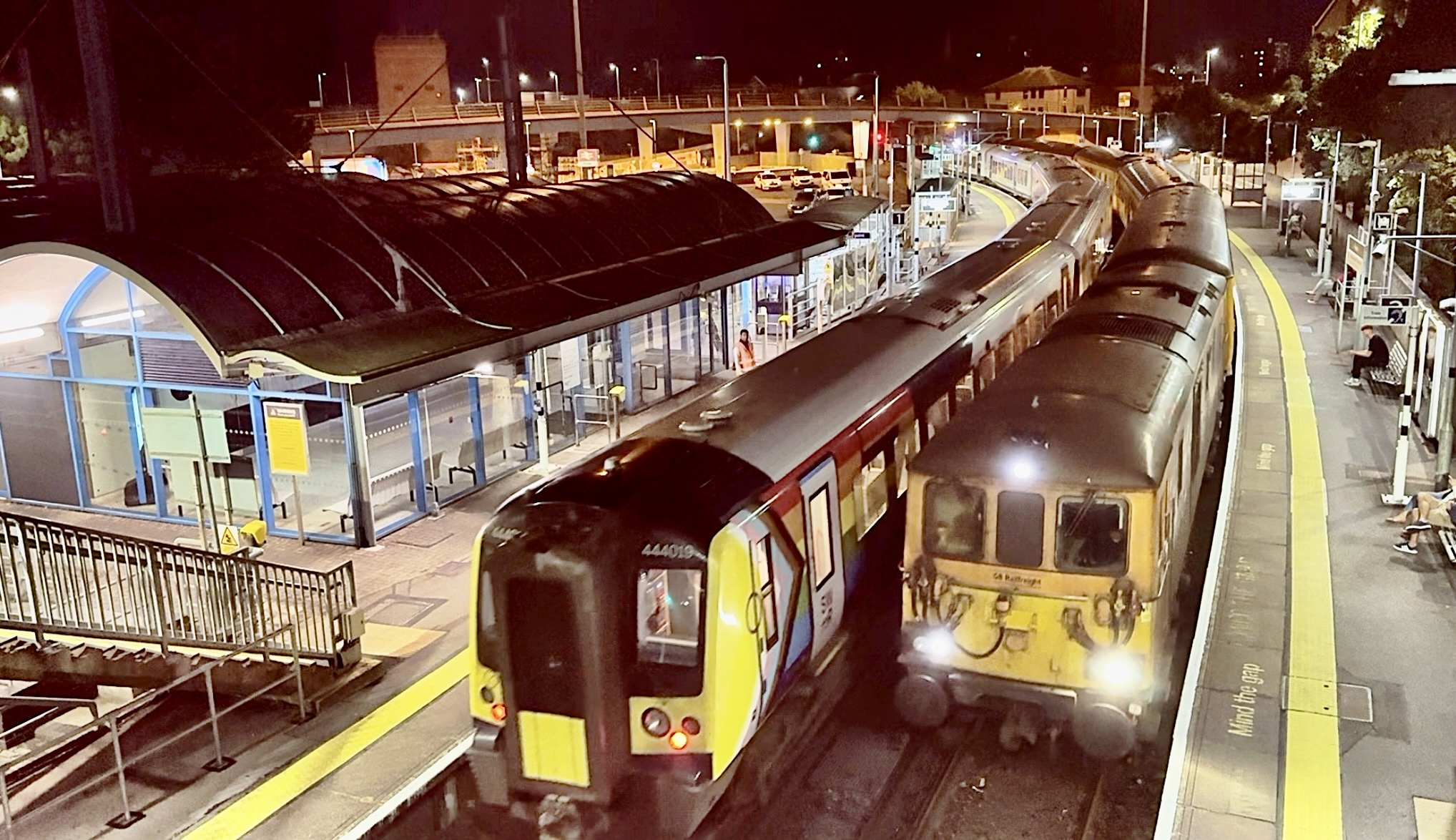
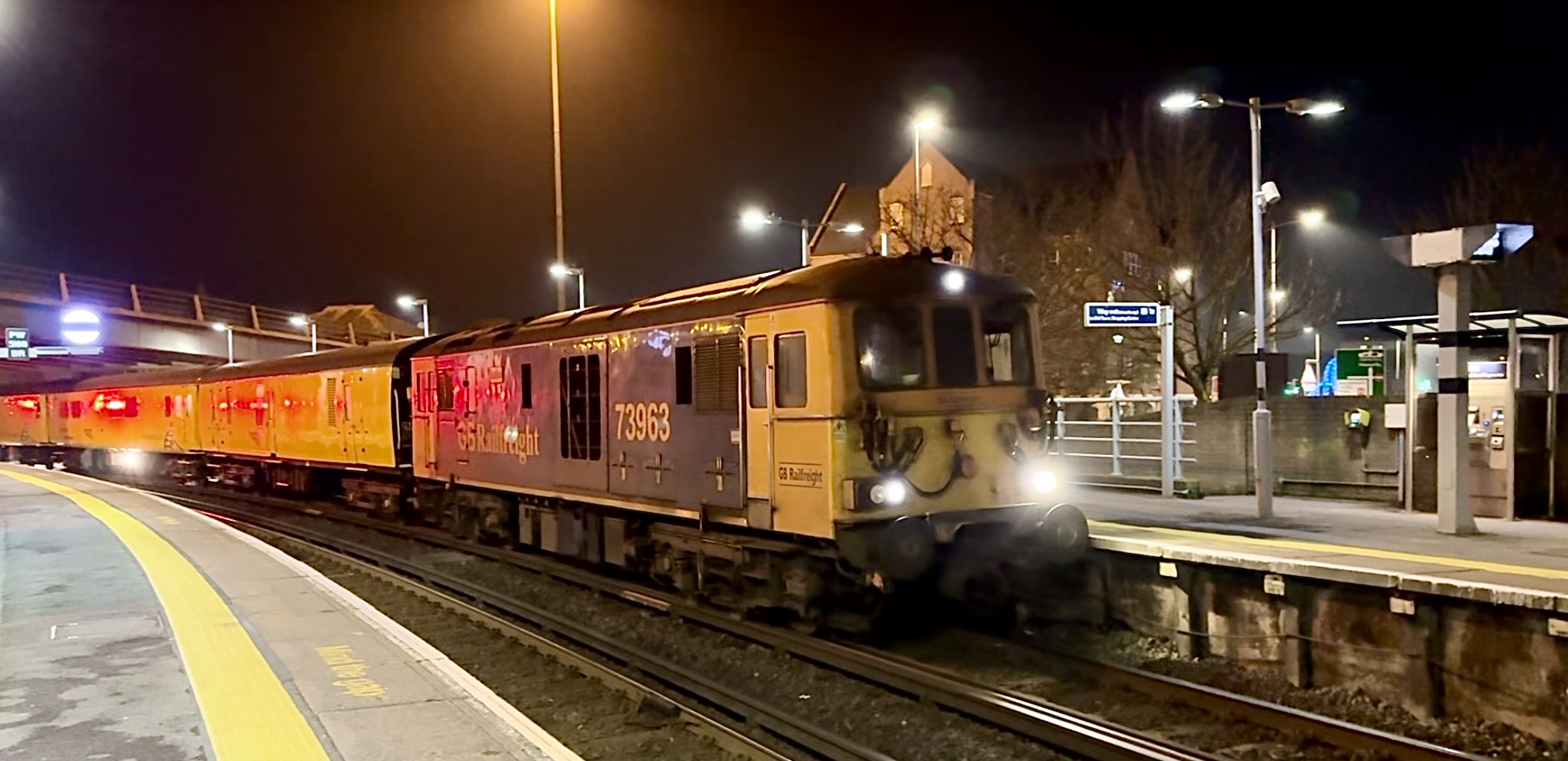
The regular monthly Plain Line Pattern Recognition (PLPR) train ran on August Bank Holiday Monday, top and tailed by GBRf Class 73/9 electro-diesel locomotives No. 73963 ‘Janice’ and 73962 ‘Dick Mabbutt’. I saw the train reporting as 1Q51 1115 Derby R.T.C.(Network Rail) to Eastleigh East Yard passing through Poole on the outward leg to Weymouth in what was a busy ten minutes of activity with SWR Desiro EMU’s coming and going.
Screenshot of GBRf Class 73/9 electro-diesel locomotives No. 73963 ‘Janice’ and 73962 ‘Dick Mabbutt’ working 1Q51 1115 Derby R.T.C.(Network Rail) to Eastleigh East Yard at Poole passing South Western Railway Class 444 No. 444019 forming 5W80 2026 Weymouth to Bournemouth T&RSMD – 26/08/2024Screenshot of GBRf Class 73/9 electro-diesel locomotive No. 73962 ‘Dick Mabbutt’ at the rear of 1Q51 1115 Derby R.T.C.(Network Rail) to Eastleigh East Yard at Poole – 26/08/2024
Plain Line Pattern Recognition uses a variety of tools to measure and detect defects and potential problems that might arise in track condition. PLPR uses equipment such as: 4 foot camera used to check the track condition, thermal imaging to check rail temperature, fasteners are checked with diagonal and top down cameras. The various cameras used store HD laser scanned images which show different angles and planes of the track and rails. PLPR was initially rolled out on the NMT measurement train, but has since been fitted to Network Rail’s coaches and can be seen across the UK rail network. PLPR trains often use class 1 headcode, 1Qxx. If you use Rail Record live train times, it will show you that it is a test train in the service description once activated. The train service code (TSC) for PLPR is usually 52495111 or 52495113.
1Q51 1115 Derby R.T.C.(Network Rail) to Eastleigh East Yard at Poole – 26/08/2024
28/08/2024 – Class 458 Unit Drags to and from Bournemouth T&RSMD
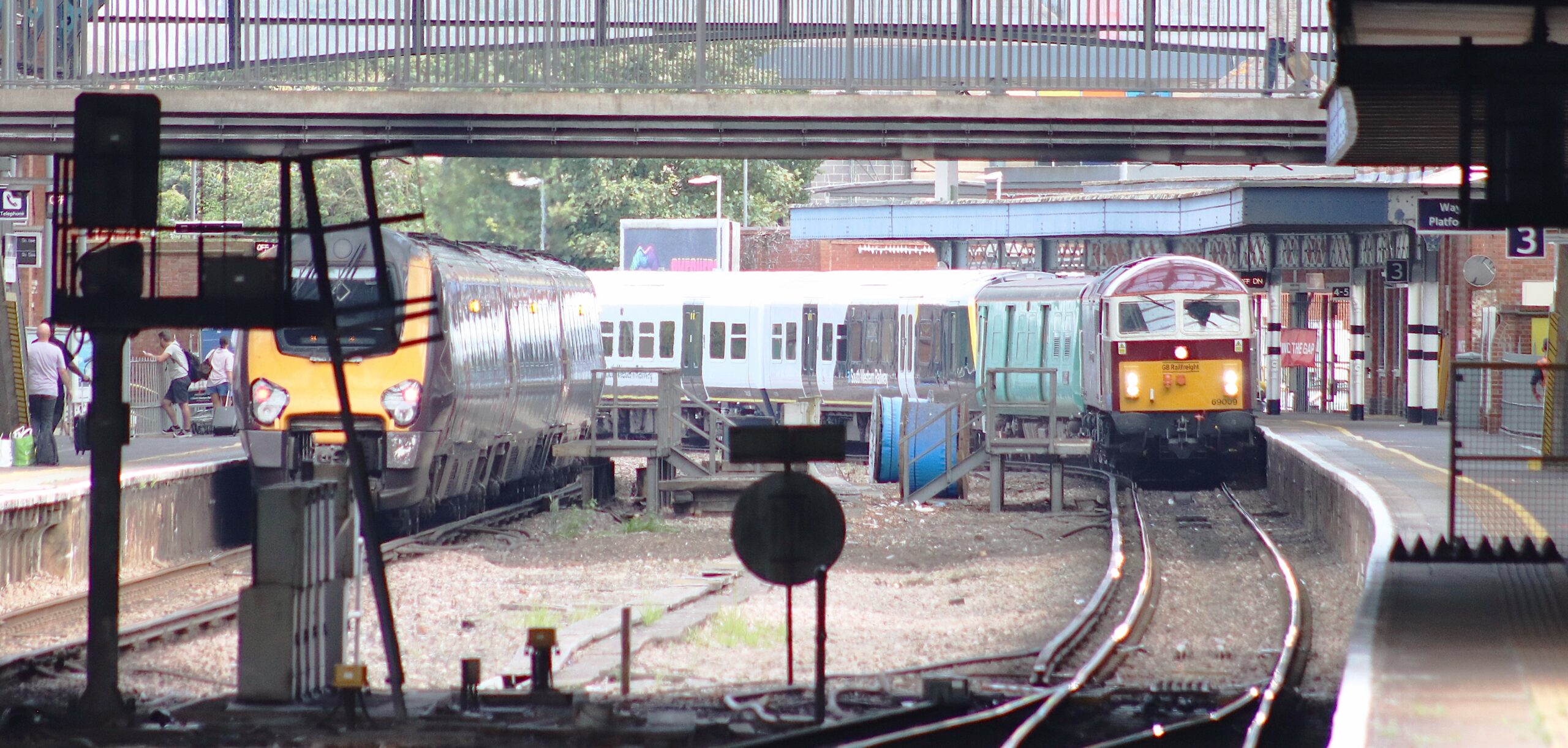
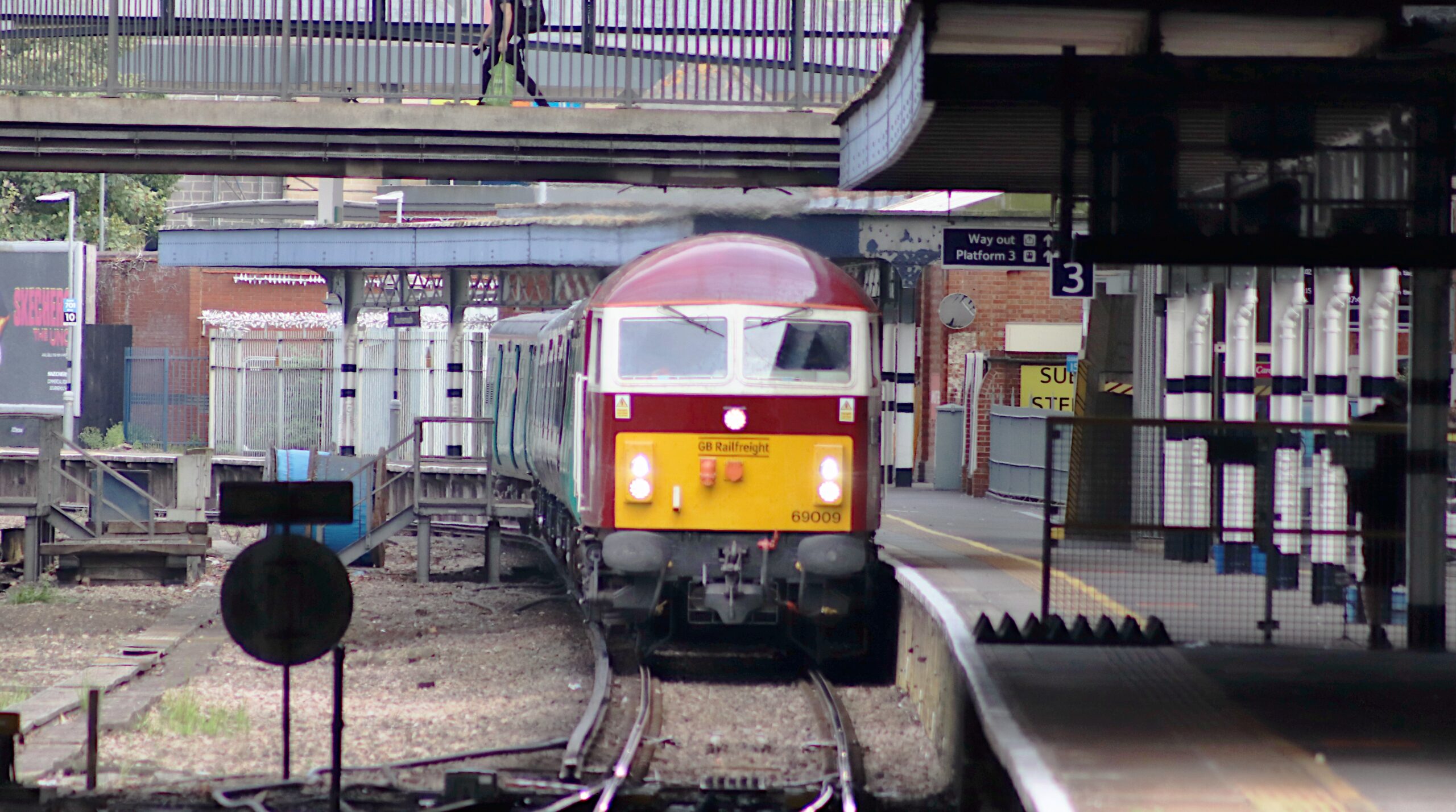
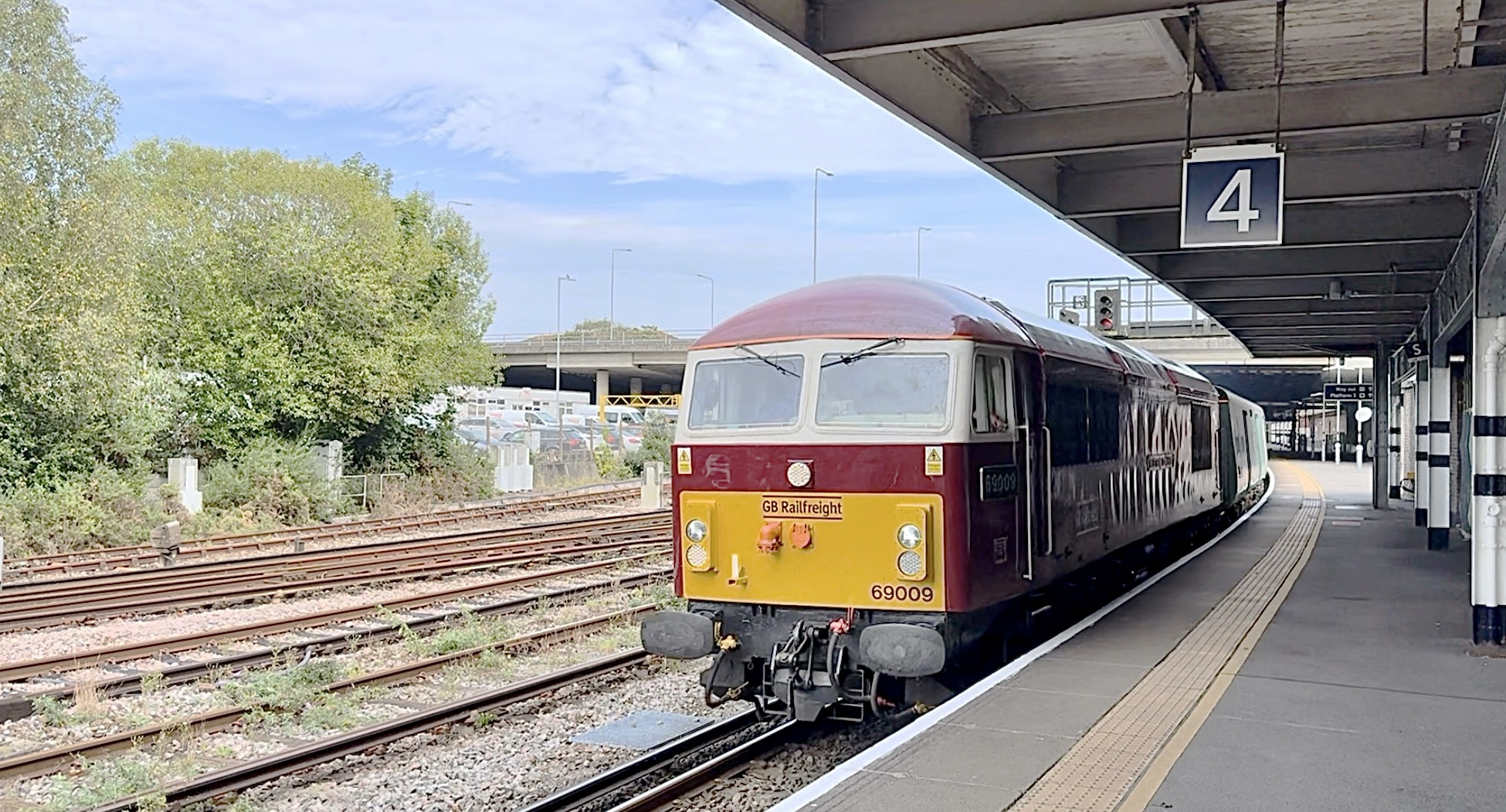
While a CrossCountry Voyager and South Western Railway Desiro EMU’s come and go, refurbished SWR Class 458/4 arrives ‘down South’ after conversion work at Widnes Transport Tech as GBRf Class 69 No. 69009 ‘Western Consort’ hauls unit No. 458418 through Bournemouth station on its way to Bournemouth depot. Later on, the same locomotive makes a return trip setting off on the first leg with No. 458511 which will undergo refurbishment in Widnes. The train runs from Bournemouth Traincare depot to Poole Storage Sidings where the Class 69 runs around the train before propelling it back eastwards to Eastleigh.
GBRf Class 69 No. 69009 ‘Western Consort’ hauls SWR Class 458/4 No. 458418 through Bournemouth with 5Q64 1531 Southampton Central to Bournemouth T&RSMD while CrossCountry Voyager No. 220001 awaits departure with the !M66 Bournemouth to Manchester Piccadilly service – 28/08/2024GBRf Class 69 No. 69009 ‘Western Consort’ hauling SWR Class 458/4 No. 458418 passing Bournemouth with 5Q64 1531 Southampton Central to Bournemouth T&RSMD – 28/08/2024Screenshot of GBRf Class 69 No. 69009 ‘Western Consort’ with SWR Class 458/4 No. 458418 powering through Bournemouth working 5Q64 1531 Southampton Central to Bournemouth T&RSMD – 28/08/2024Screenshot of GBRf Class 69 No. 69009 ‘Western Consort’ with SWR Class 458/5 No. 458511 at Poole forming 5Z66 2018 Bournemouth T&RSMD to Eastleigh East Yard. The EMU is destined for refurbishment at Widnes Transport Tech – 28/08/2024GBRf Class 69 No. 69009 ‘Western Consort’ at Poole – 28/08/2024Screenshot GBRf Class 69 No. 69009 ‘Western Consort’ with SWR Class 458/5 No. 458511 passing back through Poole workiing 5Z66 2018 Bournemouth T&RSMD to Eastleigh East Yard – 28/08/2024
GBRf Class 69 No. 69009 ‘Western Consort’ performing haulage duties with SWR Class 458 EMU’s – 28/08/2024
31/08/2024 – 33111’s Last Running Day on the Swanage Railway
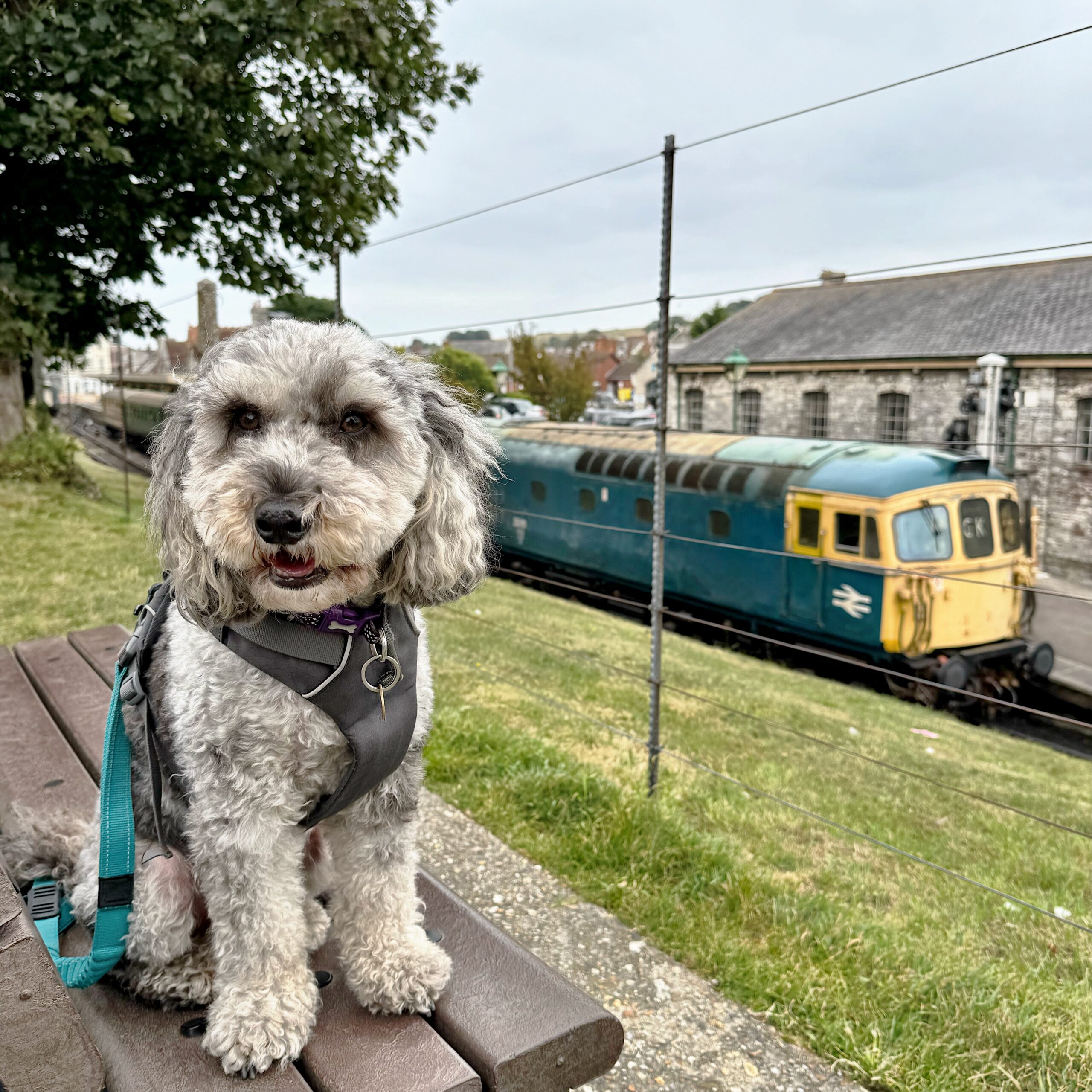
Yoshi says a fond au revoir to Class 33 No. 33111 at Swanage – 31/08/2024
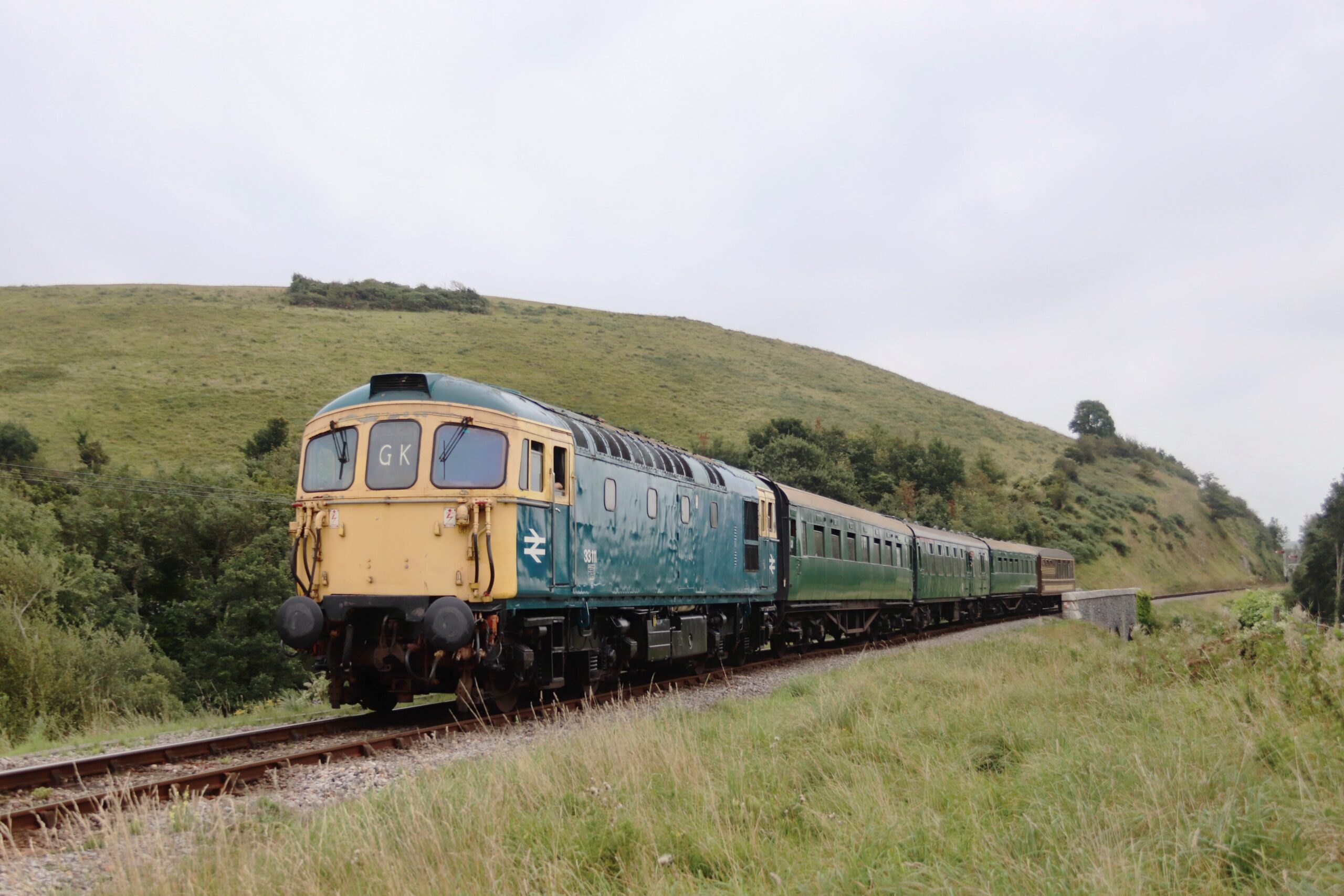
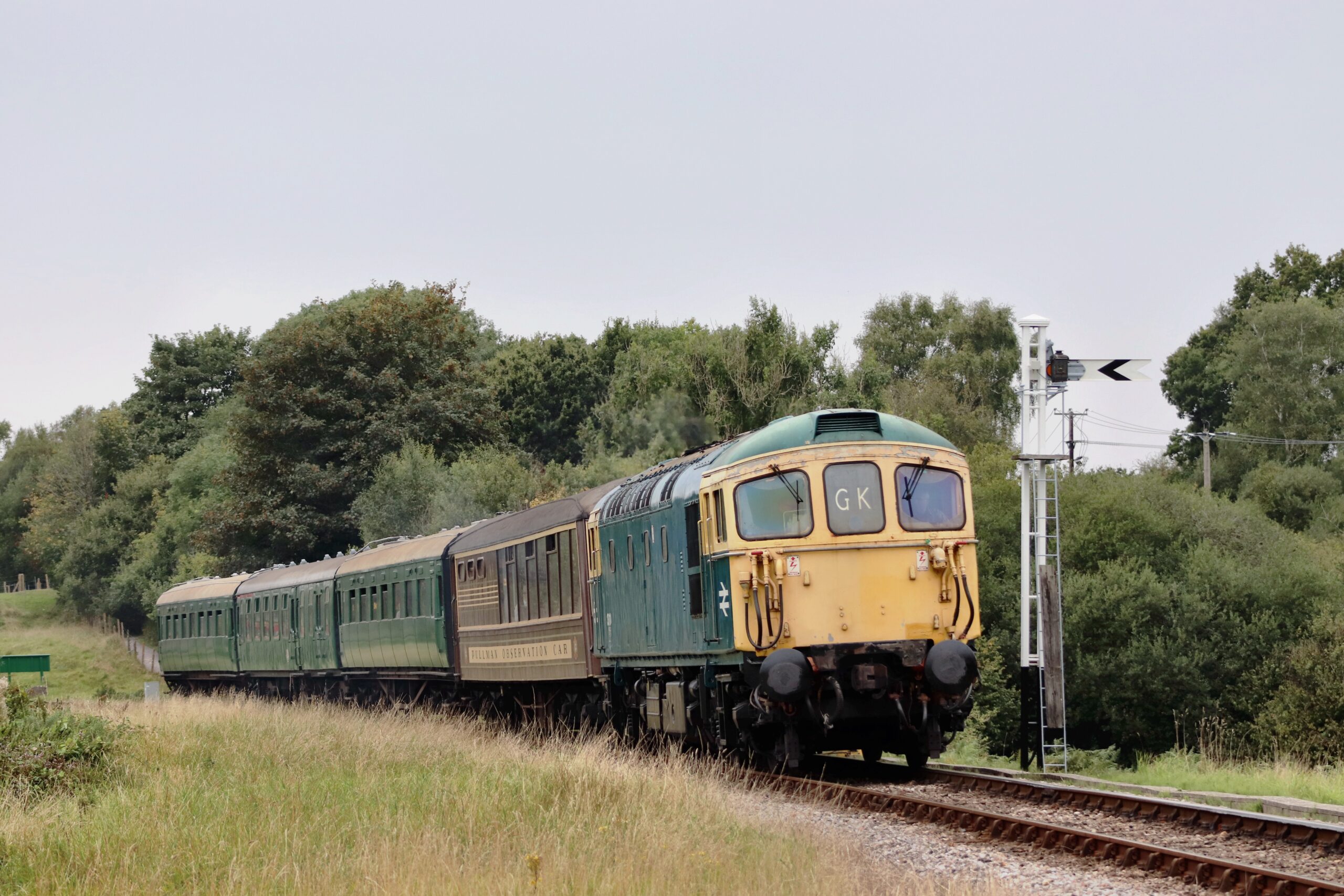
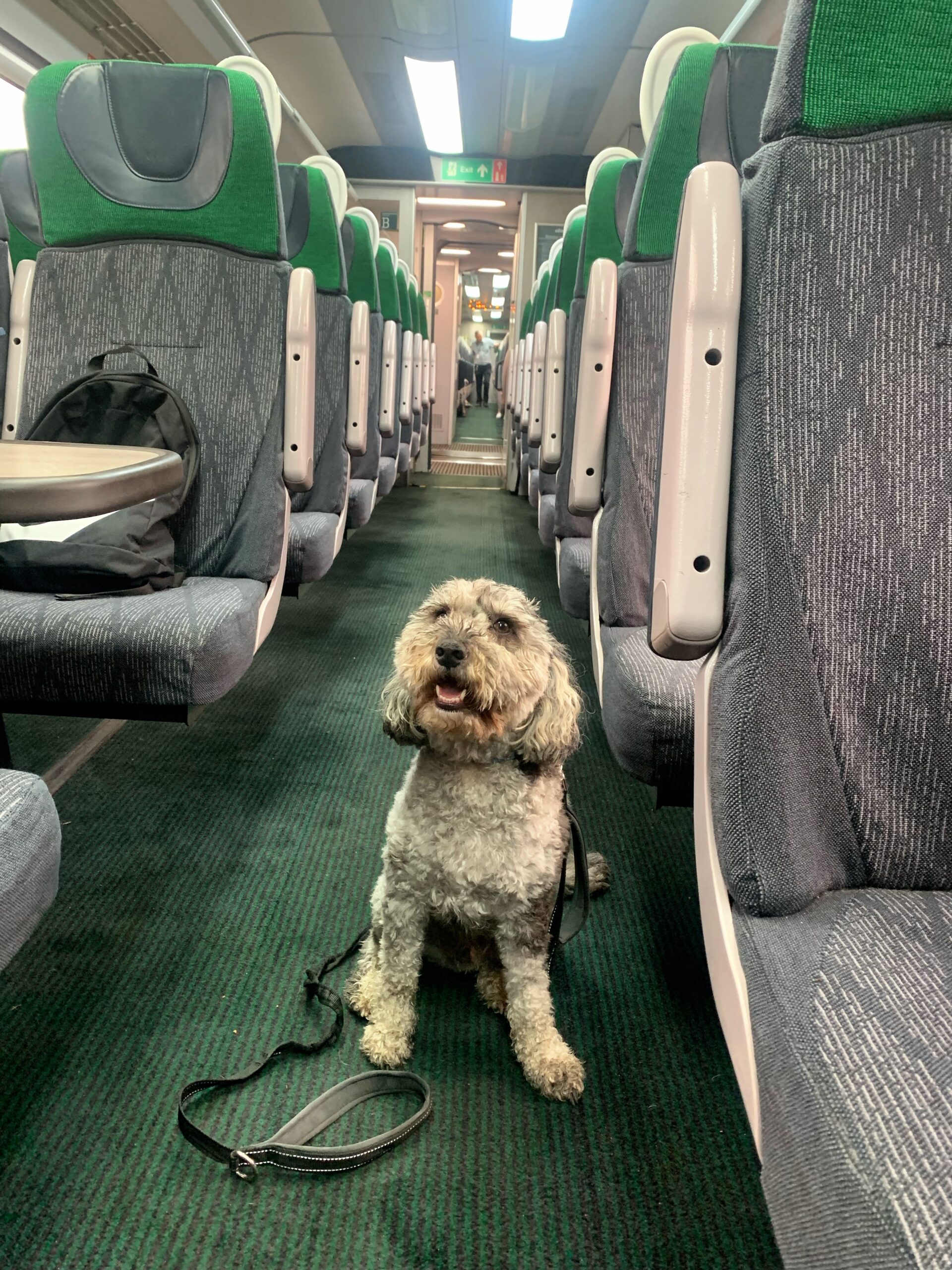
Announced as Swanage Railway resident BR&CW Class 33 Bo-Bo diesel-electric locomotive No. 33111’s last scheduled running day on the Purbeck heritage line for the foreseeable future, Yoshi and I spent the afternoon of 31st August barking at our favourite Crompton. The loco is off to The Bluebell Railway in West Sussex at the beginning of September. This will be followed by much-needed bodywork repairs and a fresh coat of paint being carried out at Barrow Hill meaning she will be away from Swanage for several months.
Swanage resident Class 33 No. 33111 on the approach to Norden having departed Corfe Castle on her last day of 2024 working trains at Swanage – 31/08/2024Class 33 No. 33111 on her way to Swanage at Castle View between Norden and Corfe Castle – 31/08/2024
Video of Class 33 No. 33111 from her last 2024 running day at Swanage – 31/08/2024
For The Record
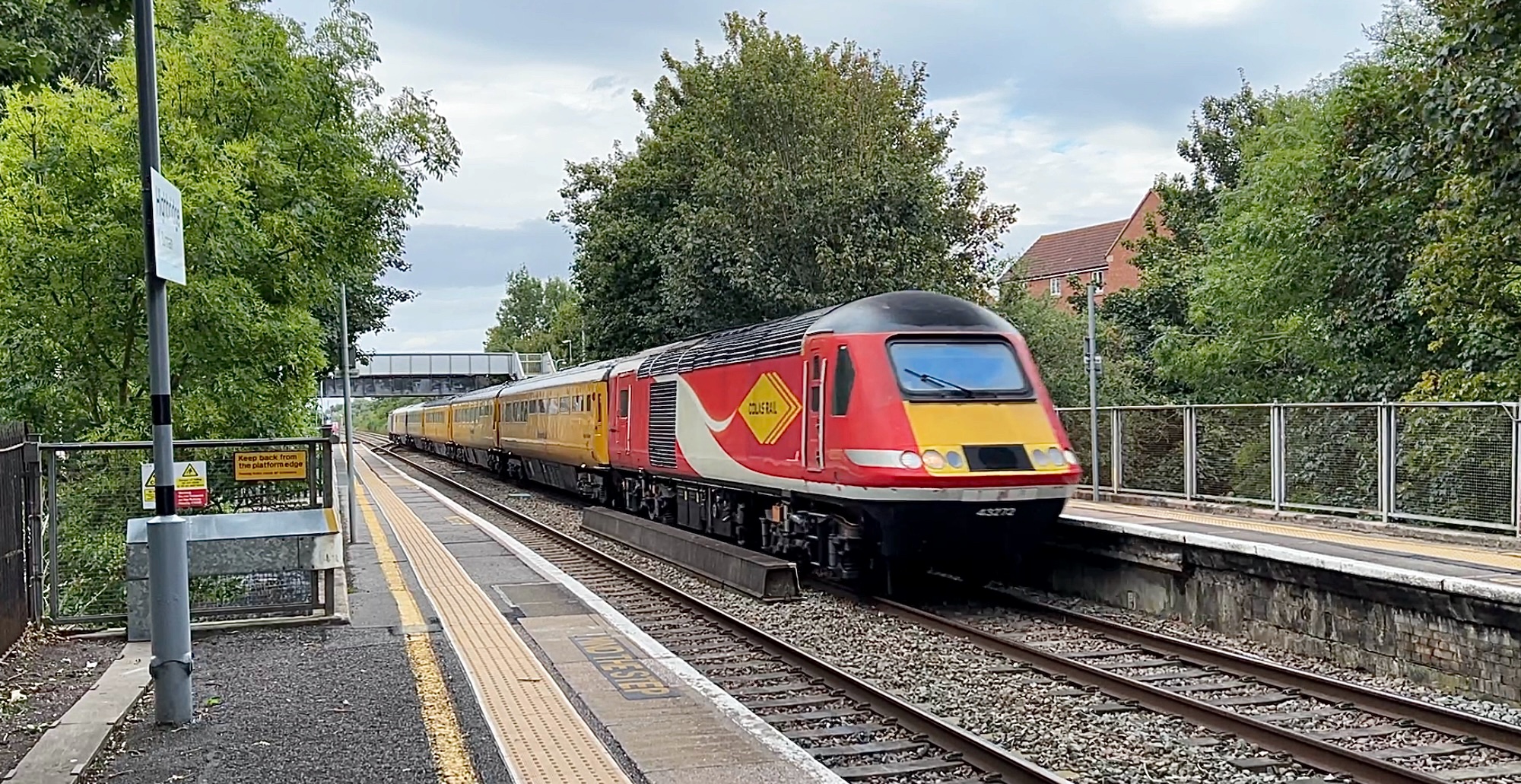
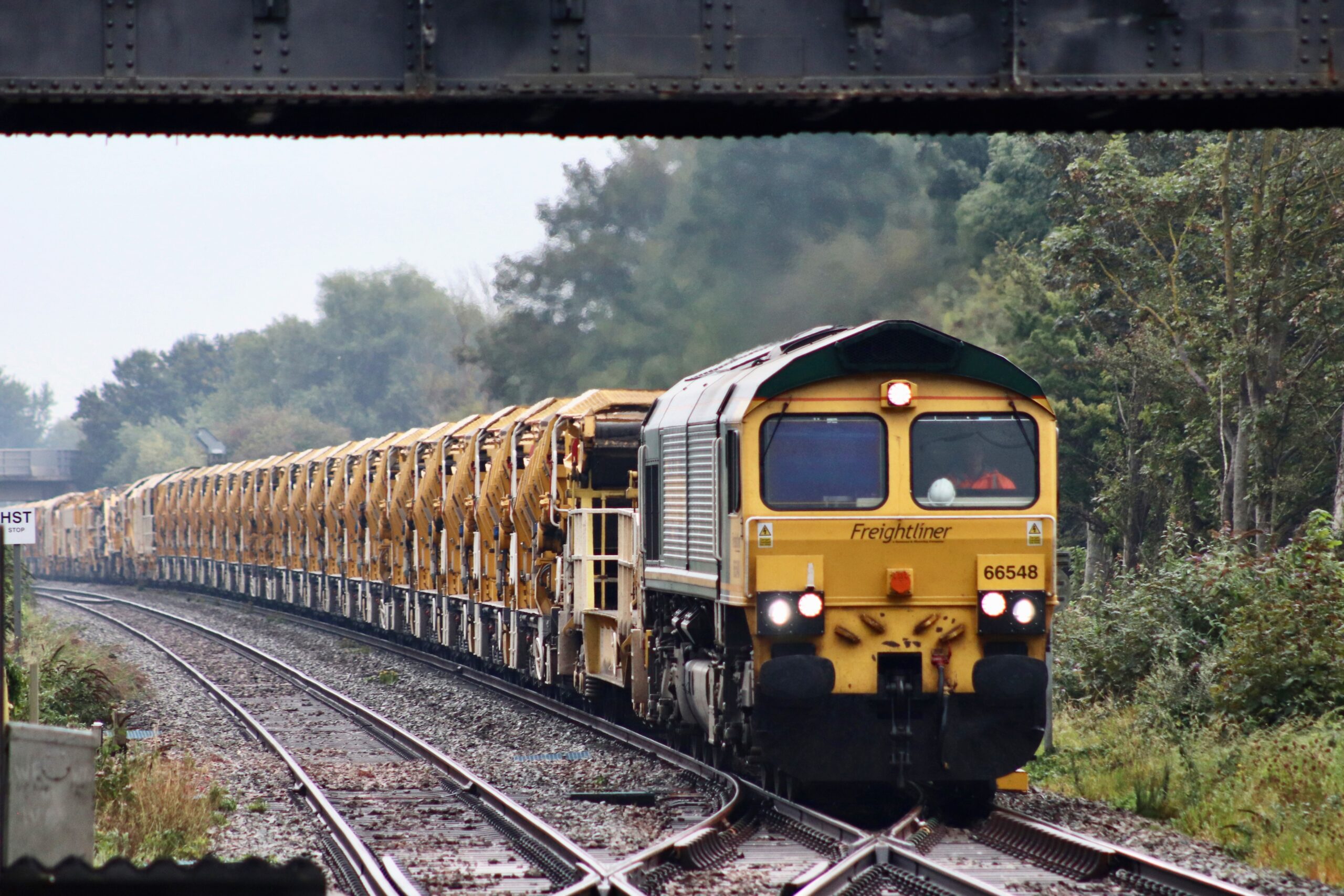
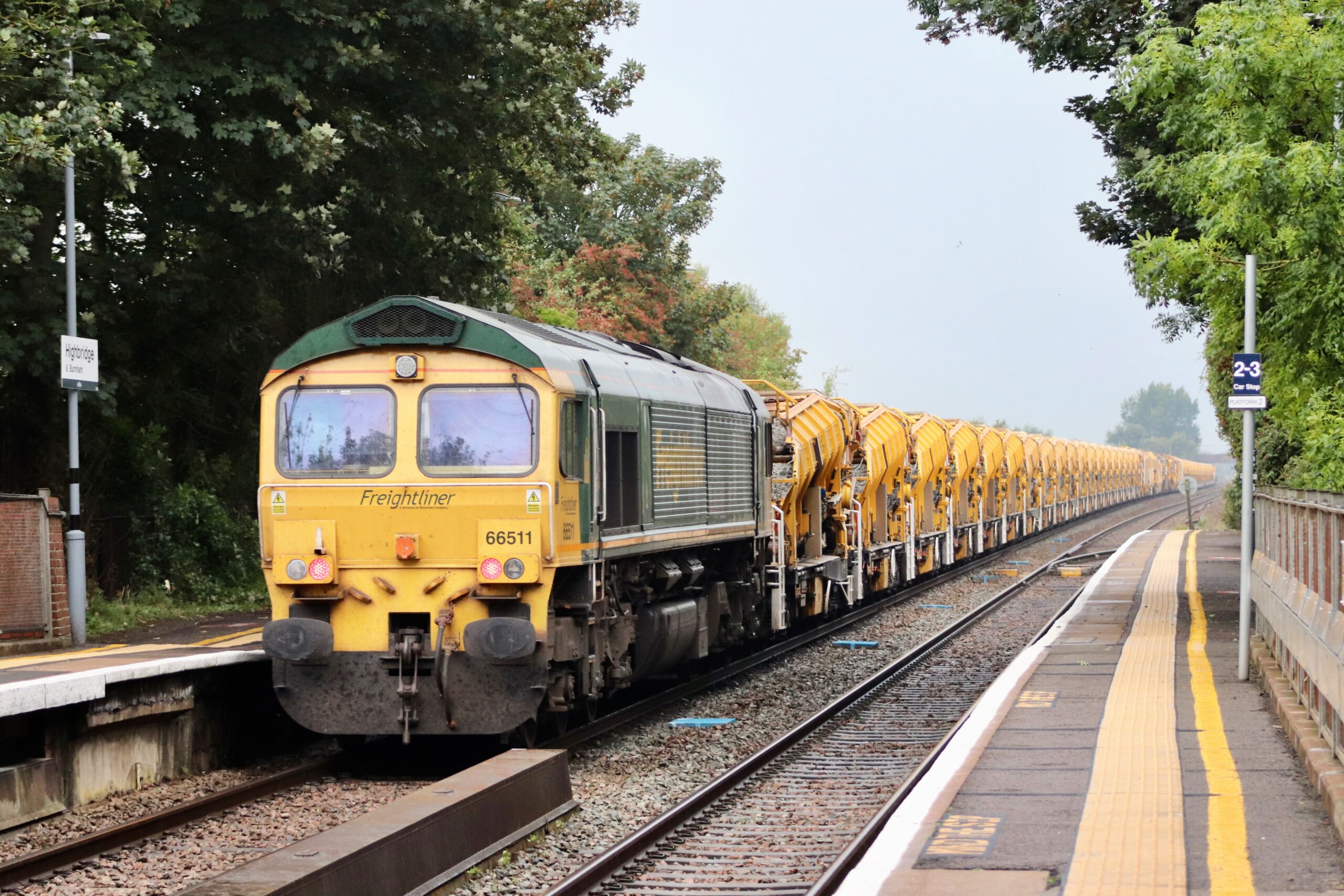
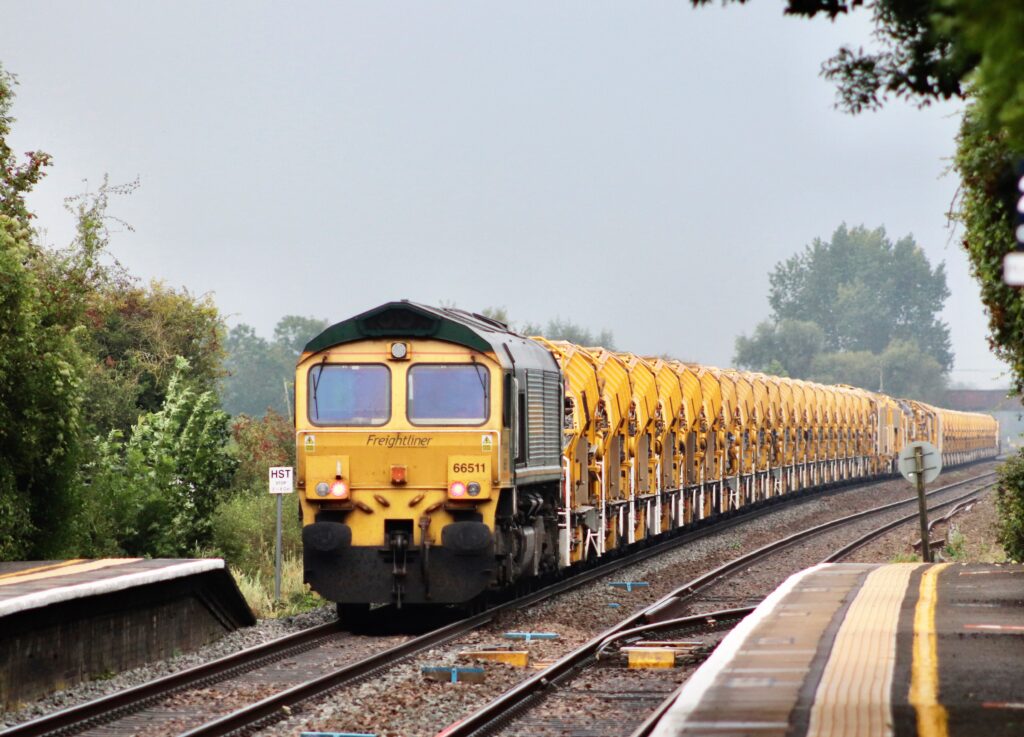
The New Measurement Train running as 1Q23 0552 Reading to Salisbury via Exeter passed through North Dorset on Thursday 22nd August 2024 top and tailed by Colas Class 43 former High Speed Train power cars No.’s 43272 and 43274 . We were not able to see this working, but good friend of the blog @smithy.377 caught the NMT configuration the following day passing through Highbridge working 1Z18 1539 Paignton to Taunton via Bristol East Yard before it returned to Derby RTC.
Screenshot of Class 43 No. 43272 leading on the NMT at Highbridge & Burnham – 23/08/2024 ( courtesy of @smithy.377 )
1Z18 1539 Paignton to Taunton via Bristol East Yard – 23/08/2024 ( courtesy of @smithy.377 )
Colas Class 37 No. 37610 ran through North Dorset with test train 3Q07 2031 Exeter Riverside N.Y. to Exeter Riverside N.Y. overnight on 29th/30th August 2024.
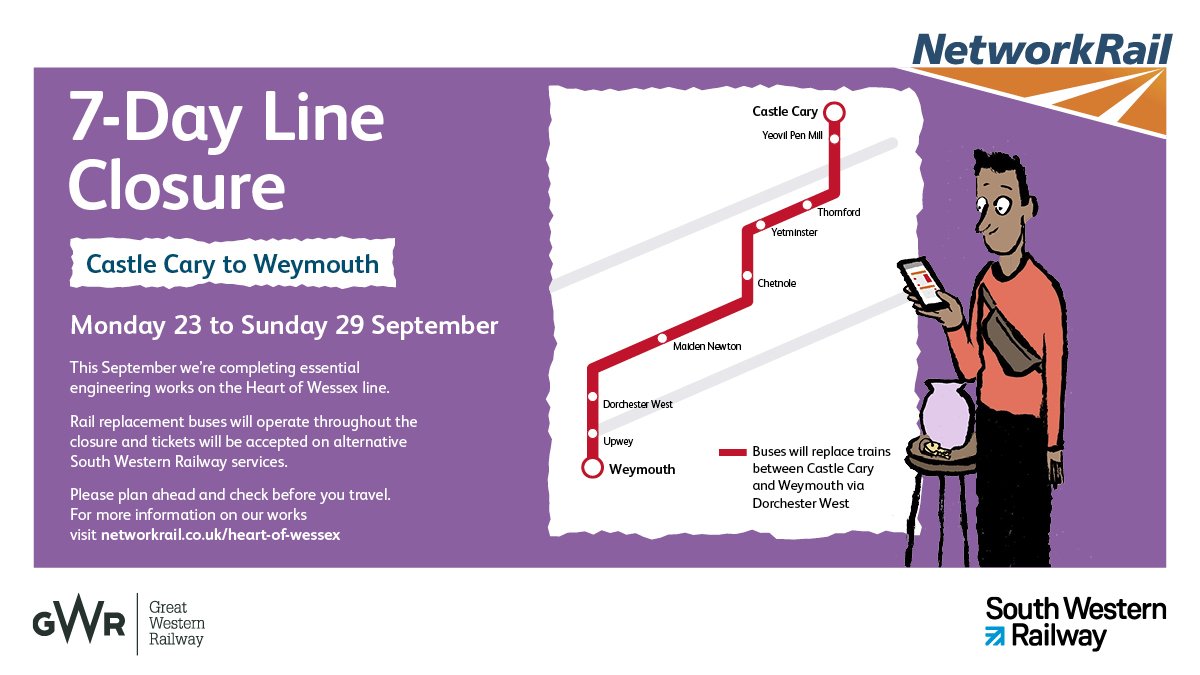
The Heart of Wessex Line will be closing between Castle Cary and Weymouth on Monday 23rd September 2024 to Sunday 29th September 2024 as Network Rail replace less than a mile of over fifty year old track. Improvements will also be made to the junctions either side of Maiden Newton railway station. A rail replacement bus service will operate during the closure period.
Engineering work is also scheduled to take place between Dorchester West and Weymouth on Sunday September 22nd.
From the Archive
Back in 1989, Hunslet-Barclay acquired six Class 20 locomotives from British Rail, re-engineered and re-numbered them for use as the motive power on a Nomix-Chipman weedkiller train. A subsequent loco was also purchased for spares. Hunslet-Barclay were the second company after Foster-Yeoman to operate privately owned locomotives on the BR Network. Although driven by a Hunslet-Barclay employee, they were always accompanied by a BR driver over routes being sprayed. The locomotives were sold to Direct Rail Services in November 1998.
On 21st May 1996, Class 20 No.’s 20904 and 20901 visited Weymouth top and tailing a weedkiller train as this archive footage reveals.
Great Western Approaches
Great Western Railway (GWR) passengers across Somerset, Wiltshire and Dorset can now travel back in time as part of an archive film project by Windrose Rural Media Trust. It’s been inspired by an old film called “Great Western Approaches”, a renowned film made in 1936 and still available, which took viewers on a journey to the sun.
Windrose has used footage from 1909 to the 1990’s to craft short films relevant to 24 stations across seven routes:
Westbury to Salisbury
Westbury to Weymouth
Westbury to Bath
Westbury to Swindon
Westbury to Bedwyn
Westbury to Taunton
Taunton to Bristol
Each film explores local life as it used to be, allowing customers to travel into the past via a QR code linkon posters displayed at stations, which can be scanned into phones while waiting for the train.
Windrose Rural Media Trust is a Dorset-based charity which uses the media – television, radio and the internet – to portray the past of rural communities in the south west and to give them a voice in the present day.
A still of Weymouth from the Great Western Approaches project
That brings us up to date with Dorset railway events to the end of August 2024. Thanks for reading and your updates and corrections which are very much appreciated. Be seeing you!
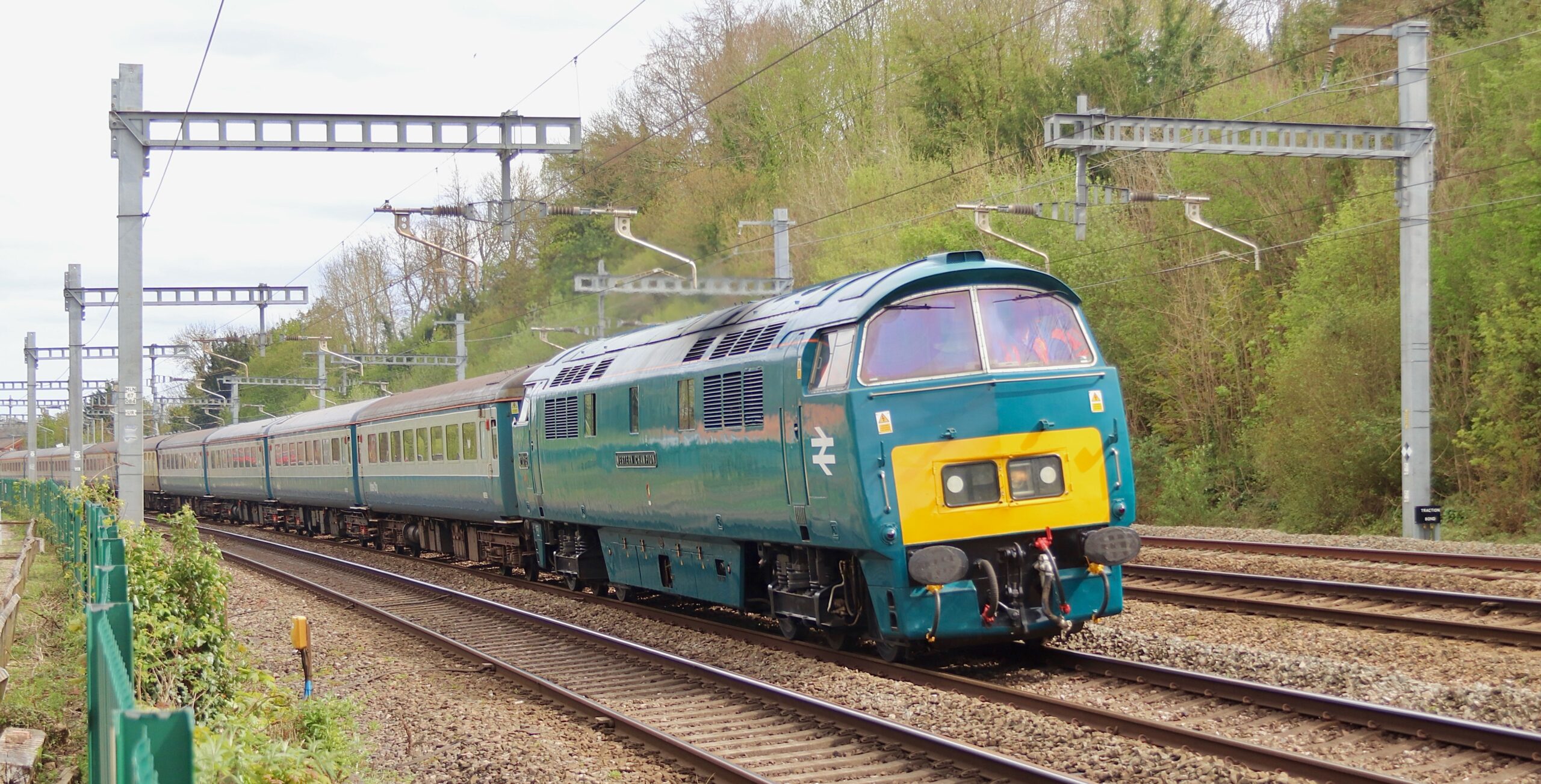
Having worked up to London Paddington earlier in the day, the Diesel Traction Group owned Class 52 “Western” diesel-hydraulic No. D1015 ‘Western Champion’ passes through Pangbourne at the head of 1Z56 1352 London Paddington to Birmingham New Street charter train. Originally an empty coaching stock movement to Burton, it was instead tuned into a main line test run for No. D1015 and opened up for public use as a joint operation by UK Railtours and Pathfinder Tours named “The One Way Wizzo”. The “Western” worked the tour as far as Bescot Yard, from where Class 57 No. 57303 took over the last into New Street before taking the ECS forward to Burton-on-Trent – 14/04/2024
April 14th 2024 to April 24th 2024
On Sunday 14th April 2024, preserved Class 52 “Western” diesel-hydraulic locomotive No. D1015 ‘Western Champion’ worked a loaded test run from London Paddington to Birmingham New Street, supported by GBRf Class 57 No. 57303 which was utilised as a passenger carrying one way rail tour. No. D1015 ran light into Paddington and then headed up the “One Way Wizzo” as far as Bescot Yard, with No. 57303 taking charge for the final leg into New Street. After the tour, ‘Western Champion’ returned to her base on the Severn Valley Railway.
I was quite intrigued with the idea of trying to photograph both the Western’s light engine move as well as the loaded test run itself, so devised a plan for a visit to a National Trust property as a day-out for Yoshi and Caroline. Checking out the route of the Great Western main line on Google maps, I settled on Basildon Park as our heritage destination as the railway runs very close to the estate. On the day, I checked out potential photographic spots, but discounting these, back-tracked slightly to Pangbourne railway station as the car park is ideally situated for photography as long as you can position yourself above the line-side fencing; remembering to stay safe at all times!
Pangbourne station is located close to the village centre, with the main station buildings on the opposite side of the railway to the village. It has two platforms, one on each of the relief (slow) lines, whilst the fast lines pass behind the station. The platforms are linked to each other and the station entrance, on the up relief platform, by a pedestrian underpass. The station once had four platforms with those situated on the main fast lines now no longer in situ.
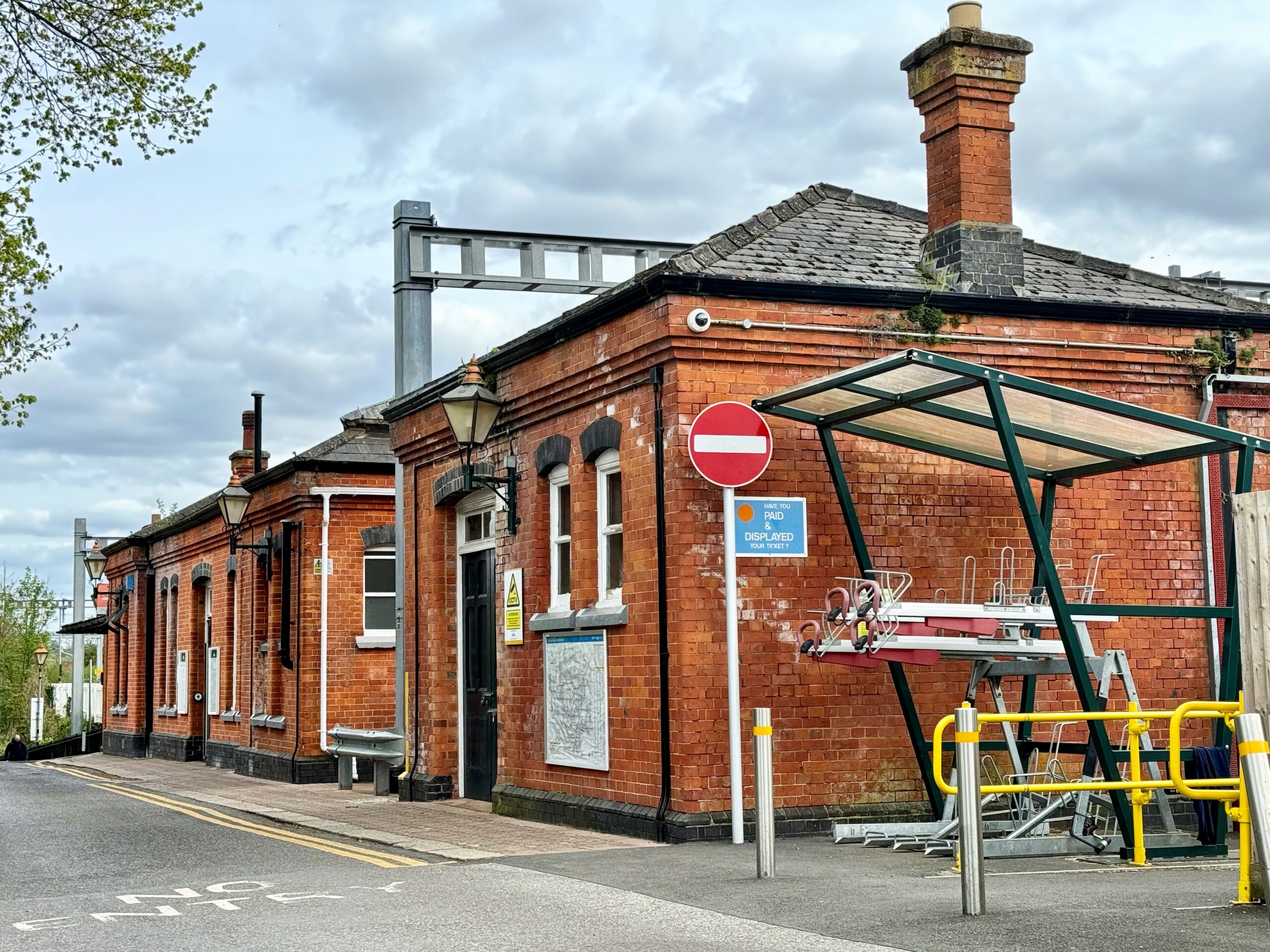
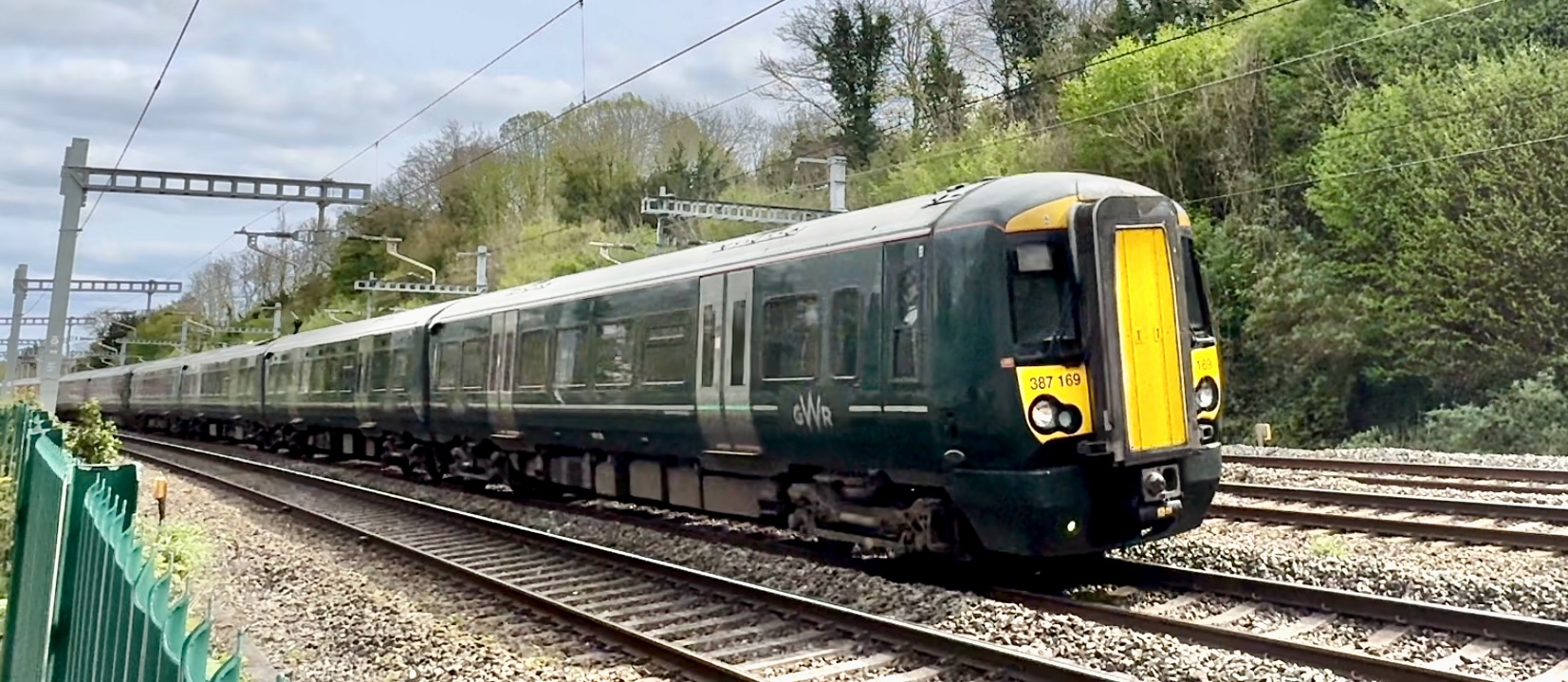
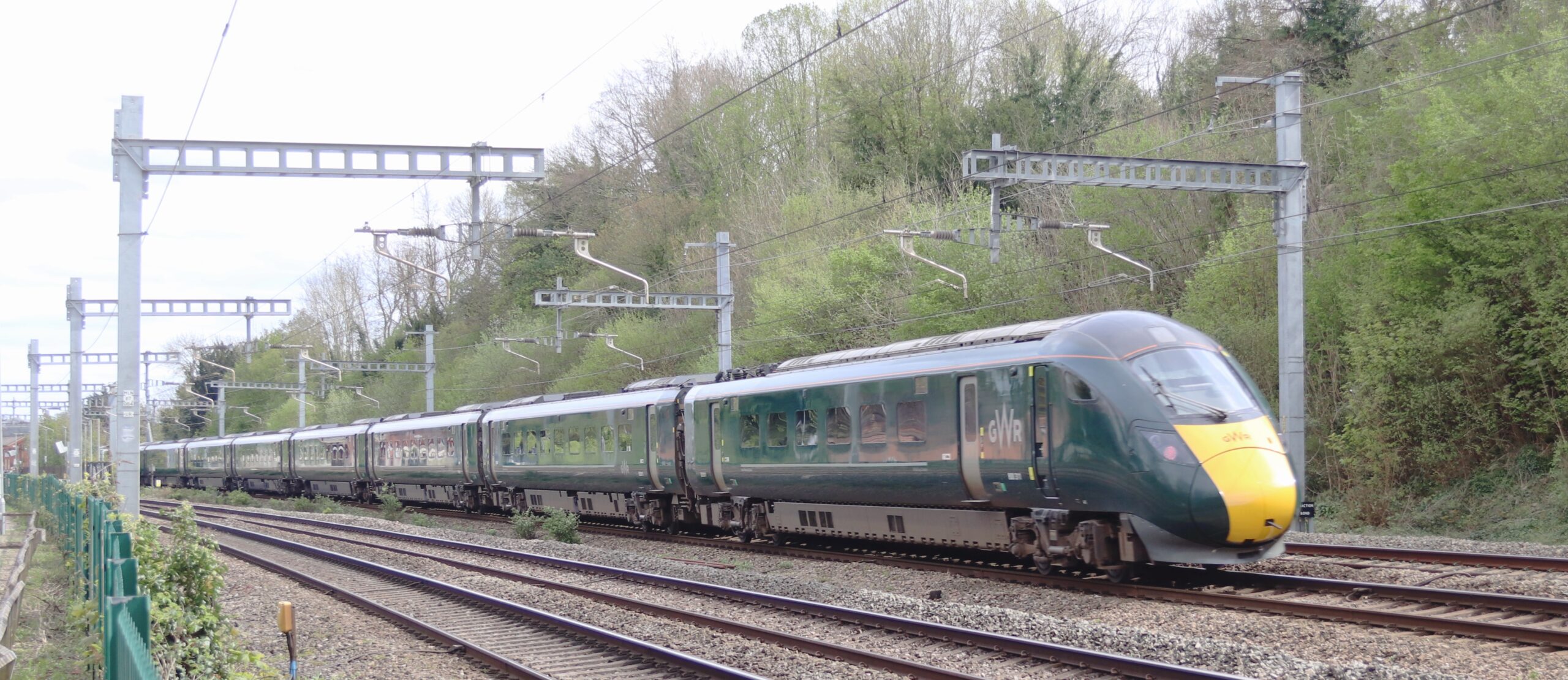
Exterior of Pangbourne railway station. The station is on the original line of the Great Western Railway, which was opened in stages: the portion between Reading and Steventon opened on 1st June 1840, with Pangbourne being the first station west out of Reading – 14/04/2024All services at Pangbourne are operated by Great Western Railway (GWR) using Class 387 EMU’s. The typical off-peak is two trains per hour in each direction between London Paddington and Didcot Parkway. On Sundays, the service is reduced to hourly in each direction. Screenshot of Class 387 Electrostar electric multiple unit (EMU) No.’s 387169 & 387170 depart Pangbourne working 2N42 1426 Reading to Didcot Parkway – 14/04/2024Great Western Railway Intercity Express Train (IET) pass Pangbourne on the fast lines situated behind the platforms at Pangbourne. Class 800 No. 800311 passes Pangbourne working 1A18 1300 Bristol Temple Meads to London Paddington – 14/04/2024CrossCountry trains also pass Pangbourne. Screenshot of CrossCountry Class 221 Super Voyager No. 221133 works 1O16 1124 Manchester Piccadilly to Southampton through Pangbourne – 14/04/2024
While waiting for No. D1015 to pass us on her way to London Paddington, the local security operated by Land Sheriffs Ltd pulled into the car park and parked up casting a weather eye over my activity. As the Western was still a good few minutes off, I strolled over for a chat. The two security guards were really friendly and knew just what I was waiting for. They were, however, surprised to learn that the heritage diesel-hydraulic locomotive was making a solo pass prior to its railtour work as they had been charged with keeping an eye on proceedings further up the line at Didcot when the “One Way Wizzo” was due to pass later that afternoon as the train was sure to attract much attention from railway enthusiasts. Satisfied that I was not a security risk, the Land Sheriffs left me to await the first appearance of No. D1015.
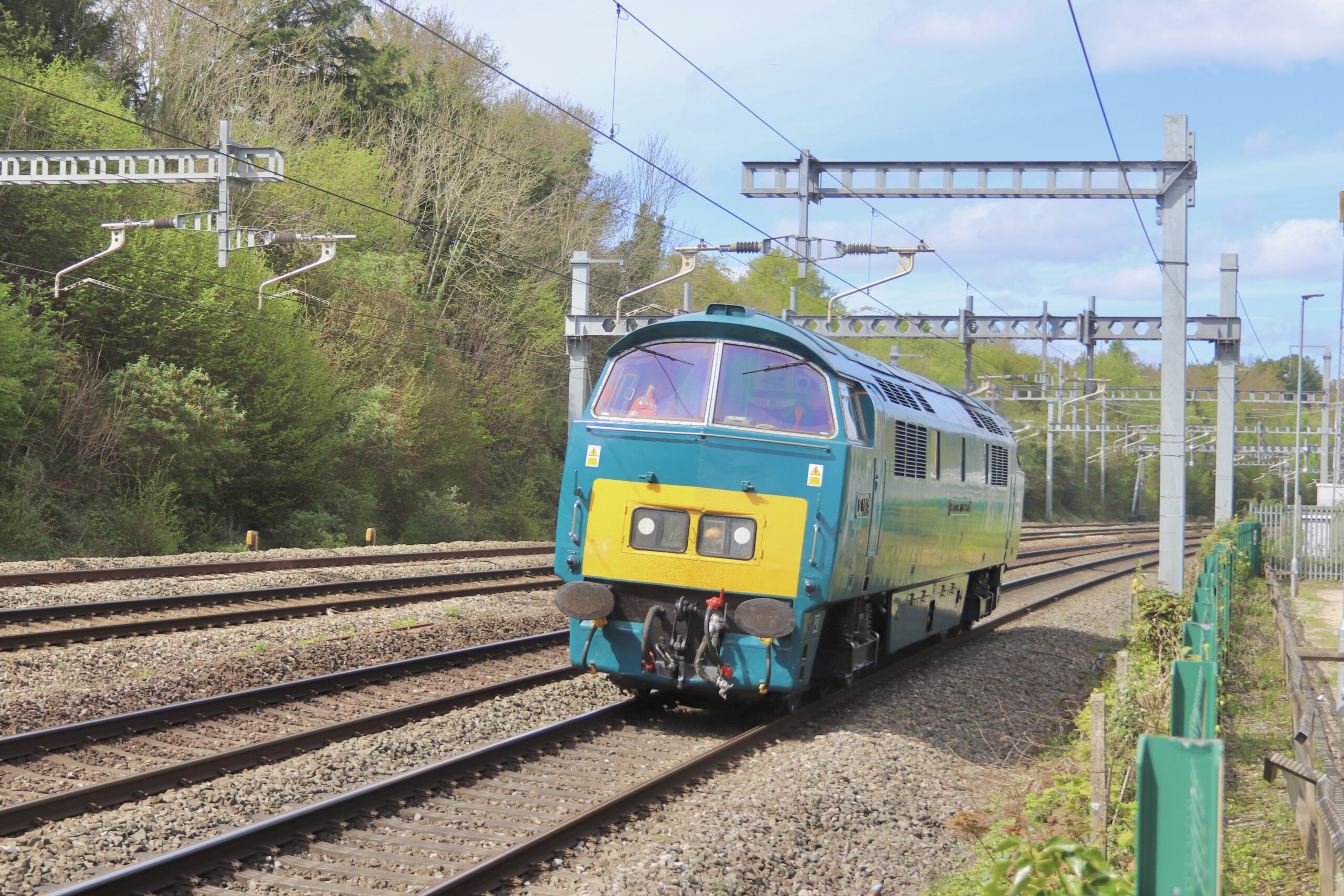
Class 52 No. D1015 ‘Western Champion’ runs light engine towards Pangbourne railway station working 0Z55 1020 Kidderminster SVR to London Paddington – 14/04/2024
It was a good couple of hours before ‘Western Champion’ was timed to pass Pangbourne on her way to Bescot, so we decamped to National Trust Basildon Park where we enjoyed a woodland walk taking in the bluebells before Caroline took a tour of the mansion house and Yoshi and I headed back to the railway station car park for another shot at photographing No. D1015, this time at the head of a rake of carriages.
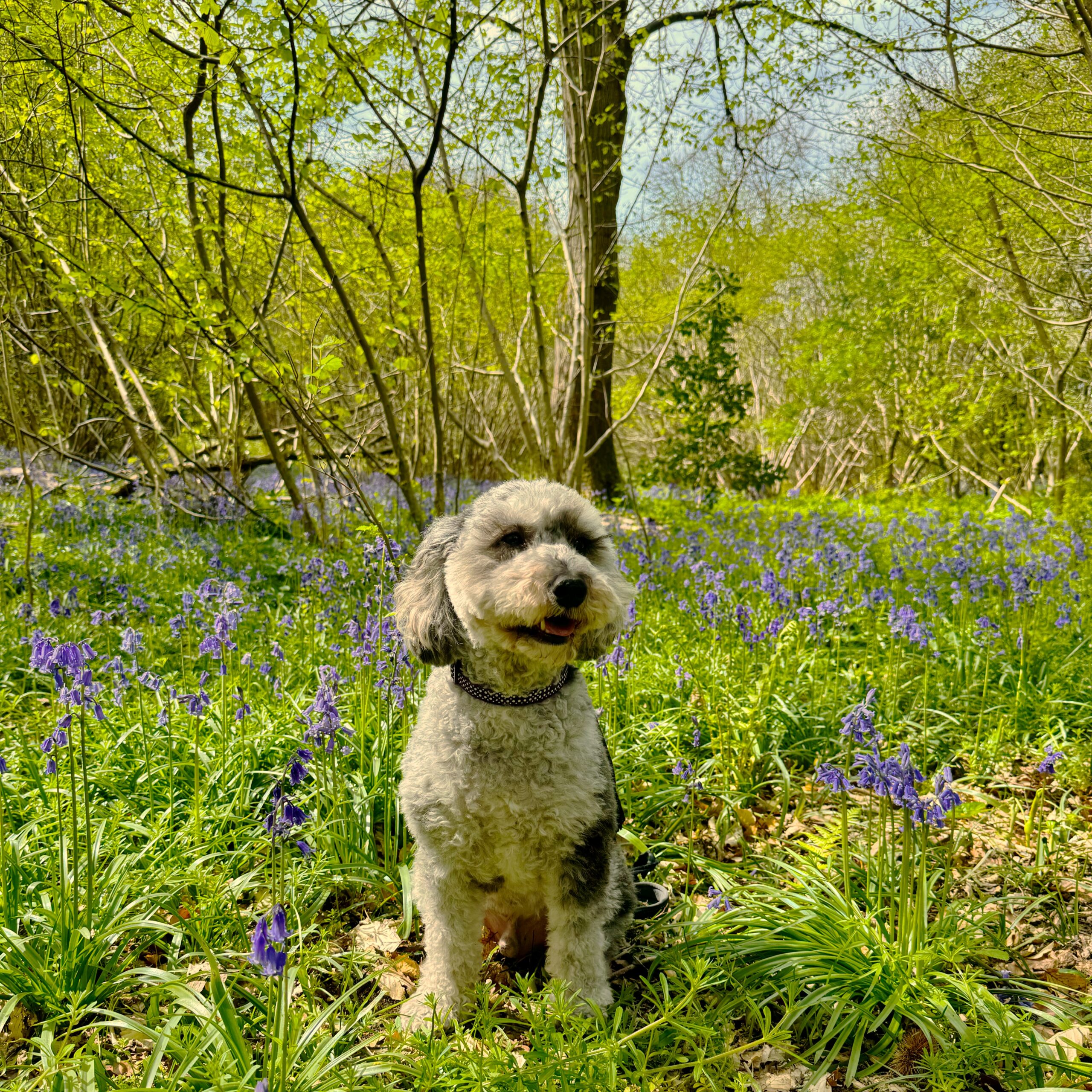
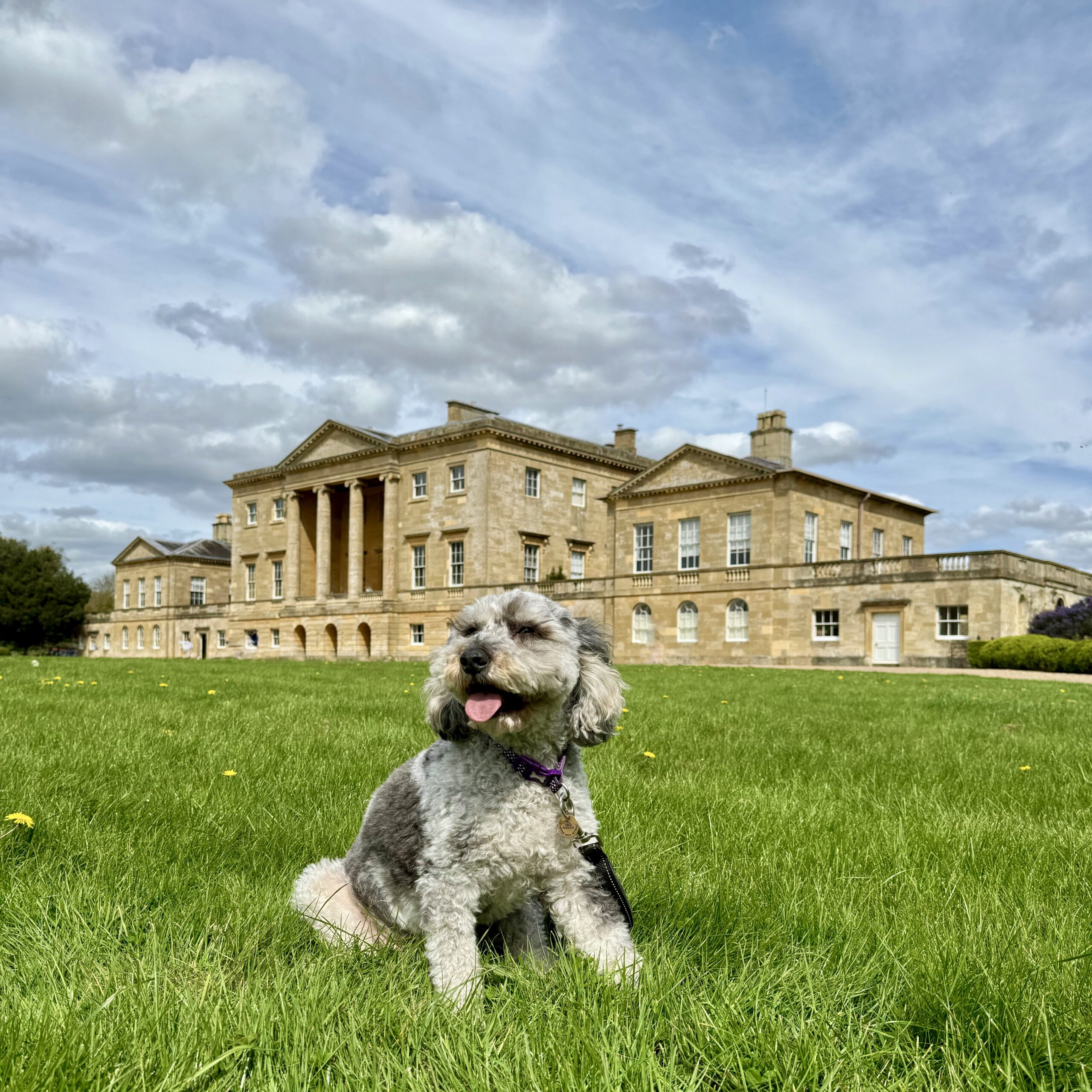
Yoshi amongst the bluebells in the wooded parkland at Basildon Park – 14/04/2024Yoshi at National Trust Basildon Park. The estate was purchased by Francis Sykes in 1771. Sykes had made his fortune in the East India Company and required a home befitting his status. He demolished the old house and employed architect John Carr to build the Bath-stone mansion which exists today. The property was gifted to the National Trust in 1978 by Lord and Lady Iliffe who had bought Basildon Park in 1952 – 14/04/2024Class 52 “Western” diesel-hydraulic No. D1015 ‘Western Champion’ passes Pangbourne with “One Way Wizzo” 1Z56 1352 London Paddington to Birmingham New Street – 14/04/2024
Video of Class 52 “Western” diesel-hydraulic No. D1015 ‘Western Champion’ passing Pangbourne – 14/04/2024
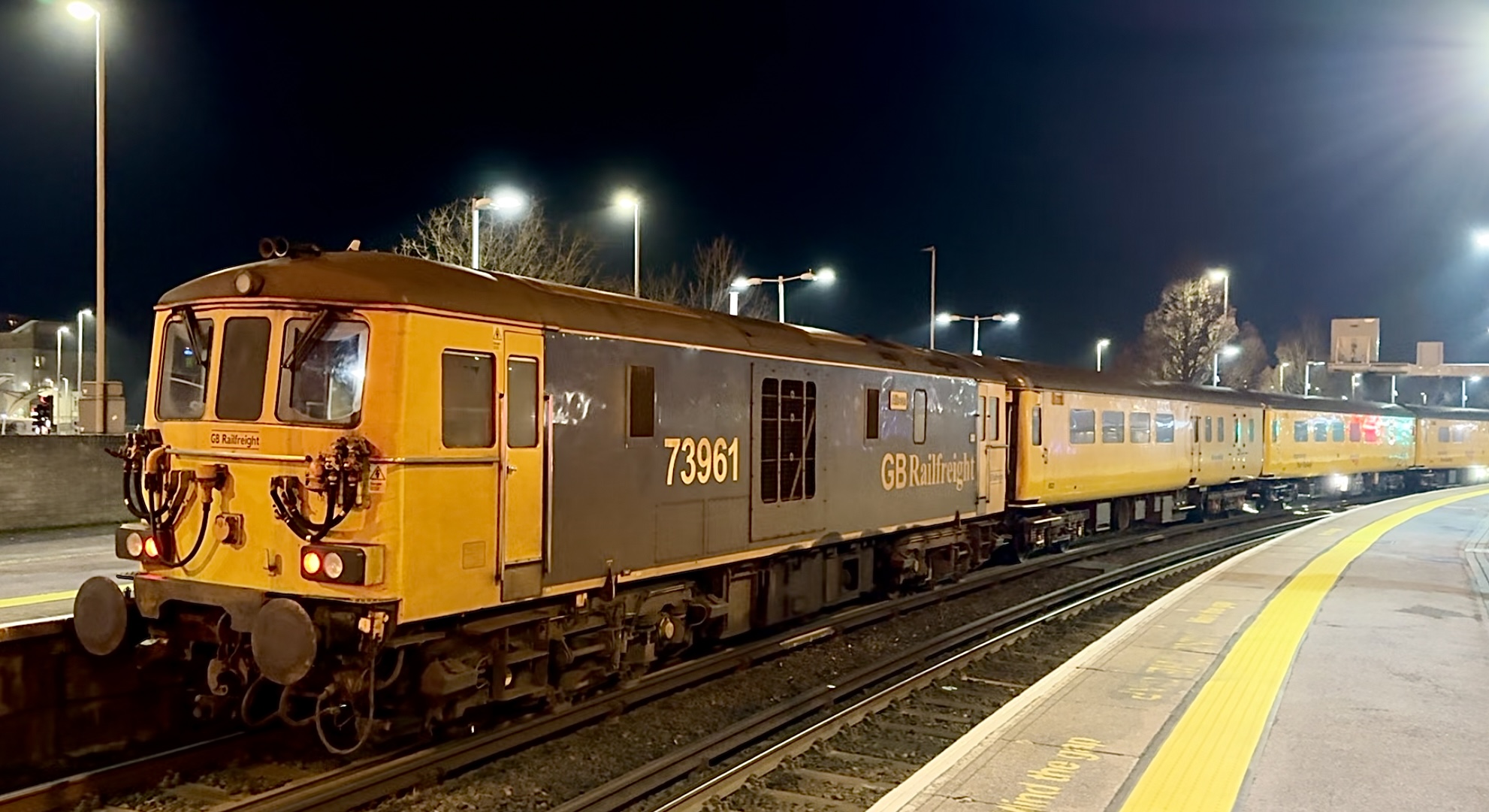
Monday 15th April we were back at Poole railway station in readiness for GBRf Class 73 No.’s 73962 ‘Dick Mabbutt’ and 73961 ‘Alison’ working the monthly 1Q51 11:15 Derby RTC to Eastleigh Yard via Weymouth test train.
Video screenshots of GBRf Class 73 No.’s 73962 ‘Dick Mabbutt’ and 73961 ‘Alison’ working 1Q51 11:15 Derby RTC to Eastleigh Yard via Weymouth – 15/04/2024
Video of 1Q51 11:15 Derby RTC to Eastleigh Yard via Weymouth at Poole – 15/04/2024
The following day, Tuesday 16th April, we were out to see GBRf Class 57 No. 57303 once again, this time performing electric multiple unit drag duties, hauling South Western Railway (SWR) refurbished Class 458 No. 458421 and 508 barriers as 5Q64 1534 Southampton Central to Bournemouth T&R.S.M.D. having worked down from Widnes Transport Tech as far as Wembley Receptions 1-7 the previous day before progressing into Dorset.
GBRf Class 57 No. 57303 leading SWR Class 458 No. 458421 and 508 barriers towards Parkstone railway station as 5Q64 1534 Southampton Central to Bournemouth T&R.S.M.D. – 16/04/2024After running round its train, GBRf Class 57 No. 57303 hauls SWR Class 458 No. 458421 up Parkstone Bank working 5Q64 1534 Southampton Central to Bournemouth T&R.S.M.D. – 16/04/2024
Later the same day, No. 57303 departed Bournemouth depot with un-refurbished Class 458 No. 458513 as 5Z66 2018 Bournemouth T&R.S.M.D to Eastleigh East Yard. The formation was scheduled to stable at Eastleigh overnight before proceeding to Widnes Transport Tech on Wednesday 17th. We saw this formation at Poole on the first leg of its journey.
Screenshot of GBRf Class 57 No. 57303 with Class 508 barrier coaches and SWR Class 458 No. 458513 arrives at Poole working 5Z66 2018 Bournemouth T&R.S.M.D to Eastleigh East Yard. The train heads out to Poole Storage Sidings – 16/04/2024Having left the Class 458 in Poole Storage Sidings, GBRf Class 57 No. 57303 runs light engine into Poole railway station before heading back to attach to the London end of its train – 16/04/2024
GBRf Class 57 No. 57303 on SWR Class unit drags – 16/04/2024
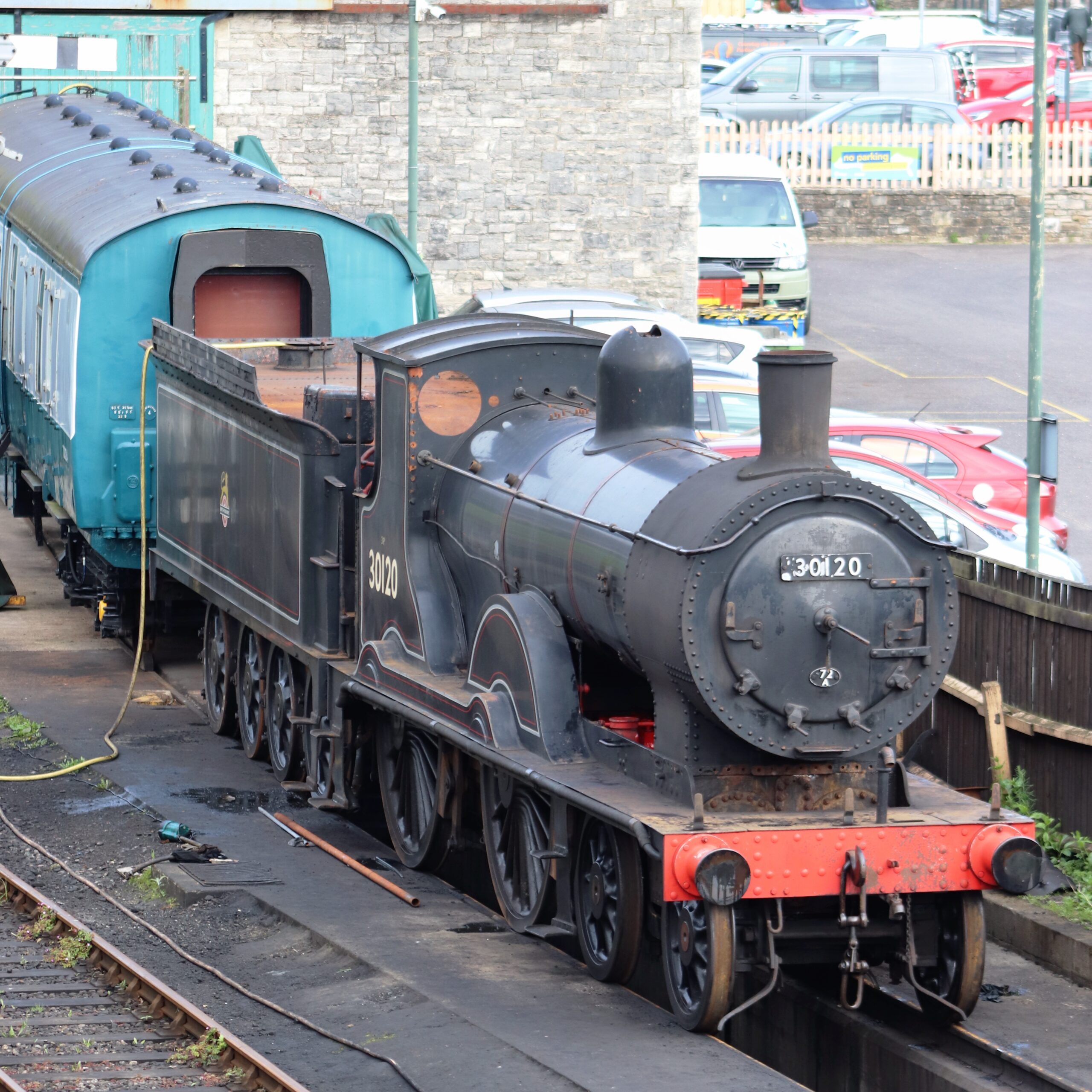
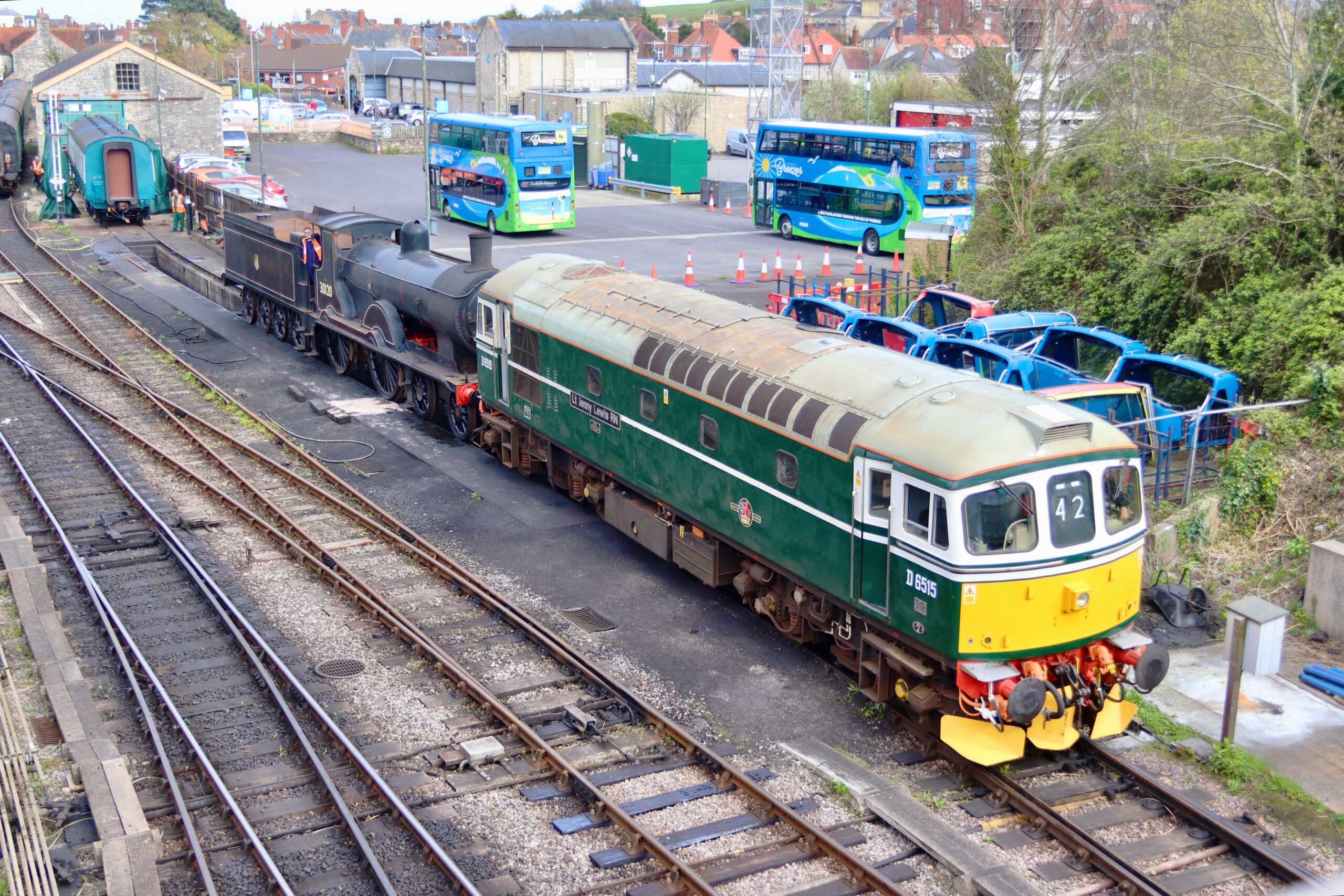
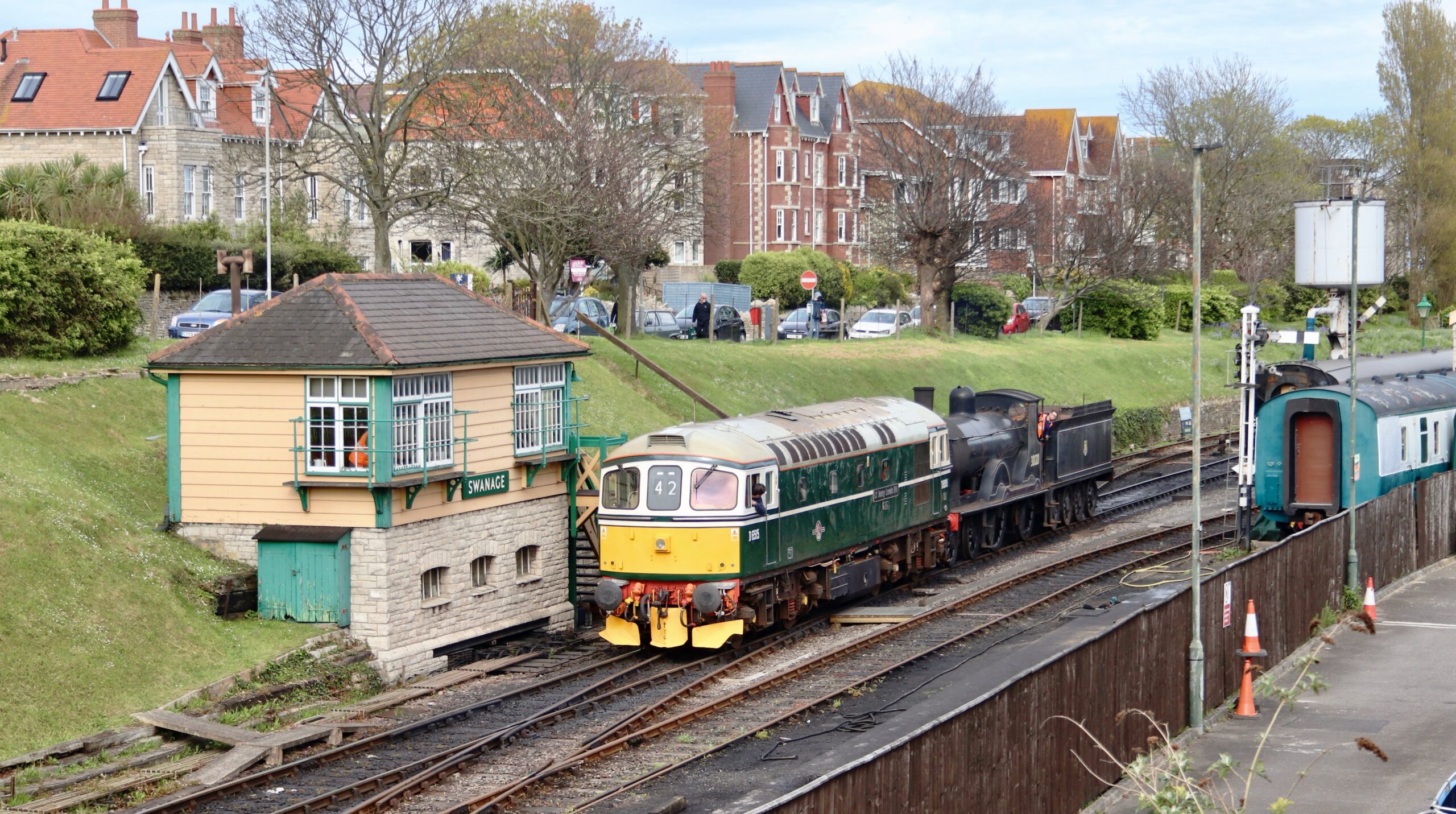
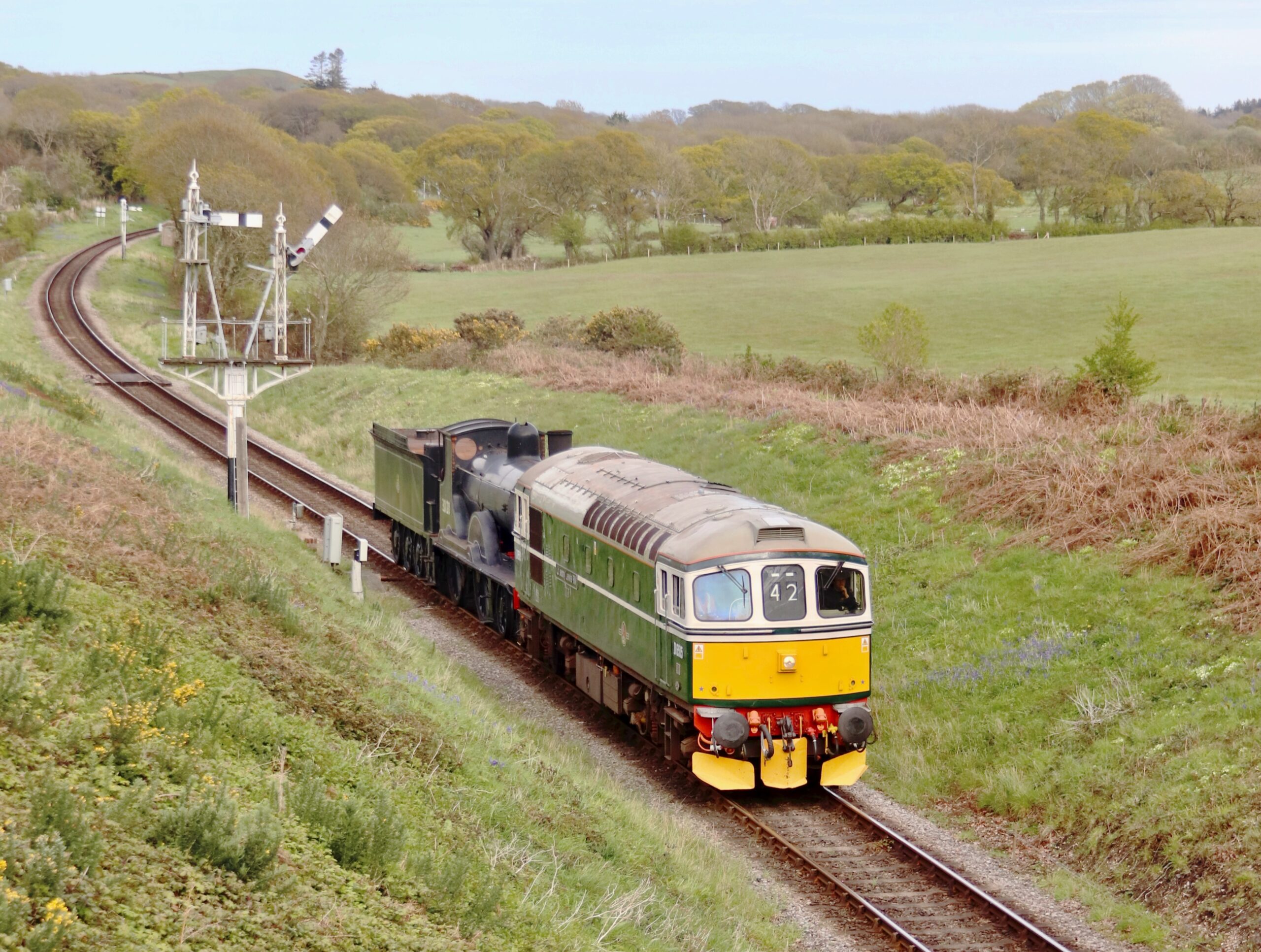
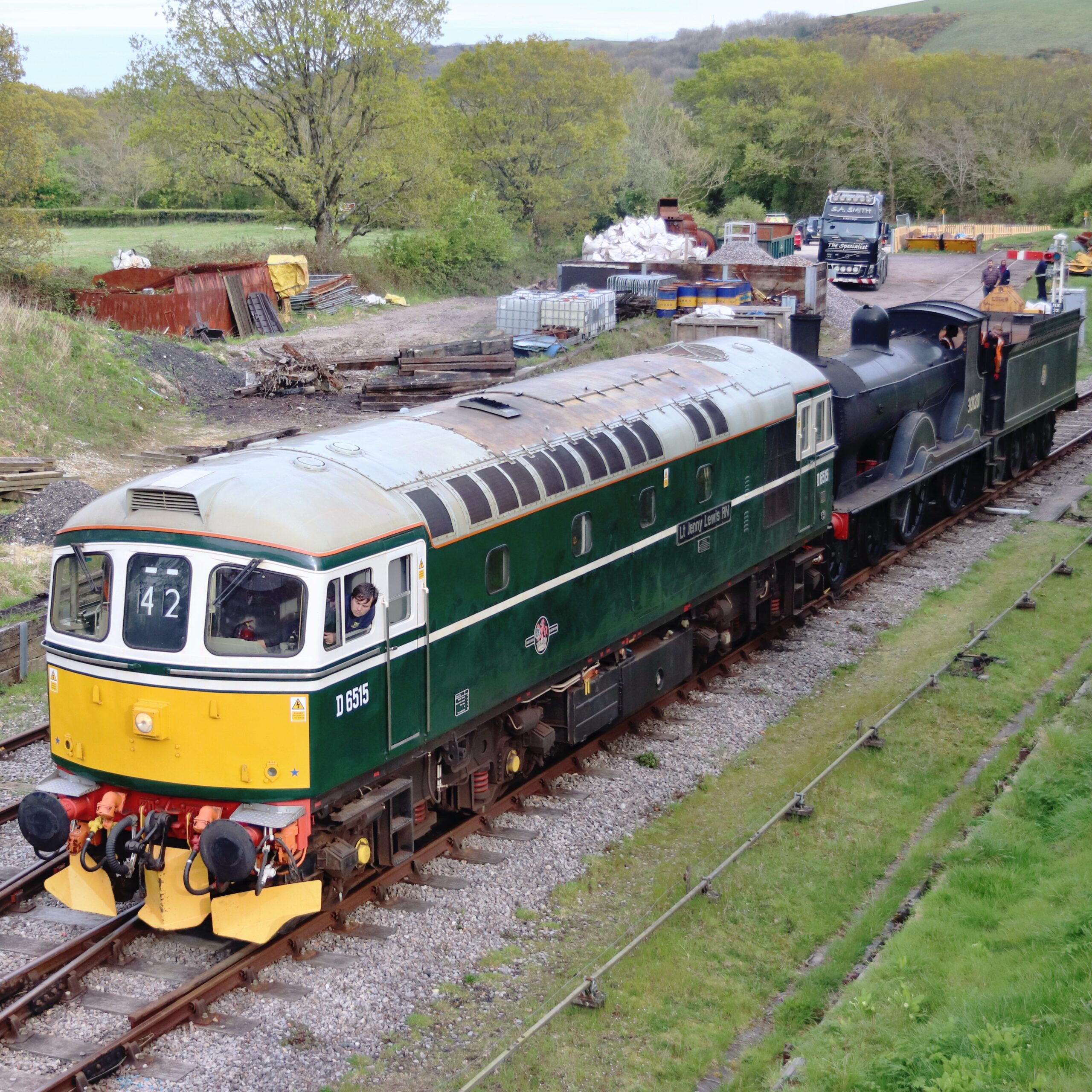
Following the successful restoration of LSWR Adams T3 Class No. 563, the team at the Swanage Railway are now turning their attention to their next challenge, that of returning LSWR T9 Class No.120 to steam in time for its 130th birthday in 2029 resplendent in Olive green livery. Thursday 18th April was therefore an eventful one for No.120 as she departed the Swanage Railway by road for transit to The Flour Mill Locomotive Repair Workshop in Lydney, Gloucestershire. The Flour Mill is a listed former colliery electricity generating station which was converted to a railway workshop between 1995 and 1996. The Flour Mill Ltd operates the business undertaking work repairing and overhauling steam locomotives. We popped over to the Purbeck line to witness the Victorian locomotive being collected from Swanage by resident diesel Class 33 No. D6515 (33012) ‘Lt. Jenny Lewis RN’. The pairing then travelled up to Arne Road sidings where No.120 was to be placed on a road low-loader.
The T9 is owned by the National Railway Museum (NRM) and agreement has been reached where the condition of the locomotive will be assessed ahead of a commitment to return her to steam for further service on the Swanage Railway.
Designed by Dugald Drummond and built in 1899 at Nine Elms works, No.120 was a member of the T9 class of locomotives, affectionately known as the “Greyhounds” for their swift performances on the West of England main lines.
LSWR 4-4-0 T9 Class No.30120 at Swanage – 18/04/2024
Altogether, sixty-six T9 locomotives were built, with No.120 being the only survivor. She was withdrawn from regular service in 1961 and painted in London South Western Railway (LSWR) ‘Pea Green’ livery, colours – inappropriate as she was modified with a superheater by Robert Urie and as a consequence her appearance was substantially altered from her early days. However, in this guise she hauled special trains for a few years before becoming part of the National Collection. After spells of service on the Mid-Hants Railway, at Swanage and on the Bodmin & Wenford Railway, No. 120 returned to Swanage in 2017 and became a vital part of the fleet until her boiler certificate expired. During her time at Swanage the locomotive proved a powerful but economic machine, popular with both crews and visitors alike. Her restoration will allow the Swanage railway to develop a more sustainable locomotive fleet into the future as the T9, like the T3, is perfectly sized for the heritage branch.
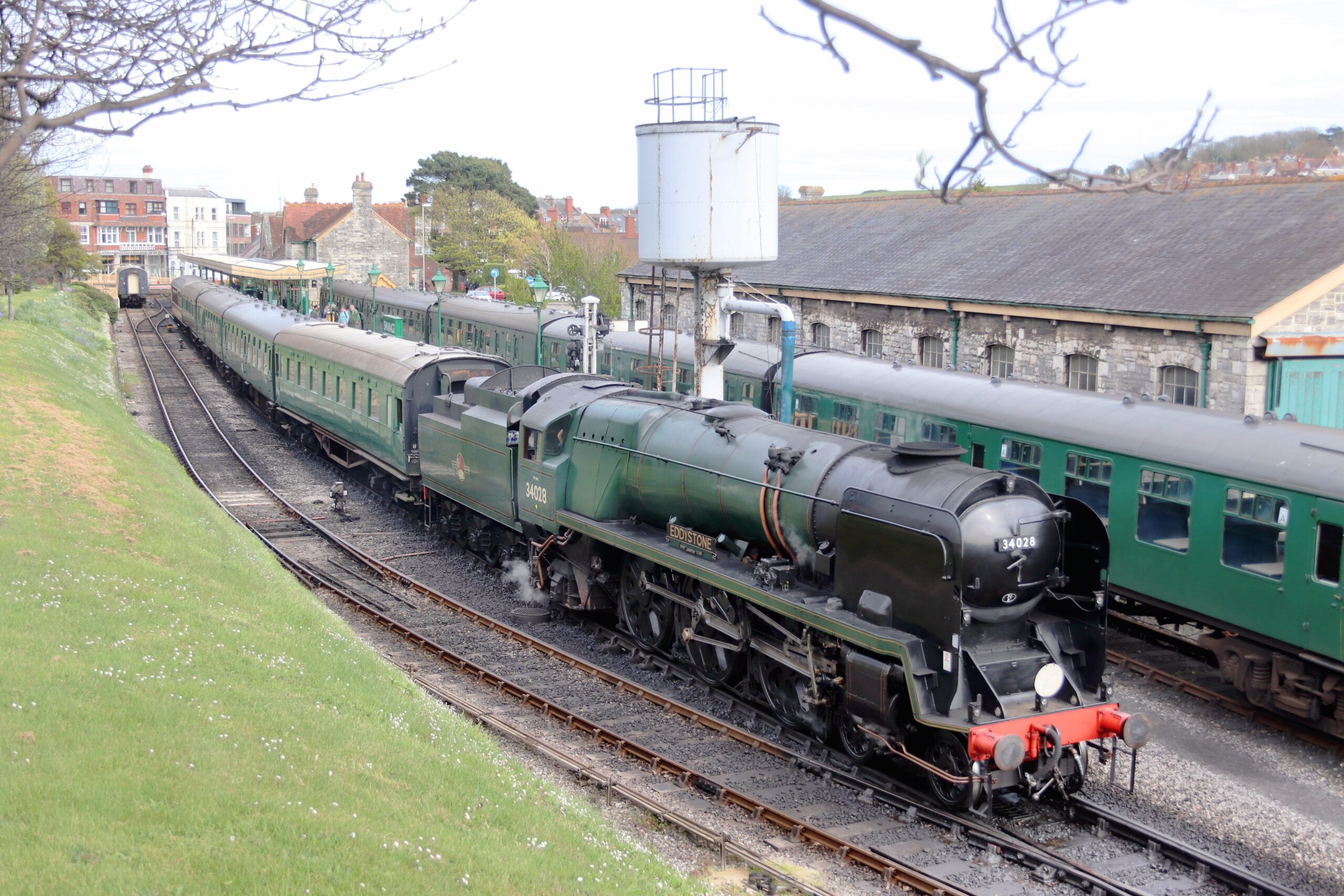
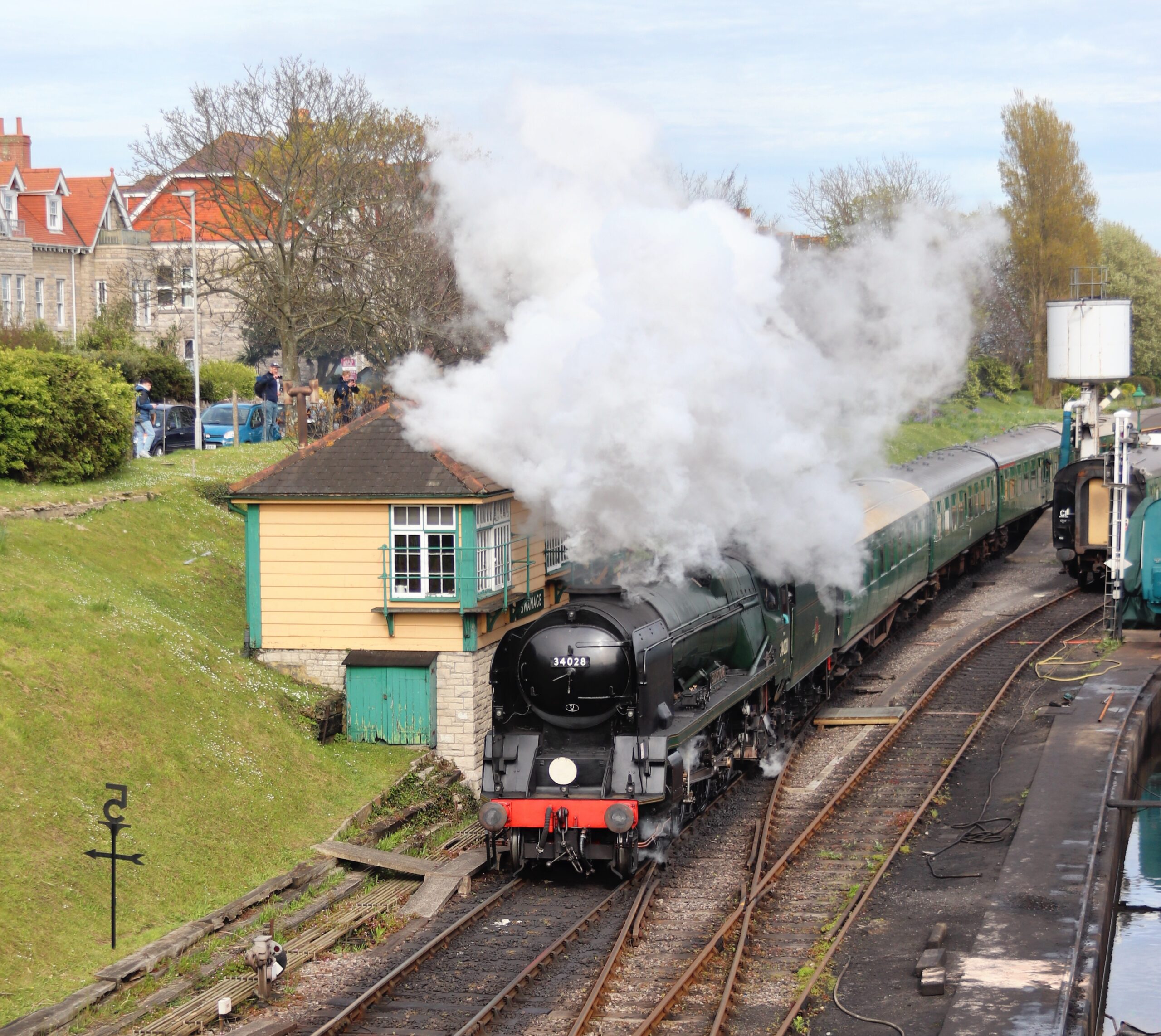
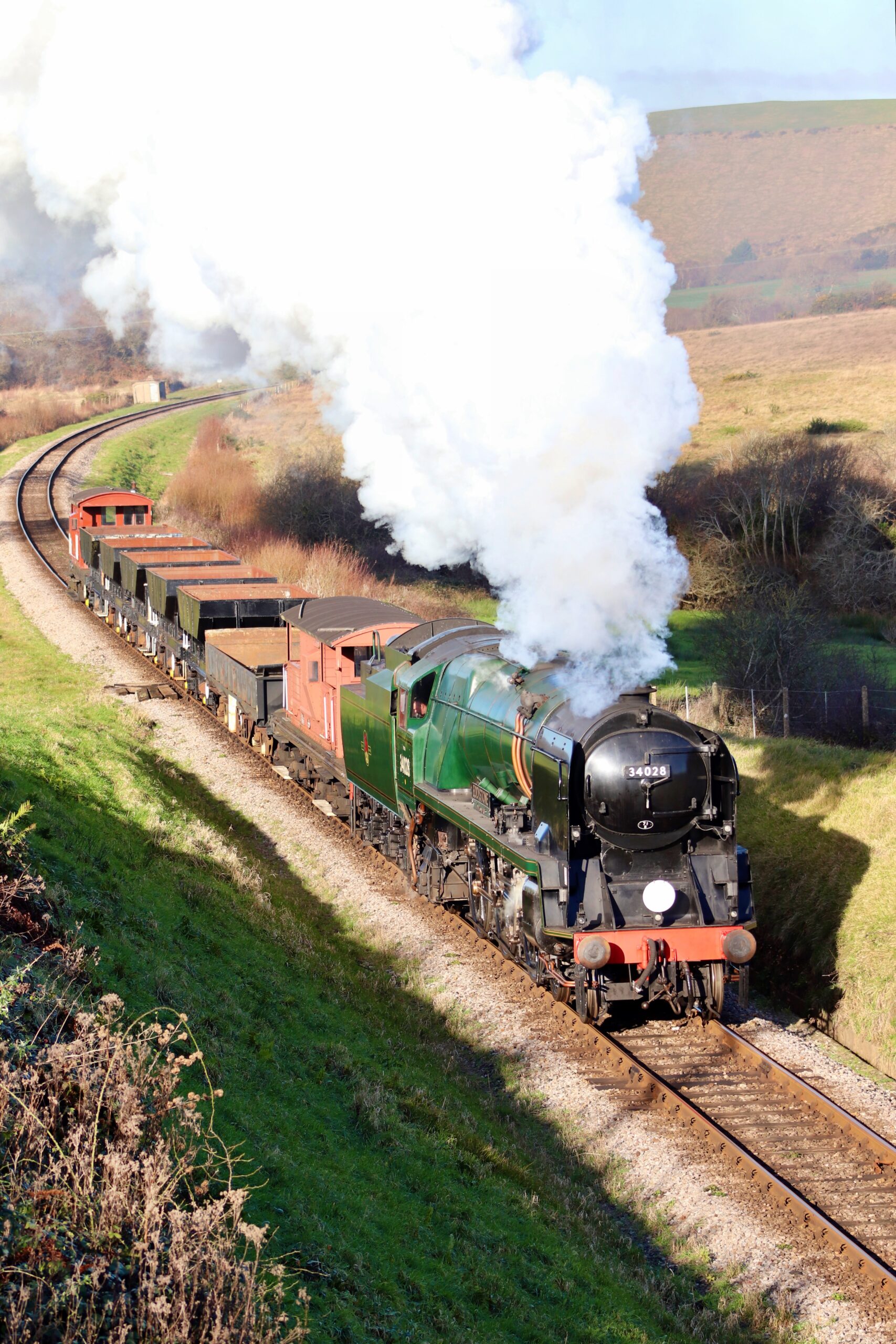
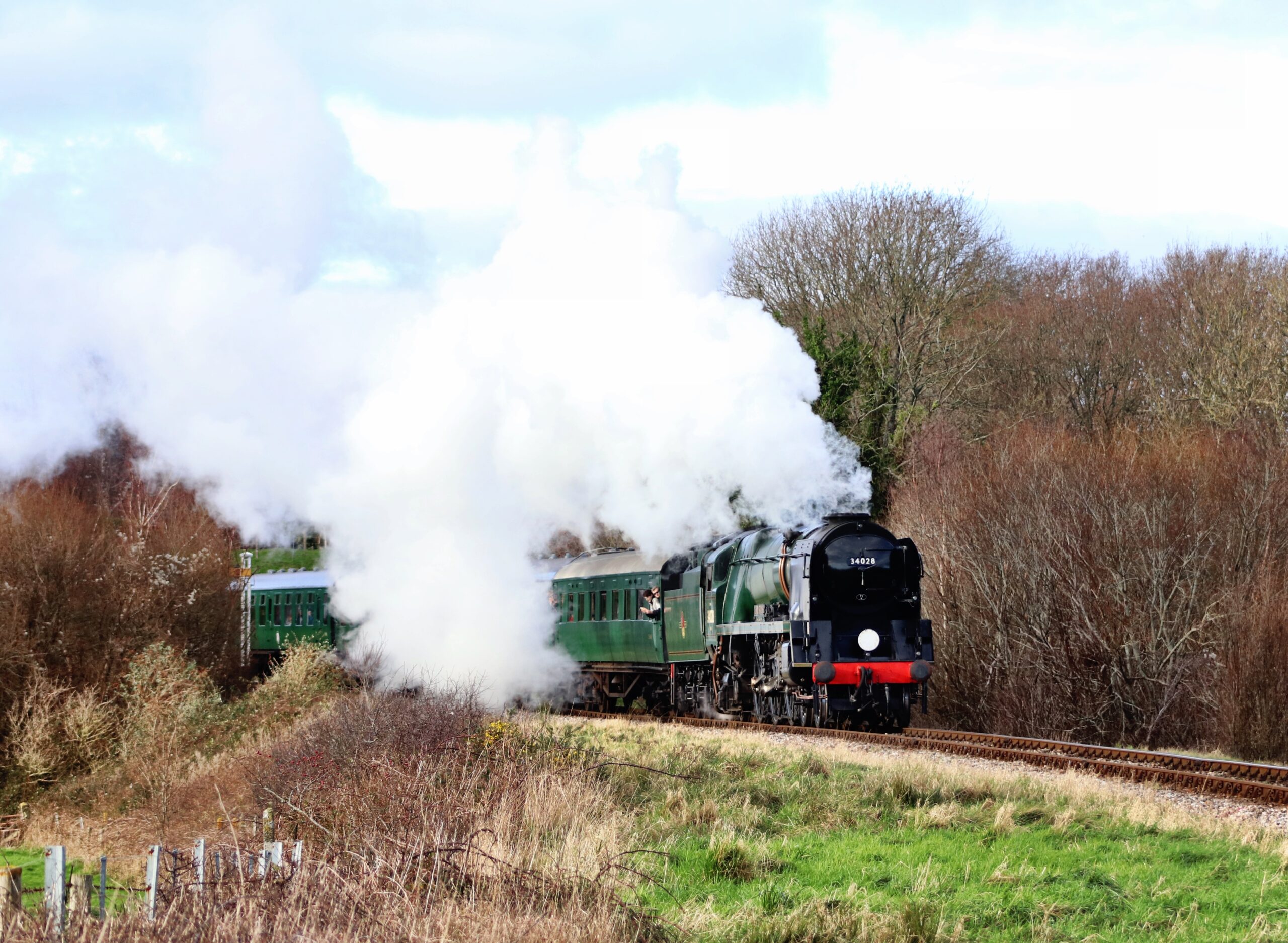
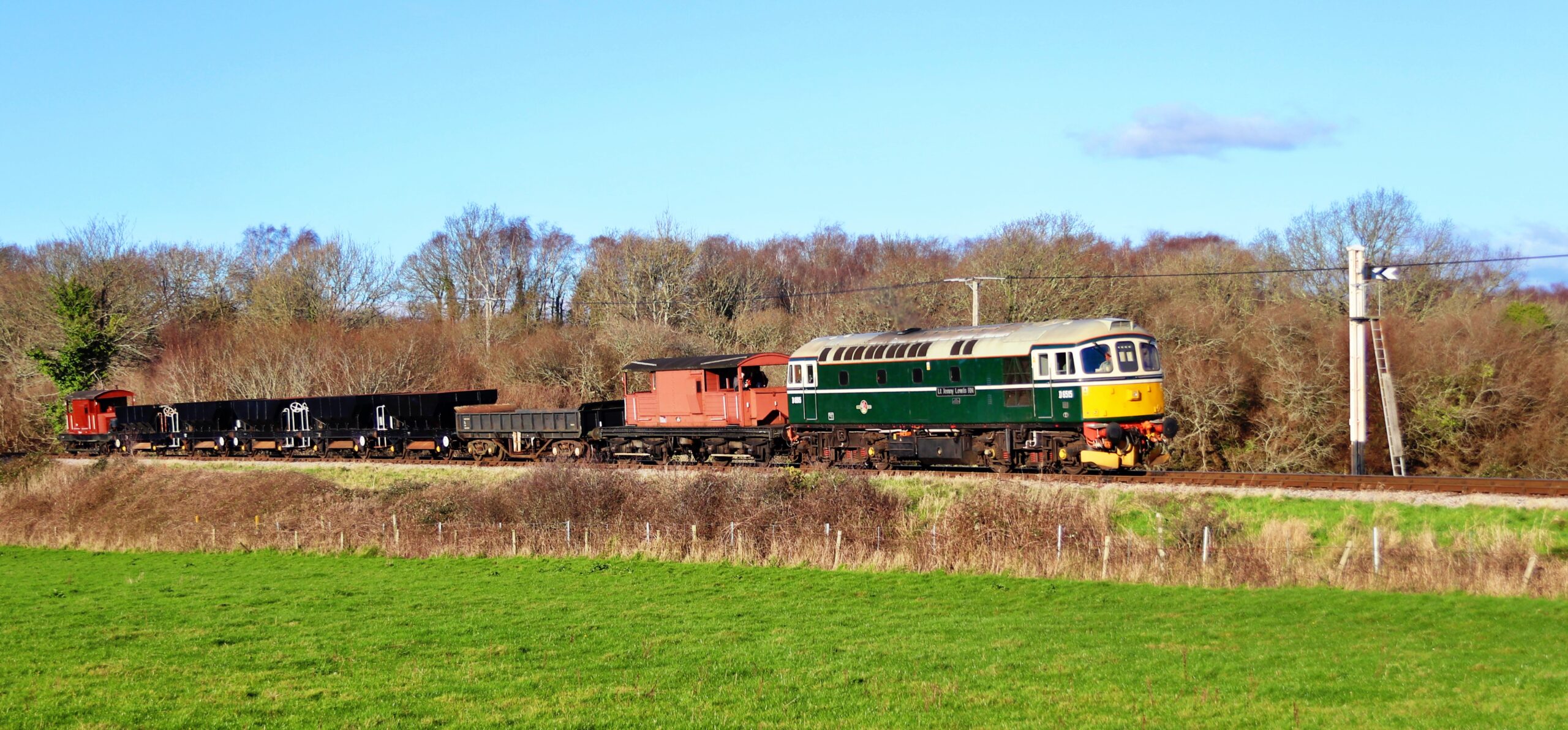
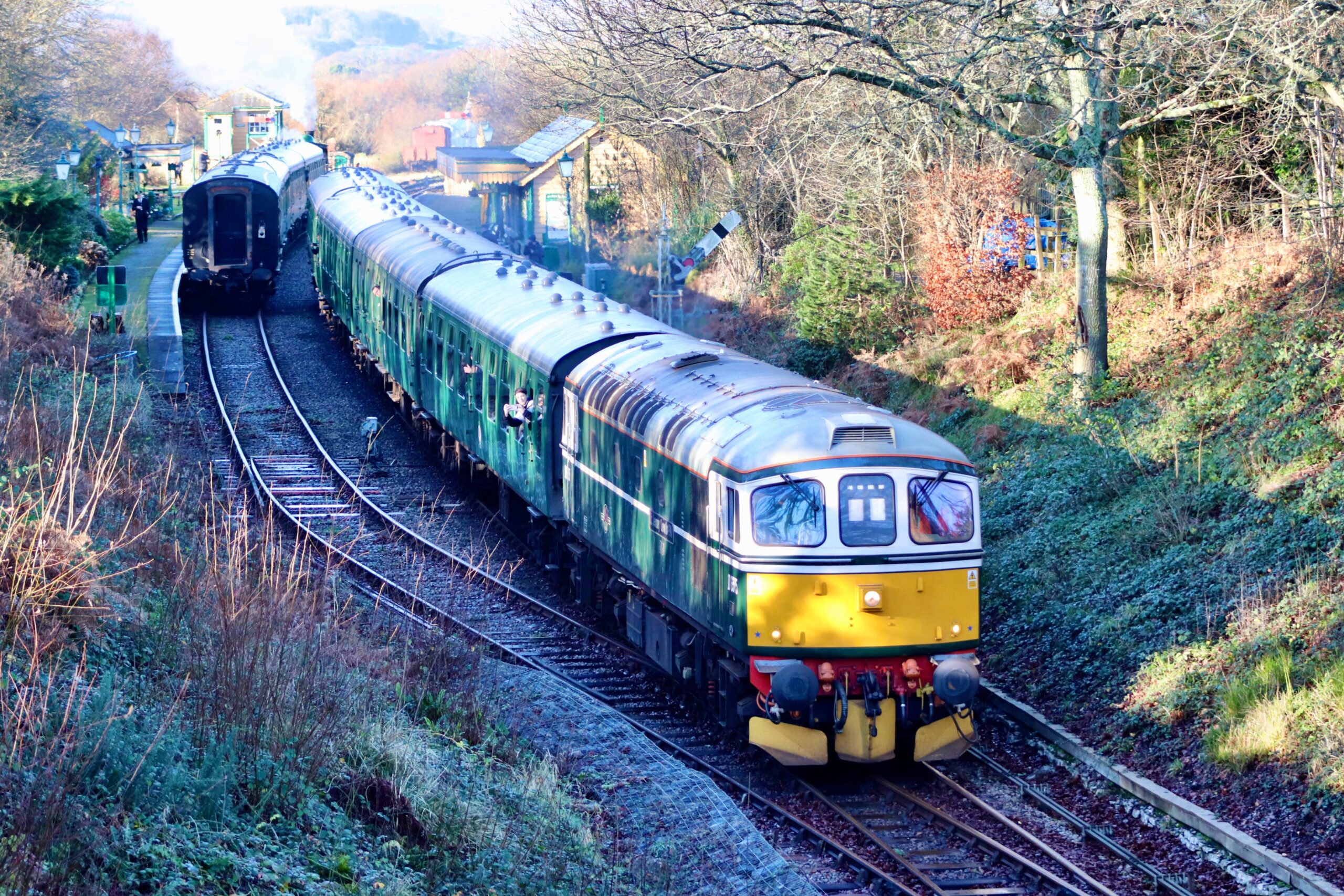
Swanage resident Class 33 No.D6515 (33012) ‘Lt. Jenny Lewis RN’ having coupled up to 4-4-0 T9 Class No.30120 in readiness of forming 6Z12 1652 Swanage to Arne Road Siding – 18/04/2024Crompton No. D6515 (33012) ‘Lt. Jenny Lewis RN’ is owned by the 71A Loco Group, and returned to Swanage in time for the May 2011 Diesel Gala after undergoing overhaul at Eastleigh works. She is seen here reversing into Swanage railway station with 4-4-0 T9 Class No.30120 – 18/04/2024Southern Railway 4-6-2 “West Country” Class No. 34028 ‘Eddystone’ at Swanage having backed onto the coaching stock of the 2N10 1640 Swanage to Norden service – 18/04/2024Southern Railway 4-6-2 “West Country” Class No. 34028 ‘Eddystone’ departs Swanage working 2N10 1640 Swanage to Norden – 18/04/2024Class 33 No.D6515 (33012) ‘Lt. Jenny Lewis RN’ hauls 4-4-0 T9 Class No.30120 away from Swanage working as 6Z12 1652 Swanage to Arne Road Siding – 18/04/2024Class 33 No.D6515 (33012) ‘Lt. Jenny Lewis RN’ and 4-4-0 T9 Class No.30120 on the approach to Harmans Cross working 6Z12 1652 Swanage to Arne Road Siding – 18/04/2024
The Swanage Railway Trust are hoping to raise £50,000 for this project, which will enable No. 120 to be dismantled and assessed at the Flour Mill. Following this, a report will be produced detailing the work required to return 120 to service, including an assessment of the cylinder block and whether this needs to be replaced. If the report is favourable, the Trust can proceed to the next stage of the overhaul later in the year. Should it be decided the locomotive is not a suitable contender for restoration, the remainder of the £50,000 will see No. 120 re-assembled and returned to the NRM for further display.
Class 33 No.D6515 (33012) ‘Lt. Jenny Lewis RN’ arrives at Arne Road with 4-4-0 T9 Class No.30120 in tow working 6Z12 1652 Swanage to Arne Road Siding – 18/04/2024
Video of T9 Class No.30120 being hauled to Arne Sidings on the Swanage Railway – 18/04/2024
Engineering Work took place in the Wareham area over the weekend of 20th / 21st April 2024. The sidings to the east of Wareham railway station were renewed, ballast was refreshed at Worgret Junction and the footbridge at Wool railway station received attention. Two engineering trains were engaged for the work; 6G13 2212 Eastleigh East Yard to Wareham top and tailed by GBRf Class 66 No.’s 66795 & 66749 ‘Christopher Hopcroft MBE 60 Years Railway Service’ and 6C03 1939 Eastleigh East Yard to Holton Heath in the sole charge of Colas Class 66 No.66850 ‘David Maidment OBE’. Two other associated workings featured 4-wheeler Track Machine Colas Tamper No. DR73931 forming 6J86 1844 Woking Up Yard Reception to Wool MOD Siding GBRf and Pandrol Jackson Plain Line Stoneblower No. DR80205 working as 6U37 2103½ Horsham Up T.C. to Holton Heath.
Screenshot of GBRf Class 66 No. 66795 at Poole leading on 6G13 2212 Eastleigh East Yard to Wareham – 20/04/2024Screenshot of GBRf Class 66 No. 66749 ‘Christopher Hopcroft MBE 60 Years Railway Service’ passes through Poole at the rear of 6G13 2212 Eastleigh East Yard to Wareham – 20/04/2024Screenshot of Colas Class 66 No.66850 ‘David Maidment OBE’ passing Poole working 6C03 1939 Eastleigh East Yard to Holton Heath – 20/04/2024Wareham Railway Station – 21/04/2024A hand written note informs us that the pedestrian crossing at Wareham railway station is closed due to engineering work – 20/04/2024New track panels stacked adjacent the unused signal box at Wareham – 20/04/2024Work continues at Wareham – 20/04/2024A view up the line towards Wareham sidings which would be partially renewed during the weekend engineering works- 20/04/2024A Road Rail Vehicle (RRV) at work in Wareham – 21/04/2024Pandrol Jackson Plain Line Stoneblower No. DR80205 used for the initial levelling of track after it has been freshly installed awaits the call of duty at Holton Heath – 21/04/2024
The Class 66 hauled engineers trains departed the possession area in the early hours of Monday 22nd reporting as 6G13 0230 Bournemouth to Eastleigh East Yard and 6C03 0330 Bournemouth to Eastleigh East Yard.
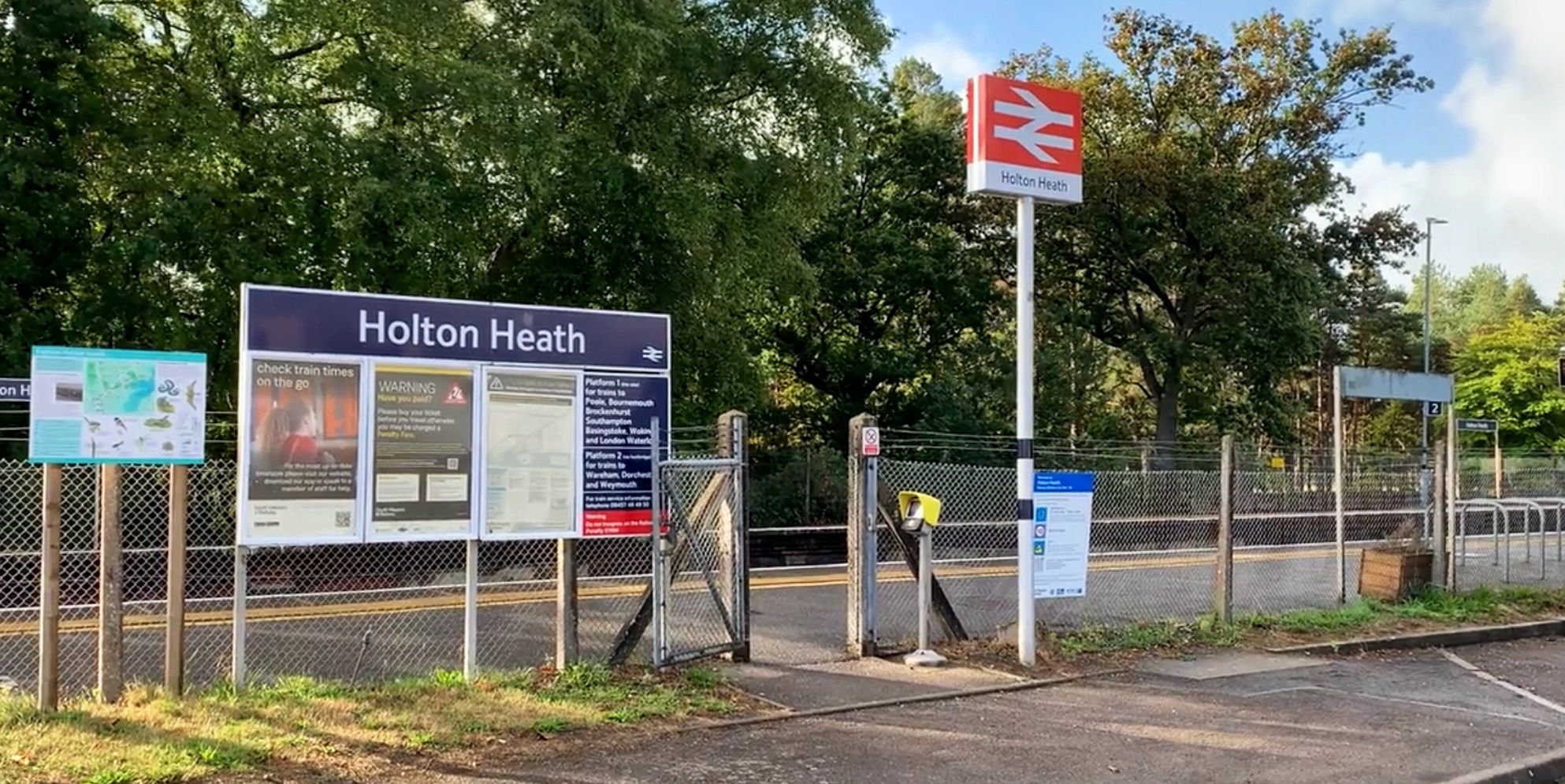
Holton Heath railway station – September 2022
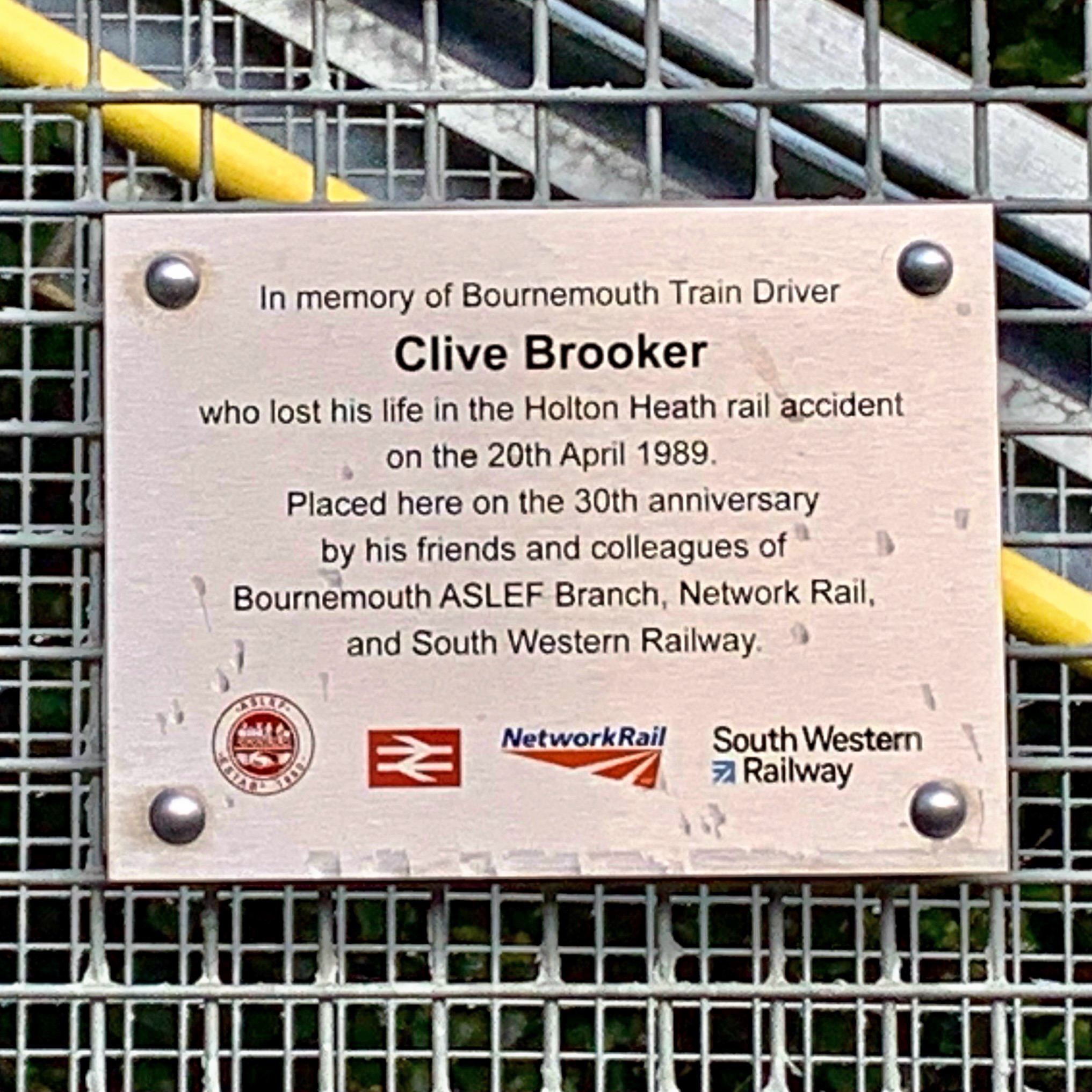
20th April was the 35th anniversary of a collision which occurred at Holton Heath in 1989. Tragically, Bournemouth train driver Clive Brooker lost his life in the accident. The archived report can be found here.
Plaque in memory of Driver Clive Brooker situated at Hamworthy railway station; “At about 1202, a light locomotive, that is one travelling without a train, collided with the rear of a freight train at Holton Heath. I regret to report that the driver of the light locomotive… died as a result of the accident. The driver and the guard of the freight train suffered minor injuries.
On a dry clear day, the diesel locomotive, No. 33107, was travelling at speed under clear signals along the Up line between Wareham and Hamworthy Junction, when it struck the rear of the 1145 Wool to Eastleigh freight train 6W54 as it was accelerating away from a stand after carrying out shunting duties at Holton Heath Siding. The freight train consisted of eight wagons hauled by an electro-diesel locomotive No. 73002; the rearmost wagon being the Type VAA four-wheeled covered van with long sliding doors and loaded with bagged and palletised ballcla.”
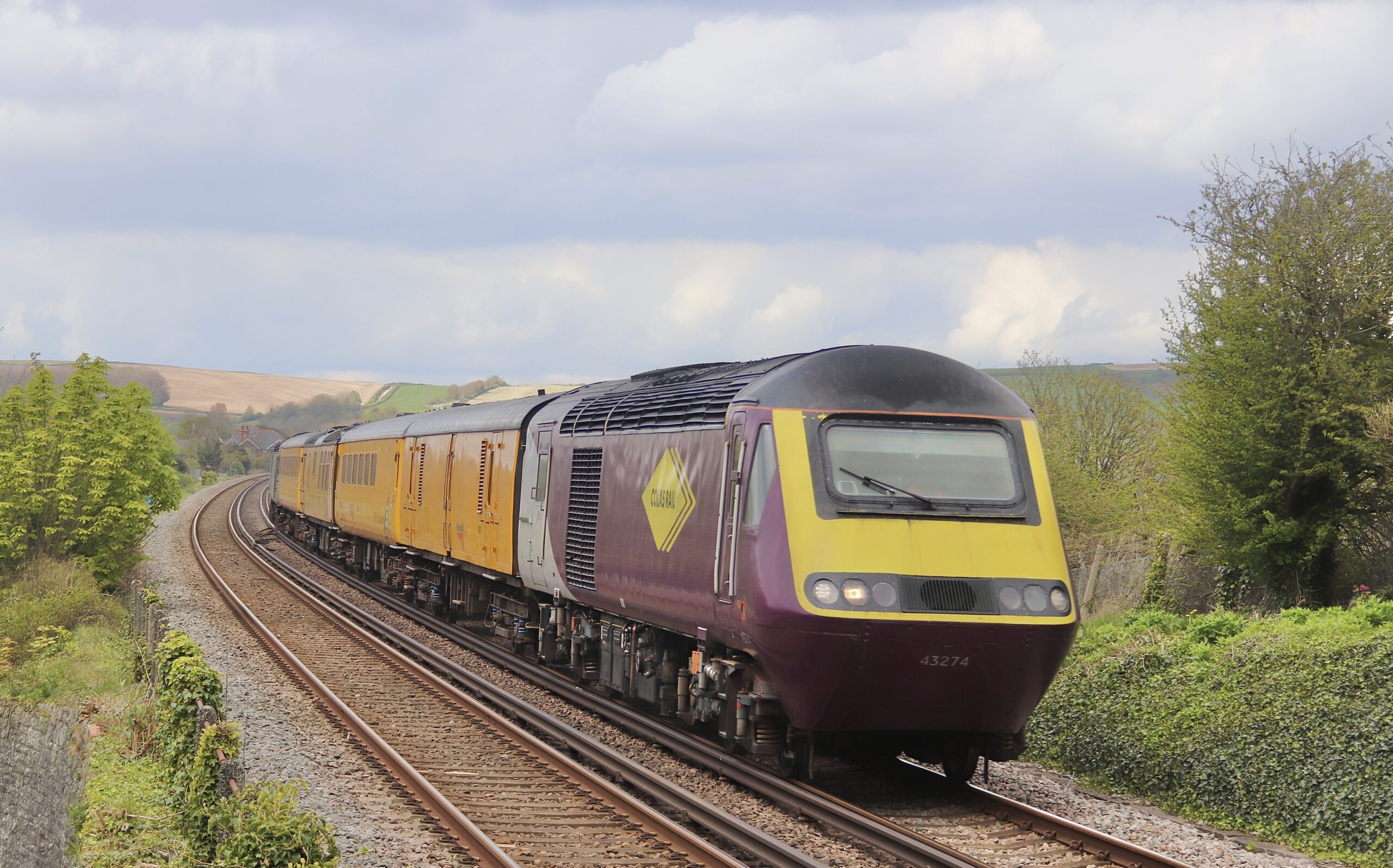
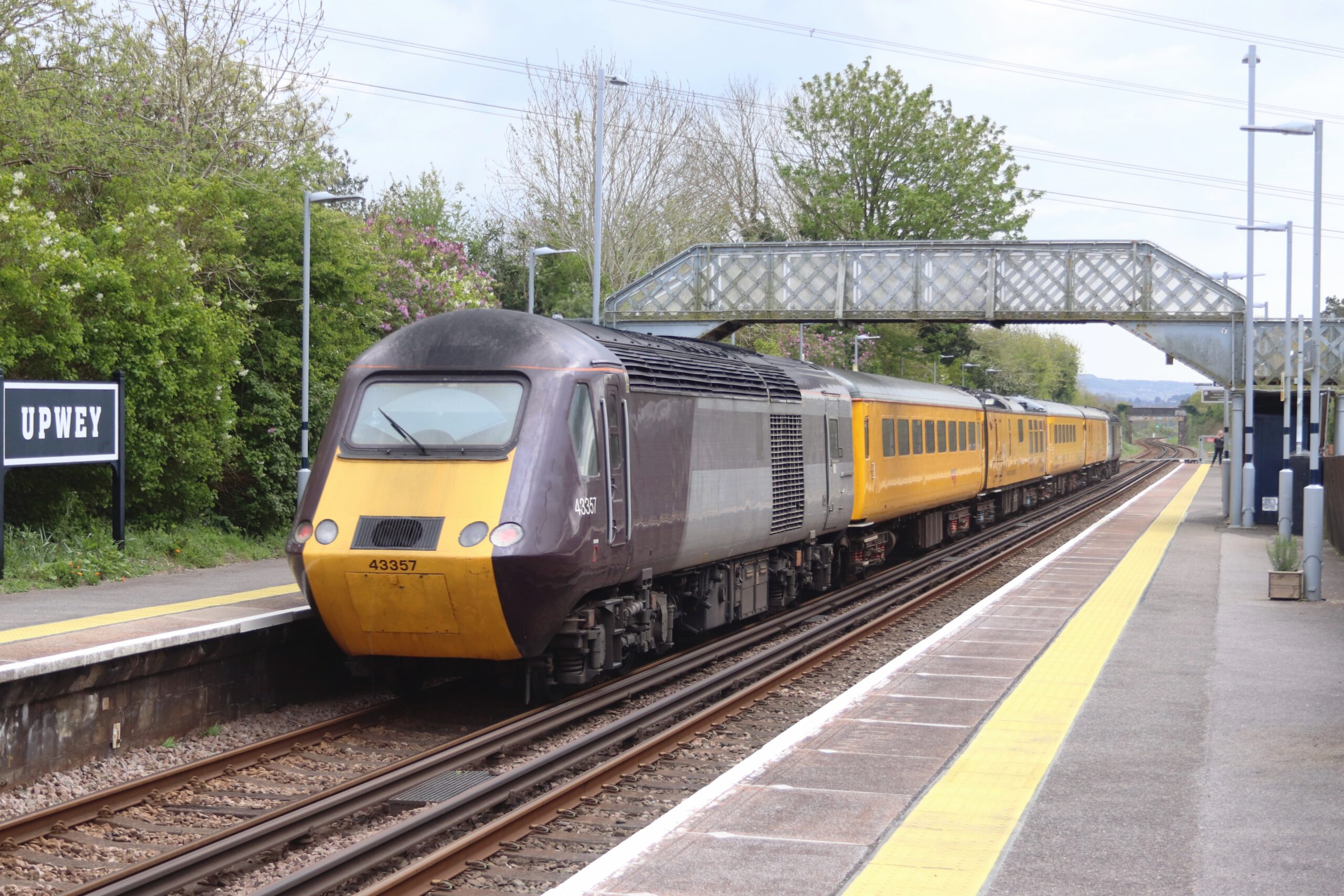
Wednesday April 24th 2024 and it was the turn of Network Rail’s (NR) New Measurement Train (NMT) to visit Weymouth via the western route from Yeovil Pen Mill. Having missed out the Dorset seaside town because of line closures in March the train, which monitors and records track condition information at speeds up to 125mph, was in the hands of former High Speed Train Class 43 power cars No.’s 43274 and 43357 this month. Yoshi and I visited Upwey to see the outward and return legs.
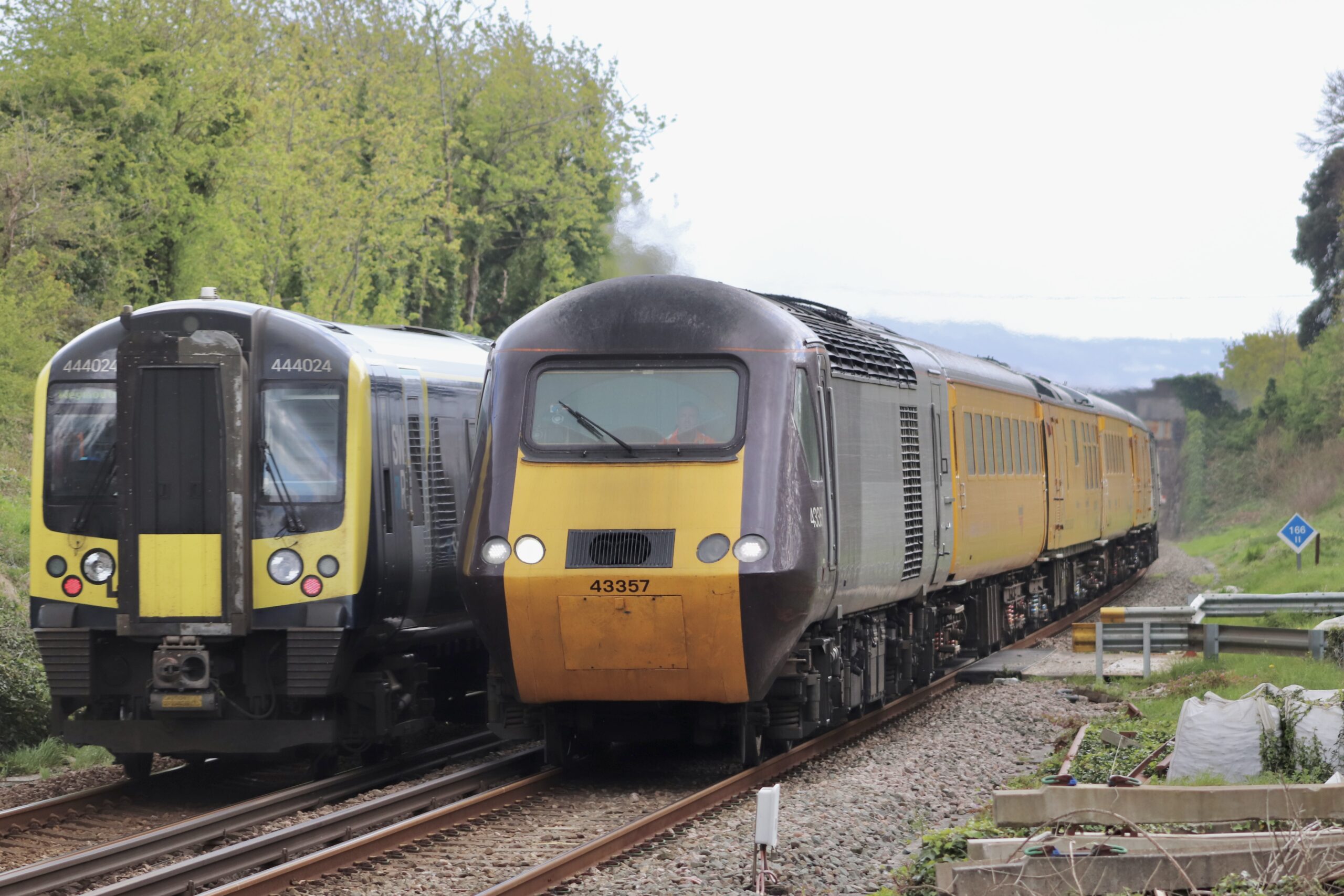
In its Colas branded East Midlands Railway (EMR) livery, Class 43 High Speed Train power car No. 43274 leads on the approach to Upwey working the New Measurement Train 1Z22 0747 Derby Railway Technical Centre to Bristol Kingsland Road via Weymouth – 24/04/2024At the rear of the New Measurement Train – reporting as 1Z22 0747 Derby RTC to Bristol Kingsland Road via Weymouth – in de-branded CrossCountry livery Class 43 High Speed Train power car No. 43357 passes through Upwey on its way to Weymouth – 24/04/2024Class 43 High Speed Train power car No. 43357 forming the New Measurement Train 1Z22 0747 Derby Railway Technical Centre to Bristol Kingsland Road via Weymouth passes South Western Railway Class 444 No. 444024 forming 1W27 1335 London Waterloo to Weymouth at Upwey – 24/04/2024
Video of the Dorset HST Hew Measurement Train – 24/04/2024 (with thanks to da_bucklet967 and G E Barrett for additional video content)
Train drivers union, ASLEF, have announced fresh strikes and an overtime ban taking place between Monday 6th May and Saturday 11th May 2024. Train Operating Companies (TOC) in Dorset affected by strike action days are SWR on Tuesday 7th May and GWR on Wednesday 8th May when revised services will run, with short-notice cancellations possible.
That’s it for another belated blog entry, thanks for joining us looking back on our railway themed adventures! We appreciate your comments, corrections and feedback. We’ll be back with another update soon. Until then, be seeing you!
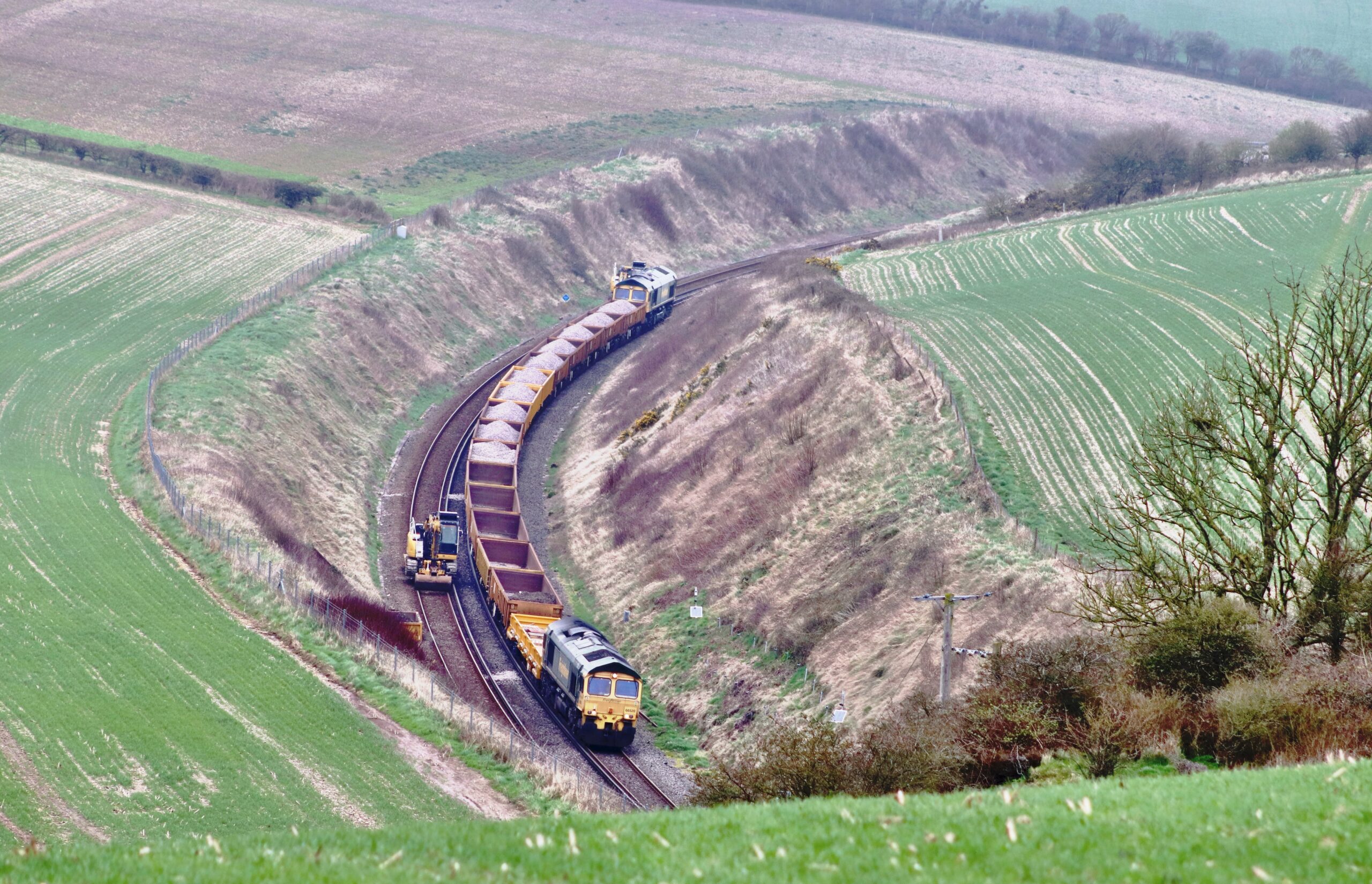
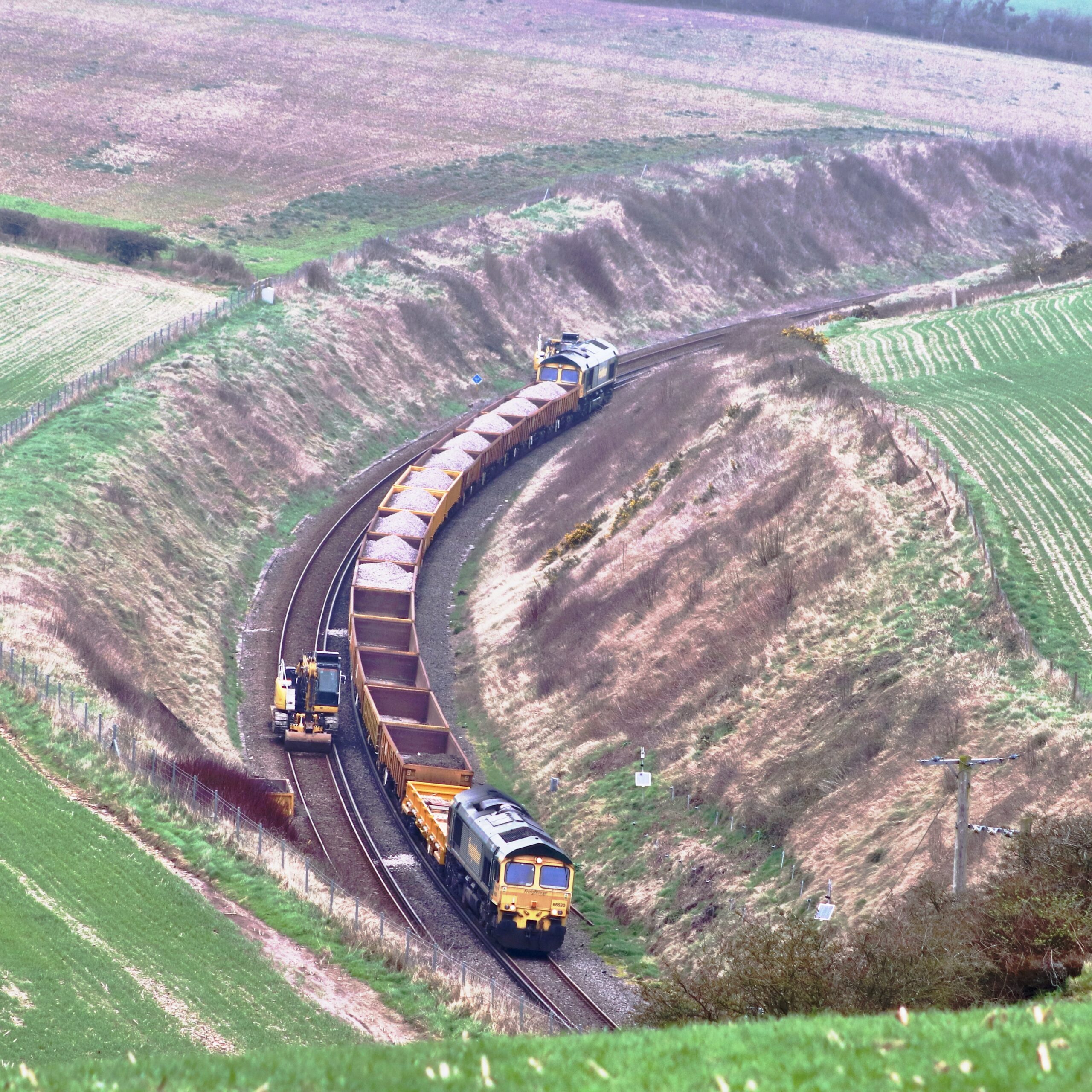
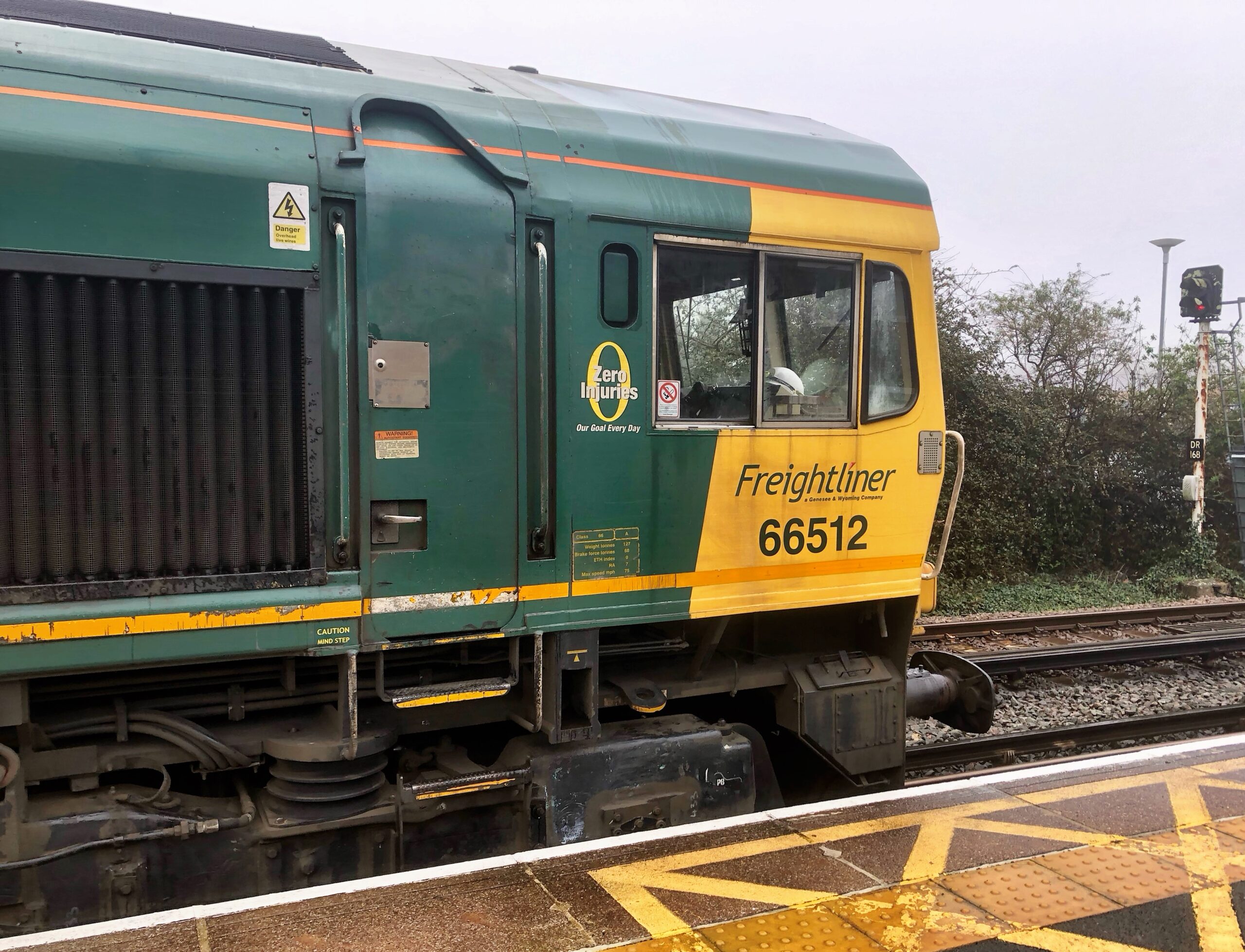
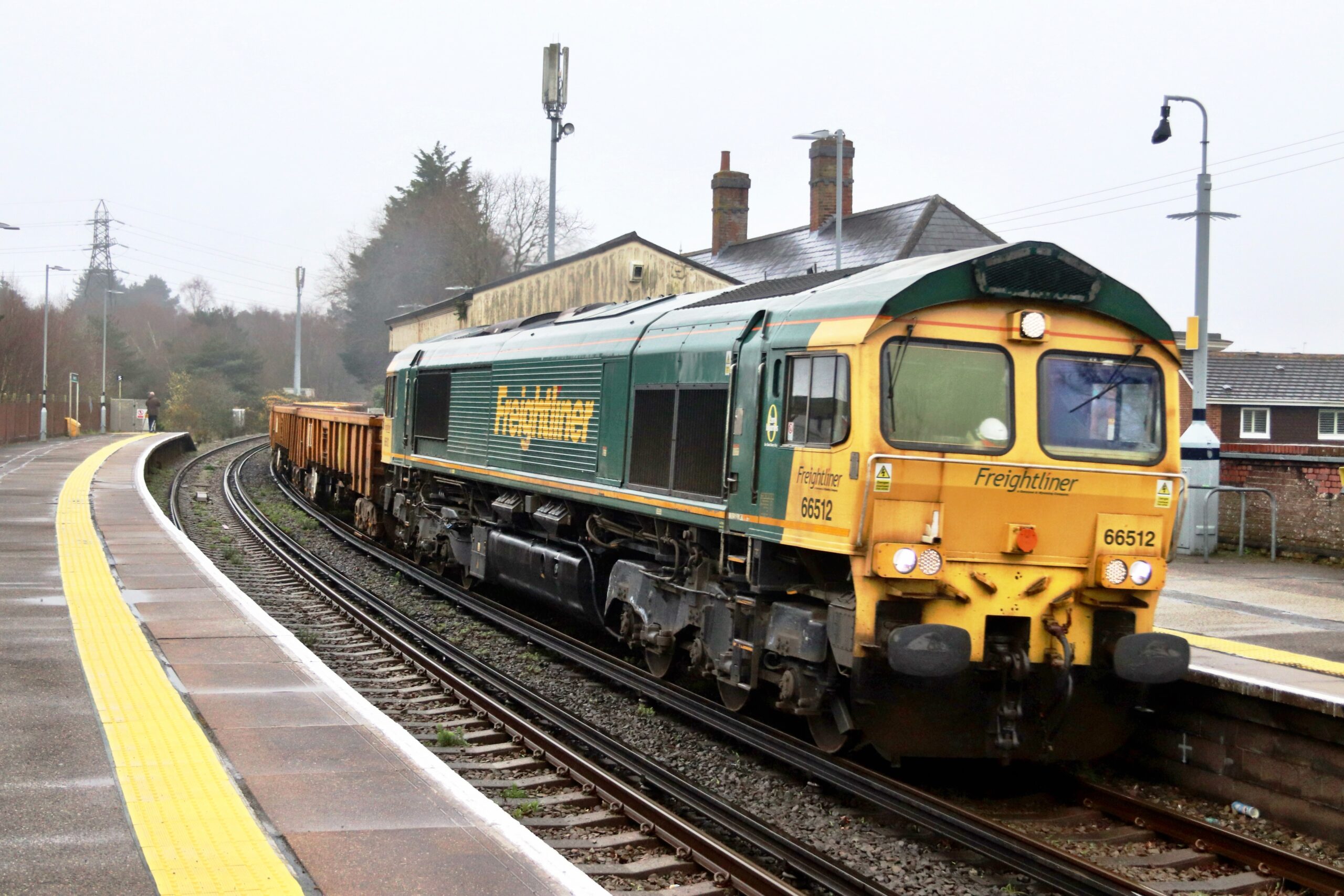
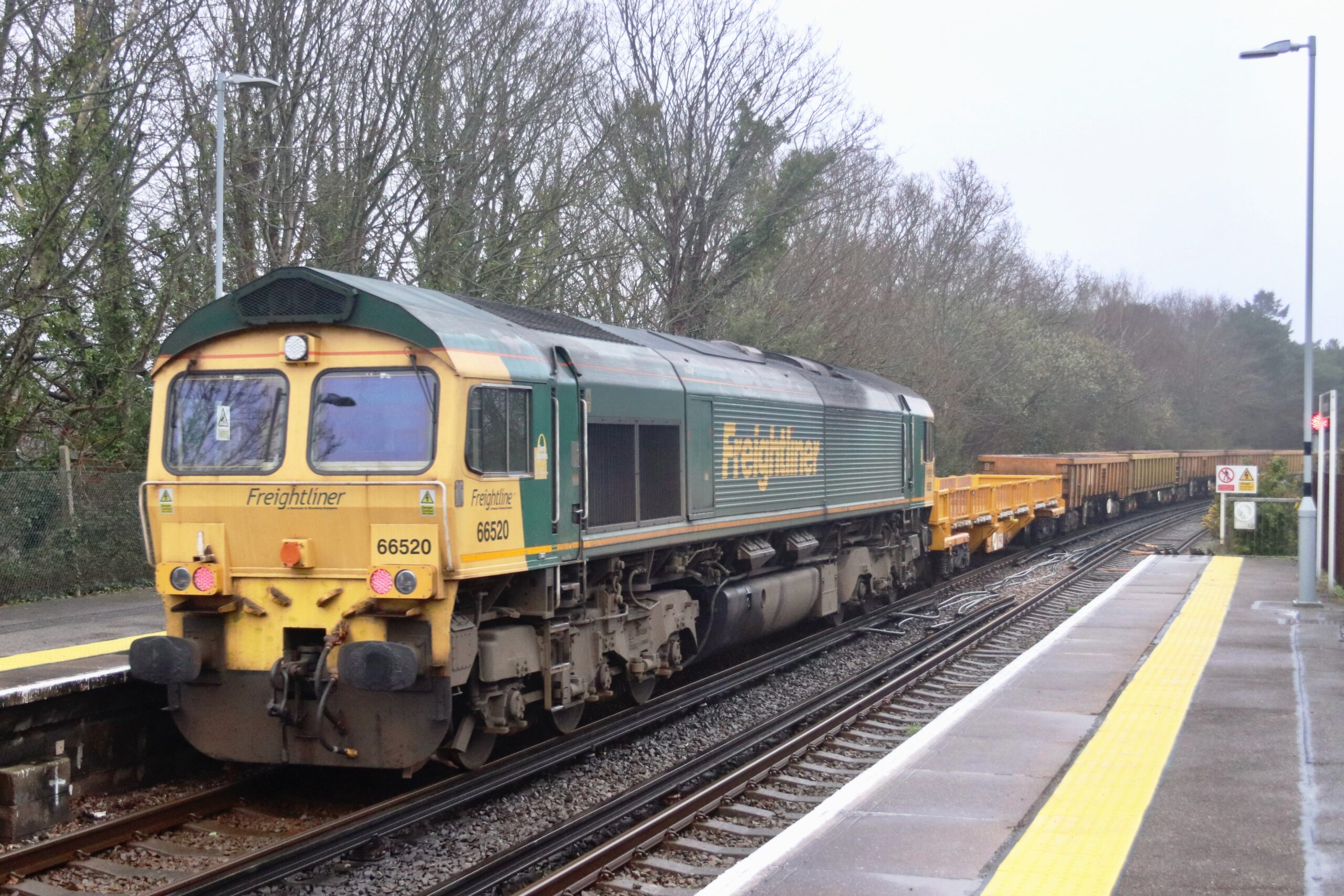
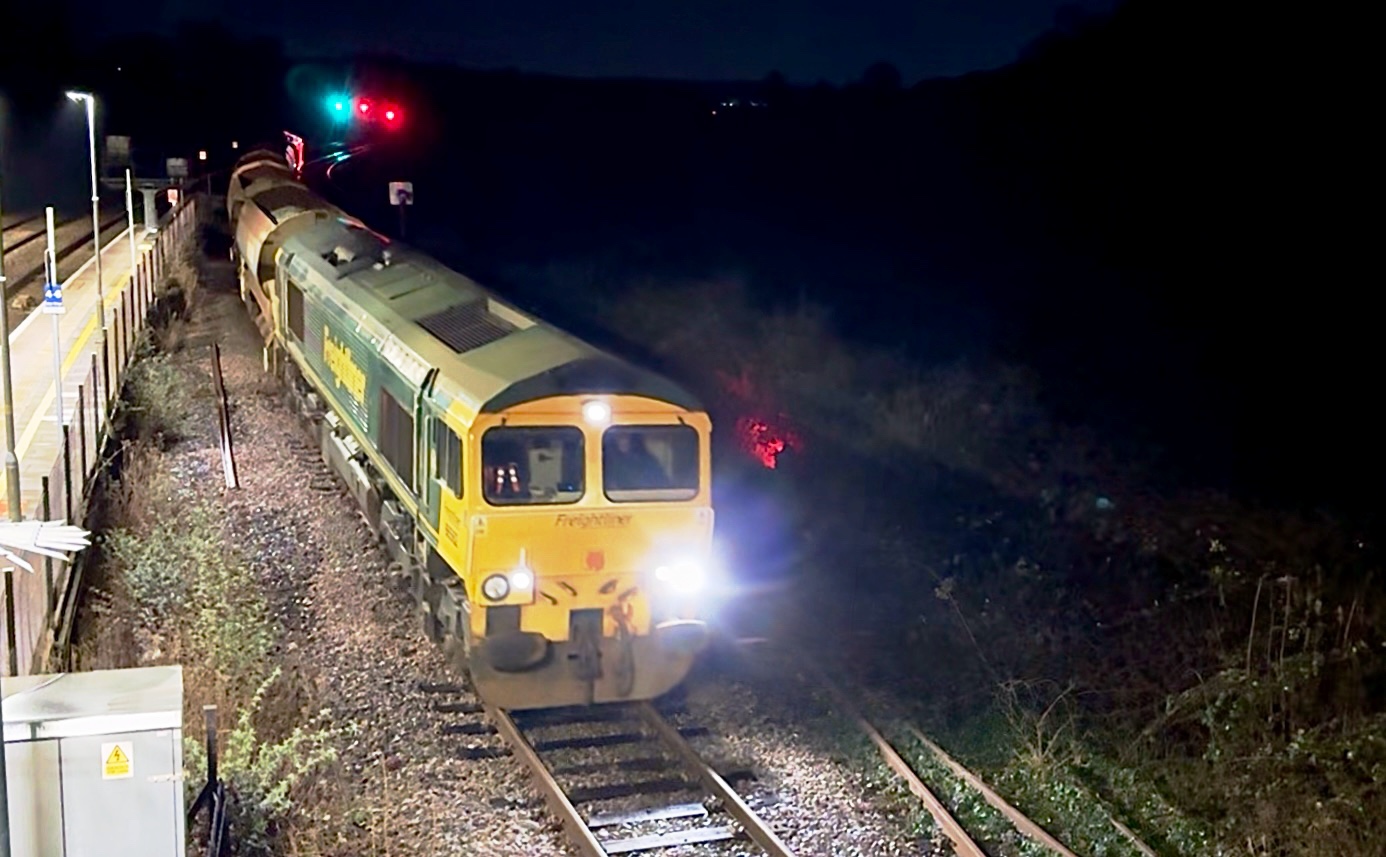
Freightliner Class 66 locomotives No.’s 66520 and 66512 at Bincombe during engineering work reporting as 6Y85 2348 Eastleigh East Yard to Dorchester South – 18/03/2024
March 16th 2024 to March 22nd 2024
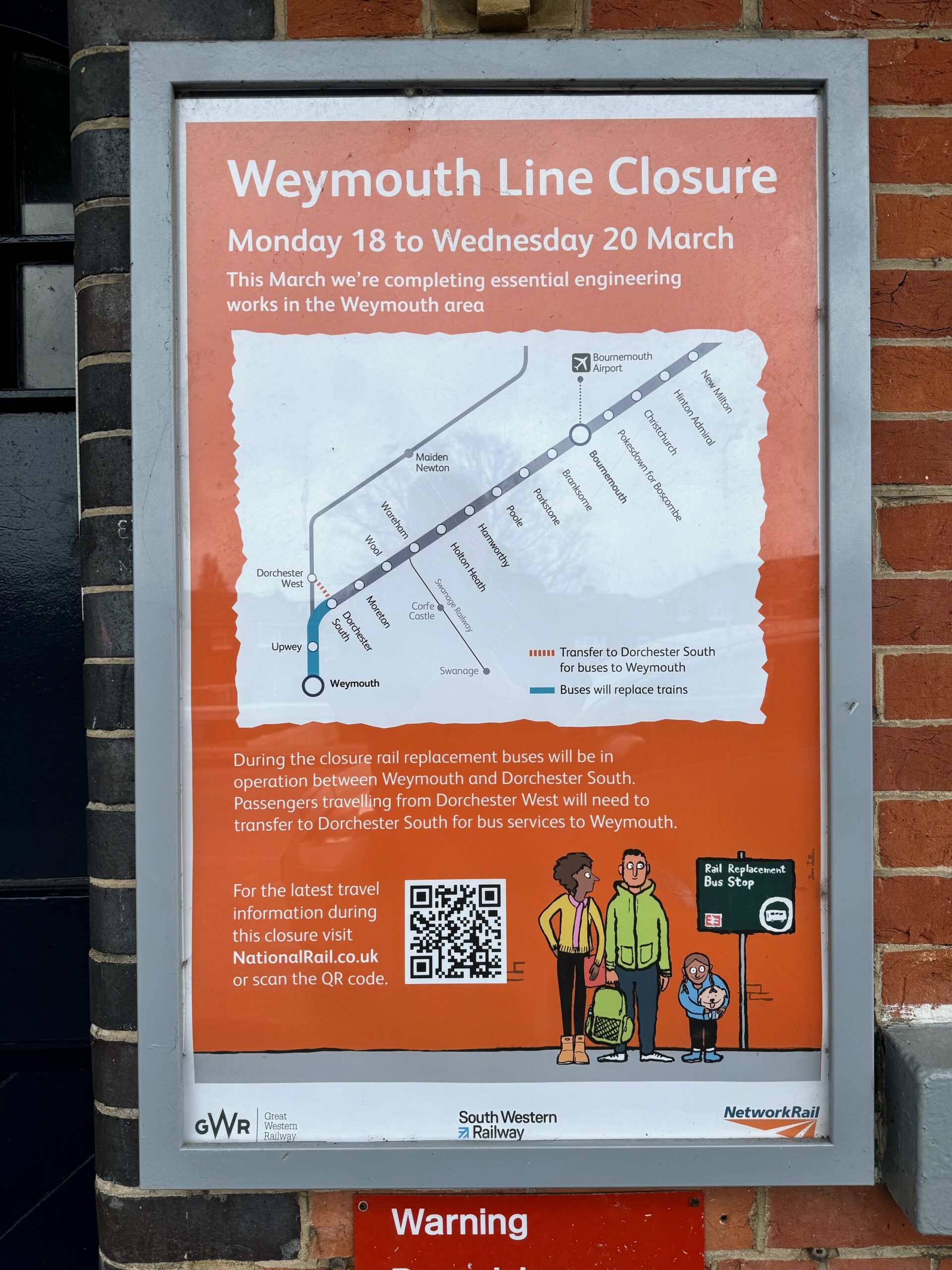
Maintenance work between Dorchester and Weymouth closed the railway line from Monday 18th to Wednesday 20th March 2024 affecting both South Western Railway (SWR) and Great Western Railway (GWR) services along this route. In association with the work, an engineers train, in the hands of Freightliner, worked from Eastleigh East Yard to Dorchester South overnight of 16/17th March, arriving in the County Town at 0156 on the Monday morning, approximately 46 minutes behind schedule. We saw the train pass through Hamworthy, top and tailed by Class 66 locomotives No.’s 66520 and 66512, at which point it was running 36 minutes late.
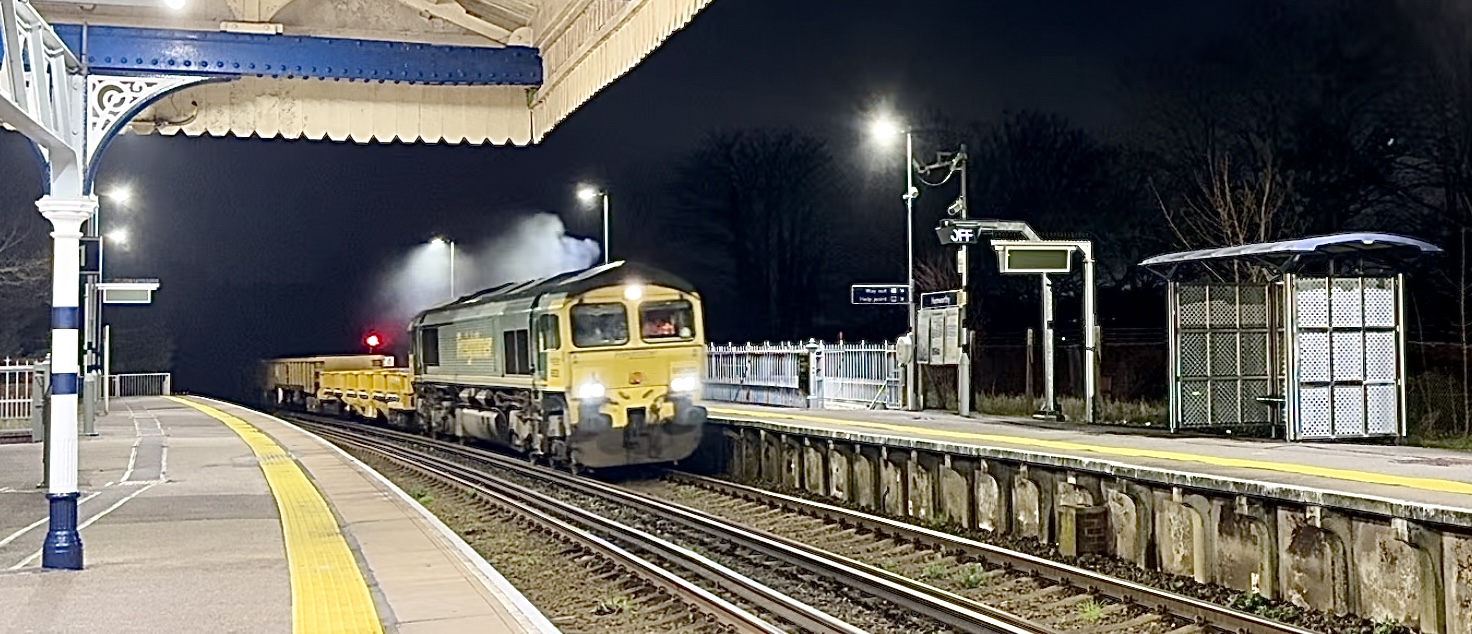
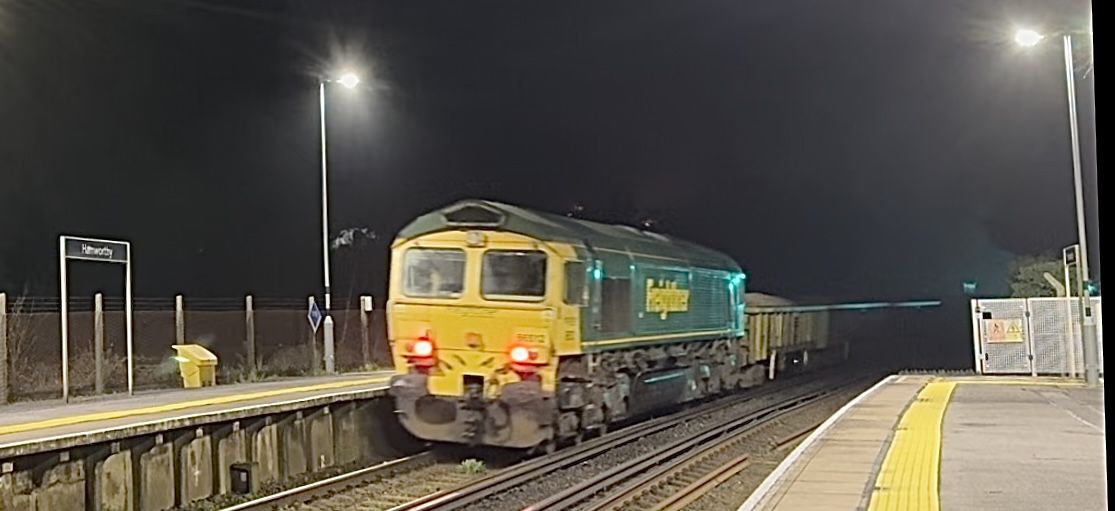
Freightliner Class 66 No. 66520 leads through Hamworthy working 6Y85 2348 Eastleigh East Yard to Dorchester South – 17/03/2024FL Class 66 No. 66512 brings up the rear on 6Y85 2348 Eastleigh East Yard to Dorchester South passing Hamworthy – 17/03/2024
As we arrived at the station in good time to see the engineering train heading to Weymouth, we were surprised to see an empty coaching stock movement, formed of SWR Class 444 No. 444001 passing through Hamworthy just after 0100 on its way to Bournemouth Traincare depot working as 5W71 0041 Weymouth to Bournemouth TRSMD. A result of the line being closed in the Poole area on the Sunday meant trains from London Waterloo terminated at Bournemouth. A replacement bus service ran to stations between Bournemouth and Wareham with a shuttle train service operating between Wareham and Weymouth during the day.
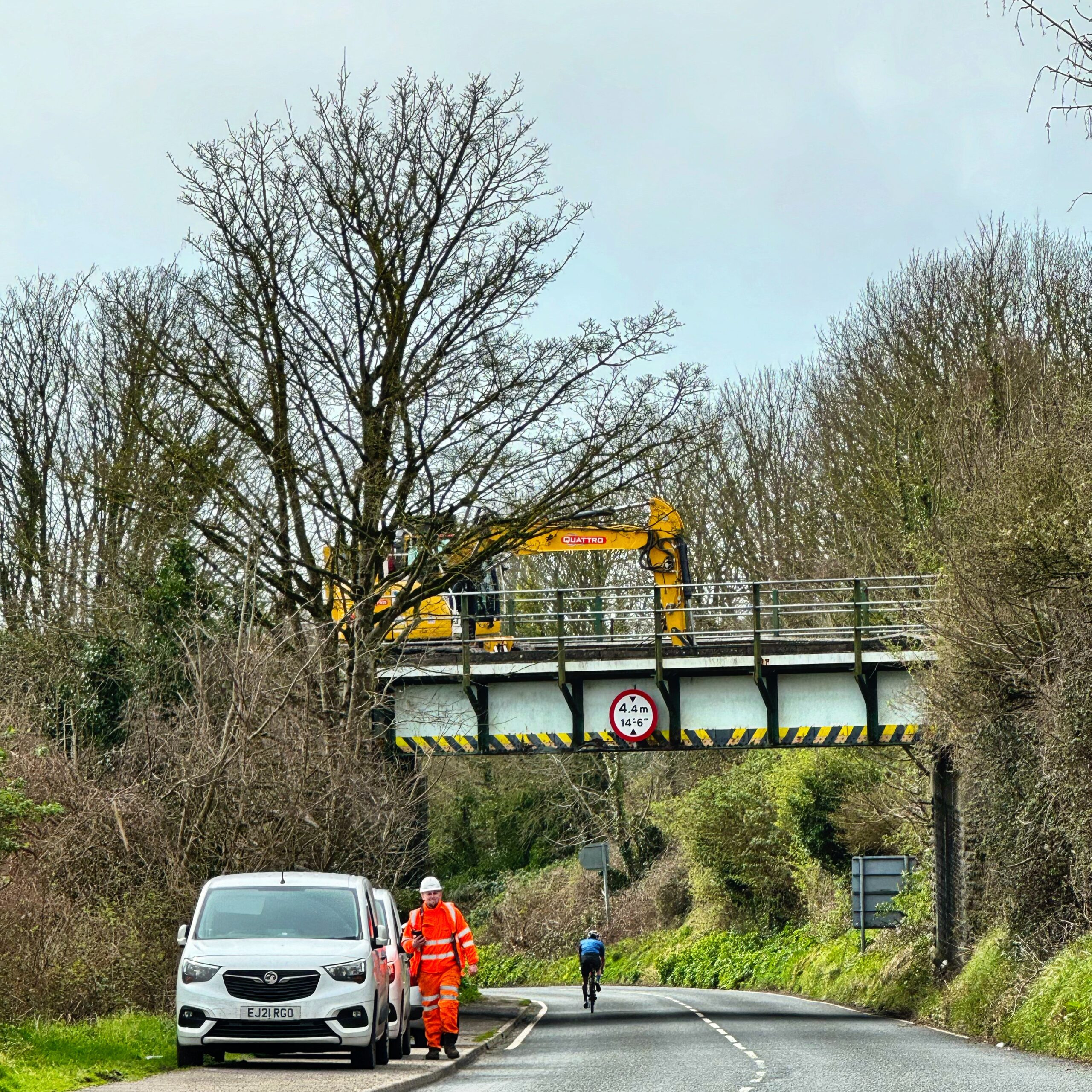
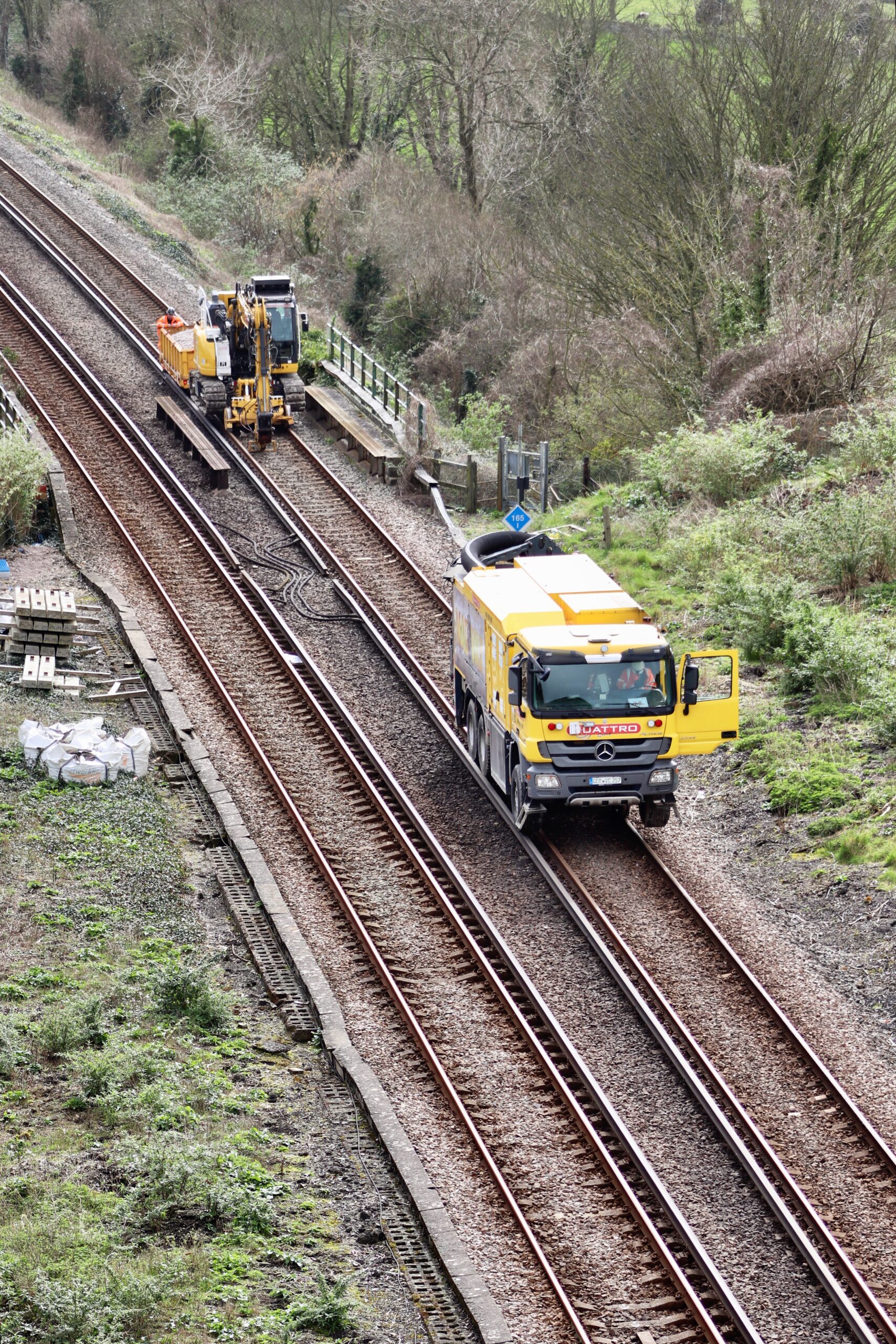
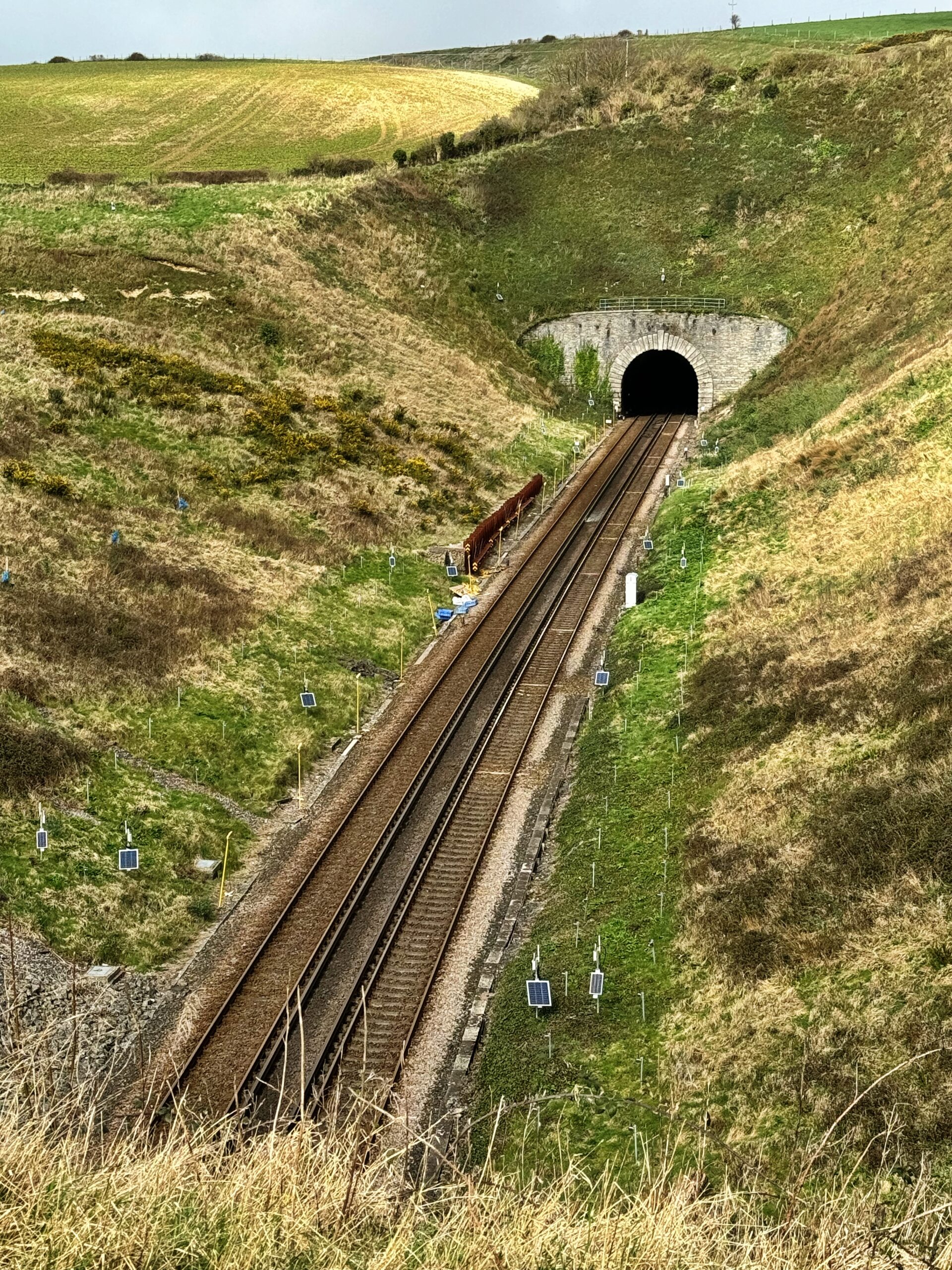
The worksite necessitating the Monday to Wednesday line closure was located in the Bincombe area, where track would receive the attention of a tamper and gain some fresh ballast. We popped out on Monday afternoon to take a look at what was going on, expecting to find the two Class 66 locomotives parked up on the down line between Bincombe Tunnel and Bincombe Tunnel Number 2. Instead we found Quattro Group’s Mercedes rail road vehicle ‘Mad Vax’ and one of their tracked Road Rail Vehicles (RRV).
A RailRoad vehicle at Bincombe – 18/03/2024Quattro Group’s Mad Vax vacuum excavation system, which won the Most Innovative RRV Product Award at the National Rail Awards in 2019, prepares to do its stuff at Bincombe. Quattro Group are rightly proud of this piece of kit; “The Mad Vax vacuum excavation system has all the power and performance needed to complete a wide array of rail applications from ballast removal to spillage clean up operation. The unit’s spoil capacity is an impressive 6m3, and with a side tipping hopper it can be emptied lineside, utilising a special split-lid spoil tank to give a lower overall profile and to reduce overall tipping height for works under overhead power cables or at a suitable location when off track. The machine is also equipped with a Powerarm and IKE rotating suction tube to aid in breaking up harder ground for improved efficiency.” – 18/03/2024Bincombe worksite for the March 2024 maintenance work – 18/03/2024
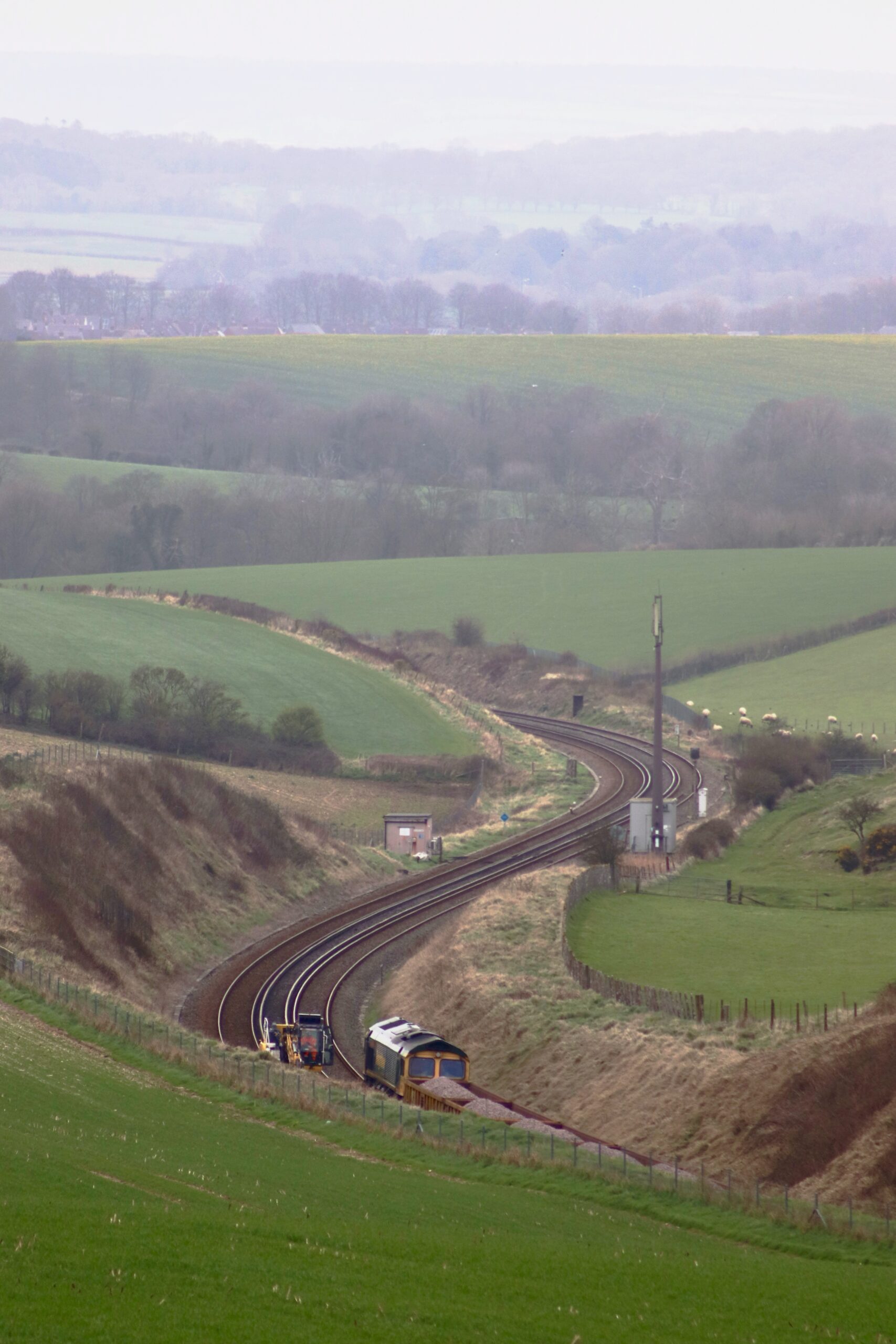
After a quick chat with friend of this blog, Robin, we drove off towards Upwey to see if the engineers train was stabled near the railway station. Despite much of the line side trees and vegetation having been cut back, there was no sign of the Freightliner train. After refreshments at The Royal Standard in Upwey, we proceeded to drive back towards Dorchester when, glancing to the right as we came over the brow of Ridgeway hill, we could see the unmistakable sight of a Class 66 locomotive. Parking the car in the next lay-by, I crossed over the road and proceeded along the footpath back in the direction of Weymouth to see if it was possible to get a photo of the train at rest.
Class 66 No. 66512 stands out amidst the Dorset countryside – 18/03/2024
I was quite pleased with the resulting photo of the train parked at the northern portal of Bincombe Tunnel, perfectly placed for a photograph imho.
Because I liked the shot so much, another view of Freightliner Class 66 locomotives No.’s 66520 and 66512 at Bincombe during engineering work reporting as 6Y85 2348 Eastleigh East Yard to Dorchester South – 18/03/2024A tamper sits in the sidings at Dorchester South waiting to be deployed at Bincombe – 18/03/2024 (G E Barrett)
The Class 66’s returned to Eastleigh on the afternoon of Tuesday 19th March. It was quite a novelty to see a local engineers train working in daylight hours!
Class 66 No. 66512 awaiting departure with 6Y85 1454 Dorchester South to Eastleigh East Yard – 19/03/2024 (G E Barrett)Class 66 No. 66520 in the gloom of a wet Dorchester South at the rear of 6Y85 1454 Dorchester South to Eastleigh East Yard – 19/03/2024 (G E Barrett)Freightliner Class 66 No. 66512 ready to depart from Dorchester South working 6Y85 1454 Dorchester South to Eastleigh East Yard – 19/03/2024 (G E Barrett)Freightliner Class 66 No. 66512 leads on 6Y85 1454 Dorchester South to Eastleigh East Yard passing Hamworthy – 19/03/2024Freightliner Class 66 No. 66520 runs through Hamworthy at the rear of 6Y85 1454 Dorchester South to Eastleigh East Yard – 19/03/2024
Video of Freightliner Class 66 No.’s 66520 and 66512 working a Dorset engineering train – March 2024 (Additional video courtesy of G E Barrett)
The monthly New Measurement Train (NMT) which is scheduled to visit Weymouth via the West route through Maiden Newton was curtailed at Yeovil on Wednesday 20th March 2024 owing to the line closure between Dorchester and Weymouth. Allocated Class 43 High Speed Train (HST) power cars No.’s 43357 and 43277 worked 1Q18 0748 Derby RTC to Bristol Kingsland Road.
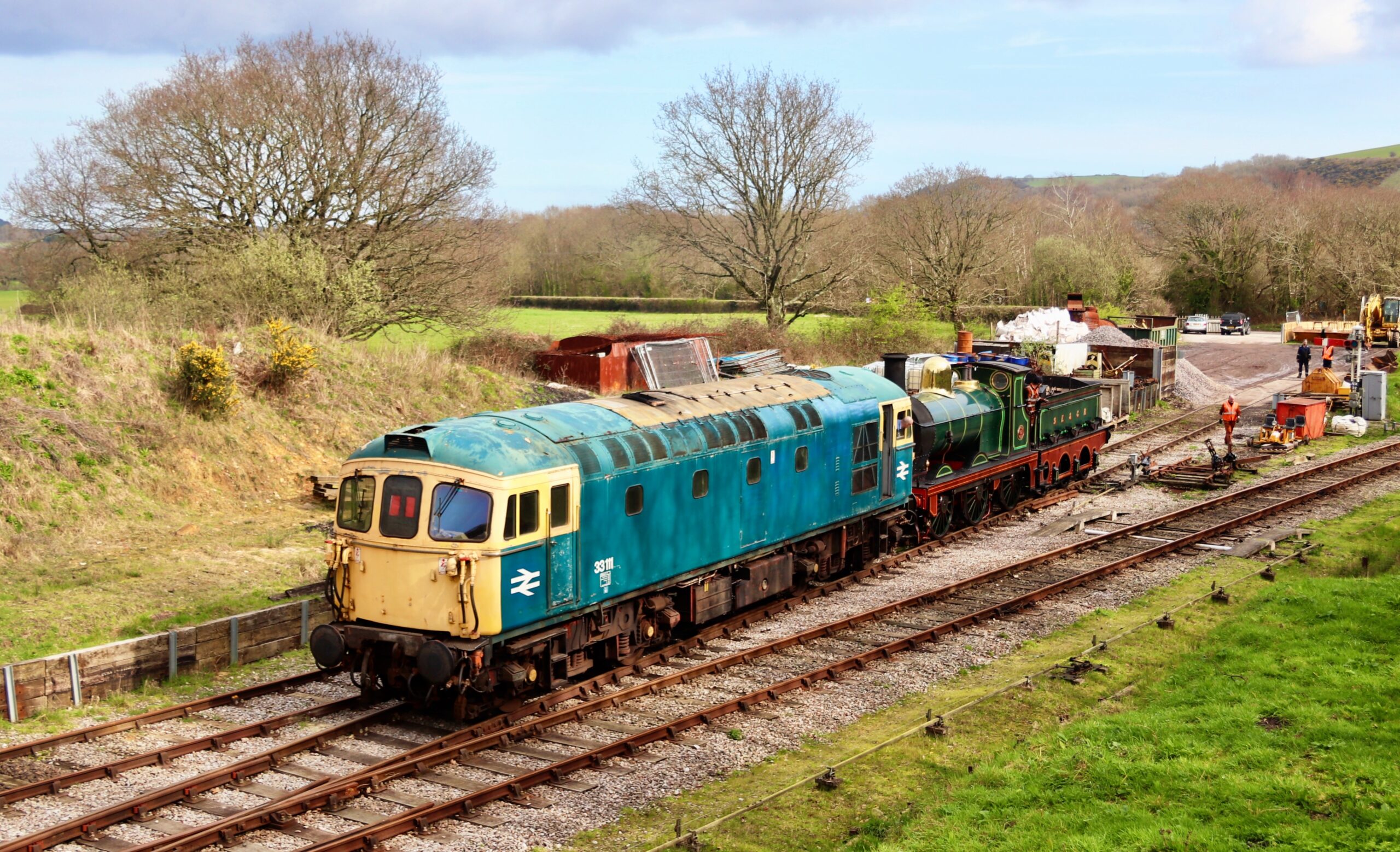
While the NMT was making its way to Somerset, I could be found at Norden on the Swanage Railway watching visiting South Eastern & Chatham Railway (SECR) Class O1 steam locomotive No. 65 being prepped for towing down to Swanage in readiness for the railways Victorian Weekend. Resident preserved Birmingham Rail & Carriage Works (BR&CW) Class 33 No. 33111 had the task of collecting No. 65 and hauling her down to Swanage.
Swanage resident Class 33/1 No. 33111 cautiously hauls South Eastern & Chatham Railway (SECR) Class O1 steam locomotive No. 65 away from Norden sidings – 20/03/2024South Eastern & Chatham Railway (SECR) Class O1 steam locomotive No. 65 at Norden during the operation to haul her to Swanage in readiness for the railway’s Victorian Weekend – 20/03/3024Class 33/1 No. 33111 hauls South Eastern & Chatham Railway (SECR) Class O1 steam locomotive No. 65 as they depart Norden station heading to Swanage – 20/03/2024
SECR O1 No. 65 arrives on the Swanage Railway – 20/03/2024
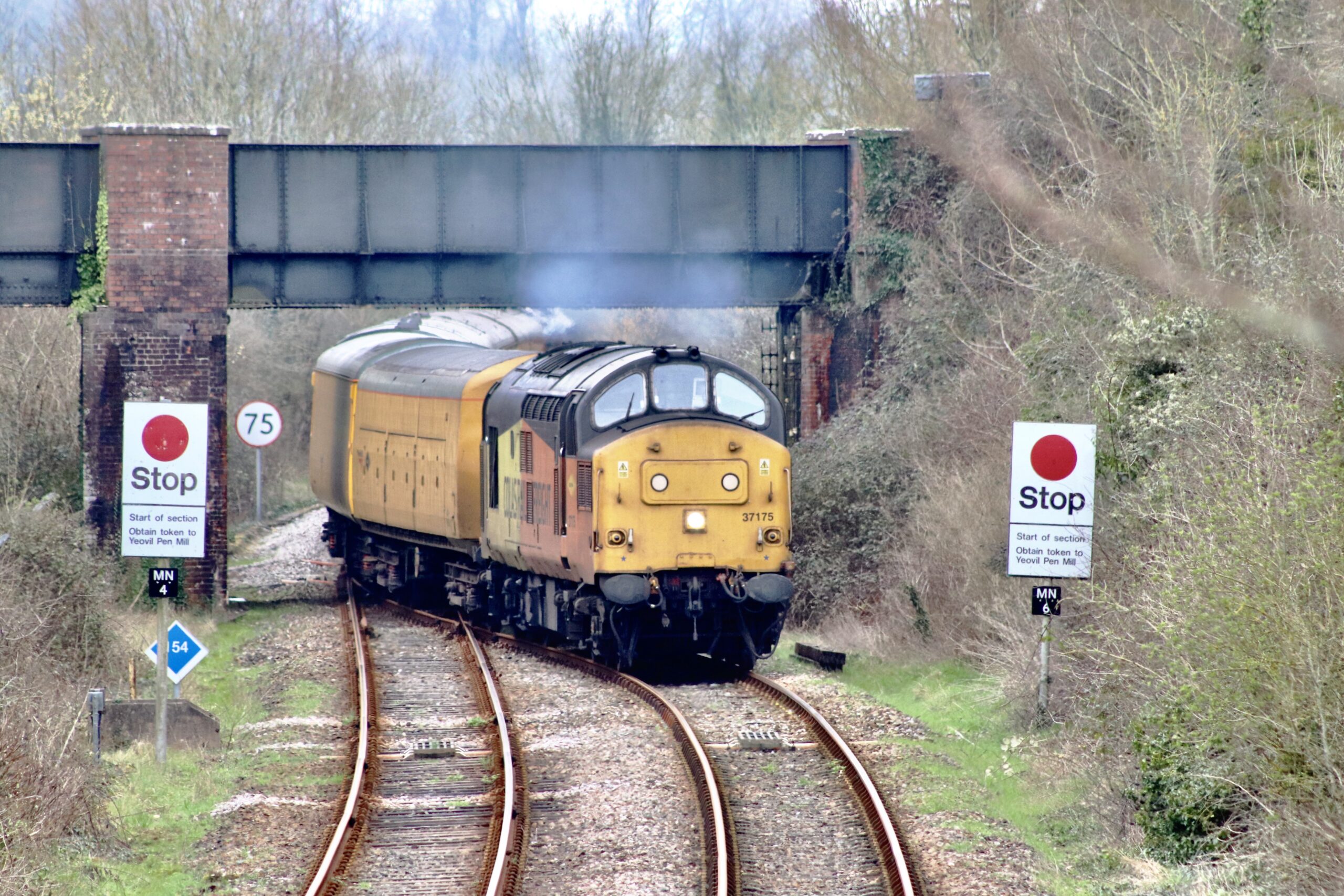
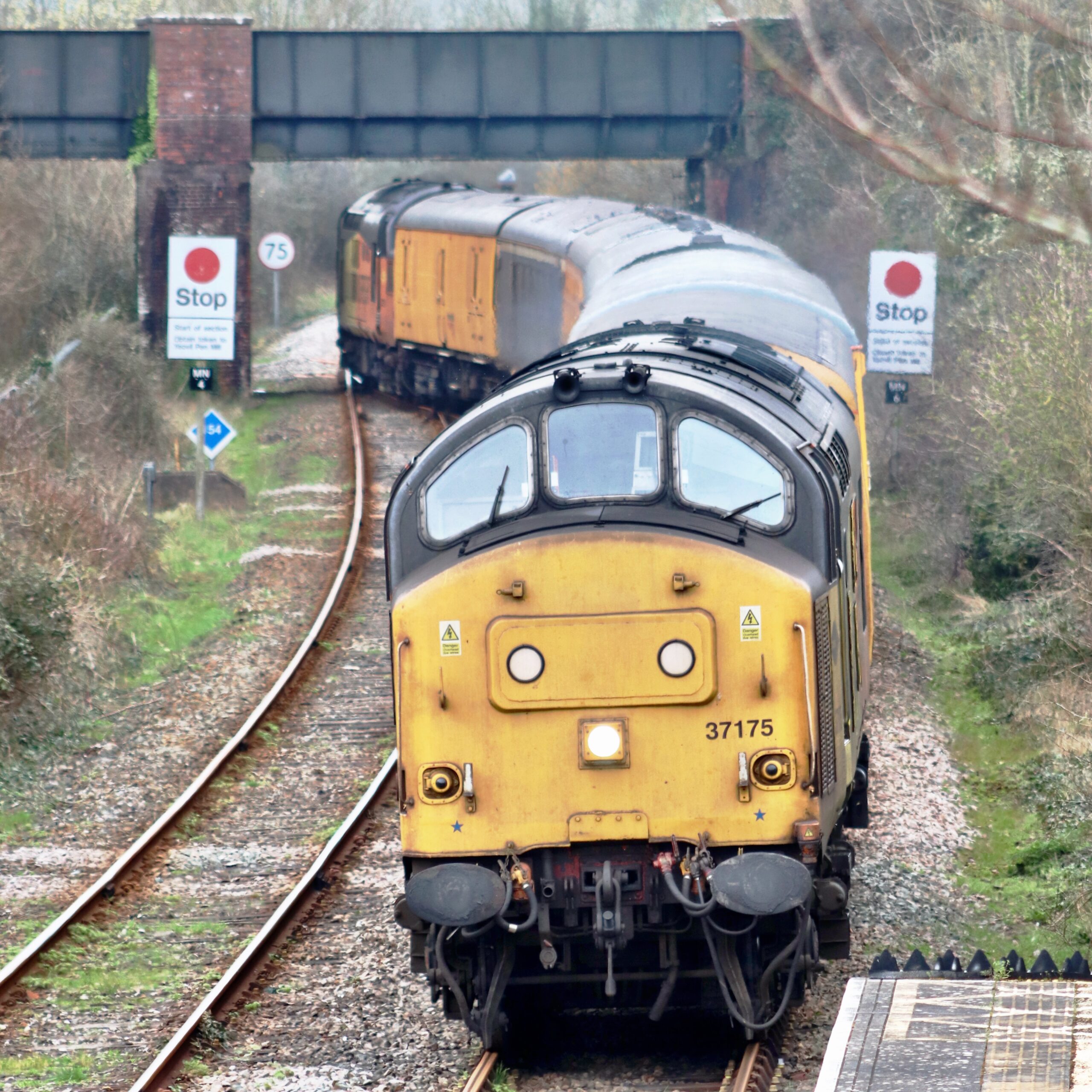
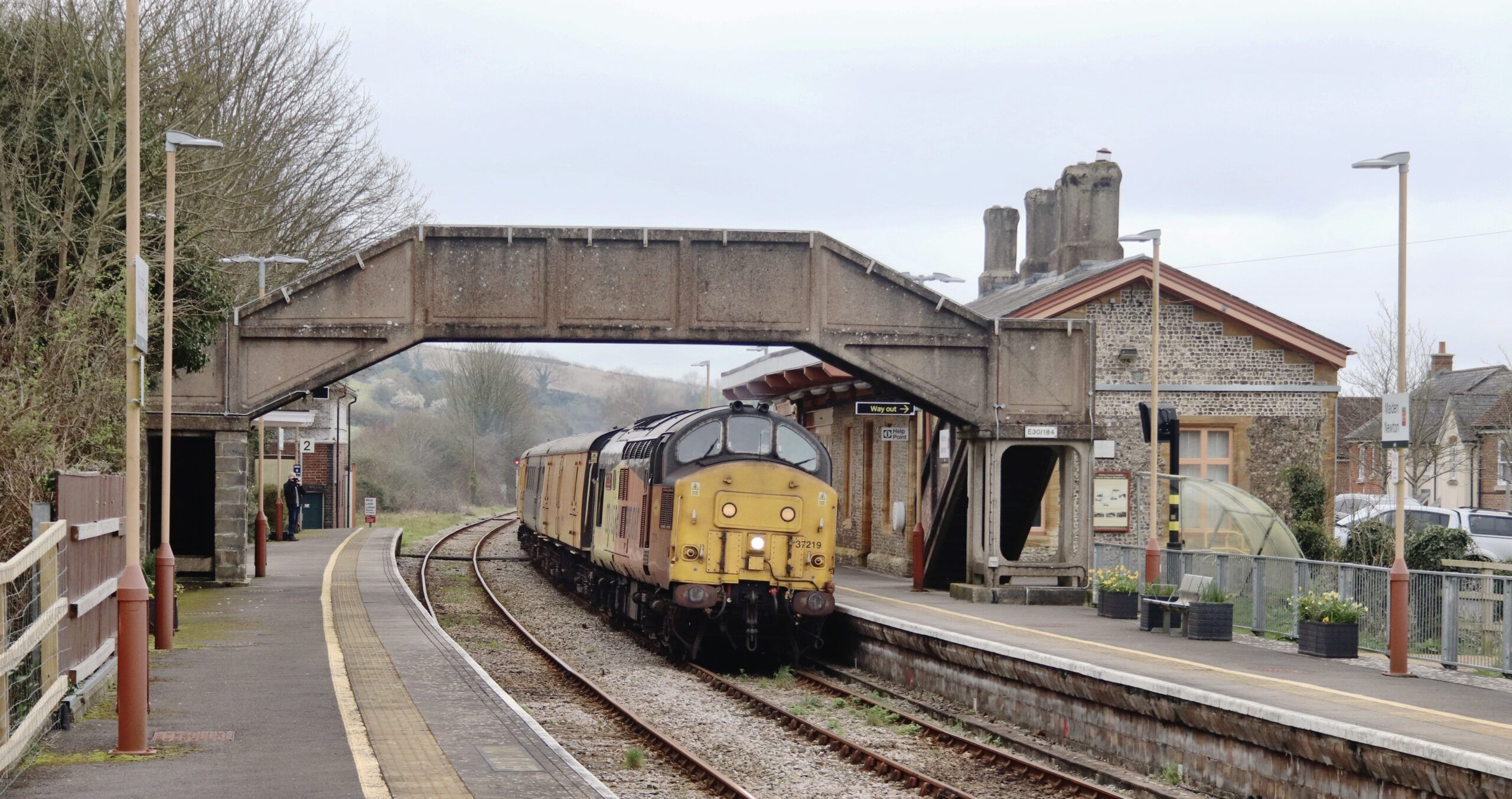
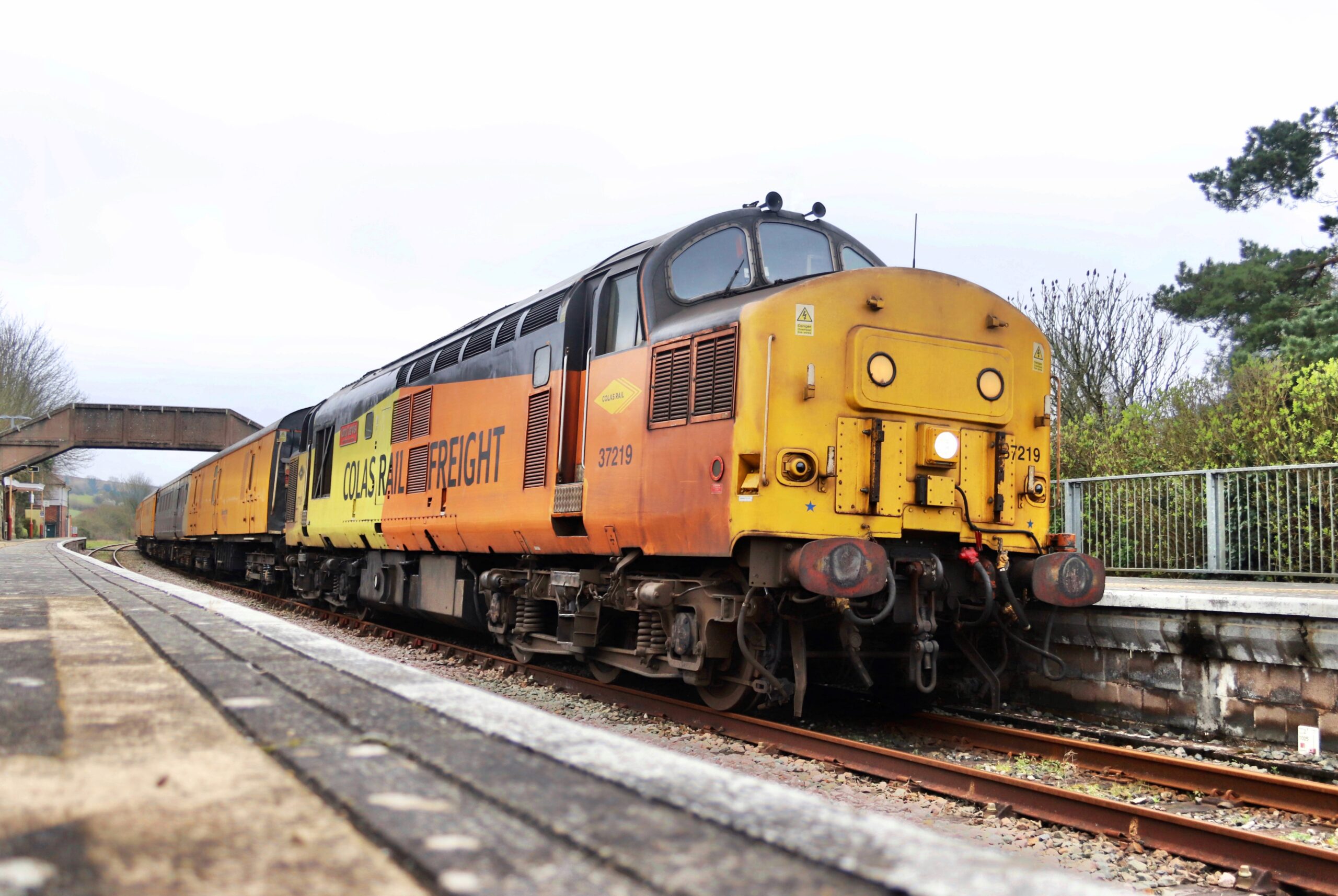
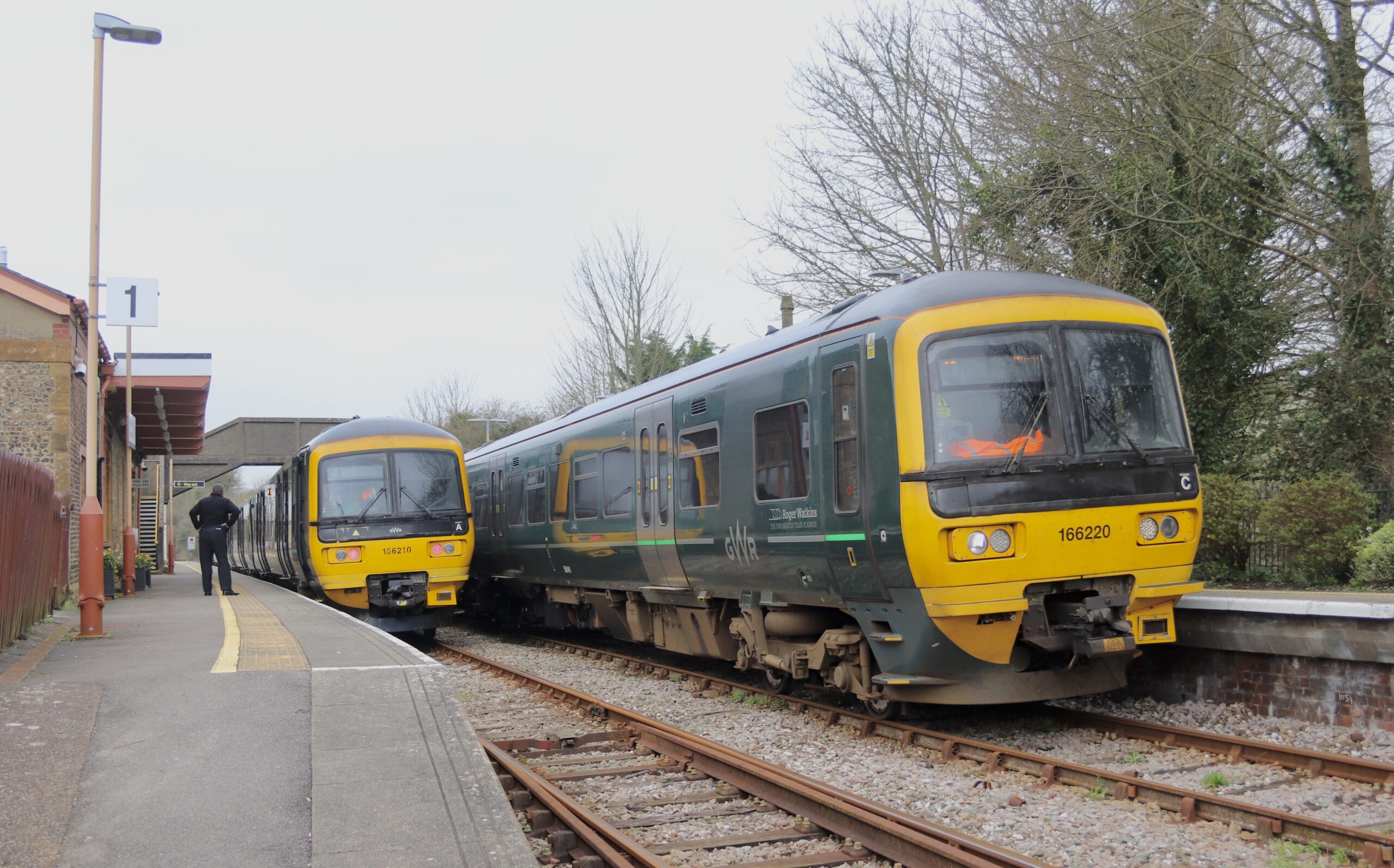
The following day, I hitched a lift with friend of the blog Jamie for a visit to Maiden Newton to see Colas Railfreight Class 37 No.’s 37175 and 37219 ‘Jonty Jarvis’ top and tailing a Structure Gauging Train on its way from Westbury to Weymouth and return. The working left Westbury around two hours late and I probably aged Jamie by a few years by claiming we had plenty of time to make the journey over to see the train! We arrived in Maiden Newton with ten minutes to spare.
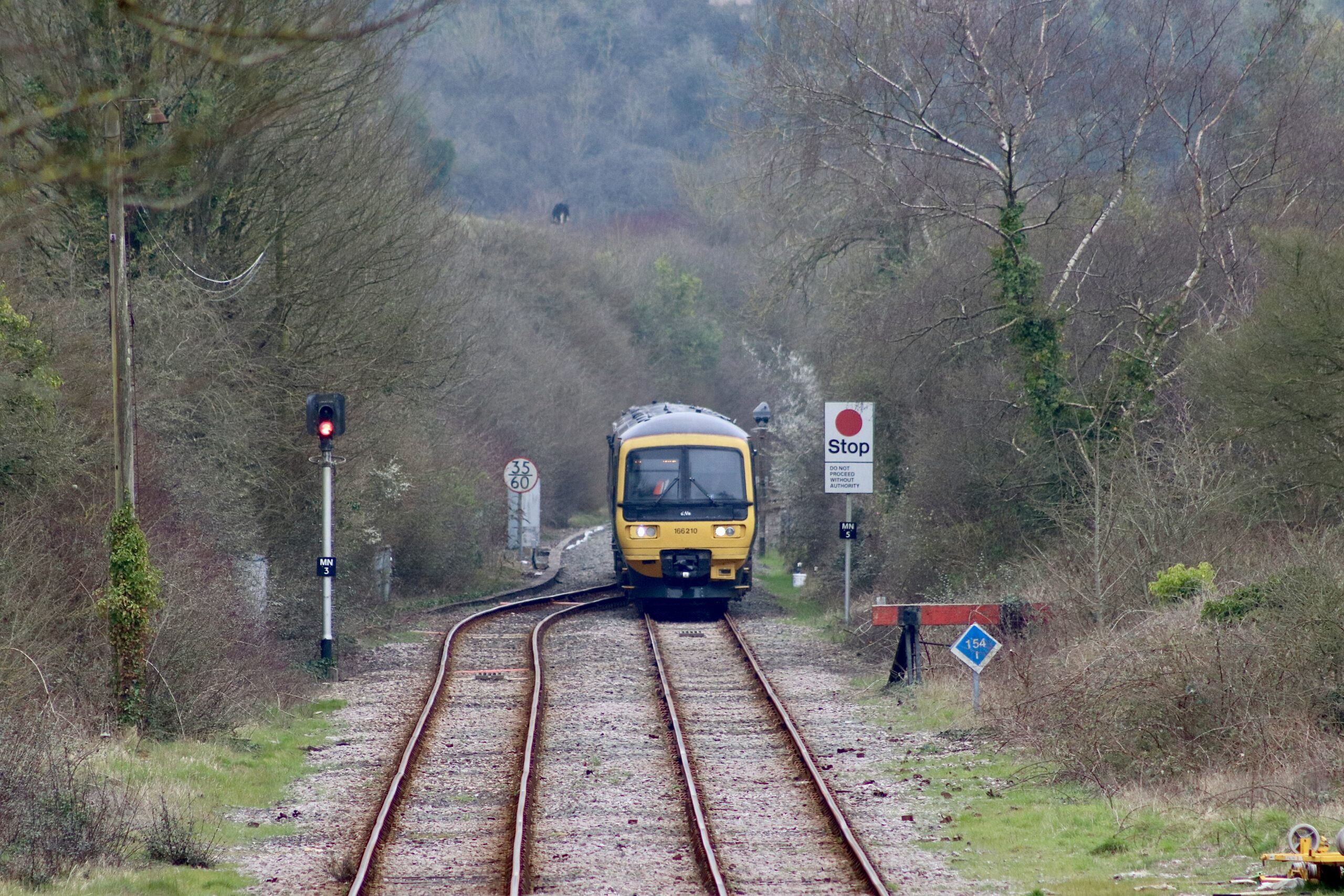
Great Western Railway Class 166 No. 166210 on the approach to Maiden Newton working 2V68 1328 Weymouth to Gloucester – 21/03/2024Colas Railfreight Class 37 No. 37175 on the approach to Maiden Newton leading on 3Q14 1021 Westbury Down Yard to Westbury Down Yard – 21/03/2024Colas Railfreight Class 37 No. 37175 with 37219 ‘Jonty Jarvis’ at the rear at Maiden Newton leading on 3Q14 1021 Westbury Down Yard to Westbury Down Yard on the outward leg to Weymouth – 21/03/2024On the return leg of 3Q14 1021 Westbury Down Yard to Westbury Down Yard Colas Class 37 No. 37219 ‘Jonty Jarvis’ leads into Maiden Newton – 21/03/2024 Colas Class 37 No. 37219 ‘Jonty Jarvis’ pauses at Maiden Newton as the driver collects to token to allow the train to progress onto the next single line section of track – 21/03/2024Great Western Railway Class 166 Turbo’s cross at Maiden Newton; No.166220 working 2O76 1110 Gloucester to Weymouth and No. 166210 forms 2V68 1328 Weymouth to Gloucester – 21/03/2024
Maiden Newton trains – 21/03/2024
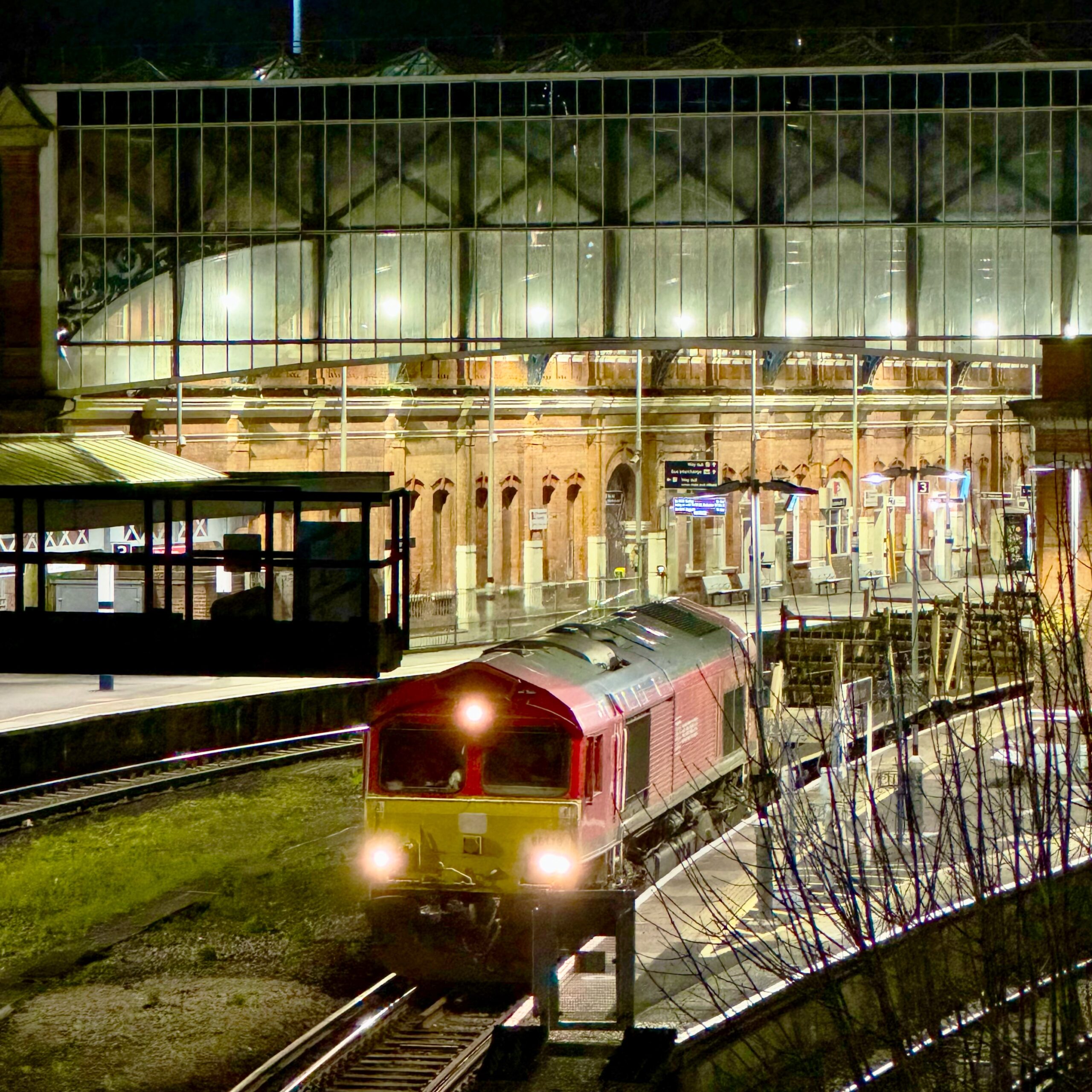
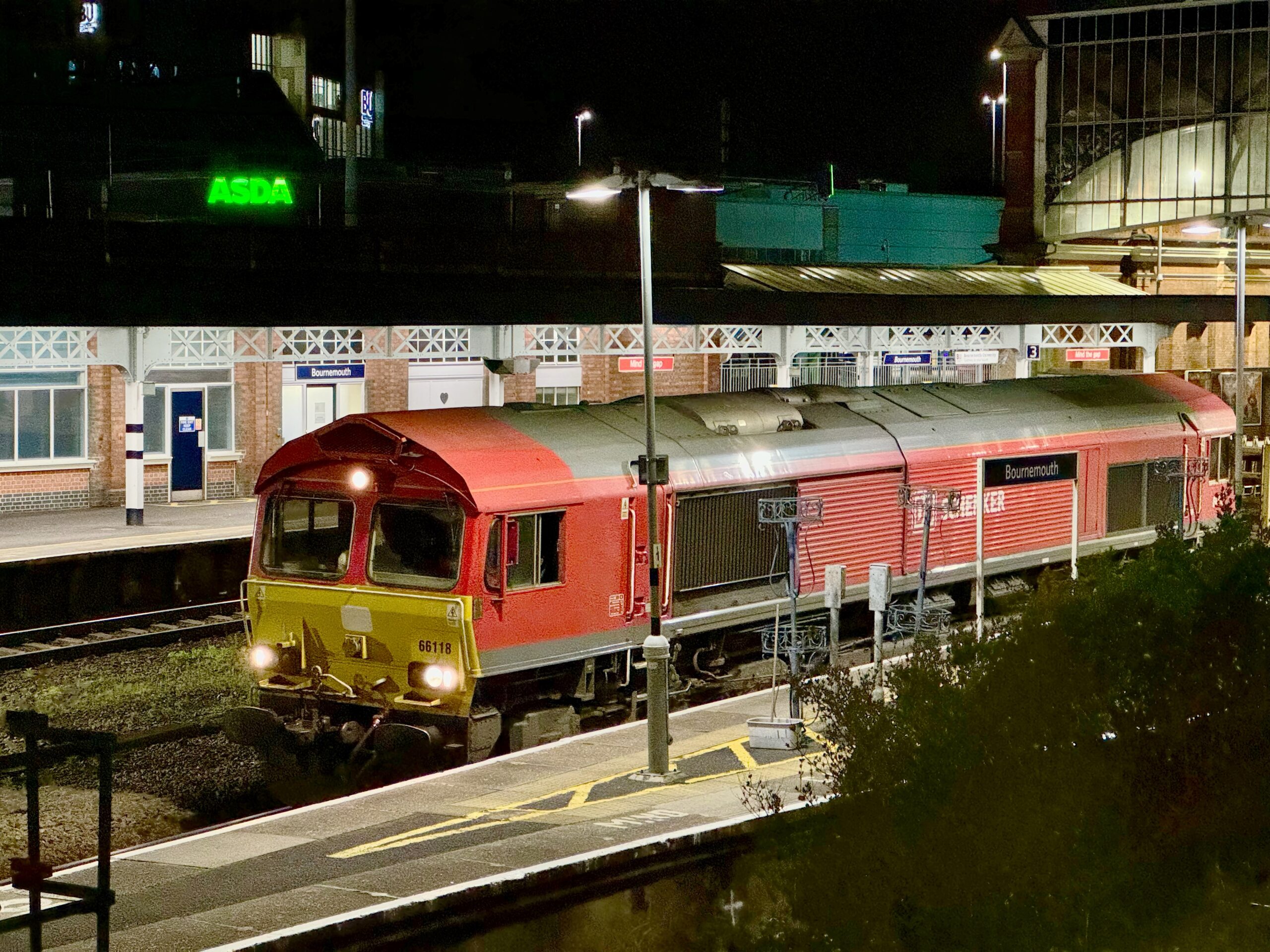
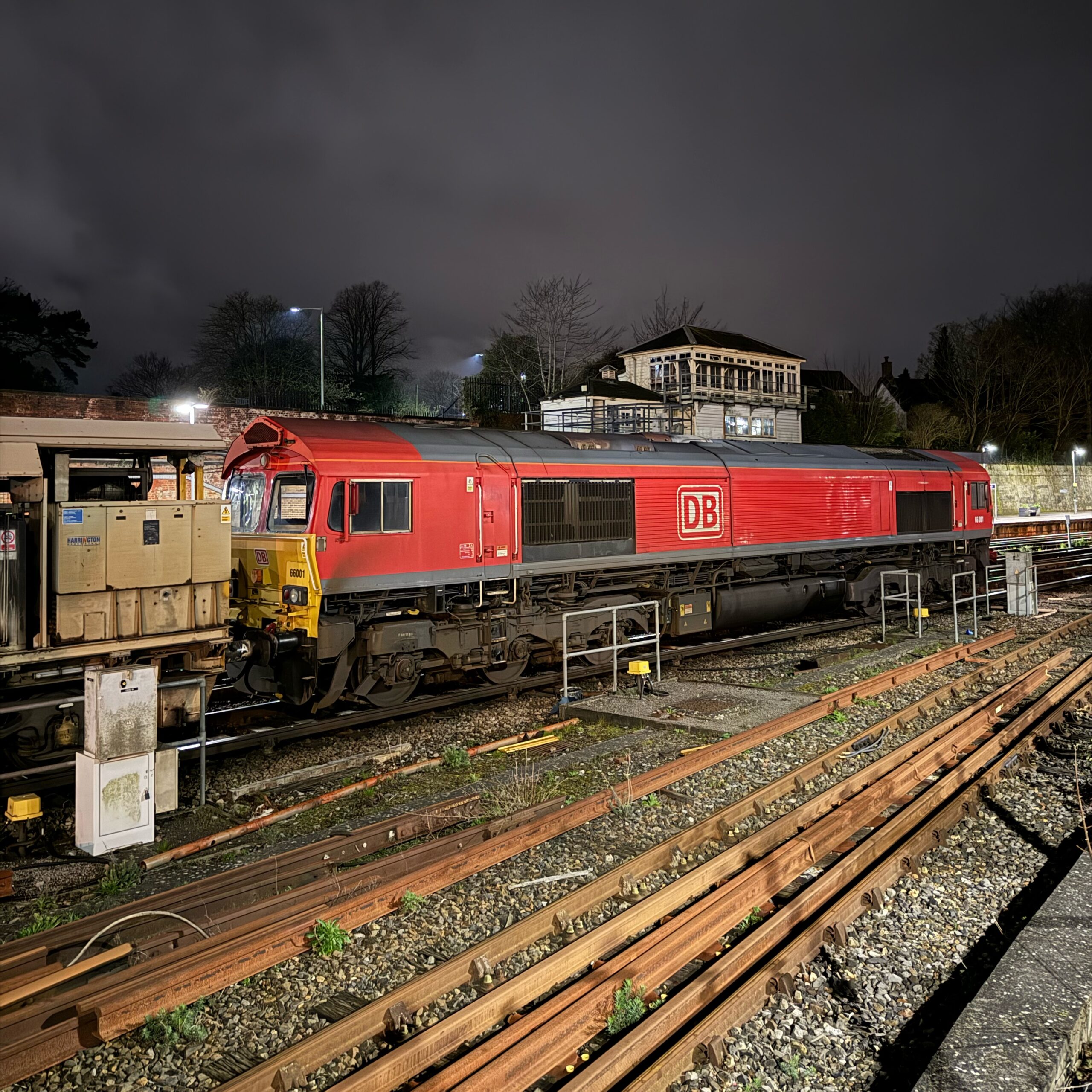
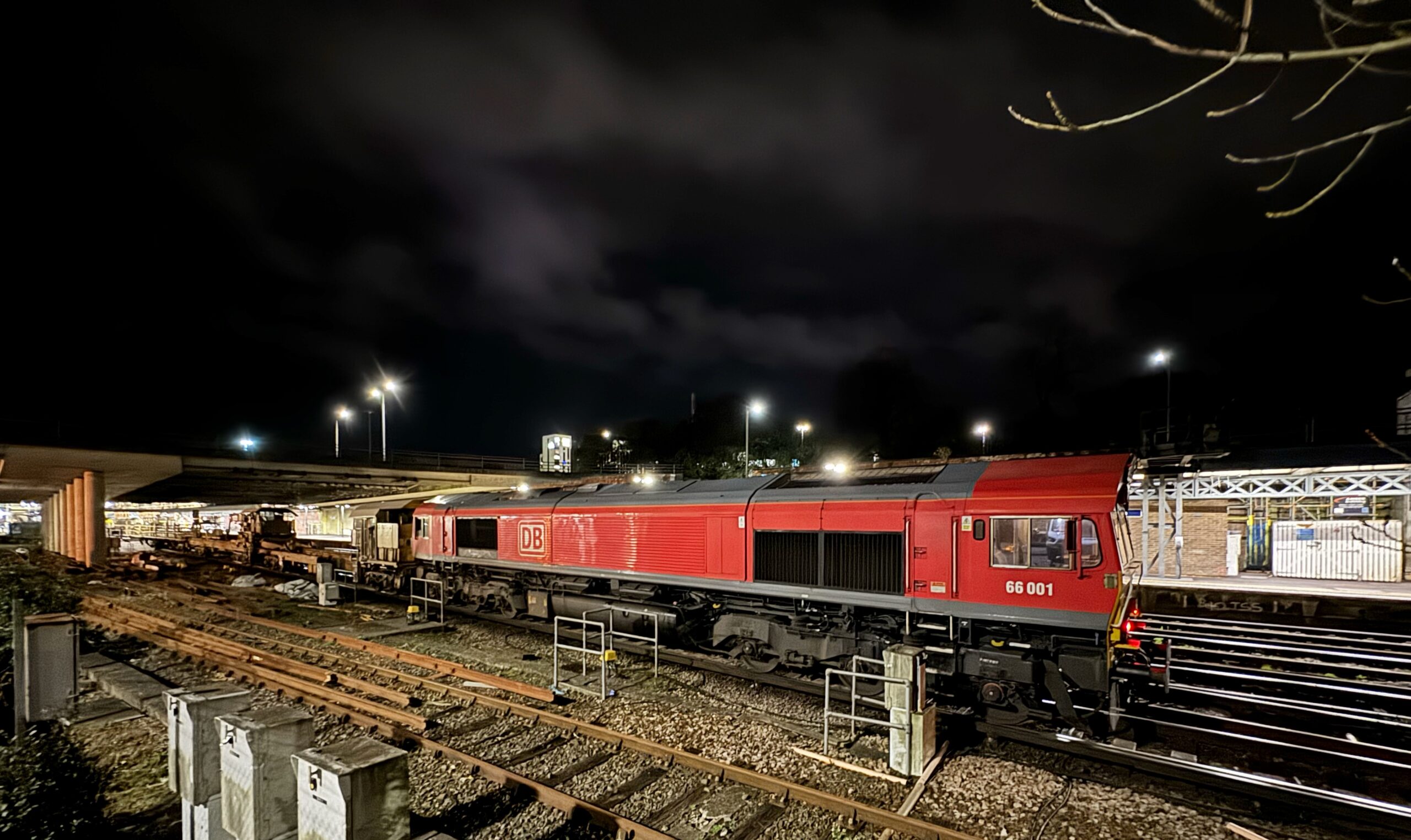
Later that night, another engineering train ventured into Dorset in conjunction with work in the Christchurch area. I didn’t see train 6N75 2300 Eastleigh East Yard to Christchurch arrive, but I did get up early Friday morning to see DB Class 66 No. 66118 and pioneer shed No. 66001 departing Bournemouth as they returned with their train to Eastleigh East Yard this time working as 6N75 0505 Bournemouth to Eastleigh East Yard. It was so early, Bournemouth railway station was still locked up when I arrived. However the train departed around 20 minutes behind schedule, but not wanting to risk missing filming the departure, I stood steadfastly at my vantage point overlooking the station when I could have easily ventured down to platform level once the station was opened up to the travelling public for the first passenger trains of the day.
With Bournemouth railway station as its backdrop, DB Cargo Class 66 No. 66118 awaits departure working 6N75 0505 Bournemouth to Eastleigh East Yard – 22/03/2024DB Cargo Class 66 No. 66118 at Bournemouth leading on 6N75 0505 Bournemouth to Eastleigh East Yard – 22/03/2024DB Cargo Class 66 No. 66001 at the rear of 6N75 0505 Bournemouth to Eastleigh East Yard – 22/03/2024DB Cargo Class 66 No. 66001 awaits departure of 6N75 0505 Bournemouth to Eastleigh East Yard – 22/03/2024
DB Cargo Class 66’s at Bournemouth – 22/03/2024
HAMWORTHY BRANCH
Poole Harbour Commissioners (PHC) Annual Stakeholders Open Evening 2024 – 20/03/2024
Poole Harbour Commissioners (PHC) Annual Stakeholders Open Evening 2024 took place on 20th March in the North Lounge of the Passenger Terminal. We went along to see if there were any updates on the restoration of freight traffic along the Hamworthy Branch which runs down to the port area from a junction to the mainline at Hamworthy railway station. PHC CEO Captain Brian Murphy said; “We are very fortunate to have the port railway. We haven’t used it for some time, but it’s there and it aligns perfectly with our decarbonisation goals. Modal shift is the best way to get transport off the roads. We want to grow the business, we want to grow the freight. We want more cargo through the port but we’d rather actually get as much as possible on to rail rather than the roads. So this does align with the governments ambitious targets which are of part of their 2050 plan for clean maritime and reducing carbon emissions and there has been a lot of work which has actually happened thus far. The commissioners have invested quite heavily in securing the lease that runs from the port all the way to the mainline and there has been a lot of upgrading work which has happened on the Hamworthy Branch. We’ve got a little bit more to do in terms of in the port but we are looking at the business case and hopefully it all aligns. But clearly in terms of ownership, it’ll be a lot of trucks off the road so very excited about that project.”
We recently learned of the passing of our friend and fellow railway enthusiast, Syd Brown. Syd has been a transport enthusiast for many years and could regularly be found supporting local transport events. He was an active member of the old Dorset Transport Circle in times past. Syd’s working life was spent in Dorset County Council’s Roads and Bridges department (now known as Transport and Engineering) and he was also an official in the Dorset County branch of NALGO (now UNISON). Our condolences to Syd’s family.
Thank you for reading and for your comments and corrections. We’ll be back soon with our record of our day attending the Swanage Railway Victorian Weekend. Be seeing you!
Postscript:
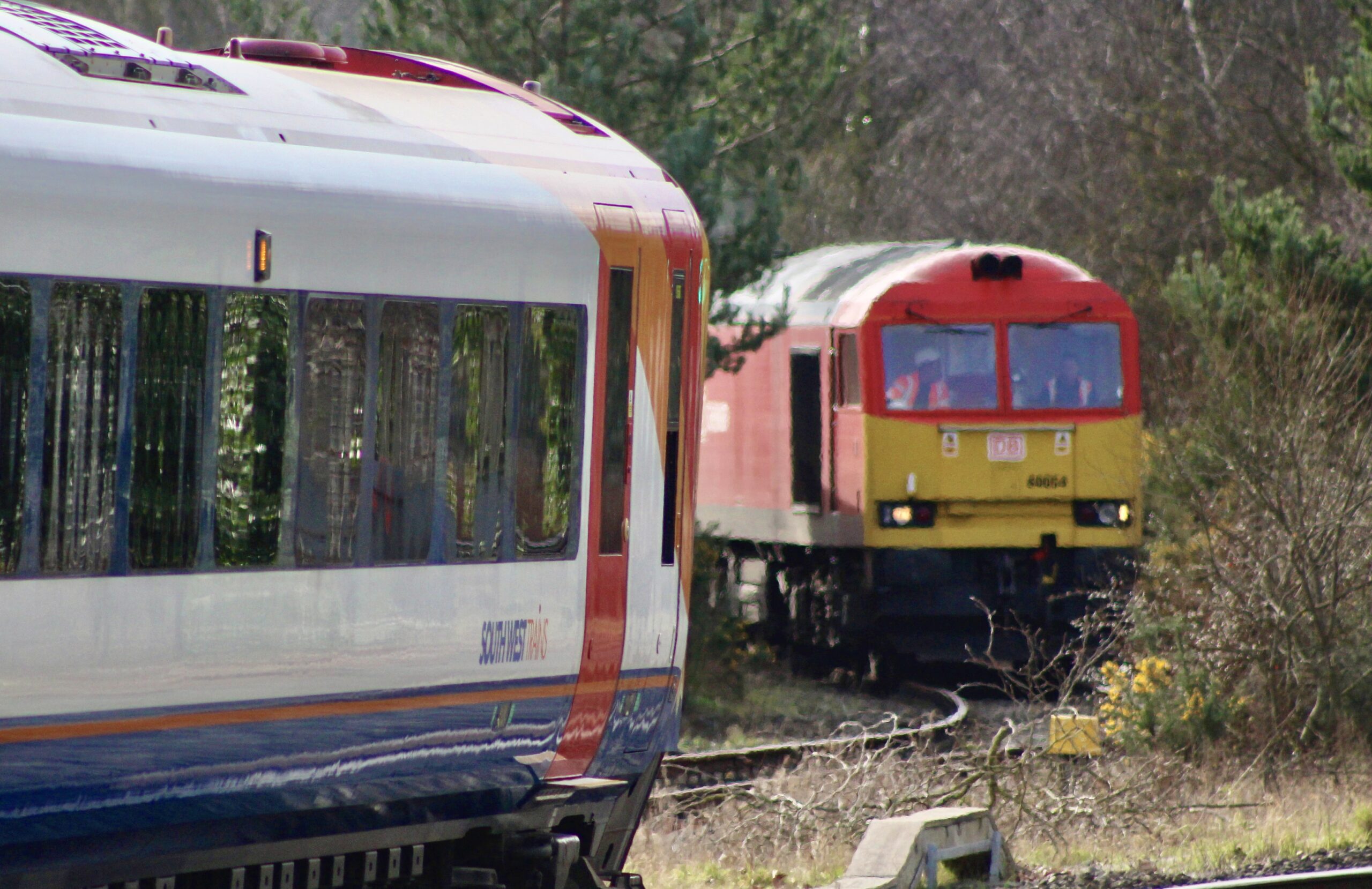
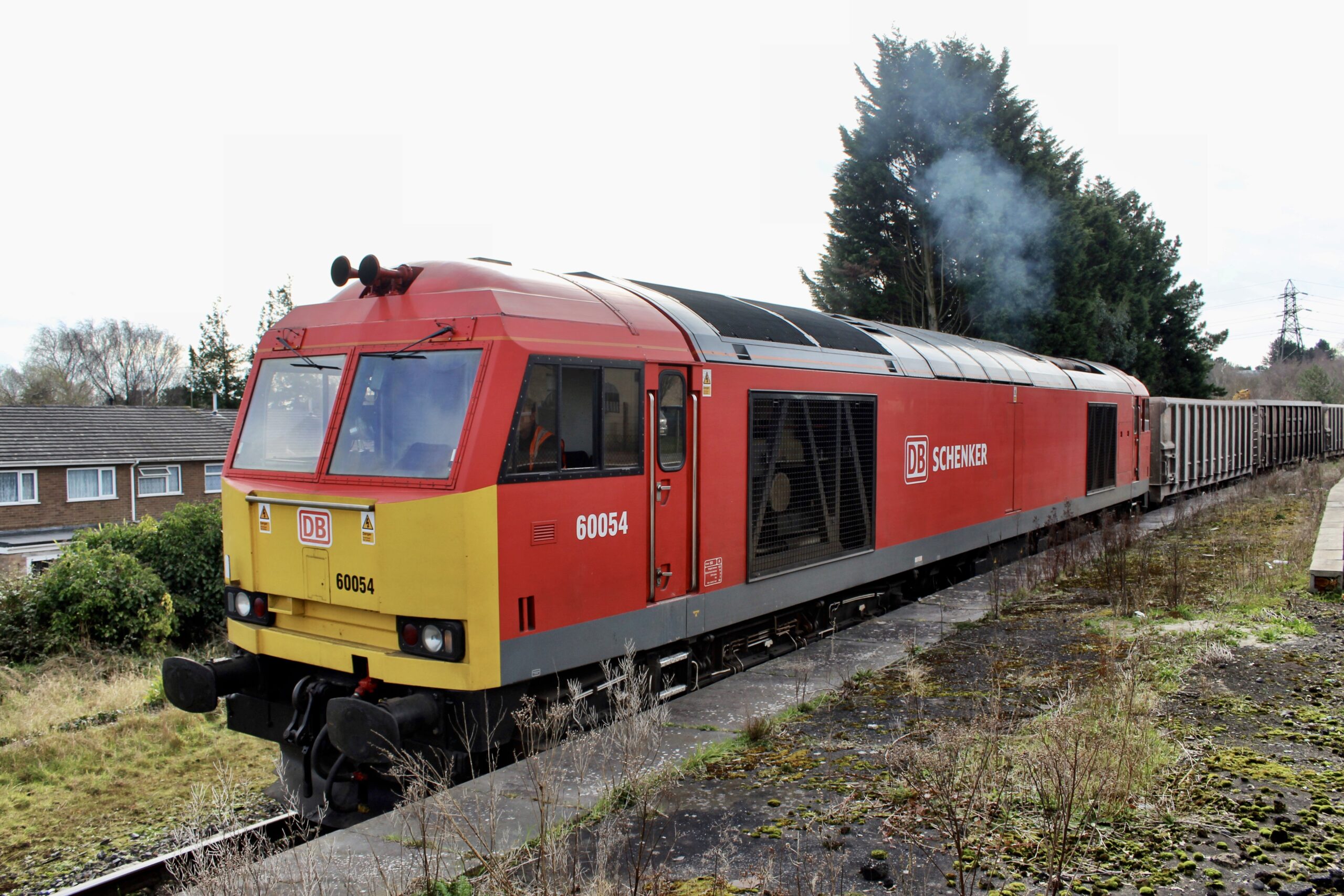
Will we ever see trains coming off the Hamworthy Branch again? Back in 2017, DB Cargo Class 60 No. 60054 heads towards the mainline at Hamworthy while South West Trains (SWT) Class 444 No. 444032 waits at platform with a Weymouth service – 17/02/2017 DB Cargo Class 60 No. 60054 draws up to the signal protecting the branch from the mainline at Hamworthy – 17/02/2017
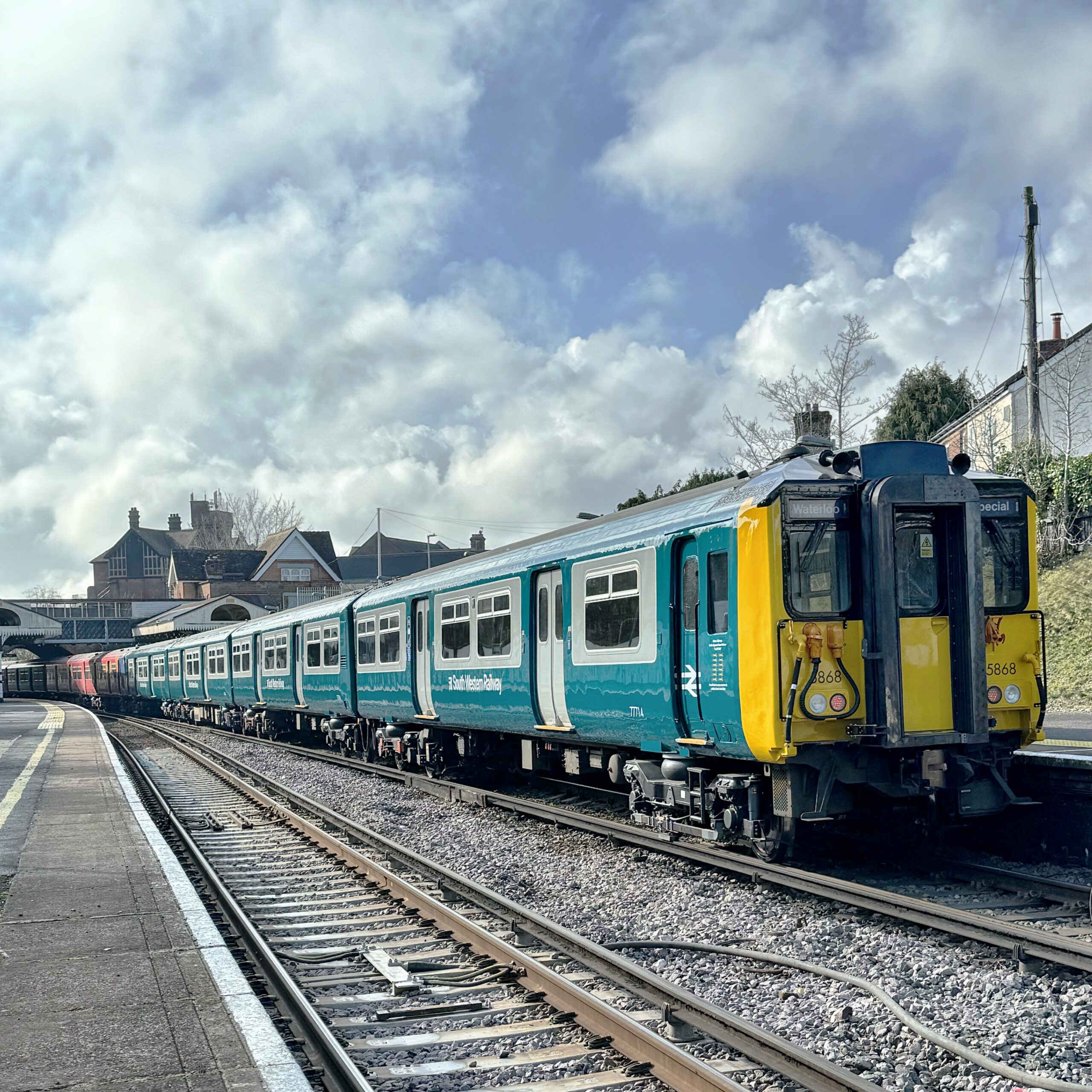
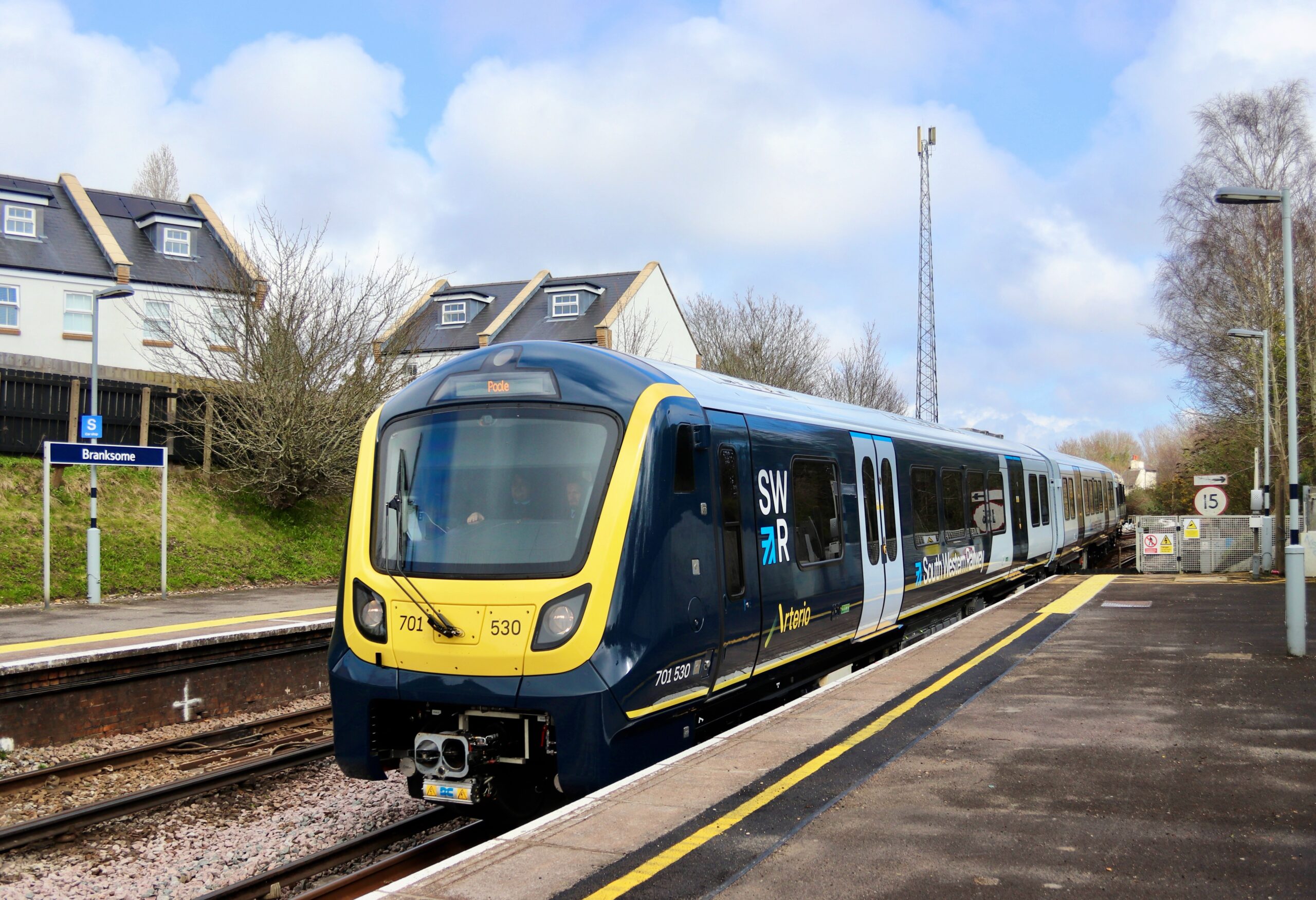
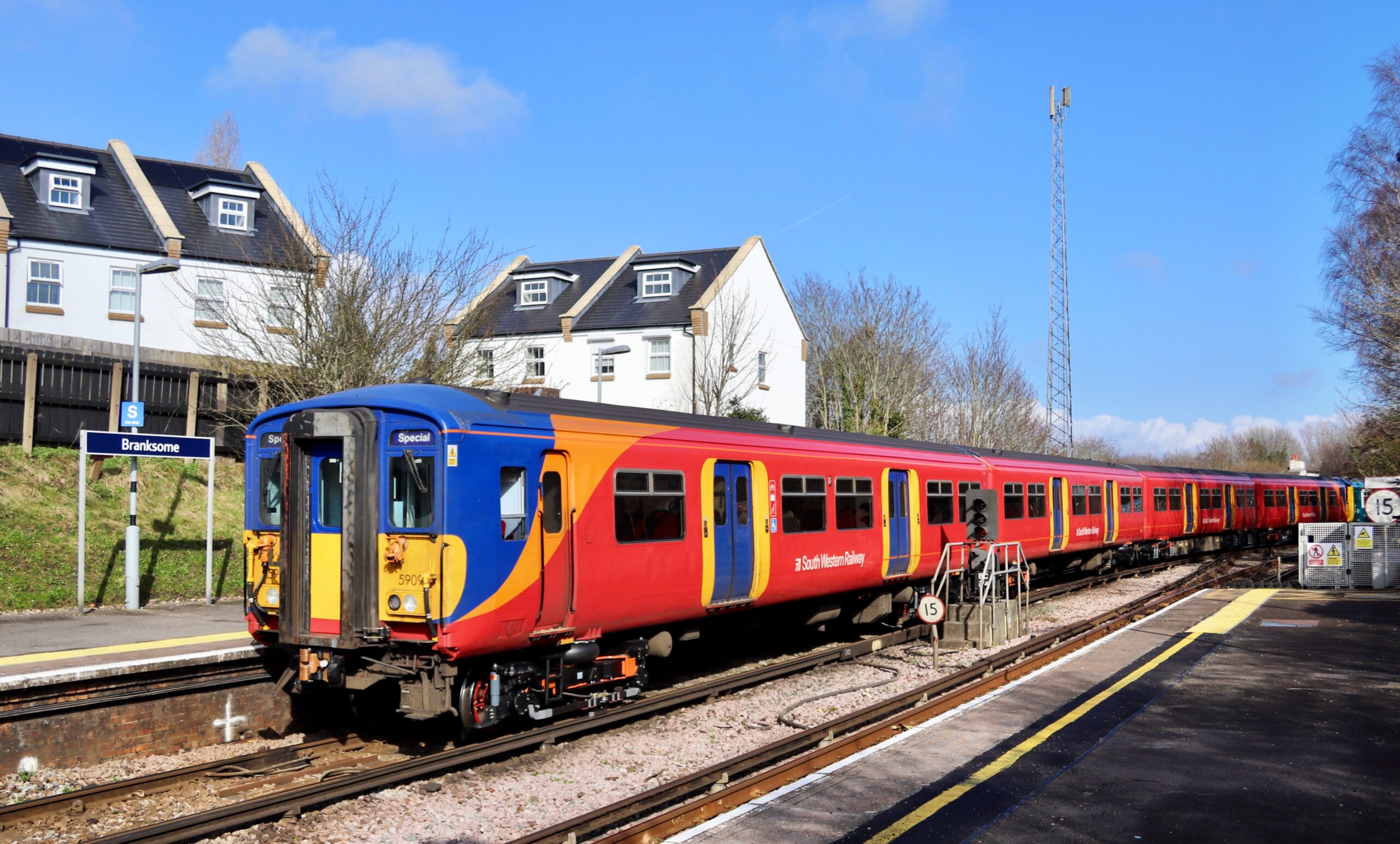
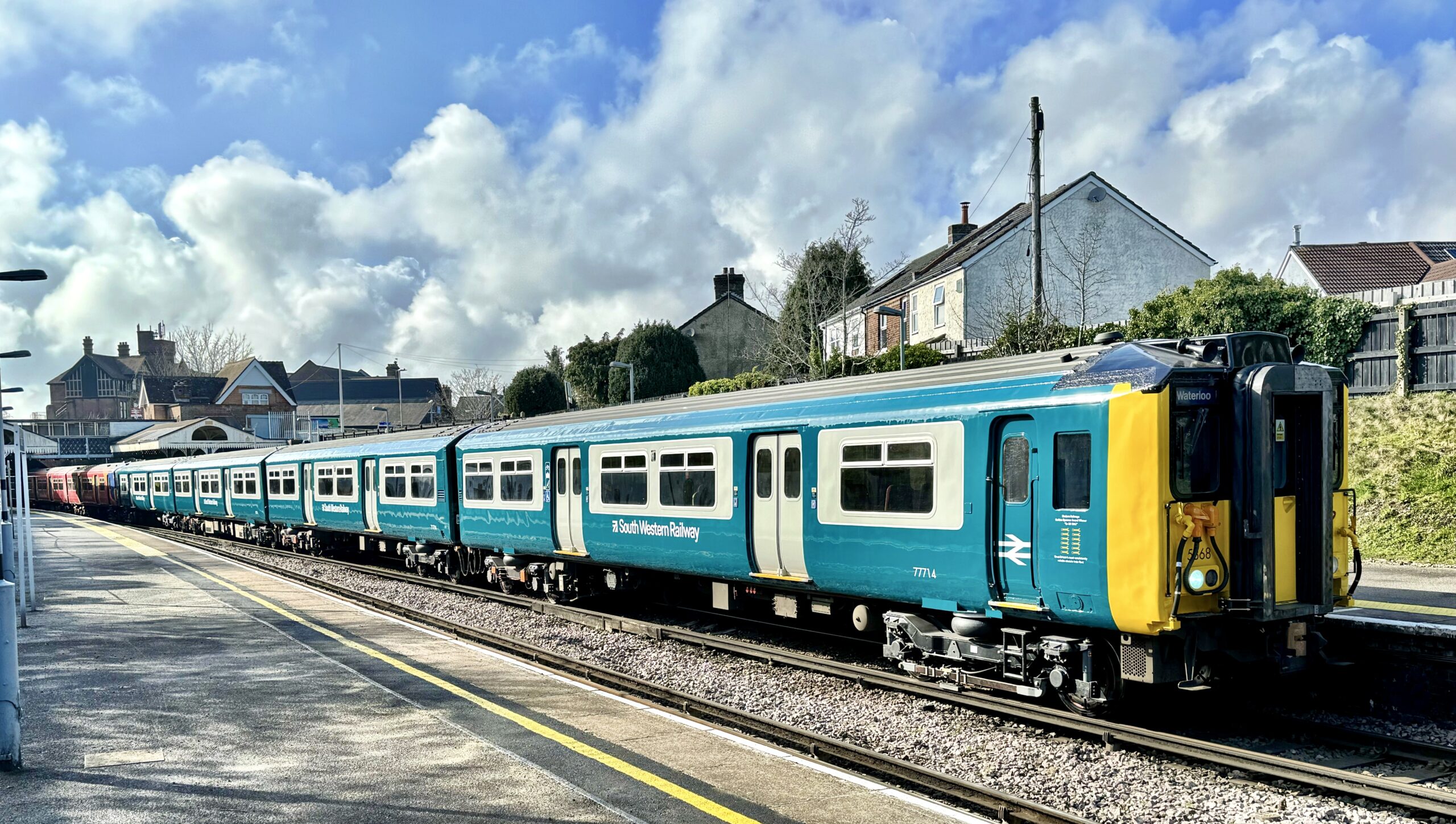
Newly repainted in retro British Rail Blue and Grey livery SWR Class 455 No. 455868 with 455909 behind, awaits departure from Branksome forming 5Y51 1432 Bournemouth T&R.S.M.D to Wimbledon Park Depot Sdgs – 06/03/2024
March 1st 2024 to March 16th 2024
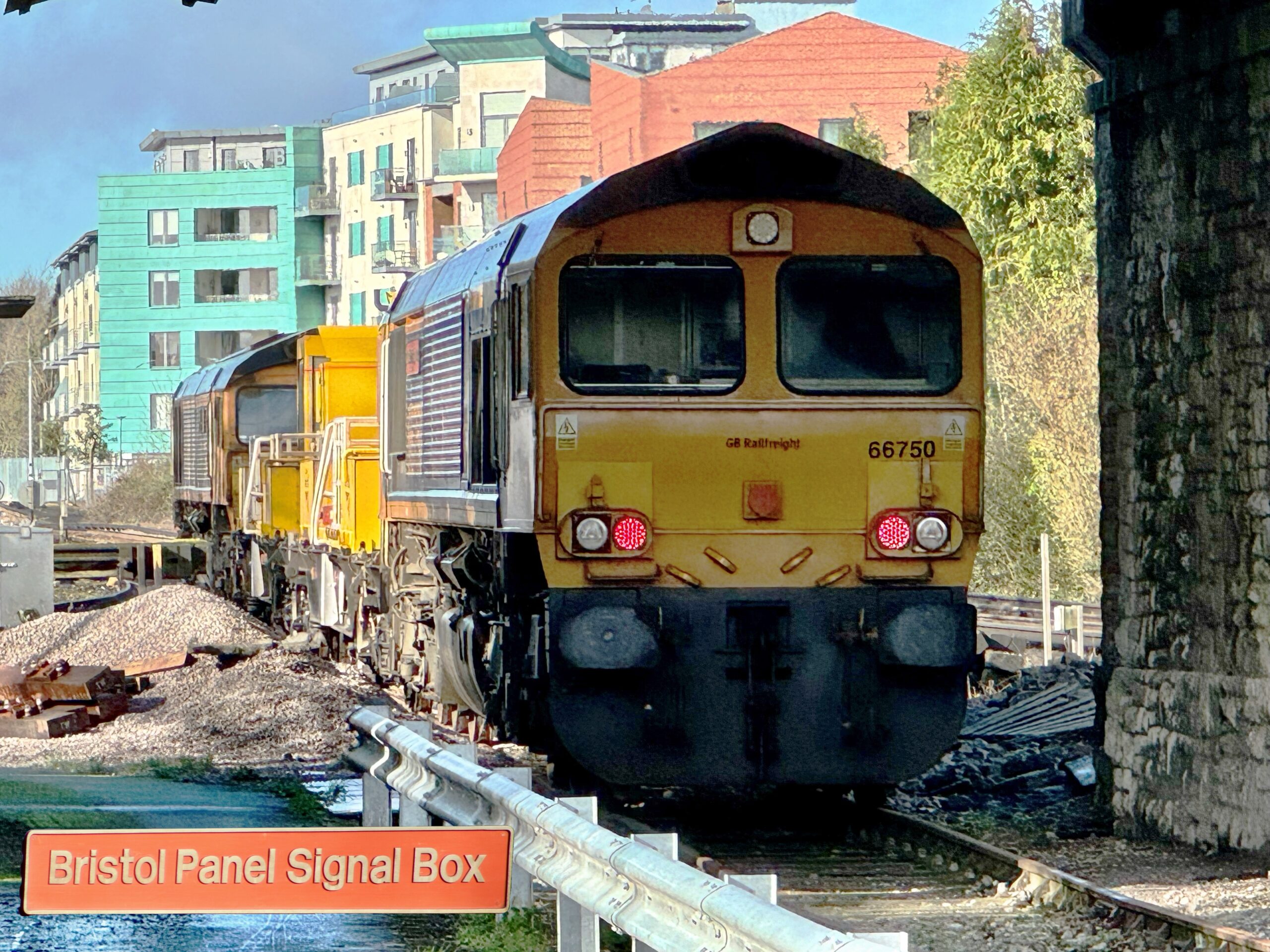
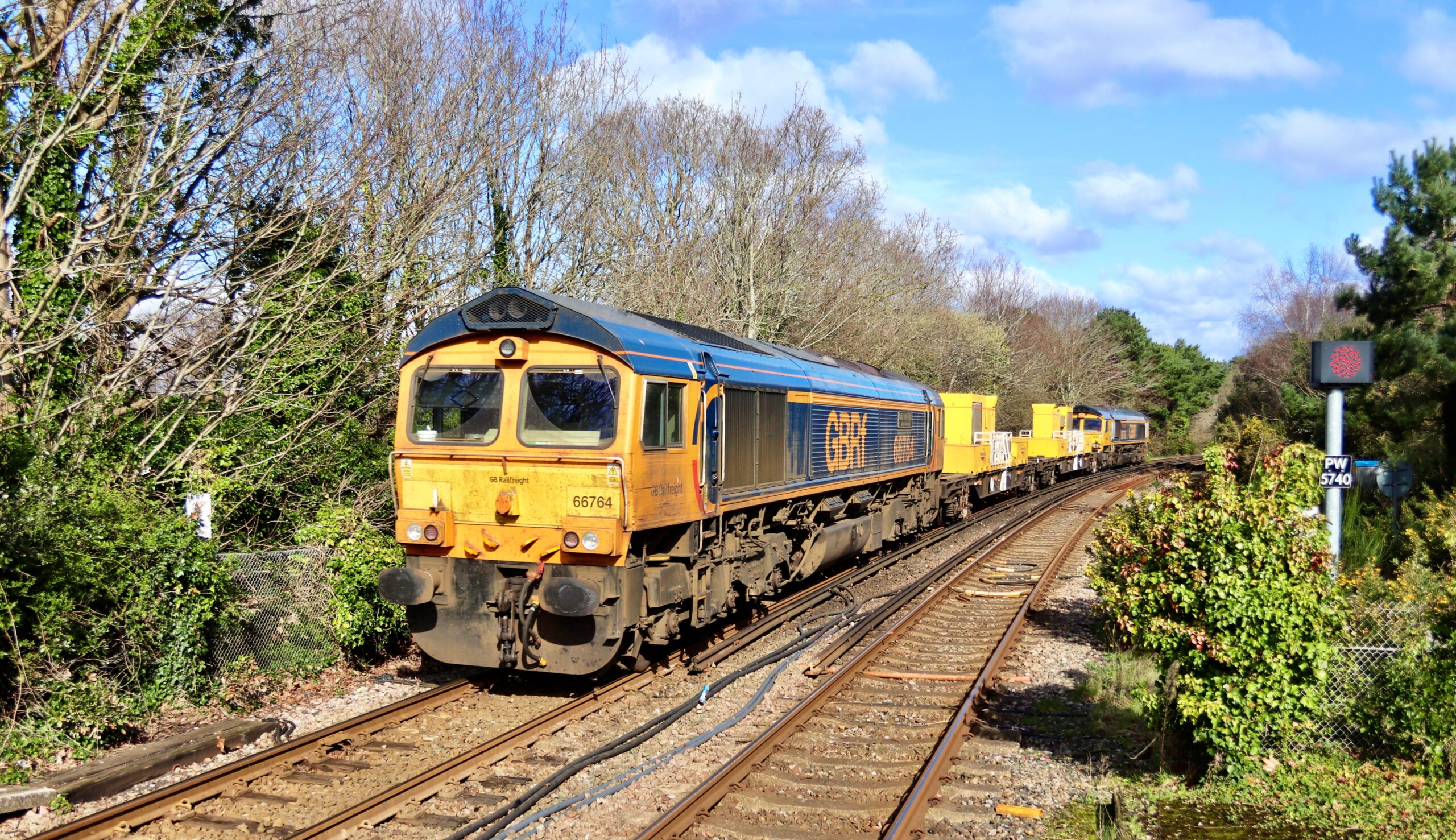
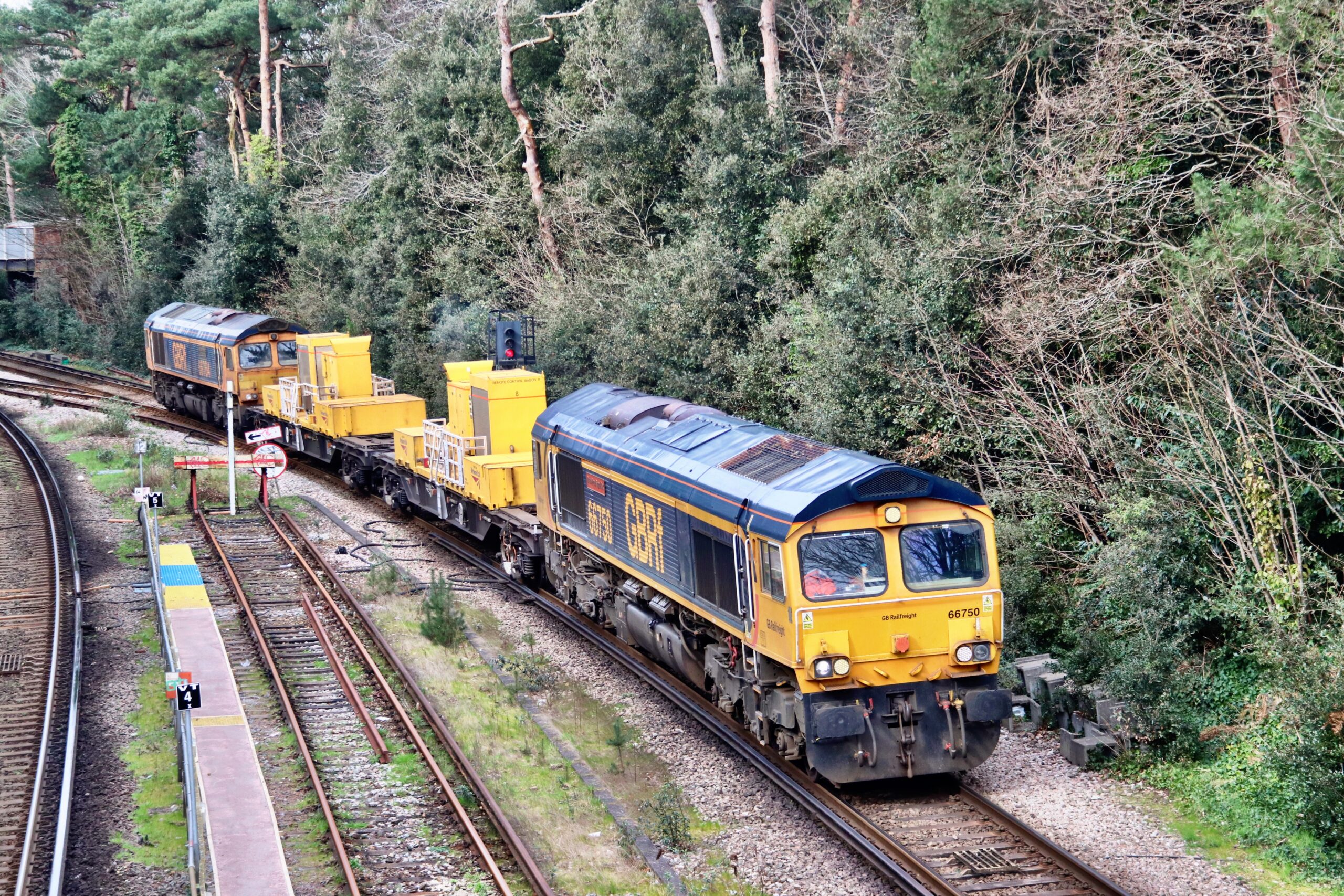
March 2024 kicked off with another visit to Dorset from the Snow & Ice Treatment Train (SITT) in the charge of GBRf Class 66 No.’s 66764 ‘Major John Poyntz Engineer & Railwayman’ and 66750 ‘Bristol Panel Signal Box’ working as 3Y89 2200 Totton Yard to Totton Yard. This ran on the evening of Friday 1st March and we saw the train passing through Hamworthy as it headed to Weymouth on its outward run.
GBRf Class 66 No.’s 66764 ‘Major John Poyntz Engineer & Railwayman’ leads through Hamworthy on the SITT 3Y89 2200 Totton Yard to Totton Yard – 01/03/2024
Video of GBRf Class 66 No.’s 66764 ‘Major John Poyntz Engineer & Railwayman’ leads through Hamworthy on the SITT 3Y89 2200 Totton Yard to Totton Yard – 01/03/2024
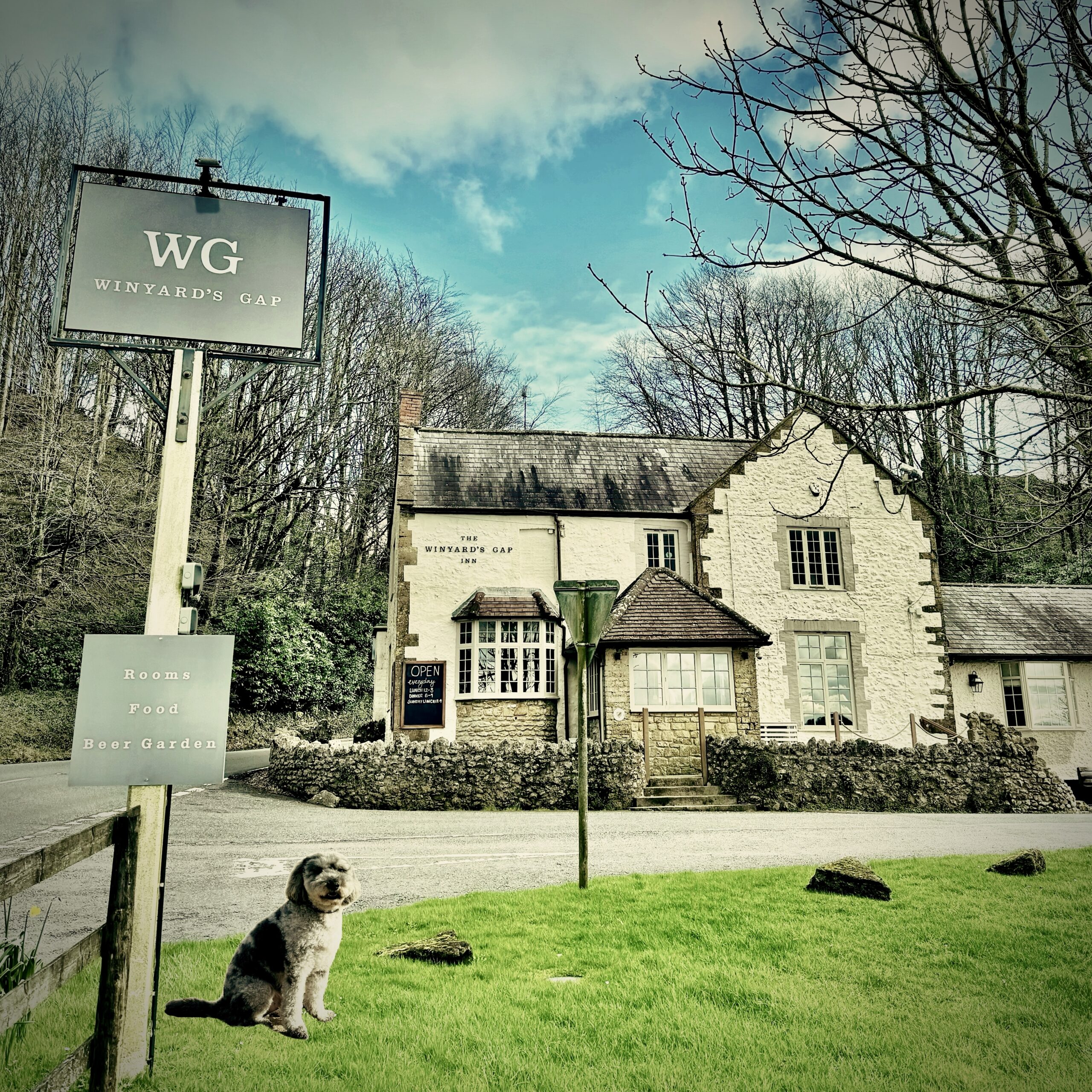
The following day, Saturday 2nd March, Yoshi exercised his National Trust membership and had an enjoyable day visting Lytes Cary Manor and Montacute House, both located in Somerset. On the way home we took a slight diversion and popped into the independent and dog friendly Winyard’s Gap Inn, situated on the outskirts of Chedington village in West Dorset overlooking the glorious Dorset and Somerset hills. After the First World War, the National Trust donated 16 acres of land close to the pub for a memorial to the 43rd Division of the Dorsetshire Regiment.
Yoshi with National Trust Lytes Cary Manor in the background – 02/03/2024Yoshi and daffodils at Montacute House – 02/03/2024Yoshi likes to walk around the grounds of Montacute House – 02/03/2024Winyards Gap where we stopped off on our way home. There were several doggos in the bar and a roaring fire. Like many amateur photographers, I do occasionally experiment with editing….. – 02/03/2024
Monday 4th March was the planned date for the unveiling of South Western Railway (SWR) retro liveried Class 455/8 Electric Multiple Unit (EMU) No. 455868, as the set was due to form a staff special running from Bournemouth to London Waterloo initially leaving Bournemouth depot as 5Z67 1012 Bournemouth TRSMD to Bournemouth. It was envisaged that SWR’s Managing Director would join the train at Woking in readiness for a ceremony being held at the London Terminus. However, these plans were cancelled following a derailment (or “operational incident” as it was described on the day) between Walton on Thames and Weybridge blocking all lines into Waterloo. This was the effect of a train, reportedly traveling at 90mph, hitting an object on the conductor rail.
A Network Rail Wessex safety bulletin posted on X (formerly Twitter) states the train struck scrap rail left on the track following engineering work:
At 05.50 on Monday 4th March 2024, a passenger train struck scrap rail travelling on the Up Fast line on the four track railway at Walton-on-Thames. This caused the front bogie of the train to partially derail. No passengers on the train were injured. Following the event, all lines were blocked to allow the safe evacuation of passengers. The derailment caused significant damage to the infrastructure. A few minutes before this incident, a train reported striking an object (at the time reported as a possible branch or piece of wood) on the adjacent Up Slow line. This was the third train in the Up direction following weekend engineering works, and the first on the Up Fast line. The works undertaken at the weekend included tamping, ballasting and scrap clearance. The location where the train struck the scrap rail was on a rail road access point (RRAP). This had been used at the weekend as part of a track renewal follow up. The incident is under investigation by the Rail Accident Investigation Branch (RAIB) and Network Rail.”
Rumours abounded that the newly repainted Class 455 would sneak out of the depot later on the Monday, and when that didn’t happen, it was said to be working to Wimbledon on the Tuesday. And when that run didn’t materialise, news came that it would definitely depart Bournemouth Traction & Rolling Stock Maintenance Depot on the Wednesday! So that’s how we found ourselves on Branksome Station after lunch on March 6th, delighted to be one of the first to see No. 458868 in all her retro glory as she formed the 5Y51 1432 Bournemouth T&RSMD to Wimbledon Park Depot Sidings working along with fellow classmate No. 455909 which is still in red SWT livery.
While we waited for the celebrity Class 455 to appear, we saw one of the Class 701 Arterio test runs heading to Poole (as well as its return leg). The introduction of these units is severely delayed, but once they are cascaded onto suburban services, the Class 455’s will be withdrawn from service.
Five-Car SWR Class 701’s on test as No. 701530 leads to Poole working 5Q51 1115 London Waterloo to Staines Up Loop – 06/03/2024SWR Class 701 No. 701510 leads on the return working of 5Q51 1115 London Waterloo to Staines Up Loop – 06/03/2024Class 455 No. 455909 in SWT red livery leads No. 455868 into Branksome working 5Y51 1432 Bournemouth T&R.S.M.D to Wimbledon Park Depot Sidings – 06/03/2024Newly repainted in retro British Rail Blue and Grey livery, applied by the paint team at Bournemouth depot, SWR Class 455 No. 455868 with 455909 behind, awaits departure from Branksome forming 5Y51 1432 Bournemouth T&R.S.M.D to Wimbledon Park Depot Sdgs – 06/03/2024
The retro look of No. 458868 is inspired by the original British Rail Blue and Minerva Grey livery that passengers would have seen when the trains first arrived on British Rail Southern Region in 1982. To meet modern accessibility standards, some slight changes have been made, with the units’ doors fully painted in Minerva Grey.
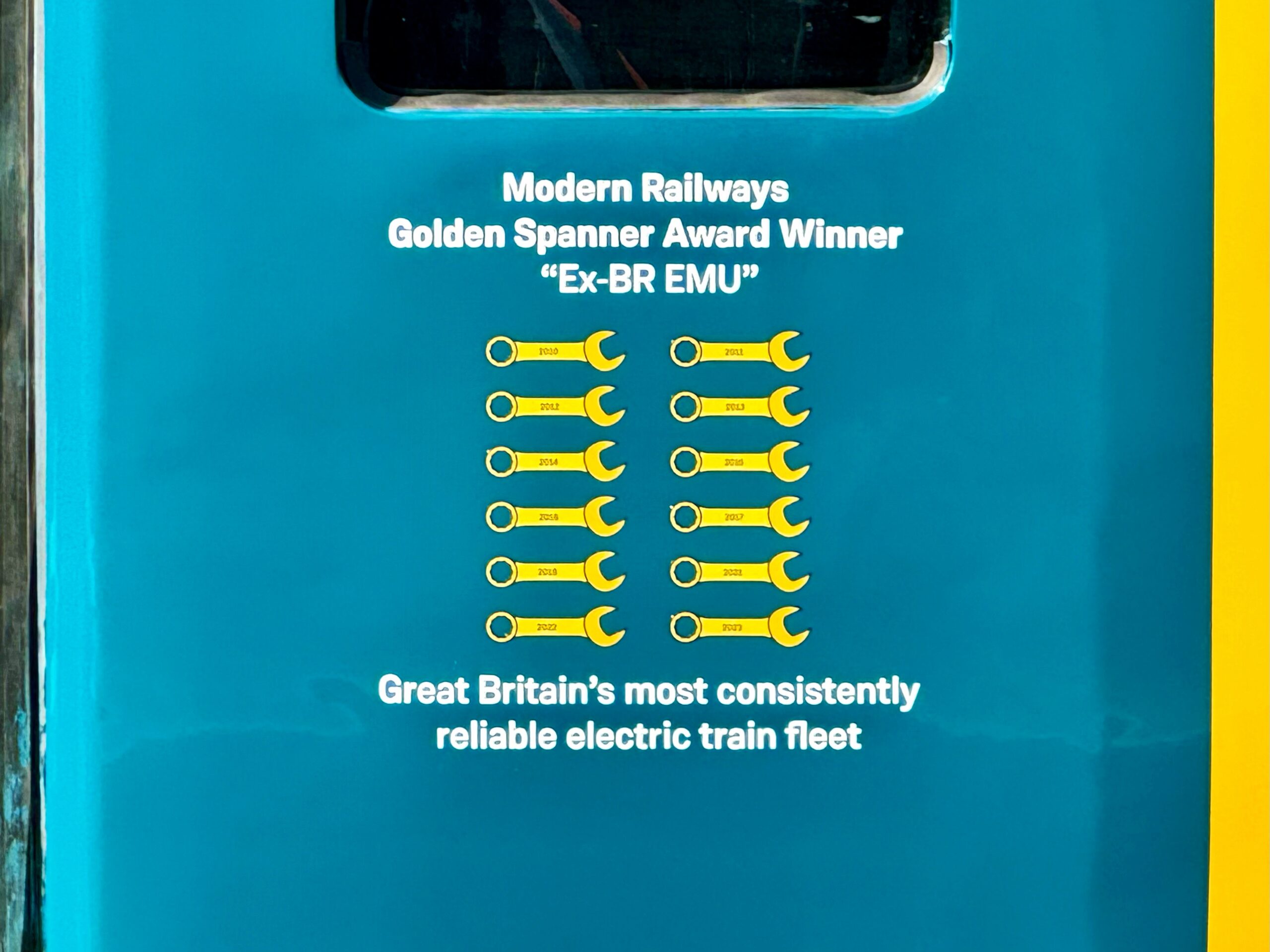
SWR’s name is displayed as are 12 Golden Spanners, commemorating Wimbledon Depot’s 12 award wins at the Modern Railways Golden Spanner awards in the category of Ex-British Rail Electrical Multiple Units. It’s presumed that this retro-painted train will be one of the last of its class to be taken out of service and likely to have a special farewell tour when that time arrives.
Underneath each of the Class 455 cab windows of No. 455868 there are 12 Golden Spanners, commemorating Wimbledon Depot’s 12 award wins at the Modern Railways Golden Spanner awards in the category of Ex-British Rail Electrical Multiple Units – 06/03/2024
A pair of refurbished Class 458 EMU’s were also out on day release from Bournemouth depot performing a test run, and we managed to snap a couple of shots of these as they arrived at Branksome to run into the depot before we headed home.
Refurbished Class 458/4 No.’s 458416 and 458424 approach Branksome working 5Q91 1320 Basingstoke to Bournemouth T&R.S.M.D – 06/03/2024Awaiting reversal into the depot, SWR Class 458/4 No. 458424 sits at Branksome railway station working 5Q91 1320 Basingstoke to Bournemouth T&R.S.M.D – 06/03/2024
Video featuring retro-BR livery SWR Class 455 No. 455868 – 06/03/2024
Monday 11th March and the monthly Class 73 top and tailed Colas Railfreight operated test train ventured onto our metals again. GBRf No.’s 73963 ‘Janice’ and 73961 ‘Alison’ took the honours this time working 1Q51 1005 Derby R.T.C.(Network Rail) to Eastleigh East Yard. We were also able to see a nocturnal Class 701 run departing Poole prior to the Class 73’s arriving.
Ten-Car SWR Class 701 No. 701003 pauses briefly at Poole forming the return 5Q52 1844 Eastleigh to Eastleigh TRSMD having reversed in Poole Storage Sidings – 11/03/2024Dorsetway line stalwart Class 444 No.444027 reaches journeys end working 1B57 1835 London Waterloo to Poole – 11/03/2024GBRf Class 73 Electro-Diesel No.’s 73963 ‘Janice’ and 73961 ‘Alison’ arrive at Poole top and tailing 1Q51 1005 Derby R.T.C.(Network Rail) to Eastleigh East Yard – 11/03/2024GBRf Class 73 No. 73961 ‘Alison’ at the rear of 1Q51 1005 Derby R.T.C.(Network Rail) to Eastleigh East Yard pauses at Poole – 11/03/2024
Video of GBRf Class 73 Electro-Diesel No.’s 73963 ‘Janice’ and 73961 ‘Alison’ passing Poole top and tailing 1Q51 1005 Derby R.T.C.(Network Rail) to Eastleigh East Yard – 11/03/2024
Wednesday 14th March saw more Class 458 Unit drags taking place to and from Bournemouth depot – this time with a variation in paths from recent similar movements when two locomotives have been employed – one loco at each end of the train to enable reversing into the depot sidings from Branksome railway station. On this run, only one locomotive was allocated to the train, necessitating a run round at Poole. This was believed to be at trial for future unit drag operations and saves the cost of hiring two locomotives by employing T7 EMU translator coaches which enable locomotives with standard hook and shackle couplers to move multiple units fitted with tightlock couplers. The coaches were converted at Eastleigh Arlington in 2014 from two ex-Class 508 Driving Motor Coaches, sourced from unit No. 508027, purposely for use on stock drags and make shunting simpler.
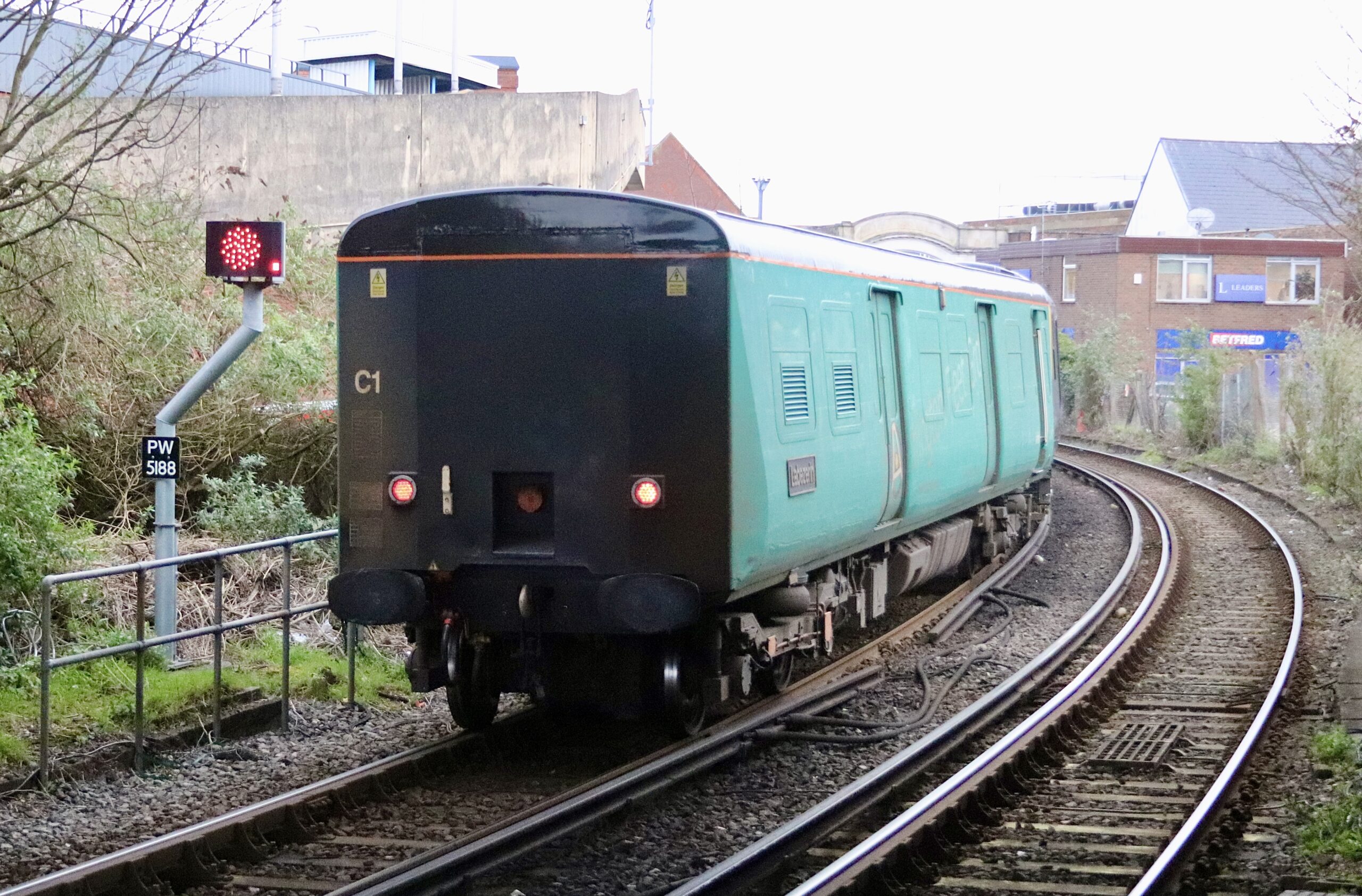
T7 barrier translator coach No. 64707 ‘Labezerin’ at the rear of 5Q64 Southampton Down Loop to Bournemouth T&RSMD – 13/03/2024
The two bright green T7 barrier translator coaches are registered as No. 64707 ‘Labezerin’ and No. 64664 ‘Liwet’ – both cars being named after angels; Labezerin is the genius of success in talismanic magic. He serves in the second hour of the day and, according to angelic lore, Liwet presides over unique ideas and inventions. So now you know.
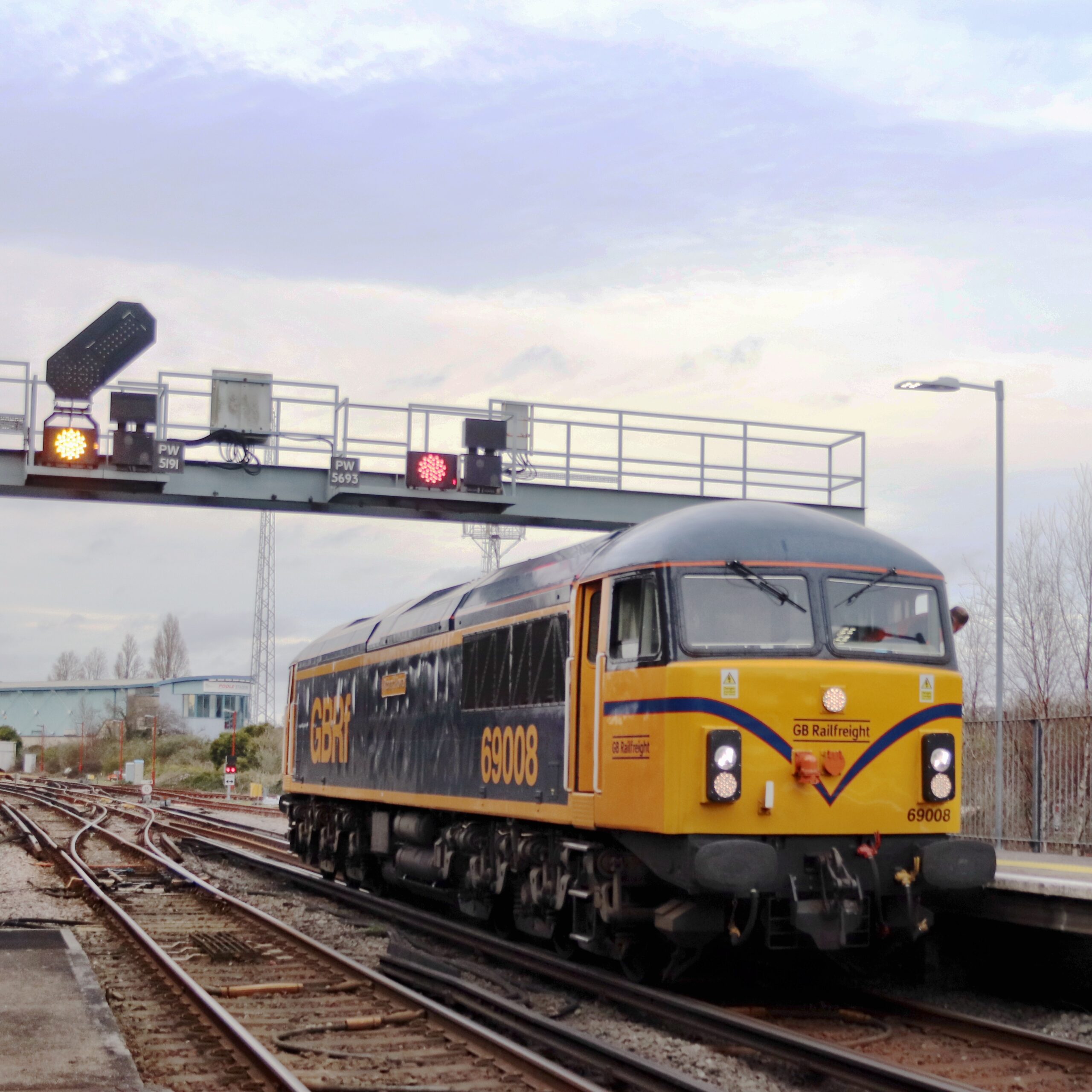
We went to Poole railway station to see Class 69 No. 69008 ‘Richard Howe’ hauling refurbished SWR Class 458 No. 458415 arriving with 5Q64 Southampton Down Loop to Bournemouth T&RSMD before heading out to Poole Storage Sidings where the locomotive would detach and run round its train. Poole Town Bridge is closed for two weeks for its annual maintenance and I was caught out with a bridge lift at Twin Sails, and arrived at Poole Station with minutes to spare. Unfortunately, the camera on my phone was ‘hunting’ it recorded the train running through platform 2 resulting in out of focus video and the SD card in my DSLR malfunctioned. Not a promising start!
Rebuilt from Class 56 No. 56038, GBRf Class 69 locomotive No. 69008 recently named after driver ‘Richard Howe’ at Poole whilst running round its train which has been deposited in Poole Storage Sidings – 13/03/2024GBRf Class 69 locomotive No. 69008 ‘Richard Howe’ running into Poole railway station before heading back out to Poole Storage Sidings and recouping to its train – 13/03/2024
Later in the day, I opted to film the return working at Branksome as under cover of darkness, No. 69008 left Bournemouth depot on the first leg of its journey up to Widnes with Class 458 No. 458521, the next unit in line for refurbishment and conversion, working as 5Z66 1937 Bournemouth T&RSMD to Eastleigh East Yard. We also saw another SWR Class 701 Arterio test run and several passenger and empty coaching stock movements. You can watch events in the video below.
Video from Poole, Branksome and Parkstone – 13/03/2024
15th March and the Snow & Ice Treatment Train made another Friday evening visit on the Bournemouth to Weymouth line, reporting as 3Y89 2200 Totton Yard to Totton Yard and once again being top ‘n tailed by GBRf Class 66 No.’s 66764 ‘Major John Poyntz Engineer & Railwayman’ and 66750 ‘Bristol Panel Signal Box’.
GBRf Class 66 No.’s 66764 ‘Major John Poyntz Engineer & Railwayman’ and 66750 ‘Bristol Panel Signal Box’ working 3Y89 2200 Totton Yard to Totton Yard passing Hamworthy – 15/03/2024
View From North Dorset:
07/03/2024 – The New Measurement Train (NMT) passed through North Dorset with Network Rail Yellow liveried Class 43 HST power cars No.’s 43062 and 43013 as 1Q23 0556 Reading to Exeter via Salisbury.
Class 37 No. 37607 pauses at Yeovil Junction working the return leg of 3Q07 Exeter Riverside N.Y. to Exeter Riverside N.Y. (Scott Lewis) – 15/03/2024
Over night on the 14th and 15th March 2024, the Ultrasonic Test Unit (UTU) made an appearance in North Dorset with Harry Needle Class 37 No. 37607 working 3Q07 Exeter Riverside N.Y. to Exeter Riverside N.Y. Friend of the blog and North Dorset Correspondant, Scott, was on hand to see the train passing Gillingham and at Yeovil Junction in the early hours.
Class 37 No. 37607 working 3Q07 Exeter Riverside N.Y. to Exeter Riverside N.Y. Video by kind permission of Scott Lewis – 15/03/2024
HAMWORTHY BRANCH
Work has been taking place at Hamworthy Park Crossing in connection with renewing the electrical supply and the restoration of signalling at this location.
Aiming to restore signalling, work to clear vegetation at Hamworthy Park Crossing began on 7th March – 07/03/2024New ducting etc. has been put in place – 12/03/2024Awaiting new electrical connections. We were told the relay box will also be replaced – 12/03/2024Lineside vegetation clearance has been carried out near Hamworthy Park Crossing – 12/03/2024
February 27th 2024 saw the publication of the new Poole Harbour Commissioners (PHC) Masterplan – which expands on the previous ambition in returning rail freight to the port by utilising the Hamworthy Branch. First published in March 2013, the Masterplan identifies PHC’s vision and strategic outcomes for the next 20 years.
PHC Masterplan in relation to the Hamworthy Branch – February 2024
A date of 2025 for the reinstatement of the rail link is quoted if negotiations with potential stakeholders bear fruit. This ties in with information we have been told previously by Network Rail (NR). This was further supported in the response to a Freedom Of Information Request recently shared on Facebook:
[Network Rail] can confirm that there are plans to resume freight traffic to Poole harbour along the Hamworthy Branch. The project is subject to funding being secured to redevelop the sidings infrastructure within the Port, which would prove the catalyst for some latent demand for sea dredged aggregates traffic to originate from the Port and serve the London and Southeast market.
“There is some potential for container traffic as an onward development, but that is a longer-term prospect and would need to overcome some gauging challenges elsewhere before it could start. The focus will very much be on aggregates traffic and the market should cater for a dally train. There is a potential pot of funding which Network Rail is seeking to utilise for the Poole project but the application for the Port works to be part of this is not confirmed yet.”
From The Archive:
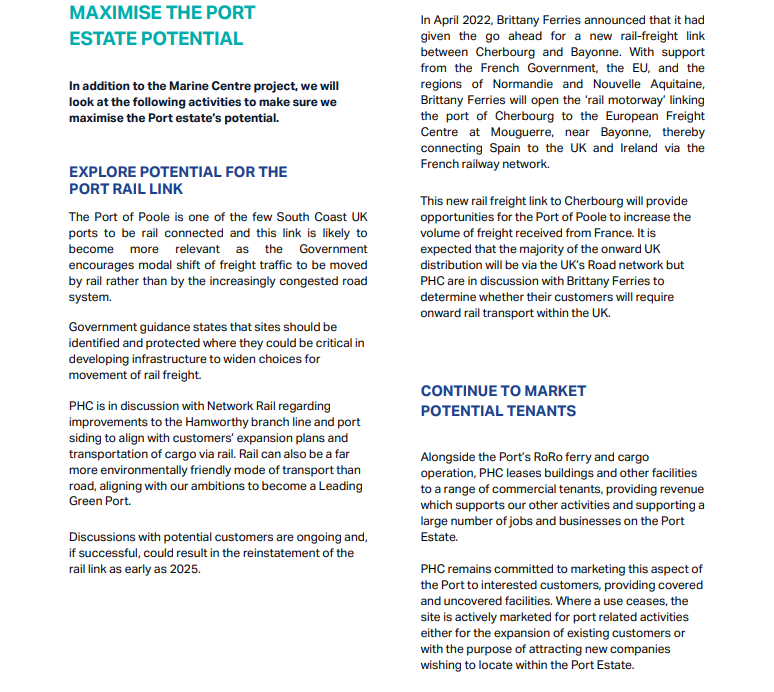
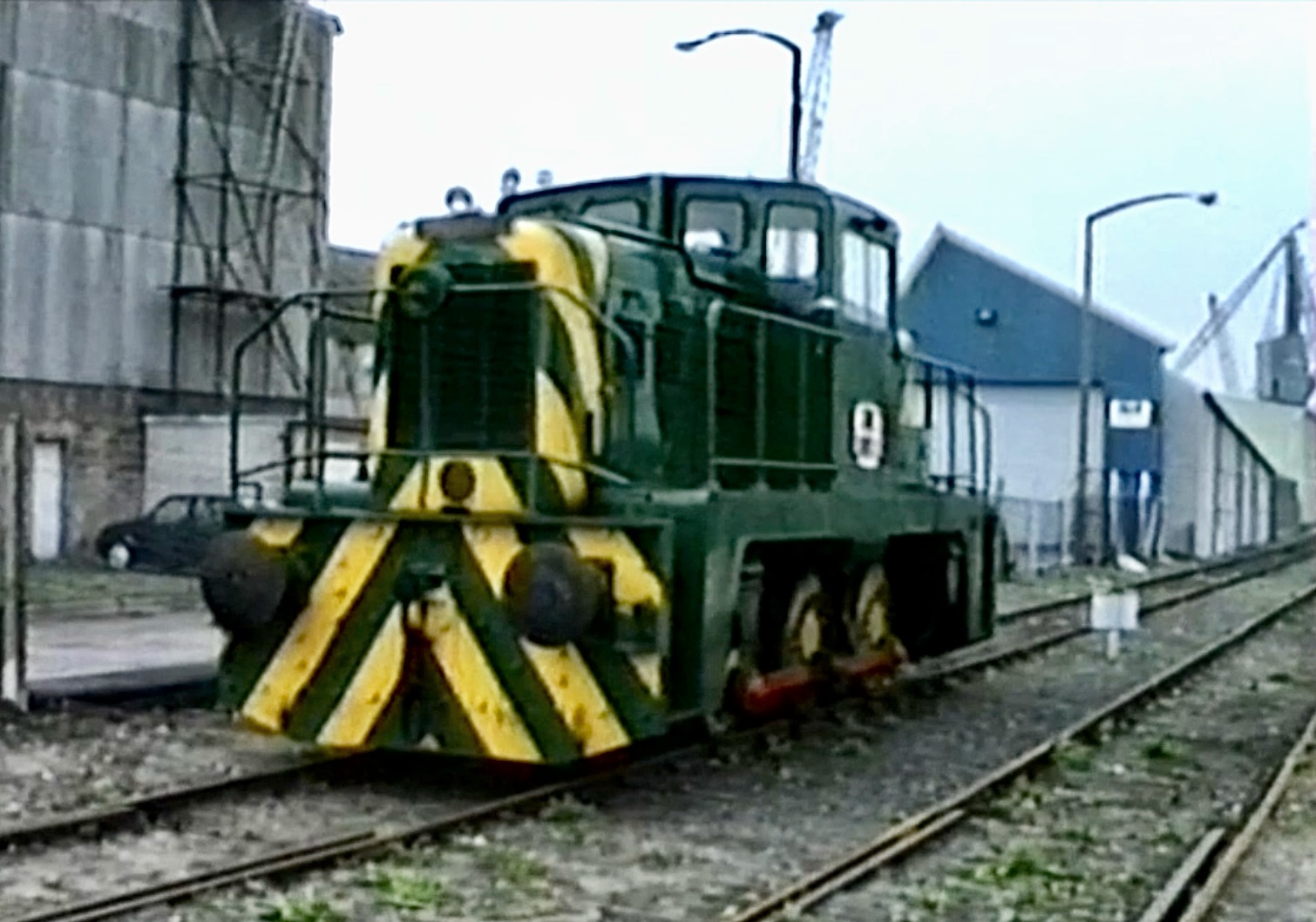
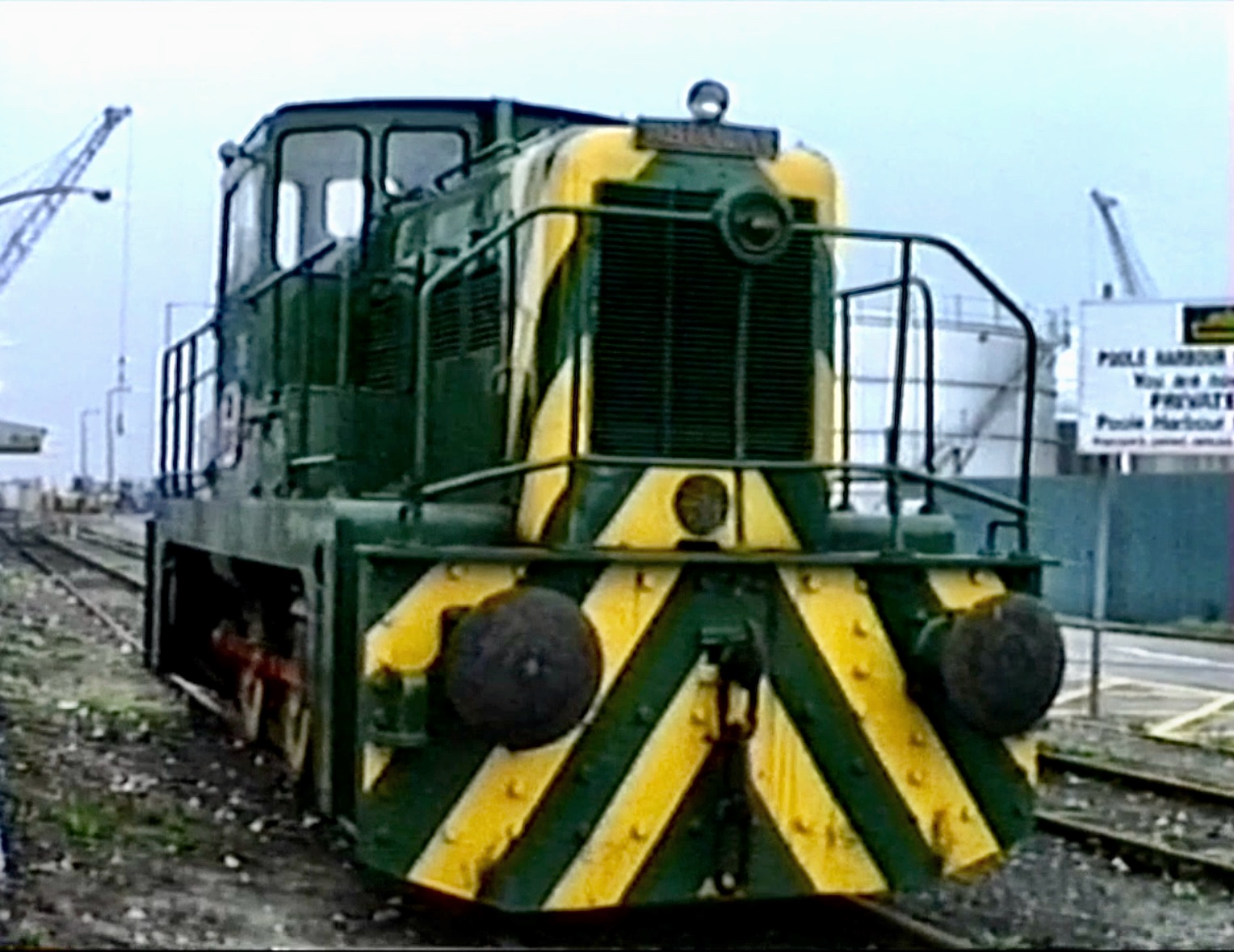
‘Janus’ class 0-6-0DE Yorkshire Engine Co. diesel-mechanical no. 391 ‘Astolat’ (works No.2630 of 1956) at Poole Port. These engines were 0-6-0 wheel arrangement locomotives that weighed 48 long tons and had a maximum speed of 23mph. The two Rolls-Royce C6SFL diesel engines gave a total power output of 400 hp. Each engine had its cooling system at the outer end, and the its generator at the inner end. There were two traction motors, each being powered by one generator, thus simplifying the electrical system. Production began in 1956, and ended in 1965 with 102 Janus locomotives being constructed, mostly for the British steel industry. Other prominent customers included Imperial Chemical Industries (12 locomotives), the Port of London Authority (10), and the National Coal Board (7). Three locomotives were exported. The name Janus is from the two-faced god Janus: the locomotive was symmetrical with two ‘faces’ – 1992 (John Chappell)‘Astolat’ was hired in from Allied Steel & Co., Cardiff from May to November 1992 and is seen at Poole Port – 1992 (John Chappell)
A 1992 glimpse of ‘Astolat’ at Poole Port. Video by John Chappell
DC Tours 1Z24 Hamworthy Quay Phoenix with Class 37 No.’s 37227 & 37902 and Class 33 No. 33114 providing the motive power -15/03/1992 Video by John Chappell
For The Record:
Dorset Council announced it is now part of the North as it declared it would receive £2.068 million each for the years 2023/24 and 2024/25 from the Department for Transport (DafT) ‘Network North fund’, from “reallocated HS2 government funding”, which together with other maintenance and pothole funds, will be dedicated to carriageway maintenance in the council area.
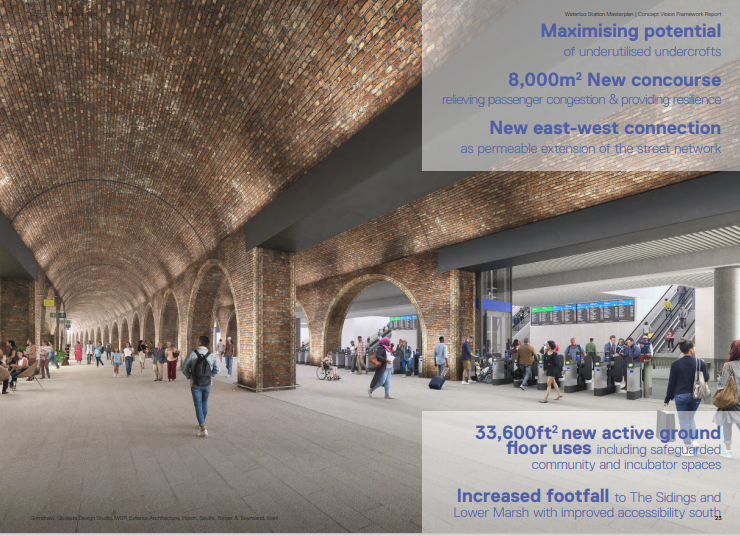
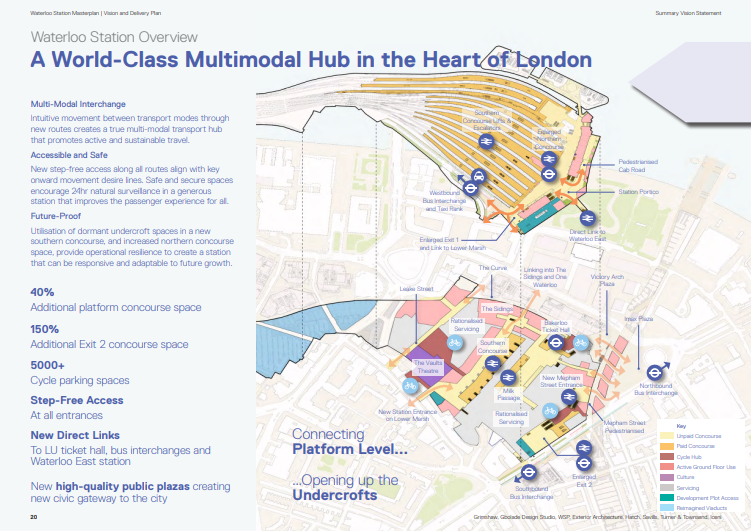
Network Rail and Lambeth council have announced a Vision Statement on future plans for Waterloo Railway Station – the London terminus for the Bournemouth and Weymouth line. Plans include opening up the station undercroft area for public use with new office space built above the station to help fund the upgrade. The masterplan also looks at how the wider area can be improved, with the street outside the front of the station pedestrianised and several of the arches carrying the railway to Charing Cross, directly in front of Waterloo, opened up to form new public walkways. Some of the existing bus and taxi stops could also be relocated to a new enhanced interchange on the south-eastern side of the station.
For more information on future plans for London Waterloo, follow the links below:
That just about brings us to the end of another railway dog blog entry, but just enough time to say on March 16th 2024, Yoshi and I celebrated the fifth anniversary of Gotcha Day. On this day in 2019, Yoshi adopted me and I’ve loved having his companionship ever since.
Thanks for reading, and for your comments and corrections. We’ll be back soon, until then take care. Be seeing you.
Gotcha Day – five years apart!
Postscript:
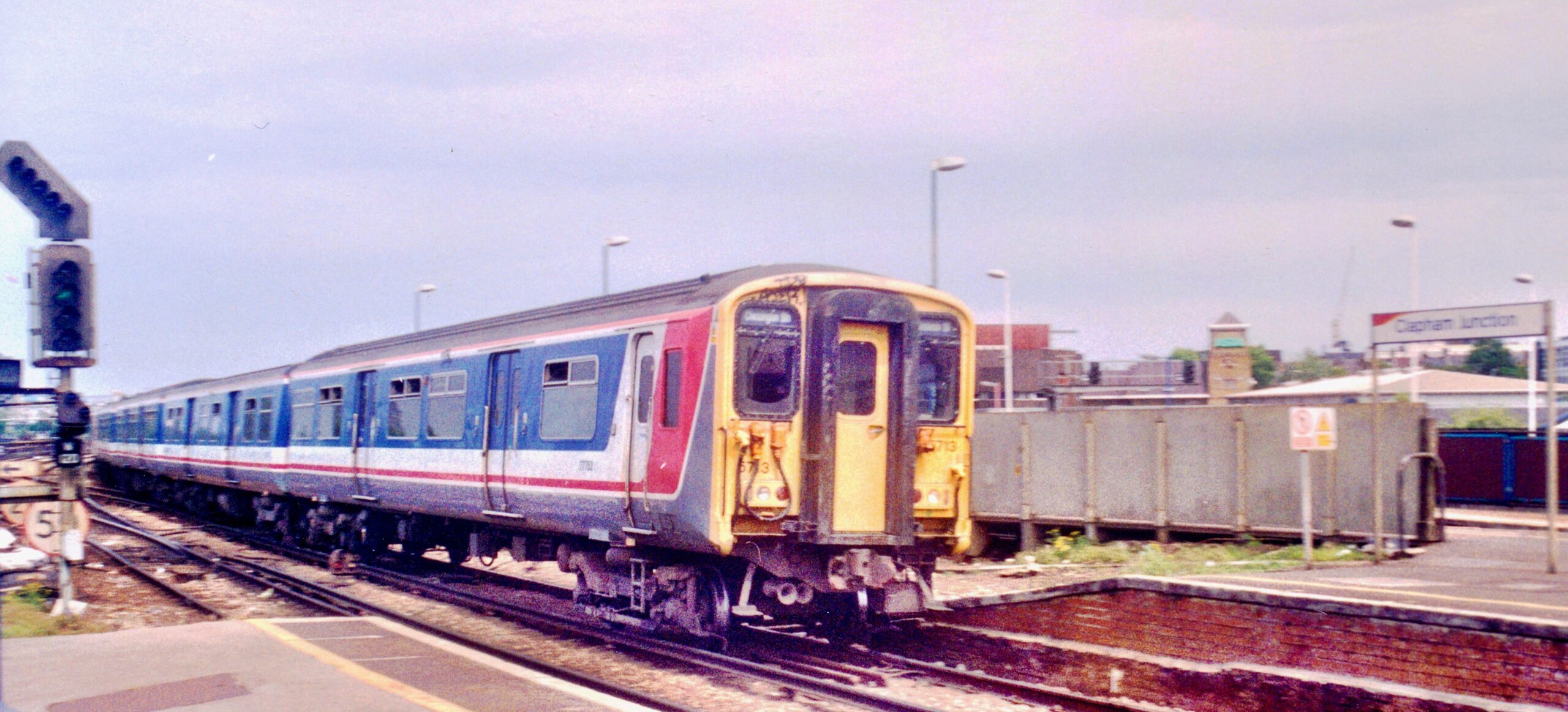
I doubt we’ll see a Class 455 in former SWT livery again. No. 455713 is seen here approaching Clapham Junction (therailwaydog collection)
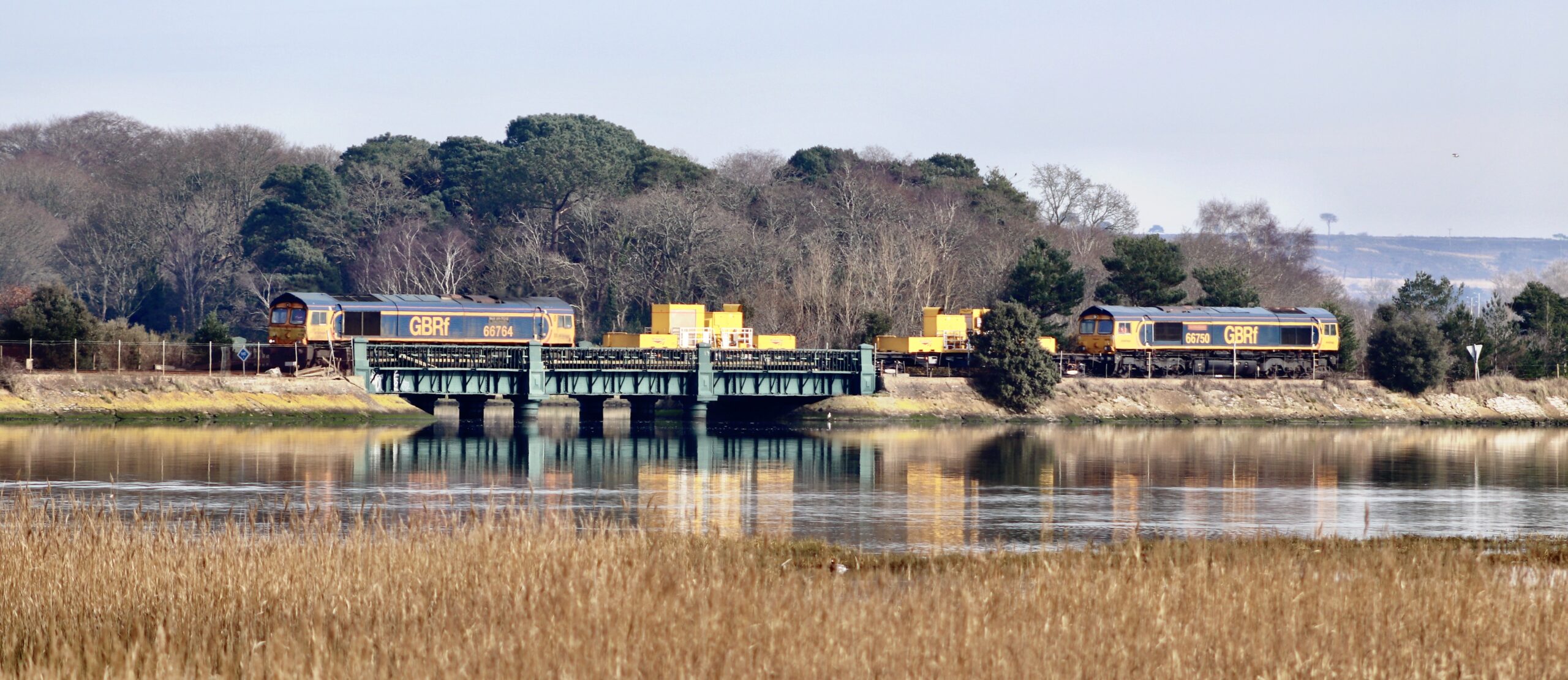
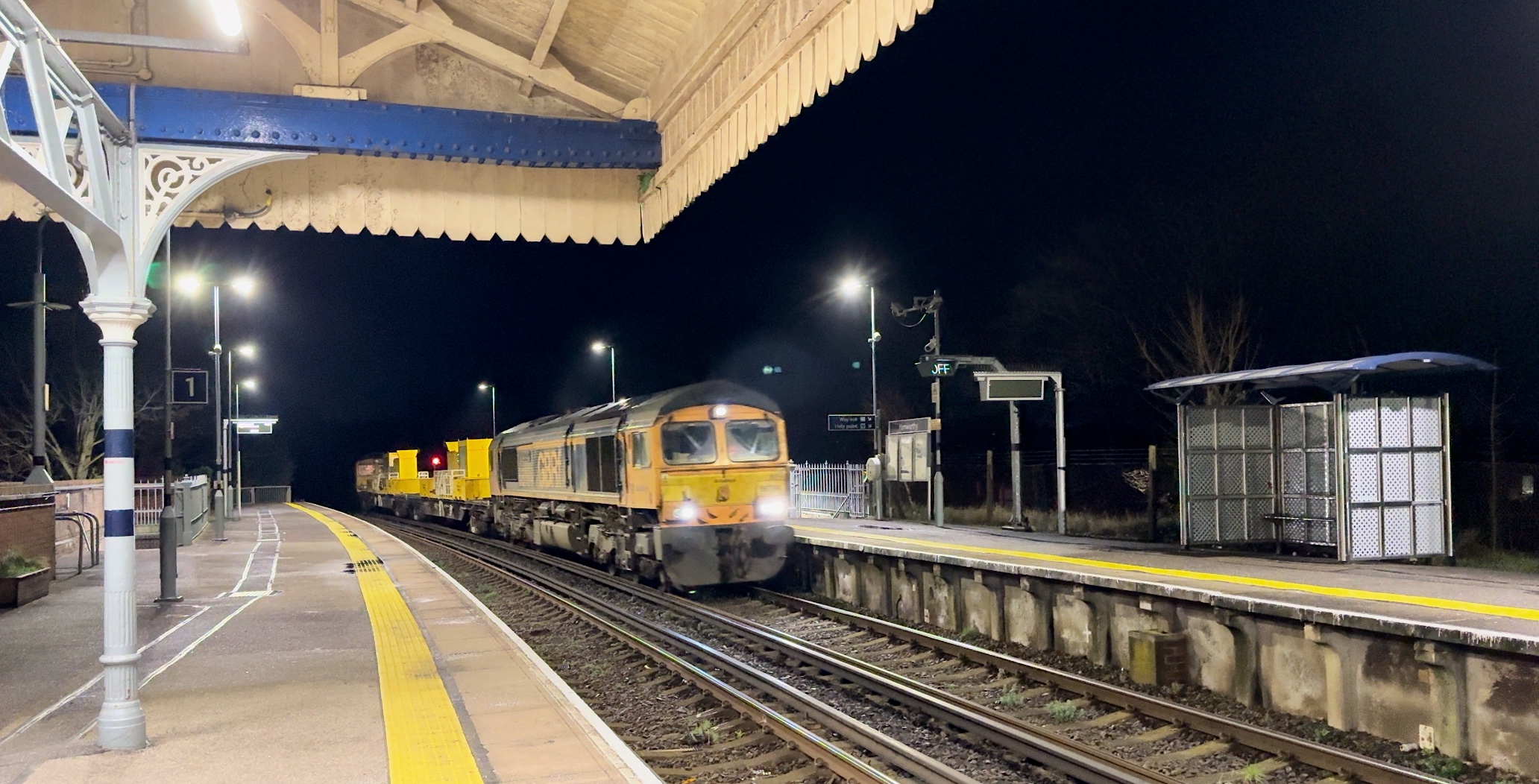
GBRf Class 66 No.’s 66764 ‘Major John Poyntz Engineer & Railwayman’ and 66750 ‘Bristol Panel Signal Box’ pass over Upton viaduct on Holes Bay, Poole working 3Y88 0931 Totton Yard to Totton Yard – 27/02/2024
February 22nd 2024 to February 29th 2024
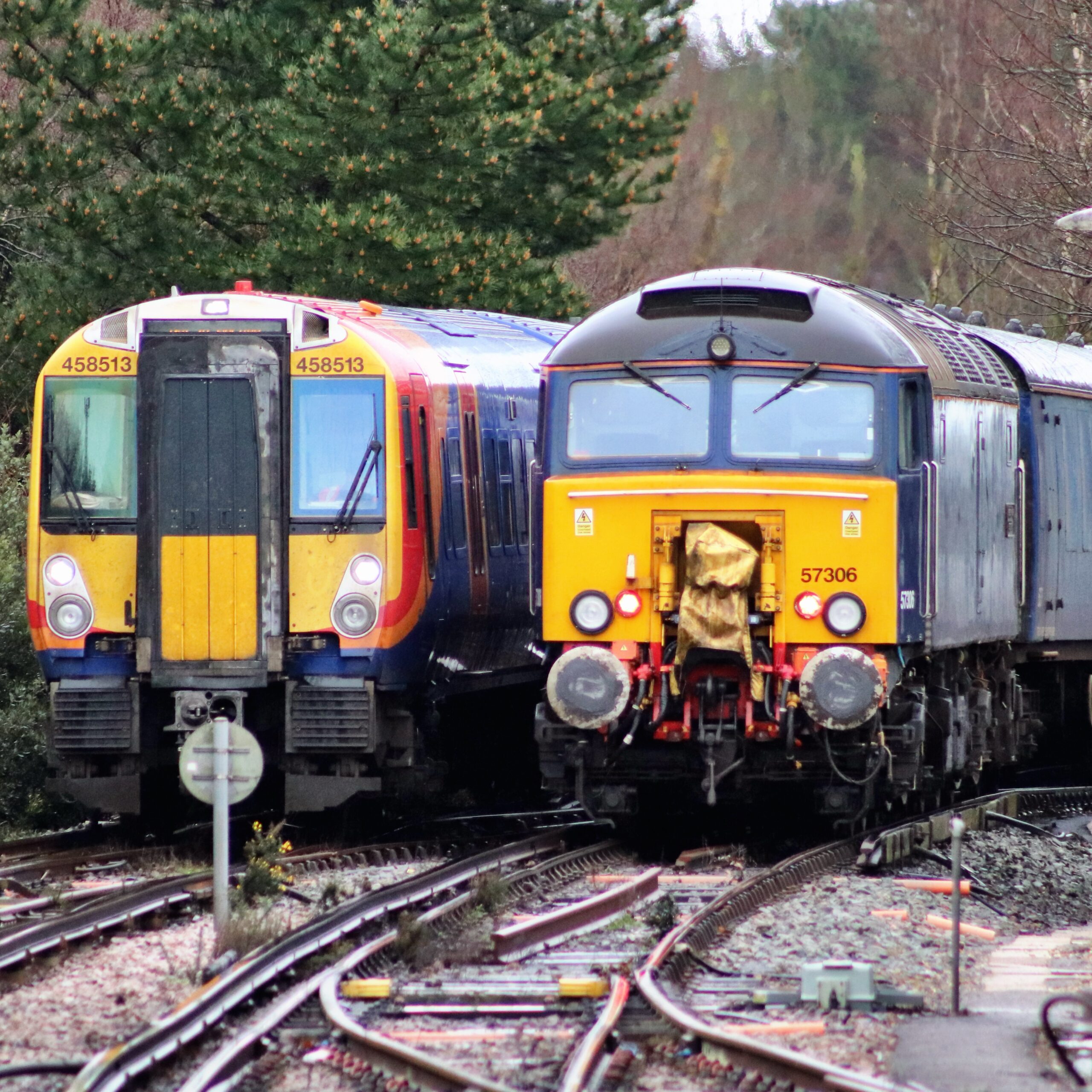
GBRf Class 57 No.’s 57306 ‘Her Majesty’s Railway Inspectorate’ arrives at Branksome with 5X62 0909 Wembley Receptions 1-7 to Bournemouth T&R.S.M.D – 22/02/2024
Thursday 22nd February 2024 saw more Class 458 EMU shenanigans with planned working 5X62 0530 Wembley Receptions 1-7 to Bournemouth T&RSMD and associated return 5M64 1315 Bournemouth T&RSMD to Leicester L.I.P. being cancelled due to a “request by the train operator”. Things were retimed, however, but we still saw GBRf Class 57 No.’s 57306 ‘Her Majesty’s Railway Inspectorate’ and 57303 arriving at Branksome with refurbished Class 458/4 No. 458424 65 minutes later than the revised schedule with 5X62 0909 Wembley Receptions 1-7 to Bournemouth T&RSMD.
GBRf Class 57 No. 57303 prepares to lead into the depot working 5X62 0909 Wembley Receptions 1-7 to Bournemouth T&R.S.M.D – 22/02/2024
As the Class 57 and Class 458/4 consist departed Branksome to reverse into the depot, an un-refurbished Class 458/5 No. 458513, still in the old SWT blue livery, was poking its nose out of the sidings. Which was a bit of a bonus.
As Class 458/5 No. 458513 edges out of the depot working 5Y51 1432 Bournemouth T&R.S.M.D to Wimbledon Park Depot Sidings, GBRf Class 57 No.’s 57306 ‘Her Majesty’s Railway Inspectorate’ moves in on the rear of 5X62 0909 Wembley Receptions 1-7 to Bournemouth T&R.S.M.D – 22/02/2024SWR Class 458/5 No. 458513 working 5Y51 1432 Bournemouth T&R.S.M.D to Wimbledon Park Depot Sidings – 22/02/2024
Video from Branksome – 22/02/2024
The pair of Class 57’s departed almost an hour late top and tailing barrier wagons as 5M64 1515 Bournemouth T&RSMD to Leicester L.I.P. I was at home cooking dinner, being watched closely by a cockapoo of my acquaintance.
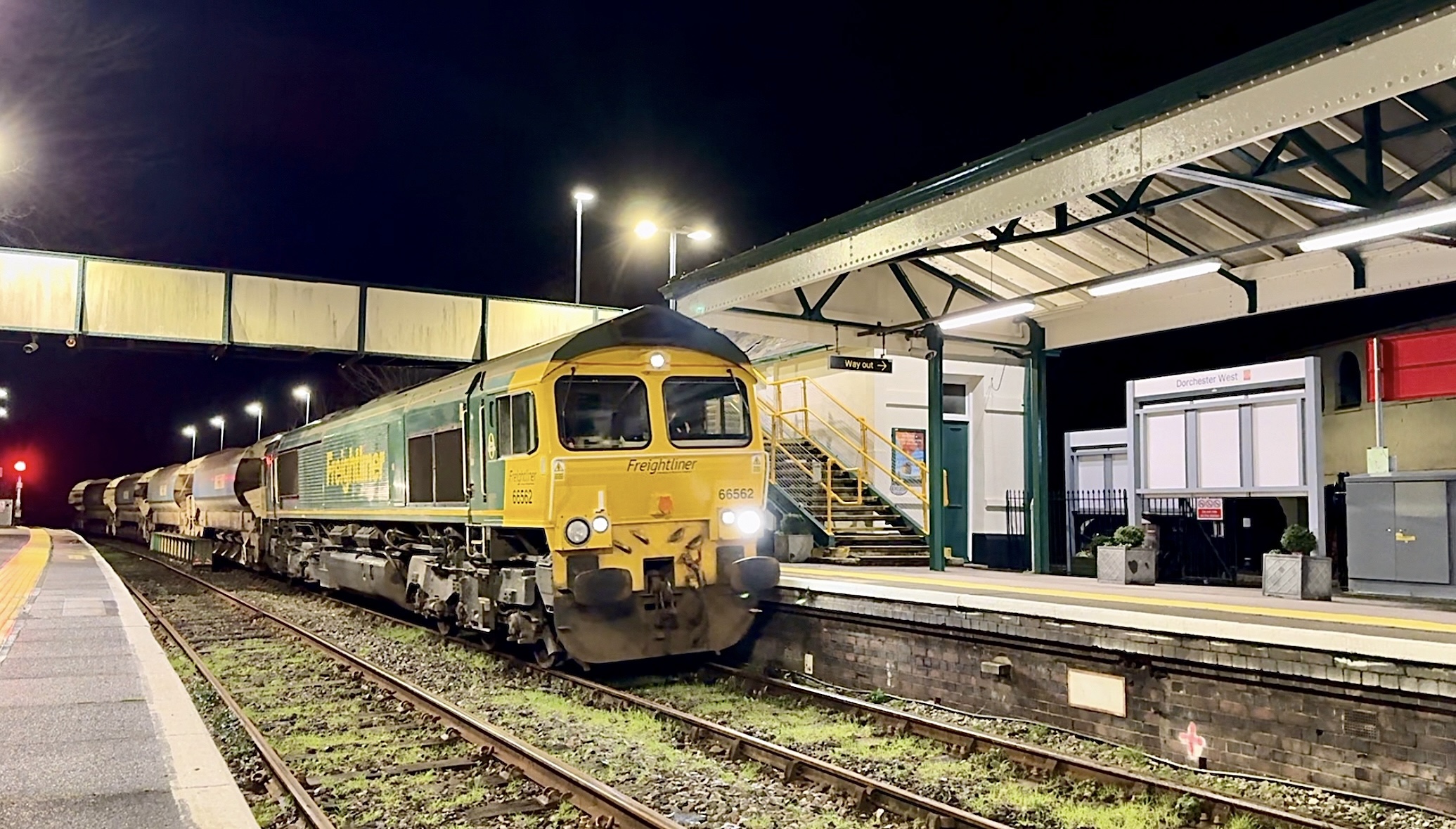
Later that same day, a Freightliner operated engineers train worked down from Westbury to Dorchester West, top and tailed by Class 66 No.’s 66562 and 66559. Having feasted, Yoshi and I headed off to Castle Cary to see the train arrive. Major redevelopments continue at Castle Cary station with a new car park taking shape which will provide spaces for 193 cars. An access ramp will take station users from the car park up to the front of the station. There will also be a new cafe and office space in the former milk factory building, which dates from 1910 and is adjacent to the new car par. This work is being carried out by the Emily Estate who also have planning permission for a creamery which may see the production of cheese return to the building. That’s something both Yoshi and I can get behind!
More car parking spaces have been much needed at the station which is located on the GWR line from London Paddington to Taunton. Trains travelling from Bristol Temple Meads to Weymouth also call at Castle Cary. The present car park, which will be reconfigured to provide additional Blue Badge parking and spaces for taxi use, is often full on weekdays and, until now, no additional parking has been available nearby.
Freightliner Class 66 No. 66562 emerges out of the darkness at Castle Cary leading on 6Y91 1929 Westbury Down T.C. to Dorchester West – 22/02/2024GWR Class 158 DMU No. 158950 having arrived at Castle Cary with ECS working 5C90 1847 Axminster to Exeter TMD – 22/02/2024The driver of GWR Class 158 DMU No. 158950 prepares to depart Castle Cary with ECS working 5C90 1847 Axminster to Exeter TMD as Freightliner Class 66 No. 66562 waits right time with 6Y91 1929 Westbury Down T.C. to Dorchester West – 22/02/2024
After seeing the engineers train at Castle Cary, and not wanting to out stay our 20 minute free parking allowance, we headed to Yeovil Pen Mill where we once again saw the pair of 66 locomotives arrive with 6Y91. The driver wearily acknowledged us as we passed each other on the platform.
Freightliner Class 66 No. 66562 at Yeovil Pen Mill leading on 6Y91 1929 Westbury Down T.C. to Dorchester West – 22/02/2024Freightliner Class 66 No. 66559 pauses at Yeovil Pen Mill on the rear of 6Y91 1929 Westbury Down T.C. to Dorchester West – 22/02/2024
Another lengthy booked stop at Yeovil meant Yoshi and I were able to get ahead of the train and see it pass through Yetminster before we were able to once again get ahead of it as there was a booked stop at Maiden Newton and for our fourth and final time of the evening see the Class 66’s pass through Dorchester West.
Arriving at Dorchester West and heading for Dorchester Junction to reverse and work back is Freightliner Class 66 No. 66562 working 6Y91 1929 Westbury Down T.C. to Dorchester West – 22/02/2024Freightliner Class 66 No. 66559 pauses at Dorchester West on the rear of 6Y91 1929 Westbury Down T.C. to Dorchester West before heading down to Dorchester Junction – 22/02/2024
Freightliner Engineers to Dorchester West – 22/02/2024
As the train headed off to Dorchester Junction in order to reverse and return via Dorchester West up platform, Yoshi and I headed off home. The train worked up the West line to its work site and returned to Westbury the following morning as 6Y91 0430 Castle Cary to Westbury Down T.C.
GBRf Class 66 locomotives No.’s 66764 ‘Major John Poyntz Engineer & Railwayman’ and 66750 ‘Bristol Panel Signal Box’ passing through Hamworthy railway station working 23/02/2024: 3Y89 2200 Totton Yard to Totton Yard. The return from Weymouth would be curtailed at Dorchester South – 23/02/2024
The Snow & Ice Treatment Train (SITT) saw increased activity due to the cold snap in the South at the tail end of February. Top and tailed by GBRf Class 66 locomotives No.’s 66764 ‘Major John Poyntz Engineer & Railwayman’ and 66750 ‘Bristol Panel Signal Box’, the SITT ventured out of Totton Yard on the night of Friday 23rd February working as 3Y89 2200 Totton Yard to Totton Yard. However, this service was cancelled on the return leg between Dorchester South and Totton Yard “due to an error having been made”, although we believe in reality it was because there was no cover for the Dorsetway signal panel due to late staff absence. We hope everyone concerned is OK.
Having been tipped off by friend of the blog, Jamie, we were able to see the SITT parked up in Dorchester South Engineers Siding on the Saturday morning. Although the locomotives were fired up and looked like they were ready to leave, we were unable to wait to witness their departure towards Weymouth as 3Y88 1200 Dorchester South Isu (CE) to Totton Yard
Friday’s Snow & Ice Treatment Train, having been curtailed at Dorchester South and tucked into a siding by the signal box, returned to Totton on Saturday morning running as 3Y88 1200 Dorchester South Engineers Sidings to Totton Yard top and tailed by GBRf Class 66 locomotives No.’s 66764 ‘Major John Poyntz Engineer & Railwayman’ and 66750 ‘Bristol Panel Signal Box – 24/02/2024 (Image: G E Barrett)GBRf Class 66 No. 66750 ‘Bristol Panel Signal Box’ stands in Dorchester South Engineers Sidings awaiting departure back to Totton Yard – 24/02/2024
The same locomotives and rolling stock also worked to Weymouth in daylight hours on Monday 26th February and Tuesday 27th February 2024, which gave opportunities for photography.
GBRf Class 66 locomotives No.’s 66750 ‘Bristol Panel Signal Box’ and 66764 ‘Major John Poyntz Engineer & Railwayman’ pass Hamworthy working 3Y88 0931 Totton Yard to Totton Yard – 26/02/2024GBRf Class 66 locomotives No. 66764 ‘Major John Poyntz Engineer & Railwayman’ at the rear of 3Y88 0931 Totton Yard to Totton Yard having passed Hamworthy. No. 66750 ‘Bristol Panel Signal Box’ was leading on this occasion – 26/02/2024GBRf Class 66 locomotives No.’s 66750 ‘Bristol Panel Signal Box’ and 66764 ‘Major John Poyntz Engineer & Railwayman’ on the approach to Bournemouth as 3Y88 0931 Totton Yard to Totton Yard – 27/02/2024The SITT in the charge of GBRf Class 66 locomotives No. 66764 ‘Major John Poyntz Engineer & Railwayman’ at the rear and 66750 ‘Bristol Panel Signal Box’ leading near Bournemouth railway station working 3Y88 0931 Totton Yard to Totton Yard – 27/02/2024
February 2024 Dorset Snow & Ice Train video
Tuesday 27th also saw further Class 57 hauled unit drags to and from Bournemouth depot as GBRf Class 57 No.’s 57306 ‘Her Majesty’s Railway Inspectorate’ and 57303 returned with another refurbished SWR Class 458/4, this time No. 458420, from Widnes Transport tech.
GBRf Class 57 No. 57306 ‘Her Majesty’s Railway Inspectorate’ and I have rubbed buffers so many times now, we are on first name terms. We enjoyed a brief catch up here as the locomotive arrived at Branksome working 5X62 0531 Wembley Receptions 1-7 to Bournemouth T&R.S.M.D bringing SWR Class 458 No. 458420 back following refurbishment at Widnes. Sister locomotive No. 57303 was on the other end. Again – 27/02/2024The driver of 5X62 0531 Wembley Receptions 1-7 to Bournemouth T&R.S.M.D changes ends so Class 57 No. 57303 leads into the depot from Branksome – 27/02/2024
The pair of Class 57’s left with 5Q64 1315 Bournemouth T&R.S.M.D to Widnes Transport Tech, this time taking Class 458/5 No. 458522 for refurbishment. We saw this near Bournemouth from Beechey Road bridge overlooking the railway station.
GBRf Class 57 No. 57306 ‘Her Majesty’s Railway Inspectorate’ approaches Bournemouth railway station leading on 5Q64 1315 Bournemouth T&R.S.M.D to Widnes Transport Tech with Class 458 No.458522 sandwiched between barrier coaches – 27/02/2024Five car Class 458 EMU No.458522 heads to Cheshire for conversion onto Class 458/4 as 5Q64 1315 Bournemouth T&R.S.M.D to Widnes Transport Tech – 27/02/2024GBRf Class 57 No. 57303 brings up the rear of 5Q64 1315 Bournemouth T&R.S.M.D to Widnes Transport Tech as the train enters Bournemouth Station – 27/02/2024
Whilst awaiting the arrival of 3Y88 and 5Q64 at Bournemouth, I was almost caught out by a Class 458/4 test run as No. 458424 snuck up on me working the curtailed 5Q91 1320 Basingstoke to Bournemouth T&R.S.M.D. The outward run (5Q90 1119 Bournemouth T&R.S.M.D to Basingstoke) had been terminated at Southampton Central due to a points failure.
Class 458/4 test run as No. 458424 passing Bournemouth working the curtailed 5Q91 1320 Basingstoke to Bournemouth T&R.S.M.D, although on RTT the train kept its outward designation; 5Q90 1119 Bournemouth T&RSMD to Southampton Central – 27/02/2024Class 458/4 No. 458424 having passed through Bournemouth and heading to Branksome and the depot – 27/02/2024
More Class 458 EMU video – 27/02/2024
What better thing to do on the “extra day” provided in the 2024 calendar – 29th February – than pop over to Bournemouth and see Network Rail Class 153 Diesel Multiple Unit No. 153385 converted to a Video Inspection Unit which ran as 2Q32 1113 Eastleigh East Yard to Eastleigh East Yard.
2Q32 1113 Eastleigh East Yard to Eastleigh East Yard2Q32 1113 Eastleigh East Yard to Eastleigh East Yard2Q32 1113 Eastleigh East Yard to Eastleigh East YardSWR Class 444 No. 444038 at Bournemouth forming 1W16 1103 Weymouth to London Waterloo – 29/02/2024CrossCountry Voyagers No.’s 220023 and 221214 at Bournemouth having arrived as 1008 0725 Manchester Piccadilly to Bournemouth – 29/02/2024
Class 153 VIU at Bournemouth – 29/02/2024Poster seen at Bournemouth detailing the Weymouth line closure which takes place 18th – 20th March 2024 – 29/02/2024
We returned to Bournemouth later on the 29th to see a Colas Engineers Train top and tailed by regular visitors Class 66 No.’s 66848 and 66849 ‘Wylam Dilly’ which were running as 6C19 2259 Eastleigh East Yard to New Milton.
6C19 2259 Eastleigh East Yard to New Milton6C19 2259 Eastleigh East Yard to New Milton6C19 2259 Eastleigh East Yard to New Milton
Video of Colas Engineering Train reversing at Bournemouth – 29/02/2024
Saturday 24th February Yoshi took a visit to Dawe’s Twineworks at West Coker in Somerset. This is England’s only surviving working Victorian Twineworks. Built in 1899, Dawe’s Twineworks survived until 1968 utilising the flax and hemp grown in the local rich soil to provide the twine, rope and sailcloth required by sailing ships. “Coker Canvas” made the best quality sails and helped the Royal Navy rule the waves in the 19th Century. The volunteers were lovely, very enthusiastic and knowledgeable with the new Visitor Centre providing refreshments and information all for a donation. Dawe’s is open on the 4th Saturday of each month (please check before visiting).
Yoshi in the tea room and visitor centre built in 2018/2019 at Dawe’s Twineworks – 24/02/2024
South Somerset District Council made a compulsory purchase of the site in 2005 to save the buildings which were then close to collapse. The “Coker Rope & Sail Trust”, set up under the auspices of West Coker Parish Council, now has a 125 year lease on the site. In recent years the Trust has managed, with local effort, to restore parts of the building and machinery, install an engine and bring Dawe’s back to life.
Yoshi outside the engine house. To be honest, he wasn’t too keen on the engine once it was fired up – 24/02/20241927 Shanks 16 litre 23HP oil engine made in Arbroath was secured by the Twineworks. The engine has to be started using compressed air which is supplied by a 3.5HP Lister-Hamworthy compressor dating from the 1940’s and stored in a WWI torpedo casing at 25olb/in2 – 24/02/2024The “Walk” is an imposing structure 100m in length, allowing twine to be made in 200m lengths whatever the weather with its Bridgwater-tiled roof protecting valuable machinery – 24/02/2024Construction of the “Walk” was very simple, consisting of just oak posts in the ground, bolted trusses to support the roof and a pine first floor.The Ford model T was first produced in 1908, and was the first mass produced motor car, and due to this it also became affordable to the people. Due to its success the T was modified and different variants were produced. Yoshi is admiring this example which dates from 1926 – 24/02/2024
That’s it for another blog entry. Thanks for reading! Yoshi and I hope you’ve found something of interest. We’ll be back again soon. Be seeing you!
Yoshi after his recent grooming session – 26/02/2024
Yoshi in the back of the car having enjoyed a wet and muddy walk in the woods!
February 10th 2024 to February 21st 2024
Hello – as mentioned briefly last time around, we were planning on bringing you an archive feature on Bournemouth Depot Open days, but we need to find and scan some additional negatives as well as editing down and converting 8mm video tape, so that’ll take a little bit more time to prepare. That’ll teach us, and to be fair this blog entry has taken long enough! In the meantime, a rolling stone gathers no moss and Yoshi has been exploring Stonehenge (or at least the footpath outside the English Heritage site, as dogs are “NOT ALLOWED” near the ancient monument). A note to English Heritage – can you provide dog poo bins prior to the section where dogs cannot pass please? Thanks very much. And as if Yoshi couldn’t get enough of old rocks, he also took a walk around the stone circle at Avebury – no trains, but lots of mystical ley lines – before moving onto Wells and Tyntesfield House.
Yoshi gets as close to Stonehenge as he is allowed! Stonehenge is a prehistoric megalithic structure on Salisbury Plain in Wiltshire two miles west of Amesbury. It consists of an outer ring of vertical sarsen standing stones, each around 13 feet high, seven feet wide, and weighing around 25 tons, topped by connecting horizontal lintel-stones. Inside is a ring of smaller bluestones. Inside these, are free-standing trilithons; two bulkier vertical sarsens joined by one lintel. The whole monument is aligned towards the sunrise on the summer solstice and sunset on the winter solstice. Archaeologists believe that Stonehenge was constructed in several phases from around 3100 BC to 1600 BC, with the circle of large sarsen stones placed between 2600 BC and 2400 BC. Doctor Who used Stonehenge as a plot point in the 2010 episode “The Big Bang”. I liked that episode. I should rewatch it. I include the mention to the BBC TV series, as it was something of a developing theme…..An announcement in November 2020 stated that a plan to construct a four-lane tunnel for traffic below the site had been approved. This was intended to eliminate the section of the A303 that runs close to the circle. The plan had received opposition from a group of “archaeologists, environmentalists and modern-day druids” according to National Geographic but was supported by others who wanted to “restore the landscape to its original setting and improve the experience for visitors”. Opponents of the plan were concerned that artifacts that are underground in the area would be lost or that excavation in the area could de-stabilize the stones, leading to their sinking, shifting or perhaps falling. On 14th July 2023, the Department for Transport (DaFT) announced that, despite the original planning application having been overturned by the High Court in 2021, the Transport Secretary, Mark Harper, had approved plans for a 2 mile road tunnel. On 19th February 2024, the High Court in London rejected a fresh bid by campaigners to stop the road tunnel construction.Yoshi’s next stop was Aldbourne where he visited the village green and took a look at the medieval St Michael’s church. During the Second World War, U.S. Army paratroopers of Easy Company, 2nd Battalion, 506th Parachute Infantry Regiment, 101st Airborne Division were based at Aldbourne from late 1943 to mid-1944, in preparation for the Normandy landings in June 1944 and Operation Market Garden in September.Aldbourne is also known as Devil’s End in the Doctor Who story “The Dæmons” featuring The Third incarnation of the Time Lord played by Jon Pertwee. One of the village pubs, The Blue Boar, was renamed as The Cloven Hoof! A model of St.Michaels’s church was also blown up during the story, which anecdotally generated complaints from viewers. A reminder of the Aldbourne Doctor Who link is this TARDIS litter bin, free for public use 🙂The prehistoric Avebury henge and stone circles were built and much altered during the Neolithic period (2850 BC and 2200 BC) survivING as a huge circular bank and ditch, encircling an area that includes part of Avebury village. Within the henge is the largest stone circle in the UK which originally consisted of approximately 100 stones. Two smaller stone circles are enclosed within. Avebury was memorably used as the location of the itv children’s drama series “Children of the Stones” (1977). As far as I know, the stones have not been seen in Doctor Who. So, in a bid for completism, I searched for a link and found it in nearby Yatesbury, where from 1942 – 1965 an RAF Radar School was situated and attended by Brian Hodgson who went on to run the BBC Radiophonic Workshop and devised the sound of the TARDIS by scraping his mother’s front door key along the strings of a piano. The video to the 1988 No.1 hit song “Doctorin’ the Tardis” by The Timelords, better known as The KLF, was partly filmed at Yatesbury. Don’t worry, we’ll get to the trains soon. Yoshi takes a look at Wells Cathedral – construction of which began on c1180 and was completed by the time of Henry VII. It was damaged during the English Civil War, but was later restored during the Victorian age. The building has also been used as a Doctor Who filming location when to stood in for Southwark Cathedral in the 2006 story “The Lazarus Experiment” featuring David Tennant as the Tenth Doctor.National Trust owned Tyntesfield House, bought in 1844 by William Gibbs as a retreat for his wife,Blanche, and their growing family. Close relatives in Bristol and neighbouring Belmont House in Wraxall, the estate benefited from direct links to London on Brunel’s newly built Great Western Railway (GWR). Keeping up with the Doctor Who connection, the property was used as a haunted mansion in Matt Smith’s tenure during the 2013 episode “Hide”.A walk in Horton Woods….…. past the 140ft high Horton Tower, also known as Sturt’s Folly, built in c1750 by the Lord of Horton Manor, Humphrey Sturt, who was an architect and a Dorset MP. In 1967 the tower featured in the film adaptation of Thomas Hardy’s “Far From the Madding Crowd”. Over the years it had fallen into disrepair but in 1991, Vodafone was granted permission to use the tower for mobile phone masts. As part of the deal the company agreed to carry out repairs, and the conservation project was recognised with a Royal Town Planning Institute award in January 1995.Journey’s End; Yoshi relaxing in front of a warm fire at The Horton Inn after our walk!
For The record
12/02/2024: 1Q51 1115 Derby RTC to Eastleigh East Yard via Weymouth
73963 ‘Janice’ pauses briefly at Poole leading on 1Q51 1115 Derby RTC to Eastleigh East Yard via Weymouth – 12/02/2024
GB Railfreight (GBRf ) Class 73 Electro-Diesel No.’s 73962 ‘Dick Mabbutt’ and 73963 ‘Janice’ returned for the monthly Colas Plain Line Pattern Recognition Train.
1Q51 1115 Derby RTC to Eastleigh East Yard via Weymouth at Poole – 12/02/2024
13/02/2024: 5X62 0524 Wembley Terminal Complex Wheel Lathe to Bournemouth Traction & Rolling Stock Maintenance Depot / 5Q64 1321 Bournemouth Traction & Rolling Stock Maintenance Depot to Widnes Transport Tech
GBRf Class 57 No. 57305 leading on 5X62 0524 Wembley Terminal Complex Wheel Lathe to Bournemouth Traction & Rolling Stock Maintenance Depot. SWR Class 458 No. 458416 was sandwiched between the front loco and No. 57303 at the rear of the consist – 13/02/2024GBRf Class 57 No. 57303 at the rear of 5X62 0524 Wembley Terminal Complex Wheel Lathe to Bournemouth Traction & Rolling Stock Maintenance Depot – 13/02/2024
GBRf Class 57 No.’s 57303 and 57305 arrived at Bournemouth depot with refurbished SWR Class 458 No. 458416. The pair of Class 57 locomotives departed with 5-Car Class 458 No. No. 458515 later in the day. A similar exercise scheduled for Thursday 15th February; 5X62 0524 Wembley Receptions 1-7 to Bournemouth T&R.S.M.D and 5M64 1314 Bournemouth T&R.S.M.D to Leicester L.I.P. did not run. It is most likely that the same pair of Class 57 locomotives would have been involved.
While waiting for the morning unit drag to Bournemouth depot, we were entertained by passing South Western Railway (SWR) Class 444’s on regular passenger services.
SWR Class 444 No. 444017 working 2W13 0904 Bournemouth to Weymouth – 13/02/2024Unique Pride liveried SWR Class 444 No. 444019 forms 2W52 0900 Poole to Bournemouth – 13/02/2024
5X62 0524 Wembley Terminal Complex Wheel Lathe to Bournemouth Traction & Rolling Stock Maintenance Depot between Bournemouth and Branksome – 13/02/2024
18/02/2024: 3Q02 2155 Eastleigh East Yard to Eastleigh East Yard
HNR Class 37 No. 37607 seen at Derby Technical Centre at the head of a Network Rail Test Train – 02/04/2023
Harry Needle Rail operated Class 37 No. 37607 was scheduled to visit the Bournemouth to Weymouth line with the Ultrasonic Test Train overnight on Sunday 18th / Monday 19th February. Disappointingly for us, however, this service was cancelled due to the train crew not being available and did not run.
21/02/2024: 1Z22 0747 Derby R.T.C.(Network Rail) to Bristol Kingsland Road
Former High Speed Train Class 43 Power Cars No.’s 43272 in debranded Virgin Trains East Coast livery and 43274 in East Midlands Railway Purple livery worked the New Measurement Train to Weymouth on Wednesday 21st February.
I missed this pairing as I was in London for a work meeting. I took the opportunity to pop into London Euston and London Kings Cross on my way to the office after arriving at London Waterloo.
One of two remaining Class 707 EMU’s still with SWR No. 707024 at the buffer stops of London Waterloo – 21/02/2024Caledonian Sleeper Class 92 No. 92038 at London Euston. I had hoped to see the incoming sleeper service in the station, but this was running almost two hours late, and I had places to be – 21/02/2024London Kings Cross with Class 91 No. 91119 ‘Bounds Green InterCity Depot 1977-2017’ working 1D09 1003 London Kings Cross to Leeds alongside LNER Azuma trains 801210 forming 1S12 1S12 1030 Kings Cross to Edinburgh Waverley, 801213 on 1Y11 0630 Newcastle to London Kings Cross and 800209 having arrived with 1A12 0700 Hull to London Kings Cross – 21/02/2024Class 91 No. 91105 at London Kings Cross having arrived at the rear of the 1A13 0656 service from Skipton – 21/02/2024Covering low-availability of the Class 180 fleet, Grand Central have supplemented their fleet with a pair of former Avanti Super Voyagers. Here Class 221 No. 221143, now with driving vehicles in Grand Central’s livery stands at platform 10 at The Cross having arrived with 1A59 0659 Bradford Interchange to London Kings Cross – 21/02/2024Meeting over, we sought out refreshments at The George pub, established in medieval times on Borough High Street in Southwark. It is currently owned and leased by the National Trust and is the only surviving galleried London coaching inn. I recommend the Mac n’ Cheese – 21/02/2024One of the railway arches in the recently restored Findlater’s Corner at London Bridge railway station that was formerly an Express Dairy tea room is now a branch of Starbucks. During renovation work an impressive mosaic was revealed showing its previous function, advertising afternoon teas, luncheons, and smoking rooms – 21/02/2024Express Dairy was founded in 1864 and its name is part of the marketing as it was an early adopter of the railways to ship milk from the countryside to a bottling plant in South Acton and then ship them around London, also by rail. At a time when many people got milk from urban cows, milk from the countryside was seen as a healthier option. At its peak, Express Dairy had over 240 tea rooms across London, making it the Edwardian equivalent of Starbucks today, which seems fitting….
Winfrith No More
On what turned out to be the final trip to Winfrith; Direct Rail Services Class 68 No.’s 68016 ‘Fearless’ & 68002 ‘Intrepid’ work 6Z62 0100 Crewe Coal Sidings DRS to Winfrith Sidings (Wool) passing through Poole – 23/01/2024
It has been announced Direct Rail Services (DRS), the rail freight arm of Nuclear Transport Solutions (NTS), has now completed its task in the transportation of radioactive materials from the Winfrith treated waste store as the very last flasks of radioactive waste have been moved to their final destination at the low-level waste repository near Cumbria in the Lake District. The final rail shipment ran on 23rd January 2024 and marked a reduction in legacy waste on the Winfrith site by approximately seventy per cent. The successful completion of this contract contributes to returning the site to heathland with public access. It’s the first site from the first generation of nuclear power plants to be completely decommissioned.
From 1980, a Class 33/0 at Dorchester South yard with a Winfrith flask. I’ve rather frustratingly mislaid the original photographic print which contains the actual date and locomotive detail, but do recall we trainspotters were chased away by railway staff when these workings arrived – xx/xx/1980
Forthcoming Dorset Engineering Work
The lines in the Poole area will be closed all day due to maintenance work on Sunday 17th March 2024.
London Waterloo to Weymouth services will terminate at Bournemouth.
London Waterloo to Poole services will terminate at Bournemouth.
Buses will run between Bournemouth and Poole (non-stop).
Buses will run between Bournemouth and Wareham.
A revised service will run between Wareham and Weymouth.
Monday 18th to Wednesday 20th March 2024, the lines between Dorchester South and Weymouth will be closed from Monday to Wednesday all days inclusive due to maintenance work.
Great Western Railway services between Weymouth and Yeovil Pen Mill will be affected by this work.
London Waterloo to Weymouth services will be revised and will terminate at Dorchester South.
Buses will run between Dorchester South and Weymouth.
In association with these works, a Freightliner engineering train is showing on Real Time Trains as running as 6Y85 2348 Eastleigh East Yard to Dorchester South departs its source on Sunday 17th March 2024 and arrives Dorchester South at 0110 (on the 18th) – returning as 6Y85 1454 Dorchester South to Eastleigh East Yard on 19th March
The lines between Bournemouth and Poole will be closed all day due to maintenance work on 23rd March.
London Waterloo to Poole and Weymouth services will terminate at Bournemouth.
Buses will run between Bournemouth and Poole.
A revised service will run between Poole and Weymouth.
In addition to this, the lines in the Brockenhurst area will be closed all day due to maintenance work on 24th March.
London Waterloo to Weymouth services will terminate at Southampton Central.
London Waterloo to Poole services will terminate at Southampton Central.
Fast buses will run between Southampton Airport Parkway, Bournemouth and Poole.
Fast buses will run between Southampton Central, Bournemouth and Poole.
Buses will run between Southampton and Poole via Brockenhurst (buses will not call at Beaulieu Road).
A revised service will run between Poole and Weymouth.
Passengers travelling from London Waterloo to Bournemouth, Poole and Weymouth should change at Southampton Airport Parkway for the fast bus service to Poole.
Sunday 28th April, the lines in the Wool area will be closed all day due to maintenance work.
London Waterloo to Weymouth services will terminate at Wareham.
Buses will run between Wareham and Dorchester South.
Buses will run between Wareham and Weymouth.
A revised service will run between Dorchester South and Weymouth.
Looking further ahead, rail improvement work will also affect train services between Castle Cary and Weymouth in the autumn.
The March 2024 edition of “Steam Days” magazine features Colin Boocock’s well illustrated account of train diversions in 1960 off the Bournemouth main line and onto what was known as both the ‘Old Road’ after the direct line to Bournemouth was opened in 1888 or ‘Castleman’s Corkscrew’, so named after Charles Castleman who was the driving force in getting the Southampton & Dorchester Railway built and its somewhat circuitous route.
Thanks for reading – we’ll be back soon with a further updates of happenings along the rails in Dorset. Be seeing you!
Postscript:
Engineering work in days gone by…. Class 33/0 No. 33035 and Class 33/1 No. 33118 on Bincombe Bank adjacent to Upwey Telephone Exchange sometime in the early 1990’s. No. 33118 was withdrawn from service in April 1993 and cut up by MRJ Phillips at Eastleigh Depot by February 1997. No. 33035 was named ‘Spitfire’ in December 1993 and withdrawn in October 1996 but lives on in preservation – xx/xx/199x
Yoshi visited The London Museum of Water & Steam to celebrate the New Year. In the background are the museum buildings and the impressive Victorian standpipe tower, which is not, as you might expect, a chimney but a brick winter coat for the two systems of vertical pipes – through which water was pumped before it entered the mains water supply – contained within to prevent freezing and is the museum’s most striking feature standing at 200 ft high. The Grade I brick tower, of Italianate design, was constructed in 1867 to replace an earlier open metal lattice structure – 01/01/2024
January 1st 2024 to January 11th 2024
We kicked off 2024 with a visit to the “New Years Steam Up” being held at the London Museum of Water & Steam in Brentford. The Steam Up weekend of celebrations was the first opportunity in two years for people to marvel at the monstrous working steam engines that once provided water to the millions living and working in London. In July 2022, the Museum’s 96 year old Lancashire Boiler failed an inspection when it was discovered one of the seventeen rivets which hold the crown valve mounting flange onto the main boiler shell had lost its heat inside the boiler’s steam space. This meant that the boiler could no longer be used and the steam engines fell silent and still while extensive repairs were carried out. Now, just in time to celebrate the museum’s 50th anniversary the boiler is steaming once again.
Situated on the site of the former Kew Bridge Pumping Station, close to Kew Bridge on the River Thames in West London, the museum is centred on a collection of stationary water pumping steam engines dating from 1820 to 1910. It is the home of the world’s largest collection of working Cornish engines, including the largest working beam engine in the world; the Grand Junction 90 inch.
The Grand Junction 90 inch has a cylinder diameter of 90 inches (hence its name!) and was used to pump water to London for 98 years. This machine is over 40 feet high and weighs about 250 tons. It was described by Charles Dickens as “a monster”. It was built by Sandys, Carne & Vivian of Hayle in 1846 as the first Cornish beam engine specifically designed for water supplies and was powerful enough to supply water to the upper floors of buildings, allowing direct supply to upstairs bathrooms 01/01/2024
We arrived early after a good run in the car up from Dorset and luckily found parking on site in the small car park at the museum, although the site is only a 3 minute walk from Kew Bridge railway station if you chose to arrive by train. There were a number of families in evidence with young children during our visit and the museum is a great place to learn and have fun.
Exhibiting a plethora of steam, diesel and electric powered pumps, the London Museum of Water & Steam tells the story of London’s water supply housed in historic Georgian buildings and they very kindly allowed access to Yoshi, but explained that our boy may not like some of the steam engines when they are working. We duly followed this advice and Yoshi waited with one of his hoomans in the Pump and Grind Coffee Shop or explored the garden area while the machines were being operated. The coffee shop was very busy and served an excellent cuppa. It is run by “Our Barn Community”, a local charity working with young people with learning difficulties enabling a supported work placement.
We have shared just a small fraction of the engineering marvels housed at the museum below:
The Waddon Engine with drove 3 pumps was built by James Simpson & Co of Newarkin 1910 and originally found use at Waddon Pumping Station in Croydon. It was the last steam water-pumping engine in active UK service before being retired in June 1983. It was restored in 1990 and restored to original Edwardian colours for display at the museum – 01/01/2024This waterwheel was built in 1902 by S. Hindley & Sons in Bourton, Dorset for the Duke of Somerset to serve his estate at Maiden Bradley in Wiltshire and was one of the last waterwheels ever built to pump water in the UK – 01/01/2024The Boulton & Watt (West engine) is the oldest engine in the London Museum of Water & Steam having been built in Birmingham in 1820.It was one of a pair moved to Kew in 1840 which were then converted into a Cornish type between 1846 and 1848. Retired in 1944, this was the first engine to be returned to working order in 1975 – 01/01/2024
Kew Bridge Pumping Station was originally opened in 1838 by the Grand Junction Waterworks Company, expanding over the ensuing years and ultimately housing six steam pumping engines as well as four Allen diesel pumps and four electric pump sets. The steam engines were retired from service in 1944, although two were kept on standby until 1958. The Metropolitan Water Board thankfully decided not to scrap the resident steam pumping engines and set them aside to form the basis of a museum display at a later date which came to fruition in 1974 with the formation of the Kew Bridge Engines Trust.
The original Number 1 horizontal AC motor driving centrifugal pump was built in 1944 by Hawthorn Davey & Co of Leeds. This type of electric pump replaced steam engines at pumping stations across the UK and this example is the oldest surviving pump of its kind. It was retired in the late 1980’s – 01/01/2024
The museum also runs a 2 ft narrow gauge railway, which despite being advertised as running over the weekend, was unfortunately not operating during our visit. The museum has been a filming location for many television programmes, including the Doctor Who serial “Remembrance of the Daleks” broadcast in 1988.
After our visit to the London Museum of Water & Steam, we had planned on taking a trip into central London by rail, but in the event decided against this and instead took a drive and a leisurely walk around nearby Richmond, including a visit to the railway station. Of course we did!
The Art Deco façade of Richmond railway station complete with its square clock centrepiece – 01/01/2024
The Art Deco station building in Richmond, designed by James Robb Scott (1882-1965) for the Southern Railway and constructed in Portland stone dates from 1937 and replaced an earlier station on the site. Scottish born Scott became the Chief Architect of the Southern Railway and is perhaps best known for his redesign of London Waterloo between 1910 and 1923 where he was chiefly responsible for the offices, main entrance and war memorial to the fallen employees of the railway known as the Victory Arch. Scott also designed Wimbledon and Surbiton railway stations – now part of the South Western Railway (SWR) network – the latter having recently celebrated 40 years since being bestowed Grade II listed status.
SWR, Network Rail (NR) and the Railway Heritage Trust are jointly funding a £325,000 programme of improvements with hopes of more refurbishment to come in the future, subject to additional funding being made available. Initial work includes cleaning the Portland stone façade, repairing the timber entrance doors and polishing its bronze embellishments, repairing flagpoles and refurbishing customer toilets.
The restored entrance doors to Richmond railway station which Yoshi unceremoniously christened on our visit…. 01/01/2024
The style of the building at Richmond is suggested as being inspired by the work of Charles Holden (1875-1960), the architect behind London Underground stations including South Wimbledon on the Northern line. Holden’s designs included multi-frame glazing, enamelled signage panels, the use of an iconic typeface for signage and brick and tile detailing. Similar features at Richmond have been lost or covered up over time, including during the station’s last major refurbishment in 1985. SWR, NR and the Railway Heritage Trust have worked with Benedict O’Looney Architects on designs that include restoring or replicating those features, and others, in future improvements. Paying close attention to detail, the station’s original, hand-drawn plans are being used together with promotional photographs from when the station first opened its doors to customers. Samples of the station’s original paint are also being analysed by the University of Lincoln, specialists in the conservation and restoration of the interior and exterior features of listed and historic buildings.
The area in front of Richmond station main entrance was pedestrianised in 2013 and includes a war memorial to soldier Bernard Freyberg, who was born in Richmond. As well as Sir trains, the station is served by the London Overground North London Line and Underground District Line trains.
Star of the show, Adams 4-4-0 T3 No. 563 working the 1200 Swanage to Norden service approaches Corfe Common – 06/01/2024
The Swanage Railway’s first event of 2024 was their annual “Winter Warm Up” weekend held on January 6th & 7th. With cold, but clear weather forecast, I decided on heading down to Swanage on the Saturday after taking a chance on a picturesque sunrise at Durdle Door on the way.
Resident Class 33 No. 33111 crosses Corfe Viaduct hauling the 1245 Swanage to Norden train – 06/01/2023SR West Country 4-6-2 No. 34028 ‘Eddystone’ takes her turn on the demonstration freight working the 1132 Norden to Swanage nearing Afflington. Later during the weekend, brake van rides were offered – 06/01/2024This time working a passenger train, SR West Country 4-6-2 No. 34028 ‘Eddystone’ has departed Norden with the 1415 service to Swanage – 06/01/2024Class 33 No.D6515 ‘Lt Jenny Lewis RN’ takes her turn on the freight wagons working 1302 Norden to Swanage – 06/01/2024Class 33 No.D6515 ‘Lt Jenny Lewis RN’ departs Harman’s Cross with the 1030 Norden to Swanage – 06/01/2024
In action this year was the recently restored Adams 4-4-0 T3 No. 563 hauling its first freight train since its return to service, SR West Country 4-6-2 No. 34028 ‘Eddystone’ and the resident Class 33 diesel locomotives no.’s 33111 and D6515 ‘Lt Jenny Lewis RN’
Adams 4-4-0 T3 No. 563 powers away from Corfe Castle at the head of the 1357 Swanage to Norden demonstration freight – 06/01/2024
The Swanage Railway Trust 563 Locomotive Group have been nominated for the “Steam Railway Magazine Award”. This award is decided by the public and will be announced at Heritage Railway Association’s annual ceremony on February 10th 2024 and you can now cast your vote online until the 18th January 2024: www.steamrailway.co.uk/read/hra-awards
Video from January 6th 2024 Swanage Winter Warm Up
Scheduled mainline action kicked off the year with a “no-show” as the HST powered New Measurement Train (NMT) failed to reach Weymouth on January 3rd after a points failure at Castle Cary curtailed 1Z22 1211 Derby RTC (Network Rail) to Bristol Kingsland Road – top and tailed by Class 43 power cars No.’s 43274 and 43257 – at Westbury. Interestingly three different paths were put in for this test train on this particular day. The one which finally ran was timed later than the usual working to Dorset, but not as late as one of the options given for the day!
We did, however, get to experience a daylight Snow & Ice treatment Train (SITT) on Sunday 7th January as GBRf Class 66 locomotives No.’s 66764 ‘Major John Poyntz Engineer & Railwayman’ and 66772 ‘Maria’ in top and tail formation worked to Weymouth as 3Y88 1035 Totton Yard to Totton Yard. 66764 replaced No. 66723 ‘Chinook’ and No. 66743 which had both been previously paired up with No. 66772 on the Totton based SITT locomotive diagram.
Sunday morning tranquility is disturbed as GBRf Class 66 locomotives No.’s 66764 ‘Major John Poyntz Engineer & Railwayman’ and 66772 ‘Maria’ top and tail SITT 3Y88 1035 Totton Yard to Totton Yard across Upton Viaduct on the Holes Bay causeway – 07/01/2024GBRf Class 66 No. 66772 ‘Maria’ leads on the return 3Y88 1035 Totton Yard to Totton Yard Snow & Ice Treatment Train through Hamworthy with No. 66764 ‘Major John Poyntz Engineer & Railwayman’ at the rear – 07/01/2024GBRf Class 66 locomotives No.’s 66764 ‘Major John Poyntz Engineer & Railwayman’ and 66772 ‘Maria’ at Hamworthy working 3Y88 1035 Totton Yard to Totton Yard – 07/01/2024
Major John Poyntz served in the British army for 35 years, with the Royal Engineers and later the Royal Corps of Transport. After military service, he joined the Railway Inspectorate, now part of the Office of Rail and Road, and was the last Royal Engineer to take such a route, spending 25 years in the role as a Railway Inspector. His work included inspections of heritage railways and dealing with accidents and incidents such as the Severn Tunnel rail accident and the Cannon Street rail crash, both in 1991.
Overnight on Saturday 6th/Sunday 7th a ballast train headed to Moreton working as 6C03 2312 Eastleigh East Yard to Moreton (Dorset) in the hands of Colas locomotives Class 66 No. 66848 and Class 70 No. 70809. We saw the ensemble pass through Hamworthy on the outward leg and had planned to see the associated return 6C03 0810 Moreton (Dorset) to Eastleigh East Yard crossing Holes Bay, but as the train set off over an hour early and with the sun yet to rise, we played safe and returned once again to Hamworthy railway station to watch the train pass through.
January ballast train with Class 66 No. 66848 and Class 70 No. 70809
The SITT returned to the Bournemouth to Weymouth line under the cover of darkness on Monday 8th and Wednesday 10th January employing the same pair of Class 66’s as the previous Sunday run.
January 2024 Dorset Snow & Ice Treatment Train workings (additional video courtesy of G E Barrett)
In between the SITT workings, on Tuesday 9th January, we saw a first for Dorset as Direct Rail Services (DRS) ran a service to Winfrith using a Class 88 locomotive No. 88002 ‘Prometheus’ which had replaced failed Class 68 No. 68004 (which itself had substituted for No. 68005) and No. 68003 ‘Astute’ in top an tail formation. This was the inaugural use a Class 88 on the Bournemouth to Weymouth line.
DRS Class 68 No. 68003 ‘Astute’ with Class 88 No. 88002 ‘Prometheus’ working the empties to Winfrith as 6Z62 0100 Crewe Coal Sidings (DRS) to Winfrith Sidings through Hamworthy – 09/01/2024DRS Class 68 No. 68003 ‘Astute’ leads the return 6Z95 1551 Winfrith Sdgs to Crewe Coal Sidings (DRS) at Hamworthy – 09/01/2024Class 88 No. 88002 ‘Prometheus’ at the rear of 6Z62 0100 Crewe Coal Sidings (DRS) to Winfrith Sidings having cleared Hamworthy railway station. Class 68 No. 68003 ‘Astute’ leads – 09/01/2024
The Class 88 is a mixed traffic electro-diesel locomotive manufactured by Stadler Rail and is part of the Stadler Euro Dual family.
Class 88 No. 88002 ‘Prometheus’ remained at the rear for the return 6Z95 1551 Winfrith Sidings to Crewe Coal Sidings (DRS) – 09/01/2024
During the development of the Class 68 diesel locomotive for DRS which was first announced in January 2012, the design team at Stadler proposed the concept of a dual-mode locomotive that could be alternatively powered by an onboard diesel engine or via electricity supplied from overhead lines (OHLE). In comparison to conventional diesel locomotives, this arrangement enables operational costs to be significantly reduced when diagrammed on routes partially or entirely under OHLE, under which the diesel engine can be deactivated.In September 2013, DRS placed an order for ten such locomitives which would become the Class 88. Having been developed alongside the Class 68, considerable similarities are shared between the two locomotive types, with an approximate 70% share of components.
Video of January 9th 2024 Winfrith run (additional video courtesy of G E Barrett)
The Class 88 is the first dual-mode locomotive type in the UK to use the 25 kV AC electrification, as the only other electro-diesel locomotives to have entered service with British Railways are the Class 73’s and Class 74’s, which operated on the Southern Region using third rail electrification, and we’ve reached back into the archives to find some images to share:
Class 74 No. 74010 at Doncaster Works. Withdrawn from service in December 1977, the locomotive was cut up here in October 1979 after being given a brief reprieve so that it could be for evaluated for departmental use by the Railway Technical Centre (RTC) in Derby. It was given a light overhaul at Eastleigh before being towed to Derby, where it was eventually deemed to be unsuitable and taken to Doncaster for scrapping – 22/07/1979A hastily taken photo of Class 74’s at London Waterloo taken from a departing train bound for Weymouth. This side of the station later became Waterloo International between 1994 and 2007 – July 1977Class 74 No. 74004 has had a bit of a bump (not helped by my camera shake!) as it stands forlorn at Eastleigh Diesel Depot during the 1978 Open Day. This locomotive was withdrawn from service in December 1977 and cut up at Birds in Long Marston. She was originally built as the pioneer Class 71 and numbered E5000 – 30/04/1978Withdrawn Class 74’s at Eastleigh Diesel Depot Open Day including No.’s 74005 and 74009 – 30/04/1978
Eastleigh Open Day 1978 flyerClass 73 No. 73122 and 2-HAP Unit No. 6103 with a third unidentified carriage and Class 33 No. 33116 working a test train towards Dorchester South – 13/05/1981The same test train as in the image above focussing on Class 33 No. 33116 on the approach to Dorchester South – 13/05/1981
For The Record:
In other news, the SWR Class 701 Electric Multiple Units (EMU’s) finally entered revenue earning service on Tuesday 9th January 2024 when No. 701037 worked a single round trip between Waterloo and Windsor Eton Riverside. The Derby-built trains had been due to enter service in 2019. SWR have since promised the rolling stock would enter passenger service in 2023 – a promise echoed by the Department for Transport (DaFT) in a statement issued in May 2023, which said the trains would run “this calendar year”. It is intended a Class 701 will continue to run off-peak Monday to Friday between London Waterloo and Windsor, in order to fulfil that commitment, making one single round trip each day, or working between 1000 and 1600. The phased entry into service of the Class 701’s – which continue test runs to Poole and Bournemouth – will eventually allow for the withdrawal of SWR’s Class 455 units and the cascade of the Class 458 fleet to longer distance services.
Back in 2020, the first Class 701 to be delivered, No. 701002, was delivered to South Western Railway and somehow made its way to Weymouth where it is seen here in Jersey Sidings awaiting commissioning tests. Yoshi and I stumbled across it while out for our morning walkies – 16/06/200
The North Dorset NMT ran on Thursday 11th January 2024 – a week earlier than I expected – in the hands of HST Class 43 power cars No.’s 43013 and 43257.
Lake Road was closed to road traffic from its junction with Lake Drive to its junction with Coles Avenue from Monday 8th January up to and including Friday 12th January 2024 – 2200 to 0600 daily to facilitate removal of material from a bridge strike and replace missing signage on Lake Road Bridge situated on the Hamworthy Branch. We popped by a couple of times, and although the road was indeed closed, there didn’t seem to be any activity taking place with regards to bridge repairs, which is disappointing to say the least.
Road closure at Lake Road bridge – but little sign of any repairs taking place – 08/01/2024Yoshi had his first grooming session of 2024 on Monday 8th January and couldn’t wait to show off his new cut to his grandmama – 08/01/2024
That brings us to the end of another blog entry. Next week, we’ll celebrate Yoshi’s birthday and hopefully have some more Dorset based railway images and video to bring you. Thank you for reading and for your comments, corrections and amendments. All very much appreciated. We’ll leave you with a couple of shots from that early morning trip to Durdle Door! Be seeing you!
Sunrise at Durdle Door – 06/01/2024Sunrise at Durdle Door – 06/01/2024
Yoshi visited STEAM: The Museum of the Great Western Railway and saw GWR King Class 4-6-0 No. 6000 ‘King George V’ – 11/11/2023
November 10th 2023 to November 17th 2023
Having not seen any of the locomotive operated Rail Head Treatment Trains (RHTT) this year, we decided to combine a visit to the McArthur Glen Designer Outlet in Swindon with a visit to STEAM Museum and the chance of photographing an RHTT or two. The railways of Dorset are serviced by Multi Purpose Vehicles (MPV) during leaf fall season with leaves on the railway line causing problems.
An early morning MPV RHTT working crosses Upton Viaduct on the Holes Bay Causeway, Poole as 3S81 0547 Totton Yard to Totton Yard – 07/11/2023
Windy conditions can cause heavy leaf fall in a short space of time and rain means they are more likely to stick to the rails. When trains pass over leaves, the heat and weight of the trains bake them into a thin, slippery layer on the rail. This is equivalent to black ice on the roads. This can create operational issues for the signalling system (track circuits) and reduce a trains grip – which can change the ability of a train to start from a station, accelerate and climb hills, or stop at stations and signals. Across the GB Rail Network, there are 32 MultiPurpose Vehicles and 29 locomotive hauled RHTT’s. Both types of train are equipped with a high-pressure water pump delivering 1,500 Bar and, if required, can apply adhesion modifier – a mixture of suspension gel (so it can be pumped), sand (to help train wheels grip the rail), and steel or iron shot that is pushed through contamination (compressed leaves and debris) on the rail head to help the track circuits work correctly – to each running rail. If the track circuits fail to identify, or ‘lose’ a train (because the leaf and debris contamination is preventing this) then the signalling system is designed to automatically stop all the trains to prevent an accident.
Colas Class 66 No.’s 66848 & 66850 ‘David Maidment OBE www.railwaychildren.org.uk’ on the approach to Swindon working 3S59 09:00 Hereford to Swindon Transfer Yard Rail Head Treatment Train – 11/11/2023
Swindon has been synonymous with railways, and in particular the Great Western Railway (GWR) since the 1840’s, when Daniel Gooch – working under Isambard Kingdom Brunel – picked the Wiltshire town as the location for a central repair works with the site opening on 2nd January 1843. The Works transformed Swindon from a small market town with a population of 2,500 into a bustling railway themed hive of industry. Built to the north of the main town centre, Swindon works had a need for locally accessible housing and services for the men and women who worked there. The development of the railway village was on the lines of similar Victorian-era model village lifestyle concepts, such as Bournville near Birmingham, and architect/builder Rigby’s were given license to create a commercially viable development by the GWR. The completed village provided the town with medical and educational facilities that had been previously sorely lacking, together with the large St Mark’s Church and the Bakers Arms public house, all completed before 1850.
The first locomotive constructed at Swindon Works, emerging in 1846 having taken less than two weeks to build, was the ‘Premier’, originally built with a 2-2-2 wheel arrangement but later converted to 4-2-2 and renamed ‘Great Western’ becoming part of the Iron Duke Class of broad gauge locomotives. She was joined by six more engines, with the Iron Dukes being considered the fastest broad gauge engine of its day. By 1851, the works employed over 2,000 people and were producing about one locomotive a week, with the first standard gauge engine being built in 1855. In addition to locomotive building standardised goods vehicles were produced, and in 1867 Swindon was made the central workshop for the construction of carriages and wagons.
In its heyday, Swindon works employed 14,000 people as Charles Collett (GWR’s Chief Mechanical Engineer from 1921 to 1941) greatly improved boiler making and facilities for working heavy gauge sheet metal. In 1927 the GWR’s most powerful and largest class of locomotive, the King’s, were introduced becoming the flagship of the GWR fleet. The King’s had been developed from the Castle Class which, along with the Hall Class, helped cement GWR’s reputation and image.
At the nationalisation of British Railways (BR) in 1948, the works was producing 60 new locomotives a year, with this number reducing to 42 in 1954. From 1948 to 1956, the works made 452 steam engines to GWR designs and between 1951 and 1960 200 BR standard classes. When the decision was made to transition the railways from steam to diesel and electric motive power, the works produced BR’s last steam locomotive; No. 92220 ‘Evening Star’. By this time the works employed 5,000 people and had become the regional hub for the storage and scrapping of steam locomotives and rolling stock.
BR Standard Class 9F 2-10-0 No. 92220 ‘Evening Star’ at the National Railway Museum, York 03/07/2012Nameplate and commemorative plaque commemorating No. 92220’s status as the final steam locomotive built for BR at Swindon – 03/07/2012
As part of its Modernisation Plan, BR Western Region opted to develop and build diesel hydraulic locomotives rather than the diesel electric varieties employed across the rest of the network. From 1957 the works produced 38 “Warship” class D800’s and 30 “Western” class D1000’s.
Class 42 Warship Diesel Hydraulic No. D818 ‘Glory’ at Swindon Works. This locomotive entered traffic on 30th March 1960 and was withdrawn on 1st November 1972. She was cut up in November 1985. ‘Glory’ was a static exhibit at Swindon longer than she was in revenue earning service. Although No. D818 donated much needed parts to fellow classmate No. D821 ‘Greyhound’, it is still sad that this third candidate for preservation was lost – 06/06/1981Class 52 Western Diesel Hydraulic No. D1023 ‘Western Fusilier’ at Swindon where she had been built in September 1963. She was withdrawn in February 1977 having operated various runs including the last ever Western hauled rail tour; the ‘Western Tribute’. In 1973 she was the last ever hydraulic to have a general repair at Swindon. The locomotive was preserved as part of The National Collection and placed on display in the National Railway Museum at York in 1977. No. D1023 has been placed on loan to the Didcot Railway Centre for a period of five years commencing January 2023 – 06/06/1981Class 14 0-6-0 650hp diesel hydraulic No. D9551 in non-original ‘golden ochre’ livery at Kidderminster on the Severn Valley Railway. 56 of these locomotives were built by BR’s Swindon Works between 1964 and 1965. Locomotives of the class were given the nickname “Teddy Bears”, after a comment by Swindon Works foreman George Cole, “We’ve built the Great Bear, now we’re going to build a Teddy Bear!” – 15/05/2021
Locomotive building ceased at Swindon in 1965 following the construction of the Class 14 “Teddy Bear’s” after which the works became a heavy repair facility. In the 1970’s it was decided that the diesel hydraulic’s were non-standard and were withdrawn in favour of the diesel electric classes. The works were absorbed into British Rail Engineering Ltd (BREL) but won less and less maintenance business against the internal competition of Crewe and Derby Works. With the town of Swindon expanding and needing land close to its centre for development, the decision was made to close the works with the final day of operation being 26nd March 1986.
The redevelopment of the works took account of the listed building status of the original core infrastructure. The engineers’ office is now the headquarters of English Heritage, with most of the remaining buildings redeveloped as part of the Designer Outlet Village. The rest of the site’s extensive railway yard was used for housing and commercial buildings including purpose built storage for the English Heritage Archive and the National Trust’s central office building, known as “Heelis”, the married name of Beatrix Potter, one of the key figures in the early history of the organisation.
Another original works building houses STEAM: The Museum of the Great Western Railway, which “tells the story of the men and women who built, operated and travelled on the GWR, a network that, through the pioneering vision and genius of Isambard Kingdom Brunel, set the standard for rail travel. The story is brought to life with famous GWR locomotives, story-telling displays, videos – mixing rare archive film footage with the stories of ex-railway workers – hands-on exhibits, interactive displays and a large number of rare GWR objects and memorabilia.”
The folk at STEAM had very kindly given Yoshi permission to accompany me on my visit to the museum and we are very grateful for the team in extending the hand of friendship and being very helpful during our time there, which coincided with the National Trust’s AGM being held at the venue, so everyone was already very busy indeed.
King Class 4-6-0 No 6000 ‘King George V‘
GWR King Class 4-6-0 No. 6000 ‘King George V’ on display at STEAM 11/11/2023
Charles Collett, Chief Mechanical Engineer at Swindon Works 1922 – 1941, designed the King Class to be the most powerful express passenger steam locomotive in Britain.
In 1927, King George V was the first of the King locomotives to be built. The engine was named after the reigning monarch and later locos were named after previous kings of England.
The King locos were much heavier than previous engines. A number of bridges and platforms had to be strengthened to accommodate them. The Kings weren’t used in Cornwall because the Royal Albert Bridge was too weak to support their weight.
In 1927, No. 6000 ‘King George V’ was sent to the USA to take part in the centenary celebrations for the Baltimore and Ohio Railroad. While there, it was presented with the brass bell which is still attached to the front of the locomotive.
In 1947, the GWR began experiments leading to a number of modifications to ensure the King locomotives continued to perform well. By the time ‘King George V’ was retired in 1962, it had travelled nearly two million miles. But this wasn’t the end of the story as No. 6000 was preserved as part of the national collection and restored to main line running order at the Bulmer’s Railway Centre in Hereford. In 1971 ‘KGV’ became the first steam locomotive to break the British Rail mainline steam ban that had been in place since the completion of the “Fifteen Guinea Special” – the last main line passenger train to be hauled by steam locomotives over BR metals on 11th August 1968. No. 6000’s restoration to main line service and subsequent operation is often credited with opening the door for the return of steam to the mainlines of the UK.
Back in the 1980’s when I could afford to travel on steam hauled excursion trains, “run-pasts” were a feature where passengers would de-train and the locomotive would back up the stock and then go hell for leather through the station to enable travellers to get photographs of the steam locomotive as here with No. 6000 ‘King George V’ at Craven Arms during a “Welsh Marshes Pullman” tour – 21/11/1981GWR King Class 4-6-0 No. 6000 ‘King George V’ at Shrewsbury – 21/11/1981GWR King Class 4-6-0 No. 6000 ‘King George V arrives at Bristol Temple Meads at the head of “The Brunel Pullman” – 12/06/1983GWR King Class 4-6-0 No. 6000 ‘King George V’ pauses under the Royal Mail conveyor which was situated at the northern end of Bristol Temple Meads railway station. Built in the 1970’s to convey mail to the sorting office situated adjacent to the eastern edge of the station, use of the conveyor was stopped after closure of the sorting office on the transfer of Royal Mail’s activities to the West of England Mail Centre at Filton. It has now been removed – 12/06/1983GWR King Class 4-6-0 No. 6000 ‘King George V’ at Bristol Bath Road diesel depot – 12/06/1983GWR King Class 4-6-0 No. 6000 ‘King George V’ runs light engine through Bristol Temple Meads – 12/06/1983
2800 Class 2-8-0 No 2818
No. 2818 was built at Swindon Works in 1905 and has bee resident at STEAM since 2018 – 11/11/2023
George Jackson Churchward, Chief Mechanical Engineer at Swindon Works 1902 – 1921, designed the 2800 class of heavy freight locos – a completely new design and not based on any previous loco type. Churchward’s design proved to be so successful that they were built from 1903 until 1942. During the 60 years that they were in service, they only underwent minor changes to their original build.
The original paint livery was black with red lining. This was changed to green during the First World War. Once the locomotive was under British Railways ownership, it was given the standard unlined black livery.
No. 2818 was allocated to work in South Wales where she hauled heavy coal trains. During the First World War, the loco, along with most others in the class, hauled the Jellicoe Specials, transporting coal to the Royal Navy’s fleet of ships based in Scapa Flow. Unusually for freight locos, the 2800’s were also used on Bank Holiday passenger special trains, where they demonstrated both their strength and their speed.
City Class 4-4-0 No 3717 ‘City of Truro‘
Yoshi meest ‘City of Truro’ at STEAM – 11/11/2023
George Jackson Churchward also designed the City Class of locomotive. For the City locos, he used initial designs prepared by his predecessor, William Dean. The GWR built ten City Class locomotives between 1903 and 1907. They also converted ten GWR Atbara Class locos into the City Class.
‘City of Truro’ nameplate – 11/11/2023City Class 4-4-0 No 3717 ‘City of Truro’ at STEAM, Swindon – 11/11/2023
In 1903, No. 3440 ‘City of Truro’ became the 2,000th loco built at Swindon Works. She was re-numbered No. 3717 by GWR in 1912. This meant that locos of the same class all had consecutive numbers.
On 9th May 1904, ‘City of Truro’ laid claim at being the first steam locomotive to reach over 100 miles an hour. She was travelling between Plymouth and London Paddington, hauling the “Ocean Mails” consisting of a light load of 8-wheeled parcels vans with 1,300 bags of mail onboard giving a total weight of 148 tonnes. ‘City of Truro’ was timed as taking 8.8 seconds to travel a quarter of a mile; equal to 102.3 miles an hour. This was while descending Whiteball in Somerset and can only ever be a claim. It was recorded by railway journalist Charles Rous-Marten, but there was no second timekeeper to confirm his reading. ‘City of Truro’s record has therefore always been a matter of dispute, however if Rous-Marten’s timings are accurate they would indeed correspond to a speed of 102.3mph.
No. 3440 ‘City of Truro’ in readiness to work the RCTS “North Somerset Rail Tour” – 28/04/1957 (Photo courtesy of Chris Bancroft)No. 3440 ‘City of Truro’ at Reading on the RCTS “North Somerset Rail Tour”. This tour was the first one for the RCTS that used ‘City of Truro’- 28/04/1957 (Photo courtesy of Chris Bancroft)Video screen grab of No. 3440 ‘City of Truro’ working the return leg of Pathfinders Tours “The Ocean Mail 100” celebrating the oft disputed record run of 9th May 1904 when Charles Rous-Marten claimed the locomotive exceeded 100mph. The loco is seen on the Exeter to Taunton section of the GW main line on which the controversial speed record was recorded – 10/05/2004
Video of No. 3440 ‘City of Truro’ working the return leg of Pathfinders Tours “The Ocean Mail 100”. Ian Riley Engineering Ltd Electric owned Type Three Class 37/0 No. 37197 diesel-electric followed the steam hauled train ready to provide support if required – 10/05/2004
City of Truro was withdrawn from service in 1931. Although she was later returned to heritage railway service and continued operating until 2011.
Castle Class 4-6-0 No 4073 ‘Caerphilly Castle‘
Yoshi poses with Castle Class 4-6-0 No 4073 ‘Caerphilly Castle’. The Castle Class celebrate their centenary in 2023 – 11/11/2023
Charles Collett, Chief Mechanical Engineer at Swindon Works 1922 – 1941, designed the Castle Class of locomotive. He based the designs for the Castle Class locos on the earlier Star Class.
Who built, Castle class loconotives were Britain’s most powerful express passenger loco. Castle Class locos had larger boilers, and were designed to pull heavier loads.
Nameplate of Castle Class 4-6-0 No 4073 ‘Caerphilly Castle’ – 11/11/2023
Between 1923 and 1950, the GWR built 155 Castle locos at Swindon Works. A further sixteen were converted from other classes. On the 23rd August 1923, No. 4073 ‘Caerphilly Castle’ was the first Castle Class loco to go into service. In 1924 and 1925, ‘Caerphilly Castle’ was exhibited at the British Empire Exhibition at Wembley next to the LNER’s ‘Flying Scotsman’ ( a locomotive we may have mentioned more than once previously).
Visitors to STEAM can see underneath Castle Class 4-6-0 No 4073 ‘Caerphilly Castle’. Yoshi and I declined to take this opportunity – 11/11/2023
Castle Class locos were used on the express route between London Paddington and Cheltenham Spa. The Cheltenham Spa Express was a record breaker. In June 1923, it took just 75 minutes to travel from Swindon to Paddington, at an average speed of 61.8 miles per hour.
In July 1929, it became the world’s fastest train when it achieved an average speed of 66.2mph. On June 6th 1932, the Cheltenham Flyer smashed its own speed record, reaching an average speed of 81.6mph.
Replica of broad gauge engine ‘North Star‘
Yoshi with the replica of broad gauge engine ‘North Star’ – 11/11/2023
North Star is a broad gauge locomotive, built in 1837 for the New Orleans and Carrollton Railroad in the USA by Robert Stephenson and Company.
Replica of broad gauge engine ‘North Star’Replica of broad gauge engine ‘North Star’
The full size replica on display at STEAM was built at Swindon Works in 1926 to the 1837 specification. It was built to celebrate 100 years of the railways. The replica uses some parts from the original locomotive.
2301 Class 0-6-0 No 2516 Dean Goods
2301 Class 0-6-0 No 2516 Dean Goods – 11/11/2023
William Dean, Chief Locomotive Engineer at Swindon Works 1877 – 1902, designed the Dean Goods Class of locomotives. The first locomotive of the class was built in 1883 at Swindon.
During the First World War, 62 of these locos were sent to France and Salonika (Greece). The engines were lightweight, strong, and reliable, making them ideal for war work. Inexperienced crews also found them easy to drive. During the Second World War, 108 of these locos were requisitioned. Of these, 32 had already seen service during the First World War. Most were sent to France and many were destroyed in the retreat to Dunkirk or used on the French railways by German forces.
No. 2516 was built in 1897. It spent most of its working life taking goods and passengers up and down the GWR branch lines in Mid-Wales before being withdrawn from service in the 1950’s.
9400 Class 0-6-0T No 9400 Pannier Tank
9400 Class 0-6-0T No 9400 Pannier Tank on display at STEAM – 11/11/2023
Frederick Hawksworth designed the Pannier Tank Locomotives. Hawksworth spent his entire career at Swindon Works. He began as an apprentice in 1905 and rose to become Chief Mechanical Engineer in 1941, before retiring in 1949.
From 1947, GWR built ten Hawksworth Pannier Tan locos at Swindon Works. The loco was called a ‘Pannier Tank’ because the water tanks on either side of the boiler looked like pannier bags carried by horses.
Hawksworth Pannier Tank locos were used all over the rail network for shunting and hauling passenger and goods trains on smaller branch lines. The locos could often be seen taking empty carriages to and from Paddington Station.
In 1947, No 9400 was the first Hawksworth Pannier Tank to be built at Swindon. It was one of the last locos to be built by the GWR before the railways were nationalised in 1948. After nationalisation, private contractors for British Railways built another 200 Hawksworth Pannier Tanks. By 1965, all Hawksworth Pannier Tanks including No. 9400 had been withdrawn from service.
4200 Class 2-8-0T 4248 (skeleton only)
Diorama featuring 4200 Class 2-8-0T No. 4248 – 11/11/2023
No. 4248 was built in 1916 at Swindon Works. It is one of the 4200 class of 2-8-0 tank engines designed by George Jackson Churchward. No. 4248 spent most of its working life hauling coal trains in and around South Wales. After being withdrawn from service in 1963 the engine spent many years in Barry Scrapyard. It was rescued from there in 1986.
No. 4248 was purchased for the Museum with the support of a Museums and Galleries PRISM grant. The engine has been conserved at STEAM and is on display as if it is a locomotive under construction in the Boiler Shop area of the museum.
The collection holds a small but varied selection of Great Western rolling stock, which includes Queen Victoria’s Royal Saloon (above) which was built in 1897 and formed part of the Queen Victoria’s Diamond Jubilee train. Another highlight is the beautiful art deco styled Buffet Car No. 9631 built at Swindon in 1934 (below).
Interior of Buffet Car No. 9631 – 11/11/2023STEAM holds a small collection of road vehicles, ranging from horse drawn carts to motorised vans like this Scammell Tractor and Trailer. Road vehicles were an essential part of Great Western operations and were used in and around Swindon Works, good depots and stations – 11/11/2023 Swindon Trip to Weymouth!Display case showing GWR’s nautical connections – 11/11/2023
After our visit to STEAM we met up with Caroline who had been exploring the Designer Outlet. The shopping centre is located on the site of the long shop which was once responsible for erecting steam and diesel locomotives. One such example is GWR 7800 Class 4-6-0 No. 7821 ‘Ditcheat Manor’ which has been on display at the Designer Outlet centre since 2018 when she was moved from the STEAM museum taking the place of sister locomotive No. 7819 ‘Hinton Manor’.
GWR 7800 Class 4-6-0 No. 7821 ‘Ditcheat Manor’ at Swindon Designer Outlet – 11/11/2023 (CS)Nameplate of GWR 7800 Class 4-6-0 No. 7821 ‘Ditcheat Manor’ GWR 7800 Class 4-6-0 No. 7819 ‘Hinton Manor’ at the Swindon Designer Outlet. The locomotive returned to the Severn Valley Railway in August 2018 – 20/02/2014GWR 7800 Class 4-6-0 No. 7819 ‘Hinton Manor’ at the Swindon Designer Outlet – 20/02/2014GWR 7800 Class 4-6-0 No. 7821 ‘Ditcheat Manor’ when she was resident within STEAM museum – 20/02/2014
My next port of call was destined to be Swindon railway station as I was hoping to see and photograph Colas Class 67’s working the Cheltenham to Swindon Transfer Sidings RHTT. However a rare failing on behalf of Google maps, which directed us to the wrong car park, combined with the early running of the class 67’s meant I missed this particular working by a very thin margin. However, this was more than compensated by the DCR Class 60 which worked through the station on a Tytherington to Willesden DC Rail Sidings freight shortly after I arrived on the platform.
Swindon railway station opened in 1842. Until 1895, every train stopped here for at least 10 minutes to change locomotives. Swindon station hosted the first recorded railway refreshment rooms, divided by class – even the King and Queen of the time took refreshments there – 11/11/2023GWR Class 387157 (with 387167) ready to depart Swindon platform 4 working 1B14 1213 London Paddington to Cardiff Central -11/11/2023Freightliner Class 59 No. 59205 ‘L Keith McNair’ thunders through Swindon working 6C48 1147 Appleford Sidings Freightliner Heavy Haul to Whatley Quarry Freightliner Heavy Haul – 11/11/2023DCR Class 60 No. 60046 working east on the approach to Swindon at the head of 6Z52 10:20 Tytherington to Willesden DC Rail Sidings – 11/11/2023Colas Class 66 No.’s 66848 & 66850 ‘David Maidment OBE www.railwaychildren.org.uk’ on the approach to Swindon railway station working 3S59 09:00 Hereford to Swindon Transfer Yard Rail Head Treatment Train – 11/11/2023GWR IET No. 800320 working 1A20 1132 Taunton to London Paddington nears Swindon – 11/11/2023
Video from Swindon – 11/11/2023
The following day we were off to the Isle of Wight to celebrate our friends 50th Wedding Anniversary in Ryde. We chose to leave the car on the mainland and take the hovercraft from Southsea over to the island. The Hovertravel crossing takes a speedy ten minutes.
Griffon 1200TD Hovercraft GH-2160 ‘Solent Flyer’ in service with Hovertravel arrives at the Southsea HoverPort – 12/11/2023
As we arrived into Ryde, I noticed a number of the railway orange army on the pier. Trains that run to Ryde Pier Head station are currently out of action following extensive damage from Storm Ciarán. The Island Line between Ryde Pier Head and Ryde St Johns Road has been closed since the bad weather on 2nd November and engineers are working to reopen the line. South Western Railway (SWR) hope to have trains running on the pier section again by 20th November. Meanwhile, a minibus service is running between Ryde St Johns Road and Ryde Pier Head to allow passengers to connect with ferries.
The rail line had a £26m upgrade in 2021 which saw Island Line’s old 1938 tube trains replaced by refurbished London Underground District Line trains, and its tracks and platforms upgraded. You can revisit our 2022 IoW trip here
The line remains open between between Ryde St Johns Road and Shanklin with two trains per hour running. On our way to the Wedding Anniversary party, we took a slight detour to see SWR Class 484 No. 484002 depart Ryde St Johns Road with a lunchtime service to Shanklin.
SWR Class 484 No. 484002 awaits departure from Ryde St Johns with the 2D33 1332 service to Shanklin -12/11/2023Class 484 units No.’s 484003 and 484005 at Ryde depot – 12/11/2023SWR Class 484 No. 484002 ready for the off from Ryde St Johns with the 2D33 1332 service to Shanklin -12/11/2023
Isle of Wight – 12/11/2023
For The Record:
The New Measurement Train visited North Dorset on 16th November with High Speed Train Class 43 power cars No.’s 43013 and 43277 running as 1Q23 0556 Reading to Salisbury.
Network Rail has confirmed the successful completion of the first phase of works in a wider half a million-pound project to improve reliability on the mainline between Yeovil Junction and Axminster. A five day closure, which was announced at the end of last month, saw key upgrades carried out by engineers who worked day and night at four different sites and included works to stabilise the cutting at Crewkerne tunnel in Somerset following a landslip in October 2021. New drainage and specialist six metre long nails were installed into the earth just outside the tunnel entrance to help lessen the impact of heavy rainfall.
The second phase of the project will see a 16 day closure from Saturday 25th November to Sunday 10th December between Salisbury and Yeovil Junction, when approximately 0.3 miles of track on platform one at Gillingham in Dorset will be replaced and works to stabilise the ground by Gillingham tunnel will be carried out. A further 0.8 plus miles of track will be replaced between Tisbury, in Wiltshire’s Nadder Valley and Sherborne in Dorset and vegetation between Tisbury and Gillingham will be cleared. Maintenance work at the Wyley and Castleton level crossing is also planned. Rail replacement services will run during the two-week line closure.
A British Railways half-flanged green and white enamel steel Yeovil Pen Mill station totem is up for online auction on Thursday November 30th with Leonard Auction
We rather like this nameplate too!
Class 153 DMU Network Rail Video Inspection Unit No. 153385 ran to Bournemouth on Friday 17th November 2023 as 2Q34 0942 Eastleigh East Yard to Eastleigh East Yard. I was picking Yoshi up from the groomer, so missed it!
Class 153 DMU Network Rail Video Inspection Unit No. 153385 at Eastleigh in 2022 – 06/03/2022Yoshi back from the groomer. Better than a Class 153! – 17/11/2023
ASLEF, the train drivers’ union have set dates for further strikes. In a change to previous industrial action, the strikes will be across a whole week split on different days affecting different Train Operating Companies (TOC’s). Union members will walk out at East Midland Railway and LNER on Saturday 2 December; at Avanti West Coast, Chiltern, Great Northern Thameslink, andWest Midlands Trains on Sunday 3 December; at C2C and Greater Anglia on Tuesday 5 December; at Southeastern, Southern/Gatwick Express, South Western Railway main line, South Western Railway depot drivers, and Island Line on Wednesday 6 December; at CrossCountry and Great Western Railway on Thursday 7 December; and at Northern andTransPennine Trains on Friday 8 December.
You’ve made it to the end of this blog entry, there are no prizes, but well done and thank you for reading. We’ll be back soon. Be seeing you!
Postscript:
Class 52 Western Diesel Hydraulic No. D1028 ‘Western Hussar’ in the scrap line at Swindon Works. Built at Swindon in 1964, the locomotive was withdrawn on October 5th 1976. She was cut up a month after this photograph was taken – 13/05/1979D1041 ‘Western Prince’ at Swindon. She was withdrawn from service in February 1977 but was rescued from being cut up by the East Lancashire Diesel Group and is one of the original diesel locos based at Bury – 13/05/1979
Definitely not coming to a cinema near you anytime soon! A movie poster created using Microsoft Bing Creator Artificial Intelligence.
October 26th 2023 to November 2nd 2023
It was very quiet around these parts this last week. Nothing much of note to report on the rails of Dorset as far as I’m aware. Storm Ciarán hit the South West in the early hours of Thursday 2nd November with the BBC reporting train lines ground to a halt, with some rail operators telling commuters to work from home – and drivers in the south and west of UK were told to avoid coastal roads. South Western Railway (SWR) ran a revised service during the day and warned of the weather conditions ability to cause flooding, landslips, low adhesion from increased leaf fall and debris on the tracks. Across the South West of England, there were no Great Western Railway (GWR) services in Cornwall because of flooding and fallen trees. The line was also closed between Exeter and Taunton, Salisbury and Southampton, Reading to Gatwick and a reduced service to Heathrow. Locally, SWR Weymouth services terminated at Bournemouth with an hourly shuttle service between Bournemouth to Weymouth providing half the normal frequency. The line between Bournemouth and Hinton Admiral was blocked for a time due to heavy flooding. A pair of two-car SWR Class 158 Diesel Multiple Units No.’s 158884/886 then formed a shuttle service between Bournemouth and Brockenhurst. CrossCountry (XR) services to Bournemouth were also disrupted with several services stopping short at Brockenhurst. Brittany Ferries cancelled most of their services on Wednesday and Thursday, while Condor Ferries suspended all sailings on these two days.
Tuesday evening I was in Winchester visiting the Cathedral to see “Poppy Fields” an immersive light and sound show by Luxmuralis. Billed as a “spectacular light and sound show which takes you on a mesmerising journey of reflection and hope”, the art installation did not disappoint. Developed from the concept of “son et Lumiere” Luxmuralis is a collaborative team combining artists from different backgrounds and artistic disciplines who create works across multimedia and presentation formats whilst exploring the development of fine art tradition through new media ultimately taking the medium onto the streets and providing access to visual artwork in public as well as unexpected places.
Winchester Cathedral – 31/10/2023
“Poppy Fields” was sponsored by South Western Railway and was presented at Winchester Cathedral from 31stOctober to 4th November 2023. Appropriately enough, we took the train for our visit, arriving in the City in good time for our ticketed time of 2000. By good judgement of the stewards in attendance we were allowed early access to the cathedral due to the wet weather and joined a queue of other eager first night attendees.
“Poppy Fields” at Winchester Cathedral created by Luxmuralis – 31/10/2023“Poppy Fields” at Winchester Cathedral created by Luxmuralis – 31/10/2023“Poppy Fields” at Winchester Cathedral created by Luxmuralis – 31/10/2023“Poppy Fields” at Winchester Cathedral created by Luxmuralis – 31/10/2023
Unfortunately our usual good time keeping was lacking for our return journey and this, compounded by our SWR service departing Winchester early meant that we were left on the station platform with the last train west of Poole disappearing into the night. Taking a screen grab from Real Time Trains of evidence, one of our party had the foresight to contact the SWR helpline to advise of the situation with the result that within the hour we were heading home in a taxi (which had come all the way from Southampton to collect us!) provided by the railway company. While our transport was on its way, I obviously took the opportunity to see a couple of freight trains passing through Winchester amongst an assortment of SWR Class 450’s, 444’s and a XR Class 221 Voyager.
CrossCountry Voyager Class 221 No. 221135 working 1O30 1825 Manchester Piccadilly to Winchester. This service would normally run to Bournemouth but on this occasion terminated short at Winchester, the unit moving forward as 5Z30 2228 Winchester to Eastleigh TRSMD empty coaching stock – 31/10/2023
Winchester railway station was opened on 10th June 1839 by the London and Southampton Railway as a temporary terminus for the Winchester to Southampton section. Another station was opened at Basingstoke on the same day, which acted as the temporary terminus of the London to Basingstoke section. The line connecting Winchester and Basingstoke completed in March 1840.
Another line was constructed to run via Guildford, Farnham and Alton, which joined the main line north of Winchester. The present day line runs via Aldershot instead of Guildford, and the line finishes at Alton. British Rail closed the line from Alton to Winchester in 1973 but a section from Alton to Alresford is preserved as the Watercress Line.
The Great Western Railway had their own line having absorbed the Didcot, Newbury and Southampton Railway which opened in stages between 1882 and 1885. This used a separate station on the eastern side of Winchester, when opened called Winchester Cheesehill, which I think is an excellent name but this was later changed to Winchester (Chesil). It was renamed again in 1949 when the brackets were dropped and the station became known as Winchester Chesil, whilst Winchester’s main station was renamed Winchester City. When Chesil closed in 1966, British Rail (BR) changed the station name from Winchester City during the following year to Winchester as it is known today.
SWR Class 450 No. 450119 at Winchester working 1B73 2205 London Waterloo to Bournemouth in tandem with Class 444 No. 444012 – 31/10/2023Class 444 No. 444031 stops at Winchester working 1W82 2100 Weymouth to Woking – 31/10/2023
Video from an hours sojourn at Winchester railway station – 31/10/2023
In other news, the government has cancelled rail industry plans for the mass closure of ticket offices in England, saying they failed to reach the “high threshold of serving passengers”. You may recall The Rail Delivery Group (RDG) had announced over the summer that it intended to shut almost all of the nation’s 1,007 train station ticketing outlets in an effort to reduce costs after a ‘post-COVID fall in passenger numbers’. Following a public outcry over the three week public consultation period running from 5th to 26th July as originally proposed, this was hastily extended to 1st September. Although the cost-cutting proposals were made by the train operators managing the station offices, they were widely understood to have been pushed by a government eager to trim the subsidy for rail. According to the passenger watchdogs managing the survey after receiving over 750,000 responses to the consultation, with what is believed to have been a figure of around 99% of which were objections, the Transport Secretary Mark Harper confirmed he had asked train operators to “withdraw their proposals”.
The government announcement on Tuesday 31st October came after watchdogs Transport Focus and London TravelWatch said they opposed every single planned closure due to concerns over the impact on passenger accessibility. During the previous week a cross-party transport committee of MP’s also warned the plans went “too far, too fast” and described the consultation as lacking in transparency. Prime Minister and private jet enthusiast Rishi Sunak said in September that closing ticket offices was “the right thing for the British public and British taxpayers” because “only one in 10 tickets are sold currently in ticket offices”. However, Mr Harper said in his statement on Tuesday that the government had made clear to the industry throughout the consultation that its proposals “must meet a high threshold of serving passengers”. He added; “We have engaged with accessibility groups throughout this process and listened carefully to passengers as well as my colleagues in parliament. The proposals that have resulted from this process do not meet the high thresholds set by ministers, and so the government has asked train operators to withdraw their proposals. We will continue our work to reform our railways with the expansion of contactless Pay As You Go ticketing, making stations more accessible through our Access for All programme and £350m funding through our Network North plan to improve accessibility at up to 100 stations.”
Another AI generated image from Bing!
A lot of words this week, and not many visuals! Thank you for visiting and for your comments. We’ll be back soon, in the meantime take care and….. be seeing you!
Yoshi looking out to see if there are any more HST’s following Class 43 No. 43092 ‘Cromwell’s Castle’ into Taunton – 10/09/2023
September 6th 2023 to September 12th 2023
Saturday afternoon, I had booked with the Inter-City Railway Society (ICRS) for a visit to Eastleigh Arlington works. An accident involving three cars on the A31 forced the closure of the eastbound dual carriageway between Picket Post and Stoney Cross and created delays of up to two hours. Thankfully, I believe nobody was seriously hurt in the crash and I have Google Maps to thank in navigating me across the New Forest, arriving just before 1400 and the safety briefing which was given to all those in attendance at the new gated entrance to the works.
The queue at the gates of Eastleigh Works ready for the safety briefing – 09/09/2023The safety briefing at Eastleigh Works – 09/09/2023
Unfortunately part of the terms of entry were that no images taken on site during the visit can be shared, so I’m unable to post any photographs which I took during my time walking around the works. However, pics obtained from outside the fence on the public highway are fair game!
Taken from a public area, Class 50 No. 50021 ‘Rodney’ and Class 08 No. 08567 ‘John Arlington Stephens 20th May 1925 – 19th July 1984’ were providing cab rides for visitors to Eastleigh Works – 09/09/2023Locomotive Services Ltd owned Class 57 No. 57311 looked impressive turned out in a lined black livery – 09/09/2023GBRf Class 66 No. 66309 at Eastleigh Works – 09/09/2023GBRf Class 59 No. 59003 at Eastleigh Works – 09/09/2023Numerous withdrawn Class 313 EMU’s are dotted around the Eastleigh Works site, No. 313208 awaits its fate – 09/09/2023
Originally a bustling carriage and wagon repair works for the London & South West Railway (L&SWR), Eastleigh Works boasts a history dating back as far as 1874. In January 1910 locomotive building was transferred to the workshops at Eastleigh from Nine Elms in London. Following the 1923 Railways Grouping Act, Eastleigh became the principal works for the new Southern Railway (SR). As with many large engineering locations, Eastleigh Works made a valuable contribution to the Second World War effort, with production resources being diverted, for example, to producing parts enabling Blenheim Bombers to be repurposed as fighters and building Horsa gliders for the D-Day airborne assault.
Following the 1948 nationalisation of the railways in the UK, new steam locomotive building ceased at Eastleigh, the works concentrating on repair work and the rebuilding of 90 of the Bulleid Pacific classes carried out between 1956 and 1961. In 1962, Eastleigh Works built the first six electro-diesel locomotives which would become later known as the Class 73. As steam locomotives disappeared from use, focus at the works changed from steam to diesel repairs.
As part of the privatisation of British Rail, the plant was acquired from British Rail Engineering Limited (BREL) through a management buyout in June 1995 and rebranded Wessex Traincare. In 1998 the site was sold to Alstom and renamed Alstom Wessex Traincare being used for carriage and multiple unit repairs. In 2004, Alstom announced the works were to close due to a lack of work, and this was realised in March 2006 after the completion of a contract to refurbish Class 455 EMU’s for Southern.
However, this was not the end of the story and in more recent times, the works has seen something of a steady resurgence in activity with principal tenant Arlington Fleet Services capitalising on the site’s rail infrastructure and vast engineering sheds; with locomotive and carriage renovations and decommissioning projects all being undertaken.
After spending three very enjoyable hours wandering around the Works, I made my way back to the car. As I walked over Cambell Road bridge, I cast an eye across to Eastleigh T&RSMD where a number of SWR Class 701 EMU’s are still in storage prior to their acceptance into traffic ( has there ever been such a new train fiasco in recent times? Answers on the back of a postage stamp to the usual address). As well as the stored units, I spied the distinct outline of a Class 67 locomotive. As its driver was making his way up the yard, I had a quick look at Real Time Trains (RTT – I really should create a glosary page with all the railway themed acronyms and abbreviations) and noted that the Class 67 was scheduled to depart the depot within the following 20 minutes working the empty coaching stock (ECS – see what I mean?) for the Belmond British Pullman Goodwood Revival railtour which was running that day from London Victoria to (you guessed it) Goodwood and return.
DB Cargo operated Class 67 No. 67021 sits in Eastleigh depot as the driver of the Belmond British Pullman Goodwood Revival railtour empty coaching stock heads over to pick up his train. Class 701 EMU’s are still being stored on site – 09/09/2023
I headed to Eastleigh railway station to take a few photographs of the Class 66 locos stabled adjacent the platforms, pick up some water and wait for the ECS to pass.
Colas Class 66 No. 66846 at rest in Eastleigh – 09/09/2023DB cargo ‘Ukraine’ liveried Class 66 No. 66099 between duties at Eastleigh – 09/09/2023Class 66 No.’s 66099 and 66846 at Eastleigh – 09/09/2023Class 67 No. 67006 ‘Royal Sovereign’ at the head of empty coaching stock move 5Z84 1719 Eastleigh Traction & Rolling Stock Maintenance Depot to Chichester passing through Eastleigh railway station – 09/09/2023Class 67 No. 67021 brings up the rear of ECS working 5Z84 1719 Eastleigh Traction & Rolling Stock Maintenance Depot to Chichester as the train manoeuvres into Eastleigh East Yard – 09/09/2023
5Z84 1719 Eastleigh Traction & Rolling Stock Maintenance Depot to Chichester at Eastleigh – 09/09/2023
On Sunday we took another opportunity to see some CrossCountry HST services passing through Somerset and Devon as only days of them in scheduled service remain. In fact, Yoshi and I decided to sample the delights of High Speed Train travel and planned a short trip utilising these now classic old girls of British Rail. On checking the timetable, we decided on taking a Great Western Railway (GWR) Castle Class HST set from Highbridge and Burnham to Taunton where, after a two hour wait, we could catch one of the two CrossCountry HST’s diagrammed that day on to Exeter St Davids. Here we would de-train and catch the next GWR Castle back to Highbridge.
We were joined on our mini-rail adventure by @smithy.377 who, on our arrival at Highbridge and Burnham railway station, alerted us to the fact there was the imminent arrival of two Freightliner Class 66’s working a High Output Ballast Cleaner (HOBC) train on its way to Fairwater Yard, Taunton.
On the approach to Highbridge, Freightliner Class 66 No. 66548 heads up the Network Rail High Output Ballast Cleaner train working 6X37 0705 Didcot Parkway to Fairwater Yard – 10/09/2023Freightliner Class 66 No. 66511 brings up the rear of 6X37 0705 Didcot Parkway to Fairwater Yard passing through Highbridge – 10/09/2023
I don’t think I’ve seen one of these HOBC trains moving, if at all. Over time, railway ballast wears down and becomes rounded, the pieces of ballast then fit together less easily. Fine pieces of granite, like sand, are also created by attrition – these are known as ‘fines’. These fines stick together when combined with water in the ballast, making the ballast like a lump of concrete. This hinders track drainage and the flexibility of the ballast to constrain the track as it moves under traffic. The HOBC is used to recycle old ballast as much as possible during possessions where the ballast is due for renewal, reducing the quantity of new stones needed as the cleaning removes ballast, screens it and replaces the dirty worn ballast with new angular ballast. When in operation, the half a mile long HOBC consists of locomotives each end (to move the train to and from the work site in traffic at up to 60mph), an impressive sounding RM 900 RT ballast cleaning machine, two power wagons used as traction vehicles to propel the train while in operation, and 44 material conveyor and hopper units (22 empty wagons for ballast waste and 22 wagons full of new ballast). The entire system is designed for a cleaning output of up to 900 m3 per hour or 400 metres of track per hour.
You can get a sense of how long the Network Rail High Output Ballast Cleaner train is in this view of Freightliner Class 66 No.66511 at the rear of 6X37 0705 Didcot Parkway to Fairwater Yard at Highbridge – 10/09/2023
Following thunder and a heavy persistent shower of rain our GWR HST rolled into Highbridge and Burnham railway station around five minutes late. Onboard announcements apologising for the delay mentioned unspecific problems with the train which would be checked at Taunton, from where it departed approximately 9 minutes late.
Yoshi samples the delights of a GWR Castle set MKIII carriage on the journey to Taunton – 10/09/2023Class 43 No. 43098 ‘Walton Castle’ readies for departure from Taunton working 2C69 0955 Bristol Temple Meads to Plymouth. No. 43162 was the rear power car – 10/09/2023
While we waited for our CrossCountry train at Taunton station, we could see the HOBC train emerging and re-entering Fairwater Yard to the west of the station. After watching various CrossCountry and Great Western Railway trains arrive and depart and enjoying a coffee from the station Starbucks, it was over to platform two ready for the arrival of the 1V48 0811 Leeds to Plymouth service which rolled in 13 minutes late.
GWR IET No. 800010 ‘Paddington Bear’ calls at Taunton working 1C76 0909 Reading to Plymouth. The cab at the other end of the unit is named ‘Michael Bond’ – 10/09/2023CrossCountry Class 221 DMU No. 221137 pauses to pick up passengers at Taunton working 1S45 0927 Plymouth to Dundee – 10/09/2023GWR Castle HST with Class 43 No. 43092 ‘Cromwell’s Castle’ at the rear of 2U14 0947 Plymouth to Cardiff Central. No. 43154 was the other power car – 10/09/2023GWR IET No. 800001 has a layover at Taunton having arrived with the 2C71 1000 Cardiff Central to Taunton working and prior to departing as 2U18 1317 Taunton to Cardiff Central – 10/09/2023XC Class 43 No. 43304 on the approach to Taunton as 1V48 0811 Leeds to Plymouth – 10/09/2023XC Class 43 No. 43303 at the platform in Taunton on the rear of 1V48 0811 Leeds to Plymouth- 10/09/2023XC Class 43 No. 43303 at Taunton working 1V48 0811 Leeds to Plymouth- 10/09/2023
Once onboard the well loaded HST, we discovered the seats were comfy, if high density, and I could imagine being quite settled for a long journey in the MKIII carriage. Mosreso than the Class 220/221 Voyager DMU’s which work the majority of XC services in the West Country.
Yoshi finds a comfy space on the CrossCountry HST to Exeter – 10/09/2023Me and the boy aboard a CrossCountry HST – 10/09/2023
The journey to Exeter St Davids took around 25 minutes and although arrival was behind schedule, we had allowed plenty of time in our schedule for catching the return GWR Castle set back to Highbridge. This gave us time to watch a few trains, explore the immediate station vicinity and top up with water.
XC Class 43 No. 43304 having arrived at Exeter St Davids with 1V48 0811 Leeds to Plymouth – 10/09/2023Yoshi gets a look at the lead power car Class 43 No. 43304 of the 1V48 0811 Leeds to Plymouth service on which we had travelled between Taunton and Exeter – 10/09/2023GWR Class 150 DMU No. 150219 with 150266 having worked in as 5F11 1301 Exeter TMD to Exeter St Davids prior to working a service to Exmouth – 10/09/2023800306 ‘Harold Day DSC’ is the GWR Remembrance IET, seen here at Exeter St Davids working 1C78 1036 London Paddington to Paignton – 10/09/2023In 1934, on his way to London after visiting his friend Agatha Christie, the young publisher Allen Lane stopped at the station bookstall at Exeter St Davids and saw that the books on sale were of a poor quality and overpriced. What was needed, he realised, were good books at a price everyone could afford. Within a year he had founded Penguin Books, creating a paperback revolution that would sweep the world. A plaque recording Sir Allen Lane’s connection with Exeter St Davids is on display at the railway station – 10/09/2023Exeter St Davids now boasts a Penguin Books vending machine – 10/09/2023The Penguin Books vending machine situated on the concourse at Exeter St Davids – 10/09/2023- 10/09/2023Yoshi says hello to one of several Guide Dogs for the Blind collecting points dotted around Exeter St Davids – 10/09/2023The GWR Passenger Stationmaster’s House at Exeter is to be demolished to make way for a platform extension. Some of its architectural features will be moved to the Cholsey & Wallingford Railway and other heritage railways along the Western Route. Built around 1900 it is one of two such identical houses, one for the passenger manager and one for freight. The freight version, situated by Exeter St Davids main road entrance, is now used for non railway use – 10/09/2023
Yoshi took a distinct dislike to a South Western Railway Class 159 in old South West Trains livery which had arrived from London Waterloo just prior to the arrival of our service train becoming quite vexed. So we headed off away from the offending vehicles and waited for our third and final train of the day.
The two GWR services we planned to take should have been diagrammed for the same Castle HST set out and back, but because of the problems with set GW16 (operated by power cars No.’s 43098 and 43162) as announced by the guard onboard as we had neared Taunton earlier, it was replaced on the diagrams for the day by another set; GW02 top and tailed by No.’s 43188 and 43186. This was the same unit we had seen on the Severn Valley Railway back in May.
This, our second GWR HST set was possibly the best of the day as the air conditioning was working, so a cool journey ensued with right time arrival at Highbridge. After this I headed home via Cogload Junction to get a couple more snaps of passing CrossCountry HST’s on their way north and south in quick succession.
The relief driver for GWR HST Class 43 No. 43188 ‘Newport Castle / Y Cymru The Welshman’ gets ready to take charge of 2U20 1245 Plymouth to Cardiff Central at Exeter St Davids – 10/09/2023Yoshi gets comfy on a GWR Castle set – 10/09/2023XC HST Set XC03 with Class 43 Power Car No. 43303 leads the 1S55 1427 Plymouth to Edinburgh working on the approach to Cogload Junction – 10/09/2023XC Set XC03 with Class 43 Power Car No. 43304 at the rear of 1S55 1427 Plymouth to Edinburgh nearing Cogload Junction – 10/09/2023CrossCountry HST 1S55 working 1427 Plymouth to Edinburgh passing GWR HST Castle set forming 2C79 1400 Cardiff Central to Plymouth at Cogload Junction – 10/09/2023GWR Castle HST Set GW09 Class 43 No. 43092 ‘Cromwell’s Castle’ 2C79 1400 Cardiff Central to Plymouth having passed Cogload Junction – 10/09/2023Class 43 No. 43154 ‘Compton Castle’ sharing the load on 2C79 1400 Cardiff Central to Plymouth heads towards Creech St Michael – 10/09/2023CrossCountry HST Set XC05 with Class 43 No. 43321 leading on 1V56 0908 Edinburgh to Plymouth having passed Cogload Junction – 10/09/2023CrossCountry HST Class 43 No. 43378 at the rear of the 1V56 0908 Edinburgh to Plymouth service at Creech St Michael – 10/09/2023
Video of our day out in the West Country – many thanks to @smithy.377 for allowing us to share his video clip of the HOBC train at Highbridge in the above compilation. Heaven knows how he manages to hold the camera so still – 10/09/2023
With a couple of weekends worth of scheduled engineering works in the Bournemouth and Poole area coming up in September, the early hours of Tuesday saw something of a curtain raiser as DB Cargo operated 6N60 2240 Eastleigh East Yard to Parkstone (Dorset) and the associated return 6N60 0507 Bournemouth to Eastleigh East Yard. I went to Poole to see the outward working as the train, top and tailed by Class 66 “sheds” No.’s 66047 ‘Maritime Intermodal Two” and 66176, was scheduled to stop before moving out to Poole Storage Sidings and reversing back to Parkstone. I was pleased the blue liveried No. 66047 was leading as it made a pleasant change from the standard EWS or DB Cargo red liveries. Although 6N60 arrived into Poole 14 minutes late it was still held at a red light in the station, so I was able to get a reasonable photo of the lead loco standing at the platform as well as the usual phone video.
66047 ‘Maritime Intermodal Two’ 6N60 2240 Eastleigh East Yard to Parkstone (Dorset)66047 ‘Maritime Intermodal Two’ 6N60 2240 Eastleigh East Yard to Parkstone (Dorset)
6N60 2240 Eastleigh East Yard to Parkstone (Dorset) engineers train at Poole – 12/09/2023
For The Record
Wednesday 6th September 2023
Colas operated test train 1Z22 0800 Derby R.T.C.(Network Rail) to Bristol Kingsland Road, in the capable hands of top and tailed Class 37 No.’s 37116 and 37610, was scheduled to run to Weymouth via the West route. Because of late running due to a track circuit failure, the train was reversed at Yeovil Pen Mill.
Thursday 7th / Fiday 8th September 2023
Colas engineering train 6C19 1913 Eastleigh East Yard to Maiden Newton was operated by Class 66 locomotives No.’s 66847 and 66849. It’s not clear if the train went all the way to Maiden Newton despite Real Time Trains reporting it arrived on time. It certainly didn’t pass me as I was waiting at Yetminster well past its due time! The associated return working was 6C19 0500 Yeovil Pen Mill to Eastleigh East Yard.
Two historic viaducts on a route which mostly follows the former Somerset & Dorset Joint Railway (S&DJR) will be a given a new lease of life after Somerset Council have approved plans for a new active travel route with the aim of encouraging people to walk or cycle to work and school. The route starts at the Ham Wood viaduct in Croscombe and runs through the Windsor Hill tunnel before passing over Ham Lane and Forum Lane. People will then cross the Bath Road viaduct, taking them above the B3136 Bath Road, before ending their journey at a new junction with the A37 at Kilver Street Hill. Once permissions and further funding have been secured, campaigners hope that the route intended to form part of the Somerset Circle – a 76 mile traffic free circuit which would link to the north Somerset coast – can be extended. Two new sections of the Strawberry Line – which will also form part of the Somerset Circle – were previously opened in Shepton Mallet during March 2023, with work currently under way on further extensions in Easton and Dulcote.
PS Waverley on Town Quay, Poole – 11/09/2023Rear view of PS Waverley alongside at Poole Quay – 11/09/2023
Yoshi and I took another opportunity to go see the last seagoing passenger-carrying paddle steamer, PS Waverley, alongside Town Quay in Poole on Monday 11th September. Built in 1946 for sailings from Craigendoran on the Firth of Clyde to Arrochar on Loch Long which she operated until 1973 when she was purchased by the Paddle Steamer Preservation Society (PSPS) for the princely sum of £1 and restored to her 1947 condition. She now operates passenger excursions around the British coast. Most years she visits Dorset, operating tours from Poole and Swanage.
Yoshi during his visit to see PS Waverley in Poole – 11/09/2023PS Waverley is named after Sir Walter Scott’s first novel. Yoshi is named after the Japanese word for lucky – 11/09/2023
Thank you once again for visiting and for your comments and corrections. Hopefully we’ll be back next week with photos of the Railway Touring Company organised “Swanage Belle” railtour and the results of our efforts at tracking down local engineers trains! Be seeing you!