Category: GB Railfreight

  • ScotRail Inter7City HST’s

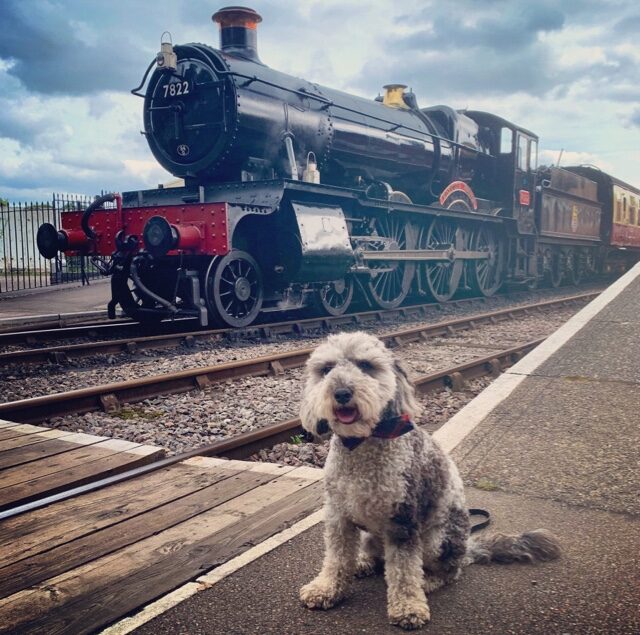
    Yoshi at Edinburgh Waverley railway station with ScotRail Inter7City High Speed Train Class 43 power car behind – 14/09/2024

    On September 3rd 2024, it was announced that ScotRail’s Inter7City High Speed Train fleet used on routes between Glasgow, Edinburgh, Aberdeen and Inverness, is to be replaced with formal procurement due to start within weeks.
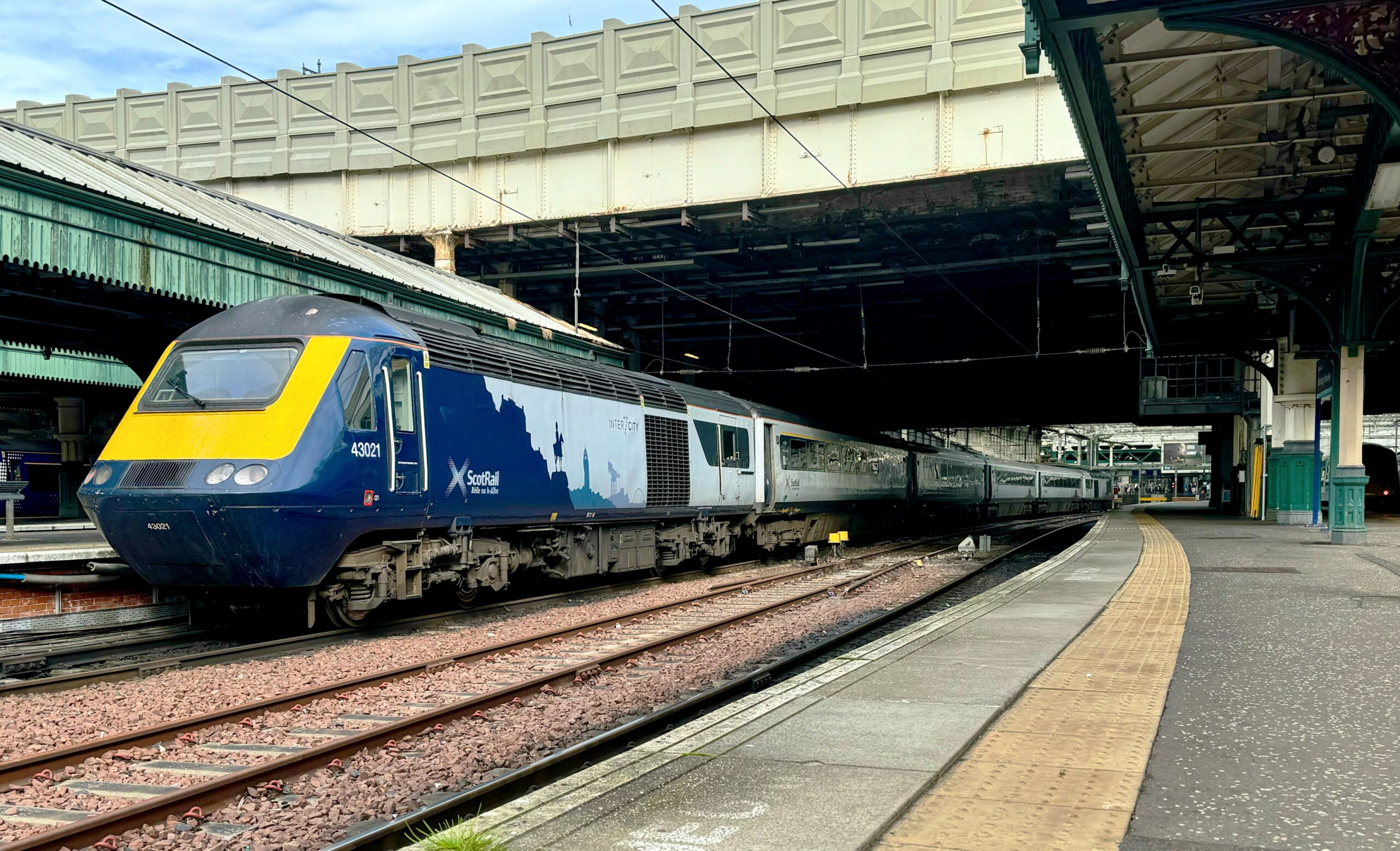
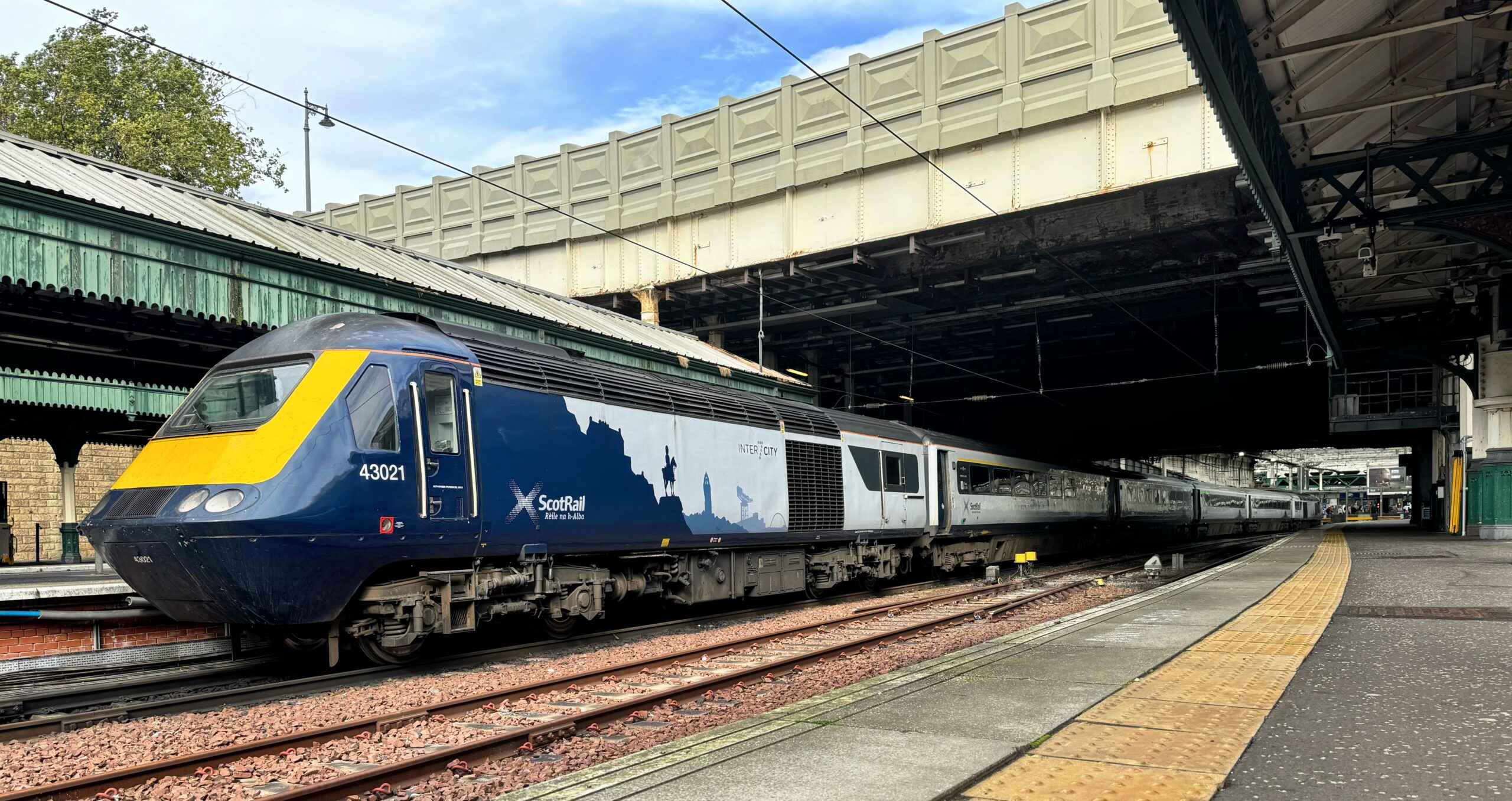
    Class 43 No. 43021 at Edinburgh Waverley having arrived at the rear of 1B82 1309 Aberdeen to Edinburgh – 14/09/2024

    ScotRail operates 52 Class 43 power cars with 22 sets of Mark 3 coaches modified with sliding doors. Two, No.’s 43030 and 43140 were written off after the 2020 Carmont derailment. ASLEF, the train drivers union, have called for the withdrawal of the ScotRail HST fleet for a number of years as “not fit for purpose”citing drivers descriptions of the trains as “notoriously unreliable”, an “unmitigated disaster” and that using them is “tantamount to environmental vandalism”

    ASLEF have further expressed the view that “the HST’s are not crashworthy and do not meet modern safety standards. Their fibreglass cabs with wooden frames bolted on were built in the 70’s and are not fit for purpose for speeds of up to 125 mph. As such our members who drive these trains have little or no confidence in them.”

    Cabinet Secretary for Transport, Fiona Hyslop announced ScotRail will lead the acquisition of replacement rolling stock and a detailed delivery timetable will be announced at the award of the contract, adding; “Resilient, reliable ScotRail services are key to encouraging more people to choose to travel by train rather than car, to cutting our transport emissions and to helping to move people around Scotland for work, leisure and learning. Over 4 million passenger journeys were made on inter-city trains in the last year. We want to maintain and where possible, increase that number choosing to go by train between Scotland’s cities. We want to replace the current inter-city fleet with trains which provide more comfort and accessibility for passengers on these routes. This planned investment will ensure the reliability of our inter-city routes for the long-term, will reduce emissions from inter-city services and will support our efforts to decarbonise Scotland’s railways.”

    ScotRail Managing Director Joanne Maguire said “today’s announcement is good news for our customers and an important step for ScotRail as we work towards delivering a safe, green, and reliable railway.”

    Although no announcement on whether new-build or cascaded trains will be deployed, suitable inter-city rolling stock could soon become available with the introduction of East Midlands Railway’s Hitachi Class 810 bi-mode units, which will replace its Class 222 Meridian DEMU’s. Introduced by Midland Mainline from 2004, EMR operates 27 sets, running in five and seven-car formations, owned by Eversholt.

    I mention the Inter7City HST’s because we had already planned a road trip which would give me an opportunity to see these surviving trains from a bygone age of British Rail at Edinburgh and Aberdeen.

    At Edinburgh Waverley Yoshi and I were very kindly allowed through the electronic ticket barriers and on to the platforms to photograph the HST sets. We were approached during our visit at the end of platform 18 by a member of station staff who wanted to know if we were “lost or just catching the breeze”. Once we’d explained ourselves, we had a friendly chat as we walked over to platform 2 in time for the next HST arrival.
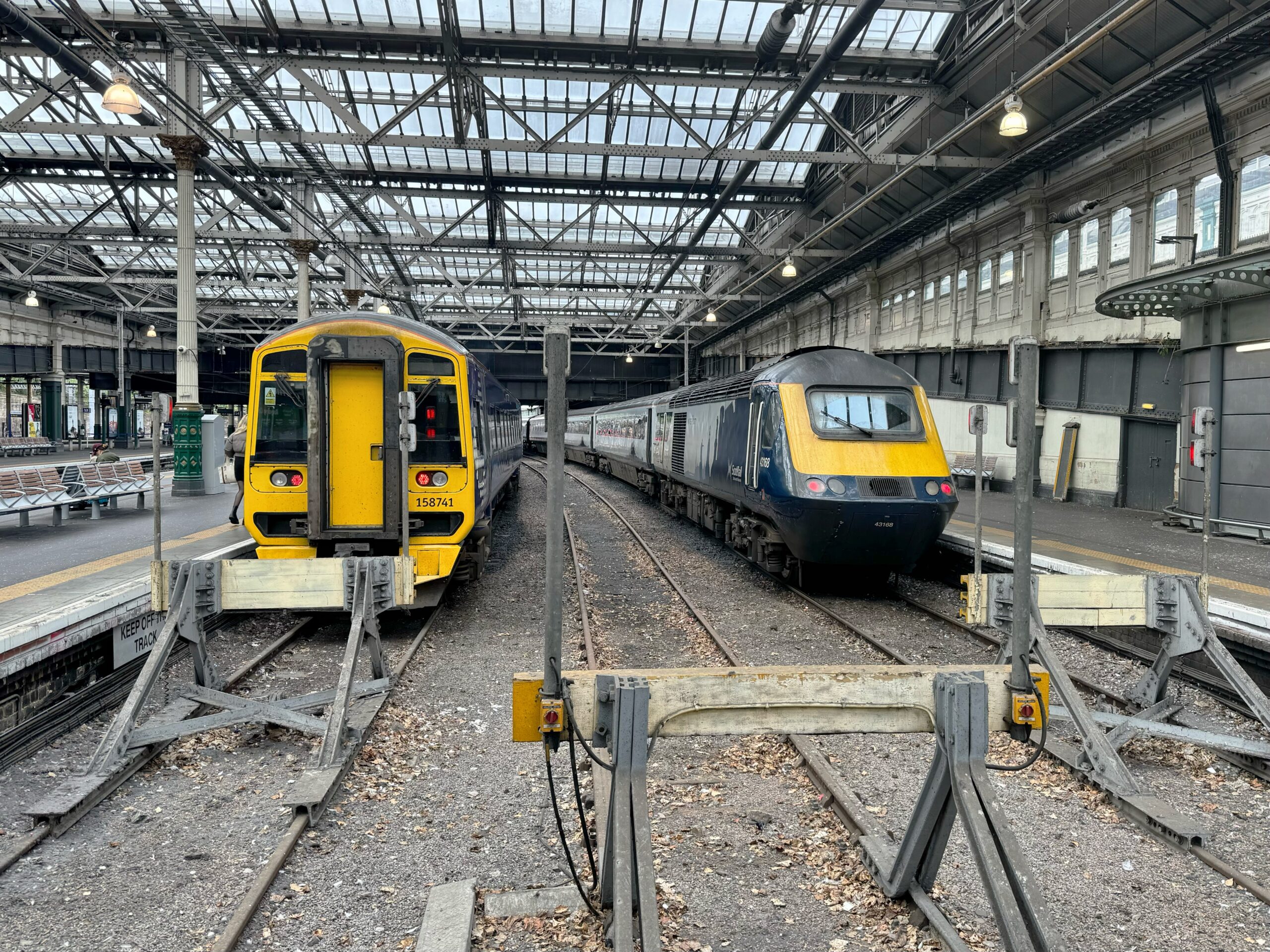
    Class 43 No 43168 forming the rear of 1A81 1130 Edinburgh to Aberdeen at the buffer stops alongside Class 158 “Express Sprinter” DMU No.158741, Edinburgh Waverley – 14/09/2024
    Class 43 No 43179 1A81 1130 Edinburgh to Aberdeen at Edinburgh Waverley in the company of Class 158 No. 158740 and Class 334 Coradia Juniper EMU No. 334013 – 14/09/2024
    Another view of Class 43 No. 43021 at Edinburgh Waverley having arrived at the rear of 1B82 1309 Aberdeen to Edinburgh – 14/09/2024
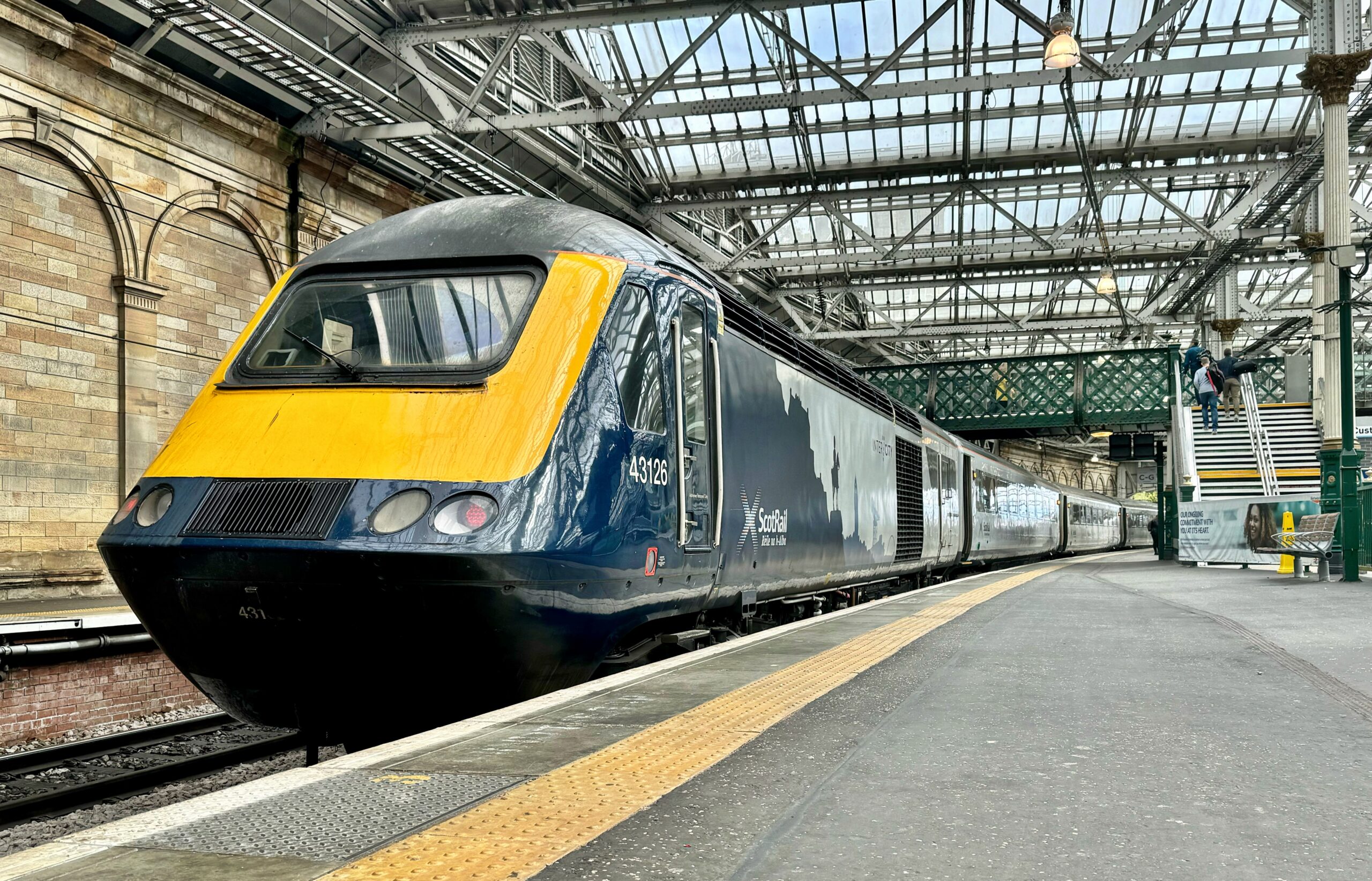
    Class 43 No 43126 having arrived at Edinburgh Waverley with 1B74 0905 Aberdeen to Edinburgh – 14/09/2024
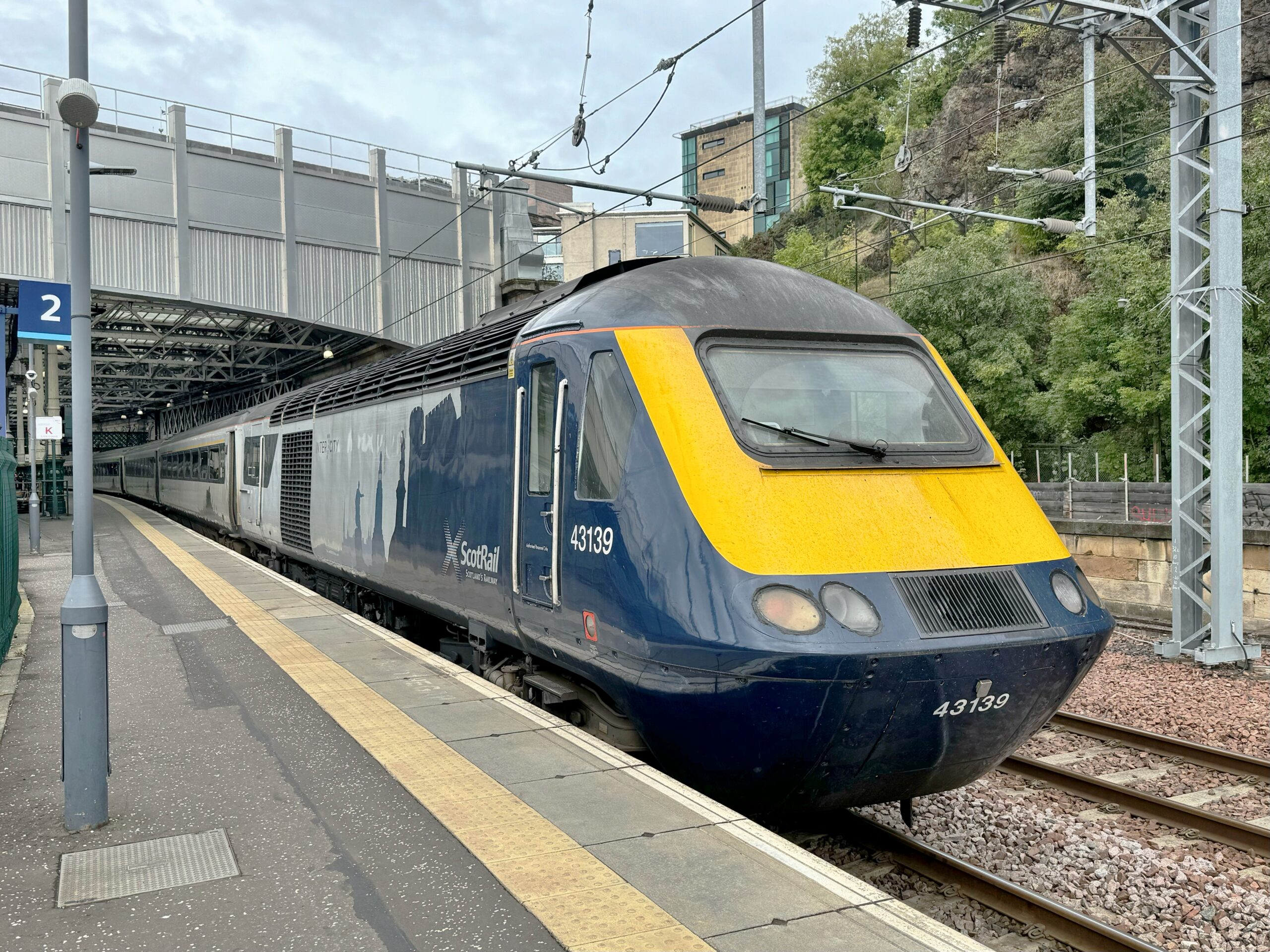
    Class 43 No 43139 at Edinburgh Waverley leading on 1B74 0905 Aberdeen to Edinburgh – 14/09/2024
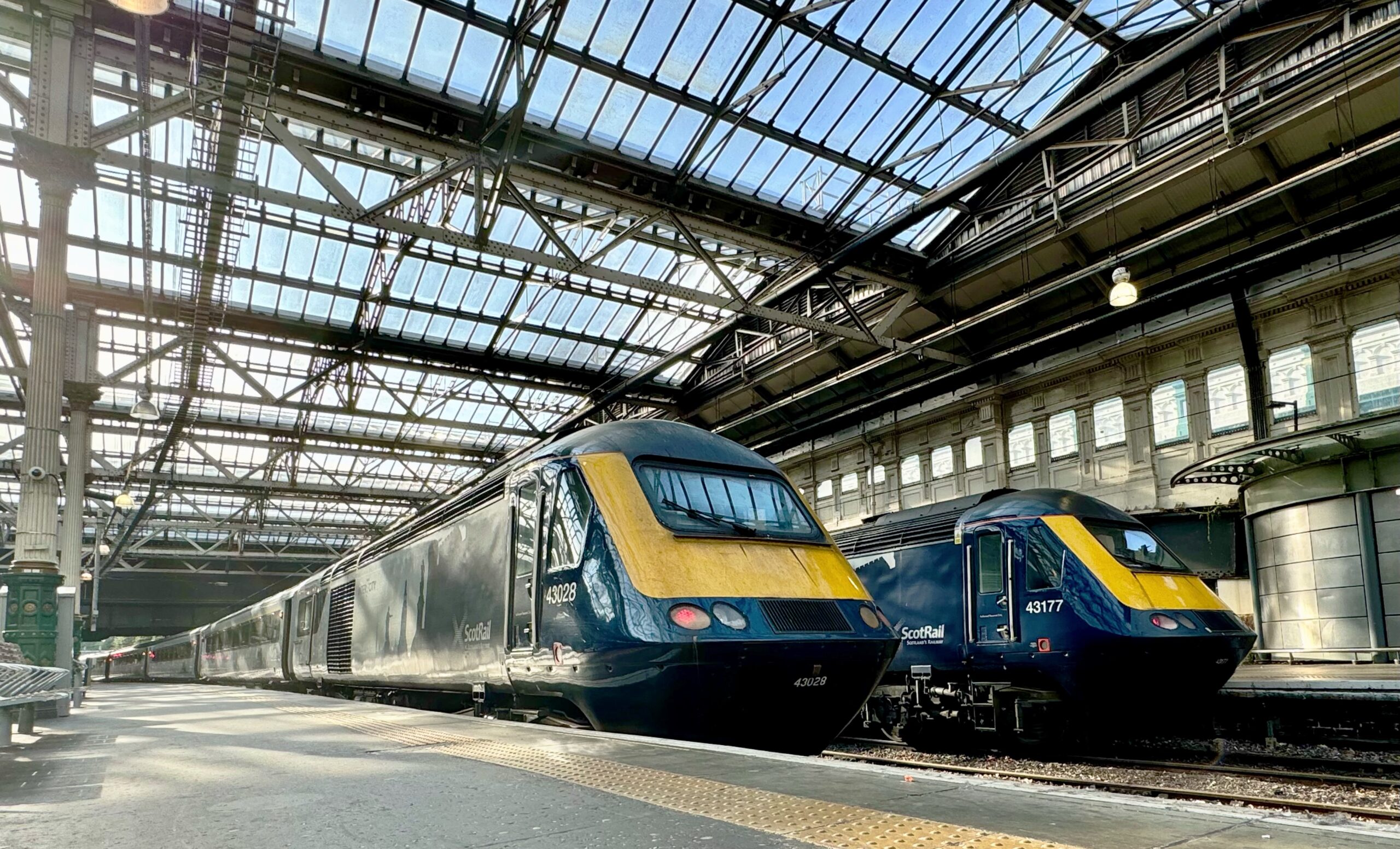
    ScotRail Inter7City High Speed Train Class 43 power cars side by side at Edinburg Waverley. No. 43177 having arrived at the rear of 1B82 1309 Aberdeen to Edinburgh and No. 43148 on the rear of 1B30 1248 Inverness to Edinburgh – 14/09/2024
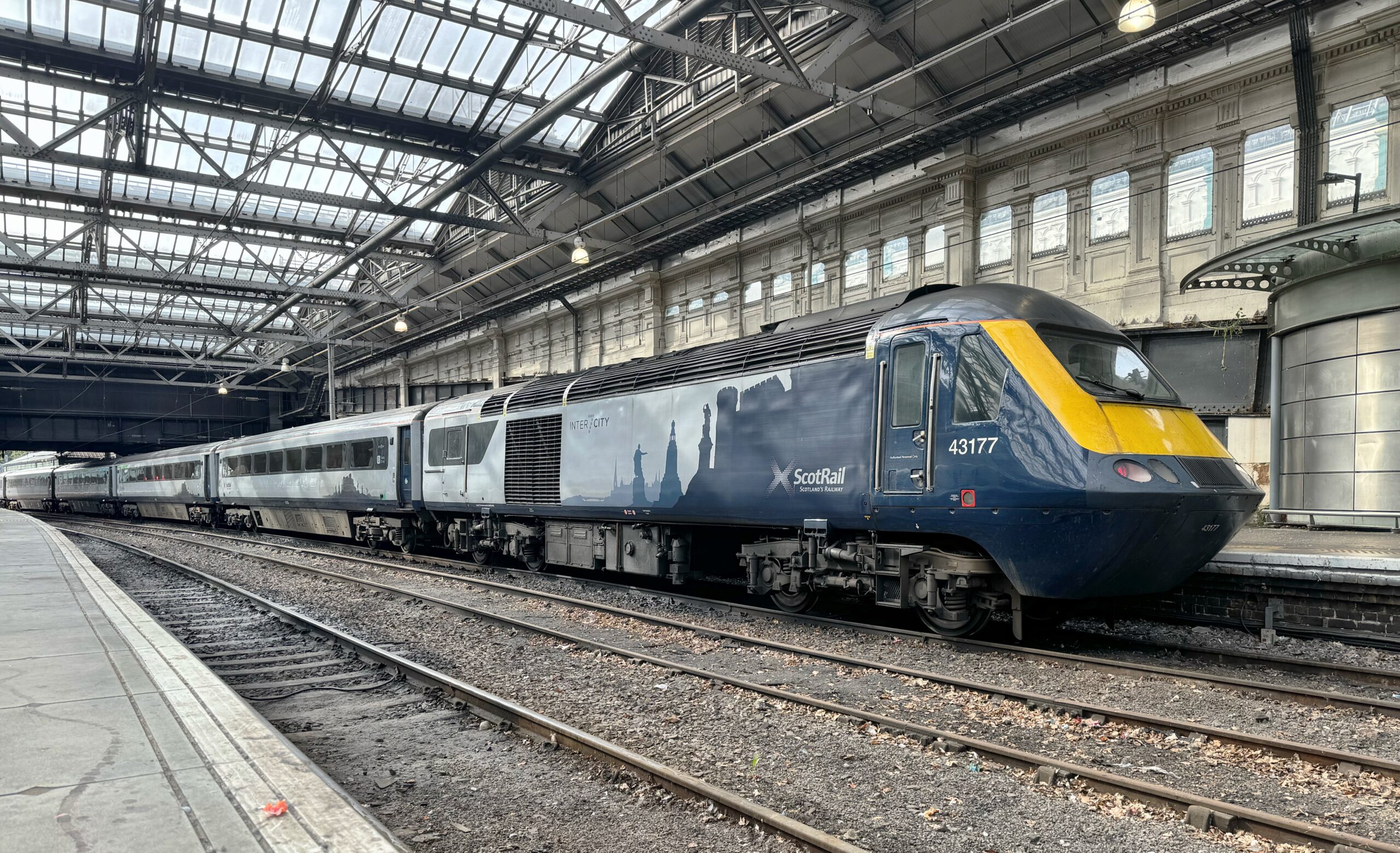
    Class 43 No 43177 1B82 1309 Aberdeen to Edinburgh – 14/09/2024
    Afternoon arrivals at Edinburgh Waverley; Class 43 No. 43028 having arrived with 1B30 1248 Inverness to Edinburgh stands alongside No. 43177 which was working 1B82 1309 Aberdeen to Edinburgh – 14/09/2024
    Another view of Class 43 No. 43028 having arrived with 1B30 1248 Inverness to Edinburgh stands alongside No. 43177 which was working 1B82 1309 Aberdeen to Edinburgh – 14/09/2024

    The dark blue and pale grey ‘Inter7City’ livery features large silhouettes of landmarks in the seven cities of Scotland. Before relivery, the power cars were in the plain blue livery of First Great Western.

    Abellio ScotRail received nine 4-carriage and 17 five-carriage trainsets from Great Western Railway (GWR) for use on longer-distance services between the major Scottish cities.

    The power cars were refurbished at Brush Loughborough, with the coaches being refurbished at Wabtec Doncaster. The first set, which included power cars No.’s 43021 and 43132, was delivered to ScotRail on 1st September 2017. The set was transferred to Aberdeen Clayhills on 10th September for the start of driver training. The first refurbished set was due in February 2018, with a full fleet in service by December 2018.

    On the 15th October 2018 after months of crew training, the first revenue earning and fully branded ‘InterCity’ diagram began and ran with power cars No.’s 43033 & 43183 along with refurbished MK3 Set HA26 on the Edinburgh – Aberdeen route.
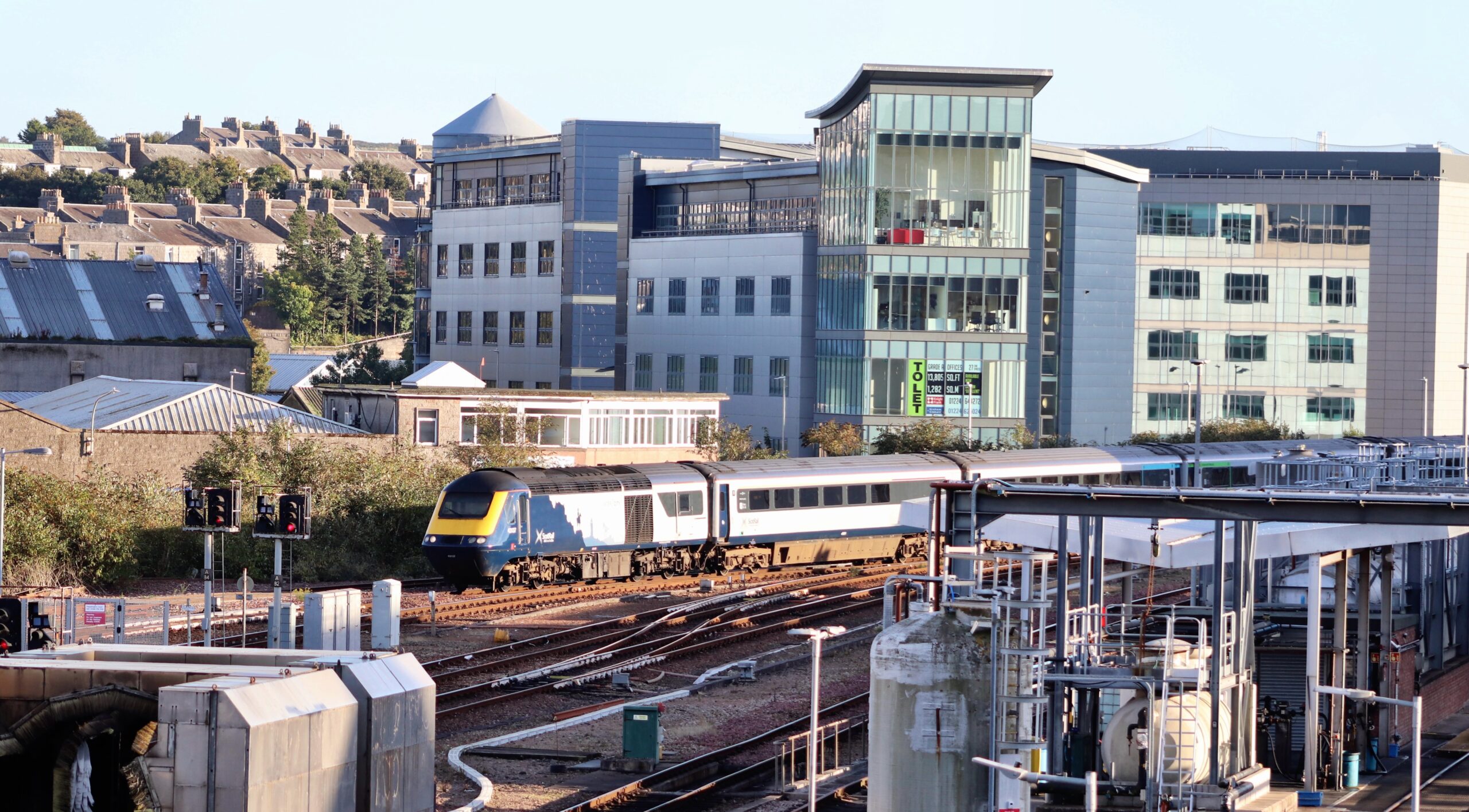
    Class 43 No. 43137 arrives at Aberdeen working the 1A87 1530 Edinburgh to Aberdeen service 17/09/2024
    Class 43 No. 43152 rests at Aberdeen Clayhills Carriage Maintenance Depot. I didn’t think to check on the power car at the other end! The Caledonian Sleeper stock shares the depot with Class 73 No. 73968. Clayhills depot is used for maintaining and stabling long distance locomotive hauled services, more specifically, ScotRail Class 43, High Speed Trains, their respective Mark 3 carriages, Class 158 Express Sprinters and Class 170 Turbostars, as well as LNER Class 800 Azumas – 17/09/2024
    Class 43 No. 43175 at Aberdeen having arrived at the rear of A87 1530 Edinburgh to Aberdeen service 17/09/2024
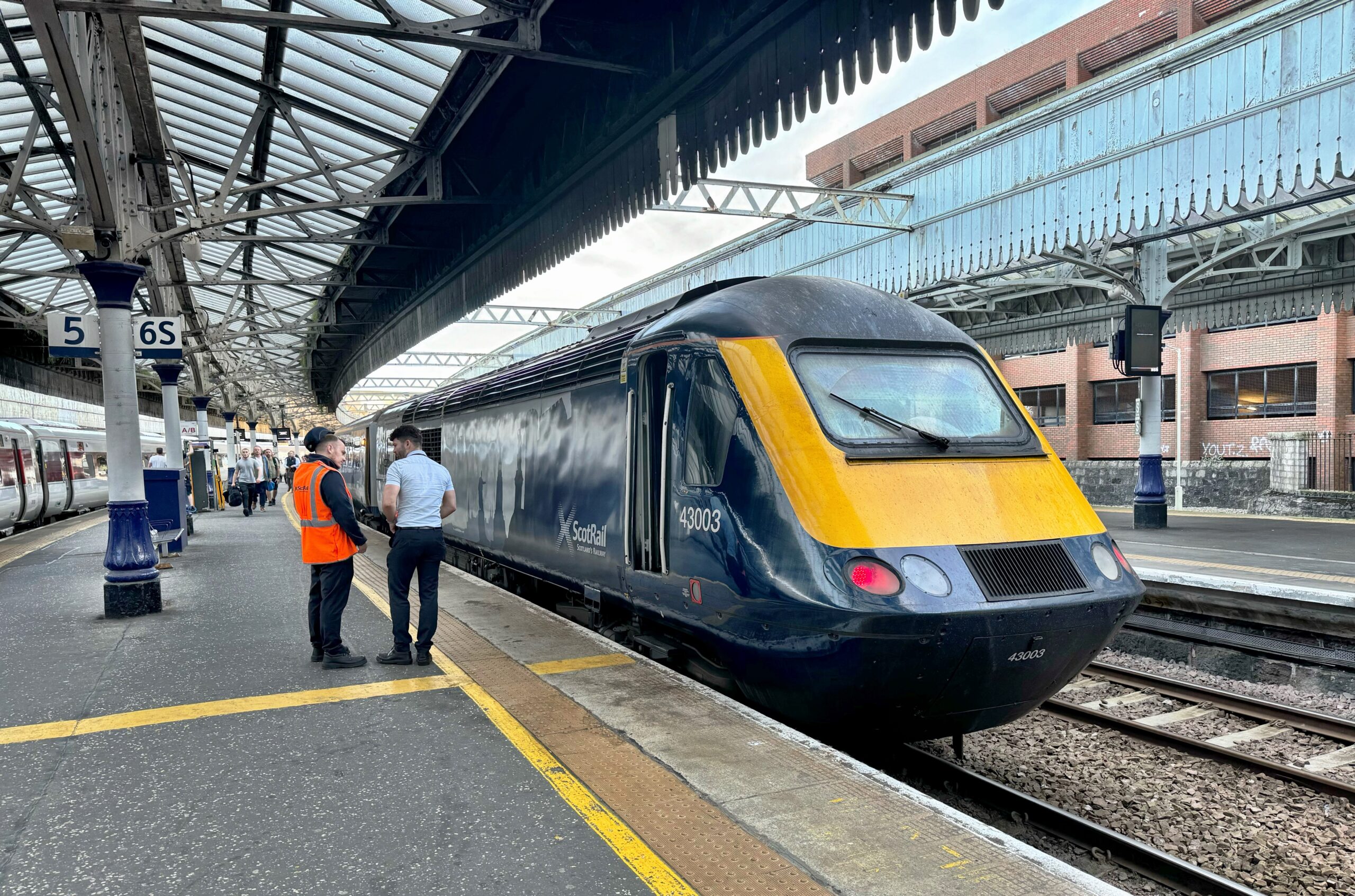
    Class 43 No. 43003, the oldest HST power car in service at Aberdeen having arrived with 1A49 1539 Glasgow Queen Street to Aberdeen – 17/09/2024
    Class 43 No. 43137 arrives at Aberdeen having terminated working 1A87 1530 Edinburgh to Aberdeen service 17/09/2024
    Class 43 No. 43124 has arrived at Aberdeen with 1A49 1539 Glasgow Queen Street to Aberdeen prepares to depart as 5A75 1853 Aberdeen to Aberdeen Clayhills Carriage MD. No. 43175 in the background will be leading on 1T62 1836 Aberdeen to Glasgow Queen Street – 17/09/2024
    Class 43 No. 43003 has arrived at Aberdeen Clayhills – 17/09/2024
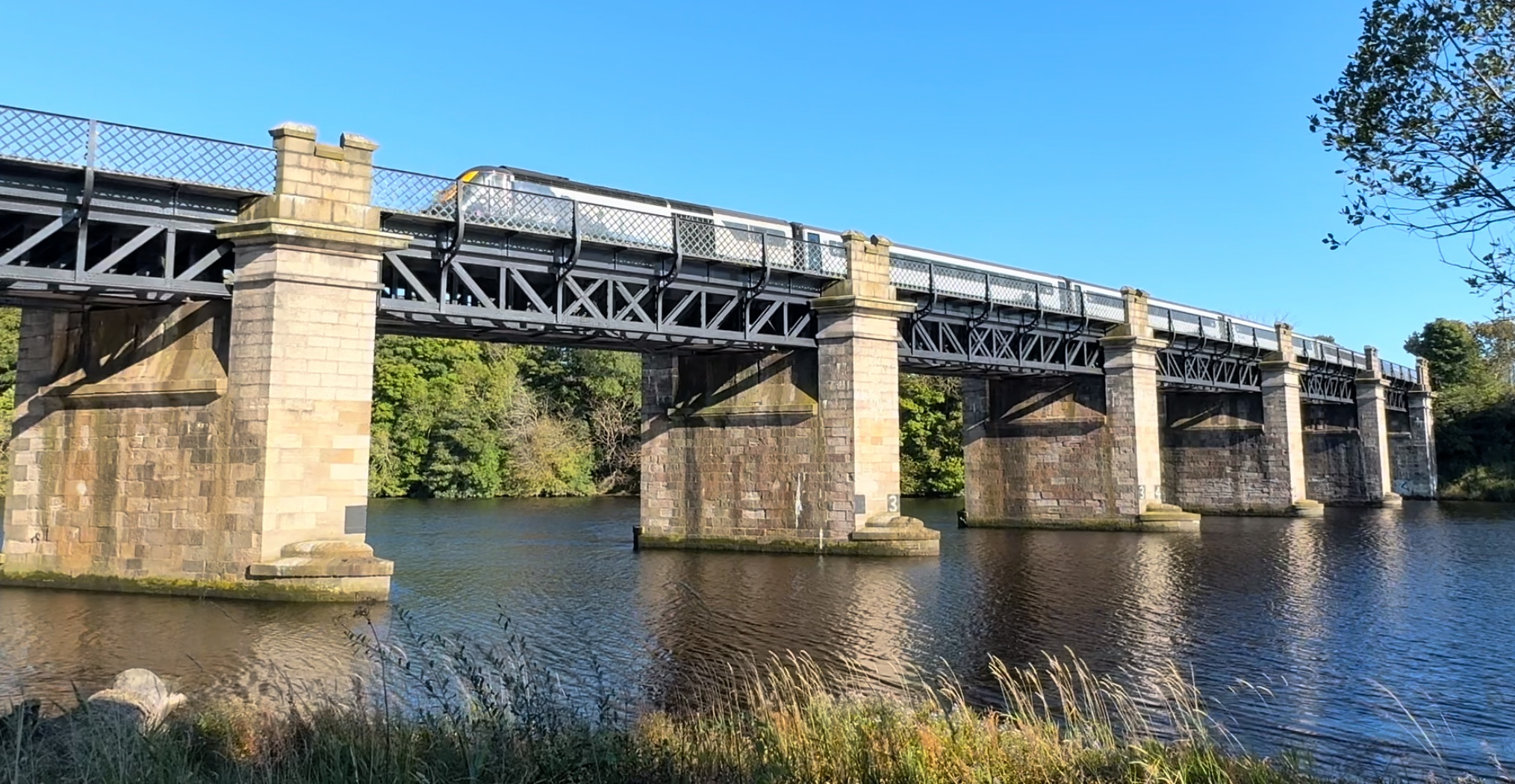
    Screenshot of Class 43 No. 43028 passing over the River Dee Railway Bridge working 1T50 1535 Aberdeen to Glasgow Queen Street. The bridge, built by Lock and Errington in 1848 has 11-spans, consisting of 7 principal spans of steel trussed on granite and sandstone piers, with cutwaters forming a crenellated parapet for mesh railings. There are four round-arched sandstone approach spans with polished arch rings and a coped parapet. The original bridge, as constructed by the Aberdeen Railway Company, included wooden beams on stone foundations, but from the 1880’s onwards, these were replaced by iron girders as a major programme of bridge improvements to accommodate heavier trains 18/09/2024
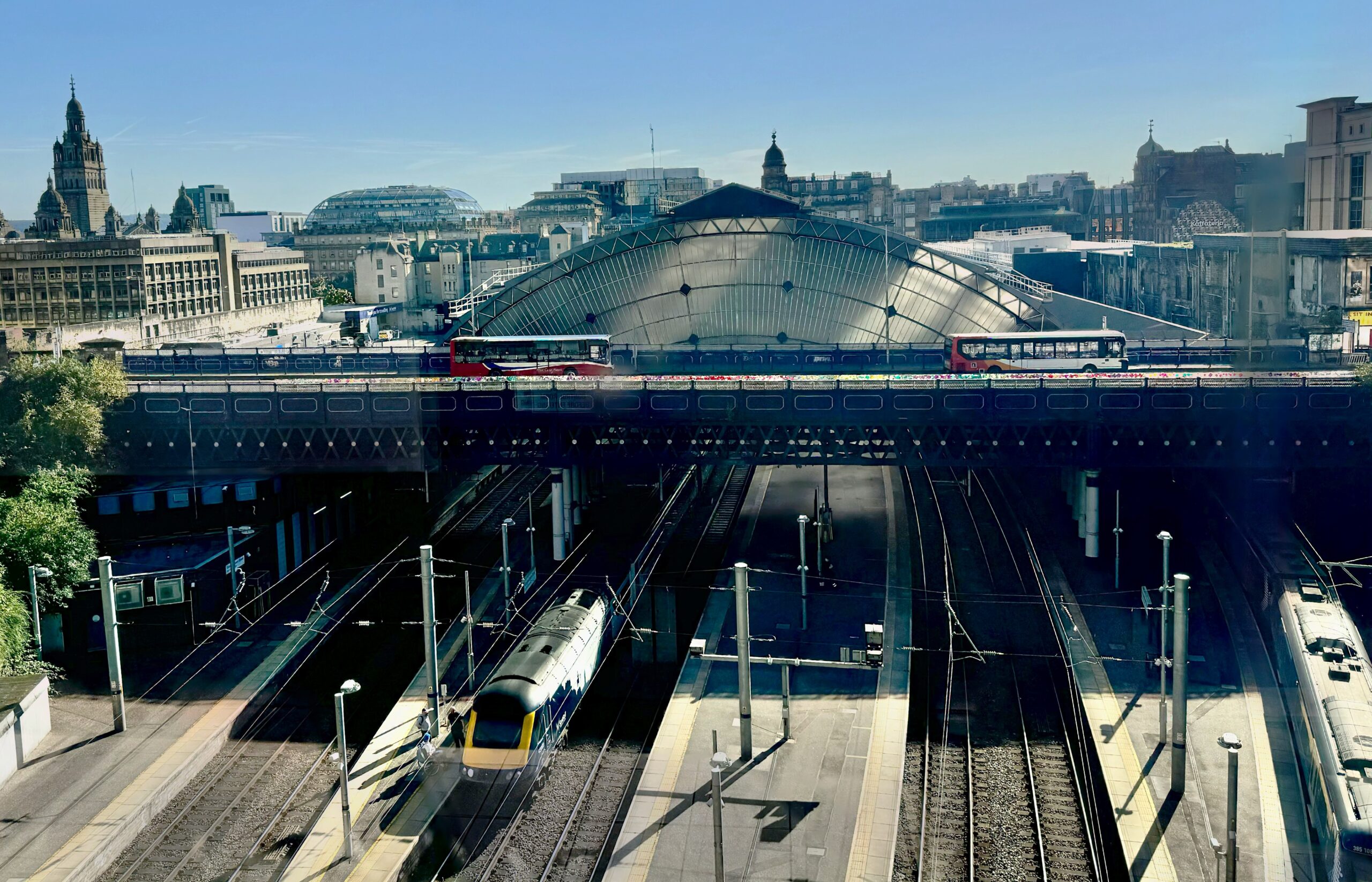
    Another chance encounter with Class 43 No. 43003 in Glasgow preparing to work 1A49 1539 Glasgow Queen Street to Aberdeen – 19/09/2024
    Class 43 No. 43003 prior to working 1A49 1539 Glasgow Queen Street to Aberdeen – 19/09/2024
    Class 43 No. 43003 at the head of 1A49 1539 Glasgow Queen Street to Aberdeen – 19/09/2024

    While in Aberdeen, as well as taking the opportunity to pop down to the railway station one evening to see some ScotRail HST workings, I was also able to observe Class 73/9 No. 73968 at rest having worked into the station on empty coaching stock move 5B16 1935 Aberdeen Clayhills Car.M.D to Aberdeen prior to heading the Aberdeen to Edinburgh section of 1B16 2143 Aberdeen to London Euston.

    Class 73/9 No 73968 at rest having arrived at platform with 5B16 1935 Aberdeen Clayhills Car.M.D to Aberdeen – 17/09/2024

    Class 73’s are Electro-Diesel locomotives, built by English Electric between 1962-1967 for the Southern Region of British Rail. Primarily intended to work on 3rd rail electrified lines, as built they were also equipped with a 600hp diesel engine for short distance movements.

    Between 2013 and 2016, eleven of these locomotives owned by GB Railfreight were rebuilt by Wabtec at the Brush Traction works in Loughborough and designated Class 73/9.

    Plaque detailing rebuild on No. 73968 – 17/09/2024

    The rebuilt locos have a 1600hp MTU ‘R43 4000’ V8 diesel engine, coupled to a new Lechmotoren alternator. The existing bogies and DC traction motors are retained. The locos are now fitted with AAR multiple working control and can also work with class 66 and 67 locos, however the old Style MW jumpers are kept for compatibility with un-rebuilt Class 73’s. Other features retained were the driving controls on both sides of the cab, the drop-head buckeye coupling, central buffing plate and retractable side buffers.

    Five locos for duties in Southern England are numbered 73961 to 73965 and painted in GBRf livery. Six of these locomotives are deployed on Sleeper services north of Edinburgh replacing Class 67 locos from 2016. The locos utilised for Caledonian Sleeper duties are numbered 73966 to 73971, and painted in ‘Midnight Teal’ livery.

    Having arrived with the Caledonian Sleeper ECS, Class 73/9 No 73968 will work the Aberdeen to Edinburgh section of the 1B16 2143 Aberdeen to London Euston sleeper service – 17/09/2024

    No. 73968 was formerly No. 73117 (E6023).

    The Caledonian Sleeper locos No.’s 73966-971 have several detail differences to the earlier No.’s 73961-965 batch:

    * Driving Desk is more extensively modernised.

    * The cab centre window is ‘unblanked’ and fitted with a wiper.

    * 1-piece miniature obstacle deflectors fitted.

    * High-level air hoses removed.

    * Communications jumper socket left of coupling.

    * Additional main air reservoir pipe left of coupling.

    * NRN Radio and aerials. (NRN radios removed in 2016).

    * ETS on/off indicators on the sides of the Headlamp clusters.

    * Electric Train Supply to coaching stock increased from ETH 38 to ETH 70.

    * 3rd-rail pick-ups were initially retained, but isolated.

    * RETB-NG (fitted to the locos in Scotland during 2016).

    * The buckeye coupling and central buffing plate would later be removed in favour of drop-head Dellner couplings, with the obstacle deflectors changed to accommodate this.

    * The cab centre window (formerly a 2-character headcode display) was not installed on locos No.’s 73966 and 73967 until return visits to Loughborough in February 2016.

    * The conversion programme and introduction to service (originally intended for the 1st April 2015) was severely delayed, a major factor being the new alternators suffering from vibration problems, particularly when at full power.

    * From October 2016 the Sleeper Class 73/9s were only providing ETH, with Class 66 providing traction, rather than working in multiple.

    * Delivery of the final conversion No. 73971 was postponed until November 2016, while a solution to the alternator issue was sought.
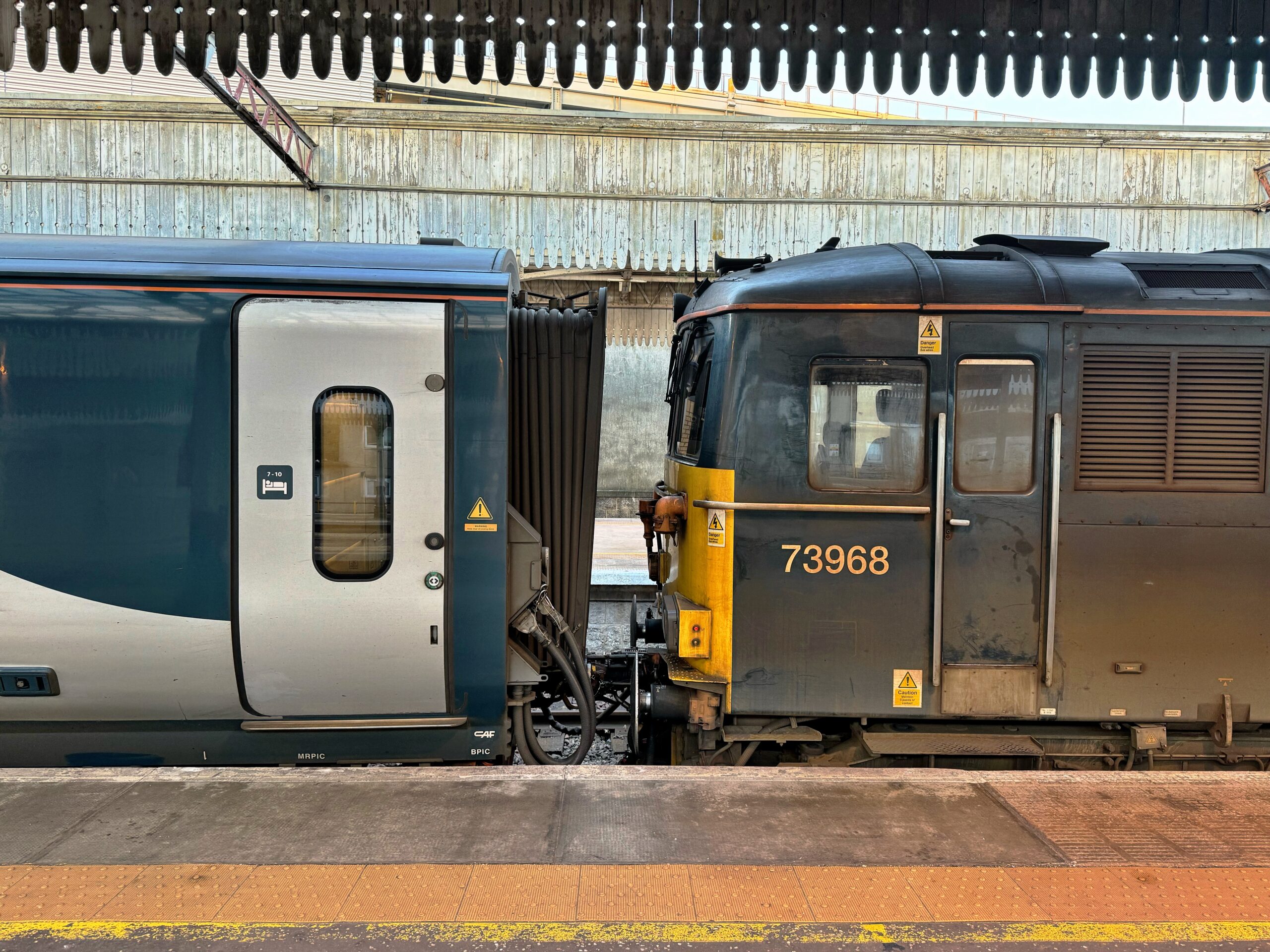
    Class 73 No. 73968 at Aberdeen with the Caledonian Sleeper – 17/09/2024

    * Further changes to the locomotive were required to operate with the new Mk5 sleeper coaches which have dellner semi-automatic couplings.

    * The first to be equipped was No. 73971 which went south to Brush at Loughborough on 19th of April 2017 and returned to Craigentinny on 9th July 2017 with its new drop-head Dellner coupling fitted, but covered up.

    * The class 73/9s had initially retained 3rd rail pick-up shoes, but these were removed when the six locomotives visited Eastleigh Works for new wheelsets in 2019/2020.

    Source: http://www.scot-rail.co.uk/page/Class+73#google_vignette

    For The Record

    The Heart of Wessex Line closed between Castle Cary and Weymouth on Monday 23rd September 2024 to Sunday 29th September 2024 as Network Rail replaced less than a mile of over fifty year old track. Improvements were also made to the junctions either side of Maiden Newton railway station. A rail replacement bus service operated during the closure period for passengers.

    GB Railfreight Class 66 No. 66789 awaits clearance to proceed at Yeovil Pen Mill at the head of engineers train 6G12 2145 Hinksey Sidings to Maiden Newton. The locomotive was scheduled to return to Eastleigh East Yard via Dorchester West and the South Western Mainline later that morning but the driver was not cleared for the route, so instead the Class 66 travelled back through the engineering possession to Yeovil Pen Mill and made its way to Eastleigh via Westbury – 23/09/2024
    Colas Railfreight Class 70 No. 70807 at Yeovil Pen Mill at the head of 6C01 2047 Hinksey Sidings to Yeovil Pen Mill – 23/09/2024

    The first two engineering trains in association with the works arrived at Yeovil Pen Mill in the early hours of 23rd September. Colas and Freightliner were also involved with engineering trains during the ensuing days.

    Video at Yeovil Pen Mill of engineering trains – 23/09/2024

    Monday 23rd September and it was time for the monthly Plain Line Pattern Recognition (PLPR) train which this time around was top and tailed by GBRf Class 73/9 electro-diesel locomotives No. 73965 ‘Des O’Brien’ and 73962 ‘Dick Mabbutt’.
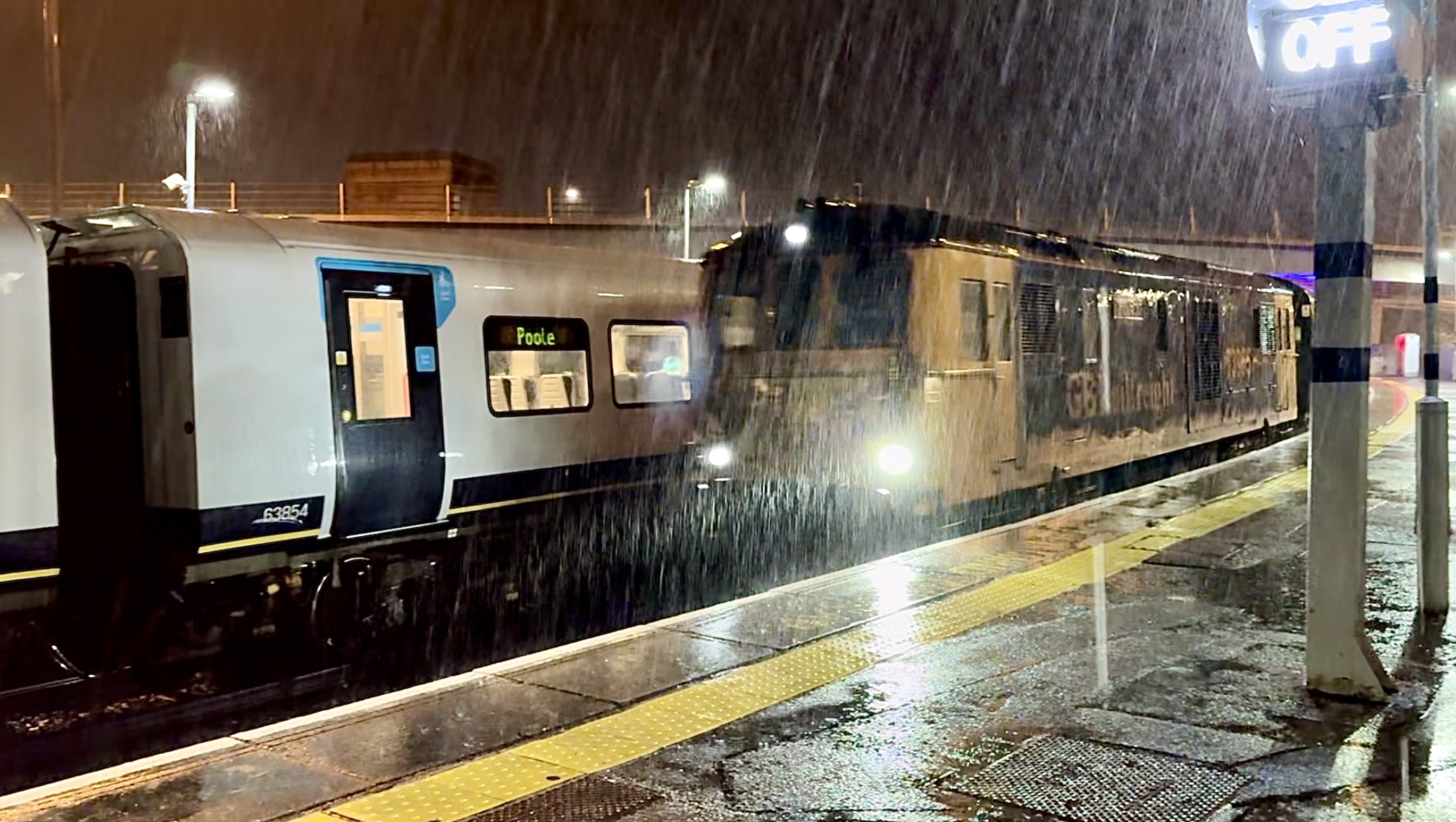
    Screenshot of GBRf Class 73/9 electro-diesel locomotives No. 73965 ‘Des O’Brien’ at Poole working 1Q51 1115 Derby R.T.C.(Network Rail) to Eastleigh East Yard via Weymouth – 23/09/2024

    I saw the train reporting as 1Q51 1115 Derby R.T.C.(Network Rail) to Eastleigh East Yard via Weymouth passing through Poole in heavy rain. Must be mad!

    1Q51 1115 Derby R.T.C.(Network Rail) to Eastleigh East Yard via Weymouth – 23/09/2024

    GBRf Class 69 No. 69009 ‘Western Consort’ was once again charged with transporting South Western Railway Class 458 Electric Multiple Units between Widnes Transport Tech and Bournemouth T&RSMD. The loco hauled refurbished SWR Class 458/4 No. 458411 on its return south as 5064 1603 Southampton Central to Bournemouth T&R.S.M.D, returning later with SWR Class 458/5 No. 458502 reporting as 5Z66 2018 Bournemouth TRSMD to Eastleigh East Yard.
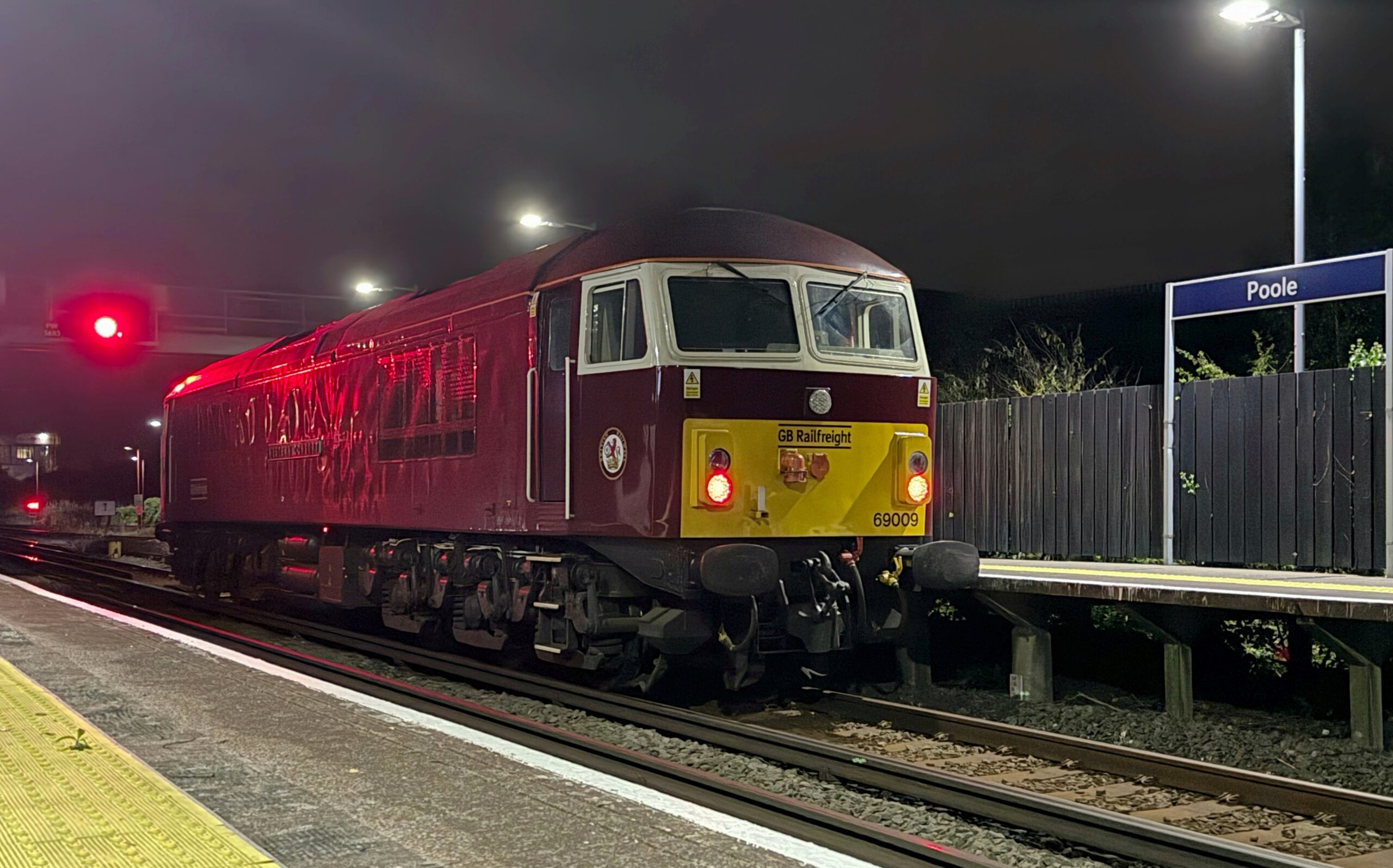
    GBRf Class 69 No. 69009 ‘Western Consort’ at Poole while running around its train – 24/09/2024

    As part of the operation, the consist heads to Poole Storage Sidings where the loco changes ends and the train heads back east along the South Western Mainline.

    Class 458 EMU drags to/from Bournemouth TRSMD – 24/09/2024

    Network Rail’s Ultrasonic Test Unit (UTU) visited Dorset in the early hours of 26th September. UTU’s usually have one locomotive at one end and a Driving Brake Standard Open (DBSO) at the other. The train can operate in push-pull mode with the loco hauling or pushing with the DBSO controlling it. UTU trains have ground penetrating radar systems to detect voids and deformities up to two metres into the ballast and ground and employ rail profile scanners to identify issues in track profile in comparison to an ideal track template.
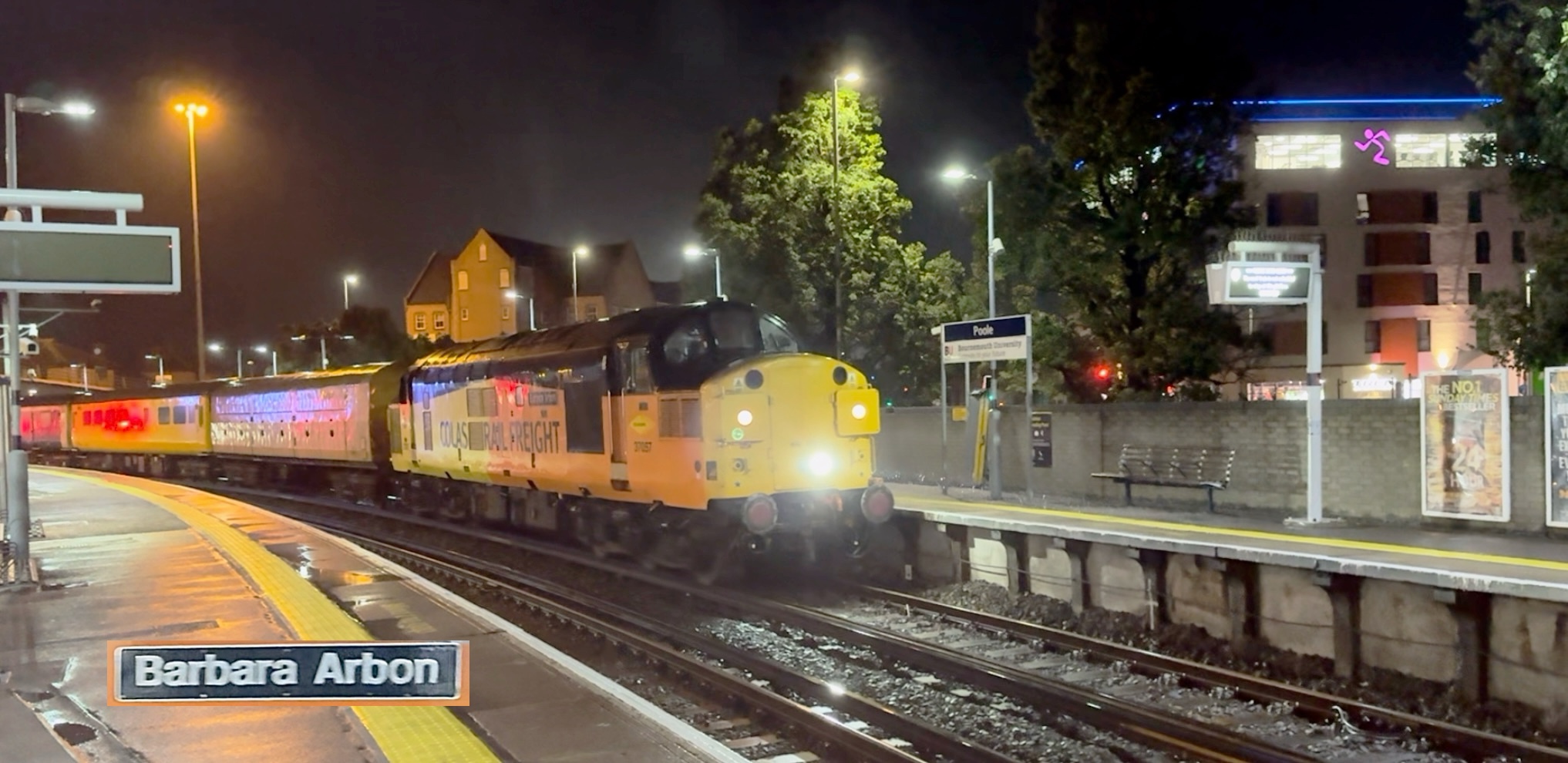
    Screenshot of Colas Railfreight Class 37 No.37057 ‘Barbara Arbon’ at Poole working 3Q02 2140 Eastleigh East Yard to Eastleigh East Yard via Weymouth – 26/09/2024

    Running 102 minutes late, Colas Railfreight Class 37 No.37057 ‘Barbara Arbon’ passes through Poole working 3Q02 2140 Eastleigh East Yard to Eastleigh East Yard via Weymouth. No. 37057 was named in honour of Barbara Arbon on July 4th 2021 at Loram, Derby. Barbara was a member of the Colas Infrastructure Monitoring Team who sadly passed away in 2020. She was affectionately known by her colleagues as ‘Auntie Barbara’.

    Video of 3Q02 2140 Eastleigh East Yard to Eastleigh East Yard via Weymouth – 26/09/2024

    “The Last Post”

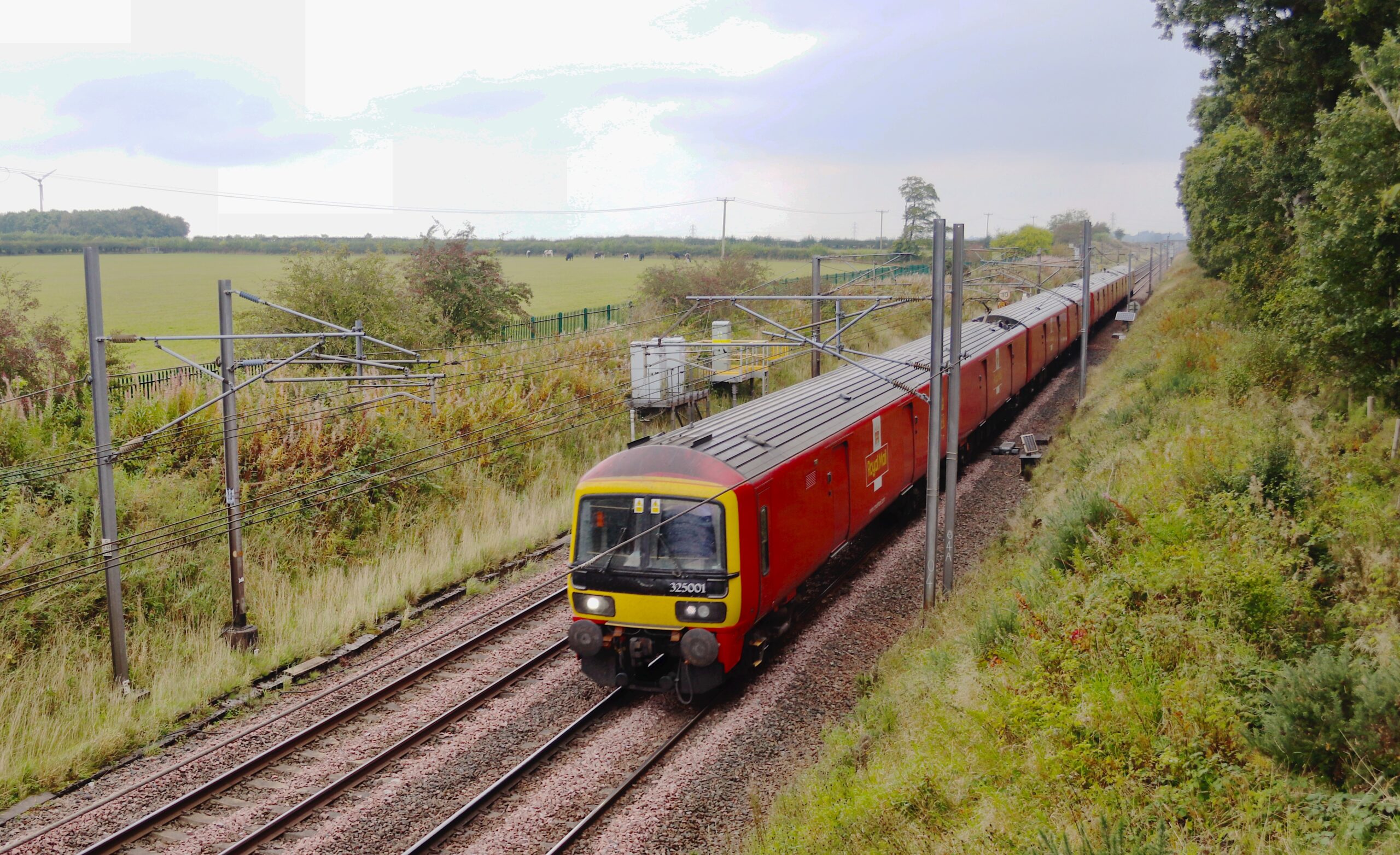
    Class 325 No.’s 325001 & 325002 on the approach to Quintinshill working 1M27 1235 Shieldmuir Mail Terminal to Willesden PRDC – 20/09/2024

    Reportedly the final DB Cargo operated mail trains on the West Coast Main Line ran on Friday 20th September 2024, the cessation of the services being brought forward from the original end date of October 10th. I was fortunate enough to see Class 325 No.’s 325001 & 325002 passing Quintinshill working 1M27 1235 Shieldmuir Mail Terminal to Willesden PRDC while we were on a walk to remember the Quintnshill Railway Disaster which claimed the lives of over 200 people and left 246 injured. The incident remains the worst rail disaster in British history.

    Fire rages amongst the debris of the Quintinshill rail disaster – 22/05/1915 (Unknown – The Illustrated London News, 25 May 1915)

    Human error caused the accident, two signalmen made several careless mistakes and omissions in their duties. They had shunted a local train onto the main line and while it stood there in plain view of the signal box, they accepted a troop train travelling south carrying 500 soldiers of the 1/7th Royal Scots Territorial Battalion and then, minutes later, a sleeper from London heading north on the same line. The local train’s brakes were on, which upon collision, caused the troop train to telescope to half of its original length, while survivors staggered from the wreckage, the Carlisle express ran into It.

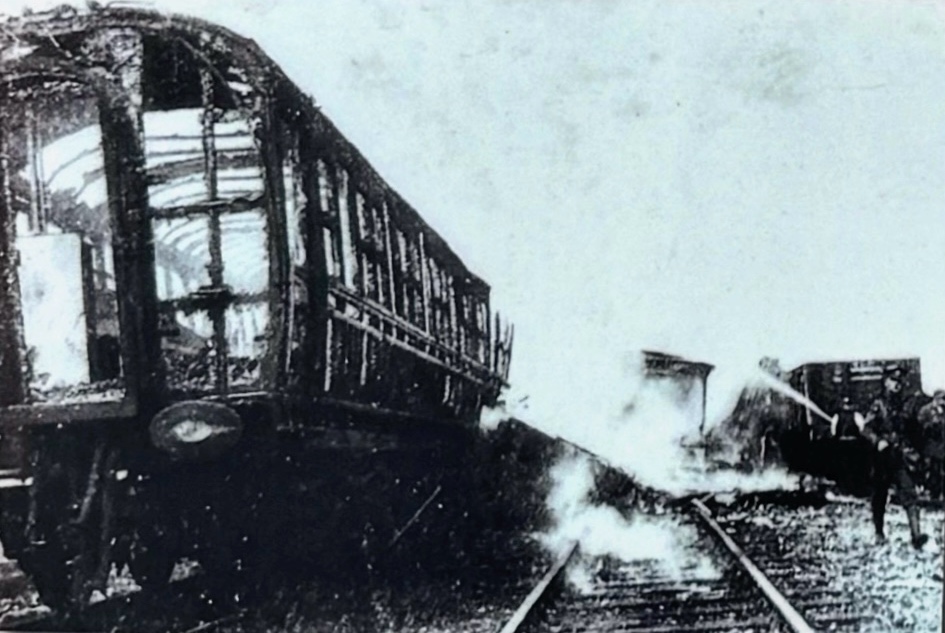
    The impact of the collision pushed the express locomotives on top of the debris of the first crash. The carriages were telescoped, after the collision the troop train which was 215 vards in length was reduced to only 67 yards – 05/1915 (Unknown)
    The fire in the wooden carriages was almost impossible to extinguish with the small jets of water that the fire brigade could play on the flames – 22/05/1915 (Unknown)

    Immediately after the collisions, fire broke out. Hot coals from the engine of the troop train set alight the wooden carriages and the flames were fed by gas from the train’s lighting supply. Despite vain attempts to quell the fire with water from the tanks of two goods trains and by syphoning water from a nearby stream, the inferno raged for 24 hours with devastating results. Once it was extinguished, 82 bodies were unrecognisable and 50 were never traced at all.

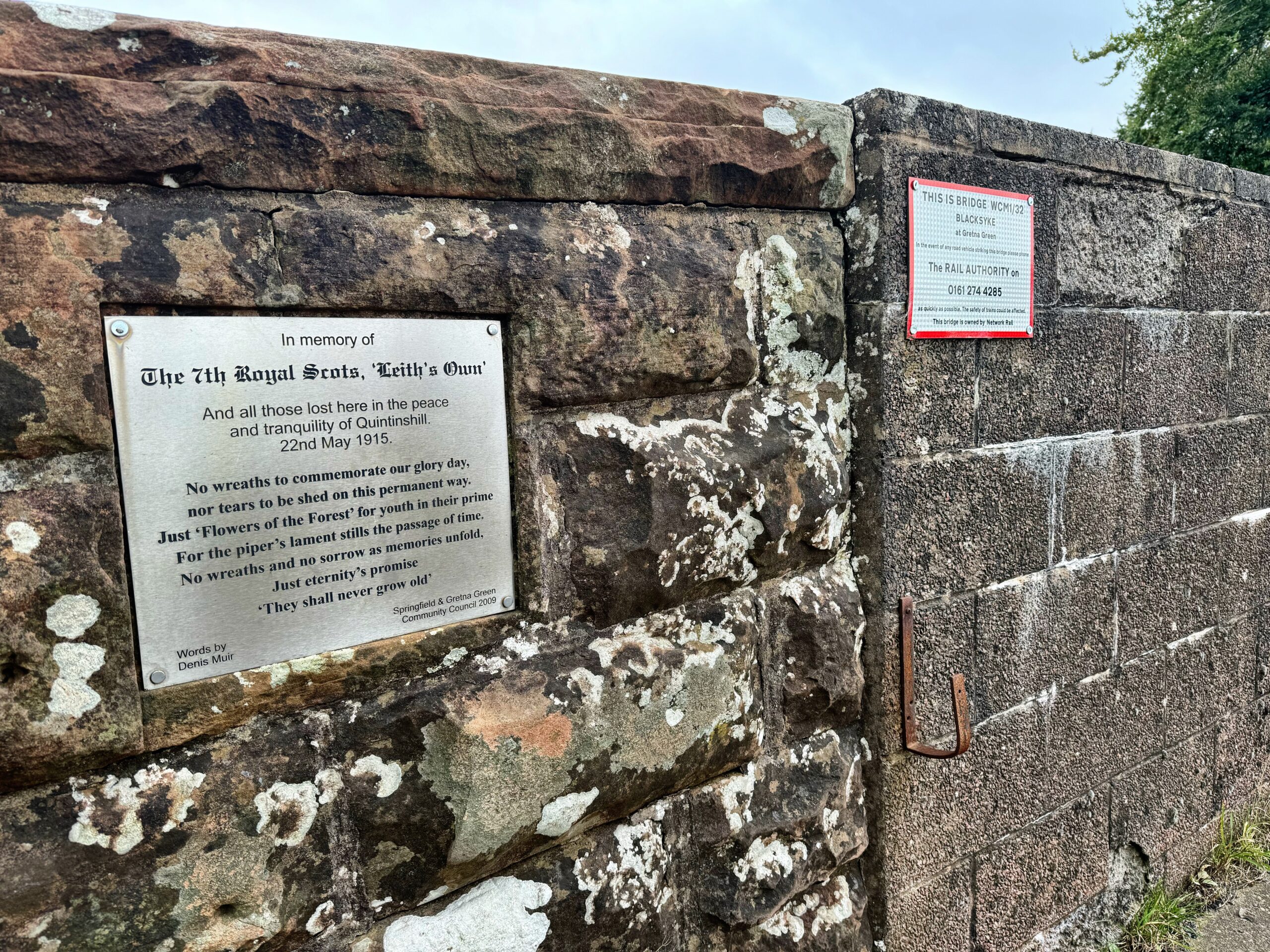
    Memorials to the troops were built at Rosebank Cemetery, Edinburgh and one was erected at Gretna Visitor Centre by the Scottish Area of the Western Front Association, being unveiled on 21st May 1995. In September 2010 a plaque to commemorate the disaster was unveiled on Blacksyke Bridge which overlooks the crash site. Today, little trace of Quintinshill remains, the signal box having been demolished in the early 1970’s.
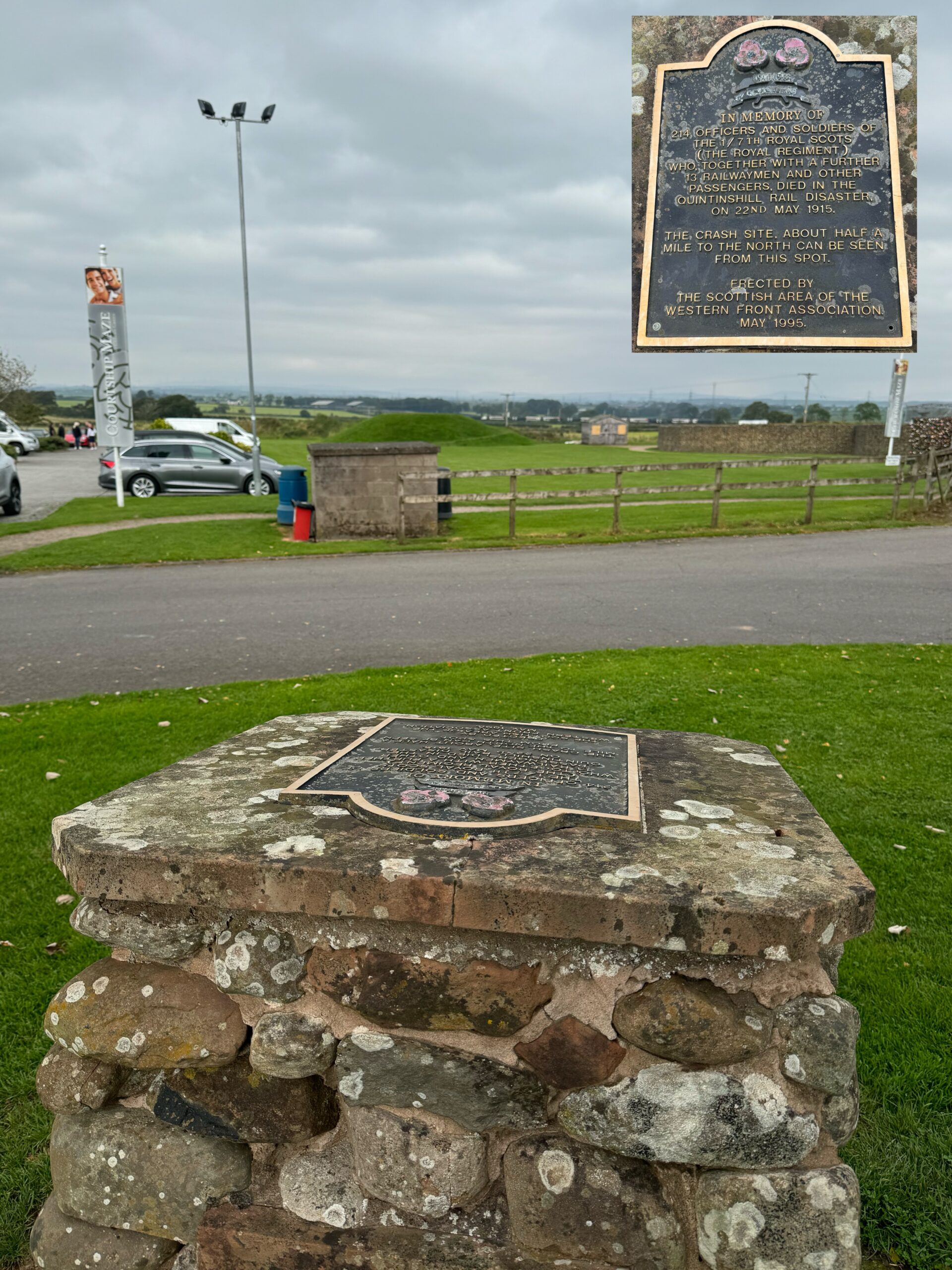
    Memorial overlooking the site of the Quintinshill disaster at Rail Gretna Visitor Centre. Avanti West Coast Class 390 No. 390044 is passing with 9M55 1156 Glasgow Central to London Euston – 20/09/2024
    The plaque which commemorates the disaster on Blacksyke Bridge – 20/09/2024
    Trans Pennine Express Class 397 No. 397001 passes the site of the disaster working 1S51 1104 Manchester Airport to Glasgow Central. Left to right: up loop; up main (where the first collision occurred); down main; down loop. The signal box was on the outside of the up loop – 20/09/2024

    To round off a Scottish themed September, on Monday 23rd, while Caroline was shopping in Southampton, I decamped to Eastleigh for a few hours to see Locomotive Services Class 37 No. 37401 ‘Mary Queen of Scots’ which has been outshopped in retro ScotRail livery depart with stablemate Class 57 No. 57003 ‘Inter City Railway Society 50th Anniversary 1973 – 2023’ which carries Trainload Freight Speedlink colours.
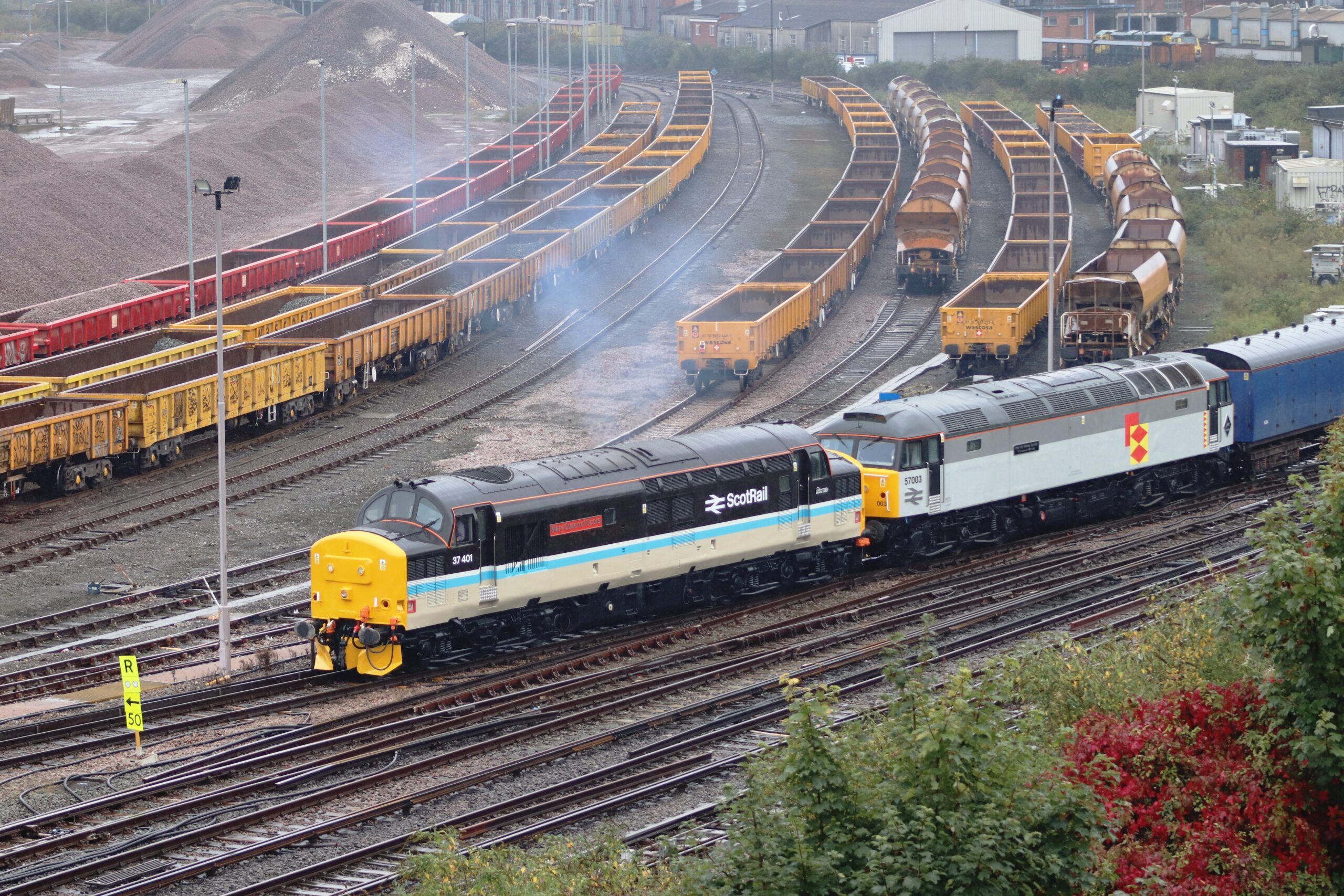
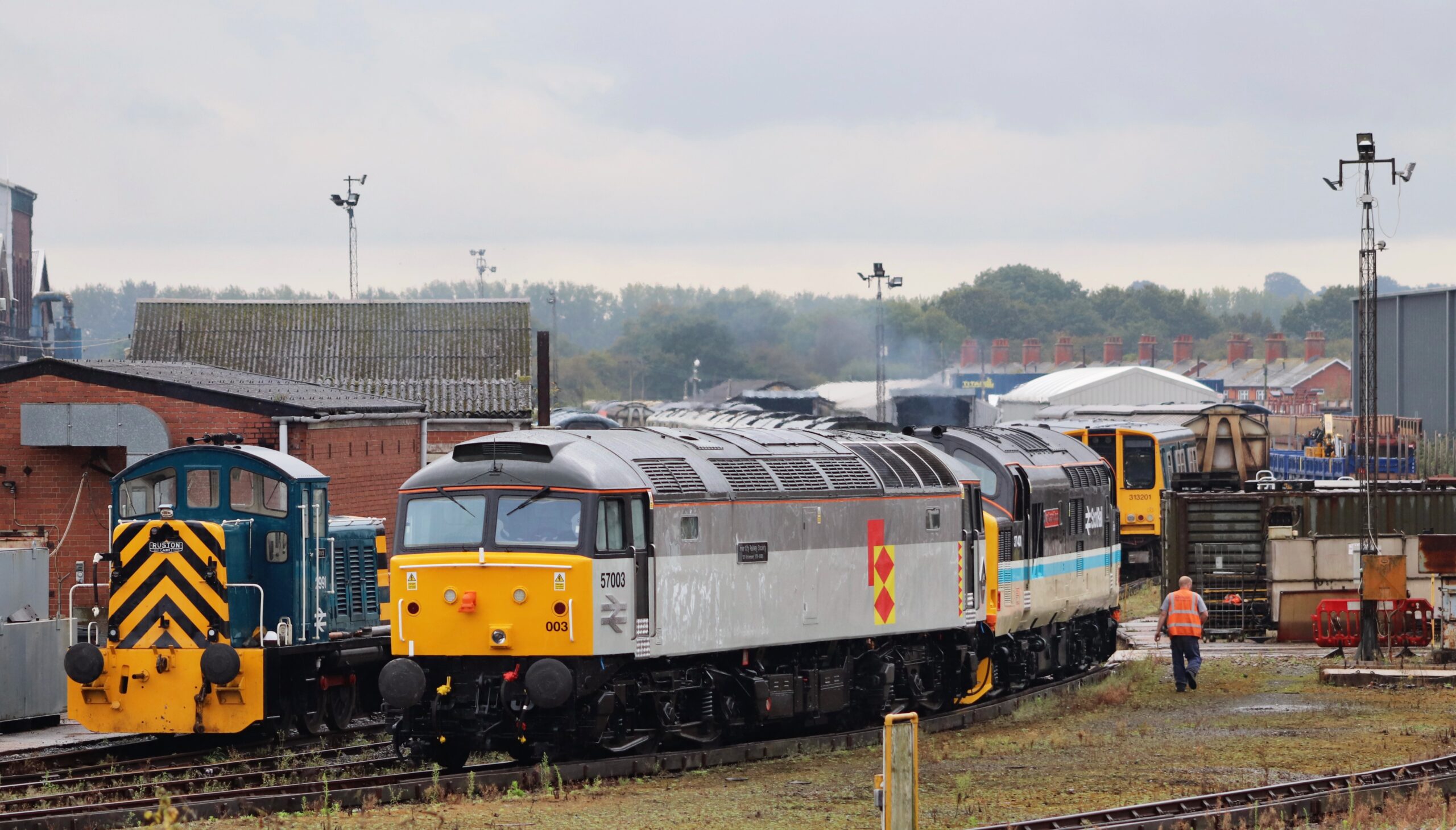
    Locomotive Services Limited (LSL) Class 37 No. 37401 ‘Mary Queen of Scots’ leads Class 57 No. 57003 ‘Inter City Railway Society 50th Anniversary 1973 – 2023’ on the approach to Eastleigh railway station forming 5Z45 1500 Eastleigh Arlington to Crewe HS. The Class 37 would later fail near Northampton, requiring rescue by a Class 86 also belonging to LSL – 23/09/2024
    Class 57 No. 57003 ‘Inter City Railway Society 50th Anniversary 1973 – 2023’ shows off its retro Trainload Freight Speedlink livery at Eastleigh Arlington – 23/09/2024
    Video from a day at Eastleigh – 23/09/2024

    That’s it for another blog entry. We’ll be back in a few weeks with a look back at October lineside adventures. Thanks for popping by and for your comments and corrections which are always welcome.

    Don’t forget you can catch up on our latest videos on the Railway Dog YouTube Channel or catch random witterings and photos via the new Railway Dog Facebook group.

    Be seeing you!

  • GBRf Gala – Sept 2024

    GBRf Class 57 No. 57310 at GBRf’s Peterborough depot during the Key Publishing Gala weekend – 08/09/2024

    A special gala weekend of activities, based around Peterborough and the Nene Valley Railway organised by “Modern Railways” magazine with support from their sister publication “Hornby Magazine”, took place over the weekend of September 7th/8th 2024.

    The event was supported by GB Railfreight who provided a range of visiting locomotives hauling trains at the Nene Valley Railway on both days of the gala. The freight operator also offered the opportunity to look behind the scenes at its Peterborough headquarters in a series of pre-booked tours.

    Because of family plans organised for the Saturday of the event, I booked to attend on the Sunday and drove over to Peterborough arriving in good time to join the designated shuttle bus which was running between the railway station and the GBRf facility.

    GBRf House, Peterborough – 08/09/2024

    On arrival at the GBRf depot the bus divested of its passengers and we all stood around on the lawned area in front of GBRf House before being split into two groups of around twelve people each. One group headed off to the Maintenance Hub and depot area while the other, which I was part of, were taken off to see the train driving simulators.

    GB Railfreight (GBRf) invested in two state of the art simulators, which form part of their training school at Peterborough. At a total cost of £850,000, they are the UK’s first and only full cab freight European Rail Traffic Management System (ERTMS) capable simulators. They are used by new and existing drivers for basic training, advanced training as part of the Driver rules exam, Mentor and Instructor training and post incident reconstruction – 08/09/2024 
    From the outset, the simulators covered the journey from London Kings Cross to Peterborough, and are designed with a route building tool which will enable the addition of all other GBRf routes going forward. The simulators were built with the recycled remains of Class 66 locomotive No. 66734, which was involved in a landslip derailment at Loch Treig in 2012 – 08/09/2024 
    Photographs on display at the GBRf Training facility showing Class 66 No. 66734, which was involved in a landslip derailment at Loch Treig in 2012 – 08/09/2024

    Once everyone in my group had a chance to experience the simulator, we swapped over with the other crowd and were led off to the depot area. First up was a visit inside the new Peterborough Maintenance Hub.

    The Peterborough Maintenance Hub, which is larger than six-Olympic swimming pools was completed in just 10 months and brings back into use a derelict plot of land. The facility is key to unlocking GBRf’s ambitious growth plans as it aims to run c.80 intermodal services a day by 2025. The building has strong sustainability credentials – it is fully powered by electricity and has been designed to support electric shunt engines and forklifts to reduce carbon emissions.
    By analysing four wagons per shift, the Hub is a strategic enabler that creates a step-change in maintenance for the rail freight industry. It delivers significant safety and reliability improvements that will allow current and future customers to move an even wider range of goods by rail. As new smart-technologies emerge, the Hub will be a testbed that will allow GBRf to identify innovative solutions that will drive continual improvement – 08/09/2024
    GBRf is in the process of converting a pair of redundant “Polybulk” hoppers to barrier vehicles at its new Peterborough wagon facility having won the contract to move brand new Piccadilly line trains from Siemens new £200 million factory in Goole, East Yorkshire to London. One end of each barrier wagon retains conventional buffering and drawer. The other end has this removed and replaced with couplers for the new Tube stock, and high-level brake pipes. When being transported, the Underground train will run between the two wagons – 08/09/2024

    We were free to take photographs in the Hub facility and of the stabled locomotives as we walked back to join the bus which would this time take us to the Nene Valley Railway.

    GBRf Class 66 No. 66768 on shed at Peterborough in the company of No. 66762, 57310, 66760 ‘David Gordon Harris’, 66741 ‘Swanage Railway and 66711 ‘Sence’ – 08/09/2024
    GBRf Class 66 No. 66768 at Peterborough – 08/09/2024
    GBRf Class 66 No. 66760 ‘David Gordon Harris’, Peterborough – 08/09/2024
    GBRf Class 66 No. 66741 ‘Swanage Railway’ at Peterborough – 08/09/2024
    GBRf Class 69 No. 69003 ‘The Railway Observer’ at Peterborough. The locomotive was in operation on the Saturday of the gala – 08/09/2024

    On arrival at the Nene Valley, there was a bit of a wait in the rain before enjoying a journey from Peterborough to Wansford hauled by GB Railfreight Class 66 No. 66312. A volunteer at Peterborough Nene Valley very kindly gave me some treats to take home for Yoshi, which he enjoyed very much!

    Our train to Wansford at the other end of the line was hauled by Class 66 No. 66312.

    GBRf Class 66 No. 66312 was in operation on the Nene Valley during the Sunday – 08/09/2024
    GBRf Class 47 No. 47727 ‘Edinburgh Castle’ arrives at Peterborough Nene Valley – 08/09/2024
    GBRf Class 66 No. 66312 rests at Wansford – 08/09/2024
    GBRf Class 66 No. 66312 at Wansford – 08/09/2024
    Another view of GBRf Class 66 No. 66312 at Wansford – 08/09/2024
    Surely not GBRf Class 66 No. 66312 at Wansford – 08/09/2024
    GBRf Class 69 69009 ‘Western Consort’ at platform of Wansford station – 08/09/2024
    GBRf Class 47 No. 47727 ‘Edinburgh Castle’ with 45041 ‘Royal Tank Regiment’ operating as a translator between the Brush Type 4 and the coaching stock on the approach to Wansford – 08/09/2024
    GBRf Class 66 No. 66312 departs Wansford – 08/09/2024
    GBRf Class 47 No. 47727 ‘Edinburgh Castle’ double heads with Class 69 69009 ‘Western Consort’ at Wansford – 08/09/2024
    GBRf Class 08 No. 08632 runs into the bay platform at Wansford – 08/09/2024
    Nene Valley resident Class 14 No. D9529 is an 0-6-0 Diesel Hydraulic loco built at Swindon Works in 1964, weighing in at 48.5 tonnes. Originally intended for hauling working movements between local yards and short-distance freight trains on the western region, No. D9529 was sold to The British Steel Company and worked at Buckminster from 1968-1972. It was later moved to Corby Steelworks and worked there until 1981 when it was moved to Bardon Hill Quarry until 2010 when it was rescued by the Iron Steel & Traction Group and moved to the Nene Valley Railway – 08/09/2024
    “Peak” Class 45 No. 45041 ‘Royal Tank Regiment’ is a 1-Co Co-1 wheel arrangement Diesel Electric loco built at Crewe Works in 1962, weighing 133 tonnes. The loco was originally based at Derby hauling passenger services on The Midland Mainline as No. D53. The loco was named in 1964 and was re-numbered in 1975. No. 45041 was used predominantly on freight trains during the 1980’s as it was not one of the Class 45’s that was selected to be converted to supply electric train heat (ETH) for passenger carriages. Unfortunately, the loco suffered a traction motor problem in 1988 and was condemned, but she was bought by the Peak Locomotive Society in 1996 and has been based at the NVR since then – 08/09/2024
    GBRf Class 57 No. 57303 with Class 66 No. 66312 getting ready to depart Peterborough Nene Valley with the final service of the gala weekend – 08/09/2024

    Funds raised from the gala were donated to charity, supporting the work of the MS Society, which provides support to those suffering with Multiple Sclerosis. GB Railfreight donated funds raised from the site tours to its charity partner Great Ormond Street Hospital Children’s Charity.

    Video from Day Two of the 2024 GBRf Gala at the Nene Valley Railway – 08/09/2024

    For The Record

    Screenshot of LSL Class 47 No. 47805 ‘Roger Hosking MA 1925-2013’ passing Poole at the head of empty coaching stock move 5Z50 0714 Crewe H.S. to Norden (Swanage Railway) – 03/09/2024

    On 4th September 2024, Saphos Trains ran a “Welsh Marches Express” from Bournemouth to Shrewsbury. The empty coaching stock was scheduled to be stabled at Norden on the Swanage Railway the night before the railtour. However, a bridge strike at Grange Road (Bridge 9) near Creech on the Swanage Branch causing noticeable movement in the structure and likely requiring substantial and costly repair works meant the train was unable to travel to Norden and was stabled at Holme Lane (Bridge 7) instead. We saw the ECS passing Poole on 3rd September running almost three hours late after being diverted due to congestion at Reading West following the failure of an earlier freight train.

    LSL Class 57 No. 57311 at the rear of empty coaching stock move 5Z50 0714 Crewe H.S. to Norden (Swanage Railway) – 03/09/2024

    Locomotive Services Limited Class 47 No. 47805 ‘Roger Hosking MA 1925-2013’ and Class 57 No. 57311 were utilised in top and tail formation for the stock movements, with the pair taking the carriages to Bournemouth in the early hours to pick up passengers.

    We were at Hamworthy the following morning as they passed through on the way to pick up passengers running thirty minutes late working 5Z50 0430 Norden (Swanage R) to Bournemouth. The Saphos Tour was scheduled for steam haulage from Bristol, but due to a fatality in the Taunton area necessitating the closure of the railway line, the allocated locomotive; LNER Thompson Class B1 No. 61306 ‘Mayflower’ was unable to get to Temple Meads in time. Instead the train continued with No.’s 57311 and 47805 in charge. ‘Mayflower’ eventually caught up with her train and while No. 57311 was sent home to Crewe, the B1 and No. 47805 returned South, the steam locomotive taking the train as far as Bristol and the Brush Type 4 then working solo back to Bournemouth where we were on hand to see the train arrive. On arrival at Bournemouth, the Class 47 then ran around the carriages to enable the empty stock to be hauled to Southall.

    Having arrived around an hour early, LSL Class 47 No. 47805 ‘Roger Hosking MA 1925-2013’ being detached from the coaching stock of 1Z52 1550 Shrewsbury to Bournemouth prior to running round – 04/09/2024
    LSL Class 47 No. 47805 ‘Roger Hosking MA 1925-2013’ ready to depart with 5Z54 2354 Bournemouth to Southall Locomotive Services Limited – 04/09/2024
    Video from 3rd/4th September 2024 with movements in association Saphos “Welsh Marches Express”

    Wednesday 4th September 2024 was the turn of the New Measurement Train (NMT) to visit the “Heart of Wessex” line with Class 43 ex-HST power cars No.’s 43274 and 43277 ‘Safety Task Force’ working 1Q22 0757 Derby R.T.C.(Network Rail) to Bristol Kingsland Road via Weymouth. My brother was on hand to catch it passing through Dorchester West on the outward leg.

    Screenshot of Class 43 ex-HST power cars No. 43274 arriving at Dorchester West 1Q22 0757 Derby R.T.C.(Network Rail) to Bristol Kingsland Road via Weymouth – 04/09/2024 ( G E Barrett)
    Screenshot of Class 43 ex-HST power cars No.’s 43277 ‘Safety Task Force’ passing through Dorchester West with 1Q22 0757 Derby R.T.C.(Network Rail) to Bristol Kingsland Road via Weymouth – 04/09/2024 ( G E Barrett)
    Colas Rail Freight Class 37 No. 37175 at Weymouth having worked in with 3Q14 1112 Westbury Down TC to Westbury Down TC – 05/09/2024
    Colas Class 37 No. 37254 ‘Cardiff Canton’ at Weymouth 3Q14 1112 Westbury Down T.C. to Westbury Down T.C.

    Thursday 5th September 2024 and the booked “Heart of Wessex” test train produced Colas Rail Freight Class 37 No.’s 37175 and 37254 ‘Cardiff Canton’ at Weymouth top and tailing Network Rail’s Structure Gauging Train, reporting as 3Q14 1112 Westbury Down T.C. to Westbury Down T.C.

    Screenshot of GBRf Class 66 No. 66798 ‘Justine’ passing Poole at the head of 6G15 2305 Eastleigh East Yard to Wool Signal PW5255 – 08/09/2024
    Screenshot of GBRf Class 66 No. 66303 at the rear of 6G15 2305 Eastleigh East Yard to Wool Signal PW5255 – 08/09/2024

    A couple of engineering trains passing Poole just after midnight on 08/09/2024 in preparation for work in the Wool area. GBRf Class 66 No.’s 66798 ‘Justine’ and 66303 were first up forming a short ballast train 6G15 2305 Eastleigh East Yard to Wool Signal PW5255 followed quickly after by Colas Rail owned Plasser & Theurer 08-16/4x4C100-RT Tamper No. DR73931 ‘Brian Hill’ working 6J86 2338½ Brockenhurst Down Siding to Wareham.

    North Dorset Route Learning runs: 10/09/2024: GBRf Class 66 No. 66731 ‘Capt. Tom Moore, A True British Inspiration’ ran light engine through Sherborne and Gillingham working 0Z47 1145 Eastleigh East Yard to Honiton and the corresponding return 0Z48 1521 Honiton to Eastleigh East Yard. The following week Monday to Friday saw the following schedules diagrammed: 0Z47 1145 Eastleigh East Yard to Honiton and 0Z48 1517 Honiton to Eastleigh East Yard. with the following running; 16/09/2024: operated by 66727  ‘Maritime One’. 17/09/2024: 66770, 18/09/2024: 69006. The Thursday and Friday moves were cancelled.

    Colas operated rail delivery train ran 12/13th September 2024 with Class 66 No. 66791, on hire from GBRf and 66849 ‘Wylam Dilly’. The outward run reported as 6C19 2251 Eastleigh East Yard to Dorchester South, while the return was 6C19 0525 Dorchester South to Eastleigh East Yard

    On hire from GBRf Class 66 No. 66791 with Colas decals applied stands at Dorchester South having arrived working 6C19 2251 Eastleigh East Yard to Dorchester South – 13/09/2024 (Image courtesy of Scott Lewis)
    Class 66 No. 66791 at Dorchester South working 6C19 2251 Eastleigh East Yard to Dorchester South – 13/09/2024 (Image courtesy of Scott Lewis)
    Colas Class 66 No. 66849 ‘Wylam Dilly’ passing Poole at the rear of 6C19 2251 Eastleigh East Yard to Dorchester South – 13/09/2024 (Image courtesy of Tony Henley)

    What we like to call the North Dorset New Measurement Train ran on 19/09/2024 with Colas Class 43 HST power cars No.’s 43251 and 43357 working 1Q23 0552 Reading to Salisbury via Exeter.

    The October 2024 edition of “Railway Modeller” features a very well illustrated article on the impressive “Bournemouth West” model layout>

    October 2024 edition of “Railway Modeller”
    Yoshi gets some ideas from the “Railway Modeller”

    Hamworthy Branch

    I followed up my email to Network Rail of twelve months ago to ask if there was any more information regarding the 2025 date previously given for rail traffic to commence on the Hamworthy Branch – I received the following response today (18/09/2024):

    “Subject

    Information Request – Hamworthy Branch, Dorset

    Response By E-mail (Simon) (18/09/2024 04.34 PM)

    Hi Andrew,

    Thanks for getting in touch – I have reached out to the team concerned and although there’s not specifically anything more to add to the previous reply, I can let you know that we’re still on course for reactivating the terminal and running trains in 2025. You’d be surprised I’m sure if I didn’t add the proviso that this is always subject to change, but certainly 2025 is still looking good as of now.

    I hope that helps for now,

    Kind Regards

    Simon

    Community Relations – Network Rail”

    That’s it for another blog entry – thank you for reading! We’ll be back soon with a look at the remainder of Dorset special railway workings and our trip North of the Border to photograph Scottish High Speed Trains. Grateful thanks to all corrections, submissions and suggestions. Be seeing you!