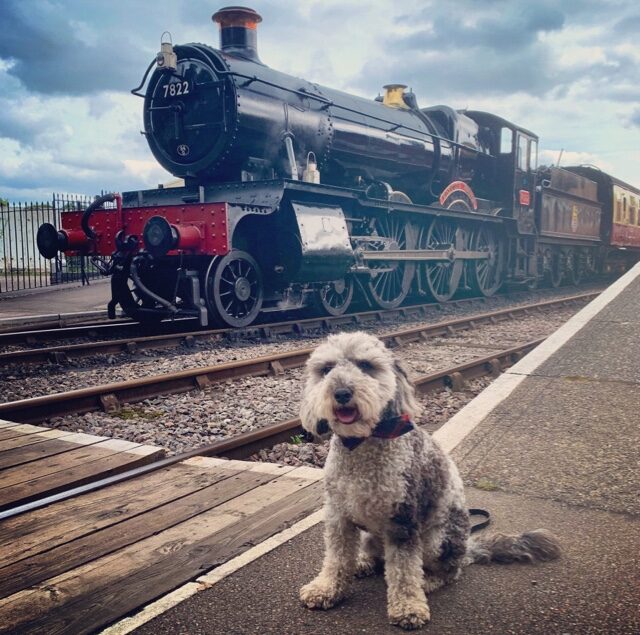
Tuesday 12th July to Tuesday 19th July

Fleetwood
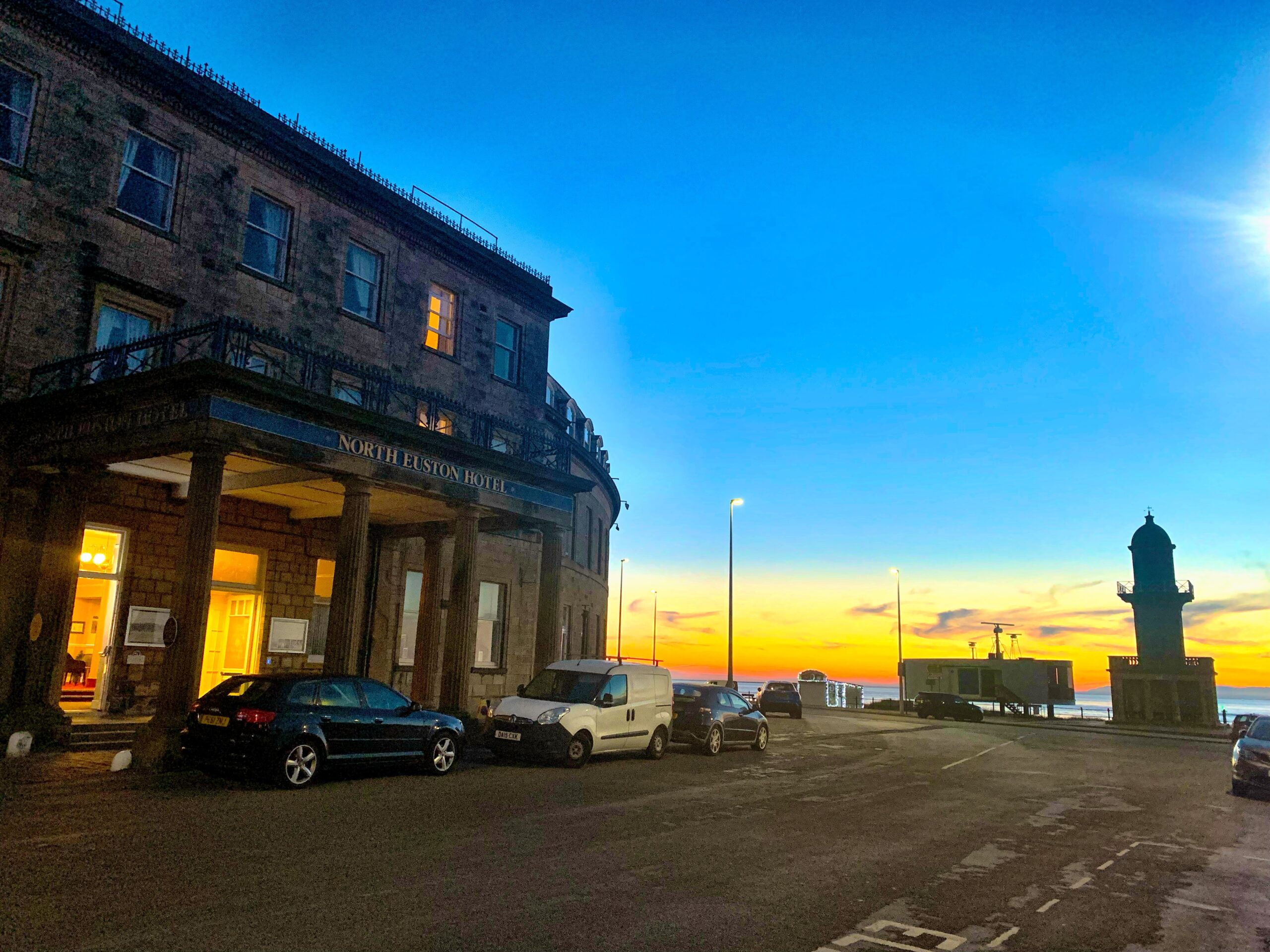
Yoshi and I spent much of last week in the North West of England as we made The North Euston Hotel in Fleetwood our base. The hotel was commissioned by Sir Peter Hesketh Fleetwood, designed in the Greek classical style by architect Decimus Burton and built between 1839 and 1841 to serve overnight passengers making the journey by rail from London Euston who were destined for steam ships which would provide onward travel to Scotland where after disembarking at Ardrossan they would take the train on to Glasgow. Fleetwood was the northern most station at the time, hence the name “North Euston” for the hotel, and the railway was yet to run over the Shap hills. Queen Victoria made the journey in 1847 and stayed at the hotel, although I’m sure she didn’t stay in our room. The first manager of the hotel, Corsican born Xenon Vantini, had been a courier for Napoleon Bonaparte and was also the first person to open a refreshment room at Wolverhampton railway station. In 1859 following a decline in fortunes, the hotel was sold to the government and was converted into a school of musketry and later, in 1867, an officer’s quarters. The building existed in this form until the 1890’s when it was purchased by a group of London businessmen who converted it back into a hotel. The North Euston is currently owned by local business families. Yoshi very much enjoyed his morning sausage for breakfast and we celebrated our dubious achievement of coming last in the Sunday evening pub quiz which was a lot of fun.
The railway to Fleetwood was opened on 15th July 1840 as the Preston & Wyre railway and was also the vision of Sir Peter Hesketh Fleetwood it being designed to connect the then new port of Fleetwood on the Fylde coast to Preston. The railway was constructed by George and Robert Stephenson with contribution from Joseph Locke. Its glory days lasted only six years until a direct route over Shap was finally achieved. The railway was absorbed into the Lancashire & Yorkshire Railway ( later the London Midland Scottish Railway as part of the Big Four groupings in 1923) and extensions were built to Blackpool and Lytham to cater for the growing number of passengers traveling to the seaside. Fleetwood would become, for a time, one of the largest and most successful fishing ports in the UK but by 1970 the railway from Poulton-le-Fylde to Fleetwood was closed to passenger traffic and later, in 1999, to freight workings.


In 2006, the Poulton & Wyre Railway Society was formed with the aim of reopening the railway. Since then, much work has been carried out in clearing sections of the line from the ingress of nature and a Class 108 Diesel Multiple Unit was purchased for restoration and use on the line. More recently, the Poulton-Le-Fylde to Fleetwood line was subject to a study as part of the UK Government’s Restoring Your Railway programme. In June 2022 it was announced that the scheme should progress further and Network Rail will receive funding to produce a detailed plan for the revival of services. The Poulton-Le-Fylde & Wyre Railway Society have now turned their attention to developing a heritage railway centre which will eventually house a collection of railway artefacts and memorabilia for public viewing.
Churnet Valley Railway
Having heard that Class 33/1 No. 33102 was hauling trains, Yoshi and I spent Tuesday morning ( 12th July 2022 ) visiting Cheddleton on the Churnet Valley Railway, a preserved heritage line in Staffordshire. I grew up with 33/1’s providing the daily motive power on local passenger services between Bournemouth and Weymouth, and even though No. 33111 lives on at Swanage, our local heritage railway, it was fantastic to hear the Crompton’s Sulzer engine at work hauling a passenger train.
The Churnet Valley railway dates back to 1849 following the formation of The North Staffordshire Railway Company (NSR) in 1845. Falling passenger numbers saw the Beeching Report include the Churnet Valley line and its associated branches which became earmarked for closure with the final section from Leek Brook Junction to Oakamoor quarry lasting out until the late 1980’s as it was used for freight traffic. In 1992 the newly formed Churnet Valley railway (1992) PLC began talks with the Department of Transport with a view to operate the line. Trains currently run between Froghall and Ipstones, but the ambition is to run services into the Staffordshire market town of Leek for the first time since 1965. And they have an eye on the clock to achieve this as the railway needs to run its first passenger train into Leek by 1st December 2022 or lose a £1.4m EU grant. This means all track must be laid on the 0.5 mile extension, with additional resources being provided for a triangle at Leek Brook Junction, and a platform constructed at Leek. It really is a very picturesque railway with extremely friendly volunteers, Yoshi and I were escorted around the workshops to get a closer view of locomotives stabled there, and I wish them every success with their endeavours and look forward to a return visit in the future.


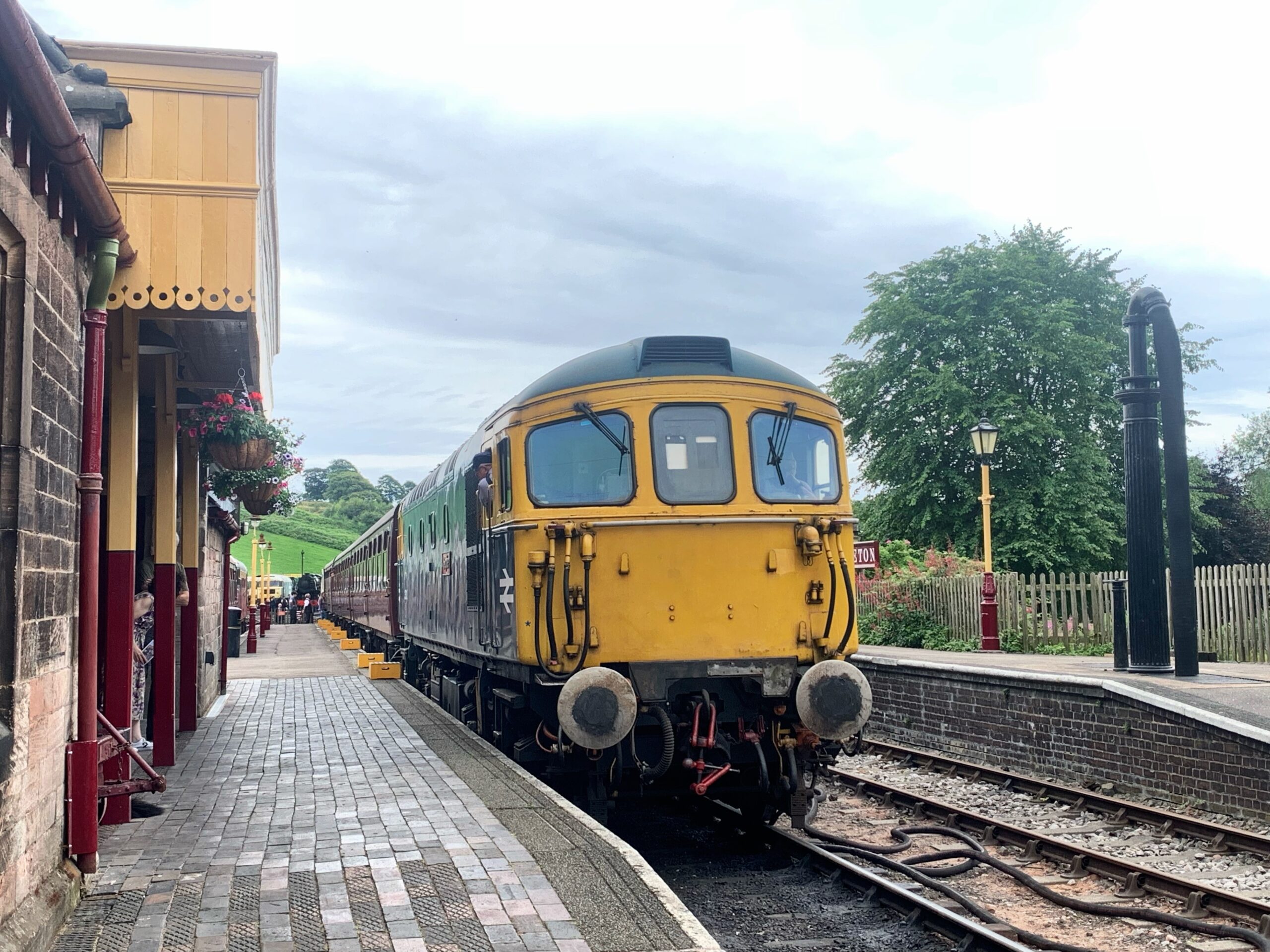


On our way back to Fleetwood, we stopped off at Acton Bridge for an hour or so, primarily to capture Class 37 No. 37884 which was diagrammed to pass through with 0M58 Kilmarnock Long Lyes T.C. to Derby R.T.C. – which can be seen in the video below:
Southport
On the Wednesday, Yoshi and I took a trip on a heritage Blackpool Tram – more about that adventure next week – but first that we made a brief visit to Southport and Formby. Southport railway station is the terminal of the Southport branch of the Northern Line of the third-rail electric Merseyrail network, and the diesel-operated Manchester to Southport line. The station and services to Liverpool and Hunts Cross are operated by Merseyrail, with Manchester services operated by Northern Trains. The current station opened as Southport Chapel Street on 22 August 1851 and once boasted eleven regular platforms and two excursion platforms. Six truncated platforms are now in use (platforms 1-3 for Liverpool trains and 4-6 for Manchester services), the remainder having been demolished to make way for car parking. In 1970 the former terminal building was replaced with a shopping centre.
New Stadler Class 777 trains are currently being tested, and one was scheduled to visit Southport that morning on test run. Despite the best attempts at numerous roadworks and traffic queues, we made it just in time to see Class 777 No. 777015 arriving. Members of The National Union of Rail, Maritime and Transport Workers ( RMT – what these initials mean was one of the pub quiz questions I actually answered correctly! But I digress…. ) Anyway to continue; RMT members recently voted in favour of the proposed crewing plans for the new fleet which brings a five-year dispute to its conclusion. Merseyrail still has to reach agreement with the drivers union, the Associated Society of Locomotive Engineers and Firemen (ASLEF), but intends to introduce the new Class 777’s into service later this year. Currently, 17 out of the 53 units purchased have been delivered to the UK. The arrival of the Class 777 fleet will see the demise of both the Class 507 and 508 electric-multiple units (EMU’s).
The Class 507’s were built to work on Merseyside, replacing the London Midland Scottish Railway (LMS) built Class 502 units on Northern line services from Liverpool to Southport, Ormskirk and Kirkby. 33 sets were built by British Rail Engineering Limited (BREL) in York from 1978 to 1980 followed by 43 Class 508s constructed between 1979 and 1980. They were the second and fourth variety of BR’s then standard 1972 design for suburban EMU’s, which were derived from the prototype 2PEP and 4PEP EMU’s introduced in 1971 and eventually amassed 755 vehicles across five Classes (313/314/315/507/508). Originally, the Class 508’s were built as 4-car units for the Southern Region of British Rail working out of Waterloo on former London South Western Railway (LSWR) routes. From 1982 to 1984 they were reduced to 3 car units (one of the trailer cars was removed to be incorporated into the Class 455/7 EMU’s) and transferred to Merseyside to replace the former LMS Class 503 units that operated Wirral line services to New Brighton, Rock Ferry and West Kirby. Following rail privatisation the two fleets became interchangeable and work both sides of the Mersey. They are the oldest EMU’s still working in the UK after the Class 313’s.


Crewe
After breakfast on Thursday where we spent a few enjoyable hours watching freight movements around Crewe Basford Hall. You can relive this by playing the video below:
We returned to Dorset on Friday, eschewing the opportunity of capturing two Colas Class 37’s at rest in Blackpool North Railway Station which had worked a test train from Carlisle in the early hours. However, the next day; Saturday 16th July, I was back in Crewe, this time without Yoshi, so I could attend the Direct Rail Services (DRS) Open Day at their depot at Gresty Road. Understandably, dogs were not allowed on site, so Yoshi spent the day with his mum, while I endured the heat of the day without my fluffy sidekick. Many thanks to Scott for driving and for his company.
The Open Day coincided with LMS Coronation 4-6-2 No. 6233 ‘Duchess Of Sutherland’ passing through Crewe railway station with the Railway Touring Company’s “Cheshireman” rail tour from London Euston to Chester. (1Z86 0639 London Euston to Chester with Class 47 No. 47813 providing support at the rear). The station was extremely busy with the influx of enthusiasts in the town to visit the DRS site, but I managed to catch a short video clip of this magnificent locomotive departing Crewe. Later that day, SR Merchant Navy 4-6-2 No. 35018 ‘British India Line’ worked into Crewe light engine and support coach as 5Z46 Carnforth Steamtown to Crewe Heritage Centre for servicing ahead of rail tour duties scheduled for the following day:
3,500 people attended Nuclear Transport Solutions’ (NTS) rail division DRS’s open day, the first one to be held for a number of years because of the Covid pandemic. There were two locomotive naming’s at the event – the first saw Class 66 No. 66422 being unveiled as ‘Max Joule’ in tribute to one of DRS’s founders and former Managing Director who died in 1999. The second naming was for Class 66 No. 66424 which was named ‘Driver Paul Scrivens’ who had been a driver with DRS for more than 20 years. An emotional tribute was delivered by colleague Tim Howlett before the new plate was unveiled by Paul’s sister Emma.
The open day raised over £39,000 from sponsorship and donations which is an amazing figure that will go to deserving causes across the UK. It was a fantastic event, and I thoroughly enjoyed the experience. Because of the hot weather, DRS made bottles of water available at points across the site, which was very welcome.
Locomotives on display were:


On our way to the DRS Open Day, we stopped off at Longport to peer through the fence at Electro-Motive Diesel Limited’s (EMD) site and witnessed some shunting around of locomotives, mainly Class 56 / Class 69 conversions which are ongoing.


On our way home we diverted to Keynsham to refuel the car and restock with drinking water. Fortuitously, Class 37 No.’s 37901 and 37800 were scheduled to pass through top and tailing an Eastleigh Works to Swansea Landore stock move consisting of a Great Central-liveried Mk4 set and an LNER-liveried Mk4 set (5Q79 1826 Eastleigh Arlington to Landore). This made a fantastic epilogue to the day!

Dorset NMT
While we were away it was a quiet week on the Bournemouth to Weymouth line, with only the New Measurement Train of particular interest on the main line as far as I’m aware. HST Class 43 power car No.’s 43272 and 43257 were in charge of 1Q18 0719 Derby RTC to Bristol Kingsland Road on Wednesday 13th July 2022.


My brother popped out to see the NMT return through Dorchester West on its way to Bristol and his video which he captured especially for Yoshi can be seen here:
In other news, Swanage resident Class 33/1 No. 33111 headed off by road to the Mid Hants Railway (MHR) to participate in their 2022 diesel gala. I had considered visiting the MHR on Sunday, but felt it was far too hot for Yoshi to be out and about, so we decided to stay home and catch up on some gardening.
The recent heat wave also resulted in speed restrictions being imposed on main line services by South Western Railways (SWR), including those on the Bournemouth to Weymouth line, with the increased risk of tracks buckling. Reduced services were introduced on Monday 18th and Tuesday 19th July 2022 in a bid to give passengers certainty over which trains would run. There was also a steam ban imposed by many heritage railways and on the main line. This includes the Railway Touring Company’s “Dorset Coast Express” excursion to Weymouth on Thursday 21st July which will now be diesel hauled throughout.
Great Western Railways were under fire in the local press this week, when the Dorset Echo reported chaotic scenes at Weymouth station where passengers were turned away from trains as they tried to return home. The 1728 departure to Bristol Temple Meads from the Dorset seaside town was formed of just two carriages meaning station staff and police had to request some travellers to wait for the next service which was due to leave an hour later. Not so long ago a High Speed Train was regularly employed to run a relief service to Weymouth via the West route on Summer Saturdays in order to cater for anticipated increased passenger numbers.
That’s all for this week – join us next time when we recount our trip on a heritage Blackpool Tram. Many thanks for reading, and for continued contributions, comment and corrections which are very much appreciated!
Leave a Reply