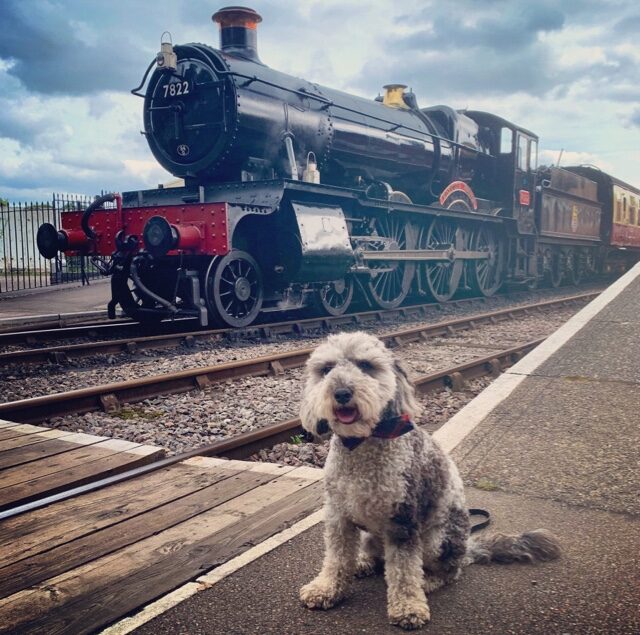
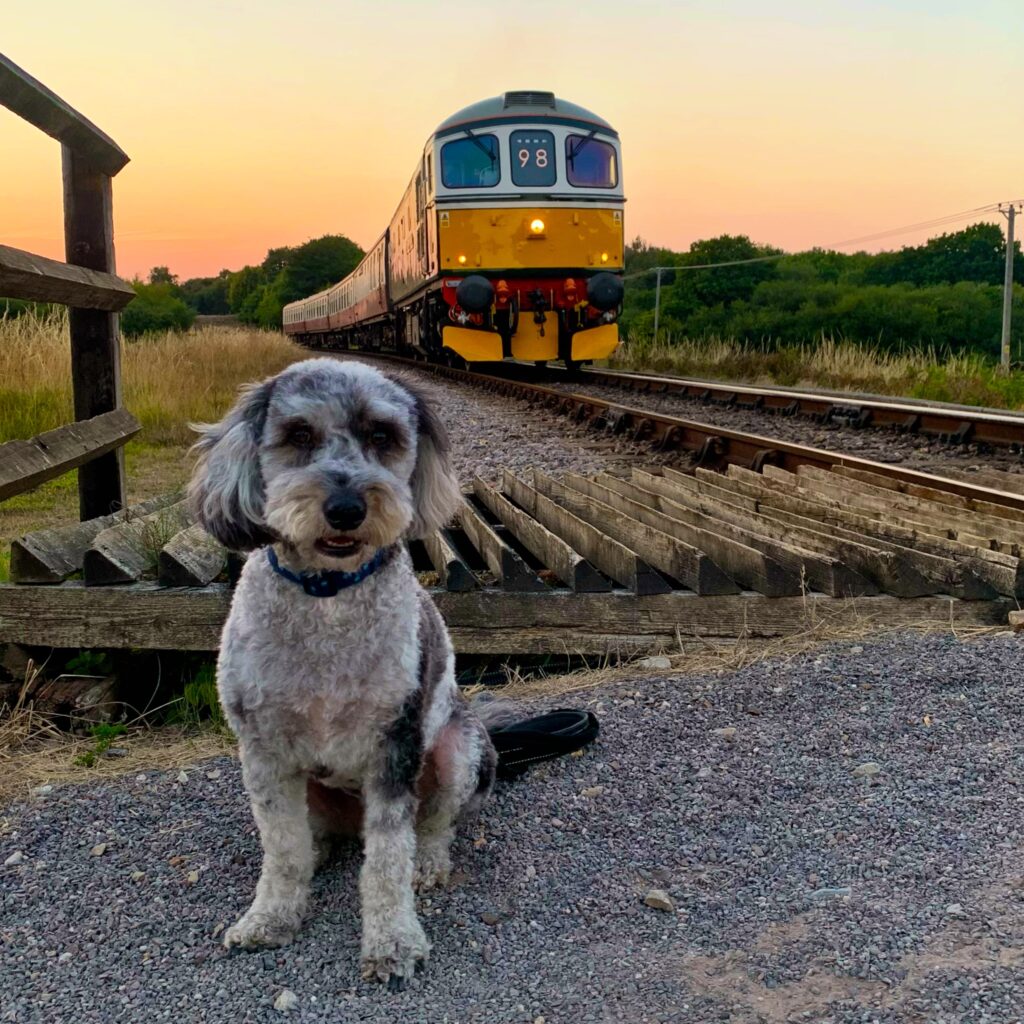
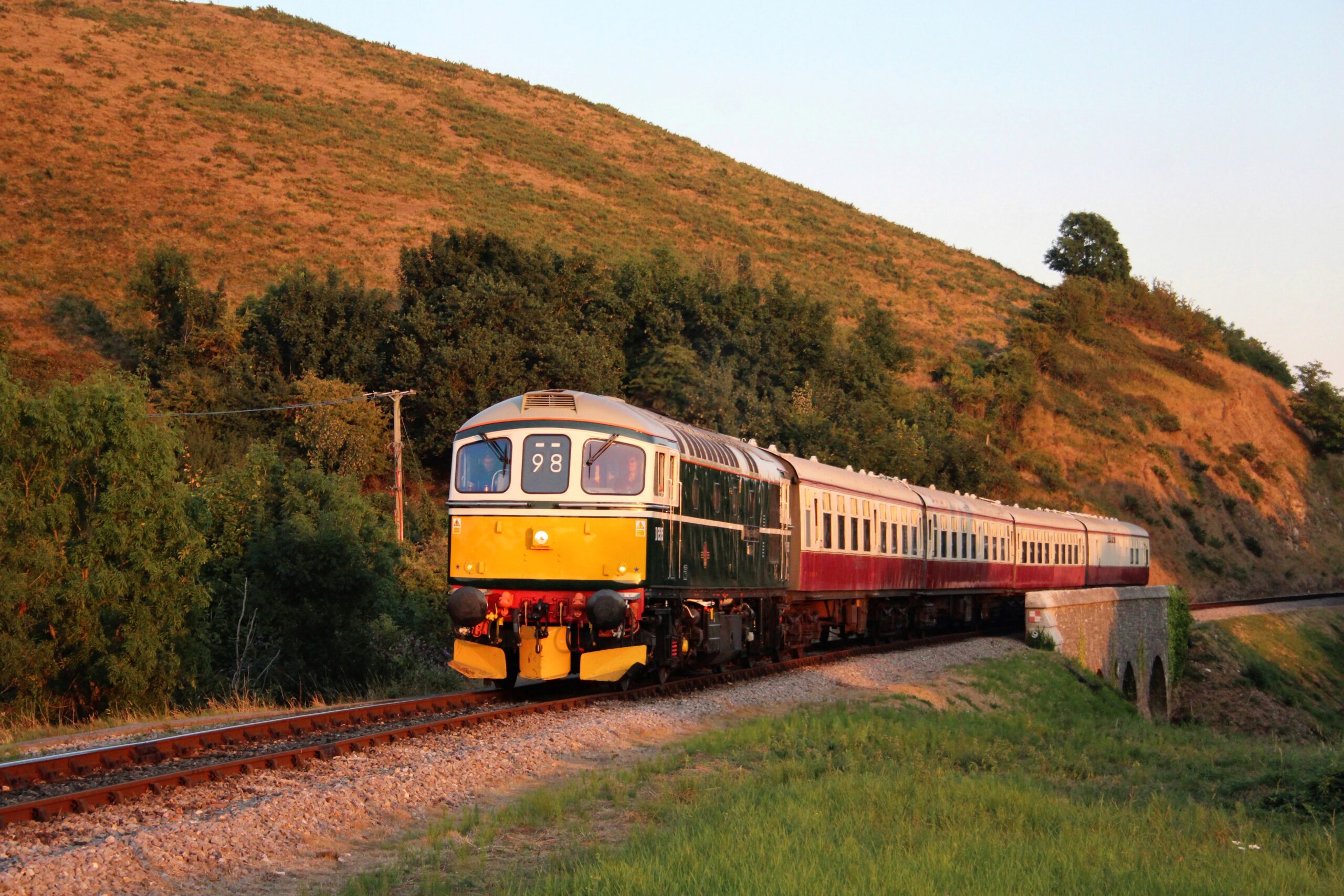
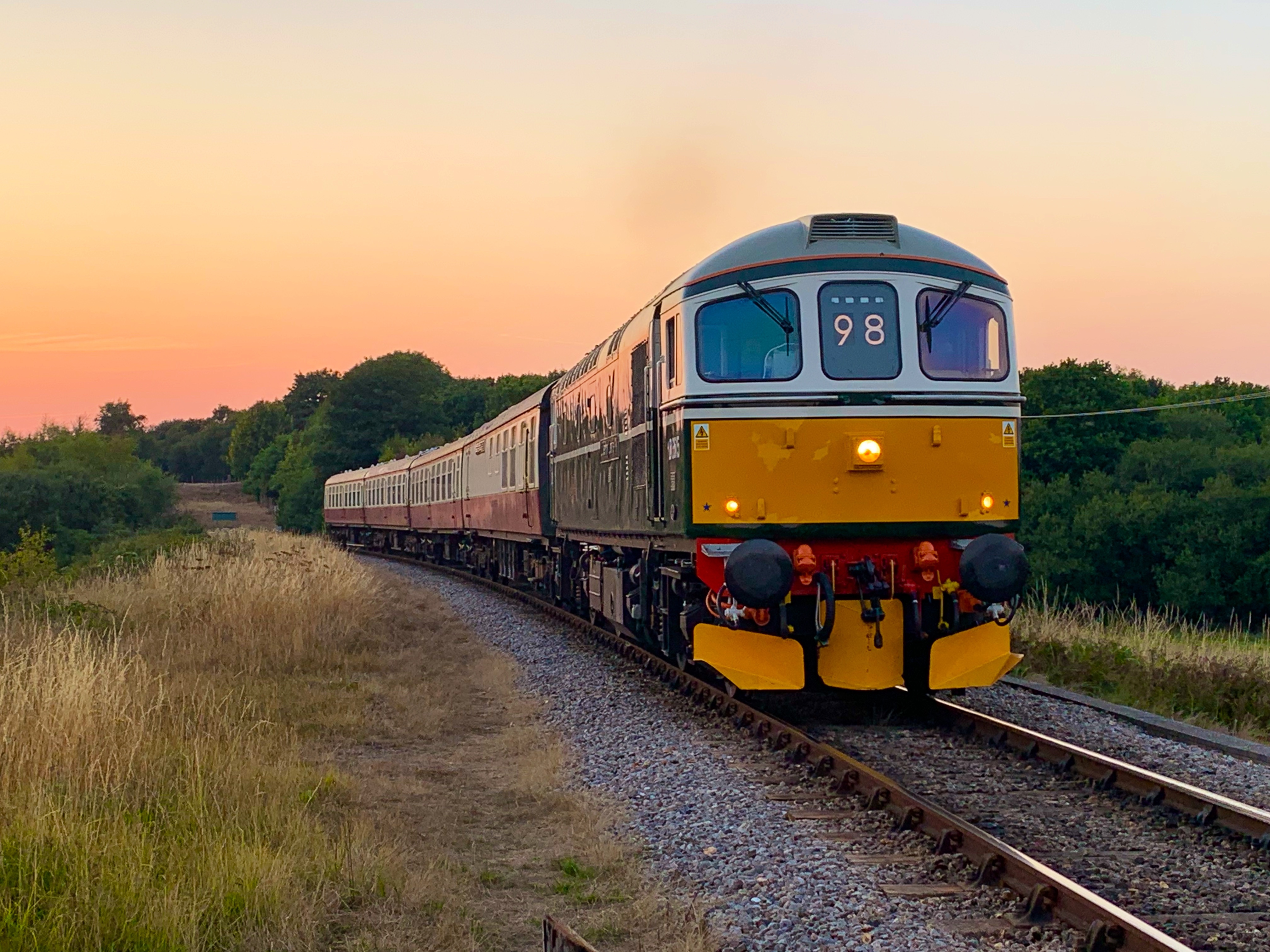
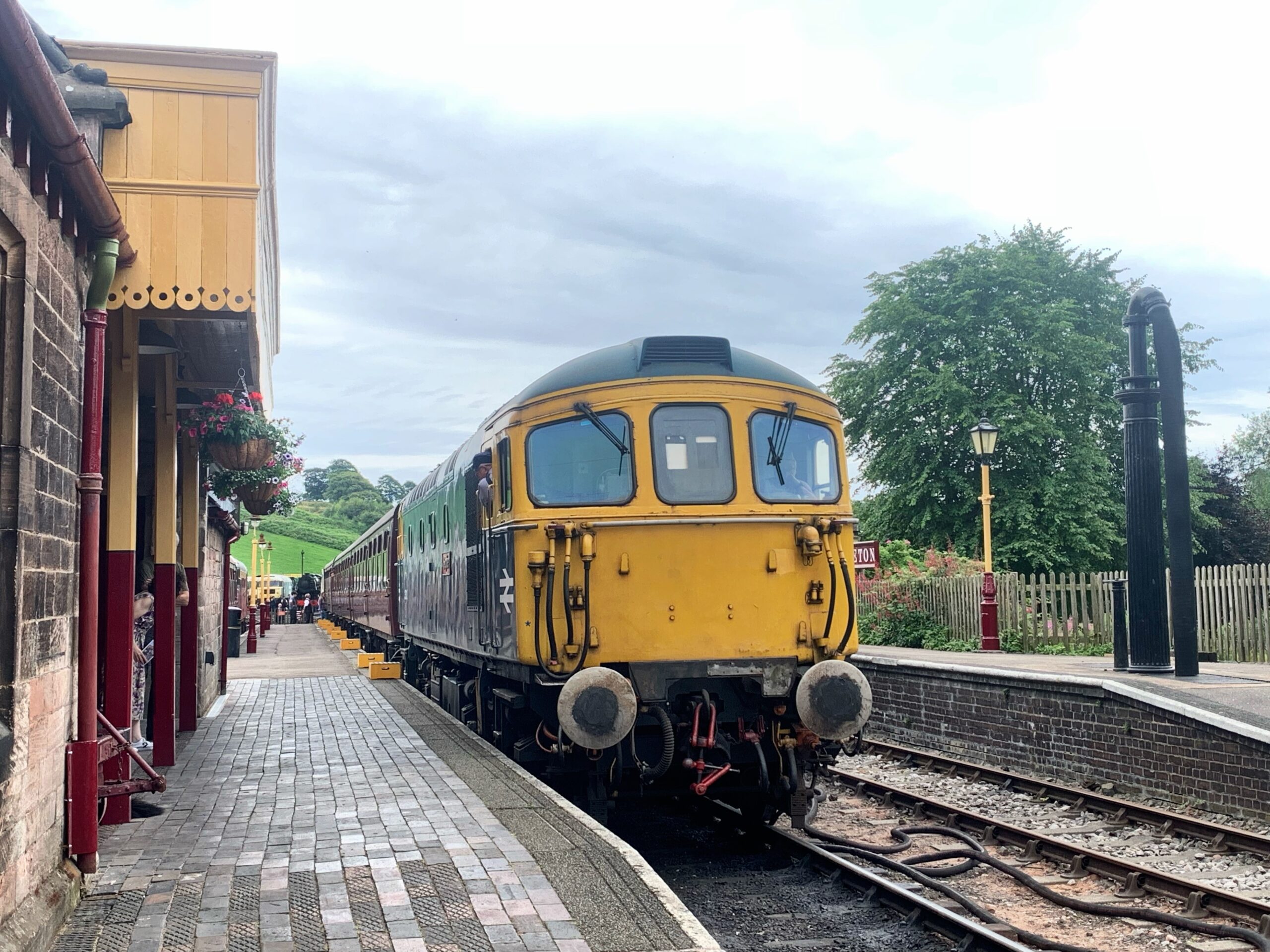
Yoshi in front of stationary Class 33/0 No. D6515 (33012) ‘Lt Jenny Lewis RN’ which was working Swanage Railway Friday Night Bistro train duties. The train stops here for around thirty minutes and we had permission from the driver and guard to take this photo. Please ensure you and your pets stay safe in and around railway property – 12/08/2022
This was looking like a quiet week on the local railway scene, but Yoshi and I had some lovely family events to fill the days. It’s not all about the trains, apparently. Despite the lack of main line entertainment, we were surprised to find another Direct Rail Services (DRS) Winfrith train was running on Thursday 11th August. These workings are in connection with the removal of low level nuclear waste from Magnox Winfrith. This weeks run only appeared on the schedules a couple of days previously (Tuesday 9th August 2022) and, according to folk at Magnox Winfrith I chatted to, may well be the last such working of 2022. The next is provisionally slated for around March 2023. Let’s see.
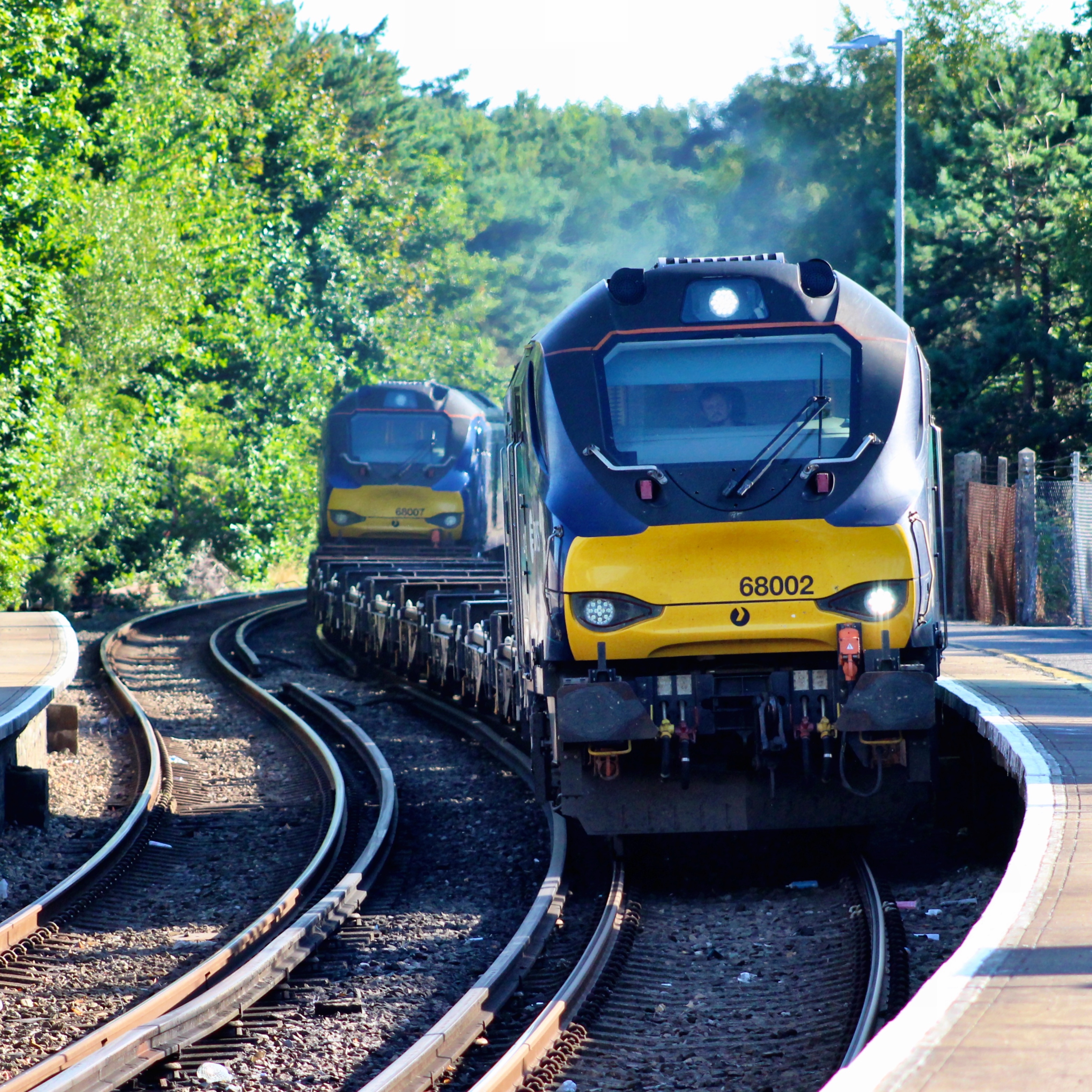
I chose to see the down working pass through Hamworthy on its way to Winfrith. The locomotives top and tailing the train were DRS Class 68 No.’s 68002 ‘Intrepid’ and 68007 ‘Valiant’. No. 68005 ‘Defiant’ had originally been allocated to the working but developed a fault on its way from Sellafield to Crewe with the empty PFA wagons which would be used for onward transit to Dorset. The Class 68’s were built by Vossloh at Albuixech, Valencia for use by Direct Rail Services.
DRS Class 68 locomotives No.’s 68002 ‘Intrepid’ and 68007 ‘Valiant’ top and tail a set of empty PFA wagons bound for Magnox Winfrith powering through Hamworthy with 6Z62 0103 Crewe Coal Siding (DRS) to Winfrith Sidings – 11/08/2022
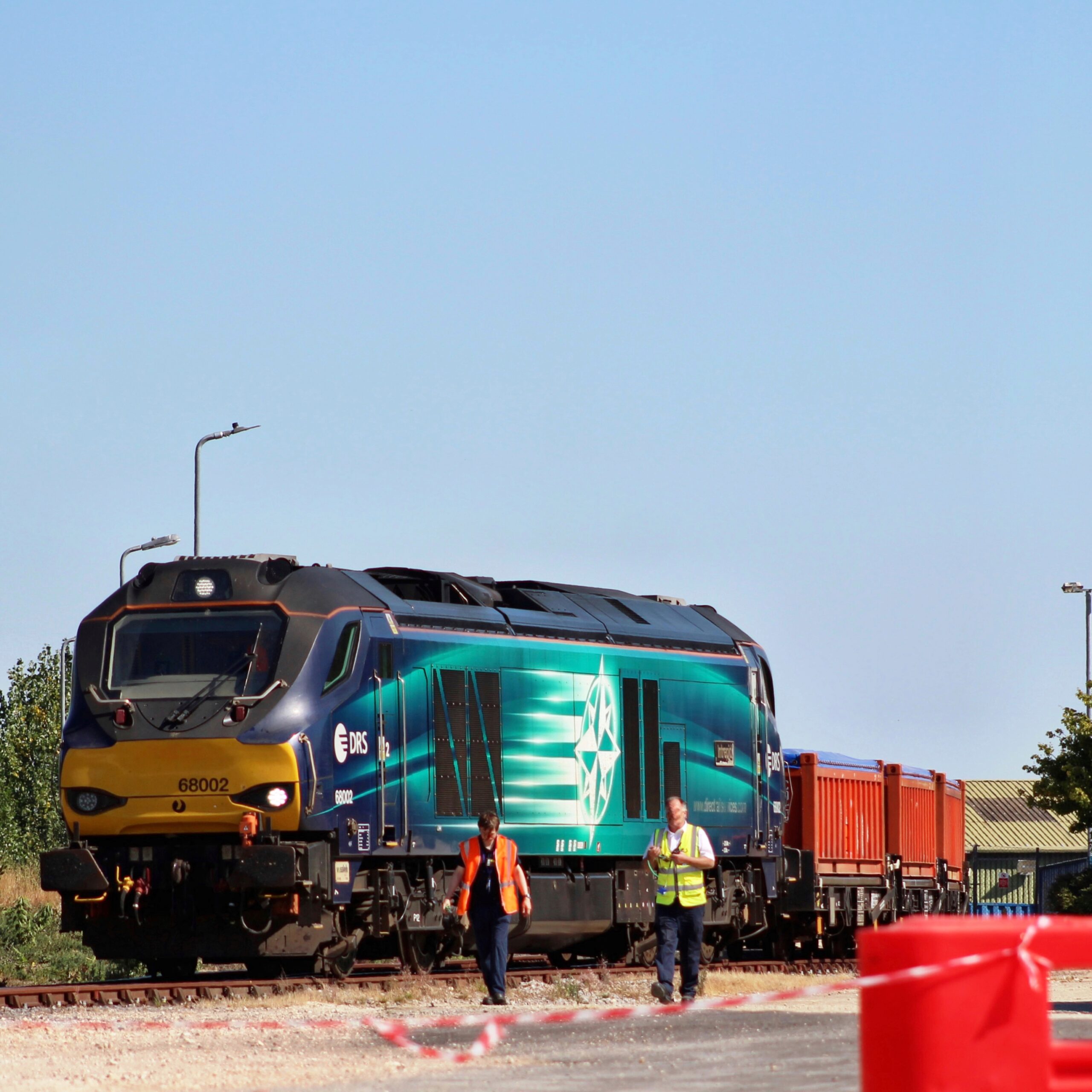
For the return run, I wanted to catch the loaded train leaving Winfrith sidings as there will be only a limited number of these workings, so I thought I would take the opportunity on a beautiful sunny day. The security guys at Winfrith were pleasant and relaxed about my taking photos from a public footpath. After departure from Winfrith Sidings, the train goes on to Dorchester South where it reverses to embark on its trip back to Crewe. While it was doing this, I headed off to Poole in order to catch the consist passing over Holes Bay.
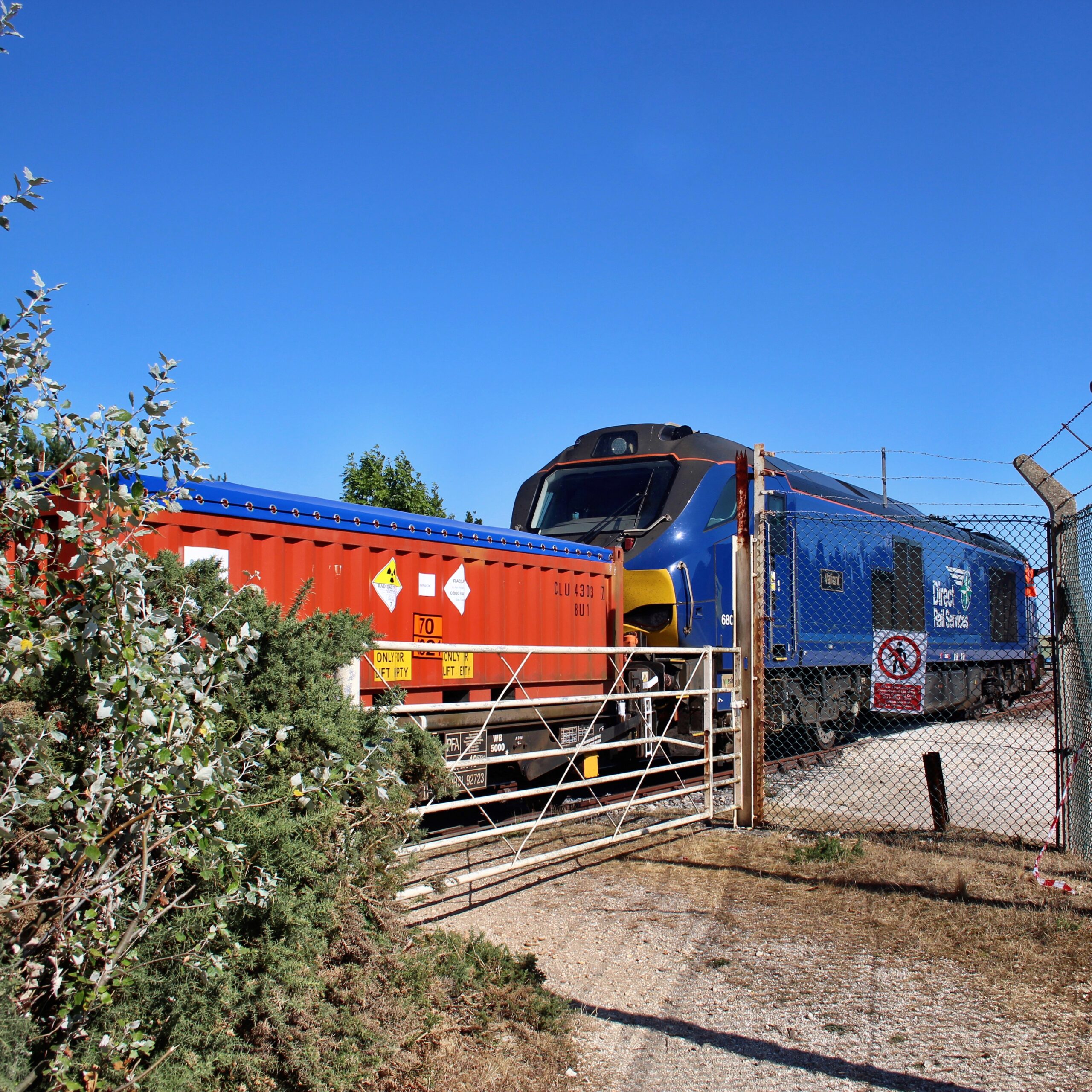
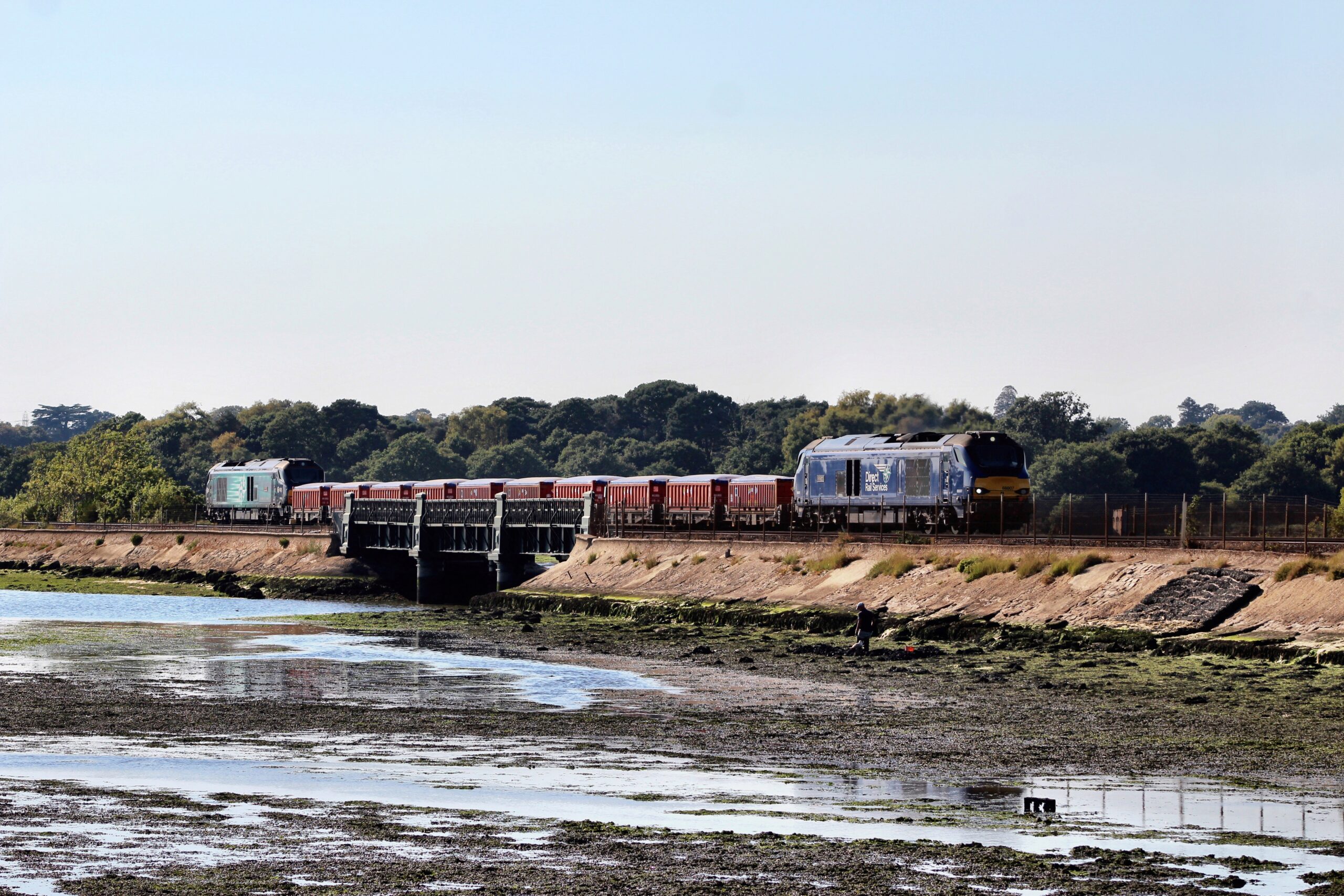
DRS Class 68 No. 68002 ‘Intrepid’ stands in Winfrith Sidings awaiting departure with the loaded train of low level nuclear waste – 11/08/2022DRS Class 68 No. 68002 ‘Intrepid’ edges out of Winfrith Sidings towards the main line – 11/08/2022At the rear of the loaded train DRS Class 68 No. 68007 ‘Valiant’ formerly in ScotRail livery – 11/08/2022DRS Class 68 locomotives No.’s 68007 ‘Valiant’ and 68002 ‘Intrepid’ crossing Holes Bay with the loaded 6Z95 1600 Winfrith Sidings to Crewe Coal Sidings (DRS) – 11/08/2022
And here’s our video of the August 2022 Winfrith Cats:
DRS Class 68 locomotives No. 68002 ‘Intrepid’ and 68007 ‘Valiant’ with the third Winfrith train of 2022 seen at Hamworthy, Winfrith and Holes Bay – 11/08/2022
Digital photography has given us the ability to snap away more or less at our hearts content. Back in my misspent youth armed at first with my 126 Kodak camera, then my 110 Kodak and finally my trusty Russian made 35mm Zenit SLR I was very conscious of both the cost of the film and of the developing and printing. This meant that, often, I had one chance to take a photograph of a particular train. I wasn’t always too mindful however of where the sun was in relation to my subject and the effect this would have on the resulting image. It would take a week or so for the prints to be returned in the post from Truprint or other postal D&P service which might have a money saving promotion on the go. In my mind I had always taken a masterpiece of railway photography, but invariably what was returned never lived up to my expectations. But what did it matter? There would be another Class 33/0 on the Weymouth Boat Train or Inter-Regional Class 47 hauled holiday special excursion to get into the camera viewfinder another day. Until when there wasn’t, of course. Railway’s have always encompassed change and development. If they didn’t, we’d still all be being hauled by variations of Stephenson’s ‘Rocket’ and getting smut in our faces sitting in open topped wagons. I sometimes wish I’d taken more photos of everyday scenes back in the 70’s and 80’s. But I didn’t and I don’t have a time machine to take me back there. Which is where, to some extent, our heritage railways step in. I have spent many a happy hour at a steam or diesel gala on a preserved railway. Some people like to travel behind their favourite class of locomotive, whereas I like to photograph or video the trains, as I know a lot of other enthusiasts do. I politely suggest photographers – and I am sure there are many who already do – who don’t travel on the trains make a donation to the railway they are using as their canvas. Or use the catering facilities, or buy merchandise. Anything to give something back.
Friday evening (August 12th), as the heat of the day had subsided, Yoshi and I ventured out to our local heritage line, The Swanage Railway, to see their resident Class 33/0 No. D6515 (33012) * ‘Lt Jenny Lewis RN’ hauling the custard and cream dining set on the Friday Bistro train. Although replicating an era prior to my interest in railways, the ensemble looked magnificent catching the last rays of the sun at the end of the day.
D6515 (33012) ‘Lt Jenny Lewis RN’ working Swanage Railways Friday Night Bistro Train 1N08 1930 Swanage to Norden having just departed Corfe Castle station – 12/08/2022D6515 (33012) ‘Lt Jenny Lewis RN’ working Swanage Railways Friday Night Bistro Train 1N09 2010 Norden to Swanage having just departed Norden – 12/08/2022
Class 33 No. D6515 (33012) ‘Lt Jenny Lewis RN’ with Swanage Railways Friday Bistro Train – 12/08/2022
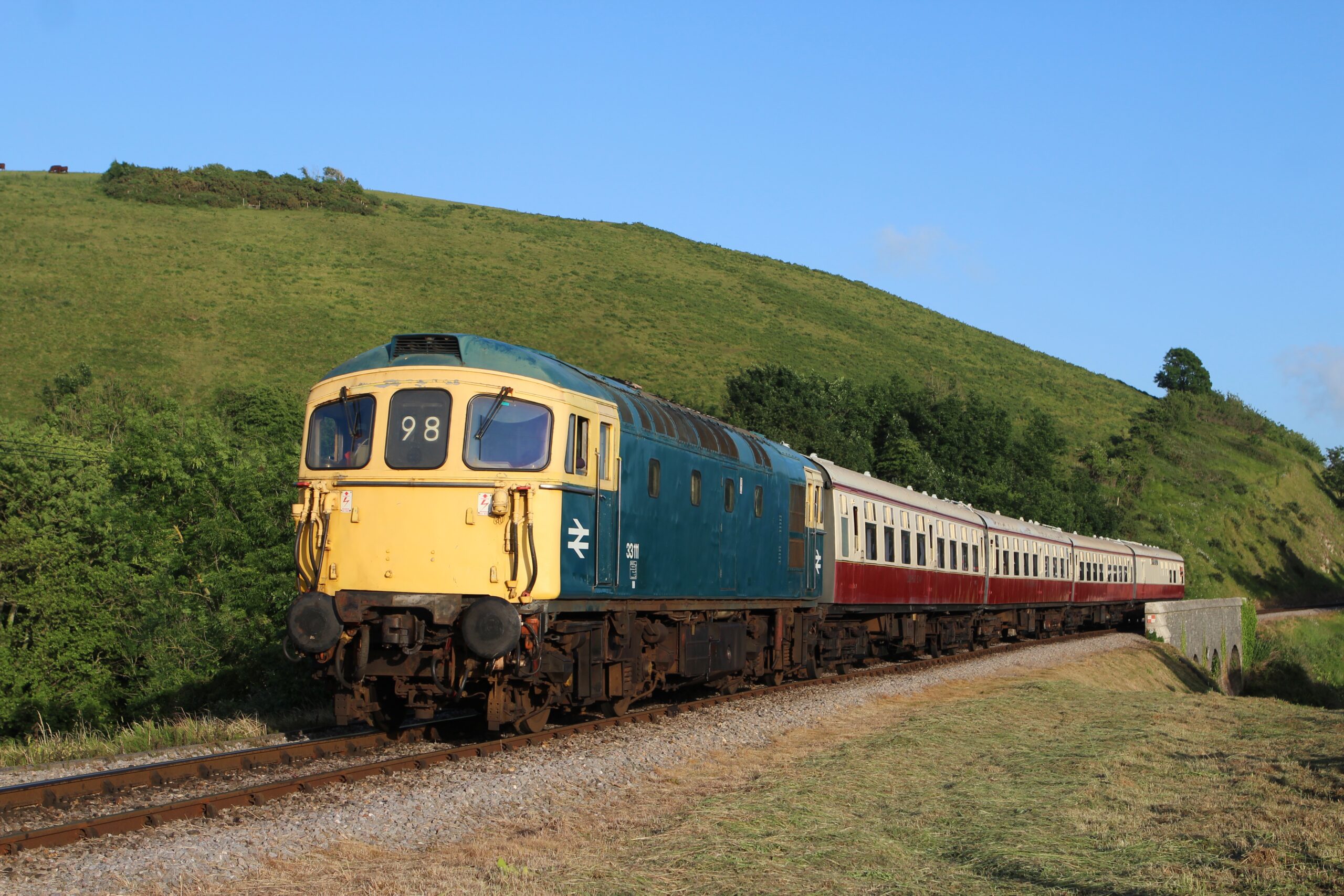
Sister locomotive Class 33/1 No. 33111 experienced difficulties earlier on Friday and has had to be withdrawn from service pending repairs. Hopefully she won’t be out of action for too long. In the meantime, during the steam ban which resulted from the recent spell of dry weather, Swanage are employing their Diesel Multiple Unit set to run services in conjunction with No. D6515 with steam expected to return on Wednesday 17th August 2022.
*A note about British Rail diesel & electric locomotive numbering. Upon introduction as part of the 1950’s “Modernisation Plan”, diesel locomotives carried one to four-digit numbers prefixed with a letter ‘D’, and electric locomotives with a letter ‘E’. With a move to computerisation all locomotives were renumbered so they could be logged on the Total Operating Processing System (TOPS) which recorded the maintenance history of locomotives and rolling stock, along with its allocation to division and depot and duty, its current status, its location etc. Locomotives were numbered in a consecutive series in terms of classification with the first two or three digits used to denote the class of locomotive or multiple unit. Sub-classifications were indicated in the TOPS system with a slash and a subclass number. For example Birmingham R.C.&W. Co Type 3 Bo-Bo No. D6515 became Class 33/0 No. 33012.
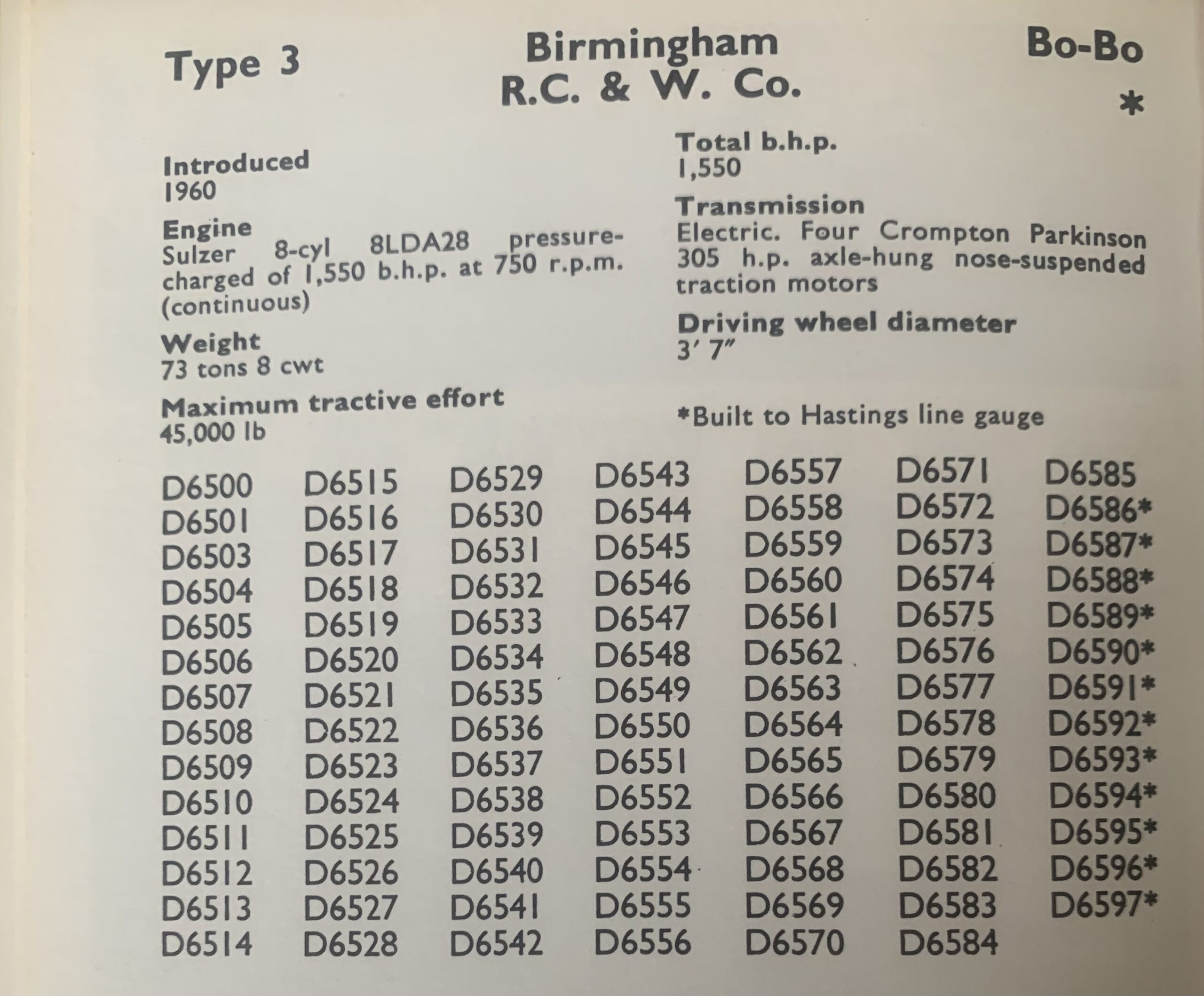
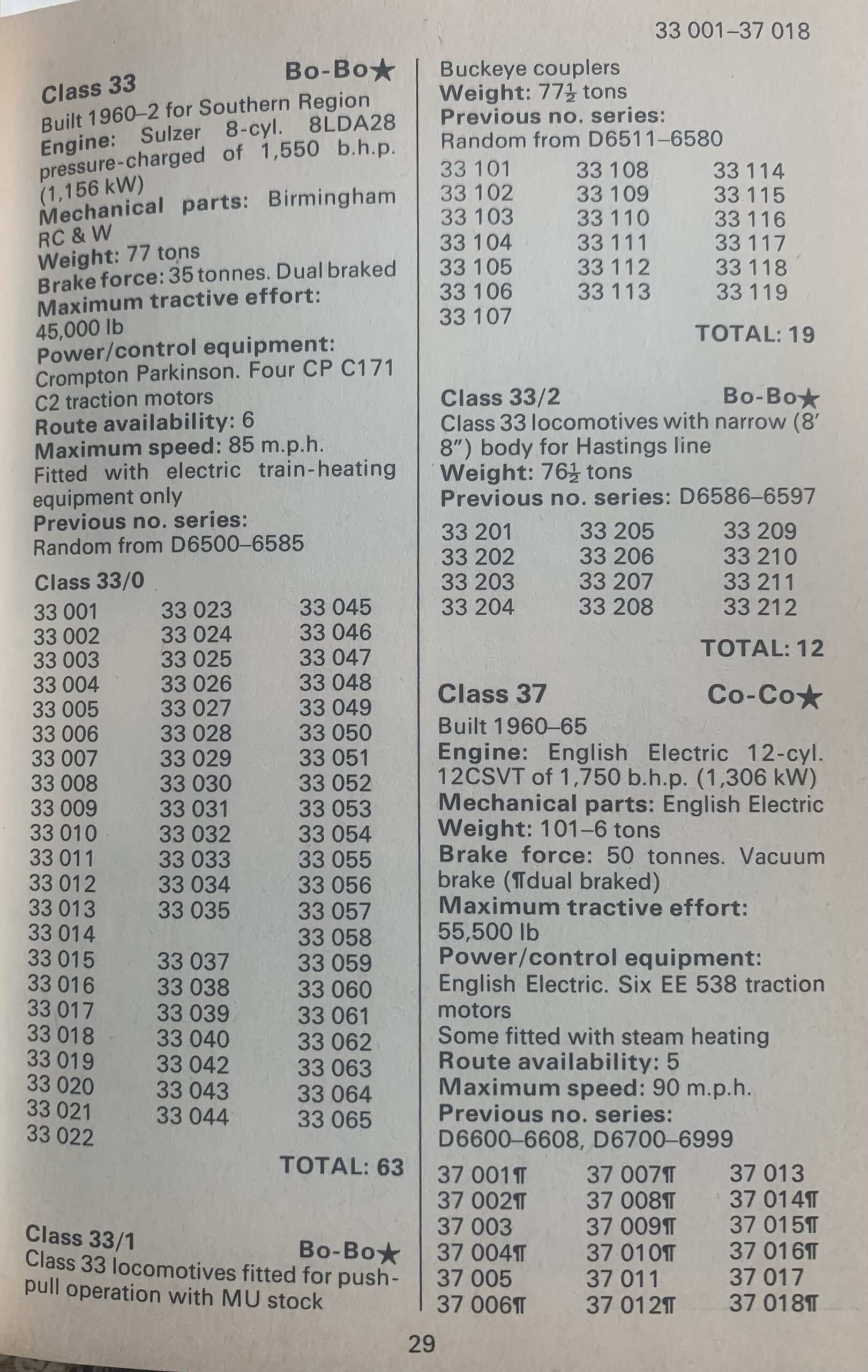
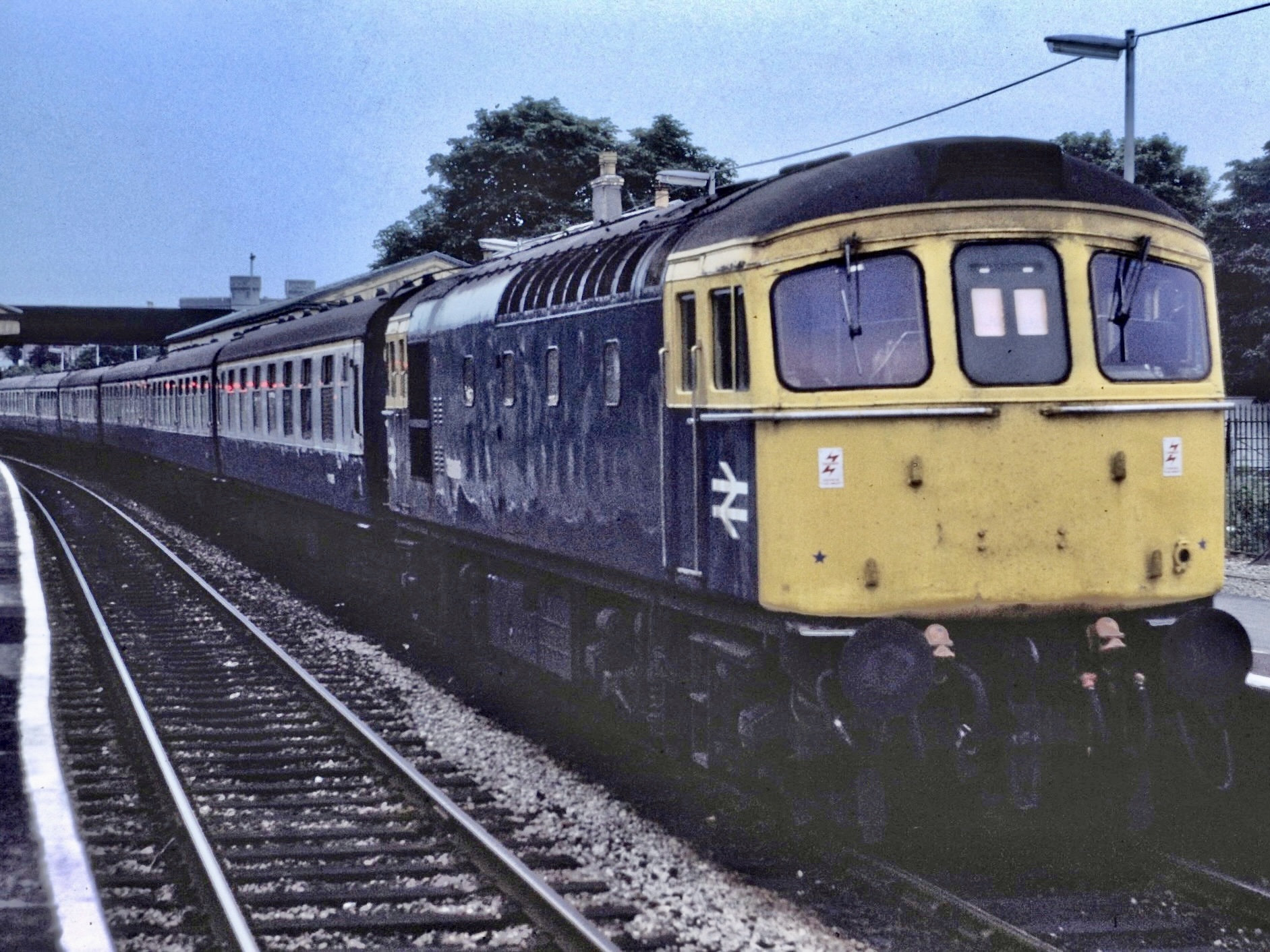
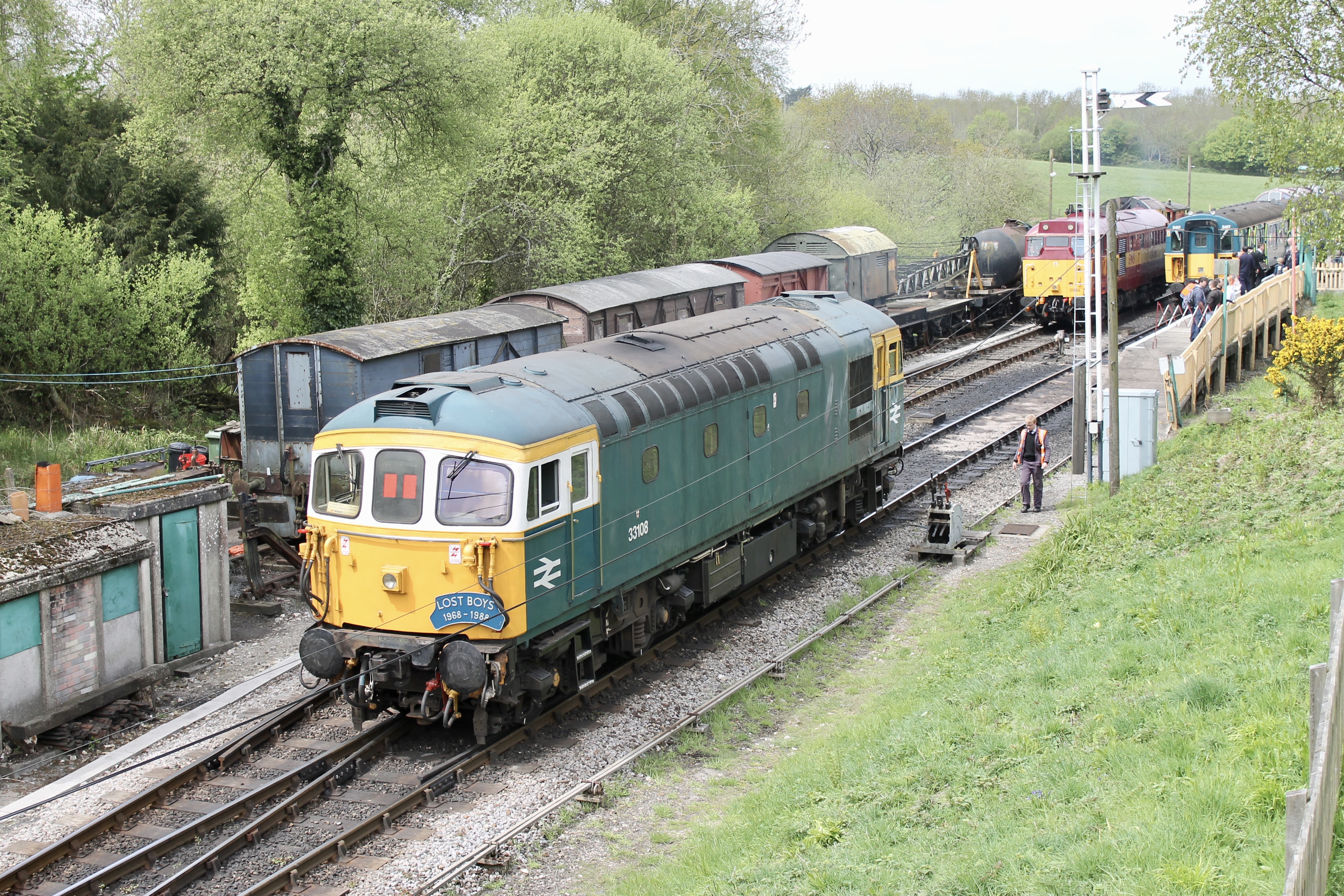
Ian Allan were well known for publishing books of locomotive numbers for train spotters who could tick off or underline the examples they had seen. Here is the B.R.C&W Type 3 fleet list as at August 22nd 1966 published in “British Rail Locomotives And Other Motive Power”. As you can see D6502 is missing from this list, having already been withdrawn following an accident in 1964The Class 33’s divided into sub classes as seen from the 1980 edition of Ian Allan’s “British Rail Motive Power Combined Volume”Class 33/0 No. 33016 with a Bristol to Weymouth service at Dorchester West – 25/06/1981Class 33/1’s were modified for push pull operations on the un-electrified Bournemouth to Weymouth line and can be easily identified by their high-level brake pipes and jumper cables. They were originally going to be classified Class 34 under TOPS, but instead sensibly became a Class 33 sub-class. No. 33108 is seen at Norden on the Swanage Railway taking part in the 2013 diesel gala backing onto 4VEP EMU No. 3417 ‘Gordon Pettitt’. Class 31 No. 31466 can be seen in the background. No. 33108 is currently undergoing repairs to bodywork and traction motors at the Severn Valley Railway – 12/05/2013A batch of twelve locomotives were built with narrow bodies to enable working through narrow tunnels between Tunbridge Wells in Kent and Hastings in Sussex. These became Class 33/2 under TOPS and were nicknamed “Slim Jims” by enthusiasts. West Coast Railway Co. No. 33207 ‘Jim Martin’ is photographed in the sidings at Poole – 11/06/2011
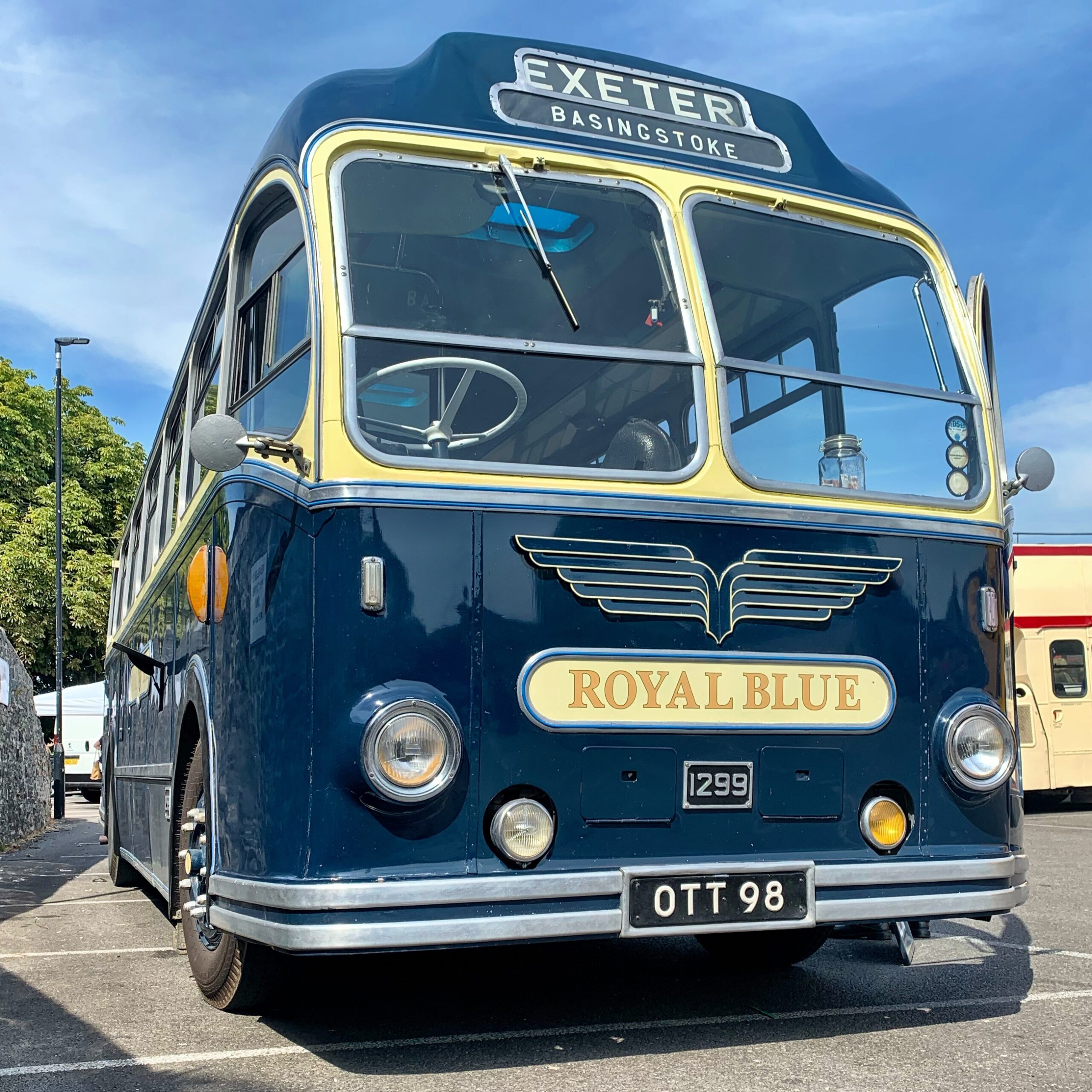
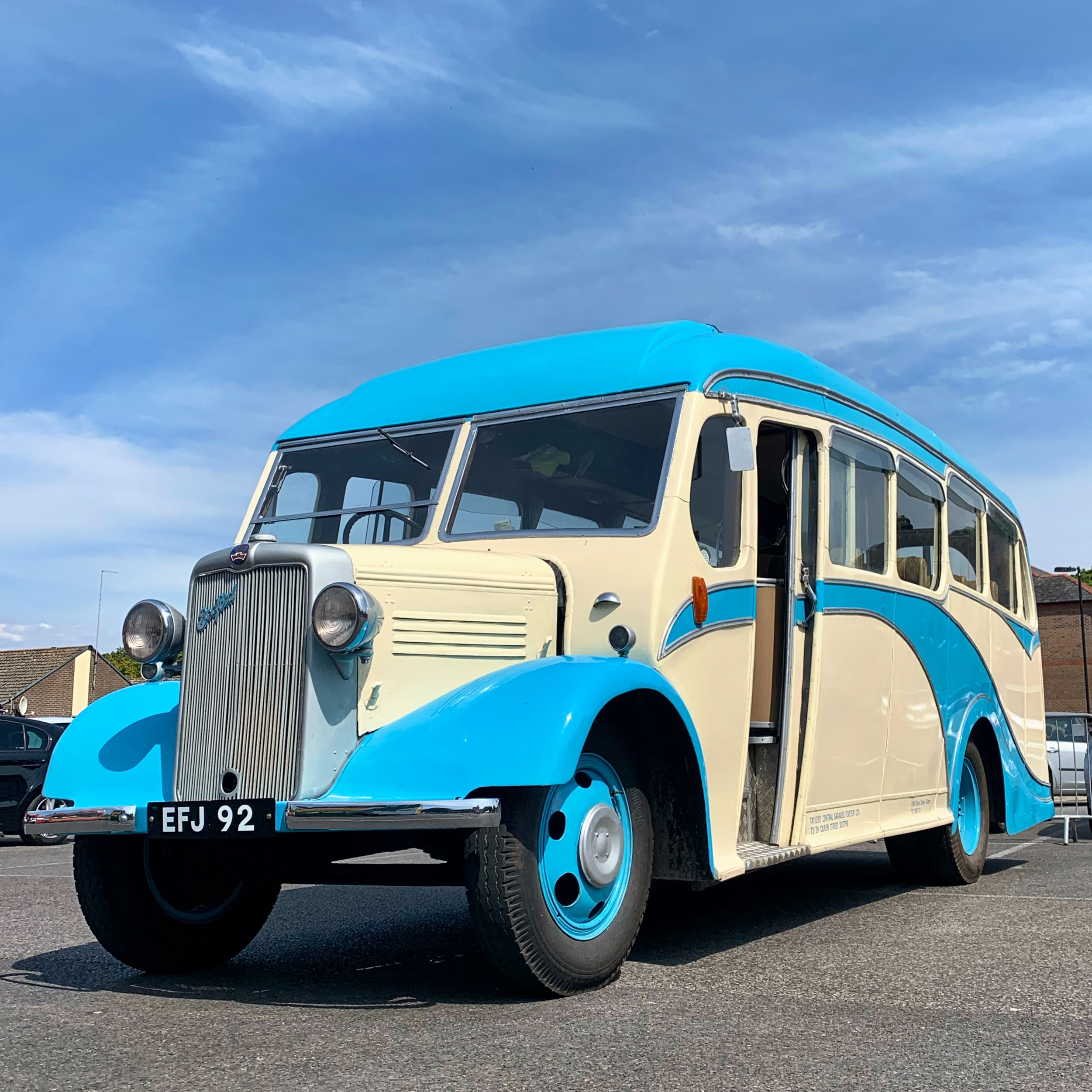
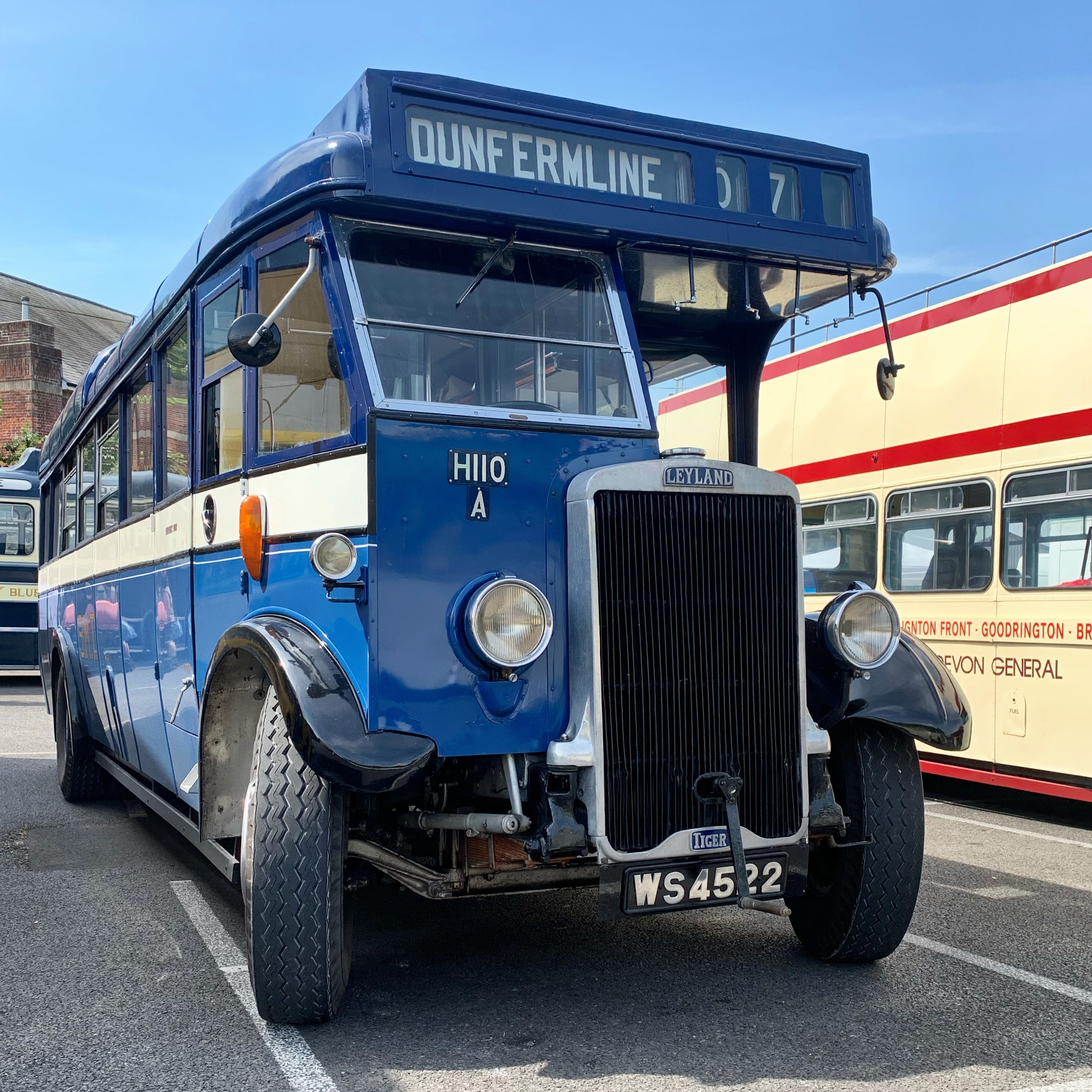
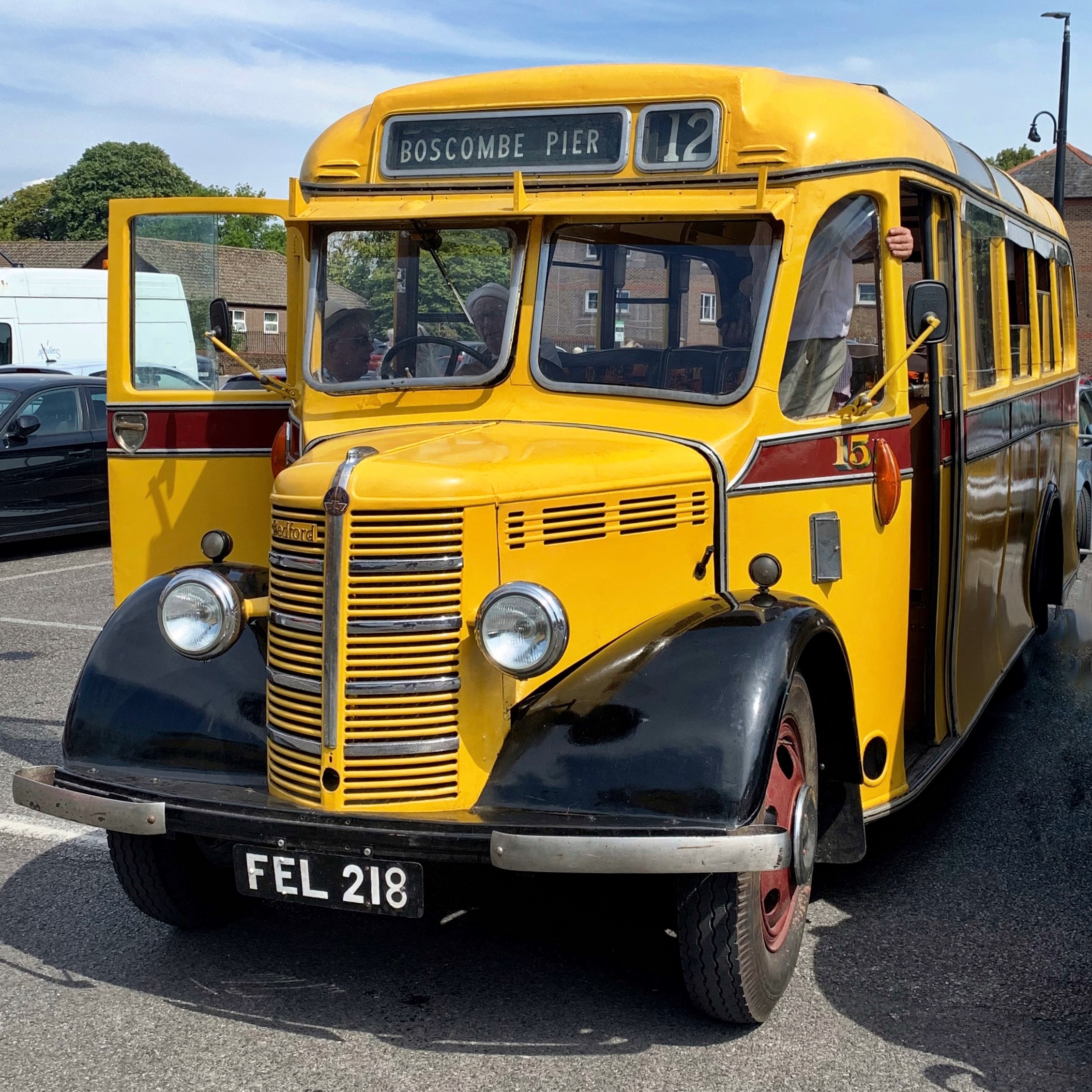
I made a quick visit to Top o’ Town car park in Dorchester for The West Country Historic Omnibus & Transport Trust Dorchester Running Day on Sunday 14th August 2022. Although a smaller concern than in pre-covid times, it was still great to see these old vehicles making trips around town or on static display. It was far too hot to take Yoshi with me and he remained at home where it was much cooler for him.
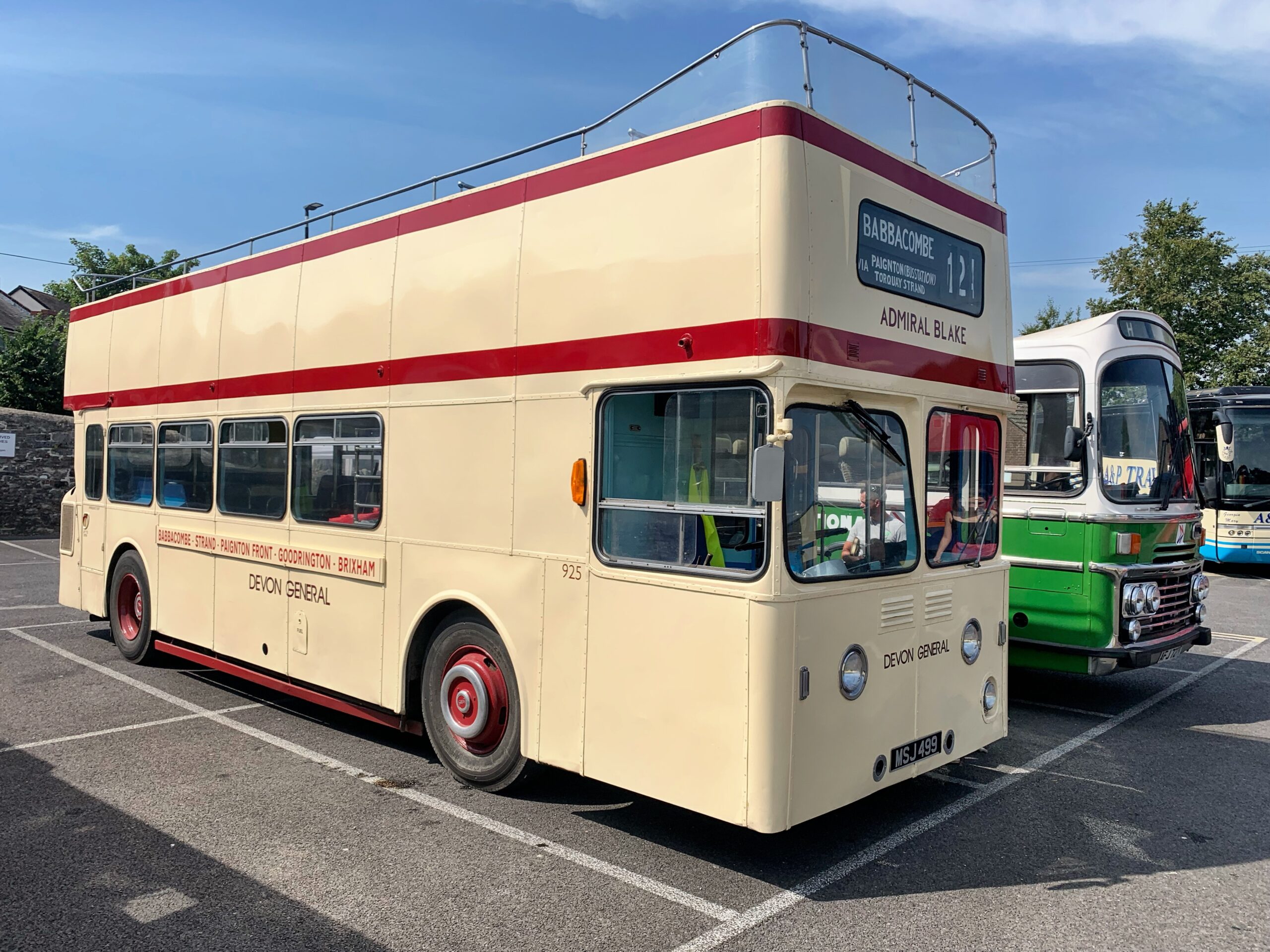
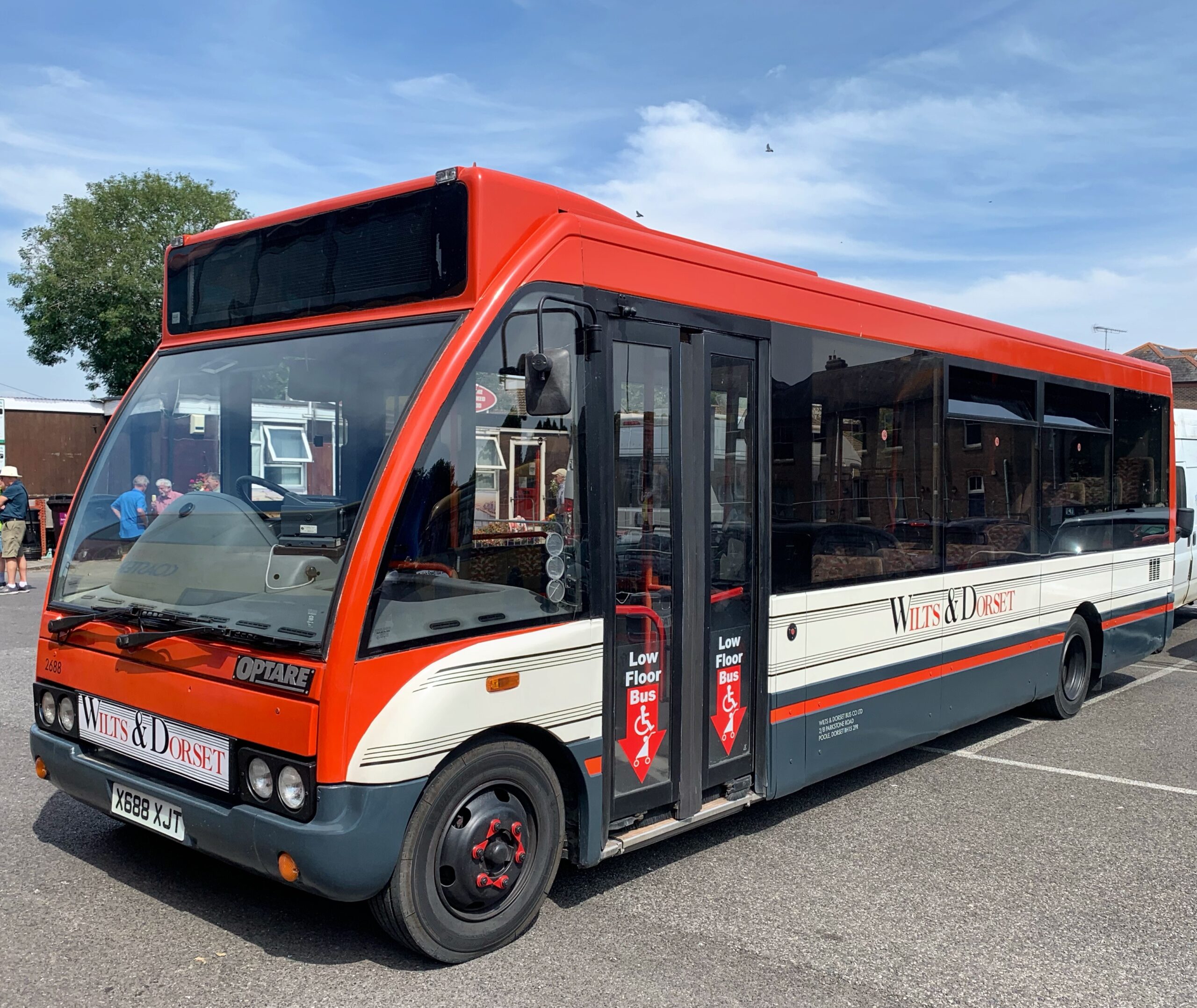
Perhaps my favourite bus / coach is OTT 98 a Bristol/ECW LS6G integral coach. She was delivered to Southern National in 1953 and given the fleet number 1299 for working as part of the Royal Blue fleet from Bournemouth in 1969. I remember her from her Dorset Transport Circle days and associated trips out – 14/08/2022EFJ 92 a Bedford WTB with Heaver C25F body – delivered new to Taylors Central Garage (Exeter) Ltd in June 1938. Sold to Vic’s Tours of St. Mary’s on the Scilly Isles and operated until 1971 when she entered preservation – 14/08/2022WS 4522, a 1935 Scottish Motor Traction Co. (SMT) H110 Cowieson bodied Leyland Tiger TS7 – 14/08/2022FEL 218; Bournemouth Corporation Bedford WTB Duple B25F – 14/08/2022Preserved former Yellow Buses N465 TPR Dennis Dart with East Lancs body and H262 MFX Dennis Dominator with East Lancs body – 14/08/2022“Sea Dog” MSJ 499 a Leyland Atlantean PDR1 with open top Metro-Cammell body was delivered new in 1961 to Devon General and named ‘Admiral Blake’. She reminds me of my time working in Torquay in the mid-1980’s, not that I had much time to enjoy the local area! After she finished carrying passengers around the Devon coast she was sold to Yellow Buses in Bournemouth and used as a tree lopper before entering preservation in 2006 – 14/08/2022X688 XJT an Optare Solo M850 from 2000 in original Wilts & Dorset livery spent some years as a Tesco free bus – 14/08/2022
From The Archive
This week in….
2019: Saturday 10th August 2019, 8 month old Yoshi and I took a trip out to see SR Merchant Navy No. 35028 ‘Clan Line’ working UK Railtours “The Atlantic Coast Express” which originated from London Waterloo and took in Salisbury, Exeter, Bristol and Bath. It was around this time when I really renewed my latent enthusiasm in railways after several years of having only a passing interest.
Clan Line on “The Atlantic Coast Express” 1Z82 0752 London Waterloo to Exeter St Davids and 1Z84 1550 Exeter St Davids to London Waterloo – 10/08/2019
The following day, Sunday 11th August 2019, saw two special excursion trains visit Dorset. We saw “The Northern Belle” top and tailed by WCRC Class 57 No.’s 57601 ‘Windsor Castle’ and 57314 at Dorchester followed by a trip to Holton Heath to see the return working along with a glimpse of Class 73 No.’s 73107 ‘Tracy’ and 73201 ‘Broadlands’ working “The Swanage Sunday Special No.3”.
Thursday 15th August 2019 saw LNER Thompson Class B1 No. 61306 ‘Mayflower’ and WCRC Class 47 No. 47802 working a Steam Dream Rail Company “Cathedrals Express” excursion from West Brompton to Weymouth and return. In between arrival and departure of the special train, Colas Rail Class 37 No. D6757 (37057) also visited the seaside terminal with a Network Rail test train.
2010: The Railway Touring Company ran “The Dorset Coast Express” on Wednesday 11th August 2010. The train departed London Victoria at 0845 and was hauled down to Weymouth by LNER A4 4-6-2 No. 60019 ‘Bittern’ which I saw pass through Bournemouth. The return working to London Waterloo was headed by SR N15 King Arthur Class 4-6-0 No. 30777 ‘Sir Lamiel’ with the A4 providing banking assistance at the rear until Wareham which is where I filmed the ensemble. The A4 was detached and then ran with her support coach to Yeovil Railway Centre at Yeovil Junction.
That brings us to the end of another entry, this week the Railway Dog blog was mostly put together to the sounds of The Who, Lily Williams and Yoshi barking at anyone moving outside. We really appreciate you stopping by and reading the blog and watching the video clips. As always, comments, suggestions and corrections are welcomed and thank you to everyone who has helped out in some way. We look forward to seeing you again next week.
DB Cargo Class 67 No. 67025 in operation with Transport for Wales waits departure at Crewe with 5K67 0951 Holyhead Car. M.D. Empty Coaching Stock working to Crewe C.S. – 16/07/2022
Fleetwood
The North Euston Hotel, Fleetwood
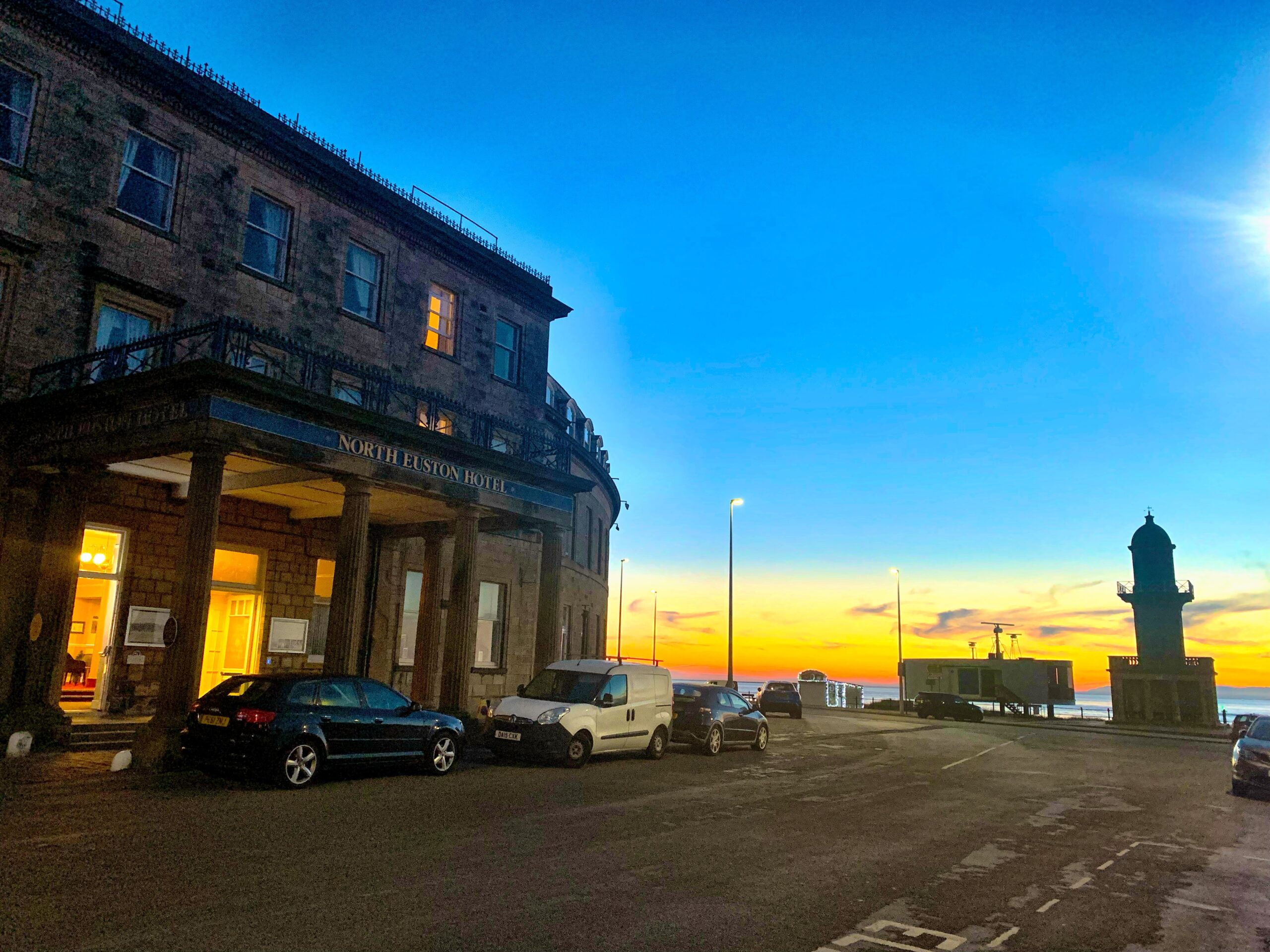
Yoshi and I spent much of last week in the North West of England as we made The North Euston Hotel in Fleetwood our base. The hotel was commissioned by Sir Peter Hesketh Fleetwood, designed in the Greek classical style by architect Decimus Burton and built between 1839 and 1841 to serve overnight passengers making the journey by rail from London Euston who were destined for steam ships which would provide onward travel to Scotland where after disembarking at Ardrossan they would take the train on to Glasgow. Fleetwood was the northern most station at the time, hence the name “North Euston” for the hotel, and the railway was yet to run over the Shap hills. Queen Victoria made the journey in 1847 and stayed at the hotel, although I’m sure she didn’t stay in our room. The first manager of the hotel, Corsican born Xenon Vantini, had been a courier for Napoleon Bonaparte and was also the first person to open a refreshment room at Wolverhampton railway station. In 1859 following a decline in fortunes, the hotel was sold to the government and was converted into a school of musketry and later, in 1867, an officer’s quarters. The building existed in this form until the 1890’s when it was purchased by a group of London businessmen who converted it back into a hotel. The North Euston is currently owned by local business families. Yoshi very much enjoyed his morning sausage for breakfast and we celebrated our dubious achievement of coming last in the Sunday evening pub quiz which was a lot of fun.
The railway to Fleetwood was opened on 15th July 1840 as the Preston & Wyre railway and was also the vision of Sir Peter Hesketh Fleetwood it being designed to connect the then new port of Fleetwood on the Fylde coast to Preston. The railway was constructed by George and Robert Stephenson with contribution from Joseph Locke. Its glory days lasted only six years until a direct route over Shap was finally achieved. The railway was absorbed into the Lancashire & Yorkshire Railway ( later the London Midland Scottish Railway as part of the Big Four groupings in 1923) and extensions were built to Blackpool and Lytham to cater for the growing number of passengers traveling to the seaside. Fleetwood would become, for a time, one of the largest and most successful fishing ports in the UK but by 1970 the railway from Poulton-le-Fylde to Fleetwood was closed to passenger traffic and later, in 1999, to freight workings.
Thornton Station is located in the heart of Thornton town centre – July 2022Until the late 1980’s a signal box operated the crossing over Station Road, Thornton – July 2022The current station buildings were the first built by the then newly formed London Midland Scottish Railway (LMS) in 1927 – July 2022
In 2006, the Poulton & Wyre Railway Society was formed with the aim of reopening the railway. Since then, much work has been carried out in clearing sections of the line from the ingress of nature and a Class 108 Diesel Multiple Unit was purchased for restoration and use on the line. More recently, the Poulton-Le-Fylde to Fleetwood line was subject to a study as part of the UK Government’s Restoring Your Railway programme. In June 2022 it was announced that the scheme should progress further and Network Rail will receive funding to produce a detailed plan for the revival of services. The Poulton-Le-Fylde & Wyre Railway Society have now turned their attention to developing a heritage railway centre which will eventually house a collection of railway artefacts and memorabilia for public viewing.
Churnet Valley Railway
Having heard that Class 33/1 No. 33102 was hauling trains, Yoshi and I spent Tuesday morning ( 12th July 2022 ) visiting Cheddleton on the Churnet Valley Railway, a preserved heritage line in Staffordshire. I grew up with 33/1’s providing the daily motive power on local passenger services between Bournemouth and Weymouth, and even though No. 33111 lives on at Swanage, our local heritage railway, it was fantastic to hear the Crompton’s Sulzer engine at work hauling a passenger train.
The Churnet Valley railway dates back to 1849 following the formation of The North Staffordshire Railway Company (NSR) in 1845. Falling passenger numbers saw the Beeching Report include the Churnet Valley line and its associated branches which became earmarked for closure with the final section from Leek Brook Junction to Oakamoor quarry lasting out until the late 1980’s as it was used for freight traffic. In 1992 the newly formed Churnet Valley railway (1992) PLC began talks with the Department of Transport with a view to operate the line. Trains currently run between Froghall and Ipstones, but the ambition is to run services into the Staffordshire market town of Leek for the first time since 1965. And they have an eye on the clock to achieve this as the railway needs to run its first passenger train into Leek by 1st December 2022 or lose a £1.4m EU grant. This means all track must be laid on the 0.5 mile extension, with additional resources being provided for a triangle at Leek Brook Junction, and a platform constructed at Leek. It really is a very picturesque railway with extremely friendly volunteers, Yoshi and I were escorted around the workshops to get a closer view of locomotives stabled there, and I wish them every success with their endeavours and look forward to a return visit in the future.
Cheddleton Station which was to be demolished in April 1974 but saved by the actions of local businessman and parish councillor Norman Hancock who parked his car on the level crossing preventing access to bulldozers giving sufficient time for the building to be Grade II listed – July 2022Cheddleton Station – July 2022Time for a cuppa! Yoshi waits for the kettle to boil in the booking hall of Cheddleton Station – July 2022Class 33/1 No. 33102 ‘Sophie’ awaits departure from Cheddleton – 12/07/2022Class 20 No. D8057 (20057) sits outside the repair shed at Cheddleton – 12/07/2022S160 Class 2-8-0 No. 5197 was built by the Lima Locomotive Company in Ohio, USA and exported to China in 1946. The United States Army Transportation Corps Class S160 were designed for heavy freight work across Europe during World War 2 with a total of 2,120 being built they eventually worked all over the world – 12/07/2022Class 25 No. 25322 ‘Tamworth Castle’ was the final Class 25 locomotive to see mainline service with British Rail. She is currently in store at Cheddleton Yard awaiting restoration – 12/07/2022Yoshi inspects Class 33 No. 33021 ‘Eastleigh’ in Post Office Red style livery. This locomotive was amongst the first privately owned diesel locomotives to be used on the mainline – 12/07/2022The Churnet Valley Railway has acquired Class 47 No. 47292 for an initial loan period of five years supplementing Class 33 No.’s 33021 and 33102 for use on passenger trains – 12/07/2022
On our way back to Fleetwood, we stopped off at Acton Bridge for an hour or so, primarily to capture Class 37 No. 37884 which was diagrammed to pass through with 0M58 Kilmarnock Long Lyes T.C. to Derby R.T.C. – which can be seen in the video below:
Southport
On the Wednesday, Yoshi and I took a trip on a heritage Blackpool Tram – more about that adventure next week – but first that we made a brief visit to Southport and Formby. Southport railway station is the terminal of the Southport branch of the Northern Line of the third-rail electric Merseyrail network, and the diesel-operated Manchester to Southport line. The station and services to Liverpool and Hunts Cross are operated by Merseyrail, with Manchester services operated by Northern Trains. The current station opened as Southport Chapel Street on 22 August 1851 and once boasted eleven regular platforms and two excursion platforms. Six truncated platforms are now in use (platforms 1-3 for Liverpool trains and 4-6 for Manchester services), the remainder having been demolished to make way for car parking. In 1970 the former terminal building was replaced with a shopping centre.
New Stadler Class 777 trains are currently being tested, and one was scheduled to visit Southport that morning on test run. Despite the best attempts at numerous roadworks and traffic queues, we made it just in time to see Class 777 No. 777015 arriving. Members of The National Union of Rail, Maritime and Transport Workers ( RMT – what these initials mean was one of the pub quiz questions I actually answered correctly! But I digress…. ) Anyway to continue; RMT members recently voted in favour of the proposed crewing plans for the new fleet which brings a five-year dispute to its conclusion. Merseyrail still has to reach agreement with the drivers union, the Associated Society of Locomotive Engineers and Firemen (ASLEF), but intends to introduce the new Class 777’s into service later this year. Currently, 17 out of the 53 units purchased have been delivered to the UK. The arrival of the Class 777 fleet will see the demise of both the Class 507 and 508 electric-multiple units (EMU’s).
The Class 507’s were built to work on Merseyside, replacing the London Midland Scottish Railway (LMS) built Class 502 units on Northern line services from Liverpool to Southport, Ormskirk and Kirkby. 33 sets were built by British Rail Engineering Limited (BREL) in York from 1978 to 1980 followed by 43 Class 508s constructed between 1979 and 1980. They were the second and fourth variety of BR’s then standard 1972 design for suburban EMU’s, which were derived from the prototype 2PEP and 4PEP EMU’s introduced in 1971 and eventually amassed 755 vehicles across five Classes (313/314/315/507/508). Originally, the Class 508’s were built as 4-car units for the Southern Region of British Rail working out of Waterloo on former London South Western Railway (LSWR) routes. From 1982 to 1984 they were reduced to 3 car units (one of the trailer cars was removed to be incorporated into the Class 455/7 EMU’s) and transferred to Merseyside to replace the former LMS Class 503 units that operated Wirral line services to New Brighton, Rock Ferry and West Kirby. Following rail privatisation the two fleets became interchangeable and work both sides of the Mersey. They are the oldest EMU’s still working in the UK after the Class 313’s.
Yoshi with Merseyrail Class 507 No. 507020, Southport – 13/07/2022Yoshi compares the differences between EMU’s with a study of Merseyrail Class 508 No. 508140, Southport – 13/07/2022Merseyrail Class 777 No. 777015 having arrived with 5T02 0917 Sandhills Reversing Sdg to SouthportSouthport – 13/07/2022Northern Trains Class 769 No.’s 769424 & 769456 Southport – 13/07/2022Northern Trains Class 150 No. 150128 and 150134 Southport – 13/07/2022Merseyrail Class 507 No. 507020 Southport – 13/07/2022Merseyrail Class 507 No. 507020 and Class 508 No. 508131 stand side by side at Southport – 13/07/2022Merseyrail Class 508 No. 508126 at the buffer stops, Southport – 13/07/2022Merseyrail Class 777 No. 777015 awaits departure of 5T03 1008 Southport to Kirkdale C.S. Southport – 13/07/2022
Crewe
After breakfast on Thursday where we spent a few enjoyable hours watching freight movements around Crewe Basford Hall. You can relive this by playing the video below:
We returned to Dorset on Friday, eschewing the opportunity of capturing two Colas Class 37’s at rest in Blackpool North Railway Station which had worked a test train from Carlisle in the early hours. However, the next day; Saturday 16th July, I was back in Crewe, this time without Yoshi, so I could attend the Direct Rail Services (DRS) Open Day at their depot at Gresty Road. Understandably, dogs were not allowed on site, so Yoshi spent the day with his mum, while I endured the heat of the day without my fluffy sidekick. Many thanks to Scott for driving and for his company.
The Open Day coincided with LMS Coronation 4-6-2 No. 6233 ‘Duchess Of Sutherland’ passing through Crewe railway station with the Railway Touring Company’s “Cheshireman” rail tour from London Euston to Chester. (1Z86 0639 London Euston to Chester with Class 47 No. 47813 providing support at the rear). The station was extremely busy with the influx of enthusiasts in the town to visit the DRS site, but I managed to catch a short video clip of this magnificent locomotive departing Crewe. Later that day, SR Merchant Navy 4-6-2 No. 35018 ‘British India Line’ worked into Crewe light engine and support coach as 5Z46 Carnforth Steamtown to Crewe Heritage Centre for servicing ahead of rail tour duties scheduled for the following day:
Crewe 16th July 2022
3,500 people attended Nuclear Transport Solutions’ (NTS) rail division DRS’s open day, the first one to be held for a number of years because of the Covid pandemic. There were two locomotive naming’s at the event – the first saw Class 66 No. 66422 being unveiled as ‘Max Joule’ in tribute to one of DRS’s founders and former Managing Director who died in 1999. The second naming was for Class 66 No. 66424 which was named ‘Driver Paul Scrivens’ who had been a driver with DRS for more than 20 years. An emotional tribute was delivered by colleague Tim Howlett before the new plate was unveiled by Paul’s sister Emma.
The open day raised over £39,000 from sponsorship and donations which is an amazing figure that will go to deserving causes across the UK. It was a fantastic event, and I thoroughly enjoyed the experience. Because of the hot weather, DRS made bottles of water available at points across the site, which was very welcome.
Locomotives on display were:
Class 37 No. 37218 in retro DRS livery – 16/07/2022Class 37 No. 37401 ‘Mary Queen Of Scots’ – 16/07/2022Class 37 no. 37419 ‘Carl Haviland’ – 16/07/2022Class 37 No. 37425 ‘Concrete Bob’ – 16/07/2022Class 68 No. 68025 ‘Superb’ – 16/07/2022Class 57 No. 57312 – 16/07/2022Class 88 No. 88002 ‘Prometheus’ – 16/07/2022Class 68 No. 68006 ‘Pride of the North’ in special green livery showcasing the environmental benefits of rail freight and how a diesel locomotive can reduce emissions by using Hydrotreated Vegetable Oil (HVO) fuel – 16/07/2022Class 66 no. 66303 ‘Rail Riders 2020’ – 16/07/2022Class 68 no. 68009 ‘Titan’ – 16/07/2022Class 66 No. 66422 ‘Max Joule 1958-1999’ – 16/07/2022Class 66 No. 66424 awaits its naming ceremony – 16/07/2022Class 57 No. 57304 – 16/07/2022Class 88 No. 88009 ‘Diana’ – 16/07/2022Class 66 No. 66429 – 16/07/2022Class 37 No. 37424/37558 ‘Avro Vulcan XH558’ – 16/07/2022Class 88 No. 88001 ‘Revolution’ – 16/07/2022
On our way to the DRS Open Day, we stopped off at Longport to peer through the fence at Electro-Motive Diesel Limited’s (EMD) site and witnessed some shunting around of locomotives, mainly Class 56 / Class 69 conversions which are ongoing.
With 69006 stencilled on the bodyside, the conversion of 56128 is almost complete. Longport – 16/07/2022The empty shell of Class 56 No. 56032 awaiting a second move to Marcroft Engineering with 69007 ( ex-56037 ) in the background – 16/07/202256038 is being converted into 69008 and is still on accommodation bogies but some of its new innards are in place. An extra hole has been cut in the cab front ends to accommodate an additional connection with this locomotive likely being the first for use by the GBRf Rail Services sector which handles stock movements – 16/07/2022Class 56 No. 56009 sits in the yard at Longport. The locomotive was unofficially renumbered No. 56201 when it was converted for use as an engineering test bed by Brush Traction in order to assess refurbished Paxman engines of sister class members – 16/07/2022Former DB Cargo UK Class 66 No. 66048 rests on accommodation bogies at Longport. The locomotive was damaged when it derailed at Carrbridge in January 2010 and it ended up down an embankment. It was sold to EMD in March 2016 after being initially disposed of for scrap. It’s unclear what the future holds for this Class 66 locomotive – 16/07/2022
On our way home we diverted to Keynsham to refuel the car and restock with drinking water. Fortuitously, Class 37 No.’s 37901 and 37800 were scheduled to pass through top and tailing an Eastleigh Works to Swansea Landore stock move consisting of a Great Central-liveried Mk4 set and an LNER-liveried Mk4 set (5Q79 1826 Eastleigh Arlington to Landore). This made a fantastic epilogue to the day!
Class 37 No. 37901 heads an Eastleigh Works to Swansea Landore stock move consisting of a Great Central-liveried Mk4 set and an LNER-liveried Mk4 set with 37800 on the rear approaches Keynsham station – 16/07/2022.
Dorset NMT
While we were away it was a quiet week on the Bournemouth to Weymouth line, with only the New Measurement Train of particular interest on the main line as far as I’m aware. HST Class 43 power car No.’s 43272 and 43257 were in charge of 1Q18 0719 Derby RTC to Bristol Kingsland Road on Wednesday 13th July 2022.
Class 43 No. 43257 sits in Weymouth station – 13/07/2022. Photograph courtesy of @da_buckley967Class 43 No. 43272 preparing to depart from Weymouth – 13/07/2022. Photograph courtesy of @da_buckley967
My brother popped out to see the NMT return through Dorchester West on its way to Bristol and his video which he captured especially for Yoshi can be seen here:
In other news, Swanage resident Class 33/1 No. 33111 headed off by road to the Mid Hants Railway (MHR) to participate in their 2022 diesel gala. I had considered visiting the MHR on Sunday, but felt it was far too hot for Yoshi to be out and about, so we decided to stay home and catch up on some gardening.
The recent heat wave also resulted in speed restrictions being imposed on main line services by South Western Railways (SWR), including those on the Bournemouth to Weymouth line, with the increased risk of tracks buckling. Reduced services were introduced on Monday 18th and Tuesday 19th July 2022 in a bid to give passengers certainty over which trains would run. There was also a steam ban imposed by many heritage railways and on the main line. This includes the Railway Touring Company’s “Dorset Coast Express” excursion to Weymouth on Thursday 21st July which will now be diesel hauled throughout.
Great Western Railways were under fire in the local press this week, when the Dorset Echo reported chaotic scenes at Weymouth station where passengers were turned away from trains as they tried to return home. The 1728 departure to Bristol Temple Meads from the Dorset seaside town was formed of just two carriages meaning station staff and police had to request some travellers to wait for the next service which was due to leave an hour later. Not so long ago a High Speed Train was regularly employed to run a relief service to Weymouth via the West route on Summer Saturdays in order to cater for anticipated increased passenger numbers.
That’s all for this week – join us next time when we recount our trip on a heritage Blackpool Tram. Many thanks for reading, and for continued contributions, comment and corrections which are very much appreciated!
33111 pauses after departing Norden on the Swanage Railway Friday evening dining train – 10/06/2022
Swanage Railway
Friday evening was gloriously sunny, so Yoshi and I made the most of the light and took a drive to Swanage to see resident Class 33 No. 33111 in charge of the dining train which made two return trips between Swanage and Norden enabling diners ample time to enjoy dinner while taking in the beautiful Purbeck countryside. Class 33/1’s were part of the regular scene in my train spotting days back in the late 1970’s/ early 1980’s. On my way to school in the morning I would time my walk to coincide with the arrival of the ‘school train’ from Weymouth to Dorchester South which was regularly hauled by a 33/1 diesel locomotive hauling the passenger stock from the overnight mail train which would have arrived at the seaside terminus several hours previously. Well, that’s my recollection anyway! No. 33111 was the last locomotive of the 19 strong sub-class that I needed to ‘spot’, and therefore holds a special memory for me. I’m very pleased she survived into preservation locally.
Class 33 No. 33111 heads towards Norden – 10/06/2022
Yoshi with Class 33 No. 33111 – so as not to upset anyone of a nervous disposition, I digitally removed the fence behind Yoshi which separated him from the lineside.
On Tuesday 14th June, 71A Locomotive Group’s green liveried Class 33 No. D6515 (33012) ‘Lt Jenny Lewis RN’ along with Network Southeast liveried Class 50 No. 50026 ‘Indomitable’ returned to Swanage after their outing to guest at the Keighley & Worth Valley Railway diesel gala over the weekend. It was too hot for Yoshi to be hanging around for old diesels, so I headed off to Wareham alone. The 33/50 combo arrived around ten minutes late and a passing up service almost rendered photographic opportunities useless, but I managed to get a few snaps of the event. There’s a video below too, featuring the locomotives at Wareham on the main line and at Norden Crossing on the Swanage Railway.
71A Locomotive Group’s green liveried Class 33 No. D6515 (33012) ‘Lt Jenny Lewis RN’ along with Network Southeast liveried Class 50 No. 50026 ‘Indomitable’ pause at Wareham for a crew change working as 0Z23 0700 Dereham U.K.F. to Swanage – 14/06/2022
Portsmouth Harbour
On Saturday while Yoshi was enjoying spending a day with friends and socialising with other doggos, I was off on a family jaunt to the Portsmouth Historic Dockyards to visit The Mary Rose and to hit my head several times onboard HMS Victory. It was a lovely day, apart from the bashing my head on the low beams inside Victory bit obviously, made even better by taking the train to Portsmouth Harbour.
Portsmouth Harbour railway station first opened on the 2nd October 1876 as the terminus of Portsmouth and Ryde Joint Railway Chief Engineer Frederick Banister’s Portsmouth Waterside Extension to the Portsmouth Direct Line which runs to London Waterloo. The construction of the station replaced an earlier pier on the site called the Albert Pier that was used for passenger steamships in the mid-Victorian era. The Portsmouth and Ryde Joint Railway was a group of three railway lines in Southern England that were jointly owned and operated by the London & South Western Railway (LSWR) and the London, Brighton & South Coast Railway (LB&SCR). The main line was between Cosham and Portsmouth Harbour. There was a branch from Fratton to East Southsea; and a line between Ryde Pier Head and Ryde St John’s Road. The last-named section was isolated from the others, being on the Isle of Wight. The first section of line opened in 1847 and the last in 1885; the Southsea branch closed in 1914 but all of the other routes have since been electrified and remain open.
Portsmouth Harbour railway station was rebuilt in 1937 when the route was electrified but was almost totally destroyed during World War 2 by fire after German bombing. The station was rebuilt again after the war.
Train services to and from Portsmouth Harbour are operated by South Western Railway (SWR), Southern and Great Western Railway (GWR) – here are a selection of images taken on Saturday 11th June 2022:
GWR Class 166 No. 166210 at Portsmouth Harbour having arrived with the 1F05 0629 Cardiff Central to Portsmouth Harbour service – 11/06/2022Southern Class 377 EMU No. 377129 working 1S27 1529 Portsmouth Harbour to Brighton – 11/06/2022Class 444 No. 444018 leads fellow unit 444040 on 1P54 1545 Portsmouth Harbour to London Waterloo – 11/06/2022Portsmouth Harbour signal box was opened by the Southern Railway on the 1st June 1946. It was built to the Southern Railway Type 13 design and was fitted with a 47 lever Westinghouse ‘L’ frame.
It replaced two boxes, Portsmouth Harbour signal box which was destroyed by aerial bombing in 1941 but was not officially closed and Portsmouth Harbour signal box, a temporary box opened on 21st August 1941 to replace the bomb damaged box. Portsmouth Harbour signal box was closed on 21st April 1968 and was used as an office and a relay room for Portsmouth power signal box. After closure the lever frame was moved to the school of signalling at Clapham Junction. The building was retained as a relay room for the 1968 Portsmouth NX signalling scheme which was operational until December 2006. Network rail re-commissioned Portsmouth Harbour signal box on February 4th 2007, following serious problems with the 2006 Portsmouth re-signalling scheme. It was closed for the second time at the end of 2007 when Havant ASC was eventually commissioned.The Spinnaker Tower forms a backdrop to the entrance to Portsmouth Harbour railway station – 11/06/2022The steps leading up to the entrance of Portsmouth Harbour railway station – 11/06/2022SWR Class 450 No.’s 450053 forming the 1P56 1615 departure to London Waterloo and 450126 having worked in on the 1P43 1430 London Waterloo service at the buffer stops, Portsmouth Harbour – 11/06/2022GWR Class 166 No. 166220 waits to depart with F26 1623 Portsmouth Harbour to Cardiff Central – 11/06/2022
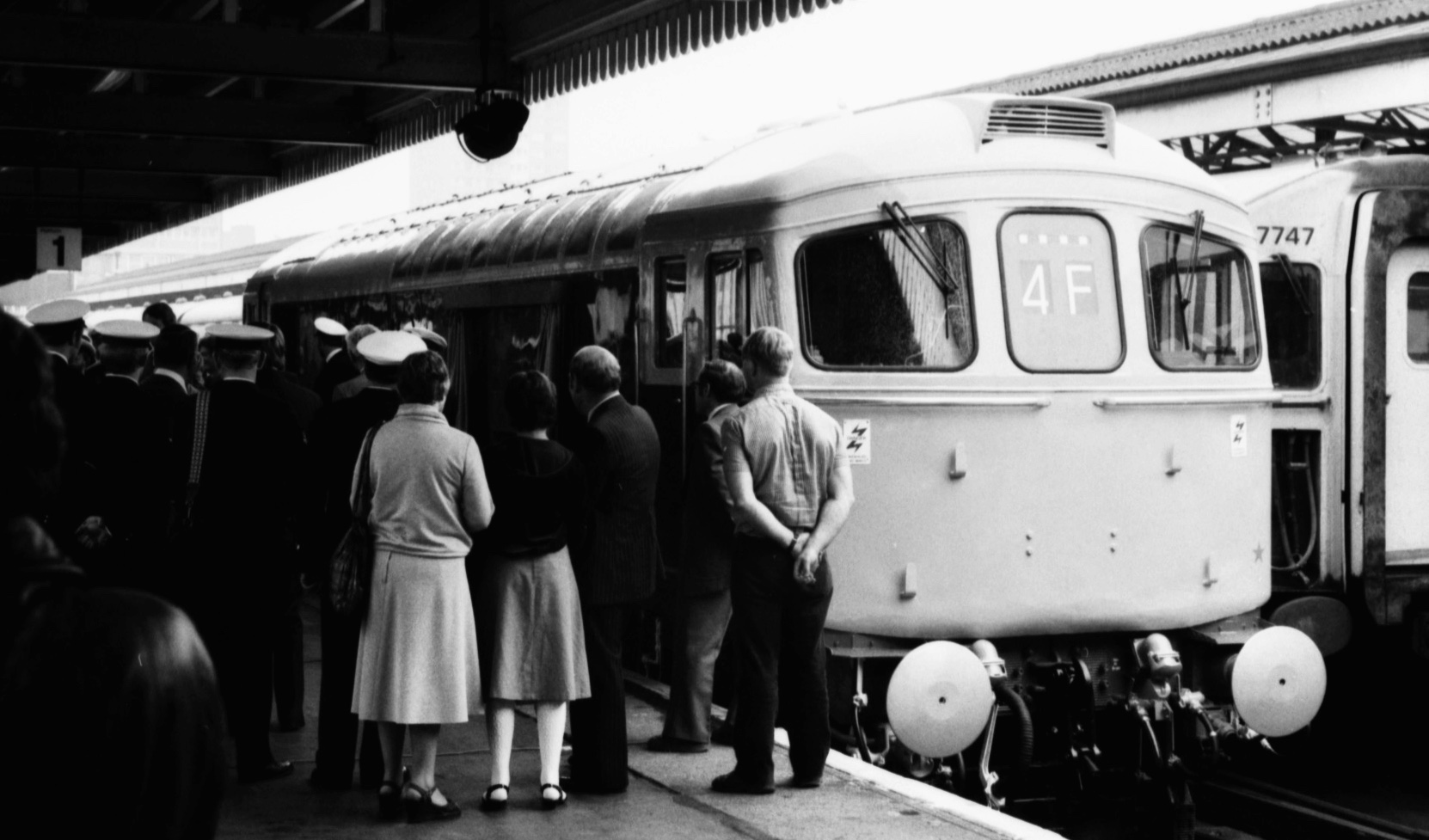
On 6th August 1981, Class 33 No. 33025 was named ‘Sultan’ during a ceremony at Portsmouth Harbour by Captain Austin Lockyer of HMS Sultan. The crests for 33025 were presented by The Royal Navy. I remember it being a wet day, not unusual for a British summer by the seaside I suppose! Here are some scans of my colour slides and black and white negatives of the day, including a couple shots taken at Southampton Central on the way to/ from the naming ceremony.
33025 ‘Sultan’ Portsmouth Harbour – 06/08/198133025 ‘Sultan’ Portsmouth Harbour – 06/08/198133025 ‘Sultan’ Portsmouth Harbour – 06/08/198133025 ‘Sultan’ Portsmouth Harbour – 06/08/198133025 ‘Sultan’ Portsmouth Harbour – 06/08/198133025 ‘Sultan’ Portsmouth Harbour – 06/08/1981BR Class 33 No. 33001 at Portsmouth Harbour – 06/08/1981Class 33 No. 33116 arrives at Portsmouth Harbour – 06/08/2022Brush Type 4 Class 47 No. 47064 pauses at Southampton Central – 06/08/1981Class 33 No. 33057 gets the road at Southampton Central – 06/08/1981
Southampton – Dorchester 175
June 2022 marks the 175th Anniversary of the Southampton to Dorchester line opening in 1847. The main driving force behind this line was Wimborne solicitor, Charles Castleman who first proposed a route by way of Brockenhurst, Wimborne, Poole and Wareham. Interestingly, one town which was not included was Bournemouth which in the early 1840’s had a population of around 200, none of whom appeared to care greatly about the new era of rail transportation. Politics of the day meant the supporters of the line courted interest from both the LSW and GW railway companies as both had interest in gaining a foothold in each others territories. The LSW to Exeter and GWR to Southampton. Weymouth was not initially included because of the projected expense of tunnelling which would be required between Dorchester and the seaside town. Eventually the GWR proposed a Wilts, Somerset and Weymouth line and it was agreed that when built the LSW should work the line between Southampton and Dorchester and the GWR from Dorchester to Weymouth.
Castleman had suggested early on that the Southampton to Dorchester route should be extended west from Dorchester through to Exeter, but in the event this didn’t happen. In part because the LSW eventually preferred to extend its Salisbury line. The Southampton and Dorchester Railway received Royal Assent on 21st July 1845 and engineer Samuel Peto was hired to construct the line, work commencing in August 1845. Castleman’s route was anything but direct, but was designed to take in most of the larger settlements on the way. This twisting route earned the nickname of Castleman’s Corkscrew.
The Illustrated London News w/e 5th June 1847 edition
The first section to be completed was between Dorchester and Ringwood but trains did not start running until the section through the New Forest was ready. Problems with the construction of a tunnel to carry the line under Southampton causing earthslips and subsidence prevented the running of through trains on opening day; 1st June 1847 and trains ran between Dorchester and Blechynden which was immediately west of the tunnel and stood further east than the present Southampton Central station.
There were originally thirteen stations on the 60.5 mile line, plus one other for Poole which was accommodated by a 1.75 mile branch and was actually located in Hamworthy. The chief engineer, William Moorson, appointed architect Sancton Wood to design a station building which could be replicated across all locations these being Blechynden, Redbridge, Lyndhurst, Beaulieu, Brockenhurst, Christchurch Road, Ringwood, Wimborne, Poole Junction (later Hamworthy Junction ), Wareham, Wool, Moreton and Dorchester.
The 1960’s saw the ‘old road’ from Brockenhurst through Ringwood and Wimborne fall under the blade of the Beeching cuts with passenger services assigned closure on 2nd May 1964, although Wimborne remained open for freight until 1977. I’m quite grumpy about not having seen any workings on this route. The last passenger to actually use Wimborne station was Her Majesty The Queen in July 1969. It is ironic that today the towns on the route of Castleman’s Corkscrew are growing conurbations and the railway would have had great potential as a commuter line. The population was already increasing when the line was closed, such is the short sightedness of planners and politicians and we are now left with the cycle and walking Castleman’s Trailway which Yoshi and I have explored in part.
An £180,000 improvement scheme has recently been completed to upgrade surfaces and access making the Trailway more accessible to a wider range of users. Drainage has been improved and much of the route has been widened. Barriers have been replaced by bollards, new signage and benches will be installed soon and verges seeded with wildflowers.
There were activities ranging from cake to dancing held at a number of stations on the Southampton to Dorchester route over the last weekend to celebrate the 175th Anniversary. Certainly something worth celebrating.
That’s just about all for from us for this week. Last weekend was also the occasion of the 2022 West Somerset Railway Diesel Gala. Because of lovely family plans we were unable to visit this year, but we’ll leave you with a couple of glimpses of one of our previous visits to the line. This was in 2019 and was coincidentally Yoshi’s first heritage railway outing!
Class 25 D7535 at Crowcombe Heathfield – 21/06/2019Yoshi meets D1010 ‘Western Campaigner’ at Williton – 21/06/2019
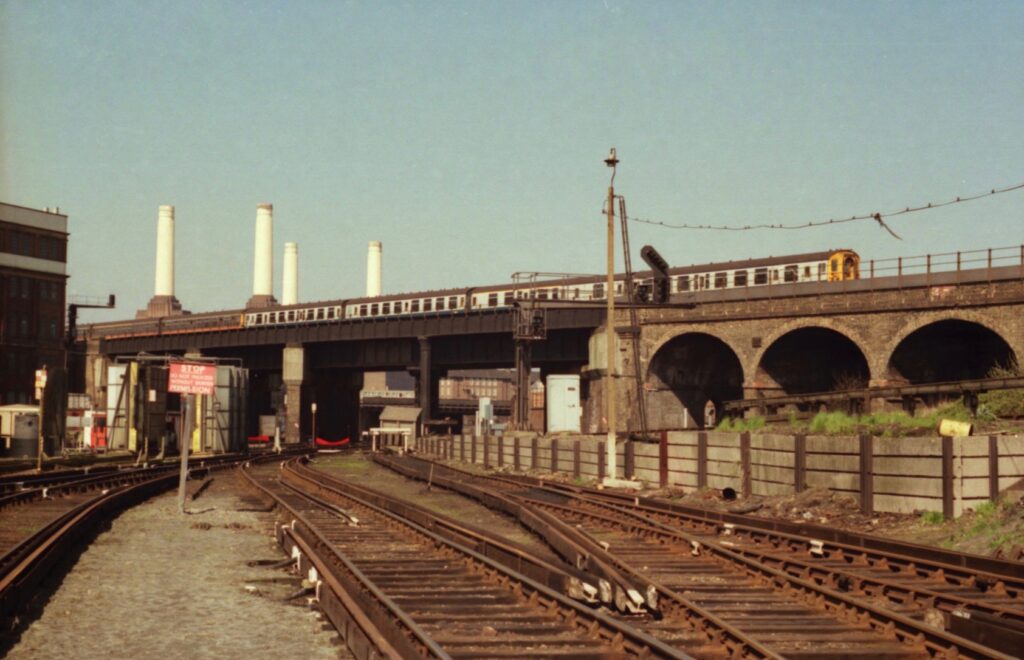
On a recent rail trip to London I was reminded of a visit to Stewarts Lane depot, a large train servicing facility near Battersea which our train passed on the way into Waterloo Station. The depot is situated amongst a maze of railway lines and when much younger it was a marker on the journey to London and a brief glimpse was afforded as we hurtled past. The site was originally a steam depot and locomotive works for the London, Chatham and Dover Railway which opened in 1862. The Lane was converted to maintain diesel and electric locomotives in the 1960’s and is currently home to both DB Cargo UK’s special trains operating unit and Govia Thameslink. In my train spotting days the depot code was ‘SL’ – you can probably work out why!
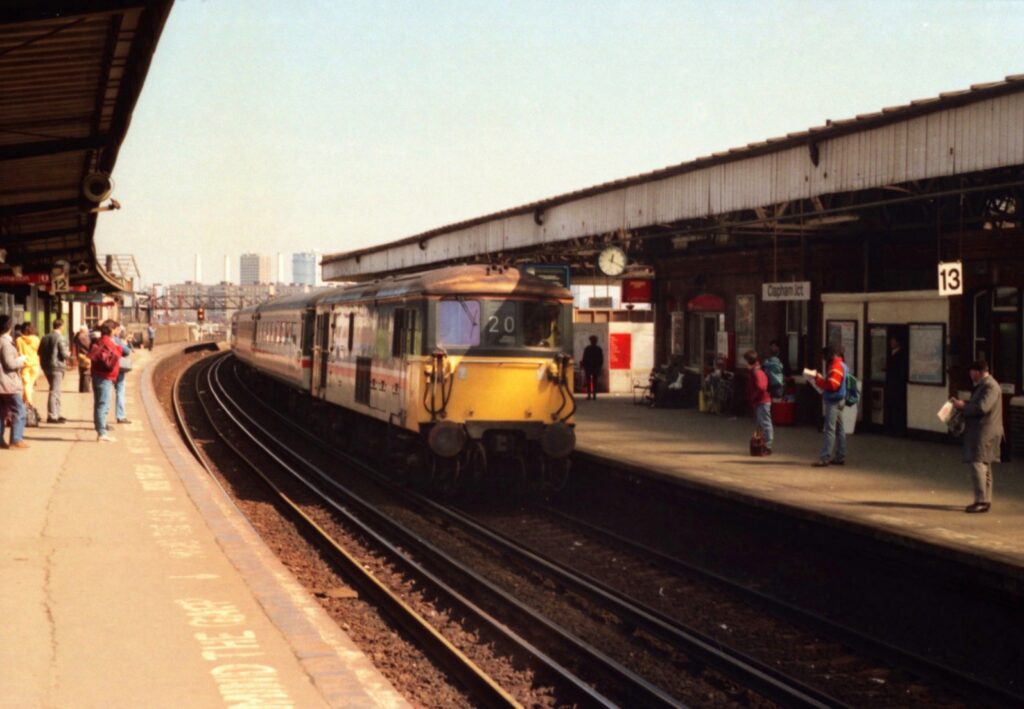
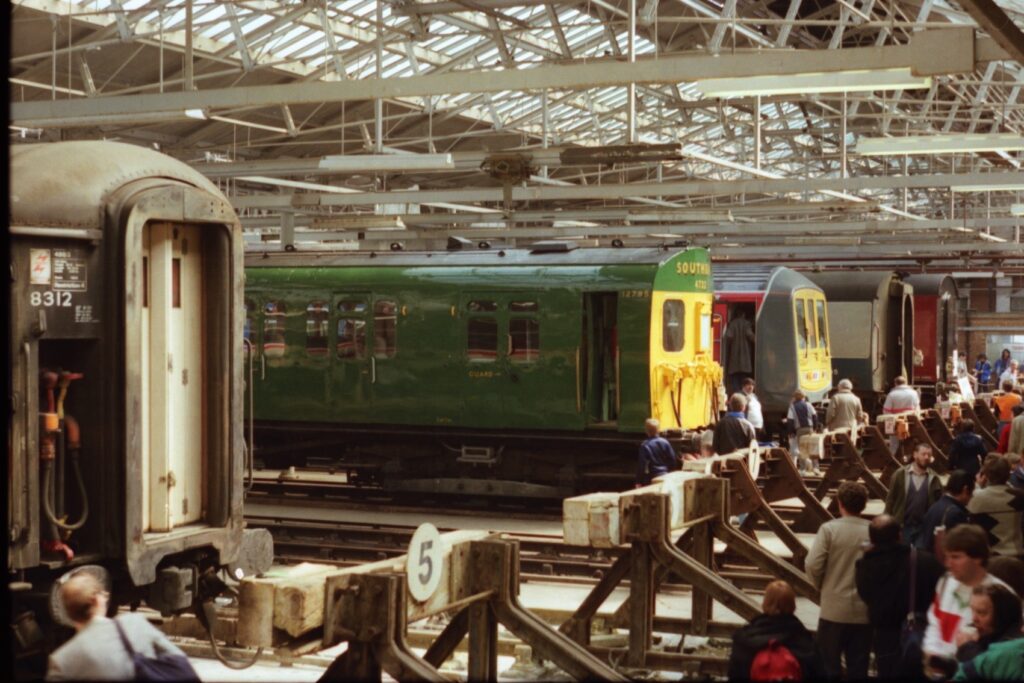
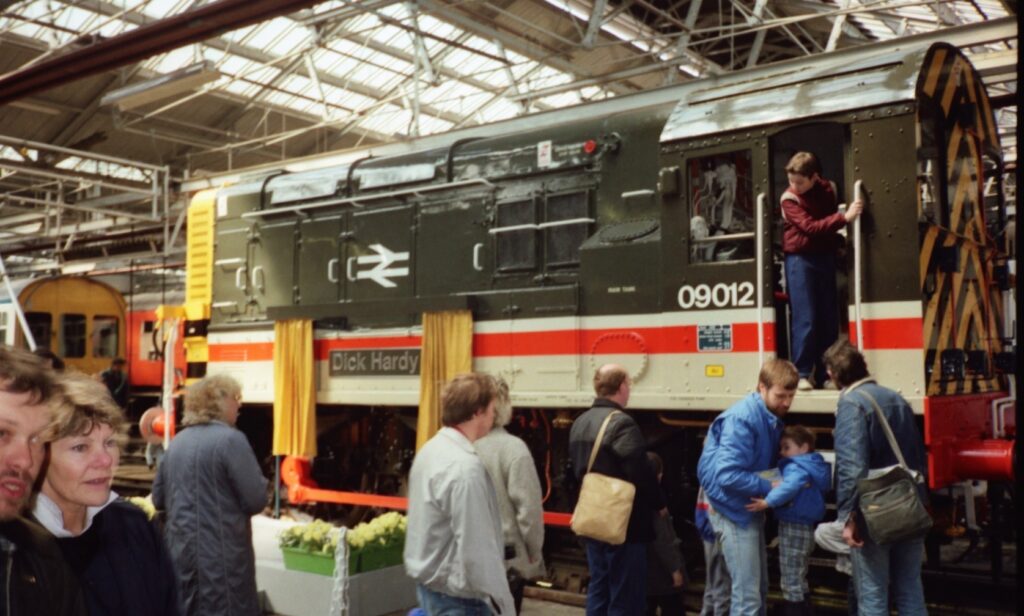
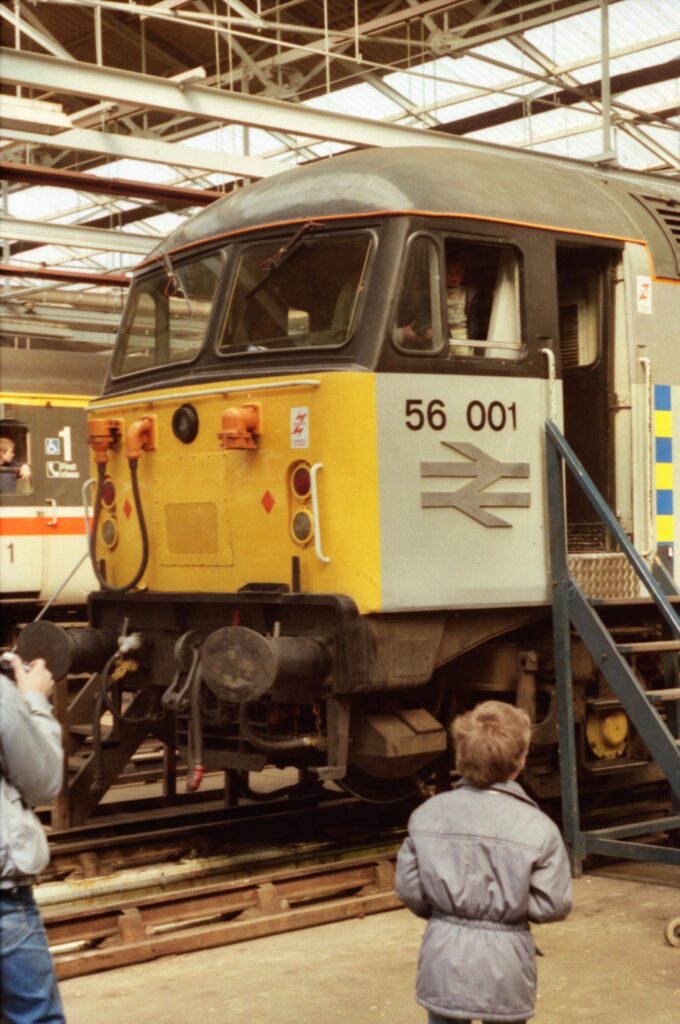
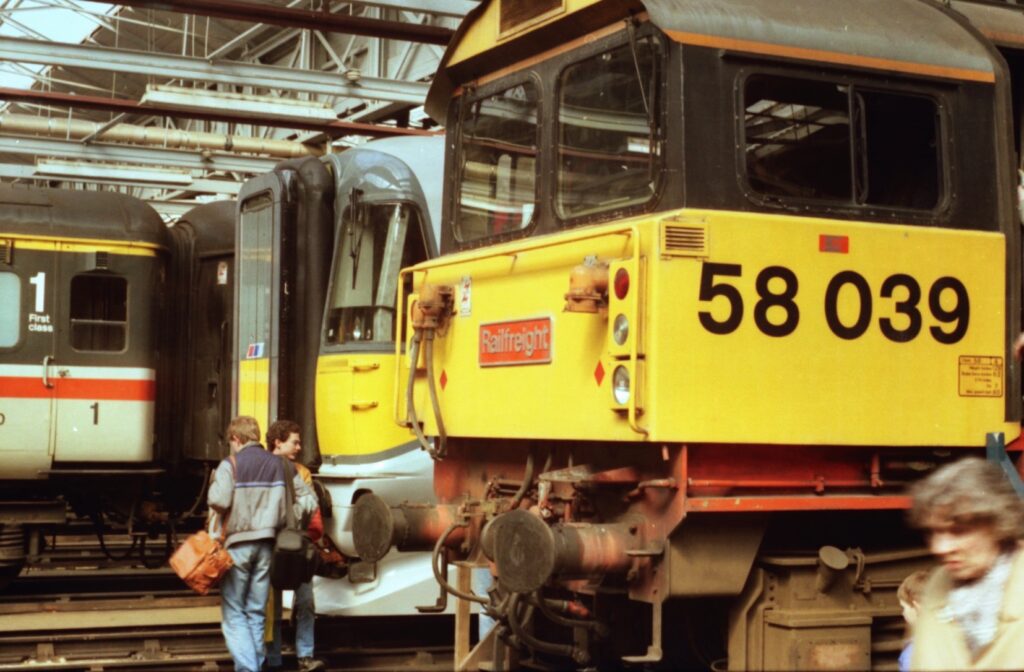
On the 10th April 1988 Stewarts Lane hosted an open day and invited visitors to take a shuttle service from London Victoria to the depot. I have some brief notes about my visit, which is sadly a rare occurrence and I am left to rely on my memories. But on this Sunday morning I left from my local station in Dorset being propelled by push pull Class 33 diesel loco’s No’s 33111 and 33117 as far as Bournemouth when passengers had to detrain and join a bus service to Brockenhurst. Here awaited a fresh train headed up by Class 73 Electro-Diesel No. 73132 to take us on to Clapham Junction.
73203 passes through Clapham Junction – 10th April 1988
Transport from Victoria to Stewarts Lane was provided by Class 205 diesel-electric multiple unit No. 205002. These DEMU’s managed 47 years in service between 1957 and 2004 and several examples survive in preservation.
One thing that I must always remember about Open Days is that if I expect to get clear photographs of the exhibits free of other visitors there is really no point in going. Fellow enthusiasts and other visiting members of the public often make it their mission to examine the smallest bolt in minute detail or decide to have a lengthy conversation right in front of a shooting gallery of increasingly frustrated photographers.
A variety of Class 33 and Class 73 locomotives were on display or in the process of being worked on in the maintenance sheds alongside Class 55 Deltic D9000 ‘Royal Scots Grey’. A selection of images from the Stewarts Lane Open Day 1988 can be found below.