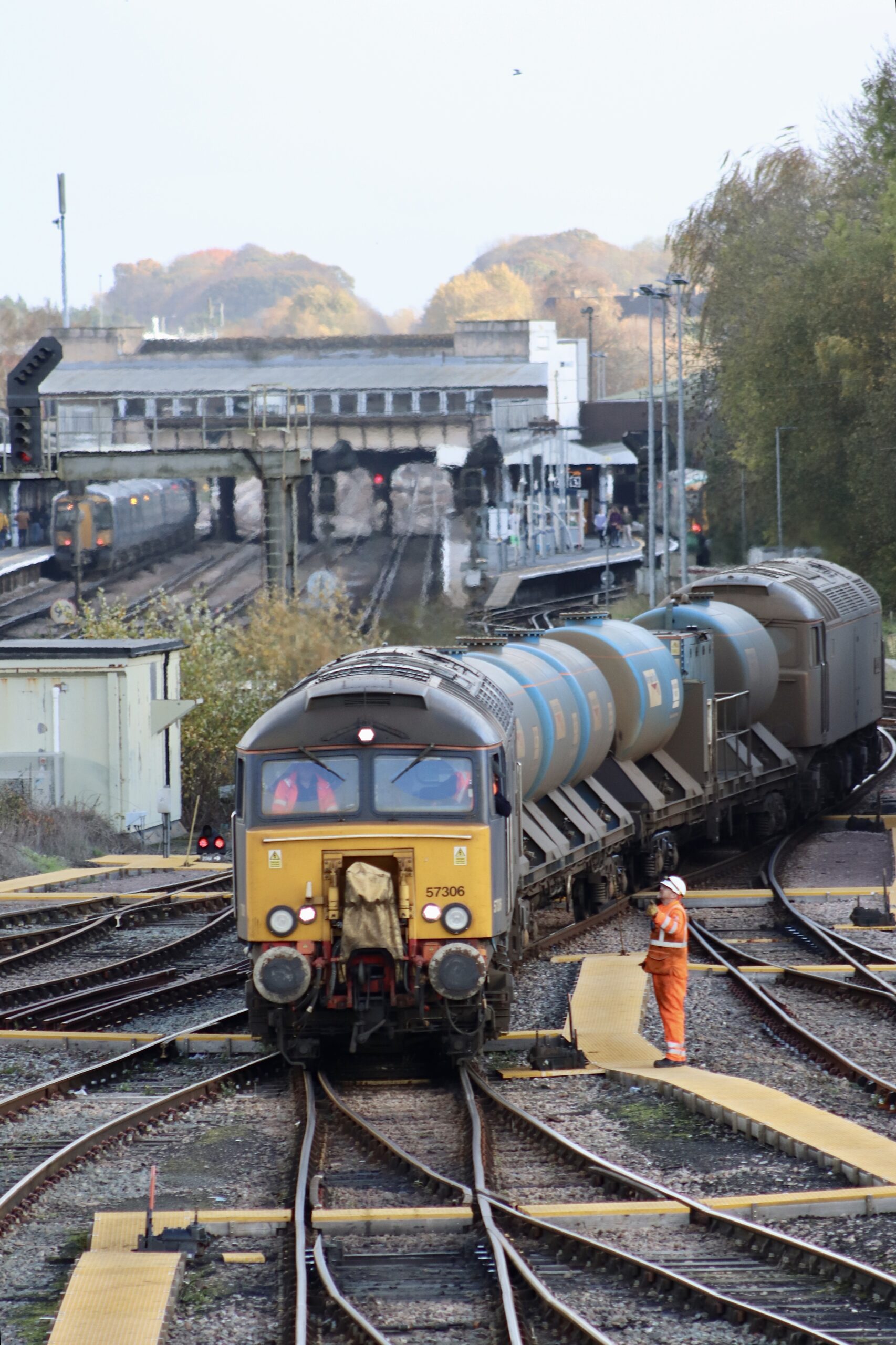
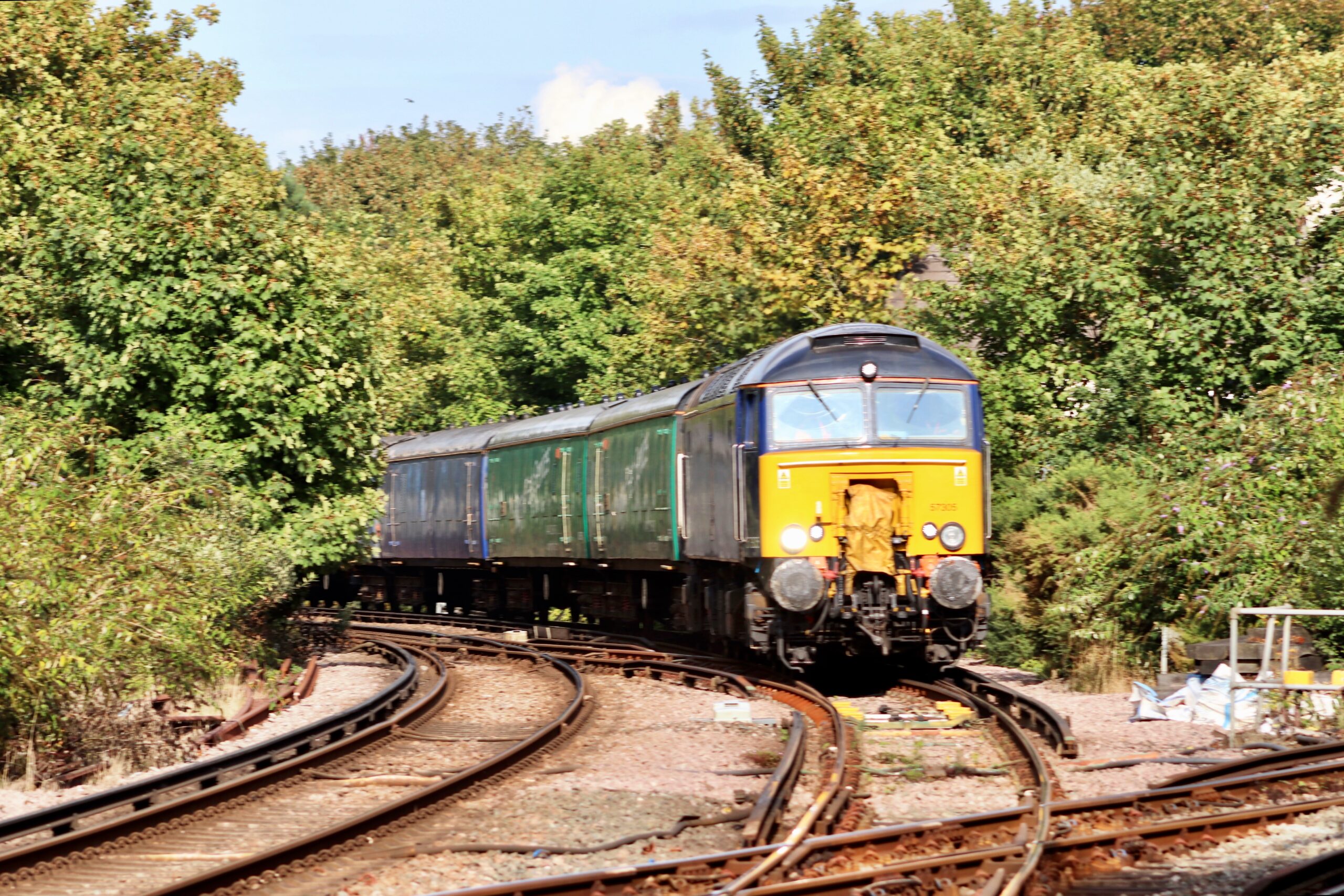
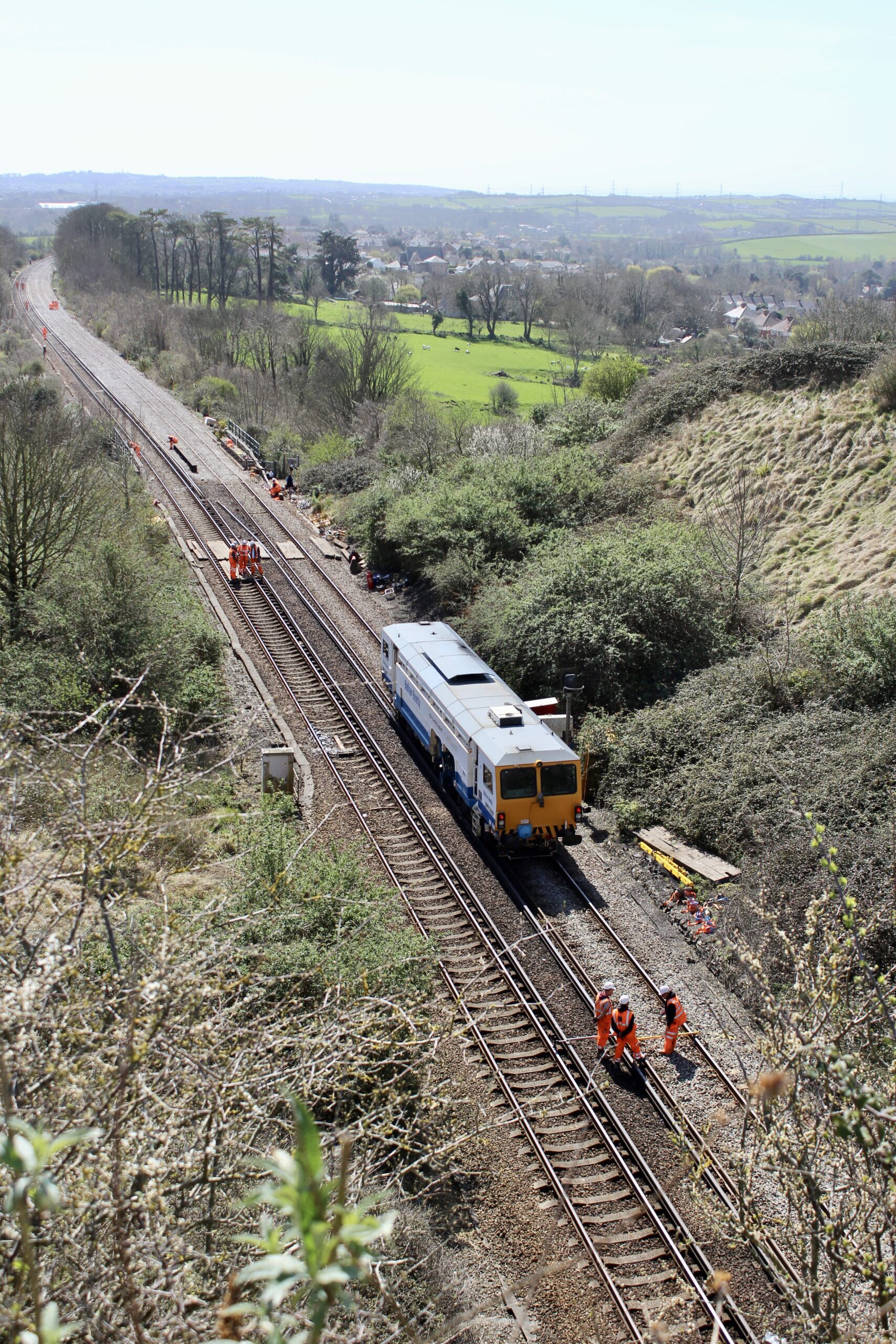
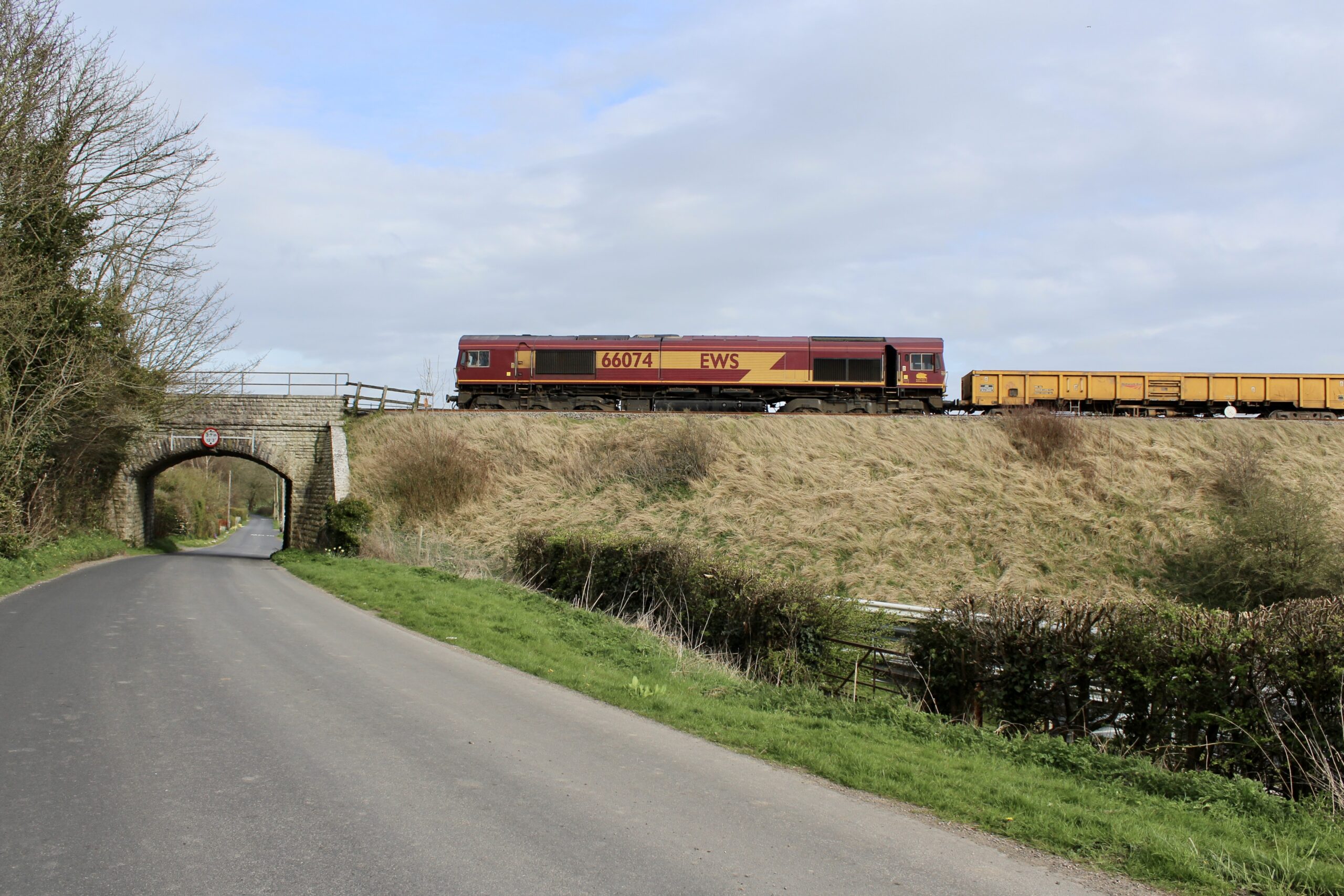
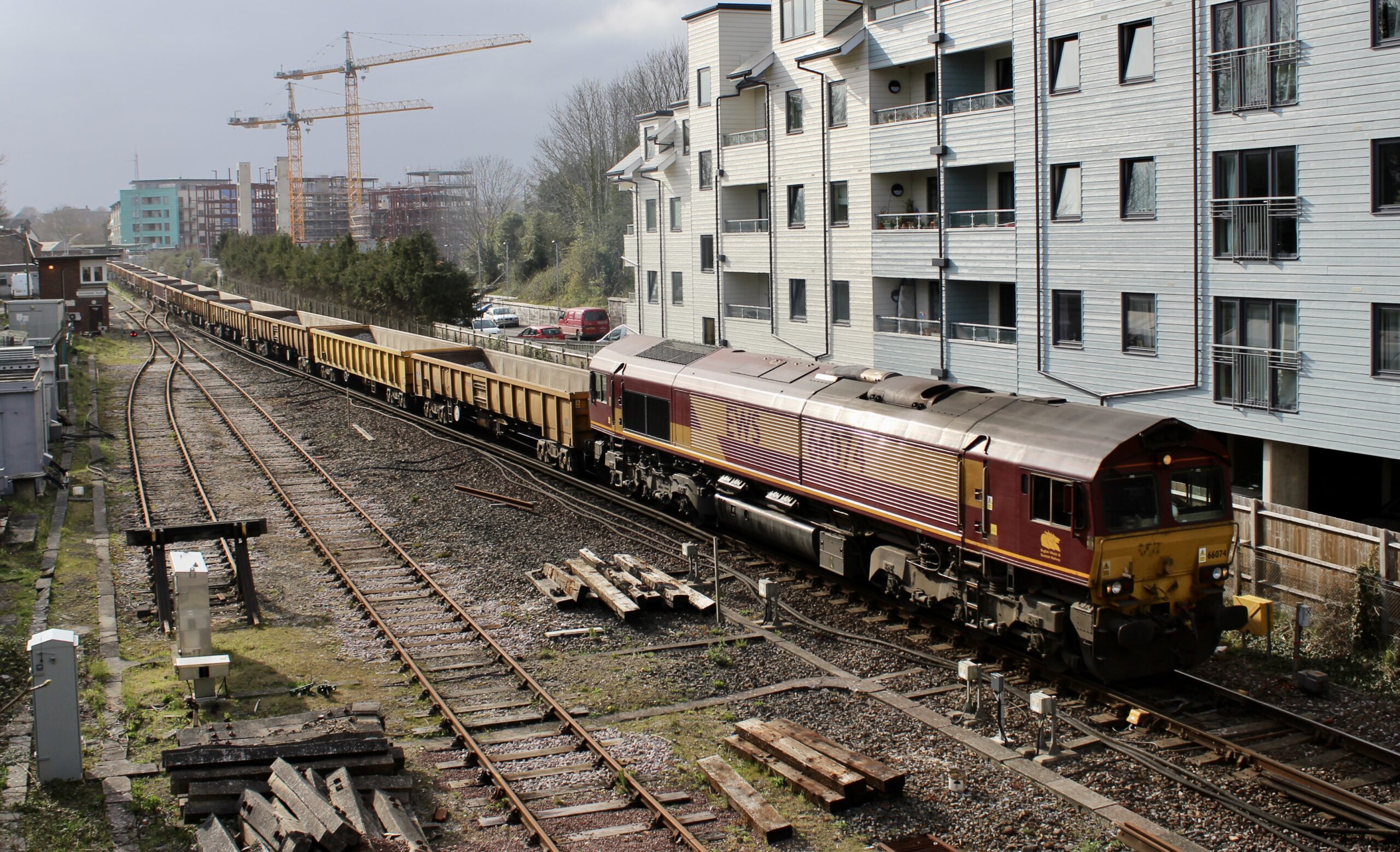
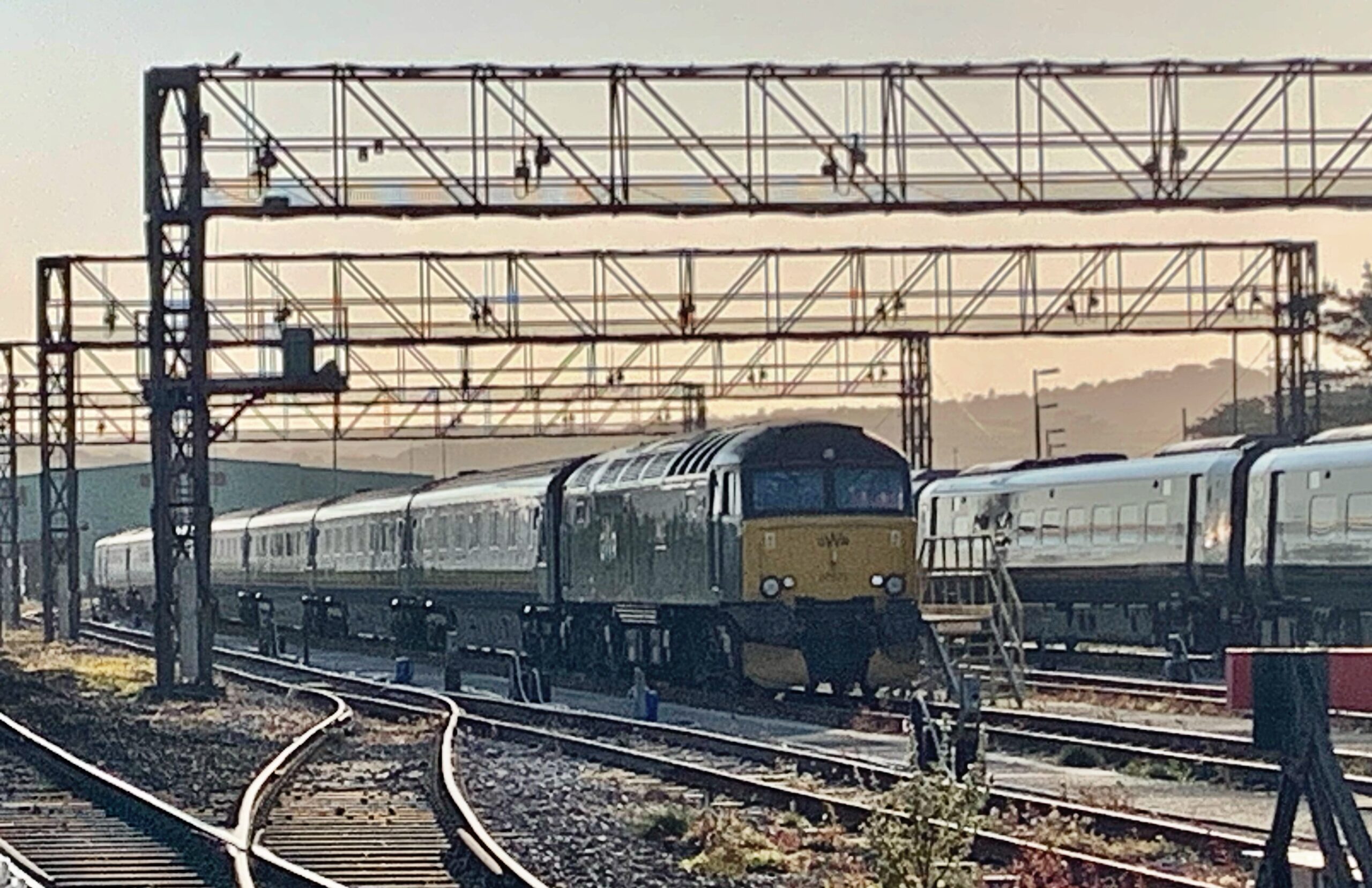
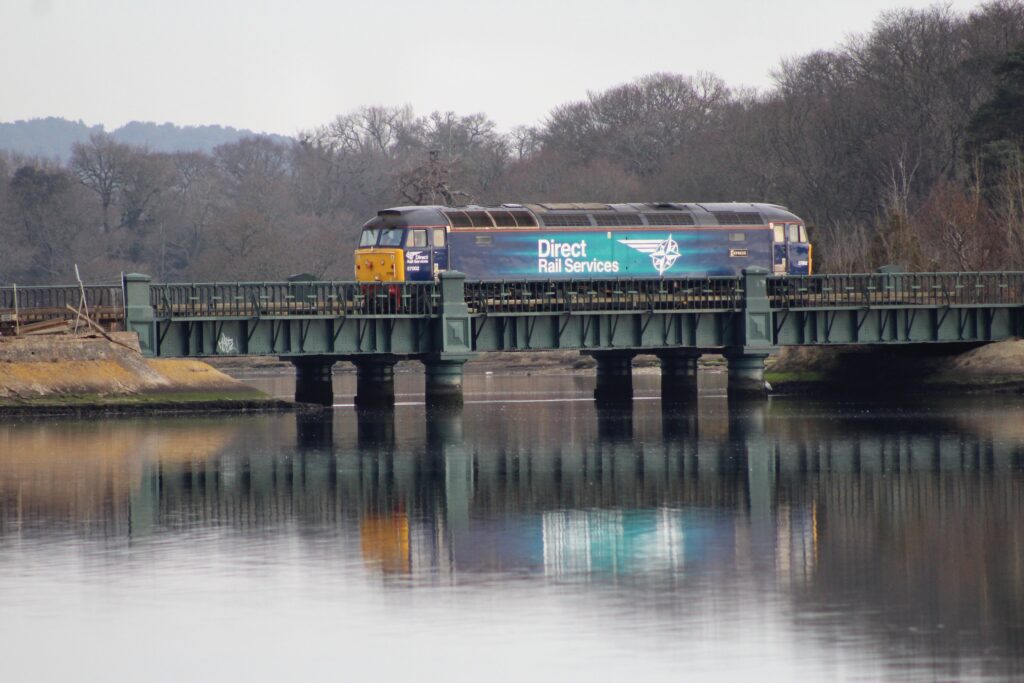
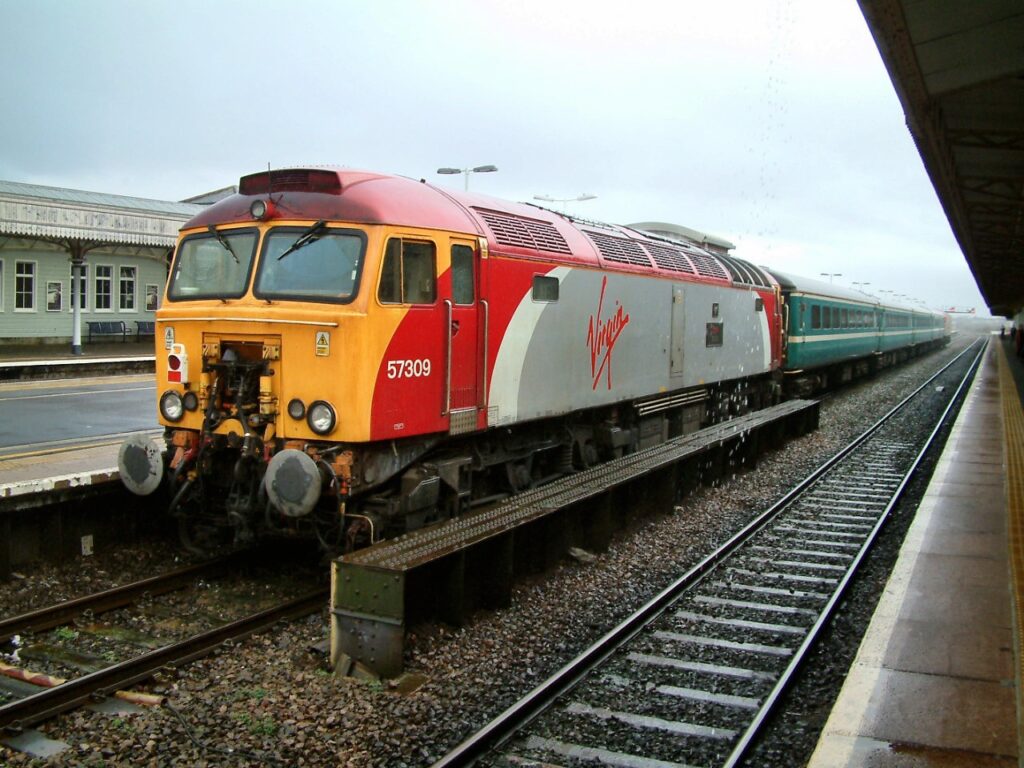
GBRf Class 57 No.’s 57306 ‘Her Majesty’s Railway Inspectorate’ and 57310 ‘Pride of Cumbria’ head into the yard after reversing in Tonbridge station working 3W01 0907 Tonbridge West Yard GBRf to Tonbridge West Yard GBRf – 19/11/2023
November 18th 2023 to November 23rd 2023
I may have mentioned previously that I have a list of locomotives or unit trains I would very much like to photograph. These include named examples to livery variations. One such loco is GB Railfreight’s (GBRf) Class 66 No. 66743 which can be usually found North of The Border operating the luxury Belmond Royal Scotsman train along with sister locomotive No. 66746. GBRf took over the running of these excursion trains from West Coast Railways (WCR) in 2016. Outside the Scottish railtour season, the Royal Scotsman locos have to earn their keep on more mundane tasks, and last week No. 66743 was shuttling backwards and forwards from Scunthorpe or Doncaster to Eastleigh East Yard on freight or engineers related workings. At least until the weekend when she ended up on one of the engineering trains involved in the 16 day closure of the railway line between Salisbury and Yeovil Junction. This, I observed, meant she was stabled at Eastleigh East Yard on Sunday following her outing to Wiltshire. So with hopeful abandon, off I set at 0730 thinking the locomotive might well be parked in an advantageous position for a photo. Unfortunately, this was not to be the case with No. 66743 being somewhat obscured by a row wagons. It’s like that, this hobby, you win some and you lose some. The trick is not to be disheartened because next time, things may well go your way.
Belmond Royal Scotsman liveried Class 66 No. 66743 partially hidden behind wagons in Eastleigh East Yard – 19/11/2023
While I was in Eastleigh I took advantage of the lull in between rain showers to walk Yoshi and photograph other trains parked up.
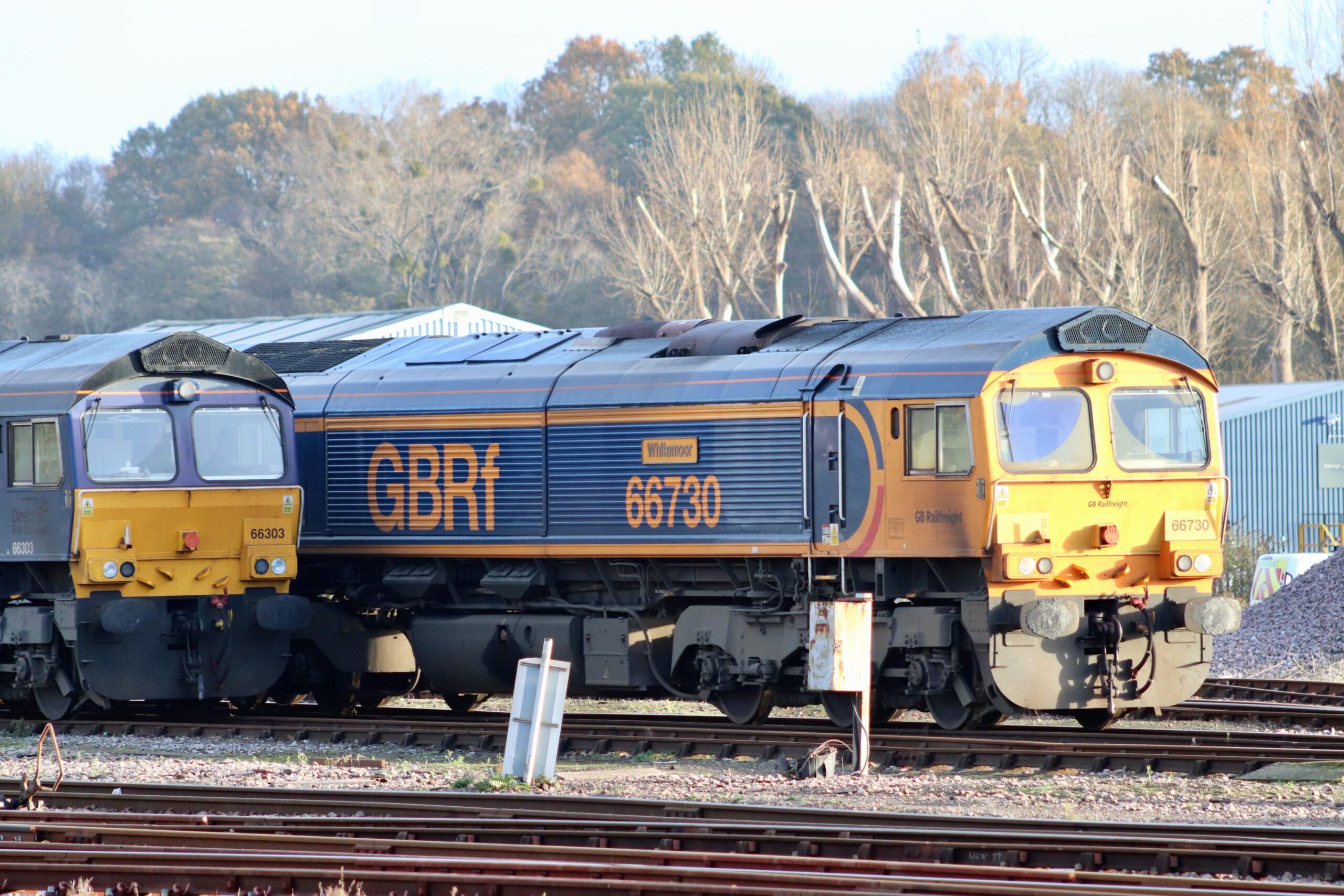
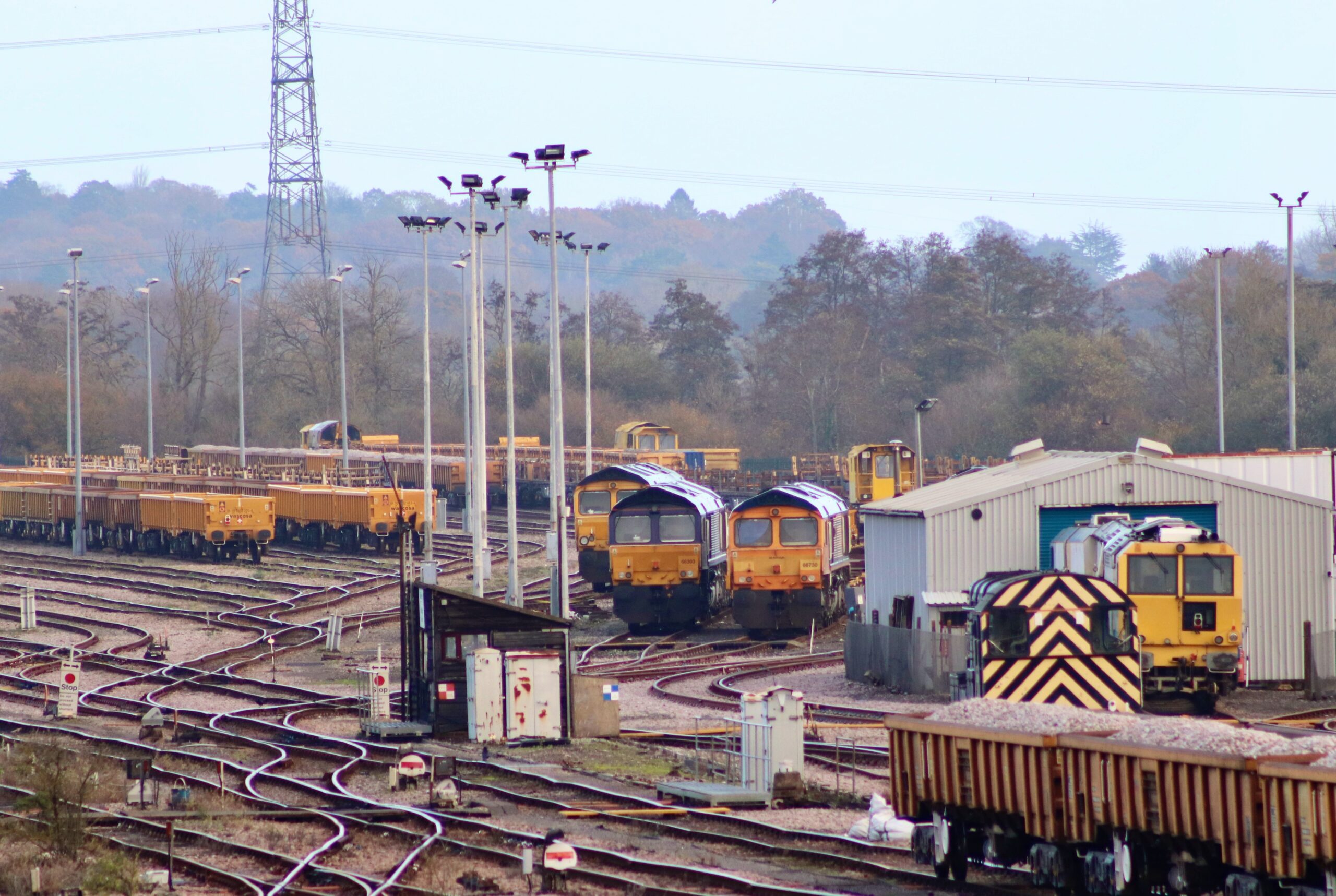
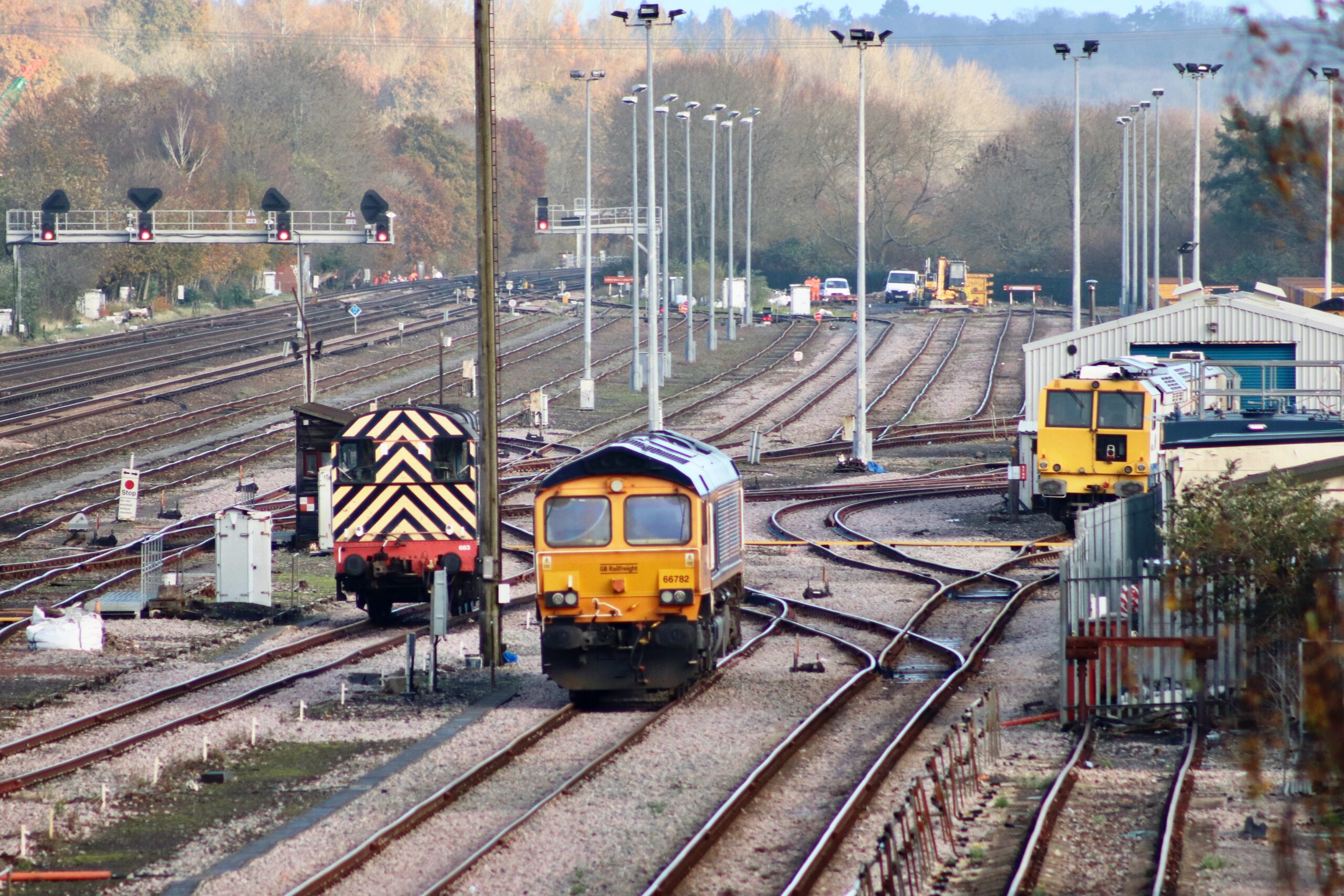
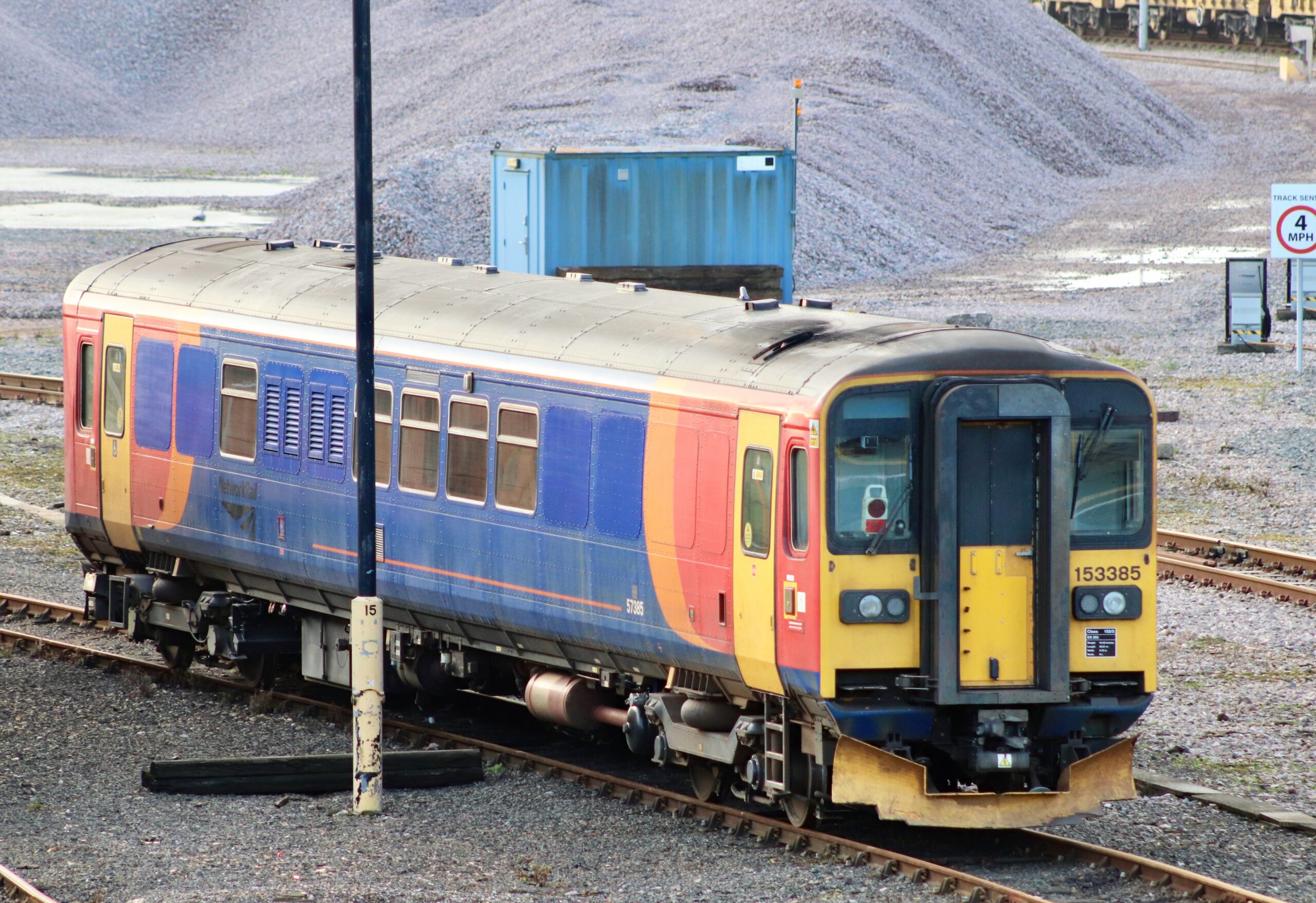
Class 66 No. 66303 stands in Eastleigh East Yard – 19/11/2023Class 66 No. 66730 ‘Whitemoor’ alongside stablemate No. 66303 at Eastleigh East Yard – 19/11/2023GBRf Class 66 No. 66740 ‘Sarah’ stands at Eastleigh CTT Forwardings – 19/11/2023A view across to Eastleigh East Yard – with Class 66 locomotives No.’s 66730/66303/66740 resting between duties – 19/11/2023Class 66 No. 66782 at Eastleigh East Yard alongside a Class 08 shunter – 19/11/2023Class 08 No. 08511 in Eastleigh East Yard – 19/11/2023Colas Class 70 No. 70810 at Eastleigh – 19/11/2023Class 153 DMU Network Rail Video Inspection Unit No. 153385, Eastleigh – 19/11/2023
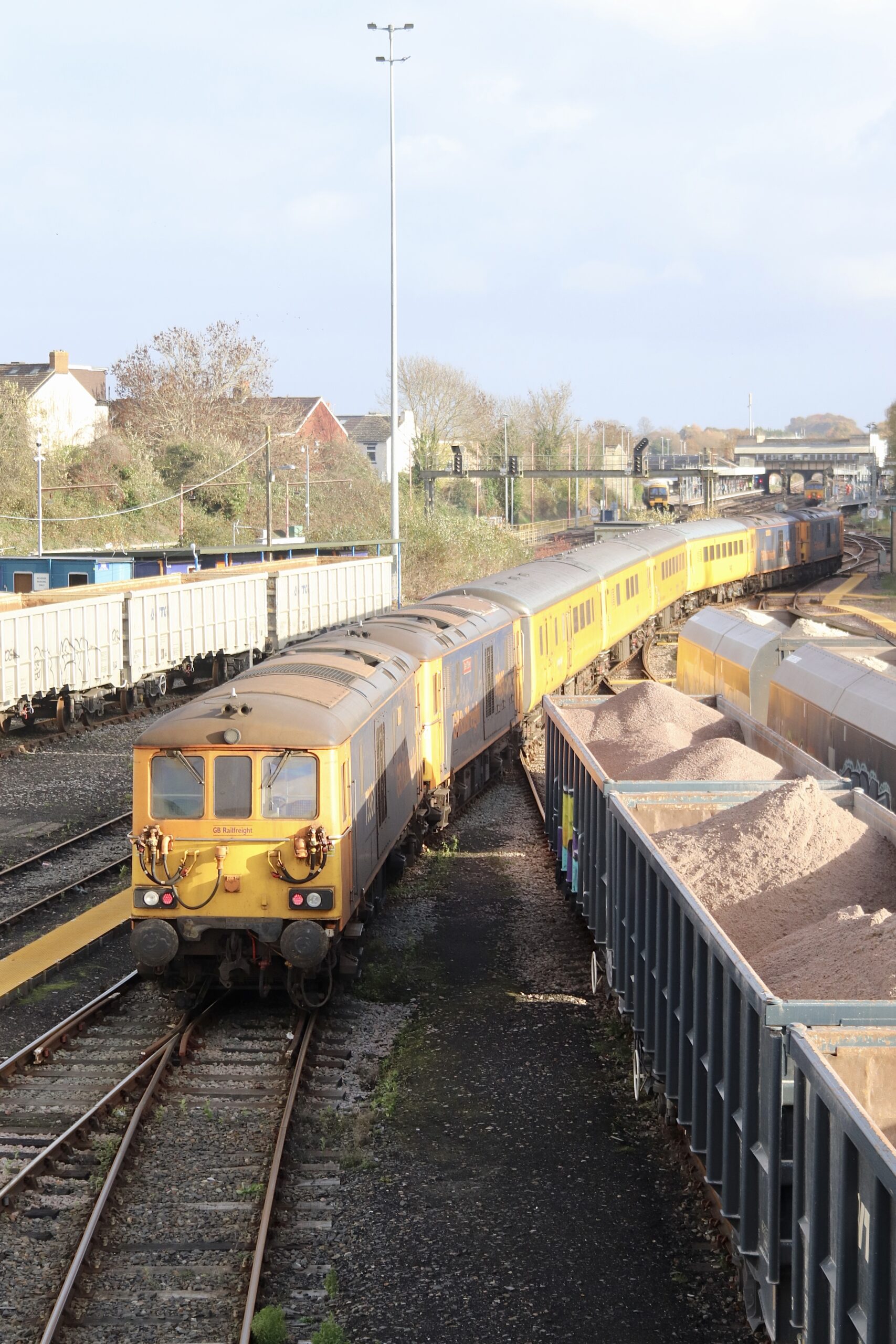
Eschewing a FatMacs breakfast (I’m on a diet, don’t you know), I decided to press on and drive over to Tonbridge in the hope that the Rail Head Treatment Trains (RHTT) based there would be engaged in leaf clearing as runs were scheduled across the day to and from Tonbridge West Yard. These are dependant on requirements and don’t always run however. Coincidentally, we started this blog two years ago on November 22nd 2021 with a brief clip of a steam hauled Belmond British Pullman tour through Tonbridge taken the previous day. I’d forgotten just how short those early blog entries were – something to be mindful of now, perhaps! We made another visit to Tonbridge on 12th November 2022, so this is becoming rather like an annual tradition. I felt the visit this year was one of diminishing returns, although we were able to capture an assortment of Class 57’s and Class 73’s!
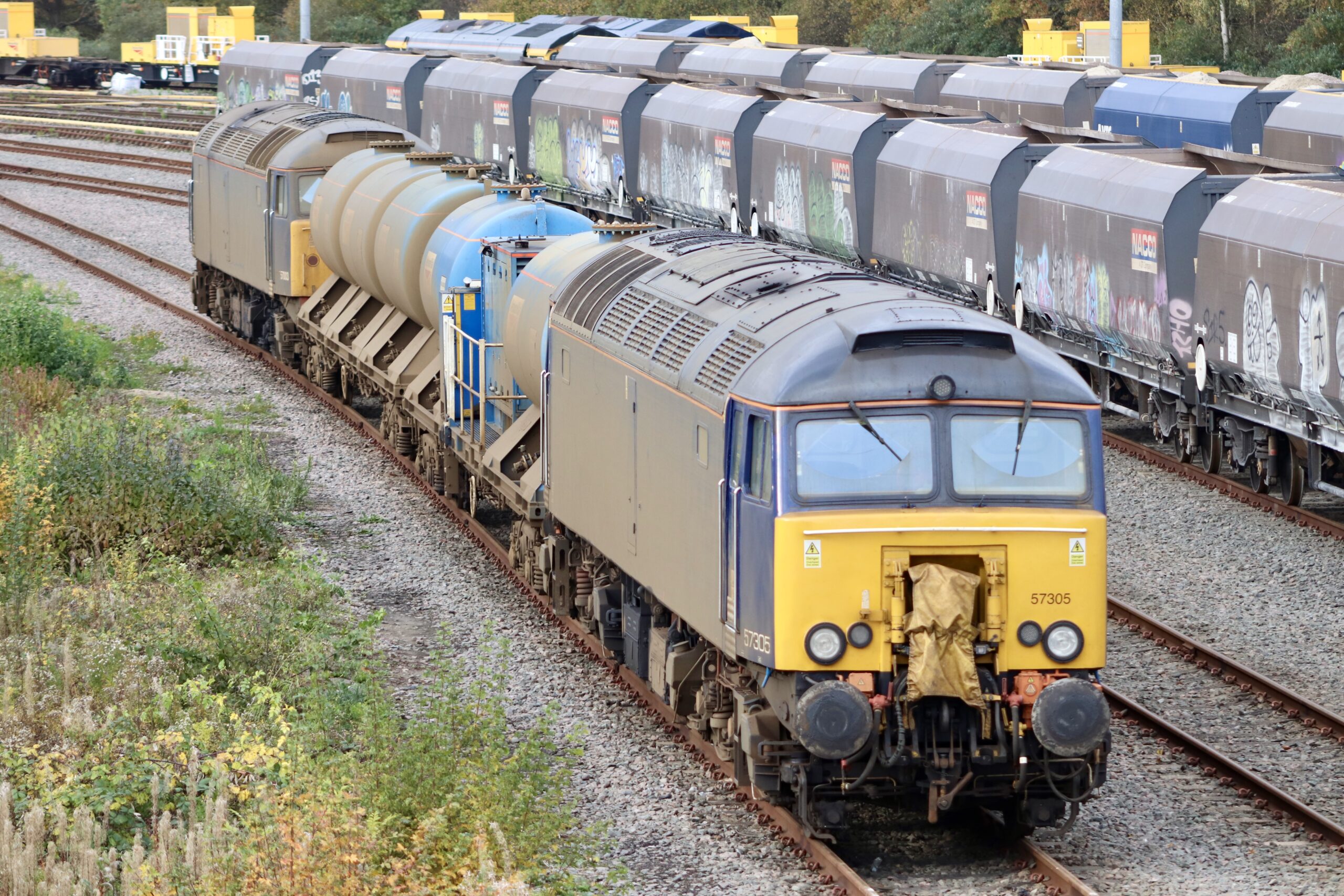
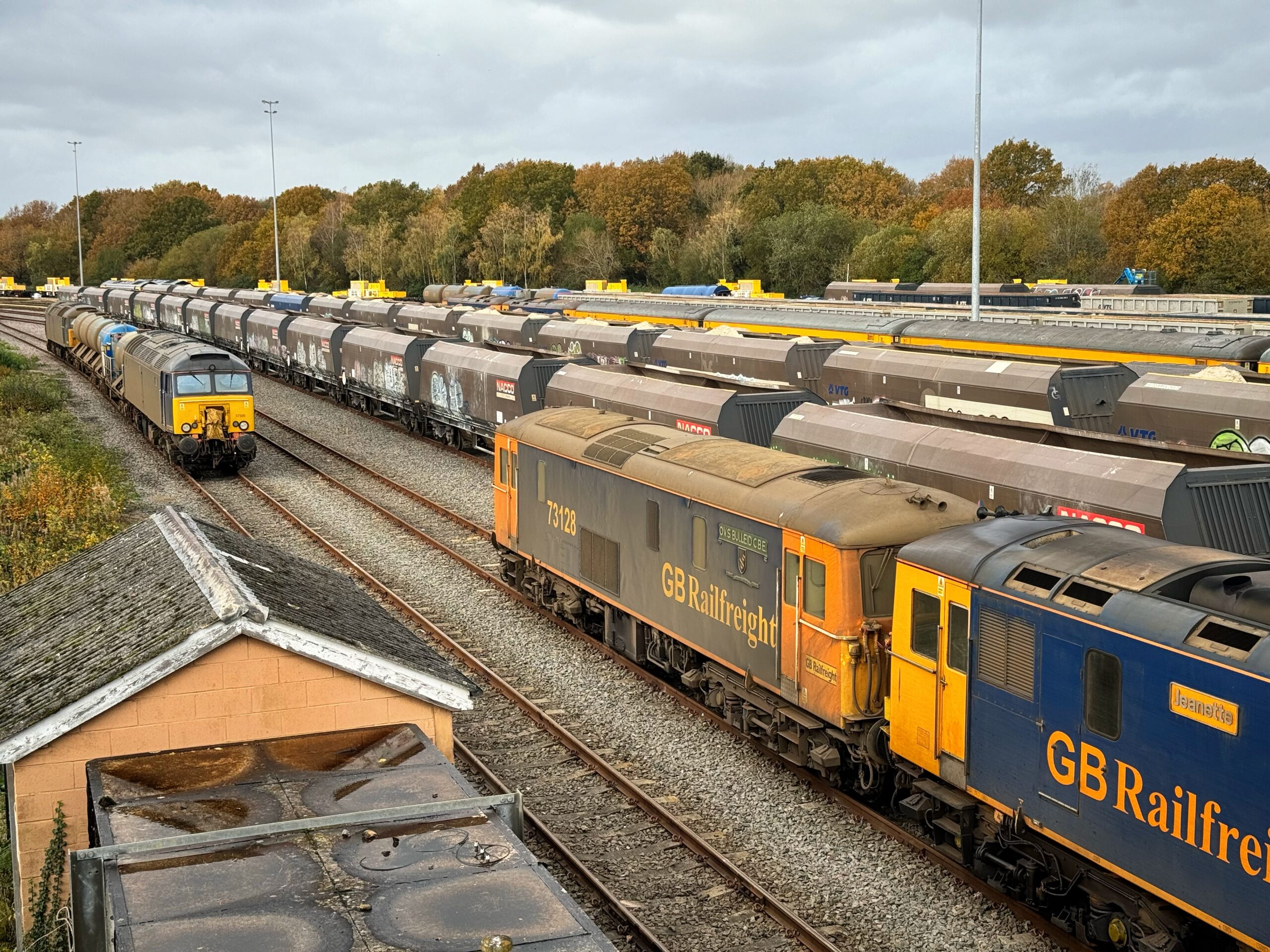
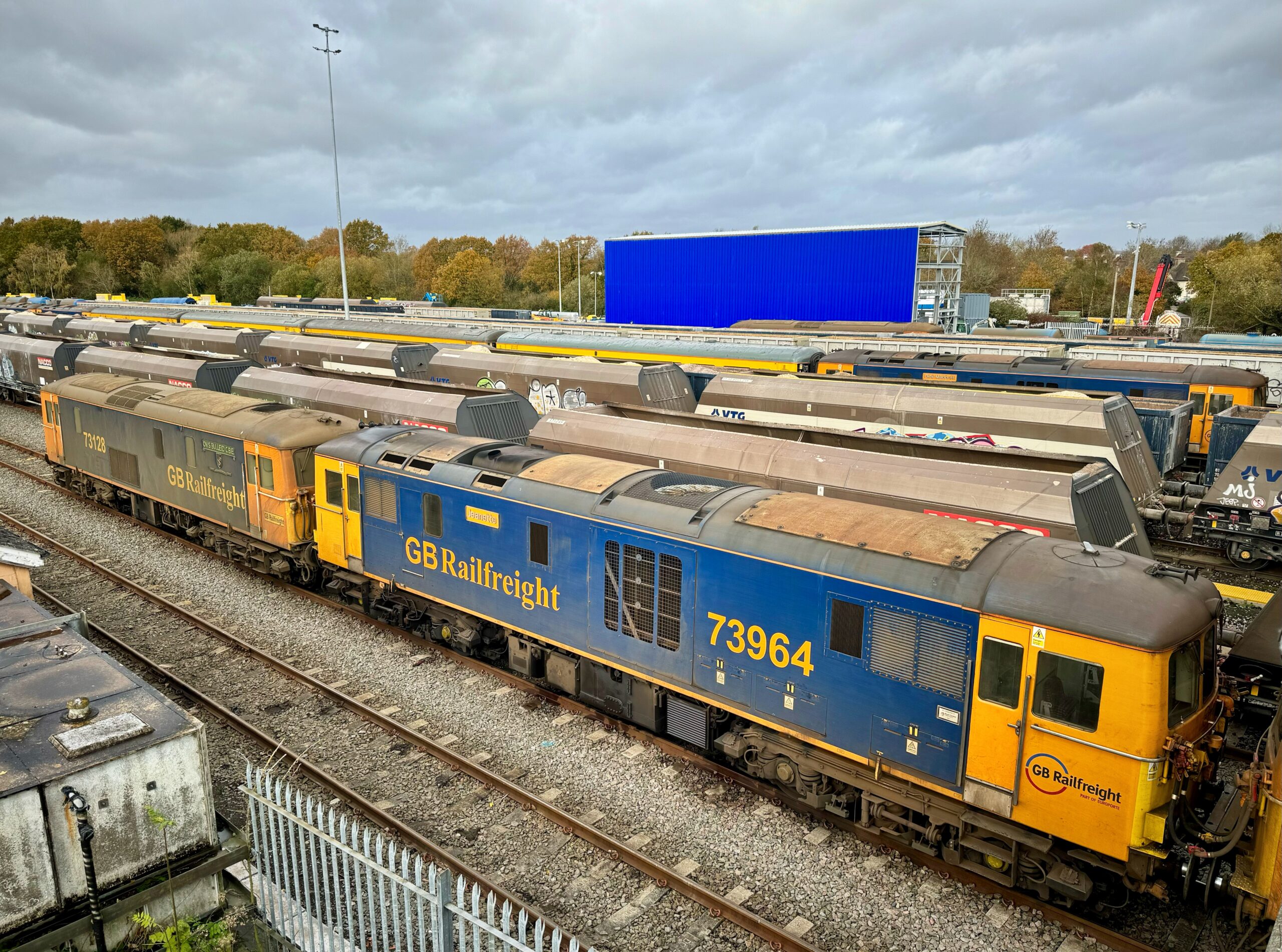
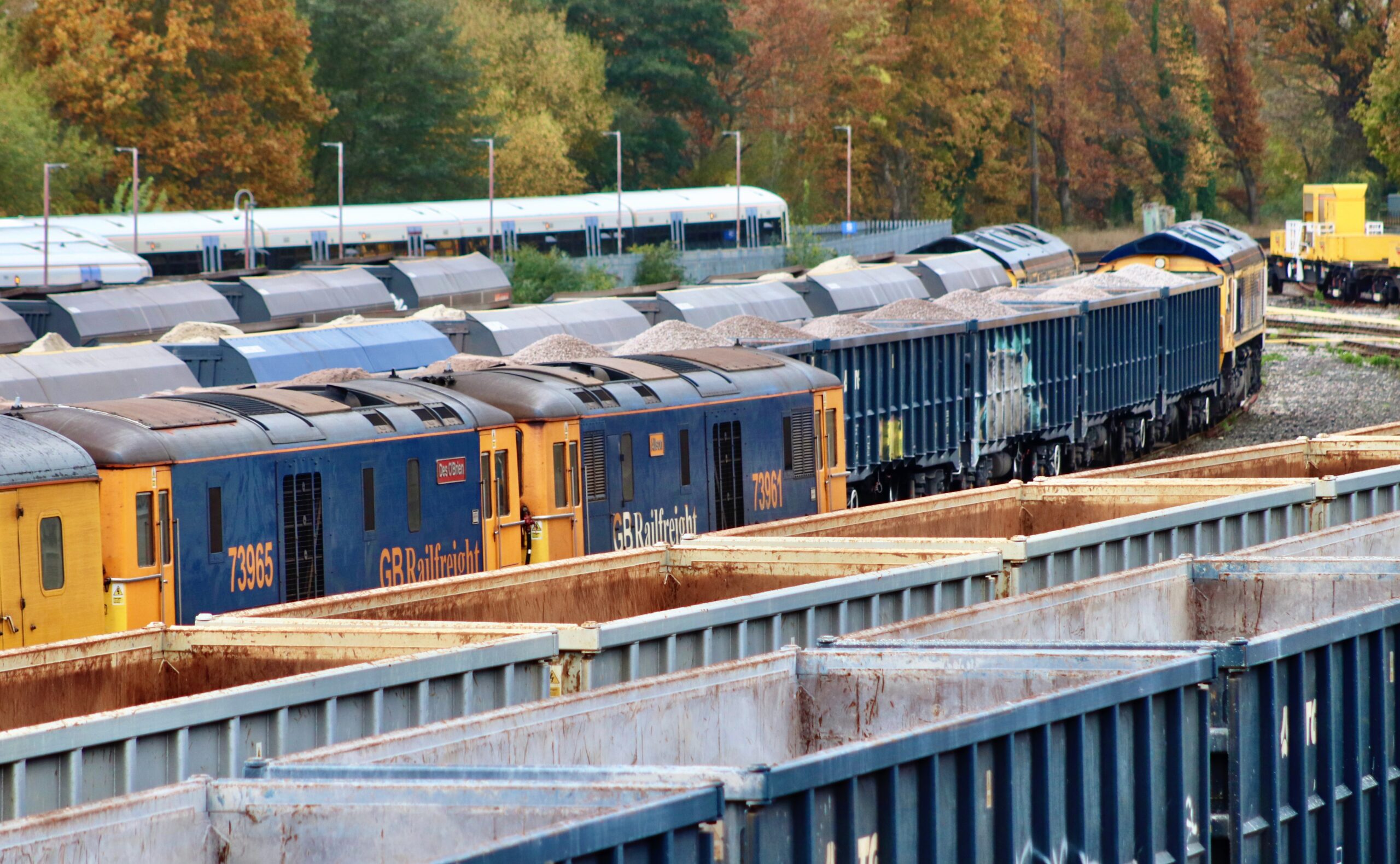
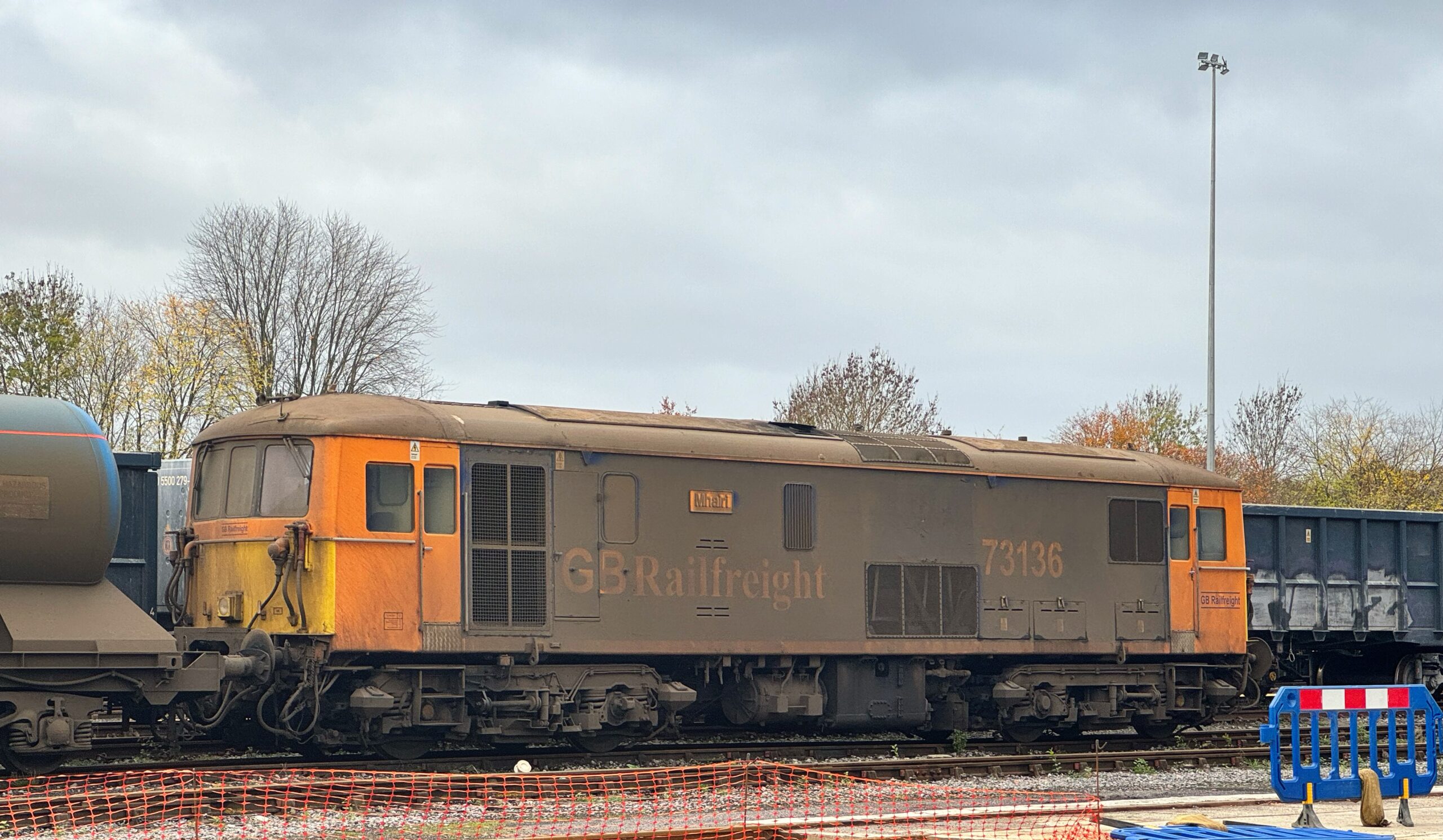
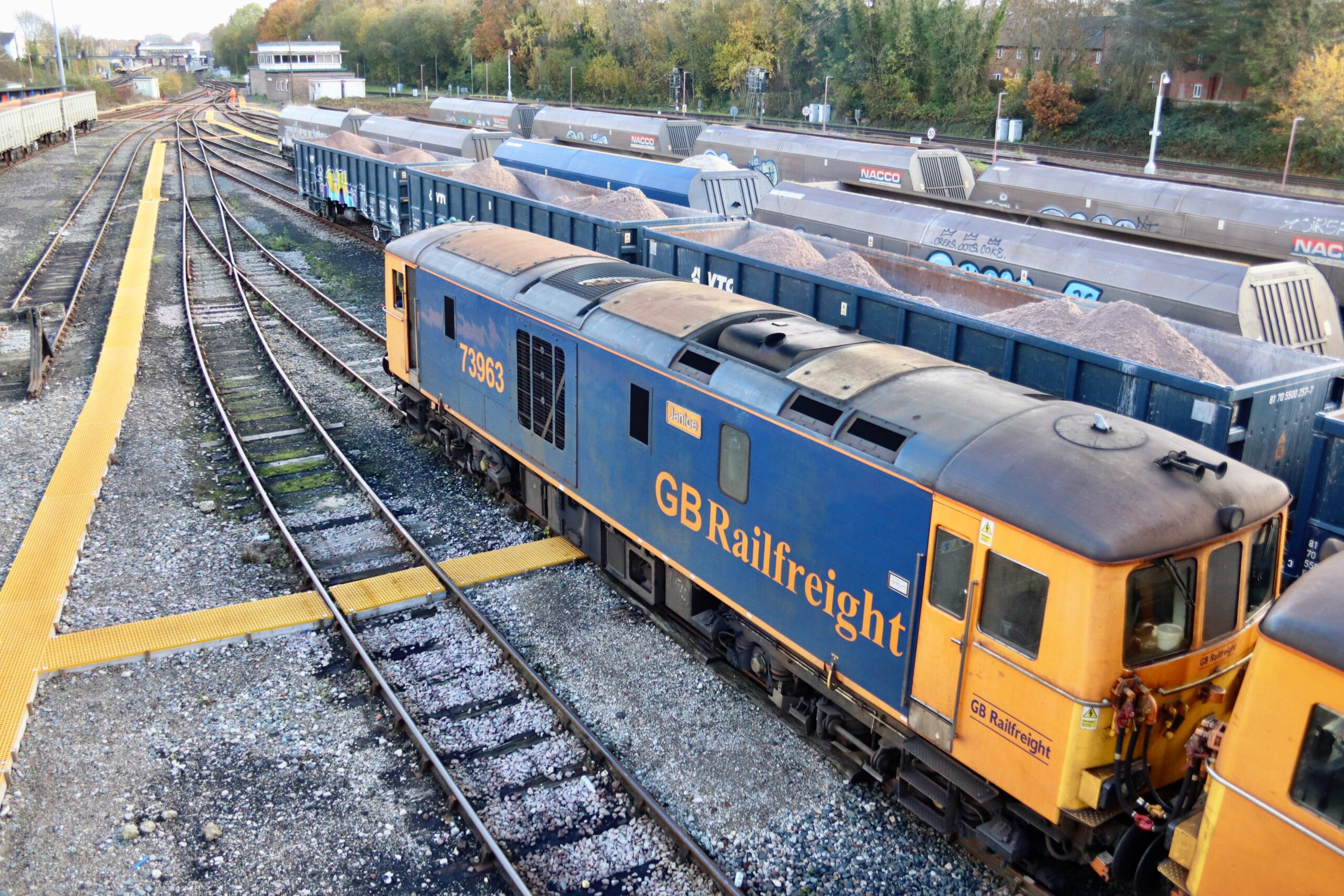
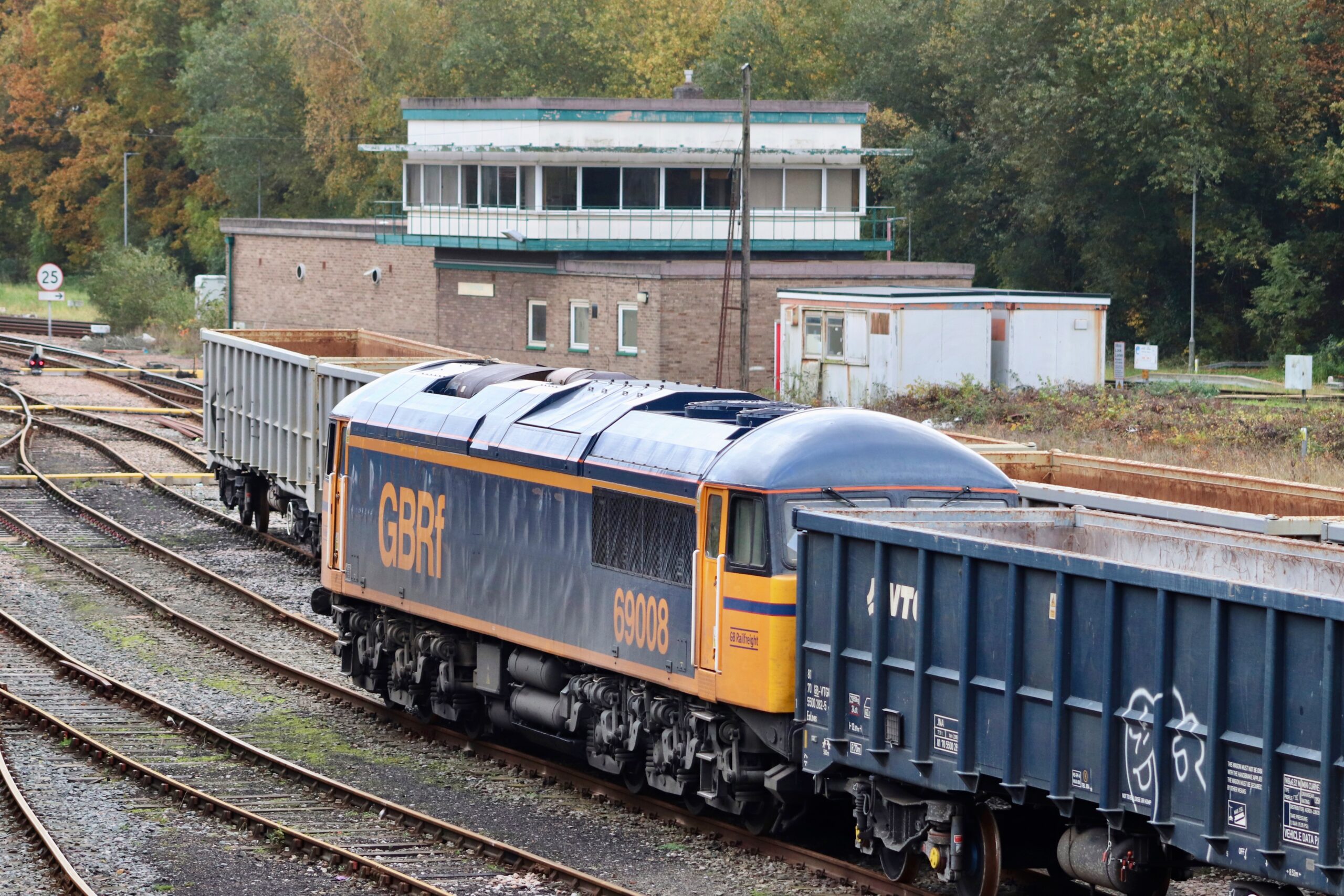
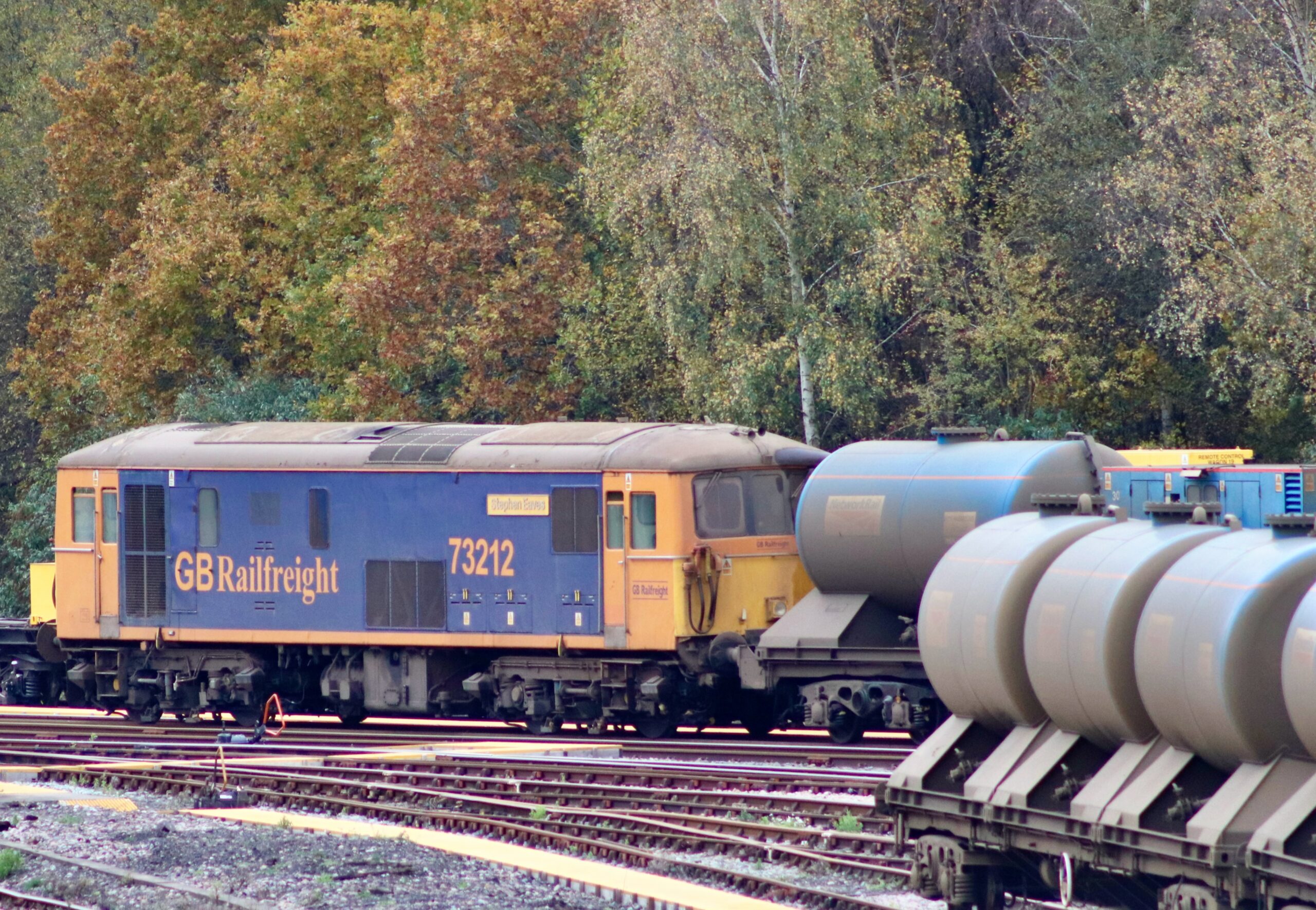
Class 57’s have been employed on the Tonbridge circuit RHTT this year. No.’s 57305 and 57003 are seen in-between duties at Tonbridge West Yard – 19/11/2023Class 73 No.’s 73964 ‘Jeanette’ and 73128 ‘O.V.S. Bulleid CBE’ with Class 57 No.’s 57305 and 57003 in Tonbridge West Yard – 19/11/2023Class 73 No.’s 73964 ‘Jeanette’ and 73128 ‘O.V.S. Bulleid CBE’ at Tonbridge West Yard. A new GBRf shed can be seen during construction in the background – 19/11/2023Class 73 No. 73109 ‘Battle of Britain 80th Anniversary’ in seasonal RHTT livery in Tonbridge West Yard – 19/11/2023Class 73’s No.’s 73965 and 73961 at the rear of 1Z01 1300 Tonbridge West Yard to Derby RTC in Tonbridge West Yard with two unidentified Class 66 locomotives at the head of aggregate trains – 19/11/2023Class 73 No. 73136 ‘Mhairi’ in Tonbridge West Yard – 19/11/2023GBRf Class 73 No. 73963 ‘Janice’ at the head of 1Z01 1300 Tonbridge West Yard to Derby RTC awaits departure – 19/11/2023GBRf Class 69 No. 69008 was the only member of the class in evidence at Tonbridge West Yard during this visit – 19/11/2023GBRf Class 73’s No.’s 73961 ‘Alison’ and 73965 ‘Des O’Brien’ at the rear 1Z01 1300 Tonbridge West Yard to Derby RTC depart Tonbridge West Yard. No.’s 73963 ‘Janice’ and 73962 ‘Dick Mabbutt’ are leading – 19/11/2023 With four GBRf Class 73’s attached, Colas test train 1Z01 1300 Tonbridge West Yard to Derby RTC departs Tonbridge West Yard. No. 73961 ‘Alison’ is the trailing locomotive along with No.’s 73965 ‘Des O’Brien’, 73962 ‘Dick Mabbutt’ and 73963 ‘Janice’ – 19/11/2023 GBRf Class 73 No. 73963 ‘Janice’ and 73962 ‘Dick Mabbutt’ leading 1Z01 1300 Tonbridge West Yard to Derby RTC out of the yard while RHTT 3W01 0907 Tonbridge West Yard GBRf to Tonbridge West Yard GBRf top and tailed by GBRf Class 57 No.’s 57306 ‘Her Majesty’s Railway Inspectorate’ and 57310 ‘Pride of Cumbria’ arrive at Tonbridge station where the train reverses – 19/11/2023GBRf Class 57 No.’s 57306 ‘Her Majesty’s Railway Inspectorate’ and 57310 ‘Pride of Cumbria’ pause as they enter Tonbridge West Yard working 3W01 0907 Tonbridge West Yard GBRf to Tonbridge West Yard GBRf – 19/11/2023GBRf Class 73 No. 73119 ‘Paul Taylor’ arrives at Tonbridge West Yard working 3W91 1026 Tonbridge West Yard GBRf to Tonbridge West Yard GBRf, with No. 73212 ‘Stephen Eaves’ at the rear – 19/11/2023GBRf Class 73 No. 73212 ‘Stephen Eaves’ at the rear of 3W91 1026 Tonbridge West Yard GBRf to Tonbridge West Yard GBRf – 19/11/2023GBRf Class 73 No. 73119 ‘Paul Taylor’ in retro BR ‘Dutch’ Civil Engineers livery at Tonbridge West Yard having arrived with RHTT working 3W91 1026 Tonbridge West Yard GBRf to Tonbridge West Yard GBRf – 19/11/2023
On leaving Tonbridge, Yoshi and I had planned on seeing one more RHTT, this time passing through at Edenbridge Town Station as it was in the direction of home.
Edenbridge Town railway station on the Uckfield branch, one of two stations serving Edenbridge in Kent, was opened in January 1888 – 19/11/2023
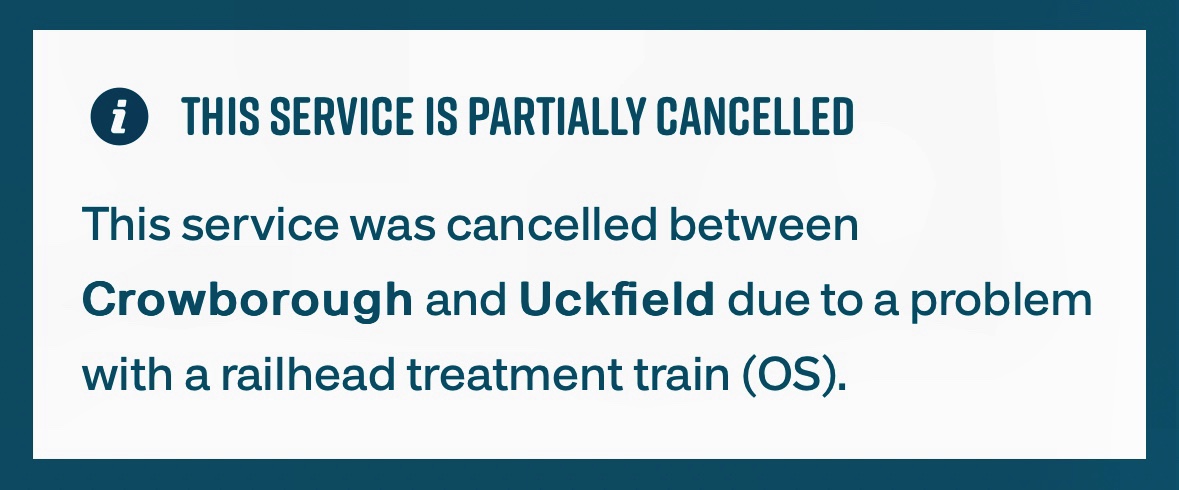
We parked up in the station car park and checked Real Time Trains (RTT) to see that the train; 3W90 0715 Tonbridge West Yard to Tonbridge West Yard via the South East of England, top and tailed by GBRf Class 73 No.’s 73107 and 73213, was at Uckfield and had been for 20 minutes or so beyond its scheduled departure time. Passenger trains into Uckfield (which is a terminus station) were being turned around at Crowborough as the line beyond was effectively blocked.
RTT information regarding partially cancelled passenger trains on the Uckfield branch – 19/11/2023
I hung around in Edenbridge for a little while, but soon came to the conclusion that this RHTT was not going to be heading our way while there was still a decent amount of daylight left to photograph it. I briefly contemplated driving to Uckfield, but Google Maps informed me it was at least a 30 minute drive away and would substantially delay my arrival home, so instead made the decision to head for Dorset. Had I known there would be delays on the M25 caused by pedestrians “being loose on the carriageway”, I might well have taken the Uckfield option and returned home via the South Coast route!
Video from our visit to Tonbridge – 19/11/2023
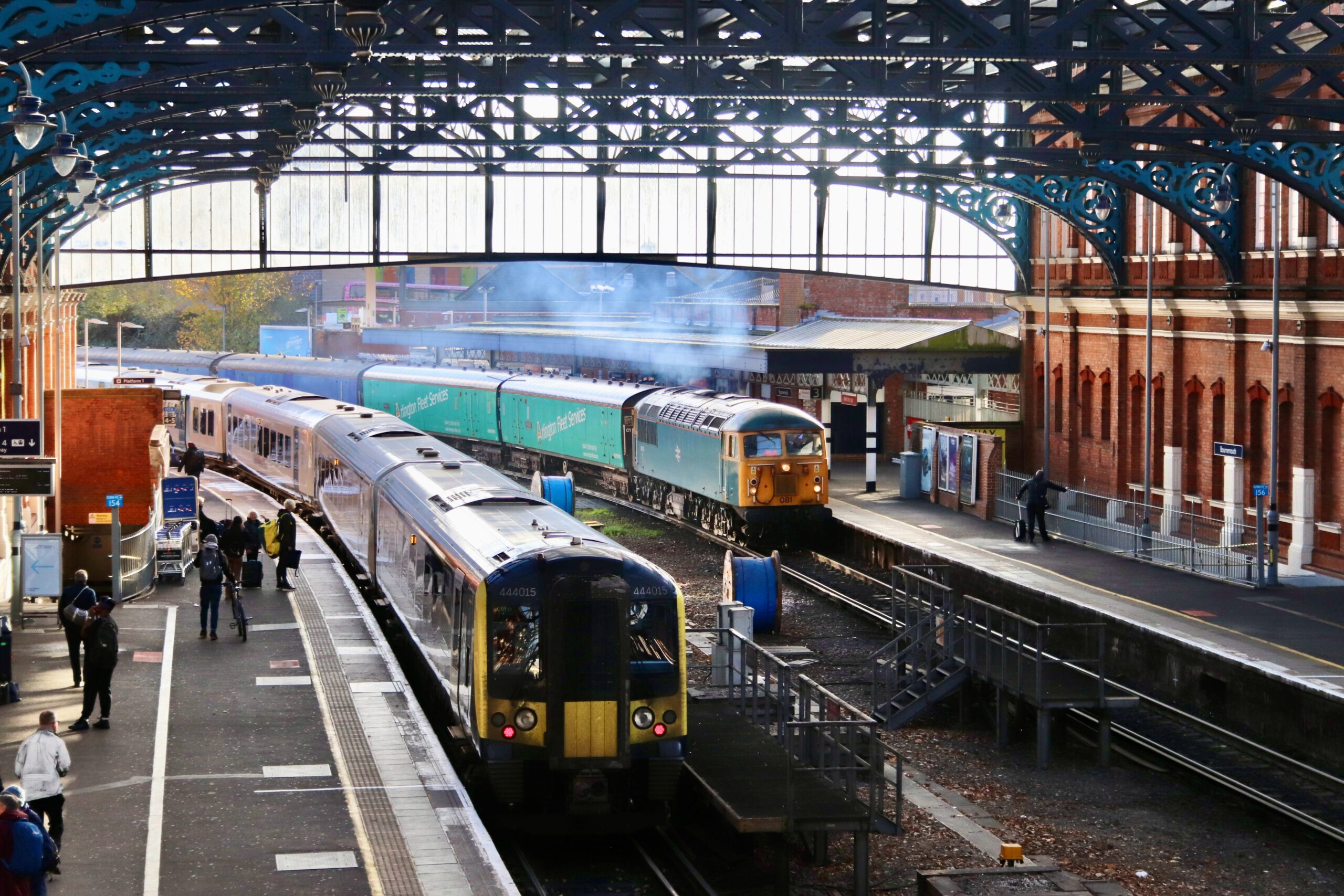
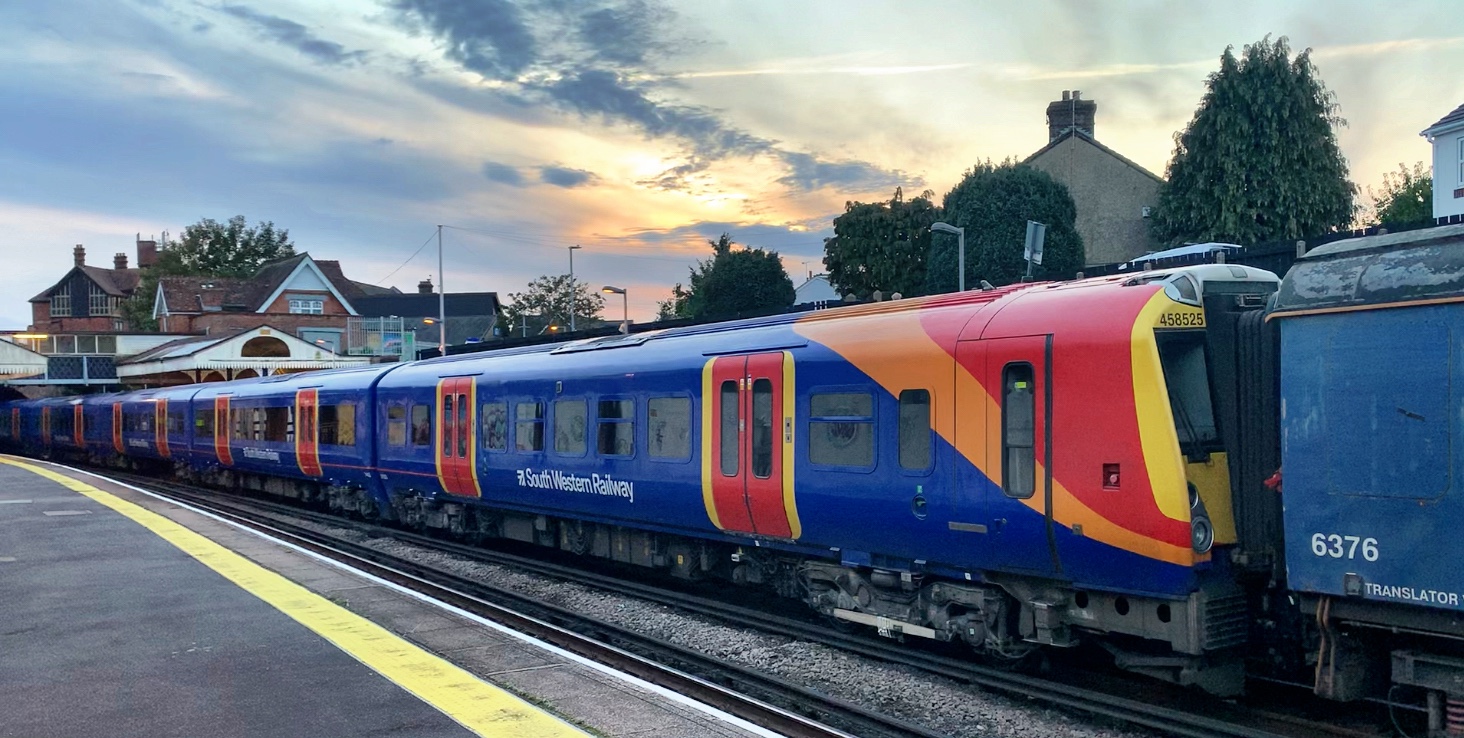
Monday 20th November saw another attempt to collect South Western Railway (SWR) Class 458 Electric Multiple Unit (EMU) No. 458524 for onward transit to Alstom Widnes Transport Tech where it is to undergo refurbishment. Our regular reader may recall an abortive attempt a couple of weeks ago when the brakes on the EMU curtailed the train in Christchurch station. With the associated locomotives and barrier coaches due to arrive at Bournemouth depot mid-morning, I chose to head out to see the train pass through Bournemouth railway station as I felt I’d photographed and videoed these workings at Branksome where they reverse into the depot many times, so was looking for something different. The change of location was well rewarded as Class 56 No. 56081, leading on 5O58 0520 Leicester L.I.P. to Bournemouth T&R.S.M.D, made a fine sight and sound as she opened up passing through the station with the sound of her 3,250 brake horsepower (bhp) Ruston-Paxman power unit echoing around the glass roofed building.
GBRf Class 56 No. 56081 opens up as she arrives at Bournemouth station working 5058 0520 Leicester LIP to Bournemouth T&RSMD passing SWR Class 444 No. 444015 which has arrived on 2W54 1000 Poole to London Waterloo – 20/11/2023GBRf Class 56 No. 56081 thunders through Bournemouth station on 5058 0520 Leicester LIP to Bournemouth T&RSMD. Class 47 No. 47727 ‘Edinburgh Castle’ is at the rear, while SWR Class 444 No. 444015 awaits the arrival of a Weymouth service before coupling up and departing for London Waterloo – 20/11/2023Class 47 No. 47727 ‘Edinburgh Castle / Caisteal Dhun Eideann’ passing Bournemouth at the rear of 5058 0520 Leicester LIP to Bournemouth T&RSMD – 20/11/2023
I had also planned on seeing the return working from Branksome, due to arrive at 1715 running as 5Q58 17:11 Bournemouth Traction & Rolling Stock Maintenance Depot to Widnes Transport Tech. However, unbeknown to me – and most of the other local rail enthusiasts – the train left the depot, unheralded, at around 1300. You win some…..
While I was in Bournemouth, I took the opportunity of capturing some images and video of everyday operations, which I mostly forget to do.
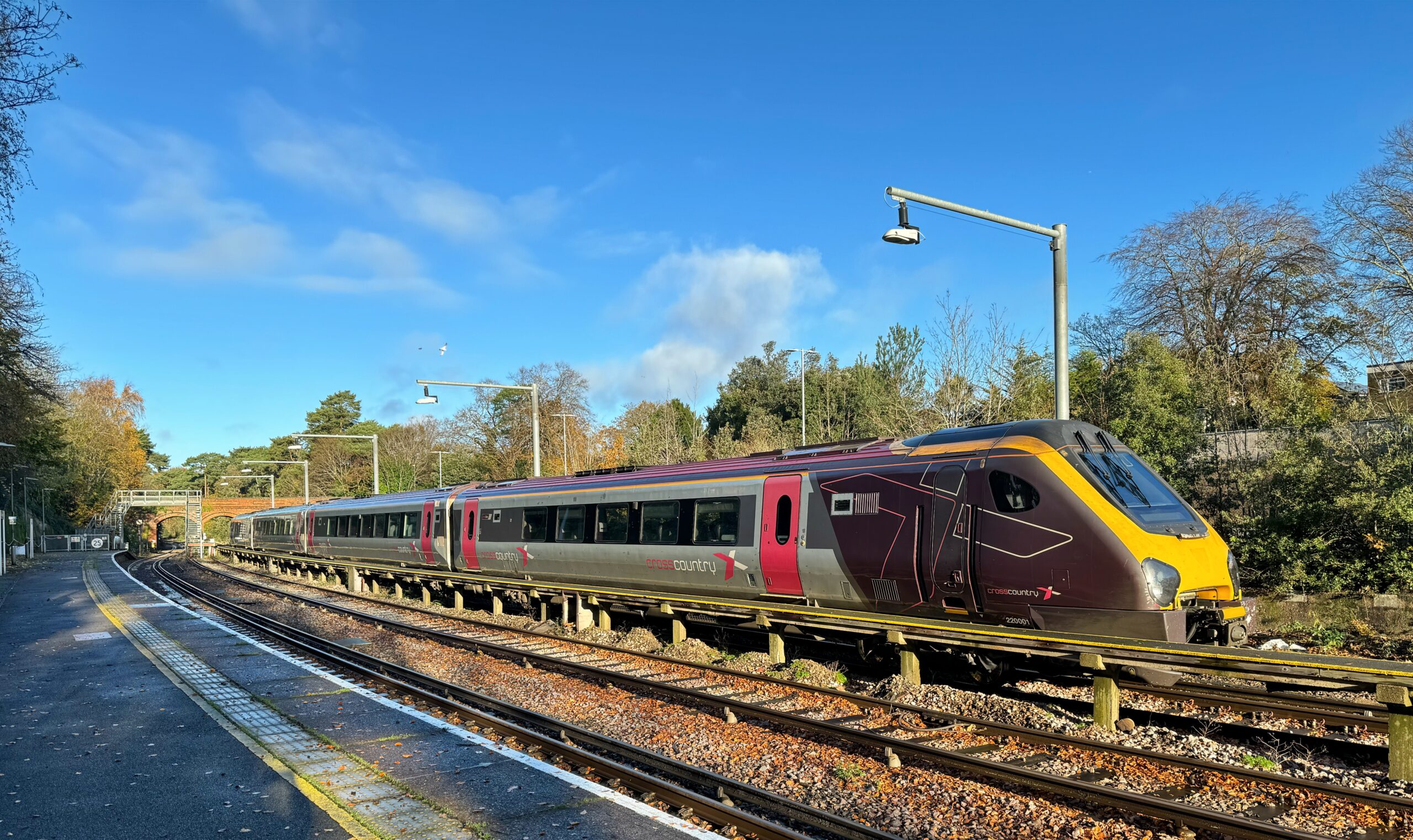
CrossCountry Class 220 Voyager DMU No. 220001 in Bournemouth Middle Sidings waiting to move forward to form a service to Manchester – 20/11/2023 SWR Class 450 No. 450034 at Bournemouth platform 1 awaiting departure on 2B36 1002 Bournemouth to Winchester while Class 444 No. 444001 stands at platform 3 with the short formed 1W08 0903 Weymouth to London Waterloo – 20/11/2023SWR Class 444 No. 444024 waits at platform forming 2W57 0805 London Waterloo to Poole as fellow class member No. 444017 departs with the front five coaches of 1W57 0805 London Waterloo to Weymouth – 20/11/2023
Video from Bournemouth station, including GBRf Class 56 No. 56081, captured on 20/11/2023
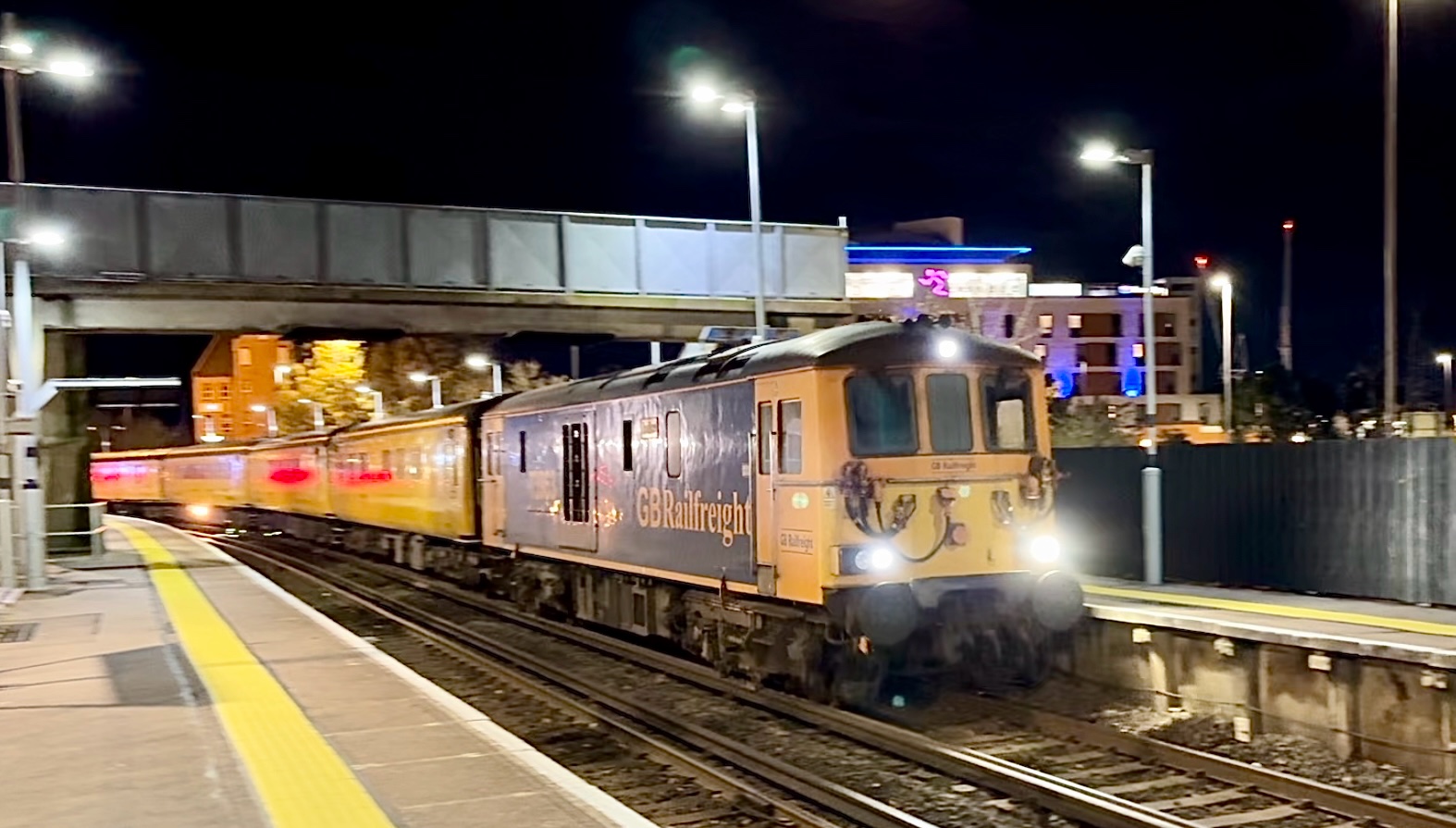
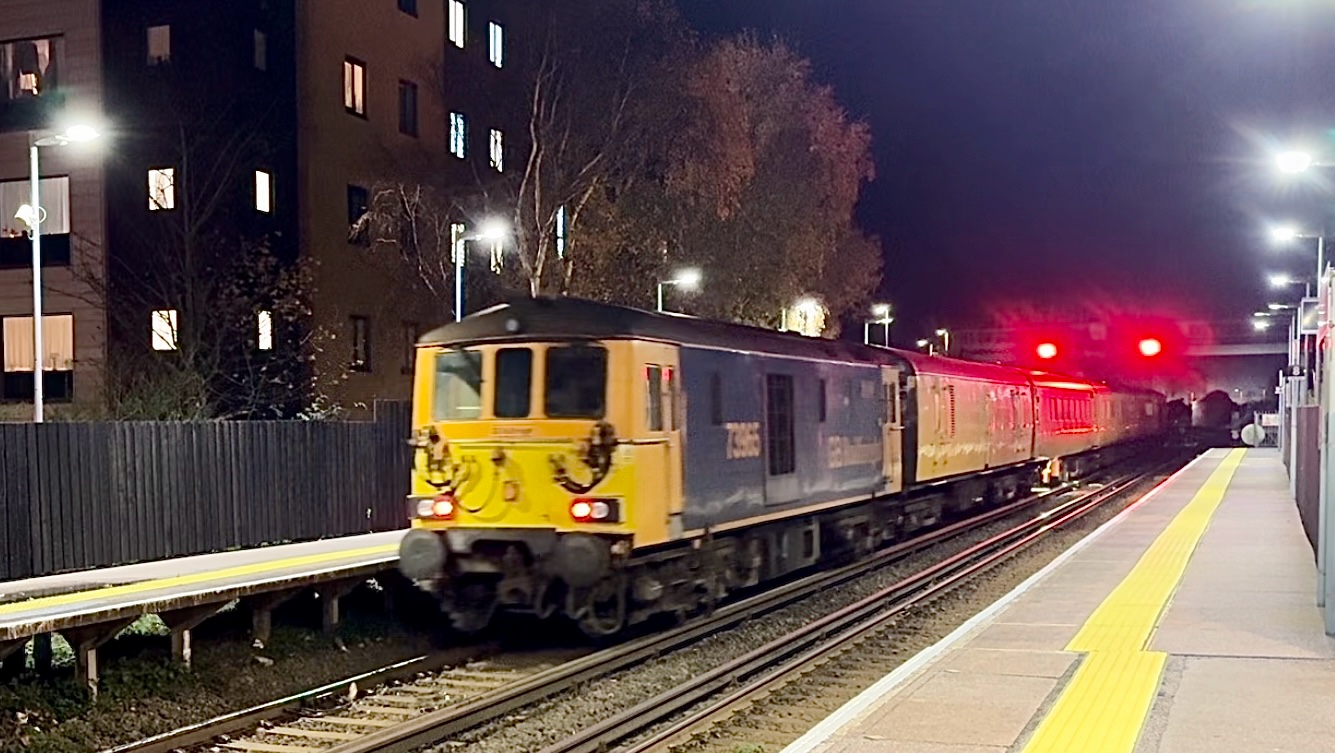
Later Monday evening the regular monthly Colas test train from Derby RTC to Eastleigh East Yard via Weymouth ran as 1Q51 1115 Derby R.T.C.(Network Rail) to Eastleigh East Yard employing the usual traction of GBRf Class 73 locomotives. This time is was the turn of No.’s 73963 ‘Janice’ and 73965 ‘Des O’Brien’ – two locomotives we had seen the previous day departing Tonbridge bound for Derby.
Video screen grab of GBRf Class 73 No. 73963 ‘Janice’ at the head of 1Q51 1115 Derby RTC to Eastleigh East Yard via Weymouth passing through Poole – 20/11/2023Video screen grab of Class 73 No. 73965 ‘Des O’Brien’ passing Poole at the rear of 1Q51 1115 Derby RTC to Eastleigh East Yard via Weymouth – 20/11/2023
Video of 1Q51 1115 Derby RTC to Eastleigh East Yard via Weymouth passing through Poole – 20/11/2023Notification of BCP roadworks for 21st November 2023
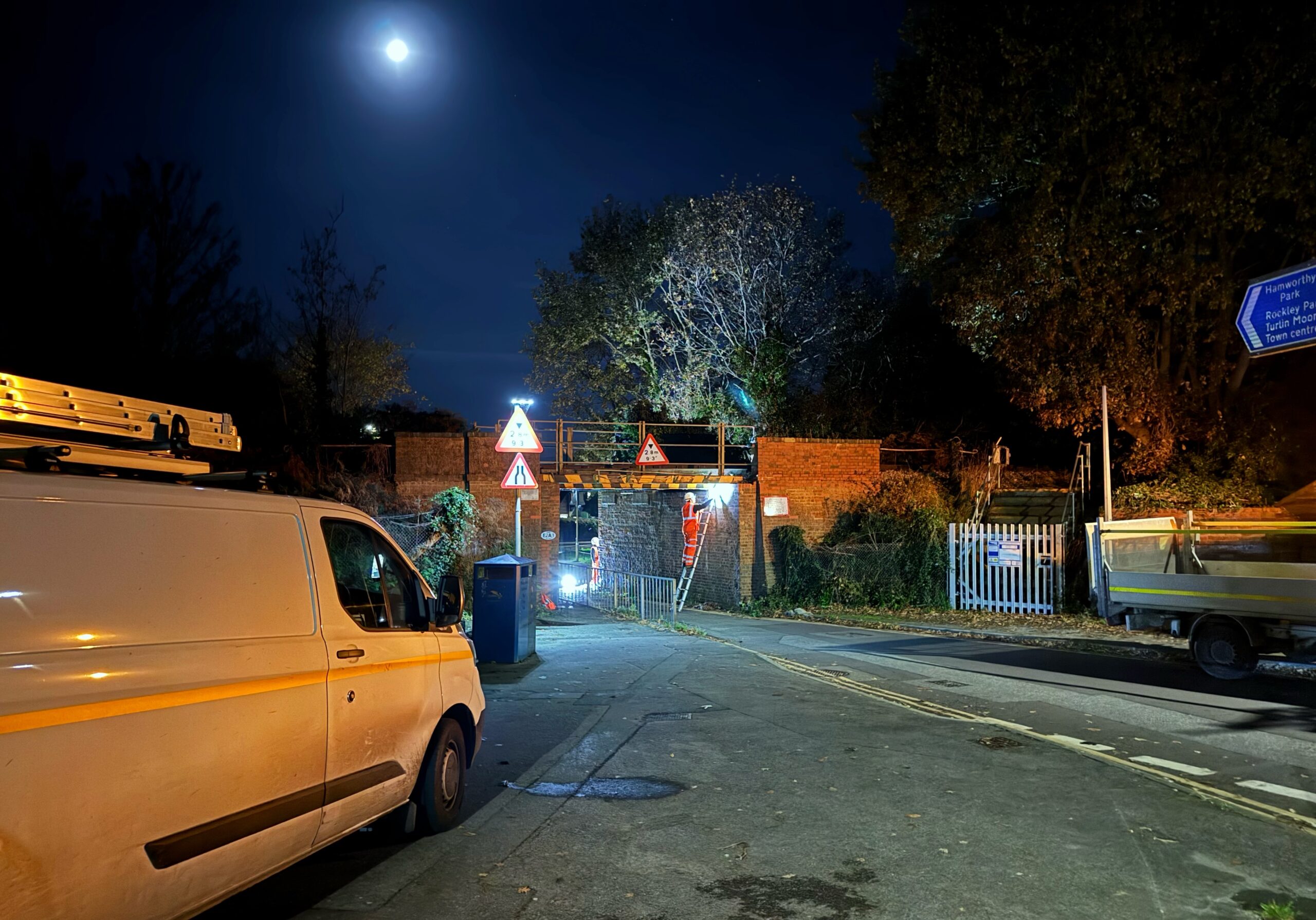
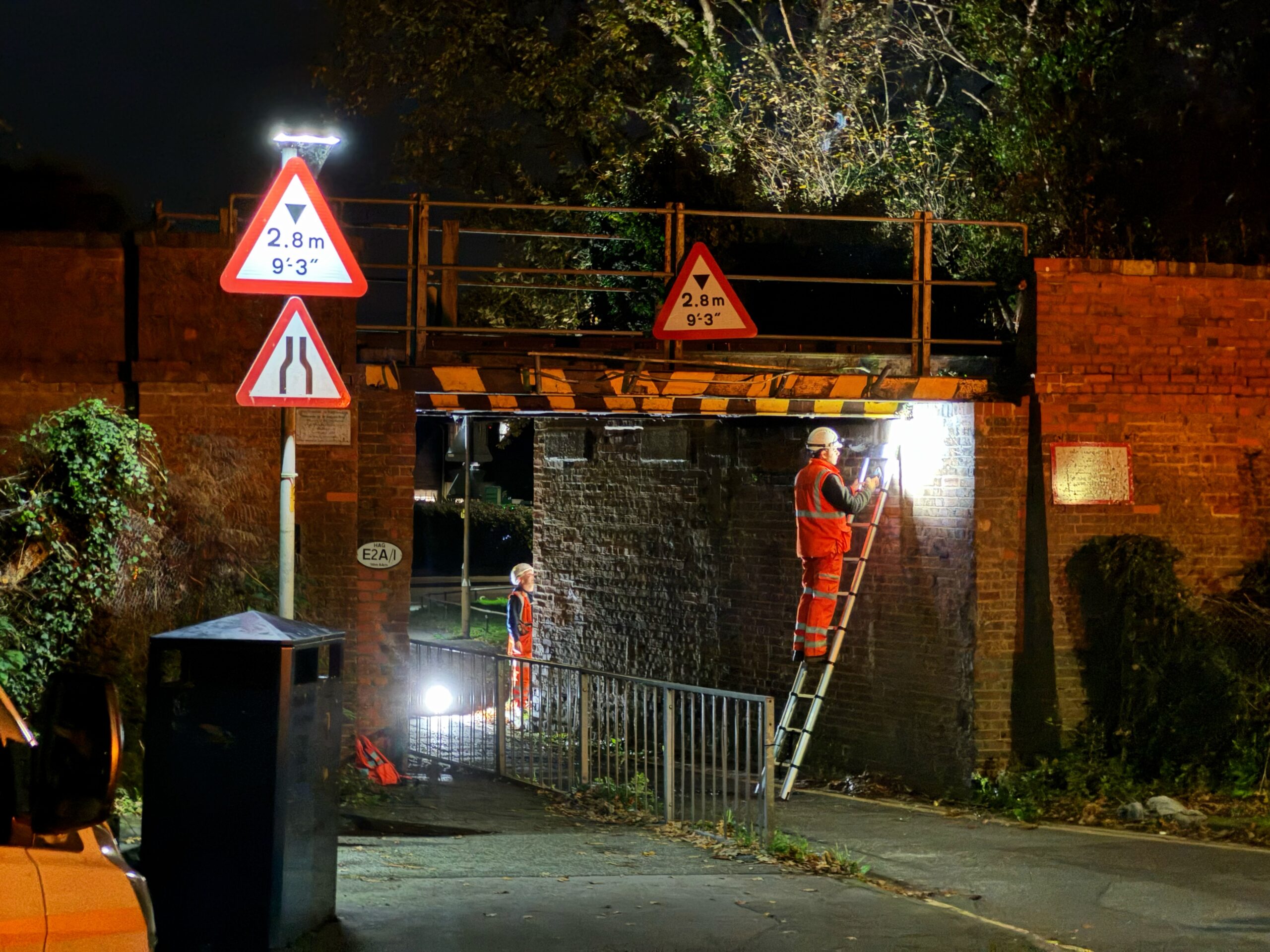
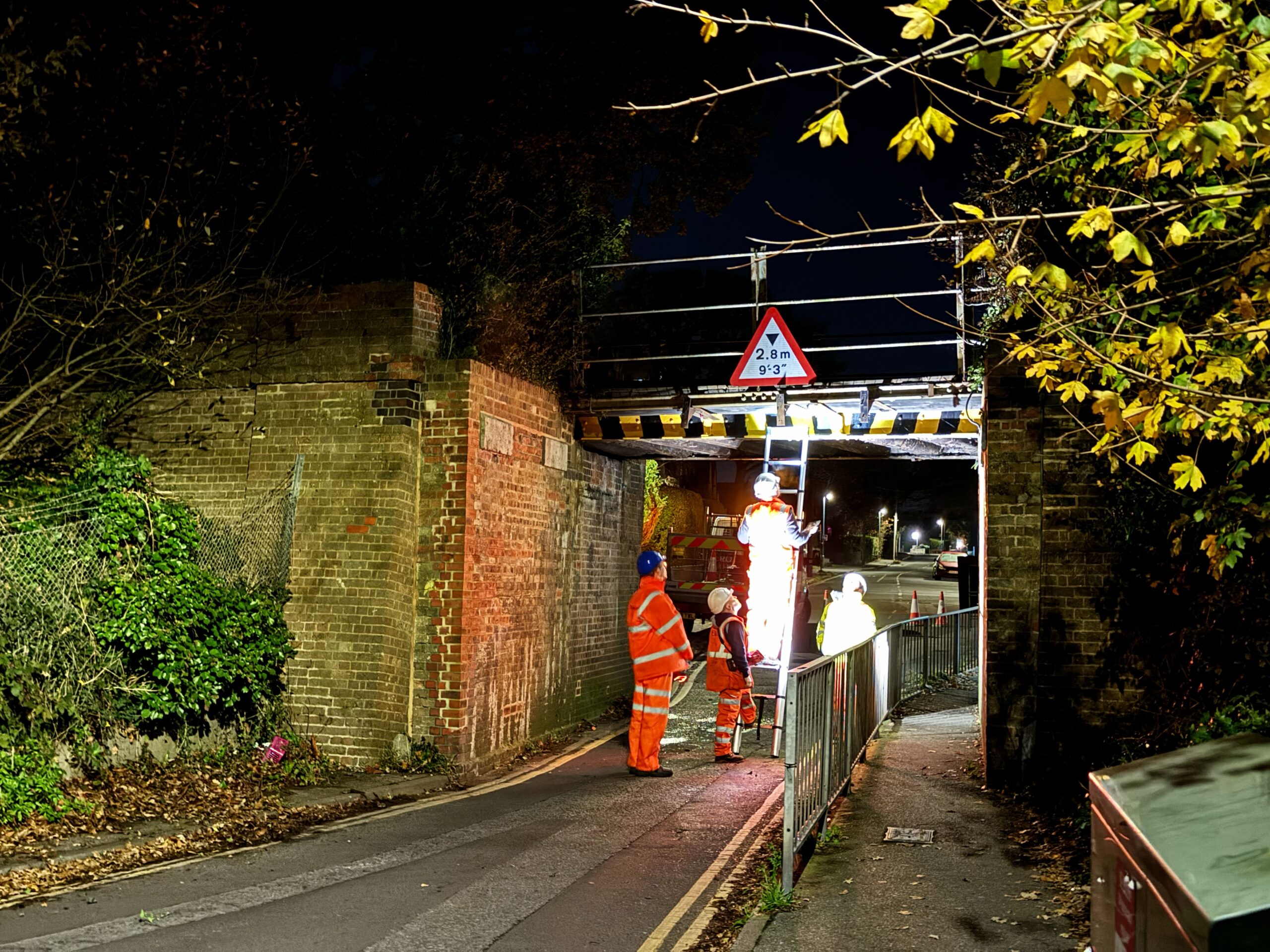
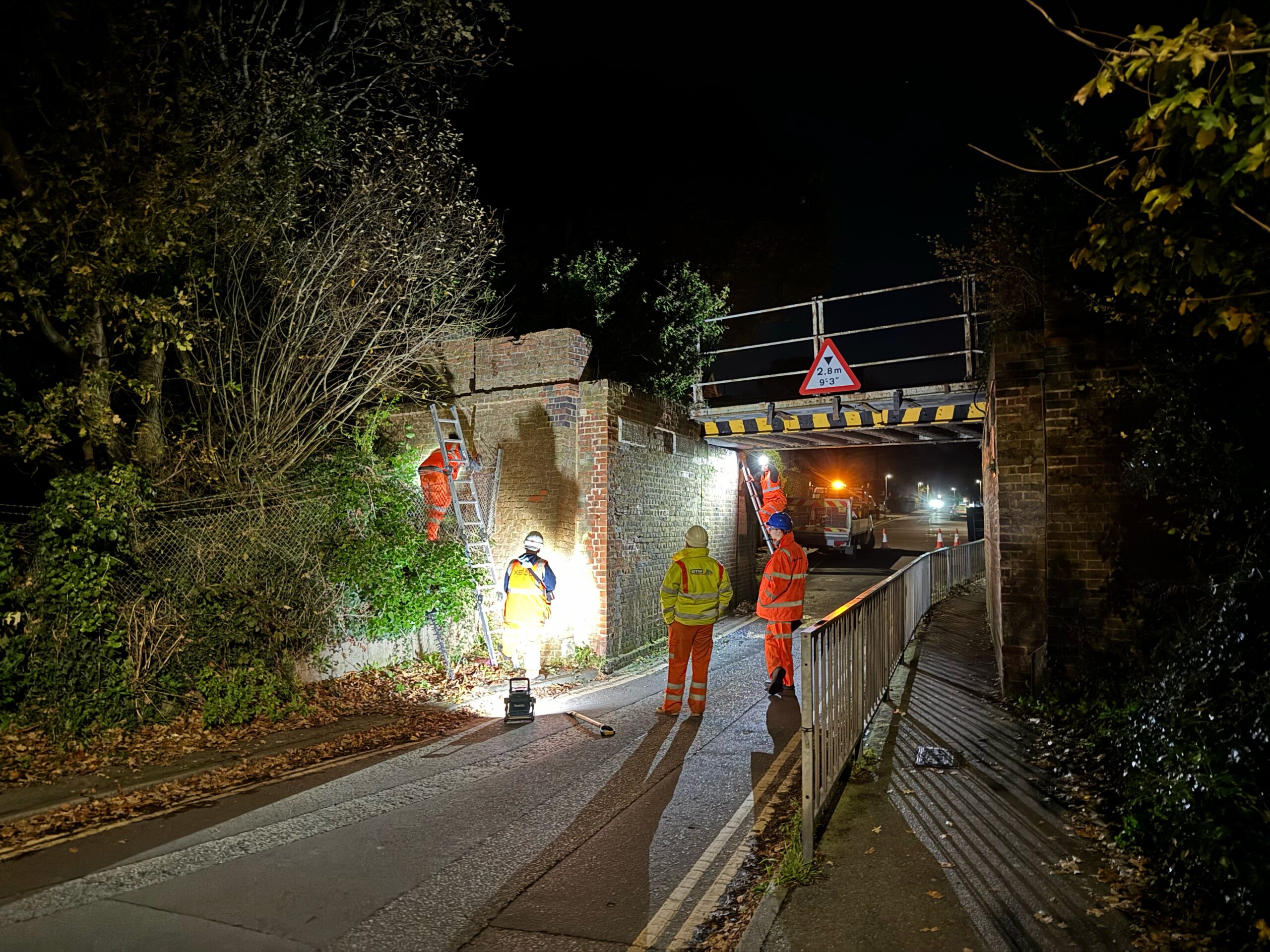
The railway bridge over Lake Road on the Hamworthy Branch was subject to an inspection this week. A small group of Highway Maintenance engineers were on site for a few hours from 2100 on Tuesday 21st November.
Inspection of Lake Road bridge on the Hamworthy Branch – 21/11/2023Inspection of Lake Road bridge on the Hamworthy Branch – 21/11/2023Inspection of Lake Road bridge on the Hamworthy Branch – 21/11/2023Inspection of Lake Road bridge on the Hamworthy Branch – 21/11/2023
The guy we spoke to from the team was very enamoured with Yoshi, but wasn’t able to give us an inside scoop of what might happen at the bridge in the future. Further road closures described as “Works for Rail Purposes” are scheduled at the location in January 2024.
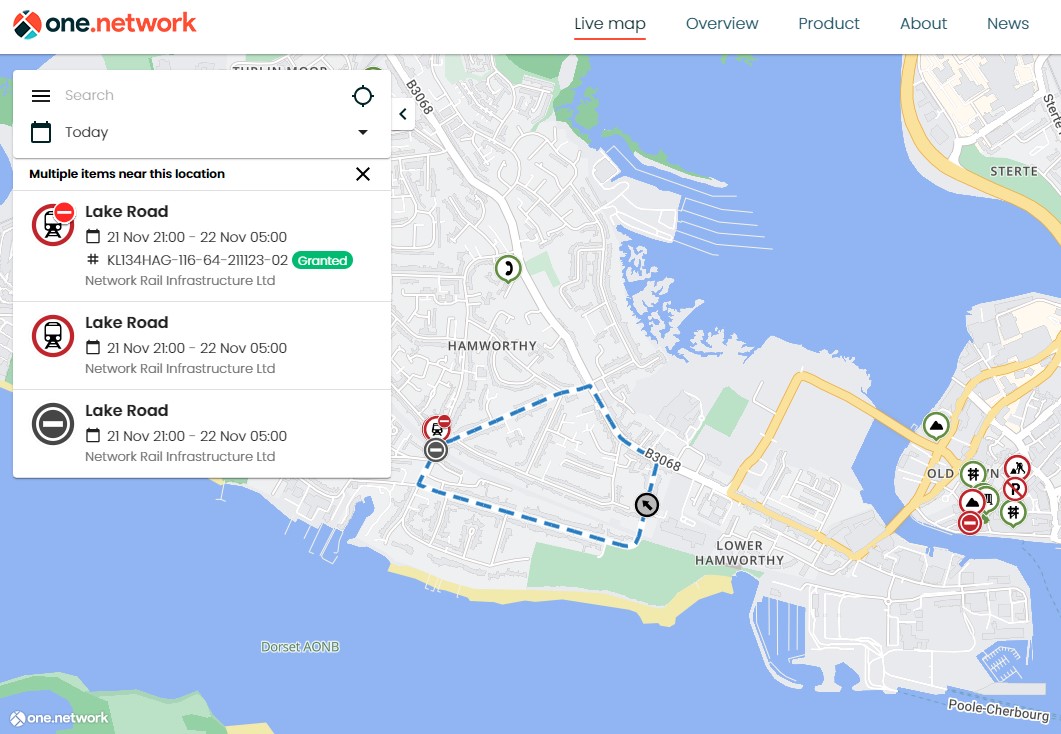
BCP roadworks map detailing roadworks at Lake Road bridge in January 2024
For The Record:
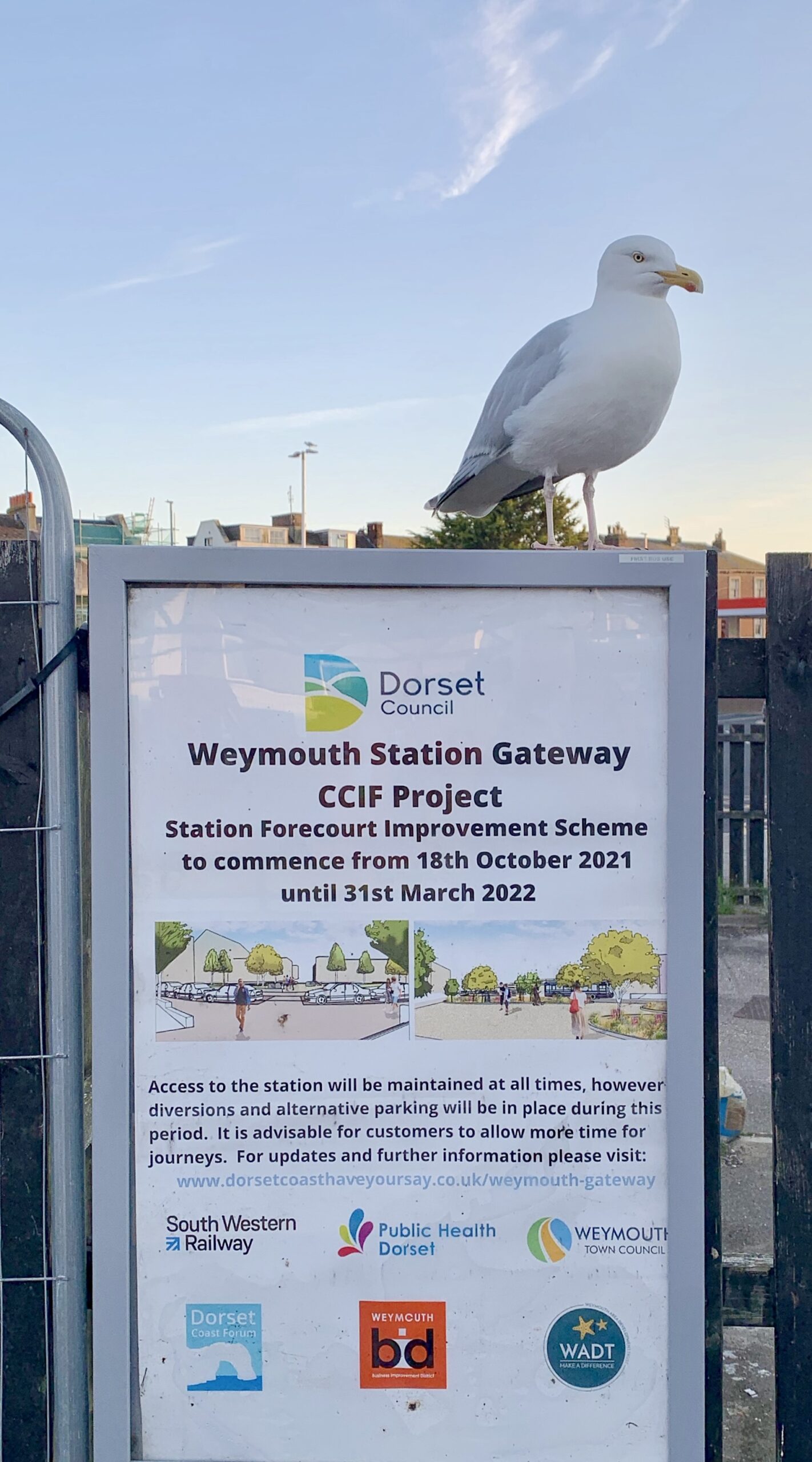
Poster giving customer information for the, clearly over-running, Weymouth Station Gateway Project in May 2022 – 22/05/2022
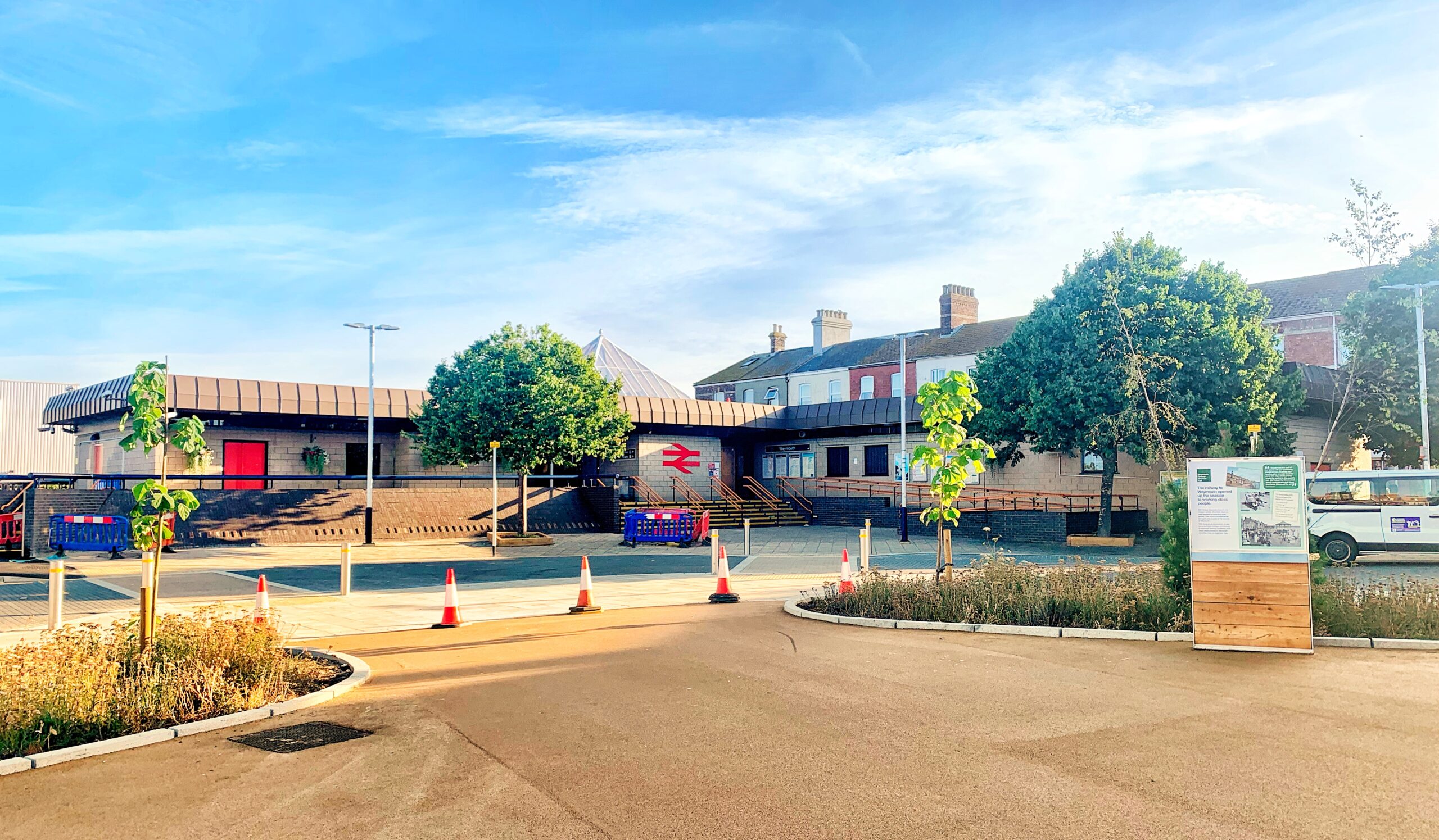
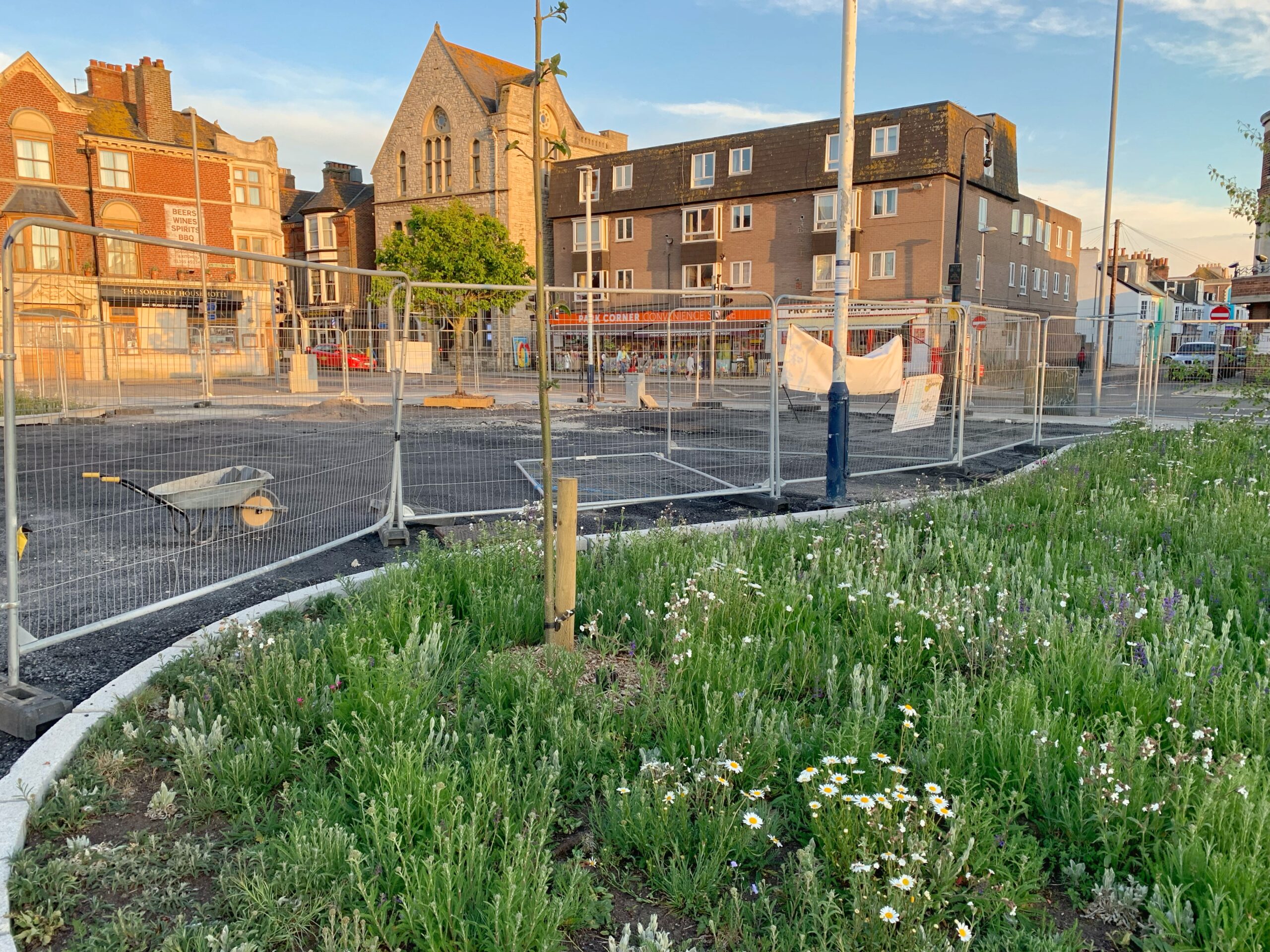
The Weymouth Station Gateway project (WSP), designed to create a more welcoming and user-friendly space for residents, businesses, and visitors to Weymouth railway station has won two trophies at the Institution of Civil Engineers (ICE) South West Civil Engineering Awards 2023. The £1.2m project led by Dorset Coast Forum in partnership with Dorset Council, using funding from South Western Railway, was designed by WSP to open up the layout of the station forecourt, promoting sustainable transport options and reducing anti-social behaviour. The scheme also involved the creation of Pocket Park from a disused section of track on the former Weymouth Harbour Branch. As well as being presented with the Community Award, Weymouth Station Gateway was also given the Judges’ Special Award. The judging panel was impressed with the collaborative, respectful partnership behind the scheme, bringing together the local community, the rail company and the transport authority to improve the public realm. The judges described the project as an outstanding example of infrastructure that unites communities and improves people’s daily lives.
Works during the Weymouth Station Gateway Project – 23/07/2022Works during the Weymouth Station Gateway Project – 22/05/2022
Ten project awards and two individual trophies were presented at the ICE South West Civil Engineering Awards in association with Kier BAM on Friday 10th November 2023 at a gala ceremony in Bristol hosted by TV presenter, Rob Bell. The awards are held annually to recognise achievement among regional engineers and project teams.
…. and relax. Thanks for visiting our page and for your comments and corrections, which are always gratefully received! We’ll be back next week all being well! Be seeing you!
Yoshi celebrating not only this blog’s second birthday, but the 60th Anniversary of Doctor Whoof – 23/11/2023
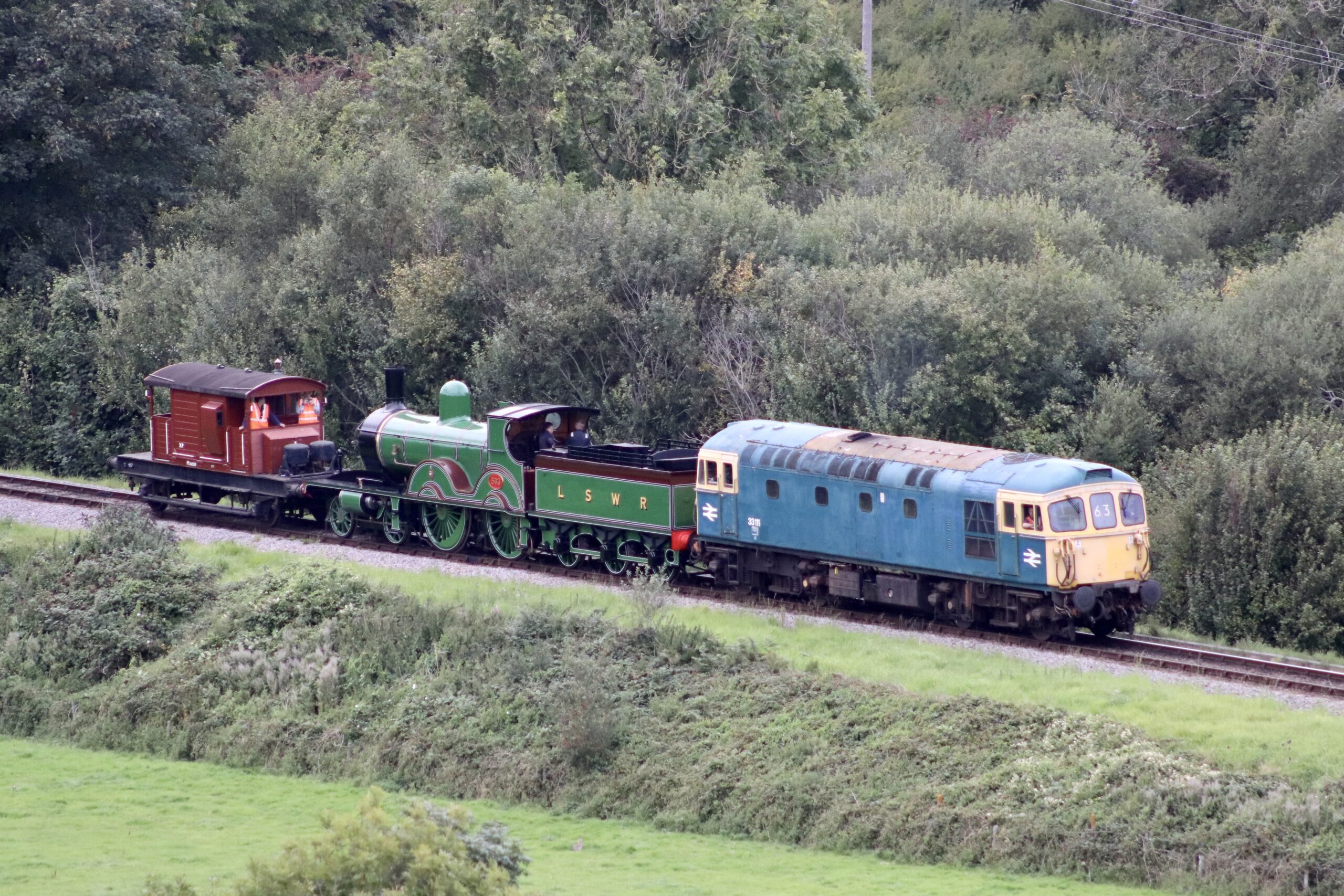
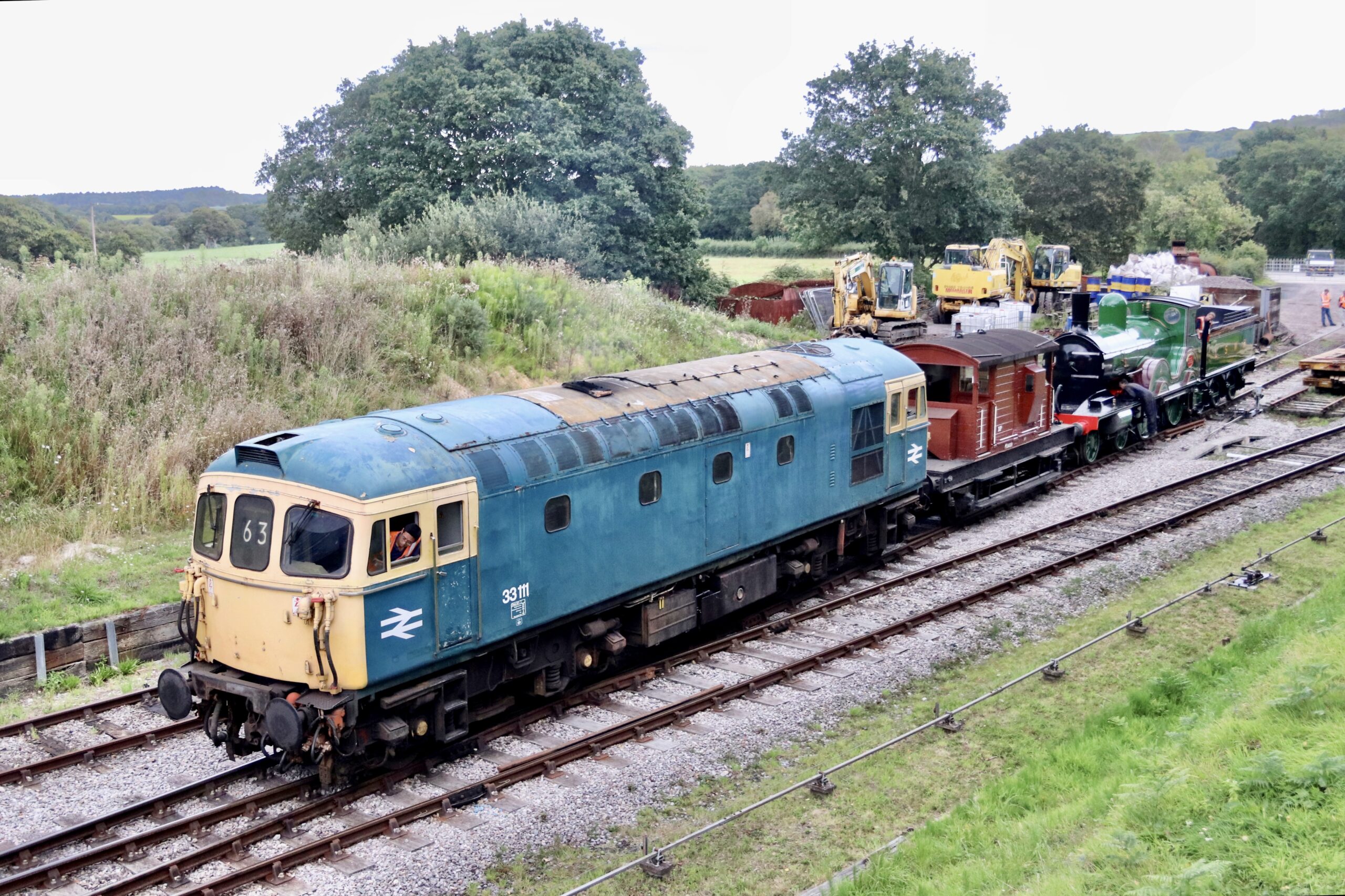
Swanage resident Class 33 No. 33111 tows Adams T3 4-4-0 No. 563 from Norden to Swanage – 30/08/2023
August 30th 2023 to September 5th 2023
Wednesday August 30th was a busy day for local rail activity in our part of Dorset with a Class 458/5 unit drag scheduled from Bournemouth depot and the return of a Victorian era “Top Link” engine in the form of London & South Western Railway (LSWR) Adams T3 4-4-0 No. 563 to the Swanage Railway following her six year overhaul. And with both these things scheduled to happen 17 miles apart at relatively the same time it was time for a plan!
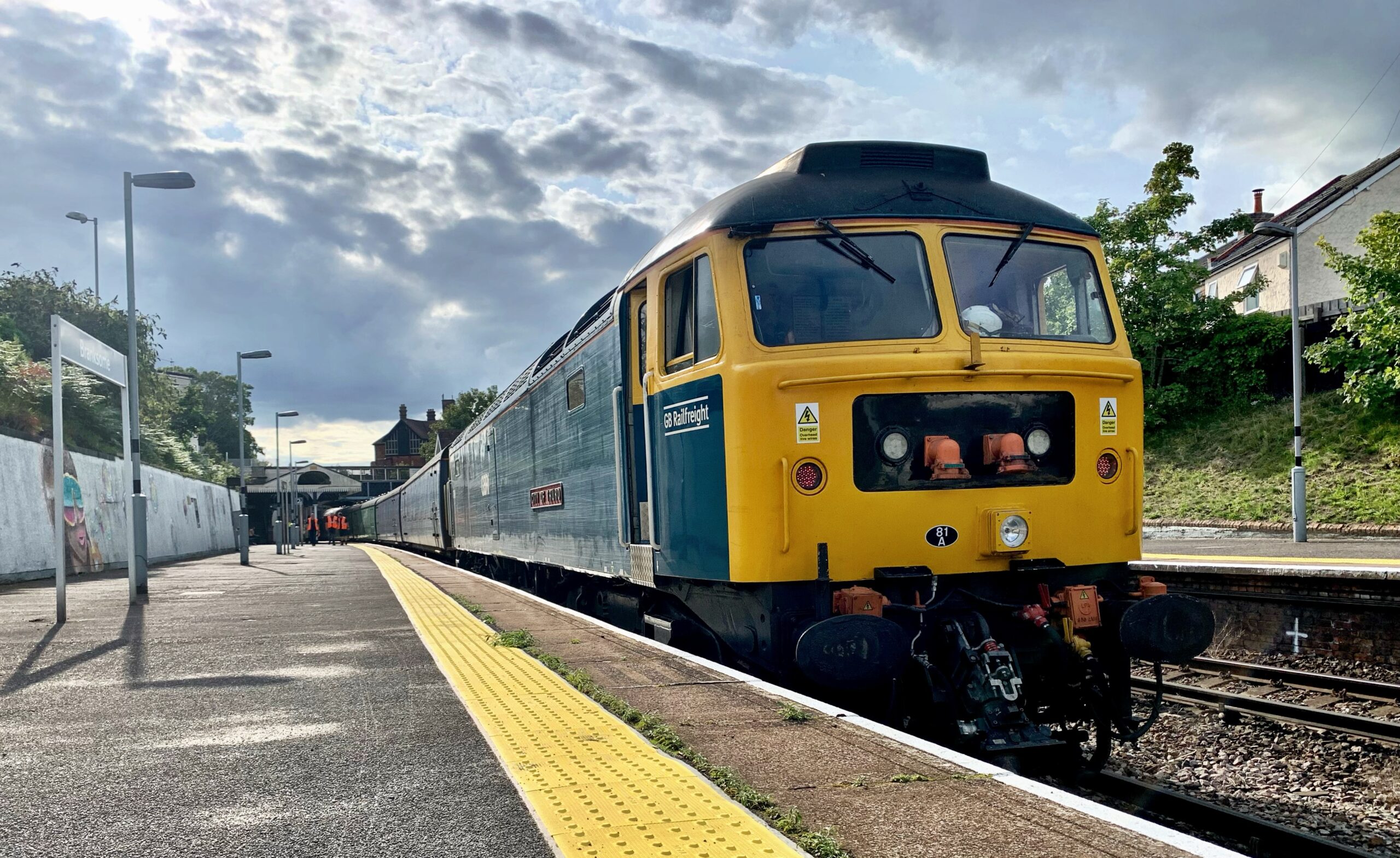
It was my intention to pop over to Branksome railway station around half four to see the arrival of GBRf Class 57 No. 57305 and Class 47 No. 47749 ‘City Of Truro’ arriving with barrier wagons working 5Z72 1548 Eastleigh East Yard to Bournemouth T&R.S.M.D in preparation for another Class 458/5 electric multiple unit move to Widnes Transport Tech where the units are being modified and refurbished for future use by South Western Railway (SWR). Following this, it would be a half hour drive to Norden where T3 No. 563 would be waiting to be towed down to Swanage. Once again, Jamie very kindly provided transport and good company with Yoshi sitting this adventure out at home.
On arrival at Branksome we followed the progress of 5Z72 via Real Time Trains (RTT) and Open Train Times (OTT) which showed the train getting progressively later. This meant that is was likely to arrive at platform 2 the same time as a passenger service was scheduled on platform 1. So careful consideration had to be made in order for the GBRf working to not be blocked from view if I opted for the wrong platform from which to see the train. I played it safe and wandered off to the London end of platform 2 in time to see the Class 57 round the corner just as the service train crept up behind me on the adjacent track. I wasn’t to be so lucky on the return working however!
GBRf Class 57 No. 57305 climbs into Branksome working 5Z72 1548 Eastleigh East Yard to Bournemouth T&RSMD – 30/08/2023
It’s been approximately 20 years since the most recent Class 57 conversions from Class 47’s were out-shopped by Brush Traction at Loughborough and 32 of the 33 rebuilds during the late 1990’s and early 2000’s are still in existence following the scrapping of No. 57004 in July 2023, this being the first and to date, only Class 57 to be broken up.
GBRf Class 47 No. 47749 ‘City of Truro’ awaits permission to reverse 5Z72 1548 Eastleigh East Yard to Bournemouth T&RSMD into the depot – 30/08/2023
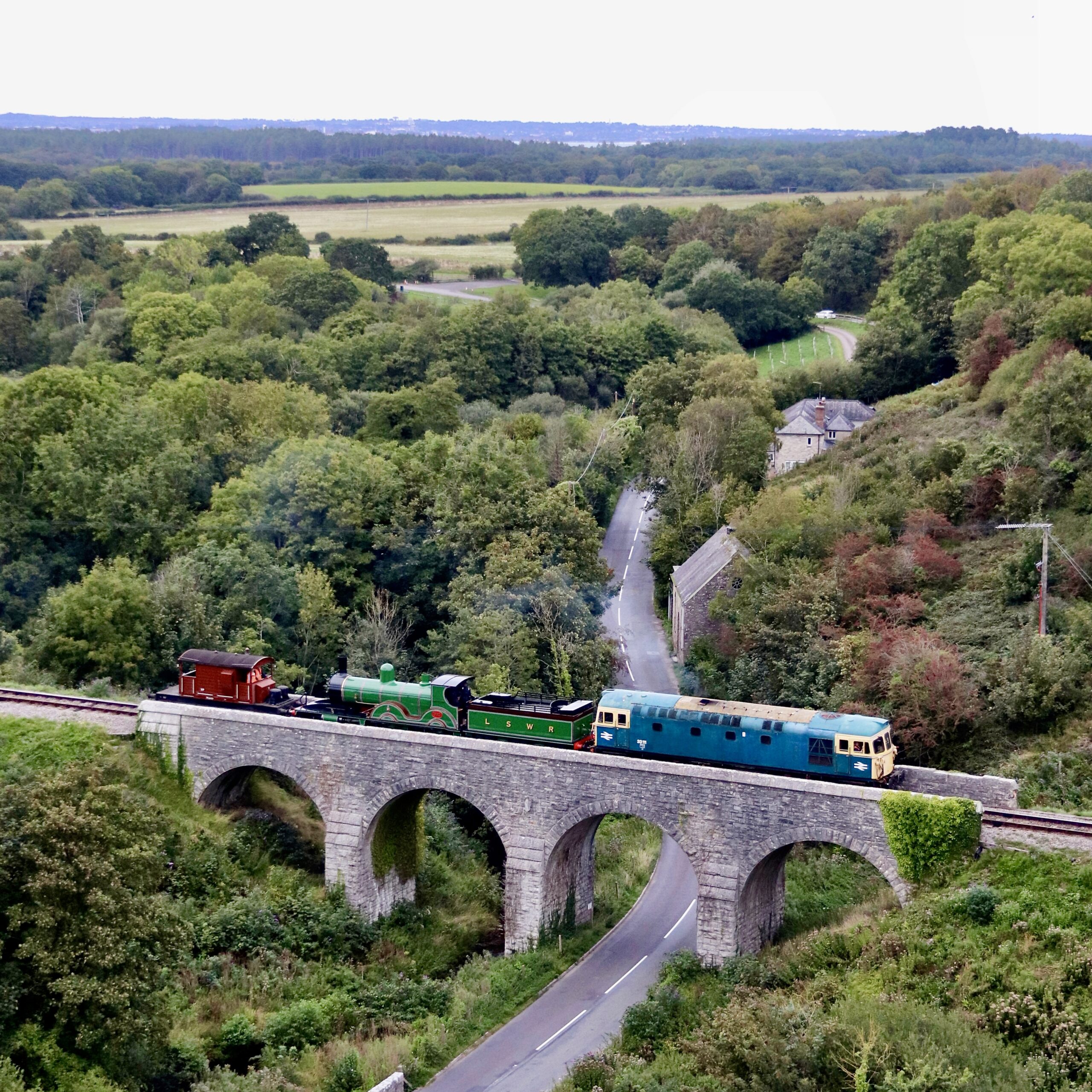
Cameras safely stowed away we drove off through Poole and Wareham, where we were stuck behind slow moving motorhomes and bus services. Narrowly avoiding being further delayed by a herd of cows crossing the road at Stoborough, we arrived at Norden well before Class 33 No. 33111 arrived from Swanage towing a brake van to collect No. 563. The Victorian 4-4-0 looked amazing, even from a distance, as we observed the locomotive from the road bridge looking across to Arne Road siding. The final Diesel Multiple Unit service of the day from Wareham to Corfe castle was waiting clearance at the road crossing into Norden station and once this had passed through the area, we didn’t have too long to wait until the Crompton arrived. In fact the whole operation of reversing into the siding and coupling up to the T3 was done ahead of the proposed timings and once the consist pulled away we moved on to our next vantage point. We had plenty of time as it was planned for the diesel locomotive to run around the T3 and brake van in Norden station so the Class 33 was leading for the onward journey to Swanage. With top speed a sedate 15mph for the 33 and T3 pairing, we took a position overlooking the Grade II listed viaduct in the shadow of Corfe Castle. We didn’t know if we’d be in for a long wait as things were, at that time, around an hour ahead of schedule. As luck would have it, we didn’t have long before the locomotives came into view.
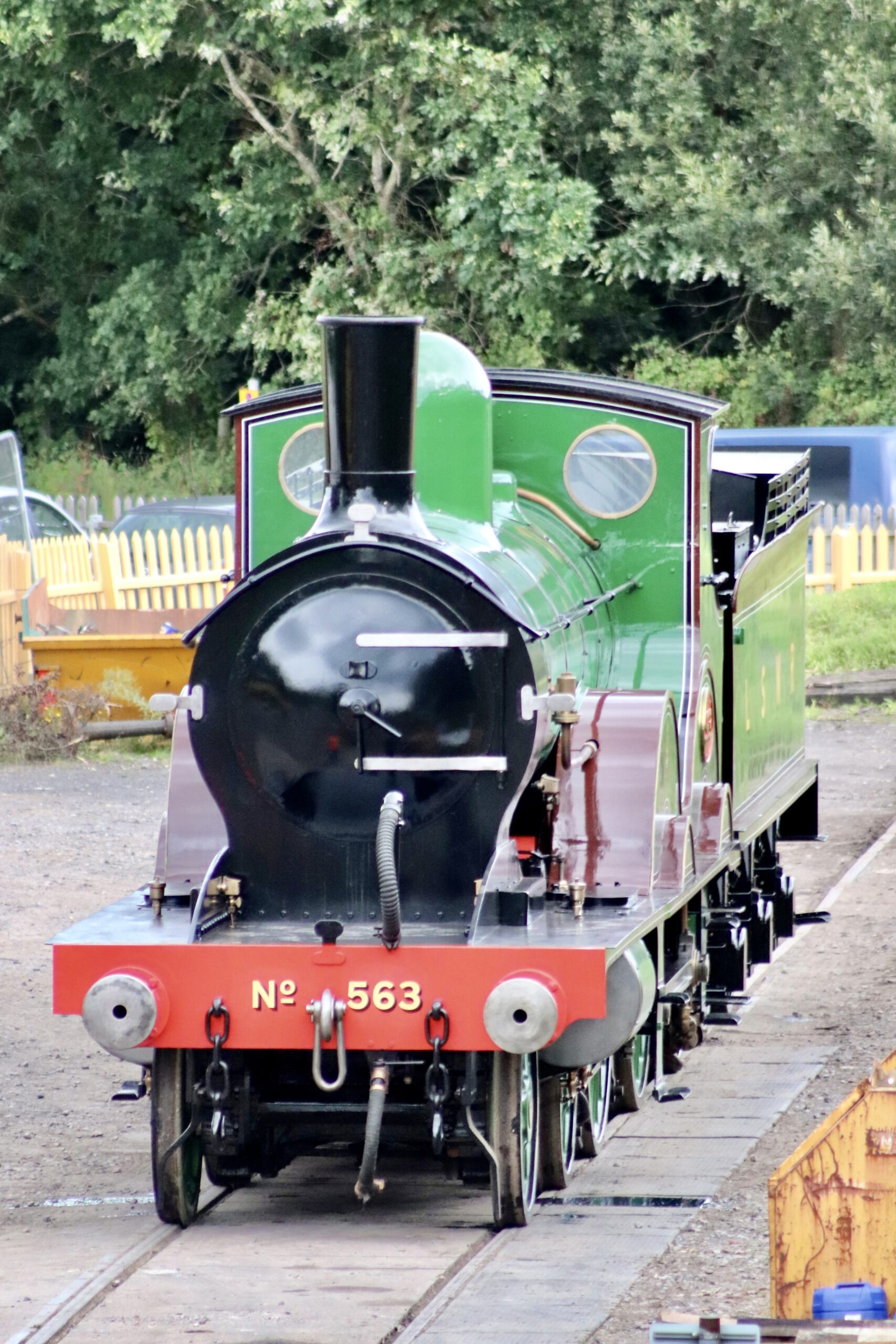
Looking stunning in her restored Drummond passenger green livery, Adams T9 4-4-0 No. 563 has been reunited with her tender and awaits the arrival of the train to tow her to Swanage – 30/08/2023Class 33 No. 33111 slowly draws T3 No. 563 slowly out of Arne Road Siding – 30/08/2023Adams T9 4-4-0 No. 563 being moved from Norden to Swanage – 30/08/2023Adams T9 4-4-0 No. 563 is towed across the Grade II listed viaduct at Corfe Castle by Class 33 No. 33111 – 30/08/2023
T3 No.563 was completed in March 1893 and was allocated new to Nine Elms shed, with moves to Guildford and Eastleigh over the following years. After an overhaul in 1935, she was transferred to Salisbury where she was looked after by shed staff, performing as station pilot or working slow trains to Bournemouth until being reallocated to Eastleigh in February 1938. She was withdrawn in March 1939 following her failure whilst working a Fawley goods train. However, with the onset of World War II she was reinstated into traffic being allocated to both Basingstoke and Eastleigh before being withdrawn again in 1945 following cessation of hostilities in Europe. She was resurrected yet again three years later in 1948 as an exhibit at London Waterloo’s centenary celebrations where she represented the LSWR. There then followed periods of storage in the electric carriage shed at Farnham, and at Tweedmouth before being restored at Eastleigh prior to moving to the Clapham transport museum in 1961 as part of the National Collection. From 1975, she was subsequently displayed at York and Shildon and took part in theatre productions of “The Railway Children” in London and Toronto before being disposed of by the National Railway Museum in 2017, when following a series of negotiations it was agreed to transfer ownership of No. 563 to the Swanage Railway Trust.
No. 563 has been extensively restored at the Flour Mill near Lydney in the Forest of Dean, Gloucestershire with the tender being restored separately at Herston Works, Swanage. Restoration started in November 2017, at the cost of £650,000. Having passed her boiler exam in July 2023 and moving under her own power for the first time in 75 years, No. 563 was transported by road to Purbeck arriving early morning on Wednesday August 30th. Resplendent in lined-out 1890’s Drummond passenger green livery, the T3 was reunited with her tender prior to making the journey by rail from Arne Road Siding at Norden in the company of “Crompton” Class 33 No. 33111. She will undergo inspections and testing prior to entering operational service. Unfortunately while the locomotive was being moved at low speed to Swanage, both coupling rods started to run warm. Before testing can resume, precautionary checks will be required and the re-machining of the coupling rods bushes. Commissioning work will continue at Herston while this is being done. It is hoped that No. 563 will haul her first passenger train in 75 years on the Swanage Railway to mark the centenary of the Southern Railway and the 185th anniversary of the formation of the London and South Western Railway in 2023, but no date has yet been confirmed.
No. 563 fills a gap in the Swanage Railway fleet as the class hauled trains from London to Swanage from the 1890’s through to the 1930’s and represents an image of what the railways would have been like during the industrial and social development of Dorset during the 19th Century.
Adams T3 4-4-0 No. 563, Swanage Railway – 30/08/2023
As things had happened smoothly and well ahead of schedule, following a quick consult of Google Maps, we decided we had enough time to head back to Branksome and see the Class 458/5 drag departing Bournemouth depot. On our return to Branksome, we checked RTT and OTT once again, but it was to be a good 17 minutes after the allotted time that Class 57 No. 57305 rolled back into the station working as 5Q72 1926 Bournemouth T&R.S.M.D to Wembley Receptions 1-7. Although diagrammed to reverse at platform 2, the train in fact arrived on platform 1. Again decisions had to be made on where to stand in order to get a shot of the GBRf locos and SWR EMU. All went well until departure time when, having returned to the London end of platform 2, a Class 444 working a service train arrived just as the Class 47, now leading the train out, powered up and departed. You win some, you lose some!
GBRf Class 57 no. 57305 emerges from Bournemouth depot working 5Q72 1926 Bournemouth T&R.S.M.D to Wembley Receptions 1-7 – 30/08/2023Class 458/5 No. 458525, part of 5Q72 1926 Bournemouth T&R.S.M.D to Wembley Receptions 1-7, stands in the platform at Branksome on the way to Widnes Transport Tech for conversion and refurbishment – 30/08/2023
Class 458 EMU move from Bournemouth T&RSMD – 30/08/2023
On Sunday September 3rd, we took the opportunity to go and bark at some CrossCountry HST’s in Somerset. With only a few weeks remaining of scheduled XC High Speed Train workings we drove over to Highbridge and met up with @smithy.377 (check out his excellent Instagram account!).
Once an important centre on the Somerset & Dorset Joint Railway (S&DJR) accommodating their locomotive works, Highbridge survives today as a top on the Bristol to Taunton Main Line operated by Great Western Railway (GWR). The original station opened on 14th June 1841, when the Bristol and Exeter Railway (B&ER) opened its broad gauge line to Bridgwater. The B&ER was later amalgamated into the Great Western Railway (GWR) on 1st January 1876.
The Somerset Central Railway (later absorbed into the S&DJR) opened to Glastonbury on 28th August 1854 but was worked by the B&ER for the first few years as it was also originally built to Brunel’s broad gauge. Separate platforms were provided for each railway and a connection between the was two situated in the goods yard. The layout eventually consisted of two terminal platforms and two through platforms to service an extension line that continued via Highbridge Wharf (where most of the S&DJR goods traffic was also handled) and onwards to Burnham On Sea extending the line two or three miles westwards which opened on 3rd May 1858.
To reach the extension, the S&DJR line crossed the B&ER main line on the level just north of the road bridge, by means of a special ‘diamond crossing’ over the main line and a gated level-crossing over the A38. The Burnham line was a key element in the original planning for the Somerset and Dorset line and was built with the expectation of picking up passengers from paddle-steamer ferries from South Wales and transporting them to the south coast of England with Burnham On Sea railway station, essentially a terminus, also including a through platform allowing services to travel on to a 900ft S&DJR built stone pier on the River Severn/River Parrett estuary from where the steamers would sail. Railway operations onto the pier ceased in 1888 although the pier continued in use for shipping until the 1950’s.
Burnham On Sea effectively closed when regular passenger services were curtailed at Highbridge on 28th October 1951. Excursion traffic continued until 1962, and the goods depot remained open until 1963 with all rail traffic ceasing in 1966. The station building, main platform and goods shed were all subsequently demolished. The excursion platform remained on the derelict site for over a decade, until the former track bed eastwards was developed into Marine Drive, a road which has helped ease traffic flowing into the town.
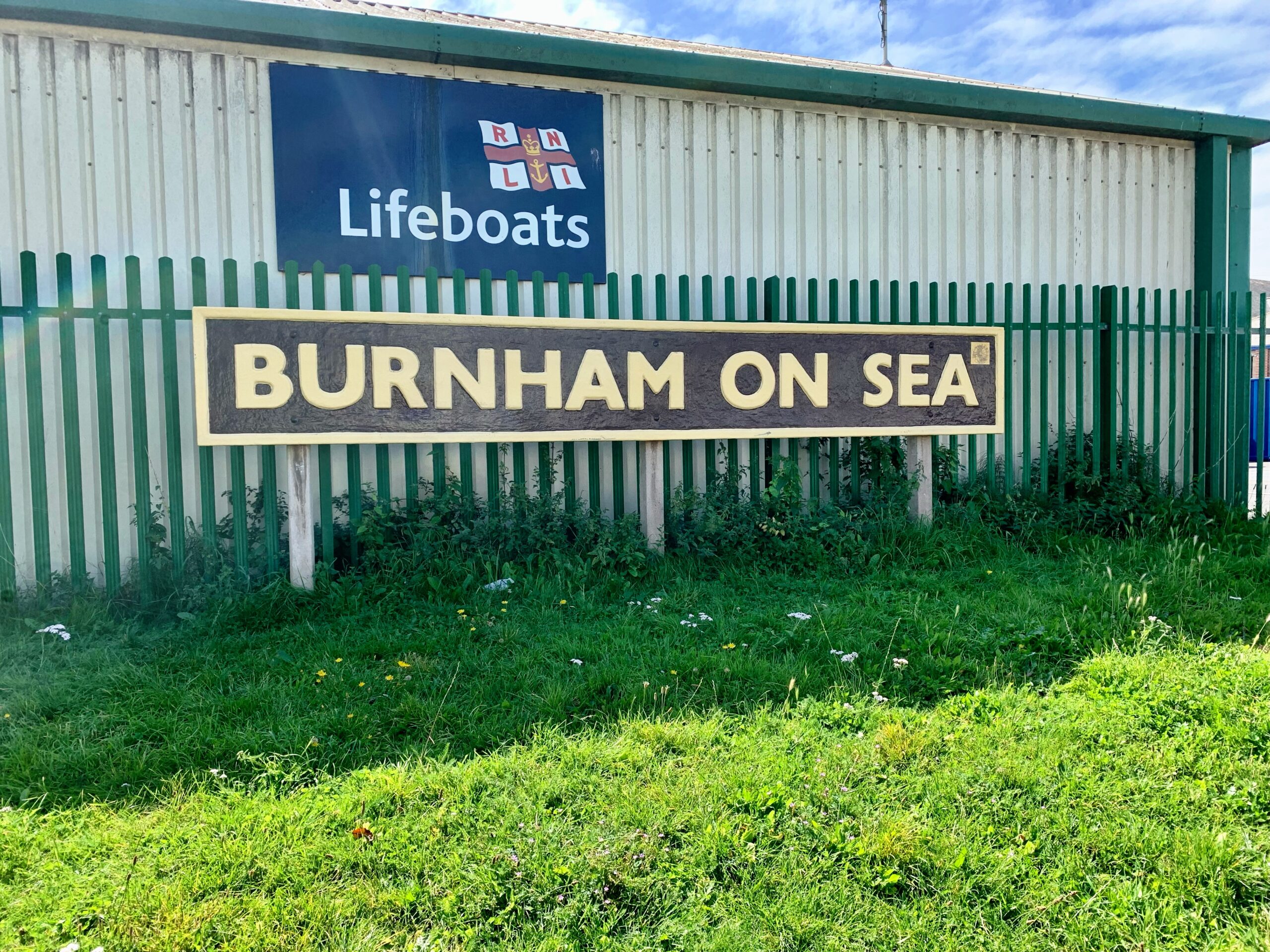
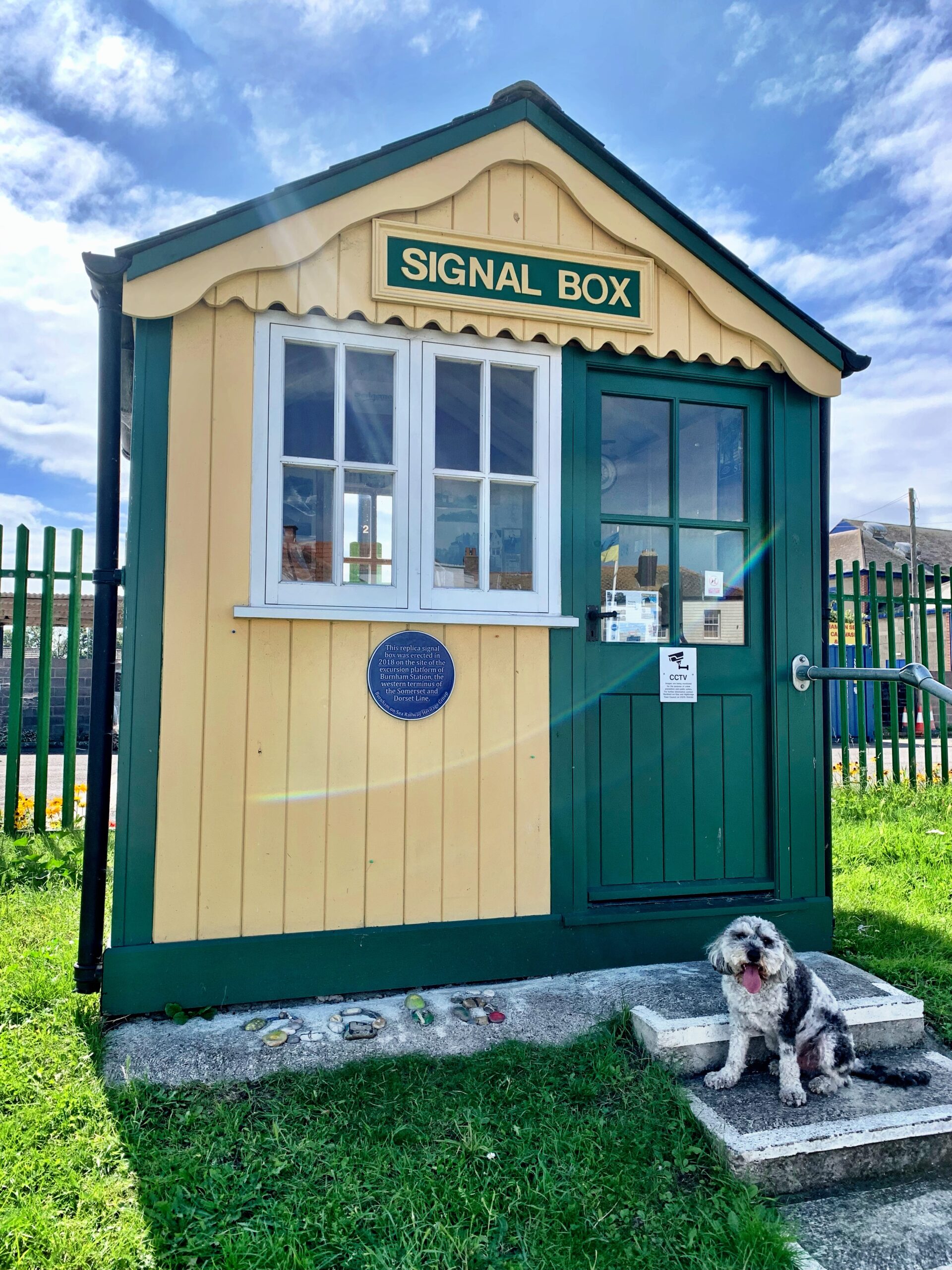
The location of the station itself was on the junction of Old Station Approach and Abingdon Street, and the former goods yard is now a small car park. An adjacent pub on the High Street was renamed the “Somerset & Dorset”. The local RNLI station and yard occupy land to the south and east of the former main station building, adjacent to the site of the former excursion platform. A B&M store occupies the seaward-west side. To remember its railway past, there are various features which have been installed by the local railway Heritage Group, notably a replica semaphore signal on Old Station Approach near the entrance to the High Street Car Park, a buffer stop on the corner of South Esplanade and Pier Street located very near to the site of original railway terminus, a station signboard and replica signal box which stands on what was known as the excursion platform, and a locomotive shaped weathervane on the town green. The original signal box which once stood alongside the platforms has been restored and is now based at Washford on the West Somerset Railway.
Burnham On Sea station sign marking the site of the former excursion platform – 03/09/2023Yoshi enjoys the shade provided by the replica signal box at Burnham On Sea – 30/08/2023Plaque explaining the replica signal box at Burnham On Sea – 30/08/2023
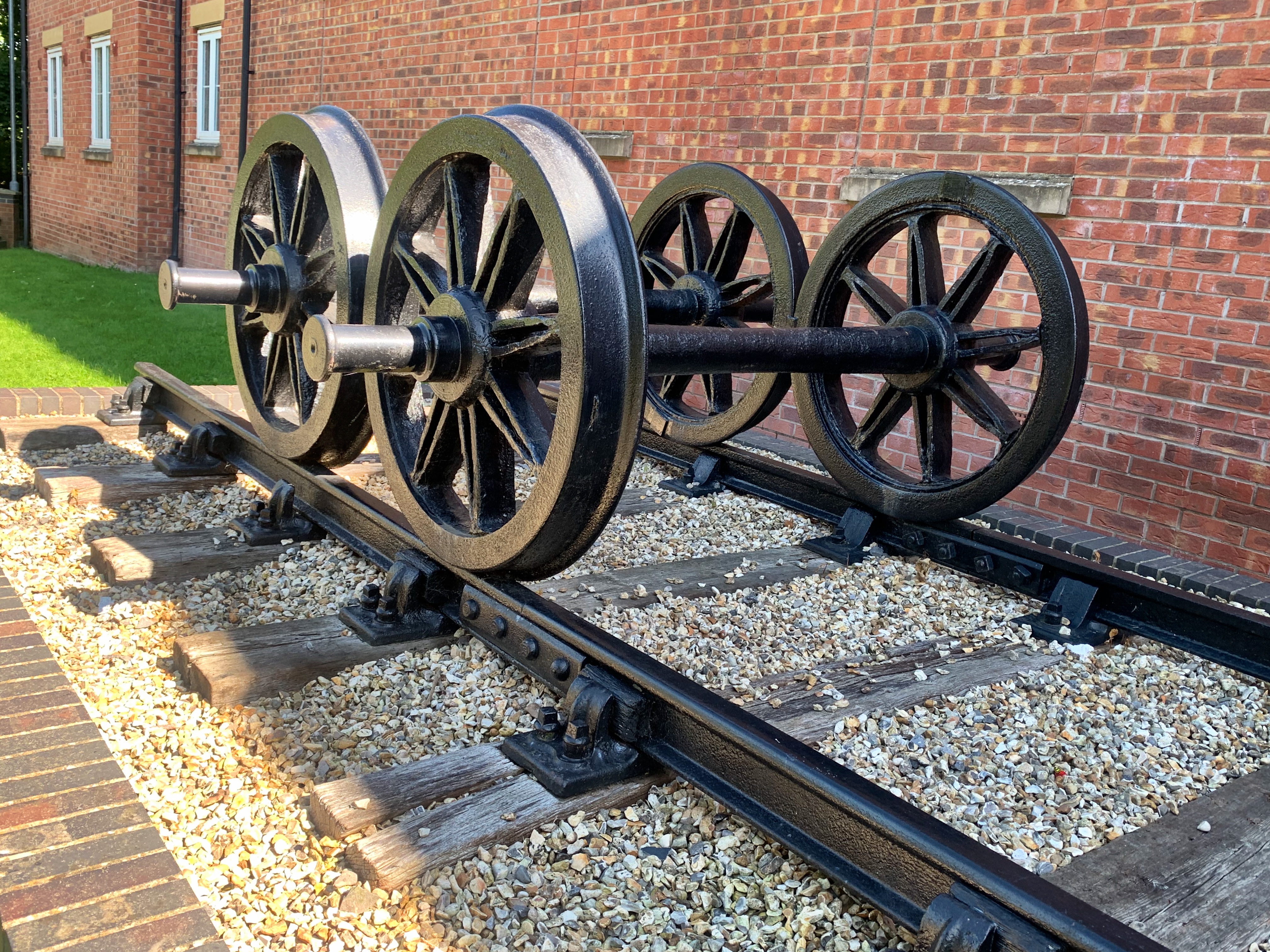
Returning to Highbridge the S&DJR locomotive works closed in 1930 after the motive power of the line was taken over by the London Midland and Scottish Railway (LMS), whilst its joint-venture owning partner the Southern Railway (SR) took over civil engineering and line operations. a small engine shed remained open until the Somerset & Dorset line and platforms finally shut in 1966. All of the original B&ER/GWR and S&DJR station buildings have all since been demolished, replaced on current platforms by metal and glass shelters. There is also no trace of the former S&DJR trackbed, platforms, engine shed or works, all of which are now beneath new housing to the east of platform 1. A couple of old wagon wheels sit on a short length of track on a plinth marking the past history of the site.
Wheel sets mark the area where the S&DJR yard and works once stood at Highbridge – 03/09/2023Old rail at Highbridge – 30/08/2023
To see film of Highbridge and Burnham in the early 1960’s follow this link: https://www.bbc.co.uk/iplayer/episode/b03495yn/lets-imagine-a-branch-line-railway-with-john-betjeman. First transmitted in 1963, John Betjeman looks at the Evercreech Junction to Burnham On Sea railway line, providing a unique profile of a working steam branch line railway as he travels along the original part of the Somerset Central Railway. Examining towns and stations along the way, Betjeman laments the tragic decline of steam railways. The journey culminates with a stroll around Highbridge Wharf.
Twenty odd years ago I visited Burnham On Sea regularly for work based at Highbridge Radio Station (Portishead Radio). The radio station, which operated the world’s largest and busiest maritime radio service, closed in April 2000, having initially operated from a site near Devizes in 1920. At its peak, in the late 1970’s and early 1980’s, over 300 staff were employed at the Highbridge site. The station buildings were demolished in 2007 and the Mulholland Park housing estate was built on the site.
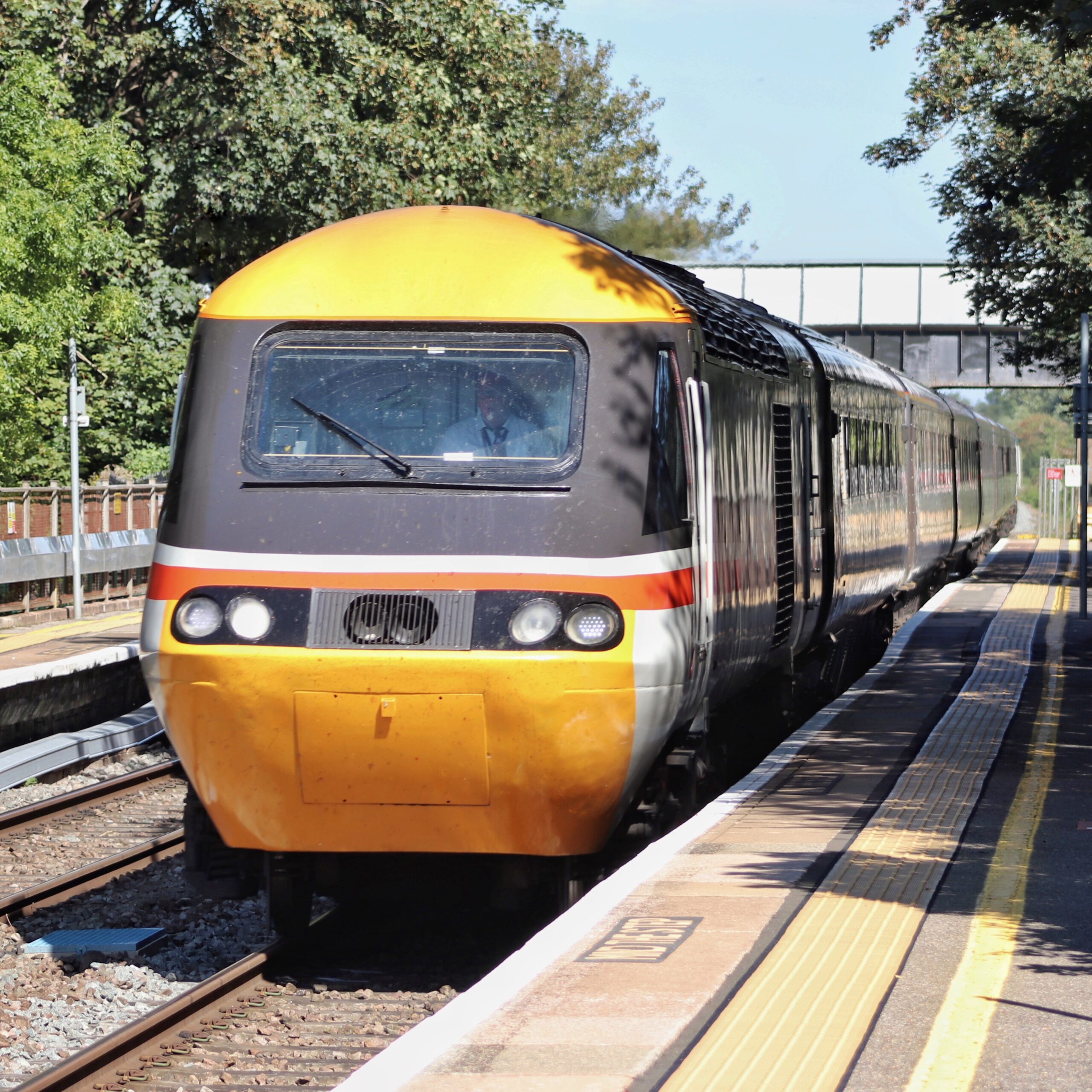
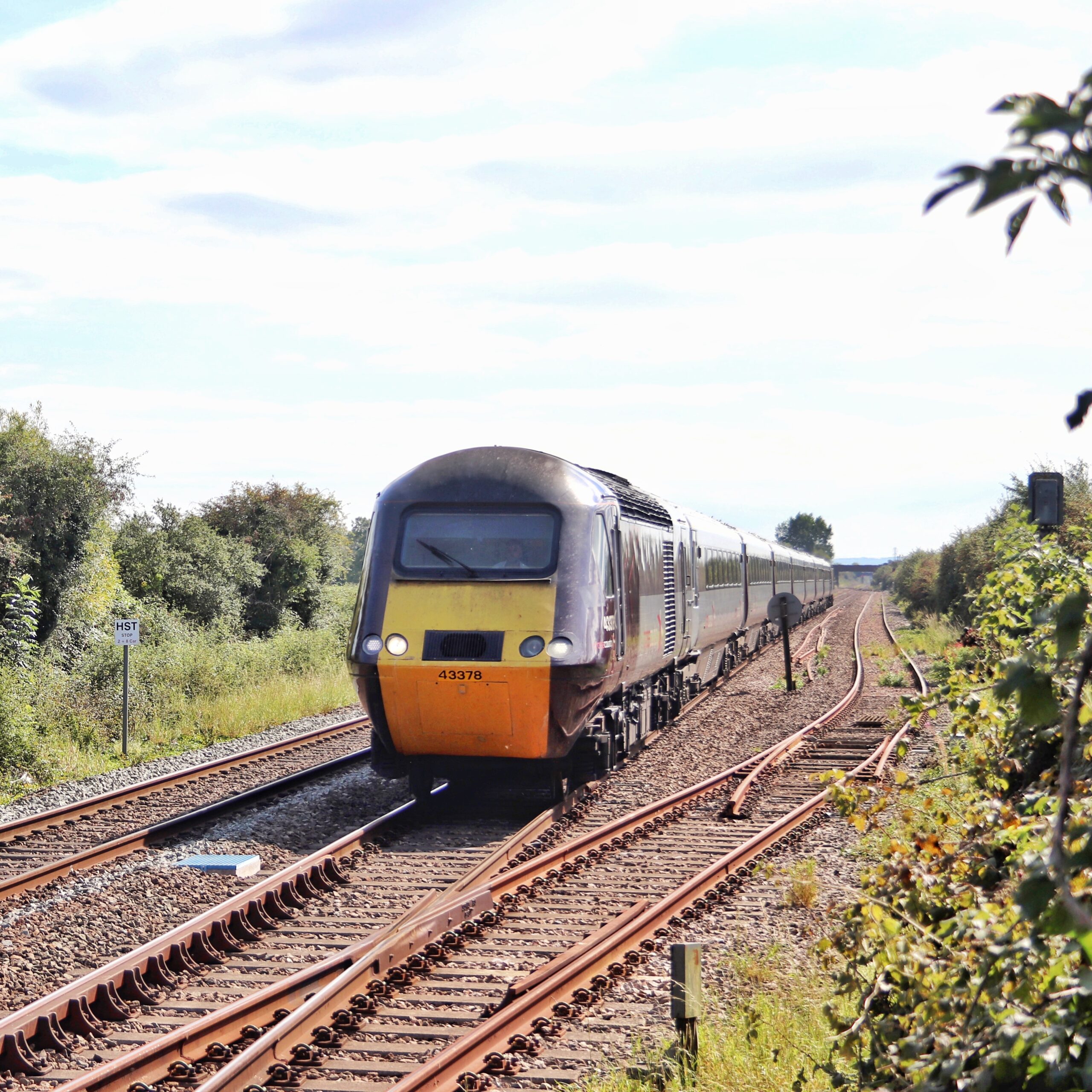
Motive power through Highbridge is currently provided by GWR Intercity Express Trains (IET) and soon to be retired HST Castle Sets with one stopping train in each direction each hour. Passing CrossCountry Voyager sets will continue after the retirement of the XC HST’s.
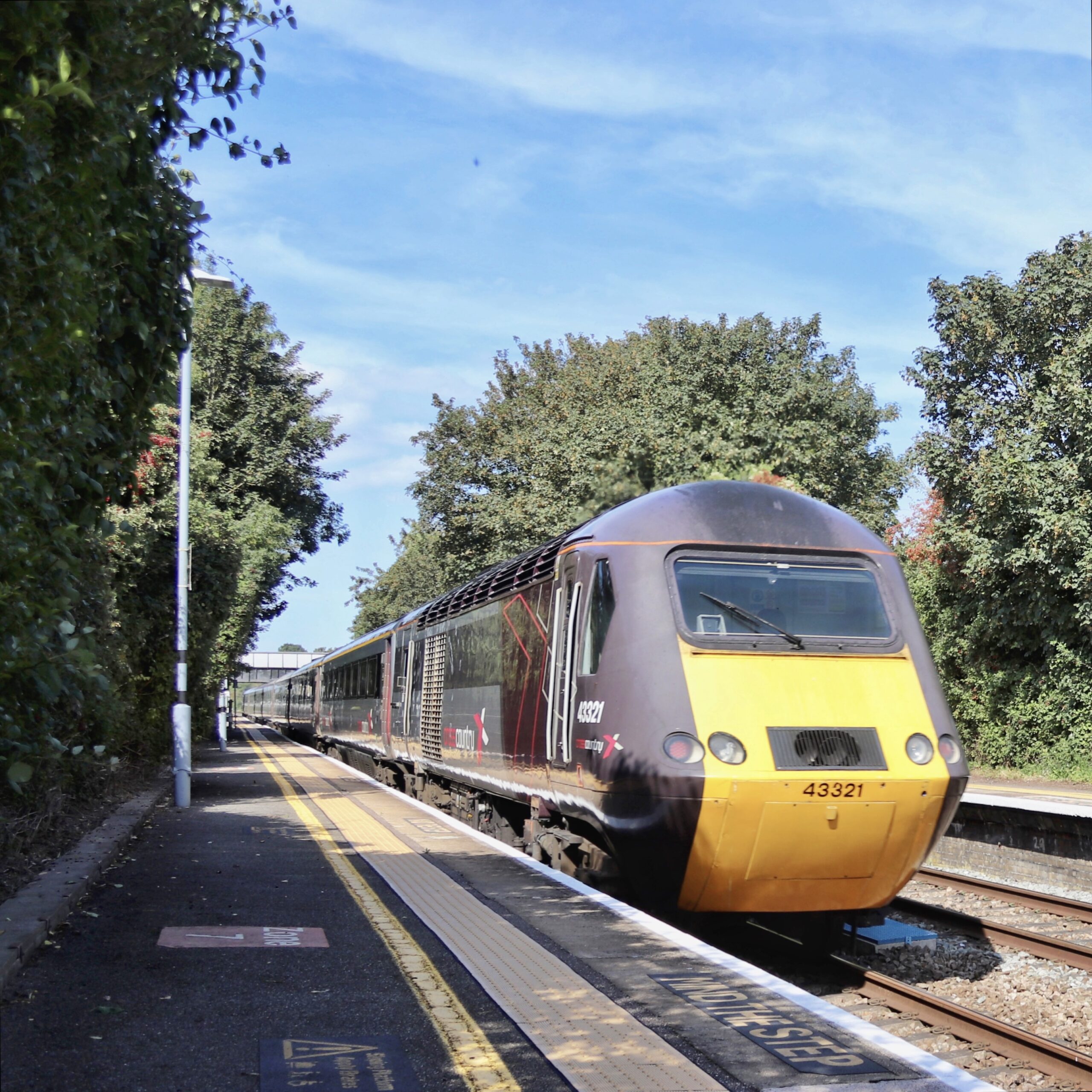
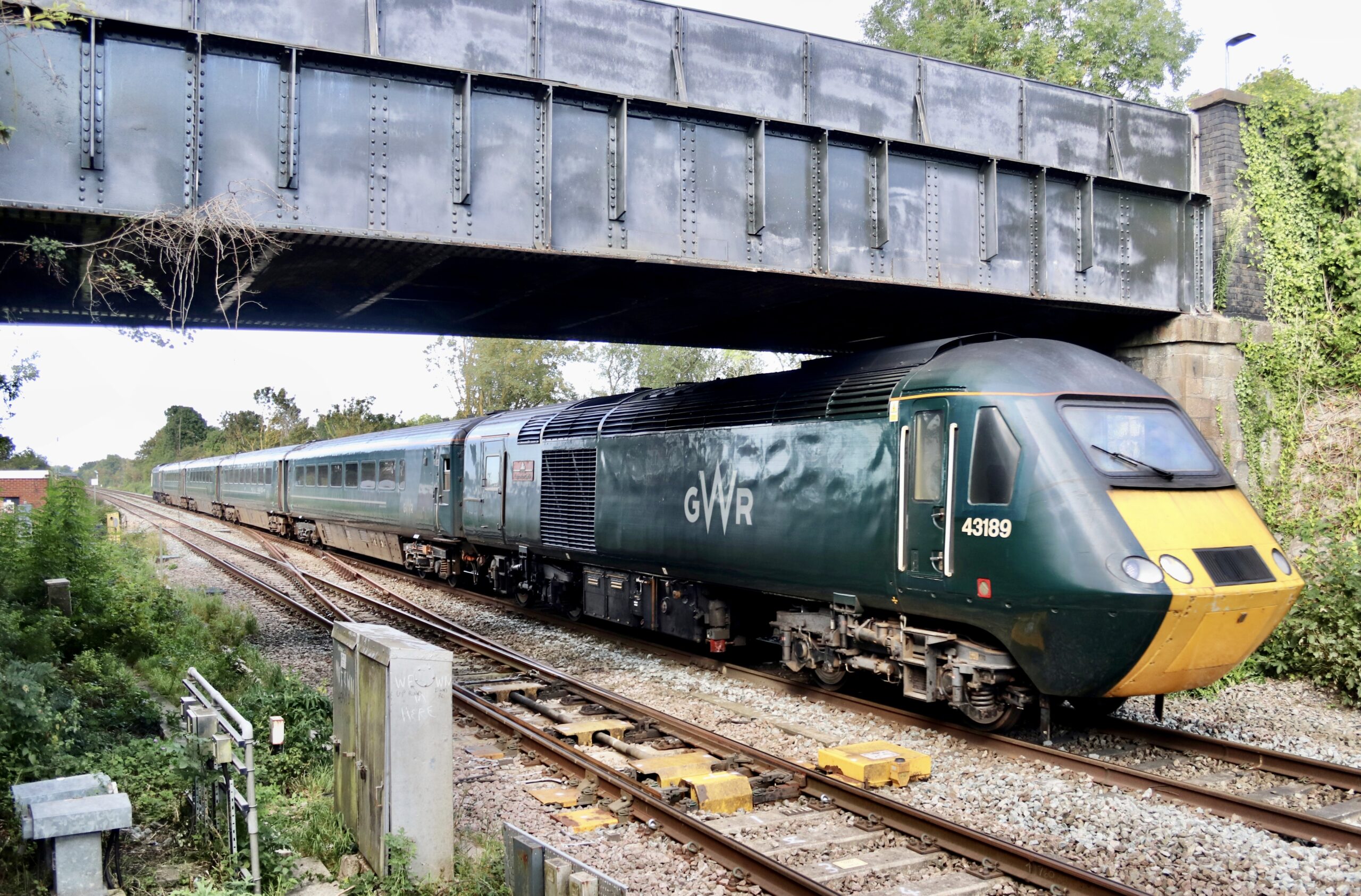
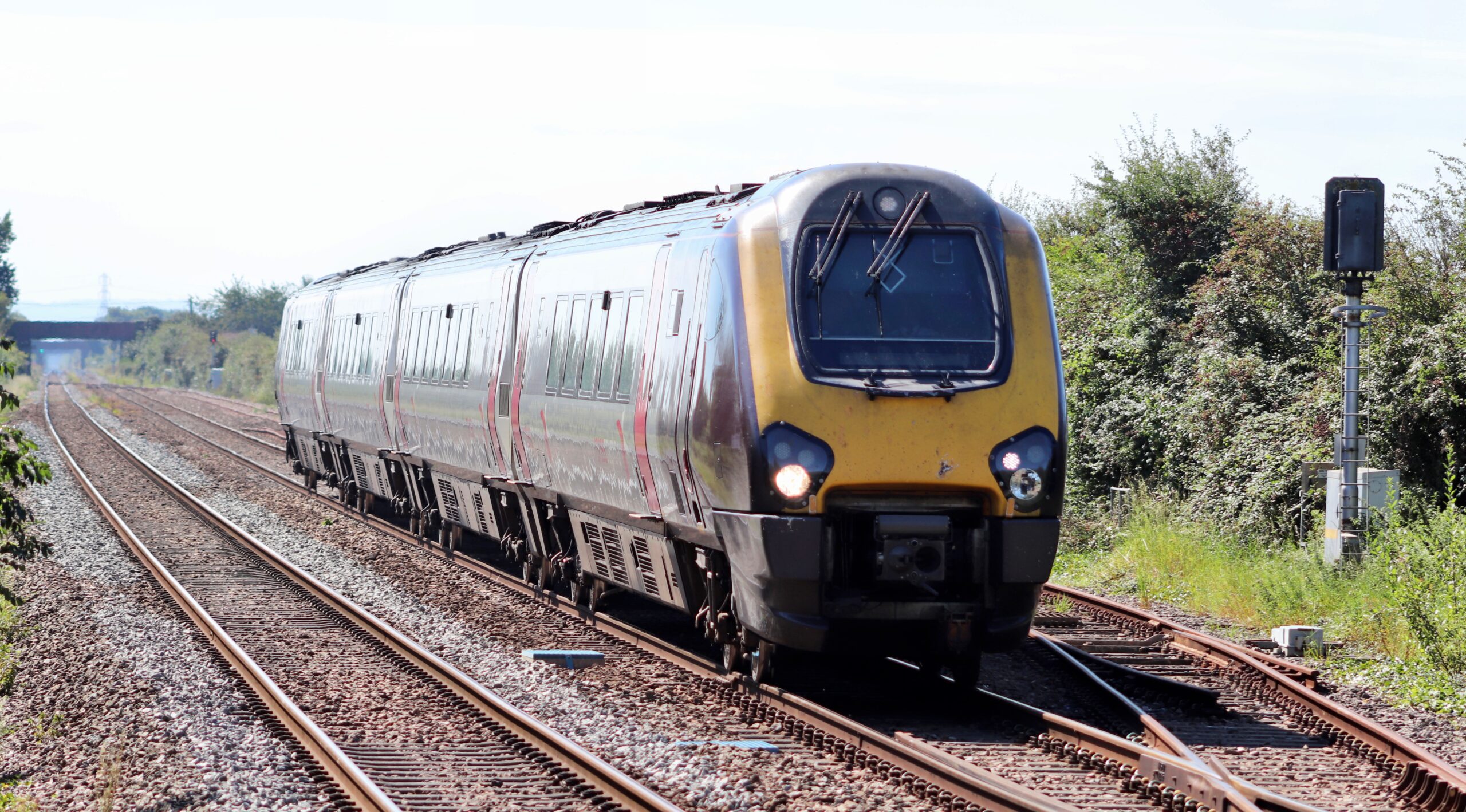
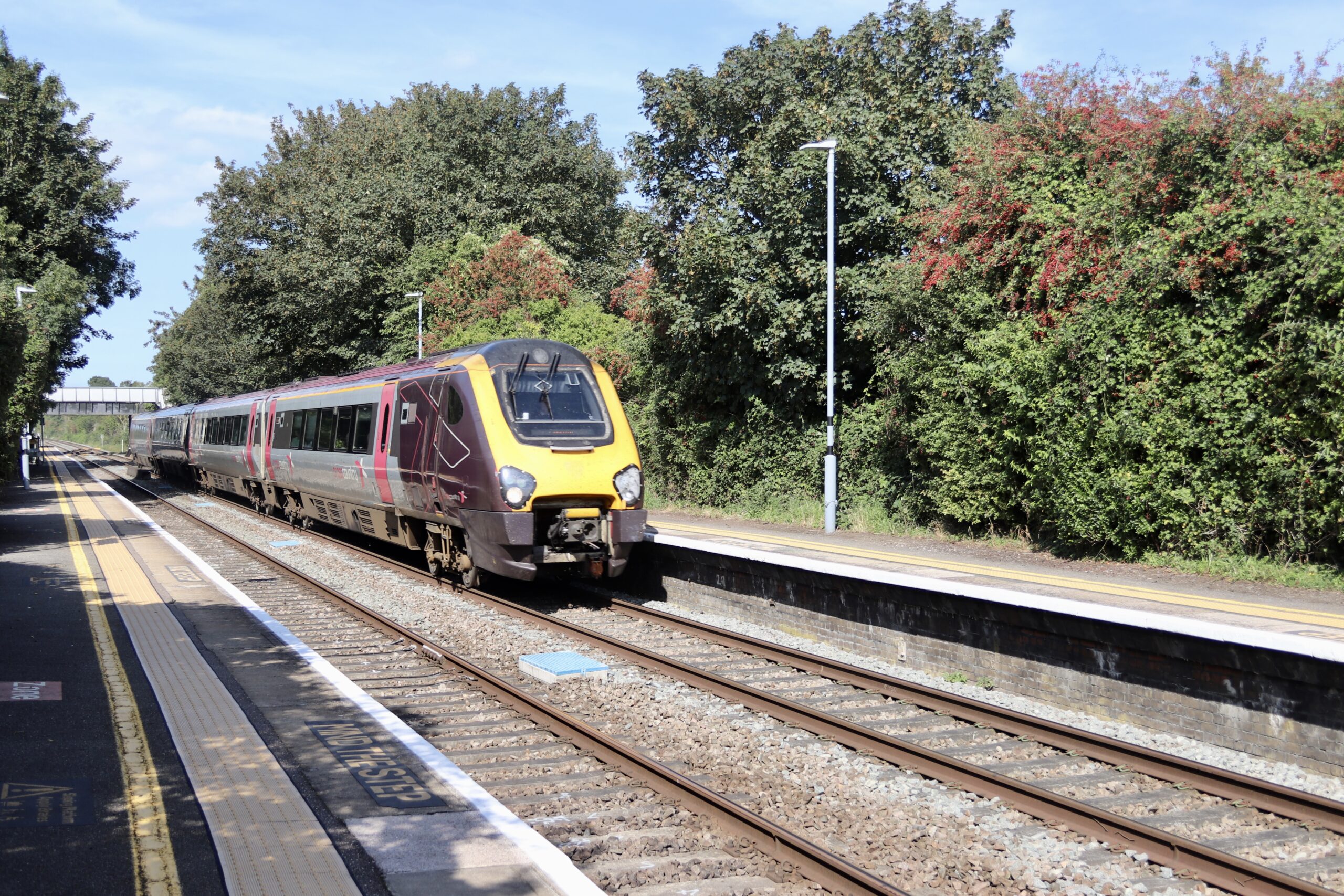
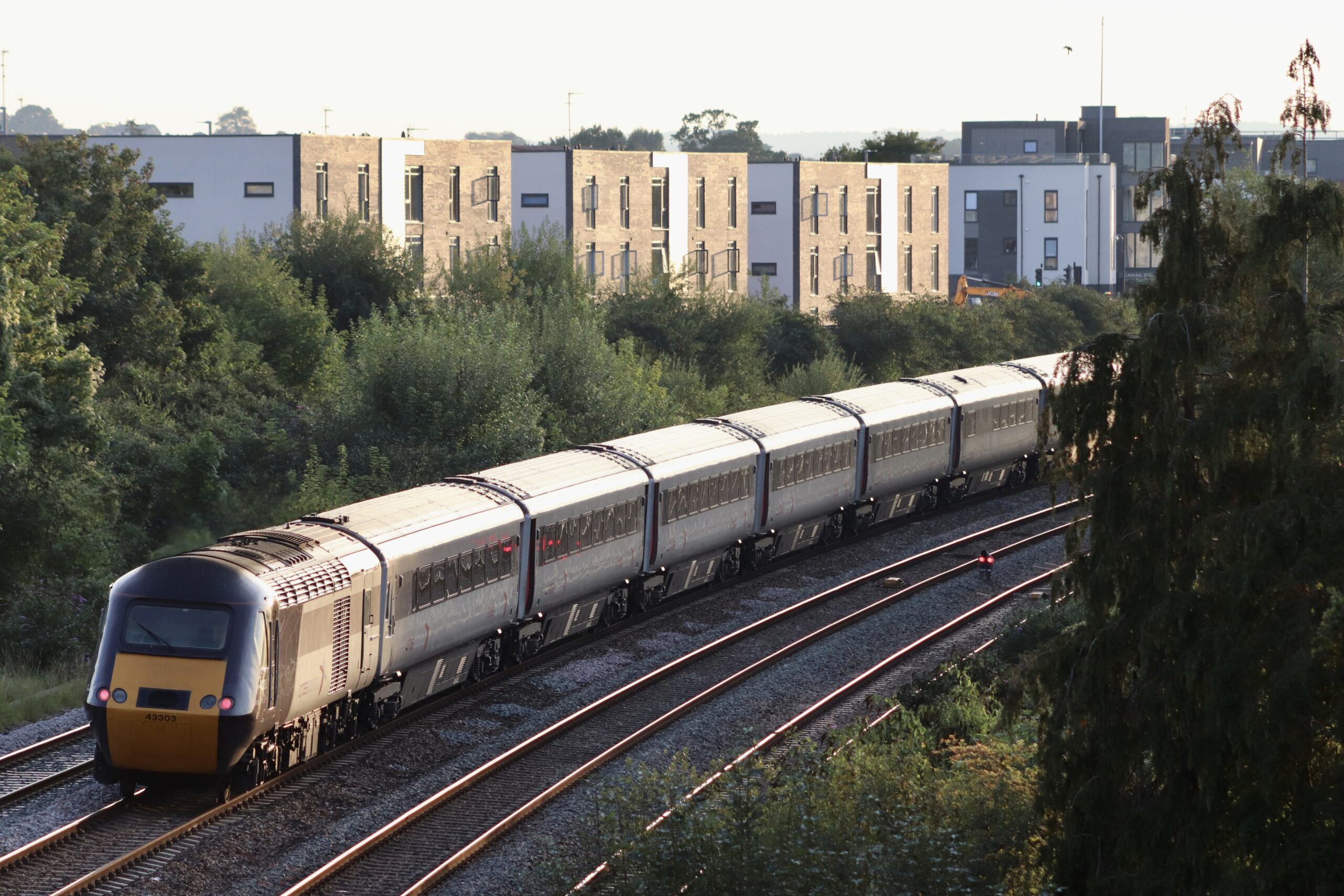
CrossCountry Class 43 HST power car No. 43007 leads 1V48 0811 Leeds to Plymouth through Highbridge – 03/09/2023CrossCountry Class 43 HST power car No. 43378 at the head of 1S53 1327 Plymouth to Edinburgh approaches Highbridge railway station – 03/09/2023CrossCountry Class 43 HST power car No. 43321 at the rear of 1S53 1327 Plymouth to Edinburgh speeds through Highbridge – 03/09/2023Celebrity BR liveried CrossCountry Class 43 HST power car No. 43008 working 1S55 1427 Plymouth to Leeds on the approach to Highbridge – 03/09/2023GWR Castle Class HST No. 43155 with the stopping 2U20 1050 Penzance to Cardiff Central service approaches Highbridge – 03/09/2023GWR Castle Class HST No. 43155 at the rear of 2U20 1050 Penzance to Cardiff Central awaiting departure from Highbridge – 03/09/2023GWR Castle Class HST No. 43189 working 2C79 1400 Cardiff Central to Penzance passes under the road bridge on the approach to Highbridge from the Bristol direction – 03/09/2023GWR Castle Class HST No. 43016 2C79 1400 Cardiff Central to Penzance sits at the platform in Highbridge – 03/09/2023GWR InterCity Express Train (IET) No. 800004 at Highbridge working 2C77 1300 Cardiff Central to Penzance – 03/09/2023CrossCountry Voyager Class 220 DMU No. 220003 approaches Highbridge with 1S47 1027 Plymouth to Edinburgh – 03/09/2023CrossCountry Voyager Class 220 DMU No. 220003 1S47 1027 Plymouth to Edinburgh passing through Highbridge – 03/09/2023CrossCountry Voyager Class 220 DMU No. 220006 1M45 1049 Paignton to Manchester Piccadilly at Highbridge – 03/09/2023CrossCountry Voyager Class 220 DMU No. 220021 1V56 1101 Leeds to Plymouth powers through Highbridge – 03/09/2023With the leaves on the trees starting to display autumnal colours, CrossCountry Voyager Class 220 DMU No. 220012 forming 1V54 0935 York to Plymouth passes Highbridge – 03/09/2023GWR IET No. 800304 forming 1C22 1630 London Paddington to Plymouth at Taunton East Junction – 03/09/2023CrossCountry Class 43 HST power car No. 43357 1V62 1105 Edinburgh to Plymouth catches the last rays of sun at Taunton East Junction – 03/09/2023CrossCountry Class 43 HST power car No. 43303 at the rear of 1V62 1105 Edinburgh to Plymouth approaching Taunton – 03/09/2023
XC HST’s in Somerset – 03/09/2023
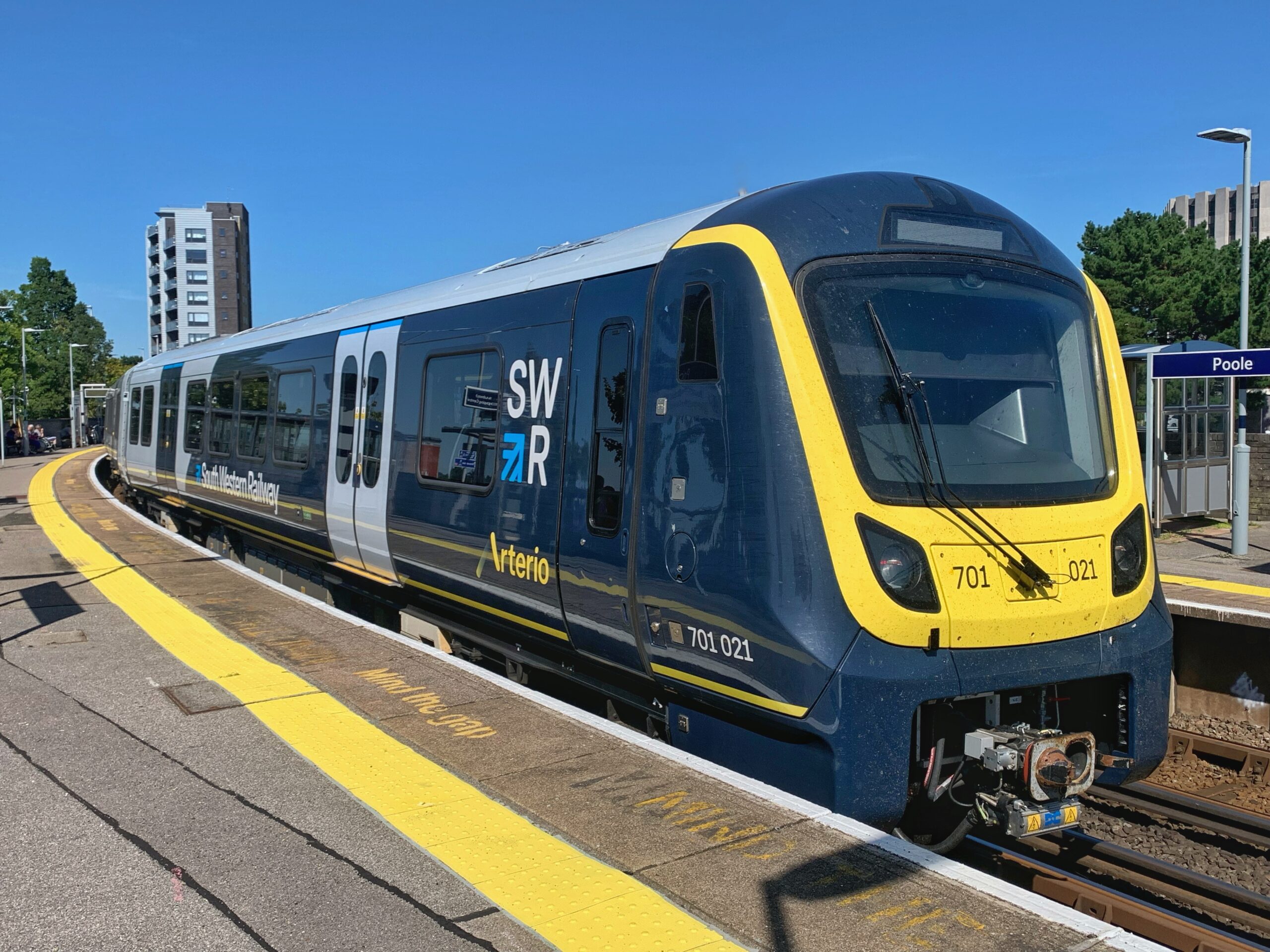
As I was in the Poole area on Monday I took the opportunity of getting a glimpse of one of the Class 701 units; No. 701021, on its latest mileage accumulation run, working as 5Q51 1115 London Waterloo to Staines Up Loop. This service runs to Poole Storage Sidings where the train reverses. The 701’s are still to enter revenue earning service with South Western Railway.
Class 701 No. 701021 stands at Poole working 5Q51 1115 London Waterloo to Staines Up Loop – 04/09/2023
Video of Class 701 No. 701021 at Parkstone and Poole working 5Q51 1115 London Waterloo to Staines Up Loop – 04/09/2023
Tuesday evening saw the return of the GBRf pairing of Class 57 No. 57305 and Class 47 No. 47749 ‘City Of Truro’ with another Class 458 EMU drag from Widnes Transport Tech to Bournemouth depot. This time, I elected to see the train passing Bournemouth instead of my usual spot at Branksome. After a coffee from the Pumpkin buffet on platform 2, I walked through the car park which was once the site of Bournemouth steam shed and up to Beechey Road bridge which gives a view back towards the railway station. While I was in Bournemouth, I took the opportunity of photographing regular train movements, including South Western Railway (SWR) Class 444’s, Class 450’s and CrossCountry Voyager DMU’s.
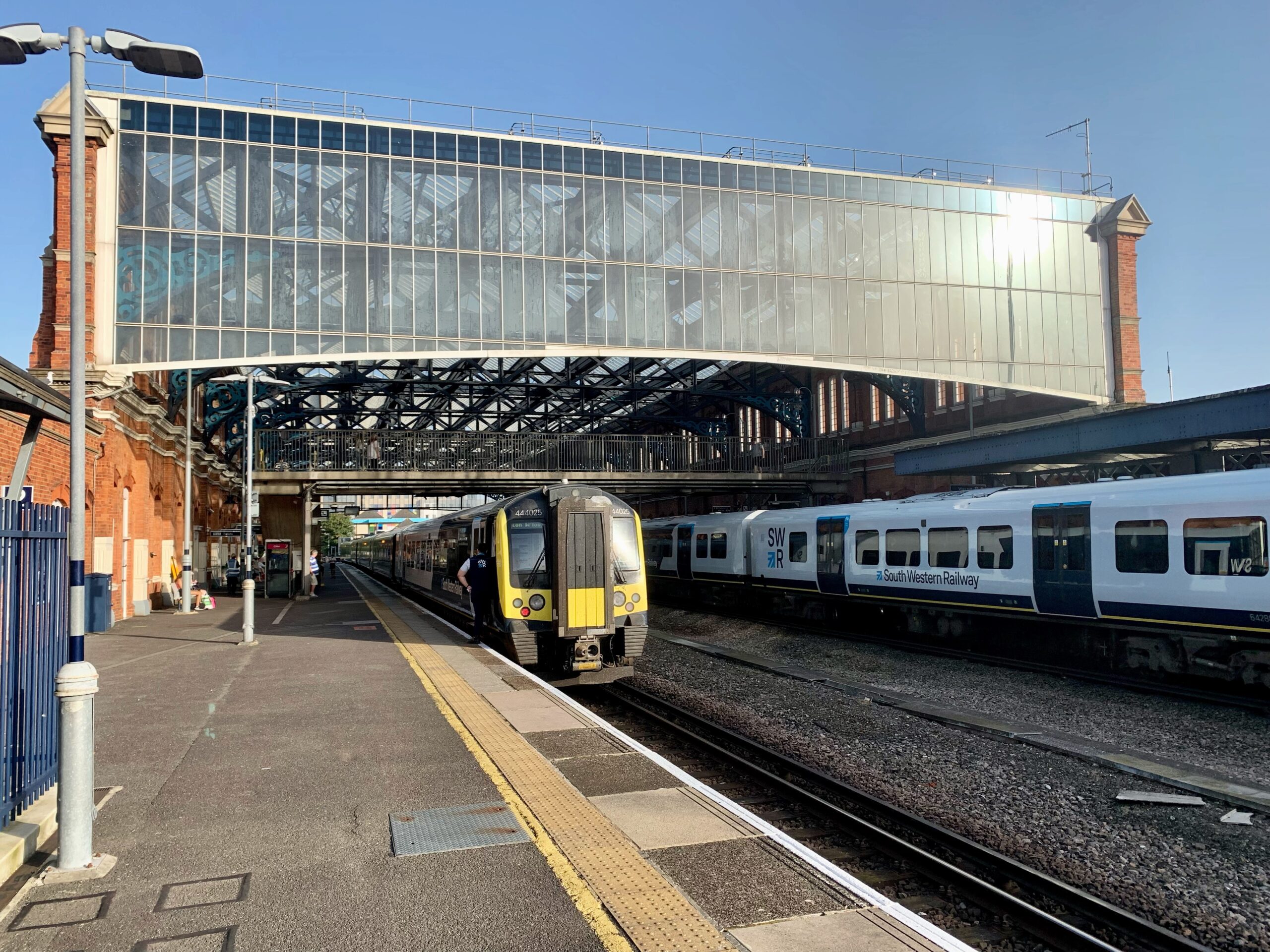
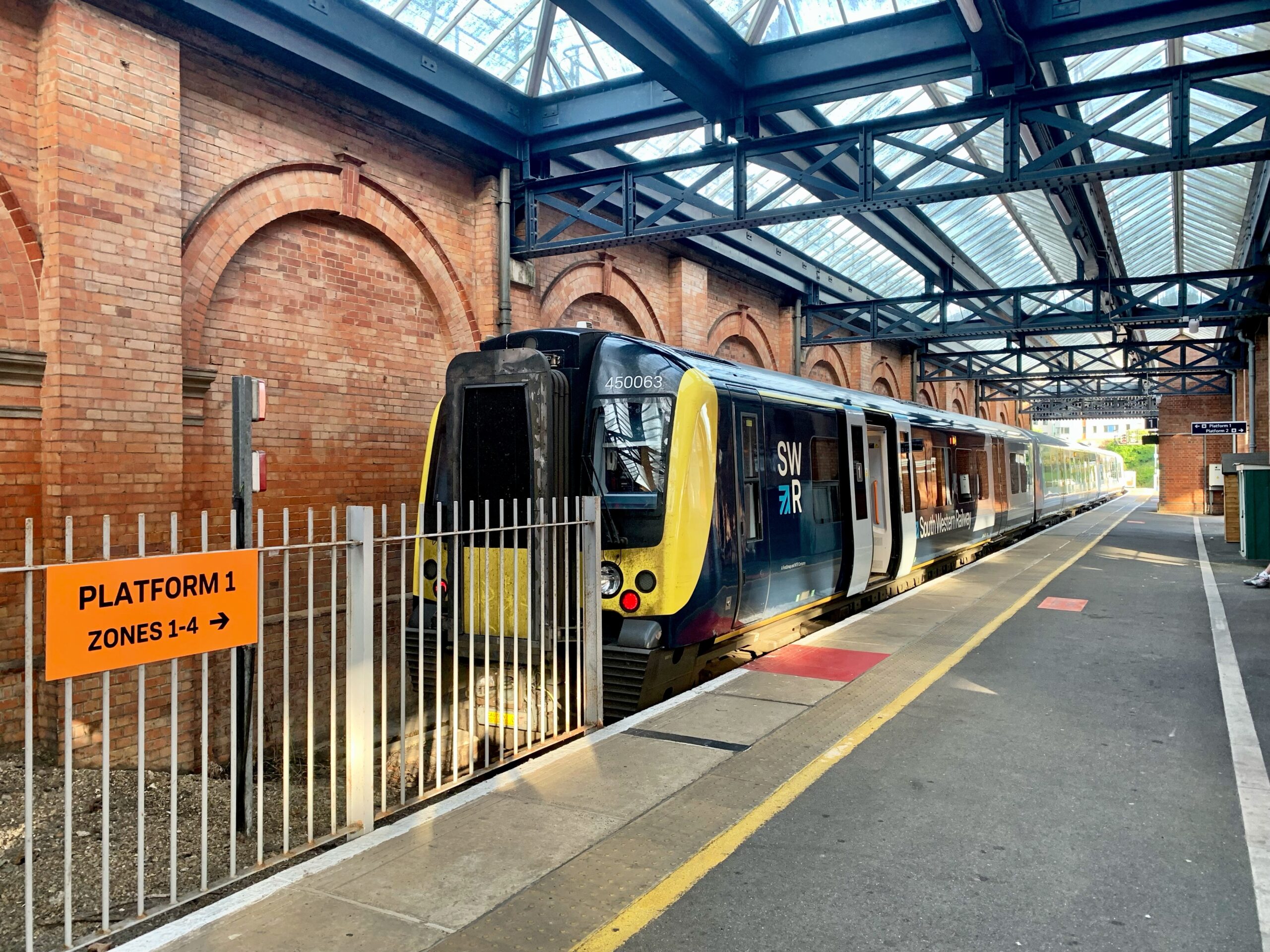
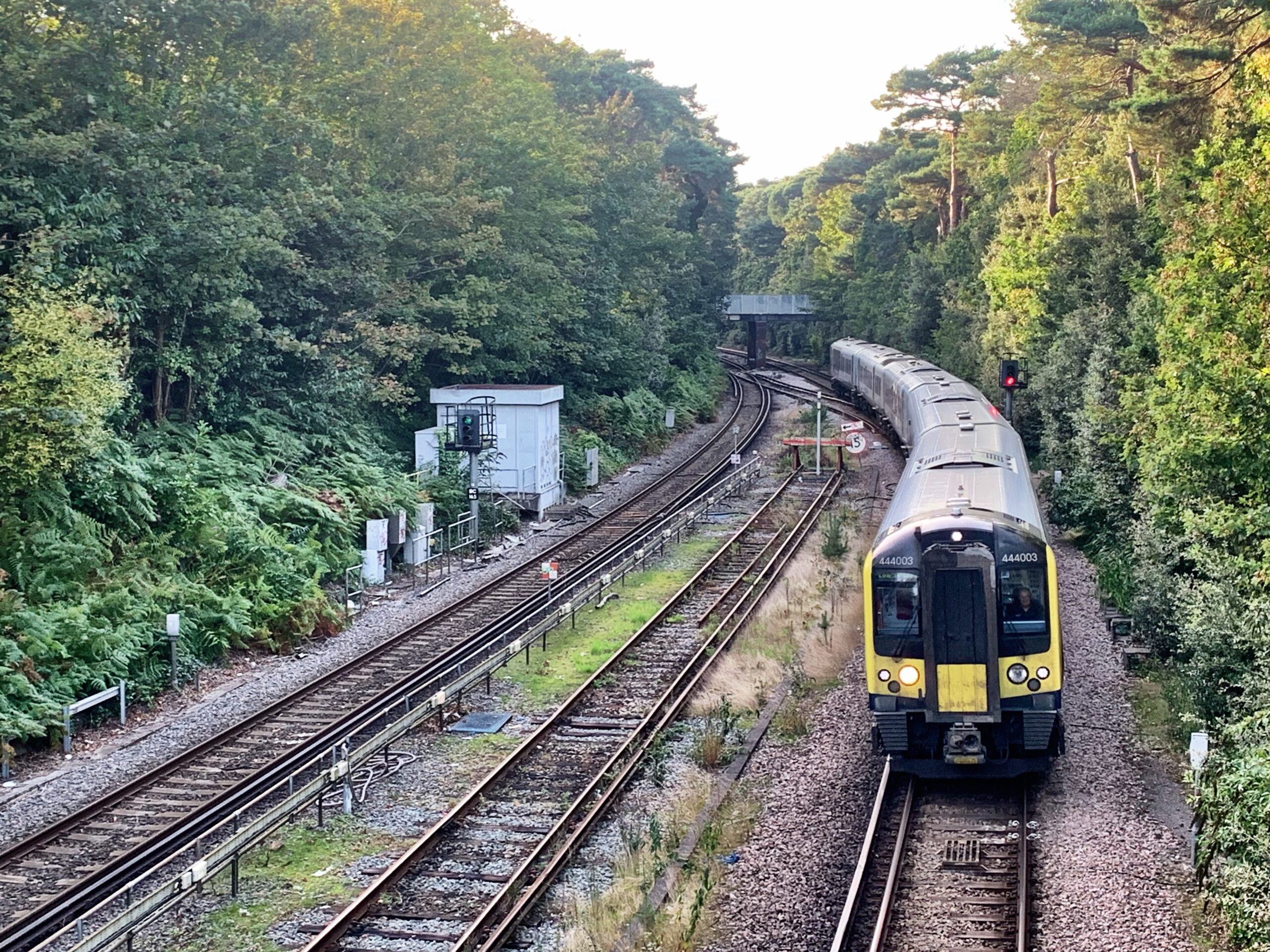
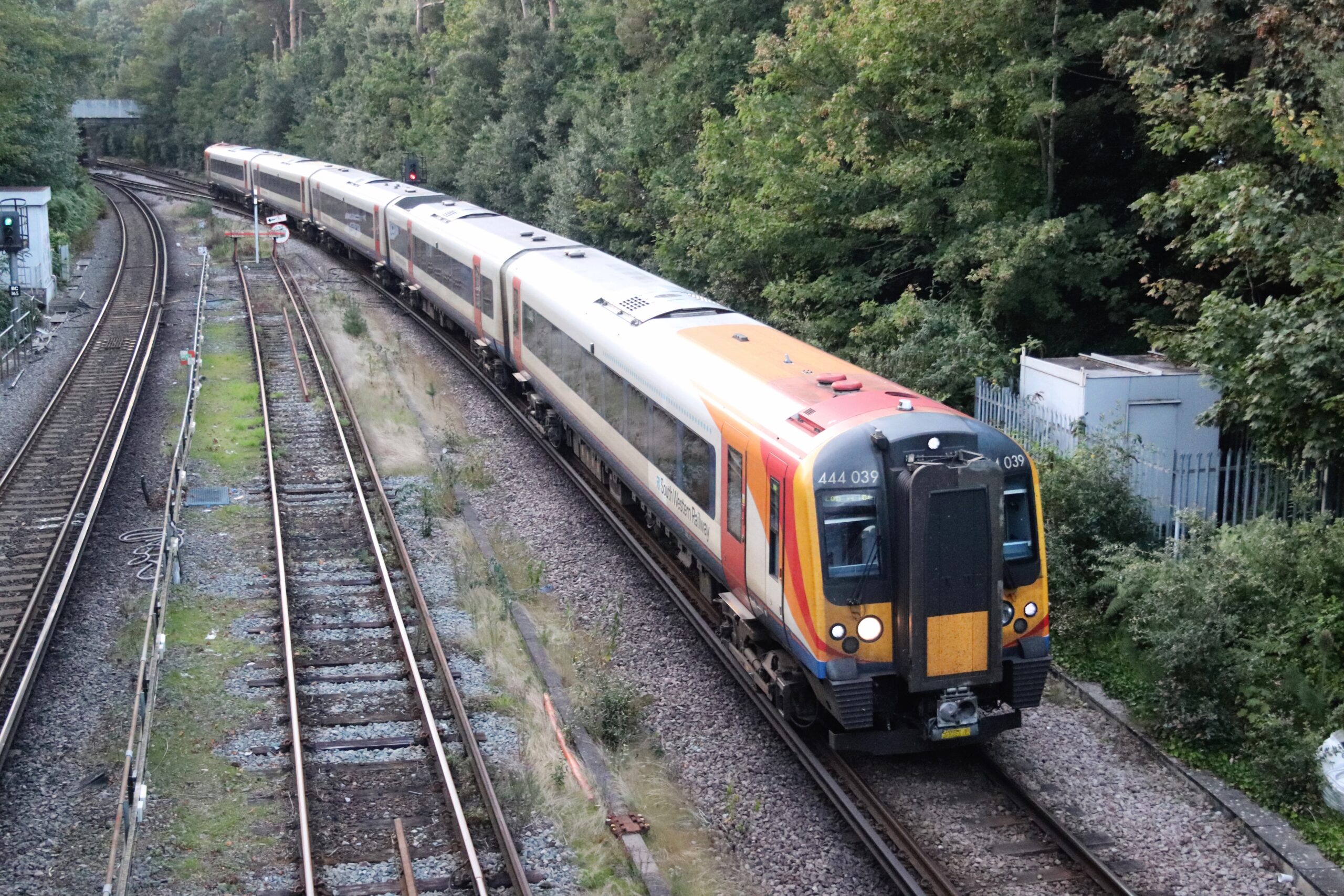
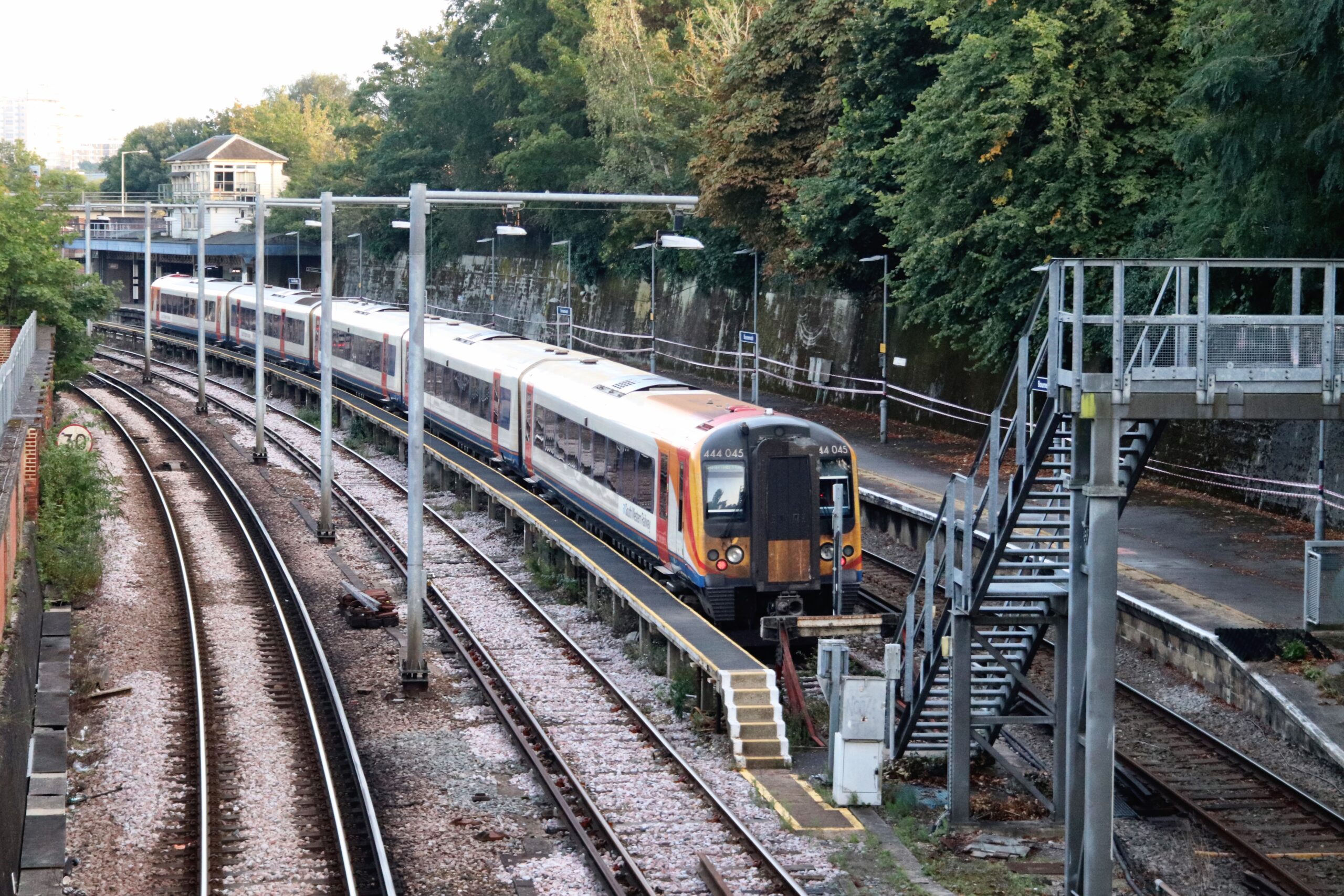
SWR Class 444 No. 444025 awaiting departure from Bournemouth working 1W28 1703 Weymouth to London Waterloo as Class 450 No. 450088 passes as 1B45 1535 London Waterloo to Poole – 05/09/2023Occupying bay platform 1, SWR Class 450 No. 450063 prepares for departure with 1B68 1802 Bournemouth to Basingstoke – 05/09/2023SWR Class 444 No. 444003 on the approach to Bournemouth with the 1W70 1720 Weymouth to London Waterloo service – 05/09/2023SWR Class 444 No. 444039 works 1W72 1820 Weymouth to London Waterloo at Bournemouth – 05/09/2023SWR Class 444 No. 444045 at Bournemouth Middle Sidings – 05/09/2023Having arrived from Manchester Piccadilly, CrossCountry Voyager Class 221 No. 221133 worked 5022 1919 Bournemouth to Bournemouth Middle Sidings before forming the 1M78 1945 departure from Bournemouth to Birmingham New Street – 05/09/2023GBRf Class 57 No. 57305 hauling refurbished SWR Class 458 No. 458405 with Class 47 No. 47749 ‘City Of Truro’ at the rear passes through Bournemouth as 5X65 1435 Wembley Receptions 1-7 to Bournemouth T&RSMD. The locomotives and barrier coaches retuned to Eastleigh later that evening – 05/09/2023
X65 1435 Wembley Receptions 1-7 to Bournemouth T&RSMD.- 05/09/2023
Britain’s busiest railway stations have been identified following the analysis of data for 2,616 locations, and Bournemouth came top in the Dorset with 5616 passengers per day and the 190th station in the UK. Bournemouth has a performance ranking of 1908. The analysis of National Rail data, collated by On Time Trains Stations, is ranked by a performance score, calculated based on service punctuality and cancellation frequency.
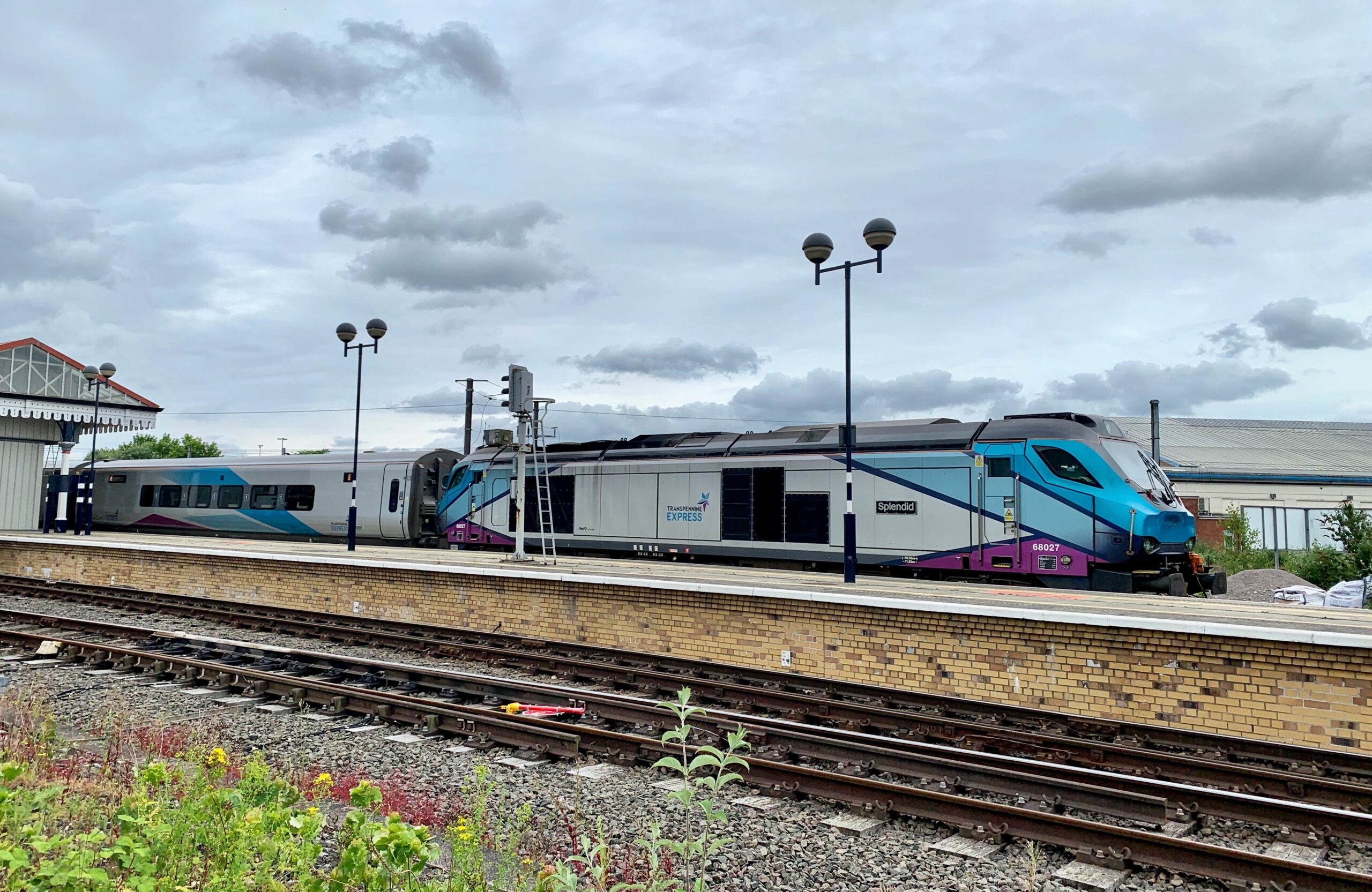
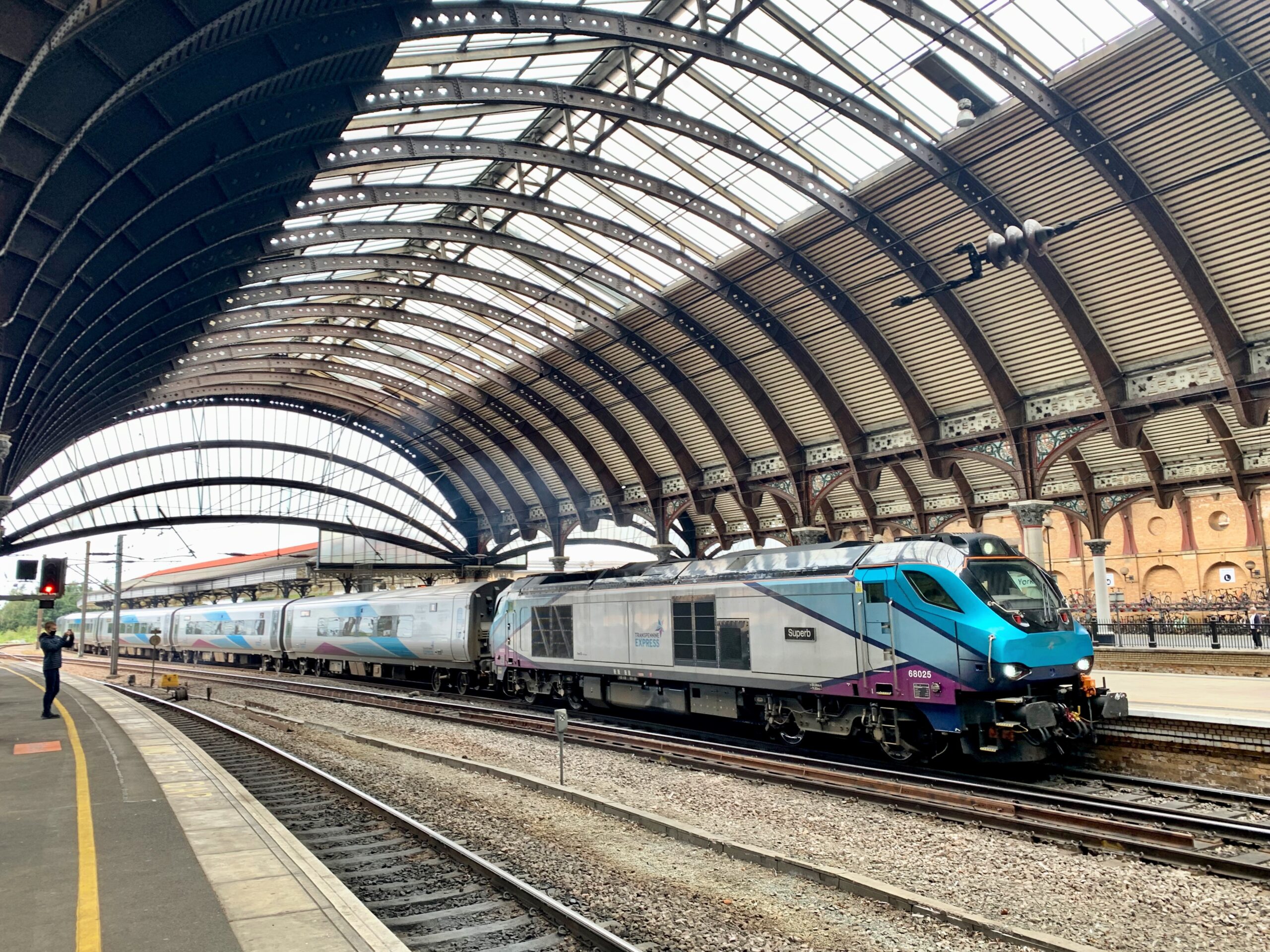
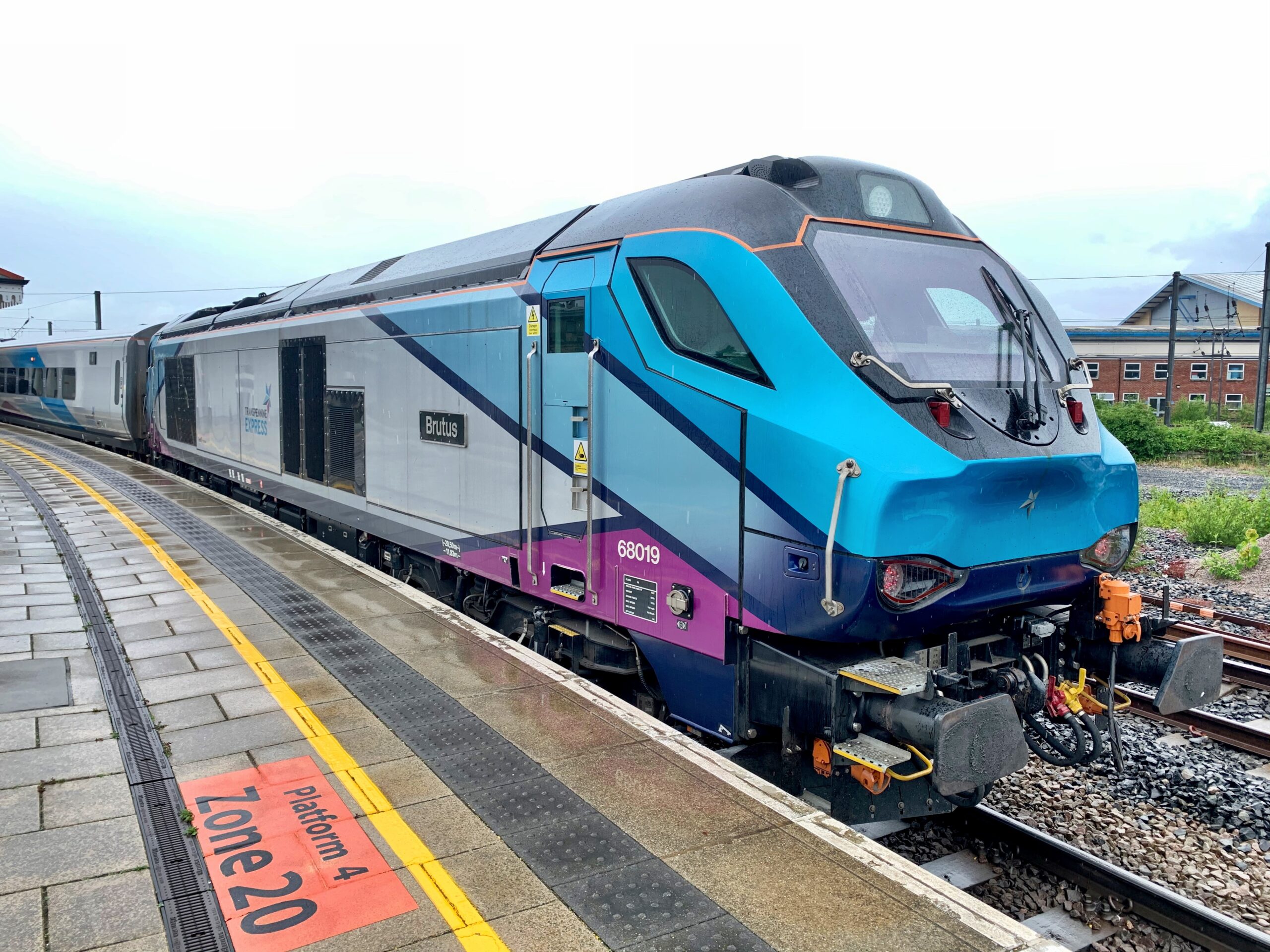
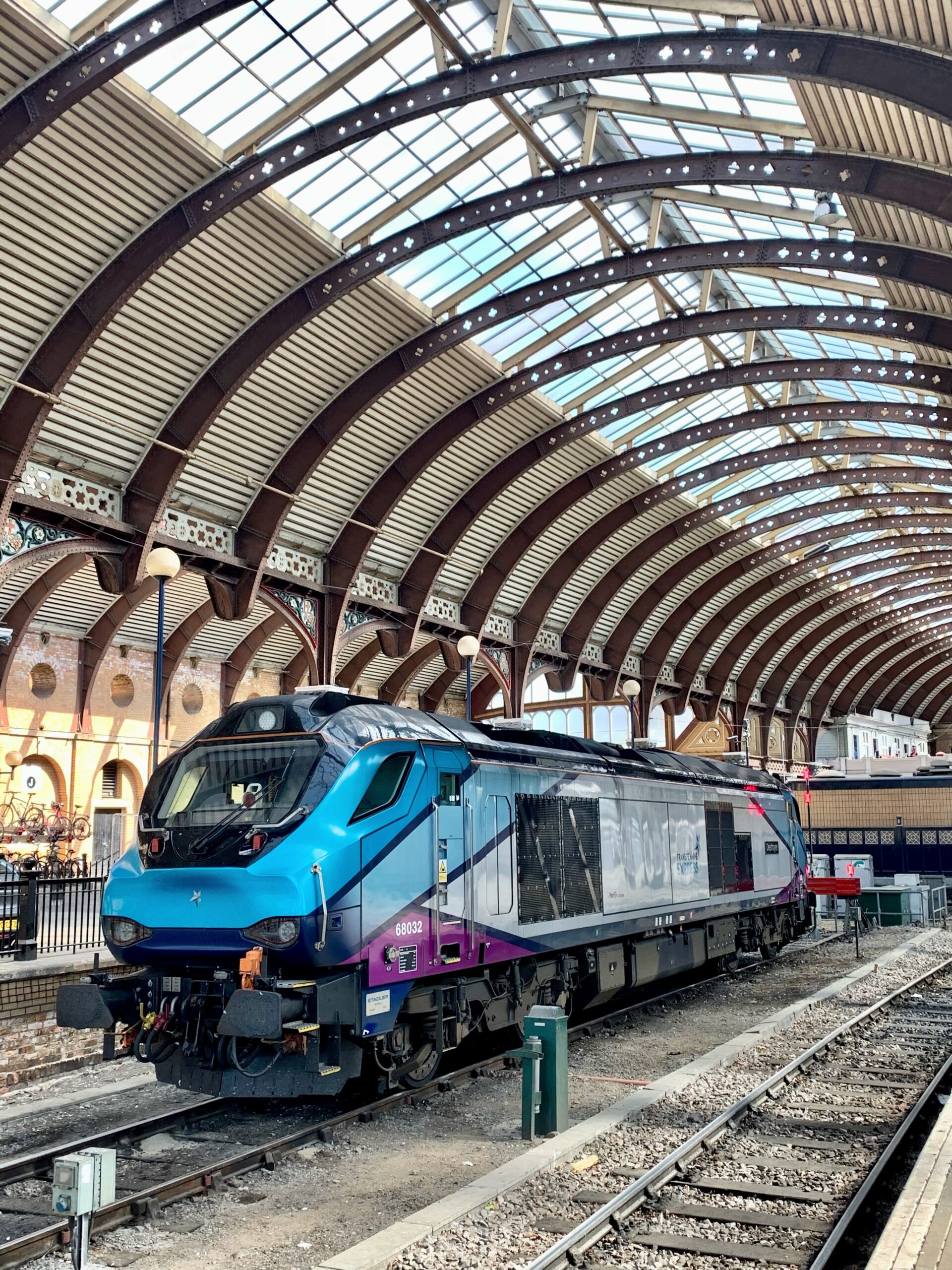
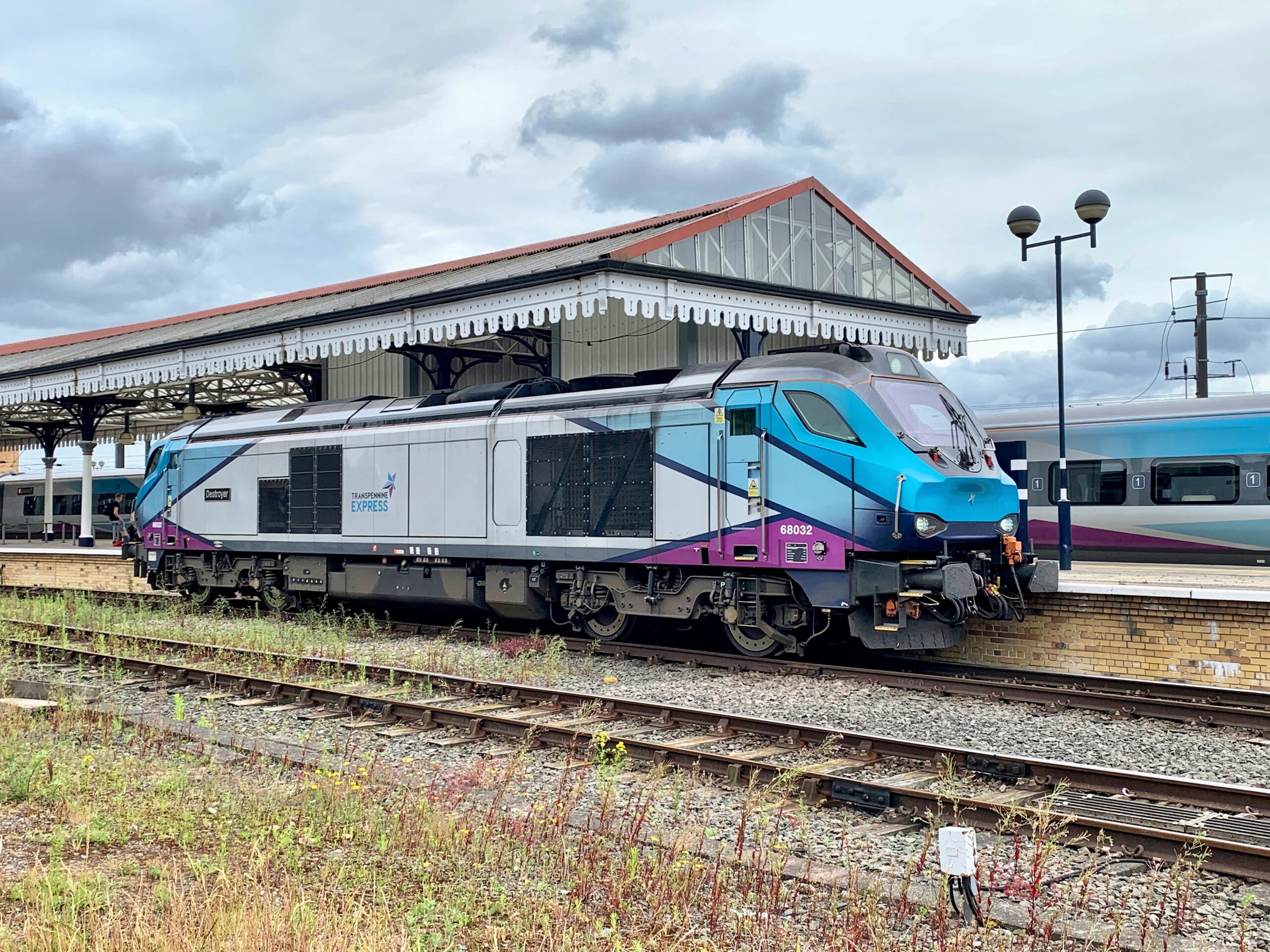
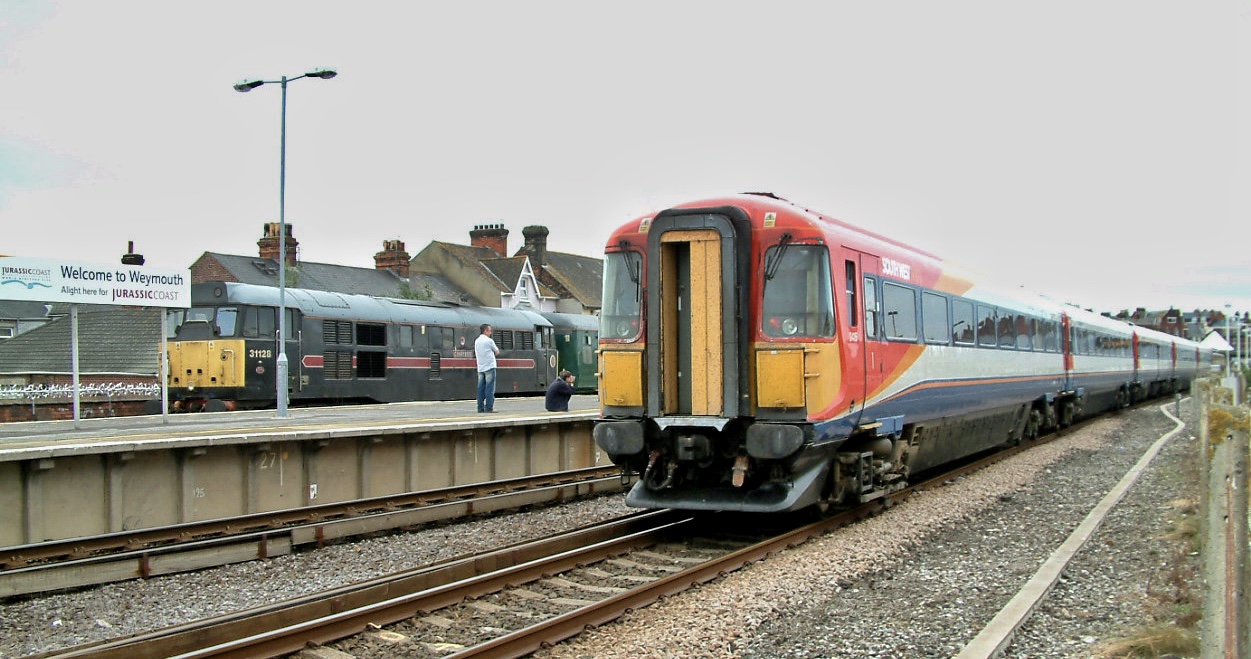
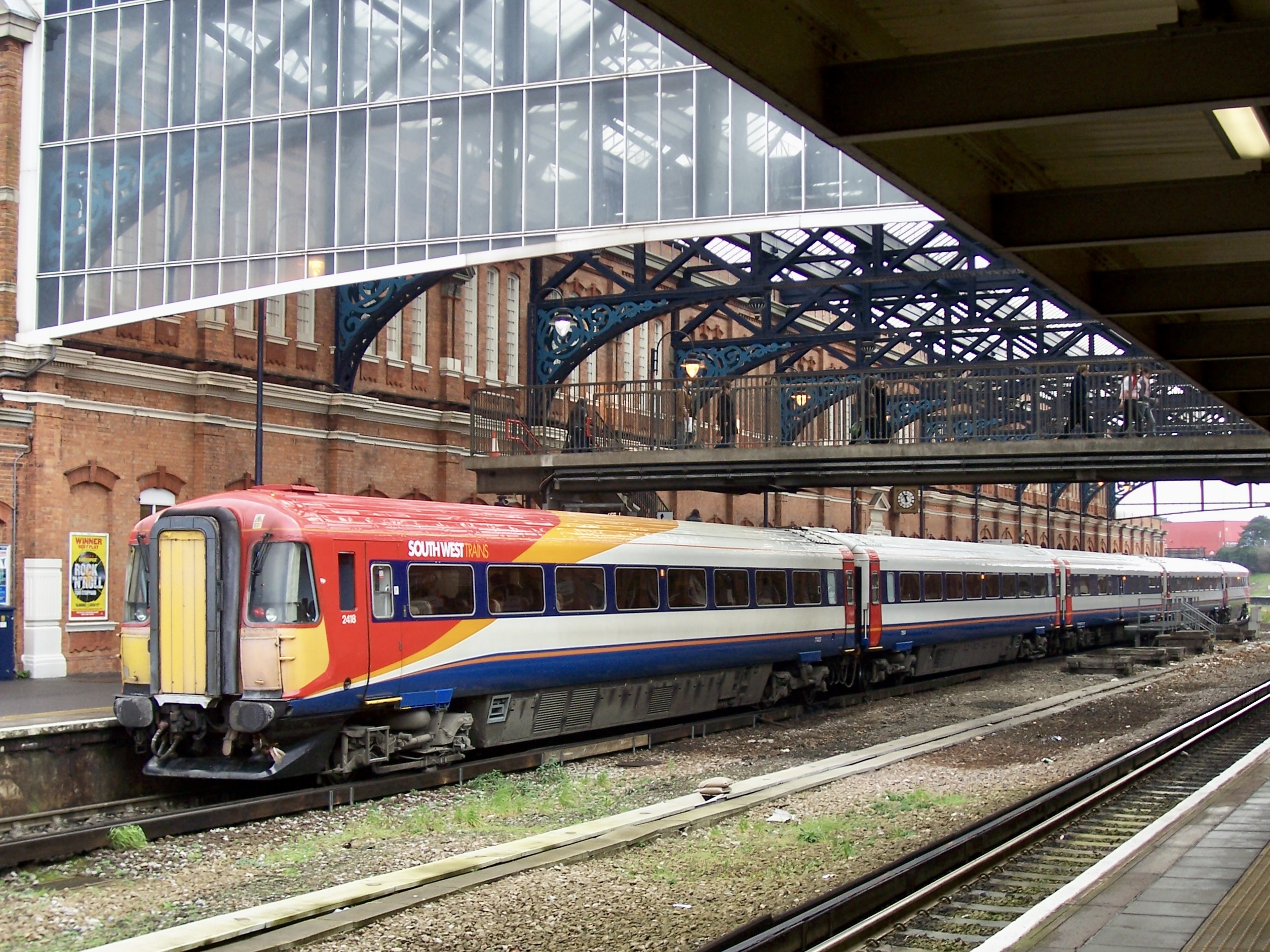
Further afield, it has been announced that TransPennine Express (TPE) will withdraw their troubled Nova 3 Class 68 hauled trains with effect from the December 2023 timetable change. We mention this, as back in 2016 prior to the TPE contract being awarded to FirstGroup, it was widely reported that the Department for Transport (DaFT) was eager to utilise de-motored Class 442 “Wessex Electric” electric multiple units hauled by Class 68 locomotives on Trans Pennine services. This plan, however, developed into an order for 66 new MK 5a carriages. The “Wessex Electrics” were introduced when the Bournemouth to Weymouth route was electrified and imho are amongst the best electric multiple units ever built. All this gives me an excuse to share some images of TPE liveried Class 68’s along with a few local photos of Class 442 EMU’s in South West Trains days.
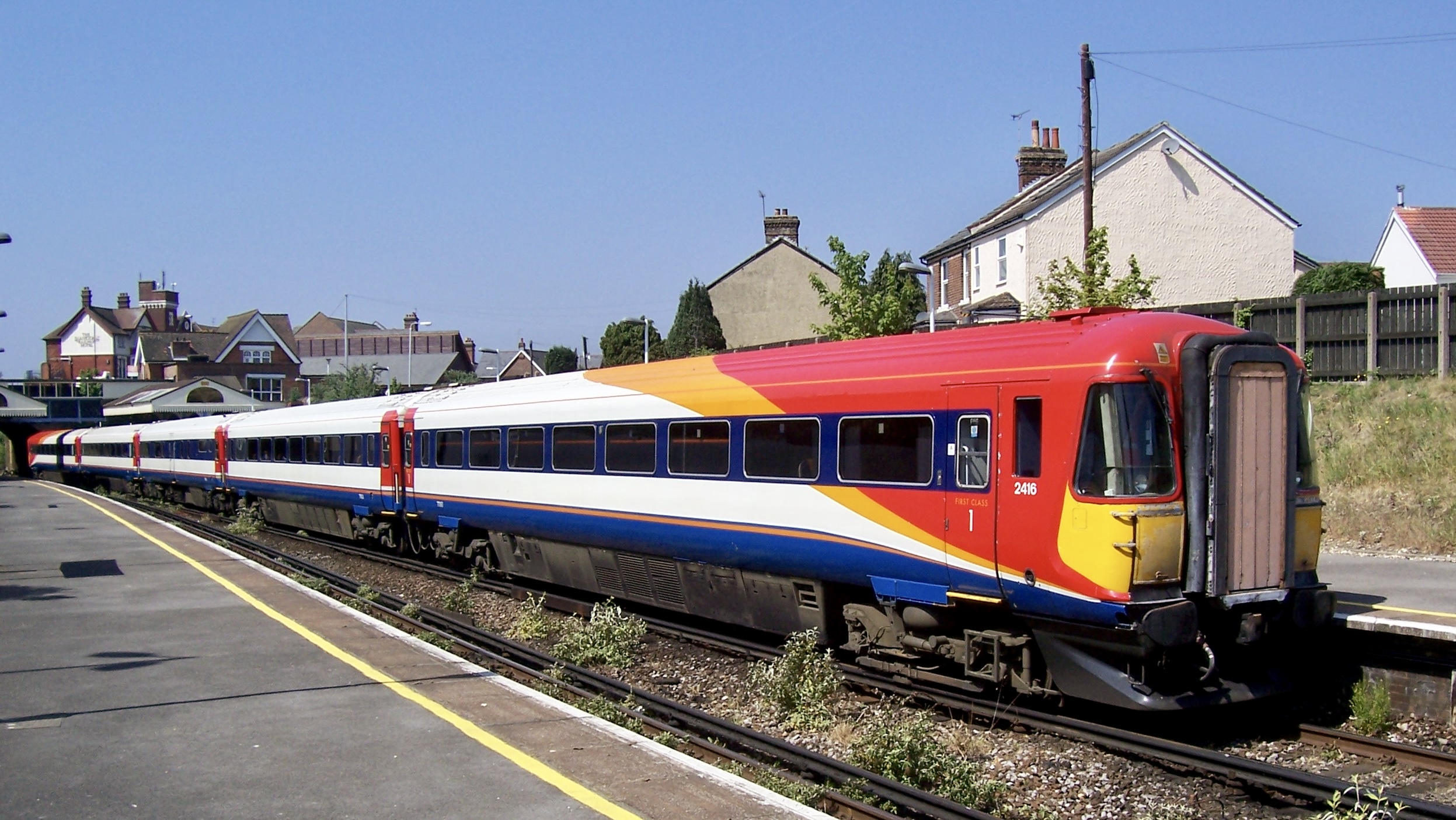
68027 ‘Splendid’ at York – 18/06/202168024 ‘Centaur’ at York -30/08/202068025 ‘Superb’ at York- 30/08/202068019 ‘Brutus’ at York – 18/06/202168032 ‘Destroyer’, York – 17/06/202168032 ‘Destroyer’ at York – 18/06/2021South West Trains Class 442 No. 442415 at Weymouth. FM Rail owned Class 31 No. 31128 ‘Charybdis’ waits to depart with a “John Lewis Partnership” private charter back to London Victoria – 29/07/2006South West Trains Class 442 No. 442418 at Bournemouth – 28/12/2006De-branded Class 442 No. 442416 at Branksome – 03/05/2007
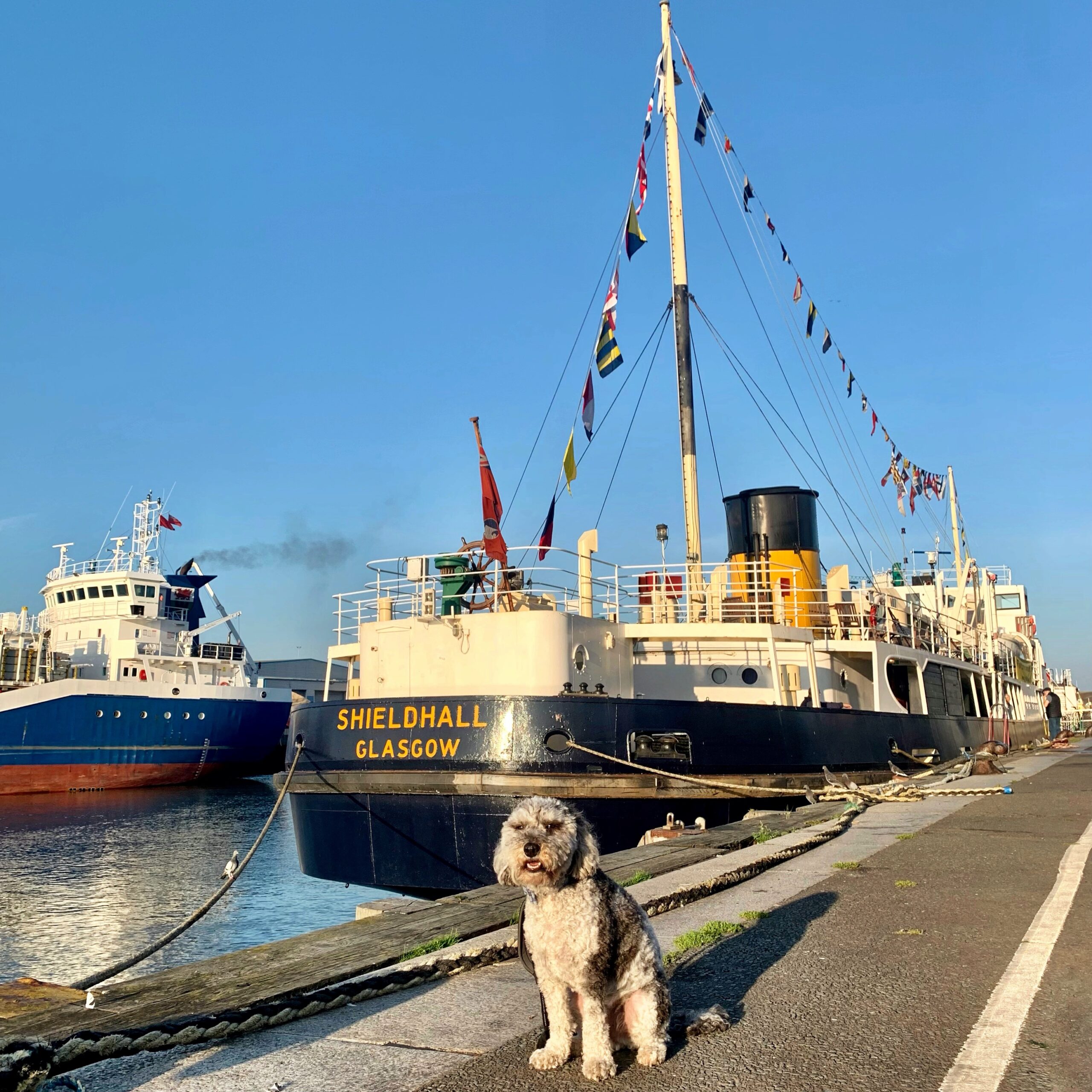
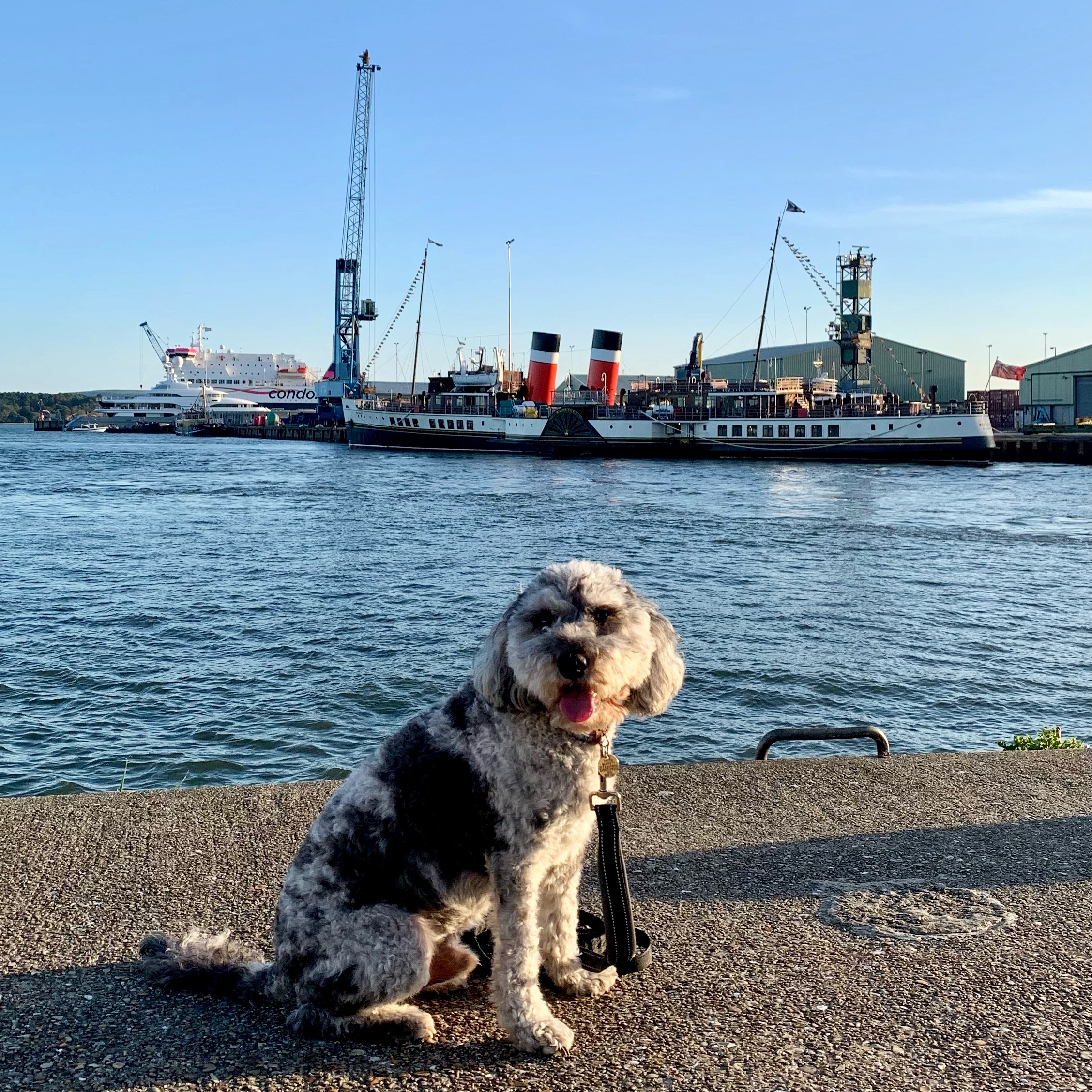
Yoshi has been ship spotting at Poole Quay this week as two steamships, both originally from Glasgow, namely SS Shieldhall and PS Waverley, visited.
SS Shieldhall is a preserved steamship that operates from Southampton. She is one of the last reciprocating steam engined ships built, using technology that dated back to the last quarter of the 19th century and which was obsolete at the time of her construction. She spent her working life as one of the “Clyde sludge boats”, making regular trips from Glasgow to dump treated sewage sludge at sea – 04/09/2023 PS Waverley is the last seagoing passenger-carrying paddle steamer in the world. Built in 1946, she sailed from Craigendoran on the Firth of Clyde to Arrochar on Loch Long until 1973 – 04/09/2023
Thanks for making it this far! I often say I ignore the Voyager units, but think I’ve more than made up for it this time around. Comments and corrections gratefully received. Be seeing you!
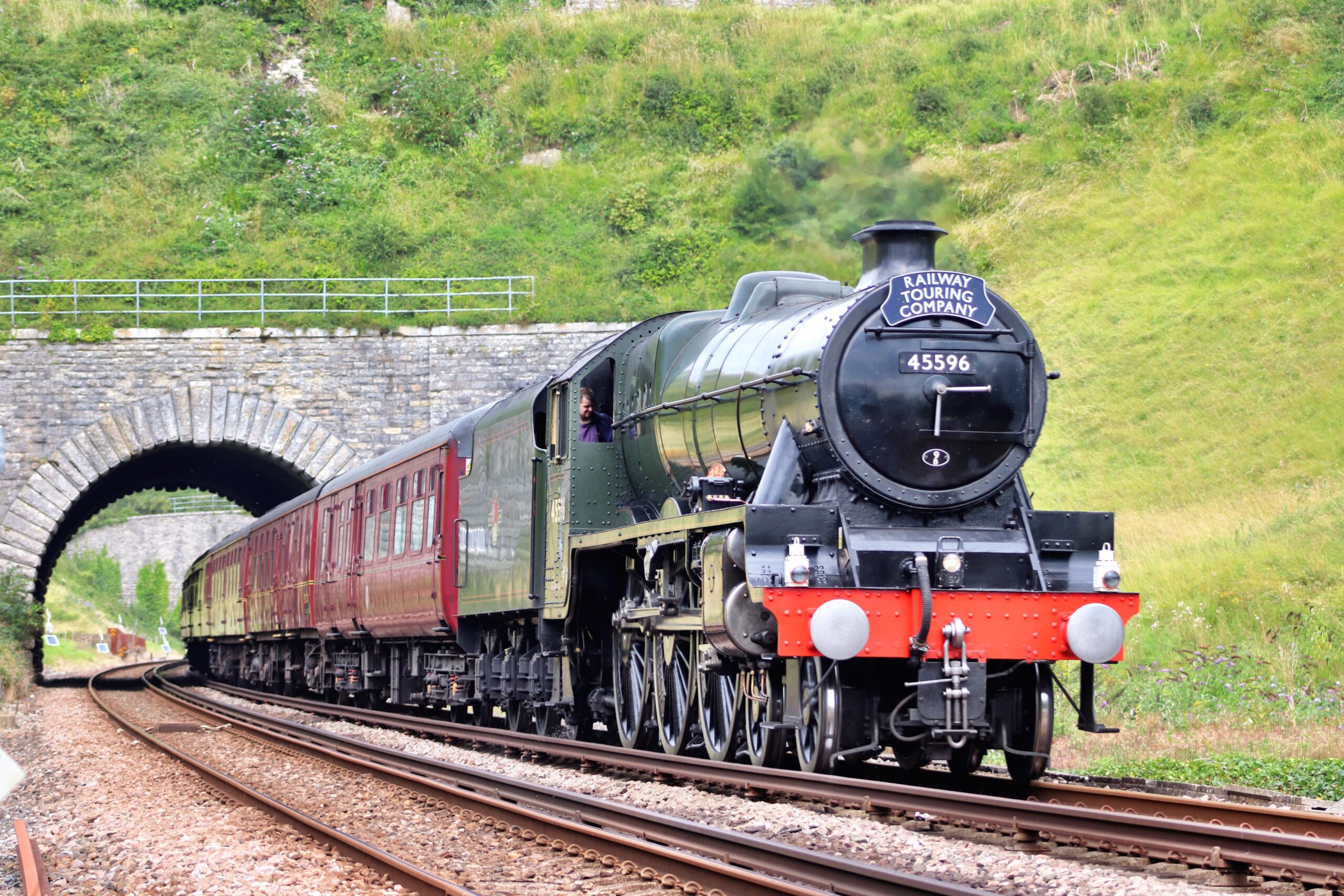
LMS Jubilee 4-6-0 No. 45596 ‘Bahamas’ working the final 2023 Railway Touring Company organised “Dorset Coast Express” 1Z92 0845 London Victoria to Weymouth – 17/08/2023
August 16th 2023 to August 23rd 2023
For a long while I’ve been meaning to climb up to the railway line accessed from the old main road between Dorchester and Weymouth, just north of Upwey village, with the aim of photographing passing trains. This was once the site of Upwey Wishing Well Halt, and although the steps survive either side of the railway line, nothing now exists of the platforms which once stood here. Opened by the Great Western Railway (GWR) on 28th May 1905 and served by rail motor trains between Weymouth and Dorchester, the station survived until 7th January 1957 when it was closed. Originally the station was a two platform timber built affair with corrugated iron pagoda style shelters. The nearby tourist attraction of Upwey Wishing Well brought many visitors by rail in the early years of the halt’s existence, but increasing competition from road transport and buses which could deposit their passengers closer to the Well itself saw an ever diminishing use by rail passengers. The last remnants were swept away during the 1988 Bournemouth to Weymouth electrification scheme. Locked gates and fences protect observers from the railway, preventing trespass but affording a good view up to Bincombe tunnel. I chose Thursday 17th August to visit as there were two special excursion trains due to pass in relatively quick succession. Grateful thanks to Jamie for the lift down to Upwey. A few days later I returned to Upwey and the actual Wishing Well to celebrate my mum’s 90th birthday. Happy days.
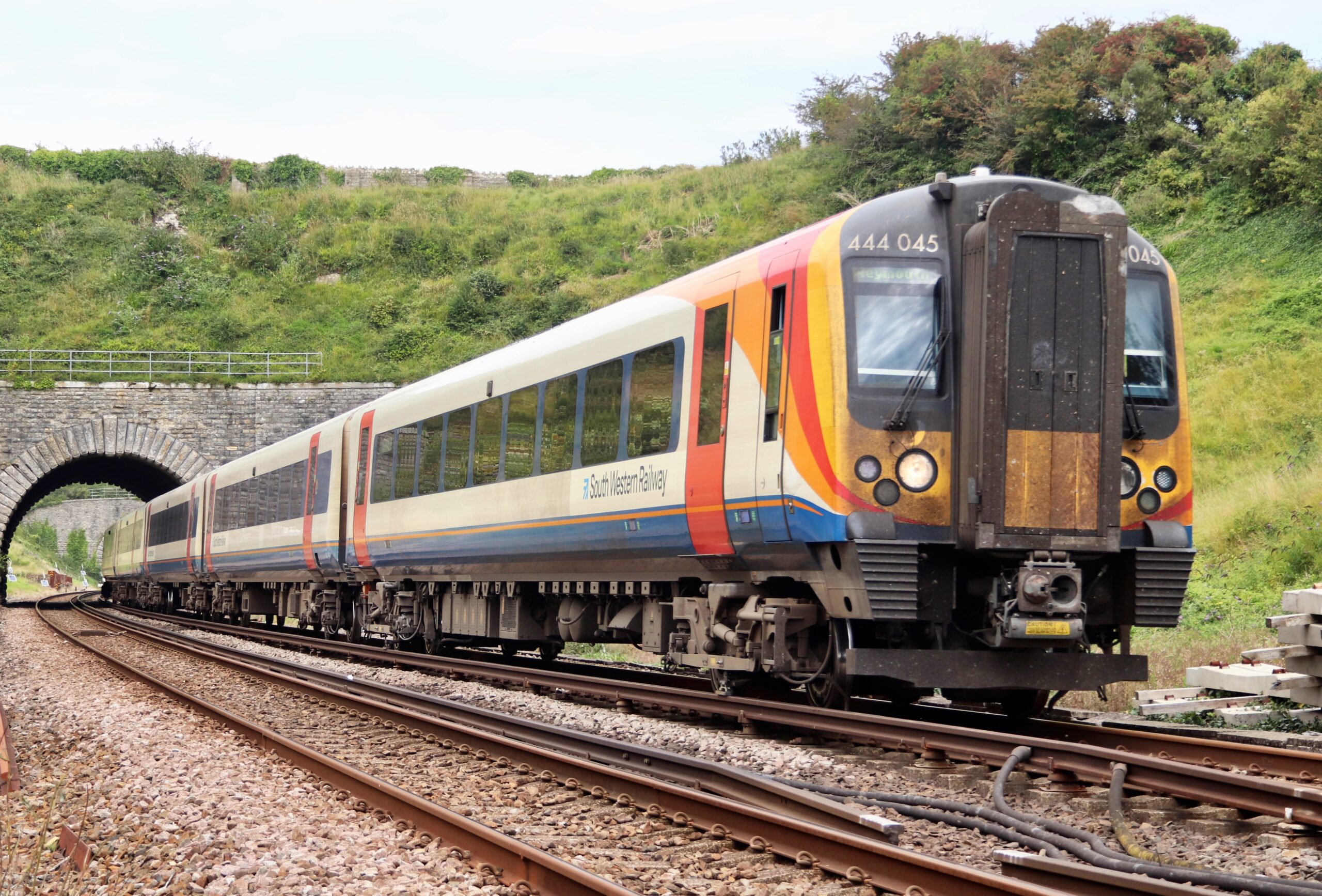
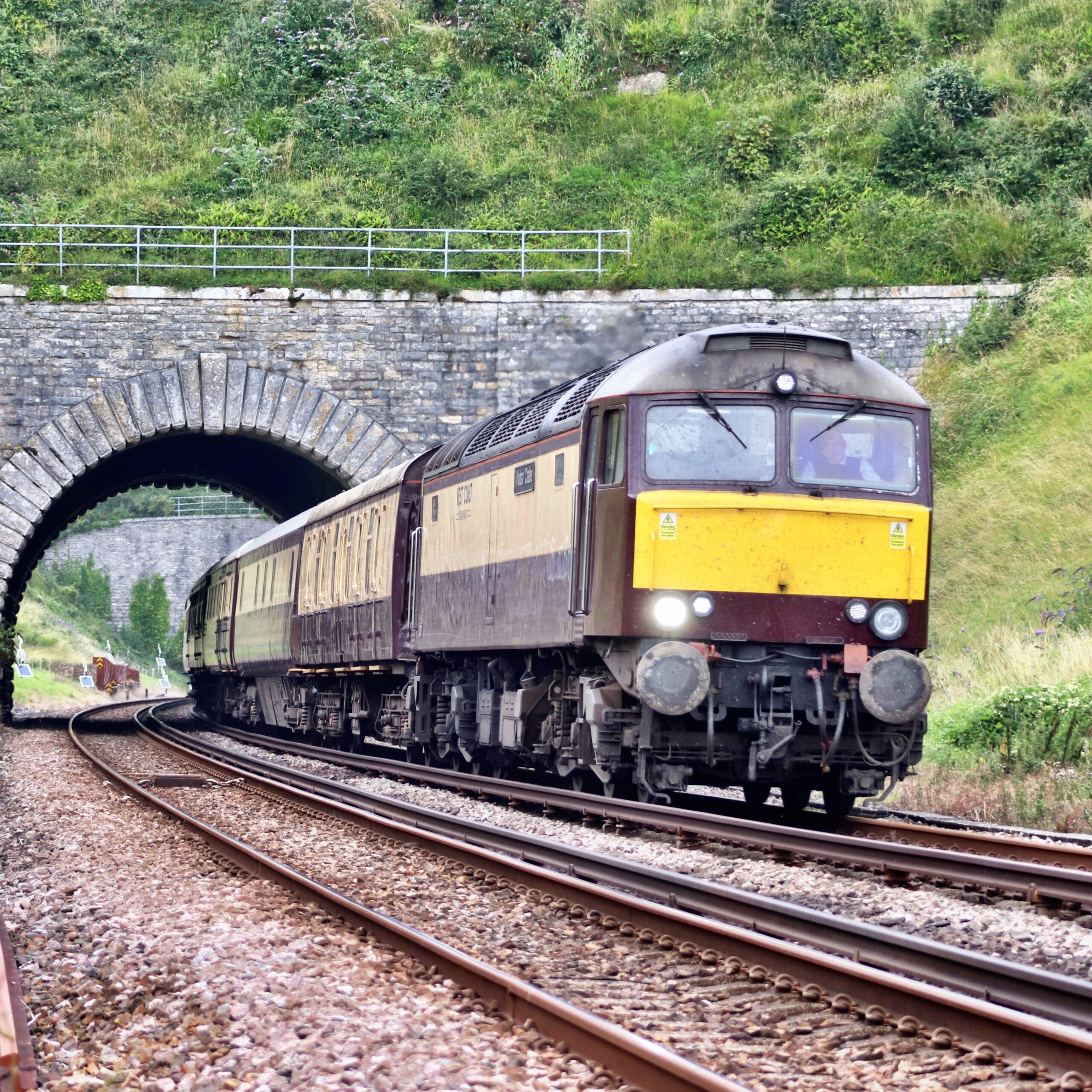
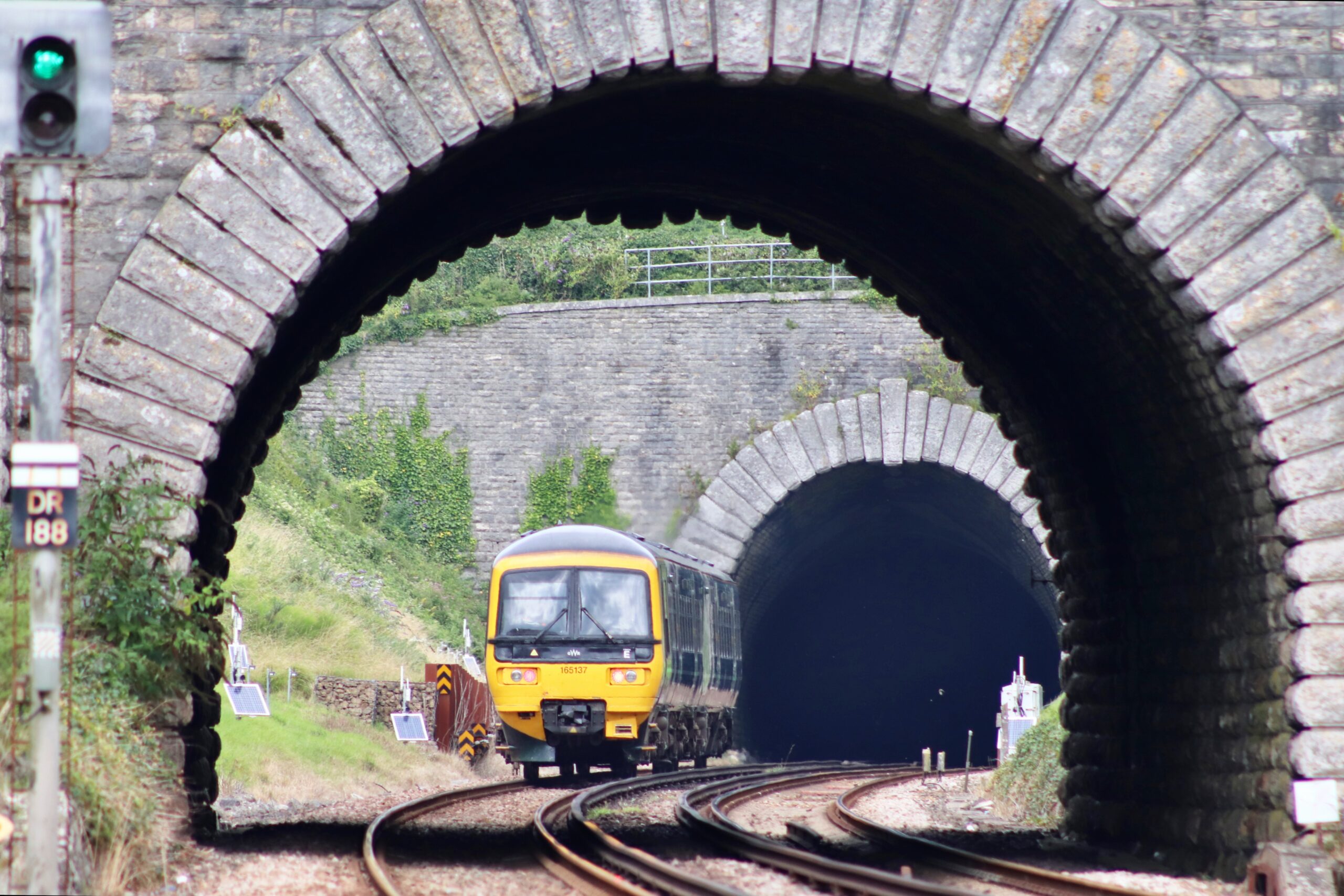
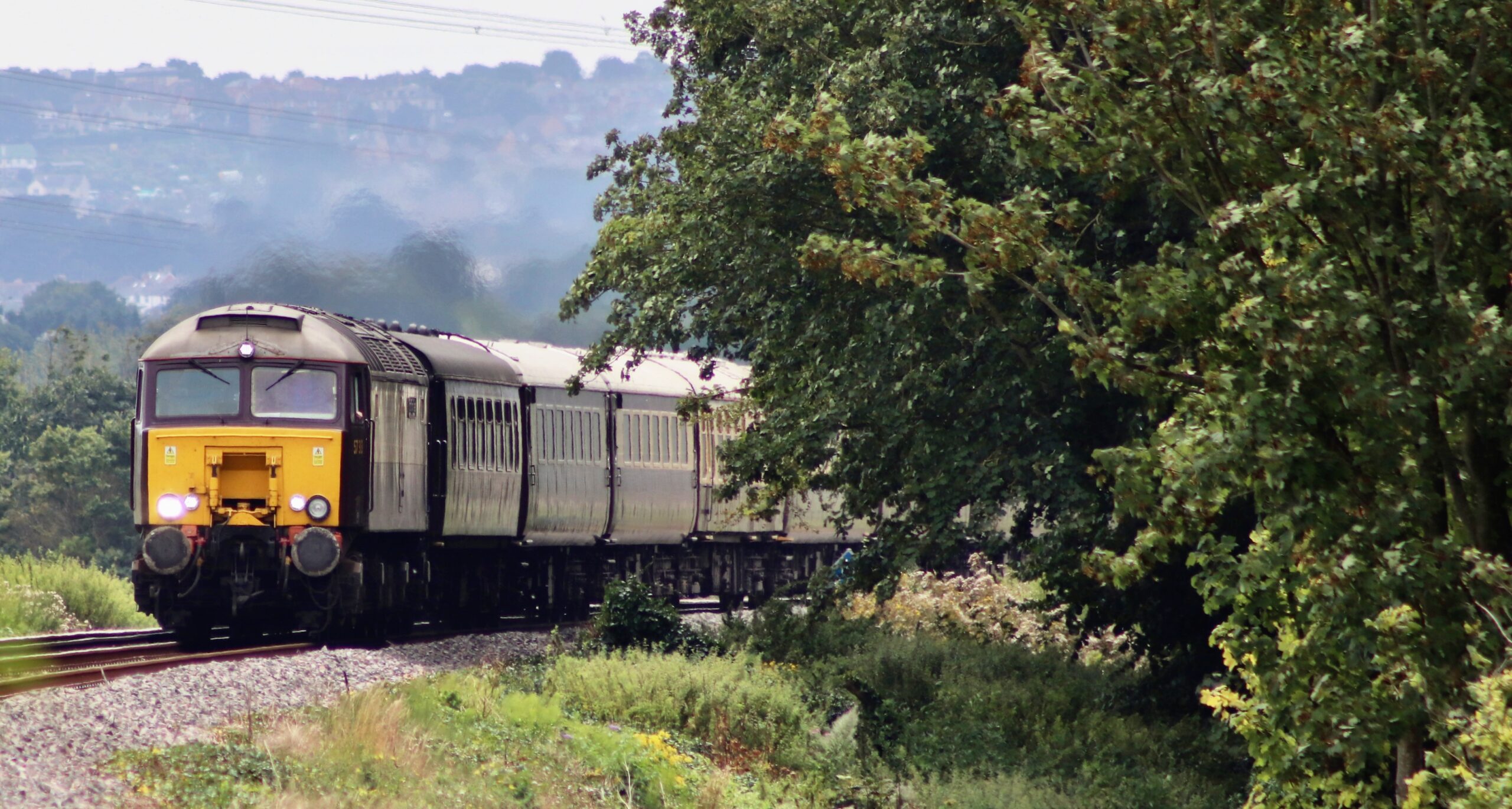
Still in South Western Trains livery, South Western Railway Class 444 EMU No. 444045 runs past the site of the former Upwey Wishing Well Halt with 1W21 1035 London Waterloo to Weymouth – 17/08/2023Class 57 No. 57601 ‘Windsor Castle’ heads up “The Northern Belle: Weymouth Harbour” 1Z79 0711 Coventry to Weymouth – 17/08/2023165137 – 2V68 1328 Weymouth to GloucesterLMS Jubilee 4-6-0 No. 45596 ‘Bahamas’ works the final 2023 “Dorset Coast Express” 1Z92 0845 London Victoria to Weymouth coasting down Bincombe Bank – 17/08/2023West Coast Railways Class 57 No. 57313 ‘Scarborough Castle’ working 5Z80 1333 Weymouth to Yeovil Pen Mill empty coaching stock movement designed to free up space in Weymouth because of the two excursion trains scheduled for the day works up Upwey Bank towards Bincombe Tunnel – 17/08/2023
Video from 17th August 2023 including the following: 444034 – 1W61 1005 London Waterloo to Weymouth and Poole 444029 – 1W20 1303 Weymouth to London Waterloo 444045 – 1W21 1035 London Waterloo to Weymouth 57601/57313 – 1Z79 0711 Coventry to Weymouth 444034 – 1W62 1320 Weymouth and Poole to London Waterloo 165137 – 2V68 1328 Weymouth to Gloucester 45596/ 47802 – 1Z92 0845 London Victoria to Weymouth 57313/57601 – 5Z80 1333 Weymouth to Yeovil Pen Mill 47802/45596 – 1Z93 1636 Weymouth to London Victoria 57601/57313 – 5Z82 1641 Yeovil Pen Mill to Weymouth – with thanks to G E Barrett for video clips at Dorchester
Later on the 17th I headed off to Branksome to see an engineers train pass through bound for Poole. On this occasion the train was worked by GBRf and was top and tailed by class 66 locomotives. On my way home, I popped in at Poole to see the locos and ballast hoppers awaiting deployment.
GBRf Class 66 No. 66791 6G28 2304 Eastleigh East Yard to Poole – 18/08/2023GBRf Class 66 No. 66749 ‘Christopher Hopcroft MBE 60 Years Railway Service’ at the rear of 6G28 2304 Eastleigh East Yard to Poole – 18/08/2023
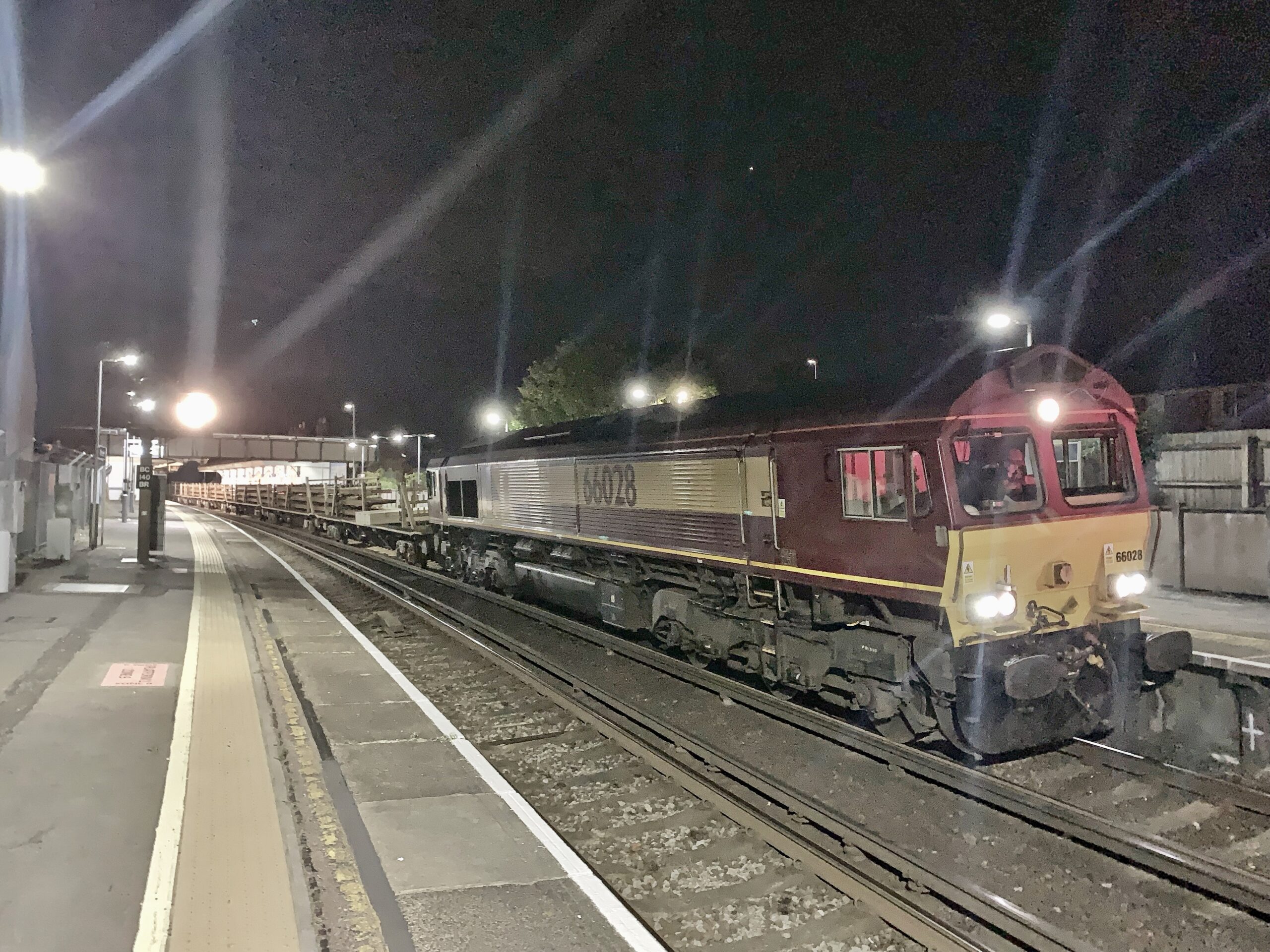
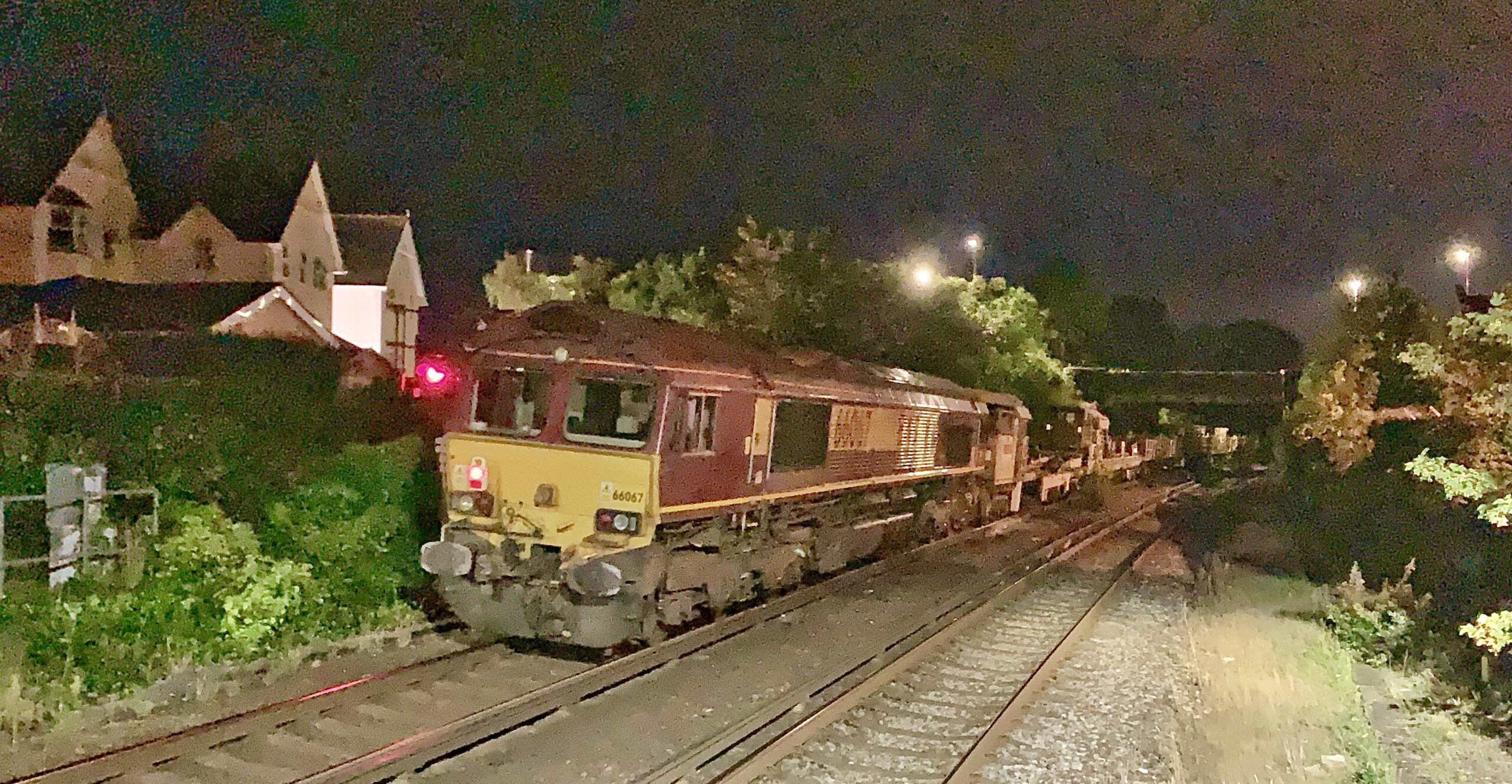
The following Tuesday and I was once again setting off for more midnight engineering train shenanigans, this time with DB Cargo class 66’s in charge of a train of new rail which was destined for the Christchurch – Pokesdown area.
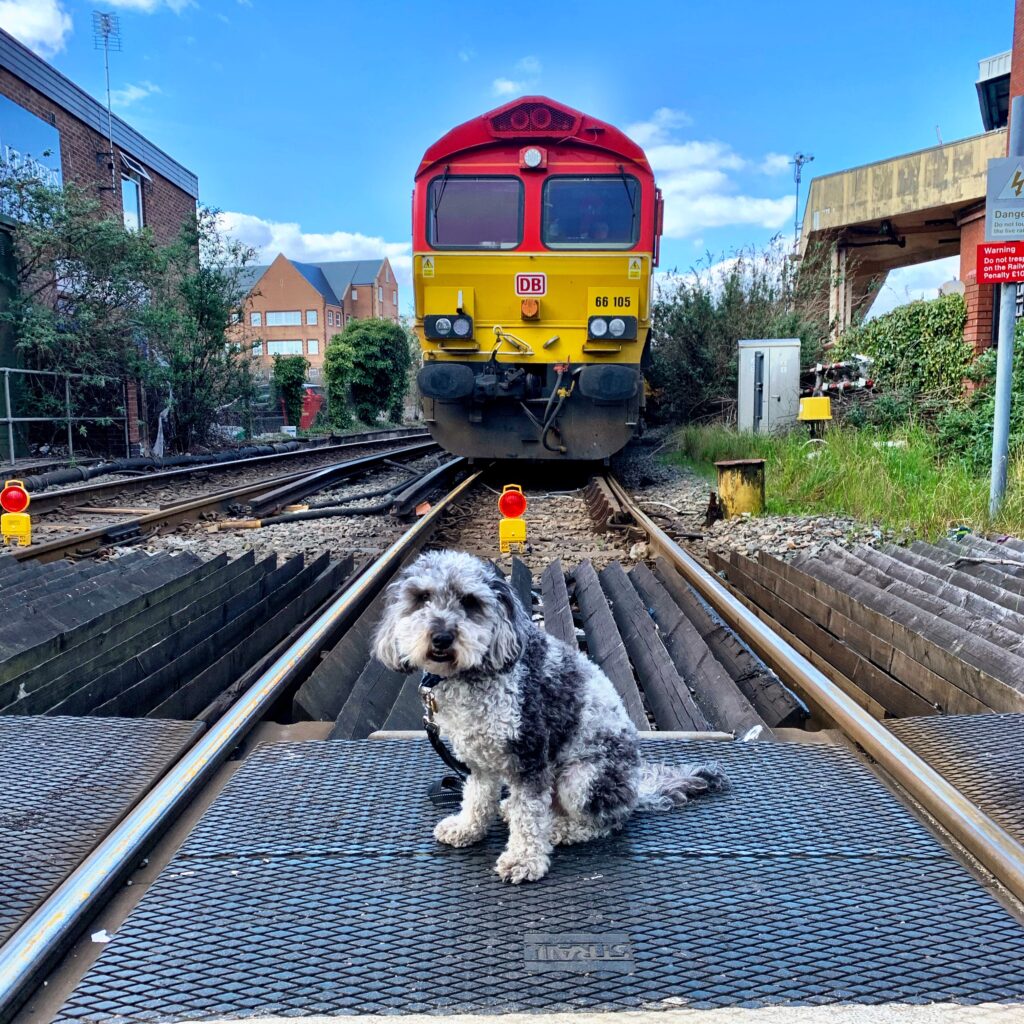
DB Cargo Class 66 No. 66028 at the head of 6N65 2349 Eastleigh East Yard to Christchurch – 23/08/2023DB Cargo Class 66 No. 66067 at the rear of 6N65 2349 Eastleigh East Yard to Christchurch having run through the station – 23/08/2023
Video of Dorset engineers train amongst every day railway movements – August 2023
Hamworthy Branch Update:
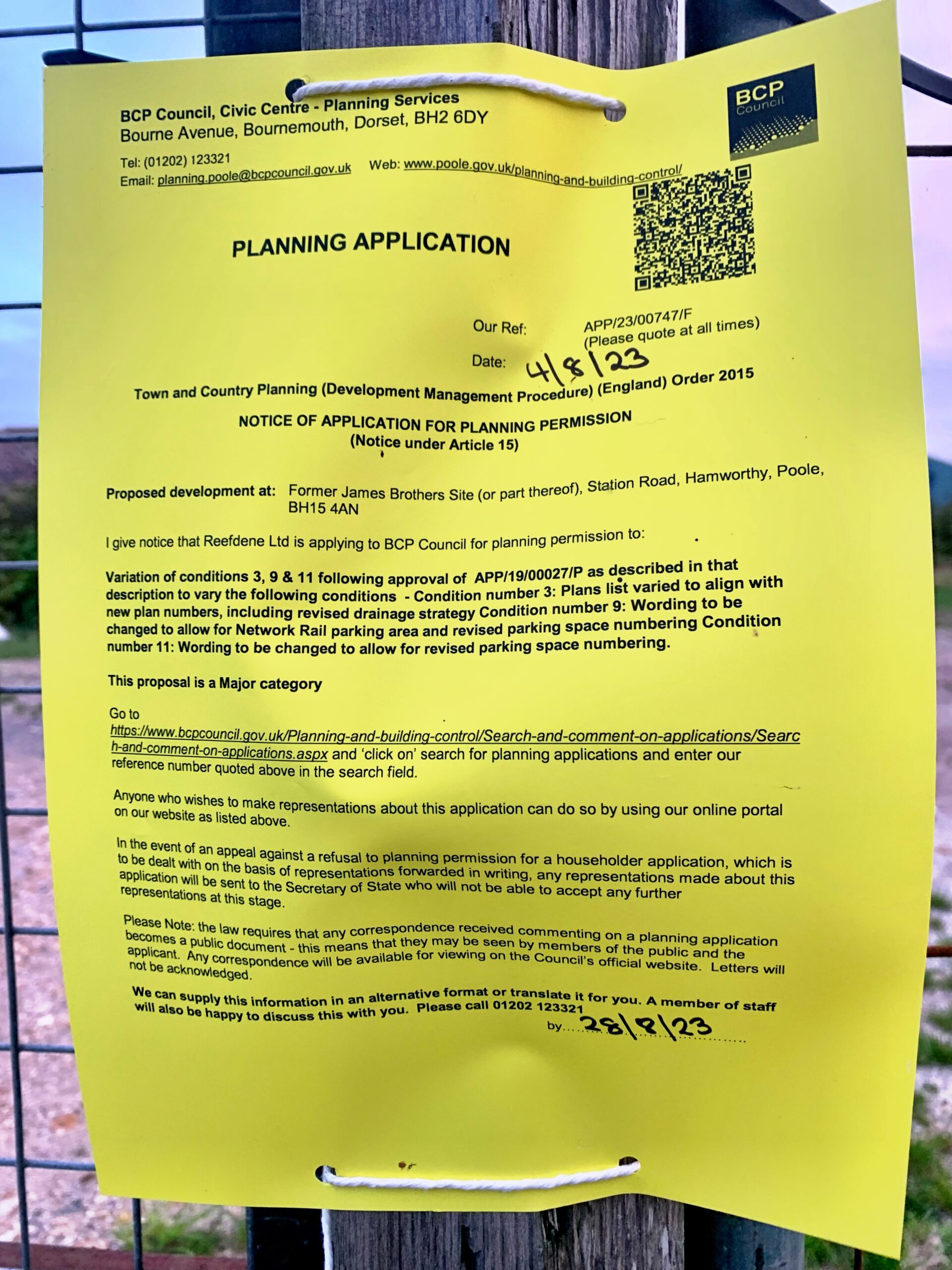
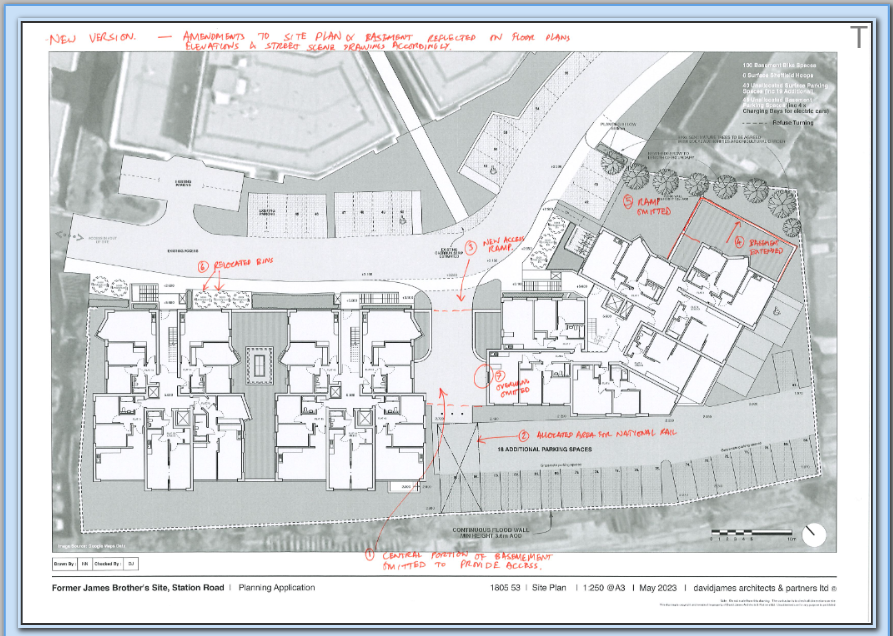
Out walking Yoshi around Hamworthy and I noticed a planning application notice fastened to the fence close to where the original Poole station once stood. What caught my eye was a variation of conditions quoted within the notice allowing for a “National Rail parking area” as part of a new development on the former James Brothers Site on Station Road.
Planning application notice – August 2023Diagram of redevelopment plans of the former James Brothers Site on Station Road, Hamworthy varied to align with new plan numbers, including a revised drainage strategy, wording changed with amended parking space numbering to allow for a dedicated Network Rail parking area which includes a set of gates to allow access to railway land to the south of the site. As shown by the plans, these will be flood-gates at a minimum height of 3.6m – August 2023
From The Archive:
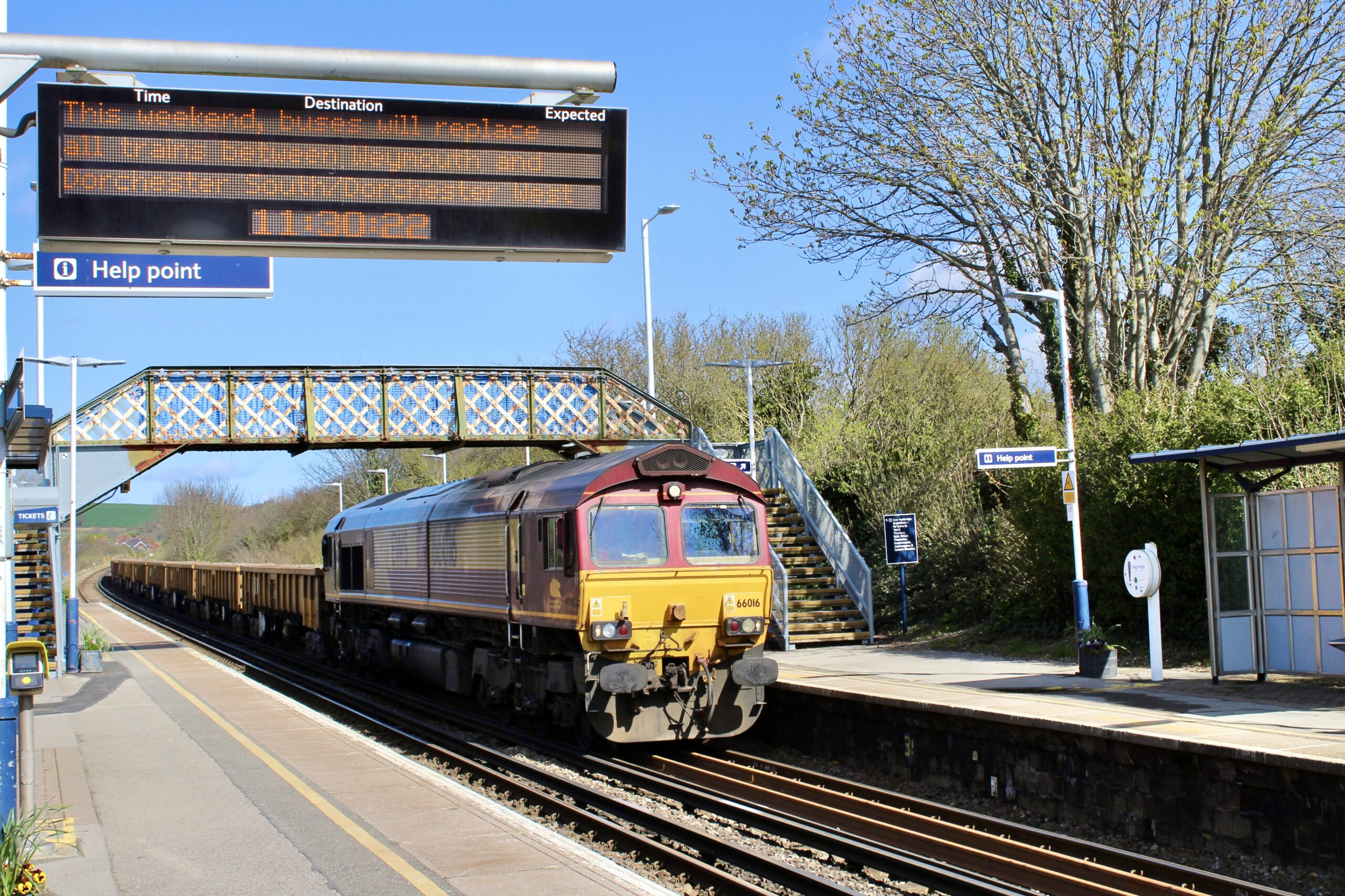
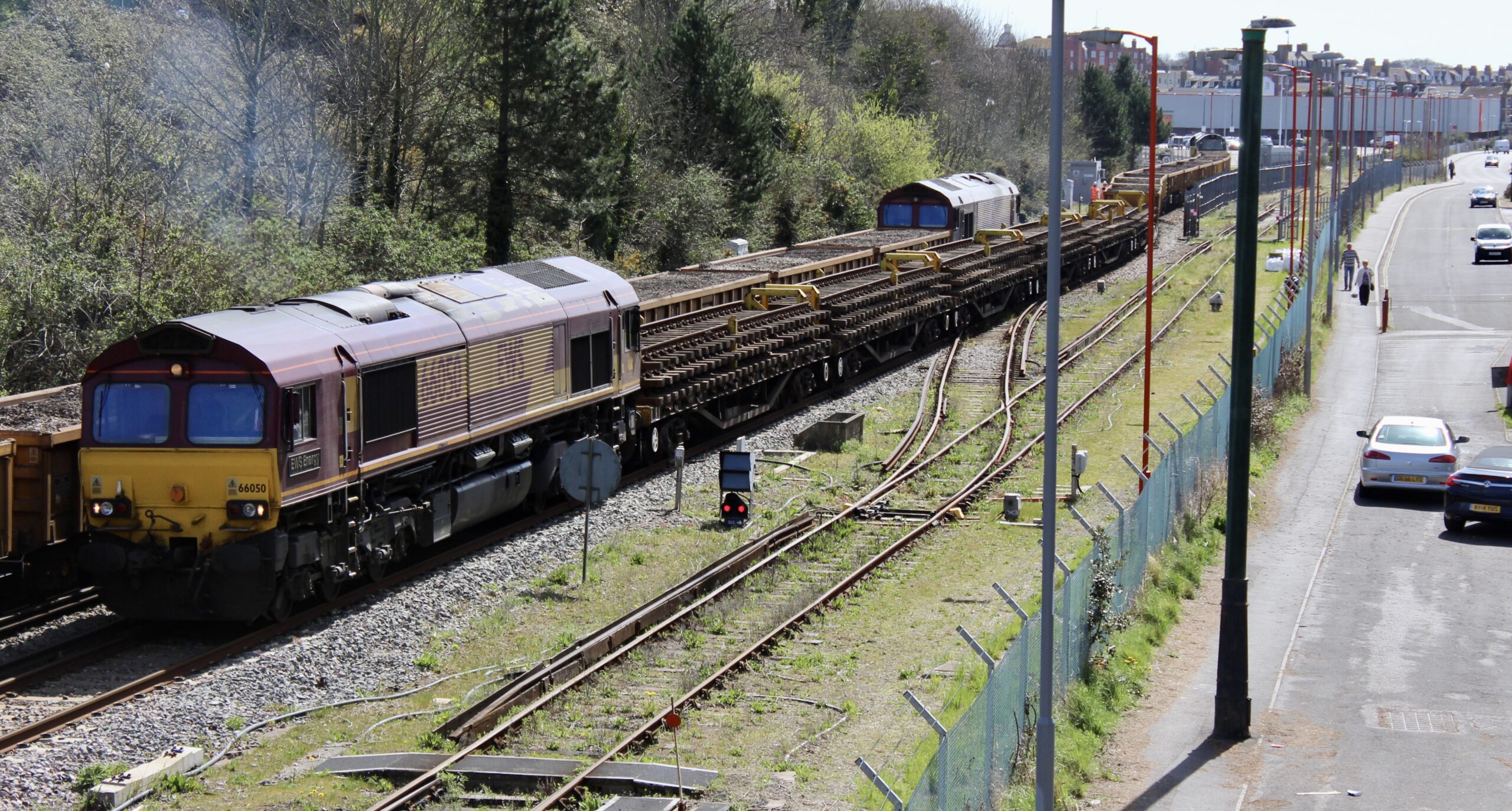
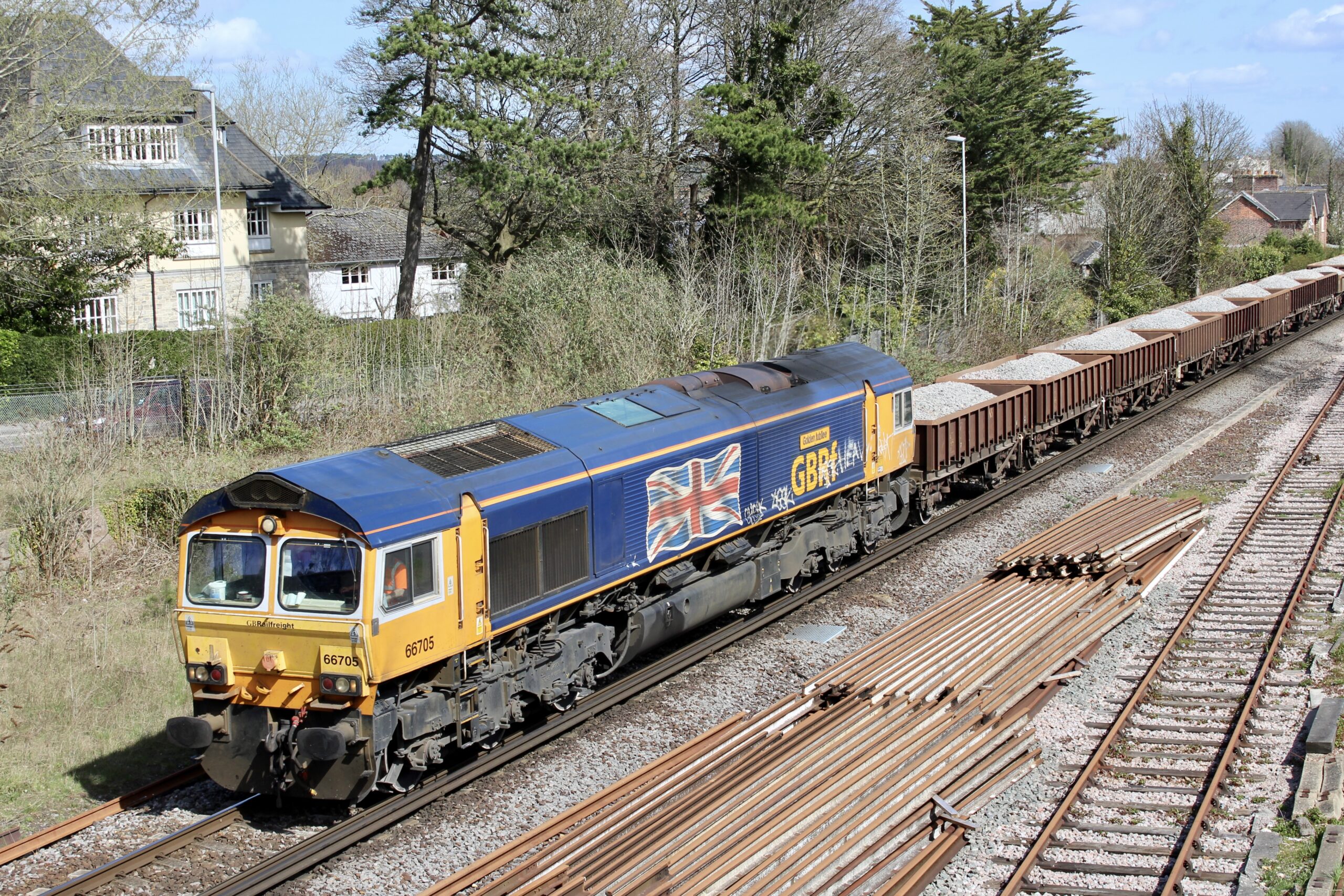
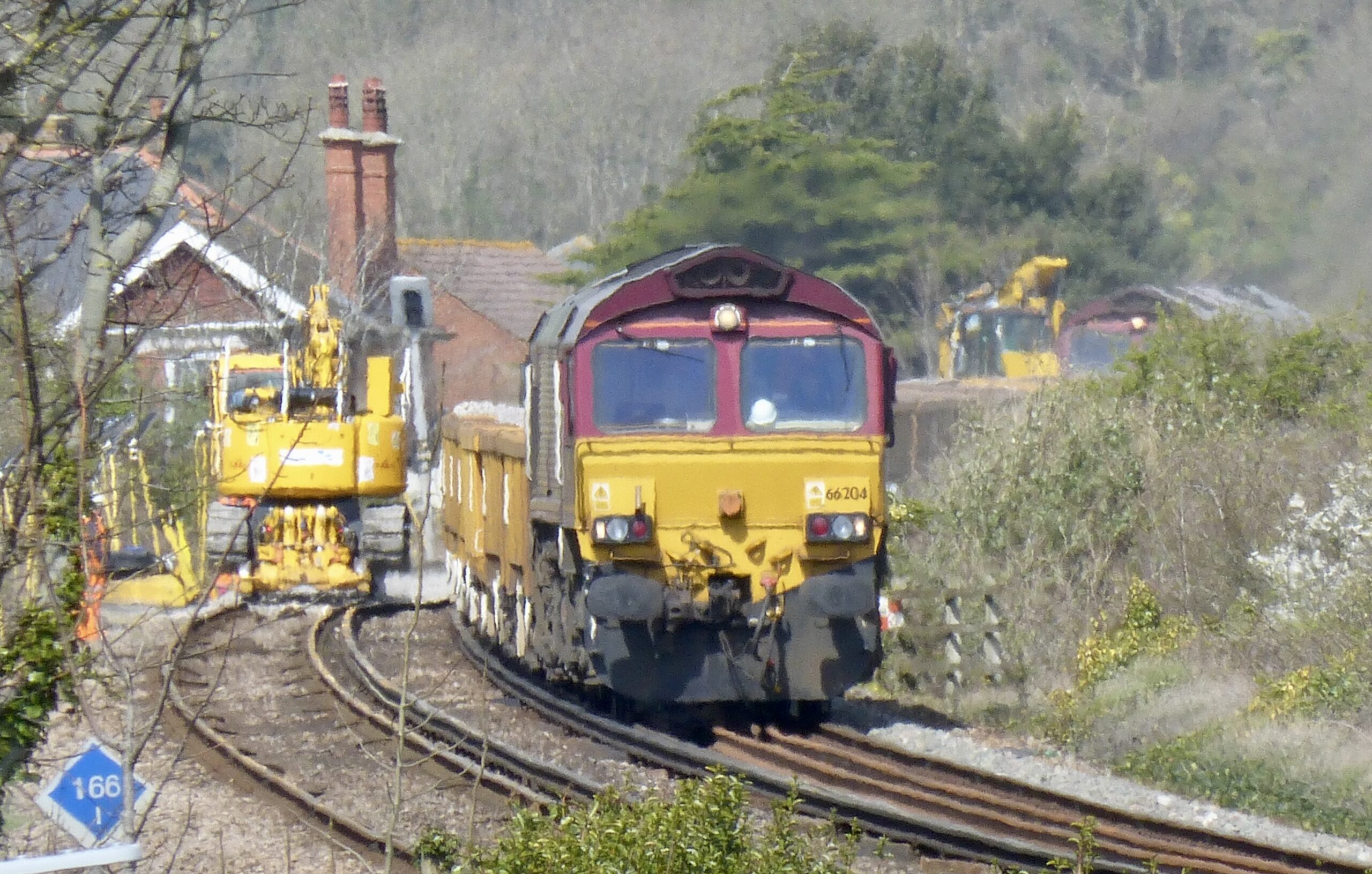
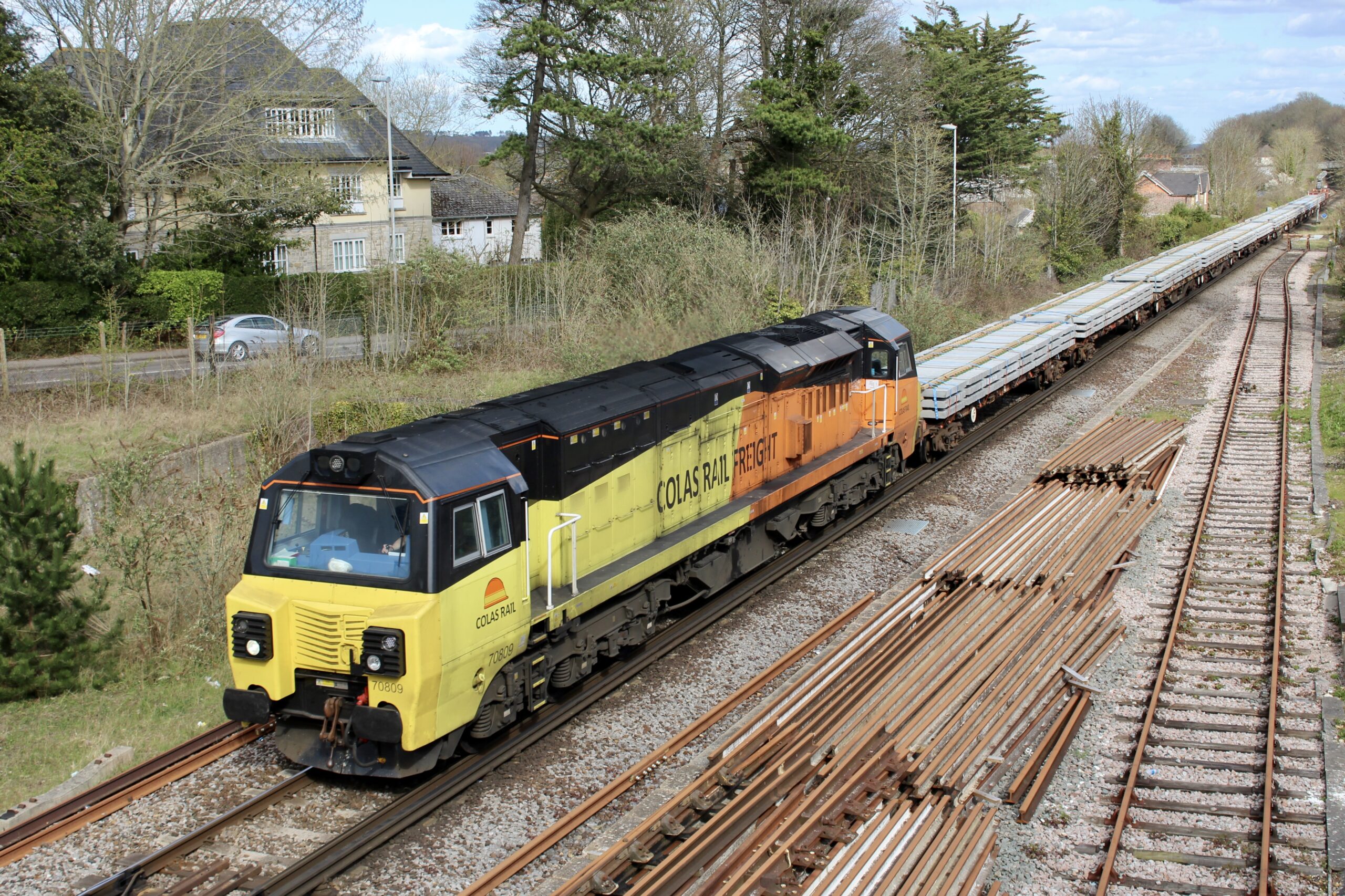
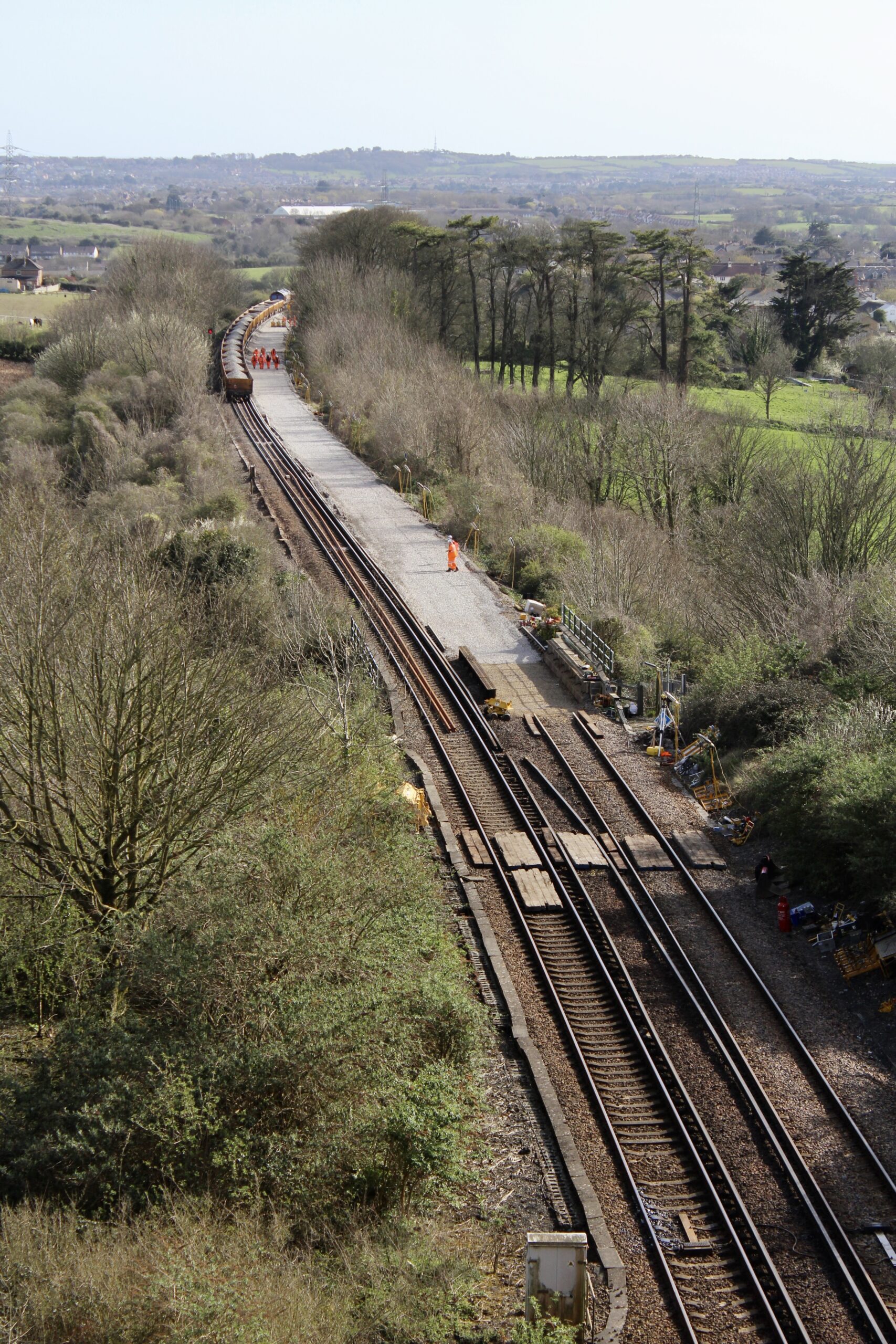
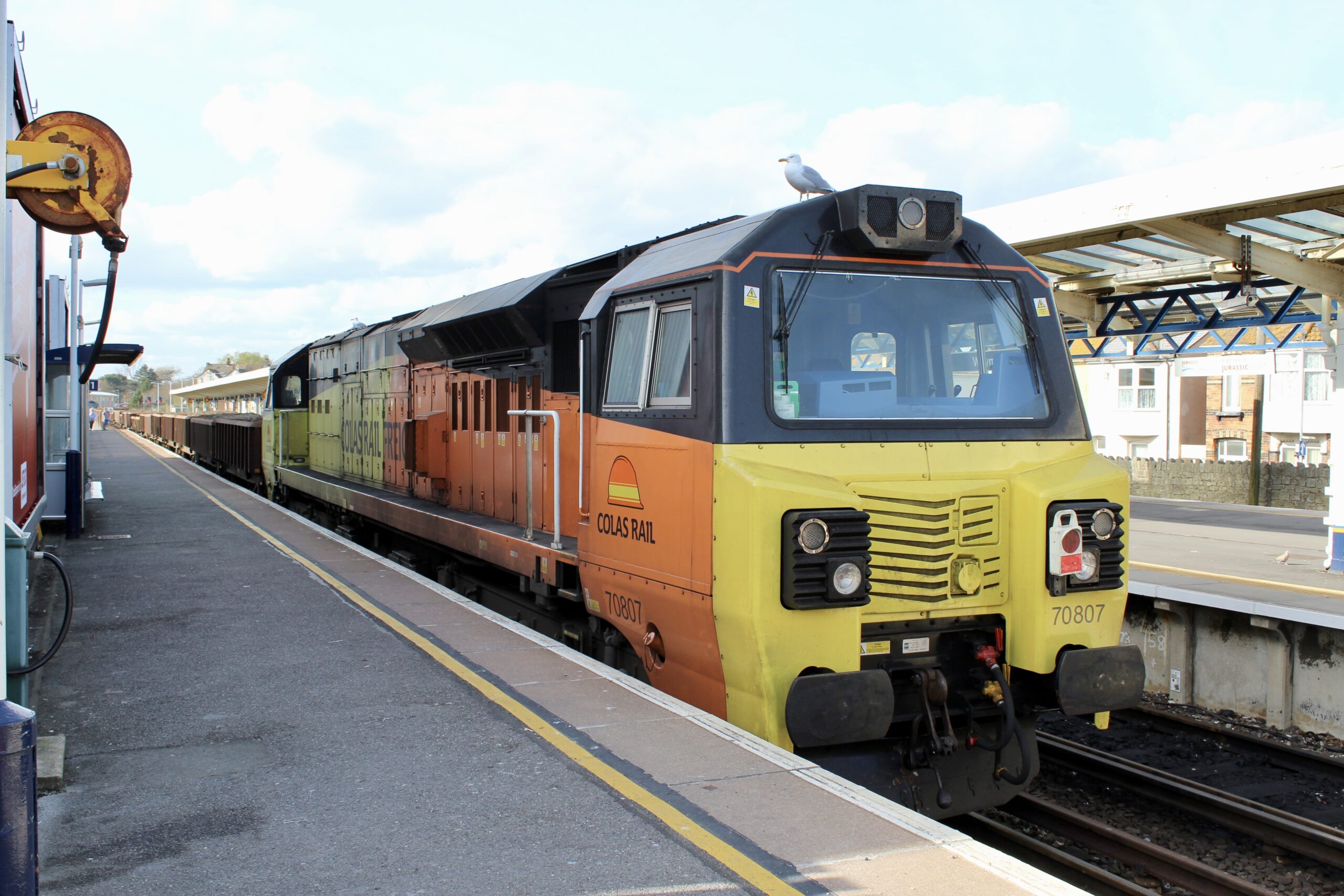
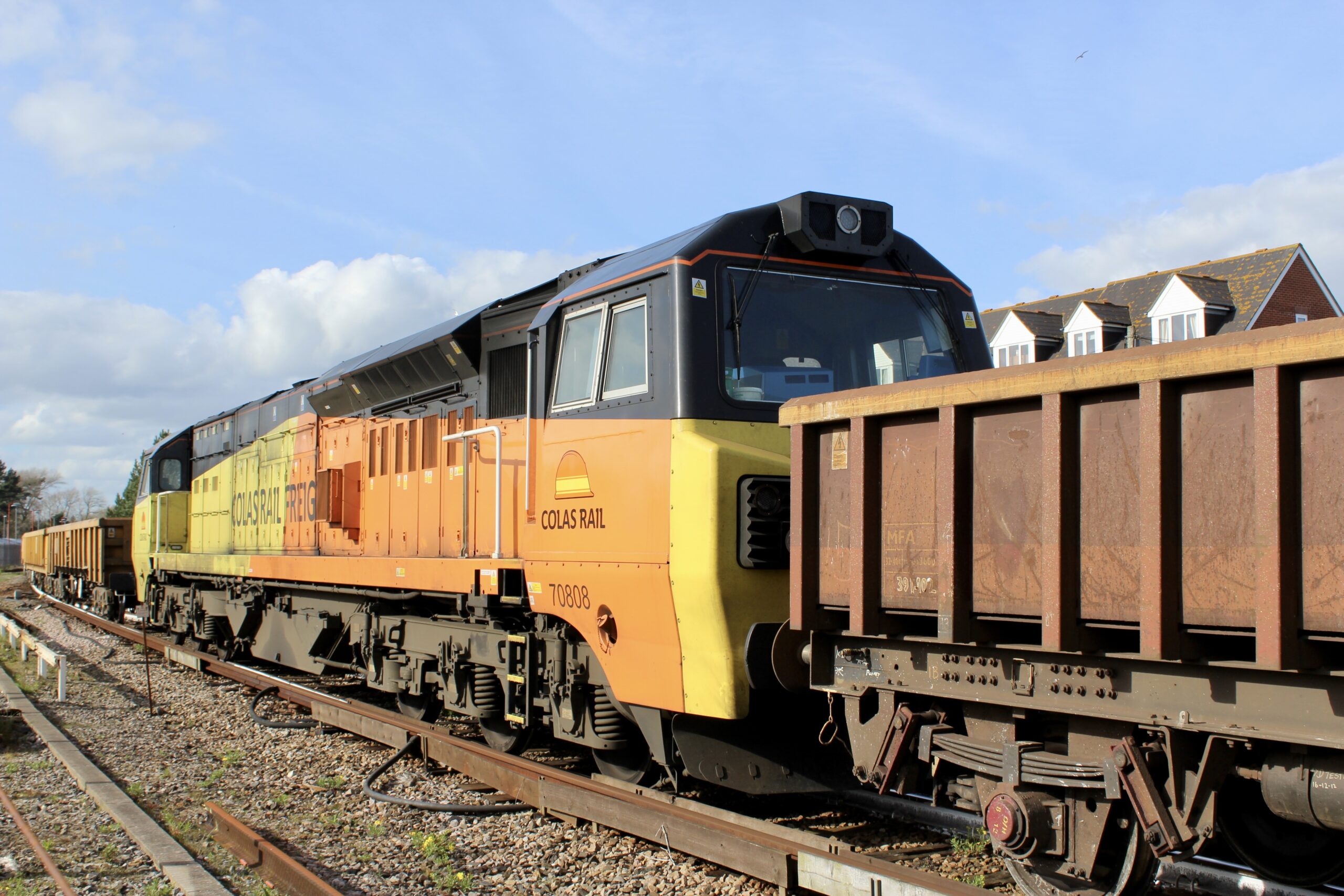
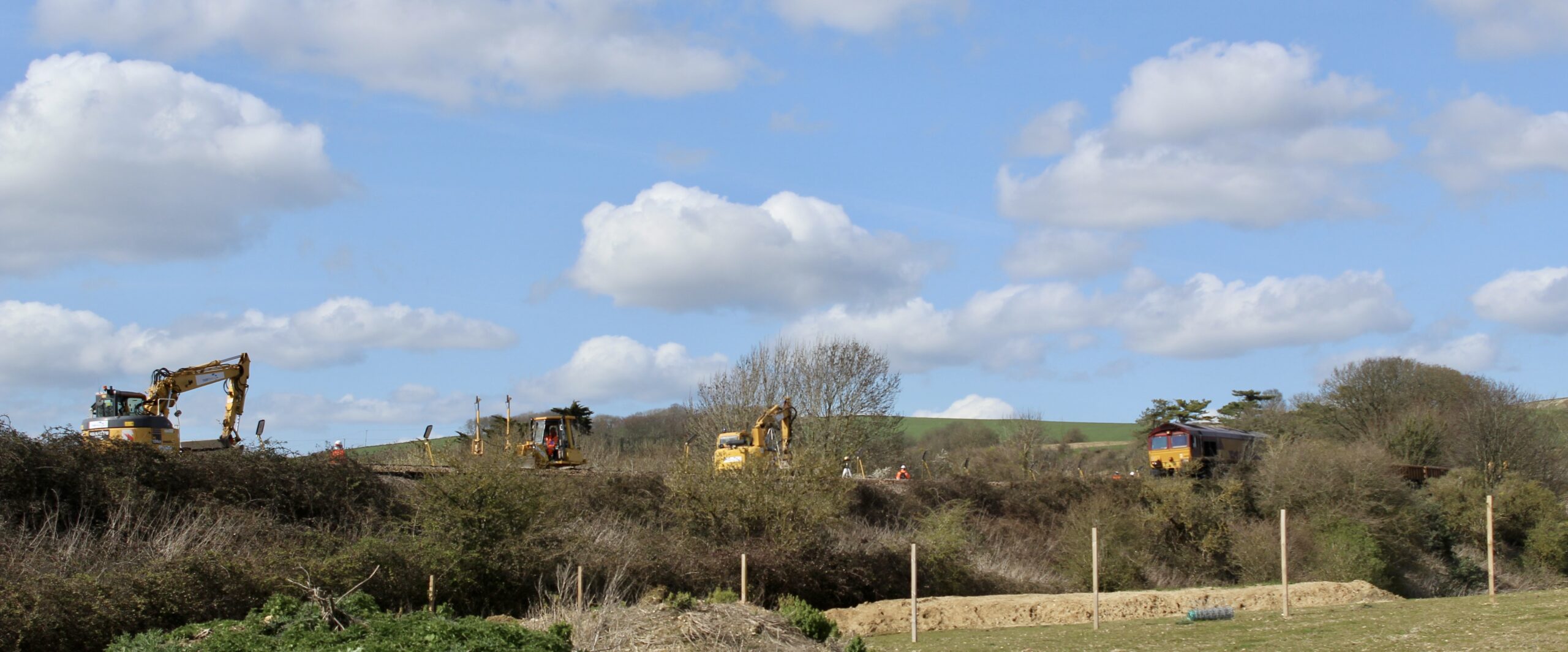
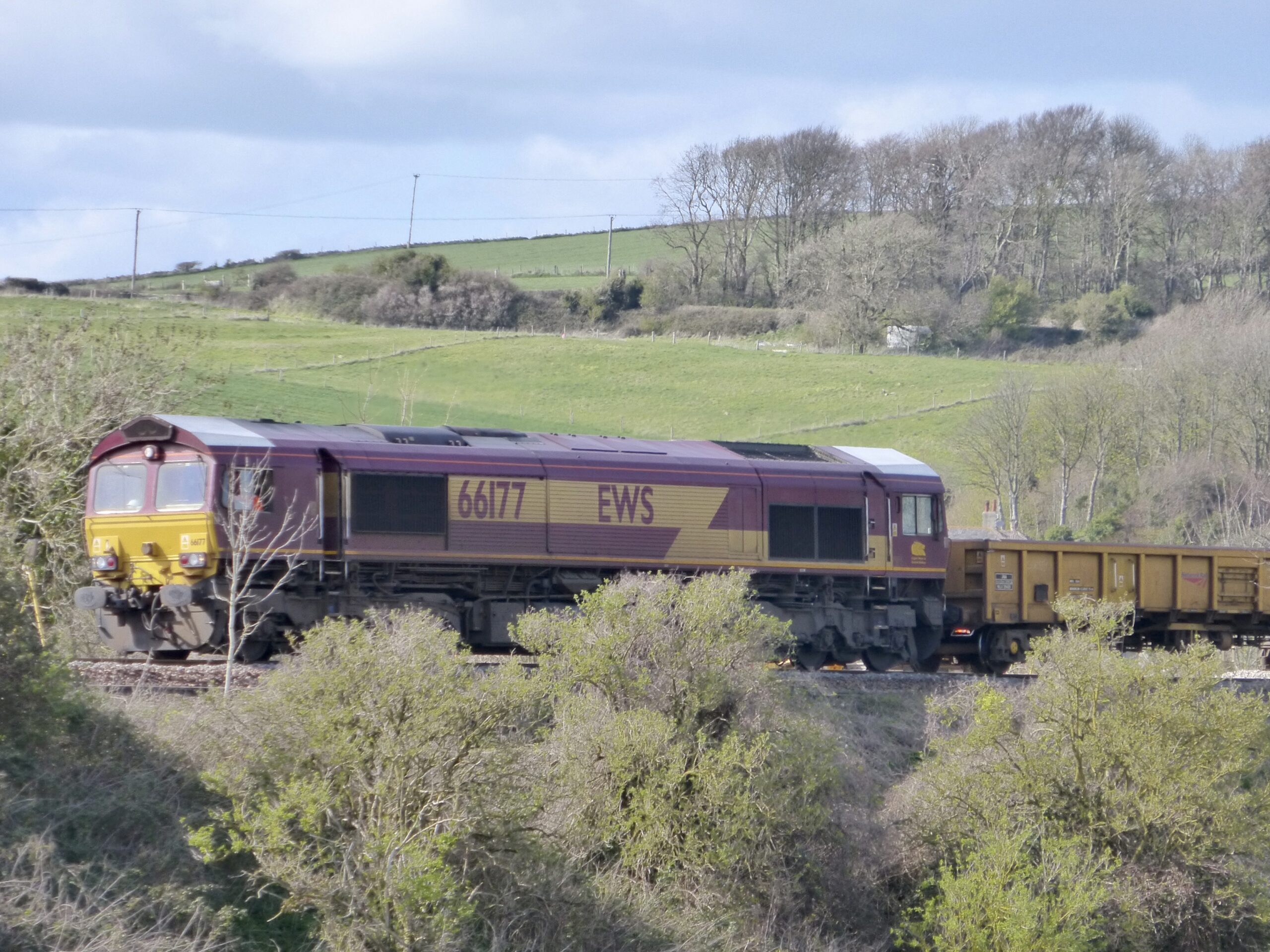
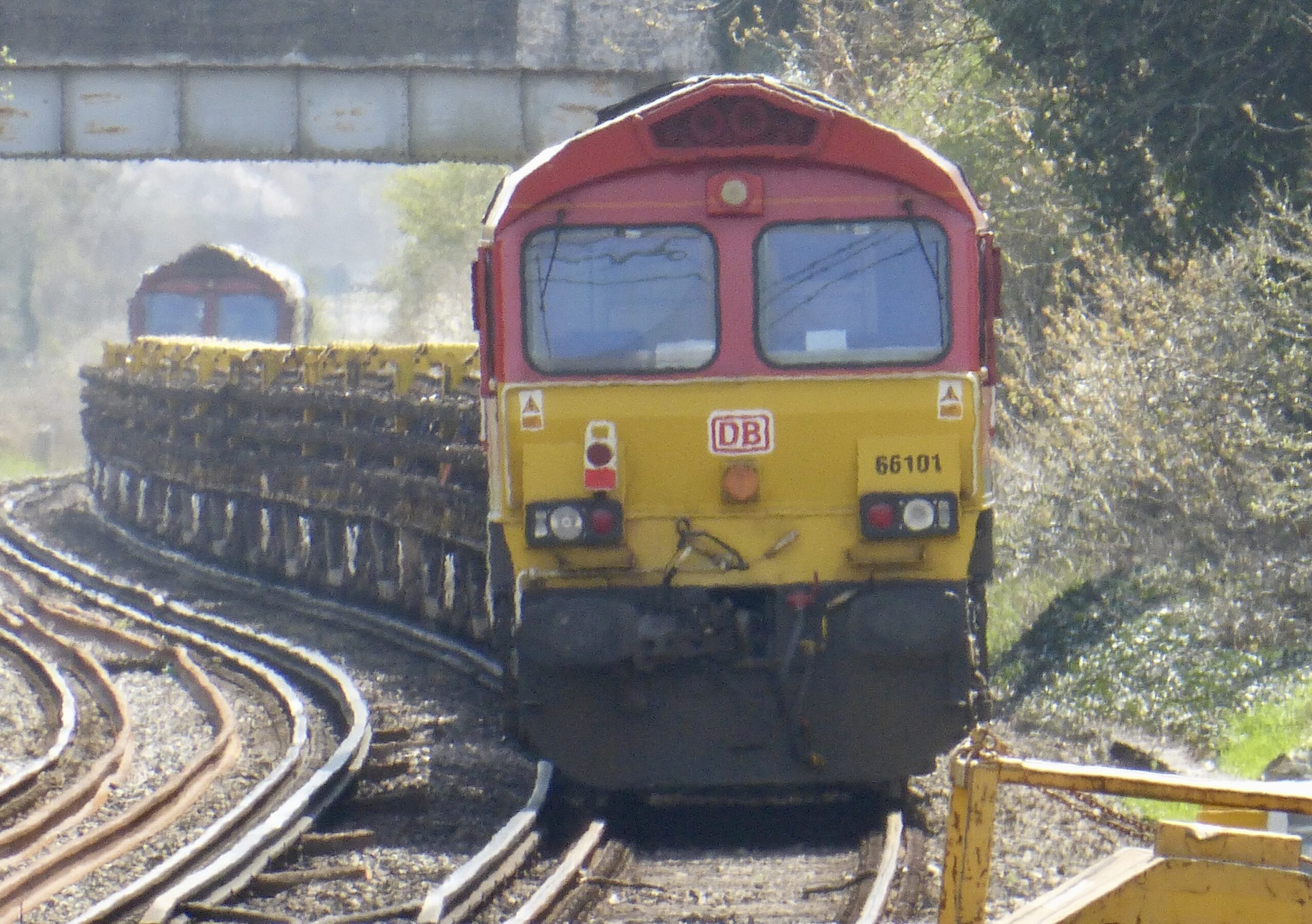
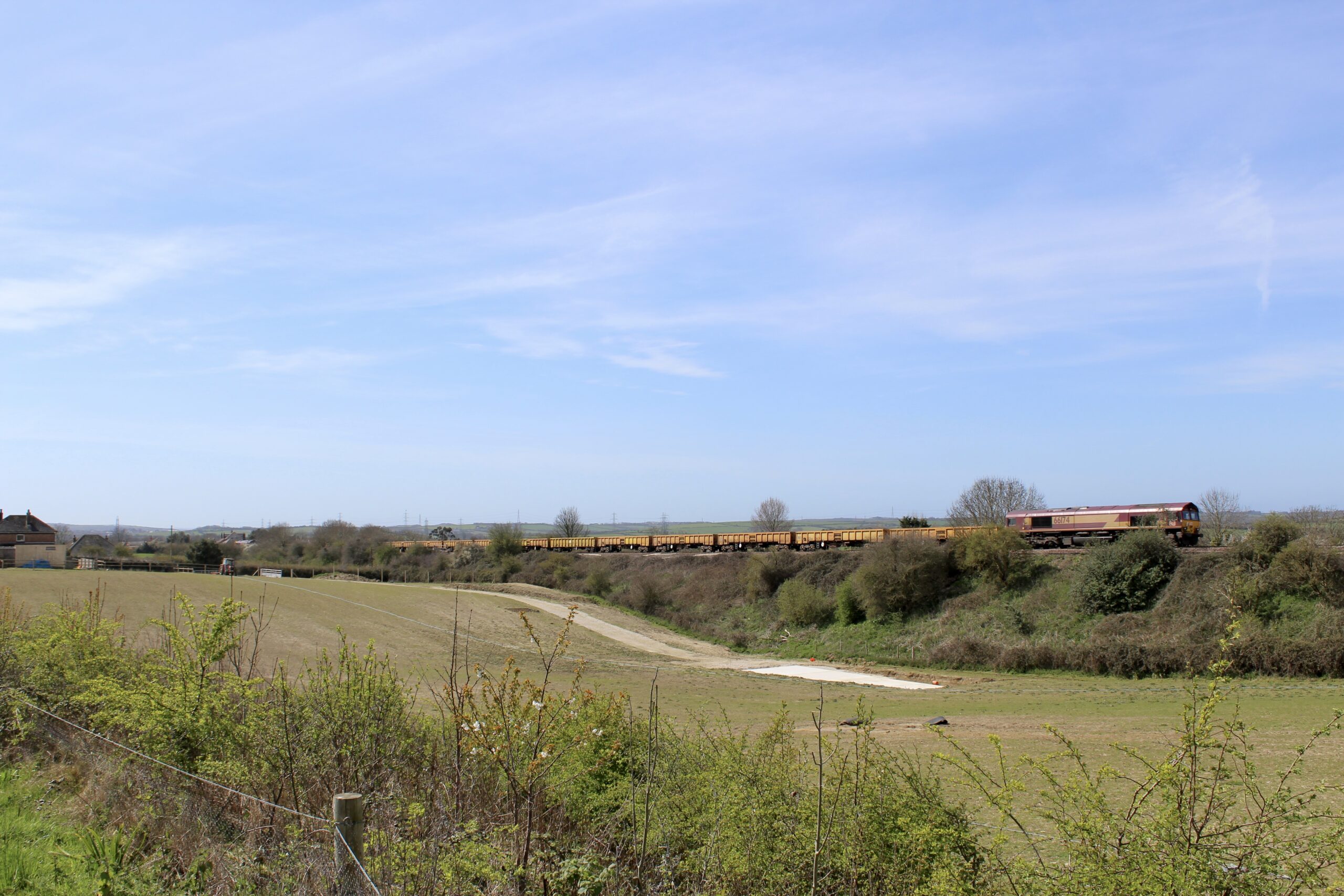
I have to admit to being partial to an engineering train. Every night I lie in bed, the brightest colours fill my head, a million dreams are keeping me awake, I think of what the world could be. No, hang on, that’s from “The Greatest Showman”. Anyway, back in April 2015 there was no need to dream of engineers trains as eleven of them found their way to Upwey on Saturday 11th, following an earlier light engine visit on the 9th which ran as a crew route refresher for Colas. The purpose of this engineering possession was for the relaying of the up line between Upwey station and Bincombe Tunnel. Trains ran in order as follows; No. 66050 top and tailed with No. 66101, No. 70805, No. 66016, No. 70807, No. 70808, No. 66014, No. 66177, No. 66705, No. 70809, No. 66204 and finally train eleven with No.’s 66074 and 66174.
EWS Class 66 No. 66016 at Upwey – 11/04/2015Class 66 Np. 66050 and Class 70 No. 70805 at Weymouth – 11/04/2015Class 70 No. 70805 in Weymouth station – 11/04/2015Class 66 No. 66016 on the approach to Weymouth – 11/04/2015Class 66 No. 66050 departs Weymouth with a train of track panels – 11/04/2015GBRf Class 66 No. 66705 arrives at Dorchester South with a train of new ballast – 11/04/2015A view over to Upwey railway station with Class 66 No. 66101 in DB red livery – 11/04/2015Class 66 No. 66204 near Upwey – 11/04/2015Class 70 No. 70809 arrives into Dorchester – 11/04/2015A view towards Weymouth looking down to the site of Upwey Wishing Well Halt – 11/04/2015Class 70 No. 70807 at rest in Weymouth station – 11/04/2015Class 70 No. 70808 between to trains in Weymouth – 11/04/2015GBRf Class 60 No. 66705 pokes out of Bincombe Tunnel – 11/04/2015Road/rail machines watched by Class 66 No. 66014 near Upwey – 11/04/2015Class 66 No. 66177 at Upwey – 11/04/2015DB liveried Class 66 No. 66101 at Upwey – 11/04/2015Class 66 No. 66174 at a stand on Bincombe Bank- 12/04/2015Another view looking towards Weymouth with a track machine where Upwey Wishing Well Halt was once located – 12/04/2015Class 66 No. 66074 near to the location of Monkton and Came Halt railway station which opened in 1905 as Came Bridge and closed in 1957 – 12/04/2015
Starting with No. 66174 which departed Dorchester South mid-afternoon most of the trains returned to Eastleigh on Sunday 12th in reverse order with the last running early on Monday 13th.
Class 66 No. 66074 at Dorchester South departs for Eastleigh. The Brewery Square development is being built in the background – 12/04/2015
A continuation of the work was carried out over three successive evenings on 13th, 14th and 15th April, with two engineers trains allocated to this. On the evening of Monday 13th No. 66050 worked train No. 1 followed by top and tail Class 70 No.’s 70808 and 70809, the same loco’s repeated the moves the following day. However on Wednesday 15th No. 66170 turned up with the same Class 70’s remaining on the second train (With thanks to “The Corkscrew” the newsletter of The Wimborne Railway Society for the meticulous notes!)
That’s us for this week. Thanks, as ever, for reading and for your comments and corrections which are always welcome, except the ones with links to dubious websites obviously (these can, however, be obtained by writing to me on the back of a ten pound note). Be seeing you!
Yoshi wanting to play ball rather than help compile this weeks blog!
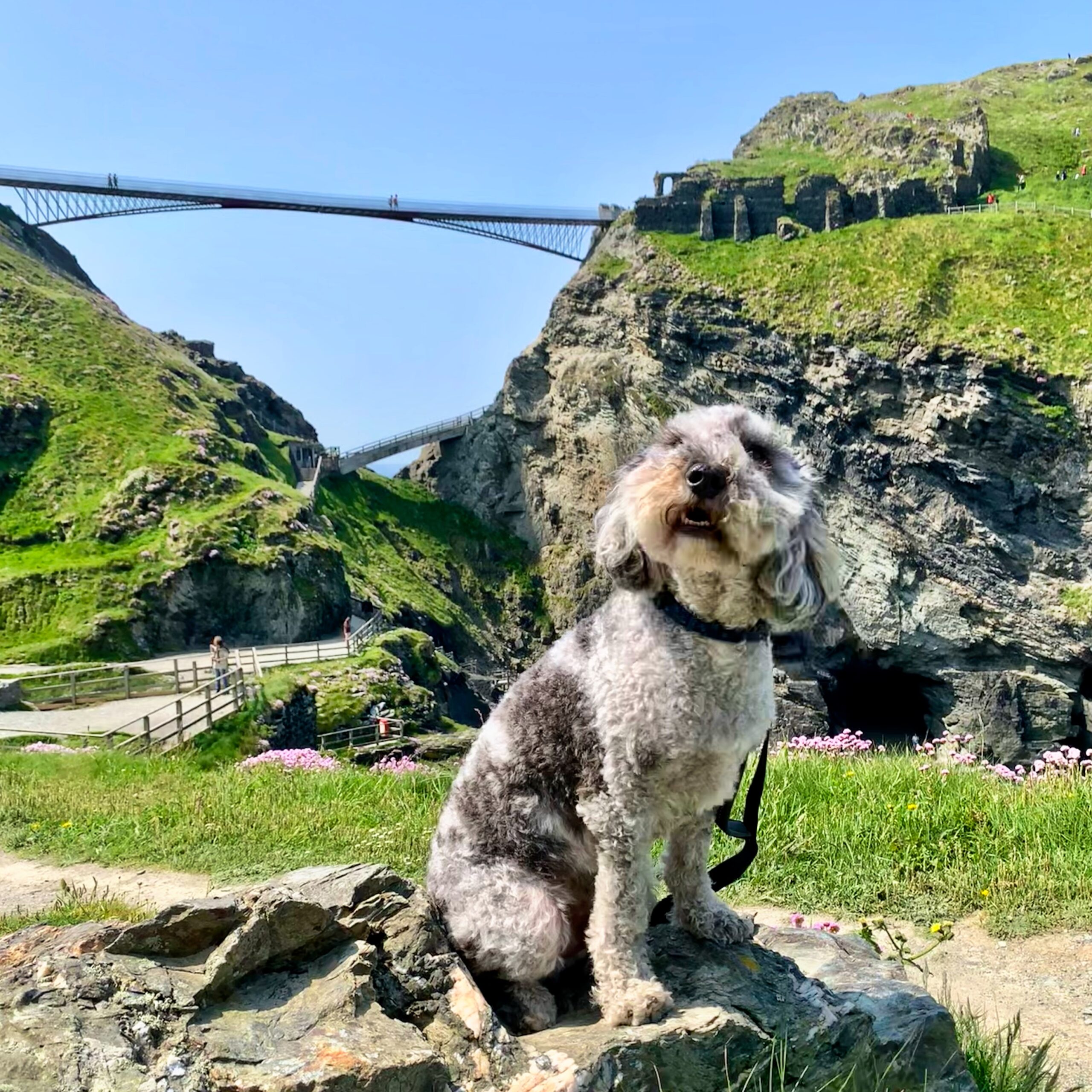
Did Yoshi discover King Arthur at Tintagel during our trip to Cornwall? “Gallos”(meaning ‘power’ in Cornish) created by sculptor Rubin Eynon is an 8ft bronze sculpture standing above cliffs on the Atlantic coast-side of the castle – 22/03/2023Yoshi with the new Tintagel Bridge in the background which reinstates the original route to the castle. In the Middle Ages, Tintagel’s residents walked from one side of the site to the other using a narrow land bridge as high as the clifftops. But the crossing disappeared between the 14th and 17th centuries, leaving the castle divided by a natural chasm. English Heritage launched a competition in 2015 to find a design for a new bridge. The winning concept was created by Ney & Partners Civil Engineers and William Matthews Associates. The project was completed in August 2019. The design sees two cantilevers reach out and meet, not quite touching, with a 40mm gap in the middle. The gap represents the transition from the mainland to the island, present to past. The bridge is paved with Cornish Delabole slate, with stainless steel balustrades fitted along its length. The balustrades have been designed to be so fine that, when viewed from a distance, they disappear against the sky – 22/03/2023
As mentioned in our last blog, we recently spent a few days in Cornwall. This gave me the opportunity to see some of the remaining semaphore signals on the Great Western mainline and also GWR sleeper trains arriving and departing from Penzance. We stayed in Camelford for three nights before moving onto Penzance for a couple of days.
While we were in the Camelford area we visited Padstow and Bodmin and we were able to walk along some disused railway trackbed which now forms the Camel Trail; an 18 mile largely traffic free, surfaced and virtually level multi use trail. It provides access to the beautiful Cornish countryside between Wenfordbridge, Bodmin, Wadebridge and Padstow and is suitable for walkers, cyclists, horse-riders and wheel-chair users.
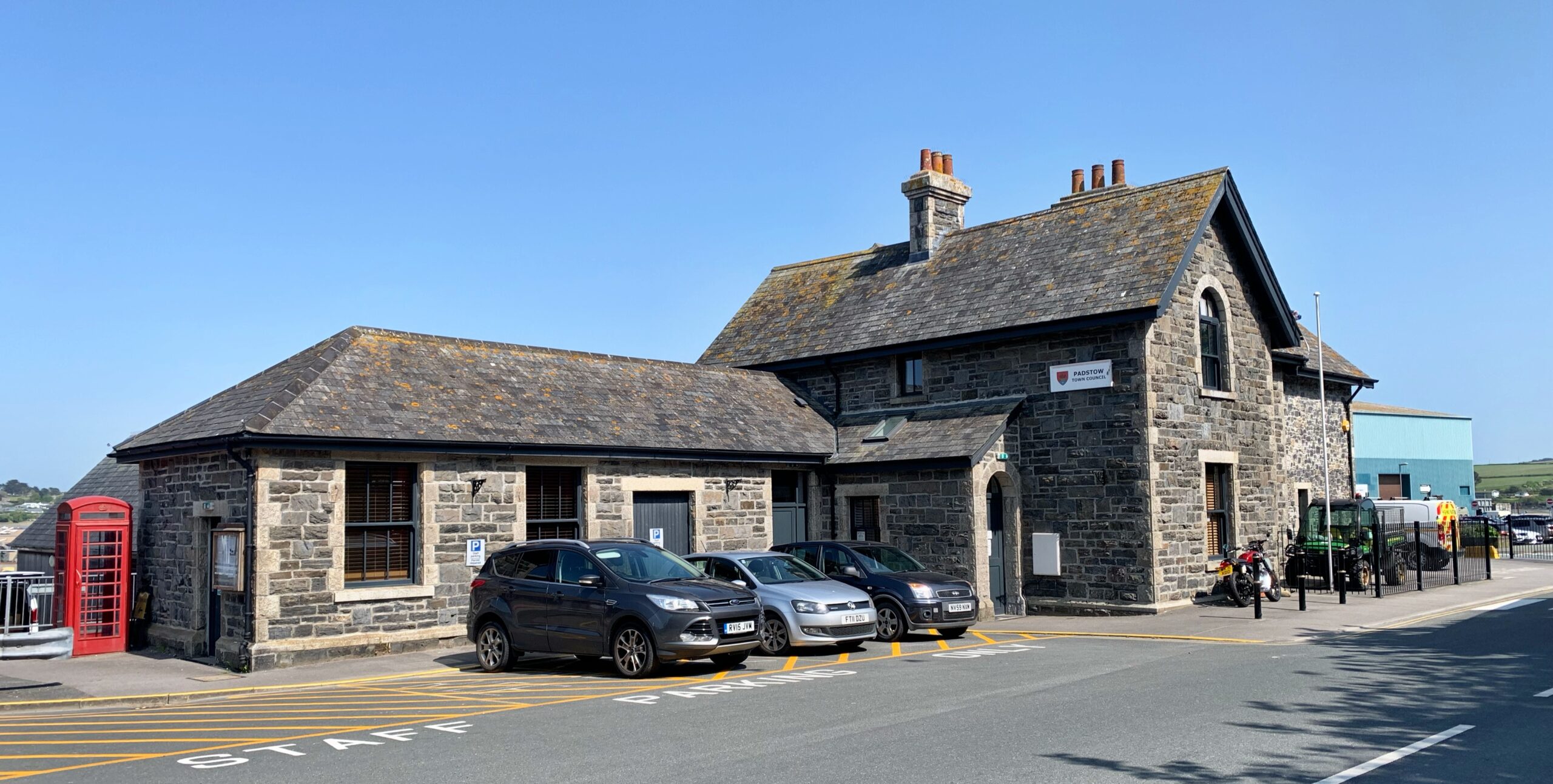
The former Padstow railway station, the western terminus of the North Cornwall Railway. It was opened in 1899 by the London and South Western Railway and closed in 1967 following the Beeching report. The building currently houses the offices of Padstow Town Council – 22/05/2023
We walked from Padstow towards Wadebridge and from Bodmin, we also walked in the direction of Wadebridge as the trail follows the paths of two former railway lines; a section of the North Cornwall Railway between Padstow and Wadebridge and most of the Bodmin and Wadebridge Railway from Wadebridge to Wenford Bridge, along with a short branch from that line to Bodmin.
The Bodmin and Wadebridge Railway was originally built at a cost of £35,000 following a study commissioned in 1831 by local landowner Sir William Molesworth of Pencarrow. The line was intended to carry sand from the Camel estuary to inland farms for use as fertiliser. In the 1840’s, England’s railway network expanded towards Bodmin. The London and South Western Railway (LSWR) purchased the Bodmin and Wadebridge Railway in 1846 and intended to connect it to the rest of the system by a new line through North Cornwall. The line from Halwill reached Wadebridge in June 1895 and then Padstow in March 1899. Later the railway was used to ship slate and china clay from inland quarries to ships in Padstow and also transport fish landed in Padstow inland to London and other cities. When both quarrying and fishing died off, the railway lost most of its traffic. The last passenger train ran in 1967 and freight ceased in 1983, when a need to invest in new track forced the line to close.
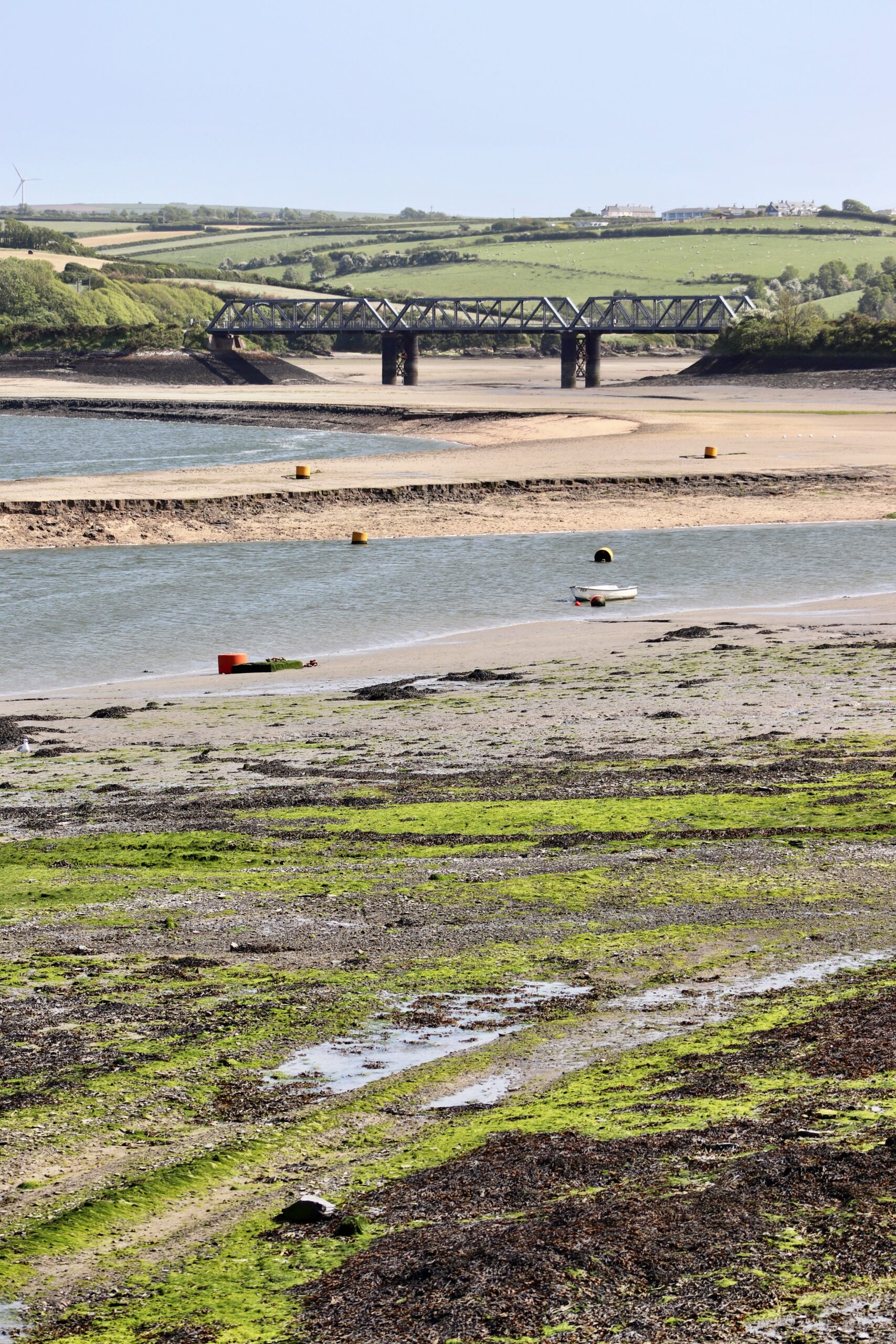
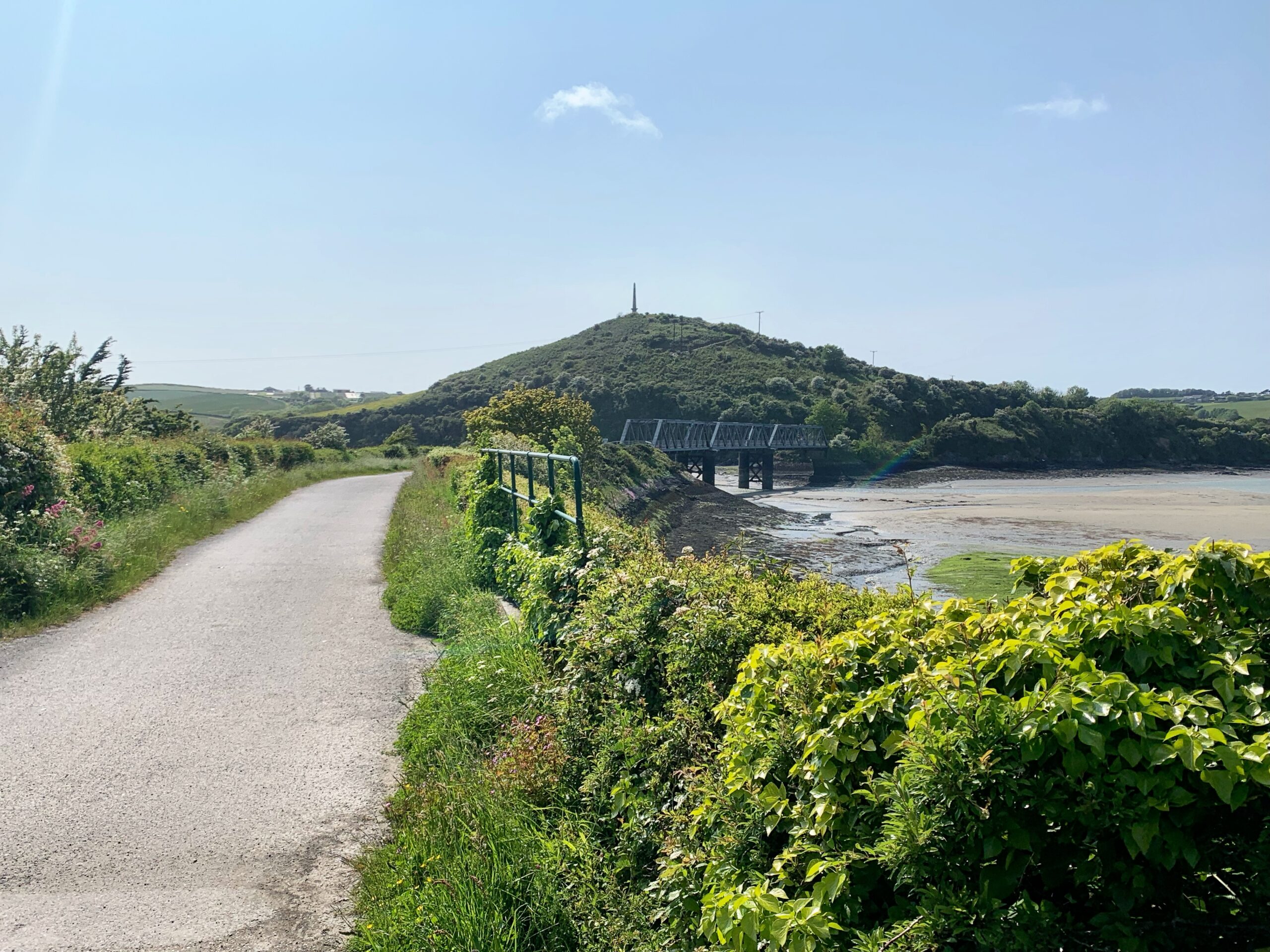
On leaving Padstow, the Camel Trail crosses Petherick Creek on this bridge which formerly carried the North Cornwall Railway – 22/05/2023Petherick Creek bridge. Construction began in December 1896 with the erection of temporary staging over Little Petherick Creek, a mile south-east of Padstow. This facilitated construction of a bridge comprising three spans of 133 feet each, curving to the north on a radius of about 20 chains. It was built by contractors from Derby, Messrs Eastwood Swingler & Co. The spans are formed of two Pratt trusses, together with nine cross girders and three wind braces, giving a deck width of 16 feet 3 inches. Two rail bearers are also provided. The ironwork was brought by rail to Wadebridge before being carried on barges to site down the River Camel. Each truss weighs 350 tons. Heading towards Padstow, the structure is approached on a 230-yard embankment, protected by revetments. This incorporates a brick and slate arched bridge at its east end.The main bridge’s abutments are formed in brick and concrete. Supporting the spans are two piers incorporating pairs of cast iron cylinders, 8 feet in diameter and at 18 feet 3 inch centres. These are braced at the top. Rail level is approximately 85 feet above bedrock, 30 feet above the river bed and 16 feet above high water level. At the top of the cylinders are granite bedstones and cast iron bearings.The contractor experienced considerable difficulty assembling the piers. Each 200-ton cylinder was loaded with a 50 ton weight, causing it to sink through the river silt. With bedrock found, the mud was then excavated using grabs, sometimes taking 48 hours to progress just one yard down. When the water had been pumped out and the interior cleaned, they were then filled with concrete – 22/05/2023
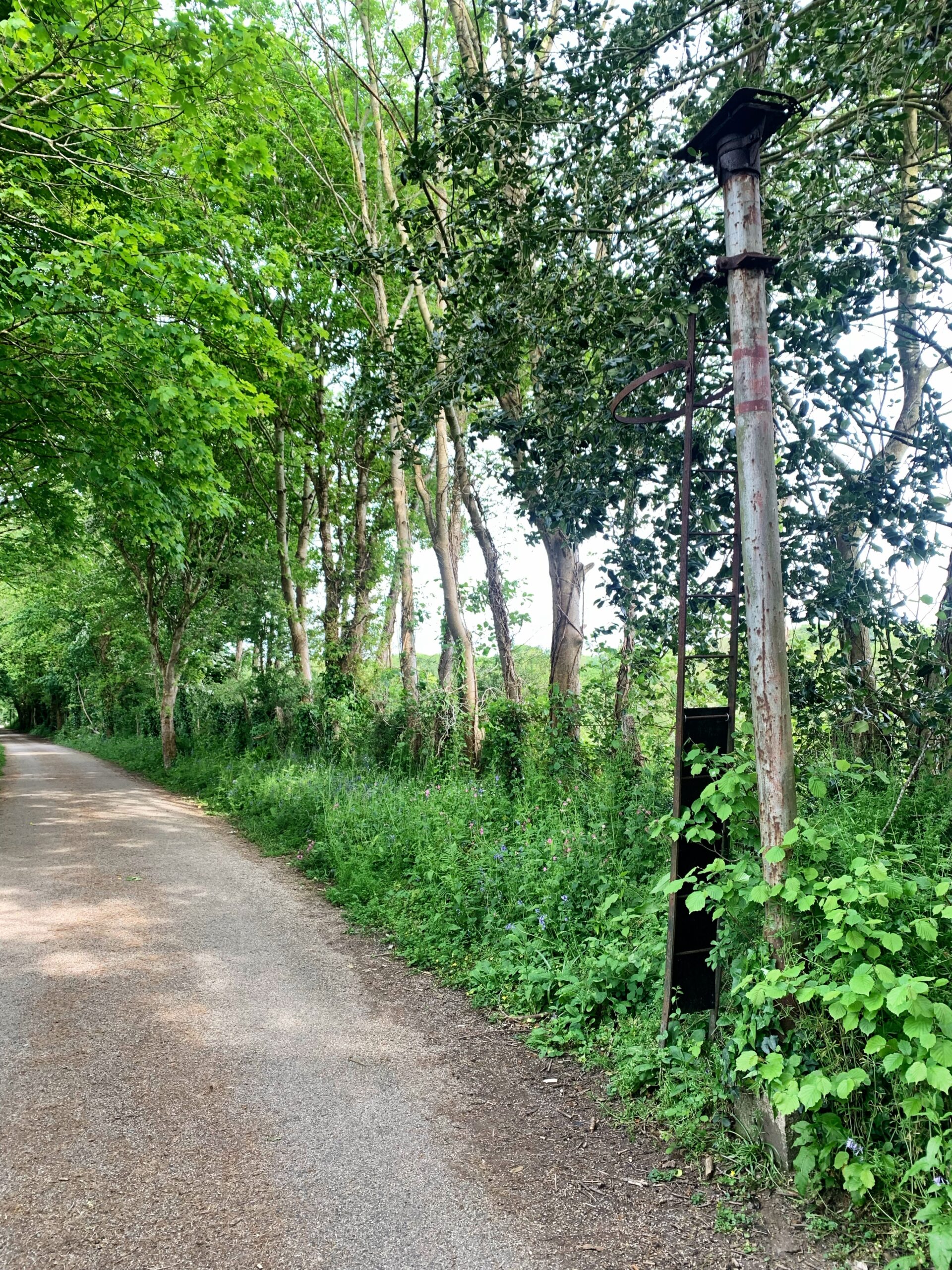
Listen to the wind as Yoshi crosses Petherick Creek bridge in a rare portrait ratio video – 22/05/2023Looking back at Petherick Creek – 22/05/2023The Camel Trail near Padstow -22/05/2023St Issey on the Camel Trail – 22/05/2023Lobster pots on the River Camel alongside the disused railway line – 22/05/2023Road bridge over the Camel Trail at Bodmin – 23/05/2023Dunmere on the Camel Trail – 23/05/2023Dunmere Halt on the Camel Trail – 23/05/2023Dunmere Halt on the Camel Trail – 23/05/2023Dunmere on the Camel Trail – 23/05/2023Nanstallon Halt on the Camel Trail – 23/05/2023Remains of railway track at Nanstallon on the Camel Trail – 23/05/2023Remains of signalling at Nanstallon on the Camel Trail – 23/05/2023The branch to Camelford on the Camel Trail – 23/05/2023
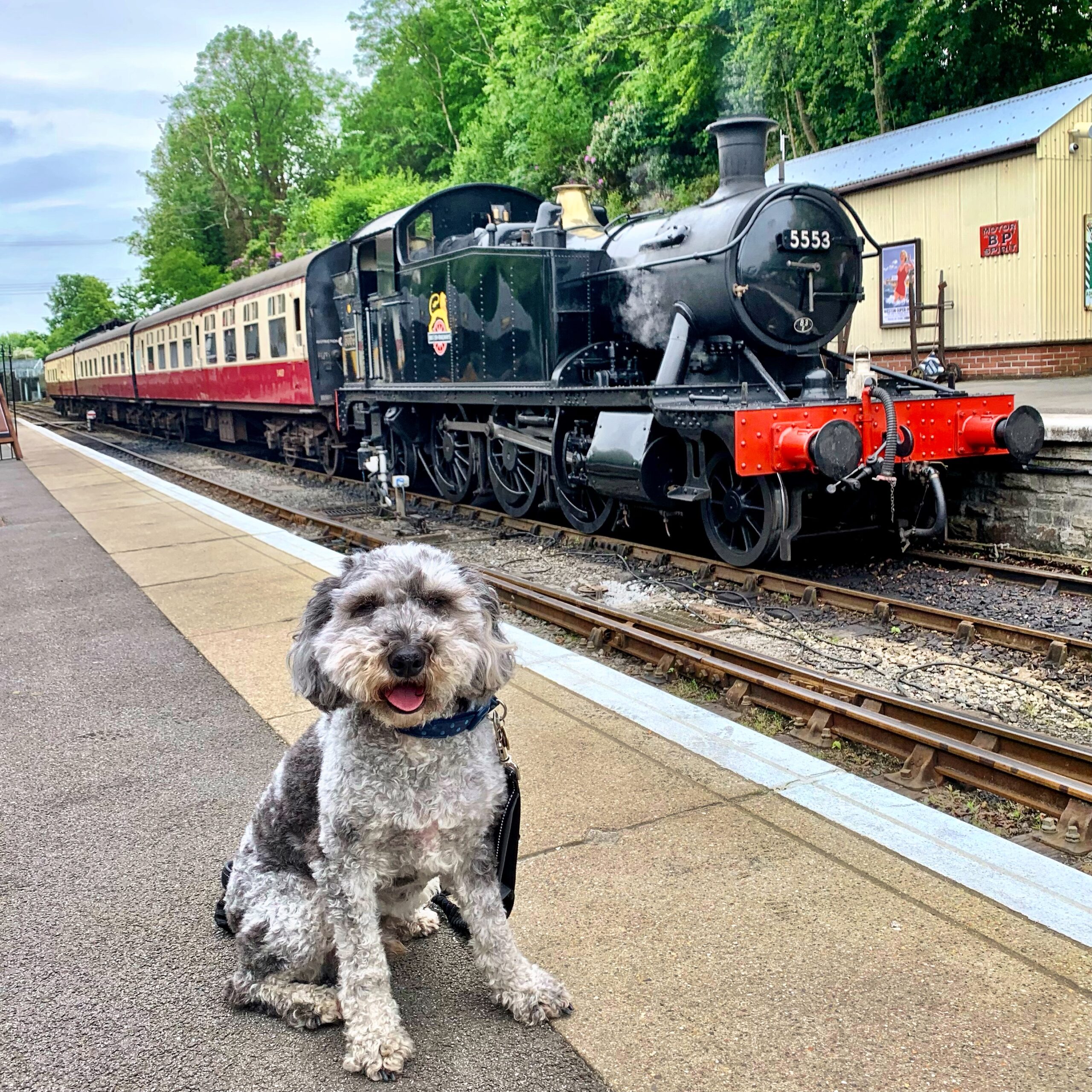
While Yoshi’s mama was visiting Bodmin Jail (now a tourist attraction, Caroline wasn’t spending time at the invitation of the local constabulary), the boy and I also popped in briefly on the Bodmin & Wenford Railway. On the day of our visit visiting steam loco GWR Small Prairie Class 4500 Churchwood 2-6-2T tank engine No. 5553 was in operation, but we also saw several heritage diesel locomotives on site. The Bodmin Railway Preservation Society (BRPS) was formed in 1984, and they in turn formed the Bodmin Railway plc in order to raise funds to purchase the line from Bodmin Parkway to Boscarne Junction, via Bodmin General. They were successful, and North Cornwall District Council (now part of Cornwall Council) secured the land from British Rail.
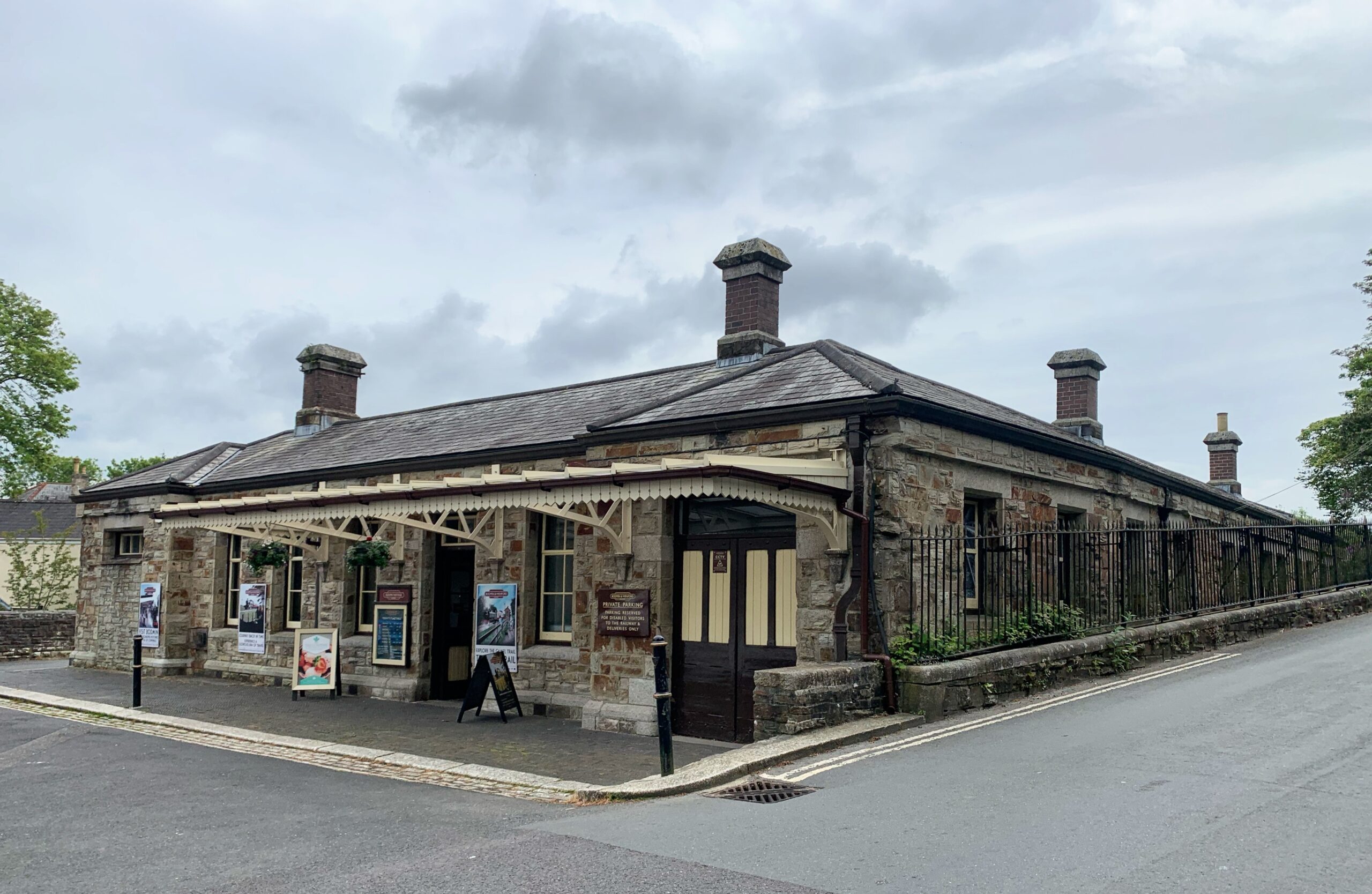
Bodmin General railway station was constructed by the Great Western Railway and opened in 1887, when the 3½-mile branch line from Bodmin Road to Bodmin was opened. The station is beautifully restored to reflect the 1950’s and is resplendent in the British Railways (Western Region) colour scheme of the period. It currently houses the headquarters of the Bodmin and Wenford Railway – 23/05/2023Yoshi at Bodmin General with GWR Small Prairie No. 5553. The locomotive was built at Swindon in 1928 and withdrawn in November 1961 when she was sold for scrap to Woodham Brothers in Barry. Having spent nearly 28 years in the scrapyard, she was the last locomotive to leave Barry in January 1990 where she was transported to the Dean Forest Railway – 23/05/2023
No. 5553 arrives at Bodmin General. Feel free to bark along – 25/03/2023
Services between Bodmin Parkway and Bodmin General were restored in 1990, and the line was extended back to Boscarne Junction six years later, in 1996.
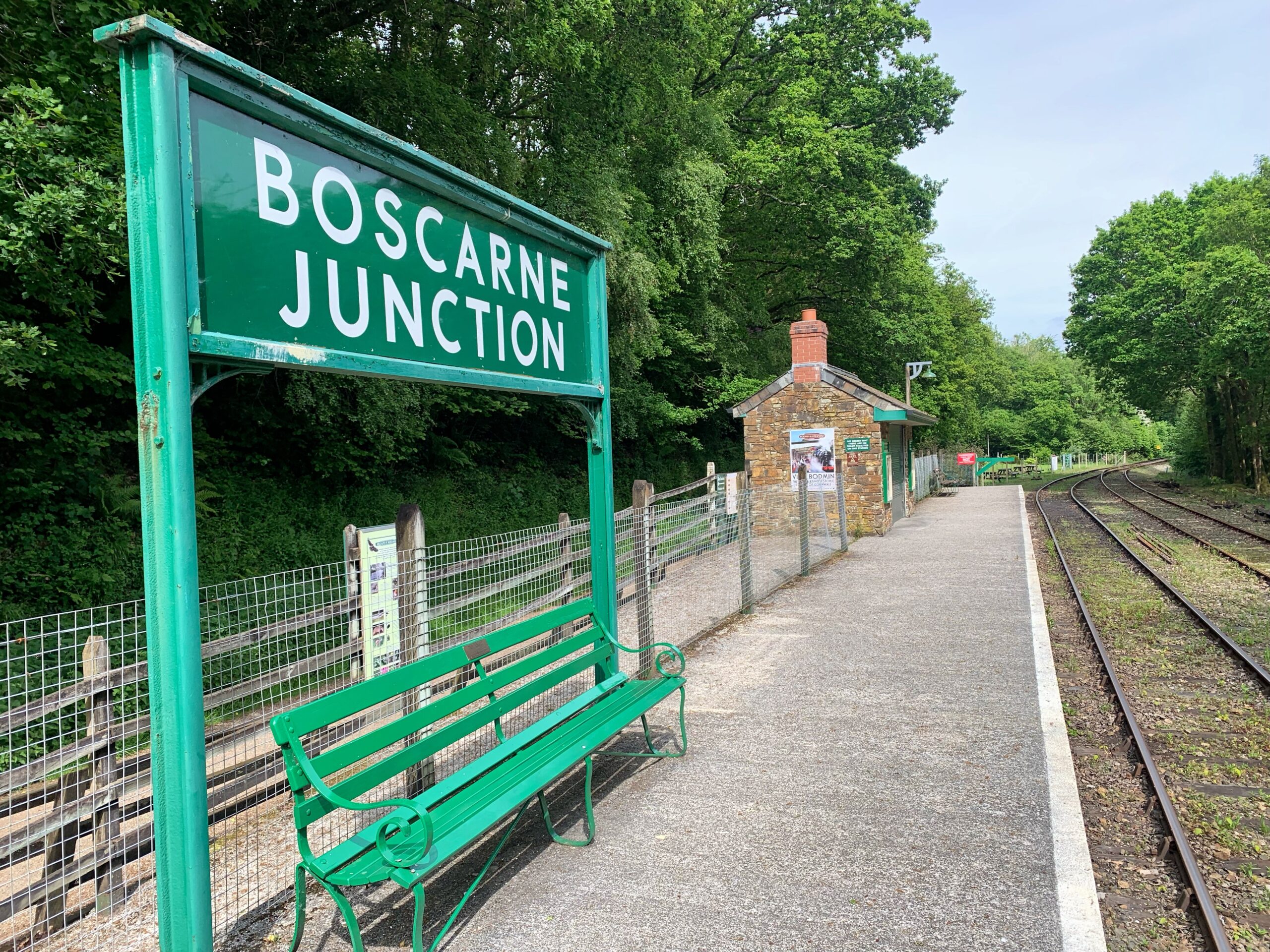
Boscarne Junction station on the Bodmin and Wenford railway. The Camel Trail passes this location – 23/05/2023
Since then the Bodmin & Wenford Railway has operated trains – principally steam, but with some heritage diesel services – over the 6½ miles between Bodmin Parkway and Boscarne Junction via Bodmin General.
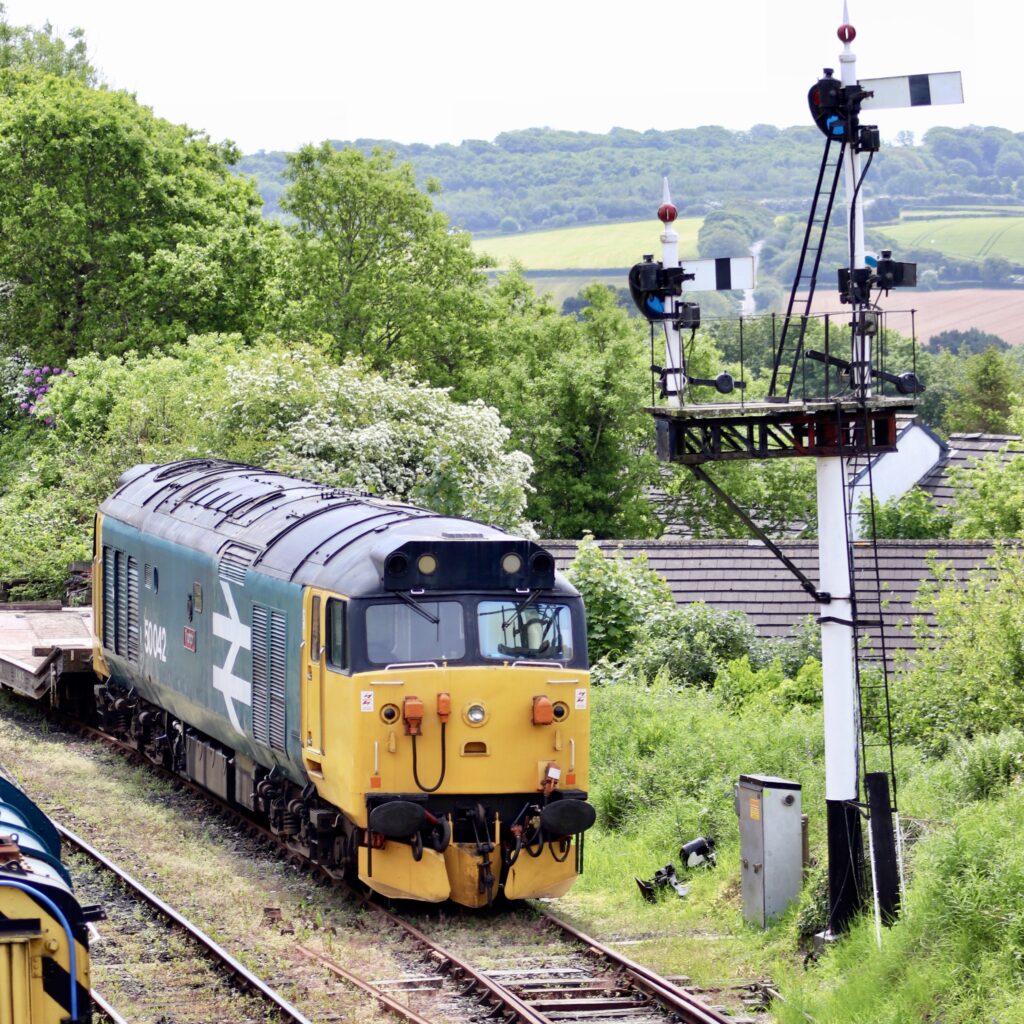
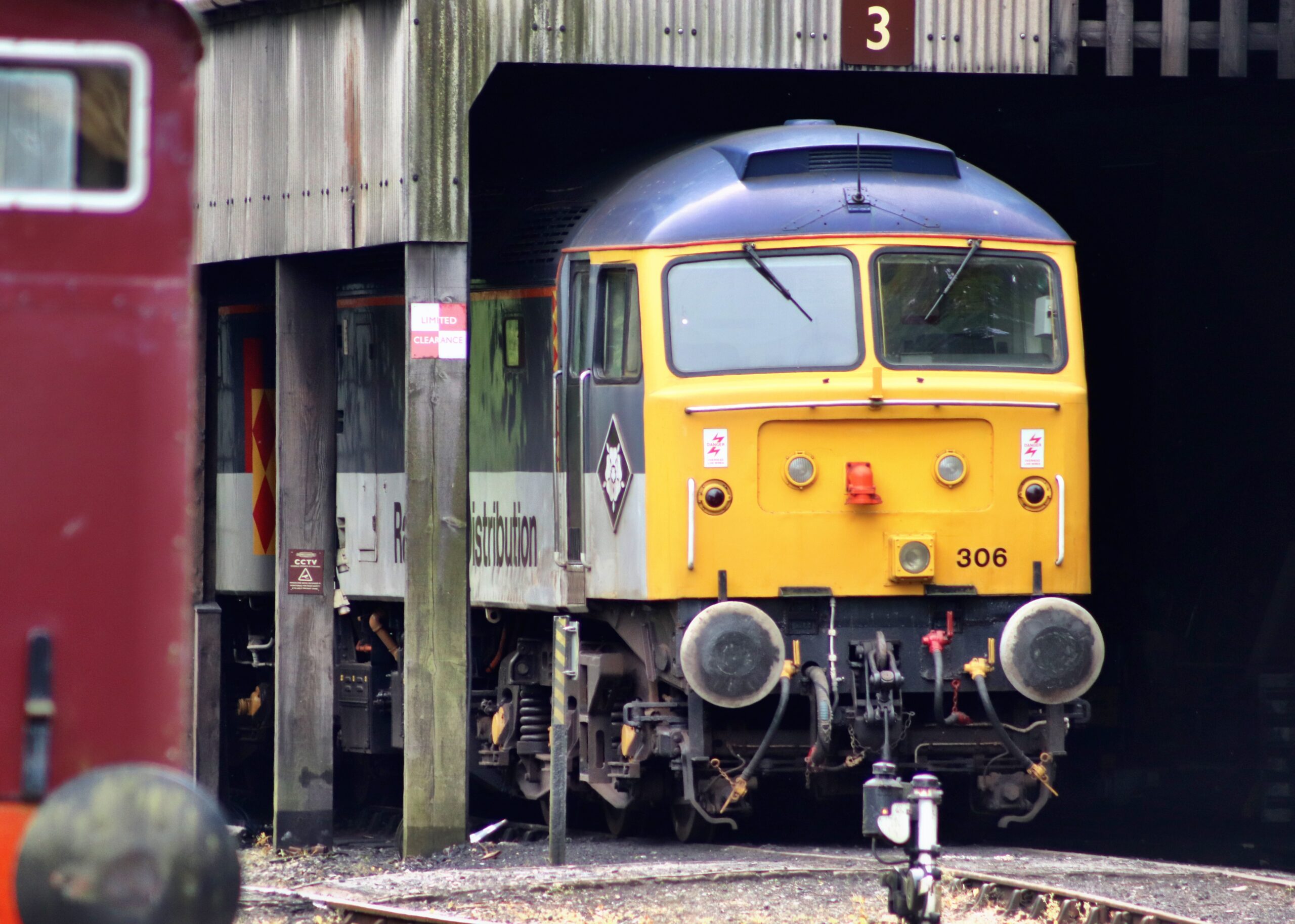
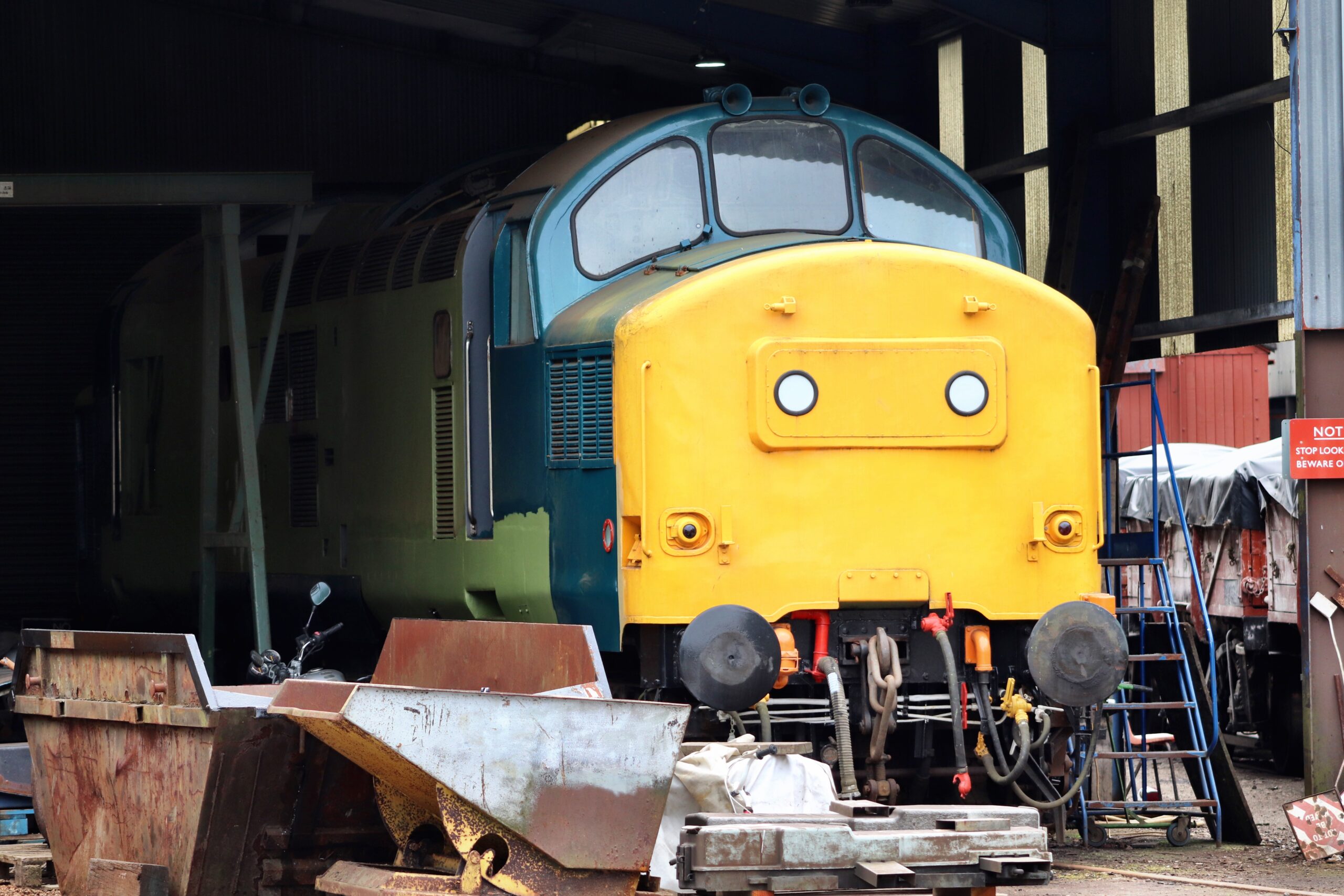
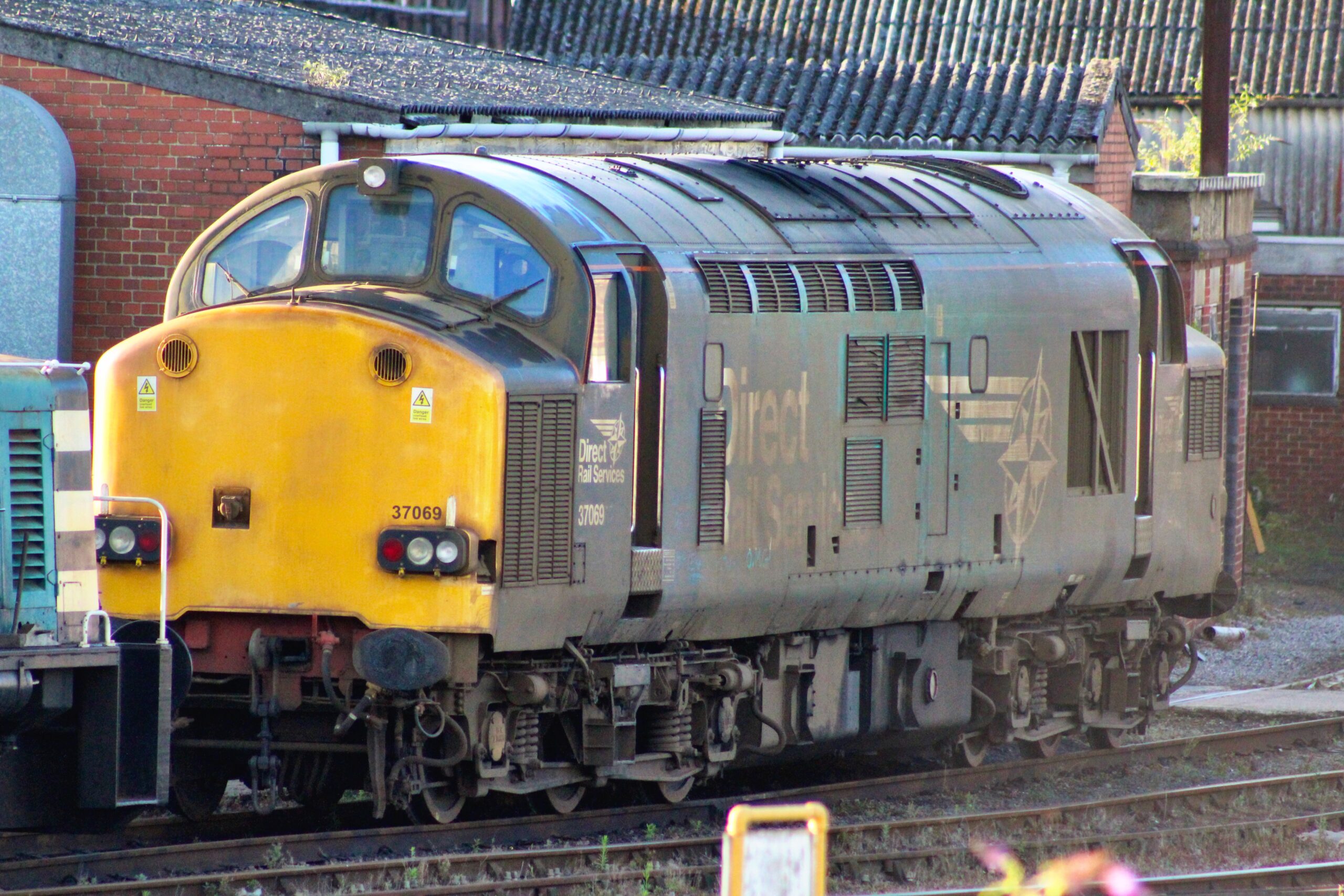
Class 50 No. 50042 ‘Triumph’ at Bodmin. Withdrawn in 1990 the Bodmin Mainline Diesel Group purchased the loco in 1991 and restored her to pristine condition in 1993 – 23/05/2023Class 47 No. 47306 ‘The Sapper’ at Bodmin. Built by Brush at their Falcon Works in Loughborough in 1963 the locomotive arrived on the Bodmin and Wenford Railway in 2007 straight from St Blazey where she had been placed in store following withdrawal from mainline use – 23/05/2023Class 37 No. 37142 built in 1963 at English Electric’s Vulcan Foundry is currently undergoing an overhaul at Bodmin. In her mainline days she worked China Clay trains across Cornwall so is very much at home on the Bodmin and Wenford Railway – 23/05/2023
Travel back to April 1995 when Robert Stephenson & Hawthorn Works 0-6-0T locomotive No. 7597 was in operation on the Bodmin and Wenford Railway. The locomotive was built in 1959 and spent her industrial life at the Rye House Power Station on the Lea Valley in Essex. She is currently being overhauled at The Lincolnshire Wolds Railway.
We also had time to take photographs of GWR Castle HST Sets and a passing freight at Bodmin Parkway railway station which we visited before reuniting with Caroline. The signal box at Bodmin Parkway is now a café and I enjoyed a latte in between photographing passing trains.
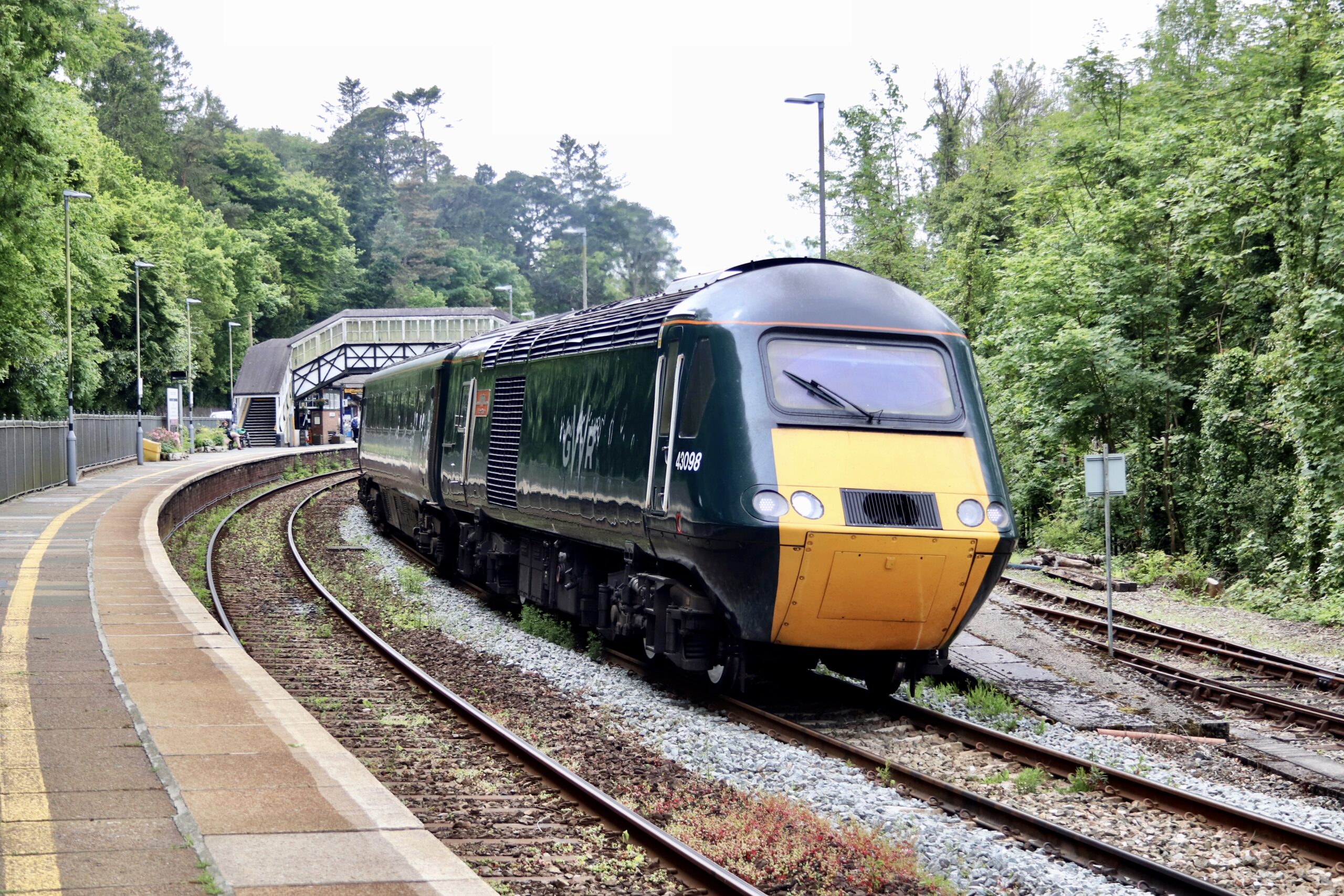
Class 43 No. 43098 ‘Walton Castle’ departs Bodmin Parkway working 2U24 1250 Penzance to Cardiff Central – 23/05/2023GWR IEP No. 802107 departs Bodmin Parkway with 1A88 1215 Penzance to London Paddington passing DB Class 66 No. 66165 6C99 1103 Exeter Riverside N.Y. to St. Blazey SS – 23/05/2023
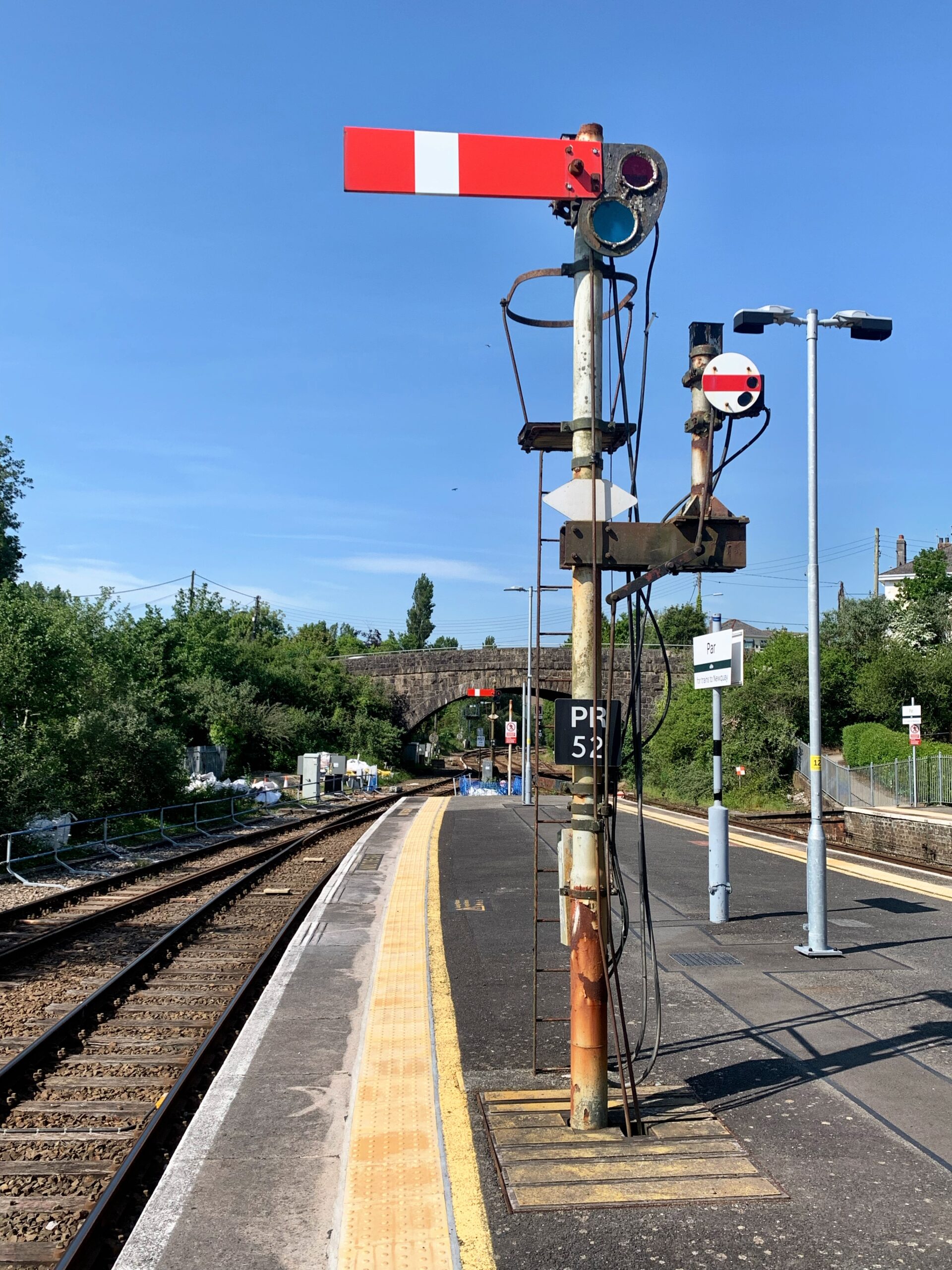
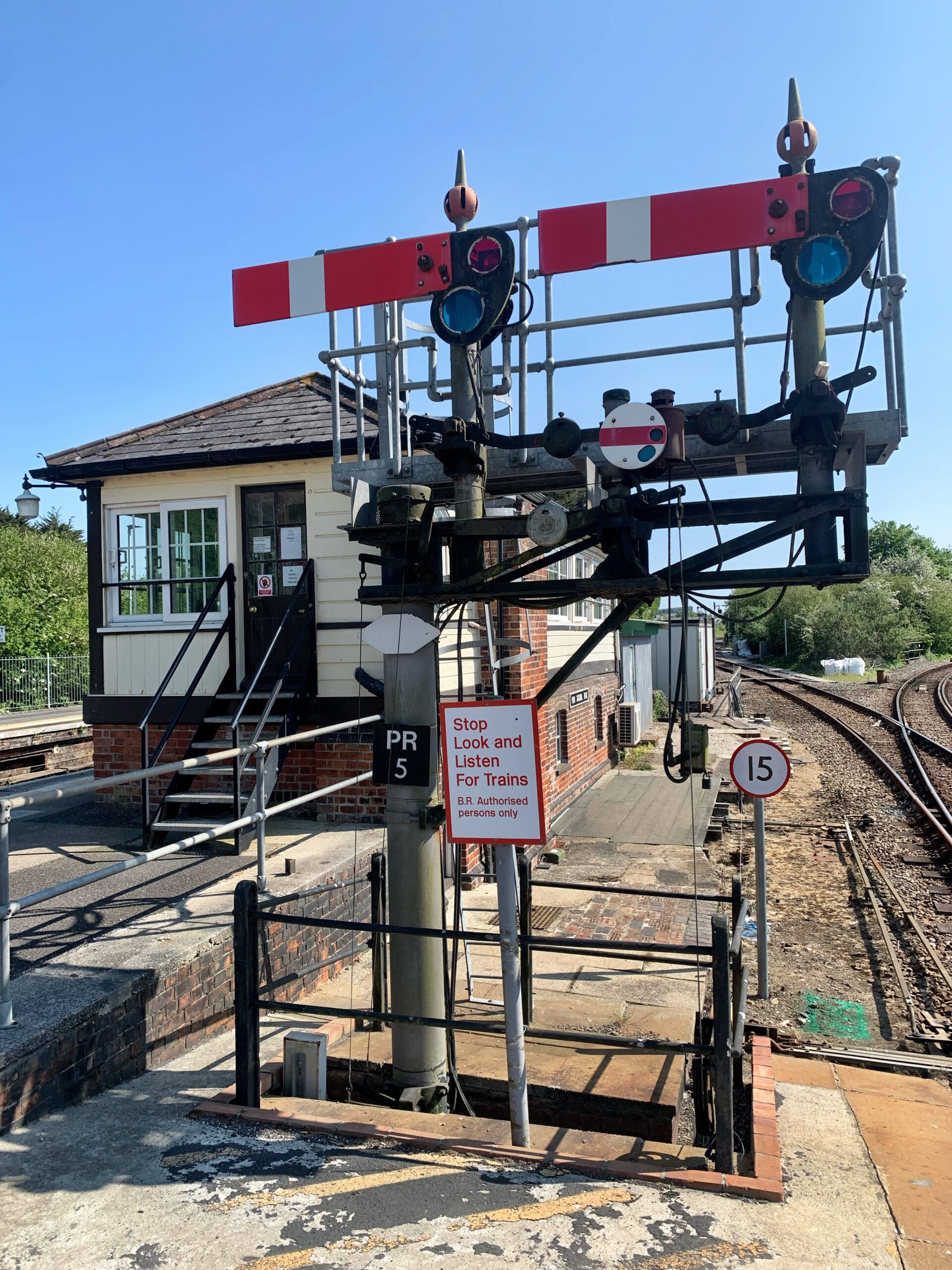
The next day we drove to Penzance via a couple of stations which still have their semaphore signalling intact. Cornwall has long been one of the country’s most remarkable outposts of lower quadrant semaphore signalling, but time is fast running out for much of its marvellous mechanical infrastructure, with a major re-signalling project due to be completed in Autumn 2023.
The present Exeter signalling centre is to become the centralised control point for the West of England and will become a Railway Operations Centre in all but name. The section from Lostwithiel to Truro will be controlled from a new work station incorporating four or five VDU screens, sited in the Exeter centre. It will mean the closure of Lostwithiel, Par and Truro signal boxes but the same track layouts will be retained, more or less, except for some minor rationalisation. Improving the capacity on the Newquay branch is part of the plan as is the modernisation of two level-crossings on each of the Looe and Gunnislake branches.
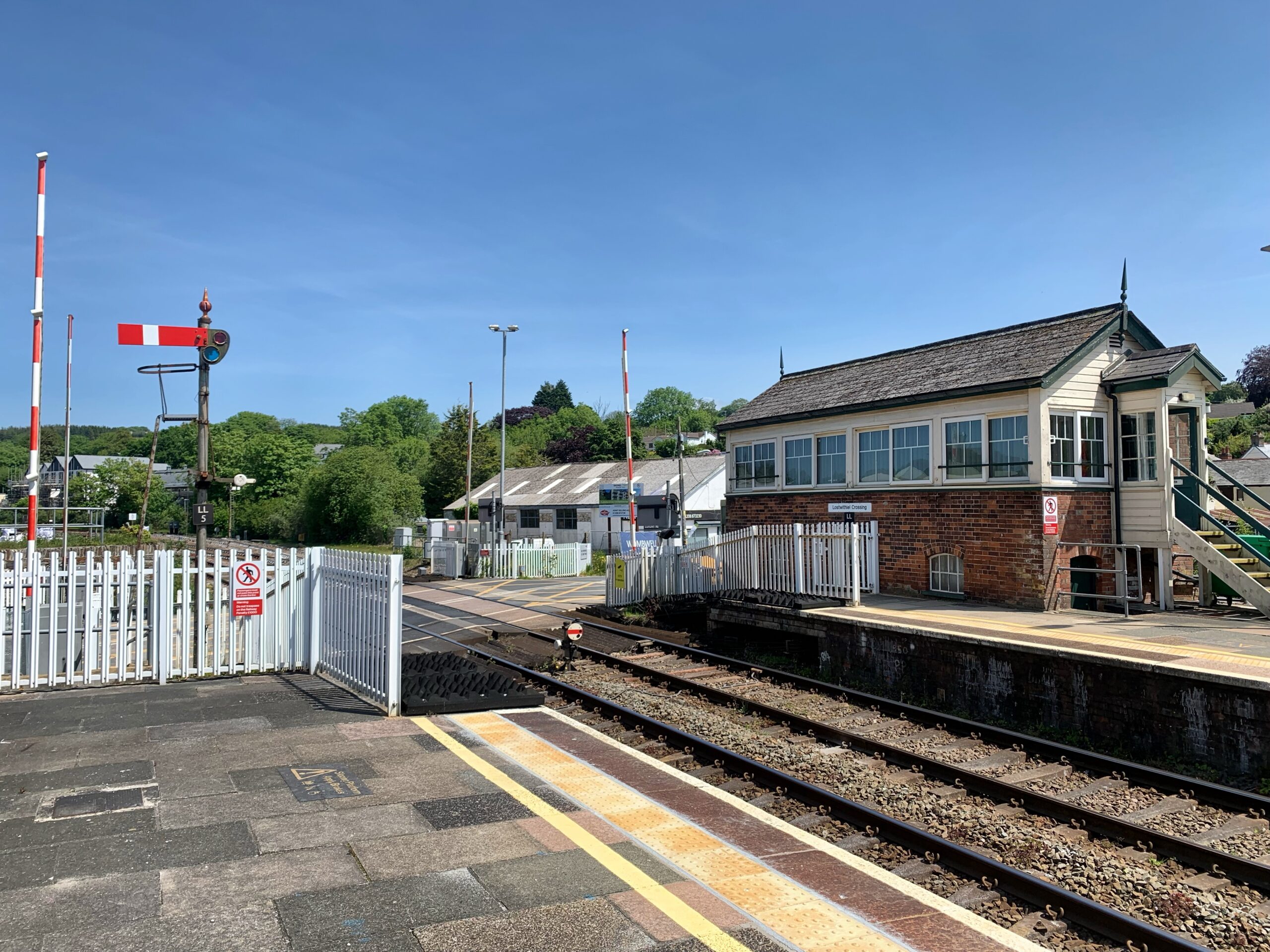
At Lostwithiel, the junction for the Fowey freight line, the two holding loops for the china clay trains, and the level crossing at the eastern end of the station, will all be controlled from Exeter. The crossing will become CCTV-controlled, with the monitoring screens sited at the Exeter work station. It is anticipated that the downtime of the barriers, a cause of local complaint, can be reduced with this arrangement.
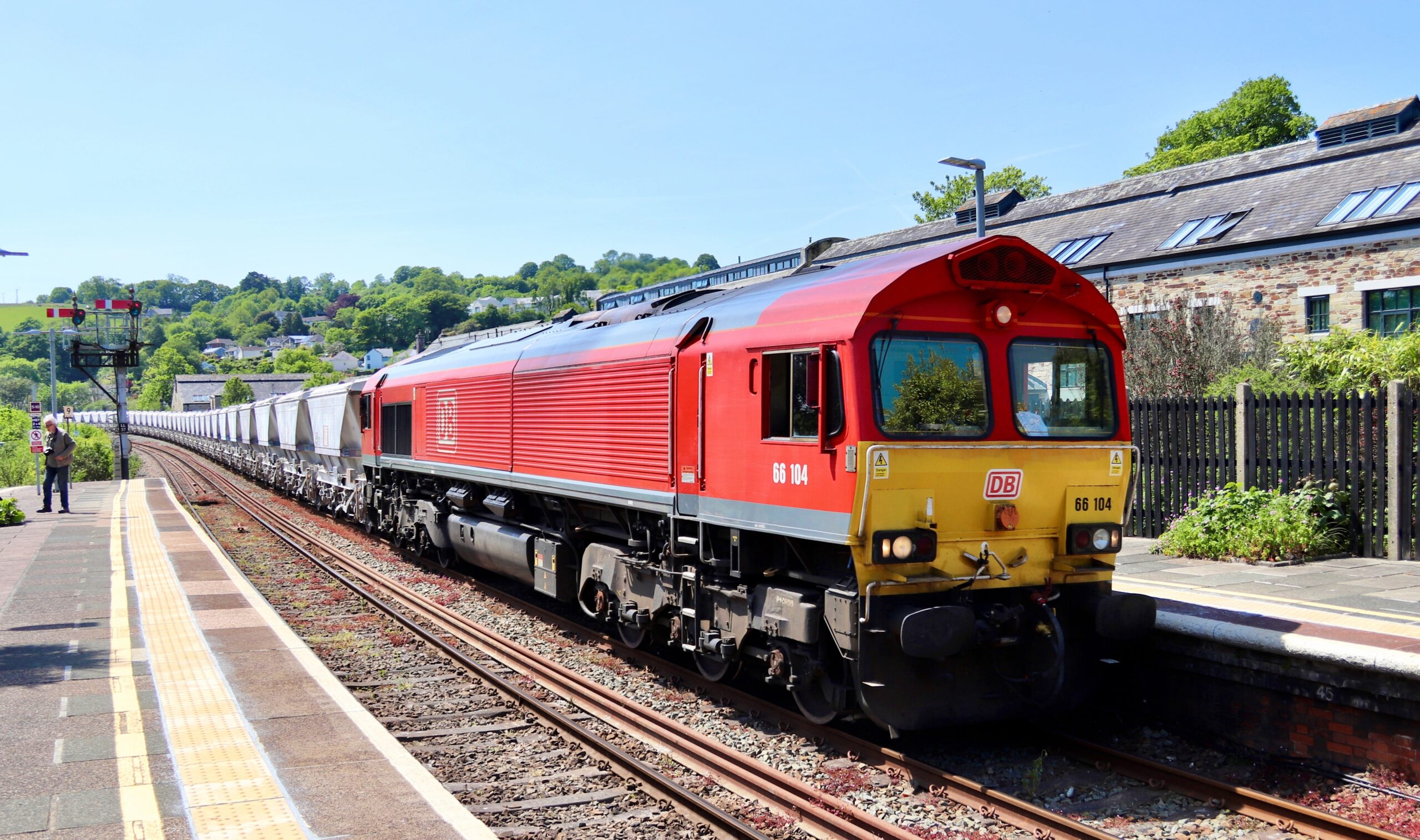
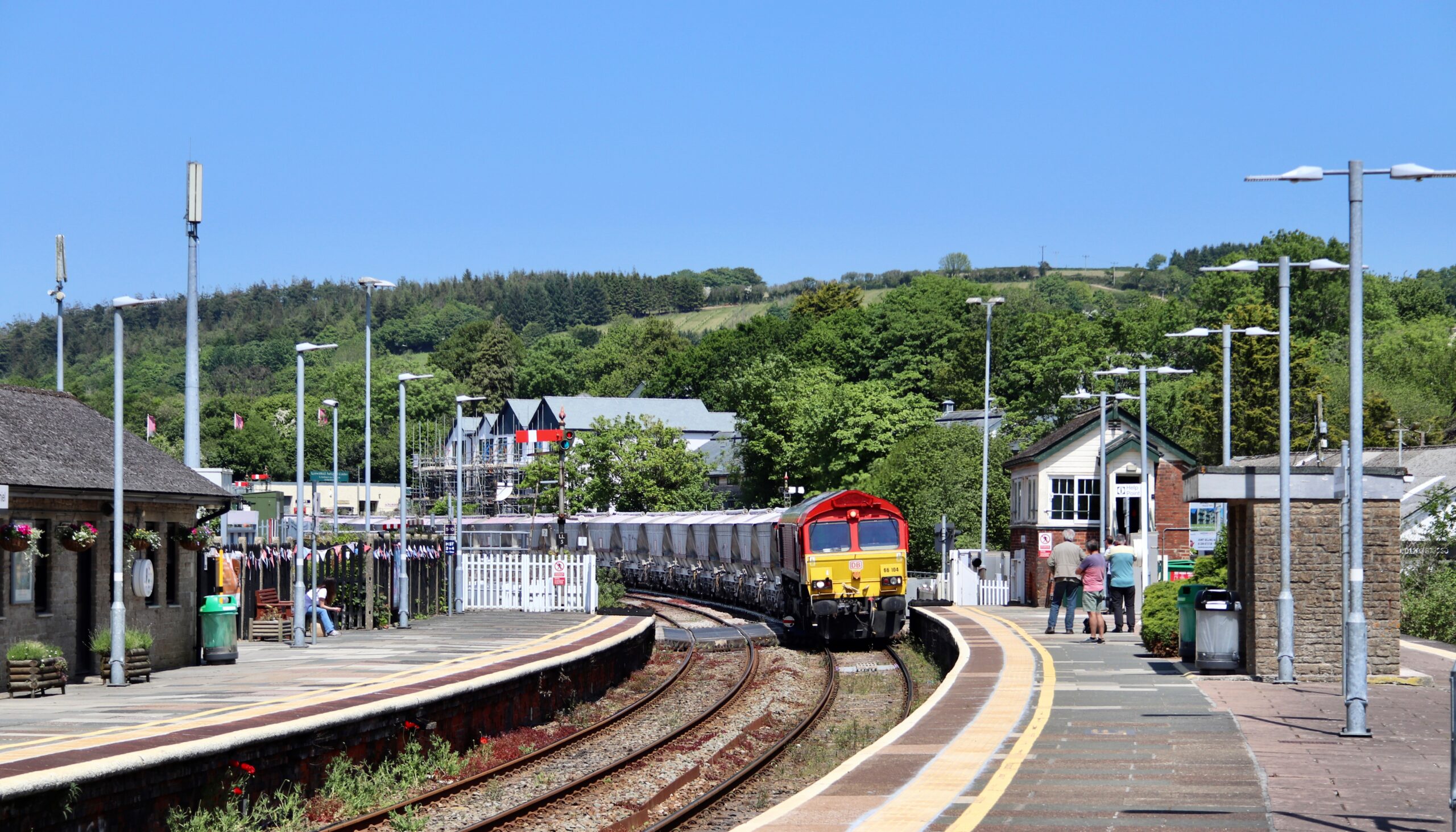
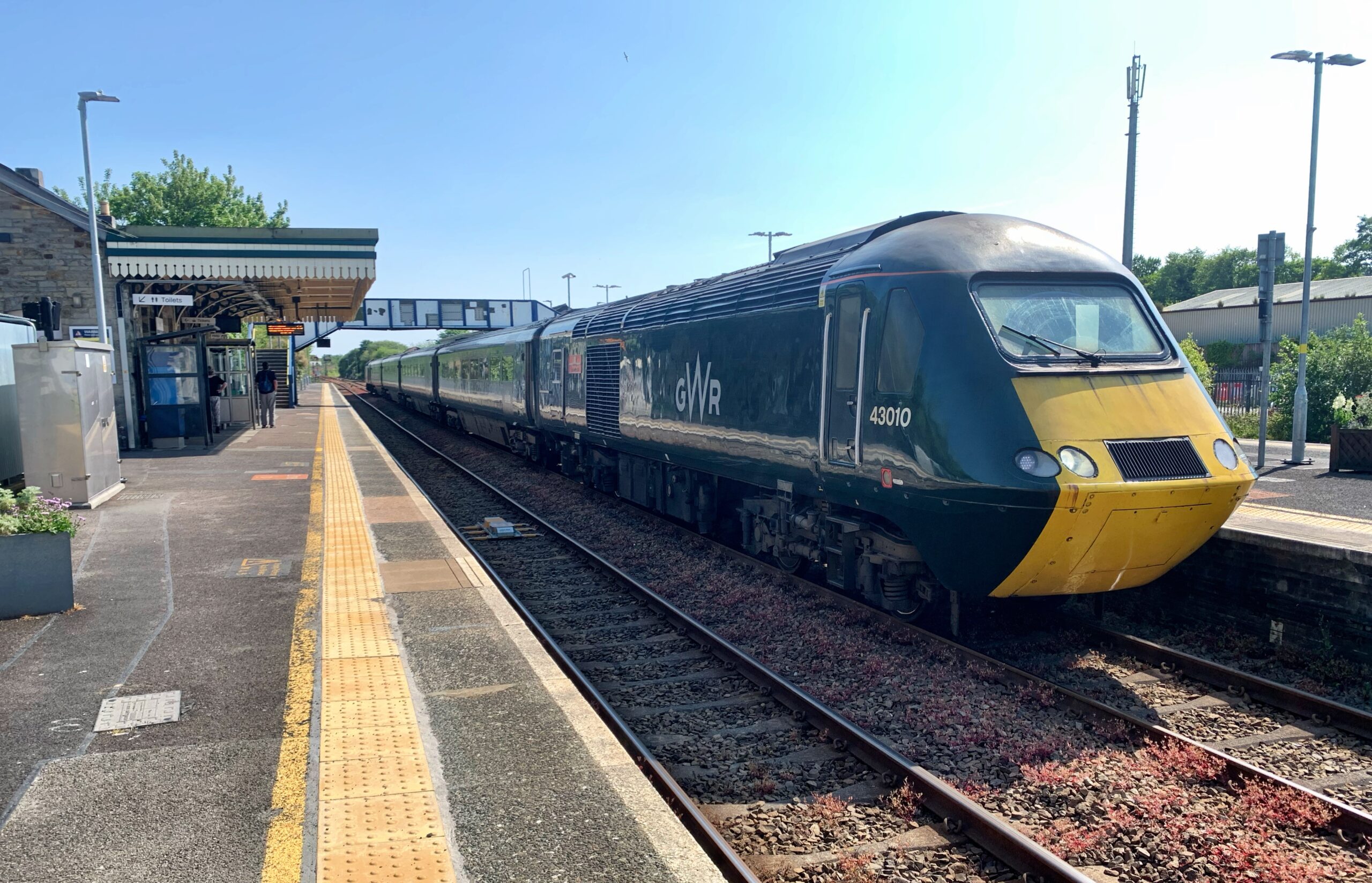
Class 43 No. 43010 ‘Lydford Castle’ at the rear of the late running 2C69 0900 Cardiff Central to Penzance Castle HST service – 24/05/2023Class 66 No. 66104 heads up 6G09 1302 Goonbarrow Junction EWS to Fowey Dock Carne Point china clay working at Lostwithiel. The locomotive runs around the train in Lostwithiel Up Goods Loop before heading back through the station to Fowey – 24/05/2023Having run round its wagons, Class 66 No. 66104 hauls 6G09 1302 Goonbarrow Junction EWS to Fowey Dock Carne Point china clay back through Lostwithiel – 24/05/2023Lostwithiel signal box and crossing – 24/05/2023
At Par, the junction for the Newquay branch, the signal box will be abolished and the entire layout, including the main line connections to enable through running to the branch, will be put on the Exeter work station. The intermediate block sections at St Austell, Burngullow and Probus will also transfer to Exeter. Par station will be equipped with a new footbridge and lifts to comply with the disabled access requirements.
Class 43 No. 43010 ‘Lydford Castle’ pauses at Par with 2P20 1515 Penzance to Plymouth service – 24/05/2023Semaphore signals at Par – 24/05/2023Grade II listed signal box and semaphore signals at Par. The box opened in 1879 and is built to the first GWR standard design, it was set up to control the GWR’s mainline onwards to Penzance, together with the junction for the branch to Newquay – 24/05/2023
Par is one of two operational Cornish signal boxes – along with Lostwithiel – to enjoy a Grade II Listing, being one of only two surviving examples of a GWR-designed Type 2 box to survive in its original location, at the western end of platforms 2 and 3 on Par station.
As well as the main line, modifications will be made to some of the Cornish branch lines to increase operating flexibility and an improved train service. The most significant of these will be on the one from Par to Newquay, currently the Cinderella branch in the county with, broadly, a two-hour interval service. The intermediate signal box at Goonbarrow splits the section, after that the branch being ‘One Train Working’.
802006 ‘Harry Billinge MBE LdH’ at Newquay having arrived with the 1N68 0905 Plymouth to Newquay service – 23/05/2023
Only one operational platform exists at Newquay. A passing loop is to be provided at Goss Moor that will enable an hourly service to be introduced. The second platform at Newquay will be brought back into use thus enabling more through trains from beyond Par. The county’s ambition is to create a Mid Cornwall Metro to facilitate more train usage into the areas of greater employment. This will imply the restoration of full signalling throughout, which will be controlled from Exeter.
During our sty in Penzance, I enjoyed watching the GWR sleeper service headed up by Class 57 locomotives depart for London in the evening and the corresponding service arrive from the capital in the morning. The Night Riviera leaves Penzance at 2145 and arrives in London paddington at 0504 while the reverse working departs London at 2345 and is scheduled to pull in to Penzance at 0754. On the Wednesday, I was interested to learn that the sleeper service was diverted via Yeovil that day.
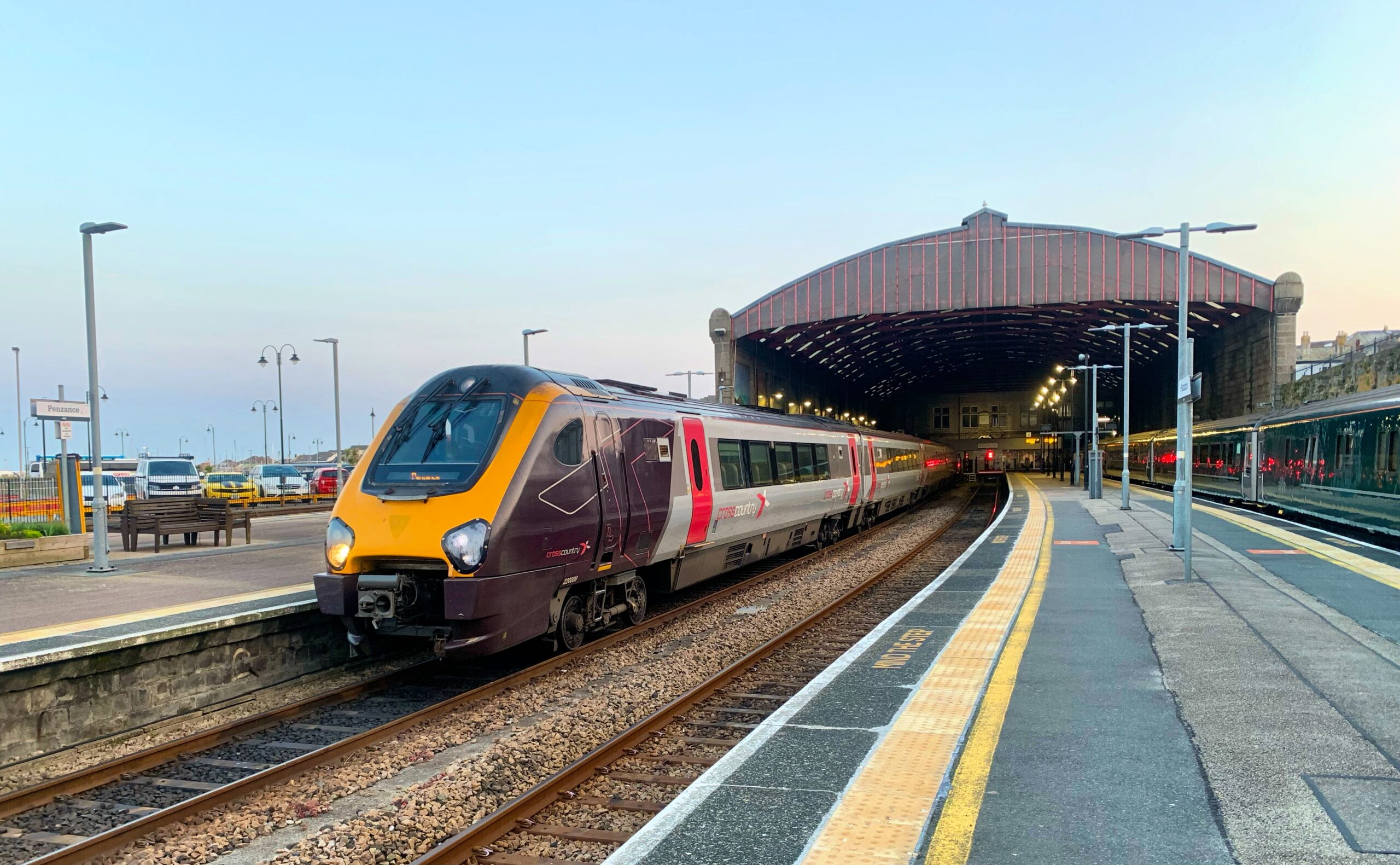
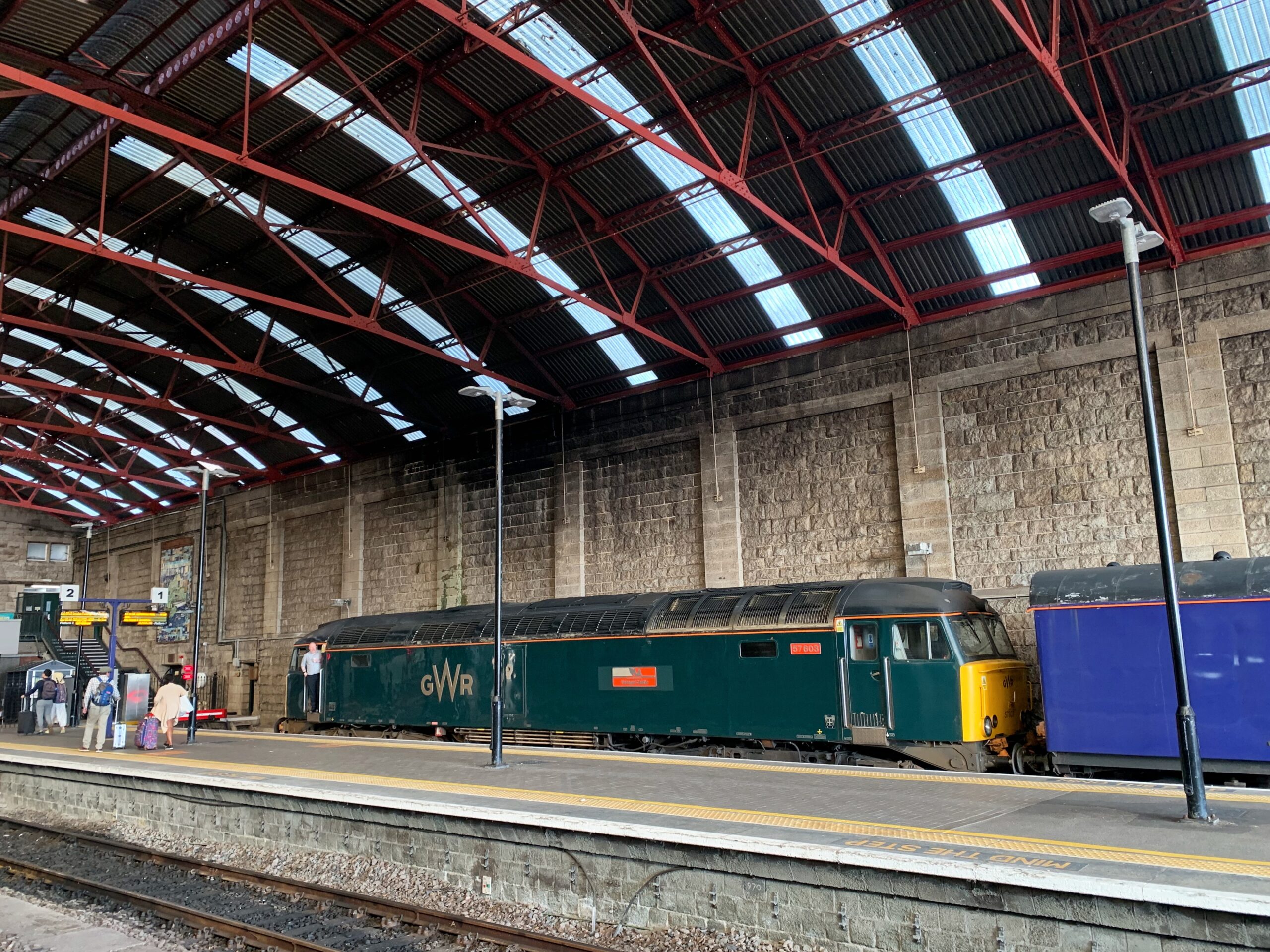
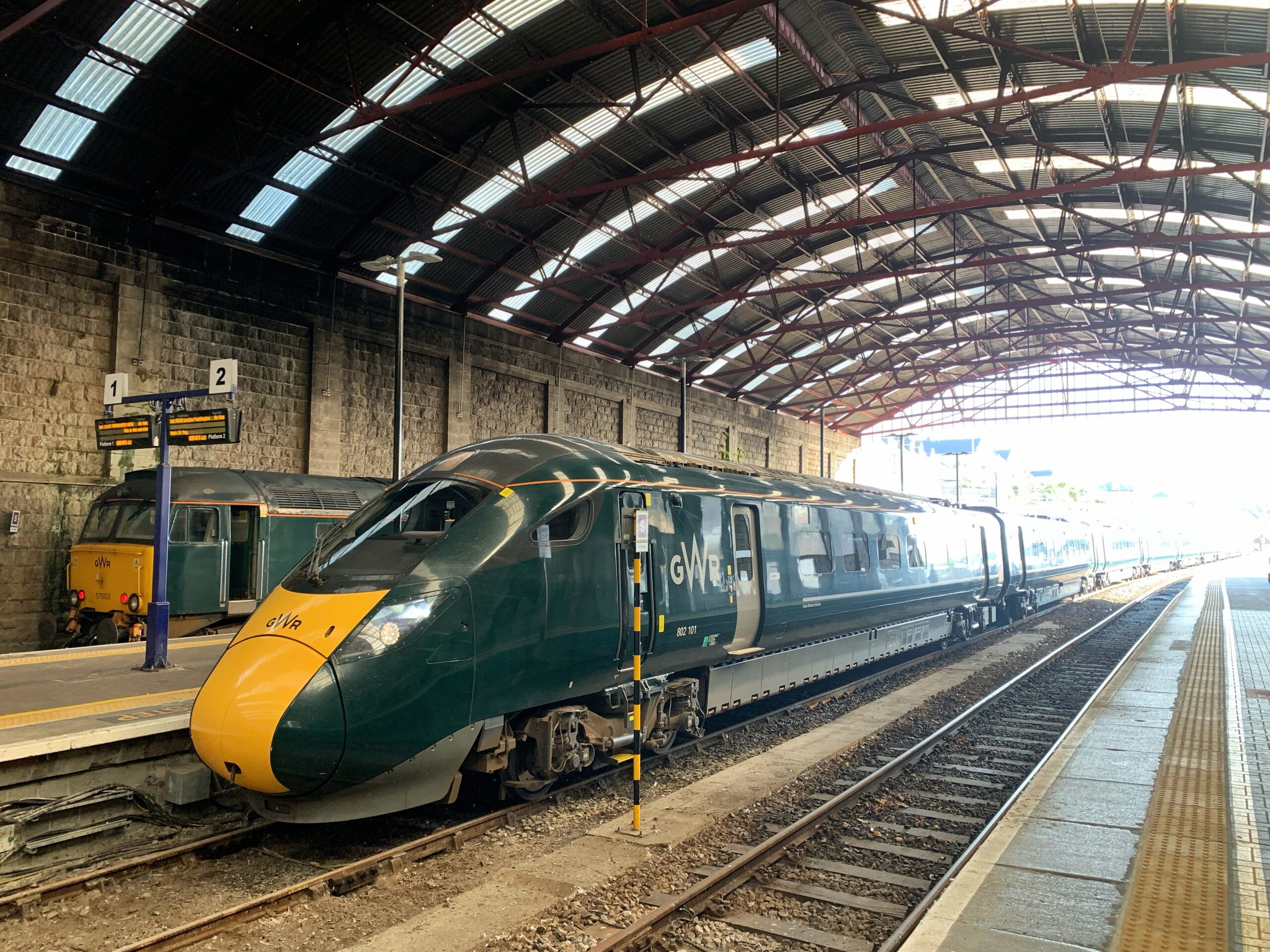
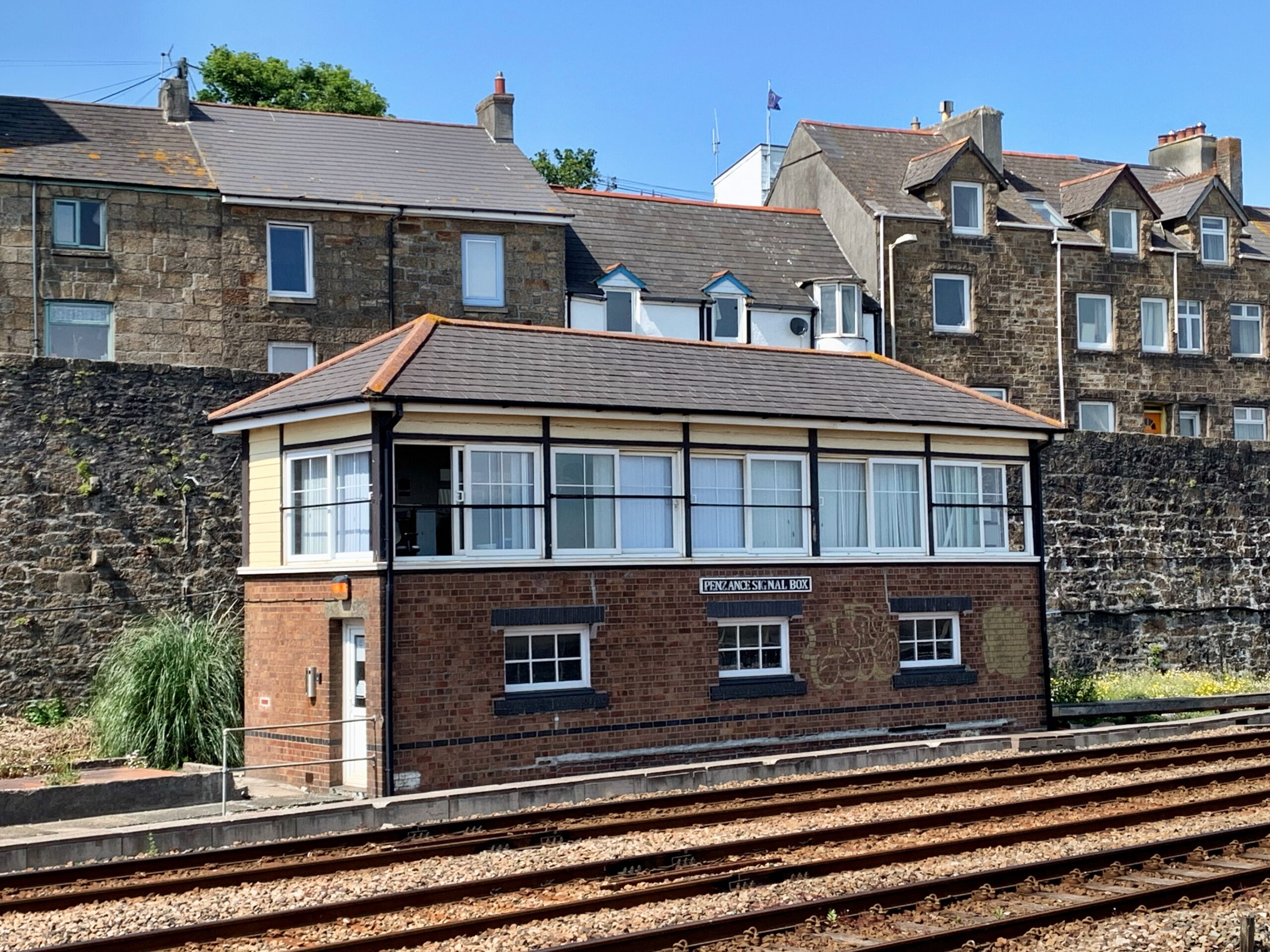
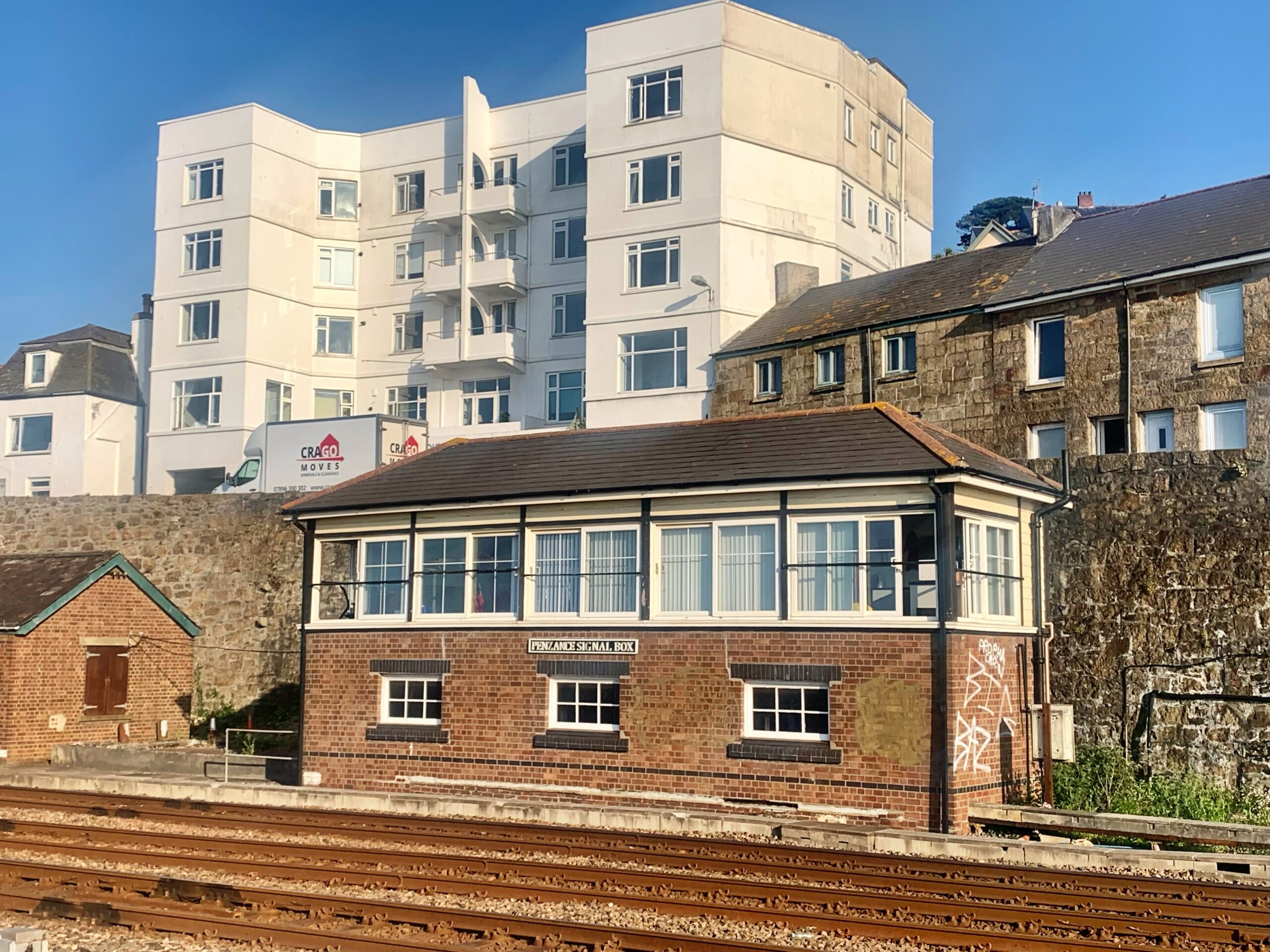
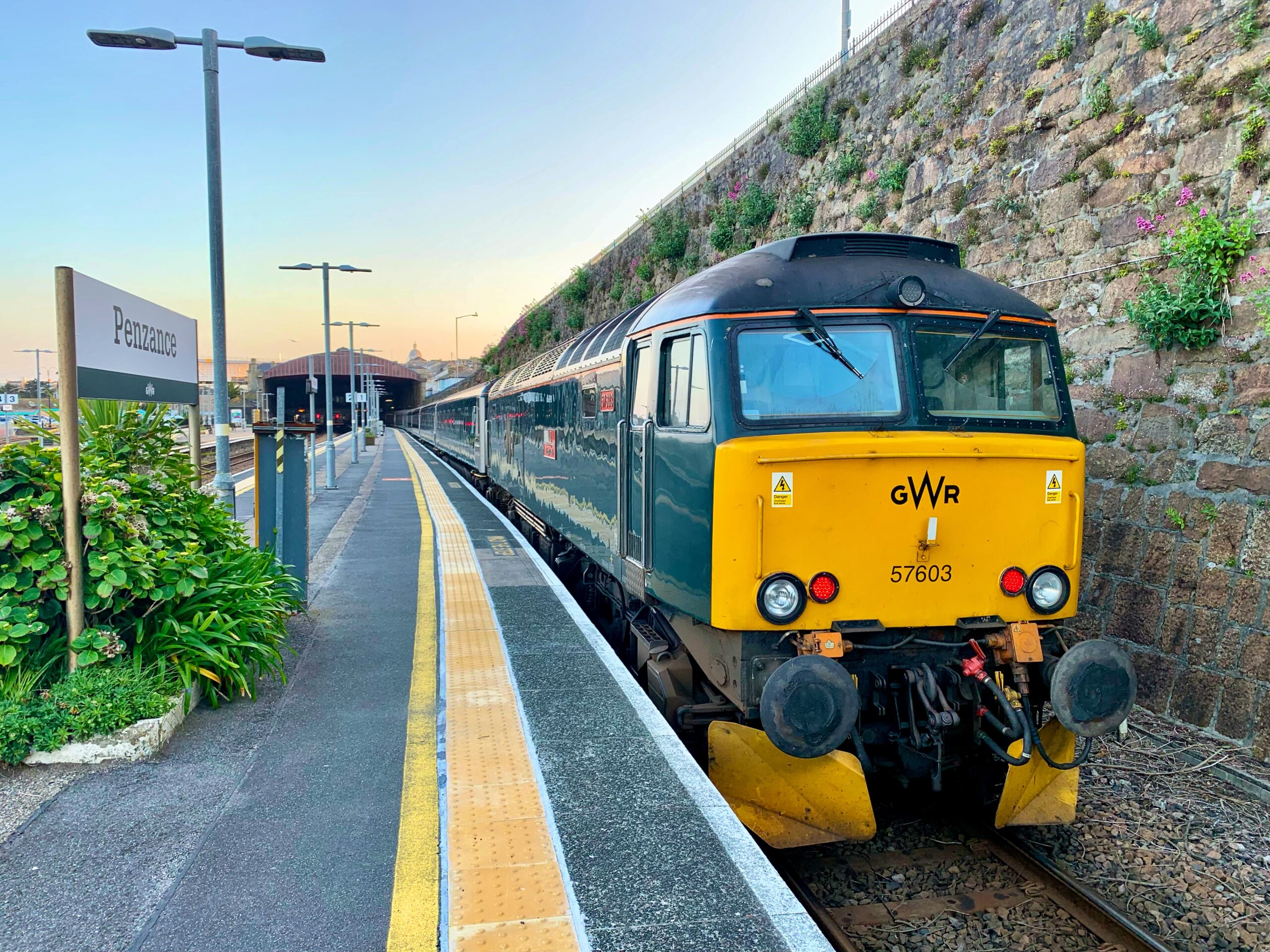
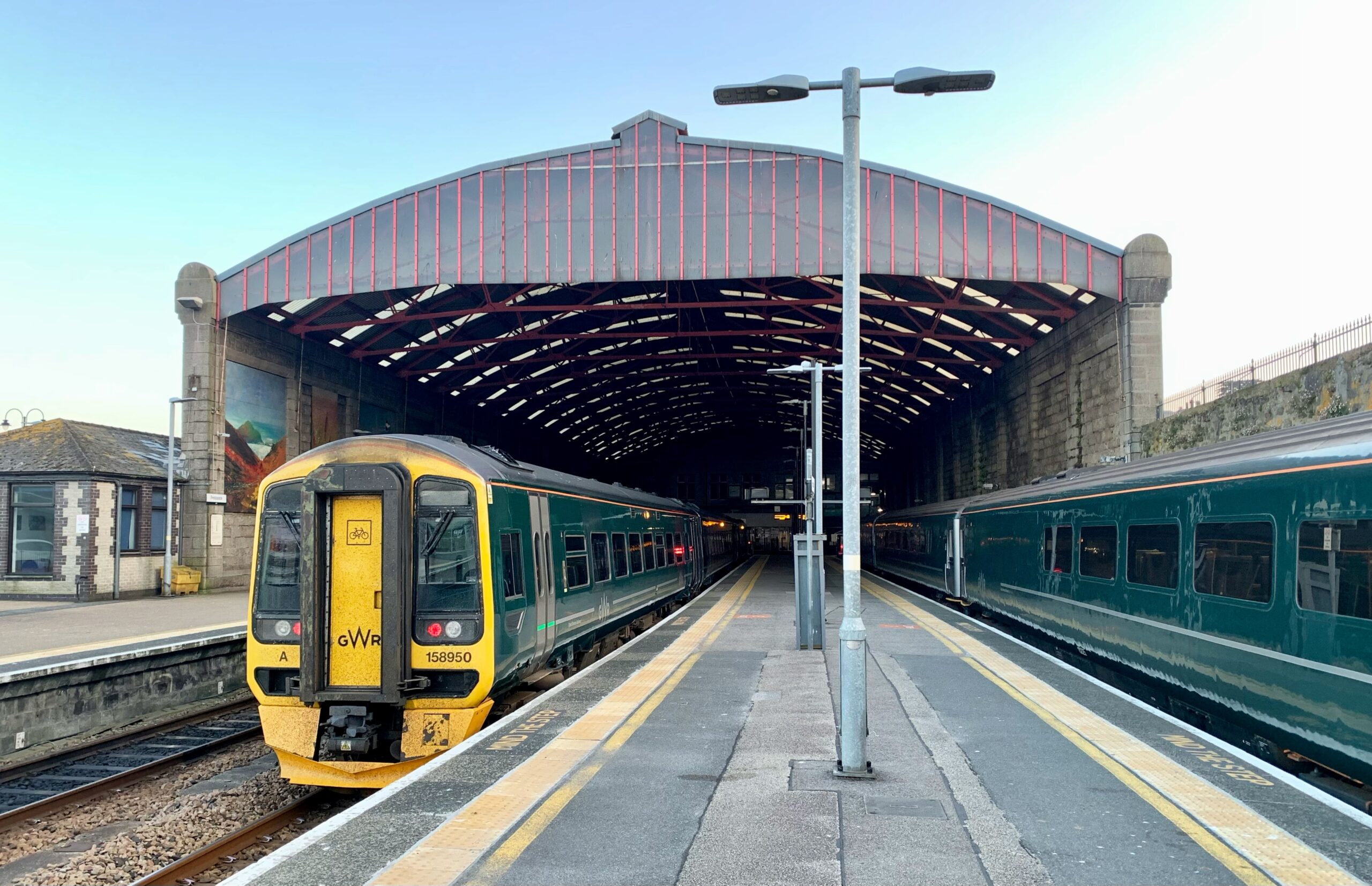
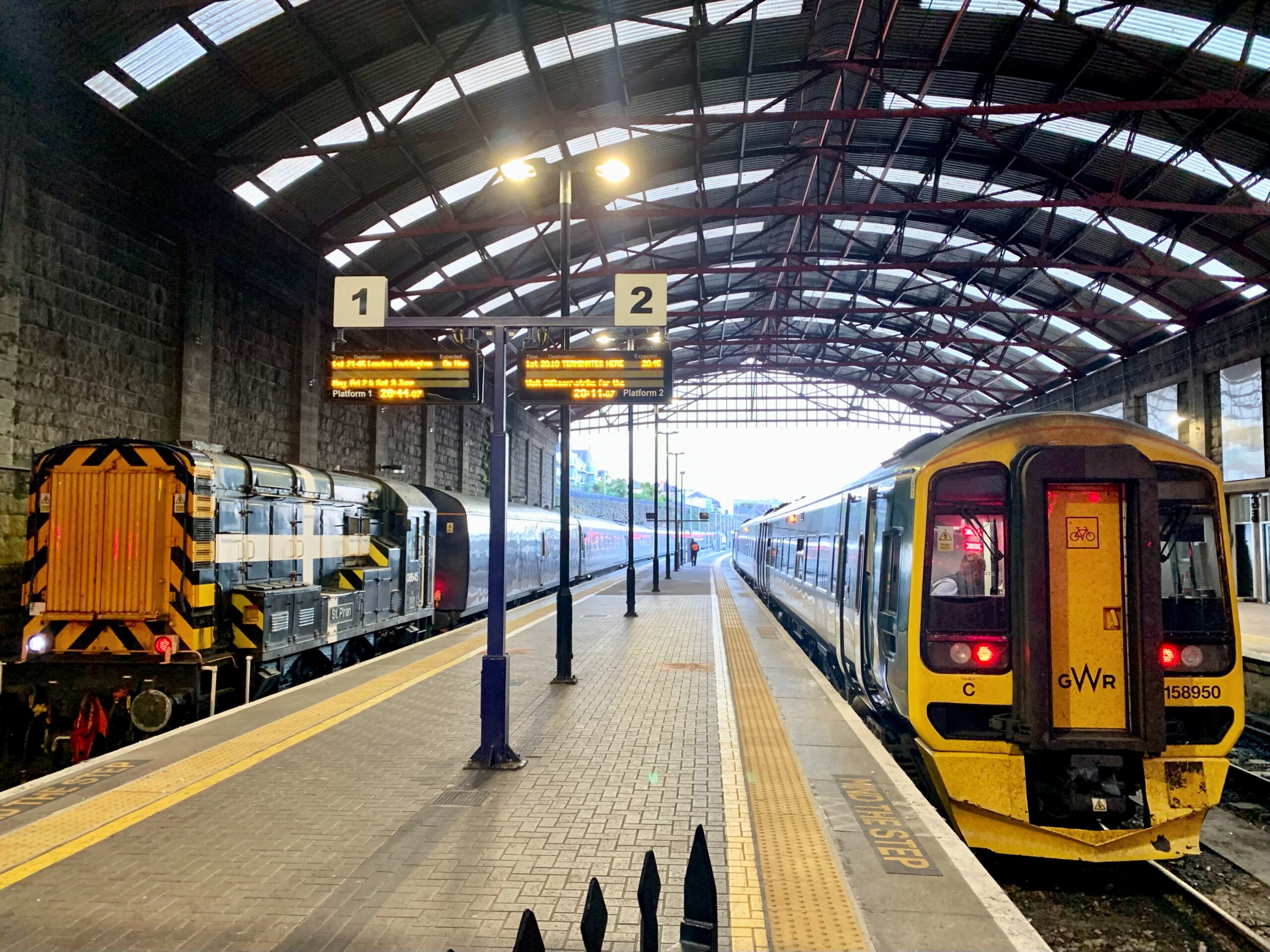
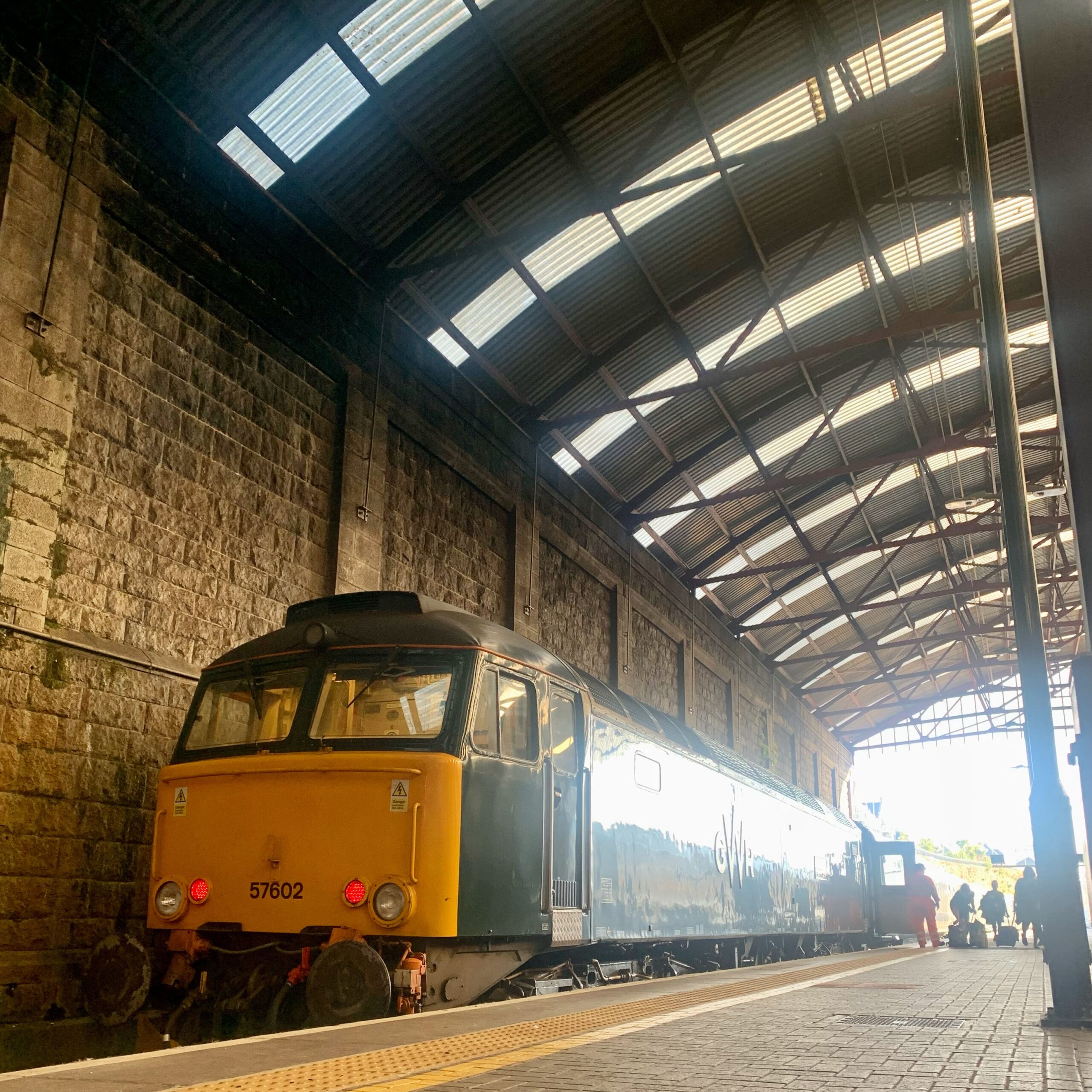
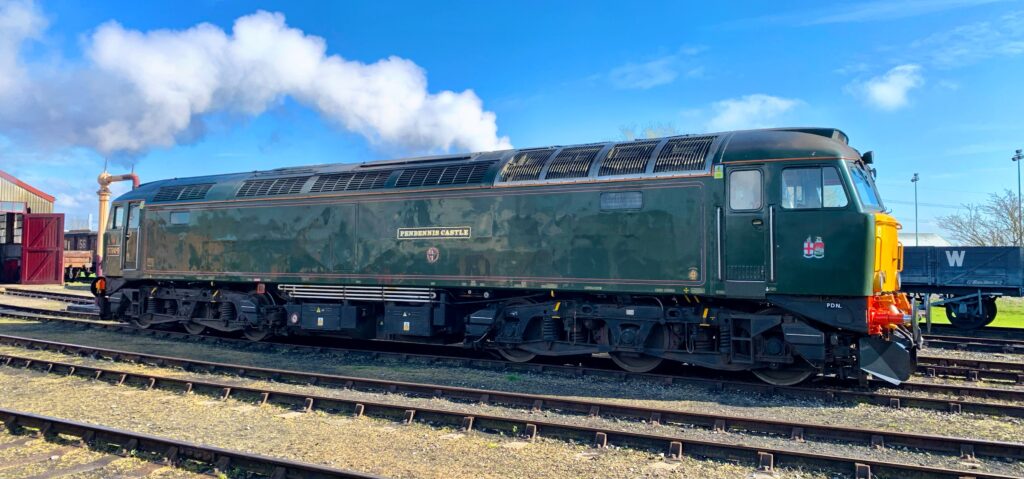
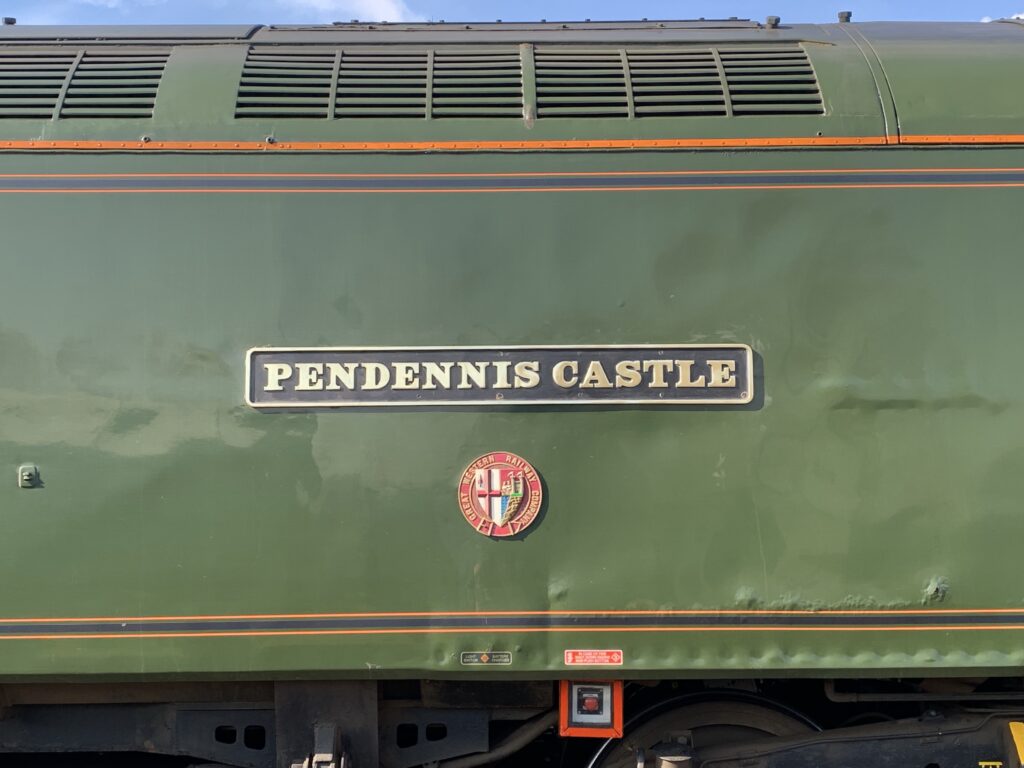
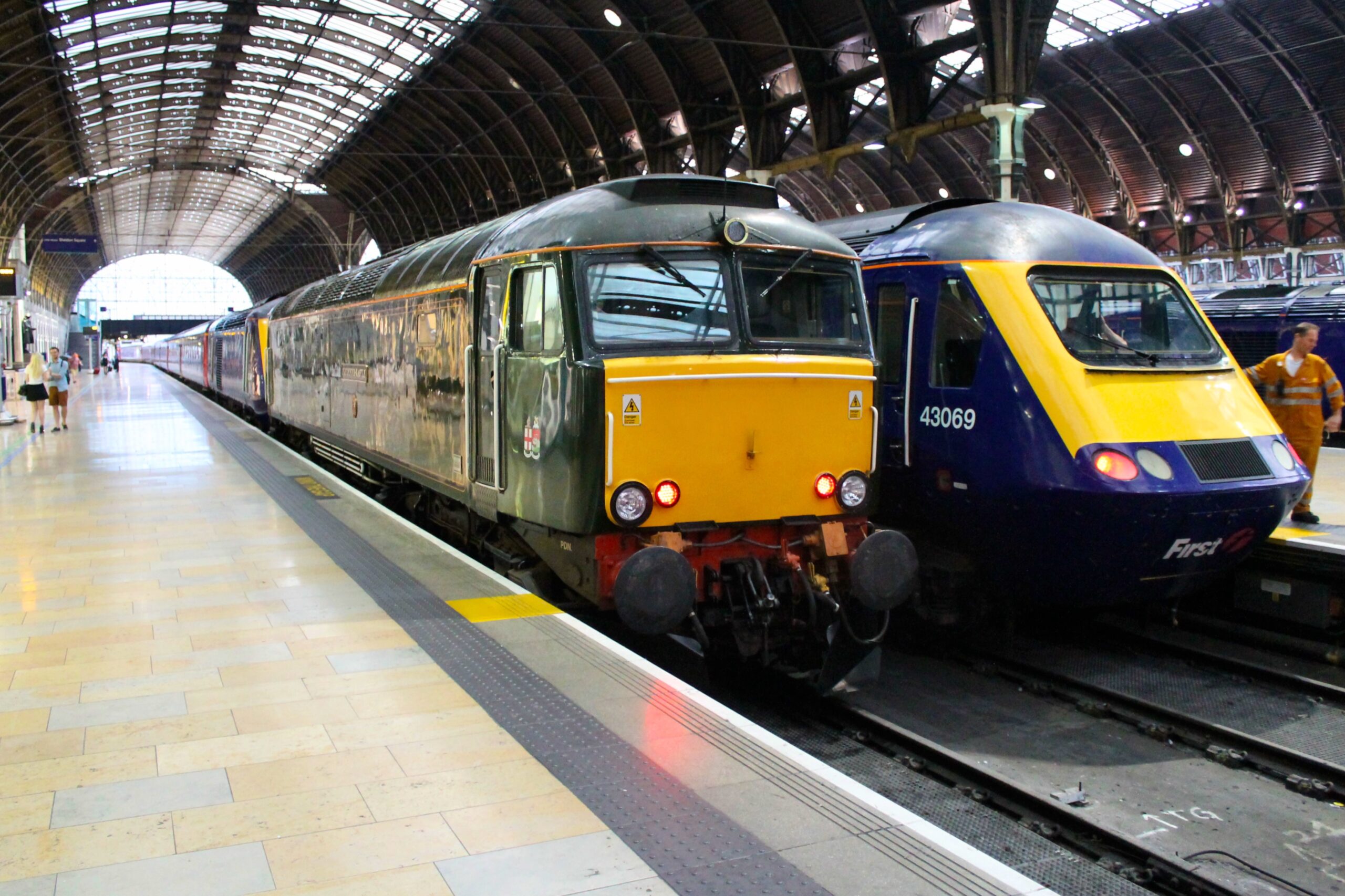
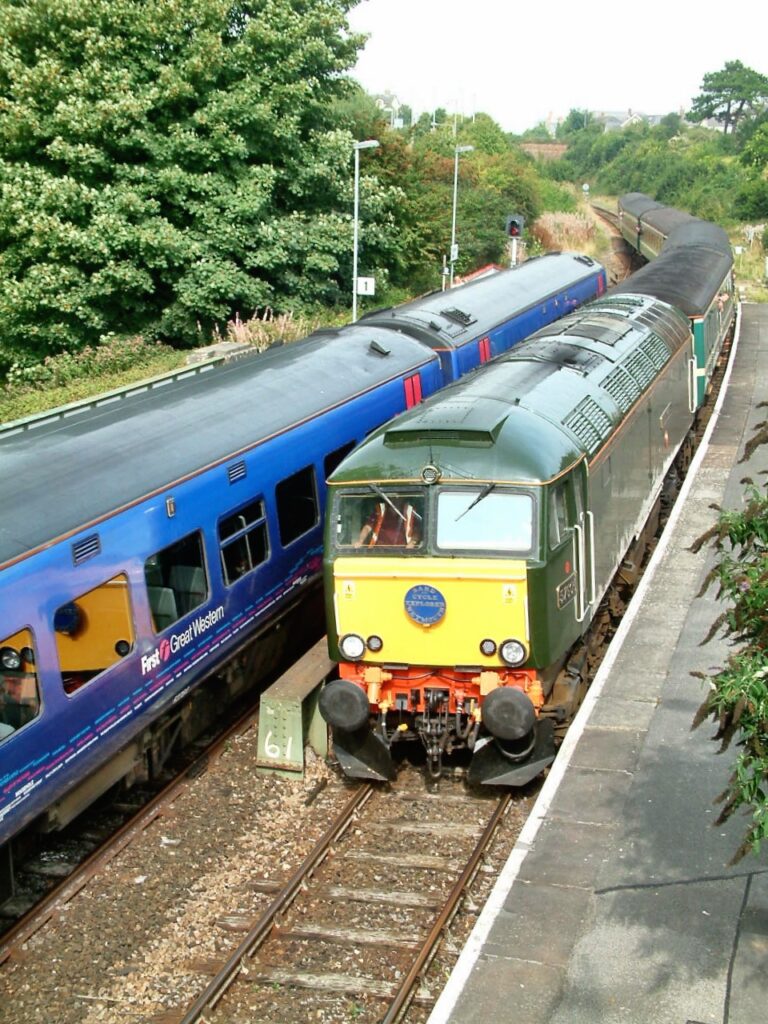
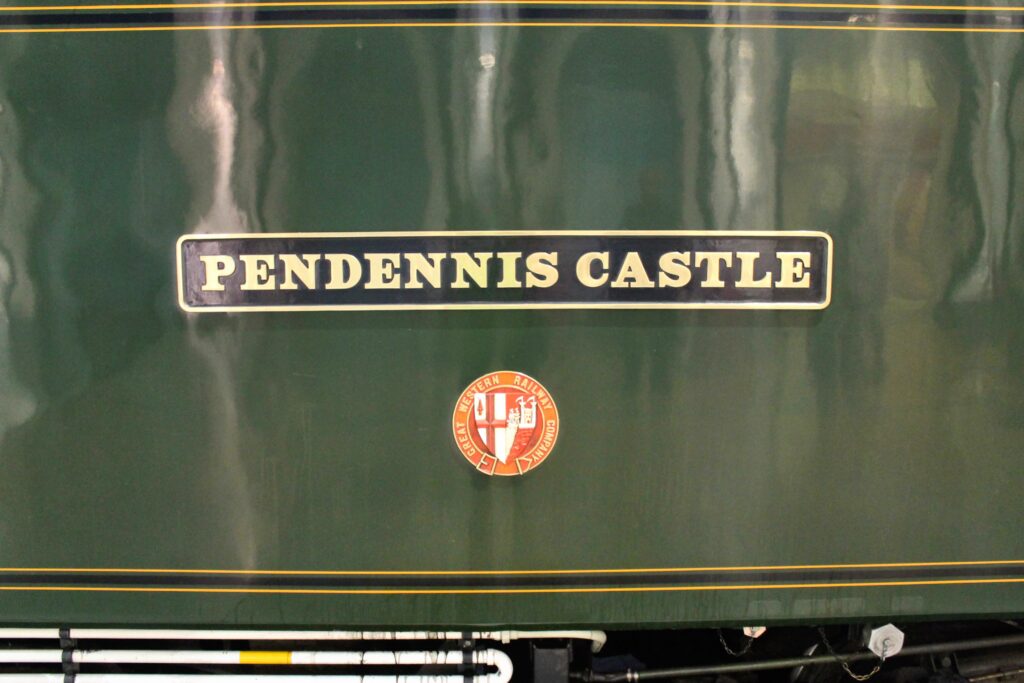
Class 57 No. 57604 ‘Pendennis Castle’ awaits departure of 1A50 2145 Penzance to London Paddington sleeper – 24/05/2023CrossCountry Voyager Class 220 No. 220009 ready to set off ECS to Long Rock after working in 1V58 1003 Edinburgh Waverley to Penzance – 24/05/2023Class 57 No. 57603 ‘Tintagel Castle’ at the buffer stops at Penzance having worked 1C50 2345 London Paddington to Penzance – 25/05/2023Class 57 No. 57603 ‘Tintagel Castle’ nameplateClass 57 No. 57603 ‘Tintagel Castle’ awaiting shunting movement to Long Rock having arrived with the morning 1C50 2345 London Paddington to Penzance service – 25/05/2023Class 57 No. 57603 ‘Tintagel Castle’ and GWR Bi-Mode IET Class 802 No. 802101 ‘Nancy Astor’ working 1A80 0815 Penzance to London Paddington – 25/05/2023Penzance Signal Box – 25/05/2023Penzance Signal Box – 26/05/2023Class 57 No. 57603 ‘Tintagel Castle’ at the rear of 5A50 2012 Penzance Traction & Rolling Stock Maintenance Depot to Penzance Empty Coaching Stock move forming the evening Night Riviera sleeper service to London Paddington – 25/05/2023Class 57 No. 57603 ‘Tintagel Castle’ having arrived at the rear of the ECS move from Long Rock ready to haul the 1A50 2145 Penzance to London Paddington sleeper – 25/05/2023GWR Class 158 No. 158950 at Penzance having arrived with 2C36 1830 Plymouth to Penzance service – 25/05/2023Class 08 No. 08645 ‘St.Piran’ at rest having brought the Night Riviera stock into Penzance whilst GWR Class 158 No. 158950 awaits departure with the 2E30 2100 service to Exeter St. Davids – 25/05/2023Class 57 No. 57602 ‘Restormel Castle’ at the buffer stops in Penzance having worked the down Night Riviera sleeper service – 26/05/2023
On Thursday we walked from Penzance to Marazion which conveniently meant we passed by Long Rock where Penzance TMD, the most westerly and southerly rail depot in the country, is located. There has been a depot a Long Rock since 1914 when a steam shed was opened. The current depot dates from 1977 with later modernisation to increase capacity in 2017.
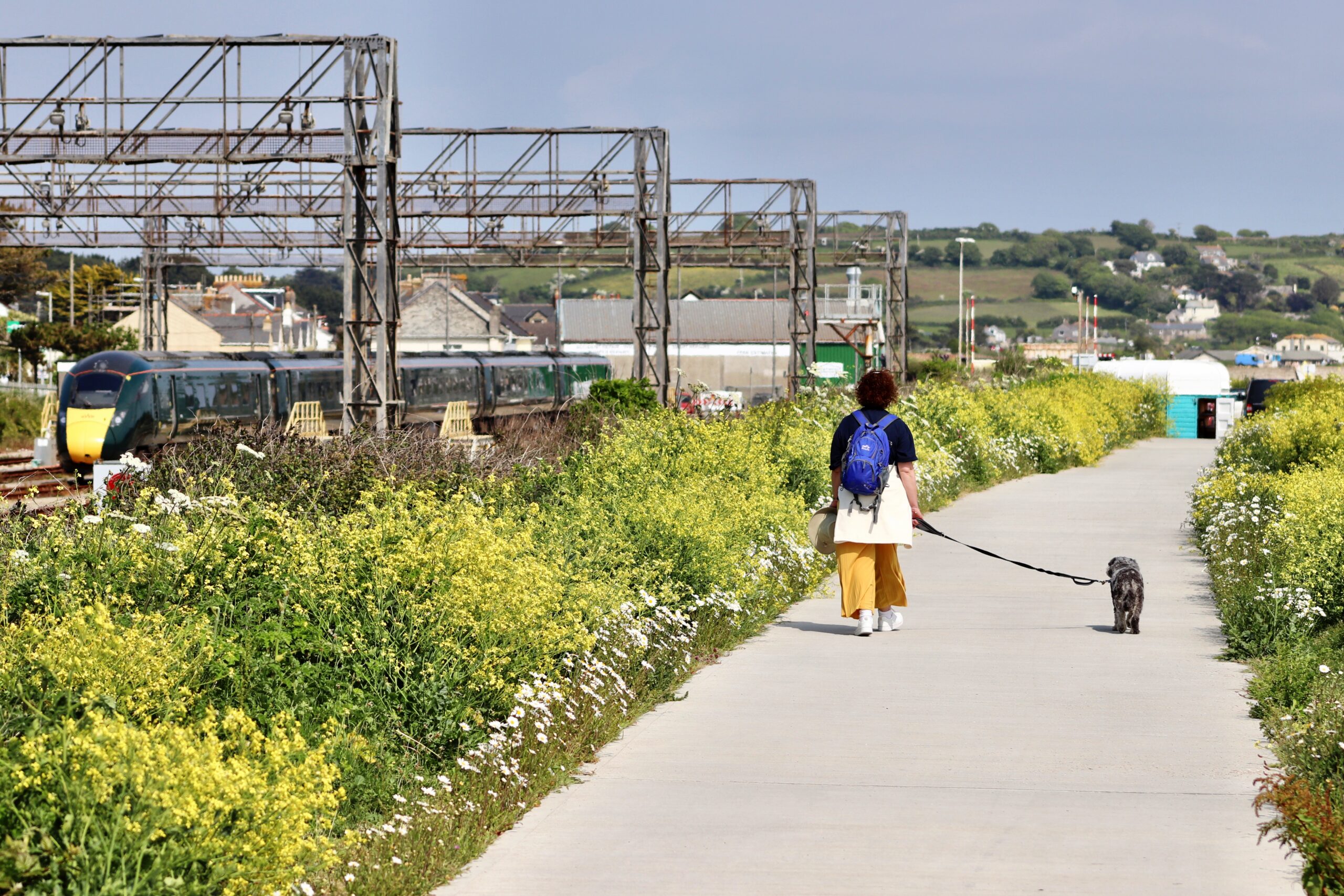
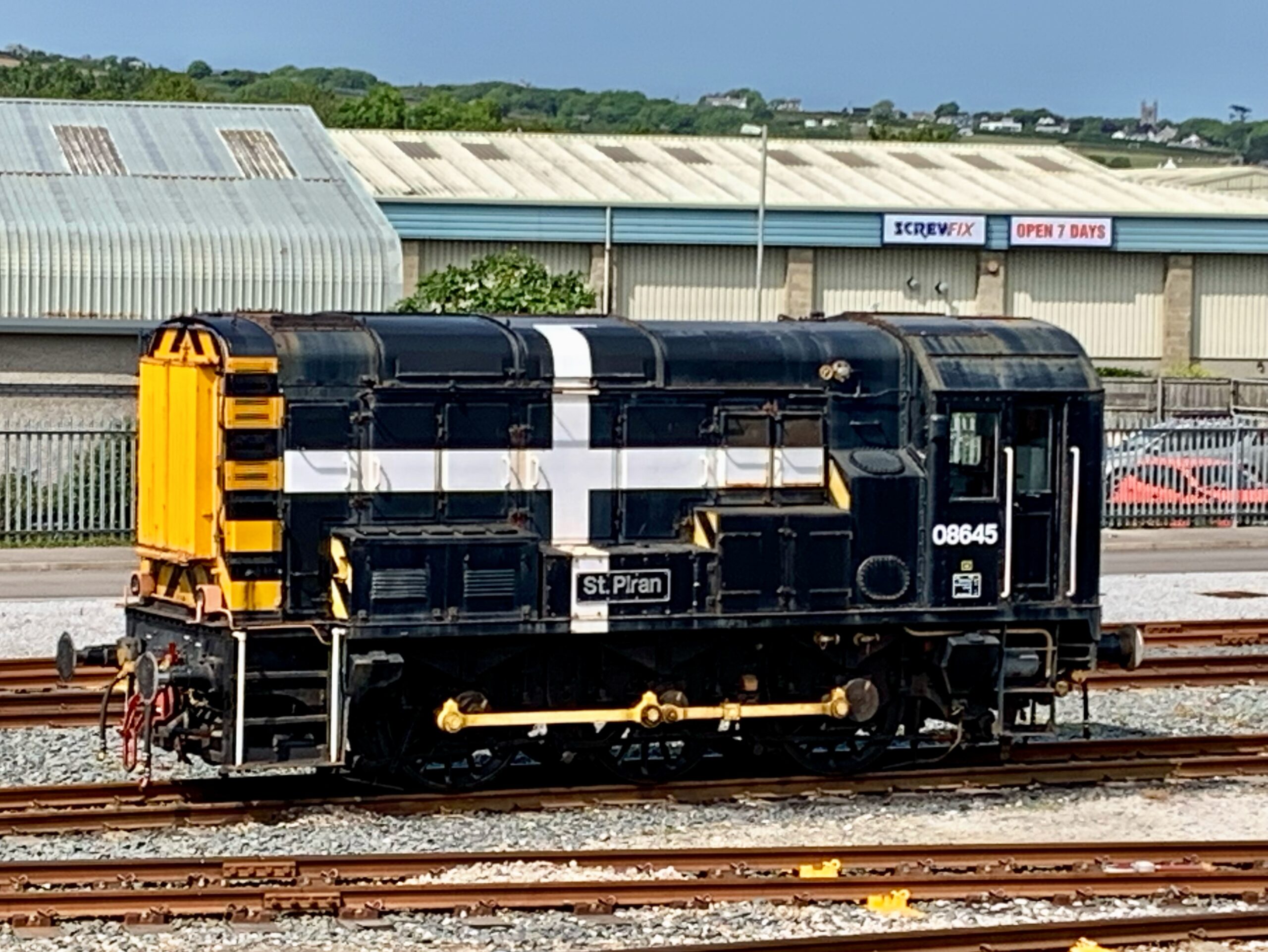
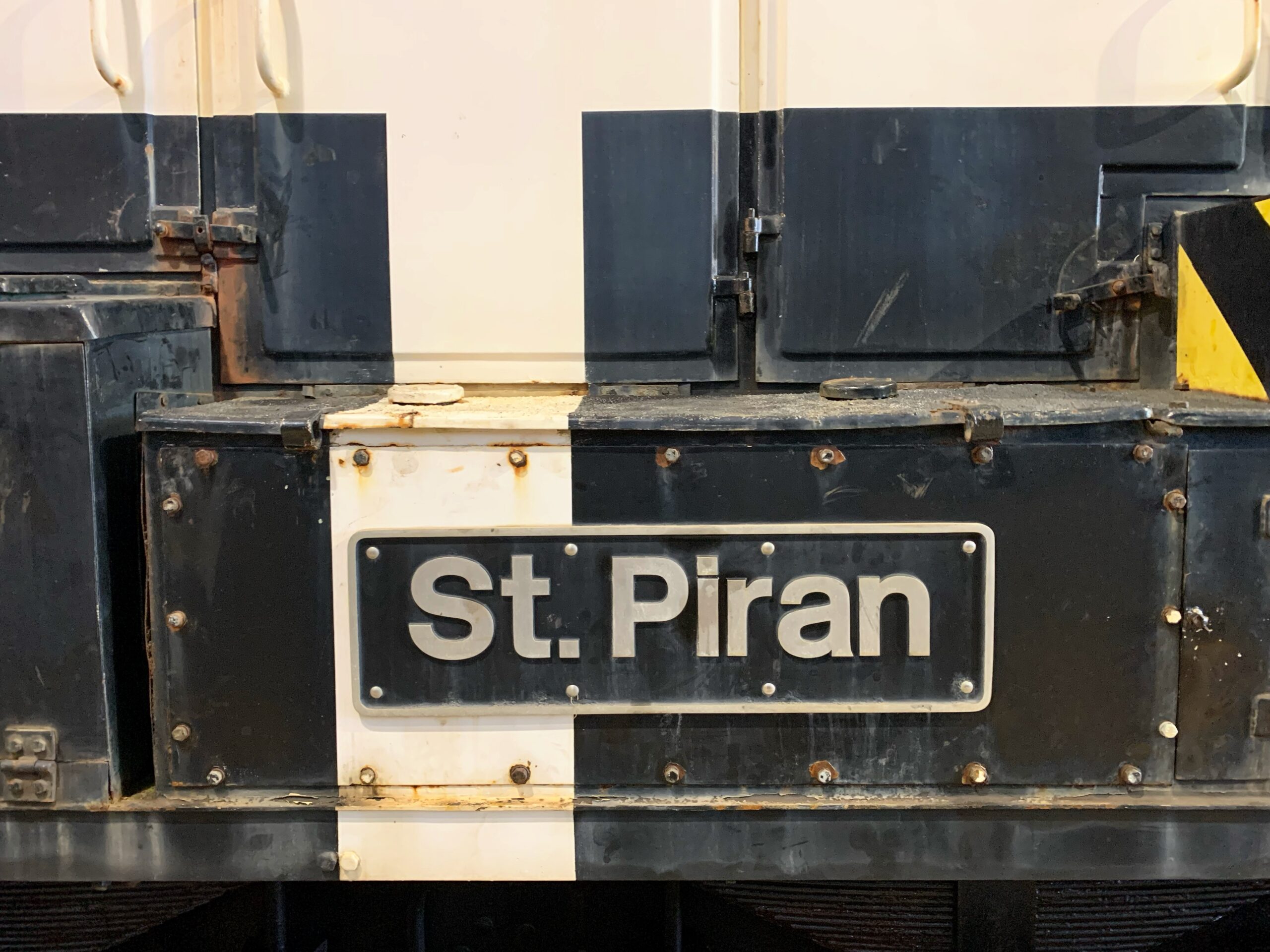
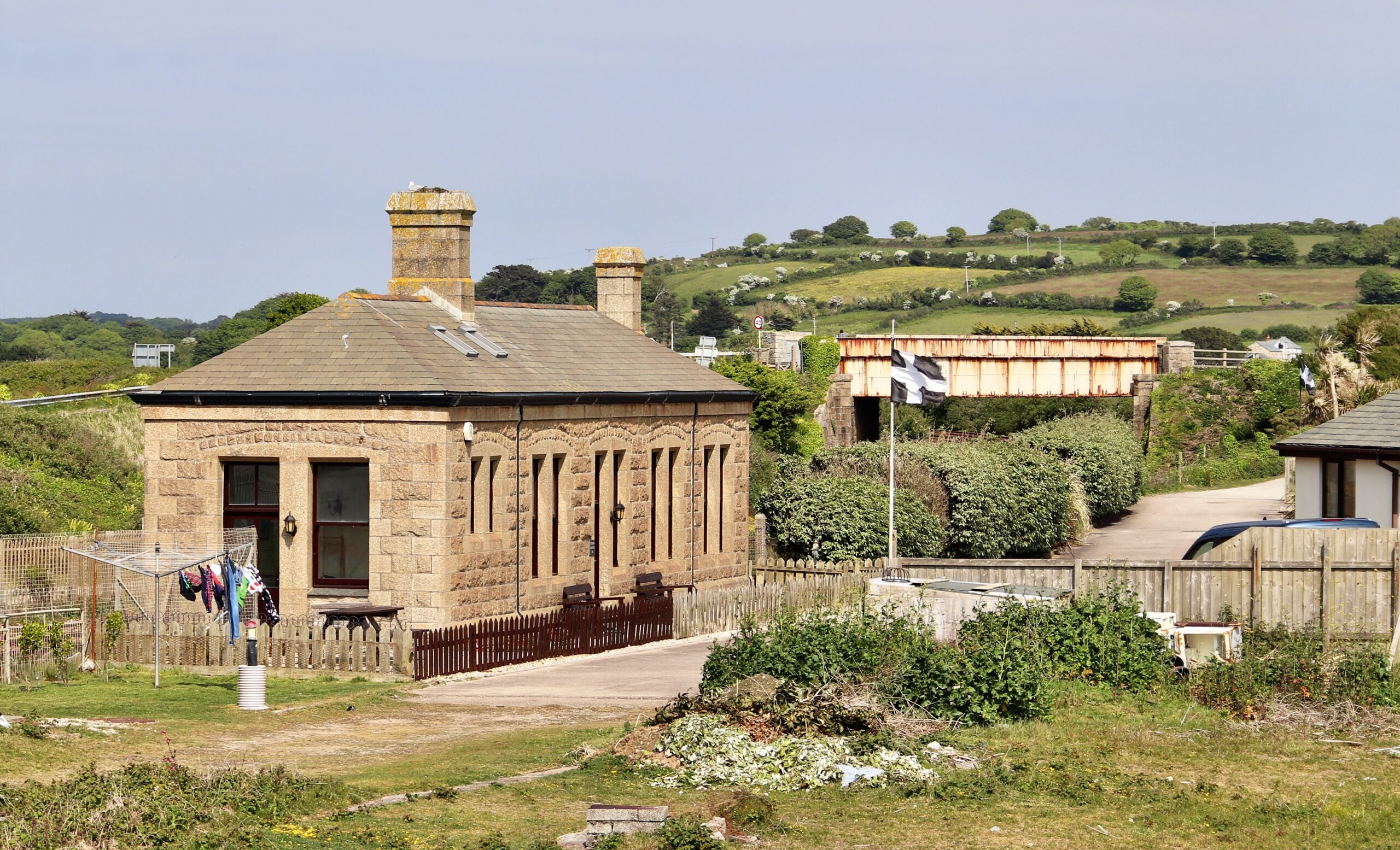
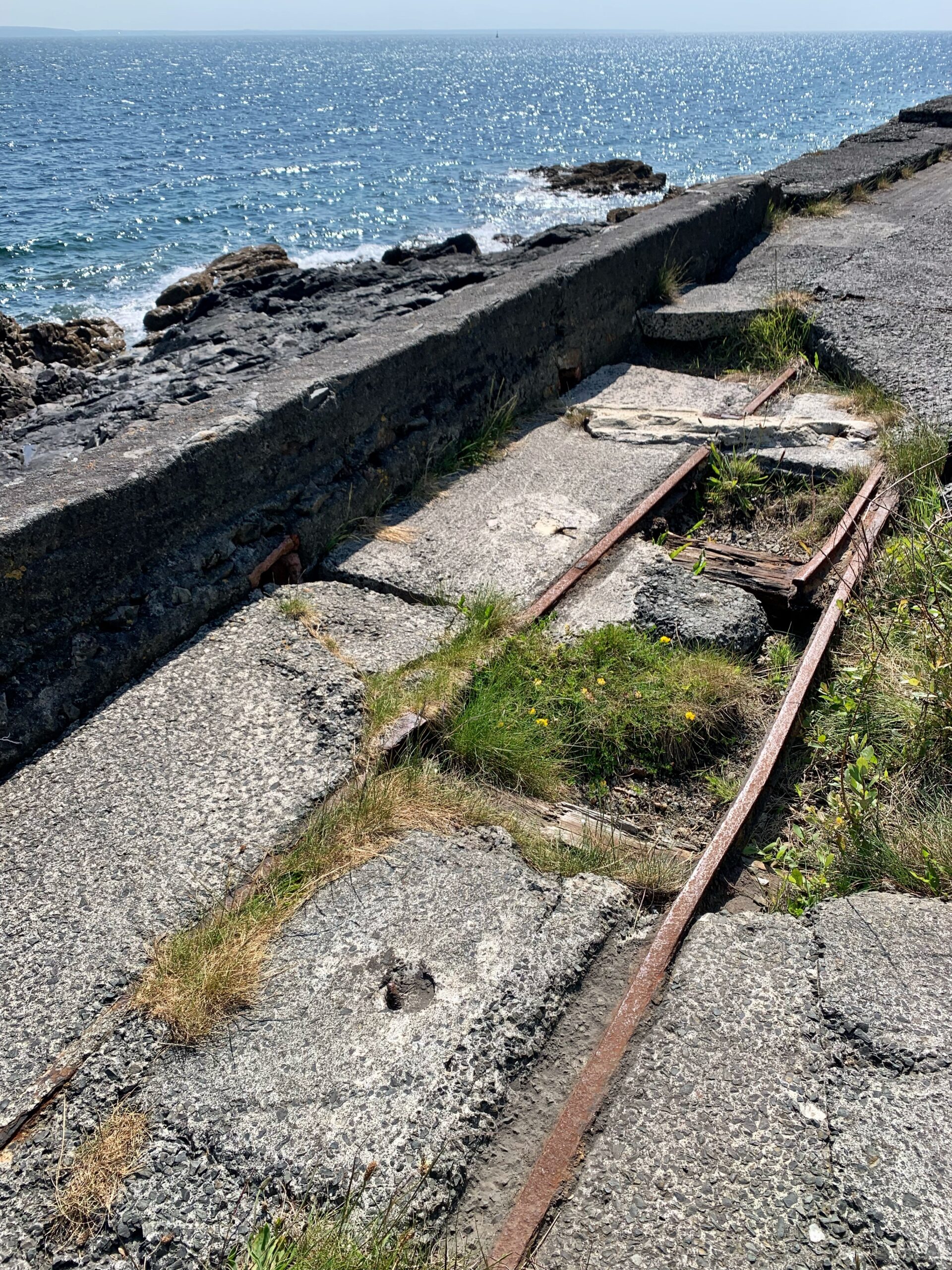
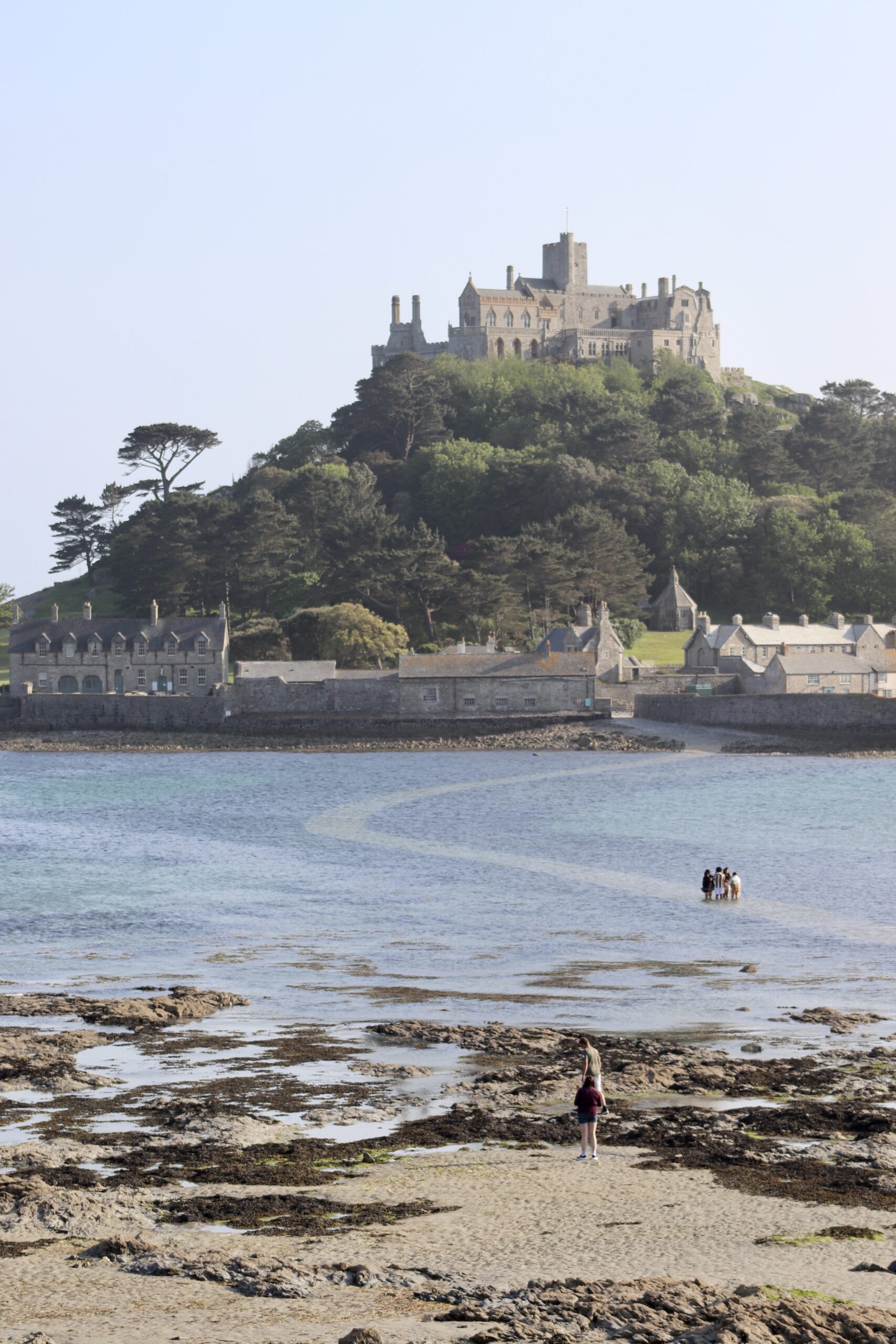
Long Rock depot seen from the west of Penzance – 25/05/2023The coastal path runs adjacent to Long Rock. Caroline and Yoshi pass an unidentified IET awaiting its next duty from Penzance – 25/05/2023Class 08 No. 08645 ‘St.Piran’ (after the patron saint of Cornwall) in Kernow livery at Long Rock, Penzance. Built at Harwich Works and originally numbered D3812 this 0-6-0 diesel shunter entered traffic in February 1959 being allocated to Newport Pill. The locomotive was allocated to different Welsh depots until December 2018 when, with the closure of Landore, she moved to Penzance. Her new livery was unveiled to the public at a special open day to raise money for the Penlee Lifeboat in April 2019 – Nameplate of Class 08 No. 08645 ‘St. Piran’ Class 57 No. 57603 ‘Tintagel Castle’ pokes her nose out of the shed at Long Rock – 25/05/2023 Class 57 No. 57603 ‘Tintagel Castle’ with the Night Riviera Sleeper stock in the sidings at Long Rock – 25/05/2023New sidings being constructed at Long Rock depot, Penzance – 26/05/2023Once an important stop on the main London Paddington – Penzance route, Marazion railway station, which originally opened in March 1852 by the West Cornwall Railway, has been stripped of its platforms and awnings. The current building which dates from the 1880’s has been fully restored into a two bedroom bungalow. The line was absorbed into the Great Western Railway on 1st January 1877. The station was never particularly busy, although it dealt with a fair bit of agricultural traffic including broccoli and new potatoes. The station was closed to passengers 5 Oct 1964, with freight services following on 6 Dec 1965. The station is situated on the shore of Mount’s Bay and offers wonderful views across to St. Michael’s Mount. For many years Marazion was home to six old Pullman coaches that were employed as camping coaches, holiday accommodation offered by the railway containing sleeping and living space designed to encourage people to travel by train to the stations where they were situated. I remember the coaches from a previous visit to the area and I’ll tray and find some photographs at some point! The coaches, which had fallen into disrepair, were removed in 2006 and nine holiday cottages built in their place – 25/05/2023Yoshi was a real trooper on our walks. Earlier on the same day we had walked to Mousehole before setting off for Marazion. St Michael’s Mount can be seen behind Yoshi. It is a rocky island crowned by a medieval church and castle, home to the St Aubyn family and a community of islanders – 25/05/2023Yoshi at Mousehole. Famous for its narrow streets and tiny harbour, its name comes from a cave in the cliffs nearby. Until the 16th century it was one of the main ports on Mount’s Bay, the other being Marazion. Mousehole is believed to have been the landing place of the Knights of St John when they returned from the Holy Land. The poet, Dylan Thomas called it the prettiest village in England – 25/05/2023Stone from Penlee Quarry was transported along by the coast near Newlyn in large containers on rails. The containers were originally pulled by a locomotive called ‘Penlee’, also known as ‘Janner’s Engine’ to the south pier in Newlyn, where the contents were loaded onto boats. Later, in the 1960’s, six diesel locomotives were required for hauling the stone. The quarry closed in the late 1980’s – 25/05/2023Marazion is a town of great antiquity, being one of the oldest chartered towns in Cornwall and in Medieval times was a significant location. Marazion was granted its first charter of incorporation by Henry III in 1257 and was reaffirmed on 13th June 1595 by Queen Elizabeth I. The name derives from the important fairs and markets that were held in the town, the earliest dating back to 1070; Marghas Byghan (Small Market) and Marghas Yow or Jew (Thursday Market) blurred over time to become ‘Marazion’. The presence of the Benedictine Monastery on St. Michael’s Mount attracted pilgrims to Marazion, who hung about in the town until the causeway was revealed by the ebbing tide allowing them to cross to the island – 25/05/2023
Lineside video of our visit to Cornwall in May 2023
Bringing us up to date, another Winfrith run took place over 31st May and 1st June 2023 as unusually the train collecting low lever radioactive waste from the Steam-Generating Heavy Water Reactor stayed a night in the sidings at the Dorset facility. Ownership of the Winfrith Nuclear site is under the auspices of the Nuclear Decommissioning Authority (NDA). The site is managed by Magnox Limited who are contracted to deliver the site decommissioning programme, the Winfrith reactor having been shut down in 1990.
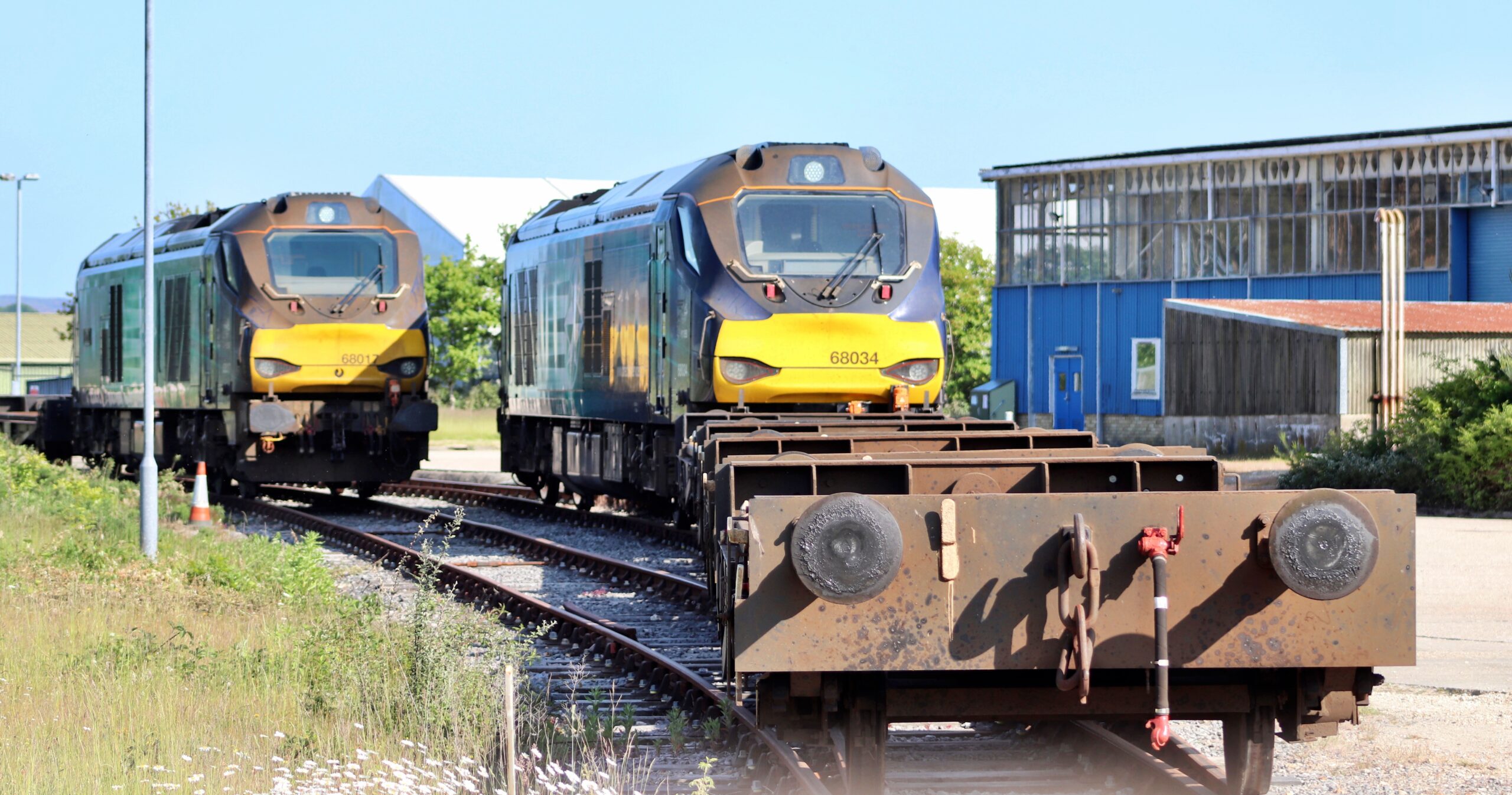
Direct Rail Services (DRS) Class 68’s No.’s 68017 ‘Hornet’ and 68034 top and tail 6Z62 Crewe Coal Sidings DRS to Winfrith Sidings on the approach to Parkstone railway station – 31/05/2023DRS Class 68’s No.’s 68017 ‘Hornet’ and 68034 in the sidings at Winfrith – 31/05/2023DRS Class 68’s No.’s 68017 ‘Hornet’ and 68034 in the sidings at Winfrith – 31/05/2023DRS Class 68 No. 68034 passing through Hamworthy heading up the return working 6Z95 Winfrith Sidings to Crewe Coal Sidings DRS. No. 68017 ‘Hornet’ was on the rear of the consist – 01/06/2023
Winfrith Cats 31/05/2023 & 01/06/2023
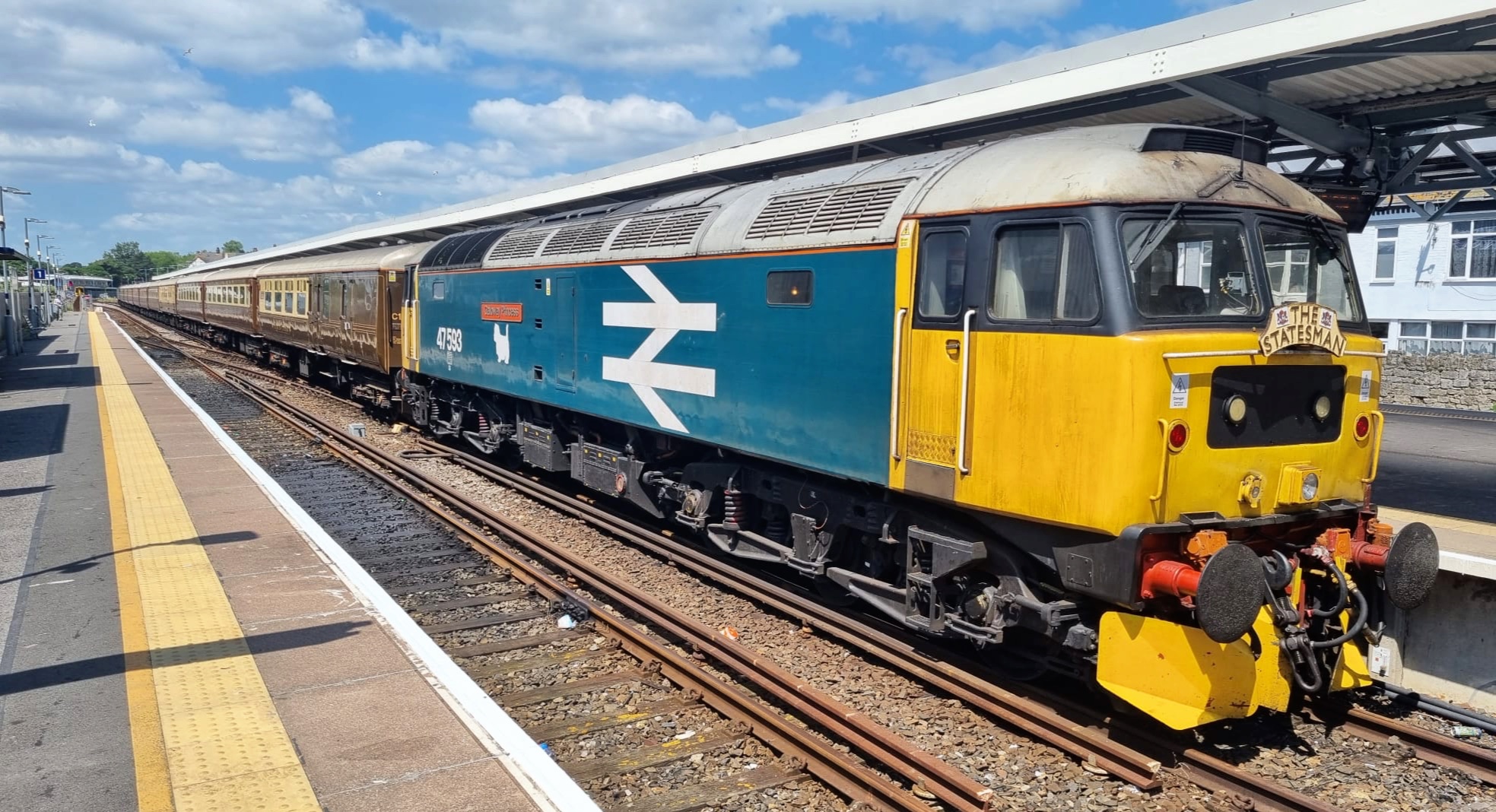
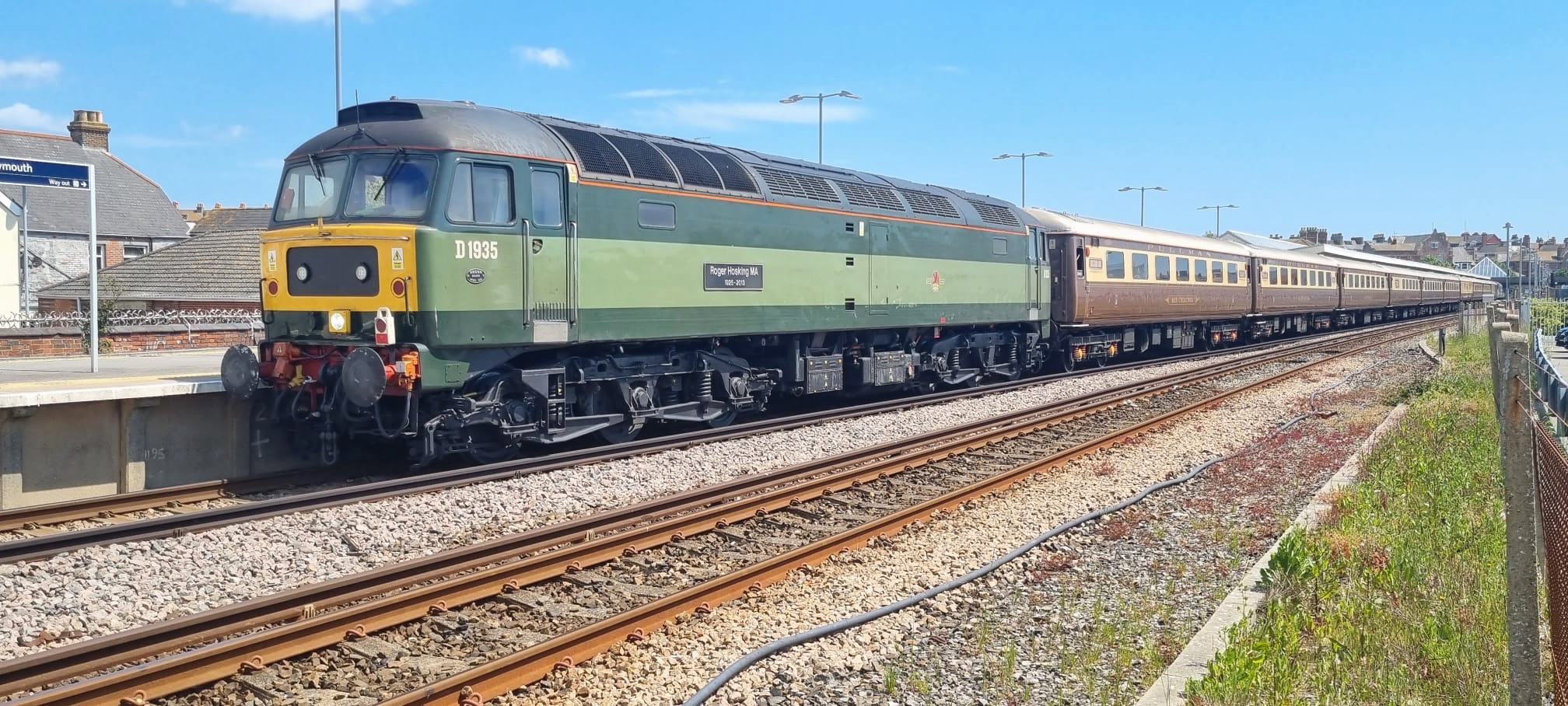
On Saturday 3rd June “The Dorset Coast Statesman” ran to Weymouth for the third time in 2023. On this occasion the tour originated from Peterborough and was top and tailed by LSL Class 47 locomotive No.’s 47805 ‘Roger Hosking MA 1925-2013’ and 47593 ‘Galloway Princess’. I was unable to see this working (again!) as I was in Lichfield helping to celebrate the wedding of two friends, and the following photos are by kind permission of Scott Lewis.
47593 ‘Galloway Princess’ at the buffer stops in Weymouth – 03/06/2023 (Image courtesy of Scott Lewis)47805 ‘Roger Hosking MA 1925-2013’ in Weymouth station at the rear of 1Z40 0617 Peterborough to Weymouth – 03/06/2023 (Image courtesy of Scott Lewis)
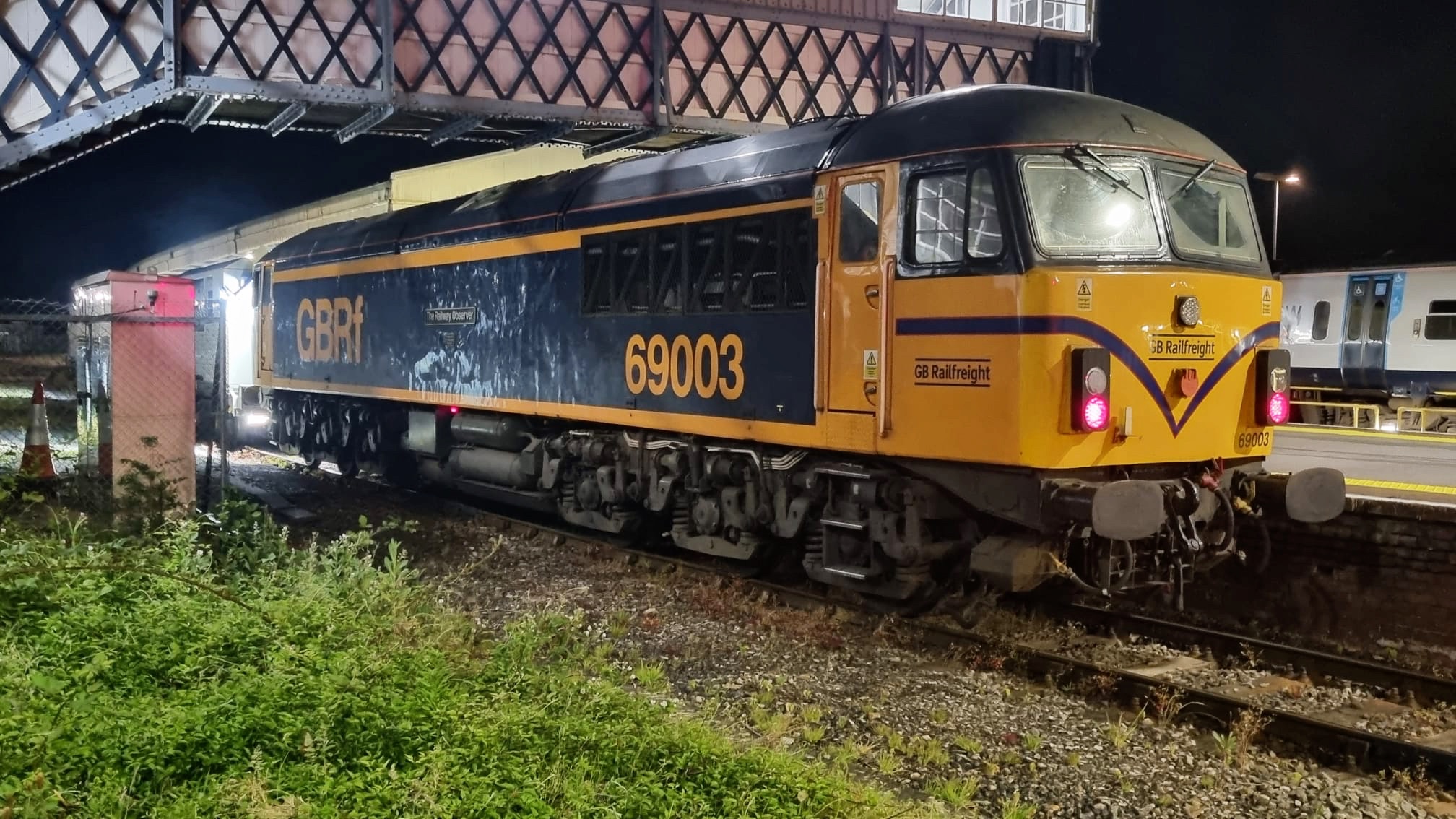
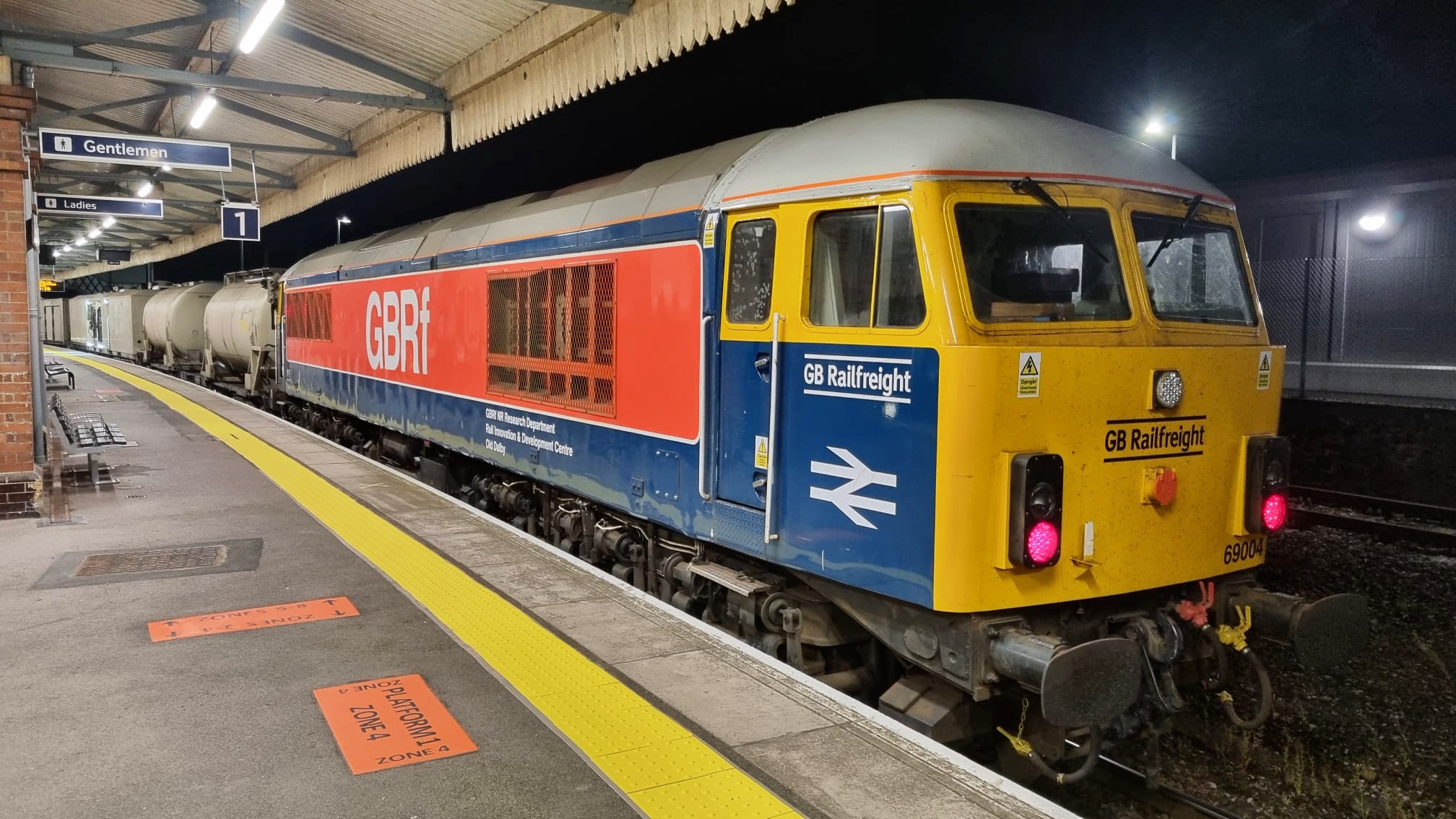
Our North Dorset Correspondent was up in the early hours of Tuesday 6th June to see Class 69 locomotives No.’s 69003 ‘The Railway Observer’ and 69004 which are currently operating in the West Country on weedkiller duties. This is the first operational visit of the class to our area. Yeovil Junction railway station was in Dorset until 1991 when county boundaries were changed. The 69’s are scheduled to work the same vegetation management train to Dorchester West in the early hours of 9th June and the Bournemouth to Weymouth on the 12th/13th June 2023.
GBRf Class 69 No.’s 69003 ‘The Railway Observer’ at Yeovil Junction – 06/06/2023 (Image courtesy of Scott Lewis)GBRf Class 69 No.’s 69004 at Yeovil Junction working 3Q00 Exeter Riverside NY to Exeter Riverside NY – 06/06/2023 (Image courtesy of Scott Lewis)
Yoshi was delighted to learn that South Western Railway (SWR) have joined other rail operators in banning e-scooters, e-skateboards, u-unicycles and “hoverboards” across its stations as from 1st June 2023. The rule has been introduced as there is a small fire risk due to the potential for their lithium-ion batteries to overheat.
With that piece of trivia we come to the end of another blog entry. Thank you for joining us and as always we appreciate your comments, corrections and feedback. We’ll be seeing you.
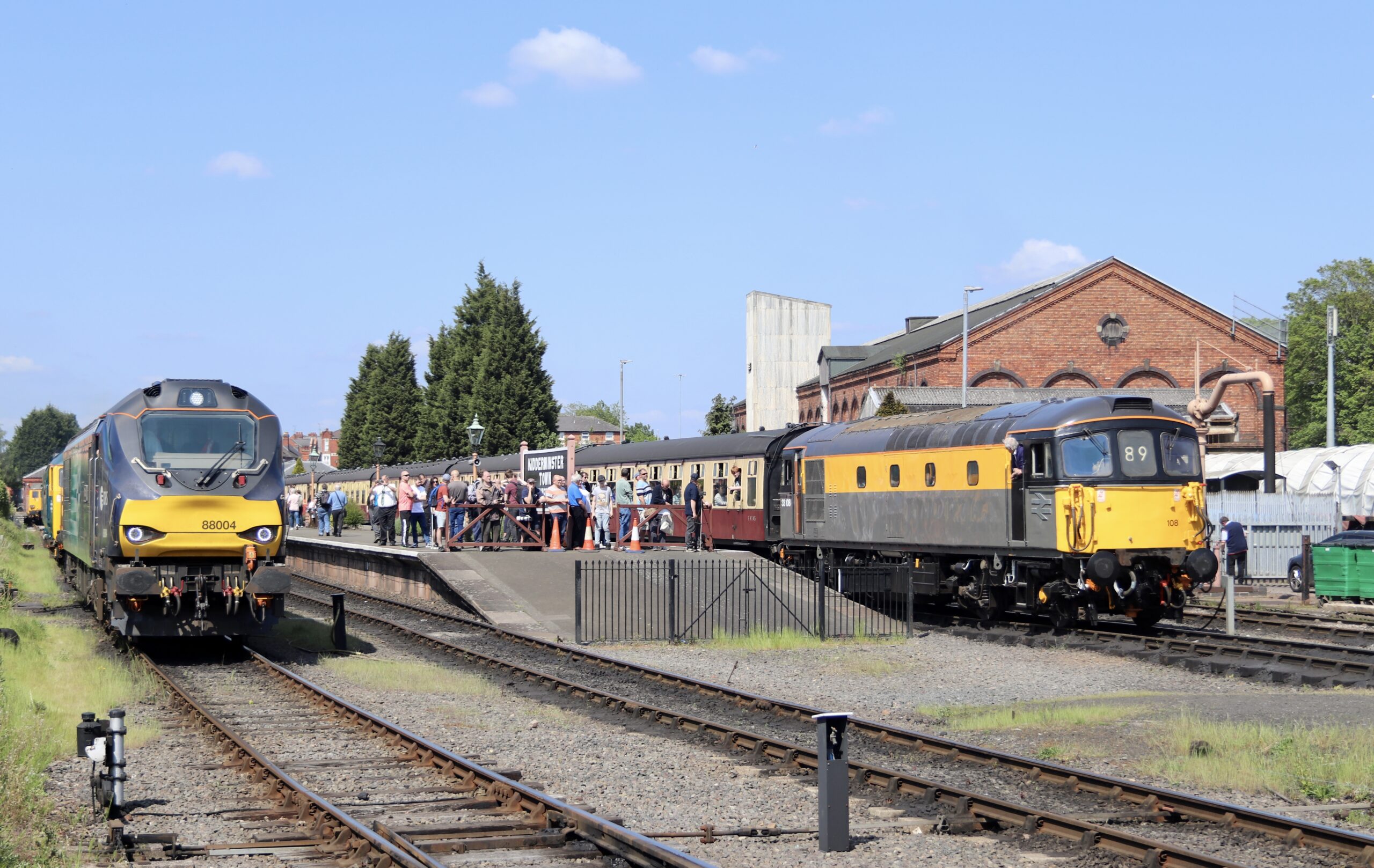
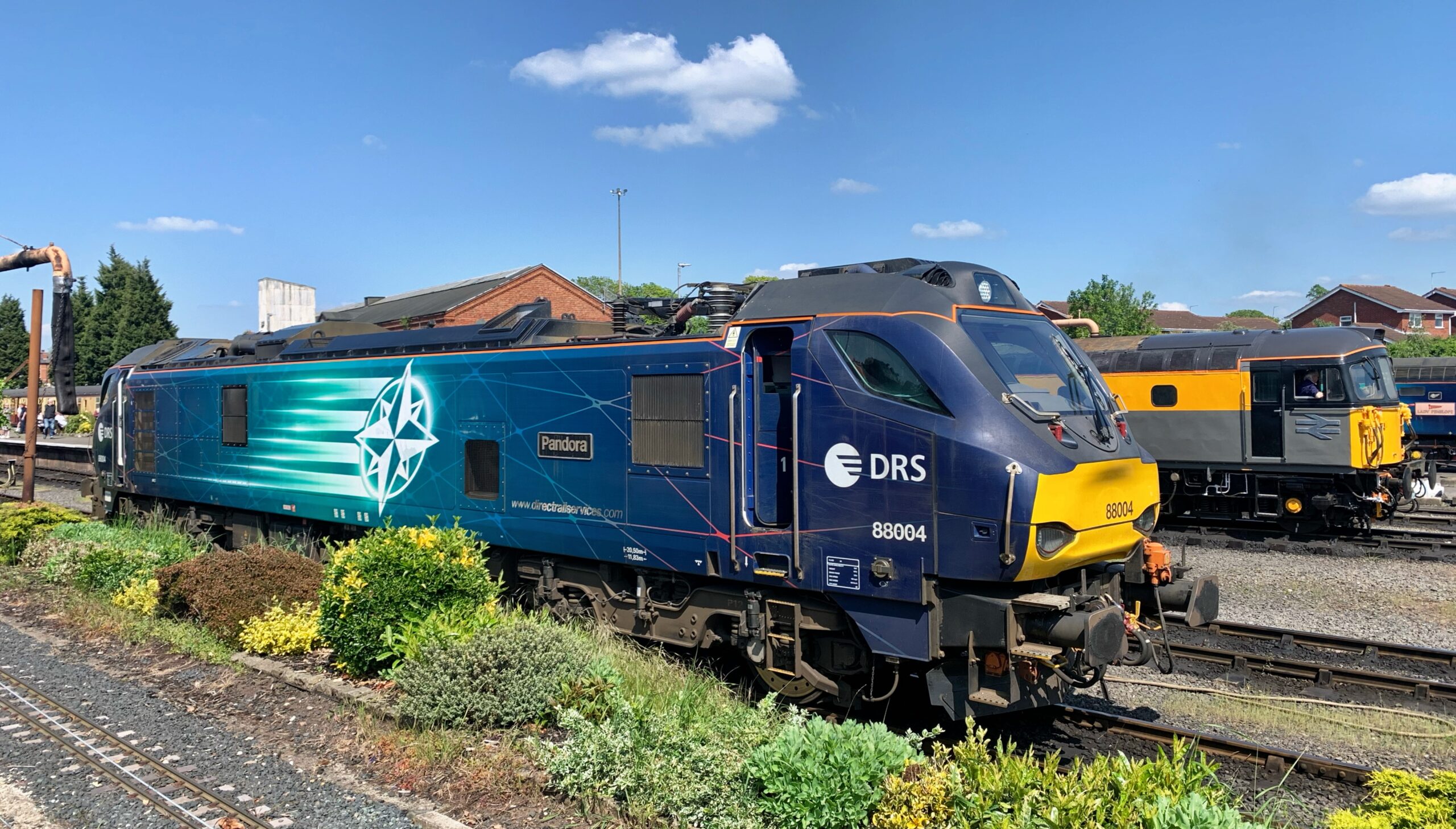
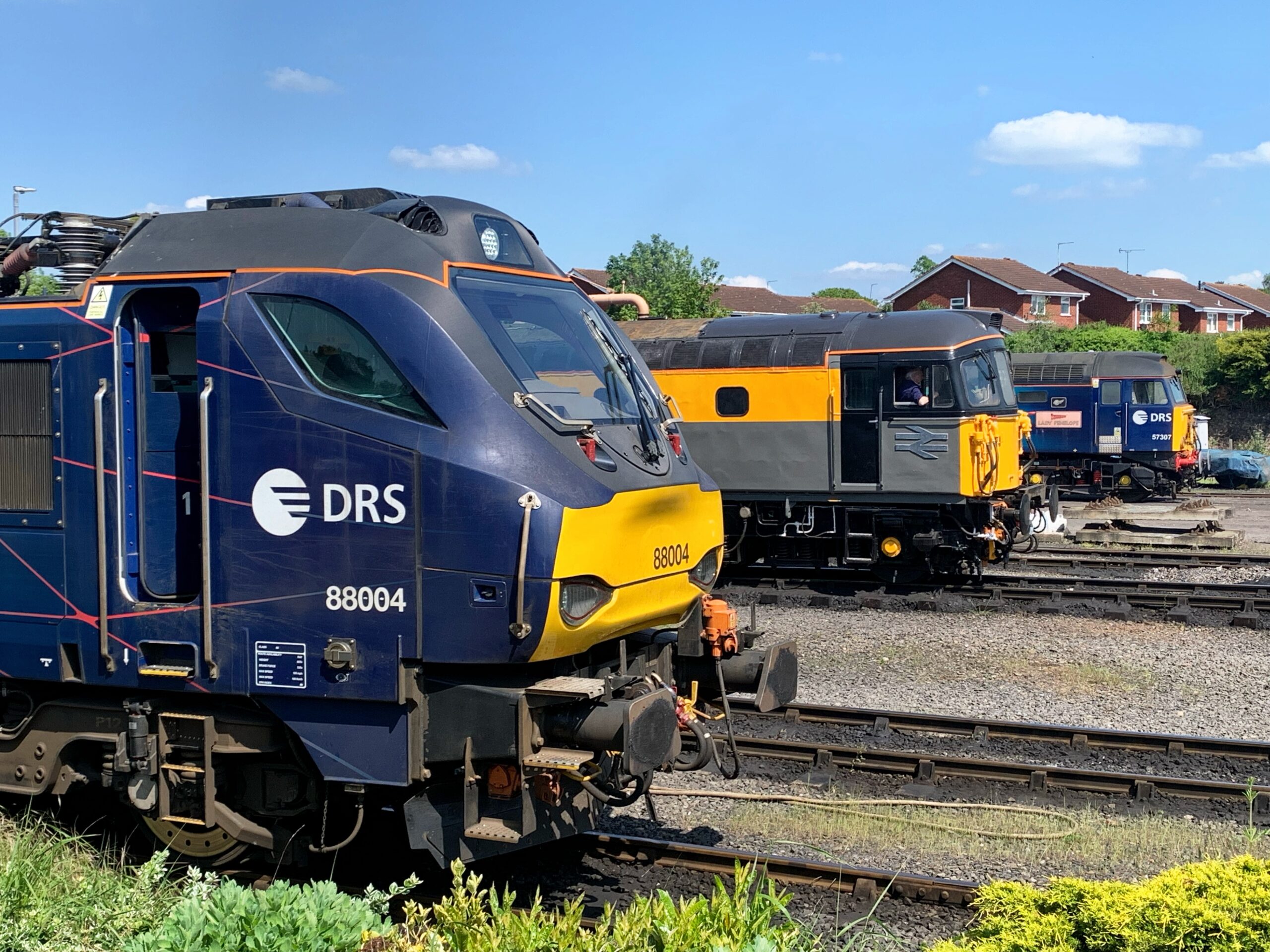
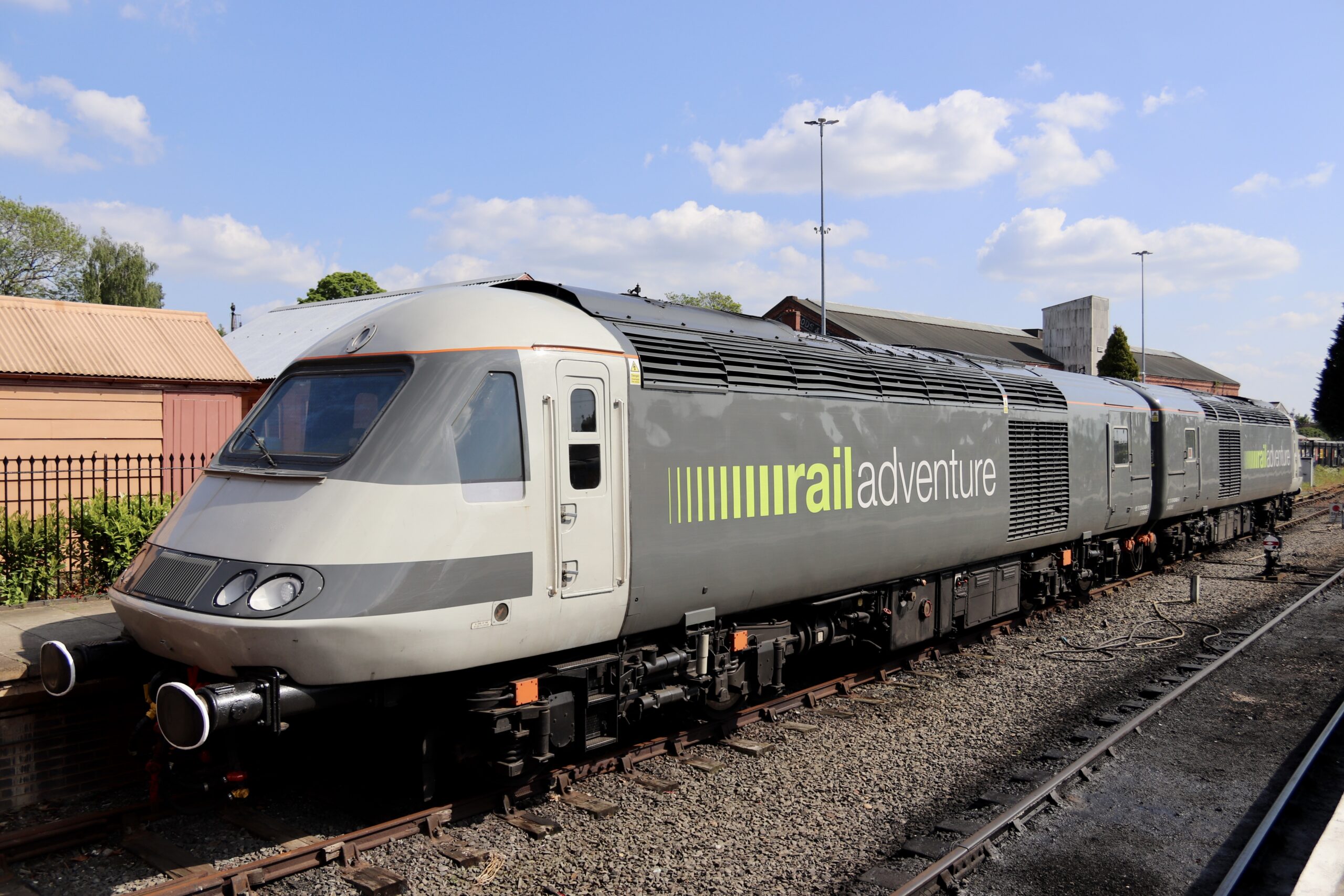
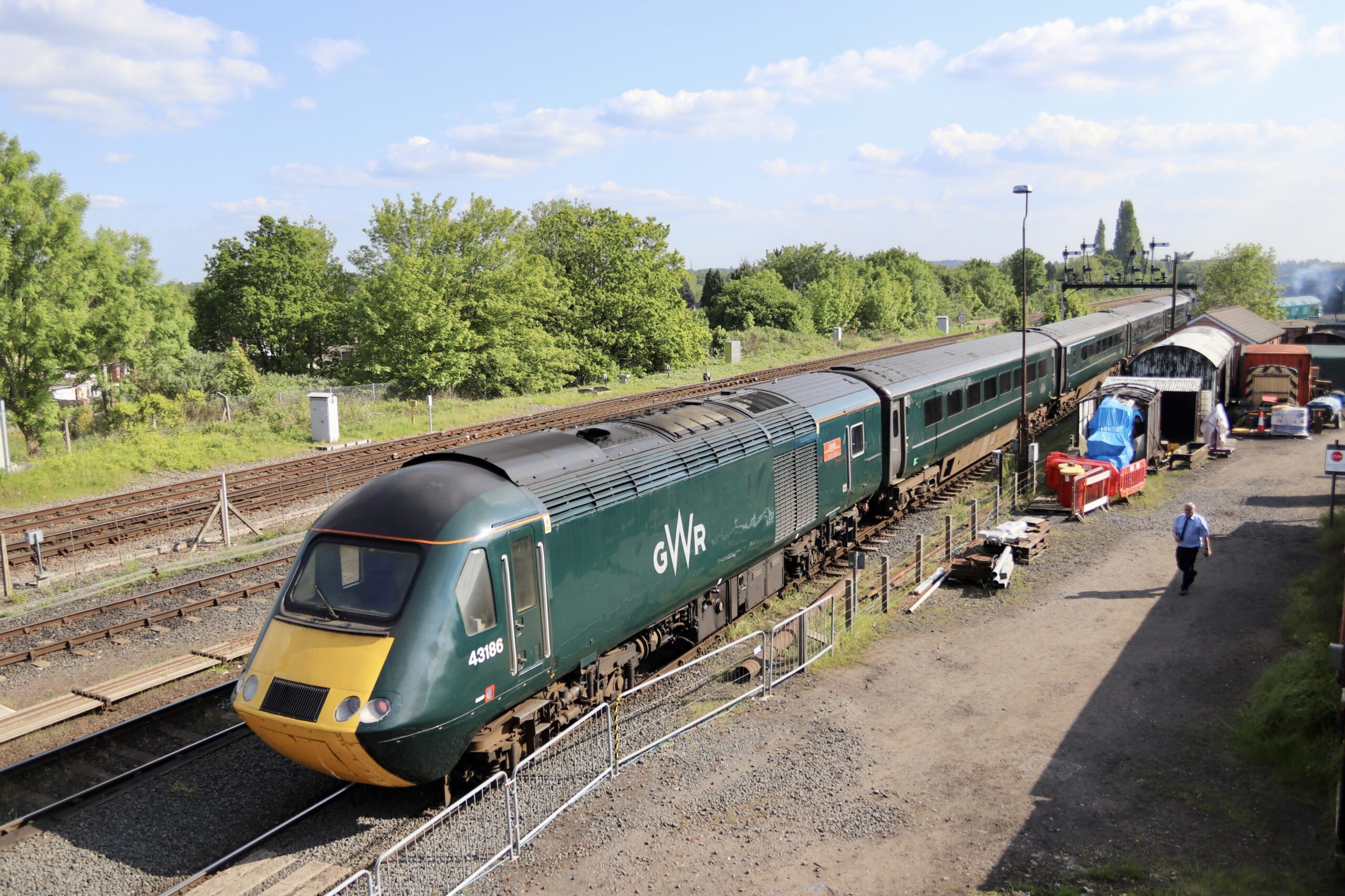
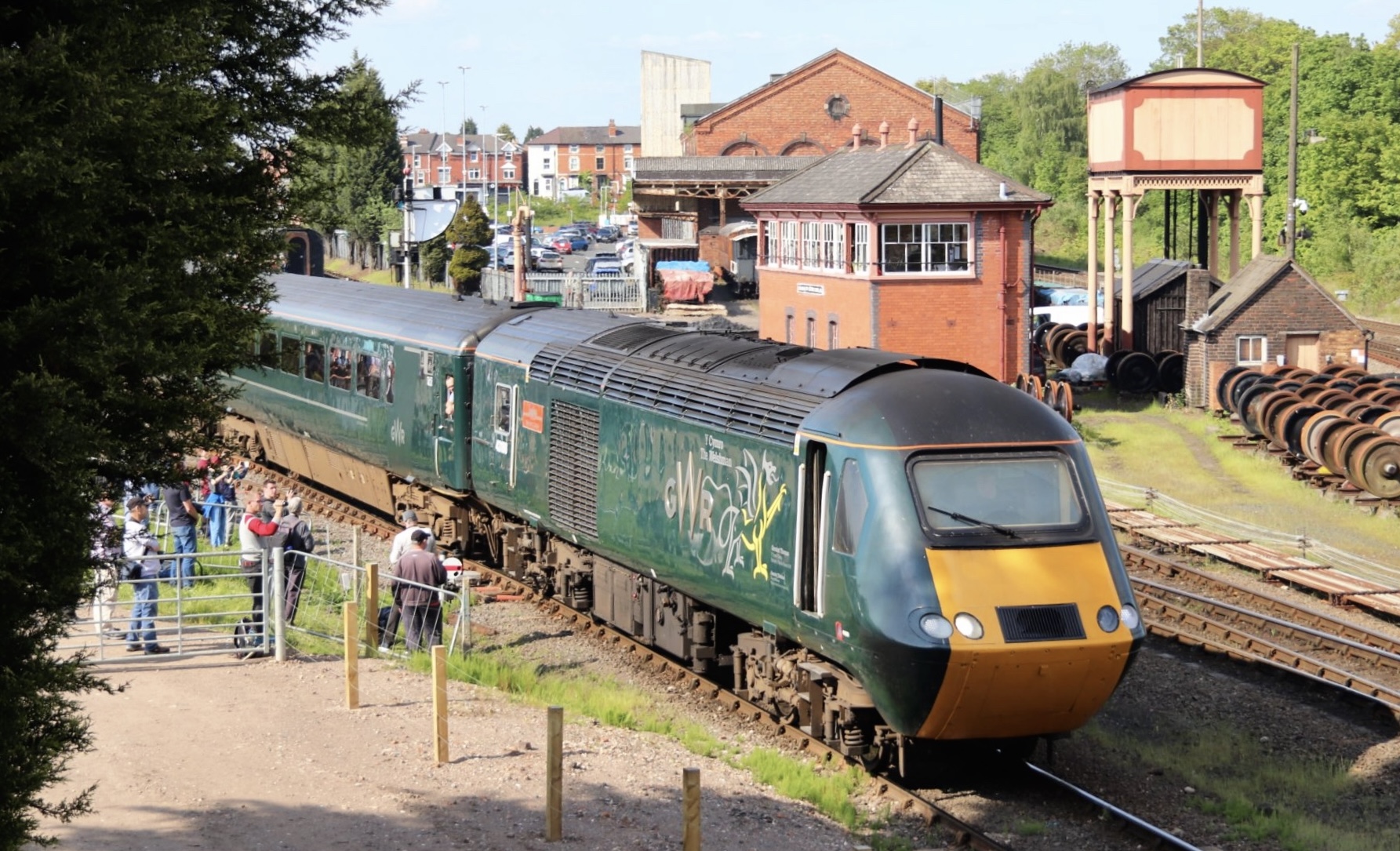
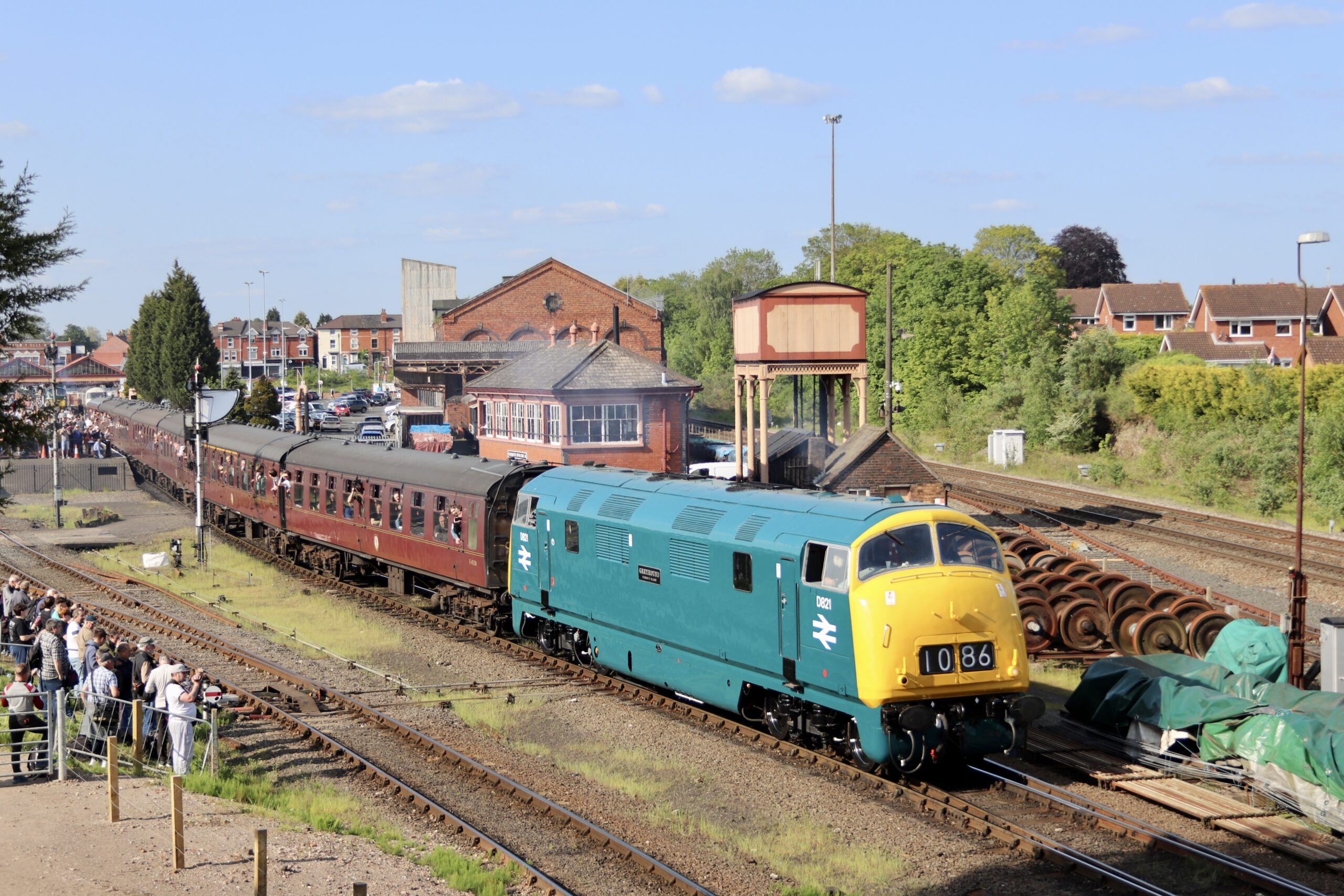
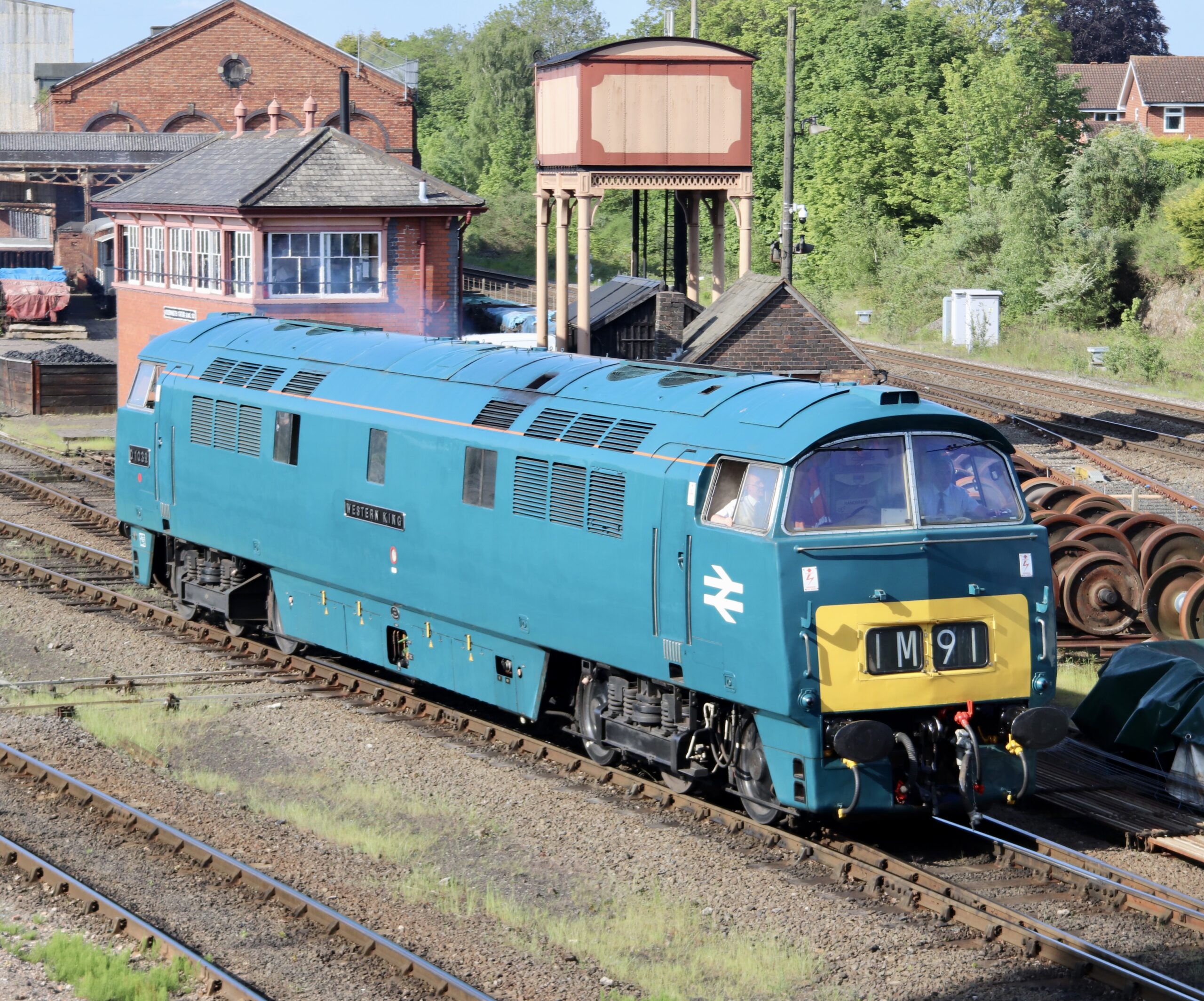
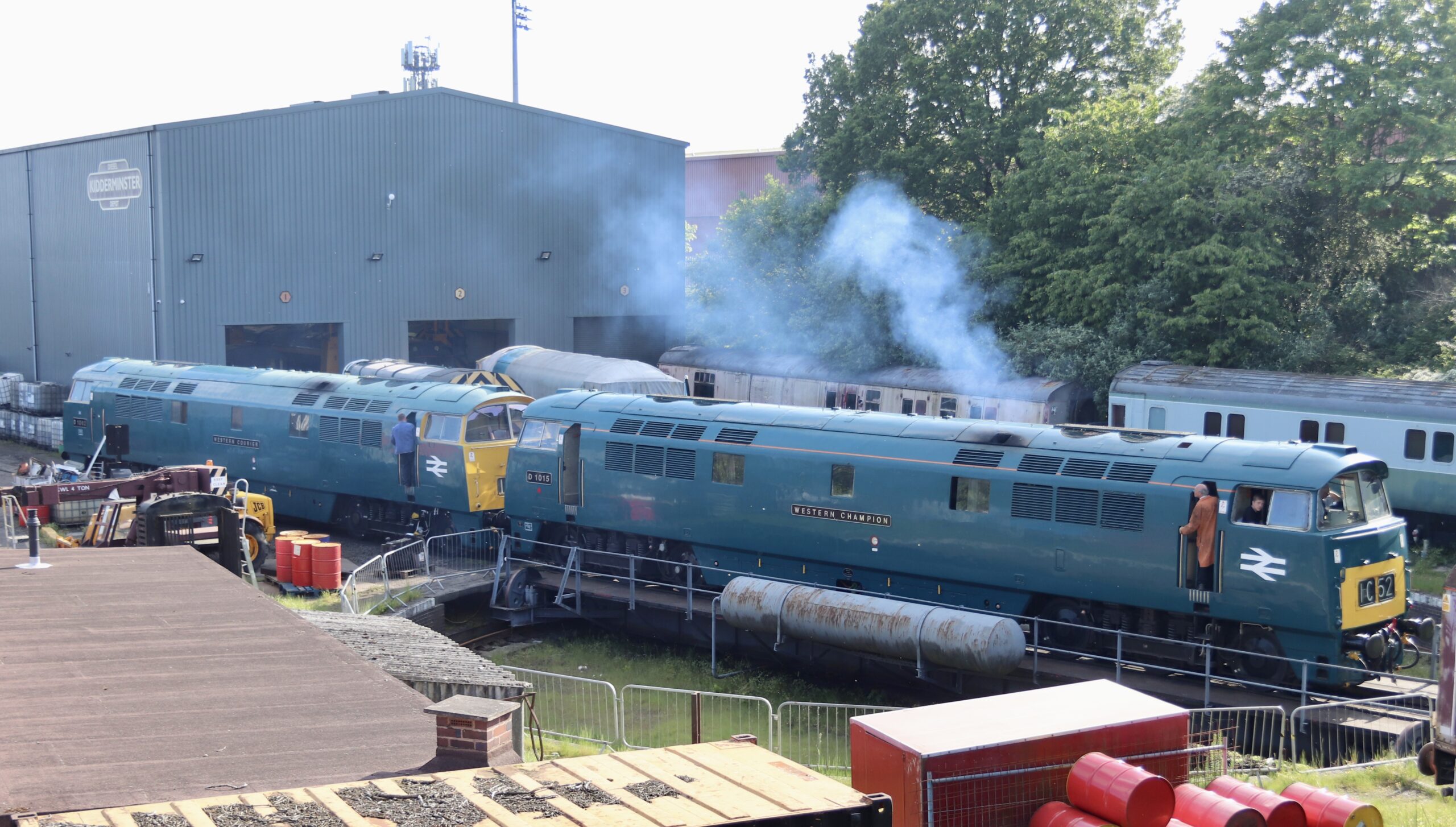
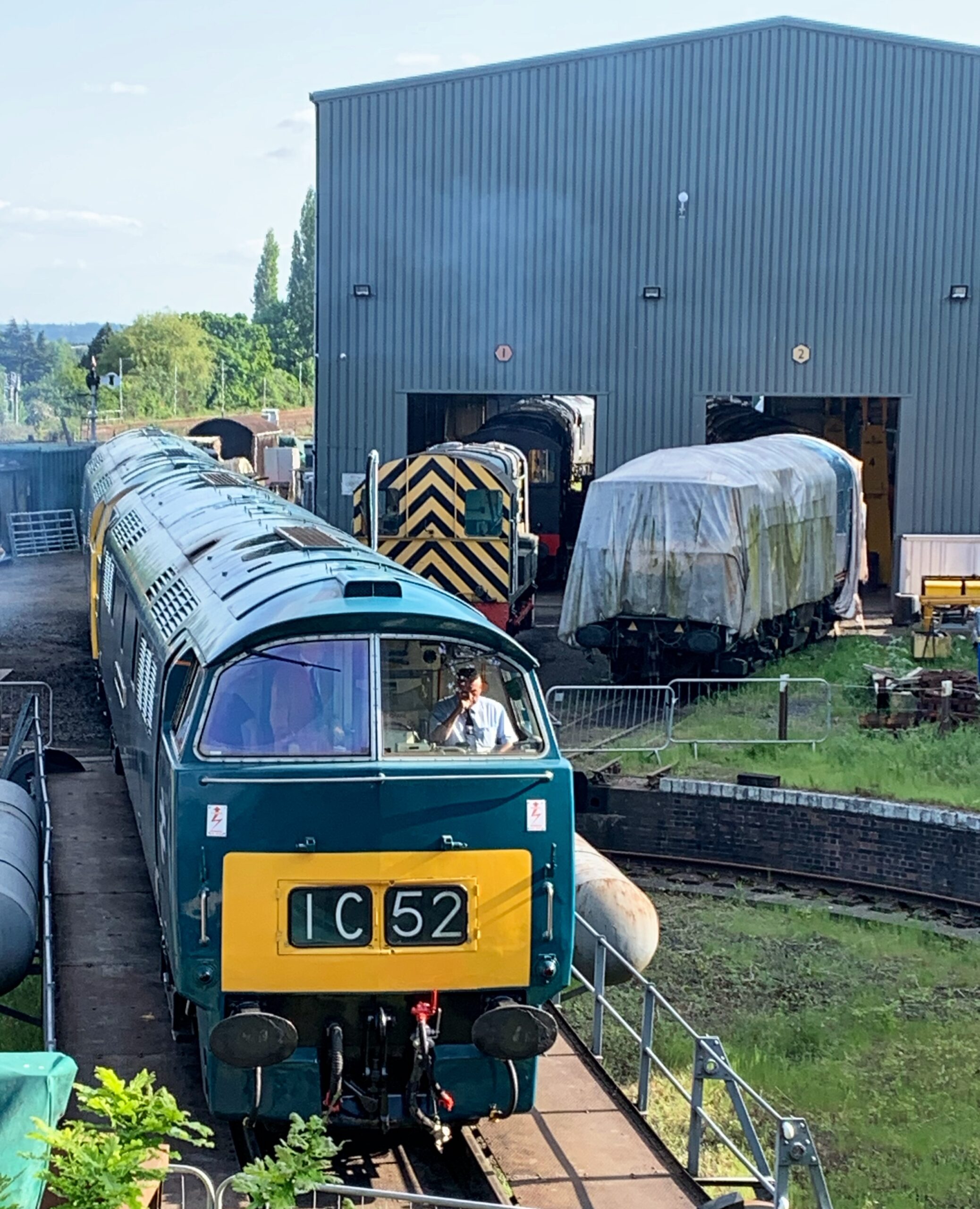
Yoshi took a liking to RailAdventure Class 43 No.’s 43465 and 43484 which only hauled trains on the Friday of the 2023 Severn Valley Diesel Gala and seen here on display the following day at Kidderminster – 20/05/2023
Last week we were enjoying the sun in Cornwall, so our report on our visit to the 2023 Severn Valley Diesel Gala ( which took place 18th – 21st May) is slightly delayed until now. We hope you found our mini blog about Promenade Plantée in Paris interesting and a bit different last week, but for now let us catch up with events at the Severn Valley.
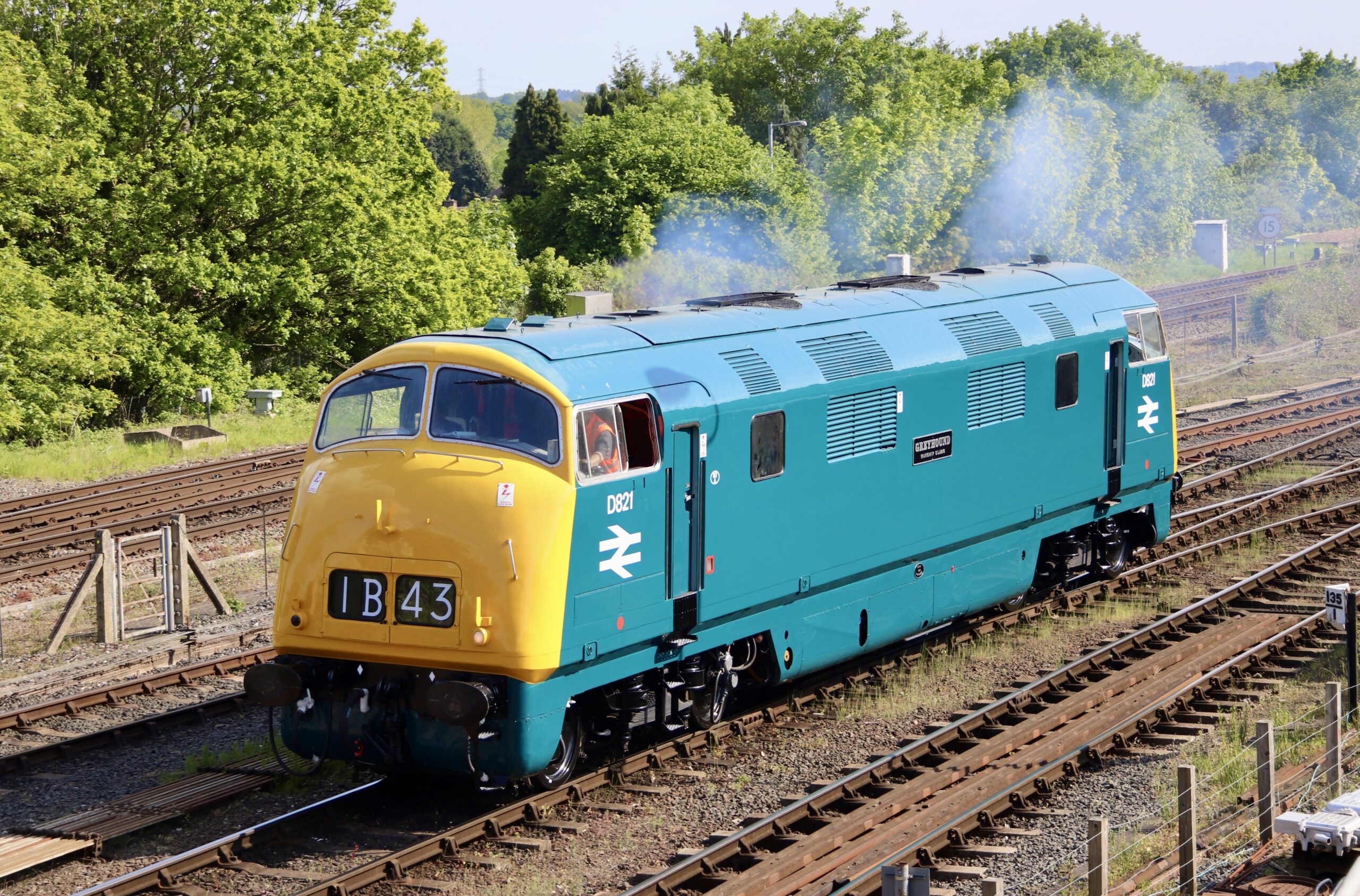
Saturday was my chosen day to visit the SVR as I was heading to the West Country the following day. The timetable for the gala was a packed affair with a large roster of resident and visiting locomotives scheduled to run, many of which were provided by freight and passenger operating companies. Indeed, the SVR event was undoubtably the biggest diesel gathering in the UK calendar for 2023, with its planned four-day extravaganza intended as a celebration of 50 years of diesel preservation. An early departure from home was required in the hope of seeing everything running. A few missed turnings and a closed motorway junction delayed our arrival time but in the event we arrived at Highley just in time to see sole-surviving Clayton Class 17 No. D8568 arrive with the first train of the day from Bridgnorth. Unfortunately there were no available parking spaces at the station, so we reversed out and headed up out of the car park to find alternative facilities. Although I later managed to capture a short video clip of the Clayton running light engine within the Highley station area, the locomotive avoided my camera lens for a still photo opportunity. As this particular diesel had been at Swanage the previous weekend, I didn’t mind too much!
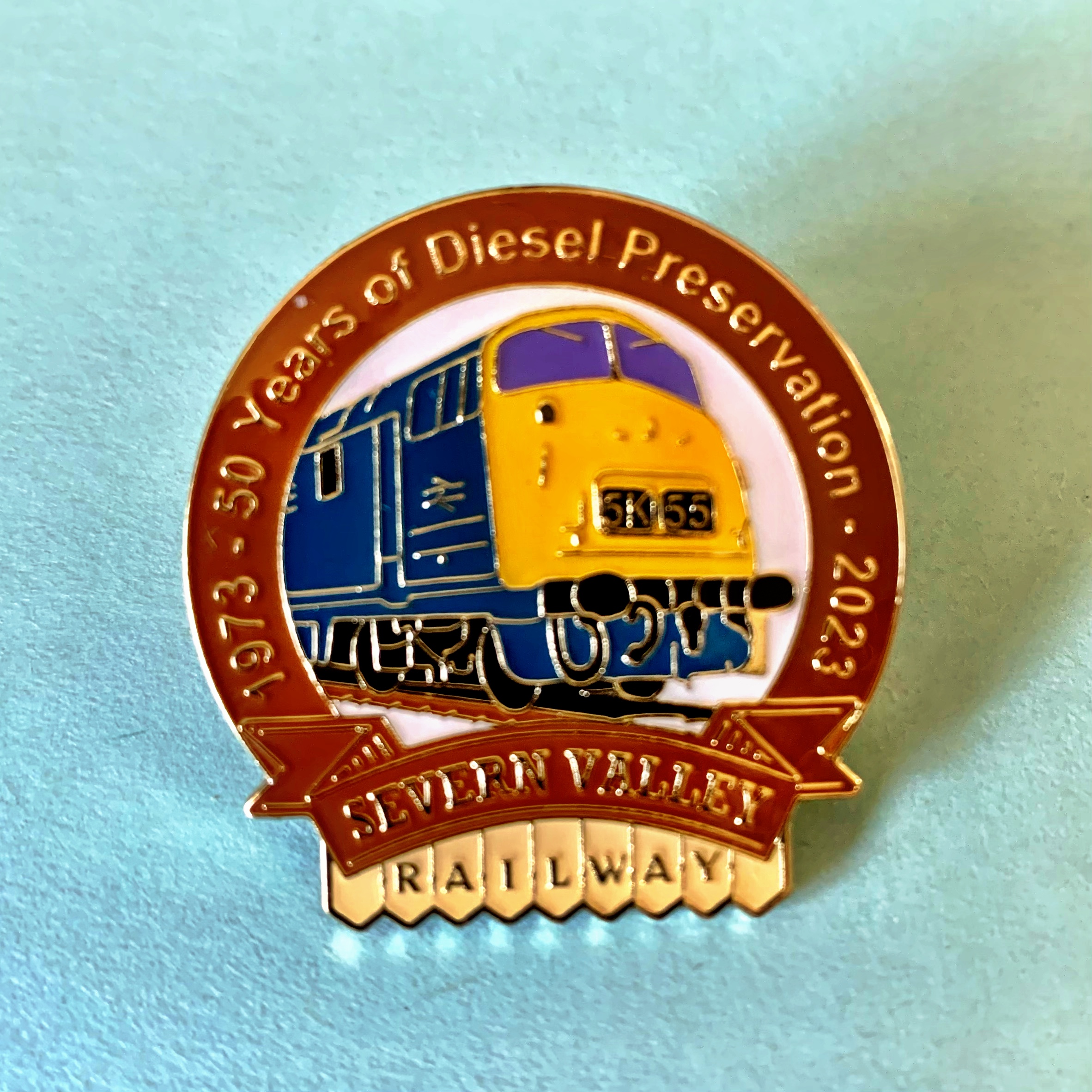
They even made a special badge to celebrate 50 years of Diesel Preservation!
We had however trooped back down to Highley station in time to see Class 31 No. 31270, quite suiting her Regional Railways livery, arriving with the 0845 departure from Kidderminster. Although the first two trains on the Saturday were spot on for their time-keeping, it didn’t take too long for the timetable to go awry and things became progressively more delayed as the day went on.
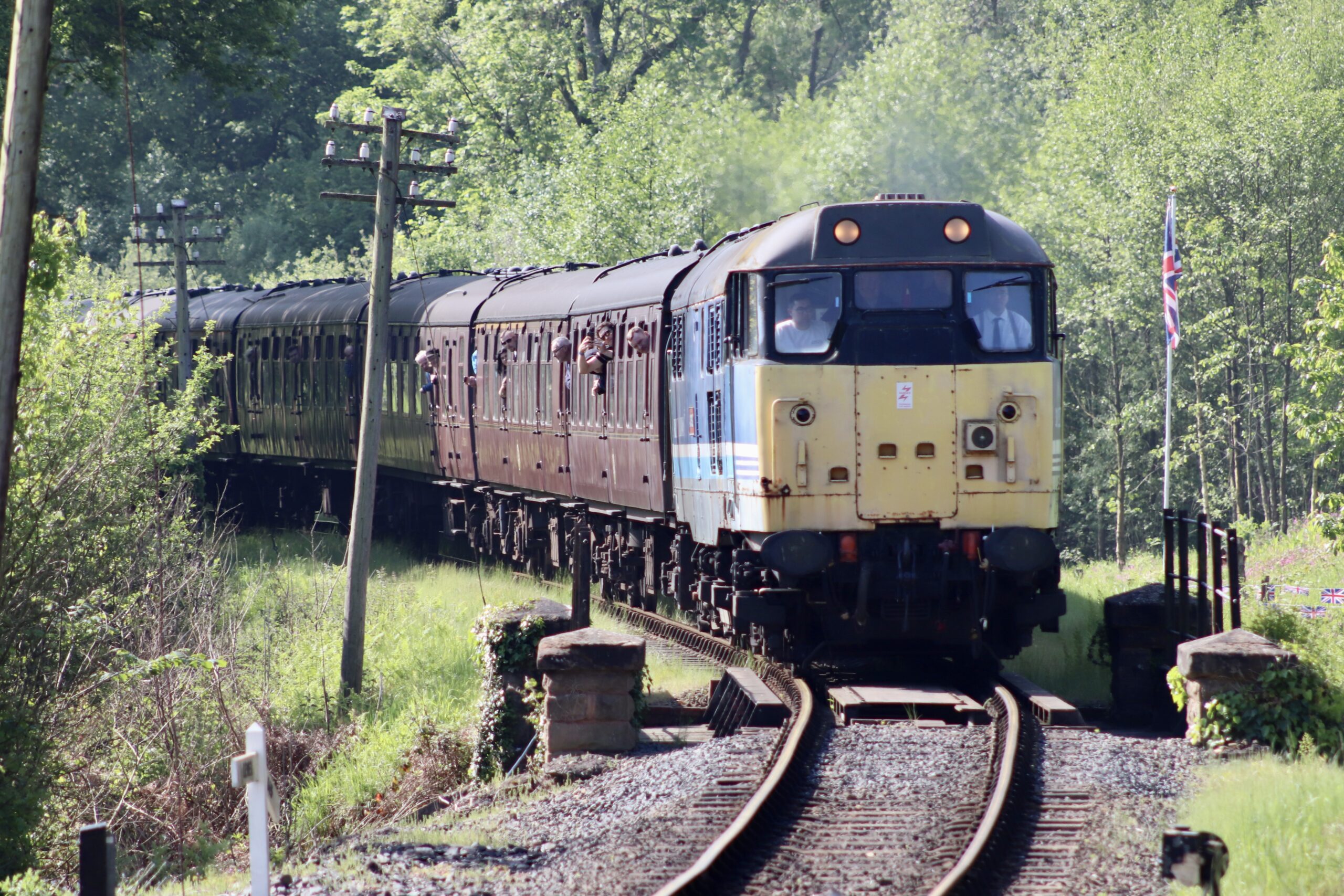
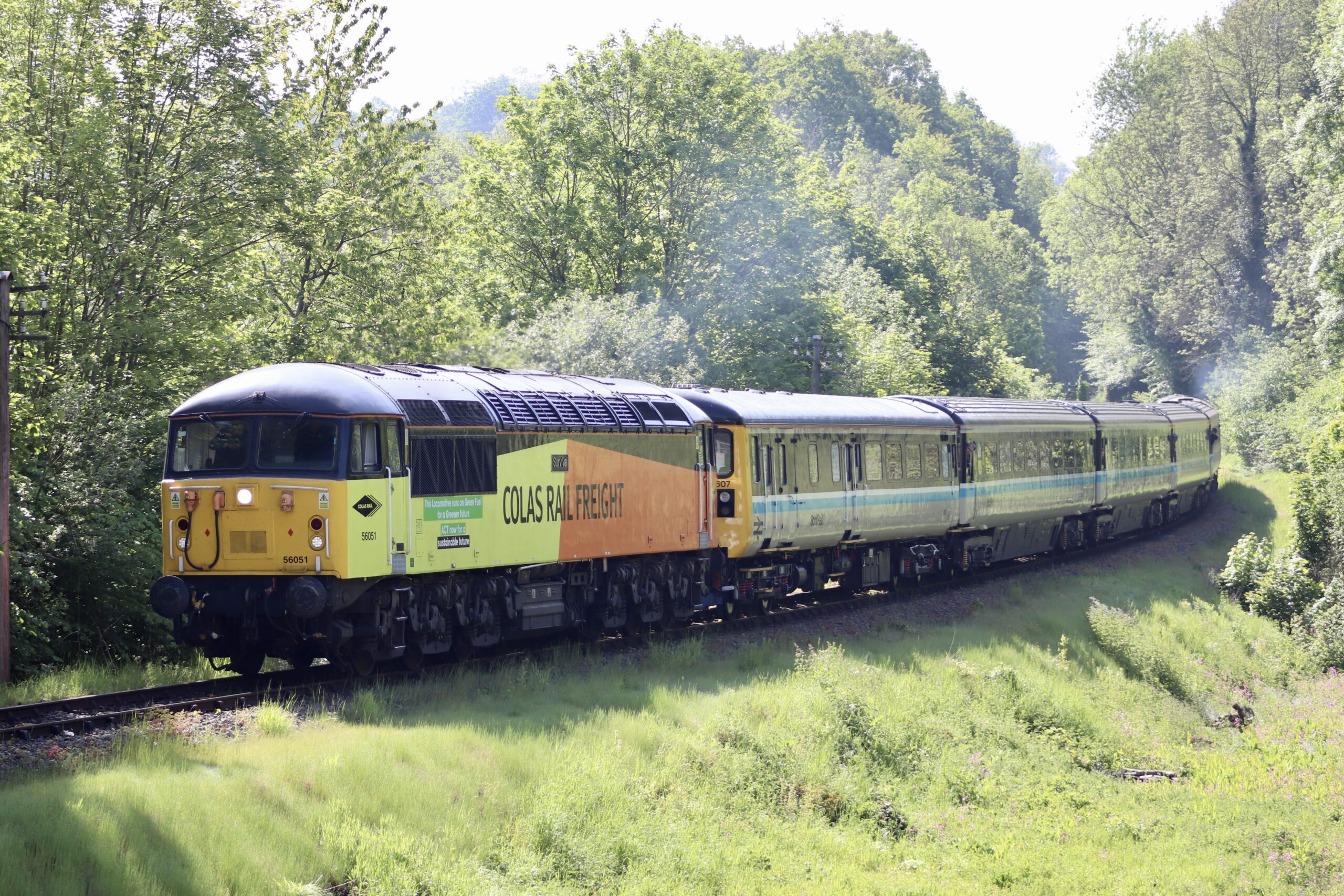
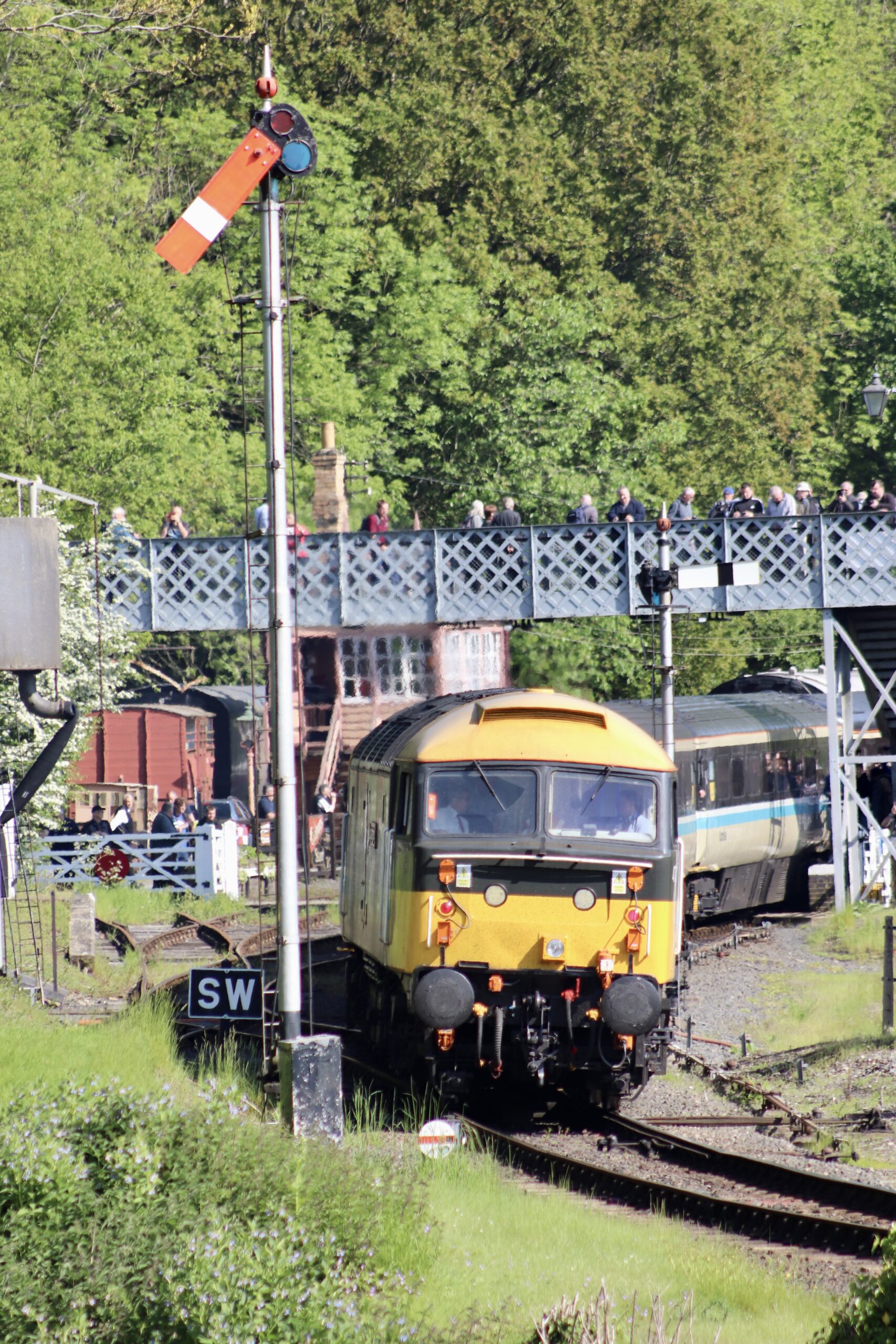
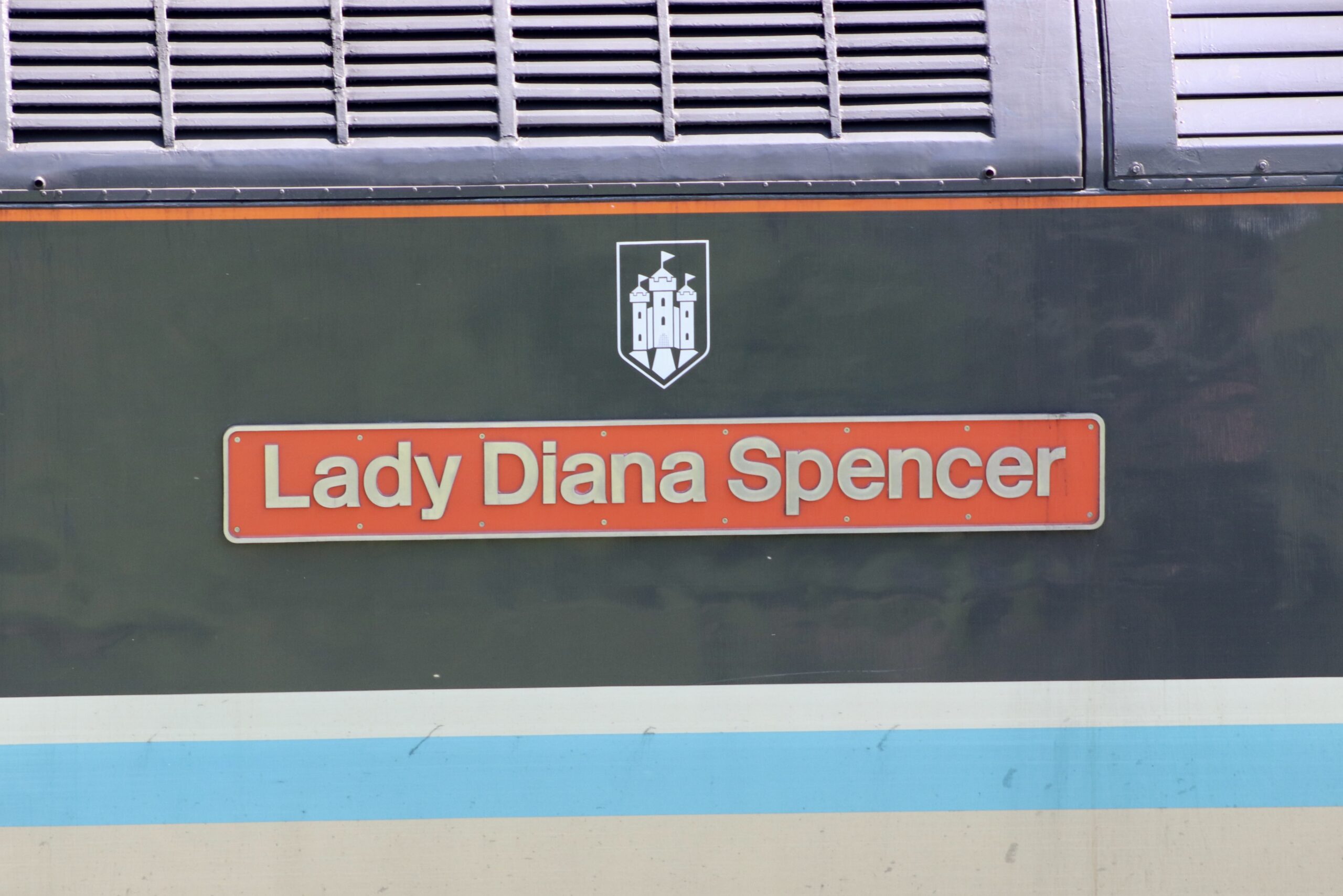
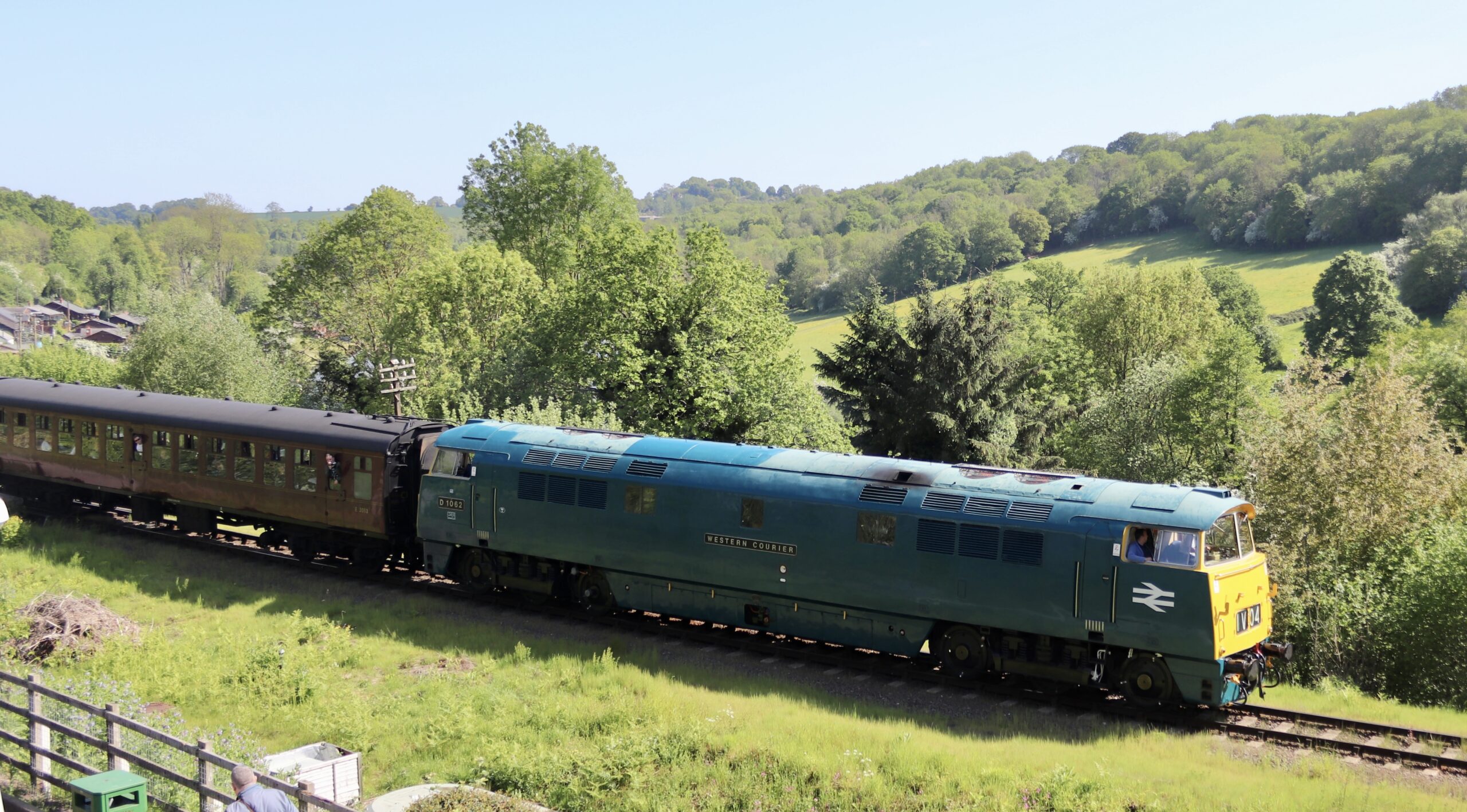
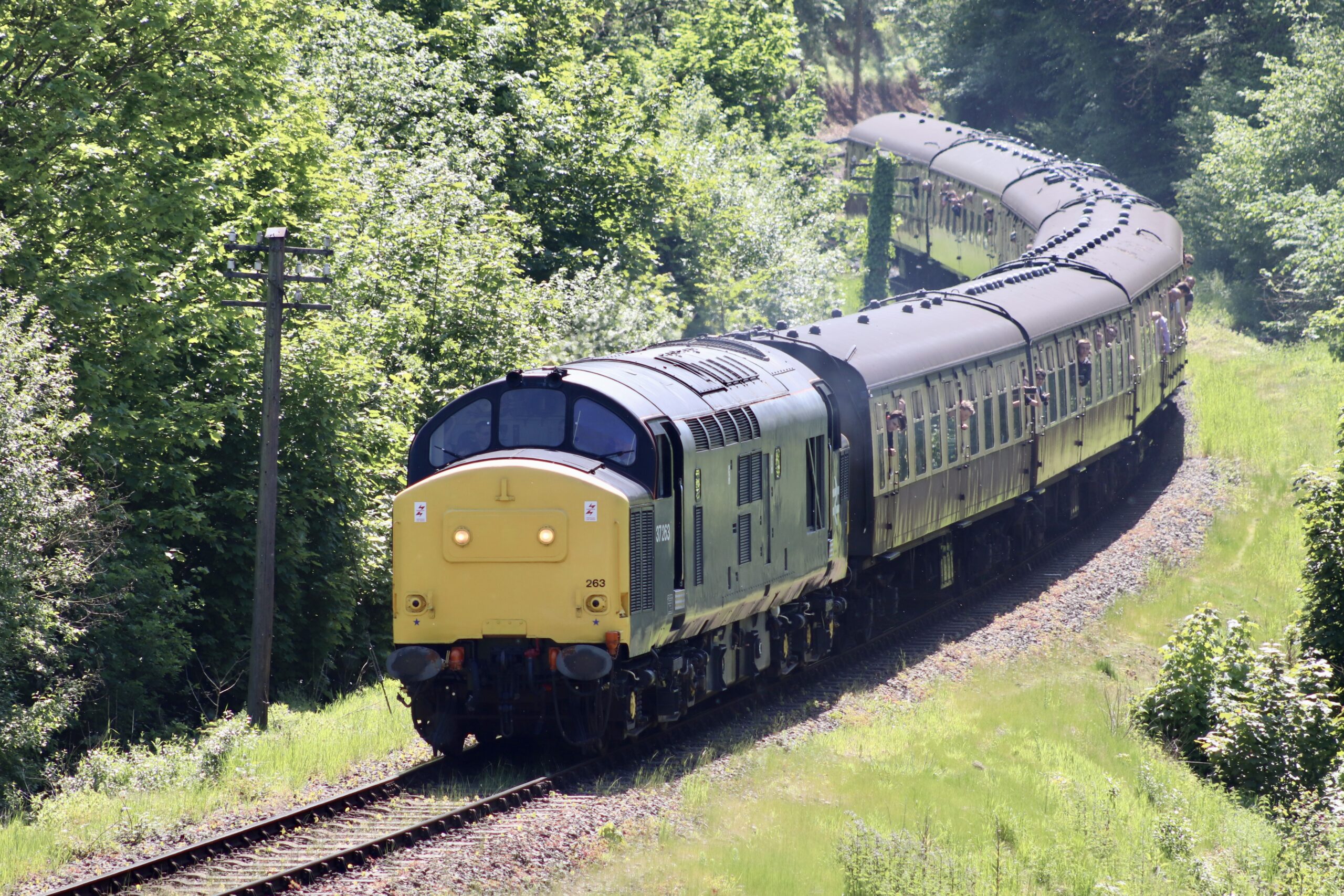
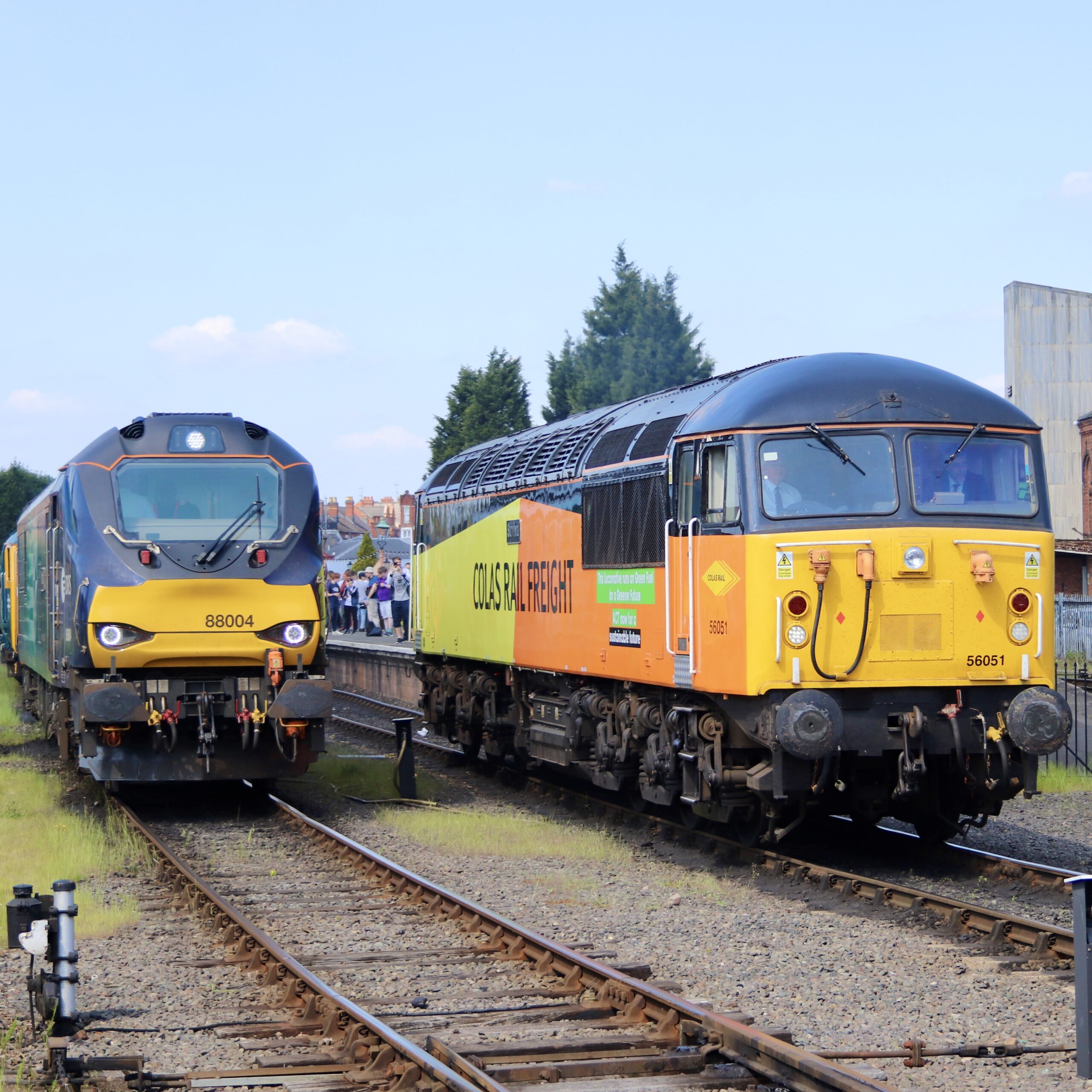
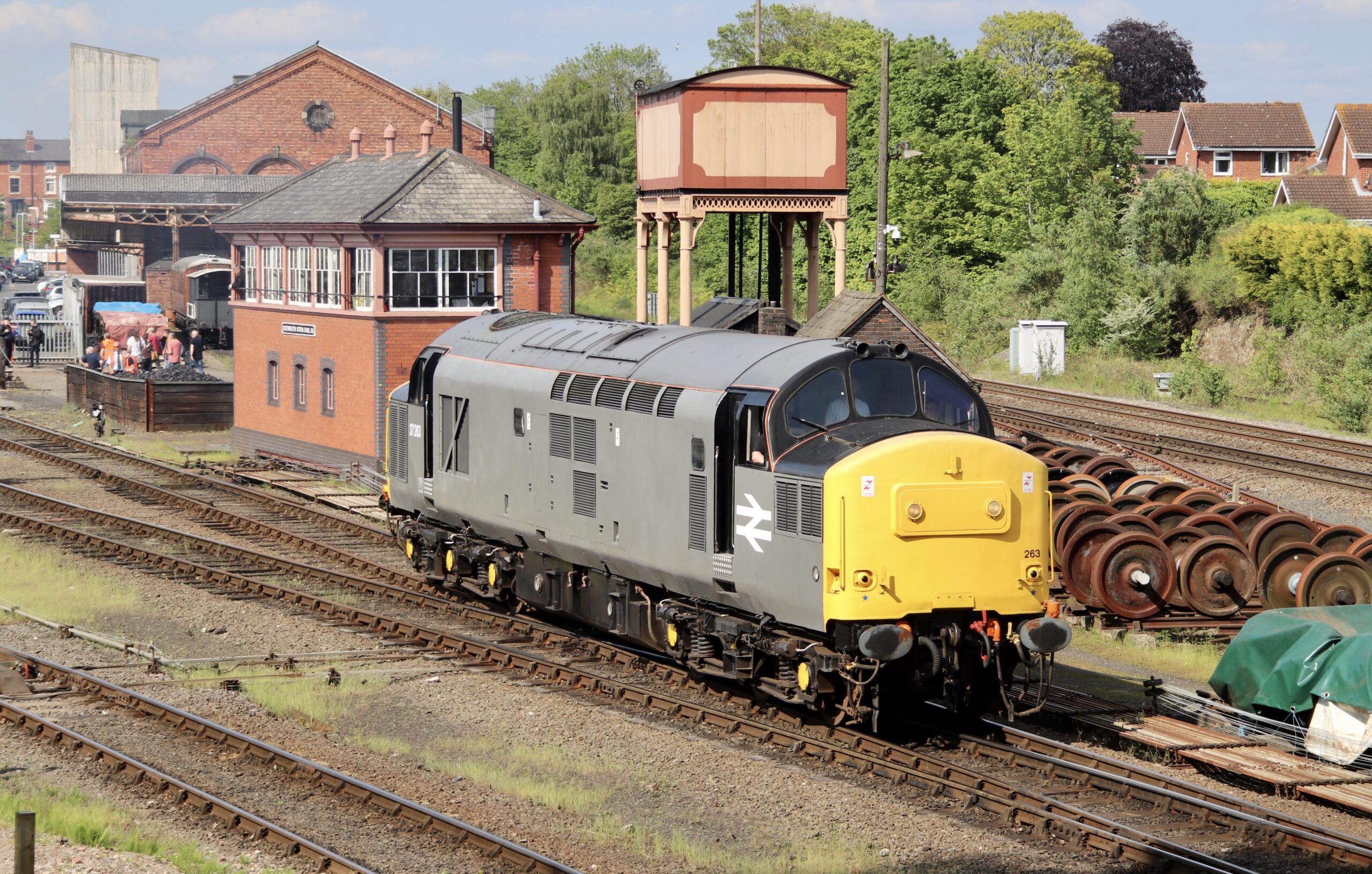
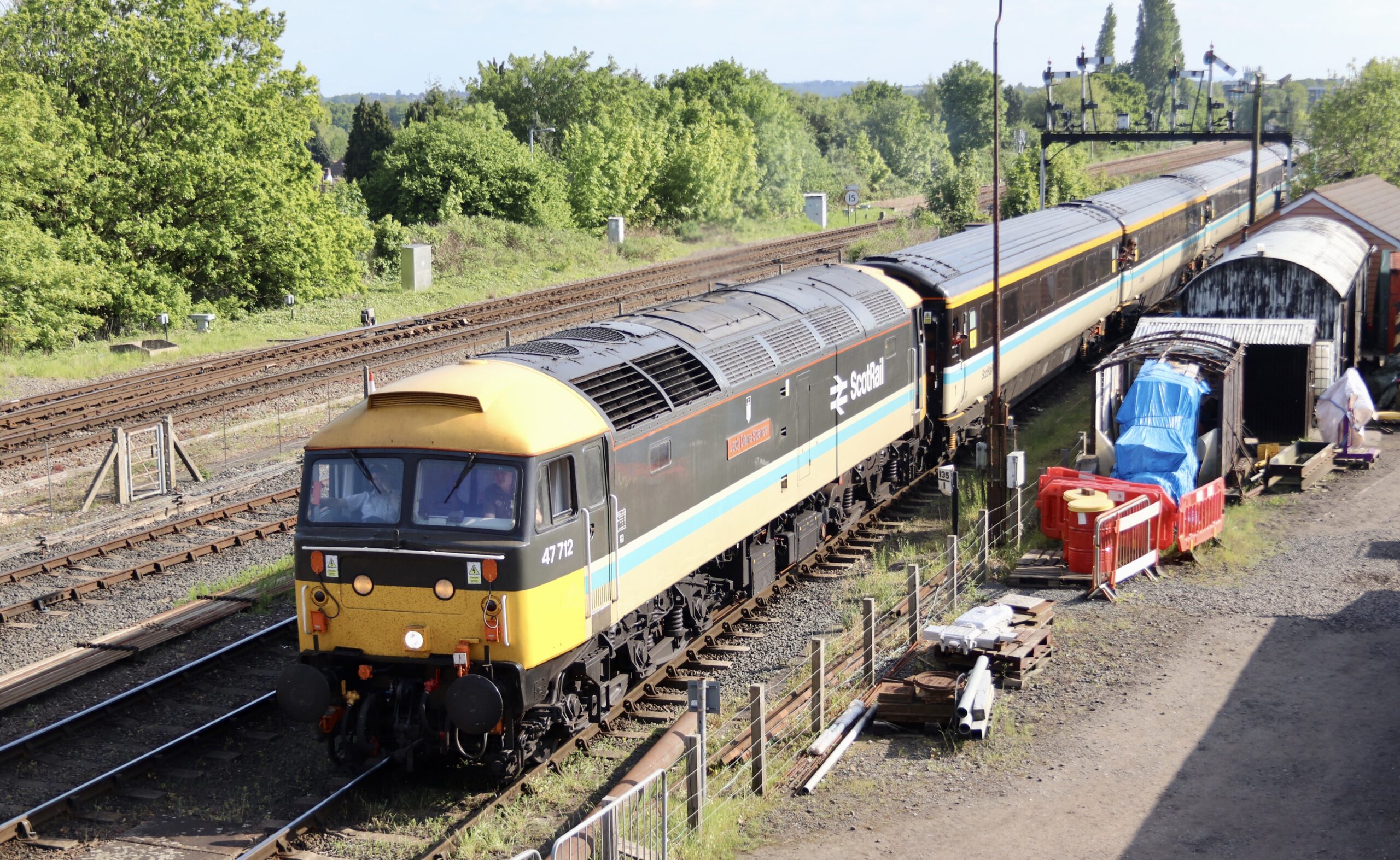
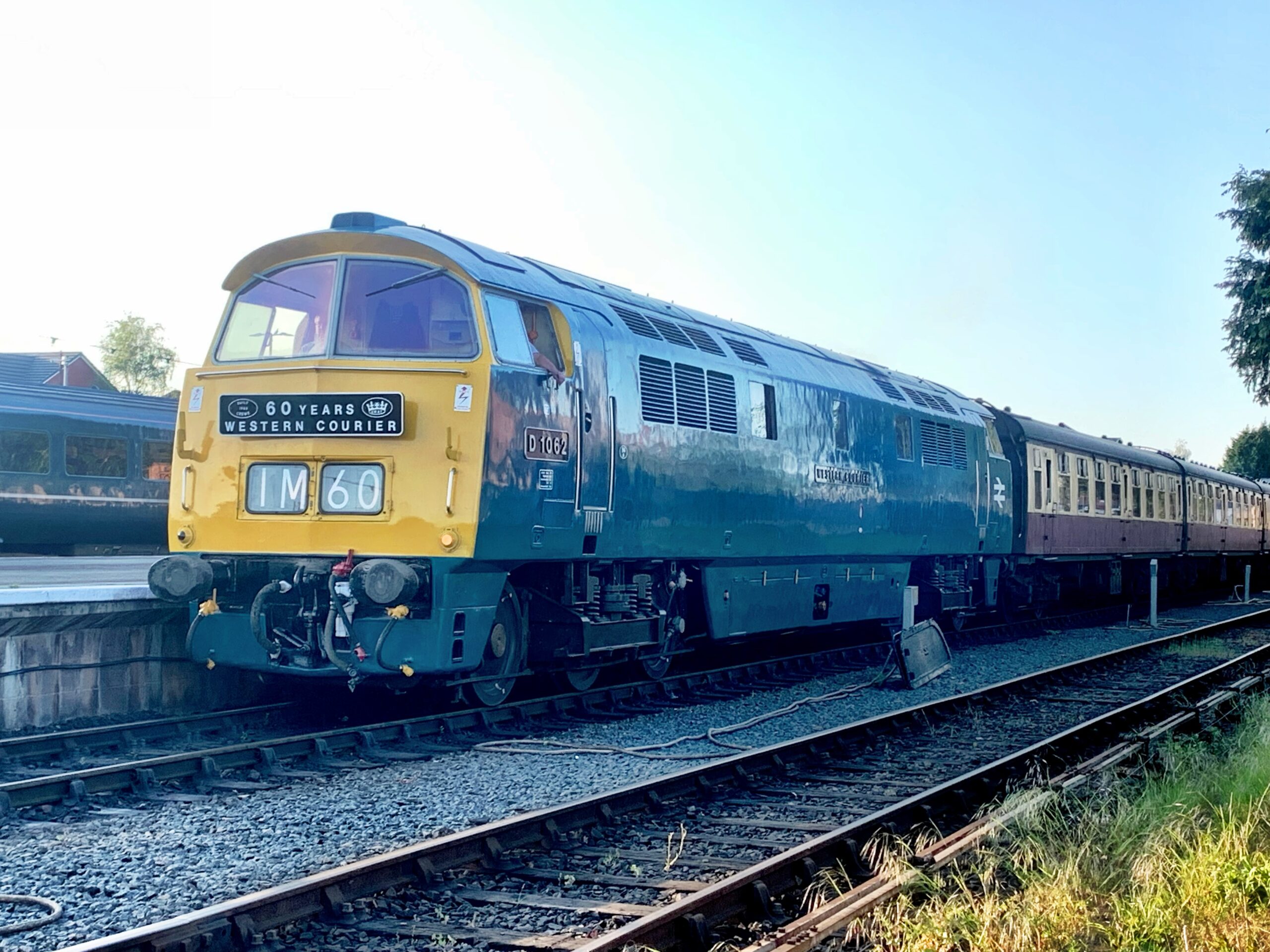
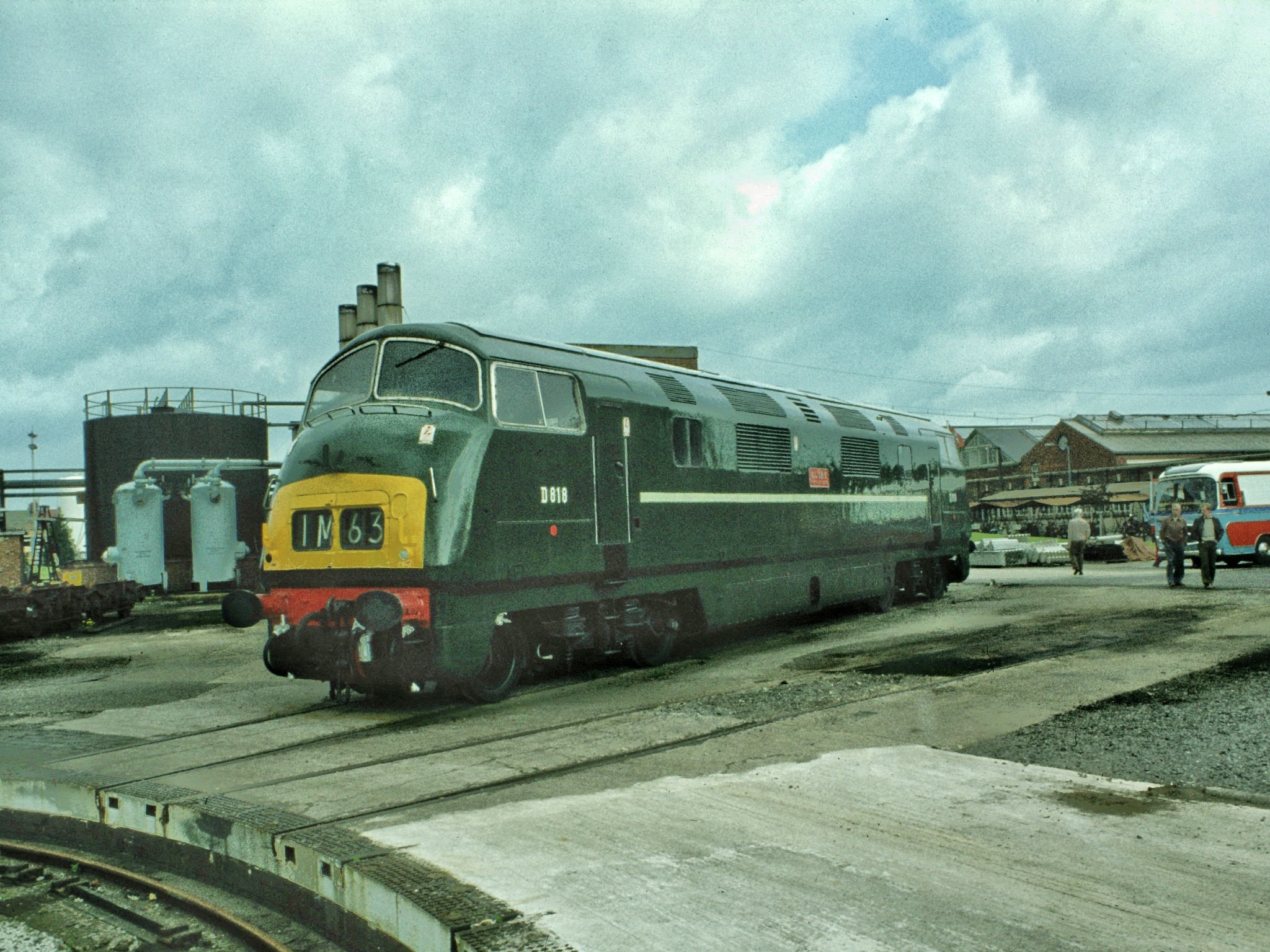
Peak Rail’s Brush Type 2 Class 31 A1A-A1A No. 31270 ‘Athena’ in British Rail (BR) Regional Railways sector livery approaches Highley. No. 31270 was built by Brush Ltd in Loughborough in 1961 and carried the pre-TOPS number D5800. She was withdrawn from traffic on 26th May 2000. She never carried this livery or the nameplate while in BR service – 20/05/2023Colas Rail Freight Class 56 No. 56051 ‘Survival’, built in 1978, on the approach to Highley with the Locomotive Service Ltd (LSL) restored ScotRail MK3 carriages that reproduce the push-pull stock used between Glasgow, Edinburgh and Aberdeen in the 1980’s – 20/05/2023Scottish Push-Pull Class 47 No. 47712 ‘Lady Diana Spencer’ prepares to depart Highley. This locomotive and rake of air braked push-pull stock was paired with different visiting locomotives throughout the gala, top and tailing between Kidderminster and Highley. I thought it was a shame the loco and stock didn’t perform at least one run a day in push-pull mode as it had reportedly done on the Thursday – 20/05/2023Class 47 No. 47712 ‘Lady Diana Spencer’ nameplate – 20/05/2023Diesel- Hydraulic Western Class 52 No. D1062 ‘Western Courier’ departs Highley. This locomotive was built at Crewe Works and entered service at London’s Old Oak Common shed on 6 May 1963. She was withdrawn by British Rail on 23 August 1974 after 1,096,000 miles in service. Courier was an early withdrawal but was lucky enough to share “mascot” duties with Class 42 Warship No. D818 ‘Glory’, being placed on the turntable at Swindon works and given a repaint by the apprentices – 20/05/2023Class 37 No. 37263 displaying departmental grey livery approaches Highley. No. 37263 was introduced into traffic in 1965 and is visiting from the Telford Steam Railway – 20/05/2023
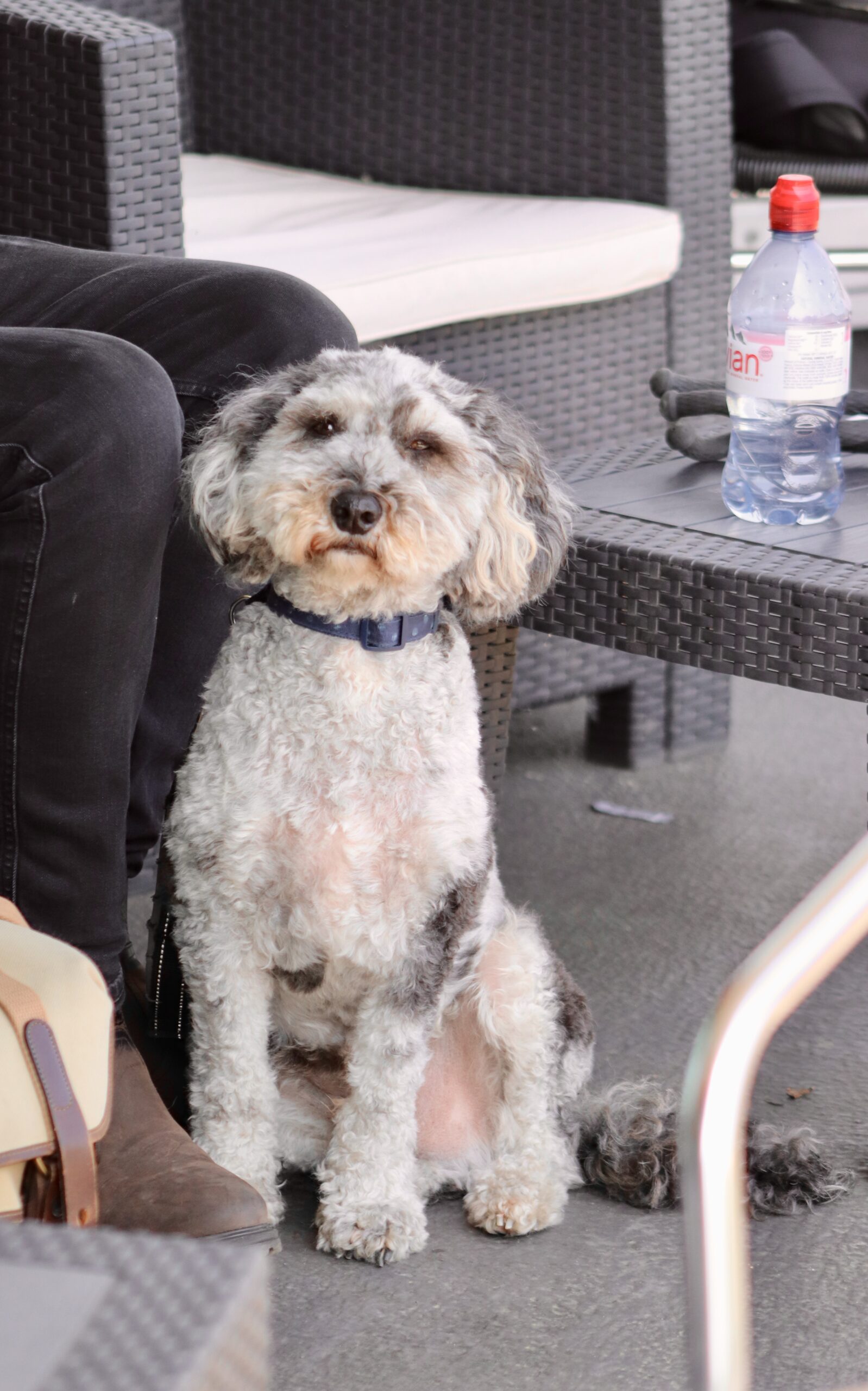
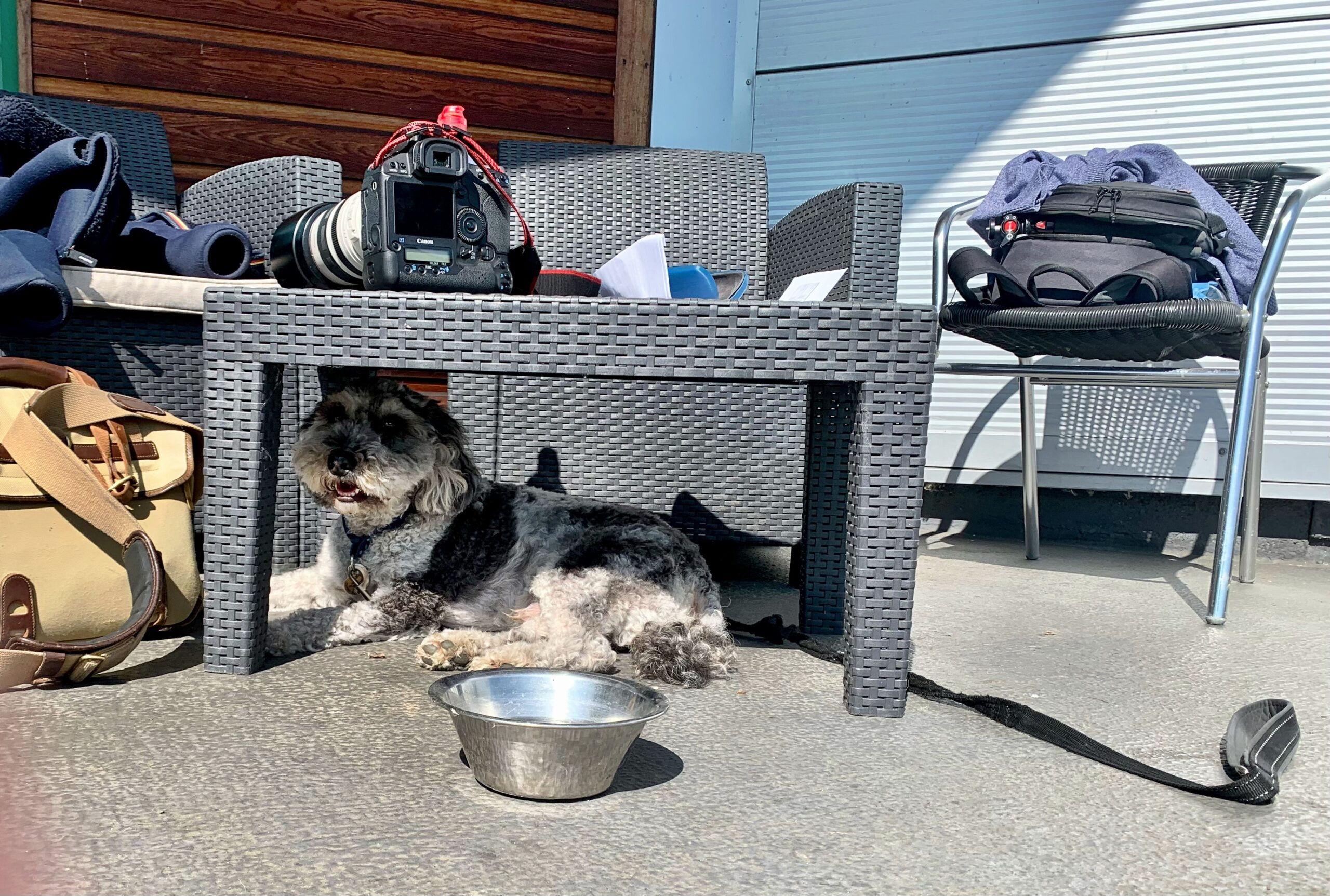
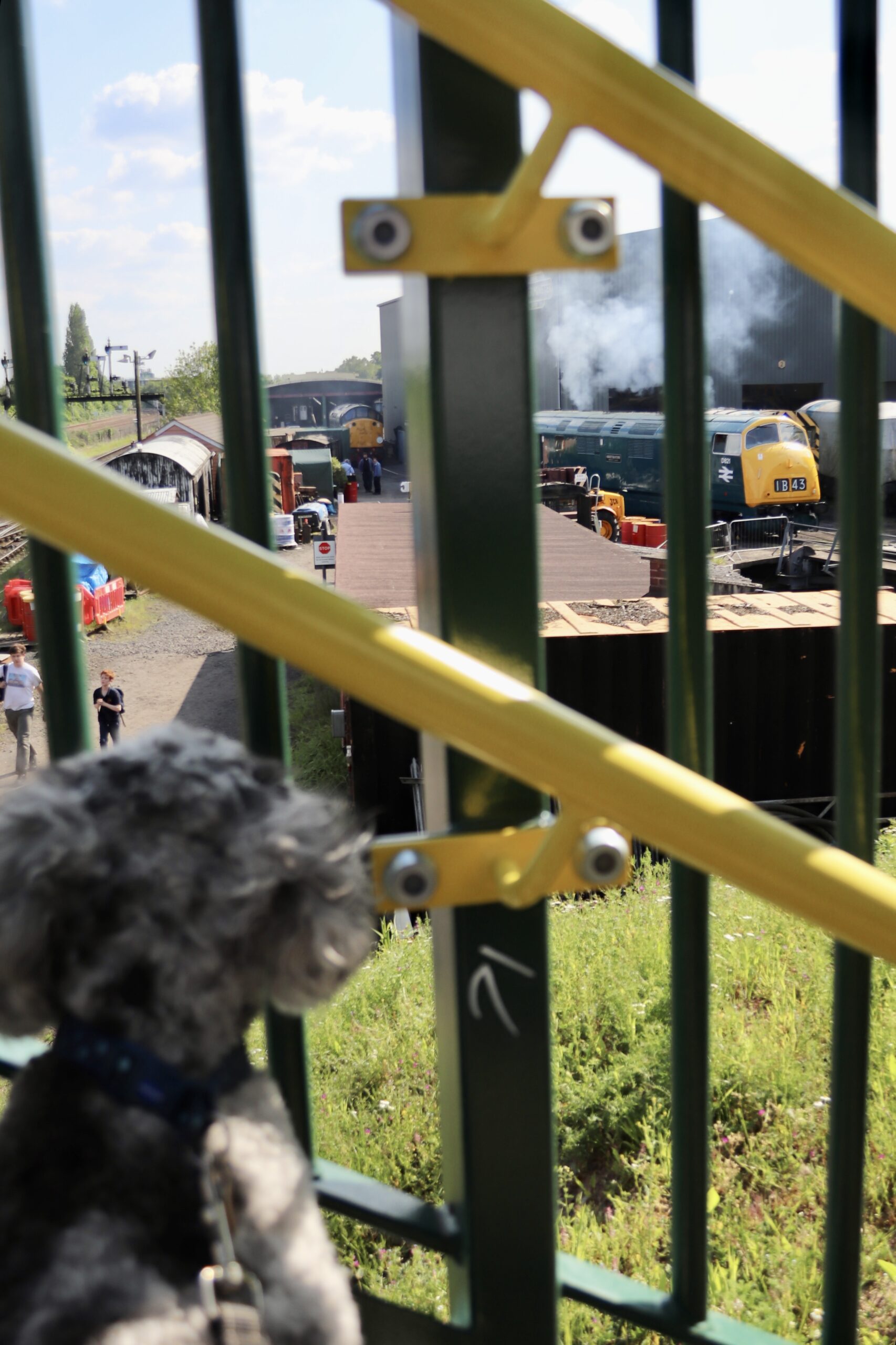
The weather was extremely warm and I made the decision to stay on the viewing balcony at Highley as this ensured Yoshi was able to stay in the shade and not get over heated. He also seems to like it there as he gets lots of fuss from passers by and doesn’t seem too bothered by the trains passing below. It’s also close to the cafe, so despite issues with the new coffee machine, what could be better? On the downside, of course, it means that my photographs and video from Highley are from much the same two angles, but I’ll take this provided our boy is comfortable.
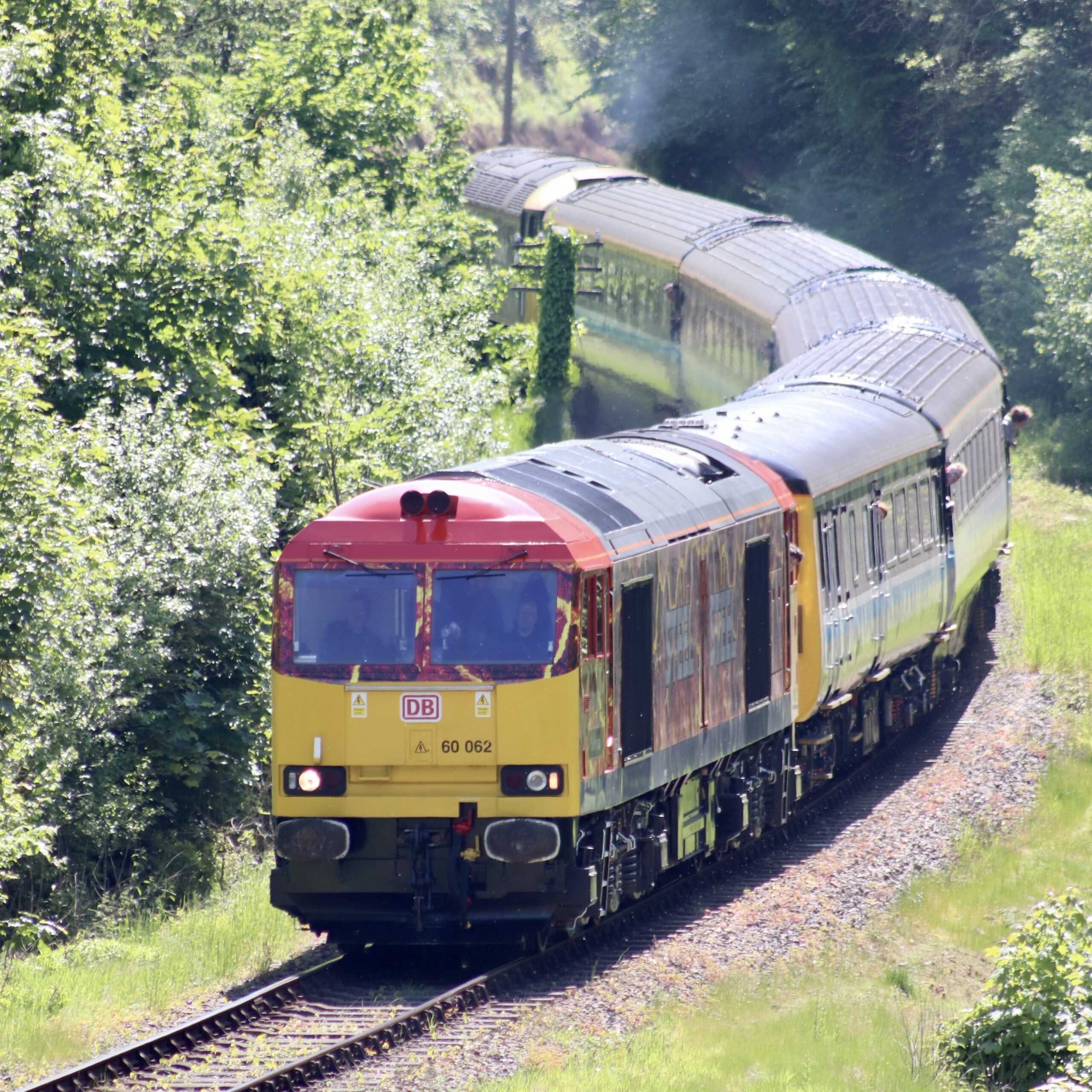
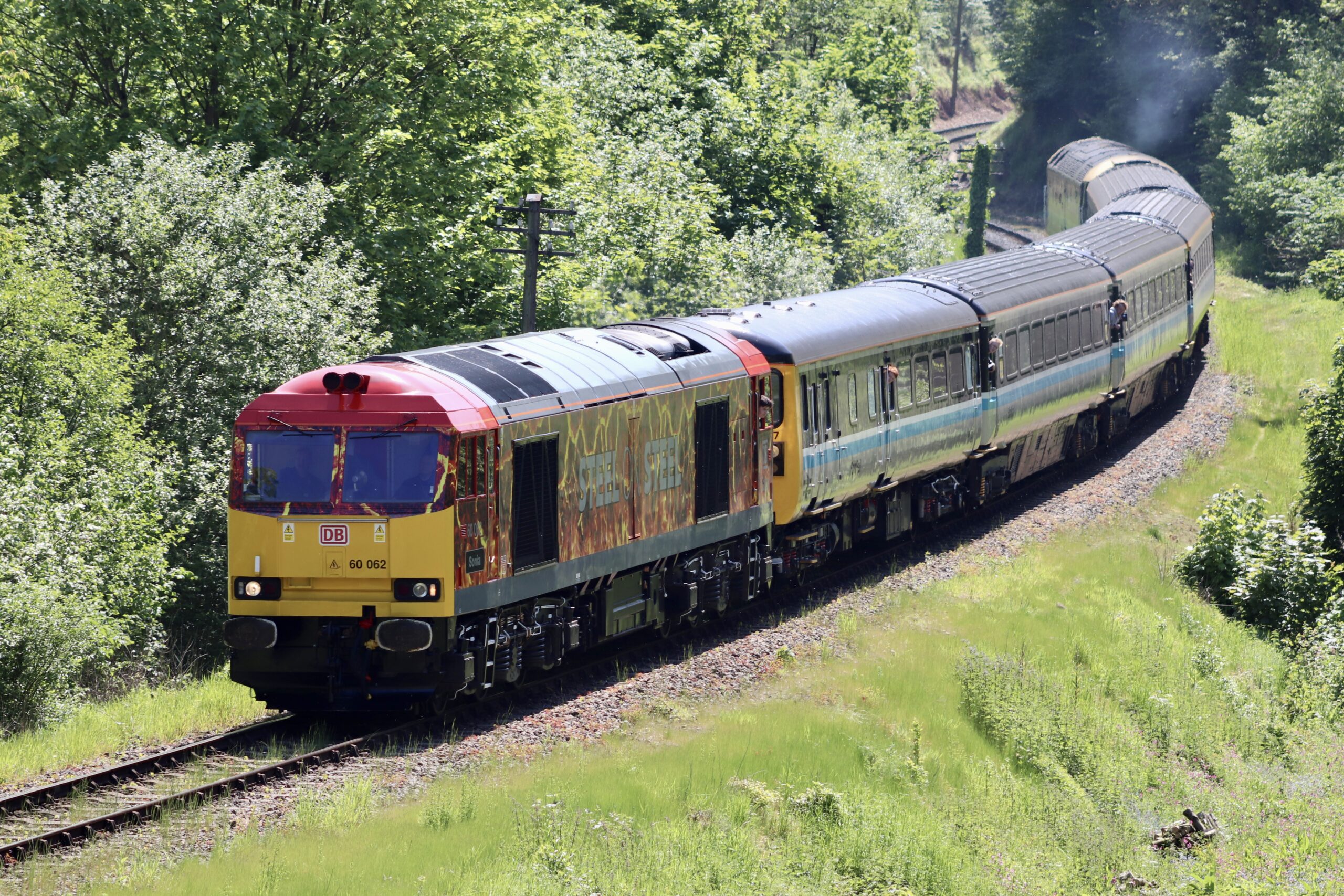
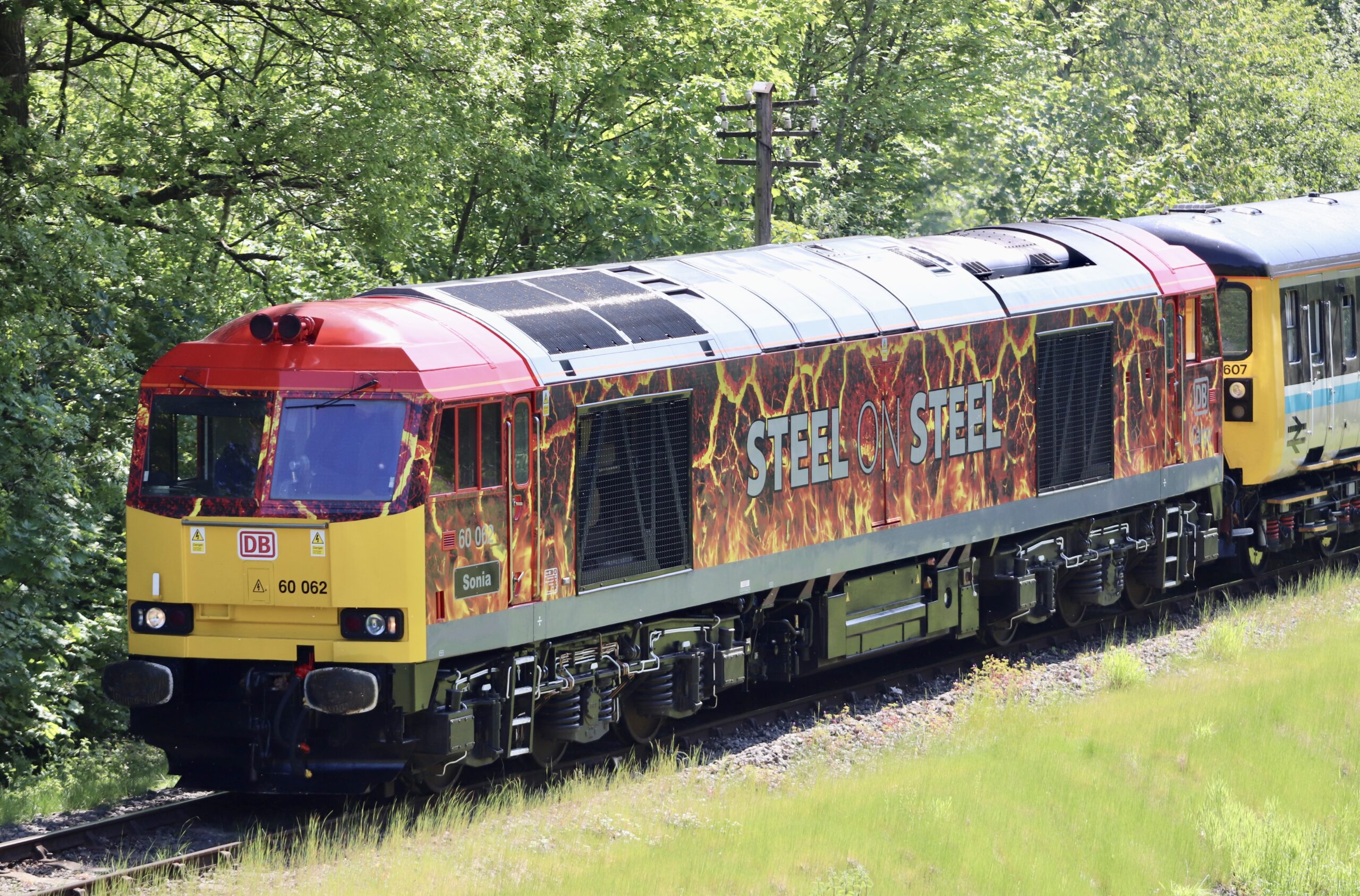
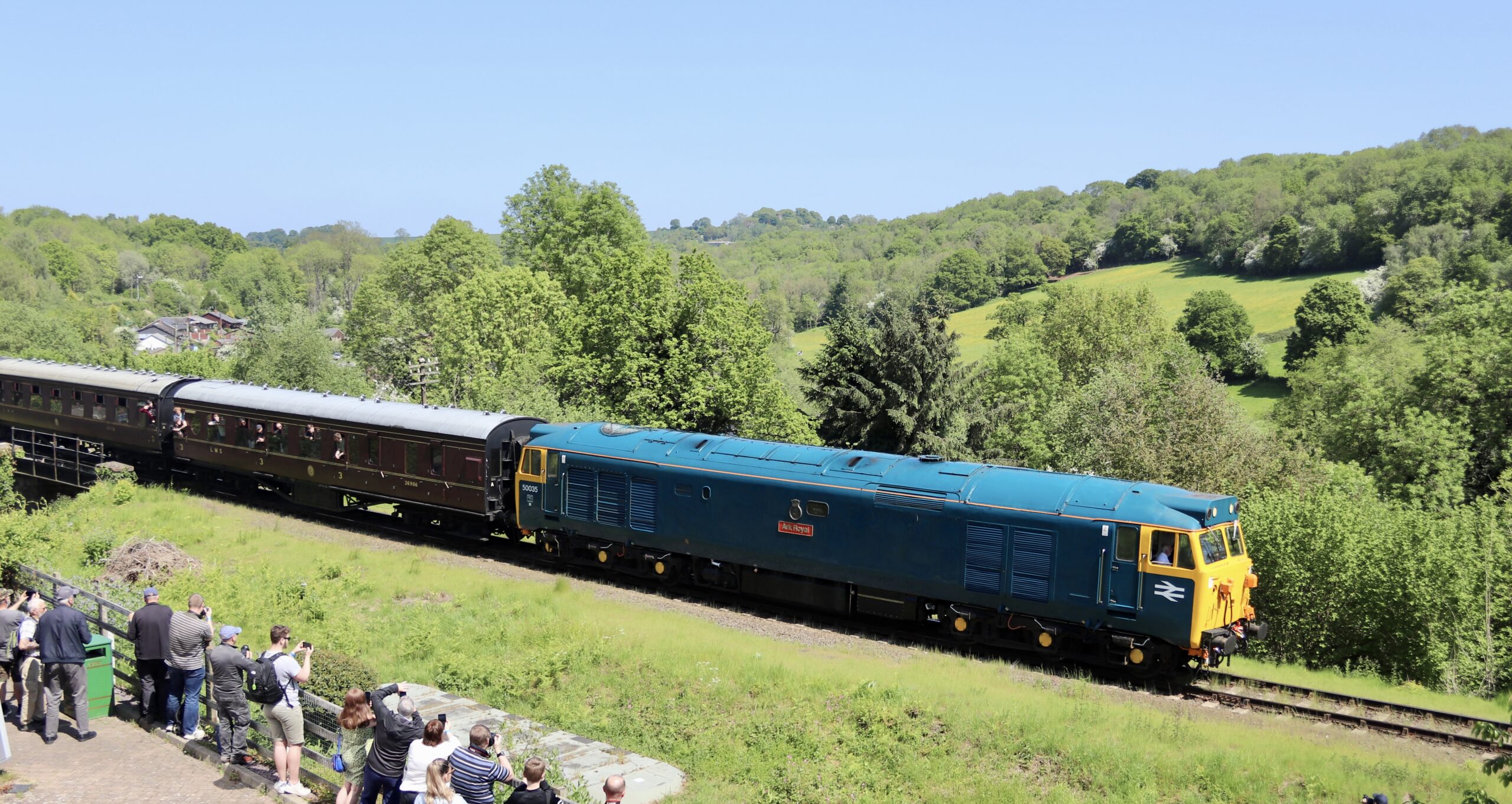
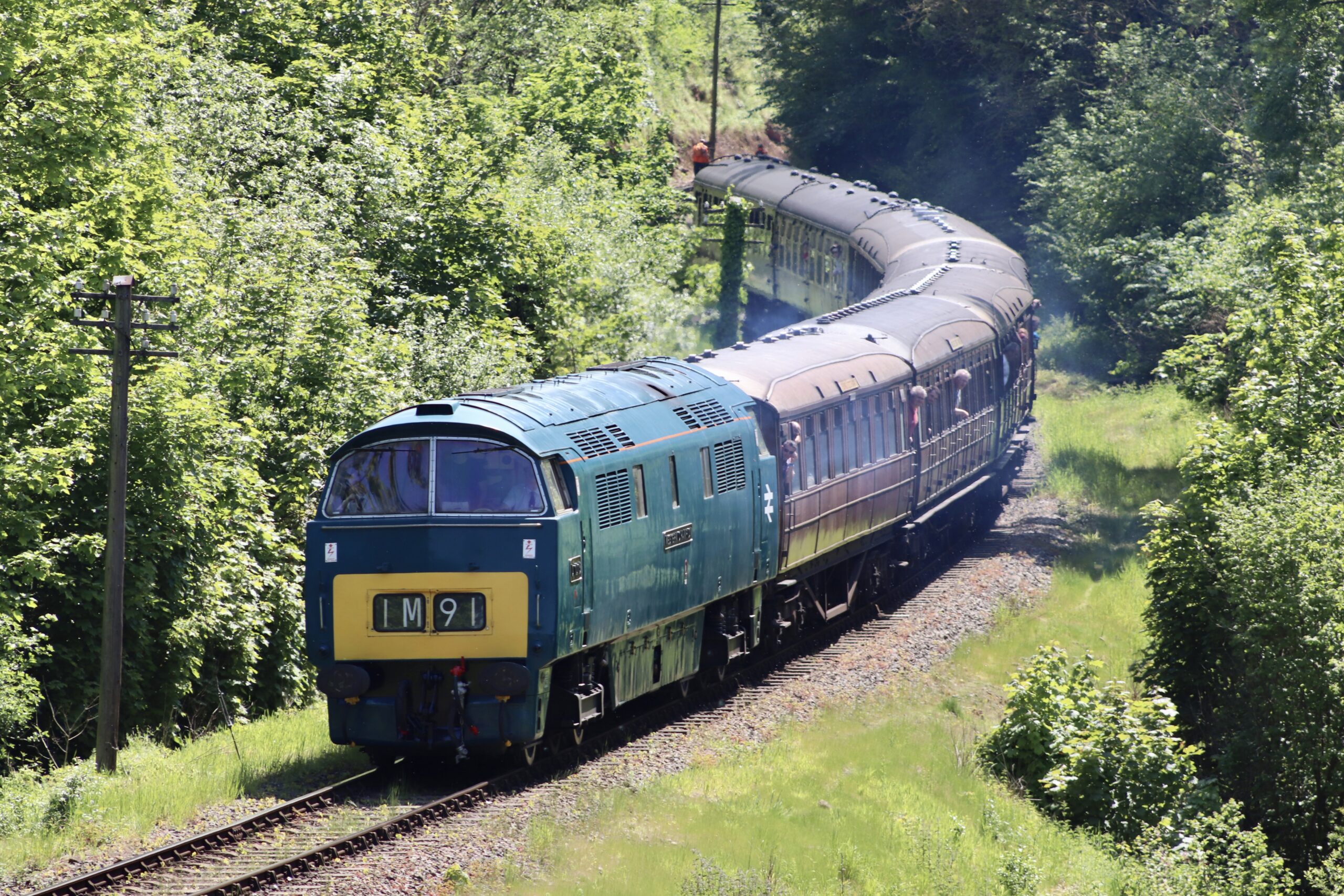
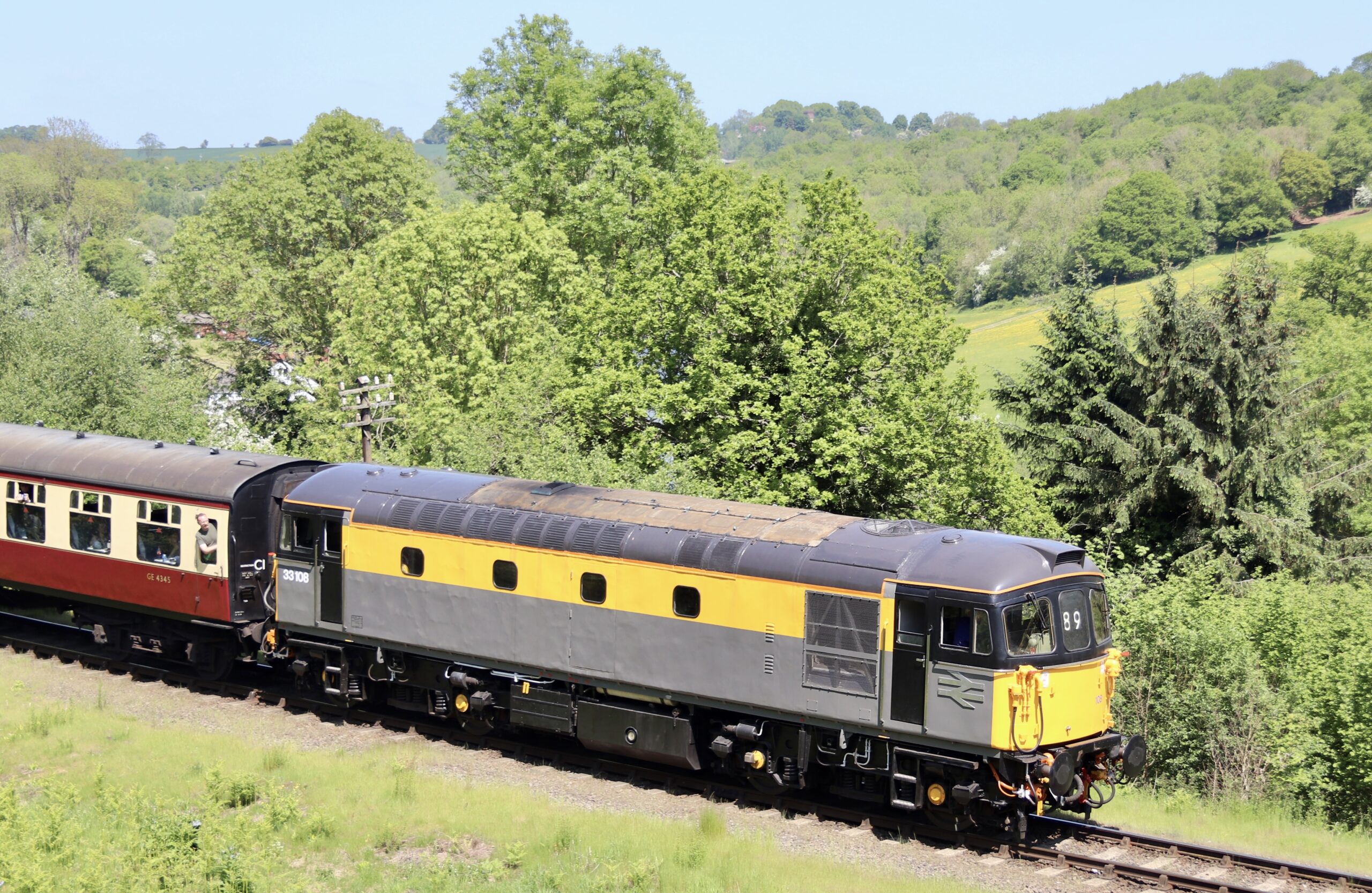
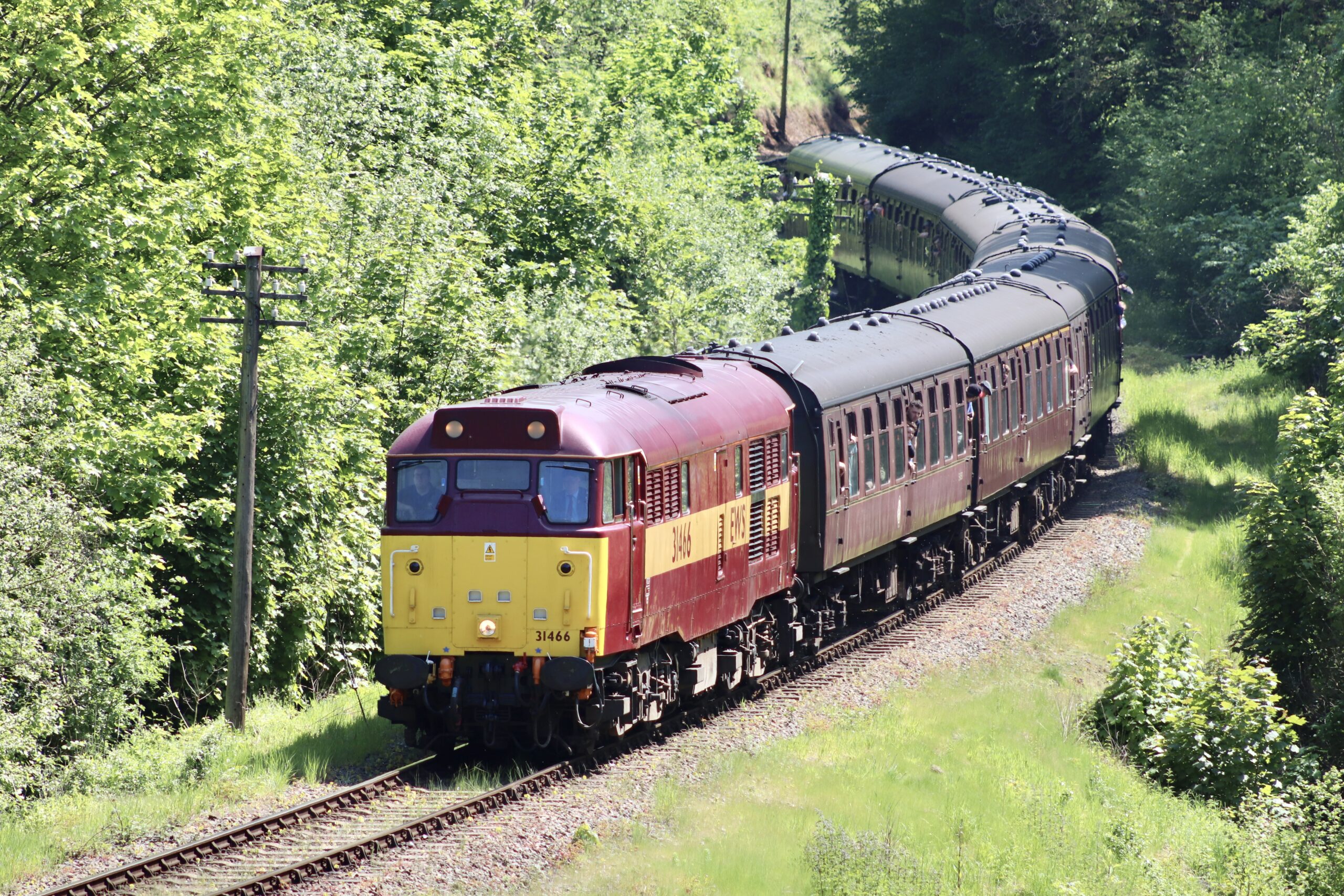
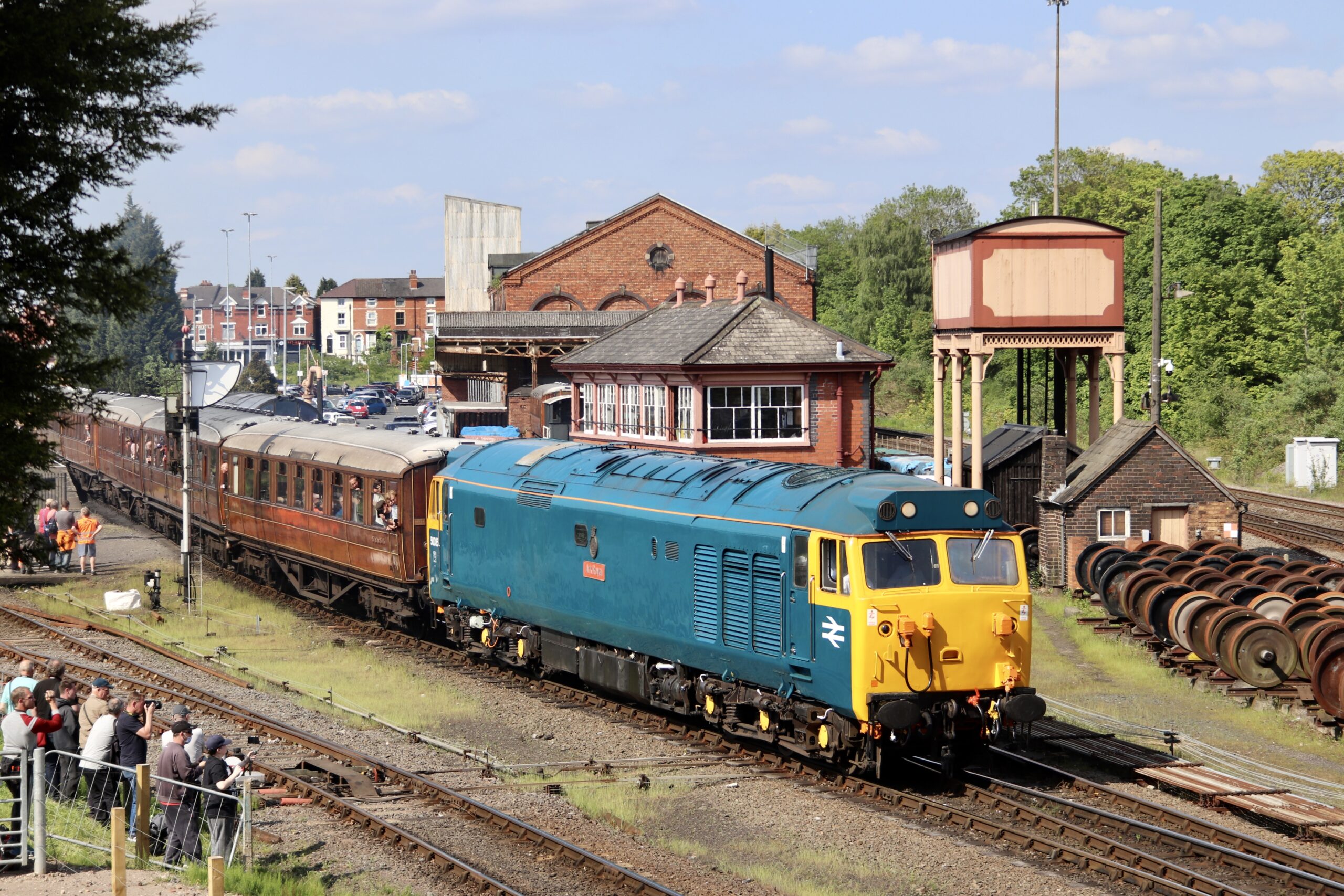
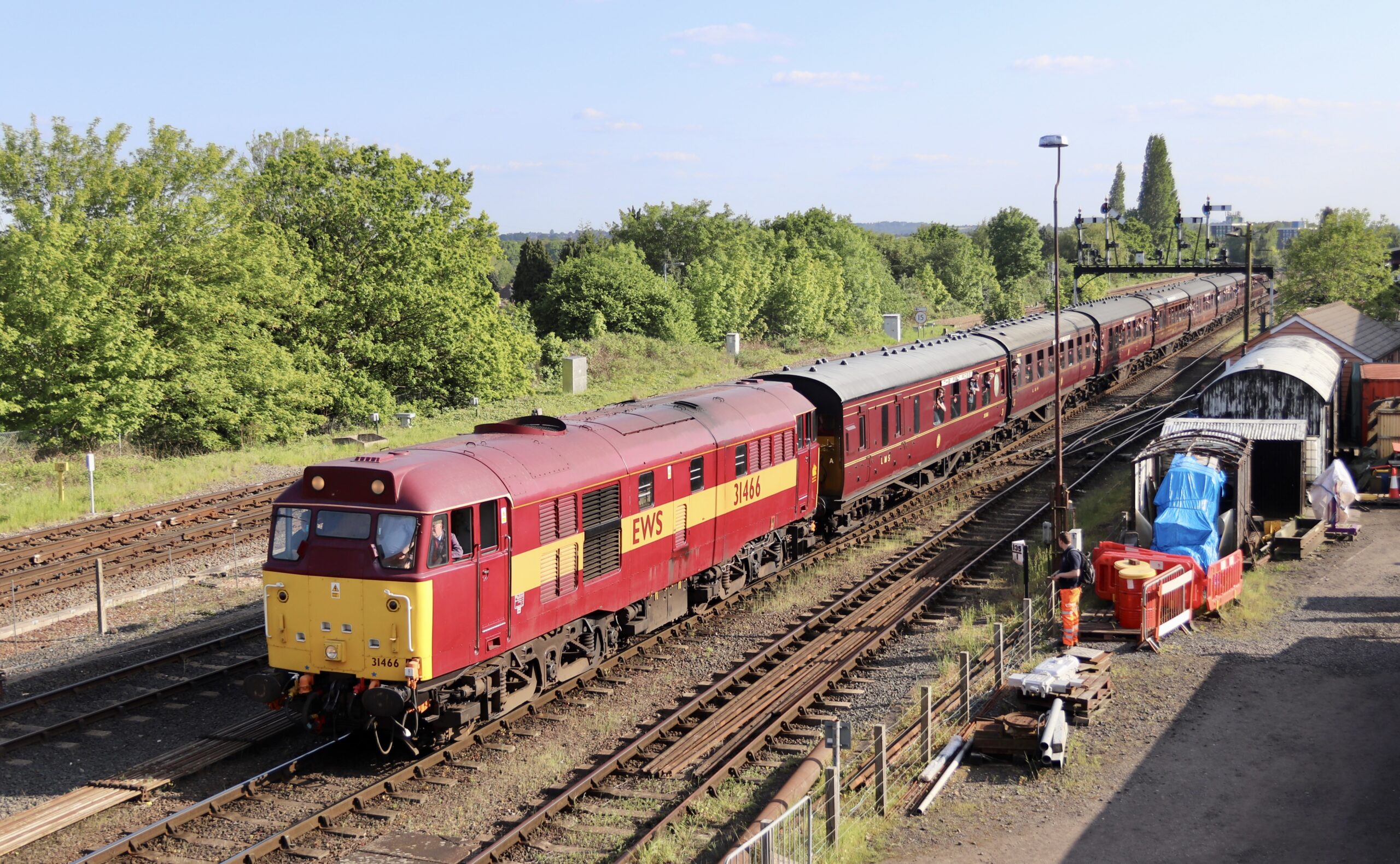
Yoshi takes to the shade at Highley – 20/05/2023DB Cargo provided Class 60 No. 60062 ‘Sonia’ in her striking fiery Steel On Steel livery. Class 47 No. 47712 is on the rear – 20/05/2023Class 60 No. 60062 ‘Sonia’ approaches Highley – 20/05/2023Close up of Class 60 No. 60062 ‘Sonia’. The locomotive carries this special livery to celebrate the important role DB Cargo UK plays in supporting the UK’s metal transportation market. One full train load of steel coil can produce over 1,000 new cars or 60,000 white goods – 20/05/2023Class 50 No. 50035 ‘Ark Royal’ departs Highley with a Kidderminster bound train. There are several Class 50’s based on the Severn Valley but only one example was in operation over the gala as the GBRf pair No.’s 50007 and 50035 were undergoing some maintenance between mainline outings, while No.’s 50033 and 50044 were in the Traction Maintenance Depot and No. 50031 is currently minus a fuel tank – 20/05/2023Maybach Music as Class 52 No. D1015 ‘Western Champion’ arrives at Highley. No. D1015 is one of seven preserved Western locomotives from the original 74 built by BR at Swindon and Crewe – 20/05/2023 Push-Pull fitted Class 33 No. 33108 in revised departmental “Dutch” livery (so named because of the similarity to the Dutch State Railway colours later adopted by the BR engineers sector) was in service following an overhaul – 20/05/2023Resident Class 31 No. 31466 in English Welsh Scottish (EWS) livery on the approach to Highley. The Class 31 locomotives received a number of derogatory nicknames over their years in mainline operation including Goyles (short for “gargoyles” in reference to the perceived ugliness of the design), Peds (short for “pedal cars” in reference to their speed and pulling power) and Gurglers, after the noise they made. 26 members of the class have been preserved – 23/05/2023Yoshi relaxes at Highley – 20/05/2023
At some point we knew we had to move on from our balcony position, essentially to get photos of locomotives which were not planned to make it to Highley. Our original plan was to journey to Bewdley and then onto Kidderminster. As Bewdley can be somewhat busy on an average day and with this being the busiest I’d ever seen the Severn Valley, I opted instead to head straight for Kidderminster. This would mean we’d miss seeing the visiting Class 20 locomotives (No.’s 20048 and 20189) heading to Bridgnorth, but these were scheduled to return later. Unfortunately, things didn’t go quite to plan and one of the Class 20’s, No. 20048 failed and was removed from the train on reaching Bridgnorth and didn’t make the return outing. Another Class 20, No. 20142 in red London Transport livery was in attendance for the gala, but was not in use, or indeed visible, on the day of our visit.
Direct Rail Services (DRS) Class 88 No. 88004 ‘Pandora’ awaits her turn while Class 33 No. 33108 prepares for departure form Kidderminster – 20/05/2023DRS) Class 88 No. 88004 ‘Pandora’ and Class 33 No. 33108 at Kidderminster – 20/05/2023Line up of No.’s 88004, 33108 and 57307 at Kidderminster – 20/05/2023Colas Freight Class 56 No. 56051 ‘Survivor’ passes DRS Class 88 No. 88004 ‘Pandora’ at Kidderminster – 20/05/2023Direct Rail Services (DRS) Class 57 No. 57307 ‘Lady Penelope’ awaits action in the sidings at Kidderminster – 20/05/2023DRS pair Class 88 No. 88004 ‘Pandora’ and Class 57 No. 57307 ‘Lady Penelope’ at Kidderminster – 20/05/2023Class 88 No. 88004 ‘Pandora’ at the head of the ScotRail stock in Kidderminster. Ten Class 88 locomotives were built in 2015/16 by Stadler Rail Valencia. They are dual-mode locomotives that are fitted both with a pantograph to collect electricity from overhead wires, and a Caterpillar diesel engine. They are the first dual-mode locomotive in the UK to use the 25 kV AC electrification – 20/05/2023Class 50 No. 50035 ‘Ark Royal’ runs light engine out of Kidderminster. No. 50035 was the first BR Class 50 diesel locomotive to enter preservation The locomotive was built at English Electric’s Vulcan Foundry at Newton-le-Willows and entered BR service as No. D435 at Crewe in August 1968, being given the number 50035 in March 1974 under the TOPS scheme. She was withdrawn from service on 5th August 1990 – 20/05/2023RailAdventure Class 43 No.’s 43465 and 43484 on static display at Kidderminster. The pairing hauled trains on the Friday only – 20/05/2023RailAdventure Class 43 No.’s 43484 and 43465 at Kidderminster. RailAdventure signed a partnership deal with Hanson & Hall Rail Services in April 2021 having purchased eight Class 43 power cars, which will run back to back to operate domestic services. RailAdventure is based in Munich and has been involved in delivering new trains from Europe to the UK, such as the new Merseyrail Class 777 trains – 20/05/2023Network Rail Class 73 “Minions” No.’s 73951 ‘Malcom Brided’ and 73952 ‘Janis Kong’ were on display at Kidderminster over the gala. The two locomotives were withdrawn from service in mid-May. The pair were rebuilt by Loram in 2011/2015 with their English Electric engines being replaced by two newer, more powerful and lower emission Cummins QSK19 engines each rated at 750hp. Their acceptance into traffic was heavily delayed until 2016 and endured initial teething problems which were resolved and they became well liked by crews. They were used mostly on infrastructure monitoring trains. They are, however, non-standard locomotives and have limited crews trained to work on them. Network Rail currently lease five MTU-engined Class 73/9’s so the “Minions” are surplus to requirement – 20/05/2023Electro-Diesel Class 73 No.’s 73951 and 73952. The locomotives are scheduled to depart for warm storage, possibly at Peak Rail, by road – 20/05/2023
The new footbridge across the railway line just outside of Kidderminster station has been rebuilt after an absence of a year or two, so following a brief sojourn looking at the static exhibits, sales stands and taking a few photographs of departing trains we marched round to see what the view was like from the bridge and spent most of the rest of our visit here.
Class 50 No. 50035 ‘Ark Royal’ has lost her central headlight (a later addition to the class in service) and is seen departing Kidderminster – 20/05/2023Class 37 No. 37263 catches the afternoon sun at Kidderminster. The locomotive is scheduled for a prolonged stay on the SVR over the summer months – 20/05/2023DRS Thunderbird rescue locomotive Class 57 No. 57307 ‘Lady Penelope’ runs out of Kidderminster light engine in readiness to attach to a train bound for Highley – 20/05/2023Yoshi watches as Warship No. D821 ‘Greyhound’ starts up on Kidderminster TMD – 20/05/2023Class 52 No. D1015 ‘Western Champion’ carried the identity of lost classmate D1039 ‘Western King’ on one side (to celebrate the coronation of King Charles III), seen approaching Kidderminster – 20/05/2023Great Western Railway HST Castle set formed of Class 43 power car No.’s 43186 ‘Taunton Castle’ and 43188 ‘Newport Castle’ ran shuttles between Kidderminster and Arley on all four days of the gala – 20/05/2023Class 43 No. 43188 ‘Newport Castle’ which also carries decals reading: ‘Y Cymro – The Welshman’ and a Welsh Dragon leads the GWR Castle HST set out of Kidderminster – 20/05/2023D821 ‘Greyhound’ makes a fine sight as she runs towards Kidderminster station. D821 is one of two preserved Warship locomotives from the original 38 built by BR at Swindon Works. Sadly none of the 33 built by the North British Locomotive Company in Glasgow were saved for preservation. D821 has returned to service following an extensive overhaul – 20/05/2023Class 47 No. 47712 ‘Lady Diana Spencer’ leads into Kidderminster with a shuttle from Highley – 20/05/2023Diesel Traction Group’s Warship No. D821 ‘Greyhound’ resplendent in British Rail monastral blue livery to celebrate 50 years in preservation. No. D821 was the first main line diesel to be preserved by a private group having being acquired from BR in May 1973 – 20/05/2023Class 52 No. D1015 ‘Western Champion’ as D1039 ‘Western King’ runs to the Traction Maintenance Depot at Kidderminster – 20/05/2023Class 52 Western No.’s D1015 ‘Western Champion’ and D1062 ‘Western Courier’ between duties at Kidderminster – 20/05/2023Two Western Diesel Hydraulics on to the Kidderminster turntable – 20/05/2023SVR Home fleet loco Class 31 No. 31466 on the entry to Kidderminster – 20/05/2023A study of Class 40 No. 40106 ‘Atlantic Conveyor’ running light engine into Kidderminster station. The loco was named ‘Atlantic Conveyor’ on 11th August 1984 in memory of the Cunard cargo ship and those on board who lost their lives in the 1982 Falklands war – 20/05/2023Class 40 No. 40106 ‘Atlantic Conveyor’ carries “The Caledonian” headboard as she awaits departure form Kidderminster. The locomotive was built at Robert Stephenson and Hawthorns factory in Darlington. The loco features the original four disc headcode system along with interconnecting gangway doors seen on various classes of BR diesels but ultimately under used – 20/05/2023Resident Class 40 No. 40106 ‘Atlantic Conveyor’ departs Kidderminster. The locomotive entered into BR service as No. D306, later becoming No. 40106 under the TOPS system in the 1970s. During her last works overhaul at Crewe in September 1978, No. 40106 was repainted into Dark Brunswick green with full yellow ends, thus becoming a firm favourite loco on railtours and other special passenger workings for several years. I fondly remember the cover of the 1979 Locoshed book which featured this loco – 20/05/202320189 Ltd’s Class 20 Bo-Bo diesel-electric No. 20189 worked to Kidderminster solo, nose first, following the failure of classmate 20048 at Bridgnorth. 228 examples of these locomotives were built between 1957 and 1968. Each weighed 73 tonnes and delivered 1,000 hp, they were used to haul mixed freight traffic – often in tandem positioned nose to nose. – 20/05/2023Eastfield Scotty Dog depot plaque carried by Class 20 No. 20189 – 20/05/2023Last shot of the day; Western Class 52 No. D1062 ‘Western Courier’ prepares to depart Kidderminster. D1062 was bought from BR by the Western Locomotive Association on 4th November 1976, becoming the first Class 52 Western to be preserved – 20/05/2023
With 22 locomotives in traffic across the four day event, trains were very busy with the SVR reporting in excess of 4,000 pre-booked tickets sold and with pay on the day passengers a new record was set at over 6,500 visitors across the gala. This will certainly help with the SVR’s current £1.5 million appeal. It was certainly an interesting day, although I have to admit to feeling rather overwhelmed by the number of locomotives involved and my OCD in attempting to catch ’em all! Well done to all involved in the organisation and daily support of the railway.
Video of our day at the Severn Valley Diesel Gala 2023
For the record…
While Yoshi and I were enjoying the delights of the Severn Valley on May 20th, two rail tours visited Dorset. Firstly, Class 47 No.’s 47828 and 47593 headed to Weymouth with the “Dorset Coast Statesman”. Next, LMS Jubilee No. 45596 ‘Bahamas’ journeyed from London Waterloo to Exeter via Sherborne and Yeovil Junction hauling the “Atlantic Coast Express”.
The Swanage Railway Diesel Multiple Unit service to and from Wareham was cancelled on 23rd May 2023 because of an electrical fault on the unit discovered during a routine inspection. Repairs and testing meant the service resumed the following day.
Lake Road Bridge on the Hamworthy Branch – 29/05/2023
The damaged access gate to the Hamworthy Branch at Lake Road Bridge has been repaired. Rumour is that metalwork on the bridge needs further attention before any trains can cross it.
Warship
D821 ‘Greyhound’
D821 ‘Greyhound’ celebrated 50 years in preservation during the Severn Valley Diesel Gala. The locomotive had been procured from British Rail by Colin Massingham, owner of model rail white metal kit company Modern Traction Kits (MTK) and Chris Reid a customer at Colin’s shop in Slough. Along with other financial supporters the pair had hoped to purchase North British Class 22 No. D6319 but a misunderstanding meant this loco was cut up at Swindon. Instead, the pick of the remaining Class 42 “Warship” locomotives which had recently been withdrawn at Plymouth Laira was offered. No. D821 was chosen as she was virtually complete.
D821 ‘Greyhound’ in Swindon. I was usually very good at keeping a record of dates, but a whole films worth of photos have no details recorded with them – 1980D821 ‘Greyhound’ in Swindon – 1980D821 ‘Greyhound’ in Kidderminster during the 2021 Severn Valley Railway Diesel Gala – 15/05/2021
The “Warship” diesel-hydraulic B-B locomotives were based on the West German V200 design, 38 examples being constructed at Swindon between 1958 and 1961. Each locomotive bore a name with all except D800 and D812 being named after Royal Navy vessels, thus the “Warship” moniker used to refer to the class. They were later designated as Class 42’s. The “Warships” took over from “Castle” and “King” Great Western steam locomotives on Top Link work but were deemed non-standard and all were withdrawn by 1972.
No. D832 ‘Onslaught’ at Bishops Lydeard on the West Somerset Railway – 09/06/2013Nameplate of No. D832 ‘Onslaught’ showing the “Warship Class” designation carried under the locomotive name – 09/06/2013No. D832 ‘Onslaught’ was guest loco at the 2016 Swanage Diesel Gala and is seen here departing Corfe Castle – 08/05/2016No. D832 ‘Onslaught’ at Bishops Lydeard – 09/06/2013
No. D821 was not the only member of the class to make it to preservation as No. D832 ‘Onslaught’ was also saved after being moved to the Railway Technical Centre (RTC) in Derby following withdrawal from service where it was used for various research purposes. However, a third member of the class, No. D818 ‘Glory’ wasn’t so lucky and, despite being kept at Swindon as a “pet” of the employees and for BR apprentices to work on, was cut up before the works was closed in 1985.
“The one that got away”; No. D818 ‘Glory’ at Swindon – 06/06/1981
Thanks for reading and your comments! Next week we’ll tell you all about our trip to Cornwall in search of Sleeper trains, pasties and semaphore signals!
That 1979 Locoshed Book featuring Class 40 No. 40106 on the cover at a “New Lower Price of 40p!”
DB Cargo Class 67 No. 67025 in operation with Transport for Wales waits departure at Crewe with 5K67 0951 Holyhead Car. M.D. Empty Coaching Stock working to Crewe C.S. – 16/07/2022
Fleetwood
The North Euston Hotel, Fleetwood
Yoshi and I spent much of last week in the North West of England as we made The North Euston Hotel in Fleetwood our base. The hotel was commissioned by Sir Peter Hesketh Fleetwood, designed in the Greek classical style by architect Decimus Burton and built between 1839 and 1841 to serve overnight passengers making the journey by rail from London Euston who were destined for steam ships which would provide onward travel to Scotland where after disembarking at Ardrossan they would take the train on to Glasgow. Fleetwood was the northern most station at the time, hence the name “North Euston” for the hotel, and the railway was yet to run over the Shap hills. Queen Victoria made the journey in 1847 and stayed at the hotel, although I’m sure she didn’t stay in our room. The first manager of the hotel, Corsican born Xenon Vantini, had been a courier for Napoleon Bonaparte and was also the first person to open a refreshment room at Wolverhampton railway station. In 1859 following a decline in fortunes, the hotel was sold to the government and was converted into a school of musketry and later, in 1867, an officer’s quarters. The building existed in this form until the 1890’s when it was purchased by a group of London businessmen who converted it back into a hotel. The North Euston is currently owned by local business families. Yoshi very much enjoyed his morning sausage for breakfast and we celebrated our dubious achievement of coming last in the Sunday evening pub quiz which was a lot of fun.
The railway to Fleetwood was opened on 15th July 1840 as the Preston & Wyre railway and was also the vision of Sir Peter Hesketh Fleetwood it being designed to connect the then new port of Fleetwood on the Fylde coast to Preston. The railway was constructed by George and Robert Stephenson with contribution from Joseph Locke. Its glory days lasted only six years until a direct route over Shap was finally achieved. The railway was absorbed into the Lancashire & Yorkshire Railway ( later the London Midland Scottish Railway as part of the Big Four groupings in 1923) and extensions were built to Blackpool and Lytham to cater for the growing number of passengers traveling to the seaside. Fleetwood would become, for a time, one of the largest and most successful fishing ports in the UK but by 1970 the railway from Poulton-le-Fylde to Fleetwood was closed to passenger traffic and later, in 1999, to freight workings.
Thornton Station is located in the heart of Thornton town centre – July 2022Until the late 1980’s a signal box operated the crossing over Station Road, Thornton – July 2022The current station buildings were the first built by the then newly formed London Midland Scottish Railway (LMS) in 1927 – July 2022
In 2006, the Poulton & Wyre Railway Society was formed with the aim of reopening the railway. Since then, much work has been carried out in clearing sections of the line from the ingress of nature and a Class 108 Diesel Multiple Unit was purchased for restoration and use on the line. More recently, the Poulton-Le-Fylde to Fleetwood line was subject to a study as part of the UK Government’s Restoring Your Railway programme. In June 2022 it was announced that the scheme should progress further and Network Rail will receive funding to produce a detailed plan for the revival of services. The Poulton-Le-Fylde & Wyre Railway Society have now turned their attention to developing a heritage railway centre which will eventually house a collection of railway artefacts and memorabilia for public viewing.
Churnet Valley Railway
Having heard that Class 33/1 No. 33102 was hauling trains, Yoshi and I spent Tuesday morning ( 12th July 2022 ) visiting Cheddleton on the Churnet Valley Railway, a preserved heritage line in Staffordshire. I grew up with 33/1’s providing the daily motive power on local passenger services between Bournemouth and Weymouth, and even though No. 33111 lives on at Swanage, our local heritage railway, it was fantastic to hear the Crompton’s Sulzer engine at work hauling a passenger train.
The Churnet Valley railway dates back to 1849 following the formation of The North Staffordshire Railway Company (NSR) in 1845. Falling passenger numbers saw the Beeching Report include the Churnet Valley line and its associated branches which became earmarked for closure with the final section from Leek Brook Junction to Oakamoor quarry lasting out until the late 1980’s as it was used for freight traffic. In 1992 the newly formed Churnet Valley railway (1992) PLC began talks with the Department of Transport with a view to operate the line. Trains currently run between Froghall and Ipstones, but the ambition is to run services into the Staffordshire market town of Leek for the first time since 1965. And they have an eye on the clock to achieve this as the railway needs to run its first passenger train into Leek by 1st December 2022 or lose a £1.4m EU grant. This means all track must be laid on the 0.5 mile extension, with additional resources being provided for a triangle at Leek Brook Junction, and a platform constructed at Leek. It really is a very picturesque railway with extremely friendly volunteers, Yoshi and I were escorted around the workshops to get a closer view of locomotives stabled there, and I wish them every success with their endeavours and look forward to a return visit in the future.
Cheddleton Station which was to be demolished in April 1974 but saved by the actions of local businessman and parish councillor Norman Hancock who parked his car on the level crossing preventing access to bulldozers giving sufficient time for the building to be Grade II listed – July 2022Cheddleton Station – July 2022Time for a cuppa! Yoshi waits for the kettle to boil in the booking hall of Cheddleton Station – July 2022Class 33/1 No. 33102 ‘Sophie’ awaits departure from Cheddleton – 12/07/2022Class 20 No. D8057 (20057) sits outside the repair shed at Cheddleton – 12/07/2022S160 Class 2-8-0 No. 5197 was built by the Lima Locomotive Company in Ohio, USA and exported to China in 1946. The United States Army Transportation Corps Class S160 were designed for heavy freight work across Europe during World War 2 with a total of 2,120 being built they eventually worked all over the world – 12/07/2022Class 25 No. 25322 ‘Tamworth Castle’ was the final Class 25 locomotive to see mainline service with British Rail. She is currently in store at Cheddleton Yard awaiting restoration – 12/07/2022Yoshi inspects Class 33 No. 33021 ‘Eastleigh’ in Post Office Red style livery. This locomotive was amongst the first privately owned diesel locomotives to be used on the mainline – 12/07/2022The Churnet Valley Railway has acquired Class 47 No. 47292 for an initial loan period of five years supplementing Class 33 No.’s 33021 and 33102 for use on passenger trains – 12/07/2022
On our way back to Fleetwood, we stopped off at Acton Bridge for an hour or so, primarily to capture Class 37 No. 37884 which was diagrammed to pass through with 0M58 Kilmarnock Long Lyes T.C. to Derby R.T.C. – which can be seen in the video below:
Southport
On the Wednesday, Yoshi and I took a trip on a heritage Blackpool Tram – more about that adventure next week – but first that we made a brief visit to Southport and Formby. Southport railway station is the terminal of the Southport branch of the Northern Line of the third-rail electric Merseyrail network, and the diesel-operated Manchester to Southport line. The station and services to Liverpool and Hunts Cross are operated by Merseyrail, with Manchester services operated by Northern Trains. The current station opened as Southport Chapel Street on 22 August 1851 and once boasted eleven regular platforms and two excursion platforms. Six truncated platforms are now in use (platforms 1-3 for Liverpool trains and 4-6 for Manchester services), the remainder having been demolished to make way for car parking. In 1970 the former terminal building was replaced with a shopping centre.
New Stadler Class 777 trains are currently being tested, and one was scheduled to visit Southport that morning on test run. Despite the best attempts at numerous roadworks and traffic queues, we made it just in time to see Class 777 No. 777015 arriving. Members of The National Union of Rail, Maritime and Transport Workers ( RMT – what these initials mean was one of the pub quiz questions I actually answered correctly! But I digress…. ) Anyway to continue; RMT members recently voted in favour of the proposed crewing plans for the new fleet which brings a five-year dispute to its conclusion. Merseyrail still has to reach agreement with the drivers union, the Associated Society of Locomotive Engineers and Firemen (ASLEF), but intends to introduce the new Class 777’s into service later this year. Currently, 17 out of the 53 units purchased have been delivered to the UK. The arrival of the Class 777 fleet will see the demise of both the Class 507 and 508 electric-multiple units (EMU’s).
The Class 507’s were built to work on Merseyside, replacing the London Midland Scottish Railway (LMS) built Class 502 units on Northern line services from Liverpool to Southport, Ormskirk and Kirkby. 33 sets were built by British Rail Engineering Limited (BREL) in York from 1978 to 1980 followed by 43 Class 508s constructed between 1979 and 1980. They were the second and fourth variety of BR’s then standard 1972 design for suburban EMU’s, which were derived from the prototype 2PEP and 4PEP EMU’s introduced in 1971 and eventually amassed 755 vehicles across five Classes (313/314/315/507/508). Originally, the Class 508’s were built as 4-car units for the Southern Region of British Rail working out of Waterloo on former London South Western Railway (LSWR) routes. From 1982 to 1984 they were reduced to 3 car units (one of the trailer cars was removed to be incorporated into the Class 455/7 EMU’s) and transferred to Merseyside to replace the former LMS Class 503 units that operated Wirral line services to New Brighton, Rock Ferry and West Kirby. Following rail privatisation the two fleets became interchangeable and work both sides of the Mersey. They are the oldest EMU’s still working in the UK after the Class 313’s.
Yoshi with Merseyrail Class 507 No. 507020, Southport – 13/07/2022Yoshi compares the differences between EMU’s with a study of Merseyrail Class 508 No. 508140, Southport – 13/07/2022Merseyrail Class 777 No. 777015 having arrived with 5T02 0917 Sandhills Reversing Sdg to SouthportSouthport – 13/07/2022Northern Trains Class 769 No.’s 769424 & 769456 Southport – 13/07/2022Northern Trains Class 150 No. 150128 and 150134 Southport – 13/07/2022Merseyrail Class 507 No. 507020 Southport – 13/07/2022Merseyrail Class 507 No. 507020 and Class 508 No. 508131 stand side by side at Southport – 13/07/2022Merseyrail Class 508 No. 508126 at the buffer stops, Southport – 13/07/2022Merseyrail Class 777 No. 777015 awaits departure of 5T03 1008 Southport to Kirkdale C.S. Southport – 13/07/2022
Crewe
After breakfast on Thursday where we spent a few enjoyable hours watching freight movements around Crewe Basford Hall. You can relive this by playing the video below:
We returned to Dorset on Friday, eschewing the opportunity of capturing two Colas Class 37’s at rest in Blackpool North Railway Station which had worked a test train from Carlisle in the early hours. However, the next day; Saturday 16th July, I was back in Crewe, this time without Yoshi, so I could attend the Direct Rail Services (DRS) Open Day at their depot at Gresty Road. Understandably, dogs were not allowed on site, so Yoshi spent the day with his mum, while I endured the heat of the day without my fluffy sidekick. Many thanks to Scott for driving and for his company.
The Open Day coincided with LMS Coronation 4-6-2 No. 6233 ‘Duchess Of Sutherland’ passing through Crewe railway station with the Railway Touring Company’s “Cheshireman” rail tour from London Euston to Chester. (1Z86 0639 London Euston to Chester with Class 47 No. 47813 providing support at the rear). The station was extremely busy with the influx of enthusiasts in the town to visit the DRS site, but I managed to catch a short video clip of this magnificent locomotive departing Crewe. Later that day, SR Merchant Navy 4-6-2 No. 35018 ‘British India Line’ worked into Crewe light engine and support coach as 5Z46 Carnforth Steamtown to Crewe Heritage Centre for servicing ahead of rail tour duties scheduled for the following day:
Crewe 16th July 2022
3,500 people attended Nuclear Transport Solutions’ (NTS) rail division DRS’s open day, the first one to be held for a number of years because of the Covid pandemic. There were two locomotive naming’s at the event – the first saw Class 66 No. 66422 being unveiled as ‘Max Joule’ in tribute to one of DRS’s founders and former Managing Director who died in 1999. The second naming was for Class 66 No. 66424 which was named ‘Driver Paul Scrivens’ who had been a driver with DRS for more than 20 years. An emotional tribute was delivered by colleague Tim Howlett before the new plate was unveiled by Paul’s sister Emma.
The open day raised over £39,000 from sponsorship and donations which is an amazing figure that will go to deserving causes across the UK. It was a fantastic event, and I thoroughly enjoyed the experience. Because of the hot weather, DRS made bottles of water available at points across the site, which was very welcome.
Locomotives on display were:
Class 37 No. 37218 in retro DRS livery – 16/07/2022Class 37 No. 37401 ‘Mary Queen Of Scots’ – 16/07/2022Class 37 no. 37419 ‘Carl Haviland’ – 16/07/2022Class 37 No. 37425 ‘Concrete Bob’ – 16/07/2022Class 68 No. 68025 ‘Superb’ – 16/07/2022Class 57 No. 57312 – 16/07/2022Class 88 No. 88002 ‘Prometheus’ – 16/07/2022Class 68 No. 68006 ‘Pride of the North’ in special green livery showcasing the environmental benefits of rail freight and how a diesel locomotive can reduce emissions by using Hydrotreated Vegetable Oil (HVO) fuel – 16/07/2022Class 66 no. 66303 ‘Rail Riders 2020’ – 16/07/2022Class 68 no. 68009 ‘Titan’ – 16/07/2022Class 66 No. 66422 ‘Max Joule 1958-1999’ – 16/07/2022Class 66 No. 66424 awaits its naming ceremony – 16/07/2022Class 57 No. 57304 – 16/07/2022Class 88 No. 88009 ‘Diana’ – 16/07/2022Class 66 No. 66429 – 16/07/2022Class 37 No. 37424/37558 ‘Avro Vulcan XH558’ – 16/07/2022Class 88 No. 88001 ‘Revolution’ – 16/07/2022
On our way to the DRS Open Day, we stopped off at Longport to peer through the fence at Electro-Motive Diesel Limited’s (EMD) site and witnessed some shunting around of locomotives, mainly Class 56 / Class 69 conversions which are ongoing.
With 69006 stencilled on the bodyside, the conversion of 56128 is almost complete. Longport – 16/07/2022The empty shell of Class 56 No. 56032 awaiting a second move to Marcroft Engineering with 69007 ( ex-56037 ) in the background – 16/07/202256038 is being converted into 69008 and is still on accommodation bogies but some of its new innards are in place. An extra hole has been cut in the cab front ends to accommodate an additional connection with this locomotive likely being the first for use by the GBRf Rail Services sector which handles stock movements – 16/07/2022Class 56 No. 56009 sits in the yard at Longport. The locomotive was unofficially renumbered No. 56201 when it was converted for use as an engineering test bed by Brush Traction in order to assess refurbished Paxman engines of sister class members – 16/07/2022Former DB Cargo UK Class 66 No. 66048 rests on accommodation bogies at Longport. The locomotive was damaged when it derailed at Carrbridge in January 2010 and it ended up down an embankment. It was sold to EMD in March 2016 after being initially disposed of for scrap. It’s unclear what the future holds for this Class 66 locomotive – 16/07/2022
On our way home we diverted to Keynsham to refuel the car and restock with drinking water. Fortuitously, Class 37 No.’s 37901 and 37800 were scheduled to pass through top and tailing an Eastleigh Works to Swansea Landore stock move consisting of a Great Central-liveried Mk4 set and an LNER-liveried Mk4 set (5Q79 1826 Eastleigh Arlington to Landore). This made a fantastic epilogue to the day!
Class 37 No. 37901 heads an Eastleigh Works to Swansea Landore stock move consisting of a Great Central-liveried Mk4 set and an LNER-liveried Mk4 set with 37800 on the rear approaches Keynsham station – 16/07/2022.
Dorset NMT
While we were away it was a quiet week on the Bournemouth to Weymouth line, with only the New Measurement Train of particular interest on the main line as far as I’m aware. HST Class 43 power car No.’s 43272 and 43257 were in charge of 1Q18 0719 Derby RTC to Bristol Kingsland Road on Wednesday 13th July 2022.
Class 43 No. 43257 sits in Weymouth station – 13/07/2022. Photograph courtesy of @da_buckley967Class 43 No. 43272 preparing to depart from Weymouth – 13/07/2022. Photograph courtesy of @da_buckley967
My brother popped out to see the NMT return through Dorchester West on its way to Bristol and his video which he captured especially for Yoshi can be seen here:
In other news, Swanage resident Class 33/1 No. 33111 headed off by road to the Mid Hants Railway (MHR) to participate in their 2022 diesel gala. I had considered visiting the MHR on Sunday, but felt it was far too hot for Yoshi to be out and about, so we decided to stay home and catch up on some gardening.
The recent heat wave also resulted in speed restrictions being imposed on main line services by South Western Railways (SWR), including those on the Bournemouth to Weymouth line, with the increased risk of tracks buckling. Reduced services were introduced on Monday 18th and Tuesday 19th July 2022 in a bid to give passengers certainty over which trains would run. There was also a steam ban imposed by many heritage railways and on the main line. This includes the Railway Touring Company’s “Dorset Coast Express” excursion to Weymouth on Thursday 21st July which will now be diesel hauled throughout.
Great Western Railways were under fire in the local press this week, when the Dorset Echo reported chaotic scenes at Weymouth station where passengers were turned away from trains as they tried to return home. The 1728 departure to Bristol Temple Meads from the Dorset seaside town was formed of just two carriages meaning station staff and police had to request some travellers to wait for the next service which was due to leave an hour later. Not so long ago a High Speed Train was regularly employed to run a relief service to Weymouth via the West route on Summer Saturdays in order to cater for anticipated increased passenger numbers.
That’s all for this week – join us next time when we recount our trip on a heritage Blackpool Tram. Many thanks for reading, and for continued contributions, comment and corrections which are very much appreciated!
Class 47 No. 47593 ‘Galloway Princess’ approaching Campbell Road Bridge, Eastleigh working Saphos Trains 1Z60 0635 Poole to Kingswear “English Riviera Express” – 02/07/2022
Wednesday 29th June - Tuesday 5th July 2022
Saturday Sightings
Three rail tours were scheduled to pass through Dorset territory on Saturday July 2nd 2022. One had seemingly been cancelled a few days prior to its intended departure before reappearing on the schedules, much to Yoshi’s relief. Originally advertised as being steam hauled and later switched to a Class 57 diesel, “The Northern Belle Special: Tribute To The Bournemouth Belle” actually ran with a Class 47 at one end and a Class 57 at the other. Its journey from London Victoria to Bournemouth and return to London Euston via Slough briefly touched the route “The Bournemouth Belle” would have traversed back in the day. The empty coaching stock from this service ran to Norden on the Swanage Railway for servicing.
Class 57 No. 57314 approaching Creech Bottom on The Swanage Railway with The Northern Belle empty coaching stock 5Z68 1256 Bournemouth to Norden – 02/07/2022Class 57 No. 57314 at Creech Bottom on The Swanage Railway with The Northern Belle empty coaching stock 5Z68 1256 Bournemouth to Norden – 02/07/2022Class 57 No. 57314 parked up behind a pair of skips at Norden on The Swanage Railway awaiting servicing of The Northern Belle coaching stock – 02/07/2022Class 47 No. 47804 passes the former Furzebrook LPG site working 5Z69 1640 Norden to Bournemouth Northern Belle ECS – 02/07/2022
Saphos Trains Class 47 top and tailed “English Riviera Express” ran from Poole to Kingswear. BR Standard No. 70000 ‘Britannia’ took over the train from Norton Fitzwarren near Taunton, the diesel locomotives taking back control at the same point on the return leg back to Poole.
Class 47 No. 47810 (D1924) ‘Crewe Diesel Depot’ passes Bournemouth with the Empty Coaching Stock movement 5Z62 0444 Eastleigh Arlington to Poole to form Saphos Trains excursion to Kingswear and return – 02/07/2022
Railway Touring Company organised “The Atlantic Coast Express” took Southern Railway rebuilt Merchant Navy 4-6-2 No. 35028 ‘Clan Line’ from London Waterloo to Exeter St. Davids which traversed the Waterloo – Exeter line on its outward journey. One day I’ll tick off that box of recording a steam hauled train departing from Waterloo, but this week I was content with catching a glimpse of ‘Clan Line’ passing underneath Battledown Flyover at Worting Junction and nearing Sherborne.
SR rebuilt Merchant Navy 4-6-2 No. 35028 ‘Clan Line’ passes nearby Sherborne Old Castle with “The Atlantic Coast Express” 1Z82 0752 London Waterloo to Exeter St. Davids – 02/07/022
We have put together a compilation video of our Saturday below:
Yoshi was so excited to see and hear ‘Clan Line’ whistling as she passed Worting Junction he jumped up against the fence my camera was balanced on top of to see her pass for himself which is why there’s a slight wobble in the footage! I wish I’d have had the presence of mind to film him! We had a really enjoyable day out, despite the early start at Bournemouth and we met some friendly folk on our travels. I really didn’t imagine back in the late 1970’s that I’d be so pleased to see three Class 47’s on one day!
Freightliner Class 66 No. 66529 working 43Z2 0047 Trafford Park F.L.T. to Southampton M.C.T. through Eastleigh – 02/07/2022Direct Rail Services Class 37 No. 37069 which has been authorised for new wheelsets stands at Eastleigh Works – 02/07/2022Class 701 No. 701022 departing Eastleigh depot with 5Q50 0653 Eastleigh TRSMD to Eastleigh TRSMD – 02/07/2022
Class 701
Class 701 No. 701022 snaking its way into Eastleigh with 5Q50 0653 Eastleigh TRSMD to Eastleigh TRSMD – 02/07/2022
Trials with new Class 701 Electric Multiple Units continue. This week we filmed No. 701022 out and about over a few days which we’ve edited together in the video below:
Hamworthy Branch Update
Network Rail team examining the track work at Lake Road Bridge – image by kind permission of Kev Scott Trains
Network Rail were seen examining Lake Road Bridge on the Hamworthy Branch on the morning of Tuesday 5th July. Hopefully work will start soon clearing the site and replacing the existing structure which is rusted and, as was pointed out to me, has as at least one hole in the metal fabric. The replacement frog for the pointwork ready to reconnect the branch to the main line was deposited on the ballast at Hamworthy a few weeks ago.
Lake Road Bridge on the Hamworthy Branch – July 2022Lake Road bridge has sustained a number of hits from road vehicles as can be seen by the damaged brickwork in this view – July 2022
Great British Railways
This week “Snake-oil salesman” and Secretary of State for Transport Grant Shapps announced the shortlist of the most suitable locations for the national headquarters of Great British Railways (GBR), the planned state-owned public body that will oversee the majority of rail transport in Great Britain from 2023.
The closest local authorities to Yoshi HQ which threw their hats in the ring were Southampton and Eastleigh. However, these were both unsuccessful. The shortlist has been confirmed as:
Birmingham
Crewe
Derby
Doncaster
Newcastle upon Tyne
York
We would have visited each of these locations for a cup of tea and a bun, but they’re all too far away from Dorset so instead we’ll share the link where you can vote for your preferred location from the shortlist. The results will be used to measure the level of support for each place and will be considered as part of the final decision making. It’s almost like democracy at work.
Northern Belle: July 2019
A five month old Yoshi examines Class 57 No. 57601 ‘Windsor Castle’ at the buffer stops in Weymouth having worked The Northern Belle into the town for the Seafood Festival – 14/07/2022
In pre-Covid times The Northern Belle visited Weymouth with two special trains bringing passengers in to the seaside town for the annual Seafood Festival. Saturday 13th July saw Class 57 No. 57316 with Pullman Liveried classmate No. 57601 ‘Windsor Castle’ attached to the rear with the rail tour having originated form Cardiff. The following day saw the locomotives swap positions with No. 57601 heading into Weymouth with a tour having originated from Coventry.
Yoshi and Class 57 No. 57316 at Weymouth – 13/07/2019
This week, Yoshi’s blog was written to the sounds of Freya Ridings, A Dog’s Purpose (Original Motion Picture Soundtrack ) and Bear’s Den. Thanks to everyone who helped and provided information for this weeks therailwaydog blog. We’ll be back here in seven days for another update – we hope you’ll be able to join again us then. May your dog go with you.
Yoshi takes the opportunity to inspect DB Class 66 No. 66105 at Poole High Street Crossing
It was an early start on Saturday April 2nd, or possibly a late end to Friday 1st when I popped into Poole to catch sight of DB Class 66 No. 66105 arrive with an engineers train from Eastleigh East Yard at 0045 (6N03 2355 Eastleigh East Yard to Poole). The next day, Yoshi and I were fortunate to see the locomotive and consist depart the Poole station area, getting some unusual photographs of the locomotive waiting for the barriers to close at Poole High Street crossing, but more of that later.
Back to Saturday and shortly after breakfast, we set off for the 2022 Steam Railway Magazine Readers’ Heritage Railway Association Award winning Didcot Railway Centre to share in the celebrations of Great Western Railway Castle Class 4-6-0 No. 4079 ‘Pendennis Castle’ being relaunched into traffic after a long absence. We made good time in getting to the car park adjacent to Didcot railway station and made our way across to the concourse where there was some confusion in how to access the subway to the railway centre. Yoshi was extremely excited and waited impatiently to get our tickets scanned before we made our way onto the site. The Great Western Society Didcot Railway Centre really is a marvel – 21 acres covering 200 years of railway heritage. Sadly the Coal Stage which dominates the skyline was recently found in need of urgent repair but conservation work is now underway on the Coal Stage as are repairs to the water tank that supplies the Centre’s steam engines with water.
We were greeted by not one, but two Pendennis Castle locomotives. In a lovely touch, current GWR Class 57 No. 57604 ‘Pendennis Castle’ was lined up alongside her early steam namesake No. 4079.
4079 and 57604 both named ‘Pendennis Castle’ in front of the engine shed at DidcotClass 57 No. 57604 ‘Pendennis Castle’ – Didcot 02/04/2022Nameplate of Class 57 No. 57604 ‘Pendennis Castle’
The Castle Class 4-6-0 express passenger engine was first introduced in 1923. No. 4079 ‘Pendennis Castle’was the 7th machine – of an eventual total of 171 – completed in February of 1924. She shot to fame the next year when she triumphed in a series of trials against the LNER Class A1 Pacific locomotives. The most famous of these being the legendary ‘Flying Scotsman’. ‘Pendennis Castle’was rather cheekily sent to be displayed alongside its famous rival in the 1925 Empire Exhibition at Wembley.
No. 4079 worked express passenger trains on the Great Western Railway and later British Rail (Western Region) for forty years, racking up an impressive 1.75 million miles in service. This came to a sudden end in 1964 when travelling on a special train, she sustained severe damage to her rear driving wheel bearings as her fire grate collapsed and almost melted them. She was taken off the train and abandoned on shed at Westbury.
From Westbury, she was rescued by Mike Higson who was then proprietor of Roundhouse Books. He had the locomotive slowly towed back to her birthplace at Swindon and restored to working order. On completion, she was handed over in 1965. Shortly afterwards, Mr Higson sold the locomotive to Lord John Gretton (of the Bass Brewery dynasty) and, Sir William McAlpine who had famously saved ‘Flying Scotsman’from a financially disastrous tour of North America. Initially based at Didcot, No. 4079 eventually moved to the Steamtown Railway Museum in Carnforth.
The story now shifts to 1977 and Hammersley, amid the deserts of North Western Australia, where Sir Russel Madigan was visiting the iron ore mines of the company he worked for; Rio Tinto. Here he encountered a preservation group named The Pilbara Railways Historical Society who were saving diesel locomotives which had once worked the iron ore railways. The society were also keen to obtain a steam locomotive to run on the railway. Sir Russel declared he would “go home and buy them the ‘Flying Scotsman’”. This was not to be as Sir William McAlpine wasn’t prepared to sell ‘Scotsman’. He was, however, willing to part with ‘Pendennis Castle’. After a farewell tour stopping for what was believed to be the last time at Didcot, she went to Southampton Docks, was loaded onto a P&O ship and set sail for ‘Down Under’ via the Suez Canal.
Arriving at Hammersley in 1978, she soon became a firm favourite, pulling trains over the extensive iron ore rail system for pleasure trips. Apparently, it wasn’t unknown for the locomotive to just pull up out of the way somewhere in the desert and for her hot coals to be used to start the barbecue! The highlight of her time in Australia was when her great rival ‘Flying Scotsman’ visited during the country’s bicentennial celebrations in 1988 and they hauled trains together.
By 1994 changes were afoot on the Rio Tinto railway. The introduction of a new in cab signalling system made it very difficult for a 1924 steam engine to pull trains and time was beginning to take its toll on No. 4079. Faced with mounting repair bills and operational difficulties, her last operational trip was made in 1994 and she was retired to await her fate.
It was suggested by the editor of Railway Magazine, Nick Piggott, that ‘Pendennis Castle’ needed to be repatriated into the hands of the Great Western Society at Didcot. Having contacted the society and entered negotiations with then deputy society chair Richard Croucher, the society was donated 120 tons of historic steam locomotive. With one provision; the society had to get her home. Through the efforts of successful fundraising that was match funded by the Heritage Lottery coffers, No. 4079 journeyed 1,000 miles on the roads of Australia, placed on a ship that took her through the Panama Canal, thus completing her circumnavigation of the planet. She arrived back in the UK on the 8th July 2000.
Sadly the engine was in poor condition mechanically. The buckets of red desert sand that permeated the locomotive which were removed had also ground away at her moving parts. Large sections of the structure under her cab was life expired, her cylinder block needed new liners and a serious crack repairing as well as her boiler requiring a thorough overhaul.
While the original intention was to restore No. 4079 to main line condition, operational changes have resulted in Didcot withdrawing from the main line scene. However, following over twenty years of volunteer work ‘Pendennis Castle’ has been fully restored to a very high standard and after her April 2nd 2022 photoshoot with her more ‘modern’ Class 57 counterpart, No. 4079 soon moved off to the turntable where, following speeches including one from Great Western Society Chair Richard Coucher, the widow of the late Sir William, Lady Judy McAlpine, cut the ribbon officially launching ‘Pendennis Castle’ back into traffic.
GWR Castle Class 4-6-0 No.4079 ‘Pendennis Castle’ on the turntable at DidcotLady Judy McAlpine launched ‘Pendennis Castle’ into trafficNameplate of No. 4079 ‘Pendennis Castle’GWR Castle Class 4-6-0 No.4079 ‘Pendennis Castle’ with the volunteers who restored her to working condition at Didcot
GWR Castle No.4079 is re-launched at Didcot – 02/04/2022
We also had an enjoyable look around the Didcot engine shed:
GWR King Class 4-6-0 No. 6023 ‘King Edward II’ – Didcot 02/04/2022GWR 0-4-0T No. 1338 – Didcot 02/04/2022No. 5 ‘Shannon’ – Didcot 02/04/2022
Of local interest for Yoshi and I was ‘Bonnie Prince Charlie’. The locomotive was built by Robert Stephenson and Hawthorns in 1949 (Works No. 7544) and entered service with Messrs. Corrall Ltd, initially in Dorset at Corrall’s Ballast Wharf in Hamworthy and later from 1965, at Corrall’s depot on Dibles Wharf in Southampton. ‘Bonnie Prince Charlie’ was purchased for preservation by the Salisbury Steam Trust in 1969 and arrived at Didcot soon after.
Works No. 7544 ‘Bonnie Prince Charlie’ – Didcot 02/04/2022
Saturday afternoon, Yoshi and I decided to visit the Chinnor & Princes Risborough Railway’s diesel gala. The main draw for me at least ( I’m not sure about Yoshi ) being the visit of two ex East Midlands Trains Class 43 HST power cars which are currently being operated by Rail Operations Group on behalf of Data Acquisition & Testing Services of Long Eaton – try saying that after a few JD and Coke’s – on routine checking of Over Head Line Equipment (OHLE) throughout the network, most recently in the Corby / Kettering area. The intention was for the power cars to work with the resident Southern Region 3-CEP unit, which is currently the C&PRR’s only operational air braked passenger stock. Unfortunately power car No. 43054 failed and was removed from the consist, being replaced with visiting Hanson & Hall Rail Services Solutions Ltd Class 50 No. 50008 ‘Thunderer’ which top and tailed the 3-CEP with working power car No. 43066. Sadly, this was not to be the only locomotive failure of the day as C&PRR’s departmental liveried home Class 31 No. 97205 was also withdrawn from the gala after experiencing issues.
A short video from the Chinnor & Princes Risborough Diesel Gala – 02/04/2022
C&PRR’s ambition is to extend to Aston Rowant which involves crossing a public highway at Kingston Blount in order to create a 14 mile heritage train round trip and to share operations with a public service originating from a large park and ride located near Junction 6 of the M40 to Princes Risborough for onward connections to London and Birmingham.
The next day, we caught up with Class 66 No. 66105 as it waited with its consist of wagons in the Poole area.
66105 in Poole – 03/04/202266105 at Poole with tamper DR75501 – 03/04/202266105 at Poole railway station – 03/04/202266105 at Poole High Street Crossing – 03/04/202266105 at Poole High Street Crossing – 03/04/202266105 waits to return to Eastleigh East Yard at Parkstone the eastern extent of the worksite – 03/04/2022Balfour Beatty Matisa B 66 UC Tamper No. DR75501 in Poole sidings – 03/04/2022
Video of 66105 in Poole – 02 & 03/04/2022
More engineering work is planned for this coming Sunday in the Poole area, although I have yet to see if any engineers trains beyond a tamper will be involved. Network Rail track inspections on the Hamworthy branch necessitate road closure and traffic restrictions as Hamworthy Level Crossing in Ashmore Avenue, Poole is closed for several days w/c 25th April 2022. Interesting times ahead, hopefully!
For our look into the archives this week we are returning to Didcot with a 1992 video from John Chappell, but first a set of photos taken with my ever trusty Kodak 110 camera during a school visit in 1979:
Didcot engine shed featuring GWR Collett 5600 Class 0-6-0T tank engine No. 6697, SR Battle of Britain No. 34051 ‘Sir Winston Churchill’ and No. 5 ‘Shannon’ – 24/06/1979Southern interloper Battle of Britain Class No.34051 ‘Sir Winston Churchill’ on shed at Didcot – 24/06/1979GWR Modified Hall Class 4-6-0 No. 6998 ‘Burton Agnes Hall’ at Didcot – 24/06/1979Nameplate of GWR No. 6998 ‘Burton Agnes Hall Hymek D7018 adjacent the turntable at Didcot – 24/06/1979.Hymek D7018 adjacent the turntable at Didcot – 24/06/1979. Note the now demolished cooling towers of the nearby power station.GWR Class 5700 0-6-0PT Pannier Tank No. 3738 on the demonstration line at Didcot – 24/06/1979Didcot 24/06/1979
During the weekend of 21/22nd November 1992, BR Standard 4-6-2 No. 70000 ‘Britannia’ was joined by unique BR Standard Pacific No. 71000 ‘Duke Of Gloucester’ where both locomotives were in steam working double headed trains on the demonstration line. In the video below, filmed by John Chappell, there is also a glimpse of ex-Corrall’s locomotive ‘Bonnie Prince Charlie’ in a blue livery for comparison to the more recent photo above.
As mentioned previously, the Railway Centre once enabled the servicing of steam locomotives for special main line trains. One example being the Great Western Society’s Rising Star tour which ran from London Paddington to Stratford-upon-Avon and return on 13th September 1981. I have few memories of the trip except for the glorious view of British Railways Standard Class 9F 2-10-0 No. 92220 ‘Evening Star’ setting off light engine to Didcot shed with the setting sun glinting off her side after completing the steam leg of the tour ( Didcot – Stratford-upon-Avon and return ).
BR Standard Class 9F 2-10-0 No. 92220 ‘Evening Star’ having worked the Rising Star railtour runs light engine into Didcot Railway Centre – 13/09/1981BR Standard Class 9F 2-10-0 No. 92220 ‘Evening Star’ working the Rising Star rail tour at Banbury – 13/09/1981
I’m assuming after arriving at Stratford-upon-Avon, ‘Evening Star’ turned on the triangle at Hatton before taking the train on the return journey. The images below are taken at Stratford-upon-Avon:
I recall from the main line steam excursions I travelled on in the 1980’s there was often a photo stop to enable passengers to disembark and fire off a few shots of the train, as in the photograph below:
BR Standard Class 9F 2-10-0 No. 92220 ‘Evening Star’ stops for photographs at Claverdon as part of the Rising Star tour – 13/09/1981Nameplate of BR Standard Class 9F 2-10-0 No. 92220 ‘Evening Star’
BR Standard Class 9F 2-10-0 No. 92220 ‘Evening Star’ was the last steam locomotive to be built by British Railways and the only main line steam locomotive earmarked for preservation from the date of construction. Built at Swindon Works in 1960, she was the 999th locomotive of the British Railways Standard Classes of locomotives. After a working life of only five years, she was withdrawn from service following an accident where she incurred minor damage at Cardiff Docks. As part of the National Collection, she now resides on static display at the Railway Museum in York
BR Standard Class 9F 2-10-0 No. 92220 ‘Evening Star’ at the National Railway Museum in York – 03/07/2012
Thank you for visiting and for your comments and corrections which are much appreciated. Many thanks to the Great Western Society for use of material from their press release in writing the story of No. 4079 ‘ Pendennis Castle’. Donations to the Water Tower and Coal Stage Conservation Project can be made here.
Yoshi at Ryde Pier Head in the company of Class 484 unit No. 484002
We spent last weekend enjoying the delights of the Isle of Wight. As part of our travels, we took a trip from Shanklin to Ryde Pier Head on the recently upgraded Island Line which is operated by South Western Railway (SWR). The Island Line is 8.5 miles long and runs between Ryde and Shanklin. Because of clearance height issues along the route, notably in Ryde Tunnel, limited locomotives and rolling stock could be employed on this route. I was planning on visiting the Island in 2020/21 prior to the improvement works taking place, but Covid measures prevented travel and I was unable to capture the last days of the Class 483 trains. My previous visit to Ryde St Johns was in June 2013 when I snapped the following images of the ex-1938 London Underground tube stock on the depot. These units were extensively refurbished for use on the Isle of Wight line at Eastleigh Works between 1989 and 1992.
Ryde 22062013Ryde 22062013Ryde 22062013
The Class 483’s replaced the even older and life-expired Class 485 ( or 4VEC / 5VEC) and 486 (3TIS / 2TIS) units which were introduced to the island in 1967 and had been converted from 1923 standard tube stock built for use on the London Electric Railway. At the time of their introduction on the Isle of Wight these trains were already over forty years old but allowed for the phasing out of steam locomotives on the line. I travelled on these trains in August 1980 and took these photos with my treasured Kodak 110 camera.
The main purpose of the 1980 trip was to track down the elusive Class 05 shunter which was at that time unique on British Rail. We found it hiding at the back of the shed at Ryde St Johns. The locomotive is now preserved on the Isle of Wight Steam Railway which was unfortunately not open for the 2022 season during our stay on the island.
05001 Ryde 2608198005001 Ryde 26081980
There are five ‘new’ two-car Class 484 trains which were converted by Vivarail using London Underground D78 stock originally built in the late 1970’s / early 1980’s by Metero-Cammell. The 484’s are based on the Class 230 diesel multiple unit.
230004 seen at Bedford 15/05/2021
The Island Line closed in January 2021 for the £26m upgrade to take place. Work was originally scheduled to take until April 2021 for its completion, but because of the Covid pandemic and teething problems with onboard software the line didn’t reopen to passengers until 1st November 2021. As part of the upgrade, platforms were raised or tracks lowered at five stations to improve accessibility and re-engineering of the track considerably improved the standard of travel and ensured a smooth ride. We found the new interiors spacious and clean with charging sockets available at most seats.
Class 484 No. 484002 heading to Ryde Pier Head 13/03/2022
The Isle of Wight has a great deal of railway history and more by accident than design we came across the location of the former railway stations at Newport, Freshwater and Yarmouth.
We enjoyed a light lunch at the ‘End Of The Line Cafe’ in Freshwater on Saturday, Yoshi sharing a delicious sausage baguette with his mum while I kept all my vegetable soup to myself.
Plaque marking the location of Newport Railway StationThe site of Freshwater Railway StationThe site of Freshwater Railway StationThe site of Freshwater Railway Station
We can totally recommend ‘Off The Rails‘, an award winning restaurant which inhabits the station building at Yarmouth. Our Sunday lunch was exceptional and the dog snack menu was welcomed by Yoshi who enjoyed another tasty sausage.
Afterwards we walked off the calories taking a stroll along the trackbed of the former Newport, Yarmouth and Shanklin railway.
After a slow start to the week in review, Monday 14th March could be described as something of a bumper day for unusual traction on the Bournemouth to Weymouth line.
66799 and 66760 Holes Bay, Poole 14/03/202273964 Dorchester South 14/03/2022Namplate detail of 66760 (photograph courtesy of @da_buckley967)
Our marvellous Monday kicked off with a visit of GBRf Class 66 top and tailed Snow & Ice Treatment Train. Railhead treatment trains are always a favourite in this dog house so it was great to see this working after an absence of a few months.
Monday 14th and Tuesday 15th saw an interesting route learning move from Direct Rail Services (DRS) with Class 57 No. 57002 ‘Rail Express’ working from Norwich to Southampton via Weymouth in connection with a few future train movements from the area.
The Class 57 was re-engineered from redundant Class 47 locomotives by Brush Traction of Loughborough between 1998 and 2004. The locos were given reconditioned Electro-Motive Diesel engines and traction alternator’s as fitted to the Class 56 to improve reliability and performance. 57002 is part of the 57/0 variant specifically designed for freight operations. DRS currently have nine Class 57’s on their books.
57002 ‘Rail Express’ Holes Bay, Poole 15/03/2022Namplate detail of 57002 (photograph courtesy of @da_buckley967)
Along with the 57/0’s there are two other sub-classes of Class 57; 57/3 and 57/6 both primarily intended for passenger use.
57005 Cardiff 24/02/2010
Virgin West Coast Trains utilised 16 Class 57’s for rescue duties and for dragging electric locomotives on routes with no overhead wires with the first locomotive leased from Porterbrook delivered in 2002. All were handed back by the end of 2012 as they were no longer required.
To acknowledge their role as rescue locomotives, Virgin named their Class 57’s after elements from Gerry Anderon’s Thunderbirds TV series and in addition each engine carried an International Rescue logo above the nameplate. The next few images show two of he Thunderbird locomotives which were hired in by First Great Western to work a Taunton to Cardiff Central diagram which commenced in December 2009. The 57’s worked in pairs top and tailing stock sourced from Riviera Trains. The sets were serviced at Bishops Lydeard on the West Somerset Railway on weekdays, returning to Cardiff for maintenance at the weekends. However, the 57’s and coaching stock proved troublesome and the contract ceased in July 2010.
57309 ‘Brains’ Taunton 24/02/201057307 ‘Lady Penelope’ Taunton 24/02/201057309 ‘Brains’ and 57307 ‘Lady Penelope’ at Bristol Temple Meads 24/02/2010Nameplate of 57309 ‘Brains’ 24/02/2010Nameplate of 57307 ‘Lady Penelope’ 24/02/2010
Great Western Railway (GWR) operate four Class 57/6 locomotives which were all named after castles in the Devon and Cornwall area in which they operate, mostly on the Night Riviera sleeper service between London Paddington and Penzance. In June 2010 No. 57604 ‘Pendennis Castle’ was out-shopped in a lined Brunswick green livery to celebrate the 175th anniversary of the original Great Western Railway.
57604 ‘Pendennis Castle’ London Paddington 27/03/201357604 ‘Pendennis Castle’ London Paddington 27/03/201357604 ‘Pendennis Castle’ at Dorchester West 04/09/2010Nameplate of 57604 ‘Pendennis Castle’ London Paddington 27/03/2013
Finally the monthly rail inspection train, this time top and tailed by Class 73 Electro-Diesel locomotives No’s 73963 ‘Janice’ and 73964 ‘Jeanette’, ran to Weymouth this week as 186V 1115 Derby RTC to Eastleigh East Yard.
For the record, my first ever visit to the Isle of Wight was in 1973. I don’t recall travelling by train during that holiday, but I do remember sunny days sat on the top deck of double decker buses touring the island. I also vividly remember the poster campaign for the ecological dystopian thriller film ‘Soylent Green‘. The images of riot control trucks fitted with large hydraulic shovels scooping up people like they were waste has haunted me ever since. Incidentally the film was set in 2022. I suppose I should get around to watching it some day. For this weeks archive feature, we return to the island in the mid 1970’s and a trip along the Isle of Wight steam Railway in a short, silent cine film from the John Chappell Collection.
16th March 2022, the day this blog entry was uploaded, marks the third anniversary of Yoshi picking me as his human dad. It’s been a happy rewarding companionship, made stronger when we found Yoshi’s gorgeous human mum. We both love our boy to bits and try and include him on as many adventures as possible.
That’s it for this week. Thanks for reading. I’m off to find a snack – I’ve heard about a nutritious product made from ocean plankton I should try…..