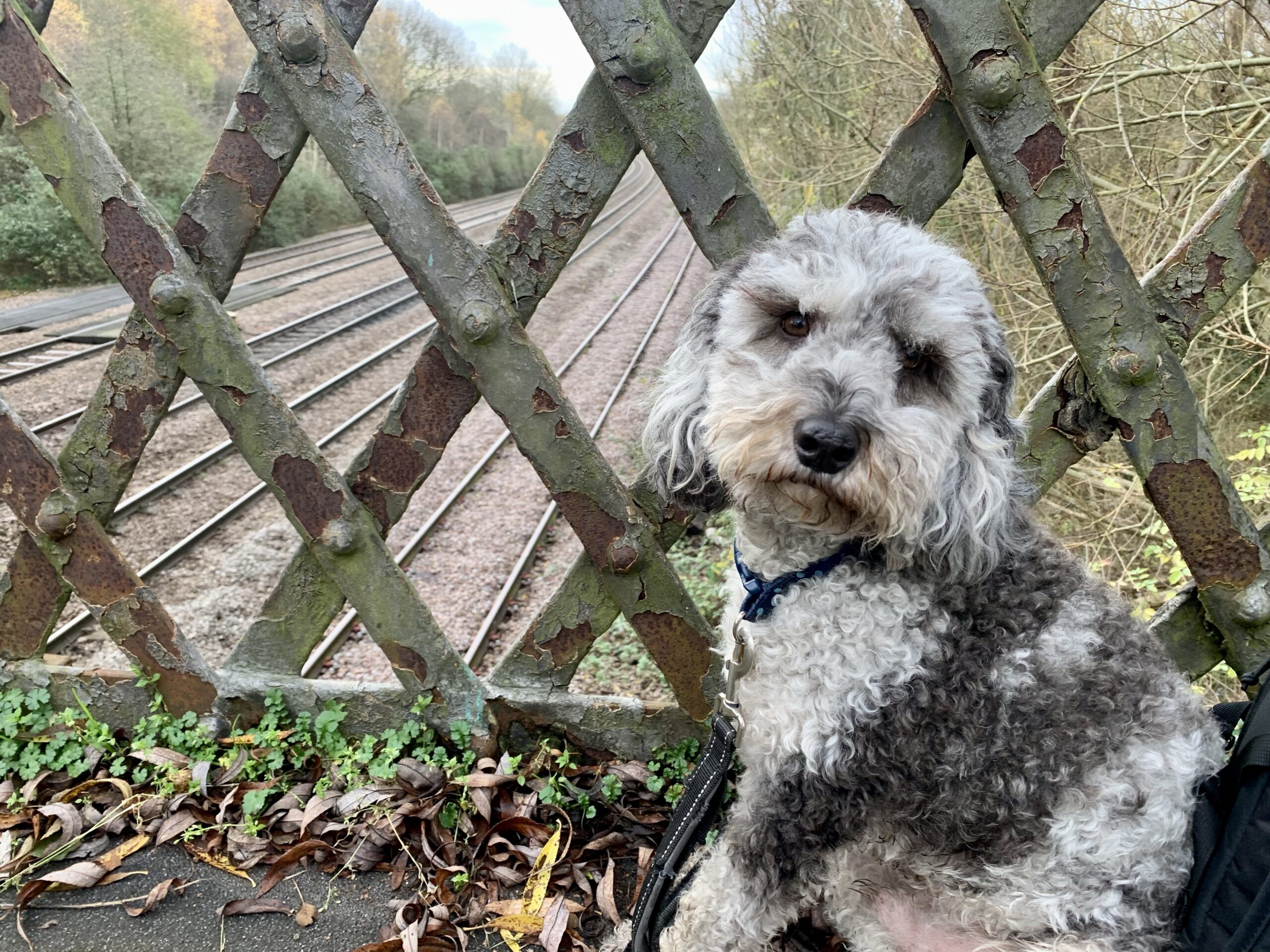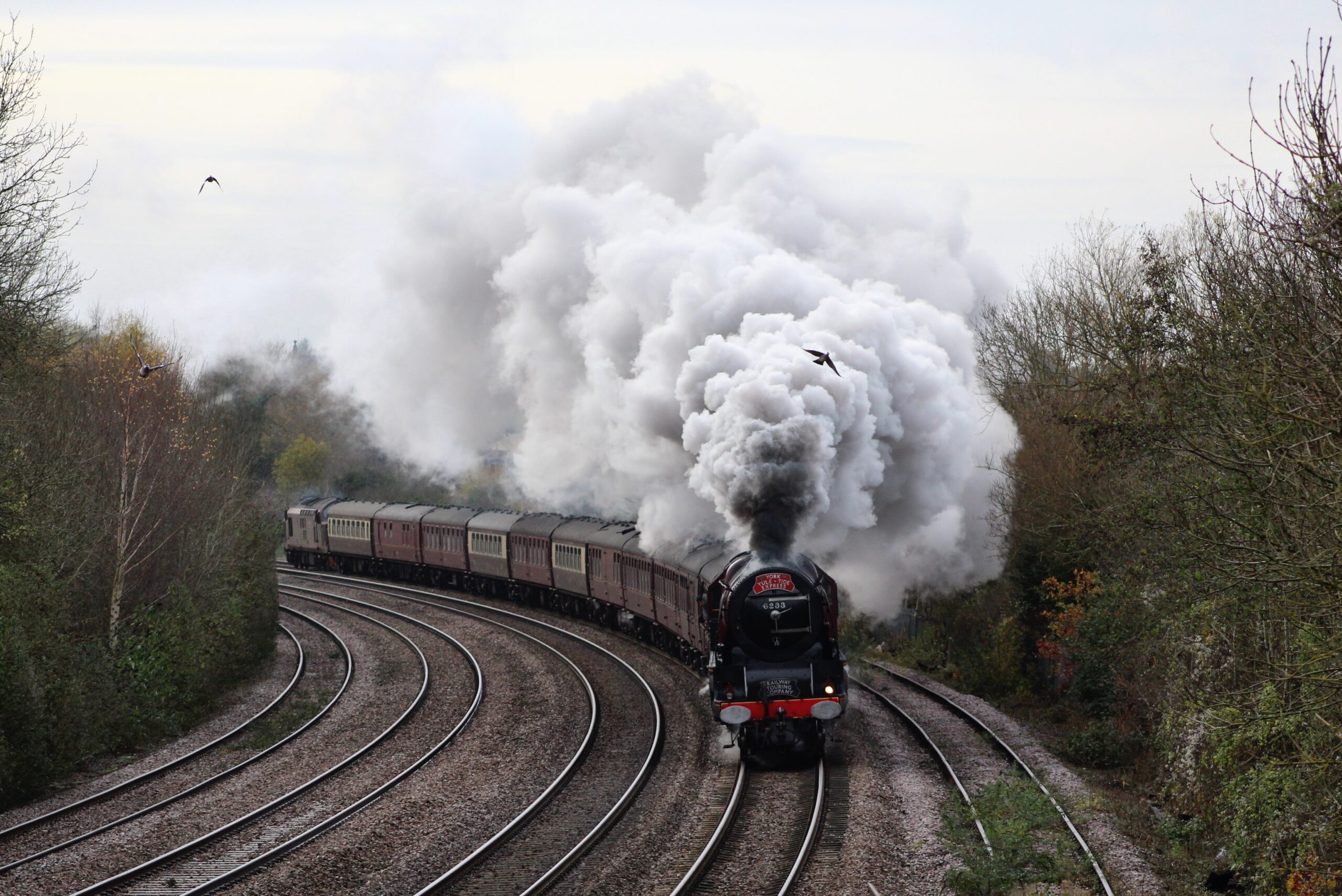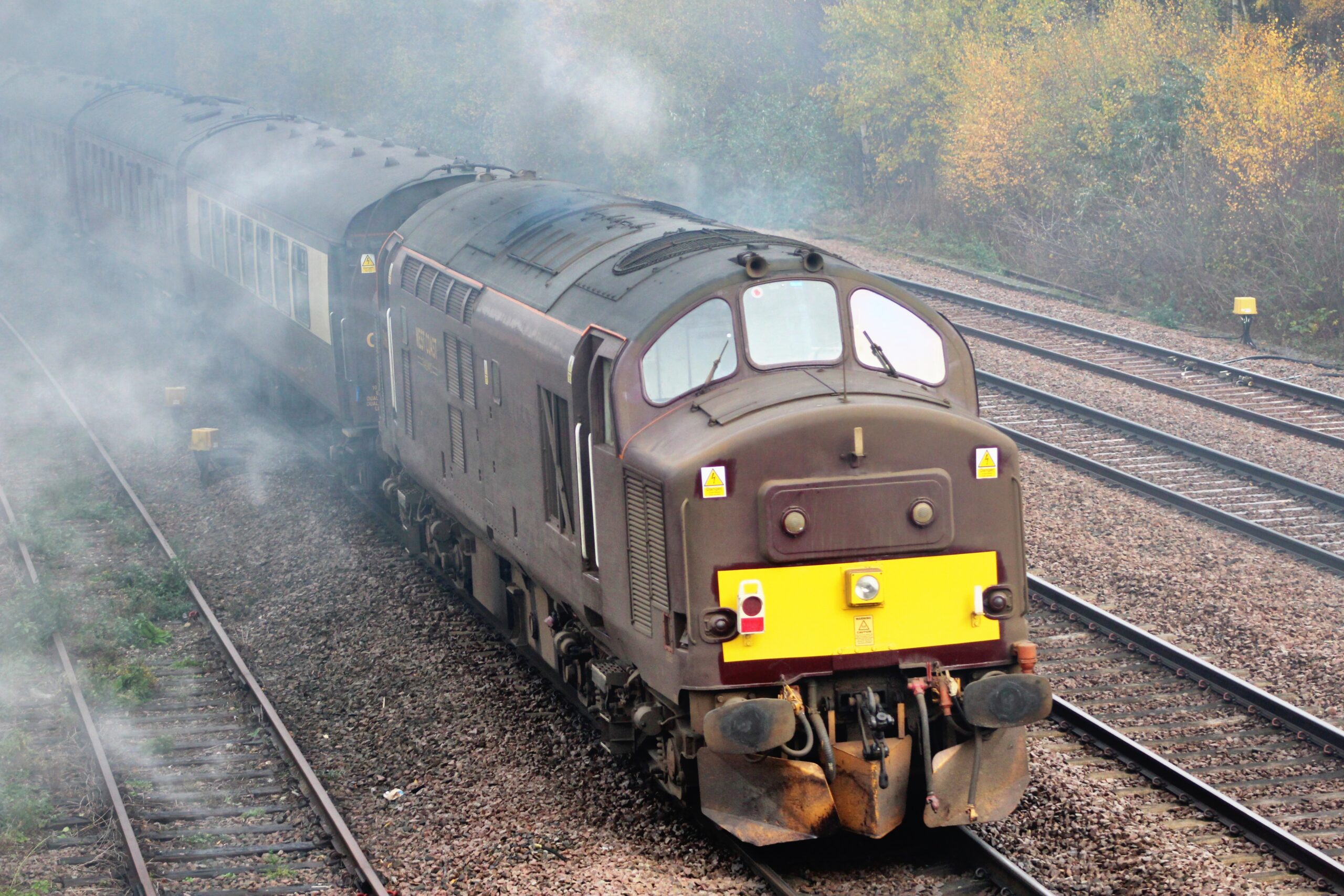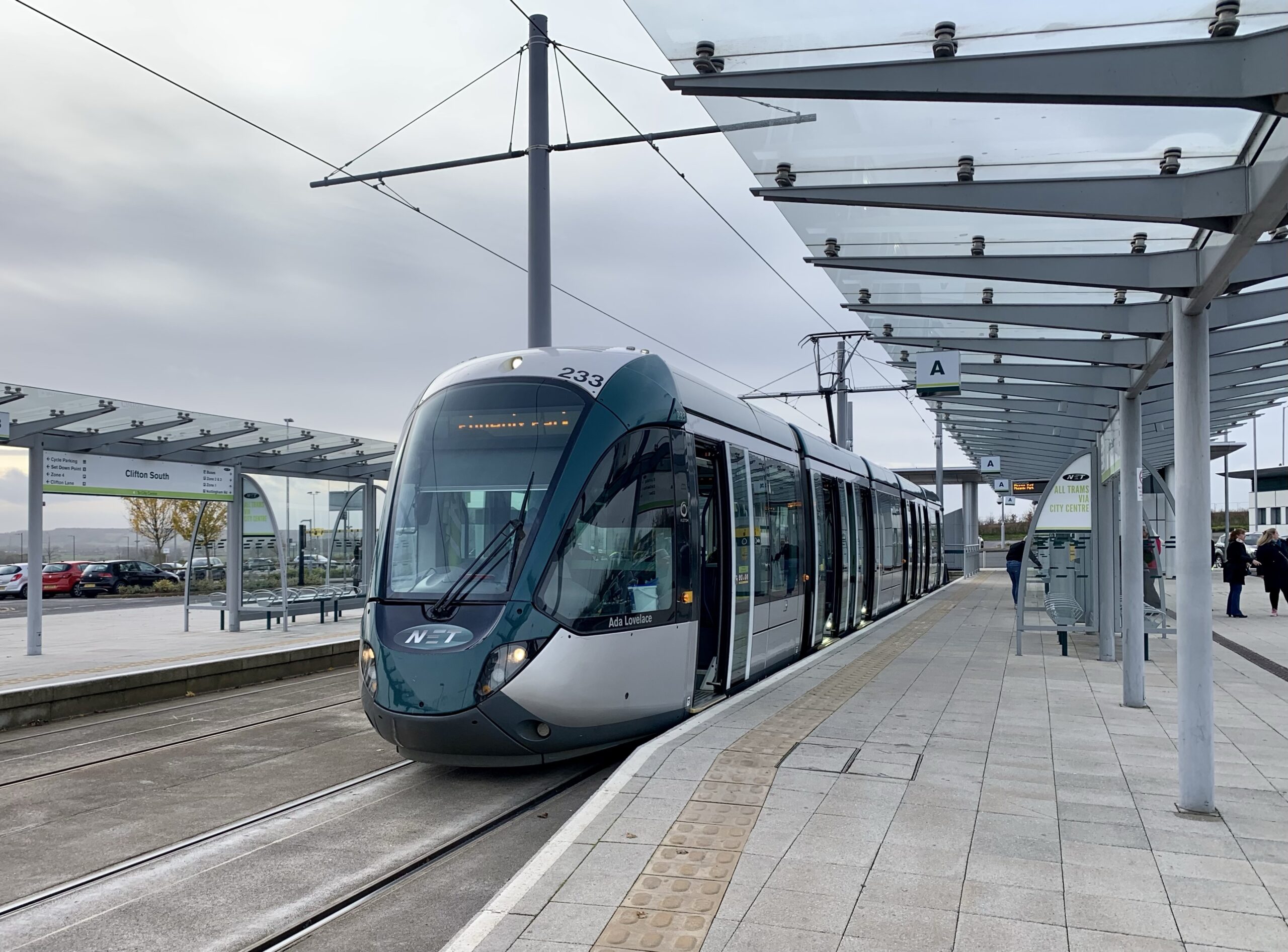
Category: Test Trains

  • Yoshi and the Hastings Unit

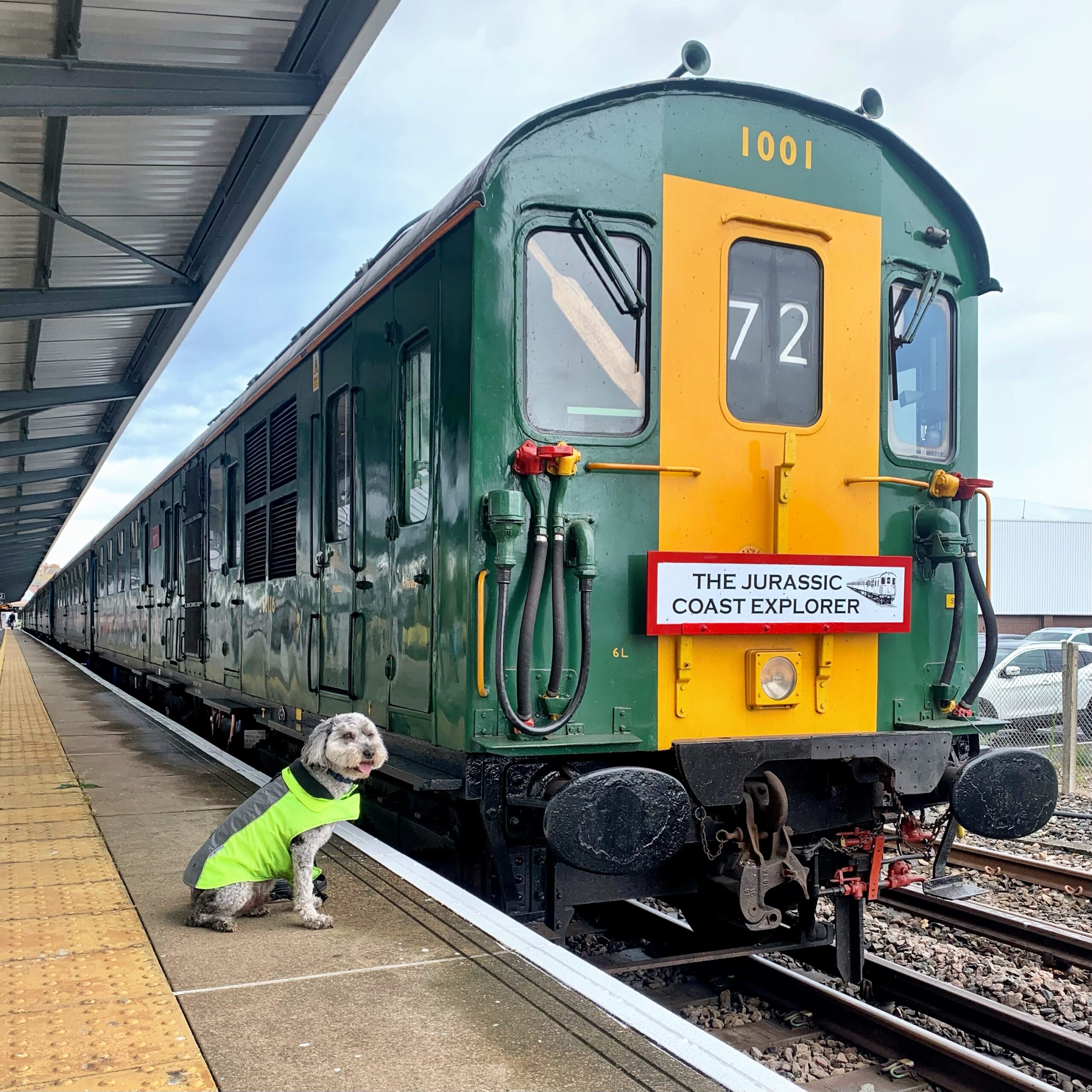
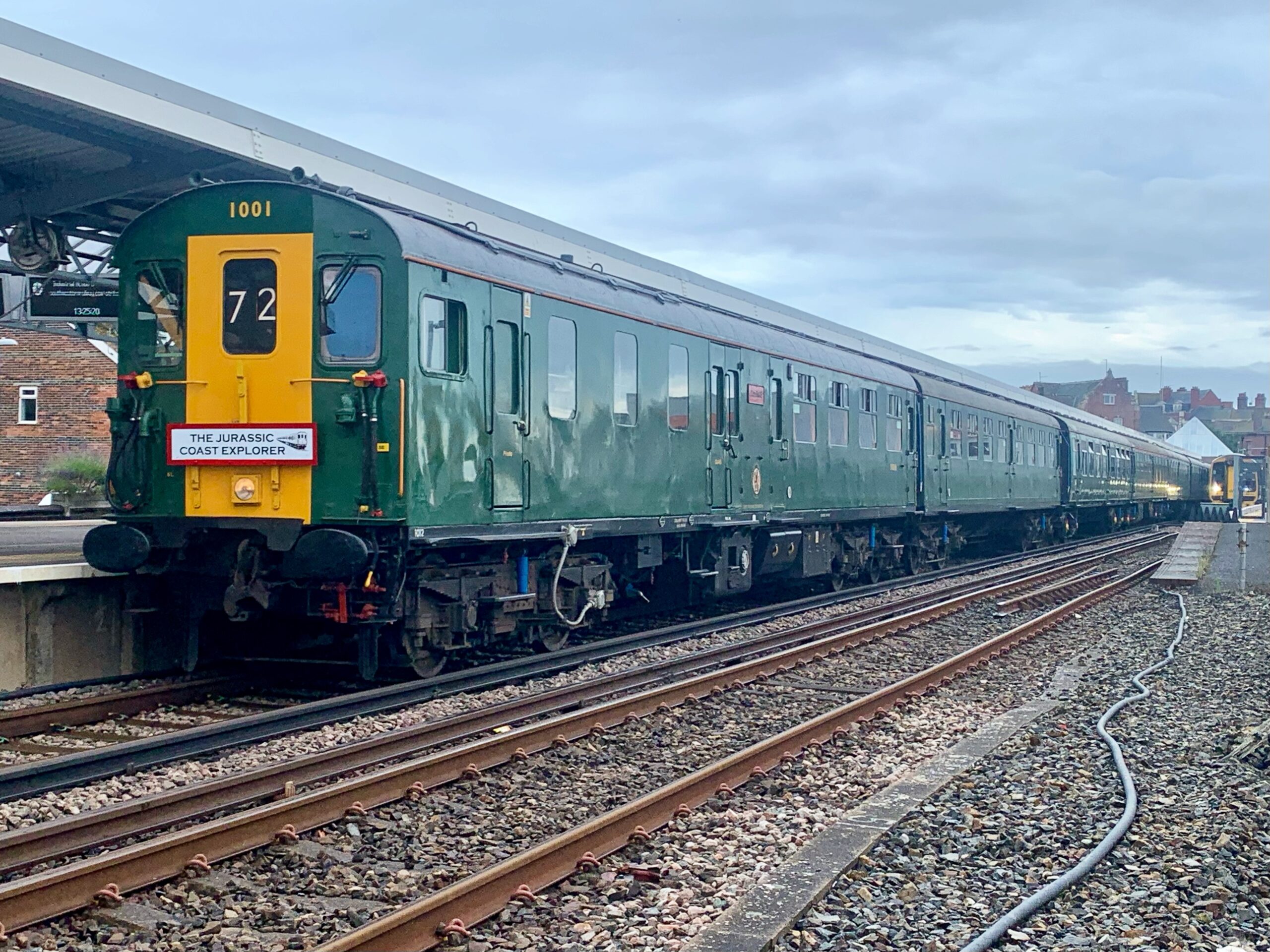
    In between showers of rain, Yoshi takes a look at Hastings Unit No. 1001 at Weymouth following its arrival with “The Jurassic Coast Explorer” railtour – 08/07/2023

    July 5th 2023 to July 11th 2023

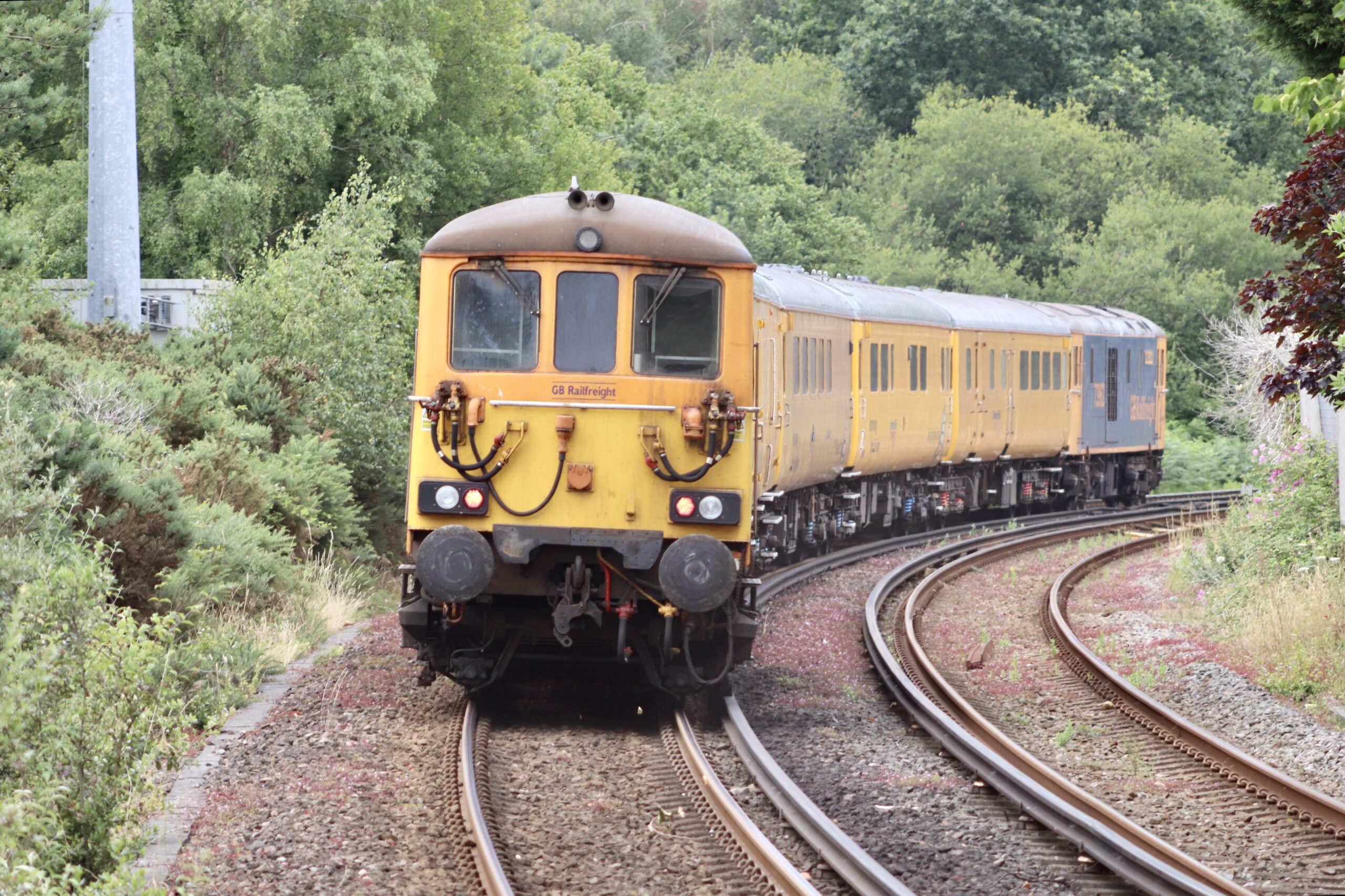
    This time around we were lucky enough to see two separate railtours grace our patch. But before that on Wednesday 5th July, the Ultrasonic Test Unit (UTU) reached Weymouth via  Bournemouth working as 3Q02 2140 Eastleigh East Yard to Eastleigh East Yard via Weymouth Signal DR194. As the name of the UTU suggests, ultrasonic equipment – the same technology used in medical practices – is employed to detect minute flaws in the track as the train passes over it. Hauled by Colas Class 37 No. 37175 the ensemble was in much use in the South and visited Weymouth once again on Sunday 9th July (although running around two hours late) as 3Q14 1517 Westbury to Westbury via Weymouth. UTU’s inspect around 64,000 miles of track all over the UK using four trains over 750 shifts annually.

    Ultrasonic Test Unit (UTU) in Dorset – July 2023 (Additional video by kind permission of G E Barrett)

    Ultrasonic Testing Unit trains usually have 1 locomotive at one end, and a DBSO (Driving Brake Standard Open) at the other. The DBSO controls the locomotive at the other end whilst it is leading the formation. UTU trains have ground-penetrating radar systems to detect voids and deformations up to 2 meters into the ballast and earth. Similarly to Plain Line Pattern Recognition test trains (on which more below), UTU trains use rail profile scanners to help identify problems or degradation in track profile, comparing it to a template of an ideal track.

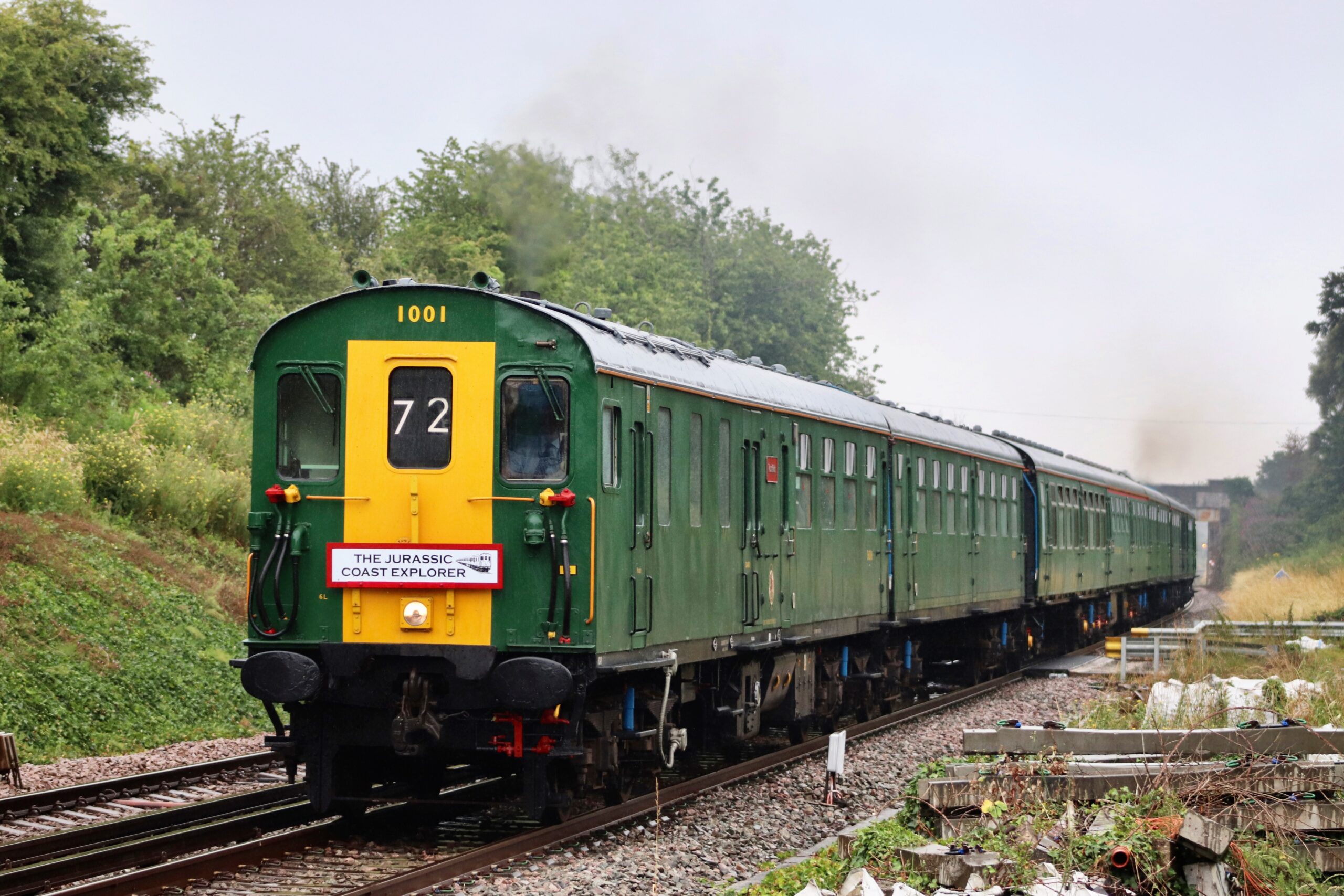
    Hastings Unit No. 1001 at Weymouth having arrived with “The Jurassic Coast Explorer” – 08/07/2023

    The first railtour over the weekend was Hastings Diesels Limited’s (HDL) “The Jurassic Coast Explorer” which ran on Saturday July 8th 2023 employing  their Hastings Diesel-Electric Multiple-Unit (DEMU), one of a class of trains built during 1957 and 1958 to replace steam-hauled stock operating between London and Hastings via Tunbridge Wells. The six-coach units, incorporating diesel generators at each end, were unique in having specially narrow bodies which enabled them to pass through the unusually narrow tunnels on the Hastings line. When the line was electrified in 1986, these “Hastings” diesel units were withdrawn (and the tunnels single-tracked to solve the width problem). The preserved example, certified for mainline running, is numbered Unit No. 1001 but actually includes vehicles from several different units and trains including a buffet car from a 4-BIG electric multiple unit (EMU) and a Trailer Second (TSO) from a 4-CEP EMU which unlike the other stock are built to standard UK loading gauge.
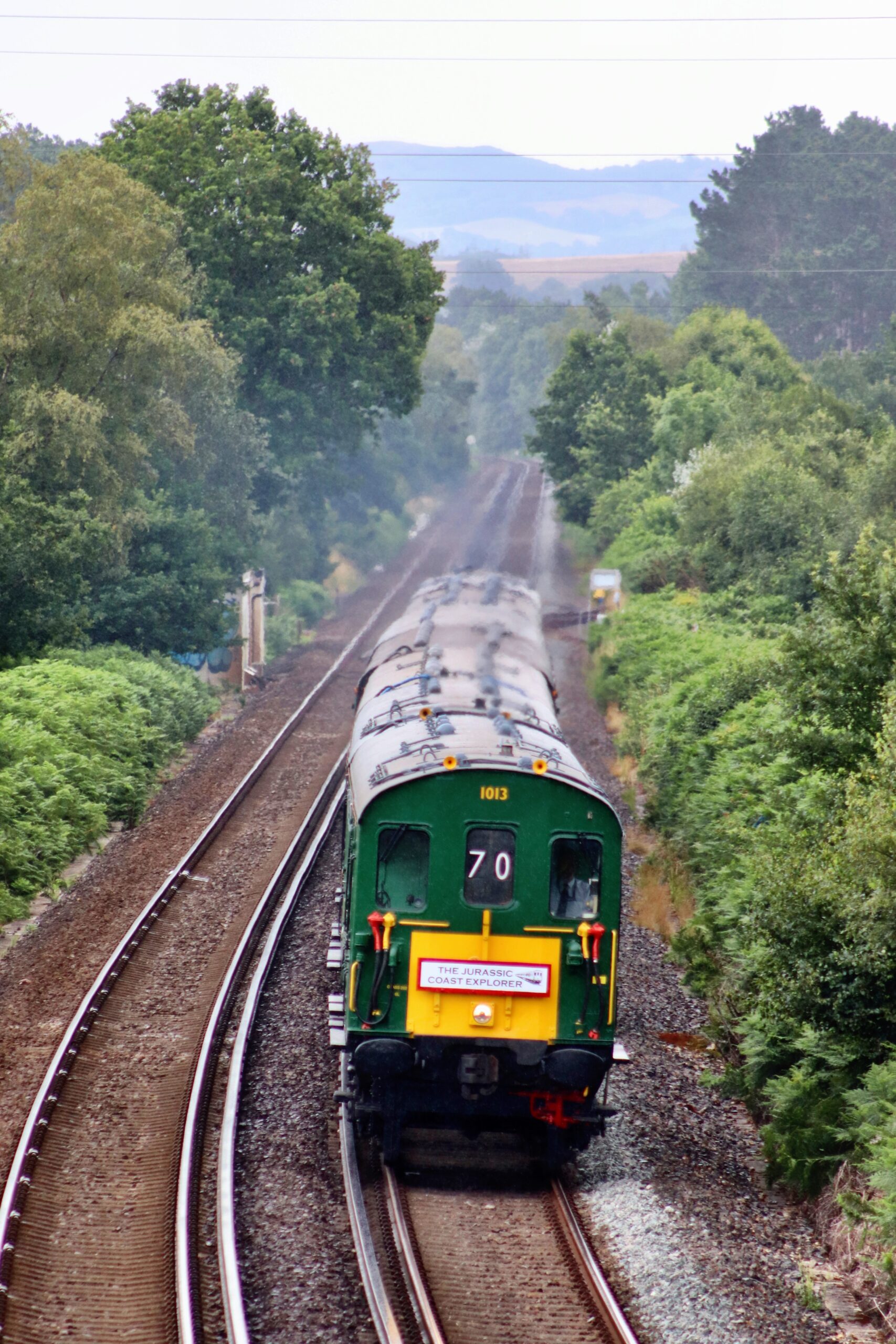
    Hastings Unit No. 1001 speeds past Winfrith working 1Z70 0651 Hastings to Weymouth “The Jurassic Coast Explorer” – 08/07/2023
    Hastings Unit No. 1001 at rest in Weymouth whilst working “The Jurassic Coast Explorer” – 08/07/2023
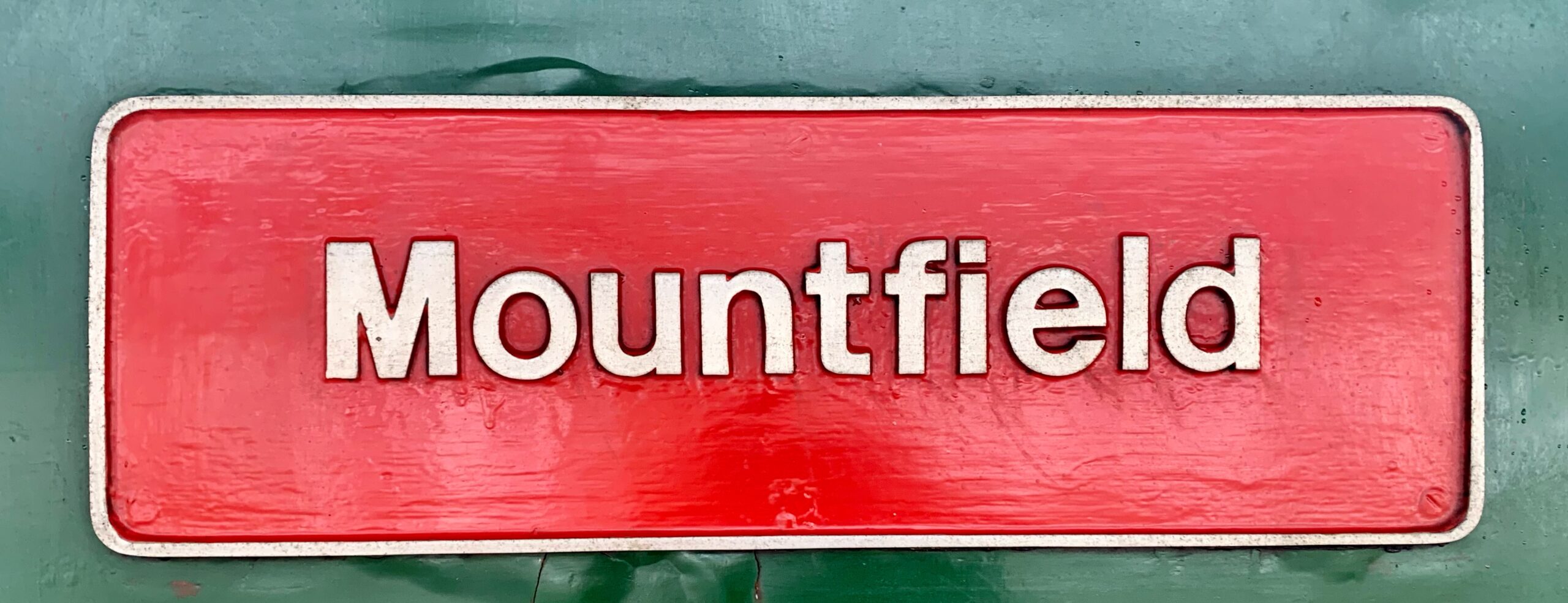
    Hastings Unit DEMU nameplate detail ‘Mountfield’ – 08/07/2023
    Hastings Unit DEMU nameplate detail ‘Tunbridge Wells’ – 08/07/2023
    Hastings Unit No. 1001 powers up through Upwey whilst working the return “The Jurassic Coast Explorer” 1Z72 1538 Weymouth to Hastings – 08/07/2023 (With thanks to G E Barrett for Dorchester images)
    Video of Hastings Unit No. 1001 railtour “The Jurassic Coast Explorer” – 08/07/2023

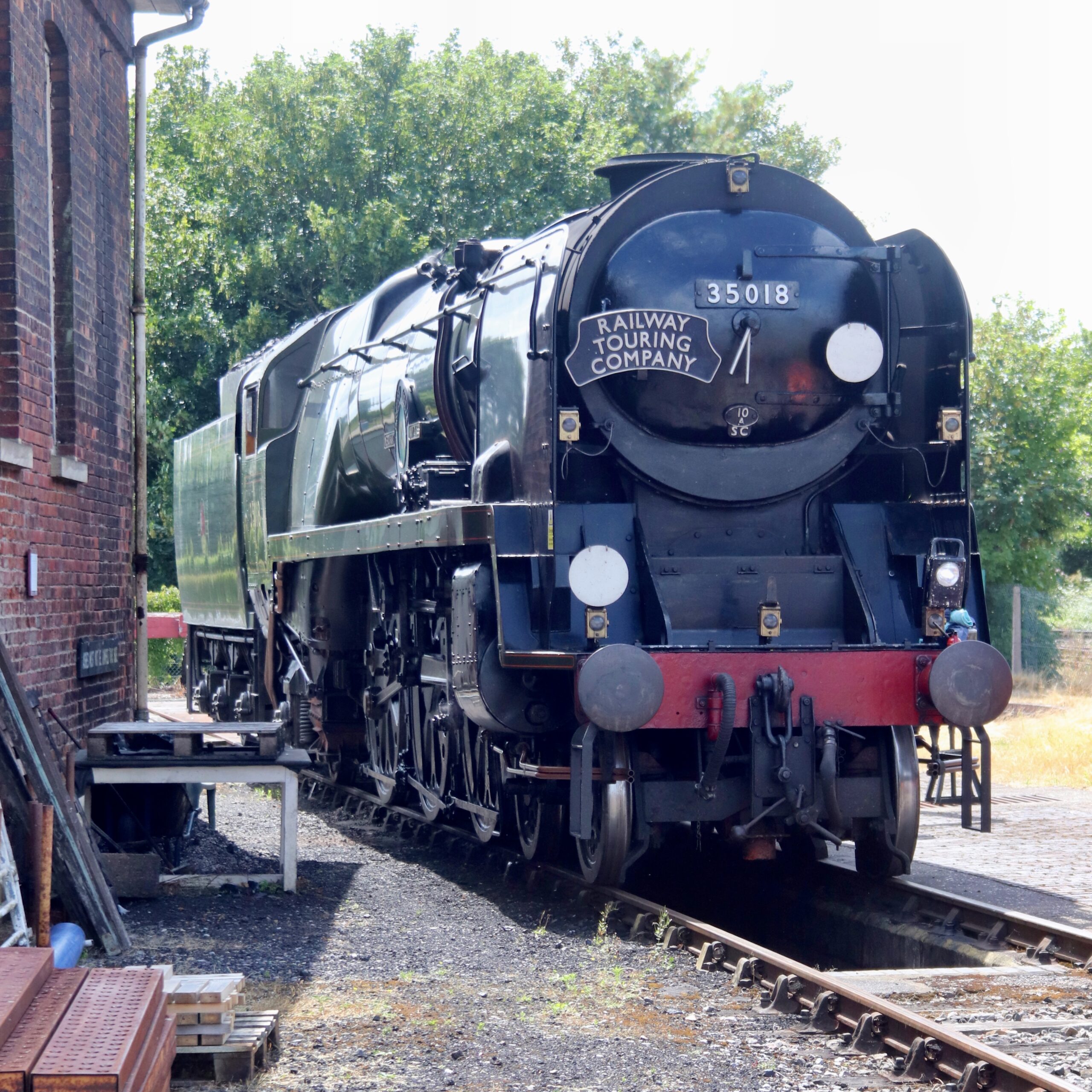
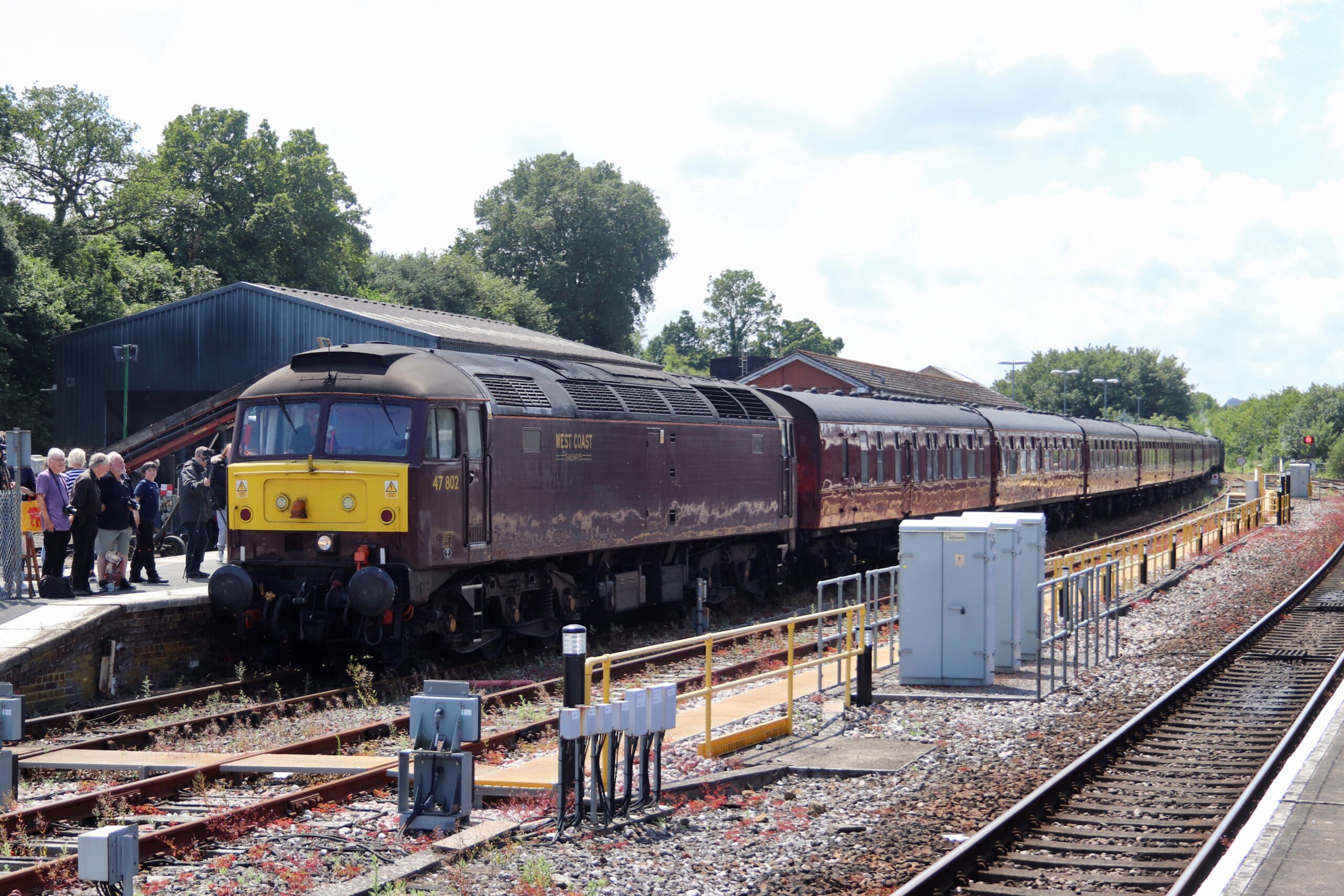
    The following day, Sunday July 9th the seemingly annual tour celebrating “The End Of Southern Steam” reached Weymouth. The last day of regular steam haulage across the British Railways (BR) Southern Region took place on July 9th 1967. 56 years later and Southern Railway Bullied Pacific No. 35018 ‘British India Line’ returned to the metals she would have travelled over back in her working BR days. Starting out from London Victoria the passengers were hauled by No. 35018 to Yeovil Junction via Salisbury where the steam locomotive was removed from the train for turning and servicing, the tour advancing to Weymouth behind West Coast Railway Company (WCRC) owned Class 47 No. 47802 which had been on the rear of the train since its London departure.

    I left home thinking I had lots of time to find a location to photograph the train near Gillingham, and was surprised to see on Real Time Trains the tour had in fact gained five minutes by the time it had reached Dorset. So a change of plan was instigated and I diverted off to Sherborne where I was caught out by the train approaching my over bridge vantage point wrong line.
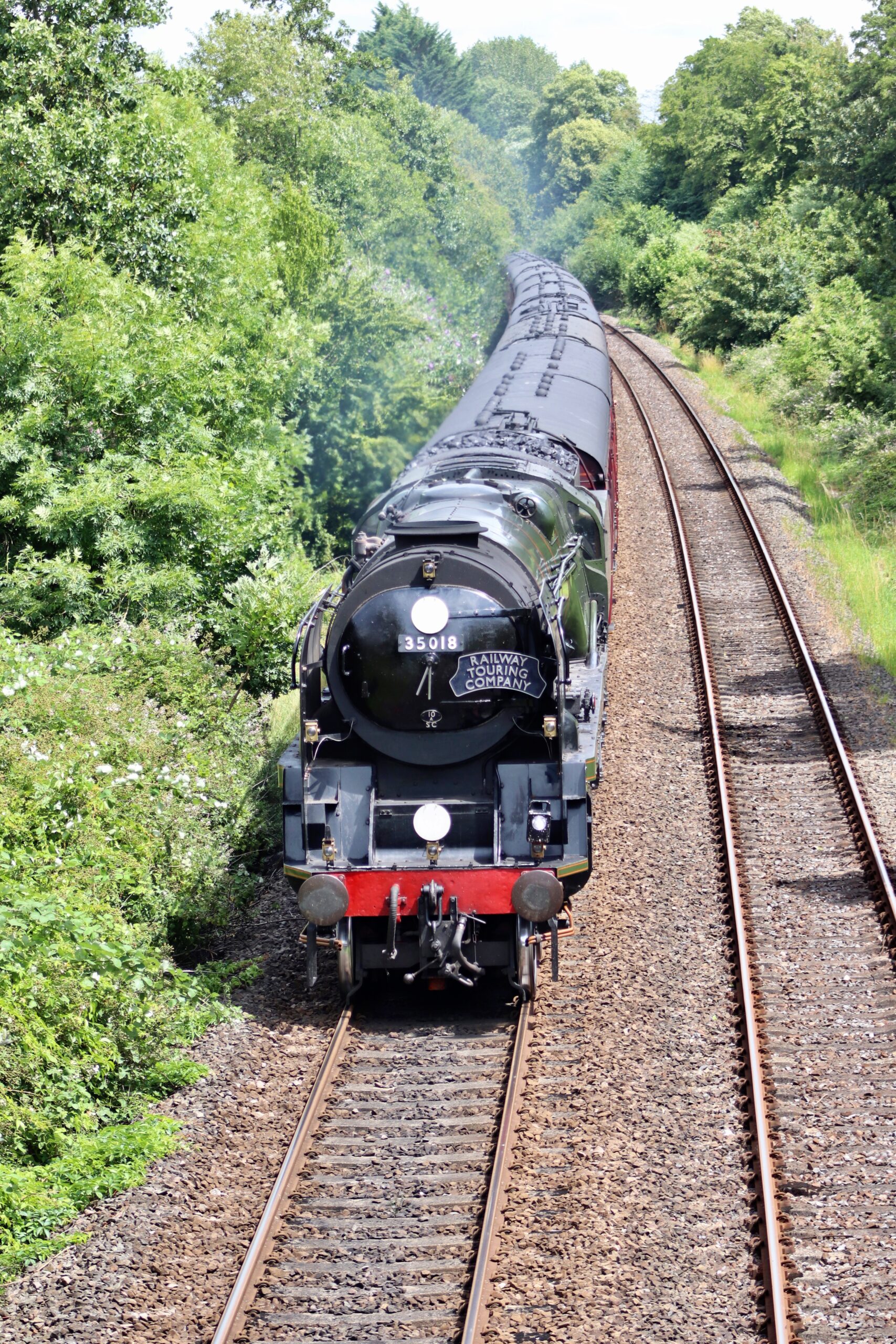
    Southern Railway Bullied Pacific No. 35018 ‘British India Line’ working wrong line at Sherborne as 1Z82 London Victoria to Yeovil Junction Down Main Platform – 09/07/2023
    WCRC Class 47 No. 47802 resides departure with 1Z83 1344 Yeovil Junction Down Main Platform to Weymouth which left Yeovil 20 minutes late – 09/07/2023
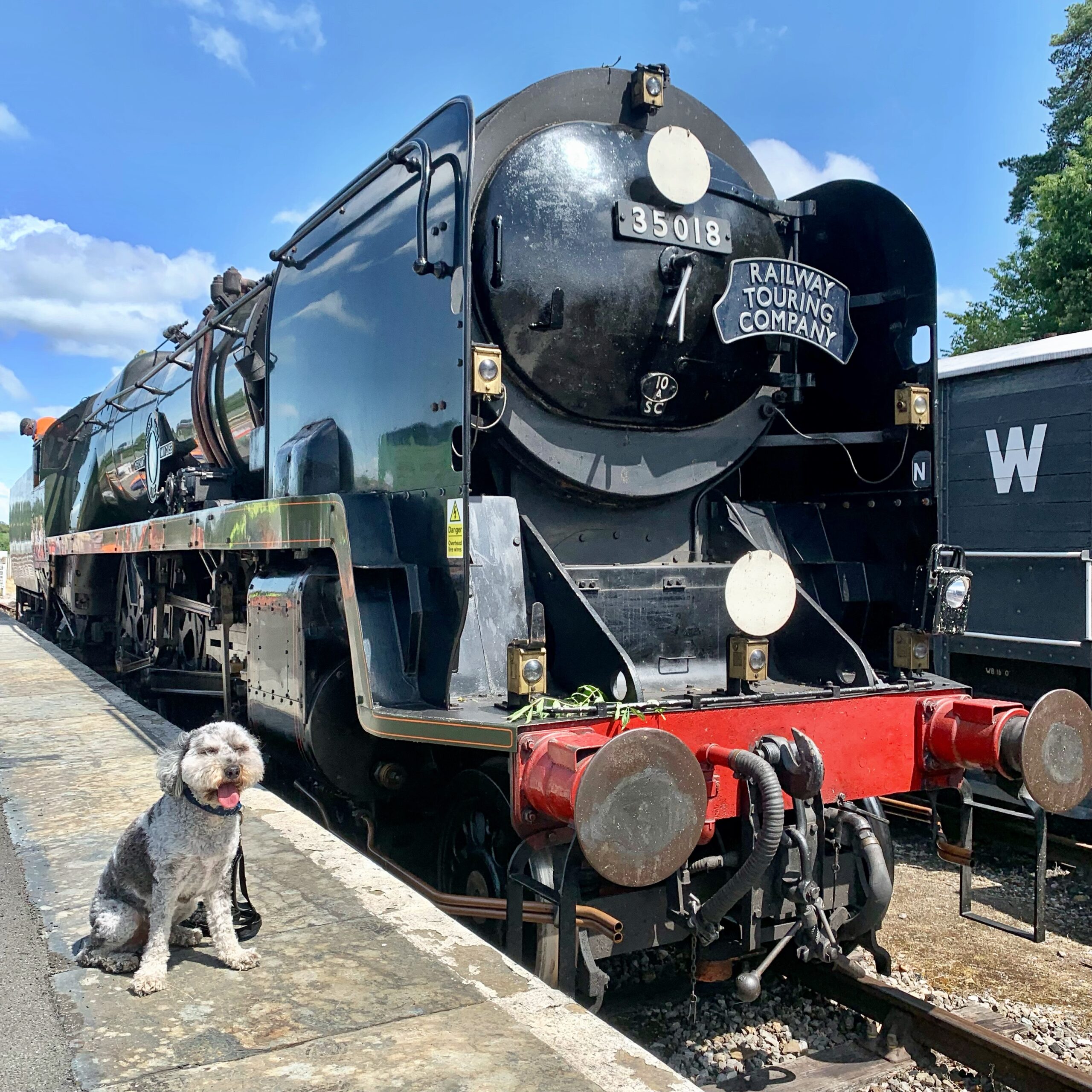
    Yoshi meets Southern Railway Bullied Pacific No. 35018 ‘British India Line’ at Yeovil Junction which was being serviced at the Yeovil Railway Centre – 09/07/2023
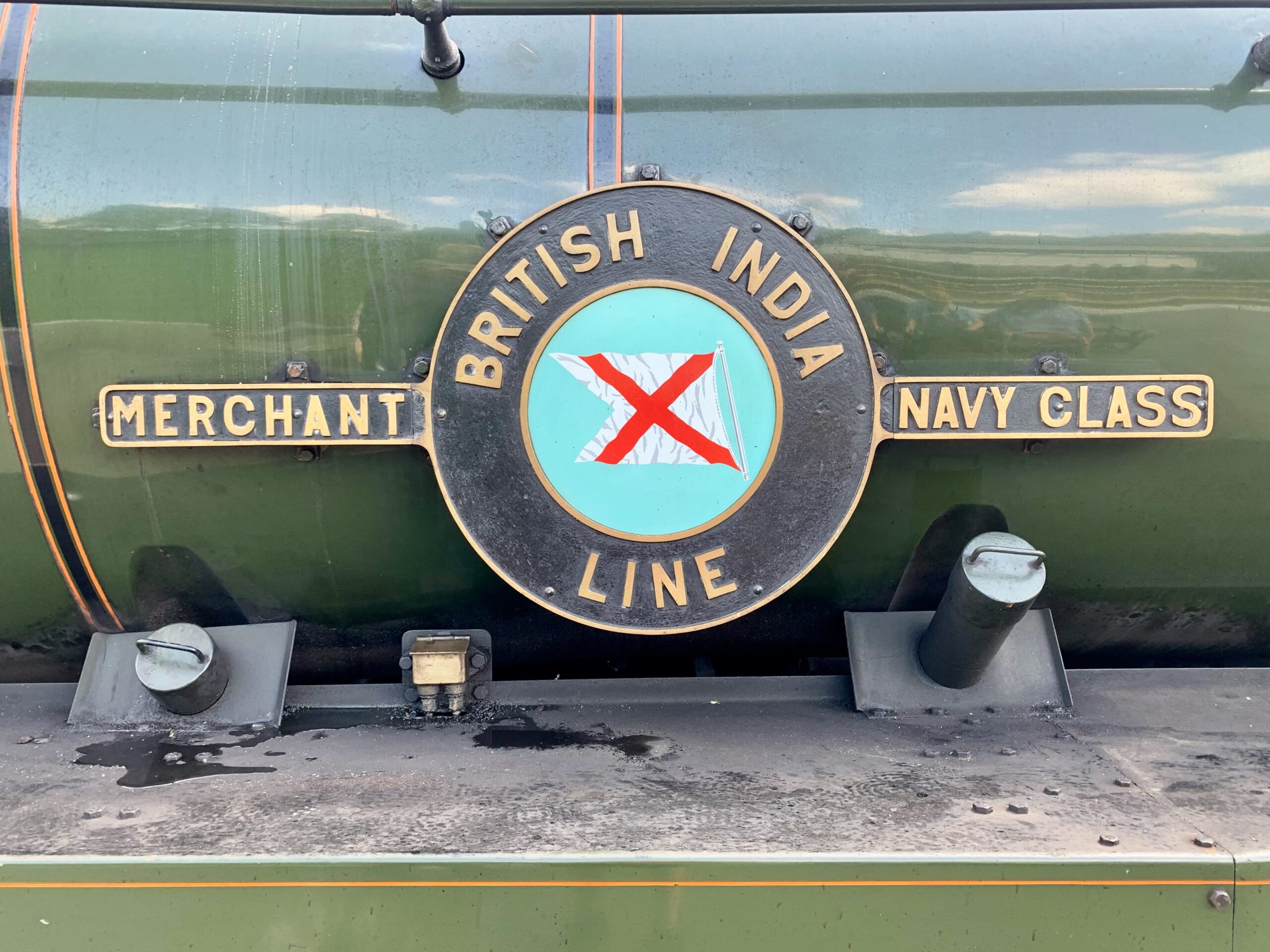
    Nameplate detail for Bullied Pacific No. 35018 ‘British India Line’ – 09/07/2023
    Southern Railway Bullied Pacific No. 35018 ‘British India Line’ having been turned on the Yeovil Railway Centre turntable – 09/07/2023

    Having been refreshed by the team at the Yeovil Railway Centre, No. 35018 worked light engine down to Weymouth where she re-joined the railtour for a spirited late afternoon departure bound for London Waterloo. I waited for the light locomotive at Evershot, but my view was obscured by steam. I then got ahead of No. 35018 and saw her again very close to the former Monkton and Came Halt which had been opened by the Great Western Railway in 1905 as part of their ambitions to combat road based transport. The station served the nearby Came Golf Links and visitors to Maiden Castle. This ultimately failed and the Halt was closed in 1957. Some remains of the platforms can still be seen.
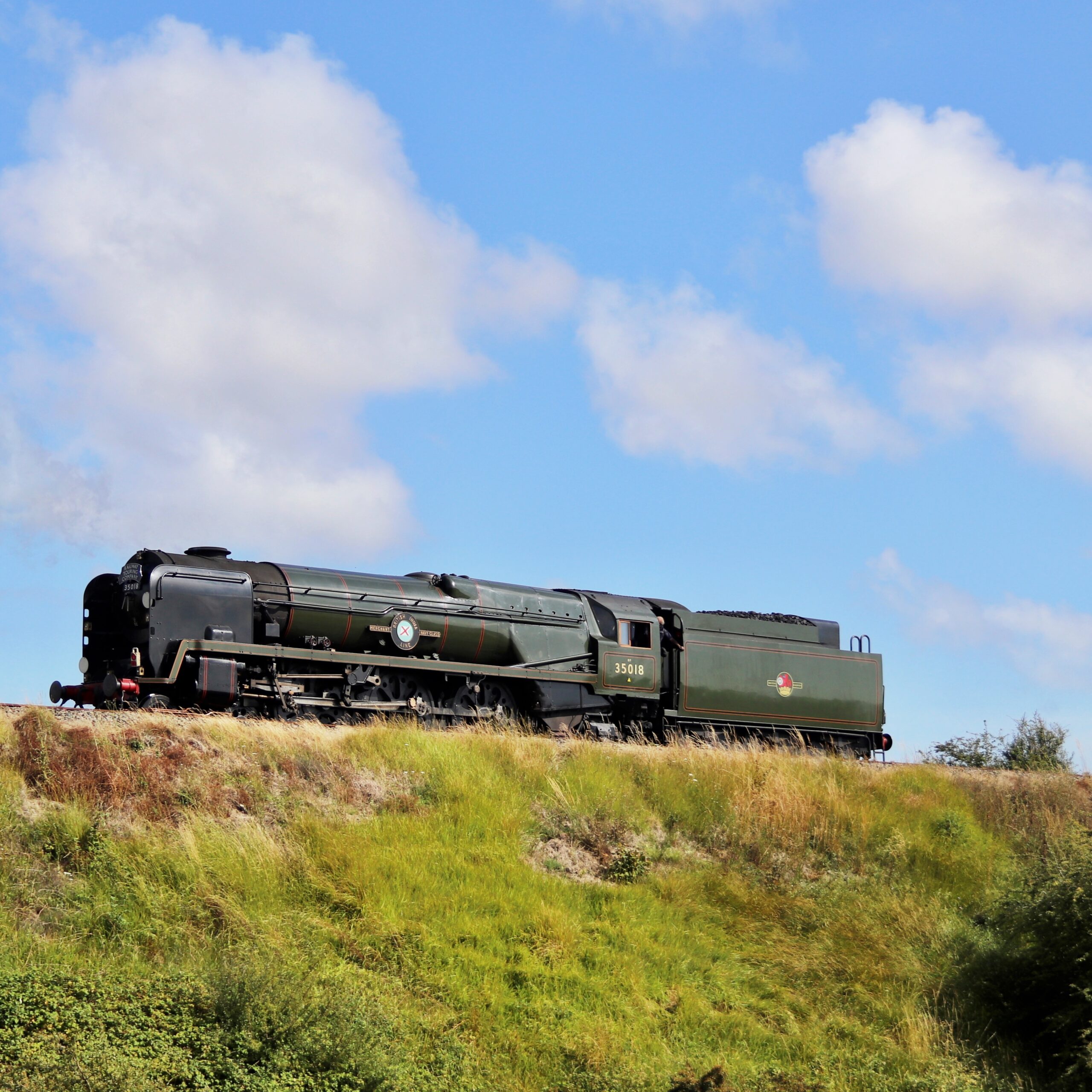
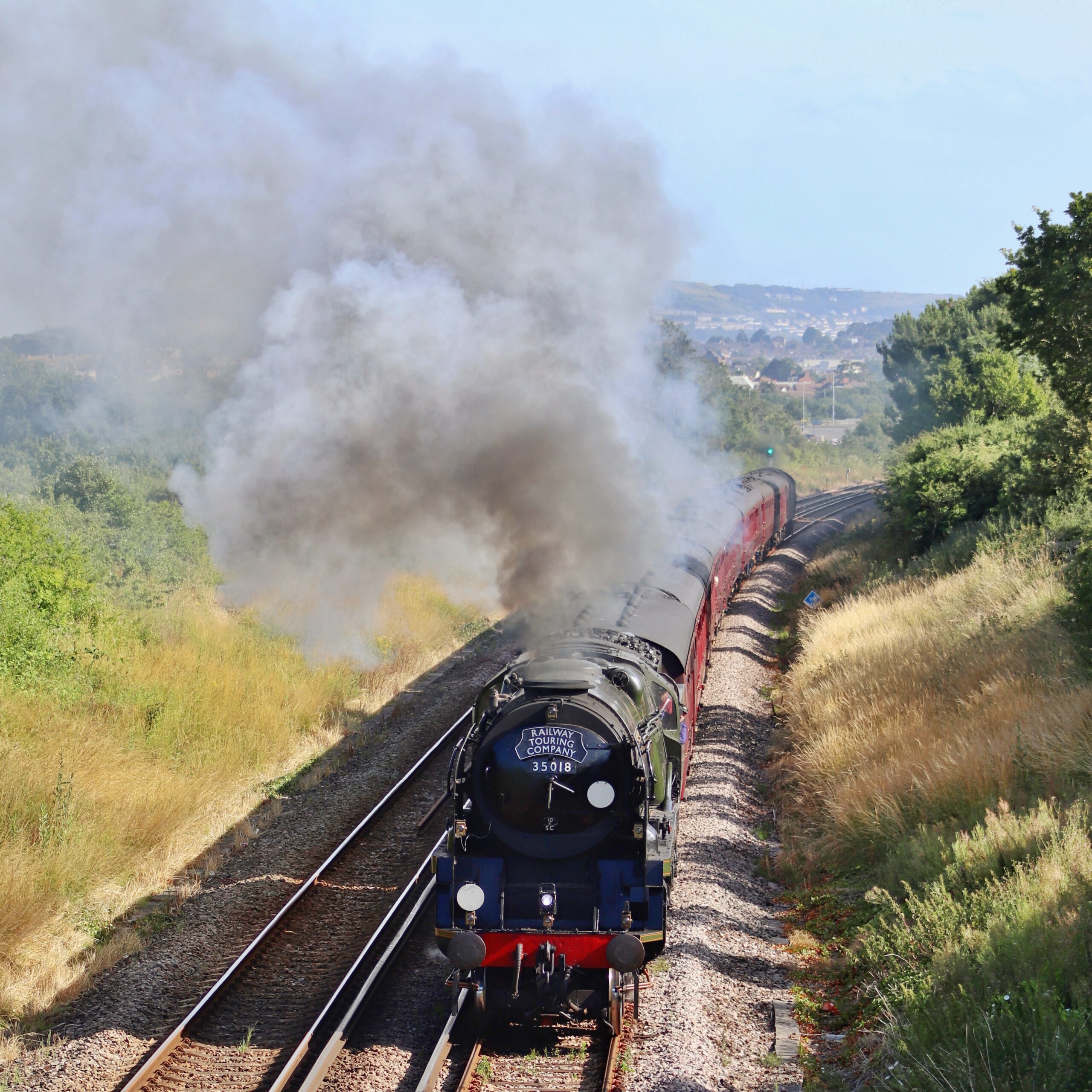
    Running tender first to Weymouth as 0Z84 1523 Yeovil Junction Down Main Platform to Weymouth Jersey Siding to rejoin the main train Southern Railway Bullied Pacific No. 35018 ‘British India Line’ passes Monkton – 09/07/2023
    Making a spirited climb towards Bincombe summit Southern Railway Bullied Pacific No. 35018 ‘British India Line’ hauling Railway Touring Company’s “End of Southern Steam” 1Z84 1724 Weymouth to London Waterloo tour advances towards Upwey – 09/07/2023
    Southern Railway Bullied Pacific No. 35018 ‘British India Line’ the “End of Southern Steam” tour – 09/07/2023 (With grateful thanks to @da_buckley967 for the departure from Weymouth and G E Barrett for Dorchester footage)

    Co-incidentally two days later, London Waterloo celebrated its 175th anniversary which included the unveiling of a plaque commemorating the landmark birthday, a joint Network Rail and South Western Railway choir treated visitors to iconic ‘Waterloo’ songs such as ABBA’s “Waterloo” and The Kinks’ “Waterloo Sunset” as well of a preview of Class 701 “Arterio” EMU No. 701043 on platform 19 which was also adorned with a celebratory London Waterloo 175 roundel . The fleet of 90 Class 701 trains are over two years late at being introduced on Reading, Windsor and South West London suburban routes. In addition, fittingly situated under the famous Waterloo clock on the station concourse, a fascinating 40-panel history exhibition was put on display for a limited time. 

    Celebrating Waterloo 175 logo – 12/07/2023
    An exhibition celebrating Waterloo 175 stood for a few days on the concourse of the Southern Terminus – 12/07/2023

    Delayed by a week, Monday 10th July saw the monthly 1Q51 Plain Line Pattern Recognition (PLPR) test train head to Weymouth, as usual top and tailed by GBRf Class 73 electro-diesel locomotives, but this time in daylight. The train usually runs on our patch in in the late evenings but the rescheduled working was scheduled for a lunchtime turn around at Weymouth. 
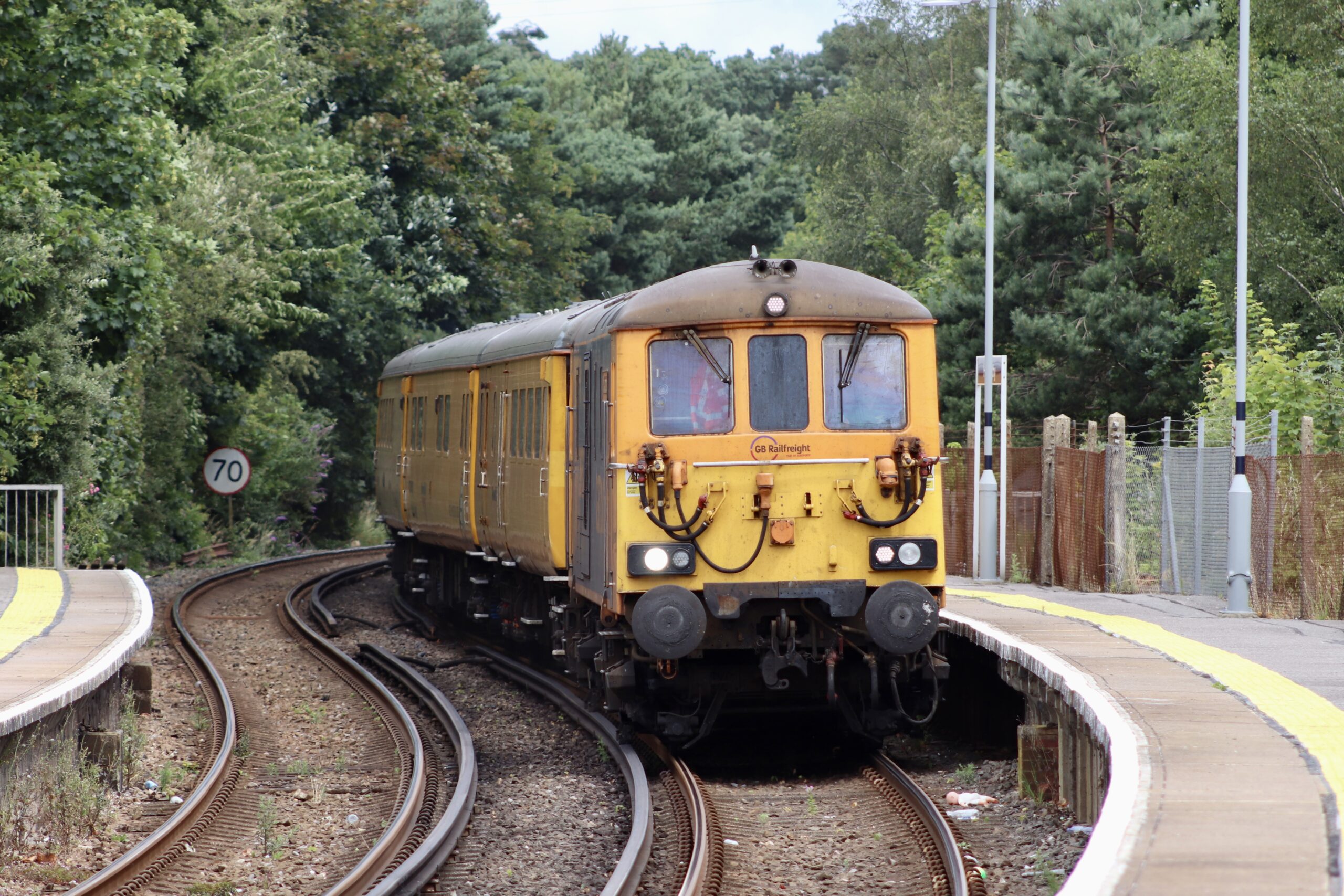
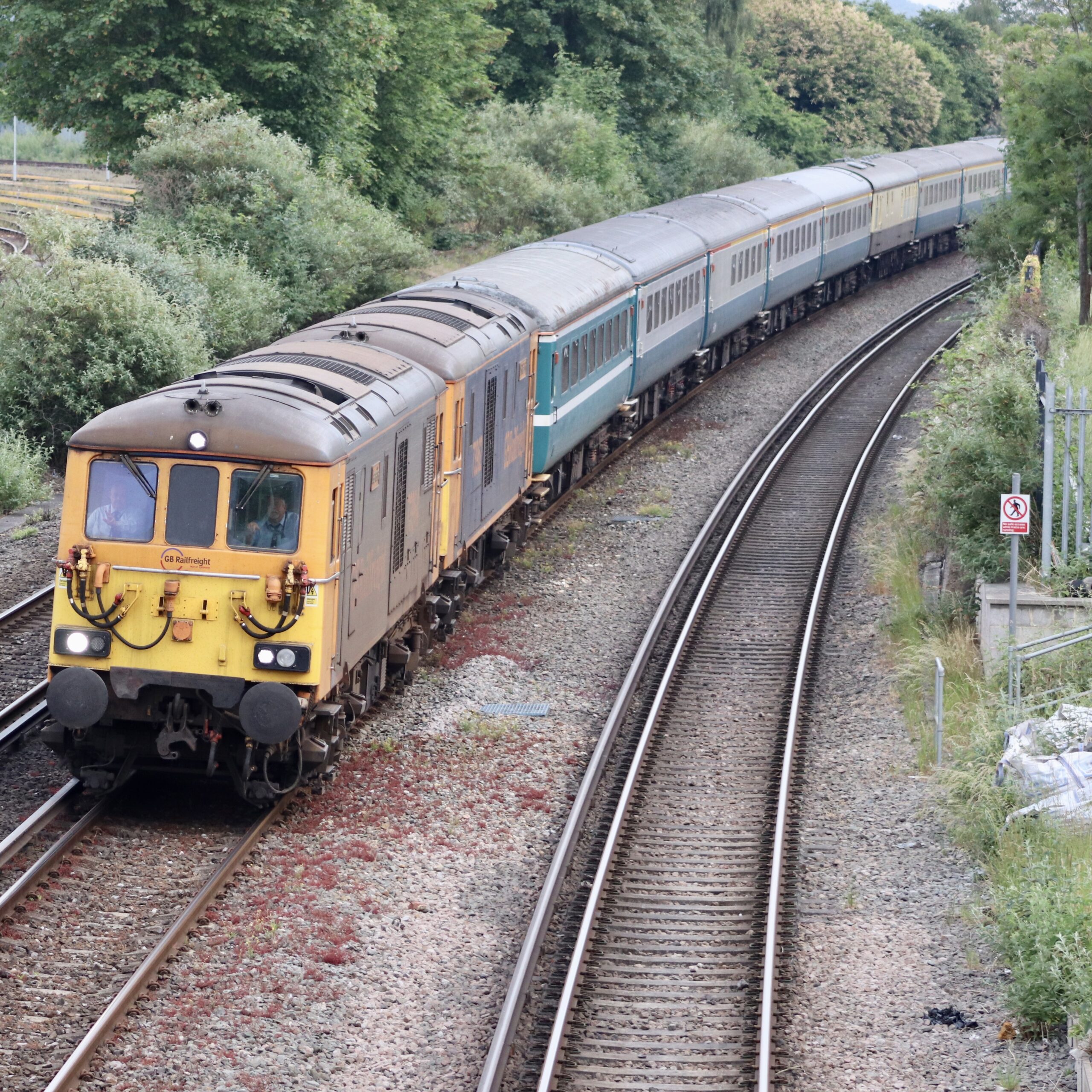
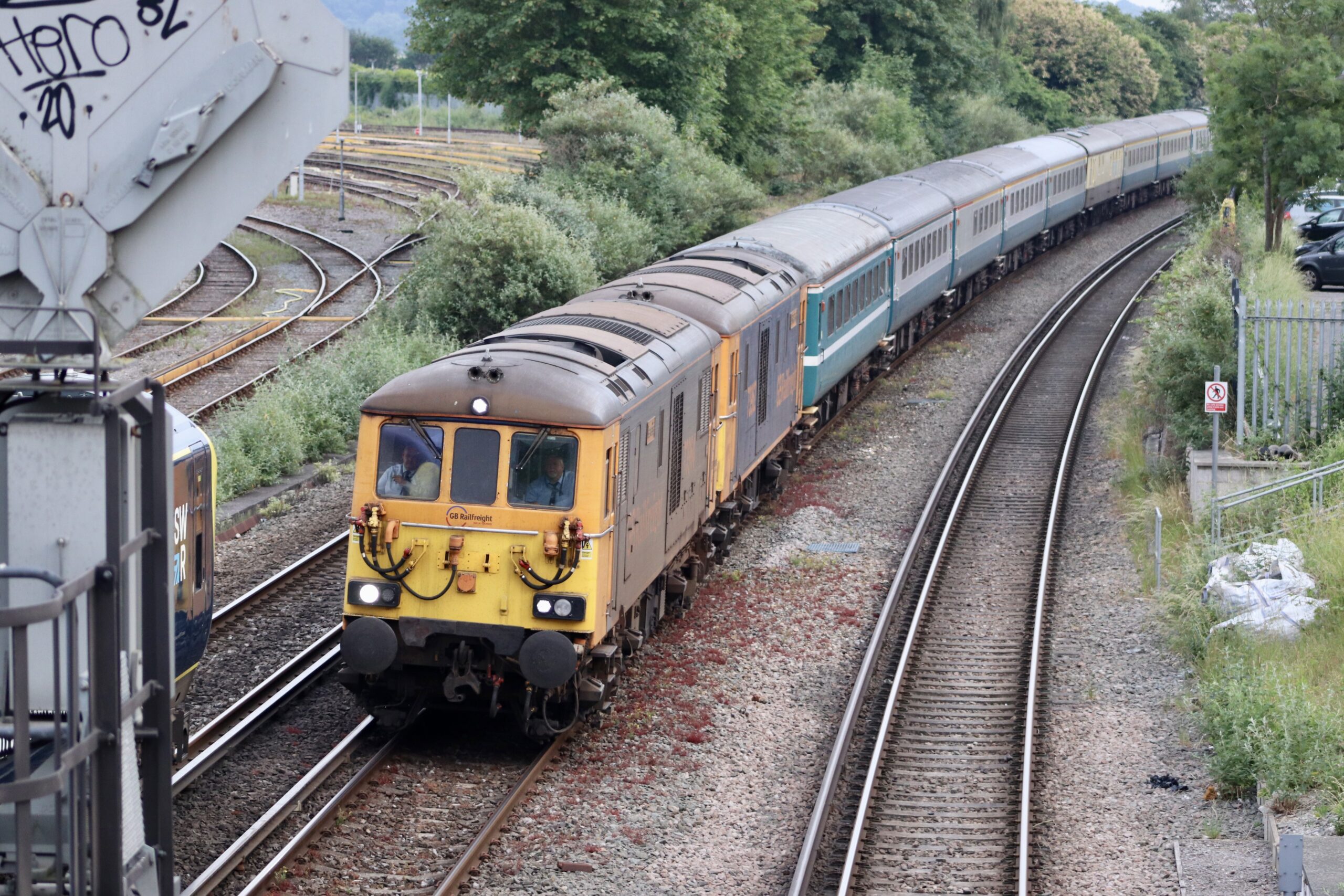
    GBRf Class 73 No. 73962 ‘Dick Mabbutt’ leading the outward leg of 1Q51 1008 Woking Up Yard Reception to Woking Up Yard Reception via Weymouth Plain Line Pattern Recognition (PLPR) test train passing Hamworthy – 10/07/2023
    GBRf Class 73 No. 73961 ‘Alison’ at the rear of 1Q51 Woking to Woking via Weymouth passing Hamworthy – 10/07/2023

    Plain Line Pattern Recognition uses a variety of tools to measure and detect defects and potential problems that might arise in track condition. PLPR uses equipment such as: 4 foot camera used to check the track condition, thermal imaging to check rail temperature, fasteners are checked with diagonal and top down cameras. The various cameras used store HD laser scanned images which show different angles and planes of the track and rails. PLPR was initially rolled out on the NMT measurement train, but has since been fitted to Network Rail’s coaches and can be seen across the UK rail network. The coaches on the PLPR may also by fitted with Radio Survey equipment, for testing of NRN, CSR and GSM-R communication systems.

    Video of 1Q51 Plain Line Pattern Recognition (PLPR) Test Train – 10/07/2023 (With thanks to G E Barrett for Dorchester video)

    From the Archive…

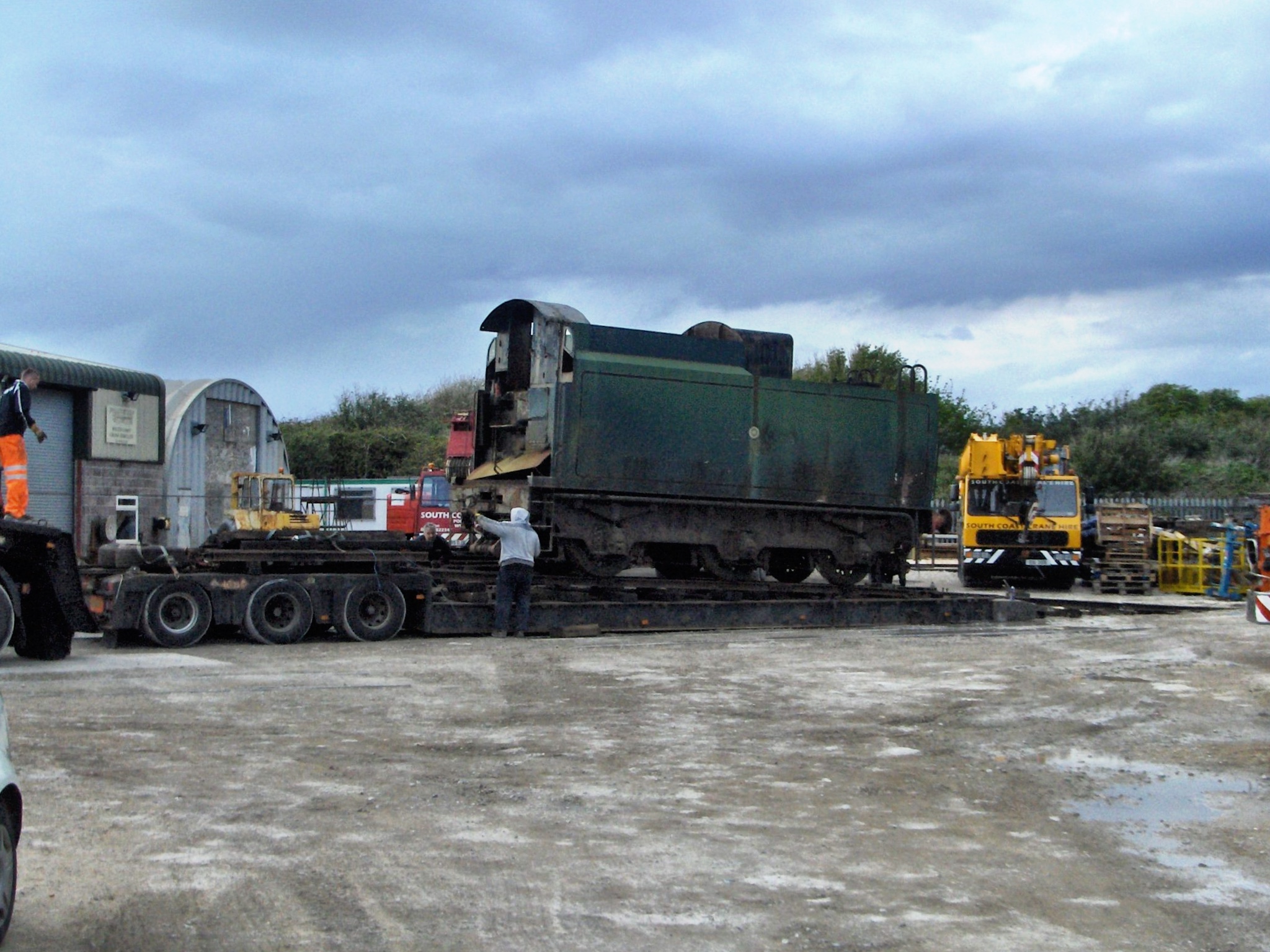
    In contrast to how SR Bullied Pacific No. 35018 ‘British India Line’ looked on her recent visit to Weymouth, below are three images of the locomotive and tender when she left storage on Portland taken by John Chappell.

    No. 35018 ‘British India Line’ was the first Merchant Navy locomotive to have the original air-smoothed casing removed as part of a rebuild of the class and emerged from Eastleigh Works in her new form during February 1956. She was withdrawn from service with British Railways in August 1964 and despatched to Barry Scrapyard for disposal. However, after languishing in South Wales for 15 years, she was purchased for preservation by Richard Heather and John Bunch, and in March 1980 the engine was moved to the Mid Hants Railway (MHR) where it was planned for her to be restored to full working order. In the event little work was undertaken on the locomotive during this time and she was later moved to a site in Portland but following little work again being undertaken on restoring the engine she moved once again, in 2012, to Carnforth in Lancashire having been purchased by David Smith. She finally underwent a thorough restoration to running order for mainline standards.
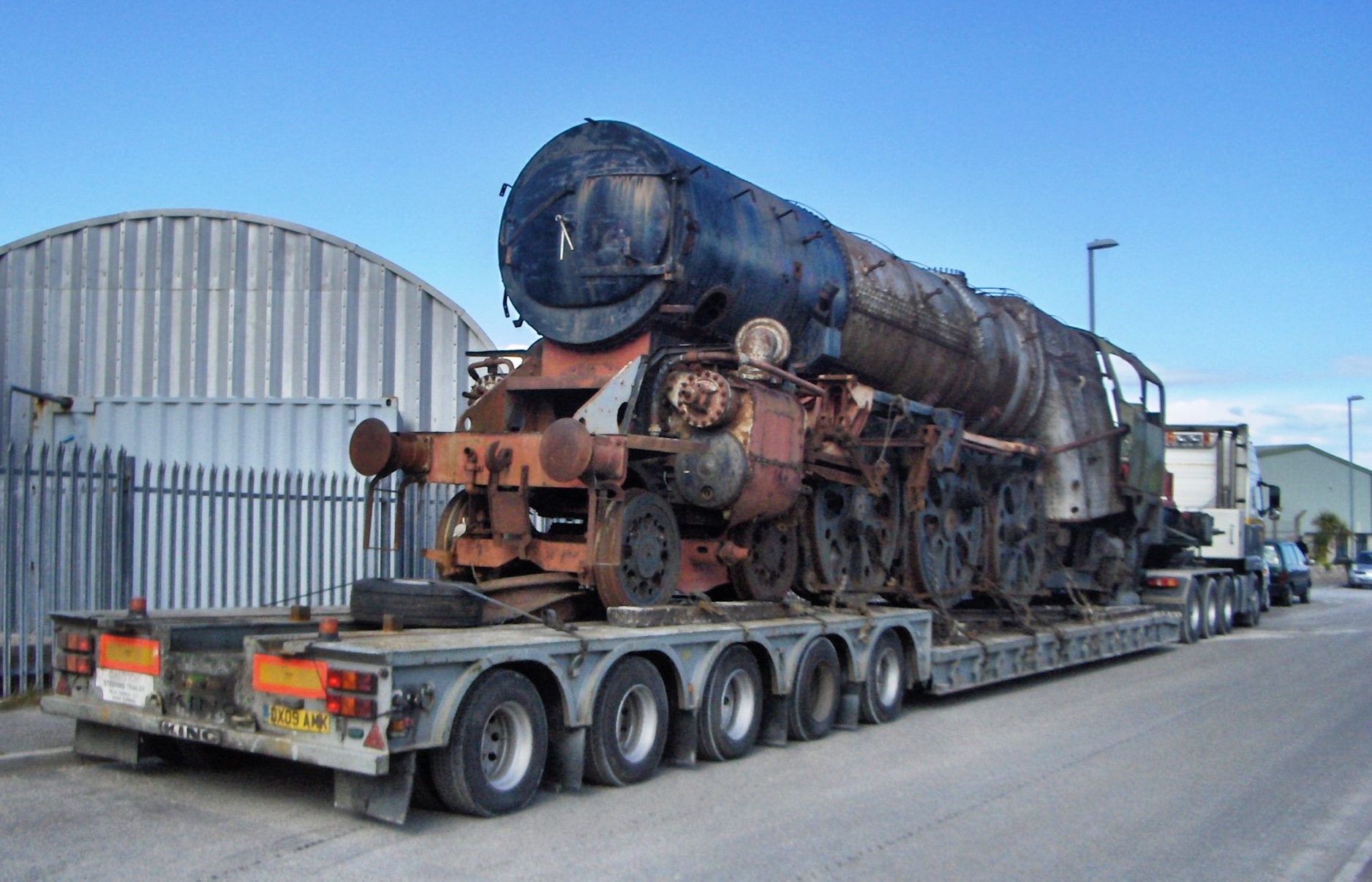
    SR Bullied Pacific No. 35018 ‘British India Line’ departs storage on Portland – 24/04/2012 (Image: John Chappell)
    SR Bullied Pacific No. 35018 ‘British India Line’ is manoeuvred out of storage on Portland – 24/04/2012 (Image: John Chappell)
    Tender for SR Bullied Pacific No. 35018 ‘British India Line’ departs storage on Portland – 24/04/2012 (Image: John Chappell)
    Hastings Unit No. 1001 was privately chartered for the Any Piper Memorial Railtour from Hastings to London Waterloo, Bournemouth and Poole in conjunction with Network rail and GBRf – 08/08/2010

    “The Dorset Diadem” rail tour took Hastings Unit No. 1001 to Bournemouth and Swanage were she was scheduled to arrive at 1320 and giving passengers just under three hours at the seaside town.
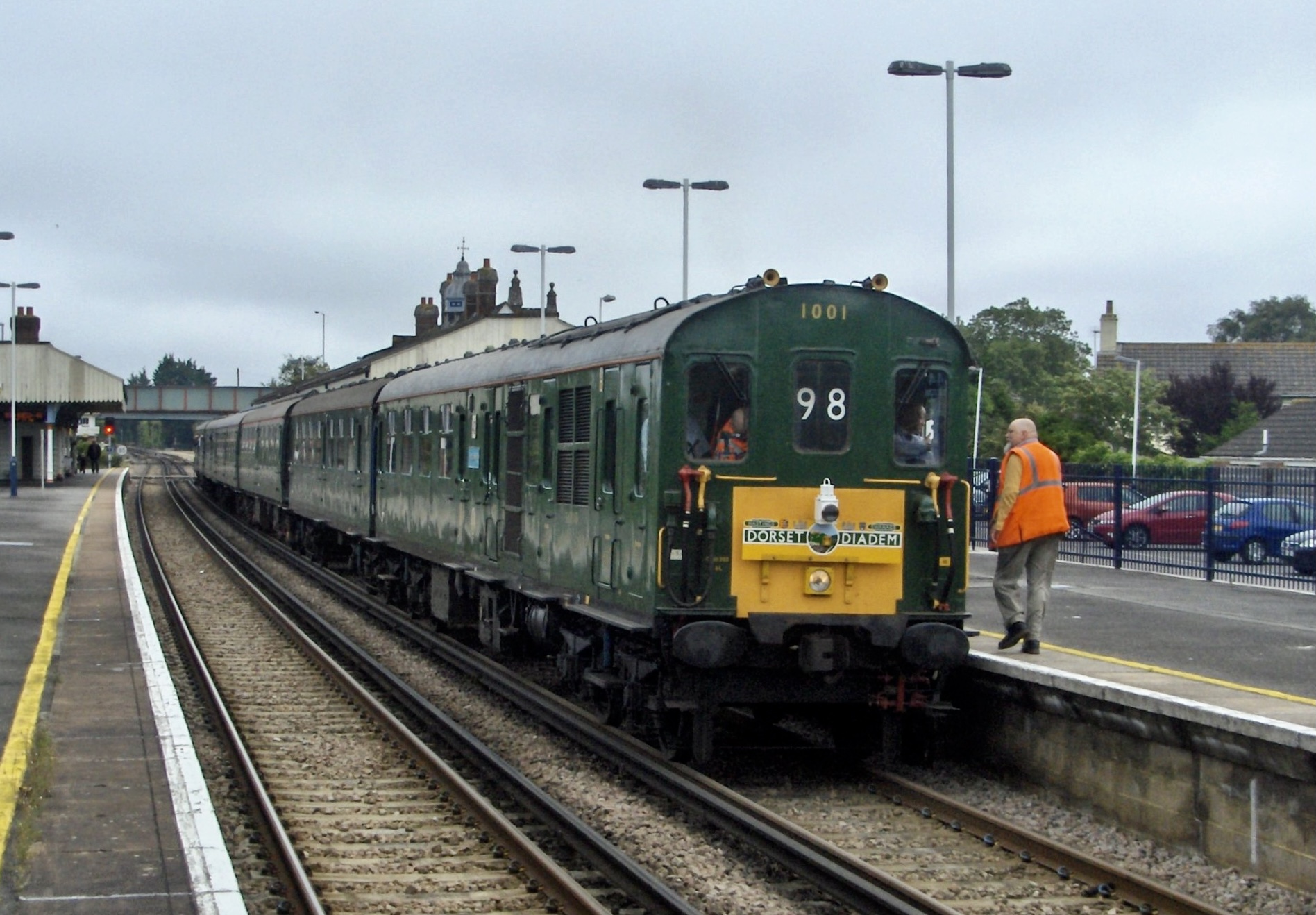
    Hastings Unit DEMU No. 1001 “The Dorset Diadem” at Wareham – 25/06/2011 (Image: John Chappell)
    No. 1001 forming the “The Dorset Diadem” railtour to Swanage rests at Wareham – 25/06/2011 (Image: John Chappell)

    Hastings Diesel Limited’s 57th public rail tour the “Weymouth Envoy” ran from Hastings to Weymouth via London Waterloo therefore running the entire length of the LSWR main line.

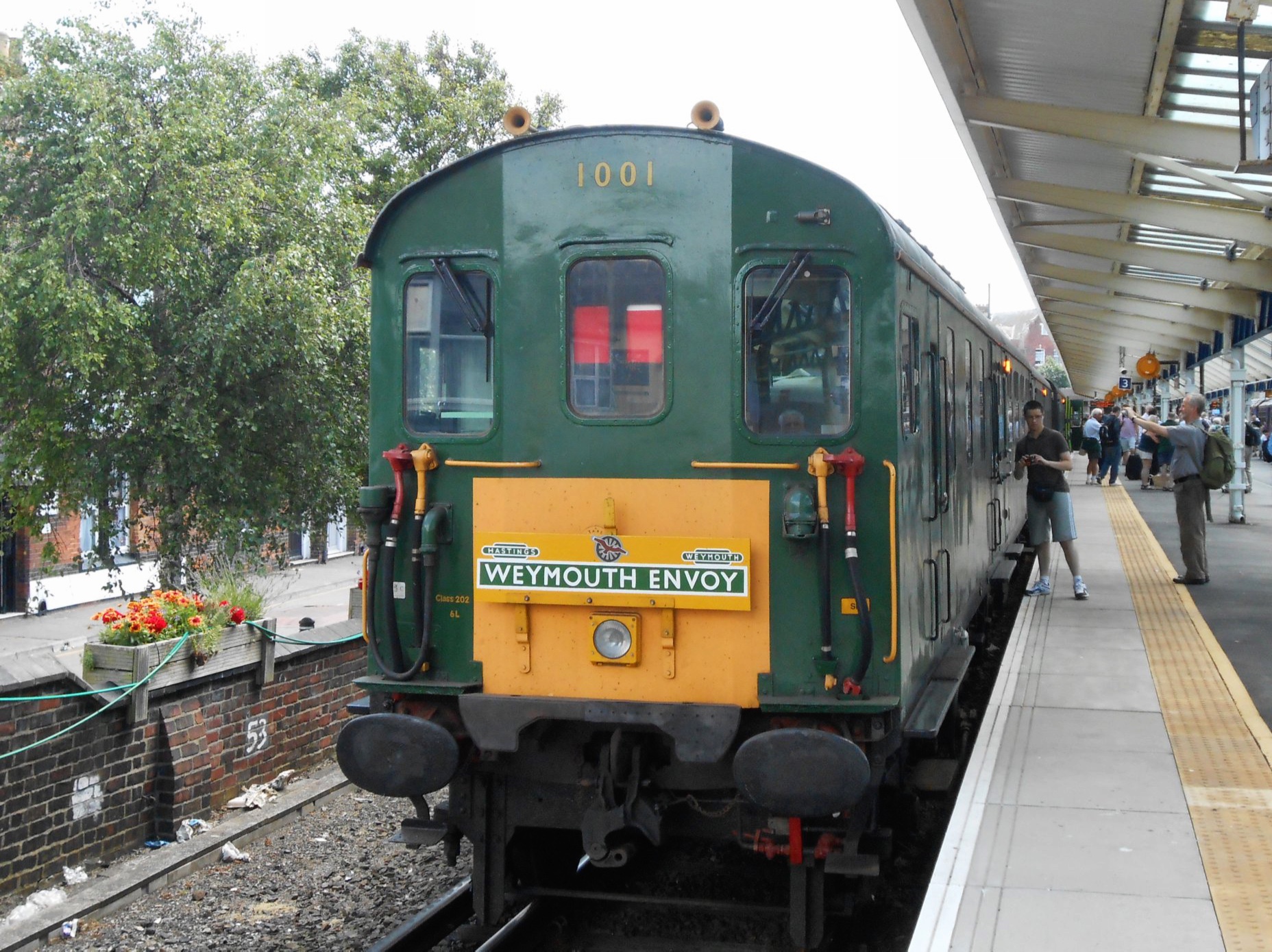
    At Weymouth No. 1001 was shunted to Jersey Sidings and is seen here pulling forward on the return to Weymouth Railway Station to pick up passengers passing Great Western Railway Class 150 No. 150927 – 20/07/2012 (Image: John Chappell)
    Hastings Unit No. 1001 awaits 1632 departure working as 1Z31 Weymouth to Hastings – 20/07/2012 (Image: John Chappell)
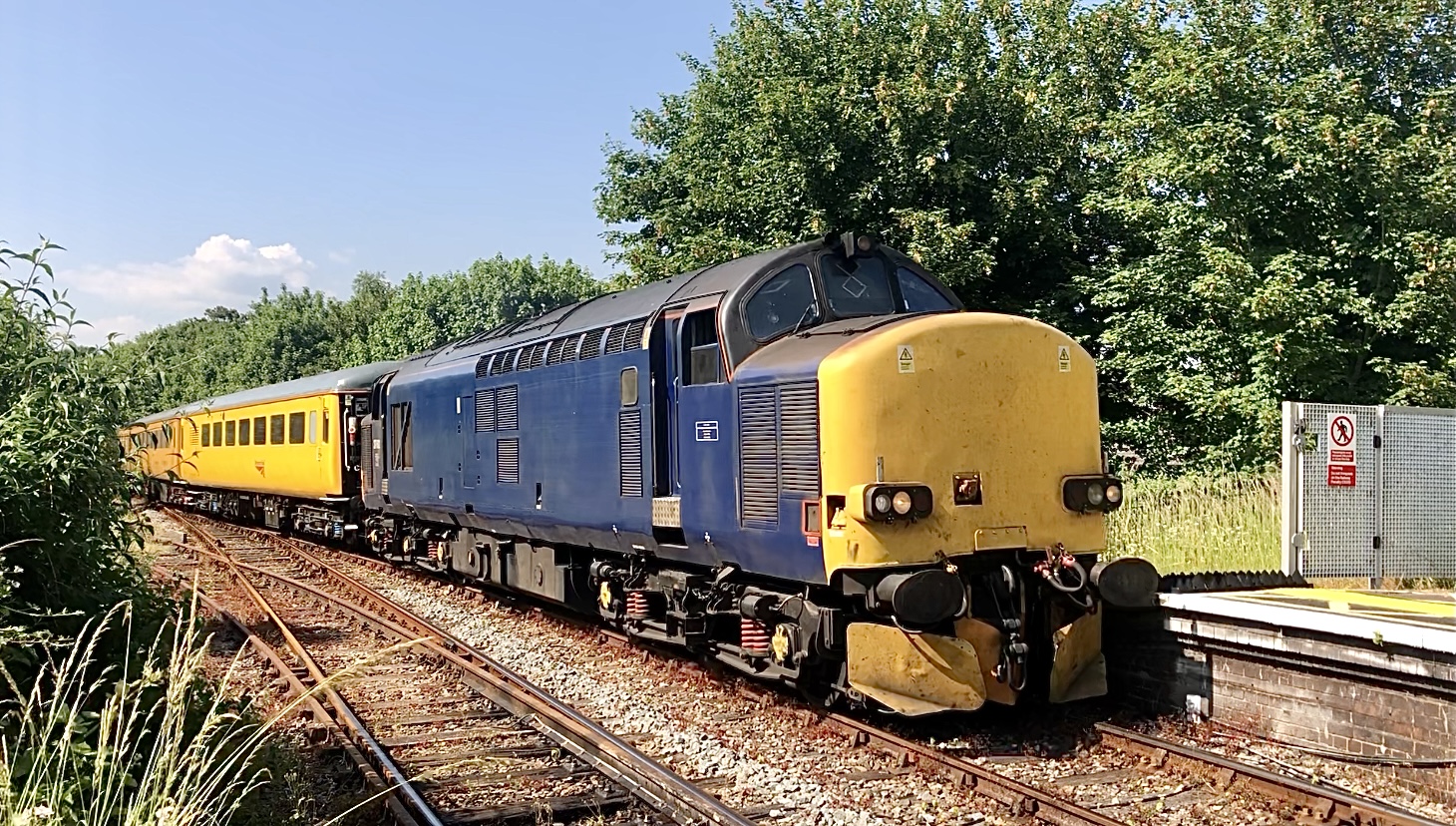
    Back in July 2015, Colas Class 37 No. 37175 was again in charge of the Ultrasonic Test Unit, seen here at Dorchester West propelling to Weymouth – 16/07/2015

    Thank you for stopping by. Your comments, corrections, contributions are most welcome. Be seeing you.
  • Yoshi Climbs Gold Hill

    14th June 2023 to 20th June 2023

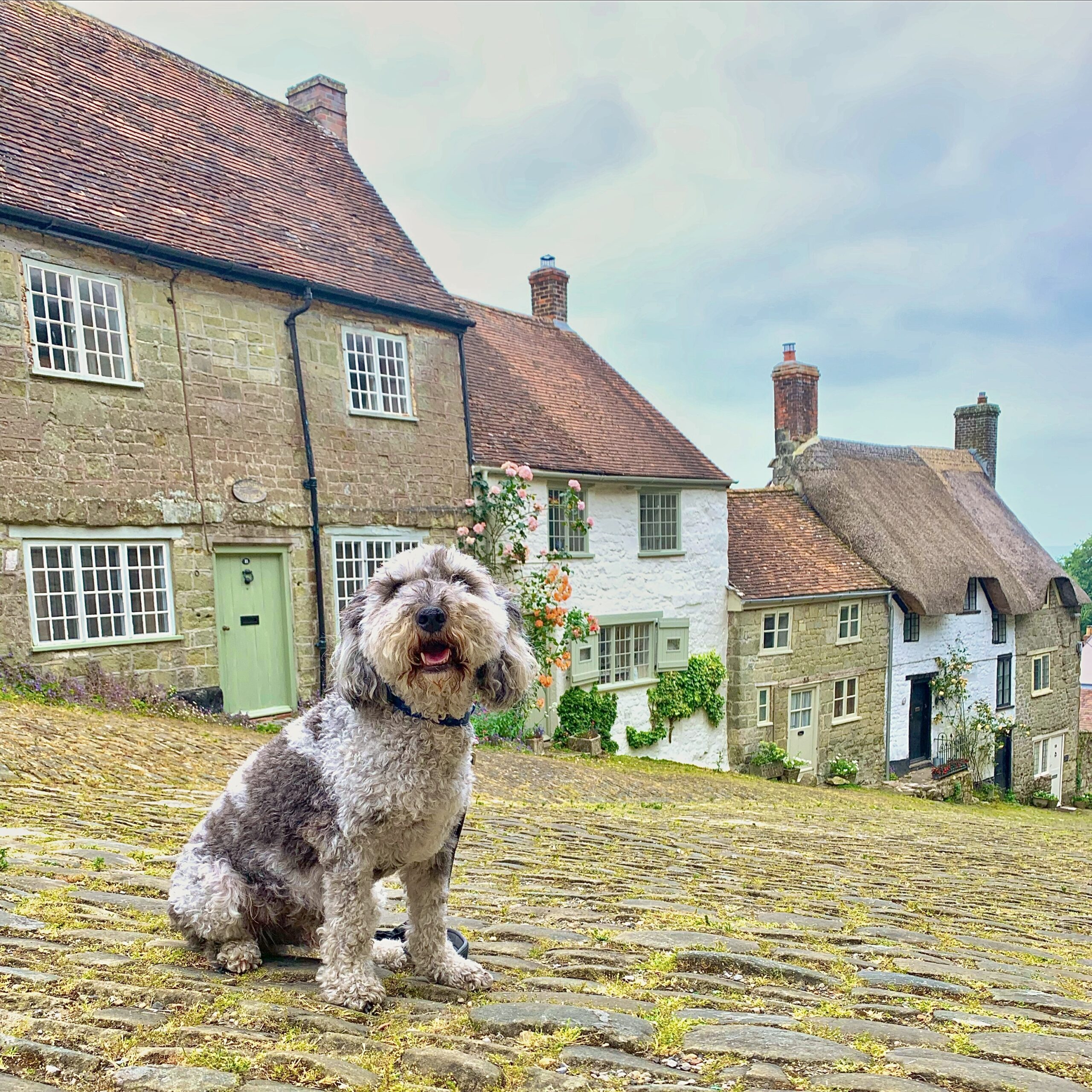
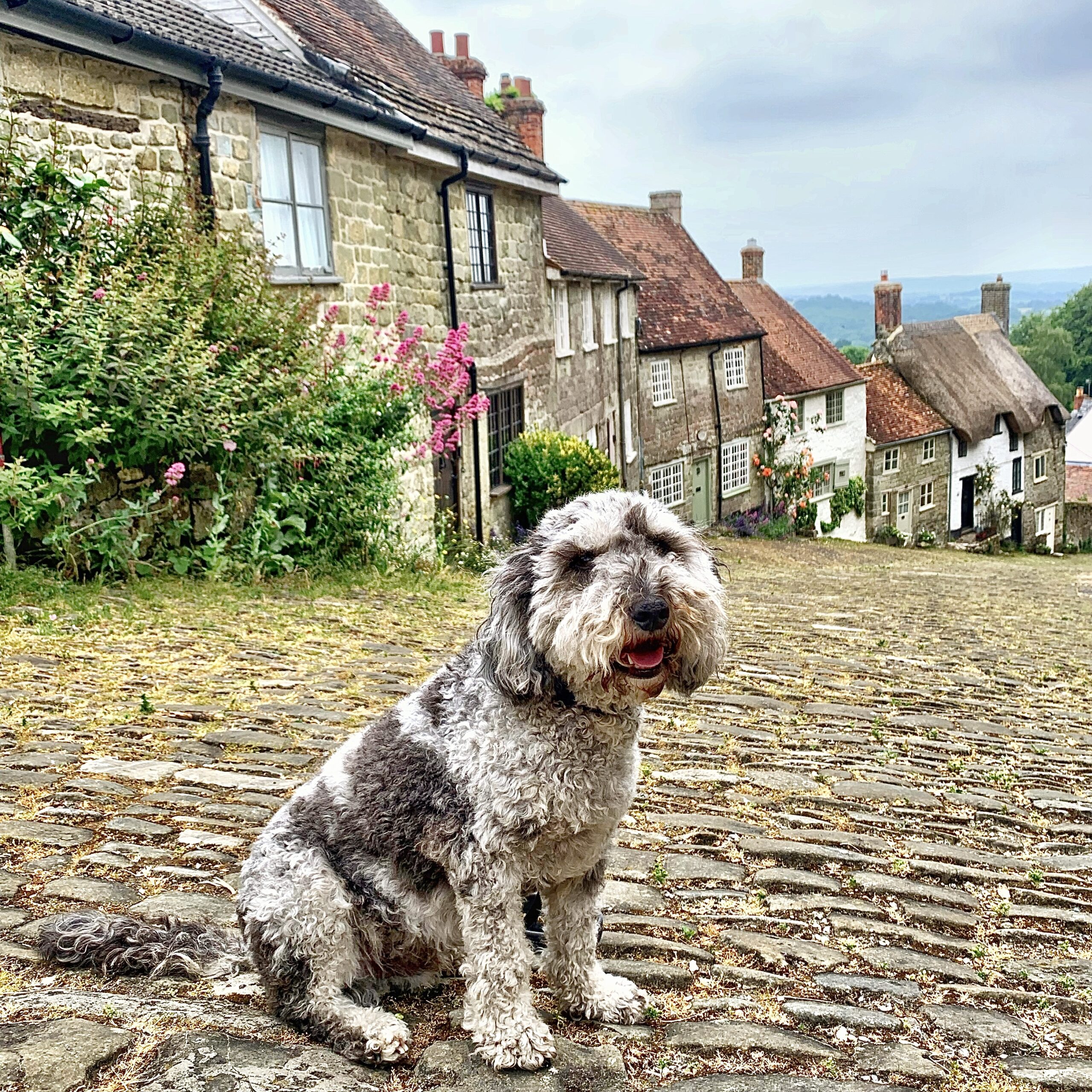
    We went to Shaftesbury on Sunday to see old buses. Caroline and I visited a pub or three and Yoshi took a liking to Gold Hill. Famous as the location for the 1973 Hovis bread TV advert directed by Ridley Scott. Still the same today as its always been – 18/06/2023
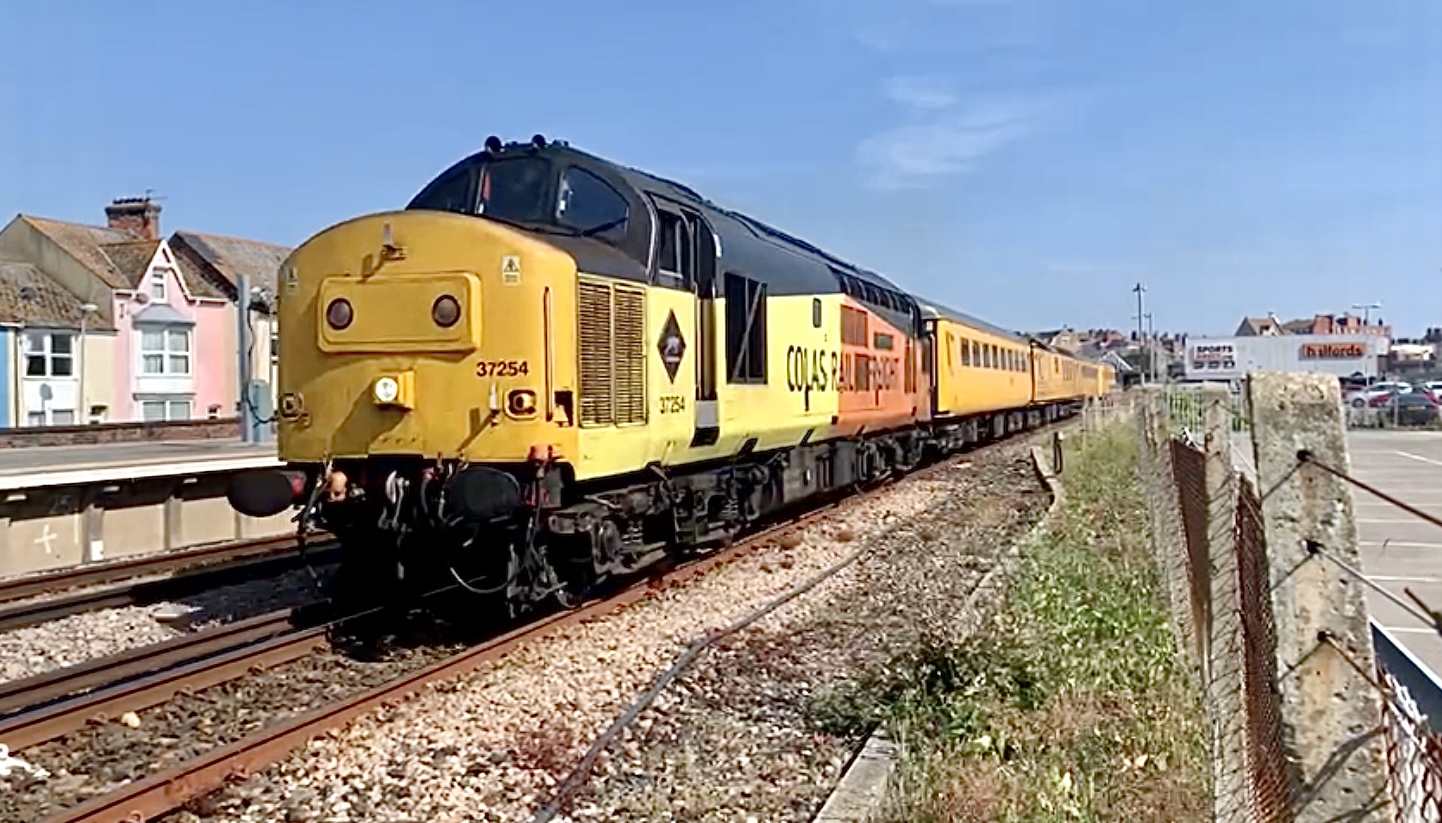
    Wednesday 14th June 2023 saw Colas test train 1Q18 Derby RTC to Bristol Kingsland Road visit Dorset in the capable charge of top and tailed Class 37 locomotives No.’s 37612 and 37254. I was in the east of the county hoping to capture a Class 701 drag from Bournemouth to Eastleigh which didn’t materialise. It’s been quite a month for unusual movements being cancelled here; a Class 69 hauled Weedkiller to Weymouth, a Class 37 test train via the West and a Class 455 drag with a Rail Operations Group (ROG) Class 37 to Bournemouth T&RSMD to mention a few.

    Class 37 No. 37612 leads 1Q18 Derby RTC to Bristol Kingsland Road via Weymouth into Dorchester West (video screen grab courtesy of G E Barrett) – 14/06/2023
    Class 37 No. 37254 leads out of Weymouth where 1Q18 Derby RTC to Bristol Kingsland Road has reversed for the run to Bristol (video screen grab courtesy of @da_buckley967) – 14/06/2023
    Video of Class 37 No.s 37612 and 37254 working 1Q18 Derby RTC to Bristol Kingsland Road courtesy of @da_buckley967 and G E Barrett – 14/06/2023

    On Saturday, I popped over to the Southampton area for a brief evening visit to see LNER A3 4-6-2 Pacific No. 60103 ‘Flying Scotsman’. I don’t understand the scorn poured on this locomotive by a certain section of the railway enthusiast fraternity. I think it’s great Scotsman captures the imagination of the general public and it was delightful to hear a lot of chatter on our local radio station before and after the locomotive visited Portsmouth. I was interested to see if No. 60103 retained her white roof which she had gained the previous week in advance of hauling the Royal Train carrying King Prince Charles over the North Yorkshire Moors Railway on Monday 12th June, and I was very pleased to see she had! I was able to observe the “Portsmouth Flyer” rail tour on its way back to London Victoria from the overbridge leading to Dock Gate 20 at Millbrook. It’s also an excellent vantage point to see the locomotives being stabled at Freightliner Maritime depot. I thought the location would be quite popular with onlookers, but in the event it was just myself and another photographer there to see the “People’s Locomotive” steam by. It was quite pleasant passing the time having a friendly chat about railways of today and years gone. 

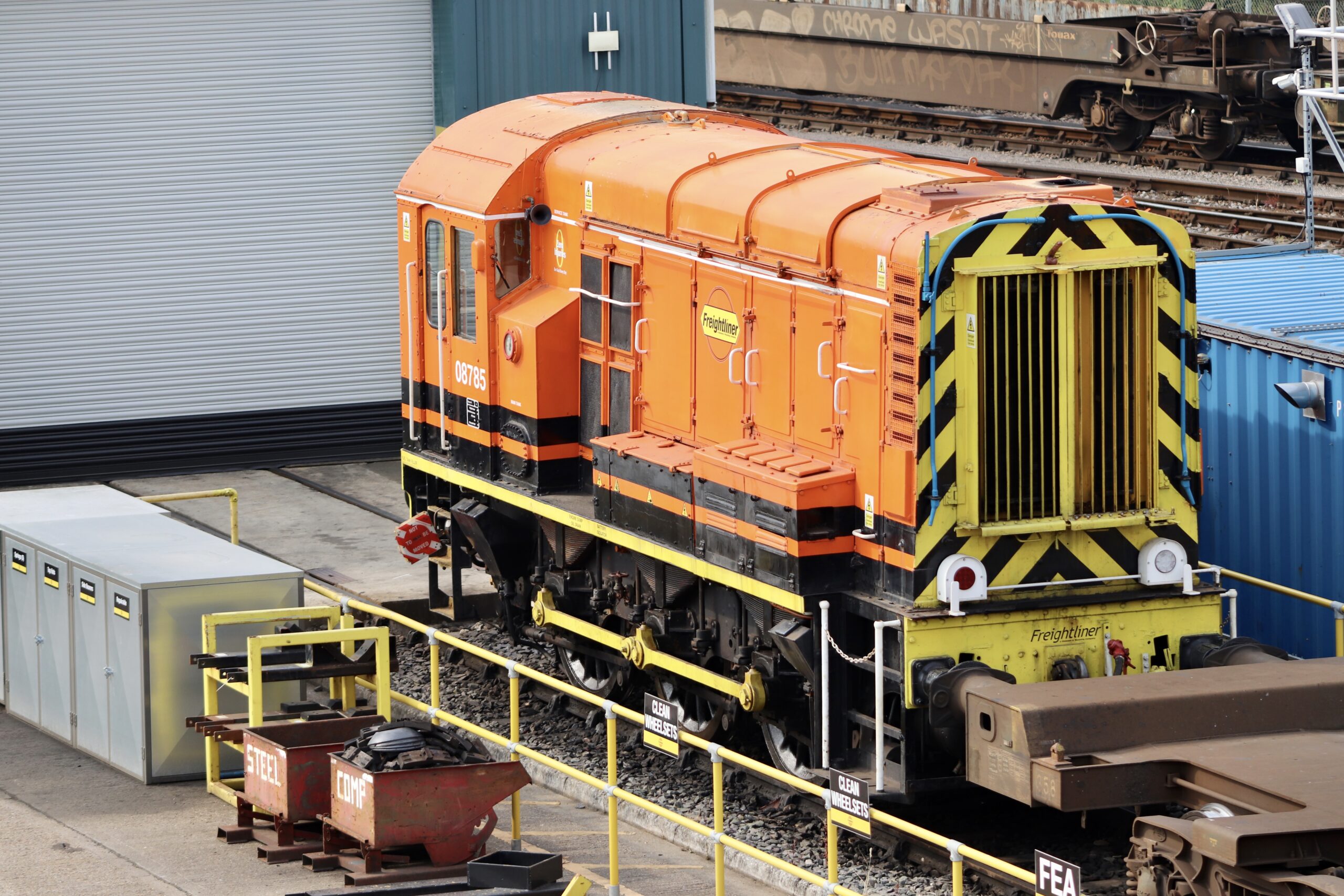
    Freightliner Class 08 shunter No. 08785 at Southampton Maritime – 17/06/2023
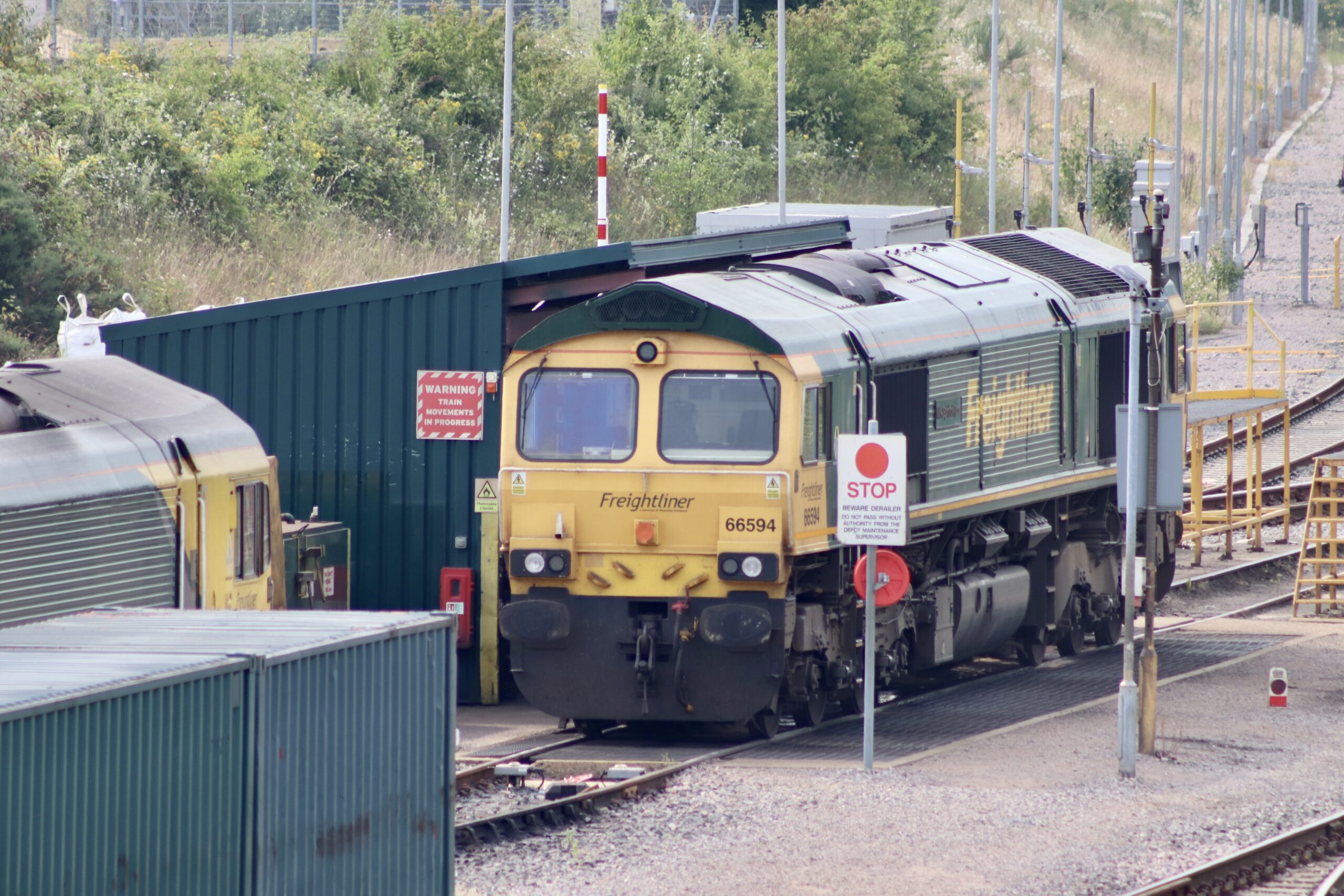
    Class 66 No. 66594 at Southampton Maritime – 17/06/2023
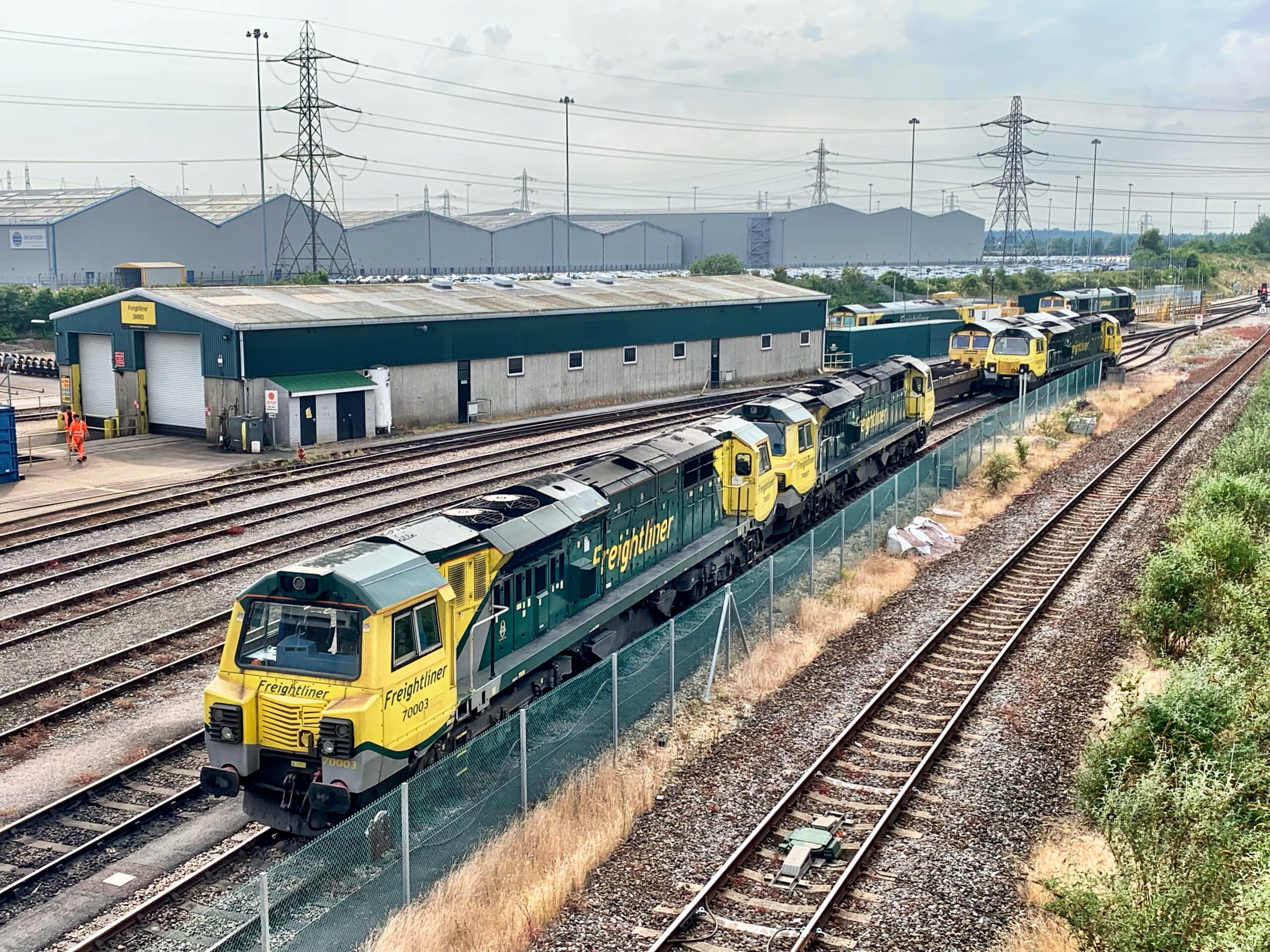
    A line up of Class 70’s at Southampton Maritime, including No.’s 70003,70007 and 70014 with Class 66 No.’s 66565, 66594 and 66504 also visible- 17/06/2023
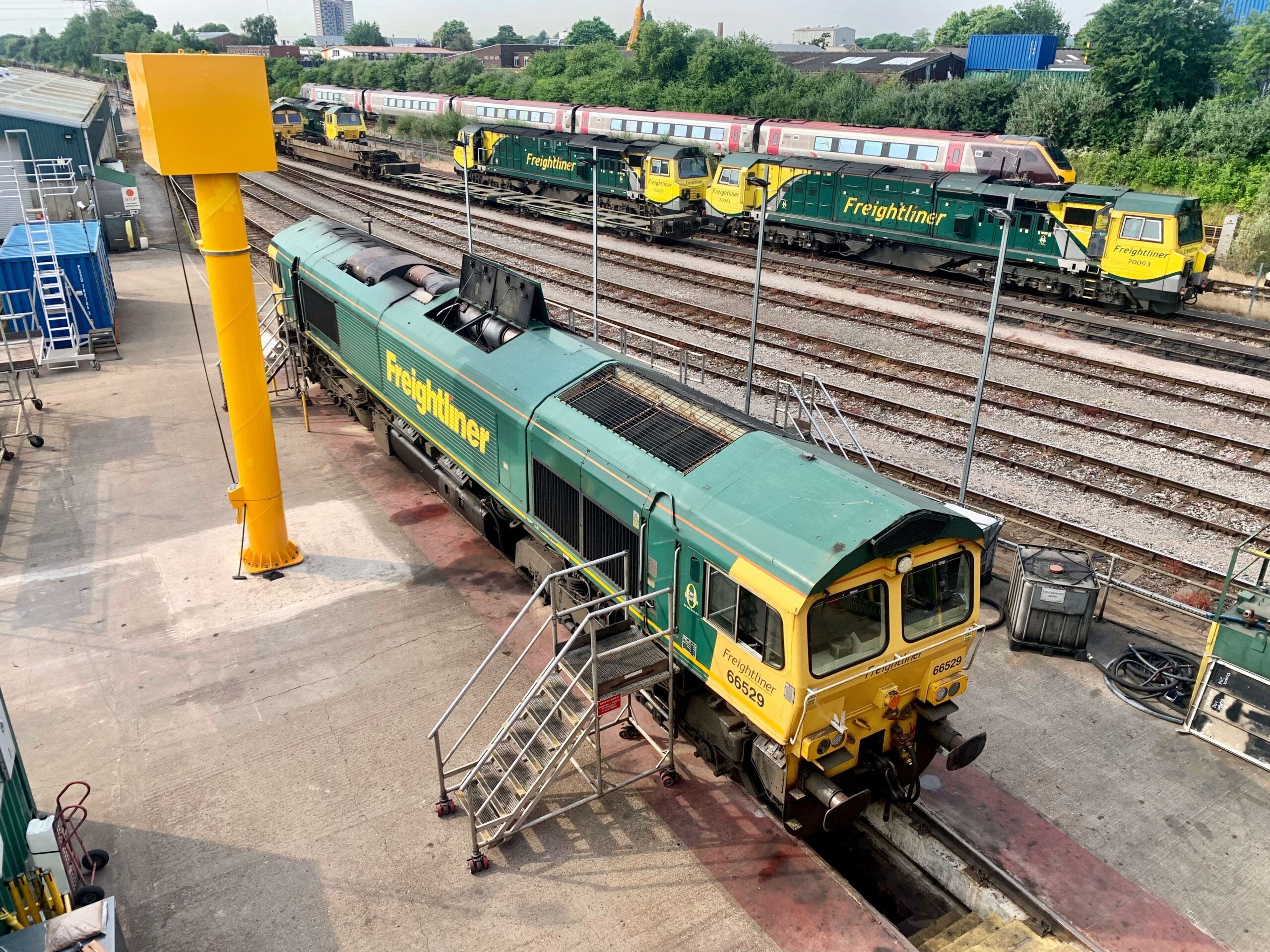
    Class 66 No. 66529 receives attention at Southampton Maritime – 17/06/2023
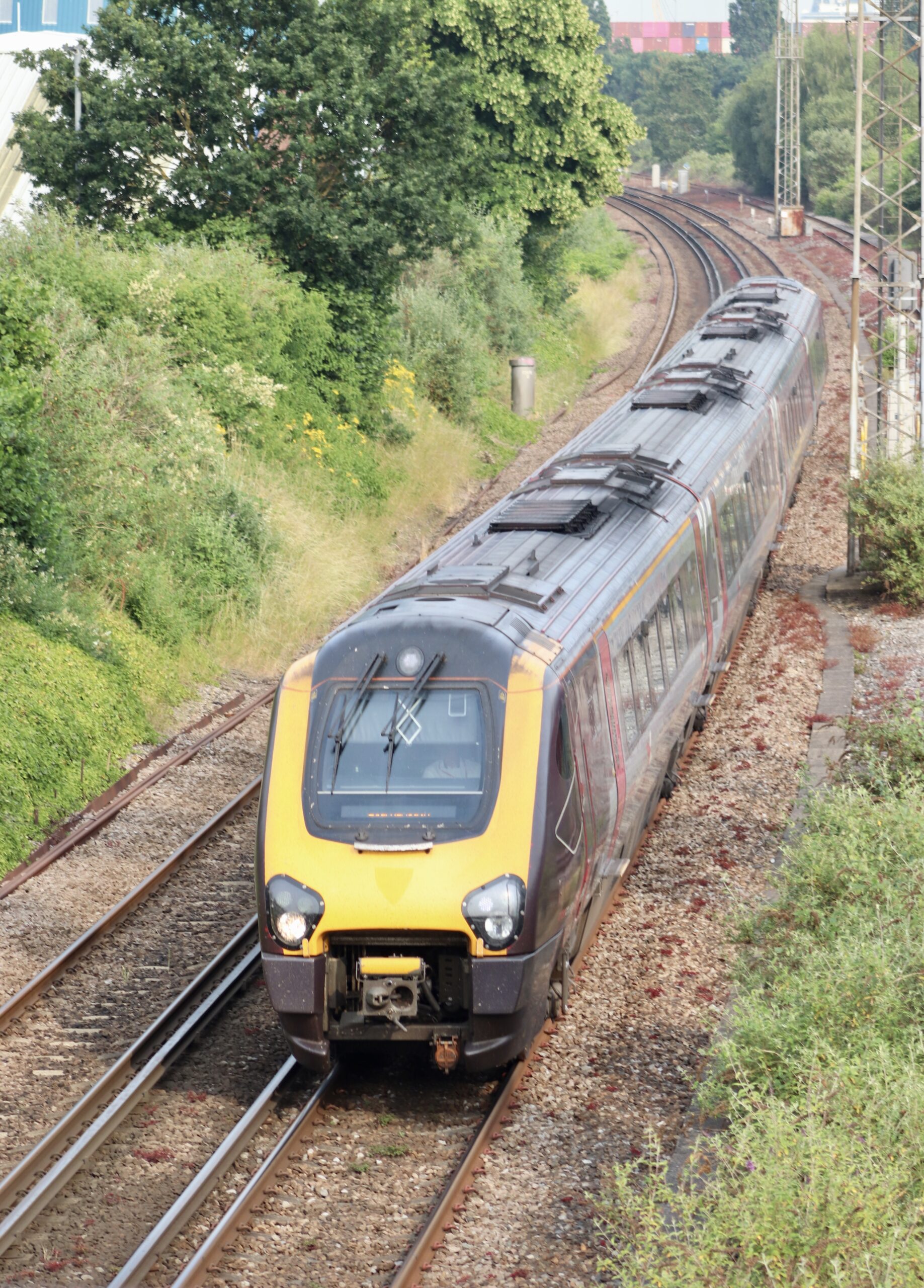
    CrossCountry Voyager No. 220011 nears Redbridge working 1020 1325 Manchester Piccadilly to Bournemouth – 17/06/2023
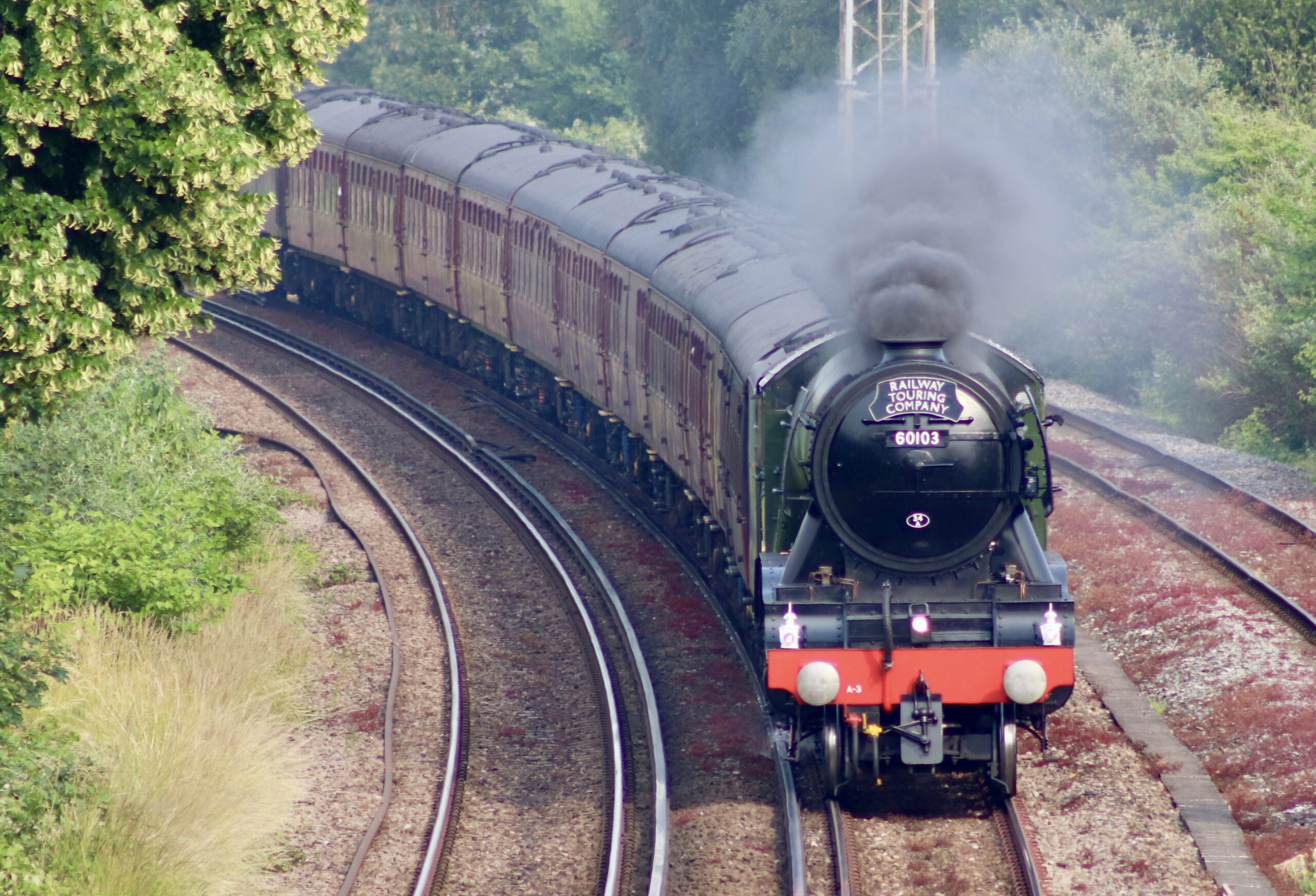
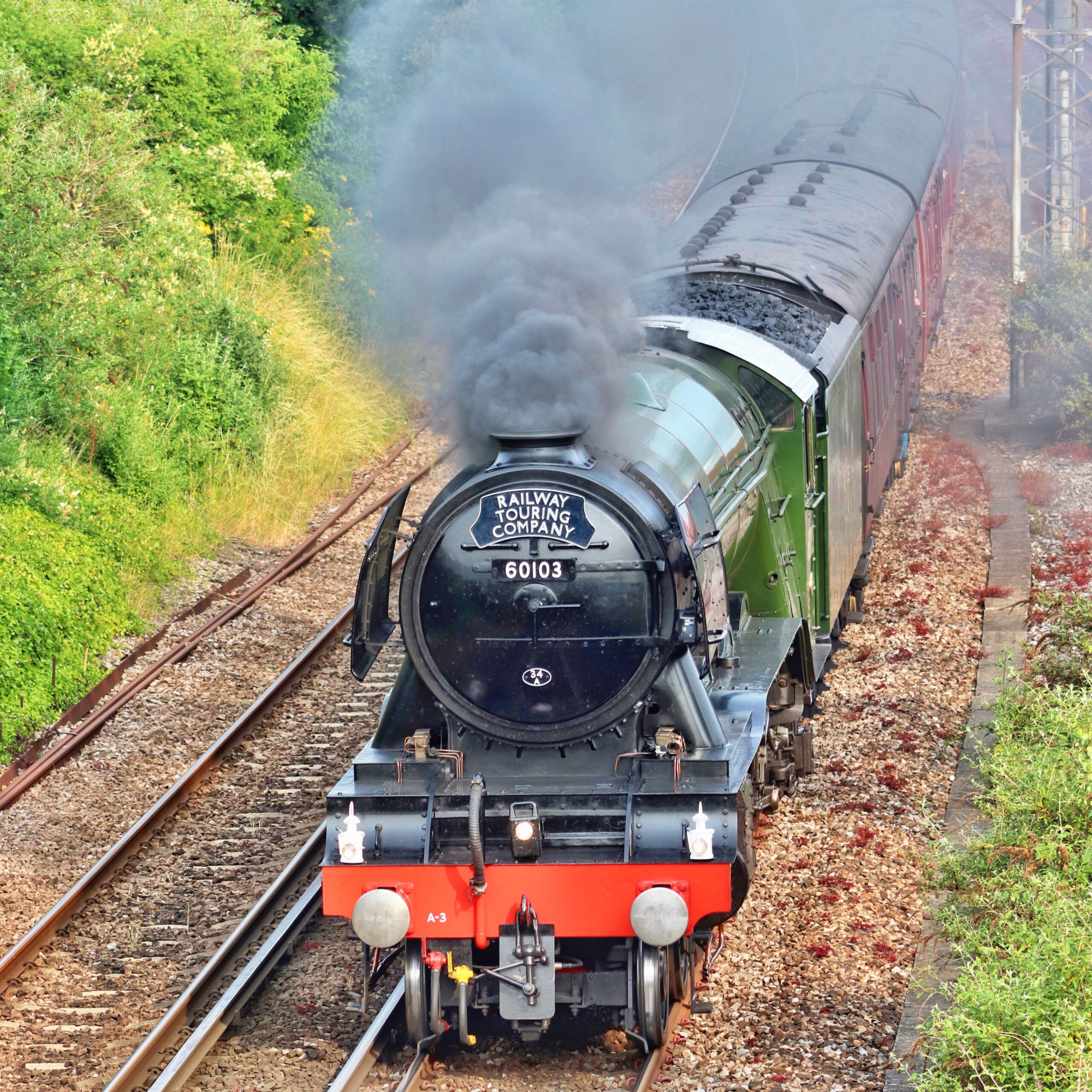
    LNER A3 Pacific No. 60103 ‘Flying Scotsman’ at Millbrook working the return “The Portsmouth Flyer” 1Z73 1606 Portsmouth Harbour to London Victoria – 17/06/2023
    The white cab roof applied to LNER A3 Pacific No. 60103 ‘Flying Scotsman’ can be seen clearly in this view of the locomotive as she works the return “The Portsmouth Flyer” 1Z73 1606 Portsmouth Harbour to London Victoria on the approach to Redbridge – 17/06/2023
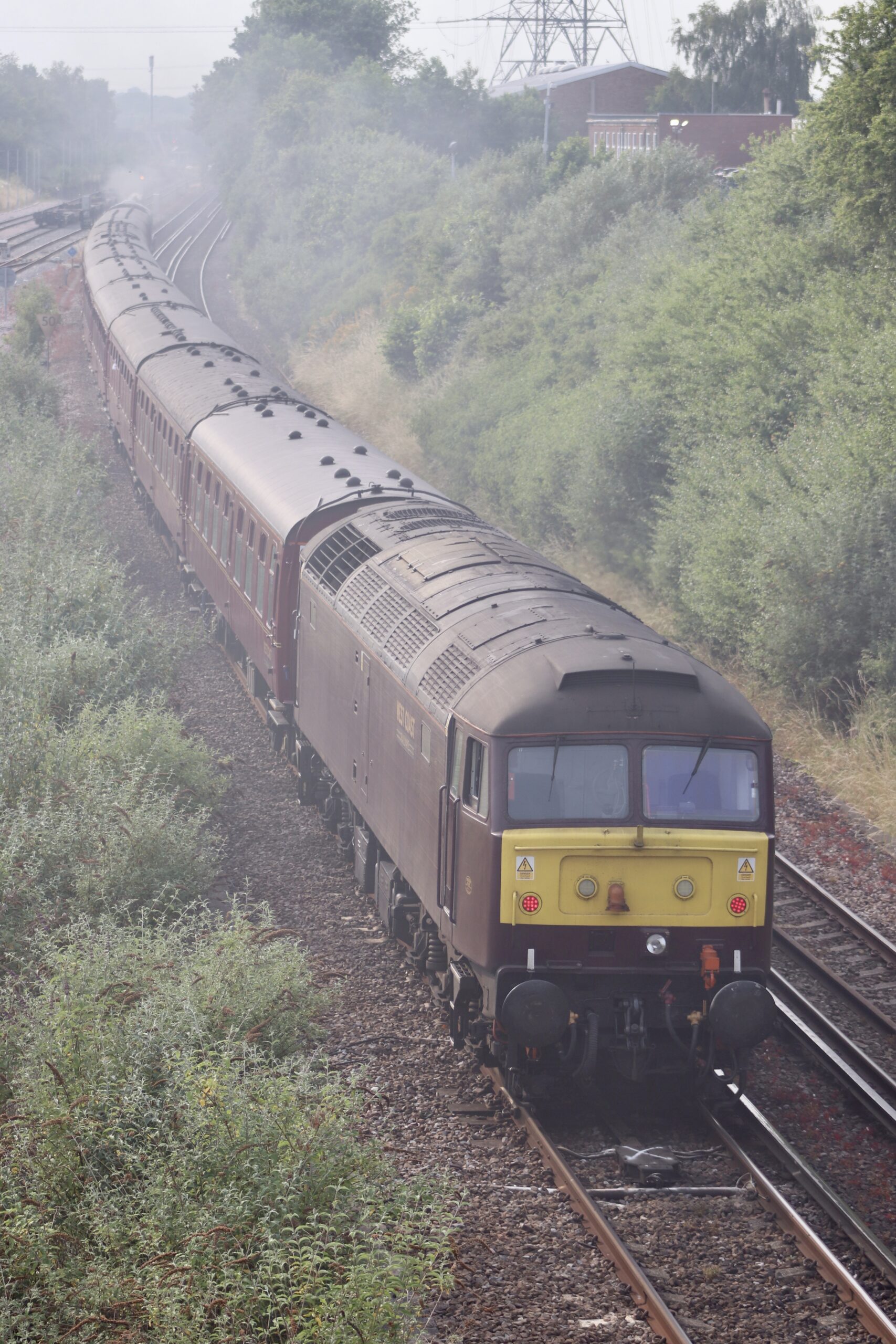
    West Coast Railway Company Class 47 No. 47802 at the rear of “The Portsmouth Flyer” 1Z73 1606 Portsmouth Harbour to London Victoria approaching Redbridge – 17/06/2023

    After seeing ‘Flying Scotsman’ I had just enough time to pop over to Eastleigh to get a photo of the Network Rail Class 153 Inspection Train. I was also able to see UK Railtours “The Magic Carpet” on its way from Exeter to London Victoria. This was hauled by two GBRf Class 73 Electro-diesels of the type we normally get here on a test train the first Monday of every month. 

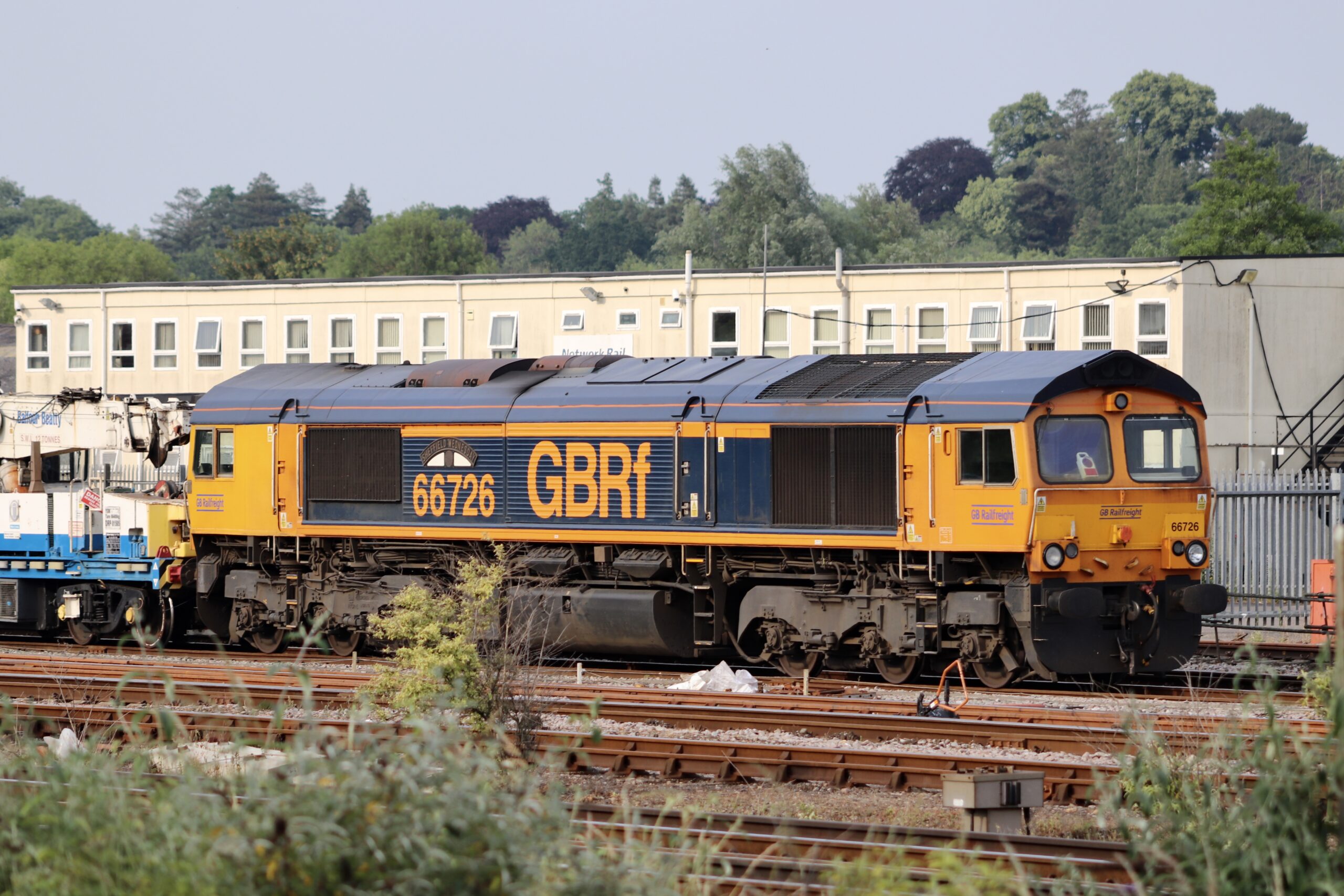
    GBRf Class 66 No. 66726 ‘Sheffield Wednesday’ in Eastleigh East Yard in preparation for working 7C03 2302 to Clapham Junction Windsor Lines civil engineering train later in the day along with No. 66846 – 17/06/2023
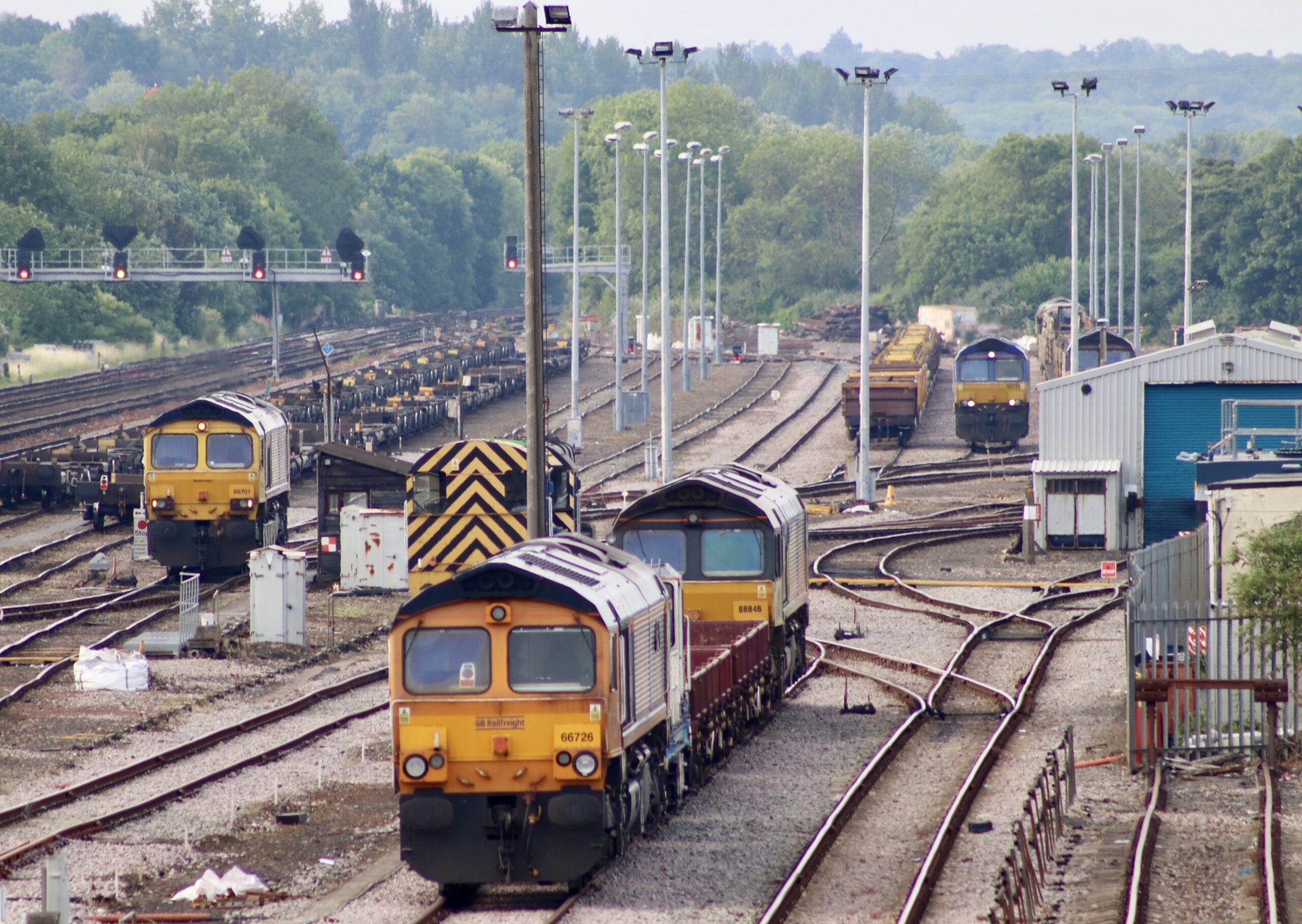
    A view over Eastleigh East Yard with GBRf Class 66 No. 66726 ‘Sheffield Wednesday’ and Colas Rail Class 66 No. 66846 in the foreground – 17/06/2023
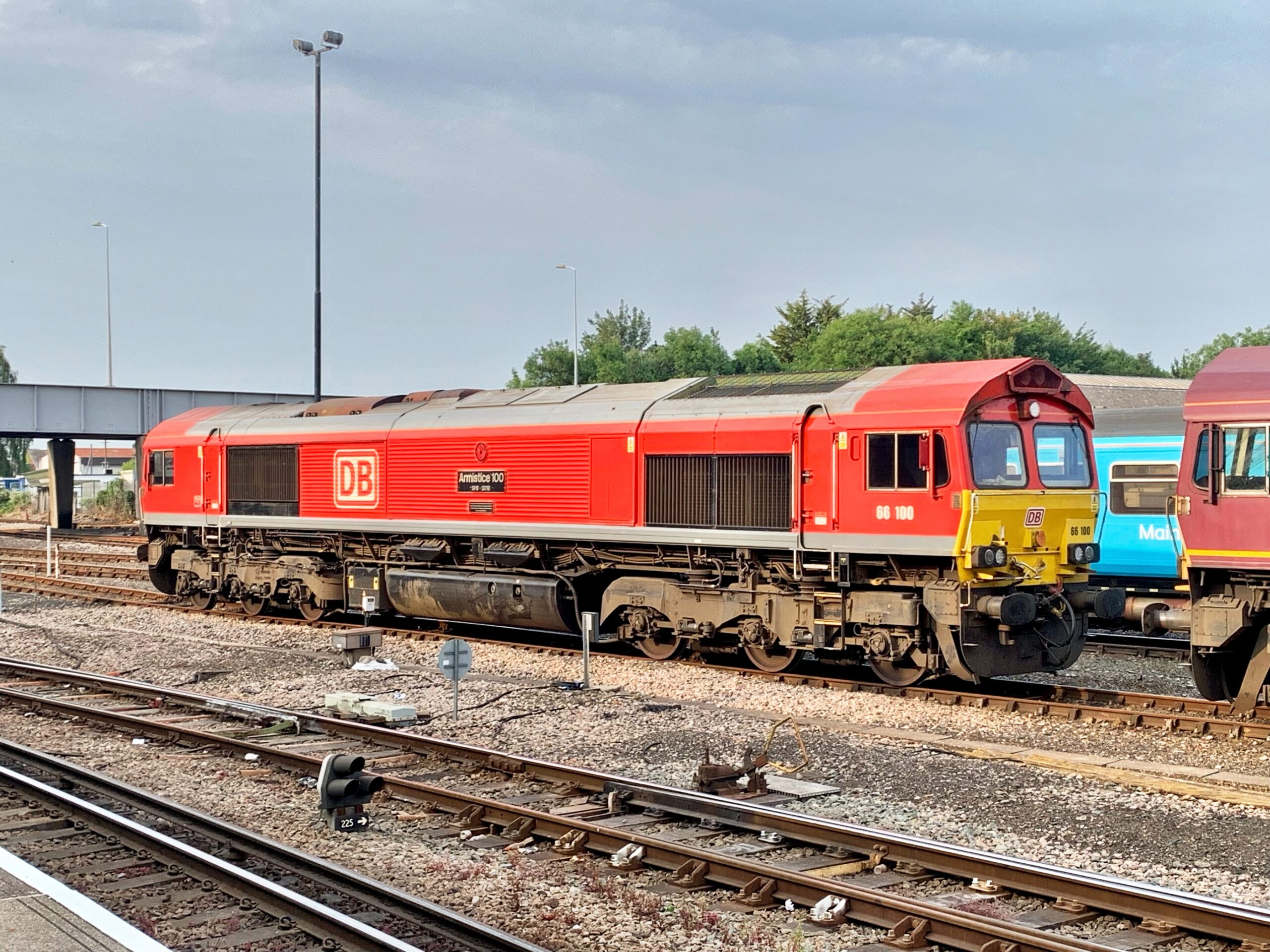
    DB Cargo Class 66 No. 66100 ‘Armistice 100 1918 – 2018’ in the sidings adjacent Eastleigh railway station – 17/06/2023
    Nameplate detail of Class 66 No. 66100 ‘Armistice 100 1918 – 2018’ – 17/06/2023
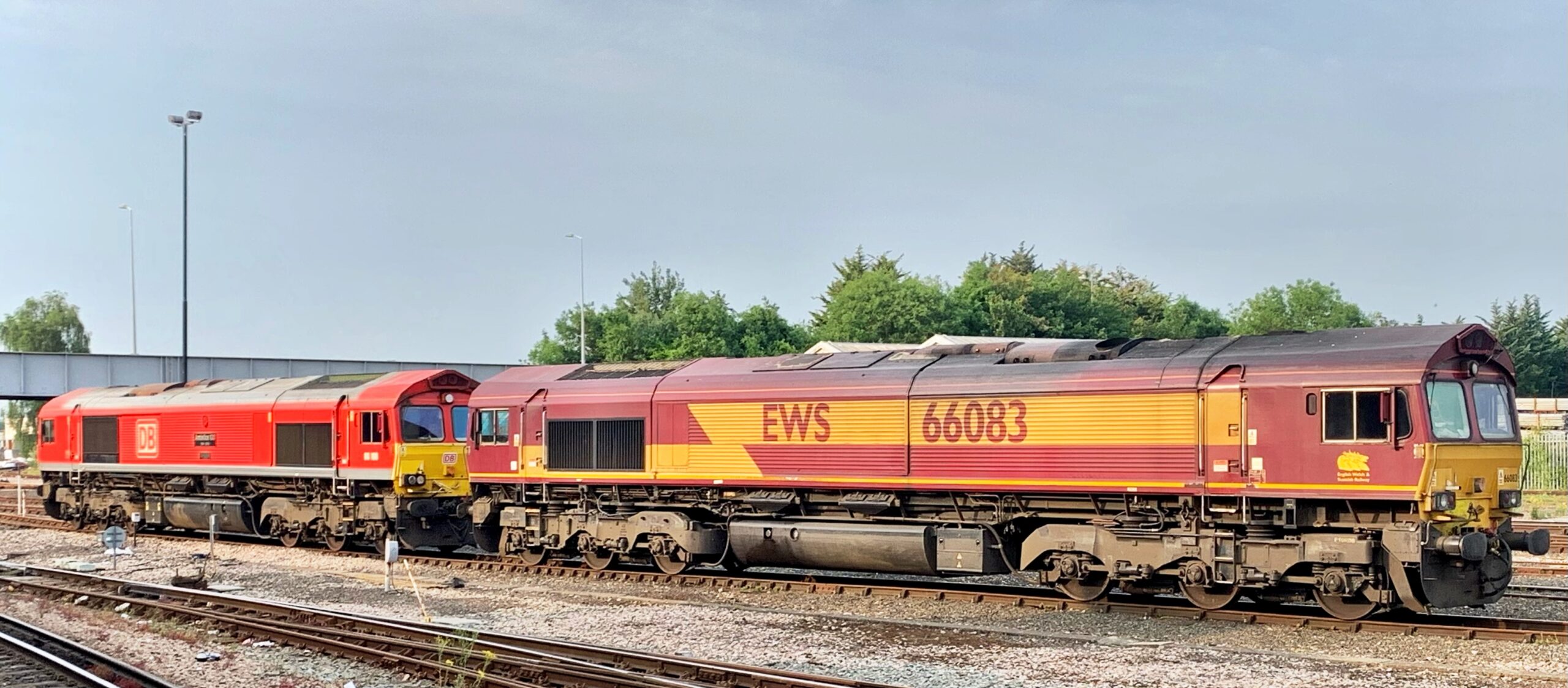
    Still carrying EWS Livery, DB Cargo Class 66 No. 66083 partners No. 66100 ‘Armistice 100 1918 – 2018’ at Eastleigh – 17/06/2023
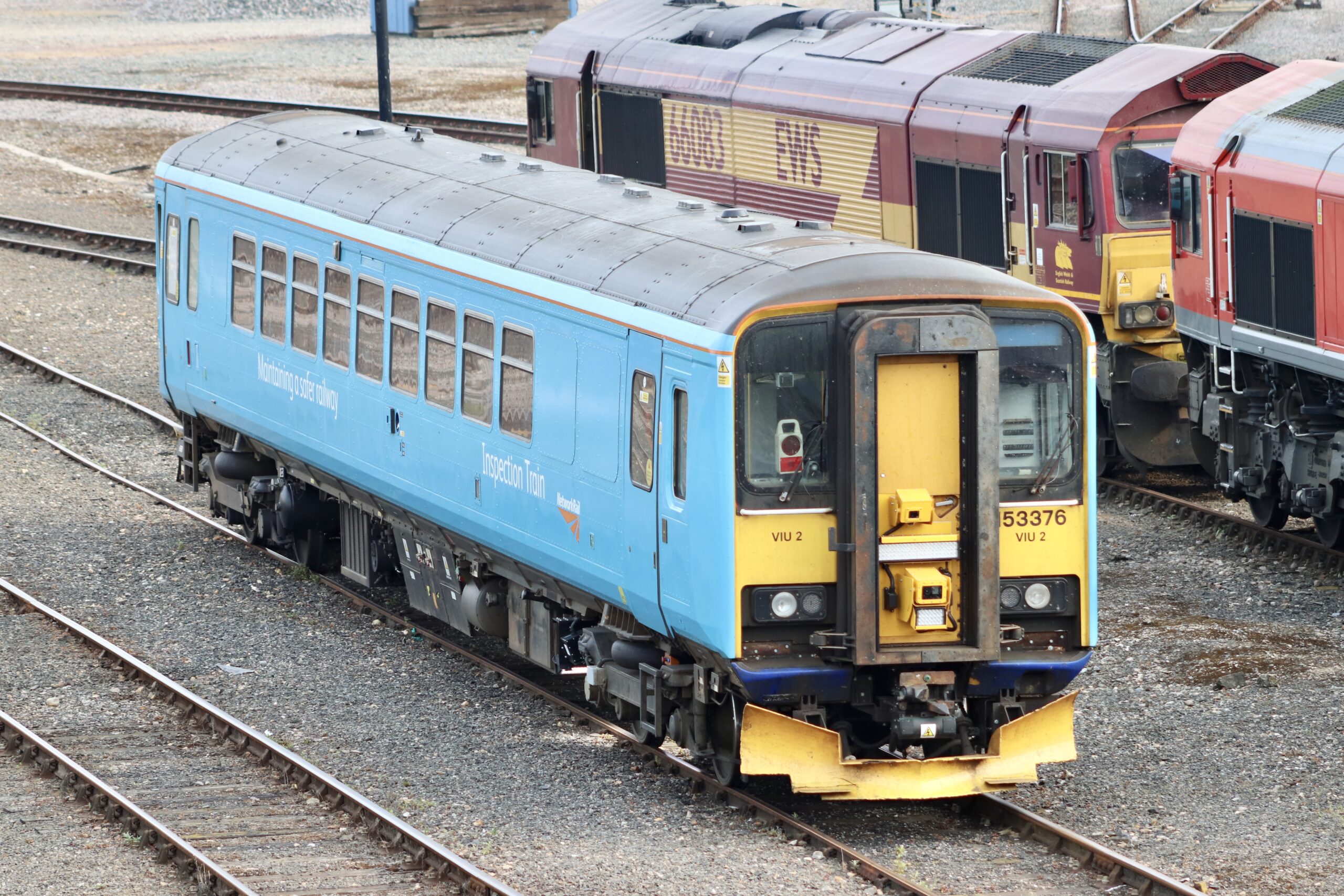
    Network Rail Video Inspection Unit No. 2 (VIU2) No. 153376 rests at Eastleigh. Network Rail employs three Class 153 DMU’s for video assessment of track and points – 17/06/2023
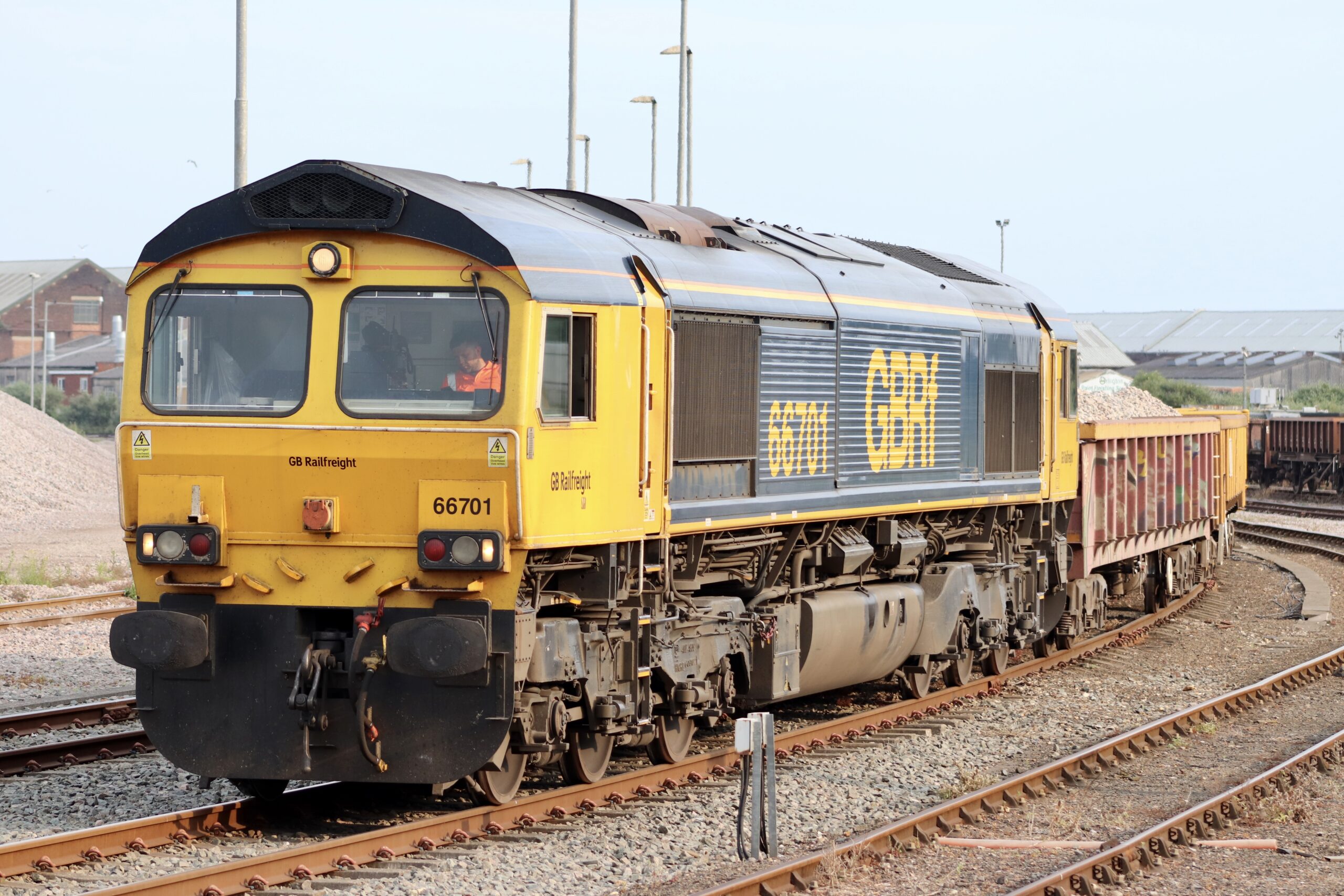
    GBRf Class 66 No. 66701 having just reversed onto wagons ready to form 6G13 1952 Eastleigh East Yard to Cheam engineers train – 17/06/2023
    Maritime Blue liveried Class 66 No. 66051 ‘Maritime Intermodal Four’ passing through Eastleigh heading up 4V44 1824 Southampton Eastern Docks to Morris Cowley MAT – 17/06/2023
    GBRf Class 73/9 No.’s 73964 ‘Jeanette’ and 73962 ‘Dick Mabbutt’ hauling UK Railtours “The Magic Carpet” one the approach to Eastleigh – 17/06/2023
    GBRf Class 73/9 No.’s 73964 ‘Jeanette’ and 73962 ‘Dick Mabbutt’ hauling UK Railtours “The Magic Carpet” 1Z62 1533 Exeter St Davids to London Victoria on the approach to Eastleigh – 17/06/2023
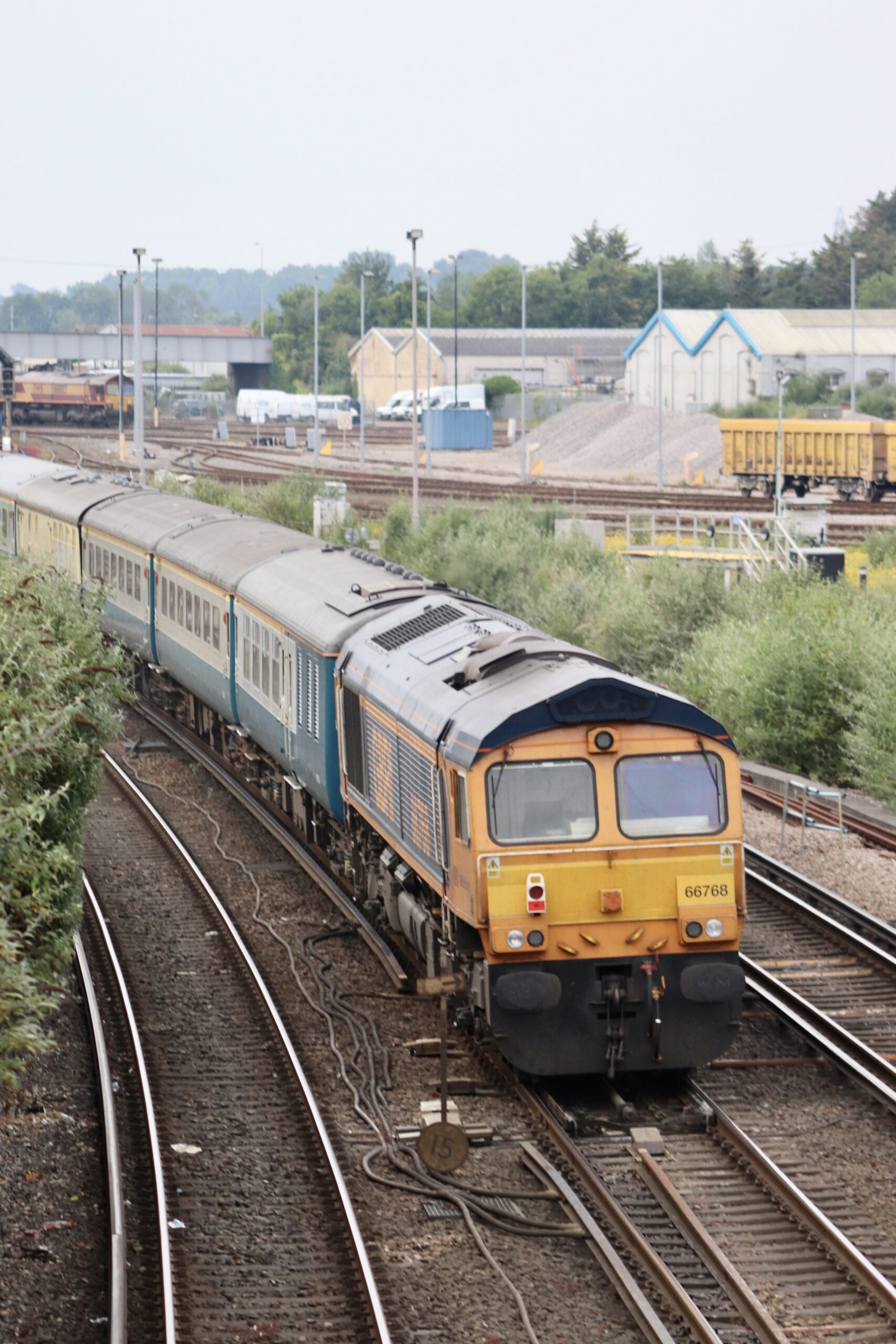
    On the rear of “The Magic Carpet” 1Z62 1533 Exeter St Davids to London Victoria GBRf Class 66 No. 66768 – 17/06/2023
    In 2011, leasing company Akiem acquired seven unused JT42CWRM locomotives, which would originally enter service for Veolia Cargo SAS (77501-77503) as order 20078941 and Crossrail Benelux (77504-77507) as 20078920. On 20 June 2011, all seven locos were delivered with train protection systems for Germany, Belgium and France. After being delivered to Akiem, they were immediately leased to VFLI.
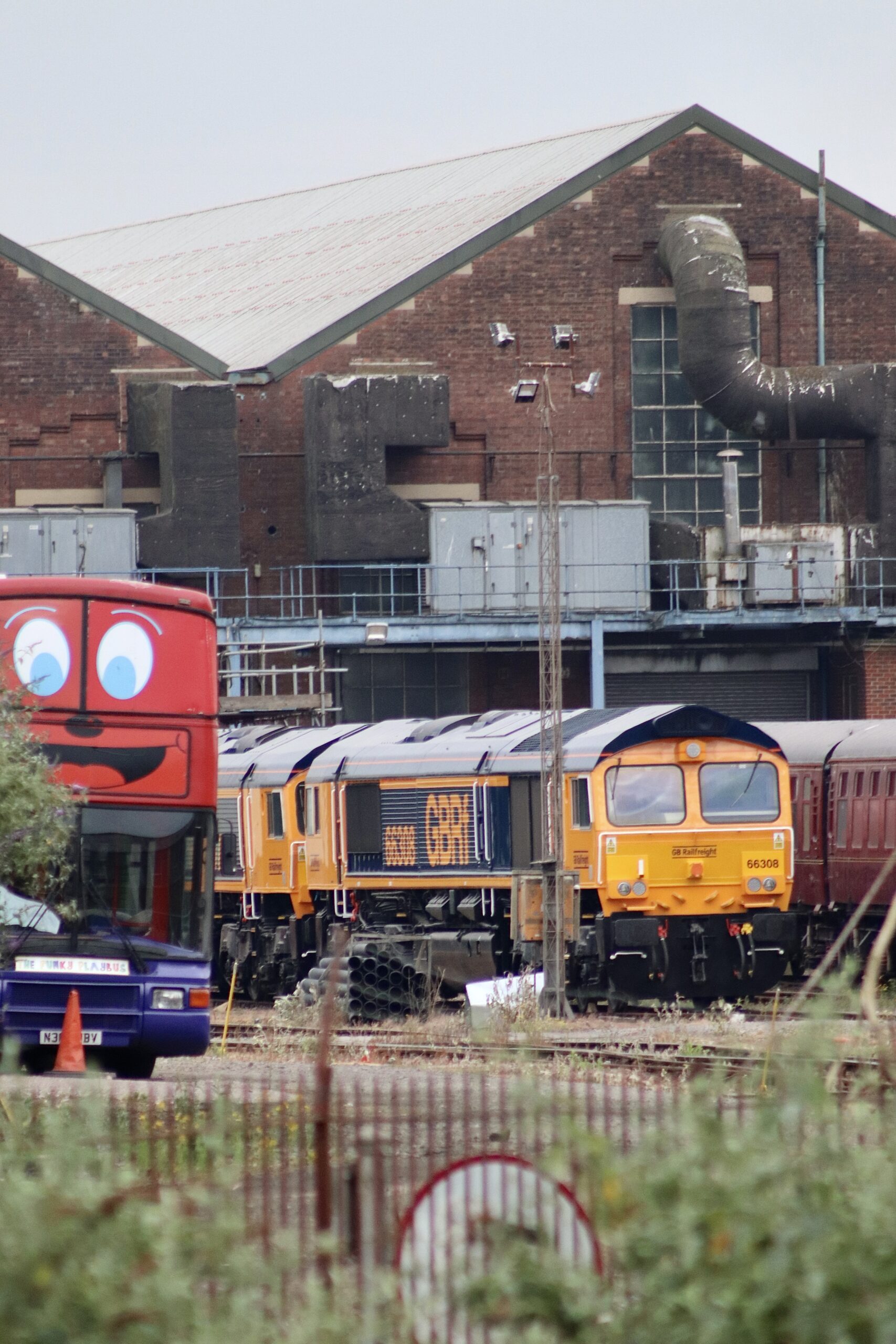
    Purchased and imported by GBRf Class 66 No.’s 66308 (ex-77503) and 66307 (ex-77502) are seen at Eastleigh Arlington Works having been repainted into standard GBRf livery following sizing modifications for the UK rail loading gauge carried out at Doncaster – 17/06/2023
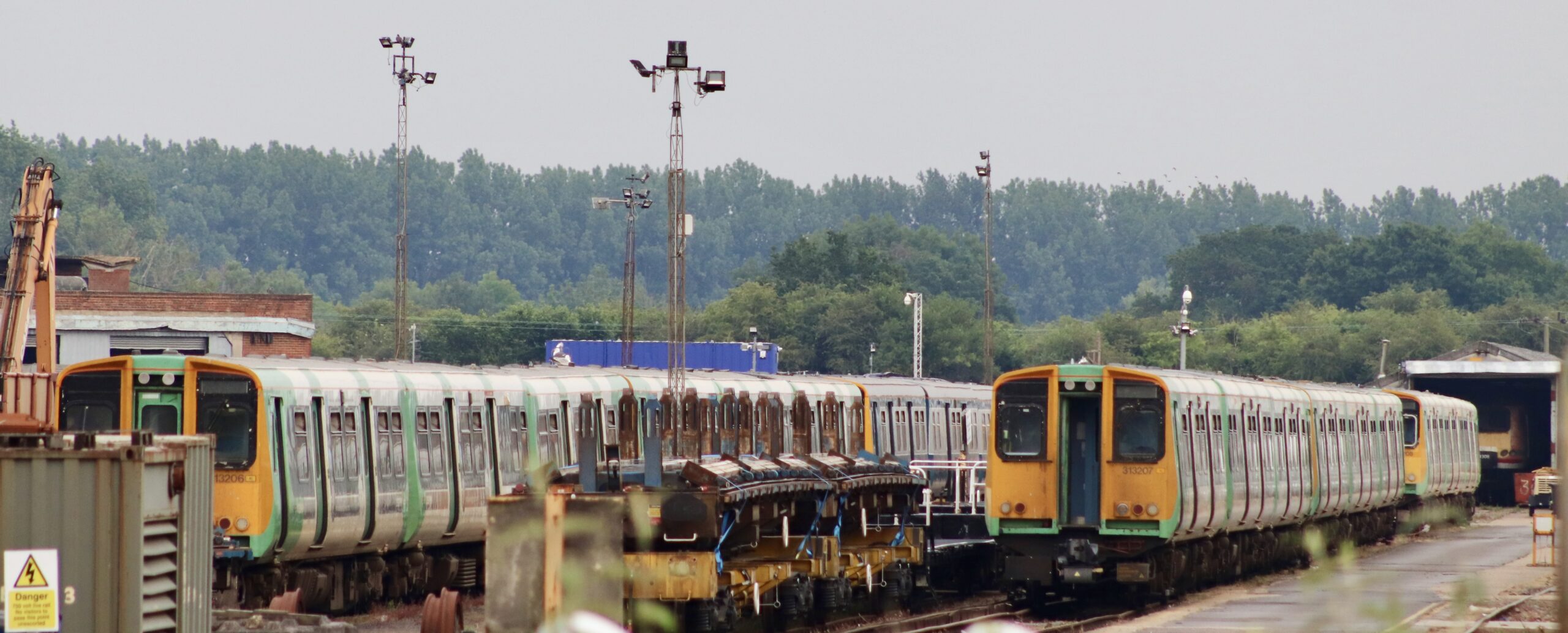
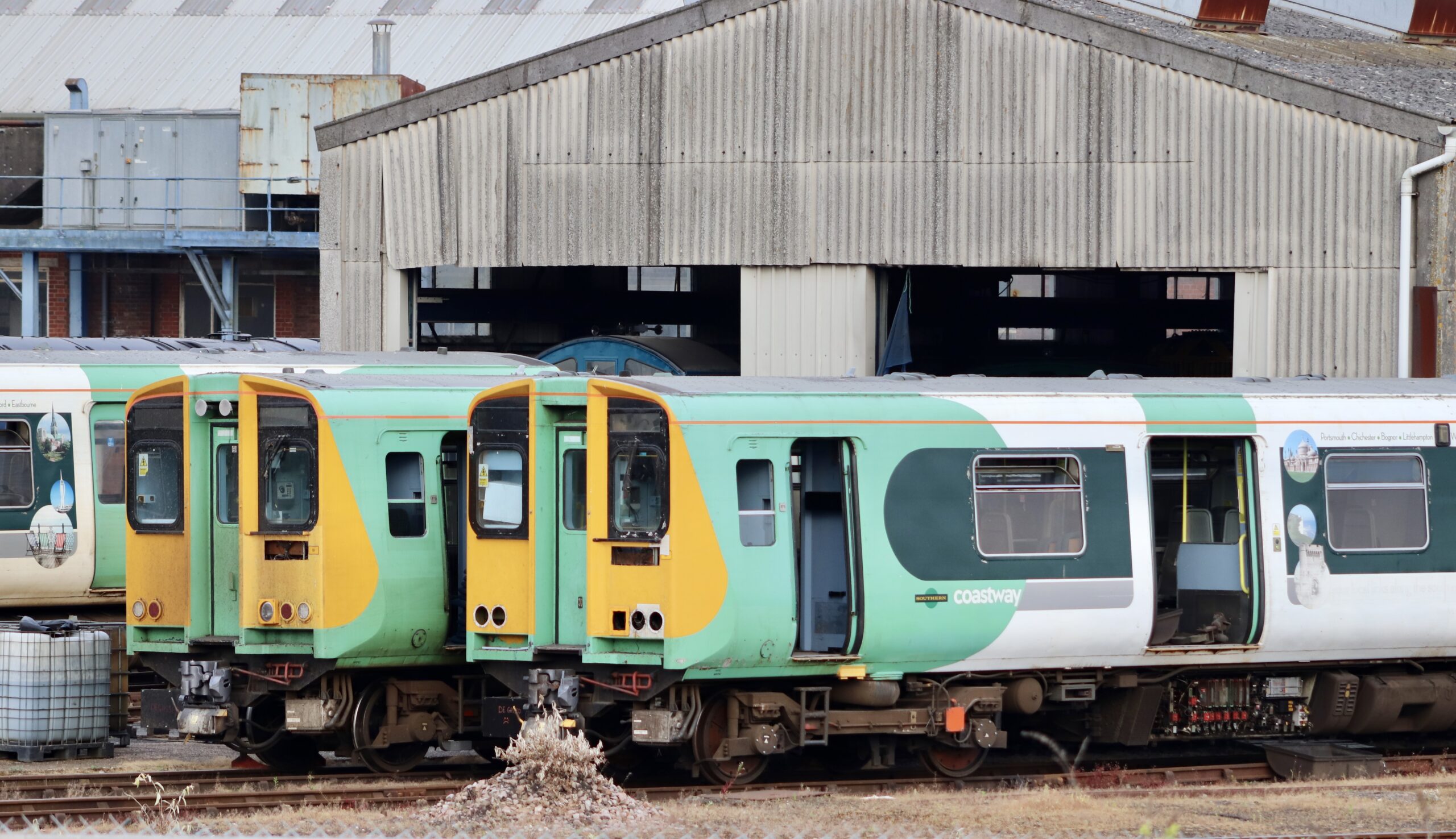
    Class 313’s continue to arrive at Eastleigh Arlington for component recovery and scrapping. No.’s 313206, 313201, 313207 and 313208 can be identified in this view. An appeal to fund maintenance and storage costs of blue liveried No. 313201 has been launched – 17/06/2023
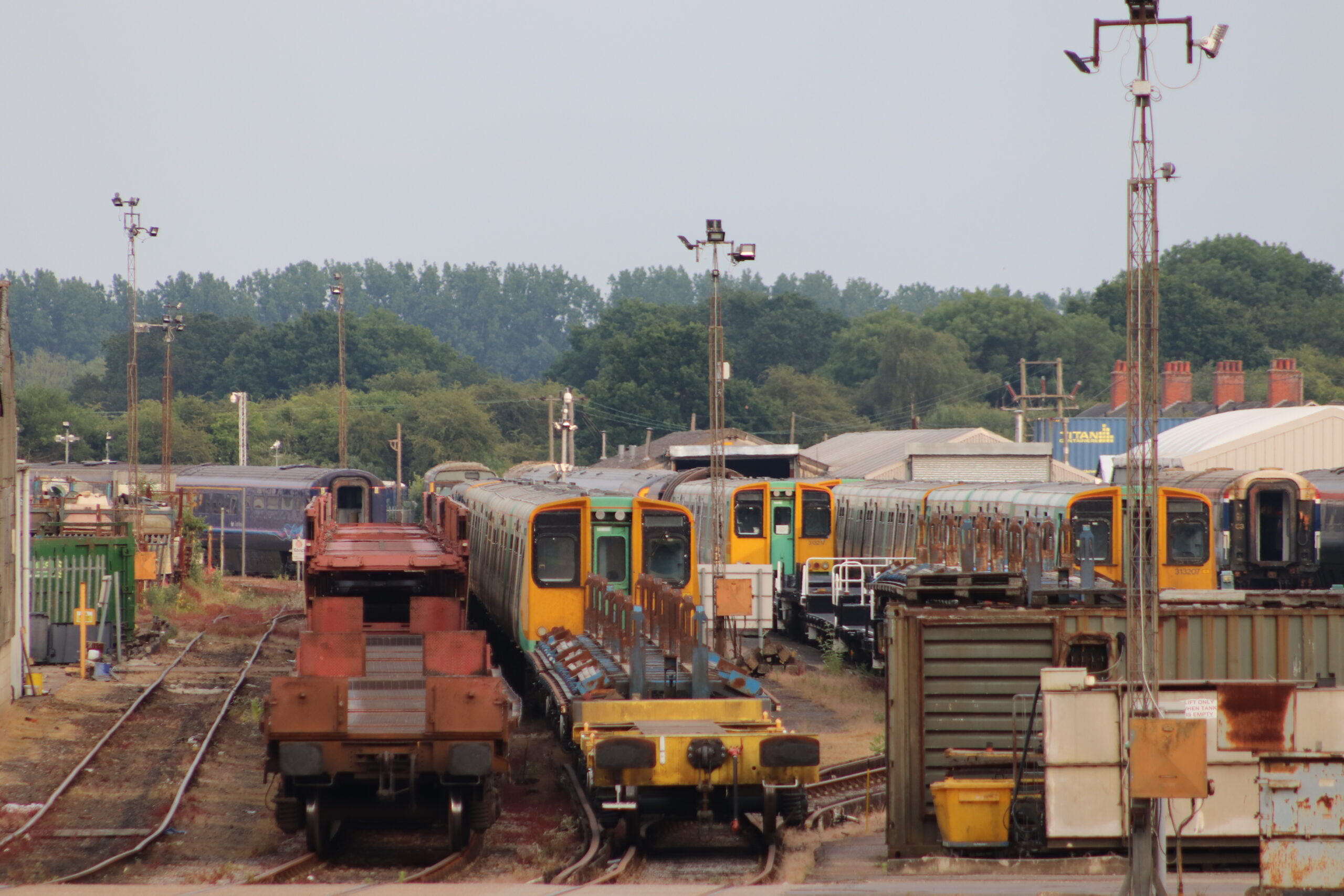
    No.’s 313206, 313201, 313217, 313207 and 313208 await their fate at Eastleigh Arlington – 17/06/2023
    These Class 313 EMU’s at Eastleigh Arlington have had their numbers cut out. We can identify No. 313202, closest to the camera, from the coach number 62530 – 17/06/2023

    “The Magic Carpet” passed through Dorset and our North Dorset correspondent was on hand to capture the train at Gillingham:

    GBRf Class 73/9 No.’s 73964 ‘Jeanette’ and 73962 ‘Dick Mabbutt’ head up UK Railtours “The Magic Carpet” at Gillingham on the return leg (photo courtesy of Scott Lewis) – 17/06/2023

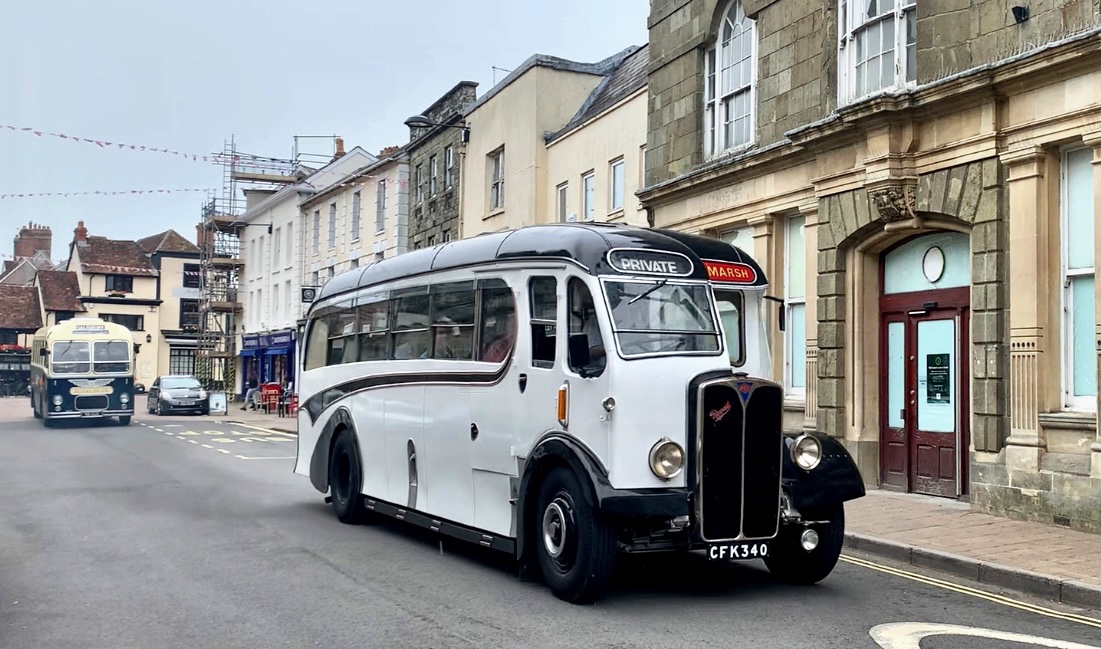
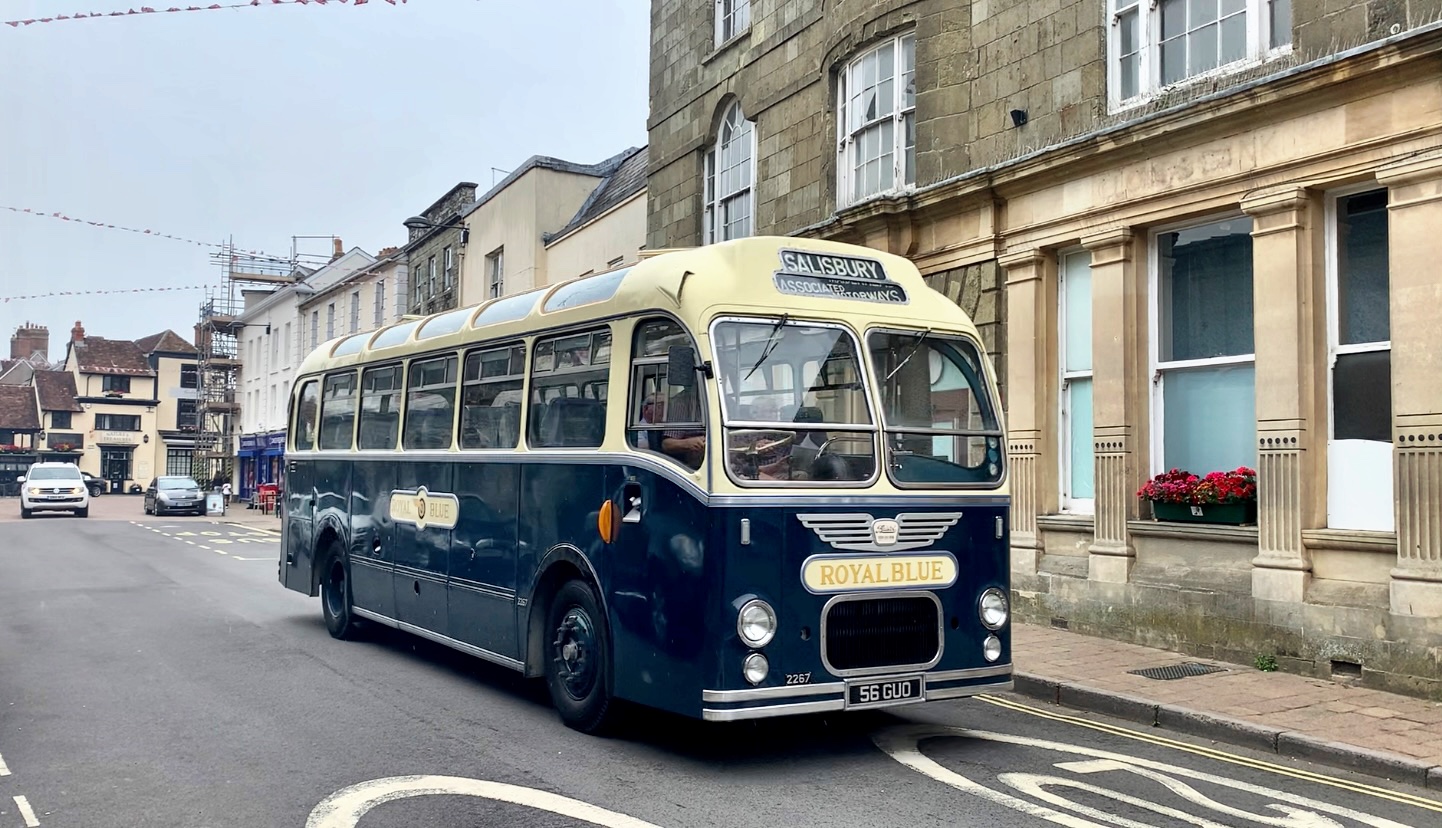
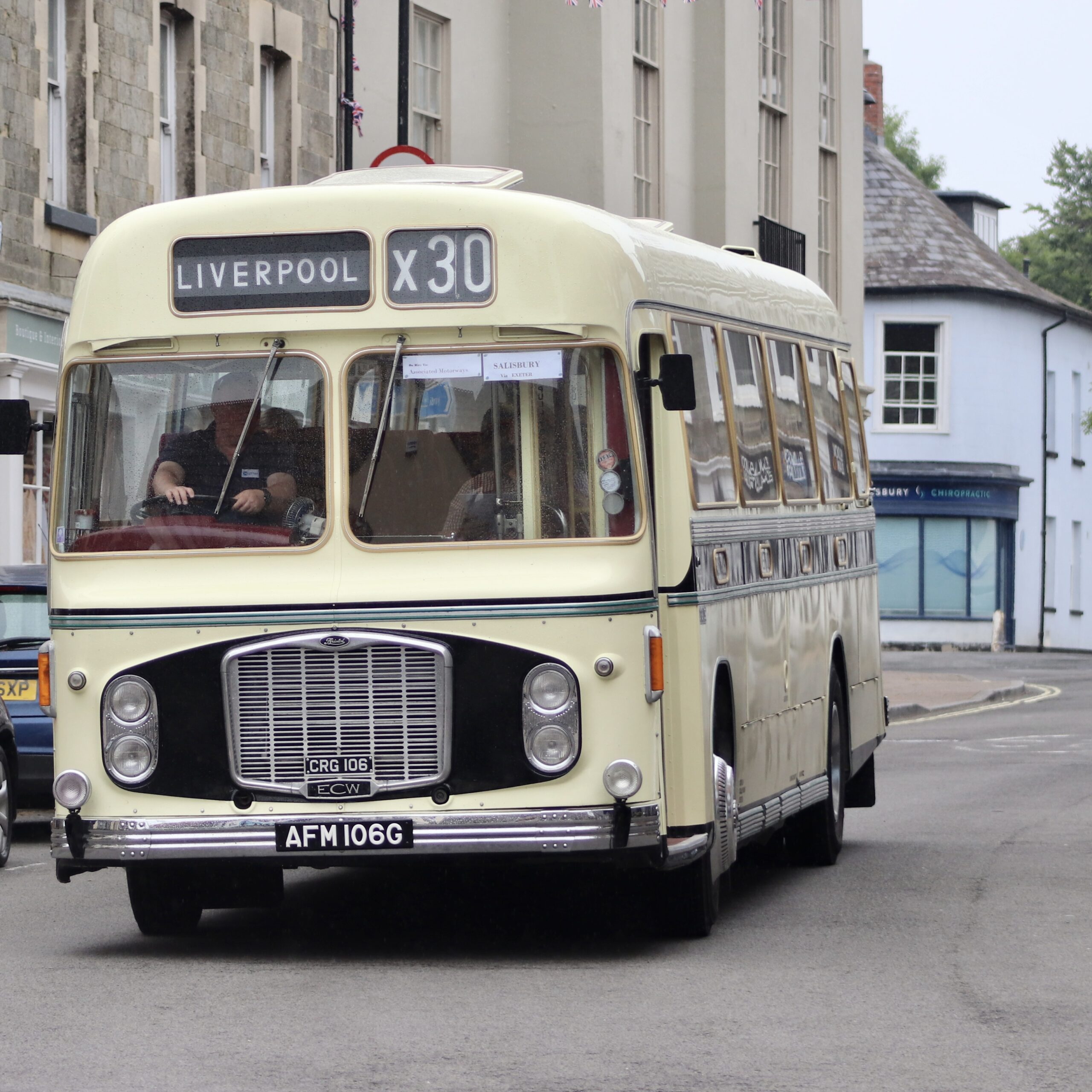
    This past weekend the 2023 “Royal Blue Run” saw the return of preserved and restored coaches to roads across the West Country, showcasing these fine specimens in authentic settings across the country recreating lost scenes. This year the Royal Blue & Associated Motorways run saw the privately owned vehicles recreate an age of bygone travel on the open roads through Wiltshire, Somerset, Devon and Cornwall reaching Penzance in the far south west.  The specific routes chosen were drawn from Royal Blue timetables from different eras. Sometimes segments of express services are followed, or in other cases seasonal variants are used (e.g. summer Saturdays only or winter season routing).  Every stretch has to be pre-driven to ensure the original roads remain suitable for coaches to pass even with modern parking practices or traffic management schemes. The coaches set out from Salisbury bus station on Friday 16th June and we chose to see them passing through Shaftesbury on their return final stage run up the A30, as used by the ‘stopping’ Penzance to London services, to Salisbury.

    Burlingham C33F AEC Regal Reg No. CFK 340 in the livery of operator Burnham built 1948 at Shaftesbury – 18/06/2023
    Royal Blue ECW Bristol MW6G Fleet No. 2267 Reg No. 56 GUO built 1961 at Shaftesbury – 18/06/202
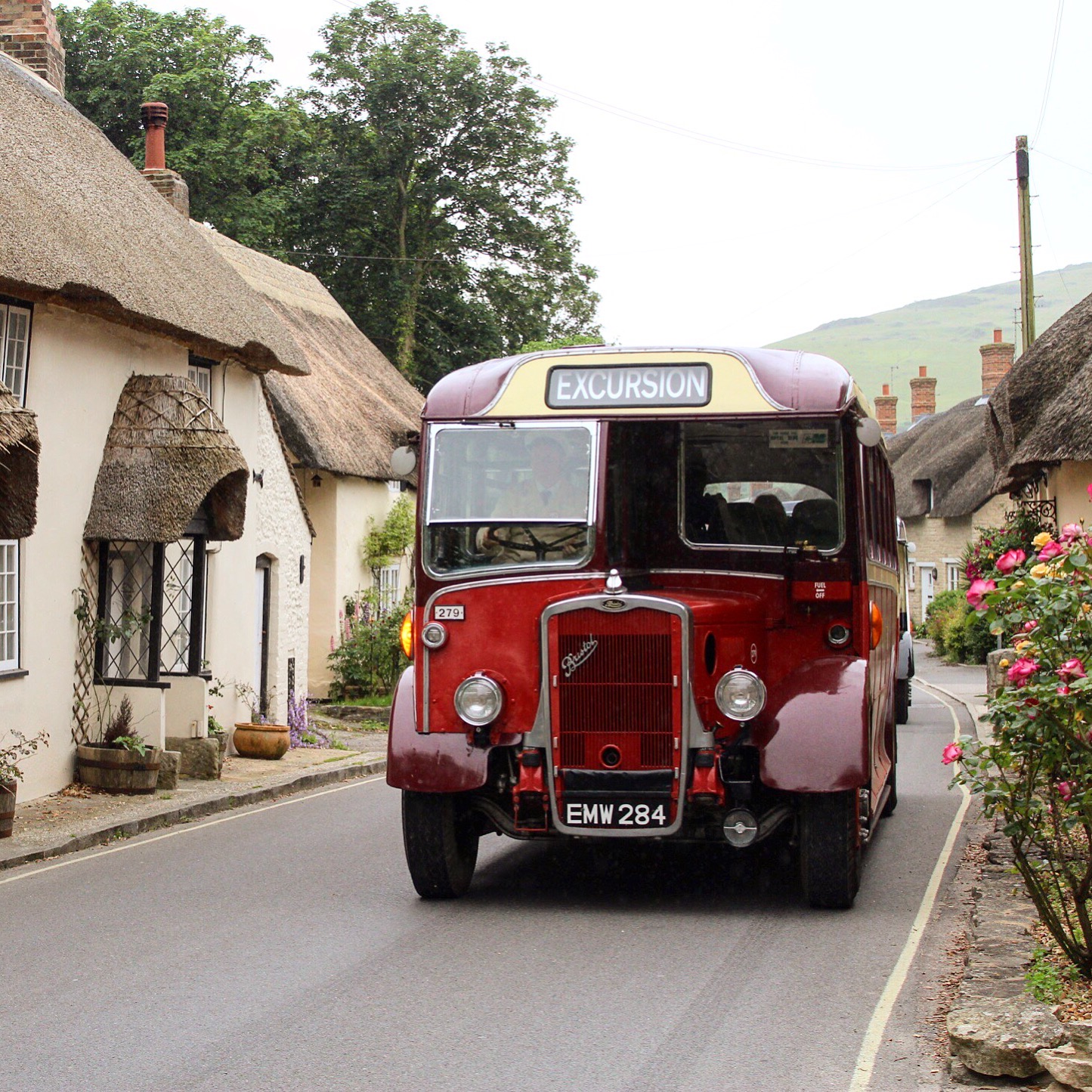
    Wilts & Dorset Beadle C32R Bristol L6B Fleet No. 279 Reg. EMW284, built 1947 at Shaftesbury – 18/06/202

    The Thames Valley & Great Western Omnibus Trust (TV&GWOT) website provides more information on the Royal Blue Runs which “were established in 2002 so that owners and their passengers can relive the pleasures of long distance luxury coach travel for which their carefully preserved vehicles were originally intended. The aim is to follow original Royal Blue routes as closely as possible and to travel at a leisurely pace redolent of the times. The runs also create a wonderful spectacle for innocent bystanders and dedicated photographers alike, thanks to the hard work and resources the owners have devoted to restoring and maintaining their fine coaches.

    A lot of work goes into planning the runs from selecting routes from the extensive Royal Blue network and researching the original drivers’ instructions and passenger timetables, preparing maps and outline routing, driving the routes to develop detailed instructions allowing for modern day features and constraints, organising refreshment stops, obtaining parking permissions, to identifying potential accommodation for a dozen or more coaches and their passengers. Despite all the preparations, final timings are hard to judge whether due to roadworks or things that might pique the interest of crews along the way. The coaches do not travel in close convoy so as not to inconvenience other road users. Some drivers have also been known on occasion to deviate from the intended route (unintentionally!).

    Overall the focus is on education and enjoyment and we hope that however you take part you share in the pleasure.”

    Western National Fleet No. 3307 Reg AFJ 727T Plaxton Supreme DP41F Bristol LH6L built in 1979 at Shaftesbury – 18/06/202
    A long way from home, Crossville Fleet No. CRG106 Reg AFM 106G ECW C49F Bristol RELH built in 1969 at Shaftesbury – 18/06/202
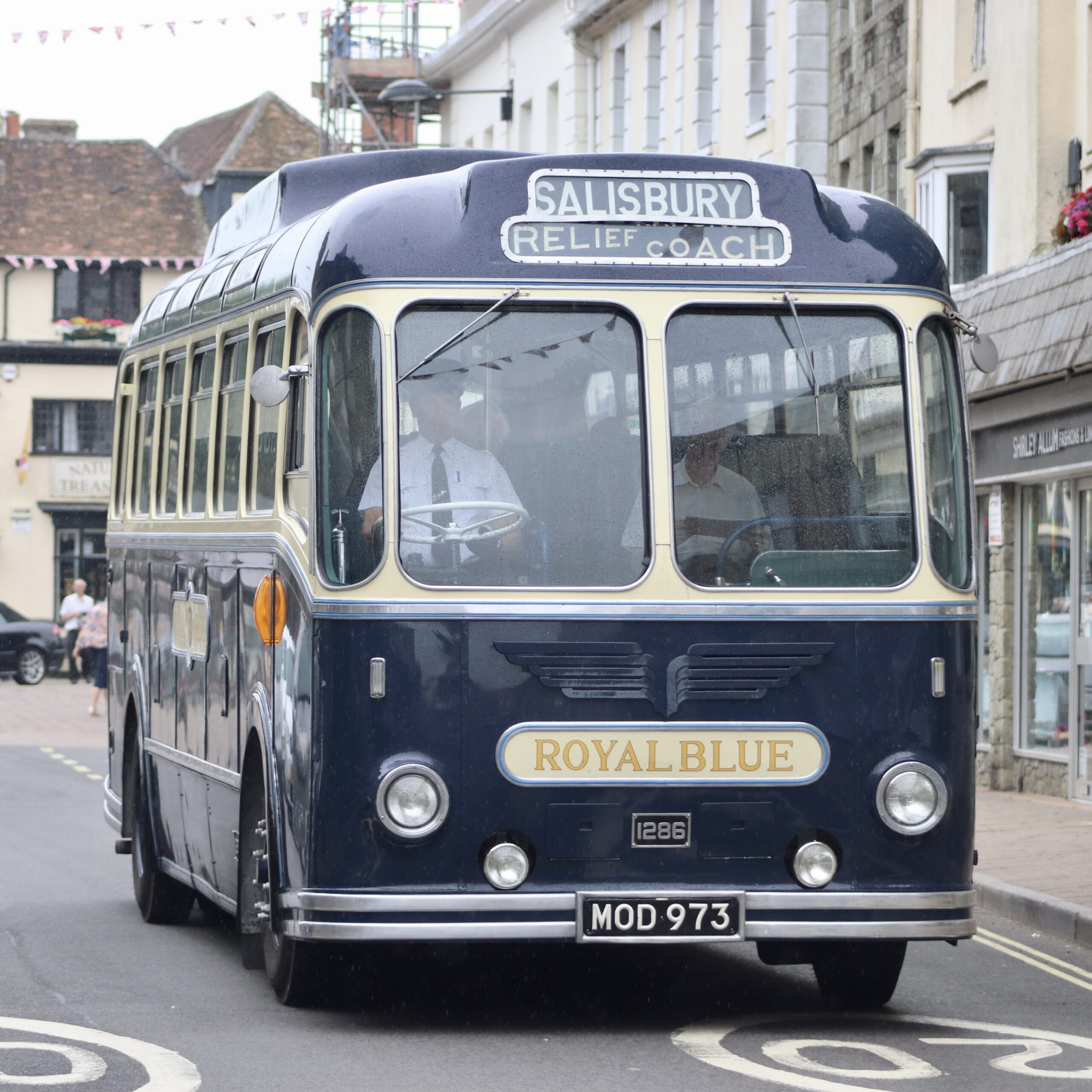
    Royal Blue Fleet No. 1286 Reg MOD 973 ECW Bristol LS6G C39F built in 1952 at Shaftesbury – 18/06/202
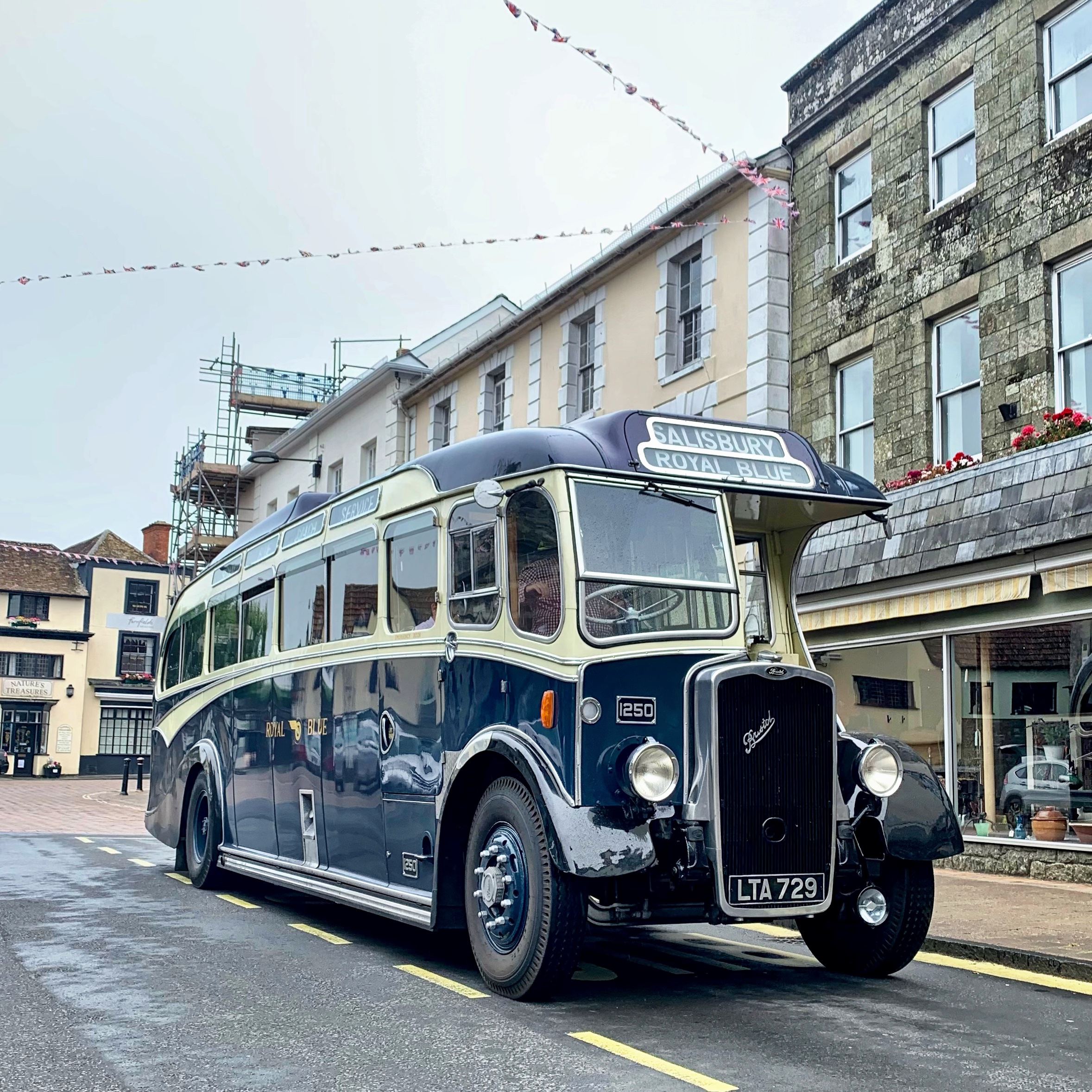
    Royal Blue (Western National) Fleet No. 1250 Reg. LTA 729 Duple Bristol LL6B C37F built in 1951 at Shaftesbury – 18/06/202
    A very short video of Royal Blue Run buses passing through Shaftesbury – 18/06/2023

    I certainly derived much pleasure from seeing the coaches which were running around thirty minutes behind schedule when they passed us. Not bad timing in my humble opinion! I previously saw the 2016 Royal Blue Run which having started at London Victoria Coach Station ran to Bristol on Day One. The following day was designed to commemorate 50 years since the final train on the Somerset & Dorset Railway, a much loved and mourned route that ran through Royal Blue heartland from Bath to Bournemouth. The route intertwined with several famous S&D locations, recreating in part the former rail replacement service that was created when the line closed in 1966. Day Three was an excursion from Bournemouth to Lulworth Cove, followed by a trip across the New Forest to Lyndhurst. It was Lulworth Cove where I decided to see the buses as they grouped together in the car park before once again taking to the open road where I took the opportunity to see them passing through Lulworth village and Wareham.

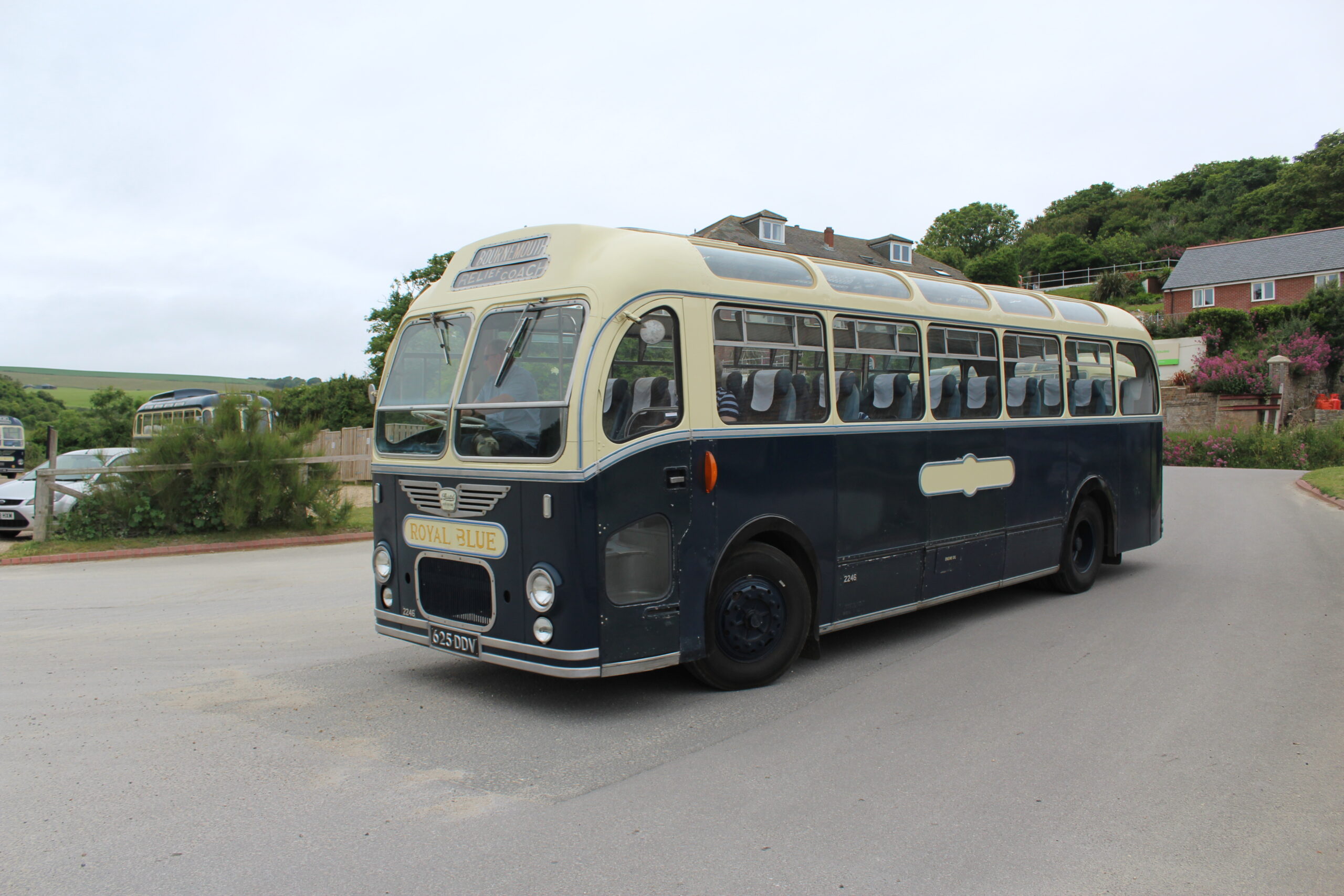
    Royal Blue Bristol MW6G Fleet No. 2246 Reg. 625 DDV built 1960 enters the car park at Lulworth Cove – 19/06/2016
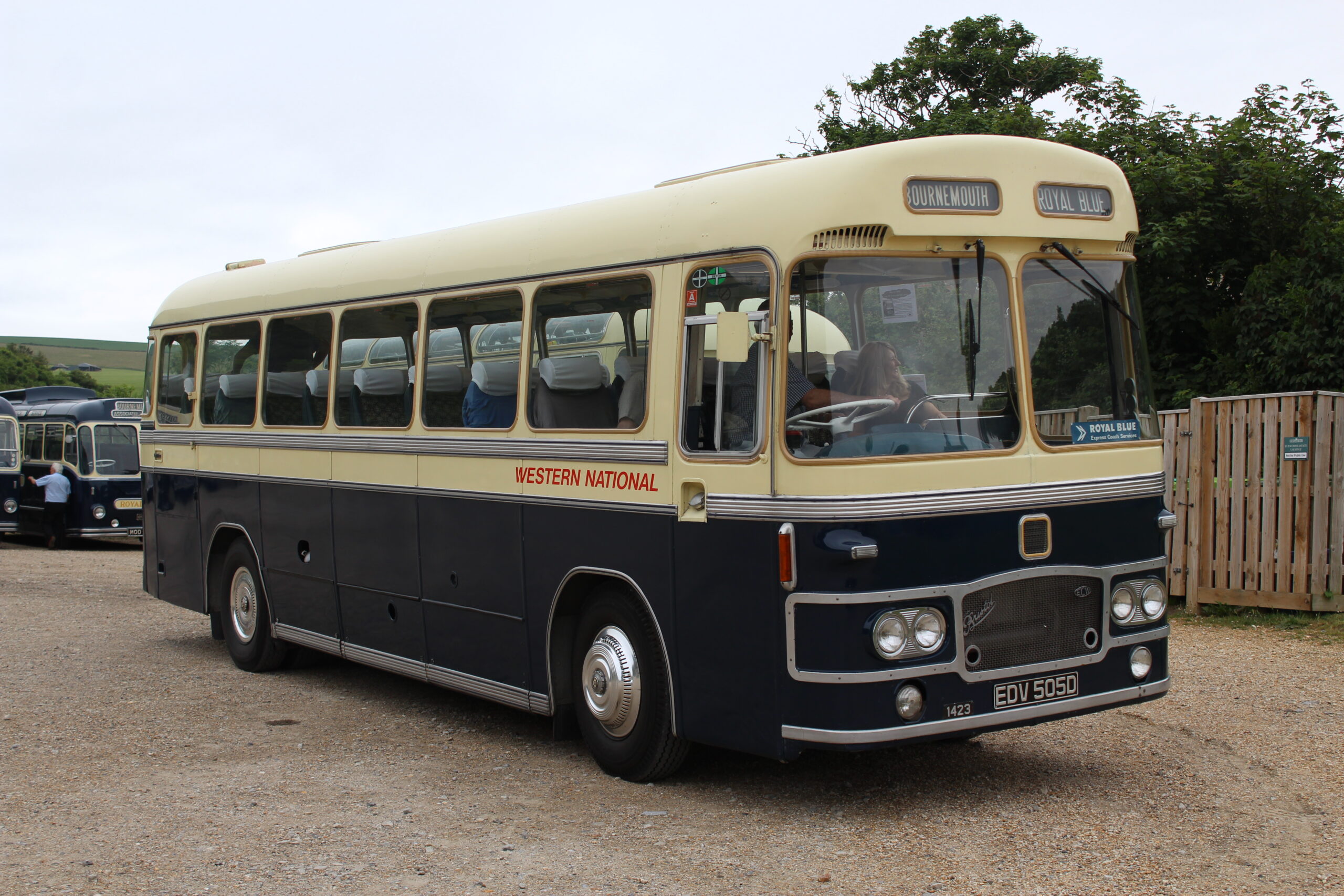
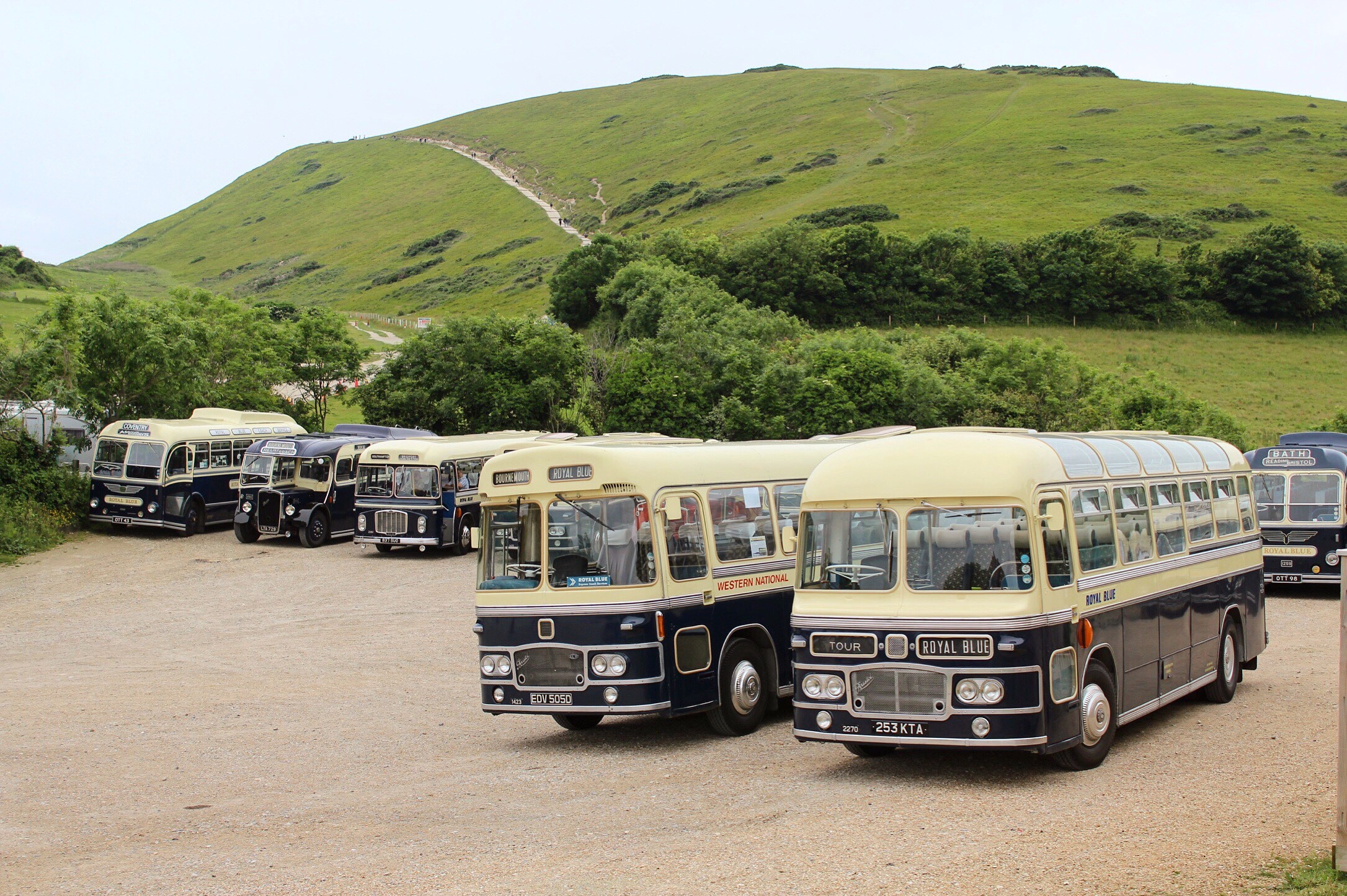
    Western National Bristol MW6G ECW C39F Fleet No. 1423 Reg. EDV 505D built in 1966 and entered service in Plymouth seen at Lulworth Cove – 19/06/2016
    A Royal Blue line up at Lulworth Cove – 19/06/2016
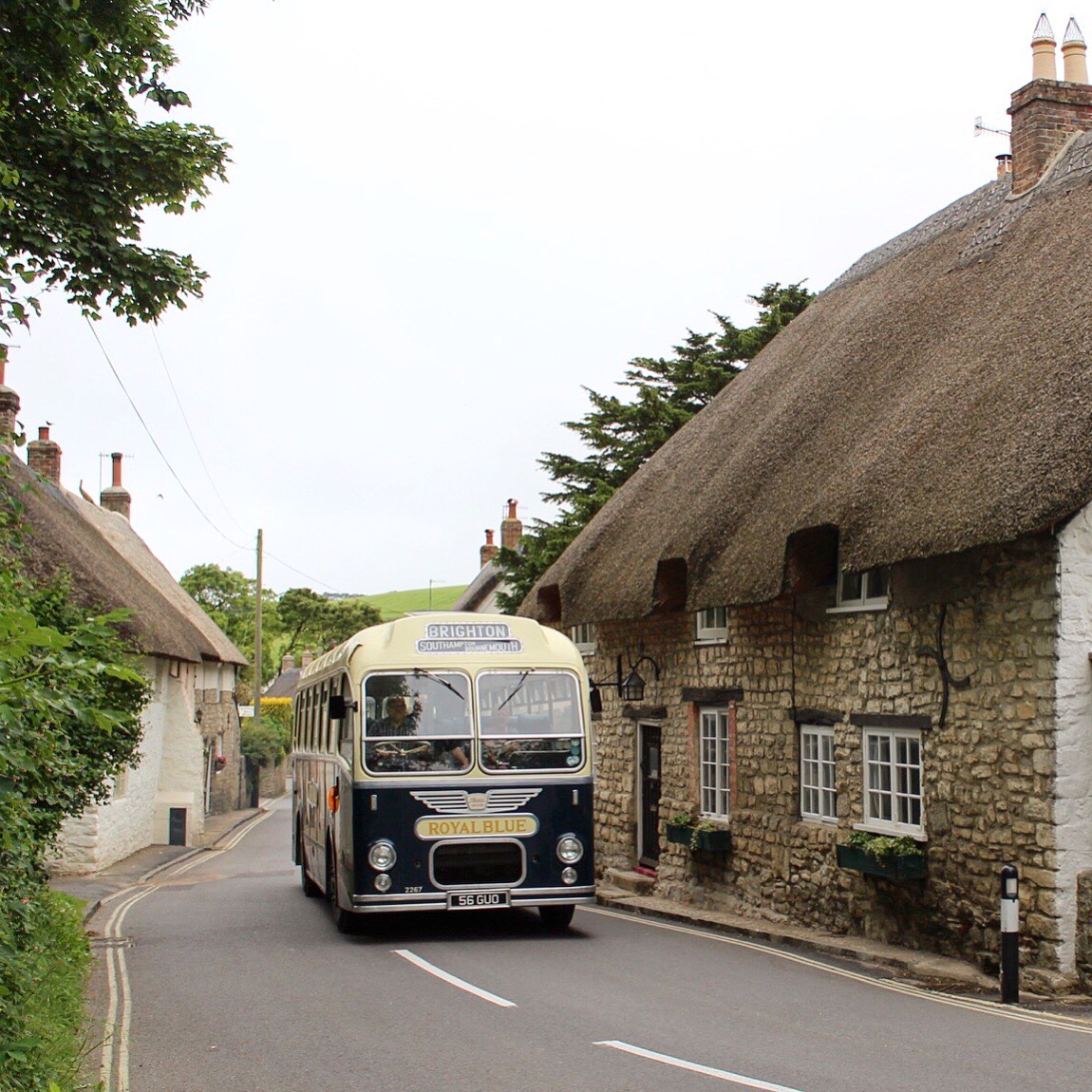
    Royal Blue ECW Bristol MW6G Fleet No. 2267 Reg No. 56 GUO built 1961 passing through Lulworth – 19/06/2016
    Wilts & Dorset Beadle bodied Bristol L6B Fleet No. 279 Reg. EMW284, built 1947 at Lulworth – 19/06/2016
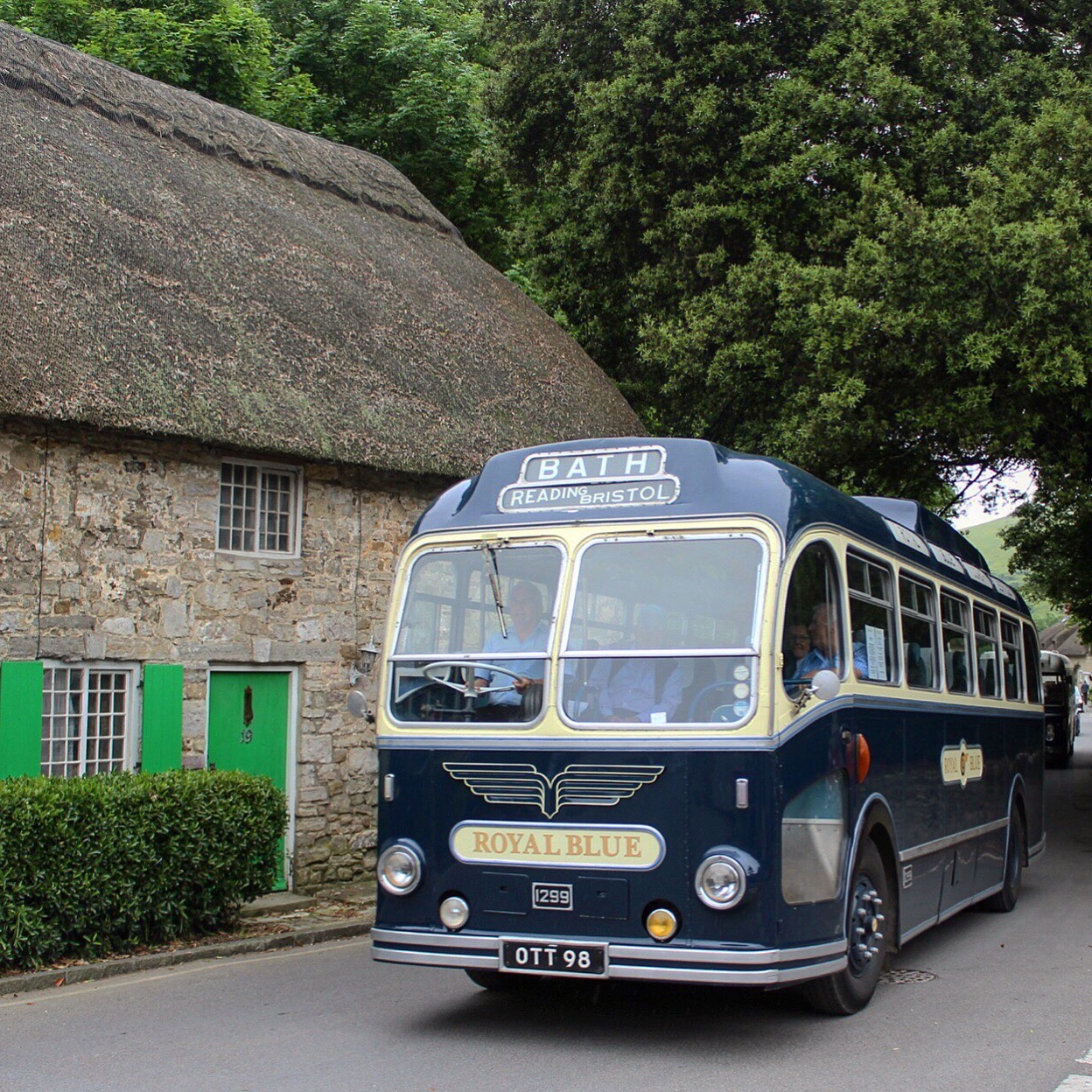
    Royal Blue Fleet No. 1299 Reg. OTT 98 1953 Bristol LS6G with ECW C39F coachwork at Lulworth village – 19/06/2016
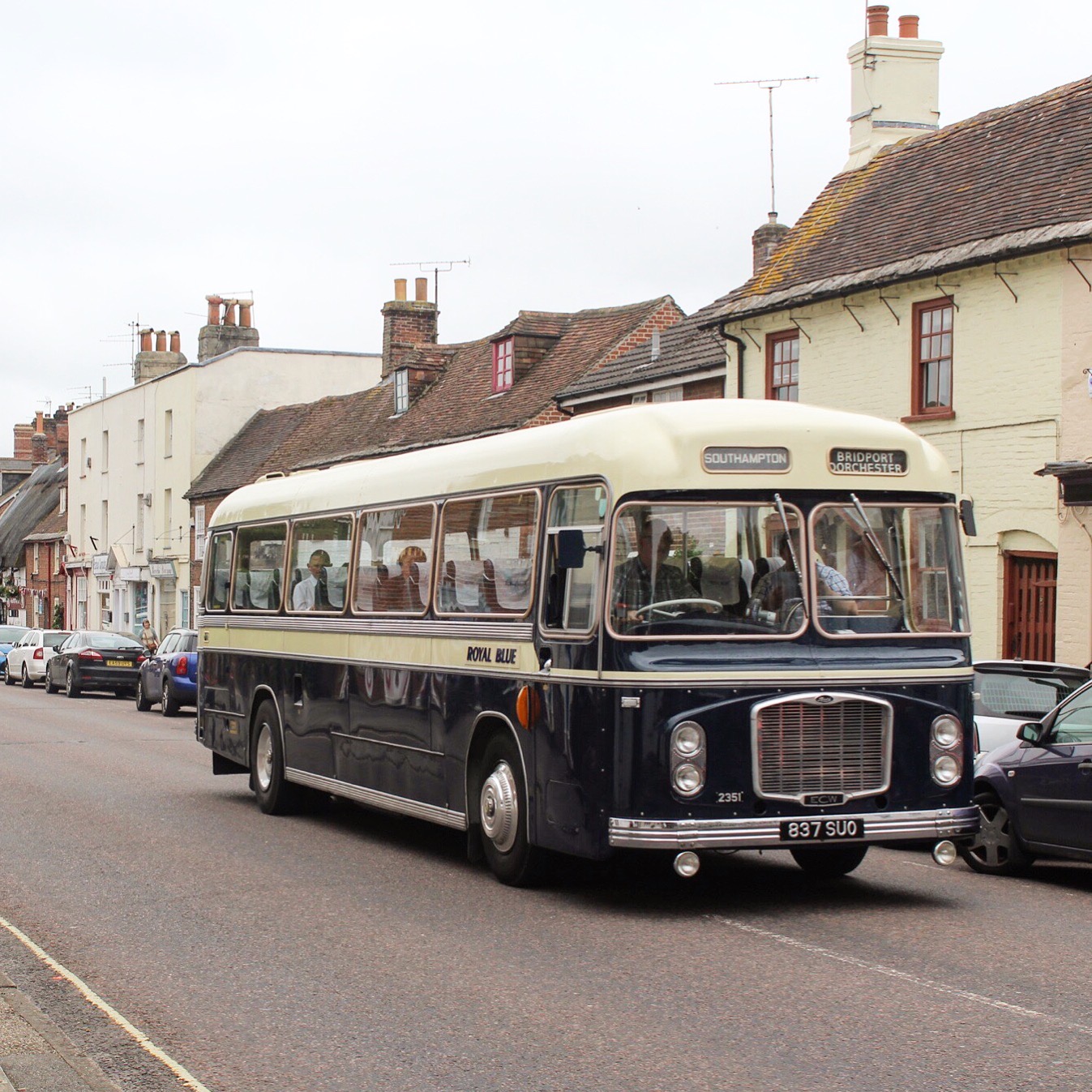
    Royal Blue express services Fleet No. 2351 Reg. 837 SUO Bristol RELH6G ECW passing through Wareham – 19/06/2016

    From The Archives:

    Mention of Penzance as part of the Royal Blue Run this year reminded me that I was going to look for a photograph of the Pullman Camping Coaches which used to stand at Marazion and I mentioned as much in our blog entry “Yoshi Goes To Cornwall”. As luck would have it, I was looking for some paperwork the other day and came across the following images:

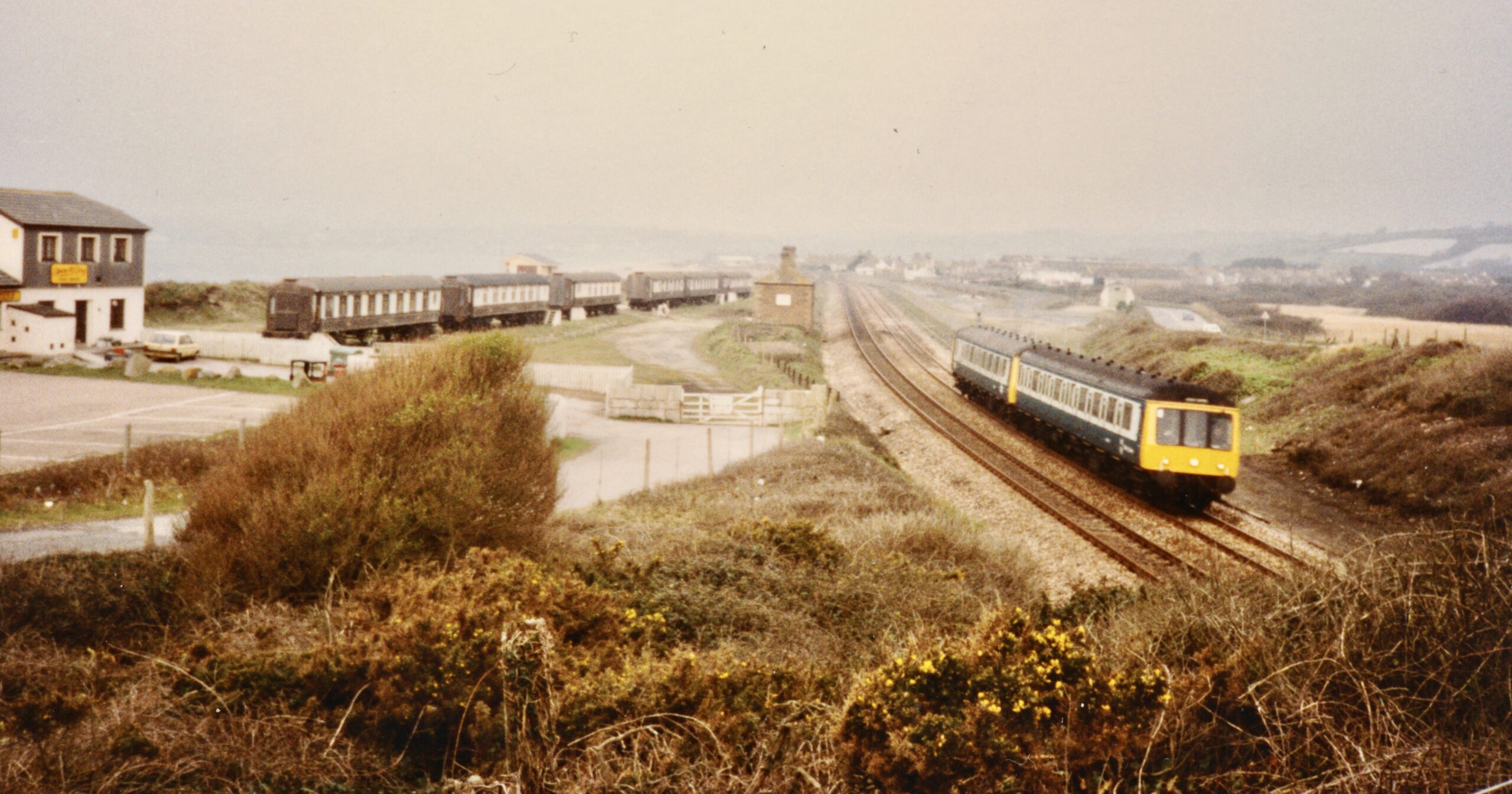
    For many years Marazion was home to six old Pullman coaches that were employed as camping coaches; holiday accommodation offered by the railway containing sleeping and living space designed to encourage people to travel by train to the stations where they were situated – March 1993
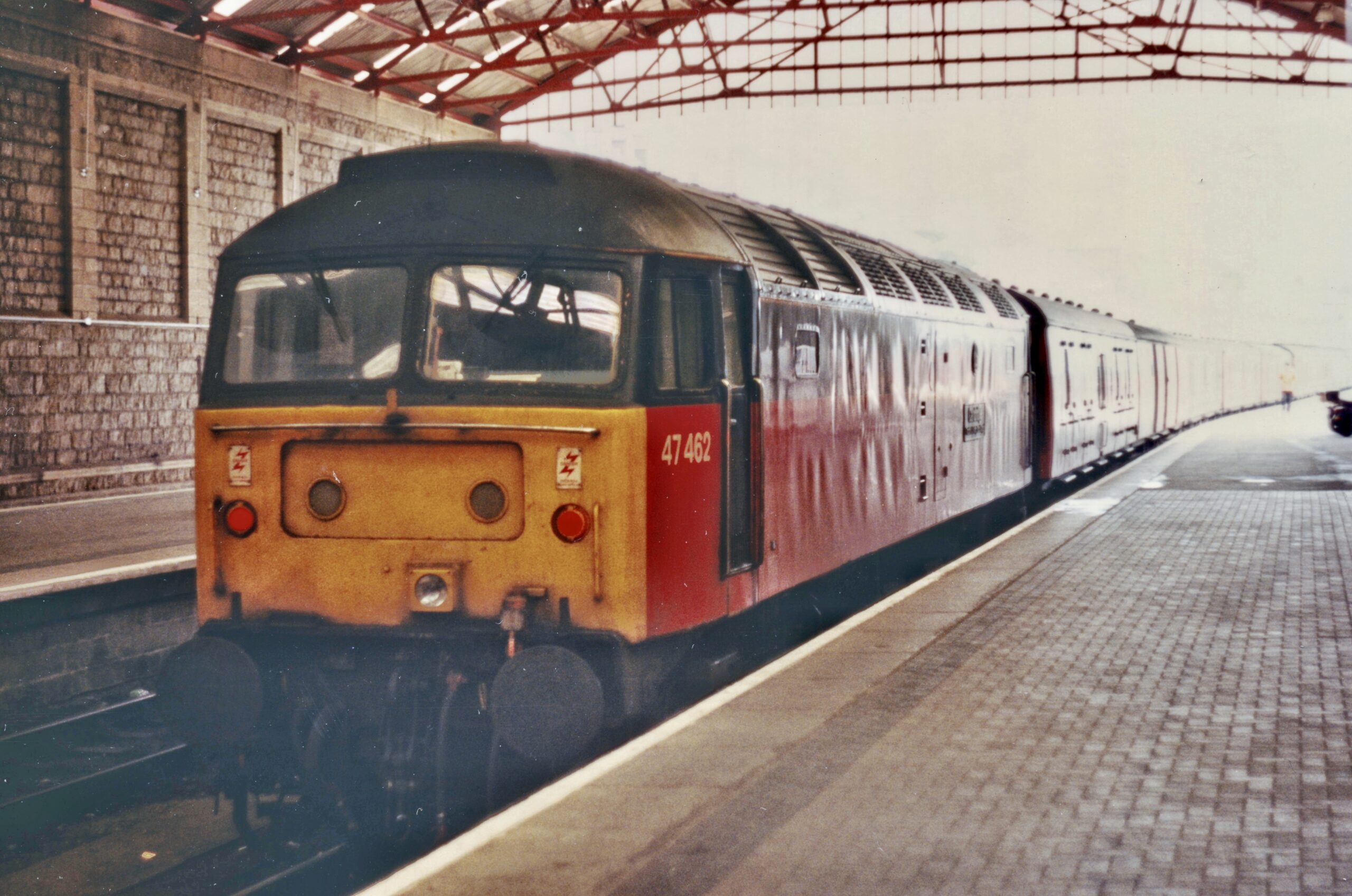
    British Rail Parcels Sector liveried Class 47 No. 47462 ‘Cambridge Traction & Rolling Stock Depot’ at Penzance – March 1993
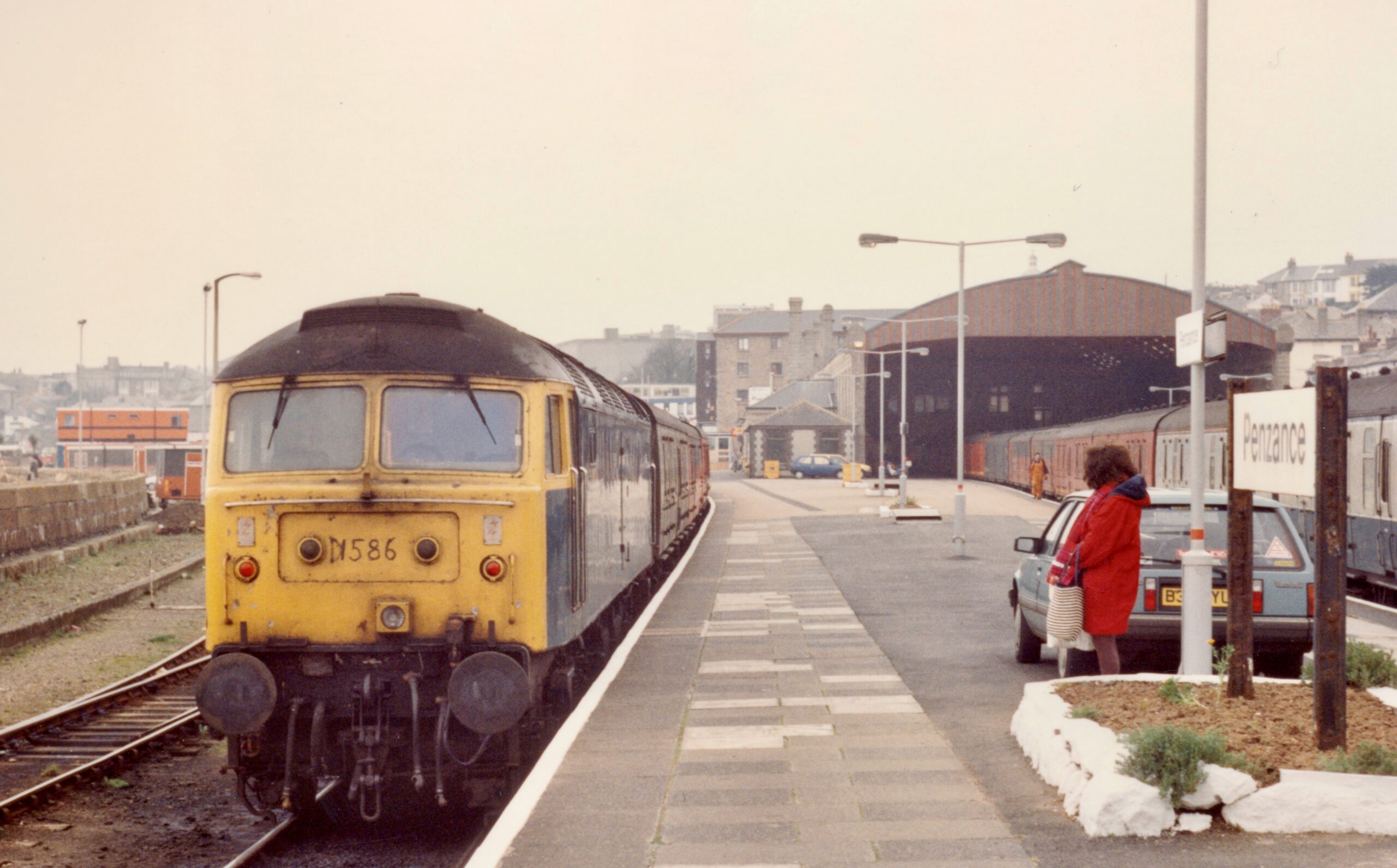
    Class 47 No. 47463 (with her pre-TOPS number D1586 marked between her head code lights) in BR Standard Monastral Blue livery, which she retained to the end, stands at Penzance. The locomotive entered service in May 1964 and was cut up in November 1996 by MRJ Phillips at Crewe Works – March 1993
    Class 47 No. 47462 ‘Cambridge Traction & Rolling Stock Depot’ at Penzance. The locomotive was built at Crewe and entered traffic on May 16th 1964 as D1582. Named at Cambridge Open Day held on 29th September 1990 by Jack Firman a retired workshop supervisor, the nameplates were removed in December 1993 and later transferred to No. 47736 – March 1993
    Class 47 No. 47462 at Penzance. The locomotive was cut up at Toton by Harry Needle Rail Co in March 2003 – March 1993

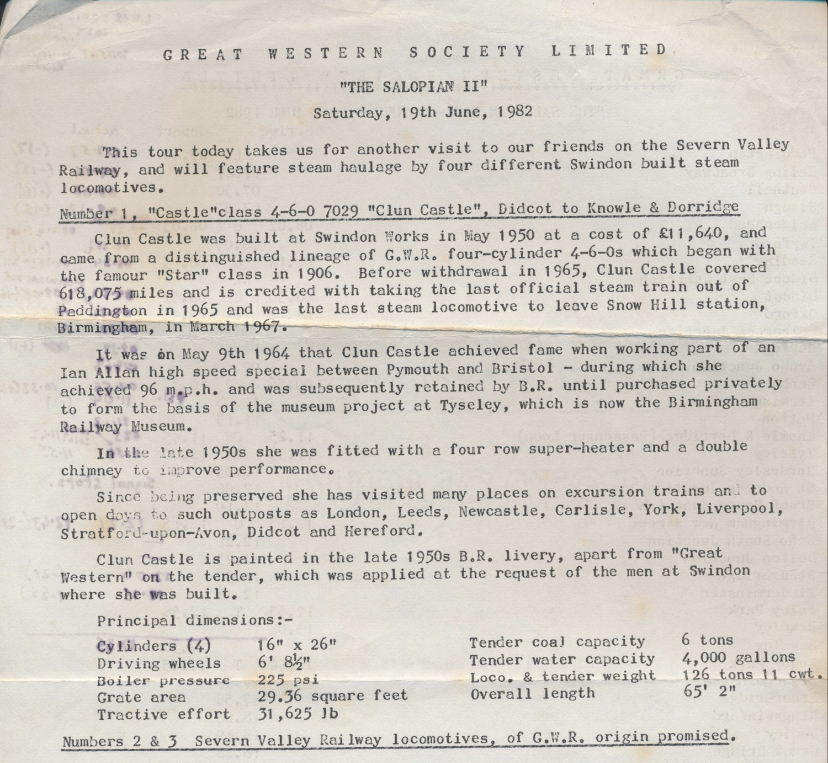
    Alongside the Cornwall photographs above, the same box of documents contained, amongst other things, a Blake’s 7 ‘Liberator’ model and an old diary. I’ve not been one for keeping a diary, but for six months in 1982, I seemed to have managed it. Tucked inside the diary was a piece of paper from a rail tour I took from London Paddington to the Severn Valley Railway on Saturday 19th June 1982.

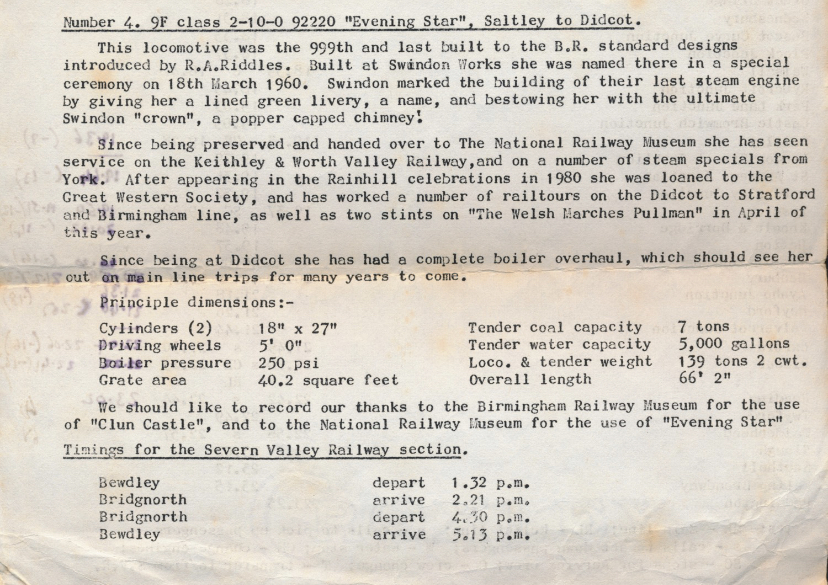
    Great Western Society Limited “The Salopian II” information sheet – 19/06/1982
    Great Western Society Limited “The Salopian II” information sheet – 19/06/1982

    This must have been my first visit to the SVR, and I don’t really remember much about the day if I’m honest. So from the pages of a diary not opened in years, here, extracted from amongst references to exams, my sister’s wedding, the Falklands War and working part-time at Bere Regis Motors in Dorchester, is my record of the Great Western Society Limited’s “The Salopian II”:

    Thursday June 10th 1982

    Rail tour tickets for the 19th arrived today. Going with Tony S.
    Adam Ant is number one with ‘Goody Two Shoes’

    Friday June 18th 1982

    At 2245 Tony and I boarded the mail train at Dorchester South. Jon H was there as well, but he’s going off somewhere else when we get to London. 

    There was talk about the mail train being taken off soon. If so, we will have problems if we want an overnight jaunt to connect with rail tours departing London in the future. 

    Saturday June 19th 1982

    The locomotive which hauled the mail train from Dorchester, 33118, came off at Eastleigh where it was replaced by 73122. We arrived at London Waterloo right-time and then, together, Jon, Tony and I took a black cab across to Euston. At 0600 we went our separate ways with Jon heading to Kings Cross while Tony and I undertook the two and a half mile stroll to Paddington railway station. The weather was dismal , but at least it didn’t pour down with rain.

    At Paddington, we were due to depart at 0740 but at the appointed time we were surprised to see our train loco; 47532, being taken off the stock at 0725 and taken away.

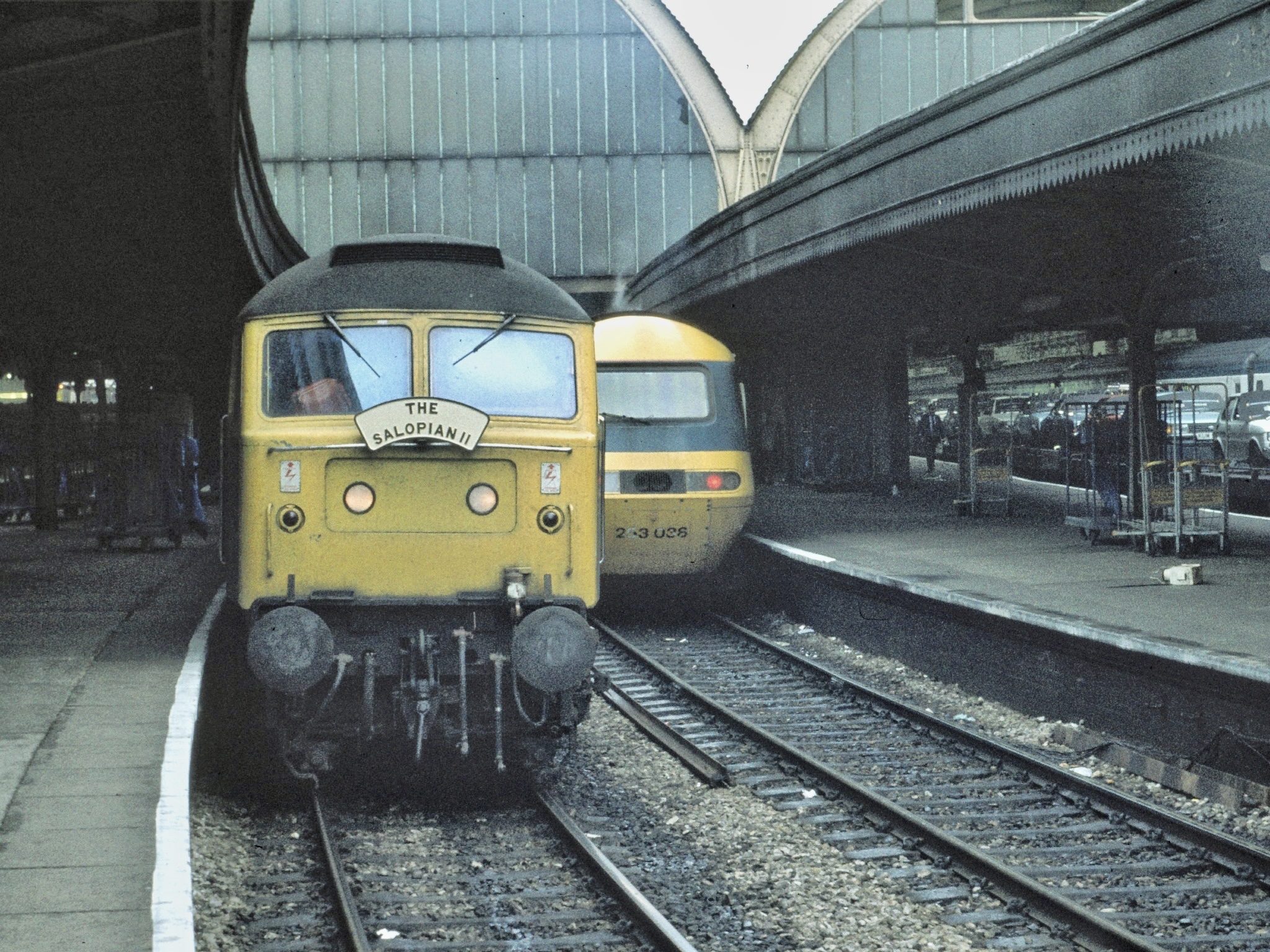
    Class 47 No. 47532 at the head of “The Salopian II” rail tour at London Paddington prior to being removed from the train. HST Class 43 Power Car No. 43145 is on the adjacent track – 19/06/1982

    We eventually left at 0757 with the class 47 having been replaced by 50012.

    Class 50 No. 50012 ‘Benbow’ approaches London Paddington to take over “The Salopian II” rail tour. The locomotive would be withdrawn from service in January 1989 and cut up by Vic Berry in Leicester by July of that year – 19/06/1982

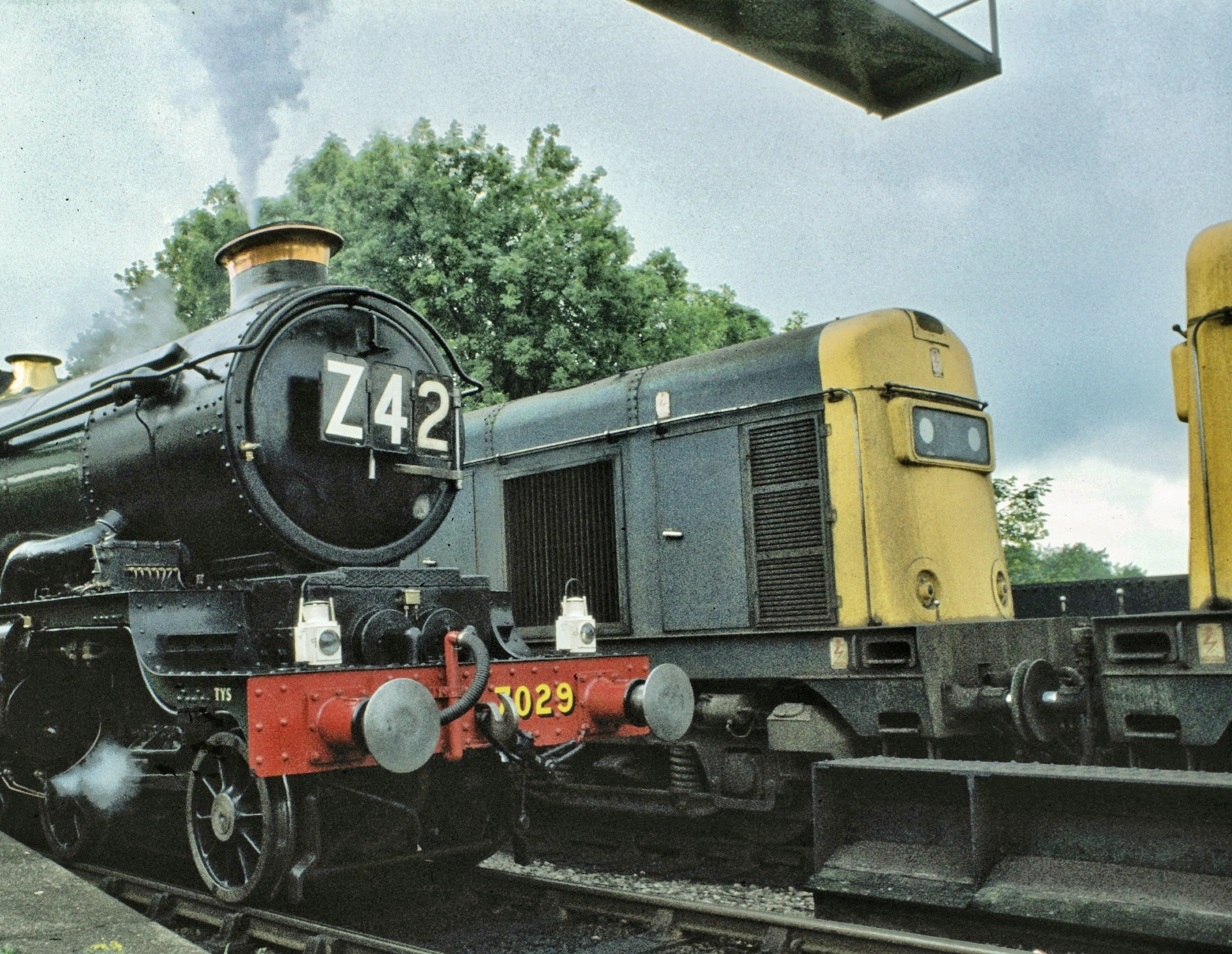
    By the time we arrived at Didcot we were 27 minutes down on schedule. But a quick locomotive changeover meant this was reduced to 16 minutes when we left behind 7029 ‘Clun Castle’.

    GWR 4073 Class 4-6-0 No. 7029 ‘Clun Castle’ backs onto “The Salopian II” at Didcot – 19/06/1982
    GWR 4073 Class 4-6-0 No. 7029 ‘Clun Castle’ at Didcot – 19/06/1982
    GWR 4073 Class 4-6-0 No. 7029 ‘Clun Castle’ at Didcot – 19/06/1982
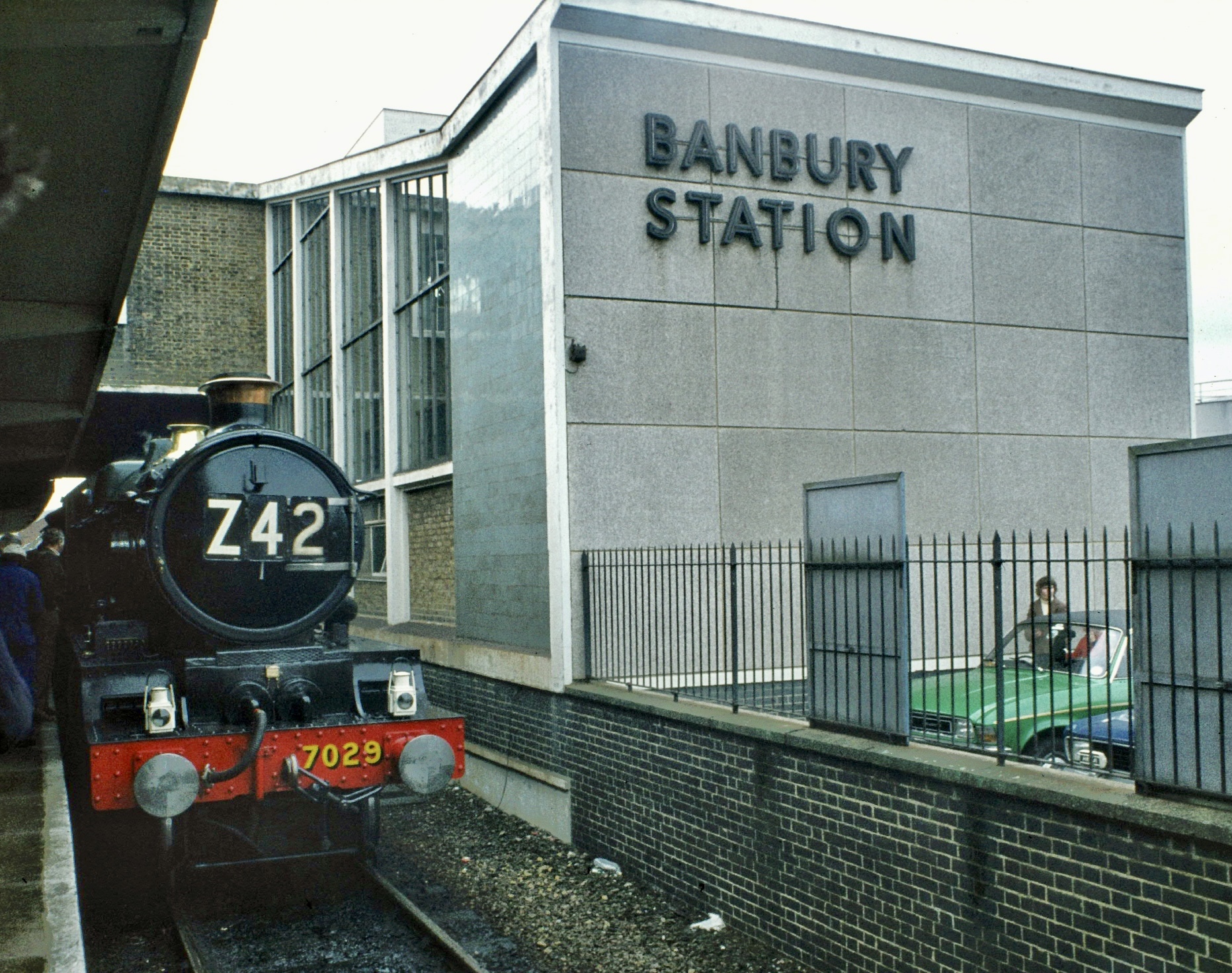
    GWR 4073 Class 4-6-0 No. 7029 ‘Clun Castle’ stopped at Banbury for a water stop – 19/06/1982
    Class 33 No. 33025 ‘Sultan’ in the bay platform at Banbury as No. 7029 ‘Clun Castle’, having drawn forward from the previous image, takes on water – 19/06/1982

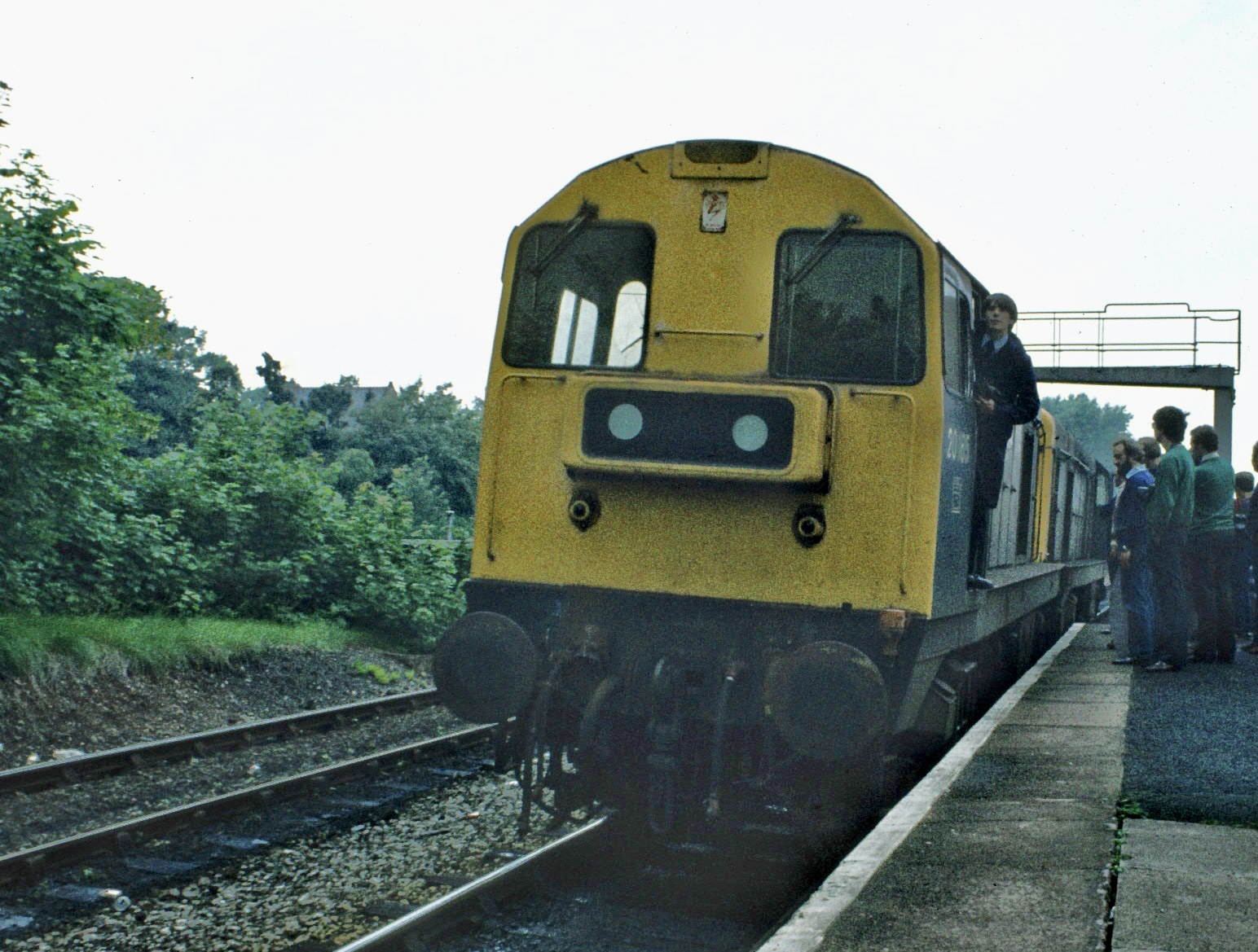
    By the time of our next locomotive changeover the ‘Castle’ had managed to make up the deficit and we arrived bang on time allowing 20165 and 20167 to take us forward to Bewdley on the Severn Valley Railway where we still managed to arrive 20 minutes late!

    GWR 4073 Class 4-6-0 No. 7029 ‘Clun Castle’ alongside Class 20 No.’s 20165 and 20167 which took over “The Salopian II” at Dorridge – 19/06/1982
    Class 20 No.’s 20165 and 20167 backing onto “The Salopian II” at Dorridge – 19/06/1982

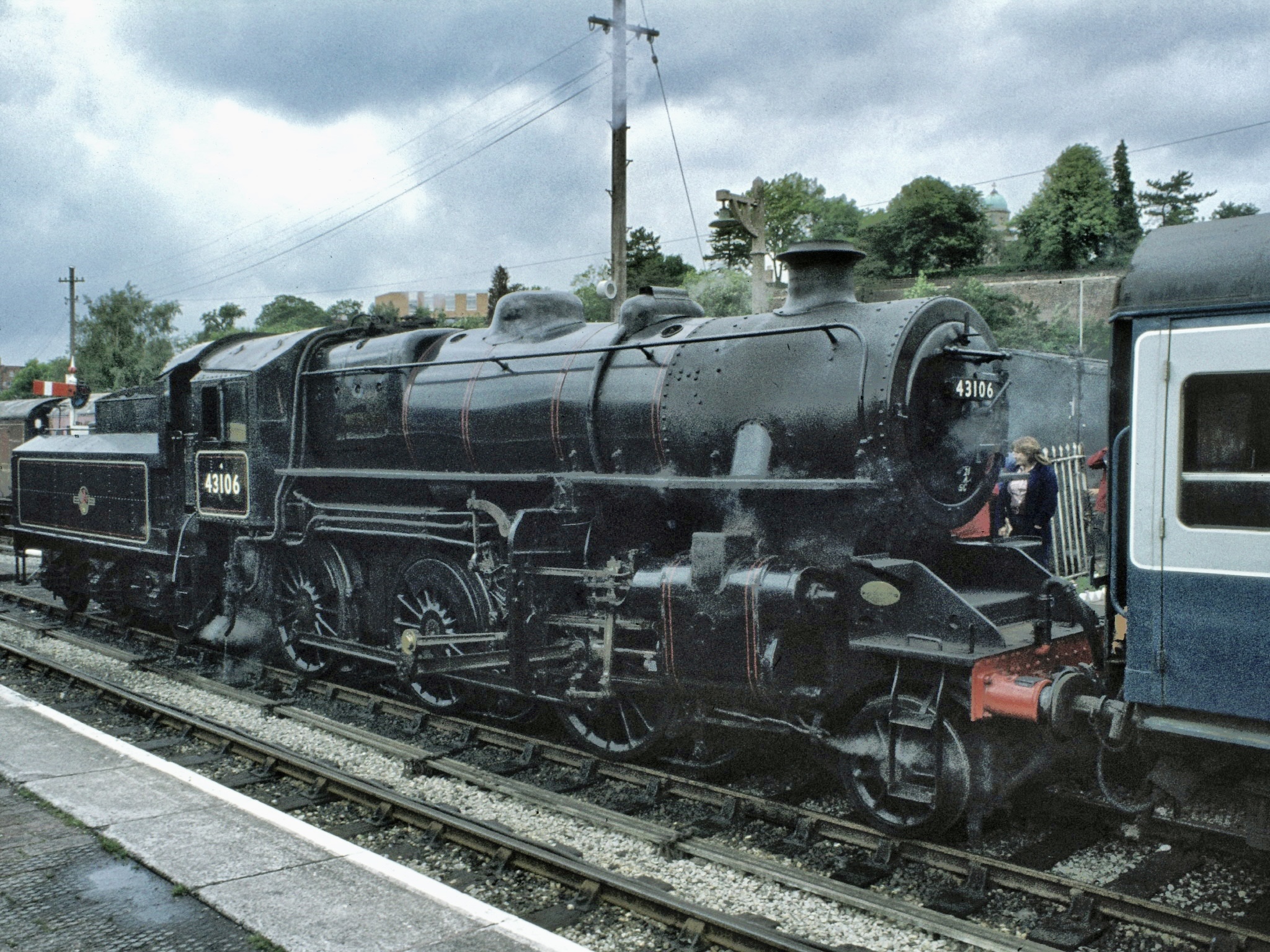
    On the SVR we were hauled by 43106 from Bewdley to Dorridge and return. We had a couple of hours to look around the shed at Bridgnorth and get refreshments.

    While on Severn Valley Railway metals our train was hauled by LMS Ivan Class 4 No. 43106, the only surviving member of the class. Seen here at Bridgnorth – 19/06/1982
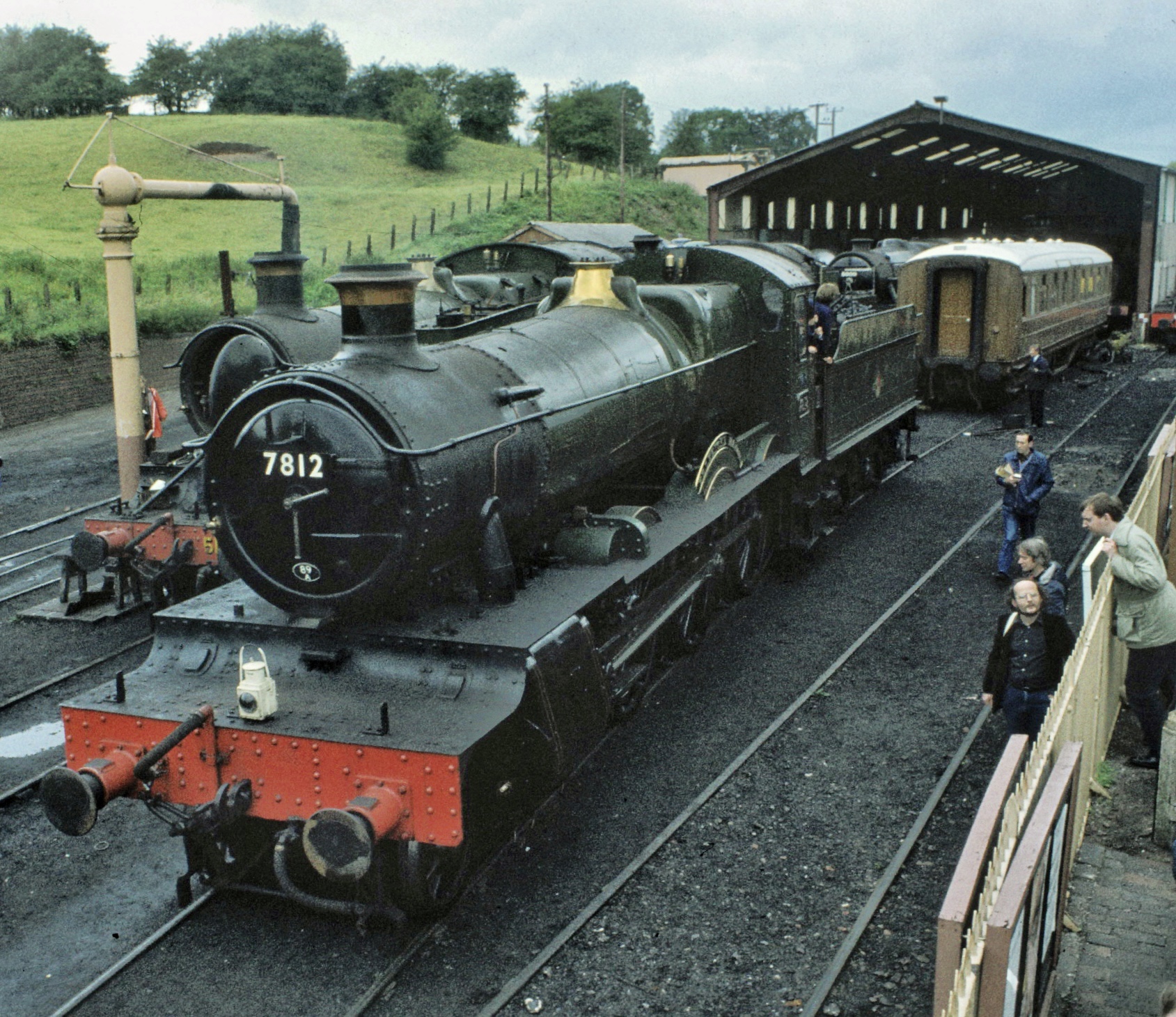
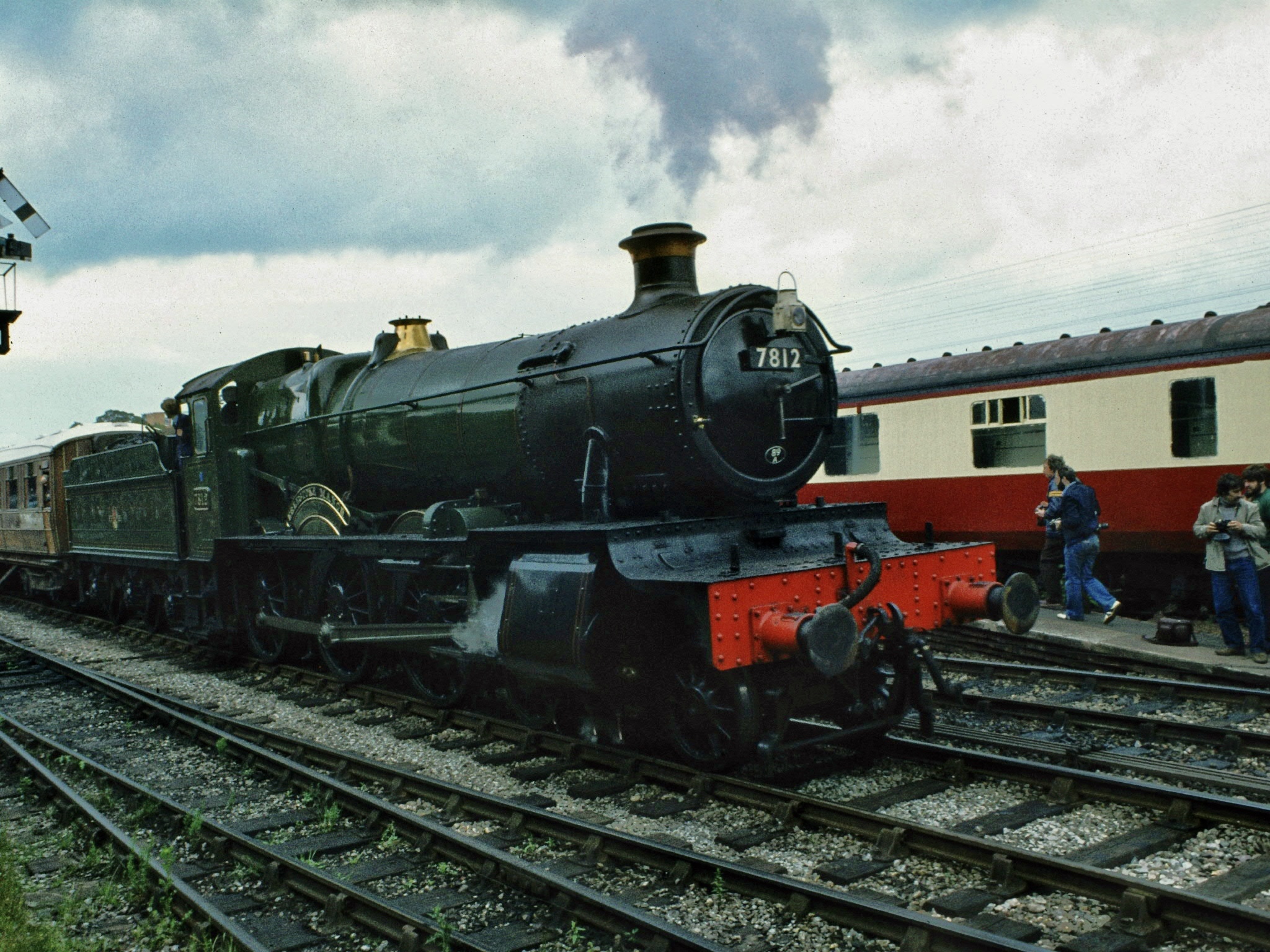
    GWR 7800 Class 4-6-0 No. 7812 ‘Erlestoke Manor’ at Bridgnorth – 19/06/1982
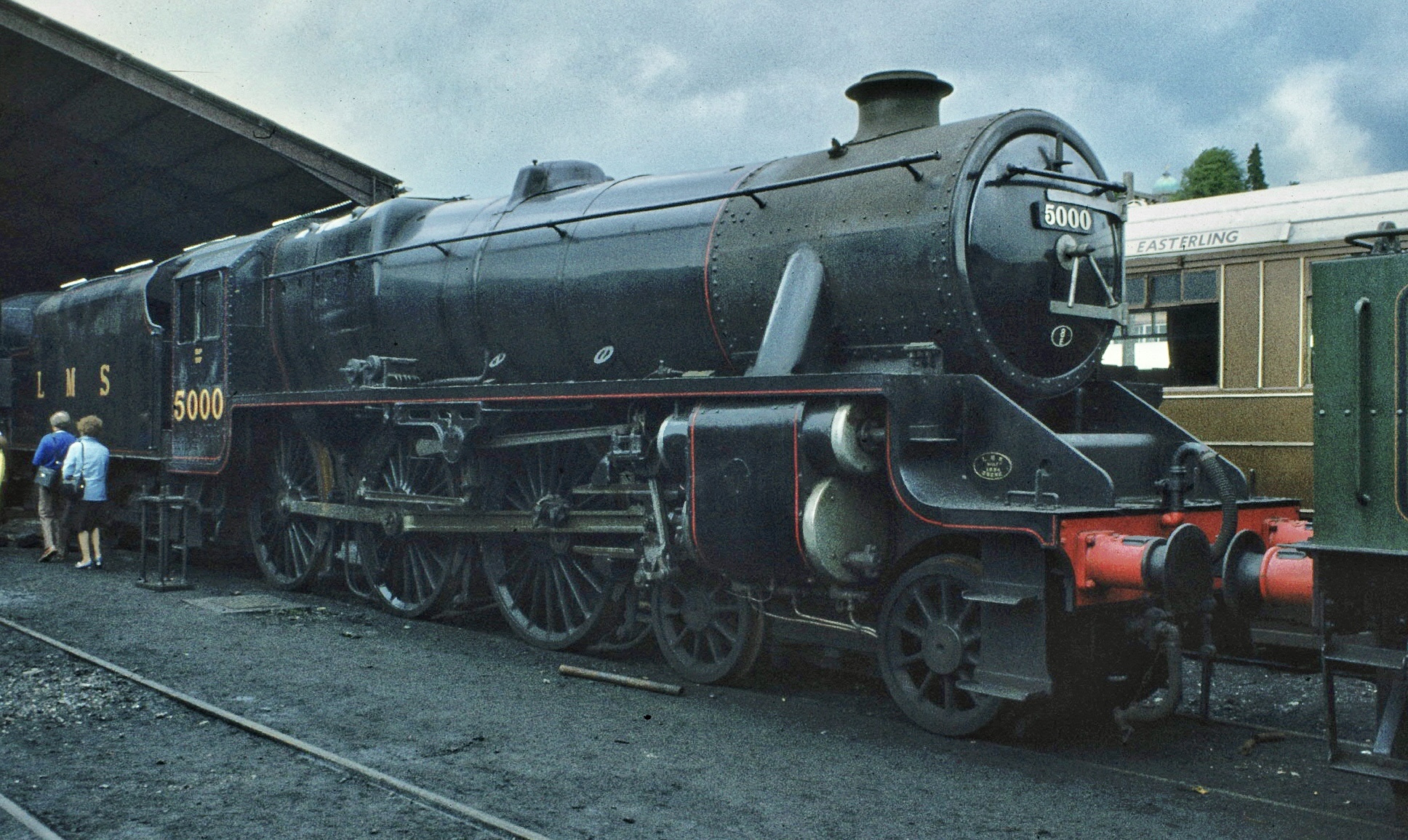
    LMS Stanier Class 5 4-6-0 No. 5000 at Bridgnorth. No. 5000 is part of the National Collection and is currently on static display at the Shildon Locomotion Museum in County Durham – 19/06/1982
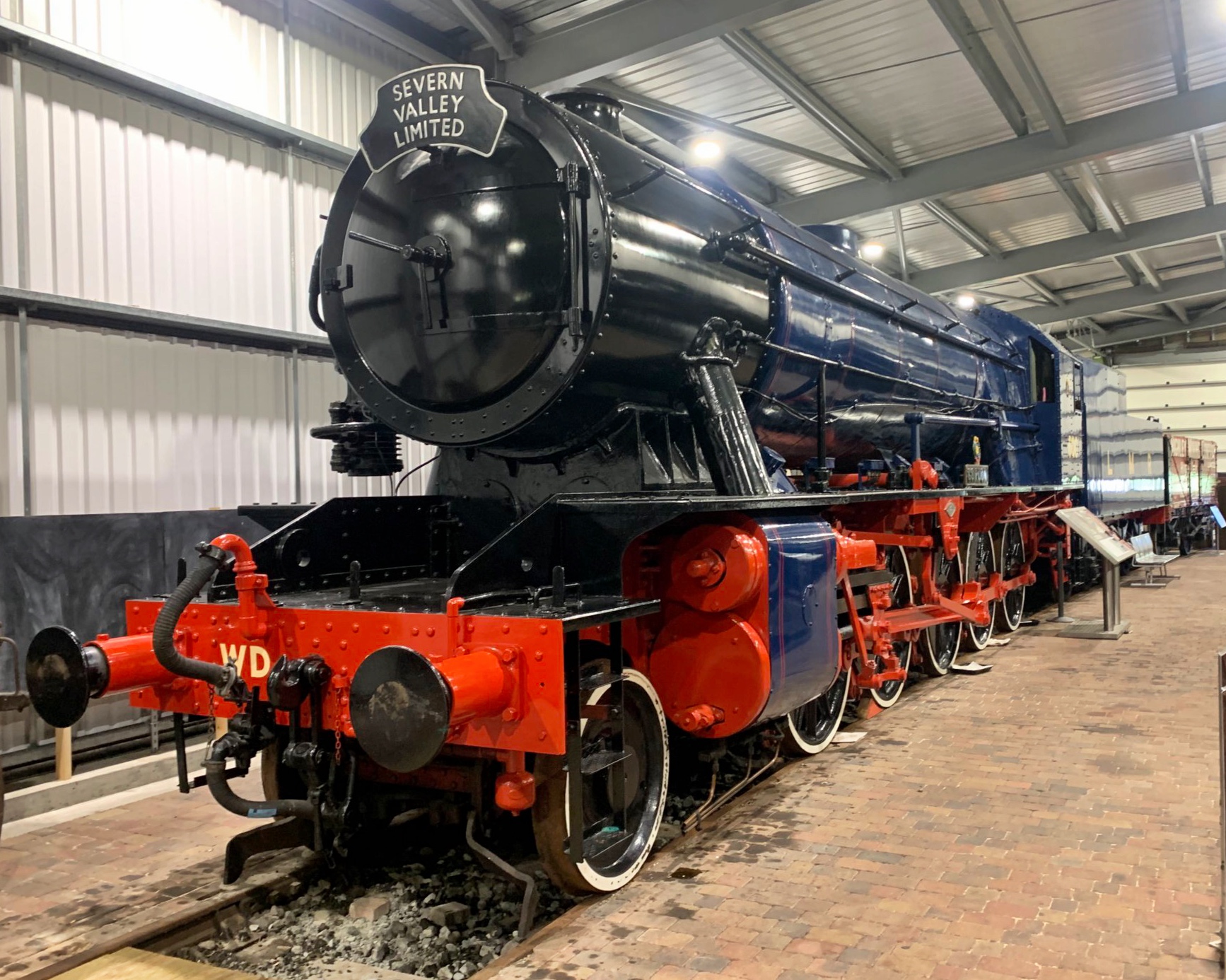
    Longmoor Military Railway No. 600 ‘Gordon’ (named after General Gordon of Khartoum) was. built in 1943 for the War Department and is seen here at Bridgnorth. In 1957, during the Suez Crisis, ‘Gordon’ worked highly secretive trains between Longmoor Military Base and Southampton. The locomotive is currently on static display on the SVR at The Engine House, Highley – 19/06/1982
    GWR 7800 Class 4-6-0 No. 7812 ‘Erlestoke Manor’ at Bridgnorth – 19/06/1982
    GWR 7800 Class 4-6-0 No. 7812 ‘Erlestoke Manor’ at Bridgnorth – 19/06/1982

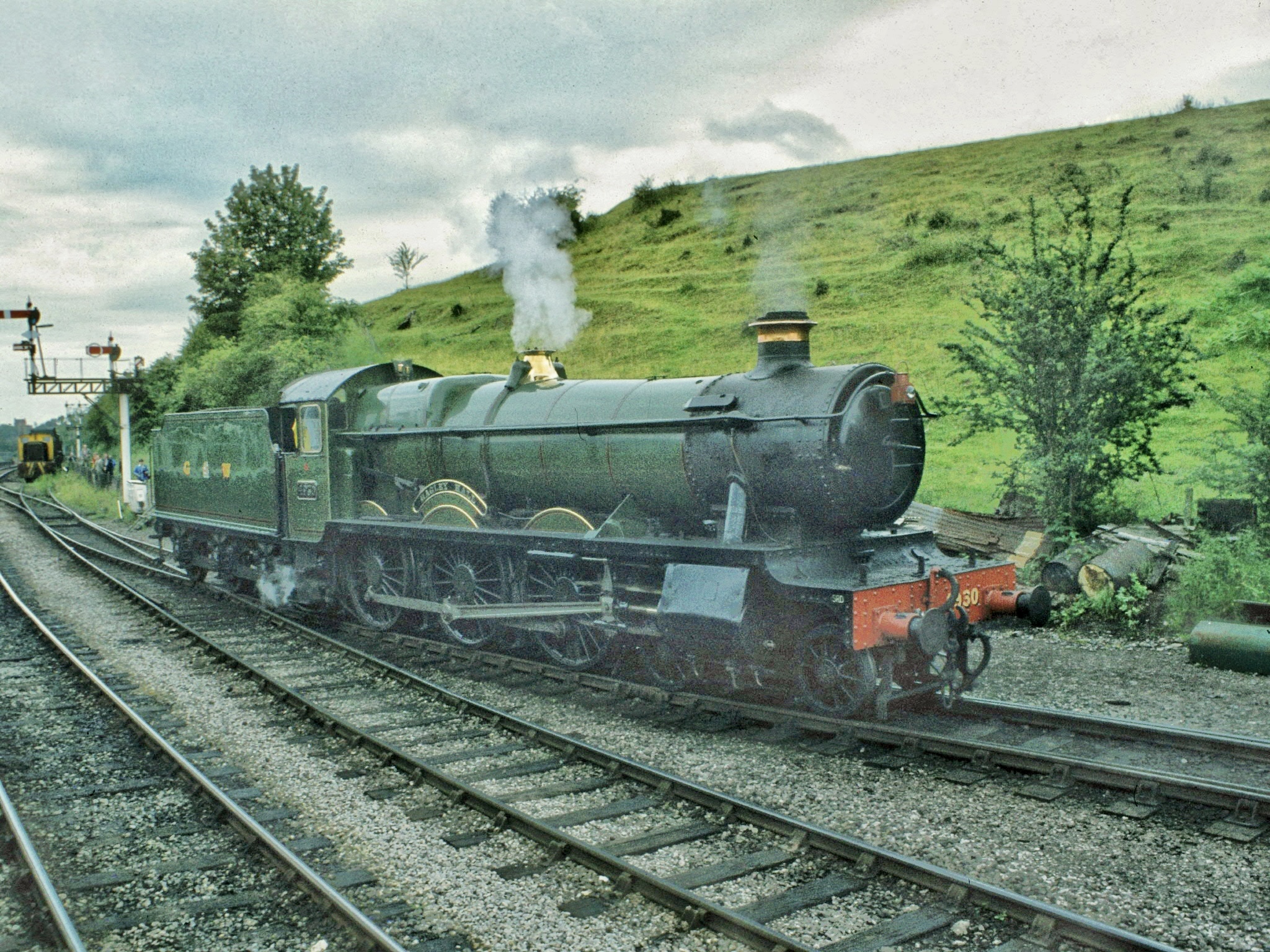
    I managed to get a piece of smut in my in my eye from 4930 ’Hagley Hall’ which I just couldn’t get out. [2023 note: I’m thinking No. 4930 may have hauled us one way on the SVR, but my diary says No. 43106 worked the train in both directions]

    GWR Collett 4-6-0 Hall Class No. 4930 ‘Hagley Hall’ at Bridgnorth. She was built in 1929 at Swindon Works and originally allocated to Wolverhampton Stafford Road – 19/06/1982
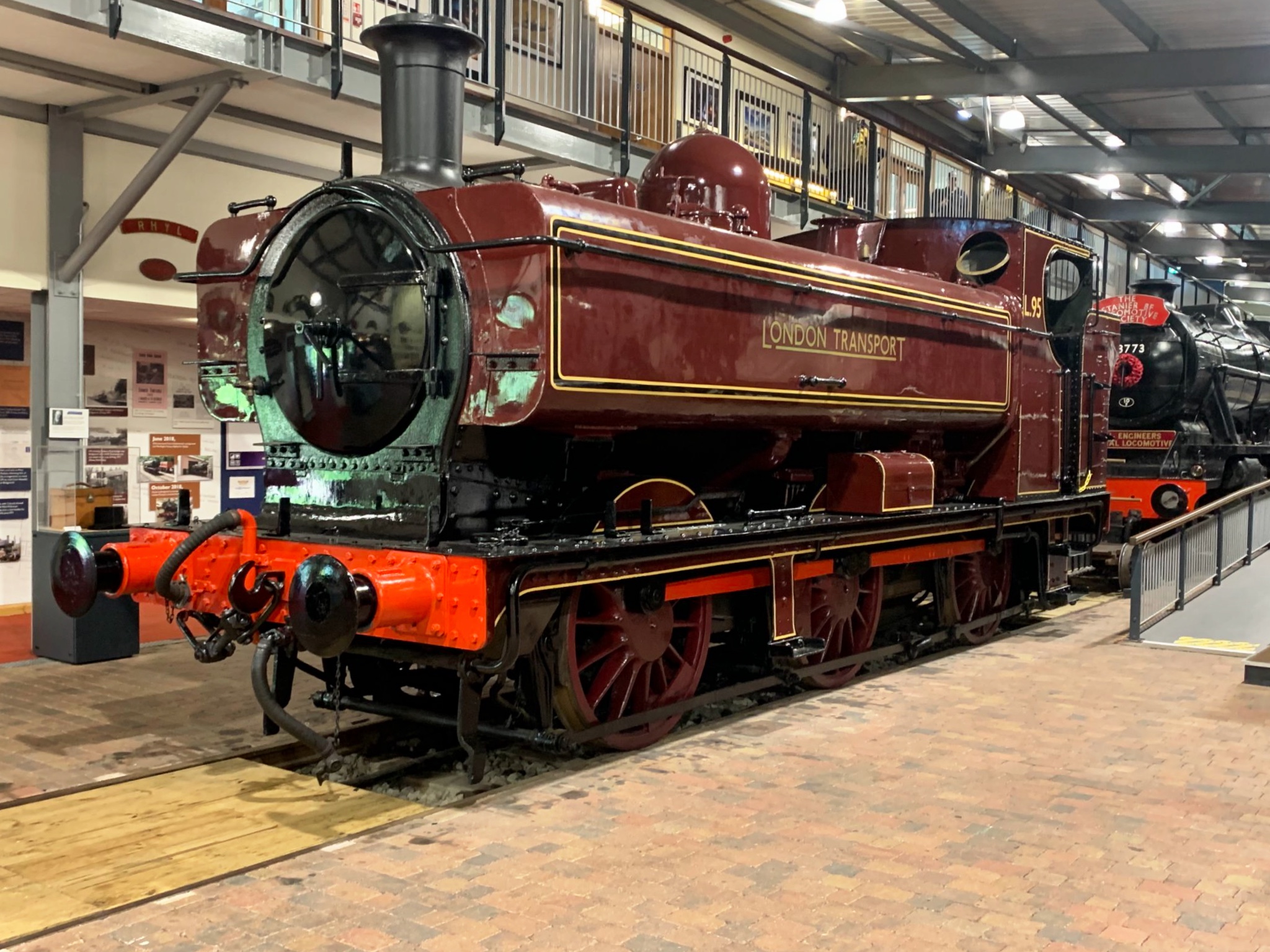
    GWR Collett 5700 Class 0-60PT “Pannier Tank” No. 5764 entered service at London’s Old Oak Common in 1929 and was later one of a number of the class sold to London Transport following withdrawal from British Rail in 1960. She is currently on static display in London Transport guise, numbered L95, at The Engine House, Highley. She is seen here in GWR livery at Bridgnorth – 19/06/1982

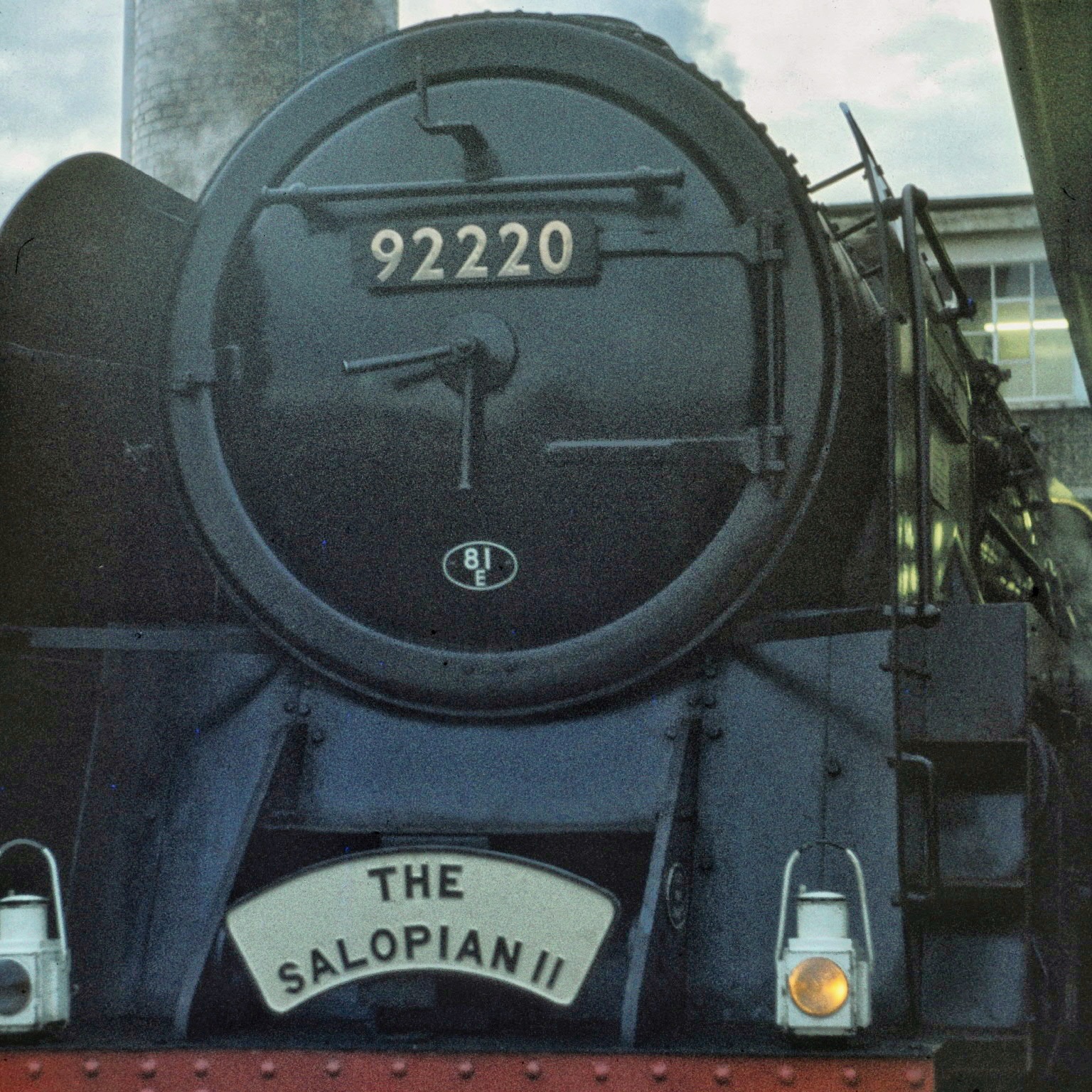
    Returning to Bewdley, the 20’s took control of our train once again and regained all lost time and even gained 15 minutes. But despite these efforts, the quarter hour and more was lost due to a number of signal stops. In my opinion the star of the day; 92220 ‘Evening Star’, to be precise, replaced the diesel power at Saltley and despite working hard we arrived back at Didcot some 16 minutes down.

    BR Standard Class 9F No. 92220 ‘Evening Star’ during a water stop at Banbury. No. 92220 was the last steam locomotive to be built at for British Railways and was earmarked for preservation before she entered service in March 1960. She hauled the last Pines Express on the Somerset & Dorset line on 8th September 1962. ‘Evening Star’ had a working life of five years before being withdrawn from service in March 1965 after sustaining damage in a shunting incident at Cardiff Docks. She was overhauled and restored at Crewe Works following withdrawal working in preservation until the late 1980’s. She is now on static display at the Railway Museum in York and one of nine existing locomotives of a class which numbered 251- 19/06/1982

    50040 took us forward to Reading where Tony and I de-trained for our connection down to Basingstoke and home. 

    Sunday June 20th 1982

    The down Mail arrived into Basingstoke at Midnight. We were extremely lucky to have made it as our connecting service train from Reading should have left at 2300 and “The Salopian II” arrived at 2302. We met Paul E and Mark B, two rail enthusiasts from Charminster who had been part of the group who went to Plymouth Laira with us in April. This time they had been to Calais with Mark’s parents. A class 73 took us from Basingstoke to Eastleigh where 33010 came on to bring us into Dorchester South just after 0300 where we all said our good-byes and headed home to our beds. 

    I was up again at 0900 in order to see some excursion trains.

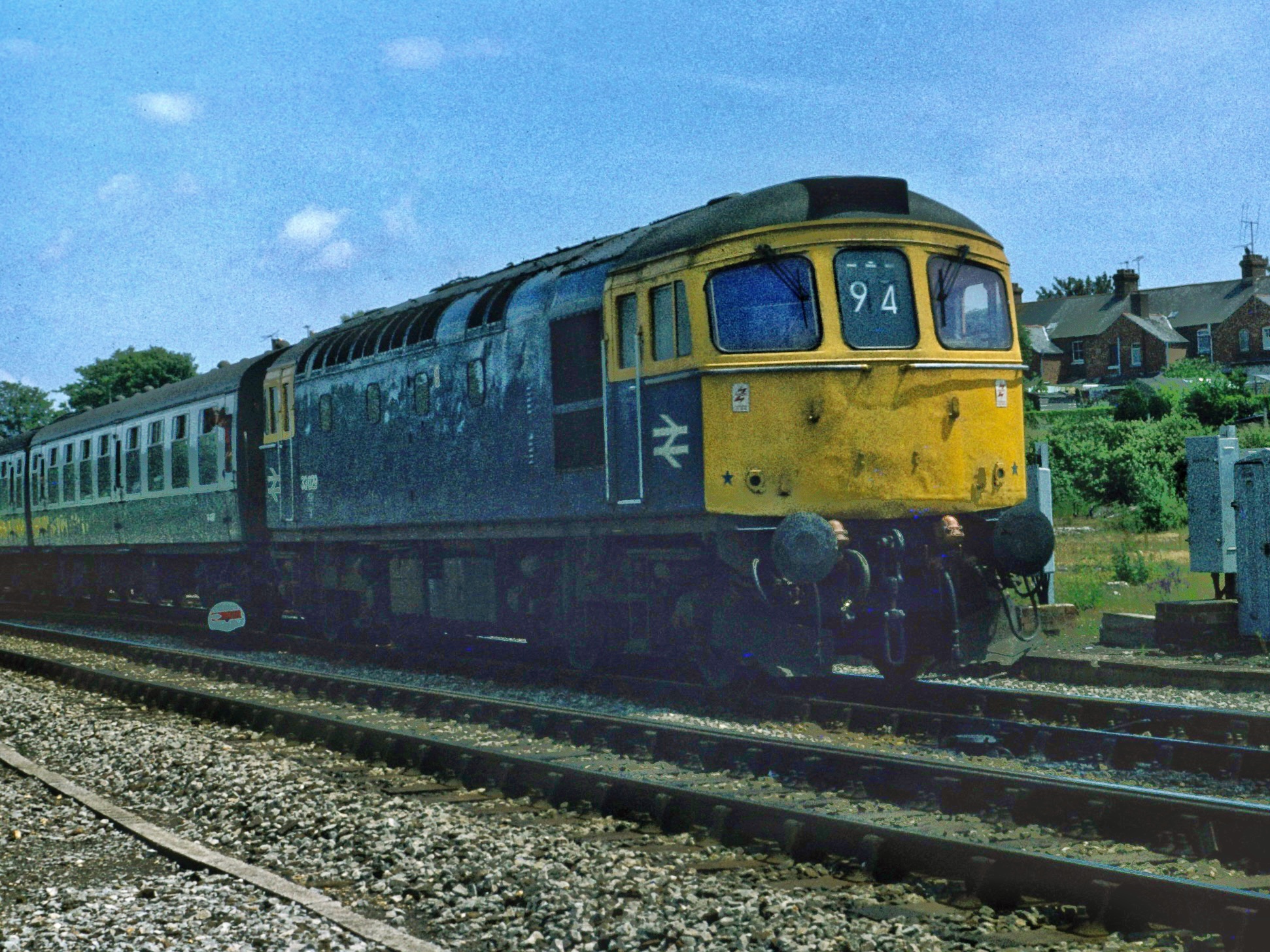
    Class 33 No. 33029 approaching Dorchester South – 20/06/1982
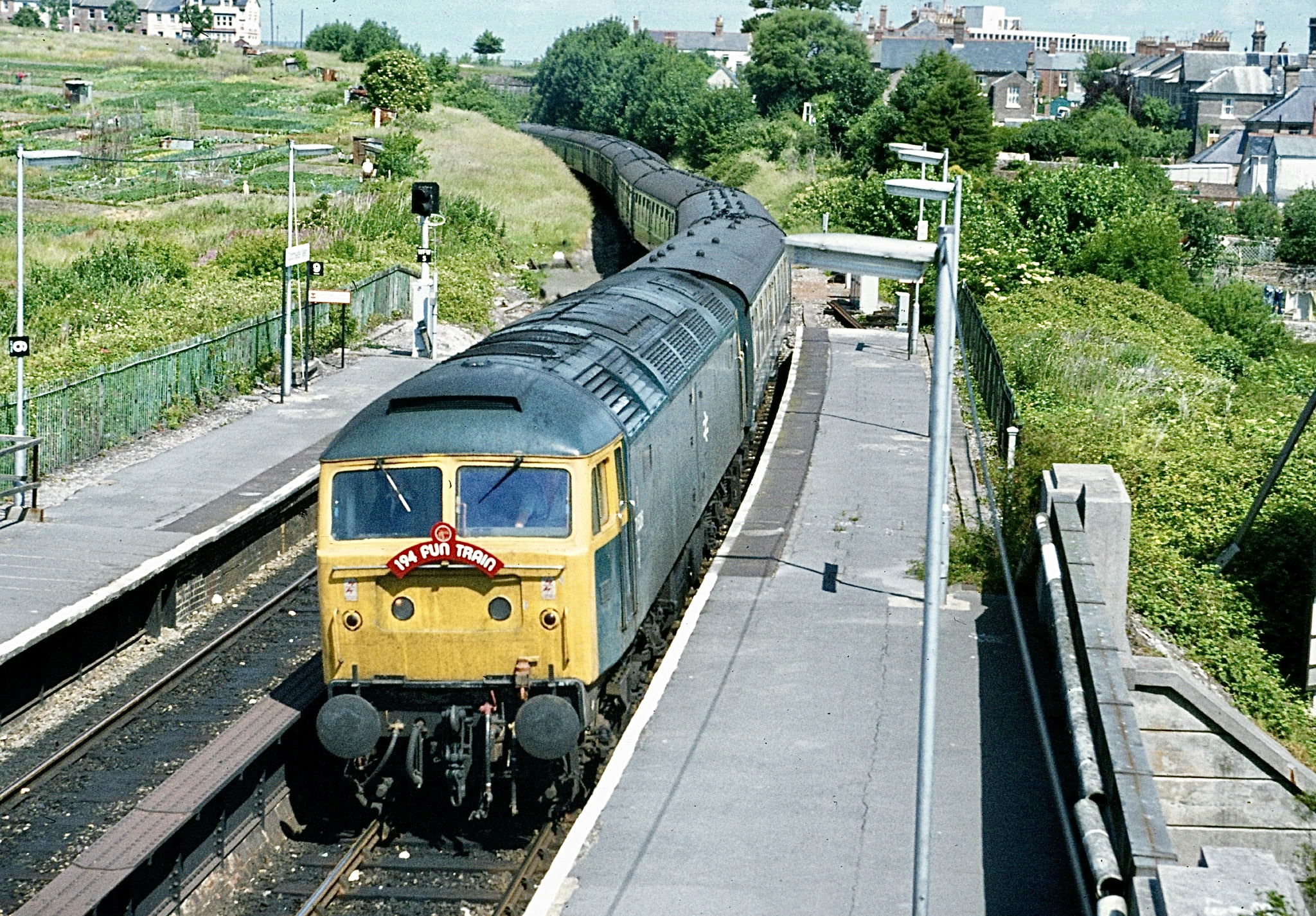
    Class 47 No. 47526 at Dorchester West – 20/06/1982

    The piece of smut in my eye from ‘Hagley Hall’ was still there, so I called on [my brother], who was out. Anyway, he appeared at half four and spent an hour moving the smut from the blue bit of my eye to the edge and finally relief!

    GBRf Class 73 No.’s 73964 ‘Jeanette’ and 73961 ‘Alison’ were out on a GB Railfreight staff special the “Tonbridge Trailblazer” in June 2016 running from Ashford International to Weston-super-Mare. The ED’s are seen here at Bath Spa on the return leg working 1Z63 1725 Weston-super-Mare to Ashford International – 18/06/2016

    Postscript:

    Longmoor Military Railway No. 600 ‘Gordon’ as seen in 2023 at The Engine House, Highley – 20/05/2023
    London Transport No. L95 (the former GWR Collett 5700 Class 0-60PT “Pannier Tank” No. 5764) as seen in 2023 at The Engine House, Highley – 20/05/2023
    It’s goodbye from me, and a goodbye from Yoshi! Thanks for reading. We appreciate your comments, contributions, updates and corrections. See you soon!
  • A Brief Ingress

    It’s been a quiet week on the rails here, with only one special rail movement to report on the Bournemouth to Weymouth line. We’ve also been entertaining friends for an extended Coronation weekend, although I was fully behind the suggestion from Yoshi’s Mama of exploring Corfe Castle and Swanage on the Tuesday. I had hoped to see the Class 17 Clayton Type 1 diesel-electric locomotive arrive at Norden on a low loader in the afternoon but I was informed by the Norden crossing signalman that it wasn’t going to arrive that afternoon. I’ve since heard it did – so big sighs all round!

    Instead of watching an old diesel locomotive being unloaded off the back of a lorry, Yoshi enjoyed zoomies in Corfe Castle – 09/05/2023

    On Sunday we took a walk down Poole Quay in order to celebrate the sights, sounds and smells of the age of steam with visiting mini steam traction engines, all lovingly built and maintained by their owners and representing many hours of hard work. The traction engines are recreated from original Victorian drawings or old photographs. It was lovely relaxing on a sunny afternoon with a drink in one of the many pubs along Poole Quay as the smell of steam wafted in through the doors. Yoshi was initially quite happy to see the steam engines but later decided to bark at each one individually. Just like he would their full size cousins.

    Before Yoshi took a dislike to the mini steam traction engines, he happily posed with this example – 07/05/2023
    Mini Steam On The Quay at Poole – 07/05/2023
    Mini Steam On The Quay at Poole – 07/05/2023
    Mini Steam On The Quay at Poole – 07/05/2023
    Mini Steam On The Quay at Poole – 07/05/2023
    Mini Steam On The Quay at Poole – 07/05/2023
    Mini Steam On The Quay at Poole – 07/05/2023
    Mini Steam On The Quay at Poole – 07/05/2023

    The monthly Class 73 Electro-Diesel top and tailed Colas Test Train ran on Monday evening, passing through Hamworthy in a shower of rain on its outward journey to Weymouth. The weather put me off going back out to see the ensemble on the return journey as it headed to Eastleigh East Yard and journeys end. The locomotives utilised on the 1Q51 1115 Derby R.T.C.(Network Rail) to Eastleigh East Yard working this time were GBRf Class 73 No’s 73964 ‘Jeanette’ and 73965 ‘Des O’Brien’. 

    1Q51 1115 Derby R.T.C.(Network Rail) to Eastleigh East Yard – 08/05/2023

    Thanks for reading. As always, thank you for your comments and corrections. With the 2023 Swanage Diesel Gala just days away as I write this, I’ll leave you with some images taken from the 2016 event.

    Class 20 No’s. 20205 and 20142 pass Class 50 No. 50035 ‘Ark Royal’ at Corfe Castle – 07/05/2016
    Swanage resident Class 33 No’s 33012 (D6515) ‘Lt. Jenny Lewis RN’ and 33111 head to Norden – 07/05/2016
    BR Blue liveried Class 31 No. D5580 (31162), owned by A1A Locomotive Limited runs round her train at Swanage – 07/05/2016
    Class 40 No.D213 ‘Andania’ (40013) having departed Corfe Castle. A total of 200 Class 40 locomotives were built by English Electric between 1958 and 1962. Seven examples are preserved – 07/05/2016
    Warship No. D832 ‘Onslaught’, the first member of the class to visit the Swanage Railway, on the approach to Corfe Castle – 07/05/2016
    Class 31 No. D5580 (31162) recreating a Kings Cross service with head code 1N08 – 07/05/2016
    Peak Class 46 No. D182 (46045) catches the sun crossing Corfe Common on her way to Swanage – 07/05/2016
    Class 50 No. 50035 ‘Ark Royal’ heads towards Corfe. The Hoover was a late substitute for 50049 ‘Defiance’ which was unavailable to attend – 07/05/2016
    Class 33 No’s 33012 (D6515) ‘Lt. Jenny Lewis RN’ and 33111 between Harmans Cross and Corfe Castle – 07/05/2016
    Another view of Swanage based Class 33 No’s 33012 (D6515) ‘Lt. Jenny Lewis RN’ and 33111 – 07/05/2016
    Class 40 No.D213 (40013) ‘Andania’ leads Class 46 No. D182 (46045) out of Norden towards Corfe Castle – 07/05/2016
    Unusually coupled cab to cab, English Electric Class 20 No. 20205 leading No. 20142 which was acting as a translator as 205 is air-brake only and the coaching stock is vacuum brake, crossing Corfe viaduct – 07/05/2016
    Hastings gauge “Slim Jim” Class 33 No. 33202 with a Swanage bound train 07/05/2016
    Warship No. D832 ‘Onslaught’ makes a fine sight and sound powering out of Corfe Castle on her way to Norden – 07/05/2016
  • Winfrith Cats Return

    Yoshi watches Steam Dreams afternoon Test Valley rail tour passing through Romsey – 22/04/2023

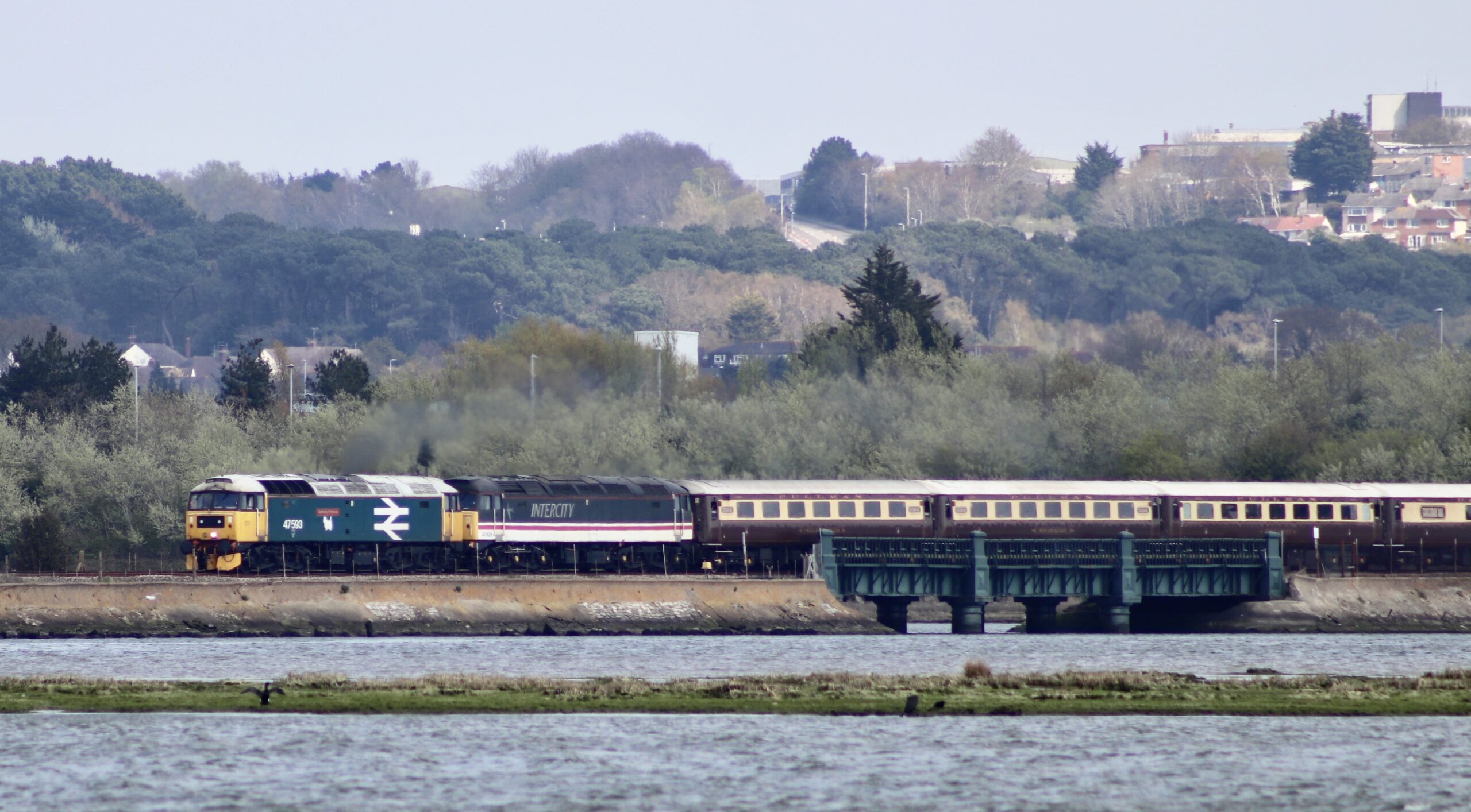
    The Weymouth line was visited by a rail tour on Wednesday 19th April 2023 when Statesman Rail’s Dorset Coast Statesman, hauled by double-headed Brush Type 4 Class 47 diesel-electric locomotives No.’s 47593 ‘Galloway Princess’ and 47828 ran from Crewe to the Dorset seaside town for an afternoon layover. We saw the train on its outward leg passing over Holes Bay at Poole. If you look very closely in the following video you might be able to work out the train as it crosses the causeway. Thankfully my brother was at Dorchester South and managed to capture a much better clip. On the return journey, I elected to pop up to Hamworthy railway station to see the train passing through, which I only just managed as it was running nine minutes early and I was only just able to grab my phone to video the pass, my stills camera remaining firmly in its bag!

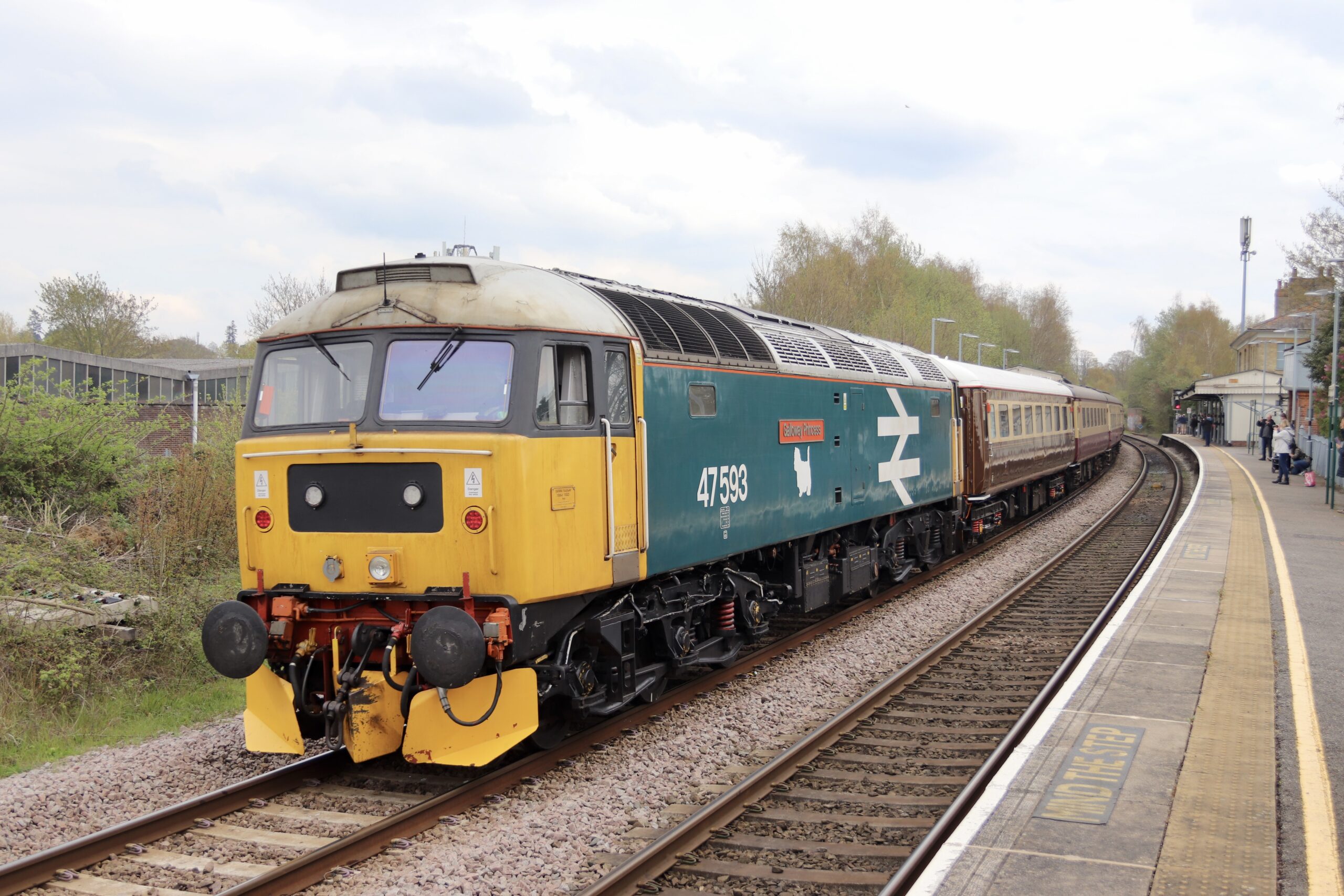
    Class 47 No.’s 47593 ‘Galloway Princess’ and 47828 working the outward leg of Statesman Rail’s Dorset Coast Statesman 1Z67 0614 Crewe to Weymouth – 19/04/2023
    Additional video from Dorchester South courtesy of G E Barrett

    Wednesday also saw the regular monthly New Measurement Test Train working to Weymouth. This month it ran with two former High Speed train power cars and arrived 75 minutes late because of incidents on its journey south from Derby. Thinking the train would be capped enroute, I elected not to go and see this working, so I’m very grateful for the great video kindly provided by both my brother, and Scott our North Dorset correspondent!

    Video courtesy of G E Barrett and Scott Lewis
    Colas Class 43 HST Power Car No. 43274 at Dorchester West working the late running 1Z22 0804 Derby R.T.C.(Network Rail) to Bristol Kingsland Road having reversed at Weymouth. Image courtesy of Scott Lewis – 19/04/2023
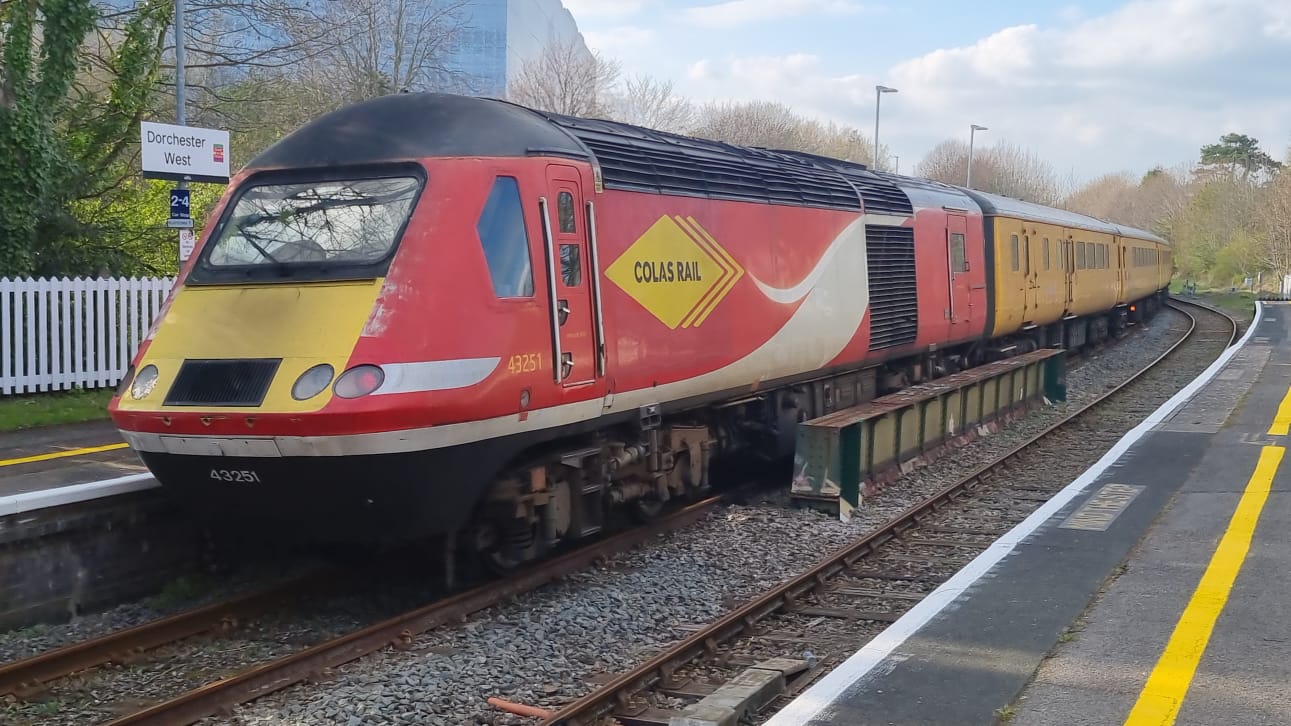
    Colas Class 43 HST Power Car No. 43251 runs through Dorchester West working 1Z22 0804 Derby R.T.C.(Network Rail) to Bristol Kingsland Road. Image courtesy of Scott Lewis – 19/04/2023

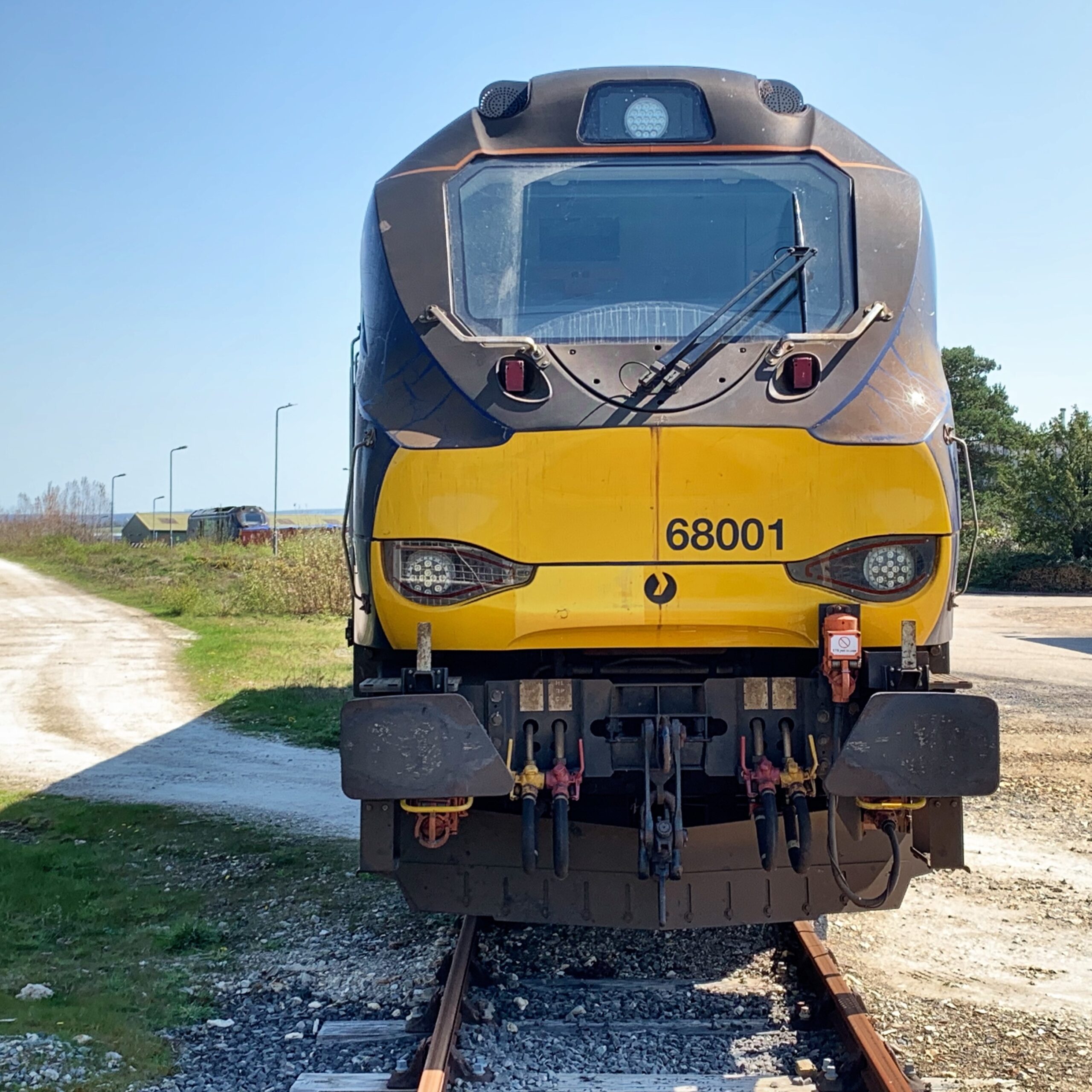
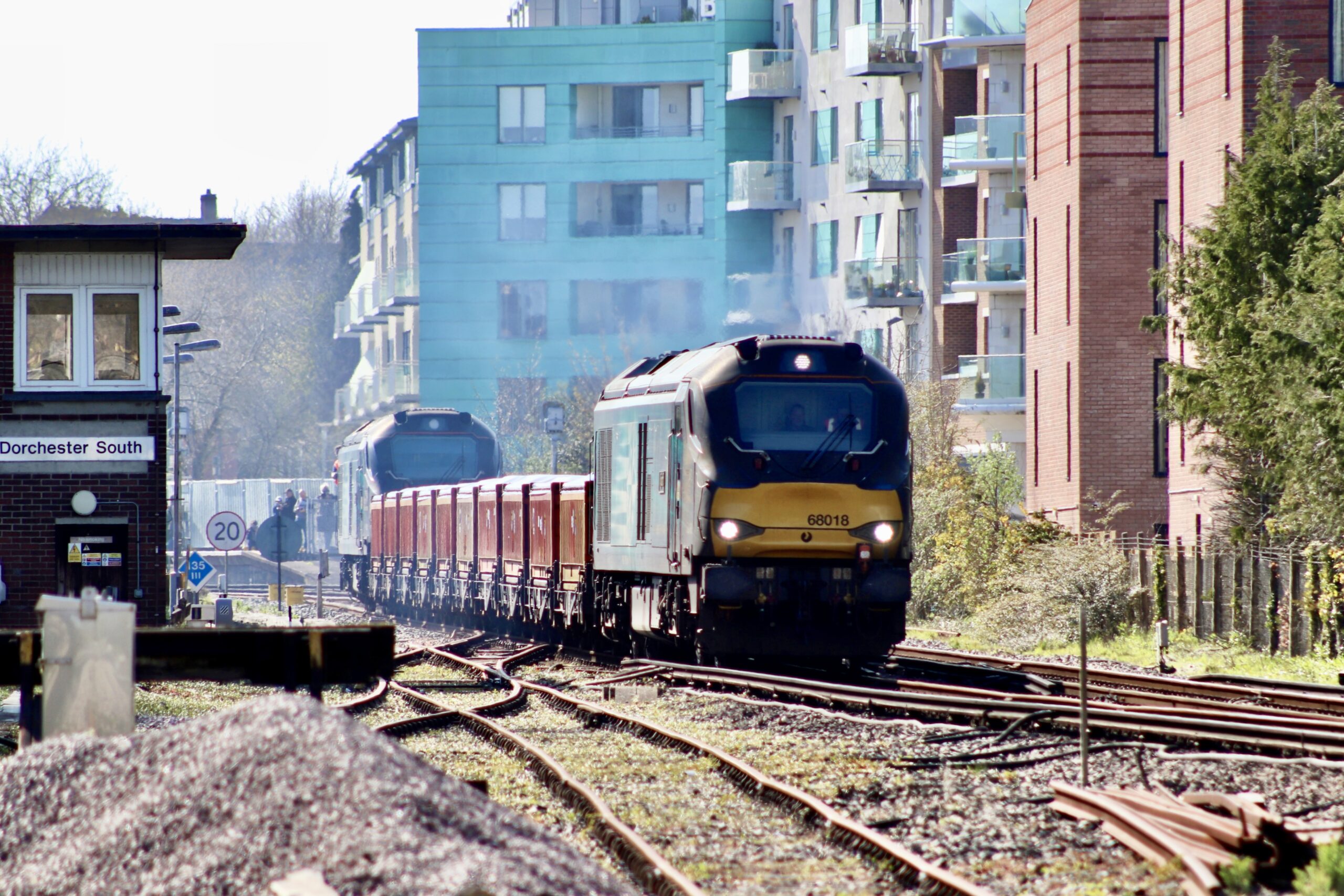
    The following day saw another out of the norm working as Direct Rail Services (DRS) Class 68’s No.’s 68001 ‘Evolution’ and 68018 ‘Vigilant’ top and tailed ten FNA wagons on their mission to collect low level nuclear waste from Magnox Winfrith. The previous working left empty because of operational difficulties preventing the loading of the train so it was good to see all went smoothly this time around. We were able to have another wander around the perimeter fence at Winfrith to see the train up close. As always, security staff were on hand to politely request that photographs and video refrained from showing buildings or the faces of staff. I was happy to oblige. Although leaving Winfrith more or less right-time, the return working was delayed by some 86 minutes further up the line following an incident at Basingstoke.  

    Direct Rail Services Class 68’s No.’s 68001 ‘Evolution’ and 68018 ‘Vigilant’ on the approach to Poole working 6Z62 0100 Crewe Coal Sidings (DRS) to Winfrith Sidings – 20/04/2023
    DRS Class 68 No. 68001 ‘Evolution’ is seen prior to marshalling the loaded train together at Winfrith. 68018 ‘Vigilant’ is in the background – 20/04/2023
    DRS Class 68 No. 68018 ‘Vigilant’ leads out of Dorchester South with the return 6Z95 1551 Winfrith Sdgs to Crewe Coal Sidings (DRS). No. 68001 ‘Evolution’ at the rear – 20/04/2023

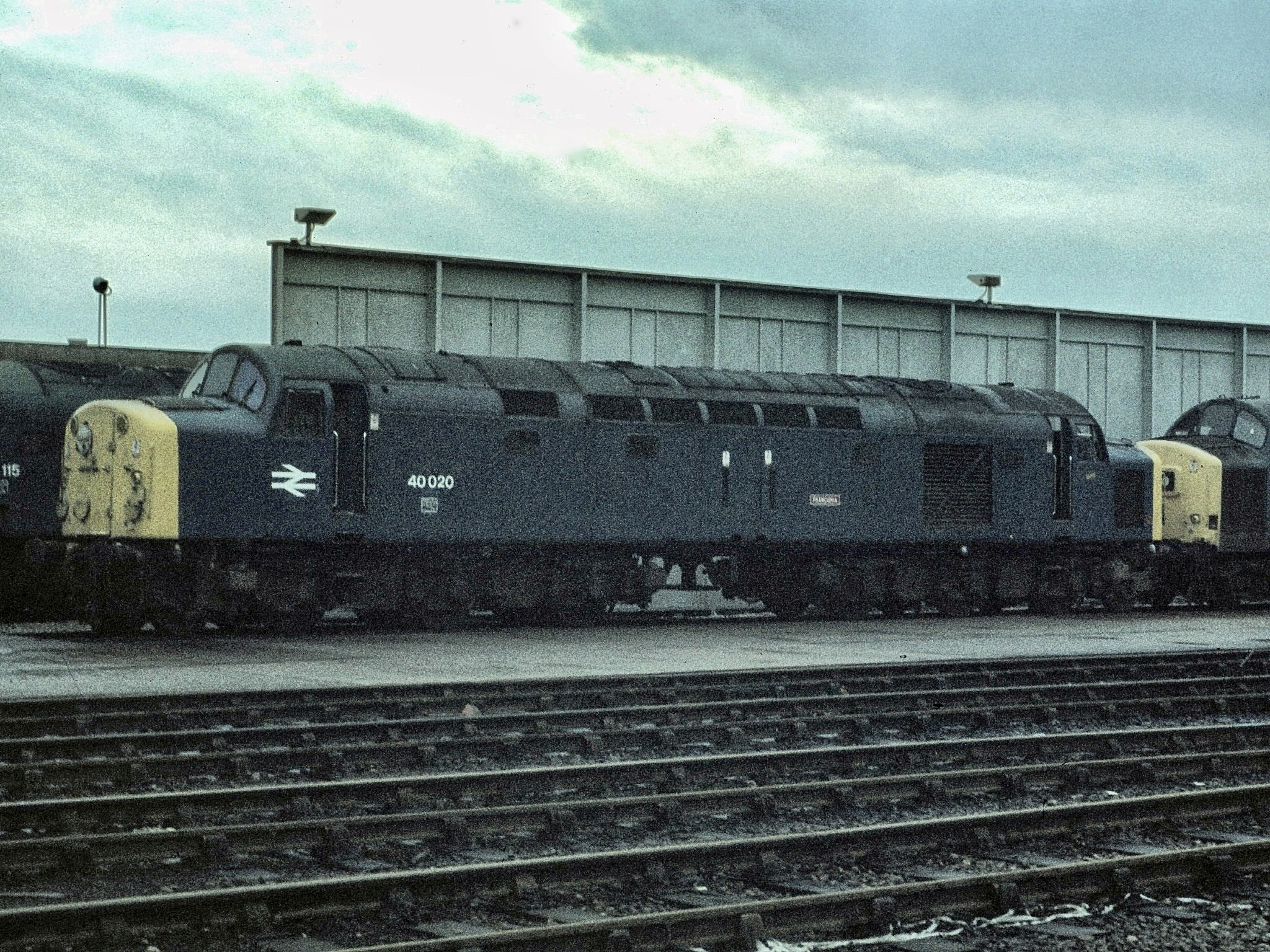
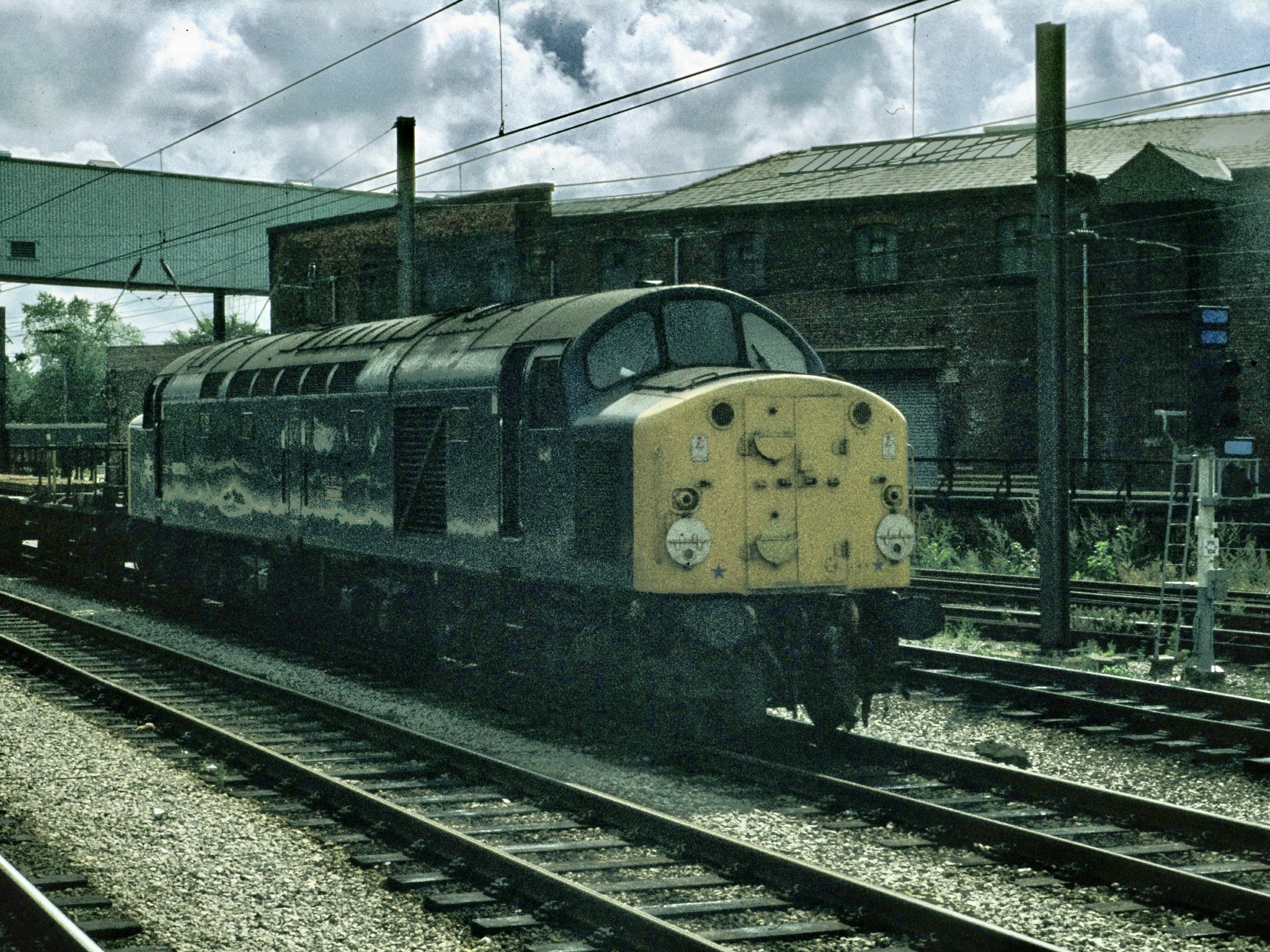
    On Saturday, to tie in with a passing steam hauled excursion train, Yoshi, his Mama and I had a walk along the Test Valley nature reserve. Or that was the plan at least. We encountered a fair bit of flood water so our walk was curtailed and instead, while we waited for the Winchester to Salisbury circular tour to pass by we grabbed a take away tea from a burger van outside of B&Q Nursling and sat awhile at a convenient picnic table located on Franconia Drive, named, we assume, after the Cunard ship of the same name. Or perhaps the road name is inspired by English Electric Class 40 Diesel loco No. D220 (40020) ‘Franconia’ which was of course definitely named after the liner. This is an excuse to share the following two images from 1982:

    EE Class 40 No. 40020 at Crewe, the ‘Franconia’ nameplates long gone having been removed but carrying a stencilled name instead – 24/10/1982
    Class 40 No. 40020 at Preston – 13/08/1982

    Class 40 locomotives in the number range D210–D235 were mostly named after ships operated by the Cunard Line, Elder Dempster Lines and Canadian Pacific Steamships as the diesel locos hauled express trains to and from Liverpool, the home port of these companies. In the early 1970’s, with Class 40’s no longer working these trains, the nameplates were gradually removed, although enthusiasts still remembered the names and as in the images above, replacement versions were often applied.

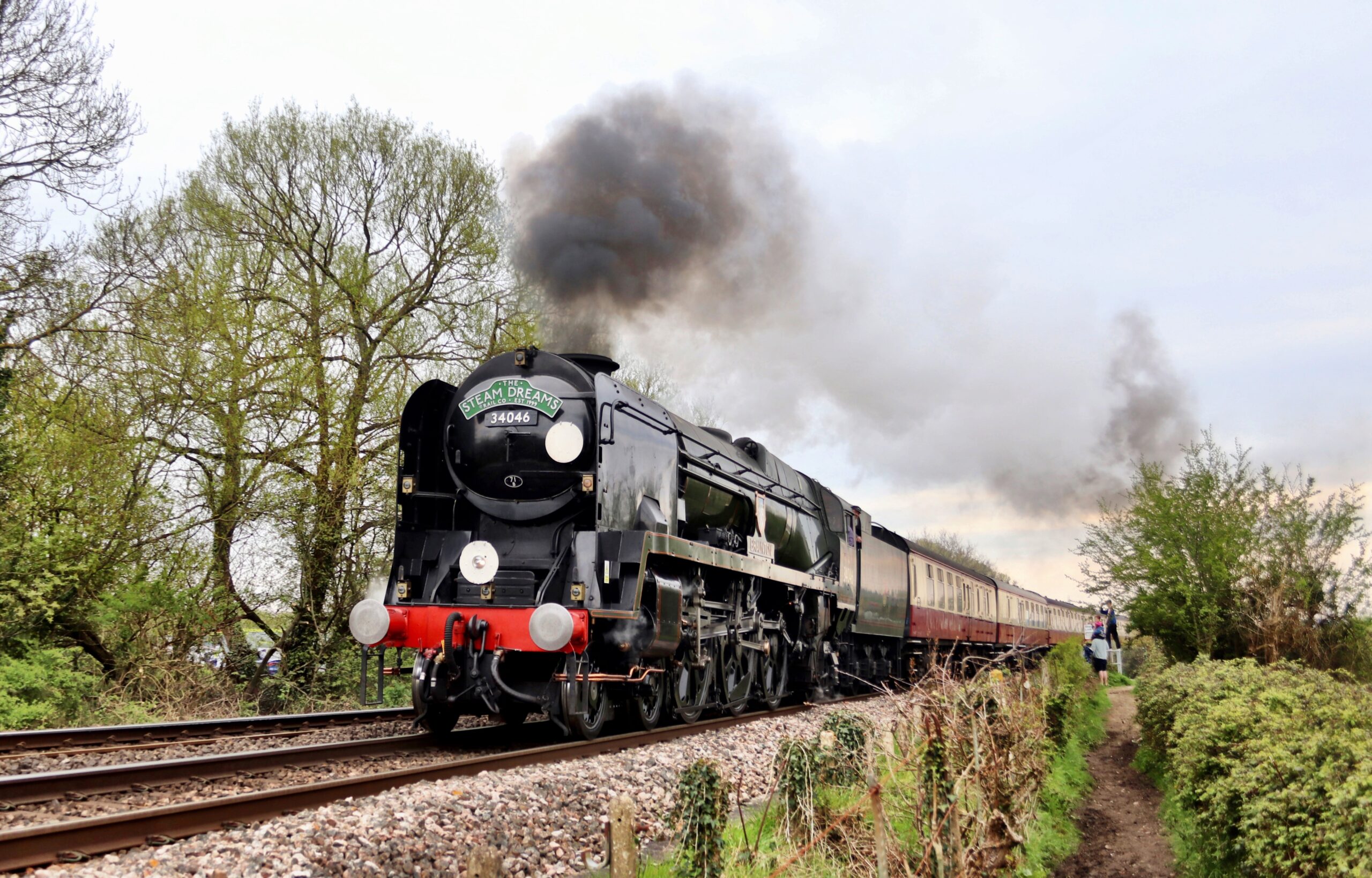
    Suitably refreshed following our cuppa (Yoshi had water and some snacks), we headed back to the footpath which runs alongside the railway line, only to discover the location had suddenly become very popular with other enthusiasts and observers of steam trains. The two locations I had thought about photographing the train from had ‘been taken’ so I settled for another view which was slightly obscured by lineside vegetation, but turned out to be a reasonable shot after all. Afterwards, we drove the short distance to Romsey to see the train head back to Winchester prior to its onward journey to London.

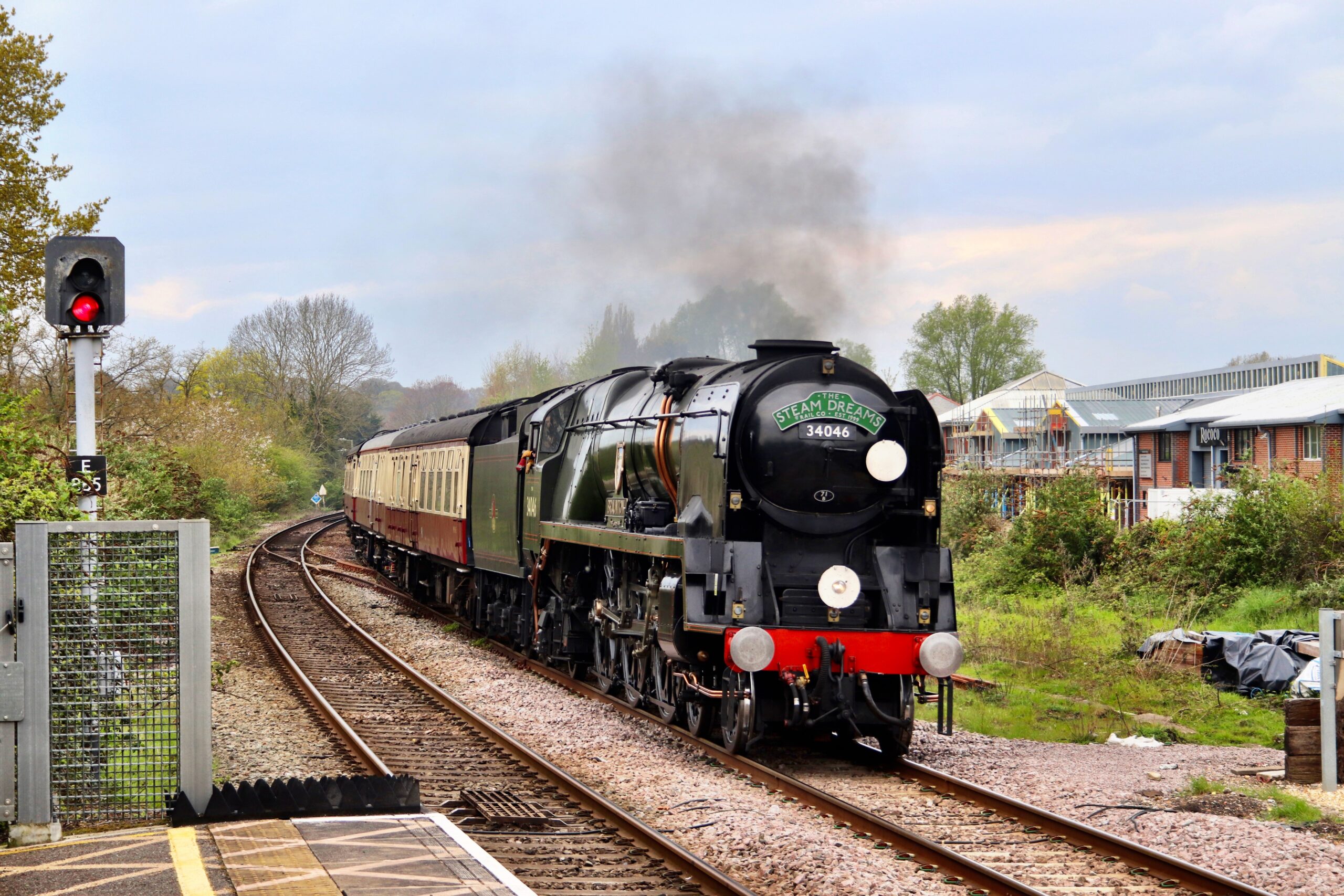
    Southern Railway West Country Class No. 34046 ‘Braunton’ powers along the Lower Test Valley working Steam Dreams 1Z92 1316 Winchester to Salisbury – 22/04/2023
    Southern Railway West Country Class No. 34046 ‘Braunton’ approaches Romsey working Steam Dreams 1Z93 1444 Salisbury to Winchester – 22/04/2023
    Second viewing for us as Class 47 No. 47593 ‘Galloway Princess’ works Steam Dreams 1Z93 1444 Salisbury to Winchester through Romsey – 22/04/2023

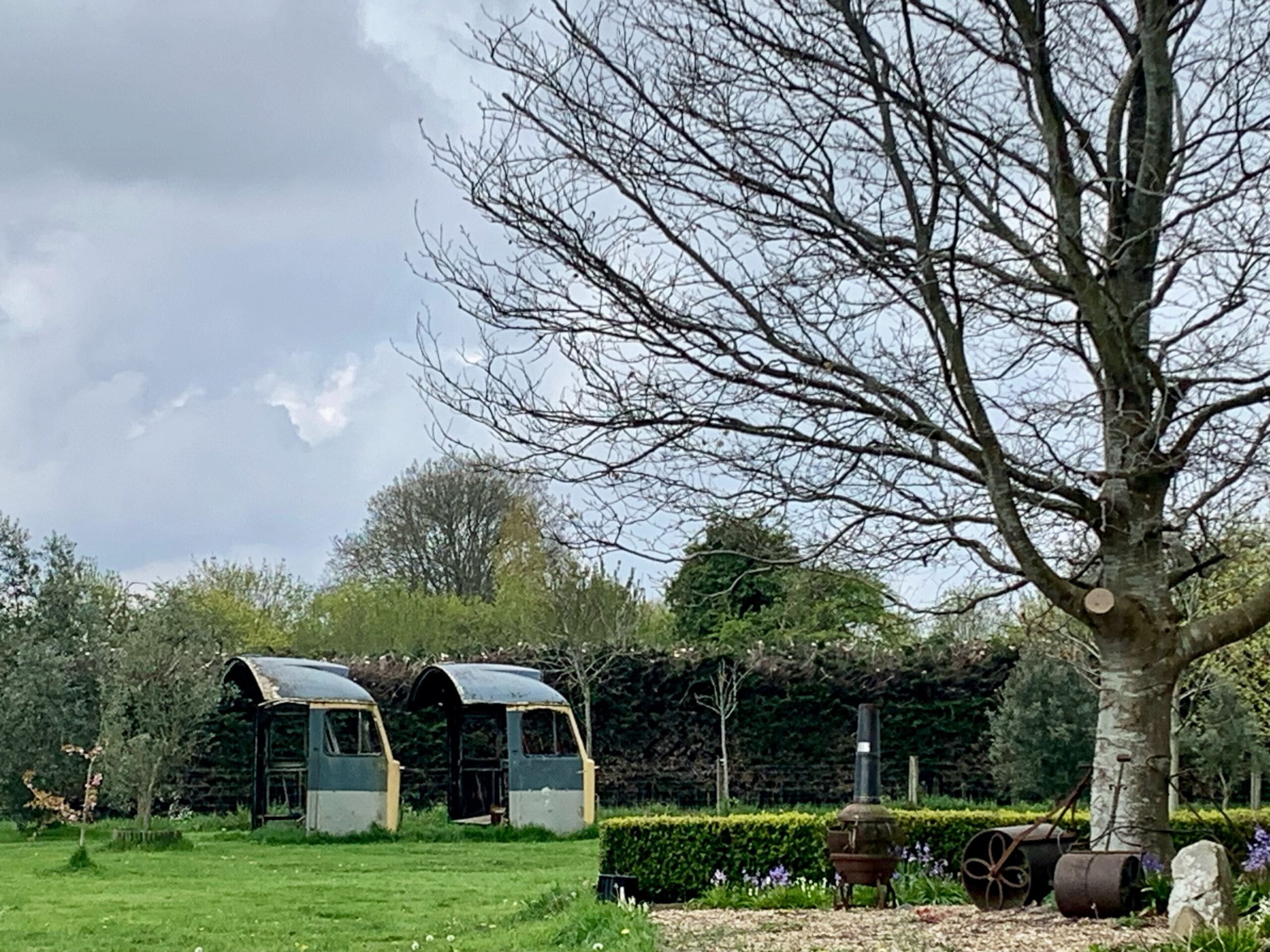
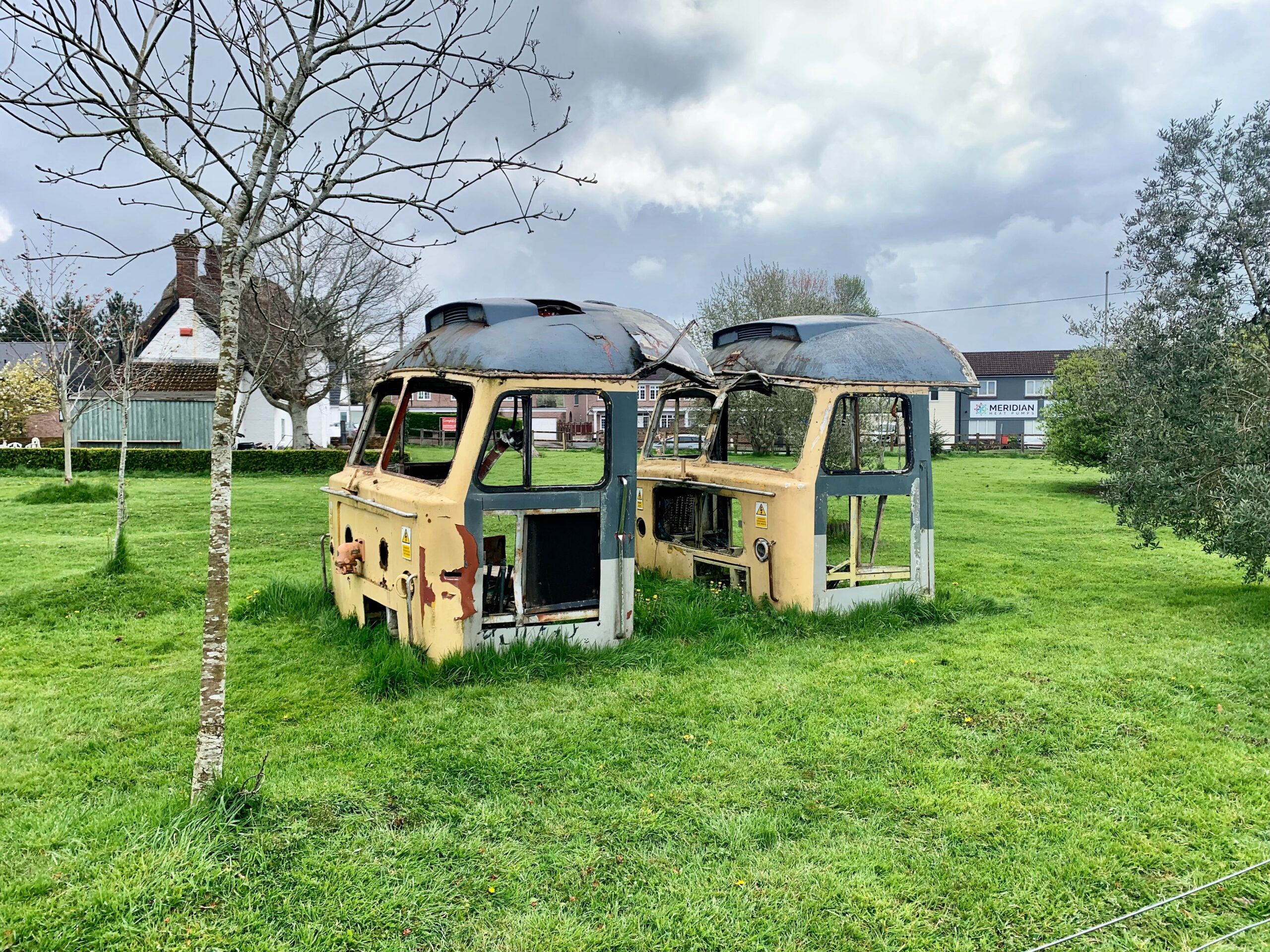
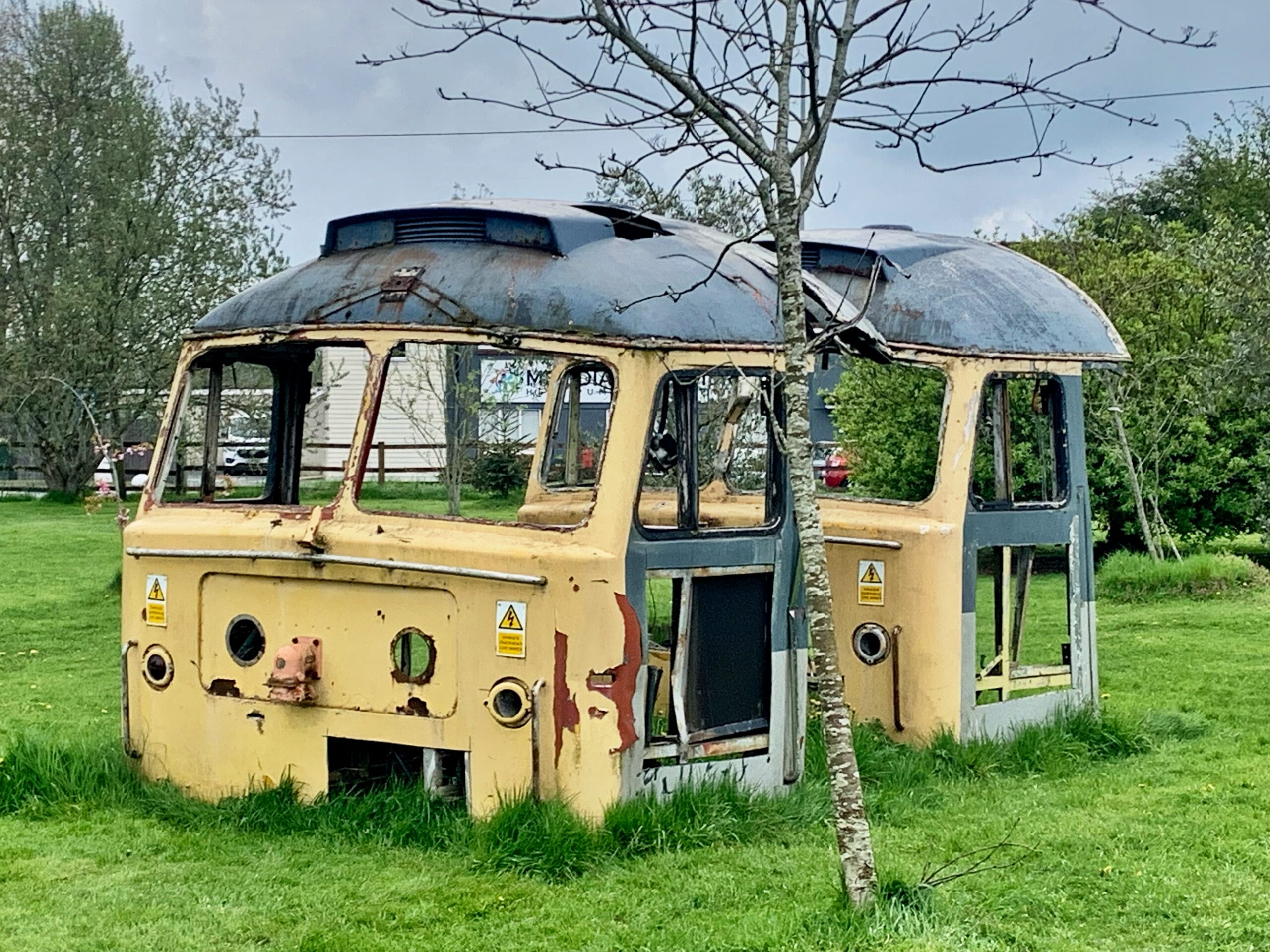
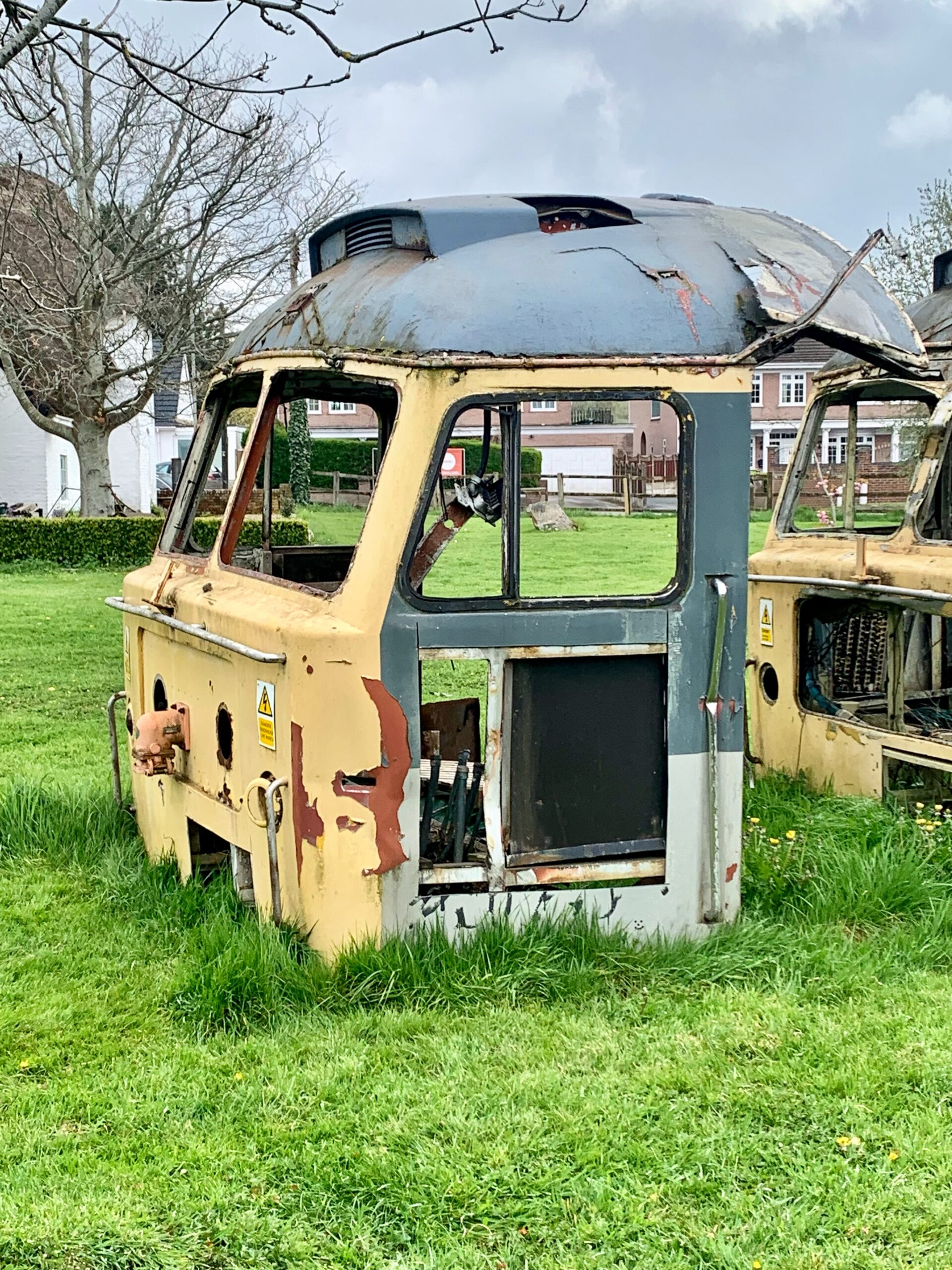
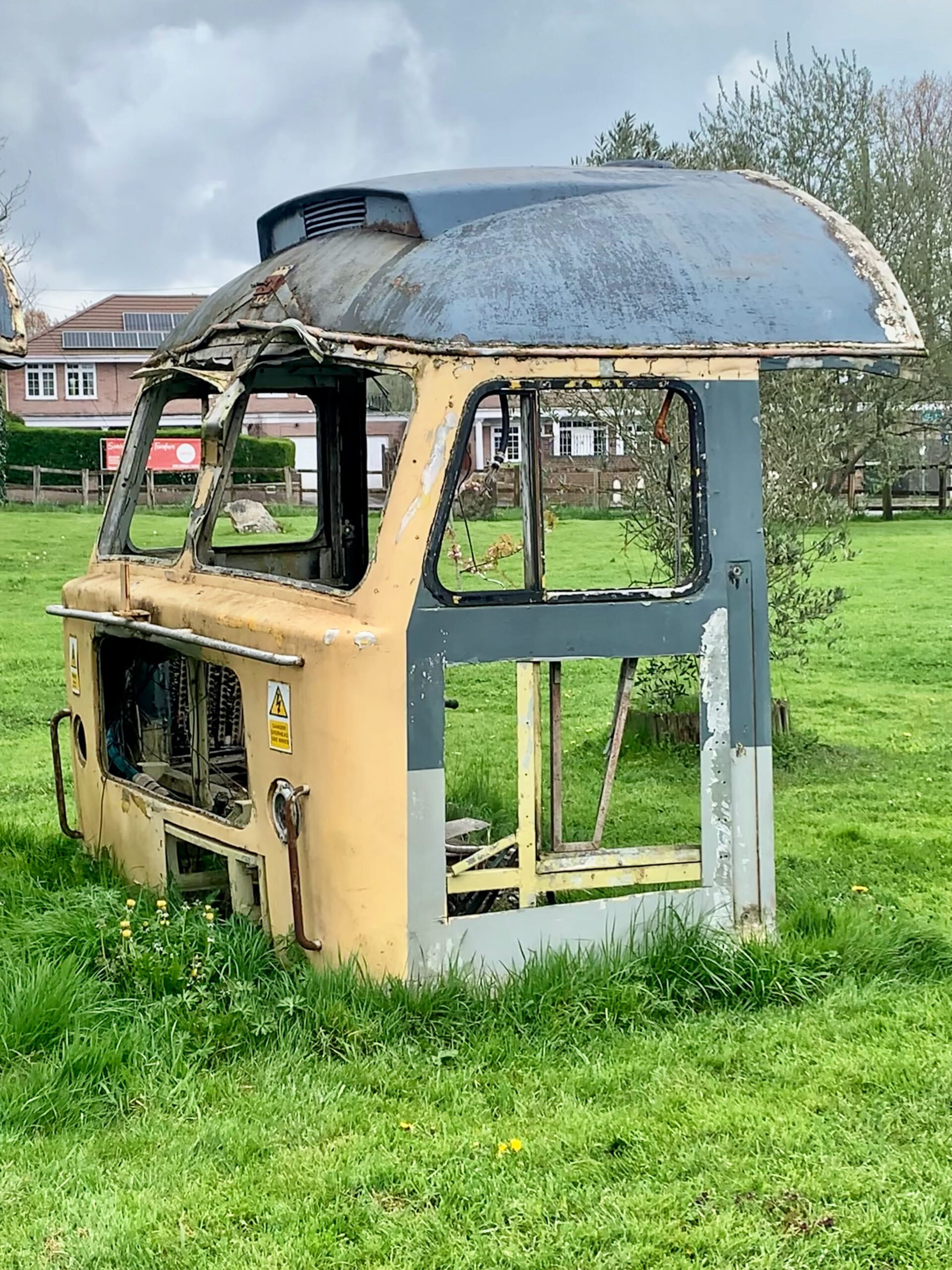
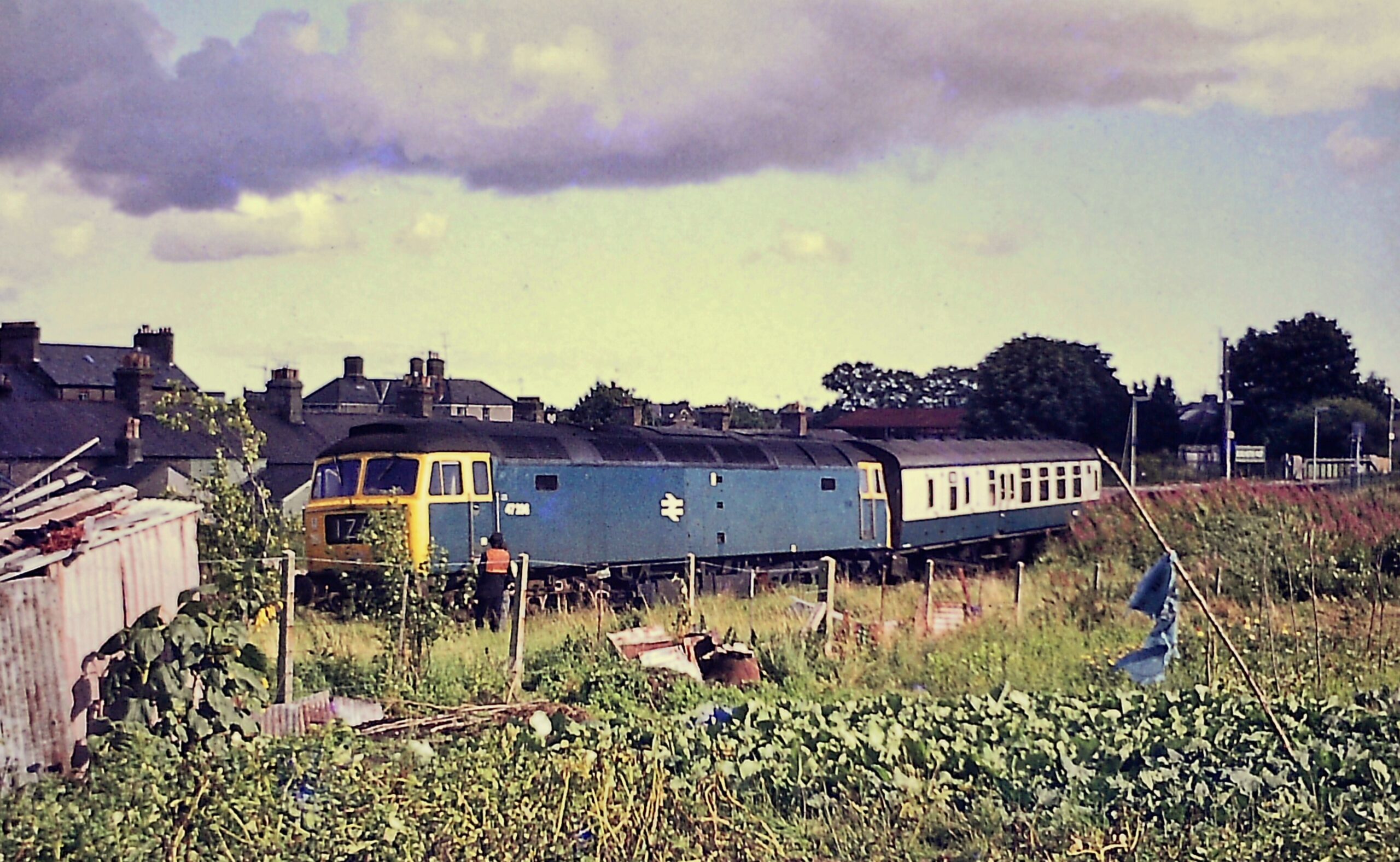
    The following day, Yoshi and I went in search of a pair of Class 47 locomotive cabs which I have seen photographs of, but never quite managed to work out where they are located. Tipped off by our pal Nick, we headed out to Longham near Bournemouth and were able to get the following snaps. Our North Dorset correspondent, Scott, was able to confirm that the cabs came from Brush Type 4 No. 47236 which was retired from service and put into store in February 1999 lasting until November 2017 when it was cut up by Morecambe Metals at Carnforth.

    Cabs from Class 47 No. 47236 as garden decoration near Bournemouth – 23/04/2023
    Cabs from Class 47 No. 47236 – 23/04/2023
    Cabs from Class 47 No. 47236 – 23/04/2023
    Cab from Class 47 No. 47236 – 23/04/2023
    Cab from Class 47 No. 47236 – 23/04/2023

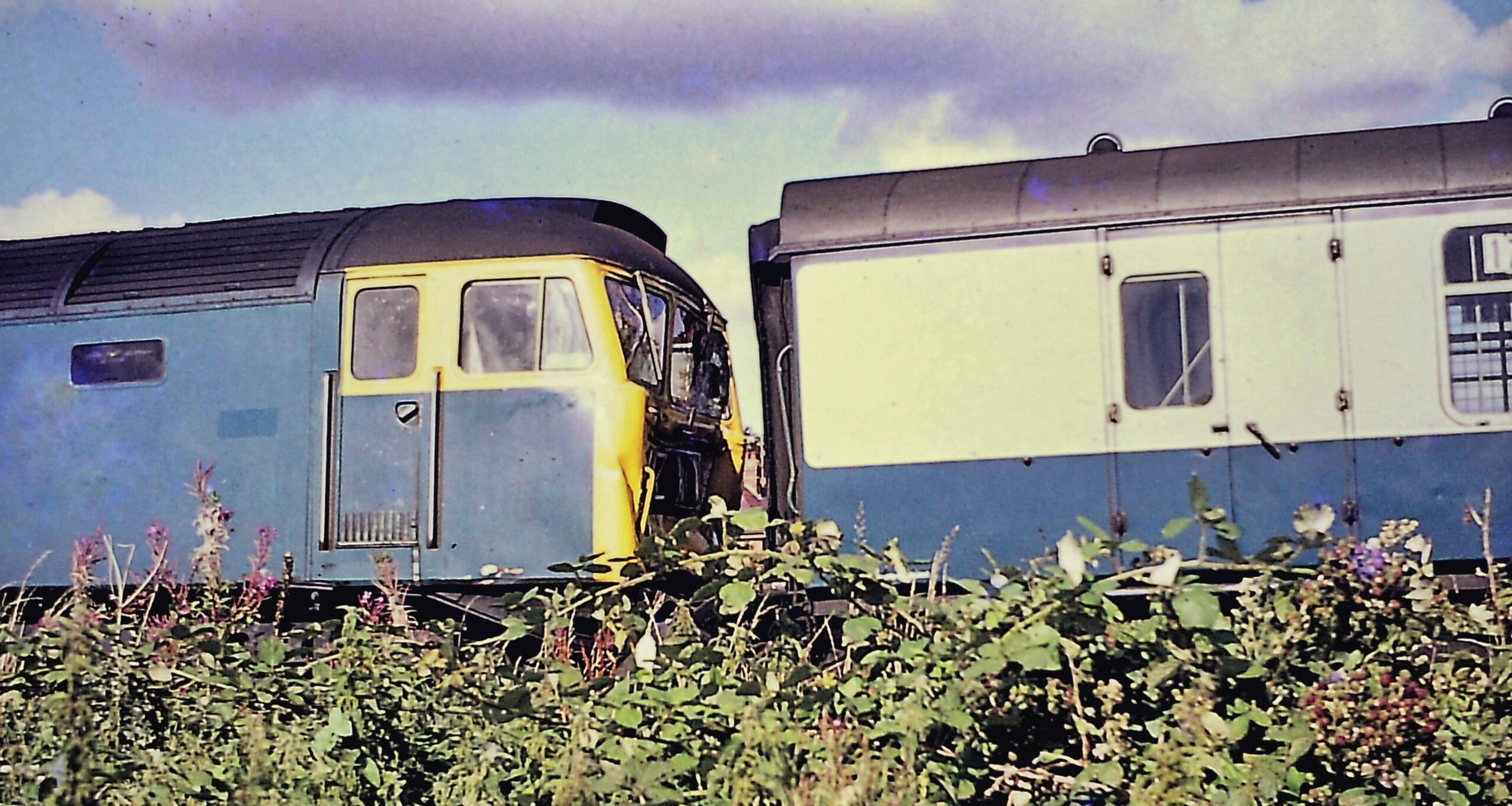
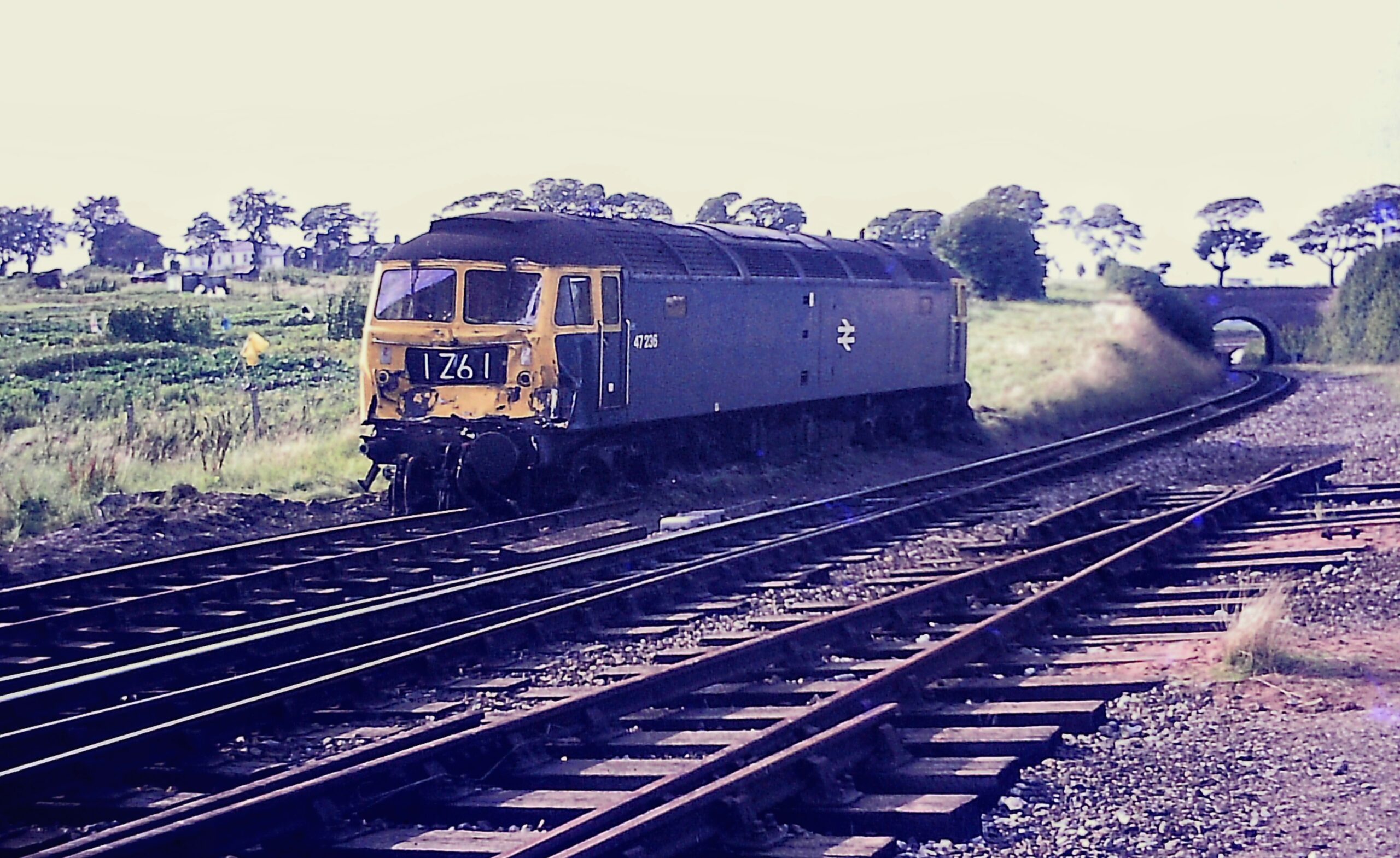
    No. 47236 was involved in an incident at Dorchester West on Sunday 25th August 1974 when she fell foul of trap points having passed a signal at danger in heavy rain whilst working 1Z61 Weymouth to Hereford excursion train. The main damage to the locomotive was at the trailing end where the leading coach had ridden up over the buffers, tearing them off in the process. The cab-end panelling was torn away from the bottom edge and stove in to just above the head code indicator; the side panelling between the corners and cab doors was torn and buckled. Both bogies suffered damage to their brake equipment. The leading coach, a brake second corridor, had its forward bogie displaced by about 7 feet and suffered minor damage to the end of the coach where it had struck the rear of the locomotive. The second coach, an open second, was also damaged. The track survived intact following the derailment and the only damage to the signalling equipment was the slight displacement of one lineside apparatus case. The accident report, published in 1976, was written by Major P. M. Olver who noted:

    “The train was the 2000 Weymouth to Hereford return passenger excursion train, consisting of 12 coaches and hauled by a Class 47 diesel-electric locomotive. Travelling at about 15 mile/h, the head of the train passed Dorchester Junction Up Main Starting signal at Danger, the locomotive and first two coaches being diverted into a sand drag by trap points protecting the single line to Maiden Newton. The locomotive and leading coach ran off the end of the sand drag and were derailed before the train came to a stand.

    I am glad to report that of the 600 passengers, who were railway staff and their families from the Hereford Staff Association and Social Club, only 6 were required to be taken to hospital for the treatment of their minor injuries and a further 12 were given first aid attention on site. A special train was formed from the rear 10 coaches of the train, after they had been examined and found fit to run, and the passengers finally departed for Hereford via Bournemouth and Southampton at 2346.”

    Class 47 No. 47236 in the aftermath of the 25th August 1974 derailment at Dorchester West – Image by John Chappell
    Class 47 No. 47236 in the aftermath of the 25th August 1974 derailment at Dorchester West – Image by John Chappell
    Class 47 No. 47236 in the aftermath of the 25th August 1974 derailment at Dorchester West – Image by John Chappell
    Class 47 No. 47236 in the aftermath of the 25th August 1974 derailment at Dorchester West – Image by John Chappell
    Class 47 No. 47236 in the aftermath of the 25th August 1974 derailment at Dorchester West – Image by John Chappell
    Class 47 No. 47236 in the aftermath of the 25th August 1974 derailment at Dorchester West – Image by John Chappell

    It’s been a family story that my brother spent much of one night following the derailment watching recovery operations, much to the consternation of our mum who wondered where he’d got to!

    For The Record

    An informal event took place on 21st April 2023 to mark the opening of the new look forecourt at Weymouth railway station. Work began on the £1 million redevelopment in November 2021 with most of the work having been completed by September 2022. 

    Network Rail has started a two-year project to refurbish London Waterloo’s roof, which was built in 1922. Around 10,000 new glazed panels will be installed across 12,000 square metres of roof – an area nearly twice the size of the pitch at Wembley Stadium. The panels will be made from a polycarbonate material which is around 50% lighter than the existing panels in order to reduce stress on the structure. Other changes to the station will include the addition of more seating and improved toilet and baby changing facilities. London Waterloo, which celebrates its 175th Anniversary in 2023, was originally opened in 1848 and is now Britain’s busiest train station with 99.4 million journeys a year. 

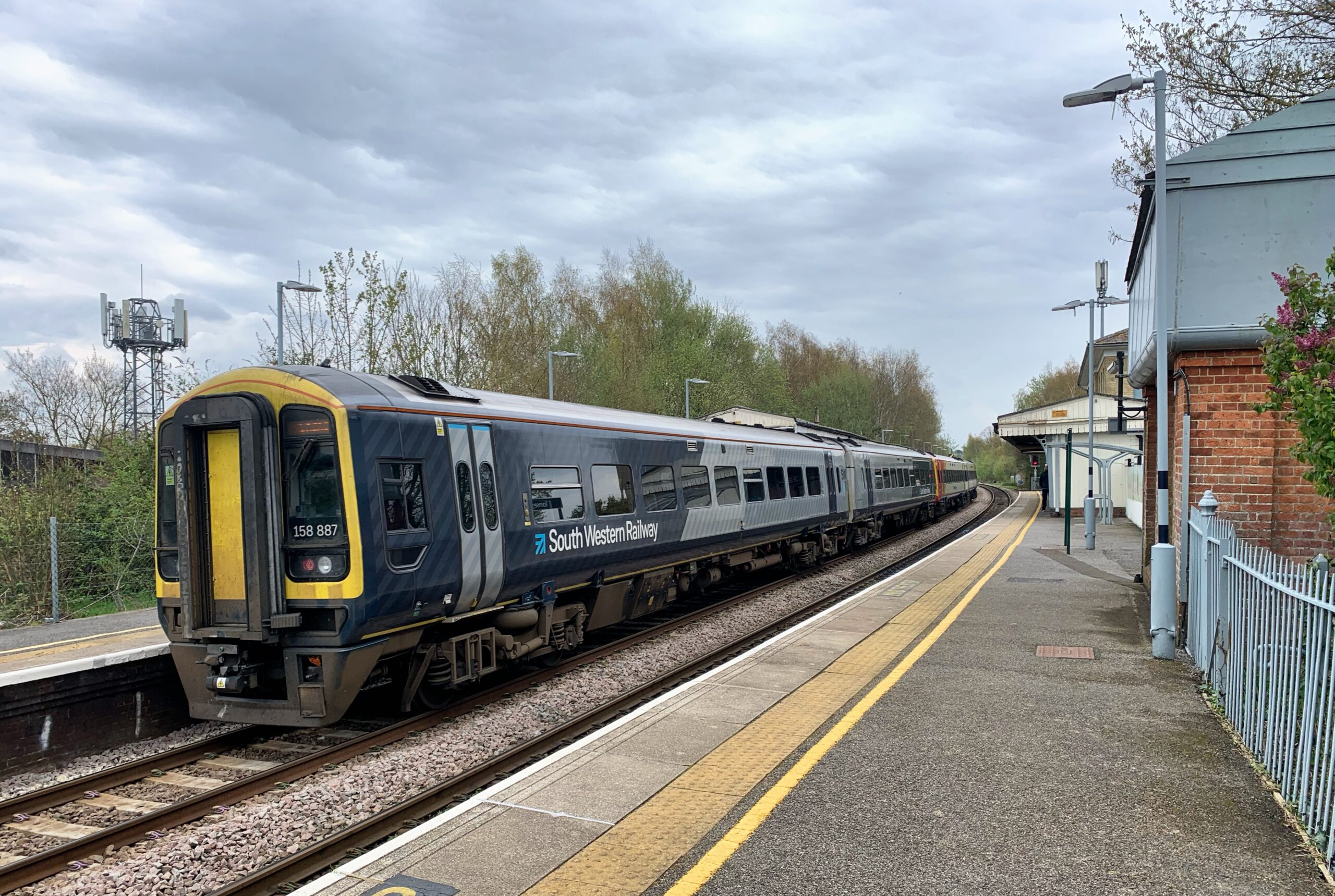
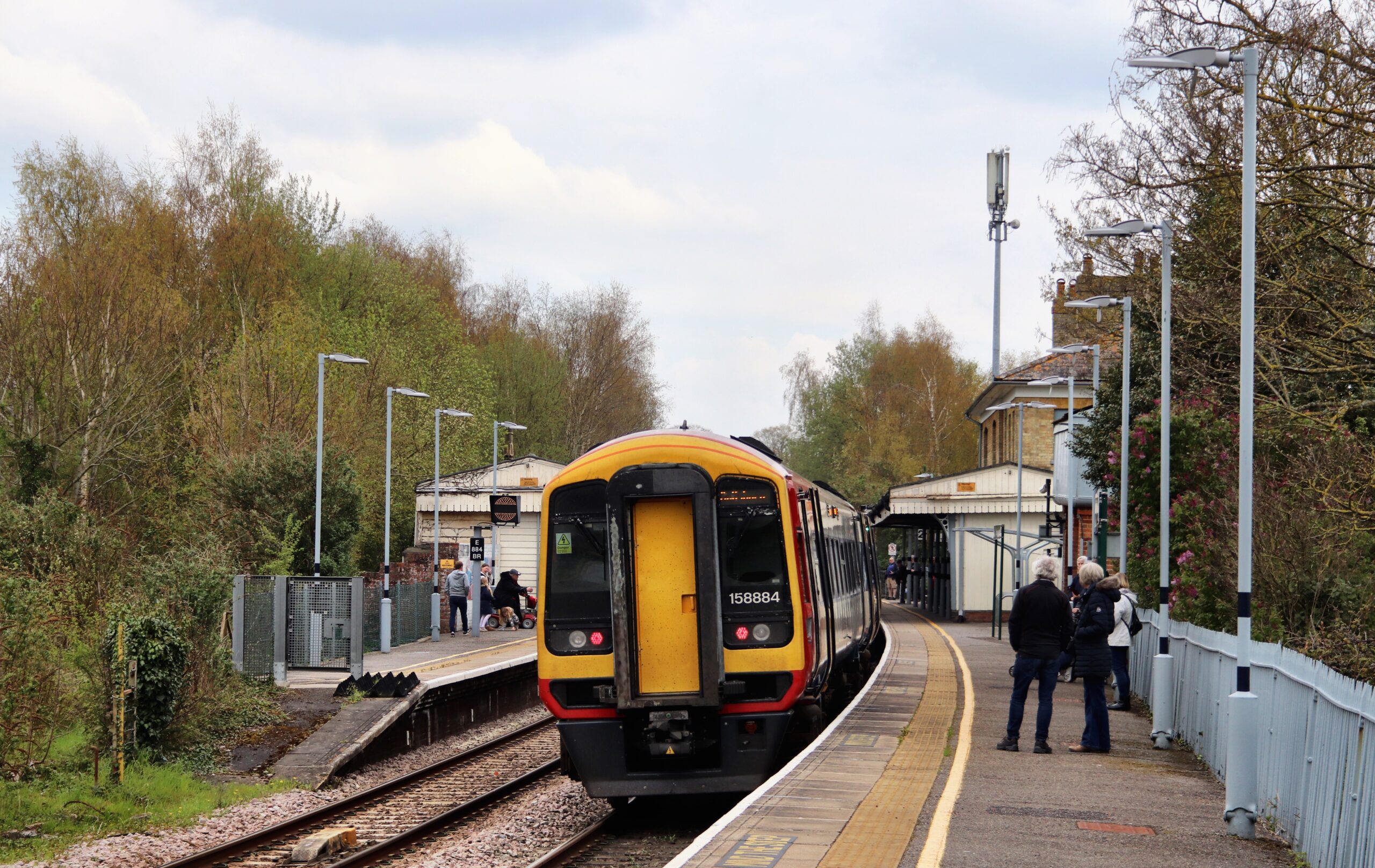
    South Western Railway (SWR) severely reduced services in the Romsey area and west of Salisbury following reports biofuel was clogging the engine fuel filters of Class 158 and Class 159 diesel multiple units (DMU’s) which reduced their power and performance. The fault was discovered in much of the diesel fleet at depots in Exeter and Salisbury on Wednesday 19th April 2023. The fuel tanks will have to be flushed clean and the filters replaced which is not an insignificant task.  SWR will run one train every two hours on routes connecting Salisbury to Exeter and Southampton. One train an hour will operate between Salisbury and Basingstoke, while services to Westbury and Yeovil Pen Mill will not run. Disruption is expected until the end of the day on 28/04/23.

    Class 158 DMU No.’s 158887 and 158884 working 2R50 1356 Salisbury to Romsey service – 23/04/2023
    Timetable changes meant Class 158 DMU No. 158884 reversed at Romsey to form the 2S43 1507 Romsey to Salisbury service. No. 158887 was the lead unit – 23/04/2023

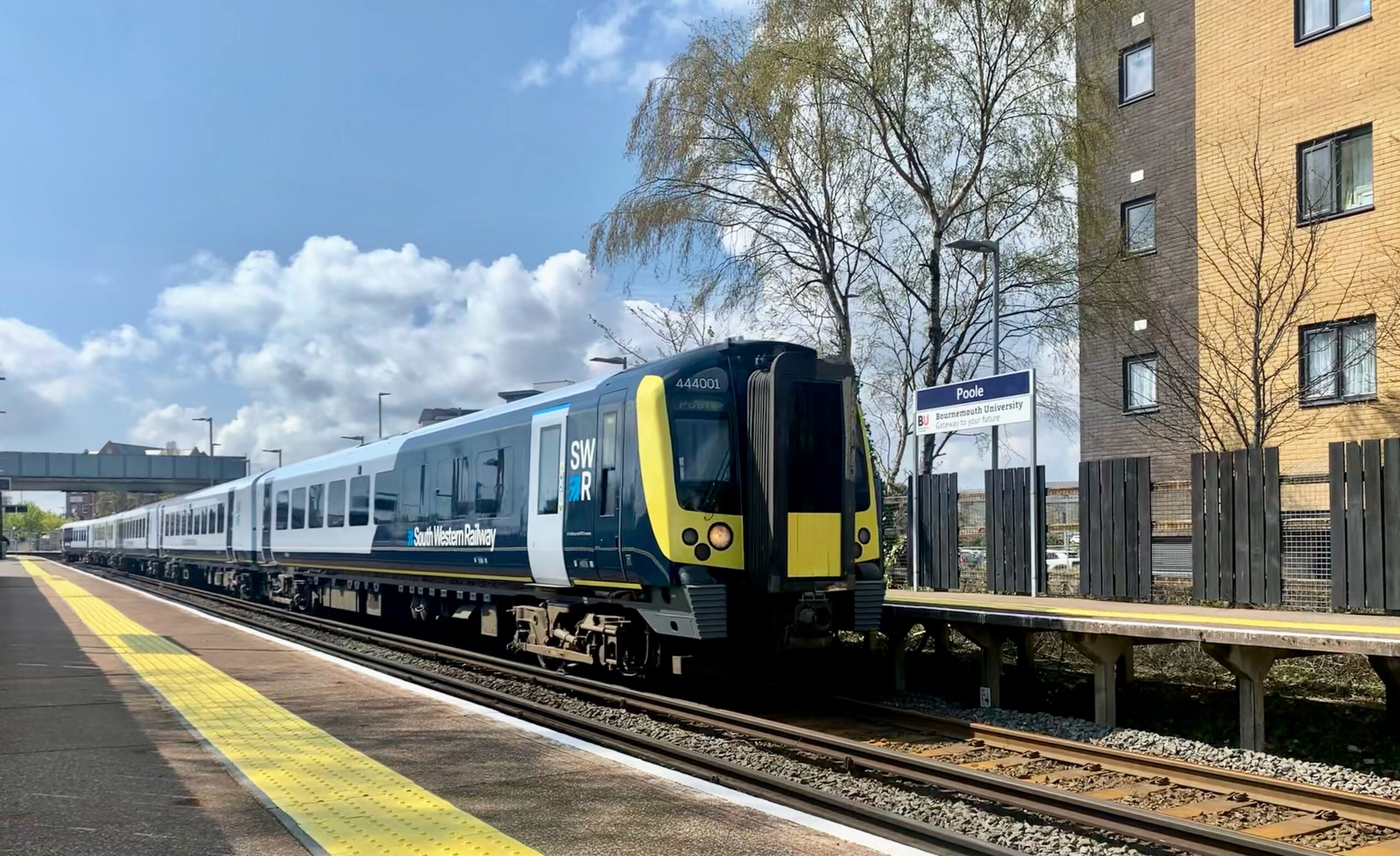
    Initial Class 444 Desiro Electric Multiple Unit (EMU) No. 444001 has been the latest vehicle to receive the corporate South Western Railway (SWR) livery having been repainted at Bournemouth T&RSMD and released back into traffic on 23rd April 2023. Formerly still carrying South West Trains livery, No. 444001 was the last unit in SWR’s fleet to carry a proper nameplate which it carried since being named ‘Naomi House’ at London Waterloo on 24th May 2007 to mark the 10th anniversary of the Winchester charity of the same name. The unit emerged without the nameplate or a replacement SWR style sticker name.  

    South Western Railway Class 444 No. 444001 ‘Naomi House’ at Weymouth – 26/04/2020
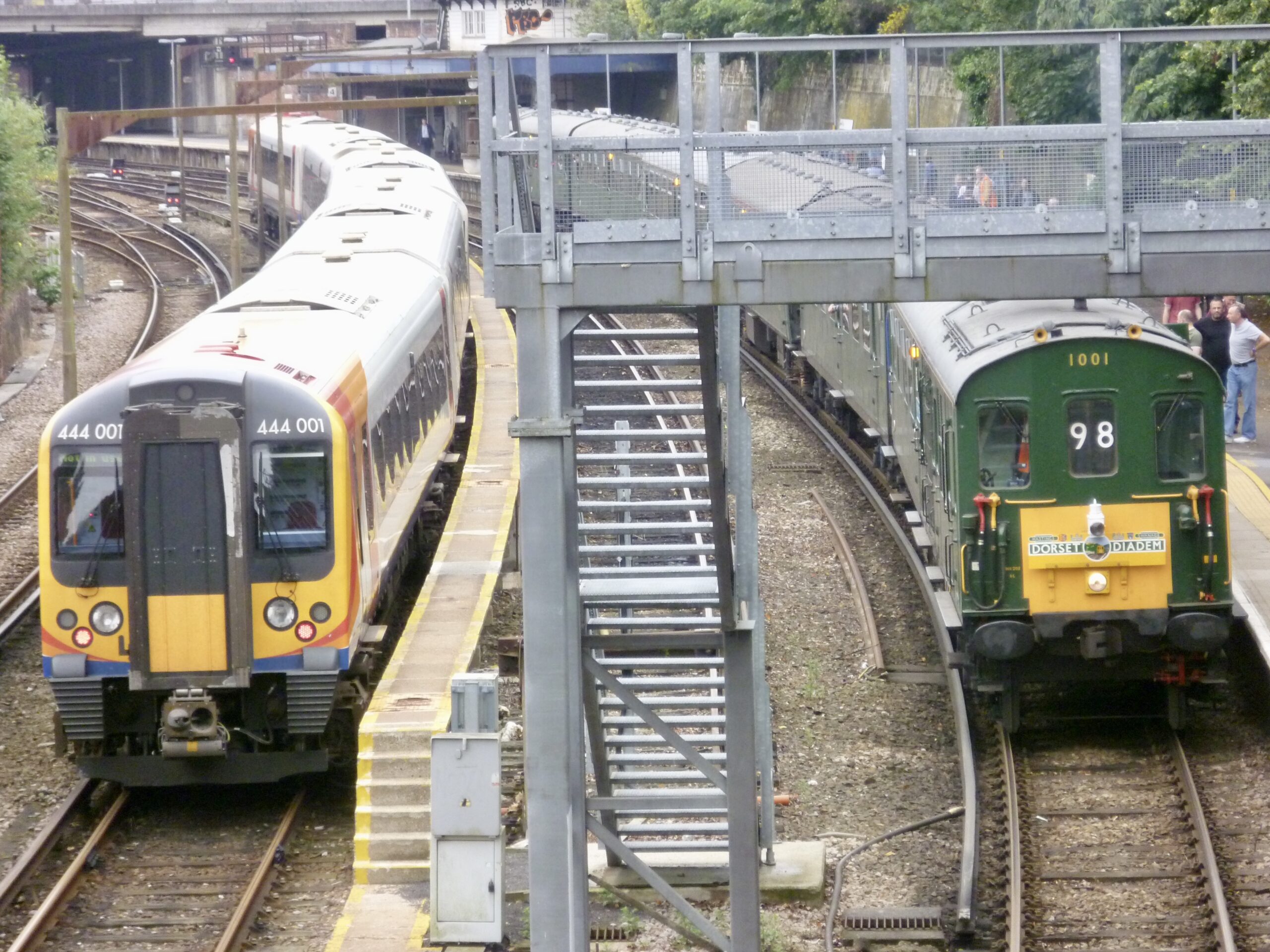
    South West Trains Class 444 No. 444001 at Bournemouth while “slim gauge” Hastings Diesel Electric Multiple Unit (DEMU) No. 1001 passes with the “Dorset Diadem’ Rail tour – 25/06/2011
    Newly re-liveried SWR Class 444 No. 444001 departs Poole working 5B19 1137 Poole to Poole Storage Sidings – 23/04/2023

    The Class 444’s were built by Siemens in Austria between 2002 and 2004, initially on Portsmouth services. They began replacing Class 442 “Wessex Electrics” on the Weymouth line from November 2006. They have five carriages and can operate in multiple, meaning two Class 444’s can run together as a ten-car service or they can work with a four car Class 450 to make a nine-car train.

    That’s all we have time for this week. Thank you for reading and for your corrections and comments – all very much appreciated!

    End Shot

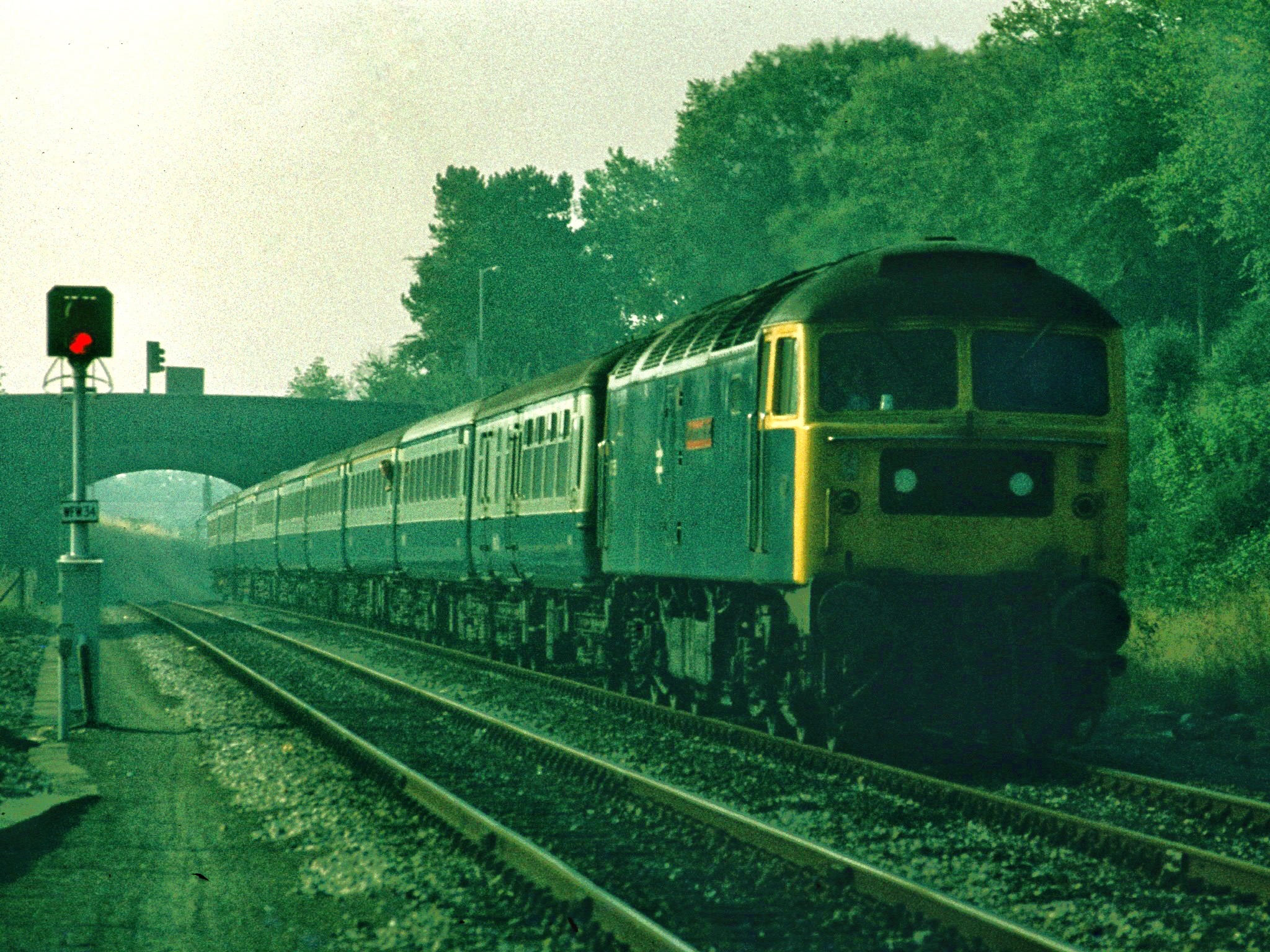
    Class 47/4 No. 47555 ‘The Commonwealth Spirit’ heads up a rake of MK2 Inter-City coaches approaching Dorchester West on 5th September 1981. The locomotive entered traffic on 28th February 1964 as No. D1717. It carried the number 47126 for a short while, before being fitted with Electric Train Heating (ETH) in 1974. She was withdrawn in January 1999 and cut up at EWS Wigan Springs Branch CRDC by January of the following year. This was one of my favourite Class 47 locos. It’s a bit strange to have favourites I suppose, but I liked the name and I saw her many times. Unlike sister loco, No. 47595 ‘Confederation of British Industry’ which I always found a bit toxic.
  • Crewe Heritage Centre

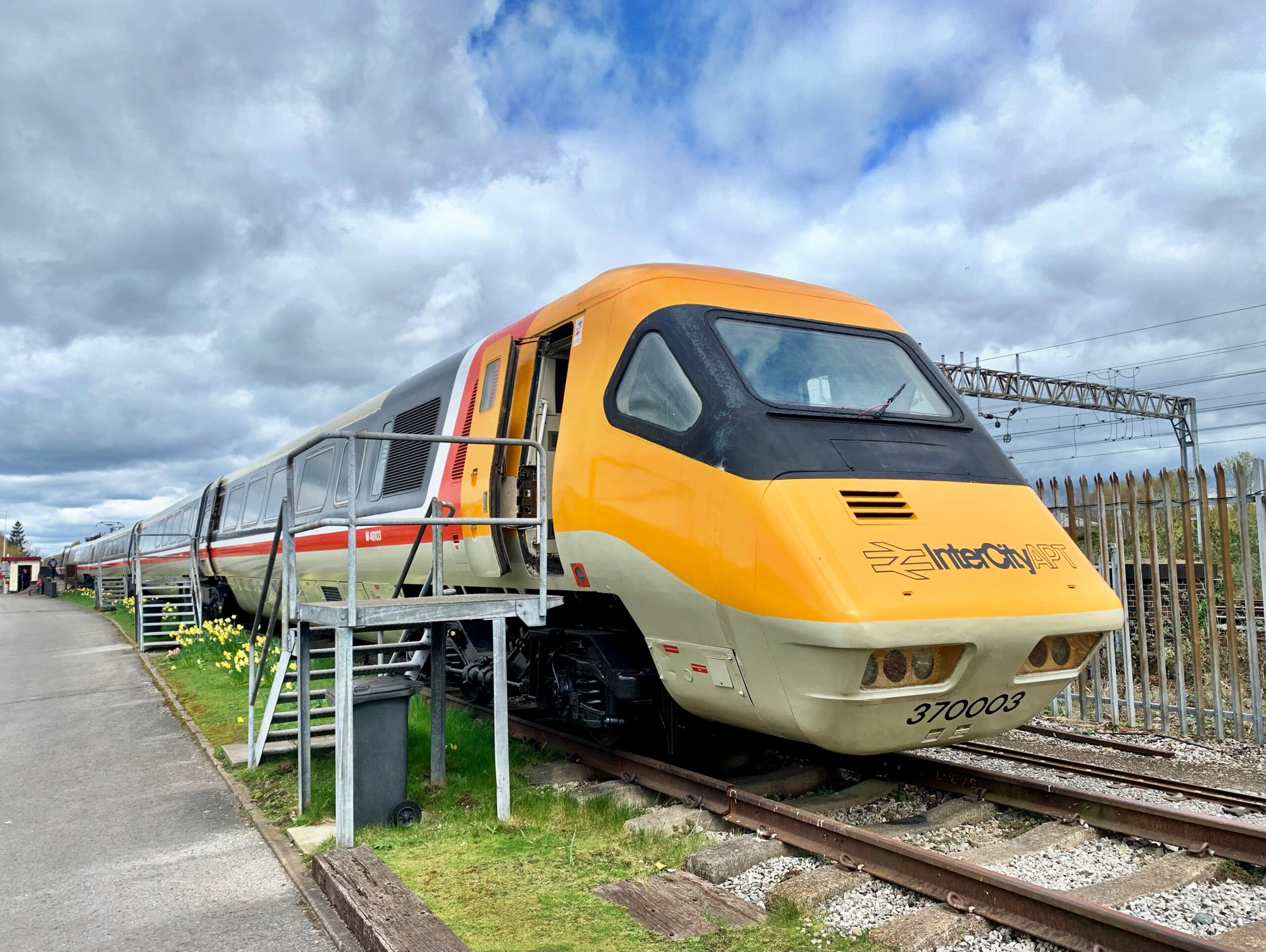
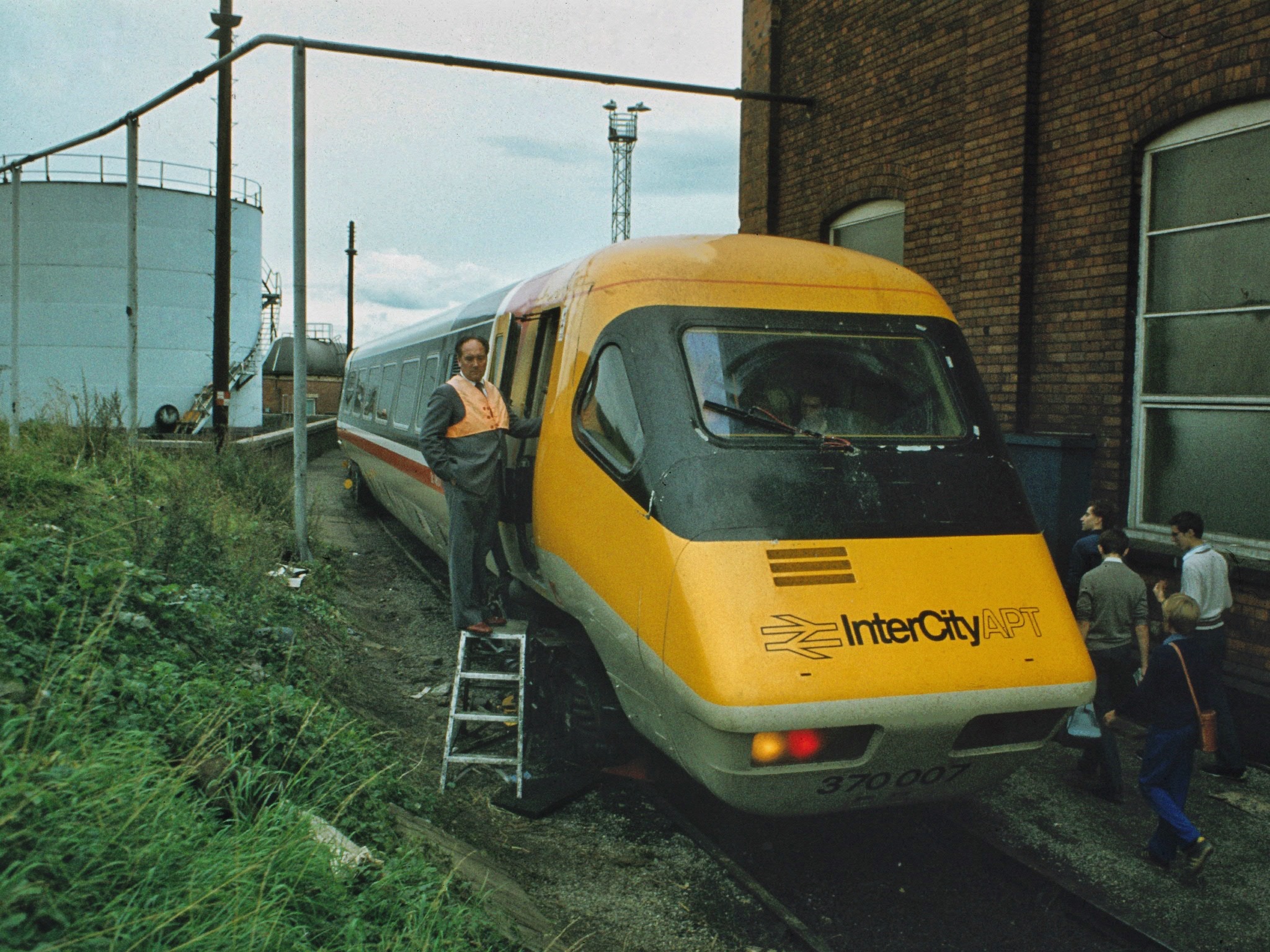
    The Inter City APT-P (Advanced Passenger Train Prototype) was donated to the Crewe Heritage Centre by British Rail in 1988, this would become the only APT-P to be preserved and is the first thing visitors see on arrival – 01/04/2023

    On Saturday April 1st, Yoshi’s mama had a weekend away planned with friends in Oxford. Organised before the announcement of rail strikes, I had a cunning plan for an adventure of my own when Mick Lynch of the RMT declared “everyone out!” By the time the April strike day was suspended, I’d already committed myself to an overnight stay in Derby. So after a stop at the Oxford Park & Ride, my chum @da_buckley967 and myself headed North to Crewe as we had booked a visit to the Freightliner depot at Crewe Basford Hall. Yoshi was still on his hols with his cousins as obviously he wasn’t going to be allowed to wander around a working railway yard. Our visit was scheduled to last for approximately one hour and kicked off at midday. Looking for some other things to do in the area, a visit to The Crewe Heritage Centre was an obvious choice. I was under the misunderstanding that dogs were not allowed on site, but I am happy to report that dogs are very much welcomed, and indeed, they enjoy free admission and doggy watering stations are spotted about the museum to help keep them hydrated. Owners are catered for in the cafe where tea, coffee, cold drinks and snacks are available.

    The former Crewe North Junction Signal Box now contains a cafe, viewing point, model railway and signalling equipment. Constructed in 1938 by the London Midland & Scottish (LMS) Railway Company and built to an ‘ARP’ (Air Raid Precautions) design, with 38cm thick reinforced concrete walls and a 45cm thick concrete roof. The new ‘electric’ Signal Box was constructed directly in front of the previous 1906 building; this was partially demolished in 1940 with only the ground floor being retained and converted into a Linesmans’ hut. In 1985 as part of the Crewe Station remodelling project this Signal Box was closed with control being handed over to the new Signalling Centre on the opposite side of the Crewe to Chester Line.

    The Crewe Heritage Centre is nestled between the Crewe to Chester line and West Coast Mainline on part of the site of the original Crewe Locomotive Works. The Heritage Centre was officially opened by Her Majesty Queen Elizabeth II and His Royal Highness the Duke of Edinburgh, on 24th July 1987 to mark the 150th anniversary of the first train to arrive at Crewe Railway Station in 1837. Originally forming part of the Crewe Heritage Festival which was an eight week long event with activities and celebrations taking place all over the town of Crewe, members of the public were also invited to visit the historic Locomotive Works and see first hand how railway locomotives were constructed and maintained by British Rail.

    Following a really successful festival, Crewe and Nantwich Borough Council decided to open the Heritage Centre again in 1988, and in 1989 the council handed the running of the museum over to the newly formed Crewe Heritage Trust who continue to operate the museum to this day. We really enjoyed our visit and I hope to return with Yoshi in tow one day soon!

    Crewe Station ‘A’ Signal Box with Exeter West Signal Box behind – 01/04/2023
    In 1991, the dismantled sections of Exeter West Signal Box are transported to the Heritage Centre from storage and the complex task of reconstructing the Signal Box begins in May, construction continued into 1992 with the Signal Box opening as part of the museum on May Day 1993 – 01/04/2023
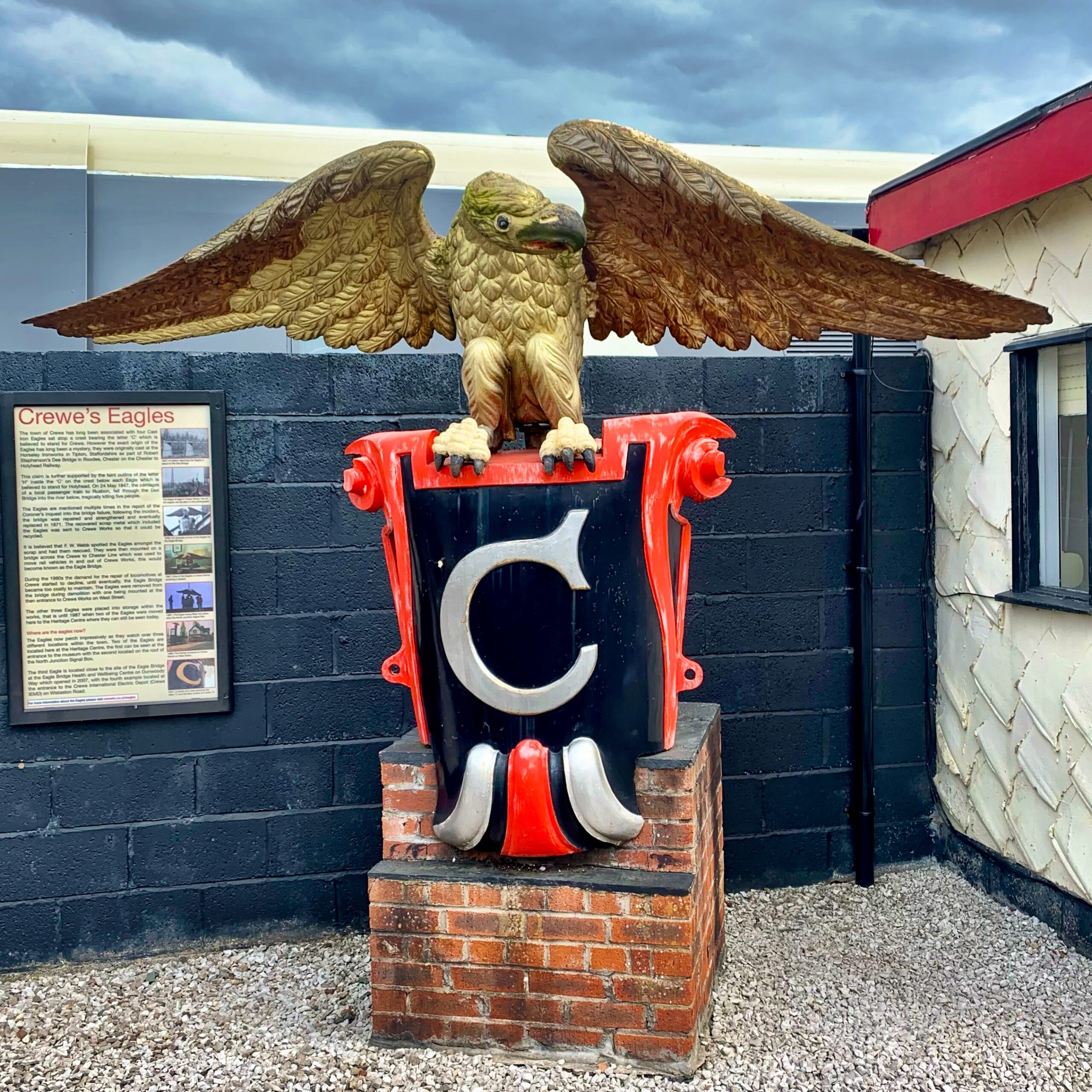
    An example of a Crewe Eagle, four of which were mounted on a bridge crossing the Crewe to Chester railway line – 01/04/2023
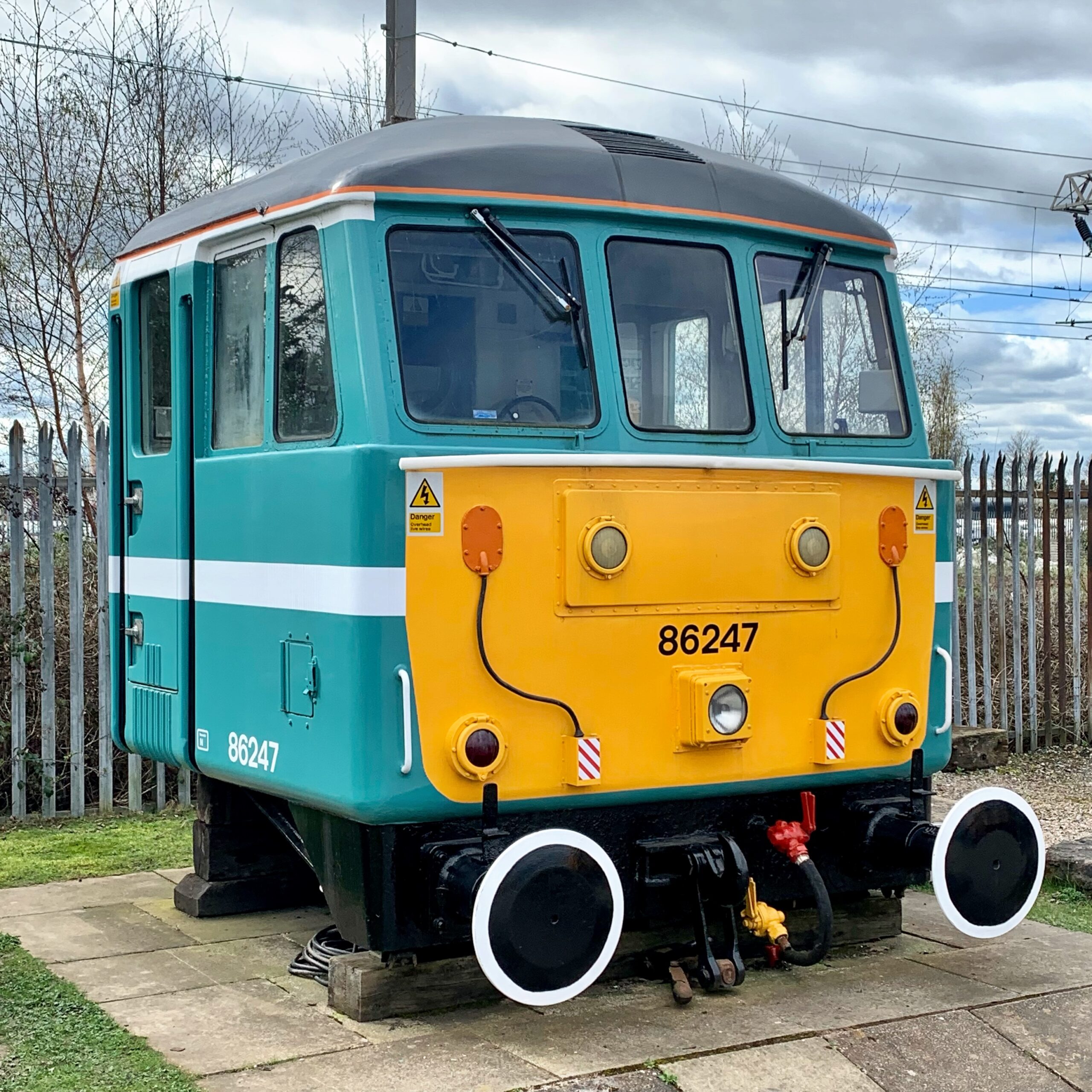
    The No. 2 end cab of Class 86 No. 86247 was restored at the Heritage Centre and currently displays the Anglia Railways livery, which whilst in service, the locomotive never actually carried. The locomotive was scrapped in 2015 with both cabs being saved. The No. 1 end cab can be seen at The Cab Yard Project in Bridgend – 01/04/2023
    One of two Class 86/6 locomotives to be given the Freightliner Powerhaul green and yellow livery No. 86622 is on long term loan at the Heritage Centre – 01/04/2023
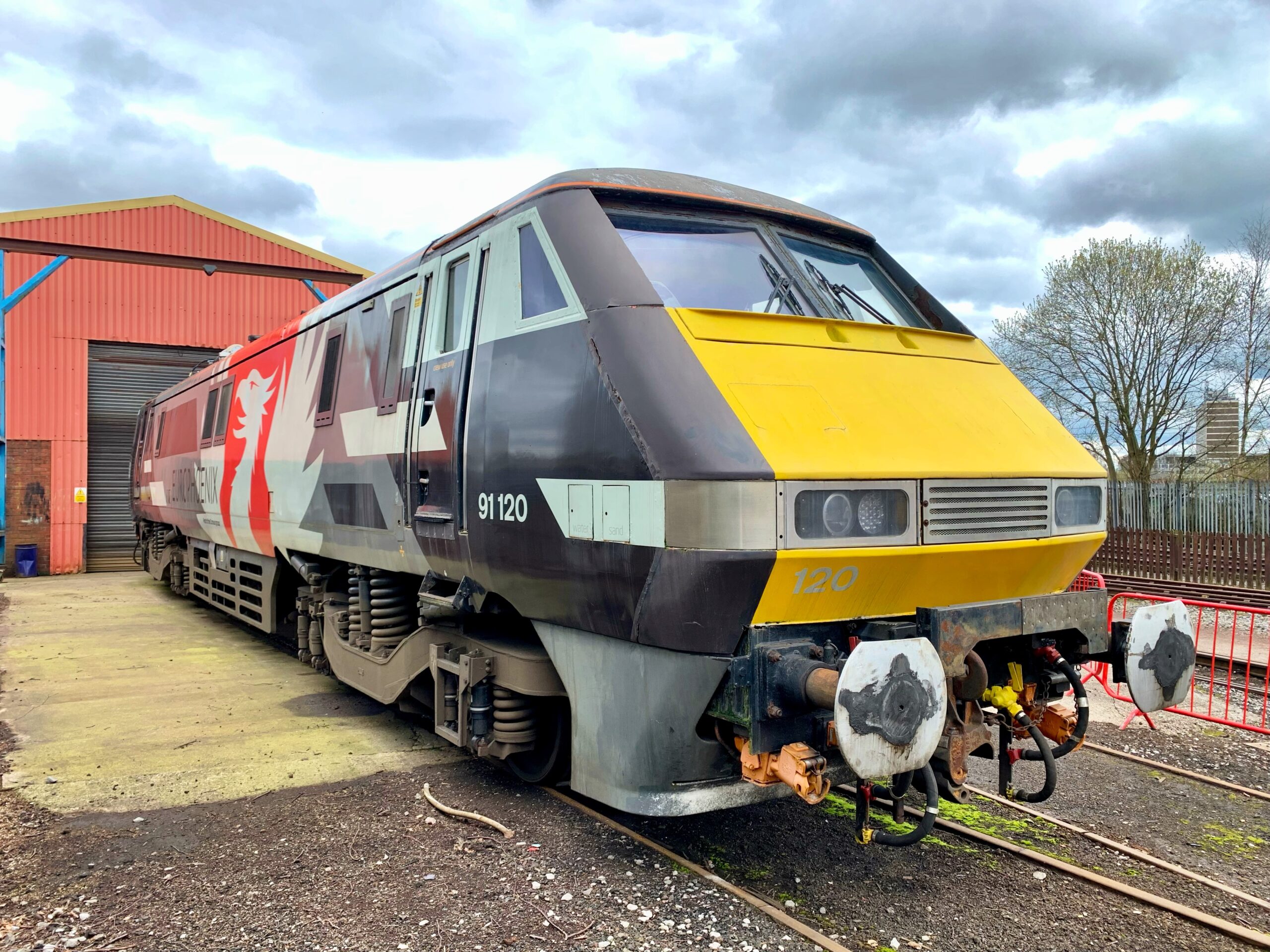
    Through an agreement between the Crewe Heritage Trust and Europhoenix British Rail Class 91 No. 91120 arrived at the Heritage Centre in 2022 – 01/04/2023
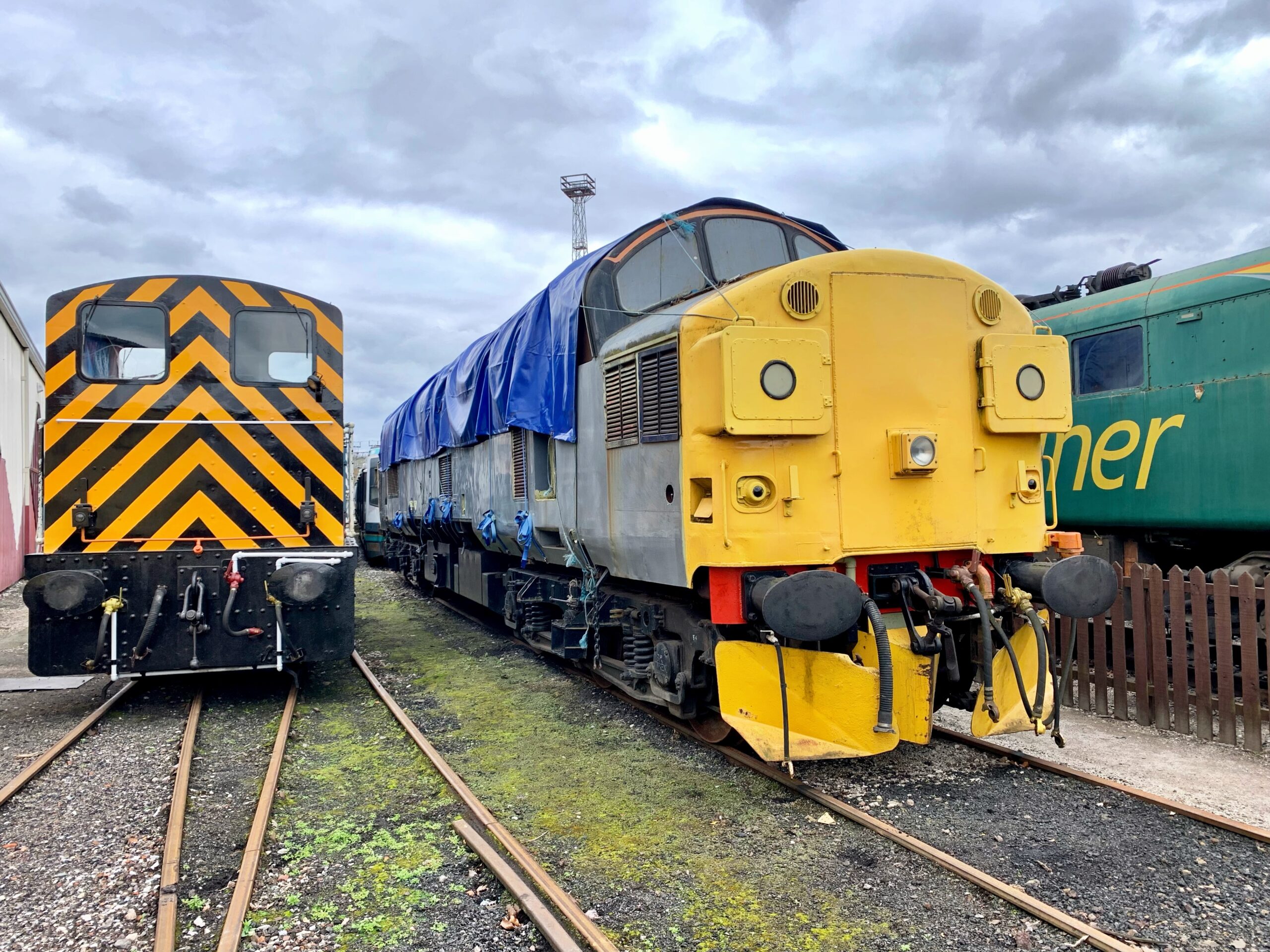
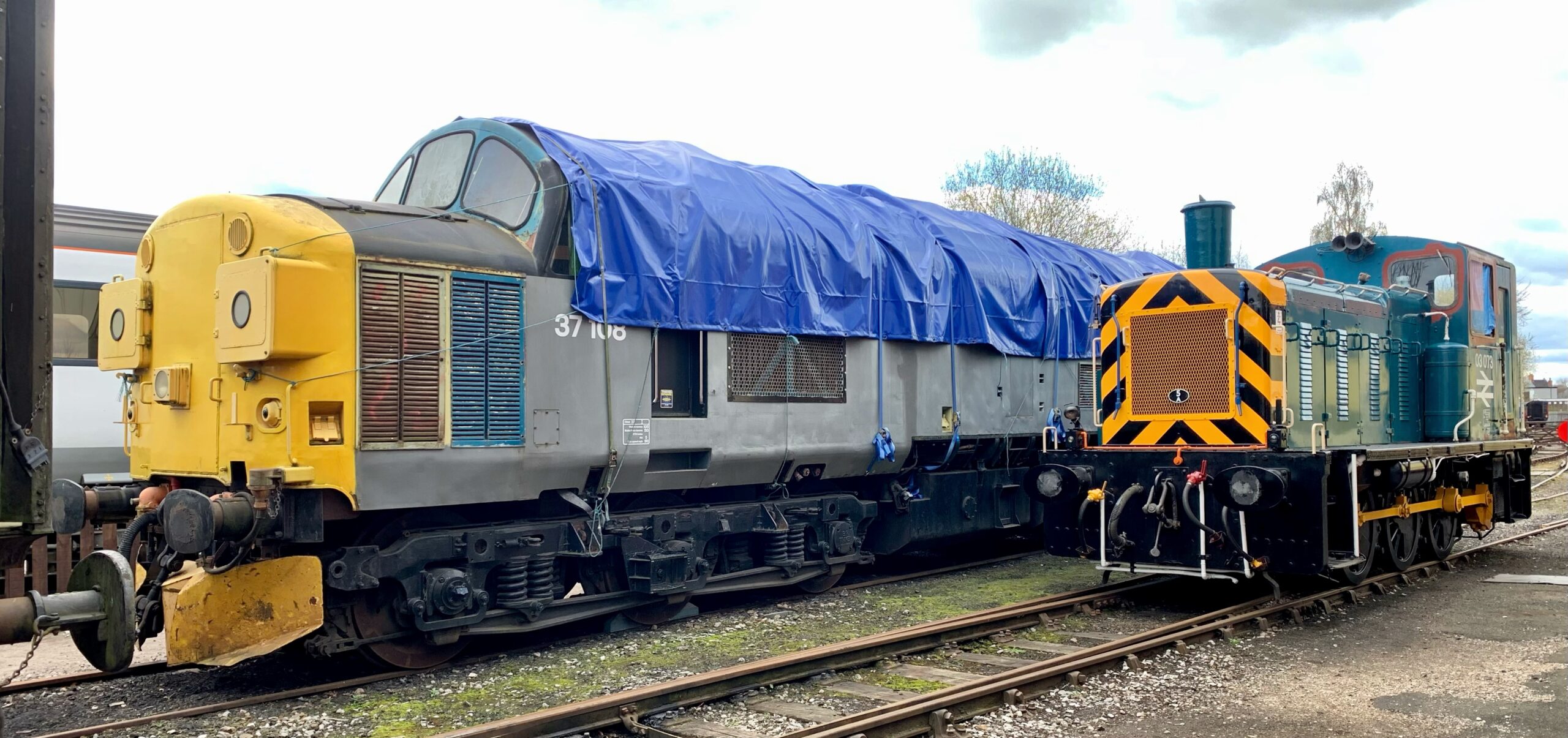
    Released from English Electric Vulcan Foundry in January 1963 – Works Number EE/VF3237/D762 1962 – and originally numbered No. D6808, Class 37 No. 37108 was moved to the Heritage Centre from Carnforth by road in 2010 – 01/04/2023
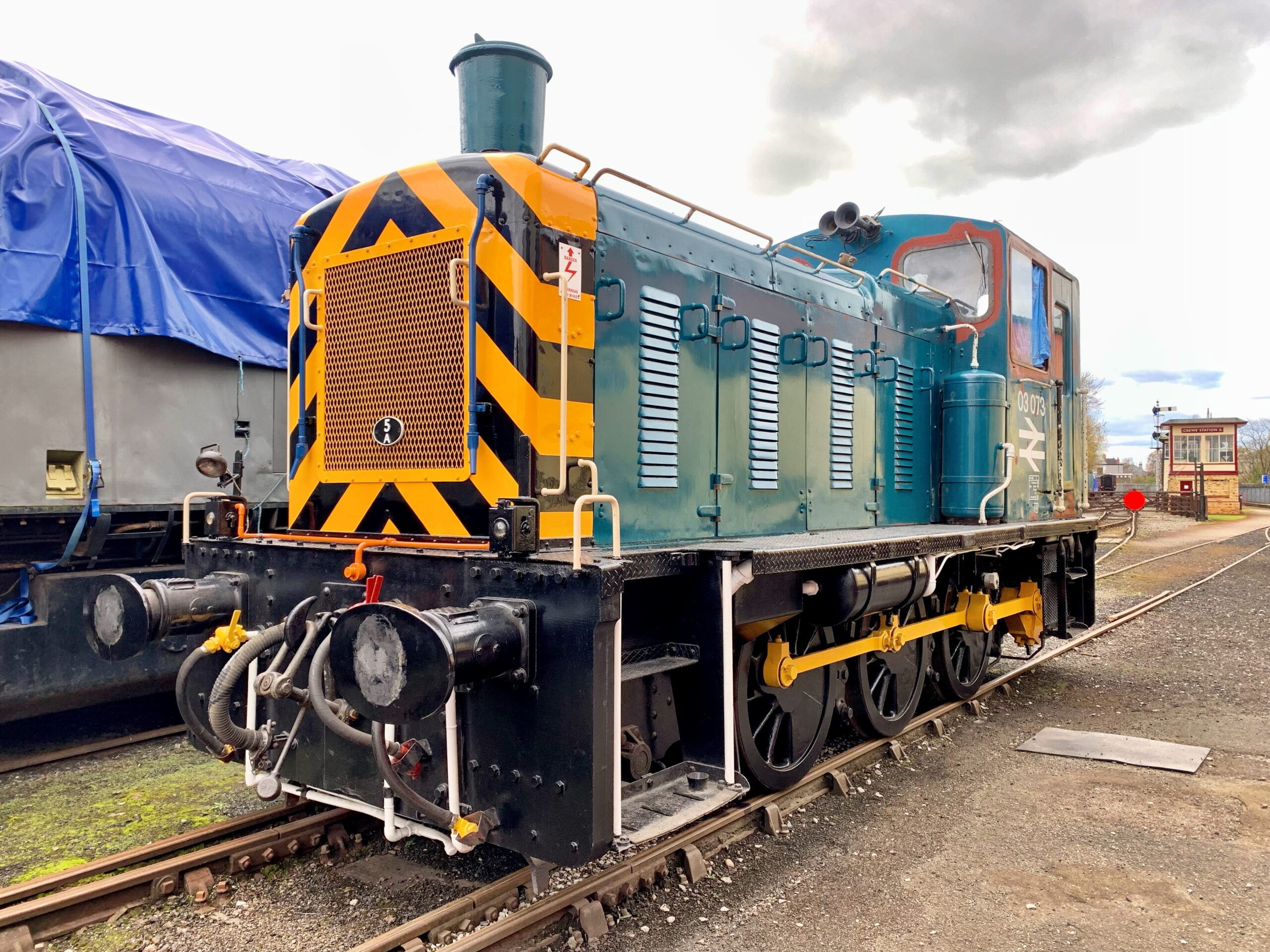
    Class 37 No. 37108 alongside Class 03 No. 03073 – 01/04/2023
    With the kind support of British Rail, the Heritage Centre was able to acquire Doncaster built Class 03 Diesel Shunter No. 03073 in 1990, this would be the first shunting locomotive to be preserved by the Heritage Centre – 01/04/2023
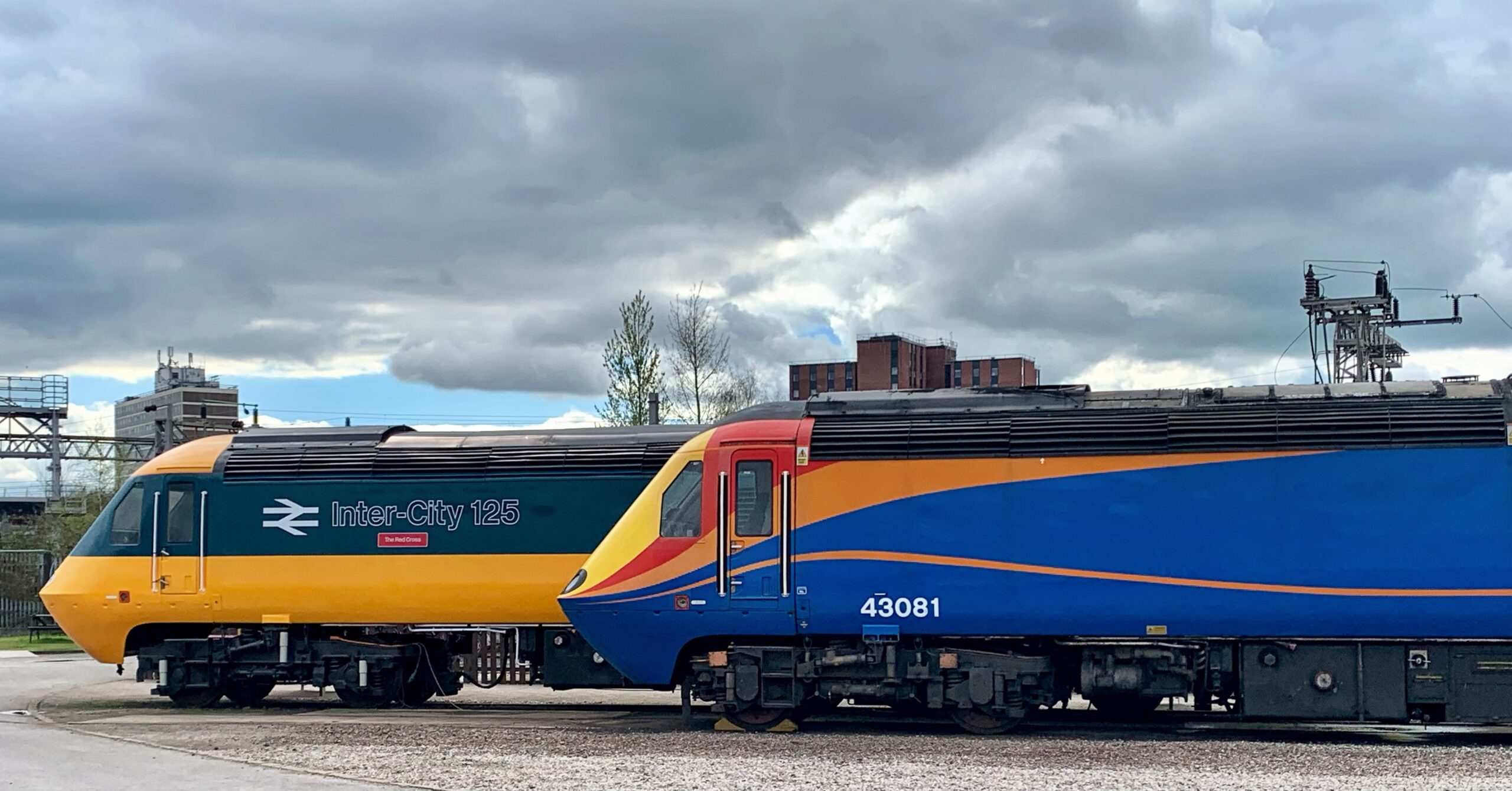
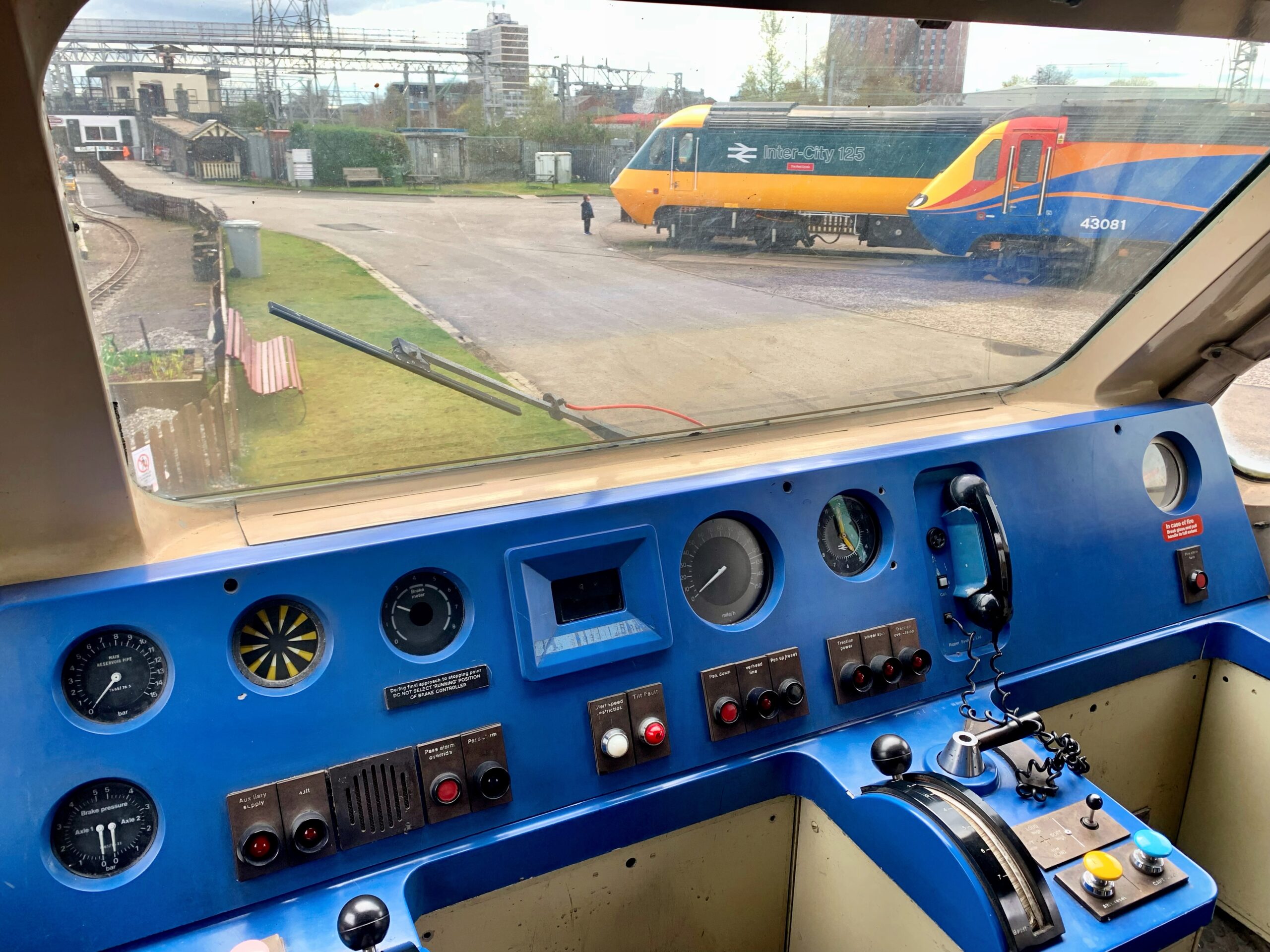
    Thanks to a generous donation by Porterbrook the Heritage Centre secured the High Speed Train (HST) Power Car No. 43081, the 8,000th locomotive to be constructed in Crewe Work – 01/04/2023
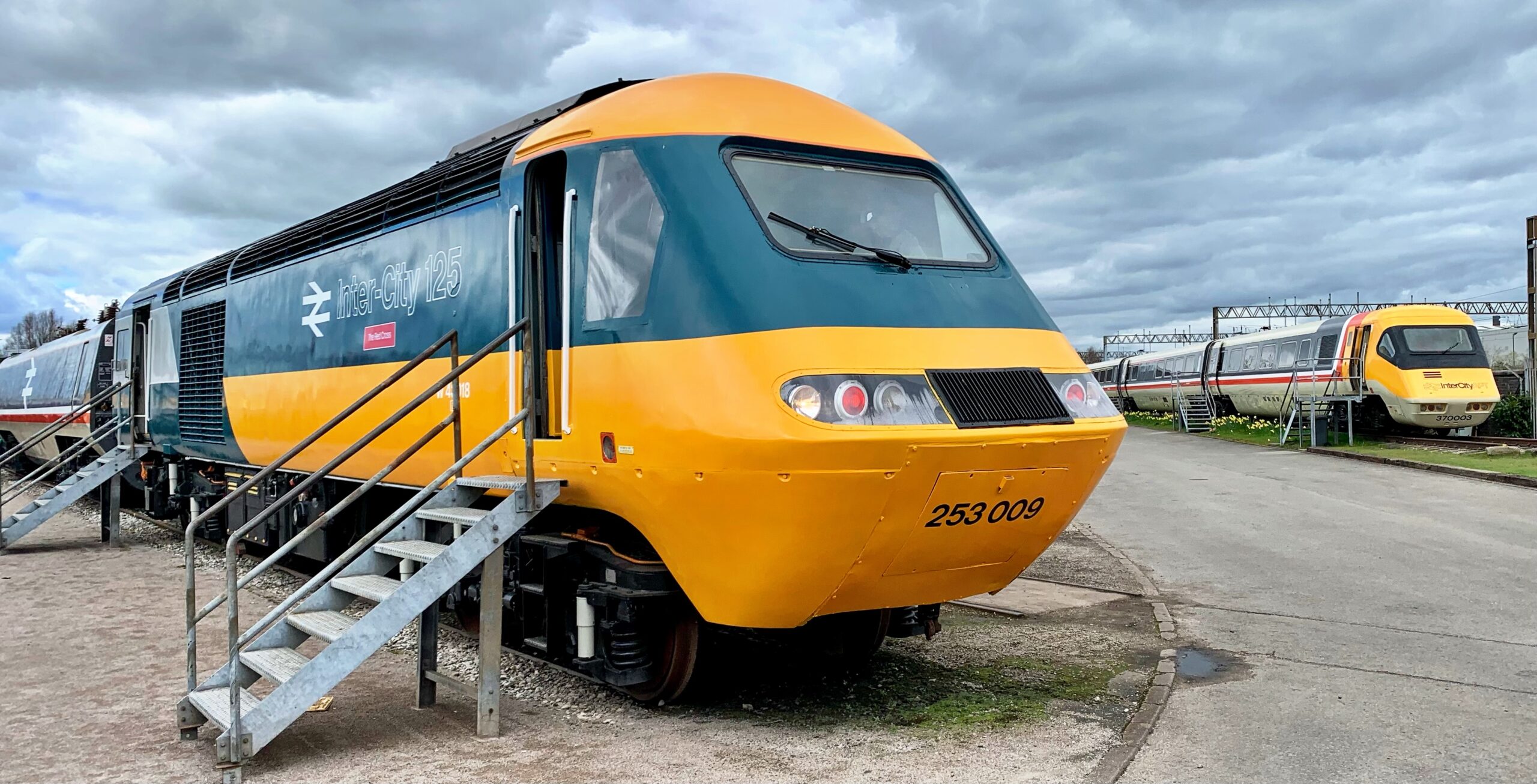
    Crewe built HST Power Car No. 43018 on static exhibition was acquired by the Heritage Centre in 2020 – 01/04/2023
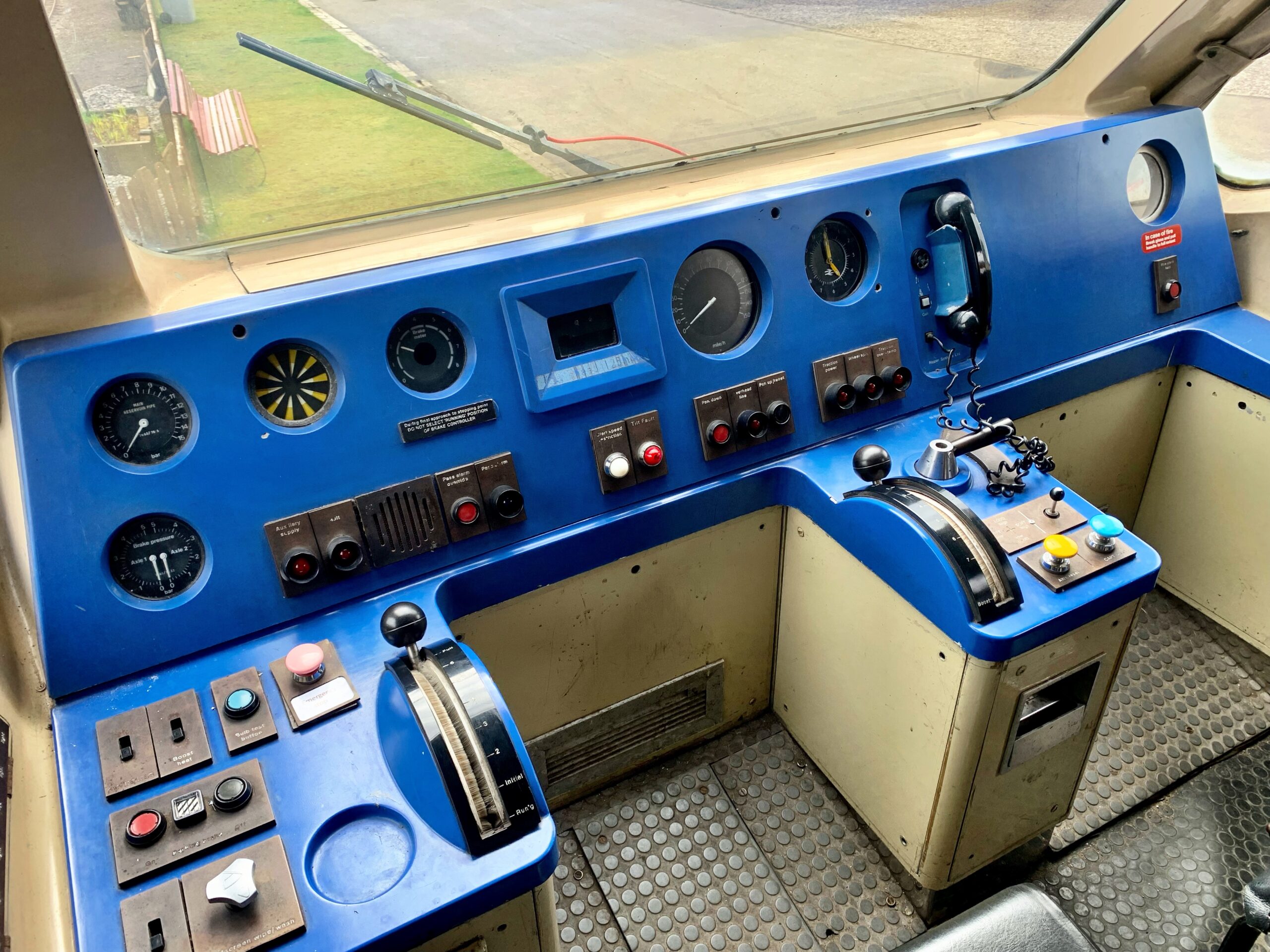
    Visitors to the Heritage Centre can visit the cab of one of the driving trailers from set 370003 – 01/04/2023
    The very 1970’s high tech cab arrangement of APT-P – 01/04/2023
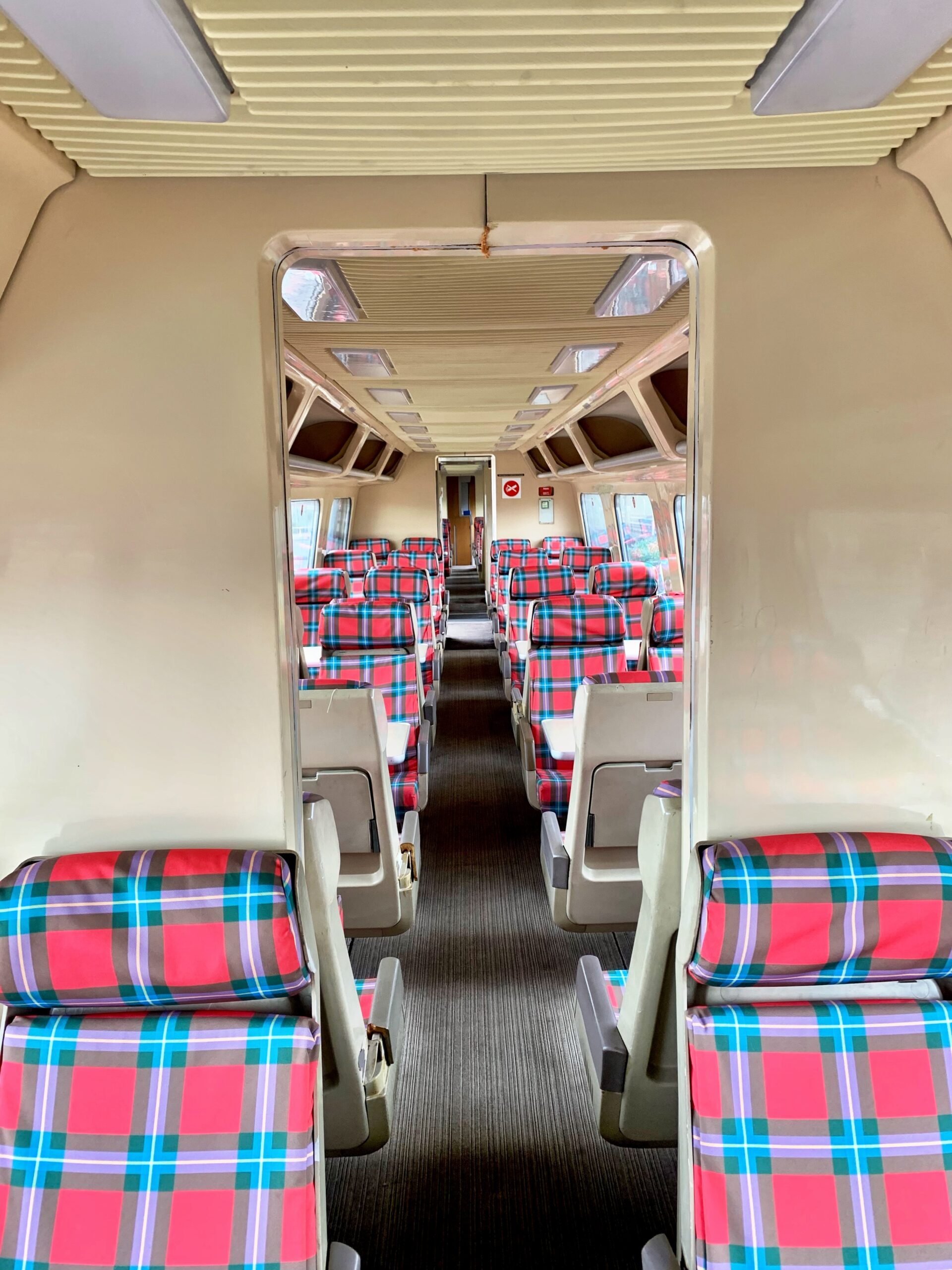
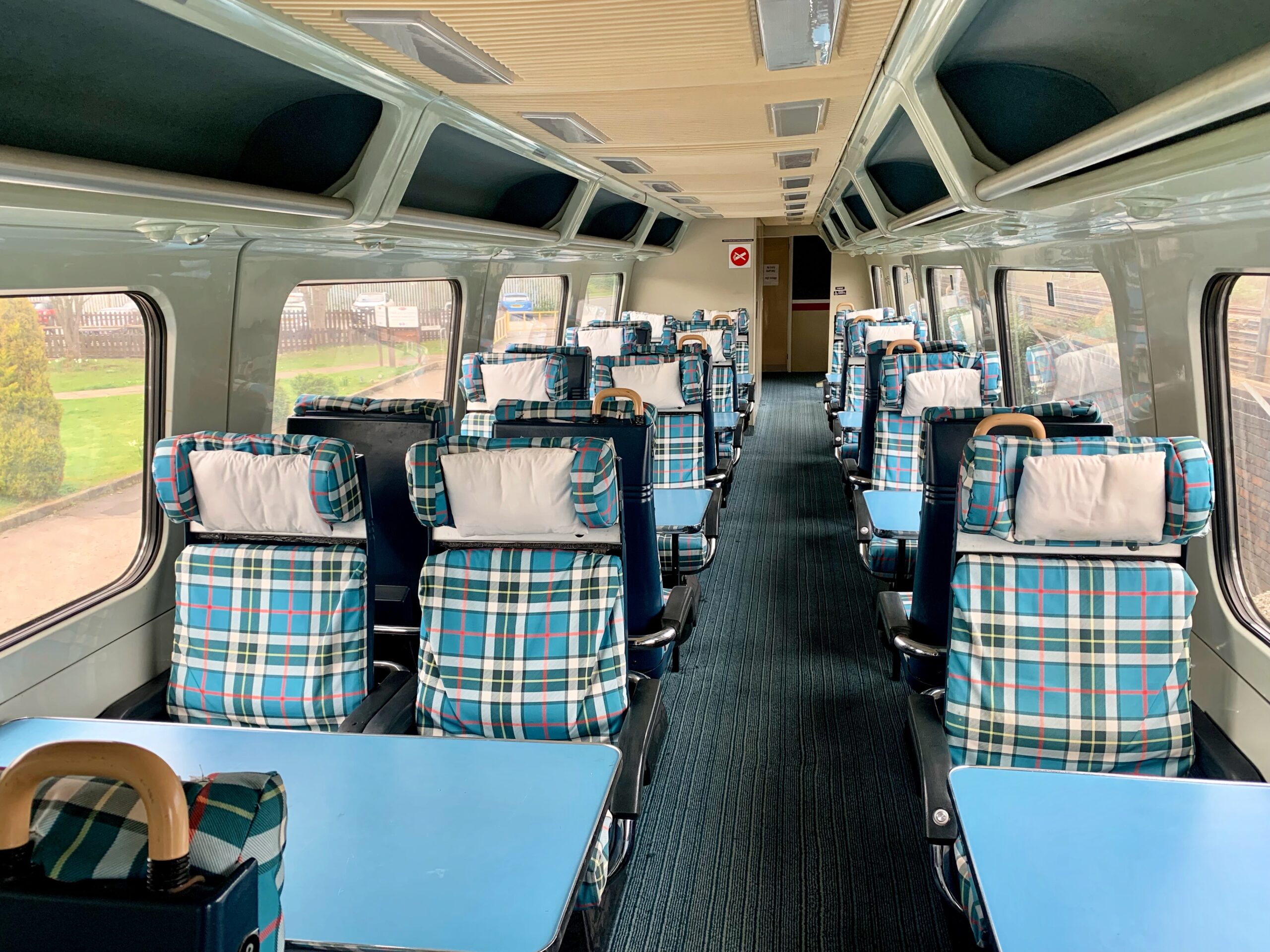
    Standard Class (probably still called second class in the 1980’s) seating in APT-P – 01/04/2023
    The “fully stocked bar” in the buffet car of APT-P – 01/04/2023
    First class seating on board APT-P – 01/04/2023
    The view from the cab window of the APT-P driving car – 01/04/2023

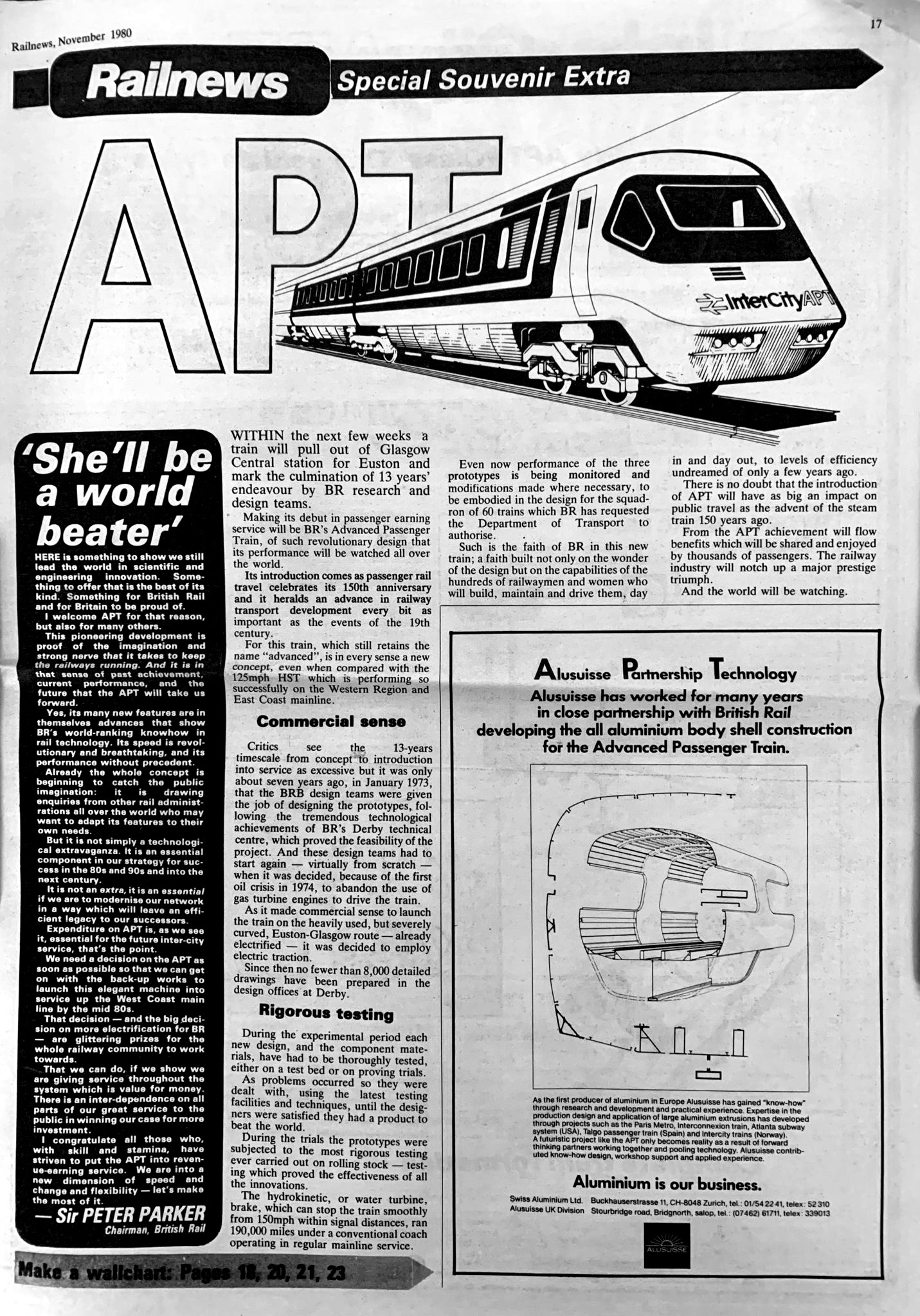
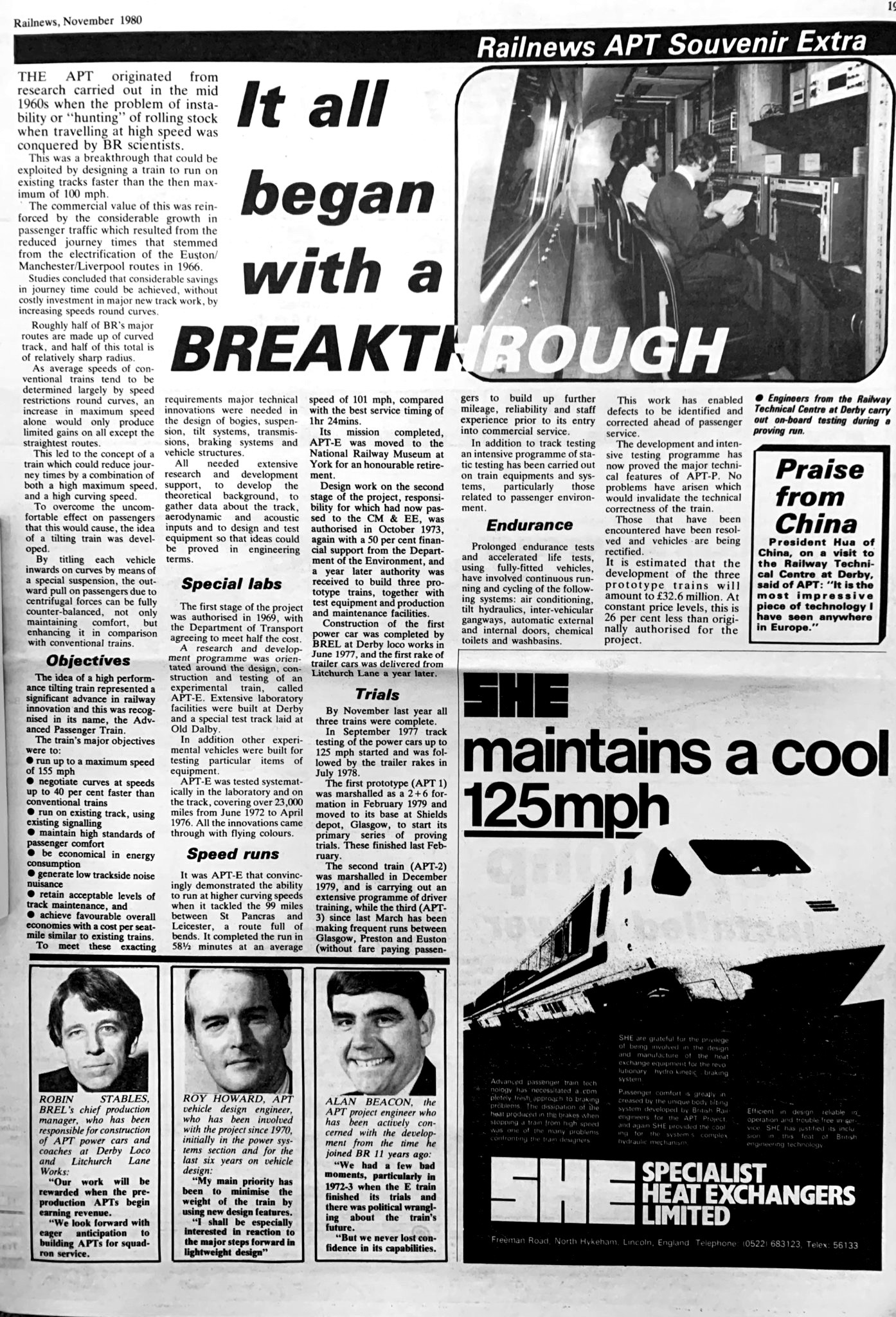
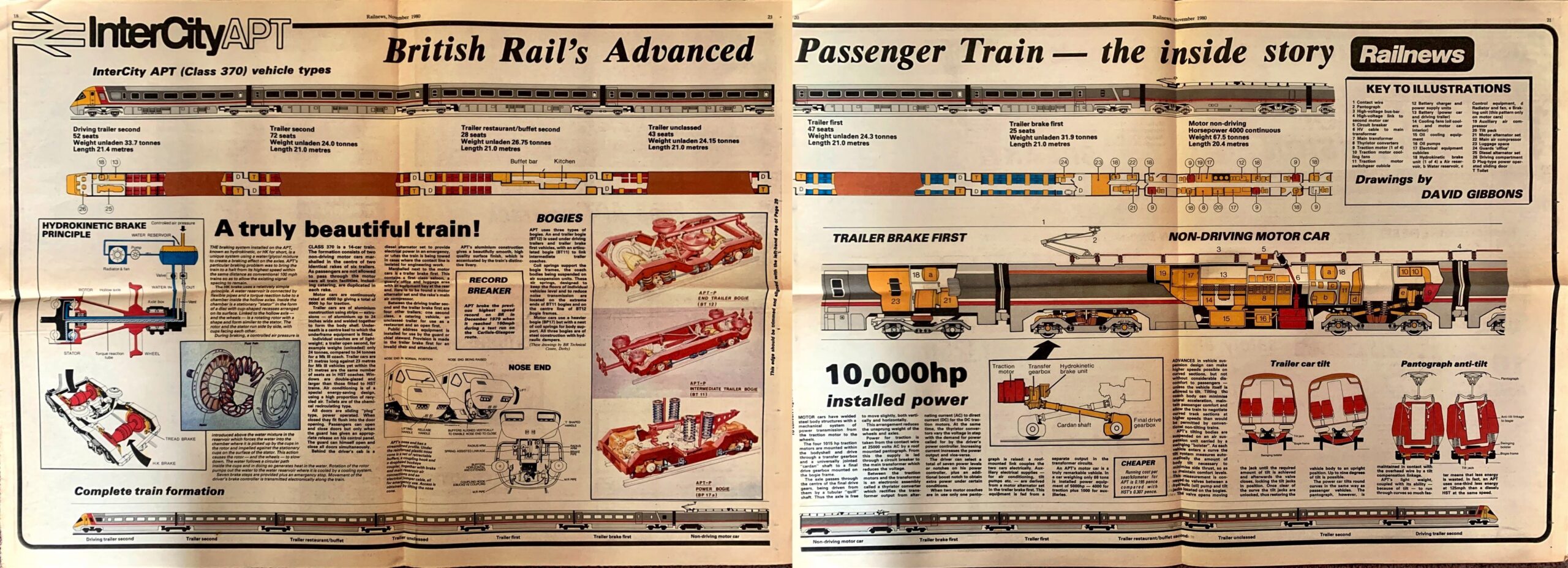
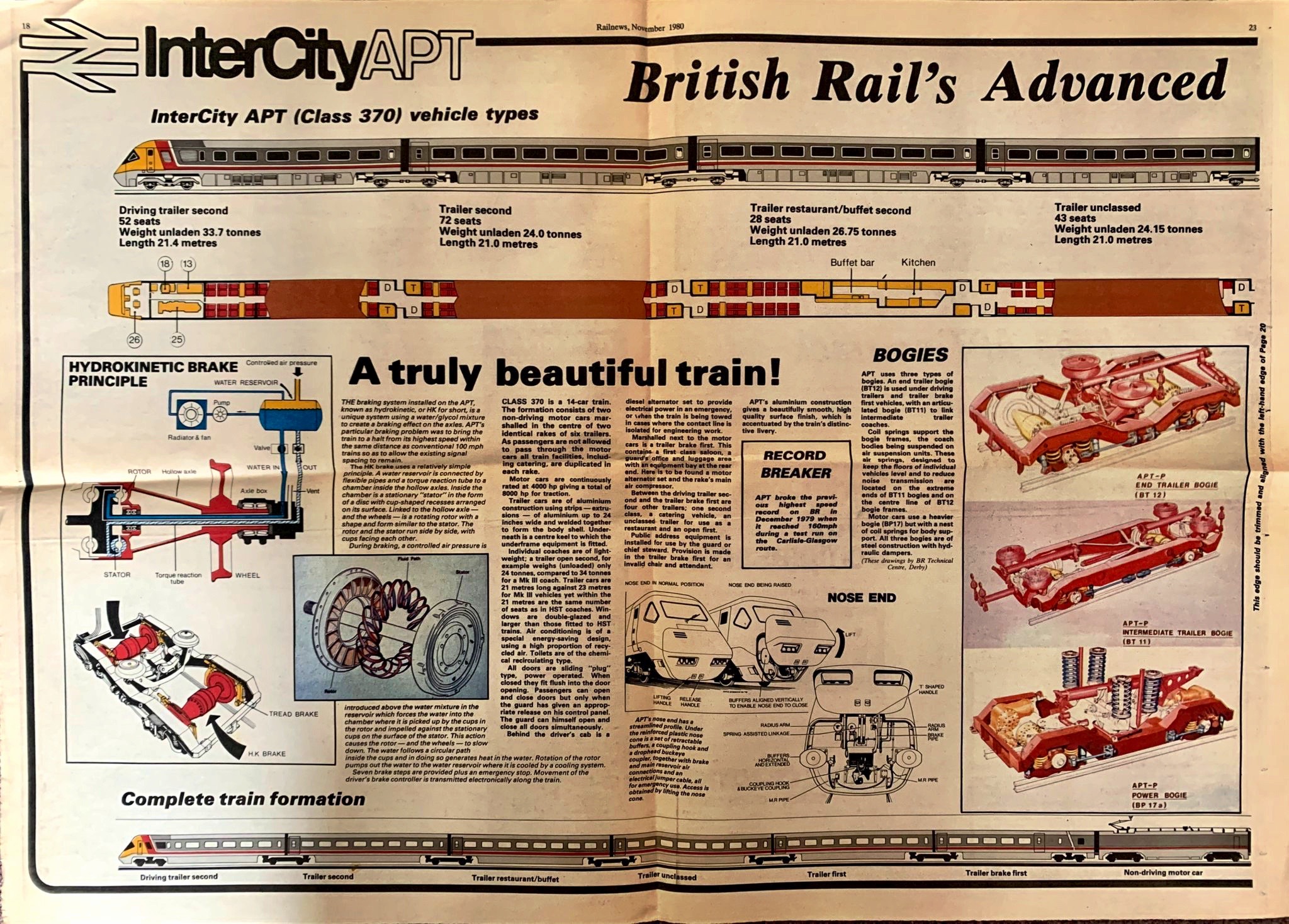
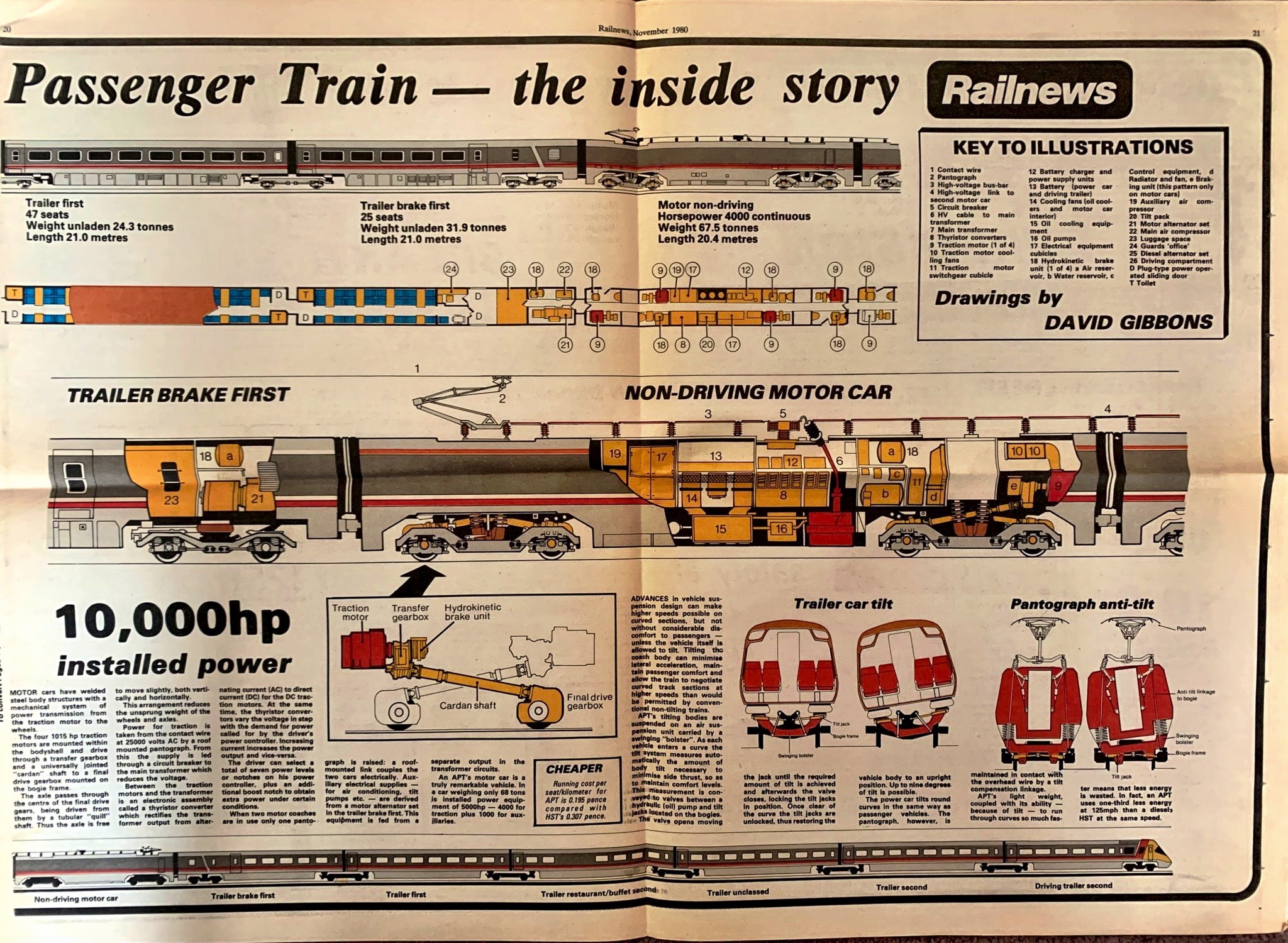
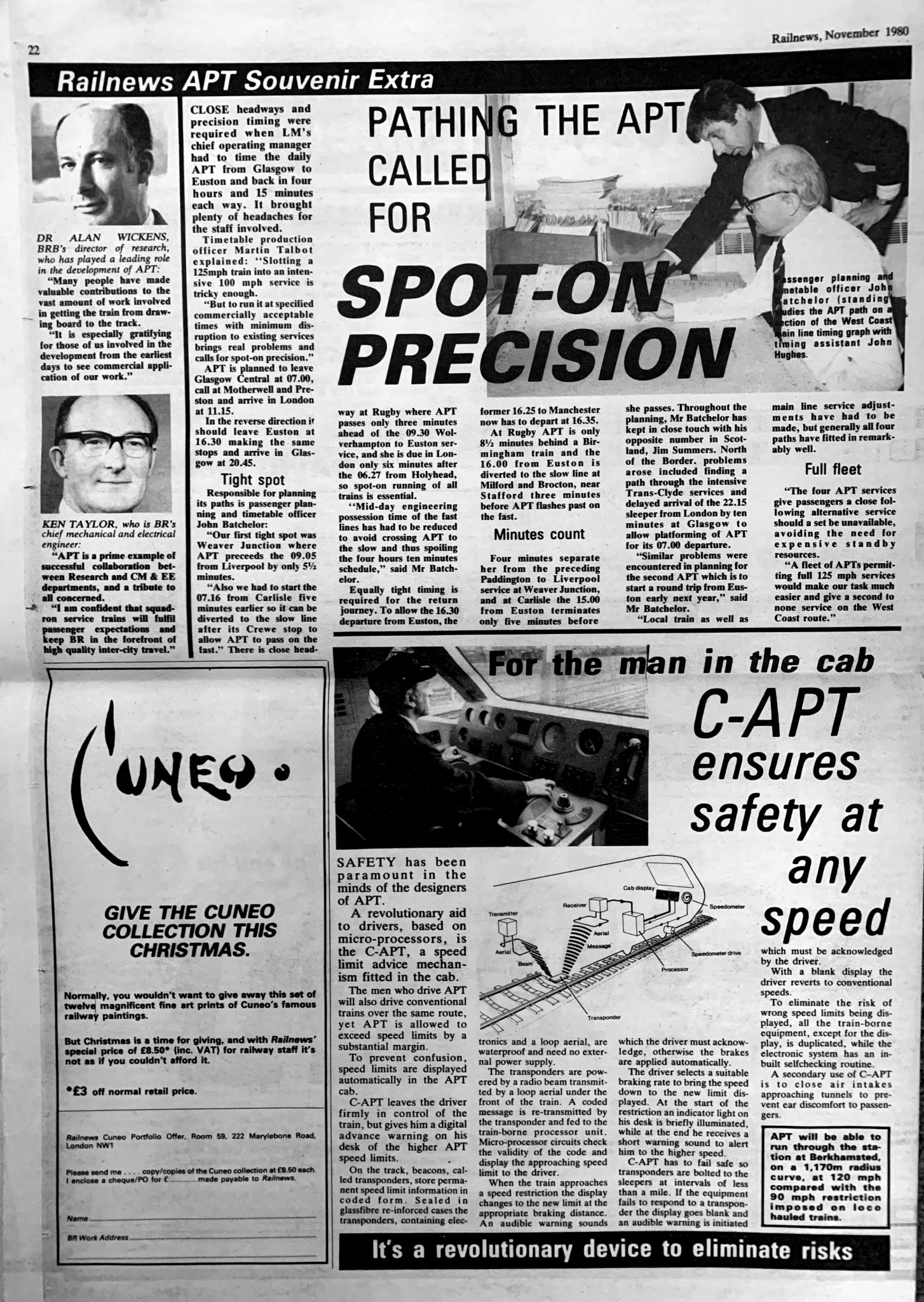
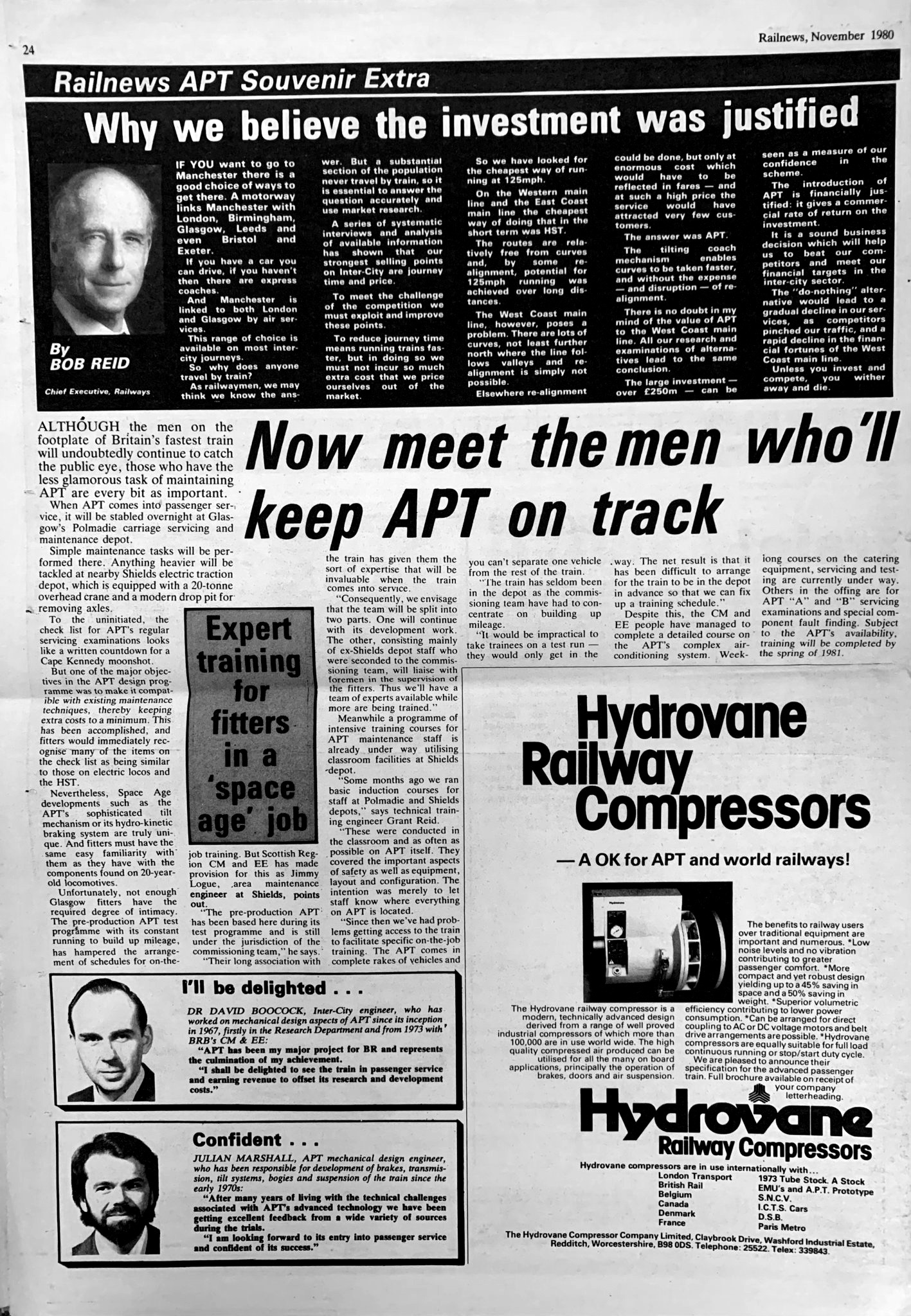
    In the November 1980 edition of Railnews, the industry newspaper, there was pullout special souvenir all about the Advanced Passenger Train:

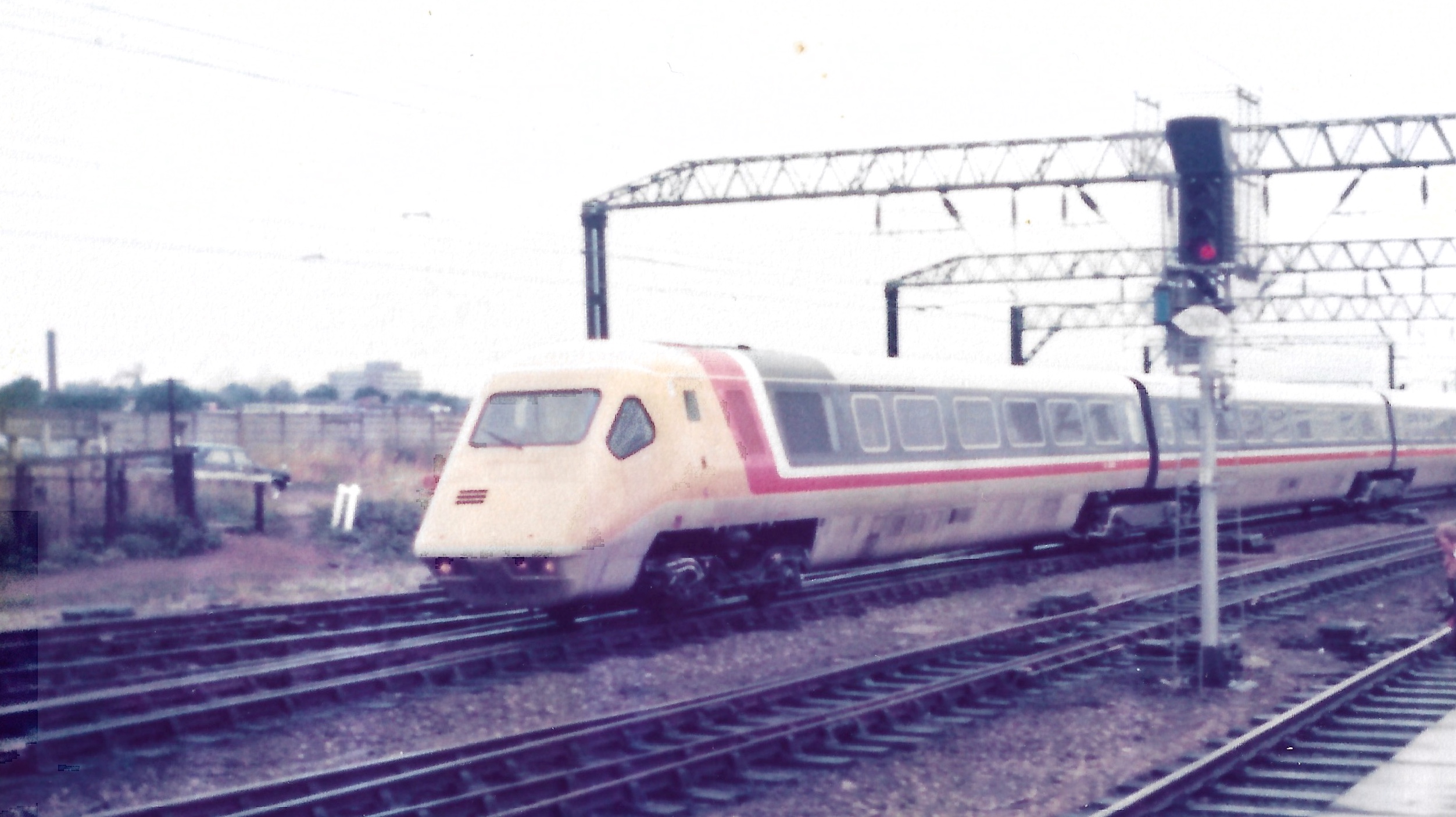
    Proof I saw APT-P on the mainline! An unidentified APT at Crewe – 13/08/1978
    Driving trailer of APT-P set No. 370007 at Old Oak Common. The APT was apparently a late addition to the Open Day at Old Oak Common after lots of discussions over route clearance – 20/09/1981

    We’ll tell you more about our weekend next time. I would have included more this week, but I have episodes of “Married At First Sight Australia” to catch up on.

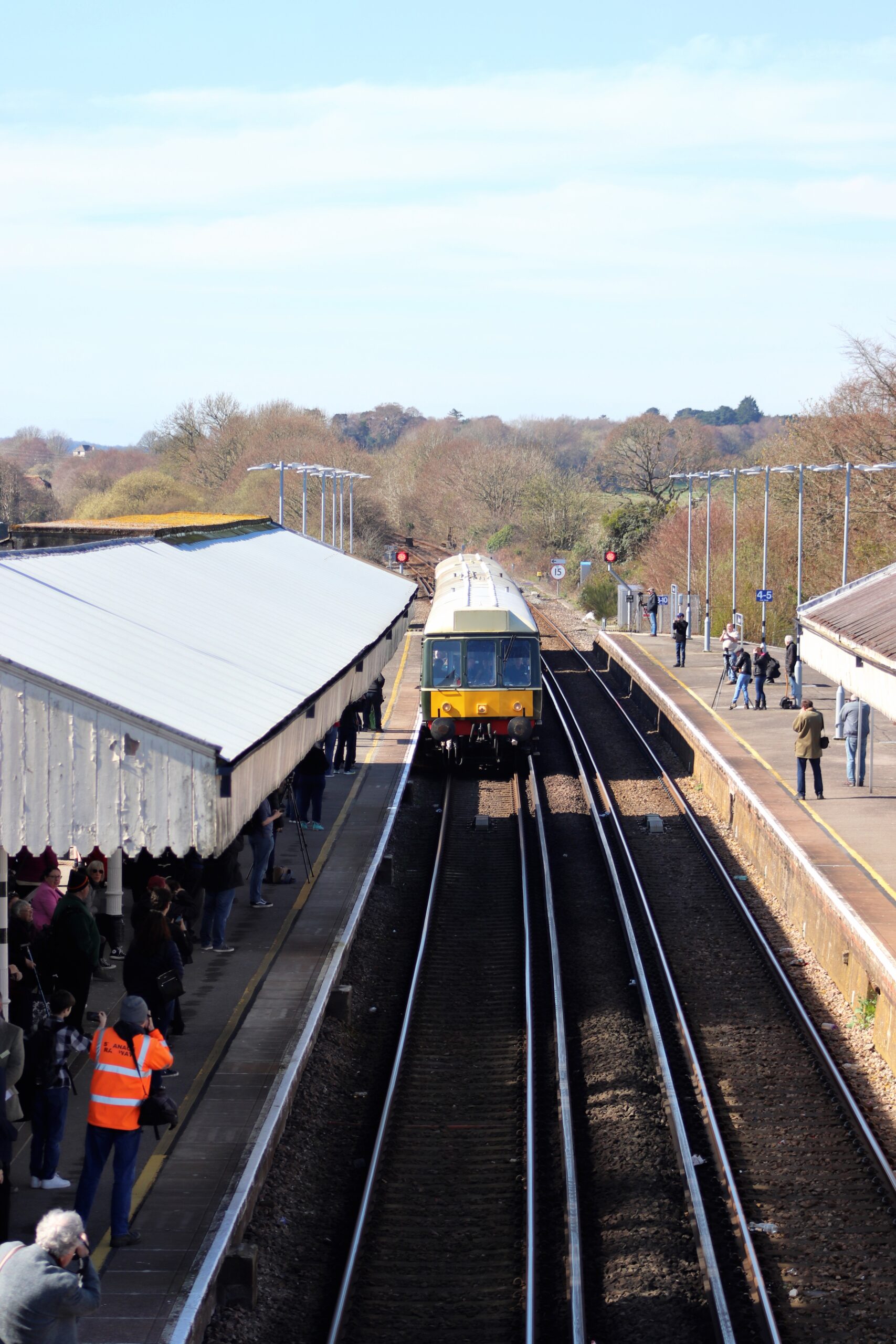
    Closer to home, Yoshi, his mama and I made the trip on Swanage Railway’s trial diesel multiple unit (DMU) service which we discussed in our previous blog entry. The trains were well used on Saturday 8th April, the day of our trip, which was good to see. This was despite widespread criticism of the ticket prices.

    Swanage Railway’s three car Class 117 DMU stands at Wareham Platform 2 with the 1109 arrival from Swanage – 08/04/2023

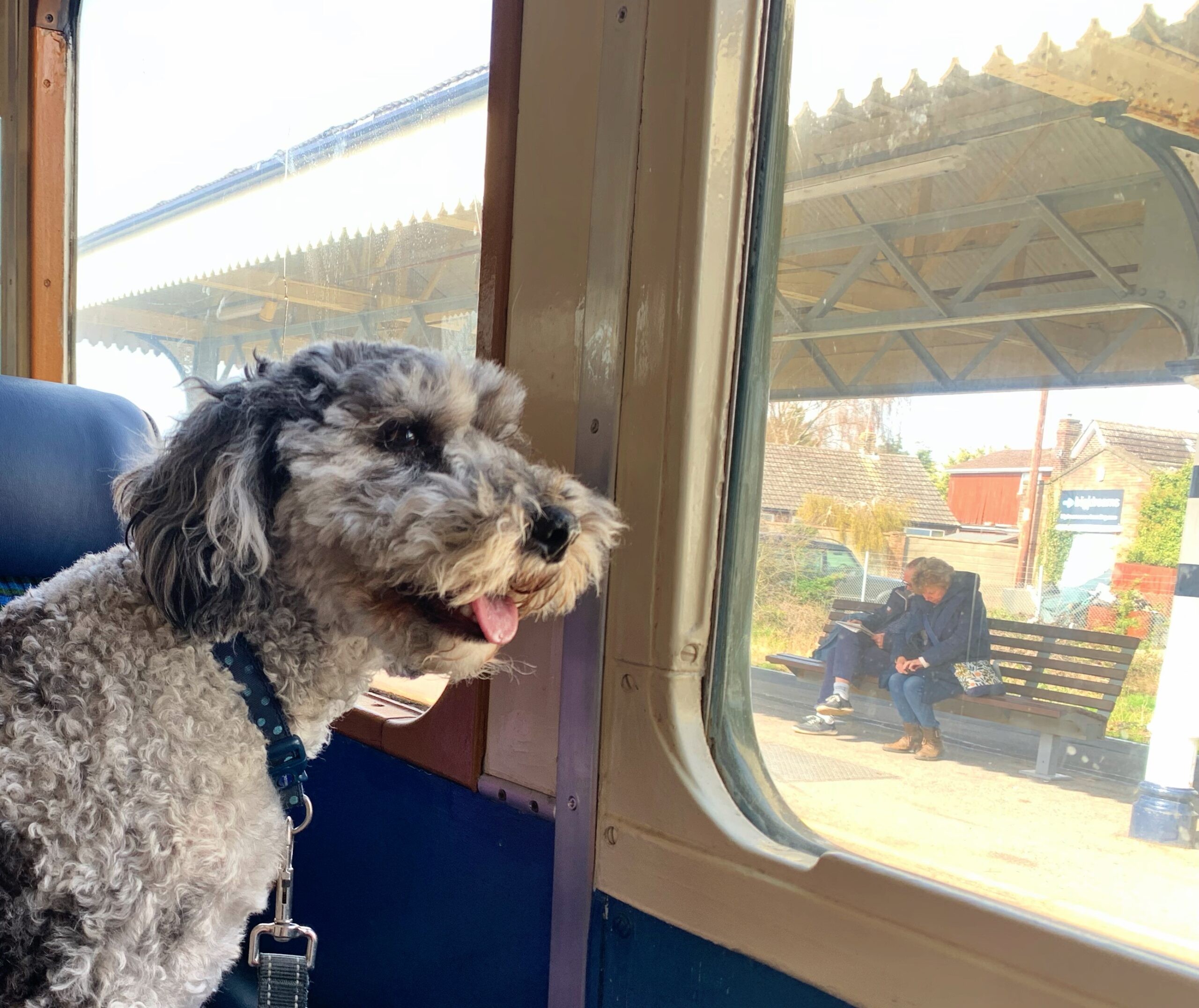
    Yoshi had a good view out of the window along the route to Corfe Castle aboard the heritage Class 117 DMU – 08/04/2023
    Having arrived back in Wareham, Yoshi took a closer look at the Class 117 DMU – 08/04/2023

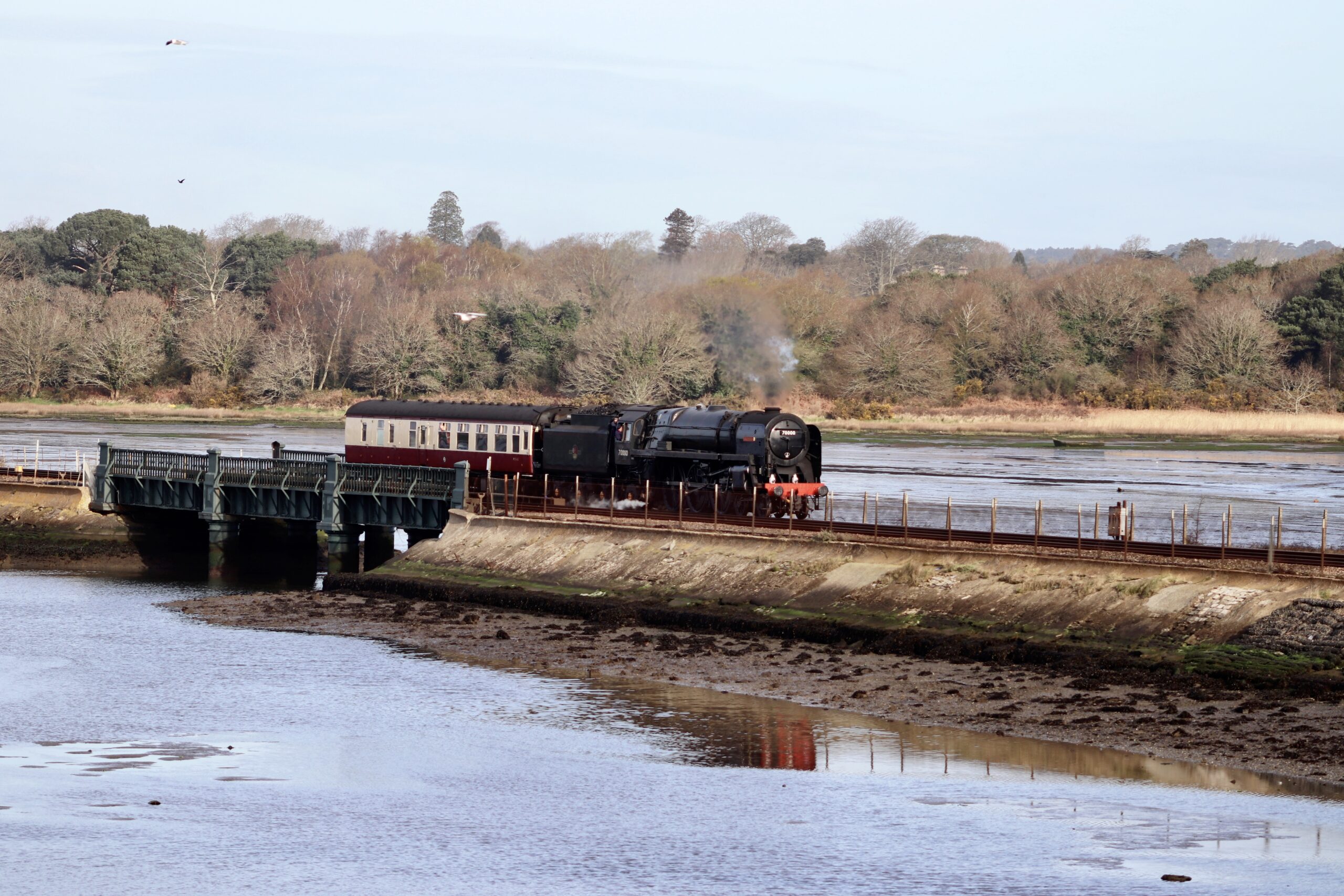
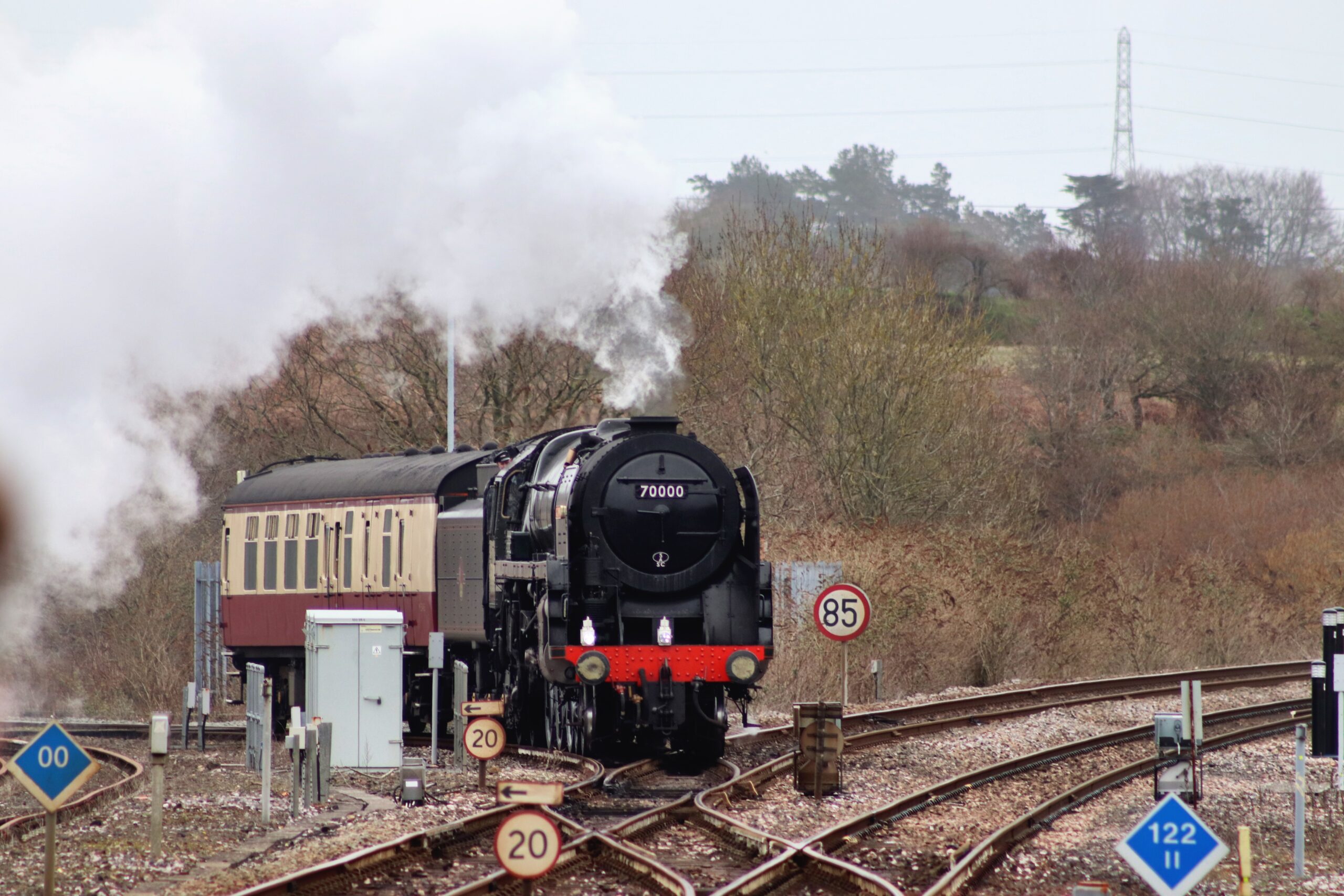
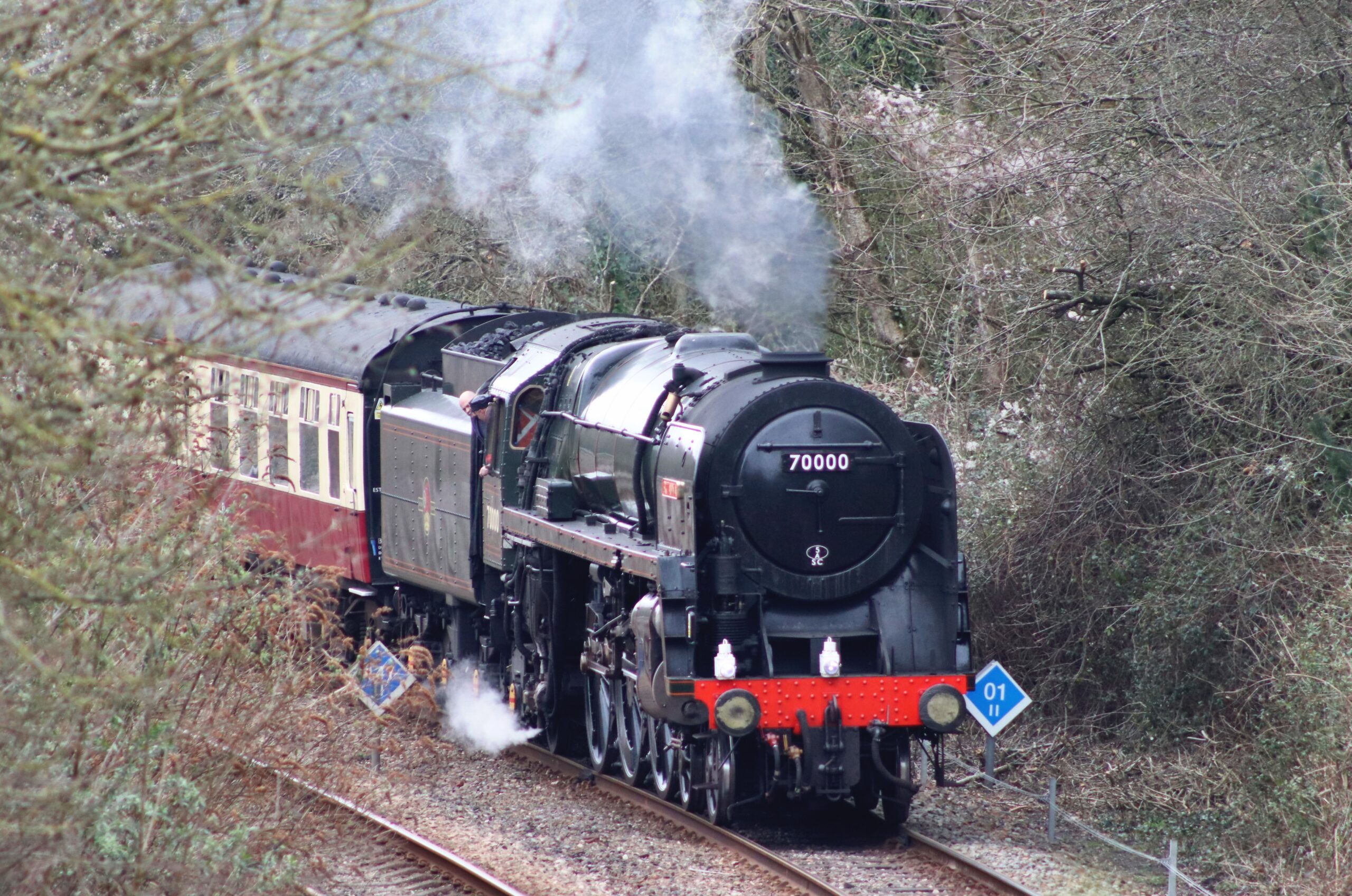
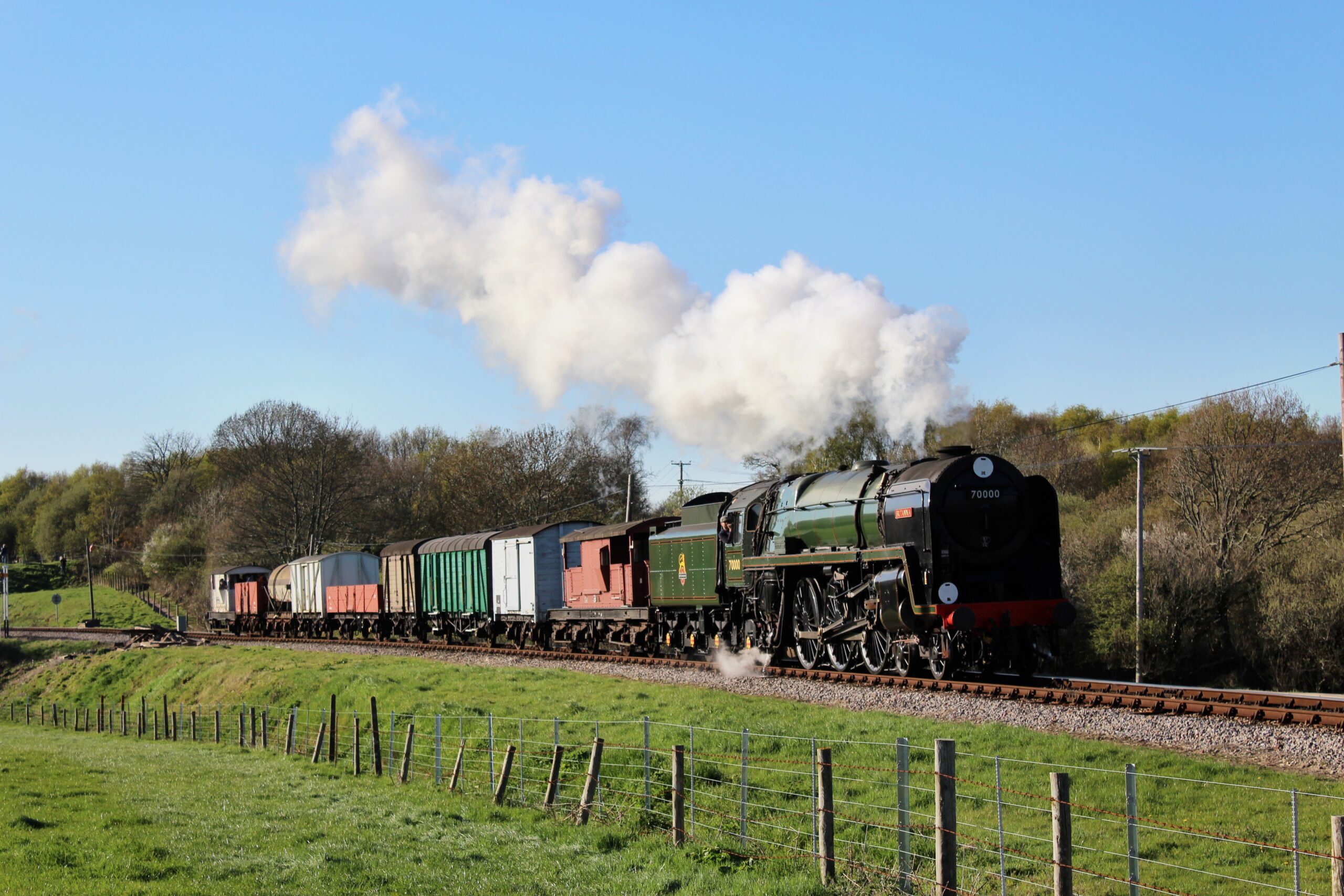
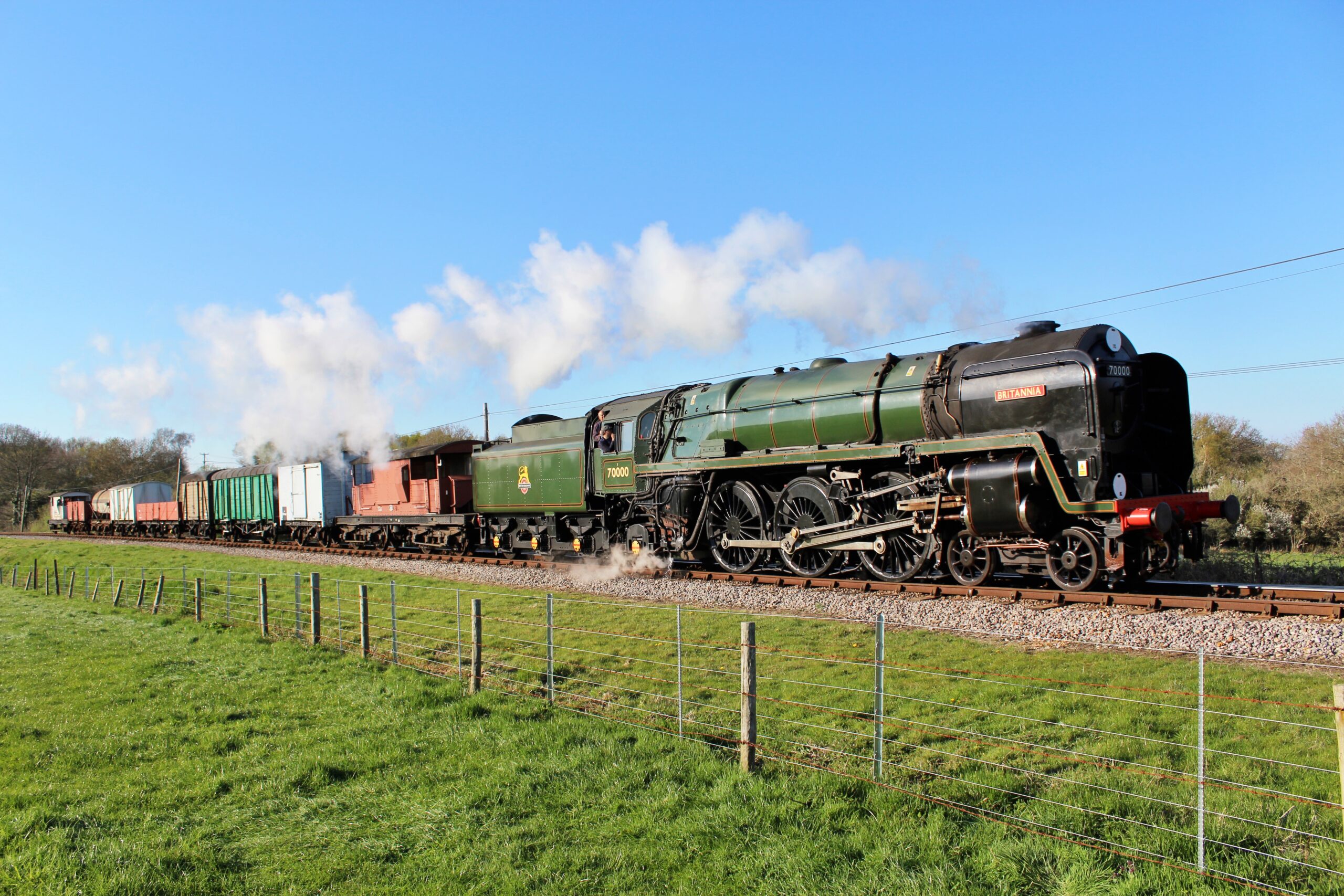
    On Tuesday 11th April, the Swanage Railway said good-bye to British Railways Standard Class 7 No. 70000 ‘Britannia’ as she returned to her base at Locomotive Services Limited in Crewe. We caught her crossing the Holes Bay causeway in Poole. During her stay in The Purbeck’s the Brit was star guest at the Swanage Steam Gala and was utilised on sell out driver training events.

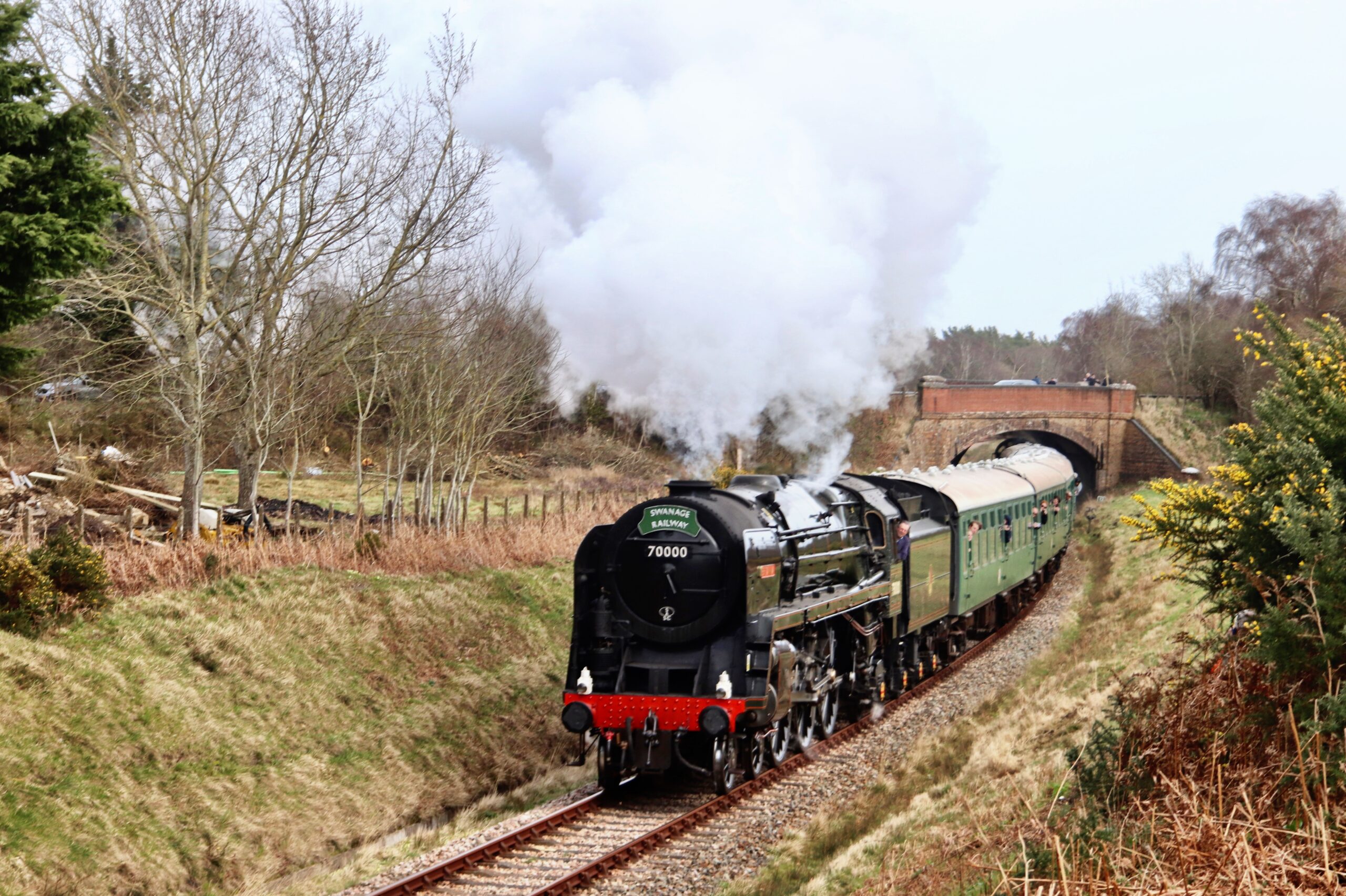
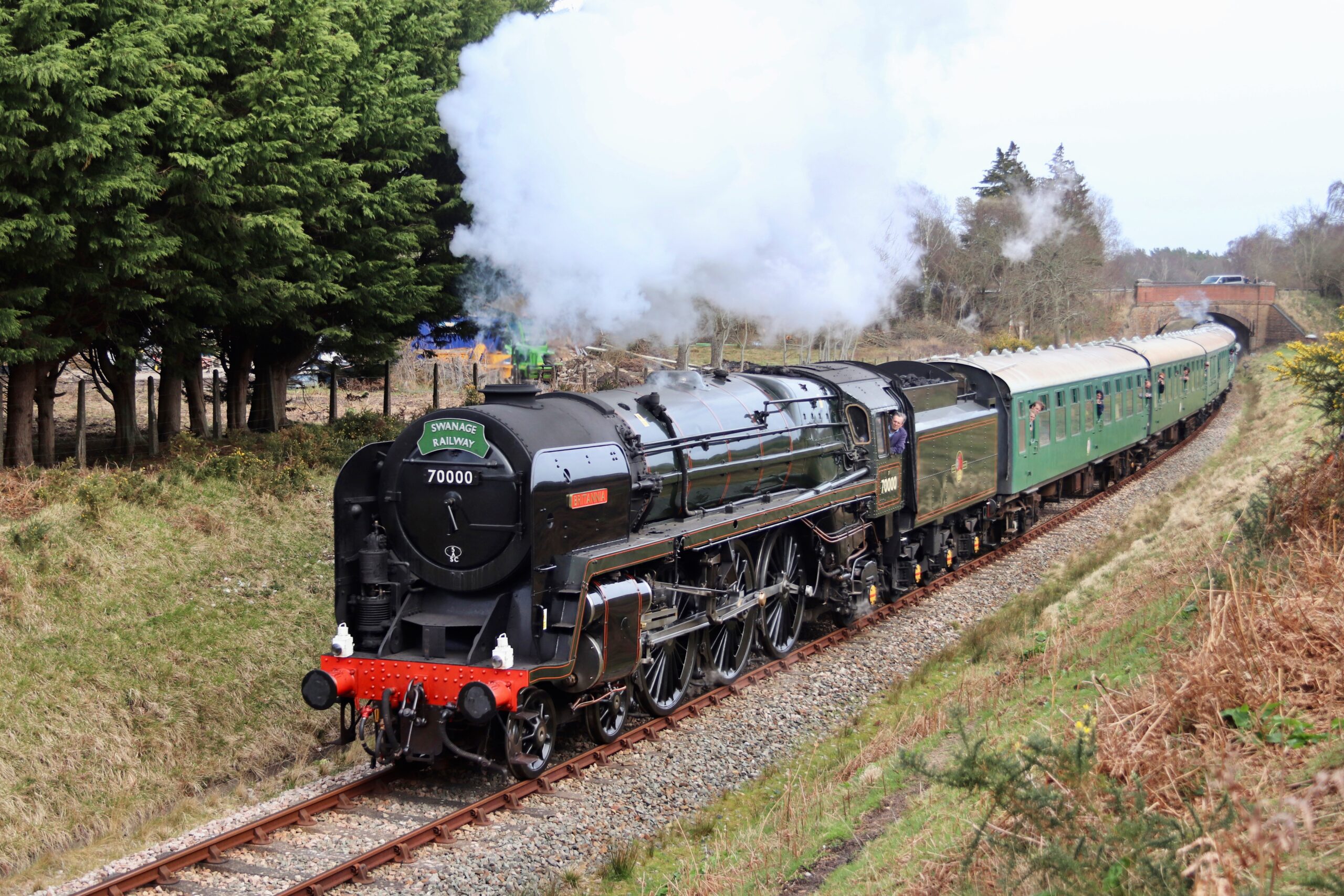
    British Railways Standard Class 7 No. 70000 ‘Britannia’ crosses Holes Bay working 5Z72 0720 Swanage to Crewe H.S. – 11/04/2023
    Video of ‘Britannia’ at Holes Bay – 11/04/2023

    Easter Monday saw the monthly GBRf Class 73 hauled test train originating from Derby Railway Technical Centre visit Weymouth. Because of engineering work in the Basingstoke / Winchester area, this working was diverted via Guildford. Which was a shame as I was visiting friends in Basingstoke. However, I was back in Dorset just in time to see the early running ensemble pass through Poole on the return run from Weymouth heading to Eastleigh East Yard.

    GBRf Class 73 No.’s 73965 ‘Des O’Brien’ and 73963 ‘Janice’ working 1Q51 1115 Derby RTC to Eastleigh East Yard pass Poole – 10/04/2023
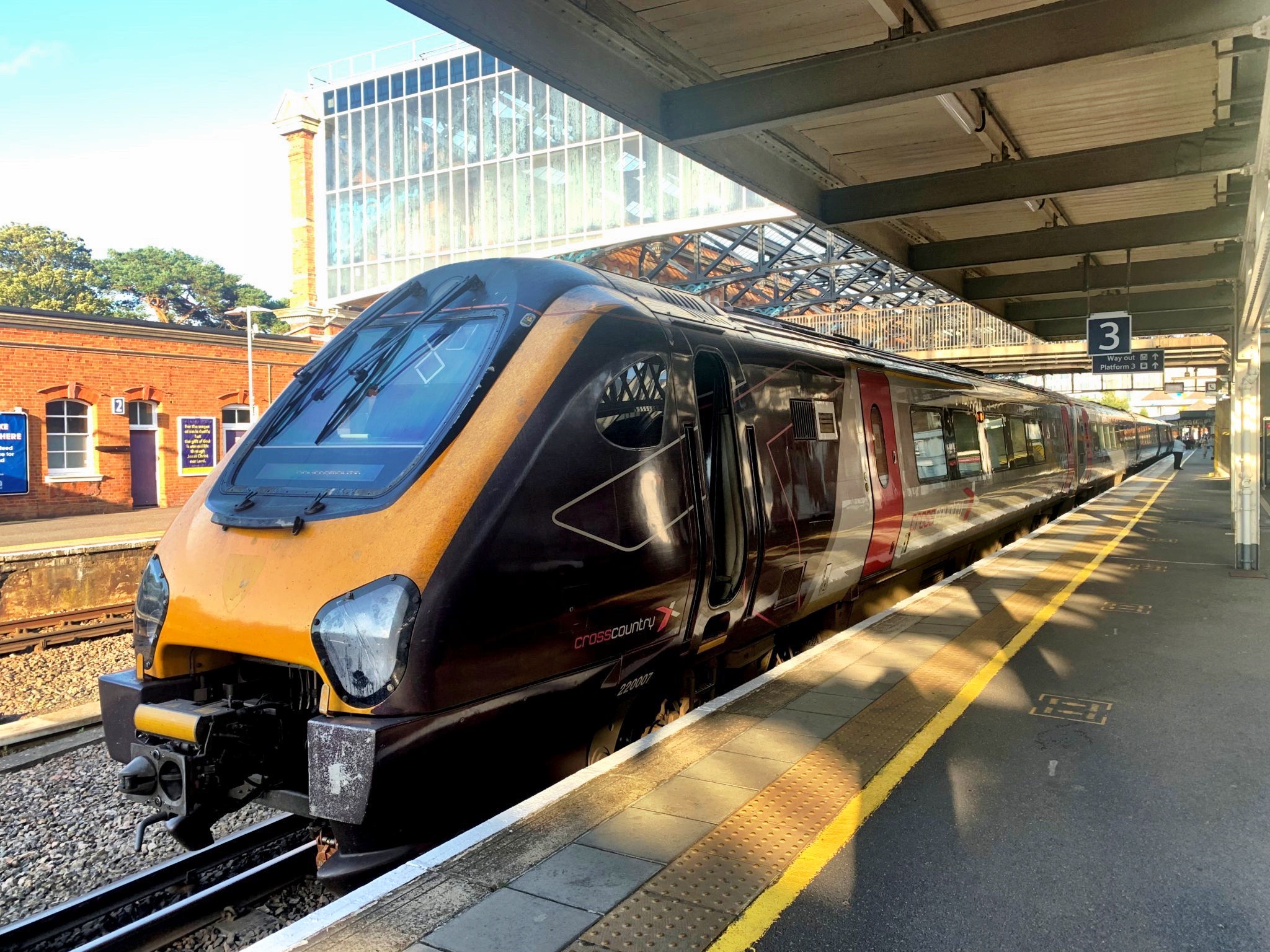
    CrossCountry Voyager Class 220 No. 220007 at Bournemouth – 28/07/2021

    CrossCountry train services from Bournemouth to the North as well as freight from Southampton have been affected by the closure of the Nuneham Viaduct near Abingdon in Oxfordshire. Network Rail have been carrying out stabilisation works on the viaduct in recent weeks and monitoring equipment detected significant movement over the weekend of 1st/2nd April with the result that the bridge was temporarily closed on 4th April along with the railway between Didcot Parkway and Oxford to ensure the safety of passengers.

    Network Rail advised CrossCountry passengers; “Trains will be revised to run in two portions; between Bournemouth and Didcot Parkway and between Oxford and Manchester Piccadilly. Limited replacement road transport is in operation between Didcot Parkway and Oxford. Customers travelling between Bournemouth/Reading and Banbury/Birmingham/Manchester are advised to travel via London stations or Bristol stations. This is due to limited availability of road transport at Didcot Parkway.”

    Network Rail are working around the clock to install a temporary structure to stabilise Nuneham Viaduct, so trains can safely run again by Saturday 10 June. Place your bets….

    That’s all we have time for this week. Thanks agin for joining us. We’ve been busy catching up with friends and eating chocolate over the Easter weekend just gone. Mmmhhh, chocolate.

  • Mostly Britannia

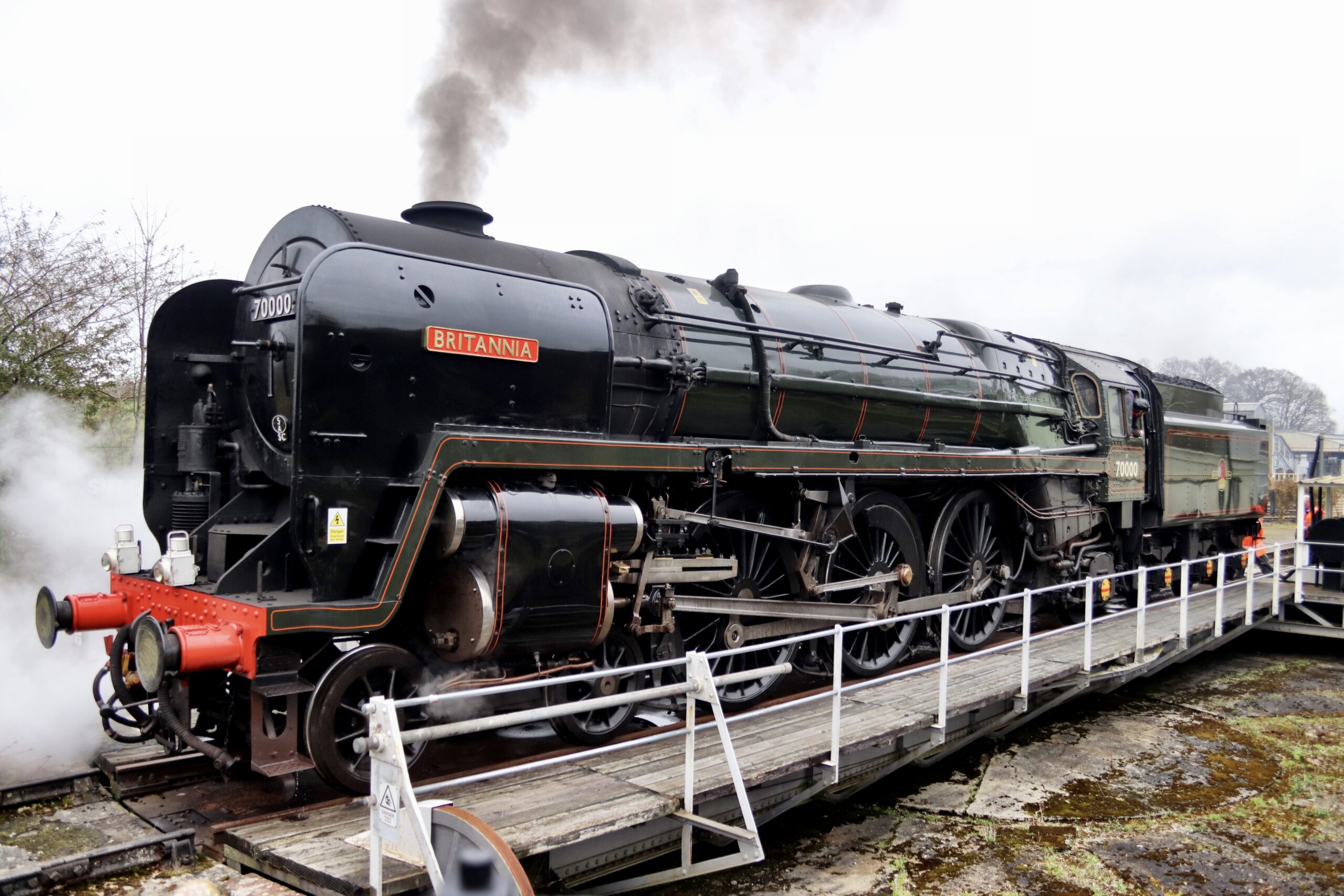
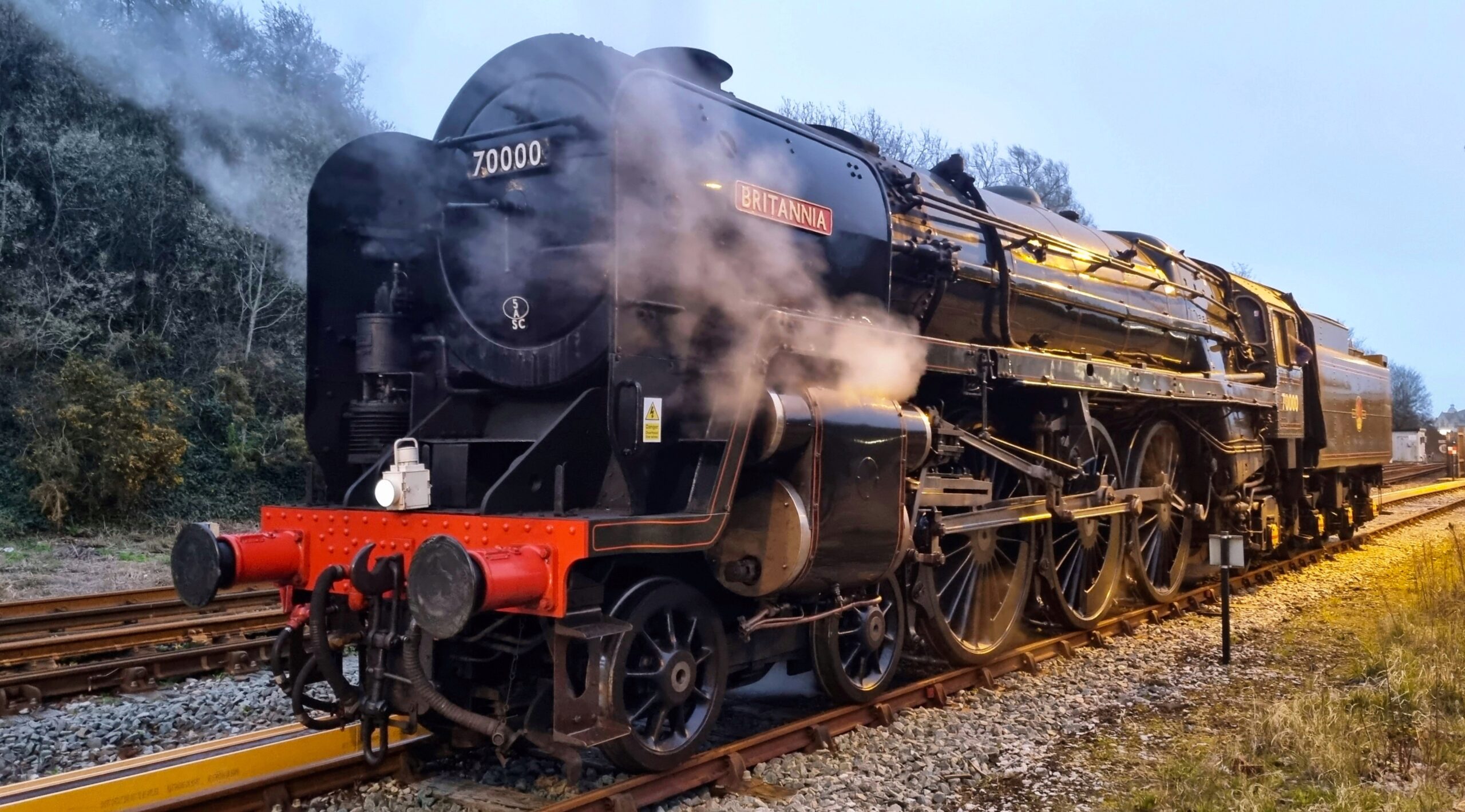
    British Railways Standard Class 7 4-6-2 No. 70000 ‘Britannia’ on the turntable at the Yeovil Railway Centre – 22/03/2023

    Hello there – after a week away, we are back with a lot to catch up on. We hope you found last times Beeching blog of interest – it’s certainly a period in railway history which incites discussion and reflection. This time we are concentrating on more recent events concerning the Swanage Railway including our visit to their excellent March 2023 Steam Gala – which featured British Rail Standard Class 7 4-6-2 No. 70000 ‘Britannia’ – and the first diesel multiple unit train departing Wareham connecting the Purbeck heritage railway to the main line. 

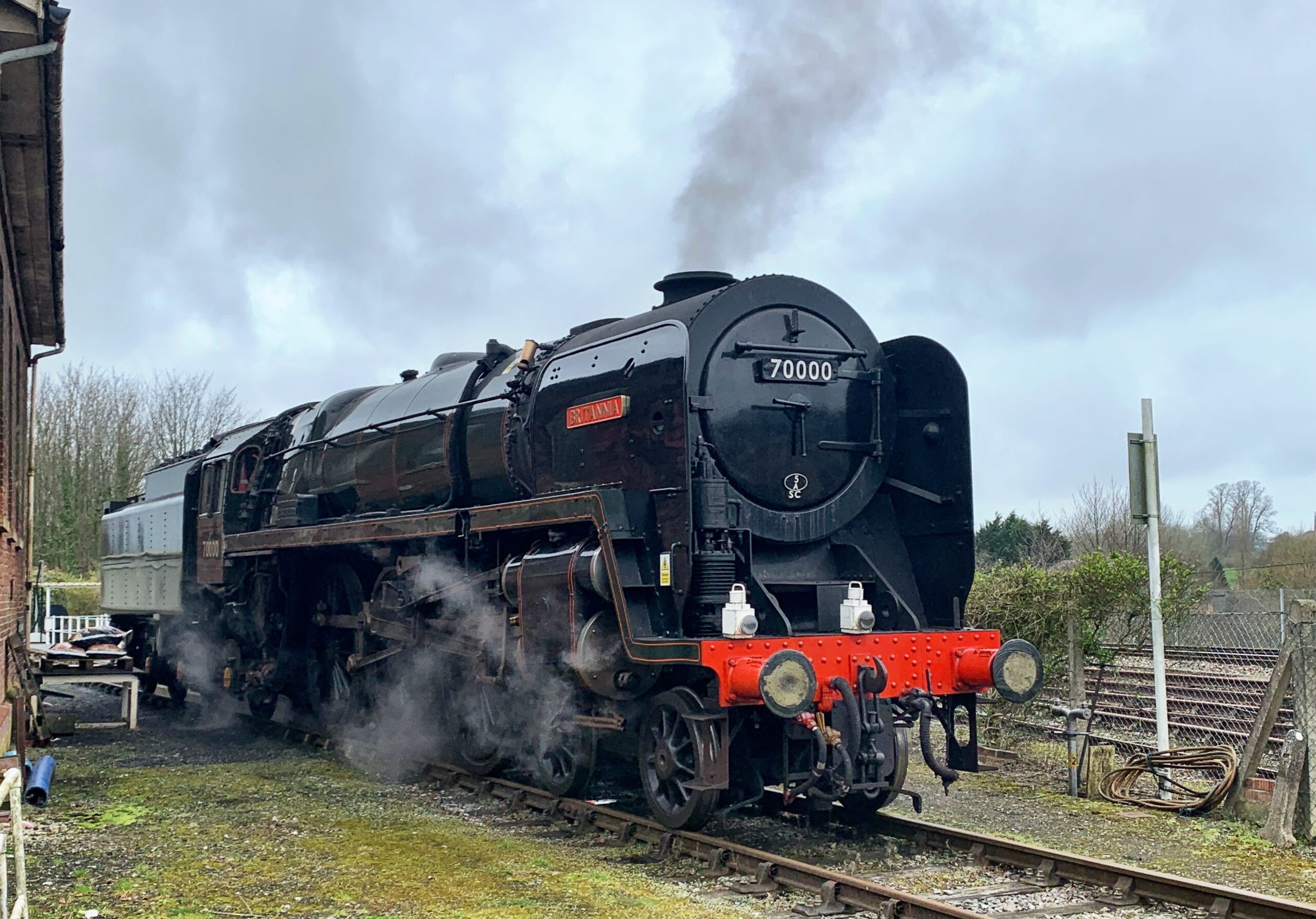
    British Railways Standard Class 7 4-6-2 No. 70000 ‘Britannia’ approaches Yeovil Junction working 5Z70 Crewe HS to Swanage having used the connecting curve from Yeovil Pen Mill – 22/03/2023

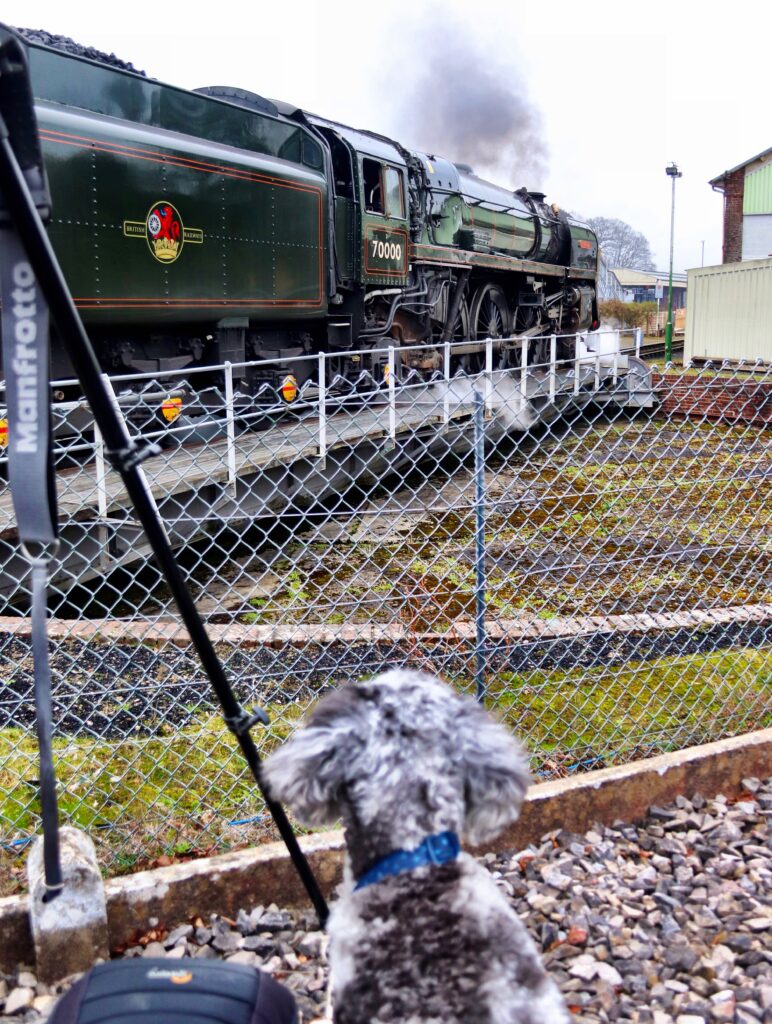
    On Wednesday 22nd March 2023, we headed over to Yeovil to see No. 70000 ‘Britannia’ arrive at Yeovil Junction in readiness for her being turned on Yeovil Railway Centre’s turntable. I always enjoy watching locomotives on the turntable, and despite a few initial barks form Yoshi, he mostly watched on with quiet fascination.

    British Railways Standard Class 7 4-6-2 No. 70000 ‘Britannia’ is turned on the Yeovil Railway Centre turntable – 22/03/2023
    British Railways Standard Class 7 4-6-2 No. 70000 ‘Britannia’ after being turned at the Yeovil Railway Centre – 22/03/2023

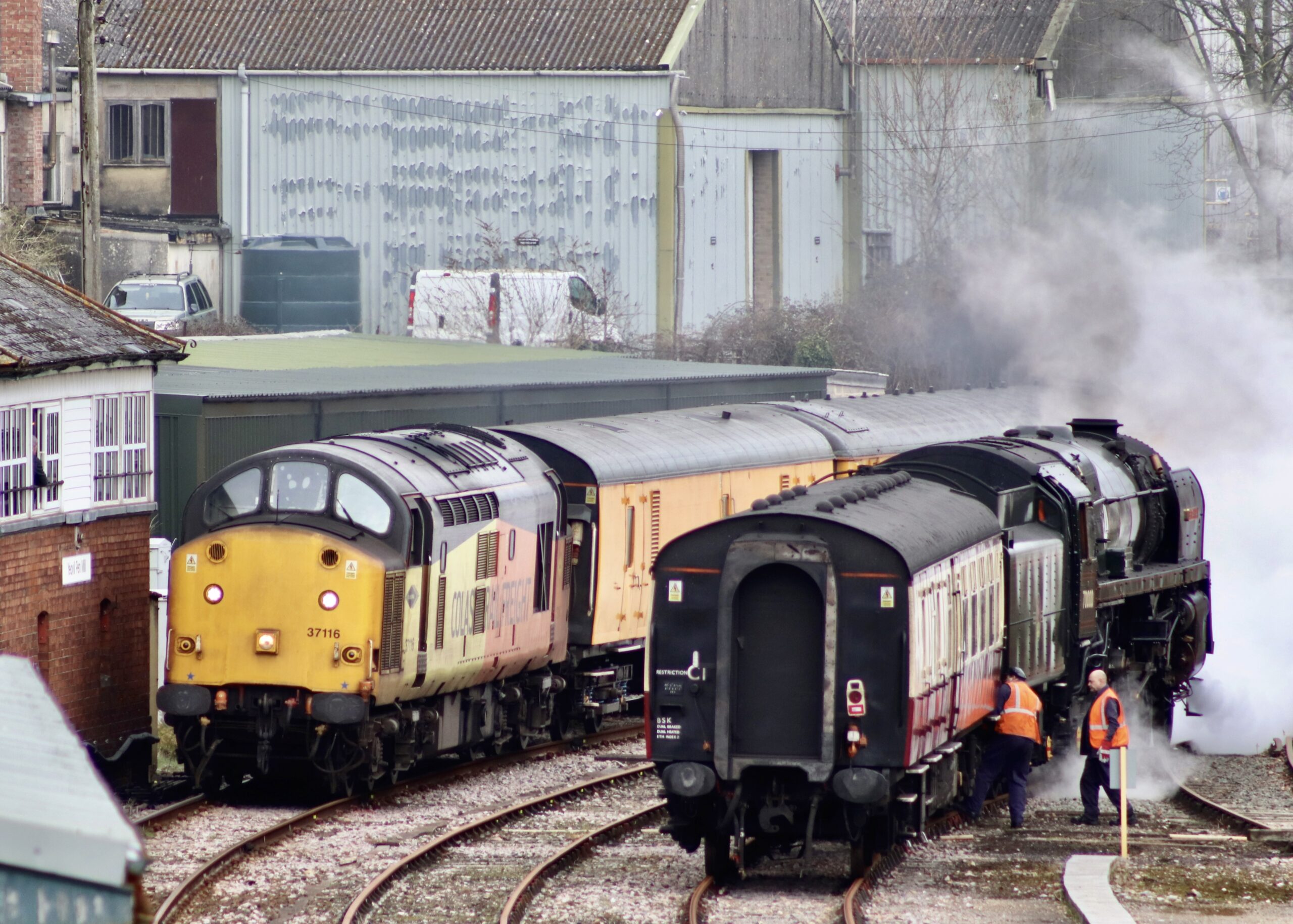
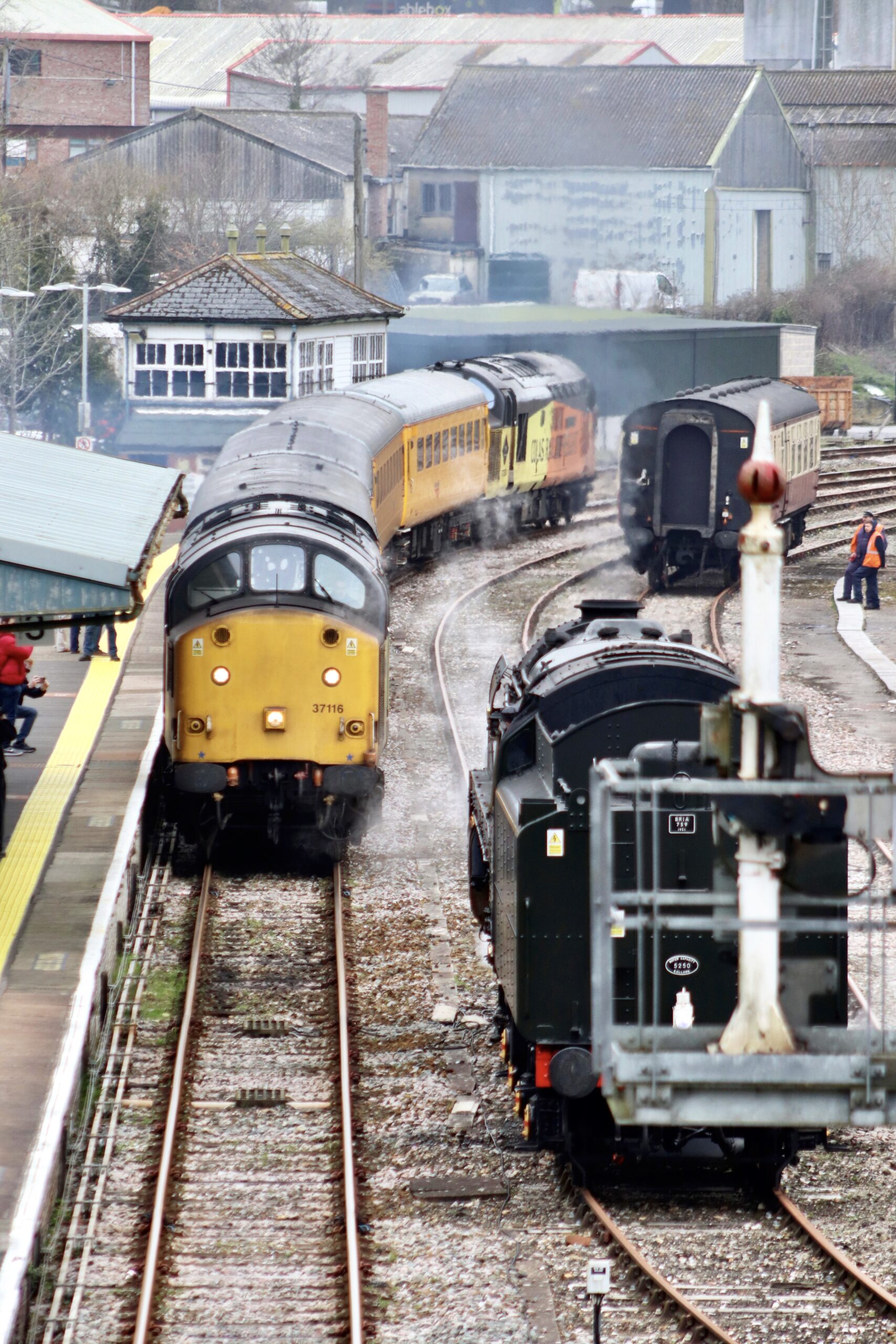
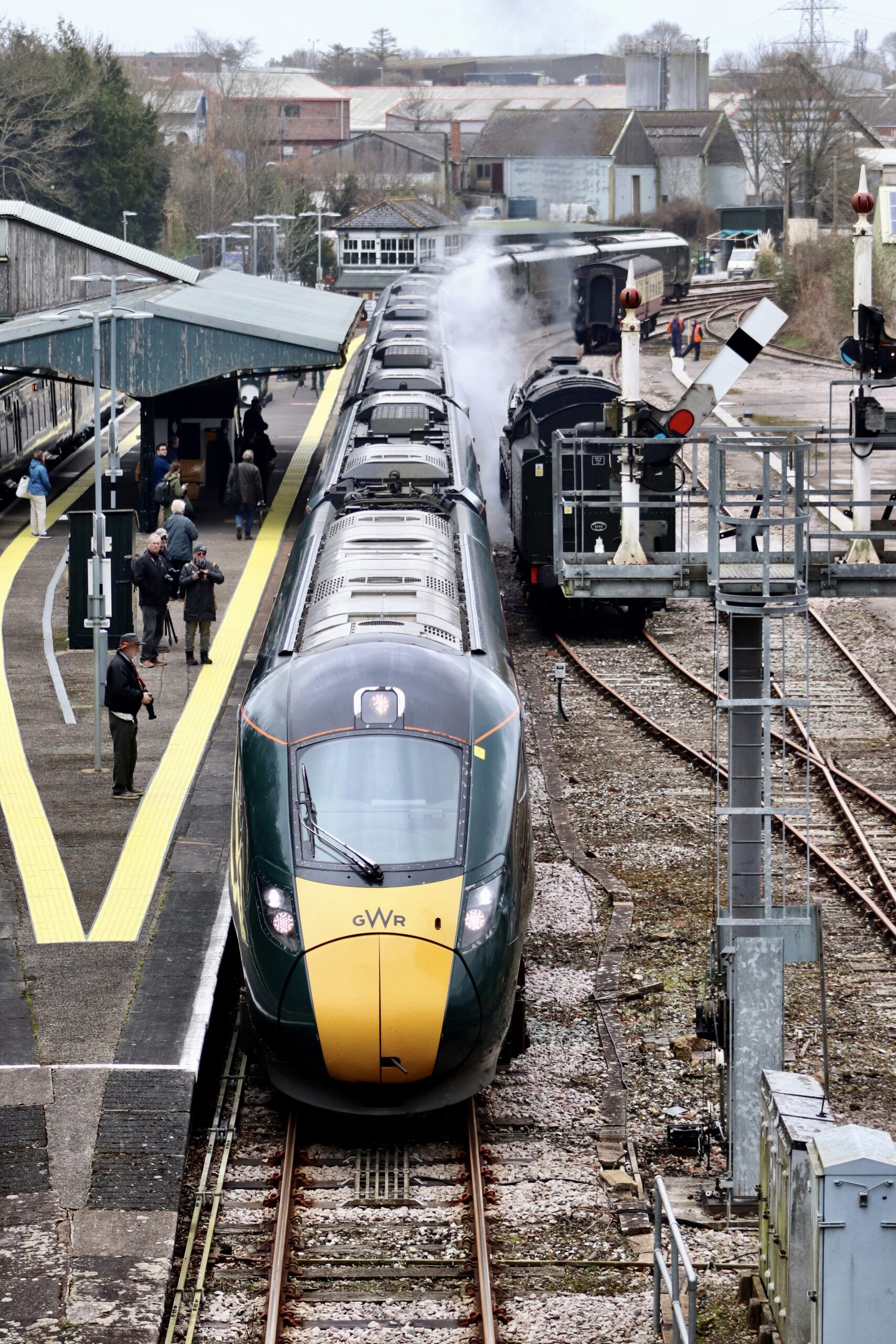
    Following her spin on the turntable, ‘Britannia’ backed out onto the main line at Junction station and we drove down to Yeovil Pen Mill so that we could capture a pair of Class 37 diesel locomotives working test train 1Z22 Derby Railway Technical Centre to Bristol Kingsland Road via Weymouth which was scheduled to pass through at around 1500, 20 minutes or so before ‘Britannia’ was due to arrive at Pen Mill prior to a tender first run down to Weymouth. The test train, however, top and tailed by Colas No.’s 37116 and 37254 arrived at Pen Mill almost thirty minutes late and by this time ‘Britannia’ had already made the run down from Junction with her support coach. We were also able to see a Great Western Railway (GWR) Class 800 IET pass through on a divert as engineering work was taking place on the Taunton line and services to Exeter were taking the West of England route. 

    British Railways Standard Class 7 4-6-2 No. 70000 ‘Britannia’ having turned at Yeovil Junction nears Yeovil Pen Mill where she will run round her support coach before proceeding to Weymouth – 22/03/2023
    Colas Class 37 No. 37116 arrives at Yeovil Pen Mill with 1Z22 Derby Railway Technical Centre to Bristol Kingsland Road. British Railways Standard Class 7 4-6-2 No. 70000 ‘Britannia’ stands in the sidings waiting to run round her support coach before proceeding to run tender first to Weymouth – 22/03/2022
    Colas Class 37 No’s. 37116 and 37254 depart Yeovil Pen Mill top and tailing 1Z22 Derby Railway Technical Centre to Bristol Kingsland Road as No. 70000 ‘Britannia’ waits to reverse out of the station and back on to her support coach – 22/03/2023
    Great Western Railway Class 800 IET No. 802102 works the diverted 1C84 1404 London Paddington to Plymouth service through Yeovil Pen Mill – 22/03/2023
    British Railways Standard Class 7 4-6-2 No. 70000 ‘Britannia’ prepares to reverse out of Yeovil Pen Mill and run back in to couple up with her support coach – 22/03/2023
    British Railways Standard Class 7 4-6-2 No. 70000 ‘Britannia’ at Weymouth here she again ran around her support coach in preparation for the journey to Poole, where she again changes ends on the coach, before working back down to Swanage (Image courtesy of Scott Lewis) – 22/03/2023
    Video from Yeovil, Dorchester, Upwey and Hamworthy as British Railways Standard Class 7 4-6-2 No. 70000 ‘Britannia’ makes her way to Dorset having departed Crewe earlier in the day as working 5Z70 Crewe HS to Swanage (additional video courtesy of G E Barrett and Scott Lewis – 22/03/2023

    I had an idea that I would pop over to Yeovil Pen Mill at 2am some point during the week to see the Penzance sleeper services cross via the diversionary route, but decided to wait until warmer weather later in the year should the diversions take place again. However, our North Dorset Correspondent was far more intrepid and caught the following exchange as No. 57604 ‘Pendennis Castle’ passed No. 57602 ‘Restormel Castle’:

    GWR Sleeper trains on divert pass at Yeovil Pen Mill. Video courtesy of Scott Lewis – 24/03/2023

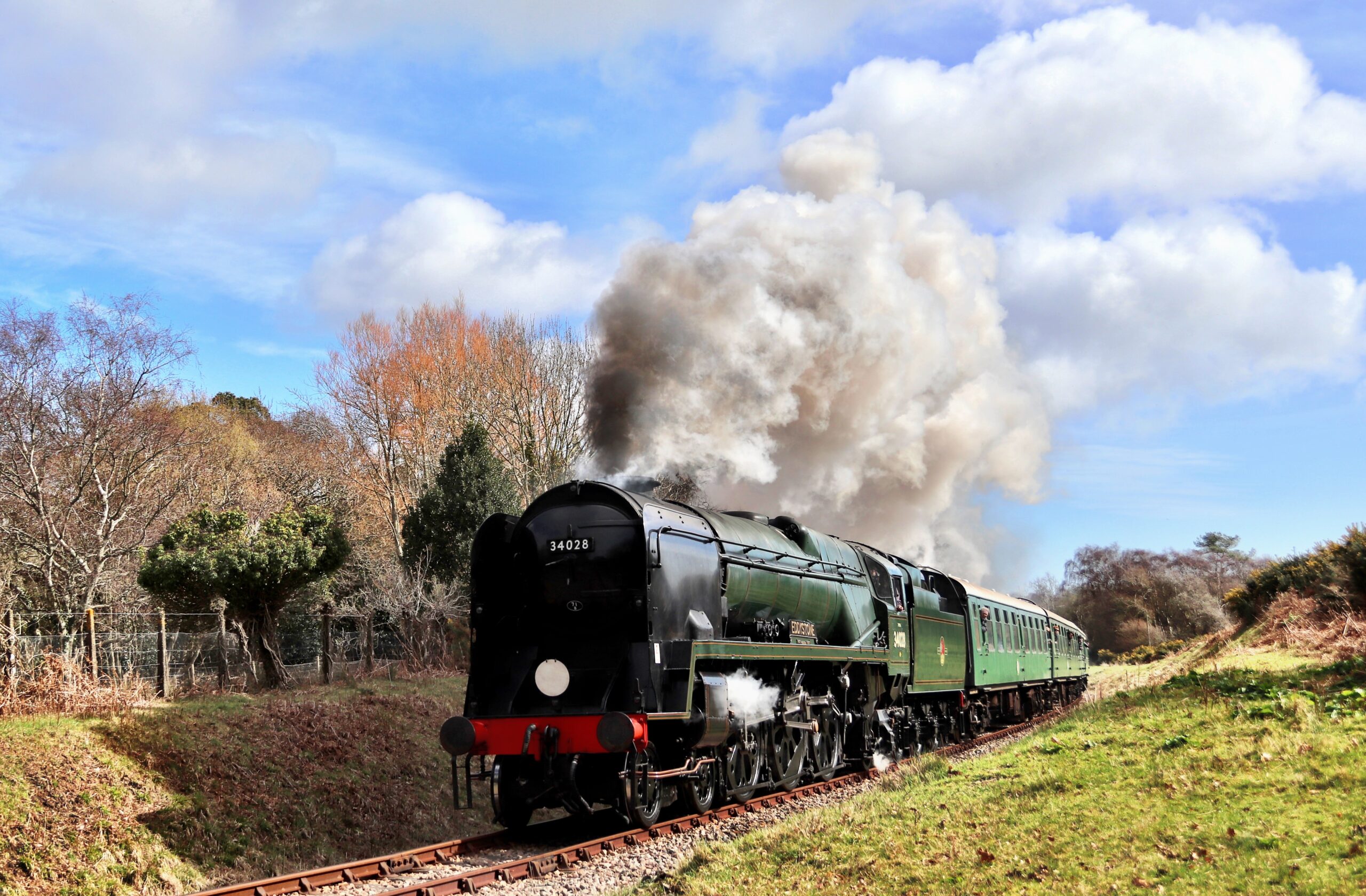
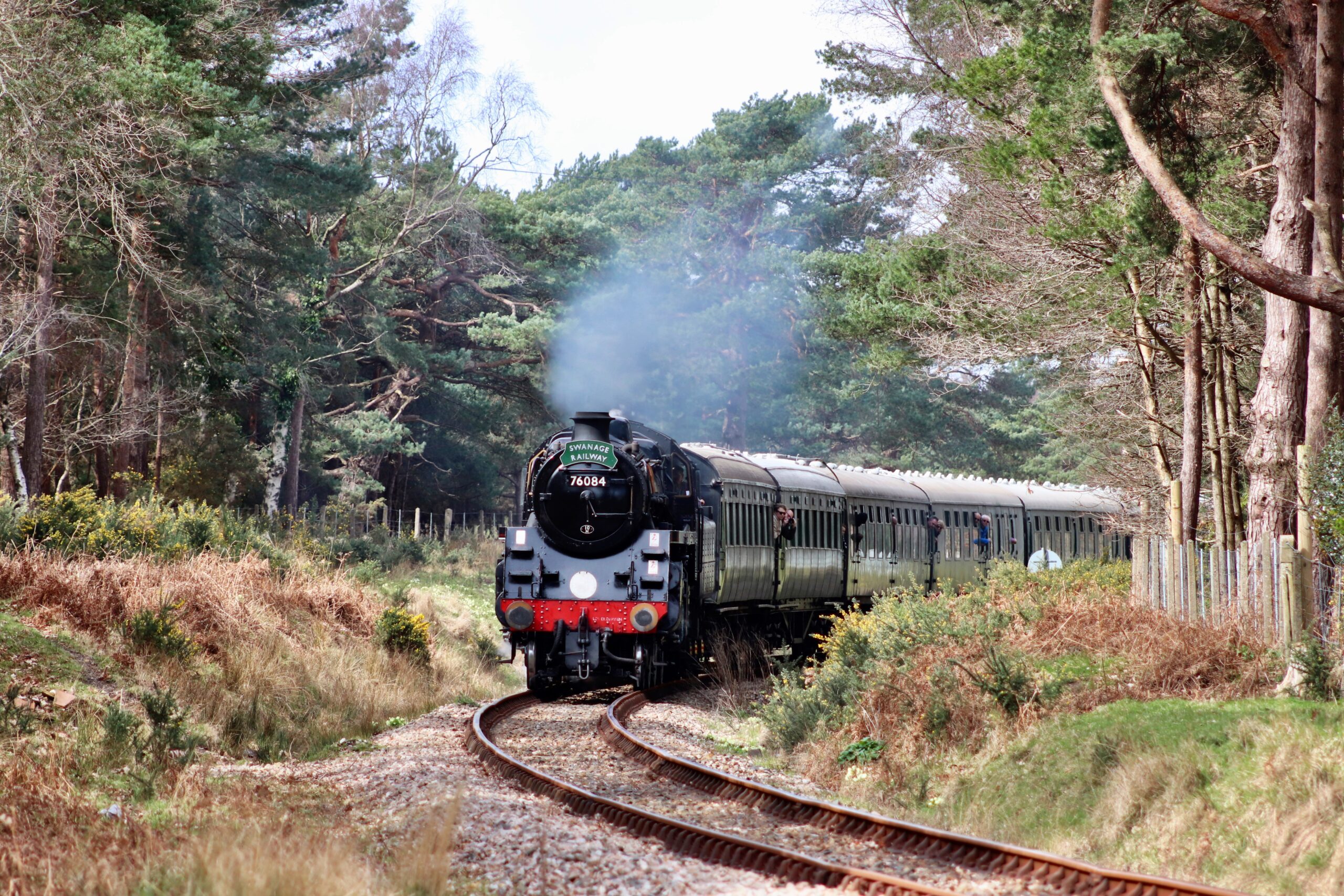
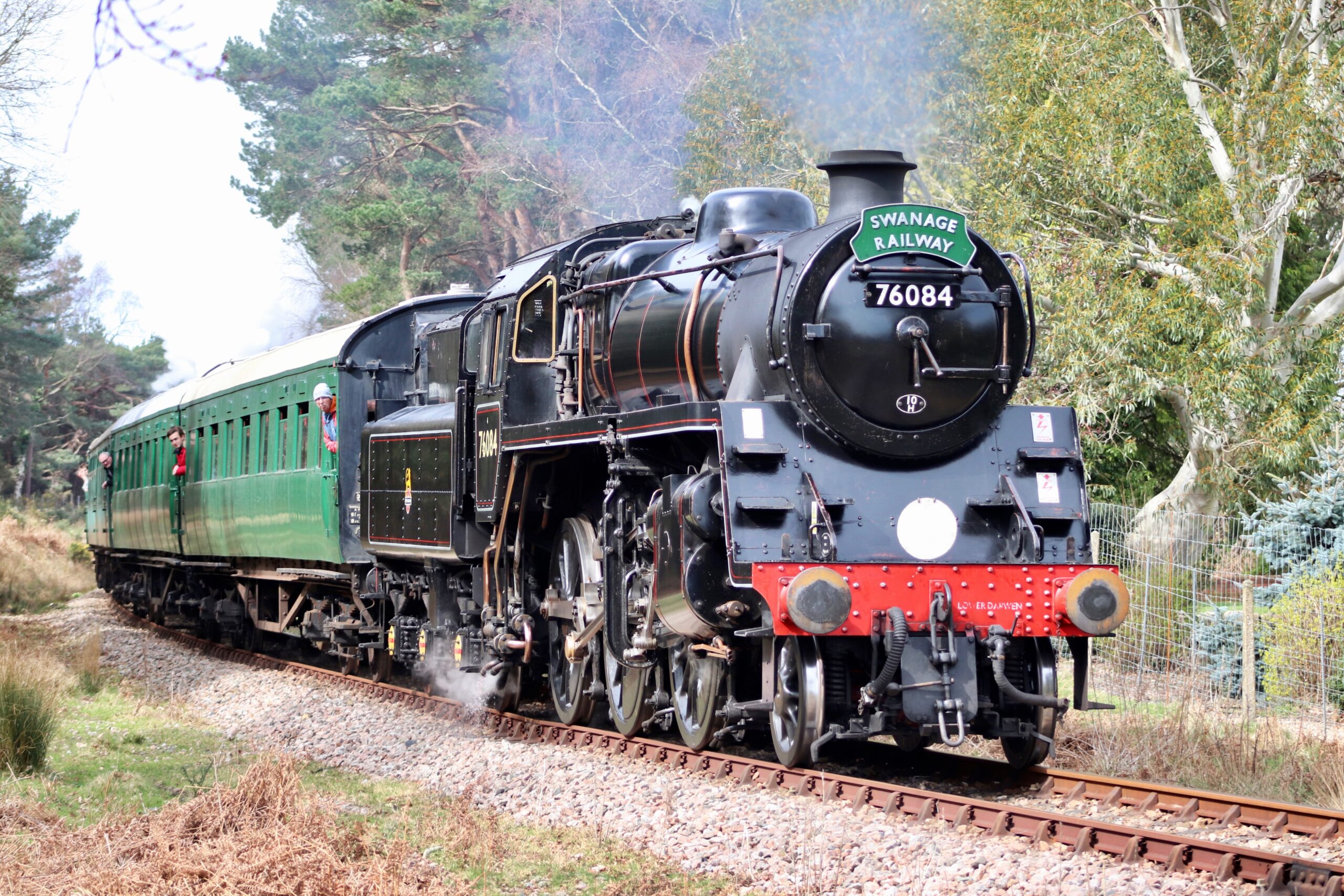
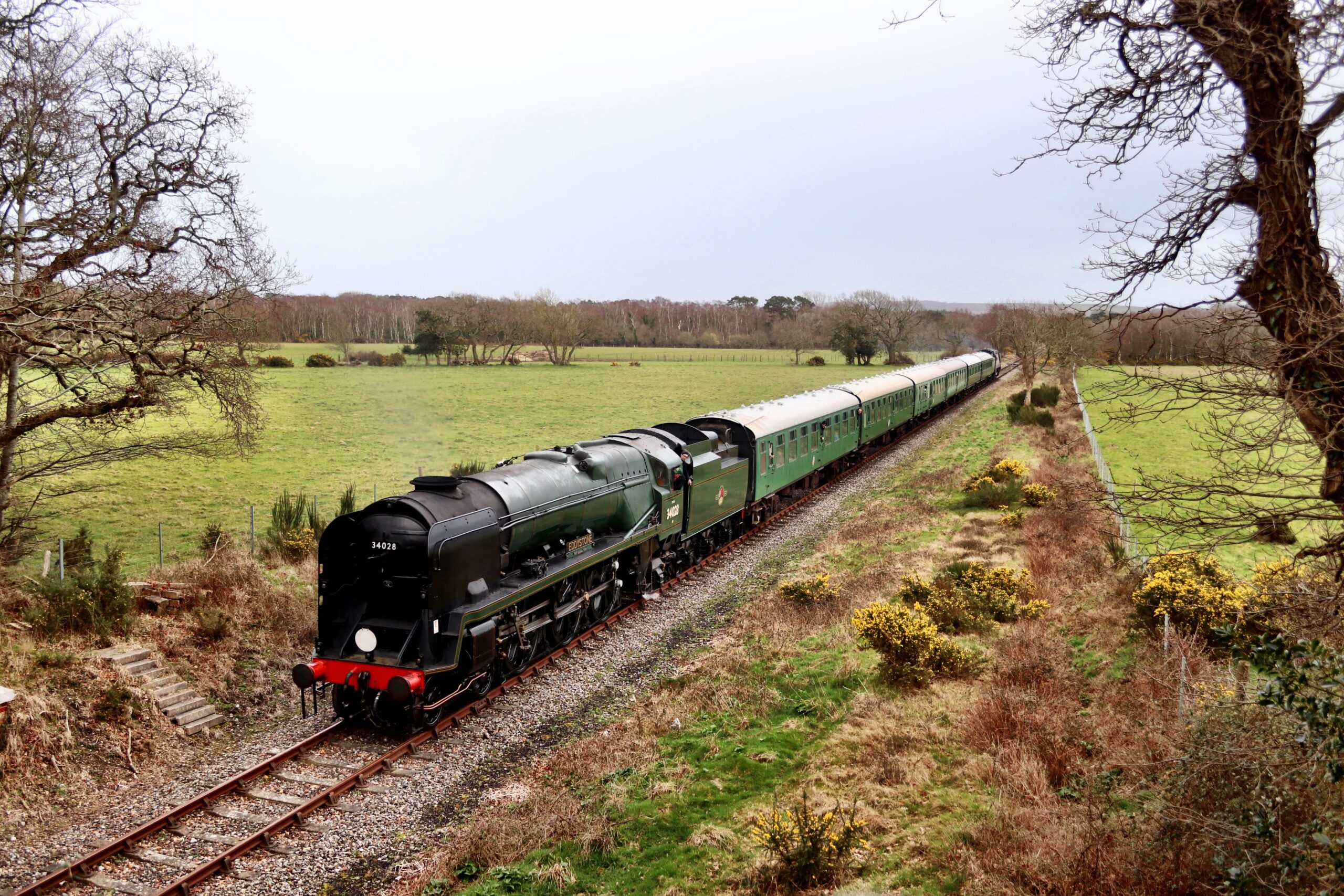
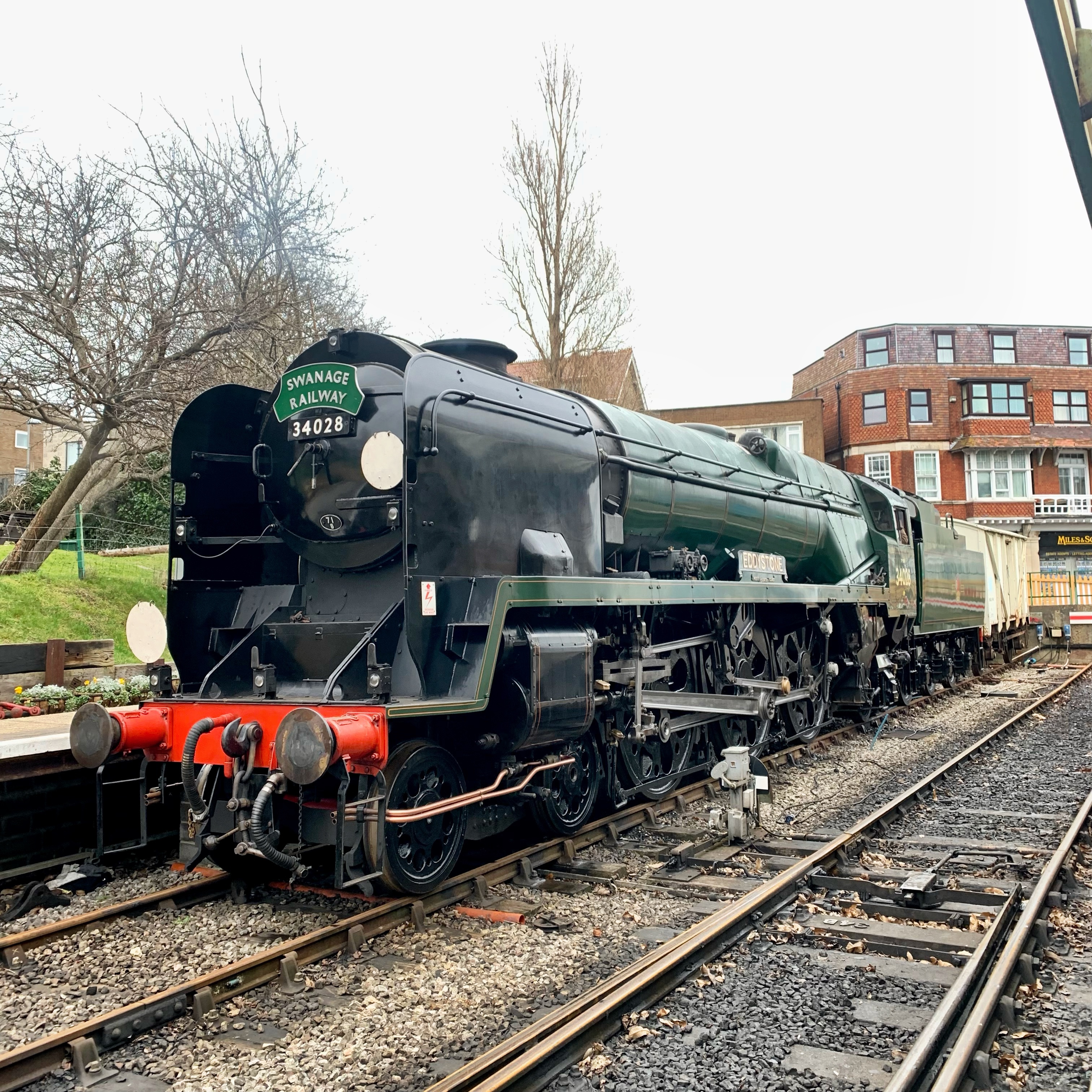
    Over the final March weekend, the Swanage Railway ran their popular Spring Steam Gala which featured ‘Britannia’ and BR Standard Class 4MT 2-6-0 No. 76084 as guest locomotives alongside home fleet Southern Railway U Class No. 31806 and Southern Railway Bulleid Pacifics No. 34070 ‘Manston’ and No. 34028 ‘Eddystone’. I headed down to join in the fun on the Saturday leaving Yoshi with his mama. I had planned on seeing the first train of the day which was scheduled to be double headed – but I also needed to pop into Wareham and visit the Post Office – so my arrival at the National Trust car park at Corfe Castle was delayed and I just missed the ensemble pass. To make things worse, the National Trust tea room at the car park was closed, so no breakfast for me as I had left home with the idea of catching refreshment between trains. However, luckily for me, Jamie came to my rescue and very kindly shared his packed lunch so I didn’t waste away through the lack of nourishment. 

    A video snap shot of the 2023 Swanage Steam Gala – 25/03/2023
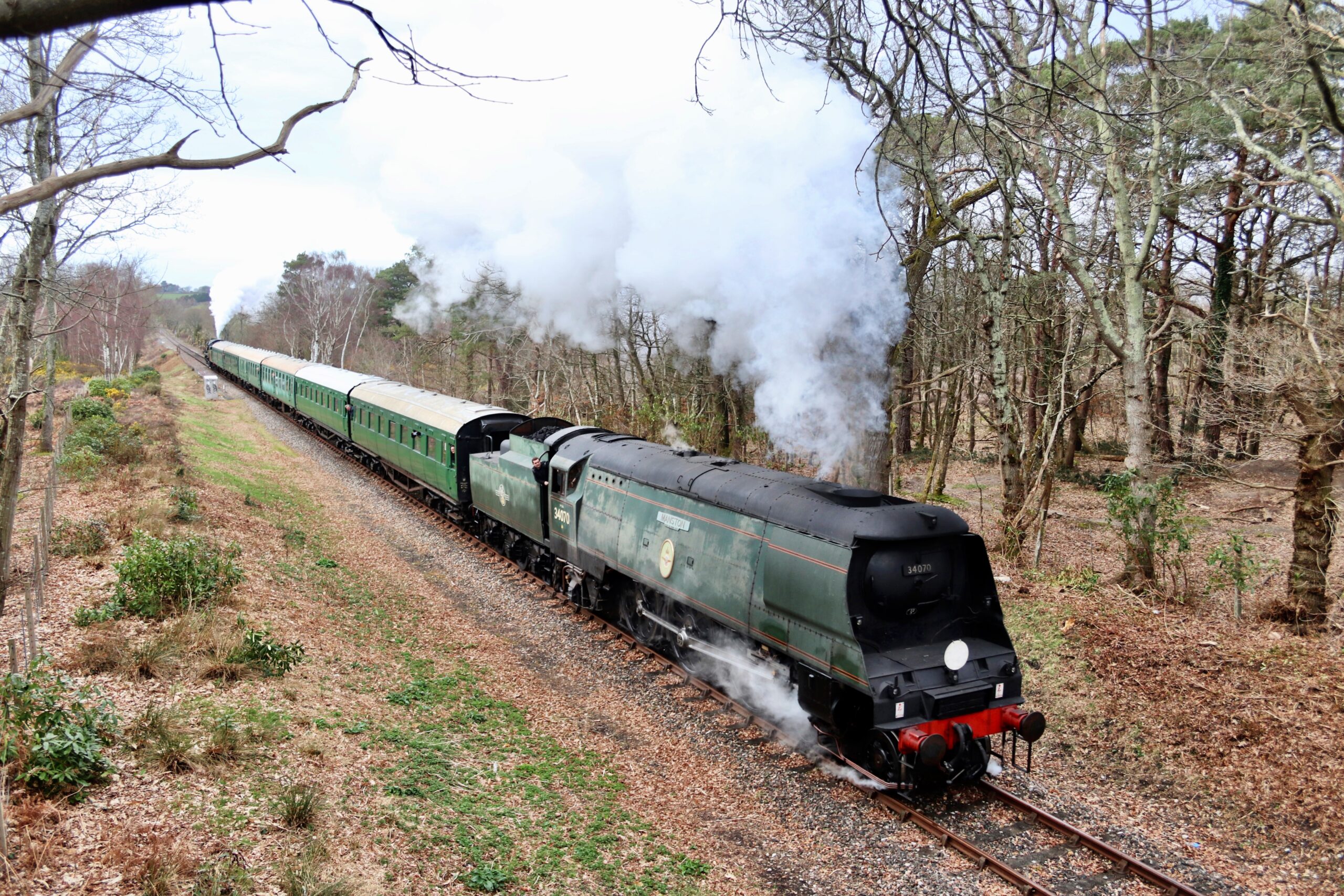
    Unrebuilt Battle of Britain Class Bulleid Pacific No. 34070 ‘Manston’ between Norden and Corfe Castle – 25/03/2023
    Rebuilt West Country Class Bulleid Pacific No. 34028 ‘Eddystone’ nears Cat’s Eye Crossing with a train bound fro the River Frome boundary – 25/03/2023
    Bulleid Pacific No. 34028 ‘Eddystone’ approaching Cat’s Eye Crossing – 25/03/2023
    BR Standard Class 4MT 2-6-0 No. 76084 nears Cat’s Eye Crossing – 25/03/2025
    BR Standard Class 4MT 2-6-0 No. 76084 approaching Cat’s Eye Crossing – 25/03/2023
    Bulleid Pacific No. 34028 ‘Eddystone’ approaches Holme Lane Bridge on the Swanage Railway – 25/03/2023
    Bulleid Pacific No. 34070 ‘Manston’ hauls a train away from the River Frome boundary – 25/03/2023
    British Railways Standard Class 7 4-6-2 No. 70000 ‘Britannia’ with a train heading towards the River Frome boundary passing under Cat’s Eye Bridge – 25/03/2023
    British Railways Standard Class 7 4-6-2 No. 70000 ‘Britannia’ nears Cat’s Eye Crossing – 25/03/2023

    Undoubtably the star of the gala; No. 70000 ‘Britannia’ was built at Crewe Works to a new design and entered servive in January 1951. She was the first British Railways Standard locomotive to be constructed and was the initial locomotive in the Britannia Class which went on to number 55 examples. The design of the ‘Britannias’ was based on best practice from the pre-nationalisation “Big Four” railway companies. The new classes were designed by Ernest Stewart Cox, under Robert Riddles who had previously designed the War Department Austerity 2-8-0 and 2-10-0  locomotives for use during World War 2. No. 70000 was named ‘Britannia’ during a ceremony held at Marylebone station by Minister for Transport Alfred Barnes on the 30th January 1951. ‘Britannia’ had the honour of hauling the funeral train of King George VI from King’s Lynn to London in February 1952, for which she had her cab roof painted white as was the custom for royal locomotives. No. 70000 was withdrawn after only 15 years of service in May 1966 and was initially destined for the National Collection, but was passed over for sister locomotive No. 70013 ‘Oliver Cromwell’. She was saved from the cutter’s torch by the Britannia Locomotive Company Ltd. She is currently operated by Locomotive Services Limited (LSL). One of most memorable main line steam locomotives when I used to enjoy the chase in the mid 1990’s, a video with footage of ‘Britannia’ from this period is below:

    No. 70000 ‘Britannia’ also visited the Swanage Railway in 2015 and I’ve dug out a few images of that time to share:

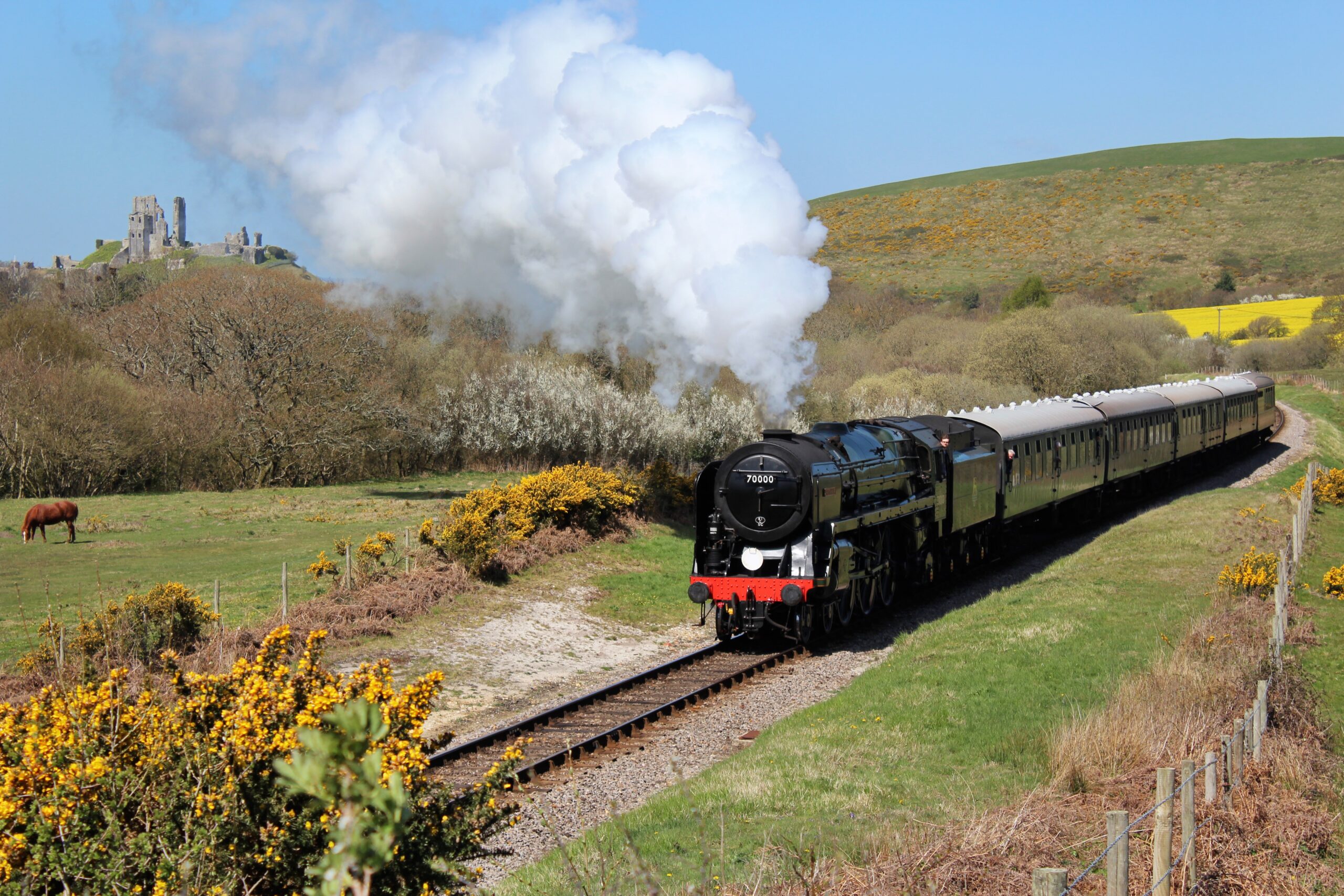
    British Railways Standard Class 7 4-6-2 No. 70000 ‘Britannia’ heads a Swanage bound service with Corfe Castle in the background – 18/04/2015
    British Railways Standard Class 4 2-6-4 No. 80104 double heads with BR Standard Class 7 4-6-2 No. 70000 ‘Britannia’ having just left Norden – 18/04/2015
    British Railways Standard Class 7 4-6-2 No. 70000 ‘Britannia’ works a demonstration freight nears Corfe Castle – 18/04/2015
    Another view of British Railways Standard Class 7 4-6-2 No. 70000 ‘Britannia’ working the Swanage Railway demonstration freight – 18/04/2015

    The Swanage Railway has also been in the news following their launch of a trial train service from main line Wareham through to the heritage branch line. Operating from April to September 2023, tickets for the service will also be available from South Western Railway (SWR) from late April so passengers can add tickets for Corfe Castle and Swanage to their main line tickets. This is the first time in 51 years that through ticketing to Corfe and Swanage has been possible. The last day of British Rail passenger services between Wareham, Corfe Castle and Swanage was on Saturday 1st January 1972 when the branch was closed. The eleven mile service, one mile of which running from Worgret Junction into Wareham station will be over main line Network Rail metals, will utilise restored and upgraded 1950’s Class 117 and Class 121 heritage diesel multiple units. The trial service will operate on Tuesdays, Wednesdays, Thursdays and Saturdays from 4th April to 10th September 2023, with the first train departing Wareham at 1119 and the last train leaving Swanage for Wareham at 1620 giving visitors the opportunity to spend four hours in Swanage or Corfe Castle. The timetable is subject to change on special event days. We popped over to Wareham to see the first service arrive and depart from Wareham.

    Swanage Railways Class 117 DMU leads into Wareham with the first trail service onto the main line – 04/04/2023
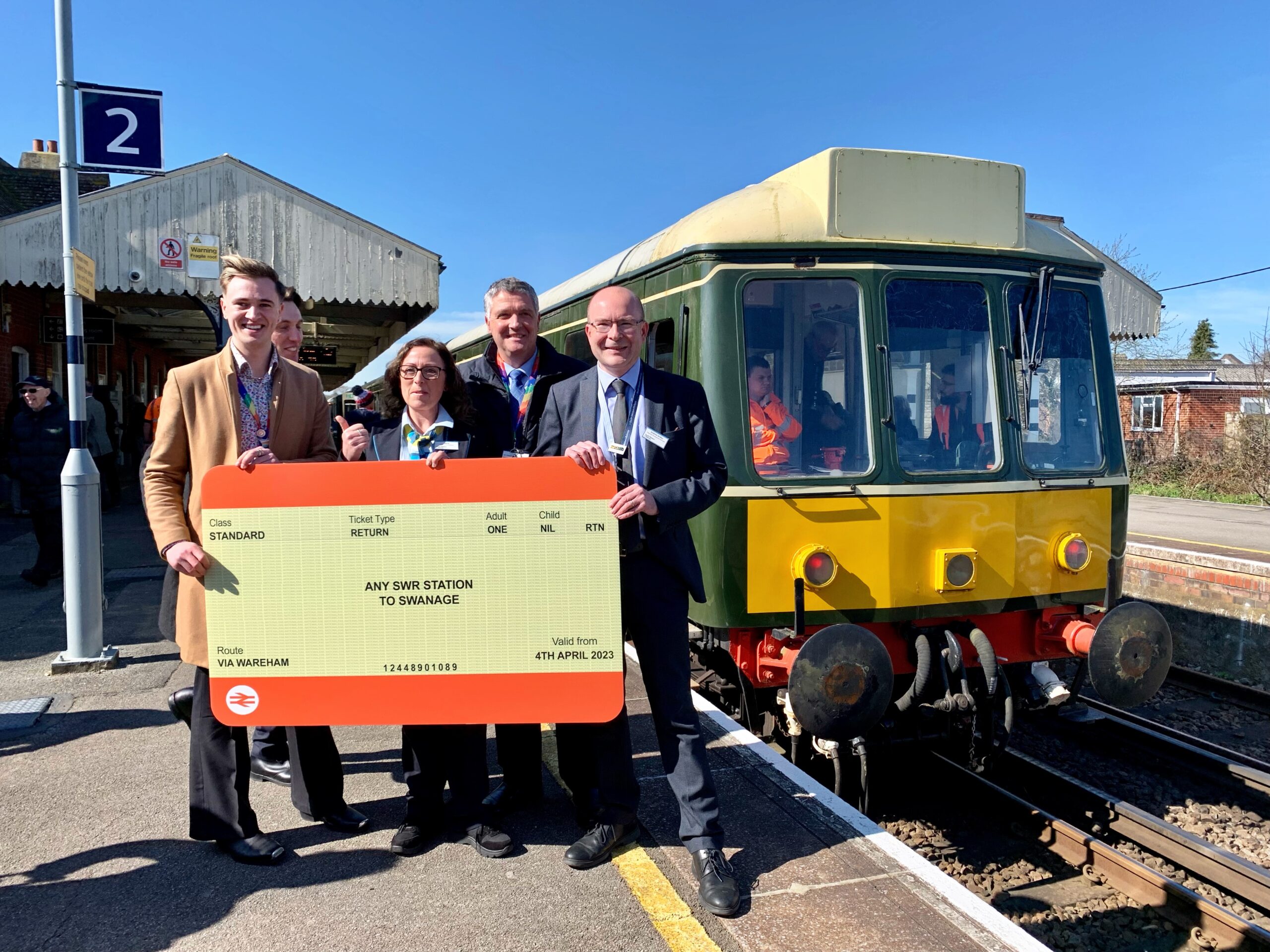
    South Western Railway staff pose at Wareham with an actual sized ticket to promote through ticketing to Corfe Castle and Swanage – 18/04/2023
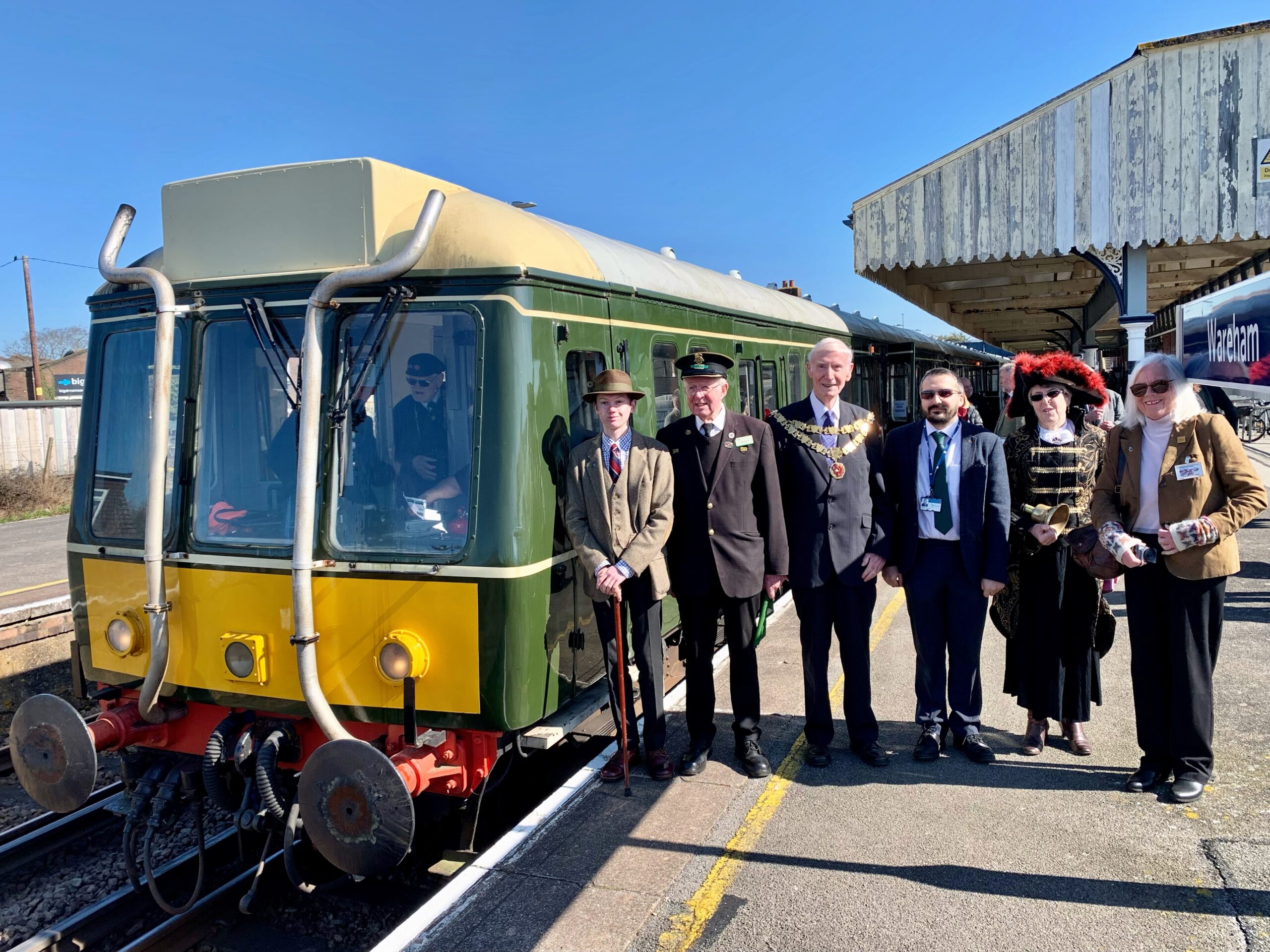
    Dignitaries pose in front of the single car Class 121 DMU at Wareham ahead of the first departure to Swanage – 04/04/2023

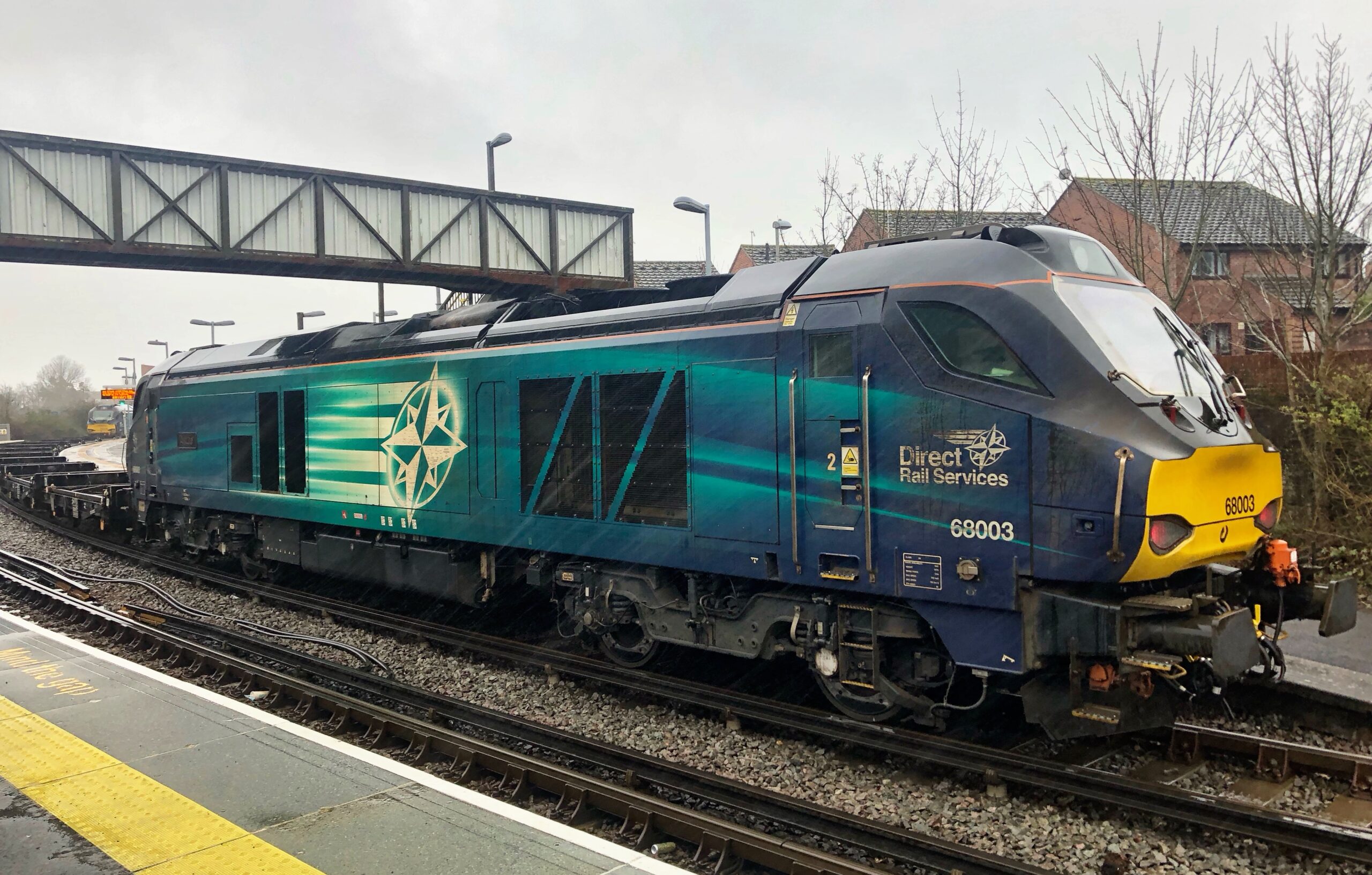
    A surprise run to Winfrith occurred on March 23rd 2023, timings only appearing on Real Time Trains late the previous day. Two new to Dorset Direct Rail Services (DRS) Class 68 locomotives top and tailed the train which interestingly returned empty to Crewe. It is thought that the high winds in evidence on the day meant it was unsafe to use the crane at Winfrith employed to load the low level nuclear waste onto the wagons.

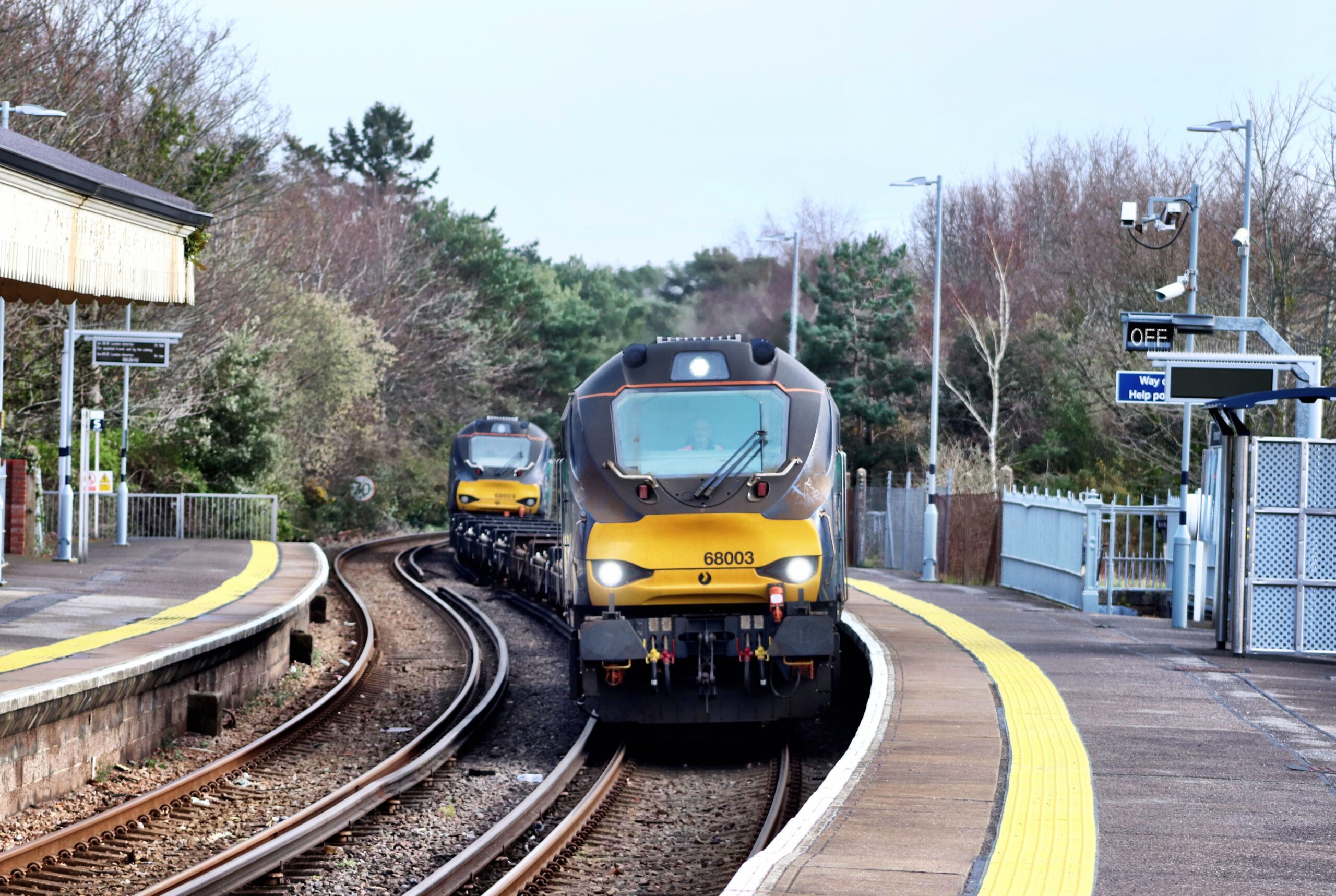
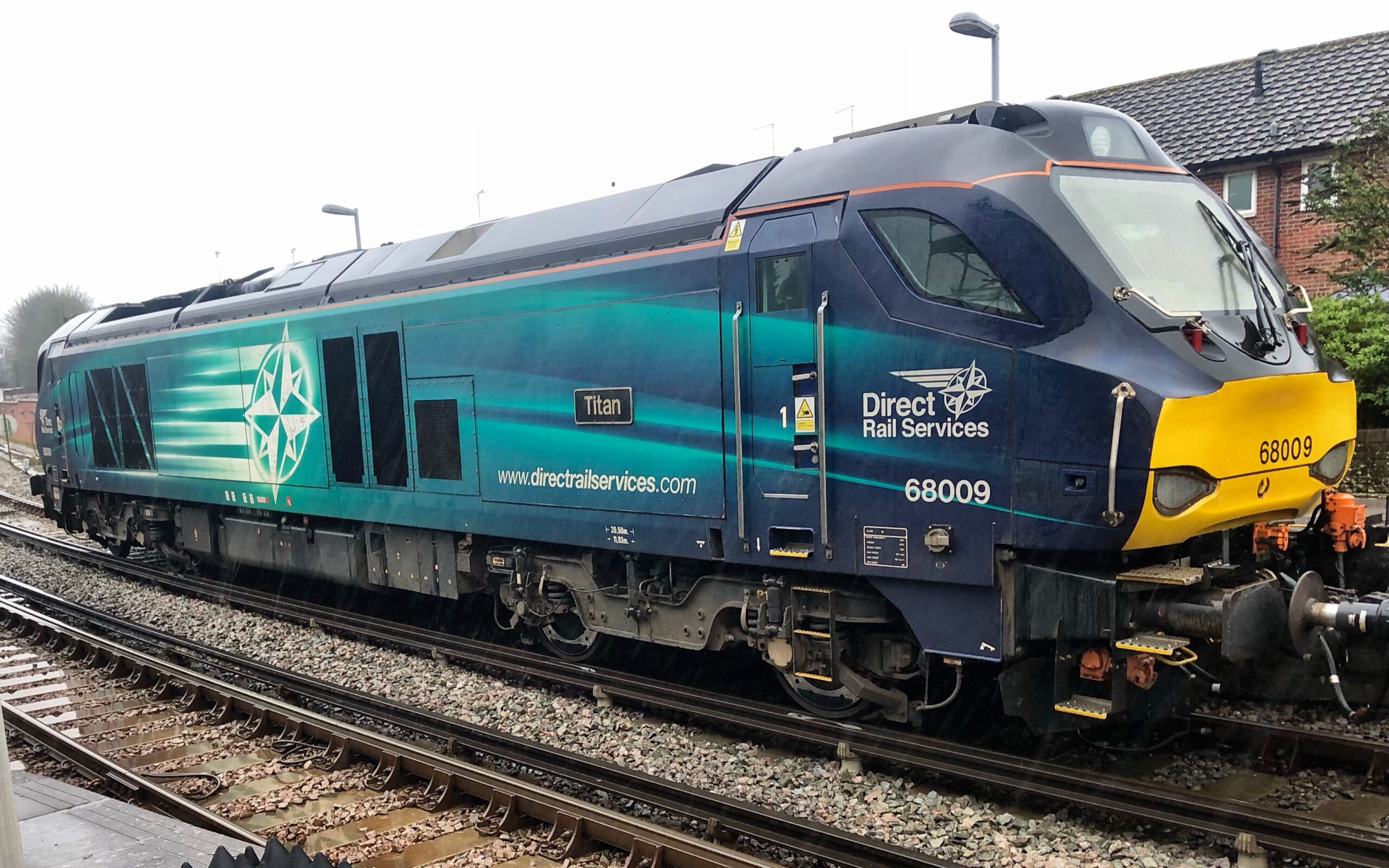
    DRS Class 68 No. 68003 ‘Astute’ heads up 6Z62 0100 Crewe Coal Sidings DRS to Wool Winfrith Sidings with classmate No. 68009 ‘Titan’ behind passing through Hamworthy – 23/03/2023
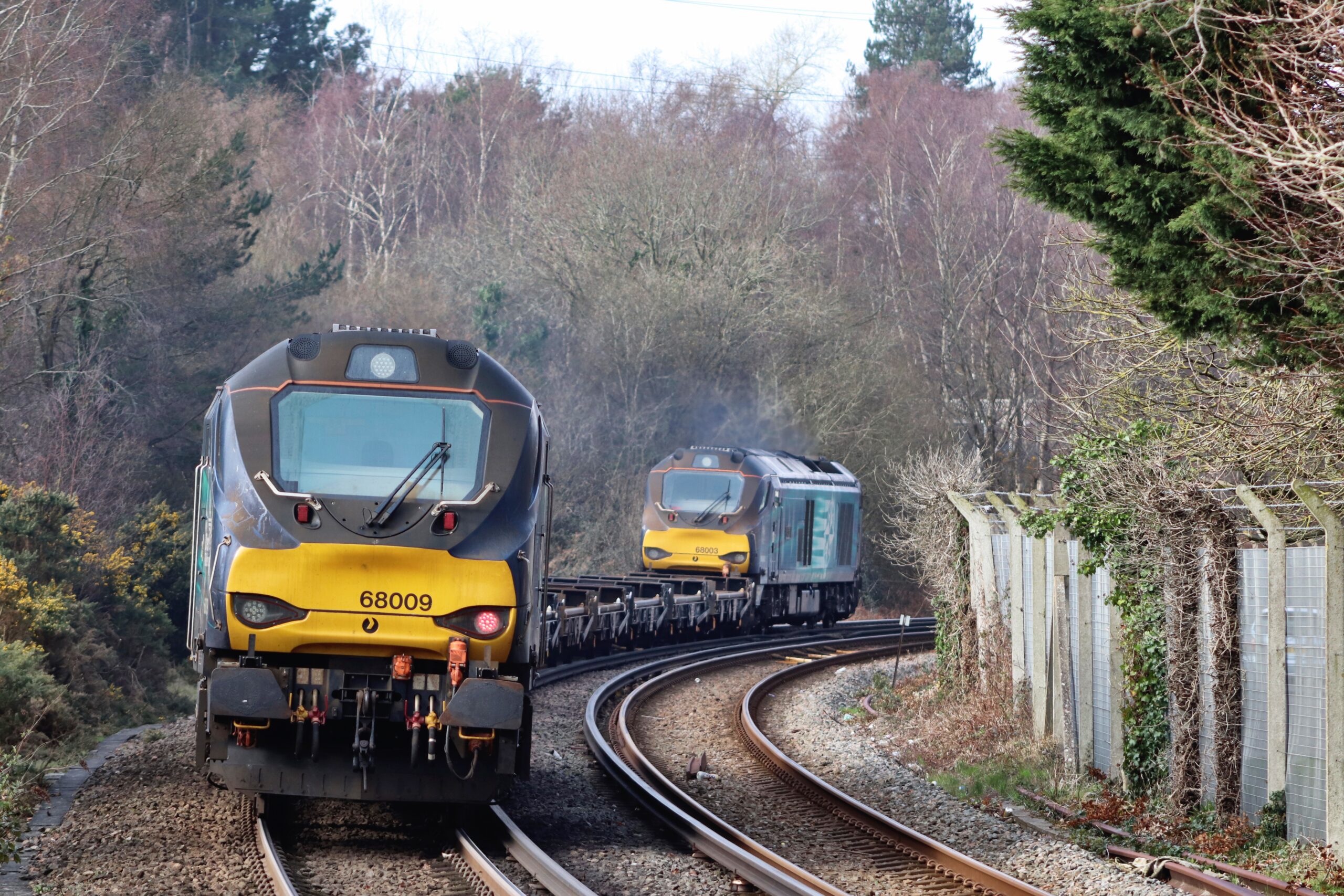
    DRS Class 68 No. No. 68009 ‘Titan’ trails No. 68003 ‘Astute’ having passed through Hamworthy working 6Z62 0100 Crewe Coal Sidings DRS to Wool Winfrith Sidings – 23/03/2023
    DRS Class 68 No. 68003 ‘Astute’ at Dorchester South working 6Z95 1554 Wool Winfrith Sidings to Crewe Coal Sidings DRS (image courtesy of G E Barrett) – 23/03/2023
    DRS Class 68 No. No. 68009 ‘Titan’ prepares to lead 6Z95 1554 Wool Winfrith Sidings to Crewe Coal Sidings DRS away from Dorchester South (image courtesy of G E Barrett) – 23/03/2023
    Video of the DRS Class 68 No.’s 68003 ‘Astute’ and 68009 ‘Titan’ working a Winfrith train. Additional video courtesy of G E Barrett – 23/03/2023

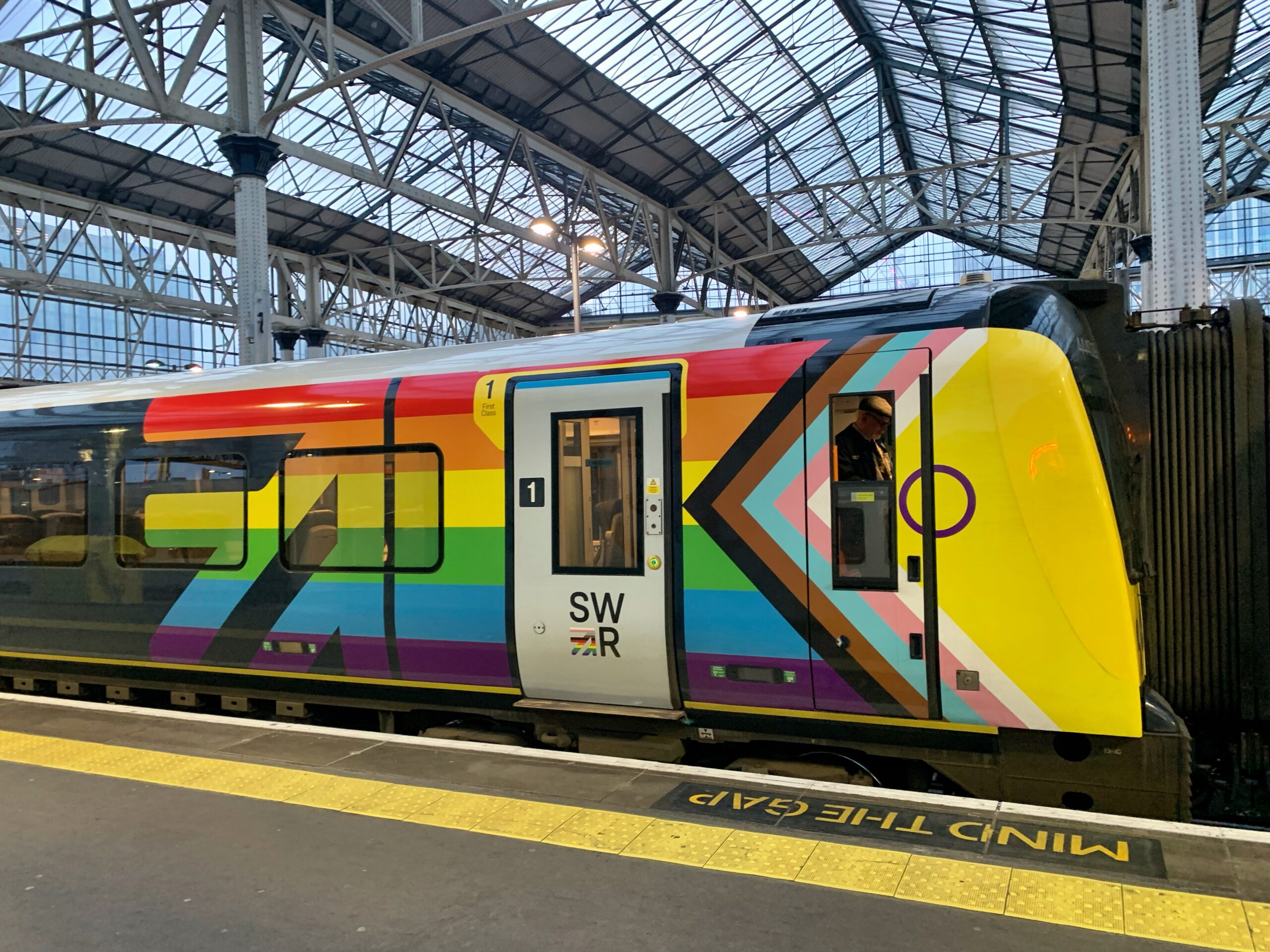
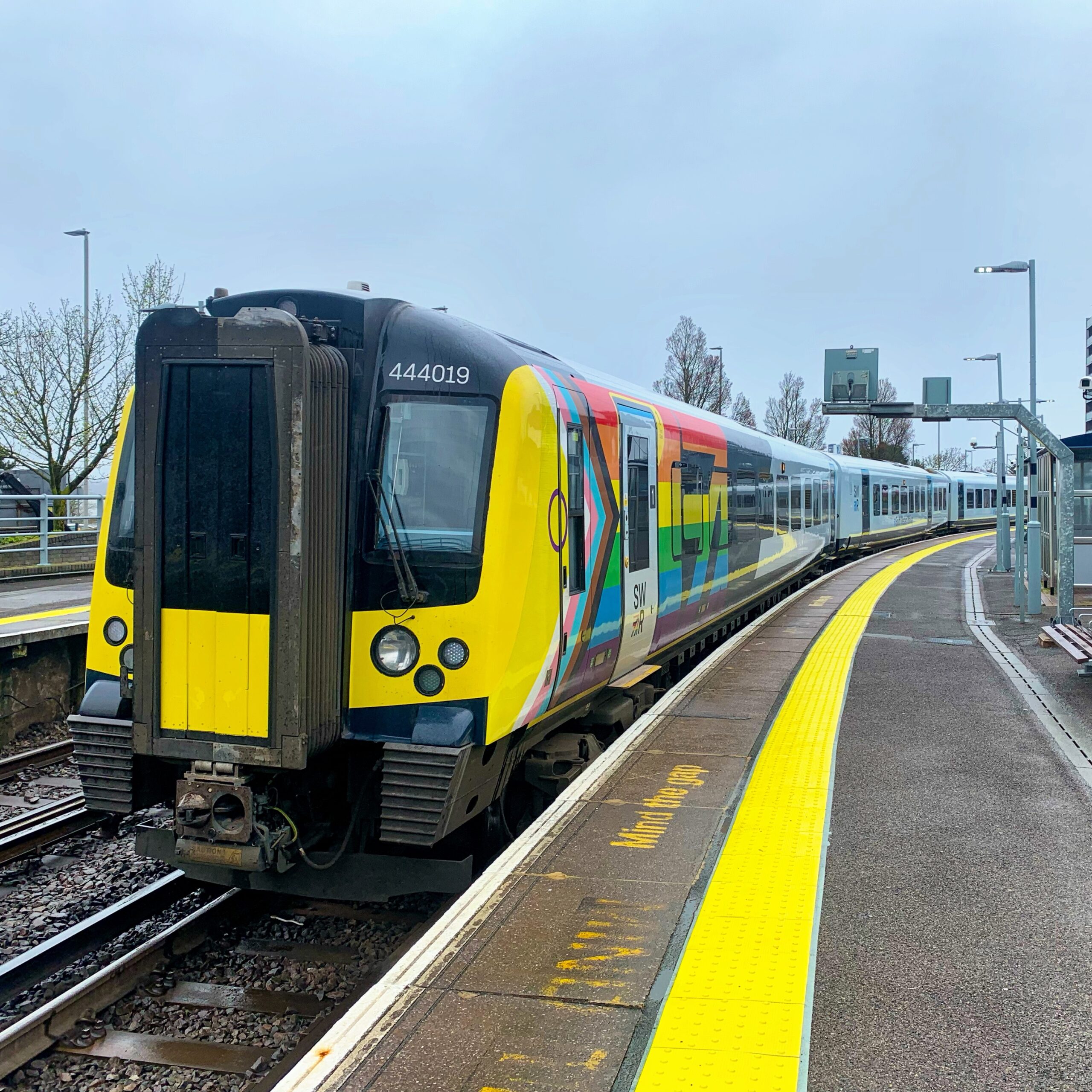
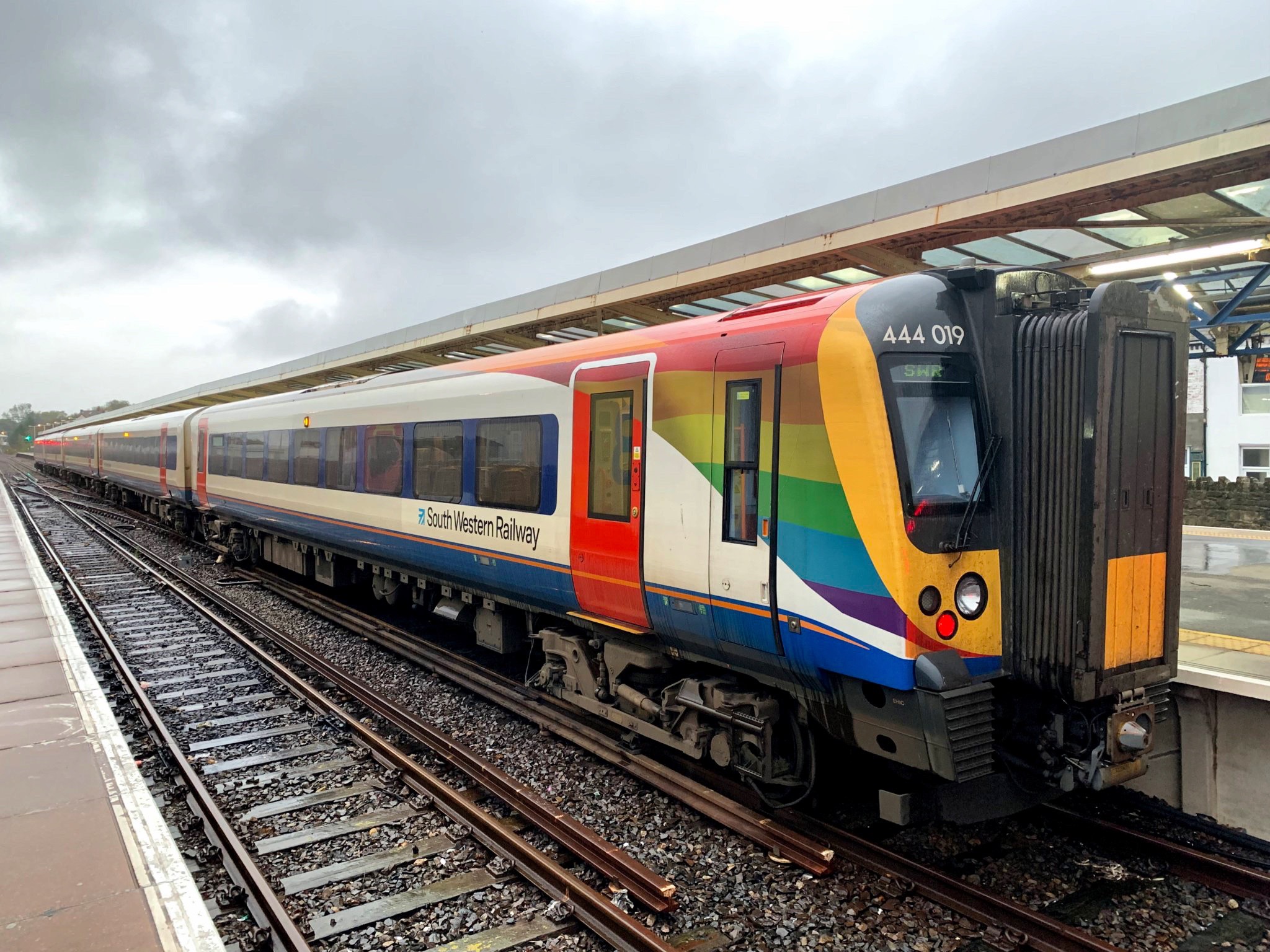
    South Western Railway (SWR) have unveiled Class 444 Electric Multiple Unit No. 444019 in a new version of their ‘Pride’ livery. The unit was wrapped at Bournemouth Traction and Rolling Stock Maintenance depot on 25th/26th March 2023 and displays the LGBTQIA+ flag on the driving ends.

    SWR Class 444 No. 444019 displays the new ‘Pride’ livery at London Waterloo before working IP65 2000 London Waterloo to Portsmouth & Southsea – 30/03/2023
    SWR Class 444 No. 444019 awaits departure from Poole with the 2W56 1100 service to London Waterloo – 31/03/2023
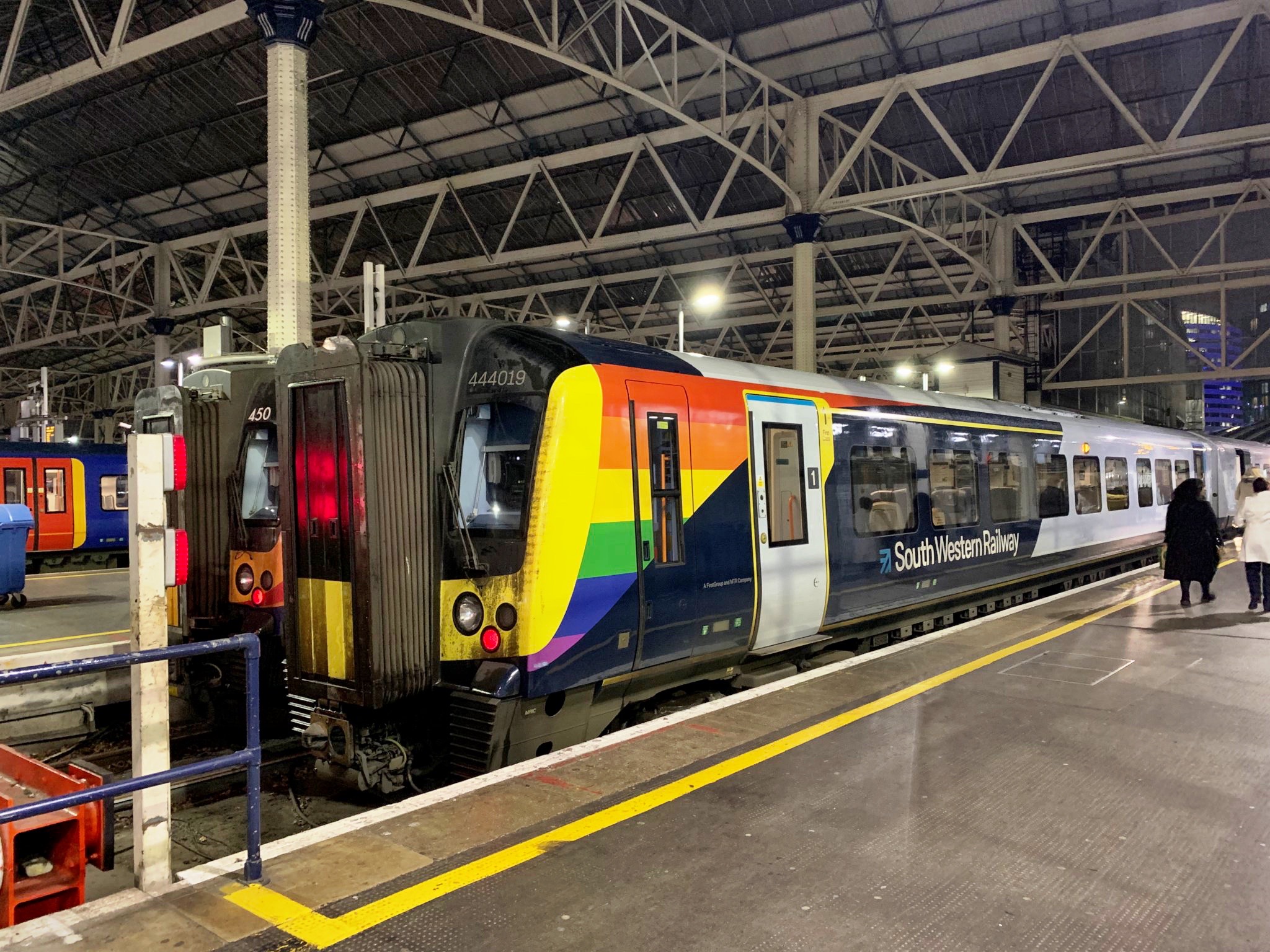
    SWR Class 444 No. 444019 in an earlier ‘Pride’ livery stands at the buffer stops in London Waterloo – 05/03/2022
    How Class 444 No. 444019 used to look, seen at Weymouth – 12/10/2019

    That’s it for this week, thanks for joining us! We’ll be back in seven days or so when we have a look at the Crewe Heritage Centre amongst other things.

    Yoshi watches on as British Railways Standard Class 7 4-6-2 No. 70000 ‘Britannia’ turns on the Yeovil Steam Centre turntable – 22/03/2023
  • Gotcha Week!

    Wednesday 15th March 2023 to Tuesday 21st March 2023

    Gotcha Day!

    On Thursday we celebrated the annual ‘Gotcha Day’ when Yoshi first decided to adopt me as his hooman. He really was a tiny little pup with razor sharp baby teeth. We’ve both got bigger since then and I can hardly believe it’s been four years!

    Colas Class 66 No. 66850 ‘David Maidment’ at the head of a rake of autoballasters pauses at Poole to pick up a crew member just after midnight working 6C15 2303 Eastleigh East Yard to Worgret Junction – 15/03/2023

    This week I was a bit of a night owl on three consecutive occasions as I stayed up past my bedtime to see three engineers trains and a test train visit our patch, all operated by Colas Rail.

    Class 66 No. 66848 at Hamworthy on the rear of the 6C17 2356 Eastleigh East Yard to Hamworthy autoballaster working – 16/03/2023
    Colas Trains in Poole and Hamworthy – March 2023

    Colas Rail is a subsidiary of Bouygues, a French industrial group headquartered in Paris. Originally a railway construction and maintenance company named Seco Rail, they became a freight operator in the UK market during 2006 acquiring their first locomotives in 2007 after a successful period using leased rolling stock. In 2008, Seco Rail merged with AMEC-Spie and Carillion Rail under the Colas Rail banner and today they are one of the five largest contractors working for Network Rail. Colas Rail were involved with major improvement works at London Waterloo railway station. The current fleet of locomotives include Class 37, Class 43 (HST Power Cars), Class 56, Class 66 and Class 70 as well as a mixed fleet of on-track plant, such as tampers, for maintenance operations which by 2016, was reportedly the largest of its type in the UK. Previously they counted ten Class 60 locomotives amongst their fleet, and for a short while Class 86 No. 86701 which gained the Colas Rail yellow and orange livery in October 2012. The locomotive was withdrawn from mainline use in January 2013 and subsequently transferred to Europhoenix and exported to Bulgaria where she is still in use running as No. 85001.

    I quite like the bright Colas Rail livery, and I’ve added some photos from recent years showing some examples:

    Class 37 No. 37175 pauses at Dorchester West – 16/07/2015
    Class 37 No. 37099 speeds through Upwey on a test train – 27/04/2017
    Class 37 No. 37099 shelters from the rain at Weymouth – 31/10/2020
    Class 37 No. 37116 at Weymouth – 24/01/2018
    Class 37 No. 37219 on track data recording duties (with extra, technical equipment mounted on its ends) reverses at Weymouth – 06/05/2020
    Class 37 No. 37219 on track data recording duties (with extra, technical equipment mounted on its ends) at Weymouth  – 06/05/2020
    Class 37 No. 37421 makes a nocturnal visit to Weymouth on a test train – 03/08/2020
    Class 47 No. 47749 ‘Demelza’ on the Weymouth Quay branch siding – 24/02/2012
    Close up detail for Class 47 No. 47749 ‘Demelza’ – 24/02/2012
    Nameplate for Class 47 No. 47749 ‘Demelza’ – 24/02/2012
    43274 about to depart from Maiden Newton having picked up the token to traverse the single line section to Dorchester West. Dorset Council is currently in talks with the Railway Heritage Trust over renovation plans for Maiden Newton – 23/03/2022
    Class 43 HST power cars No.’s 43274 and 43251 about to enter Bincombe Tunnel between Weymouth and Dorchester working the New Measurement Train 1Z23 0747 Derby RTC to Bristol Kingsland Road – 26/01/2022
    Class 56 No. 56105 works through Cardiff Central on a train of logs – 07/05/2013
    Class 56 No. 56049 at Westbury – 03/09/2022
    Class 56 No. 56096 hauling a Class 701 delivery through Eastleigh –
    Class 66 No. 66847 on the Weymouth Quay branch siding – 24/12/2012
    Class 66 No. 66849 at Weymouth on an engineers train during rail replacement work – 15/12/2015
    Class 66 No. 66848 on an engineers train at Monkton, Dorchester – 24/04/2016
    Class 67 No. 67027 working the New Measurement Train at Weymouth – 19/06/2019
    Class 67 No. 67023 at the platform in Weymouth – 15/07/2020
    Class 70 No. 70805 at the head of an engineers train at Weymouth – 11/04/2015
    Class 70 No. 70809 on the approach to Dorchester South – 11/04/2015
    Class 70 No. 70806 in Weymouth – 15/12/2015
    Class 70 No. 70807 sits in Weymouth station – 11/04/2015

    South Western Railway (SWR) Class 444 EMU No. 444023 has been named ‘The Alex Wardle Foundation’ to celebrate a partnership between SWR and the Alex Wardle Foundation to help raise awareness of sudden arrhythmic death syndrome (SADS), when someone dies suddenly and unexpectedly from a cardiac arrest, particularly young, apparently healthy, people. The railway company is investing more than half a million pounds installing publicly accessible automated external defibrillators at its 154 staffed stations it operates across South West London, Surrey, Hampshire, Berkshire, Dorset, Wilshire, Somerset, and Devon. The installation of the lifesaving defibrillators comes as part of the rail operators’ commitment to support safety and serve local communities. Located in protective cabinets as close as possible to the front of stations, the defibrillators will be available for use day and night in the instance of cardiac issues in the surrounding area.

    South Western Railway (SWR) Class 444 EMU No. 444023 ‘The Alex Wardle Foundation’ arrives at Hamworthy working 1W23 0855 London Waterloo to Weymouth – 19/03/2023

    The charity was set up in memory of Alex Wardle, a medical student and son of an SWR operations trainer. Alex passed away from SADS in March 2016. His father, Steve Wardle, has worked for SWR for 38 years and, along with other members of Alex’s close family and friends, he set up the charity to help further understanding of SADS and prevent deaths from the condition.  The Class 444 was named ‘The Alex Wardle Foundation’ on 15th March 2023. Unit number 23 was chosen as this was Alex’s age when he passed away.

    BR Standard Class 4MT No. 76084 having been unloaded at Norden – 17/03/2023

    On Friday I slipped out to Norden as visiting British Railways (BR) Standard Class 4MT No. 76084 was delivered by road on the back of two lorries; one for the locomotive and one for the tender.  No. 76084 is spending time on the Purbeck Heritage line for the Swanage Railway Spring Steam Gala running between 24th and 26th March 2023. The Gala will also feature BR Standard Class 7 No. 70000 ‘Britannia’, scheduled to arrive at the heritage line on 22nd March.  Resident Class 33 diesel locos No.’s 33111 and D6515 (33012) ‘Lt Jenny Lewis RN’ were scheduled to assist the BR Standard down to Swanage once it had been unloaded onto the tracks at Norden. The locomotive was already sitting in the sidings when I arrived and, unfortunately, issues with a wagon meant that her departure was delayed and I was unable to wait for the consist to be formed and depart as Yoshi had an appointment with the dog groomer. I was, however, able to capture some images via the Swanage Railway webcams.

    Class 33 diesel locos No.’s D6515 (33012) ‘Lt Jenny Lewis RN’ and 33111 as seen on the Swanage Railway Webcam passing through Corfe Castle – 17/03/2023
    Class 33 diesel locos No.’s D6515 (33012) ‘Lt Jenny Lewis RN’ and 33111 top and tail BR Standard Class 4MT No. 76084 as seen on the Swanage Railway Webcam passing through Corfe Castle as Jamie Smith Going Loco leans out of the cab door to collect the token giving permission for the consist to move on to Harmans Cross – 17/03/2023
    Class 33 diesel locos No.’s 33111 and D6515 (33012) ‘Lt Jenny Lewis RN’ top and tail BR Standard Class 4MT No. 76084 as seen on the Swanage Railway Webcam arriving into Swanage – 17/03/2023
    Yoshi post groom and sporting his Easter Bandana – 17/03/2023

    Congratulations to Derby which has been chosen as the headquarters of Great British Railways (GBR HQ), beating five other short listed locations, none of which were in the West Country. There followed lots of bluster about the government going “full steam ahead” with reforms for the railways and promotion for Rolls-Royce.

    RMT members working for Network Rail voted to accept the company’s pay offer; 12,047 voted yes and 3,709 voted no which brings to an end to their campaign of strike action. Disputes with 14 rail companies, represented by the Rail Delivery Group – including SWR and Great Western Railway (GWR) – are ongoing with further walk outs planned for 30th March and 1st April.

    SWR is investing over £400,000 on improving waiting rooms at ten of its stations, including locations on the London Waterloo to Weymouth line including Basingstoke, Brockenhurst, Southampton Central and Totton. There are no stations on the list to be found in Dorset.

    That’s it for another week – thank you for joining us. Please keep your comments and corrections coming, we really appreciate you having taken the time to read our little page.

  • Shillingstone

    Shillingstone Railway Station built in the Dorset Central Railway style of red brick with cream decorative brickwork around windows and doors and featuring a Welsh slate roof – 11/02/2023

    Wednesday February 8th to Tuesday February 14th 2023

    South Western Railway Class 444 Electric Multiple Unit No. 444023 departs Weymouth – 07/01/2021

    On Friday, it was announced that South Western Railway had received a two-year extension on its existing contract from the Department of Transport. Scottish parent company FirstGroup PLC said their national rail contract would now run until May 2025. With no sense of irony Chief Executive Officer Graham Sutherland said, “We welcome the contract extension for South Western Railway, which enables us to build on the achievements of the first two years of the contract and continue improving the customer offering.” FTSE 250-listed FirstGroup operates another three rail franchises in the UK: Avanti West Coast, Great Western Railway (GWR), and TransPennine Express (TPE), plus an open access passenger service, Hull Trains. It also has a bus division, which operates around a fifth of local bus services in the UK. 

    In other SWR related news, it is hoped that Network Rail will complete work on the landslip at Hook to allow the full restoration of normal timetabled train services from 24th February 2023.

    Yoshi takes a look at the short section of track representing the Somerset & Dorset Joint Railway which is displayed in Railway Gardens, Sturminster Newton – 11/02/2023

    Saturday 11th February 2023, Yoshi, his mama and I headed to North Dorset to walk a section of the former Somerset & Dorset Joint Railway (S&DJR) trackbed which is now part of the North Dorset Trailway. We decided to walk four miles from Sturminster Newton to beyond Shillingstone and back, so that we could visit the North Dorset Railway and enjoy a refreshing cup of tea and a slice of cake before retracing our footsteps back to our starting point. However, we wish we had asked our North Dorset Correspondent where we could have found a cup of tea on our arrival back in Sturminster!

    Yoshi amongst the snowdrops along the North Dorset Trailway – 11/02/2023
    Abandoned railway furniture on the North Dorset Trailway – 11/02/2023
    Lamb House Bridge, Shillingstone – 11/02/2023

    On arrival at Shillingstone we were able to watch some shunting manoeuvres which were taking place around the station site. The station which opened on the 31st August 1863 and is the last remaining building of the Dorset Central Railway which later formed part of the Somerset & Dorset Joint Railway running from Bournemouth West to Bath Green Park until falling victim to the Beeching cuts in March 1966.

    There are several posters from the age of steam as well as a museum packed with railway artefacts on view at Shillingstone railway station – 11/02/2023

    During World War I Shillingstone saw additional trains in the form of troop and supply workings. One such instance, in February 1915, saw the Naval Battalion based at Blandford Camp march en masse to Shillingstone to board a train bound for Avonmouth and ultimately to take part in the Gallipoli Campaign. Included in their number was the war poet Lt. Rupert Brooke who died of septicaemia en route off Skyros, Greece.

    A few years after the station at Shillingstone closed to rail traffic, the Dorset County Council purchased the trackbed for a proposed road which would by-pass the village. This plan never came to fruition and the council eventually decided to dispose of the station site. Following protracted negotiations, the North Dorset Railway Trust signed a lease in 2005.

    I loved this imaginary painting of what might have been and the S&DJR survived the Beeching cuts which hangs in the station tea rooms (Steve Hiscocks, 2012)

    The North Dorset Railway Trust aim to relay track in the direction of Sturminster Newton over Lamb House Bridge. Maybe one day we may even see a Class 9F or similar working part of the route once again.

    Hudswell Clarke 0-6-0 Diesel Loco Works No. D1186 ‘Ashdown’ passes Shillingstone signal box – 11/02/2023

    ‘Ashdown’ was built by Hudswell Clarke, Leeds in 1959 for use on the Manchester Ship Canal Railway (MSCR), numbered D1 and based at Partington coal basin she was the first of a small fleet of diesel locomotives working on the MSCR. She has had an illustrious career being sold on to Hunslet Engine Co. of Leeds, who leased the locomotive to the National Coal Board (NCB) Crompton colliery in Lancashire, before returning to Hunslets as their works shunter. In 1986 she was subject to a re-build before moving to the NCB Gwent Coal Distribution centre in Newport, South Wales. She was renumbered No. 8526 and named ‘Pride of Gwent’ lasting up to 1991 when she entered preservation firstly at the Butetown Historic Railway Society in Cardiff until 1997 before moving to the Vale of Glamorgan Railway. In 2008, she was purchased by the Pontypool and Blaenavon Railway. In July 2013, she was exchanged for a diesel locomotive located at Peak Rail in Derbyshire and reunited with the ‘Ashdown’ name. The North Dorset Railway purchased ‘Ashdown’ in 2020. She is of a unique design and therefore the only locomotive of this type preserved.

    Ruston & Hornsby Diesel Shunter No. RH305302 (DS1169) ‘Little Eva’, Shillingstone – 11/02/2023

    No. RH305302 (DS1169) ‘Little Eva’ was built by Ruston & Hornsby, at their Boultham Works, Lincoln in 1951, for the Ransome and Marles Bearing Co of Newark, where she was used to move steel casings around the factory site. She retired from service in 1978 and donated to the Market Overton Industrial Railway Trust before moving to the Statfold Barn Railway in Tamworth.  She was purchased in 2015 and moved to Shillingstone and underwent full restoration.

    Yoshi strikes a pose alongside Class 62 Yankee 0-6-0 Tank Locomotive No. 30076, Shillingstone – 11/02/2023

    The Class 62 “Yankee Tank” steam locomotives were built from the US Army Transportation Corps template of S100 Shunters of World War II designed in 1941 by Colonel Howard G Hill. The class was extremely successful, proving powerful, economical to operate and relatively easy to maintain. More than 400 of these locomotives were deployed across Europe after the war, with over 100 ending up in Yugoslavia earning the designation Class 62. A further 90 of the class were built in Yugoslavia by Djuro Djakovic of Slavonski Brod between 1952 and 1961. Four original US built locomotives are preserved in the UK, one at the Bluebell Railway, two at the Kent & Sussex Railway and one at the Keighley and Worth Valley Railway.

    Here in the UK, 14 (plus one for spare parts) of the S100 Class were purchased by the Southern Railway (SR) from the United States Army Transportation Corps in 1946, mainly for shunting in Southampton Docks, between the end of World War II and the end of steam in the 1968. Other examples saw use as industrial locomotives with Austin Motors/BMC at Longbridge, the NCB and on the Longmoor Military Railway.

    There are two examples of these locomotives currently at Shillingstone. Firstly No. 30075, built in 1960 and acquired from Store Steel in Slovenia in 1990 after clocking up only 25,000 miles in service. She was transported to the Swanage Railway, where she was completely overhauled and returned to steam in late 1992. The locomotive suffered a major steam pipe failure in 1998 and was withdrawn from traffic. No. 30075 was then dismantled and moved to the East Somerset Railway in July 2002 and was returned to traffic in July 2004. August 2009 saw her being relocated to the Mid-Hants Railway and later visited the Bodmin & Wenford Railway, the Bristol Docks Railway, Yeovil Junction Steam Centre, the Churnet Valley Railway and the Dartmoor Railway. Following withdrawal due to leaks in the inner firebox, No. 30075 was eventually moved to Shillingstone for repairs in January 2016 where she is undergoing full restoration to operational service. On our visit, No. 30075 was under cover from the elements away from public view.

    The second “Yankee” No. 30076 was built in 1954 with factory No. 62-521. She was purchased by the P62 Group in 2006 from Mittal Steel Zenica in Bosnia & Herzegovina and arrived at Shillingstone in 2016 after spending many years in store at Allelys Heavy Haulage in Studley near Birmingham. She will be a spares donor for her sister locomotive and as such will be on static display.

    Yoshi enjoyed spending time on a sniffari during our walk along the former S&DJR track bed – 11/02/2023

    Over the weekend of 11th / 12th February 2023, the Swanage Railway held a special “Behind the Scenes” event with the aim of encouraging more volunteers to help out maintain and run the railway. Passengers were able to enjoy beautiful Purbeck countryside views not often enjoyed from a train thanks to a special heritage diesel train service employing the Class 117 DMU on the occasionally used four-mile line between Norden and the River Frome, within sight of Wareham. At Swanage railway station, SR West Country Class 4-6-2 No. 34028 ‘Eddystone’ was available for footplate visits and Class 08 diesel shunter No. 08436 ‘Beighton’ was the focus of a “driver for a fiver” experience while SR Battle of Britain Class 4-6-2 No. 34070 ‘Manston’ ran passenger trains between Swanage and Norden.

    Class 08 No. 08436 waits patiently in the bay platform at Swanage – 12/02/2023
    Side detail of Class 08 No. 08436 – 12/02/2023

    I was joined by my brother and @da_buckley967 at Swanage railway station at 0930 on the Sunday morning as we had managed to book the first three available slots of this sell out escapade. Once the doors to the booking hall were unlocked, we made ourselves known and signed our lives away on a safety declaration. We then learned that the driver who was conducting the driver experience was marooned in Eastleigh because of transportation issues and an emergency relief driver had been called in to take their place, necessitating a thirty minute delay. This gave us the opportunity to grab a cuppa and take a look at ‘Eddystone’ parked up in the station and to watch ‘Manston’ depart with the first steam hauled train of the day while I constantly complained about not having any gloves with me because I was finding it cold. Diddums. At 1020 we were ushered over to No. 08436 and I was first to be allowed to climb onboard and take the controls.

    It really was a fun and interesting ten minutes being supervised at the number 2 driver position. I think was a bit harsh on the brake, and I’m amazed at the poor visibility looking out of the windows down the nose of the Class 08 and drivers, past, present and future have my full admiration! Grateful thanks to The Swanage Railway for including the chance for a taste of driving the loco as one of the ‘open weekend’ attractions – you can share our experience in the video below:

    Driver for a Fiver! – 12/02/2023
    Swanage Railway’s Class 117 DMU at Creech Bottom with a River Frome to Norden service – 12/02/2023
    Swanage Railway’s Class 117 DMU on the Norden to the River Frome section, February 2023
    SR West Country Class 4-6-2 No. 34028 ‘Eddystone’ on display in Swanage enabling visitors the opportunity to view the locomotive’s footplate – 12/02/2023

    Monday evening saw a Class 37 top and tailed test train actually find its way to Dorset in 2023 with 1Q51 1115 Derby RTC to Eastleigh East Yard via Weymouth. I decided to see Colas liveried Class 37 No. 37254 ‘Cardiff Canton’ and on hire No. 37610 pass through Poole on the outward run and couldn’t resist a second shot at Hamworthy as they returned on the final leg to Eastleigh East Yard. It was a foggy evening and the sound of the two English Electric built veterans could be heard from several miles away – pure bliss!

    Colas Class 37 No. 37254 ‘Cardiff Canton’ passing through Poole (video screen grab) – 13/02/2023
    Harry Needle Railroad Company owned Class 37 No. 37610 on hire to Colas Rail accelerates through Hamworthy (video screen grab) – 13/02/2023
    1Q51 1115 Derby RTC to Eastleigh East Yard – 11/02/2023

    Thank you, dear reader, for visiting and your comments and corrections which are very much appreciated! We’ll be back next week for a delve into our archives for video of ‘Flying Scotsman’ as we celebrate 100 years of the world’s most famous steam locomotive.

    Sturminster Newton – the start and end point of our walk this week – 11/02/2023

    The Night Journey 

    Rupert Brooke (1887-1915)

    Hands and lit faces eddy to a line;
        The dazed last minutes click; the clamour dies.
    Beyond the great-swung are o’ the roof, divine,
        Night, smoky-scarv’d, with thousand coloured eyes

    Glares the imperious mystery of the way.
        Thirsty for dark, you feel the long-limbed train
    Throb, stretch, thrill motion, slide, pull out and sway,
        Strain for the far, pause, draw to strength again. . . . 

    As a man, caught by some great hour, will rise,
        Slow-limbed, to meet the light or find his love;
    And, breathing long, with staring sightless eyes,
        Hands out, head back, agape and silent, move

    Sure as a flood, smooth as a vast wind blowing;
        And, gathering power and purpose as he goes,
    Unstumbling, unreluctant, strong, unknowing,
        Borne by a will not his, that lifts, that grows,

    Sweep out to darkness, triumphing in his goal,
        Out of the fire, out of the little room. . . .
    —There is an end appointed. O my soul!
        Crimson and green and signals burn; the gloom

    Is hung with steam’s far-blowing livid streamers.
        Lost into God, as lights in light, we fly,
    Grown one with will, end-drunken huddled dreamers.
        The white lights roar. The sounds of the world die.

    And lips and laughter are forgotten things.
        Speed sharpens; grows. Into the night, and on,
    The strength and splendor of our purpose swings.
        The lamps fade; and the stars. We are alone. 

  • 313 Farewell

    Wednesday 7th December 2022 to Tuesday 13th December 2022

    LMS Coronation Pacific No. 6233 ‘Duchess of Sutherland’ at Worting Junction working The Railway Touring Company’s “The Bath & Bristol Christmas Market” 1Z82 0847 London Victoria to Bristol Temple Meads – 10/12/2022

    This week, Yoshi and I took a trip along the Southern Railway West Coastway route to witness the final days of the Class 313 electric multiple units (EMU), saw LMS Coronation Pacific No. 6233 ‘Duchess of Sutherland’ storming past Worting Junction and took in some Great Western Castle Class HST’s in frosty conditions.

    Class 313

    In preparation of spending a day on the Western Coastway route to see Class 313 emu’s, we had pre-booked our Southern Daysave ticket well in advance, and paid extra for next day delivery to avoid the postal strikes. It was a good job we did, as the ticket still took four days to arrive. So, on Friday 9th December we set off on a South Western Railway (SWR) service for Southampton (where we saw a couple of passing Class 66 hauled freight workings) to pick up a Southampton to London Victoria train which would take us to Barnham where we changed platforms to get a Class 313 operated shuttle to Bognor Regis. These are the last days of the Class 313’s and we hoped to record some of the units still in service.

    The three-car Class 313’s were the first production, second generation, EMU’s built as a direct result of trials in 1972 with the PEP prototypes on British Rail Southern Region. I remember seeing at least one of the PEP units at Wimbledon on my first train journey to London in the early 1970’s. I may not have been an avid rail enthusiast at the time, but I’d clearly read about the new trains being introduced by British Rail. None of the prototypes survive and they were all cut up by 1990.

    PEP Unit No. 4002 in the sidings at Wimbledon – 27/08/1982

    The production-run classes which are most visibly similar to the PEP Stock are the dual voltage 750 V DC third rail / 25 kV AC overhead power collection Class 313, the 25 kV AC Classes 314 and 315, and the 750 V DC Classes 507 and 508. We covered the 507’s and 508’s earlier in the year when we visited Stockport. You can read about that adventure here.

    A fleet of 64 three car sets were built by British Rail Engineering Limited (BREL) in York in 1976/1977 and were intended for the then newly modernised and electrified Great Northern inner suburban lines. The front end doors were designed for evacuation in an emergency in a single bore tunnel and the fleet were constructed to take in the slightly restricted loading gauge between Drayton Park and Moorgate.

    Class 313 No. 313008 at Finsbury Park with a service to Moorgate – 30/10/1980

    Upon privatisation, the 313’s were operated by Silverlink Railways and West Anglia Great Northern (WAGN) and later, in 2007, the class were transferred to London Overground who ran them until September 2010.

    19 Class 313’s were modified for DC pick up only at Wolverton works and transferred to Southern to operate on the Coastway services out of Brighton from May 2010. These were deliveries into GTR Southern green and white with pictogram route branding. The remaining Great Northern members of the class were all withdrawn from service and scrapped by the end of 2019.

    Yoshi gets up close to Class 313 No. 313207 at Bognor Regis having worked in with the 2P26 1053 service from Littlehampton – 09/12/2022
    When the Class 313’s were transferred to GTR Southern from May 2010 the sets were overhauled and the interiors refurbished with new seating in low-density 2+2 style using high backed seating – 09/12/2022
    Southern Class 313 onboard diagram – 09/12/2022
    Faded branding detail applied the intermediate coach of Coastway Class 313 No. 313207 (and other members of the class) on transfer to GTR Southern promoting the route Portsmouth, Chichester, Bognor, Littlehampton, Worthing, Brighton, Lewes, Seaford and Eastbourne – 09/12/2022
    In 2017 No. 313201, the first of the class to be built and therefore the oldest operational EMU in use in the UK, was repainted into as near as possible the BR blue/grey livery and it is believed the unit is destined for the National Collection. Because of disability reasons, the unit has contrasting colour doors and is seen here at Barnham – 09/12/2022
    On transfer to GTR Southern, the fleet was repainted in GTR Southern white and green. Class 313 No. 313210 at Brighton having arrived with
    Not being used on the day of our visit, Class 313 No. 313216 in the sidings at Brighton – 09/12/2022
    Class 313 No. 313206 at Brighton having arrived with the 1453 service from Seaford – 09/12/2022
    Class 313 No. 313203 has a short rest at Brighton prior to working the 1511 Brighton to Seaford service – 09/12/2022
    Coastway Class 313’s – 09/12/2022
    Class 313 No. 313121 transferred to Network Rail in 2013 for use as a dynamic test vehicle for the development of the European Traffic Control System (ETCS). The set is based at Eastleigh Arlington where it is seen here – 30/01/2022
    Development set 313 No. 313121 at Arlington Works, Eastleigh – 02/07/2022

    Sherwood Forester

    While on our Class 313 mission, we spent an hour at Chichester to coincide with the arrival of the steam hauled “Chichester For Carols” rail tour operated by Steam Dreams. Arriving just over half an hour late and with some confusion as to which platform the train was going to arrive on, LMS Black Five No. 45231 ‘Sherwood Forester’ hove into view.

    LMS Stanier Class Five 4-6-0 No. 45231 ‘Sherwood Forester’ sits at Chichester having brought in Steam Dreams “Chichester for Carols” rail tour 1Z45 0649 Shoeburyness to Chichester – 09/12/2022
    Class 47 No. D1935 (47805) ‘Roger Hosking MA 1925-2013’ at the rear of Steam Dreams “Chichester for Carols” rail tour 1Z45 0649 Shoeburyness to Chichester – 09/12/2022
    1Z45 0649 Shoeburyness to Chichester – 09/12/2022

    Duchess

    Saturday saw us heading towards London in order to capture LMS Coronation Pacific No. 6233 ‘Duchess of Sutherland’ which was heading the Railway Touring Company “The Bath & Bristol Christmas Market” excursion. Having elected to see the tour at Worting Junction we were greeted by bright sunshine on a beautiful frosty day. Yoshi didn’t much care for the approaching steam locomotive and made his concerns known.

    Worting Junction and LMS Coronation Pacific No. 6233 ‘Duchess of Sutherland’ – 10/12/2022

    Following our view of the Duchess we headed towards London in the hope of seeing a second steam excursion originating from London Victoria, but in the event the promised steam locomotive had been replaced by a Class 67 diesel (again). Our view of the Belmond Pullman train was obscured by the parallel running of a Southern service into the London terminus. You win some, you lose some!

    London Victoria – 10/12/2022

    Bristol Temple Meads

    Sunday and we were in Bristol in the hope of capturing the Lilly’s Pet Food Christmas liveried IET No. 802106 which had been allocated to work the 1300 Bristol Temple Meads to London Paddington service. We were disappointed when this colourful unit did not materialise. However, we had a lovely few hours meeting new friends, downing festive coffee and getting photos of trains in wintery conditions.

    5 car CrossCountry Voyager No. 221135 arrives at a snowy Bristol Temple Meads working 1S45 0927 Plymouth to Dundee – 11/12/2022

    Great Western Railway (GWR) has confirmed that it intends to withdraw its fleet of Castle Class HST sets with the December 2023 timetable change with IET’s taking over their duties.

    GWR Castle HST Class 43 Power Car No. 43155 ‘Rougemont Castle’ at Bristol Temple Meads forming 2E42 1338 service to Worcester Foregate Street – 11/12/2022
    What should have been the special Lilly’s Christmas liveried IETNo. 802106 was disappointingly plain old No. 802103 instead working 1A18 1300 Bristol Temple Meads to London Paddington – 11/12/2022
    CrossCountry Class 43 HST Power Car No. 43378 at Bristol Temple Meads working 1V48 0811 Leeds to Plymouth – 11/12/2022
    Yoshi with a snowman he made at Bristol Temple Meads – 11/12/2022

    For The Record

    The seasonal locomotive hauled Snow & Ice Treatment Trains (SITT) began running on 11th December 2022, with the first instance of the consist traversing the Bournemouth to Weymouth line in the early hours of 12th December. GBRf Class 66 locomotives No.’s 66745 and 66704 have been stationed at Totton Yard alongside the usual Multi Purpose Vehicles (MPV). Although running @25 minutes late, I remained tucked up in my warm bed and didn’t venture out in freezing temperatures to record the SITT pass. The Network Rail SITT scrapes any build up of ice from the Third Rail (the conductor rail from which electric traction pick up their power) using metal brushes and spraying anti-icing fluid to prevent further ice from forming. Without this process occurring, depending on the volume of ice, electric trains can struggle to pick up power and in really exceptional instances will be unable to move, which is what appears to have happened on Sunday 11th December when icy conditions between Weymouth and Brockenhurst meant all services were stopped. Engineering works taking place east of Brockenhurst prevented the SITT from running to Weymouth to rectify the situation. Limited services were later resumed, although South Western Railway (SWR) requested only essential journeys should be made. During the suspension of train services, passengers could source taxis between Brockenhurst and Weymouth and claim the cost back from SWR providing evidence of a train ticket and taxi receipt for the associated journey.

    Throwback to December 2019 and GBRf Class 66 No. 66717 ‘Good Old Boy’ at the head of the SITT waiting departure from Weymouth to Totton Yard – 17/12/2019

    The start of the new timetable on Sunday December 11th 2022 saw the inclusion of a weekday path along the Hamworthy Branch originating from Westbury Tarmac and terminating at Hamworthy BCI. It came as no surprise that the service did not run.

    Many thanks for stopping by. This weeks blog is slightly curtailed owing to the fact somewhere along the line I have picked up a cold. Or more likely an extreme case of man-flu! Anyway, you have been saved my witterings on Brighton Railway Station, Class 701’s at Clapham Junction, video from Bristol and more about the Coastway Route.

    Postscript

    As a codicil to the Class 313 feature above, there was a period when I spent a great deal of time in North London. My local railway services were provided by Class 315 emu’s which were introduced in 1980 and was the last variant of five to have their design based on the PEP prototype units. The Class 315’s were set to end over 40 years of service on 9th December 2022. One unit, No. 315856 which took part in a farewell tour of the class organised by the Class 315 Preservation Society and the Branch Line Society, has been saved for preservation. The Class 315 Preservation Society has acquired the unit from Eversholt Rail Group and is destined for the Dean Forest Railway where it will be restored to original BR condition.

    Class 315 No. 315830 arrives at Highams Park with a Chingford to London Liverpool Street service – 18/09/2020
    Class 315 No. 315801 arrives at Highams Park with a London Liverpool Street to Chingford service – 23/03/2020
    Class 315 No. 315807 passes the signal box at Highams Park with a London Liverpool Street to Chingford service – 19/04/2020
    Class 315 No. 315812 crosses the A406 rail bridge with a Chingford to London Liverpool Street service – 11/06/2020
  • A Peak Week

    23rd November to 29th November 2022

    Yoshi in Loughborough with a Ladybird Book seat featuring images from the “How It Works….” series – 24/11/2022

    We were lucky enough to enjoy a few days away last week, and as part of our travels, I was able to take in some railway locations. Before that however, Wednesday evening was one of those occasions when an unusual working along the Bournemouth to Weymouth line passed me by and it wasn’t until Thursday morning that I realised I’d missed out on seeing the Colas Ultrasonic Test Unit hauled by vintage Class 37 diesel electric locomotive No. 37421. I consoled myself with the knowledge it would have been raining as it passed through my local station on the outward run, and I was tucked up in bed by the time it returned. However, on our way to Derbyshire on Thursday morning, we popped into Eastleigh to find No. 37421 perfectly parked for a quick photo opportunity adjacent to Eastleigh railway station.

    Colas Class 37 No. 37421 parked up having worked 3Q02 Eastleigh East Yard to Eastleigh East Yard via Weymouth and Fratton at Eastleigh – 24/11/2022
    GBRf Class 66 No. 66797 with a Network Rail National Delivery Service (NDS) track machine at Eastleigh – 24/11/2022
    GBRf Class 73 Electro-Diesel No.’s 73965 ‘Des O’Brien’ and 73961 ‘Alison’ being readied to work 1Q52 1045 Eastleigh East Yard to Tonbridge West Yard at Eastleigh – 24/11/2022

    After our Eastleigh pitstop, we drove on to Loughborough, where I was hopeful at seeing some stored Class 60 diesel locomotives at Brush Traction Works. The plant, known locally as the Falcon Works, was established in 1865 to build steam locomotives. American owned Wabtec took charge in 2011 and in April 2021 they announced reduced volumes had made the site “unsustainable” and proposed its closure which would see the end to over 150 years of locomotive building.

    The last time I had attempted to see locomotives at Brush, Loughborough I recall traipsing across water meadows to get a close view through a fence of Channel Tunnel Class 92’s. This time, having studied Google Maps, I drove around the outskirts of the site along access roads which I wasn’t entirely sure were open to the public. I wasn’t stopped by security, even when they drove past me as I snapped away.

    Class 92 No. 92006, Loughborough – 24/11/2022
    GBRf Class 47 No. 47727 ‘Edinburgh Castle’ at Loughborough. The Class 47 diesel-electric locomotive was one of Brush’s most successful with 512 examples having been built as part of the British Rail Modernisation Plan. This particular example was built at BR Crewe Works as part of Order Lot 400 and entered traffic as D1629 at Toton depot on the 17th October 1964 – 24/11/2022
    Class 60 No. 60013 at Brush Loughborough – 24/11/2022

    Below are a series of images of nine stored Class 60 locomotives at Brush Works, Loughborough: the locos are No.’s 60057, 60008, 60061, 60070, 60038, 60009, 60090 and 60064. They are owned by Devon Cornwall Rail (DCR) and hopefully some will be returned to main line use.

    Brush, Loughborough – 24/11/2022
    Brush, Loughborough – 24/11/2022
    Brush, Loughborough – 24/11/2022
    Brush, Loughborough – 24/11/2022
    Brush, Loughborough – 24/11/2022
    Brush, Loughborough – 24/11/2022
    Brush, Loughborough – 24/11/2022
    Brush, Loughborough – 24/11/2022

    And here is video of my previous visit in 1995, when Class 92’s, Class 20’s and a Class 47 were amongst the classes of locomotive present:

    I very much look forward to learning what is going to happen to the Class 60 locomotives at Loughborough and hope that at least some of them will turn a wheel in revenue earning service in the near future.

    From Loughborough, we drove onto Derby where we stopped for refreshment at The Alexandra Pub on Siddals Road. The pub is well known for it’s railway memorabilia and I enjoyed a Diet Coke and a packet of dried roasted peanuts while I took in the signs and locomotive nameplates which adorned the walls.

    The Alexandra Hotel has a strong railway theme and Manager Ralf Edge has collected a range of memorabilia that decorates the walls – 24/11/2022
    Railway memorabilia at The Alexandra Hotel, Derby – 24/11/2022
    ‘Derby Evening Telegraph’ name plate at The Alexandra Hotel, Derby – 24/11/2022
    The Alexandra Hotel, Derby has the cab of Class 37 No. 37411 in its garden – 24/11/2022

    After a nights rest, we set off on Friday morning for a leisurely drive through the Peak District National Park taking in Peak Forest.

    The former Peak Forest Railway Station – 25/11/2022

    Peak Forest railway station was opened in 1867 by the Midland Railway on its extension of the Manchester, Buxton, Matlock and Midlands Junction Railway from Rowsley, part of the main Midland Line from Manchester to London. It was also the northern junction for the line from Buxton. A section of the line is retained for freight trains. The station closed in 1967 and the platforms were demolished shortly afterwards, although a section has been reinstated for railway staff and the station buildings which can be seen from the road bridge passing over the tracks survive as offices for the nearby quarry terminal.

    DB Class 66 No.’s 66085 and 66143 at Peak Forest – 25/11/2022
    I was very happy to see Class 20 No.’s 20007 and 20205 parked up at Peak Forest – 25/11/2022
    MPV No. DR98982 works 3S50 0554 Wigan Locomotive Inspection Point to Crewe at Peak Forest – 25/11/2022
    Freightliner Class 66 No. 66620 working 6D17 1148 Tunstead sidings to Radlett Redland Roadstone passes Peak Forest signal box – 25/11/2022
    Class 60 No. 60059 ‘Swindon Dalesman’ at Peak Forest – 25/11/2022

    From Peak Forest, we headed into Buxton for lunch in “The Railway @. Buxton” a pub which got its name as it was popular with railway workers after they had finished their shifts. It stands in front of the impressive Buxton Viaduct which carries the freight line from Peak Forest. As we parked up, we saw Class 60 No. 60059 ‘Swindon Dalesman’ pass over working 6E18 1141 Peak Forest RMC Sidings to Attercliffe Sindings EWS

    Class 60 No. 60059 ‘Swindon Dalesman’ working 6E18 1141 Peak Forest RMC Sidings to Attercliffe Sindings EWS at Buxton – 25/11/2022

    There were once two railway stations in Buxton; the aforementioned Manchester, Buxton, Matlock and Midlands Junction Railway from Rowsley favoured by the Midland Railway (MR) and The Stockport, Disley and Whaley Bridge Railway supported by the London & North Western Railway (LNWR) extended its line to Buxton. The stations were built side by side and given identical frontages designed by Joseph Paxton (best known for designing Crystal Palace and for cultivating the Cavendish banana), and built by John Smith each being built from local stone and having a wrought iron glazed train shed, fronted with half-circle fan widows and the names of the operating companies carved into the supporting stonework. Joseph Paxton was a director of both companies and he attended grand lunches at the opening of both stations which occurred on the same day; 1st June 1863. Can’t say I blame him!

    A view along the platform at Buxton showing the half circle fan window and Class 156 No. 156452 – 25/11/2022

    Buxton’s Midland Station fell victim to the Beeching Axe and closed on 6th March 1967 and was demolished in November 1970. There have been numerous attempts since to relay the track as a heritage line, but these have met without success to date. The LNWR station survives and handles all of Buxton’s passenger traffic today. The glazed roof has been removed, but the fanlight window was restored in 2009 and is Grade II listed.

    The LNWR station building at Buxton – 25/11/2022
    An O gauge model of the demolished Midland Station at Buxton constructed by Barry Bryant, Keith Holland and Charlie Schultz which took four years to build using photographs and scale drawings – 25/11/2022
    Buxton railway station with Northern Rail Class 156 No. 156452 and Class 150 No. 150121 – 25/11/2022
    Class 156 No. 156460 contemplates the view towards Manchester with signal box and surviving semaphore signalling – 25/11/2022
    Mural of Buxton at the railway station – 25/11/2022
    Joe the Guard statue at Buxton railway station. He was named after broadcaster and comedian Alexei Sayle in honour of his father, Joseph Henry Sayle, who was a lifelong guard. Joe was made from metal salvaged from Buxton Traction Maintenance Depot (TMD) before it was demolished in March 2016 – 25/11/2022

    Saturday we had planned to head to Nottingham to meet friends. There was a strike by ASLEF union members which prevented any East Midlands Railway (EMR) trains running through the city. However, a quick look at the rail tour schedule revealed that The Railway Touring Company organised “York Yule-Tide Express” was scheduled to pass very close to Nottingham at around 1030 that morning. So feeling quite pleased that a mainline steam train would be in our sights, we headed off to Toton which is halfway between Derby and Nottingham. After taking some photographs from the A52 looking across to Toton depot, we drove a short distance to Sandiacre and the Iron Giant Walkway which crosses the five track railway line which I though would make a great location to see LMS Coronation Pacific No. 6233 ‘Duchess of Sutherland’ head to York.

    Toton viewed from the A52 rail over bridge – 26/11/2022
    A collection of Class 60 and Class 66 locomotives at Toton. Spot the Class 67! – 26/11/2022
    A view across to Toton depot with Class 60 No. 60079 in the foreground – 26/11/2022
    Class 60 No. 60012 slowly rotting away at Toton – 26/11/2022
    Some of the stored DB Class 60 locomotives at Toton with No. 60048 closest to the camera – 26/11/2022
    Yoshi settles down on the Iron Giant Walkway at Sandiacre waiting for the Duchess – 26/11/2022
    Pigeon bothering LMS Coronation Pacific No. 6233 ‘Duchess of Sutherland’ working 1Z10 0635 Ealing Broadway to York “York Yule-Tide Express” passing Sandiacre – 26/11/2022
    West Coast Railways Class 37 No. 37668 at the rear of 1Z10 0635 Ealing Broadway to York “York Yule-Tide Express” passes Sandiacre – 26/11/2022
    Video of LMS Coronation Pacific No. 6233 ‘Duchess of Sutherland’ working 1Z10 0635 Ealing Broadway to York passes the Iron Giant Walkway at Sandiacre (additional video footage courtesy of Caroline Smith – 26/11/2022

    While we were waiting for The Duchess we learned Nottingham Castle had fallen into liquidation and was closed to the public. We were not discouraged by this set back and headed off to the Park and Ride at Clifton South, Nottingham. It was only when we tried to buy tickets for the Nottingham Tram that we discovered that dogs were ‘not allowed’ onboard. The helpful Nottingham Express Transit (NET) representative at at Clifton South suggested asking tram drivers if they minded Yoshi being carried onboard and luckily none of the drivers of the trams we travelled on that day objected. Quite frankly, I was amazed that dogs were not allowed on the trams. A quick look at other tram networks in the UK revealed that NET are not alone in their no dog policy. Surely if local authorities want to get people out of their cars and onto public transport this absurd rule needs to be changed. I spoke to NET who told me dogs are not carried on the Nottingham trams for “health and safety reasons and for passenger and animal safety”. I was however informed that dogs would be allowed if they were carried in a suitable “pet carrier or bag.”

    Nottingham Express Transit Tram No.233 at Clifton South Park and Ride – 26/11/2022
    NET Tram No. 202 awaits departure from Old Market Square bound for Phoenix Park – 26/11/2022
    Nottingham City Centre trams No. 234 and No. 219 ‘Alan Sillitoe’ – 26/11/2022

    Once in Nottingham, Yoshi and I decided to explore. First stop was Nottingham railway station which is the only surviving city centre station which survives from the four that once served the population of the city of Nottingham. The station was first built by the Midland Railway (MR) in 1848 and later rebuilt in 1904 to design by company architect Charles Trubshaw with external detail by local architect Albert Lambert. It is now owned by Network Rail (NR) and managed by (EMR). The tram network runs above the station on the path of the former Great Central Railway (GCR) viaduct and includes an interchange tram stop. The station was renovated in 2017 but a fire started by a 33 year old female drug addict in January 2018 badly damaged the building.

    Nottingham Railway Station exterior – 26/11/2022

    The station entrance is itself on a road bridge above the platform level and is of heavy railway baroque style with the frontage consisting of a grand passageway, where road traffic once had access, flanked by a giant arch at each end and five arches along the front. A large domed clock tower dominates the building while the interior ticket hall displays a Renaissance quality

    The ticket hall, Nottingham Railway Station – 26/11/2022
    Yoshi meets East Midland Railway mascot “Miles” at Nottingham Railway Station – 26/11/2022
    Stationary trains including Class 158 diesel multiple units No.’s 158858 and 158777 in evidence at Nottingham Railway Station during a one day strike by ASLEF members – 26/11/2022
    Yoshi waits at Nottingham Station Tram Stop while NEC tram No. 213 awaits to depart on a service to Hucknall – 26/11/2022

    The other city centre railway stations were the GCR’s Nottingham Victoria, which was raised to the ground and replaced by a shopping centre with only the clock tower surviving, and two on London Road opened by the Great Northern Railway (GNR). Of the Nottingham London Road station’s; the High Level station was demolished in 2006 and although severely damaged by fire in 1996, the Low Level station building has been restored and converted to a health and fitness club.

    The clock tower survived the demolition of Nottingham Victoria railway station – 26/11/2022
    Plaque commemorating Nottingham Victoria with the Victoria Shopping Centre, Nottingham – 26/11/2022

    That’s it for another week – thank you for joining us. We’ll leave you with the following thought; “In times of joy, all of us wished we possessed a tail we could wag” – W.H. Auden