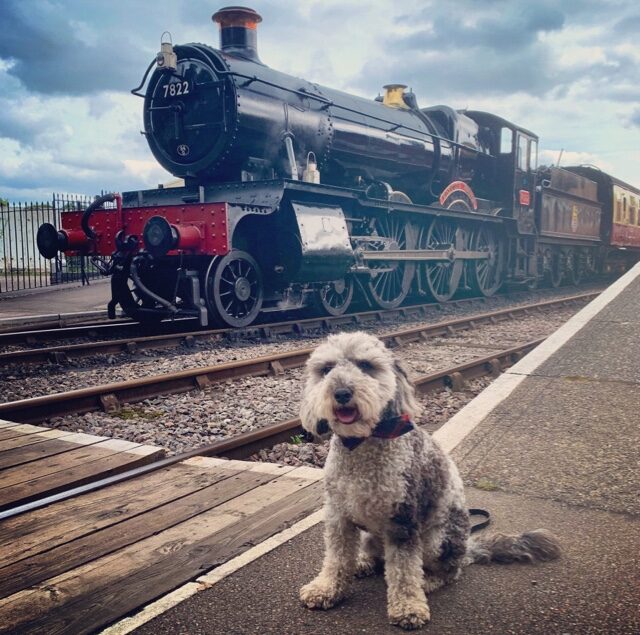
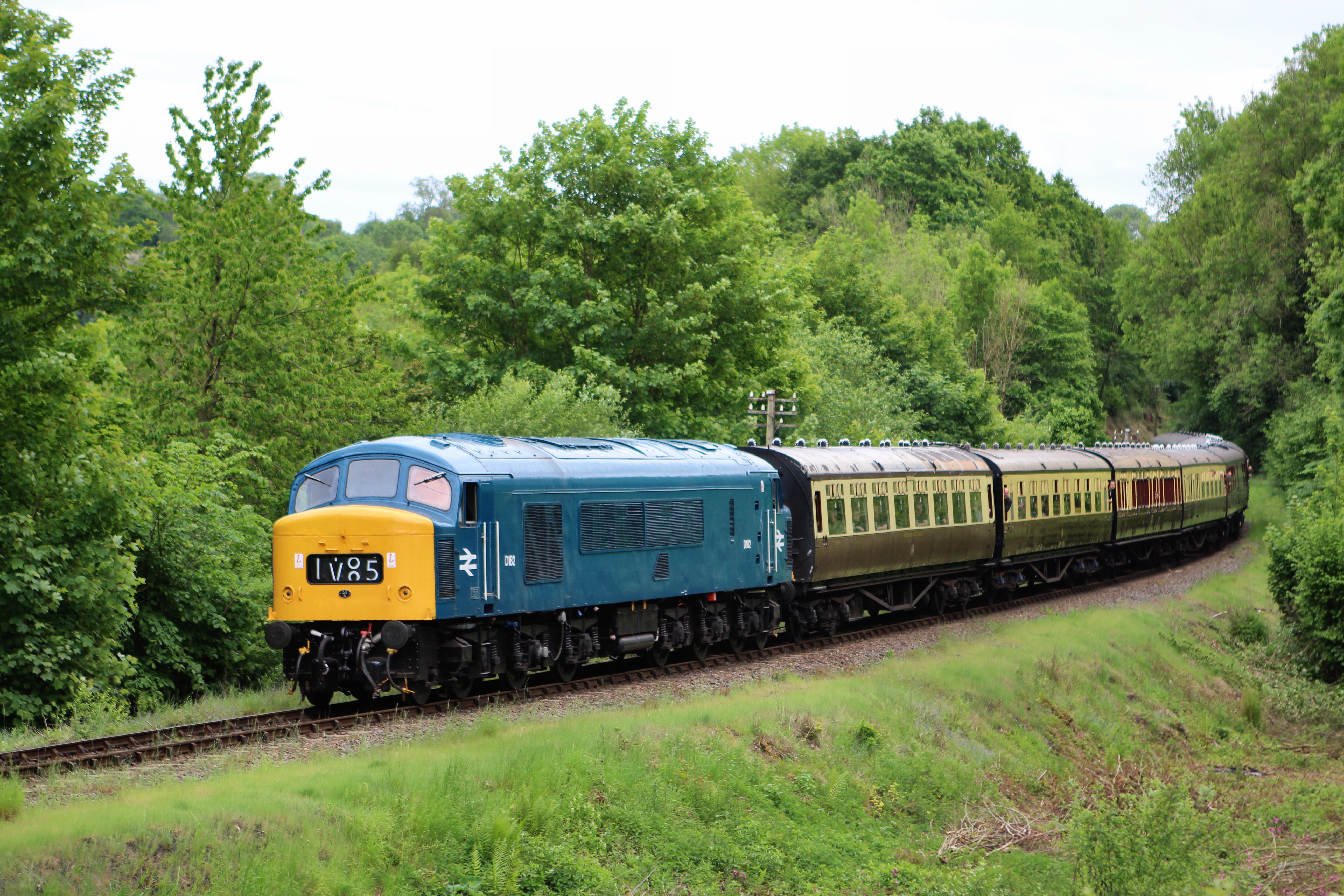
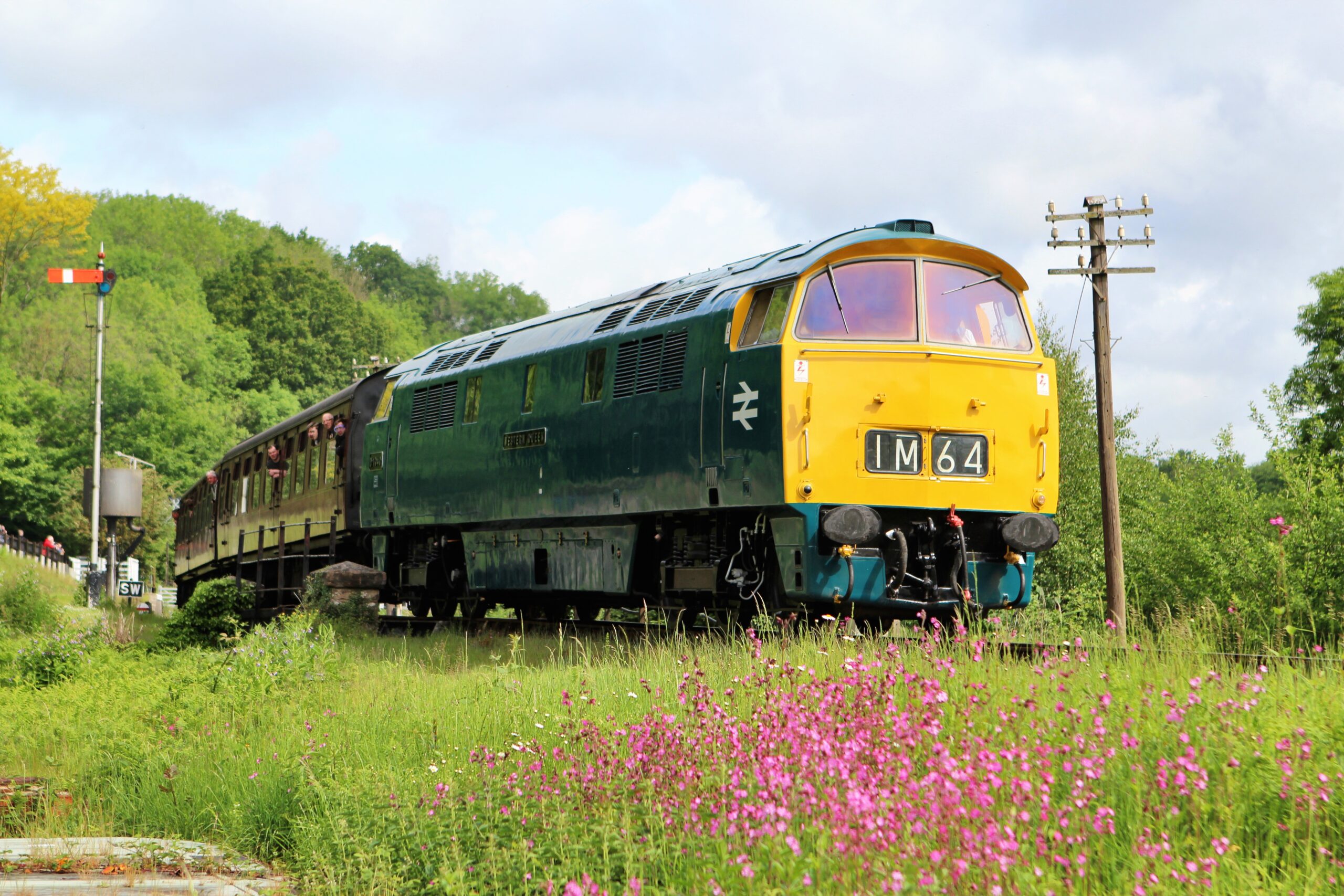
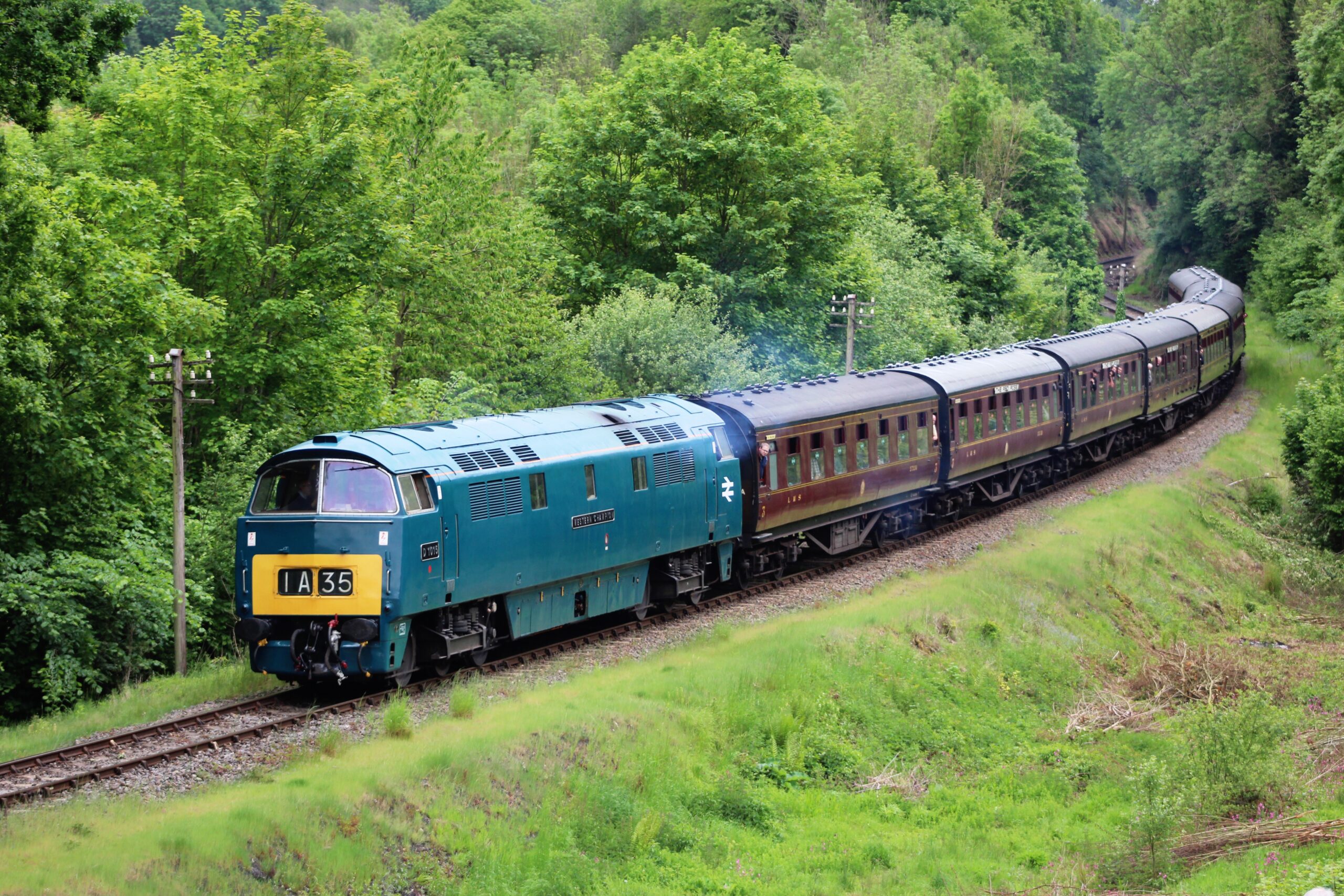
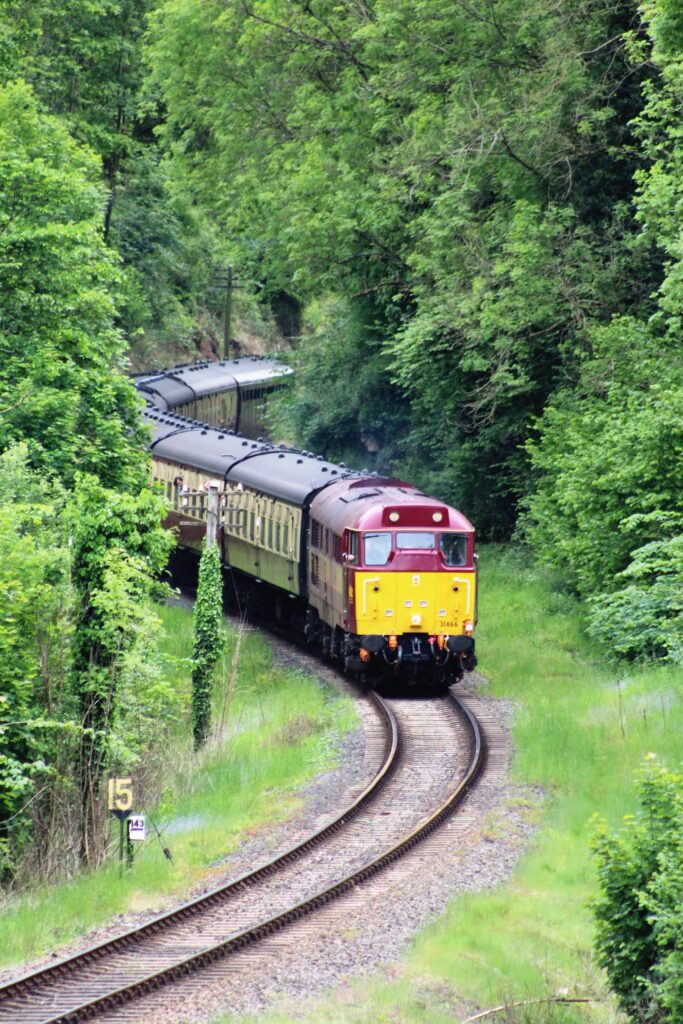
SR West Country Class 4-6-2 No. 34028 ‘Eddystone’ pauses at Harmans Cross with the Swanage Railway’s recreation of “The Royal Wessex” 1700 departure from Swanage – 27/07/2022
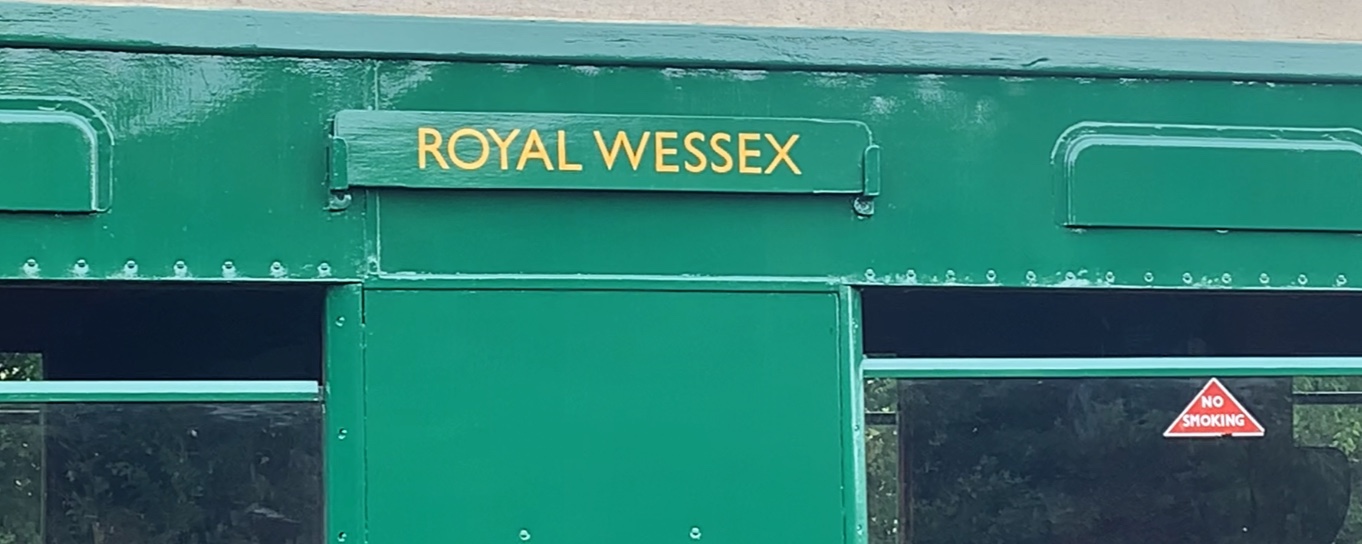
Swanage Railway recently launched a re-creation of the 1950’s era “Royal Wessex” train including the option to reserve seats in a heritage carriage designed by Richard Maunsell, the chief mechanical engineer of the Southern Railway in the 1930’s, after it was painstakingly restored by a group of volunteers. Maunsell carriages would have been a familiar sight on the Swanage branch line until the 1960’s when they were withdrawn from service. The “Royal Wessex” was introduced in 1951 and departed London Waterloo with portions designated for Swanage, Bournemouth West and Weymouth. Carriages were detached from the main train and attached to a local branch line service to take passengers to their chosen destination. The Swanage portion consisted of two carriages which were separated from, or for the return working; joined to, the main train at Wareham. The Swanage initiative sees the Maunsell carriage carrying “Royal Wessex” name boards with the locomotive hauling the train having a headboard.
“Royal Wessex” name board as carried by the restored 1930’s Maunsell Carriage – July 2022No. 34028 sporting “The Royal Wessex” headboard – July 2022
Swanage Railway ‘The Royal Wessex’ – July 2022
47 On Tour
Class 47 No. 47830 ‘Beeching’s Legacy’ pauses at Gillingham, Dorset to cross with a late running Exeter to Salisbury service while working 0V45 0835 Southampton to Exeter St. Davids – 28/07/2022 (Photograph courtesy of Scott Lewis)
In connection with 19th -23rd September 2022 engineering work scheduled to take place between Axminster and Pinhoe, Freightliner celebrity locomotive Class 47 No. 47830 ‘Beeching’s Legacy’ has been working route learning trips between Southampton Maritime and Exeter St. David’s on selected days over the last couple of weeks, which meant the locomotive briefly visited Dorset. We were very kindly sent the images and video reproduced on this page by Scott Lewis, who I’m now going to call Yoshi’s North Dorset correspondent.
28/07/2022 (Video courtesy of Scott Lewis)Class 47 No. 47830 ‘Beeching’s Legacy’ at Gillingham, Dorset – 28/07/2022 (Photograph courtesy of Scott Lewis)
The engineering work will see a five-day closure of the line with a £5m project undertaken that includes landslip prevention work at Honiton tunnel which will involve the installation of two retaining walls, 32 metres and 16 metres in length accompanied by sheet piles that consist of metal posts with concrete planks for additional support to protect the line from future closures. Weather resilience work will also improve and supplement drainage systems.
Gloucestershire Warwickshire Diesel Gala
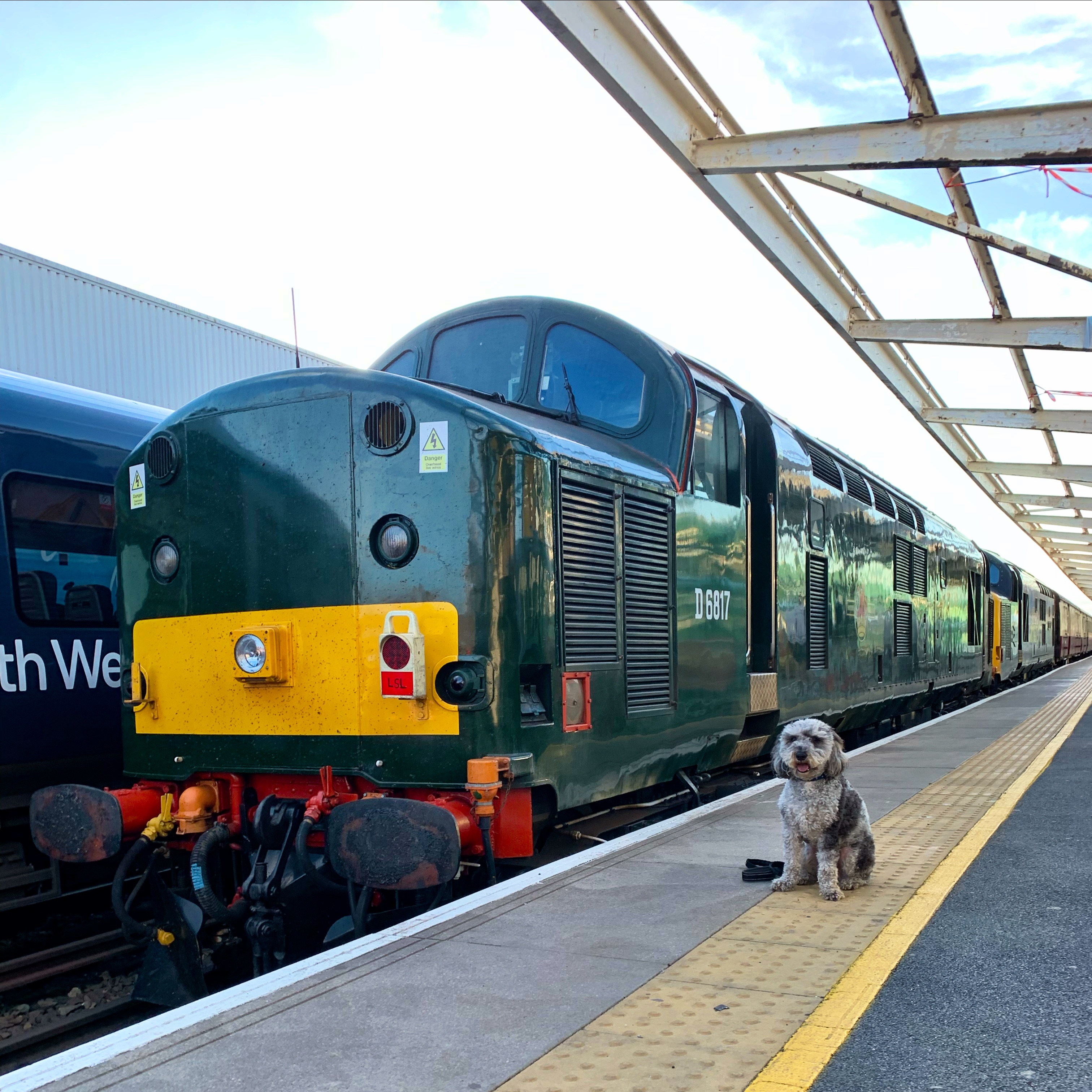
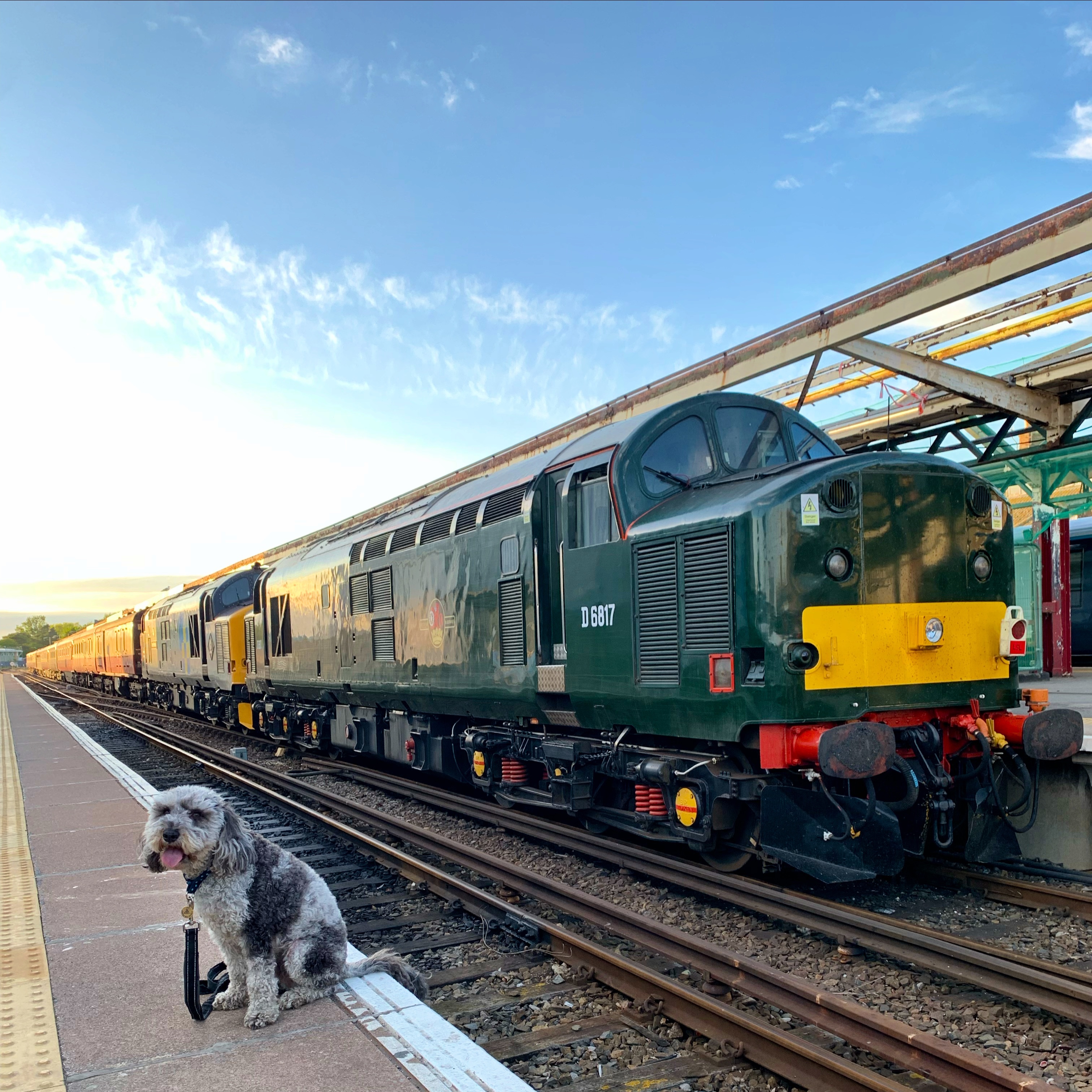
I found myself with time on my hands on Friday 29th July, so Yoshi, one of Yoshi’s hoo-man uncles and I took ourselves off to the Gloucestershire Warwickshire, a beautifully striking railway in the Cotswolds. The 2022 diesel gala employed the railways’ home fleet, supplemented by visiting Class 55 Deltic locomotive No. 55019 ‘Royal Highland Fusilier’ – the first ever visit of a locomotive of this iconic class. To be honest, the appearance of the Deltic first attracted me to the notion of attending this gala. The Gloucestershire Warwickshire is a railway I have not visited previously, but I’ll certainly be returning after having a very enjoyable day.
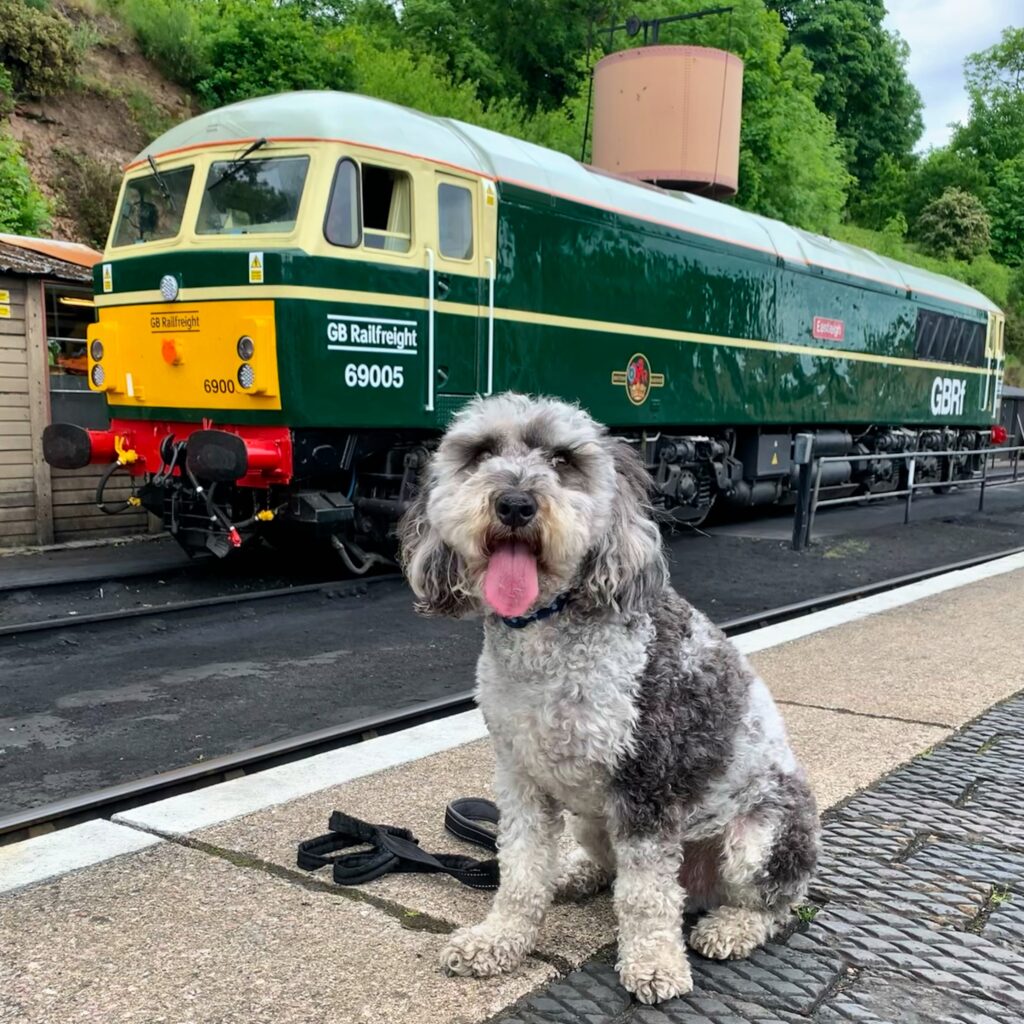
Yoshi at Toddington with Class 55 No. 55019 ‘Royal Highland Fusilier’ – 29/07/2022
The Stratford-Upon-Avon to Cheltenham Railway was constructed between 1902 and 1906 by the Great Western Railway (GWR) for the purpose of achieving a faster and more direct route between the Midlands and the South West, although this necessitated avoiding difficult terrain to allow gentle gradients and sweeping curves enabling high speed running. Extensive cuttings, embankments and a long tunnel at Greet were required, and unfortunately some of the stations were located some distance from the villages they purported to serve. As with many railways, usage began to decline in the 1950’s with passenger services being withdrawn on 7th March 1960. Use for freight and as a diversionary route continued until a derailment outside of Winchcombe station saw a cessation of all traffic with the line finally closed in November 1976, the track being lifted in 1979. Two year later, in 1981, the Gloucestershire Warwickshire Steam Railway plc was formed and they acquired the 14.5 miles of track bed between Cheltenham Racecourse and Broadway. Stations, signal boxes etc. have been reopened or rebuilt from scratch resulting in a very attractive railway.
The diesel gala featured the following locomotives:
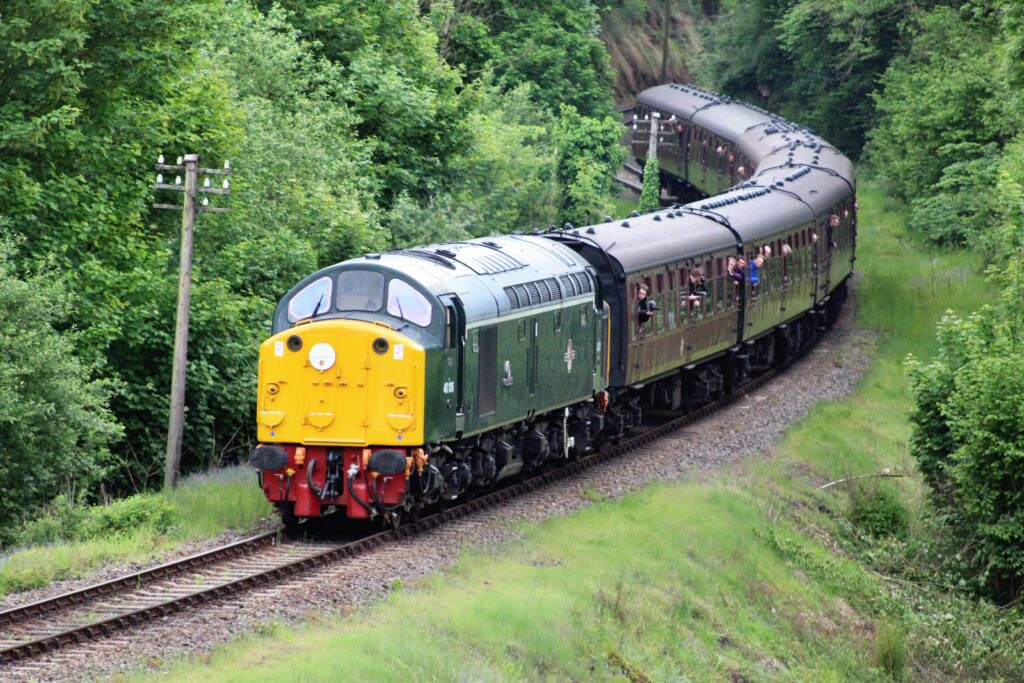
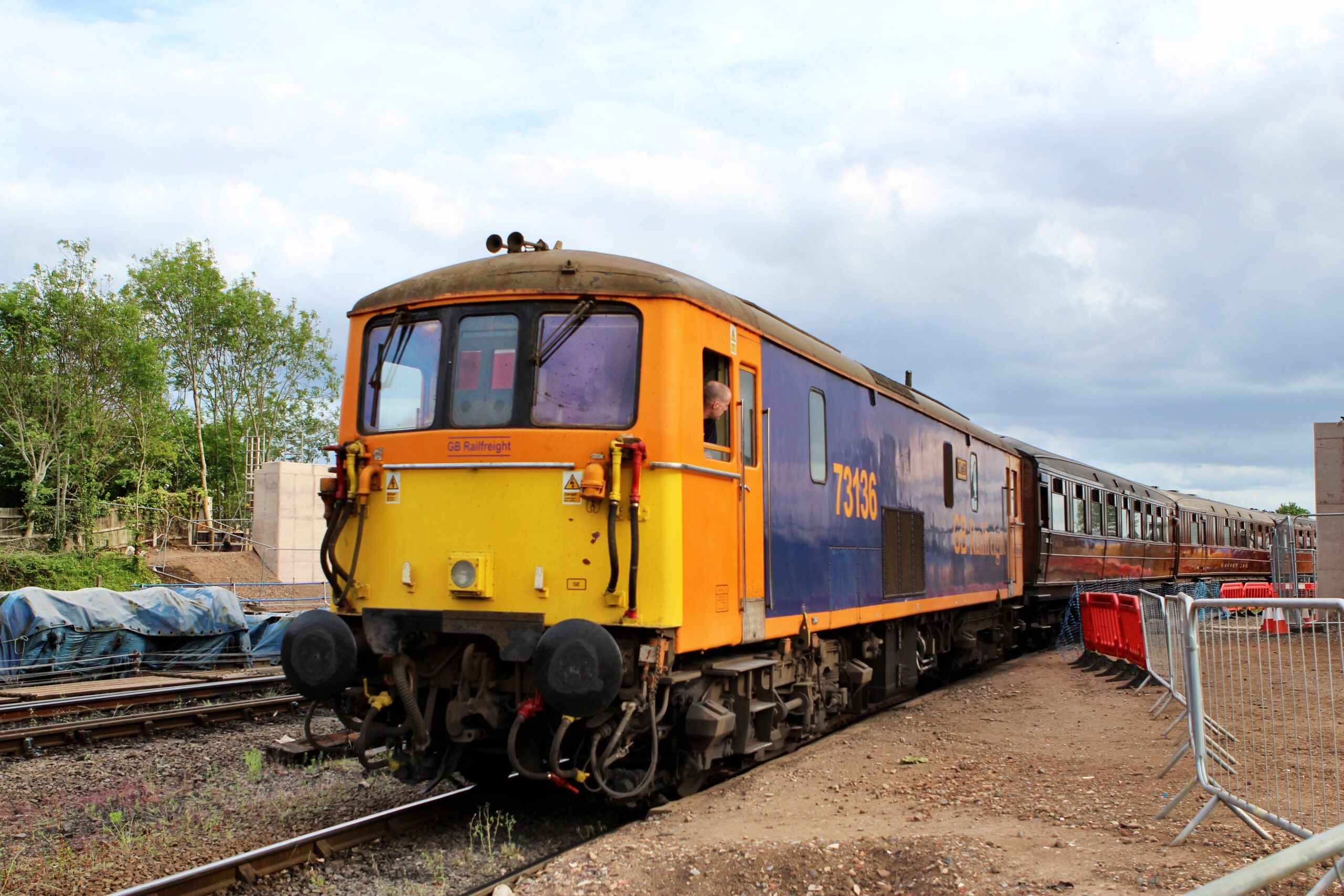
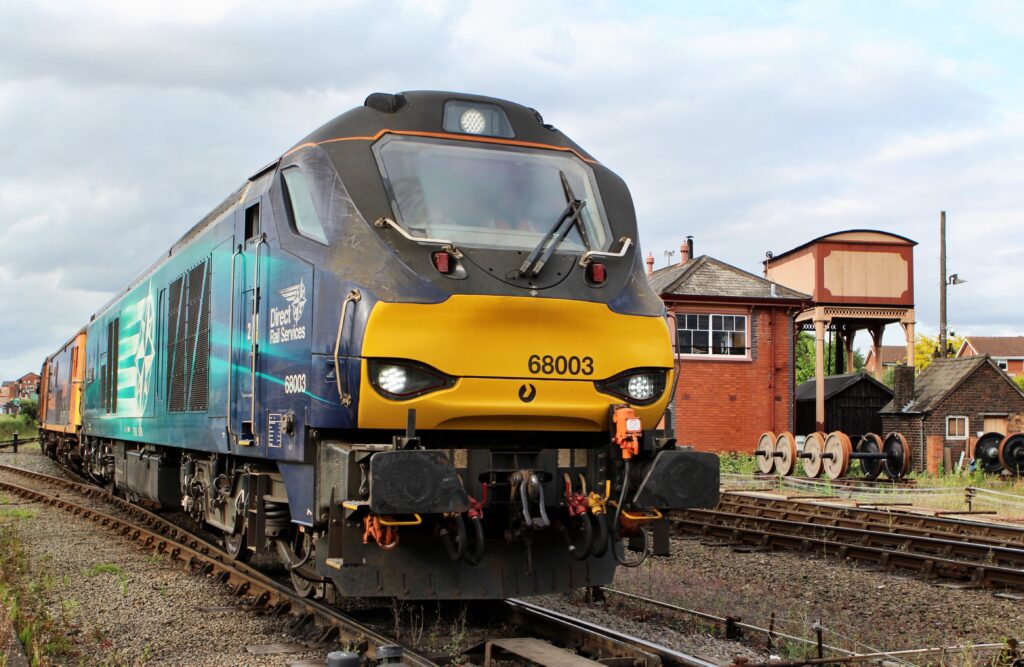
Visiting Deltic Class 55 No. 55019 ‘Royal Highland Fusilier’ is owned by The Deltic Preservation Society and its home base is Barrow Hill in Derbyshire. 22 Deltic were constructed for use on the East Coast Mainline, entering traffic between 1961-62.Brush type 4 Class 47 No. 47105 is owned by the Brush Type 4 Fund and a permanent resident on the Gloucestershire Warwickshire Railway. The locomotive was purchased in January 1994 and is seen here approaching Toddington – 29/07/2022Brush type 4 Class 47 No. 47376 s owned by the Brush Type 4 Fund and a permanent resident on the Gloucestershire Warwickshire Railway. The Brush Type 4 Fund was formed in 1992 No. 47376 was purchased in November 2002. The locomotive received a replacement engine from No. 47295 prior to arriving at Toddington in 2003.Sulzer Type 4 Class 45/1 No. 45149 was built at Crewe in 1961 and was withdrawn from British Rail service in 1987. The locomotive is owned by The Cotswold Mainline Diesel Group and is a permanent resident on the Gloucestershire Warwickshire Railway..English Electric Type 3 Class 37/0 No. 37215 was built in 1963 at Newton-le-Willows being preserved in 1994. The locomotive is owned by The Growler Group and is a permanent resident on the Gloucestershire Warwickshire Railway.Sulzer Type 2 Class 24 No. 24081 (D5081) was preserved in 1981 and is a permanent resident on the Gloucestershire Warwickshire Railway having remained operational throughout its preservation years. The locomotive is owned by the 24081 Loco Group.English Electric Type 2 Class 20 No. 20137 was built in 1966 at Newton-le-Willows and was purchased privately from British Rail in 1994, returning to working order in 1995. The locomotive is a permanent resident on the Gloucestershire Warwickshire Railway. (Seen here with class mate No.20228 (D8327) which is undergoing restoration – with their single cabs Class 20’s mostly spent their time coupled nose to nose in pairs to provide 2,000hp and to improve driver visibility).English Electric Type 2 Class 20 No. 20228 (D8327) which is currently undergoing restoration. Sulzzer Type 2 Class 26 No. D5343 (26043) was one of 47 locomotives built by the Birmingham Railway & Carriage Works (BR&CW) in Smethwick, entering service in October 1959. During January 1993, whilst allocated to snow clearance duties between Perth and Blair Atholl, 26043 suffered a power earth fault. Repairs were not authorised and it was withdrawn on 19th January 1993. Initially stored at Perth, it was then moved to MC Metals in Glasgow for asbestos insulation removal, which entailed major dismantling of the cab interiors. The loco was purchased by the Cotswold Mainline Diesel Group in late 1993 and it arrived at Toddington in April 1994.English Electric Type 3 Class 37 No.D6948 (37248) was built by English Electric at the Vulcan Foundry, Newton le Willows, Lancashire and was delivered to British Railways’ Cardiff Canton depot on the 30th October 1964 and withdrawn from service in 2003. After two years in storage at Margam, it was purchased by three Growler Group members in conjunction with West Coast Railways Limited to whom the locomotive was loaned as part of an agreement to restore it to working order for mainline operations, entering WCRC service in 2006. The loan agreement ended in 2009 and the loco entered preservation, becoming a permanent resident on the Gloucestershire Warwickshire Railway in 2010.
Gloucestershire Warwickshire Railway Diesel Gala 2022
It was an extremely hot day and we took every opportunity to keep Yoshi cool, in the shade and hydrated. I have also bought a hat for future railway days out in the sun, because I was told to, and I sometimes do what I am told! All in all an excellent day out, with good company and another heritage railway with friendly, enthusiastic and helpful volunteers. I even got back home in time to watch the last episode of Neighbours.
Test Train Delays
August kicked off with the scheduling of test train 1Q51 running from Derby Railway Technical Centre to Eastleigh via Weymouth. Our regular reader may remember that the July instance of this working didn’t make it to Weymouth, the train being curtailed at Eastleigh. This time, the test train made it as far as Wool before it was reversed, missing out the Wool to Weymouth section. This was because the 1605 departure from Waterloo developed a fault and it ground to a halt at 1829 just before reaching Wool station, blocking the line to Weymouth and causing following services knock on delays and cancellations. The 1Q51 test train was eventually caught up behind the failed service train.
GBRf Class 73 No. 73965 ‘Des O’Brien’ approaching Branksome working 1Q51 1115 Derby R.T.C. to Eastleigh East Yard – 01/08/2022
Unaware of this, I had ventured out to Branksome in order to see the train in daylight as it usually traverses the Bournemouth to Weymouth section in darkness most of the year. However earlier disruption on the network meant that delays to services resulted in late running empty coaching stock from Poole to Bournemouth T&RSMD passing on the up platform where I was stood, obscuring the 73’s from view as they headed down towards Weymouth. I consoled myself with the knowledge I would have another shot at getting some video on the return leg. However, becoming aware that the test train was sat between Wareham and Wool via the Open Train Times webpage, Yoshi and I set off for Wool to investigate.
On arrival at Wool we were able to see the failed Class 444 EMU (No. 444021) sitting just outside of Wool station.
The lights of Class 444 No. 444021 can be seen just up the track from Wool station – 01/08/2022
By the time the ailing 444 was rescued by a fellow Class 444 at 2211 and the train reversed to the Up line via a set of points situated outside of Wool to clear the line, the test train was well behind schedule. The decision was made to cancel the run to Weymouth and to reverse the train in Wool station – as you can see in the video below:
1Q51 1115 Derby R.T.C. to Eastleigh East Yard – 01/08/2022GBRf Class 73 No. 73963 ‘Janice’ at Wool awaiting reversal of 1Q51 1115 Derby R.T.C. to Eastleigh East Yard – 01/08/2022
Hamworthy Branch
More news on the reopening of the Hamworthy Branch, which was finally acknowledged by Network Rail as happening in a mailing to residents living near the railway line:
I will admit to once again failing to get a decent image of a rail/road vehicle on the branch. I’m considering sending in Yoshi with a doggo-cam to get better shots from the trackside, but in the meantime I’ll share the following video of ongoing sleeper replacement near Hercules Road Access Point ( formerly Butts Crossing ) for reference:
Hamworthy Branch Maintenance Work – 27/07/2022
For a far better glimpse of the road / rail traction being employed on the Hamworthy Branch, Kev Scott has kindly given us permission to link to his video of a Komatsu Rail Rider passing over Hamworthy Park Level Crossing. Don’t forget to check out Kev’s other videos on his You Tube page!
https://youtu.be/rKWsWxTmpPI
Class 701 on Test
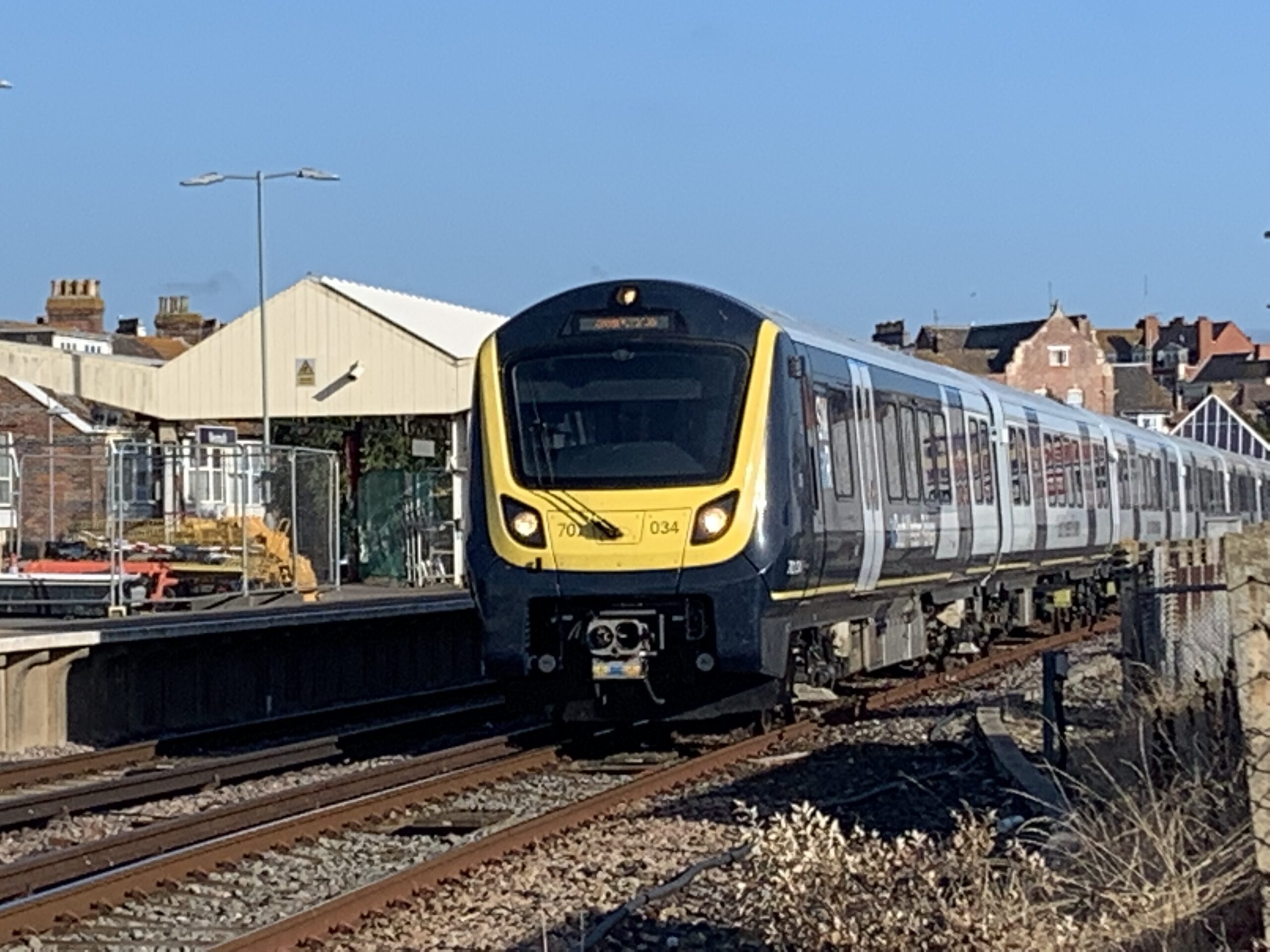
Class 701 No. 701034 seen running through Hamworthy with test train 5Q56 1612 Eastleigh TRSMD to Weymouth – 02/08/2022
Another week passes by and South Western Railway Class 701 electric multiple units are still undergoing test runs. This week however, unit No. 701034 ran west of Poole to Weymouth and Wareham on Tuesday 2nd August. Two runs took place, the first from Eastleigh TRSMD ran to Weymouth as 5Q56, the unit then forming 5Q57 to Brockenhurst. The driver and any onboard support crew would hopefully have had time for a cup of tea and cake before departing Brockenhurst at 2114 bound for Wareham as 5Q58 before returning to Eastleigh TRSMD as 5Q59 where the unit was then put to bed at around 2330.
Class 701 No. 701034 at Weymouth preparing for departure with 5Q57 1838 Weymouth to Brockenhurst – 02/08/2022 (Photograph courtesy of @da_buckley967 )
Video of Class 701 No. 701034 working evening test runs. With thanks to G E Barrett and @da_buckley967 for their kind permission to use their footage taken at Dorchester South and Weymouth respectively – 02/08/2022
This weeks ‘The Railway Dog’ was written to the accompaniment of Bear’s Den, Pink Floyd and Bernard Cribbins. I’ve enjoyed the collaborative feel to this weeks blog and my thanks to everyone who has agreed to the sharing of their material, it is much appreciated. Thanks again for reading and for corrections and observations. All being well, we’ll be back here next week for more of the same!
Old meets new at North Pier, Blackpool – 13/07/2022
Blackpool
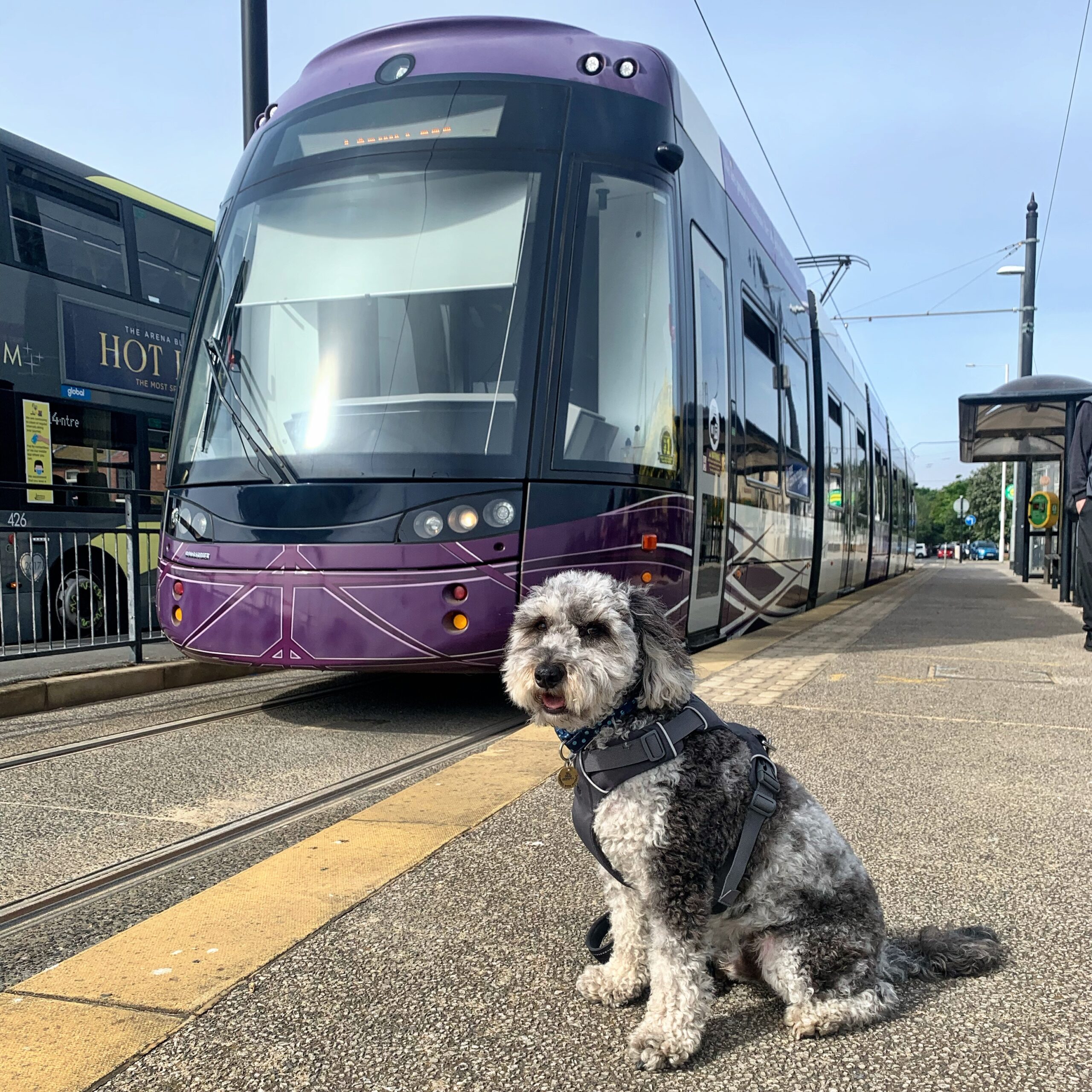
As we mentioned in our last blog entry, Yoshi and I spent a few days in the North West a couple of weeks ago when we took the opportunity to take a trip on a heritage Blackpool Tram. The Blackpool Tramway runs from Blackpool to Fleetwood, originally opening in 1885 and is one of the oldest electric tramways in the world. It is operated by Blackpool Transport (BT) and runs for approximately 11 miles. The last time I visited Blackpool was probably in 2007 when David Tennant, who was at the time playing the Tenth Doctor in BBC TV’s “Doctor Who”, switched on the illuminations. This was just prior to the announcement that the UK Government had agreed to the joint BT and Blackpool Council bid for funding towards the upgrade of the tram track network, with £60.3m coming from Government coffers. The remainder of the £85.3m cost came from Blackpool Council and Lancashire County Council which contributed @ £12.5m each. The Government’s funding allowed the entire tramway to be upgraded with 16 modern and accessible Bombardier Flexity 2 trams being introduced in 2012 replacing the traditional fleet of ageing cars.
A number of the old trams which I was familiar with on my previous visits have been retained with some having been lovingly restored to form a Heritage Fleet and modified, widened Balloon trams as part of the main fleet. The depot at Starr Gate houses the Flexity 2 trams with Rigby Road Depot, near Manchester Square, housing the traditional trams. A great deal of effort has been made to ensure that the traditional trams have a future in Blackpool and I was pleased to see one on a run out as we arrived in Fleetwood for our stay at the North Euston Hotel. Thinking perhaps these only ran at weekends, I asked a driver of one of the modern trams about the heritage fleet and was directed to a website dedicated to Blackpool Heritage Trams. From here, Yoshi and I booked a one hour promenade tour which picked up from North Pier on its way to Bispham before heading back all the way to the Pleasure Beach in the south of Blackpool before turning once more and returning via the Golden Mile, dropping us off where we started. I was delighted to see that the tram car operating our trip was one of the recognisable and iconic Balloon cars, so named because of their rounded streamlined appearance, in traditional Blackpool 1940s “Wartime” green and cream livery.
Yoshi waits to board the tram for his Blackpool promenade tour – 13/07/2022
The Balloon trams were originally called “Luxury Dreadnought” cars and had been commissioned in 1933 by Walter Luff, the controller of the Blackpool network, in a bid to modernise the tramway’s fleet which had been working the tracks since the early years. 27 trams were constructed by English Electric between 1934 and 1935, the first being delivered on 10th December 1934. They were built with central doors and stairs, with a maximum capacity of 94 passengers. Half-drop windows provided ventilation with Art Deco curved glass electric lighting providing illumination. The initial thirteen were open-topped and the remaining fourteen were enclosed, these having sliding roof windows and thermostatically-controlled radiators.
Yoshi after enjoying a snooze on Balloon tram No. 700 – 13/07/2022
Between 2009 and 2012, Balloon car No. 700, which was to provide transportation for our journey, along with sisters 711, 713, 719 and 720 were modernised so that they could continue to operate in service following the refurbishment of the whole tramway to light rail standards. New widened doorways were fitted to allow more accessibility, with driver operated doors which fit to the new platforms built at tram stops for the modern Bombardier trams. Fixed seats and new passenger information displays were also fitted to match the new trams. Speedometers were also retrofitted to the driving consoles, which seems like a very good idea to me!
Yoshi considers driving off in Car No. 700 – 13/07/2022
We really enjoyed our trip on the heritage tram, and thoroughly recommend the experience should you find yourself in Blackpool. You can join us on our tour of Blackpool promenade as well as view some of the Flexity 2 trams in our video below:
Yoshi takes time to check out Flexity 2 tram No. 010 at Fleetwood Ferry – 11/07/2022
For a reminder of what it used to be like, here’s a video of Blackpool Trams from October 1999, featuring a brief glimpse of some of the famous illuminated trams:
Dorset Coast Express
Thursday 21st July saw another steam excursion to Weymouth subjected to alterations, this time because of the dry weather and subsequent risk of line side fires, the planned steam motive power was replaced by two Class 47 diesel locomotives. Fingers crossed all goes to plan for the next scheduled The Railway Touring Company Dorset Coast Express in August!
Class 47 No. 47772 ‘Carnforth TMD’ leads 1Z82 0845 London Victoria to Weymouth past Poole carriage sidings – 21/07/2022Class 47 No. 47813 with the return working of the Dorset Coast Express racing through Hamworthy – 21/07/2022
Around Taunton
Video screen grab of Class 47 No.’s D1935 / 47805 ‘Roger Hosking MA 1925-2013’ and D1944 / 47501 ‘Craftsman’ power the “Cornish Riviera Statesman” rail tour up Whiteball bank – 23/07/2022
Saturday saw Yoshi and I in the Taunton area as we went to see a couple of rail tours and hoped to catch celebrity High Speed Train power car No. 43384 which has been outshopped in a retro livery by CrossCountry Trains. First on our radar was Statesman Rail’s “Cornish Riviera Statesman” working Derby to Penzance and double headed by Brush Type 4 Class 47 No.’s D1935 / 47805 ‘Roger Hosking MA 1925-2013’ and D1944 / 47501 ‘Craftsman’, both resplendent in British Rail two-tone green livery. I just had time to set up for a video capture when the train passed by several minutes ahead of schedule, meaning my camera was still asleep in its bag. Also running ahead of schedule was The Railway Touring Company operated “The West Somerset Express”, which like their tour to Weymouth a couple of days previously had been advertised as being steam hauled, but were deputised with West Coat Railways Class 47 No.’s 47813 and 47772 ‘Carnforth TMD’ again in top and tail formation. This tour originated from London Paddington and was destined for Minehead on the West Somerset Railway (WSR) – the longest heritage railway in the UK. On arrival at Bishops Lydeard, the first WSR station after leaving the main line, the Class 47’s were replaced with a pair of steam locomotives to take the train forward. We saw Great Western Railway (GWR) Inspired 2-6-0 9351 Class WSR Mogul No. 9351 and GWR 7800 Class Manor No. 7822 ‘Foxcote Manor’ hauling the train nearing Crowcombe Heathfield producing some fine acoustics. You can follow our day in the video below, which also includes some CrossCountry Trains and GWR Castle Class HST’s:
CrossCountry Trains (XC) recently outshopped Class 43/3 No. 43384 from Plymouth Laira Depot in a revised High Speed Train livery, known as Intercity Executive, first carried back in the 1980’s. At the time the Intercity yellow and grey livery replaced the original blue and yellow colour scheme that had been used since the introduction of the fleet. CrossCountry has confirmed that the repaint comes as part of marking the 40th anniversary of the introduction of the InterCity 125 by British Rail on to the North East to South West route. Other celebrations include a special Railway Benefit Fund charitable XC HST rail tour on the 27th September 2022 travelling from Leeds to the Severn Valley Railway including a run along the heritage railway itself. An HST power car will be named at Kidderminster to mark the anniversary.
Class 43/3 No. 43384 is seen leading on 1V52 0658 Edinburgh Waverley to Plymouth as it nears Creech St. Michael – 23/07/2022
Eastleigh Grid
Class 56 No. 56081 approaches Shawford working 5O07 1049 Leicester L.I.P. to Eastleigh East Yard hauling Arlington Fleet barrier vehicle’s No. 64664 ‘Liwet’ (Ex Class 508 DMSO from unit 508207) and 64707 ‘Labezerin’ (Ex Class 508 DMSO from unit 508116) ex EMU Barrier coach set T7 – 24/07/2022
Yoshi and I were busy with our chores on Sunday morning when we discovered GBRf Class 56 No. 56081 was on its way from Leicester to Eastleigh with barrier vehicles in order to collect Network Rail’s European Railway Traffic Management System (ERTMS) lab train No. 313121 – this was too good an opportunity to miss and we put down the duster and polish and jumped in the car and set off for Shawford. This is more than likely our final opportunity to see this particular Class 56 in its current form as it has been earmarked for conversion as part of the Class 69 programme.
On our way back home, we had a quick look in at Eastleigh Works and saw the remaining four cars of Wessex Electric Class 442 EMU No. 442412 had been shunted around and were now visible adjacent to the road. Based on the British Rail Mark 3 carriage as used in HST sets, the 442’s were introduced as part of the Bournemouth to Weymouth electrification programme in the late 1980’s and, in my view at least, were the best EMU to have run in the UK.
GBRf Class 73 No. 73141 ‘Charlotte’ at Eastleigh Works – 24/07/2022The remaining four coaches of Class 442 No. 442412 in faded “Express” livery at Eastleigh Works – 24/07/2022
701 On Test
Class 701 No. 701017 passes the site of the former Boscombe railway station working 5Q52 1724 Staines Up Loop to Eastleigh TRSMD via Bournemouth – 25/07/2022
Another week passes by and Class 701’s are still running test trains to Bournemouth and Poole prior to their introduction into revenue earning service. This week we went to take a look at the site of the former railway station at Boscombe which was located between Bournemouth Central and Pokesdown. The station opened in 1897 and served The Royal Victoria Hospital and the shopping area around the Royal Arcade. Boscombe had a goods yard which received traffic for despatch from a large area of Bournemouth along with a coal depot and sidings. The substantial brick built buildings were demolished a few years after closure in 1965. The site now houses business units and threatening signs about unofficial parking. The road bridge which goes over the railway at this point has had footbridges added to each side and these have very high fencing installed for safety reasons.
Access Point Information, Station Approach, Boscombe – July 2022Station Approach, Boscombe – July 2022Station Approach, Boscombe – July 2022
Class 701 No. 701017 was this weeks unit on test as seen in this video – 25/07/2022
Hamworthy Branch
More activity on the mothballed Hamworthy Branch this week as temporary traffic lights were put in place at the crossing on Ashmore Avenue on Tuesday 26th July. Road / rail vehicles were also in evidence along the branch moving ballast. Sleepers and sections of track have also been marked up, possibly for replacement. Network Rail have successfully applied for a road closure permit on Lake Road, presumably to enable work to be carried out on the railway bridge which is located there.
Pressure washing Ashmore Avenue crossing on the Hamworthy Branch – 26/07/2022
We arrived just too late for a decent shot of a road / rail vehicle working on the Hamworthy Branch at Hamworthy station, but we thought we’d share this anyway! 26/07/2022
Weymouth Railway Heritage Trail
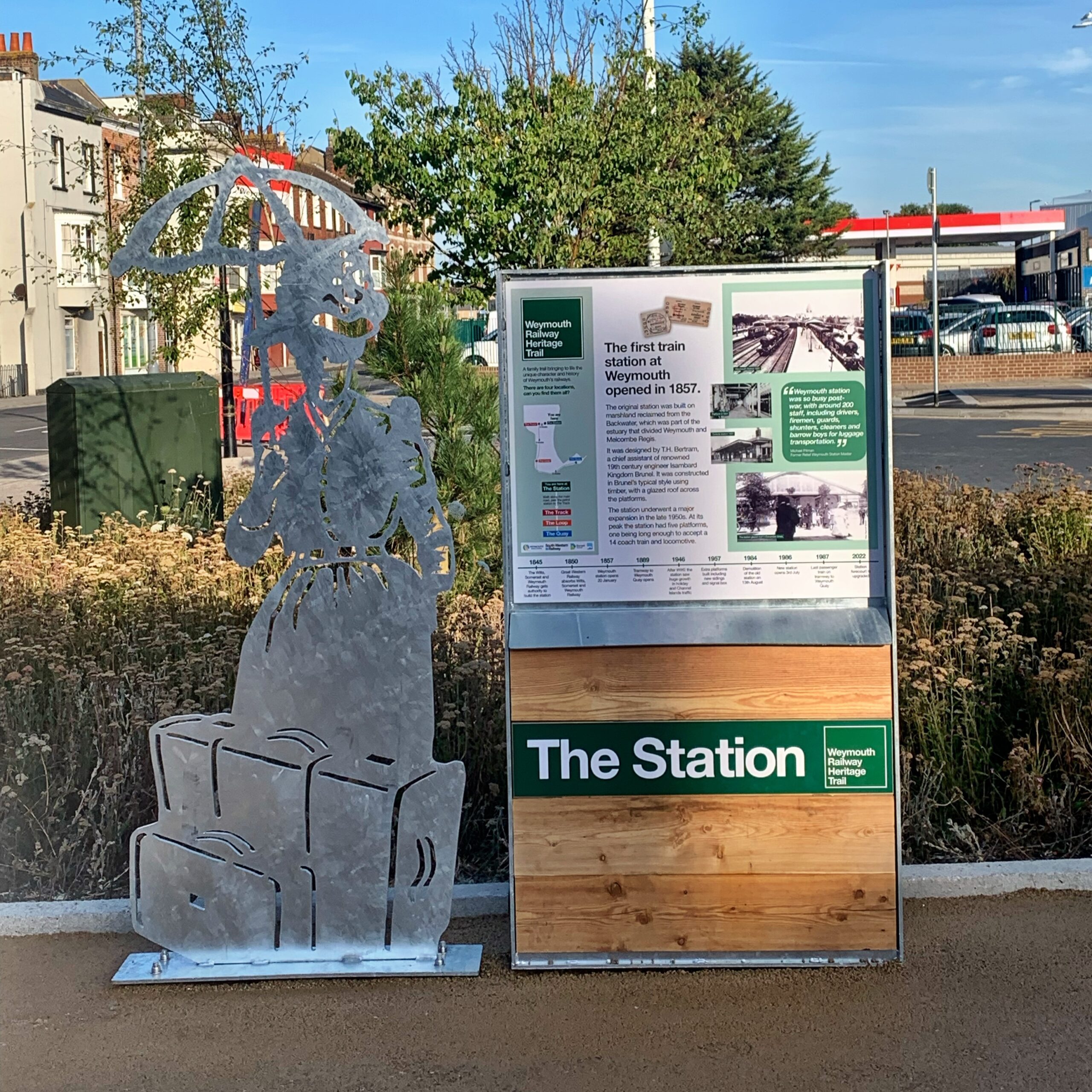
In the past week or so, new signage has popped up around Weymouth on the route of the former Weymouth Harbour Tramway which last saw use in 1999 and was dug up by the local council in an act of vandalism in 2020/21 with most of the track being removed at this time. With no sense of irony Weymouth Town Council, Dorset Council and South Western Railway have installed information boards celebrating Weymouth’s unique railway history.
The remodelled station forecourt at Weymouth – July 2022Weymouth Railway Heritage Trail information board ‘The Station’ – July 2022Weymouth Railway Heritage Trail information board ‘The Track’ – July 2022Weymouth Railway Heritage Trail information board ‘The Loop’ – July 2022Weymouth Railway Heritage Trail information board ‘The Quay’ – July 2022
This weeks “The Railway Dog” was mostly written to the sounds of Faeland, Hollow Coves, The Teardrop Explodes and Sibelius Symphony No. 5. Thanks for visiting. Comments and corrections are, as ever, always welcome and we really appreciate it when you point out typos or grammatical errors. We’ll be back next week, we hope you’ll join us.
DB Cargo Class 67 No. 67025 in operation with Transport for Wales waits departure at Crewe with 5K67 0951 Holyhead Car. M.D. Empty Coaching Stock working to Crewe C.S. – 16/07/2022
Fleetwood
The North Euston Hotel, Fleetwood
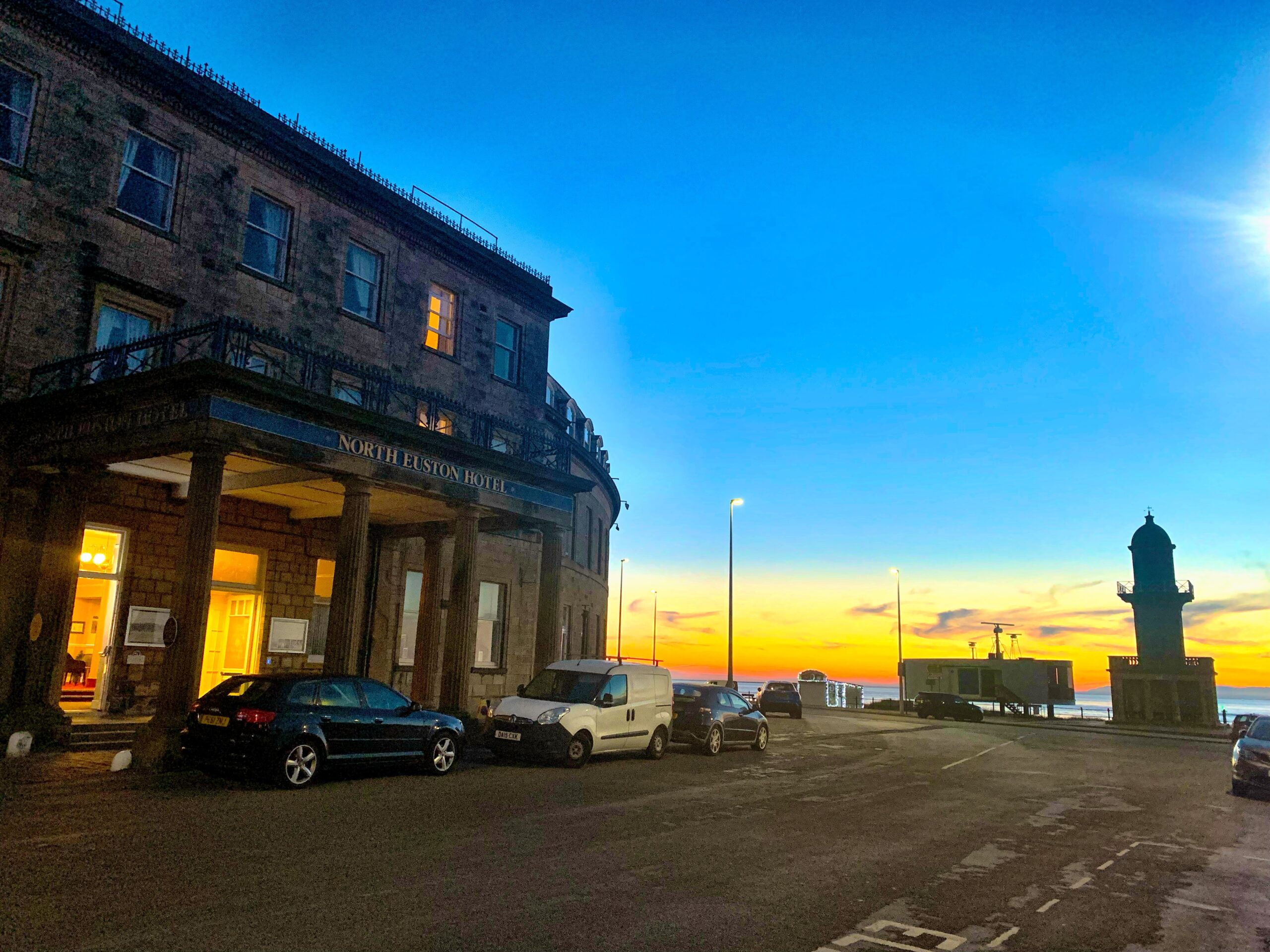
Yoshi and I spent much of last week in the North West of England as we made The North Euston Hotel in Fleetwood our base. The hotel was commissioned by Sir Peter Hesketh Fleetwood, designed in the Greek classical style by architect Decimus Burton and built between 1839 and 1841 to serve overnight passengers making the journey by rail from London Euston who were destined for steam ships which would provide onward travel to Scotland where after disembarking at Ardrossan they would take the train on to Glasgow. Fleetwood was the northern most station at the time, hence the name “North Euston” for the hotel, and the railway was yet to run over the Shap hills. Queen Victoria made the journey in 1847 and stayed at the hotel, although I’m sure she didn’t stay in our room. The first manager of the hotel, Corsican born Xenon Vantini, had been a courier for Napoleon Bonaparte and was also the first person to open a refreshment room at Wolverhampton railway station. In 1859 following a decline in fortunes, the hotel was sold to the government and was converted into a school of musketry and later, in 1867, an officer’s quarters. The building existed in this form until the 1890’s when it was purchased by a group of London businessmen who converted it back into a hotel. The North Euston is currently owned by local business families. Yoshi very much enjoyed his morning sausage for breakfast and we celebrated our dubious achievement of coming last in the Sunday evening pub quiz which was a lot of fun.
The railway to Fleetwood was opened on 15th July 1840 as the Preston & Wyre railway and was also the vision of Sir Peter Hesketh Fleetwood it being designed to connect the then new port of Fleetwood on the Fylde coast to Preston. The railway was constructed by George and Robert Stephenson with contribution from Joseph Locke. Its glory days lasted only six years until a direct route over Shap was finally achieved. The railway was absorbed into the Lancashire & Yorkshire Railway ( later the London Midland Scottish Railway as part of the Big Four groupings in 1923) and extensions were built to Blackpool and Lytham to cater for the growing number of passengers traveling to the seaside. Fleetwood would become, for a time, one of the largest and most successful fishing ports in the UK but by 1970 the railway from Poulton-le-Fylde to Fleetwood was closed to passenger traffic and later, in 1999, to freight workings.
Thornton Station is located in the heart of Thornton town centre – July 2022Until the late 1980’s a signal box operated the crossing over Station Road, Thornton – July 2022The current station buildings were the first built by the then newly formed London Midland Scottish Railway (LMS) in 1927 – July 2022
In 2006, the Poulton & Wyre Railway Society was formed with the aim of reopening the railway. Since then, much work has been carried out in clearing sections of the line from the ingress of nature and a Class 108 Diesel Multiple Unit was purchased for restoration and use on the line. More recently, the Poulton-Le-Fylde to Fleetwood line was subject to a study as part of the UK Government’s Restoring Your Railway programme. In June 2022 it was announced that the scheme should progress further and Network Rail will receive funding to produce a detailed plan for the revival of services. The Poulton-Le-Fylde & Wyre Railway Society have now turned their attention to developing a heritage railway centre which will eventually house a collection of railway artefacts and memorabilia for public viewing.
Churnet Valley Railway
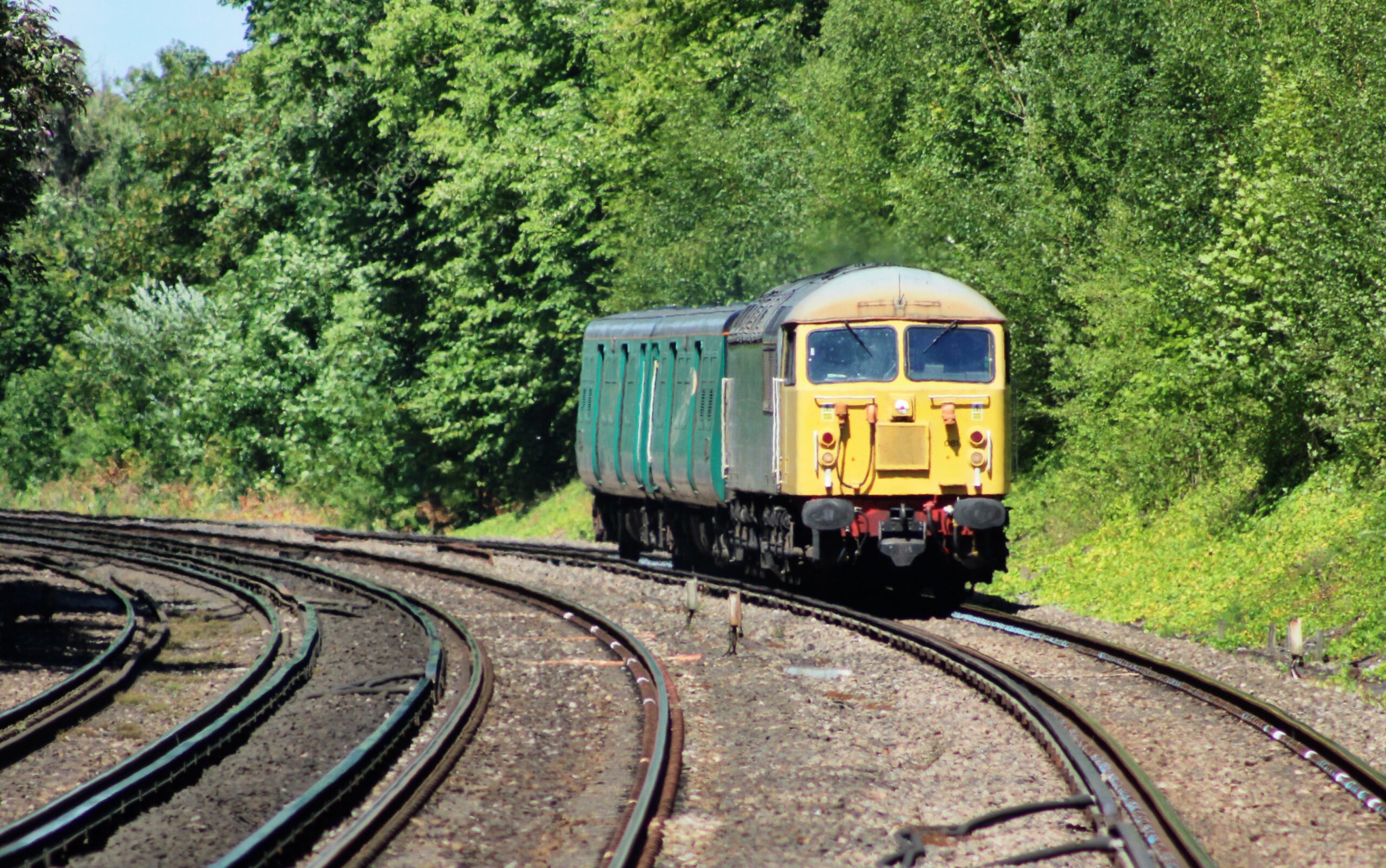
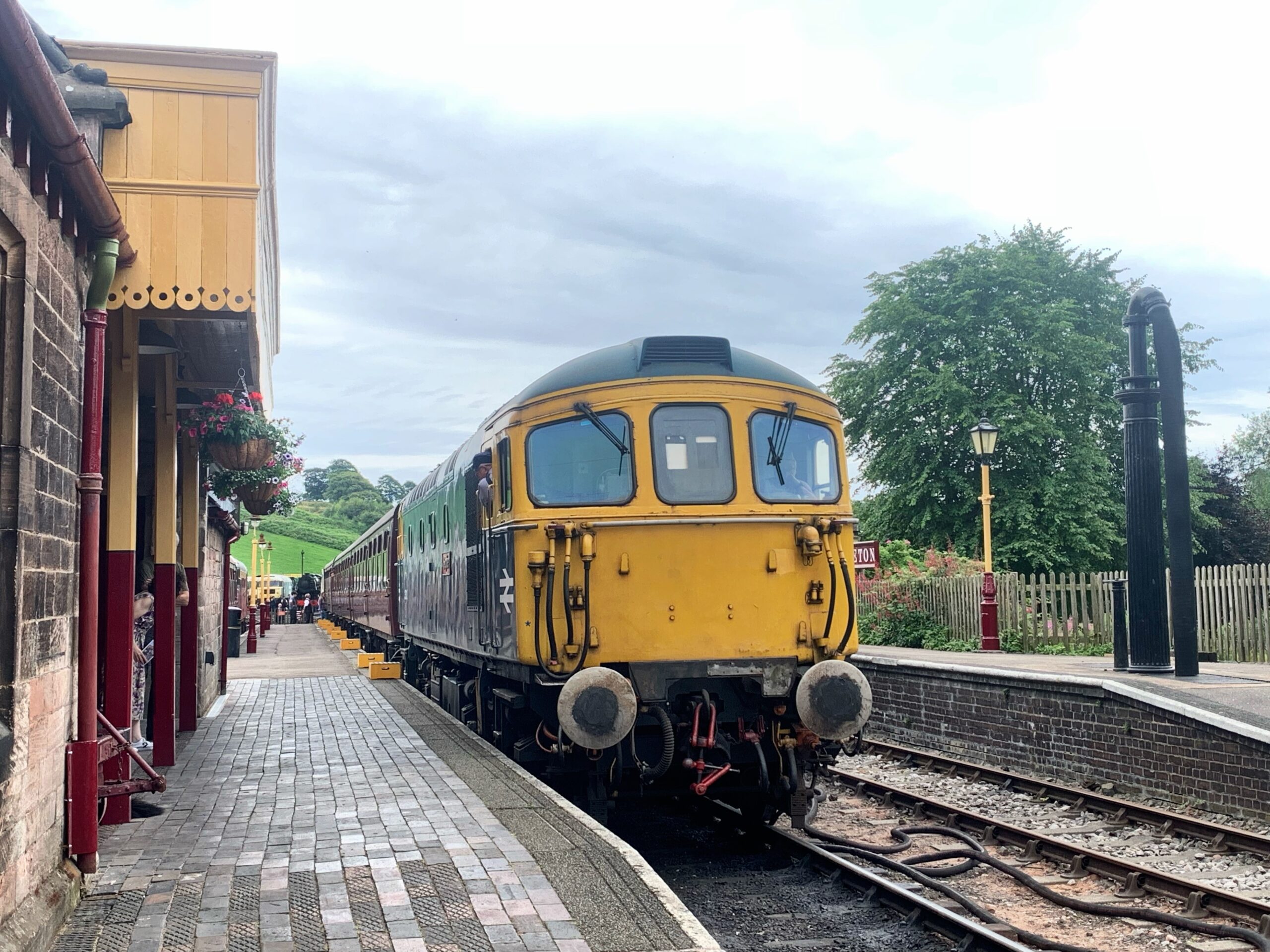
Having heard that Class 33/1 No. 33102 was hauling trains, Yoshi and I spent Tuesday morning ( 12th July 2022 ) visiting Cheddleton on the Churnet Valley Railway, a preserved heritage line in Staffordshire. I grew up with 33/1’s providing the daily motive power on local passenger services between Bournemouth and Weymouth, and even though No. 33111 lives on at Swanage, our local heritage railway, it was fantastic to hear the Crompton’s Sulzer engine at work hauling a passenger train.
The Churnet Valley railway dates back to 1849 following the formation of The North Staffordshire Railway Company (NSR) in 1845. Falling passenger numbers saw the Beeching Report include the Churnet Valley line and its associated branches which became earmarked for closure with the final section from Leek Brook Junction to Oakamoor quarry lasting out until the late 1980’s as it was used for freight traffic. In 1992 the newly formed Churnet Valley railway (1992) PLC began talks with the Department of Transport with a view to operate the line. Trains currently run between Froghall and Ipstones, but the ambition is to run services into the Staffordshire market town of Leek for the first time since 1965. And they have an eye on the clock to achieve this as the railway needs to run its first passenger train into Leek by 1st December 2022 or lose a £1.4m EU grant. This means all track must be laid on the 0.5 mile extension, with additional resources being provided for a triangle at Leek Brook Junction, and a platform constructed at Leek. It really is a very picturesque railway with extremely friendly volunteers, Yoshi and I were escorted around the workshops to get a closer view of locomotives stabled there, and I wish them every success with their endeavours and look forward to a return visit in the future.
Cheddleton Station which was to be demolished in April 1974 but saved by the actions of local businessman and parish councillor Norman Hancock who parked his car on the level crossing preventing access to bulldozers giving sufficient time for the building to be Grade II listed – July 2022Cheddleton Station – July 2022Time for a cuppa! Yoshi waits for the kettle to boil in the booking hall of Cheddleton Station – July 2022Class 33/1 No. 33102 ‘Sophie’ awaits departure from Cheddleton – 12/07/2022Class 20 No. D8057 (20057) sits outside the repair shed at Cheddleton – 12/07/2022S160 Class 2-8-0 No. 5197 was built by the Lima Locomotive Company in Ohio, USA and exported to China in 1946. The United States Army Transportation Corps Class S160 were designed for heavy freight work across Europe during World War 2 with a total of 2,120 being built they eventually worked all over the world – 12/07/2022Class 25 No. 25322 ‘Tamworth Castle’ was the final Class 25 locomotive to see mainline service with British Rail. She is currently in store at Cheddleton Yard awaiting restoration – 12/07/2022Yoshi inspects Class 33 No. 33021 ‘Eastleigh’ in Post Office Red style livery. This locomotive was amongst the first privately owned diesel locomotives to be used on the mainline – 12/07/2022The Churnet Valley Railway has acquired Class 47 No. 47292 for an initial loan period of five years supplementing Class 33 No.’s 33021 and 33102 for use on passenger trains – 12/07/2022
On our way back to Fleetwood, we stopped off at Acton Bridge for an hour or so, primarily to capture Class 37 No. 37884 which was diagrammed to pass through with 0M58 Kilmarnock Long Lyes T.C. to Derby R.T.C. – which can be seen in the video below:
Southport
On the Wednesday, Yoshi and I took a trip on a heritage Blackpool Tram – more about that adventure next week – but first that we made a brief visit to Southport and Formby. Southport railway station is the terminal of the Southport branch of the Northern Line of the third-rail electric Merseyrail network, and the diesel-operated Manchester to Southport line. The station and services to Liverpool and Hunts Cross are operated by Merseyrail, with Manchester services operated by Northern Trains. The current station opened as Southport Chapel Street on 22 August 1851 and once boasted eleven regular platforms and two excursion platforms. Six truncated platforms are now in use (platforms 1-3 for Liverpool trains and 4-6 for Manchester services), the remainder having been demolished to make way for car parking. In 1970 the former terminal building was replaced with a shopping centre.
New Stadler Class 777 trains are currently being tested, and one was scheduled to visit Southport that morning on test run. Despite the best attempts at numerous roadworks and traffic queues, we made it just in time to see Class 777 No. 777015 arriving. Members of The National Union of Rail, Maritime and Transport Workers ( RMT – what these initials mean was one of the pub quiz questions I actually answered correctly! But I digress…. ) Anyway to continue; RMT members recently voted in favour of the proposed crewing plans for the new fleet which brings a five-year dispute to its conclusion. Merseyrail still has to reach agreement with the drivers union, the Associated Society of Locomotive Engineers and Firemen (ASLEF), but intends to introduce the new Class 777’s into service later this year. Currently, 17 out of the 53 units purchased have been delivered to the UK. The arrival of the Class 777 fleet will see the demise of both the Class 507 and 508 electric-multiple units (EMU’s).
The Class 507’s were built to work on Merseyside, replacing the London Midland Scottish Railway (LMS) built Class 502 units on Northern line services from Liverpool to Southport, Ormskirk and Kirkby. 33 sets were built by British Rail Engineering Limited (BREL) in York from 1978 to 1980 followed by 43 Class 508s constructed between 1979 and 1980. They were the second and fourth variety of BR’s then standard 1972 design for suburban EMU’s, which were derived from the prototype 2PEP and 4PEP EMU’s introduced in 1971 and eventually amassed 755 vehicles across five Classes (313/314/315/507/508). Originally, the Class 508’s were built as 4-car units for the Southern Region of British Rail working out of Waterloo on former London South Western Railway (LSWR) routes. From 1982 to 1984 they were reduced to 3 car units (one of the trailer cars was removed to be incorporated into the Class 455/7 EMU’s) and transferred to Merseyside to replace the former LMS Class 503 units that operated Wirral line services to New Brighton, Rock Ferry and West Kirby. Following rail privatisation the two fleets became interchangeable and work both sides of the Mersey. They are the oldest EMU’s still working in the UK after the Class 313’s.
Yoshi with Merseyrail Class 507 No. 507020, Southport – 13/07/2022Yoshi compares the differences between EMU’s with a study of Merseyrail Class 508 No. 508140, Southport – 13/07/2022Merseyrail Class 777 No. 777015 having arrived with 5T02 0917 Sandhills Reversing Sdg to SouthportSouthport – 13/07/2022Northern Trains Class 769 No.’s 769424 & 769456 Southport – 13/07/2022Northern Trains Class 150 No. 150128 and 150134 Southport – 13/07/2022Merseyrail Class 507 No. 507020 Southport – 13/07/2022Merseyrail Class 507 No. 507020 and Class 508 No. 508131 stand side by side at Southport – 13/07/2022Merseyrail Class 508 No. 508126 at the buffer stops, Southport – 13/07/2022Merseyrail Class 777 No. 777015 awaits departure of 5T03 1008 Southport to Kirkdale C.S. Southport – 13/07/2022
Crewe
After breakfast on Thursday where we spent a few enjoyable hours watching freight movements around Crewe Basford Hall. You can relive this by playing the video below:
We returned to Dorset on Friday, eschewing the opportunity of capturing two Colas Class 37’s at rest in Blackpool North Railway Station which had worked a test train from Carlisle in the early hours. However, the next day; Saturday 16th July, I was back in Crewe, this time without Yoshi, so I could attend the Direct Rail Services (DRS) Open Day at their depot at Gresty Road. Understandably, dogs were not allowed on site, so Yoshi spent the day with his mum, while I endured the heat of the day without my fluffy sidekick. Many thanks to Scott for driving and for his company.
The Open Day coincided with LMS Coronation 4-6-2 No. 6233 ‘Duchess Of Sutherland’ passing through Crewe railway station with the Railway Touring Company’s “Cheshireman” rail tour from London Euston to Chester. (1Z86 0639 London Euston to Chester with Class 47 No. 47813 providing support at the rear). The station was extremely busy with the influx of enthusiasts in the town to visit the DRS site, but I managed to catch a short video clip of this magnificent locomotive departing Crewe. Later that day, SR Merchant Navy 4-6-2 No. 35018 ‘British India Line’ worked into Crewe light engine and support coach as 5Z46 Carnforth Steamtown to Crewe Heritage Centre for servicing ahead of rail tour duties scheduled for the following day:
Crewe 16th July 2022
3,500 people attended Nuclear Transport Solutions’ (NTS) rail division DRS’s open day, the first one to be held for a number of years because of the Covid pandemic. There were two locomotive naming’s at the event – the first saw Class 66 No. 66422 being unveiled as ‘Max Joule’ in tribute to one of DRS’s founders and former Managing Director who died in 1999. The second naming was for Class 66 No. 66424 which was named ‘Driver Paul Scrivens’ who had been a driver with DRS for more than 20 years. An emotional tribute was delivered by colleague Tim Howlett before the new plate was unveiled by Paul’s sister Emma.
The open day raised over £39,000 from sponsorship and donations which is an amazing figure that will go to deserving causes across the UK. It was a fantastic event, and I thoroughly enjoyed the experience. Because of the hot weather, DRS made bottles of water available at points across the site, which was very welcome.
Locomotives on display were:
Class 37 No. 37218 in retro DRS livery – 16/07/2022Class 37 No. 37401 ‘Mary Queen Of Scots’ – 16/07/2022Class 37 no. 37419 ‘Carl Haviland’ – 16/07/2022Class 37 No. 37425 ‘Concrete Bob’ – 16/07/2022Class 68 No. 68025 ‘Superb’ – 16/07/2022Class 57 No. 57312 – 16/07/2022Class 88 No. 88002 ‘Prometheus’ – 16/07/2022Class 68 No. 68006 ‘Pride of the North’ in special green livery showcasing the environmental benefits of rail freight and how a diesel locomotive can reduce emissions by using Hydrotreated Vegetable Oil (HVO) fuel – 16/07/2022Class 66 no. 66303 ‘Rail Riders 2020’ – 16/07/2022Class 68 no. 68009 ‘Titan’ – 16/07/2022Class 66 No. 66422 ‘Max Joule 1958-1999’ – 16/07/2022Class 66 No. 66424 awaits its naming ceremony – 16/07/2022Class 57 No. 57304 – 16/07/2022Class 88 No. 88009 ‘Diana’ – 16/07/2022Class 66 No. 66429 – 16/07/2022Class 37 No. 37424/37558 ‘Avro Vulcan XH558’ – 16/07/2022Class 88 No. 88001 ‘Revolution’ – 16/07/2022
On our way to the DRS Open Day, we stopped off at Longport to peer through the fence at Electro-Motive Diesel Limited’s (EMD) site and witnessed some shunting around of locomotives, mainly Class 56 / Class 69 conversions which are ongoing.
With 69006 stencilled on the bodyside, the conversion of 56128 is almost complete. Longport – 16/07/2022The empty shell of Class 56 No. 56032 awaiting a second move to Marcroft Engineering with 69007 ( ex-56037 ) in the background – 16/07/202256038 is being converted into 69008 and is still on accommodation bogies but some of its new innards are in place. An extra hole has been cut in the cab front ends to accommodate an additional connection with this locomotive likely being the first for use by the GBRf Rail Services sector which handles stock movements – 16/07/2022Class 56 No. 56009 sits in the yard at Longport. The locomotive was unofficially renumbered No. 56201 when it was converted for use as an engineering test bed by Brush Traction in order to assess refurbished Paxman engines of sister class members – 16/07/2022Former DB Cargo UK Class 66 No. 66048 rests on accommodation bogies at Longport. The locomotive was damaged when it derailed at Carrbridge in January 2010 and it ended up down an embankment. It was sold to EMD in March 2016 after being initially disposed of for scrap. It’s unclear what the future holds for this Class 66 locomotive – 16/07/2022
On our way home we diverted to Keynsham to refuel the car and restock with drinking water. Fortuitously, Class 37 No.’s 37901 and 37800 were scheduled to pass through top and tailing an Eastleigh Works to Swansea Landore stock move consisting of a Great Central-liveried Mk4 set and an LNER-liveried Mk4 set (5Q79 1826 Eastleigh Arlington to Landore). This made a fantastic epilogue to the day!
Class 37 No. 37901 heads an Eastleigh Works to Swansea Landore stock move consisting of a Great Central-liveried Mk4 set and an LNER-liveried Mk4 set with 37800 on the rear approaches Keynsham station – 16/07/2022.
Dorset NMT
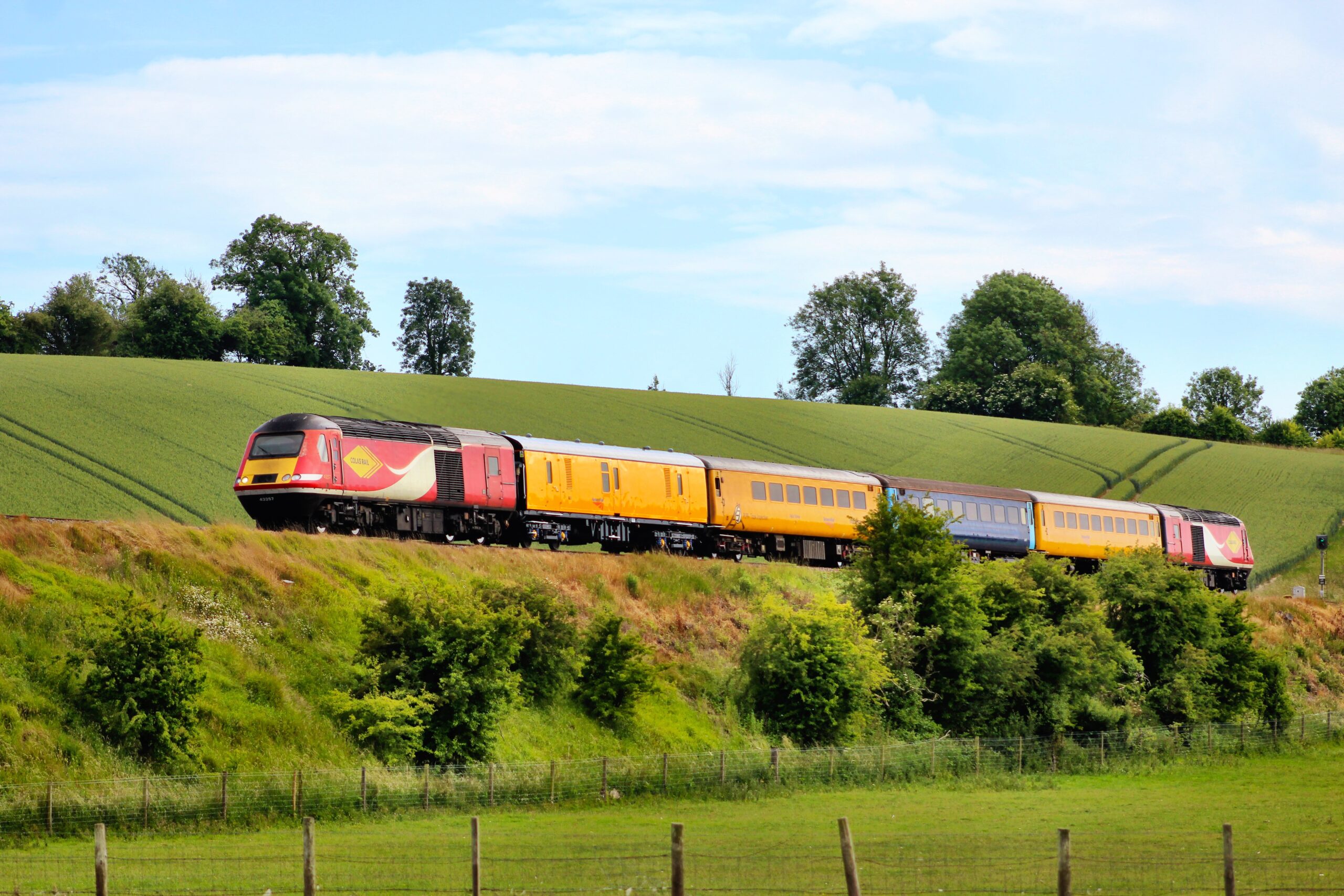
While we were away it was a quiet week on the Bournemouth to Weymouth line, with only the New Measurement Train of particular interest on the main line as far as I’m aware. HST Class 43 power car No.’s 43272 and 43257 were in charge of 1Q18 0719 Derby RTC to Bristol Kingsland Road on Wednesday 13th July 2022.
Class 43 No. 43257 sits in Weymouth station – 13/07/2022. Photograph courtesy of @da_buckley967Class 43 No. 43272 preparing to depart from Weymouth – 13/07/2022. Photograph courtesy of @da_buckley967
My brother popped out to see the NMT return through Dorchester West on its way to Bristol and his video which he captured especially for Yoshi can be seen here:
In other news, Swanage resident Class 33/1 No. 33111 headed off by road to the Mid Hants Railway (MHR) to participate in their 2022 diesel gala. I had considered visiting the MHR on Sunday, but felt it was far too hot for Yoshi to be out and about, so we decided to stay home and catch up on some gardening.
The recent heat wave also resulted in speed restrictions being imposed on main line services by South Western Railways (SWR), including those on the Bournemouth to Weymouth line, with the increased risk of tracks buckling. Reduced services were introduced on Monday 18th and Tuesday 19th July 2022 in a bid to give passengers certainty over which trains would run. There was also a steam ban imposed by many heritage railways and on the main line. This includes the Railway Touring Company’s “Dorset Coast Express” excursion to Weymouth on Thursday 21st July which will now be diesel hauled throughout.
Great Western Railways were under fire in the local press this week, when the Dorset Echo reported chaotic scenes at Weymouth station where passengers were turned away from trains as they tried to return home. The 1728 departure to Bristol Temple Meads from the Dorset seaside town was formed of just two carriages meaning station staff and police had to request some travellers to wait for the next service which was due to leave an hour later. Not so long ago a High Speed Train was regularly employed to run a relief service to Weymouth via the West route on Summer Saturdays in order to cater for anticipated increased passenger numbers.
That’s all for this week – join us next time when we recount our trip on a heritage Blackpool Tram. Many thanks for reading, and for continued contributions, comment and corrections which are very much appreciated!
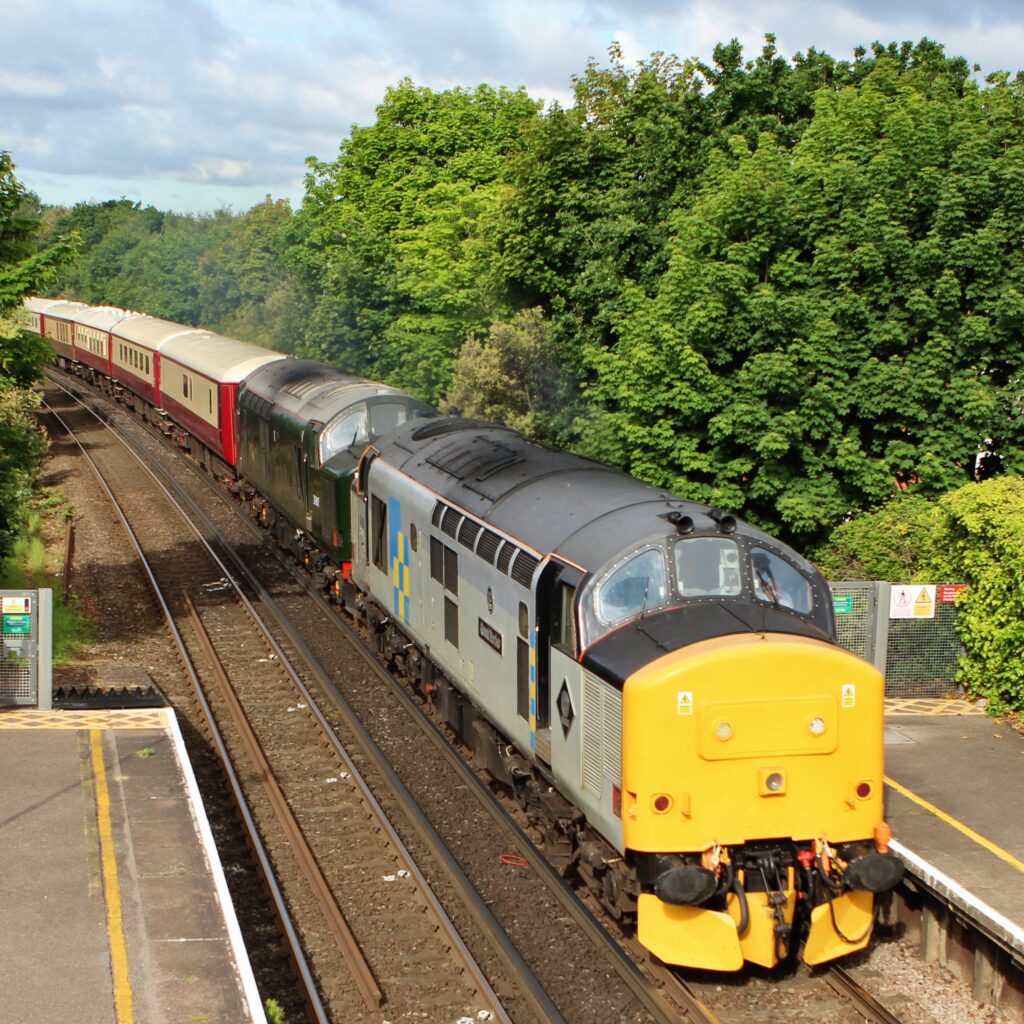
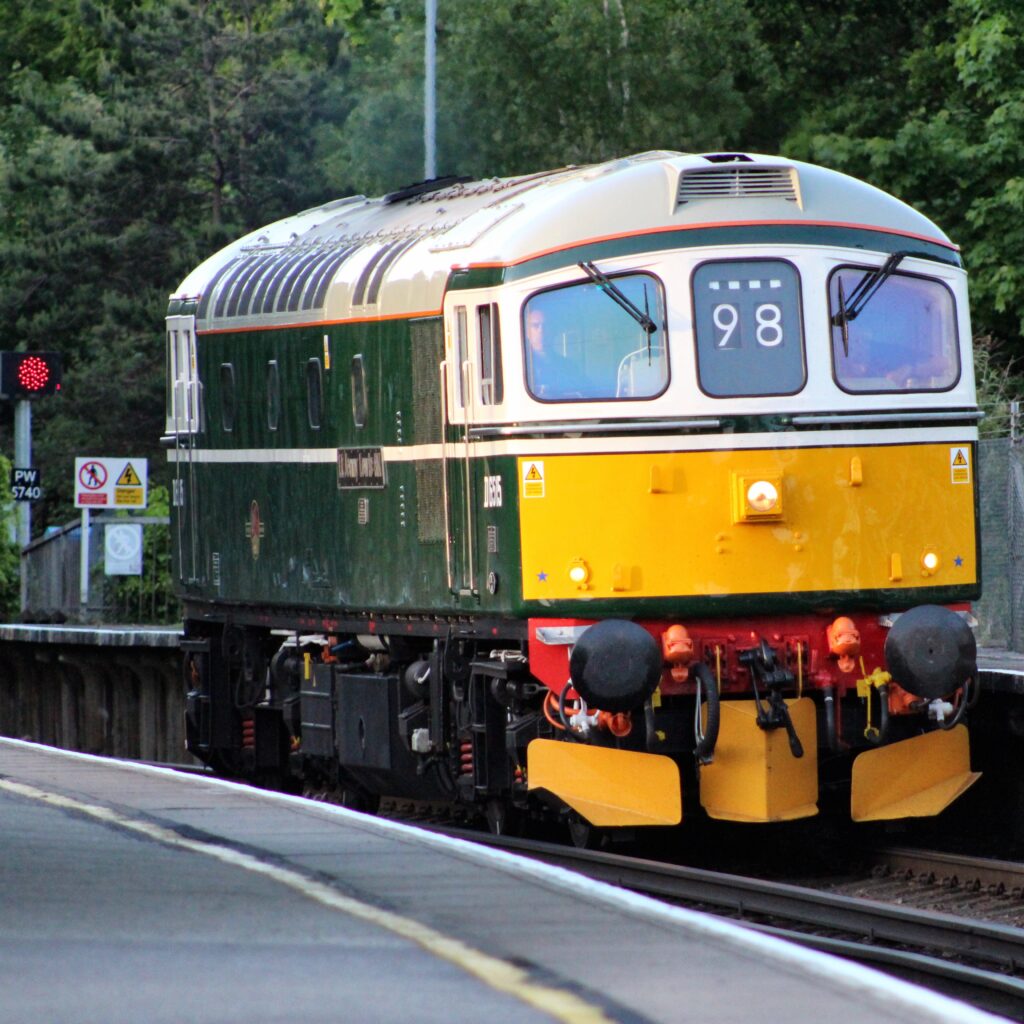
Class 50 No. 50026 ‘Indomitable’ on a loaded test run as part of mainline certification nears Furzebrook on the Swanage Railway. Class 33 No. 33012 / D6515 ‘Lt Jenny Lewis RN’ takes up the rear – 09/07/2022
Lynton & Lynmouth
We took Wednesday off to visit friends who were holidaying in North Devon near the twin villages of Lynton and Lynmouth. Lynton was built on flat land 500 feet vertically above the beautiful fishing village of Lynmouth. I can never remember which is which, but until Easter Monday 1890 the only way you could travel between the two was via a very steep road. That is until the opening of the water powered funicular railway which had been approve by an Act of Parliament two years previously. Now established as a popular visitor attraction the original role of the cliff railway was to transport passengers and goods between Lynmouth harbour and Lynton. It is the highest and steepest totally water powered railway in the world.
The view from the Lynton terminus of the Lynton and Barnstaple Cliff Railway – 06/07/2022
The project to build the railway was the funded largely by publisher, MP and philanthropist Sir George Newnes who wanted to relieve the burden placed on the horses which laboured up the steep hill. The railway was designed by George Croydon Marks an early pioneer of funicular railways and devotee of Isambard Kingdom Brunel while the actual construction was carried out by local builder Bob Jones whose family are still involved in running the funicular today. The original mechanical design remains substantially unaltered.
The environmentally friendly railway works on a simple balancing principle using water as ballast which has been collected by gravity from the West Lyn River and stored in reservoirs. Each car has a 700 gallon tank mounted between the wheels with a smaller 10 gallons tank for the braking system. The two cars are attached to each other by two hauling cables and two balance cables which run around large pulley wheels at each end of the tracks. When each car is docked with full tanks of water, the cars are balanced and ready for passengers to board. Once the brakes are taken off the lower car discharges water until it is lighter than the top car which descends under the additional weight which causes the lower car to be pulled up the track. Our video of the Lynton and Lynmouth Cliff Railway can be seen below:
In a future railwaydog blog, we’ll be taking a close look at the three Bournemouth Cliff Lifts.
Bournemouth Fisherman’s Walk Cliff Lift, built in 1935, is currently out of action due to a landslide. It links Boscombe and Southbourne with the beach – 13/02/2021
Lynton & Barnstaple Railway
We had fully intended to visit The Lynton and Barnstaple Railway, but we had lots of catching up to do as well as finding ourselves distracted by goats that we decided to save this narrow gauge railway for another visit when we had time to do it justice. As a taste of what to expect, our friends visited on Thursday and sent us the following images to share, for which we are very grateful.
Baldwin 2-4-2 tank No. 762 ‘Lyn’ on the Lynton and Barnstaple Railway – 07/07/2022Baldwin 2-4-2 tank No. 762 ‘Lyn’ on the Lynton and Barnstaple Railway – 07/07/2022
The Lynton and Barnstaple Railway originally opened in 1898 and closed in 1935. The current railway is just the start of a project to rebuild the narrow gauge line and trains currently run between Woody Bay Station and Killington Lane, a round trip of two miles.
Poole Park Railway
Postcard view of Poole Park Railway circa 1970/80’s
The 260mm gauge Poole Park railway was first operated in 1949 by Southern Miniature Railways Ltd. In 2017, Poole Borough Council ended their tenancy agreement with Chris Bullen who had operated the railway since June 2005 and awarded a thirty year concession to Friends Of Poole Park for its operation. However following behind the scenes disputes, walkouts and a derailment in 2018 the concession was withdrawn and a notice to quit issued. Now in the hands of Bournemouth, Christchurch, Poole Council (BCP) and following a successful tendering process, Shropshire based Track Systems UK began work on renewing the infrastructure, traction and rolling stock.
Despite progress on the £480,000 revamp of Poole Park Railway having been made with work completed on the new engine shed and track there has been a delay in the delivery of a fully electric engine for use on the popular attraction. Efforts to source a suitable temporary engine are ongoing. Carriages are currently being constructed off-site which are expected to be delivered shortly. When re-opened the railway will be run by volunteers and BCP environmental team.
Saturday 9th July 2022
Class 33 No. 33012 / D6515 ‘Lt Jenny Lewis RN’ leads Class 50 No. 50026 ‘Indomitable’ through Norden – 09/07/2022
Saturday was far too hot for Yoshi to venture out, so while he stayed home drinking cold mocktails and being well looked after, I headed to Norden to see Class 50 No. 50026 ‘Indomitable’ on a loaded test run as part of its mainline certification on the Swanage Railway. Class 33 No. 33012 / D6515 ‘Lt Jenny Lewis RN’ provided support.
West Coast Railway Companies Class 47 No. 47826 nears Dorchester working the “Weymouth Harbour” 1Z47 0823 Birmingham International to Weymouth – 09/07/2022WCRC Class 47 No. 47804 heads the “Weymouth Harbour” empty coaching stock past Dorchester Junction heading to Yeovil Pen Mill for stabling as there was no room to accommodate the stock at Weymouth – 09/07/2022
There were scenes reminiscent of my misspent childhood Summer Saturday’s as five Class 47 diesel locomotives passed through Dorchester on their way to Weymouth as three rail tours visited Dorset on Saturday July 9th 2022. It could have been the 1980’s if I hadn’t had to fill the car up with fuel. First up was the Northern Belle organised “Weymouth Harbour – The Dorset Coast” which originated from Birmingham International. For £370 you could enjoy all the comforts of the Northern Belle luxury trains welcome Bellini cocktail, a three-course brunch, tea and coffee, oyster tasting with sparkling wine in Weymouth, a champagne reception and a five course dinner which included cheese and biscuits. What’s not to like? Apart from the seafood in my case, obviously. I’m sure cheesy puffs would be an acceptable alternative.
Double-Headed Class 47 No.’s 47853 and 47805 hauling the “Dorset Coast Statesman” heads through Dorchester – 09/07/2022
Statesman Rail provided the “Dorset Coast Statesman” which set out from Norwich in the early hours with passengers able to pick Bournemouth, Poole or Weymouth as their destination. Pullman dining, which also boasted cheese and biscuits, was available from £330 and First Class ( non-dining ) tickets could be purchased from £175.
SR rebuilt Merchant Navy No. 35028 ‘Clan Line’ hurtles through Hamworthy with “The End Of Southern Steam” rail tour – 09/07/2022
Finally The Railway Touring Company brought steam to Dorset with “The End Of Southern Steam” excursion which also provided passengers the opportunity to visit Weymouth for the afternoon. This tour marked 55 years since the end of steam on the Southern Region of BR. On the 9th July 1967 the final regular steam hauled passenger train arrived at London Waterloo, signifying the end of steam in the South. Departure on 9th July 2022 was steam hauled from London Victoria behind SR rebuilt Merchant Navy 4-6-2 No. 35028 ‘Clan Line’ through to Yeovil Junction where the steam locomotive was detached for servicing and turning while the rest of the train continued to Weymouth diesel hauled. ‘Clan Line’ then followed light engine to Weymouth in order to haul the train up Bincombe Bank and back to London via Bournemouth. At the time of writing, I’m not aware if cheese and biscuits were on the menu, however ticket prices ranged from £130 for Standard class, £195 for First class and £295 for Premier Dining.
Class 47 No. 47813 at the rear of “The End Of Southern Steam” rail tour, Hamworthy – 09/07/2022
The afternoon schedule was disrupted by a signalling issue between Dorchester South and Weymouth which resulted in all lines being blocked for a while. This delayed the arrival and departure of “The End Of Southern Steam” (37 minutes late arriving and 48 minutes late departing) and the departure of the “Dorset Coast Statesman” (43 minutes late departing).
A compilation video covering 9th July rail tours to Weymouth is below:
Class 47’s at Dorchester in days gone by:
Class 47 No. 47455 approaches Dorchester South – 29/05/1982Class 47 No. 47152 passes Dorchester Junction Signal Box – 14/07/1980Class 47 No. 47237 heads away from Dorchester West – 20/08/1981
That’s it for this week. Thanks for reading. Comments and corrections welcome. We’ll be back for another round-up soon!
We were being truthful about being distracted by the Lynton goats. Yoshi wisely kept his distance!
Class 47 No. 47593 ‘Galloway Princess’ approaching Campbell Road Bridge, Eastleigh working Saphos Trains 1Z60 0635 Poole to Kingswear “English Riviera Express” – 02/07/2022
Wednesday 29th June - Tuesday 5th July 2022
Saturday Sightings
Three rail tours were scheduled to pass through Dorset territory on Saturday July 2nd 2022. One had seemingly been cancelled a few days prior to its intended departure before reappearing on the schedules, much to Yoshi’s relief. Originally advertised as being steam hauled and later switched to a Class 57 diesel, “The Northern Belle Special: Tribute To The Bournemouth Belle” actually ran with a Class 47 at one end and a Class 57 at the other. Its journey from London Victoria to Bournemouth and return to London Euston via Slough briefly touched the route “The Bournemouth Belle” would have traversed back in the day. The empty coaching stock from this service ran to Norden on the Swanage Railway for servicing.
Class 57 No. 57314 approaching Creech Bottom on The Swanage Railway with The Northern Belle empty coaching stock 5Z68 1256 Bournemouth to Norden – 02/07/2022Class 57 No. 57314 at Creech Bottom on The Swanage Railway with The Northern Belle empty coaching stock 5Z68 1256 Bournemouth to Norden – 02/07/2022Class 57 No. 57314 parked up behind a pair of skips at Norden on The Swanage Railway awaiting servicing of The Northern Belle coaching stock – 02/07/2022Class 47 No. 47804 passes the former Furzebrook LPG site working 5Z69 1640 Norden to Bournemouth Northern Belle ECS – 02/07/2022
Saphos Trains Class 47 top and tailed “English Riviera Express” ran from Poole to Kingswear. BR Standard No. 70000 ‘Britannia’ took over the train from Norton Fitzwarren near Taunton, the diesel locomotives taking back control at the same point on the return leg back to Poole.
Class 47 No. 47810 (D1924) ‘Crewe Diesel Depot’ passes Bournemouth with the Empty Coaching Stock movement 5Z62 0444 Eastleigh Arlington to Poole to form Saphos Trains excursion to Kingswear and return – 02/07/2022
Railway Touring Company organised “The Atlantic Coast Express” took Southern Railway rebuilt Merchant Navy 4-6-2 No. 35028 ‘Clan Line’ from London Waterloo to Exeter St. Davids which traversed the Waterloo – Exeter line on its outward journey. One day I’ll tick off that box of recording a steam hauled train departing from Waterloo, but this week I was content with catching a glimpse of ‘Clan Line’ passing underneath Battledown Flyover at Worting Junction and nearing Sherborne.
SR rebuilt Merchant Navy 4-6-2 No. 35028 ‘Clan Line’ passes nearby Sherborne Old Castle with “The Atlantic Coast Express” 1Z82 0752 London Waterloo to Exeter St. Davids – 02/07/022
We have put together a compilation video of our Saturday below:
Yoshi was so excited to see and hear ‘Clan Line’ whistling as she passed Worting Junction he jumped up against the fence my camera was balanced on top of to see her pass for himself which is why there’s a slight wobble in the footage! I wish I’d have had the presence of mind to film him! We had a really enjoyable day out, despite the early start at Bournemouth and we met some friendly folk on our travels. I really didn’t imagine back in the late 1970’s that I’d be so pleased to see three Class 47’s on one day!
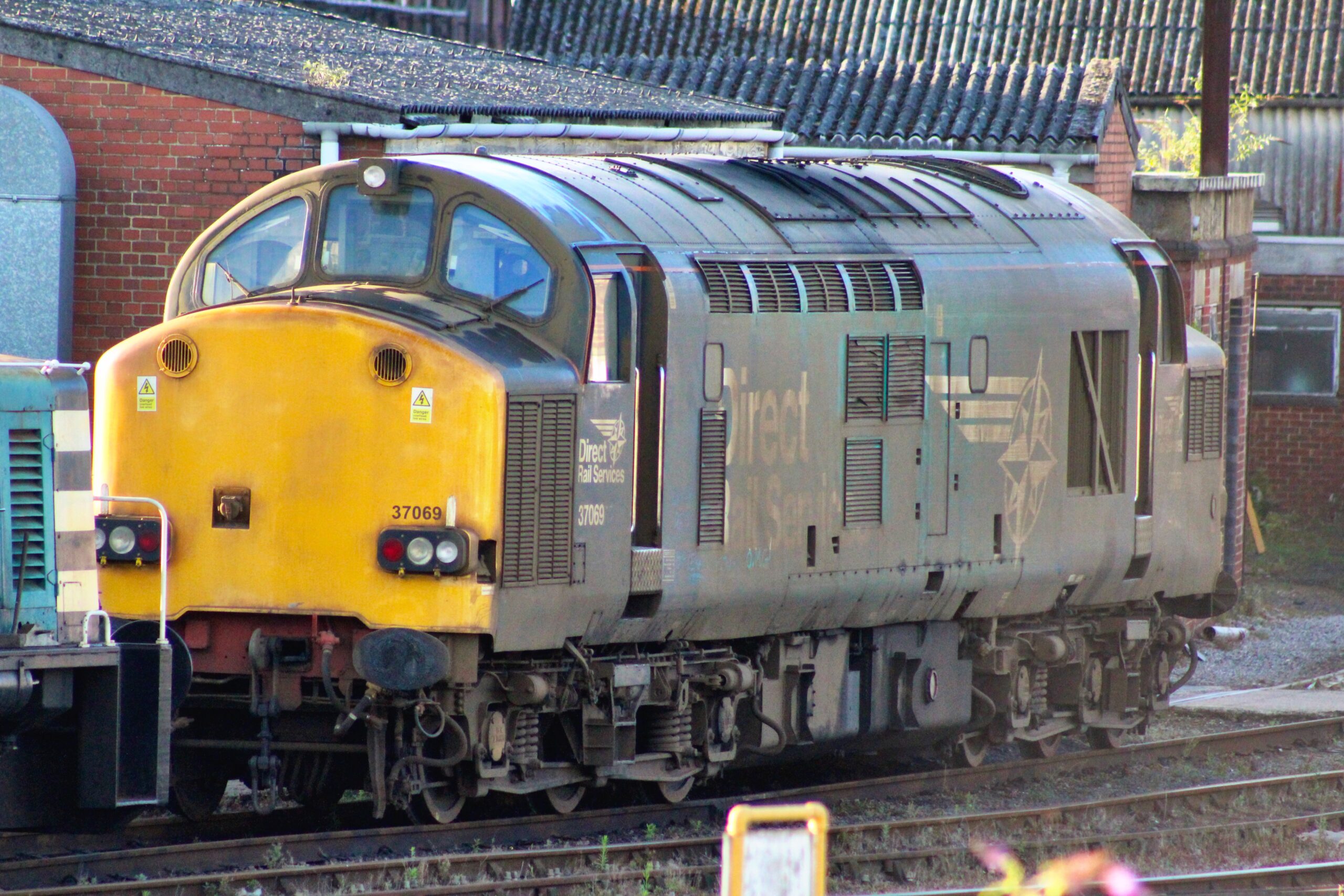
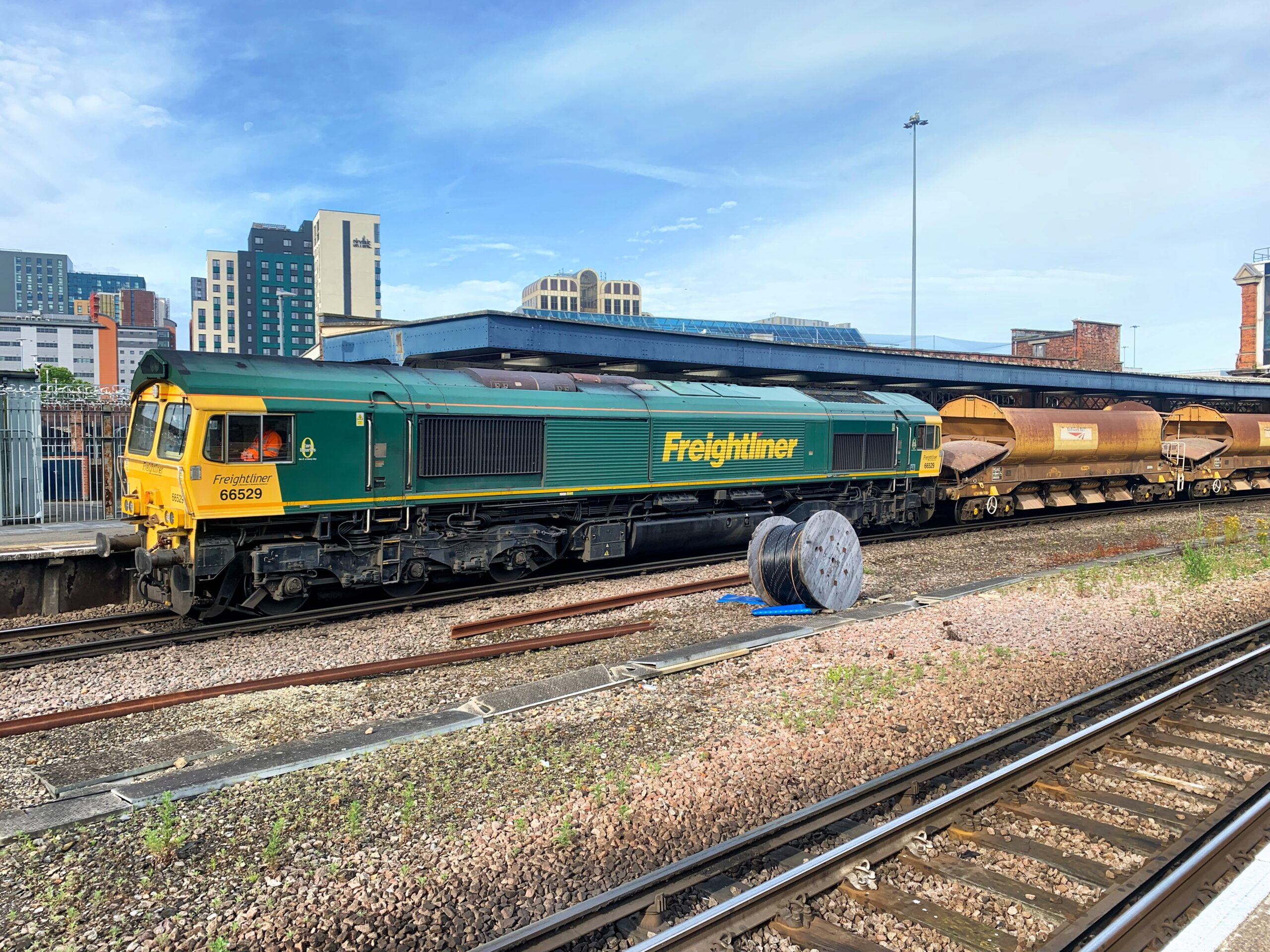
Freightliner Class 66 No. 66529 working 43Z2 0047 Trafford Park F.L.T. to Southampton M.C.T. through Eastleigh – 02/07/2022Direct Rail Services Class 37 No. 37069 which has been authorised for new wheelsets stands at Eastleigh Works – 02/07/2022Class 701 No. 701022 departing Eastleigh depot with 5Q50 0653 Eastleigh TRSMD to Eastleigh TRSMD – 02/07/2022
Class 701
Class 701 No. 701022 snaking its way into Eastleigh with 5Q50 0653 Eastleigh TRSMD to Eastleigh TRSMD – 02/07/2022
Trials with new Class 701 Electric Multiple Units continue. This week we filmed No. 701022 out and about over a few days which we’ve edited together in the video below:
Hamworthy Branch Update
Network Rail team examining the track work at Lake Road Bridge – image by kind permission of Kev Scott Trains
Network Rail were seen examining Lake Road Bridge on the Hamworthy Branch on the morning of Tuesday 5th July. Hopefully work will start soon clearing the site and replacing the existing structure which is rusted and, as was pointed out to me, has as at least one hole in the metal fabric. The replacement frog for the pointwork ready to reconnect the branch to the main line was deposited on the ballast at Hamworthy a few weeks ago.
Lake Road Bridge on the Hamworthy Branch – July 2022Lake Road bridge has sustained a number of hits from road vehicles as can be seen by the damaged brickwork in this view – July 2022
Great British Railways
This week “Snake-oil salesman” and Secretary of State for Transport Grant Shapps announced the shortlist of the most suitable locations for the national headquarters of Great British Railways (GBR), the planned state-owned public body that will oversee the majority of rail transport in Great Britain from 2023.
The closest local authorities to Yoshi HQ which threw their hats in the ring were Southampton and Eastleigh. However, these were both unsuccessful. The shortlist has been confirmed as:
Birmingham
Crewe
Derby
Doncaster
Newcastle upon Tyne
York
We would have visited each of these locations for a cup of tea and a bun, but they’re all too far away from Dorset so instead we’ll share the link where you can vote for your preferred location from the shortlist. The results will be used to measure the level of support for each place and will be considered as part of the final decision making. It’s almost like democracy at work.
Northern Belle: July 2019
A five month old Yoshi examines Class 57 No. 57601 ‘Windsor Castle’ at the buffer stops in Weymouth having worked The Northern Belle into the town for the Seafood Festival – 14/07/2022
In pre-Covid times The Northern Belle visited Weymouth with two special trains bringing passengers in to the seaside town for the annual Seafood Festival. Saturday 13th July saw Class 57 No. 57316 with Pullman Liveried classmate No. 57601 ‘Windsor Castle’ attached to the rear with the rail tour having originated form Cardiff. The following day saw the locomotives swap positions with No. 57601 heading into Weymouth with a tour having originated from Coventry.
Yoshi and Class 57 No. 57316 at Weymouth – 13/07/2019
This week, Yoshi’s blog was written to the sounds of Freya Ridings, A Dog’s Purpose (Original Motion Picture Soundtrack ) and Bear’s Den. Thanks to everyone who helped and provided information for this weeks therailwaydog blog. We’ll be back here in seven days for another update – we hope you’ll be able to join again us then. May your dog go with you.
In preparation for this weeks blog entry, Yoshi popped into Swanage to take a look at Class 50 No. 50026 ‘Indomitable’ – 19/06/2022
Class 50’s In Focus
The main focus of The Railway Dog blog was always intended to be the Bournemouth to Weymouth line and any diesel or steam hauled workings over the route. Occasionally we venture to the extremes of Dorset and even over the county boundaries if time allows. Last Saturday afternoon ( 18th June 2022 ) saw us out on one such mini-adventure when Yoshi and I headed to Templecombe which is located approximately one mile north of the Dorset border in South Somerset. A railway station in Templecombe was originally opened in 1860 but this was closed in 1966. Following pressure from the local community, the station was reopened in 1983. Which is probably around about the last time I visited. The station has two platforms, but only one side is in use and is a new extension of the former down side platform built so it meets the single track with passes through the location. The unused Up platform still has its wonderful redundant 1938 signal box in situ.
Three locomotives and one diesel multiple unit have been named ‘Templecombe’. The one loco which I most associate with the name is Class 33/1 No. 33112 which was named on 17th October 1987 ( why does that date sound familiar?)
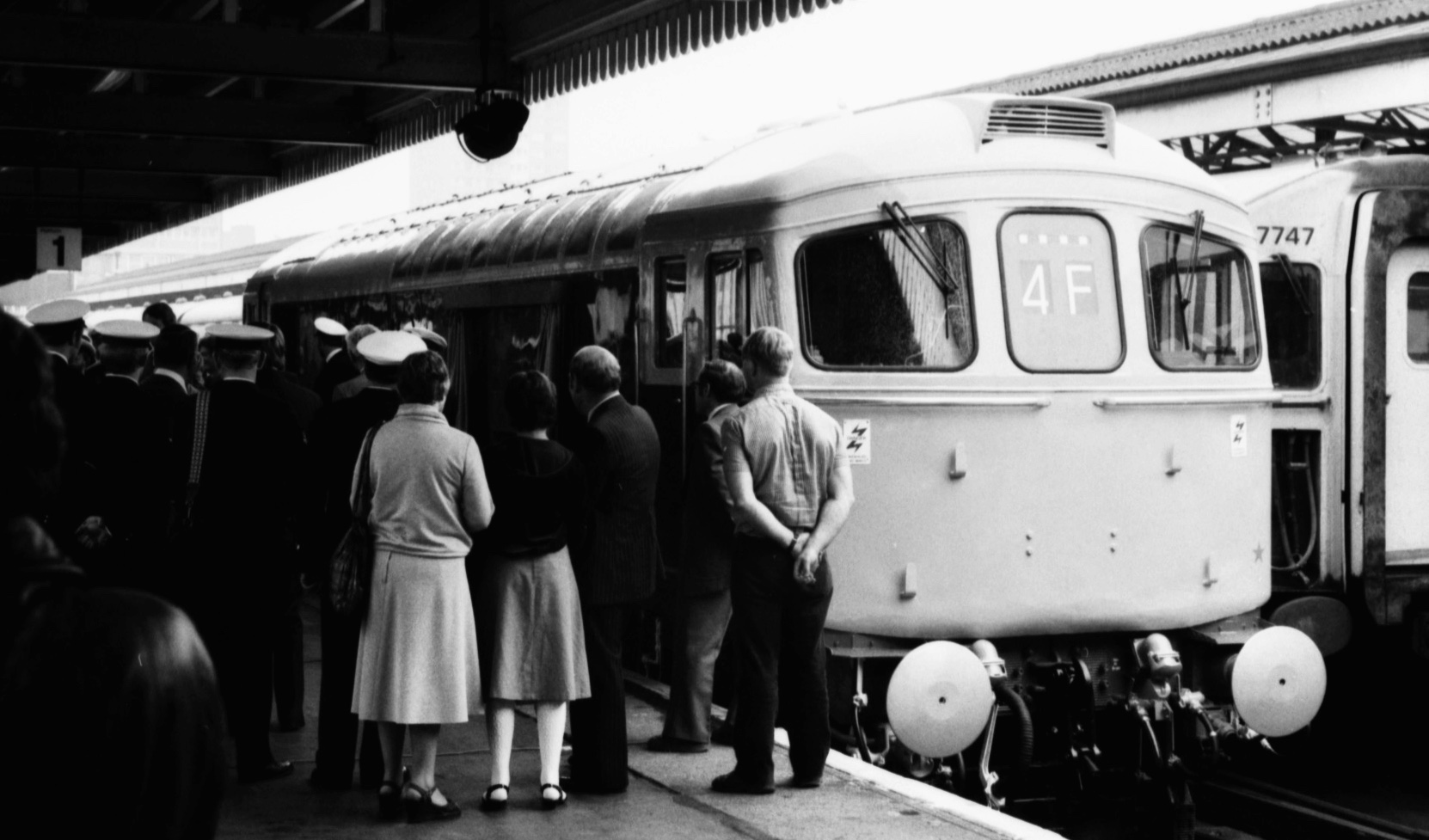
Class 33/1 No. 33112 ‘Templecombe’ stands at the buffer stops – Weymouth 09/04/1988‘Templecombe’ nameplates and crests as carried by Class 33/1 No. 33112
My Templecombe visit this past weekend was made in order to photograph the return leg of UK Railtours “The Devon Pullman” rail tour which ran between London Victoria and Exeter St. David’s and utilised the Belmond British Pullman coaching stock. The outward leg of the special train was via Westbury and Taunton, but the return by way of Honiton, Yeovil Junction and Salisbury inspired memories of when Class 50’s were regular visitors on this route.
Class 50 No. 50007 ‘Hercules’ storms through Templecombe at the head of The Devon Pullman rail tour 1Z52 1537 Exeter St David’s to London Victoria – 18/06/2022
The tour was advertised as involving two Class 50 locomotives, but it transpired that only one was in evidence on the day; No. 50007 ‘Hercules’, one side of which has been temporarily re-designated as 50034 ‘Furious’ as a thank you to GBRf charter manager Paul Taylor for his prostate cancer charity fundraising efforts as ‘Furious’ was his favourite class 50 locomotive. Our video of the train passing Templecombe is below:
Templecombe – 18/06/2022
The fifty Class 50 locomotives were built by English Electric at their Vulcan Foundry in Newton-le-Willows in Lancashire between 1967 and 1968 and were originally leased to British Rail (BR). They were introduced primarily to haul passenger trains north of Crewe during the electrification of the West Coast Main Line (WCML). At the end of their lease period, the Class 50’s, also known as English Electric Type 4’s, were purchased outright by BR. They were initially numbered D400 – D449 and were later allocated numbering sequence 50001 – 50050 under the Total Operating Processing System (TOPS) scheme in 1973. The class were named after Royal Navy ships during the late 1970’s, echoing the “Warship” diesel hydraulic locomotives which were previously employed on the Western Region of BR. In 1984, No. 50007 ‘Hercules’ was out-shopped in lined Brunswick Green livery and renamed ‘Sir Edward Elgar’ to commemorate the 150th anniversary of the Great Western Railway (GWR).
As the electrification of the WCML moved further north, the Class 50’s were gradually moved to the Great Western Main Line (GWML) replacing non-standard diesel hydraulic Class 52 “Western” locomotives on services out of London Paddington. All members of the class had been transferred from the north between 1972 and 1976. It’s alleged this is where the class gained their nickname “Hoovers” because as built they produced a noise like a vacuum cleaner. This characteristic disappeared when the whole class was refurbished between 1979 and 1984. Later, from 1976, High Speed Trains (HST) took over GWML services and the Class 50’s were once again moved, but not restricted to, new duties hauling trains from London Paddington to Worcester and Hereford via Oxford. Additionally they took charge of the West of England Main Line (WEML) between London Waterloo to Exeter which became the final regular services the class would be assigned to haul. By the early 1990’s the Class 50’s were earning a reputation for unreliability and a failure on the mostly single line sections of the route would cause severe delays to the timetable. The decision was made to withdraw the entire fleet of Class 50 locomotives and replace them initially with displaced Class 47/7’s on the Waterloo – Exeter services prior to the planned introduction of Class 159 diesel multiple units (DMU’s).
By 1992, only eight Class 50’s were in operational service and several were given special liveries to celebrate their demise, for example, founder member of the Class No. 50050 ‘Fearless’ was given her original running number of D400 and repainted in early British Rail Blue livery. Sunday 24th May 1992 was to be the last day on which Class 50’s were assigned to haul scheduled service trains. The day was organised by the Network SouthEast (NSE) route manager and the BR Special Trains Section with considerable assistance provided by Plymouth Laira depot. It was intended for three Class 50’s to be in service, but in the event, No. 50033 ‘Glorious’ had the less than glorious indignation of suffering generator and traction motor flashover damage on 23rd May and had been declared a failure. She was eventually repaired enough for her to limp back to Exeter light engine. This left two celebrity class members No.’s D400 and 50007 ‘Sir Edward Elgar’ to fly the flag working in multiple between Salisbury and Exeter.
Clipping from the June 1992 edition of The Railway Magazine
The last westbound train of the day hauled by Class 50 locomotives was the 1655 London Waterloo – Exeter St. Davids which the Hoovers worked between Salisbury and Exeter, departing the Wiltshire city at 1841 being the last service train on BR powered by Class 50 traction. The day saw the trains full and standing with railway enthusiasts who had travelled far and wide to experience the final services behind the English Electric Type 4’s. “Farewell Class 50’s” and “The Glorious End” headboards were carried on the final runs. The three locomotives scheduled to operate services on the final day of regular workings were retained by BR until 1994 for use on rail tours. My late friend, John Chappell, went out to witness the Class 50 farewell and obtained video footage at Salisbury and Yeovil Junction and I’m pleased to be able to share this with you here:
Class 50 Farewell – 24th May 1992
A few images below of Class 50’s seen at on GWML services and further afield, kicking off at Reading on a dull and overcast day in April 1982. First up is he locomotive which many years later would haul last weekends rail tour to Exeter; No. 50007 in original BR Blue livery.
Class 50 No. 50007 ‘Hercules’ enters Reading – 07/04/1982Class 50 No. 50012 ‘Benbow’ Reading – 07/04/1982Class 50 No. 50047 ‘Swiftsure’ Reading – 07/04/1982Class 50 No. 50010 ‘Monarch’ Reading – 07/04/1982Class 50 No. 50010 ‘Monarch’ Reading – 07/04/1982Class 50 No. 50021 ‘Rodney’ Reading – 07/04/1982Class 50 No. 50012 ‘Benbow’ runs into London Paddington – 19/06/1982Class 50 No. 50036 ‘Victorious’ at Bristol Bath Road diesel depot – 25/02/1983Class 50 No. 50019 ‘Ramillies’ light engine at London Waterloo having worked a Exeter St. David’s to London Waterloo – 11/07/1981Class 50 No. 50006 ‘Neptune’ rests at York depot having hauled an excursion train from the West Country – 17/10/1981
Class 50’s were occasional visitors on Bristol to Weymouth services, deputising for the regular Class 31 locomotives:
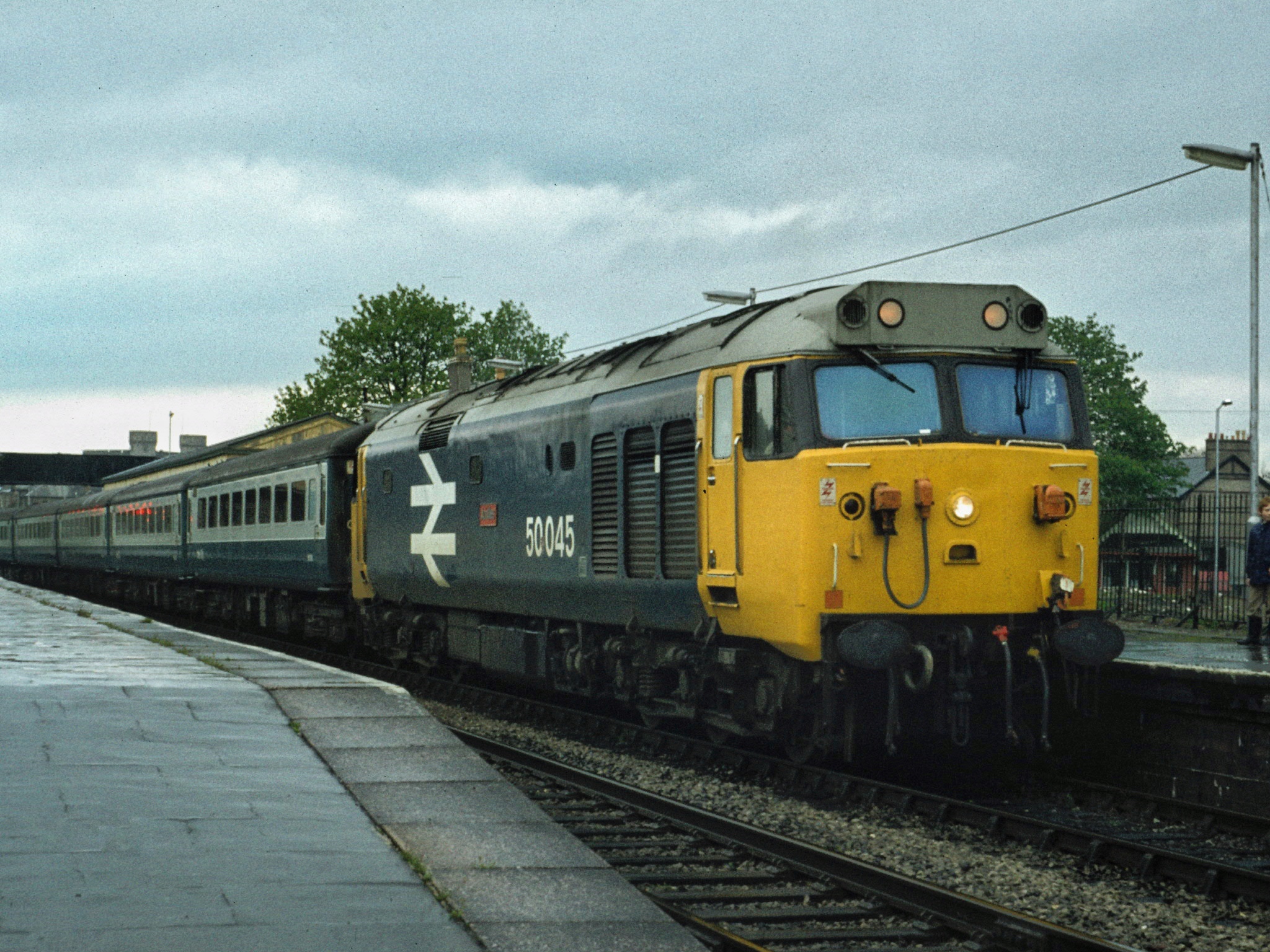
Class 50 No. 50005 ‘Collingwood’ moving empty stock to form a service to Bristol Temple Meads at Weymouth – 25/06/1983Class 50 No. 50008 ‘Thunderer’ at Radipole with the 1615 Bristol Temple Meads to Weymouth service – 16/07/1983Class 50 No. 50019 ‘Ramillies’ passes Dorchester Junction Signal Box – 26/06/1981Class 50 No. 50023 ‘Howe’ arriving at Dorchester West with the 0914 Weymouth to Bristol Temple Meads service – 21/05/1983Class 50 No. 50045 ‘Achilles’ at Dorchester West having arrived with the 1310 Westbury to Weymouth – 02/05/1983Class 50 No. 50034 ‘Furious’ arrives at Dorchester West with a Bristol Temple Meads to Weymouth service – 18/06/1983Class 50 No. 50014 ‘Warspite’ awaits the road at Dorchester West – 18/09/1982Class 50 No. 50020 ‘Revenge’ enters Dorchester West with a service from Weymouth – 03/10/1981
Eighteen Class 50 locomotives were saved for preservation.
Following her withdrawal in March 1994, Class 50 No. 50033 ‘Glorious’ was chosen to become part of the National Collection and is seen here outside of The National Railway Museum in York. The NRM decided to dispose of the locomotive in 2003 and is currently under the care of the Class 50 Alliance LimitedClass 50 No. 50002 ‘Superb’ preserved at The Paignton & Dartmouth Railway seen here at Kingswear – 05/09/1993
As mentioned in the text above, No. 50007 was painted in lined Brunswick Green and renamed ‘Sir Edward Elgar’, the following images are when she visited the 1995 Mid Hants Railway diesel gala in this guise:
The following video was taken at the 1995 Mid Hants Diesel Gala and features English Electric Class 20, Class 40 and Class 55 diesels alongside No. 50007 as well as other classes:
Footage from the 1995 Mid Hants Railway diesel gala
Surely a candidate for the strangest livery ever carried by a Class 50 is that carried by No. 50017 which was repainted into London Midland Scottish (LMS) style streamlined “Coronation Scot” crimson lake and gold. The locomotive had been purchased from BR by preservationist John F Kennedy. Shortly after returning to traffic on the West Somerset Railway the owner reached agreement with Venice Simplon Orient Express for its use working luxury Northern Belle dining services on the main line following certification by Resco. The locomotive was moved to Riley and Son Engineering in Bury for repainting in August 1999. The VSOE deal was short lived however, possibly because the mooted streamlining of LMS Coronation Pacific No. 46229 ‘Duchess of Hamilton’ for the main line failed to materialise, the cheaper option of cosmetic streamlining eventually being chosen instead, with the Stanier locomotive placed on static display at York. After being moved to Tyseley Locomotive Works No. 50017 was eventually sold on to another rail enthusiast.
Class 50 No. 50017 at Weymouth – 26/09/1999
The 26th September 1999 saw Weymouth being visited by a Class 50 and a Class 55 Deltic in connection with an empty coaching stock (ECS) move from Bournemouth. The train had originally worked from Wolverhampton to Bournemouth having been hired by the Socialist Workers Party in conjunction with the Labour Party Conference taking place that week. Riviera Trains provided the stock and VSOE provided the staff and locomotives which turned out to be Class 55 No. D9009 ‘Alycidon’ and Class 50 No. 50017 ‘Royal Oak’ ( sans nameplates ). The Class 55 lead on the southbound working with the Class 50 attached to the rear of the train. The ECS worked onto Weymouth and it was decided that as No. 50017 was to work the return working, No. D9009 would be run round and tucked inside. The same day saw Brush Type 4 Class 47 No. 47785 and Electro-Diesel Class 73 No. 73105 also in evidence with another charter train ECS from Bournemouth as can be seen in the following video clip:
Local Update
The week kicked off with a visit to the Bristol – Weymouth line by the HST New Measurement Train on Wednesday 15th June which we saw at Dorchester.
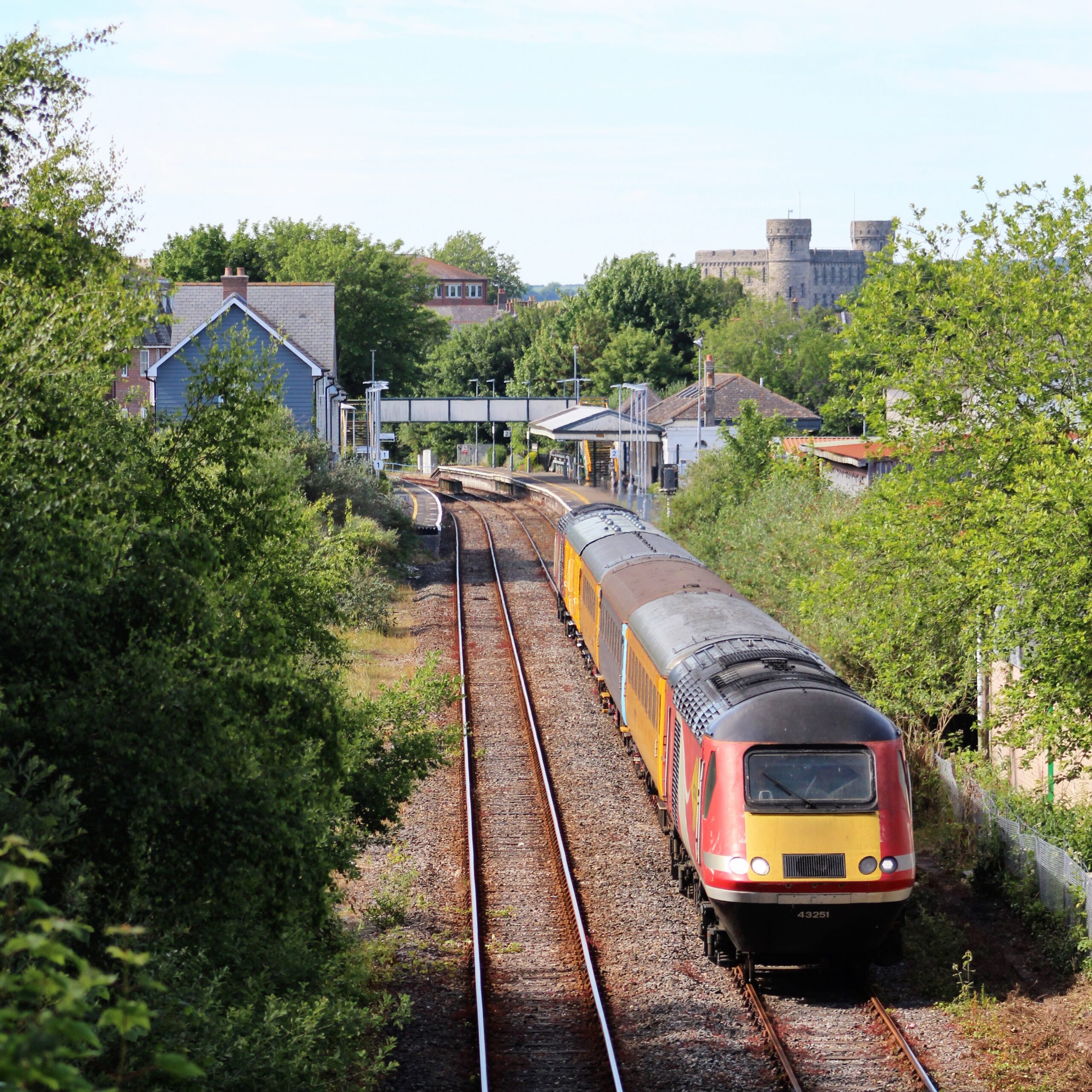
Colas Class 43 HST Power Car No. 43251 leads out of Dorchester West working 1Z22 0747 Derby RTC to Bristol Kingsland Road – 15/06/2022Colas Class 43 HST Power Car No. 432517 approaching Dorchester working 1Z22 0747 Derby RTC to Bristol Kingsland Road having reversed at Weymouth – 15/06/2022
Colas NMT at Dorchester – 15/06/2022
Yoshi was up early on Sunday morning so we could pop into Bournemouth to see the return working of a ballast train which had arrived at New Milton in the early hours. Our original plan was to get to Christchurch to see the ensemble, but it departed for Bournemouth as we were en-route, so we turned around and, as the station was locked, found a spot off Holdenhurst Road where we were just about able to peer through the buddleia and other overgrowth to get a glimpse of the Freightliner operated train. By the time the Class 66’s passed us, the station was open for business and we were very kindly allowed access to the platforms to see the train close up.
Ballast Train at Bournemouth – 19/06/2022Freightliner Class 66 No. 66598 rests at Bournemouth awaiting the reversal of 657V 0725 Bournemouth Signal 21 to Eastleigh East Yard – 19/06/2022Class 66 No. 66529 awaits the road at Bournemouth ready to take the ballast train back to Eastleigh – 19/06/2022
After all the excitement of Class 50 hauled rail tours and Class 66’s on an engineers train, Tuesday 21st June saw the first of three days of disruption on the UK railway network which have been called the biggest train strikes in thirty years. Tens of thousands of rail staff who are members of the RMT union are taking industrial action over pay, redundancies, pension reforms and changes to working practices. As a consequence no trains ran on the Bournemouth to Weymouth line during the strike. Further days of industrial action are scheduled for Thursday 23rd and Saturday 25th June. A steam railtour due to visit Bournemouth and Weymouth on the Thursday has been cancelled.
We mentioned previously about the disused railway bridge on the former Bridport Branch at Toller Porcorum which had been under threat from National Highways (NH). Following the refusal of retrospective planning permission by Eden District Council for hundreds of tonnes of concrete which had been poured over a Victorian railway bridge at Great Musgrave in Cumbria the NH have amended their processes to ensure full planning permission is sought before carrying out similar work in the future and infilling of structures would no longer be considered unless there was absolutely no alternative. Hurrah!
Thanks for reading, comments and corrections always welcome. We hope you’ll join us again next week!
33111 pauses after departing Norden on the Swanage Railway Friday evening dining train – 10/06/2022
Swanage Railway
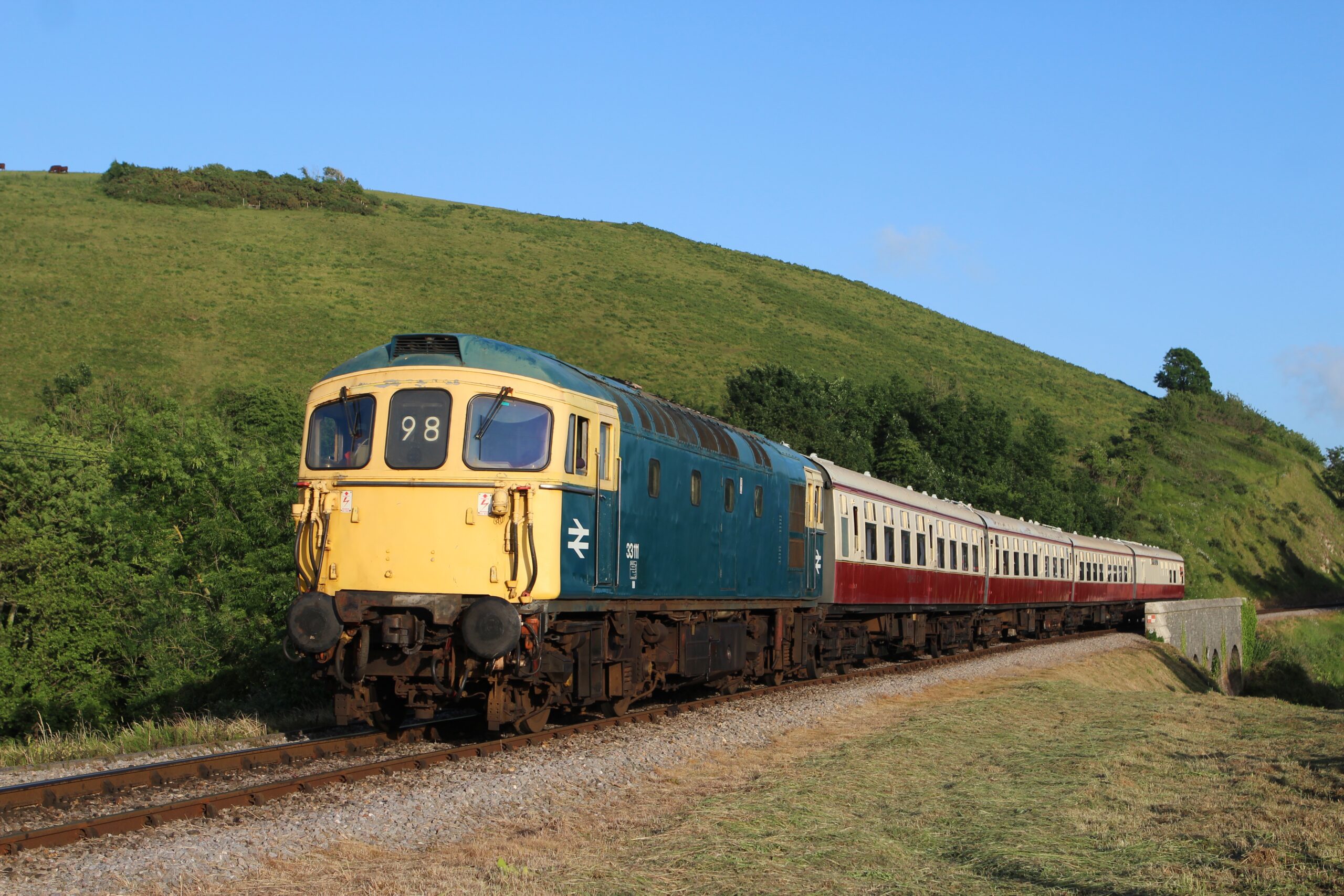
Friday evening was gloriously sunny, so Yoshi and I made the most of the light and took a drive to Swanage to see resident Class 33 No. 33111 in charge of the dining train which made two return trips between Swanage and Norden enabling diners ample time to enjoy dinner while taking in the beautiful Purbeck countryside. Class 33/1’s were part of the regular scene in my train spotting days back in the late 1970’s/ early 1980’s. On my way to school in the morning I would time my walk to coincide with the arrival of the ‘school train’ from Weymouth to Dorchester South which was regularly hauled by a 33/1 diesel locomotive hauling the passenger stock from the overnight mail train which would have arrived at the seaside terminus several hours previously. Well, that’s my recollection anyway! No. 33111 was the last locomotive of the 19 strong sub-class that I needed to ‘spot’, and therefore holds a special memory for me. I’m very pleased she survived into preservation locally.
Class 33 No. 33111 heads towards Norden – 10/06/2022
Yoshi with Class 33 No. 33111 – so as not to upset anyone of a nervous disposition, I digitally removed the fence behind Yoshi which separated him from the lineside.
On Tuesday 14th June, 71A Locomotive Group’s green liveried Class 33 No. D6515 (33012) ‘Lt Jenny Lewis RN’ along with Network Southeast liveried Class 50 No. 50026 ‘Indomitable’ returned to Swanage after their outing to guest at the Keighley & Worth Valley Railway diesel gala over the weekend. It was too hot for Yoshi to be hanging around for old diesels, so I headed off to Wareham alone. The 33/50 combo arrived around ten minutes late and a passing up service almost rendered photographic opportunities useless, but I managed to get a few snaps of the event. There’s a video below too, featuring the locomotives at Wareham on the main line and at Norden Crossing on the Swanage Railway.
71A Locomotive Group’s green liveried Class 33 No. D6515 (33012) ‘Lt Jenny Lewis RN’ along with Network Southeast liveried Class 50 No. 50026 ‘Indomitable’ pause at Wareham for a crew change working as 0Z23 0700 Dereham U.K.F. to Swanage – 14/06/2022
Portsmouth Harbour
On Saturday while Yoshi was enjoying spending a day with friends and socialising with other doggos, I was off on a family jaunt to the Portsmouth Historic Dockyards to visit The Mary Rose and to hit my head several times onboard HMS Victory. It was a lovely day, apart from the bashing my head on the low beams inside Victory bit obviously, made even better by taking the train to Portsmouth Harbour.
Portsmouth Harbour railway station first opened on the 2nd October 1876 as the terminus of Portsmouth and Ryde Joint Railway Chief Engineer Frederick Banister’s Portsmouth Waterside Extension to the Portsmouth Direct Line which runs to London Waterloo. The construction of the station replaced an earlier pier on the site called the Albert Pier that was used for passenger steamships in the mid-Victorian era. The Portsmouth and Ryde Joint Railway was a group of three railway lines in Southern England that were jointly owned and operated by the London & South Western Railway (LSWR) and the London, Brighton & South Coast Railway (LB&SCR). The main line was between Cosham and Portsmouth Harbour. There was a branch from Fratton to East Southsea; and a line between Ryde Pier Head and Ryde St John’s Road. The last-named section was isolated from the others, being on the Isle of Wight. The first section of line opened in 1847 and the last in 1885; the Southsea branch closed in 1914 but all of the other routes have since been electrified and remain open.
Portsmouth Harbour railway station was rebuilt in 1937 when the route was electrified but was almost totally destroyed during World War 2 by fire after German bombing. The station was rebuilt again after the war.
Train services to and from Portsmouth Harbour are operated by South Western Railway (SWR), Southern and Great Western Railway (GWR) – here are a selection of images taken on Saturday 11th June 2022:
GWR Class 166 No. 166210 at Portsmouth Harbour having arrived with the 1F05 0629 Cardiff Central to Portsmouth Harbour service – 11/06/2022Southern Class 377 EMU No. 377129 working 1S27 1529 Portsmouth Harbour to Brighton – 11/06/2022Class 444 No. 444018 leads fellow unit 444040 on 1P54 1545 Portsmouth Harbour to London Waterloo – 11/06/2022Portsmouth Harbour signal box was opened by the Southern Railway on the 1st June 1946. It was built to the Southern Railway Type 13 design and was fitted with a 47 lever Westinghouse ‘L’ frame.
It replaced two boxes, Portsmouth Harbour signal box which was destroyed by aerial bombing in 1941 but was not officially closed and Portsmouth Harbour signal box, a temporary box opened on 21st August 1941 to replace the bomb damaged box. Portsmouth Harbour signal box was closed on 21st April 1968 and was used as an office and a relay room for Portsmouth power signal box. After closure the lever frame was moved to the school of signalling at Clapham Junction. The building was retained as a relay room for the 1968 Portsmouth NX signalling scheme which was operational until December 2006. Network rail re-commissioned Portsmouth Harbour signal box on February 4th 2007, following serious problems with the 2006 Portsmouth re-signalling scheme. It was closed for the second time at the end of 2007 when Havant ASC was eventually commissioned.The Spinnaker Tower forms a backdrop to the entrance to Portsmouth Harbour railway station – 11/06/2022The steps leading up to the entrance of Portsmouth Harbour railway station – 11/06/2022SWR Class 450 No.’s 450053 forming the 1P56 1615 departure to London Waterloo and 450126 having worked in on the 1P43 1430 London Waterloo service at the buffer stops, Portsmouth Harbour – 11/06/2022GWR Class 166 No. 166220 waits to depart with F26 1623 Portsmouth Harbour to Cardiff Central – 11/06/2022
On 6th August 1981, Class 33 No. 33025 was named ‘Sultan’ during a ceremony at Portsmouth Harbour by Captain Austin Lockyer of HMS Sultan. The crests for 33025 were presented by The Royal Navy. I remember it being a wet day, not unusual for a British summer by the seaside I suppose! Here are some scans of my colour slides and black and white negatives of the day, including a couple shots taken at Southampton Central on the way to/ from the naming ceremony.
33025 ‘Sultan’ Portsmouth Harbour – 06/08/198133025 ‘Sultan’ Portsmouth Harbour – 06/08/198133025 ‘Sultan’ Portsmouth Harbour – 06/08/198133025 ‘Sultan’ Portsmouth Harbour – 06/08/198133025 ‘Sultan’ Portsmouth Harbour – 06/08/198133025 ‘Sultan’ Portsmouth Harbour – 06/08/1981BR Class 33 No. 33001 at Portsmouth Harbour – 06/08/1981Class 33 No. 33116 arrives at Portsmouth Harbour – 06/08/2022Brush Type 4 Class 47 No. 47064 pauses at Southampton Central – 06/08/1981Class 33 No. 33057 gets the road at Southampton Central – 06/08/1981
Southampton – Dorchester 175
June 2022 marks the 175th Anniversary of the Southampton to Dorchester line opening in 1847. The main driving force behind this line was Wimborne solicitor, Charles Castleman who first proposed a route by way of Brockenhurst, Wimborne, Poole and Wareham. Interestingly, one town which was not included was Bournemouth which in the early 1840’s had a population of around 200, none of whom appeared to care greatly about the new era of rail transportation. Politics of the day meant the supporters of the line courted interest from both the LSW and GW railway companies as both had interest in gaining a foothold in each others territories. The LSW to Exeter and GWR to Southampton. Weymouth was not initially included because of the projected expense of tunnelling which would be required between Dorchester and the seaside town. Eventually the GWR proposed a Wilts, Somerset and Weymouth line and it was agreed that when built the LSW should work the line between Southampton and Dorchester and the GWR from Dorchester to Weymouth.
Castleman had suggested early on that the Southampton to Dorchester route should be extended west from Dorchester through to Exeter, but in the event this didn’t happen. In part because the LSW eventually preferred to extend its Salisbury line. The Southampton and Dorchester Railway received Royal Assent on 21st July 1845 and engineer Samuel Peto was hired to construct the line, work commencing in August 1845. Castleman’s route was anything but direct, but was designed to take in most of the larger settlements on the way. This twisting route earned the nickname of Castleman’s Corkscrew.
The Illustrated London News w/e 5th June 1847 edition
The first section to be completed was between Dorchester and Ringwood but trains did not start running until the section through the New Forest was ready. Problems with the construction of a tunnel to carry the line under Southampton causing earthslips and subsidence prevented the running of through trains on opening day; 1st June 1847 and trains ran between Dorchester and Blechynden which was immediately west of the tunnel and stood further east than the present Southampton Central station.
There were originally thirteen stations on the 60.5 mile line, plus one other for Poole which was accommodated by a 1.75 mile branch and was actually located in Hamworthy. The chief engineer, William Moorson, appointed architect Sancton Wood to design a station building which could be replicated across all locations these being Blechynden, Redbridge, Lyndhurst, Beaulieu, Brockenhurst, Christchurch Road, Ringwood, Wimborne, Poole Junction (later Hamworthy Junction ), Wareham, Wool, Moreton and Dorchester.
The 1960’s saw the ‘old road’ from Brockenhurst through Ringwood and Wimborne fall under the blade of the Beeching cuts with passenger services assigned closure on 2nd May 1964, although Wimborne remained open for freight until 1977. I’m quite grumpy about not having seen any workings on this route. The last passenger to actually use Wimborne station was Her Majesty The Queen in July 1969. It is ironic that today the towns on the route of Castleman’s Corkscrew are growing conurbations and the railway would have had great potential as a commuter line. The population was already increasing when the line was closed, such is the short sightedness of planners and politicians and we are now left with the cycle and walking Castleman’s Trailway which Yoshi and I have explored in part.
An £180,000 improvement scheme has recently been completed to upgrade surfaces and access making the Trailway more accessible to a wider range of users. Drainage has been improved and much of the route has been widened. Barriers have been replaced by bollards, new signage and benches will be installed soon and verges seeded with wildflowers.
There were activities ranging from cake to dancing held at a number of stations on the Southampton to Dorchester route over the last weekend to celebrate the 175th Anniversary. Certainly something worth celebrating.
That’s just about all for from us for this week. Last weekend was also the occasion of the 2022 West Somerset Railway Diesel Gala. Because of lovely family plans we were unable to visit this year, but we’ll leave you with a couple of glimpses of one of our previous visits to the line. This was in 2019 and was coincidentally Yoshi’s first heritage railway outing!
Class 25 D7535 at Crowcombe Heathfield – 21/06/2019Yoshi meets D1010 ‘Western Campaigner’ at Williton – 21/06/2019
GBRf Class 66 No. 66734 ‘Platinum Jubilee’ stands adjacent to Eastleigh railway station – 02/06/2022
66734 ‘Platinum Jubilee’
We kicked off our four day Platinum Jubilee Weekend when we popped into Eastleigh to see newly outshopped GBRf EU Class 66 conversion No. 66734. The locomotive, previously No. PB04 when in use in Europe, has taken the identity of Class 66/7 No. 66734, which was written off in a landslide adjacent near Loch Trieg in 2012, and is the 100th member of the class acquired by GBRailfreight.
GBRf Class 66 No. 66734 ‘Platinum Jubilee’ stands adjacent to Eastleigh railway station – 02/06/2022Detail from 66734 ‘Platinum Jubilee’
To mark the Platinum Jubilee of Her Majesty The Queen, the engine has been given a special purple and silver livery, with the Platinum Jubilee logo and Union Flag on the bodyside. The engine has been named ‘Platinum Jubilee’, and although it currently carries vinyl nameplates, these will be replaced by cast versions in time.
Detail from 66734 ‘Platinum Jubilee’Detail from 66734 ‘Platinum Jubilee’GBRf Class 66 No. 66734 ‘Platinum Jubilee’ and Freightliner sister No. 66553 stabled next to Eastleigh railway station – 02/06/2022
Didcot
After our brief visit to Eastleigh, we headed off to Didcot Railway Centre for an evening photographic event run by TimeLine Events who had arranged for Great Western Railway Castle Class 4-6-0 No. 4079 ‘Pendennis Castle’ to be in steam for a number of scenarios around the site. You can read about our earlier visit to Didcot when No. 4079 was relaunched into service here.
TimeLine events specialise in recreating scenes from past eras using convincing re-enactors wearing authentic period dress in credible locations. Joining one of these events has been on my bucket list for a while now. We were a little late on arrival and once we had gained access to the railway centre, we quickly joined in the spirit of things. I really enjoyed the evening and the photographic opportunities and would attend another similar event in the future. I wasn’t totally satisfied with my resulting images and another time I would mount my camera on a tripod and try a variation of settings. As it was, this time around I hand held the DSLR and this certainly shows on shots taken later on in the evening.
Great Western Railway Castle Class 4-6-0 No. 4079 ‘Pendennis Castle’ at DidcotGreat Western Railway Castle Class 4-6-0 No. 4079 ‘Pendennis Castle’in the shed at DidcotGreat Western Railway Castle Class 4-6-0 No. 4079 ‘Pendennis Castle’ at Didcot
Although not the prime reason for attending the evening, I very much enjoyed seeing ‘Pendennis Castle’ in steam as she moved around Didcot and being turned on the turntable. Here’s a video showing a little taste of the evening:
Castle Class 4-6-0 No. 4079 ‘Pendennis Castle’ joins a line up of GWR engines at Didcot
Swanage Railway
Over the weekend Yoshi and I made a couple of visits to our local heritage railway in the Purbecks where dedicated Swanage Railway volunteer, Malcolm Munro, had spent a week crafting two special headboards marking the Queen’s Platinum Jubilee. Headboards are carried on trains to denote a special service or working and in the days of steam were a regular sight, including two famous Dorset related examples; The Bournemouth Belle and The Royal Wessex. The silver and red Platinum Jubilee headboards were carried by locomotives operating the Swanage Railway’s steam trains between Thursday 2nd June and Sunday 5th June 2022.
With SR 4-6-2 West Country Class No. 34028 ‘Eddystone’ on holiday at the Gloucestershire & Warwickshire Railway, steam services at Swanage were in the capable hands of SR 2-6-0 U Class No. 31806 and SR 4-6-2 Battle of Britain Class No. 34072 ‘257 Squadron’. Class 33 No. D6515 (33012) ‘Lt Jenny Lewis RN’ was in action on Saturday evening with the dining train.
SR 2-6-0 U Class No. 31806 enters Harman’s Cross – 02/06/2022SR 4-6-2 Battle of Britain Class No. 34072 ‘257 Squadron’ being prepared for departure from Swanage with the first train of the day. The special Platinum Jubilee headboard can be seen clearly – 04/06/2022Class 33 No. D6515 (33012) ‘Lt Jenny Lewis RN’ working the evening Curry Train across Corfe Common – 04/06/2022
Video of trains on the Swanage Railway over the Platinum Jubilee holiday weekend 2022
Mainline Happenings!
I was fully expecting a quiet time with local out of the ordinary main line workings over the bank holiday period and was pleasantly surprised to discover a GBRf route learner had been conjured up when I checked my emails on Saturday morning. So it was a hurried five minutes collecting cameras together and persuading Yoshi to jump in the car before setting off to view Class 66 No. 66755 ‘Tony Berkeley OBE’ working 0Z20 0813 Eastleigh East Yard to Weymouth. Over the weekend there had been several of these driver training workings set up, but in actuality only one ran each day on the Saturday and Sunday
GBRf Class 66 No. 66755 ‘Tony Berkeley OBE’ working light engine through Hamworthy as SWR Class 444 No. 444029 departs with a service bound for London Waterloo – 04/06/2022
Over the course of the Saturday and Sunday runs we managed to catch the light loco in a number of different settings – narrowly avoiding missing a shot once or twice because of passing passenger trains, as can be seen in the video below:
GBRf Class 66 No. 66755 ‘Tony Berkeley OBE’ heads into Poole having cleared the High Street crossing – 05/06/2022GBRf Class 66 No. 66755 ‘Tony Berkeley OBE’ runs down Bincombe bank into Upwey – 05/06/2022
The evening of Monday 6th June 2022 saw a test train and a heritage diesel working pass through the east of our area. The first was BR Green Class 33 No. D6515 from Swanage hauling Network SouthEast Class 50 No. 50026 ‘Indomitable’ heading to Dereham to pick up “slim’ Class 33/2 No. 33202 ‘Dennis G. Robinson’ before onward working to star at The Keighley & Worth Valley Railway diesel gala being held Friday 10th June through to Sunday 12th June 2022.
Class 33 No. D6515 from Swanage hauling Network SouthEast Class 50 No. 50026 ‘Indomitable’ through Hamworthy – 06/06/2022
The Class 33/ Class 50 combo was followed later by the monthly Colas test train top and tailed by Class 73 electro-diesels No.’s 73963 ‘Janice’ and 73962 ‘Dick Mabbutt’ working 1Q51 1115 Derby RTC to Eastleigh east Yard via Weymouth
Class 73 electro-diesels No.’s 73963 ‘Janice’ and 73962 ‘Dick Mabbutt’ working 1Q51 1115 Derby RTC to Eastleigh east Yard via Weymouth pass through Hamworthy – 06/06/2022
Elizabeth Line
We took the opportunity of an airport run to meet Yoshi’s aunty who was flying into London Heathrow to bookend our Platinum Jubilee weekend with a quick visit to see an Elizabeth line train at the T5 railway station. The staff were amazingly friendly, helpful and accommodating allowing us to onto the platform to take photographs of one of the Alstom Class 345 Aventra trains as well as explaining technical and timetable details. The Elizabeth line was officially opened by Her Majesty The Queen accompanied by HRH Prince Edward, Earl of Wessex on May 17th 2022 when a commemorative plaque was unveiled at London Paddington station a week in advance of the route opening to passenger services on May 24th.
Initially know as Crossrail, the Elizabeth line is operated by “MTR Elizabeth Line” as a concession of Transport for London between London Paddington and Abbey Wood. The Class 345’s have already been running between Paddington, Heathrow Airport and Reading in the west and between London Liverpool Street and Sheffield to the east prior to the central core opening for service. There are 70 trains, some seven carriages in length and others with nine carriages which were designed and built by Alstom in Derby. They are maintained by Alstom at Old Oak Common depot in west London. It is planned for the company to maintain the trains for the next 32 years as part of a rolling stock and provision contract.
Yoshi alongside Class 345 No. 345170Yoshi explores the interior of a Class 345 trainYoshi poses next to the Elizabeth line logo
On the day of our visit around 4,000 London Underground station staff were on strike with most services being severely disrupted so the Elizabeth line may have been busier than normal during our visit. The RMT union says it is protecting jobs and the pensions of its members which are being reviewed. TfL says jobs are not under threat. Later this month, more than 40,000 railway workers across 13 railway companies, including South Western Railway and Great Western Railway, will walk out as part of a three day national strike on 21st, 23rd and 25th June after talks about pay and redundancies collapsed.
With the tube not running because of a strike, Yoshi was unable to access the London Underground
That’s all from us at therailwaydog.co.uk for this week. Thanks, as always, for reading. My regular reader ( you know who you are ) will no doubt recall the first Railway Dog blog entry where I shared the first railway photographs I ever took, which to continue the jubilee theme, were from 1977 and show a Silver Jubilee special excursion passing through Dorchester West on its way to Weymouth. You can read more about this and see the images here.
Yoshi took a liking to Clayton Class 17 No. D8568, pictured here at Highley on the Severn Valley Railway
The main event in our diary this past week was a return visit to the Severn Valley Railway, this time for their 2022 diesel gala. We had an early start on Saturday morning, but with the car radio tuned into Yoshi FM celebrating the life of musical genius Vangelis we were in good spirits as we set off. We made it to Highley railway station just in time to see the arrival of GBRf Class 69 No. 69005 ‘Eastleigh’ double heading with Swanage Railway resident Class 33 No. 33012 ( D6515) ‘Lt Jenny Lewis RN’ on the first train of the day. Making Highley our base for much of the day meant we were able to relax and enjoy the spectacle of passing diesel locomotives, some from the SVR home fleet, and some visiting guests. I think we managed to see and photograph every loco which was running as part of the gala, even if we had to wait until almost the end to see DRS Class 68 No. 68003 ‘Astute’ working a train. It was a fabulous day with some lovely weather, good company and friendly conversation. Even the seemingly mandatory road closures didn’t dampen our enthusiasm.
The first train of the Saturday was worked by GBRf Class 69 No. 69005 ‘Eastleigh’ and visiting Class 33 No. 33012 ‘Lt. Jenny Lewis RN’ – Highley 21/05/2022Sole surviving Class 17 No. D8568 rests between shuttle duties at Highley – 21/05/2022On the other end of the Highley shuttle was Class 14 ‘Teddy Bear’ No. D9551One side of Class 50 No. 50007 has been temporarily re-designated as 50034 ‘Furious’ as a thank you to GBRf charter manager Paul Taylor for his prostate cancer charity fundraising efforts; ‘Furious’ was his favourite class 50Class 50 No. 50035 ‘Ark Royal’ approaching Highley – 21/05/2022Class 44 No. 44004 (D4) ‘Great Gable’ – Highley 21/05/2022Both the Class 44 and the Class 46 No. 46045 (D182) also attended the recent Swanage Diesel Gala – Highley 21/05/2022The Western Locomotive Association (WLA) has renumbered and renamed Class 52 Western No. D1062 ‘Western Courier’ as long scrapped sister locomotive No. D1040 ‘Western Queen’ to celebrate Her Majesty Queen Elizabeth II’s platinum jubilee. Highley – 21/05/2022D1015 ‘Western Champion’ – Highley 21/05/2022Class 31 No. 31466 nearing Highley – 21/05/2022Class 40 No. 40106 departs Highley with a train bound for Kidderminster – 21/05/2022The same locomotive, Class 40 No. 40106 heading towards Highley earlier in the day – 21/05/2022The first of two visiting GBRf Class 73’s No. 73136 ‘Mhairi’ departs Kidderminster at the rear of the 1750 departure to Bridgnorth – 21/05/2022The second of the visiting GBRf Class 73 electro-diesel locomotives No. 73107 ‘Tracy’ stands at Kidderminster – 21/05/2022Direct Rail Services operated Class 68 No. 68003 ‘Astute’ departing Kidderminster with the 1750 service to Bridgnorth – 22/05/2022Yoshi takes in a varied line up at Kidderminster just before we set off for home
Our video of our day can be seen below:
2022 Severn Valley Diesel Gala
Locally, there have been a number of interesting workings on our doorstep and nearby. Unfortunately the scheduled visit of the New Measurement Train HST didn’t make it to Dorset on Wednesday as the train was turned towards Bristol after it arrived at Westbury, missing out a whole stretch of the planned route. However, we only had to wait until the next day for something of interest as Colas Rail Class 37 No. 37612 worked a Network Rail Ultrasonic Test Train as 3Q14 1037 Westbury Down Terminal Complex to Westbury Down Terminal Complex via Weymouth on Thursday May 19th:
Colas Rail Class 37 No. 37612 nears Dorchester Junction and the South Western Mainline to Weymouth – 19/05/2022Colas Rail Class 37 No. 37612 seen approaching Upwey on the ascent of Bincombe Bank – 19/05/2022
Video of Class 37 No. 37612 on the NR ultrasonic test train – 19/05/2022
Saturday saw a very early hours visit of a GBRf operated new weed killing train to Dorchester Junction from Exeter via Yeovil. Although I’m reasonably obsessed with catching trains visiting the southern reaches of Dorset, I’m not totally insane and instead decided to stay tucked up in bed and went to see the same ensemble top and tailed by Class 66 No.’s 66790 and 66752 ‘The Hoosier State’ – a nickname for Indiana where the locomotive was built – at a more reasonable hour passing through Castle Cary on Sunday 22nd May:
Earlier on the Sunday evening, Yoshi and I were in the Weymouth area to see Locomotive Services Ltd. Class 37’s No’s 37521 and 37688 ‘Great Rocks’ hauling the LSL chairman’s train as 1Z65 1134 Llandrindod to Weymouth Jersey Siding. Our first glimpse was at Upwey and we then popped into Weymouth station itself to see the train before its planned move to the sidings. It was also an opportunity to take a look at the upgrade work taking place at Weymouth station and the forecourt area.
Yoshi alongside Class 37 No. 37521 (D6817) at Weymouth – station canopy roof upgrades are ongoing – 22/05/2022Locomotive Services Ltd. Class 37’s No’s 37521 and 37688 ‘Great Rocks’ – 22/05/2022
Two days later the LSL consist headed back to Crewe and Yoshi & I took the opportunity to see it climb Parkstone bank making a fine noise.
Locomotive Services Ltd. Class 37’s No’s 37688 ‘Great Rocks’ and 37521 working 1Z68 0726 Weymouth Jersey siding to Crewe up Parkstone bank – 24/05/2022
Our video of the train is below:
71A Loco Group owned Crompton Class 33 No. 33012 (D6515) ‘Lt Jenny Lewis RN’ returned to Swanage from the Severn Valley Railway on Tuesday 24th May. A GSM-R cab radio fault meant she arrived back in Dorset a day later than planned following an enforced stop off at Nemesis in Burton On Trent for repairs. We saw her passing through Hamworthy where a signal stop enabled a good view of the loco. We wondered when the last time a Class 33 stopped at Hamworthy.
Swanage resident Class 33 No. 33012 (D6515) ‘Lt Jenny Lewis RN’ trundles through Hamworthy on her return home – 24/05/2022
As we visited Weymouth and Upwey this week, our archive clip this time around is a glimpse of passenger trains from the late 1980’s around these locations:
Weymouth and Upwey in the 1980’s
Too late for last weeks “therailwaydog” blog entry was my Tuesday 17th May 2022 visit to Brooklands Museum who were hosting a land speed record celebration day, in partnership with the National Transport Trust and National Motor Museum Beaulieu exactly 100 years after Brooklands played host to a record-breaking run, which saw a speed of 133.75mph set by a 350-horsepower Sunbeam motorcar and the such last record ever achieved on a closed circuit. This event was immortalised in a painting by F Gordon Crosby, which depicts the Sunbeam ‘racing’ a train. Those attending the Tuesday event witnessed a real-life recreation of the painting, featuring the very Sunbeam that broke the record 100 years ago and LNER Thompson Class B1 locomotive No. 61306 ‘Mayflower’. Later in the day, four other land speed record holding cars were positioned along the finishing straight at the museum, making for an impressive display of record-setting performance. Guests on the day were joined by Kenelm Lee Guinness, grandson of his namesake, the Sunbeam’s driver in 1922. As you can see from the video below, invited guests screened the Sunbeam from public view as the B1 steamed slowly past. But to be fair, trees almost screened the train from view also! I made the composite image below to recreate the event. A recreation of a recreation, if you will.
350hp Sunbeam and Thompson B1 No. 61306 ‘Mayflower’F Gordon Crosby’s iconic painting
Steam Dreams ‘Mayflower’ headed rail tour passes Brooklands – 17/05/2022
Big thanks go to my brother who got us there on time to witness the steam train passing and also to him and my two nephews, who joined us on the trip, for a fabulous day at Brooklands Museum and the London Bus Museum.
Finally this week, a video of our visit to the 2021 Severn Valley Diesel Gala. Don’t say I’m not good to you. The weather, however, wasn’t kind to us that day, and I was reminded that at one point we had to go and buy a towel so Yoshi could be dried off!
2021 Severn Valley Diesel Gala
That’s it for this week – it’s been a busy one at Yoshi HQ, but extremely enjoyable. Thank you for reading and your comments. We’ll hopefully be back next week with more railway dog adventures. Bye for now.
Yoshi continues his obsession with GBRf Class 69 locomotives, this time at Bewdley on the SVR – woof woof!
Yoshi sits near Howard Lock, Bristol with the Clifton Suspension Bridge in the background
At the weekend, Yoshi visited Bristol by train from Dorset. He was a very good boy on the trains to and from the city. It was perhaps a little too hot for him during the day, but we made sure he had lots of water and opportunity to rest in the shade. He also enjoyed a boat trip.
Bristol Temple Meads – May 2022
We arrived in the city via Bristol Temple Meads railway station which is currently undergoing a massive transformation programme managed by Network Rail. Having completed a major track and signalling upgrade in 2021, the station roof is currently being grit-blasted to remove layers of old colouring before receiving a protective new coat of paint. New glazing is also being installed with the project due for completion in the summer of 2024.
GWR Castle Class HST power car No. 43005 ‘St. Michaels Mount’ stands at the rear of the 0820 Taunton to Cardiff Central service. The scaffolding for the safety deck to facilitate roof repairs can clearly be seen.
Watch a couple of HST’s at Bristol – 14/05/2022
The original Temple Meads, designed by famed engineer Isambard Kingdom Brunel, was opened on 31st August 1840 as the western terminus of the Great Western Railway. The Brunel train shed no longer forms part of the operational station and is now partly used for car parking, Temple Meads having been expanded to accommodate a growing number of train services by Matthew Digby Wyatt and Francis Fox in the 1870’s and Percy Emerson Culverhouse in the early 1930’s. To me Bristol Temple Meads represents one of the finest railway stations in the UK.
A statue of Isambard Kingdom Brunel (1806 – 1859) stands on the approach to Bristol Temple Meads railway station
We enjoyed a walk around the city and took in the Clifton Suspension Bridge, a visit to Bristol Museum & Art Gallery, the buzzing quayside area and Brunel’s SS Great Britain, once the largest passenger ship in the world.
Brunel’s SS Great Britain. Brunel envisaged passengers boarding his steam ships in America, sailing to Bristol and travelling to London via his trains on his railway without having to leave the Great Western Railway company services on the journey.As part of an exhibition of art works chosen by Grayson Perry and guest celebrities chronicling recent lockdowns at the Bristol Museum & Art Gallery entitled ‘Grayson’s Art Club’ was this fantastic Ticket Rug created by Simon Fraser. The rug contains over 25,900 individual threads and took 60 hours to complete.
Unplanned as part of our visit when originally devised, I was very pleased to see the Bristol Harbour Railway was in operation. Built by the Great Western Railway in the 1870’s, being formally opened on 11 March 1872 by Lady Mayoress, Mrs Elizabeth Hare. The railway was used to transport goods arriving by ship including coal, esparto grass, wood and meat, as well as alcoholic drinks such as sherry and Guinness. A great deal of goods traffic was moved on the railway throughout its working life including vital war supplies during both world wars.
The railway began at Bristol Temple Meads before proceeding through a tunnel under St Mary Redcliffe churchyard, over a steam-powered lifting bridge outside the Ostrich pub on Bathurst Basin and onto Princes Wharf. In the 1900’s it was extended onto Wapping Wharf to where the SS Great Britain is docked today.
After a century operating as a goods railway, it was handed over to the Bristol Museum and has been run as a heritage visitor attraction ever since. Today the railway runs on the quayside between M Shed and the ‘SS Great Britain’ or alongside the New Cut to Vauxhall footbridge.
Locomotive engineering was a vital industry in Bristol from the late 1830s to the 1950s and currently M Shed has two Bristol-built steam locomotives in operation; ‘Henbury’ and ‘Portbury‘, both of which served their working lives on the docks railway system at Avonmouth.
‘Portbury’
Built in the Fishponds area of Bristol in 1917 by the Avonside Engine Co and painted battleship grey, ‘Portbury’ was taken to work on the construction of the new Portbury shipyard towards the end of World War 1. In 1920 she was moved to Avonmouth Docks where she worked on the internal railway system. She was later joined by ‘Henbury’, built at Bristol company Peckett & Sons in 1937. A more powerful engine, ‘Henbury’ augmented a growing fleet of 40 engines at work in the docks.
When diesel engines took over in the 1960’s both engines were selected for the museum. After some years in storage ‘Henbury’ was overhauled and took part in the opening ceremony of Bristol Industrial Museum in 1978. In 1981, ‘Henbury’ made railway history as the first preserved steam locomotive to pull scheduled freight on the main line railway.
‘Henbury’
‘Henbury’ has pulled hundreds of thousands of visitors on trips on Bristol Harbour Railway since 1978 and was joined in 1988 by ‘Portbury’. Now in its 150th Anniversary year, we hope the railway continues to give enjoyment for many years to come.
Click on our short video from 14th May 2022 below, and also watch from the archive with the Bristol Harbour Railway in operation in the 1990’s:
The Bristol Harbour Railway in May 2022
The Bristol Harbour Railway as seen on two visits in the 1990’s
A quiet week for “out of the normal” trains locally following the excitement of the Swanage Railway diesel gala ( see last weeks blog entry ), however following the timetable changes which took place from May 15th 2022, South Western Railway has reinstated a “full service” to and from Weymouth for the first time since the coronavirus pandemic hit. Two trains an hour will now run to London, with a later evening return service from Dorset. Journey times will be reduced and improvements have been made to Weymouth station, focusing on new bus stop facilities and platform refurbishments. We’ll have to check them out!
Finally, a brief visit to Bristol Temple Meads 1988 style from the same vista as the 2022 video linked above.
Bristol Temple Meads departures – 1988
We’ll certainly be hopping in our archive time machine and visiting Bristol again in future weeks, but for now, that’s all for this entry. As always, thank you for reading and all comments welcome. May your dog go with you.