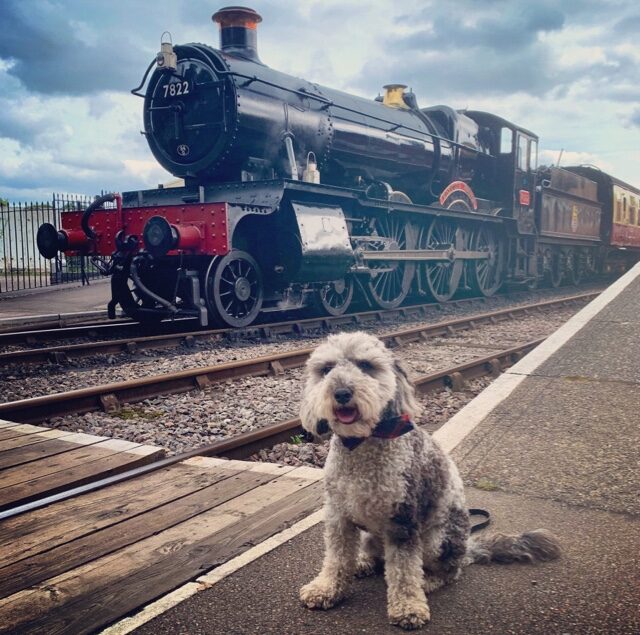
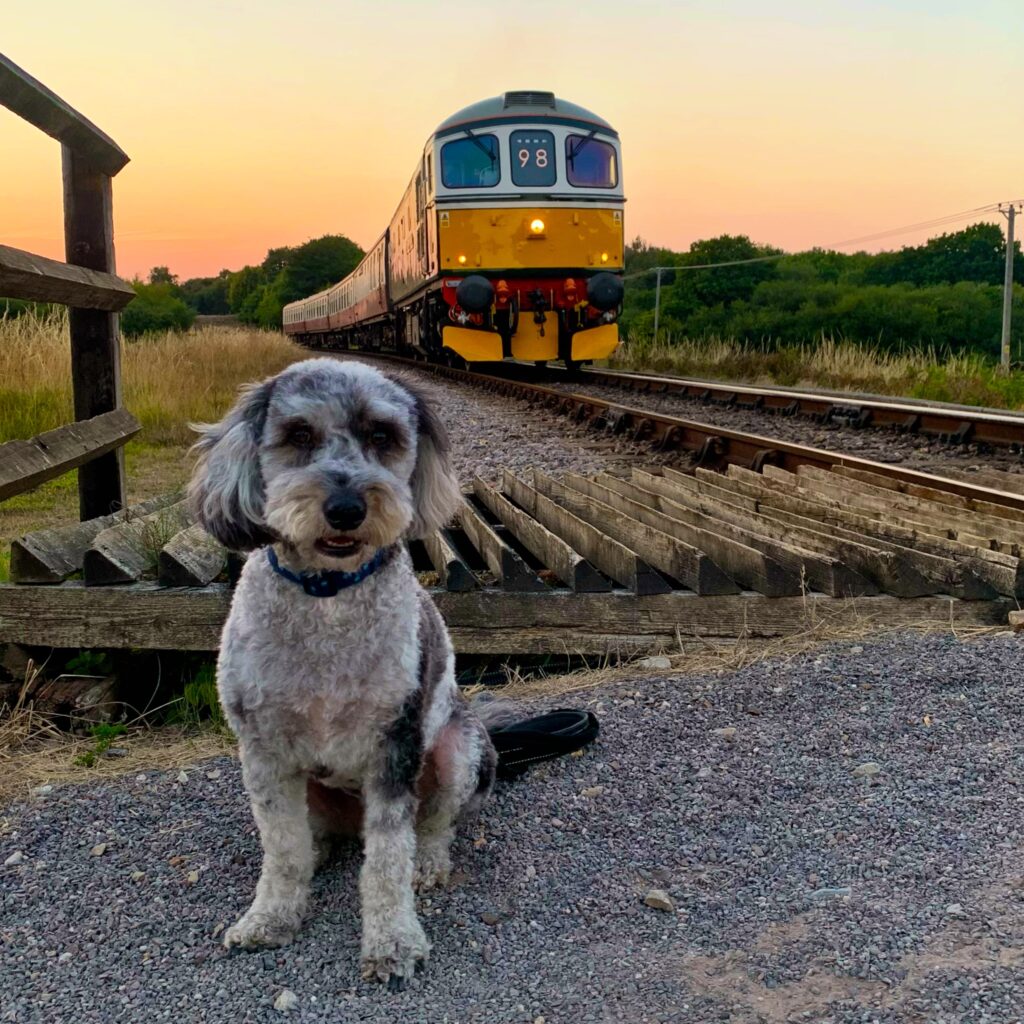
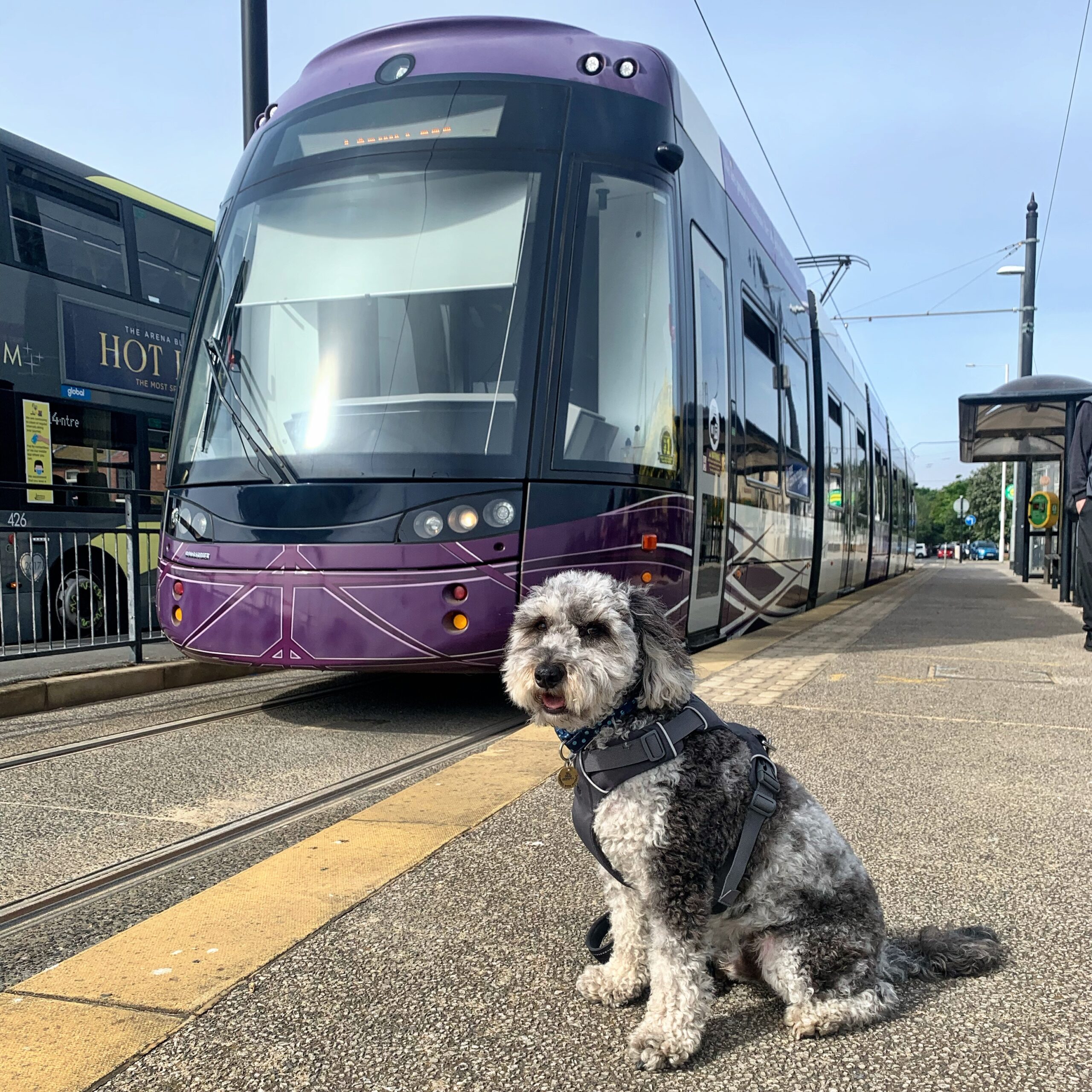
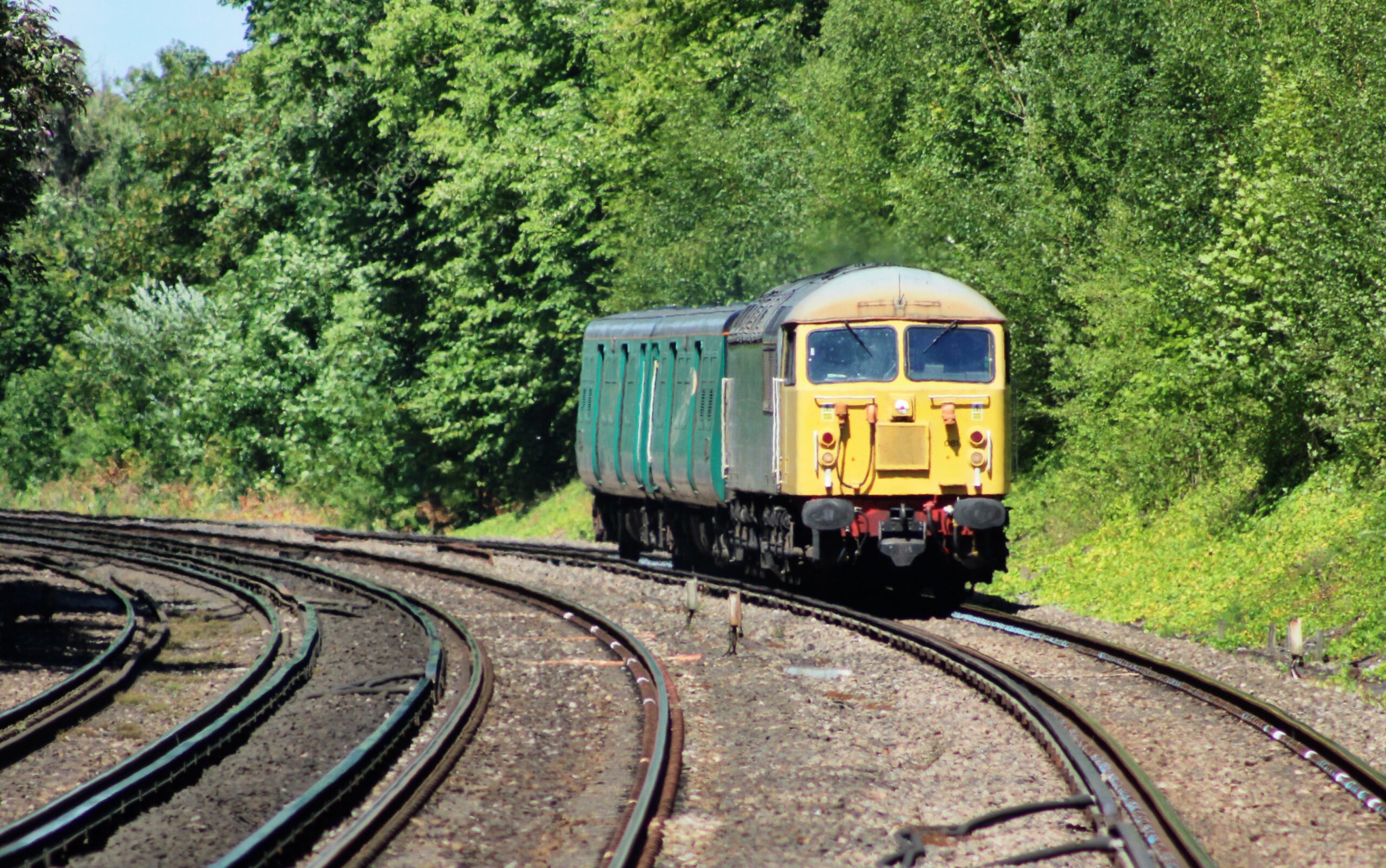
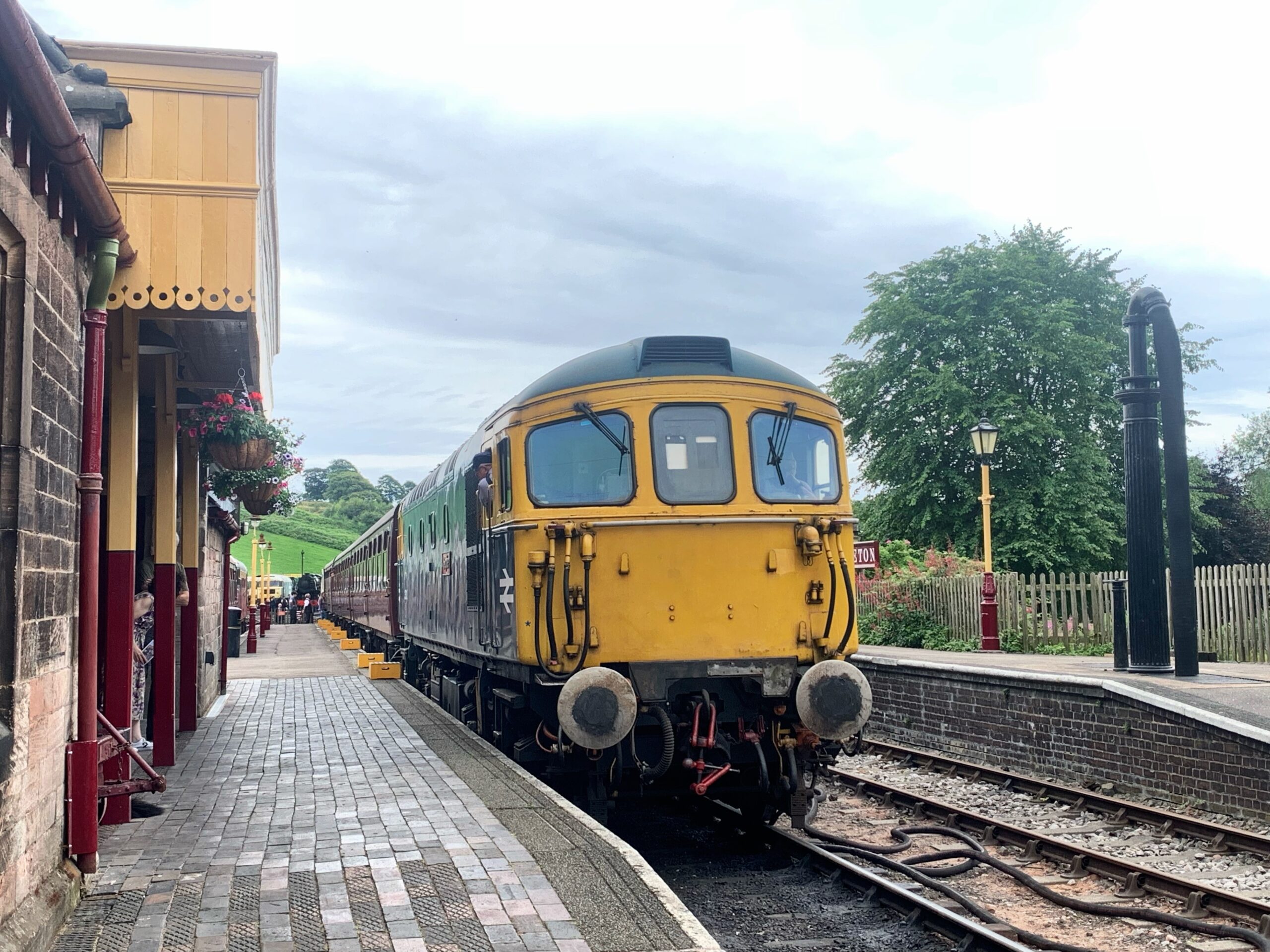
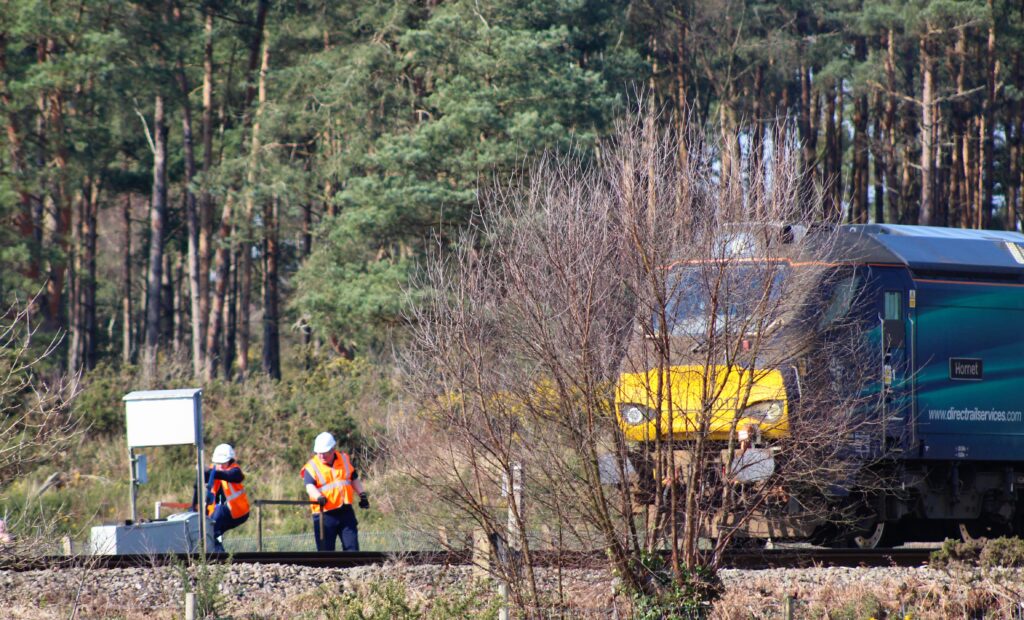
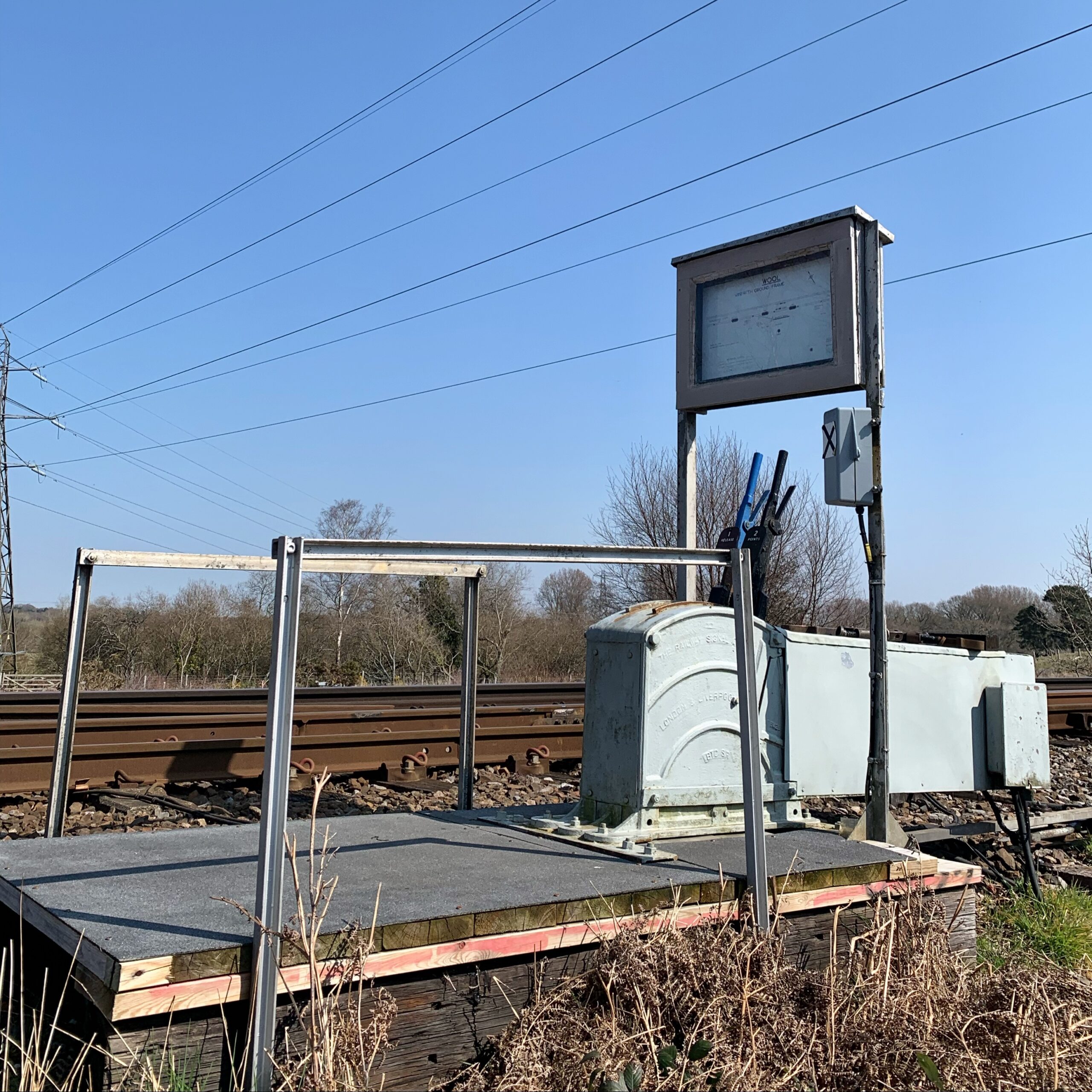
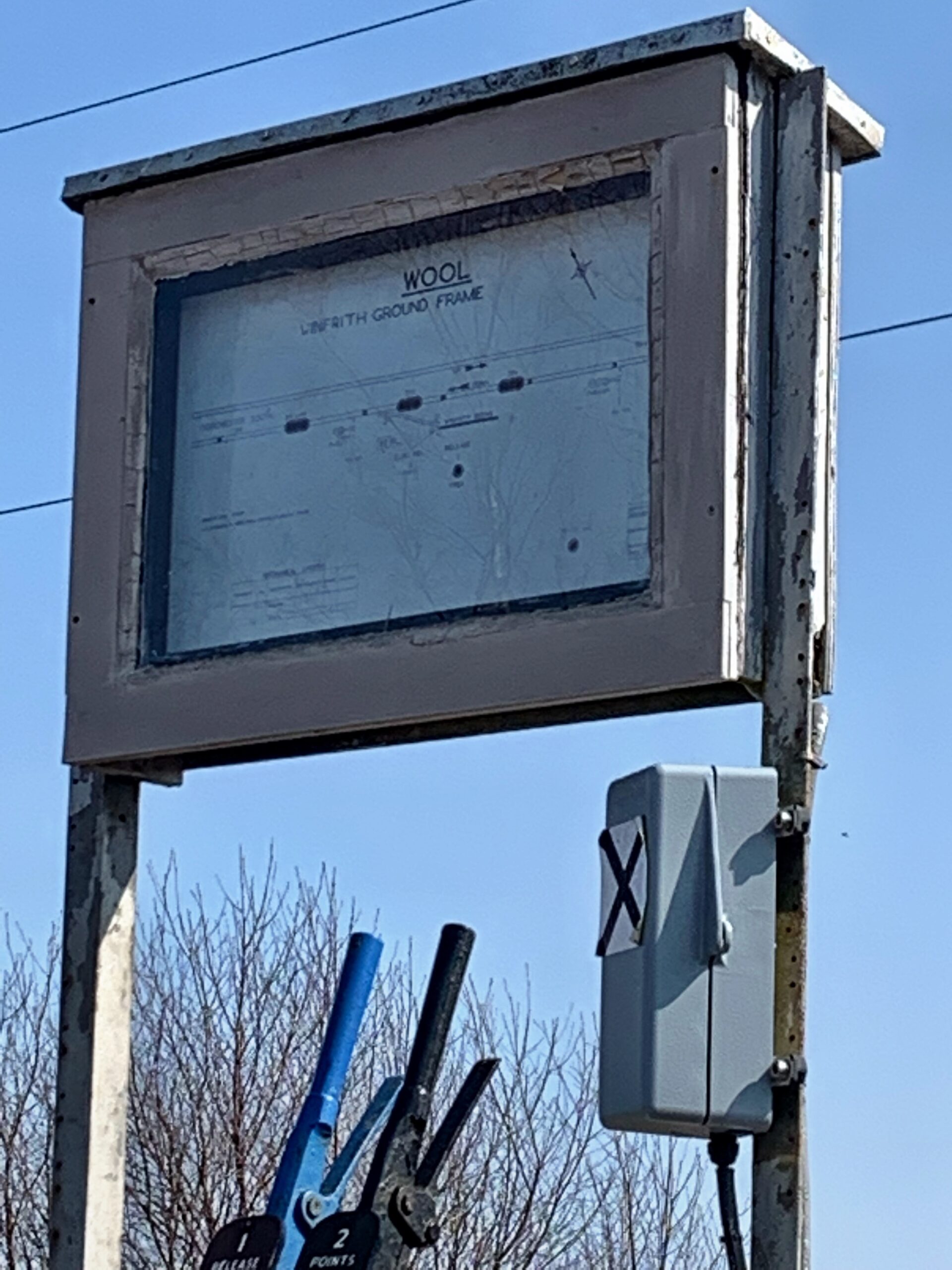
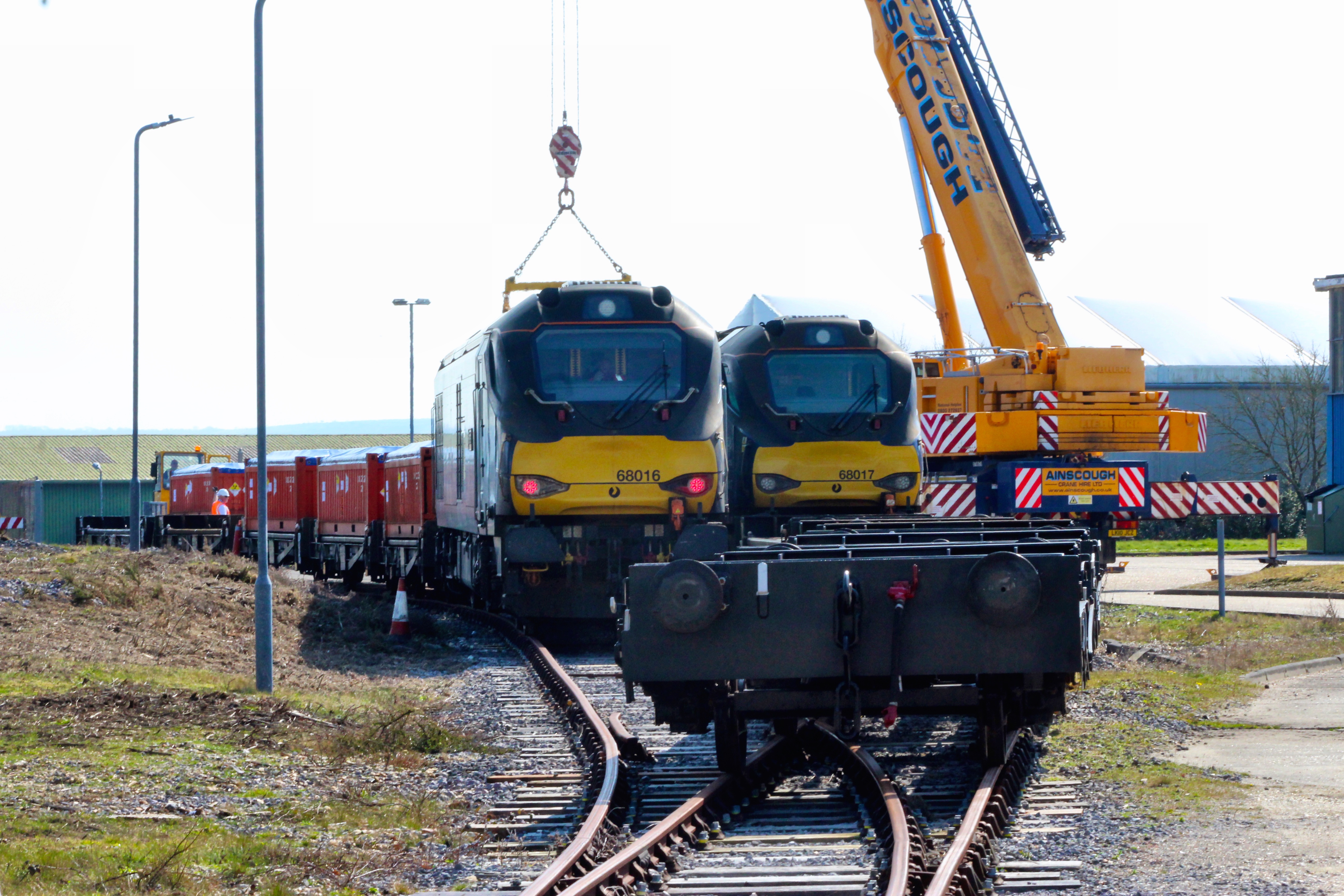
Yoshi in front of stationary Class 33/0 No. D6515 (33012) ‘Lt Jenny Lewis RN’ which was working Swanage Railway Friday Night Bistro train duties. The train stops here for around thirty minutes and we had permission from the driver and guard to take this photo. Please ensure you and your pets stay safe in and around railway property – 12/08/2022
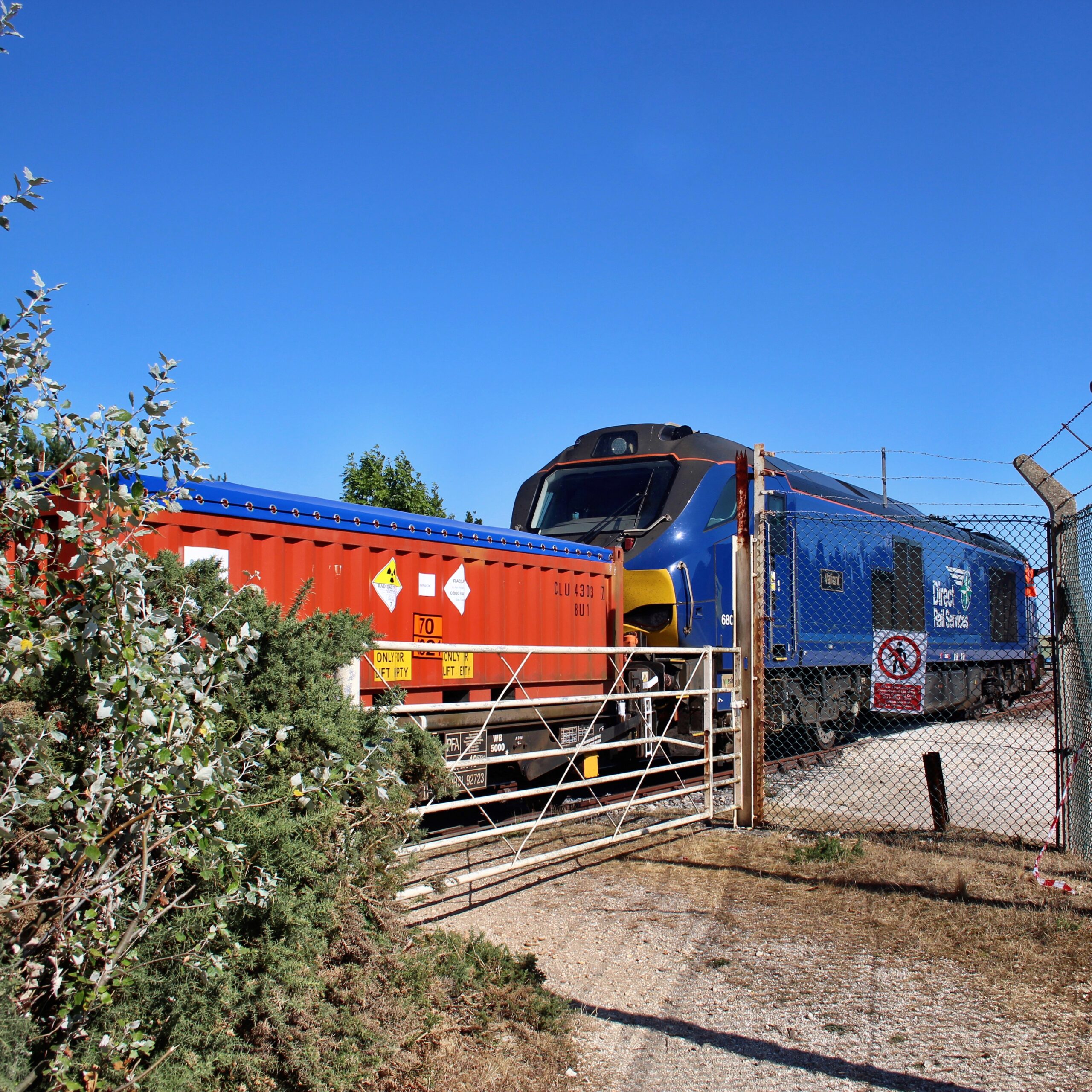
This was looking like a quiet week on the local railway scene, but Yoshi and I had some lovely family events to fill the days. It’s not all about the trains, apparently. Despite the lack of main line entertainment, we were surprised to find another Direct Rail Services (DRS) Winfrith train was running on Thursday 11th August. These workings are in connection with the removal of low level nuclear waste from Magnox Winfrith. This weeks run only appeared on the schedules a couple of days previously (Tuesday 9th August 2022) and, according to folk at Magnox Winfrith I chatted to, may well be the last such working of 2022. The next is provisionally slated for around March 2023. Let’s see.
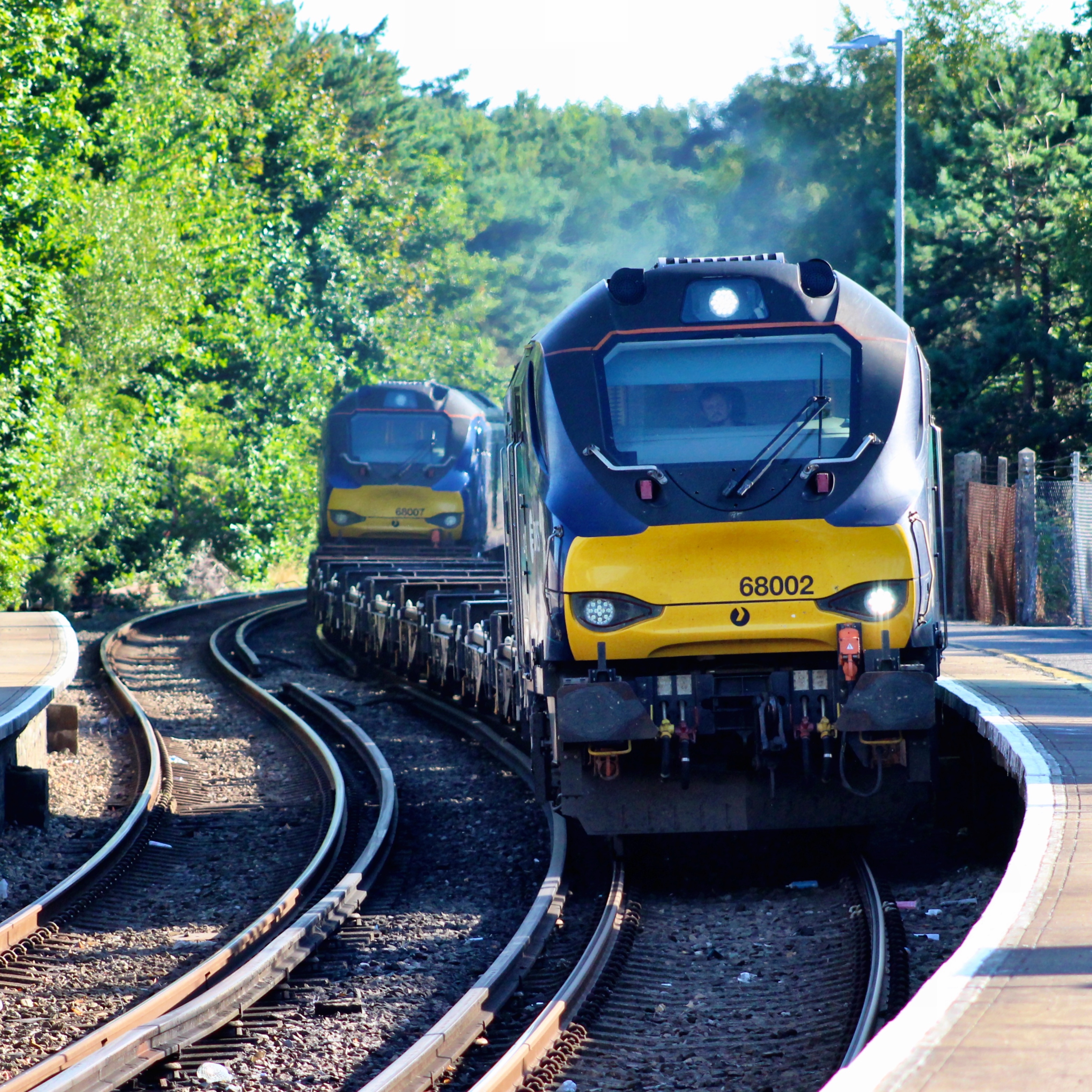
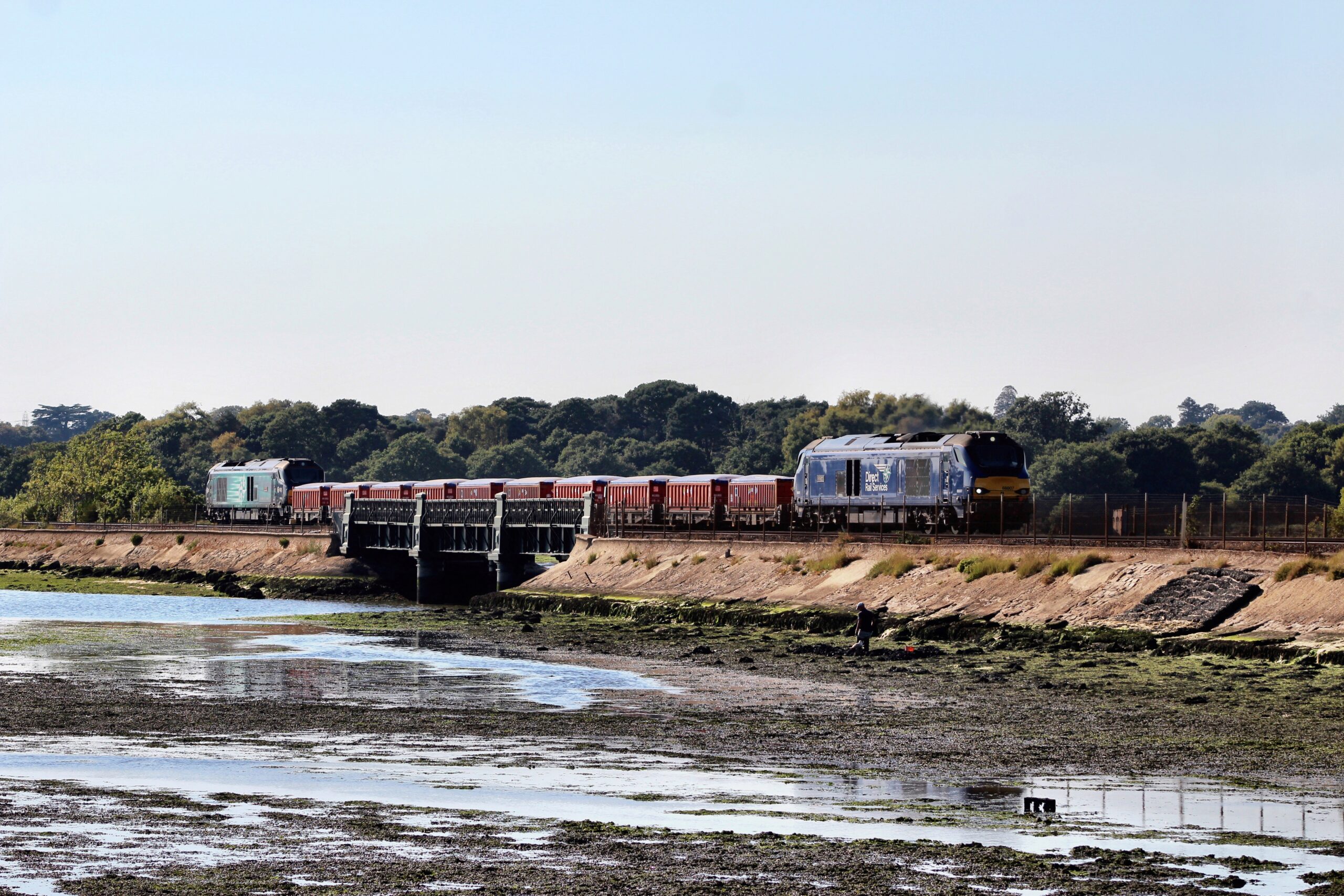
I chose to see the down working pass through Hamworthy on its way to Winfrith. The locomotives top and tailing the train were DRS Class 68 No.’s 68002 ‘Intrepid’ and 68007 ‘Valiant’. No. 68005 ‘Defiant’ had originally been allocated to the working but developed a fault on its way from Sellafield to Crewe with the empty PFA wagons which would be used for onward transit to Dorset. The Class 68’s were built by Vossloh at Albuixech, Valencia for use by Direct Rail Services.
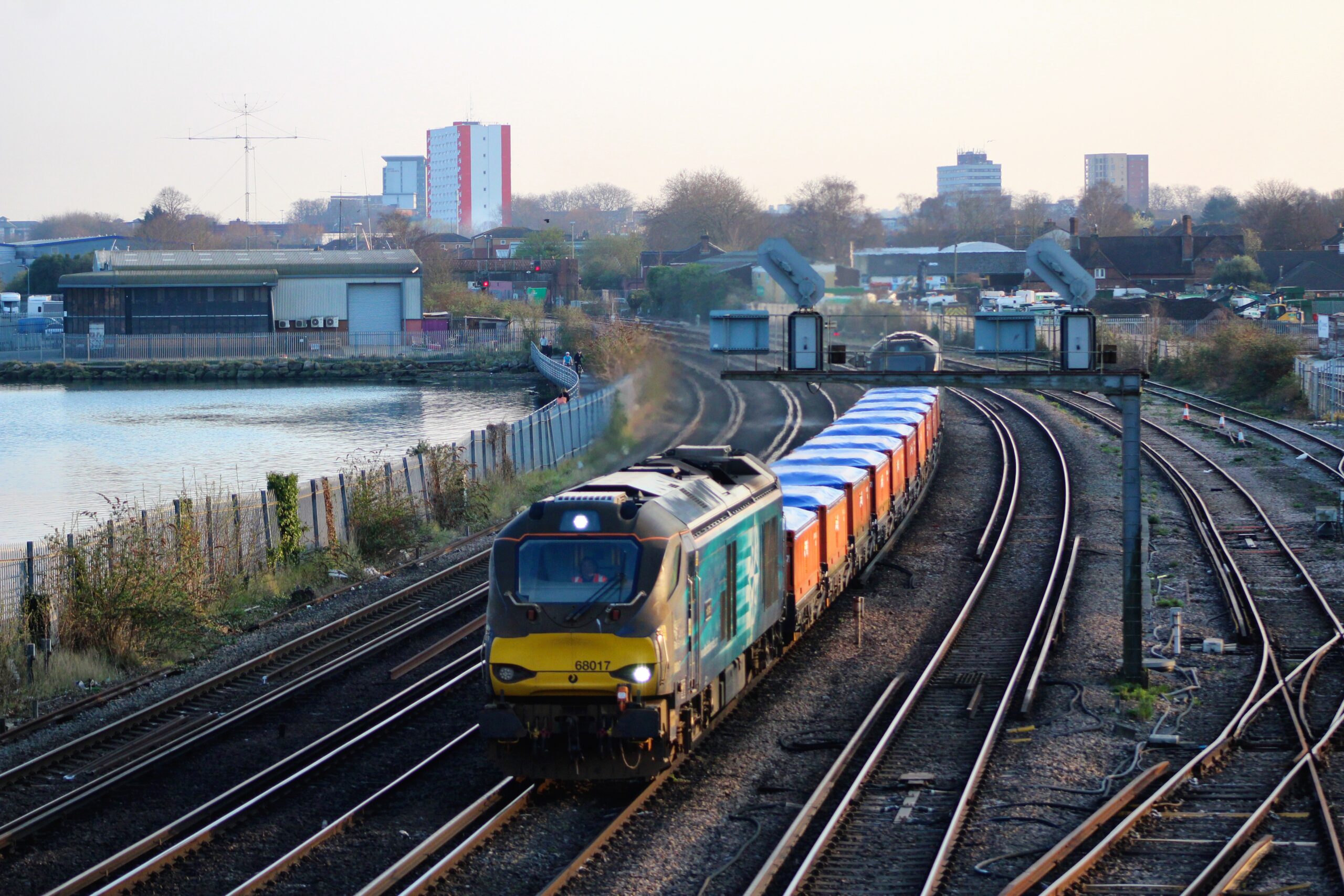
DRS Class 68 locomotives No.’s 68002 ‘Intrepid’ and 68007 ‘Valiant’ top and tail a set of empty PFA wagons bound for Magnox Winfrith powering through Hamworthy with 6Z62 0103 Crewe Coal Siding (DRS) to Winfrith Sidings – 11/08/2022
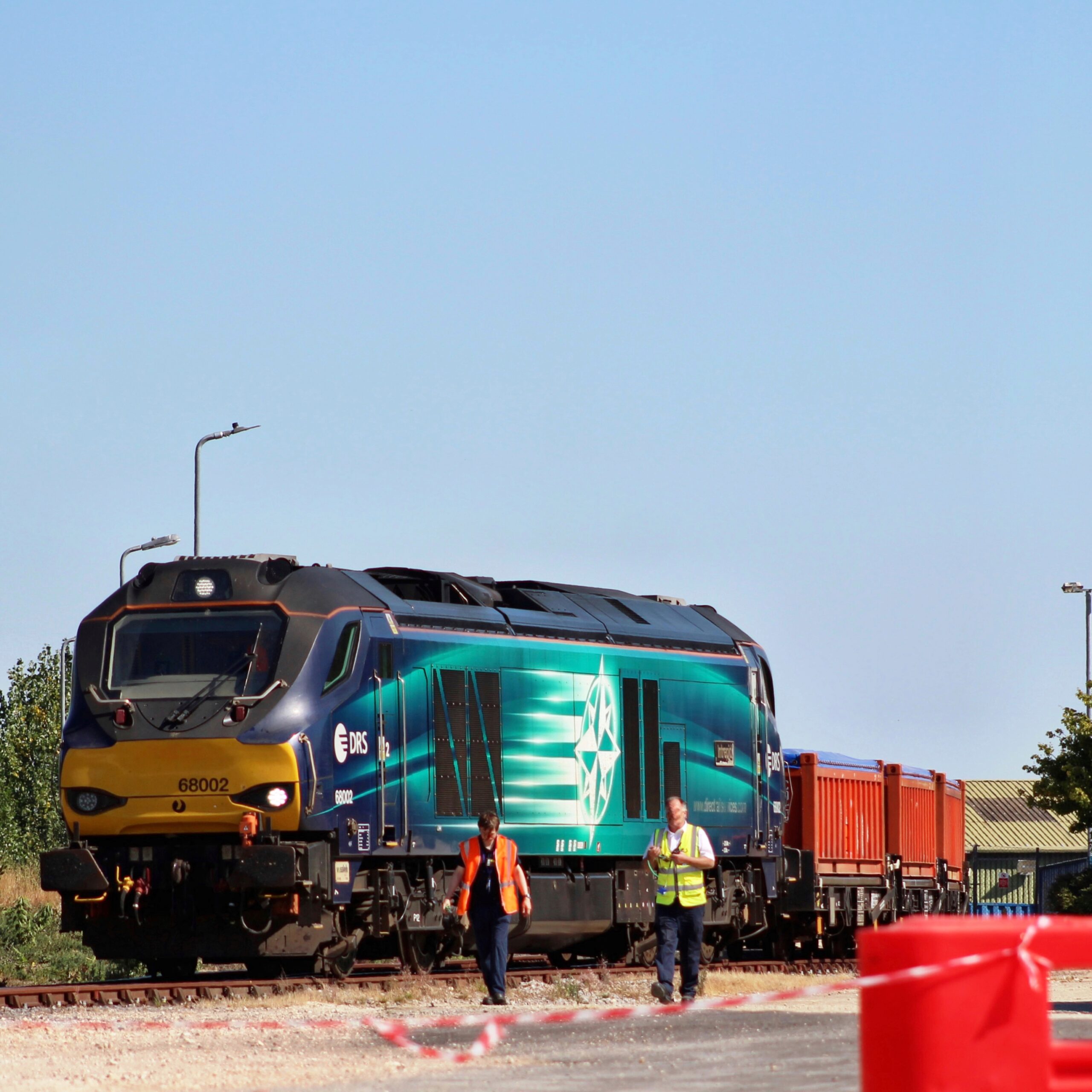
For the return run, I wanted to catch the loaded train leaving Winfrith sidings as there will be only a limited number of these workings, so I thought I would take the opportunity on a beautiful sunny day. The security guys at Winfrith were pleasant and relaxed about my taking photos from a public footpath. After departure from Winfrith Sidings, the train goes on to Dorchester South where it reverses to embark on its trip back to Crewe. While it was doing this, I headed off to Poole in order to catch the consist passing over Holes Bay.
DRS Class 68 No. 68002 ‘Intrepid’ stands in Winfrith Sidings awaiting departure with the loaded train of low level nuclear waste – 11/08/2022DRS Class 68 No. 68002 ‘Intrepid’ edges out of Winfrith Sidings towards the main line – 11/08/2022At the rear of the loaded train DRS Class 68 No. 68007 ‘Valiant’ formerly in ScotRail livery – 11/08/2022DRS Class 68 locomotives No.’s 68007 ‘Valiant’ and 68002 ‘Intrepid’ crossing Holes Bay with the loaded 6Z95 1600 Winfrith Sidings to Crewe Coal Sidings (DRS) – 11/08/2022
And here’s our video of the August 2022 Winfrith Cats:
DRS Class 68 locomotives No. 68002 ‘Intrepid’ and 68007 ‘Valiant’ with the third Winfrith train of 2022 seen at Hamworthy, Winfrith and Holes Bay – 11/08/2022
Digital photography has given us the ability to snap away more or less at our hearts content. Back in my misspent youth armed at first with my 126 Kodak camera, then my 110 Kodak and finally my trusty Russian made 35mm Zenit SLR I was very conscious of both the cost of the film and of the developing and printing. This meant that, often, I had one chance to take a photograph of a particular train. I wasn’t always too mindful however of where the sun was in relation to my subject and the effect this would have on the resulting image. It would take a week or so for the prints to be returned in the post from Truprint or other postal D&P service which might have a money saving promotion on the go. In my mind I had always taken a masterpiece of railway photography, but invariably what was returned never lived up to my expectations. But what did it matter? There would be another Class 33/0 on the Weymouth Boat Train or Inter-Regional Class 47 hauled holiday special excursion to get into the camera viewfinder another day. Until when there wasn’t, of course. Railway’s have always encompassed change and development. If they didn’t, we’d still all be being hauled by variations of Stephenson’s ‘Rocket’ and getting smut in our faces sitting in open topped wagons. I sometimes wish I’d taken more photos of everyday scenes back in the 70’s and 80’s. But I didn’t and I don’t have a time machine to take me back there. Which is where, to some extent, our heritage railways step in. I have spent many a happy hour at a steam or diesel gala on a preserved railway. Some people like to travel behind their favourite class of locomotive, whereas I like to photograph or video the trains, as I know a lot of other enthusiasts do. I politely suggest photographers – and I am sure there are many who already do – who don’t travel on the trains make a donation to the railway they are using as their canvas. Or use the catering facilities, or buy merchandise. Anything to give something back.
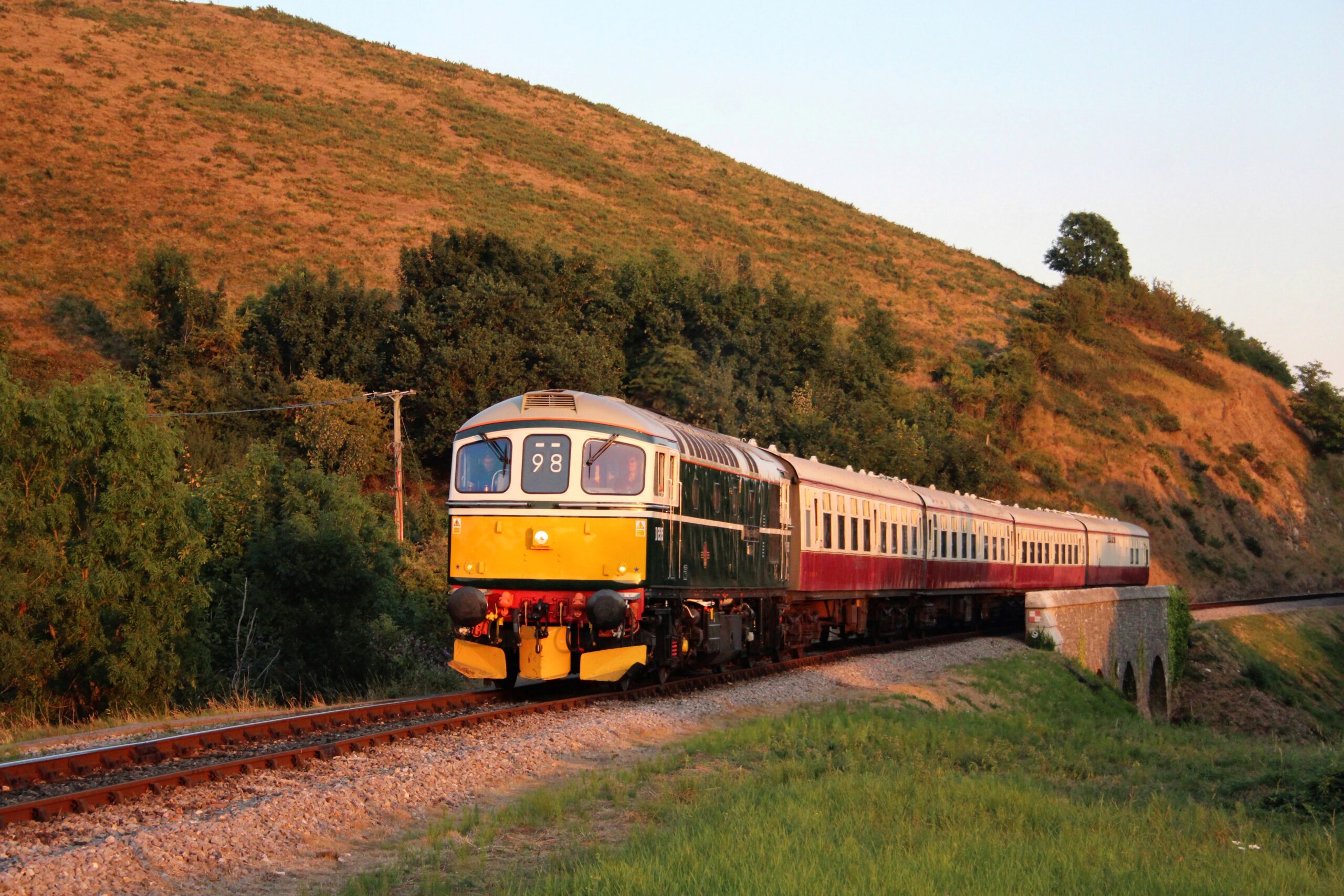
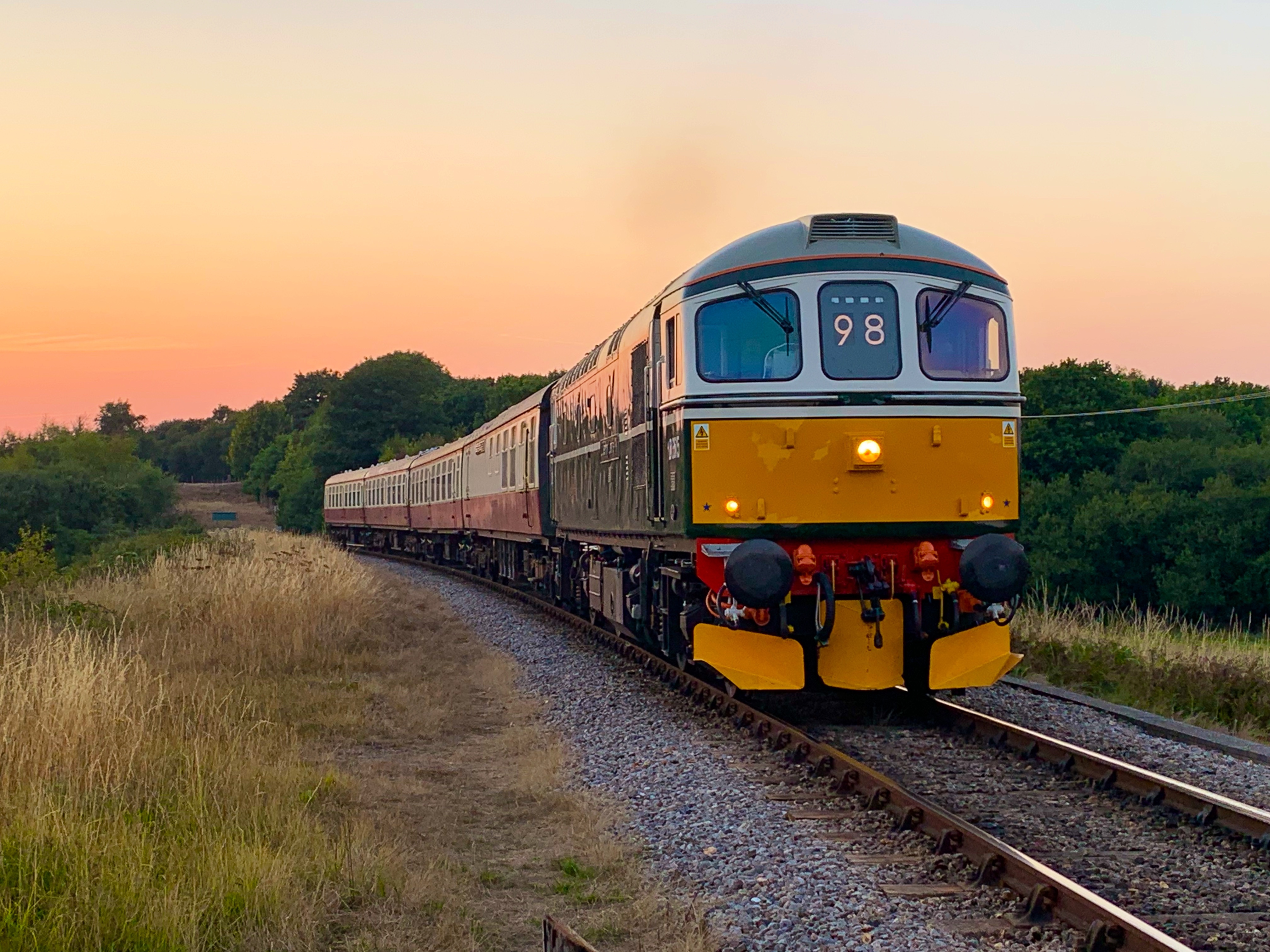
Friday evening (August 12th), as the heat of the day had subsided, Yoshi and I ventured out to our local heritage line, The Swanage Railway, to see their resident Class 33/0 No. D6515 (33012) * ‘Lt Jenny Lewis RN’ hauling the custard and cream dining set on the Friday Bistro train. Although replicating an era prior to my interest in railways, the ensemble looked magnificent catching the last rays of the sun at the end of the day.
D6515 (33012) ‘Lt Jenny Lewis RN’ working Swanage Railways Friday Night Bistro Train 1N08 1930 Swanage to Norden having just departed Corfe Castle station – 12/08/2022D6515 (33012) ‘Lt Jenny Lewis RN’ working Swanage Railways Friday Night Bistro Train 1N09 2010 Norden to Swanage having just departed Norden – 12/08/2022
Class 33 No. D6515 (33012) ‘Lt Jenny Lewis RN’ with Swanage Railways Friday Bistro Train – 12/08/2022
Sister locomotive Class 33/1 No. 33111 experienced difficulties earlier on Friday and has had to be withdrawn from service pending repairs. Hopefully she won’t be out of action for too long. In the meantime, during the steam ban which resulted from the recent spell of dry weather, Swanage are employing their Diesel Multiple Unit set to run services in conjunction with No. D6515 with steam expected to return on Wednesday 17th August 2022.
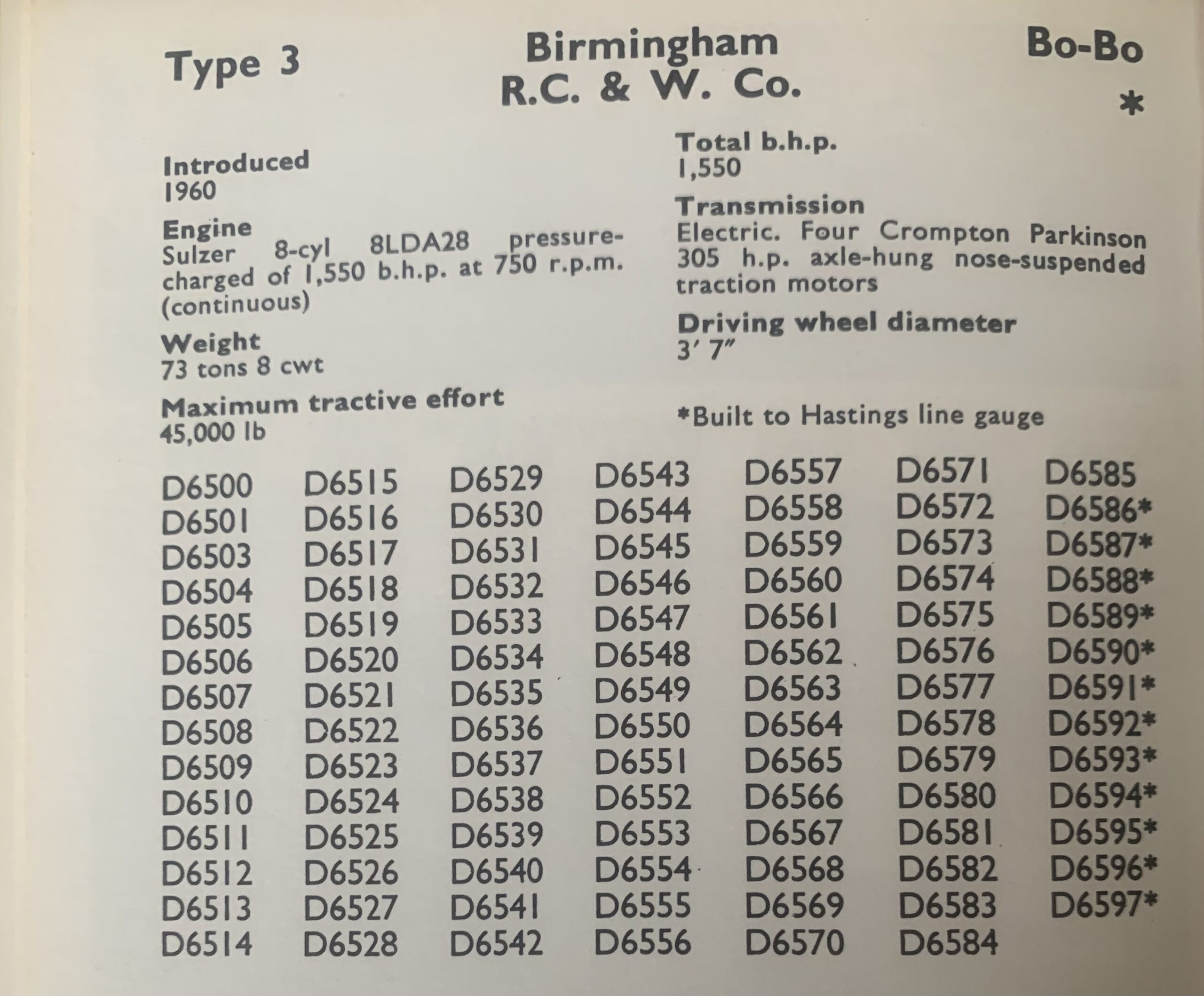
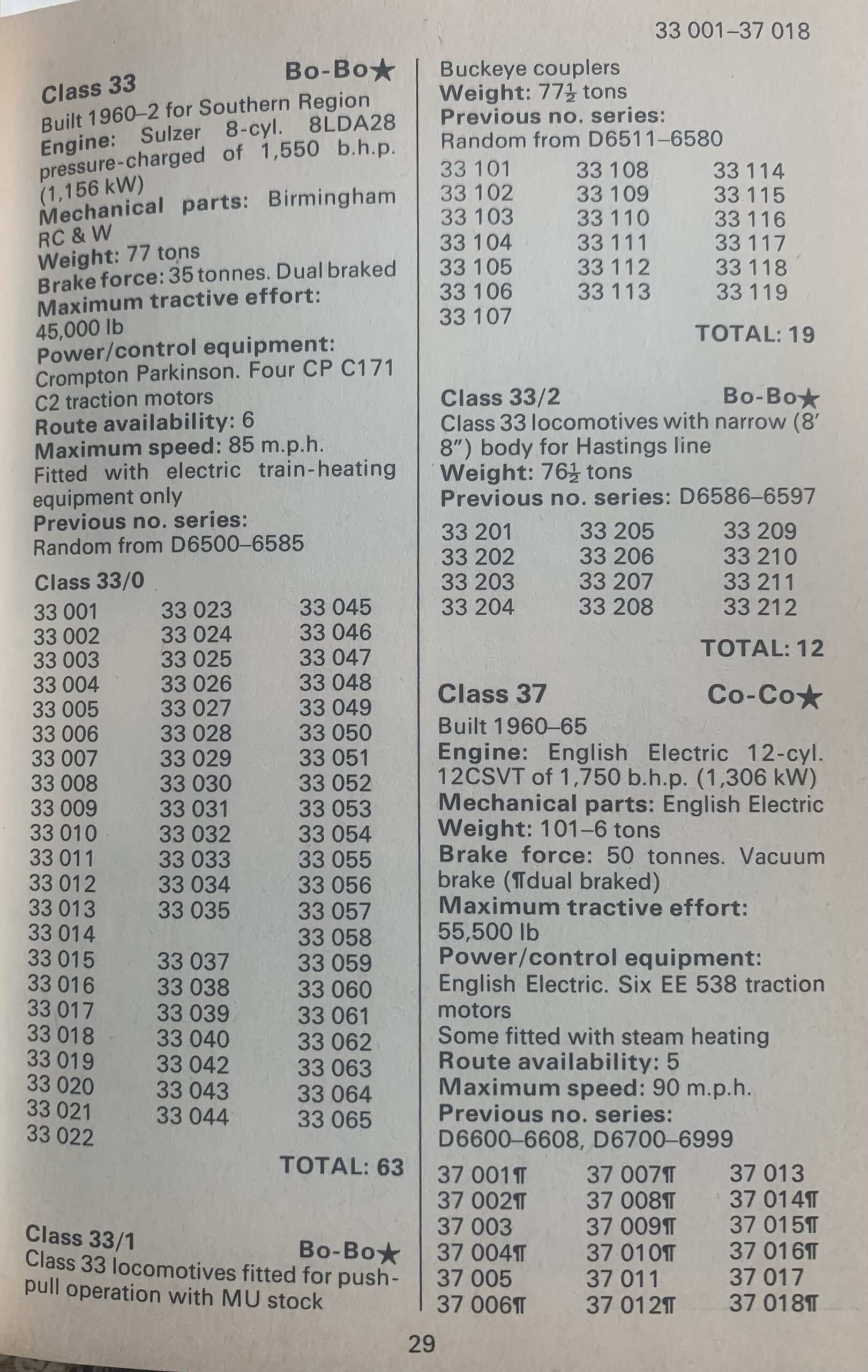
*A note about British Rail diesel & electric locomotive numbering. Upon introduction as part of the 1950’s “Modernisation Plan”, diesel locomotives carried one to four-digit numbers prefixed with a letter ‘D’, and electric locomotives with a letter ‘E’. With a move to computerisation all locomotives were renumbered so they could be logged on the Total Operating Processing System (TOPS) which recorded the maintenance history of locomotives and rolling stock, along with its allocation to division and depot and duty, its current status, its location etc. Locomotives were numbered in a consecutive series in terms of classification with the first two or three digits used to denote the class of locomotive or multiple unit. Sub-classifications were indicated in the TOPS system with a slash and a subclass number. For example Birmingham R.C.&W. Co Type 3 Bo-Bo No. D6515 became Class 33/0 No. 33012.
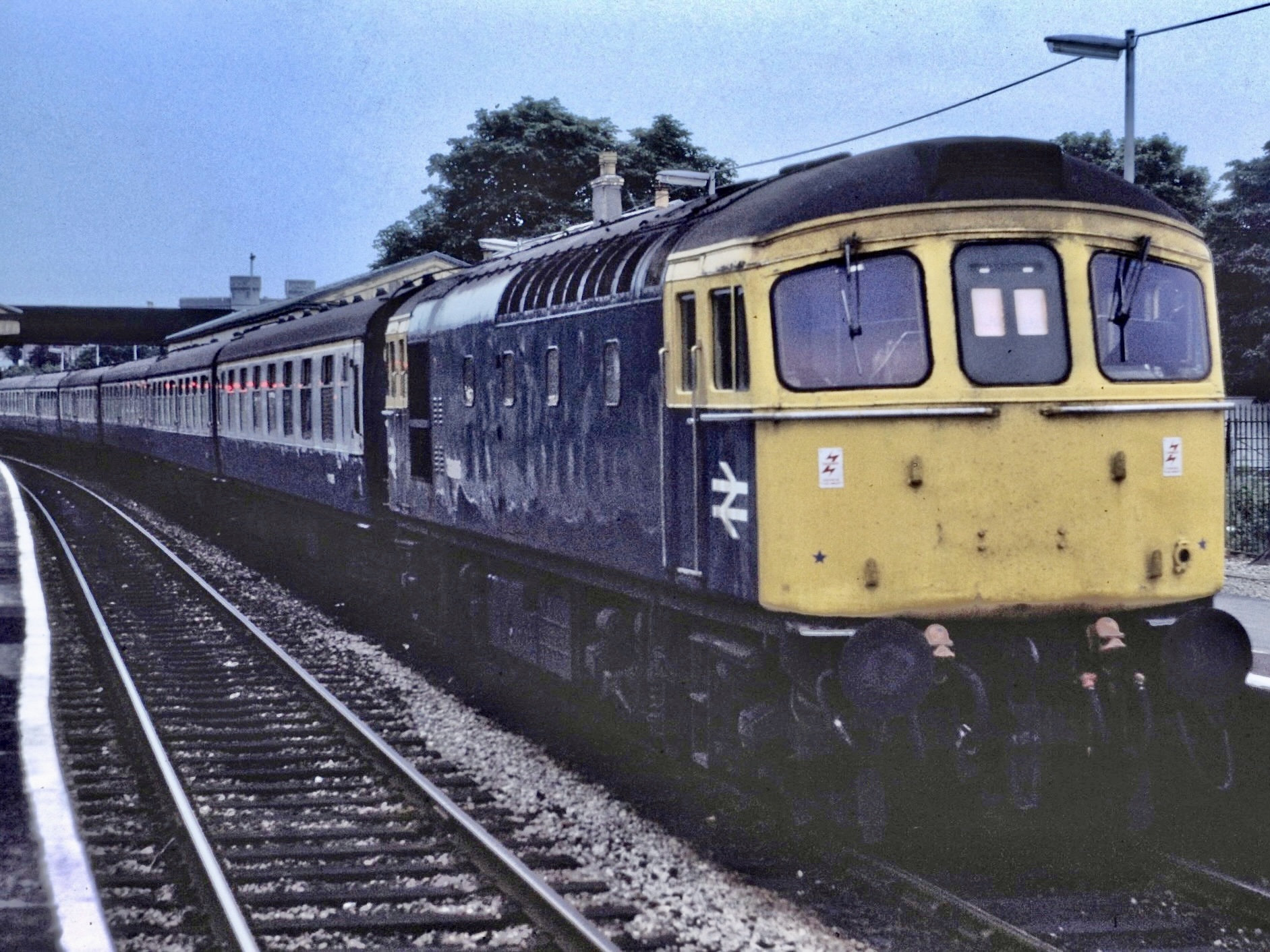
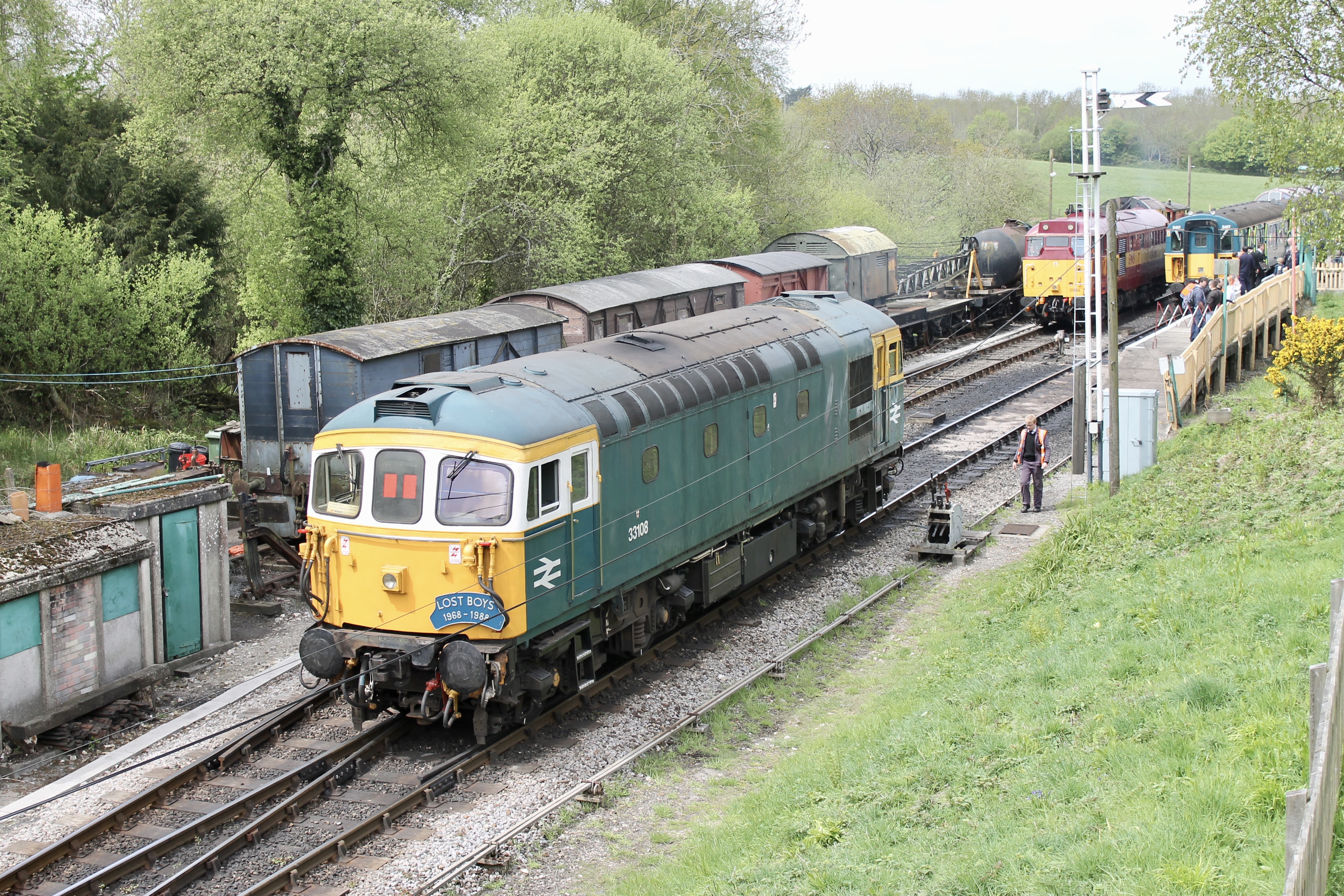
Ian Allan were well known for publishing books of locomotive numbers for train spotters who could tick off or underline the examples they had seen. Here is the B.R.C&W Type 3 fleet list as at August 22nd 1966 published in “British Rail Locomotives And Other Motive Power”. As you can see D6502 is missing from this list, having already been withdrawn following an accident in 1964The Class 33’s divided into sub classes as seen from the 1980 edition of Ian Allan’s “British Rail Motive Power Combined Volume”Class 33/0 No. 33016 with a Bristol to Weymouth service at Dorchester West – 25/06/1981Class 33/1’s were modified for push pull operations on the un-electrified Bournemouth to Weymouth line and can be easily identified by their high-level brake pipes and jumper cables. They were originally going to be classified Class 34 under TOPS, but instead sensibly became a Class 33 sub-class. No. 33108 is seen at Norden on the Swanage Railway taking part in the 2013 diesel gala backing onto 4VEP EMU No. 3417 ‘Gordon Pettitt’. Class 31 No. 31466 can be seen in the background. No. 33108 is currently undergoing repairs to bodywork and traction motors at the Severn Valley Railway – 12/05/2013A batch of twelve locomotives were built with narrow bodies to enable working through narrow tunnels between Tunbridge Wells in Kent and Hastings in Sussex. These became Class 33/2 under TOPS and were nicknamed “Slim Jims” by enthusiasts. West Coast Railway Co. No. 33207 ‘Jim Martin’ is photographed in the sidings at Poole – 11/06/2011
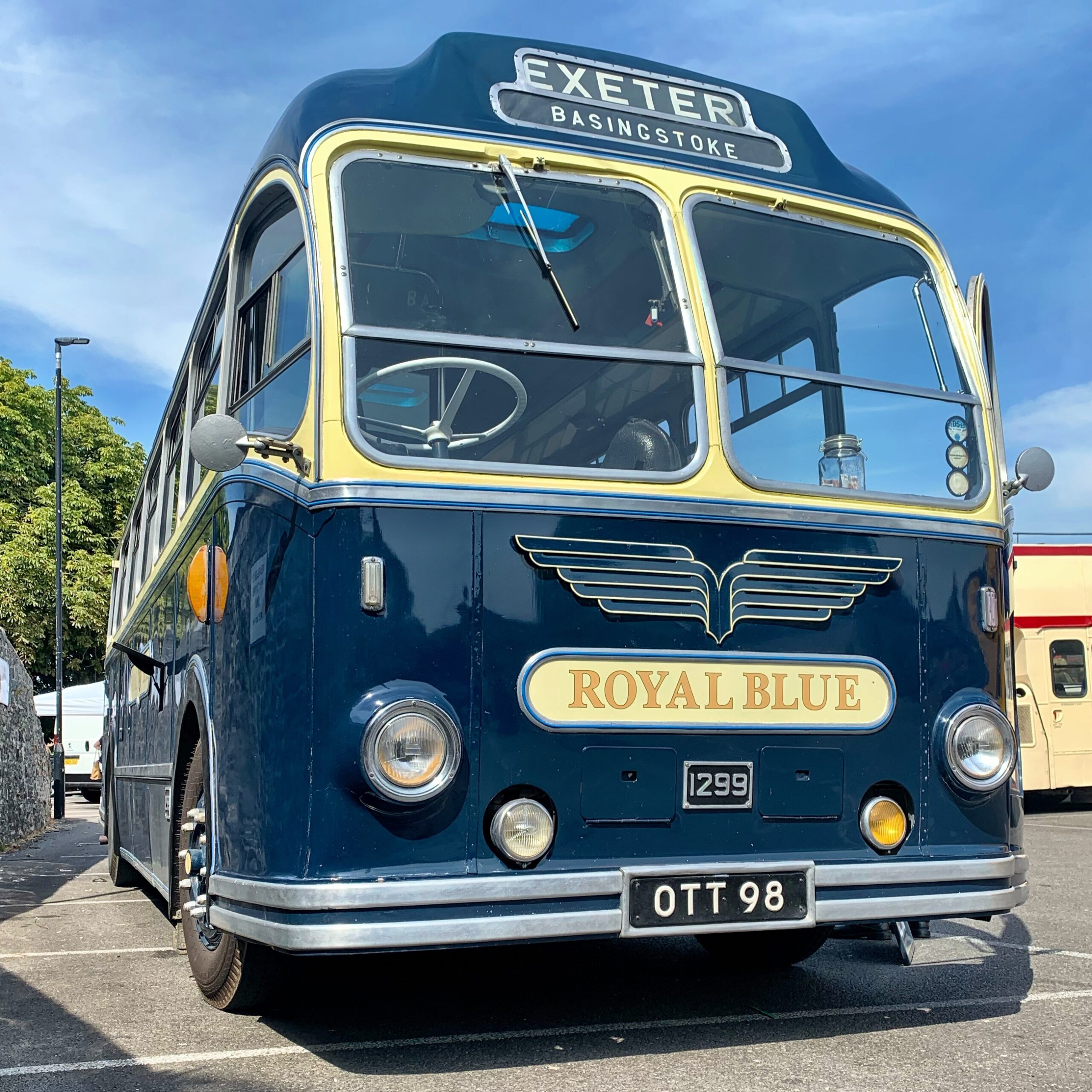
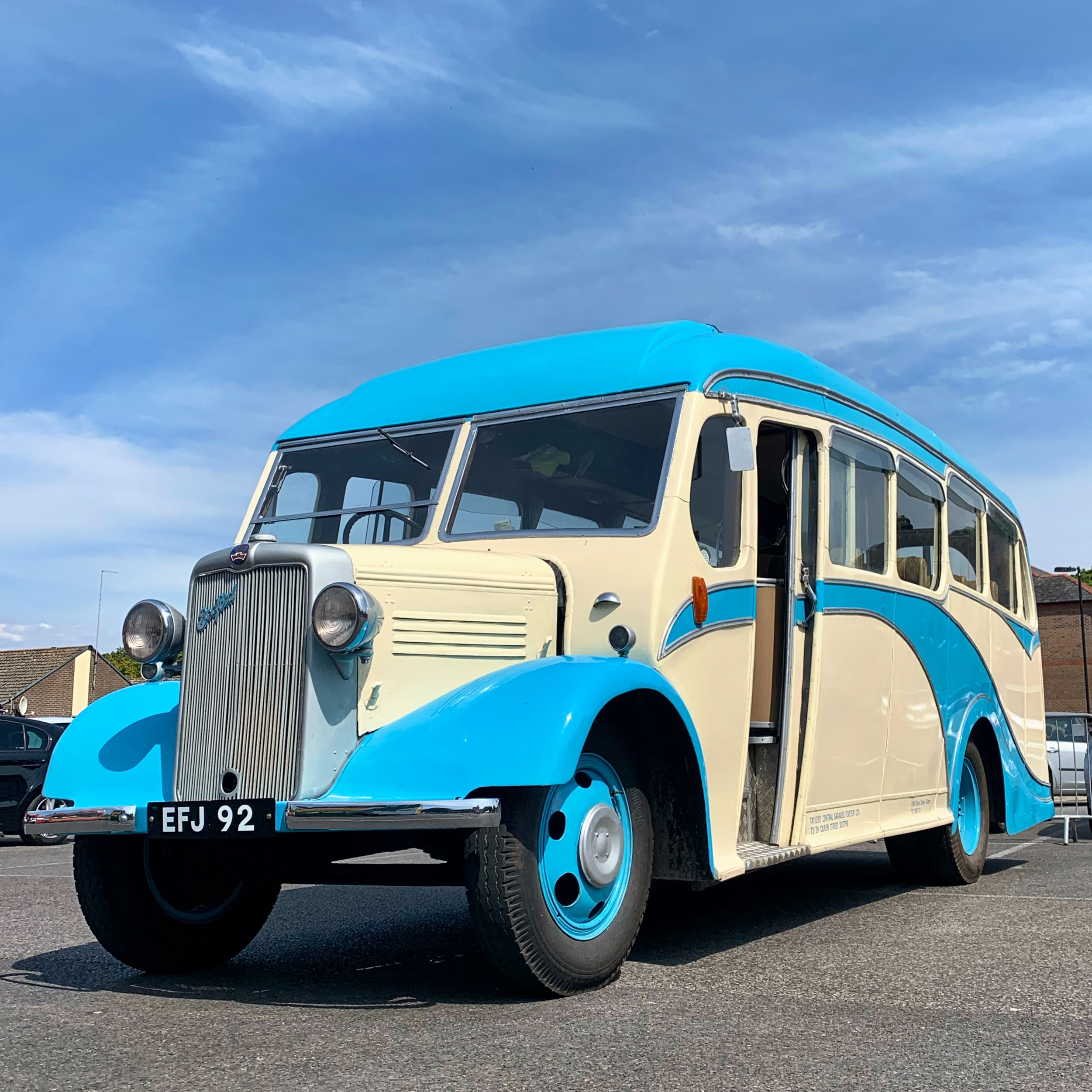
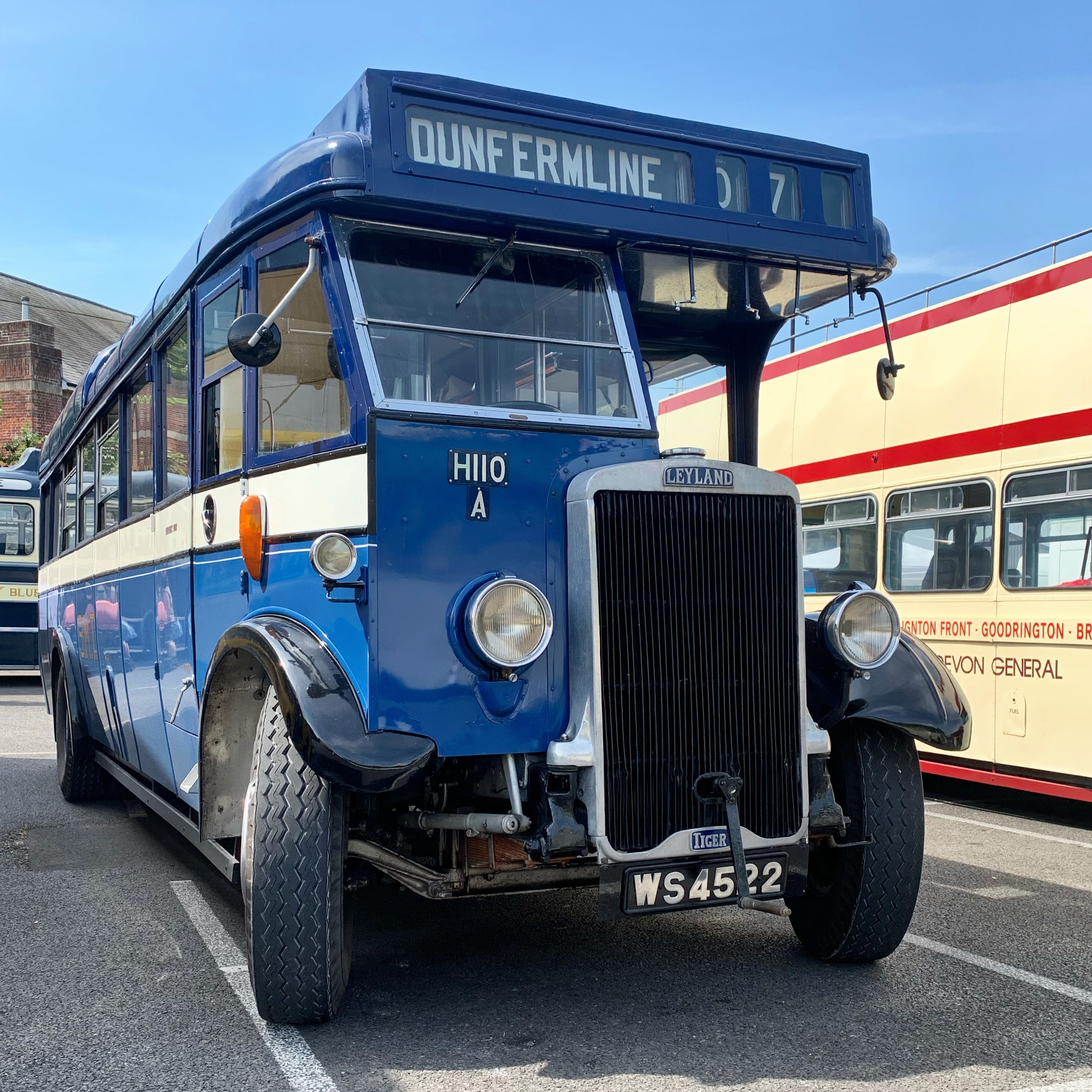
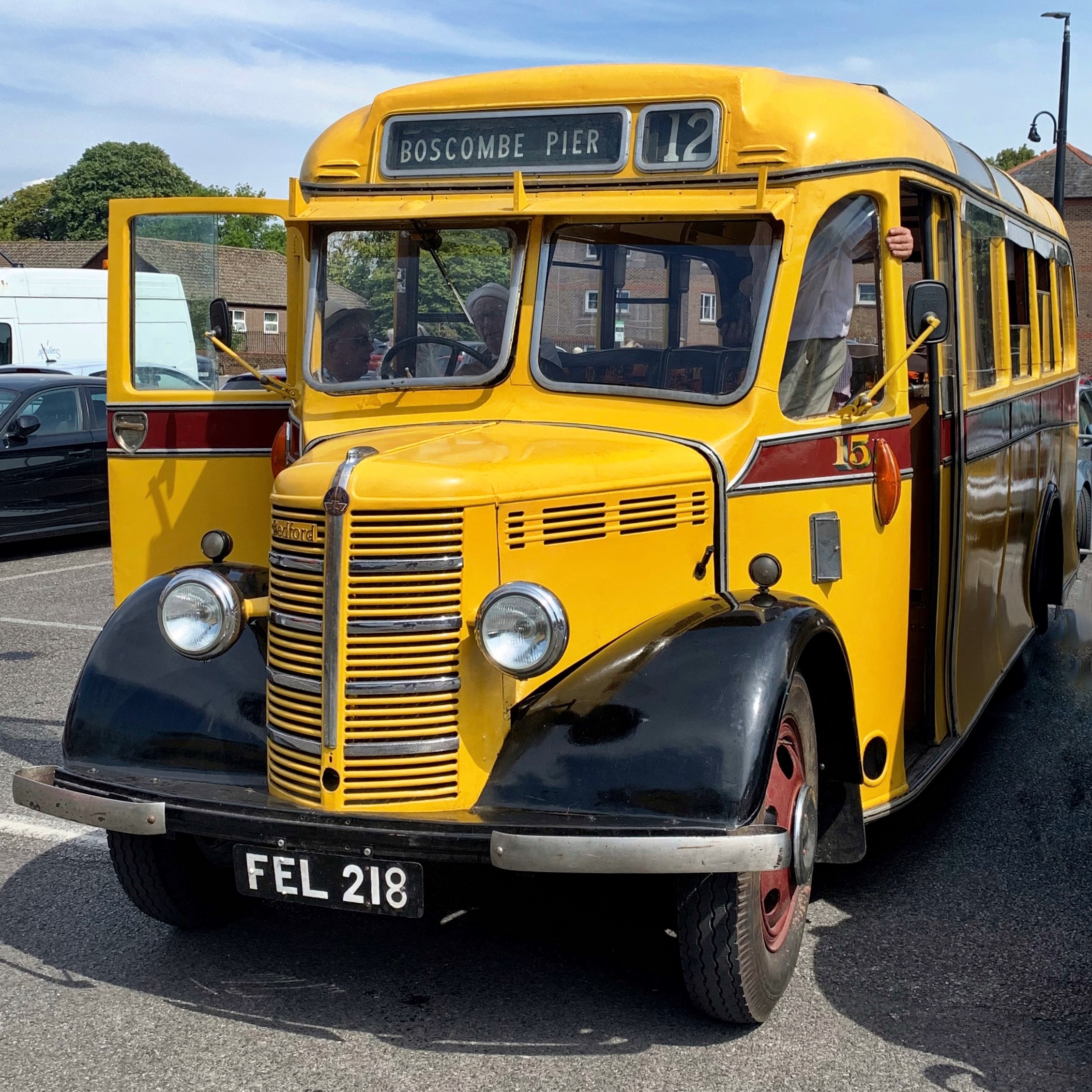
I made a quick visit to Top o’ Town car park in Dorchester for The West Country Historic Omnibus & Transport Trust Dorchester Running Day on Sunday 14th August 2022. Although a smaller concern than in pre-covid times, it was still great to see these old vehicles making trips around town or on static display. It was far too hot to take Yoshi with me and he remained at home where it was much cooler for him.
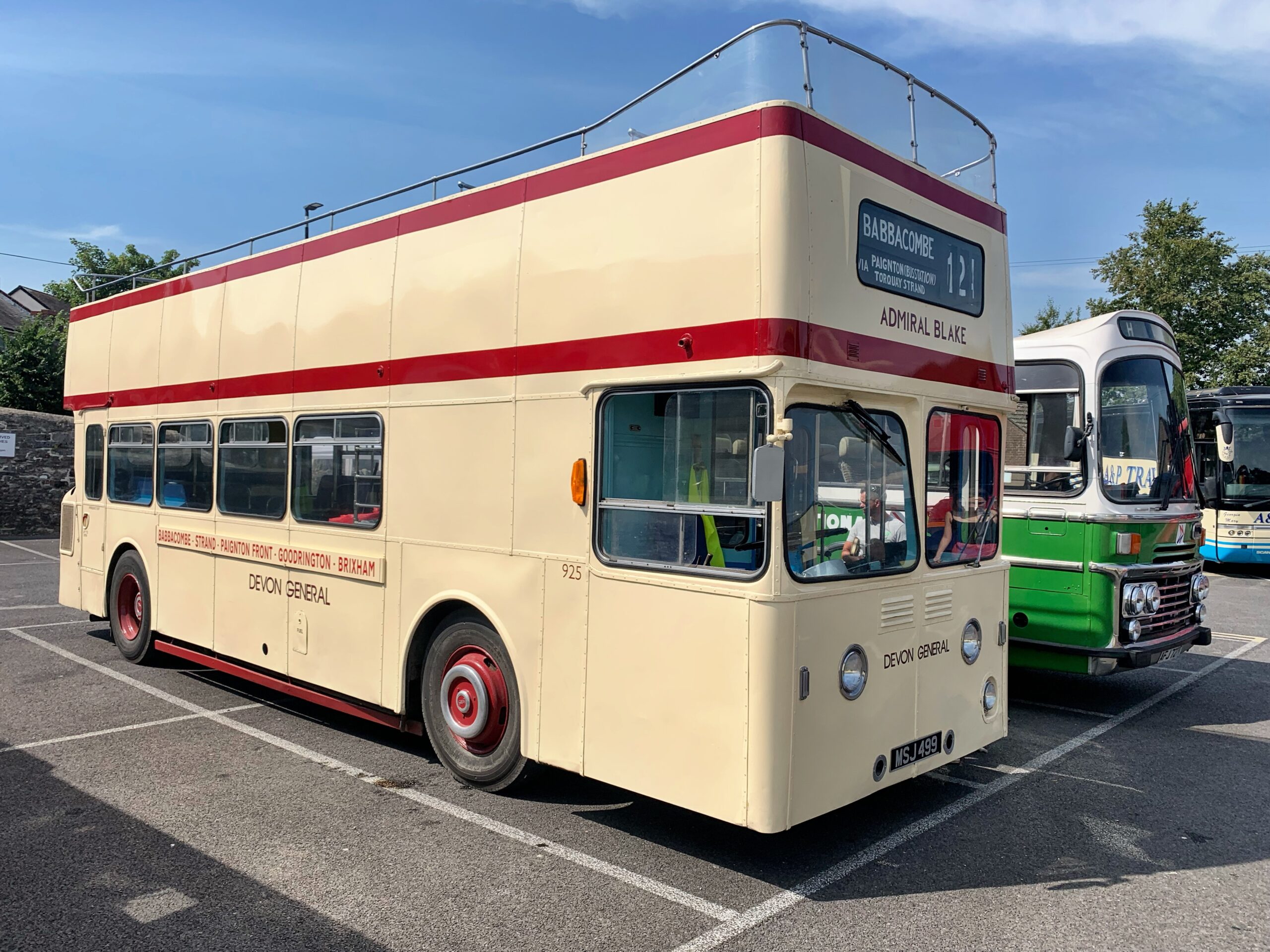
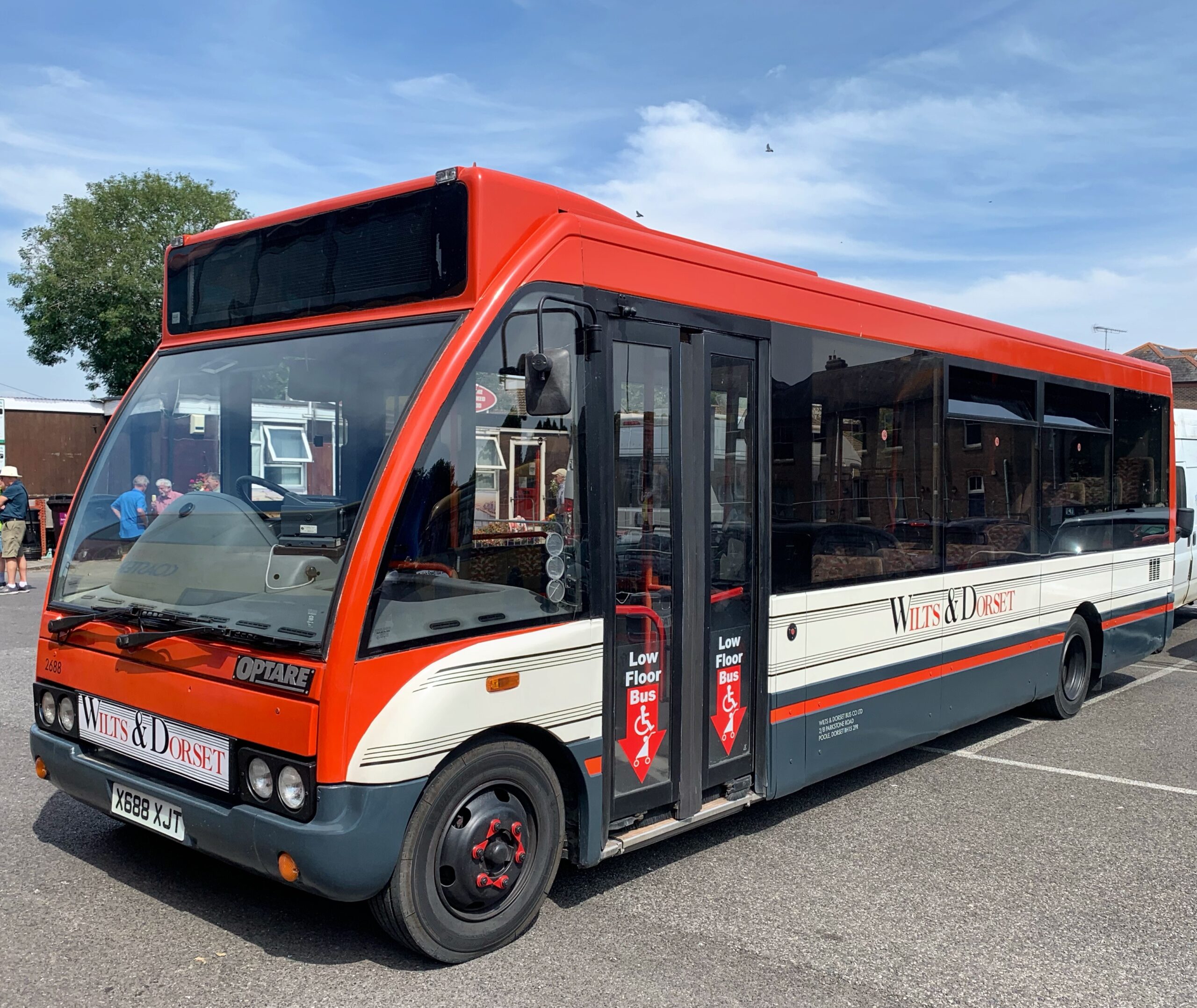
Perhaps my favourite bus / coach is OTT 98 a Bristol/ECW LS6G integral coach. She was delivered to Southern National in 1953 and given the fleet number 1299 for working as part of the Royal Blue fleet from Bournemouth in 1969. I remember her from her Dorset Transport Circle days and associated trips out – 14/08/2022EFJ 92 a Bedford WTB with Heaver C25F body – delivered new to Taylors Central Garage (Exeter) Ltd in June 1938. Sold to Vic’s Tours of St. Mary’s on the Scilly Isles and operated until 1971 when she entered preservation – 14/08/2022WS 4522, a 1935 Scottish Motor Traction Co. (SMT) H110 Cowieson bodied Leyland Tiger TS7 – 14/08/2022FEL 218; Bournemouth Corporation Bedford WTB Duple B25F – 14/08/2022Preserved former Yellow Buses N465 TPR Dennis Dart with East Lancs body and H262 MFX Dennis Dominator with East Lancs body – 14/08/2022“Sea Dog” MSJ 499 a Leyland Atlantean PDR1 with open top Metro-Cammell body was delivered new in 1961 to Devon General and named ‘Admiral Blake’. She reminds me of my time working in Torquay in the mid-1980’s, not that I had much time to enjoy the local area! After she finished carrying passengers around the Devon coast she was sold to Yellow Buses in Bournemouth and used as a tree lopper before entering preservation in 2006 – 14/08/2022X688 XJT an Optare Solo M850 from 2000 in original Wilts & Dorset livery spent some years as a Tesco free bus – 14/08/2022
From The Archive
This week in….
2019: Saturday 10th August 2019, 8 month old Yoshi and I took a trip out to see SR Merchant Navy No. 35028 ‘Clan Line’ working UK Railtours “The Atlantic Coast Express” which originated from London Waterloo and took in Salisbury, Exeter, Bristol and Bath. It was around this time when I really renewed my latent enthusiasm in railways after several years of having only a passing interest.
Clan Line on “The Atlantic Coast Express” 1Z82 0752 London Waterloo to Exeter St Davids and 1Z84 1550 Exeter St Davids to London Waterloo – 10/08/2019
The following day, Sunday 11th August 2019, saw two special excursion trains visit Dorset. We saw “The Northern Belle” top and tailed by WCRC Class 57 No.’s 57601 ‘Windsor Castle’ and 57314 at Dorchester followed by a trip to Holton Heath to see the return working along with a glimpse of Class 73 No.’s 73107 ‘Tracy’ and 73201 ‘Broadlands’ working “The Swanage Sunday Special No.3”.
Thursday 15th August 2019 saw LNER Thompson Class B1 No. 61306 ‘Mayflower’ and WCRC Class 47 No. 47802 working a Steam Dream Rail Company “Cathedrals Express” excursion from West Brompton to Weymouth and return. In between arrival and departure of the special train, Colas Rail Class 37 No. D6757 (37057) also visited the seaside terminal with a Network Rail test train.
2010: The Railway Touring Company ran “The Dorset Coast Express” on Wednesday 11th August 2010. The train departed London Victoria at 0845 and was hauled down to Weymouth by LNER A4 4-6-2 No. 60019 ‘Bittern’ which I saw pass through Bournemouth. The return working to London Waterloo was headed by SR N15 King Arthur Class 4-6-0 No. 30777 ‘Sir Lamiel’ with the A4 providing banking assistance at the rear until Wareham which is where I filmed the ensemble. The A4 was detached and then ran with her support coach to Yeovil Railway Centre at Yeovil Junction.
That brings us to the end of another entry, this week the Railway Dog blog was mostly put together to the sounds of The Who, Lily Williams and Yoshi barking at anyone moving outside. We really appreciate you stopping by and reading the blog and watching the video clips. As always, comments, suggestions and corrections are welcomed and thank you to everyone who has helped out in some way. We look forward to seeing you again next week.
Old meets new at North Pier, Blackpool – 13/07/2022
Blackpool
As we mentioned in our last blog entry, Yoshi and I spent a few days in the North West a couple of weeks ago when we took the opportunity to take a trip on a heritage Blackpool Tram. The Blackpool Tramway runs from Blackpool to Fleetwood, originally opening in 1885 and is one of the oldest electric tramways in the world. It is operated by Blackpool Transport (BT) and runs for approximately 11 miles. The last time I visited Blackpool was probably in 2007 when David Tennant, who was at the time playing the Tenth Doctor in BBC TV’s “Doctor Who”, switched on the illuminations. This was just prior to the announcement that the UK Government had agreed to the joint BT and Blackpool Council bid for funding towards the upgrade of the tram track network, with £60.3m coming from Government coffers. The remainder of the £85.3m cost came from Blackpool Council and Lancashire County Council which contributed @ £12.5m each. The Government’s funding allowed the entire tramway to be upgraded with 16 modern and accessible Bombardier Flexity 2 trams being introduced in 2012 replacing the traditional fleet of ageing cars.
A number of the old trams which I was familiar with on my previous visits have been retained with some having been lovingly restored to form a Heritage Fleet and modified, widened Balloon trams as part of the main fleet. The depot at Starr Gate houses the Flexity 2 trams with Rigby Road Depot, near Manchester Square, housing the traditional trams. A great deal of effort has been made to ensure that the traditional trams have a future in Blackpool and I was pleased to see one on a run out as we arrived in Fleetwood for our stay at the North Euston Hotel. Thinking perhaps these only ran at weekends, I asked a driver of one of the modern trams about the heritage fleet and was directed to a website dedicated to Blackpool Heritage Trams. From here, Yoshi and I booked a one hour promenade tour which picked up from North Pier on its way to Bispham before heading back all the way to the Pleasure Beach in the south of Blackpool before turning once more and returning via the Golden Mile, dropping us off where we started. I was delighted to see that the tram car operating our trip was one of the recognisable and iconic Balloon cars, so named because of their rounded streamlined appearance, in traditional Blackpool 1940s “Wartime” green and cream livery.
Yoshi waits to board the tram for his Blackpool promenade tour – 13/07/2022
The Balloon trams were originally called “Luxury Dreadnought” cars and had been commissioned in 1933 by Walter Luff, the controller of the Blackpool network, in a bid to modernise the tramway’s fleet which had been working the tracks since the early years. 27 trams were constructed by English Electric between 1934 and 1935, the first being delivered on 10th December 1934. They were built with central doors and stairs, with a maximum capacity of 94 passengers. Half-drop windows provided ventilation with Art Deco curved glass electric lighting providing illumination. The initial thirteen were open-topped and the remaining fourteen were enclosed, these having sliding roof windows and thermostatically-controlled radiators.
Yoshi after enjoying a snooze on Balloon tram No. 700 – 13/07/2022
Between 2009 and 2012, Balloon car No. 700, which was to provide transportation for our journey, along with sisters 711, 713, 719 and 720 were modernised so that they could continue to operate in service following the refurbishment of the whole tramway to light rail standards. New widened doorways were fitted to allow more accessibility, with driver operated doors which fit to the new platforms built at tram stops for the modern Bombardier trams. Fixed seats and new passenger information displays were also fitted to match the new trams. Speedometers were also retrofitted to the driving consoles, which seems like a very good idea to me!
Yoshi considers driving off in Car No. 700 – 13/07/2022
We really enjoyed our trip on the heritage tram, and thoroughly recommend the experience should you find yourself in Blackpool. You can join us on our tour of Blackpool promenade as well as view some of the Flexity 2 trams in our video below:
Yoshi takes time to check out Flexity 2 tram No. 010 at Fleetwood Ferry – 11/07/2022
For a reminder of what it used to be like, here’s a video of Blackpool Trams from October 1999, featuring a brief glimpse of some of the famous illuminated trams:
Dorset Coast Express
Thursday 21st July saw another steam excursion to Weymouth subjected to alterations, this time because of the dry weather and subsequent risk of line side fires, the planned steam motive power was replaced by two Class 47 diesel locomotives. Fingers crossed all goes to plan for the next scheduled The Railway Touring Company Dorset Coast Express in August!
Class 47 No. 47772 ‘Carnforth TMD’ leads 1Z82 0845 London Victoria to Weymouth past Poole carriage sidings – 21/07/2022Class 47 No. 47813 with the return working of the Dorset Coast Express racing through Hamworthy – 21/07/2022
Around Taunton
Video screen grab of Class 47 No.’s D1935 / 47805 ‘Roger Hosking MA 1925-2013’ and D1944 / 47501 ‘Craftsman’ power the “Cornish Riviera Statesman” rail tour up Whiteball bank – 23/07/2022
Saturday saw Yoshi and I in the Taunton area as we went to see a couple of rail tours and hoped to catch celebrity High Speed Train power car No. 43384 which has been outshopped in a retro livery by CrossCountry Trains. First on our radar was Statesman Rail’s “Cornish Riviera Statesman” working Derby to Penzance and double headed by Brush Type 4 Class 47 No.’s D1935 / 47805 ‘Roger Hosking MA 1925-2013’ and D1944 / 47501 ‘Craftsman’, both resplendent in British Rail two-tone green livery. I just had time to set up for a video capture when the train passed by several minutes ahead of schedule, meaning my camera was still asleep in its bag. Also running ahead of schedule was The Railway Touring Company operated “The West Somerset Express”, which like their tour to Weymouth a couple of days previously had been advertised as being steam hauled, but were deputised with West Coat Railways Class 47 No.’s 47813 and 47772 ‘Carnforth TMD’ again in top and tail formation. This tour originated from London Paddington and was destined for Minehead on the West Somerset Railway (WSR) – the longest heritage railway in the UK. On arrival at Bishops Lydeard, the first WSR station after leaving the main line, the Class 47’s were replaced with a pair of steam locomotives to take the train forward. We saw Great Western Railway (GWR) Inspired 2-6-0 9351 Class WSR Mogul No. 9351 and GWR 7800 Class Manor No. 7822 ‘Foxcote Manor’ hauling the train nearing Crowcombe Heathfield producing some fine acoustics. You can follow our day in the video below, which also includes some CrossCountry Trains and GWR Castle Class HST’s:
CrossCountry Trains (XC) recently outshopped Class 43/3 No. 43384 from Plymouth Laira Depot in a revised High Speed Train livery, known as Intercity Executive, first carried back in the 1980’s. At the time the Intercity yellow and grey livery replaced the original blue and yellow colour scheme that had been used since the introduction of the fleet. CrossCountry has confirmed that the repaint comes as part of marking the 40th anniversary of the introduction of the InterCity 125 by British Rail on to the North East to South West route. Other celebrations include a special Railway Benefit Fund charitable XC HST rail tour on the 27th September 2022 travelling from Leeds to the Severn Valley Railway including a run along the heritage railway itself. An HST power car will be named at Kidderminster to mark the anniversary.
Class 43/3 No. 43384 is seen leading on 1V52 0658 Edinburgh Waverley to Plymouth as it nears Creech St. Michael – 23/07/2022
Eastleigh Grid
Class 56 No. 56081 approaches Shawford working 5O07 1049 Leicester L.I.P. to Eastleigh East Yard hauling Arlington Fleet barrier vehicle’s No. 64664 ‘Liwet’ (Ex Class 508 DMSO from unit 508207) and 64707 ‘Labezerin’ (Ex Class 508 DMSO from unit 508116) ex EMU Barrier coach set T7 – 24/07/2022
Yoshi and I were busy with our chores on Sunday morning when we discovered GBRf Class 56 No. 56081 was on its way from Leicester to Eastleigh with barrier vehicles in order to collect Network Rail’s European Railway Traffic Management System (ERTMS) lab train No. 313121 – this was too good an opportunity to miss and we put down the duster and polish and jumped in the car and set off for Shawford. This is more than likely our final opportunity to see this particular Class 56 in its current form as it has been earmarked for conversion as part of the Class 69 programme.
On our way back home, we had a quick look in at Eastleigh Works and saw the remaining four cars of Wessex Electric Class 442 EMU No. 442412 had been shunted around and were now visible adjacent to the road. Based on the British Rail Mark 3 carriage as used in HST sets, the 442’s were introduced as part of the Bournemouth to Weymouth electrification programme in the late 1980’s and, in my view at least, were the best EMU to have run in the UK.
GBRf Class 73 No. 73141 ‘Charlotte’ at Eastleigh Works – 24/07/2022The remaining four coaches of Class 442 No. 442412 in faded “Express” livery at Eastleigh Works – 24/07/2022
701 On Test
Class 701 No. 701017 passes the site of the former Boscombe railway station working 5Q52 1724 Staines Up Loop to Eastleigh TRSMD via Bournemouth – 25/07/2022
Another week passes by and Class 701’s are still running test trains to Bournemouth and Poole prior to their introduction into revenue earning service. This week we went to take a look at the site of the former railway station at Boscombe which was located between Bournemouth Central and Pokesdown. The station opened in 1897 and served The Royal Victoria Hospital and the shopping area around the Royal Arcade. Boscombe had a goods yard which received traffic for despatch from a large area of Bournemouth along with a coal depot and sidings. The substantial brick built buildings were demolished a few years after closure in 1965. The site now houses business units and threatening signs about unofficial parking. The road bridge which goes over the railway at this point has had footbridges added to each side and these have very high fencing installed for safety reasons.
Access Point Information, Station Approach, Boscombe – July 2022Station Approach, Boscombe – July 2022Station Approach, Boscombe – July 2022
Class 701 No. 701017 was this weeks unit on test as seen in this video – 25/07/2022
Hamworthy Branch
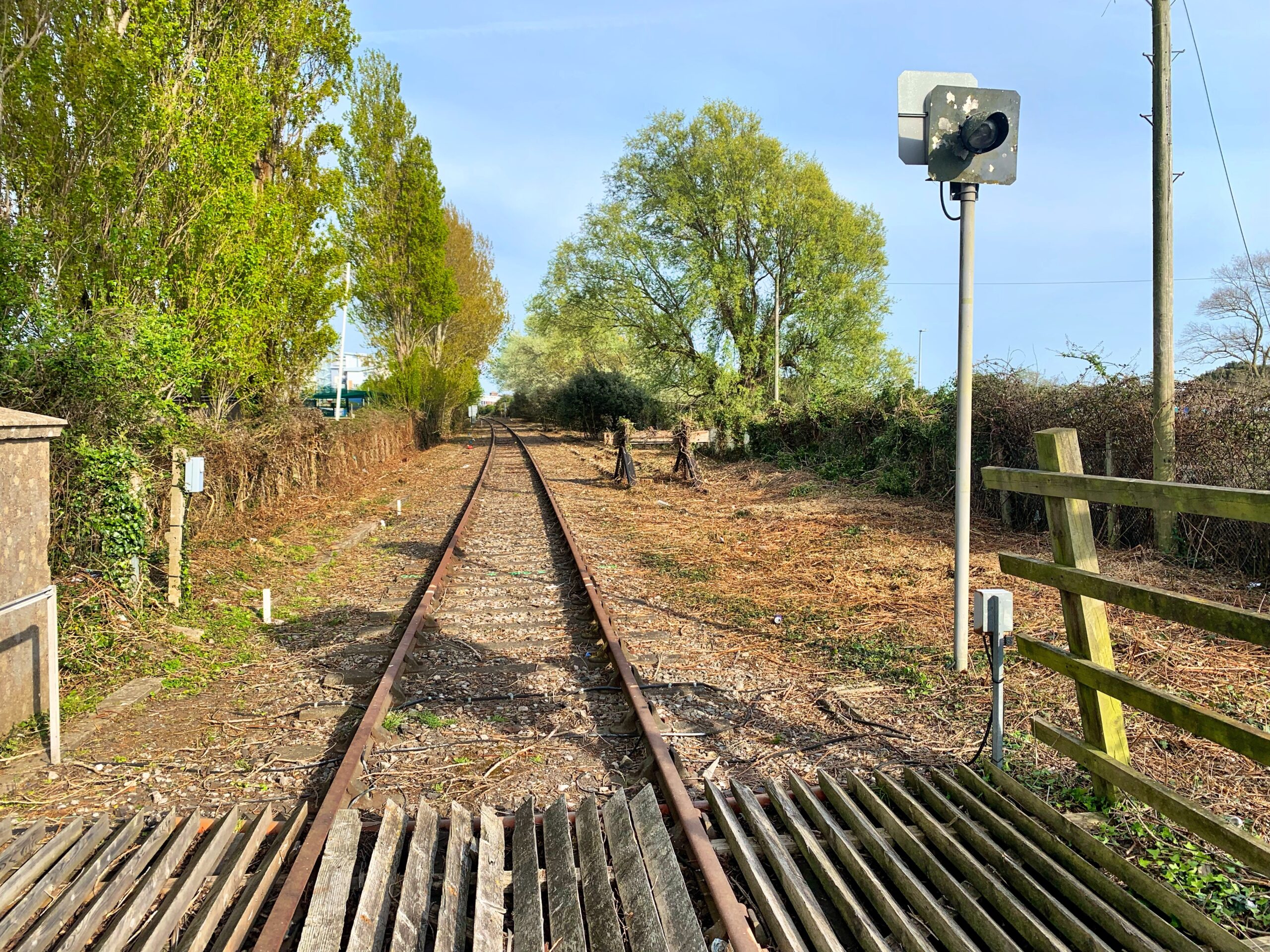
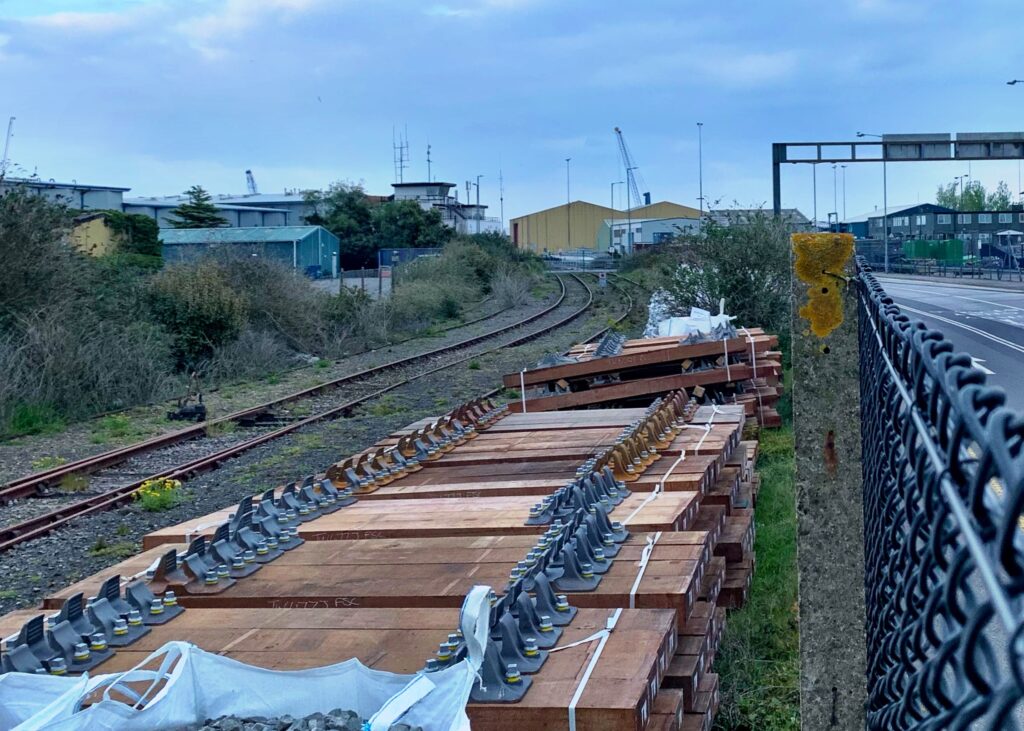
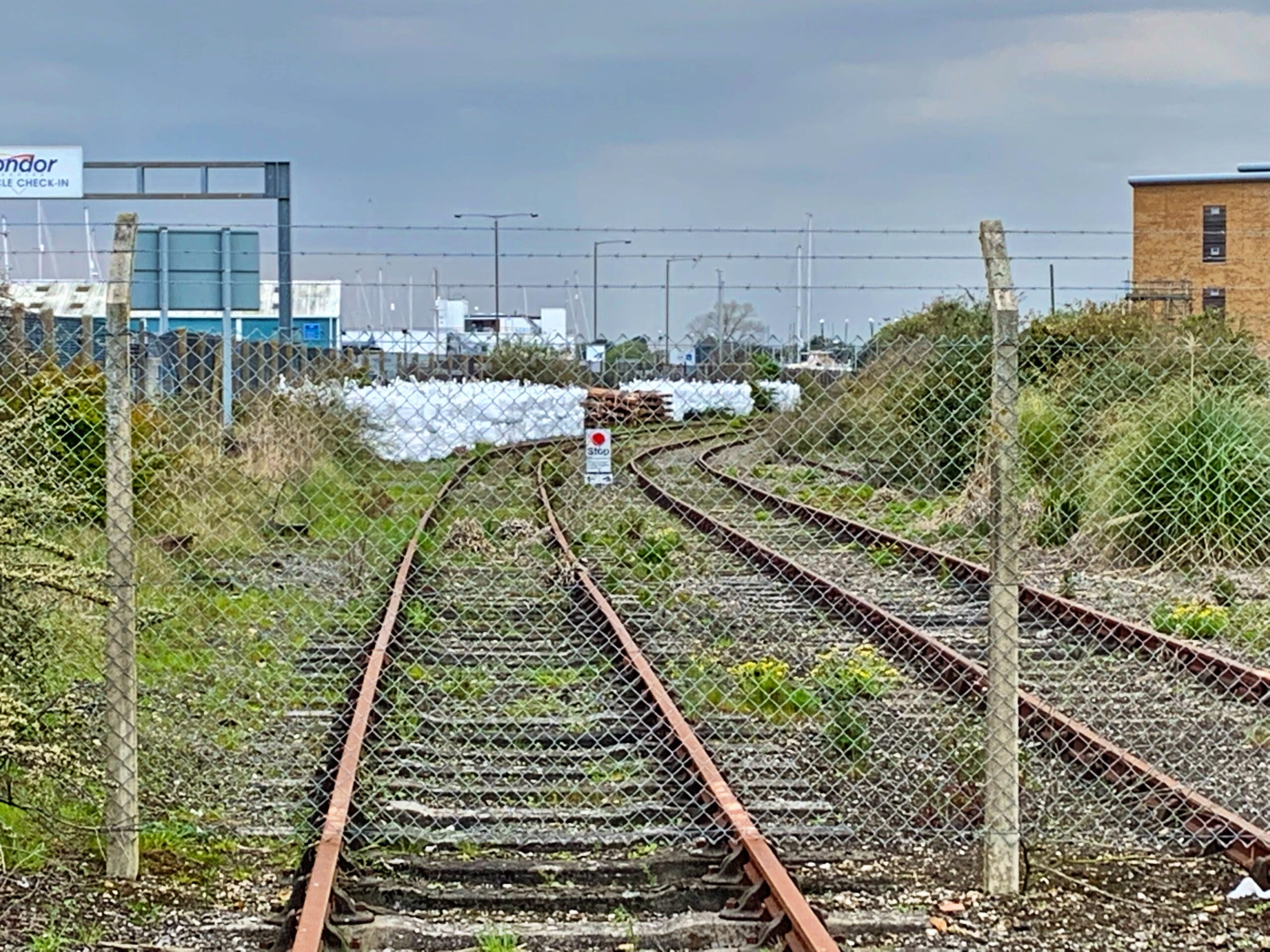
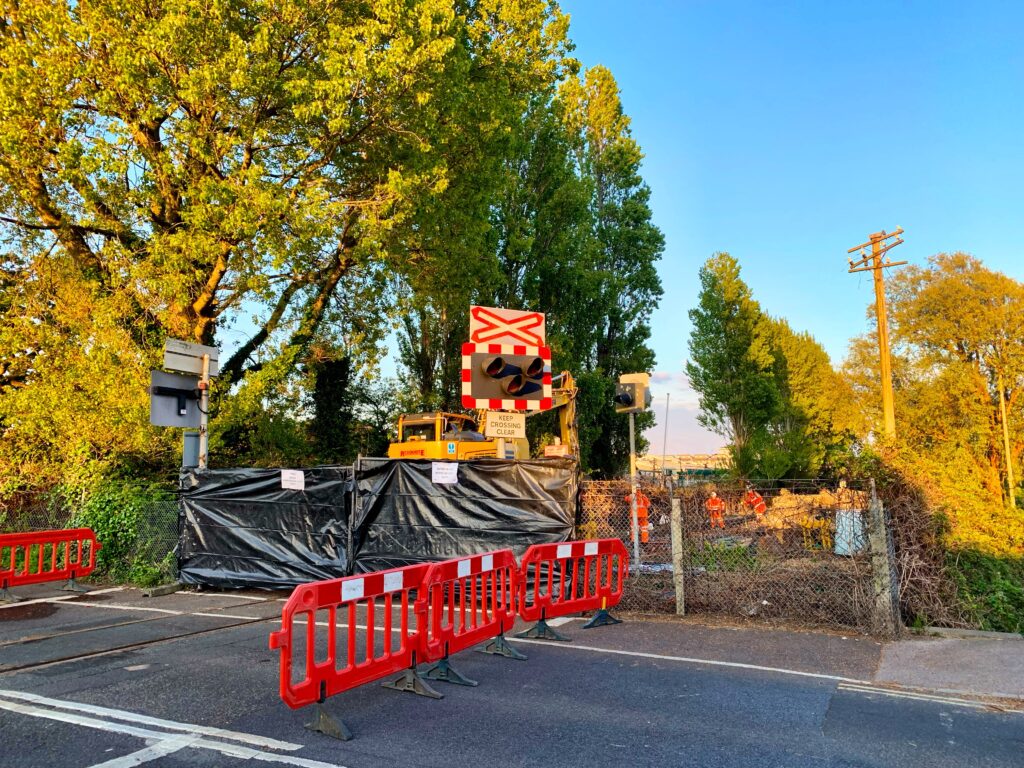
More activity on the mothballed Hamworthy Branch this week as temporary traffic lights were put in place at the crossing on Ashmore Avenue on Tuesday 26th July. Road / rail vehicles were also in evidence along the branch moving ballast. Sleepers and sections of track have also been marked up, possibly for replacement. Network Rail have successfully applied for a road closure permit on Lake Road, presumably to enable work to be carried out on the railway bridge which is located there.
Pressure washing Ashmore Avenue crossing on the Hamworthy Branch – 26/07/2022
We arrived just too late for a decent shot of a road / rail vehicle working on the Hamworthy Branch at Hamworthy station, but we thought we’d share this anyway! 26/07/2022
Weymouth Railway Heritage Trail
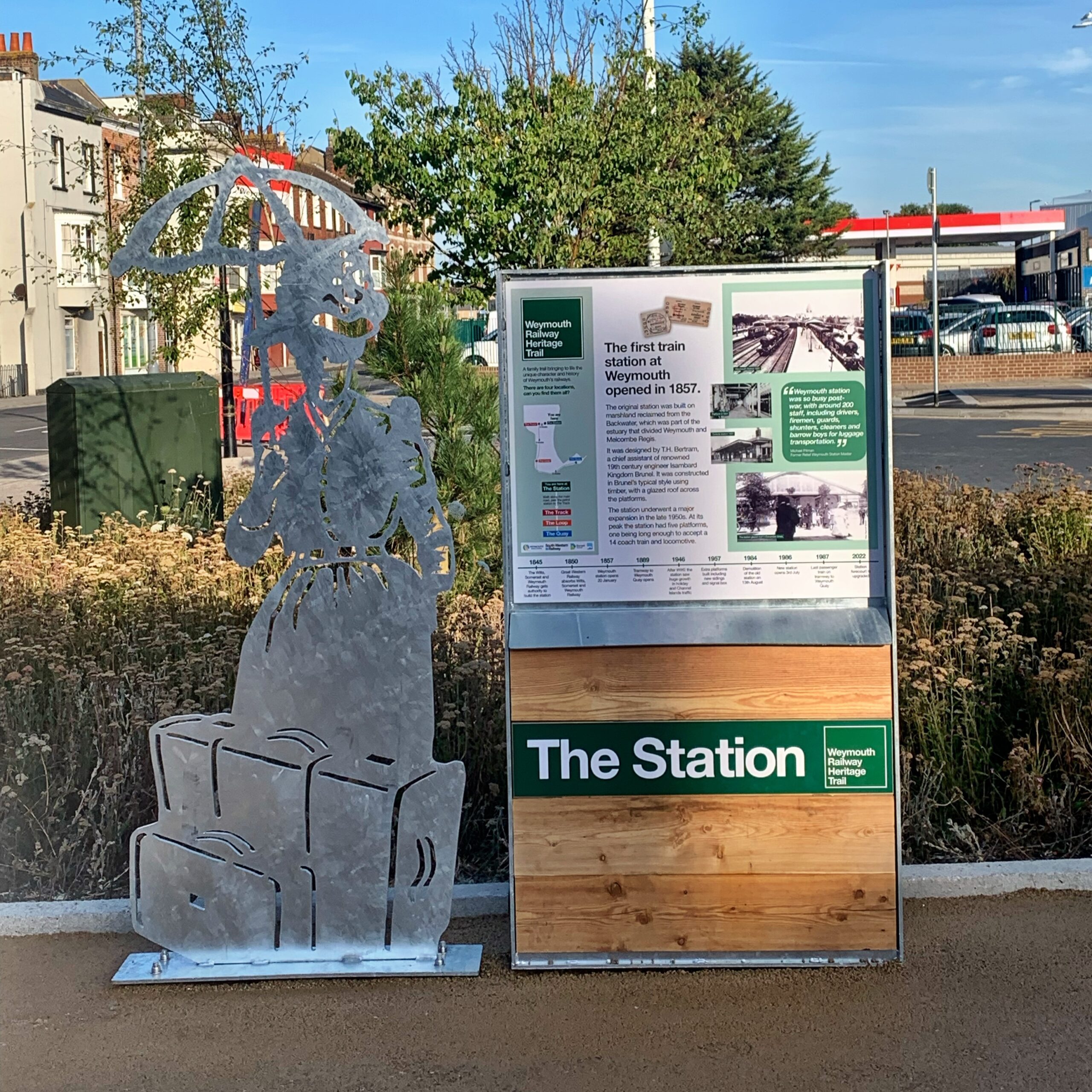
In the past week or so, new signage has popped up around Weymouth on the route of the former Weymouth Harbour Tramway which last saw use in 1999 and was dug up by the local council in an act of vandalism in 2020/21 with most of the track being removed at this time. With no sense of irony Weymouth Town Council, Dorset Council and South Western Railway have installed information boards celebrating Weymouth’s unique railway history.
The remodelled station forecourt at Weymouth – July 2022Weymouth Railway Heritage Trail information board ‘The Station’ – July 2022Weymouth Railway Heritage Trail information board ‘The Track’ – July 2022Weymouth Railway Heritage Trail information board ‘The Loop’ – July 2022Weymouth Railway Heritage Trail information board ‘The Quay’ – July 2022
This weeks “The Railway Dog” was mostly written to the sounds of Faeland, Hollow Coves, The Teardrop Explodes and Sibelius Symphony No. 5. Thanks for visiting. Comments and corrections are, as ever, always welcome and we really appreciate it when you point out typos or grammatical errors. We’ll be back next week, we hope you’ll join us.
DB Cargo Class 67 No. 67025 in operation with Transport for Wales waits departure at Crewe with 5K67 0951 Holyhead Car. M.D. Empty Coaching Stock working to Crewe C.S. – 16/07/2022
Fleetwood
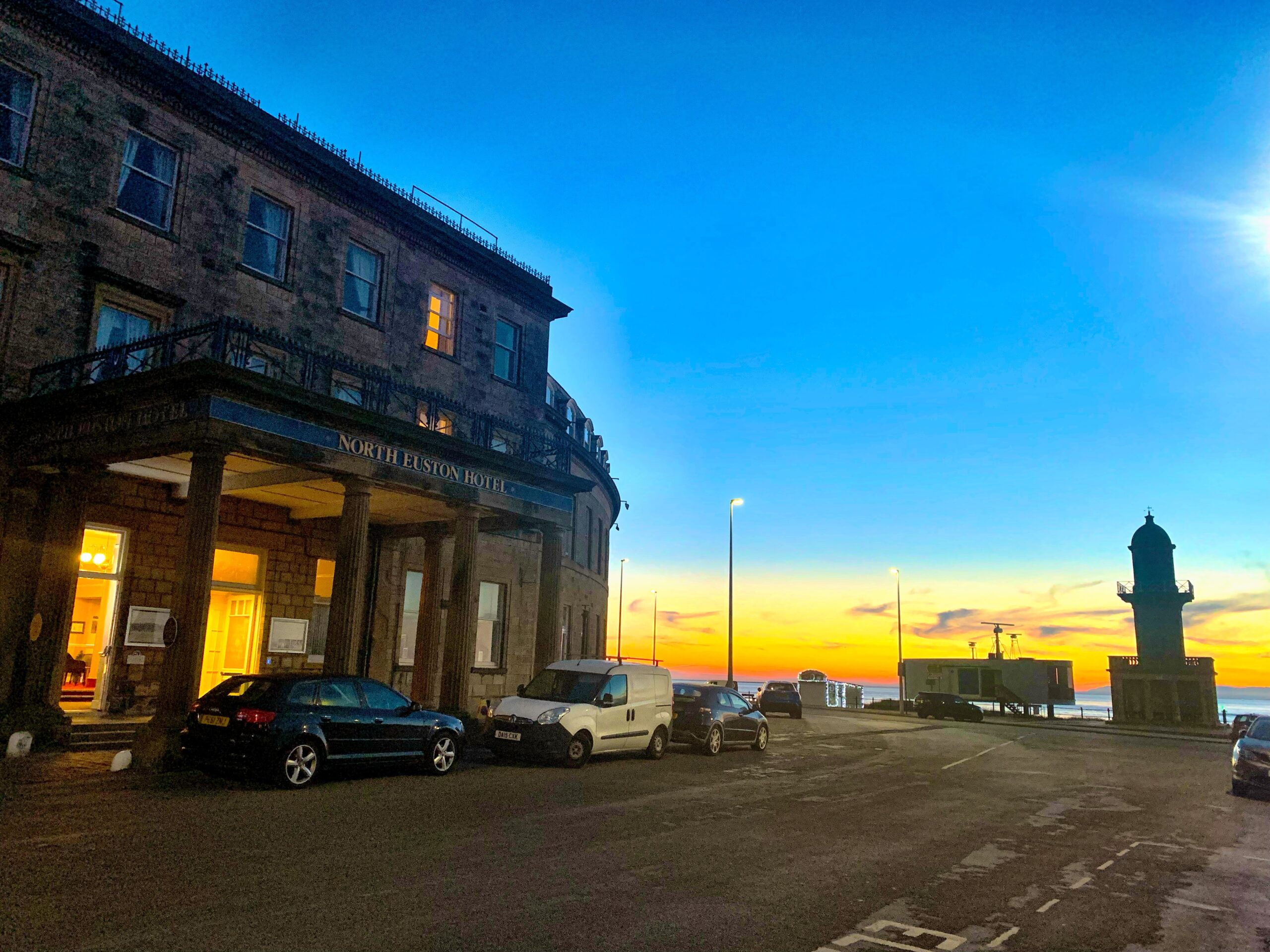
The North Euston Hotel, Fleetwood
Yoshi and I spent much of last week in the North West of England as we made The North Euston Hotel in Fleetwood our base. The hotel was commissioned by Sir Peter Hesketh Fleetwood, designed in the Greek classical style by architect Decimus Burton and built between 1839 and 1841 to serve overnight passengers making the journey by rail from London Euston who were destined for steam ships which would provide onward travel to Scotland where after disembarking at Ardrossan they would take the train on to Glasgow. Fleetwood was the northern most station at the time, hence the name “North Euston” for the hotel, and the railway was yet to run over the Shap hills. Queen Victoria made the journey in 1847 and stayed at the hotel, although I’m sure she didn’t stay in our room. The first manager of the hotel, Corsican born Xenon Vantini, had been a courier for Napoleon Bonaparte and was also the first person to open a refreshment room at Wolverhampton railway station. In 1859 following a decline in fortunes, the hotel was sold to the government and was converted into a school of musketry and later, in 1867, an officer’s quarters. The building existed in this form until the 1890’s when it was purchased by a group of London businessmen who converted it back into a hotel. The North Euston is currently owned by local business families. Yoshi very much enjoyed his morning sausage for breakfast and we celebrated our dubious achievement of coming last in the Sunday evening pub quiz which was a lot of fun.
The railway to Fleetwood was opened on 15th July 1840 as the Preston & Wyre railway and was also the vision of Sir Peter Hesketh Fleetwood it being designed to connect the then new port of Fleetwood on the Fylde coast to Preston. The railway was constructed by George and Robert Stephenson with contribution from Joseph Locke. Its glory days lasted only six years until a direct route over Shap was finally achieved. The railway was absorbed into the Lancashire & Yorkshire Railway ( later the London Midland Scottish Railway as part of the Big Four groupings in 1923) and extensions were built to Blackpool and Lytham to cater for the growing number of passengers traveling to the seaside. Fleetwood would become, for a time, one of the largest and most successful fishing ports in the UK but by 1970 the railway from Poulton-le-Fylde to Fleetwood was closed to passenger traffic and later, in 1999, to freight workings.
Thornton Station is located in the heart of Thornton town centre – July 2022Until the late 1980’s a signal box operated the crossing over Station Road, Thornton – July 2022The current station buildings were the first built by the then newly formed London Midland Scottish Railway (LMS) in 1927 – July 2022
In 2006, the Poulton & Wyre Railway Society was formed with the aim of reopening the railway. Since then, much work has been carried out in clearing sections of the line from the ingress of nature and a Class 108 Diesel Multiple Unit was purchased for restoration and use on the line. More recently, the Poulton-Le-Fylde to Fleetwood line was subject to a study as part of the UK Government’s Restoring Your Railway programme. In June 2022 it was announced that the scheme should progress further and Network Rail will receive funding to produce a detailed plan for the revival of services. The Poulton-Le-Fylde & Wyre Railway Society have now turned their attention to developing a heritage railway centre which will eventually house a collection of railway artefacts and memorabilia for public viewing.
Churnet Valley Railway
Having heard that Class 33/1 No. 33102 was hauling trains, Yoshi and I spent Tuesday morning ( 12th July 2022 ) visiting Cheddleton on the Churnet Valley Railway, a preserved heritage line in Staffordshire. I grew up with 33/1’s providing the daily motive power on local passenger services between Bournemouth and Weymouth, and even though No. 33111 lives on at Swanage, our local heritage railway, it was fantastic to hear the Crompton’s Sulzer engine at work hauling a passenger train.
The Churnet Valley railway dates back to 1849 following the formation of The North Staffordshire Railway Company (NSR) in 1845. Falling passenger numbers saw the Beeching Report include the Churnet Valley line and its associated branches which became earmarked for closure with the final section from Leek Brook Junction to Oakamoor quarry lasting out until the late 1980’s as it was used for freight traffic. In 1992 the newly formed Churnet Valley railway (1992) PLC began talks with the Department of Transport with a view to operate the line. Trains currently run between Froghall and Ipstones, but the ambition is to run services into the Staffordshire market town of Leek for the first time since 1965. And they have an eye on the clock to achieve this as the railway needs to run its first passenger train into Leek by 1st December 2022 or lose a £1.4m EU grant. This means all track must be laid on the 0.5 mile extension, with additional resources being provided for a triangle at Leek Brook Junction, and a platform constructed at Leek. It really is a very picturesque railway with extremely friendly volunteers, Yoshi and I were escorted around the workshops to get a closer view of locomotives stabled there, and I wish them every success with their endeavours and look forward to a return visit in the future.
Cheddleton Station which was to be demolished in April 1974 but saved by the actions of local businessman and parish councillor Norman Hancock who parked his car on the level crossing preventing access to bulldozers giving sufficient time for the building to be Grade II listed – July 2022Cheddleton Station – July 2022Time for a cuppa! Yoshi waits for the kettle to boil in the booking hall of Cheddleton Station – July 2022Class 33/1 No. 33102 ‘Sophie’ awaits departure from Cheddleton – 12/07/2022Class 20 No. D8057 (20057) sits outside the repair shed at Cheddleton – 12/07/2022S160 Class 2-8-0 No. 5197 was built by the Lima Locomotive Company in Ohio, USA and exported to China in 1946. The United States Army Transportation Corps Class S160 were designed for heavy freight work across Europe during World War 2 with a total of 2,120 being built they eventually worked all over the world – 12/07/2022Class 25 No. 25322 ‘Tamworth Castle’ was the final Class 25 locomotive to see mainline service with British Rail. She is currently in store at Cheddleton Yard awaiting restoration – 12/07/2022Yoshi inspects Class 33 No. 33021 ‘Eastleigh’ in Post Office Red style livery. This locomotive was amongst the first privately owned diesel locomotives to be used on the mainline – 12/07/2022The Churnet Valley Railway has acquired Class 47 No. 47292 for an initial loan period of five years supplementing Class 33 No.’s 33021 and 33102 for use on passenger trains – 12/07/2022
On our way back to Fleetwood, we stopped off at Acton Bridge for an hour or so, primarily to capture Class 37 No. 37884 which was diagrammed to pass through with 0M58 Kilmarnock Long Lyes T.C. to Derby R.T.C. – which can be seen in the video below:
Southport
On the Wednesday, Yoshi and I took a trip on a heritage Blackpool Tram – more about that adventure next week – but first that we made a brief visit to Southport and Formby. Southport railway station is the terminal of the Southport branch of the Northern Line of the third-rail electric Merseyrail network, and the diesel-operated Manchester to Southport line. The station and services to Liverpool and Hunts Cross are operated by Merseyrail, with Manchester services operated by Northern Trains. The current station opened as Southport Chapel Street on 22 August 1851 and once boasted eleven regular platforms and two excursion platforms. Six truncated platforms are now in use (platforms 1-3 for Liverpool trains and 4-6 for Manchester services), the remainder having been demolished to make way for car parking. In 1970 the former terminal building was replaced with a shopping centre.
New Stadler Class 777 trains are currently being tested, and one was scheduled to visit Southport that morning on test run. Despite the best attempts at numerous roadworks and traffic queues, we made it just in time to see Class 777 No. 777015 arriving. Members of The National Union of Rail, Maritime and Transport Workers ( RMT – what these initials mean was one of the pub quiz questions I actually answered correctly! But I digress…. ) Anyway to continue; RMT members recently voted in favour of the proposed crewing plans for the new fleet which brings a five-year dispute to its conclusion. Merseyrail still has to reach agreement with the drivers union, the Associated Society of Locomotive Engineers and Firemen (ASLEF), but intends to introduce the new Class 777’s into service later this year. Currently, 17 out of the 53 units purchased have been delivered to the UK. The arrival of the Class 777 fleet will see the demise of both the Class 507 and 508 electric-multiple units (EMU’s).
The Class 507’s were built to work on Merseyside, replacing the London Midland Scottish Railway (LMS) built Class 502 units on Northern line services from Liverpool to Southport, Ormskirk and Kirkby. 33 sets were built by British Rail Engineering Limited (BREL) in York from 1978 to 1980 followed by 43 Class 508s constructed between 1979 and 1980. They were the second and fourth variety of BR’s then standard 1972 design for suburban EMU’s, which were derived from the prototype 2PEP and 4PEP EMU’s introduced in 1971 and eventually amassed 755 vehicles across five Classes (313/314/315/507/508). Originally, the Class 508’s were built as 4-car units for the Southern Region of British Rail working out of Waterloo on former London South Western Railway (LSWR) routes. From 1982 to 1984 they were reduced to 3 car units (one of the trailer cars was removed to be incorporated into the Class 455/7 EMU’s) and transferred to Merseyside to replace the former LMS Class 503 units that operated Wirral line services to New Brighton, Rock Ferry and West Kirby. Following rail privatisation the two fleets became interchangeable and work both sides of the Mersey. They are the oldest EMU’s still working in the UK after the Class 313’s.
Yoshi with Merseyrail Class 507 No. 507020, Southport – 13/07/2022Yoshi compares the differences between EMU’s with a study of Merseyrail Class 508 No. 508140, Southport – 13/07/2022Merseyrail Class 777 No. 777015 having arrived with 5T02 0917 Sandhills Reversing Sdg to SouthportSouthport – 13/07/2022Northern Trains Class 769 No.’s 769424 & 769456 Southport – 13/07/2022Northern Trains Class 150 No. 150128 and 150134 Southport – 13/07/2022Merseyrail Class 507 No. 507020 Southport – 13/07/2022Merseyrail Class 507 No. 507020 and Class 508 No. 508131 stand side by side at Southport – 13/07/2022Merseyrail Class 508 No. 508126 at the buffer stops, Southport – 13/07/2022Merseyrail Class 777 No. 777015 awaits departure of 5T03 1008 Southport to Kirkdale C.S. Southport – 13/07/2022
Crewe
After breakfast on Thursday where we spent a few enjoyable hours watching freight movements around Crewe Basford Hall. You can relive this by playing the video below:
We returned to Dorset on Friday, eschewing the opportunity of capturing two Colas Class 37’s at rest in Blackpool North Railway Station which had worked a test train from Carlisle in the early hours. However, the next day; Saturday 16th July, I was back in Crewe, this time without Yoshi, so I could attend the Direct Rail Services (DRS) Open Day at their depot at Gresty Road. Understandably, dogs were not allowed on site, so Yoshi spent the day with his mum, while I endured the heat of the day without my fluffy sidekick. Many thanks to Scott for driving and for his company.
The Open Day coincided with LMS Coronation 4-6-2 No. 6233 ‘Duchess Of Sutherland’ passing through Crewe railway station with the Railway Touring Company’s “Cheshireman” rail tour from London Euston to Chester. (1Z86 0639 London Euston to Chester with Class 47 No. 47813 providing support at the rear). The station was extremely busy with the influx of enthusiasts in the town to visit the DRS site, but I managed to catch a short video clip of this magnificent locomotive departing Crewe. Later that day, SR Merchant Navy 4-6-2 No. 35018 ‘British India Line’ worked into Crewe light engine and support coach as 5Z46 Carnforth Steamtown to Crewe Heritage Centre for servicing ahead of rail tour duties scheduled for the following day:
Crewe 16th July 2022
3,500 people attended Nuclear Transport Solutions’ (NTS) rail division DRS’s open day, the first one to be held for a number of years because of the Covid pandemic. There were two locomotive naming’s at the event – the first saw Class 66 No. 66422 being unveiled as ‘Max Joule’ in tribute to one of DRS’s founders and former Managing Director who died in 1999. The second naming was for Class 66 No. 66424 which was named ‘Driver Paul Scrivens’ who had been a driver with DRS for more than 20 years. An emotional tribute was delivered by colleague Tim Howlett before the new plate was unveiled by Paul’s sister Emma.
The open day raised over £39,000 from sponsorship and donations which is an amazing figure that will go to deserving causes across the UK. It was a fantastic event, and I thoroughly enjoyed the experience. Because of the hot weather, DRS made bottles of water available at points across the site, which was very welcome.
Locomotives on display were:
Class 37 No. 37218 in retro DRS livery – 16/07/2022Class 37 No. 37401 ‘Mary Queen Of Scots’ – 16/07/2022Class 37 no. 37419 ‘Carl Haviland’ – 16/07/2022Class 37 No. 37425 ‘Concrete Bob’ – 16/07/2022Class 68 No. 68025 ‘Superb’ – 16/07/2022Class 57 No. 57312 – 16/07/2022Class 88 No. 88002 ‘Prometheus’ – 16/07/2022Class 68 No. 68006 ‘Pride of the North’ in special green livery showcasing the environmental benefits of rail freight and how a diesel locomotive can reduce emissions by using Hydrotreated Vegetable Oil (HVO) fuel – 16/07/2022Class 66 no. 66303 ‘Rail Riders 2020’ – 16/07/2022Class 68 no. 68009 ‘Titan’ – 16/07/2022Class 66 No. 66422 ‘Max Joule 1958-1999’ – 16/07/2022Class 66 No. 66424 awaits its naming ceremony – 16/07/2022Class 57 No. 57304 – 16/07/2022Class 88 No. 88009 ‘Diana’ – 16/07/2022Class 66 No. 66429 – 16/07/2022Class 37 No. 37424/37558 ‘Avro Vulcan XH558’ – 16/07/2022Class 88 No. 88001 ‘Revolution’ – 16/07/2022
On our way to the DRS Open Day, we stopped off at Longport to peer through the fence at Electro-Motive Diesel Limited’s (EMD) site and witnessed some shunting around of locomotives, mainly Class 56 / Class 69 conversions which are ongoing.
With 69006 stencilled on the bodyside, the conversion of 56128 is almost complete. Longport – 16/07/2022The empty shell of Class 56 No. 56032 awaiting a second move to Marcroft Engineering with 69007 ( ex-56037 ) in the background – 16/07/202256038 is being converted into 69008 and is still on accommodation bogies but some of its new innards are in place. An extra hole has been cut in the cab front ends to accommodate an additional connection with this locomotive likely being the first for use by the GBRf Rail Services sector which handles stock movements – 16/07/2022Class 56 No. 56009 sits in the yard at Longport. The locomotive was unofficially renumbered No. 56201 when it was converted for use as an engineering test bed by Brush Traction in order to assess refurbished Paxman engines of sister class members – 16/07/2022Former DB Cargo UK Class 66 No. 66048 rests on accommodation bogies at Longport. The locomotive was damaged when it derailed at Carrbridge in January 2010 and it ended up down an embankment. It was sold to EMD in March 2016 after being initially disposed of for scrap. It’s unclear what the future holds for this Class 66 locomotive – 16/07/2022
On our way home we diverted to Keynsham to refuel the car and restock with drinking water. Fortuitously, Class 37 No.’s 37901 and 37800 were scheduled to pass through top and tailing an Eastleigh Works to Swansea Landore stock move consisting of a Great Central-liveried Mk4 set and an LNER-liveried Mk4 set (5Q79 1826 Eastleigh Arlington to Landore). This made a fantastic epilogue to the day!
Class 37 No. 37901 heads an Eastleigh Works to Swansea Landore stock move consisting of a Great Central-liveried Mk4 set and an LNER-liveried Mk4 set with 37800 on the rear approaches Keynsham station – 16/07/2022.
Dorset NMT
While we were away it was a quiet week on the Bournemouth to Weymouth line, with only the New Measurement Train of particular interest on the main line as far as I’m aware. HST Class 43 power car No.’s 43272 and 43257 were in charge of 1Q18 0719 Derby RTC to Bristol Kingsland Road on Wednesday 13th July 2022.
Class 43 No. 43257 sits in Weymouth station – 13/07/2022. Photograph courtesy of @da_buckley967Class 43 No. 43272 preparing to depart from Weymouth – 13/07/2022. Photograph courtesy of @da_buckley967
My brother popped out to see the NMT return through Dorchester West on its way to Bristol and his video which he captured especially for Yoshi can be seen here:
In other news, Swanage resident Class 33/1 No. 33111 headed off by road to the Mid Hants Railway (MHR) to participate in their 2022 diesel gala. I had considered visiting the MHR on Sunday, but felt it was far too hot for Yoshi to be out and about, so we decided to stay home and catch up on some gardening.
The recent heat wave also resulted in speed restrictions being imposed on main line services by South Western Railways (SWR), including those on the Bournemouth to Weymouth line, with the increased risk of tracks buckling. Reduced services were introduced on Monday 18th and Tuesday 19th July 2022 in a bid to give passengers certainty over which trains would run. There was also a steam ban imposed by many heritage railways and on the main line. This includes the Railway Touring Company’s “Dorset Coast Express” excursion to Weymouth on Thursday 21st July which will now be diesel hauled throughout.
Great Western Railways were under fire in the local press this week, when the Dorset Echo reported chaotic scenes at Weymouth station where passengers were turned away from trains as they tried to return home. The 1728 departure to Bristol Temple Meads from the Dorset seaside town was formed of just two carriages meaning station staff and police had to request some travellers to wait for the next service which was due to leave an hour later. Not so long ago a High Speed Train was regularly employed to run a relief service to Weymouth via the West route on Summer Saturdays in order to cater for anticipated increased passenger numbers.
That’s all for this week – join us next time when we recount our trip on a heritage Blackpool Tram. Many thanks for reading, and for continued contributions, comment and corrections which are very much appreciated!
Class 50 No. 50026 ‘Indomitable’ on a loaded test run as part of mainline certification nears Furzebrook on the Swanage Railway. Class 33 No. 33012 / D6515 ‘Lt Jenny Lewis RN’ takes up the rear – 09/07/2022
Lynton & Lynmouth
We took Wednesday off to visit friends who were holidaying in North Devon near the twin villages of Lynton and Lynmouth. Lynton was built on flat land 500 feet vertically above the beautiful fishing village of Lynmouth. I can never remember which is which, but until Easter Monday 1890 the only way you could travel between the two was via a very steep road. That is until the opening of the water powered funicular railway which had been approve by an Act of Parliament two years previously. Now established as a popular visitor attraction the original role of the cliff railway was to transport passengers and goods between Lynmouth harbour and Lynton. It is the highest and steepest totally water powered railway in the world.
The view from the Lynton terminus of the Lynton and Barnstaple Cliff Railway – 06/07/2022
The project to build the railway was the funded largely by publisher, MP and philanthropist Sir George Newnes who wanted to relieve the burden placed on the horses which laboured up the steep hill. The railway was designed by George Croydon Marks an early pioneer of funicular railways and devotee of Isambard Kingdom Brunel while the actual construction was carried out by local builder Bob Jones whose family are still involved in running the funicular today. The original mechanical design remains substantially unaltered.
The environmentally friendly railway works on a simple balancing principle using water as ballast which has been collected by gravity from the West Lyn River and stored in reservoirs. Each car has a 700 gallon tank mounted between the wheels with a smaller 10 gallons tank for the braking system. The two cars are attached to each other by two hauling cables and two balance cables which run around large pulley wheels at each end of the tracks. When each car is docked with full tanks of water, the cars are balanced and ready for passengers to board. Once the brakes are taken off the lower car discharges water until it is lighter than the top car which descends under the additional weight which causes the lower car to be pulled up the track. Our video of the Lynton and Lynmouth Cliff Railway can be seen below:
In a future railwaydog blog, we’ll be taking a close look at the three Bournemouth Cliff Lifts.
Bournemouth Fisherman’s Walk Cliff Lift, built in 1935, is currently out of action due to a landslide. It links Boscombe and Southbourne with the beach – 13/02/2021
Lynton & Barnstaple Railway
We had fully intended to visit The Lynton and Barnstaple Railway, but we had lots of catching up to do as well as finding ourselves distracted by goats that we decided to save this narrow gauge railway for another visit when we had time to do it justice. As a taste of what to expect, our friends visited on Thursday and sent us the following images to share, for which we are very grateful.
Baldwin 2-4-2 tank No. 762 ‘Lyn’ on the Lynton and Barnstaple Railway – 07/07/2022Baldwin 2-4-2 tank No. 762 ‘Lyn’ on the Lynton and Barnstaple Railway – 07/07/2022
The Lynton and Barnstaple Railway originally opened in 1898 and closed in 1935. The current railway is just the start of a project to rebuild the narrow gauge line and trains currently run between Woody Bay Station and Killington Lane, a round trip of two miles.
Poole Park Railway
Postcard view of Poole Park Railway circa 1970/80’s
The 260mm gauge Poole Park railway was first operated in 1949 by Southern Miniature Railways Ltd. In 2017, Poole Borough Council ended their tenancy agreement with Chris Bullen who had operated the railway since June 2005 and awarded a thirty year concession to Friends Of Poole Park for its operation. However following behind the scenes disputes, walkouts and a derailment in 2018 the concession was withdrawn and a notice to quit issued. Now in the hands of Bournemouth, Christchurch, Poole Council (BCP) and following a successful tendering process, Shropshire based Track Systems UK began work on renewing the infrastructure, traction and rolling stock.
Despite progress on the £480,000 revamp of Poole Park Railway having been made with work completed on the new engine shed and track there has been a delay in the delivery of a fully electric engine for use on the popular attraction. Efforts to source a suitable temporary engine are ongoing. Carriages are currently being constructed off-site which are expected to be delivered shortly. When re-opened the railway will be run by volunteers and BCP environmental team.
Saturday 9th July 2022
Class 33 No. 33012 / D6515 ‘Lt Jenny Lewis RN’ leads Class 50 No. 50026 ‘Indomitable’ through Norden – 09/07/2022
Saturday was far too hot for Yoshi to venture out, so while he stayed home drinking cold mocktails and being well looked after, I headed to Norden to see Class 50 No. 50026 ‘Indomitable’ on a loaded test run as part of its mainline certification on the Swanage Railway. Class 33 No. 33012 / D6515 ‘Lt Jenny Lewis RN’ provided support.
West Coast Railway Companies Class 47 No. 47826 nears Dorchester working the “Weymouth Harbour” 1Z47 0823 Birmingham International to Weymouth – 09/07/2022WCRC Class 47 No. 47804 heads the “Weymouth Harbour” empty coaching stock past Dorchester Junction heading to Yeovil Pen Mill for stabling as there was no room to accommodate the stock at Weymouth – 09/07/2022
There were scenes reminiscent of my misspent childhood Summer Saturday’s as five Class 47 diesel locomotives passed through Dorchester on their way to Weymouth as three rail tours visited Dorset on Saturday July 9th 2022. It could have been the 1980’s if I hadn’t had to fill the car up with fuel. First up was the Northern Belle organised “Weymouth Harbour – The Dorset Coast” which originated from Birmingham International. For £370 you could enjoy all the comforts of the Northern Belle luxury trains welcome Bellini cocktail, a three-course brunch, tea and coffee, oyster tasting with sparkling wine in Weymouth, a champagne reception and a five course dinner which included cheese and biscuits. What’s not to like? Apart from the seafood in my case, obviously. I’m sure cheesy puffs would be an acceptable alternative.
Double-Headed Class 47 No.’s 47853 and 47805 hauling the “Dorset Coast Statesman” heads through Dorchester – 09/07/2022
Statesman Rail provided the “Dorset Coast Statesman” which set out from Norwich in the early hours with passengers able to pick Bournemouth, Poole or Weymouth as their destination. Pullman dining, which also boasted cheese and biscuits, was available from £330 and First Class ( non-dining ) tickets could be purchased from £175.
SR rebuilt Merchant Navy No. 35028 ‘Clan Line’ hurtles through Hamworthy with “The End Of Southern Steam” rail tour – 09/07/2022
Finally The Railway Touring Company brought steam to Dorset with “The End Of Southern Steam” excursion which also provided passengers the opportunity to visit Weymouth for the afternoon. This tour marked 55 years since the end of steam on the Southern Region of BR. On the 9th July 1967 the final regular steam hauled passenger train arrived at London Waterloo, signifying the end of steam in the South. Departure on 9th July 2022 was steam hauled from London Victoria behind SR rebuilt Merchant Navy 4-6-2 No. 35028 ‘Clan Line’ through to Yeovil Junction where the steam locomotive was detached for servicing and turning while the rest of the train continued to Weymouth diesel hauled. ‘Clan Line’ then followed light engine to Weymouth in order to haul the train up Bincombe Bank and back to London via Bournemouth. At the time of writing, I’m not aware if cheese and biscuits were on the menu, however ticket prices ranged from £130 for Standard class, £195 for First class and £295 for Premier Dining.
Class 47 No. 47813 at the rear of “The End Of Southern Steam” rail tour, Hamworthy – 09/07/2022
The afternoon schedule was disrupted by a signalling issue between Dorchester South and Weymouth which resulted in all lines being blocked for a while. This delayed the arrival and departure of “The End Of Southern Steam” (37 minutes late arriving and 48 minutes late departing) and the departure of the “Dorset Coast Statesman” (43 minutes late departing).
A compilation video covering 9th July rail tours to Weymouth is below:
Class 47’s at Dorchester in days gone by:
Class 47 No. 47455 approaches Dorchester South – 29/05/1982Class 47 No. 47152 passes Dorchester Junction Signal Box – 14/07/1980Class 47 No. 47237 heads away from Dorchester West – 20/08/1981
That’s it for this week. Thanks for reading. Comments and corrections welcome. We’ll be back for another round-up soon!
We were being truthful about being distracted by the Lynton goats. Yoshi wisely kept his distance!
Class 47 No. 47593 ‘Galloway Princess’ approaching Campbell Road Bridge, Eastleigh working Saphos Trains 1Z60 0635 Poole to Kingswear “English Riviera Express” – 02/07/2022
Wednesday 29th June - Tuesday 5th July 2022
Saturday Sightings
Three rail tours were scheduled to pass through Dorset territory on Saturday July 2nd 2022. One had seemingly been cancelled a few days prior to its intended departure before reappearing on the schedules, much to Yoshi’s relief. Originally advertised as being steam hauled and later switched to a Class 57 diesel, “The Northern Belle Special: Tribute To The Bournemouth Belle” actually ran with a Class 47 at one end and a Class 57 at the other. Its journey from London Victoria to Bournemouth and return to London Euston via Slough briefly touched the route “The Bournemouth Belle” would have traversed back in the day. The empty coaching stock from this service ran to Norden on the Swanage Railway for servicing.
Class 57 No. 57314 approaching Creech Bottom on The Swanage Railway with The Northern Belle empty coaching stock 5Z68 1256 Bournemouth to Norden – 02/07/2022Class 57 No. 57314 at Creech Bottom on The Swanage Railway with The Northern Belle empty coaching stock 5Z68 1256 Bournemouth to Norden – 02/07/2022Class 57 No. 57314 parked up behind a pair of skips at Norden on The Swanage Railway awaiting servicing of The Northern Belle coaching stock – 02/07/2022Class 47 No. 47804 passes the former Furzebrook LPG site working 5Z69 1640 Norden to Bournemouth Northern Belle ECS – 02/07/2022
Saphos Trains Class 47 top and tailed “English Riviera Express” ran from Poole to Kingswear. BR Standard No. 70000 ‘Britannia’ took over the train from Norton Fitzwarren near Taunton, the diesel locomotives taking back control at the same point on the return leg back to Poole.
Class 47 No. 47810 (D1924) ‘Crewe Diesel Depot’ passes Bournemouth with the Empty Coaching Stock movement 5Z62 0444 Eastleigh Arlington to Poole to form Saphos Trains excursion to Kingswear and return – 02/07/2022
Railway Touring Company organised “The Atlantic Coast Express” took Southern Railway rebuilt Merchant Navy 4-6-2 No. 35028 ‘Clan Line’ from London Waterloo to Exeter St. Davids which traversed the Waterloo – Exeter line on its outward journey. One day I’ll tick off that box of recording a steam hauled train departing from Waterloo, but this week I was content with catching a glimpse of ‘Clan Line’ passing underneath Battledown Flyover at Worting Junction and nearing Sherborne.
SR rebuilt Merchant Navy 4-6-2 No. 35028 ‘Clan Line’ passes nearby Sherborne Old Castle with “The Atlantic Coast Express” 1Z82 0752 London Waterloo to Exeter St. Davids – 02/07/022
We have put together a compilation video of our Saturday below:
Yoshi was so excited to see and hear ‘Clan Line’ whistling as she passed Worting Junction he jumped up against the fence my camera was balanced on top of to see her pass for himself which is why there’s a slight wobble in the footage! I wish I’d have had the presence of mind to film him! We had a really enjoyable day out, despite the early start at Bournemouth and we met some friendly folk on our travels. I really didn’t imagine back in the late 1970’s that I’d be so pleased to see three Class 47’s on one day!
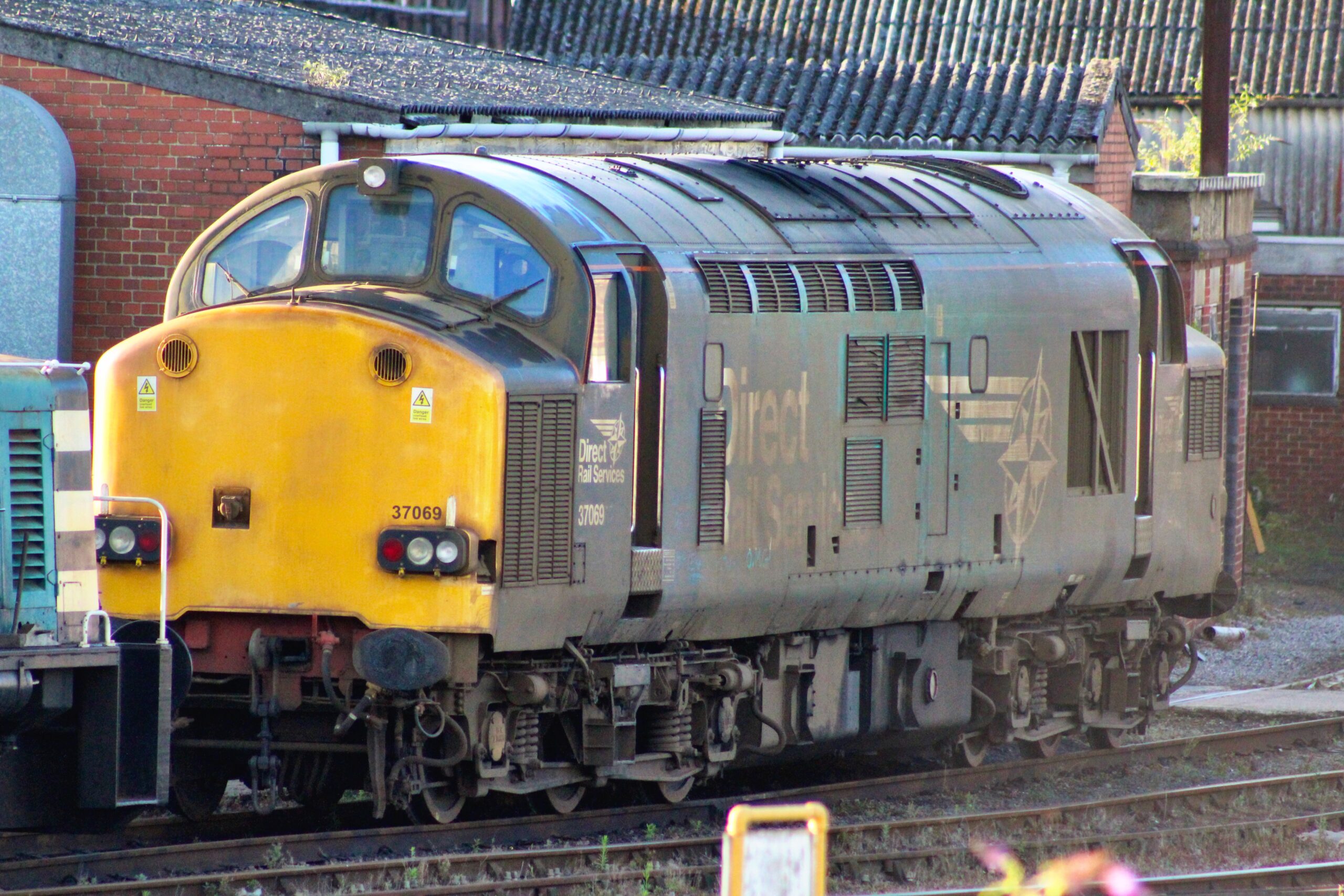
Freightliner Class 66 No. 66529 working 43Z2 0047 Trafford Park F.L.T. to Southampton M.C.T. through Eastleigh – 02/07/2022Direct Rail Services Class 37 No. 37069 which has been authorised for new wheelsets stands at Eastleigh Works – 02/07/2022Class 701 No. 701022 departing Eastleigh depot with 5Q50 0653 Eastleigh TRSMD to Eastleigh TRSMD – 02/07/2022
Class 701
Class 701 No. 701022 snaking its way into Eastleigh with 5Q50 0653 Eastleigh TRSMD to Eastleigh TRSMD – 02/07/2022
Trials with new Class 701 Electric Multiple Units continue. This week we filmed No. 701022 out and about over a few days which we’ve edited together in the video below:
Hamworthy Branch Update
Network Rail team examining the track work at Lake Road Bridge – image by kind permission of Kev Scott Trains
Network Rail were seen examining Lake Road Bridge on the Hamworthy Branch on the morning of Tuesday 5th July. Hopefully work will start soon clearing the site and replacing the existing structure which is rusted and, as was pointed out to me, has as at least one hole in the metal fabric. The replacement frog for the pointwork ready to reconnect the branch to the main line was deposited on the ballast at Hamworthy a few weeks ago.
Lake Road Bridge on the Hamworthy Branch – July 2022Lake Road bridge has sustained a number of hits from road vehicles as can be seen by the damaged brickwork in this view – July 2022
Great British Railways
This week “Snake-oil salesman” and Secretary of State for Transport Grant Shapps announced the shortlist of the most suitable locations for the national headquarters of Great British Railways (GBR), the planned state-owned public body that will oversee the majority of rail transport in Great Britain from 2023.
The closest local authorities to Yoshi HQ which threw their hats in the ring were Southampton and Eastleigh. However, these were both unsuccessful. The shortlist has been confirmed as:
Birmingham
Crewe
Derby
Doncaster
Newcastle upon Tyne
York
We would have visited each of these locations for a cup of tea and a bun, but they’re all too far away from Dorset so instead we’ll share the link where you can vote for your preferred location from the shortlist. The results will be used to measure the level of support for each place and will be considered as part of the final decision making. It’s almost like democracy at work.
Northern Belle: July 2019
A five month old Yoshi examines Class 57 No. 57601 ‘Windsor Castle’ at the buffer stops in Weymouth having worked The Northern Belle into the town for the Seafood Festival – 14/07/2022
In pre-Covid times The Northern Belle visited Weymouth with two special trains bringing passengers in to the seaside town for the annual Seafood Festival. Saturday 13th July saw Class 57 No. 57316 with Pullman Liveried classmate No. 57601 ‘Windsor Castle’ attached to the rear with the rail tour having originated form Cardiff. The following day saw the locomotives swap positions with No. 57601 heading into Weymouth with a tour having originated from Coventry.
Yoshi and Class 57 No. 57316 at Weymouth – 13/07/2019
This week, Yoshi’s blog was written to the sounds of Freya Ridings, A Dog’s Purpose (Original Motion Picture Soundtrack ) and Bear’s Den. Thanks to everyone who helped and provided information for this weeks therailwaydog blog. We’ll be back here in seven days for another update – we hope you’ll be able to join again us then. May your dog go with you.
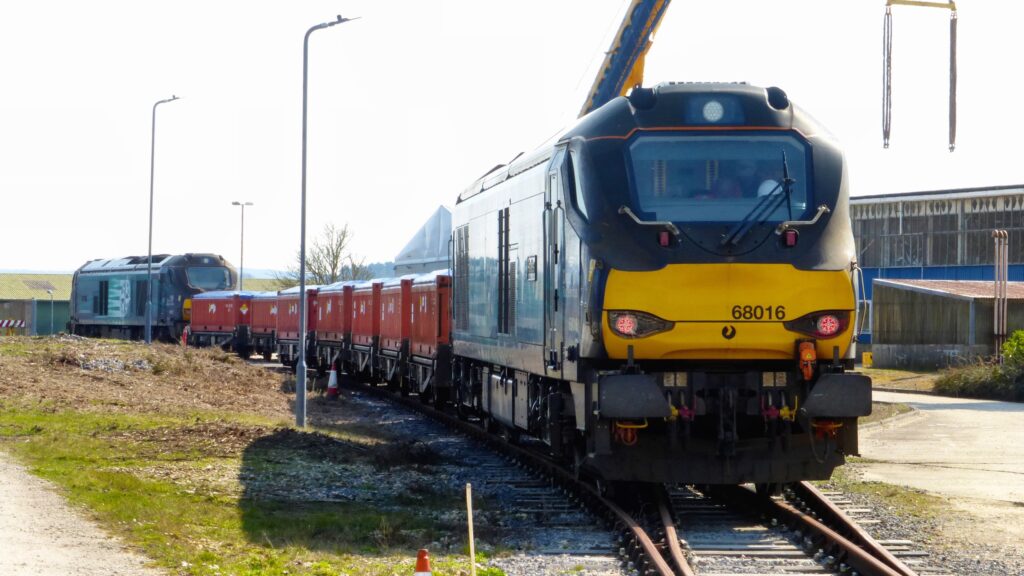
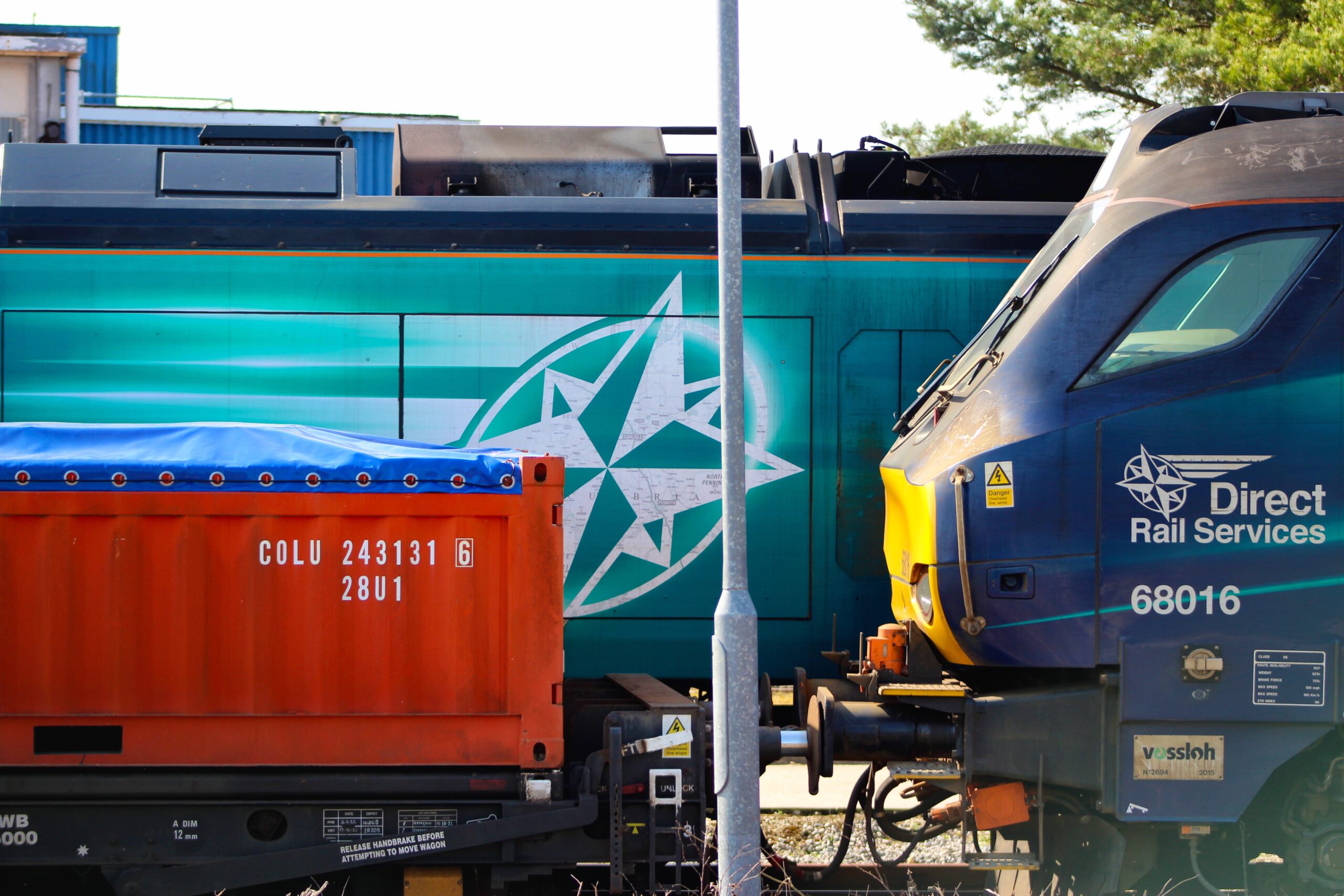
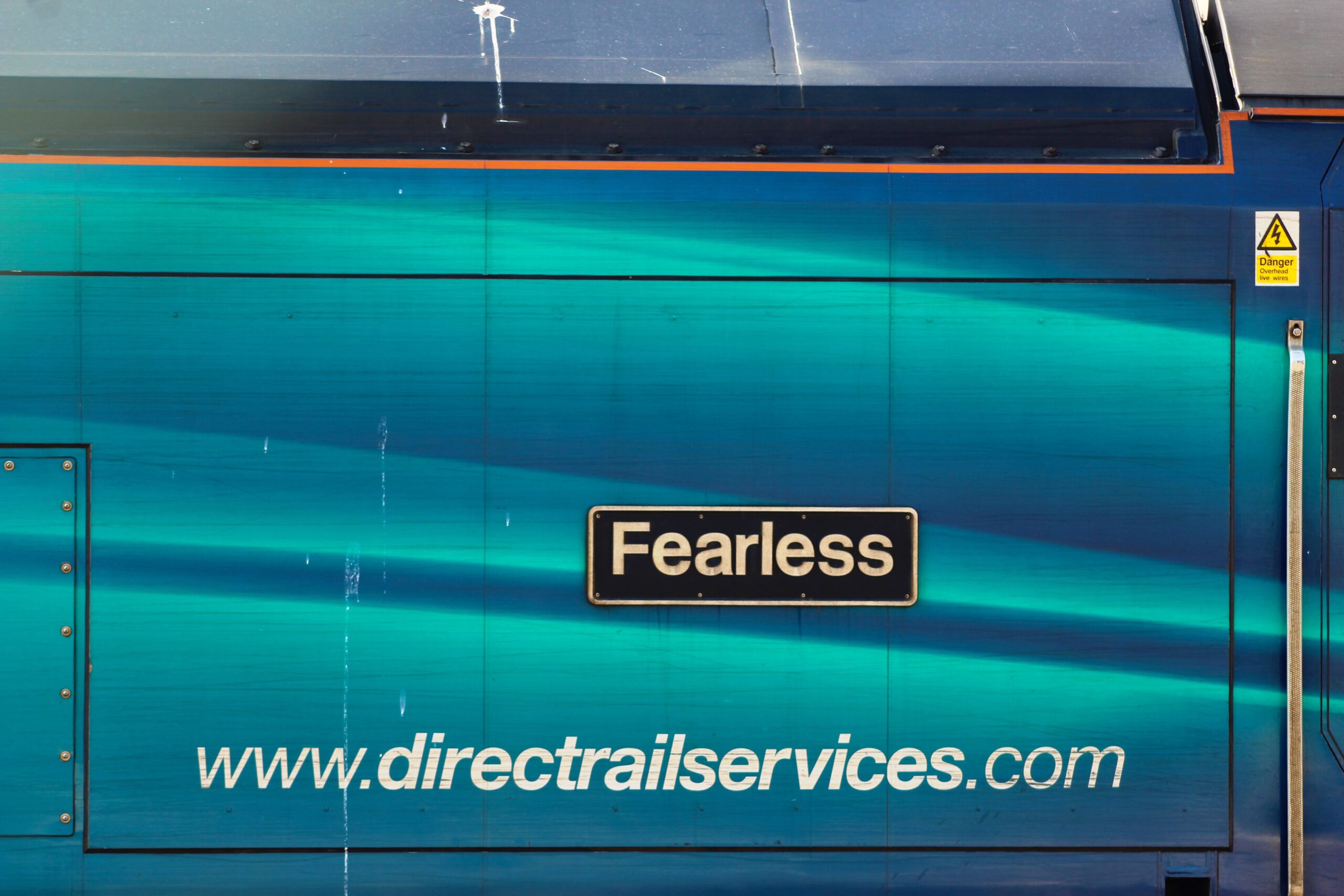
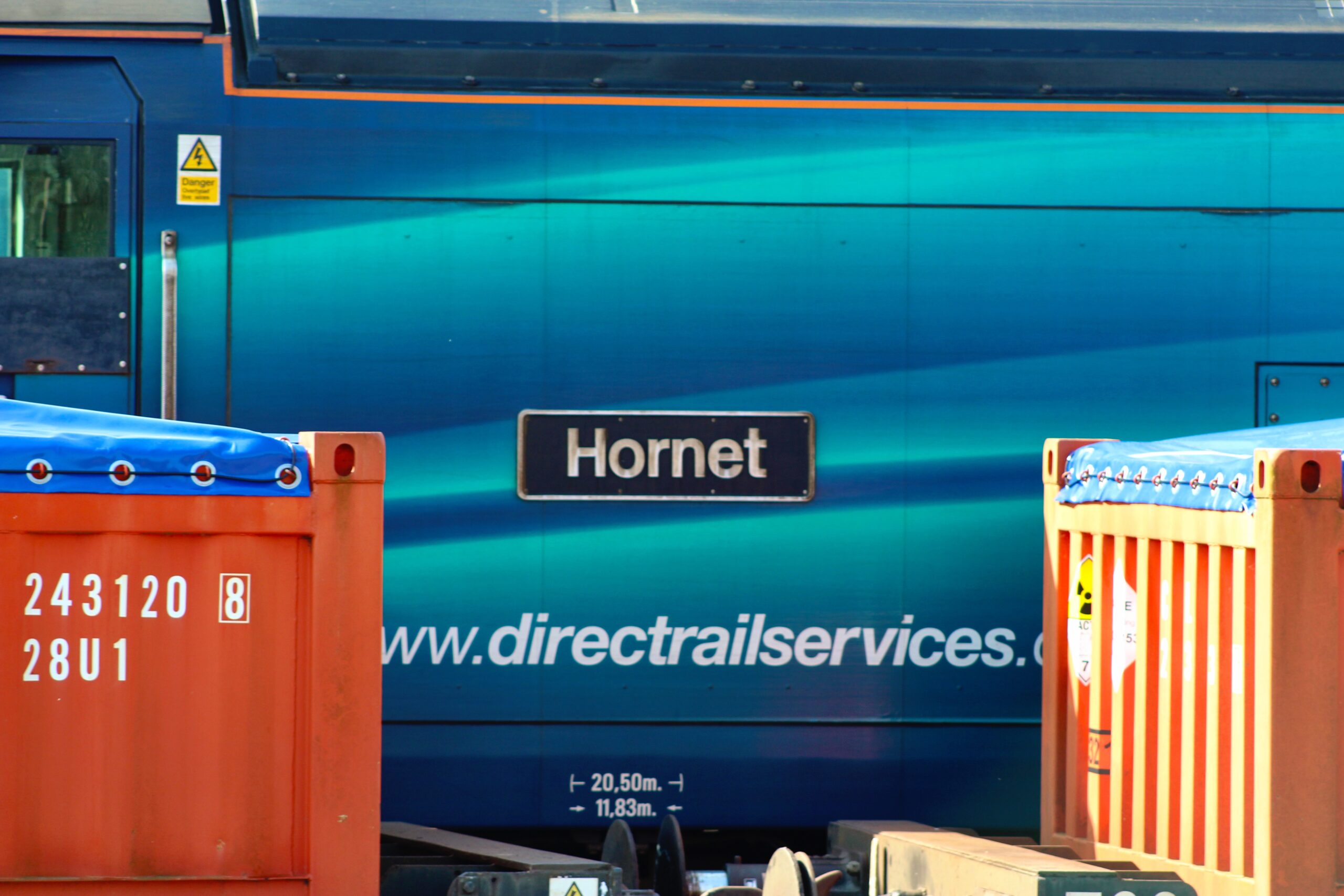
DRS Class 68 no.’s 68018 ‘Vigilant’ and 68016 ‘Fearless’ are seen just after departing Winfrith on 26/05/2022
Just taking a break from binge watching ‘Mare of Easttown’ to put together this weeks update. I’m well behind the times in catching up on the Kate Winslet TV drama, but convinced <redacted> is the guilty party. I’ll let you know if I’m correct next time. Anyway, on with the trains where this week we were surprised to be informed about the listing on Realtime Trains which revealed timings for the second run to Winfrith for the purposes of removing low level nuclear waste, the first such move which we featured here . I wasn’t expecting this to run until June given information received, but I’m assuming blocks of waste to be transported were available quicker than planned.
Yoshi and I saw the double headed train of ten empty PFA wagons hauled by DRS Class 68’s No.’s 68016 ‘Fearless’ and 68018 ‘Vigilant’ crossing Holes Bay at Poole as they headed towards Winfrith. Unfortunately the sun wasn’t shining on us that morning and it was a very dull pass.
DRS Class 68’s No.’s 68016 ‘Fearless’ and 68018 ‘Vigilant’ crossing Holes Bay – 26/05/2022
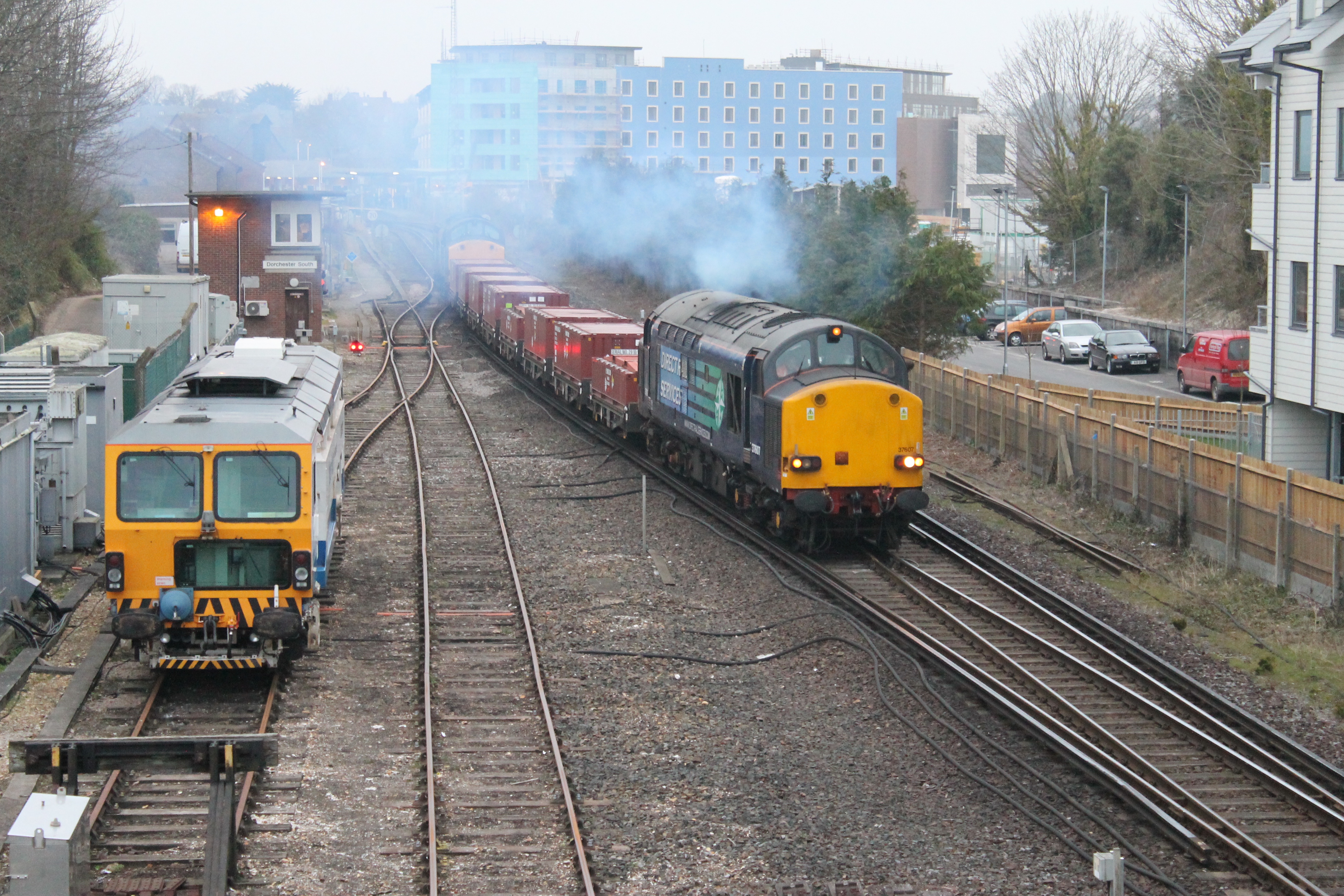
In the afternoon, we popped over to Winfrith just in time to see the loaded train, this time top and tailed by the DRS Class 68 locomotives, depart the sidings for the run to Dorchester South where the consist reversed for its onward journey to Crewe. While the train was doing this, we had enough time to scoot off to Poole in order to see the train pass us for a second camera shot.
DRS Class 68 no.’s 68018 ‘Vigilant’ and 68016 ‘Fearless’ nearing Poole – 26/05/2022
Here’s a short video of the train to accompany the above images. Many thanks to my brother for the clips near Dorchester:
On Saturday May 28th 2022 we took a trip to Dawlish to see their black swans. As luck would have it, Stanier Coronation Pacific No. 6233 ‘Duchess Of Sutherland’ was also having a day out hauling a section of the Railway Touring Company organised ‘The South Devon Explorer’ rail tour which had commenced at Woking and was destined for Plymouth. The Duchess hauled the train between Bristol Temple Meads and Plymouth on the outward leg. Yoshi was quite annoyed with me for not checking the settings on my DSLR camera as after the event I learned these needed correcting before use and the resulting images are nowhere near as sharp as they should be.
6233 ‘Duchess of Sutherland’ approaches Dawlish – 28/05/2022
The South Devon Railway was mapped out by Isambard Kingdom Brunel in 1846 and included a sea wall between Dawlish and Teignmouth. The section along Marine Parade, Dawlish was constructed in 1846. A new wall faced in limestone with granite detailing was built against this original structure between 1902 and 1905. In February 2014, a devastating storm struck Dawlish washing away the foundations of the sea wall and leaving the railway track swinging in the air. The South West peninsula was cut off from the rest of the UK rail network with millions of pounds required to put things right. Remarkably 300 Network Rail staff and contractors managed to restore the rail link in just eight weeks by repairing the sea wall and replacing the track and foundations at with 6,000 tonnes of concrete and 150 tonnes of steel. But a more longterm solution was required and a new £80million sea wall is being built. The first phase, which runs for approximately 400m from Colonnade underpass, west of Dawlish station, to Boat Cove has been completed, ensuring that this section of railway is more resilient for future generations. Work began on the second section, which runs for 415m between Coastguards and Colonnade breakwaters, in November 2020 with construction expected to finish in late summer 2022. A new accessible footbridge with lifts is due to be built at Dawlish station in 2023, subject to prior approval from Teignbridge District Council.
Stanier Coronation Pacific No. 6233 ‘Duchess Of Sutherland’ heading up The South Devon Explorer operated by The Railway Touring Company passes Marine Parade, Dawlish – 28/05/2022
Here’s our video of HST’s and the Duchess passing through Dawlish:
Trains at Dawlish including No. 6233 ‘Duchess Of Sutherland’ working The South Devon Explorer – 28/05/2022
From 2010, and for comparison of how the sea wall has changed, the following video shows GWR HST’s filmed from almost the same location as the previous footage above. The clip culminates in a shot of GWR steam locomotives No. 6024 ‘King Edward I’ and 5029 ‘Nunney Castle’ double heading Steam Dreams The Cornish Riviera excursion which ran from London Paddington to Penzance. Steaming problems with No. 6024 and a fire on the generator car at Colthorpe near Theale meant the tour was running almost 40 minutes late by the time it passed me.
HST’s and steam at Dawlish – 26th June 2010
Some images of Dawlish prior to the 2014 storm:
LMS Royal Scot Class No. 6100 ‘Royal Scot’ working the return The Torbay Express rail tour emerges from Kennaway Tunnel – 3rd July 2016LMS Royal Scot Class No. 6100 ‘Royal Scot’ nears Dawlish railway station on her way from Kingswear to Bristol Temple Meads – 3rd July 2016GWR Class 153 No. 153329 takes a battering from the sea, Dawlish – 9th June 2013LNER A4 No. 60009 ‘Union of South Africa’ working Par to Bristol Temple Meads with the Railway Touring Company’s ‘The Royal Duchy’ – 9th June 2013. The A4 has now been retired from mainline duties and is on show at the Bury Transport Museum.
By the way, you can find more about No. 6233 ‘Duchess of Sutherland’ on a previous railway dog blog entry by clicking here.
With Her Majesty The Queen’s Platinum Jubilee bank holiday weekend taking place this week, we’re sharing a video of the Royal Train when it passed through Dorchester in October 2002 as well as some royal related train images:
The Royal Train visits Dorchester on the 3rd October 2002 in charge of Class 47798 ‘Prince William’No. 47798 is a British Rail Brush Type 4 Class 47 diesel locomotive, built in 1965 and originally given the number D1656. Following the introduction of the TOPS numbering system, the loco became 47072 in 1974. Its steam heating boiler was replaced by electric train heating in 1984 and renumbered 47609. The following year it was given the name ‘Fire Fly’ to commemorate an historic Great Western Railway steam locomotive and was further renmubered to 47834 in 1989. In 1995 the locomotive was renumbered once more, this time to 47798 and the name changed to ‘Prince William’ and repainted in a plum colour was allocated as one of the locomotives rostered to pull the Royal Train as required. Withdrawn in February 2004, ‘Prince William’ is now preserved at The Railway Museum in York where these images were taken – 31/10/2010Class 67 No. 67006 ‘Royal Sovereign’ with The Royal Train approaches Parkstone with HM The Queen onboard following her visit to Poundbury for the purposes of unveiling a statue of The Qureen Mother – 27/10/2016Class 67 No. 67005 ‘Queen’s Messenger’ at the rear of The Royal Train passing through Parkstone railway station – 27/10/2016. 67005 and 67006 are painted in Royal Claret livery for hauling the Royal TrainFor The Queen’s Diamond Jubilee in 2012 various locomotives were given special liveries, one being GWR HST power car No. 43186 which is seen here at Newport, South Wales – 07/05/2013
Thanks to a suggestion, we hope that all images on this page pop out into a Lightbox when clicked on (even the fuzzy Duchess shots!). I’ll be retrospectively going back over all the older pages when time allows and updating the image links. I’ve also noticed some of the older galleries have images missing, so I’ll hopefully deal with that issue at the same time. Suggestions for updates, corrections or enhancements to Yoshi’s Adventures are always welcome! If you’re in the UK, enjoy the long Jubilee weekend if you’re able and we’ll hopefully see you back in here in seven days.
Yoshi visits the Severn Valley Railway and gets a glimpse of renumbered and repainted SR West Country Pacific No. 34027 ‘Taw Valley’
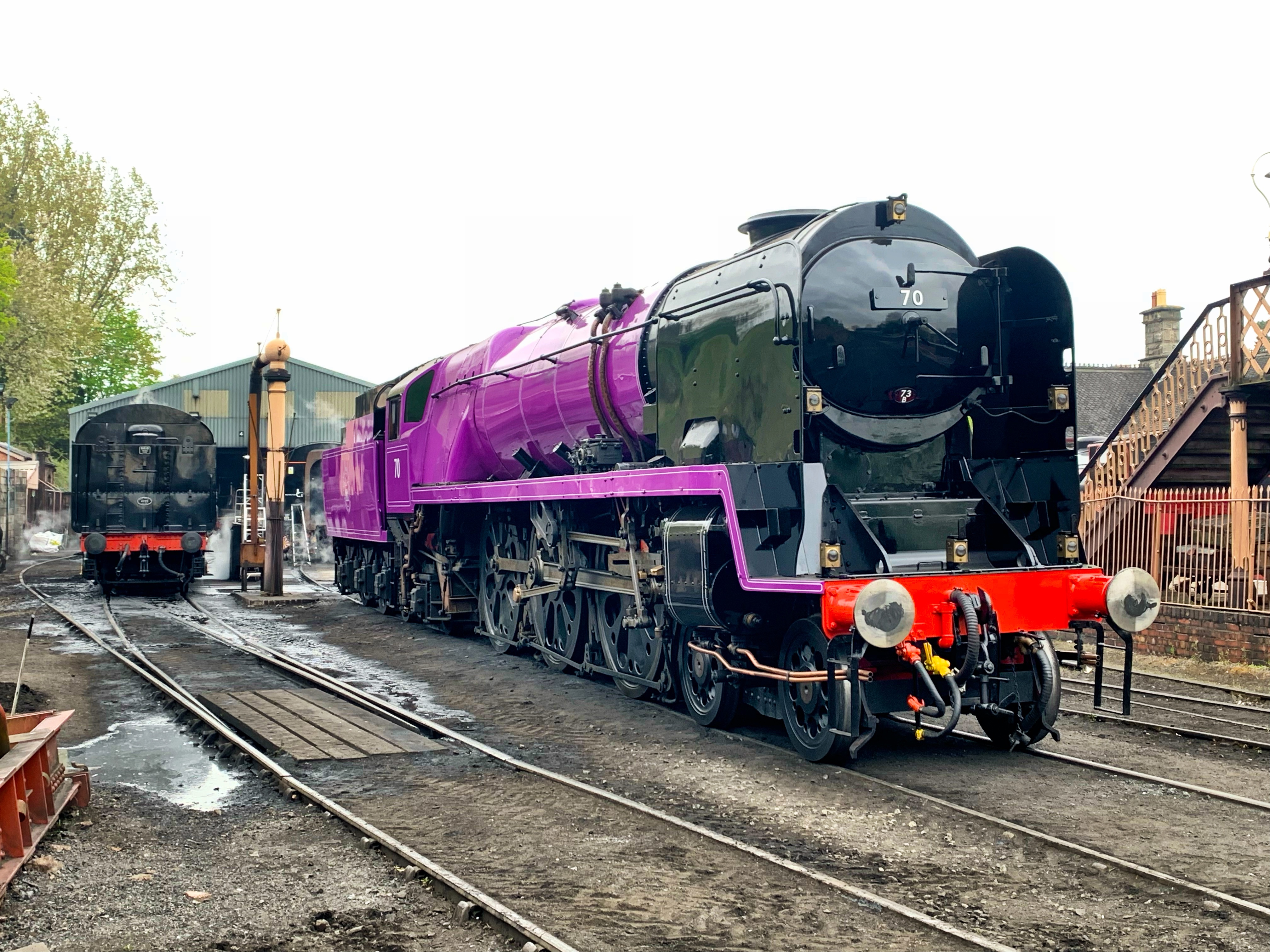
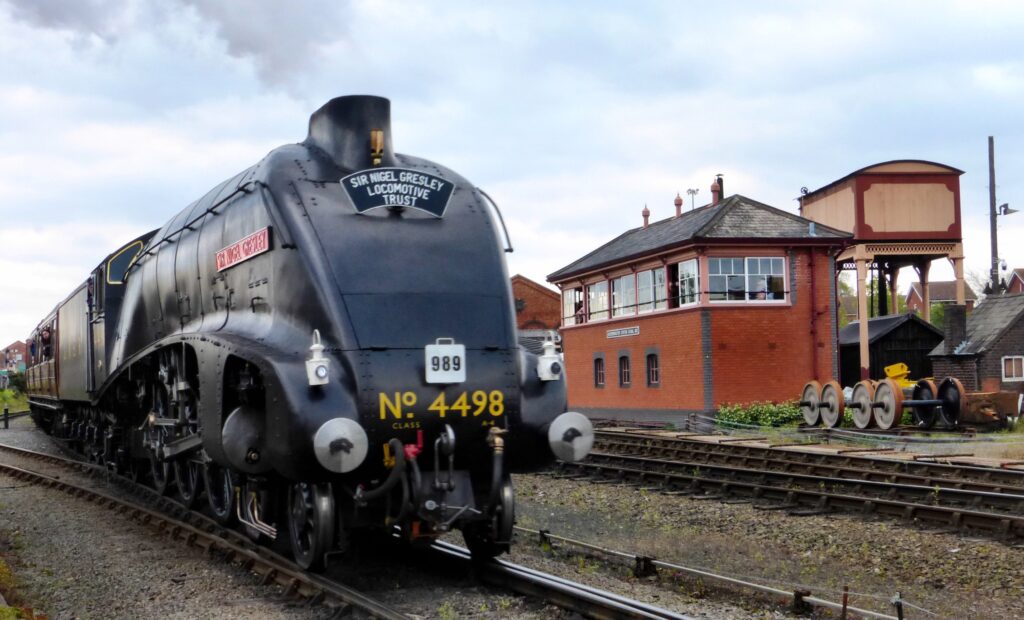
With heritage railway gala season now in full swing, last Saturday we were able to spend the day visiting The Severn Valley Railway as the 2022 Spring Steam Gala was taking place. Big draw for me was Gresley A4 4-6-2 No. 4498 ‘Sir Nigel Gresley’ in austerity black livery, as well as the chance of seeing SR West Country 4-6-2 No. 34027 ‘Taw Valley’ in Platinum Jubilee purple ready to be temporarily renamed ‘Elizabeth II’.
4498 ‘Sir Nigel Gresley’ approaches Highley on the SVR34027 ‘Taw Valley’ in Platinum Jubilee purple livery ready to be temporarily renamed ‘Elizabeth II’ at Bridgnorth
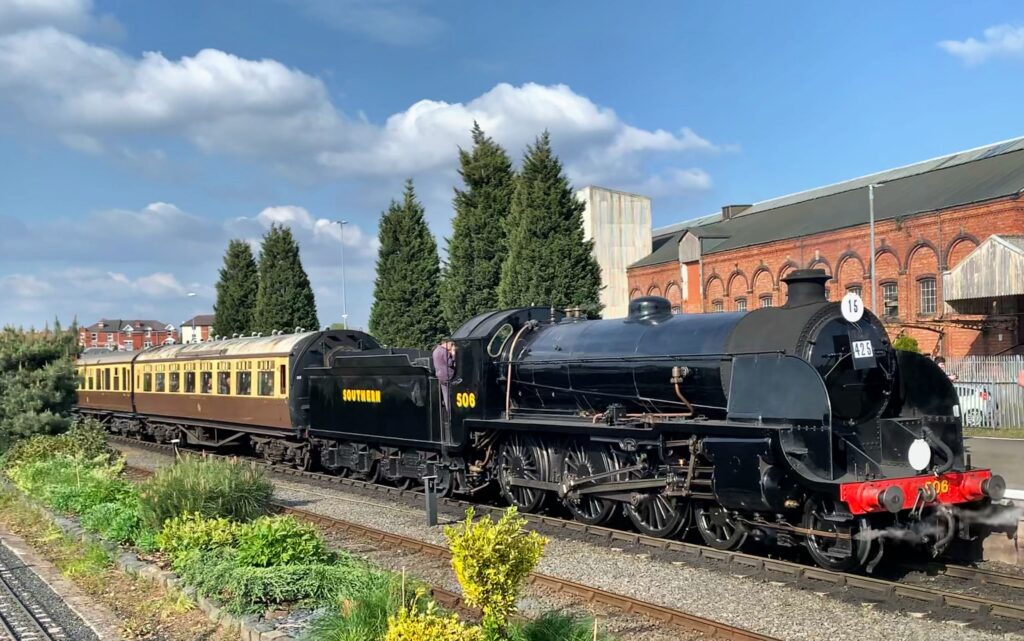
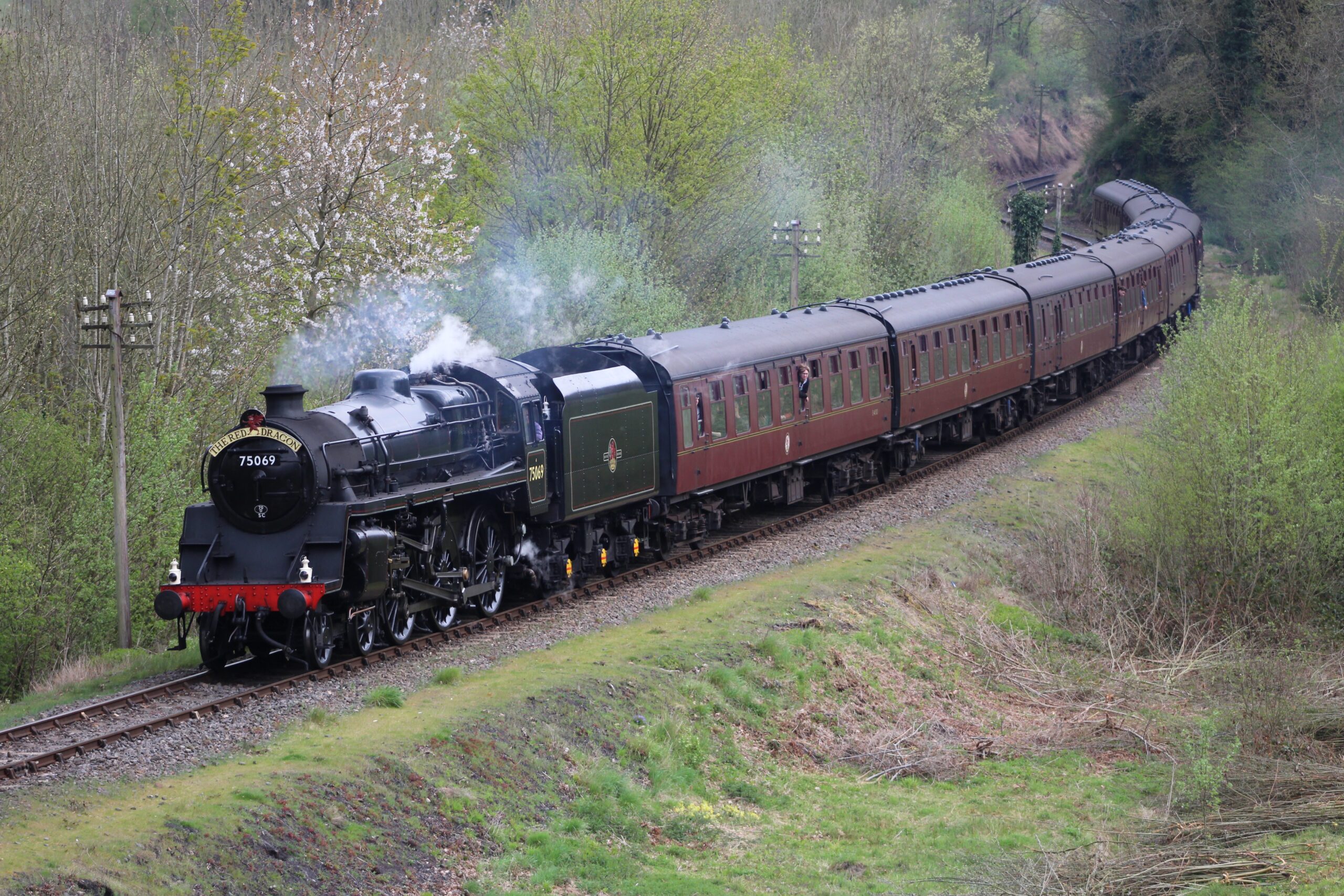
Other locomotives taking part included GWR Saint 4-6-0 new-build No. 2999 ‘Lady Of Legend’, SR S15 4-6-0 No. 506 and SVR home loco BR Standard 4MT 4-6-0 No. 75069.
No. 2999 ‘Lady of Legend’ departs HighleySR Urie S15 No. 506 awaits departure at Kidderminster75069 nearing Highley
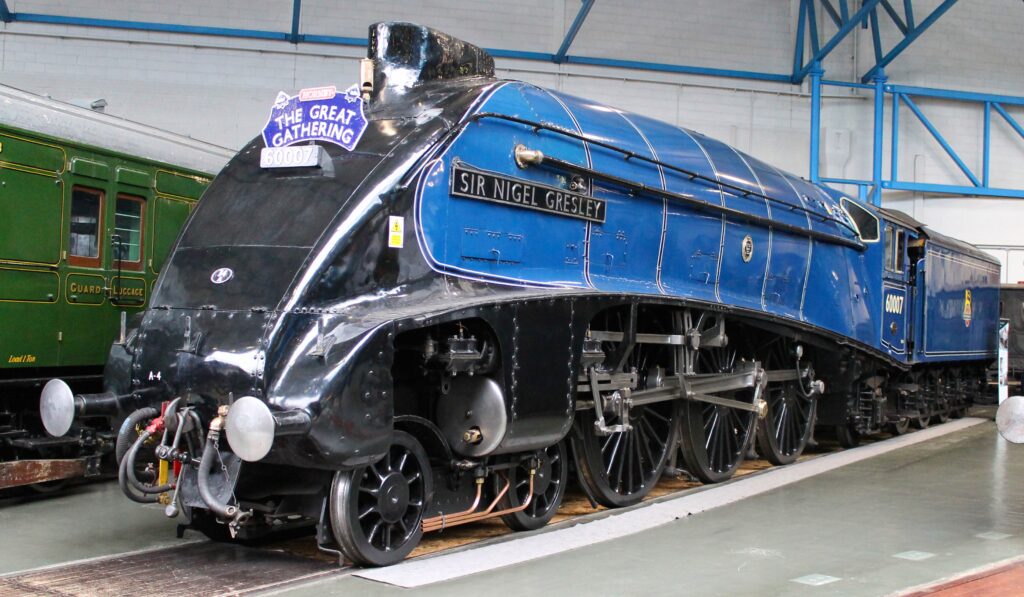
Austerity liveried A4 ‘Sir Nigel Gresley’ was matched with Gresley teak stock on certain trains over the gala weekend. With the locomotive set to be repainted into British Railways express blue and numbered 60007, this was a unique opportunity to see the A4 in its temporary guise as No. 4498.
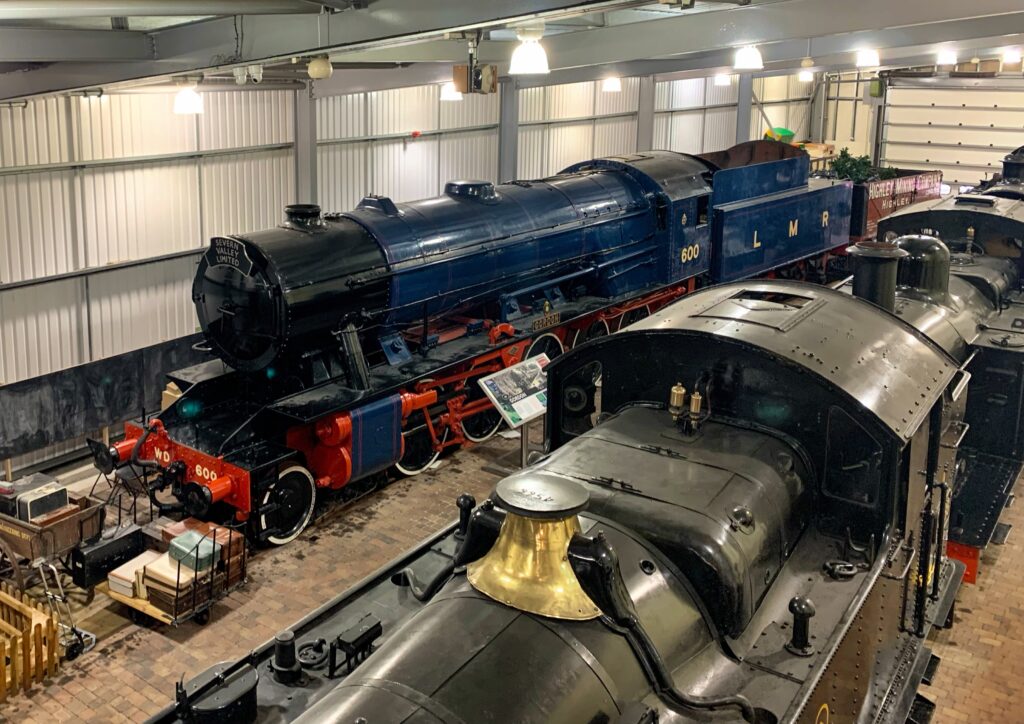
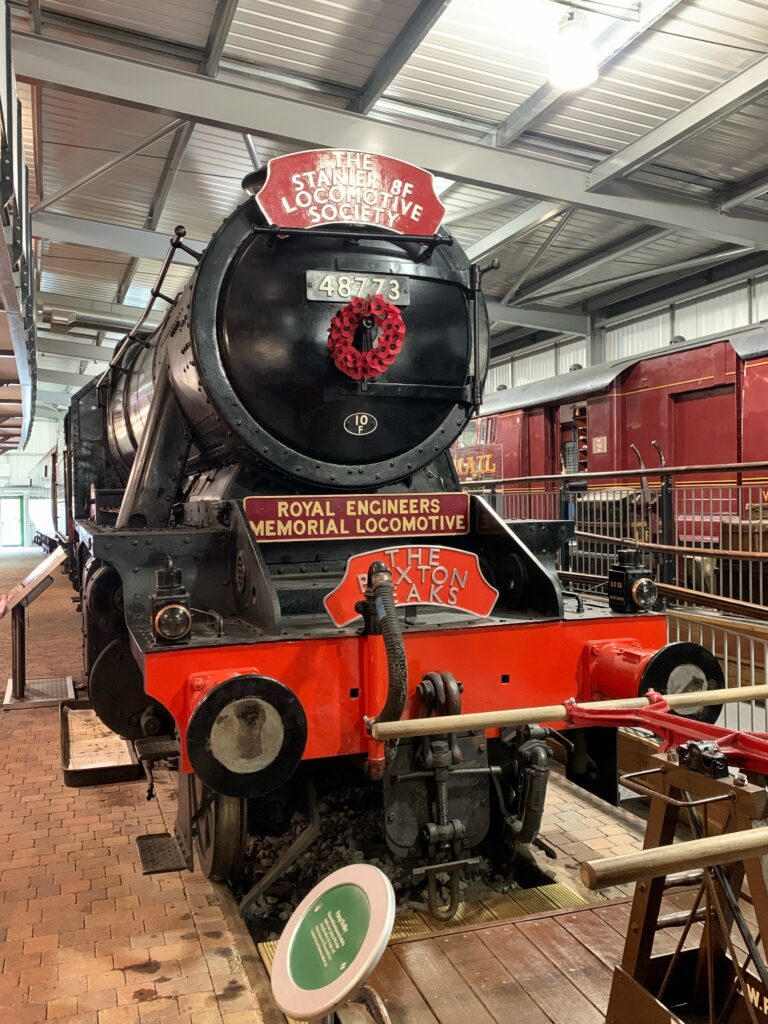
We really enjoyed our day and facilities at Highley in particular have vastly improved since my last visit to that particular location many years ago with the addition of the Engine House visitor centre where you can get up close to various static locomotives, buy a souvenir or tuck into a butternut, spinach and feta pasty – just like Yoshi and I! And until Autumn 2022 there is a photographic exhibition entitled ‘From Railways to Royalty’ featuring images from the very talented Jack Boskett.
LMR No. 600 ‘Gordon’ in The Engine ShedLMS Stanier 8F No. 48773 in The Engine Shed
A special train from London Kings Cross to Kidderminster bringing visitors to the Severn Valley Railway steam gala was top and tailed by Class 67 locomotives No.’s 67010 and 67006 ‘Royal Sovereign’ and we were able to see its departure from the SVR. We’ve put together a short video of our day which you can watch by clicking below:
Closer to home and the Weymouth line was visited by Network Rail’s new weed killing train on 20th April. The train is the result of a cooperation between NR, GBRf, Bayer Environmental Science and a number of start up companies using innovative technology to eliminate potentially dangerous weed infestations with advance precision across the railway network. The trains detect weeds using cameras and then deploy the most appropriate herbicide, thereby improving the environmental footprint. Data is uploaded to a central database to enable future weed control and monitoring. GPS tracking ensures that spray nozzles are automatically shut off when the train approaches a non-treatment zone, such as a river or a bridge. We caught the train working 3Q99 2130 Eastleigh East Yard to Eastleigh East Yard passing through Hamworthy top and tailed by Class 66 locomotives No.’s 66707 ‘Sir Sam Fay’ and 66778 ‘Cambios Depot 25 Years’:
3Q99 2130 Eastleigh East Yard to Eastleigh East Yard passing Hamworthy – 20/04/2022
Class 701 testing continues to visit Bournemouth and Poole as evidenced by No. 701044 on 21st April 2022:
Interesting work commenced on the Hamworthy branch this week with a section of the line adjacent to Hamworthy level crossing receiving attention with the replacing of 212 sleepers. We look forward to hearing more about this new initiative.
Hamworthy Branch having seen preparatory work in advance of the replacement of railway sleepersNew sleepers for the Hamworthy BranchBallast and new sleepers seen at the Poole Port end of the Hamworthy BranchWork at the Level Crossing replacing sleepersHamworthy Branch work to replace sleepersWork well underway installing replacement sleepers on the Hamworthy Branch – April 2022
Our archive footage this week features SR West Country 4-6-2 ‘Taw Valley’ as herself when she visited the Portsmouth area working a VSOE excursion train in February 1997 following the repair of a cracked cylinder liner which had seen her out of service for a few months. The video below shows No. 34027 at Havant and Fratton on 2nd February 1997 amidst some interesting diesel traction movements:
We’ll finish this week with a few more images from the Severn Valley Spring Gala 2022 and a flashback to ‘Sir Nigel Gresley’ in blue:
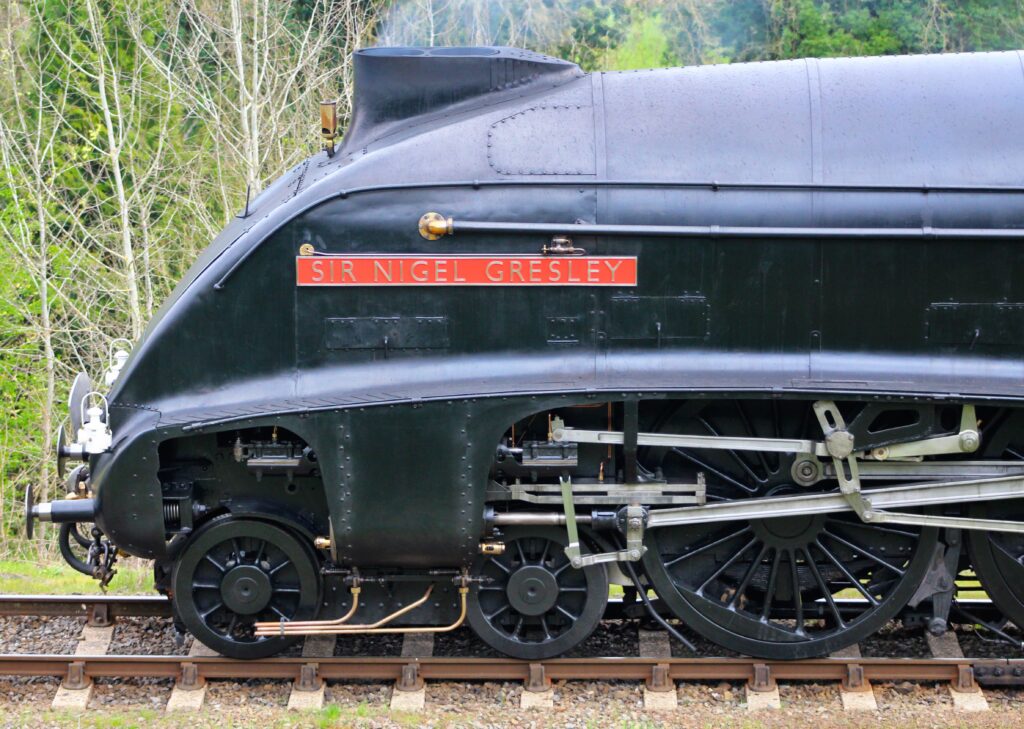
SR West Country No. 34027 ‘Taw Valley’ as No. 70 ‘Elizabeth II’ on display at Bridgnorth‘Taw Valley’ and ‘Lady of Legend’Yoshi takes another look at No. 70 ‘Elizabeth II’LNER A4 No. 4498 ‘Sir Nigel Gresley’ in black departs Kidderminster with the 1805 service to Bridgnorth – 23/04/2022Nameplate and front end detail of 4498 ‘Sir Nigel Gresley’ in austerity black liveryThe colour of things to come ‘Sir Nigel Gresley’ will revert to her British Railways number; No. 60007 and express locomotive blue livery as seen here at The Great Gathering, York 03/07/2013‘Sir Nigel Gresley’ nameplate detail as seen when in blue livery
Thanks for reading. As always comments or corrections gratefully received. Bye for now!
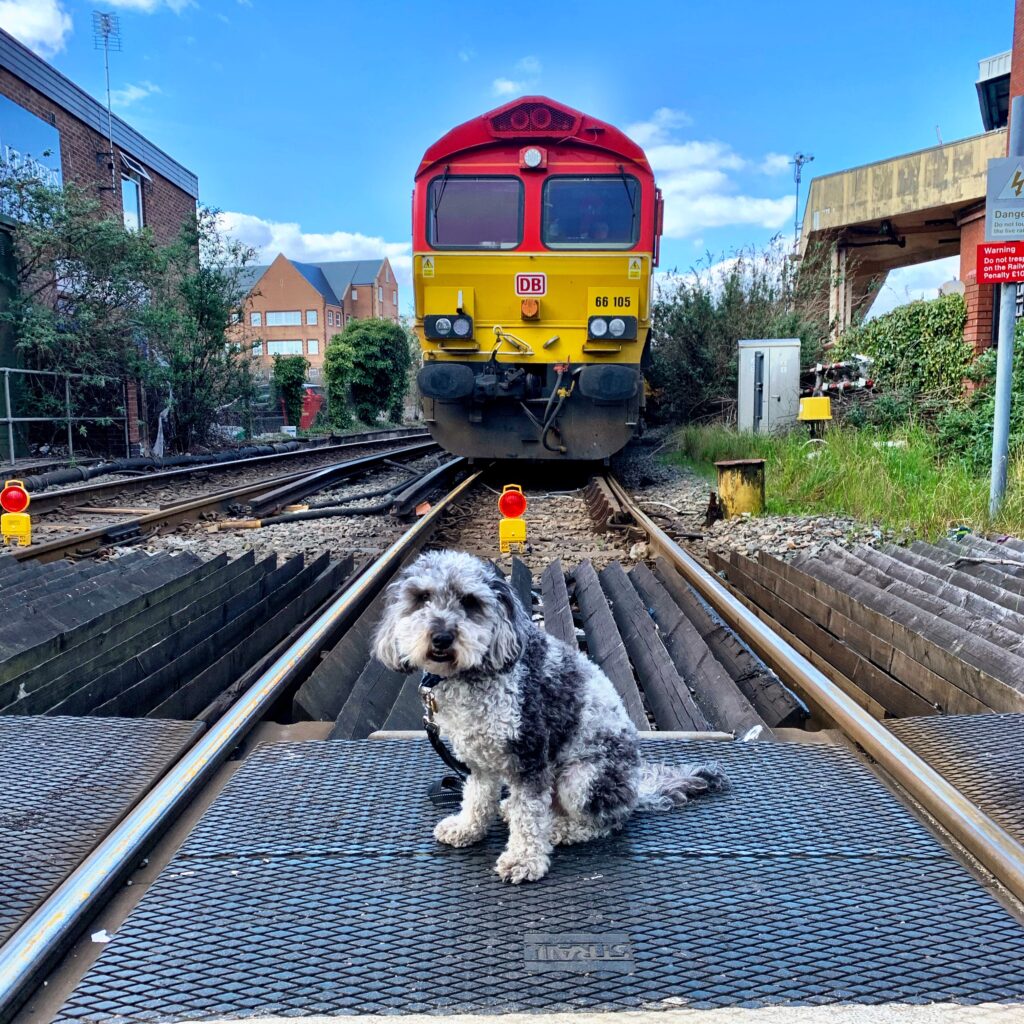
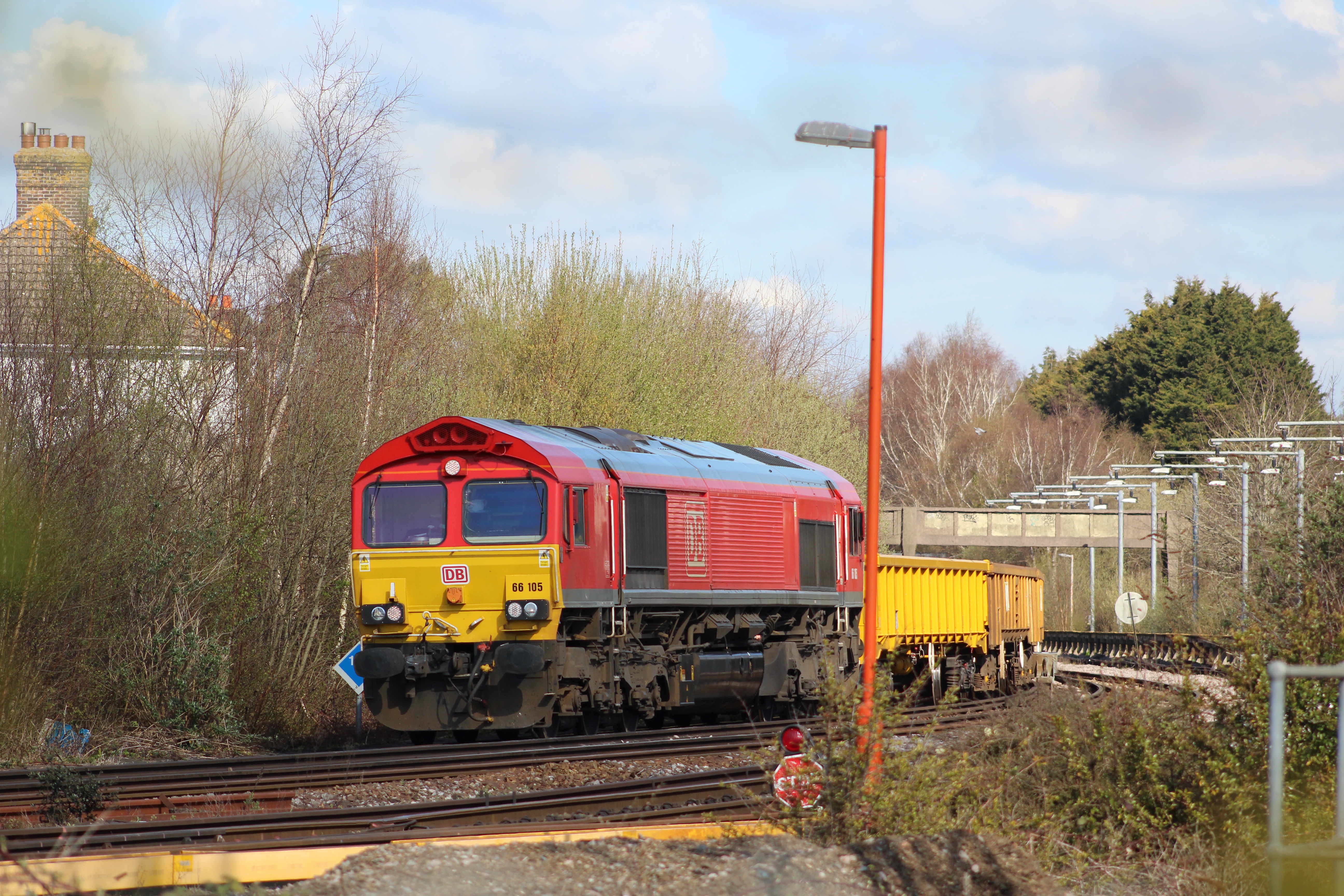
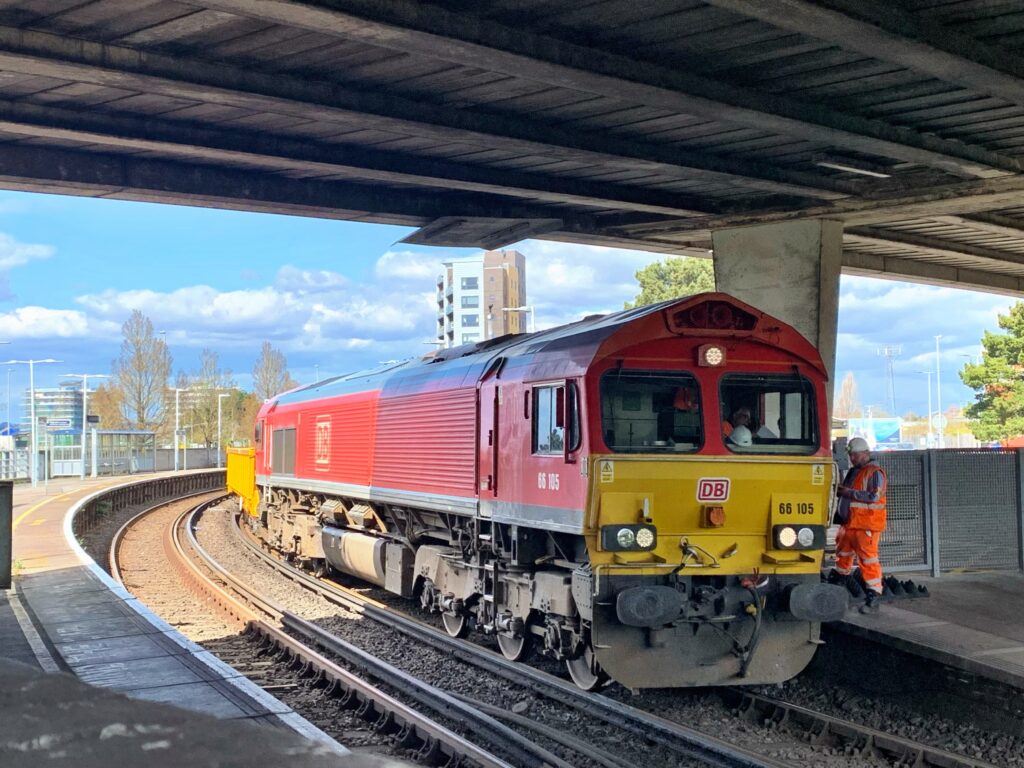
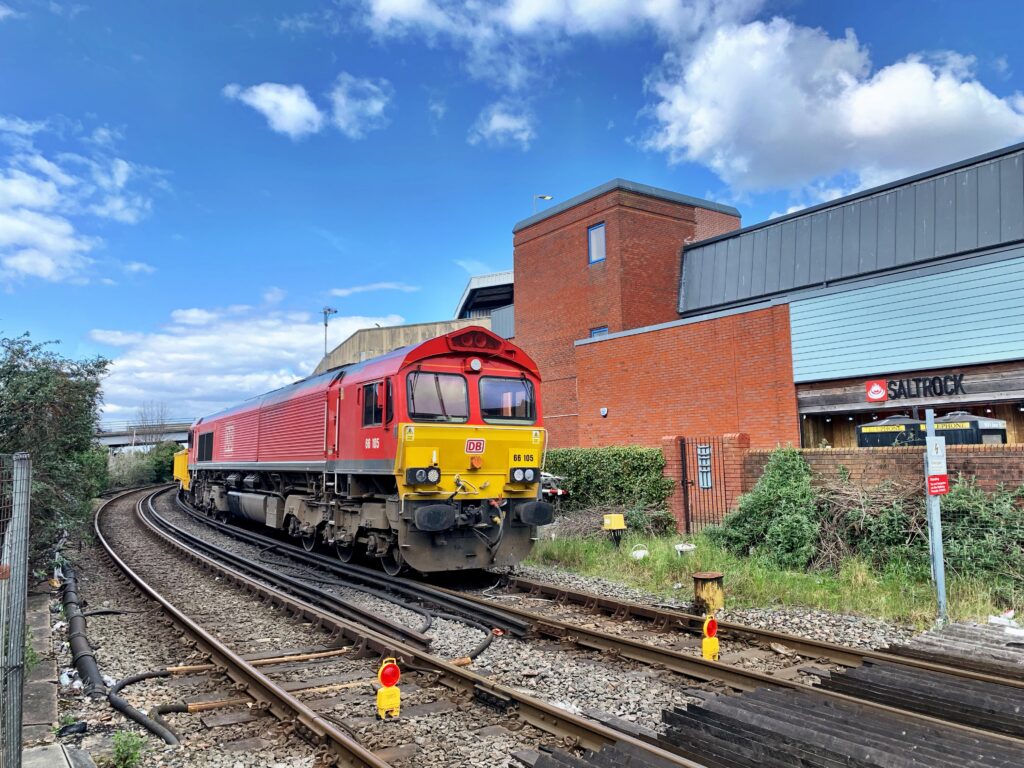
Yoshi takes the opportunity to inspect DB Class 66 No. 66105 at Poole High Street Crossing
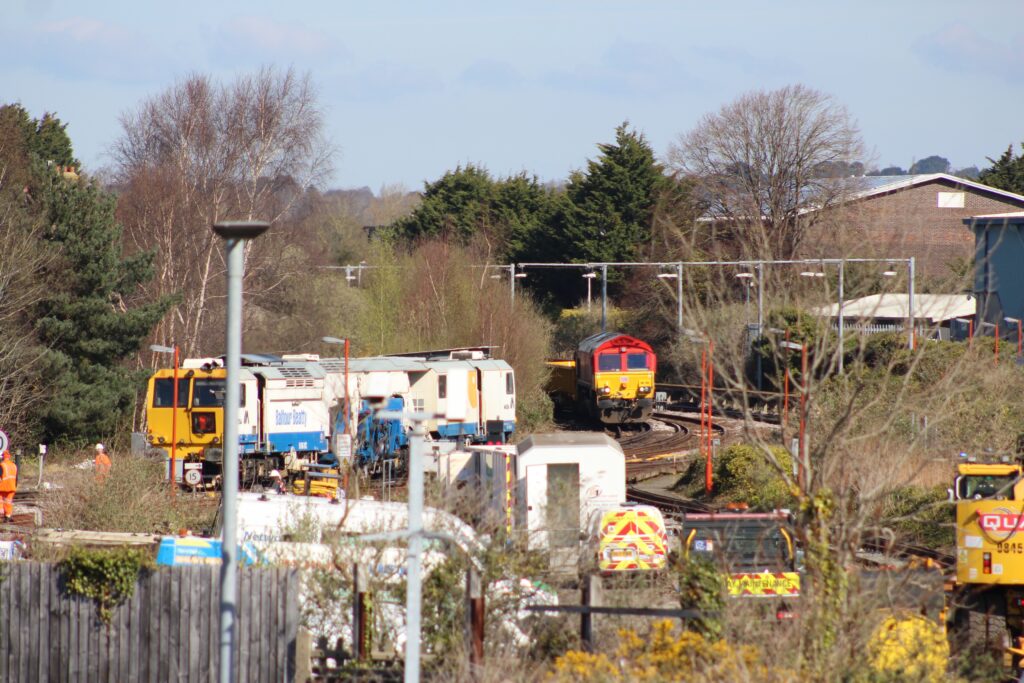
It was an early start on Saturday April 2nd, or possibly a late end to Friday 1st when I popped into Poole to catch sight of DB Class 66 No. 66105 arrive with an engineers train from Eastleigh East Yard at 0045 (6N03 2355 Eastleigh East Yard to Poole). The next day, Yoshi and I were fortunate to see the locomotive and consist depart the Poole station area, getting some unusual photographs of the locomotive waiting for the barriers to close at Poole High Street crossing, but more of that later.
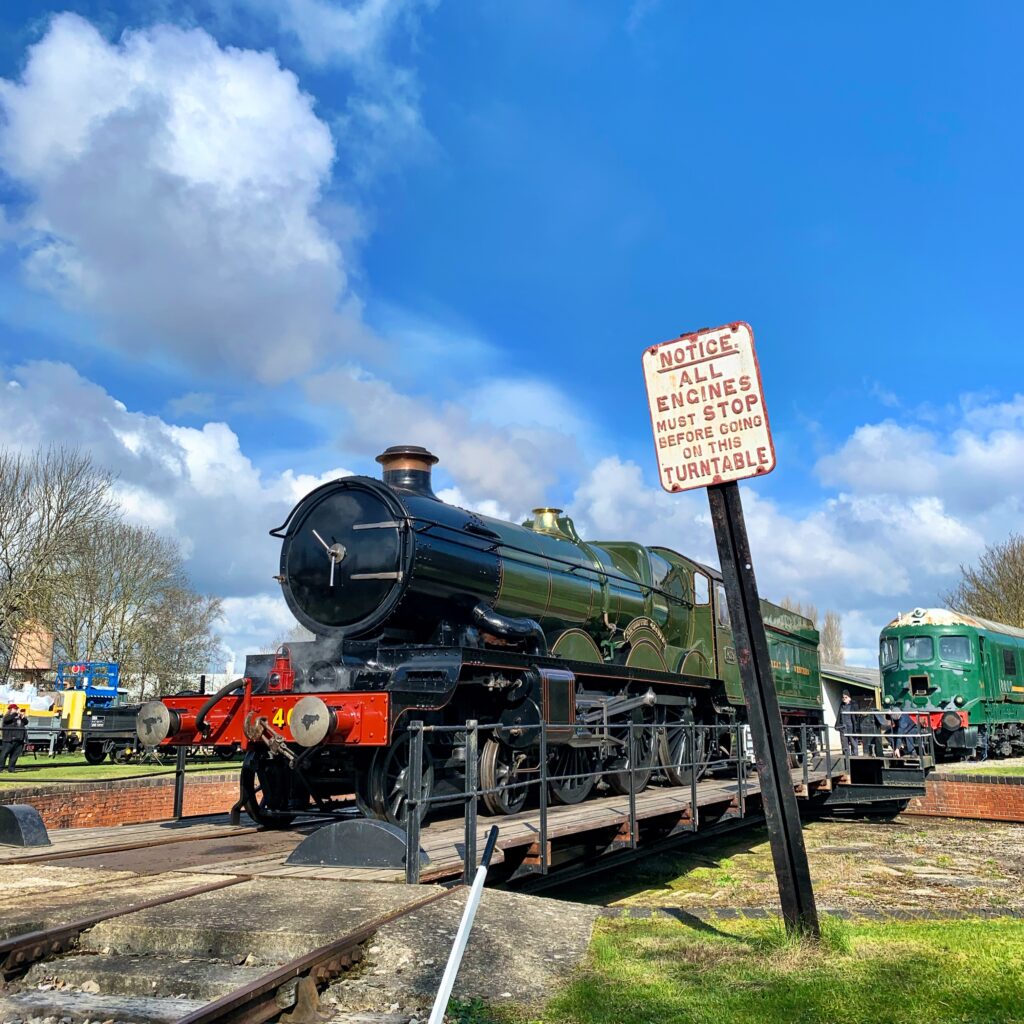
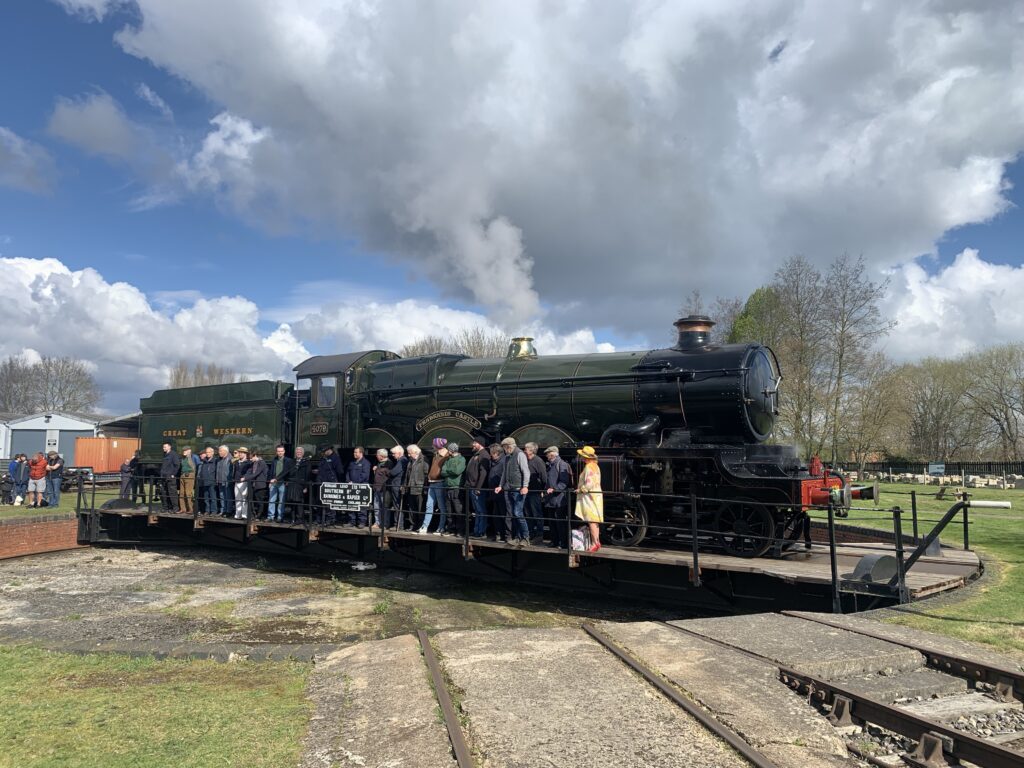
Back to Saturday and shortly after breakfast, we set off for the 2022 Steam Railway Magazine Readers’ Heritage Railway Association Award winning Didcot Railway Centre to share in the celebrations of Great Western Railway Castle Class 4-6-0 No. 4079 ‘Pendennis Castle’ being relaunched into traffic after a long absence. We made good time in getting to the car park adjacent to Didcot railway station and made our way across to the concourse where there was some confusion in how to access the subway to the railway centre. Yoshi was extremely excited and waited impatiently to get our tickets scanned before we made our way onto the site. The Great Western Society Didcot Railway Centre really is a marvel – 21 acres covering 200 years of railway heritage. Sadly the Coal Stage which dominates the skyline was recently found in need of urgent repair but conservation work is now underway on the Coal Stage as are repairs to the water tank that supplies the Centre’s steam engines with water.
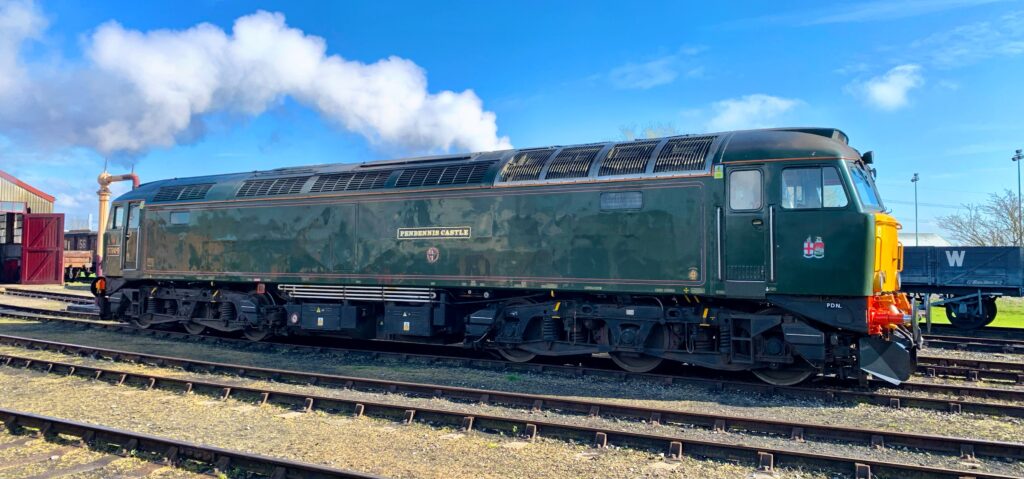
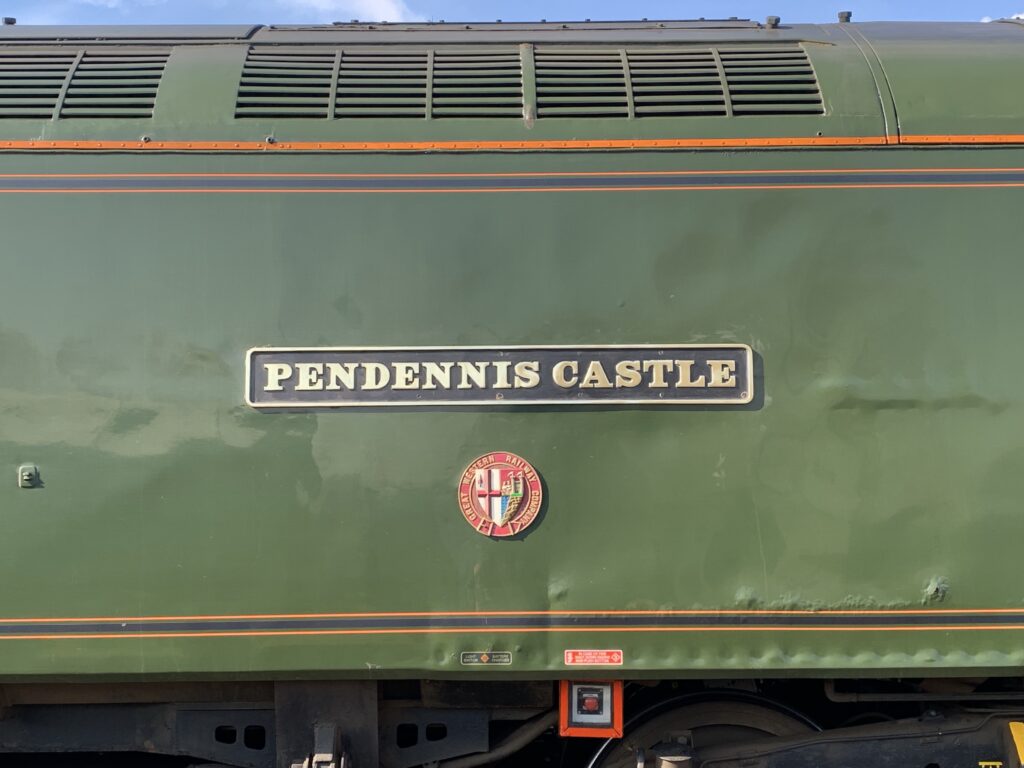
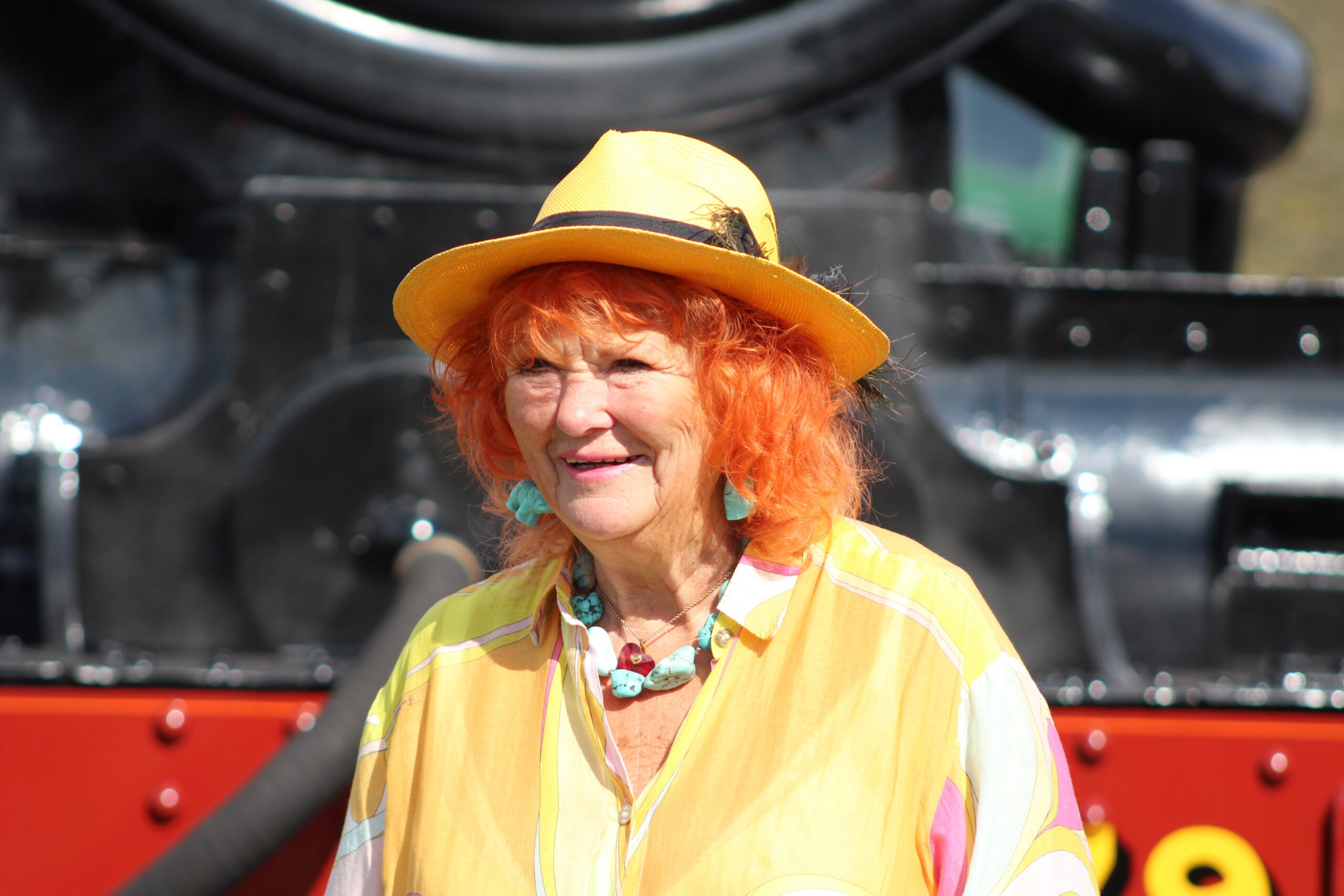
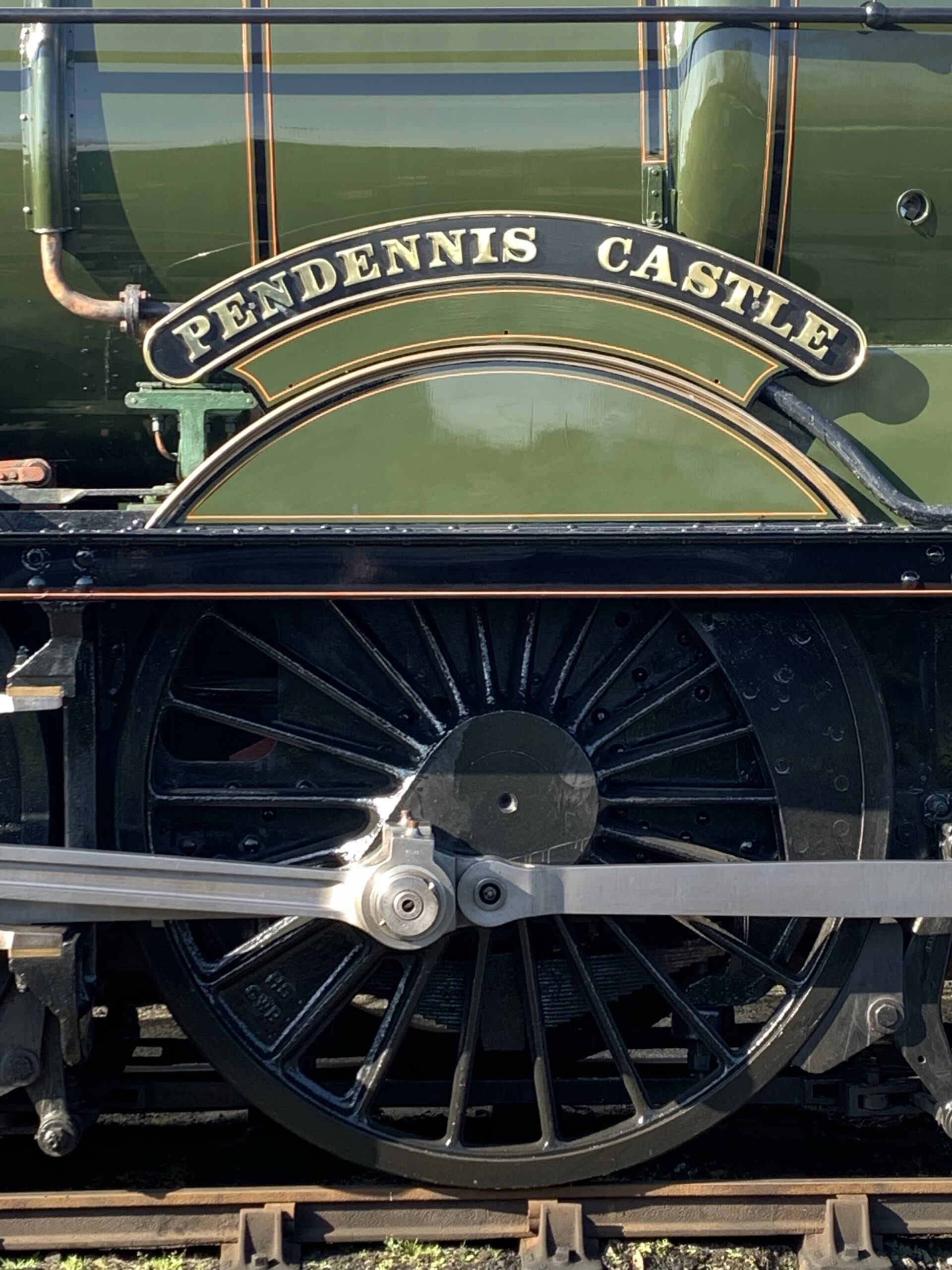
We were greeted by not one, but two Pendennis Castle locomotives. In a lovely touch, current GWR Class 57 No. 57604 ‘Pendennis Castle’ was lined up alongside her early steam namesake No. 4079.
4079 and 57604 both named ‘Pendennis Castle’ in front of the engine shed at DidcotClass 57 No. 57604 ‘Pendennis Castle’ – Didcot 02/04/2022Nameplate of Class 57 No. 57604 ‘Pendennis Castle’
The Castle Class 4-6-0 express passenger engine was first introduced in 1923. No. 4079 ‘Pendennis Castle’was the 7th machine – of an eventual total of 171 – completed in February of 1924. She shot to fame the next year when she triumphed in a series of trials against the LNER Class A1 Pacific locomotives. The most famous of these being the legendary ‘Flying Scotsman’. ‘Pendennis Castle’was rather cheekily sent to be displayed alongside its famous rival in the 1925 Empire Exhibition at Wembley.
No. 4079 worked express passenger trains on the Great Western Railway and later British Rail (Western Region) for forty years, racking up an impressive 1.75 million miles in service. This came to a sudden end in 1964 when travelling on a special train, she sustained severe damage to her rear driving wheel bearings as her fire grate collapsed and almost melted them. She was taken off the train and abandoned on shed at Westbury.
From Westbury, she was rescued by Mike Higson who was then proprietor of Roundhouse Books. He had the locomotive slowly towed back to her birthplace at Swindon and restored to working order. On completion, she was handed over in 1965. Shortly afterwards, Mr Higson sold the locomotive to Lord John Gretton (of the Bass Brewery dynasty) and, Sir William McAlpine who had famously saved ‘Flying Scotsman’from a financially disastrous tour of North America. Initially based at Didcot, No. 4079 eventually moved to the Steamtown Railway Museum in Carnforth.
The story now shifts to 1977 and Hammersley, amid the deserts of North Western Australia, where Sir Russel Madigan was visiting the iron ore mines of the company he worked for; Rio Tinto. Here he encountered a preservation group named The Pilbara Railways Historical Society who were saving diesel locomotives which had once worked the iron ore railways. The society were also keen to obtain a steam locomotive to run on the railway. Sir Russel declared he would “go home and buy them the ‘Flying Scotsman’”. This was not to be as Sir William McAlpine wasn’t prepared to sell ‘Scotsman’. He was, however, willing to part with ‘Pendennis Castle’. After a farewell tour stopping for what was believed to be the last time at Didcot, she went to Southampton Docks, was loaded onto a P&O ship and set sail for ‘Down Under’ via the Suez Canal.
Arriving at Hammersley in 1978, she soon became a firm favourite, pulling trains over the extensive iron ore rail system for pleasure trips. Apparently, it wasn’t unknown for the locomotive to just pull up out of the way somewhere in the desert and for her hot coals to be used to start the barbecue! The highlight of her time in Australia was when her great rival ‘Flying Scotsman’ visited during the country’s bicentennial celebrations in 1988 and they hauled trains together.
By 1994 changes were afoot on the Rio Tinto railway. The introduction of a new in cab signalling system made it very difficult for a 1924 steam engine to pull trains and time was beginning to take its toll on No. 4079. Faced with mounting repair bills and operational difficulties, her last operational trip was made in 1994 and she was retired to await her fate.
It was suggested by the editor of Railway Magazine, Nick Piggott, that ‘Pendennis Castle’ needed to be repatriated into the hands of the Great Western Society at Didcot. Having contacted the society and entered negotiations with then deputy society chair Richard Croucher, the society was donated 120 tons of historic steam locomotive. With one provision; the society had to get her home. Through the efforts of successful fundraising that was match funded by the Heritage Lottery coffers, No. 4079 journeyed 1,000 miles on the roads of Australia, placed on a ship that took her through the Panama Canal, thus completing her circumnavigation of the planet. She arrived back in the UK on the 8th July 2000.
Sadly the engine was in poor condition mechanically. The buckets of red desert sand that permeated the locomotive which were removed had also ground away at her moving parts. Large sections of the structure under her cab was life expired, her cylinder block needed new liners and a serious crack repairing as well as her boiler requiring a thorough overhaul.
While the original intention was to restore No. 4079 to main line condition, operational changes have resulted in Didcot withdrawing from the main line scene. However, following over twenty years of volunteer work ‘Pendennis Castle’ has been fully restored to a very high standard and after her April 2nd 2022 photoshoot with her more ‘modern’ Class 57 counterpart, No. 4079 soon moved off to the turntable where, following speeches including one from Great Western Society Chair Richard Coucher, the widow of the late Sir William, Lady Judy McAlpine, cut the ribbon officially launching ‘Pendennis Castle’ back into traffic.
GWR Castle Class 4-6-0 No.4079 ‘Pendennis Castle’ on the turntable at DidcotLady Judy McAlpine launched ‘Pendennis Castle’ into trafficNameplate of No. 4079 ‘Pendennis Castle’GWR Castle Class 4-6-0 No.4079 ‘Pendennis Castle’ with the volunteers who restored her to working condition at Didcot
GWR Castle No.4079 is re-launched at Didcot – 02/04/2022
We also had an enjoyable look around the Didcot engine shed:
GWR King Class 4-6-0 No. 6023 ‘King Edward II’ – Didcot 02/04/2022GWR 0-4-0T No. 1338 – Didcot 02/04/2022No. 5 ‘Shannon’ – Didcot 02/04/2022
Of local interest for Yoshi and I was ‘Bonnie Prince Charlie’. The locomotive was built by Robert Stephenson and Hawthorns in 1949 (Works No. 7544) and entered service with Messrs. Corrall Ltd, initially in Dorset at Corrall’s Ballast Wharf in Hamworthy and later from 1965, at Corrall’s depot on Dibles Wharf in Southampton. ‘Bonnie Prince Charlie’ was purchased for preservation by the Salisbury Steam Trust in 1969 and arrived at Didcot soon after.
Works No. 7544 ‘Bonnie Prince Charlie’ – Didcot 02/04/2022
Saturday afternoon, Yoshi and I decided to visit the Chinnor & Princes Risborough Railway’s diesel gala. The main draw for me at least ( I’m not sure about Yoshi ) being the visit of two ex East Midlands Trains Class 43 HST power cars which are currently being operated by Rail Operations Group on behalf of Data Acquisition & Testing Services of Long Eaton – try saying that after a few JD and Coke’s – on routine checking of Over Head Line Equipment (OHLE) throughout the network, most recently in the Corby / Kettering area. The intention was for the power cars to work with the resident Southern Region 3-CEP unit, which is currently the C&PRR’s only operational air braked passenger stock. Unfortunately power car No. 43054 failed and was removed from the consist, being replaced with visiting Hanson & Hall Rail Services Solutions Ltd Class 50 No. 50008 ‘Thunderer’ which top and tailed the 3-CEP with working power car No. 43066. Sadly, this was not to be the only locomotive failure of the day as C&PRR’s departmental liveried home Class 31 No. 97205 was also withdrawn from the gala after experiencing issues.
A short video from the Chinnor & Princes Risborough Diesel Gala – 02/04/2022
C&PRR’s ambition is to extend to Aston Rowant which involves crossing a public highway at Kingston Blount in order to create a 14 mile heritage train round trip and to share operations with a public service originating from a large park and ride located near Junction 6 of the M40 to Princes Risborough for onward connections to London and Birmingham.
The next day, we caught up with Class 66 No. 66105 as it waited with its consist of wagons in the Poole area.
66105 in Poole – 03/04/202266105 at Poole with tamper DR75501 – 03/04/202266105 at Poole railway station – 03/04/202266105 at Poole High Street Crossing – 03/04/202266105 at Poole High Street Crossing – 03/04/202266105 waits to return to Eastleigh East Yard at Parkstone the eastern extent of the worksite – 03/04/2022Balfour Beatty Matisa B 66 UC Tamper No. DR75501 in Poole sidings – 03/04/2022
Video of 66105 in Poole – 02 & 03/04/2022
More engineering work is planned for this coming Sunday in the Poole area, although I have yet to see if any engineers trains beyond a tamper will be involved. Network Rail track inspections on the Hamworthy branch necessitate road closure and traffic restrictions as Hamworthy Level Crossing in Ashmore Avenue, Poole is closed for several days w/c 25th April 2022. Interesting times ahead, hopefully!
For our look into the archives this week we are returning to Didcot with a 1992 video from John Chappell, but first a set of photos taken with my ever trusty Kodak 110 camera during a school visit in 1979:
Didcot engine shed featuring GWR Collett 5600 Class 0-6-0T tank engine No. 6697, SR Battle of Britain No. 34051 ‘Sir Winston Churchill’ and No. 5 ‘Shannon’ – 24/06/1979Southern interloper Battle of Britain Class No.34051 ‘Sir Winston Churchill’ on shed at Didcot – 24/06/1979GWR Modified Hall Class 4-6-0 No. 6998 ‘Burton Agnes Hall’ at Didcot – 24/06/1979Nameplate of GWR No. 6998 ‘Burton Agnes Hall Hymek D7018 adjacent the turntable at Didcot – 24/06/1979.Hymek D7018 adjacent the turntable at Didcot – 24/06/1979. Note the now demolished cooling towers of the nearby power station.GWR Class 5700 0-6-0PT Pannier Tank No. 3738 on the demonstration line at Didcot – 24/06/1979Didcot 24/06/1979
During the weekend of 21/22nd November 1992, BR Standard 4-6-2 No. 70000 ‘Britannia’ was joined by unique BR Standard Pacific No. 71000 ‘Duke Of Gloucester’ where both locomotives were in steam working double headed trains on the demonstration line. In the video below, filmed by John Chappell, there is also a glimpse of ex-Corrall’s locomotive ‘Bonnie Prince Charlie’ in a blue livery for comparison to the more recent photo above.
As mentioned previously, the Railway Centre once enabled the servicing of steam locomotives for special main line trains. One example being the Great Western Society’s Rising Star tour which ran from London Paddington to Stratford-upon-Avon and return on 13th September 1981. I have few memories of the trip except for the glorious view of British Railways Standard Class 9F 2-10-0 No. 92220 ‘Evening Star’ setting off light engine to Didcot shed with the setting sun glinting off her side after completing the steam leg of the tour ( Didcot – Stratford-upon-Avon and return ).
BR Standard Class 9F 2-10-0 No. 92220 ‘Evening Star’ having worked the Rising Star railtour runs light engine into Didcot Railway Centre – 13/09/1981BR Standard Class 9F 2-10-0 No. 92220 ‘Evening Star’ working the Rising Star rail tour at Banbury – 13/09/1981
I’m assuming after arriving at Stratford-upon-Avon, ‘Evening Star’ turned on the triangle at Hatton before taking the train on the return journey. The images below are taken at Stratford-upon-Avon:
I recall from the main line steam excursions I travelled on in the 1980’s there was often a photo stop to enable passengers to disembark and fire off a few shots of the train, as in the photograph below:
BR Standard Class 9F 2-10-0 No. 92220 ‘Evening Star’ stops for photographs at Claverdon as part of the Rising Star tour – 13/09/1981Nameplate of BR Standard Class 9F 2-10-0 No. 92220 ‘Evening Star’
BR Standard Class 9F 2-10-0 No. 92220 ‘Evening Star’ was the last steam locomotive to be built by British Railways and the only main line steam locomotive earmarked for preservation from the date of construction. Built at Swindon Works in 1960, she was the 999th locomotive of the British Railways Standard Classes of locomotives. After a working life of only five years, she was withdrawn from service following an accident where she incurred minor damage at Cardiff Docks. As part of the National Collection, she now resides on static display at the Railway Museum in York
BR Standard Class 9F 2-10-0 No. 92220 ‘Evening Star’ at the National Railway Museum in York – 03/07/2012
Thank you for visiting and for your comments and corrections which are much appreciated. Many thanks to the Great Western Society for use of material from their press release in writing the story of No. 4079 ‘ Pendennis Castle’. Donations to the Water Tower and Coal Stage Conservation Project can be made here.
DRS Class 68 No. 68016 “Fearless’ at Winfrith with the first train of waste at Nuclear Waste Services Low Level Waste Repository site at Winfrith Magnox. 68017 ‘Hornet’ is at the rear – 24th March 2022
It has been an interesting week in review with the first of what should be semi-regular visits to Dorset of trains in connection with a project to dispose of of more than 1,000 stainless steel drums of waste at Nuclear Waste Services’ Low Level Waste Repository site from Winfrith Magnox site. Gresley A3 Pacific No. 60103 ‘Flying Scotsman’ made a visit to Hampshire and Wiltshire with a Steam Dreams rail tour to Salisbury which featured an added afternoon circular tour via Southampton before returning to London Victoria. The Bournemouth to Weymouth line saw probably the final Class 66 runs of the Snow and Ice Treatment Train of the season and the New Measurement Train powered by Class 43 power cars visited Dorset via the Bristol to Weymouth route.
68017 waits the go ahead as the points are changed at Winfrith ground frameWinfrith ground frameWinfrith ground frameDRS Class 68 No.’s 68016 and 68017 at Winfrith Magnox – 24th March 2022DRS Class 68 No. 68016 at Winfrith with the first train being loaded with waste at Nuclear Waste Services Low Level Waste Repository site at Winfrith Magnox. 68017 is at the rear of the photo – 24th March 2022DRS Class 68’s at Winfrith – 24th March 2022Close up of 68016’s nameplateClose up of 68017’s nameplate
Direct Rail Services (DRS) was conceived in 1995 by British Nuclear Fuels Ltd (BNFL) as a wholly-owned subsidiary company for the purpose of transporting nuclear waste after the privatisation of British Rail. The company has since diversified into other areas of freight workings. DRS has been moving nuclear waste for over 25 years. The 24th March 2022 train to Magnox Winfrith marked the first of eleven planned trains over the next couple of years to move the one tonne stainless steel drums of waste. The drums originated from the Winfrith Steam Generating Heavy Water Reactor before being placed in Treated Radwaste Store awaiting their transfer to the Intermediate Level Waste facility at Harwell.
Top and Tailed 68017 and 68016 on a rake of 10 PFA wagons as 6Z96 1540 Winfrith Sidings to Crewe Coal Sidings (DRS) nearing St Denys – 24th March 2022
The trial run for the removal of nuclear waste took place on 26th February 2013. DRS Class 37 No.’s 37602 and 37607 top and tailed the train which at that point was the first time a nuclear material train had worked to Dorset in 14 years, the previous visit having taken place in September 1999.
Archive video from 1999 shows Class 37 and Class 20 motive power for the Winfrith flask trains which ran round at Dorchester South:
Going further back in time to 21st July 1980, Class 33 No. 33013 runs around a nuclear flask train at Dorchester South. I can recall being chased away from the train, hence the rather distant image taken by my trusty 110 Kodak camera. But it’s interesting to see the sidings which are now covered by the Brewery Square development.
The next video shows a compilation of clips showing the Snow & Ice Treatment Train in Dorset and Hampshire taken between 16th and 25th March. The locomotives are 66799 and 66760 throughout, but the weather is changeable!
The New Measurement Train visited Dorset on 23rd March 2022 formed of Class 43 power cars No.’s 43274 and 43272 working 185Y 0748 Derby RTC (Network Rail) to Bristol Kingsland Road:
43274 about to depart from Maiden Newton having picked up the token to traverse the single line section to Dorchester West – 23rd March 2022
Class 701 test runs are still taking place, as evidenced by 701028 working the 28th March 2022 5Q51 1126 Wimbledon to Woking run:
99 year old Gresley A3 Pacific No.60103 ‘Flying Scotsman’ worked her final rail tour before retiring for an overhaul, which is scheduled to start in April and last up to four months. Scotsman is scheduled to visit the Swanage Railway later in 2022 as well as appearances at the Bluebell and Strathspey railways and a possible static display at London King’s Cross to celebrate 170 years of the Great Northern Railway’s London terminus in October. We’ll devote a whole post to the Nation’s Locomotive in the future, but for now here are some photographs and short video from 24th March 2022:
Yoshi looks happy to be in the company of Flying Scotsman, seen on a previous visit to Southampton in June 2021
Thanks for visiting – we’ll hopefully be back again next week, we hope you’ll join us! As always corrections or suggestions welcomed.
Yoshi basks in the sun alongside Peckett & Sons 0-4-0T ‘Pectin’ at Yeovil Junction
Every now and then, even in this internet age, a test train or light locomotive working manages to pass me by. Recently it was a top and tailed Class 73 test train which visited our local area when I was tucking into Sunday lunch. Last year I was thwarted in seeing a Class 56 in Dorset due to a traffic queue created by roadworks and because I had dinner in the oven. This last weekend I missed seeing Class 37 No. 37612 heading up a test train from Westbury to Dorchester West and return. I was having a lovely afternoon looking around a National Trust property near Yeovil (and yes, enjoying a cuppa) when the heritage loco passed by a few miles away. We are able to share the following photograph of the Class 37 working with grateful thanks to Jim Smith.
Class 37 No. 37612 at Dorchester West 20/03/2022 ( Image courtesy of Jim Smith )
The following video shows 37612, along with sister locomotive 37610, during a previous visit to Dorchester West on December 2nd 2020 working the 0820 Tyseley L.M.D. to Bristol High Level Siding test train. Last Sunday’s working was in beautiful bright sunlight, whereas this earlier visit clearly wasn’t.
376212 Dorchester West 02/12/2020
As well as visiting stately homes on Sunday, our morning was spent at the Yeovil Railway Centre which is situated on a site covering the turntable and the former Clifton Maybank branch adjacent to Yeovil Junction railway station. The event celebrated Peckett & Sons 0-4-0ST Works No. 1579 Pectin which formally returned to traffic on 20th March 2022. We enjoyed watching turntable displays and taking a train ride along the former Clifton Maybank spur.
The first Yeovil Railway Festival organised by the South Western Main Line Steam Company was held on the 8th and 9th October 1994 and was opened by Jim Morgan, Director of Railtrack South West. Drummond Locomotive Society’s 0-4-4T Class M7 loco 30053 (as 30129) ran shuttles to Yeovil Pen Mill and trips to Maiden Newton while BR Standard Pacific No. 70000 ‘Britannia’ and examples of classes 47 (Lady Godiva from Waterman Railways), 33 and 37 were on display. S15 4-6-0 No. 828 hauled Pathfinder steam excursion, The Exe-Parrett (suitably adorned with parrot toy on the smoke box), through Yeovil from Bristol to Exeter and back to Bristol via Taunton on the Saturday and returned from Bristol for display on the Sunday. Before heading to Yeovil, our first video of the weekend sees 828 first at Westbury but also GWR Castle Class 4073 4-6-0 5029 ‘Nunney Castle’ working the London Paddington – Cranmore Capitals United Express rail tour organised by Flying Scotsman Services. You can also catch a glimpse of one of my favourite railway and wildlife artists David Shepherd with the train.
M7 No. 30053 (as 30129) ran shuttles to Yeovil Pen Mill and trips to Maiden Newton
Things didn’t run quite to plan for Pathfinder on the Sunday when the Dorset Docker rail tour hauled by a pair of Class 20 diesel locomotives en route to Weymouth and Weymouth Quay was deemed a failure at Yeovil Pen Mill when No. 20187 expired. Class 37 No. 37375 which had been on display at Yeovil Junction, working in multiple with 20075, was rostered to work the tour back as far as Westbury. The 37 was substituted for Class 47 No. 47475 which hauled the tour and the Class 20’s onward from Westbury to Wolverhampton. Our next video, filmed mostly on the Sunday captures a glimpse of the Class 37 and Class 20’s at Yeovil Pen Mill.
On 4th and 5th October 1997 the second Yeovil Railway Festival was held, once again opened by Jim Morgan now Director of GB Railways. USA Tank No. 30075 was in the upside sidings whilst S15 No. 828 and M7 No. 30053 joined in once again taking turns at operating a shuttle service to Castle Cary. Class 20 No. D8188 was named “River Yeo” by Murray Brown, editor of Rail Express magazine. Two failed Class 73 locomotives, 73104 and 73128, were unofficially on display with an engineers train. On the second day Hertfordshire Railtours ran The Blackmore Vale 125 Special HST excursion from Paddington with power cars 43006 and 43185.
This past week saw the return of the Snow & Ice Treatment Train (SITT) to the Bournemouth – Weymouth line with GBRf Class 66 locomotive No’s 66799 and 66760 ‘David Gordon Harris’ remaining in charge. We’ll share our video of these workings in our next blog.
Class 66 No.’s 66799 and 66760 seen at Poole working the SITT on 21/03/2022Class 66 No.’s 66799 and 66760 seen at Poole working the SITT on 22/03/2022
We saw the SITT leave Totton Yard on Thursday 17th March 2022 before we headed off to Eastleigh to visit an old friend and visit McDonald’s. While there, we took the opportunity to spend a few hours watching trains before and after lunch. There’s a video after this collection of photographs.
Class 59/2 No. 59205 was derailed at Eastleigh for over a week following an incident involving track spread.GBRf Class 66 No. 66764 working 1150 Southampton Western Docks to East Midlands Gateway passes 444036 on a London Waterloo to Weymouth service – Eastleigh 17/03/2022
Class 701 testing continues, as evidenced in the image below as 701037 waits for a clear road before departing from Eastleigh.
Freightliner Class 66 No. 66572working 0536 Garston FLT to Southampton MCT – Eastleigh 17/03/202266095 working 0514 Wakefield Europort to Southampton western Docks Berth 109 – Eastleigh 17/03/2022Class 67008 shunting MK4 stock – Eastleigh 17/03/202266792 working 4Y19 1230 Mountfield Sidings (GBRf) to Southampton Western Docks – Eastleigh 17/03/202266522 working 0931 Crewe Basford Hall SSM to Southampton MCT – Eastleigh 17/03/2022
In other local news, Swanage Railway have announced the postponement of their Summer 2022 planned 90 selected day trial of a Wareham to Swanage and Corfe Castle service using heritage British Railways diesel multiple units because of ‘challenging trading conditions and economic uncertainty. Plans are now being made to run the trial in 2023.
Swanage Railway heritage DMU seen at Norden on 3rd January 2022 with a train celebrating the last BR train on the branch
Fifty historic railway structures originally earmarked for demolition or infilling may be spared after an independent review of National Highways plans found that they could be readily preserved for active travel schemes. The government ordered review carried out by Sustrans concluded that two-thirds of the 75 structures could be useful for use as part of the National Cycle Network (NCN) or as local walking and cycling routes.
One such bridge deemed useful for the NCN is the bridge which carried the former Bridport branch line at Barrowland Lane, Toller Porcorum. Local residents were left angry last year when National Highways felled trees on land next to the disused bridge. The Historical Railways Estate Group, made up of engineers, sustainable transport advocates and greenway developers – want to use the bridge in its ambitious plans to develop a sustainable railway and cycle link from West Bay to Maiden Newton.
The images below show both ends of the proposed cycle / walk way; Maiden Newton and WestBay.
The former Bridport Branch Bay at Maiden NewtonFormer Bridport Branch trackbed, Maiden NewtonFormer Bridport Branch trackbed, Maiden NewtonWest Bay Station – March 2016West Bay Station – March 2016
For our final video clip this time, we have included a brief view of the last day of operation on the Bridport Branch filmed by John Chappell showing a diesel multiple unit formed using No.’s 55033, 51345 + 59497 + 51387 which ran the final services on the line. This silent cine film also offers a glimpse of Southern Electric Group rail tour The Dorset Dawdler which utilised Diesel Electric Multiple Unit No. 1131. Passengers on this tour were able to transfer to the DMU service for a trip to Bridport and back. The SEG DEMU tour also took in the Fawley branch and Weymouth Quay Tramway earlier in the day.
That’s all for this week. Thanks for reading and hopefully we’ll be back with an update in seven days.