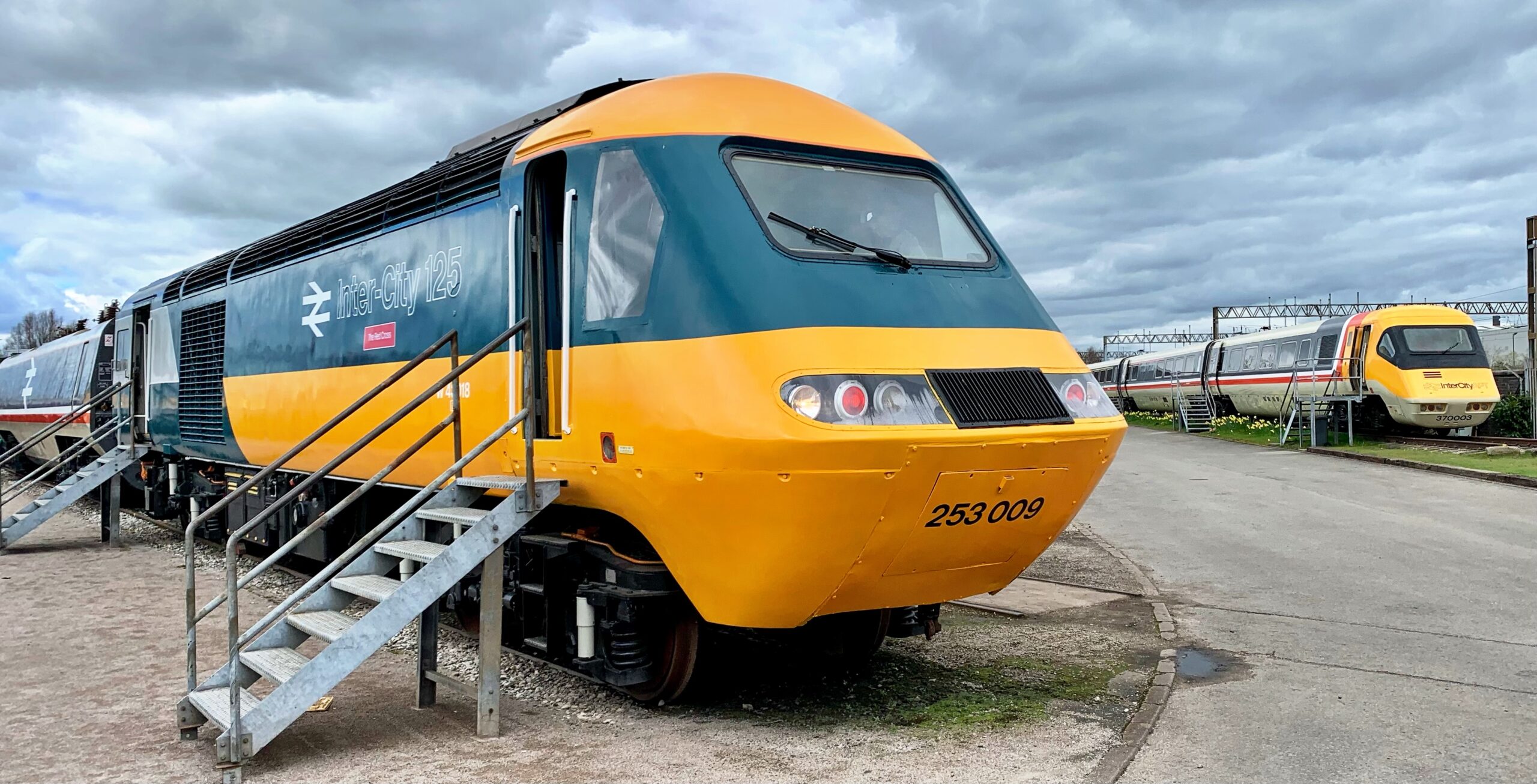
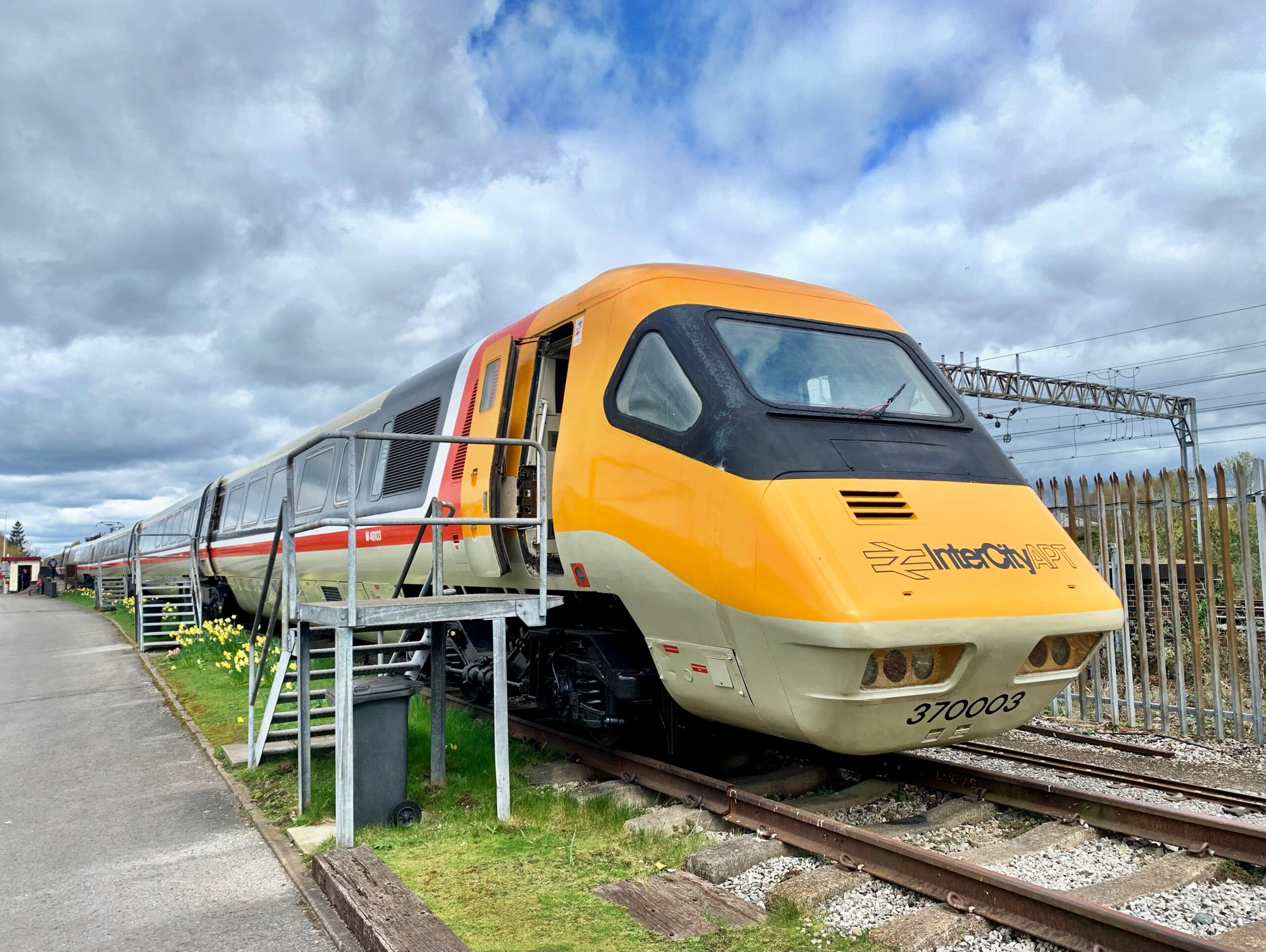
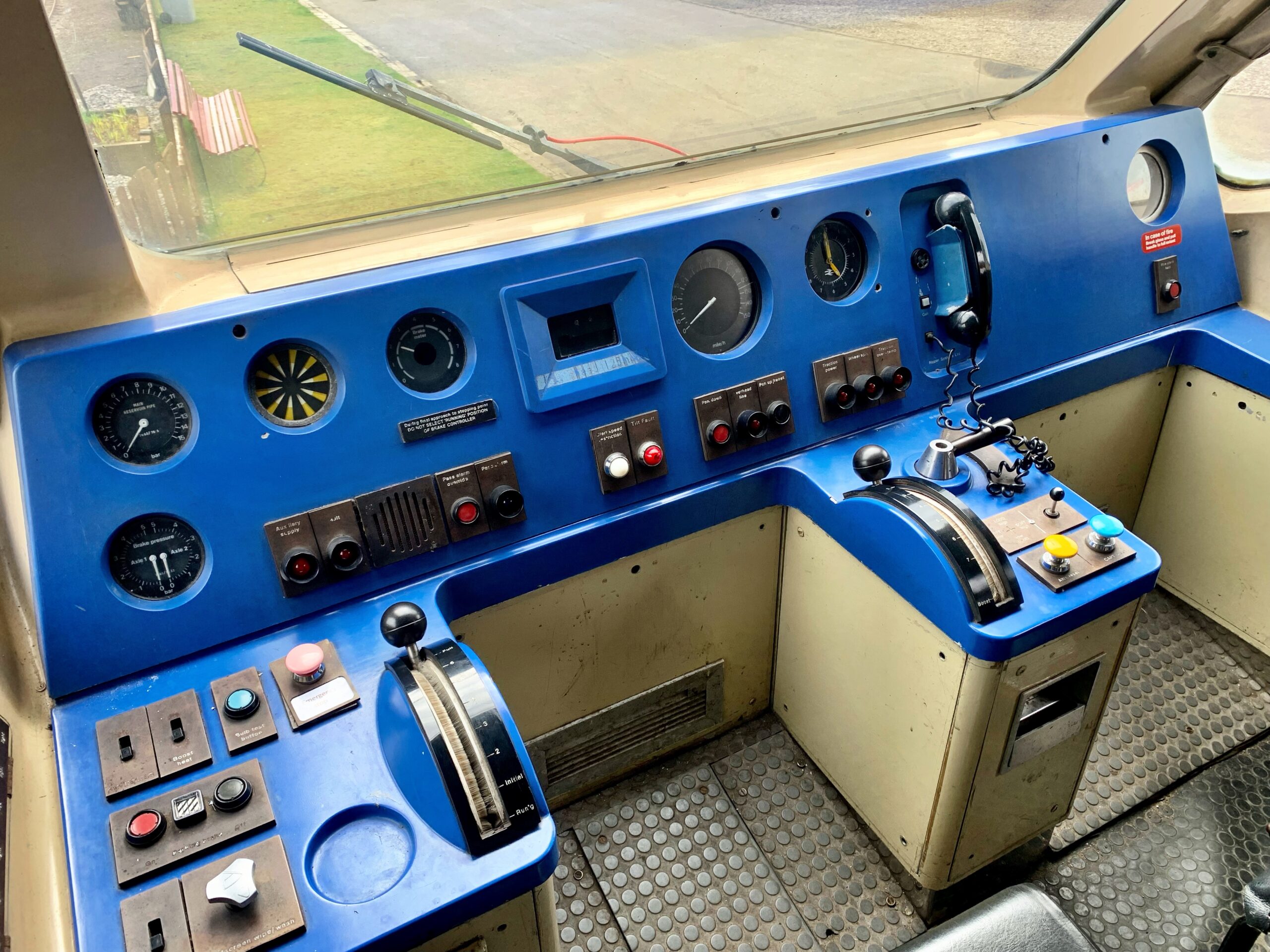
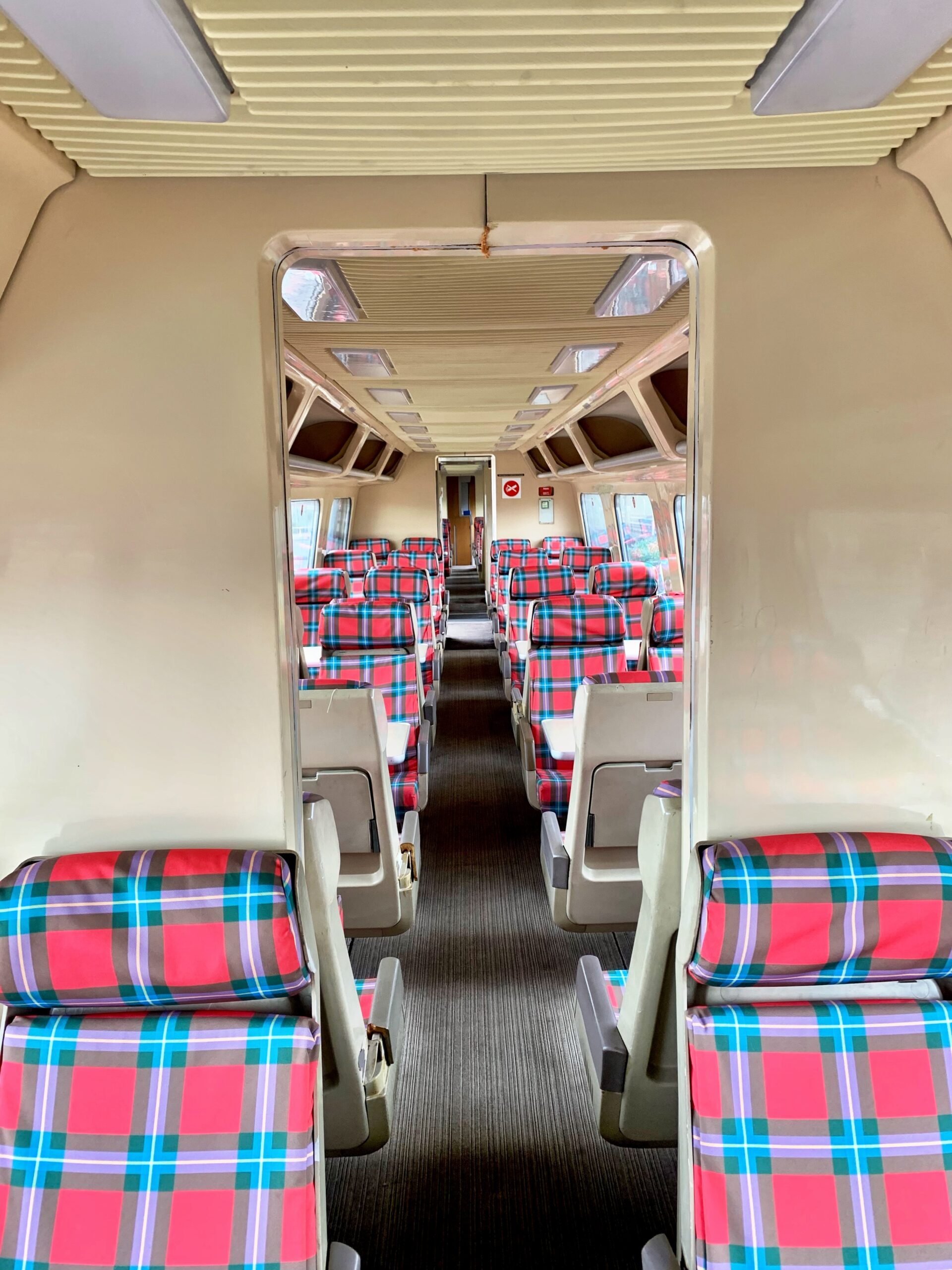
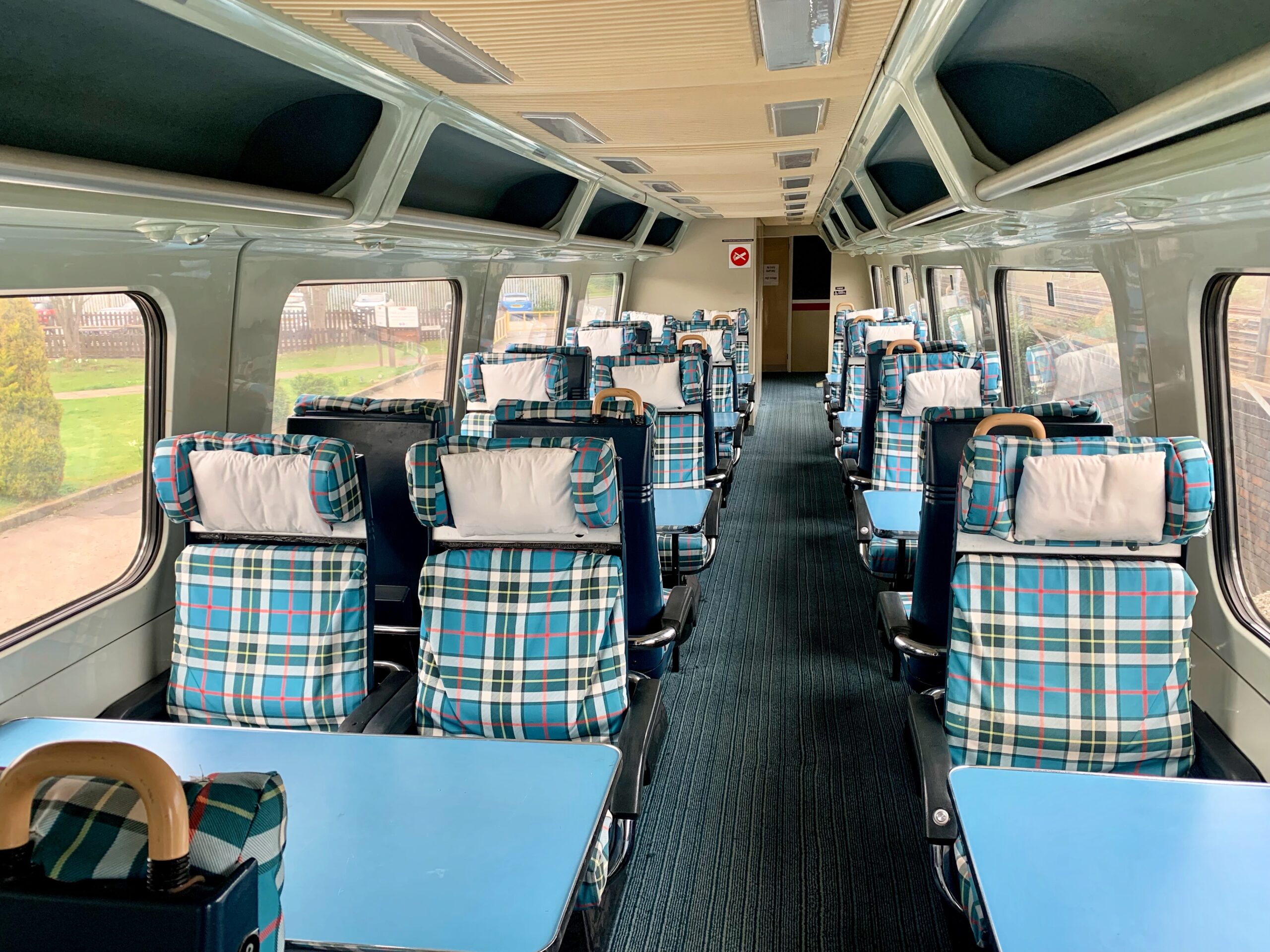
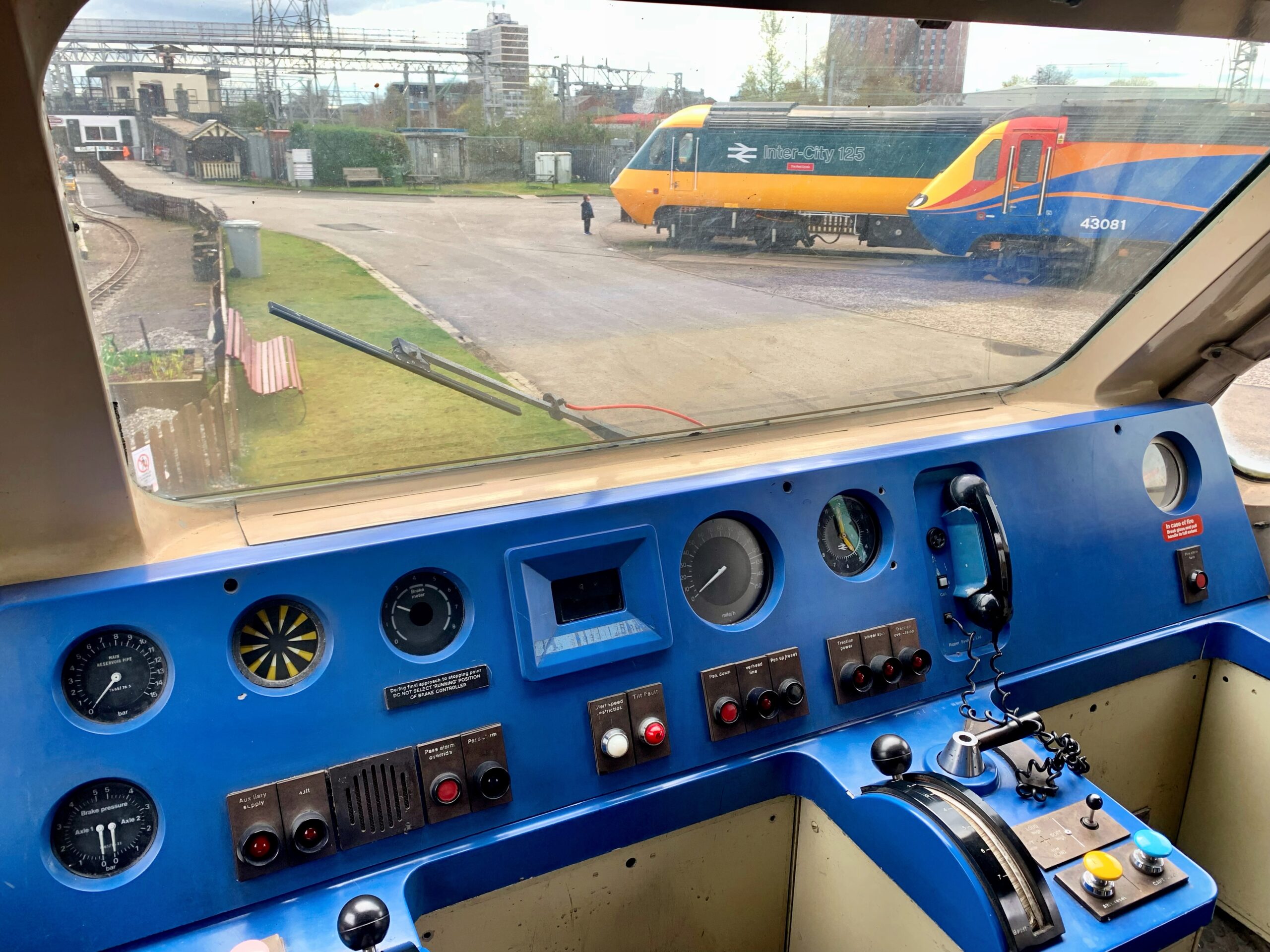
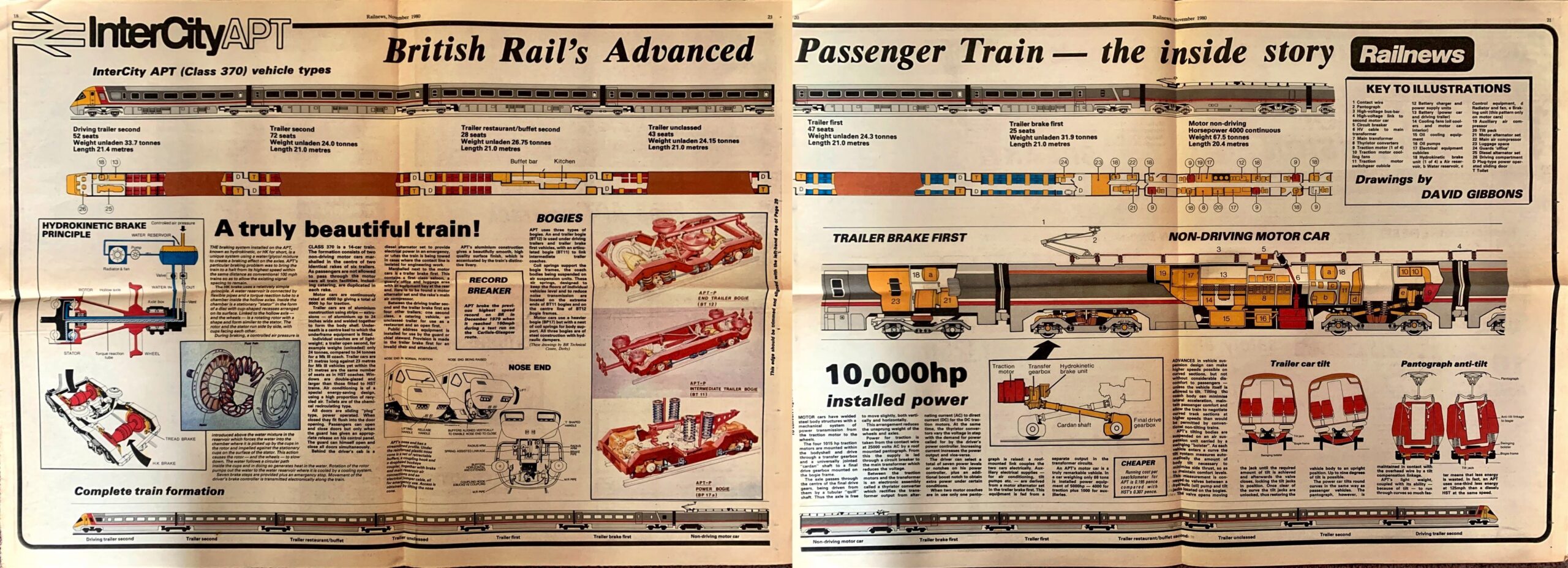
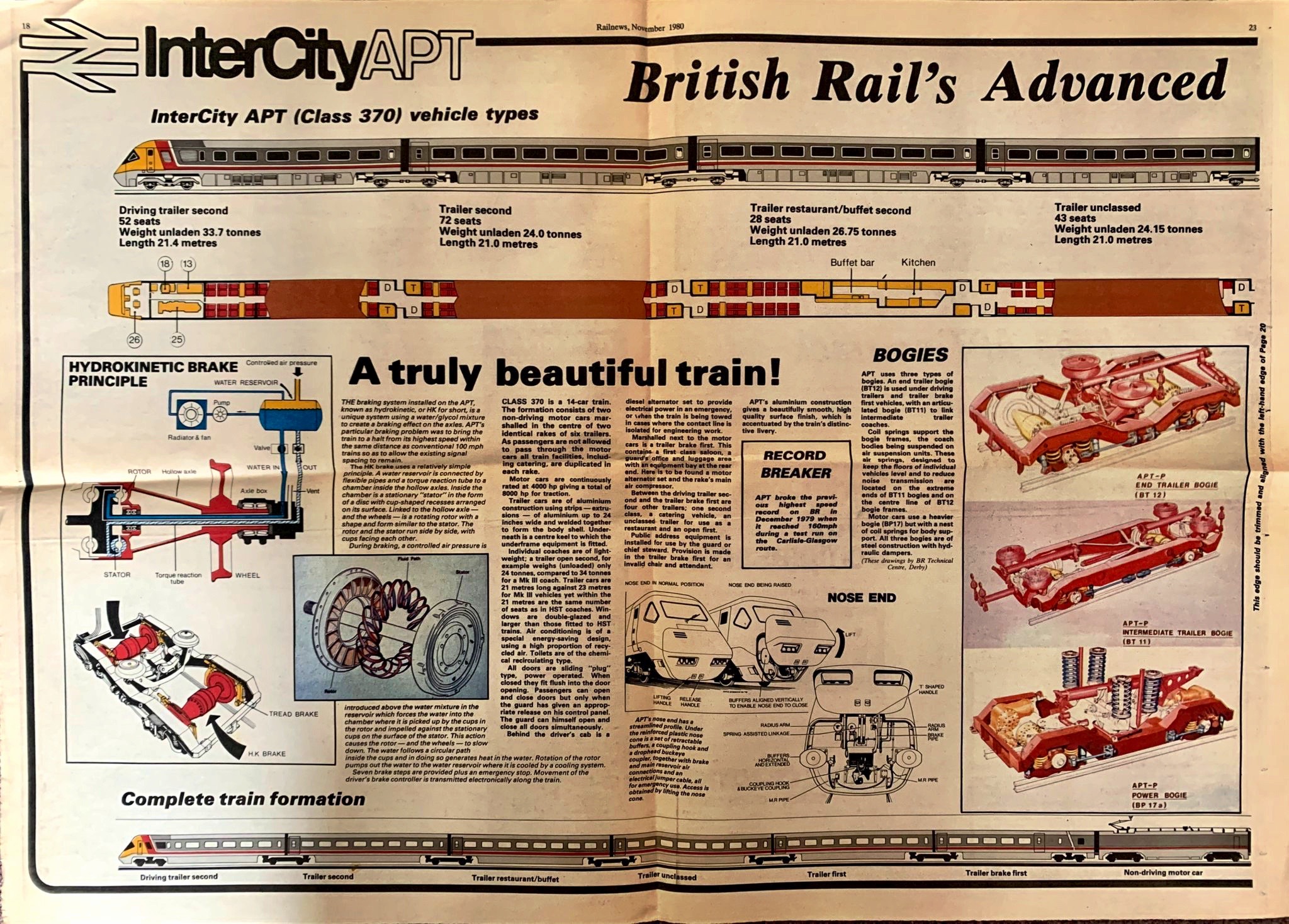
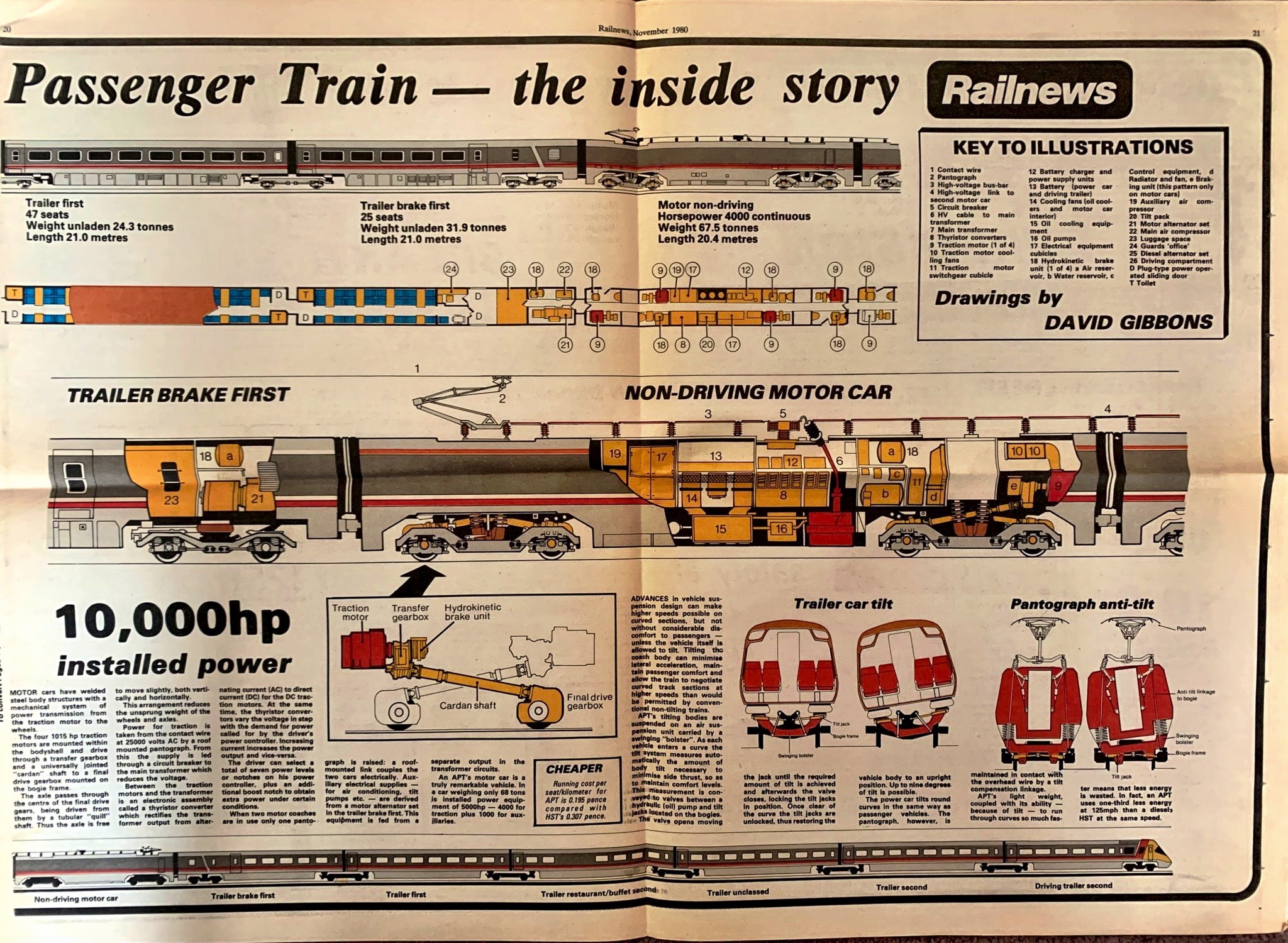
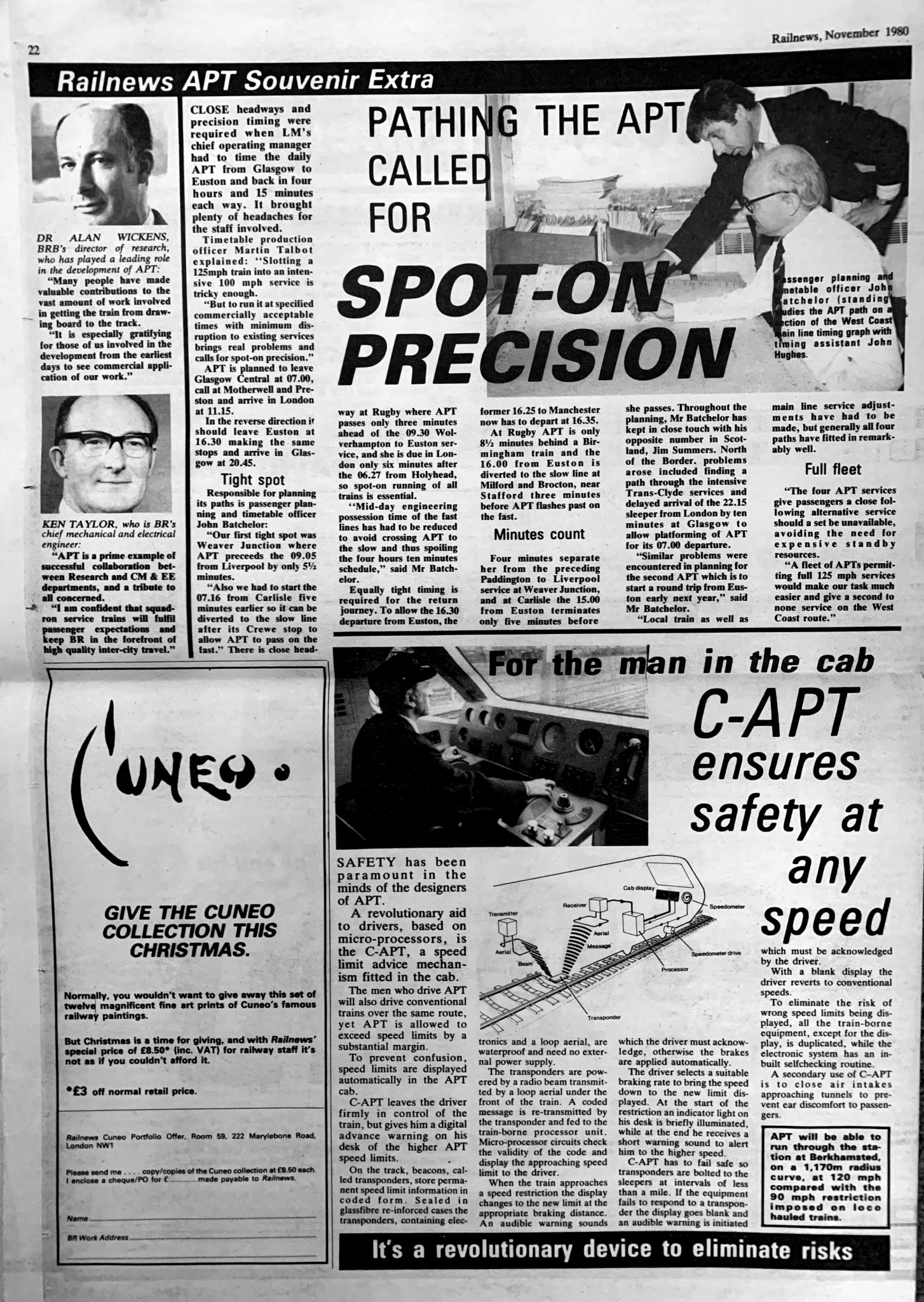
The Inter City APT-P (Advanced Passenger Train Prototype) was donated to the Crewe Heritage Centre by British Rail in 1988, this would become the only APT-P to be preserved and is the first thing visitors see on arrival – 01/04/2023
On Saturday April 1st, Yoshi’s mama had a weekend away planned with friends in Oxford. Organised before the announcement of rail strikes, I had a cunning plan for an adventure of my own when Mick Lynch of the RMT declared “everyone out!” By the time the April strike day was suspended, I’d already committed myself to an overnight stay in Derby. So after a stop at the Oxford Park & Ride, my chum @da_buckley967 and myself headed North to Crewe as we had booked a visit to the Freightliner depot at Crewe Basford Hall. Yoshi was still on his hols with his cousins as obviously he wasn’t going to be allowed to wander around a working railway yard. Our visit was scheduled to last for approximately one hour and kicked off at midday. Looking for some other things to do in the area, a visit to The Crewe Heritage Centre was an obvious choice. I was under the misunderstanding that dogs were not allowed on site, but I am happy to report that dogs are very much welcomed, and indeed, they enjoy free admission and doggy watering stations are spotted about the museum to help keep them hydrated. Owners are catered for in the cafe where tea, coffee, cold drinks and snacks are available.
The former Crewe North Junction Signal Box now contains a cafe, viewing point, model railway and signalling equipment. Constructed in 1938 by the London Midland & Scottish (LMS) Railway Company and built to an ‘ARP’ (Air Raid Precautions) design, with 38cm thick reinforced concrete walls and a 45cm thick concrete roof. The new ‘electric’ Signal Box was constructed directly in front of the previous 1906 building; this was partially demolished in 1940 with only the ground floor being retained and converted into a Linesmans’ hut. In 1985 as part of the Crewe Station remodelling project this Signal Box was closed with control being handed over to the new Signalling Centre on the opposite side of the Crewe to Chester Line.
The Crewe Heritage Centre is nestled between the Crewe to Chester line and West Coast Mainline on part of the site of the original Crewe Locomotive Works. The Heritage Centre was officially opened by Her Majesty Queen Elizabeth II and His Royal Highness the Duke of Edinburgh, on 24th July 1987 to mark the 150th anniversary of the first train to arrive at Crewe Railway Station in 1837. Originally forming part of the Crewe Heritage Festival which was an eight week long event with activities and celebrations taking place all over the town of Crewe, members of the public were also invited to visit the historic Locomotive Works and see first hand how railway locomotives were constructed and maintained by British Rail.
Following a really successful festival, Crewe and Nantwich Borough Council decided to open the Heritage Centre again in 1988, and in 1989 the council handed the running of the museum over to the newly formed Crewe Heritage Trust who continue to operate the museum to this day. We really enjoyed our visit and I hope to return with Yoshi in tow one day soon!
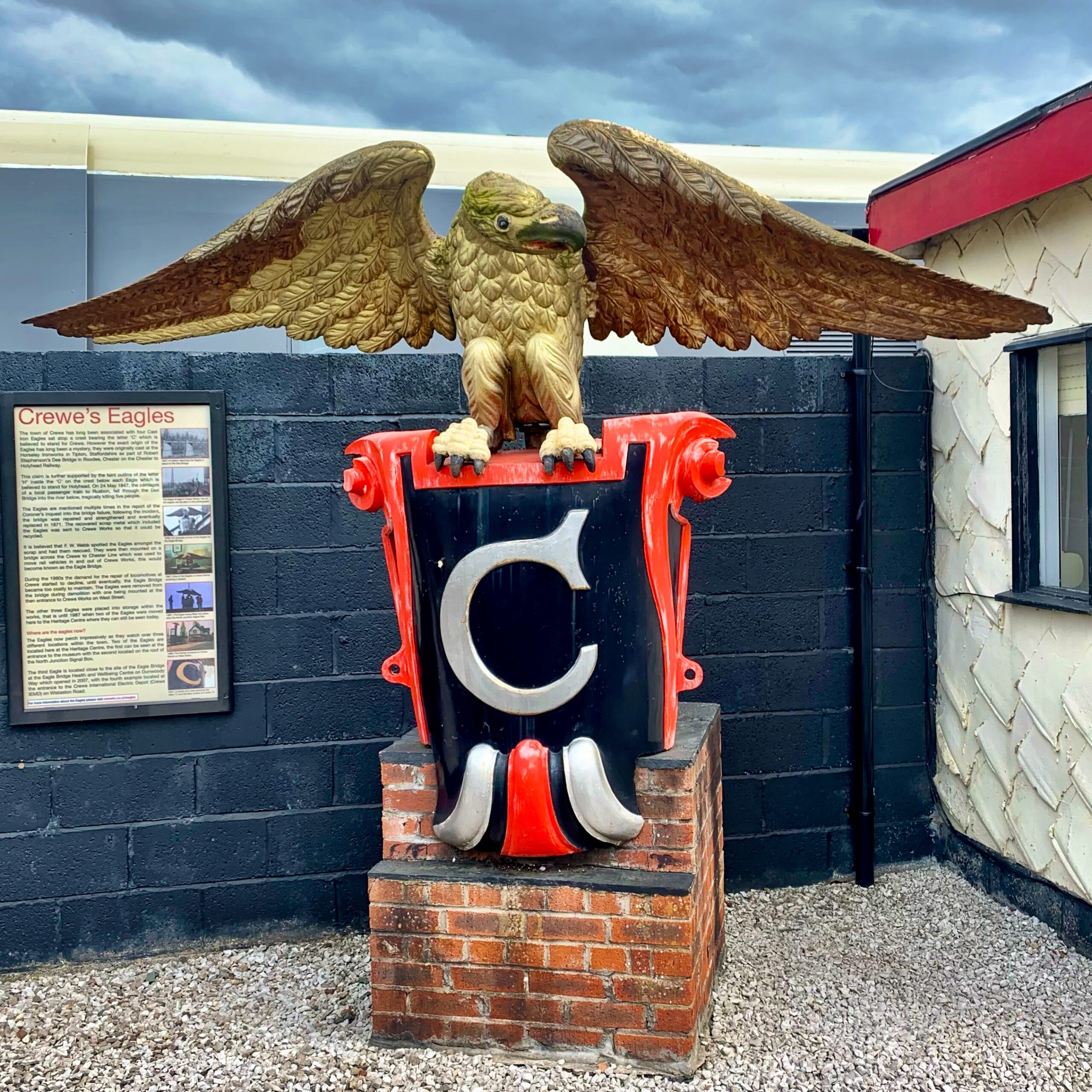
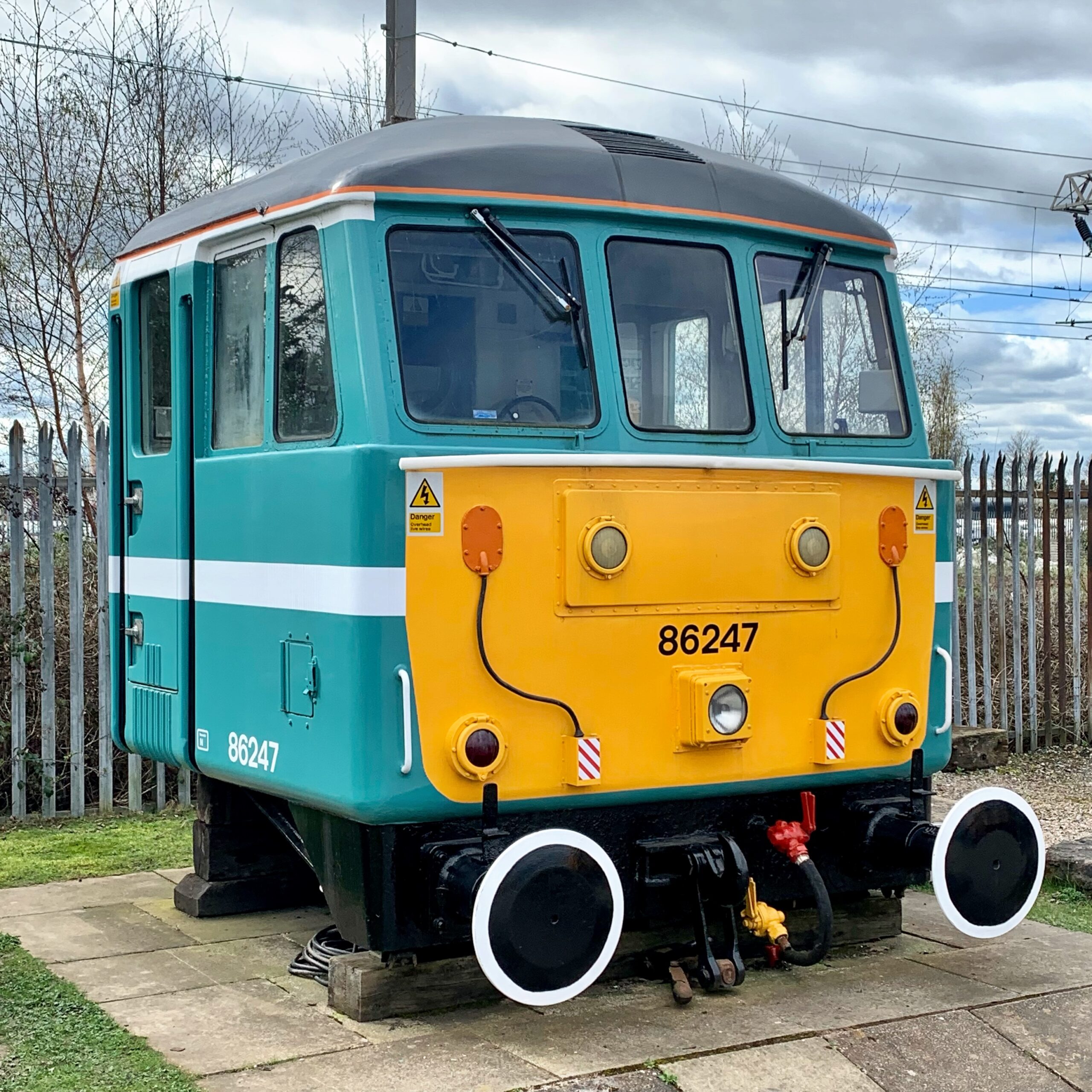
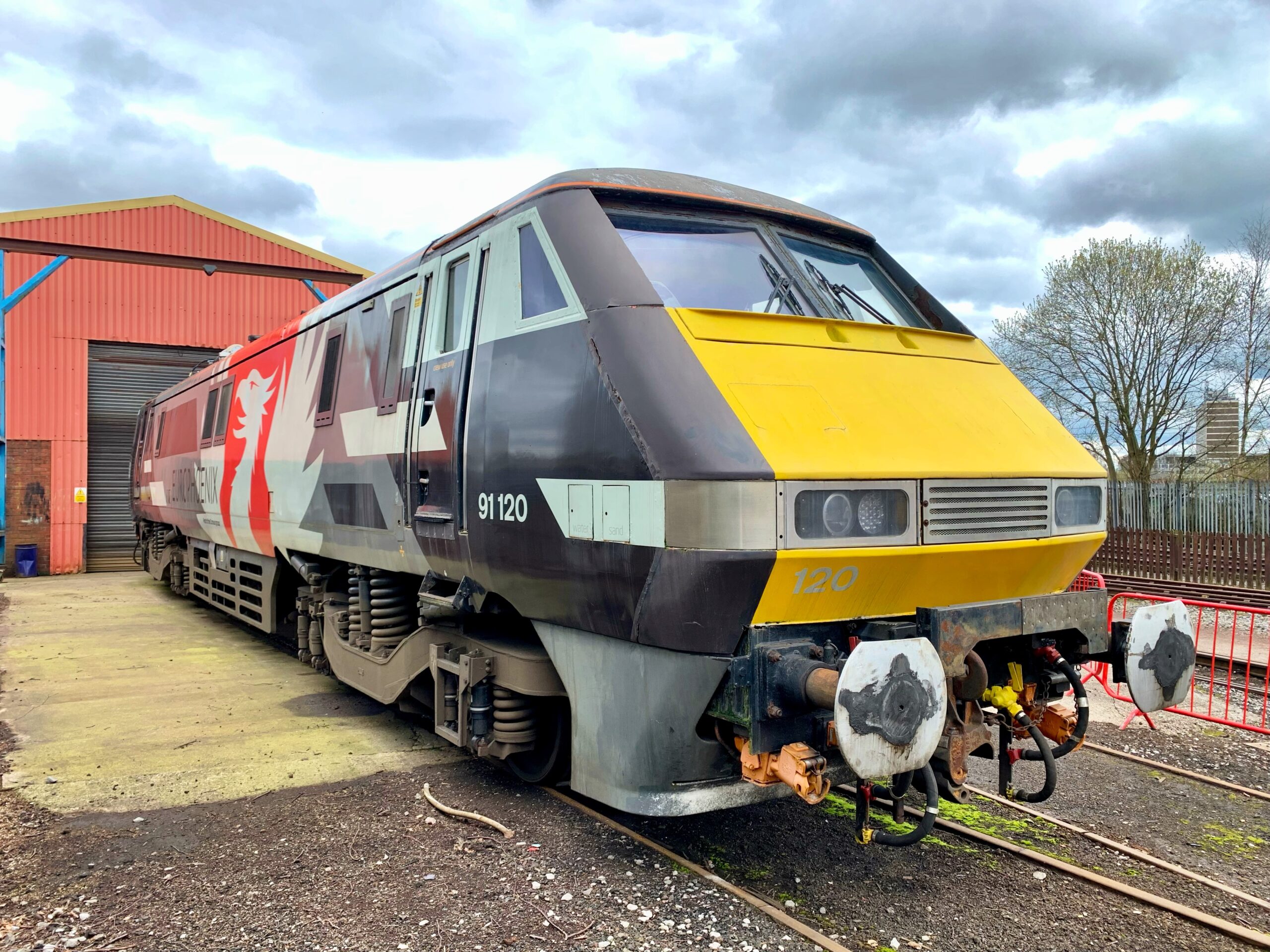
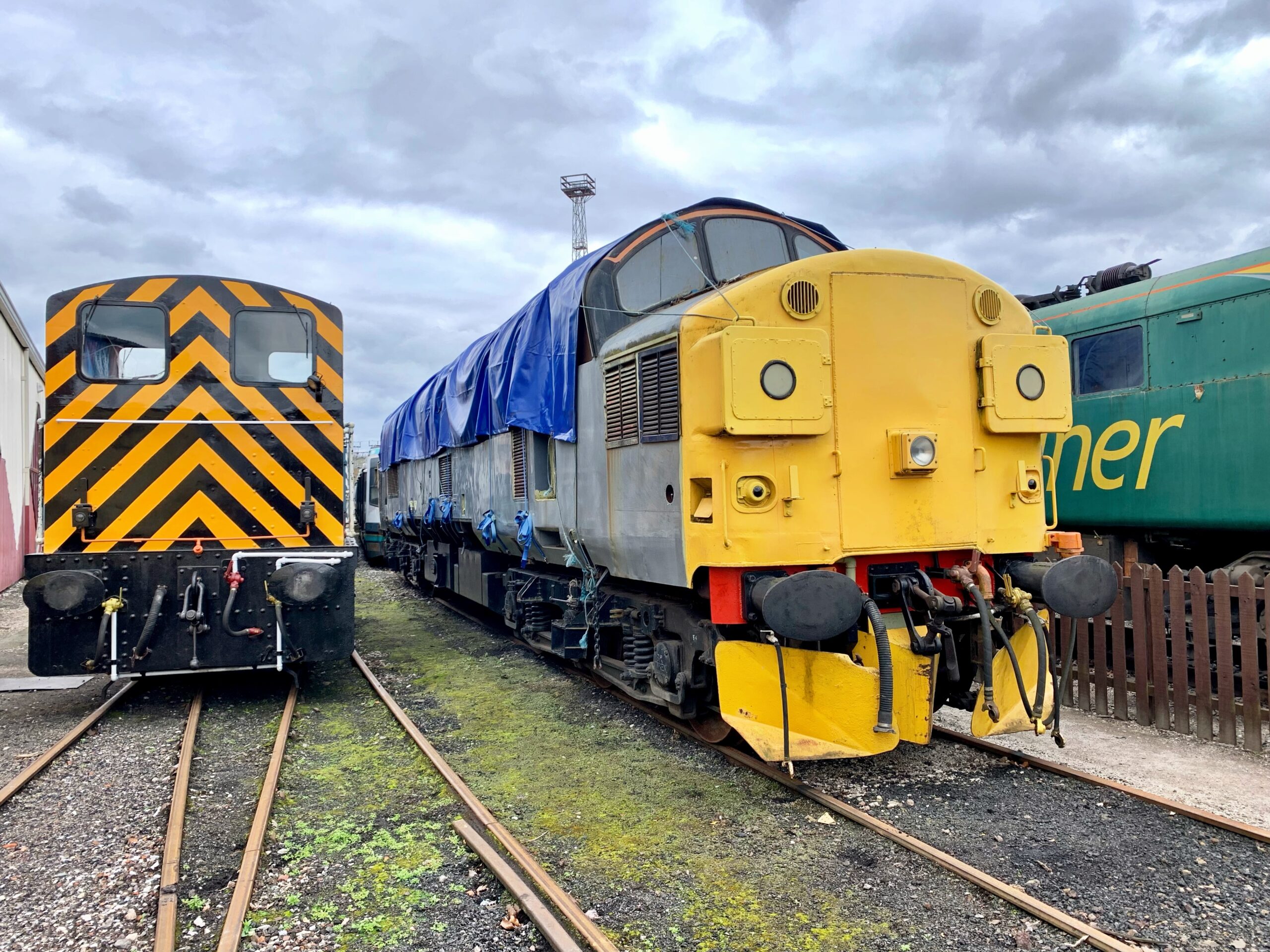
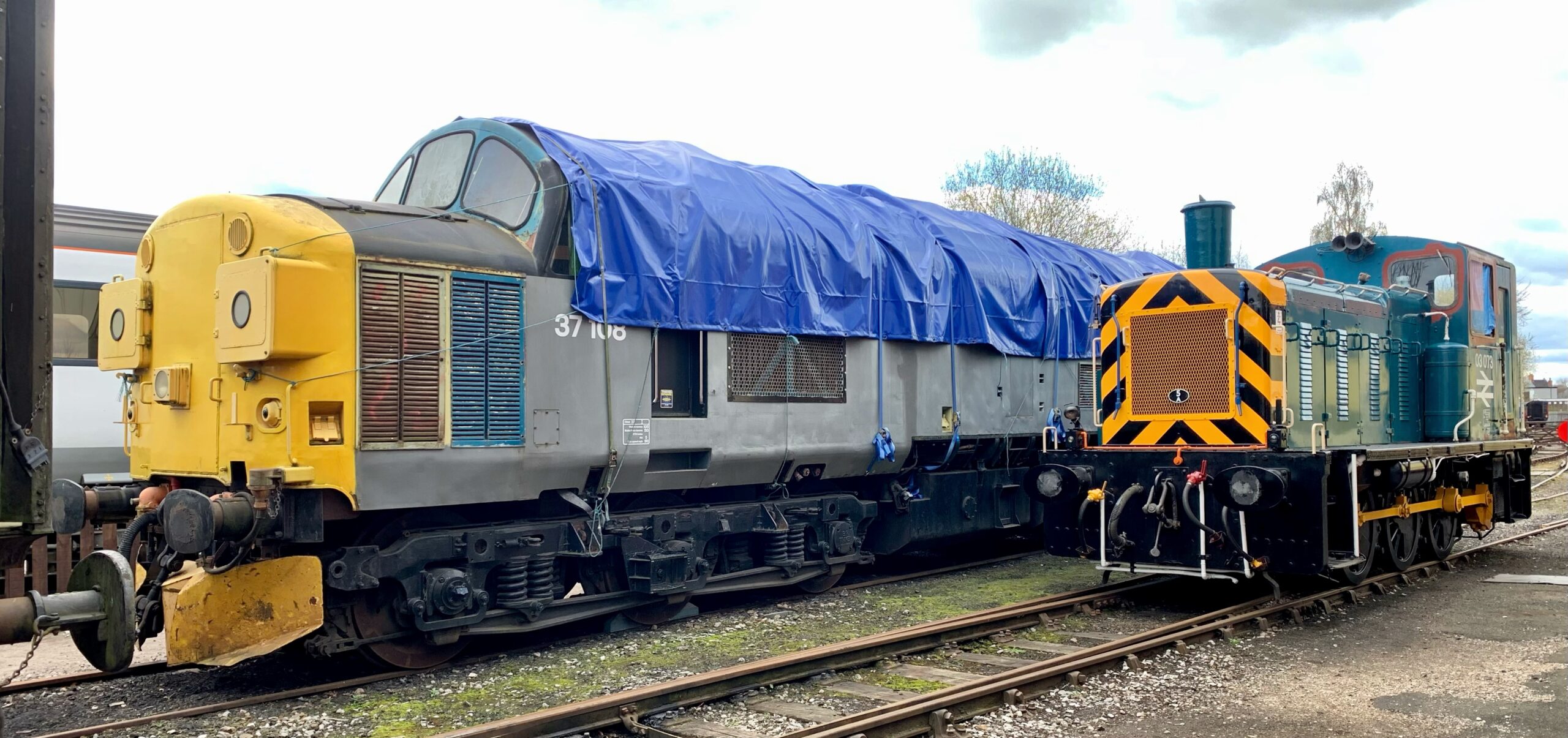
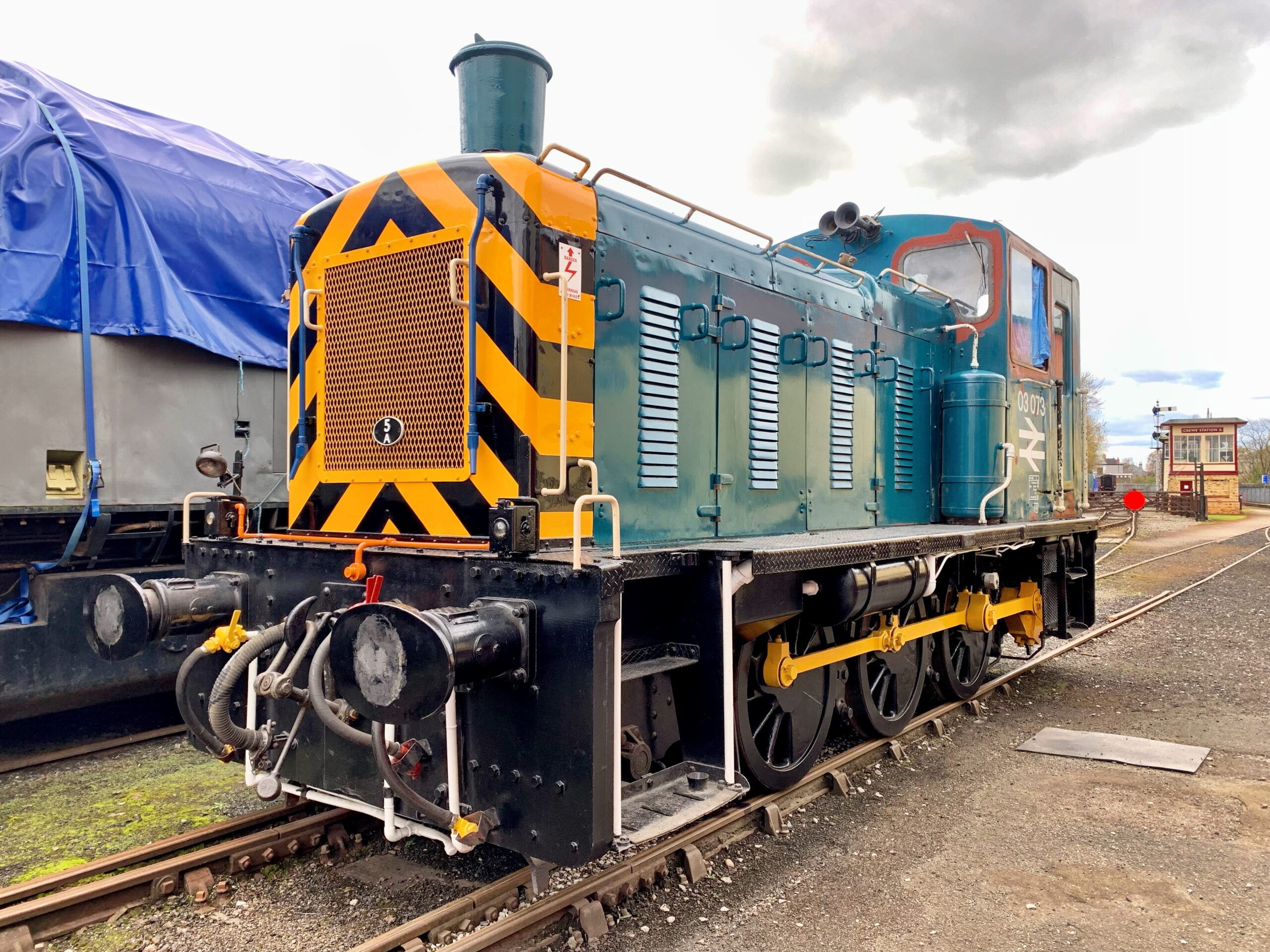
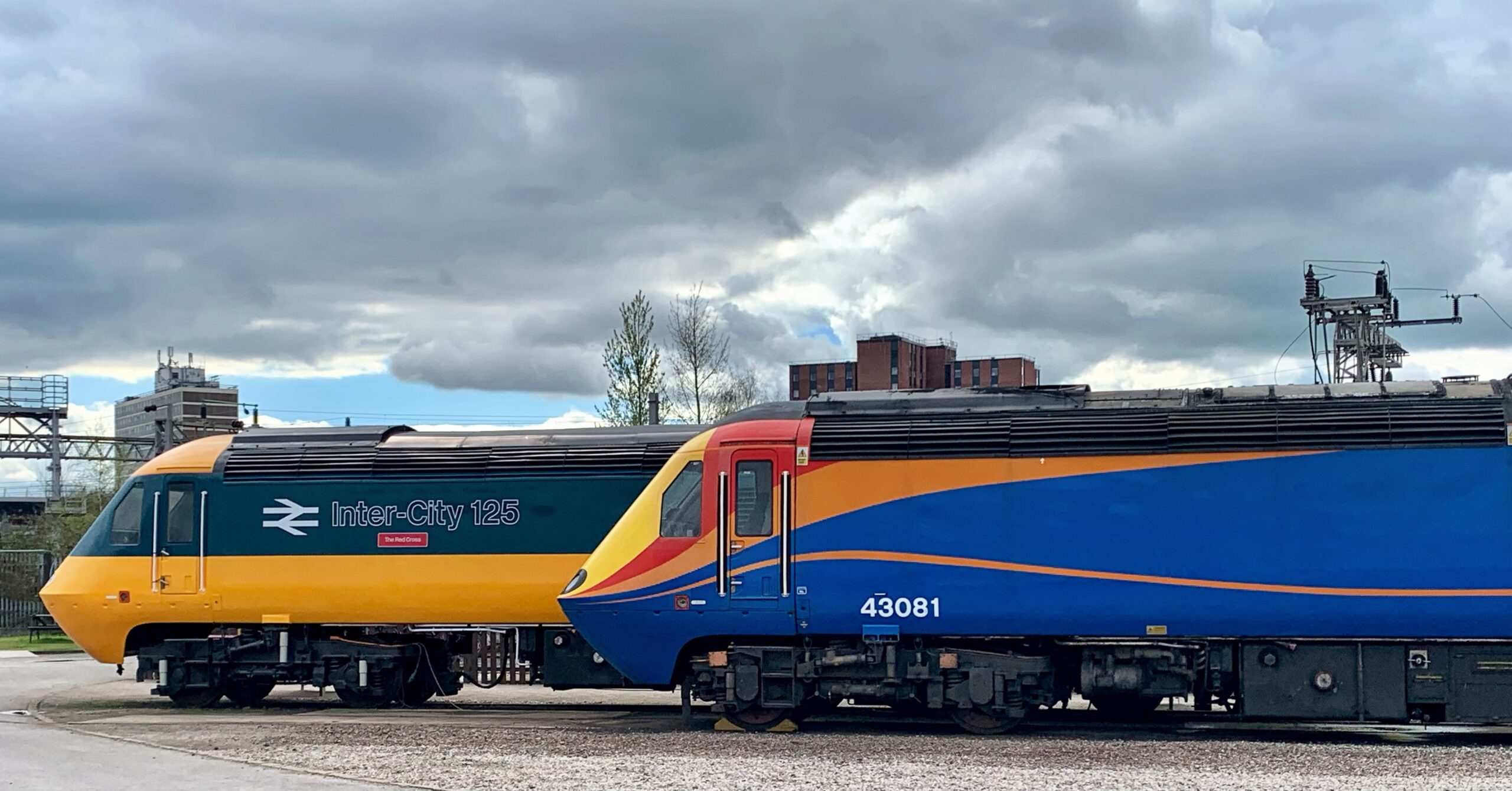
Crewe Station ‘A’ Signal Box with Exeter West Signal Box behind – 01/04/2023In 1991, the dismantled sections of Exeter West Signal Box are transported to the Heritage Centre from storage and the complex task of reconstructing the Signal Box begins in May, construction continued into 1992 with the Signal Box opening as part of the museum on May Day 1993 – 01/04/2023An example of a Crewe Eagle, four of which were mounted on a bridge crossing the Crewe to Chester railway line – 01/04/2023The No. 2 end cab of Class 86 No. 86247 was restored at the Heritage Centre and currently displays the Anglia Railways livery, which whilst in service, the locomotive never actually carried. The locomotive was scrapped in 2015 with both cabs being saved. The No. 1 end cab can be seen at The Cab Yard Project in Bridgend – 01/04/2023 One of two Class 86/6 locomotives to be given the Freightliner Powerhaul green and yellow livery No. 86622 is on long term loan at the Heritage Centre – 01/04/2023Through an agreement between the Crewe Heritage Trust and Europhoenix British Rail Class 91 No. 91120 arrived at the Heritage Centre in 2022 – 01/04/2023Released from English Electric Vulcan Foundry in January 1963 – Works Number EE/VF3237/D762 1962 – and originally numbered No. D6808, Class 37 No. 37108 was moved to the Heritage Centre from Carnforth by road in 2010 – 01/04/2023Class 37 No. 37108 alongside Class 03 No. 03073 – 01/04/2023With the kind support of British Rail, the Heritage Centre was able to acquire Doncaster built Class 03 Diesel Shunter No. 03073 in 1990, this would be the first shunting locomotive to be preserved by the Heritage Centre – 01/04/2023Thanks to a generous donation by Porterbrook the Heritage Centre secured the High Speed Train (HST) Power Car No. 43081, the 8,000th locomotive to be constructed in Crewe Work – 01/04/2023Crewe built HST Power Car No. 43018 on static exhibition was acquired by the Heritage Centre in 2020 – 01/04/2023Visitors to the Heritage Centre can visit the cab of one of the driving trailers from set 370003 – 01/04/2023The very 1970’s high tech cab arrangement of APT-P – 01/04/2023Standard Class (probably still called second class in the 1980’s) seating in APT-P – 01/04/2023The “fully stocked bar” in the buffet car of APT-P – 01/04/2023First class seating on board APT-P – 01/04/2023The view from the cab window of the APT-P driving car – 01/04/2023
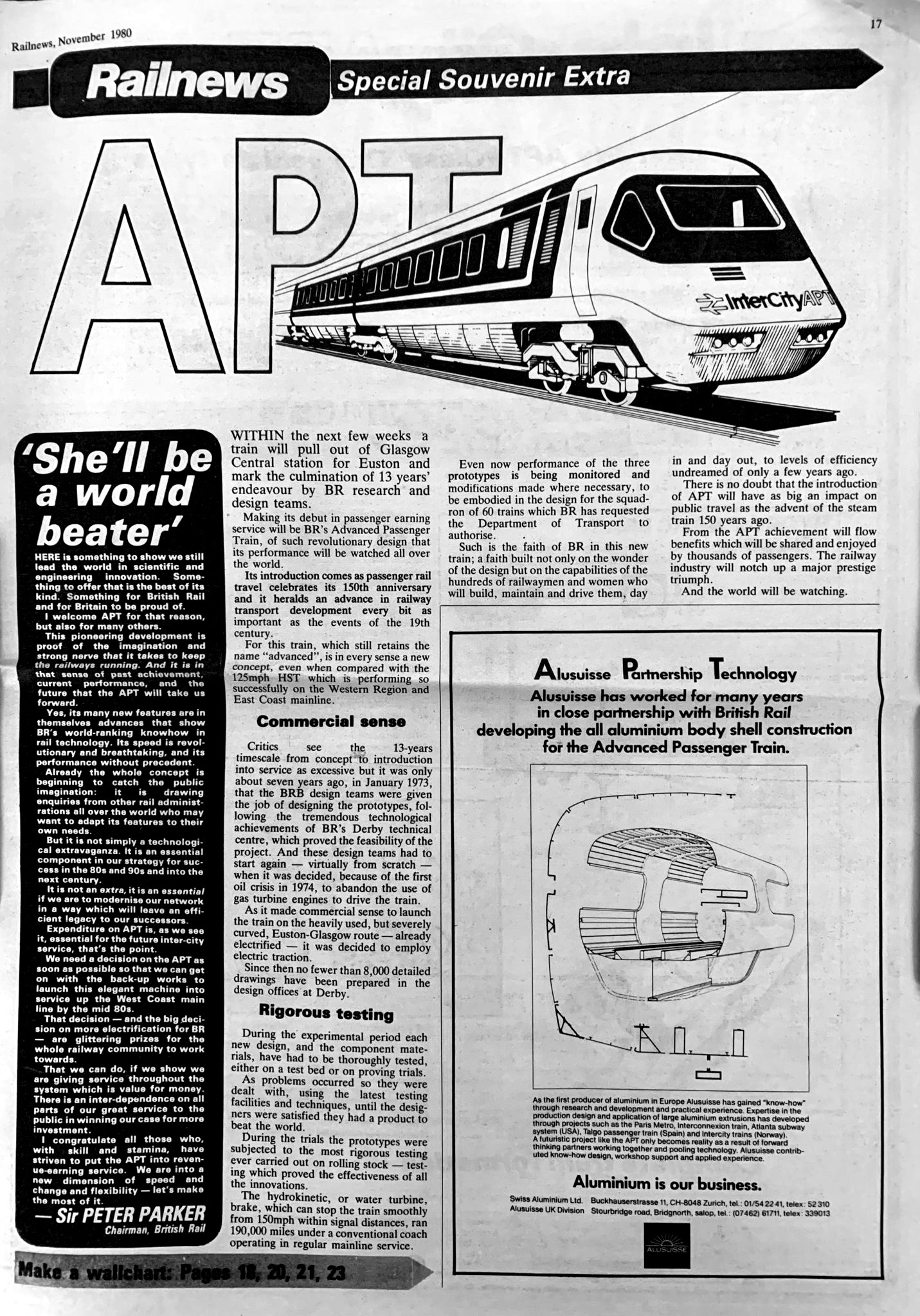
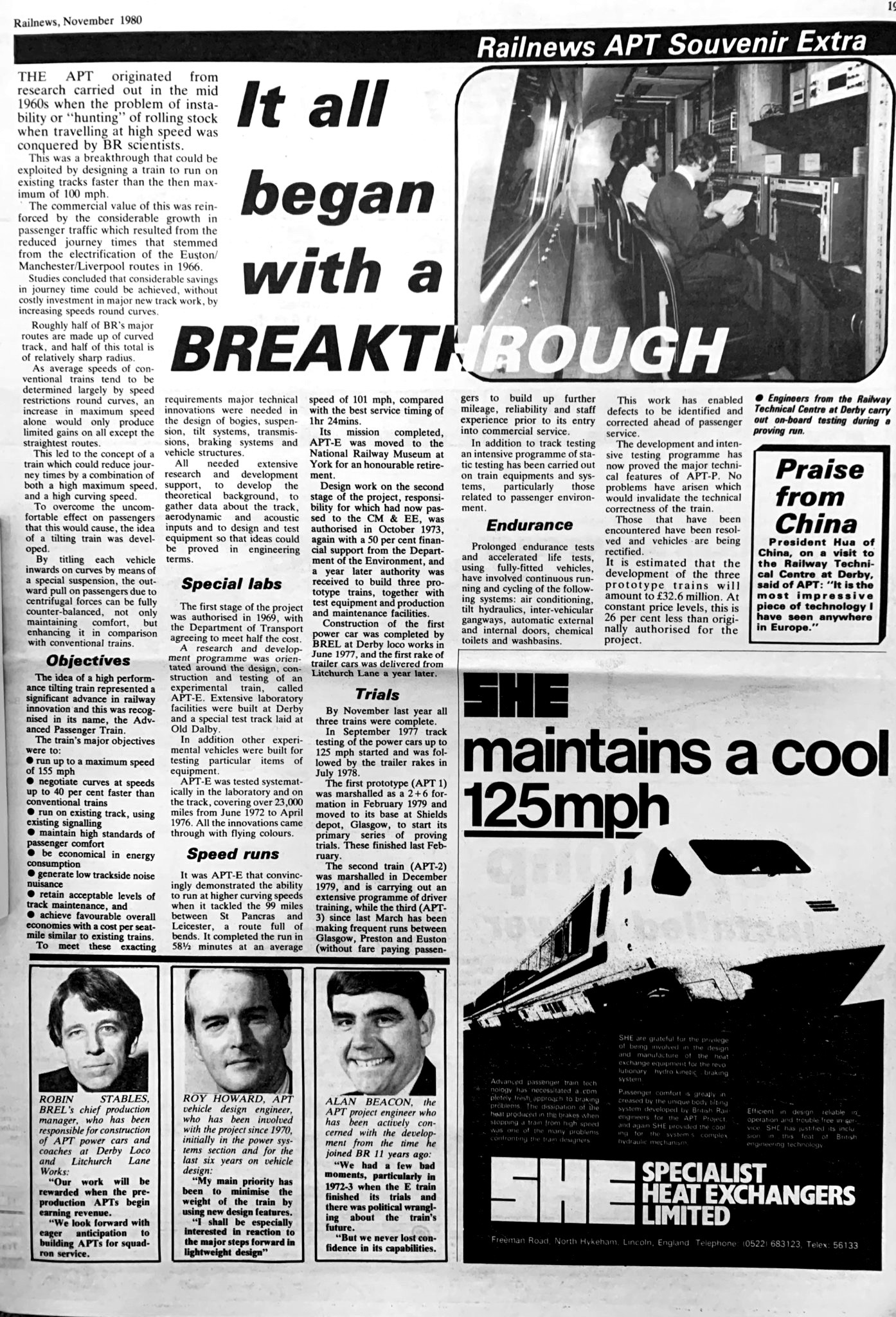
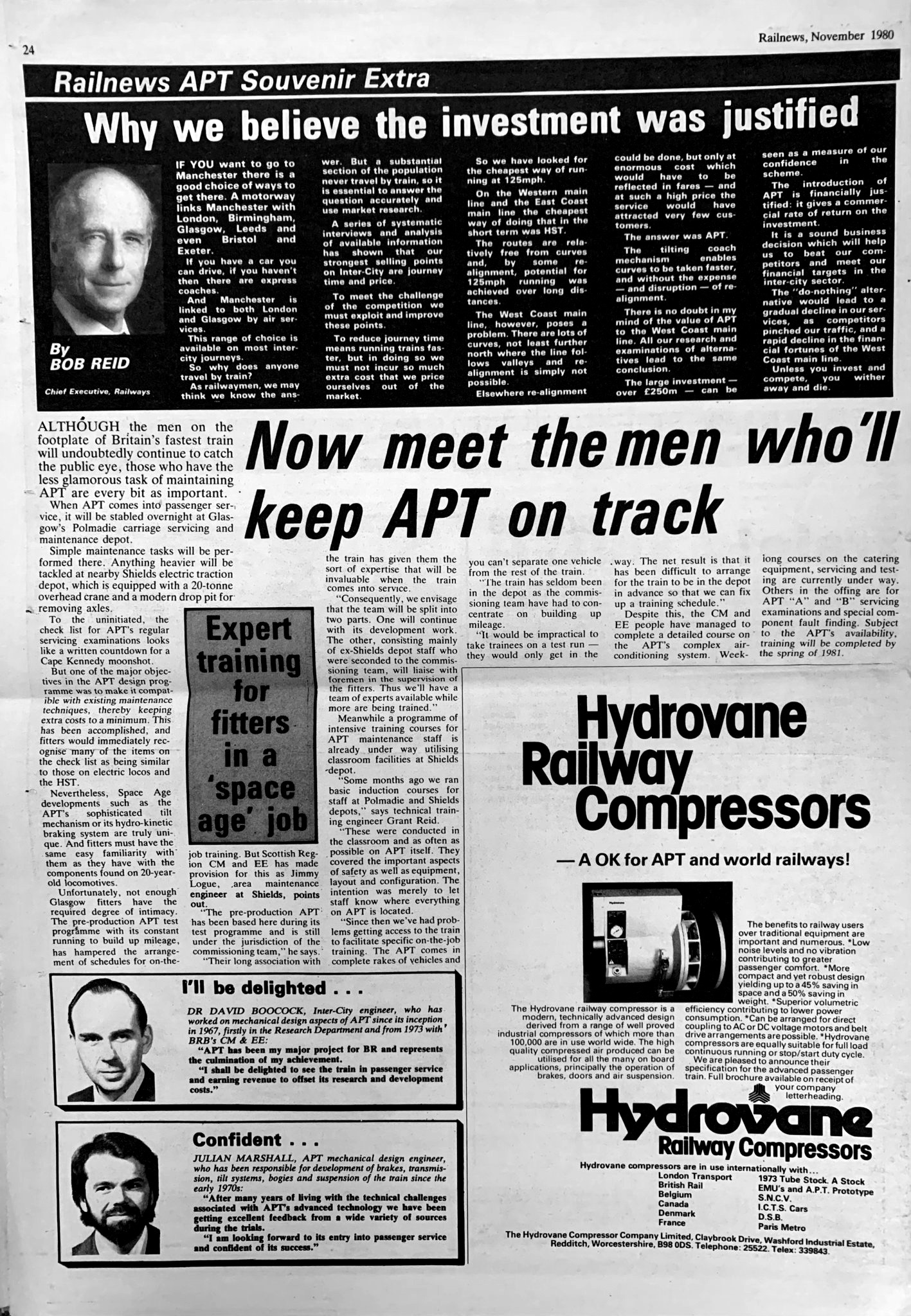
In the November 1980 edition of Railnews, the industry newspaper, there was pullout special souvenir all about the Advanced Passenger Train:
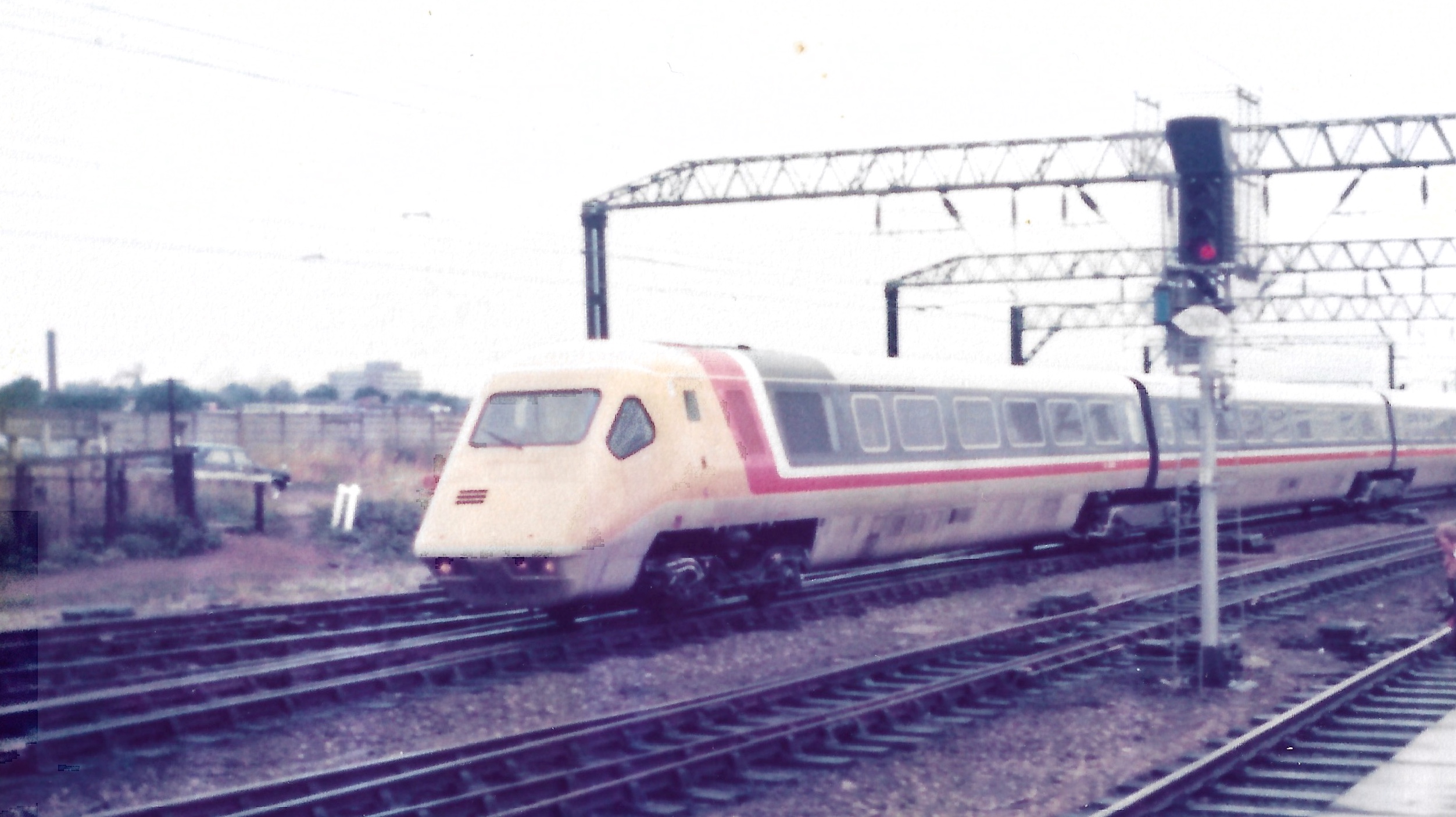
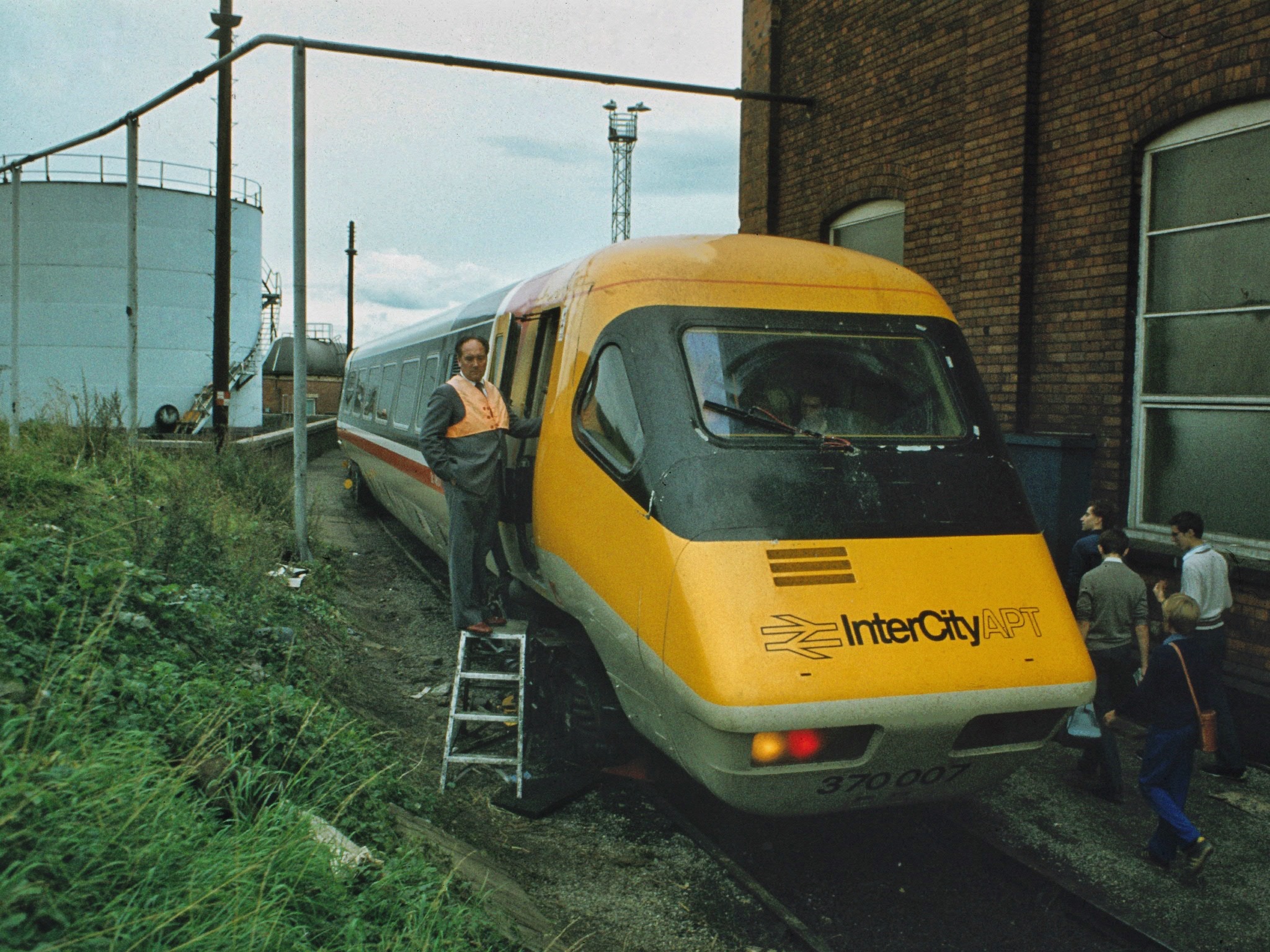
Proof I saw APT-P on the mainline! An unidentified APT at Crewe – 13/08/1978Driving trailer of APT-P set No. 370007 at Old Oak Common. The APT was apparently a late addition to the Open Day at Old Oak Common after lots of discussions over route clearance – 20/09/1981
We’ll tell you more about our weekend next time. I would have included more this week, but I have episodes of “Married At First Sight Australia” to catch up on.
Closer to home, Yoshi, his mama and I made the trip on Swanage Railway’s trial diesel multiple unit (DMU) service which we discussed in our previous blog entry. The trains were well used on Saturday 8th April, the day of our trip, which was good to see. This was despite widespread criticism of the ticket prices.
Swanage Railway’s three car Class 117 DMU stands at Wareham Platform 2 with the 1109 arrival from Swanage – 08/04/2023
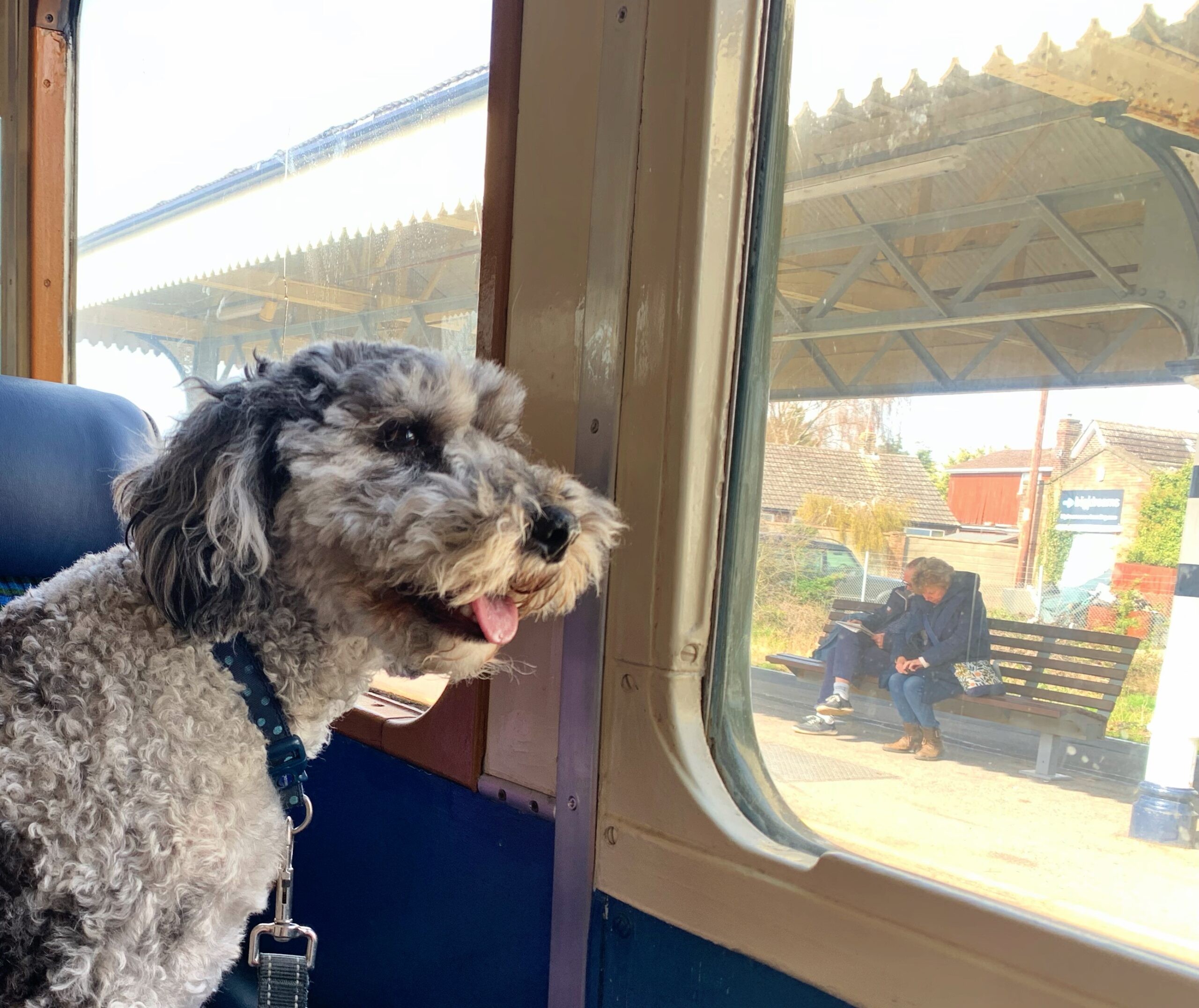
Yoshi had a good view out of the window along the route to Corfe Castle aboard the heritage Class 117 DMU – 08/04/2023Having arrived back in Wareham, Yoshi took a closer look at the Class 117 DMU – 08/04/2023
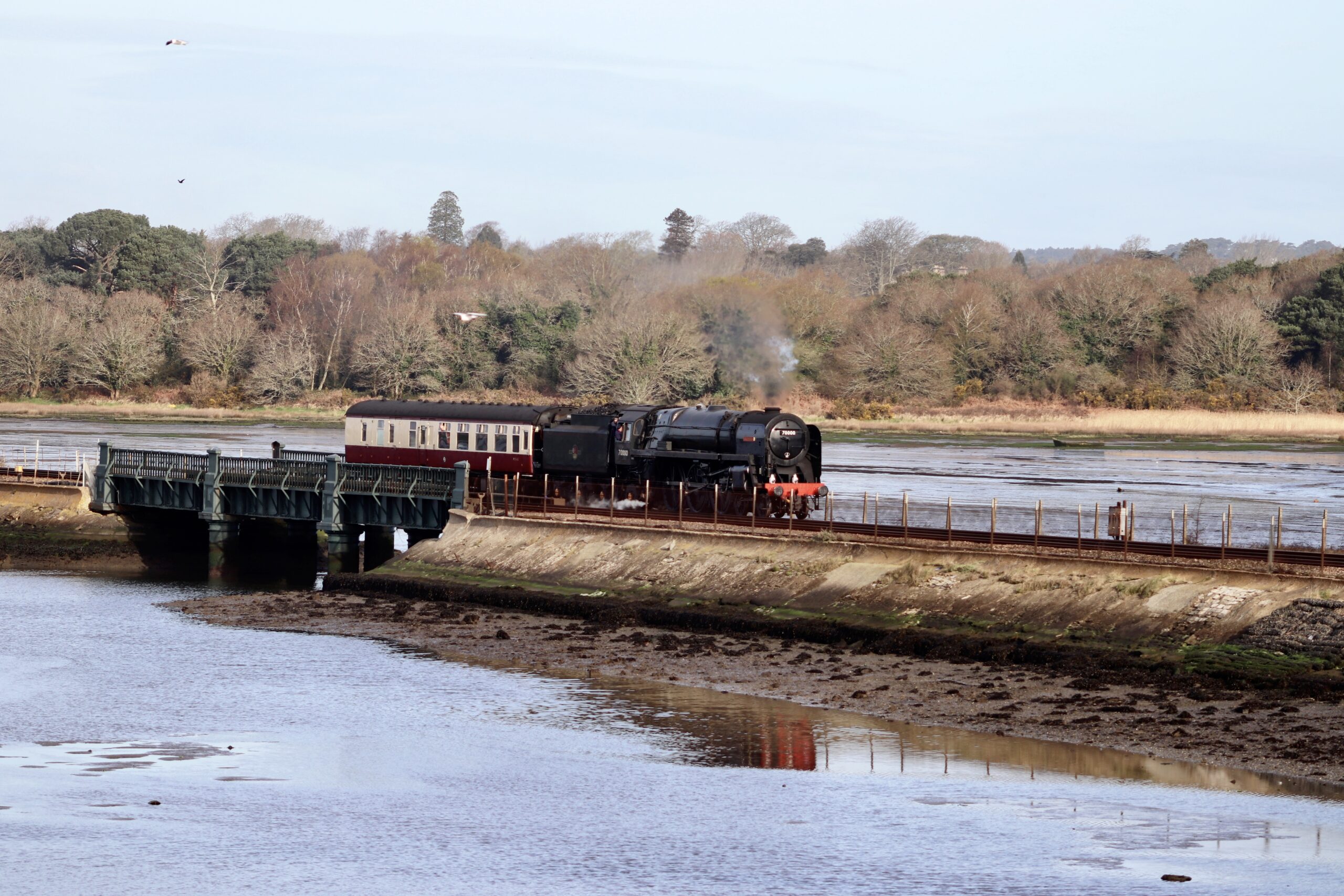
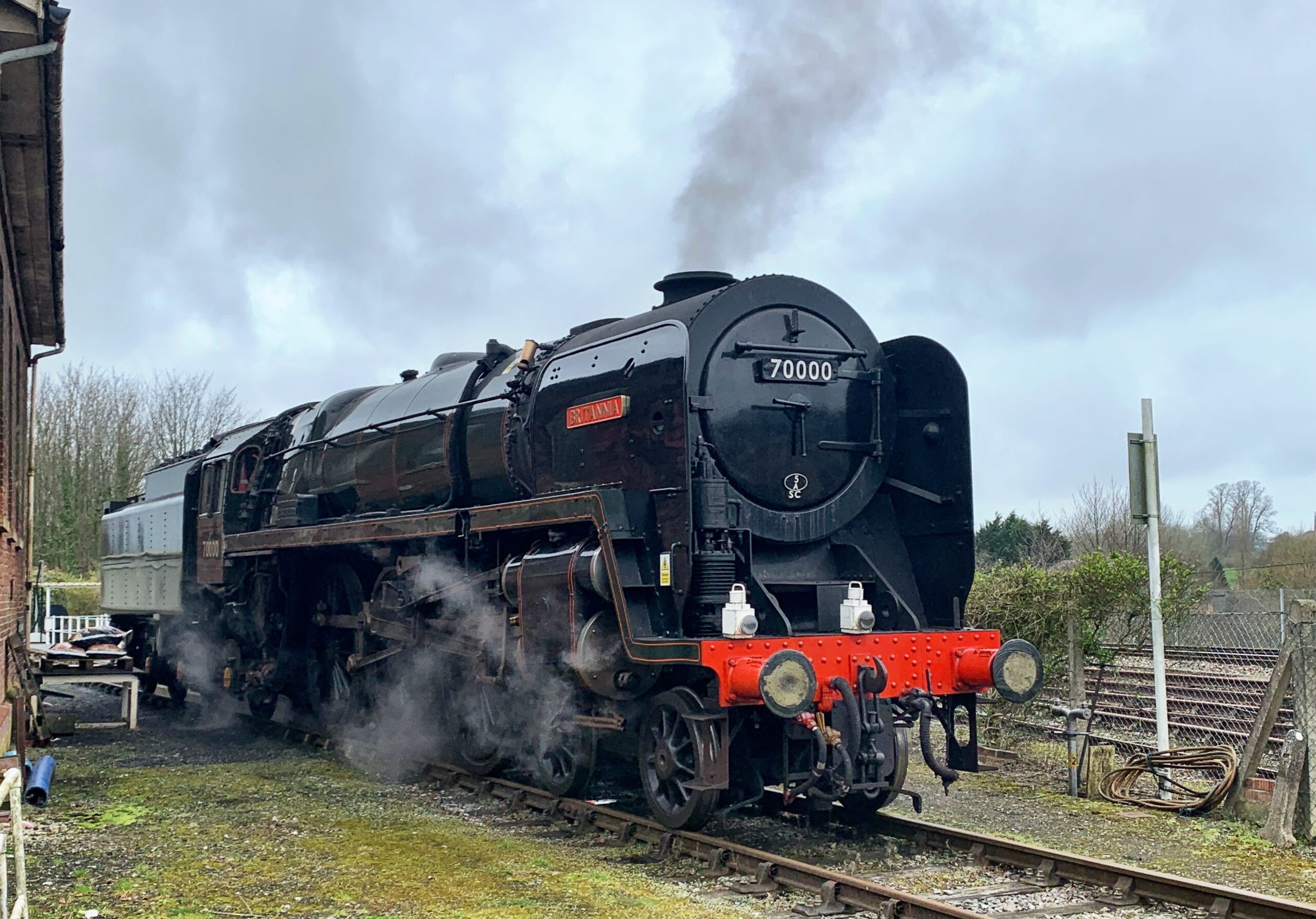
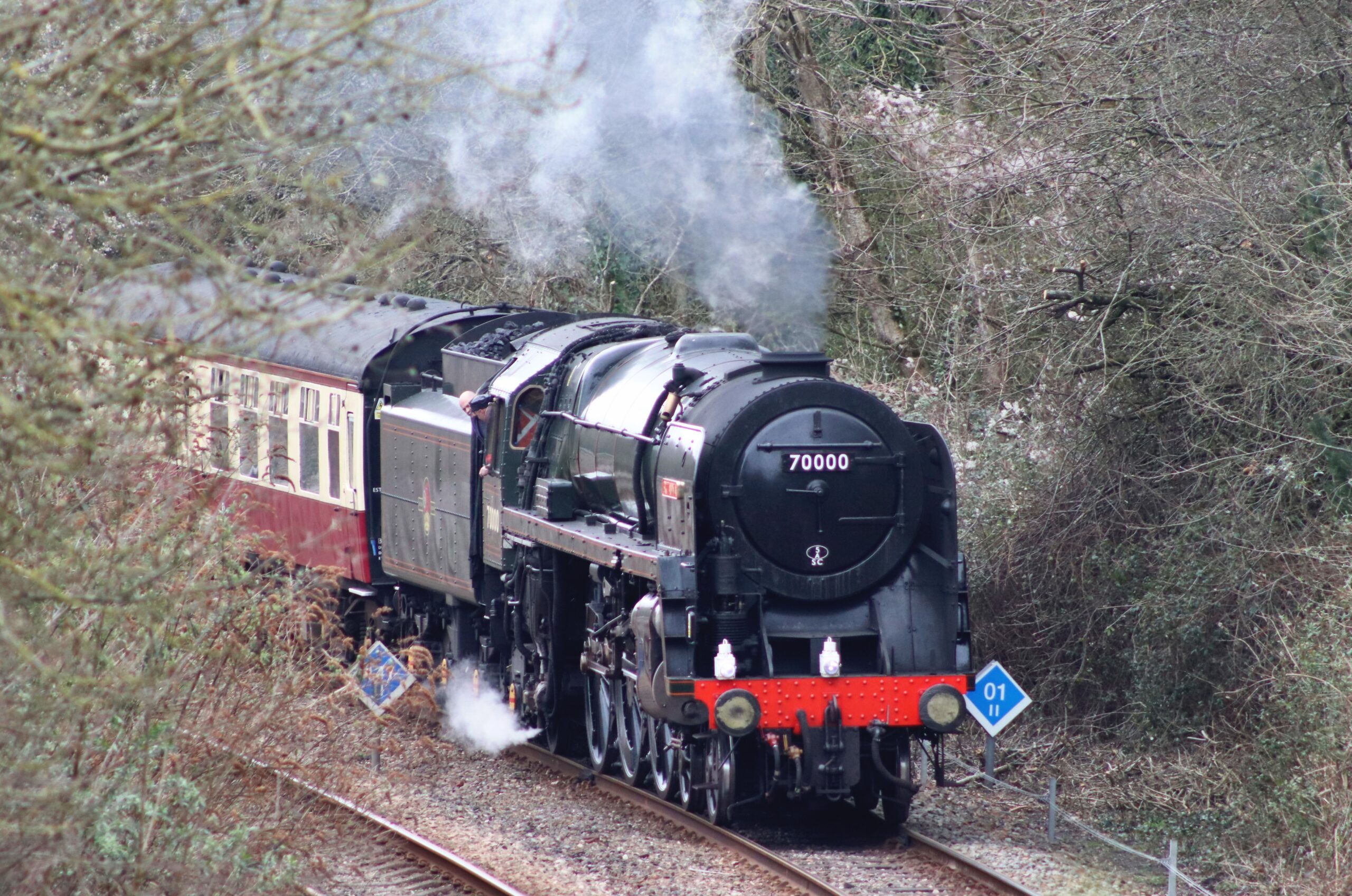
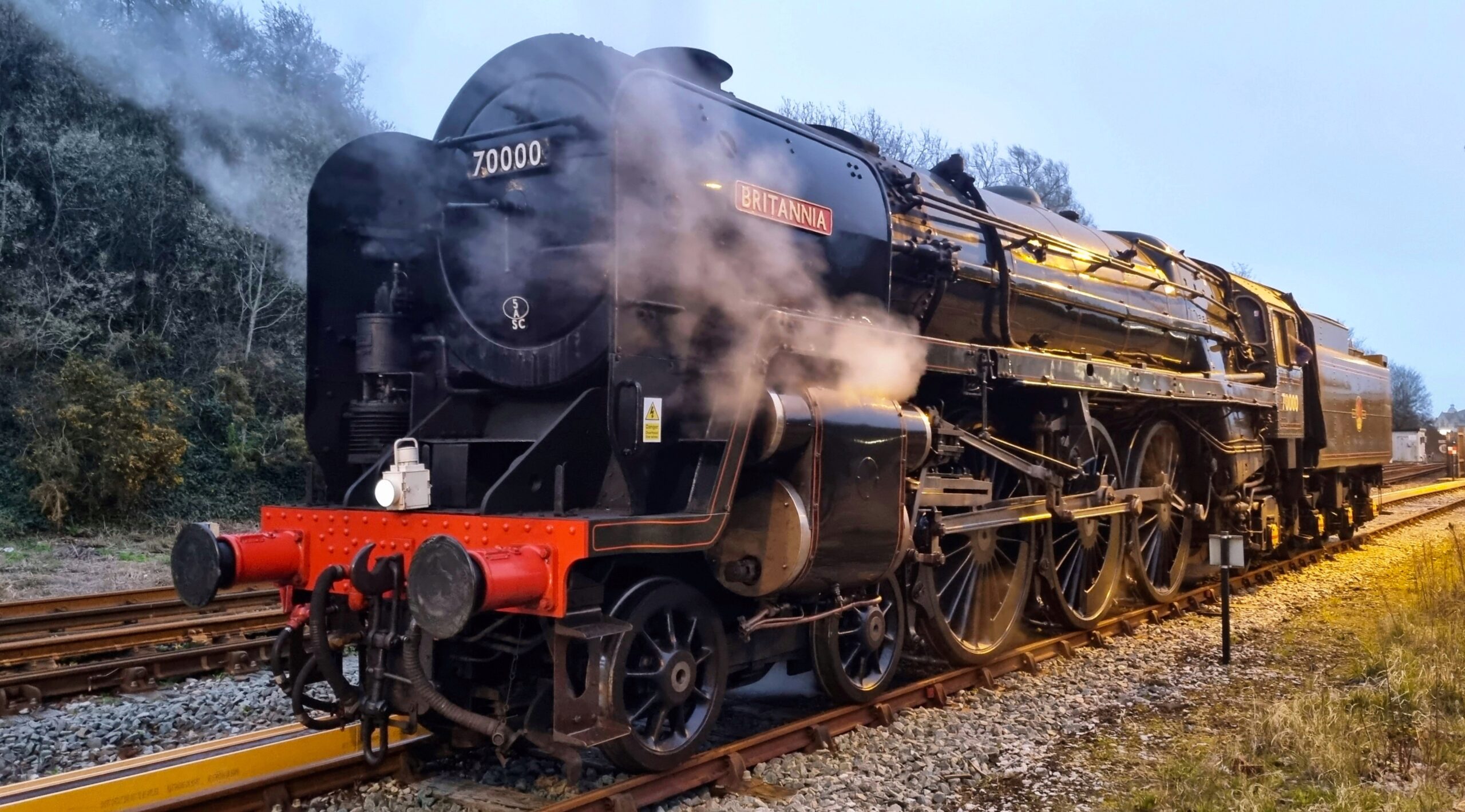
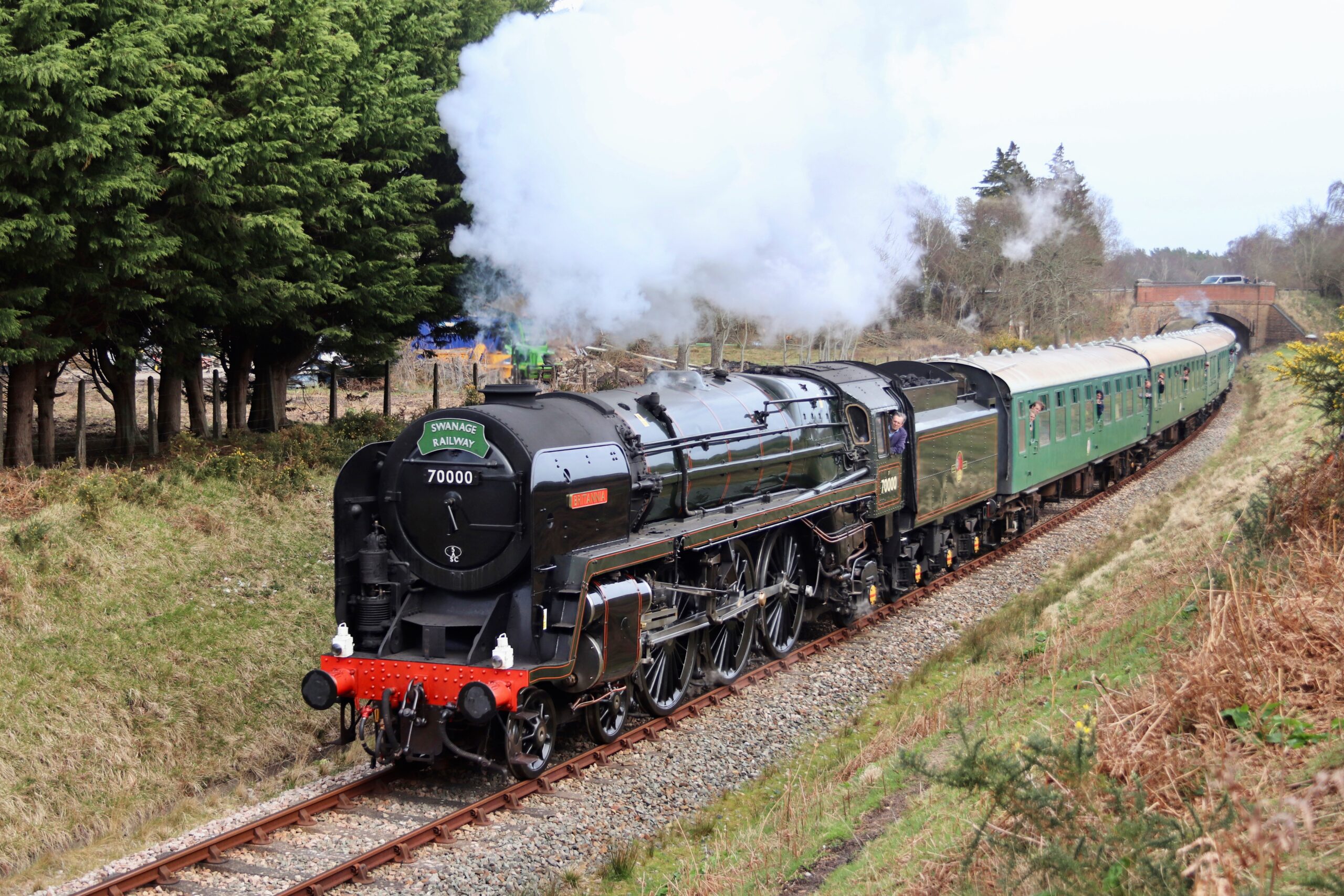
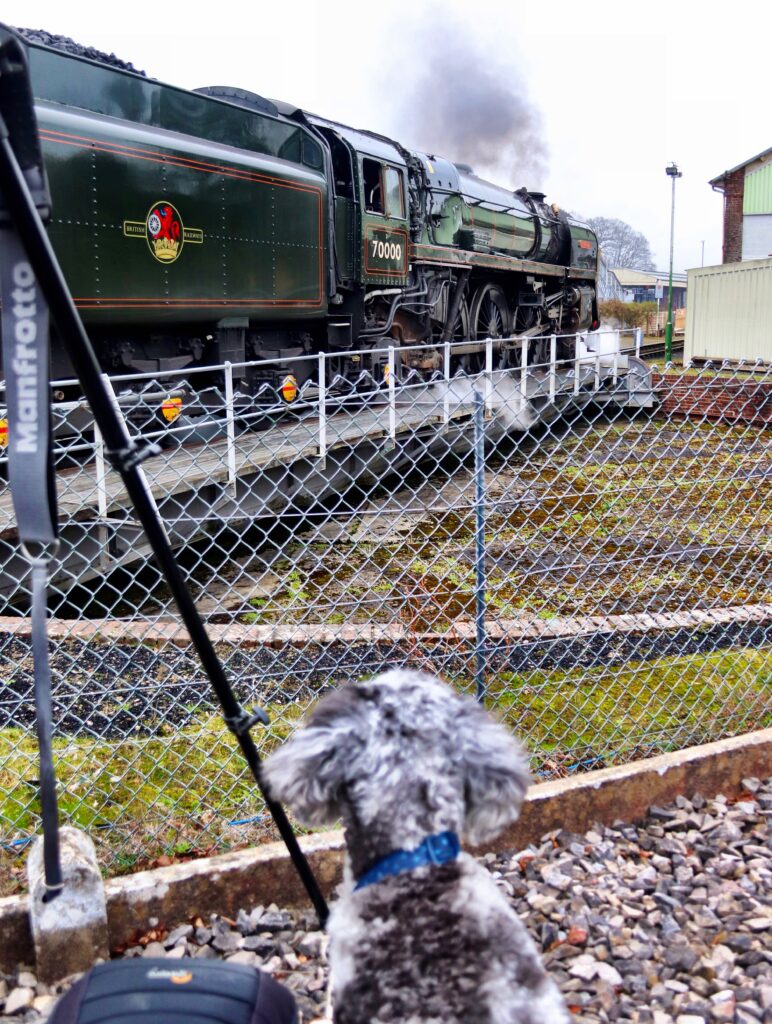
On Tuesday 11th April, the Swanage Railway said good-bye to British Railways Standard Class 7 No. 70000 ‘Britannia’ as she returned to her base at Locomotive Services Limited in Crewe. We caught her crossing the Holes Bay causeway in Poole. During her stay in The Purbeck’s the Brit was star guest at the Swanage Steam Gala and was utilised on sell out driver training events.
British Railways Standard Class 7 No. 70000 ‘Britannia’ crosses Holes Bay working 5Z72 0720 Swanage to Crewe H.S. – 11/04/2023
Video of ‘Britannia’ at Holes Bay – 11/04/2023
Easter Monday saw the monthly GBRf Class 73 hauled test train originating from Derby Railway Technical Centre visit Weymouth. Because of engineering work in the Basingstoke / Winchester area, this working was diverted via Guildford. Which was a shame as I was visiting friends in Basingstoke. However, I was back in Dorset just in time to see the early running ensemble pass through Poole on the return run from Weymouth heading to Eastleigh East Yard.
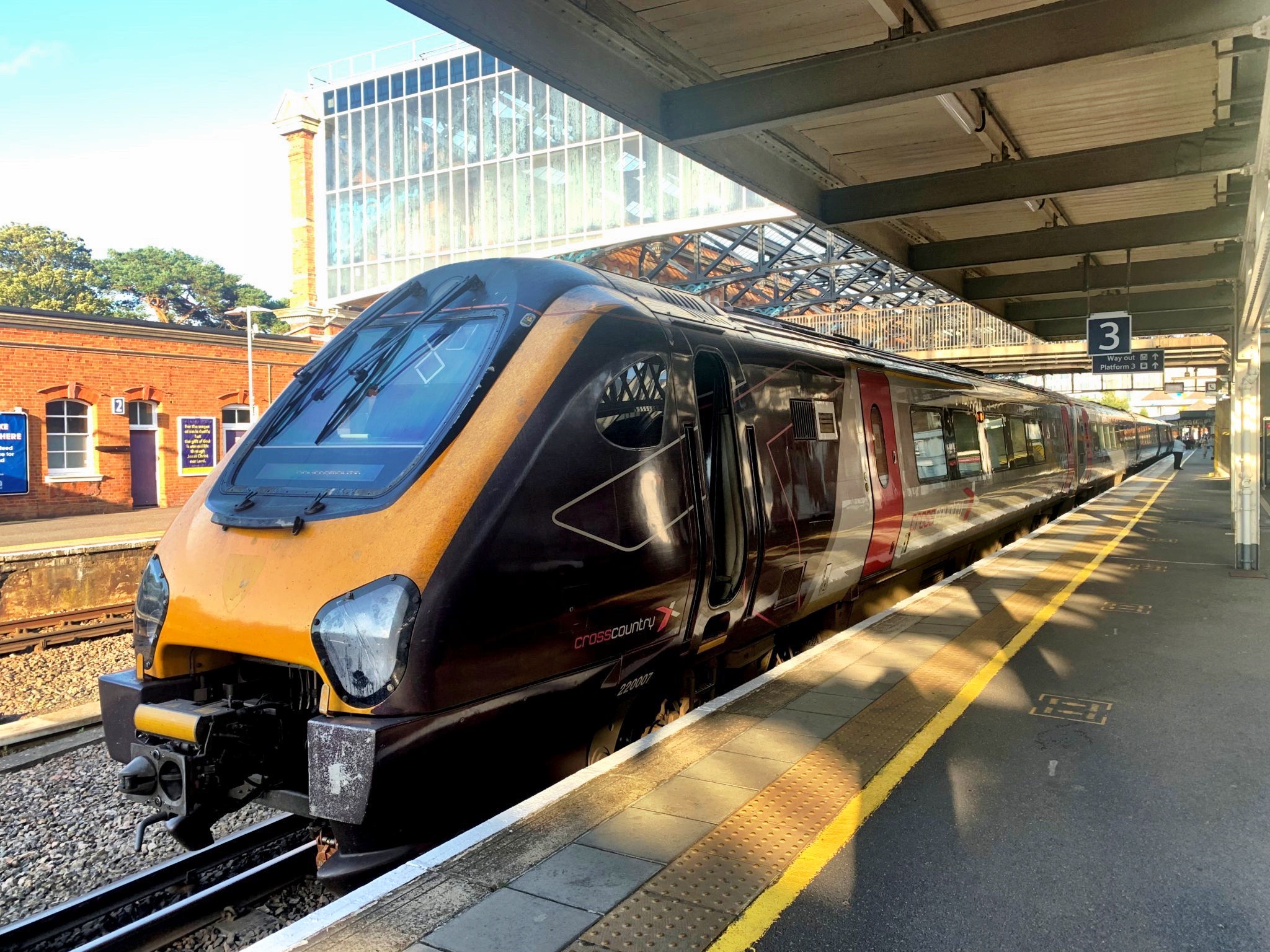
GBRf Class 73 No.’s 73965 ‘Des O’Brien’ and 73963 ‘Janice’ working 1Q51 1115 Derby RTC to Eastleigh East Yard pass Poole – 10/04/2023CrossCountry Voyager Class 220 No. 220007 at Bournemouth – 28/07/2021
CrossCountry train services from Bournemouth to the North as well as freight from Southampton have been affected by the closure of the Nuneham Viaduct near Abingdon in Oxfordshire. Network Rail have been carrying out stabilisation works on the viaduct in recent weeks and monitoring equipment detected significant movement over the weekend of 1st/2nd April with the result that the bridge was temporarily closed on 4th April along with the railway between Didcot Parkway and Oxford to ensure the safety of passengers.
Network Rail advised CrossCountry passengers; “Trains will be revised to run in two portions; between Bournemouth and Didcot Parkway and between Oxford and Manchester Piccadilly. Limited replacement road transport is in operation between Didcot Parkway and Oxford. Customers travelling between Bournemouth/Reading and Banbury/Birmingham/Manchester are advised to travel via London stations or Bristol stations. This is due to limited availability of road transport at Didcot Parkway.”
Network Rail are working around the clock to install a temporary structure to stabilise Nuneham Viaduct, so trains can safely run again by Saturday 10 June. Place your bets….
That’s all we have time for this week. Thanks agin for joining us. We’ve been busy catching up with friends and eating chocolate over the Easter weekend just gone. Mmmhhh, chocolate.
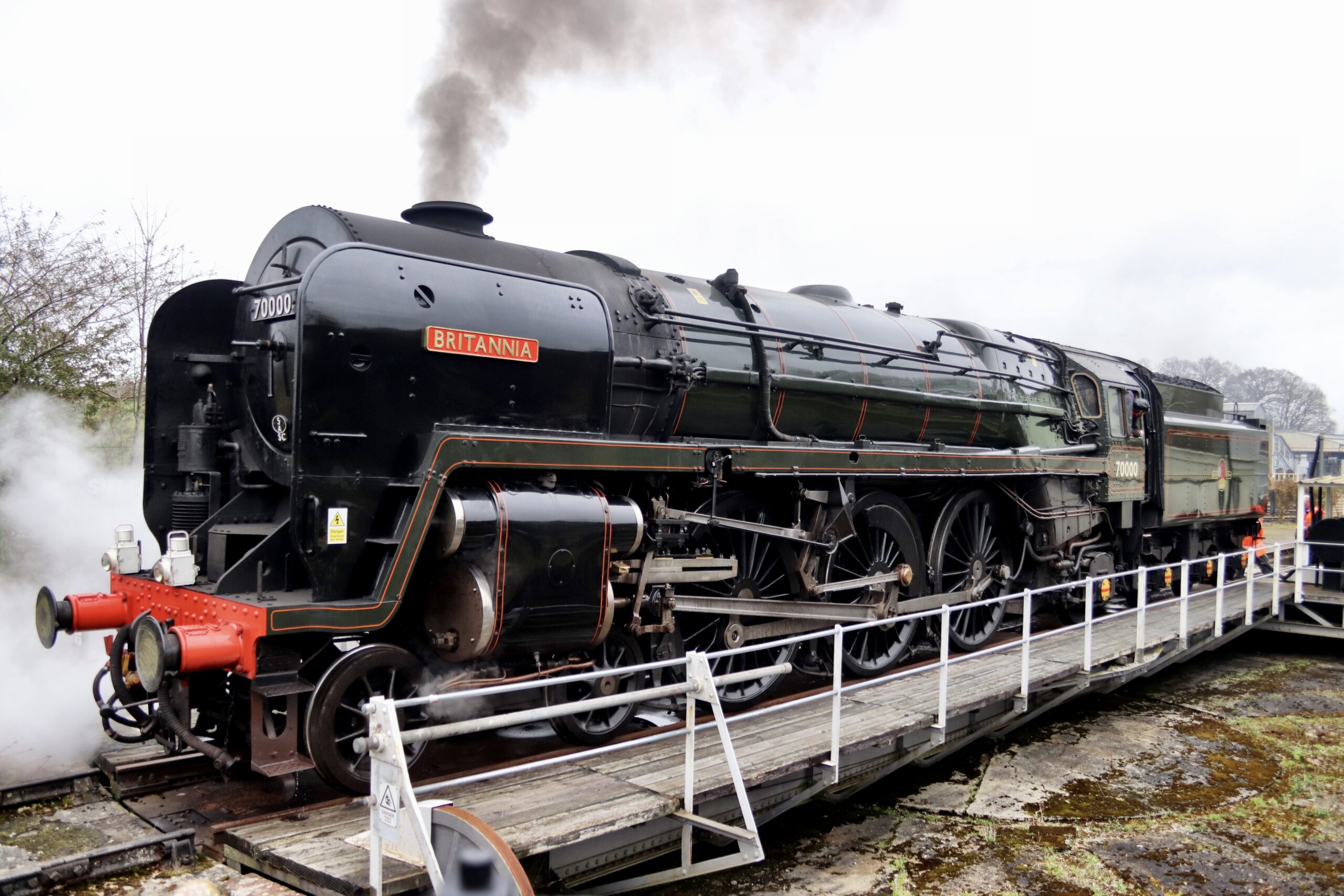
British Railways Standard Class 7 4-6-2 No. 70000 ‘Britannia’ on the turntable at the Yeovil Railway Centre – 22/03/2023
Hello there – after a week away, we are back with a lot to catch up on. We hope you found last times Beeching blog of interest – it’s certainly a period in railway history which incites discussion and reflection. This time we are concentrating on more recent events concerning the Swanage Railway including our visit to their excellent March 2023 Steam Gala – which featured British Rail Standard Class 7 4-6-2 No. 70000 ‘Britannia’ – and the first diesel multiple unit train departing Wareham connecting the Purbeck heritage railway to the main line.
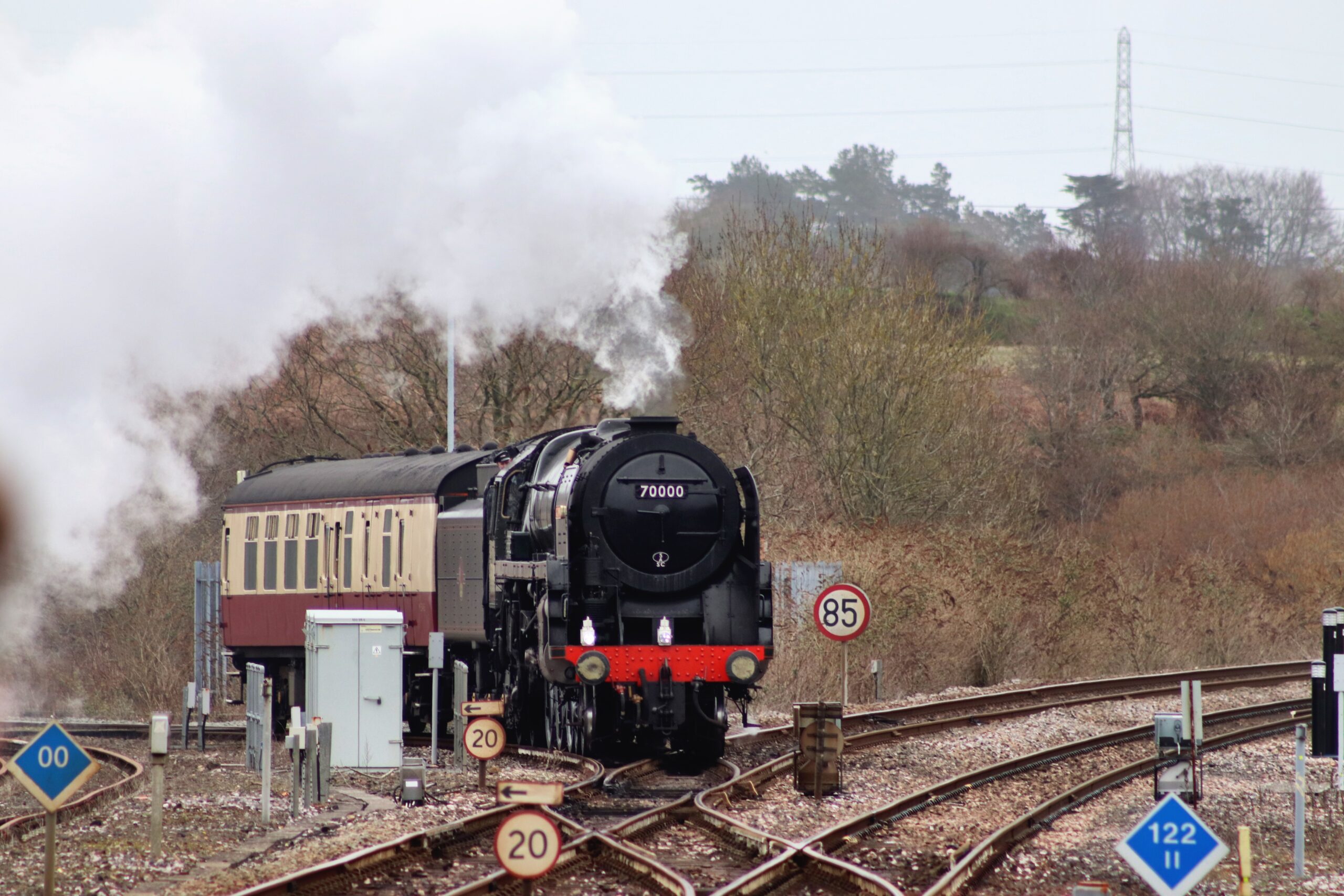
British Railways Standard Class 7 4-6-2 No. 70000 ‘Britannia’ approaches Yeovil Junction working 5Z70 Crewe HS to Swanage having used the connecting curve from Yeovil Pen Mill – 22/03/2023
On Wednesday 22nd March 2023, we headed over to Yeovil to see No. 70000 ‘Britannia’ arrive at Yeovil Junction in readiness for her being turned on Yeovil Railway Centre’s turntable. I always enjoy watching locomotives on the turntable, and despite a few initial barks form Yoshi, he mostly watched on with quiet fascination.
British Railways Standard Class 7 4-6-2 No. 70000 ‘Britannia’ is turned on the Yeovil Railway Centre turntable – 22/03/2023British Railways Standard Class 7 4-6-2 No. 70000 ‘Britannia’ after being turned at the Yeovil Railway Centre – 22/03/2023
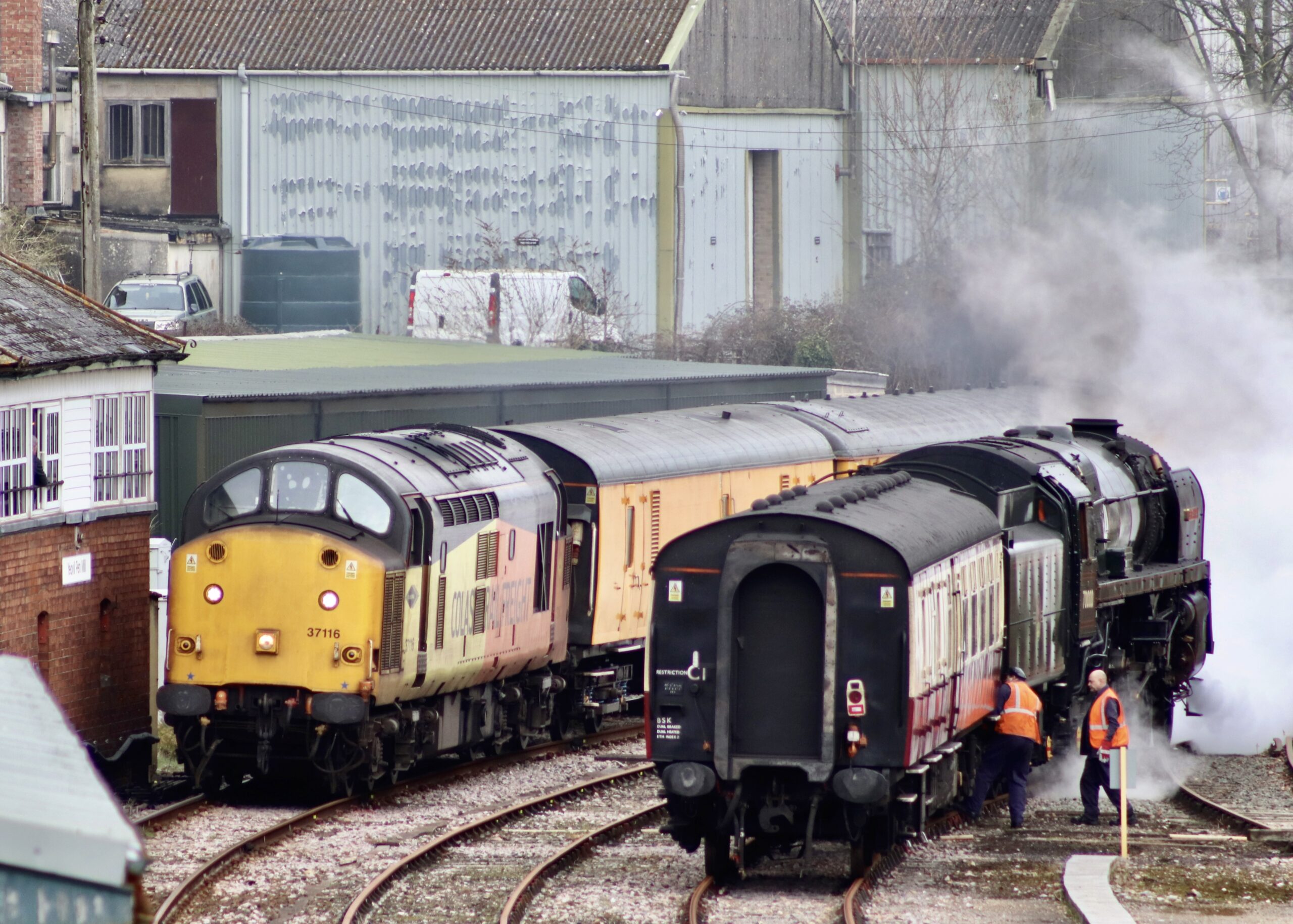
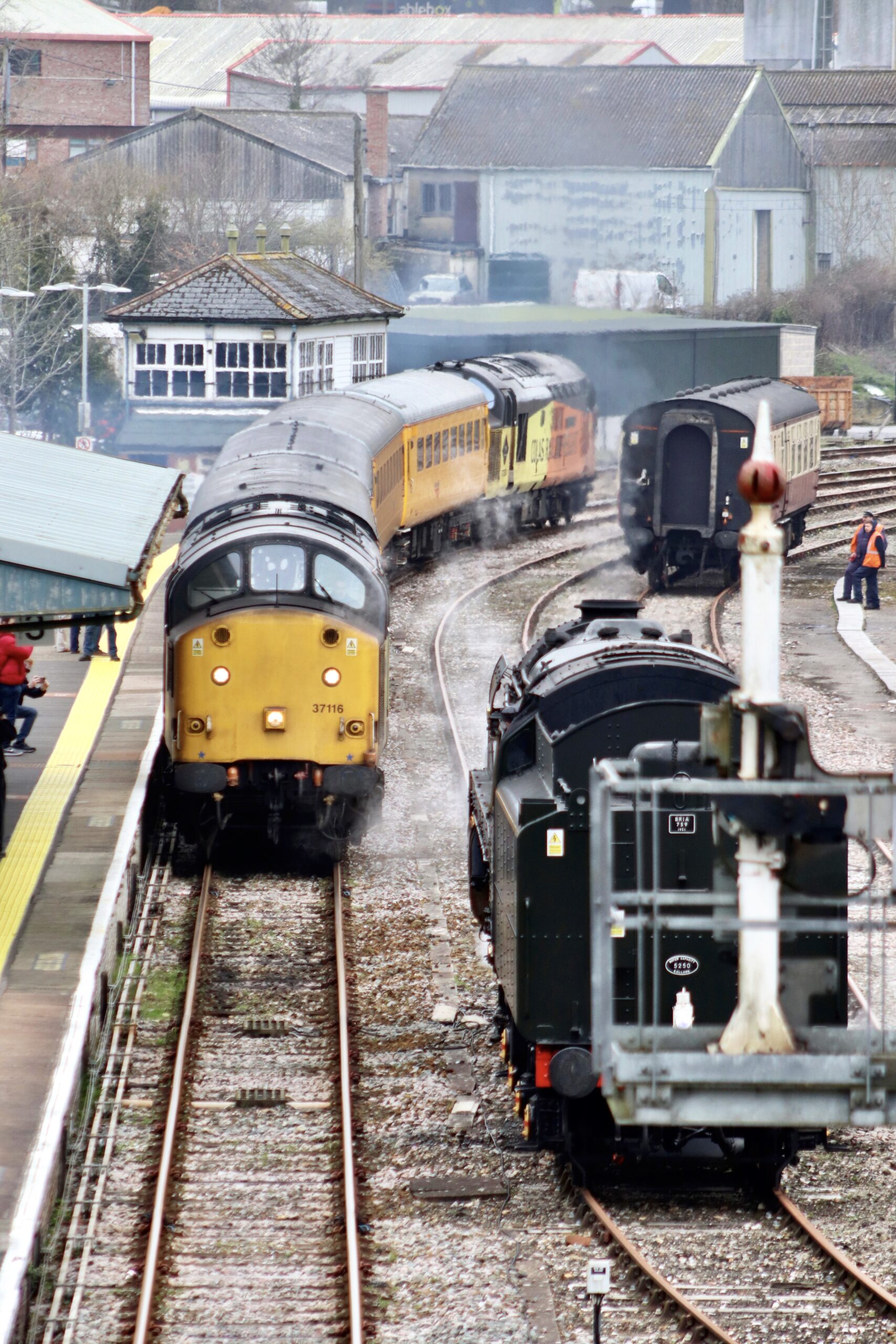
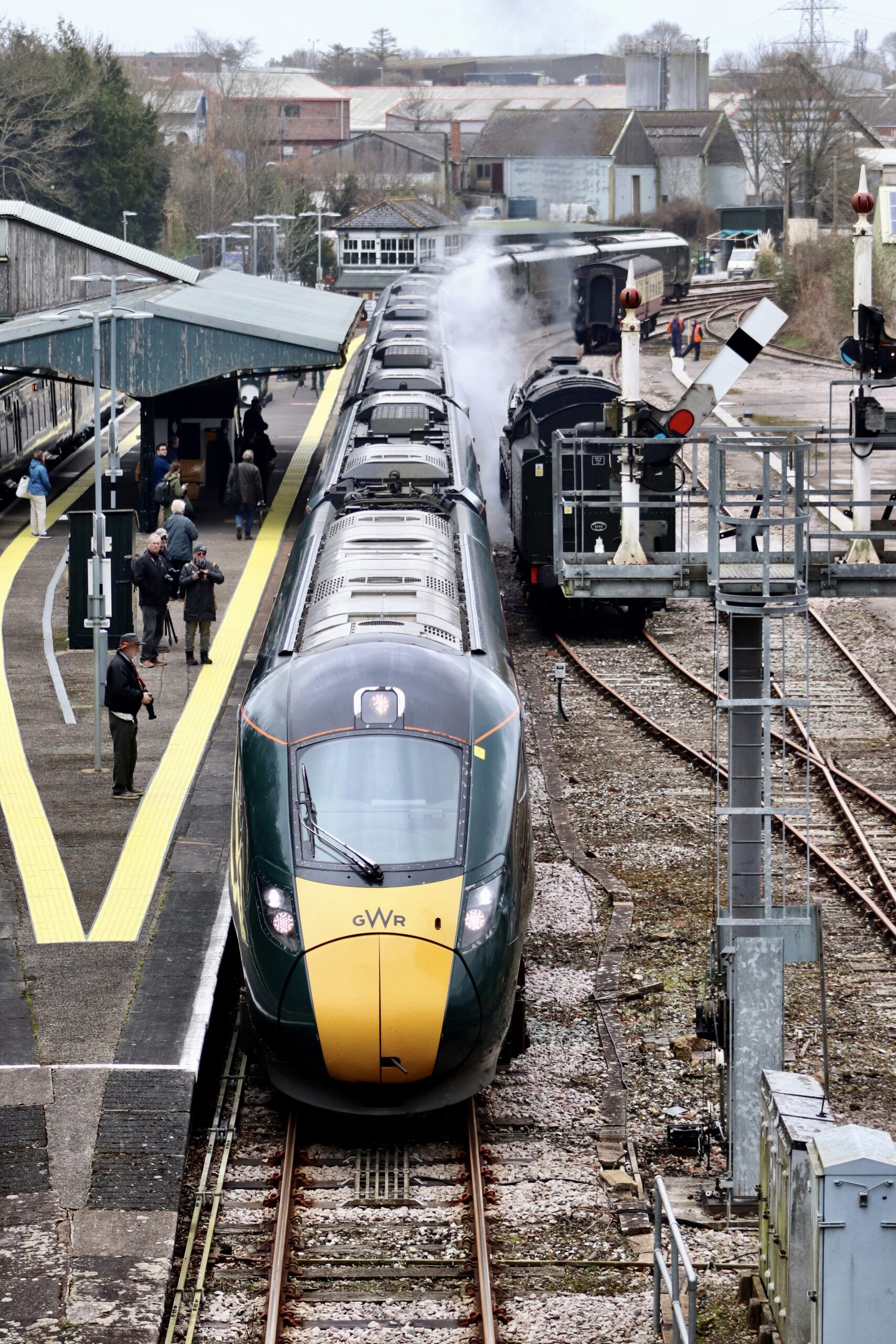
Following her spin on the turntable, ‘Britannia’ backed out onto the main line at Junction station and we drove down to Yeovil Pen Mill so that we could capture a pair of Class 37 diesel locomotives working test train 1Z22 Derby Railway Technical Centre to Bristol Kingsland Road via Weymouth which was scheduled to pass through at around 1500, 20 minutes or so before ‘Britannia’ was due to arrive at Pen Mill prior to a tender first run down to Weymouth. The test train, however, top and tailed by Colas No.’s 37116 and 37254 arrived at Pen Mill almost thirty minutes late and by this time ‘Britannia’ had already made the run down from Junction with her support coach. We were also able to see a Great Western Railway (GWR) Class 800 IET pass through on a divert as engineering work was taking place on the Taunton line and services to Exeter were taking the West of England route.
British Railways Standard Class 7 4-6-2 No. 70000 ‘Britannia’ having turned at Yeovil Junction nears Yeovil Pen Mill where she will run round her support coach before proceeding to Weymouth – 22/03/2023Colas Class 37 No. 37116 arrives at Yeovil Pen Mill with 1Z22 Derby Railway Technical Centre to Bristol Kingsland Road. British Railways Standard Class 7 4-6-2 No. 70000 ‘Britannia’ stands in the sidings waiting to run round her support coach before proceeding to run tender first to Weymouth – 22/03/2022 Colas Class 37 No’s. 37116 and 37254 depart Yeovil Pen Mill top and tailing 1Z22 Derby Railway Technical Centre to Bristol Kingsland Road as No. 70000 ‘Britannia’ waits to reverse out of the station and back on to her support coach – 22/03/2023Great Western Railway Class 800 IET No. 802102 works the diverted 1C84 1404 London Paddington to Plymouth service through Yeovil Pen Mill – 22/03/2023British Railways Standard Class 7 4-6-2 No. 70000 ‘Britannia’ prepares to reverse out of Yeovil Pen Mill and run back in to couple up with her support coach – 22/03/2023British Railways Standard Class 7 4-6-2 No. 70000 ‘Britannia’ at Weymouth here she again ran around her support coach in preparation for the journey to Poole, where she again changes ends on the coach, before working back down to Swanage (Image courtesy of Scott Lewis) – 22/03/2023
Video from Yeovil, Dorchester, Upwey and Hamworthy as British Railways Standard Class 7 4-6-2 No. 70000 ‘Britannia’ makes her way to Dorset having departed Crewe earlier in the day as working 5Z70 Crewe HS to Swanage (additional video courtesy of G E Barrett and Scott Lewis – 22/03/2023
I had an idea that I would pop over to Yeovil Pen Mill at 2am some point during the week to see the Penzance sleeper services cross via the diversionary route, but decided to wait until warmer weather later in the year should the diversions take place again. However, our North Dorset Correspondent was far more intrepid and caught the following exchange as No. 57604 ‘Pendennis Castle’ passed No. 57602 ‘Restormel Castle’:
GWR Sleeper trains on divert pass at Yeovil Pen Mill. Video courtesy of Scott Lewis – 24/03/2023
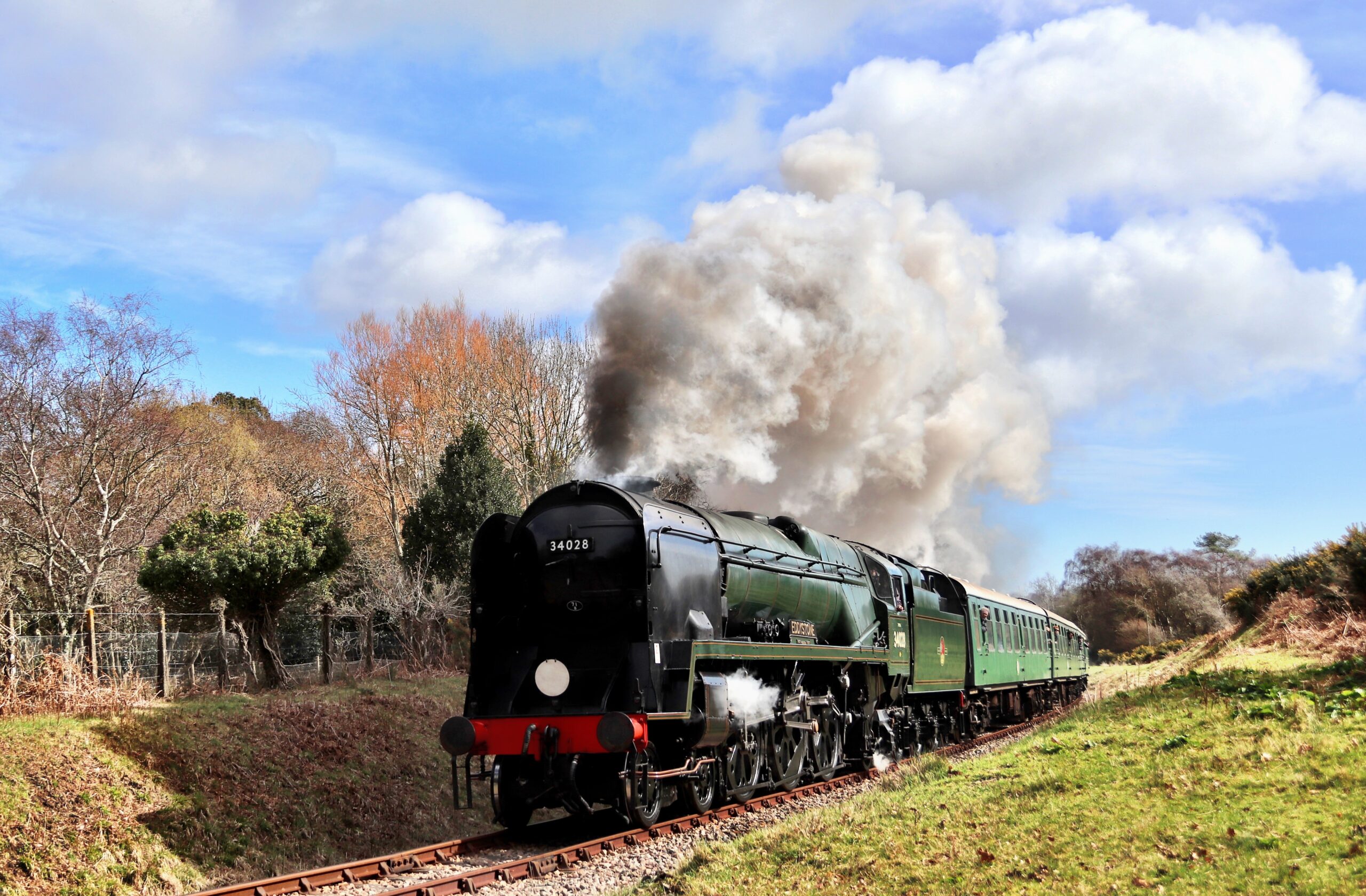
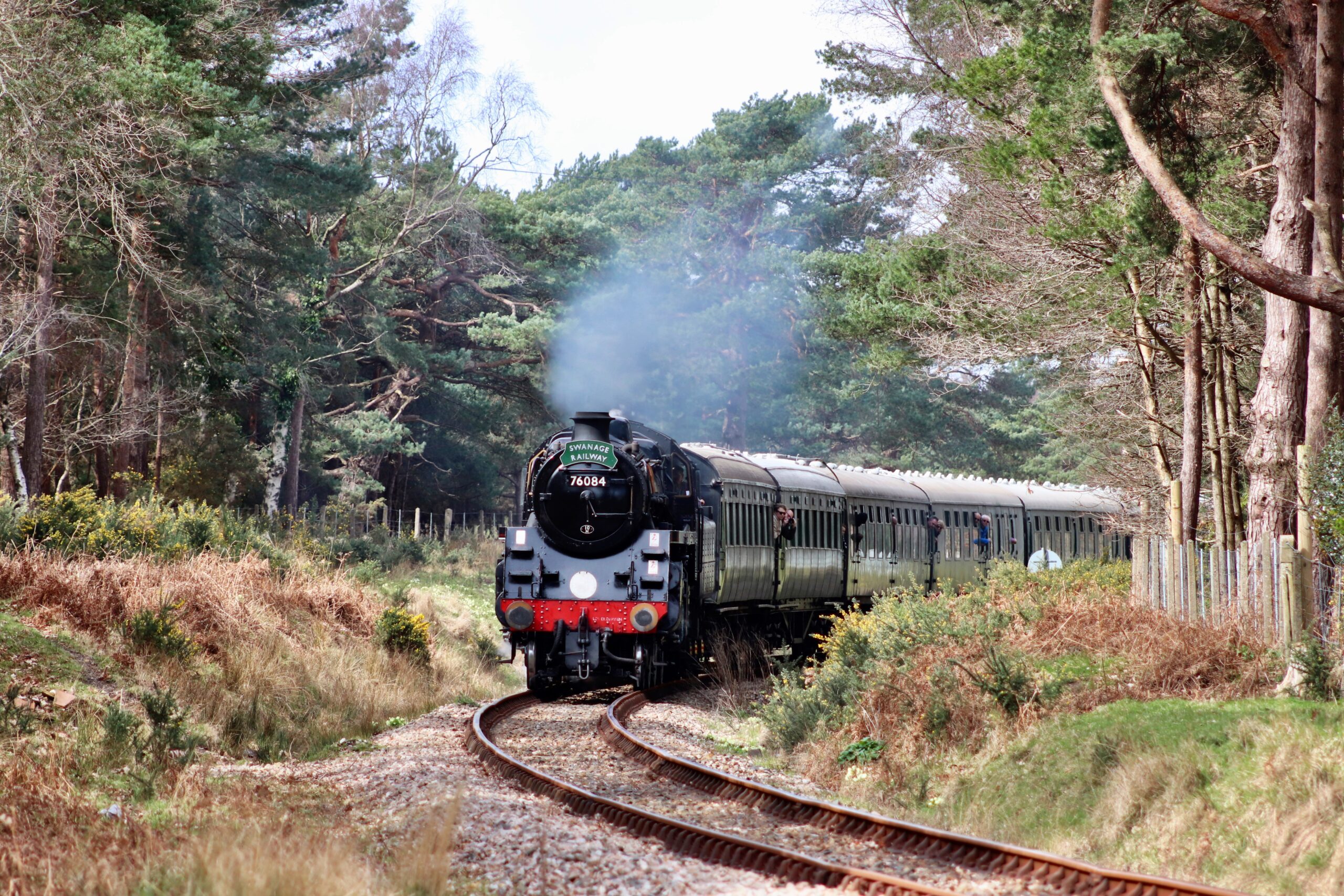
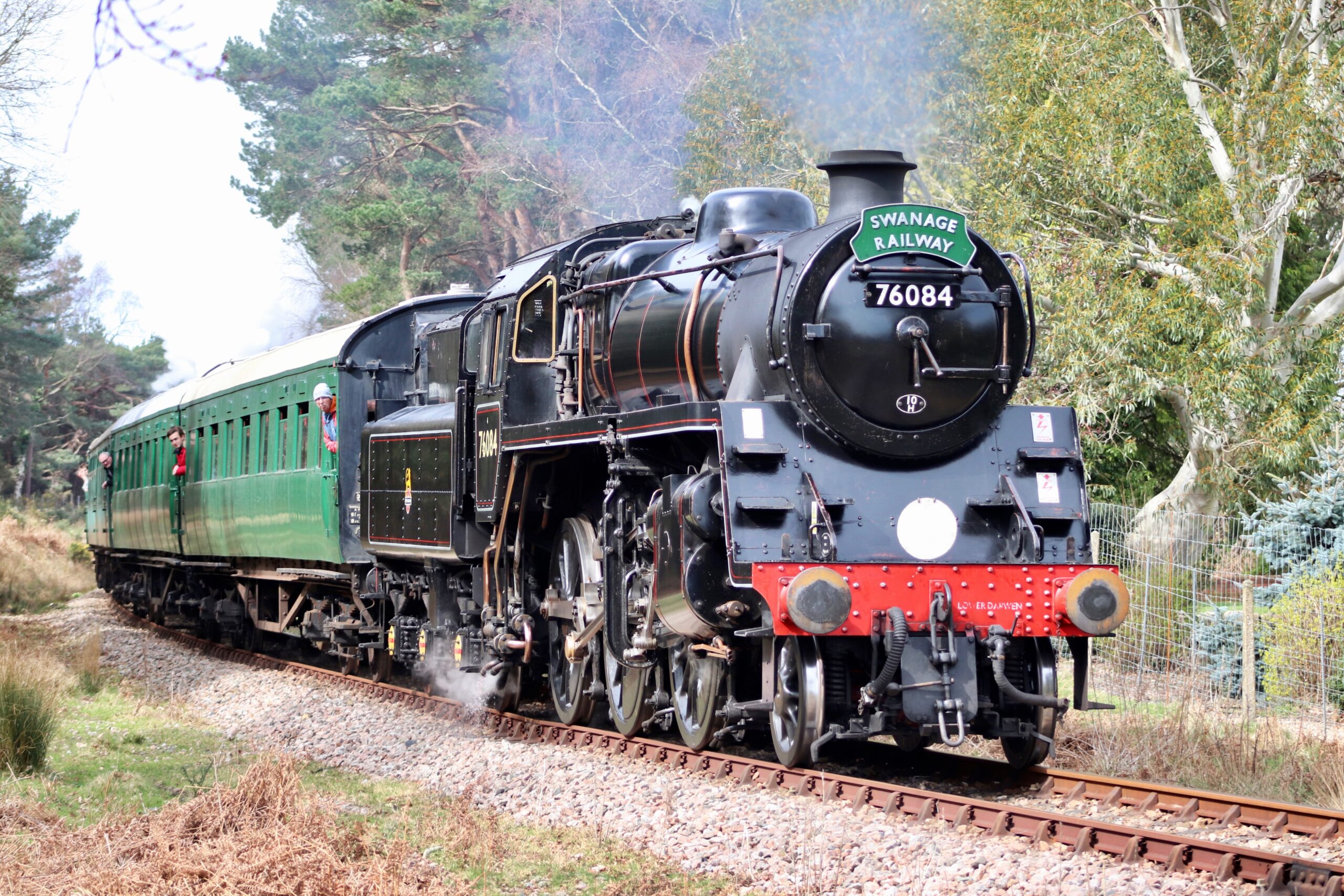
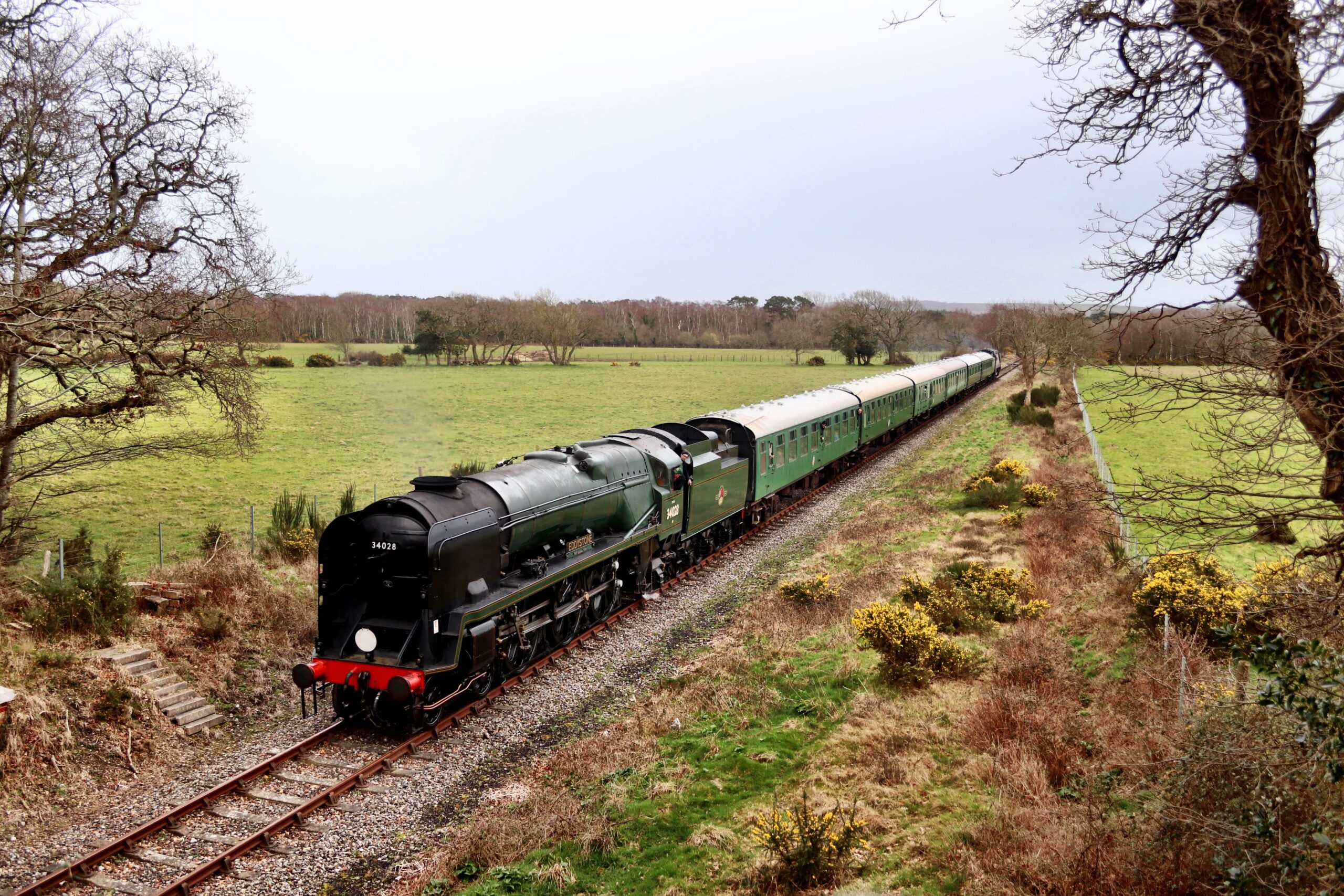
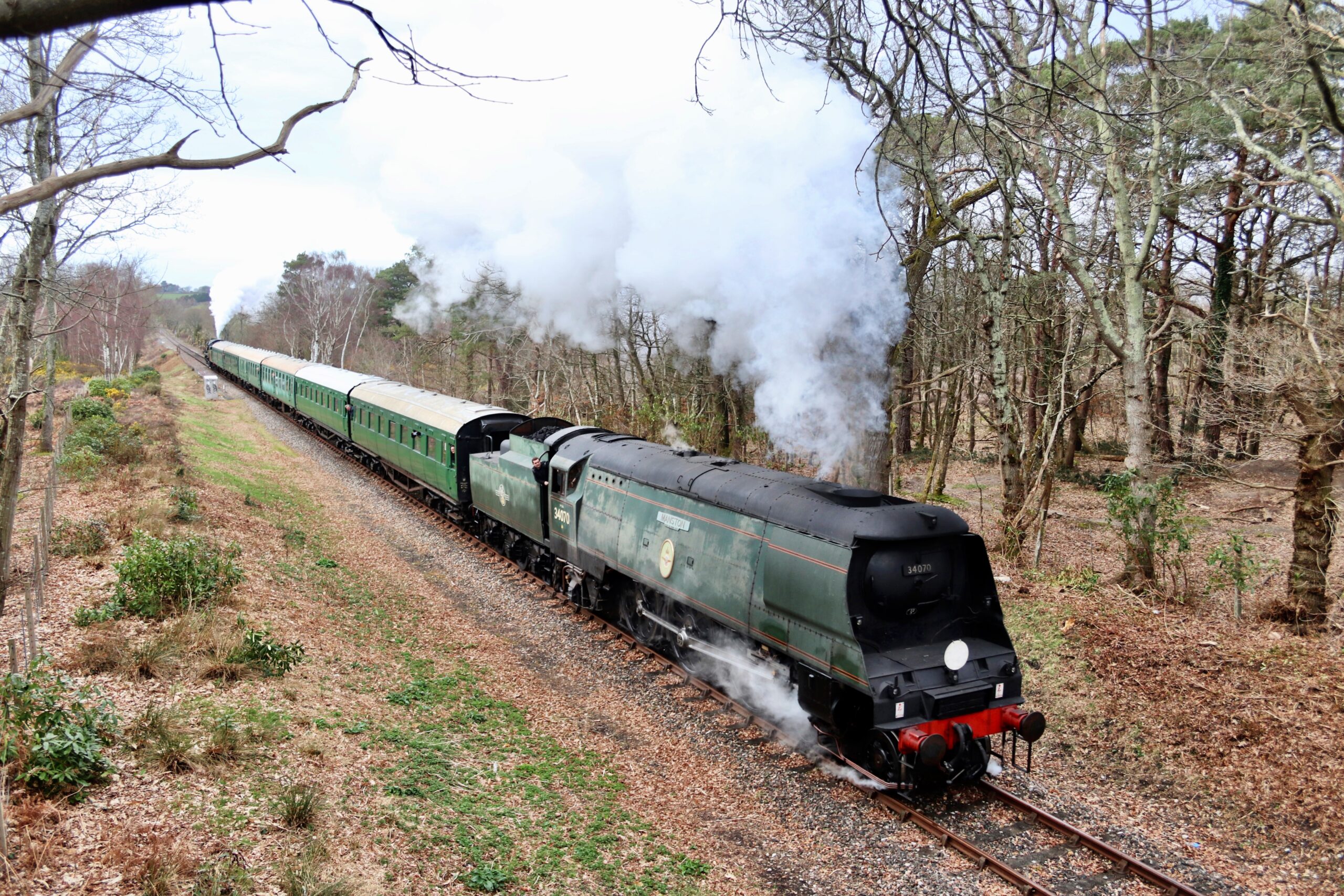
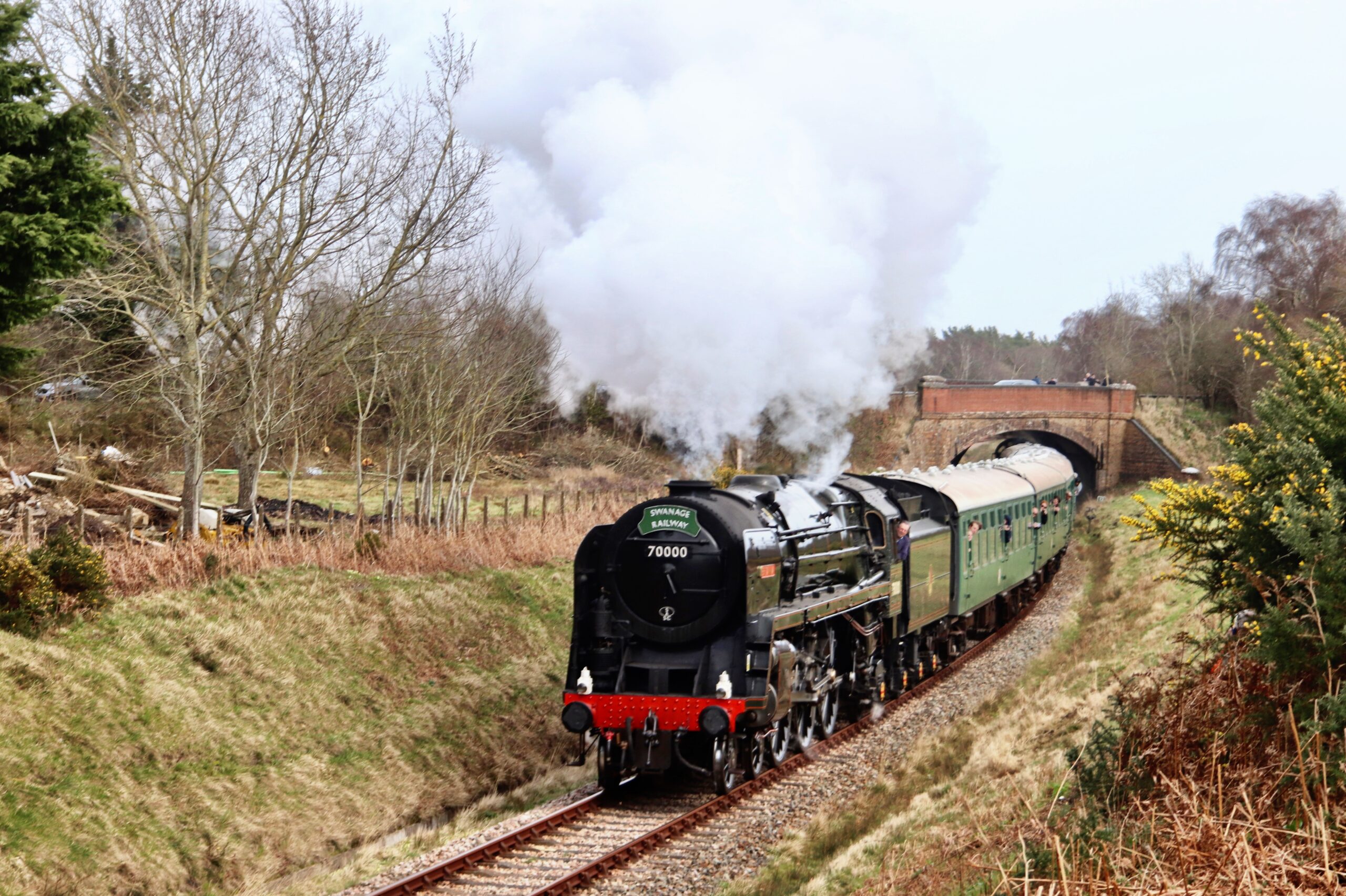
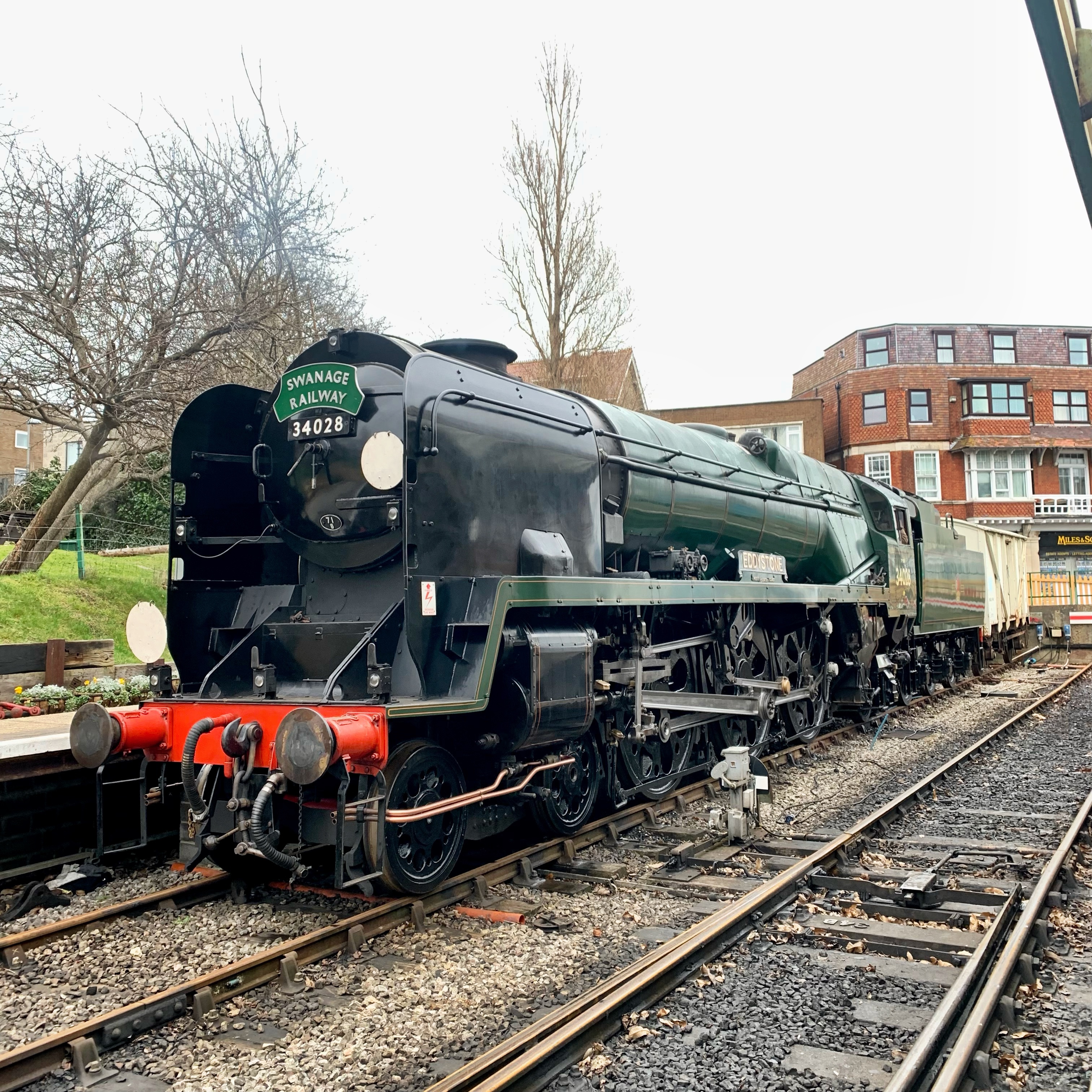
Over the final March weekend, the Swanage Railway ran their popular Spring Steam Gala which featured ‘Britannia’ and BR Standard Class 4MT 2-6-0 No. 76084 as guest locomotives alongside home fleet Southern Railway U Class No. 31806 and Southern Railway Bulleid Pacifics No. 34070 ‘Manston’ and No. 34028 ‘Eddystone’. I headed down to join in the fun on the Saturday leaving Yoshi with his mama. I had planned on seeing the first train of the day which was scheduled to be double headed – but I also needed to pop into Wareham and visit the Post Office – so my arrival at the National Trust car park at Corfe Castle was delayed and I just missed the ensemble pass. To make things worse, the National Trust tea room at the car park was closed, so no breakfast for me as I had left home with the idea of catching refreshment between trains. However, luckily for me, Jamie came to my rescue and very kindly shared his packed lunch so I didn’t waste away through the lack of nourishment.
A video snap shot of the 2023 Swanage Steam Gala – 25/03/2023Unrebuilt Battle of Britain Class Bulleid Pacific No. 34070 ‘Manston’ between Norden and Corfe Castle – 25/03/2023Rebuilt West Country Class Bulleid Pacific No. 34028 ‘Eddystone’ nears Cat’s Eye Crossing with a train bound fro the River Frome boundary – 25/03/2023Bulleid Pacific No. 34028 ‘Eddystone’ approaching Cat’s Eye Crossing – 25/03/2023BR Standard Class 4MT 2-6-0 No. 76084 nears Cat’s Eye Crossing – 25/03/2025BR Standard Class 4MT 2-6-0 No. 76084 approaching Cat’s Eye Crossing – 25/03/2023Bulleid Pacific No. 34028 ‘Eddystone’ approaches Holme Lane Bridge on the Swanage Railway – 25/03/2023Bulleid Pacific No. 34070 ‘Manston’ hauls a train away from the River Frome boundary – 25/03/2023British Railways Standard Class 7 4-6-2 No. 70000 ‘Britannia’ with a train heading towards the River Frome boundary passing under Cat’s Eye Bridge – 25/03/2023British Railways Standard Class 7 4-6-2 No. 70000 ‘Britannia’ nears Cat’s Eye Crossing – 25/03/2023
Undoubtably the star of the gala; No. 70000 ‘Britannia’ was built at Crewe Works to a new design and entered servive in January 1951. She was the first British Railways Standard locomotive to be constructed and was the initial locomotive in the Britannia Class which went on to number 55 examples. The design of the ‘Britannias’ was based on best practice from the pre-nationalisation “Big Four” railway companies. The new classes were designed by Ernest Stewart Cox, under Robert Riddles who had previously designed the War Department Austerity 2-8-0 and 2-10-0 locomotives for use during World War 2. No. 70000 was named ‘Britannia’ during a ceremony held at Marylebone station by Minister for Transport Alfred Barnes on the 30th January 1951. ‘Britannia’ had the honour of hauling the funeral train of King George VI from King’s Lynn to London in February 1952, for which she had her cab roof painted white as was the custom for royal locomotives. No. 70000 was withdrawn after only 15 years of service in May 1966 and was initially destined for the National Collection, but was passed over for sister locomotive No. 70013 ‘Oliver Cromwell’. She was saved from the cutter’s torch by the Britannia Locomotive Company Ltd. She is currently operated by Locomotive Services Limited (LSL). One of most memorable main line steam locomotives when I used to enjoy the chase in the mid 1990’s, a video with footage of ‘Britannia’ from this period is below:
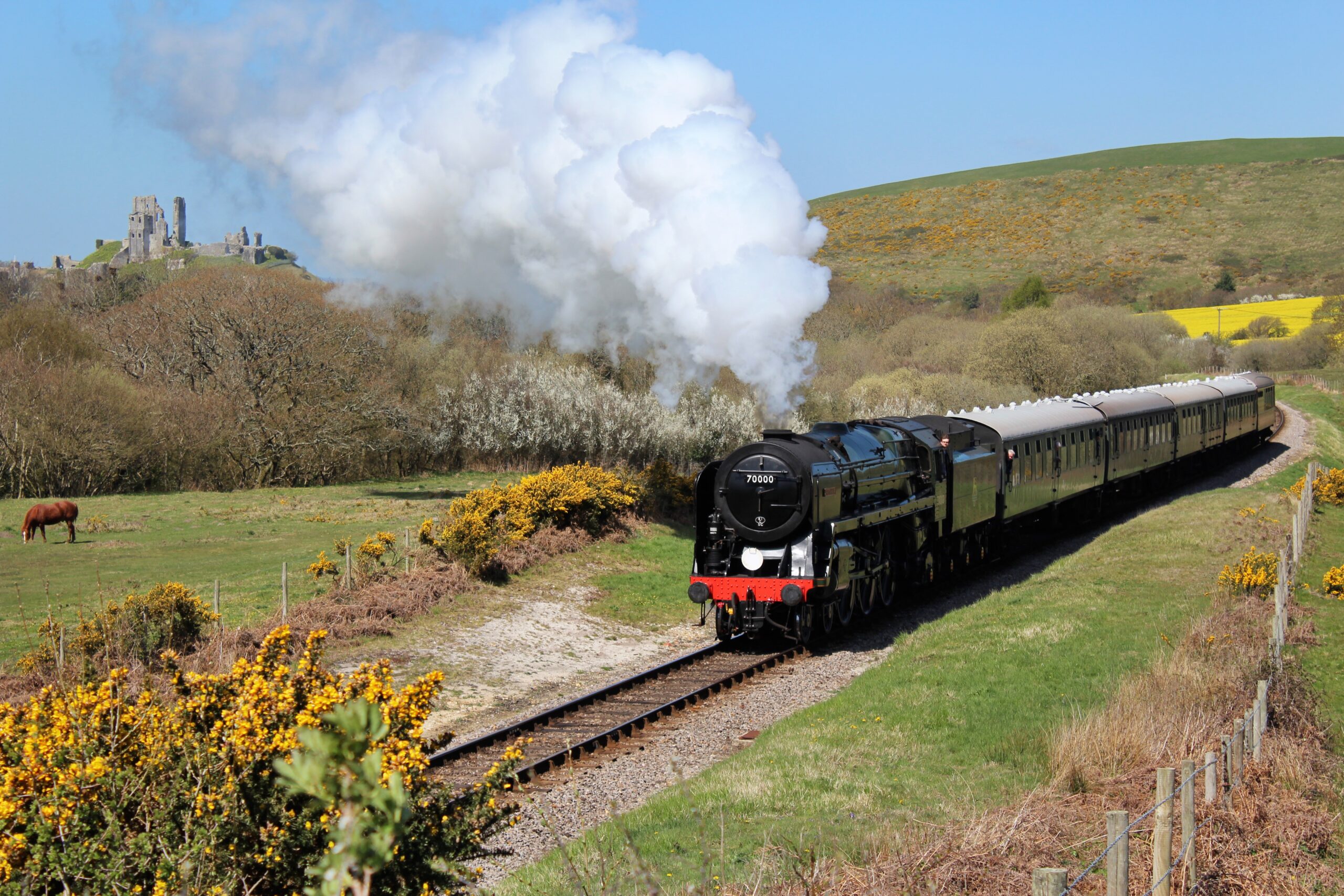
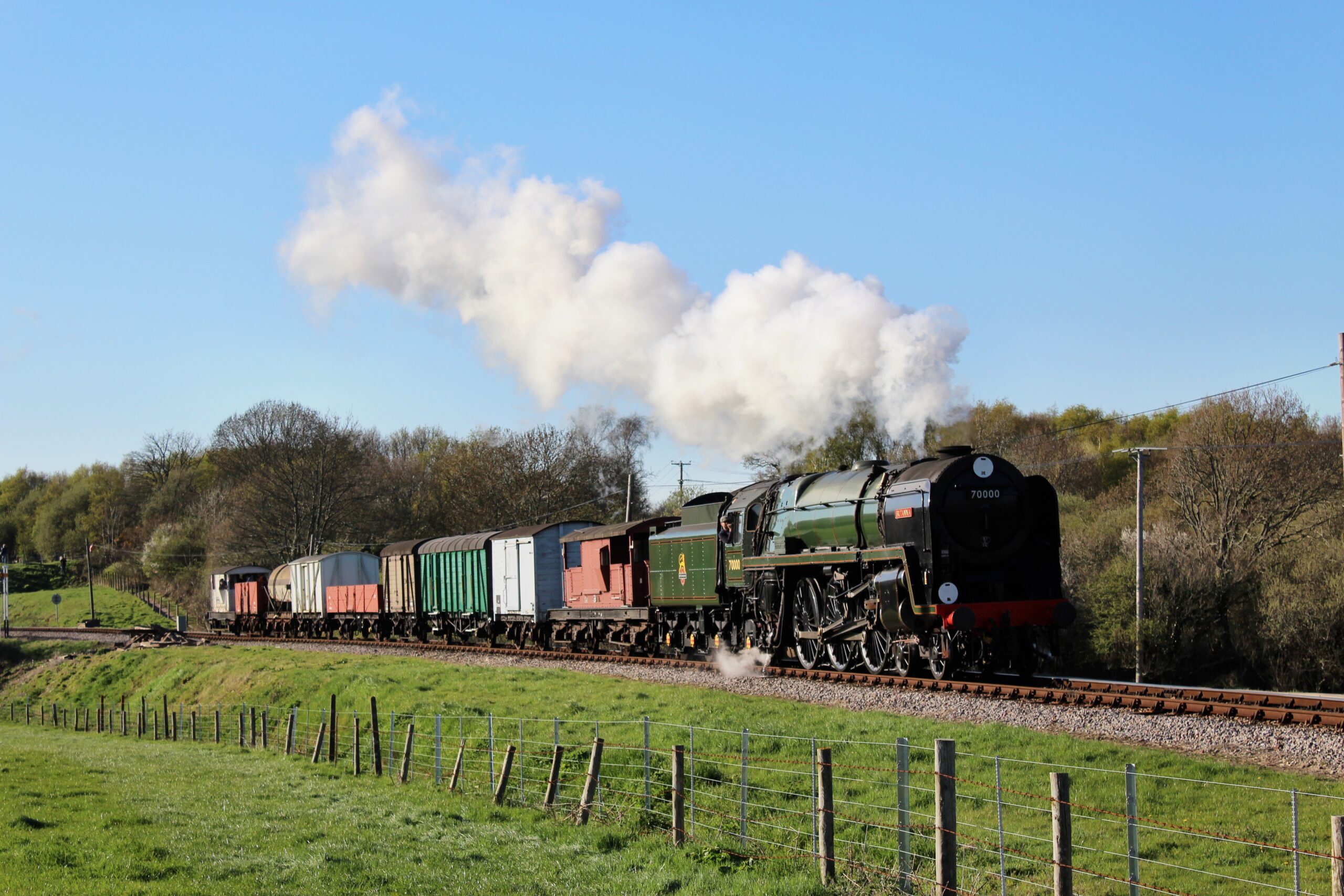
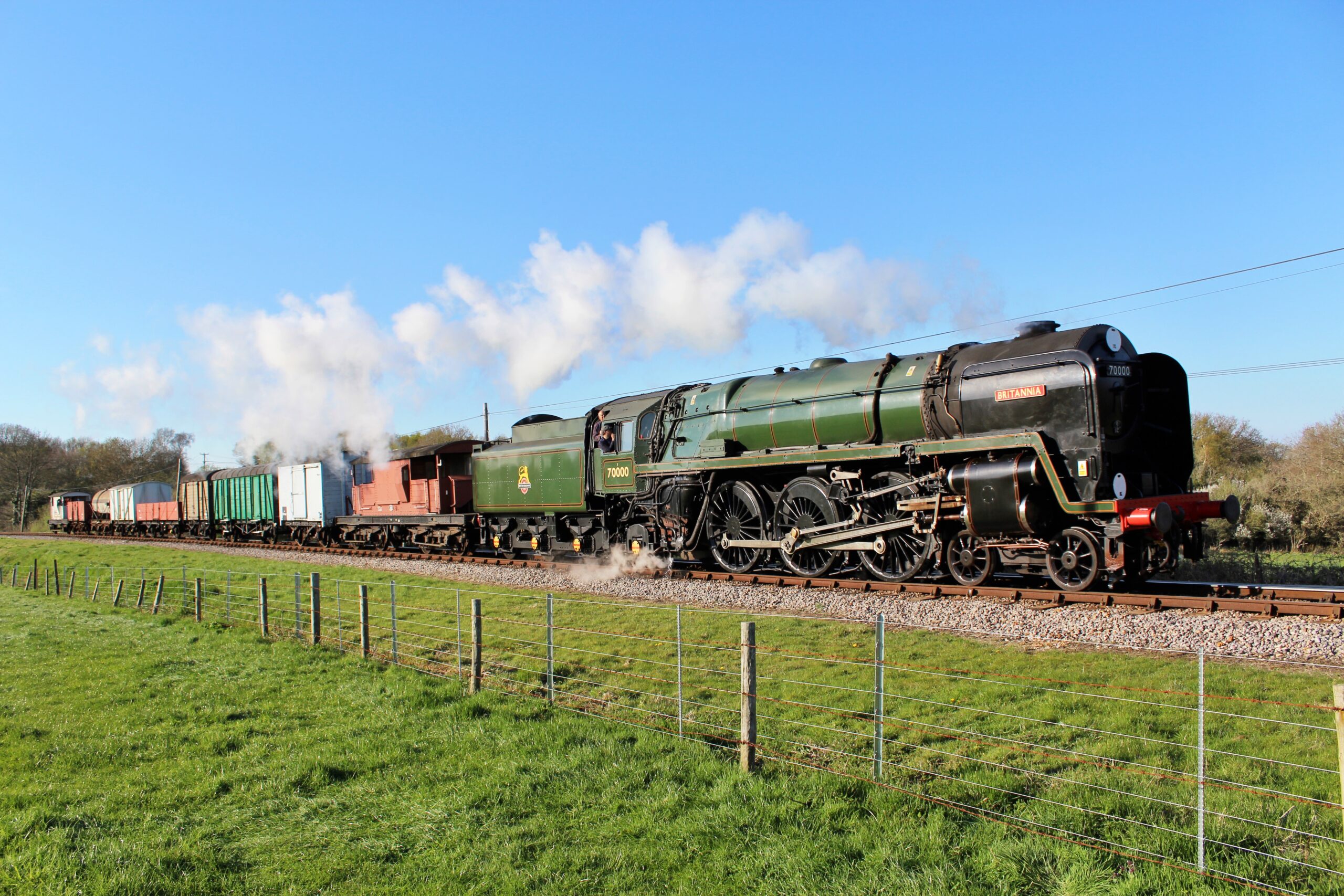
No. 70000 ‘Britannia’ also visited the Swanage Railway in 2015 and I’ve dug out a few images of that time to share:
British Railways Standard Class 7 4-6-2 No. 70000 ‘Britannia’ heads a Swanage bound service with Corfe Castle in the background – 18/04/2015British Railways Standard Class 4 2-6-4 No. 80104 double heads with BR Standard Class 7 4-6-2 No. 70000 ‘Britannia’ having just left Norden – 18/04/2015British Railways Standard Class 7 4-6-2 No. 70000 ‘Britannia’ works a demonstration freight nears Corfe Castle – 18/04/2015Another view of British Railways Standard Class 7 4-6-2 No. 70000 ‘Britannia’ working the Swanage Railway demonstration freight – 18/04/2015
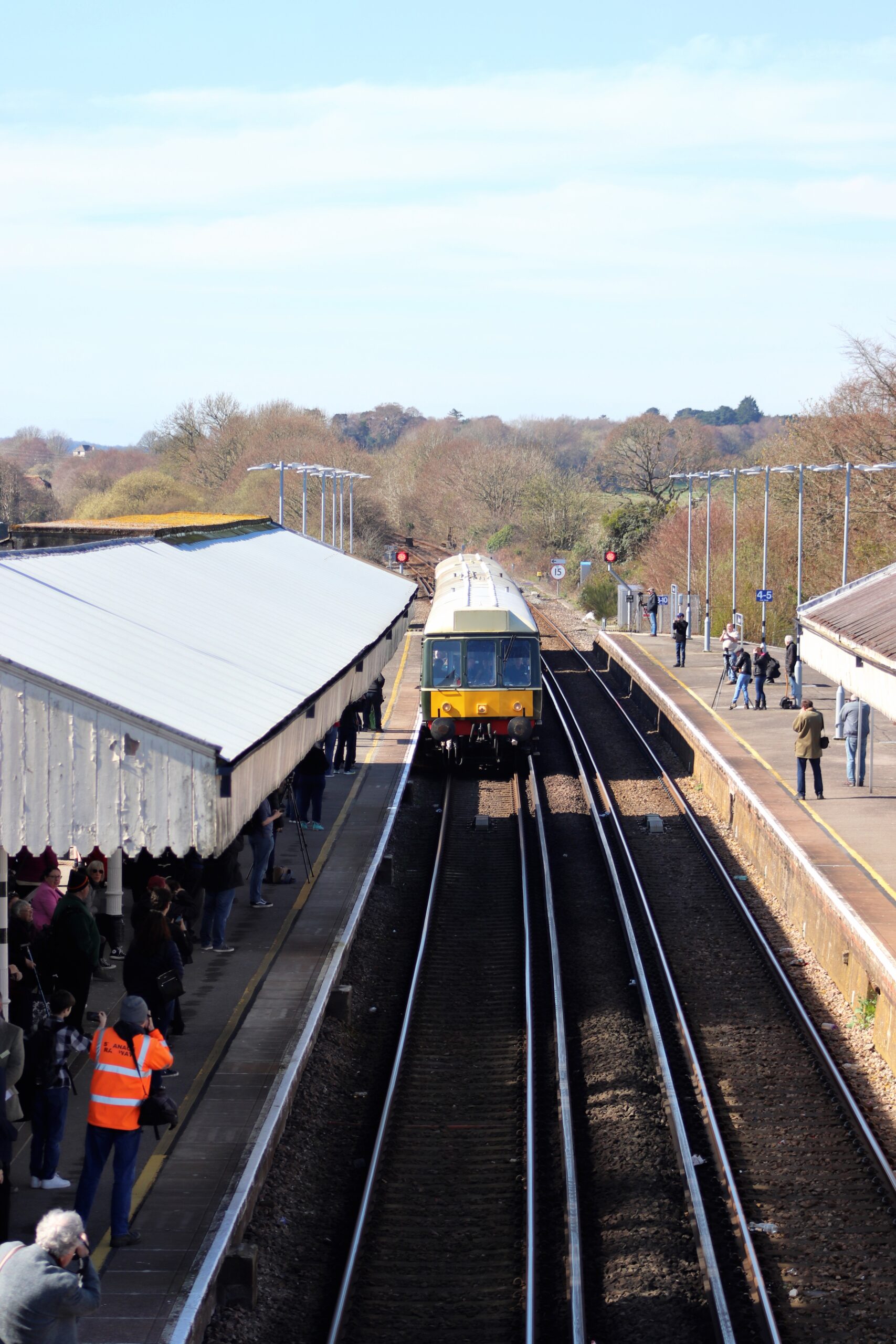
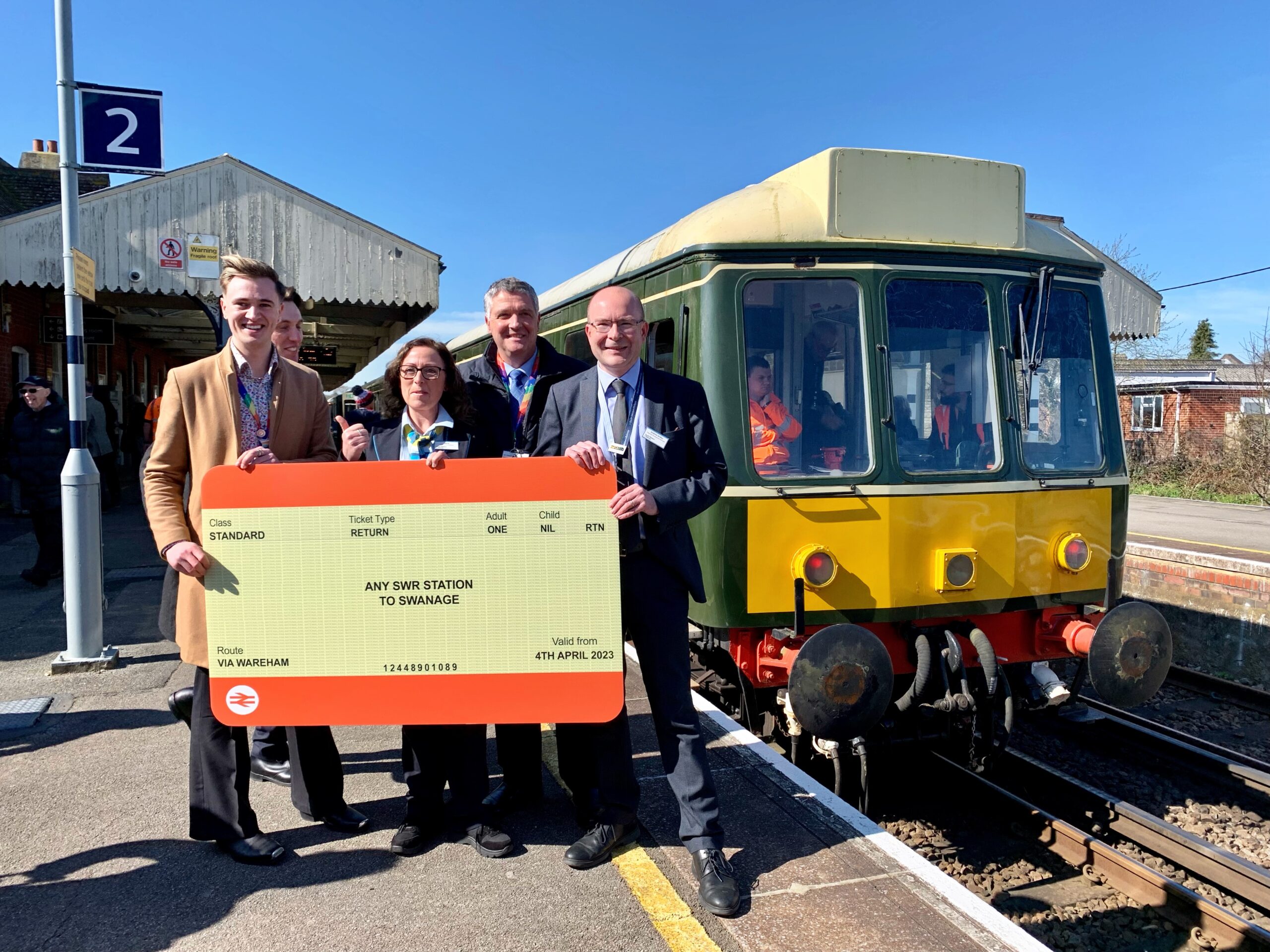
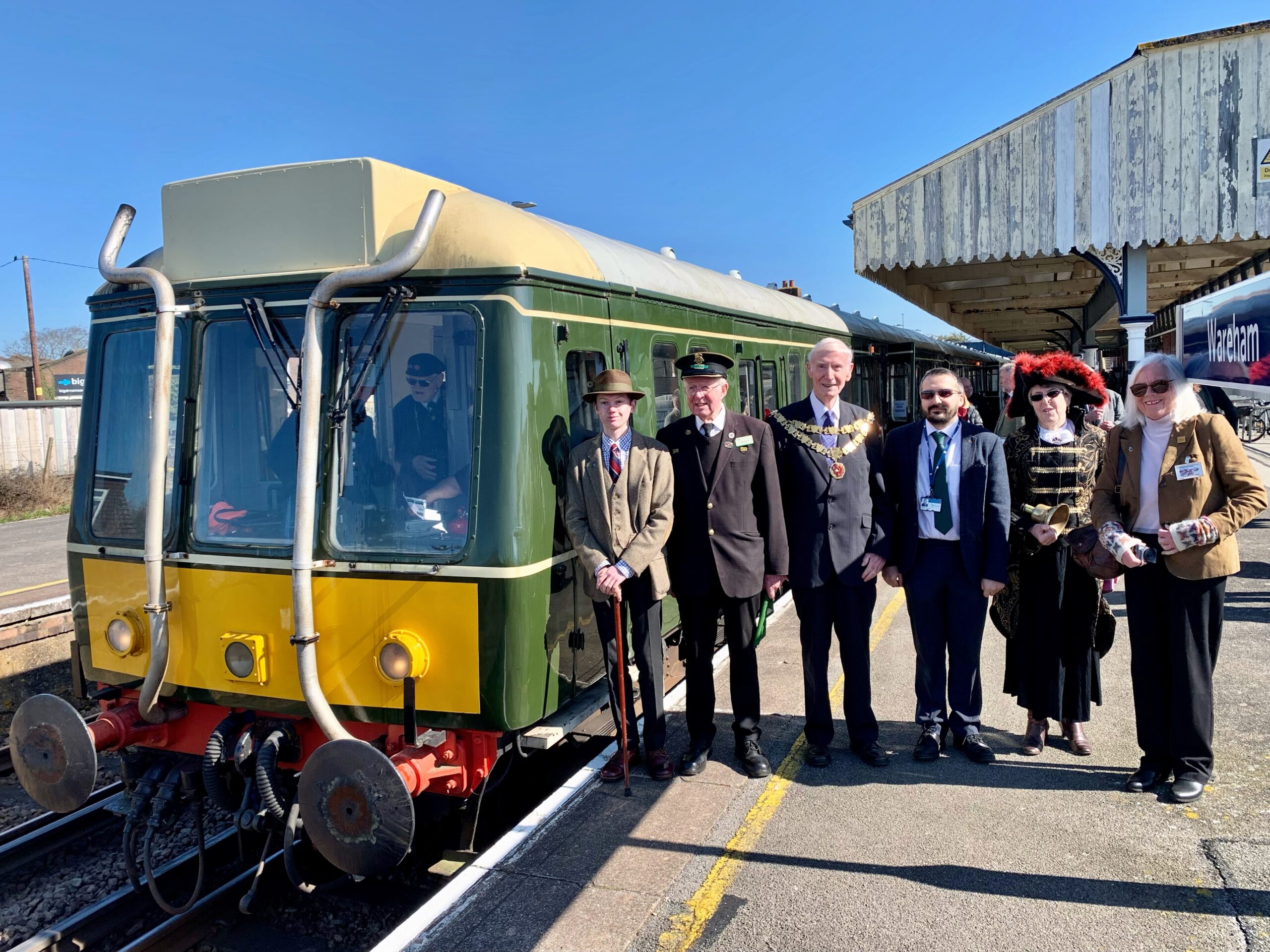
The Swanage Railway has also been in the news following their launch of a trial train service from main line Wareham through to the heritage branch line. Operating from April to September 2023, tickets for the service will also be available from South Western Railway (SWR) from late April so passengers can add tickets for Corfe Castle and Swanage to their main line tickets. This is the first time in 51 years that through ticketing to Corfe and Swanage has been possible. The last day of British Rail passenger services between Wareham, Corfe Castle and Swanage was on Saturday 1st January 1972 when the branch was closed. The eleven mile service, one mile of which running from Worgret Junction into Wareham station will be over main line Network Rail metals, will utilise restored and upgraded 1950’s Class 117 and Class 121 heritage diesel multiple units. The trial service will operate on Tuesdays, Wednesdays, Thursdays and Saturdays from 4th April to 10th September 2023, with the first train departing Wareham at 1119 and the last train leaving Swanage for Wareham at 1620 giving visitors the opportunity to spend four hours in Swanage or Corfe Castle. The timetable is subject to change on special event days. We popped over to Wareham to see the first service arrive and depart from Wareham.
Swanage Railways Class 117 DMU leads into Wareham with the first trail service onto the main line – 04/04/2023South Western Railway staff pose at Wareham with an actual sized ticket to promote through ticketing to Corfe Castle and Swanage – 18/04/2023Dignitaries pose in front of the single car Class 121 DMU at Wareham ahead of the first departure to Swanage – 04/04/2023
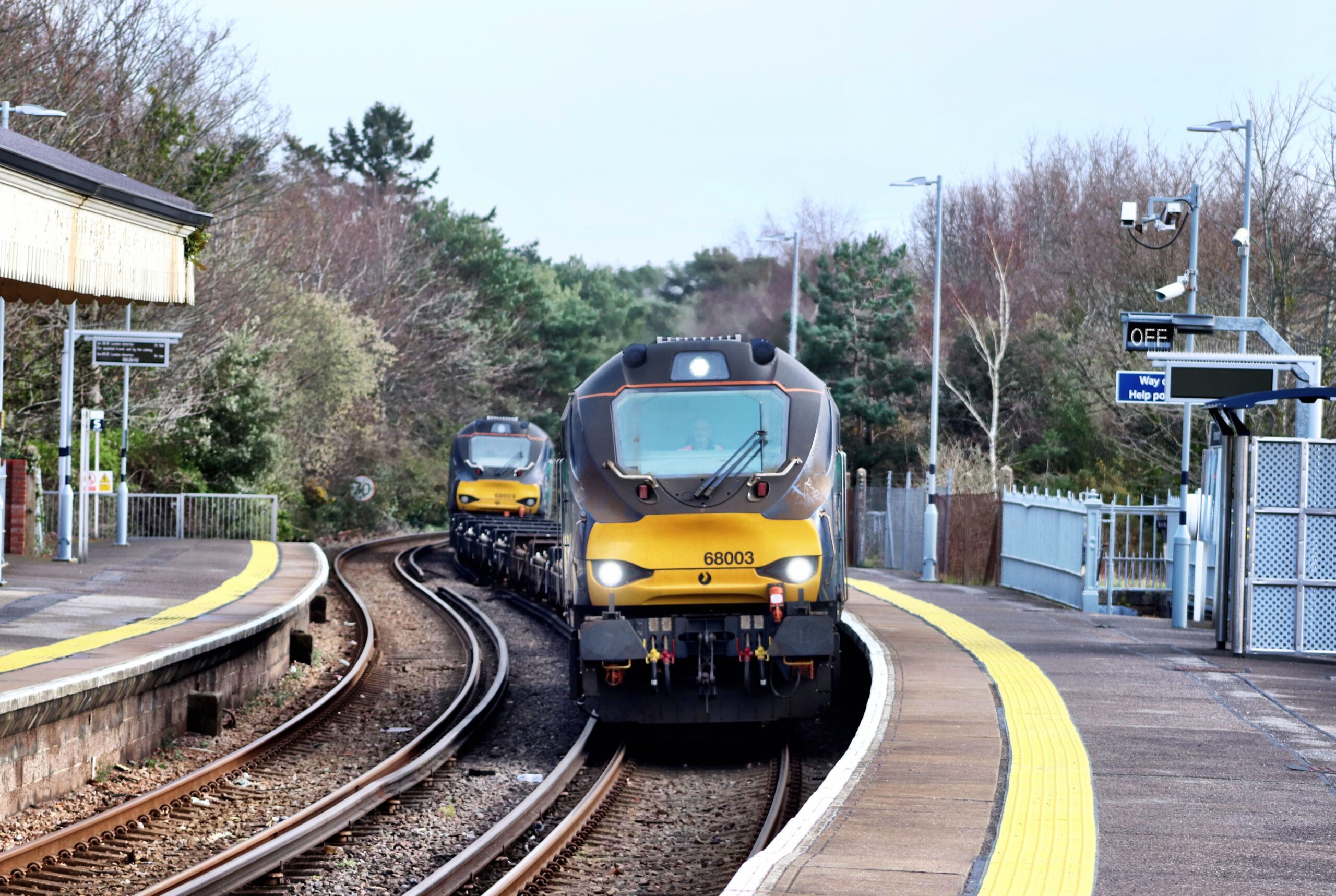
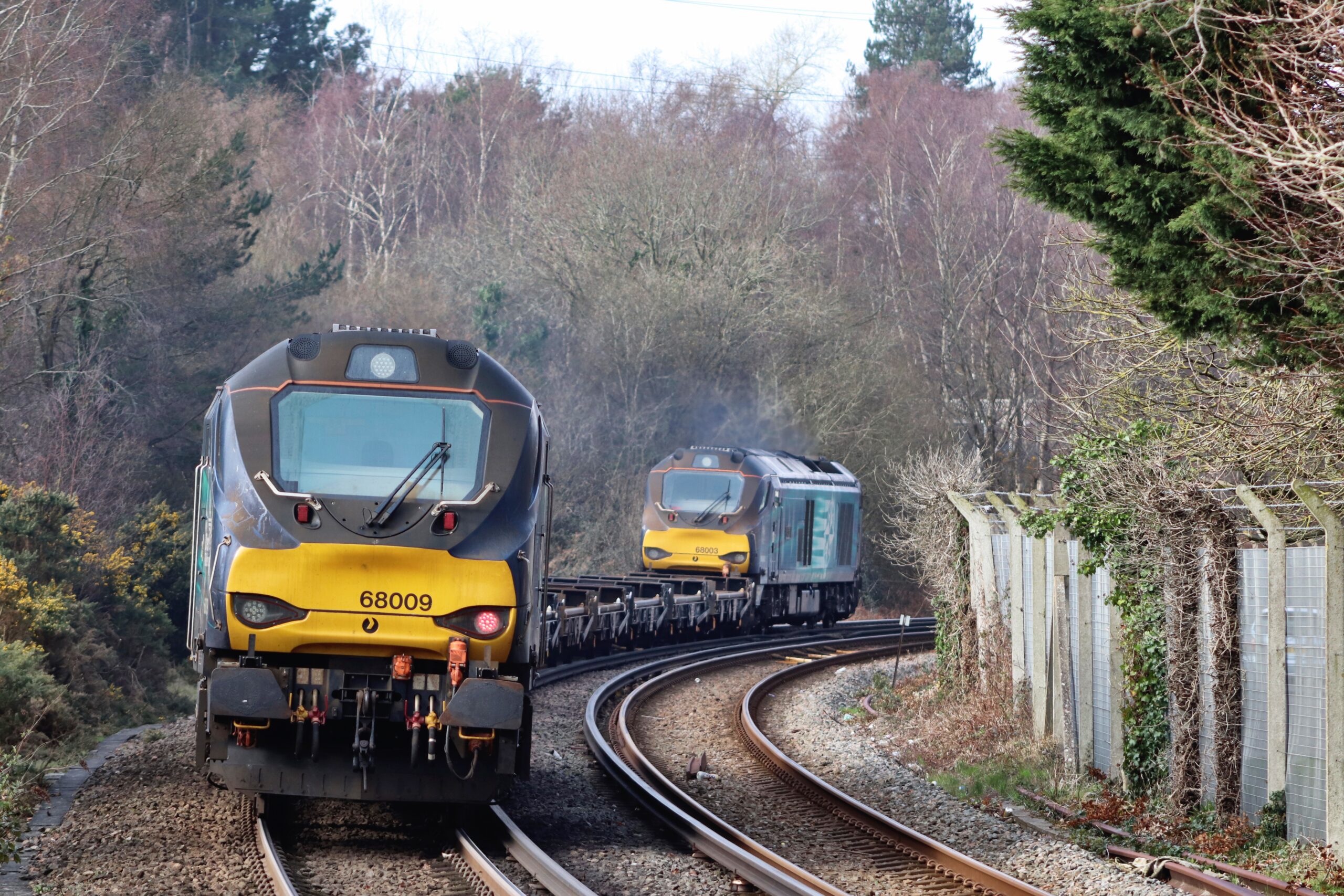
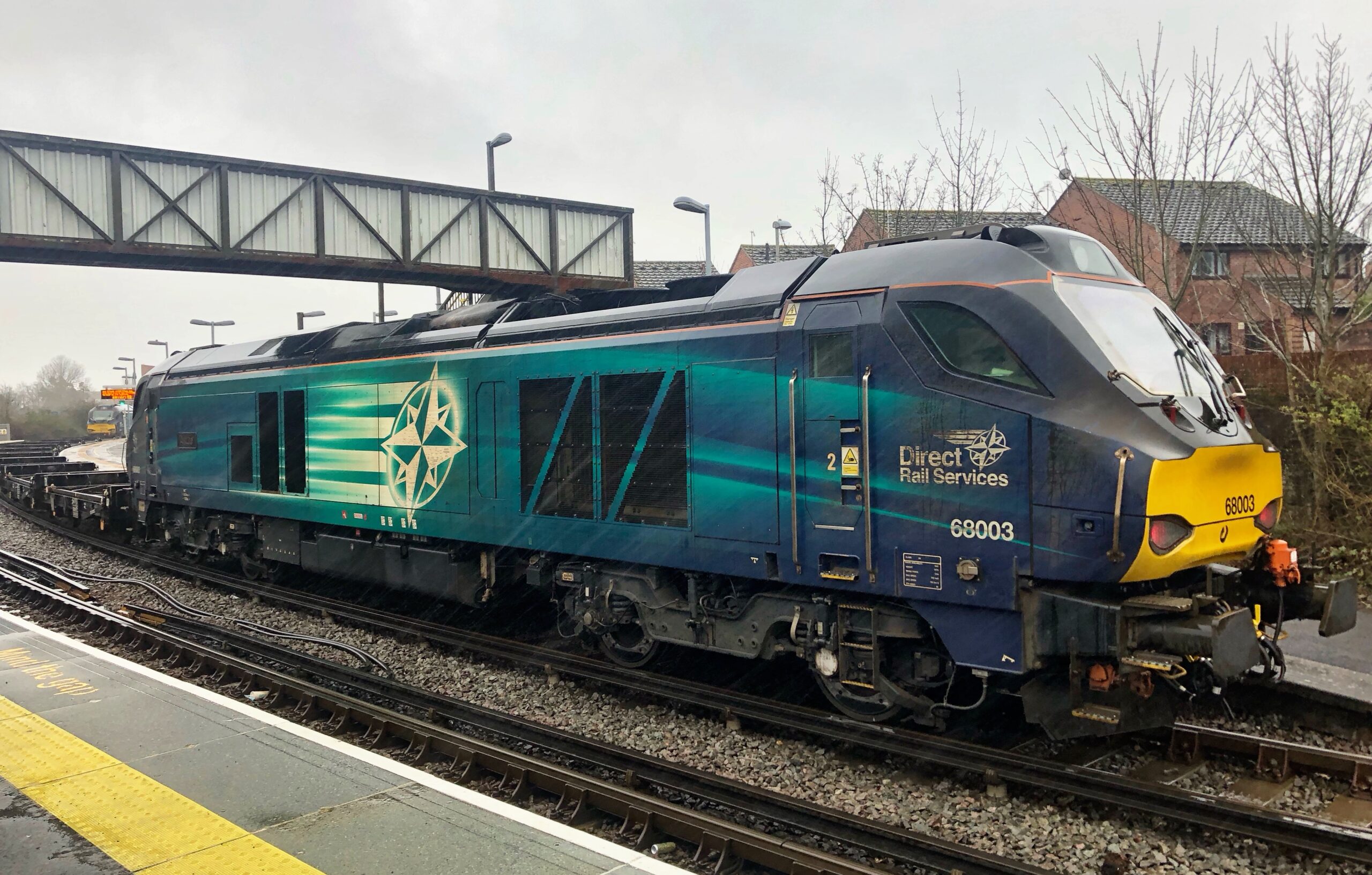
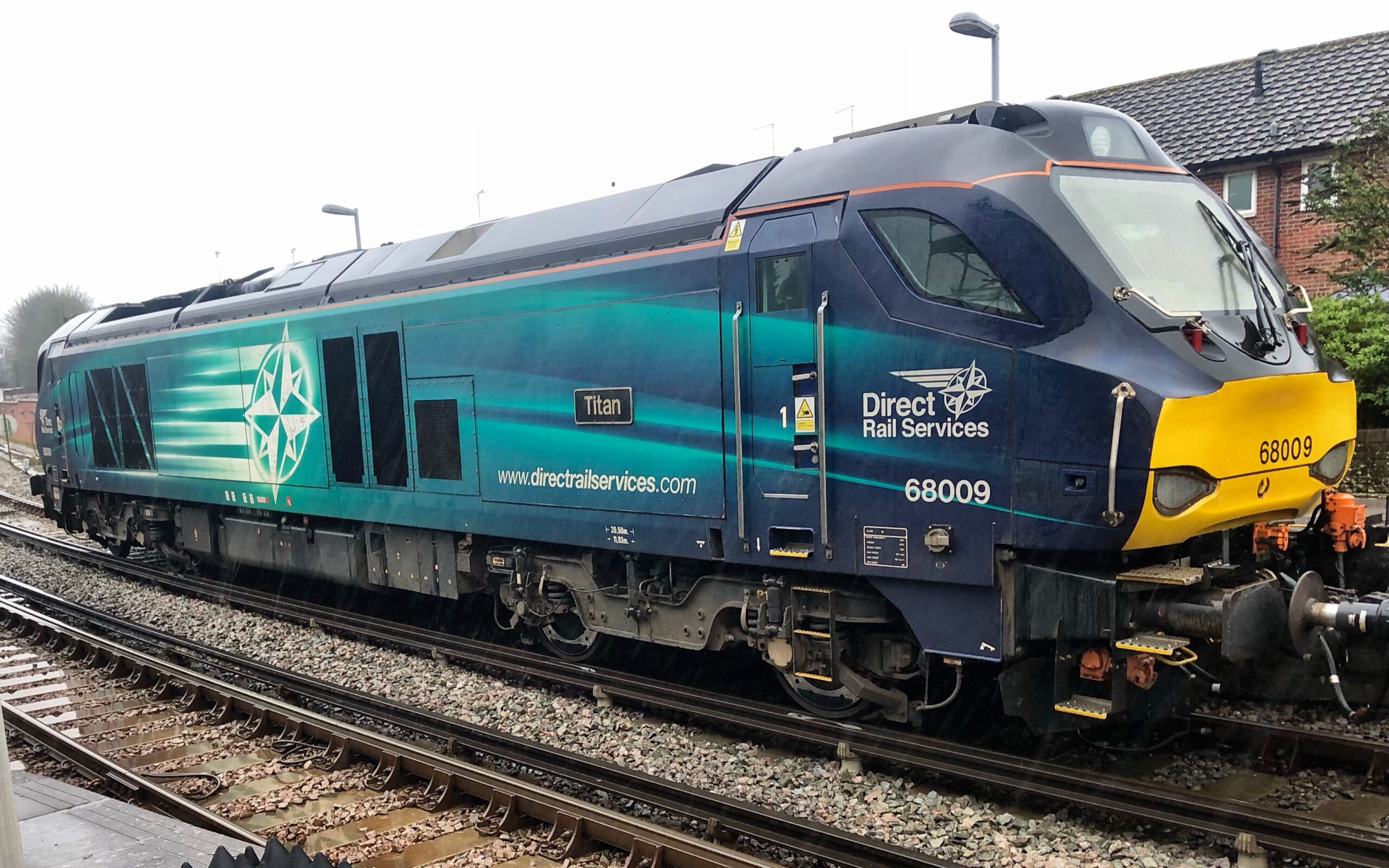
A surprise run to Winfrith occurred on March 23rd 2023, timings only appearing on Real Time Trains late the previous day. Two new to Dorset Direct Rail Services (DRS) Class 68 locomotives top and tailed the train which interestingly returned empty to Crewe. It is thought that the high winds in evidence on the day meant it was unsafe to use the crane at Winfrith employed to load the low level nuclear waste onto the wagons.
DRS Class 68 No. 68003 ‘Astute’ heads up 6Z62 0100 Crewe Coal Sidings DRS to Wool Winfrith Sidings with classmate No. 68009 ‘Titan’ behind passing through Hamworthy – 23/03/2023DRS Class 68 No. No. 68009 ‘Titan’ trails No. 68003 ‘Astute’ having passed through Hamworthy working 6Z62 0100 Crewe Coal Sidings DRS to Wool Winfrith Sidings – 23/03/2023DRS Class 68 No. 68003 ‘Astute’ at Dorchester South working 6Z95 1554 Wool Winfrith Sidings to Crewe Coal Sidings DRS (image courtesy of G E Barrett) – 23/03/2023DRS Class 68 No. No. 68009 ‘Titan’ prepares to lead 6Z95 1554 Wool Winfrith Sidings to Crewe Coal Sidings DRS away from Dorchester South (image courtesy of G E Barrett) – 23/03/2023
Video of the DRS Class 68 No.’s 68003 ‘Astute’ and 68009 ‘Titan’ working a Winfrith train. Additional video courtesy of G E Barrett – 23/03/2023
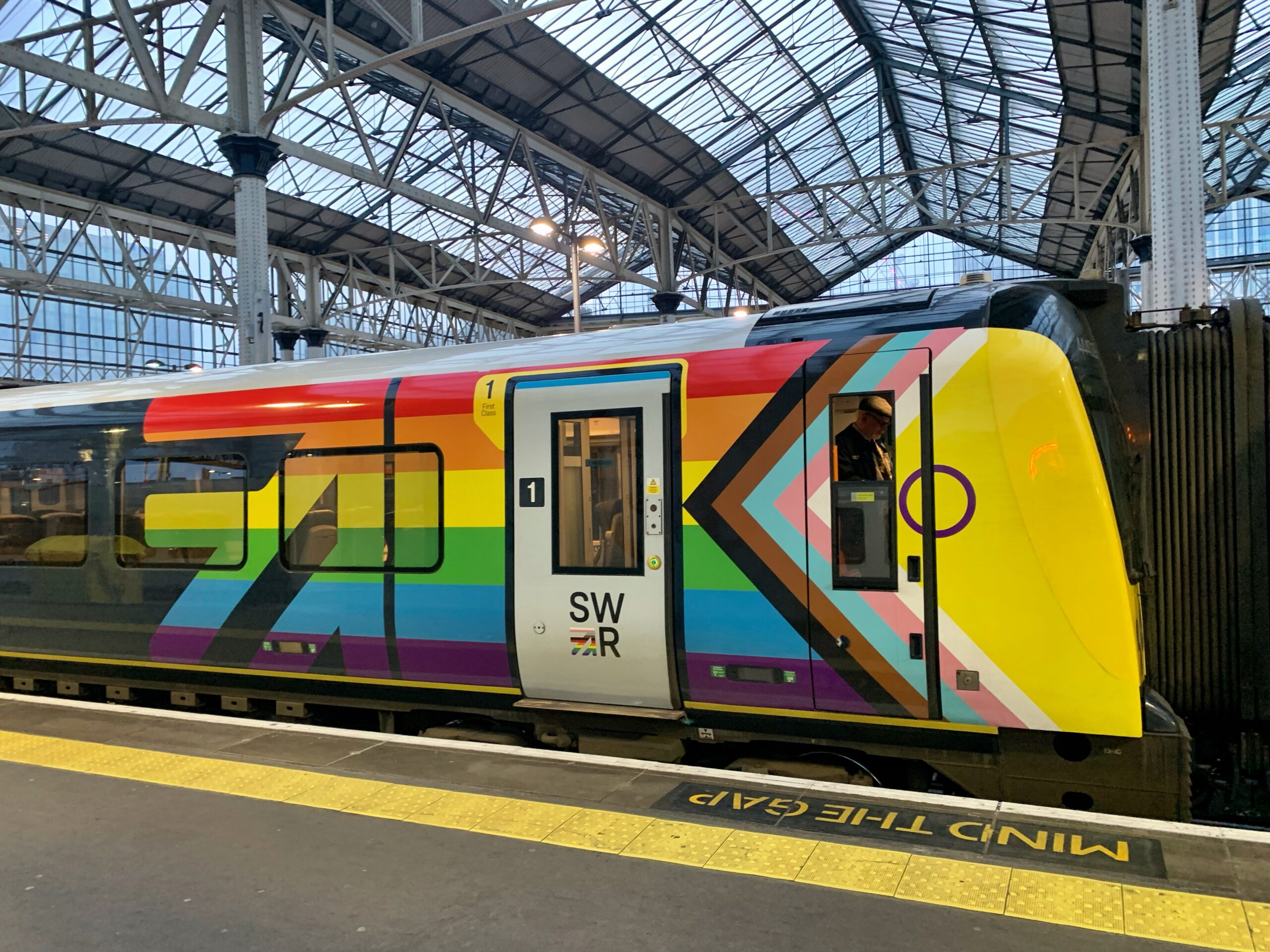
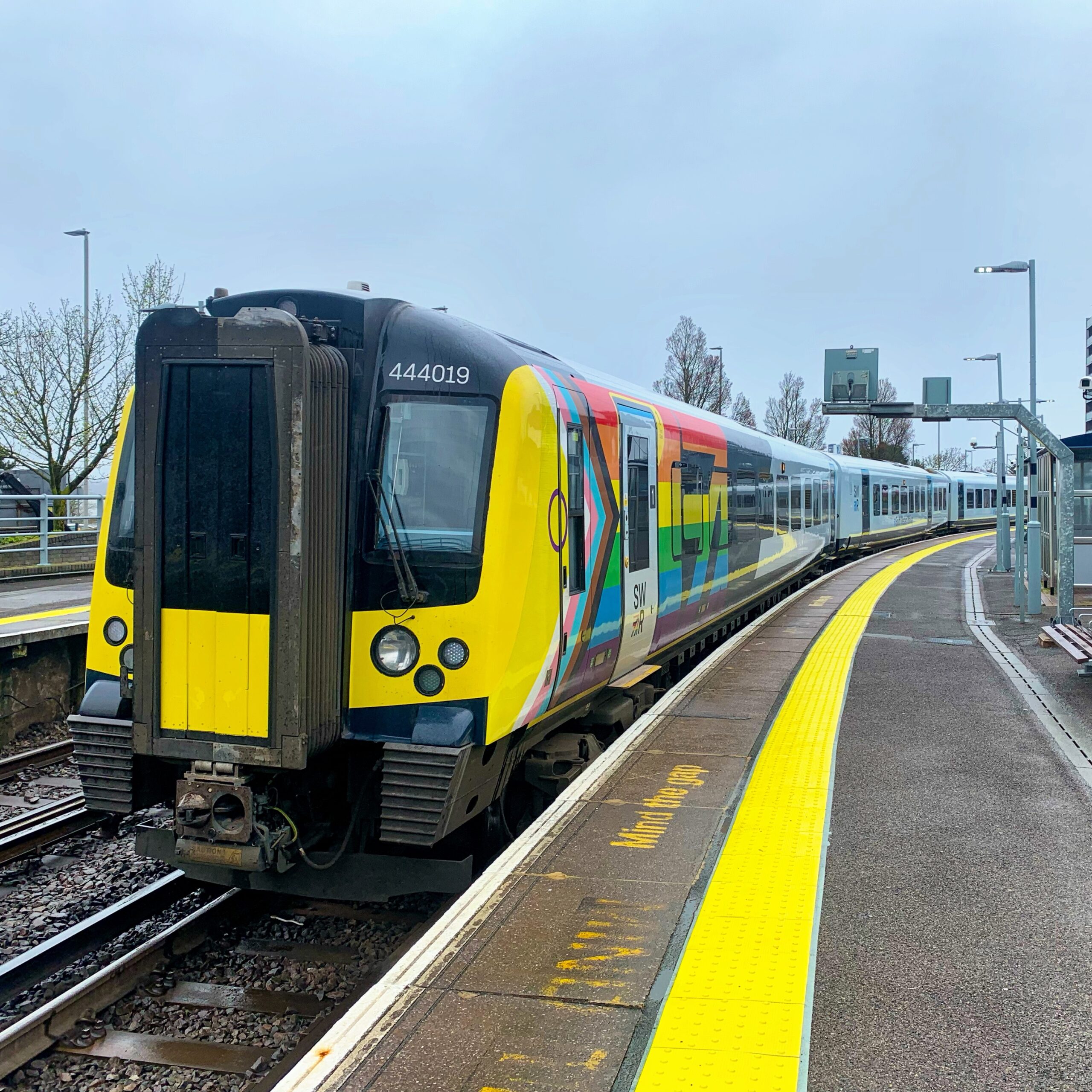
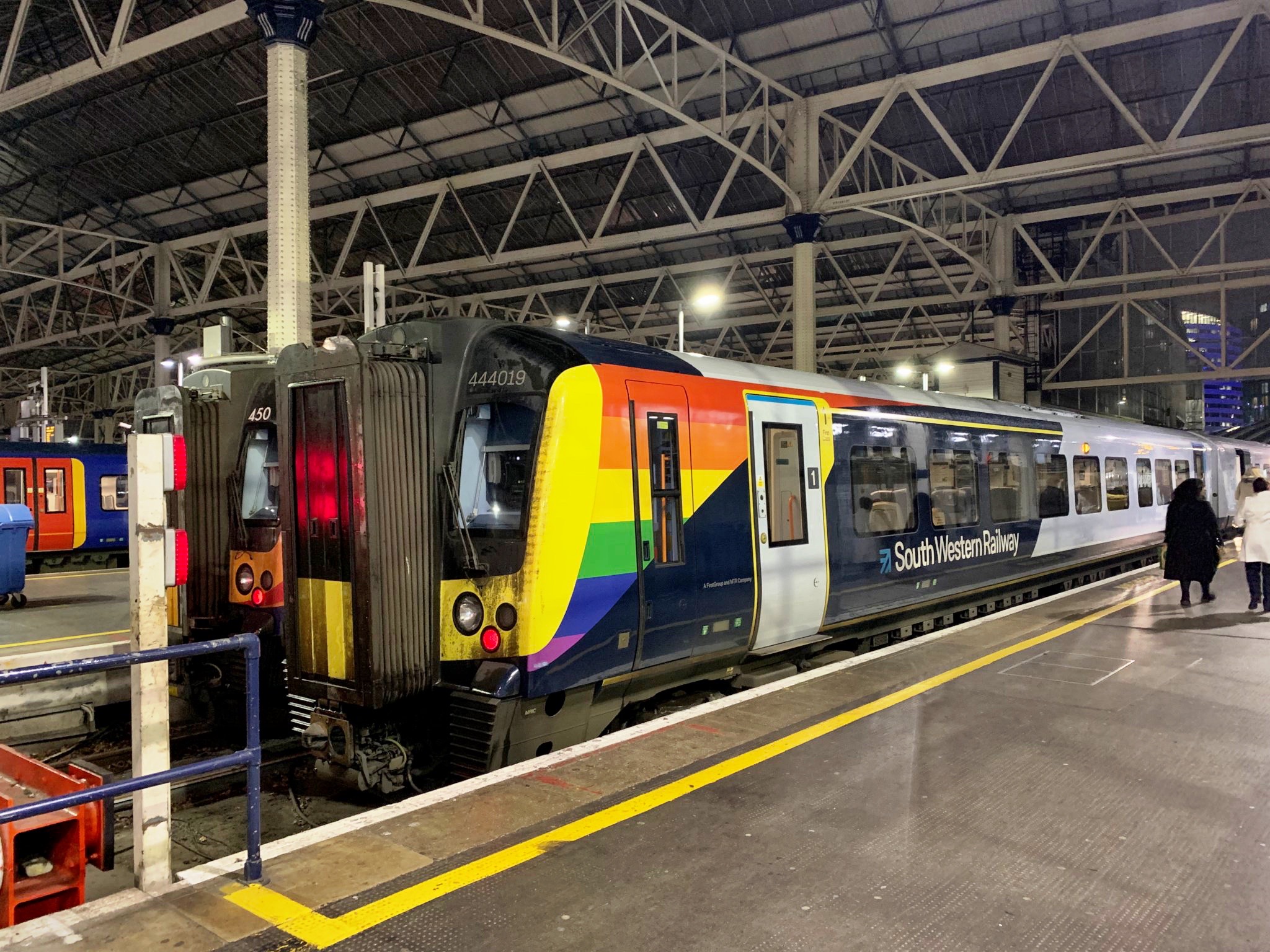
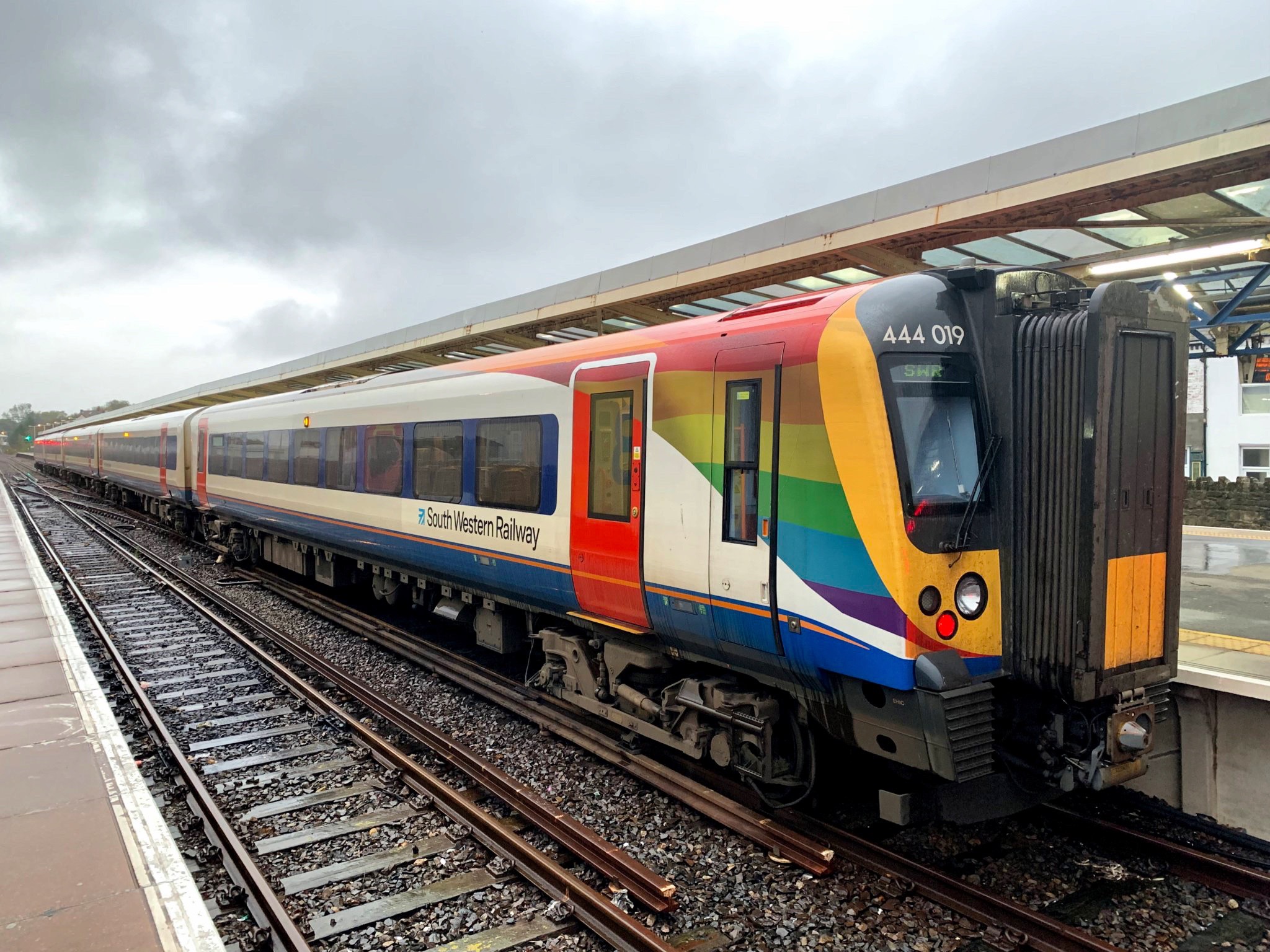
South Western Railway (SWR) have unveiled Class 444 Electric Multiple Unit No. 444019 in a new version of their ‘Pride’ livery. The unit was wrapped at Bournemouth Traction and Rolling Stock Maintenance depot on 25th/26th March 2023 and displays the LGBTQIA+ flag on the driving ends.
SWR Class 444 No. 444019 displays the new ‘Pride’ livery at London Waterloo before working IP65 2000 London Waterloo to Portsmouth & Southsea – 30/03/2023SWR Class 444 No. 444019 awaits departure from Poole with the 2W56 1100 service to London Waterloo – 31/03/2023SWR Class 444 No. 444019 in an earlier ‘Pride’ livery stands at the buffer stops in London Waterloo – 05/03/2022How Class 444 No. 444019 used to look, seen at Weymouth – 12/10/2019
That’s it for this week, thanks for joining us! We’ll be back in seven days or so when we have a look at the Crewe Heritage Centre amongst other things.
Yoshi watches on as British Railways Standard Class 7 4-6-2 No. 70000 ‘Britannia’ turns on the Yeovil Steam Centre turntable – 22/03/2023
Wednesday 15th March 2023 to Tuesday 21st March 2023
Gotcha Day!
On Thursday we celebrated the annual ‘Gotcha Day’ when Yoshi first decided to adopt me as his hooman. He really was a tiny little pup with razor sharp baby teeth. We’ve both got bigger since then and I can hardly believe it’s been four years!
Colas Class 66 No. 66850 ‘David Maidment’ at the head of a rake of autoballasters pauses at Poole to pick up a crew member just after midnight working 6C15 2303 Eastleigh East Yard to Worgret Junction – 15/03/2023
This week I was a bit of a night owl on three consecutive occasions as I stayed up past my bedtime to see three engineers trains and a test train visit our patch, all operated by Colas Rail.
Class 66 No. 66848 at Hamworthy on the rear of the 6C17 2356 Eastleigh East Yard to Hamworthy autoballaster working – 16/03/2023
Colas Trains in Poole and Hamworthy – March 2023
Colas Rail is a subsidiary of Bouygues, a French industrial group headquartered in Paris. Originally a railway construction and maintenance company named Seco Rail, they became a freight operator in the UK market during 2006 acquiring their first locomotives in 2007 after a successful period using leased rolling stock. In 2008, Seco Rail merged with AMEC-Spie and Carillion Rail under the Colas Rail banner and today they are one of the five largest contractors working for Network Rail. Colas Rail were involved with major improvement works at London Waterloo railway station. The current fleet of locomotives include Class 37, Class 43 (HST Power Cars), Class 56, Class 66 and Class 70 as well as a mixed fleet of on-track plant, such as tampers, for maintenance operations which by 2016, was reportedly the largest of its type in the UK. Previously they counted ten Class 60 locomotives amongst their fleet, and for a short while Class 86 No. 86701 which gained the Colas Rail yellow and orange livery in October 2012. The locomotive was withdrawn from mainline use in January 2013 and subsequently transferred to Europhoenix and exported to Bulgaria where she is still in use running as No. 85001.
I quite like the bright Colas Rail livery, and I’ve added some photos from recent years showing some examples:
Class 37 No. 37175 pauses at Dorchester West – 16/07/2015Class 37 No. 37099 speeds through Upwey on a test train – 27/04/2017Class 37 No. 37099 shelters from the rain at Weymouth – 31/10/2020Class 37 No. 37116 at Weymouth – 24/01/2018Class 37 No. 37219 on track data recording duties (with extra, technical equipment mounted on its ends) reverses at Weymouth – 06/05/2020Class 37 No. 37219 on track data recording duties (with extra, technical equipment mounted on its ends) at Weymouth – 06/05/2020Class 37 No. 37421 makes a nocturnal visit to Weymouth on a test train – 03/08/2020Class 47 No. 47749 ‘Demelza’ on the Weymouth Quay branch siding – 24/02/2012Close up detail for Class 47 No. 47749 ‘Demelza’ – 24/02/2012Nameplate for Class 47 No. 47749 ‘Demelza’ – 24/02/201243274 about to depart from Maiden Newton having picked up the token to traverse the single line section to Dorchester West. Dorset Council is currently in talks with the Railway Heritage Trust over renovation plans for Maiden Newton – 23/03/2022Class 43 HST power cars No.’s 43274 and 43251 about to enter Bincombe Tunnel between Weymouth and Dorchester working the New Measurement Train 1Z23 0747 Derby RTC to Bristol Kingsland Road – 26/01/2022Class 56 No. 56105 works through Cardiff Central on a train of logs – 07/05/2013Class 56 No. 56049 at Westbury – 03/09/2022Class 56 No. 56096 hauling a Class 701 delivery through Eastleigh – Class 66 No. 66847 on the Weymouth Quay branch siding – 24/12/2012Class 66 No. 66849 at Weymouth on an engineers train during rail replacement work – 15/12/2015Class 66 No. 66848 on an engineers train at Monkton, Dorchester – 24/04/2016Class 67 No. 67027 working the New Measurement Train at Weymouth – 19/06/2019Class 67 No. 67023 at the platform in Weymouth – 15/07/2020Class 70 No. 70805 at the head of an engineers train at Weymouth – 11/04/2015Class 70 No. 70809 on the approach to Dorchester South – 11/04/2015Class 70 No. 70806 in Weymouth – 15/12/2015Class 70 No. 70807 sits in Weymouth station – 11/04/2015
South Western Railway (SWR) Class 444 EMU No. 444023 has been named ‘The Alex Wardle Foundation’ to celebrate a partnership between SWR and the Alex Wardle Foundation to help raise awareness of sudden arrhythmic death syndrome (SADS), when someone dies suddenly and unexpectedly from a cardiac arrest, particularly young, apparently healthy, people. The railway company is investing more than half a million pounds installing publicly accessible automated external defibrillators at its 154 staffed stations it operates across South West London, Surrey, Hampshire, Berkshire, Dorset, Wilshire, Somerset, and Devon. The installation of the lifesaving defibrillators comes as part of the rail operators’ commitment to support safety and serve local communities. Located in protective cabinets as close as possible to the front of stations, the defibrillators will be available for use day and night in the instance of cardiac issues in the surrounding area.
South Western Railway (SWR) Class 444 EMU No. 444023 ‘The Alex Wardle Foundation’ arrives at Hamworthy working 1W23 0855 London Waterloo to Weymouth – 19/03/2023
The charity was set up in memory of Alex Wardle, a medical student and son of an SWR operations trainer. Alex passed away from SADS in March 2016. His father, Steve Wardle, has worked for SWR for 38 years and, along with other members of Alex’s close family and friends, he set up the charity to help further understanding of SADS and prevent deaths from the condition. The Class 444 was named ‘The Alex Wardle Foundation’ on 15th March 2023. Unit number 23 was chosen as this was Alex’s age when he passed away.
BR Standard Class 4MT No. 76084 having been unloaded at Norden – 17/03/2023
On Friday I slipped out to Norden as visiting British Railways (BR) Standard Class 4MT No. 76084 was delivered by road on the back of two lorries; one for the locomotive and one for the tender. No. 76084 is spending time on the Purbeck Heritage line for the Swanage Railway Spring Steam Gala running between 24th and 26th March 2023. The Gala will also feature BR Standard Class 7 No. 70000 ‘Britannia’, scheduled to arrive at the heritage line on 22nd March. Resident Class 33 diesel locos No.’s 33111 and D6515 (33012) ‘Lt Jenny Lewis RN’ were scheduled to assist the BR Standard down to Swanage once it had been unloaded onto the tracks at Norden. The locomotive was already sitting in the sidings when I arrived and, unfortunately, issues with a wagon meant that her departure was delayed and I was unable to wait for the consist to be formed and depart as Yoshi had an appointment with the dog groomer. I was, however, able to capture some images via the Swanage Railway webcams.
Class 33 diesel locos No.’s D6515 (33012) ‘Lt Jenny Lewis RN’ and 33111 as seen on the Swanage Railway Webcam passing through Corfe Castle – 17/03/2023Class 33 diesel locos No.’s D6515 (33012) ‘Lt Jenny Lewis RN’ and 33111 top and tail BR Standard Class 4MT No. 76084 as seen on the Swanage Railway Webcam passing through Corfe Castle as Jamie Smith Going Loco leans out of the cab door to collect the token giving permission for the consist to move on to Harmans Cross – 17/03/2023Class 33 diesel locos No.’s 33111 and D6515 (33012) ‘Lt Jenny Lewis RN’ top and tail BR Standard Class 4MT No. 76084 as seen on the Swanage Railway Webcam arriving into Swanage – 17/03/2023Yoshi post groom and sporting his Easter Bandana – 17/03/2023
Congratulations to Derby which has been chosen as the headquarters of Great British Railways (GBR HQ), beating five other short listed locations, none of which were in the West Country. There followed lots of bluster about the government going “full steam ahead” with reforms for the railways and promotion for Rolls-Royce.
RMT members working for Network Rail voted to accept the company’s pay offer; 12,047 voted yes and 3,709 voted no which brings to an end to their campaign of strike action. Disputes with 14 rail companies, represented by the Rail Delivery Group – including SWR and Great Western Railway (GWR) – are ongoing with further walk outs planned for 30th March and 1st April.
SWR is investing over £400,000 on improving waiting rooms at ten of its stations, including locations on the London Waterloo to Weymouth line including Basingstoke, Brockenhurst, Southampton Central and Totton. There are no stations on the list to be found in Dorset.
That’s it for another week – thank you for joining us. Please keep your comments and corrections coming, we really appreciate you having taken the time to read our little page.
Wednesday 8th March 2023 to Tuesday 14th March 2023
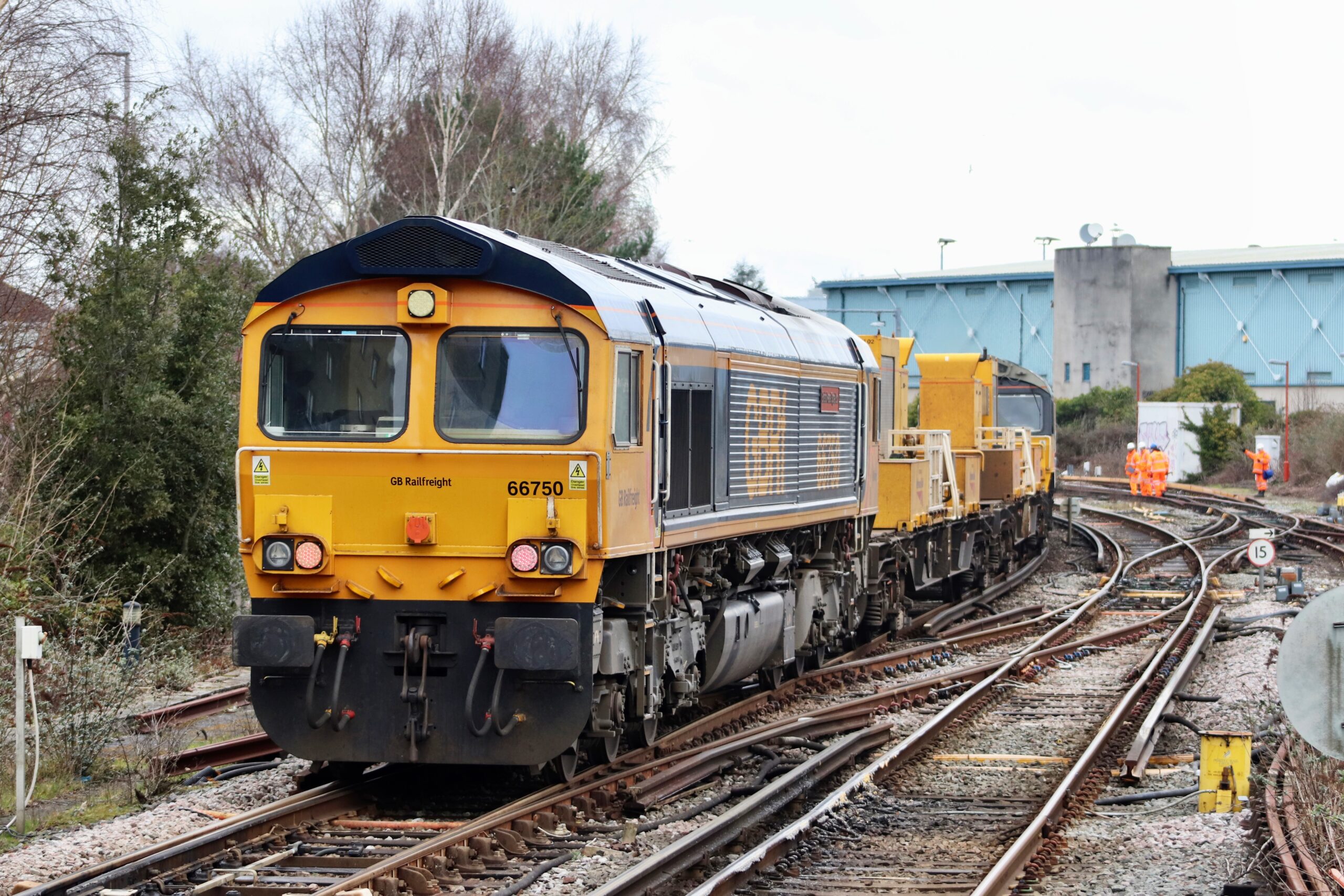
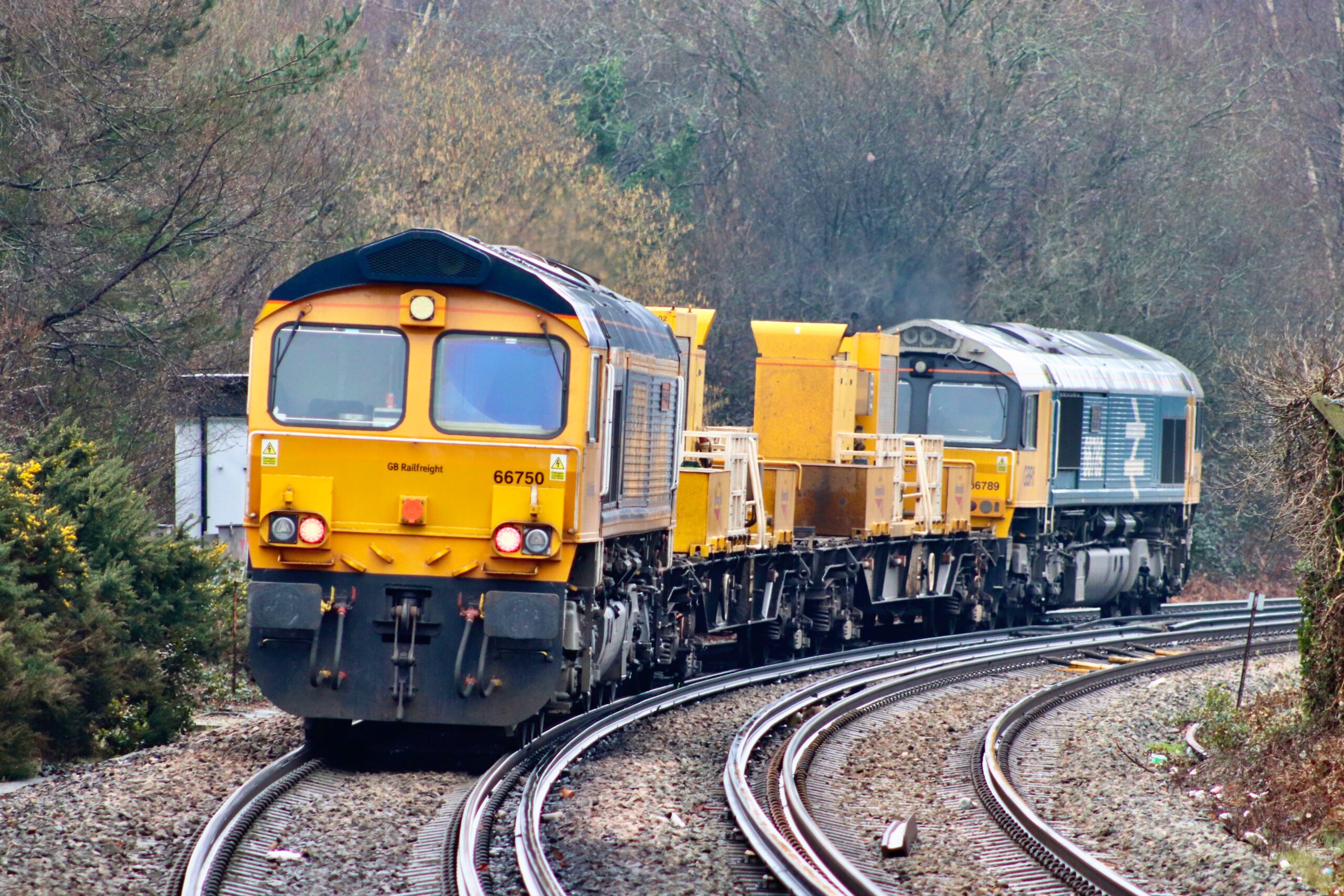
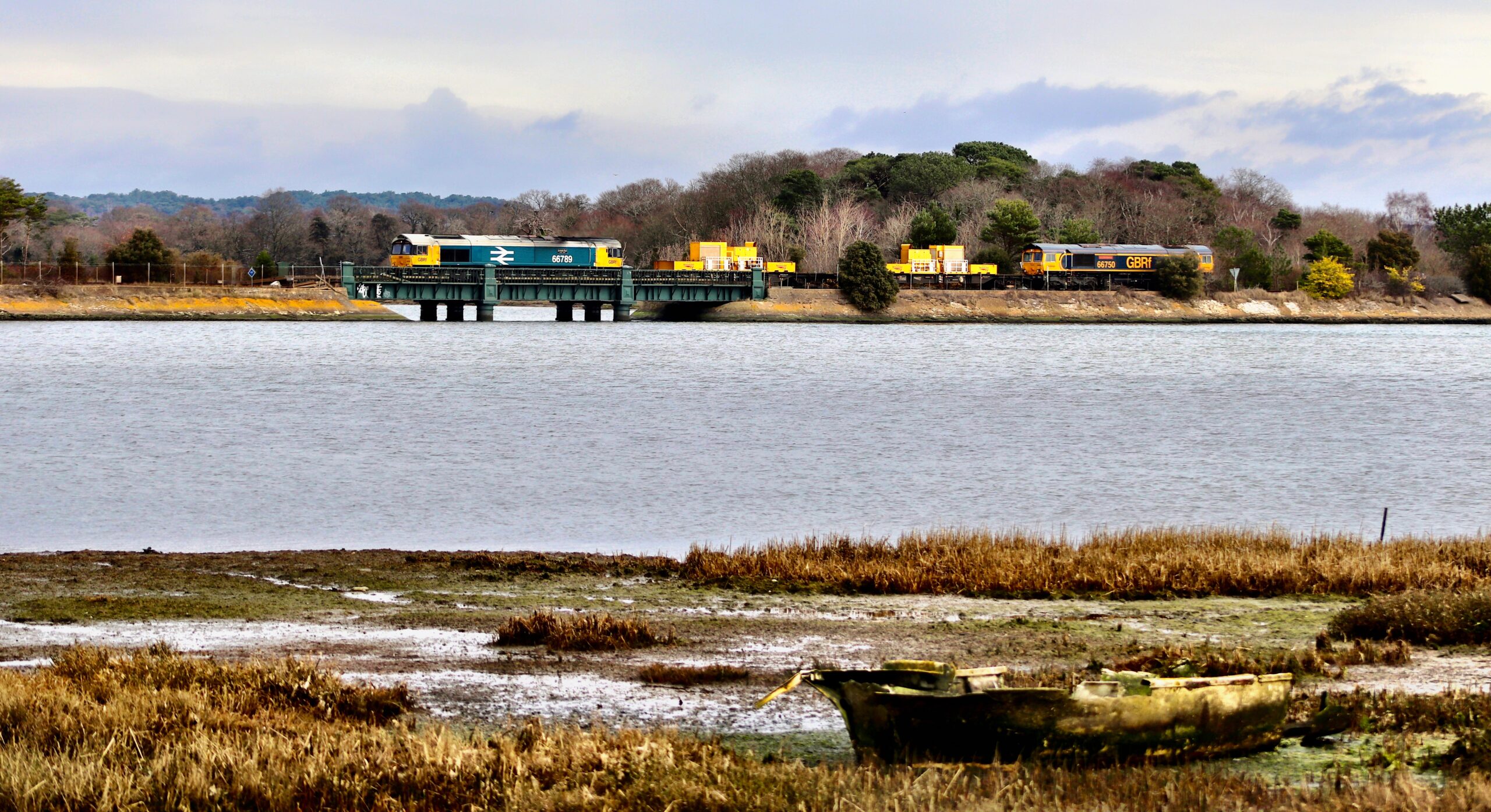
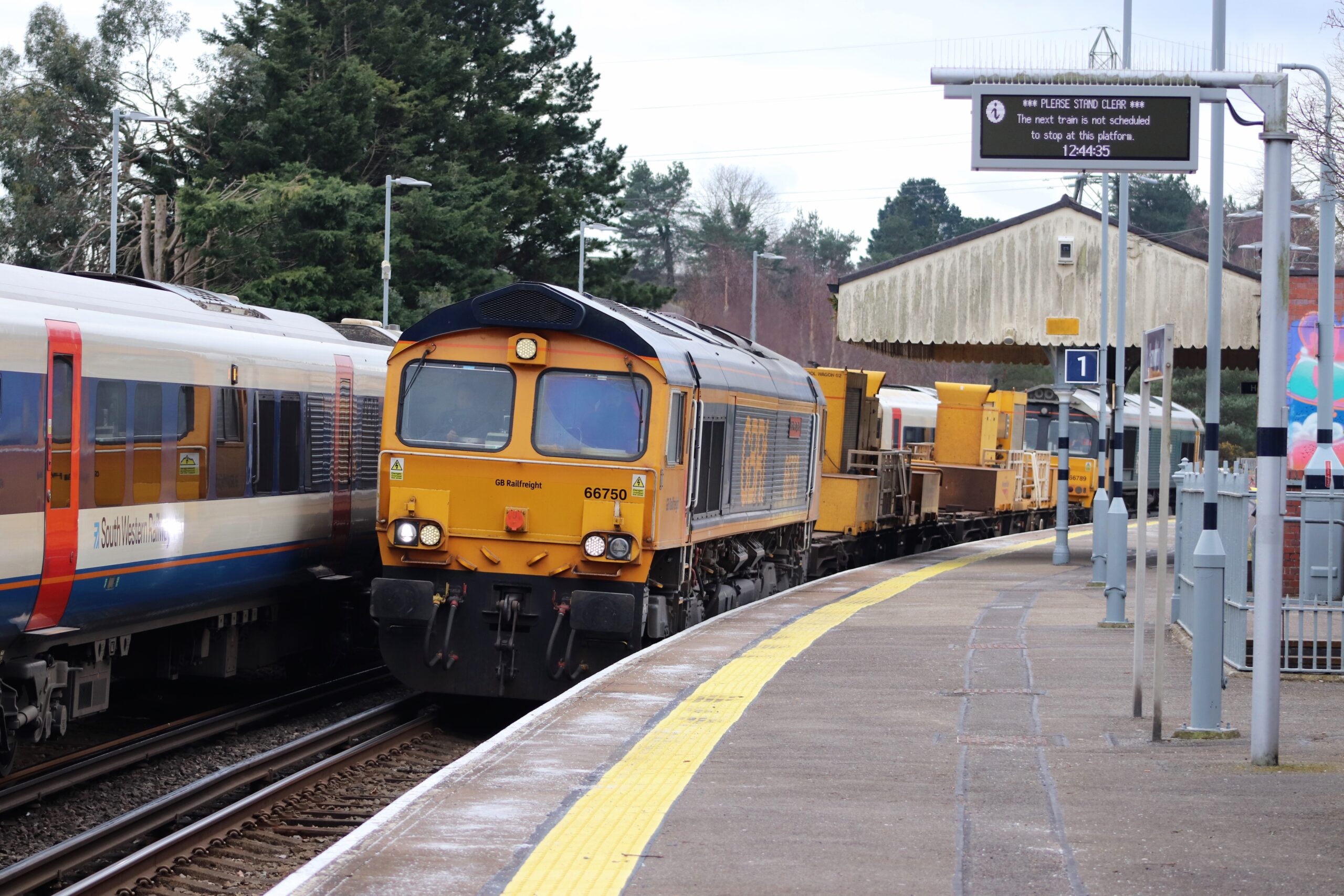
GBRf Class 66 No.’s 66789 ‘British Rail 1948-1997’ and 66750 ‘Bristol Panel Signal Box’ working 3Y88 0905 Totton Yard to Totton Yard passes South Western Railway Class 444 No. 444018 at Poole – 10/03/2022
The Network Rail Snow & Ice Treatment Train (SITT) graced us with its presence twice this week – firstly on Wednesday and then again on Friday. Both visits were top and tailed by the same pair of GBRf Class 66 locomotives which have also made it to Weymouth in the previous week or so on other SITT runs. Large logo retro British Rail liveried Class 66 No.’s 66789 ‘British Rail 1948-1997’ is a favourite amongst enthusiasts because of its special livery. Here’s a video showing the SITT workings at Hamworthy and Poole:
GBRf Class 66 No.’s 66750 ‘Bristol Panel Signal Box’ and 66789 ‘British Rail 1948-1997’ having passed through Poole working 3Y88 0900 Totton Yard to Totton Yard – 10/03/2023GBRf Class 66 No.’s 66789 ‘British Rail 1948-1997’ and 66750 ‘Bristol Panel Signal Box’ at Hamworthy working 3Y88 0900 Totton Yard to Totton Yard – 08/03/2022GBRf Class 66 No.’s 66750 ‘Bristol Panel Signal Box’ at the rear of 3Y88 0905 Totton Yard to Totton Yard with 66789 ‘British Rail 1948-1997’ leading exit Hamworthy – 08/03/2022
Monday evening the monthly 1Q51 test train made it to Dorset, this time back in the hands of GBRf Class 73 Electro-Diesel locomotives No.’s 73964 ‘Jeanette’ and 73963 ‘Janice’. We popped up to Hamworthy to see this heading towards Weymouth. Although I was planning to head out and see the return pass up to Eastleigh East Yard, the train ran 25 minutes ahead of its timings and I was otherwise avidly engaged in watching “Married At first Sight Australia”.
Yoshi takes a breather on our visit to National Trust Mottisfont – 12/03/2023
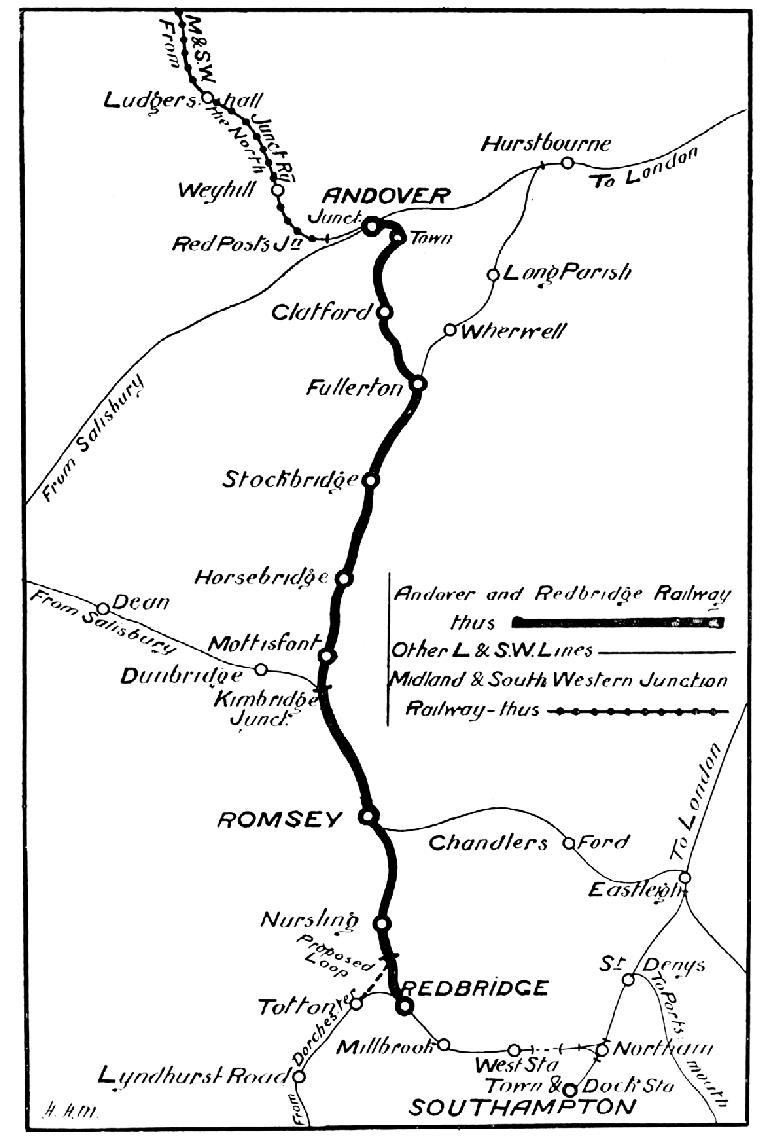
On Sunday, we went spent an afternoon at National Trust Mottisfont, an 18th-century house with a medieval priory at its heart, which was transformed into a Neo-classical home in the 1930’s. Understandably Yoshi was not allowed in the house or the on the formal lawns in front and behind of the house, but there was still plenty to see and we had an enjoyable riverside walk. On our way to the National Trust property we drove past Mottisfont & Dunbridge railway station which is the nearest station to Mottisfont. This station opened in March 1847 as Dunbridge but was renamed in 2006 to reflect its close proximity to Mottisfiont and is apparently the second least frequently used station in Hampshire, with Beaulieu Road taking the wooden spoon by having fewer passengers. We could hear the sounds of Class 158 diesel multiple units (DMU’s) passing by on the Wessex main line as we wandered around the grounds at Mottisfont. The station is served by stopping trains run by South Western Railway (SWR) which run from Romsey to Salisbury via Southampton Central. Great Western Railway (GWR) run services which pass through the station but no longer stop. As we left Mottisfont we drove through the village and found ourselves driving down Station Road. This gave away the fact Mottisfont once had a station of its own. Investigations revealed this station had been situated on the now closed ‘Sprat and Winkle Line’ which ran between Andover and Redbridge.
Yoshi takes shelter in a shepherds caravan at Mottisfont and wonders what it would like to be a sheepdog – 12/03/2023
It’s not clear how the line earned the ‘Sprat and Winkle’ name. Various suggestions have been put forward; principally that the southernmost part of the line brushes the mudflats of the River Test where winkles might sometimes be found, although there are doubts that the sprat would also be found there.
The January 1910 edition of “The Railway Magazine” included an article on the origins of the line written by John Moreton. The railway is unique in that it is built over the course of an earlier canal; The Andover and Redbridge which originates from 1792. The London & South Western Railway (LSWR) had been the first to promote a route along the canal in 1847 in an attempt to steal an advance over the Great Western Railway (GWR) and had already agreed to give those behind a Manchester and Southampton railway running powers over the line. Parliamentary assent was given to the Andover and Redbridge, but the LSWR failed to act on this and their proposal came to nothing. Ten years later, in 1858, the GWR were asked to construct a broad gauge line between Andover and Redbridge, again by means of converting the canal. With the addition of a 14 mile stretch of track between Pewsey and Andover, a broad gauge route between Southampton and Bristol / South Wales was proposed. A new terminus at Southampton along the western shore mudflats was going to be built with the broad gauge line crossing over the LSWR line to Dorchester at Redbridge. There followed a “Battle of the Gauges” with the LSWR opposed to the project attempting to secure a clause in the new Parliamentary bill that the line be built to 4ft 8.5 inch gauge. When this failed they moved to ensure the railway would be built to mixed gauge.
The first sod on the new railway was cut by Lord Palmerston at Ashfield Bridge, very close to his Broadlands residence near Romsey, on 28th September 1859 accompanied with the sound of a 14 gun salute. Over the next few years, there followed many changes and alterations to the scheme and in a June 1863 Act of Parliament the Andover and Redbridge Railway was amalgamated with the LSWR which meant the line would in fact be built to what we now call standard gauge, finally opening on 6th March 1865. As originally built following the route of the canal and to avoid the cost of building bridges over the rivers Test and Avon, the railway had many tight curves. In his 1910 RM article, John Moreton recalled, “many journeys on the line where sticking to one’s seat was a matter of considerable difficulty, and the luggage placed on the racks frequently provided a minute bombardment to those seated beneath before the end of the journey was reached.” The curves would eventually be straightened out by the LSWR, the exercise being completed by November 1885 and with the opening of the Midland & South Western Junction Railway linking Liverpool, Manchester and Birmingham with Southampton via Cheltenham and Swindon, crossing the Cotswolds and the Wiltshire Downs, the original idea of a railway providing direct passage between the North and the Solent was practically realised. The railway was an important link during the 1st and 2nd World Wars, carrying troops from Salisbury Plain for embarkation to France via Southampton.
The final British Rail timetable issued for the period 15th June to 6th September 1964 shows a more or less hourly weekday service along the line between 0640 and 2200 with Sunday working also maintaining a similar level of service between the hours of 0855 and 2101. Trains would have been worked by Eastleigh built Diesel-Electric Multiple Units (DEMU) ‘Hampshire Units’ first introduced in 1957. Despite this level of service, the Beeching report of 1963 declared that fewer than 5000 passengers used the trains each week and services were therefore withdrawn on 7th September 1964.
Map of the ‘Sprat and Winkle’ Line from ‘The Railway Magazine’ January 1910
The closed Mottisfont station is now a private house called, appropriately enough, “The Old Station House”. The old platforms have been incorporated into a garden feature. We didn’t stop to peer over the garden gate, as that would have been rude. Further up the line, and one for our bucket list, is Horsebridge station which boasts the best preserved remaining station building on the former line. It has, at least pre-Covid, been used as a tea rooms and wedding venue. There is a Southern Railway carriage acquired from Bournemouth which can be rented for holiday accommodation.
The next station heading North is Stockbridge, which has some resonance to me as two of my uncles worked on the railway here. George Downton was a signalman and Gus Robertson a platelayer. Sadly Gus died from injuries he sustained during the Great War and my mum, at the age of 8 or 9, was asked to spend her summer holiday in Stockbridge with his widow, my Aunty Gertrude, in the early 1940’s to keep her company. This was extended after the holidays and mum eventually ended up attending Stockbridge school. My mother recalls George’s wife, Aunty Bess, preparing a cooked meal for George on Fridays and asking mum to take it up to him in the signal box, a place she was not really allowed to visit. Mum doesn’t recall why this happened most Friday’s but she does remember Chipperfield’s Circus temporarily keeping their animals in the station sidings when their headquarters were at nearby Down Farm and helping to feed the tigers. I’m pleased we no longer allow wild animals to be exploited for a travelling circus.
These days, the trackbed between Westdown, near Fullerton, Stockbridge and Mottisfont forms part of the Test Way, a 44 mile footpath along the River Test.
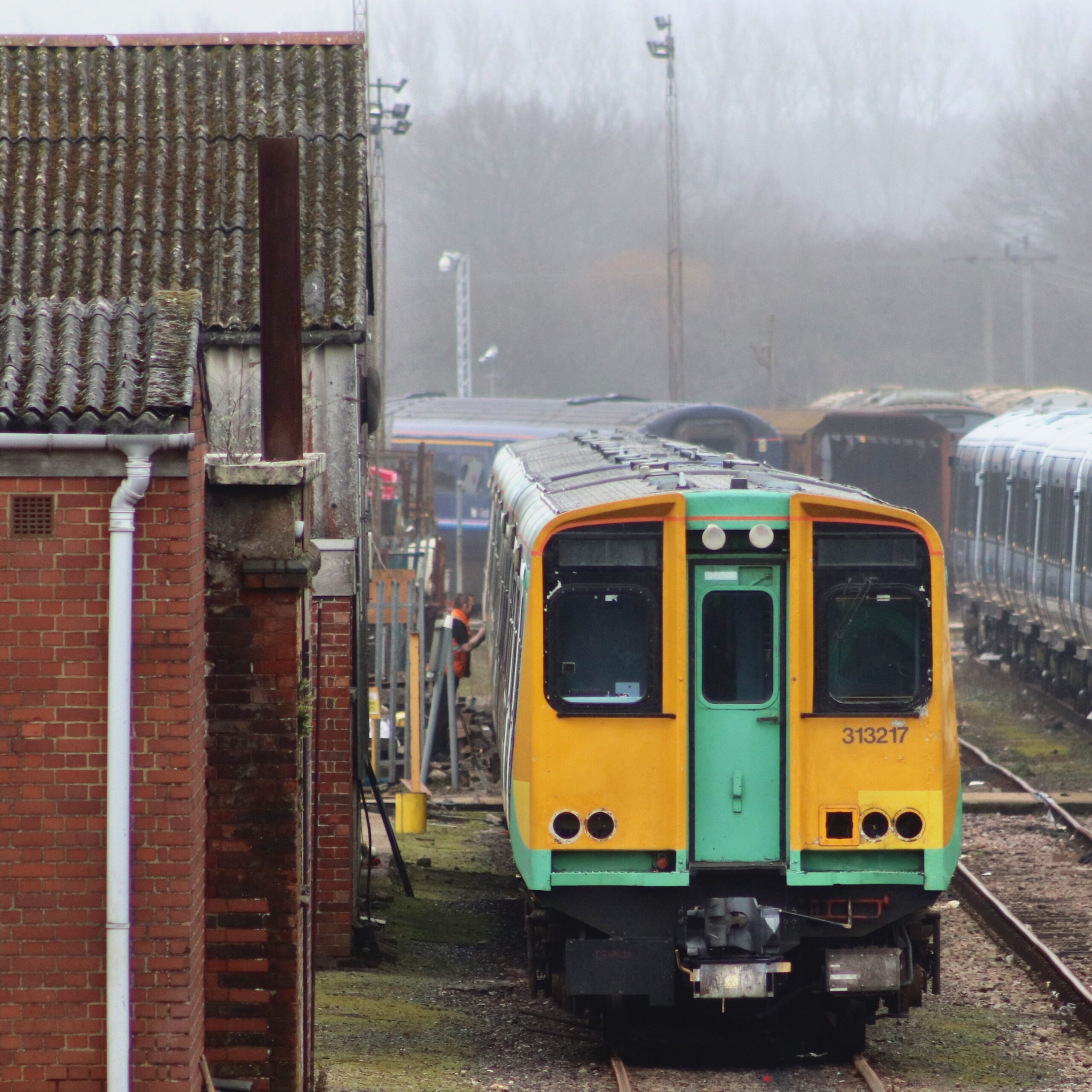
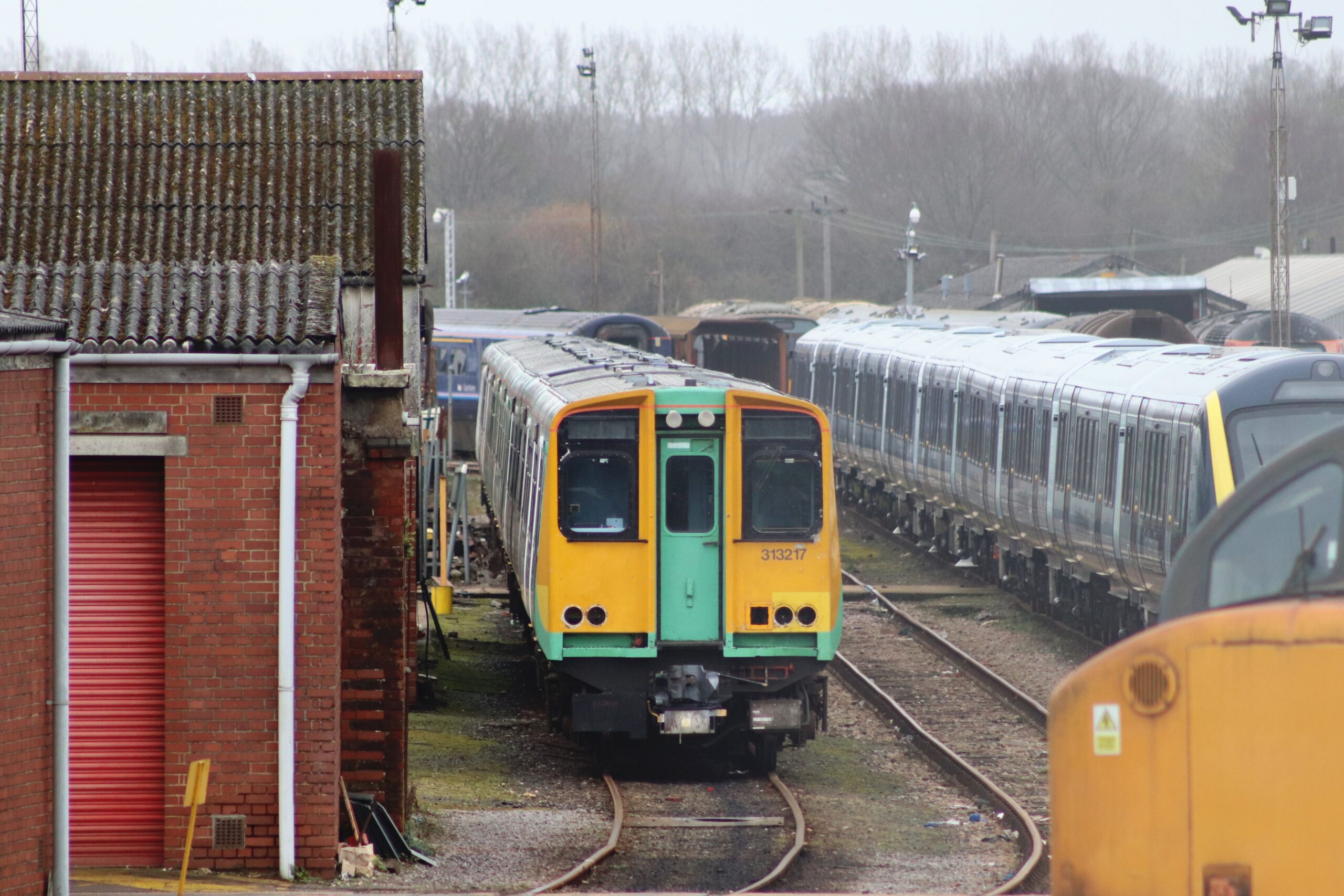
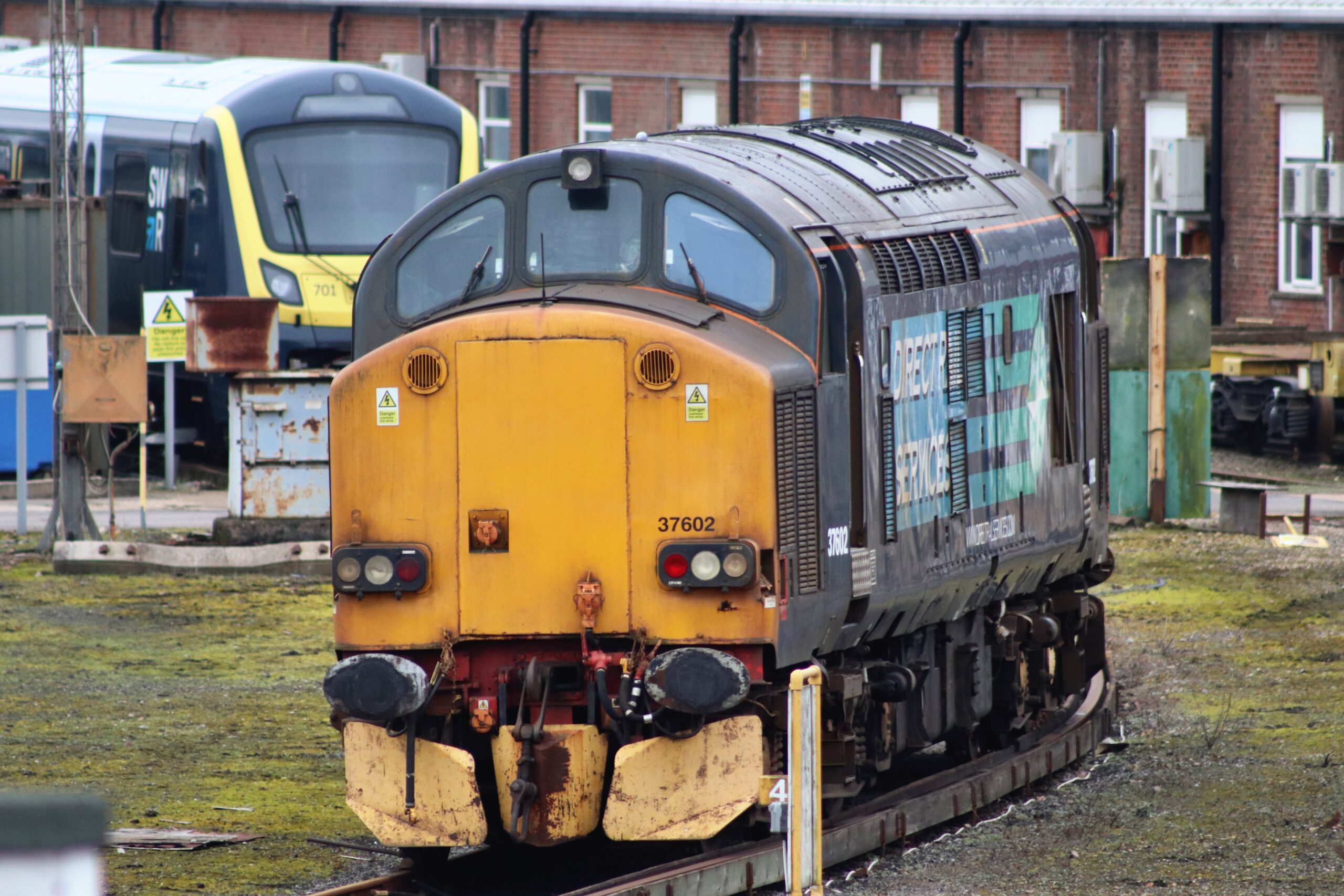
As we drove home from Mottisfont, I inadvertently turned left at Romsey and somehow found myself in Eastleigh. I took this, most unexpected, opportunity to photograph the first of the Southern Coastway Class 313 electric multiple units (EMU’s), No.’s 313203 313214 & 313217, which have been withdrawn from service and moved to Eastleigh Arlington to be scrapped. The units had arrived on Friday 10th March and indeed, I had been very tempted to pop over the county border to see them being delivered by Rail Operations Group (ROG) Class 37 No. 37800 on a working from Brighton Lovers Walk.
Class 313 No. 313217 at the rear of fellow classmates 313203 and 313214 awaiting their fate at Eastleigh Arlington – 12/03/2023Class 313 No. 313217 at Eastleigh Arlington – 12/03/2023Direct Rail Services Class 37 No. 37602 in the yard at Eastleigh Arlington works – 12/03/2023Direct Rail Services Class 37 No. 37602 in the yard at Eastleigh Arlington works – 12/03/2023
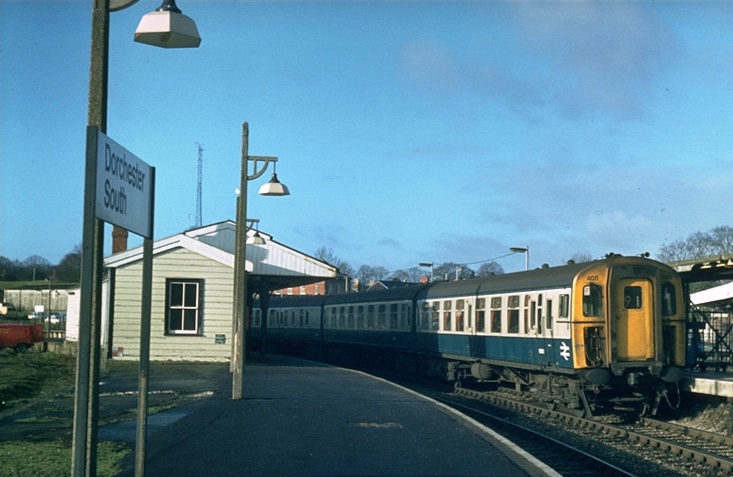
Also viewable on the works from the adjacent public road was London Underground’s (LU) 4-TC (Trailer Control) set which had arrived at Eastleigh Arlington in February following its visit to St Leonards for the fitting of retention toilet tanks. The 4-TC’s were unpowered fixed formations of 4 carriages with a driving position at each end of the set, converted by BR’s Colgate Road Carriage Works from locomotive hauled Mark 1 carriages in 1966-1967 and 1974 and were once the mainstay of the Weymouth to Bournemouth line coupled with Class 33/1 push-pull locomotives. At Bournemouth the 4-TC unit would be joined up with one or two 4-REP EMU’s for the onward journey to London Waterloo. Down trains to Weymouth would carry out the same operation in reverse.
London Underground’s 4-TC set at Eastleigh – 12/03/2023Close up of London Underground’s 4-TC set at Eastleigh – 12/03/2023
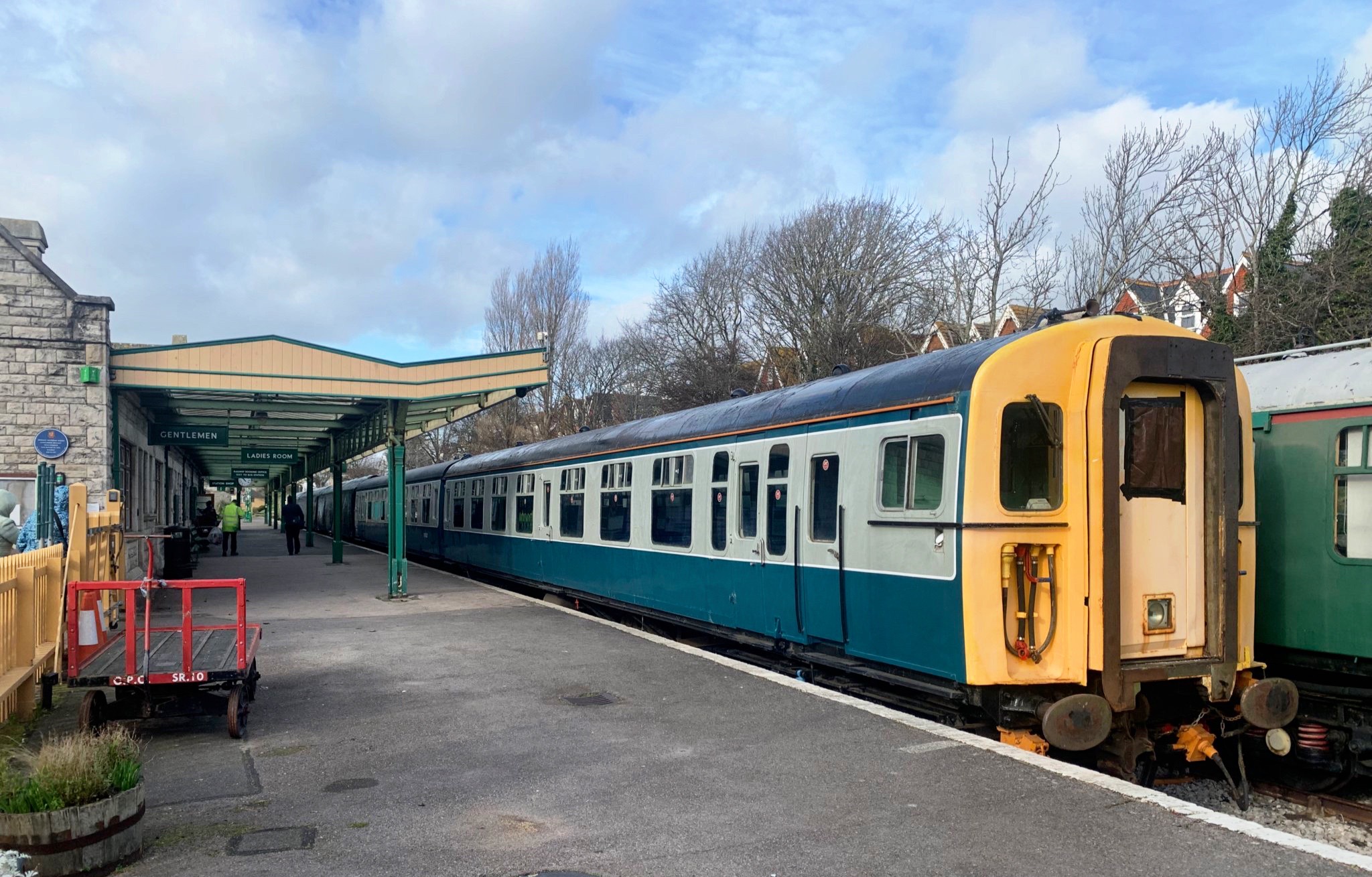
Two complete 4-TC units as well as other odd carriages have been preserved. The London Underground unit is notionally numbered 428 but contains coaches from other units making up its four car formation. Another set previously owned by LU and again made up of coaches from several units is being restored at The Swanage Railway and will be numbered 413. I am looking forward to seeing this project come to fruition and paired with a Class 33/1 will bring back memories of old.
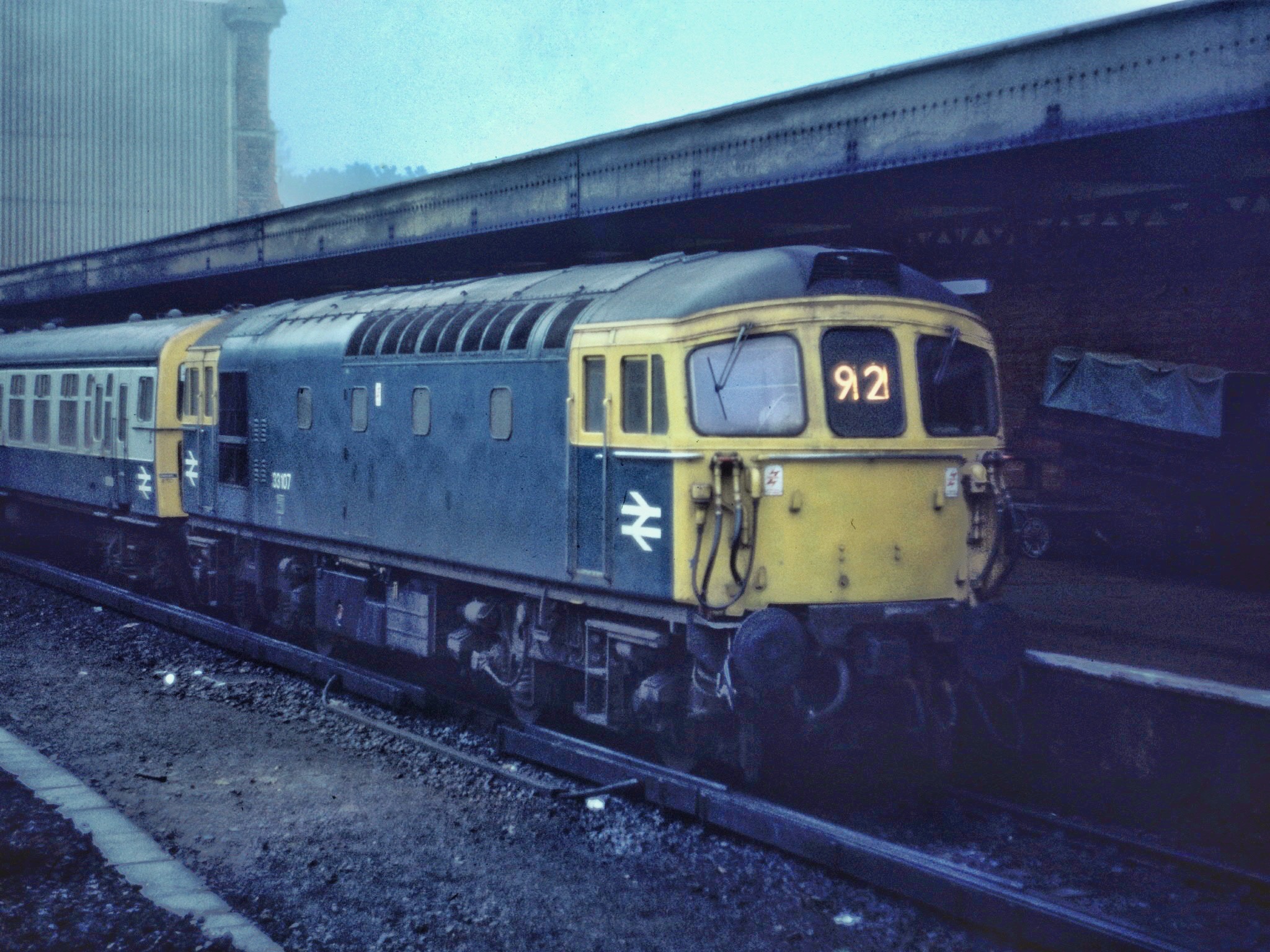
The Swanage Railway 4-TC which is undergoing restoration is seen at Swanage in February 2022 – 12/02/20224-TC No. 405 heading a Weymouth to London Waterloo service stops at Dorchester South – 26/01/1982BR&CW Class 33/1 No. 33104 propels the 1533 Weymouth to London Waterloo service which consists of two 4-TC units having passed Syward Crossing, Dorchester – 15/04/1983In fading light Class 33/1 No. 33107 at Bournemouth has attached to the 4-TC Weymouth section of a service from London Waterloo – 27/02/1982
For The Record
Swanage Railway’s Class 117 DMU at Creech Bottom with a River Frome to Norden service during the February “Behind the Scenes” event – 12/02/2023
The Swanage Railway have announced they are to operate a trial heritage diesel train service on Tuesdays, Wednesdays, Thursdays and Saturdays from the main line at Wareham between 4th April and 10th September 2023. The first train departs Wareham at 1119 and the last train of the day will depart Swanage at 1620. The trains will be operated and staffed on behalf of Swanage Railway by West Coast Railways utilising restored and upgraded 1950’s Class 117 Diesel Multiple Units (DMU) with the option of adding a single car Class 121 DMU at busy times and is the result of working in partnership with the UK Government’s Coastal Communities Fund, the Department of Transport, the former Purbeck District Council, Dorset Council, British Petroleum, Perenco, Network Rail and South Western Railway (SWR). Tickets for the service will also be available from SWR so passengers can add tickets for Corfe Castle and Swanage to their main line tickets. This will be the first time in 51 years – since the last day of British Rail passenger trains between Wareham, Corfe Castle and Swanage on Saturday 1st January, 1972, before the branch line was controversially closed – that such a main line ticket facility for travel to Swanage has been possible. During the summer of 2017, the Swanage Railway operated a 60 selected day trial train service from Wareham using hired-in diesel locomotives and carriages again operated and staffed by West Coast Railways. Plans to operate a second year 90 selected day trial train service from Wareham during 2018 were delayed and then the Covid pandemic hit which caused further delays because of its practical and economic effects.
If interested, you still have time to take part in Dorset Council’s survey on proposals to make the main route between the two Dorchester railway stations along Fairfield Road in Dorchester, which has no dedicated footway, safer for pedestrians, cyclists and wheelchair users. The survey is open until 17th March 2023. Funding for any work will come from the Government’s Active Travel Fund which aims to improve walking, wheeling and cycling for all.
Thanks for joining us, as always your visit is much appreciated! This weeks blog was put together listening to: ‘From Nothing To A Little Bit More’ by The Lathums, ‘Space Oddity’ by David Bowie and ‘The Wall’ by Pink Floyd… “Mother should I trust the government?”
Wednesday 1st March 2023 to Tuesday 7th March 2023
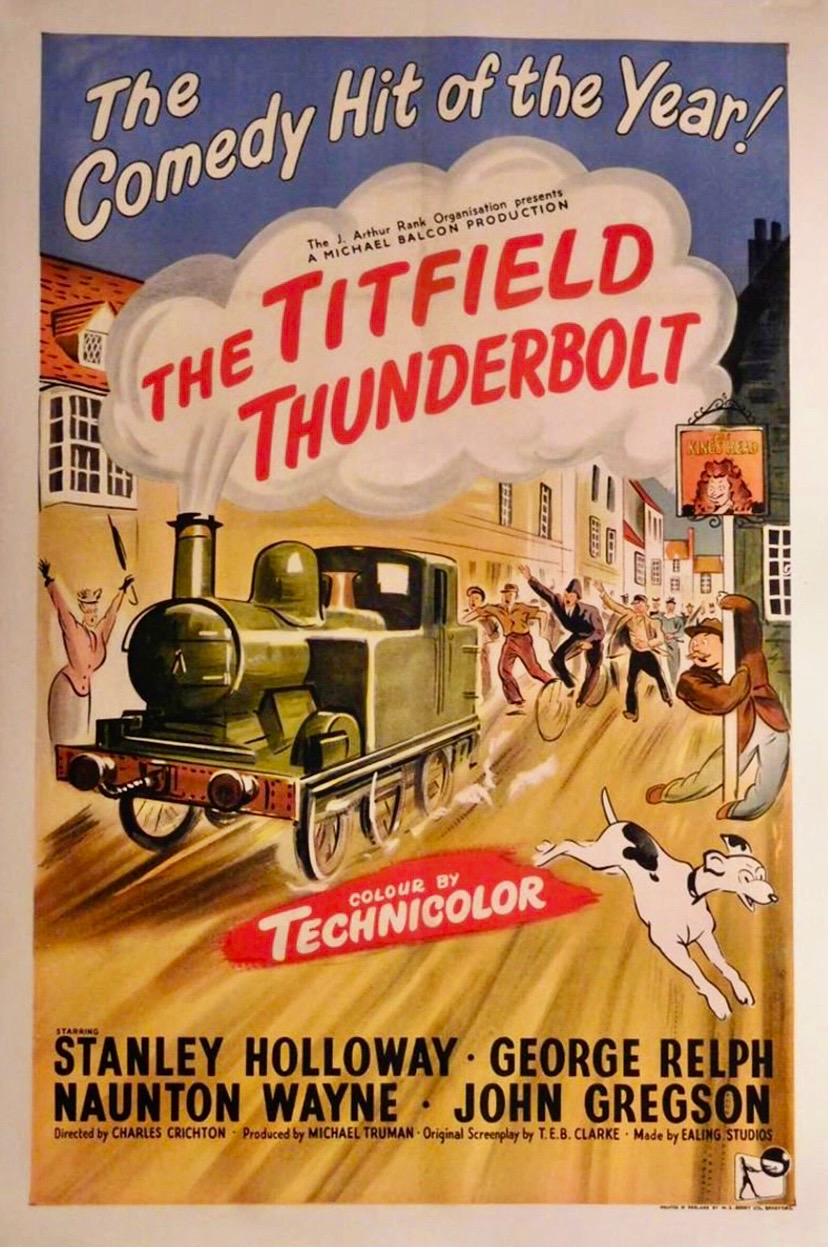
“The Titfield Thunderbolt” film poster
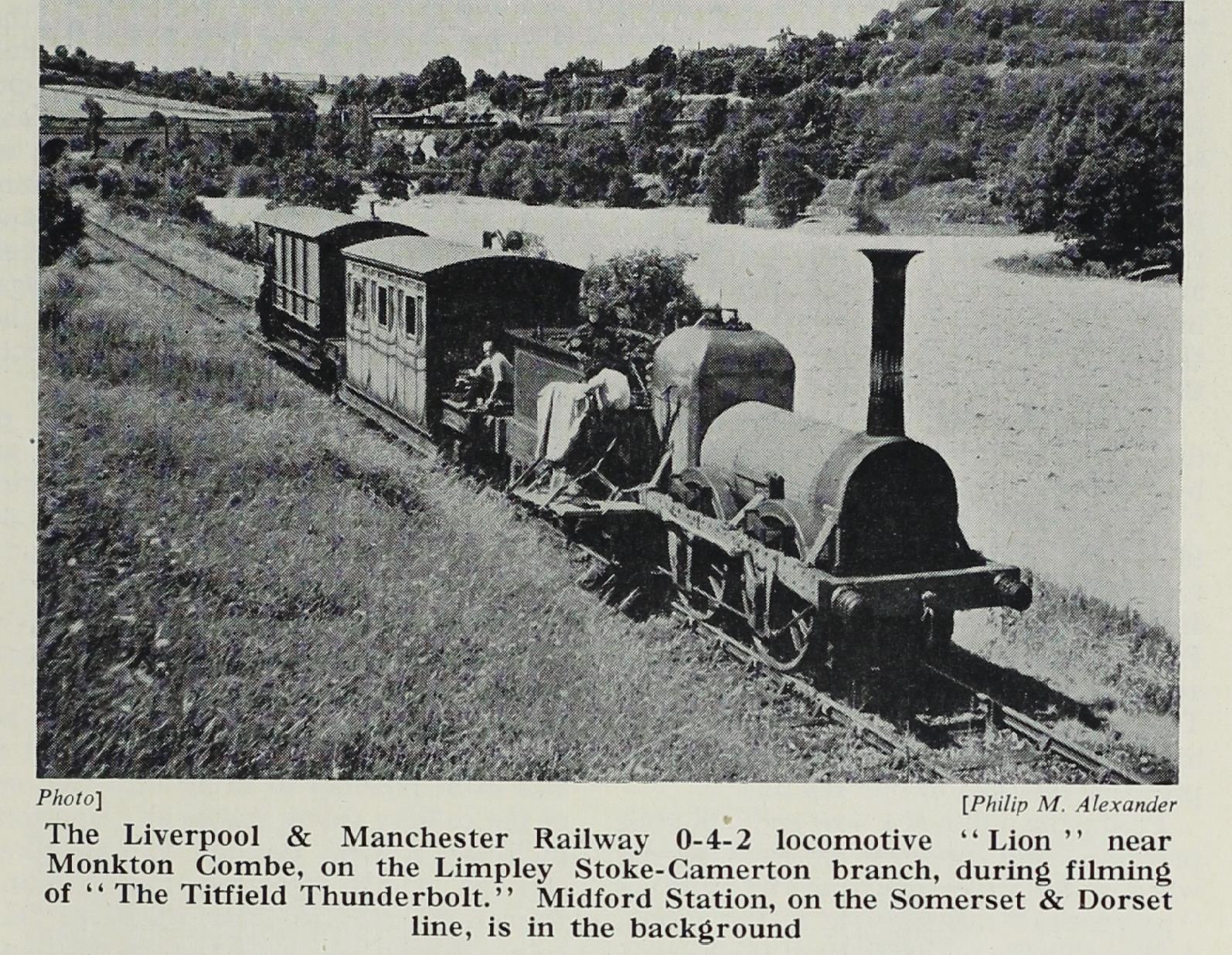
I love an Ealing Studios film, and this week, “The Titfield Thunderbolt” celebrated its 70th Anniversary having been released to the public for the first time on 5th March 1953 with a Gala Premiere at the Leicester Square Theatre in London as part of the British Film Academy’s award ceremony, before going on general release from the 6th. Filmed in 1952, the feature was mostly shot on the Camerton branch between Camerton and Limpley Stoke on the Cam Brook Valley near Bath which had closed to traffic in February of the previous year. Monckton Combe railway station stood in for Titfield while the village scenes were shot in Freshford. The Fish Bay platform at Bristol Temple Meads makes cameo appearances as Mallingford railway station.
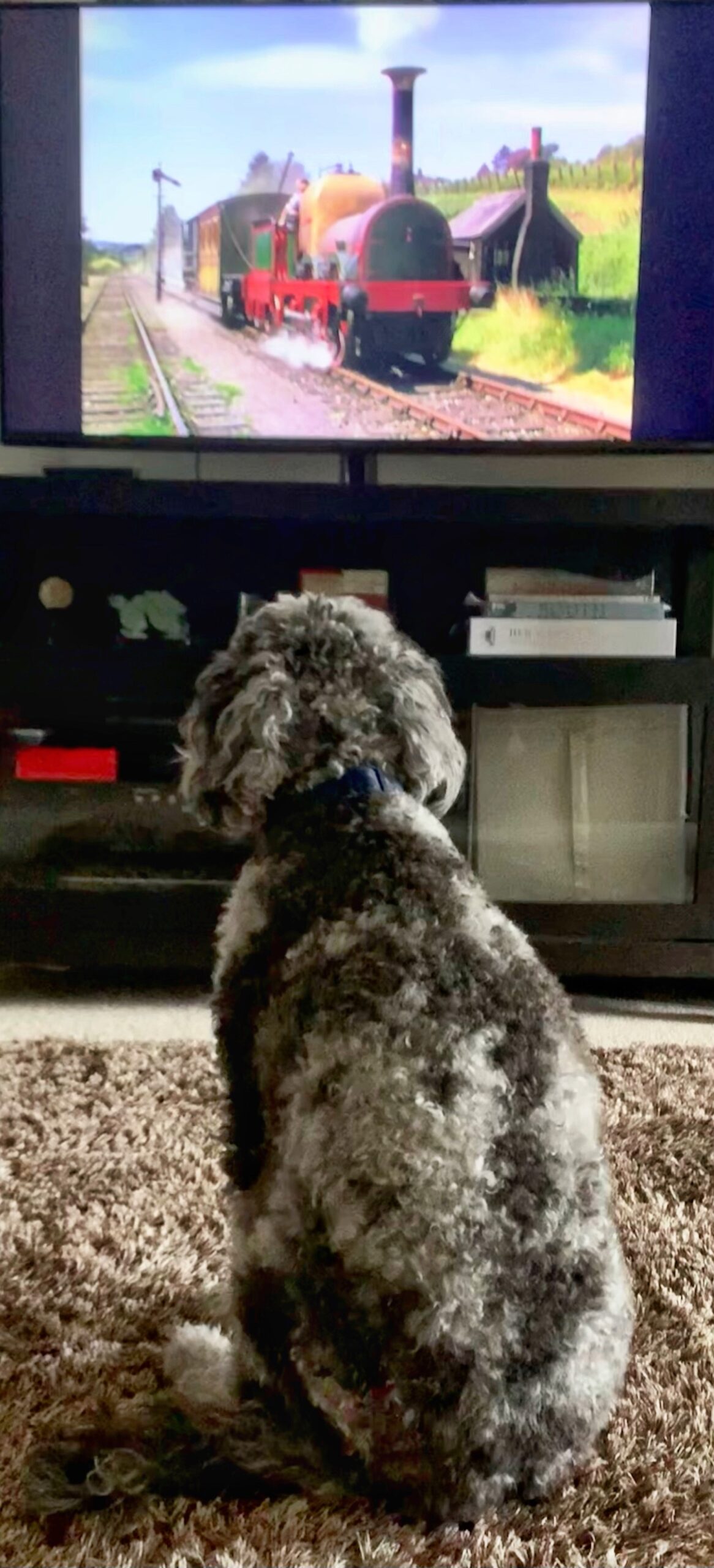
Yoshi watches “The Titfield Thunderbolt”
“The Titfield Thunderbolt” was inspired by the real life story behind the rescue of the Welsh narrow-gauge Talyllyn Railway in 1951. Directed by Ealing stalwart Charles Chrichton (1910-1999), starring Stanley Holloway (1890-1982) and with a screenplay by another Ealing old hand T.E.B. Clarke (1907-1989) the film opens with a view of Midford Viaduct on the Somerset & Dorset Joint Railway (S&DJR) as a train on the Camerton branch passes underneath. Midford is on our bucket list to explore one day, especially as there is a conveniently placed pub – the Hope & Anchor – located under the old S&D viaduct, the trackbed now forming a footpath and cycleway. The pub website notes: “The single line section between Midford & Bath required a special safety device known as “The Tablet”. A train about to enter this section had to pick up the tablet by means of a mechanical catcher. If the tablet was not there it meant another train was already on that stretch of track. Sometimes the act of giving up the tablet on the outward journey would result in the (accidental?) dropping of the tablet down the embankment into the garden of the inn. By some strange quirk of fate, this seemed to happen a lot more frequently during opening hours and climbing down to retrieve it was thirsty work!”
“The Titfield Thunderbolt” (1953) Trailer
Foreshadowing the Beeching report which would be released ten years later, “The Titfield Thunderbolt” tells the story of group of villagers determined to save their branch line after British Railways announces its closure. When a rival bus company, who have signed a deal with the nationalised railways to run a replacement service, sabotages the newly acquired train prior to an official inspection, the villagers resurrect the line’s first locomotive, ‘Thunderbolt’ which is being kept in the Mallingford Town Hall museum.
The 60th Anniversary Blu-Ray release of “The Titfield Thunderbolt”
The actual locomotive chosen to “play” the role of ‘Thunderbolt’ was Liverpool & Manchester Railway (LMR) 0-4-2 No. 57 ‘Lion’ built by Todd, Kitson & Laird of Leeds. The March 1953 edition of “The Railway Magazine” tells us the film studio borrowed the veteran loco from the Liverpool Engineering Society who, as well as allowing the application of a new nameplate, gave permission for her to be painted in a fictional bright green with red lining livery. ‘Lion’ had been in store at Crewe painted in her original dark maroon colour and was transported to Westbury in Wiltshire for an overhaul and steaming test, which proved most satisfactory, her original steam pressure gauges checked against a modern counterpart with one being correct to within a pound. Shortly after production commenced it was discovered that ‘Lion’ consumed excessive amounts of fuel and water, it was thought because she was originally designed to burn coke rather than the coal being used. The locomotive was sent back to Westbury where a damper was fitted which enabled her to simmer all day awaiting periods of sun during which scenes would be filmed. The daily filming schedule was carefully arranged to reduce the requirement to turn the locomotive and rolling stock, but when this was needed the triangle junction at Bradford-on-Avon was utilised. Various items of rolling stock were employed, including an old Great Eastern coach, two brake vans (one containing a diesel generator for arc-lighting), a cattle truck and several flat wagons as well as two Great Western Railway (GWR) 1400 Class 0-4-2 tank engines No.’s 1401 and 1456. No. 1456 provided banking assistance to ‘Lion’ on the 1 in 100 gradients between Limpley stoke and Combe Hay when scenes were not being filmed.
“The Railway Magazine” March 1953 edition included a feature on the filming of “The Titfield Thunderbolt” written by Baynham Honri (1903-1987)
I remember seeing ‘Lion’ in 1980 when she took part at “The Great Railway Exposition” in Manchester in connection with “The Rocket 150” celebrations marking the 150thAnniversary of the Rainhill Trials in 1829 and the opening of the Liverpool & Manchester Railway in September 1930. Unfortunately, along with other locomotives, she was on display in what I remember as being quite a gloomy shed area and my camera at the time would have been unlikely to have captured an image in the darkened conditions. Today you can see ‘Lion’ on static display at The Museum of Liverpool.
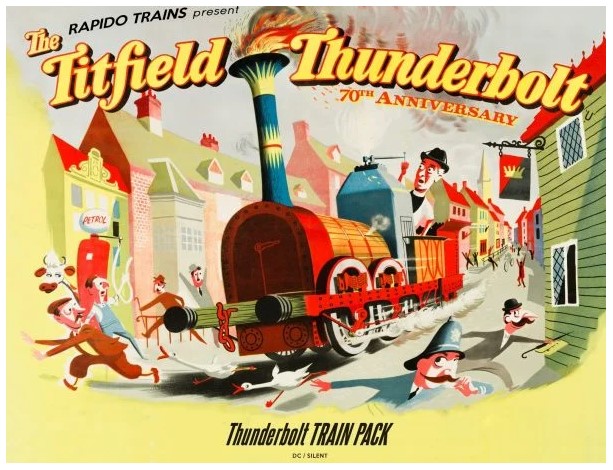
Rapido Trains publicity image
Rapido Trains are developing a special range of models celebrating the 70th Anniversary of “The Titfield Thunderbolt”. These are the only models licensed by StudioCanal the current rights owner of the film.
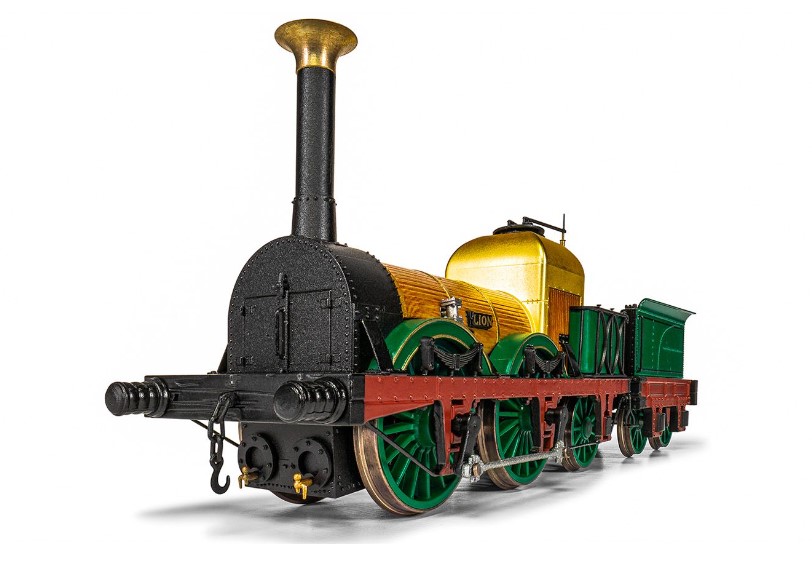
Hornby Horbies Ltd had announced they too were going to release a ‘Thunderbolt’ model but have since withdrawn this from their schedule as licensing permission was not gained. They have however pushed ahead with their model pack of ‘Lion’.
Hornby ‘Lion’ Train PackHornby ‘Lion’ model
You would think that the combination of Ealing Studios and railways would result in “The Titfield Thunderbolt” being my favourite film, but that honour falls to another Ealing production; “The Ladykillers” (1955) which also happens to feature extensive railway scenes, this time around King’s Cross in London. If you haven’t seen it, I highly recommend it. “The Ladykillers” was remade in 2004 with Tom Hanks and the location swapped to Mississippi. I don’t know why anyone thought this was a good idea.
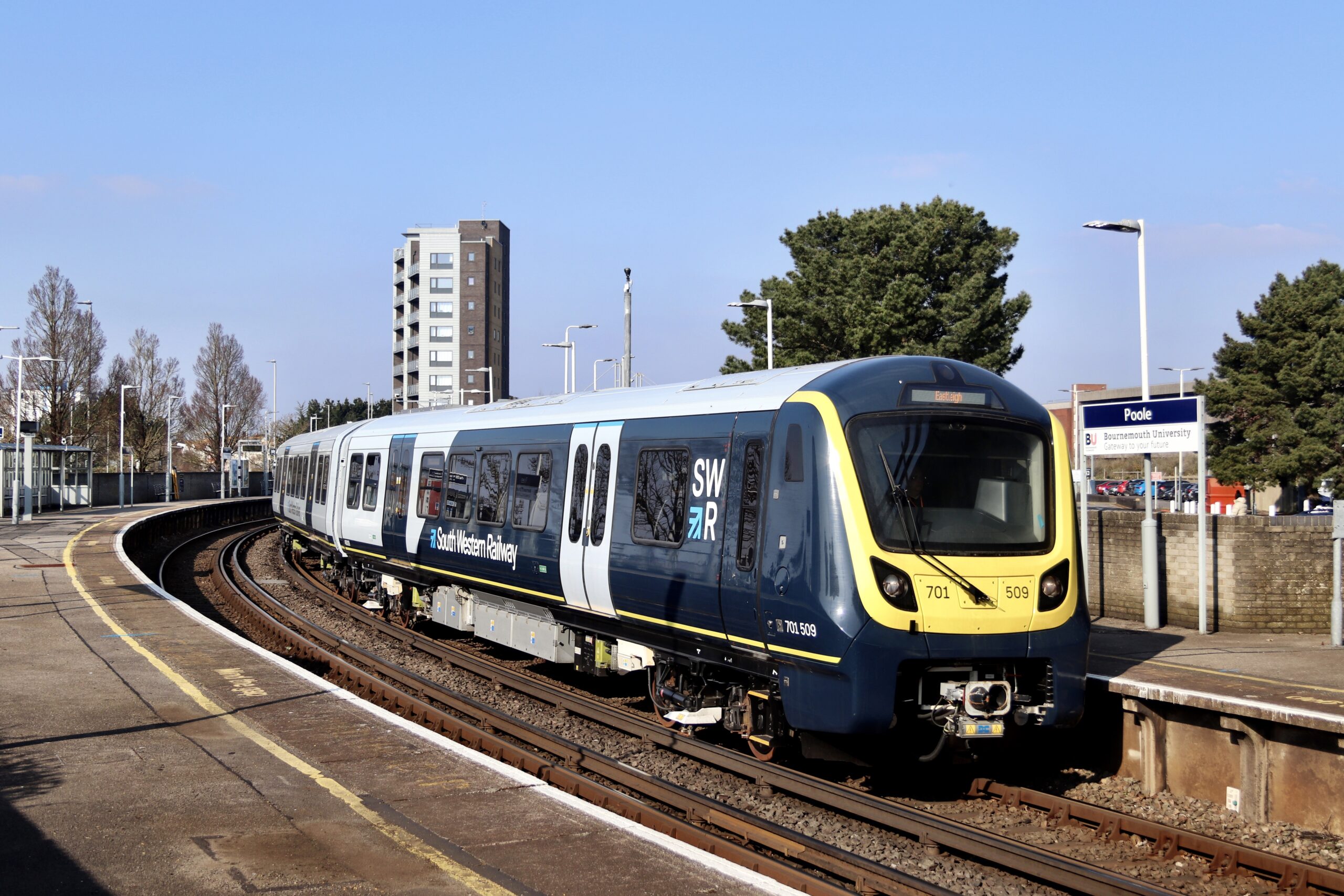
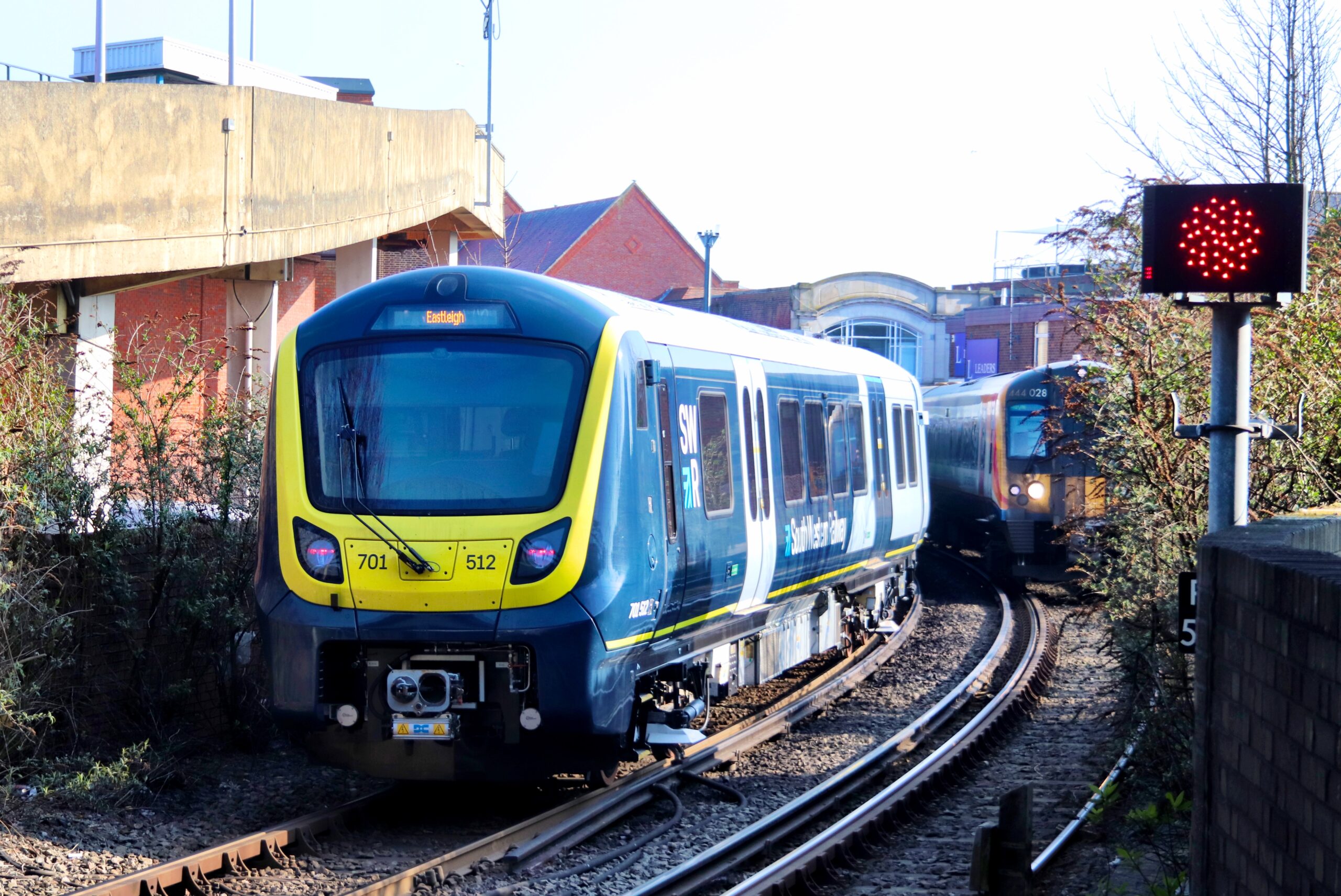
The two five car Class 701 units, No.’s 701509 and 701512, which I mentioned last time I had missed seeing in Dorset made a return visit on Thursday 2nd March 2023, and this time I was ready and waiting for them! Here’s some video as they arrive and depart Poole.
Five Car Class 701 test run – 02/03/2023South Western Railway (SWR) 5 -car Class 701 Electric Multiple Unit No. 701509 arrives at Poole on the return working to Eastleigh – 02/03/2023SWR 5 -car Class 701 Electric Multiple Unit No. 701512 departs Poole working 5Q51 1115 London Waterloo to Eastleigh as Desiro Class 444 No. 444028 arrives with 2W65 1205 London Waterloo to Poole – 02/03/2023
The Snow & Ice Treatment Train made an appearance on the Bournemouth to Weymouth line on Monday 6th. Its earlier scheduled run on Friday 3rd March was cancelled, so it was good to see the train run. And in daylight too, which was a bonus! We were pleased to see that large logo British Rail retro liveried GBRF Class 66 No. 66789 ‘British rail 1948-1997’ was one of the pair of locomotives allocated to the service, the other being No. 66750 ‘Bristol Panel Signal Box’.
GBRf Class 66 No.’s 66789 ‘British Rail 1948-1997’ and 66750 ‘Bristol Panel Signal Box’ top and tail 3Y88 1000 Totton Yard to Totton Yard across Holes Bay, Poole – 06/03/2023GBRf Class 66 No. 66750 ‘Bristol Panel Signal Box’ leading the return 3Y88 SITT with No. 66789 ‘British Rail 1948-1997’ bringing up the rear passes Class 444 No.444010 working 1W21 1035 London Waterloo to Weymouth service at Hamworthy – 06/03/2023
3Y88 1000 Totton Yard to Totton Yard – 06/03/2023 (Dorchester video courtesy of GE Barrett)
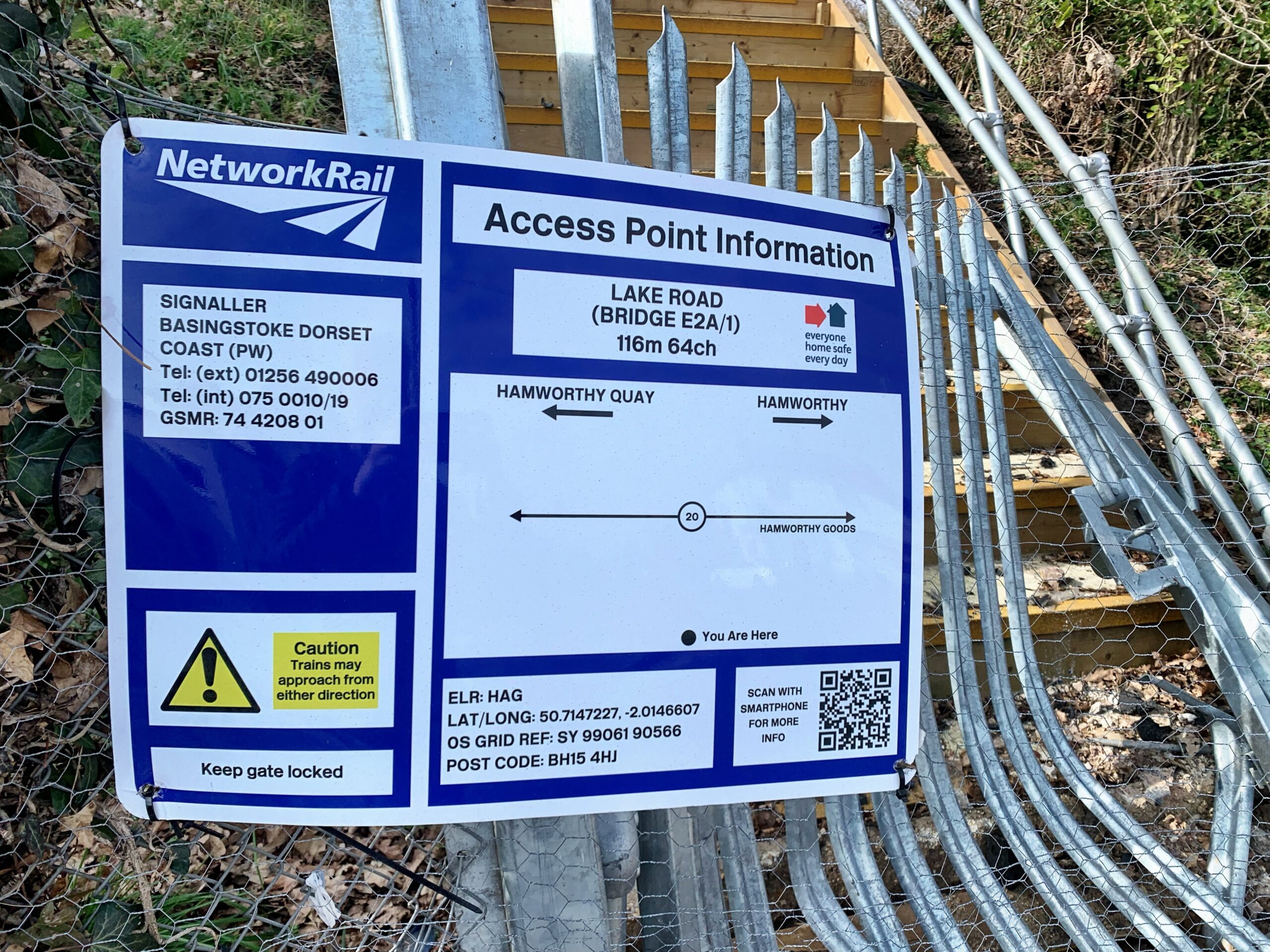
Taking Yoshi for a walk around Hamworthy Park recently, we passed under Lake Road bridge. It looks as if a vehicle wasn’t quite so lucky and deviated from the road and into the newly installed gate protecting the new access steps to the Hamworthy branch line above. Coupled with the damage to the warning lights at Ashmore Avenue crossing, I’m beginning to think someone doesn’t like the idea of the freight line re-opening!
Damaged Lake Road Access Point – 05/03/2023Debris at damaged Lake Road Access Point – 05/03/2023Access Point information for Lake Road – 05/03/2023Damaged Lake Road Access Point – 05/03/2023
For The Record
I forgot to mention that the South Western Main Line resumed a full timetable on 24th February 2023 following reinstatement works following the major landslip at Hook which occurred on 15th January 2023 and affected Weymouth to London Waterloo services.
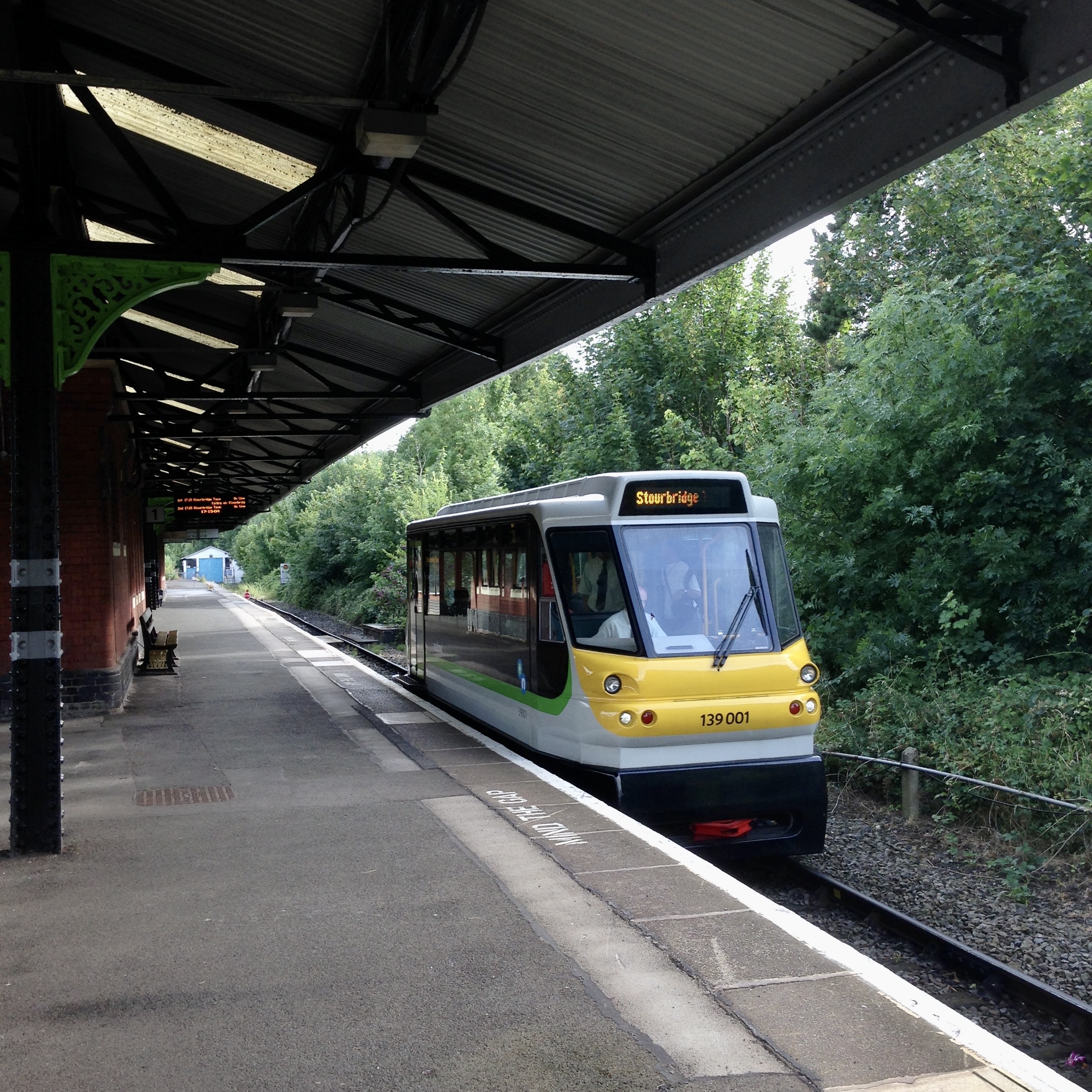
Sad news that John Parry MBE, creator of the Parry People Mover ultra-light vehicles passed away on 17th February 2023 after a short illness. He was 85. The most successful UK application of his idea is the 0.8 mile Stourbridge Junction to Stourbridge shuttle which operates every ten minutes between 0545 and 2354 Monday to Saturday with a more limited service on Sundays. These have been operated by pair of Class 139 Parry People Movers since their introduction to the branch, claimed to be the shortest in Europe, in 2009. The class 139’s are powered by Ford 86hp 2..3 litre LPG fuel engines and have flywheels to capture the energy generated which is then reused for acceleration and on-board systems. I mention it here as in 1996 an early version of a Parry People Mover was trialled on the much missed Weymouth Quay Branch in September 1996. You can watch a fascinating record of this on You Tube here.
West Midlands Trains Parry People Mover No. 139001 at Stourbridge Junction. These units have been a great success since taking over operations on the short branch to Stourbridge Town in June 2009 – 04/08/2015West Midlands Trains No. 139001 departing Stourbridge Junction. The unit will descend the 1 in 67 incline along the 0.8 mile branch line to Stourbridge Town – 04/08/2015
The RMT union has suspended industrial action, including strikes and an overtime ban, at Network Rail following the receipt of a new pay offer. Strikes remain on for now at 14 train operating companies – including South Western Railway (SWR) and Great Western Railway (GWR). More updates will be released over the coming days.
Train ticket prices in England and Wales increased by an average of 5.9% on Sunday 5th March 2023 – the largest fare hike in a decade.
South Western Railway (SWR) is set to trial the use of QR codes soon to allow mobile phone users to access features including “real-time journey information” as well as a suite of further modules relevant to their trip. A select number of train services, including London Waterloo to Weymouth services, will feature QR codes located in prominent areas of the train such as seat backs, tables, accessible areas and toilet facilities. The innovative technology developed by software experts Whoosh will also allow passengers to use features such as “Talk to Us” to communicate with SWR about any issues on their journey, including on board faults and the digital service will know where the communication is coming from and be able to automatically populate areas of the report.
That’s it for this week. It’s been a quiet one for me on the full size railway scene, but I was busy at the weekend putting floor boards down in our loft space in preparation for a model railway layout. I’ll be honest, this project has taken me far longer to get to this stage than I would have liked and my accidental mis-step resulting in putting my size 10’s through the ceiling was a low point (but not as low as it could have been as the rest of me didn’t follow my feet!), but good progress has been made over the last few weeks and I’ll soon be looking at building the baseboards for the railway track when funds allow. Thank you, as always, for stopping by and your comments and corrections. This weeks blog was brought to you with The Who “Tommy Live at The Royal Albert Hall”, The National (their latest offering “New Order T-Shirt” is just my cup of tea, or even my caramel latte) and Depeche Mode (who should really come and play a concert at the Weymouth Pavilion instead of all the big international venues they like to frequent). See you next week, take care and may your dog go with you.
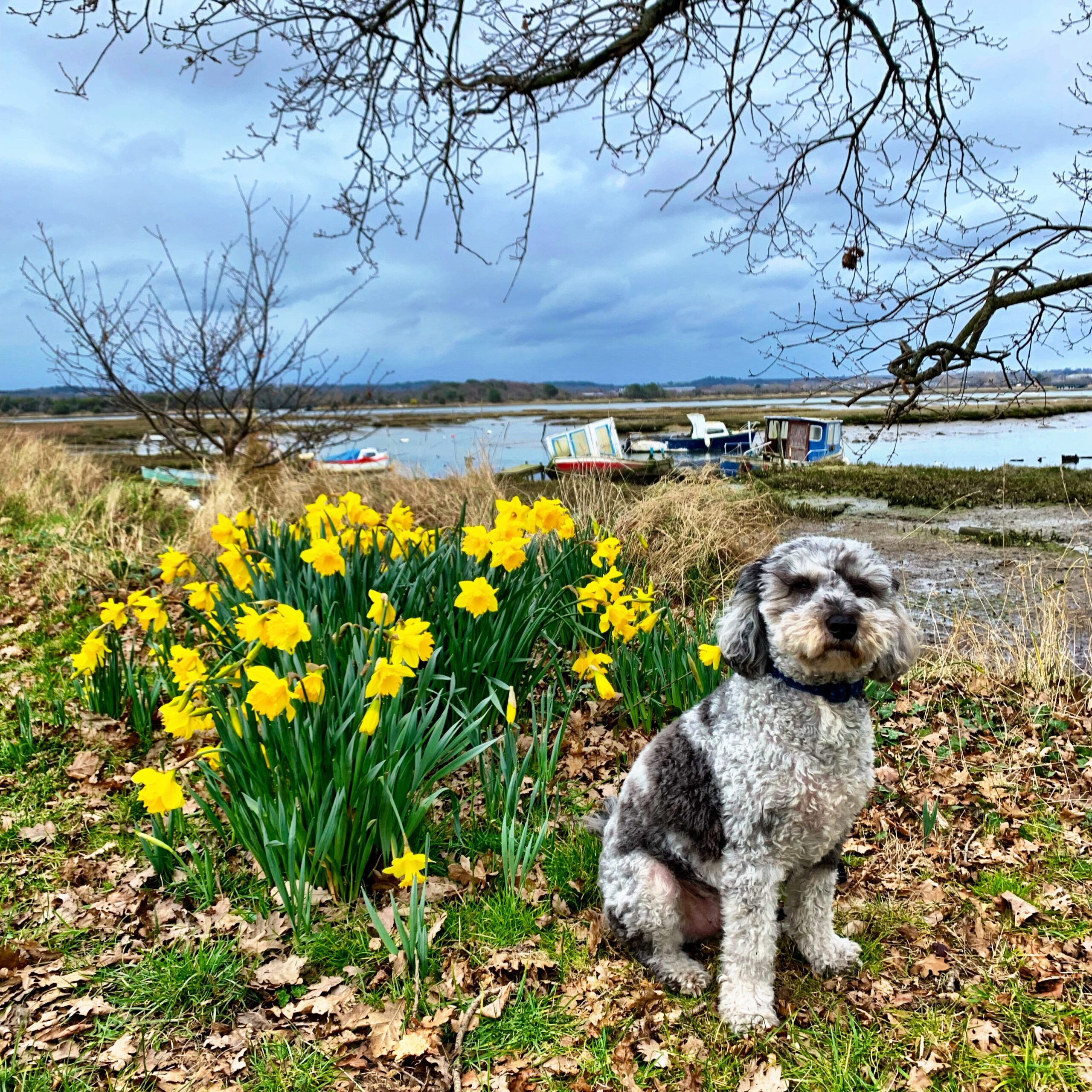
Yoshi amongst the daffodils at Holes Bay – 06/03/2023
Yoshi visits Bradpole to check out the crossing gate and track on the former Bridport Branch – 26/02/2023
Wednesday 22nd February 2023 to Tuesday 28th February 2023
We start off this week with another ‘no-show’ as the New Measurement Train running as 1Z22 0748 Derby RTC Serco to Bristol Kingsland Road Freightliner Heavy Haul scheduled to visit Weymouth via Yeovil Pen Mill on Wednesday 22nd February 2023 was truncated at Cheltenham Spa. The train would have seen Class 37 locomotives No.’s 37421 and 37610 in Dorset had it not been partially cancelled en-route at the request of the operator. It did make me wonder about the legal obligation, if any, of Network Rail to observe the findings by the Rail Accident Investigation Board (RAIB) and run these trains over the entire rail network. Maybe one day we’ll try and find out. Wednesday did, however, see two other special workings along the Bournemouth to Weymouth section as the Snow & Ice Treatment Train (SITT) and the third and final Freightliner engineers train of the week both ran as planned. The SITT made a return visit to Dorset running as far as Wareham on Monday 27th February.
All three February 2023 Dorset Freightliner engineers trains for your delectationGBRf Class 66 No. 66789 ‘British Rail 1948-1997’ in retro large logo livery stands in Totton Yard. I think it rather suits! – 25/02/2023
Keen to get a daylight image of British Rail large logo liveried Class 66 No. 66789 on the SITT as I incorrectly, as it turned out, assumed the loco would be swapped out for another member of the same class, Yoshi and I made the trip to Totton Yard to see the train before its return working to Eastleigh East Yard on Saturday morning.
GBRf Class 66 No. 66789 ‘British Rail 1948-1997’ and 66730 ‘Whitemoor’ top and tail the Snow & Ice Treatment Train (SITT) in Totton Yard – 25/02/2023
Video of the SITT working over the last week of February 2023 with GBRf Class 66 No. 66789 ‘British Rail 1948-1997’ and 66730 ‘Whitemoor’ at various locations
We also stopped off in Southampton to peer over the road bridge crossing the railway which leads to the Southampton Maritime Container Terminal which is built on reclaimed land and was opened in 1968. Dealing solely in deep sea container traffic the adjacent Freightliner terminal for rail-borne traffic links directly to the South West Main Line (SWML) at Millbrook and Redbridge. Network Rail carried out upgrades, completed in early 2021, allowing trains up to 775 metres in length to gain access to Southampton MCT which is the major rail freight traffic centre in the region. Intermodal freight transport involves the transportation of cargo in a shipping container utilising multiple modes of transport such as rail, ship, truck and aircraft without any handling of the contents while changing modes. Direct intermodal services operate from Southampton MCT six days a week to UK destinations such as Leeds and Crewe.
In this video: XC 220008 / 221140 1M38 0945 Bournemouth to Manchester Piccadilly; GWR 166209 1F62 0923 Portsmouth Harbour to Romsey; FL 70004 4018 0424 Lawley Street FLT to Southampton MCT; SWR 444021/444017 1W08 0903 Weymouth to London Waterloo; SWR 444016/444031 1W59 0905 London Waterloo to Weymouth and Poole; SWR 158883 2S23 1007 Romsey to Romsey; FL 66568 4V34 1102 Southampton MCT to Portbury Automotive FHH; SWR 450002 2B36 1002 Bournemouth to Winchester; 444042/444019 1W54 0920 Weymouth and Poole to London Waterloo; SWR 444010/444020 1W61 1005 London Waterloo to Weymouth and PooleFreightliner Class 08 No. 08785 at Southampton MCT – 25/02/2023As South Western Railway service 1W17 0835 London Waterloo to Weymouth formed of Class 444 EMU No.’s 444026 and 444034 passes on the SWML, Class 66 No. 66536 receives attention at Southampton MCT – 25/02/2023Class 70 No. 70004 arrives at Southampton MCT working the 4018 0424 from Lawley Street Freightliner – 25/02/2023The SITT passes Southampton MCT at Redbridge working 3Y88 1032 Totton Yard to Eastleigh East Yard in the care of GBRf Class 66 locos No.’s 66730 ‘Whitemoor’ and 66789 ‘British Rail 1948-1997’ – 25/02/2023Class 70 No. 70004 having just detached from her train at its final destination; 4018 0424 Lawley Street to Southampton MCT – 25/02/2023
Finally, we paid a visit to Eastleigh in the hope that former Colas Rail and newly outshopped in GBRf livery Class 67 No. 67027 would be in a position for a decent photograph as had been widely reported on social media the previous day. The Class 67 should have departed Eastleigh Arlington works bound for Rugby on the Friday, but brake issues meant it remained stuck in Hampshire. Although I was pleased with my iPhone shot of the Class 66 at Totton, my luck ran out when it came to Eastleigh and the Class 67 as the locomotive had been moved inside a shed for remedial modifications with only the front being visible from the road adjacent to the works. Yoshi and I did, however, get to a catch up with an old pal over coffee, so it turned out to be a very good day after all.
Disappointingly newly liveried into GBRf colours, Class 67 No. 67027 hides in a shed at Eastleigh Arlington. No amount of coaxing would persuade her to reveal her new paint scheme – 25/02/2023Direct Rail Services Class 37 No. 37602 in the yard at Eastleigh Arlington works – 25/02/2023Colas Class 70 No. 70801 awaits her next duty at Eastleigh East Yard – 25/02/2023GBRf Class 66 No. 66790 at Eastleigh East Yard – 25/02/2023
On Sunday, Yoshi, his mama and I made a return visit to the Station Kitchen at West Bay which we last wrote about in November 2022. This time we booked to eat in the old station building which is dog friendly (the carriages are not) and Yoshi joined us for our lunchtime visit. Again, the food was exceptional and our surroundings quirky and fun.
The Station Kitchen at West Bay – 26/02/2023The Station Kitchen, West Bay Lentil, wild mushroom & honeyed carrot roast, farm vegetables, rosemary roasties with a balsamic onion jus. Scrummy! – 26/02/2023Yoshi offers to get the drinks in – The Station Kitchen, West Bay – 26/02/2023
Prior to eating, we took the opportunity to walk the former railway track bed between West Bay and Bridport which is now a footpath and haven for nature. It was much tidier than on previous visits and Yoshi proved himself to be a good boy yet again when he roamed off lead. As the footpath approaches Bridport it rises to meet Burton Road. The original level of the railway crossed beneath the road here at Wanderwell Bridge. The top of the bridge, bore entrance and track bed can still be made out if you look closely. On its way towards Bridport East Street Station, the railway would have passed through Wanderwell and then east of the roundabout junction of Burton Road and West Bay Road. Sea Road South, the A35 Bridport by-pass, now occupies the former track bed and there is no trace left of East Street station, the site now occupied by a garage. Sea Road North has replaced the track bed between East Street Station and Bridport station (also known as Bradpole Road Station).
The start of the former West Bay to Bridport footpath looking north – 26/02/2023Along the route of the former extension from West Bay to Bridport – 26/02/2023
The railway reached Bridport in 1857 being officially opened on 12th November, just over three years after a public meeting in Bridport Town Hall in October 1854 where it was decided a railway branch line to link the town to the main line at Maiden Newton would be built. The Bridport Railway Company was formed and the necessary Act of Parliament passed on 5th May 1855. The operating licence was awarded by the Bridport Railway Company to the Great Western Railway (GWR) who supplied the steam locomotives and rolling stock before taking over the railway completely. An extension to the line running from Bridport to Bridport Harbour was instigated in 1879 with passenger services commencing on 31st March 1884. In an attempt to attract holiday traffic, the GWR named their new station at the harbour; West Bay, popularising the name by which the area is now commonly known. Passenger services to West Bay ceased in 1930 but the line remained open for freight traffic until 3rd December 1962 when only minimal traffic ran including coal and shingle from the beach. The track on the Bridport to West Bay section, which had not long been relaid with concrete sleepers, was removed in March 1965 having been cut into short lengths and sold for scrap.
My well thumbed and well loved copy of “The Bridport Branch” by B L Jackson and M J Tattershall
Our visit prompted me to dig out my copy of “The Bridport Branch” by B L Jackson and M J Tattershall. It was the first railway text book I acquired back in the 1970’s and I recall thinking it a very expensive tome at the time. Most likely my lovely mum financed the purchase and I was surprised to note the cover price was a princely £2.40. Published by the Oxford Publishing Co. (OPC), a leading publisher of railway books back then, the book was first issued in 1976, only a year after the closure of the branch it tells the history of. I would have missed travelling by train from Maiden Newton to Bridport by a couple of years, my interest in railways really taking hold in 1977. The Bridport Branch had been listed for closure as part of the Beeching plan of March 1963. We’ll take a closer look at “The Reshaping of British Railways”, to give the Beeching plan its proper title, next month following the 60thanniversary of its publication, but it is interesting to learn that a notice was posted on 1st September 1964 for the closure of all intermediate stations between Yeovil Pen Mill and Dorchester West, the latter due to be closed on 4th January 1965. However, at a public enquiry held in Yetminster it was argued that it was difficult to see how Maiden Newton could be closed on that date as the Bridport Branch would still be open and for which no notice of closure had yet been issued. The Minister of Transport’s solution was announced on 22nd April 1965; Maiden Newton and Dorchester West were to stay open along with Yetminster, Thornford Halt and Chetnole Halt while Evershot, Cattistock, Bradford Peverell and Grimstone & Frampton would close from 3rd October 1966.
On our way home from West Bay, we stopped off in the village of Bradpole to seek out the crossing gates and short length of rail embedded in the road which is most likely the last original track remaining from the Bridport Branch. The current gates are not original and were replacements made by local carpenters John Gale and Bernie Joy as a memorial to the railway. An adjacent section of the track bed has been grassed over for local residents to enjoy as part of the Railway Gardens and allotments. In December 2022, concerned at the poor repair of the crossing gates, Bradpole Civil Parish Council appealed for help in finding someone with the expertise to renovate them. Following discussions with a local woodwork firm the Parish Council are seeking funds so that a full restoration project can take place later in 2023 which will see a new gate being constructed as it is felt the existing one is now beyond repair.
The crossing gates at Bradpole – 26/02/2023
The Bridport Community Railway has an ambitious plan to restore the link between West Bay and the main line at Maiden Newton with a sustainable narrow gauge tramway and heritage steam operation alongside cycle and foot paths. In January 2021, one of the founding members of the group behind the project is quoted in the local Bridport News as saying; “Around 80 per cent of the feedback we have received has been generally positive. Ten percent are raving fans and ten per cent think we’re in cloud cuckoo land.”
Another lost railway and victim of the Beeching cuts can be celebrated at The Wimborne Railway Society “Railex” Model Railway Exhibition when the award winning Bournemouth West model layout will be on display. Celebrating the days of steam and the much missed Somerset & Dorset line which ran from Bath to Bournemouth West, the site of which now lies underneath the Wessex Way road, the terminus can be seen in all its miniature glory at The Allendale Centre, Hanham Road, Wimborne on 15/16th April 2023.
Bournemouth West in model from as seen in April 2022
For The Record
What is I believe to be the first visit to Dorset of five car Class 701 EMU’s occurred on Tuesday 28th February as No.’s 701509 and 701512 visited Poole working 5Q51 1306 Eastleigh to Eastleigh. Yoshi and I were enjoying our lunchtime walk and completely missed these. I had hoped they would make a return journey to Bournemouth later in the evening, but the associated working did not materialise.
Yet to enter revenue earning service, five car Class 701 No. 701509 nears Eastleigh – 29/03/2022
Engineering trains for the Network Rail work being carried out on the Yeovil Pen Mill to Dorchester West section of the Heart of Wessex Line have so far been headed up by a mixture of Freightliner and Colas Rail workings, involving Class 66 locomotives No.’s 66592/ 66537 / 66192 and Class 70 No. 70811.
Royal Mail ‘Flying Scotsman’ Centenary Stamp Presentation Pack
The Royal Mail have revealed images of a special stamp issue being released on 9th March 2023 to celebrate the centenary of ‘Flying Scotsman’.
The colour version of the ‘Flying Scotsman’ £2 coin
The Royal Mint have also announced the release of a special £2 coin featuring an original design by John Bergdahl and colour artwork by Ffion Gwillim. The coin is available in a range of editions all featuring the edge inscription “Live For The Journey”.
From the May timetable change, the first weekday train to the Bristol area terminating at Filton Abbey Wood from Weymouth timed to depart at 0526 will no longer run and will in future start at Yeovil Pen Mill from where the train will depart at 0618.
That brings us to the end of another week. Thanks for reading! Please keep your comments, corrections and observations coming – they are all appreciated…. even the ones suggesting I include photographs and video clips to make things more interesting. A nice idea, but I’ll carry on as I am for now….
Yoshi almost takes flight at West Bay in front of the iconic East Cliff. There has been much discussion about this being the perfect image for an album cover of doggo songs by Yoshi; “Ears In The Wind” – 26/02/2023We’ll leave you with one more image of the SITT top and tailed by GBRf Class 66 locos No.’s 66730 ‘Whitemoor’ and 66789 ‘British Rail 1948-1997’ at Redbridge – 25/02/2023
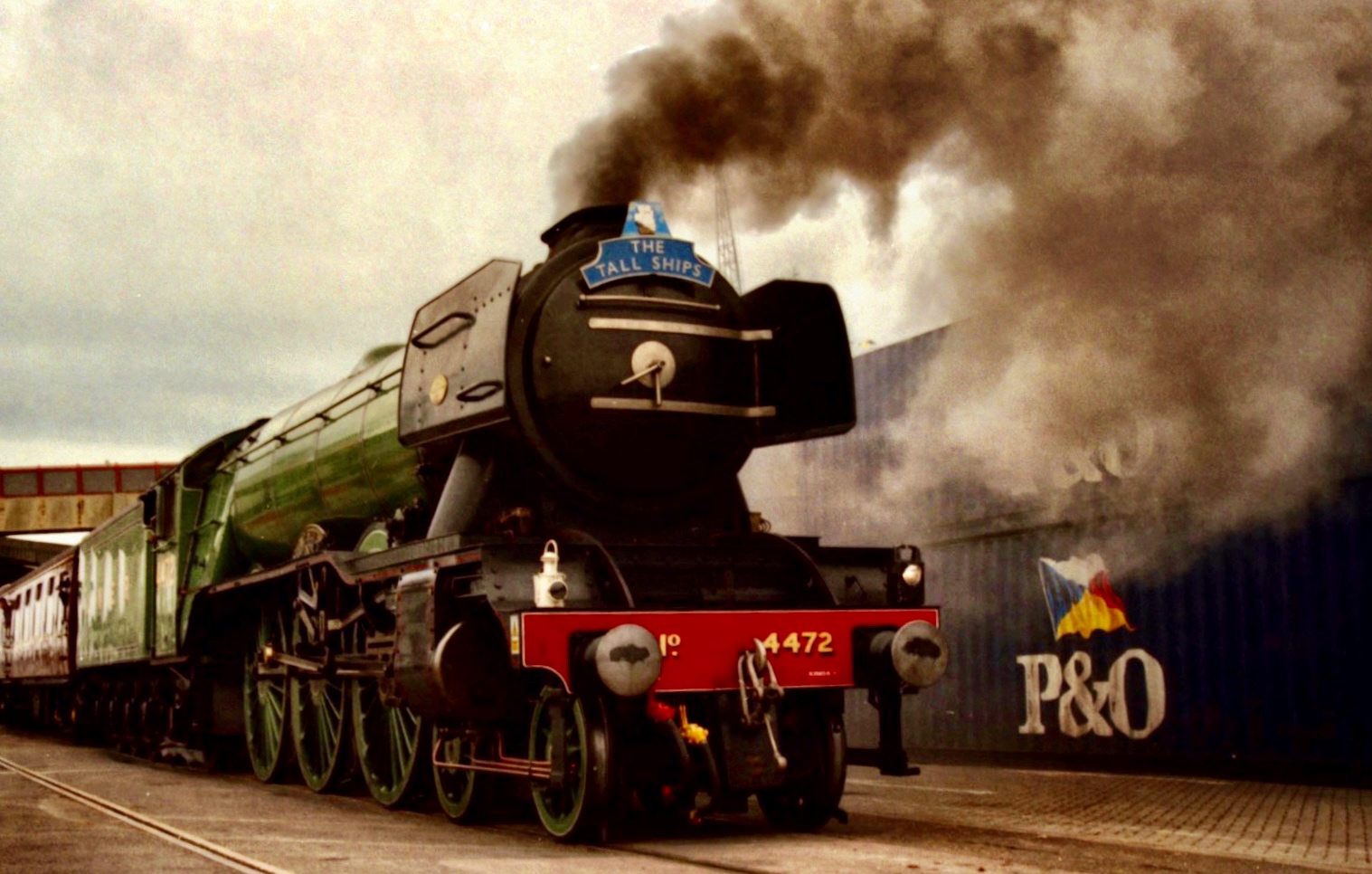
Gresley A3 Pacific No. 4472 ‘Flying Scotsman’ at Southampton Docks in an unauthentic condition in LNER Apple Green but with double chimney and smoke deflectors from BR days – 16/04/2000
Wednesday February 15th to Tuesday February 21st 2023
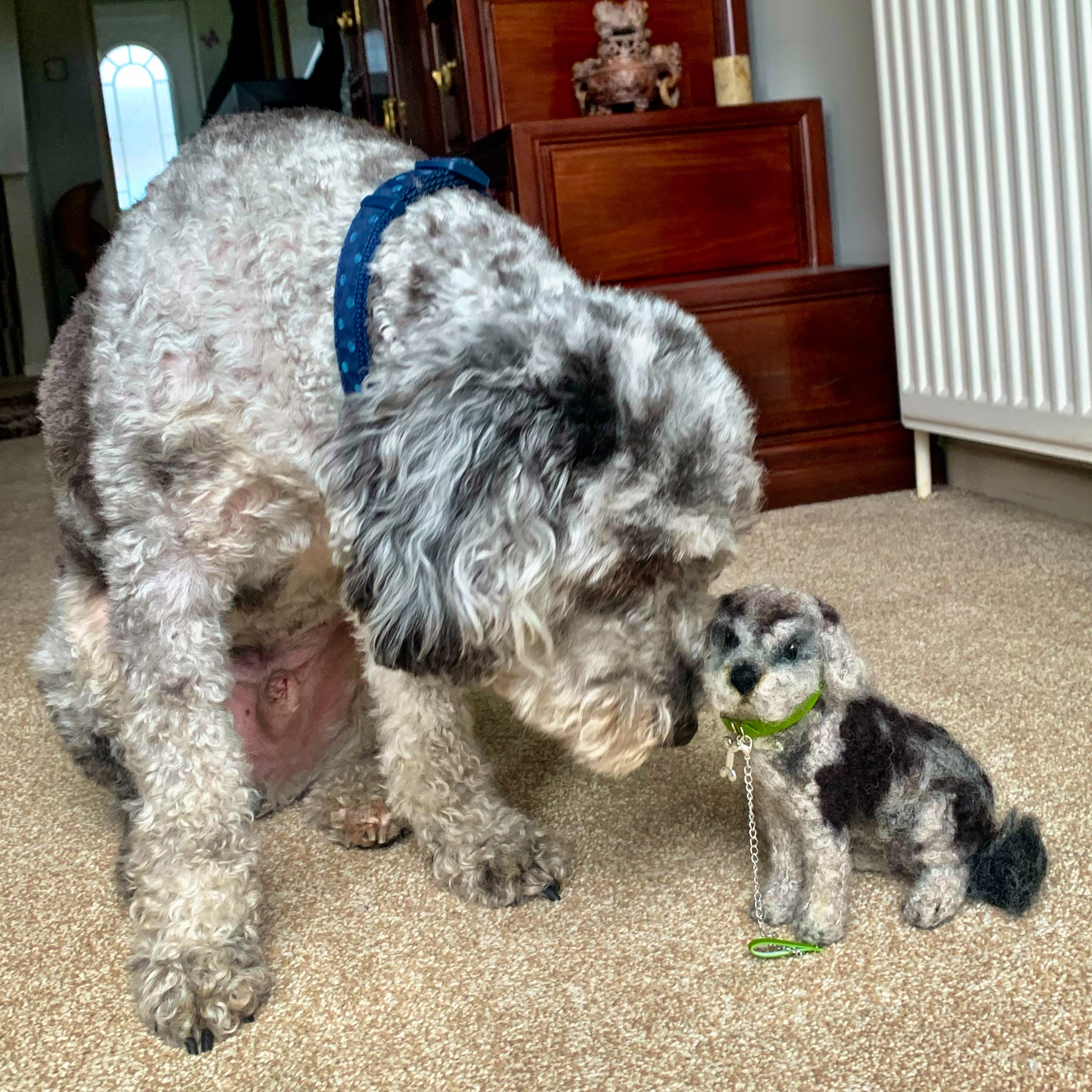
The week kicked off with the delivery of a little Yoshi from ArtemisFibreArt, which the boy himself was rather intrigued about. Thankfully he decided against tearing it apart as is his usual reaction to soft toys. He recognises a handsome boy when he sees one!
Yoshi meets…. Little YoshiYoshi and the fabulous replica Little Yoshi from ArtemisFibreArt
24th February 2023 marks 100 years since the third A1 Class 4-6-2 Pacific locomotive left Doncaster Works for the very first time and entered service with the London & North Eastern Railway. As if we haven’t written enough about this particular loco in previous blog entries, here’s another look at her history. Designed by Sir Nigel Gresley and originally numbered 1472 in a sequence originated by the Great Northern Railway who had placed the order for 51 Class A1’s prior to the “Big Four” Grouping of January 1923. A year later the LNER renumbered her No. 4472 and she gained the name ‘Flying Scotsman’ after the eponymous titled train in readiness for display at the British Empire Exhibition at Wembley.
In 1928, ‘Flying Scotsman’ ran a non-stop passenger service between London King’s Cross and Edinburgh, this was achieved by means of another Gresley innovation; a corridor tender allowing drivers and firemen to pass through to the locomotive footplate from the leading train carriage. Water for the engine was picked up en-route from troughs set between the rails.
1st November 1934 No. 4472 became the first steam locomotive to be officially recorded at travelling at 100 miles per hour as she passed between Little Bytham and Essendale on the East Coast Main Line.
In 1946 the LNER introduced an extensive renumbering scheme with the aim of placing all locomotives of the same type in a numerical sequence. ‘Flying Scotsman’ was renumbered twice this year, firstly in January as No. 502 by Gresley’s successor Edward Thompson and then No. 103 in May. After the Nationalisation of the railways in 1948 60000 was added to LNER engine numbers and consequently No. 103 became No. 60103.
January 1947 ‘Flying Scotsman’ was converted from a Class A1 locomotive to an A3 under a programme initiated by Gresley in 1928 which added a larger boiler with a higher boiler pressure. A double Kylchap chimney was added in 1959 to improve performance with German style smoke deflectors being added in 1961 as the exhaust from the new chimney blocked the drivers view.
Things looked bleak in October 1962 when it was announced ‘Flying Scotsman’ would be withdrawn from service in January 1963 and sent for scrap. Holder of the steam speed record Gresley A4 4-6-2 Pacific No. 60022 ‘Mallard’ was to be saved for the nation and it was deemed that only one locomotive of any given wheel arrangement per designer could be preserved.
After a failed public appeal to “Save Our Scotsman” by raising the £3000 scrap value, businessman Alan Peglar, fresh from selling his Northern Rubber business and with money to burn stepped in and purchased No. 60103 from British Railways in 1963. As part of the deal, Peglar negotiated an agreement for ‘Flying Scotsman’ to run on the main line until 1966 with options to 1971. The locomotive was overhauled at Doncaster emerging in LNER Apple Green and carrying the number 4472 once again. In 1969, the locomotive was heading for USA and Canada on a tour where she travelled 15,400 miles to promote British exports where, after initial success, UK Board of Trade backing was withdrawn and by 1970 money was running out. As a result, in 1972 Peglar was declared bankrupt and ‘Flying Scotsman’ was put into storage in the US Army Sharpe Depot to keep her safe from creditors.
No. 4472 ‘Flying Scotsman’ working the “Cumbrian Mountain Express” over the Settle & Carlisle stops at Garsdale for water – 22/07/1981
Enter Sir William McAlpine, who stepped in and bought the locomotive, shipping her home in 1973. Following restoration at Derby, ‘Flying Scotsman’ embarked on a career running on the UK main line and heritage railways. In October 1988 she made a trip to Australia where over the next year she travelled more than 28,000 miles and set the record for the longest non-stop run by a steam locomotive totalling 422 miles having journeyed between Parkes and Broken Hill in New South Wales. On her return to the UK, ‘Flying Scotsman’ would eventually come under new ownership, that of a new consortium “Flying Scotsman Railways” which included Sir William McAlpine and record producer and railway enthusiast Pete Waterman. In 1993, she was outshopped in BR Brunswick Green, complete with double chimney and smoke deflectors representing how she looked at the end of her working life on BR.
Following restoration to final BR condition, No. 60103 ‘Flying Scotsman’ headed for the Paignton & Dartmouth Railway where her visit lasted from 25th July to 11th September 1993
No. 60103 ‘Flying Scotsman’ visited Llangollen in 1995
April 1995, while working an empty coaching stock movement on the Llangollen Railway, ‘Flying Scotsman’ derailed and suffered a crack between her boiler and cab. She was deemed to be a complete failure and was taken to Southall to face an uncertain future. Experiencing financial difficulties, the consortium sold ‘Flying Scotsman’ to biotech entrepreneur Dr Tony Marchington in 1996 for £1.5m in a deal which included a set of coaches. Over the next three years Dr Marchington spent a further £1m restoring the locomotive which he returned to the main line in 1999. Following a failed attempt to create a “Flying Scotsman Village” in Edinburgh and the collapse of his company Oxford Molecular, Dr Marchington was bankrupted in September 2003. ‘Flying Scotsman’ was put up for sale in 2004 and there was a real fear that the locomotive would be sold abroad. However, to the relief of many, a huge public appeal was launched by the National Railway Museum (NRM) and on 5th April 2004 it was announced that the NRM had been successful with their sealed £2.2m auction bid, which had been boosted by a £1.8m grant from the National Heritage Memorial Fund. ‘Flying Scotsman’, a locomotive which perhaps more than any other represents the people’s engine had finally been saved for the nation. Unfortunately No. 60103 required a great deal of work to return her to steam with an estimated 12 month £750,000 restoration commencing in 2005. In reality, it would take 10 years and £4.2m before a warming fire could be lit in the overhauled firebox of ‘Flying Scotsman’. On her first public runs in January 2016 following restoration, she was seen in a wartime black livery on the East Lancashire Railway.
Still in wartime black livery with No. 60103 on the smokebox and No’s 103 and 502 on opposite cab sides, her first mainline outing following overhaul was on 6th February 2016 at the head of “The Winter Cumbrian Mountain Express” from Carnforth to Carlisle. Myself and @da_buckley967 decided to drive from Dorset to Cumbria to see the spectacle of ‘Flying Scotsman’ climbing Shap on the West Coast Main Line.
“The Winter Cumbrian Mountain Express” – 06/02/2016
Showing just how popular No. 60103 ‘Flying Scotsman’ has become is evident in this scene as she passes through Romsey with “The Cathedrals Express” rail tour on 21st May 2016
Steam Dreams ‘Flying Scotsman’ London to Winchester and Afternoon Tour from Southampton – 06/06/2021
Ahead of her centenary year celebrations, ‘Flying Scotsman’ underwent another overhaul at Riley & Son in Bury, the first event following this being her attendance at London King’s Cross to help celebrate the railway station’s 170th anniversary and launch her own event programme before she arrived in Dorset for a stint on the Swanage Railway.
For more ‘Flying Scotsman’ goodness, you might like to check out these “Railway Dog” blog entries from 2022 which feature more images and video:
From 27th February to 3rd March 2023 no weekday trains will run between Yeovil Pen Mill and Dorchester West to allow Network Rail to lay new track and carry out other maintenance, including station improvements at Maiden Newton. The closure extends to include the Yeovil to Castle Cary section on 6th and 7th March affecting Great Western Railway (GWR) and South Western Railway (SWR) services.
In no way connected to the forthcoming closure “up the West”, Monday 20th and Tuesday 21st February 2023 saw Freightliner Engineering Trains head to Dorchester South. A further train was scheduled to depart Eastleigh East Yard for Upwey on Wednesday 22/02/2023.
In another of our occasional visits to cafes which happen to be situated in former railway stations, on Wednesday 15th February, we popped over the county border to Hampshire in order to visit The Old Station Tea Rooms at Homsley.
The Old Station Tea Rooms at Homsley – 15/02/2023
Opened in 1874 as Christchurch Road railway station by the Southampton & Dorchester Railway it was, at the time, the closest station to Bournemouth and Christchurch, becoming Holmsley station in 1894. Prince Edward, the eldest son of Queen Victoria was a regular user of the station with his mistress Lillie Langtry as it was here where they would embark on their way to their private residence in Bournemouth. Holmsley was also the inspitration for Browndean station in Robert Louis Stephenson’s novel “The Wrong Box”.
Porters Lunch BoxStation Managers Rarebit
Holmsley station was closed on May 4th 1964 as a result of the Beeching Report. Today the main station building lives on, repurposed as a tea room with several items of railway memorabilia and photographs on display. Dogs are welcome at outside tables, of which there are many, and the food is delicious. Walks along the Castleman Railway utilising the old rail road to Ringwood, Wimborne and Poole can be enjoyed nearby.
An example of the railway themed memorabilia which can seen at The Old Station Tea Rooms, HomsleyReview the fleet at Weymouth!
That brings us to the end of another entry. Thanks for visiting and we hope to see you again another time. Your comments, corrections and observations are very much appreciated. Recommendations for cafes situated in former railway stations are welcome! This weeks blog was mostly written with the aid of tea, Galaxy Milk Chocolate Digestive biscuits to the accompaniment of Pink Floyd’s “The Dark Side Of The Moon” – which, amazingly, is 50 years old next Wednesday (1st March 2023). Time, eh?
Yoshi has spotted a squirrel, or a possibly Class 444 Electric Multiple Unit. They both deserve being barked at….
Shillingstone Railway Station built in the Dorset Central Railway style of red brick with cream decorative brickwork around windows and doors and featuring a Welsh slate roof – 11/02/2023
Wednesday February 8th to Tuesday February 14th 2023
South Western Railway Class 444 Electric Multiple Unit No. 444023 departs Weymouth – 07/01/2021
On Friday, it was announced that South Western Railway had received a two-year extension on its existing contract from the Department of Transport. Scottish parent company FirstGroup PLC said their national rail contract would now run until May 2025. With no sense of irony Chief Executive Officer Graham Sutherland said, “We welcome the contract extension for South Western Railway, which enables us to build on the achievements of the first two years of the contract and continue improving the customer offering.” FTSE 250-listed FirstGroup operates another three rail franchises in the UK: Avanti West Coast, Great Western Railway (GWR), and TransPennine Express (TPE), plus an open access passenger service, Hull Trains. It also has a bus division, which operates around a fifth of local bus services in the UK.
In other SWR related news, it is hoped that Network Rail will complete work on the landslip at Hook to allow the full restoration of normal timetabled train services from 24th February 2023.
Yoshi takes a look at the short section of track representing the Somerset & Dorset Joint Railway which is displayed in Railway Gardens, Sturminster Newton – 11/02/2023
Saturday 11th February 2023, Yoshi, his mama and I headed to North Dorset to walk a section of the former Somerset & Dorset Joint Railway (S&DJR) trackbed which is now part of the North Dorset Trailway. We decided to walk four miles from Sturminster Newton to beyond Shillingstone and back, so that we could visit the North Dorset Railway and enjoy a refreshing cup of tea and a slice of cake before retracing our footsteps back to our starting point. However, we wish we had asked our North Dorset Correspondent where we could have found a cup of tea on our arrival back in Sturminster!
Yoshi amongst the snowdrops along the North Dorset Trailway – 11/02/2023Abandoned railway furniture on the North Dorset Trailway – 11/02/2023Lamb House Bridge, Shillingstone – 11/02/2023
On arrival at Shillingstone we were able to watch some shunting manoeuvres which were taking place around the station site. The station which opened on the 31st August 1863 and is the last remaining building of the Dorset Central Railway which later formed part of the Somerset & Dorset Joint Railway running from Bournemouth West to Bath Green Park until falling victim to the Beeching cuts in March 1966.
There are several posters from the age of steam as well as a museum packed with railway artefacts on view at Shillingstone railway station – 11/02/2023
During World War I Shillingstone saw additional trains in the form of troop and supply workings. One such instance, in February 1915, saw the Naval Battalion based at Blandford Camp march en masse to Shillingstone to board a train bound for Avonmouth and ultimately to take part in the Gallipoli Campaign. Included in their number was the war poet Lt. Rupert Brooke who died of septicaemia en route off Skyros, Greece.
A few years after the station at Shillingstone closed to rail traffic, the Dorset County Council purchased the trackbed for a proposed road which would by-pass the village. This plan never came to fruition and the council eventually decided to dispose of the station site. Following protracted negotiations, the North Dorset Railway Trust signed a lease in 2005.
I loved this imaginary painting of what might have been and the S&DJR survived the Beeching cuts which hangs in the station tea rooms (Steve Hiscocks, 2012)
The North Dorset Railway Trust aim to relay track in the direction of Sturminster Newton over Lamb House Bridge. Maybe one day we may even see a Class 9F or similar working part of the route once again.
Hudswell Clarke 0-6-0 Diesel Loco Works No. D1186 ‘Ashdown’ passes Shillingstone signal box – 11/02/2023
‘Ashdown’ was built by Hudswell Clarke, Leeds in 1959 for use on the Manchester Ship Canal Railway (MSCR), numbered D1 and based at Partington coal basin she was the first of a small fleet of diesel locomotives working on the MSCR. She has had an illustrious career being sold on to Hunslet Engine Co. of Leeds, who leased the locomotive to the National Coal Board (NCB) Crompton colliery in Lancashire, before returning to Hunslets as their works shunter. In 1986 she was subject to a re-build before moving to the NCB Gwent Coal Distribution centre in Newport, South Wales. She was renumbered No. 8526 and named ‘Pride of Gwent’ lasting up to 1991 when she entered preservation firstly at the Butetown Historic Railway Society in Cardiff until 1997 before moving to the Vale of Glamorgan Railway. In 2008, she was purchased by the Pontypool and Blaenavon Railway. In July 2013, she was exchanged for a diesel locomotive located at Peak Rail in Derbyshire and reunited with the ‘Ashdown’ name. The North Dorset Railway purchased ‘Ashdown’ in 2020. She is of a unique design and therefore the only locomotive of this type preserved.
No. RH305302 (DS1169) ‘Little Eva’ was built by Ruston & Hornsby, at their Boultham Works, Lincoln in 1951, for the Ransome and Marles Bearing Co of Newark, where she was used to move steel casings around the factory site. She retired from service in 1978 and donated to the Market Overton Industrial Railway Trust before moving to the Statfold Barn Railway in Tamworth. She was purchased in 2015 and moved to Shillingstone and underwent full restoration.
Yoshi strikes a pose alongside Class 62 Yankee 0-6-0 Tank Locomotive No. 30076, Shillingstone – 11/02/2023
The Class 62 “Yankee Tank” steam locomotives were built from the US Army Transportation Corps template of S100 Shunters of World War II designed in 1941 by Colonel Howard G Hill. The class was extremely successful, proving powerful, economical to operate and relatively easy to maintain. More than 400 of these locomotives were deployed across Europe after the war, with over 100 ending up in Yugoslavia earning the designation Class 62. A further 90 of the class were built in Yugoslavia by Djuro Djakovic of Slavonski Brod between 1952 and 1961. Four original US built locomotives are preserved in the UK, one at the Bluebell Railway, two at the Kent & Sussex Railway and one at the Keighley and Worth Valley Railway.
Here in the UK, 14 (plus one for spare parts) of the S100 Class were purchased by the Southern Railway (SR) from the United States Army Transportation Corps in 1946, mainly for shunting in Southampton Docks, between the end of World War II and the end of steam in the 1968. Other examples saw use as industrial locomotives with Austin Motors/BMC at Longbridge, the NCB and on the Longmoor Military Railway.
There are two examples of these locomotives currently at Shillingstone. Firstly No. 30075, built in 1960 and acquired from Store Steel in Slovenia in 1990 after clocking up only 25,000 miles in service. She was transported to the Swanage Railway, where she was completely overhauled and returned to steam in late 1992. The locomotive suffered a major steam pipe failure in 1998 and was withdrawn from traffic. No. 30075 was then dismantled and moved to the East Somerset Railway in July 2002 and was returned to traffic in July 2004. August 2009 saw her being relocated to the Mid-Hants Railway and later visited the Bodmin & Wenford Railway, the Bristol Docks Railway, Yeovil Junction Steam Centre, the Churnet Valley Railway and the Dartmoor Railway. Following withdrawal due to leaks in the inner firebox, No. 30075 was eventually moved to Shillingstone for repairs in January 2016 where she is undergoing full restoration to operational service. On our visit, No. 30075 was under cover from the elements away from public view.
The second “Yankee” No. 30076 was built in 1954 with factory No. 62-521. She was purchased by the P62 Group in 2006 from Mittal Steel Zenica in Bosnia & Herzegovina and arrived at Shillingstone in 2016 after spending many years in store at Allelys Heavy Haulage in Studley near Birmingham. She will be a spares donor for her sister locomotive and as such will be on static display.
Yoshi enjoyed spending time on a sniffari during our walk along the former S&DJR track bed – 11/02/2023
Over the weekend of 11th / 12th February 2023, the Swanage Railway held a special “Behind the Scenes” event with the aim of encouraging more volunteers to help out maintain and run the railway. Passengers were able to enjoy beautiful Purbeck countryside views not often enjoyed from a train thanks to a special heritage diesel train service employing the Class 117 DMU on the occasionally used four-mile line between Norden and the River Frome, within sight of Wareham. At Swanage railway station, SR West Country Class 4-6-2 No. 34028 ‘Eddystone’ was available for footplate visits and Class 08 diesel shunter No. 08436 ‘Beighton’ was the focus of a “driver for a fiver” experience while SR Battle of Britain Class 4-6-2 No. 34070 ‘Manston’ ran passenger trains between Swanage and Norden.
Class 08 No. 08436 waits patiently in the bay platform at Swanage – 12/02/2023Side detail of Class 08 No. 08436 – 12/02/2023
I was joined by my brother and @da_buckley967 at Swanage railway station at 0930 on the Sunday morning as we had managed to book the first three available slots of this sell out escapade. Once the doors to the booking hall were unlocked, we made ourselves known and signed our lives away on a safety declaration. We then learned that the driver who was conducting the driver experience was marooned in Eastleigh because of transportation issues and an emergency relief driver had been called in to take their place, necessitating a thirty minute delay. This gave us the opportunity to grab a cuppa and take a look at ‘Eddystone’ parked up in the station and to watch ‘Manston’ depart with the first steam hauled train of the day while I constantly complained about not having any gloves with me because I was finding it cold. Diddums. At 1020 we were ushered over to No. 08436 and I was first to be allowed to climb onboard and take the controls.
It really was a fun and interesting ten minutes being supervised at the number 2 driver position. I think was a bit harsh on the brake, and I’m amazed at the poor visibility looking out of the windows down the nose of the Class 08 and drivers, past, present and future have my full admiration! Grateful thanks to The Swanage Railway for including the chance for a taste of driving the loco as one of the ‘open weekend’ attractions – you can share our experience in the video below:
Driver for a Fiver! – 12/02/2023Swanage Railway’s Class 117 DMU at Creech Bottom with a River Frome to Norden service – 12/02/2023
Swanage Railway’s Class 117 DMU on the Norden to the River Frome section, February 2023SR West Country Class 4-6-2 No. 34028 ‘Eddystone’ on display in Swanage enabling visitors the opportunity to view the locomotive’s footplate – 12/02/2023
Monday evening saw a Class 37 top and tailed test train actually find its way to Dorset in 2023 with 1Q51 1115 Derby RTC to Eastleigh East Yard via Weymouth. I decided to see Colas liveried Class 37 No. 37254 ‘Cardiff Canton’ and on hire No. 37610 pass through Poole on the outward run and couldn’t resist a second shot at Hamworthy as they returned on the final leg to Eastleigh East Yard. It was a foggy evening and the sound of the two English Electric built veterans could be heard from several miles away – pure bliss!
Colas Class 37 No. 37254 ‘Cardiff Canton’ passing through Poole (video screen grab) – 13/02/2023Harry Needle Railroad Company owned Class 37 No. 37610 on hire to Colas Rail accelerates through Hamworthy (video screen grab) – 13/02/2023
1Q51 1115 Derby RTC to Eastleigh East Yard – 11/02/2023
Thank you, dear reader, for visiting and your comments and corrections which are very much appreciated! We’ll be back next week for a delve into our archives for video of ‘Flying Scotsman’ as we celebrate 100 years of the world’s most famous steam locomotive.
Sturminster Newton – the start and end point of our walk this week – 11/02/2023
The Night Journey
Rupert Brooke (1887-1915)
Hands and lit faces eddy to a line; The dazed last minutes click; the clamour dies. Beyond the great-swung are o’ the roof, divine, Night, smoky-scarv’d, with thousand coloured eyes
Glares the imperious mystery of the way. Thirsty for dark, you feel the long-limbed train Throb, stretch, thrill motion, slide, pull out and sway, Strain for the far, pause, draw to strength again. . . .
As a man, caught by some great hour, will rise, Slow-limbed, to meet the light or find his love; And, breathing long, with staring sightless eyes, Hands out, head back, agape and silent, move
Sure as a flood, smooth as a vast wind blowing; And, gathering power and purpose as he goes, Unstumbling, unreluctant, strong, unknowing, Borne by a will not his, that lifts, that grows,
Sweep out to darkness, triumphing in his goal, Out of the fire, out of the little room. . . . —There is an end appointed. O my soul! Crimson and green and signals burn; the gloom
Is hung with steam’s far-blowing livid streamers. Lost into God, as lights in light, we fly, Grown one with will, end-drunken huddled dreamers. The white lights roar. The sounds of the world die.
And lips and laughter are forgotten things. Speed sharpens; grows. Into the night, and on, The strength and splendor of our purpose swings. The lamps fade; and the stars. We are alone.
A view of Grosvenor Road Carriage Sidings and the approach lines to London Victoria as seen from Lift 109 aloft Battersea Power Station – 04/02/2023
Wednesday February 1st to Tuesday February 7th 2023
A very quiet period on our patch these last seven days with no test trains or unusual visitors to report or complain about not reaching Weymouth. I would have at least expected a run of the Snow & Ice Treatment Train to Dorchester with the frosts we have been experiencing. Maybe next week we’ll have something to update you on, dear reader!
However, the Swanage Railway was able to provide some local interest when, on Friday, test runs using the restored mainline certified Class 117 Diesel Multiple Unit ran between Norden and the River Frome, within sight of Wareham, which does not normally see regular use. Hopefully the long planned rail service between Wareham and Swanage using the Class 117 will finally launch later this year.
Class 117 Diesel Multiple Unit consisting of power cars No.’s 51346, 51388, and trailer car 59486 working 1R91 River Frome to Corfe Castle approaching Furzebrook – 03/02/2023
On Saturday while Yoshi was being well looked after, I joined Yoshi’s mama and @da_buckley967 on a train to London Waterloo. Through services have been partially restored following the recent landslip at Hook and our train which originated from Weymouth arrived at its destination only a couple of minutes late.
South Western Railway trains at London Waterloo on Saturday morning – 04/02/2023
The purpose of our trip to London was for an expedition to Battersea Power Station to sample the delights of Lift 109 which ascends 109 metres to the top of the north-west chimney providing 360 degree views across London.
The Lift 109 experience starts in the Power Station’s Art Deco Turbine Hall A where, a collection of original information and media displays outline the history of the building while a lighting installation whirls and glows above as visitors interact with a giant multiplayer touchscreen to collectively ‘generate energy’ – 04/02/2023Looking up inside the chimney from Lift 109 – 04/02/2023Looking down upon Battersea Power Station from Lift 109 after it emerges from the chimney stack – 04/02/2023A view looking east along the River Thames – 04/02/2023
One of the main attractions for me, with the purpose of this blog in mind, was the opportunity to look down over Grosvenor Bridge which carries eight railway tracks for the use of trains coming from, or approaching London Victoria.
Grosvenor Bridge as viewed from Lift 109 – 04/02/2023
The bridge, engineered by Sir John Fowler (1817-1898) was originally constructed between 1859 and 1860. Fowler was also engineer for the world’s first underground railway, London’s Metropolitan Railway which celebrated its 160th anniversary last month (and was discussed here: Birthday Week – The Railway Dog) as well as chief engineer on the Forth Bridge, which as everyone knows, is the best railway bridge in the world. Returning our attention to Grosvenor Bridge, or Victoria Railway Bridge as it was once known, as originally built it carried two tracks and was the first railway bridge across the Thames in London. Between 1865 and 1866 the bridge was widened to allow an additional four tracks by Sir Charles Fox working for the London, Brighton and South Coast Railway and the London, Chatham and Dover Railway. This was still not enough for the LB&SCR which added another track in 1907 again increasing the width of the bridge. The Southern Region of British Rail carried out extensive work between 1963 and 1967 when they renewed the structure to a design by Freeman Fox & Partners leaving only the core of the original bridge piers in place, which were enlarged by concrete, reducing the span to 164 feet, but the arches and deck were entirely replaced. Each of the four river spans now comprises ten steel box-section arches. Supported between each pair of arches is a steel trough span, carrying ballast and track. The bridge could accommodate ten tracks, although currently carries nine. The land spans were replaced by welded steel girders. The design of the bridge allowed its reconstruction to be advanced progressively, resulting to minimal disruption to railway services.
Southern Railway services on the approaches to London Victoria – 04/02/2023
Lift 109 provides stunning views across London, and is well recommended should you have the opportunity to visit. I would have liked a little longer time to observe, take photographs across the City and to soak the vistas in. We conducted a debrief afterwards in Control Room B which is
Control panels form a backdrop to the Control Room B bar – 04/02/2023Battersea Power Station’s Control Room B where you can buy the smallest bottle of Diet Coke for the princely sum of £4.50 – 04/02/2023
After a trip along the Thames to Greenwich by Uber Boat from Thames Clippers we returned to Battersea to view the third light festival to be held at the Power Station which runs from January 19th to March 5th 2023.
‘Jupiter Clipper’ an Uber Boat from Thames Clippers approaches Battersea Power Station pier – 04/02/2023The view of Battersea Power Station from the pier – 04/02/2023
There are 8 pieces of illuminated artwork curated in partnership with Light Art Collection on display. Three of my favourites were the following:
“End Over End”, The Light Festival Battersea Power Station – 04/02/2023“Badstop, The Light Festival Battersea Power Station – 04/02/2023“Moonburn”, The Light Festival Battersea Power Station – 04/02/2023
You can read about our previous visit to Battersea Power Station here
On Sunday, Yoshi re-joined his mum and I as we headed off to meet up with lovely friends in Cirencester, Capital of the Cotswolds, and as we discovered, a beautiful market town.
St John Baptist towers over Cirencester and is one of the largest parish churches in England. During the 1880’s George Gilbert Scott lead a restoration team seeking to strengthen the building. Scott was the architect responsible for the Midland Grand Hotel at St Pancras Railway Station in London and grandfather of Sir Giles Gilbert Scott known for being the architect responsible for the exterior of Battersea Power Station as well as the iconic K2 and K6 red telephone boxes – 05/02/2023Yoshi with “Pink Lady Dancing with Big Brown Dog” (Bronze 2020) on loan from the artist, Sophie Ryder, who is also a passionate dog breeder. Ryder has devoted herself throughout her career to the representation of part-human, part-animal beings as allegories of human characteristics, emotions and desires. One such hybrid is “Lady Hare”, a figure with a woman’s body and a hare’s head which Ryder developed at an early date into a central motif within her work. The hare can be found throughout art history as a symbol of fertility and lust, of resurrection, power and wisdom. Sophie Ryder inscribes these meanings into her female figures, which she frequently portrays in company with the mythical Minotaur as a male vehicle of expression, or with dogs as man’s trusty companion (Yeah, I pinched that bit from elsewhere) – 05/02/2023
On our walk around Cirencester, punctuated by stops for cups of tea and the smallest halloumi filled brioche roll in the known universe (always upgrade to sourdough bread if you have the option), we happened upon the remnants of the 1841 Brunel designed Town Railway Station, one of three stations which used to grace the town (the others being Cirencester Watermoor and Chesterton Lane Halt). Cirencester lost its passenger rail service in 1964 with goods traffic surviving for another year. The town was connected to the mainline by means of a five mile, single track branch line from Kemble. In contrast to Grosvenor Bridge in central London, the Cirencester branch crossed the River Thames near its source and formed the highest rail crossing point on the river.
The 1841 Brunel Cirencester Town Railway Station buildings survived the closure of the branch line which terminated in the Cotswold Market Town – 05/02/2023
The old station building now finds itself located in the middle of a car park, with a Waitrose supermarket occupying the site of the former goods yard. The building is currently owned by Cotswold District Council with its future under review, options being considered include its conversion into a cultural centre or being put up for sale.
Now within Old Station Car Park, the remains of Cirencester Town railway station – 05/02/2023
The Cirencester Community Railway project has ambitions to restore the rail link to Kemble, although building work post closure, such as the ring road dating from the 1970’s, means that some of the former track bed has since been built upon and any new line will have to follow a different route on the final run into Cirencester. The project was accepted into the Department for Transport’s “Restoring Your Railway Ideas Fund” in December 2020 and was offered £50,000 to develop a business case for the proposed Very light Railway Scheme utilising a single self-powered electric carriage with a battery powered propulsion system.
The rather wonderful frontage of Kemble Railway Station – 05/02/2023
On our way home we stopped all too briefly at Grade II listed Kemble railway station which was opened by the Great Western Railway (GWR) in 1882 and is situated on the railway line between Swindon and Gloucester. The truncated branch line to Cirencester can still be seen as a short length of track ending in a buffer stop alongside a curved platform which also survives as part of the Kemble station complex.
The buffer stop which marks the end of the line for the former Cirencester branch. Now used for the occasional stabling of track machines, will the line to Cirencester return in the future? – 05/02/2023The truncated remains of the Cirencester branch is to the right of the picture with the main running lines to the left – 05/02/2023
There was also another line which branched off at Kemble which in this case served Tetbury between 1889 and 1964. Despite being the test beds for a new railbus service employing four wheeled vehicles built by AC Cars Ltd, the branch lines to Cirencester and Tetbury were the first casualties of the Beeching closures in the Wessex region. The railbuses later transferred to Yeovil to work between Yeovil Junction, Yeovil Town and Yeovil Pen Mill, and Bodmin before they were withdrawn from service in 1968. Successive closures of branch lines during the 1960’s and 1970’s were often marked by protests and Cirencester was no exception when a lady who had hosted a drinks party on one of the last railbus services attempted to set fire to an effigy of the Transport Minister, Ernest Marples, replete with a 3-foot axe. She was restrained by police in front of a 200 strong crowd of locals.
A view from the platforms at Kemble looking North – 05/02/2023
Kemble railway station is virtually complete as built and is in a good state of preservation. The toilets, we discovered, are currently out of use. Original track at Kemble and the branches would have been of Brunel’s broad gauge with this being changed to standard gauge in 1892. The stone station buildings are built in a Tudor style featuring arched doorways. A covered footbridge links the up and down platforms and a rectangular cast iron water tank, itself Grade II listed, stands on the down platform complete with pumping machinery below. Today, all services are operated by Great Western Railway with typically one train in either direction each hour linking London and Cheltenham using Class 800 bi-mode IET’s, and Class 158 and Class 166 DMU’s.
GWR Class 158 DMU No. 158745 passes the water tank on departure from Kemble working 2G09 1530 Swindon to Cheltenham Spa – 05/02/2023
As luck would have it, our route home to Dorset also conveniently passed through Westbury, so with fading light, but an impressive sunset, I spent twenty minutes or so busying myself by increasing my daily step count wandering up and down the station platforms taking in the locomotive shaped delights on offer. Our North Dorset Correspondent later informed me that I had missed a Colas Class 56 which had worked into Westbury that afternoon, but I’m not one to bear a grudge.
DB Cargo Class 66 No. 66075 stands adjacent to Westbury railway station – 05/02/2023Freightliner Duo: Class 66 No. 66618 ‘Railways Illustrated Annual Photographic Awards Alan Barnes’ and Class 59 No. 59002 ‘Alan J day’ sporting Aggregates Industries livery at Westbury – 05/02/2023Class 59 No. 59002 ‘Alan J day’ in Aggregates Industries livery at Westbury – 05/02/2023DB Cargo Class 66 No. 66172 ‘Paul Melleney’ prepares to leave Westbury working 6W05 1721 Westbury Down T.C. to Barry – 05/02/2023
Also this past week, we took a quick look at the demolition work being carried out at Dorchester South where the canopy and postal office is being removed. It was dark at the time of our visit, but it was clear that much progress had been made (contrast and compare with the images posted last week )
Work to remove the postal office and canopy at Dorchester South – 03/02/2023Freightliner Class 66 No. 66503 ‘The Railway Magazine’ stands adjacent the parcels office during engineering work being carried out at Dorchester South – 12/12/2020Nameplate detail of Class 66 No. 66503 ‘The Railway Magazine’ – 12/12/2020Engineering work relaying track at Dorchester South provides a view of the canopy being removed in 2023 – 24/10/2020
That brings us to the end of another weeks blog entry. Thank you so much, as always for your comments and corrections. We hope you’ll join us again next time!
Yoshi vista Pokesdown railway station – 28/01/2023
Wednesday January 25th to Tuesday January 31st 2023
Dorset railway station Pokesdown (or to quote current station signage; “Pokesdown for Boscombe”) has been in the news recently and on Wednesday January 11th 2023 was subject to an Adjournment debate at the House of Commons as Tobias Ellwood, Conservative MP for Bournemouth East, raised the question of when customer lifts would be installed at the location. Describing the station as “pretty grim” Mr. Ellwood, who has been campaigning for improvements to the station since 2016, pressed Minister of State, Department of Transport, Huw Merriman for an update on promised improvements. At the weekend, Yoshi and I decided to go along and take a look at the station ourselves.
The ground level exterior entrance to Pokesdown railway station – 28/01/2023
Pokesdown railway station serves the Pokesdown, Boscombe and Southbourne areas of Bournemouth and is on the South West Main Line, situated 106 miles 24 chains (171.1 km) from London Waterloo (Railways in the UK historically are measured in miles and chains, there being 80 chains to one mile). The station is served by South Western Railway (SWR), who operate semi-fast services from London Waterloo to Weymouth and stopping services from London to Poole. The station was originally opened on 1st July 1886 by the London and South Western Railway (LSWR) at an estimated cost of £2,000. It was originally named Boscombe, but was changed to Pokesdown (Boscombe) on 1st October 1891 as it is situated noticeably closer to Pokesdown than Boscombe. On 1st May 1897, when (the now closed) Boscombe station was opened, the station was renamed to just Pokesdown. In 1930, the station was again renamed, becoming Pokesdown for Eastern Bournemouth, but was once more changed to Pokesdown following the formation of British Railways in 1948. At one time there were two centre roads allowing non-stopping services to pass through the station without being encumbered by stopping trains at the platforms. These up and down fast lines were removed in the 1970’s.
The booking hall at Pokesdown – 28/01/2023
The station entrance at Pokesdown is at ground level with the platforms 20 meters below, access can only be currently gained by two 42-step flights of stairs, one to catch trains in the Weymouth direction and the other for stations to London. The goods lifts at Pokesdown are 90 years old and have not functioned for over 35 years. In 2021, the BBC reported that at least two passengers had suffered broken bones after falling on the steep steps. One, Jacky Dempsey, broke both arms. There is no alternative access for passengers with restricted mobility and wheelchair users are advised to use the main Bournemouth station instead.
The up platform steps – 28/01/2023The bridge across the platforms – 28/01/2023
Installation of lifts for passenger use was an obligation in SWR’s 2017 franchise agreement and although the franchise has since been replaced by a new National Rail Contract in the wake of the pandemic, SWR has reconfirmed its £1.6m contribution, subject to third-party funding to meet any shortfall. In January 2022, Bournemouth Christchurch Poole Council (BCP) pledged £2.6m from its Future Fund, with Network Rail (NR) providing the balance of the overall project cost of £5.7m which in addition to new lifts include refurbishment works on the bridge across the railway line to connect both lifts and other much needed modernisation of the Station facilities. The steelwork on the bridge is of around the same age as the redundant goods lifts and requires assessment prior to the construction of new lifts.
The main road in the area is the A35 which crosses the main line east of Pokesdown station on this bridge. As originally built there was a single island platform – this was removed and two platform faces created allowing space for four running lines through the station. SWR Class 444 EMU No. 444036 leading No. 444017 with the 1W61 0950 London Waterloo to Weymouth and Poole stopping service approaches. One of the goods lift shafts can be seen behind the station bridge – 28/01/2023
SWR and NR are hoping to be in a position to put the job out to tender later this year which will give all parties a final construction cost for the lift project. In the meantime work to upgrade the platform canopies is expected to be completed by mid-2023. Local Premiership football club, AFC Bournemouth, whose ground is only a stone’s throw from the station, has offered to help to give the station some local personality by donating large football montages to brighten the platform spaces. Other opinions on this addition may vary! I would much prefer the mural by Krishna Malla, aka Tech Moon a Bournemouth based artist specialising in photorealism, which currently adorns the down platform walls remain in situ. The mural, entitled “Hope”, was created at the request of Network Rail and SWR in 2020 to create a positive image and help uplift an area which has been beset with hard times over the past few years for depressing circumstances surrounding mental health. Doves were chosen as the subject matter because “The dove represents peace of the deepest kind”.
“Hope” dove detail by Krishna Malla, aka Tech Moon – 28/01/2023“Hope” plaque – 28/01/2023Hands detail from “Hope” by Krishna Malla, aka Tech Moon – 28/01/2023The final section of the “Hope” is designed to move from the view on the train. The shadows offer a metaphor that every shadow has a light on the other side – 28/01/2023
Regular stopping services are operated using SWR Class 444 or Class 450 electric multiple units with a weekday and Saturday service of two trains an hour. Sunday’s see one stopping train an hour. CrossCountry Voyagers are regular visitors as they pass non-stop through the station.
Class 450 No. 450066 working 2B21 1056 Southampton Central to Bournemouth stops at Pokesdown – 28/01/2023Class 444 No. 444017 at the rear of the 1W61 0950 London Waterloo to Weymouth and Poole stopping service – 28/01/2023Looking west towards Bournemouth from the footbridge, XC Voyager Class 221 No. 221127 passes Pokesdown on 1M46 1145 Bournemouth to Manchester Piccadilly. The space once occupied by two through tracks can clearly be identified – 28/01/2023
So, is the station “pretty grim”, as opined by Tobias Ellwood? I liked the mural, but I think I’d describe Pokesdown station as unloved and in urgent need of TLC. We look forward to making a return visit to Pokesdown in the future to see the results of the £5.7m upgrades.
Dorchester South is also seeing some ‘Railway Improvement Work’ as Network Rail undertake the demolition of the station canopy and removal of the former postal office at the end of platform 1. The major part of the work is planned to take place over the weekend of 4th / 5th February 2023 with follow up work expected to be completed by Friday 10th February 2023.
With the Brewery Square development rising up above it the Dorchester South postal office and canopy awaits demolition – 28/01/2023Another view of the postal office / canopy at Dorchester South SWR Class 444 No. 444016 waits in the down platform working 1W21 1020 London Waterloo to Weymouth – 28/01/2023 SWR Class 444 No. 444016 departs with the 1W21 1020 London Waterloo to Weymouth – 28/01/2023 The dilapidated condition of the Dorchester South parcels office / canopy can clearly be seen in this view – 28/01/2023Time travelling back to the 1980’s, the parcels ramp at Dorchester South was a favourite spot for rail enthusiasts and train spotters on a summer Saturday afternoon.Class 31 No.’s 31152 and 31154 make a rare visit to Dorchester South. The original station building still stands in the right of the image although the addition of an up platform meant trains no longer had to reverse into the original platform – October 1983Class 33 No. 33106 working a “Channel Islands Boat Train” through Dorchester South. On arrival at Weymouth, the train famously traversed the streets before arriving at the Quay station. The Dorchester South parcels area and canopy is seen on the left – 28/08/1982London Midland Scottish Stanier Class 5MT 4-6-0 No. 44932, the sole survivor of this type of locomotive constructed in 1945 at Horwich Works, brings Railway Touring Company “The Dorset Coast Express” 1Z96 0845 London Victoria to Weymouth railtour past the parcels office and station canopy into Dorchester South – 01/09/2010Direct Rail Services (DRS) Class 66 No. 66415 arrives at Dorchester South with a train of empty wagons destined for Wool sidings where they would be loaded with sand. The locomotive would run around the train at Dorchester before returning to Wool for reversal into the sidings situated on the Up side of the station – 10/04/2012Our final modern day glimpse of the parcels office and station canopy as SWR Class 444 No. 4440135 awaits departure from Dorchester South working 1W20 1303 Weymouth to London Waterloo – 28/01/2023
Our regular reader may remember a couple of weeks ago when one of the monthly test trains scheduled to visit Weymouth via Bournemouth and Poole did not materialise because of the landslip at Hook. A cause of much disappointment as the train was being hauled by Class 37 locomotives instead of the usual Class 73 electro-diesels. We had a sense of déjà vu this week when a Class 37 hauled test train to Weymouth via Yeovil also terminated early without visiting the Dorset seaside as 1Z22 0752 Derby RTC to Bristol Kingsland Road with No.’s 37610 and 37612 went off route at Wootton Bassett Junction and instead of heading south carried on a westerly trajectory and arrived at its final destination 481 minutes early because of lack of train crew to take over for the afternoon / evening shift.
Thursday 26th January saw SWR Class 458 EMU No. 458503 working 5B39 1001 Wimbledon Park Depot Sidings to Bournemouth T&R.S.M.D. To my knowledge, I have not previously seen a Class 458 in Dorset, so armed with a long lens for the camera, Yoshi and I stopped off at Bournemouth Traincare depot on our way to Pokesdown and from the safety of the car park took the following photos.
SWR Class 458 No. 458503 at Bournemouth T&R.S.M.D. – 28/01/2023Class 701 No. 701043 at Bournemouth T&R.S.M.D. – 28/01/2023A line up of SWR EMU’s at Bournemouth T&R.S.M.D. including No.’s 444005, 701041, 701042 and 444003 – 28/01/2023
Two other Class 458’s could be seen stabled on the depot amidst the Class 444’s, Class 701’s and Class 455 EMU’s.
SWR Class 458 No.’s 458530 and 458519 stand adjacent the train wash with an unidentified Class 455 behind, Bournemouth T&R.S.M.D. – 28/01/2023
Our final port of call on Saturday was a brief visit to the Swanage Railway and Corfe Castle station. As track work has been ongoing at Swanage this week, resident Class 33 diesel locomotives No. D6515 ‘Lt Jenny Lewis RN’ and No. 33111 have taken it in turns to be stabled adjacent to the signal box in Corfe. On our visit it was the turn of BR Blue liveried No. 33111 which made an interesting composition with a brake van and carriage.
Class 33 No. 33111 rests at Corfe Castle railway station – 28/01/2023
From The Archive
The only 8mm video footage I recorded at Pokesdown station is of SR Merchant Navy Class 4-6-2 No. 35028 ‘Clan Line’ working the return LSW Railtours “The Strong Counrtyman” on 11th June 1995. My intention was to clip this shot and include it with this weeks blog section on Pokesdown. However, I enjoyed the complete 38 minute sequence and I thought you might be interested in seeing the whole thing as well. Starting at Eastleigh with views which could not be replicated today because of new building developments (Lidl, I’m looking at you) and including Class 47’s, a Class 58, a Class 07, Class 442 Wessex Electrics and Slam Door EMU’s the video also includes shots of ‘Clan Line’ at Bournemouth Traincare Depot before they erected an annoyingly huge fence. The appearance of No. 35028 at the Bournemouth depot was the first visit of a ‘Merchant Navy’ Pacific locomotive to the approaches of the former Bournemouth West station, on which the depot now resides, in almost 30 years. Has there been one since I wonder?
Video of SR Merchant Navy Class 4-6-2 No. 35028 ‘Clan Line’ working LSW Railtours “The Strong Countryman’ – 11/06/1995
This was LSW Railtours, run by Paul Blowfield formerly of the British Rail Special Trains Unit, first ever steam hauled tour. Looking back at the pages of the August 1995 edition of “The Railway Magazine” we discovered most of the seats on the tour had been sold in advance, with well over 300 passengers travelling on the train. It appeared to be a difficult time for rail tour operators with a whole page in the magazine devoted to readers letters discussing the topic dramatically entitled “Main Line Steam In Crisis”. From the small section of letters included from amongst the many apparently received on the subject by the editor it is apparent that tour organisers were generally failing to market and promote trains aggressively to a wide audience. In addition, poor time-keeping and the lack of photo opportunities for these onboard coupled with the uncertainty as to if the tour would run or not did little for the future confidence of main line steam. Mr Blowfield admitted that it was difficult to promote trains in a climate when more and more tour operators were competing for the same market, often with several trains running on the same date.
Many thanks for your corrections, comments, contributions and observations – they are all most welcome. This weeks blog was brought to you courtesy of caramel latte and Twirl bars.
If you, or someone you know, have been affected by mental health here are a few links below that may help. Two specific to Dorset and an NHS index of further support: