Tag: Class 66

  • Scotsman 100

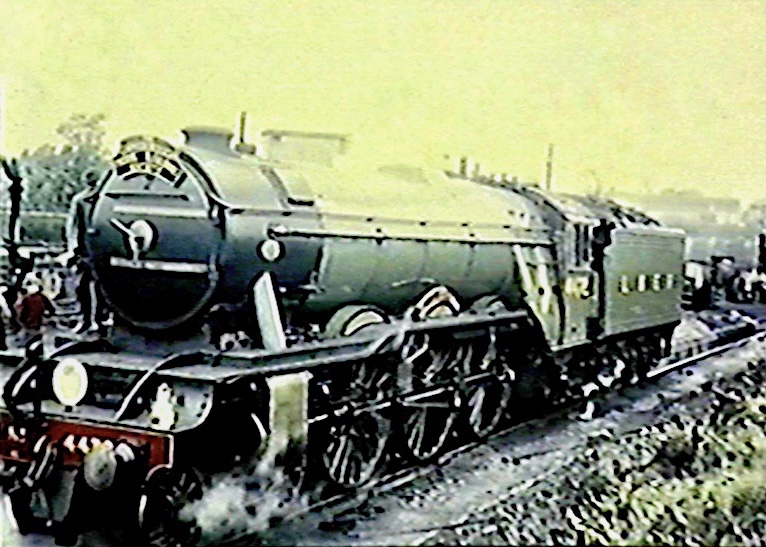
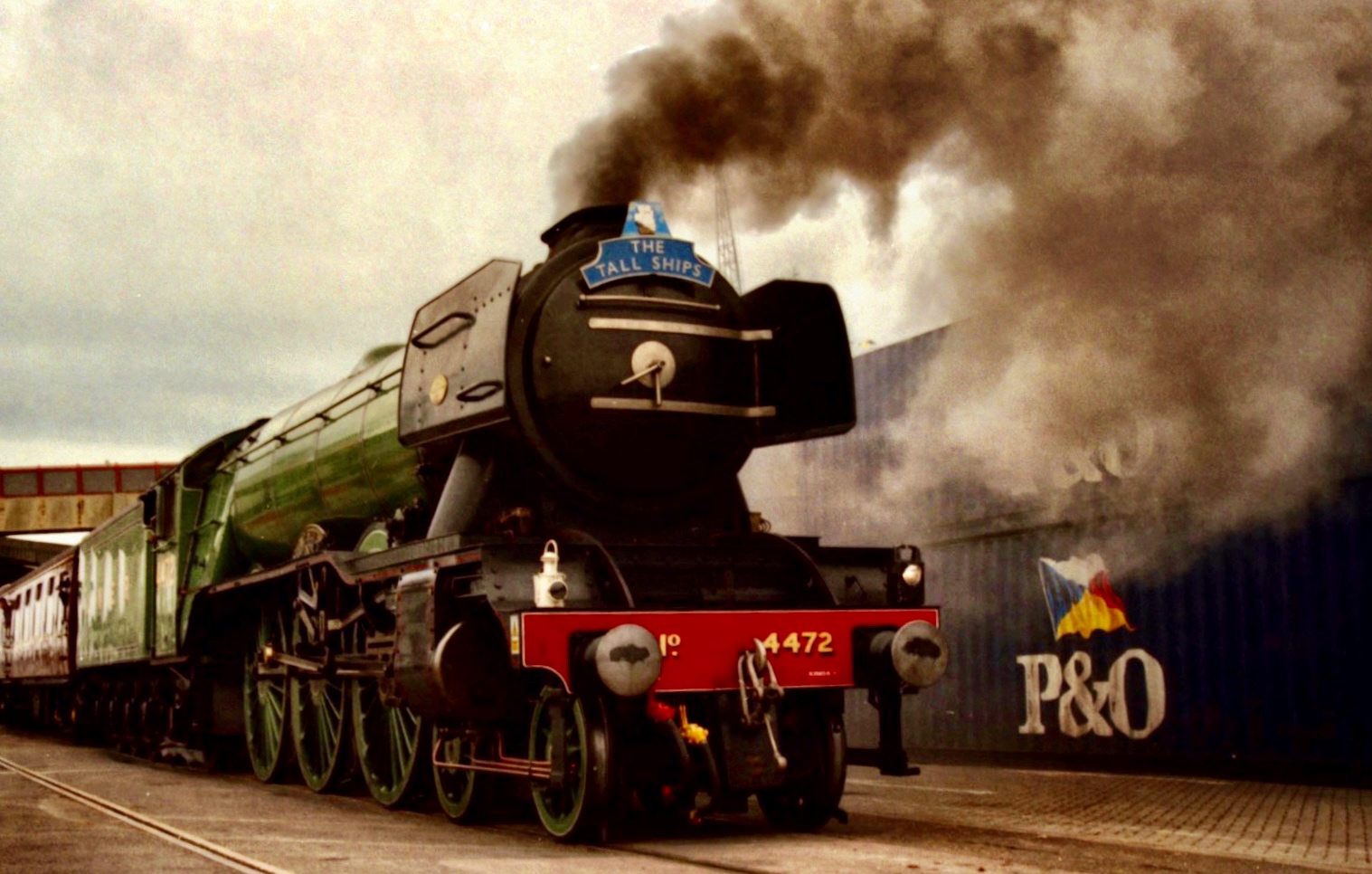
    Gresley A3 Pacific No. 4472 ‘Flying Scotsman’ at Southampton Docks in an unauthentic condition in LNER Apple Green but with double chimney and smoke deflectors from BR days – 16/04/2000

    Wednesday February 15th to Tuesday February 21st 2023

    The week kicked off with the delivery of a little Yoshi from ArtemisFibreArt, which the boy himself was rather intrigued about. Thankfully he decided against tearing it apart as is his usual reaction to soft toys. He recognises a handsome boy when he sees one!
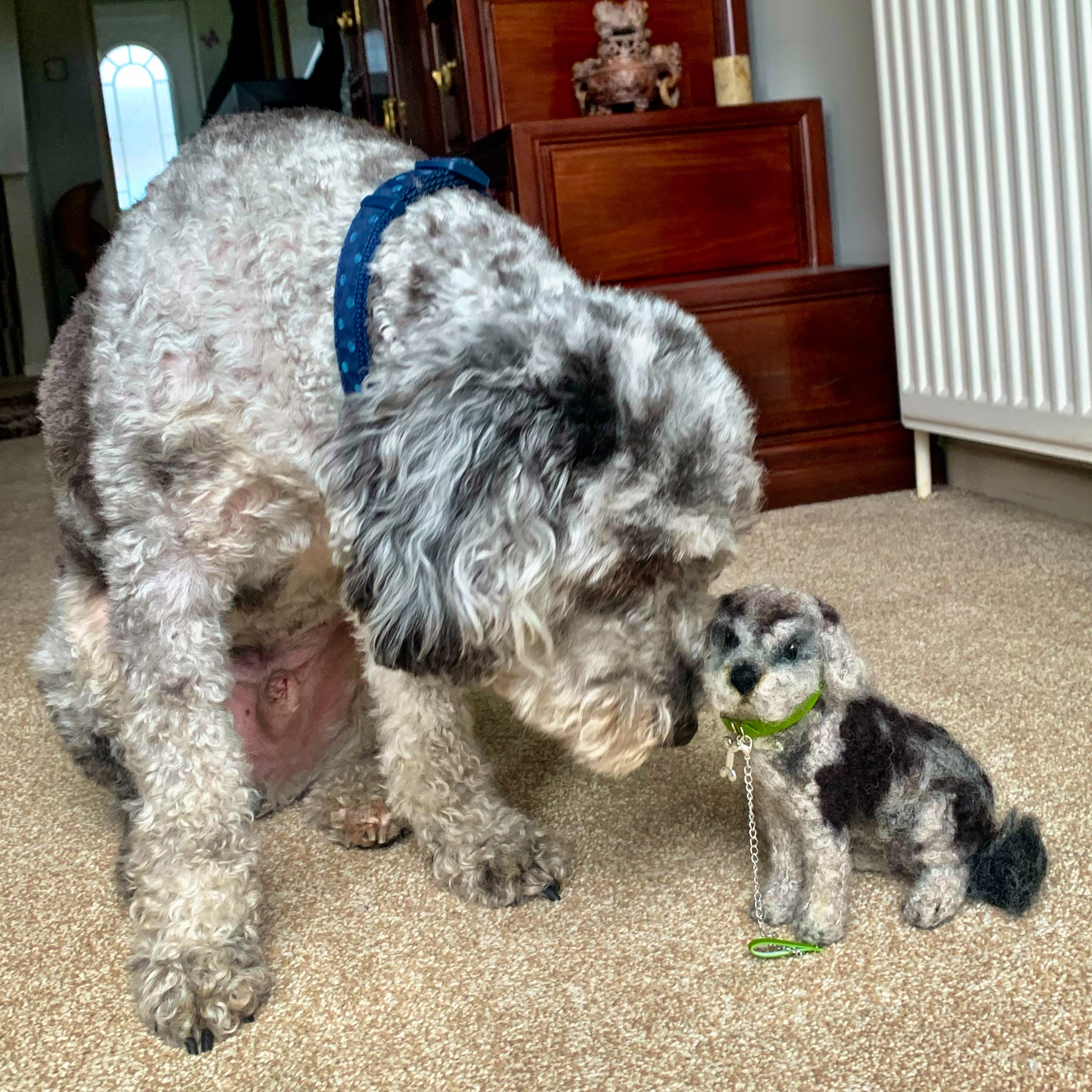
    Yoshi meets…. Little Yoshi
    Yoshi and the fabulous replica Little Yoshi from ArtemisFibreArt

    24th February 2023 marks 100 years since the third A1 Class 4-6-2 Pacific locomotive left Doncaster Works for the very first time and entered service with the London & North Eastern Railway. As if we haven’t written enough about this particular loco in previous blog entries, here’s another look at her history. Designed by Sir Nigel Gresley and originally numbered 1472 in a sequence originated by the Great Northern Railway who had placed the order for 51 Class A1’s prior to the “Big Four” Grouping of January 1923. A year later the LNER renumbered her No. 4472 and she gained the name ‘Flying Scotsman’ after the eponymous titled train in readiness for display at the British Empire Exhibition at Wembley.

    In 1928, ‘Flying Scotsman’ ran a non-stop passenger service between London King’s Cross and Edinburgh, this was achieved by means of another Gresley innovation; a corridor tender allowing drivers and firemen to pass through to the locomotive footplate from the leading train carriage. Water for the engine was picked up en-route from troughs set between the rails.

    1st November 1934 No. 4472 became the first steam locomotive to be officially recorded at travelling at 100 miles per hour as she passed between Little Bytham and Essendale on the East Coast Main Line.

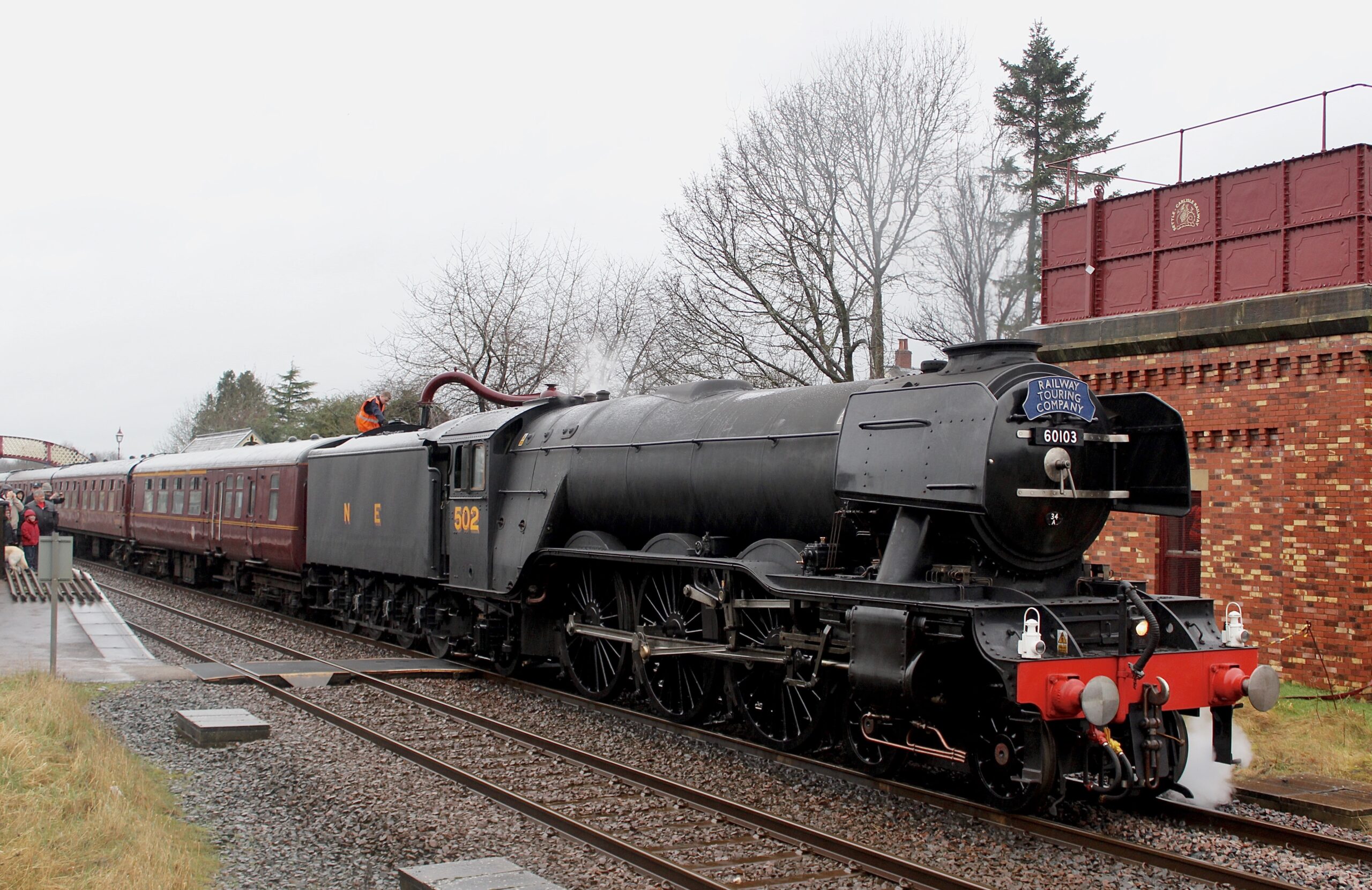
    In 1946 the LNER introduced an extensive renumbering scheme with the aim of placing all locomotives of the same type in a numerical sequence. ‘Flying Scotsman’ was renumbered twice this year, firstly in January as No. 502 by Gresley’s successor Edward Thompson and then No. 103 in May. After the Nationalisation of the railways in 1948 60000 was added to LNER engine numbers and consequently No. 103 became No. 60103.

    January 1947 ‘Flying Scotsman’ was converted from a Class A1 locomotive to an A3 under a programme initiated by Gresley in 1928 which added a larger boiler with a higher boiler pressure. A double Kylchap chimney was added in 1959 to improve performance with German style smoke deflectors being added in 1961 as the exhaust from the new chimney blocked the drivers view.

    Things looked bleak in October 1962 when it was announced ‘Flying Scotsman’ would be withdrawn from service in January 1963 and sent for scrap. Holder of the steam speed record Gresley A4 4-6-2 Pacific No. 60022 ‘Mallard’ was to be saved for the nation and it was deemed that only one locomotive of any given wheel arrangement per designer could be preserved.

    After a failed public appeal to “Save Our Scotsman” by raising the £3000 scrap value, businessman Alan Peglar, fresh from selling his Northern Rubber business and with money to burn stepped in and purchased No. 60103 from British Railways in 1963. As part of the deal, Peglar negotiated an agreement for ‘Flying Scotsman’ to run on the main line until 1966 with options to 1971. The locomotive was overhauled at Doncaster emerging in LNER Apple Green and carrying the number 4472 once again. In 1969, the locomotive was heading for USA and Canada on a tour where she travelled 15,400 miles to promote British exports where, after initial success, UK Board of Trade backing was withdrawn and by 1970 money was running out. As a result, in 1972 Peglar was declared bankrupt and ‘Flying Scotsman’ was put into storage in the US Army Sharpe Depot to keep her safe from creditors.

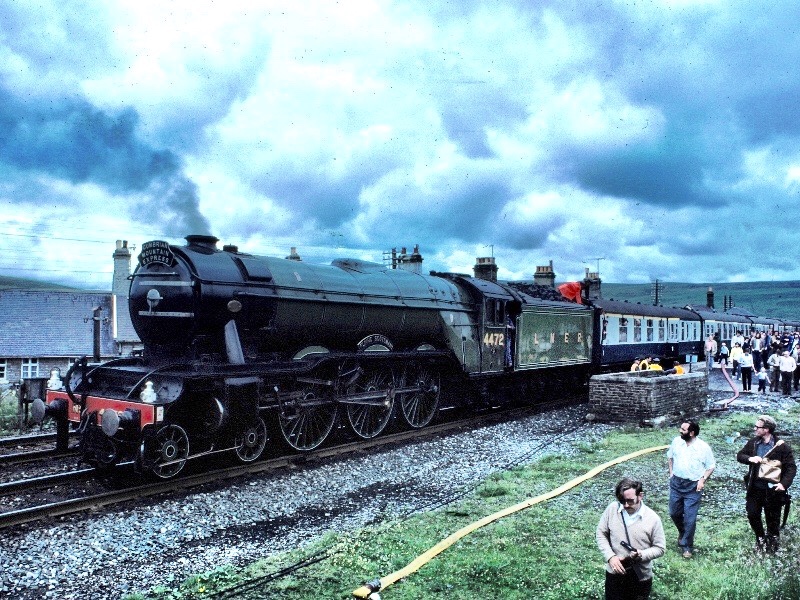
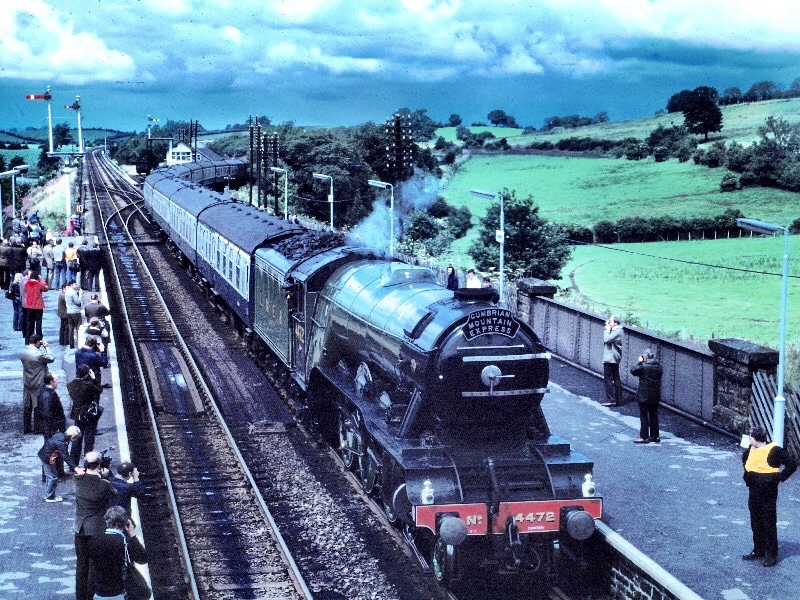
    No. 4472 ‘Flying Scotsman’ working the “Cumbrian Mountain Express” over the Settle & Carlisle stops at Garsdale for water – 22/07/1981

    Enter Sir William McAlpine, who stepped in and bought the locomotive, shipping her home in 1973. Following restoration at Derby, ‘Flying Scotsman’ embarked on a career running on the UK main line and heritage railways. In October 1988 she made a trip to Australia where over the next year she travelled more than 28,000 miles and set the record for the longest non-stop run by a steam locomotive totalling 422 miles having journeyed between Parkes and Broken Hill in New South Wales. On her return to the UK, ‘Flying Scotsman’ would eventually come under new ownership, that of a new consortium “Flying Scotsman Railways” which included Sir William McAlpine and record producer and railway enthusiast Pete Waterman. In 1993, she was outshopped in BR Brunswick Green, complete with double chimney and smoke deflectors representing how she looked at the end of her working life on BR.

    Following restoration to final BR condition, No. 60103 ‘Flying Scotsman’ headed for the Paignton & Dartmouth Railway where her visit lasted from 25th July to 11th September 1993
    No. 60103 ‘Flying Scotsman’ visited Llangollen in 1995

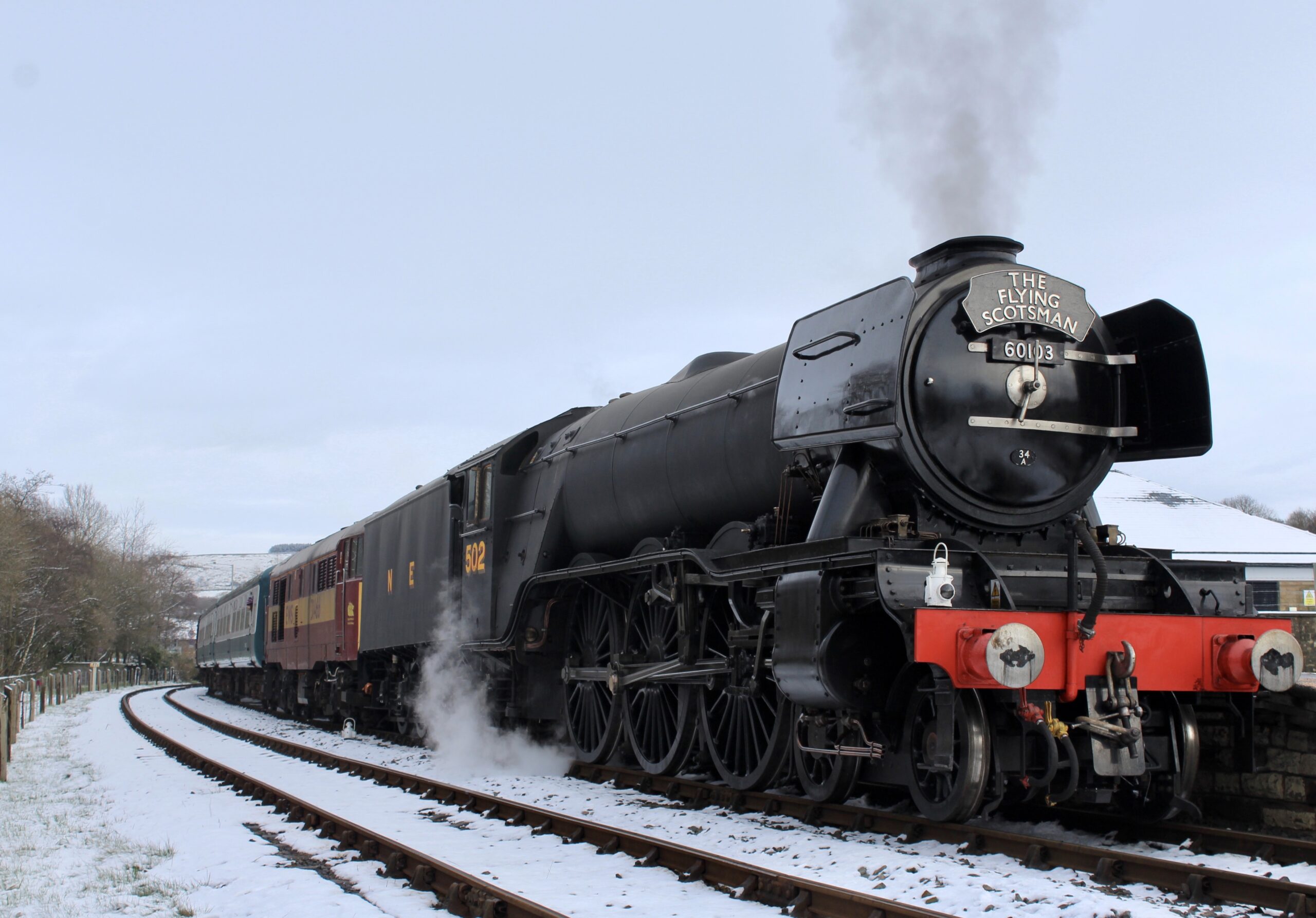
    April 1995, while working an empty coaching stock movement on the Llangollen Railway, ‘Flying Scotsman’ derailed and suffered a crack between her boiler and cab. She was deemed to be a complete failure and was taken to Southall to face an uncertain future. Experiencing financial difficulties, the consortium sold ‘Flying Scotsman’ to biotech entrepreneur Dr Tony Marchington in 1996 for £1.5m in a deal which included a set of coaches. Over the next three years Dr Marchington spent a further £1m restoring the locomotive which he returned to the main line in 1999. Following a failed attempt to create a “Flying Scotsman Village” in Edinburgh and the collapse of his company Oxford Molecular, Dr Marchington was bankrupted in September 2003. ‘Flying Scotsman’ was put up for sale in 2004 and there was a real fear that the locomotive would be sold abroad. However, to the relief of many, a huge public appeal was launched by the National Railway Museum (NRM) and on 5th April 2004 it was announced that the NRM had been successful with their sealed £2.2m auction bid, which had been boosted by a £1.8m grant from the National Heritage Memorial Fund. ‘Flying Scotsman’, a locomotive which perhaps more than any other represents the people’s engine had finally been saved for the nation. Unfortunately No. 60103 required a great deal of work to return her to steam with an estimated 12 month £750,000 restoration commencing in 2005. In reality, it would take 10 years and £4.2m before a warming fire could be lit in the overhauled firebox of ‘Flying Scotsman’. On her first public runs in January 2016 following restoration, she was seen in a wartime black livery on the East Lancashire Railway.

    Still in wartime black livery with No. 60103 on the smokebox and No’s 103 and 502 on opposite cab sides, her first mainline outing following overhaul was on 6th February 2016 at the head of “The Winter Cumbrian Mountain Express” from Carnforth to Carlisle. Myself and @da_buckley967 decided to drive from Dorset to Cumbria to see the spectacle of ‘Flying Scotsman’ climbing Shap on the West Coast Main Line.

    “The Winter Cumbrian Mountain Express” – 06/02/2016
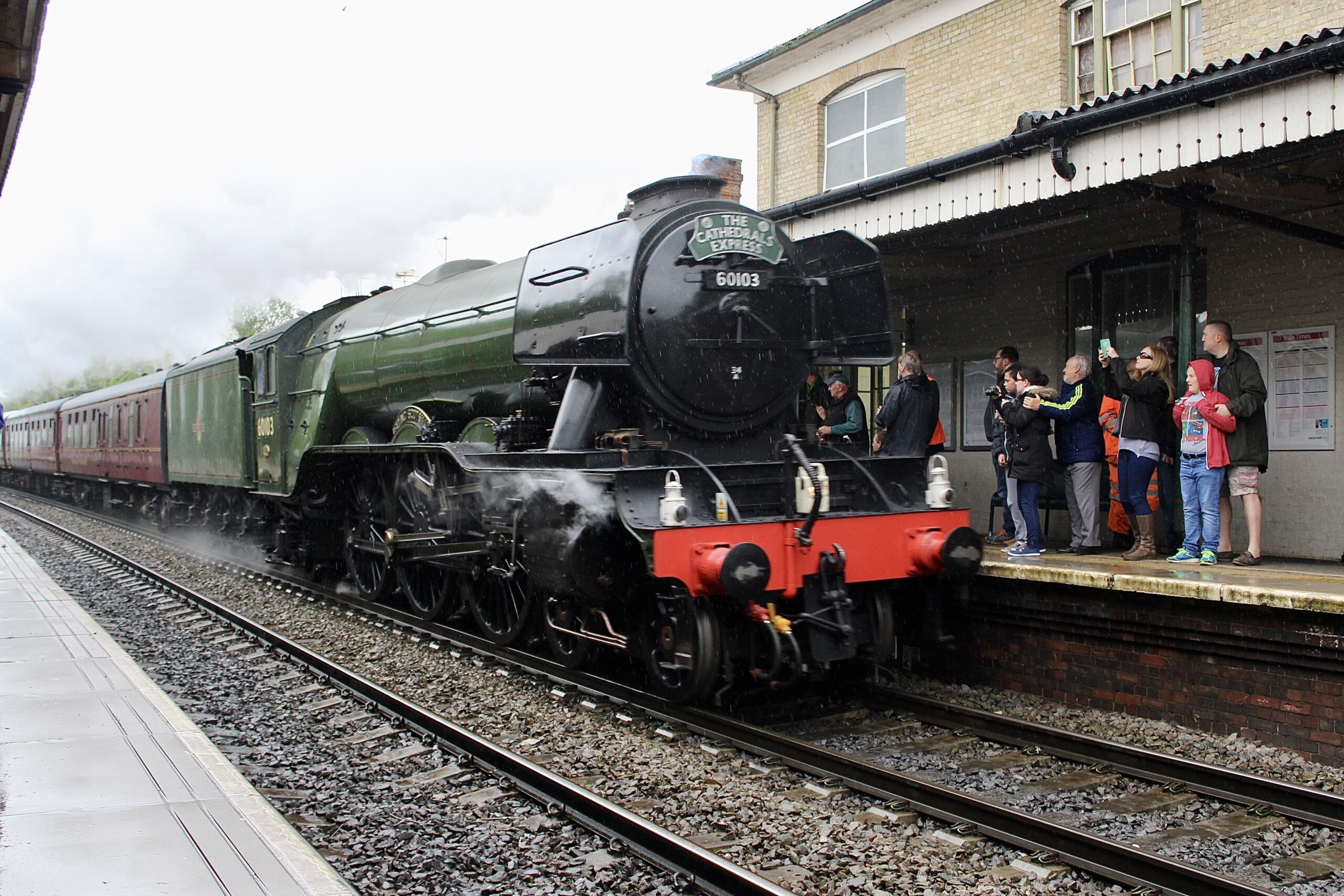
    Showing just how popular No. 60103 ‘Flying Scotsman’ has become is evident in this scene as she passes through Romsey with “The Cathedrals Express” rail tour on 21st May 2016
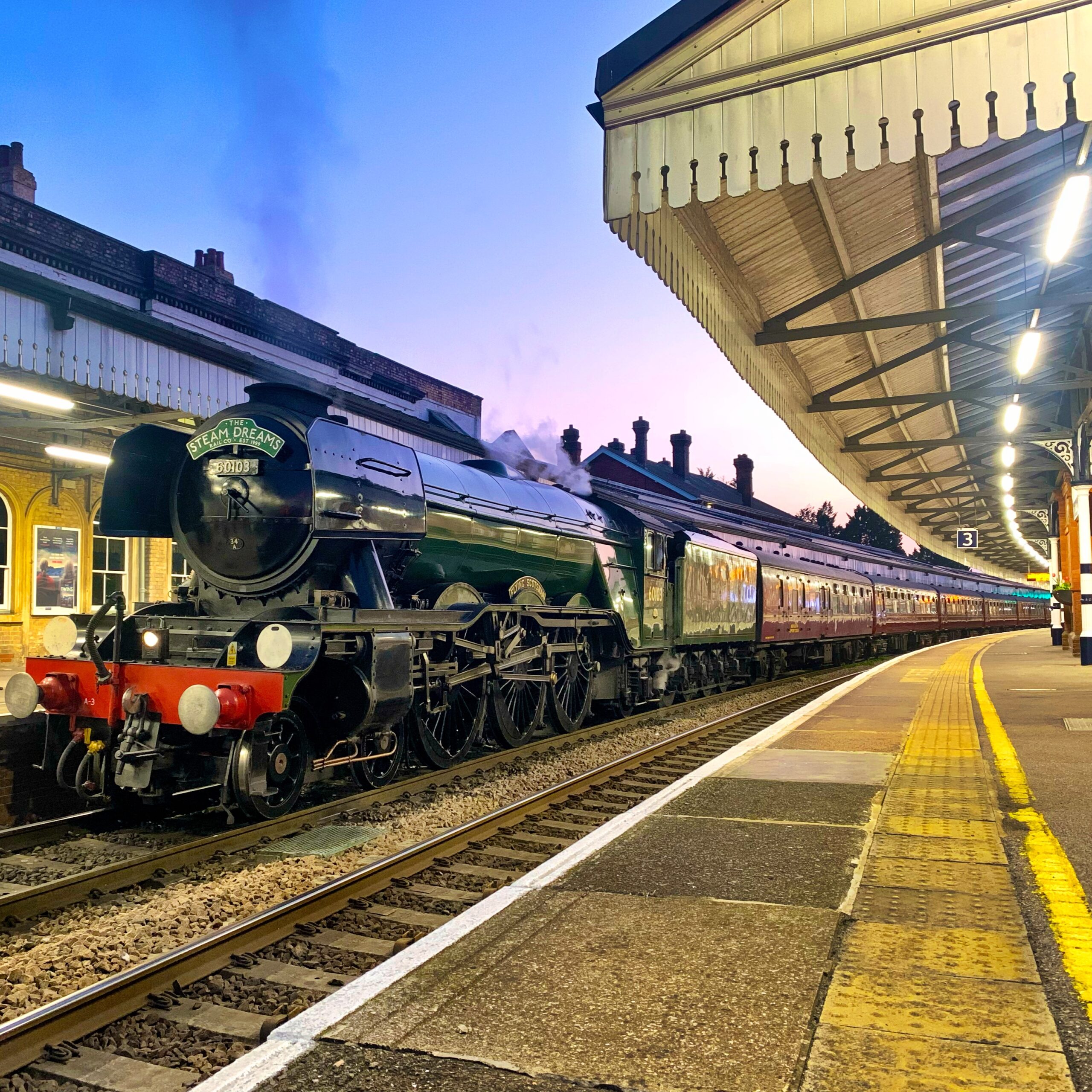
    Steam Dreams ‘Flying Scotsman’ London to Winchester and Afternoon Tour from Southampton – 06/06/2021

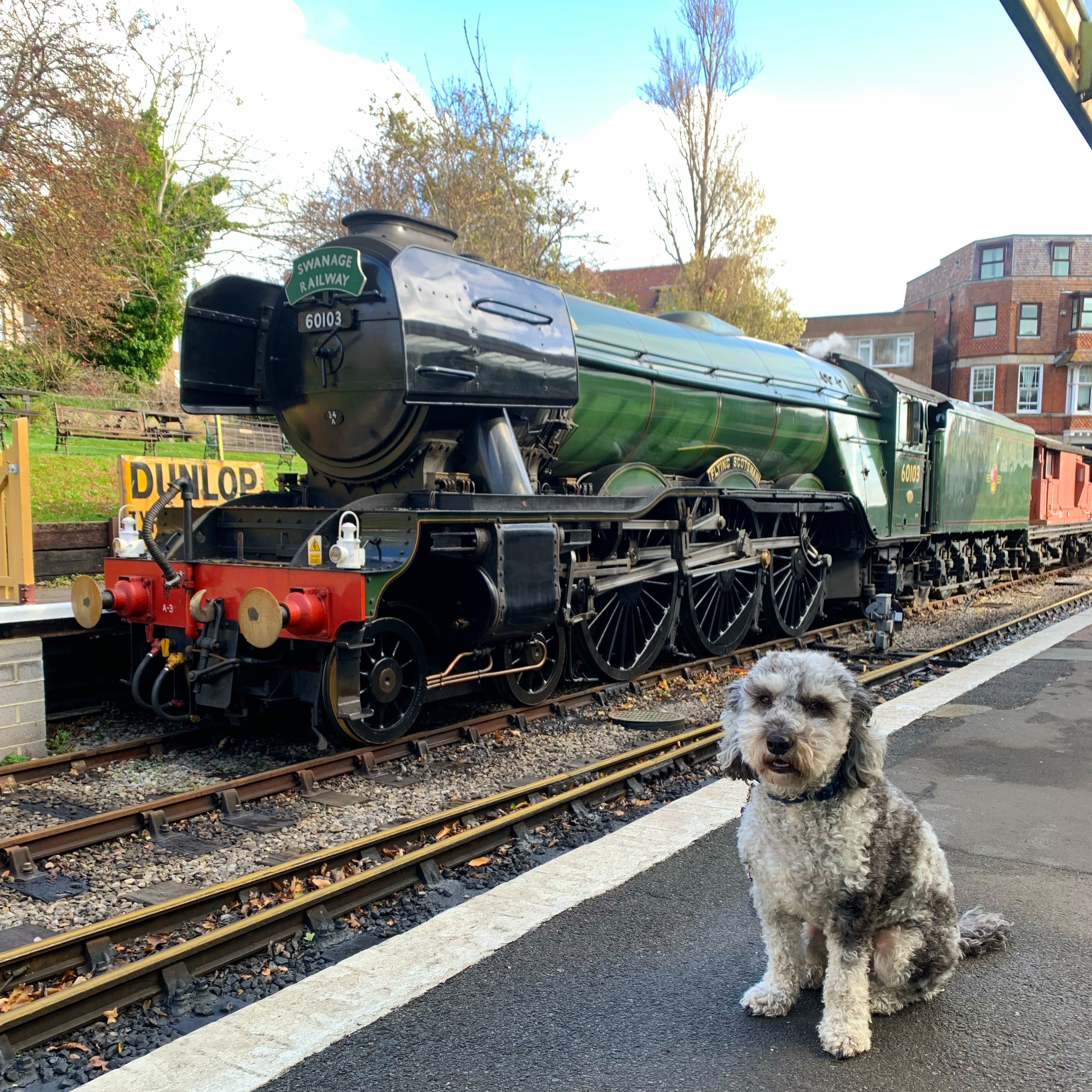
    Ahead of her centenary year celebrations, ‘Flying Scotsman’ underwent another overhaul at Riley & Son in Bury, the first event following this being her attendance at London King’s Cross to help celebrate the railway station’s 170th anniversary and launch her own event programme before she arrived in Dorset for a stint on the Swanage Railway.

    For more ‘Flying Scotsman’ goodness, you might like to check out these “Railway Dog” blog entries from 2022 which feature more images and video:

    From 27th February to 3rd March 2023 no weekday trains will run between Yeovil Pen Mill and Dorchester West to allow Network Rail to lay new track and carry out other maintenance, including station improvements at Maiden Newton. The closure extends to include the Yeovil to Castle Cary section on 6th and 7th March affecting Great Western Railway (GWR) and South Western Railway (SWR) services.

    In no way connected to the forthcoming closure “up the West”, Monday 20th and Tuesday 21st February 2023 saw Freightliner Engineering Trains head to Dorchester South. A further train was scheduled to depart Eastleigh East Yard for Upwey on Wednesday 22/02/2023.

    Dorset Freightliner Engineering Trains w/c 20/02/2023

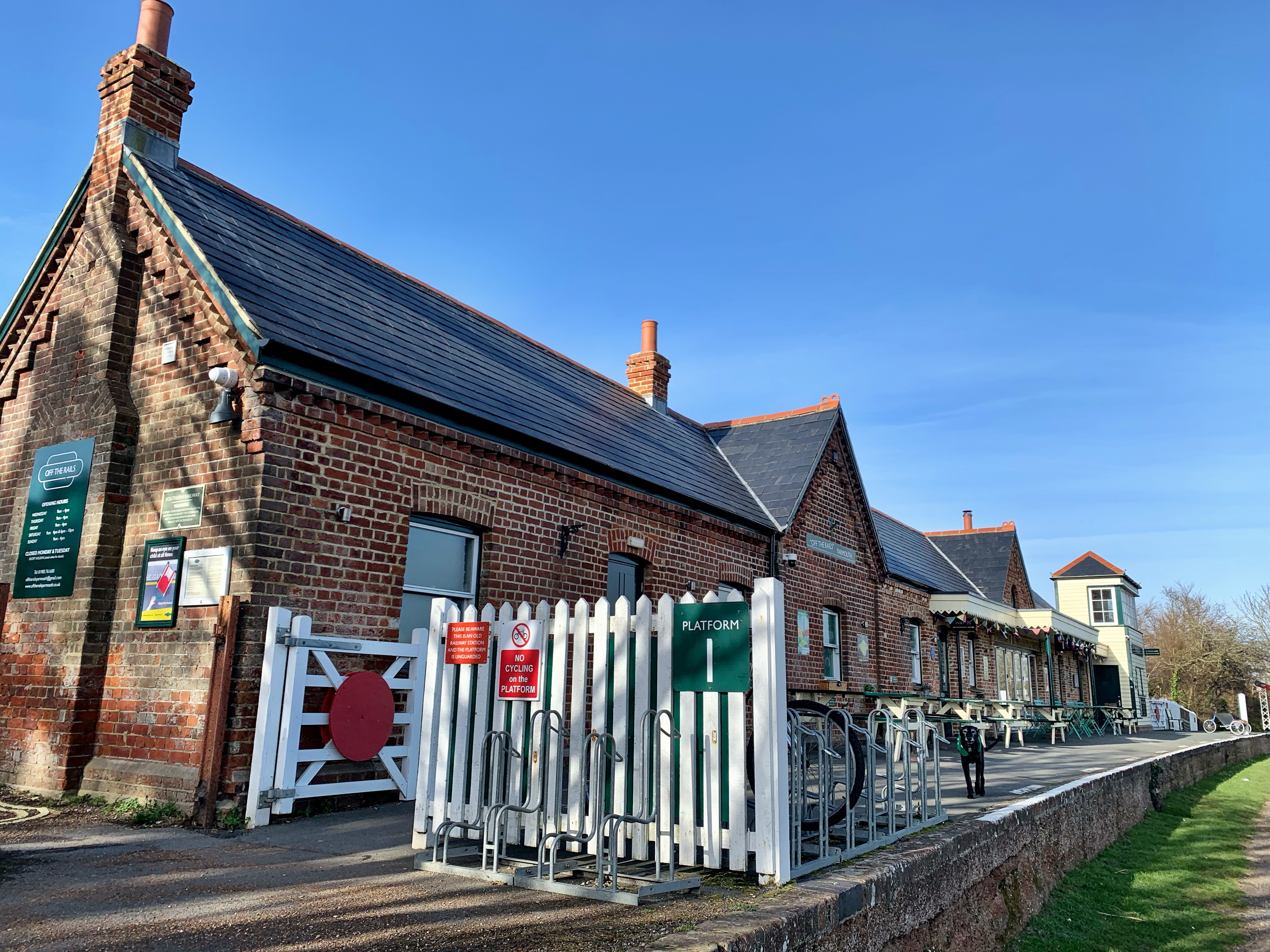
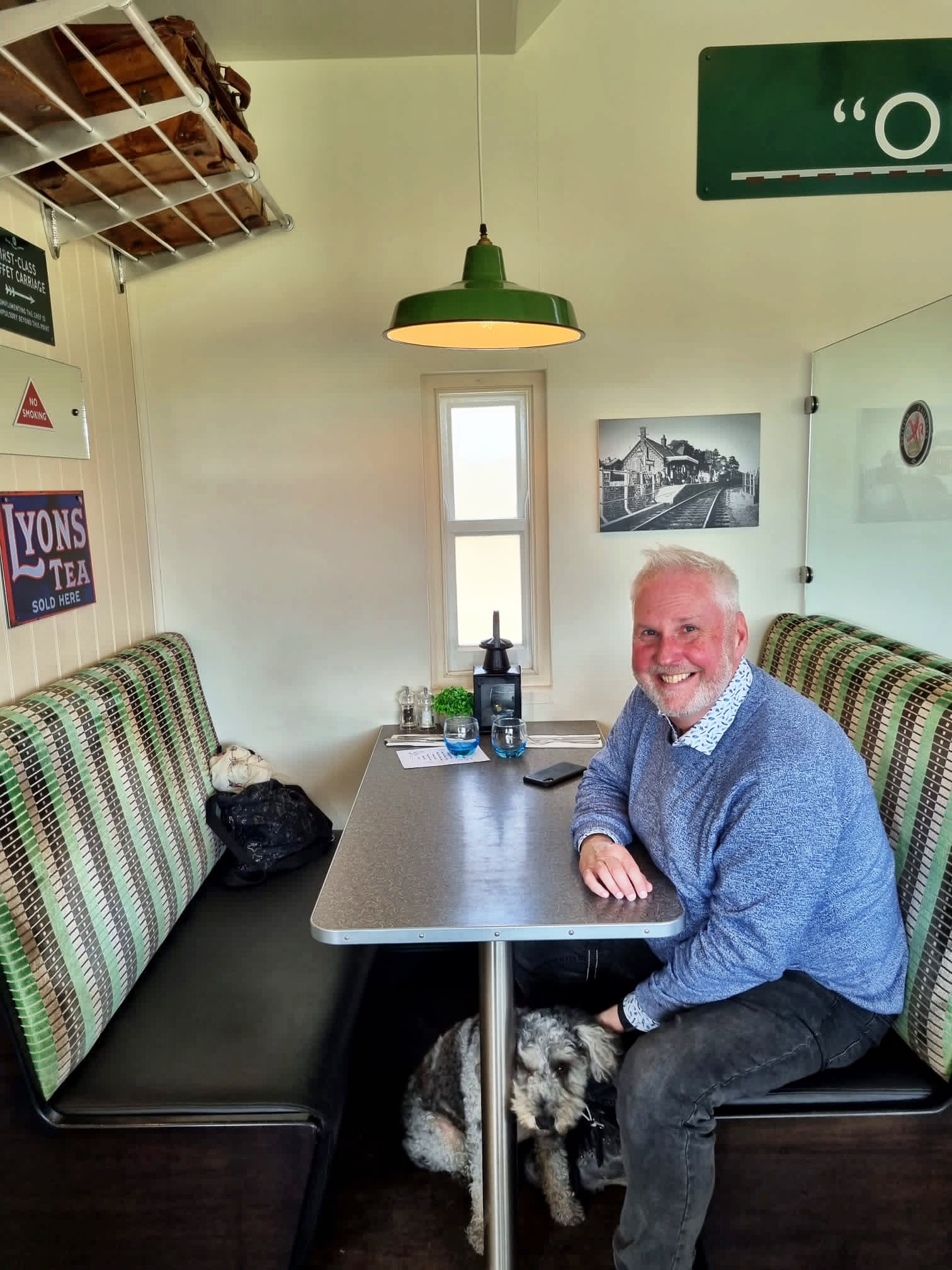
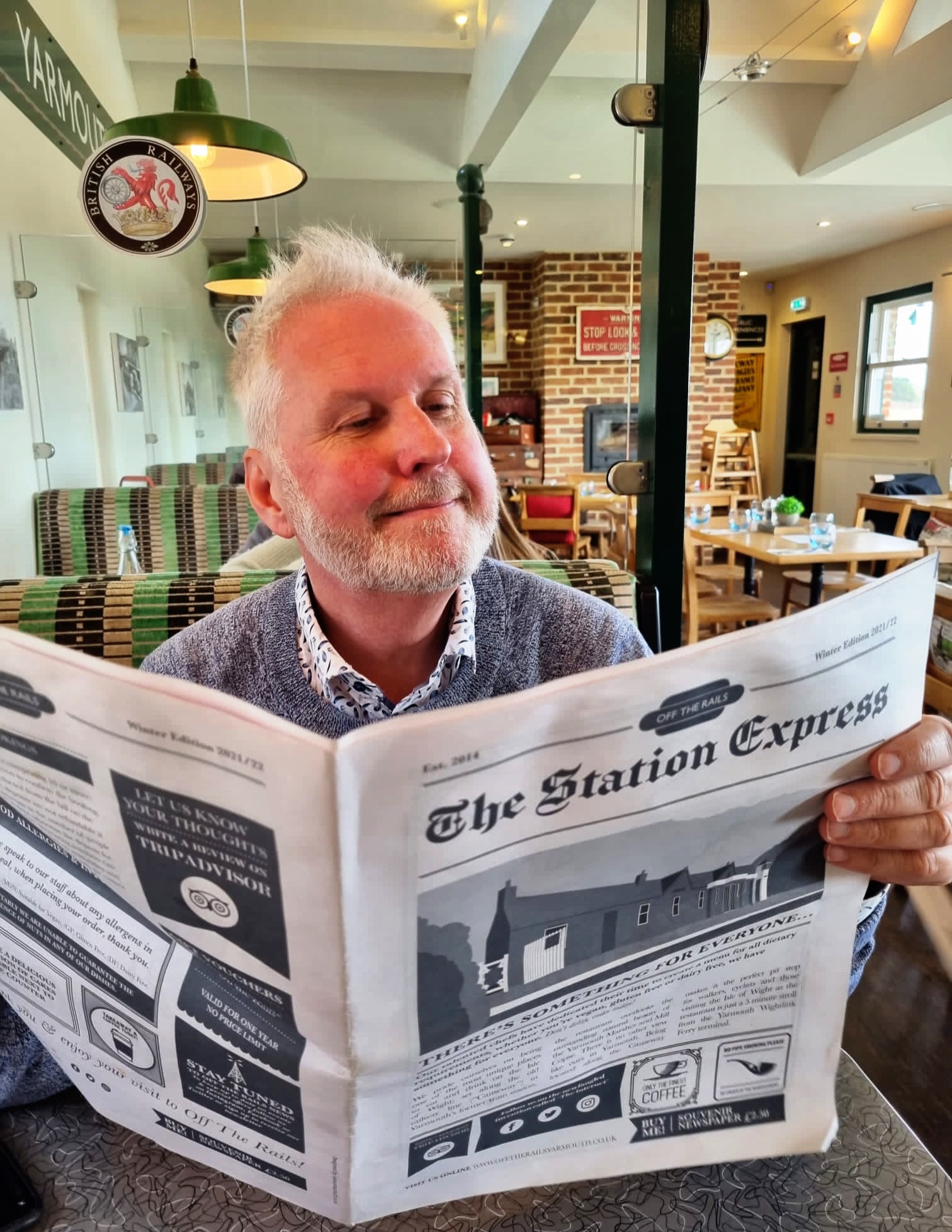
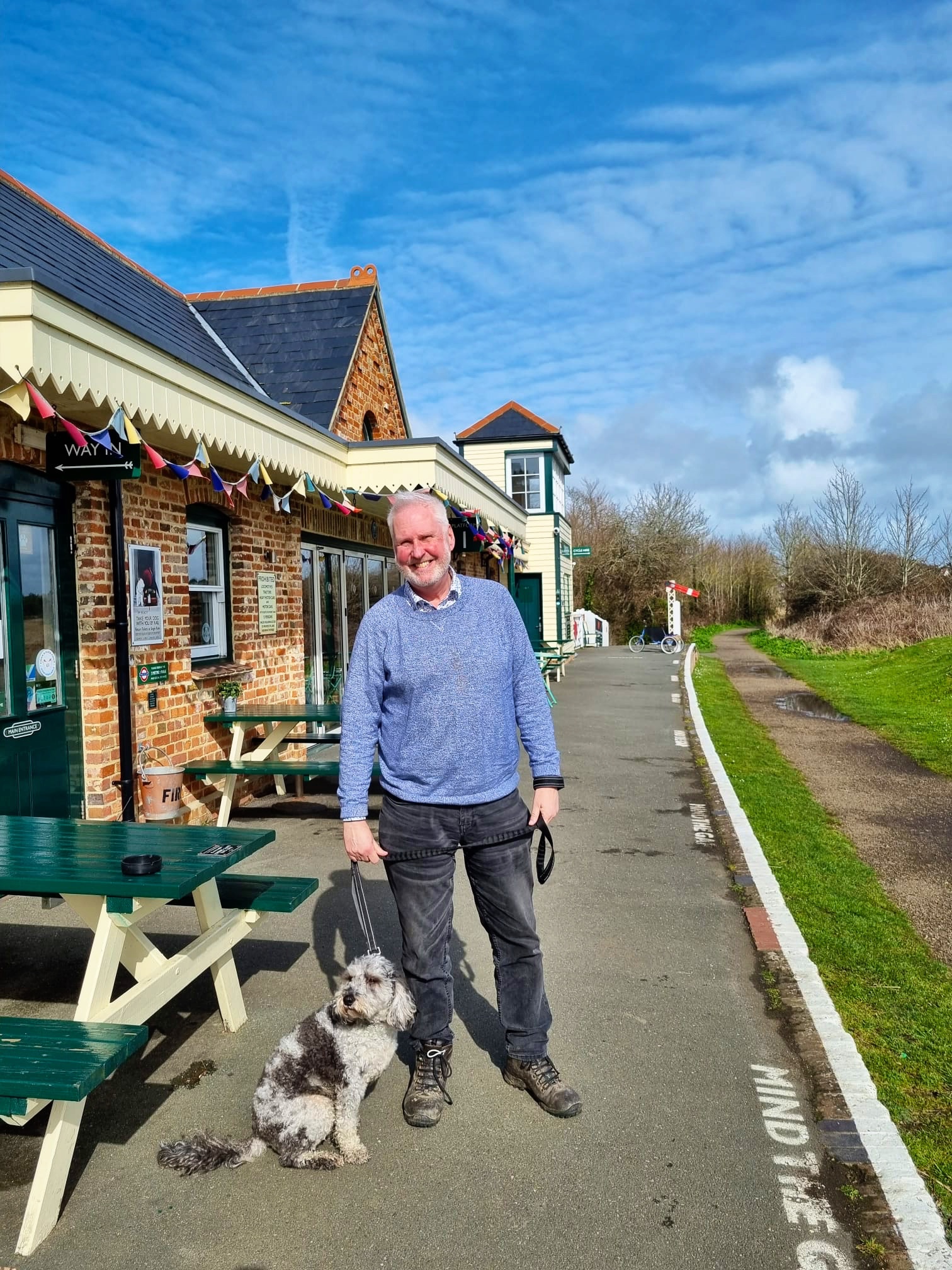
    In another of our occasional visits to cafes which happen to be situated in former railway stations, on Wednesday 15th February, we popped over the county border to Hampshire in order to visit The Old Station Tea Rooms at Homsley.
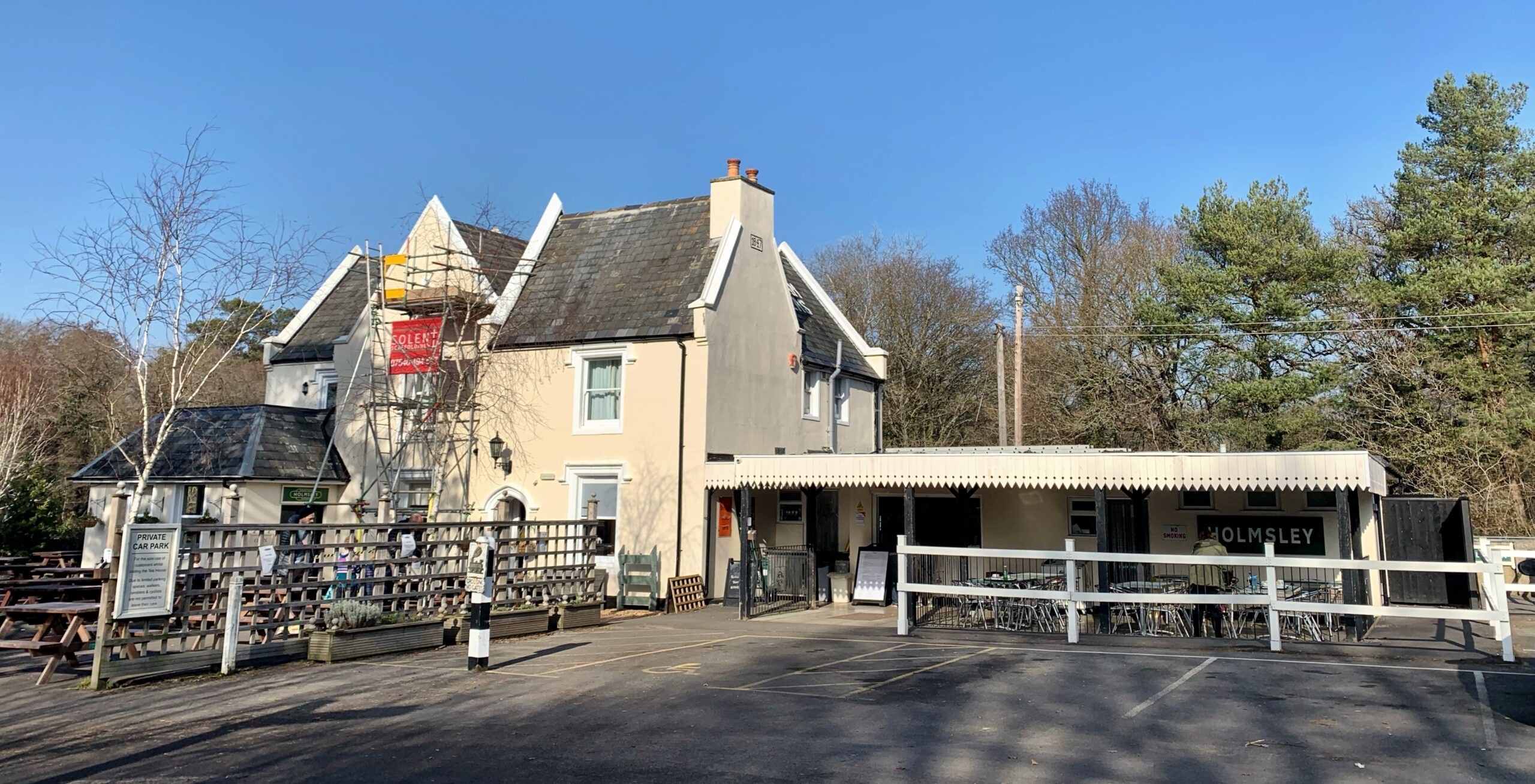
    The Old Station Tea Rooms at Homsley – 15/02/2023

    Opened in 1874 as Christchurch Road railway station by the Southampton & Dorchester Railway it was, at the time, the closest station to Bournemouth and Christchurch, becoming Holmsley station in 1894. Prince Edward, the eldest son of Queen Victoria was a regular user of the station with his mistress Lillie Langtry as it was here where they would embark on their way to their private residence in Bournemouth. Holmsley was also the inspitration for Browndean station in Robert Louis Stephenson’s novel “The Wrong Box”.
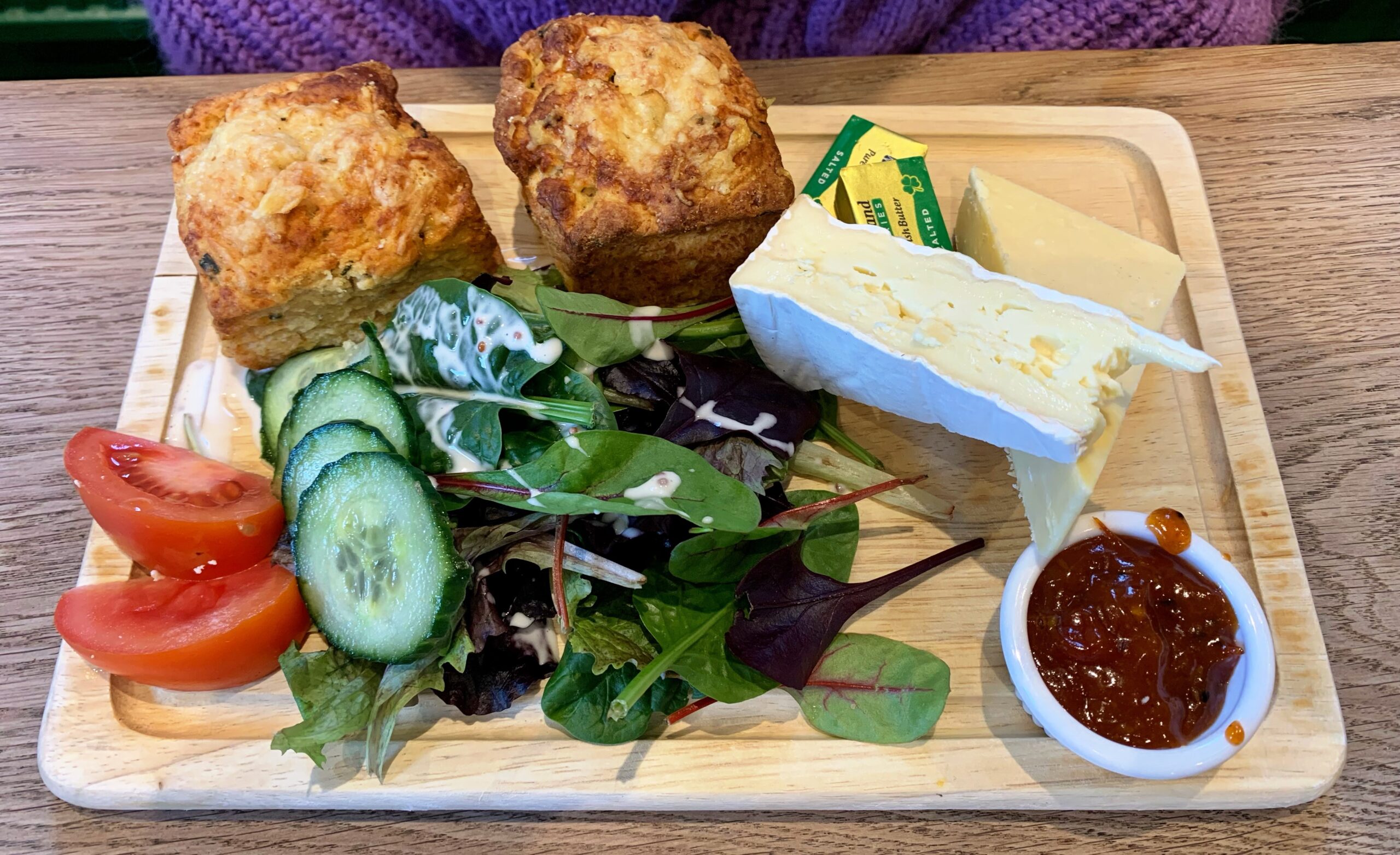

    Porters Lunch Box
    Station Managers Rarebit

    Holmsley station was closed on May 4th 1964 as a result of the Beeching Report. Today the main station building lives on, repurposed as a tea room with several items of railway memorabilia and photographs on display. Dogs are welcome at outside tables, of which there are many, and the food is delicious. Walks along the Castleman Railway utilising the old rail road to Ringwood, Wimborne and Poole can be enjoyed nearby.
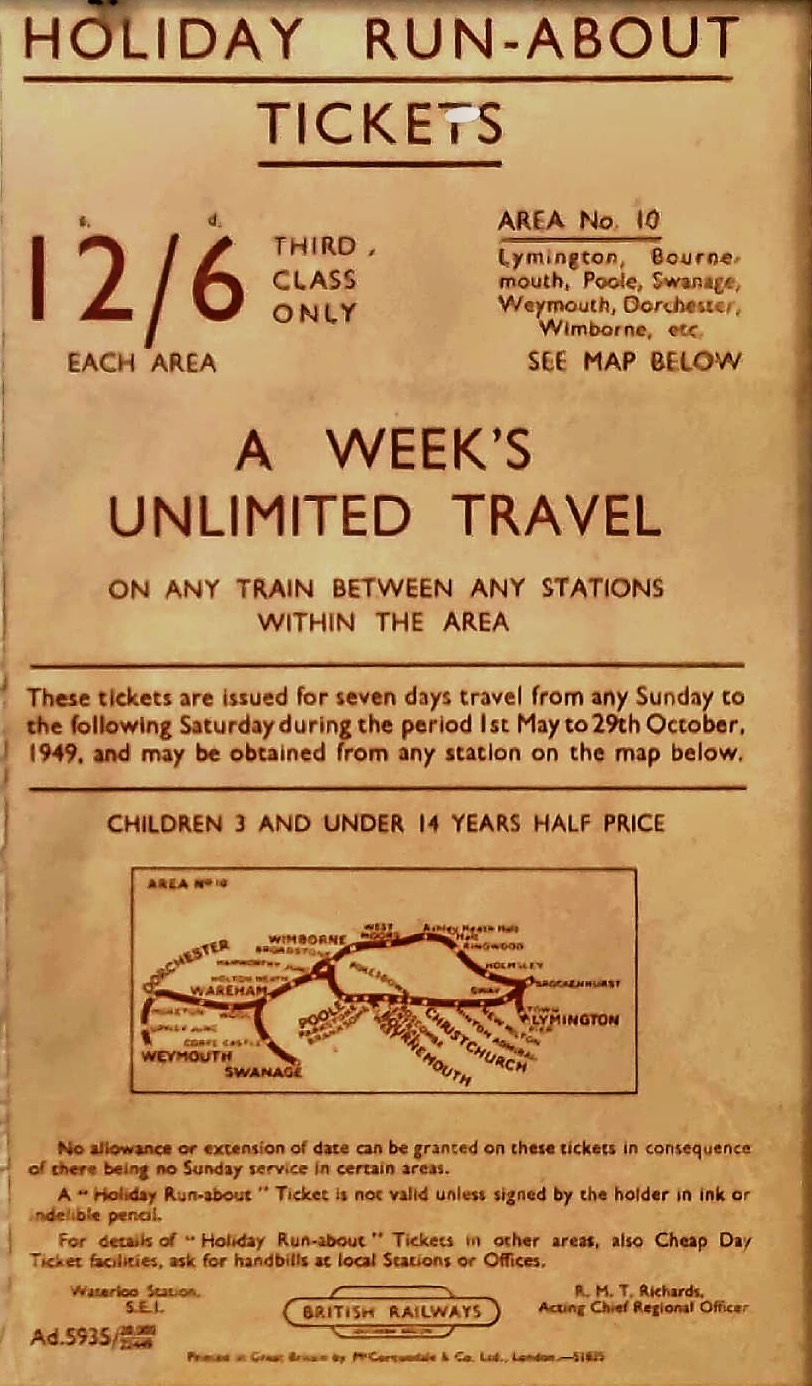
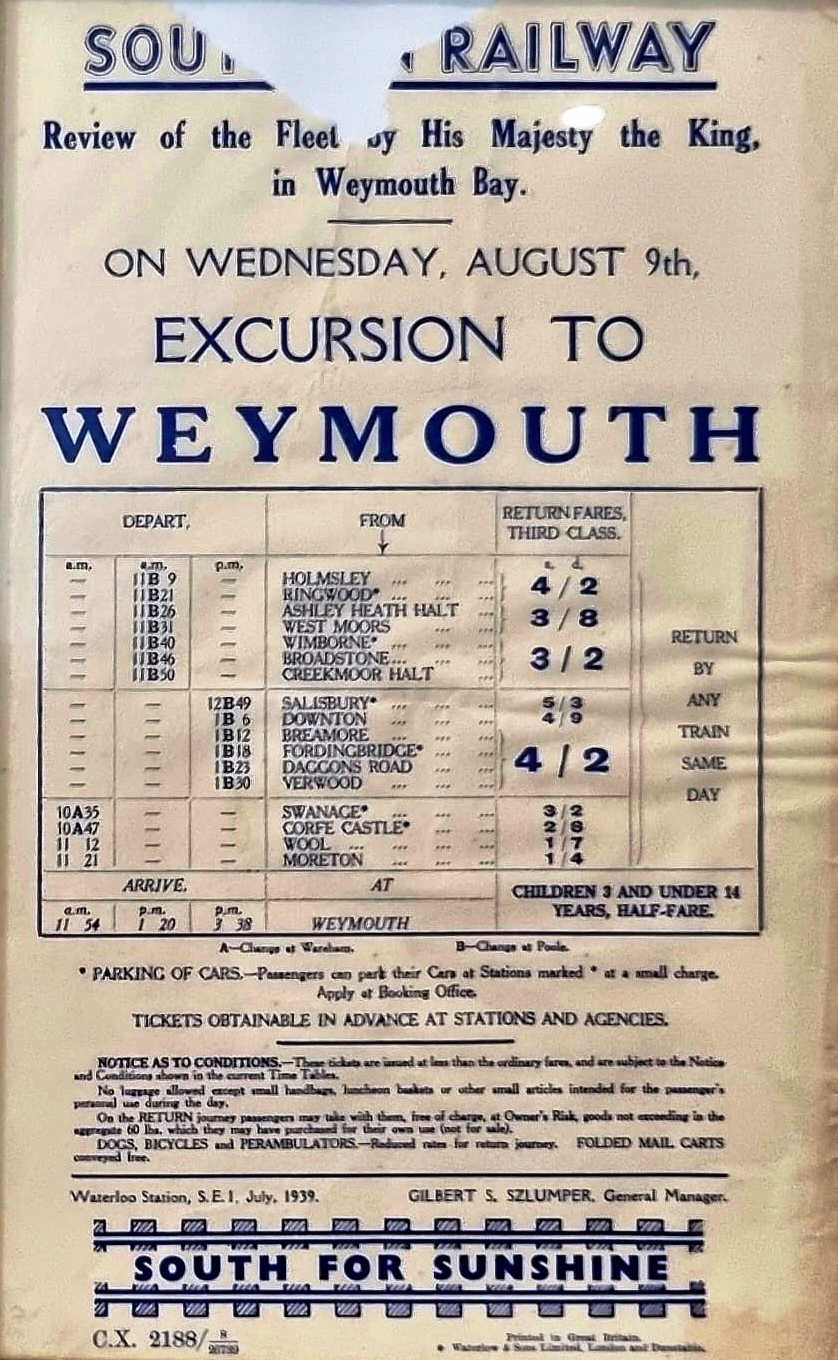
    An example of the railway themed memorabilia which can seen at The Old Station Tea Rooms, Homsley
    Review the fleet at Weymouth!

    That brings us to the end of another entry. Thanks for visiting and we hope to see you again another time. Your comments, corrections and observations are very much appreciated. Recommendations for cafes situated in former railway stations are welcome! This weeks blog was mostly written with the aid of tea, Galaxy Milk Chocolate Digestive biscuits to the accompaniment of Pink Floyd’s “The Dark Side Of The Moon” – which, amazingly, is 50 years old next Wednesday (1st March 2023). Time, eh?

    Yoshi has spotted a squirrel, or a possibly Class 444 Electric Multiple Unit. They both deserve being barked at….
  • Birthday Week

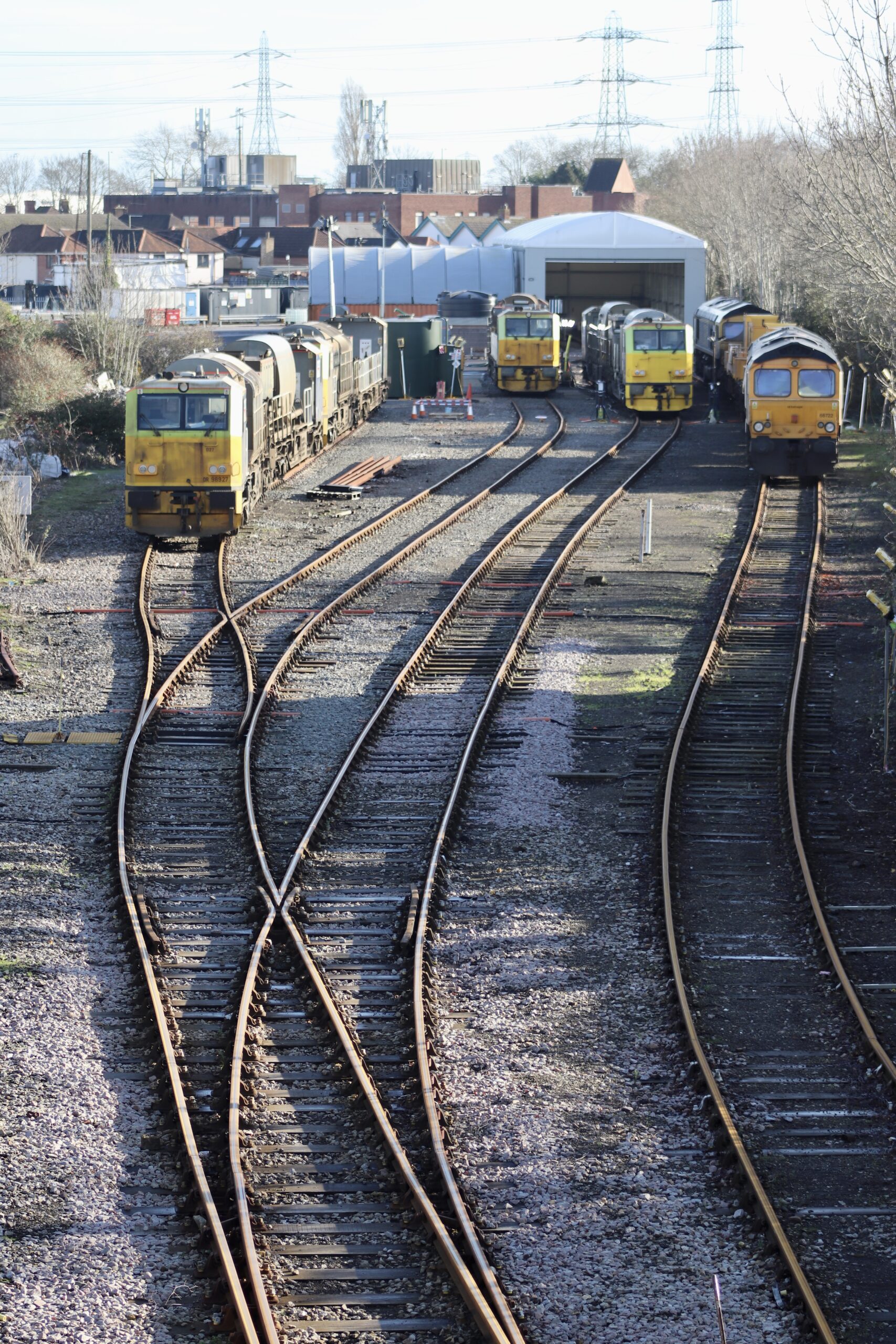
    For fans of photographs of trains taken through a shrubbery, here is Southampton Maritime Freightliner depot with pink liveried Class 66 No. 66587 ‘As One, We Can’ – 15/01/2023

    Wednesday January 11th to Tuesday January 17th 2023

    There has been a huge impact on rail services to and from London, Bournemouth and Weymouth as over the weekend, heavy rain washed away a clay embankment northeast of the Hampshire railway station of Hook situated between Basingstoke and London Waterloo. Passengers were advised against all but essential travel over the coming days on services which would usually pass through the area on the South West Main Line. The great majority of trains will not be able to run and repairs may take weeks before services are restored. As a result no trains will be stopping at Hook, Winchfield or Fleet.

    The landslip at Hook from the air – screen grab from BBC South Today – 16/01/2023

    Network Rail will need to build an access road to enable heavy machinery designed for piling to be brought in and repairs carried out around the clock. The embankment, originally built 190 years ago, is made of a mixture of London Clay and other local soils. Although there have been landslips at this location previously, they are becoming an increasing problem across the network because of drier summers and wetter winters with more intense rainfall which is a particular issue for clay embankments.

    Network Rail image of the Hook landslip – 16/01/2023

    The slip, which left one track hanging in mid-air, happened when the soil gave way along a 44-metre section of 10m high embankment, sliding out from underneath the tracks meaning only two tracks of the four-track railway are passable by trains. Both of the intact tracks are designed to be used by London bound trains only. This was the worst of 13 different flooding related incidents during the recent rainfall, which also included major flooding at Sway increasing the disruption on the already revised timetable between London Waterloo and Weymouth. South Western Railway (SWR) will run a service from Weymouth which will terminate at Basingstoke and a very limited shuttle will operate between Basingstoke and Woking, from where services continue thereafter.

    South Western Railway (SWR) service announcement published on 17/01/2023

    Wednesday 11th January, before the latest period of rain, Swanage based Class 33 No. D6515 (33012) ‘Lt Jenny Lewis RN’ hauled Network South East liveried Class 50 No. 50026 ‘Indomitable’ from the Purbeck Heritage Line to Eastleigh Arlington working as 0Z50 0942 Swanage to Eastleigh Arlington (ZG). After dropping off the Class 50, the Crompton headed back to Swanage light engine the afternoon of the same day.

    Class 33 No. D6515 (33012) ‘Lt Jenny Lewis RN’ hauling Class 50 No. 50026 ‘Indomitable’ working 0Z50 0942 Swanage to Eastleigh Arlington (ZG) through Hamworthy – 11/01/2023
    Class 33 No. D6515 (33012) ‘Lt Jenny Lewis RN’ travels solo as 0Z33 1430 Eastleigh Arlington to Swanage – 11/01/2023
    Video of Class 33 No. D6515 (33012) ‘Lt Jenny Lewis RN’ hauling Class 50 No. 50026 ‘Indomitable’ on a day out from Swanage – 11/01/2023

    On Sunday, Yoshi stayed with his mum while I headed towards Eastleigh to visit an old friend and a chance to put the world to rights. I obviously took the opportunity to get some railway time in on my way and my journey took me via Totton Yard, Freightliner Southampton MCT – which was quite full of locomotives with examples of Class 66’s, Class 70’s, Class 47 No. 47830 – and of course Eastleigh itself!

    A view of MPV’s and SITT sitting on Totton Yard – 15/01/2023
    Southampton Maritime Container Terminal depot with, amongst others, Class 47 No. 47830 ‘Beeching’s Legacy’ and Class 66 No. 66587 ‘As One, We Can’ hiding behind a container train – 15/01/2023
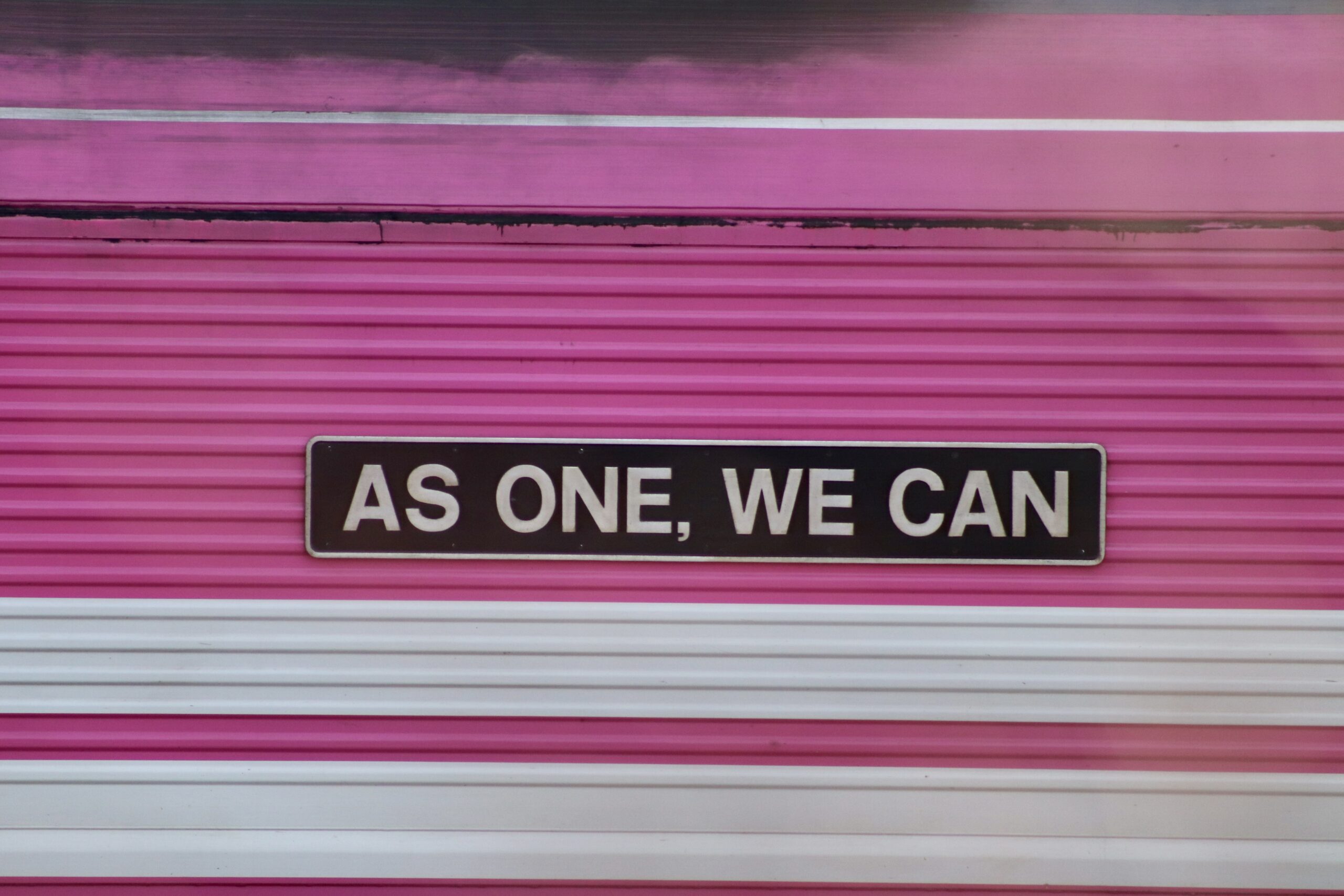
    Nameplate detail of Class 66 No. 66587 ‘As One, We Can’ – 15/01/2023
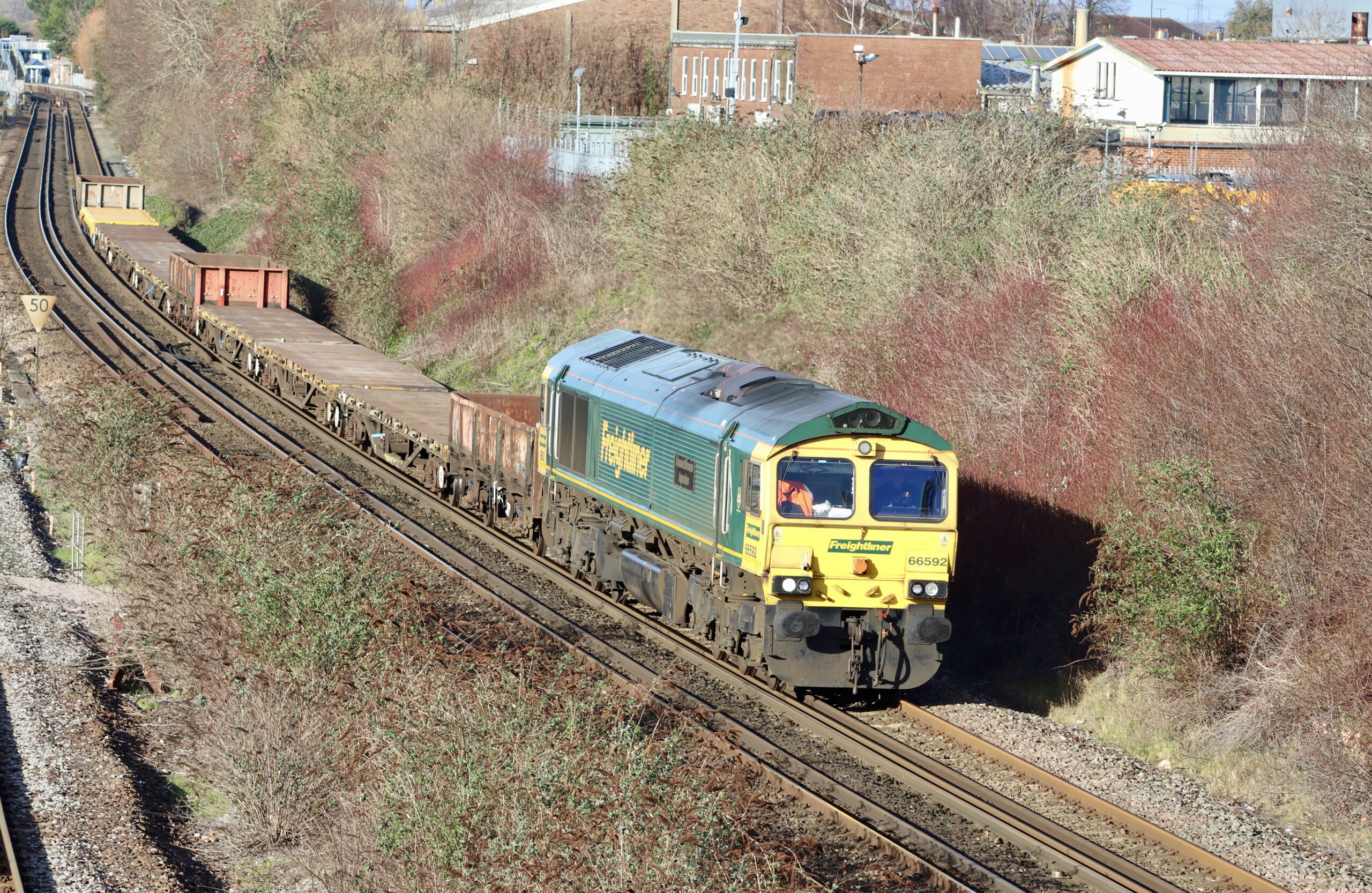
    With impeccable timing, late running Freightliner Class 66 No. 66592 ‘Johnson Stevens Agency’ works 6Y85 1000 Andover to Eastleigh East Yard past Redbridge, Southampton – 15/01/2023
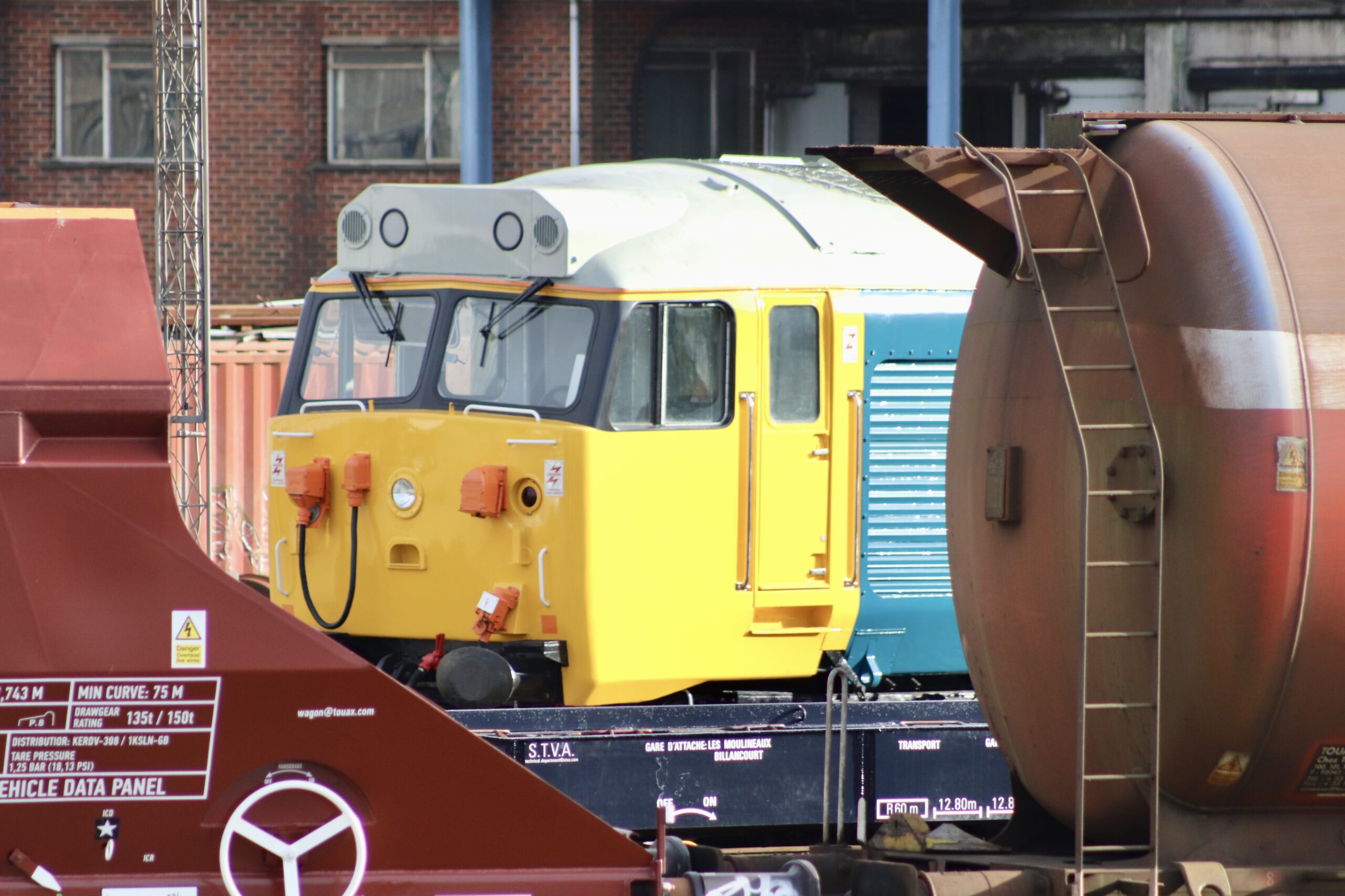
    Class 50 No. 50021 ‘Rodney’ (also known as Dave) on Eastleigh Works. Hopefully this locomotive and sister No. 50026 will head to Swanage for the 2023 Diesel Gala in May – 15/01/2023
    A view across Eastleigh East Yard – 15/01/2023
    Colas Class 66 No. 66849 ‘Wylam Dilly’ at Eastleigh East Yard – 15/01/2023
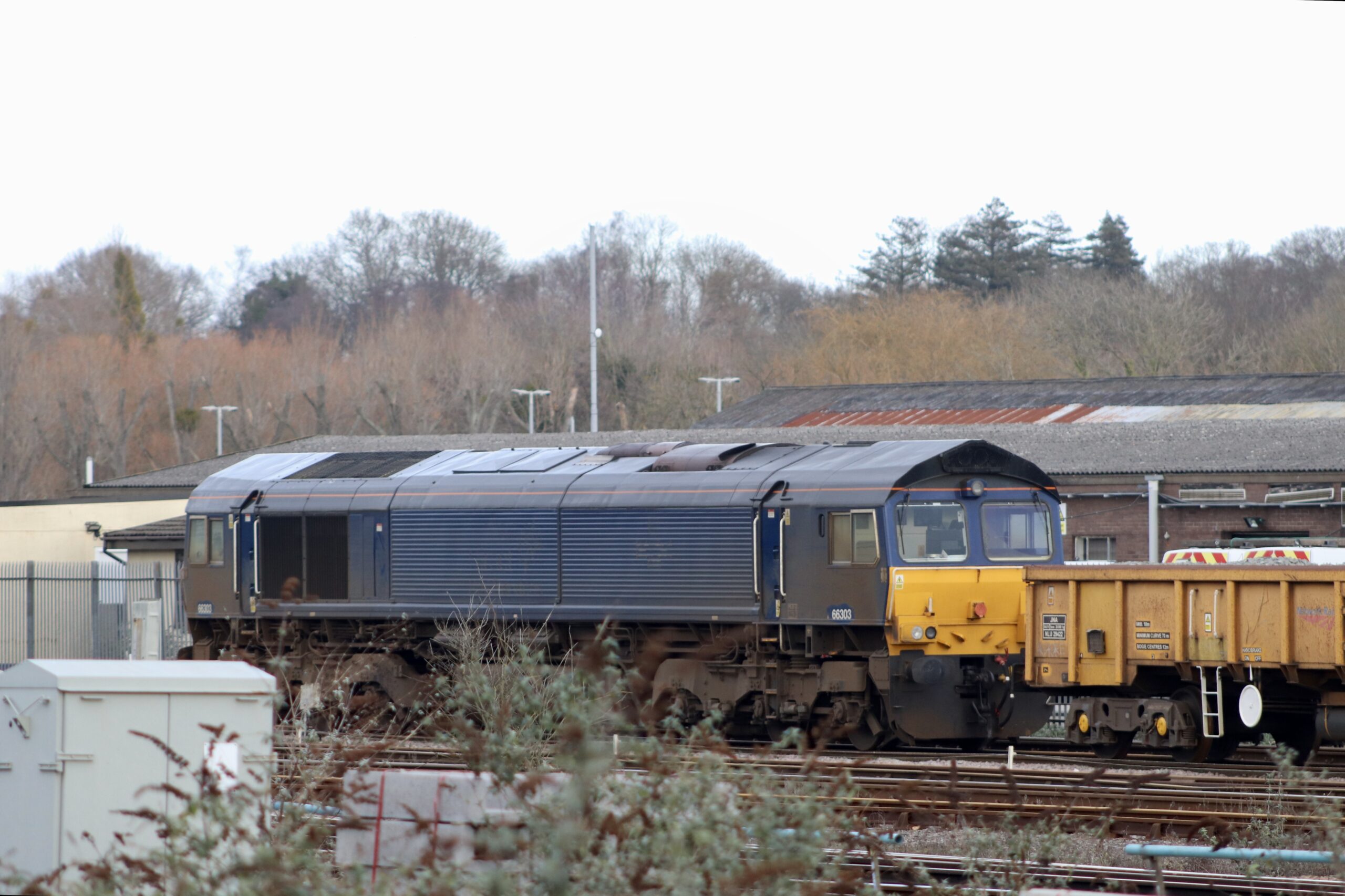
    Unbranded GBRf Class 66 No. 66303 at Eastleigh East Yard – 15/01/2023
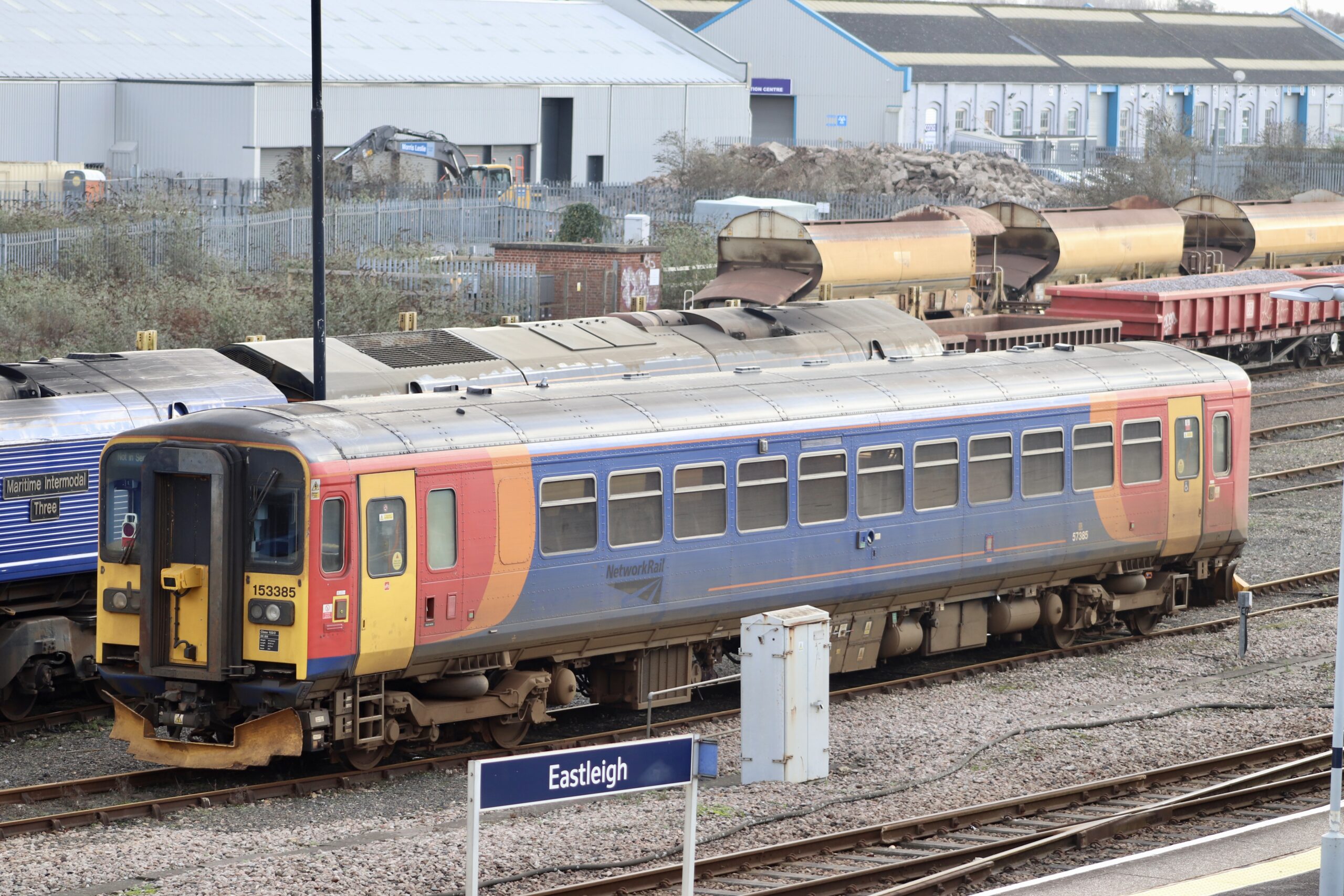
    Network Rail Video Inspection Unit VIU-3 Class 153 No. 153385 at Eastleigh – 15/01/2023
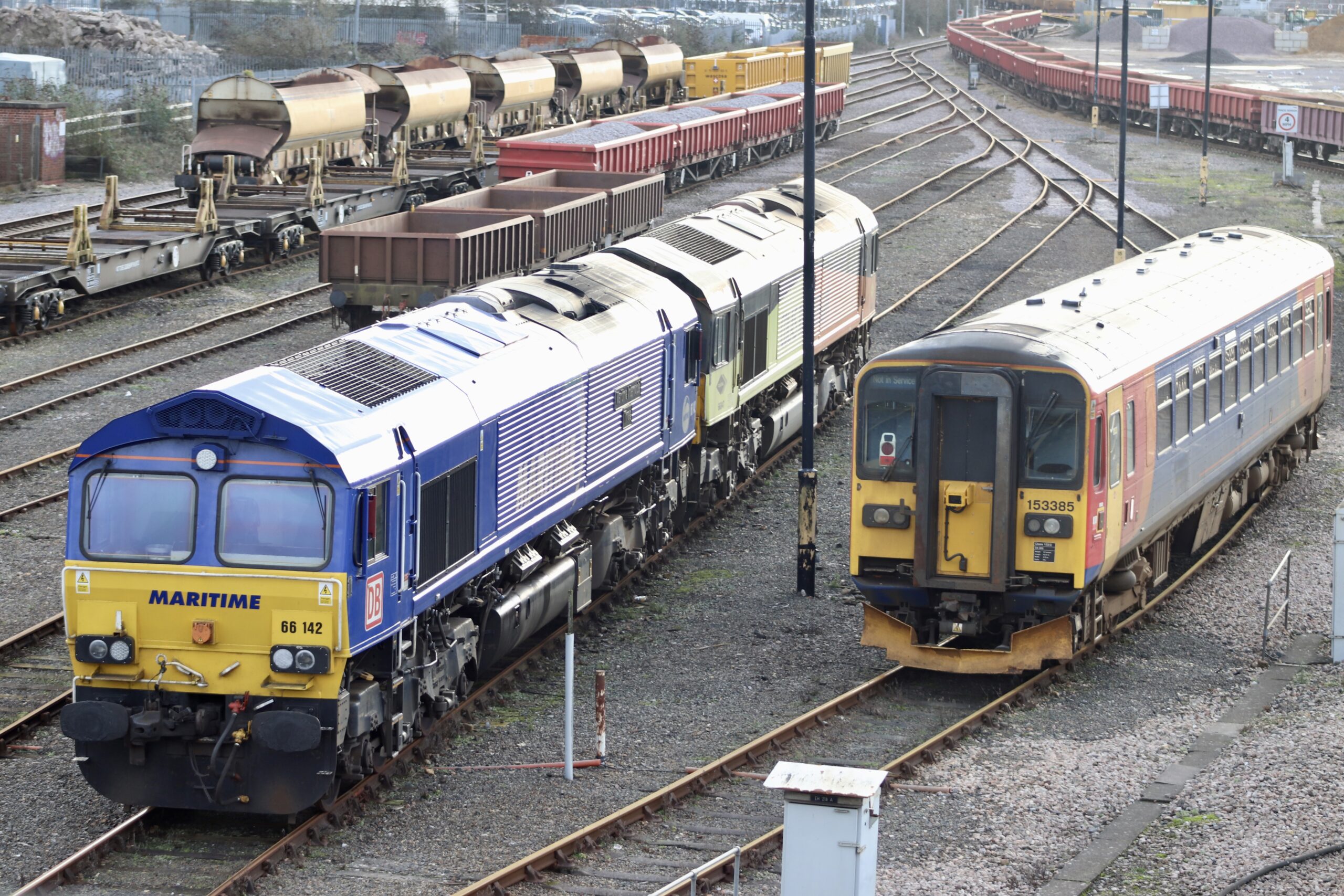
    DB Class 66 No. 66142 ‘Maritime Intermodal Three’, Colas Class 66 No. 66847 ‘Terry Baker’, Class 153 No. 153385 at Eastleigh – 15/01/2023
    Maritime Blue liveried DB Cargo Class 66 No. 66142 ‘Maritime Intermodal Three’ at Eastleigh – 15/01/2023

    Monday 16th January was panning out to feature a busy evening with the Snow & Ice Treatment Train (SITT) based at Totton Yard and the regular 1Q51 test train visiting the Bournemouth to Weymouth line. Much anticipation here when Colas English Electric Class 37’s No.’s 37116 and 37610 were allocated to the test train, normally in the hands of a pair of top and tailed Class 73 electro diesel locomotives, at Derby. However it soon became clear that the landslip at Hook meant the train would be forced off-route at Virginia Water, eventually terminating at Reading Triangle Sidings, instead of running to Weymouth via the South West Main Line and back to Eastleigh East Yard from where the consist normally operates over the rest of the week before returning to Derby. The train eventually continued to Eastleigh the following day, but at the time of writing, has not covered the section of line from Totton to Weymouth.

    Early Monday evening, the SITT was showing as cancelled on RealTimeTrains(RTT), although upon checking the following morning it was clear that the service did in fact run, at least as far as Dorchester South.

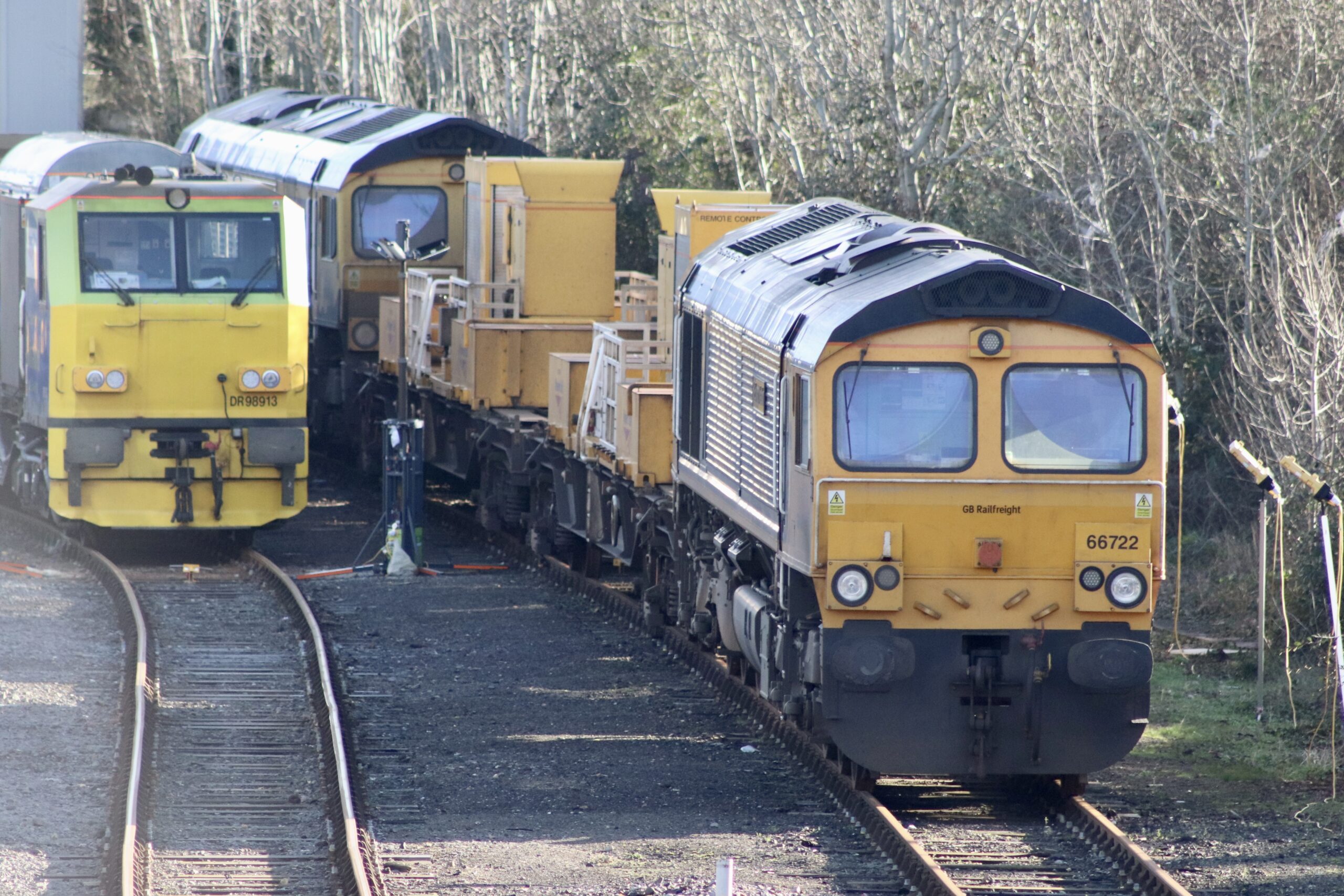
    GBRf Class 66 No.’s 66722 ‘Sir Edward Watkin’ and 66745 worked as far as Dorchester South on Monday 16th January. The pair are seen here at rest in Totton Yard – 15/01/2023

    From The Archive

    January 2023 marks the 160th Anniversary of the launch of the World’s first underground railway; The Metropolitan Line, in 1863. Ten years ago on 13th January 2013, scenes not witnessed on the central London sub-surface sections of underground since July 1954 marked the start of LU150, a year long celebration, as an 1898 built steam locomotive puffed in and out of the tunnels, surprising unsuspecting passengers and delighting railway enthusiasts. I was one of those who enjoyed the spectacle as the short video below shows:

    Video of Anniversary shuttles with 0-4-4-Steam Locomotive Met No 1 and Metropolitan Electric loco No.12 ‘Sarah Siddons’ with brake of vintage coaches

    The following is adapted from The London Transport Museum’s ‘History of the Tube’;

    Back in 1863 the underground railway was intended to reduce street congestion, which by the 1850’s had reached a crisis point. Upon opening, The Metropolitan Railway was an immediate success, although its construction had taken almost two years and caused huge disruption as the sub-surface lines were built by digging a long trench, laying track and covering it over again (known as the cut and cover technique) leaving a tunnel system which were at first operated by steam trains. The 5.6km line connected the mainline stations at Paddington, Euston and King’s Cross to Farringdon, at the edge of the City. Success meant that extensions to both ends of the line soon followed.

    In 1868, The Met was joined by an associated railway company; the Metropolitan District Railway with the intention that the two would cooperate to form an ‘Inner Circle’, linking all London’s mainline termini. However, disagreements over money led to a falling out and both companies instead chose to prioritise their individual extensions. The Circle was only completed after government intervention in 1884.

    Despite their differences, the Met cooperated with the District Railway in plans for electrification in 1900. However, their ideas were rejected when a powerful American businessman, Charles Tyson Yerkes, took over the District and a group of struggling Tube schemes in 1901. Under Yerkes, the Circle and District were electrified along American lines by 1905, powered by a new generating station at Chelsea. The Met built its own power station at Neasden using the same system but electrified more slowly. 

    In 1908, the separate companies started to work together to promote the system as a coherent network under the UndergrounD brand. Gradually most of the companies merged and the network expanded, as the population of London soared. The resultant station architecture of the 1930’s is highly regarded. 

    The Met had been exploiting the land along its lines since the 1880’s but entered a new phase when their first housing estate was built at Pinner in 1900. The name ‘Metro-land’ was coined in 1915 to publicise the area, and in 1919 a subsidiary company was set up to concentrate on housing. Throughout the 1920’s and 1930’s, thousands of homes were built. Gradually Metro-land was electrified, with services to Harrow in 1908 and Rickmansworth in 1924. A new electric line from Wembley Park to Stanmore opened in 1932, but further north steam locomotives continued as before.

    While the rest of London’s underground railways all succumbed to the domination of the railway group Yerkes founded, the Metropolitan alone remained independent. The Metropolitan Railway had regarded themselves not as a commuter railway, but as an ambitious player in the mainline railway world, extending out from Baker Street in the 1870s and 1880s into open country. By 1899, at the height of their powers, they had reached Verney Junction and Brill in Buckinghamshire, more than 80km from Baker Street.

    The Met was forced to give up their independence when all of London’s public transport – buses, trams and trolleybuses, as well as the Underground railways – came under the centralised control of London Transport (LT) in 1933 and decisions about services could be fully coordinated for the first time. The Met’s mainline ambitions were over, with LT closing the rural Brill branch in 1935 and the withdrawal of services north of Aylesbury a year later. The Stanmore branch transferred to the Bakerloo in 1939. 

    A massive plan; The New Works Programme, designed to upgrade and expand services was prepared in 1935, but the work was interrupted by the Second World War. Some of these were revived in the difficult post-war economic climate, but others were not.  

    Modernisation in the early 1960s saw extensive track and signal work and new A stock trains. These worked the line until replacement with S stock trains between 2010 and 2012 under the new Transport for London (TfL) organisation. This was part of wider modernisation project across all the Underground’s sub-surface lines, replacing infrastructure and signalling and introducing automatic operation. 

    A new Tube line had been suggested in 1943, but delays meant that the new Victoria line did not serve its first passengers until 1968. The Tube reached Heathrow Airport in 1977. Another new line, the Jubilee, was added in 1979. It terminated in central London and was later extended eastwards in 1999.

    Today, The Metropolitan Railway lives on as the Metropolitan Line, it has 67km of track and 34 stations, running from Amersham and Chesham in the north-west to Aldgate in east London, as well as a branch to Uxbridge.

    Yoshi

    Despite his urge to drink water from the upstairs toilet, Yoshi celebrated his 4th birthday on Thursday 12th January. He enjoyed a special doggo cupcake and played with a toy wine bottle for all of ten minutes before tearing it to shreds in an attempt to extract the squeaker.

    Yoshi celebrates his birthday with cake!

    On that happy note, it brings us towards the end of another blog. Many thanks for visiting, reading, your comments and corrections. For anyone wondering about my car, which broke down last week, things don’t look too good for it. In fact the garage I took it to for repair declined to undertake any further work other than an initial inspection, charging me for the privilege of confirming what the AA had previously already told me. I may get a second opinion, or just cut my losses. I can’t say it’s not been a fun car to drive, but all good things……

    Post Script

    Seeing Network Rail Class 153 No. 153385 at Eastleigh on Sunday prompted me to have a brief look at this class of diesel multiple unit (DMU).

    In the mid 1980’s, looking to replace older DMU’s, British Rail ordered 35 two-coach Class 155 units from Leyland Bus at Workington. In 1990 the decision was made to split each of the 35 Class 155’s into single car vehicles for use on rural railway lines, the work being carried out by Hunslet-Barclay at their plant in Kilmarnock during 1991/92. A new drivers cab was retrofitted into the spaces previously used for luggage racks at the inside end (B-end) of each carriage where they had been coupled together in the Class 155 formation. The new cab is noticeably smaller than the original A-end one, as the position of the exterior doors were not amended during conversion.

    Locally, GWR/Wessex Trains utilised Class 153’s on services between Bristol Temple Meads and Weymouth having inherited 13 units from Wales & West.

    Transport for Wales currently run a fleet of 26 Class 153’s having modified them to comply with Reduced Mobility Technical Specification Interoperability (PRM-TSI) legislation which came into effect on January 1st 2020. Scotrail have five units which have been modified to provide racks for luggage and bicycles for use on the West Highland Line services between Glasgow and Oban, running them in conjunction with existing Class 156 DMU’s.

    In May 2021, Network rail (NR) acquired three Class 153’s to convert into Video Inspection Units (VIU) for infrastructure monitoring services and have been fitted with cameras, recording devices and a generator placed in the saloon to provide power to the tech. One of these is the aforementioned No. 153385:

    Still in passenger revenue earning service, East Midlands Railway (EMR) Class 153 No. 153385 is seen at Barnetby working a service to Grimsby Town – 15/04/2014
    Now belonging to Network Rail; Class 153 No. 153385, also known as VIU-3, retains its East Midlands Railway (EMR) livery but with black Network Rail branding and is seen stabled in the Locomotive Holding sidings at Eastleigh – 17/02/2022
  • New Year 2023

    Thursday 22nd December to Tuesday 3rd January 2023

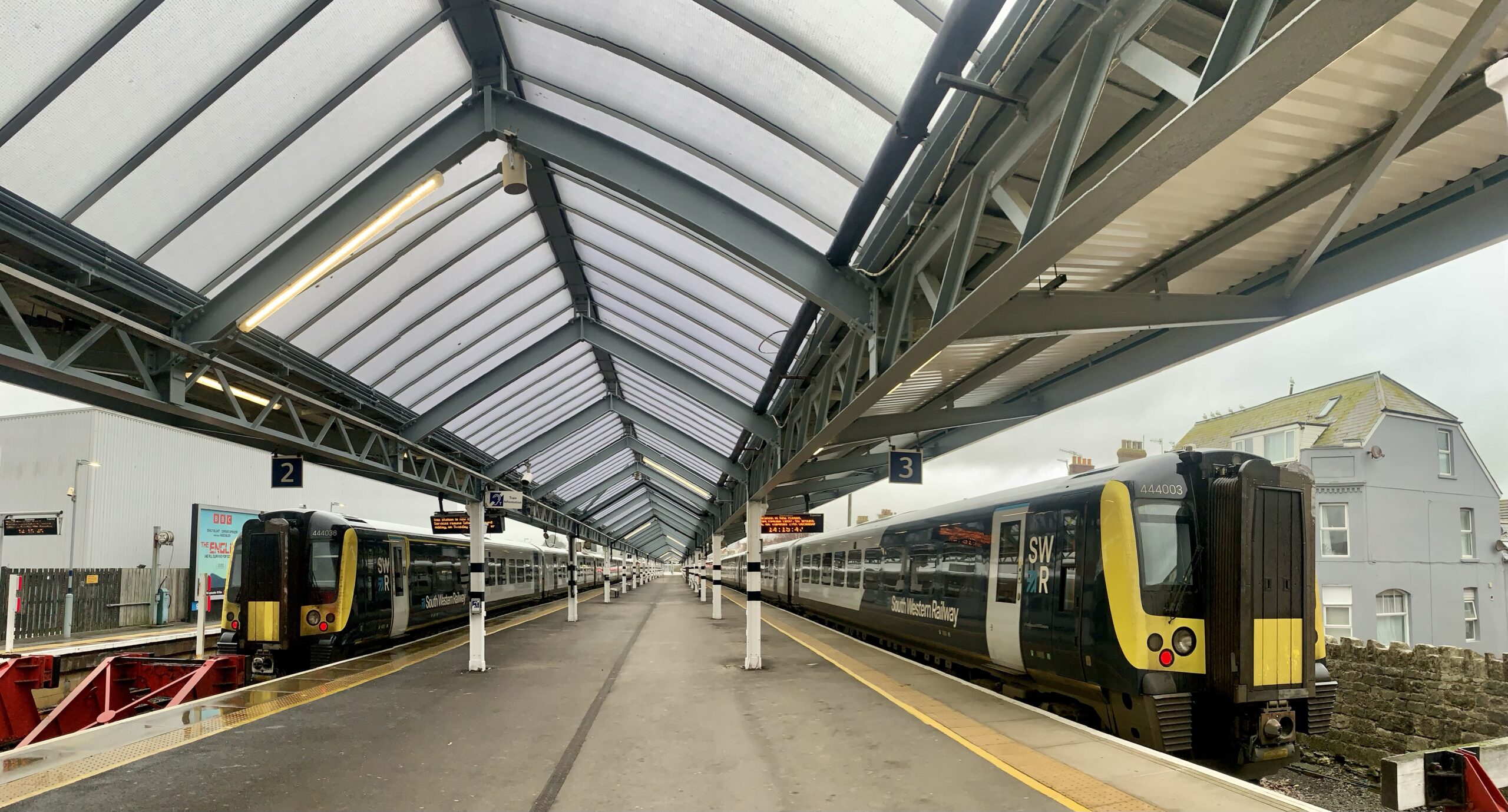
    Empty trains parked up on Christmas Day at Weymouth railway station – 25/12/2022

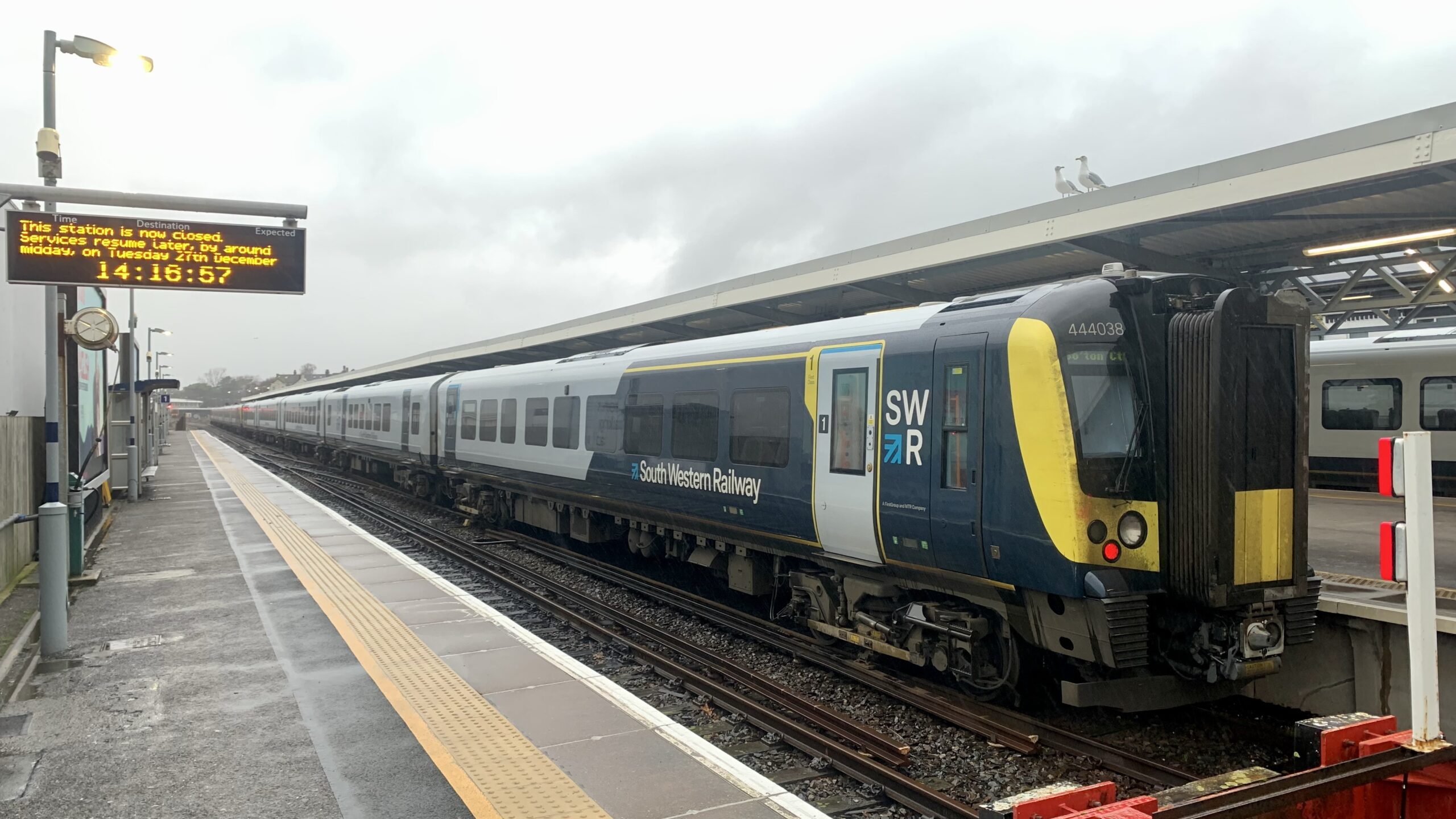
    The UK rail network wound down for the Christmas break early on 24th December in 2022 because of industrial action. Several South Western Railway (SWR) Class 444 Electric Multiple Units and a Great Western Railway (GWR) Class 165 diesel multiple unit spent Christmas parked up at Weymouth railway station awaiting the restart on the 27th December 2022.

    SWR Class 444 EMU No. 444038 in Weymouth – 25/12/2022

    Following the Christmas close down of the railways, the first train to run on the Bournemouth to Weymouth route was the seasonal Snow & Ice Treatment Train (SITT) which set off from Eastleigh mid-morning to ensure rails were free of ice before passenger services started after mid-day.

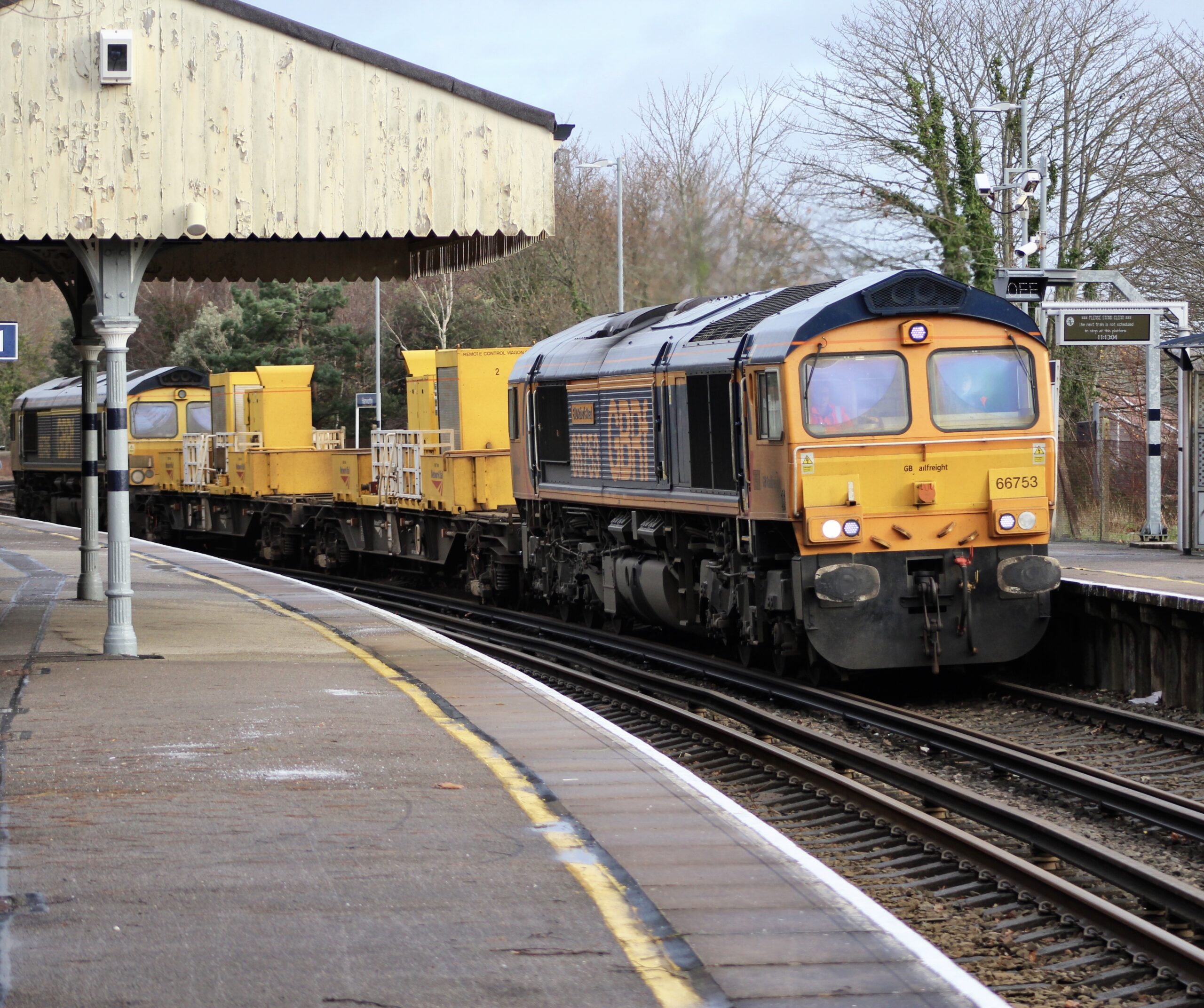
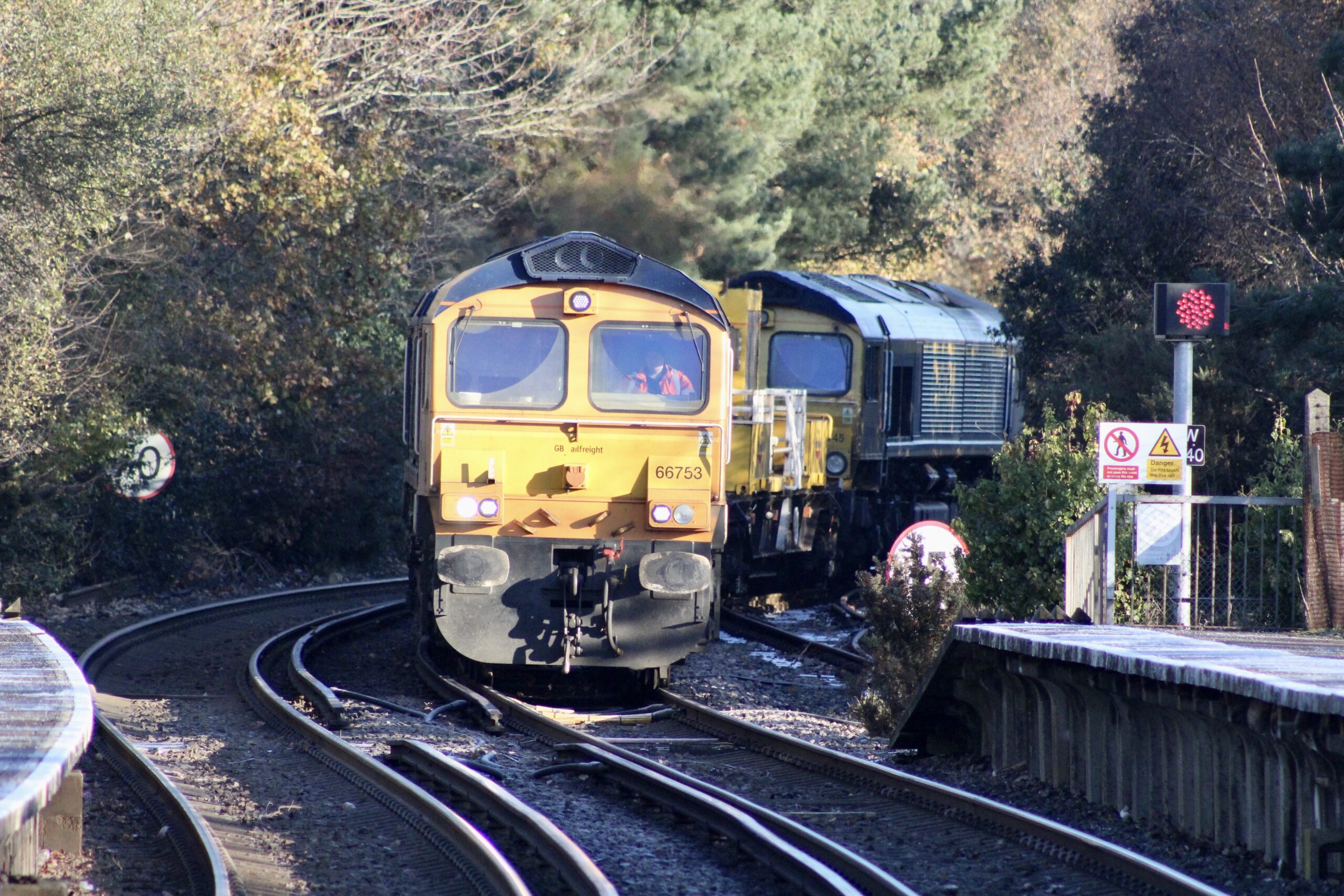
    GBRf Class 66 locomotives No.’s 66753 ‘EMD Roberts Road’ and 66745 top and tail 3Y88 1000 Eastleigh East Yard to Totton Yard SITT through Hamworthy on the outward run to Weymouth – 27/12/2022
    GBRf Class 66 locomotives No.’s 66745 and 66753 ‘EMD Roberts Road’ top and tail 3Y88 1000 Eastleigh East Yard to Totton Yard SITT across the Holes Bay causeway on the return run from Weymouth. No. 66722 replaced No. 66753 two days later, although this combination has yet to venture West to Bournemouth or Weymouth as SITT runs have been working East from Totton Yard – 27/12/2022
    GBRf Class 66 locomotives No.’s 66753 ‘EMD Roberts Road’ and 66745 top and tail 3Y88 1000 Eastleigh East Yard to Totton Yard SITT – 27/12/2022. Additional video courtesy of @dabuckley967

    1st January 2023 marks 100 years since the formation of the ‘Big Four’, the term coined by “The Railway Magazine” for the grouping of 120 individual railway companies into just four: Great Western Railway (GWR), Southern Railway (SR), London, Midland and Scottish Railway (LMS) and London and North Eastern Railway (LNER). The grouping was outlined in the 1921 Railways Act which strived to stem losses and regulate what were seen as inefficient, diverse and, in some cases, overlapping operations which had been struggling following the Great War. The act eliminated competition, as each group now had a regional monopoly. It also established standard fares and charges for particular services. 75 years ago on 1st January 1948, as a result of the Transport Act of 1947, the Big Four companies were nationalised to form British Railways.

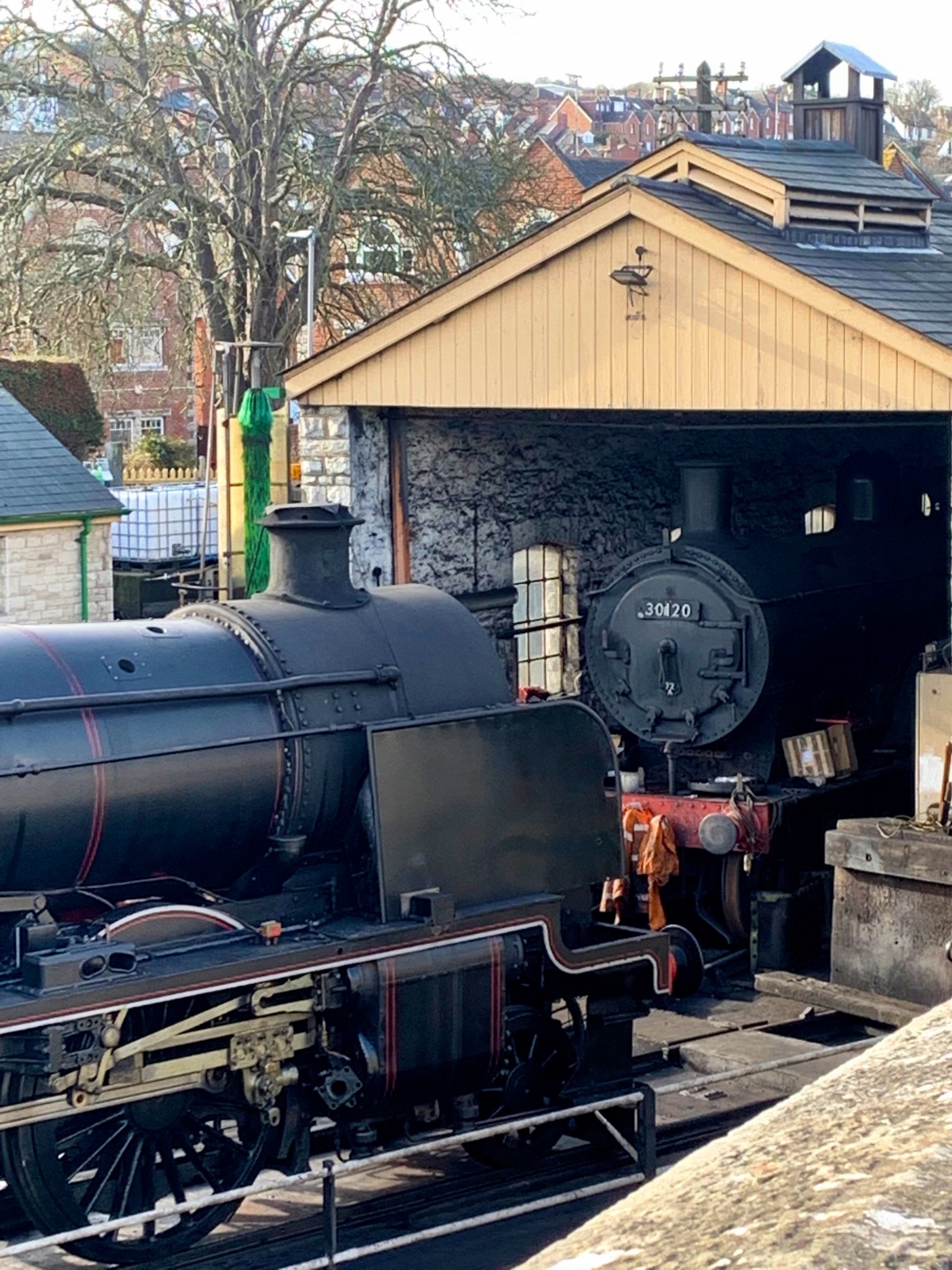
    LSWR T9 Class No. 30120, seen here with SR U Class No. 31806, is a surviving locomotive from the pre-Big Four grouping period having been built in 1899 and has been stored at Swanage following the expiry of her boiler certificate in August 2020 – 12/02/2022

    New Years Day 2023 saw Yoshi’s Mum and I heading to London to take in the conveniently extended “Beatrix Potter: Drawn to Nature” exhibition at the V&A and Matthew Bourne’s “Sleeping Beauty” at Sadler’s Wells. We had intended to take the train, but South Western Railways timetabling around the RMT industrial action meant we would not be able to get everything done and home on the day with our last train leaving London Waterloo at 1830. So instead, we took to the roads and parked up at Kew Gardens and travelled into Town using the London Underground District Line from there.

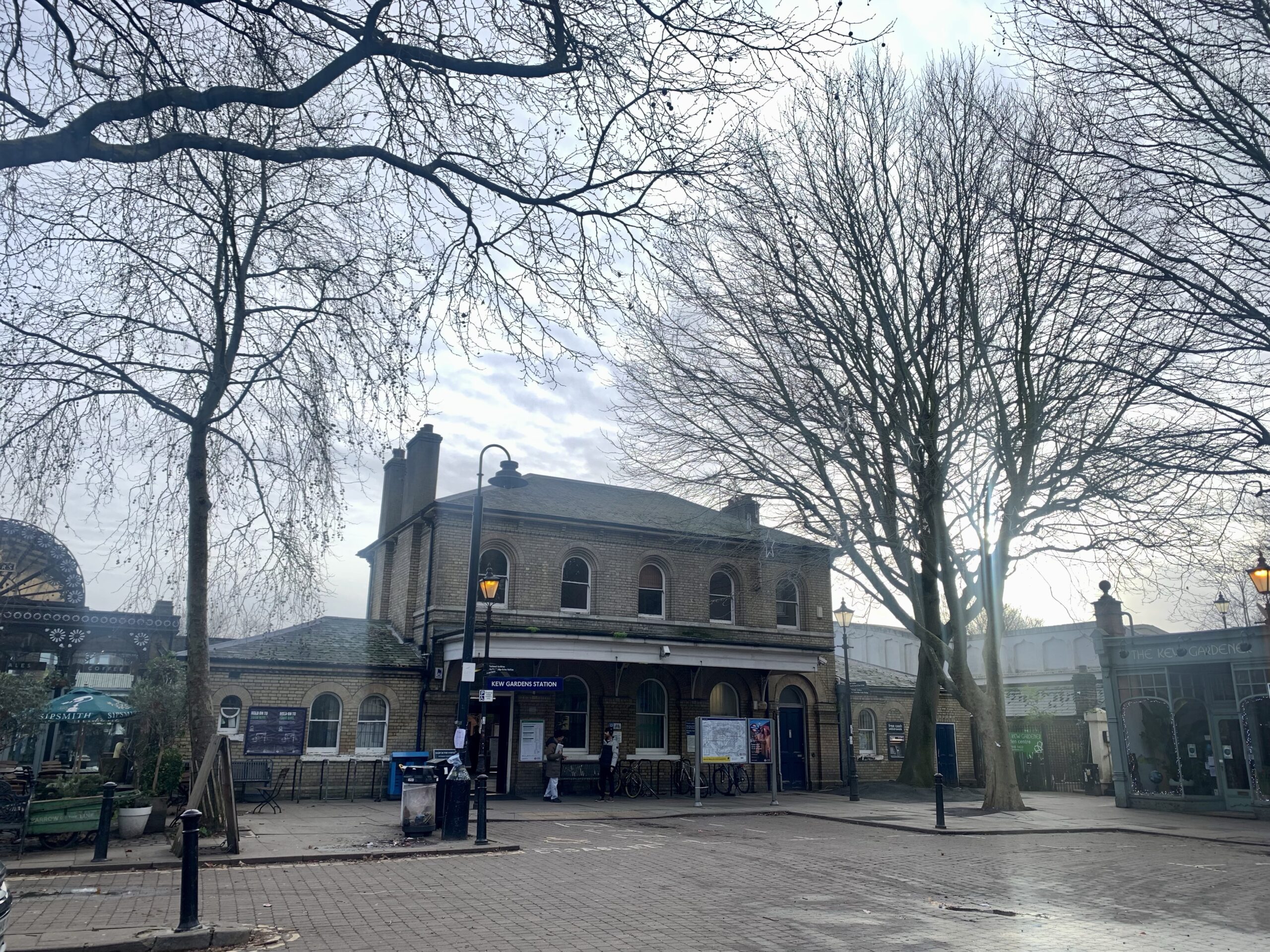
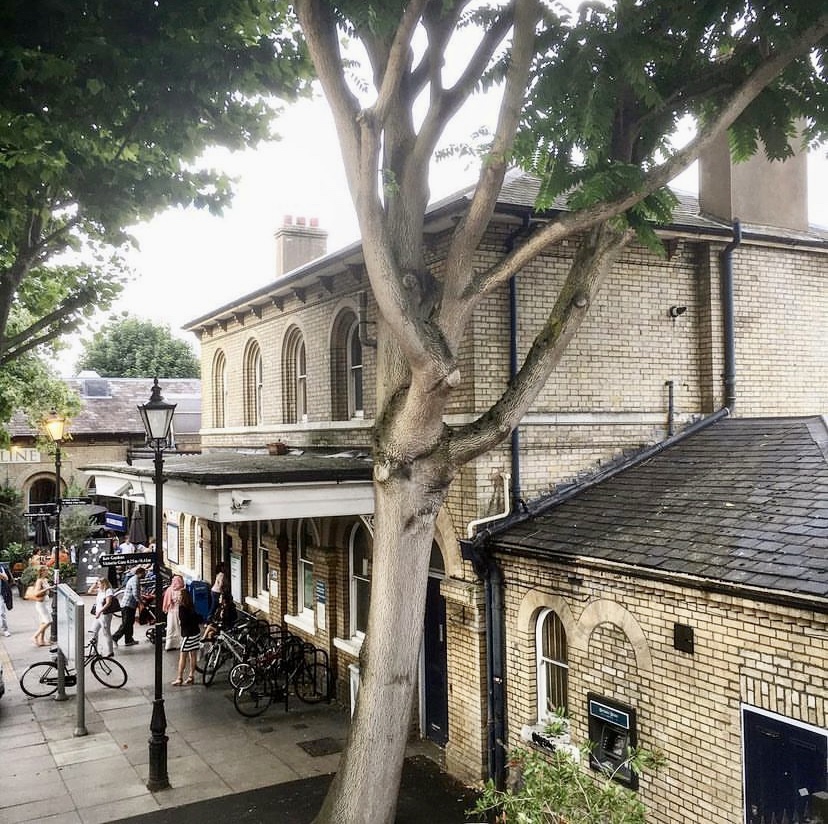
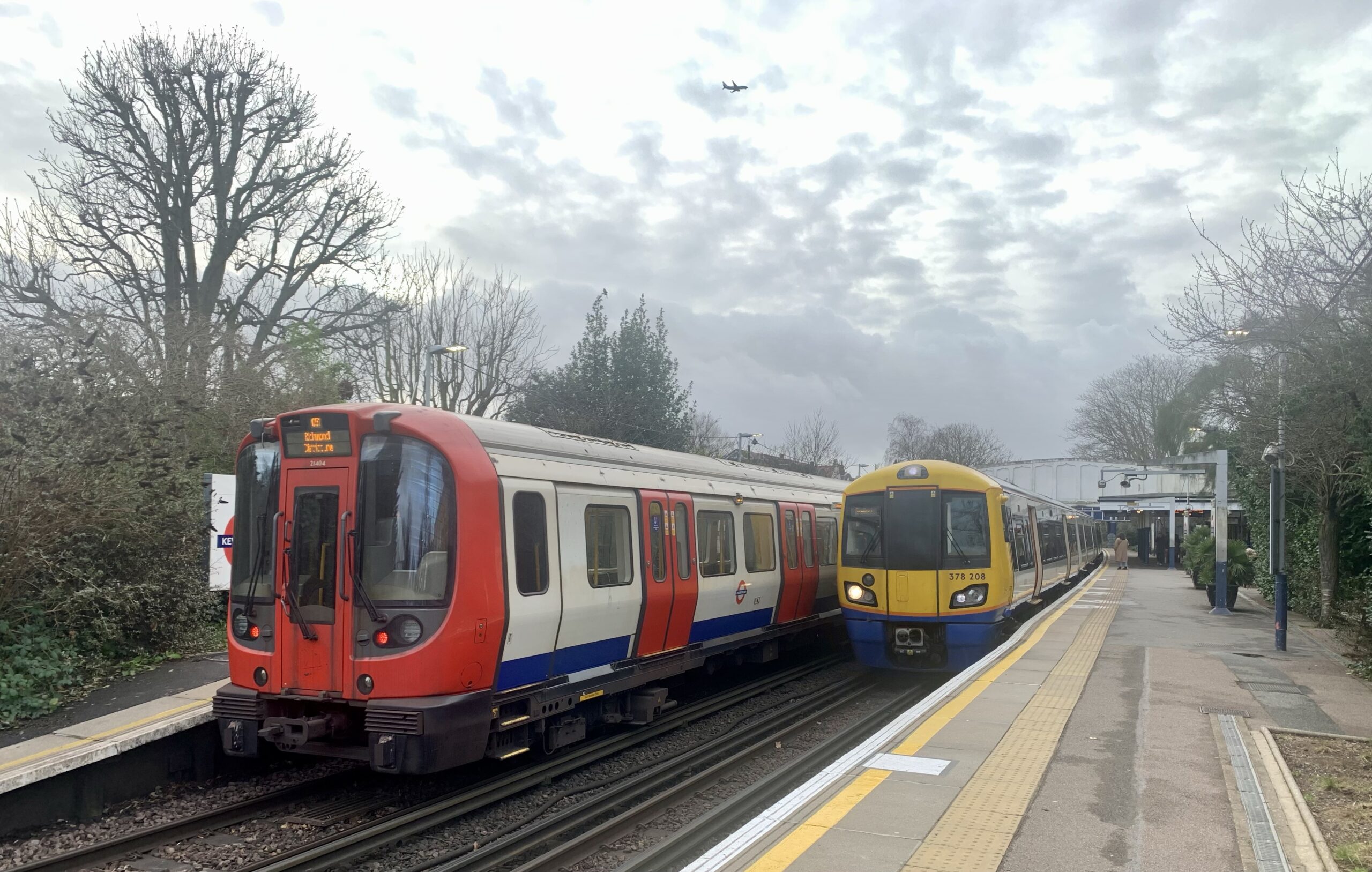
    I like Kew, it has a lovely village feel and Kew Gardens railway station is a fine Grade II listed example of mid-Victorian architecture and one of the last remaining 19th Century stations on the North London Line having been opened in 1869 by the London & South Western Railway (L&SWR) who were, prior to the formation of ‘The Big Four’, custodians of the Bournemouth to Dorchester line. Current services calling at Kew Gardens are operated by London Underground (LU) and National Rail London Overground utilising LU S7 stock and British Rail Class 378’s respectively. The Class 378 EMU’s replaced the Class 313’s operated by Silverlink and were introduced in 2008. Kew Gardens is also the only station on the London Underground network I know of which has a pub attached to it. The pub once had a door which gave access to platform one, but this is no longer in use. The pub is currently called ‘The Tap on the Line’ but was formerly known as ‘The Railway’.

    The footbridge over the tracks at the southern end of the station buildings is Grade II listed in its own right and is a rare surviving example of a reinforced concrete structure built by French engineer Francois Hennebique (1842-1921). The bridge, restored in 2004, has high sides which protected users from the smoke emitted from steam locomotives passing below when originally installed.

    Kew Gardens railway station exterior on the “Up” side – 01/01/2023
    Kew Gardens railway station – 30/07/2016
    Kew Gardens railway station, platform side – 01/01/2023
    Class 378 Capitalstar Electric Multiple Unit No. 378208 operated by London Overground arrives at Kew Gardens with 2N05 1010 Richmond NII to Stratford while London Underground S7 Stock Fleet No.21403 with driving coach No. 21404 at the rear of 2O51 Upminster LT to Upminster LT via Richmond awaits departure – 01/01/2023
    London Underground S7 Stock Fleet No. 21377 with driving coach No. 21378 leading arrives at Kew Gardens working 2O16 Upminster LT to Upminster LT via Richmond. The footbridge can be seen in the background – 01/01/2023

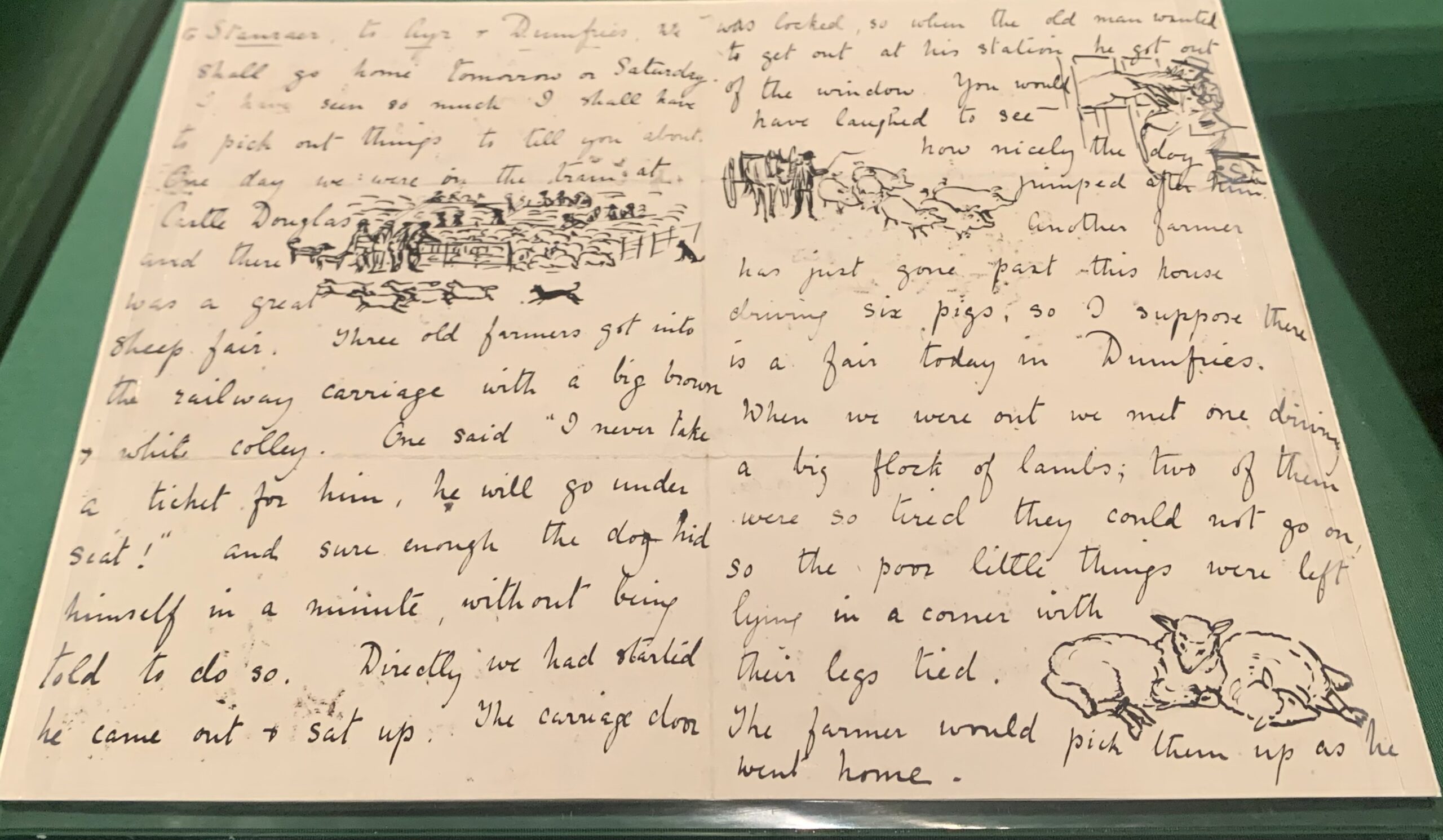
    I very much enjoyed the V&A’s exhibition celebrating the life and work of Beatrix Potter. One railway themed item was this illustrated letter Beatrix sent to Marjorie Moore, the daughter of her last governess, detailing an eventful train journey when a farmer’s collie exited the carriage by jumping through a window:

    Letter from Beatrix Potter to Marjorie Moore written on 23rd August 1898
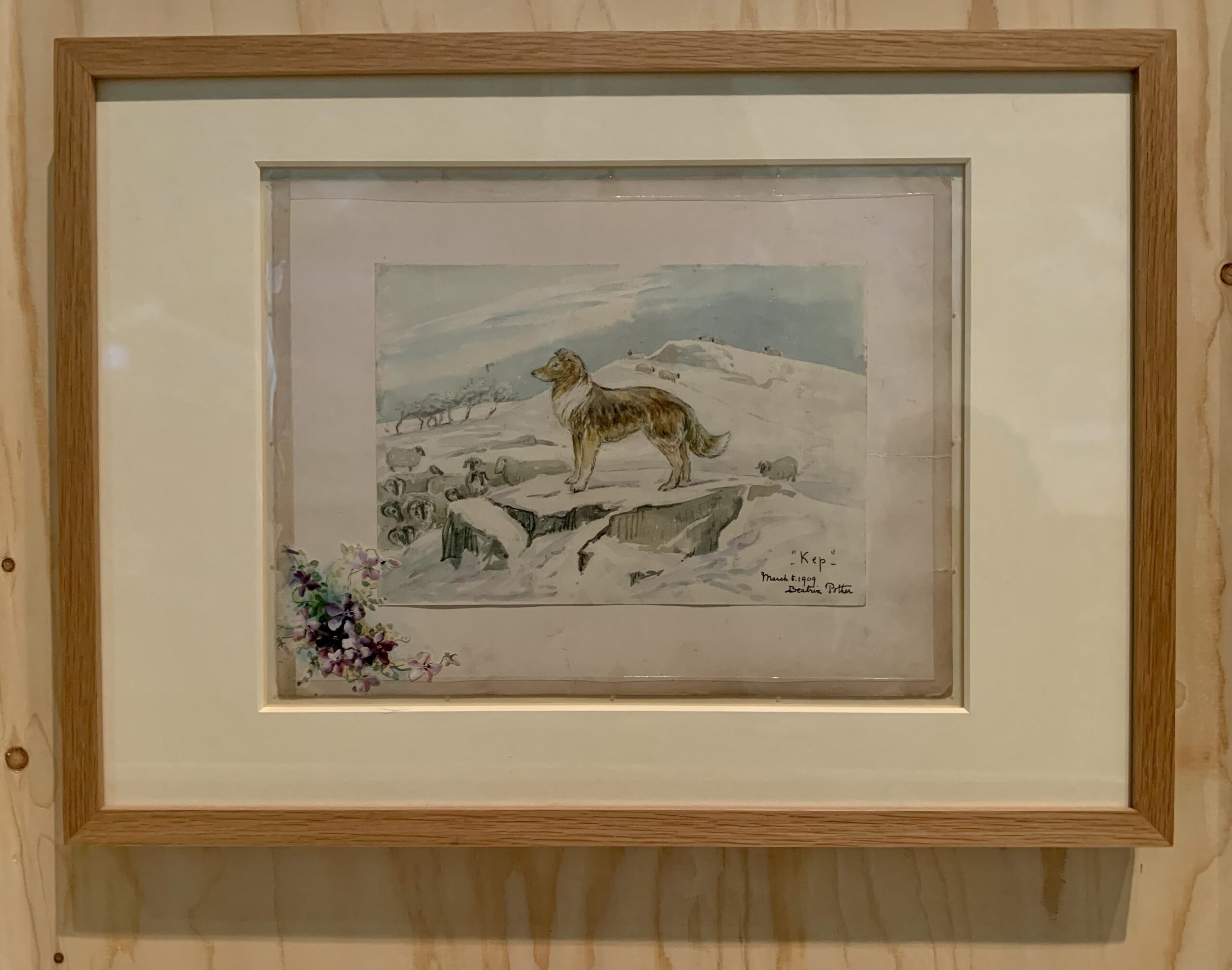
    Beatrix had many animals during her lifetime. Kep, who is shown here was immortalised as Jemima Puddle-Duck’s hero when he rescued her from a ‘sandy whiskered gentleman’

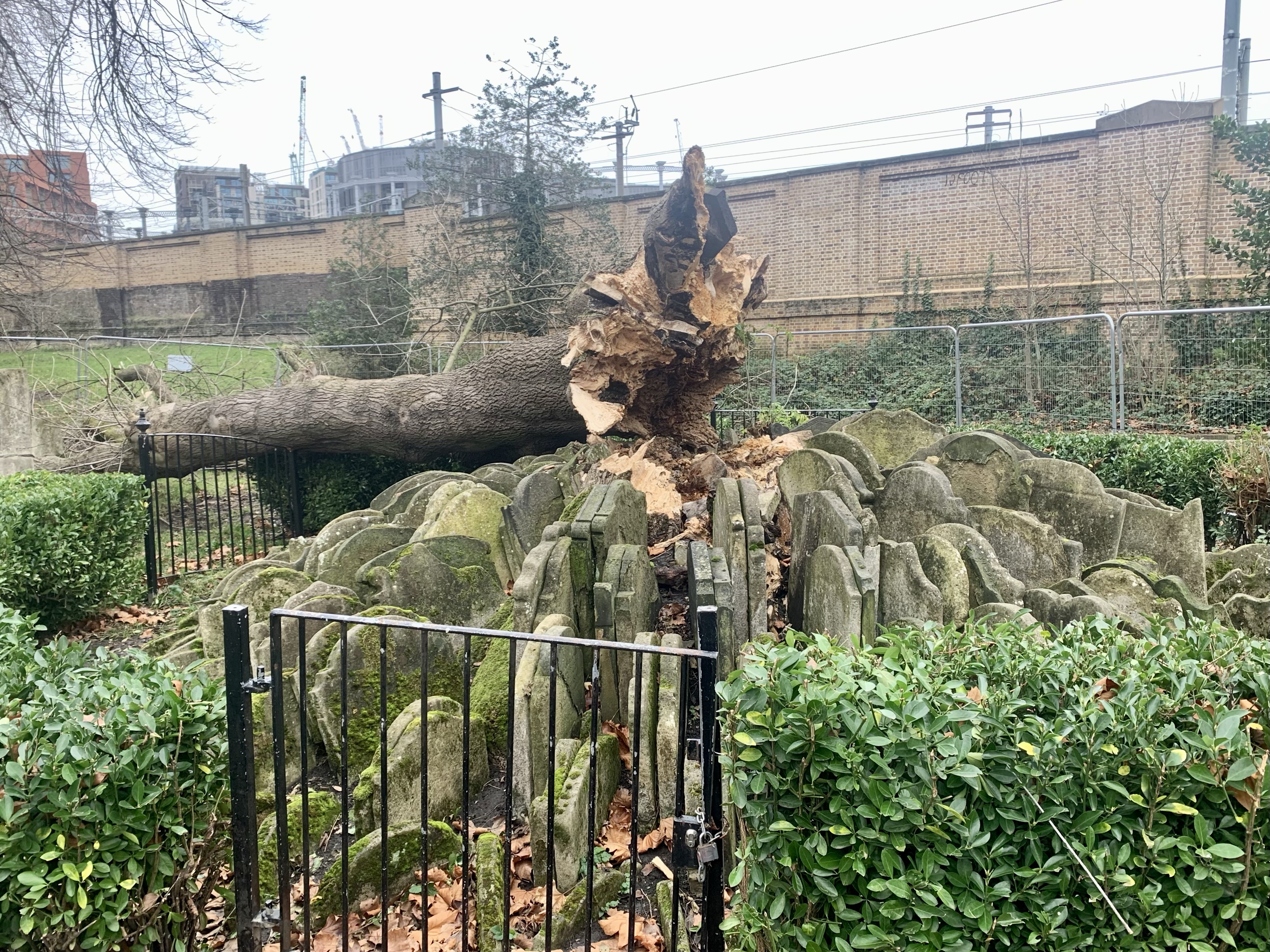
    Following our visit to the V&A (and a fabulous lunch – mustn’t forget the lunch!) we headed off to Islington via Old St. Pancras Churchyard so we could see ‘The Hardy Tree’ which had recently succumbed to a fungal infection and had fallen. During the 1860’s the Midland Railway line was being built over part of the original St. Pancras Churchyard. Arthur Blomfield, a Covent Garden based architect, was commissioned by the Bishop of London to supervise the proper exhumation of human remains and the dismantling of tombs. He passed this unenviable task onto his protégé Thomas Hardy in 1865. Hardy (1840-1928) is best known as a Dorset author and poet with his novels set in rural ‘Wessex’, however before turning to writing full time he studied architecture in London from 1862-67.

    Hardy would have spent many hours in Old St. Pancras Churchyard during the construction of the railway, overseeing the careful removal of bodies and tombs from the land on which the tracks were being laid. Legend has it that Hardy stacked displaced headstones in a circle around an ash tree with the stones becoming embedded in the tree over time.

    A few years before Hardy’s involvement, Charles Dickens (1812-1870) makes reference to Old St. Pancras Churchyard in “A Tale of Two Cities” (1859), as the churchyard in which Roger Cly was buried and where Jerry Cruncher was known to ‘fish’ – a 19th Century term for tomb robbery and body snatching!

    The sad sight of the fallen Hardy Tree, St. Pancras Old Churchyard – 01/01/2023

    Thanks for reading and Happy New Year! This blog entry was brought to you by Halls Soothers. Until next time, we’ll leave you with this; Thomas Hardy, inspired by a visit to Upwey, wrote a poem “At the Railway Station, Upway”, about waiting for a train at a country station: 

    “There is not much that I can do,
    For I’ve no money that’s quite my own!”
    Spoke up the pitying child –
    A little boy with a violin
    At the station before the train came in, –
    “But I can play my fiddle to you,
    And a nice one ’tis, and good in tone!”

    The man in the handcuffs smiled;
    The constable looked, and he smiled, too,
    As the fiddle began to twang;
    And the man in the handcuffs suddenly sang
    Uproariously:
    “This life so free
    Is the thing for me!”
    And the constable smiled, and said no word,
    As if unconscious of what he heard;
    And so they went on till the train came in –
    The convict, and boy with the violin.

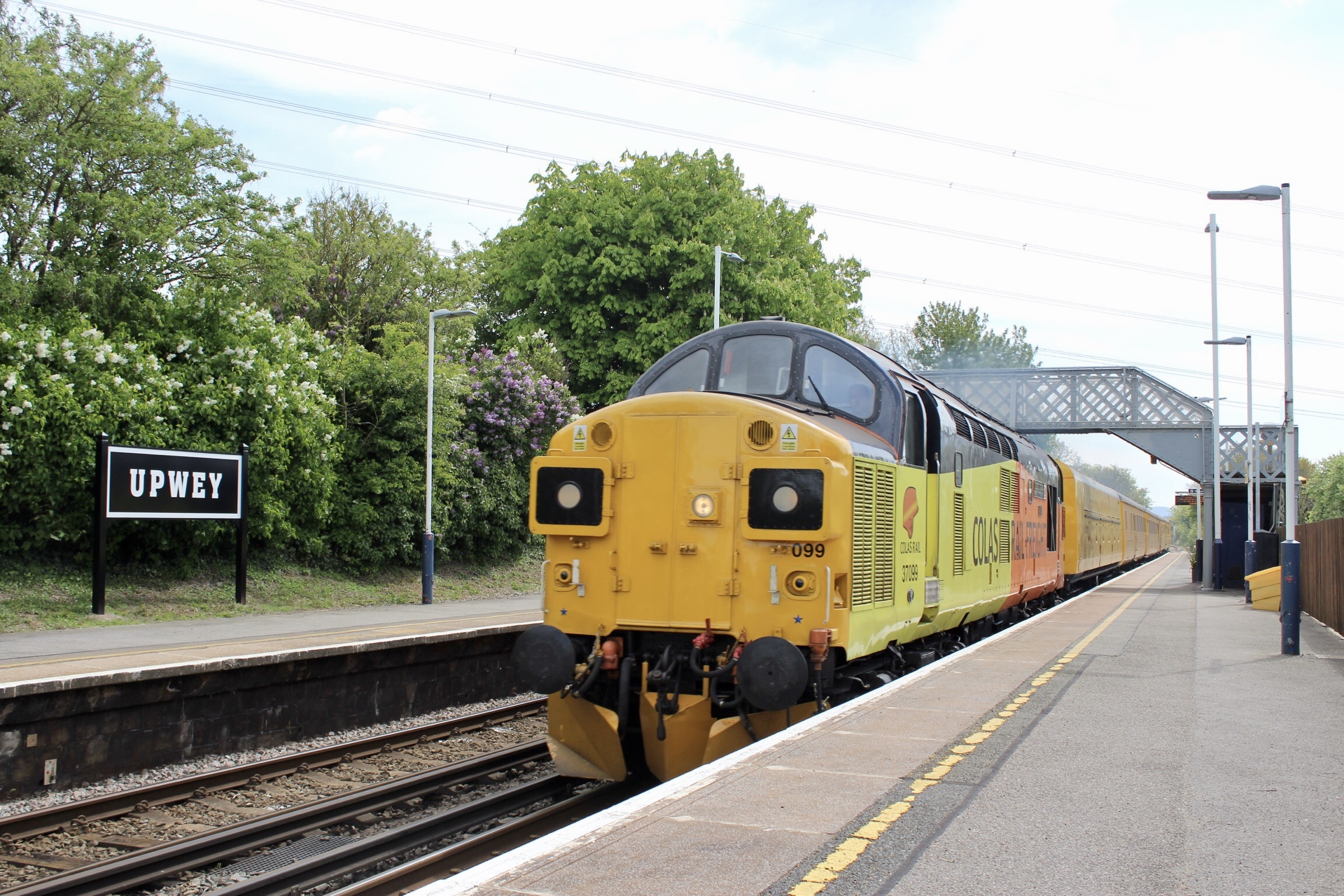
    Colas Rail Class 37 No. 37099 working a test train through Upwey – 27/04/2017
  • Seaton

    Wednesday 14th December to Wednesday 21st December 2022

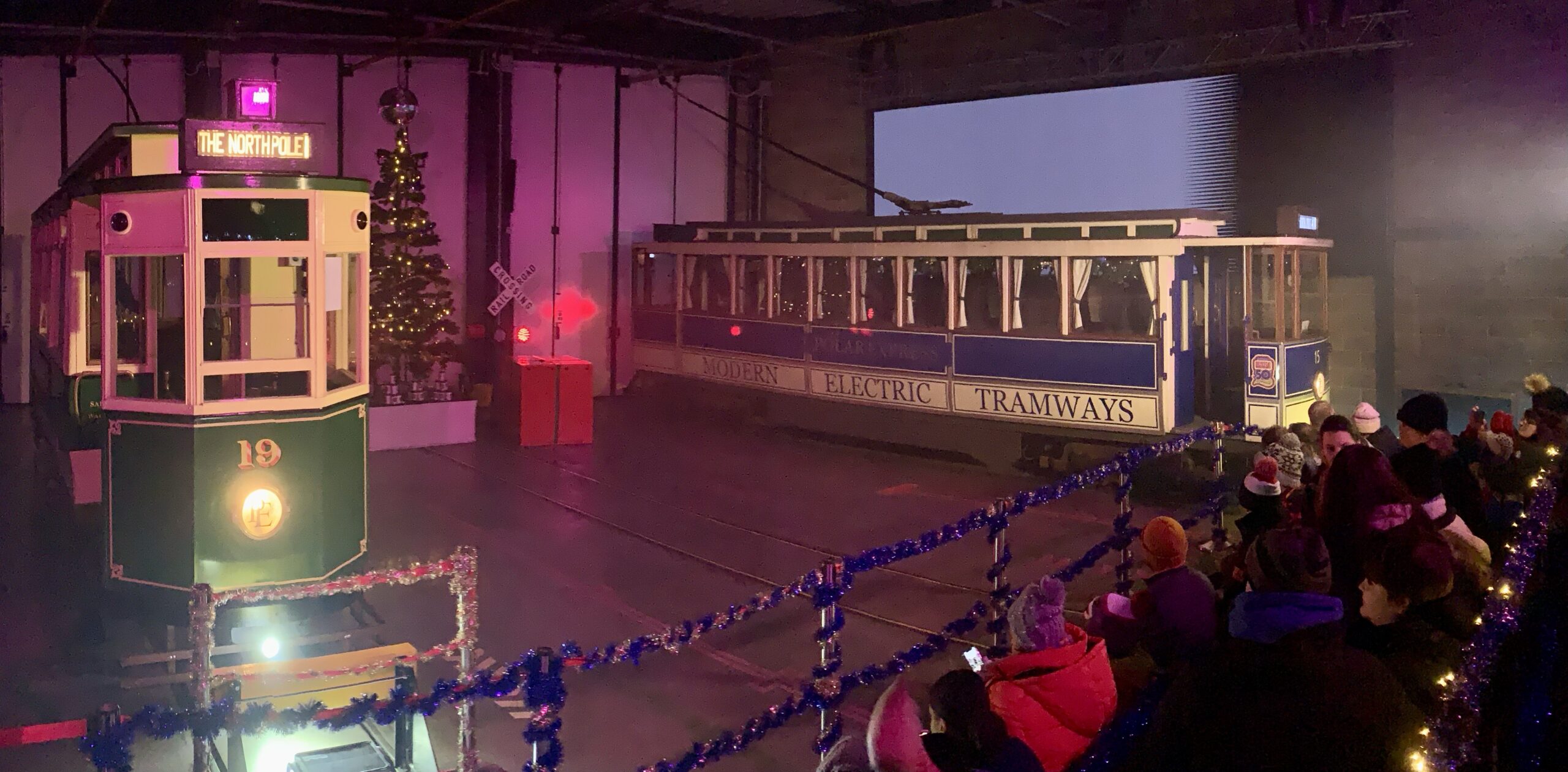
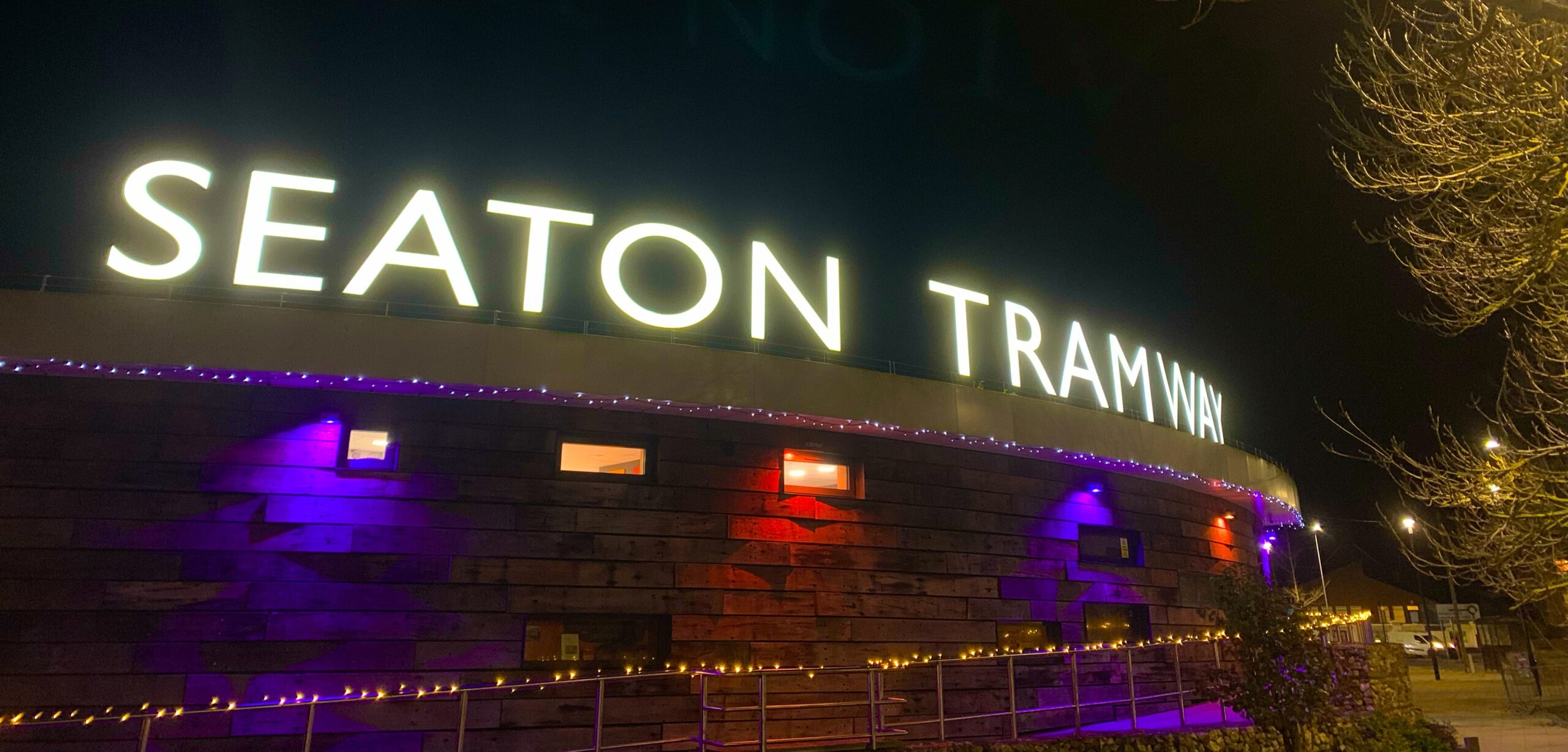
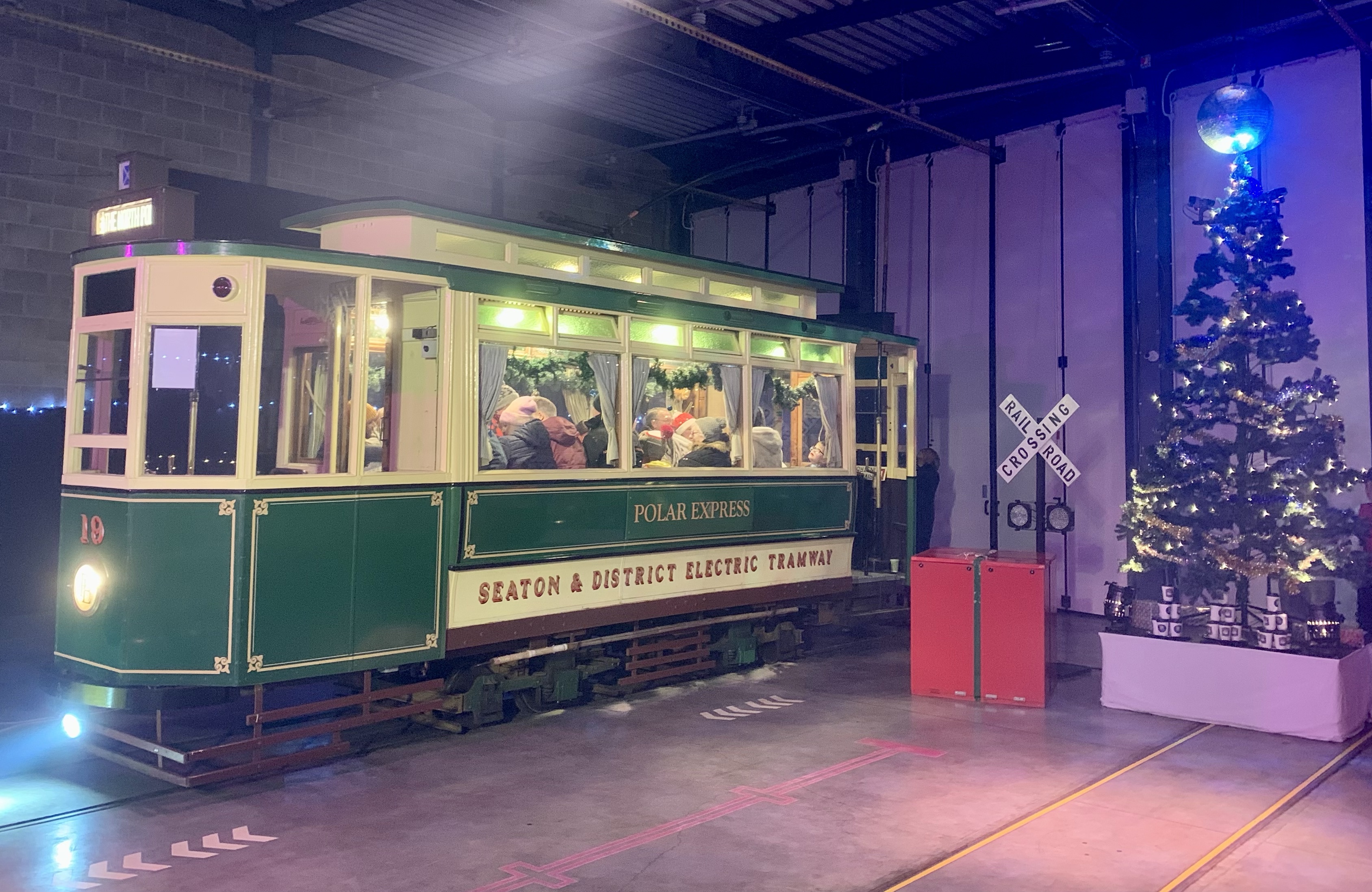
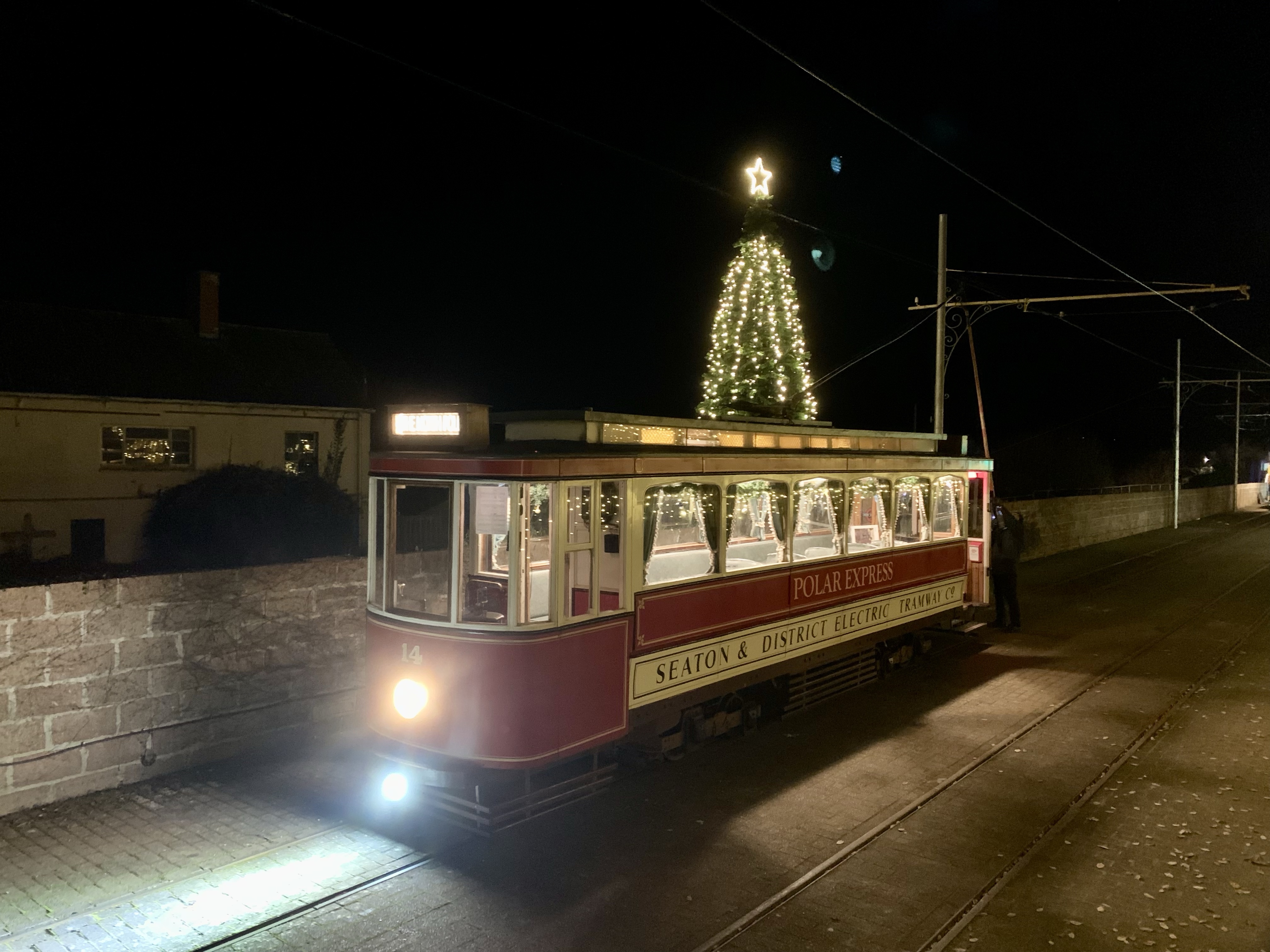
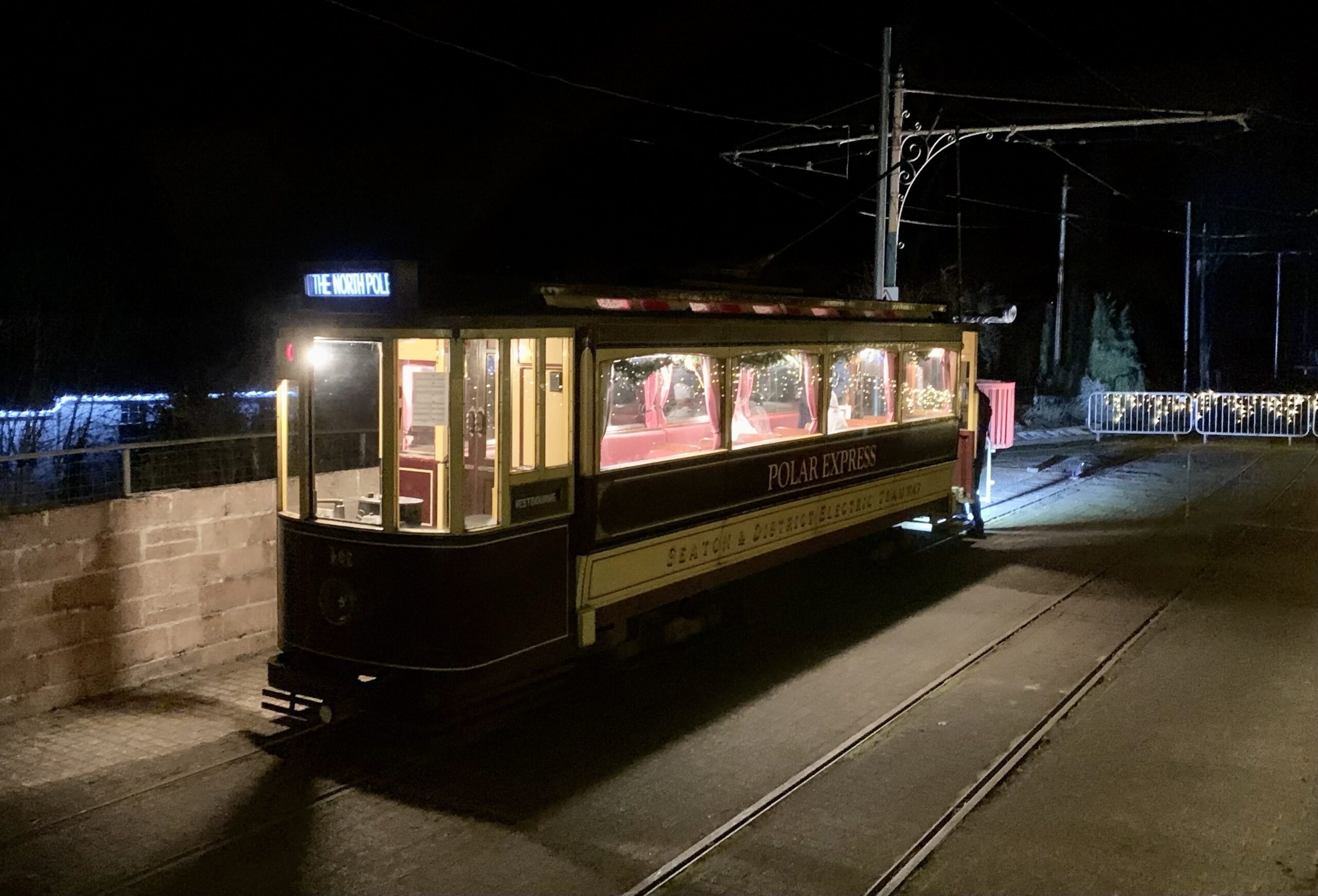
    Seaton Tramway’s Polar Express – 15/12/2022

    This week Yoshi’s mum and I took a trip on the Seaton Tramway’s Polar Express. We enjoyed hot chocolate and cookies and received the first gift of Christmas from the big man himself. Unfortunately, doggos were not allowed on the festive trams, but Yoshi had fun at his cousins’ for a few hours, as did we in the company of the conductor, chefs and elves on our journey to the North Pole.

    In 2018 a new £3m station building was opened suitable for operation all-year round, and which acts as a venue for a range of tramway and community based events including The Polar Express – 15/12/2022

    Established in 1970, the Seaton Tramway is a 2ft 9in narrow gauge electric tramway located in Devon and runs for approximately 3 miles along the Axe Estuary and the River Coly between Seaton on the coast and Colyton and operates over part of the trackbed of the former Seaton branch line railway which closed in March 1966. The tramway was established by Claude Lane, founder of Modern Electric Tramways Ltd, which had previously operated in Eastbourne between 1954 and 1969. 

    Fourteen trams, all based on classic British designs and varying in size from half-scale to two thirds-scale, run on the tramway, which sees over 100,000 visitors per year. Most of the trams were built from scratch by Claude Lane or his successor Allan Gardner, however three were rebuilt from full-size tramcars which originally ran in London, Bournemouth and Exeter.

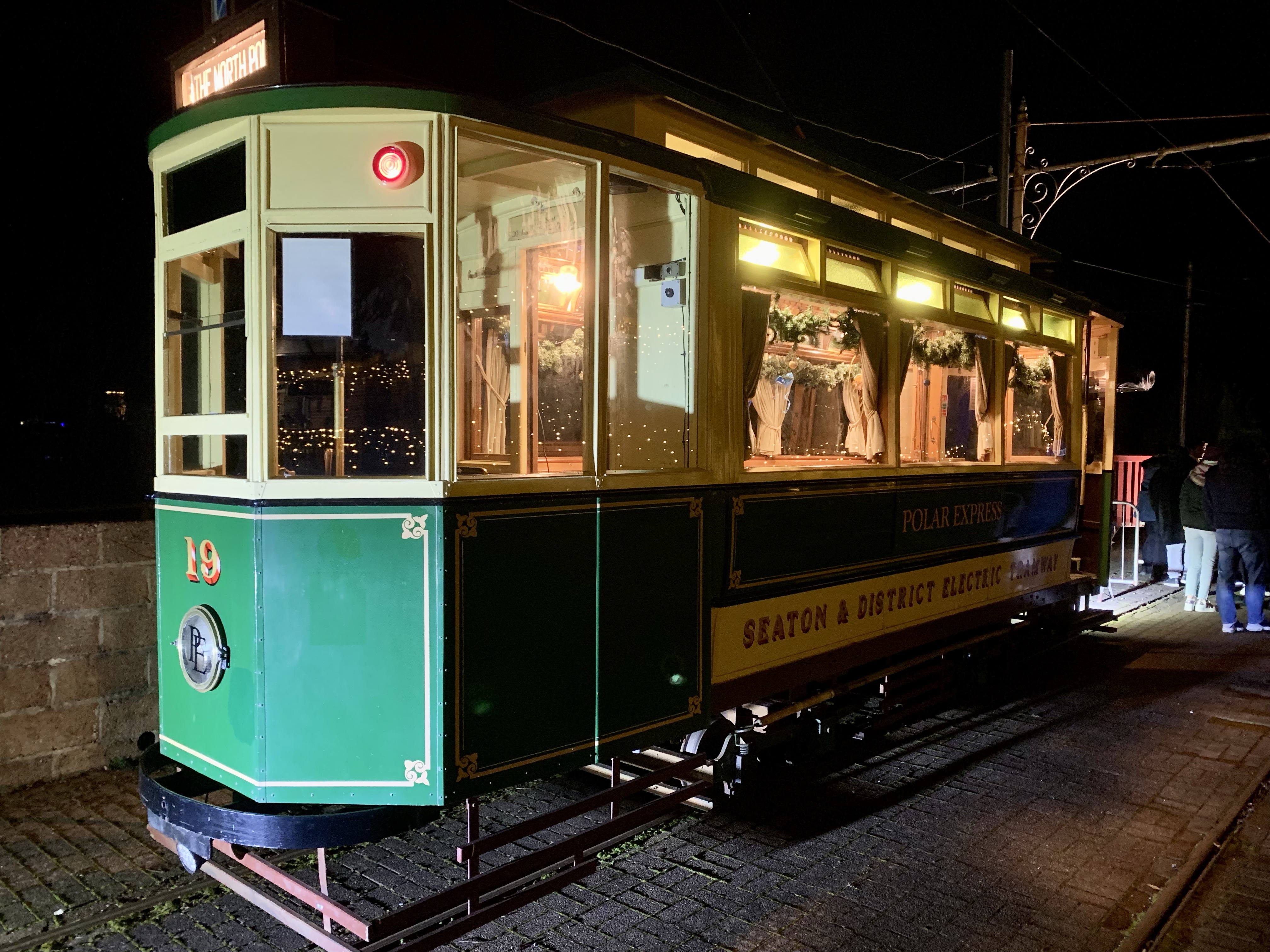
    TRAM 19 – 1906 – EX-EXETER TRAMWAY CAR
    Built in 1906. An Exeter Corporation Tramways 3ft 6in gauge open topper, 1906 – 1931. Rebuilt at Seaton, 1994-1998. The only Exeter tram in preservation. Enclosed tram for wet weather – 15/12/2022
    Tram 19 at Colyton – 15/12/2022
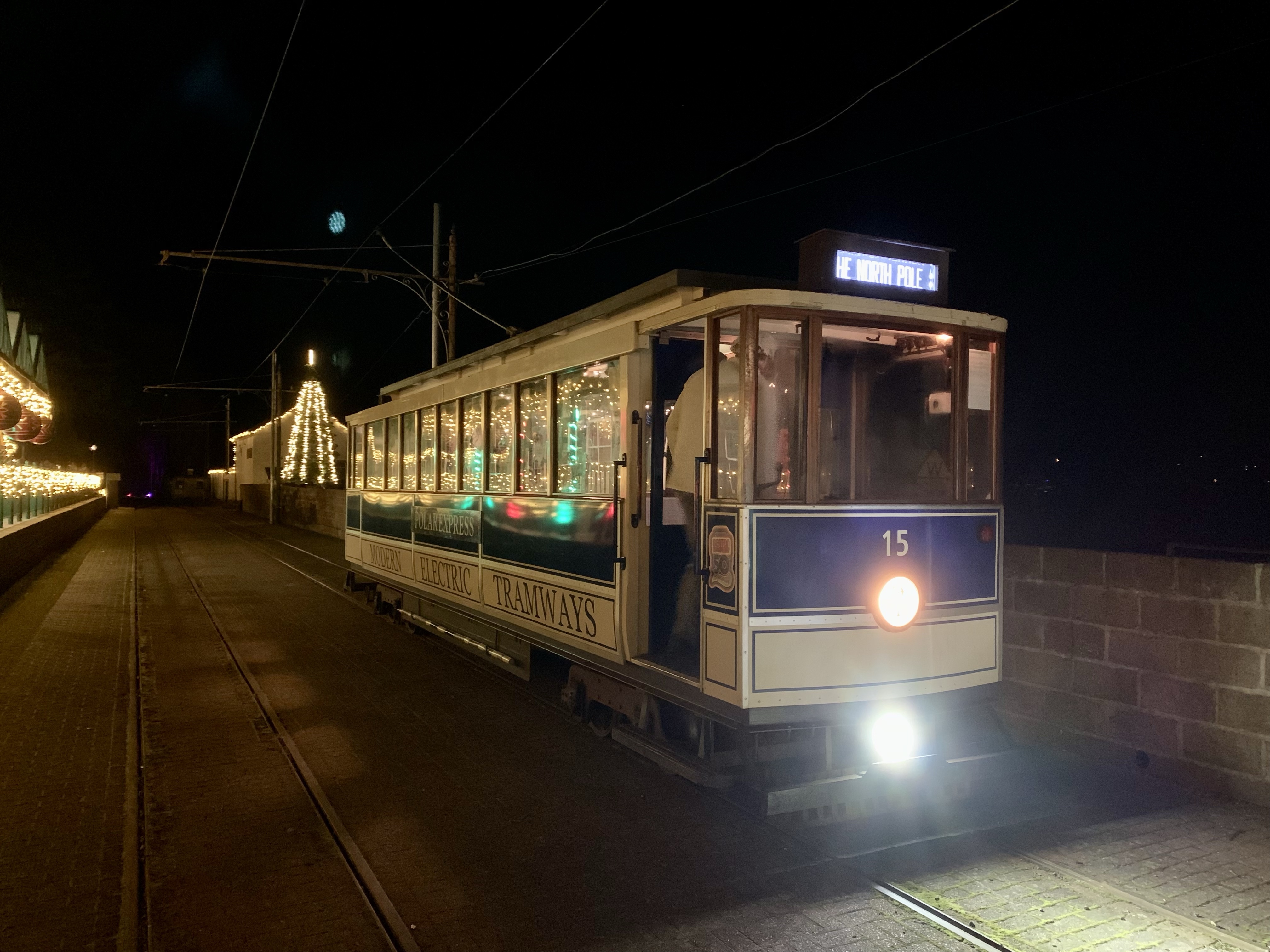
    TRAM 15 – 1988
    Built in 1988 at Seaton. Previously Car 17 and based on the Manx Electric Railway “toast-rack” cars. Rebuilt at Seaton in 2016 and transformed into an all-weather, enclosed single-deck tramcar – 15/12/2022
    TRAM 14 – 1904 – EX-METROPOLITAN TRAMWAY CAR
    Built in 1904, the oldest tram in the fleet. A metropolitan Tramways “type A” originally numbered car 94 (Standard Gauge), rebuilt at Eastbourne and Seaton between 1962 and 1984. Enclosed tram for wet weather – 15/12/2022
    TRAM 16 –1921 – EX-BOURNEMOUTH TRAMWAY CAR
    Formerly Bournemouth car No. 106, built as a 3ft 6in gauge open-top double-decker in 1921 and withdrawn on the closure of the Bournemouth system in 1936. The body was subsequently discovered in use on a Dorset farm, acquired by the Bournemouth Transport Preservation Group and then donated to Seaton Tramway in 1974 where the body was narrowed, and then rebuilt in its current form. Launched in to service in 1992 – 15/12/2022

    Video of the Seaton Tramway from 1996:

    The recent cold spell saw the Snow & Ice Treatment Train make its second run this winter along the Bournemouth to Weymouth line with a daylight outing on 15th December.

    GBRf Class 66 no.’s 66753 ‘EMD Roberts Road’ and 66745 top and tailing 3Y88 0908 Totton Yard to Totton Yard via Weymouth though Hamworthy – 15/12/2022
    3Y88 0908 Totton Yard to Totton Yard via Weymouth – additional video by kind permission of @dabuckley967 – 15/12/2022

    For The Record

    The final two scheduled test trains of 2022 failed to materialise with Monday evenings 1Q51 1115 Derby RTC to Eastleigh East Yard being cancelled at source due to ‘a problem with the train’ and Wednesday 21st December’s visit of the New Measurement Train operated by Colas Class 43 HST power car No.’s 43272 and 43257 via the West running as 1Q18 0754 Derby RTC to Bristol Kingsland Road was turned around at Yeovil Pen Mill because of late running.

    That brings us to the end of another blog entry, and indeed, our final Railway Dog of 2022. All things being equal, we’ll be back in January 2023 – thank you for reading and all your comments, corrections and contributions over the last 12 months. Wishing you a very Merry Christmas and a Happy New Year!!

  • More Flying Scotsman

    LNER Gresley A3 4-6-2 No. 60103 hauls her last passenger train during her 2022 visit to the Swanage Railway as 1X10 1645 Swanage to Norden crosses Corfe Viaduct – 26/10/2022
    No. 4472 ‘Flying Scotsman’ alongside Stanier Black Five Class 5MT 4-6-0 No. 5407 at Steamtown which occupied the site of the former London Midland & Scottish Railway Carnforth Motive Power Depot (MPD) opened in 1944. It was hoped that the depot would form part of a preservation scheme involving what is now the Lakeside & Haverthwaite Railway but when this could not be realised due to road modernisation it was developed as major visitor attraction. In 1974 Sir William McAlpine became a shareholder in the company for the purposes of stabling ‘Flying Scotsman’ and he eventually took a controlling interest in the company and purchased the complete site including the track from British Rail. In 1990 McAlpine’s controlling stake in Steamtown Railway Museum Ltd was sold to David Smith, who over the following years has bought out the majority of the minority shareholders. The site closed to the public in 1998 and today it is the base for Smith’s West Coast Railways, which operates heritage steam and diesel trains across the national UK railway network – 18/07/1981
    The “Cumbrian Mountain Express” departed Crewe at 0940 behind electric traction to Carlisle where No. 4472 ‘Flying Scotsman’ took over and took the train along Settle & Carlisle to Skipton and Carnforth followed by electric haulage to Crewe. Seen here for a water stop at Garsdale – 22/07/1981
    A feature of CME tours were the run pasts through Appleby where passengers detrained and given the opportunity to photograph the steam locomotive and train in action – 22/07/1981
    The same view 35 years later and delayed because of single line working imposed by a landslip at Eden Brows near Armathwaite, “The Winter Cumbrian Mountain Express” 1Z87 1436 Carlisle to London Euston arrives at approximately 45 minutes late arrives at Appleby. No. 60103 ‘Flying Scotsman’ replaced LMS Princess Coronation No. 46233 ‘Duchess of Sutherland’ and was 60103’s first main line rail tour following her £4.2 million, 10 year major overhaul. She ran in Wartime black livery and carried the numbers 103 and 502 on either cab side – 06/02/2016
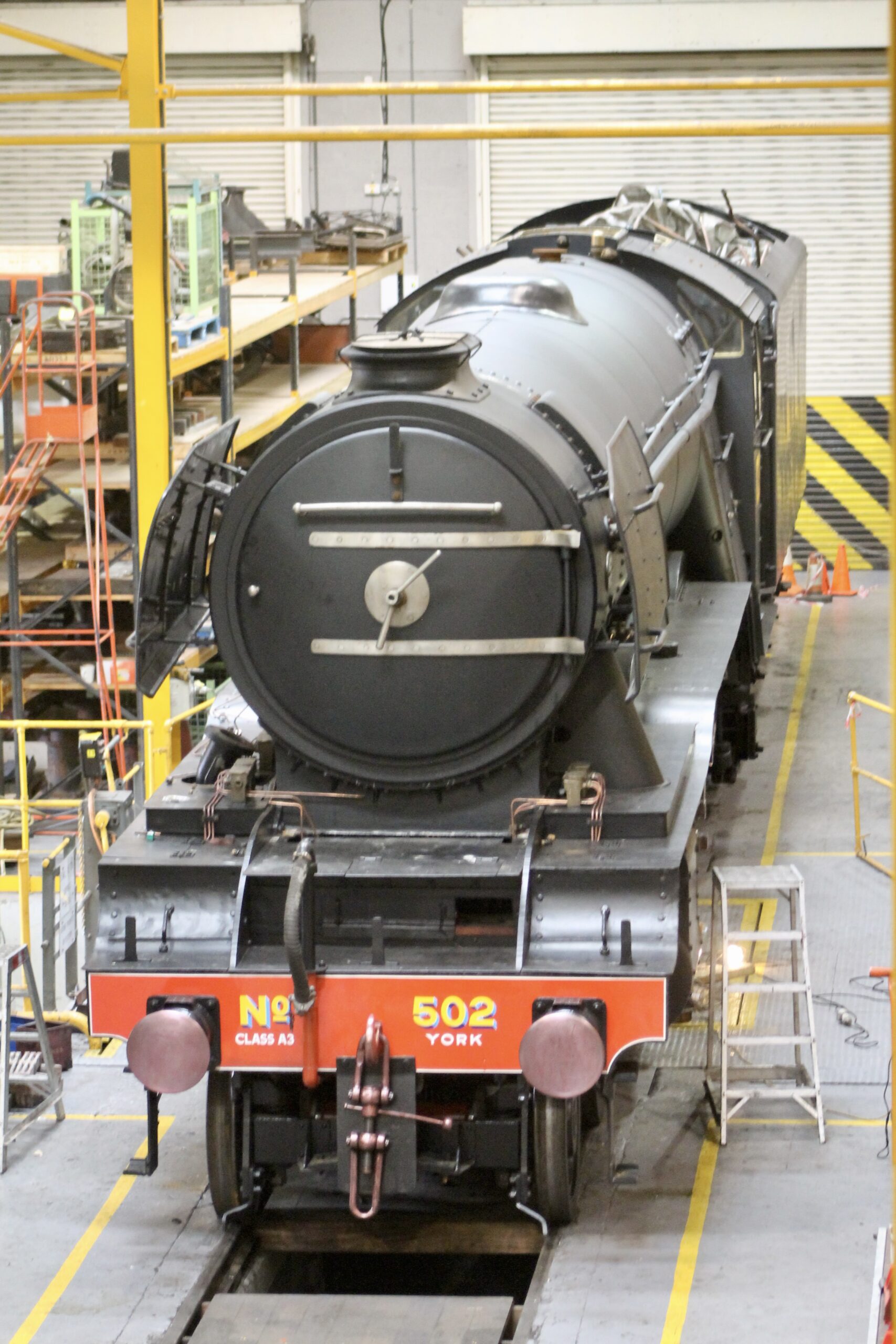
    No. 502 ‘Flying Scotsman’ in wartime black livery undergoing overhaul and restoration in the works at the National Railway Museum (NRM), York. ‘Flying Scotsman’ was bought for the nation by the NRM in April 2004 at a cost of £2.3million. She ran intermittently until December 2005 (although she was out of action between September 2004 and May 2005 undergoing a ‘heavy intermediate repair’) when she was withdrawn for overhaul. At the time, the NRM said this would take 12 months and cost around £750,000. In 2012 when the above image was taken, she was still not ready to steam again and the cost of the work undertaken had spiralled to over £2.6million. A report at the time, commissioned for the Trustees of the Science Museum Group (of which the NRM is part) to help understand quite why the overhaul had gone over time and over budget, was prepared by a respected steam engineer from Tyseley Locomotive Works, Bob Meanley, assisted by a professor of engineering and found “It is difficult to analyse drift in the project because there was no real plan against which it could be measured and new tasks were added to the workload as new problems were uncovered.” The report confirmed ‘Flying Scotsman’ was in a very worn out condition when acquired by the NRM. To a large degree this had been well known, although reports commissioned at the time seem to have been overly optimistic. The NRM had been clearly under pressure to secure the locomotive amid fears it may have been sold abroad, but is found not to have properly assessed the state of its new acquisition following purchase or to have drawn up a credible refurbishment plan. New faults are noted as having taken staff by surprise five years after purchase. In 2011, the locomotive had to be dismantled again to correct issues many thought would have been identified back in early 2006. – 03/07/2012
    No. 502 ‘Flying Scotsman’ at the Railway Museum, York. After the release of the 2012 report on the restoration of ‘Flying Scotsman’, the NRM commissioned an independent review to determine the next steps on how to proceed. It was recommended that further work on the locomotives overhaul should be put out to external tender and subsequently it was announced this would be Riley & Son and ‘Flying Scotsman’ was moved to their workshop at Bury. On 8 January 2016, ‘Flying Scotsman’ moved under her own steam for the first time since 2005. The final cost of the restoration was £4.5 million – 03/07/2012
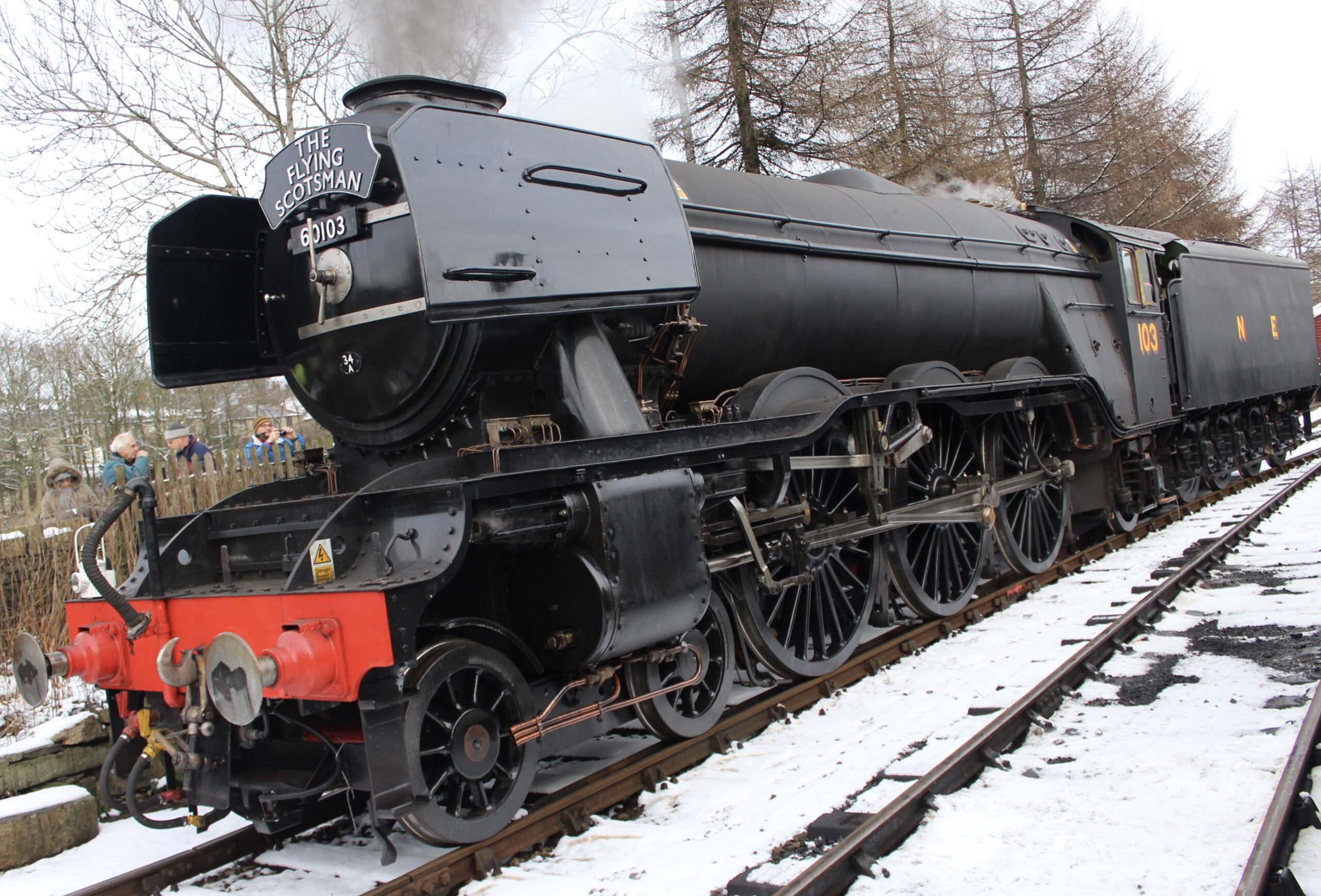
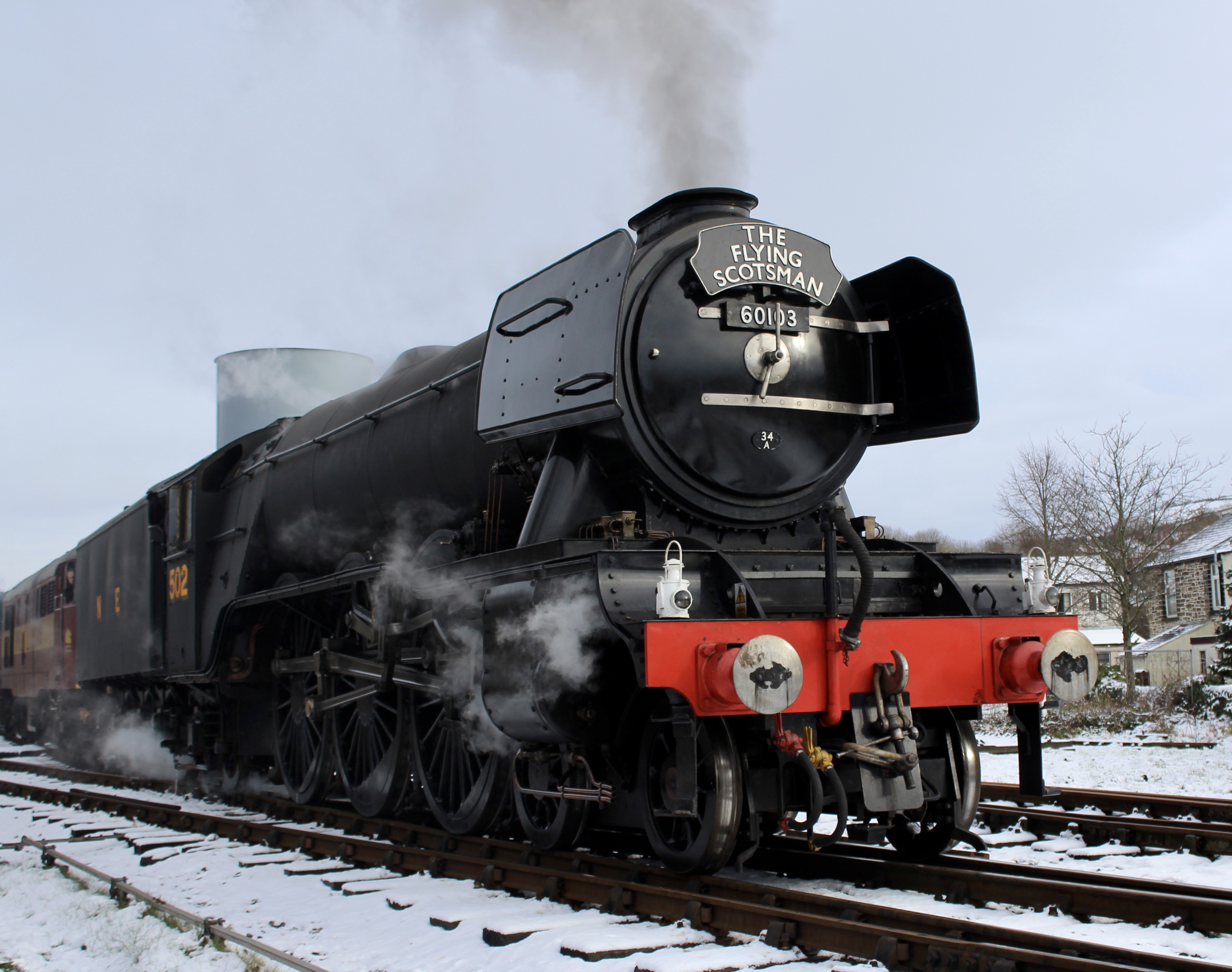
    Following her ten year overhaul and restoration, ‘Flying Scotsman’ undertook running in tests on the East Lancashire Railway (ELR) and can be seen here at Rawtenstall – 17/01/2016
    Rawtenstall – 17/01/2016
    Awaiting the road at Rawtenstall – 17/01/2016
    Approaching Ramsbottom on the ELR – 17/01/2016
    1Z86 0710 London Euston to Carlisle “The Winter Cumbrian Mountain Express” – No. 60103 ‘Flying Scotsman’ is seen here climbing Shap bank – 06/02/2016
    “The Winter Cumbrian Mountain Express” water stop at Appleby – 06/02/2016
    Steam Dreams organised 1Z60 0837 London Paddington to Salisbury “The Cathedrals Express” rail tour hauled by No. 60103 ‘Flying Scotsman’ approaches Dilton Marsh – 21/05/2016
    No. 60103 ‘Flying Scotsman’ working 1Z82 1502 Salisbury to Salisbury “The Cathedrals Express” passing through Romsey – 21/05/2016
    “The Cathedrals Express” 1Z62 1828 Salisbury to London Paddington at Grateley – 21/05/2016
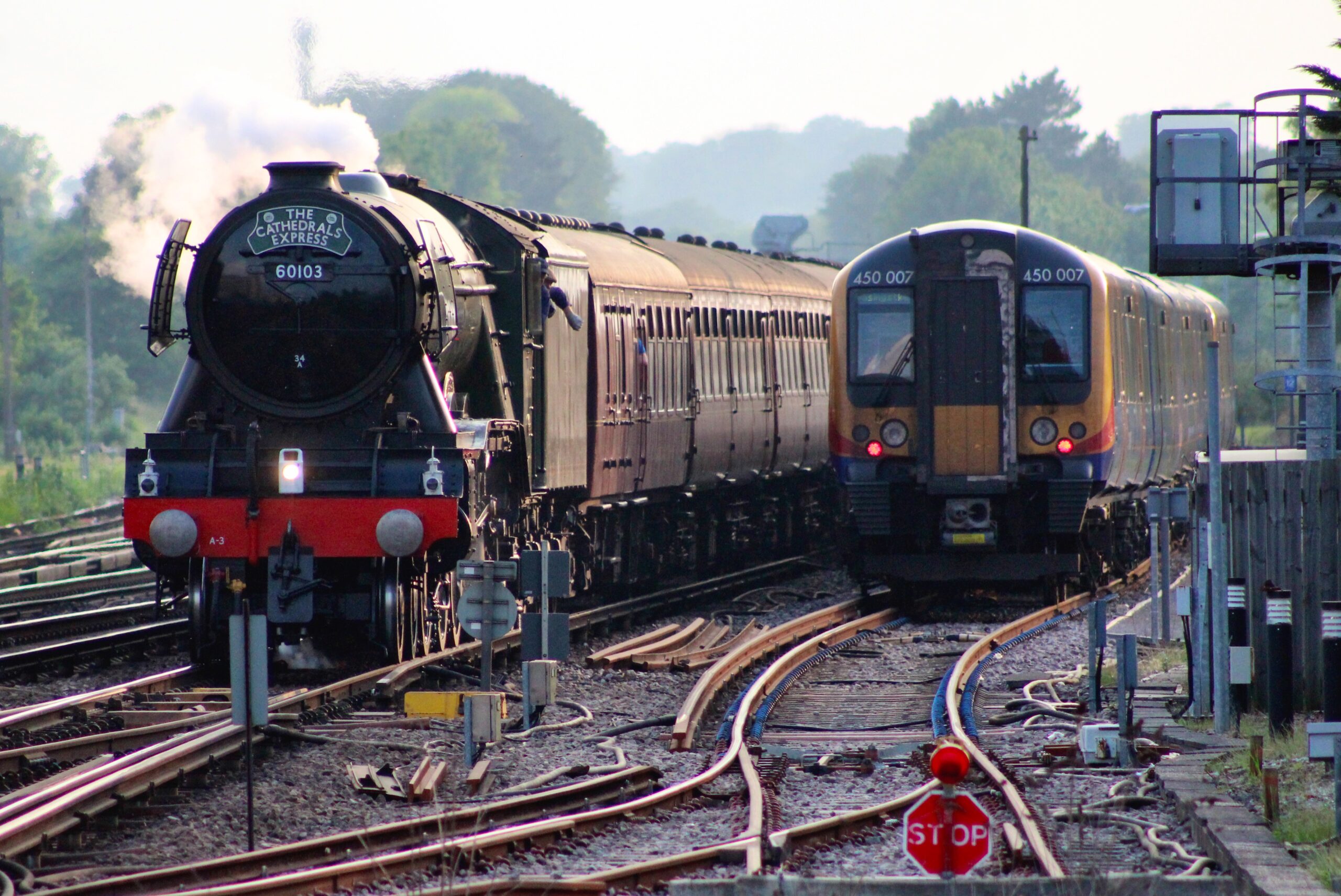
    Delayed by a line side fire in the former British Rail Staff Association building at Salisbury station, “The Cathedrals Express” 1Z62 1856 Salisbury to London Paddington passes Class 450 No. 450007 on the approach Basingstoke – 28/05/2016
    No. 60103 ‘Flying Scotsman’ working 1Z75 1520 Salisbury to Southampton Central alongside the Lower Test Valley – 06/06/2021
    No. 60103 ‘Flying Scotsman’ awaits the road at Salisbury with Steam Dreams 1Z83 1852 Salisbury to London Victoria. Following this main line run, ‘Flying Scotsman’ was withdrawn from operation for an overhaul in preparation for her centenary year celebrations – 24/03/2022

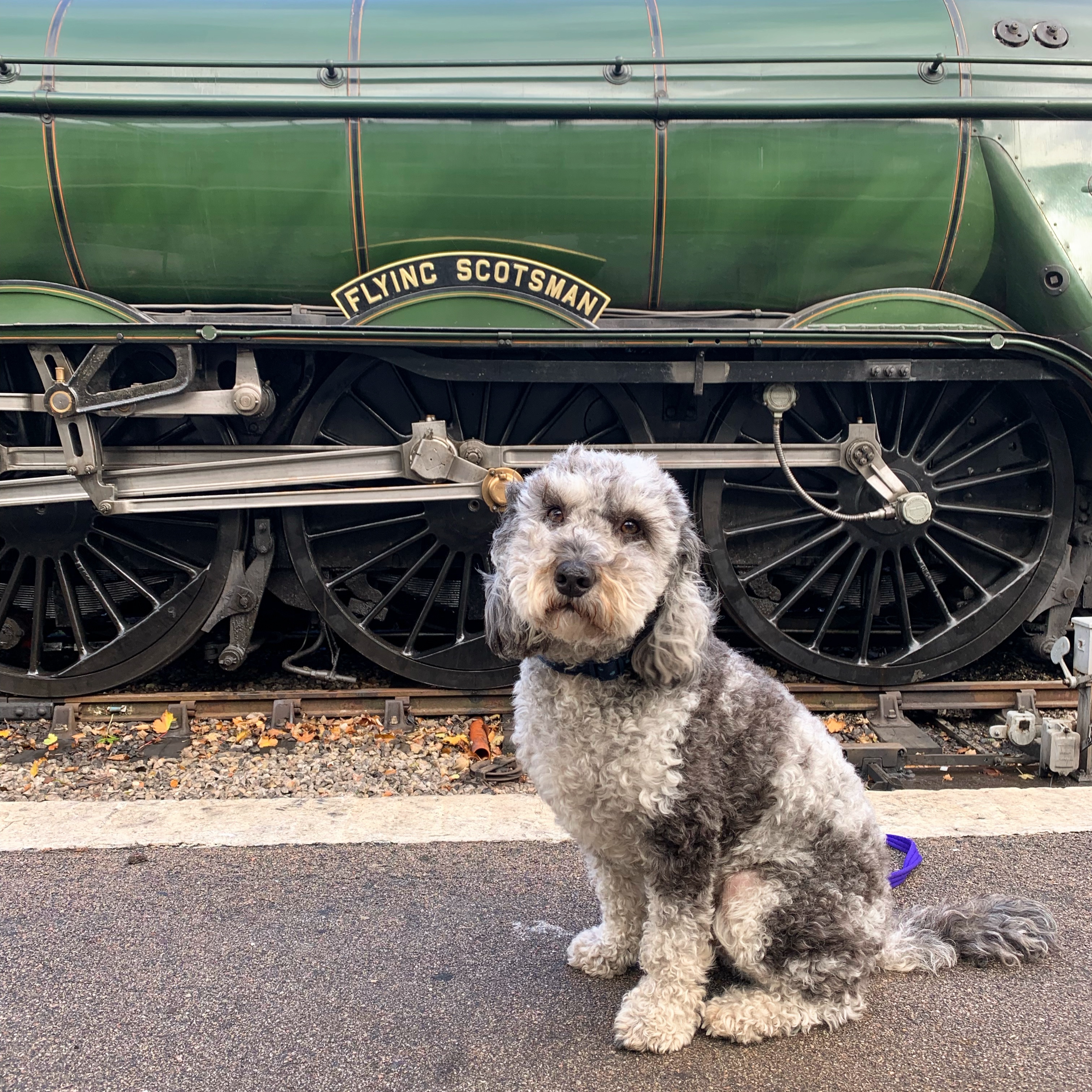
    Yoshi took the opportunity of ‘Flying Scotsman’ being on static display at Swanage railway station to get up close and personal! Last week we shared video of ‘Flying Scotsman’ during her 1994 visit to the Swanage Railway. This week we move forward to 1999 and 2000 when the locomotive could be found in her famous LNER Apple Green guise and numbered No. 4472, as she appeared when she was owned by Alan Peglar on purchase from British Railways in 1963:

    Video of LNER Gresley A3 4-6-2 No. 4472 ‘Flying Scotsman’ on various workings in LNER Apple Green livery: 08/08/1999 Upton Scudamore whilst on a London Paddington – Salisbury – London Paddington rail tour, 27/11/1999 Deputising for GWR 6000 Class King 4-6-0 ‘King Edward I’ No. 6024 on Pathfinder Tours “The Capital King” seen at Bradford Abbas and Sherborne, 06/02/2000 Deputising for SR Merchant Navy 4-6-2 No. 35028 ‘Clan Line’ on a VSOE British Pullman London Victoria to Southampton Docks and return rail tour seen in Southampton Docks, and 16/04/2000 Past Time Rail’s “The Tall Ships” seen in Southampton Docks and light engine turning move passing Eastleigh
    12th September 1965 and No. 4472 ‘Flying Scotsman’ visited Weymouth and is seen here on Weymouth depot. I was told that I was taken to see the special train organised by The Gainsborough Model Railway Society pass through Dorchester, so perhaps inspiring a lifetime love of railways! – John Chappell 12/09/1965

    Wednesday 26th October to Tuesday 1st November

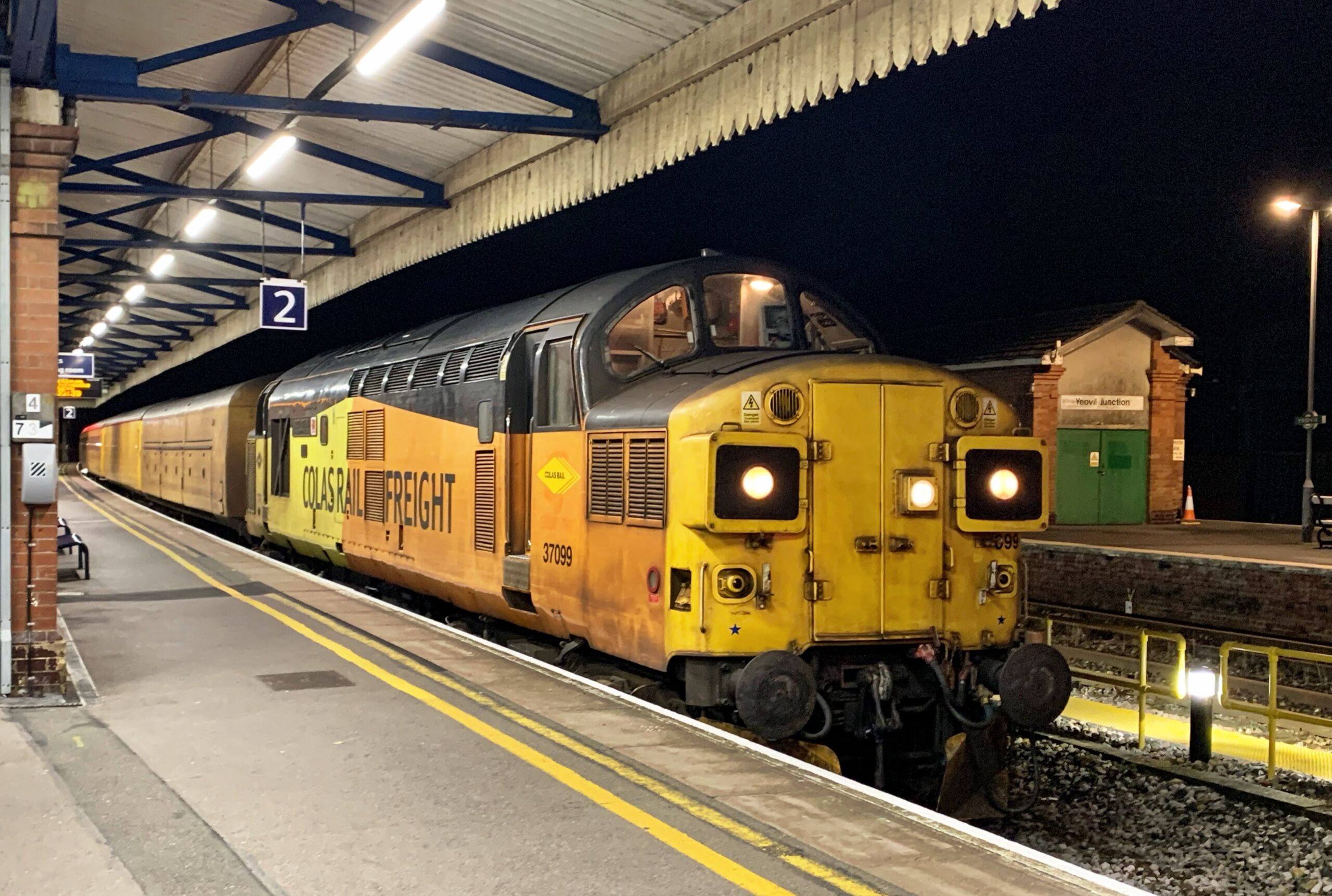
    Returning to present day 2022 and Thursday 27th October which saw Yoshi and I travelling to Yeovil to catch sight of Colas Class 37 No. 37099 ‘Merl Evans 1947 – 2016’ working 3Q07 2053 Exeter Riverside New Yard to Exeter Riverside New Yard. This working consisting of a diesel locomotive on one end and a DBSO on the other usually heads off to Sherborne and Salisbury, but this month (possibly due to the speed restrictions on the line in place until 14th November 2022 because a clay embankment between Tisbury and Gillingham had dried out, causing the ground beneath the tracks to shrink) was scheduled to reverse at Yeovil Pen Mill, a station it usually misses out although is always booked to visit. I was 99% sure the train would make it to Pen Mill this time due to its pathing, but as I didn’t fully trust that the train wouldn’t be reversed before reaching here, I hedged my bets and went straight to Yeovil Junction to witness the test train working straight through. I jumped in the car and made it over to Yeovil Pen Mill just as the service arrived into platform 1. Being a glutton for punishment, we then headed back to Yeovil Junction to see the train arrive on the return leg before departure for Exeter at 0023.

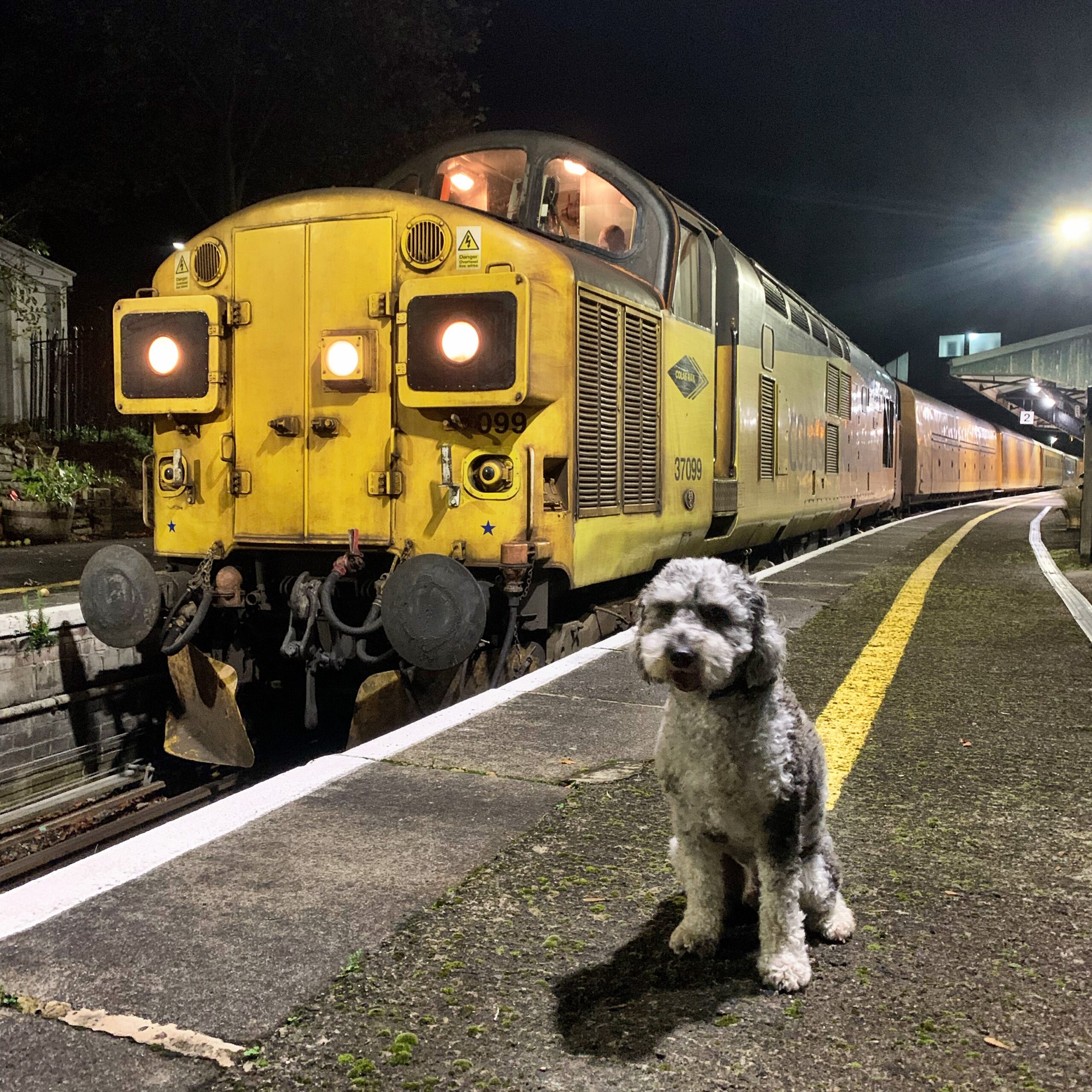
    Yoshi on a late night barking mission with Colas Class 37 No. 37099 ‘Merl Evans 1947 – 2016’ at Yeovil Pen Mill – 27/10/2022
    Nameplate detail of Colas Class 37 No. 37099 ‘Merl Evans 1947 – 2016’ named in memory of Mel’s outstanding contribution to British model railways – 27/10/2022
    Colas Class 37 No. 37099 ‘Merl Evans 1947 – 2016’ awaits the green light on the return path to Exeter at Yeovil Junction – 27/10/2022
    Video of Colas Class 37 No. 37099 ‘Merl Evans 1947 – 2016’ working 3Q07 2053 Exeter Riverside New Yard to Exeter Riverside New Yard – 27/10/2022

    On Sunday 30th October Yoshi and I visited National Trust’s Stourhead Gardens in Wiltshire. After an initial rain shower on arrival, we had a very pleasant few hours drying out whilst walking around the grounds of the estate and enjoying the autumnal colours of the trees as their leaves fluttered to the ground.

    Yoshi enjoys his walks around National Trust Stourhead Gardens – 30/10/2022

    Being so close to Westbury, we took the opportunity to pop in and see the 3S59 1554 Swindon Transfer to Loreton-On-Lugg Rail Head Treatment Train in fading light before tucking into a very tasty Sunday roast at The Three Horseshoes at Chapmanslade. Class 66 No. 66846 has returned to traffic after being temporarily replaced by Class 37 No. 37668 which we saw the previous Sunday on the equivalent working as it passed through Bradford on Avon. No 66850 ‘David Maidment’ was once again in evidence.

    Colas Class 66 No. 66850 ‘David Maidment’ on the rear of 3S59 1554 Swindon Transfer to Loreton-On-Lugg RHTT having arrived at Westbury. The train reverses here – 30/10/2022
    Video of Class 66 No.’s 66846 and 66850 reversing at Westbury with S59 1554 Swindon Transfer to Loreton-On-Lugg RHTT – 30/10/2022
    SR Battle of Britain Class 4-6-2 No. 34070 ‘Manston’ at Swanage Railway’s Herston Works. The locomotive was waiting in readiness to be collected by low loader and taken to Norden by road where she will undertake running in tests. Her place in the works will be taken by classmate No. 34053 ‘Sir Keith Park’. Many thanks to Jamie for getting permission for our visit to Herston – 01/11/2022
    The Swanage DMU stock keeping SR Battle of Britain Class 4-6-2 No. 34053 ‘Sir Keith Park’ company in the sidings at Corfe Castle ahead of her move to Herston Works – 01/11/2022
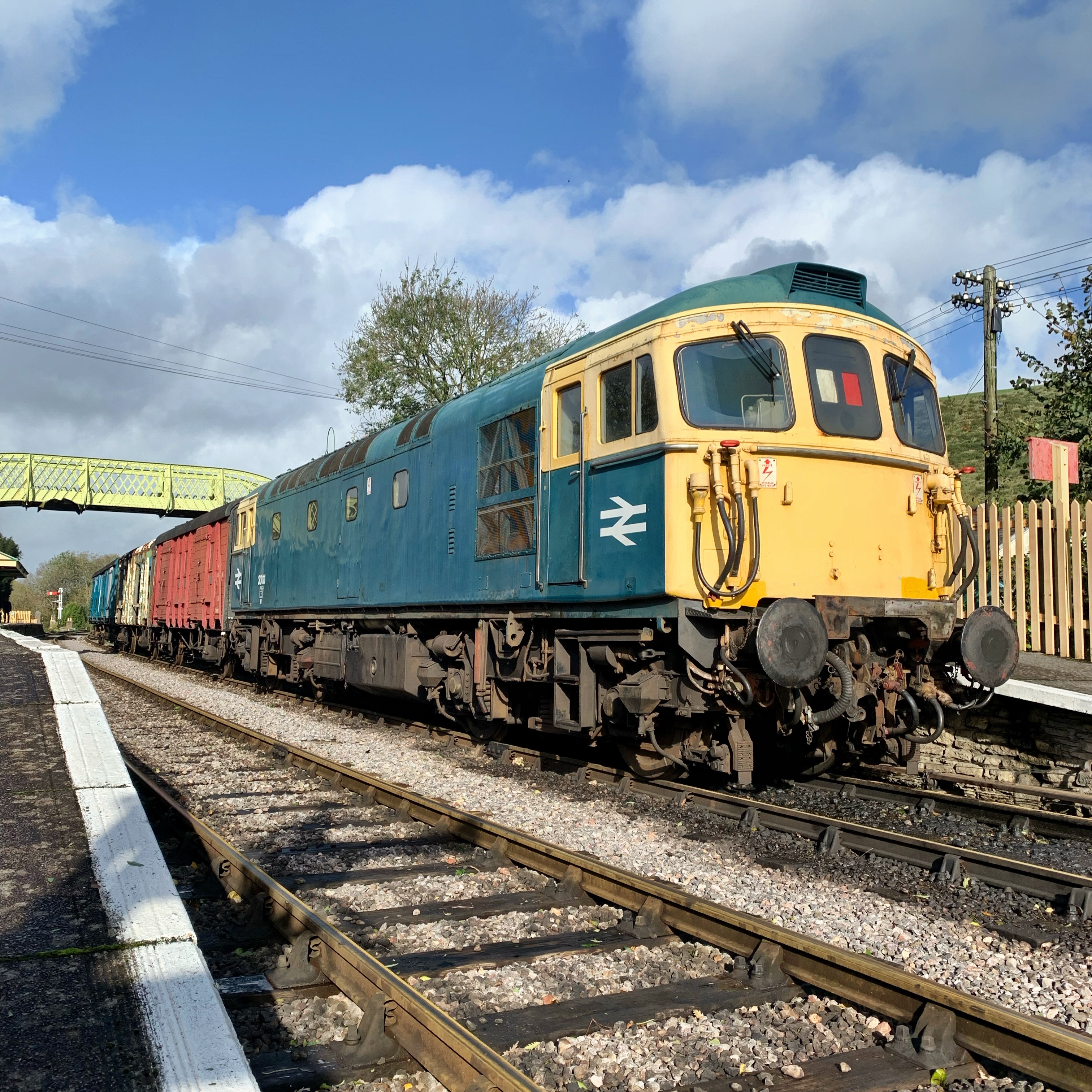
    BR Class 33 No. 33111 sits at Corfe Castle having removed a consist of wagons from Norden the previous day in readiness for the low loader moves in connection with ‘Manston’, ‘Sir Keith Park’. and ‘257 Squadron’ which is off on holiday to the Spa Valley railway to work Polar Express trains. ‘257 Squadron’ will be back at Swanage in early 2023- 01/11/2022
    SR West Country Class 4-6-2 No. 34028 ‘Eddystone’ departs Swanage with the 1000 service to Norden. SR U Class 2-6-0 No. 31806 sits in front of the ‘Flying Scotsman’ support coach. Note the fence panels which had blown over onto the coach on the extreme right of the picture – 01/11/2022

    We also came across some interesting railwaymania when we visited the Den antiques emporium over the weekend:

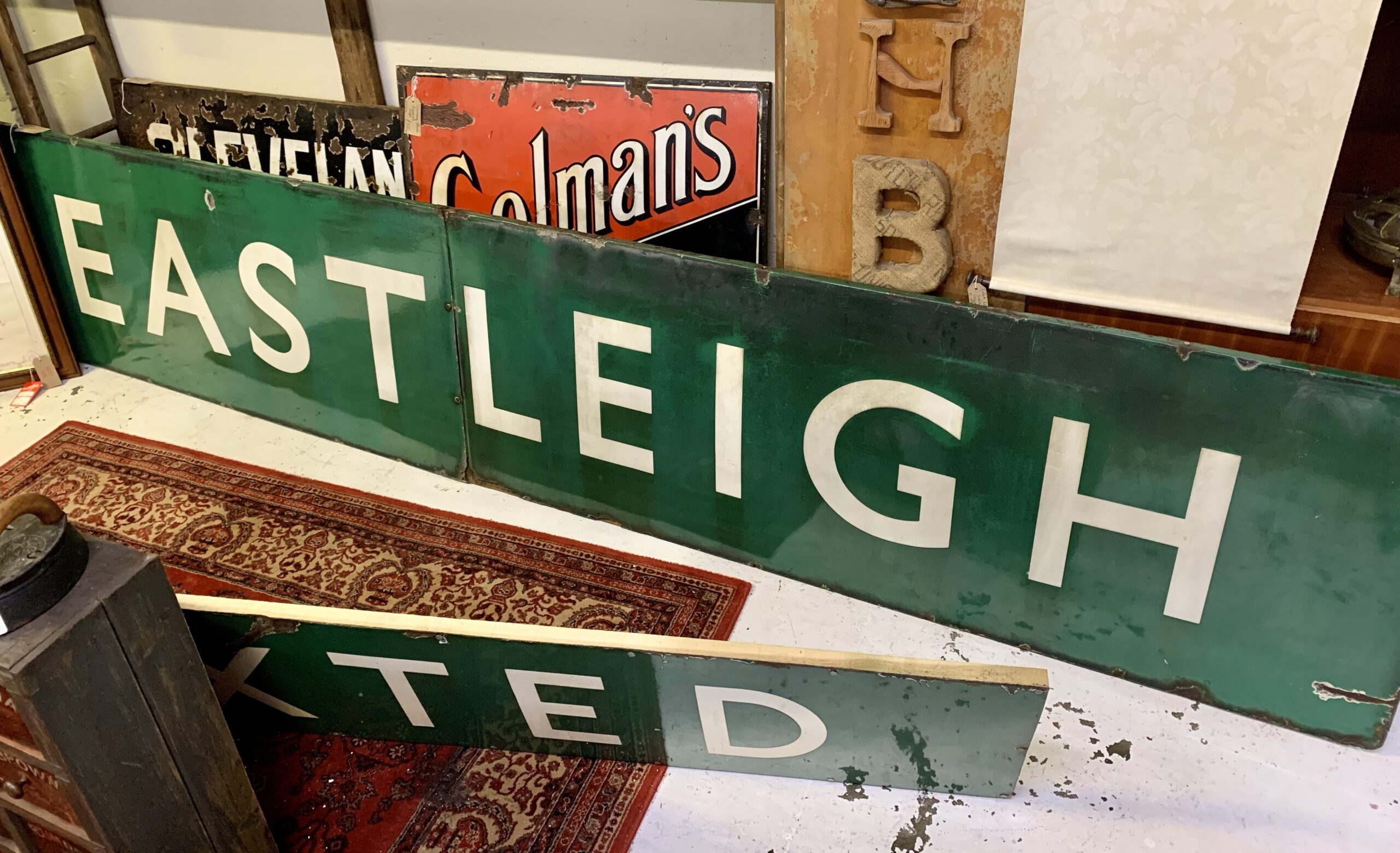
    £795 would make you the proud owner of an enamel British Railways Eastleigh station sign

    Next, we found a signed Terrence Cuneo “The Night Express” print, an evocative study of a Great Western King Class 4-6-0 working along the sea wall near Teignmouth, painted by the Master in 1975 and issued by Felix Rosenstiels Widow & Sons Ltd. as a single edition of 850 prints signed by the artist in 1977. Terrence Cuneo (1907-1996) CVO, OBE is one of my favourite railway artists. He was also renowned for his military paintings and was the official artist for the coronation of Queen Elizabeth II in 1953. A bronze memorial statue of Terrence Cuneo, unveiled by Princess Anne in 2004, once stood on the concourse at London Waterloo, but was moved to Brompton Barracks in Kent prior to the development of the disused Eurostar platforms at the station. One of my favourite Cuneo paintings can be found at the Railway Museum in York and is of London Waterloo station:

    Terrence Cuneo’s 20ft x 10ft (6 x 3.6 metres) painting “Waterloo Station” (1967) was commissioned by the Science Museum Group for its Land Transport Gallery and is the largest canvas the artist ever painted. It is on display at The National Railway Museum, York where in June 2014 it was damaged when a prop was accidentally dropped and tore a gash in the painting. You can read the fascinating account of how the painting was repaired and restored here. The painting shares the same view as seen from the first floor British Rail Southern Region boardroom windows as the pair of works by artist Helen McKie of Waterloo at war and at peace created in 1948 which are also in the NRM collection. Cuneo’s painting features the artist, his wife and daughter, his assistant, various staff of the Science Museum and a couple of politicians of the day including Harold Wilson being eyed up by a bulldog. This is undoubtably one painting that the more time you spend looking at it, the more details you see.
    © The Board of Trustees of the Science Museum. This image is used under a Creative Commons Attribution-NonCommercial-ShareAlike 4.0 Licence
    Cuneo’s signature device, which you will find in many of his post 1956 paintings, is a little mouse and sure enough he is perched atop a Johnnie Walker advertisement in his painting of Waterloo Station – 03/07/2012
    South Western Railway (SWR) has published its timetable amendments which starts on11th December 2022. In the last six months, customer numbers have stabilised at @ 69% of pre-covid pandemic levels, with peak travel at 53%. The timetable still doesn’t include any plans for the introduction of the new Derby built Class 701 EMU’s meaning they are now three years late which is mostly attributed to software faults. SWR has not accepted any of the trains as being fit for service. Class 701 No. 701043 arrives wrong line at Poole on test working 5Q51 1115 London Waterloo to Staines Up Loop – 01/11/2022

    That just about wraps up another week and all that remains is for me to thank you, dear reader, for taking the trouble to visit Yoshi’s blog. We’ve enjoyed having you stop by. As always, please feel free to comment or let me know of any typo’s, gobbledygook or misinformation! May your dog (or cat) go with you.

  • Northward Bound

    Tuesday 12th July to Tuesday 19th July

    DB Cargo Class 67 No. 67025 in operation with Transport for Wales waits departure at Crewe with 5K67 0951 Holyhead Car. M.D. Empty Coaching Stock working to Crewe C.S. – 16/07/2022

    Fleetwood

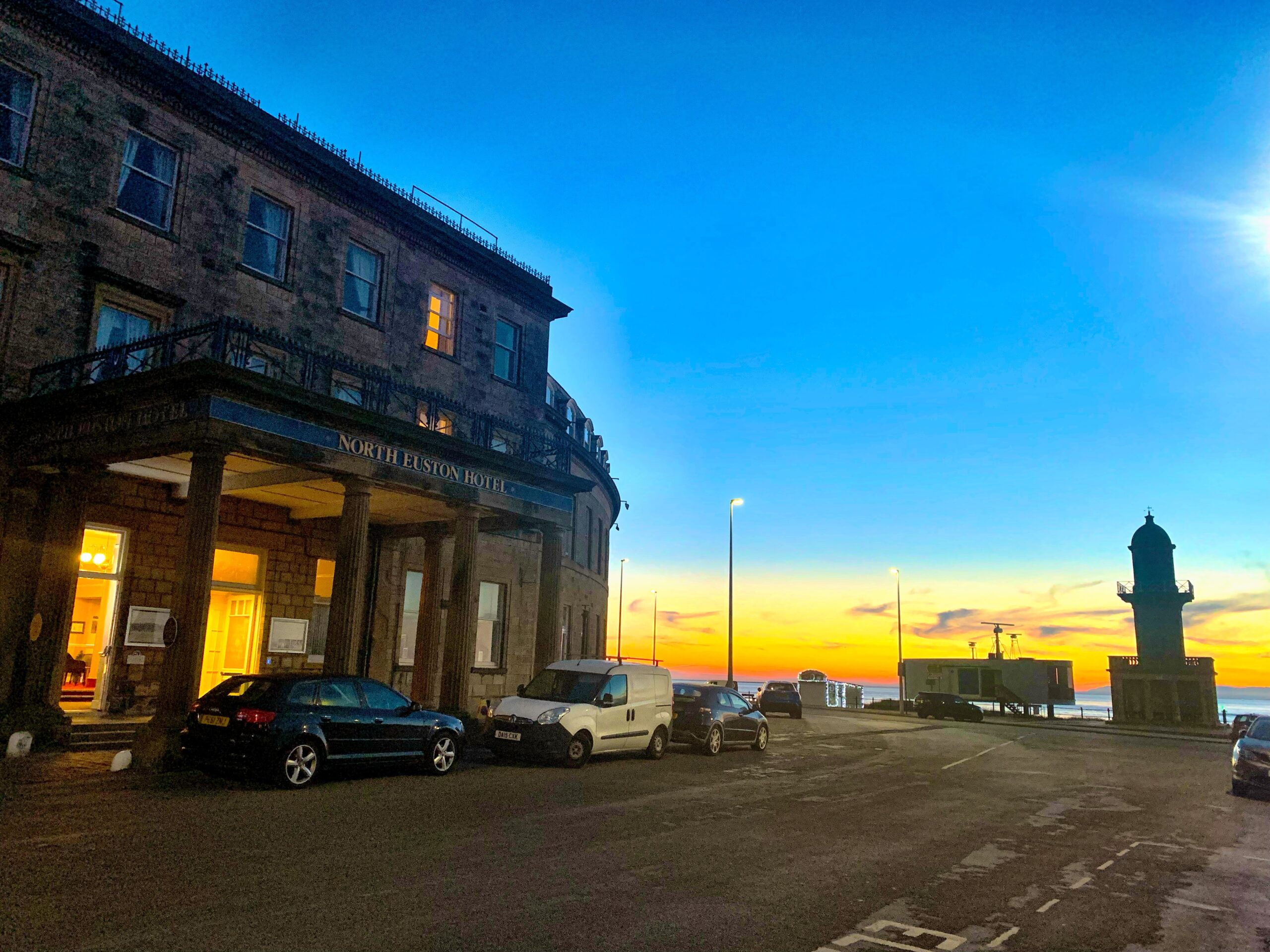
    The North Euston Hotel, Fleetwood

    Yoshi and I spent much of last week in the North West of England as we made The North Euston Hotel in Fleetwood our base. The hotel was commissioned by Sir Peter Hesketh Fleetwood, designed in the Greek classical style by architect Decimus Burton and built between 1839 and 1841 to serve overnight passengers making the journey by rail from London Euston who were destined for steam ships which would provide onward travel to Scotland where after disembarking at Ardrossan they would take the train on to Glasgow. Fleetwood was the northern most station at the time, hence the name “North Euston” for the hotel, and the railway was yet to run over the Shap hills. Queen Victoria made the journey in 1847 and stayed at the hotel, although I’m sure she didn’t stay in our room. The first manager of the hotel, Corsican born Xenon Vantini, had been a courier for Napoleon Bonaparte and was also the first person to open a refreshment room at Wolverhampton railway station. In 1859 following a decline in fortunes, the hotel was sold to the government and was converted into a school of musketry and later, in 1867, an officer’s quarters. The building existed in this form until the 1890’s when it was purchased by a group of London businessmen who converted it back into a hotel. The North Euston is currently owned by local business families. Yoshi very much enjoyed his morning sausage for breakfast and we celebrated our dubious achievement of coming last in the Sunday evening pub quiz which was a lot of fun.

    The railway to Fleetwood was opened on 15th July 1840 as the Preston & Wyre railway and was also the vision of Sir Peter Hesketh Fleetwood it being designed to connect the then new port of Fleetwood on the Fylde coast to Preston. The railway was constructed by George and Robert Stephenson with contribution from Joseph Locke. Its glory days lasted only six years until a direct route over Shap was finally achieved. The railway was absorbed into the Lancashire & Yorkshire Railway ( later the London Midland Scottish Railway as part of the Big Four groupings in 1923) and extensions were built to Blackpool and Lytham to cater for the growing number of passengers traveling to the seaside. Fleetwood would become, for a time, one of the largest and most successful fishing ports in the UK but by 1970 the railway from Poulton-le-Fylde to Fleetwood was closed to passenger traffic and later, in 1999, to freight workings.

    Thornton Station is located in the heart of Thornton town centre – July 2022
    Until the late 1980’s a signal box operated the crossing over Station Road, Thornton – July 2022
    The current station buildings were the first built by the then newly formed London Midland Scottish Railway (LMS) in 1927 – July 2022

    In 2006, the Poulton & Wyre Railway Society was formed with the aim of reopening the railway. Since then, much work has been carried out in clearing sections of the line from the ingress of nature and a Class 108 Diesel Multiple Unit was purchased for restoration and use on the line. More recently, the Poulton-Le-Fylde to Fleetwood line was subject to a study as part of the UK Government’s Restoring Your Railway programme. In June 2022 it was announced that the scheme should progress further and Network Rail will receive funding to produce a detailed plan for the revival of services. The Poulton-Le-Fylde & Wyre Railway Society have now turned their attention to developing a heritage railway centre which will eventually house a collection of railway artefacts and memorabilia for public viewing.

    Churnet Valley Railway

    Having heard that Class 33/1 No. 33102 was hauling trains, Yoshi and I spent Tuesday morning ( 12th July 2022 ) visiting Cheddleton on the Churnet Valley Railway, a preserved heritage line in Staffordshire. I grew up with 33/1’s providing the daily motive power on local passenger services between Bournemouth and Weymouth, and even though No. 33111 lives on at Swanage, our local heritage railway, it was fantastic to hear the Crompton’s Sulzer engine at work hauling a passenger train.

    The Churnet Valley railway dates back to 1849 following the formation of The North Staffordshire Railway Company (NSR) in 1845. Falling passenger numbers saw the Beeching Report include the Churnet Valley line and its associated branches which became earmarked for closure with the final section from Leek Brook Junction to Oakamoor quarry lasting out until the late 1980’s as it was used for freight traffic. In 1992 the newly formed Churnet Valley railway (1992) PLC began talks with the Department of Transport with a view to operate the line. Trains currently run between Froghall and Ipstones, but the ambition is to run services into the Staffordshire market town of Leek for the first time since 1965. And they have an eye on the clock to achieve this as the railway needs to run its first passenger train into Leek by 1st December 2022 or lose a £1.4m EU grant. This means all track must be laid on the 0.5 mile extension, with additional resources being provided for a triangle at Leek Brook Junction, and a platform constructed at Leek. It really is a very picturesque railway with extremely friendly volunteers, Yoshi and I were escorted around the workshops to get a closer view of locomotives stabled there, and I wish them every success with their endeavours and look forward to a return visit in the future.

    Cheddleton Station which was to be demolished in April 1974 but saved by the actions of local businessman and parish councillor Norman Hancock who parked his car on the level crossing preventing access to bulldozers giving sufficient time for the building to be Grade II listed – July 2022
    Cheddleton Station – July 2022
    Time for a cuppa! Yoshi waits for the kettle to boil in the booking hall of Cheddleton Station – July 2022
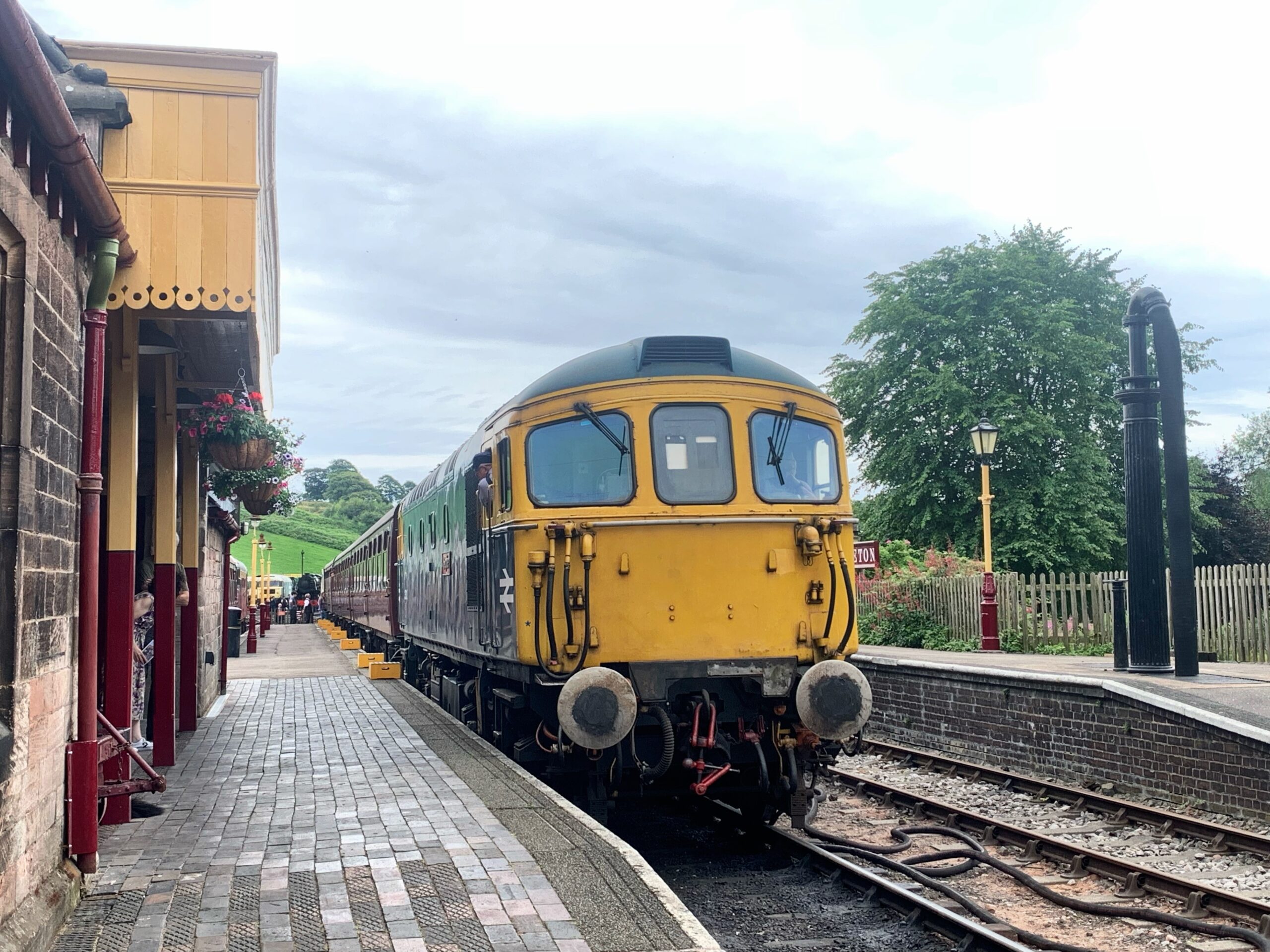
    Class 33/1 No. 33102 ‘Sophie’ awaits departure from Cheddleton – 12/07/2022
    Class 20 No. D8057 (20057) sits outside the repair shed at Cheddleton – 12/07/2022
    S160 Class 2-8-0 No. 5197 was built by the Lima Locomotive Company in Ohio, USA and exported to China in 1946. The United States Army Transportation Corps Class S160 were designed for heavy freight work across Europe during World War 2 with a total of 2,120 being built they eventually worked all over the world – 12/07/2022
    Class 25 No. 25322 ‘Tamworth Castle’ was the final Class 25 locomotive to see mainline service with British Rail. She is currently in store at Cheddleton Yard awaiting restoration – 12/07/2022
    Yoshi inspects Class 33 No. 33021 ‘Eastleigh’ in Post Office Red style livery. This locomotive was amongst the first privately owned diesel locomotives to be used on the mainline – 12/07/2022
    The Churnet Valley Railway has acquired Class 47 No. 47292 for an initial loan period of five years supplementing Class 33 No.’s 33021 and 33102 for use on passenger trains – 12/07/2022

    On our way back to Fleetwood, we stopped off at Acton Bridge for an hour or so, primarily to capture Class 37 No. 37884 which was diagrammed to pass through with 0M58 Kilmarnock Long Lyes T.C. to Derby R.T.C. – which can be seen in the video below:

    Southport

    On the Wednesday, Yoshi and I took a trip on a heritage Blackpool Tram – more about that adventure next week – but first that we made a brief visit to Southport and Formby. Southport railway station is the terminal of the Southport branch of the Northern Line of the third-rail electric Merseyrail network, and the diesel-operated Manchester to Southport line. The station and services to Liverpool and Hunts Cross are operated by Merseyrail, with Manchester services operated by Northern Trains. The current station opened as Southport Chapel Street on 22 August 1851 and once boasted eleven regular platforms and two excursion platforms. Six truncated platforms are now in use (platforms 1-3 for Liverpool trains and 4-6 for Manchester services), the remainder having been demolished to make way for car parking. In 1970 the former terminal building was replaced with a shopping centre.

    New Stadler Class 777 trains are currently being tested, and one was scheduled to visit Southport that morning on test run. Despite the best attempts at numerous roadworks and traffic queues, we made it just in time to see Class 777 No. 777015 arriving. Members of The National Union of Rail, Maritime and Transport Workers ( RMT – what these initials mean was one of the pub quiz questions I actually answered correctly! But I digress…. ) Anyway to continue; RMT members recently voted in favour of the proposed crewing plans for the new fleet which brings a five-year dispute to its conclusion. Merseyrail still has to reach agreement with the drivers union, the Associated Society of Locomotive Engineers and Firemen (ASLEF), but intends to introduce the new Class 777’s into service later this year. Currently, 17 out of the 53 units purchased have been delivered to the UK. The arrival of the Class 777 fleet will see the demise of both the Class 507 and 508 electric-multiple units (EMU’s).

    The Class 507’s were built to work on Merseyside, replacing the London Midland Scottish Railway (LMS) built Class 502 units on Northern line services from Liverpool to Southport, Ormskirk and Kirkby. 33 sets were built by British Rail Engineering Limited (BREL) in York from 1978 to 1980 followed by 43 Class 508s constructed between 1979 and 1980. They were the second and fourth variety of BR’s then standard 1972 design for suburban EMU’s, which were derived from the prototype 2PEP and 4PEP EMU’s introduced in 1971 and eventually amassed 755 vehicles across five Classes (313/314/315/507/508). Originally, the Class 508’s were built as 4-car units for the Southern Region of British Rail working out of Waterloo on former London South Western Railway (LSWR) routes. From 1982 to 1984 they were reduced to 3 car units (one of the trailer cars was removed to be incorporated into the Class 455/7 EMU’s) and transferred to Merseyside to replace the former LMS Class 503 units that operated Wirral line services to New Brighton, Rock Ferry and West Kirby. Following rail privatisation the two fleets became interchangeable and work both sides of the Mersey. They are the oldest EMU’s still working in the UK after the Class 313’s.

    Yoshi with Merseyrail Class 507 No. 507020, Southport – 13/07/2022
    Yoshi compares the differences between EMU’s with a study of Merseyrail Class 508 No. 508140, Southport – 13/07/2022
    Merseyrail Class 777 No. 777015 having arrived with 5T02 0917 Sandhills Reversing Sdg to SouthportSouthport – 13/07/2022
    Northern Trains Class 769 No.’s 769424 & 769456 Southport – 13/07/2022
    Northern Trains Class 150 No. 150128 and 150134 Southport – 13/07/2022
    Merseyrail Class 507 No. 507020 Southport – 13/07/2022
    Merseyrail Class 507 No. 507020 and Class 508 No. 508131 stand side by side at Southport – 13/07/2022
    Merseyrail Class 508 No. 508126 at the buffer stops, Southport – 13/07/2022
    Merseyrail Class 777 No. 777015 awaits departure of 5T03 1008 Southport to Kirkdale C.S. Southport – 13/07/2022

    Crewe

    After breakfast on Thursday where we spent a few enjoyable hours watching freight movements around Crewe Basford Hall. You can relive this by playing the video below:

    We returned to Dorset on Friday, eschewing the opportunity of capturing two Colas Class 37’s at rest in Blackpool North Railway Station which had worked a test train from Carlisle in the early hours. However, the next day; Saturday 16th July, I was back in Crewe, this time without Yoshi, so I could attend the Direct Rail Services (DRS) Open Day at their depot at Gresty Road. Understandably, dogs were not allowed on site, so Yoshi spent the day with his mum, while I endured the heat of the day without my fluffy sidekick. Many thanks to Scott for driving and for his company.

    The Open Day coincided with LMS Coronation 4-6-2 No. 6233 ‘Duchess Of Sutherland’ passing through Crewe railway station with the Railway Touring Company’s “Cheshireman” rail tour from London Euston to Chester. (1Z86 0639 London Euston to Chester with Class 47 No. 47813 providing support at the rear). The station was extremely busy with the influx of enthusiasts in the town to visit the DRS site, but I managed to catch a short video clip of this magnificent locomotive departing Crewe. Later that day, SR Merchant Navy 4-6-2 No. 35018 ‘British India Line’ worked into Crewe light engine and support coach as 5Z46 Carnforth Steamtown to Crewe Heritage Centre for servicing ahead of rail tour duties scheduled for the following day:

    Crewe 16th July 2022

    3,500 people attended Nuclear Transport Solutions’ (NTS) rail division DRS’s open day, the first one to be held for a number of years because of the Covid pandemic. There were two locomotive naming’s at the event – the first saw Class 66 No. 66422 being unveiled as ‘Max Joule’ in tribute to one of DRS’s founders and former Managing Director who died in 1999. The second naming was for Class 66 No. 66424 which was named ‘Driver Paul Scrivens’ who had been a driver with DRS for more than 20 years. An emotional tribute was delivered by colleague Tim Howlett before the new plate was unveiled by Paul’s sister Emma.

    The open day raised over £39,000 from sponsorship and donations which is an amazing figure that will go to deserving causes across the UK. It was a fantastic event, and I thoroughly enjoyed the experience. Because of the hot weather, DRS made bottles of water available at points across the site, which was very welcome.

    Locomotives on display were:

    Class 37 No. 37218 in retro DRS livery – 16/07/2022
    Class 37 No. 37401 ‘Mary Queen Of Scots’ – 16/07/2022
    Class 37 no. 37419 ‘Carl Haviland’ – 16/07/2022
    Class 37 No. 37425 ‘Concrete Bob’ – 16/07/2022
    Class 68 No. 68025 ‘Superb’ – 16/07/2022
    Class 57 No. 57312 – 16/07/2022
    Class 88 No. 88002 ‘Prometheus’ – 16/07/2022
    Class 68 No. 68006 ‘Pride of the North’ in special green livery showcasing the environmental benefits of rail freight and how a diesel locomotive can reduce emissions by using Hydrotreated Vegetable Oil (HVO) fuel – 16/07/2022
    Class 66 no. 66303 ‘Rail Riders 2020’ – 16/07/2022
    Class 68 no. 68009 ‘Titan’ – 16/07/2022
    Class 66 No. 66422 ‘Max Joule 1958-1999’ – 16/07/2022
    Class 66 No. 66424 awaits its naming ceremony – 16/07/2022
    Class 57 No. 57304 – 16/07/2022
    Class 88 No. 88009 ‘Diana’ – 16/07/2022
    Class 66 No. 66429 – 16/07/2022
    Class 37 No. 37424/37558 ‘Avro Vulcan XH558’ – 16/07/2022
    Class 88 No. 88001 ‘Revolution’ – 16/07/2022

    On our way to the DRS Open Day, we stopped off at Longport to peer through the fence at Electro-Motive Diesel Limited’s (EMD) site and witnessed some shunting around of locomotives, mainly Class 56 / Class 69 conversions which are ongoing.

    With 69006 stencilled on the bodyside, the conversion of 56128 is almost complete. Longport – 16/07/2022
    The empty shell of Class 56 No. 56032 awaiting a second move to Marcroft Engineering with 69007 ( ex-56037 ) in the background – 16/07/2022
    56038 is being converted into 69008 and is still on accommodation bogies but some of its new innards are in place. An extra hole has been cut in the cab front ends to accommodate an additional connection with this locomotive likely being the first for use by the GBRf Rail Services sector which handles stock movements – 16/07/2022
    Class 56 No. 56009 sits in the yard at Longport. The locomotive was unofficially renumbered No. 56201 when it was converted for use as an engineering test bed by Brush Traction in order to assess refurbished Paxman engines of sister class members – 16/07/2022
    Former DB Cargo UK Class 66 No. 66048 rests on accommodation bogies at Longport. The locomotive was damaged when it derailed at Carrbridge in January 2010 and it ended up down an embankment. It was sold to EMD in March 2016 after being initially disposed of for scrap. It’s unclear what the future holds for this Class 66 locomotive – 16/07/2022

    On our way home we diverted to Keynsham to refuel the car and restock with drinking water. Fortuitously, Class 37 No.’s 37901 and 37800 were scheduled to pass through top and tailing an Eastleigh Works to Swansea Landore stock move consisting of a Great Central-liveried Mk4 set and an LNER-liveried Mk4 set (5Q79 1826 Eastleigh Arlington to Landore). This made a fantastic epilogue to the day!

    Class 37 No. 37901 heads an Eastleigh Works to Swansea Landore stock move consisting of a Great Central-liveried Mk4 set and an LNER-liveried Mk4 set with 37800 on the rear approaches Keynsham station – 16/07/2022.

    Dorset NMT

    While we were away it was a quiet week on the Bournemouth to Weymouth line, with only the New Measurement Train of particular interest on the main line as far as I’m aware. HST Class 43 power car No.’s 43272 and 43257 were in charge of 1Q18 0719 Derby RTC to Bristol Kingsland Road on Wednesday 13th July 2022.

    Class 43 No. 43257 sits in Weymouth station – 13/07/2022. Photograph courtesy of @da_buckley967
    Class 43 No. 43272 preparing to depart from Weymouth – 13/07/2022. Photograph courtesy of @da_buckley967

    My brother popped out to see the NMT return through Dorchester West on its way to Bristol and his video which he captured especially for Yoshi can be seen here:

    In other news, Swanage resident Class 33/1 No. 33111 headed off by road to the Mid Hants Railway (MHR) to participate in their 2022 diesel gala. I had considered visiting the MHR on Sunday, but felt it was far too hot for Yoshi to be out and about, so we decided to stay home and catch up on some gardening.

    The recent heat wave also resulted in speed restrictions being imposed on main line services by South Western Railways (SWR), including those on the Bournemouth to Weymouth line, with the increased risk of tracks buckling. Reduced services were introduced on Monday 18th and Tuesday 19th July 2022 in a bid to give passengers certainty over which trains would run. There was also a steam ban imposed by many heritage railways and on the main line. This includes the Railway Touring Company’s “Dorset Coast Express” excursion to Weymouth on Thursday 21st July which will now be diesel hauled throughout.

    Great Western Railways were under fire in the local press this week, when the Dorset Echo reported chaotic scenes at Weymouth station where passengers were turned away from trains as they tried to return home. The 1728 departure to Bristol Temple Meads from the Dorset seaside town was formed of just two carriages meaning station staff and police had to request some travellers to wait for the next service which was due to leave an hour later. Not so long ago a High Speed Train was regularly employed to run a relief service to Weymouth via the West route on Summer Saturdays in order to cater for anticipated increased passenger numbers.

    That’s all for this week – join us next time when we recount our trip on a heritage Blackpool Tram. Many thanks for reading, and for continued contributions, comment and corrections which are very much appreciated!

  • Platinum Jubilee Weekend

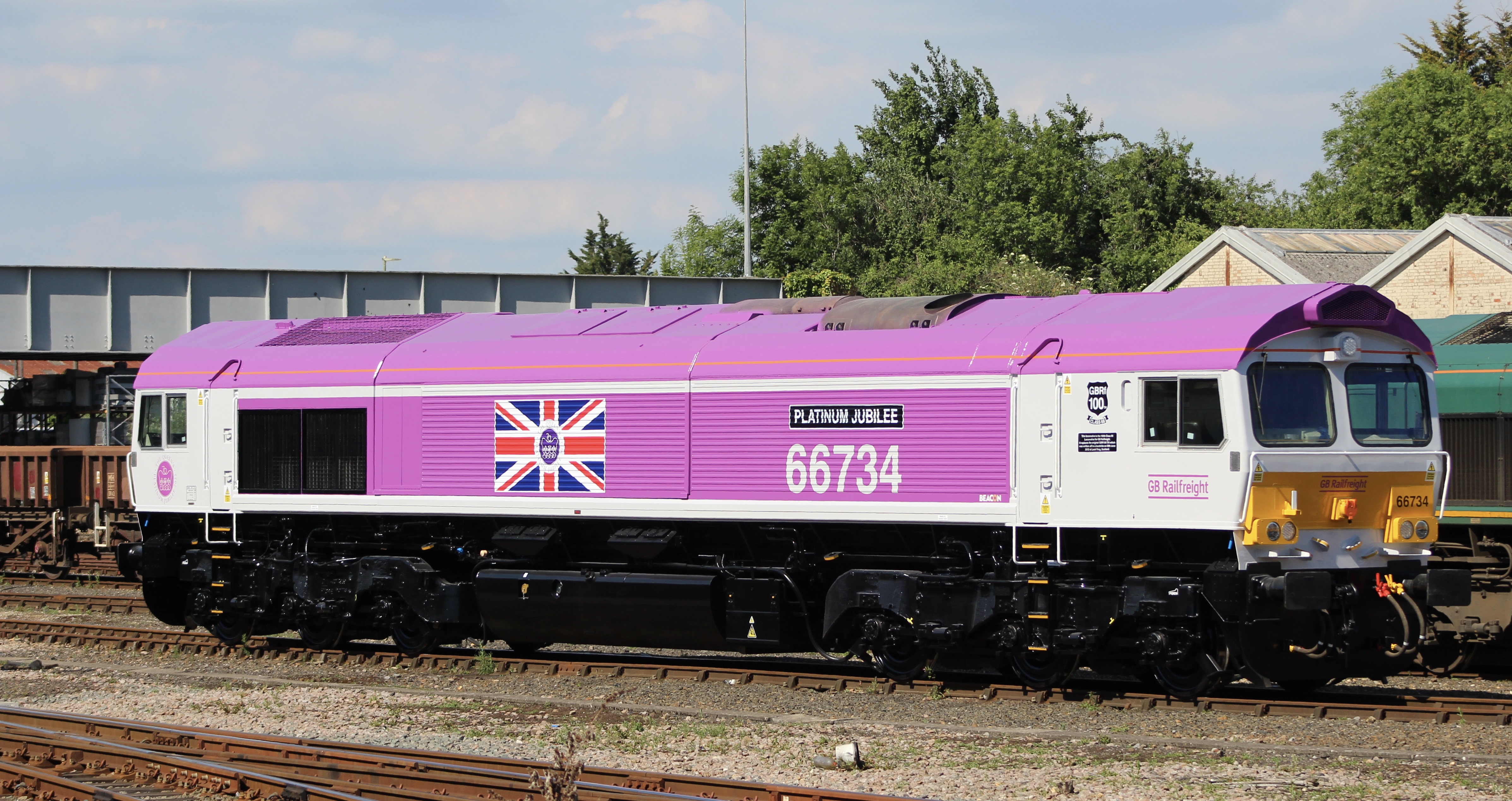
    GBRf Class 66 No. 66734 ‘Platinum Jubilee’ stands adjacent to Eastleigh railway station – 02/06/2022

    66734 ‘Platinum Jubilee’

    We kicked off our four day Platinum Jubilee Weekend when we popped into Eastleigh to see newly outshopped GBRf EU Class 66 conversion No. 66734. The locomotive, previously No. PB04 when in use in Europe, has taken the identity of Class 66/7 No. 66734, which was written off in a landslide adjacent near Loch Trieg in 2012, and is the 100th member of the class acquired by GBRailfreight.

    GBRf Class 66 No. 66734 ‘Platinum Jubilee’ stands adjacent to Eastleigh railway station – 02/06/2022
    Detail from 66734 ‘Platinum Jubilee’

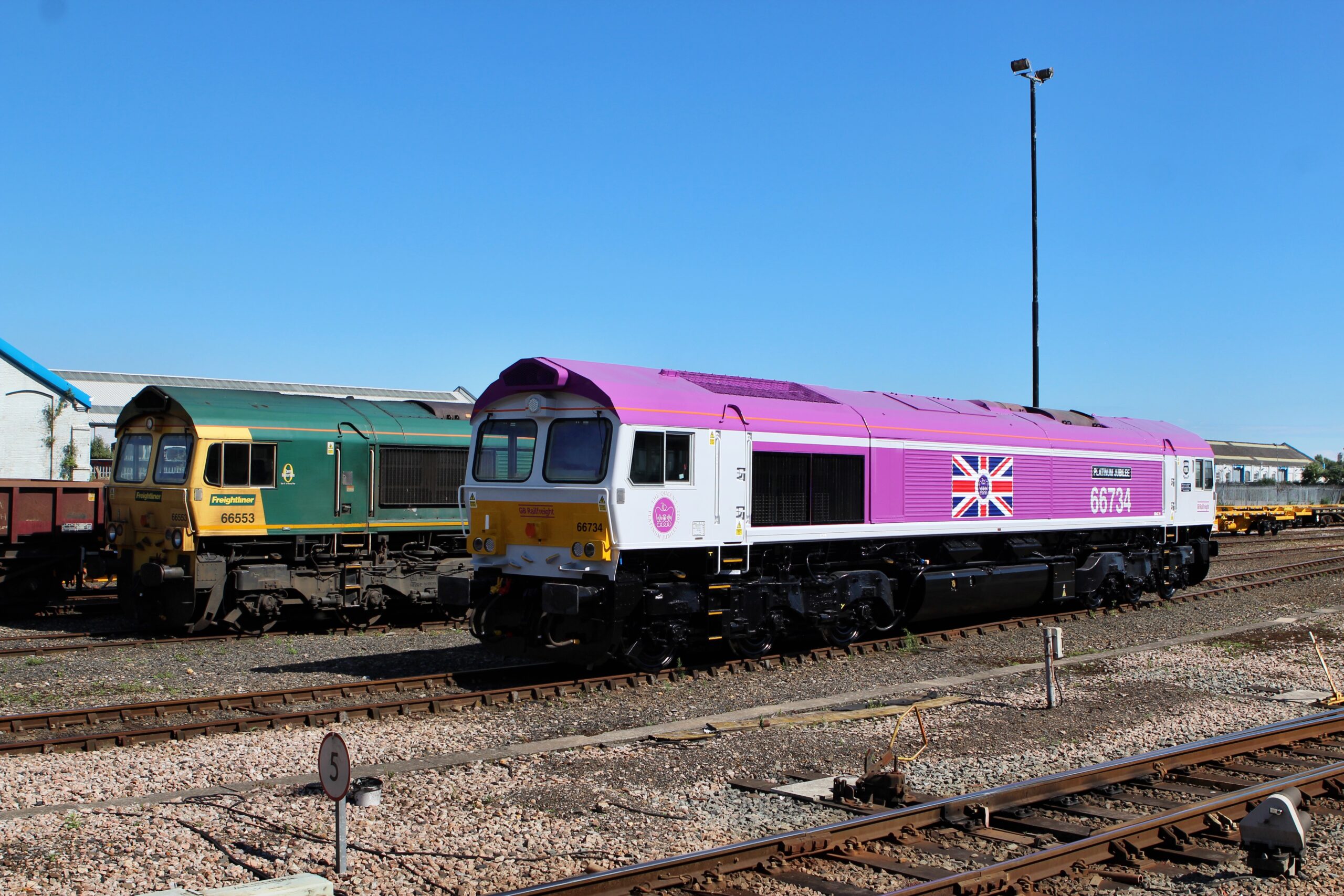
    To mark the Platinum Jubilee of Her Majesty The Queen, the engine has been given a special purple and silver livery, with the Platinum Jubilee logo and Union Flag on the bodyside. The engine has been named ‘Platinum Jubilee’, and although it currently carries vinyl nameplates, these will be replaced by cast versions in time.

    Detail from 66734 ‘Platinum Jubilee’
    Detail from 66734 ‘Platinum Jubilee’
    GBRf Class 66 No. 66734 ‘Platinum Jubilee’ and Freightliner sister No. 66553 stabled next to Eastleigh railway station – 02/06/2022

    Didcot

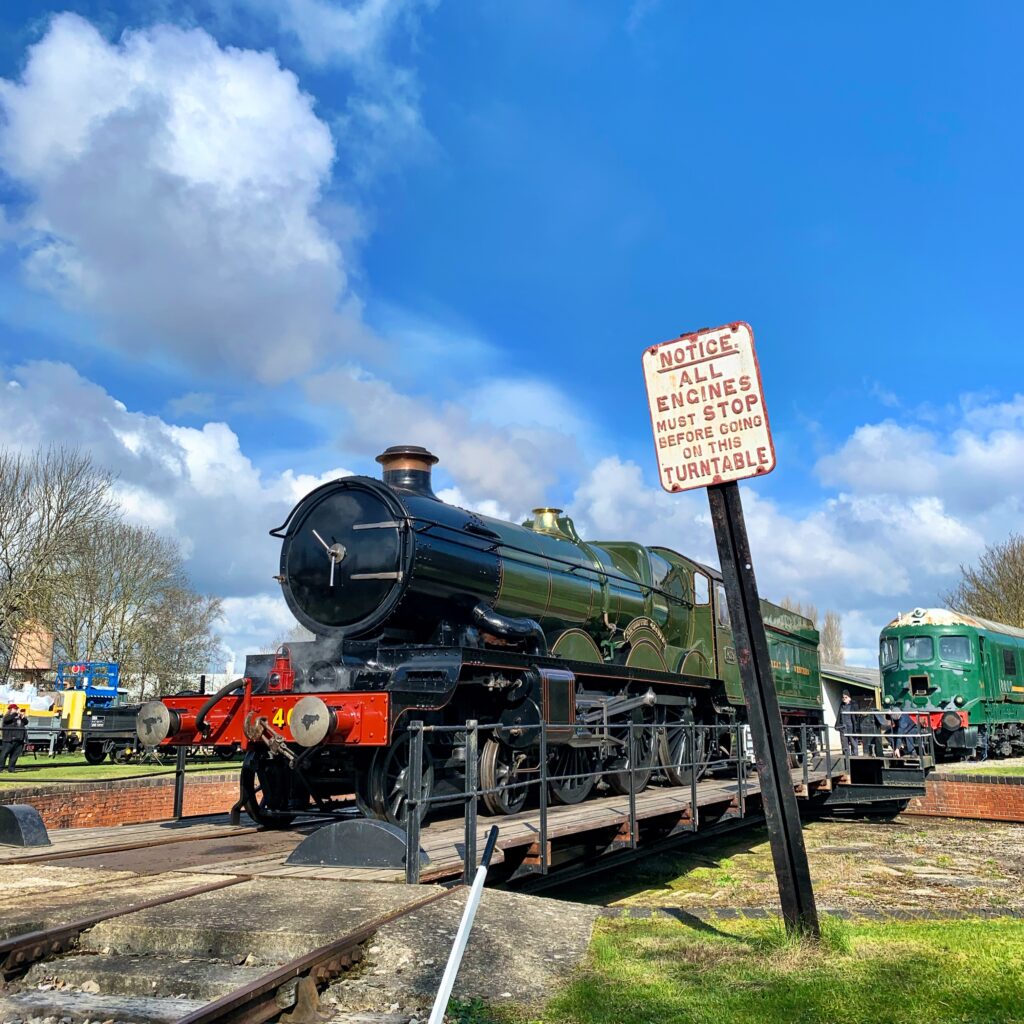
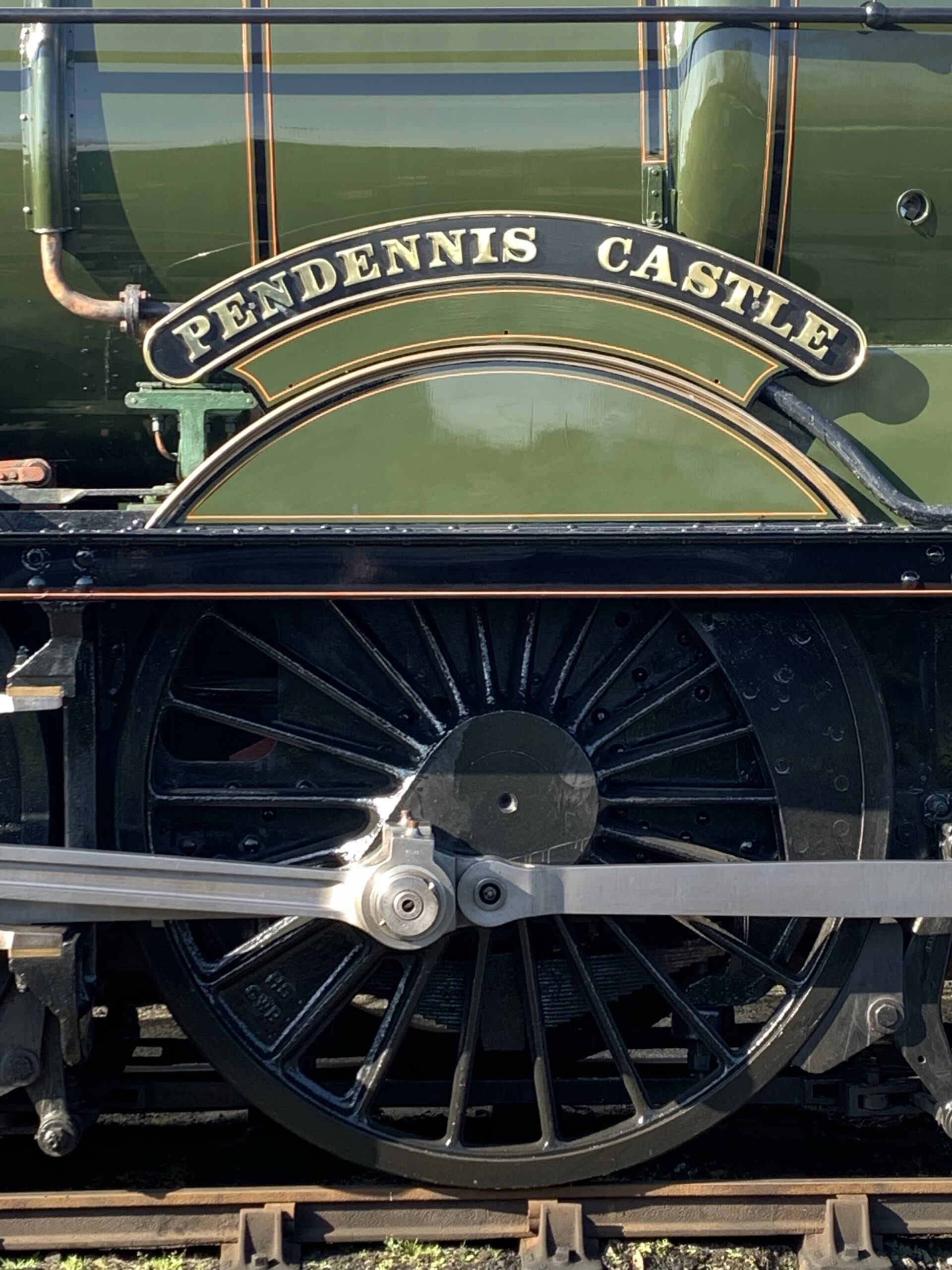
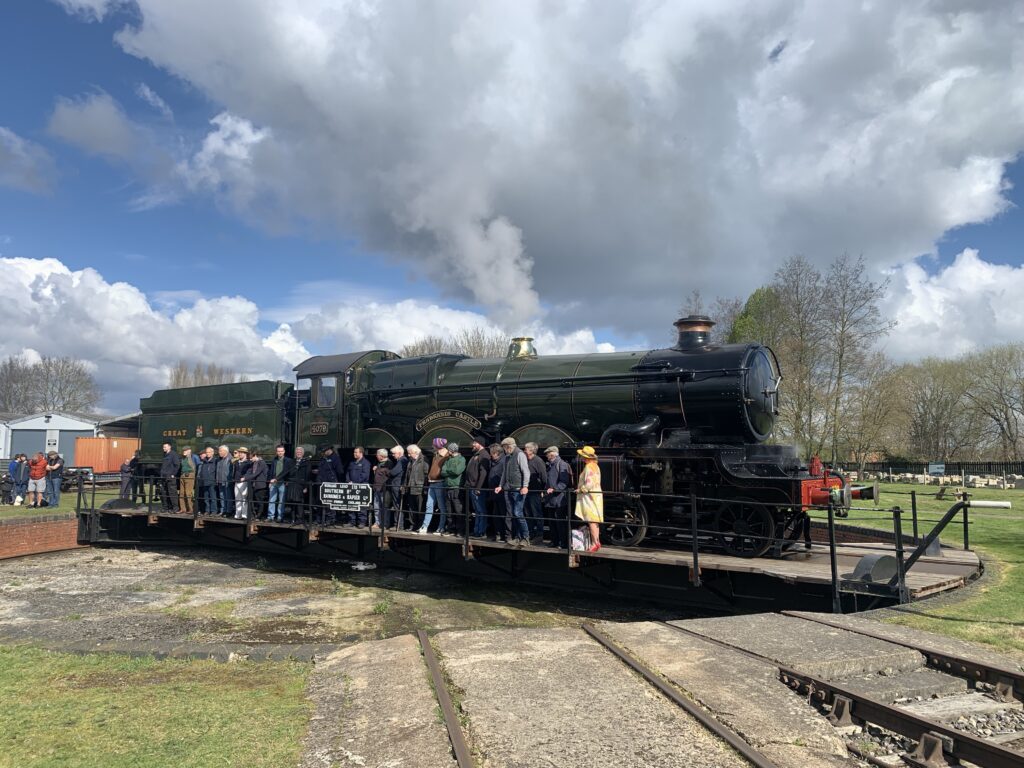
    After our brief visit to Eastleigh, we headed off to Didcot Railway Centre for an evening photographic event run by TimeLine Events who had arranged for Great Western Railway Castle Class 4-6-0 No. 4079 ‘Pendennis Castle’ to be in steam for a number of scenarios around the site. You can read about our earlier visit to Didcot when No. 4079 was relaunched into service here.

    TimeLine events specialise in recreating scenes from past eras using convincing re-enactors wearing authentic period dress in credible locations. Joining one of these events has been on my bucket list for a while now. We were a little late on arrival and once we had gained access to the railway centre, we quickly joined in the spirit of things. I really enjoyed the evening and the photographic opportunities and would attend another similar event in the future. I wasn’t totally satisfied with my resulting images and another time I would mount my camera on a tripod and try a variation of settings. As it was, this time around I hand held the DSLR and this certainly shows on shots taken later on in the evening.

    Great Western Railway Castle Class 4-6-0 No. 4079 ‘Pendennis Castle’ at Didcot
    Great Western Railway Castle Class 4-6-0 No. 4079 ‘Pendennis Castle’in the shed at Didcot
    Great Western Railway Castle Class 4-6-0 No. 4079 ‘Pendennis Castle’ at Didcot

    Although not the prime reason for attending the evening, I very much enjoyed seeing ‘Pendennis Castle’ in steam as she moved around Didcot and being turned on the turntable. Here’s a video showing a little taste of the evening:

    Castle Class 4-6-0 No. 4079 ‘Pendennis Castle’ joins a line up of GWR engines at Didcot

    Swanage Railway

    Over the weekend Yoshi and I made a couple of visits to our local heritage railway in the Purbecks where dedicated Swanage Railway volunteer, Malcolm Munro, had spent a week crafting two special headboards marking the Queen’s Platinum Jubilee. Headboards are carried on trains to denote a special service or working and in the days of steam were a regular sight, including two famous Dorset related examples; The Bournemouth Belle and The Royal Wessex. The silver and red Platinum Jubilee headboards were carried by locomotives operating the Swanage Railway’s steam trains between Thursday 2nd June and Sunday 5th June 2022.

    With SR 4-6-2 West Country Class No. 34028 ‘Eddystone’ on holiday at the Gloucestershire & Warwickshire Railway, steam services at Swanage were in the capable hands of SR 2-6-0 U Class No. 31806 and SR 4-6-2 Battle of Britain Class No. 34072 ‘257 Squadron’. Class 33 No. D6515 (33012) ‘Lt Jenny Lewis RN’ was in action on Saturday evening with the dining train.

    SR 2-6-0 U Class No. 31806 enters Harman’s Cross – 02/06/2022
    SR 4-6-2 Battle of Britain Class No. 34072 ‘257 Squadron’ being prepared for departure from Swanage with the first train of the day. The special Platinum Jubilee headboard can be seen clearly – 04/06/2022
    Class 33 No. D6515 (33012) ‘Lt Jenny Lewis RN’ working the evening Curry Train across Corfe Common – 04/06/2022
    Video of trains on the Swanage Railway over the Platinum Jubilee holiday weekend 2022

    Mainline Happenings!

    I was fully expecting a quiet time with local out of the ordinary main line workings over the bank holiday period and was pleasantly surprised to discover a GBRf route learner had been conjured up when I checked my emails on Saturday morning. So it was a hurried five minutes collecting cameras together and persuading Yoshi to jump in the car before setting off to view Class 66 No. 66755 ‘Tony Berkeley OBE’ working 0Z20 0813 Eastleigh East Yard to Weymouth. Over the weekend there had been several of these driver training workings set up, but in actuality only one ran each day on the Saturday and Sunday

    GBRf Class 66 No. 66755 ‘Tony Berkeley OBE’ working light engine through Hamworthy as SWR Class 444 No. 444029 departs with a service bound for London Waterloo – 04/06/2022

    Over the course of the Saturday and Sunday runs we managed to catch the light loco in a number of different settings – narrowly avoiding missing a shot once or twice because of passing passenger trains, as can be seen in the video below:

    GBRf Class 66 No. 66755 ‘Tony Berkeley OBE’ heads into Poole having cleared the High Street crossing – 05/06/2022
    GBRf Class 66 No. 66755 ‘Tony Berkeley OBE’ runs down Bincombe bank into Upwey – 05/06/2022

    The evening of Monday 6th June 2022 saw a test train and a heritage diesel working pass through the east of our area. The first was BR Green Class 33 No. D6515 from Swanage hauling Network SouthEast Class 50 No. 50026 ‘Indomitable’ heading to Dereham to pick up “slim’ Class 33/2 No. 33202 ‘Dennis G. Robinson’ before onward working to star at The Keighley & Worth Valley Railway diesel gala being held Friday 10th June through to Sunday 12th June 2022.

    Class 33 No. D6515 from Swanage hauling Network SouthEast Class 50 No. 50026 ‘Indomitable’ through Hamworthy – 06/06/2022

    The Class 33/ Class 50 combo was followed later by the monthly Colas test train top and tailed by Class 73 electro-diesels No.’s 73963 ‘Janice’ and 73962 ‘Dick Mabbutt’ working 1Q51 1115 Derby RTC to Eastleigh east Yard via Weymouth

    Class 73 electro-diesels No.’s 73963 ‘Janice’ and 73962 ‘Dick Mabbutt’ working 1Q51 1115 Derby RTC to Eastleigh east Yard via Weymouth pass through Hamworthy – 06/06/2022

    Elizabeth Line

    We took the opportunity of an airport run to meet Yoshi’s aunty who was flying into London Heathrow to bookend our Platinum Jubilee weekend with a quick visit to see an Elizabeth line train at the T5 railway station. The staff were amazingly friendly, helpful and accommodating allowing us to onto the platform to take photographs of one of the Alstom Class 345 Aventra trains as well as explaining technical and timetable details. The Elizabeth line was officially opened by Her Majesty The Queen accompanied by HRH Prince Edward, Earl of Wessex on May 17th 2022 when a commemorative plaque was unveiled at London Paddington station a week in advance of the route opening to passenger services on May 24th.

    Initially know as Crossrail, the Elizabeth line is operated by “MTR Elizabeth Line” as a concession of Transport for London between London Paddington and Abbey Wood. The Class 345’s have already been running between Paddington, Heathrow Airport and Reading in the west and between London Liverpool Street and Sheffield to the east prior to the central core opening for service. There are 70 trains, some seven carriages in length and others with nine carriages which were designed and built by Alstom in Derby. They are maintained by Alstom at Old Oak Common depot in west London. It is planned for the company to maintain the trains for the next 32 years as part of a rolling stock and provision contract.

    Yoshi alongside Class 345 No. 345170
    Yoshi explores the interior of a Class 345 train
    Yoshi poses next to the Elizabeth line logo

    On the day of our visit around 4,000 London Underground station staff were on strike with most services being severely disrupted so the Elizabeth line may have been busier than normal during our visit. The RMT union says it is protecting jobs and the pensions of its members which are being reviewed. TfL says jobs are not under threat. Later this month, more than 40,000 railway workers across 13 railway companies, including South Western Railway and Great Western Railway, will walk out as part of a three day national strike on 21st, 23rd and 25th June after talks about pay and redundancies collapsed.

    With the tube not running because of a strike, Yoshi was unable to access the London Underground

    That’s all from us at therailwaydog.co.uk for this week. Thanks, as always, for reading. My regular reader ( you know who you are ) will no doubt recall the first Railway Dog blog entry where I shared the first railway photographs I ever took, which to continue the jubilee theme, were from 1977 and show a Silver Jubilee special excursion passing through Dorchester West on its way to Weymouth. You can read more about this and see the images here.

  • Pendennis Castle

    Yoshi takes the opportunity to inspect DB Class 66 No. 66105 at Poole High Street Crossing

    It was an early start on Saturday April 2nd, or possibly a late end to Friday 1st when I popped into Poole to catch sight of DB Class 66 No. 66105 arrive with an engineers train from Eastleigh East Yard at 0045 (6N03 2355 Eastleigh East Yard to Poole). The next day, Yoshi and I were fortunate to see the locomotive and consist depart the Poole station area, getting some unusual photographs of the locomotive waiting for the barriers to close at Poole High Street crossing, but more of that later.

    Back to Saturday and shortly after breakfast, we set off for the 2022 Steam Railway Magazine Readers’ Heritage Railway Association Award winning Didcot Railway Centre to share in the celebrations of Great Western Railway Castle Class 4-6-0 No. 4079 ‘Pendennis Castle’ being relaunched into traffic after a long absence. We made good time in getting to the car park adjacent to Didcot railway station and made our way across to the concourse where there was some confusion in how to access the subway to the railway centre. Yoshi was extremely excited and waited impatiently to get our tickets scanned before we made our way onto the site. The Great Western Society Didcot Railway Centre really is a marvel – 21 acres covering 200 years of railway heritage. Sadly the Coal Stage which dominates the skyline was recently found in need of urgent repair but conservation work is now underway on the Coal Stage as are repairs to the water tank that supplies the Centre’s steam engines with water.

    We were greeted by not one, but two Pendennis Castle locomotives. In a lovely touch, current GWR Class 57 No. 57604 ‘Pendennis Castle’ was lined up alongside her early steam namesake No. 4079.

    4079 and 57604 both named ‘Pendennis Castle’ in front of the engine shed at Didcot
    Class 57 No. 57604 ‘Pendennis Castle’ – Didcot 02/04/2022
    Nameplate of Class 57 No. 57604 ‘Pendennis Castle’

    The Castle Class 4-6-0 express passenger engine was first introduced in 1923. No. 4079 ‘Pendennis Castle’ was the 7th machine – of an eventual total of 171 – completed in February of 1924. She shot to fame the next year when she triumphed in a series of trials against the LNER Class A1 Pacific locomotives. The most famous of these being the legendary ‘Flying Scotsman’. ‘Pendennis Castle’ was rather cheekily sent to be displayed alongside its famous rival in the 1925 Empire Exhibition at Wembley.

    No. 4079 worked express passenger trains on the Great Western Railway and later British Rail (Western Region) for forty years, racking up an impressive 1.75 million miles in service.  This came to a sudden end in 1964 when travelling on a special train, she sustained severe damage to her rear driving wheel bearings as her fire grate collapsed and almost melted them. She was taken off the train and abandoned on shed at Westbury.

    From Westbury, she was rescued by Mike Higson who was then proprietor of Roundhouse Books. He had the locomotive slowly towed back to her birthplace at Swindon and restored to working order. On completion, she was handed over in 1965. Shortly afterwards, Mr Higson sold the locomotive to Lord John Gretton (of the Bass Brewery dynasty) and, Sir William McAlpine who had famously saved ‘Flying Scotsman’ from a financially disastrous tour of North America. Initially based at Didcot, No. 4079 eventually moved to the Steamtown Railway Museum in Carnforth.

    The story now shifts to 1977 and Hammersley, amid the deserts of North Western Australia, where Sir Russel Madigan was visiting the iron ore mines of the company he worked for; Rio Tinto. Here he encountered a preservation group named The Pilbara Railways Historical Society who were saving diesel locomotives which had once worked the iron ore railways. The society were also keen to obtain a steam locomotive to run on the railway. Sir Russel declared he would “go home and buy them the ‘Flying Scotsman’”. This was not to be as Sir William McAlpine wasn’t prepared to sell ‘Scotsman’. He was, however, willing to part with ‘Pendennis Castle’. After a farewell tour stopping for what was believed to be the last time at Didcot, she went to Southampton Docks, was loaded onto a P&O ship and set sail for ‘Down Under’ via the Suez Canal.

    Arriving at Hammersley in 1978, she soon became a firm favourite, pulling trains over the extensive iron ore rail system for pleasure trips. Apparently, it wasn’t unknown for the locomotive to just pull up out of the way somewhere in the desert and for her hot coals to be used to start the barbecue! The highlight of her time in Australia was when her great rival ‘Flying Scotsman’ visited during the country’s bicentennial celebrations in 1988 and they hauled trains together.

    By 1994 changes were afoot on the Rio Tinto railway. The introduction of a new in cab signalling system made it very difficult for a 1924 steam engine to pull trains and time was beginning to take its toll on No. 4079. Faced with mounting repair bills and operational difficulties, her last operational trip was made in 1994 and she was retired to await her fate.

    It was suggested by the editor of Railway Magazine, Nick Piggott, that ‘Pendennis Castle’ needed to be repatriated into the hands of the Great Western Society at Didcot. Having contacted the society and entered negotiations with then deputy society chair Richard Croucher, the society was donated 120 tons of historic steam locomotive. With one provision; the society had to get her home. Through the efforts of successful fundraising that was match funded by the Heritage Lottery coffers, No. 4079 journeyed 1,000 miles on the roads of Australia, placed on a ship that took her through the Panama Canal, thus completing her circumnavigation of the planet. She arrived back in the UK on the 8th July 2000.

    Sadly the engine was in poor condition mechanically. The buckets of red desert sand that permeated the locomotive which were removed had also ground away at her moving parts. Large sections of the structure under her cab was life expired, her cylinder block needed new liners and a serious crack repairing as well as her boiler requiring a thorough overhaul.

    While the original intention was to restore No. 4079 to main line condition, operational changes have resulted in Didcot withdrawing from the main line scene. However, following over twenty years of volunteer work ‘Pendennis Castle’ has been fully restored to a very high standard and after her April 2nd 2022 photoshoot with her more ‘modern’ Class 57 counterpart, No. 4079 soon moved off to the turntable where, following speeches including one from Great Western Society Chair Richard Coucher, the widow of the late Sir William, Lady Judy McAlpine, cut the ribbon officially launching ‘Pendennis Castle’ back into traffic.

    GWR Castle Class 4-6-0 No.4079 ‘Pendennis Castle’ on the turntable at Didcot
    Lady Judy McAlpine launched ‘Pendennis Castle’ into traffic
    Nameplate of No. 4079 ‘Pendennis Castle’
    GWR Castle Class 4-6-0 No.4079 ‘Pendennis Castle’ with the volunteers who restored her to working condition at Didcot
    GWR Castle No.4079 is re-launched at Didcot – 02/04/2022

    We also had an enjoyable look around the Didcot engine shed:

    GWR King Class 4-6-0 No. 6023 ‘King Edward II’ – Didcot 02/04/2022
    GWR 0-4-0T No. 1338 – Didcot 02/04/2022
    No. 5 ‘Shannon’ – Didcot 02/04/2022

    Of local interest for Yoshi and I was ‘Bonnie Prince Charlie’. The locomotive was built by Robert Stephenson and Hawthorns in 1949 (Works No. 7544) and entered service with Messrs. Corrall Ltd, initially in Dorset at Corrall’s Ballast Wharf in Hamworthy and later from 1965, at Corrall’s depot on Dibles Wharf in Southampton. ‘Bonnie Prince Charlie’ was purchased for preservation by the Salisbury Steam Trust in 1969 and arrived at Didcot soon after. 

    Works No. 7544 ‘Bonnie Prince Charlie’ – Didcot 02/04/2022

    Saturday afternoon, Yoshi and I decided to visit the Chinnor & Princes Risborough Railway’s diesel gala. The main draw for me at least ( I’m not sure about Yoshi ) being the visit of two ex East Midlands Trains Class 43 HST power cars which are currently being operated by Rail Operations Group on behalf of Data Acquisition & Testing Services of Long Eaton – try saying that after a few JD and Coke’s – on routine checking of Over Head Line Equipment (OHLE) throughout the network, most recently in the Corby / Kettering area. The intention was for the power cars to work with the resident Southern Region 3-CEP unit, which is currently the C&PRR’s only operational air braked passenger stock. Unfortunately power car No. 43054 failed and was removed from the consist, being replaced with visiting Hanson & Hall Rail Services Solutions Ltd Class 50 No. 50008 ‘Thunderer’ which top and tailed the 3-CEP with working power car No. 43066. Sadly, this was not to be the only locomotive failure of the day as C&PRR’s departmental liveried home Class 31 No. 97205 was also withdrawn from the gala after experiencing issues.

    A short video from the Chinnor & Princes Risborough Diesel Gala – 02/04/2022

    C&PRR’s ambition is to extend to Aston Rowant which involves crossing a public highway at Kingston Blount in order to create a 14 mile heritage train round trip and to share operations with a public service originating from a large park and ride located near Junction 6 of the M40 to Princes Risborough for onward connections to London and Birmingham.

    The next day, we caught up with Class 66 No. 66105 as it waited with its consist of wagons in the Poole area.

    66105 in Poole – 03/04/2022
    66105 at Poole with tamper DR75501 – 03/04/2022
    66105 at Poole railway station – 03/04/2022
    66105 at Poole High Street Crossing – 03/04/2022
    66105 at Poole High Street Crossing – 03/04/2022
    66105 waits to return to Eastleigh East Yard at Parkstone the eastern extent of the worksite – 03/04/2022
    Balfour Beatty Matisa B 66 UC Tamper No. DR75501 in Poole sidings – 03/04/2022
    Video of 66105 in Poole – 02 & 03/04/2022

    More engineering work is planned for this coming Sunday in the Poole area, although I have yet to see if any engineers trains beyond a tamper will be involved. Network Rail track inspections on the Hamworthy branch necessitate road closure and traffic restrictions as Hamworthy Level Crossing in Ashmore Avenue, Poole is closed for several days w/c 25th April 2022. Interesting times ahead, hopefully!

    For our look into the archives this week we are returning to Didcot with a 1992 video from John Chappell, but first a set of photos taken with my ever trusty Kodak 110 camera during a school visit in 1979:

    Didcot engine shed featuring GWR Collett 5600 Class 0-6-0T tank engine No. 6697, SR Battle of Britain No. 34051 ‘Sir Winston Churchill’ and No. 5 ‘Shannon’ – 24/06/1979
    Southern interloper Battle of Britain Class No.34051 ‘Sir Winston Churchill’ on shed at Didcot – 24/06/1979
    GWR Modified Hall Class 4-6-0 No. 6998 ‘Burton Agnes Hall’ at Didcot – 24/06/1979
    Nameplate of GWR No. 6998 ‘Burton Agnes Hall
    Hymek D7018 adjacent the turntable at Didcot – 24/06/1979.
    Hymek D7018 adjacent the turntable at Didcot – 24/06/1979. Note the now demolished cooling towers of the nearby power station.
    GWR Class 5700 0-6-0PT Pannier Tank No. 3738 on the demonstration line at Didcot – 24/06/1979
    Didcot 24/06/1979

    During the weekend of 21/22nd November 1992, BR Standard 4-6-2 No. 70000 ‘Britannia’ was joined by unique BR Standard Pacific No. 71000 ‘Duke Of Gloucester’ where both locomotives were in steam working double headed trains on the demonstration line. In the video below, filmed by John Chappell, there is also a glimpse of ex-Corrall’s locomotive ‘Bonnie Prince Charlie’ in a blue livery for comparison to the more recent photo above.

    As mentioned previously, the Railway Centre once enabled the servicing of steam locomotives for special main line trains. One example being the Great Western Society’s Rising Star tour which ran from London Paddington to Stratford-upon-Avon and return on 13th September 1981. I have few memories of the trip except for the glorious view of British Railways Standard Class 9F 2-10-0 No. 92220 ‘Evening Star’ setting off light engine to Didcot shed with the setting sun glinting off her side after completing the steam leg of the tour ( Didcot – Stratford-upon-Avon and return ).

    BR Standard Class 9F 2-10-0 No. 92220 ‘Evening Star’ having worked the Rising Star railtour runs light engine into Didcot Railway Centre – 13/09/1981
    BR Standard Class 9F 2-10-0 No. 92220 ‘Evening Star’ working the Rising Star rail tour at Banbury – 13/09/1981

    I’m assuming after arriving at Stratford-upon-Avon, ‘Evening Star’ turned on the triangle at Hatton before taking the train on the return journey. The images below are taken at Stratford-upon-Avon:

    I recall from the main line steam excursions I travelled on in the 1980’s there was often a photo stop to enable passengers to disembark and fire off a few shots of the train, as in the photograph below:

    BR Standard Class 9F 2-10-0 No. 92220 ‘Evening Star’ stops for photographs at Claverdon as part of the Rising Star tour – 13/09/1981
    Nameplate of BR Standard Class 9F 2-10-0 No. 92220 ‘Evening Star’

    BR Standard Class 9F 2-10-0 No. 92220 ‘Evening Star’ was the last steam locomotive to be built by British Railways and the only main line steam locomotive earmarked for preservation from the date of construction. Built at Swindon Works in 1960, she was the 999th locomotive of the British Railways Standard Classes of locomotives. After a working life of only five years, she was withdrawn from service following an accident where she incurred minor damage at Cardiff Docks. As part of the National Collection, she now resides on static display at the Railway Museum in York

    BR Standard Class 9F 2-10-0 No. 92220 ‘Evening Star’ at the National Railway Museum in York – 03/07/2012

    Thank you for visiting and for your comments and corrections which are much appreciated. Many thanks to the Great Western Society for use of material from their press release in writing the story of No. 4079 ‘ Pendennis Castle’. Donations to the Water Tower and Coal Stage Conservation Project can be made here.

  • Island Line Adventure

    Yoshi at Ryde Pier Head in the company of Class 484 unit No. 484002

    We spent last weekend enjoying the delights of the Isle of Wight. As part of our travels, we took a trip from Shanklin to Ryde Pier Head on the recently upgraded Island Line which is operated by South Western Railway (SWR). The Island Line is 8.5 miles long and runs between Ryde and Shanklin. Because of clearance height issues along the route, notably in Ryde Tunnel, limited locomotives and rolling stock could be employed on this route. I was planning on visiting the Island in 2020/21 prior to the improvement works taking place, but Covid measures prevented travel and I was unable to capture the last days of the Class 483 trains. My previous visit to Ryde St Johns was in June 2013 when I snapped the following images of the ex-1938 London Underground tube stock on the depot. These units were extensively refurbished for use on the Isle of Wight line at Eastleigh Works between 1989 and 1992.

    The Class 483’s replaced the even older and life-expired Class 485 ( or 4VEC / 5VEC) and 486 (3TIS / 2TIS) units which were introduced to the island in 1967 and had been converted from 1923 standard tube stock built for use on the London Electric Railway. At the time of their introduction on the Isle of Wight these trains were already over forty years old but allowed for the phasing out of steam locomotives on the line. I travelled on these trains in August 1980 and took these photos with my treasured Kodak 110 camera.

    The main purpose of the 1980 trip was to track down the elusive Class 05 shunter which was at that time unique on British Rail. We found it hiding at the back of the shed at Ryde St Johns. The locomotive is now preserved on the Isle of Wight Steam Railway which was unfortunately not open for the 2022 season during our stay on the island.

    There are five ‘new’ two-car Class 484 trains which were converted by Vivarail using London Underground D78 stock originally built in the late 1970’s / early 1980’s by Metero-Cammell. The 484’s are based on the Class 230 diesel multiple unit.

    230004 seen at Bedford 15/05/2021

    The Island Line closed in January 2021 for the £26m upgrade to take place. Work was originally scheduled to take until April 2021 for its completion, but because of the Covid pandemic and teething problems with onboard software the line didn’t reopen to passengers until 1st November 2021. As part of the upgrade, platforms were raised or tracks lowered at five stations to improve accessibility and re-engineering of the track considerably improved the standard of travel and ensured a smooth ride. We found the new interiors spacious and clean with charging sockets available at most seats.

    Class 484 No. 484002 heading to Ryde Pier Head 13/03/2022

    The Isle of Wight has a great deal of railway history and more by accident than design we came across the location of the former railway stations at Newport, Freshwater and Yarmouth.

    We enjoyed a light lunch at the ‘End Of The Line Cafe’ in Freshwater on Saturday, Yoshi sharing a delicious sausage baguette with his mum while I kept all my vegetable soup to myself.

    We can totally recommend ‘Off The Rails‘, an award winning restaurant which inhabits the station building at Yarmouth. Our Sunday lunch was exceptional and the dog snack menu was welcomed by Yoshi who enjoyed another tasty sausage.

    Afterwards we walked off the calories taking a stroll along the trackbed of the former Newport, Yarmouth and Shanklin railway.

    After a slow start to the week in review, Monday 14th March could be described as something of a bumper day for unusual traction on the Bournemouth to Weymouth line.

    Namplate detail of 66760 (photograph courtesy of @da_buckley967)

    Our marvellous Monday kicked off with a visit of GBRf Class 66 top and tailed Snow & Ice Treatment Train. Railhead treatment trains are always a favourite in this dog house so it was great to see this working after an absence of a few months.

    Monday 14th and Tuesday 15th saw an interesting route learning move from Direct Rail Services (DRS) with Class 57 No. 57002 ‘Rail Express’ working from Norwich to Southampton via Weymouth in connection with a few future train movements from the area.

    The Class 57 was re-engineered from redundant Class 47 locomotives by Brush Traction of Loughborough between 1998 and 2004. The locos were given reconditioned Electro-Motive Diesel engines and traction alternator’s as fitted to the Class 56 to improve reliability and performance. 57002 is part of the 57/0 variant specifically designed for freight operations. DRS currently have nine Class 57’s on their books.

    57002 ‘Rail Express’ Holes Bay, Poole 15/03/2022
    Namplate detail of 57002 (photograph courtesy of @da_buckley967)

    Along with the 57/0’s there are two other sub-classes of Class 57; 57/3 and 57/6 both primarily intended for passenger use.

    57005 Cardiff 24/02/2010

    Virgin West Coast Trains utilised 16 Class 57’s for rescue duties and for dragging electric locomotives on routes with no overhead wires with the first locomotive leased from Porterbrook delivered in 2002. All were handed back by the end of 2012 as they were no longer required.

    To acknowledge their role as rescue locomotives, Virgin named their Class 57’s after elements from Gerry Anderon’s Thunderbirds TV series and in addition each engine carried an International Rescue logo above the nameplate. The next few images show two of he Thunderbird locomotives which were hired in by First Great Western to work a Taunton to Cardiff Central diagram which commenced in December 2009. The 57’s worked in pairs top and tailing stock sourced from Riviera Trains. The sets were serviced at Bishops Lydeard on the West Somerset Railway on weekdays, returning to Cardiff for maintenance at the weekends. However, the 57’s and coaching stock proved troublesome and the contract ceased in July 2010.

    57309 ‘Brains’ Taunton 24/02/2010
    57307 ‘Lady Penelope’ Taunton 24/02/2010
    57309 ‘Brains’ and 57307 ‘Lady Penelope’ at Bristol Temple Meads 24/02/2010

    Great Western Railway (GWR) operate four Class 57/6 locomotives which were all named after castles in the Devon and Cornwall area in which they operate, mostly on the Night Riviera sleeper service between London Paddington and Penzance. In June 2010 No. 57604 ‘Pendennis Castle’ was out-shopped in a lined Brunswick green livery to celebrate the 175th anniversary of the original Great Western Railway.

    57604 ‘Pendennis Castle’ at Dorchester West 04/09/2010
    Nameplate of 57604 ‘Pendennis Castle’ London Paddington 27/03/2013

    Finally the monthly rail inspection train, this time top and tailed by Class 73 Electro-Diesel locomotives No’s 73963 ‘Janice’ and 73964 ‘Jeanette’, ran to Weymouth this week as 186V 1115 Derby RTC to Eastleigh East Yard.

    For the record, my first ever visit to the Isle of Wight was in 1973. I don’t recall travelling by train during that holiday, but I do remember sunny days sat on the top deck of double decker buses touring the island. I also vividly remember the poster campaign for the ecological dystopian thriller film ‘Soylent Green‘. The images of riot control trucks fitted with large hydraulic shovels scooping up people like they were waste has haunted me ever since. Incidentally the film was set in 2022. I suppose I should get around to watching it some day. For this weeks archive feature, we return to the island in the mid 1970’s and a trip along the Isle of Wight steam Railway in a short, silent cine film from the John Chappell Collection.

    16th March 2022, the day this blog entry was uploaded, marks the third anniversary of Yoshi picking me as his human dad. It’s been a happy rewarding companionship, made stronger when we found Yoshi’s gorgeous human mum. We both love our boy to bits and try and include him on as many adventures as possible.

    That’s it for this week. Thanks for reading. I’m off to find a snack – I’ve heard about a nutritious product made from ocean plankton I should try…..

  • Dog n’ Marylebone

    A quiet week with out of the ordinary trains in the Bournemouth to Weymouth area this week. The New Measurement Train which was scheduled to have run on Wednesday 23rd February was cancelled. Maybe we’ll get visited by a COLAS HST in March instead.

    Sleeper and track replacement at Bournemouth over the weekend saw an engineers train powered by two Freightliner Class 66 locomotives No’s. 66598 and 66512 visit the station. I was asleep when the consist arrived in the early hours of Saturday, but after breakfast, Yoshi and I headed over to Bournemouth to have a quick look at what was going on.

    On Sunday, I left Yoshi at home with his mum while I went off to London for the day. At Christmas I was given a fabulous book; ‘Britain’s 100 Best Railway Stations’ by Simon Jenkins, which as the title suggests takes a look at some beautiful railway station architecture across the UK. One of the London Termini included is Marylebone, the smallest railway terminus in the capital. Being in the vicinity, I decided to take a quick look.

    Grade II listed Marylebone is the only London terminus not to see electric traction and all services are operated by diesel trains. Despite strong opposition from the Marylebone Cricket Club who objected to the line crossing Lord’s cricket ground which sits to the north, the station opened for passenger traffic on 15th March 1899 having been constructed by the Great Central Railway for their London extension and was the last of London’s main line termini to be built. Sir Edward Watkin who created the GCR and one of the Victorian era’s great Railway Kings hoped that the line would continue south to the coast and cross to France via a Channel Tunnel. The station architect was Henry William Braddock who worked as a civil engineer with the GCR. Because of the fight over Lord’s cricket ground and the agreed solution of a cut and cover tunnel to the east of the hallowed turf, money was tight and this is reflected in the modest design of the station which was originally intended to have eight platforms but only four were built. Marylebone gained two extra platforms in 2006 following rail privatisation. The design utilises attractive red brickwork with terracotta dressings. Over 500 houses were demolished to make way for the railway and those displaced were rehoused by the Great Central. It is currently the southern terminus of Chiltern Railways, but in the 1980’s serious consideration was given to tarmacking the track bed and running buses over a road expressway. I’m rather pleased that this option was not adopted and the railway survives into the 21st Century.

    For comparison below is archive footage of Marylebone and Aylesbury from March 1992 recorded by my late friend John Chappell who sadly passed away in 2021. John was an enthusiastic follower of all things transport and a supporter of the Swanage Railway and the Merchant Navy Locomotive Preservation Society and their steam locomotive No. 35028 ‘Clan Line’.

    As well as Class 165 and Class 168 diesel multiple units Chiltern Railways also employ Class 68 locomotives on London Marylebone to Birmigham Moor Street services. No.68012 is seen arriving at Birmingham Moor Street on Friday 13th March 2020
    Chiltern Railways Class 168 No. 168109 at Birmingham Moor Street – 13/03/2020

    Another visit to the archives here with video from September 1992. Last week we included photos of newly outcropped Class 69 No. 69004 in Railway Technical Centre livery and the video below, filmed by John Chappell, shows two test train examples of rolling stock painted in this livery.

    Of particular interest is the footage of the International Services Test Train passing through Eastleigh. This ensemble was part of the testing employed for the Trans Manche Super Train (TMST) Channel Tunnel stock. In December 1989, an order was placed with GEC-Alsthom for the construction of thirty TGV-style electric train sets which were to operate from London to Paris and Brussels. These trains were required to take electric current from 25 kV overhead wires while passing through the Channel Tunnel and in France, and 3 kV in Belgium. On the British side, however, the trains would be utilising the existing suburban 750 Volt DC 3rd rail track. Sir Edward Watkin of the Great Central Railway would have been proud to have seen his vision finally realised!

    As part of the programme, withdrawn from service Class 33 No. 33115 was converted into a Driving Van Trailer (DVT) at Doncaster Works in 1990 and was given a fresh look in InterCity Executive livery and renumbered 83301. The locomotive had been modified with TGV-type bogies equipped with third rail pick-up shoes. Unpowered, it kept its seized engine as a dead weight. The decal ‘Test Vehicle For International Services’ was added to the lower body sides. The ex Class 33/1 nicknamed ‘Zebedee’ and was paired with Class 73 No. 73205 ‘London Chamber of Commerce’. The two were semi-permanently coupled to each other, 83301 being used to collect electricity from the 3rd rail which was then transferred to the 73 via heavy duty cabling to provide motive power. The remainder of the test train was initially formed of 4TC Class 438 No. 8007 ( coach numbers: 977684-7 ) painted in Railway Technical Centre red and blue but was later supplemented, in 1991, with ex 4TC coaches 977763/4 in Network SouthEast livery.

    As seen in the video, the test train was commonly found running between Waterloo and Eastleigh until regular Eurostar services commenced in November 1994, running from Waterloo International to Paris and Brussels. No. 83301 was donated to the Class 33/1 Preservation Company Ltd utilising parts for Swanage railway based classmate No. 33111, the remainder being scrapped at St Leonards depot in 1996. No. 73205 remains in service with GBRf and is now named ‘Jeanette’.

    Ten years prior to conversion to DVT No. 83301, Class 33/1 No. 33115 departs Dorchester with a Weymouth to London Waterloo service – 25/07/1980
    Class 33 No. 33115 propelling a Weymouth to London Waterloo service formed of two 4TC sets near Dorchester – 04/07/1981
    Class 73 No. 73205 ‘Jeanette’ still in InterCity Executive livery seen working a test train at Weymouth – 17/02/2014 (John Chappell)
    Yoshi gets up close and personal with Class 33/1 No. 33111 at Corfe Castle. Classmate No. 33115 donated spares to this locomotive via the Class 33 Preservation Company Ltd

    That’s all for this week. Join us next time for more of the same, but subtly different.