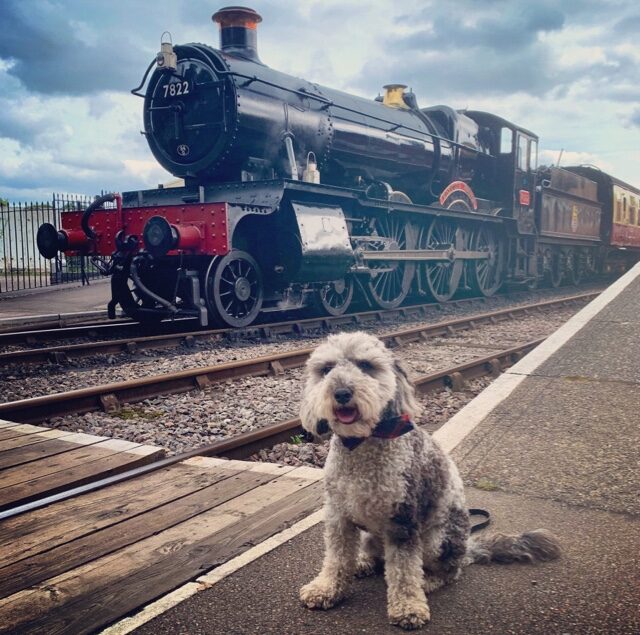
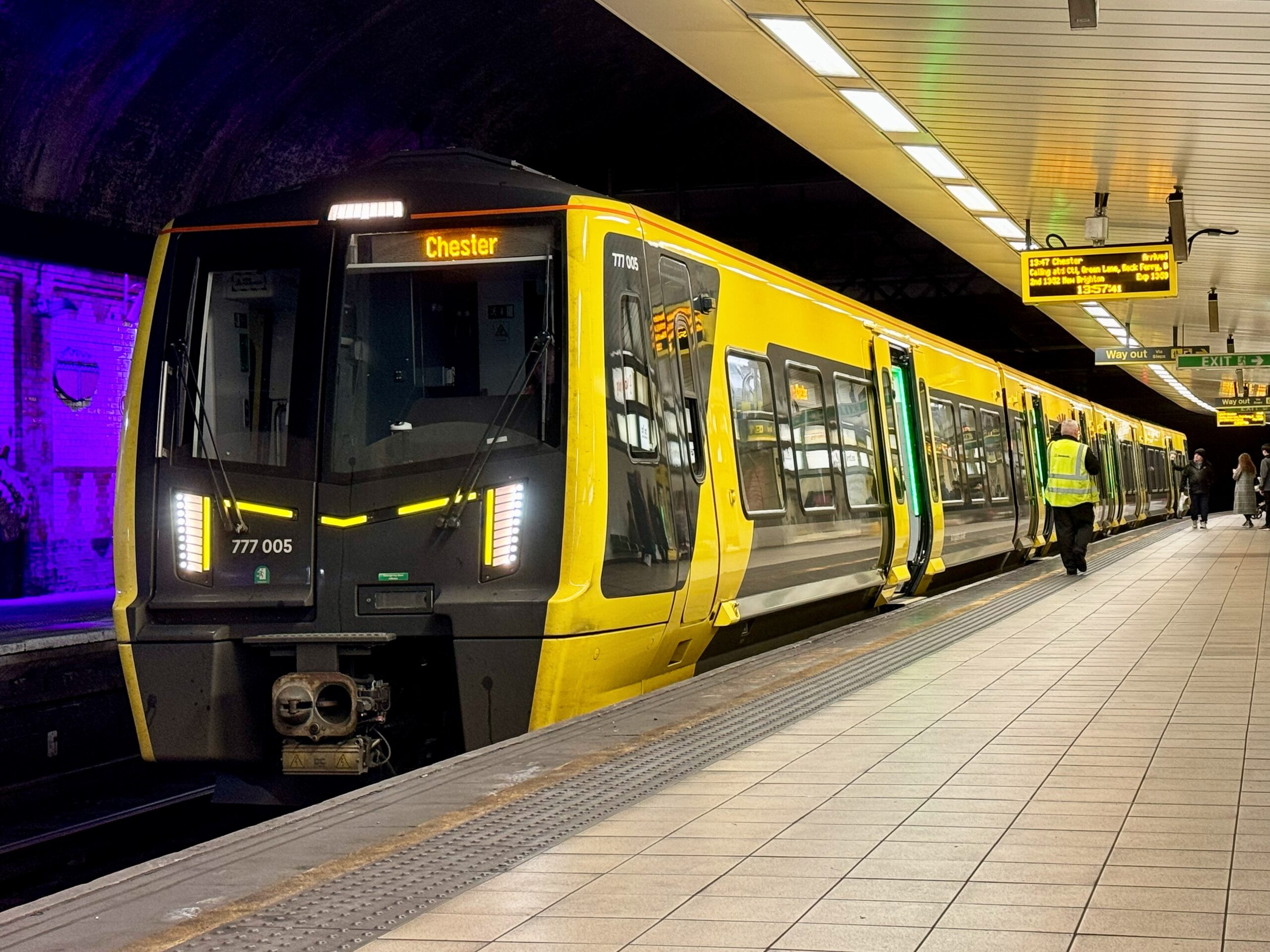
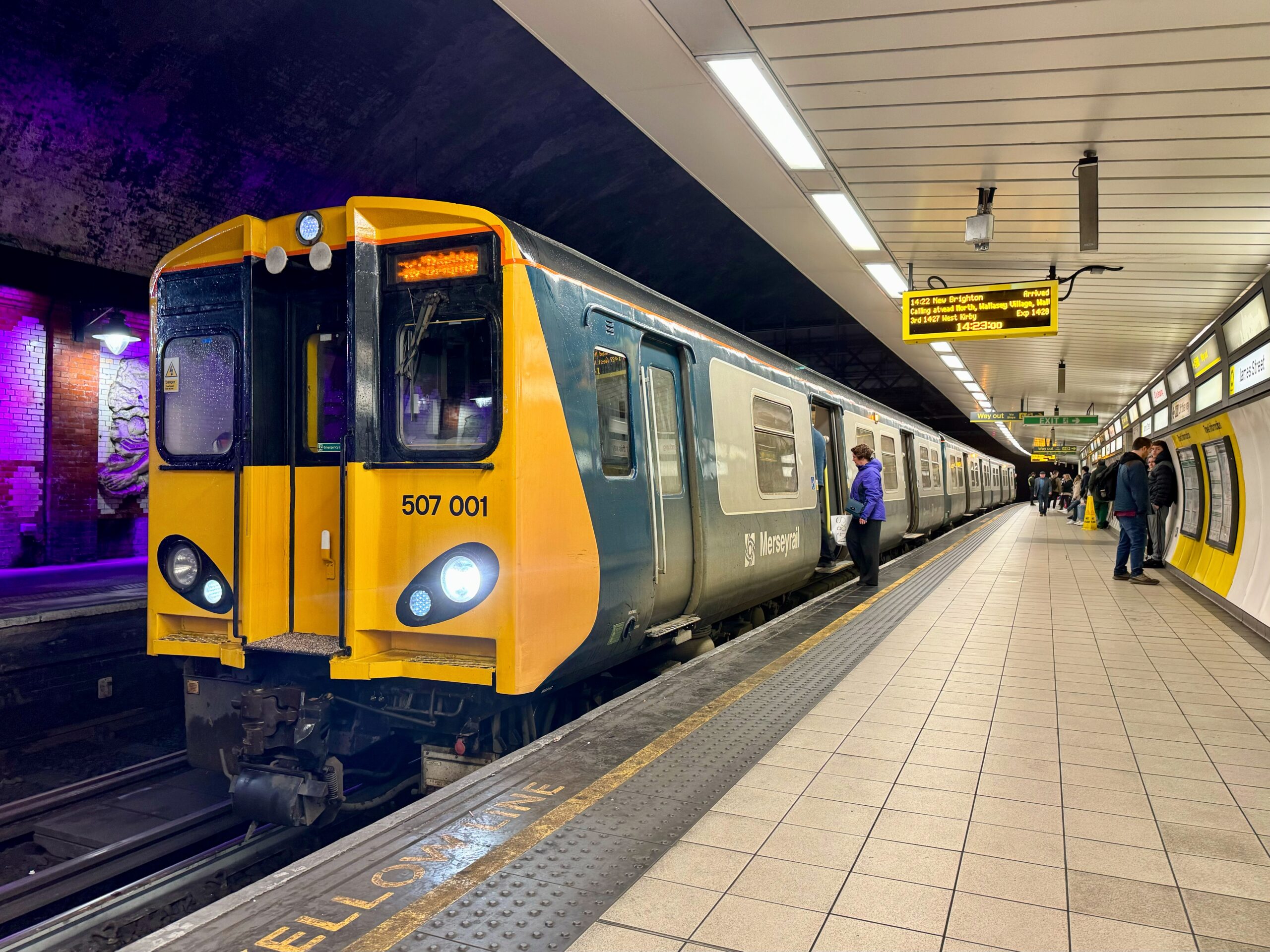
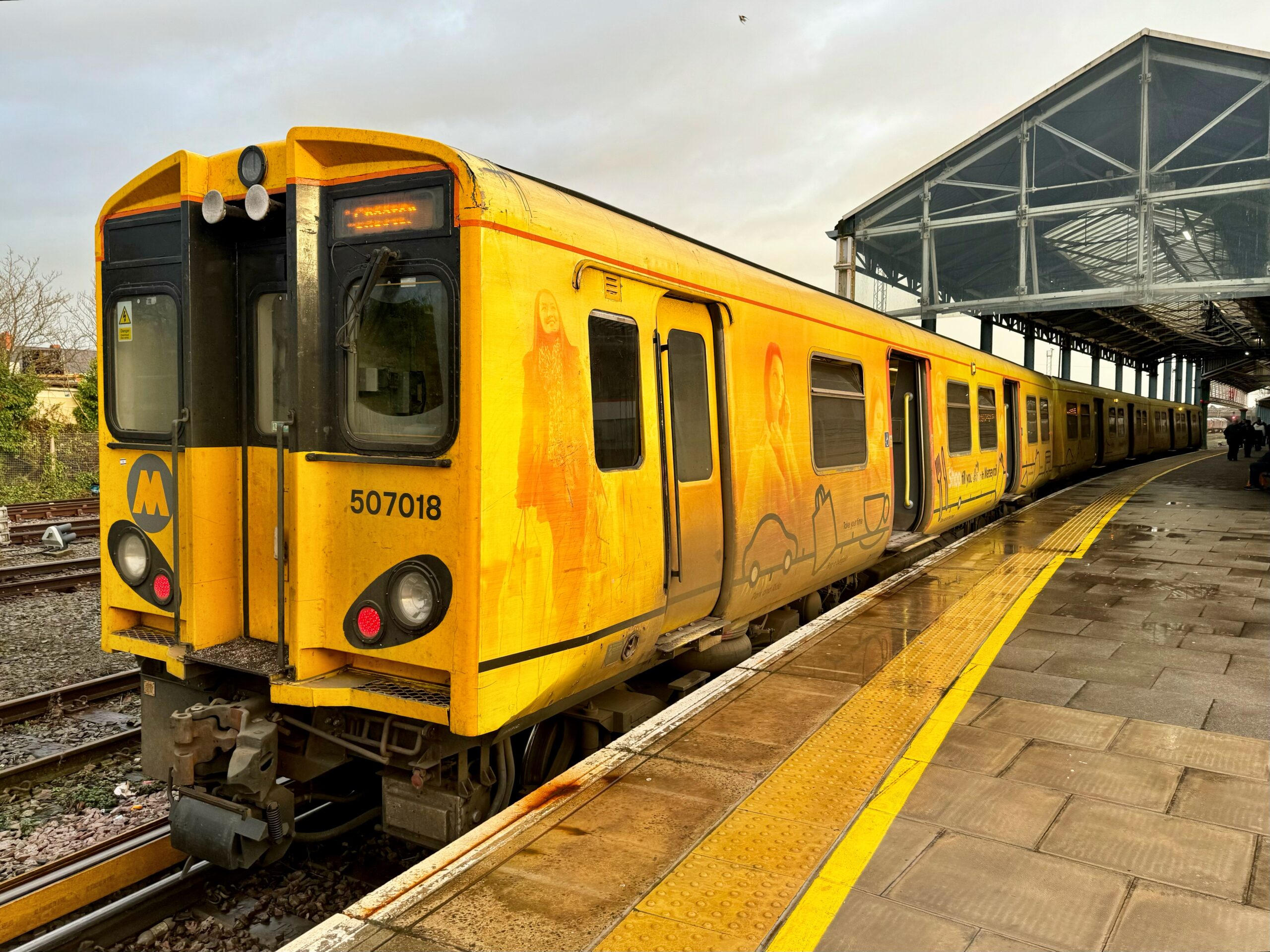
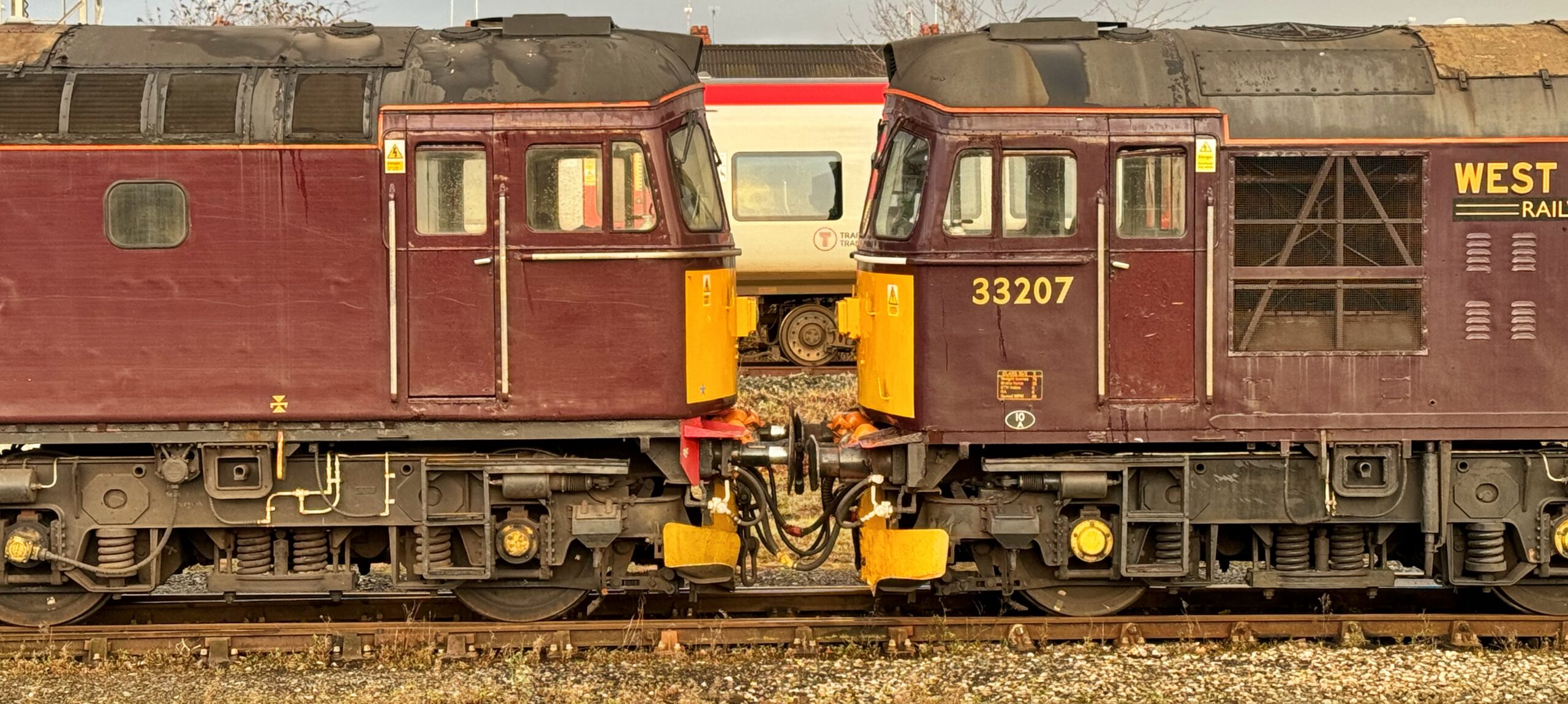
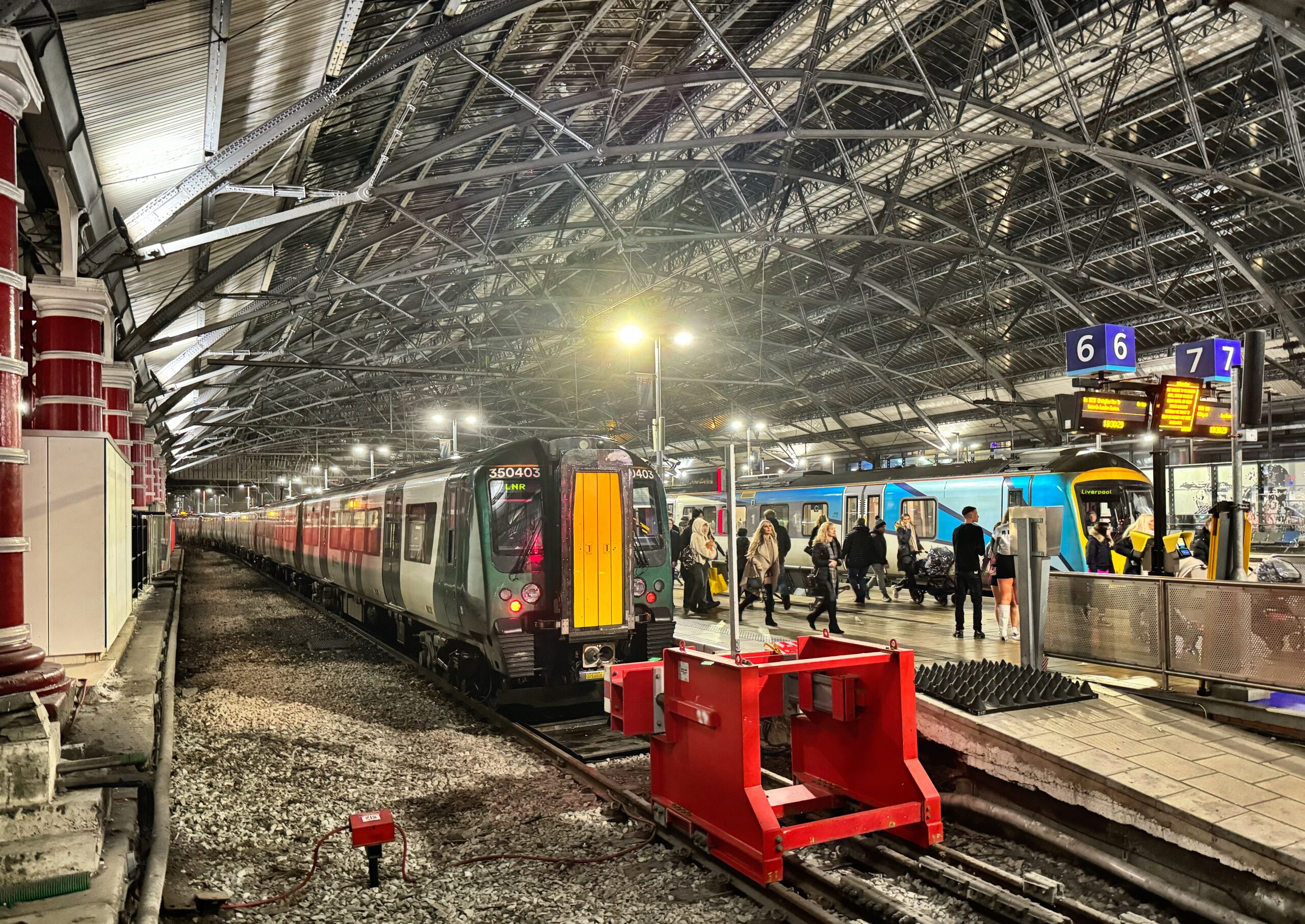
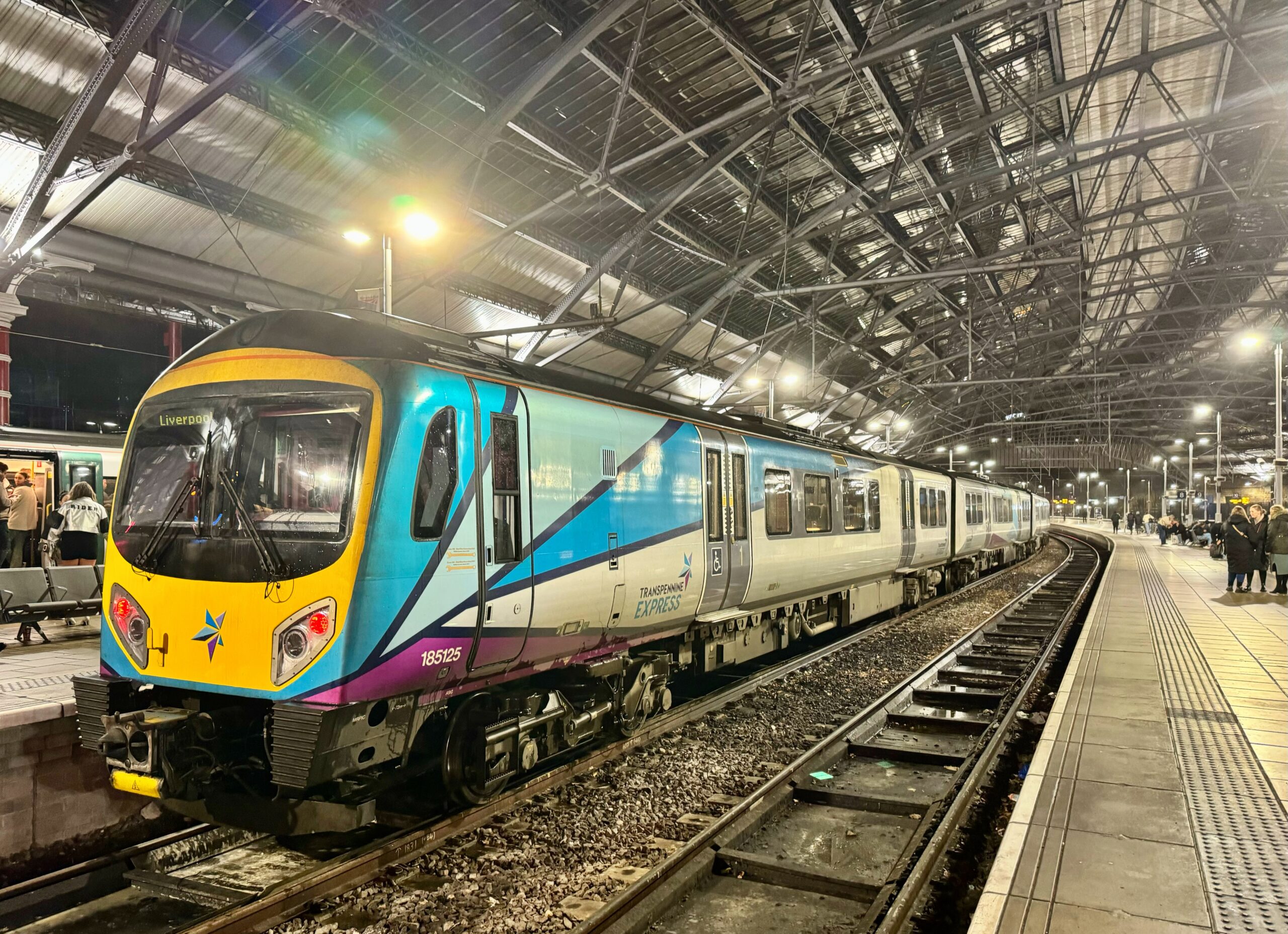
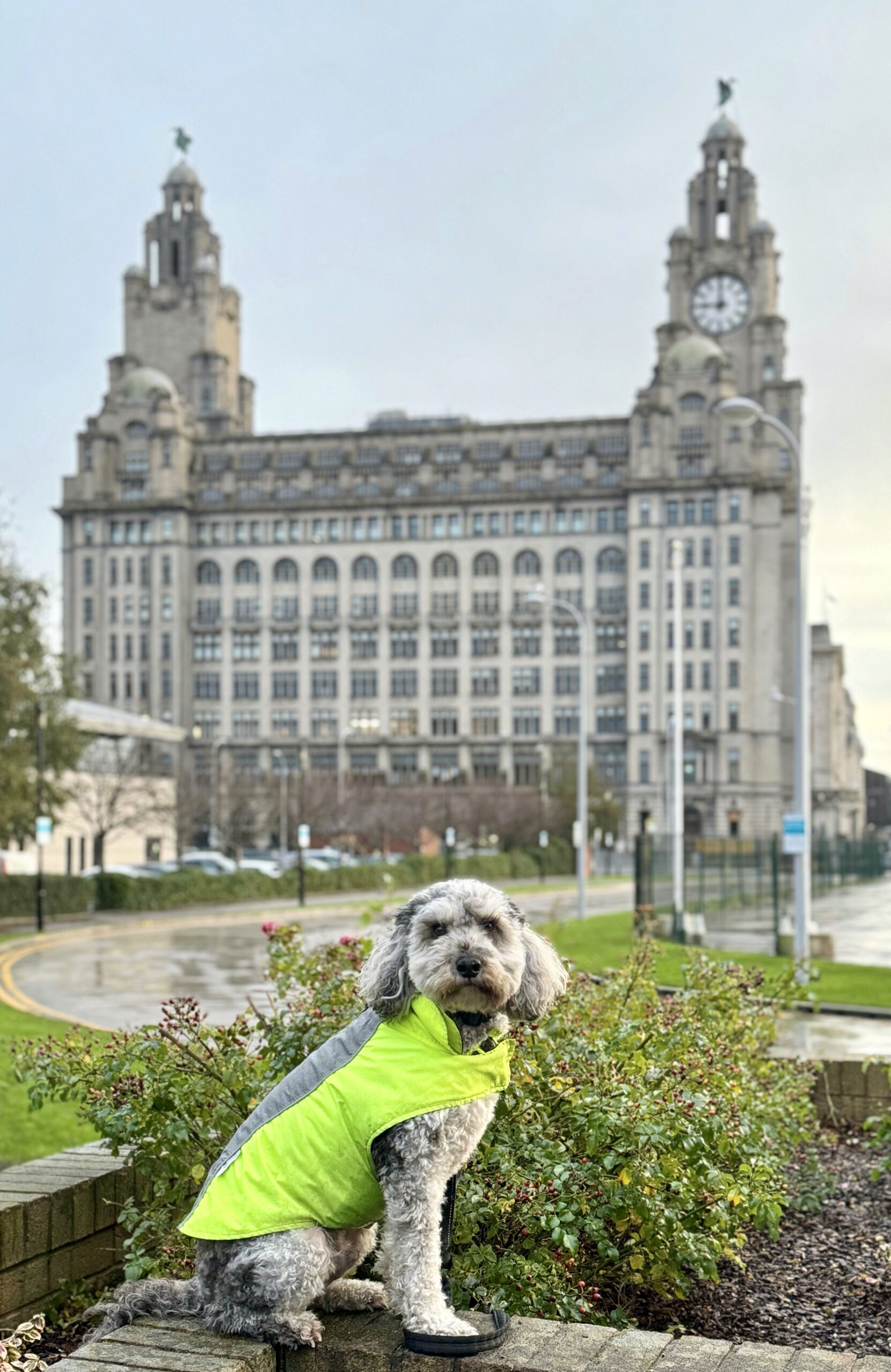
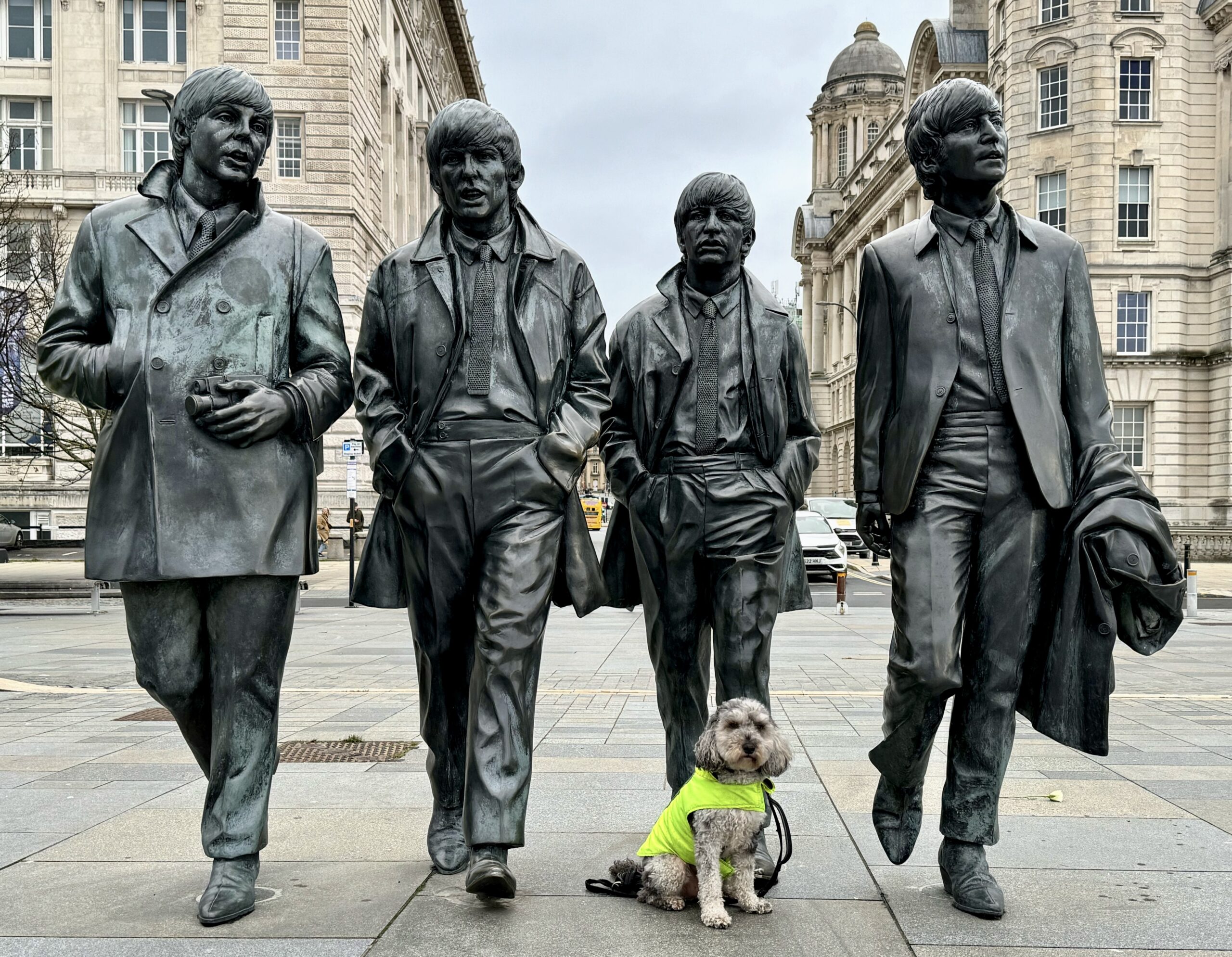
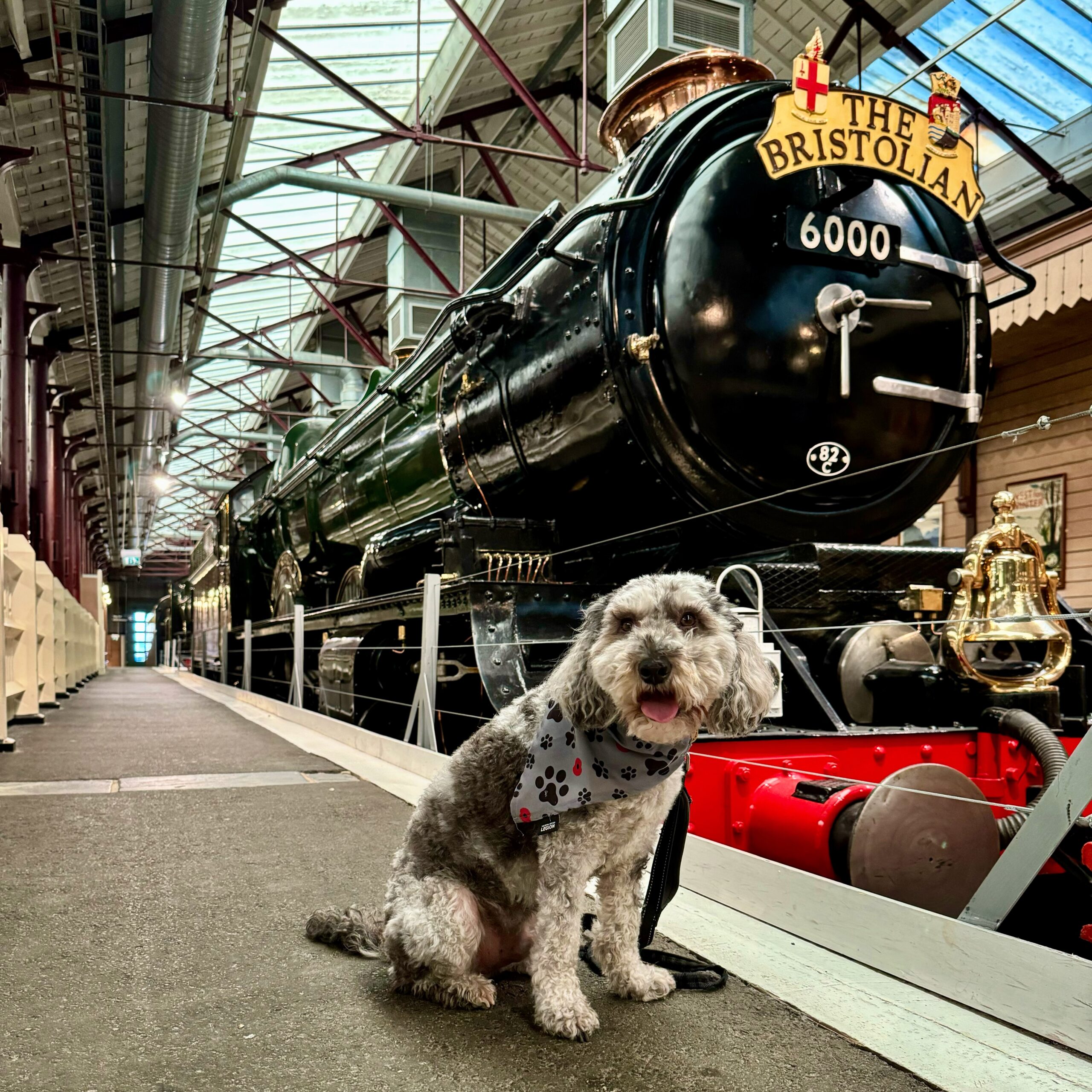
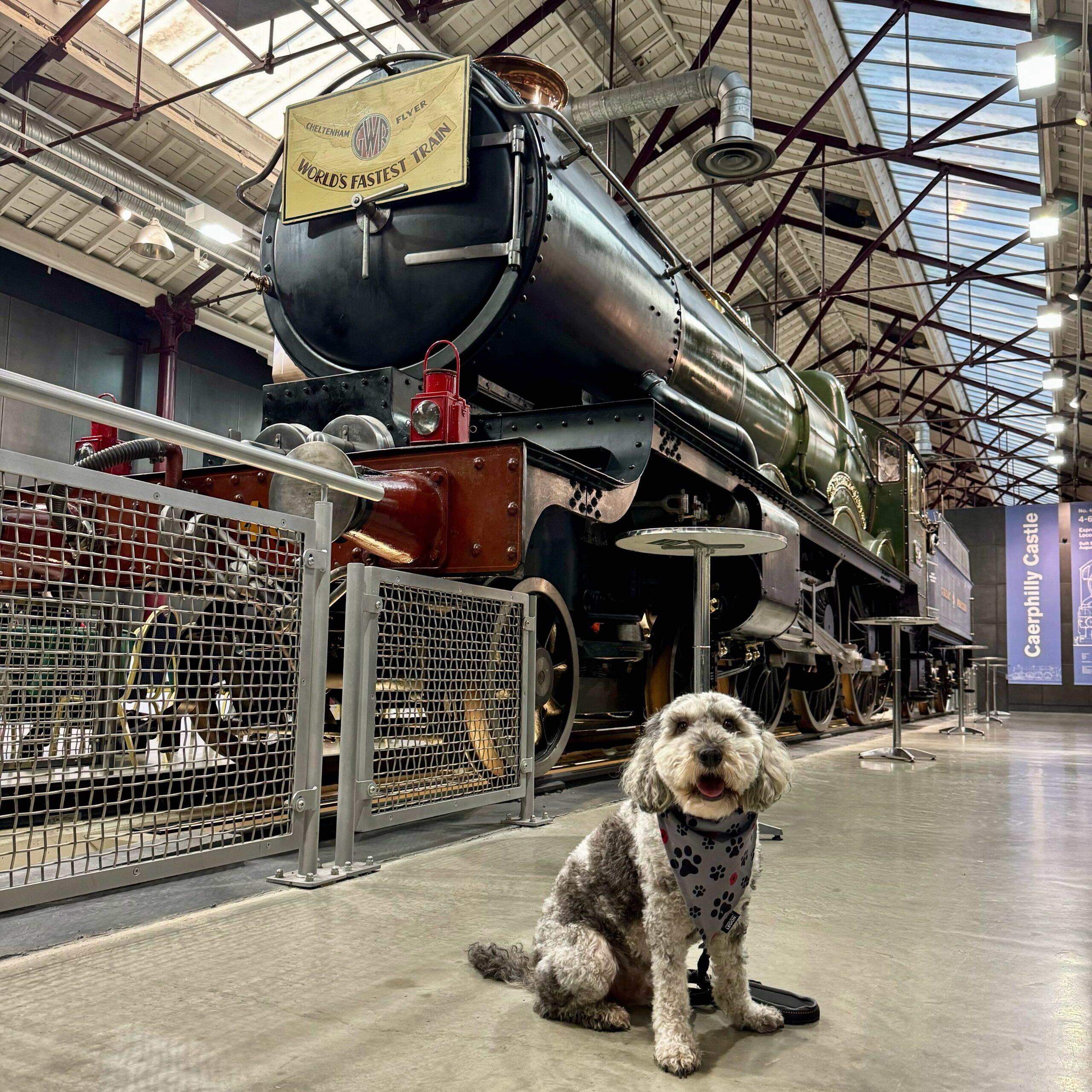
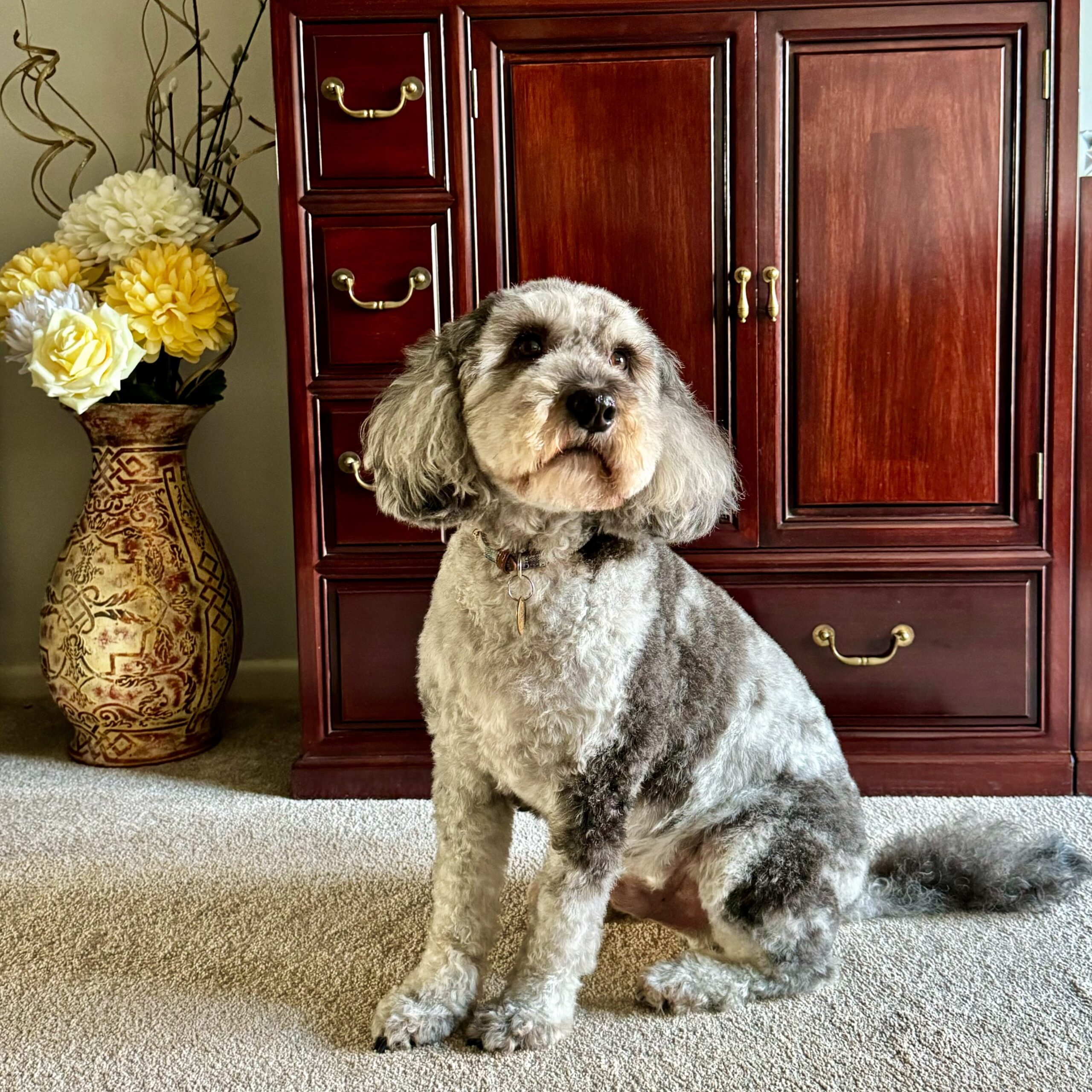
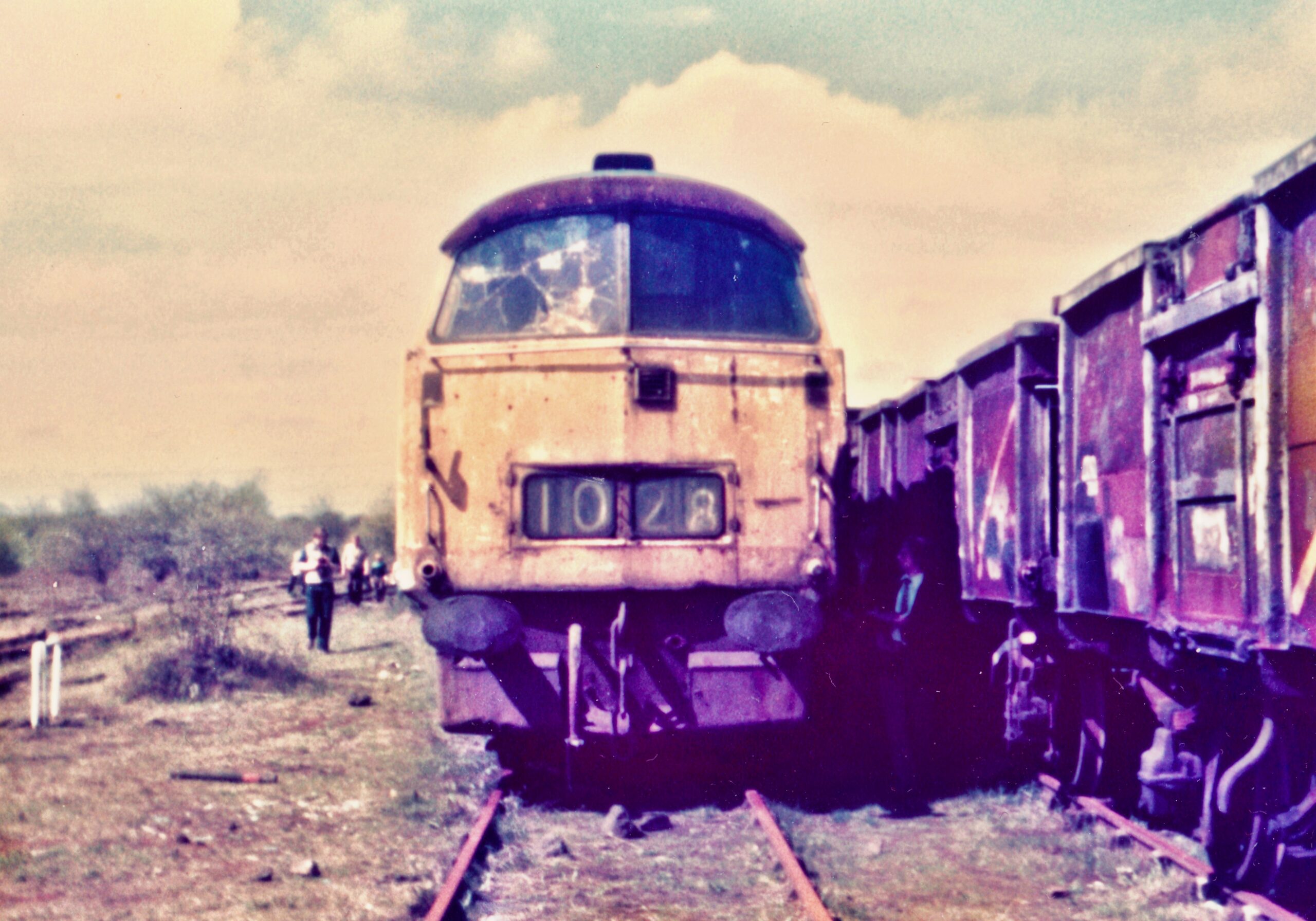
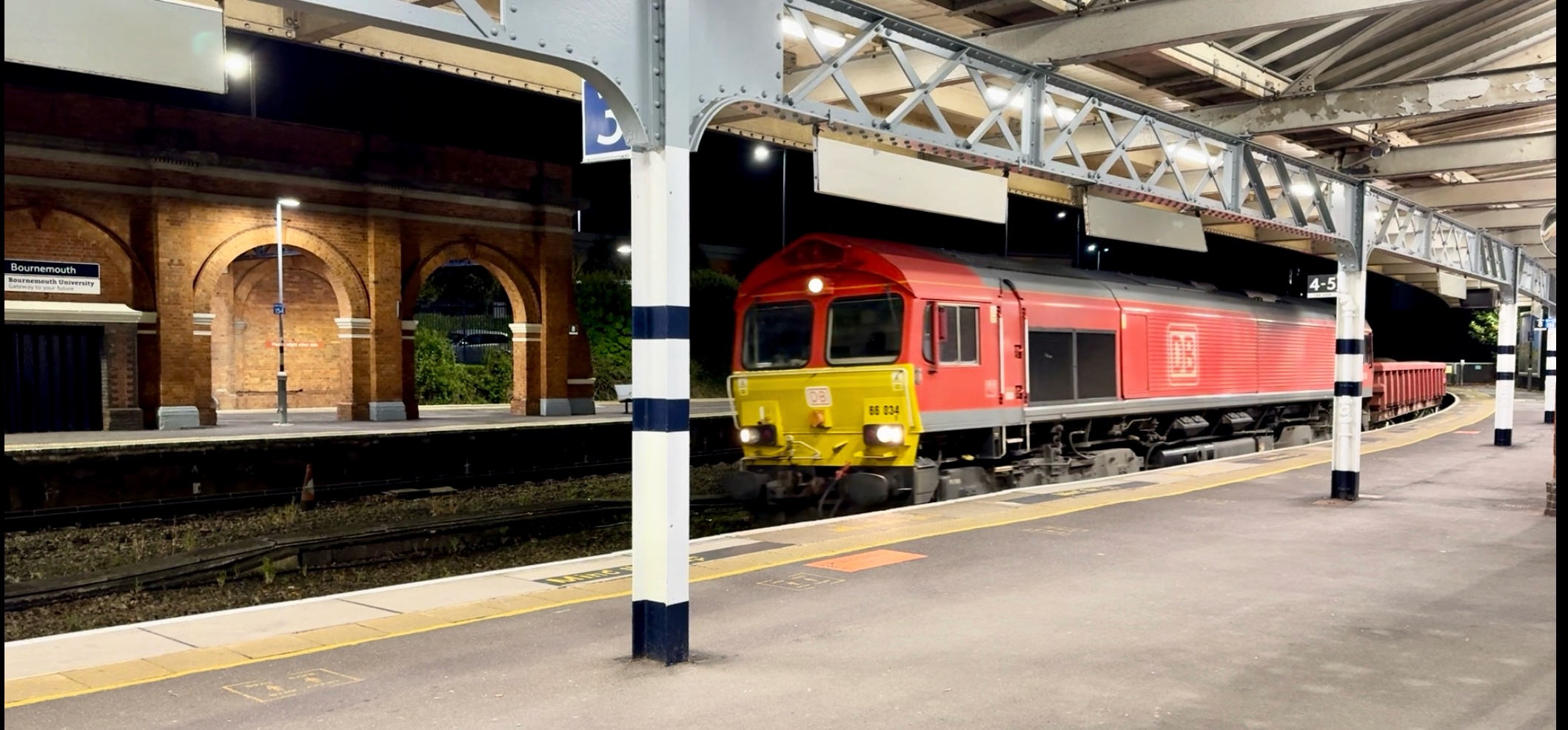
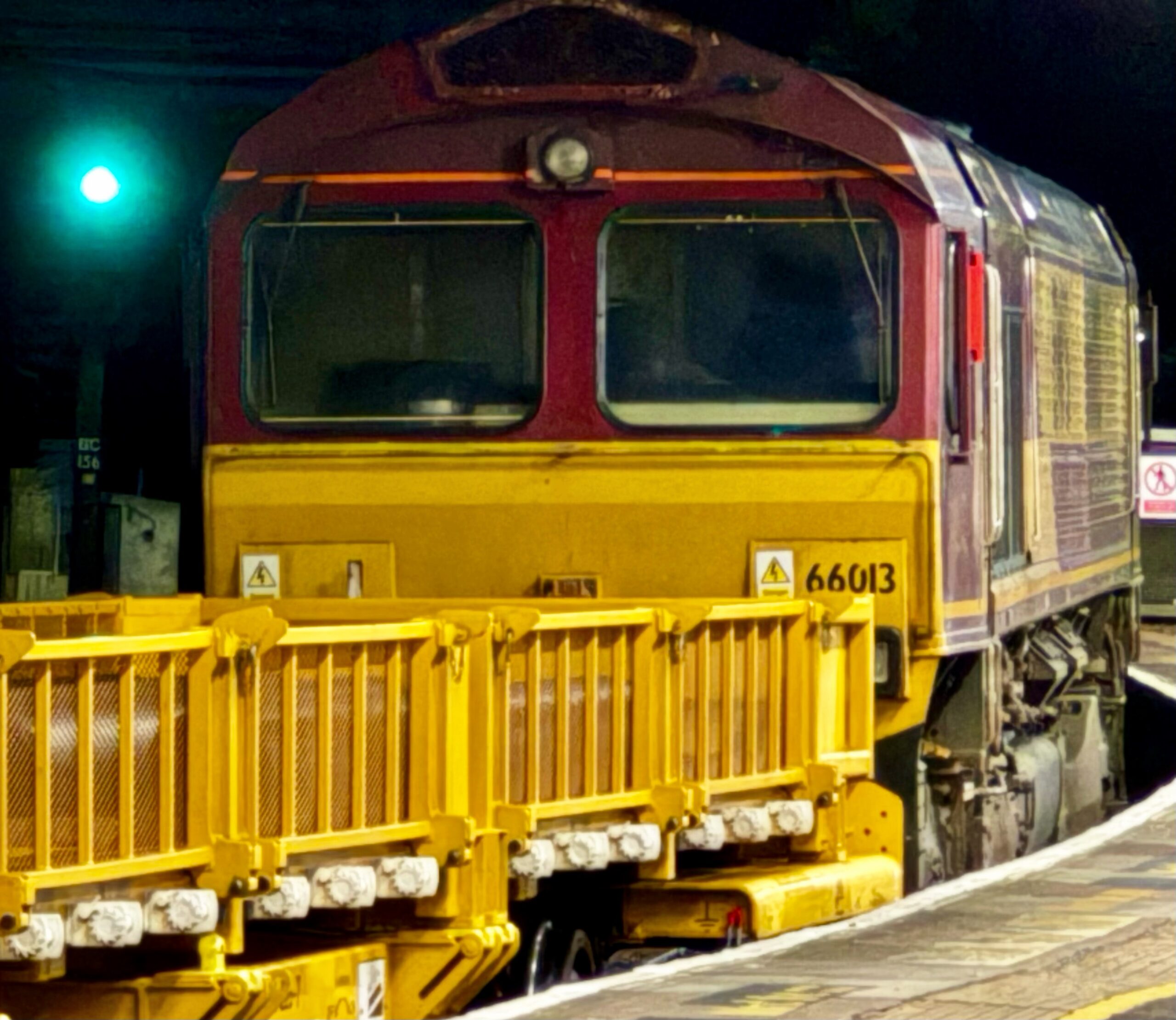
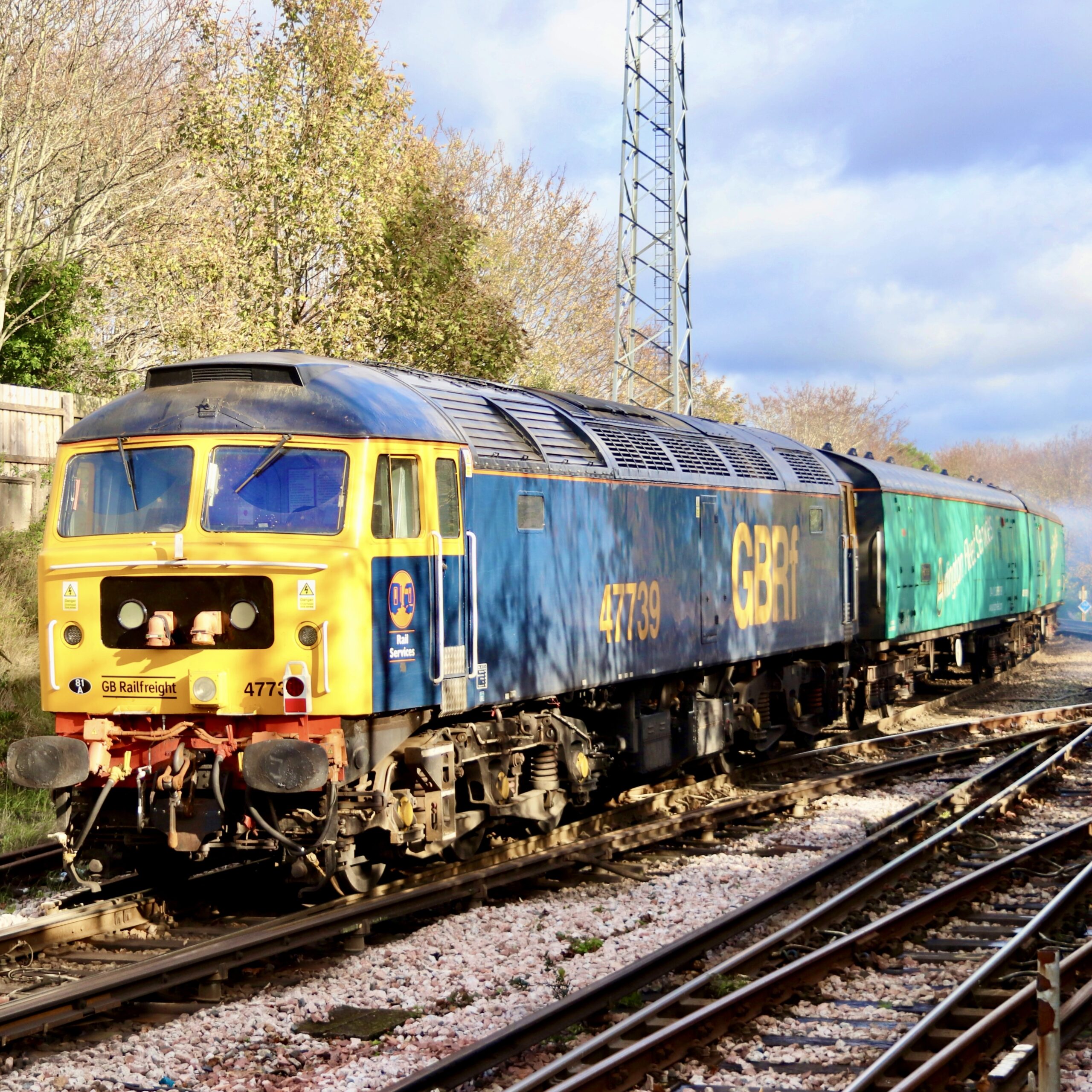
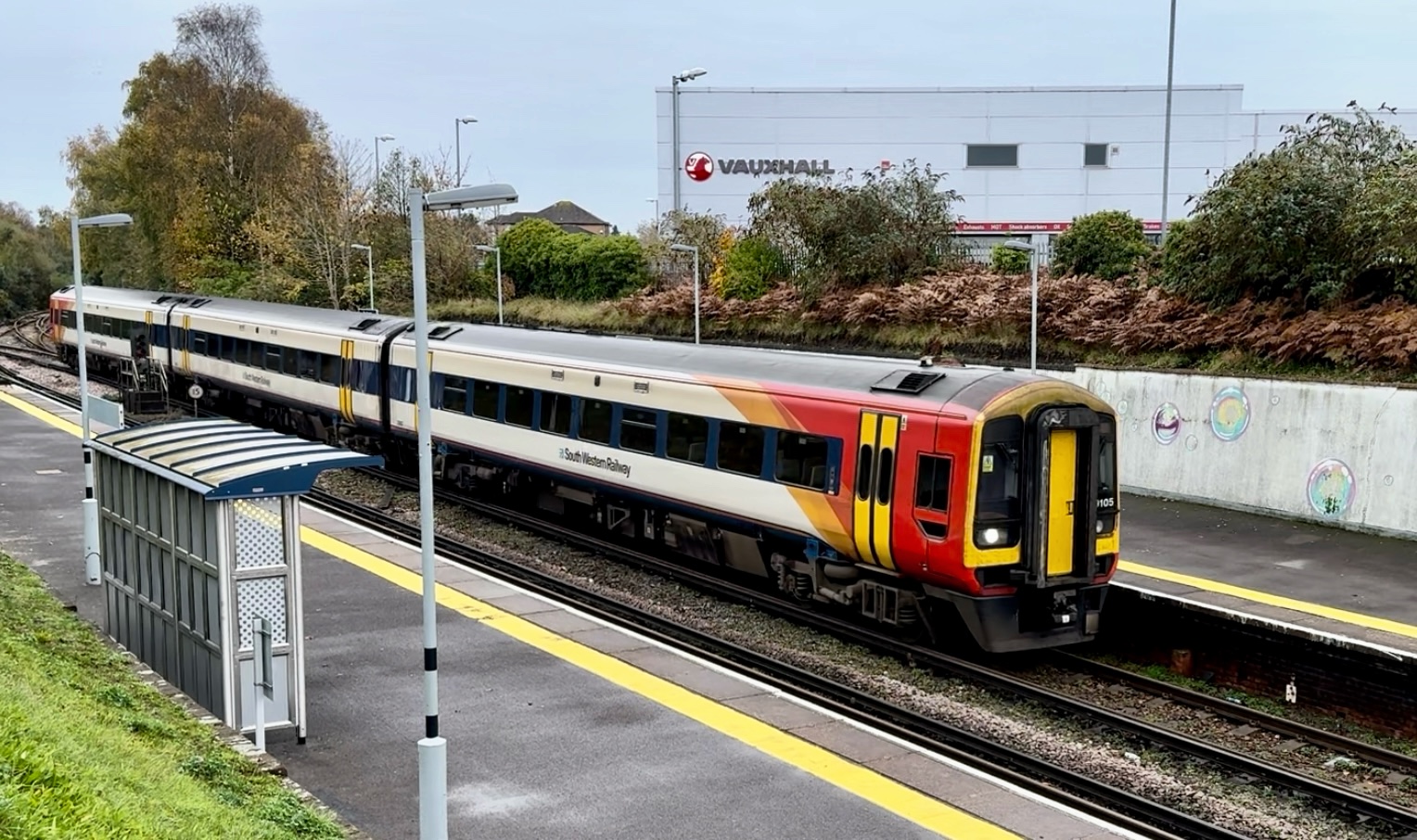
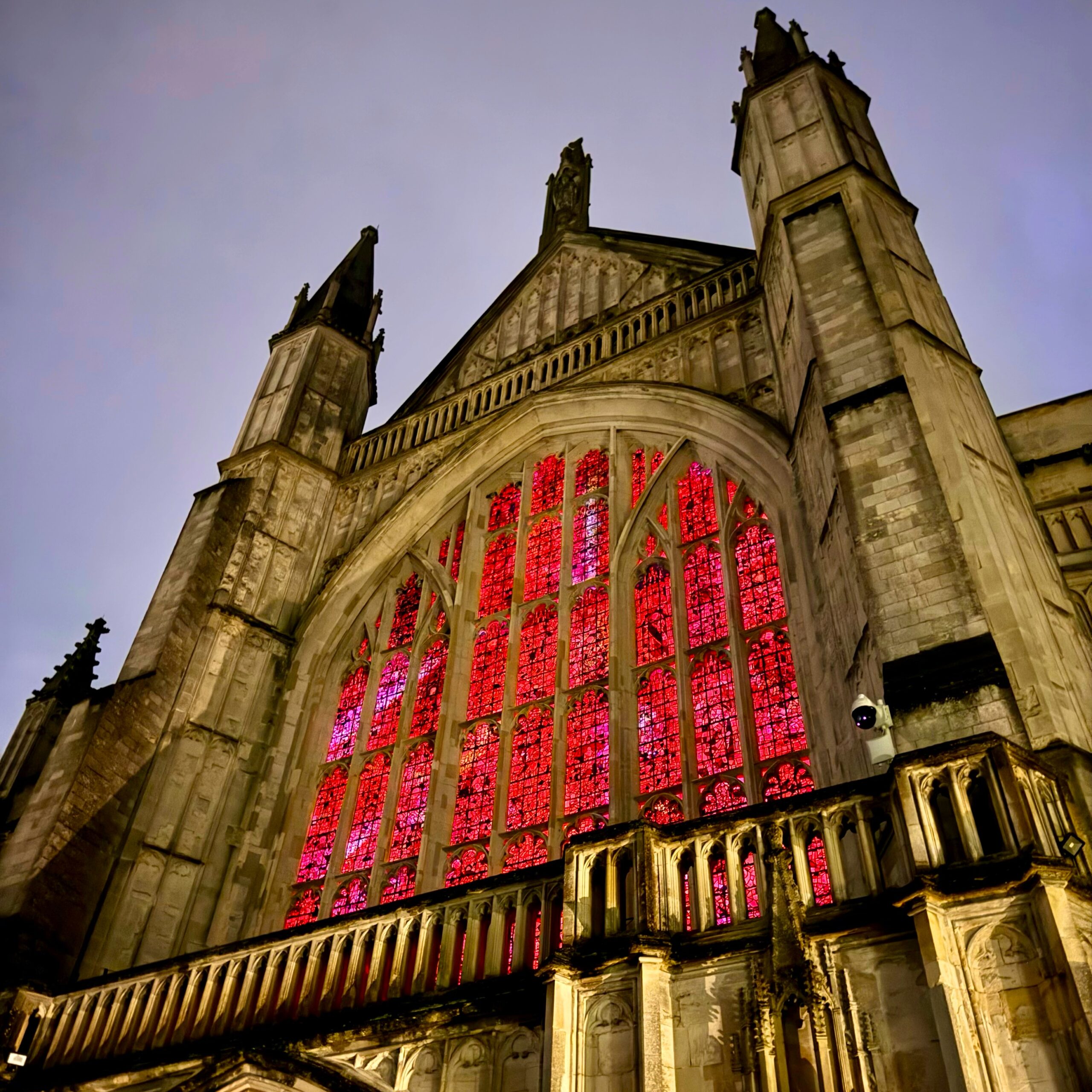
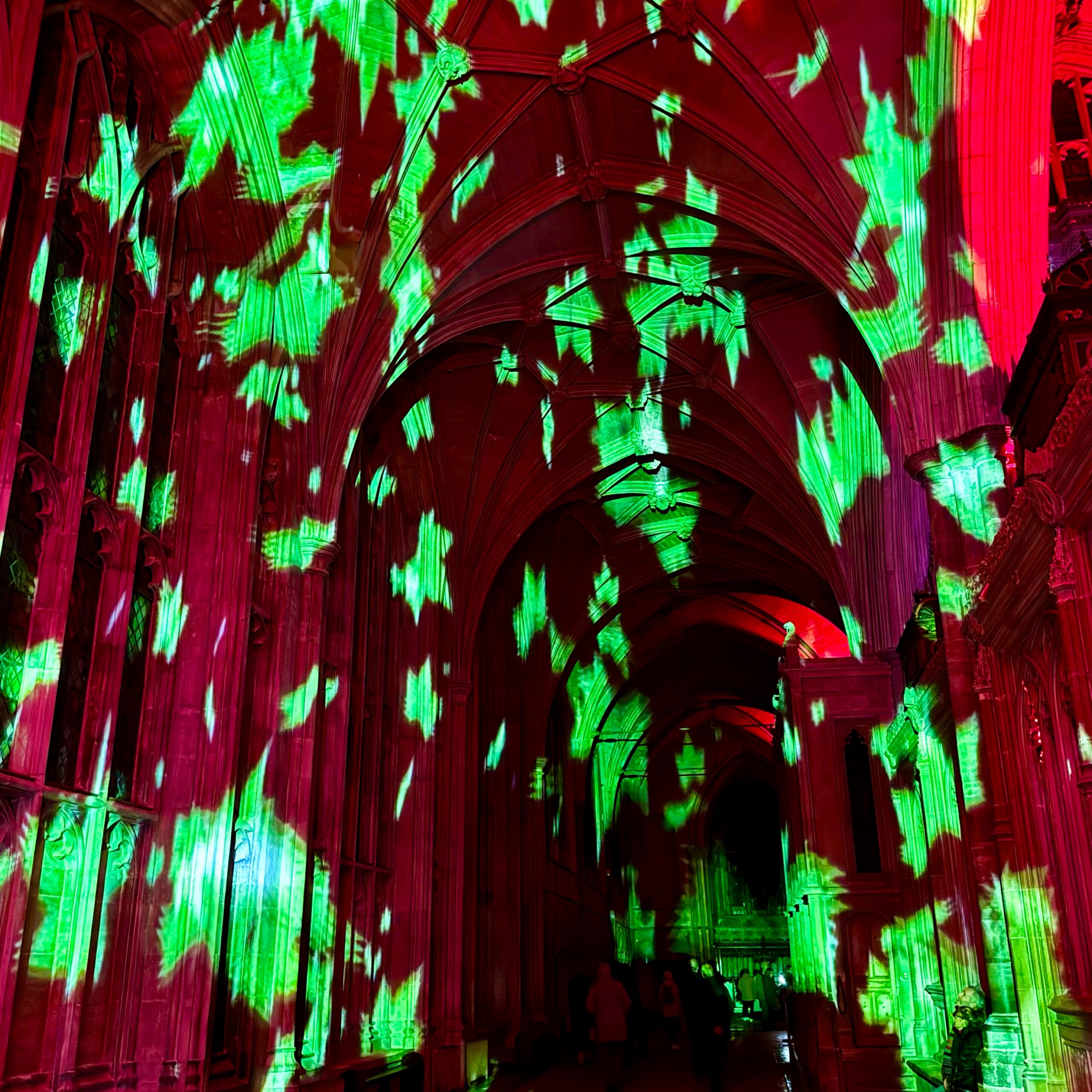
Yoshi celebrated his 5th birthday this week with lots of hugs and a new sweater – 12/01/2024
January 12th 2024 to January 19th 2024
Yoshi celebrated his 5th birthday on Friday January 12th 2024 – he posed for a few photographs so he could show off his new sweater (which would come in handy as temperatures plummeted over the course of the following week), cap and bandana. He didn’t really take to wearing the cap outside, so we put it away for another day. Lots of treats ensued.
Yoshi shows off his new sweater and cap on his 5th birthday – 12/01/2024
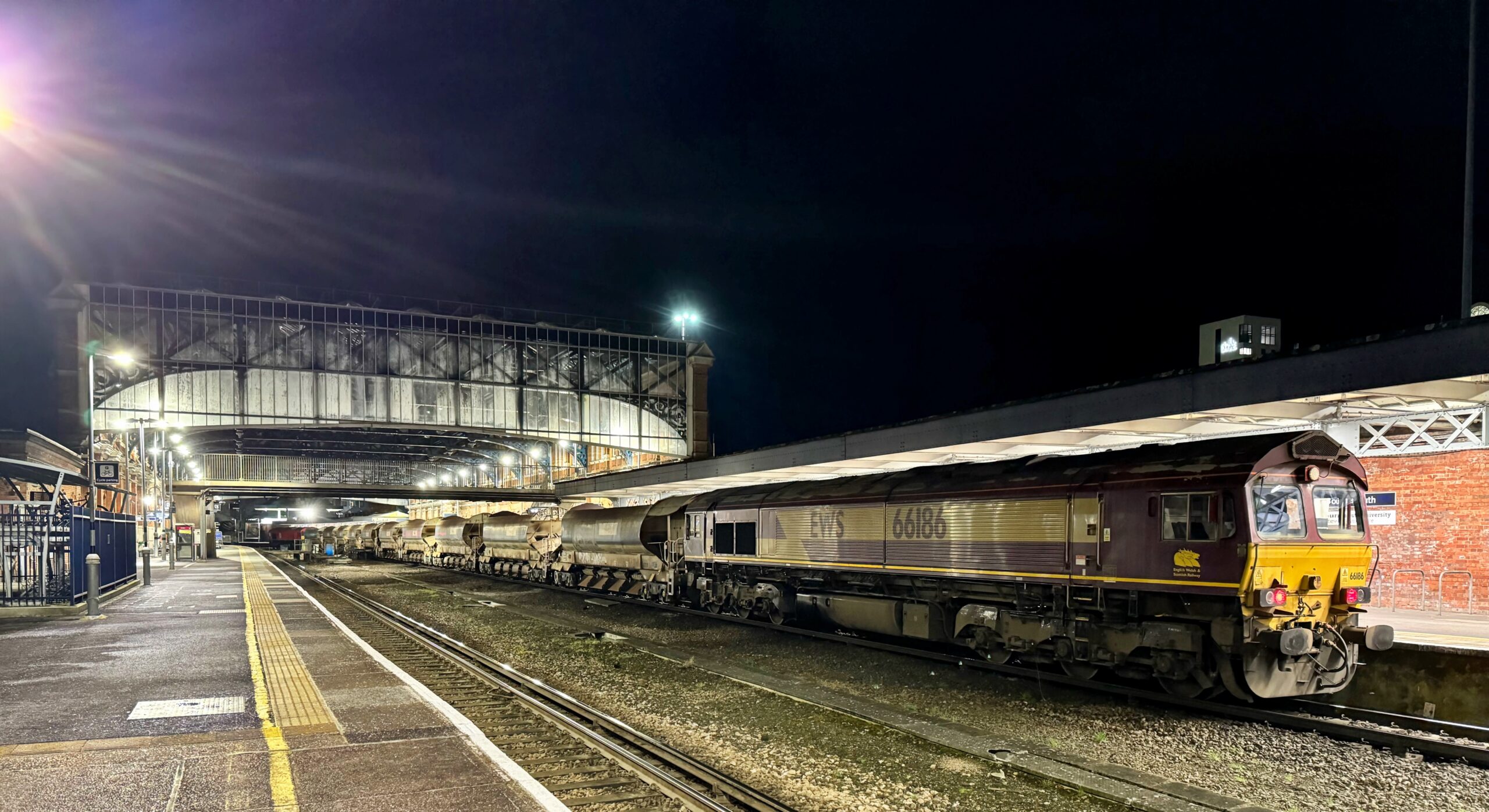
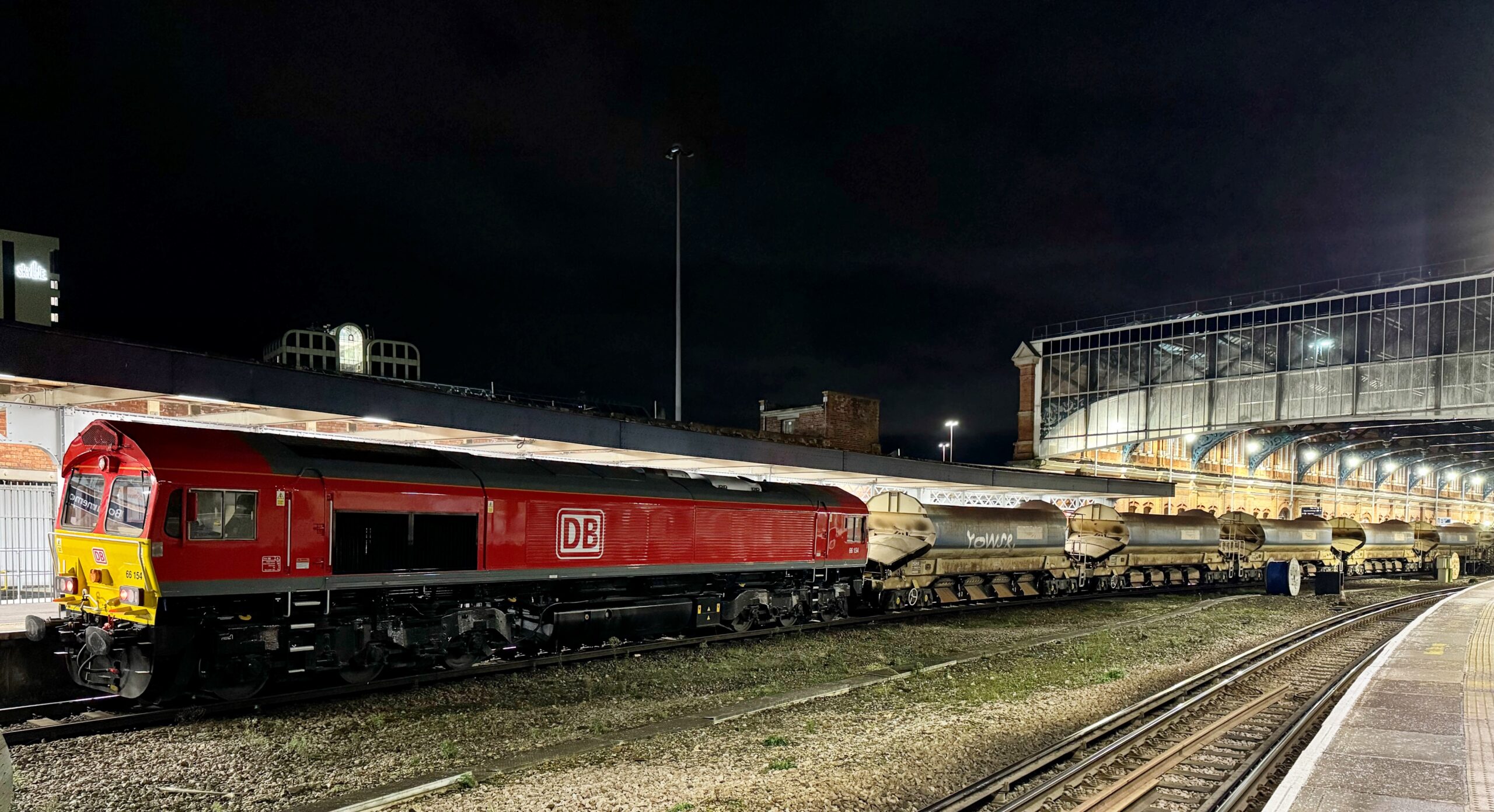
It has been a busy week or so in Dorset if, like me, you have a penchant for test and engineering trains. Yes, I’m late with this blog entry, yes, I’m obsessed with trains, and yes, I “enjoy” the solitude of a railway station platform at 0430 on a cold January morning with only the sound of waking birdsong, Network Rail staff opening gates to access the trackside and the distant call of a Class 66 locomotive tooting in the dark telegraphing its existence. This was my experience on the morning of Tuesday 16th January when I hauled myself out of bed in the early hours after a disturbed night because Yoshi had busied himself building a pillow fort as I tried to sleep. DB Cargo had two scheduled engineers trains running into Dorset on this day, one in the morning and one in the late evening – both in connection with engineering works around the Hinton Admiral, Hampshire area. The trains were scheduled to run from Eastleigh East Yard and reverse at Bournemouth before heading back in the direction they had come. Both trains employed the same locomotives, Class 66 No.’s 66154 and 66186.
DB Cargo Class 66 No. 66186 powers through Christchurch at the head of 6N60 0455 Christchurch to Eastleigh East Yard – 16/01/2024Having reversed at Bournemouth, 6N60 0455 Christchurch to Eastleigh East Yard is now in the charge of DB Cargo Class 66 No. 66154 which is seen heading back through Christchurch – 16/01/2024DB Cargo Class 66 No. 66186 having arrived at Bournemouth with 6N65 2304 Eastleigh East Yard to Hinton Admiral – 16/01/2024The driver of DB Cargo Class 66 No. 66154 prepares to depart Bournemouth with 6N65 2304 Eastleigh East Yard to Hinton Admiral – 16/01/2024
Video of DB Cargo engineers train workings 6N60 0455 Christchurch to Eastleigh East Yard at Christchurch and 6N65 2304 Eastleigh East Yard to Hinton Admiral at Bournemouth featuring Class 66 No.’s 66186 and 66154 – 16/01/2024
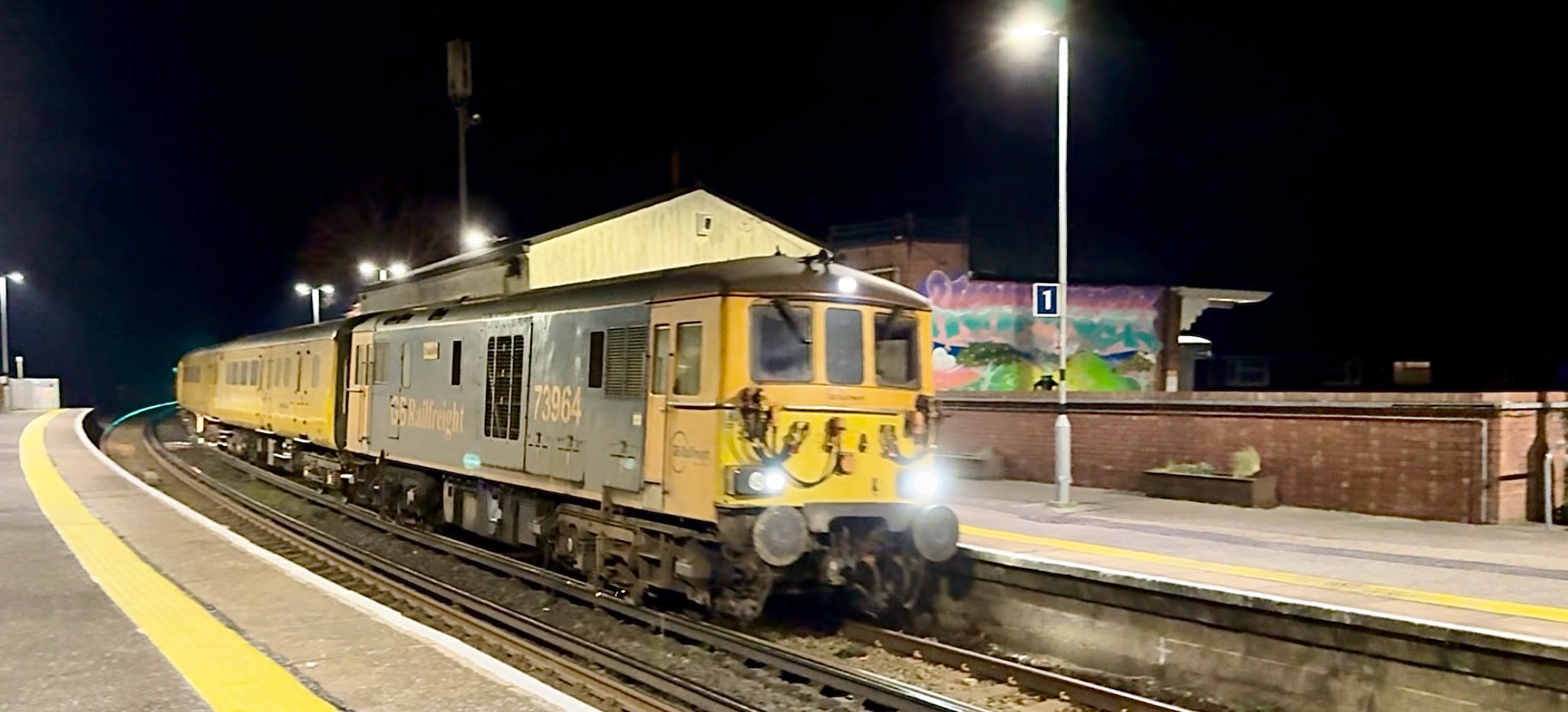
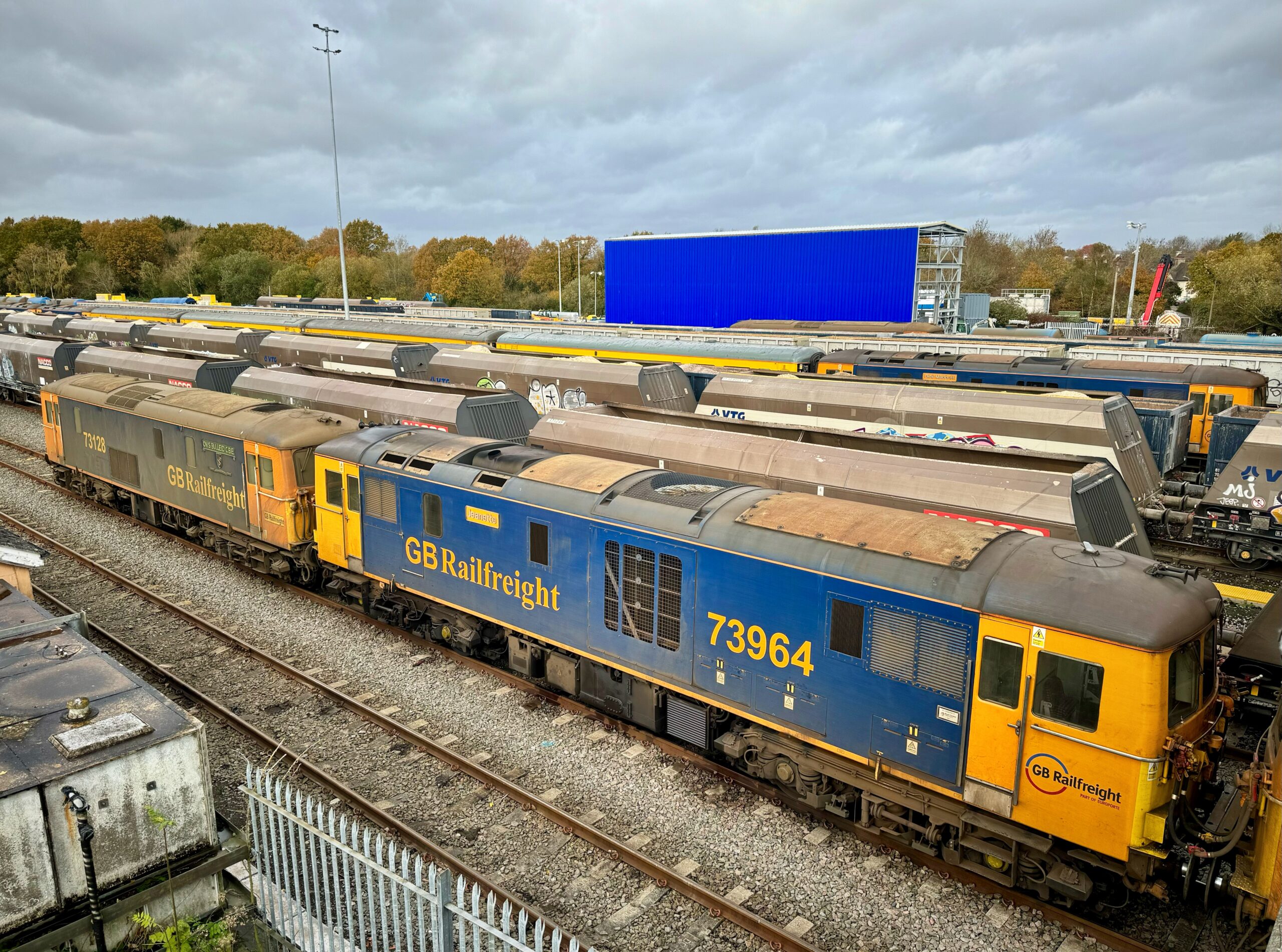
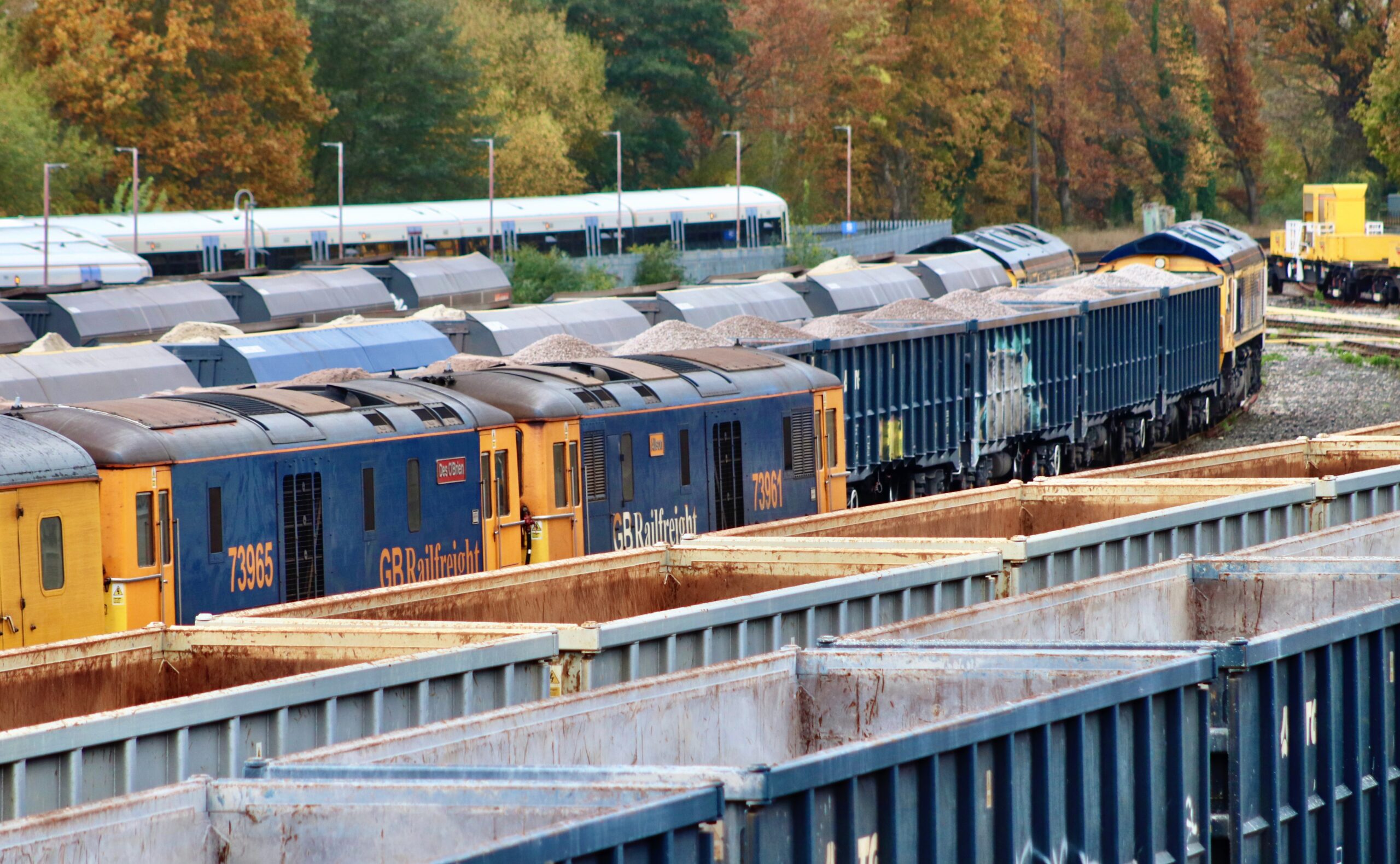
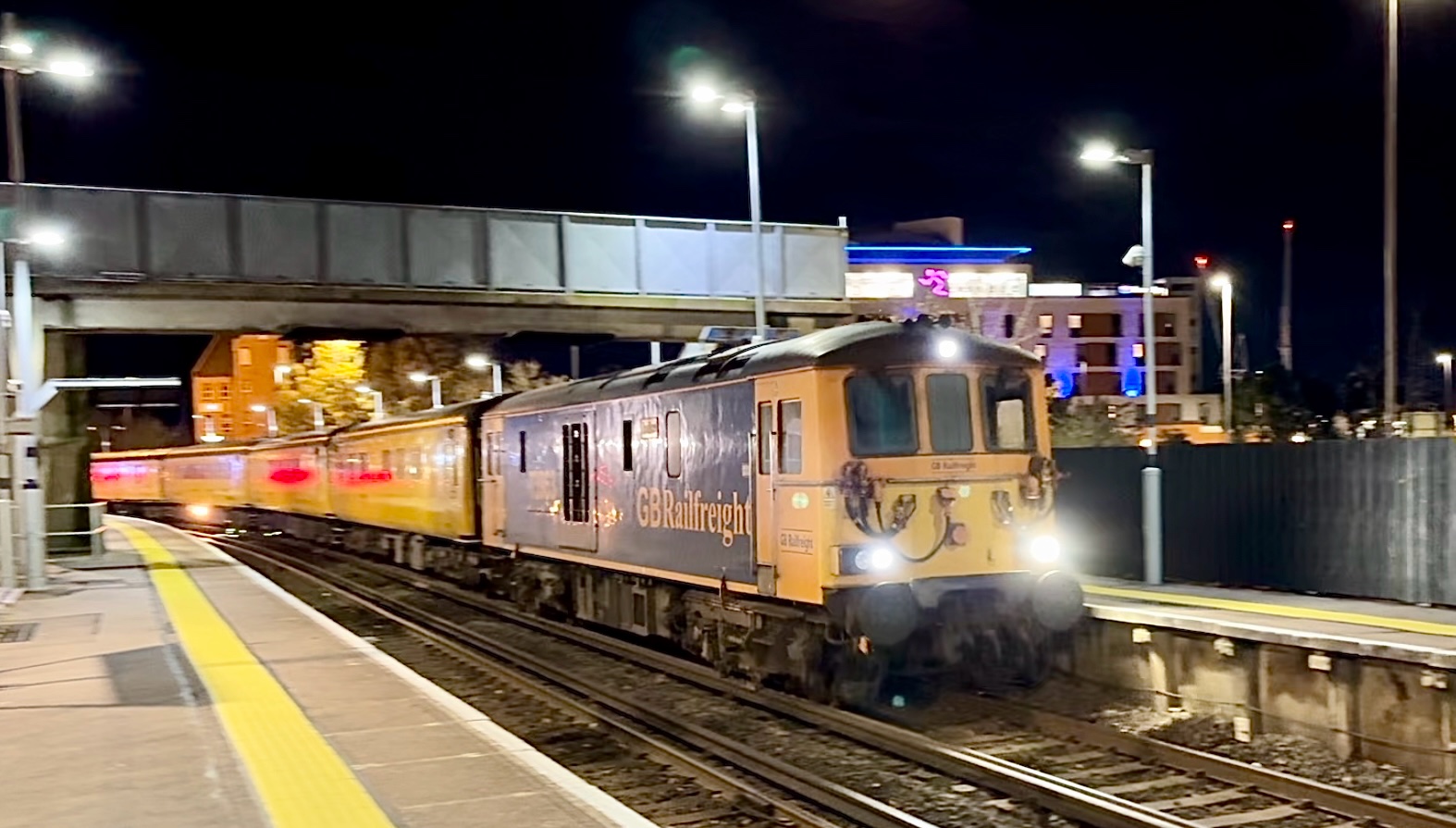
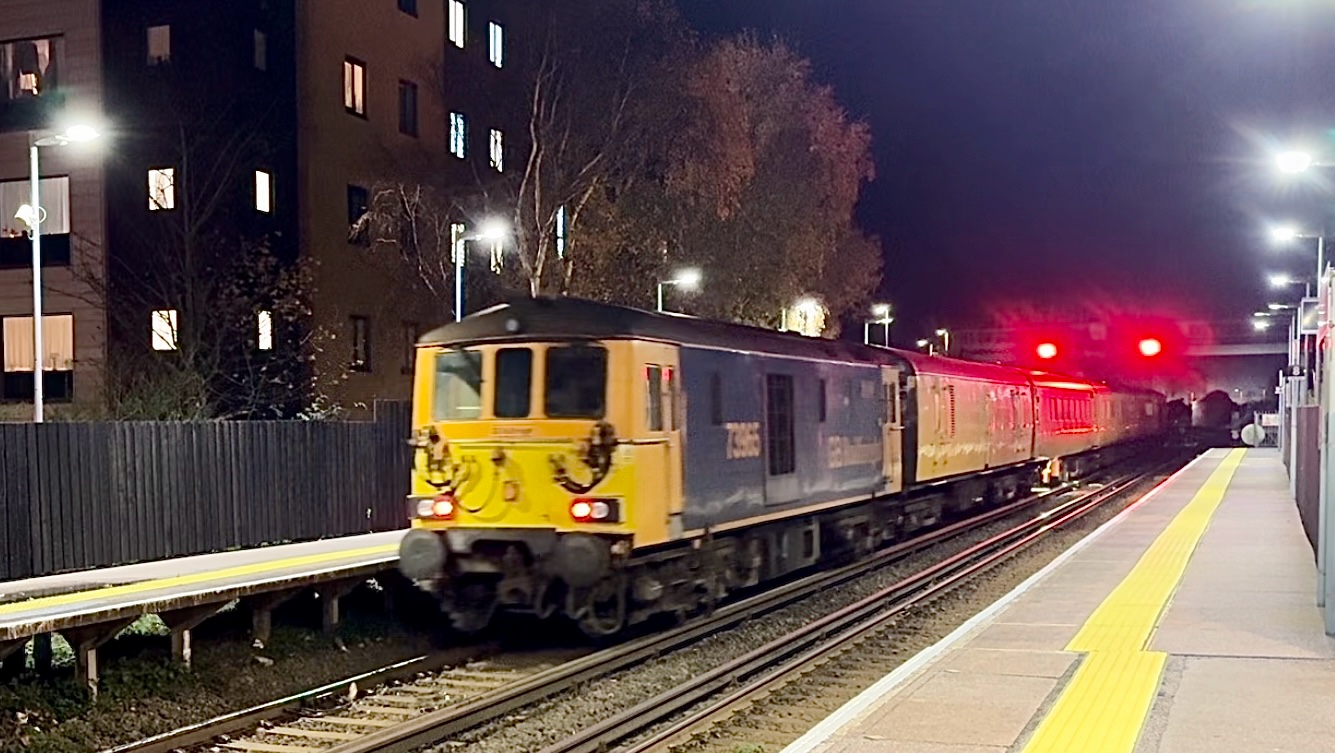
Monday 15th January and we welcomed the usual monthly Colas test train worked by a pair of GB Railfreight (GBRf) Class 73 Electro-Diesel locomotives. This time around No.’s 73965 ‘Des O’Brien’ and 73964 ‘Jeanette’ graced us with their presence top and tailing 1Q51 1115 Derby R.T.C.(Network Rail) to Eastleigh East Yard via Weymouth.
GBRf Class 73 No. 73965 ‘Des O’Brien’ leading on 1Q51 1115 Derby R.T.C.(Network Rail) to Eastleigh East Yard at Poole passing SWR Class 444 444023 which had arrived with 1B57 1835 London Waterloo to Poole service – 15/01/2024GBRf Class 73 No. 73964 ‘Jeanette’ heads up the return 1Q51 1115 Derby R.T.C.(Network Rail) to Eastleigh East Yard through Hamworthy – 15/01/2024
Video of GBRf Class 73 electro-diesels No.’s 73965 ‘Des O’Brien’ and 73964 ‘Jeanette’ top and tailing 1Q51 1115 Derby R.T.C.(Network Rail) to Eastleigh East Yard – 15/01/2024
As I’ve mentioned numerous times previously, I have a short list of railway traction I would like to photograph. This can be because of a name carried by the locomotive or vehicle in question or perhaps a special livery variation. One GBRf Class 66 I’ve been keeping tabs on of late is No. 66756 ‘Royal Corps Of Signals’. The loco was out of sight on Doncaster Roberts Road depot in Doncaster, a stones throw from the Morrison’s petrol station I visited to refuel the car as we drove to Scarborough last month and seemed to spend a good deal of time rostered on duties in the North of the country. However, during January, No. 66756 found its way down south and eventually ended up at Eastleigh. Seeing online that she was stabled on Eastleigh East Yard on Saturday morning of the 13th January, Yoshi and I ventured over the border to Hampshire in the hope that this time the locomotive would be visible from a public space. Suffice to say, we were unable to see just where the loco had been parked, and we left without accomplishing our mission. It wasn’t a totally wasted journey however, as we took the opportunity to take some photos at Eastleigh and then stop off and take a look at Freightliner Southampton Maritime via a short break at St Denys.
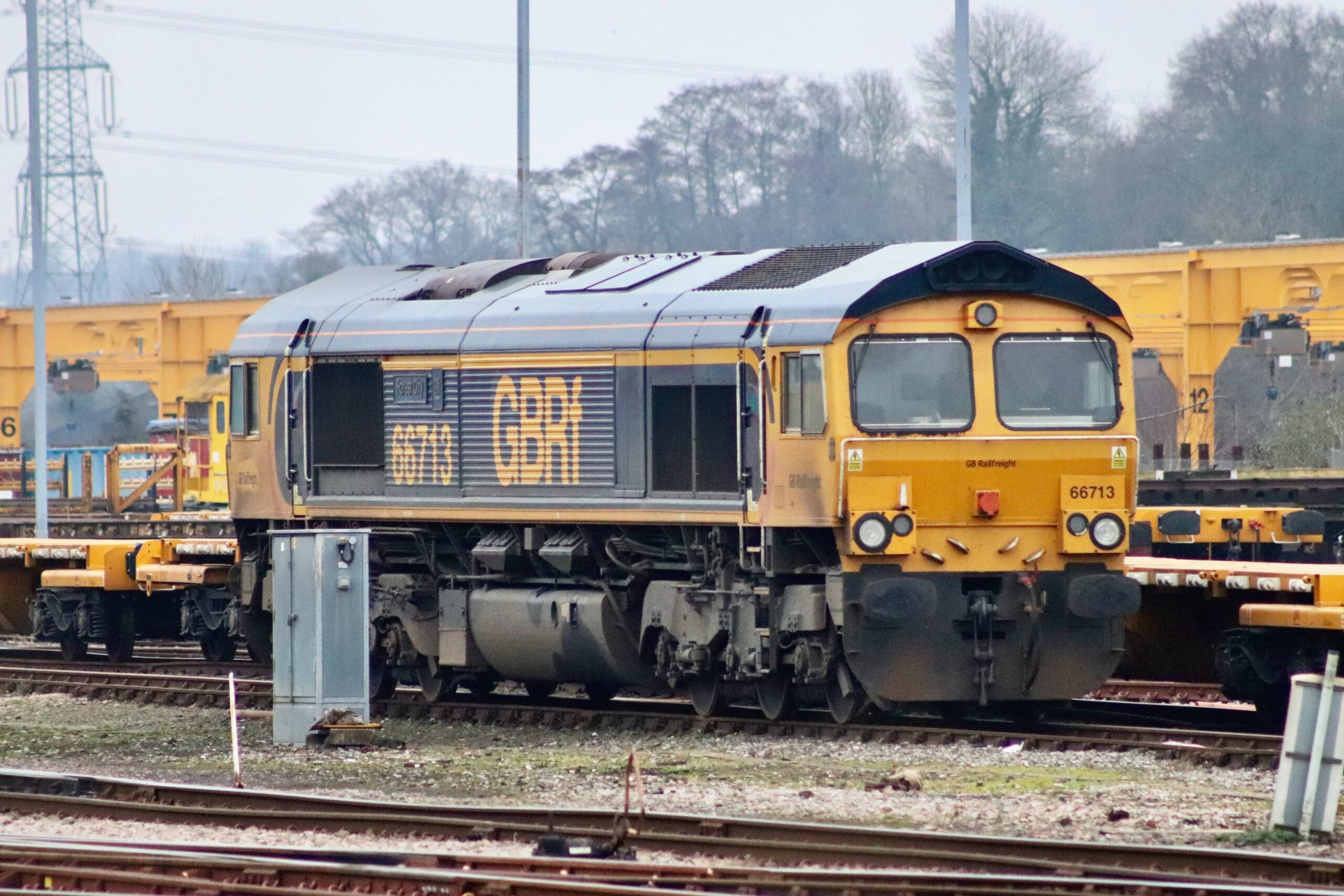
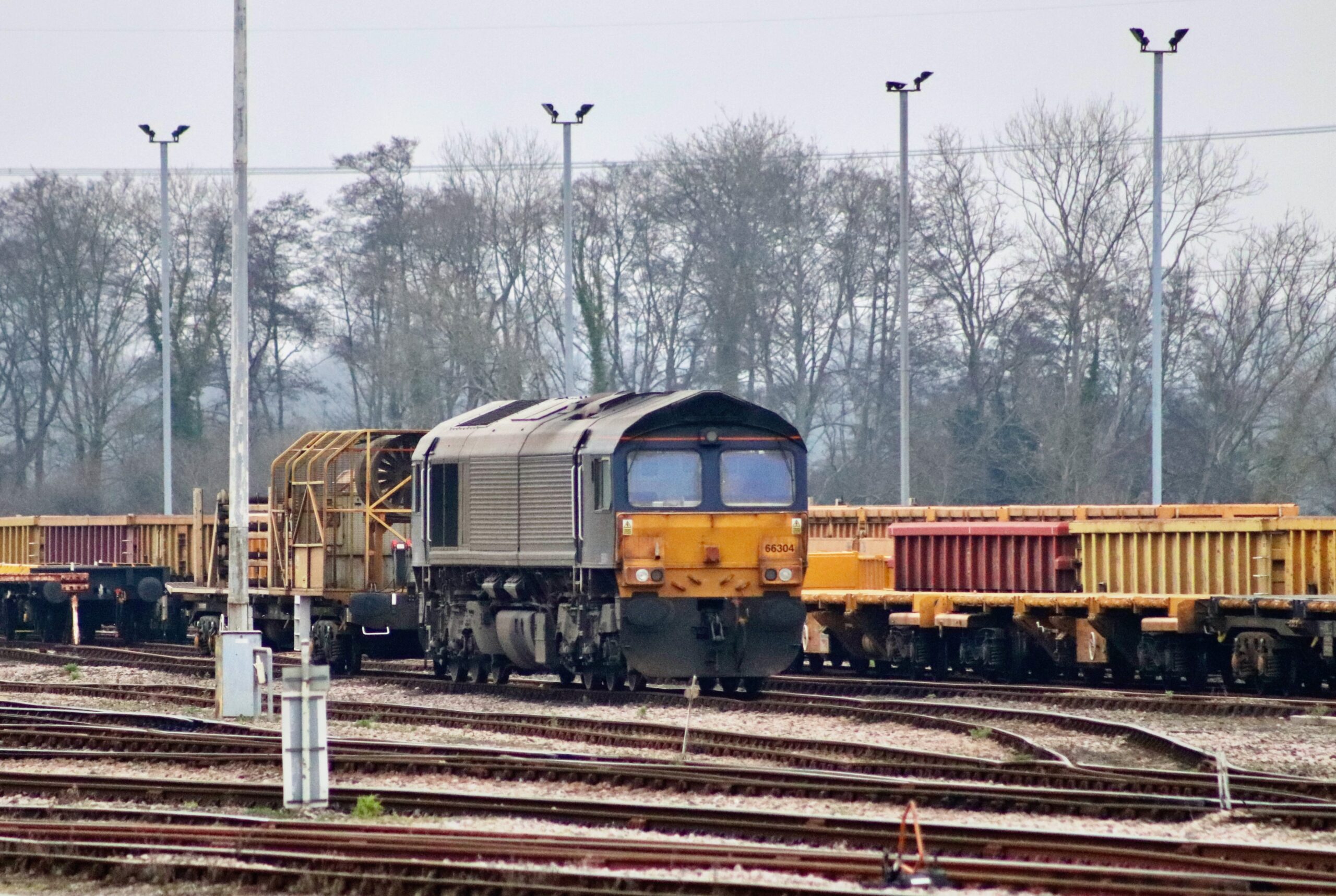
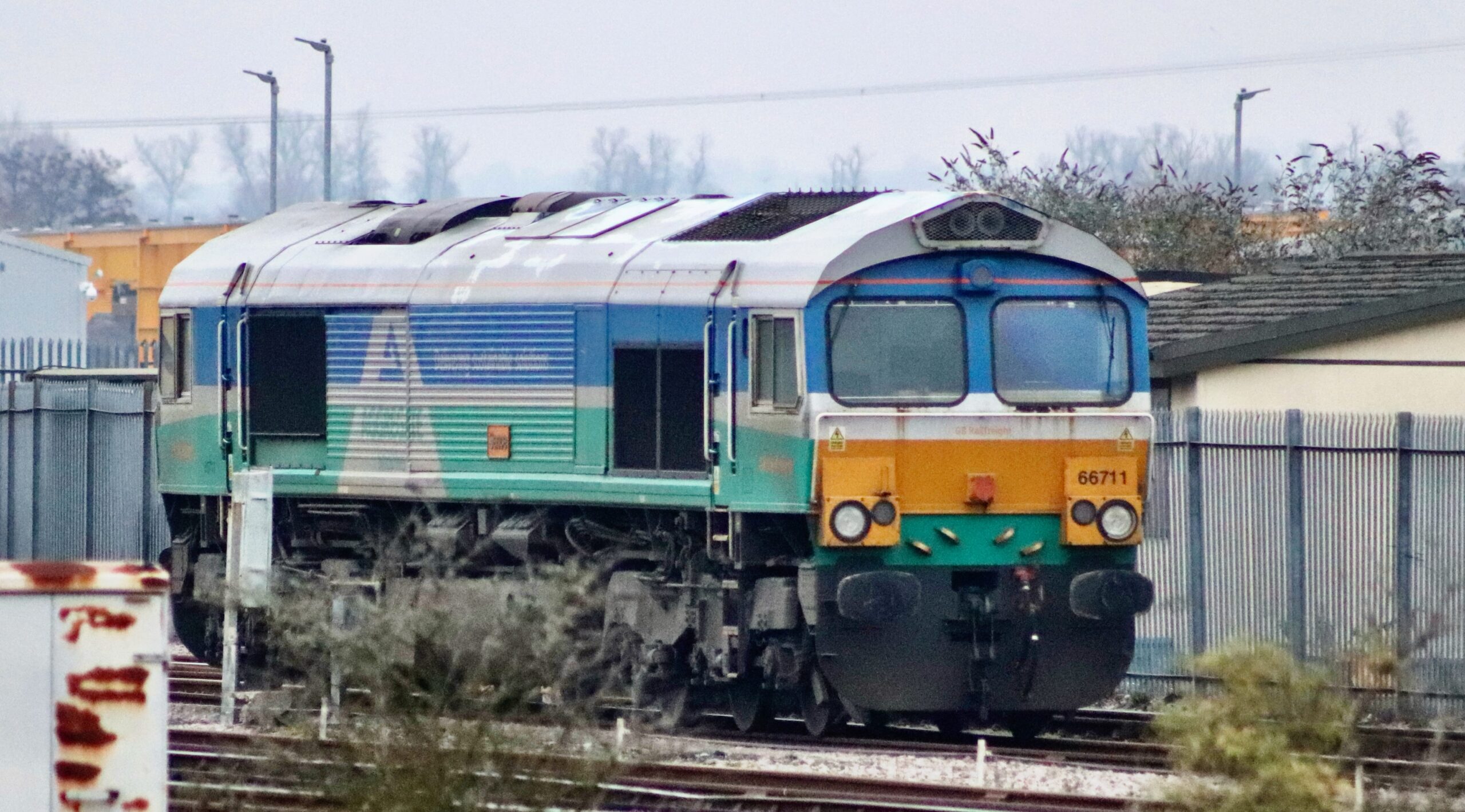
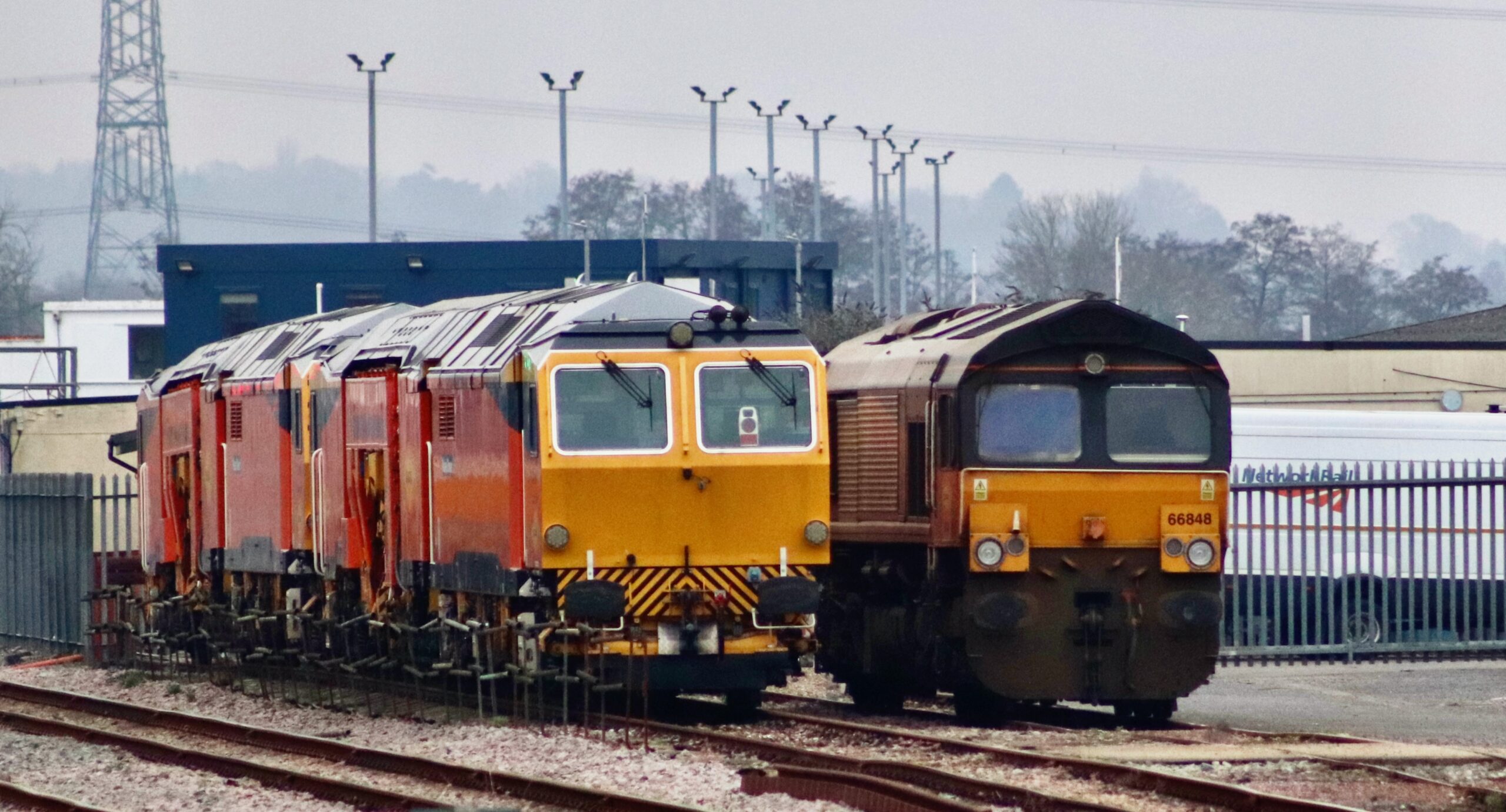
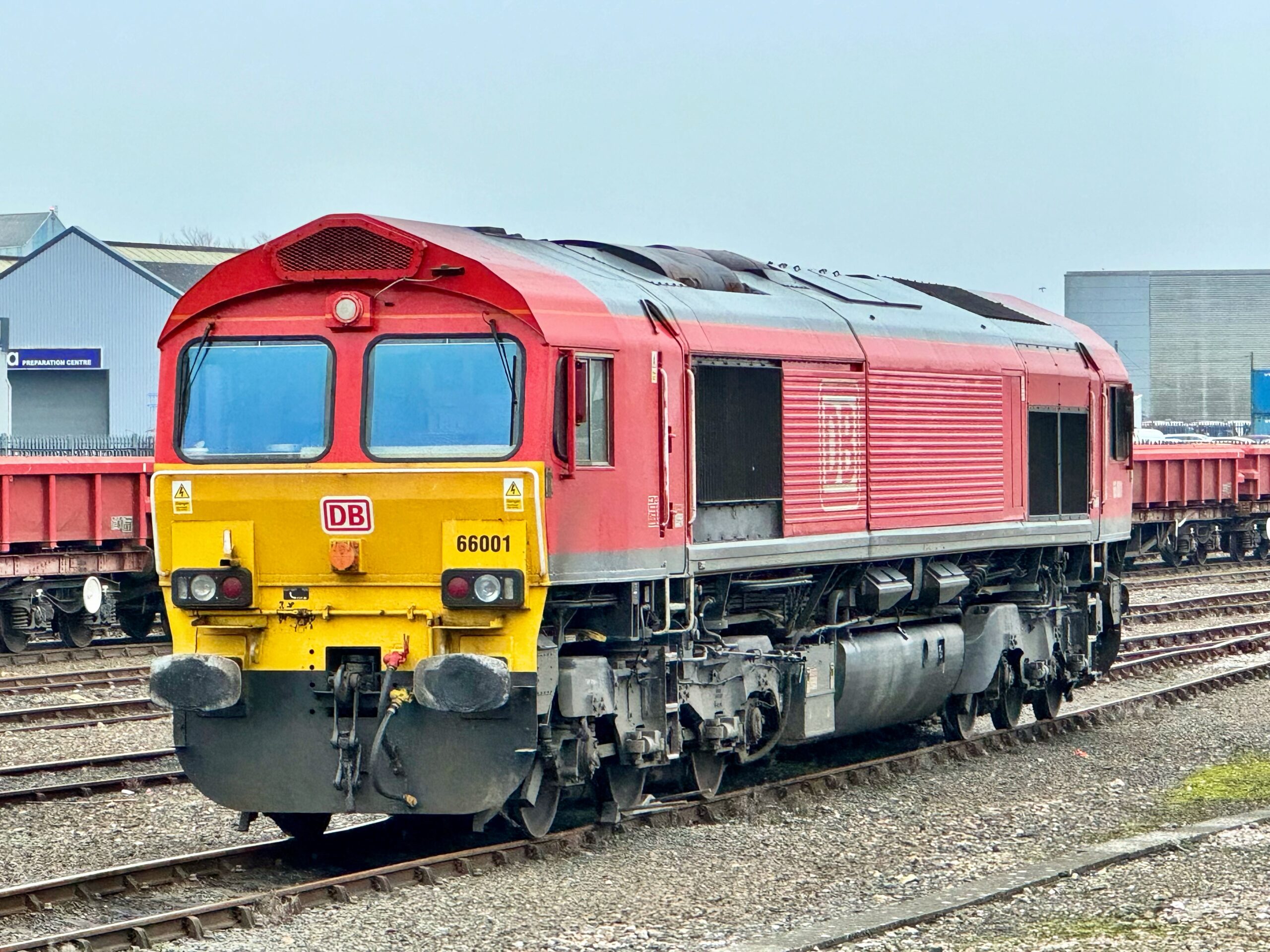
GBRf Class 66 No. 66713 ‘Forest City’ stands in Eastleigh East Yard – 13/01/2024Another view of GBRf Class 66 No. 66713 ‘Forest City’ at Eastleigh East Yard – 13/01/2024GBRf Class 66 No. 66304 at Eastleigh East Yard. The locomotive had arrived in the company of No. 66756 ‘Royal Corps Of Signals’ the previous night working light engine 0O44 1910 Kineton MOD GBRf to Eastleigh East Yard which had prompted my visit on this day – 13/01/202466711 ‘Sence’ painted in Aggregate Industries livery rests in-between duties at Eastleigh East Yard – 13/01/2024Colas Class 66 No. 66848 and track machines at Eastleigh CTT Forwardings – 13/01/2024Class 153 DMU No. 153311 which previously operated in passenger service with East Midlands Railway (EMR) but has now been converted by Network Rail into Video inspection Unit VIU 1 at Eastleigh. This unit had been scheduled to undertake two runs to Bournemouth on the previous day working as 2Q14 1312 Eastleigh East Yard to Eastleigh East Yard, but in the event both trips were cancelled – 13/01/2024Pioneer Class 66 No. 66001 part of the DB Cargo fleet stands adjacent to Eastleigh railway station. This locomotive was originally English Welsh & Scottish Railway’s (EWS) first General Motors (GM) 3,300hp Class 66 which arrived in the UK on Saturday April 18th 1998 at Immingham Dock – and according to Rail Magazine at the time was expected to start work on May 18th. More from Rail issue 330:
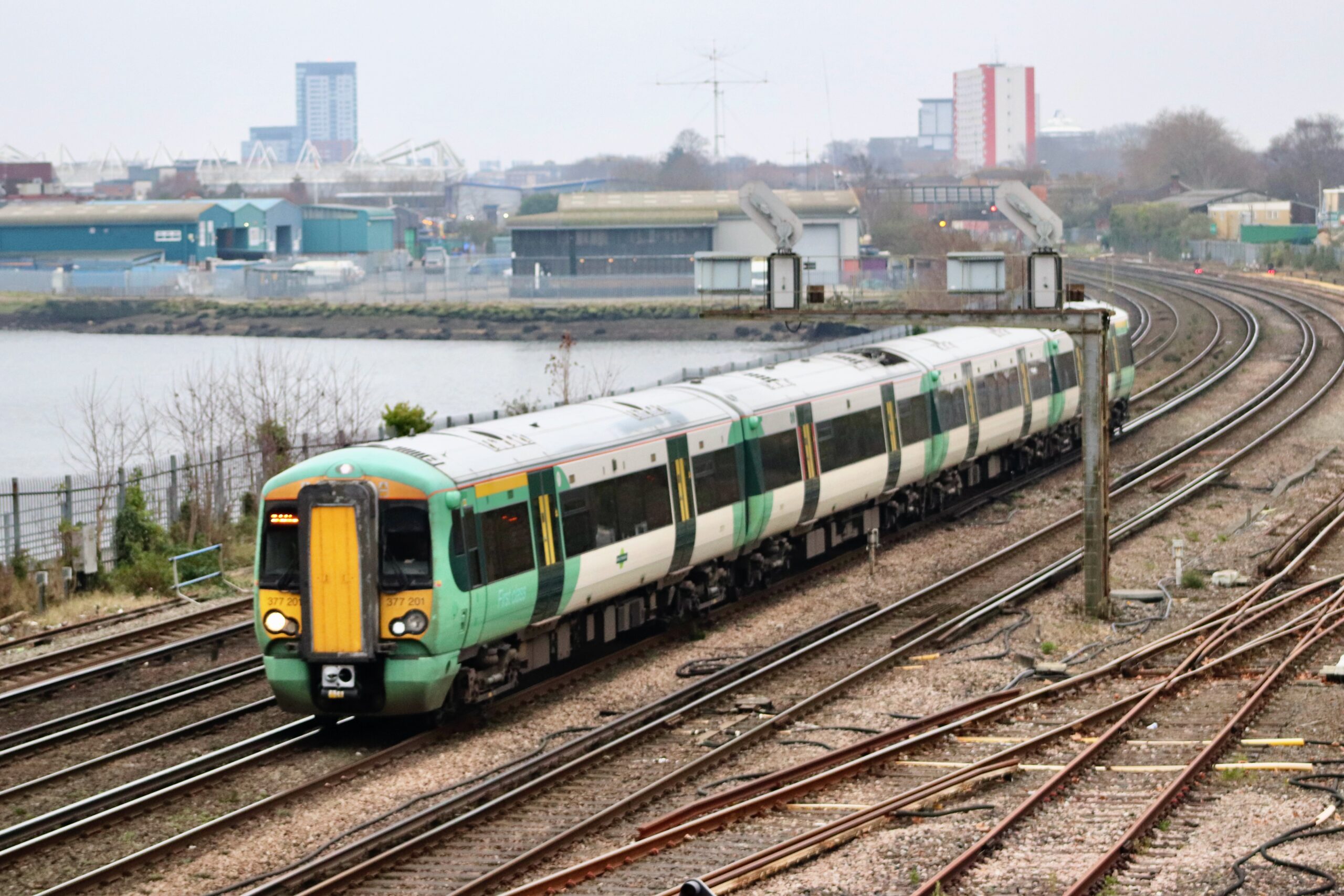
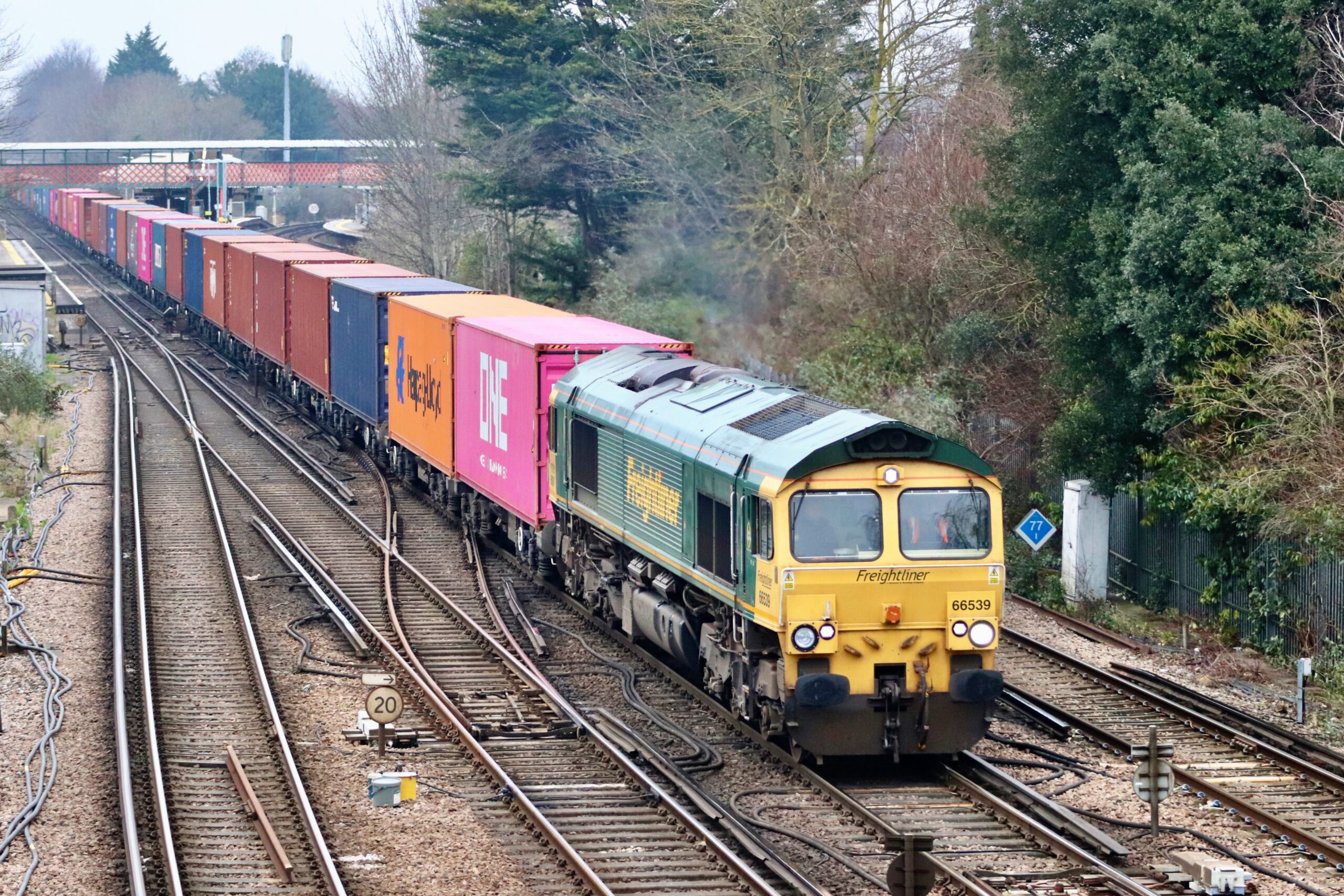
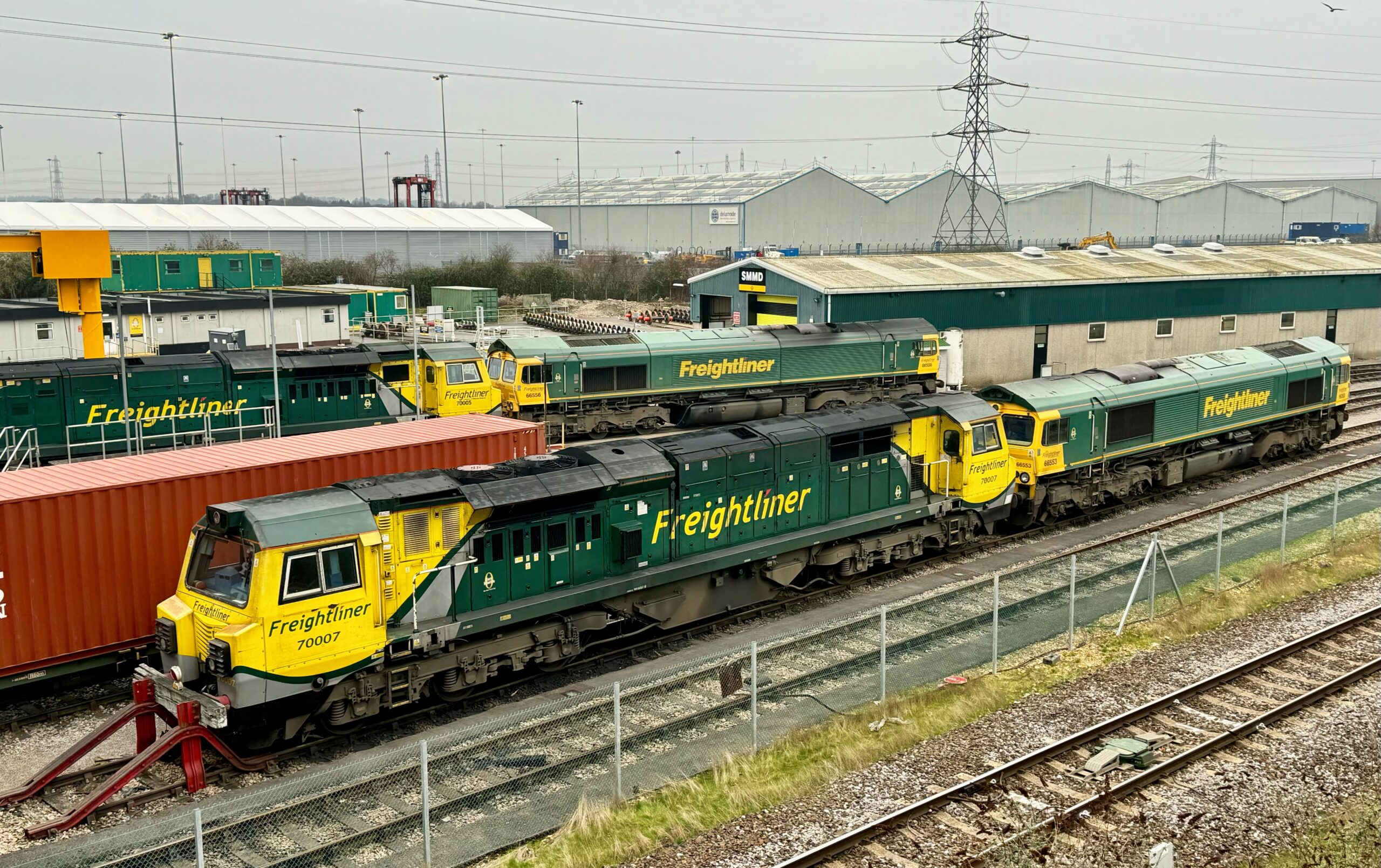
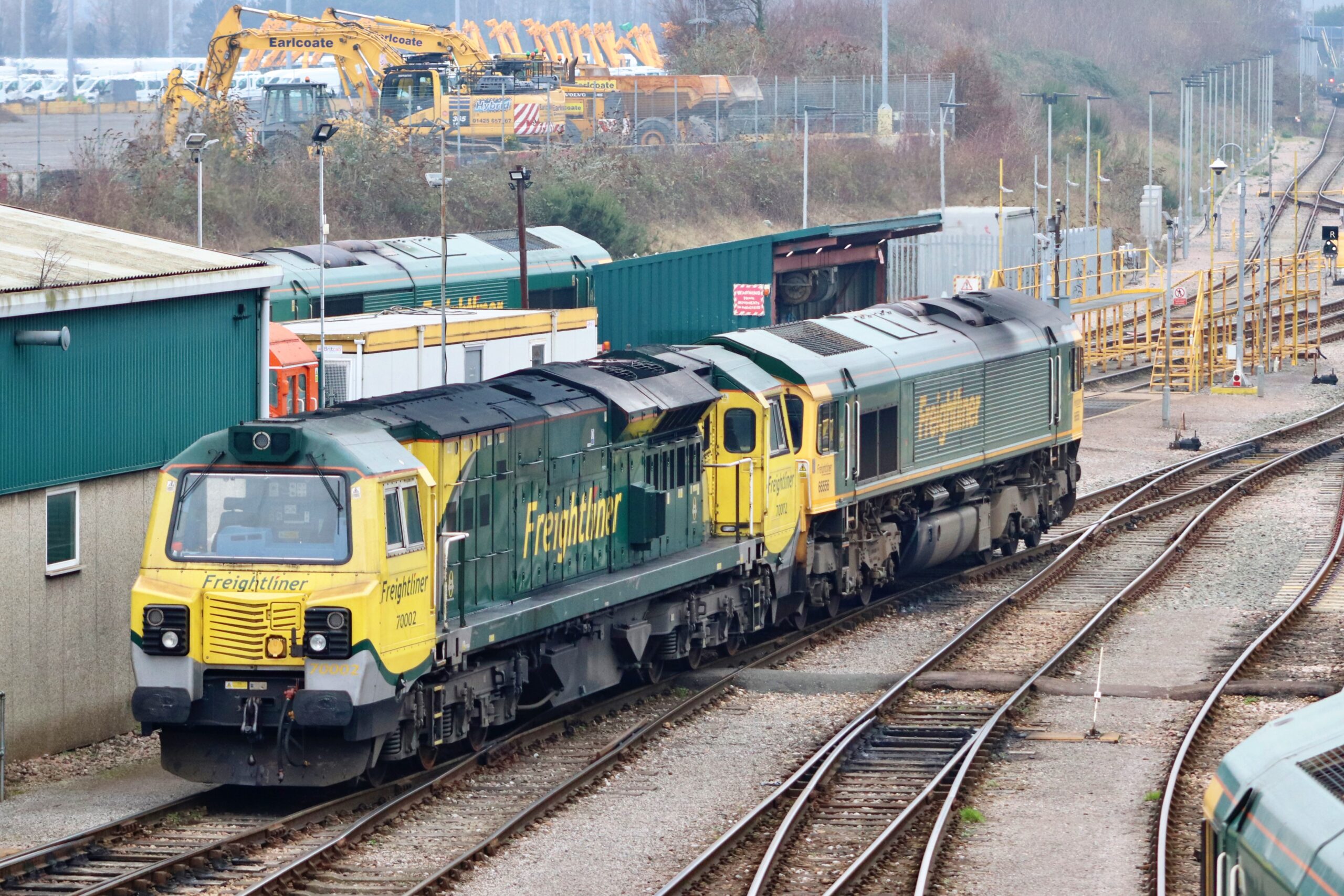
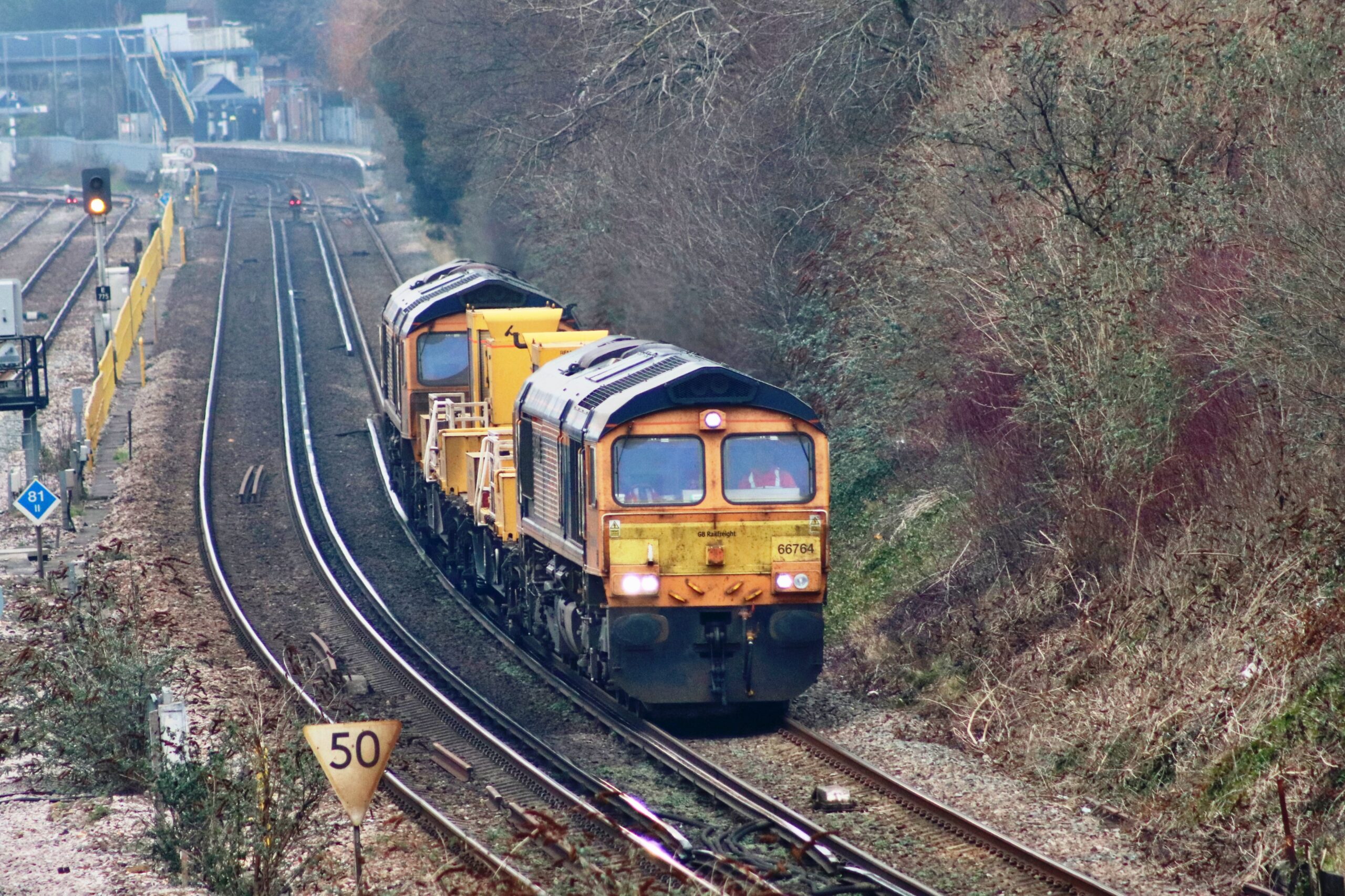
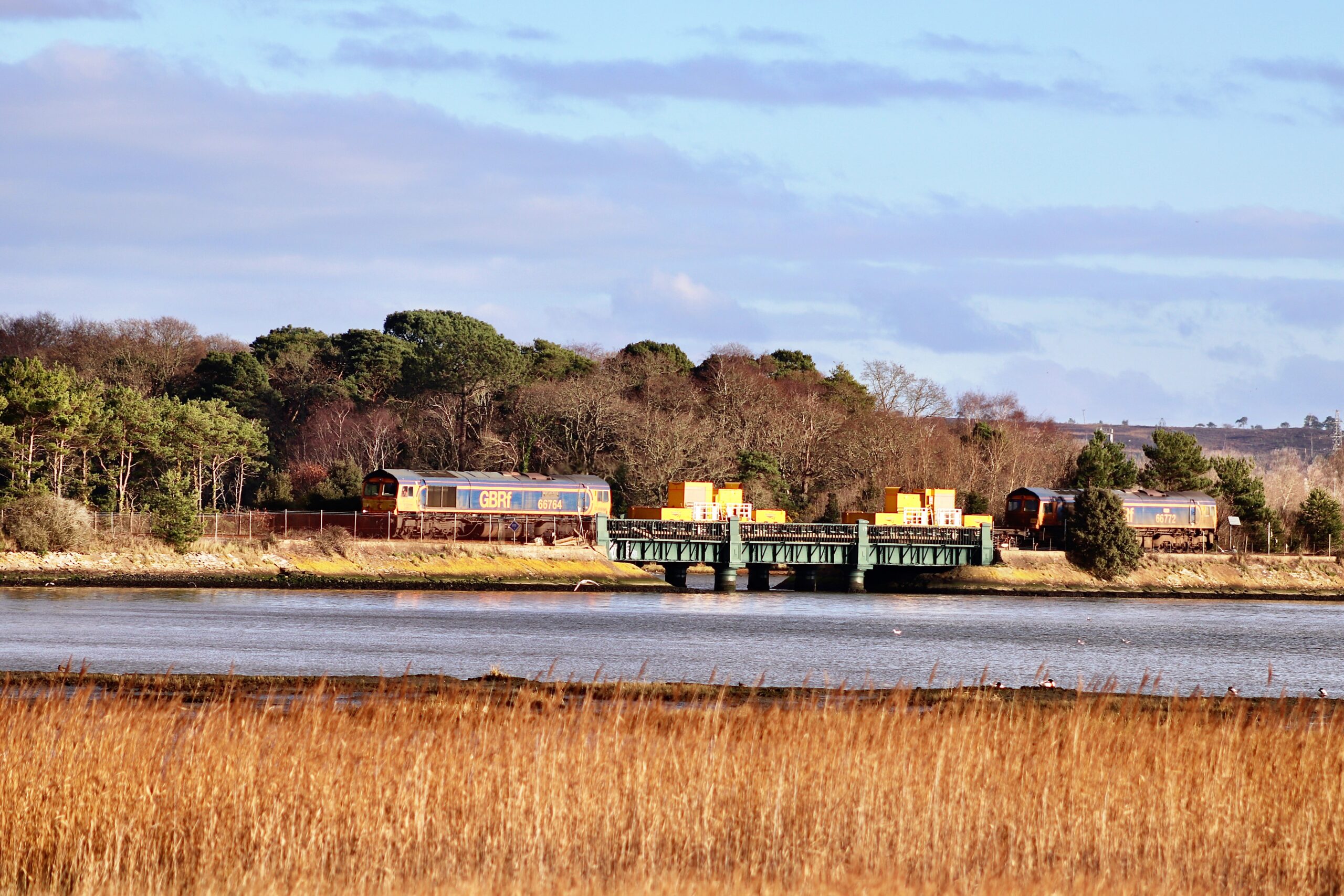
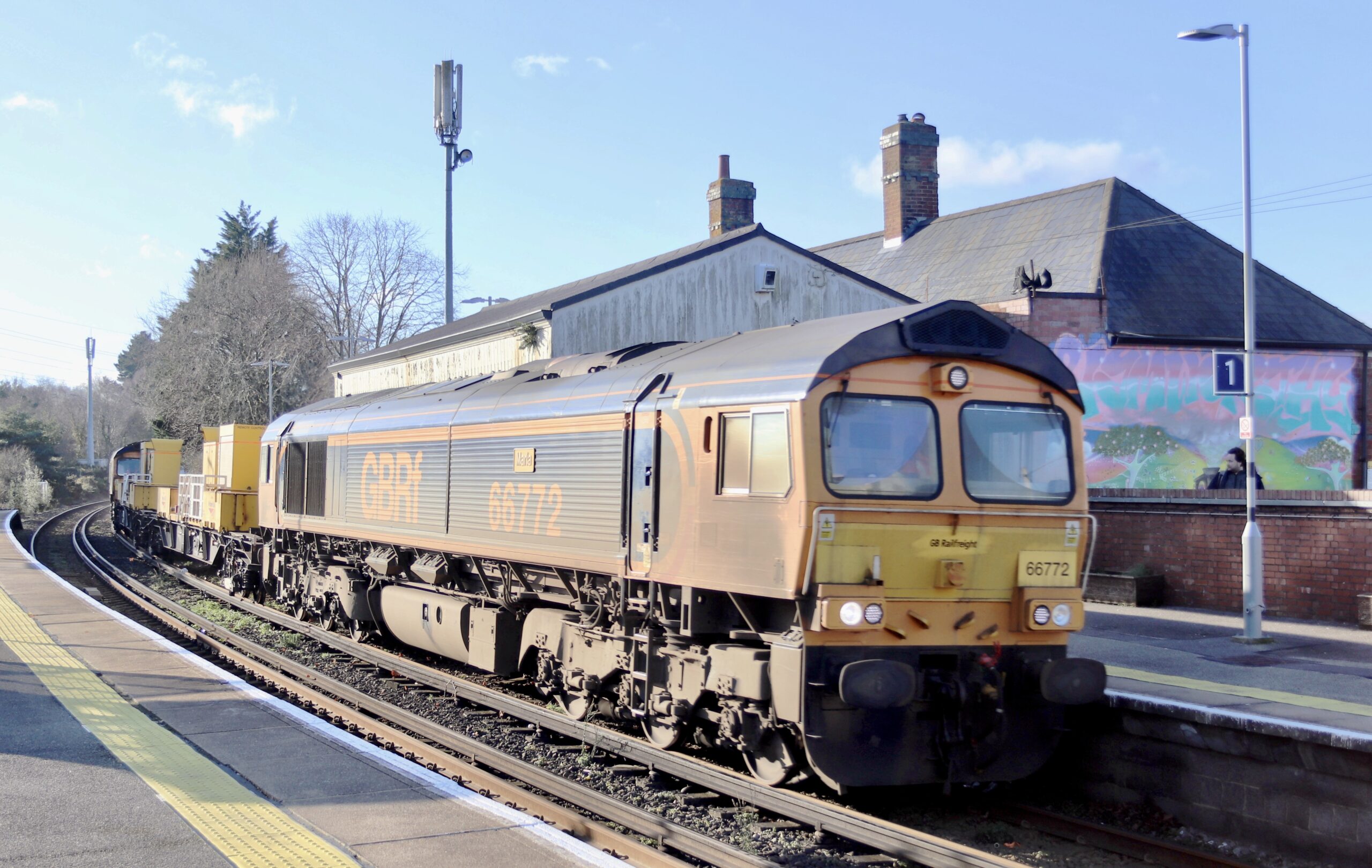
The pioneer locomotive of the 250-strong class was taken by rail to the nearby Immingham depot, fittingly hauled dead by Class 56 No. 56018, which itself arrived by sea at Harwich from Romania on January 22 1977. After unloading from heavy lift vessel Fairload, operated by Jumbo Shipping, it was inspected to ensure it was fit to move and the brake system tested. Widespread rumours that the locomotive was dropped as it was loaded in the USA were proved to be untrue. After No. 66001 was unloaded a delighted EWS Project Engineer Graham Preston told RAIL: “This is only the beginning – I’ll be even more happy when the rest have arrived. GM has made a cracking start with delivery well within the contract time and bang on schedule. “Our best estimate was for the locomotive to leave the factory in early March and it actually was finished at the end of March. It’s the fastest that GM has ever delivered a new locomotive design.” It was originally hoped that the locomotive would arrive a few weeks earlier, however the original plan, to use a fast seven-day crossing from Canada to Liverpool was scuppered when the price rose considerably. Instead No. 66001 was towed to Albany, New Jersey where it was loaded. The ship previously visited Sutton Bridge, Lincolnshire, to unload machinery, before arriving at Immingham. Deliveries of the production series, construction of which will start in earnest once EWS and Railtrack are satisfied with the prototype, will be made to Newport, South Wales. A ship, which can carry up to eleven locomotives each journey, has been chartered for two years and will take around 10 days for the crossing from Halifax, Nova Scotia, Canada. Once the Class has received Railtrack type approval and a safety case, (with completion of acceptance tests on No. 66001) there will not be a need for Railtrack to inspect each locomotive. Locomotives will arrive tested and ready to run. EWS will check lubricants, coolant, brake systems and all systems. This will take three hours per locomotive after which they will go directly into traffic. As production starts in May the first four production series (Nos. 66003-6) are expected in July, eight (Nos. 66007-14) in August and 11 (Nos. 66015-25) in September. Thereafter deliveries will be 11 locomotives a month. The other pre-production locomotive, No. 66002, which has yet to be painted, was due to move to the Association of American Railroads test track at Pueblo, Colorado in late May for a series of exhaustive tests. It will be delivered later this year once the work is complete. During the weekend of April 18/19 No. 66001 was inspected over a pit at Immingham depot, and on Monday April 20 was displayed to the press at the depot, where it made its first movements under its own power in Britain. This took place within the depot confines, which is EWS, not Railtrack infrastructure. One aspect of the Class 66 design is its radial steering bogies which slightly turn the leading axles on each bogie as the locomotive enters a curve. This results in no flange squeal, even on the sharpest curves and is expected to double the life of tyres. No. 66001 was towed to Toton by 60016 on Monday evening, where a further, very detailed inspection was made. Early on Friday April 24 it was towed to Chester where it was exhibited for a visit by Deputy Prime Minister John Prescott, returning to Toton the same day. It was moved on Monday April 27 to the Engineering Development Unit at Derby (former Research Department) for two weeks of static tests, to be followed by a week of loaded main line trials, probably over the Midland Main Line. After this it will enter service, and is expected to be based initially at Newport, South Wales. Three EWS staff have been trained in Canada to drive the Class 66. Conversion courses for other crews are being developed, but it is expected that Class 59 drivers will require a one-day course, and Class 58/60 drivers will need a three day course. The Class 66 can work in multiple with Class 59s and 67s (to be delivered in 1999). – 13/01/2024Southern Class 377 No. 377201 working 1N15 0928 Southampton Central to Brighton on the approach to St Denys – 13/01/2024SWR Class 450 No. 450057 working 2E20 0838 Portsmouth & Southsea to Southampton Central /at St Denys having passed Southern Class 377 No. 377201 forming 1N15 0928 Southampton Central to Brighton – 13/01/2024Freightliner Class 66 No. 66539 passing St Denys working 4018 0424 Lawley Street FLT to Southampton MCT – 13/01/2024Freightliner Maritime with Class 70 No. 70007, Class 66 No. 66553 in the foreground and Class 66 No. 66556 and Class 70 No. 70005 behind – 13/01/2024Class 70 No. 70002 being shunted around Southampton MCT by Class 66 No. 66556- 13/01/2024“Super Shunter” for the day Class 66 No. 66556 at Freightliner Southampton Maritime – 13/01/2024The Totton based Snow & Ice Treatment Train passes Southampton MCT, top and tailed by GBRf Class 66 No.’s 66764 ‘Major John Poyntz Engineer & Railwayman’ and 66772 ‘Maria’ – 13/01/2024Having shunted back at Southampton Maritime, Freightliner Class 66 No. 66539 arrives at the container terminal working 4018 0424 Lawley Street FLT to Southampton MCT – 13/01/2024
Video which consists mostly of Freightliner “Super Shunter” Class 66 No. 66556 moving things about at Southampton Maritime – 13/01/2024
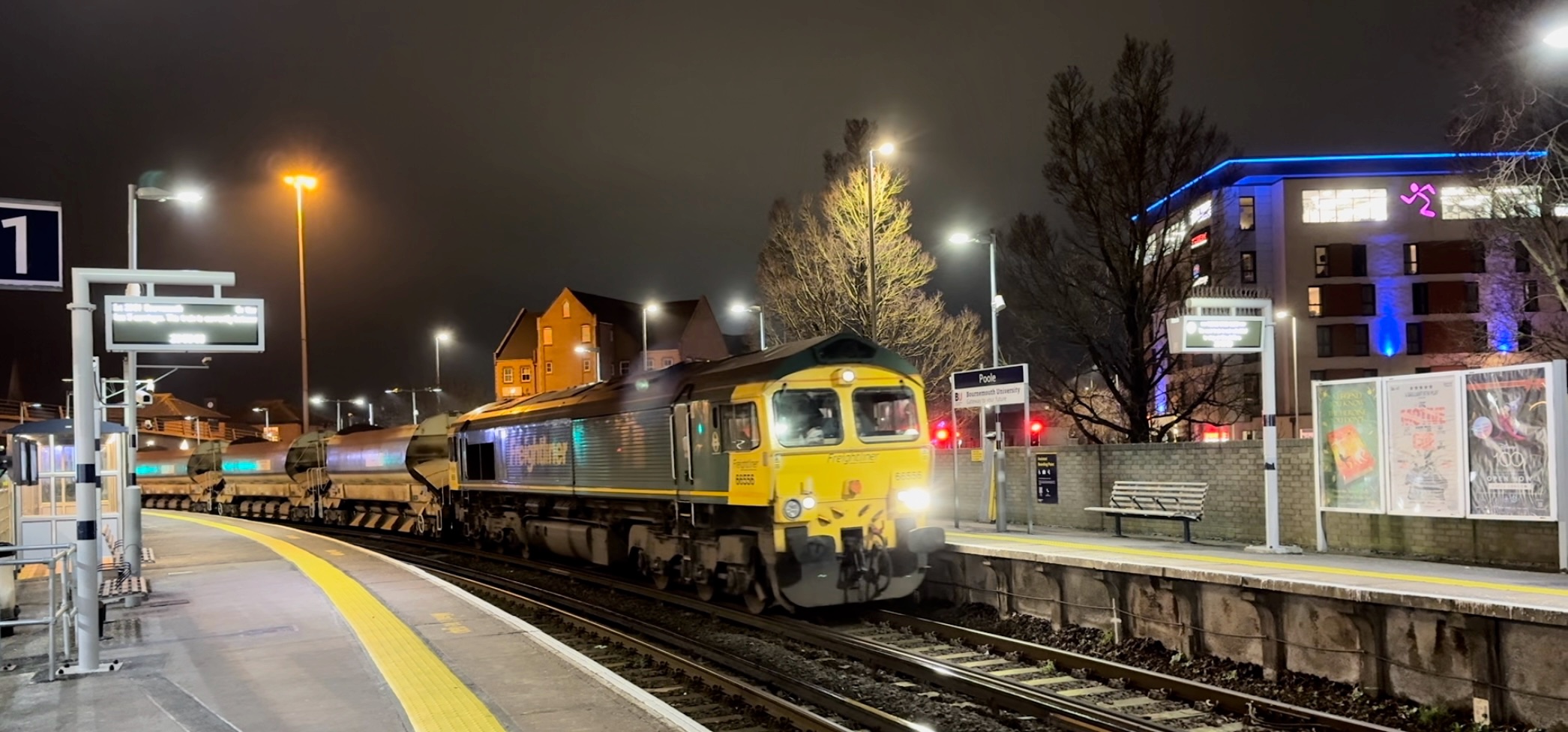
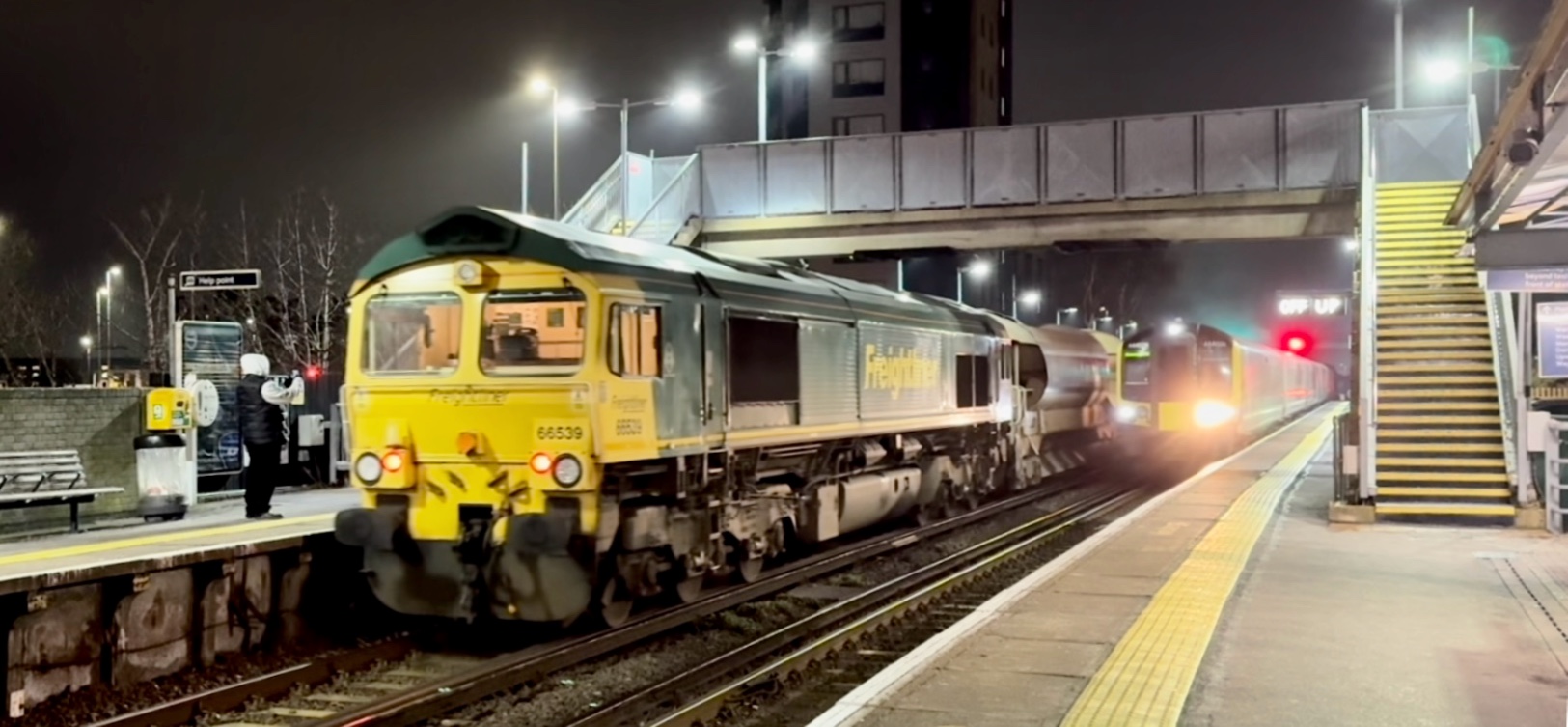
Late on Saturday evening, Freightliner had the responsibiity of providing motive power for an engineers train to Hamworthy. Two of the FL Class 66 locos we had last seen at Maritime earlier in the day were provided on this working, which I saw at Poole on the outward trip as well as the return working which ran on Sunday morning. The work site was to the west of Hamworthy railway station and away from prying eyes. I did witness two Network Rail employees placing a temporary STOP sign – to protect the branch line – in front of the existing STOP sign which is fixed to a sleeper chained across the track just after the point where the Hamworthy branch leaves the main line. A case of belt and braces!
Freightliner Class No. 66556 crawls through Poole working 6Y85 22:44 Eastleigh East Yard to Hamworthy – 13/01/2024Freightliner Class No. 66539 at Poole on the rear of 6Y85 22:44 Eastleigh East Yard to Hamworthy as SWR Class 444 No. 444026 arrives with the 2W86 2310 Weymouth to Bournemouth service – 13/01/2024
Video of Freightliner Class No.’s 66 locomotives 66556 and 66539 at Poole working ballast train 6Y85 22:44 Eastleigh East Yard to Hamworthy (13/01/2024) and 6Y85 07:30 Poole to Eastleigh East Yard (14/01/2024)
Moving forward a few days to Thursday 18th January and having received confirmation from friend of this blog, Jamie, that the aforementioned No. 66756 was scheduled to be working down the Fawley branch to Marchwood near Southampton, and taking into consideration the beautiful sunny, but cold day, I made the last minute decision to drive over and wait for the train to cross at the manual level crossing adjacent to the former Marchwood railway station.
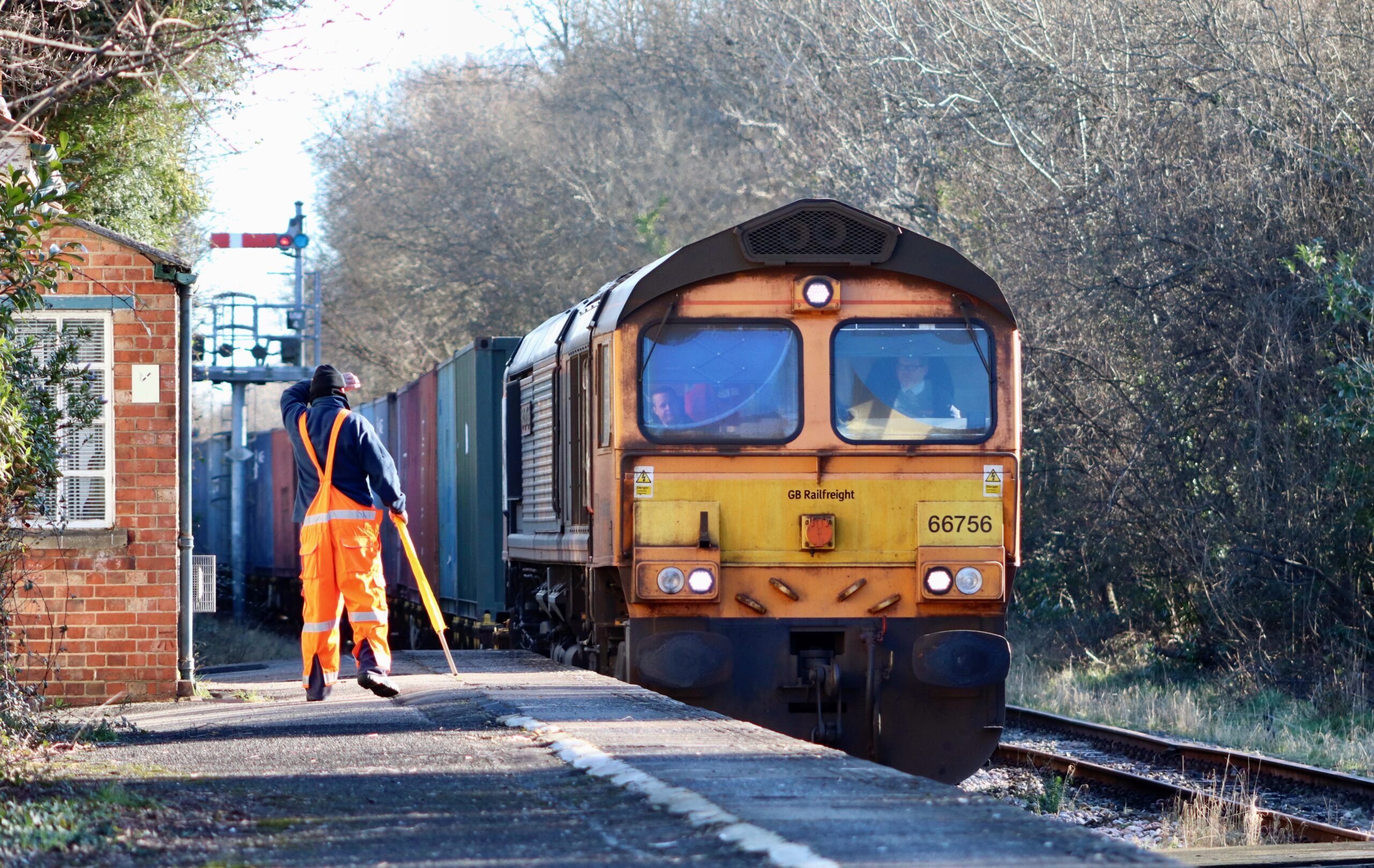
Looking from the level crossing at Marchwood down the line towards Totton, GBRf Class 66 No. 66756 ‘Royal Corps Of Signals’ can be seen approaching with 4O77 0256 London Gateway GBRf to Marchwood Mod GBRf – 18/01/2024GBRf Class 66 No. 66756 ‘Royal Corps Of Signals’ about to cross over the manual level crossing at Main Road, Marchwood hauling 4O77 0256 London Gateway GBRf to Marchwood Mod GBRf – 18/01/2024GBRf Class 66 No. 66756 ‘Royal Corps Of Signals’ on the associated return working (4Z47 1218 Marchwood MOD GBRf to Doncaster Down Decoy GBRf) from Marchwood MOD pauses in the former Marchwood railway station awaiting the ‘go ahead’ to proceed from the crossing gate keeper – 18/01/2024 Although semaphore signals remain in situ at Marchwood, they do not appear to be operational as GBRf Class 66 No. 66756 ‘Royal Corps Of Signals’ works 4Z47 1218 Marchwood Mod GBRf to Doncaster Down Decoy GBRf – 18/01/2024
Video of GBRf Class 66 No. 66756 ‘Royal Corps Of Signals’ at Marchwood working 4O77 0256 London Gateway GBRf to Marchwood Mod GBRf and 4Z47 1218 Marchwood Mod GBRf to Doncaster Down Decoy GBRf – 18/01/2024
Fawley oil refinery was established in 1921 with its construction starting in the spring of 1923, the contractors being Sir Robert McAlpine & Co Ltd. The Fawley railway branch line was built under provision of the Light Railways Act 1896 as the “Totton, Hythe and Fawley Light Railway”, opening on 20th July 1925. It branches off at the South West Main Line west of Totton station, running parallel with the line to Bournemouth and Weymouth for one mile before curving away to the south. Prior to the passenger service being withdrawn on 14th February 1966, stations were served at Marchwood, Hythe, and Fawley. Between Hythe and Fawley a station for workmen was opened briefly between 1958 and 1965 named Hardley Halt.
Railway traffic as far as Marchwood increased after a siding to Cracknore Hard was laid in 1939 for harbour defences. It was expanded to a full-blown military port in 1943, the slipway becoming a major assembly point for Mulberry floating harbour sections in 1944.
The passenger service to Fawley was always traditionally somewhat sparse with just three return trips and a long gap during the day when refinery staff were at work. There was an expansion in freight traffic as, for more than 80 years, ExxonMobil and its predecessors used rail to move oil products from the refinery, but all associated traffic ceased in September 2016. Railway Magazine reported the last DB Cargo train from Fawley; a rake of empty bogie tankers, ran on September 5th 2016. The line is now only used by freight to and from Marchwood Military Port as well as taking and removing SWR Class 701 EMU’s in storage.
Looking to the future, it is proposed to partly reopen the line with stations located at Marchwood and Hythe. On 23rd May 2020, the Department of Transport (DafT) announced that the line now marketed as the “Waterside Line” had been shortlisted for further funding to investigate the restoration of passenger services. The end of the 8-mile line would be unused, but a southern terminus, called Hythe and Fawley Parkway, would open on the site of the Hardley Halt station.
In March 2022, Rail Magazine reported that Network Rail would be taking the scheme to get the line reopened forward. However, the proposed Hythe & Fawley Parkway station will not now be included. The service that Network Rail is proposing is a 2 car Class 158/9, running every 30 minutes between Hythe and Southampton with passenger services starting in 2025 at the earliest if plans are accepted. Following public consultations held in August / September 2022, 84% of people backed the proposal to reinstate the line for passenger service.
The Totton Yard based Snow and Ice Treatment Train (SITT) saw multiple incursions into Dorset during the recent frosty January weather working:
12/01/2024 – 3Y89 2200 Totton Yard to Totton Yard
14/01/2024 – 3Y88 1009 Eastleigh East Yard to Eastleigh East Yard
17/01/2024 – 3Y89 2200 Totton Yard to Totton Yard
19/01/2024 – 3Y89 2200 Totton Yard to Totton Yard
Snow & Ice Treatment Train workings in January 2024 (additional video courtesy of G E Barrett)
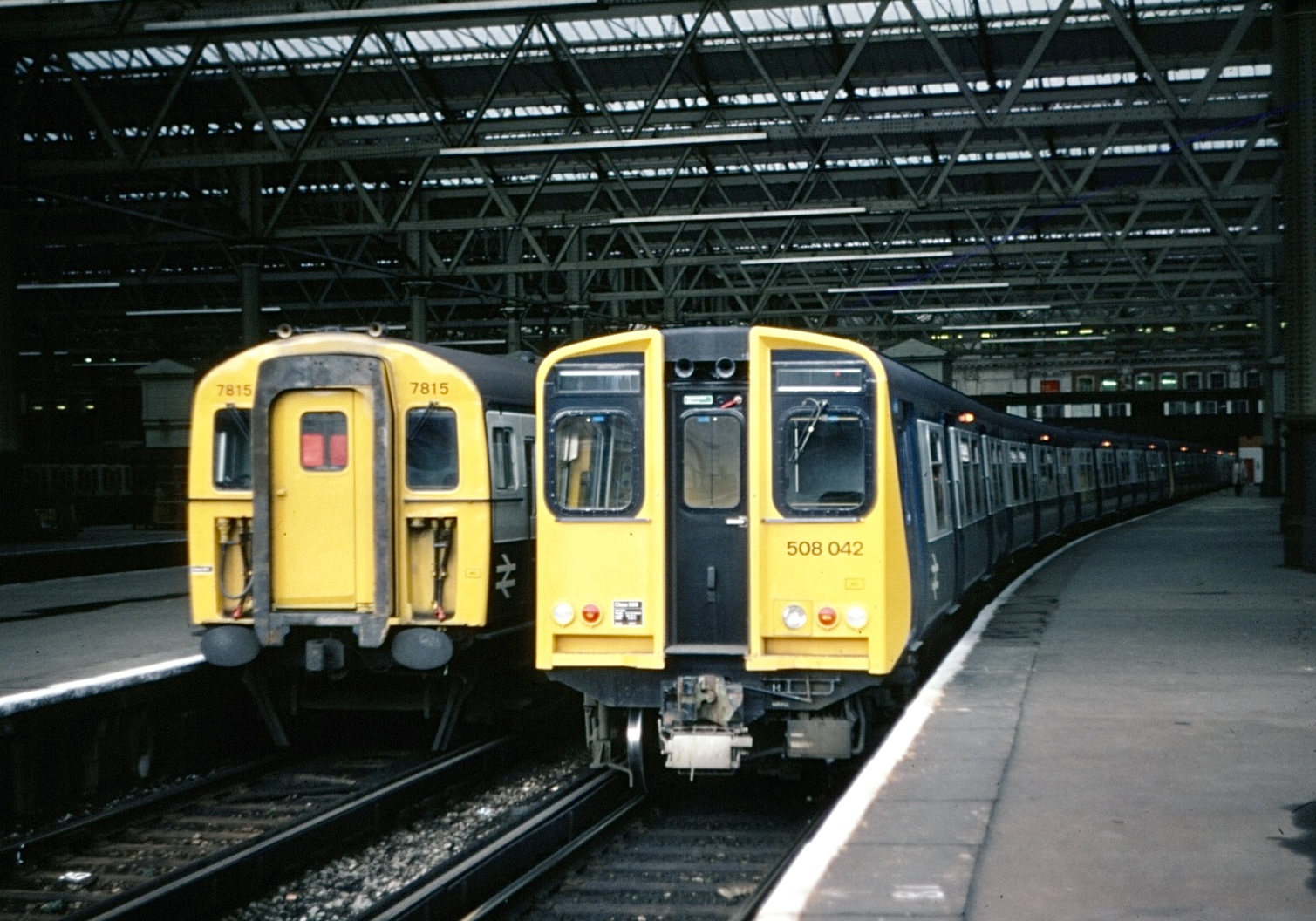
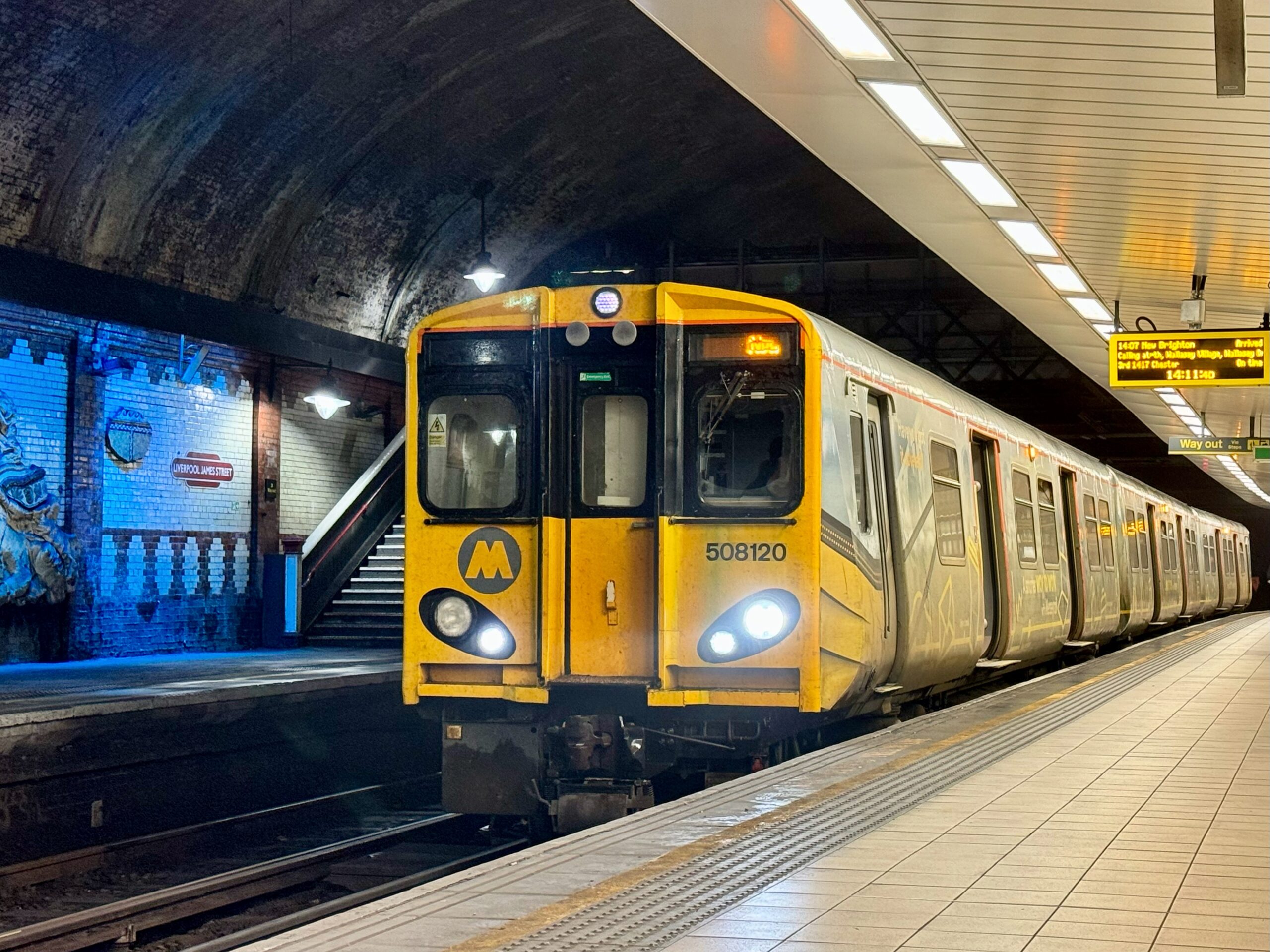
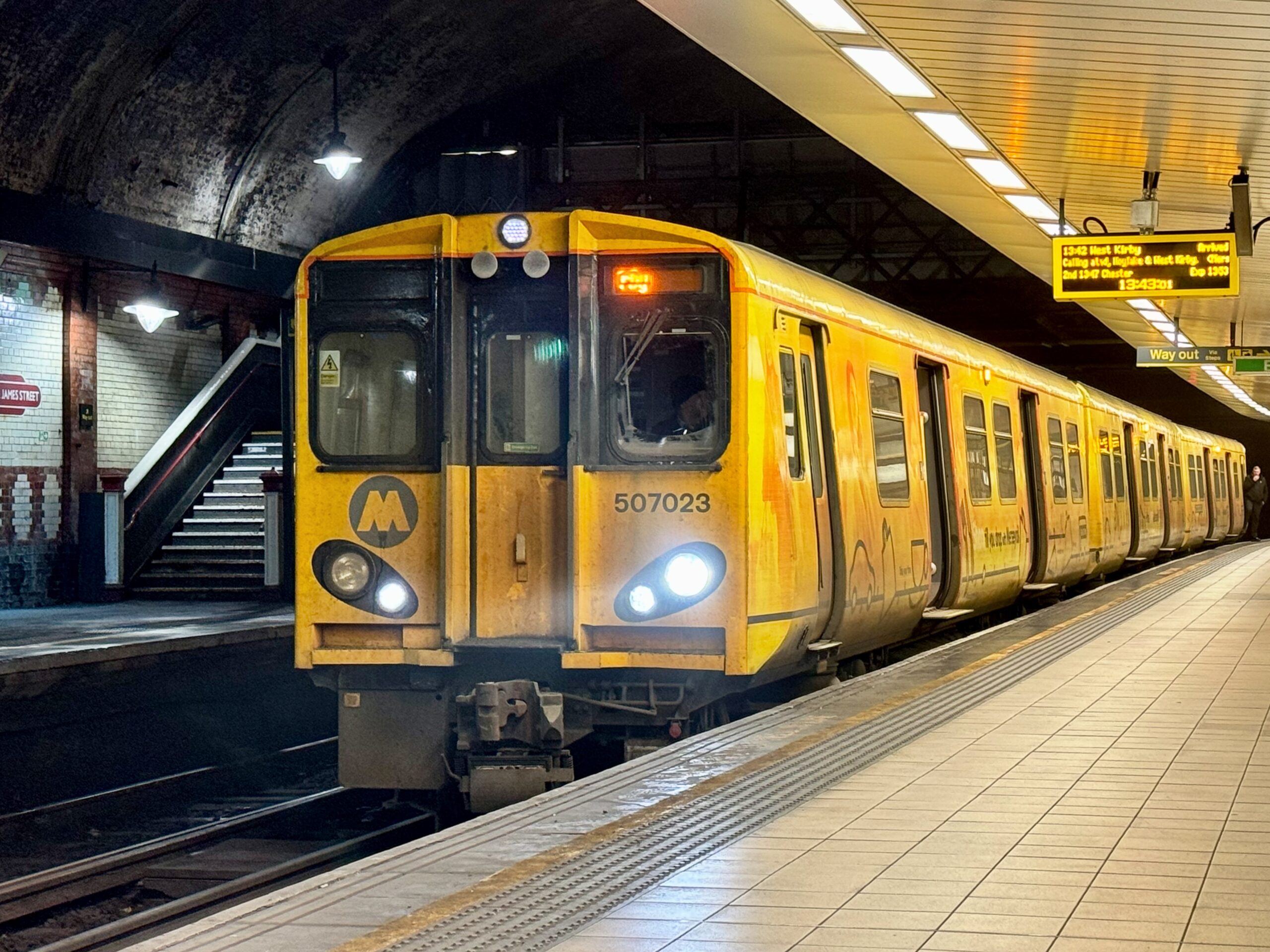
Elsewhere on the UK network, the final day of Class 508 workings took place on 16th January 2024 when Merseyrail withdrew the last operational example of the class, No. 508104 after 44 years of service. The Class 508 developed from the prototype PEP stock were built by British Rail Engineering Limited (BREL), at Holgate Road carriage works, York, between 1979 and 1980 and initially worked alongside much older first generation 4-SUB EMU’s in the London Waterloo area. The first Class 508 unit was delivered to Strawberry Hill depot on 9th August 1979.
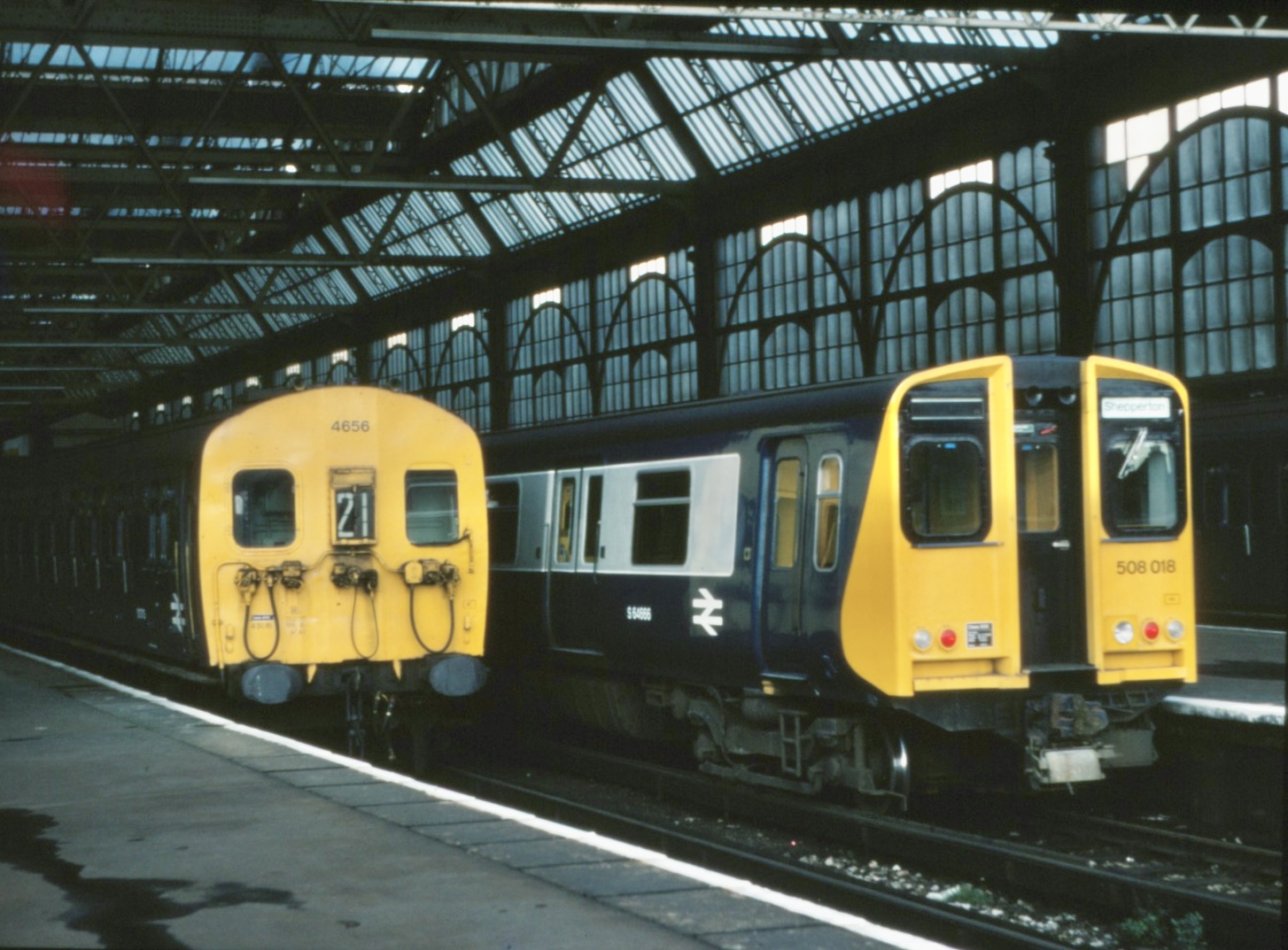
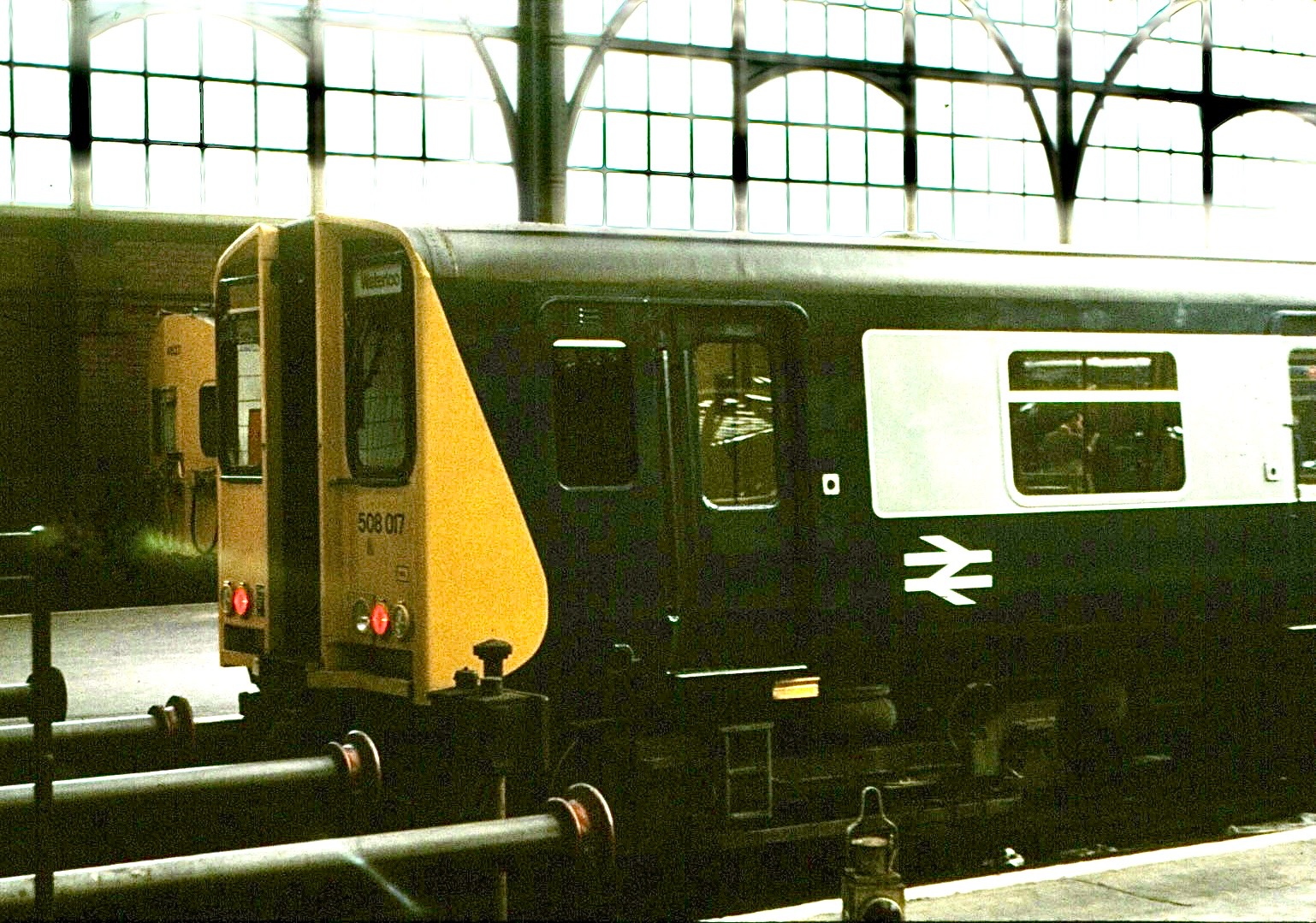
Class 508 No. 508018 and 4-SUB No. 4656 at London Waterloo – 23/03/1981Class 508 No. 508017 at the buffer stops at London Waterloo – 23/03/1981Class 508 No. 508042 and 4-VEP 7815 at London Waterloo – 23/03/1981
Transfer to of the Class 508’s to Merseyside began in 1982 when they were reduced from 4-car to 3-car sets. The removed trailer cars live on as part of South Western Railway Class 455.
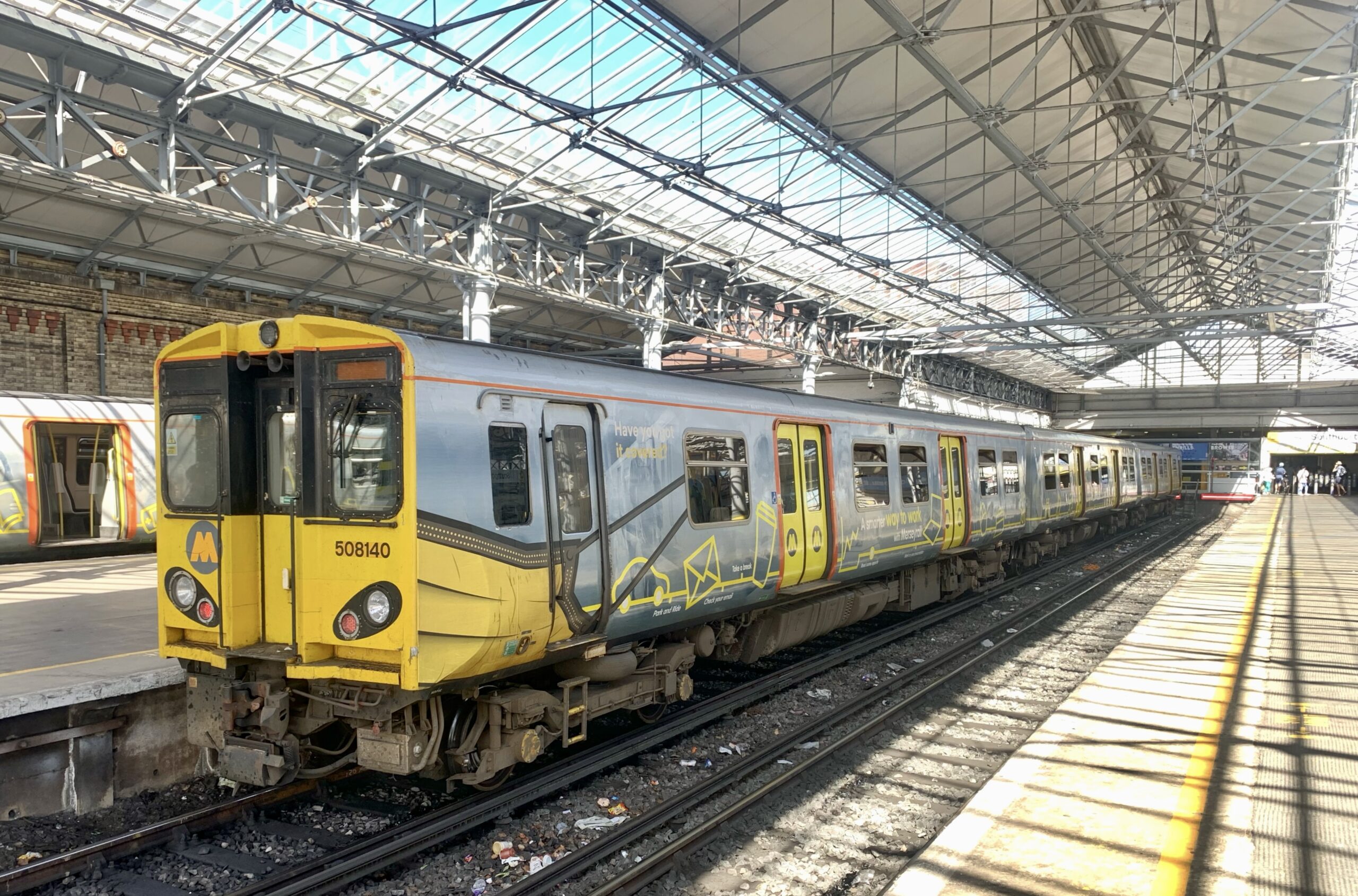
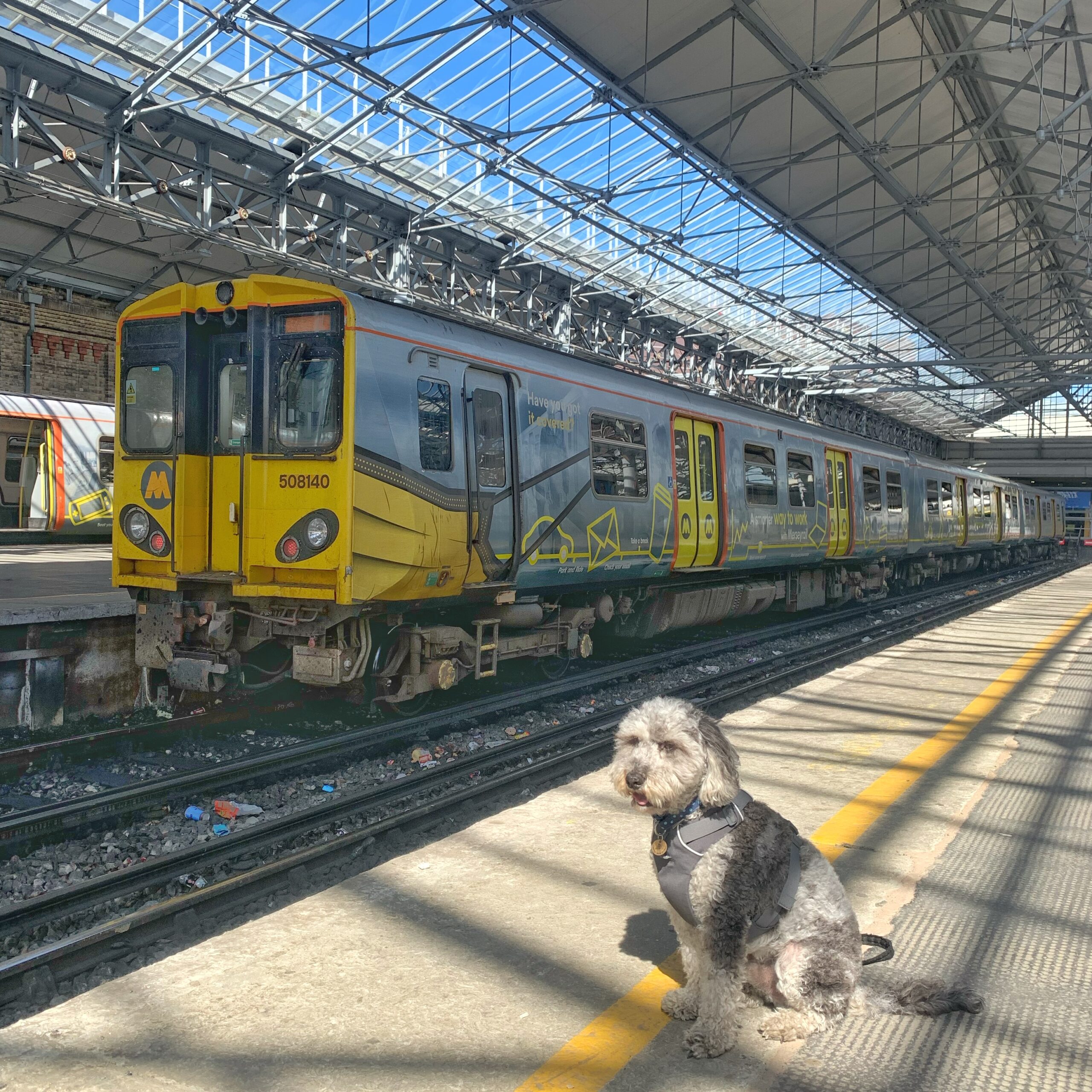
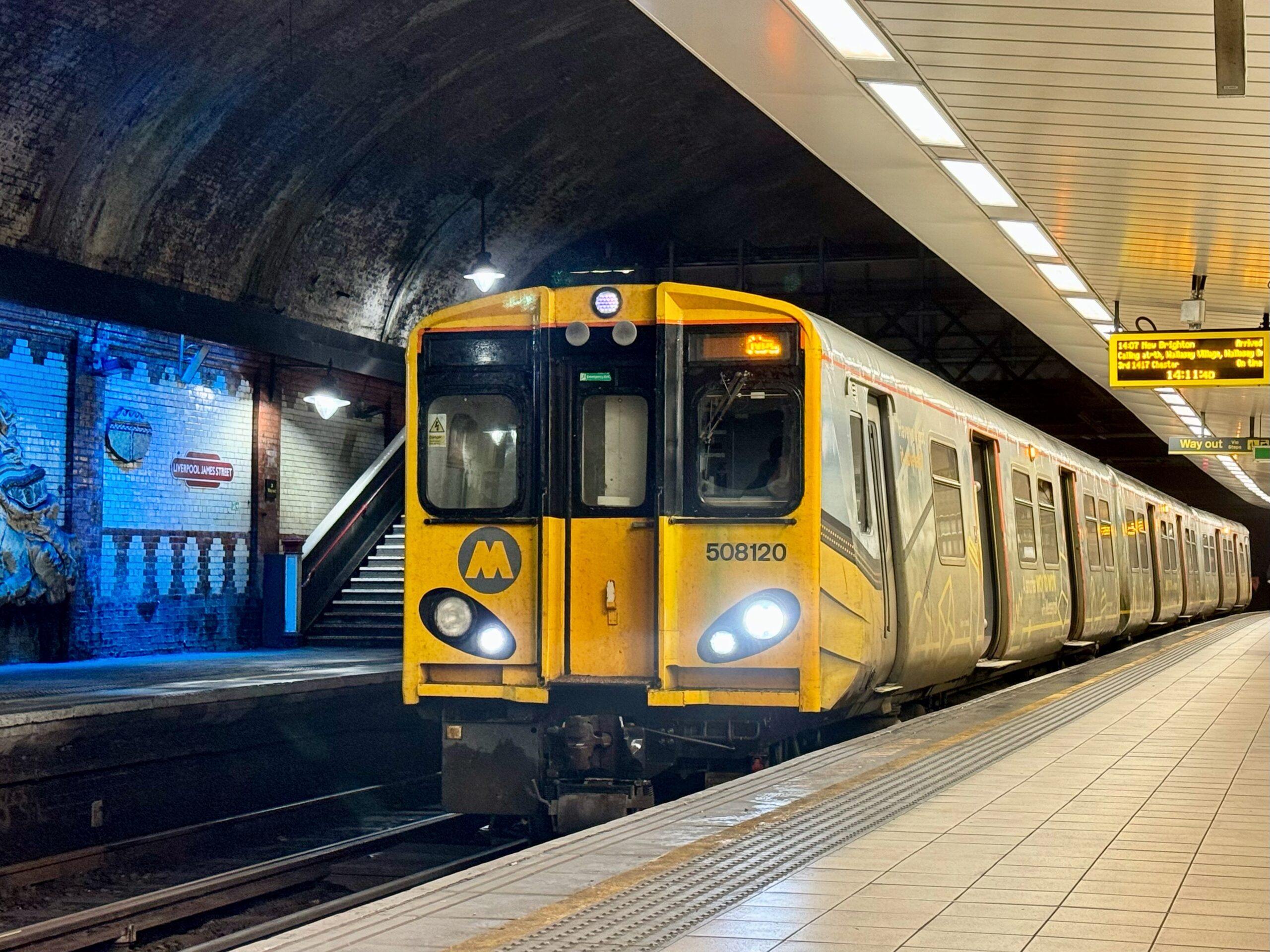
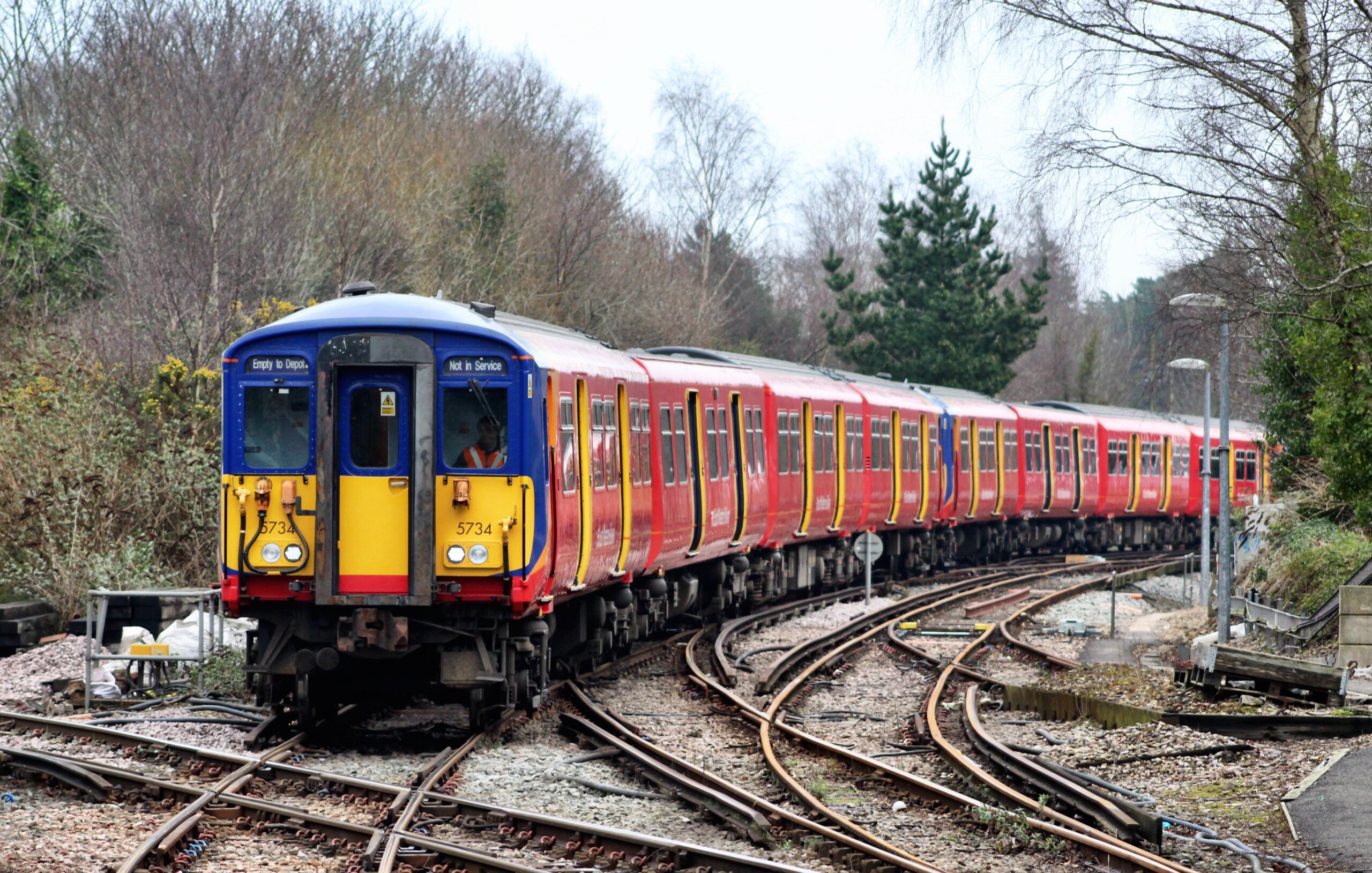
Class 508 No. 508140 at Southport – 13/07/2022Yoshi at Southport taking a look at Class 508 No. 508140 – 13/07/2022Class 508 No. 508120 at Liverpool James Street with the 1407 service to New Brighton – 09/12/2023Class 455 No. 455734 leading classmate No. 455708 towards Branksome working 5Y51 empty coaching stock movement 1431 Bournemouth Traction & Rolling Stock Depot to Wimbledon Depot Sidings. The second coach of each unit was taken from Class 508 units and the different height and shape of the carriage to the rest of the unit can be clearly seen – 02/03/2022
As you may be aware, train strikes are planned from Tuesday 30th January through to Monday 5th February 2024.
• Tuesday 30th January – Gatwick Express, Great Northern, South Western Railway (including Island Line), Southeastern, Southern, Thameslink
• Wednesday 31th January – Northern, TransPennine Express
• Friday 2nd February – c2c, Greater Anglia (including Stansted Express), LNER
• Saturday 3rd February – Avanti West Coast, East Midlands Railway, London Northwestern Railway, West Midlands Railway
• Monday 5th February – Chiltern Railways, CrossCountry, Great Western Railway
In addition, the above train operators will have an overtime ban between Monday 29th January and Tuesday 6th February.
Dorset Council and BCP Council have joined forces to develop a new transport plan for the whole of Dorset fit for the 21st Century and have launched a survey running until 3rd March. They would like our thoughts on the following:
• improving transport across rural and urban areas;
• ensuring all ages and abilities can access services;
• making it easier to be more physically active;
• enabling more opportunities for affordable, available and accessible public transport;
• helping people feel safer on our roads and on public transport;
• reducing congestion and carbon emissions; or
• improving digital and real-time travel information
You can find out more and complete the survey online here – paper copies are also available at Dorset Council and BCP Council libraries.
Many thanks for reading, for your comments and corrections. All being well, we’ll be back soon! Be seeing you.
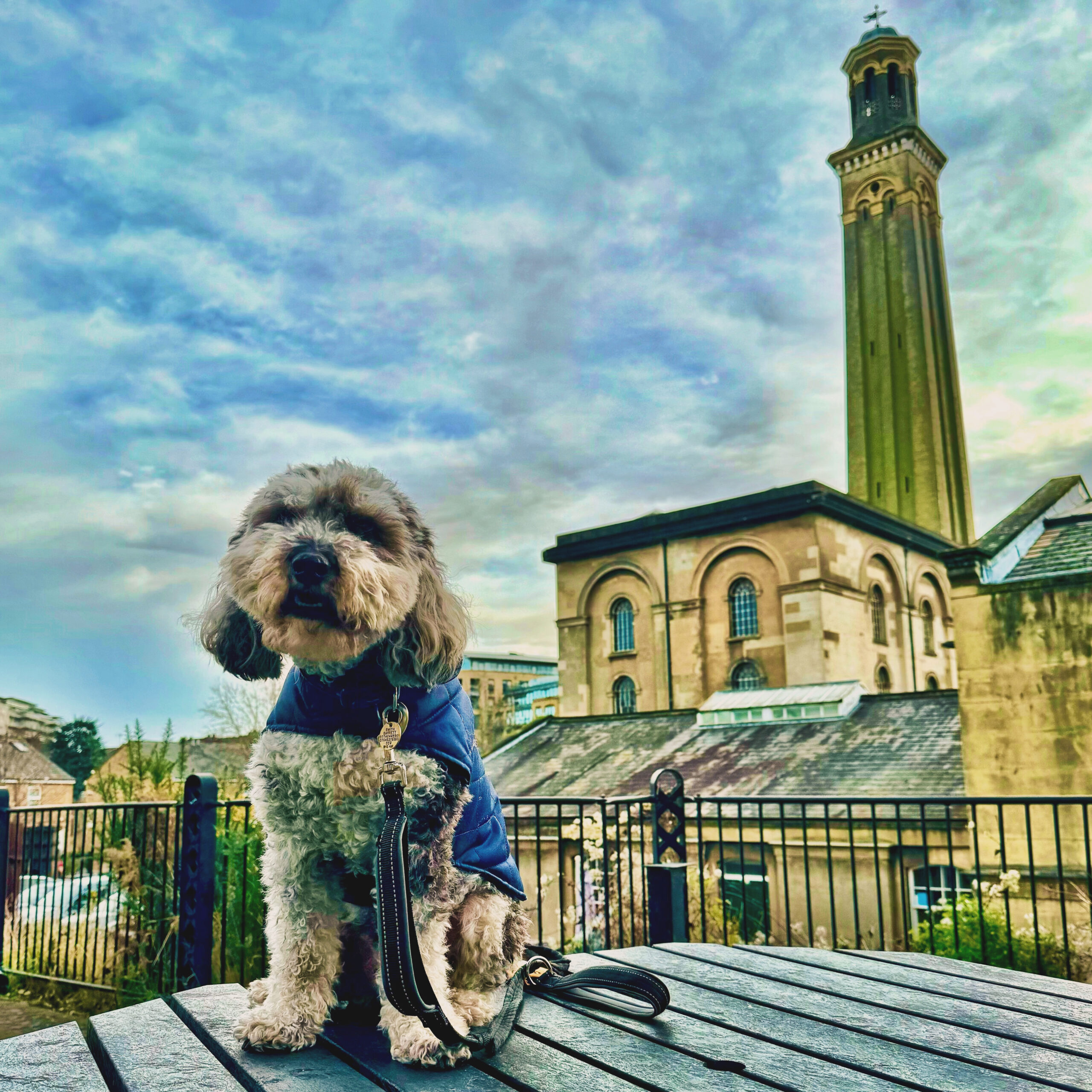
Yoshi visited The London Museum of Water & Steam to celebrate the New Year. In the background are the museum buildings and the impressive Victorian standpipe tower, which is not, as you might expect, a chimney but a brick winter coat for the two systems of vertical pipes – through which water was pumped before it entered the mains water supply – contained within to prevent freezing and is the museum’s most striking feature standing at 200 ft high. The Grade I brick tower, of Italianate design, was constructed in 1867 to replace an earlier open metal lattice structure – 01/01/2024
January 1st 2024 to January 11th 2024
We kicked off 2024 with a visit to the “New Years Steam Up” being held at the London Museum of Water & Steam in Brentford. The Steam Up weekend of celebrations was the first opportunity in two years for people to marvel at the monstrous working steam engines that once provided water to the millions living and working in London. In July 2022, the Museum’s 96 year old Lancashire Boiler failed an inspection when it was discovered one of the seventeen rivets which hold the crown valve mounting flange onto the main boiler shell had lost its heat inside the boiler’s steam space. This meant that the boiler could no longer be used and the steam engines fell silent and still while extensive repairs were carried out. Now, just in time to celebrate the museum’s 50th anniversary the boiler is steaming once again.
Situated on the site of the former Kew Bridge Pumping Station, close to Kew Bridge on the River Thames in West London, the museum is centred on a collection of stationary water pumping steam engines dating from 1820 to 1910. It is the home of the world’s largest collection of working Cornish engines, including the largest working beam engine in the world; the Grand Junction 90 inch.
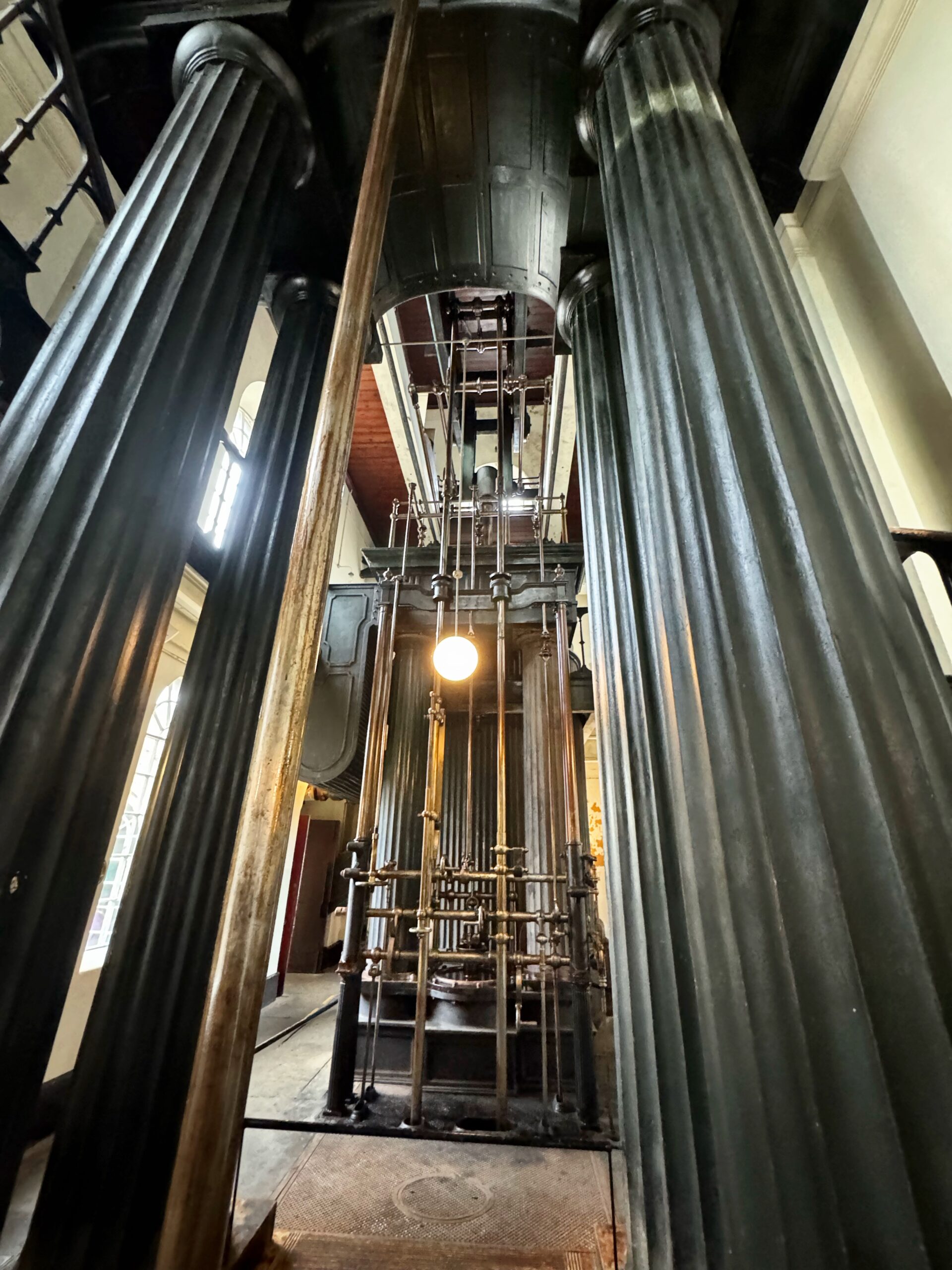
The Grand Junction 90 inch has a cylinder diameter of 90 inches (hence its name!) and was used to pump water to London for 98 years. This machine is over 40 feet high and weighs about 250 tons. It was described by Charles Dickens as “a monster”. It was built by Sandys, Carne & Vivian of Hayle in 1846 as the first Cornish beam engine specifically designed for water supplies and was powerful enough to supply water to the upper floors of buildings, allowing direct supply to upstairs bathrooms 01/01/2024
We arrived early after a good run in the car up from Dorset and luckily found parking on site in the small car park at the museum, although the site is only a 3 minute walk from Kew Bridge railway station if you chose to arrive by train. There were a number of families in evidence with young children during our visit and the museum is a great place to learn and have fun.
Exhibiting a plethora of steam, diesel and electric powered pumps, the London Museum of Water & Steam tells the story of London’s water supply housed in historic Georgian buildings and they very kindly allowed access to Yoshi, but explained that our boy may not like some of the steam engines when they are working. We duly followed this advice and Yoshi waited with one of his hoomans in the Pump and Grind Coffee Shop or explored the garden area while the machines were being operated. The coffee shop was very busy and served an excellent cuppa. It is run by “Our Barn Community”, a local charity working with young people with learning difficulties enabling a supported work placement.
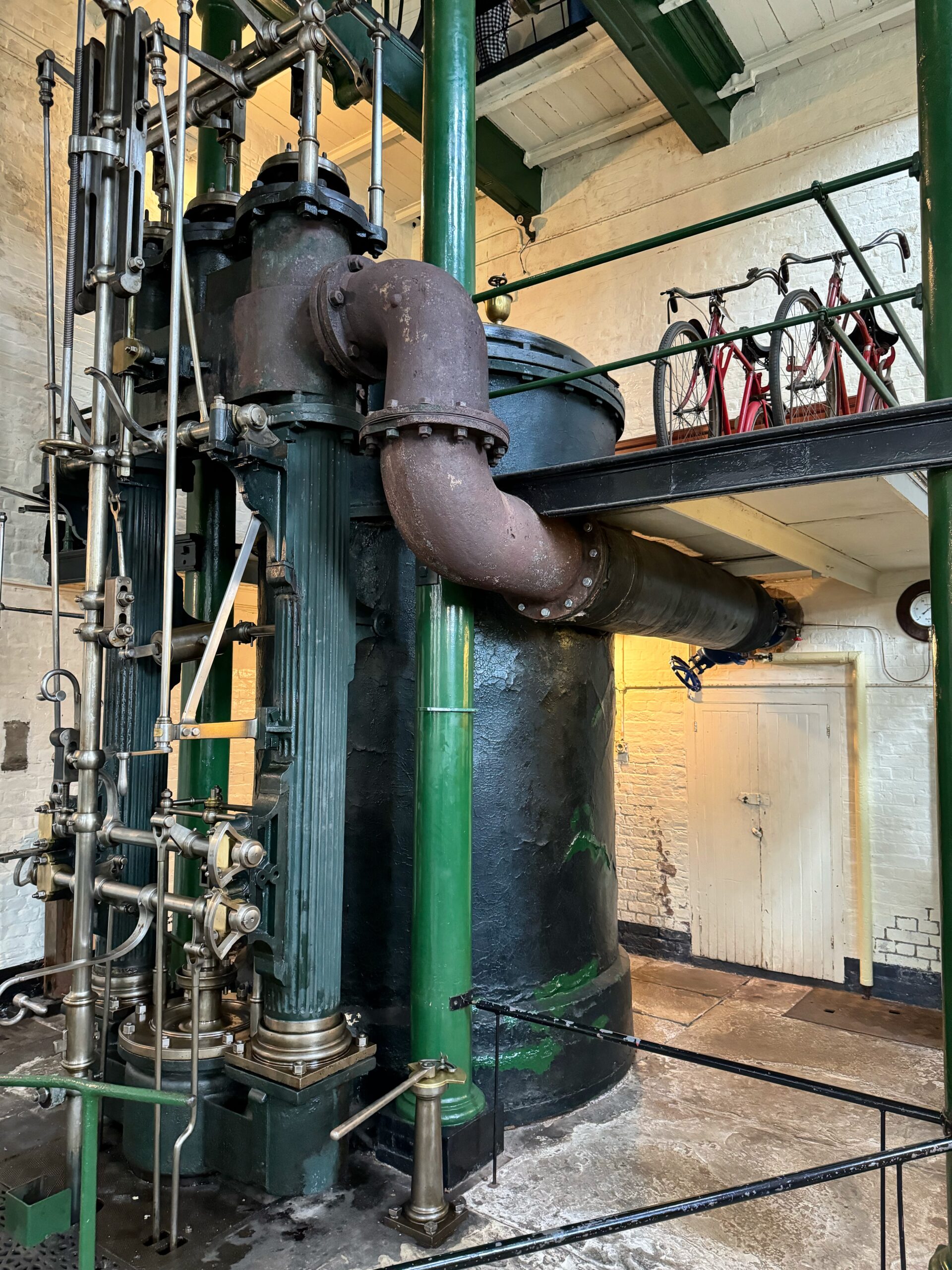
We have shared just a small fraction of the engineering marvels housed at the museum below:
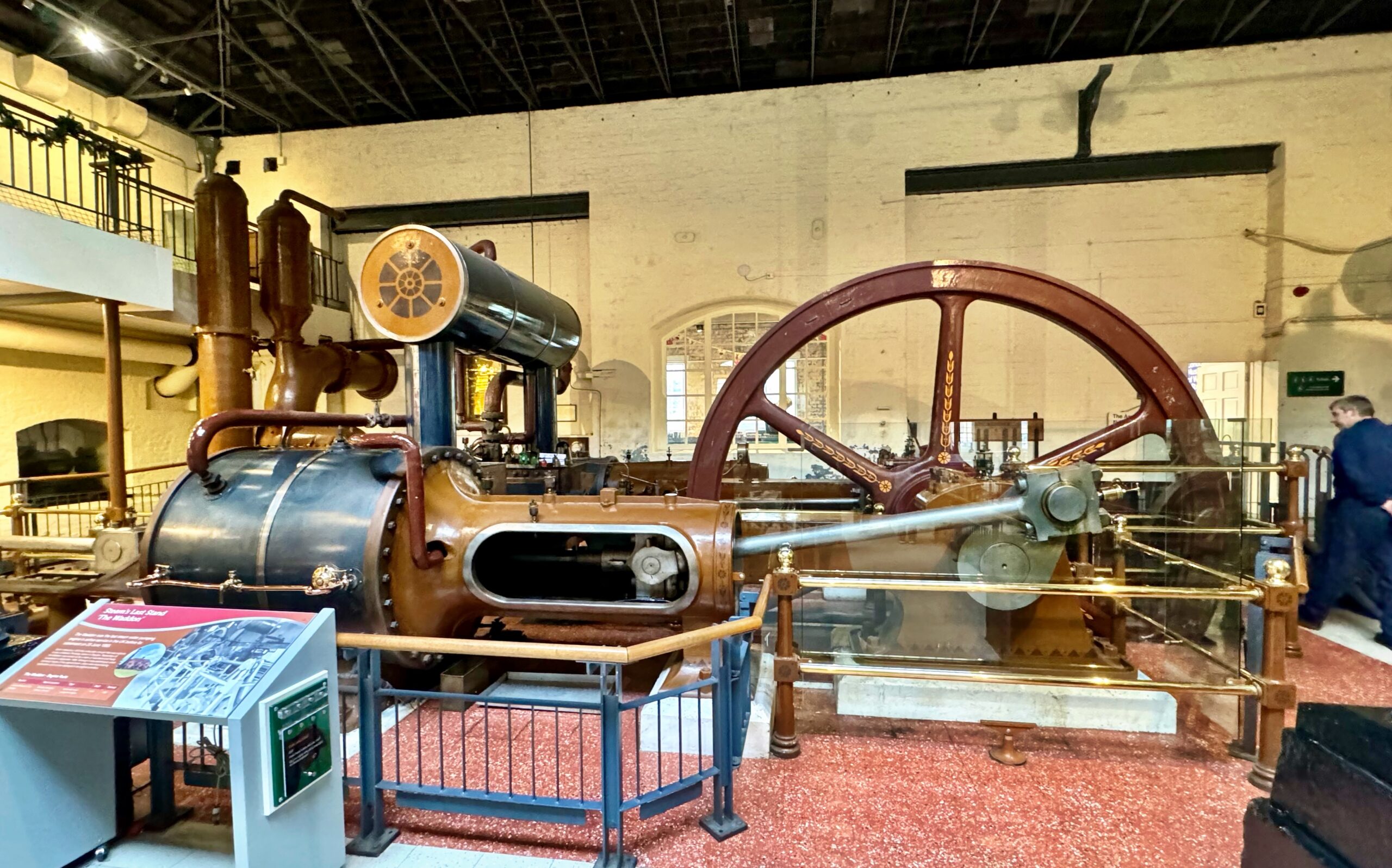
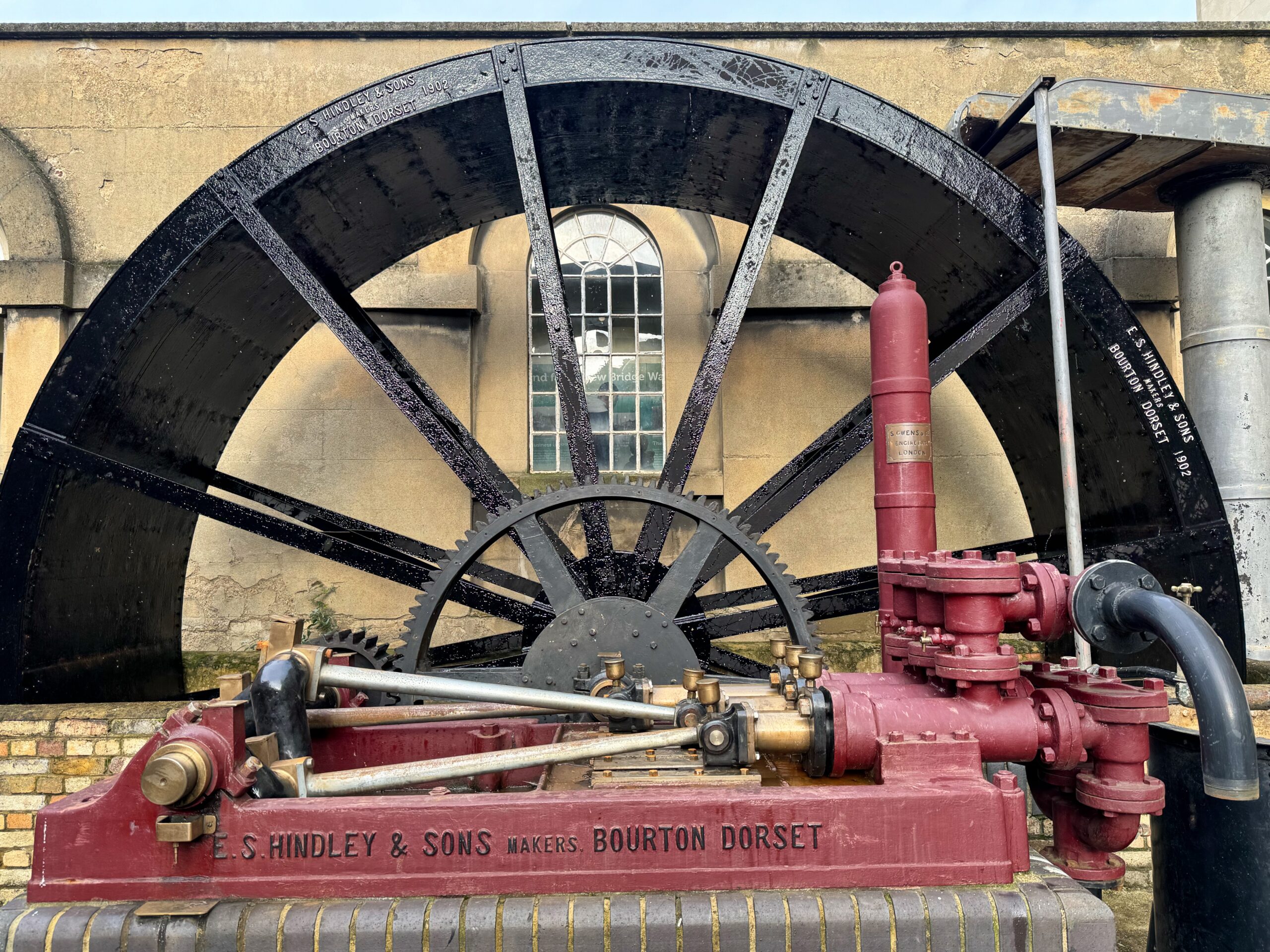
The Waddon Engine with drove 3 pumps was built by James Simpson & Co of Newarkin 1910 and originally found use at Waddon Pumping Station in Croydon. It was the last steam water-pumping engine in active UK service before being retired in June 1983. It was restored in 1990 and restored to original Edwardian colours for display at the museum – 01/01/2024This waterwheel was built in 1902 by S. Hindley & Sons in Bourton, Dorset for the Duke of Somerset to serve his estate at Maiden Bradley in Wiltshire and was one of the last waterwheels ever built to pump water in the UK – 01/01/2024The Boulton & Watt (West engine) is the oldest engine in the London Museum of Water & Steam having been built in Birmingham in 1820.It was one of a pair moved to Kew in 1840 which were then converted into a Cornish type between 1846 and 1848. Retired in 1944, this was the first engine to be returned to working order in 1975 – 01/01/2024
Kew Bridge Pumping Station was originally opened in 1838 by the Grand Junction Waterworks Company, expanding over the ensuing years and ultimately housing six steam pumping engines as well as four Allen diesel pumps and four electric pump sets. The steam engines were retired from service in 1944, although two were kept on standby until 1958. The Metropolitan Water Board thankfully decided not to scrap the resident steam pumping engines and set them aside to form the basis of a museum display at a later date which came to fruition in 1974 with the formation of the Kew Bridge Engines Trust.
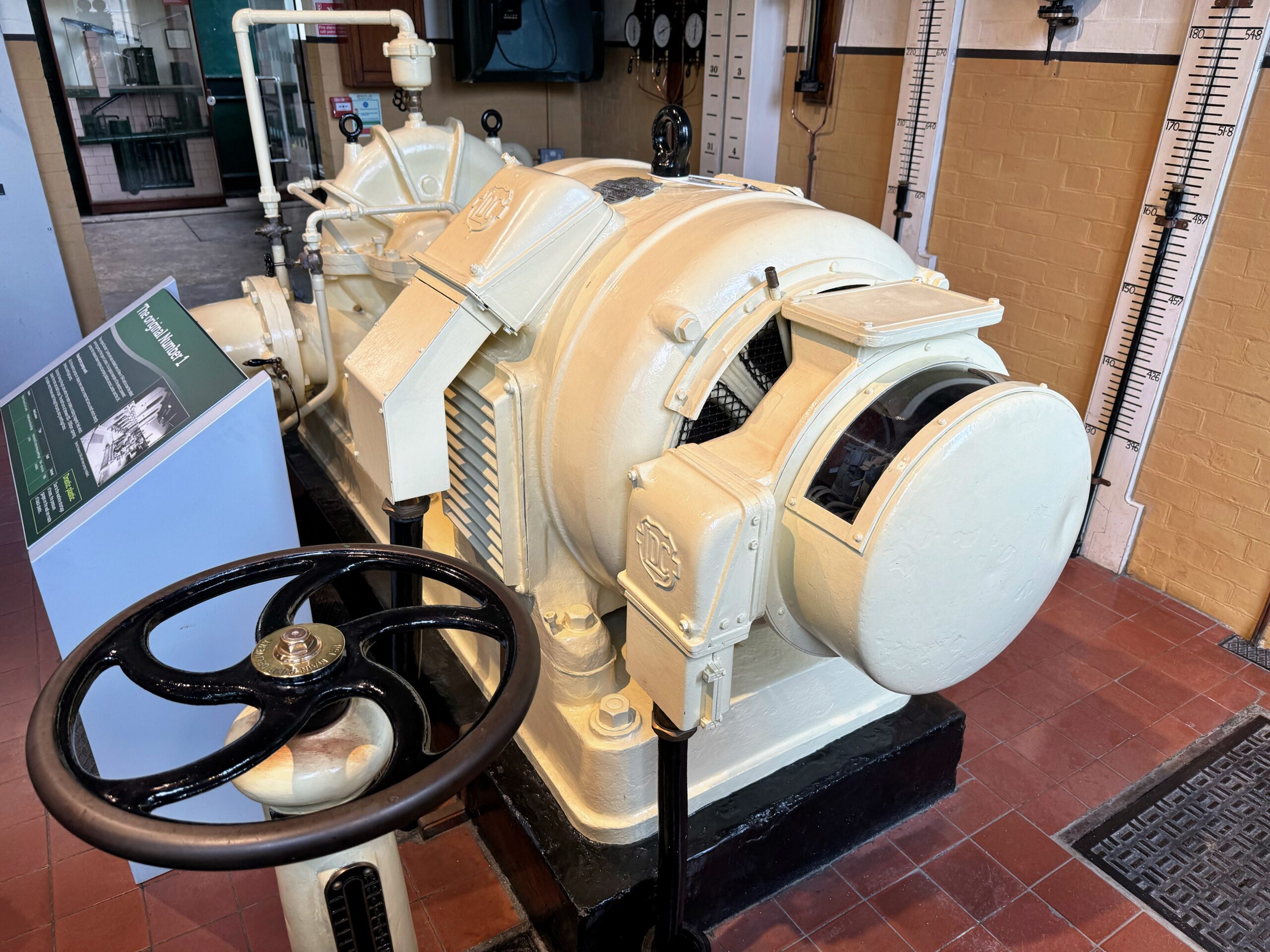
The original Number 1 horizontal AC motor driving centrifugal pump was built in 1944 by Hawthorn Davey & Co of Leeds. This type of electric pump replaced steam engines at pumping stations across the UK and this example is the oldest surviving pump of its kind. It was retired in the late 1980’s – 01/01/2024
The museum also runs a 2 ft narrow gauge railway, which despite being advertised as running over the weekend, was unfortunately not operating during our visit. The museum has been a filming location for many television programmes, including the Doctor Who serial “Remembrance of the Daleks” broadcast in 1988.
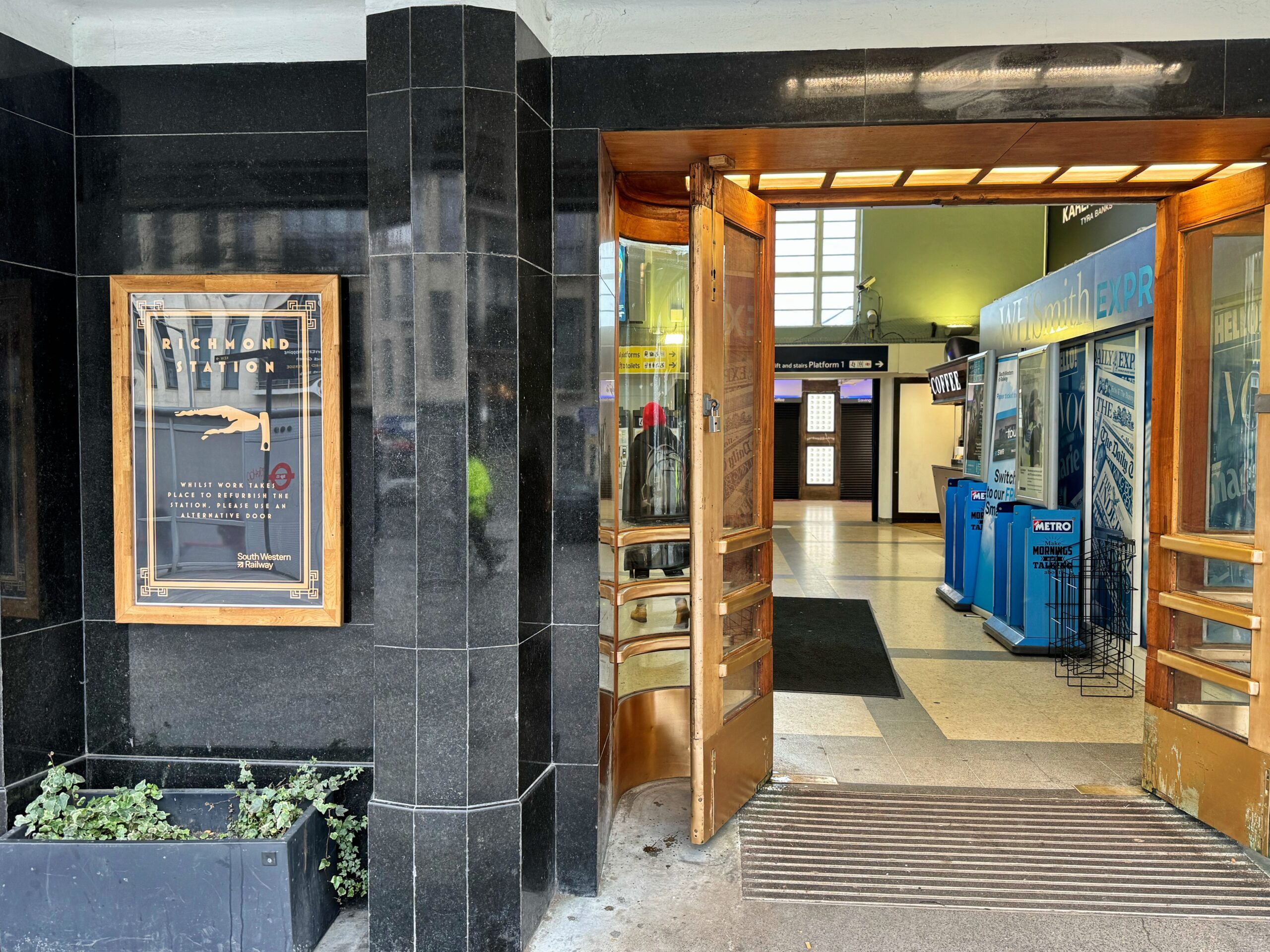
After our visit to the London Museum of Water & Steam, we had planned on taking a trip into central London by rail, but in the event decided against this and instead took a drive and a leisurely walk around nearby Richmond, including a visit to the railway station. Of course we did!
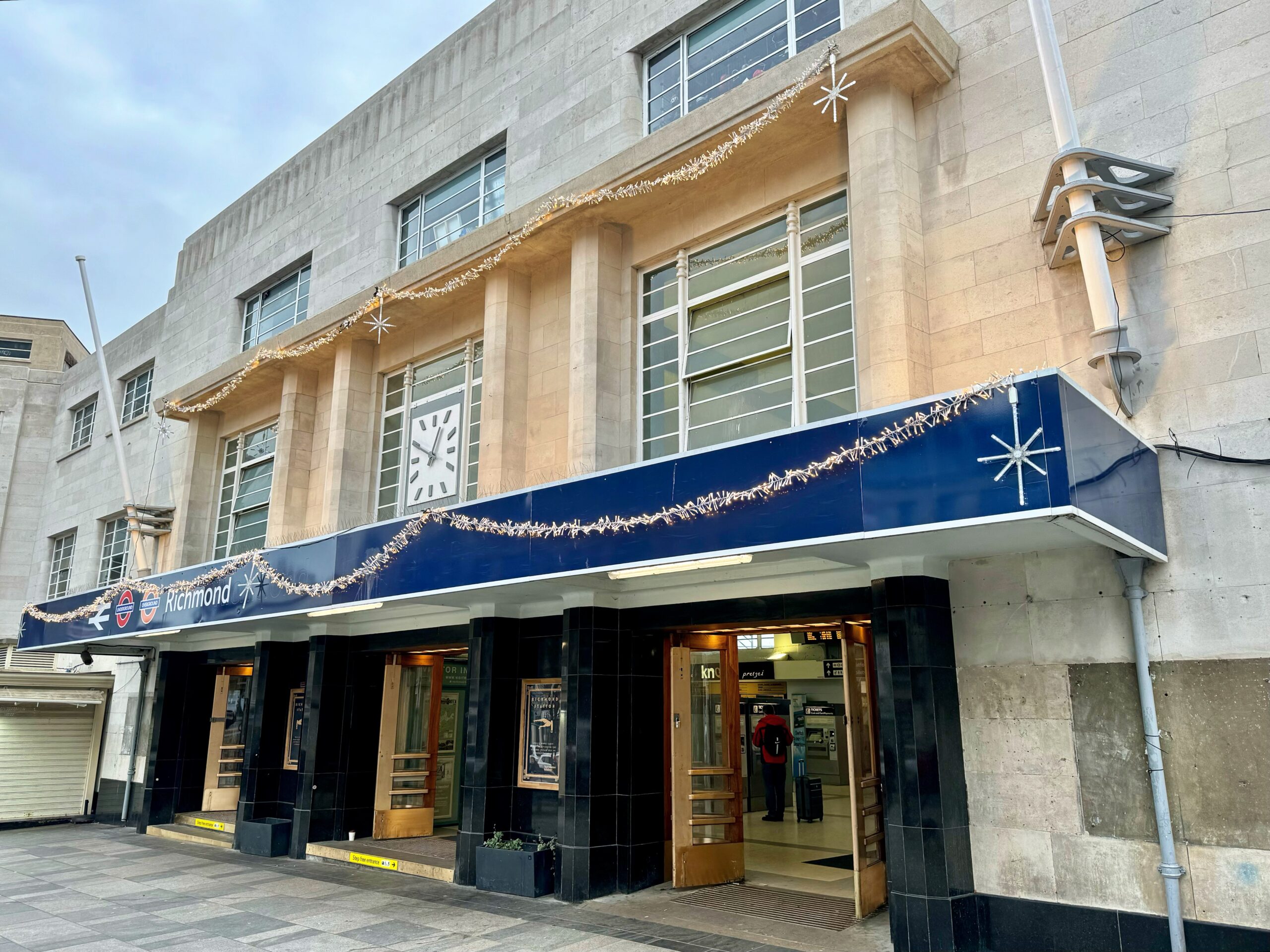
The Art Deco façade of Richmond railway station complete with its square clock centrepiece – 01/01/2024
The Art Deco station building in Richmond, designed by James Robb Scott (1882-1965) for the Southern Railway and constructed in Portland stone dates from 1937 and replaced an earlier station on the site. Scottish born Scott became the Chief Architect of the Southern Railway and is perhaps best known for his redesign of London Waterloo between 1910 and 1923 where he was chiefly responsible for the offices, main entrance and war memorial to the fallen employees of the railway known as the Victory Arch. Scott also designed Wimbledon and Surbiton railway stations – now part of the South Western Railway (SWR) network – the latter having recently celebrated 40 years since being bestowed Grade II listed status.
SWR, Network Rail (NR) and the Railway Heritage Trust are jointly funding a £325,000 programme of improvements with hopes of more refurbishment to come in the future, subject to additional funding being made available. Initial work includes cleaning the Portland stone façade, repairing the timber entrance doors and polishing its bronze embellishments, repairing flagpoles and refurbishing customer toilets.
The restored entrance doors to Richmond railway station which Yoshi unceremoniously christened on our visit…. 01/01/2024
The style of the building at Richmond is suggested as being inspired by the work of Charles Holden (1875-1960), the architect behind London Underground stations including South Wimbledon on the Northern line. Holden’s designs included multi-frame glazing, enamelled signage panels, the use of an iconic typeface for signage and brick and tile detailing. Similar features at Richmond have been lost or covered up over time, including during the station’s last major refurbishment in 1985. SWR, NR and the Railway Heritage Trust have worked with Benedict O’Looney Architects on designs that include restoring or replicating those features, and others, in future improvements. Paying close attention to detail, the station’s original, hand-drawn plans are being used together with promotional photographs from when the station first opened its doors to customers. Samples of the station’s original paint are also being analysed by the University of Lincoln, specialists in the conservation and restoration of the interior and exterior features of listed and historic buildings.
The area in front of Richmond station main entrance was pedestrianised in 2013 and includes a war memorial to soldier Bernard Freyberg, who was born in Richmond. As well as Sir trains, the station is served by the London Overground North London Line and Underground District Line trains.
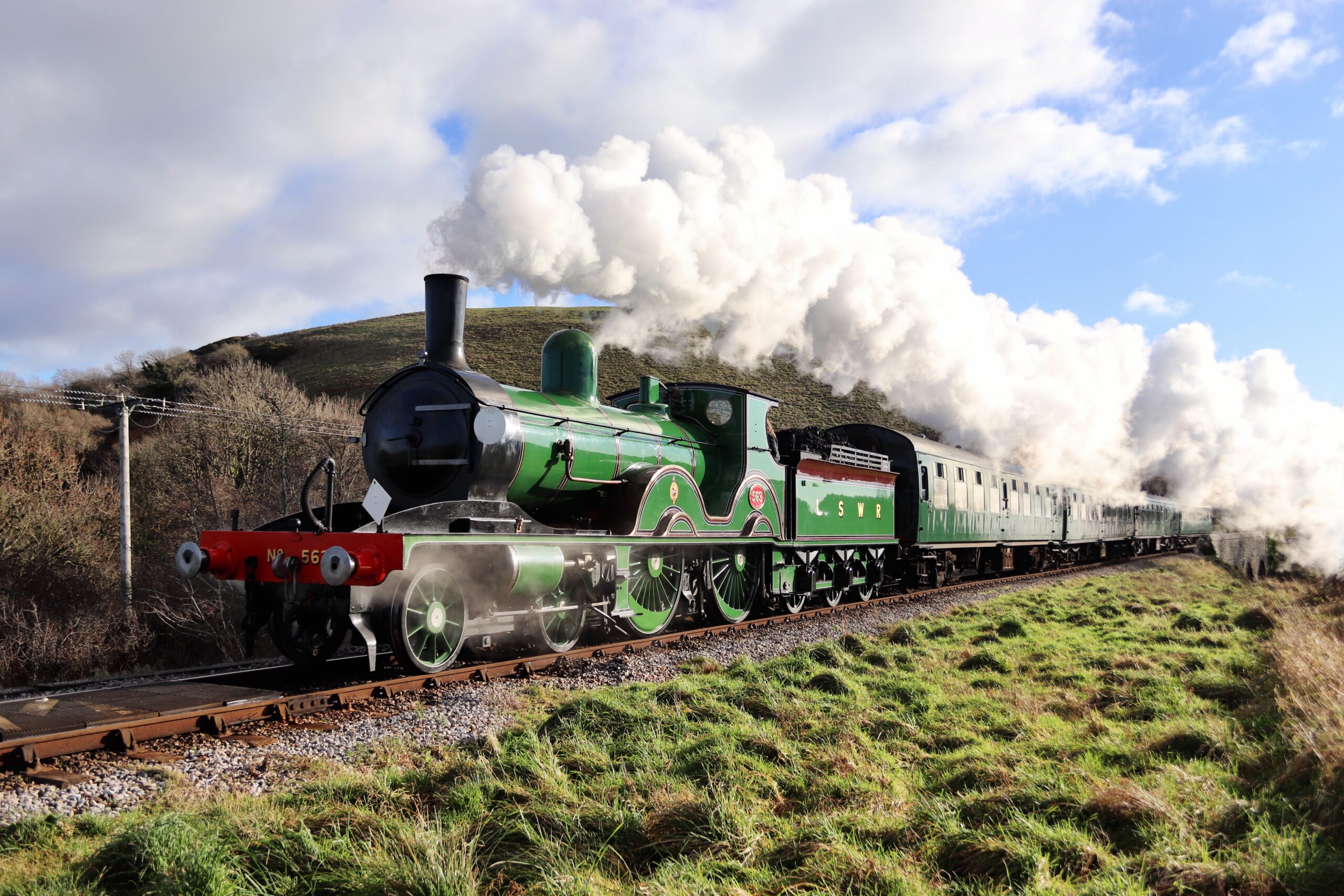
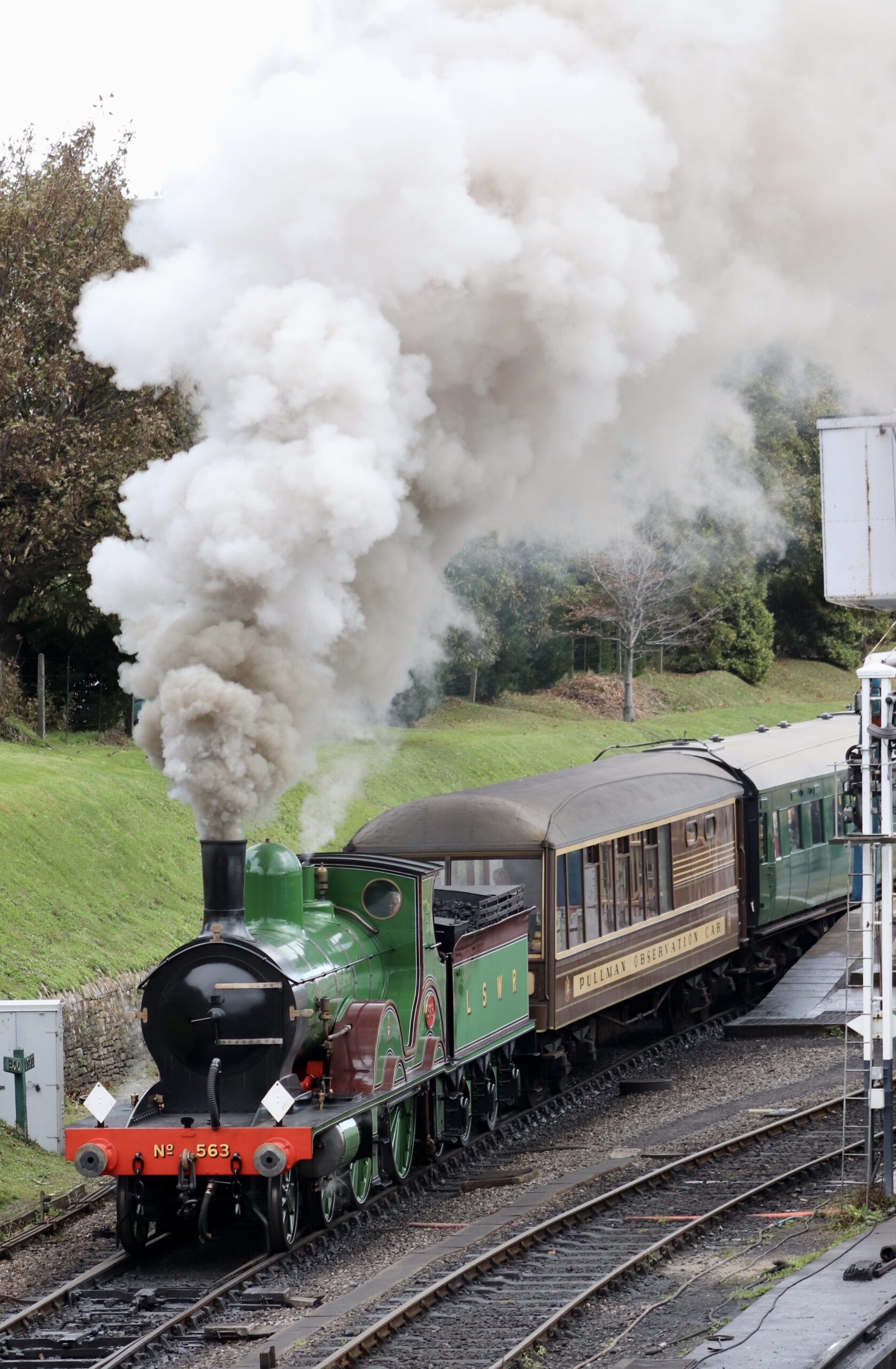
Star of the show, Adams 4-4-0 T3 No. 563 working the 1200 Swanage to Norden service approaches Corfe Common – 06/01/2024
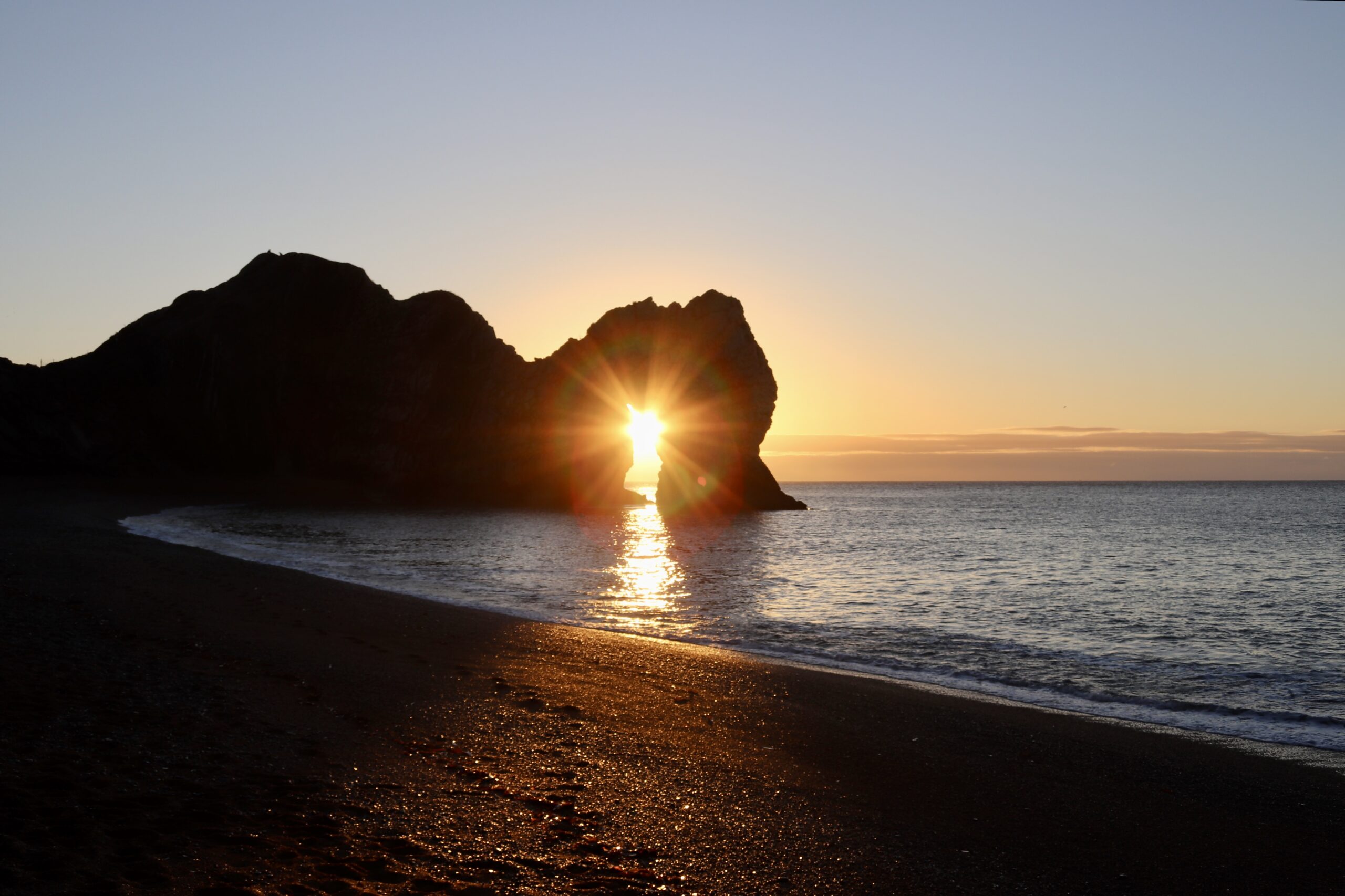
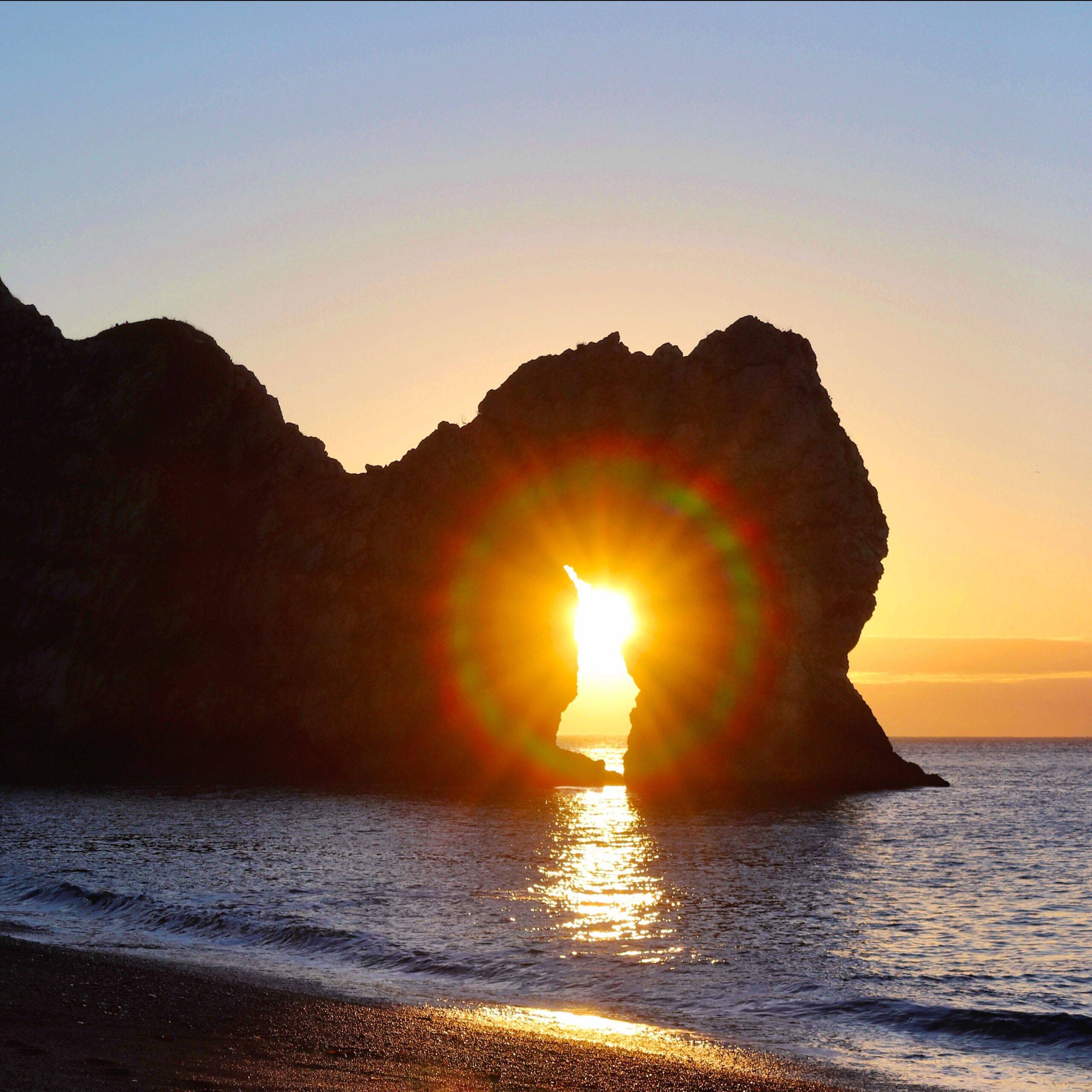
The Swanage Railway’s first event of 2024 was their annual “Winter Warm Up” weekend held on January 6th & 7th. With cold, but clear weather forecast, I decided on heading down to Swanage on the Saturday after taking a chance on a picturesque sunrise at Durdle Door on the way.
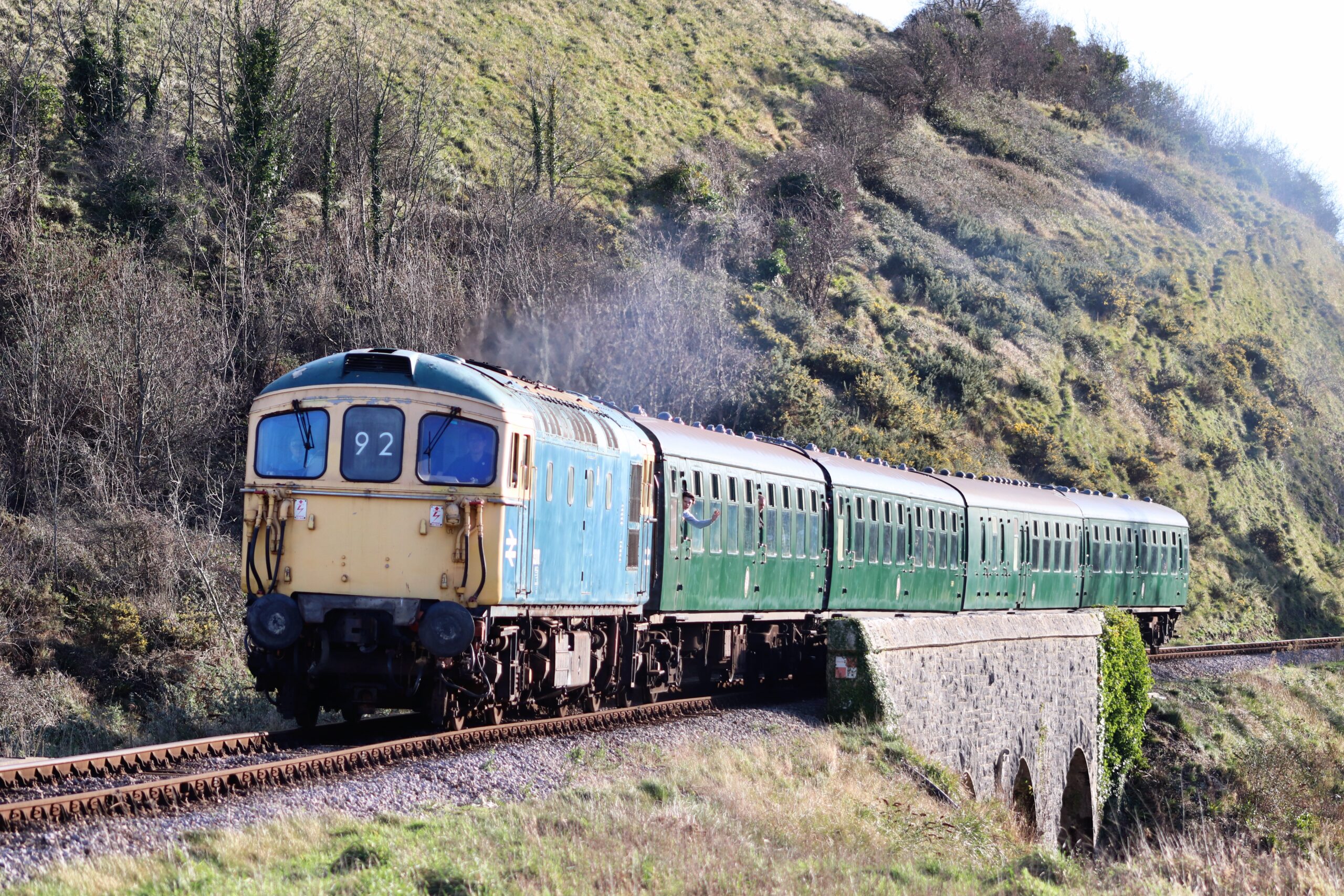
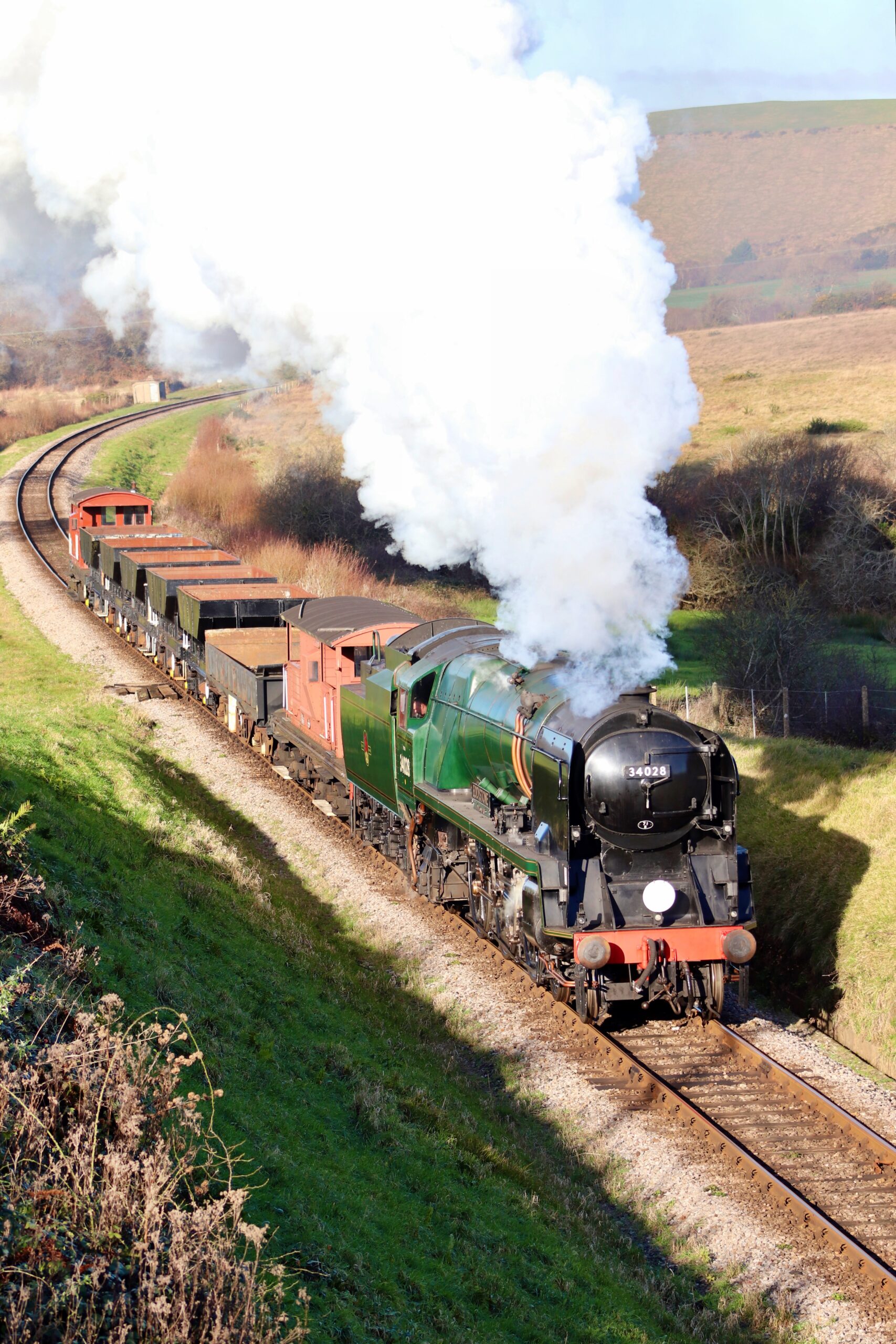
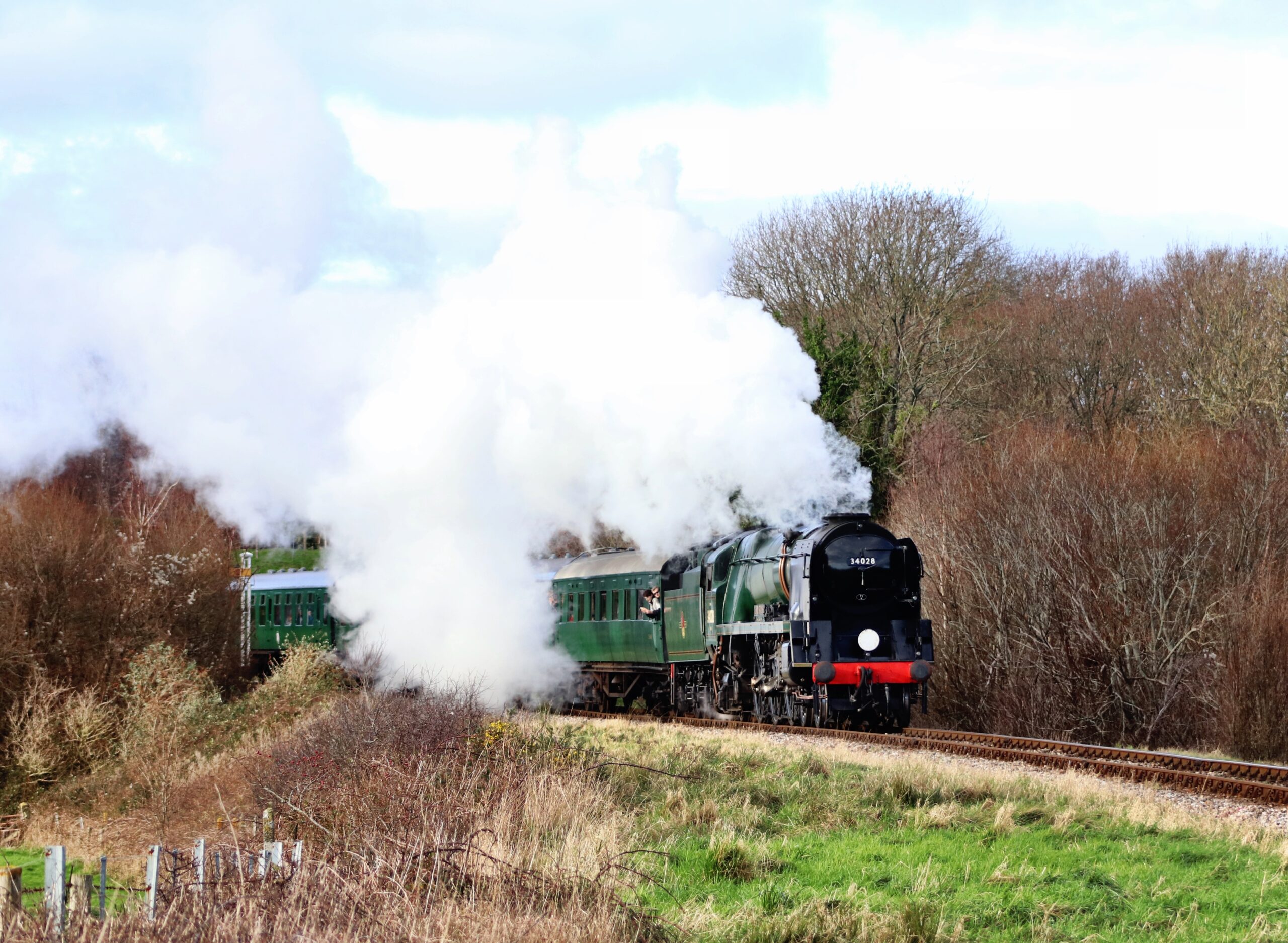
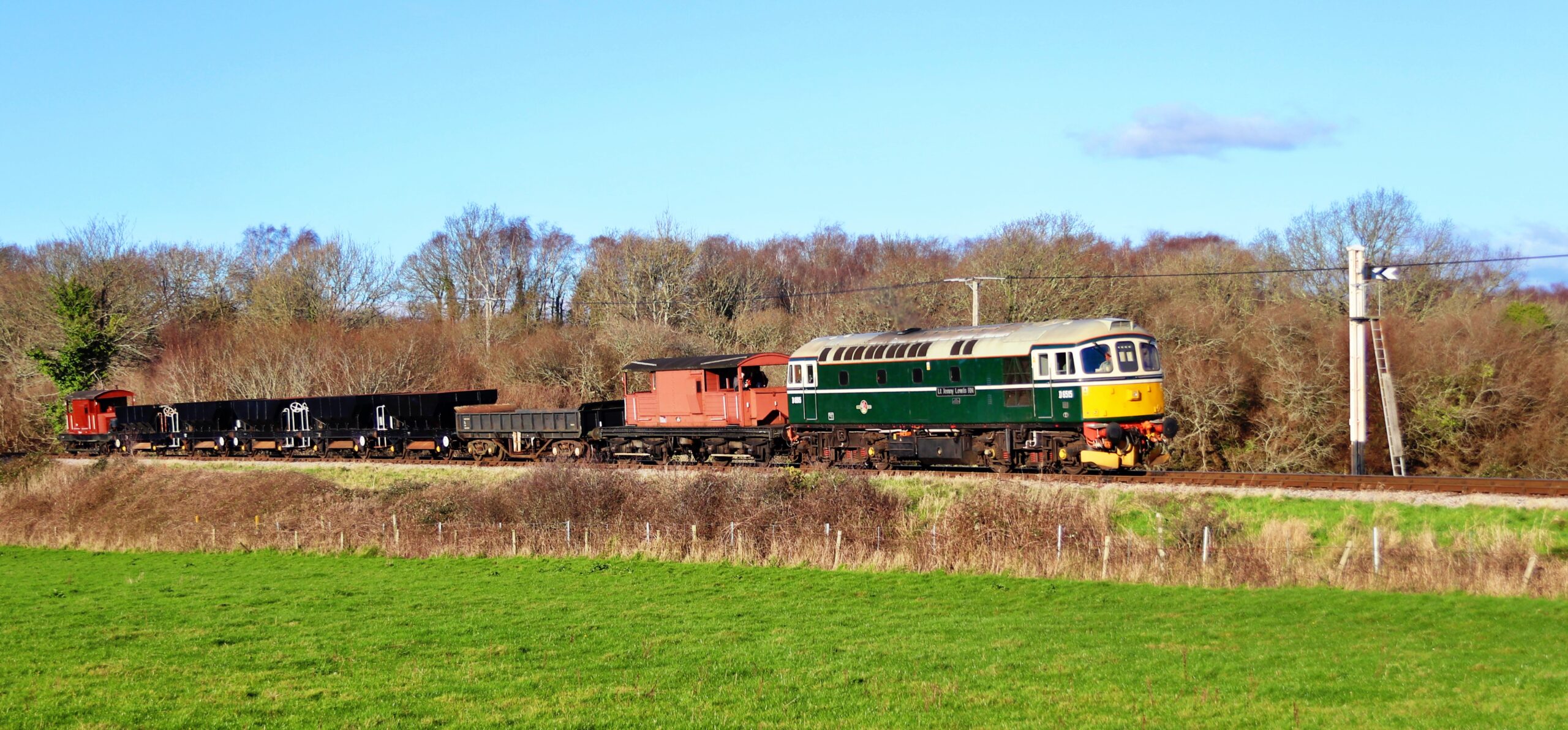
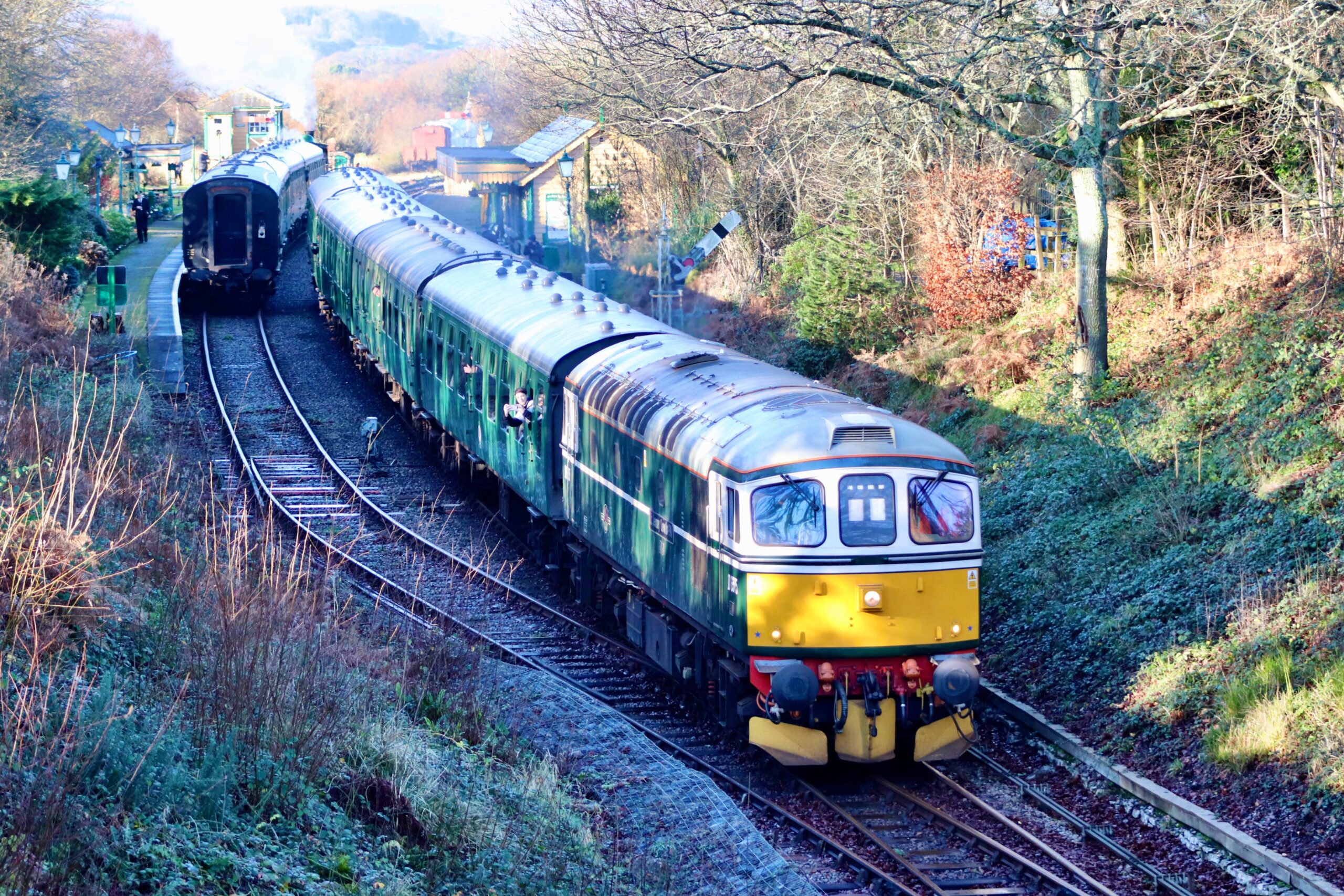
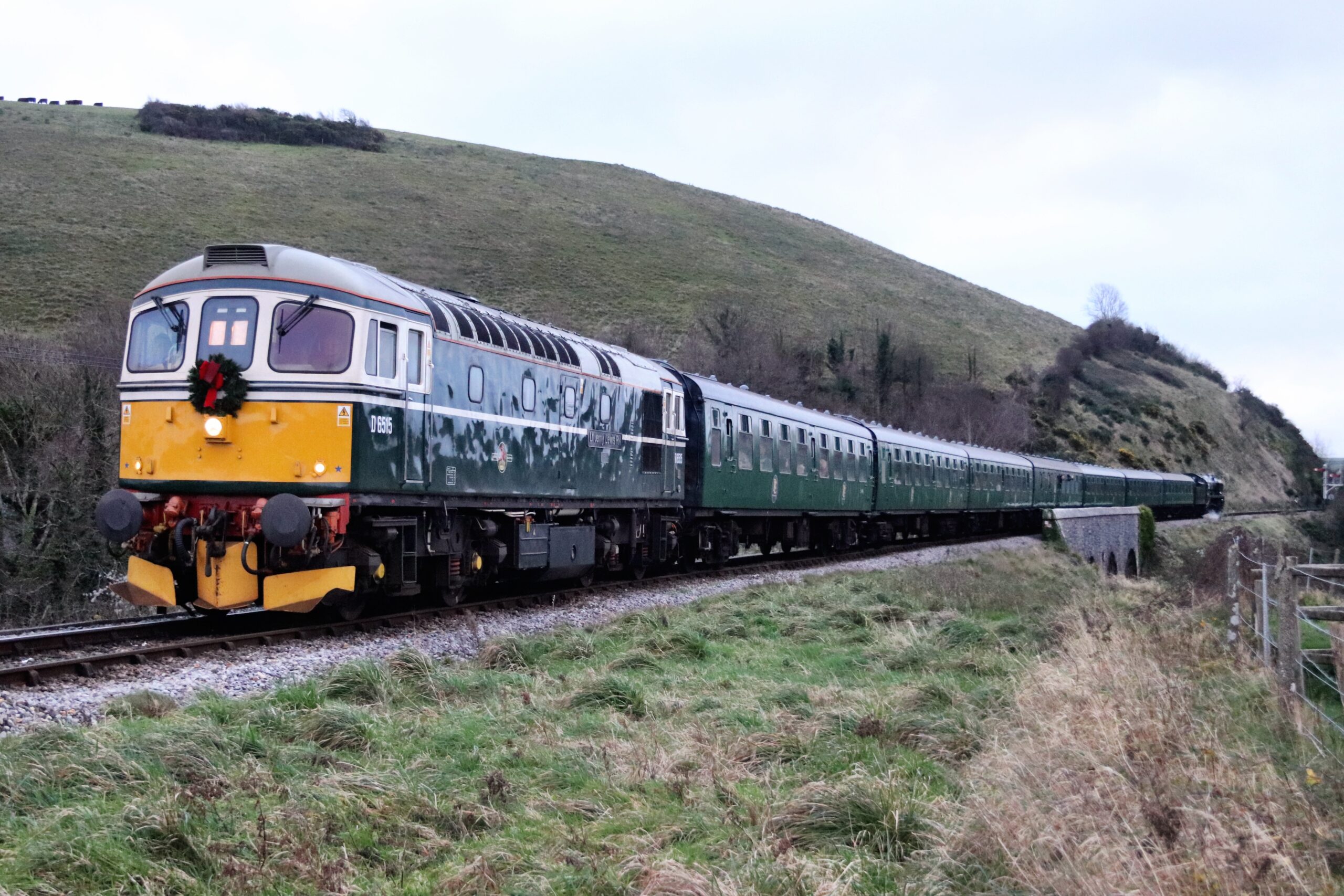
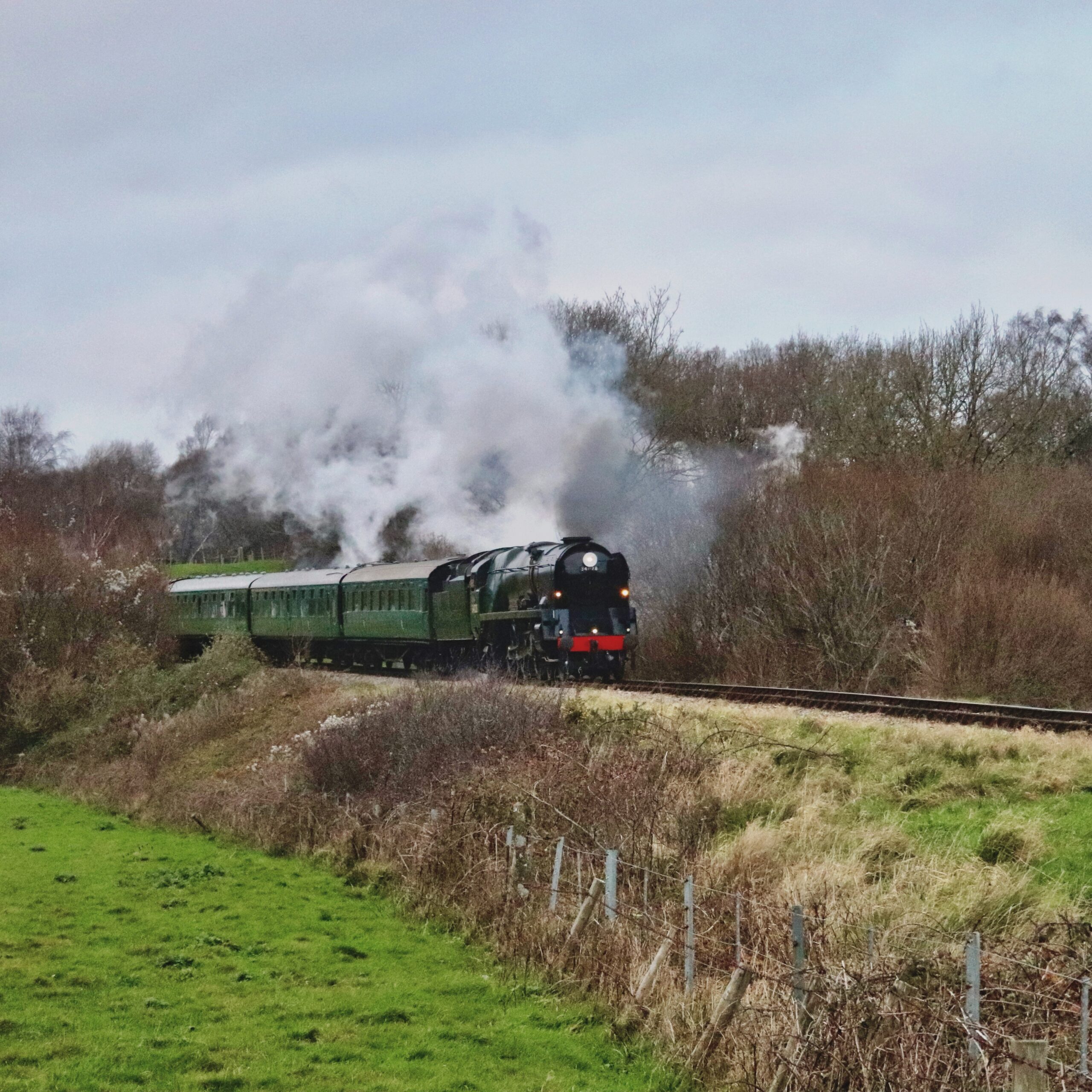
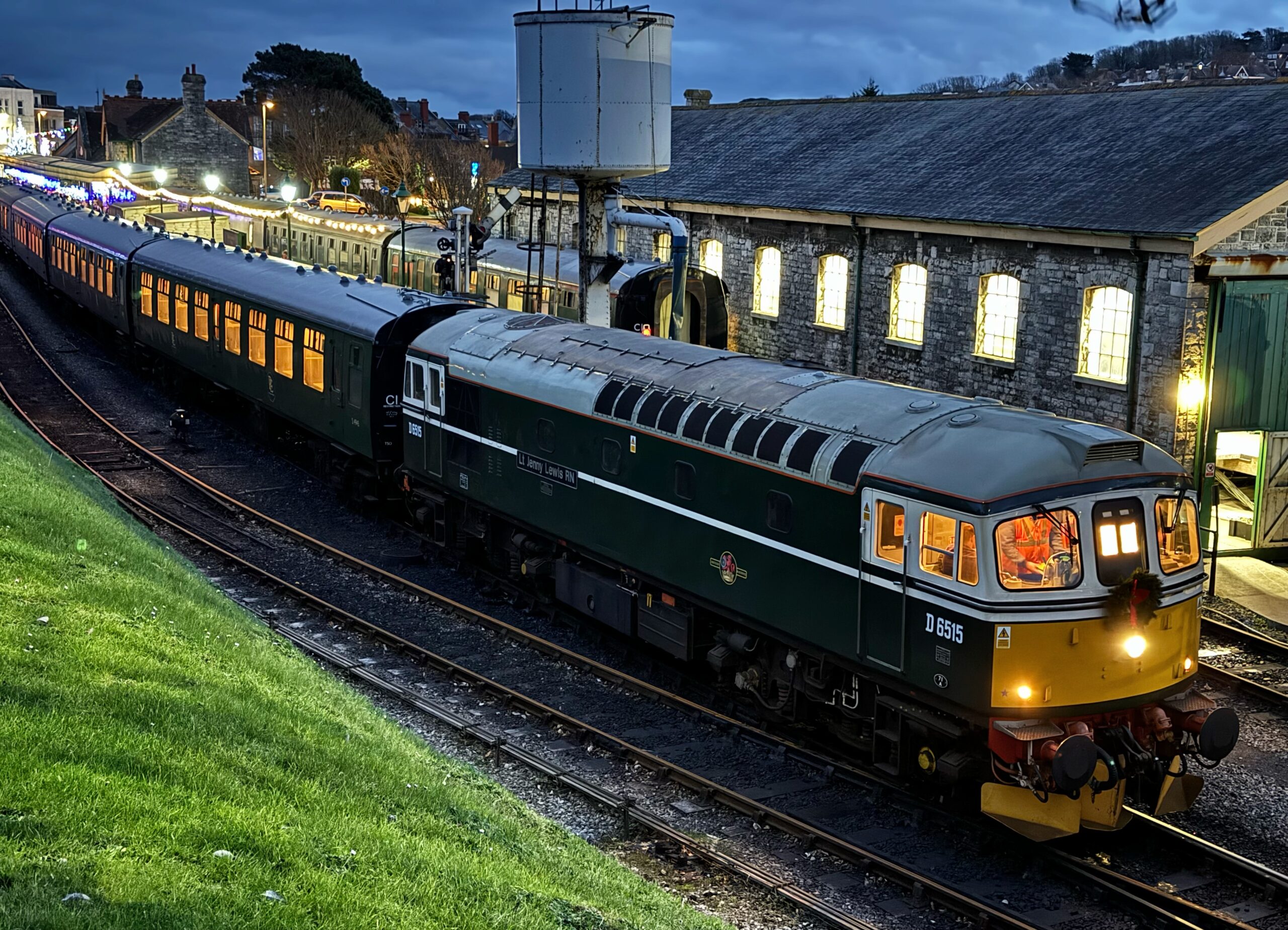
Resident Class 33 No. 33111 crosses Corfe Viaduct hauling the 1245 Swanage to Norden train – 06/01/2023SR West Country 4-6-2 No. 34028 ‘Eddystone’ takes her turn on the demonstration freight working the 1132 Norden to Swanage nearing Afflington. Later during the weekend, brake van rides were offered – 06/01/2024This time working a passenger train, SR West Country 4-6-2 No. 34028 ‘Eddystone’ has departed Norden with the 1415 service to Swanage – 06/01/2024Class 33 No.D6515 ‘Lt Jenny Lewis RN’ takes her turn on the freight wagons working 1302 Norden to Swanage – 06/01/2024Class 33 No.D6515 ‘Lt Jenny Lewis RN’ departs Harman’s Cross with the 1030 Norden to Swanage – 06/01/2024
In action this year was the recently restored Adams 4-4-0 T3 No. 563 hauling its first freight train since its return to service, SR West Country 4-6-2 No. 34028 ‘Eddystone’ and the resident Class 33 diesel locomotives no.’s 33111 and D6515 ‘Lt Jenny Lewis RN’
Adams 4-4-0 T3 No. 563 powers away from Corfe Castle at the head of the 1357 Swanage to Norden demonstration freight – 06/01/2024
The Swanage Railway Trust 563 Locomotive Group have been nominated for the “Steam Railway Magazine Award”. This award is decided by the public and will be announced at Heritage Railway Association’s annual ceremony on February 10th 2024 and you can now cast your vote online until the 18th January 2024: www.steamrailway.co.uk/read/hra-awards
Video from January 6th 2024 Swanage Winter Warm Up
Scheduled mainline action kicked off the year with a “no-show” as the HST powered New Measurement Train (NMT) failed to reach Weymouth on January 3rd after a points failure at Castle Cary curtailed 1Z22 1211 Derby RTC (Network Rail) to Bristol Kingsland Road – top and tailed by Class 43 power cars No.’s 43274 and 43257 – at Westbury. Interestingly three different paths were put in for this test train on this particular day. The one which finally ran was timed later than the usual working to Dorset, but not as late as one of the options given for the day!
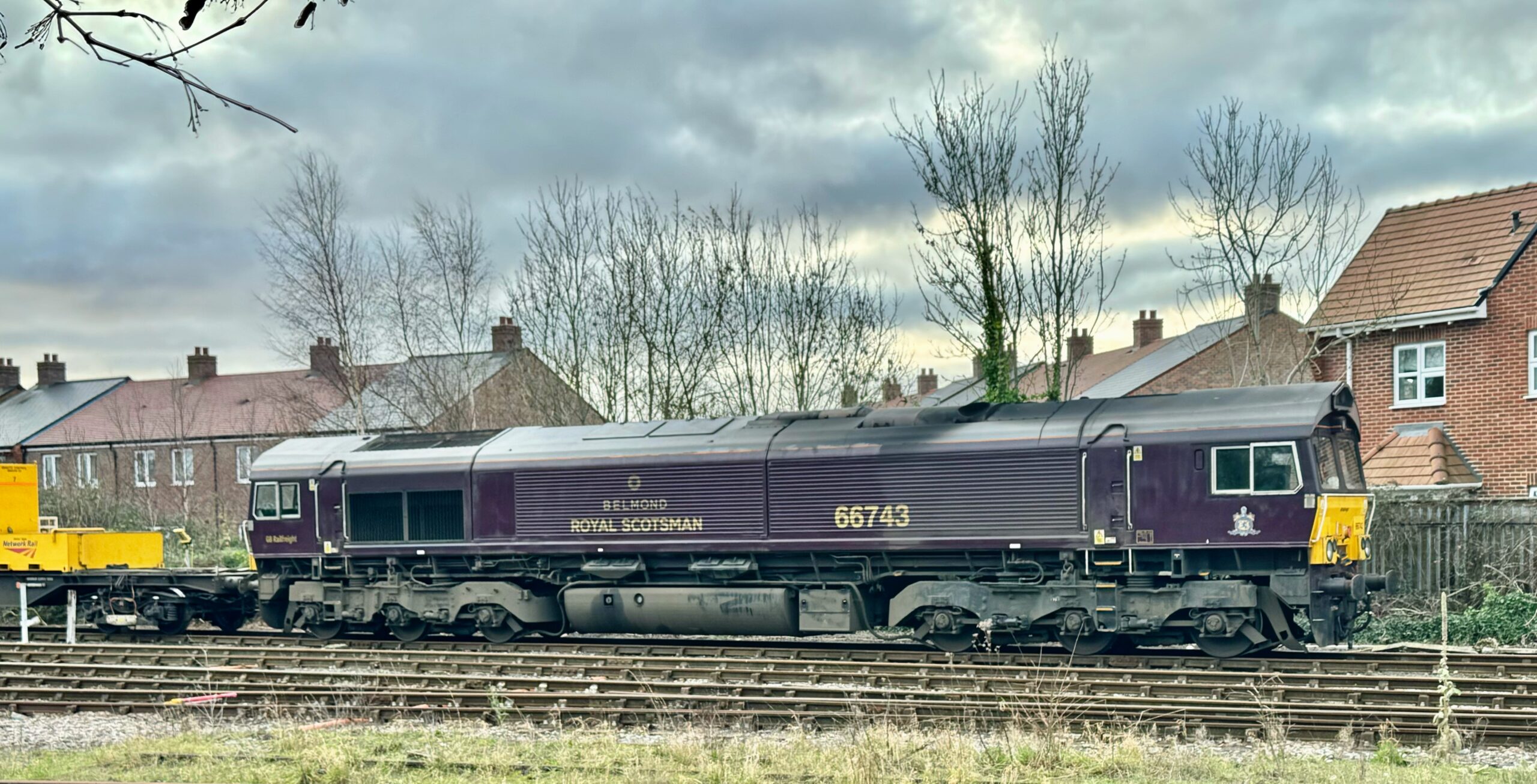
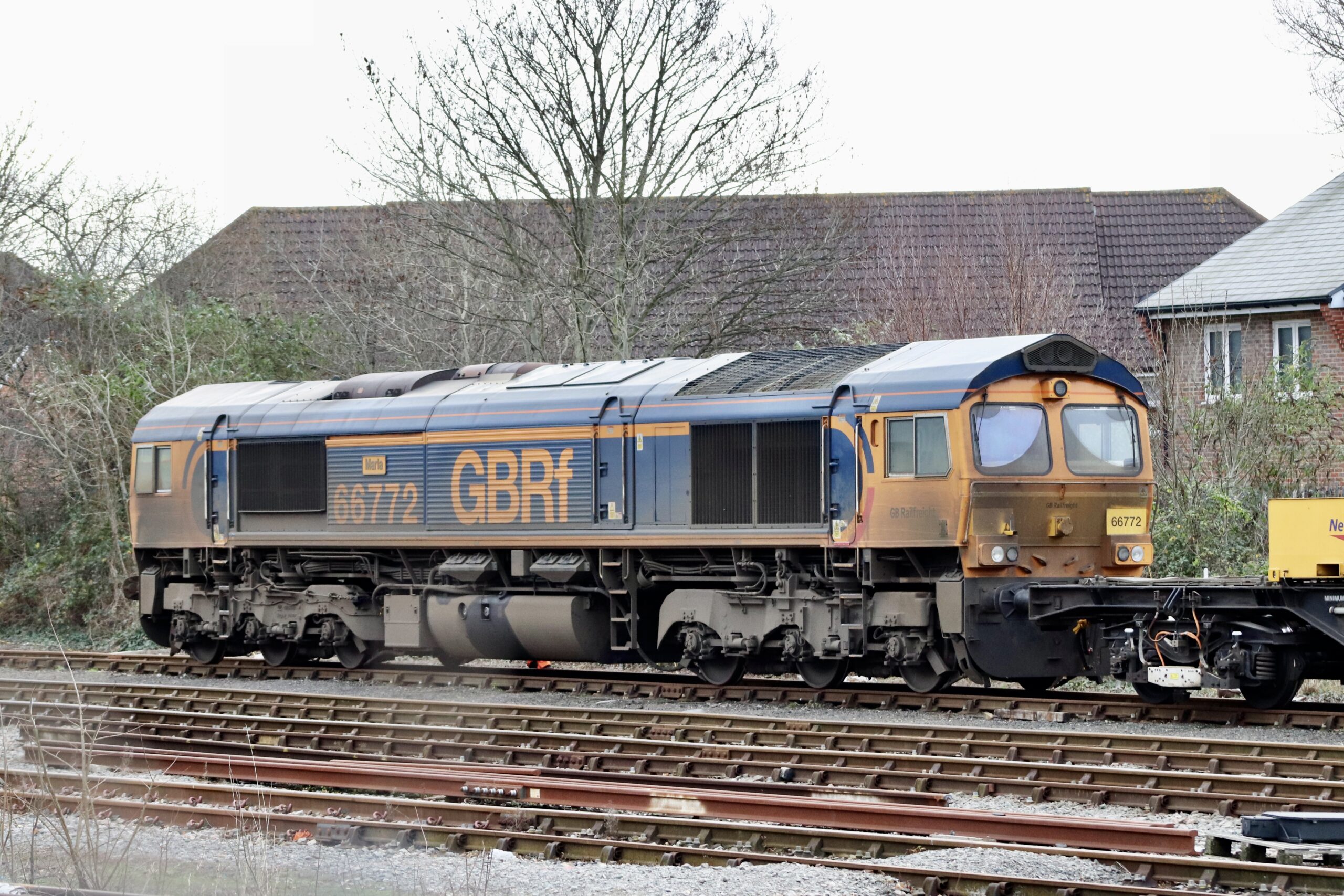
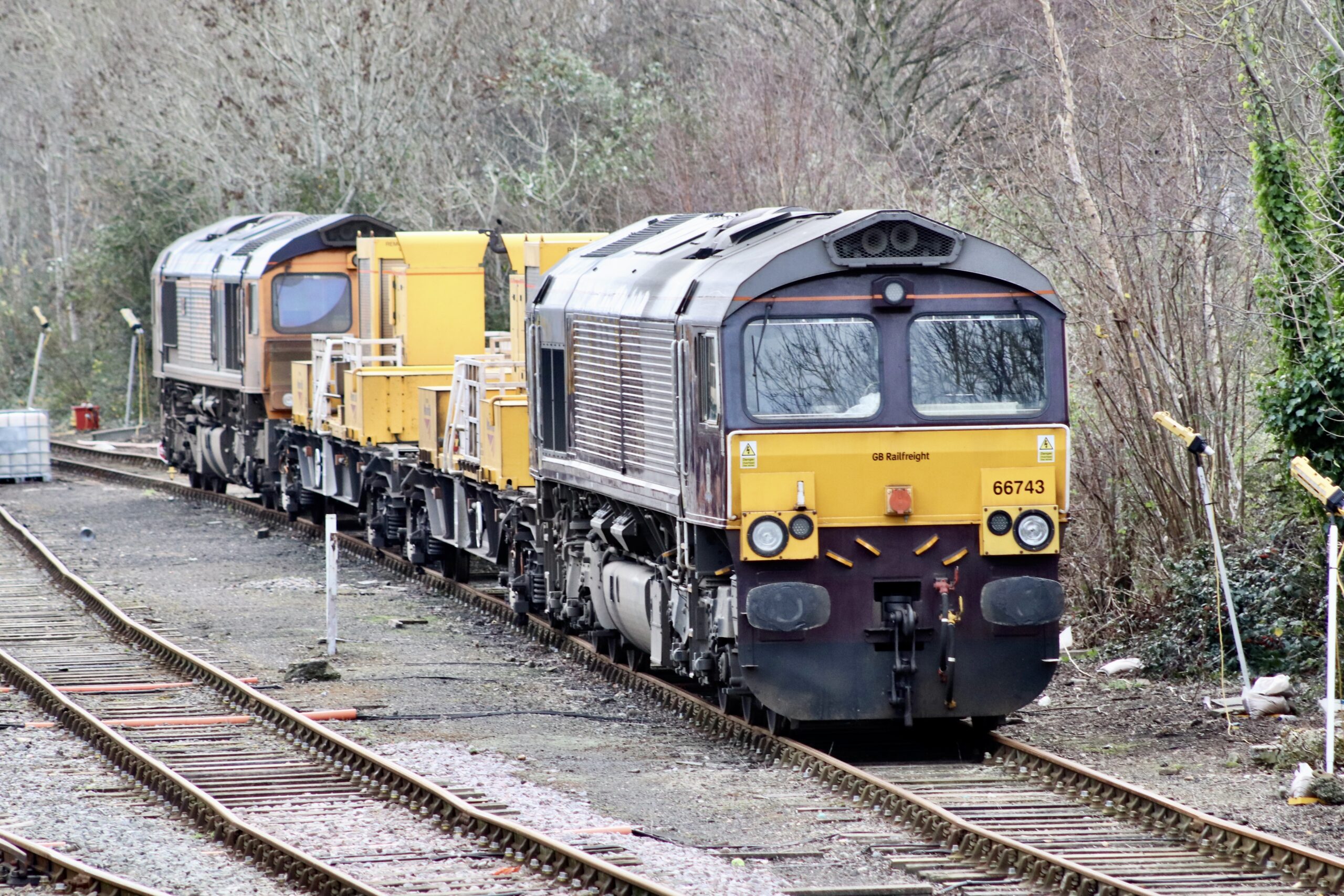
We did, however, get to experience a daylight Snow & Ice treatment Train (SITT) on Sunday 7th January as GBRf Class 66 locomotives No.’s 66764 ‘Major John Poyntz Engineer & Railwayman’ and 66772 ‘Maria’ in top and tail formation worked to Weymouth as 3Y88 1035 Totton Yard to Totton Yard. 66764 replaced No. 66723 ‘Chinook’ and No. 66743 which had both been previously paired up with No. 66772 on the Totton based SITT locomotive diagram.
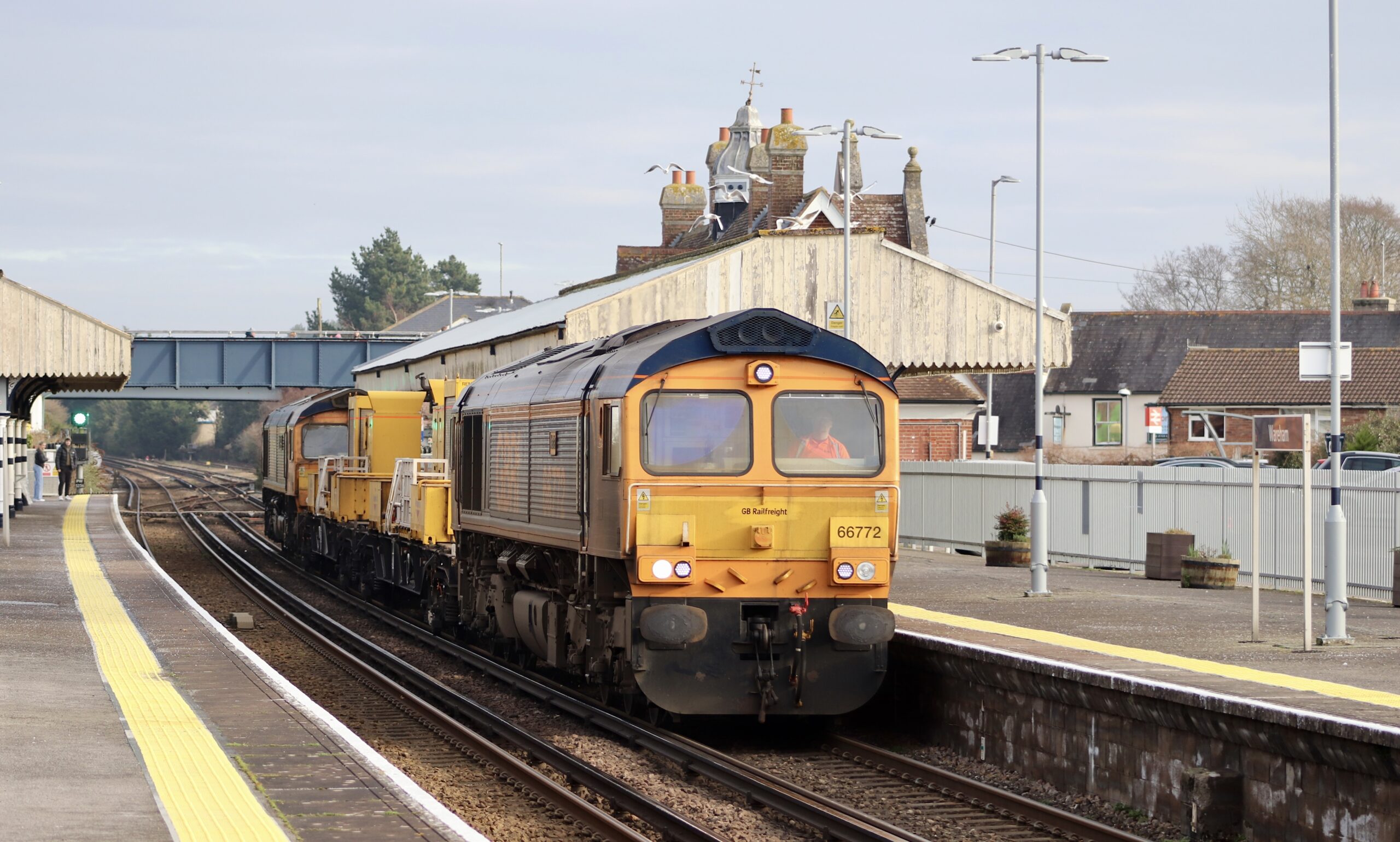
Sunday morning tranquility is disturbed as GBRf Class 66 locomotives No.’s 66764 ‘Major John Poyntz Engineer & Railwayman’ and 66772 ‘Maria’ top and tail SITT 3Y88 1035 Totton Yard to Totton Yard across Upton Viaduct on the Holes Bay causeway – 07/01/2024GBRf Class 66 No. 66772 ‘Maria’ leads on the return 3Y88 1035 Totton Yard to Totton Yard Snow & Ice Treatment Train through Hamworthy with No. 66764 ‘Major John Poyntz Engineer & Railwayman’ at the rear – 07/01/2024GBRf Class 66 locomotives No.’s 66764 ‘Major John Poyntz Engineer & Railwayman’ and 66772 ‘Maria’ at Hamworthy working 3Y88 1035 Totton Yard to Totton Yard – 07/01/2024
Major John Poyntz served in the British army for 35 years, with the Royal Engineers and later the Royal Corps of Transport. After military service, he joined the Railway Inspectorate, now part of the Office of Rail and Road, and was the last Royal Engineer to take such a route, spending 25 years in the role as a Railway Inspector. His work included inspections of heritage railways and dealing with accidents and incidents such as the Severn Tunnel rail accident and the Cannon Street rail crash, both in 1991.
Overnight on Saturday 6th/Sunday 7th a ballast train headed to Moreton working as 6C03 2312 Eastleigh East Yard to Moreton (Dorset) in the hands of Colas locomotives Class 66 No. 66848 and Class 70 No. 70809. We saw the ensemble pass through Hamworthy on the outward leg and had planned to see the associated return 6C03 0810 Moreton (Dorset) to Eastleigh East Yard crossing Holes Bay, but as the train set off over an hour early and with the sun yet to rise, we played safe and returned once again to Hamworthy railway station to watch the train pass through.
January ballast train with Class 66 No. 66848 and Class 70 No. 70809
The SITT returned to the Bournemouth to Weymouth line under the cover of darkness on Monday 8th and Wednesday 10th January employing the same pair of Class 66’s as the previous Sunday run.
January 2024 Dorset Snow & Ice Treatment Train workings (additional video courtesy of G E Barrett)
In between the SITT workings, on Tuesday 9th January, we saw a first for Dorset as Direct Rail Services (DRS) ran a service to Winfrith using a Class 88 locomotive No. 88002 ‘Prometheus’ which had replaced failed Class 68 No. 68004 (which itself had substituted for No. 68005) and No. 68003 ‘Astute’ in top an tail formation. This was the inaugural use a Class 88 on the Bournemouth to Weymouth line.
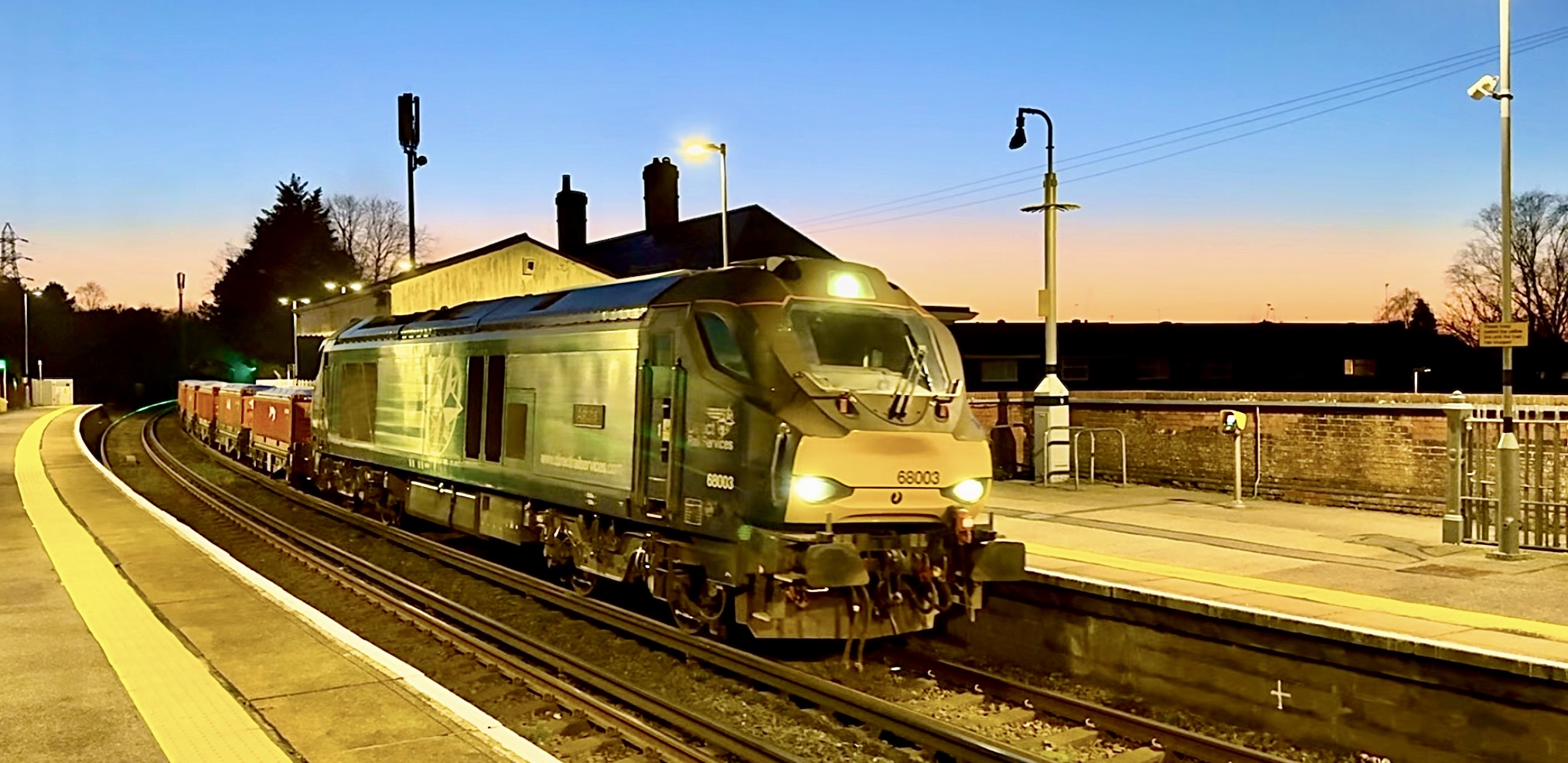
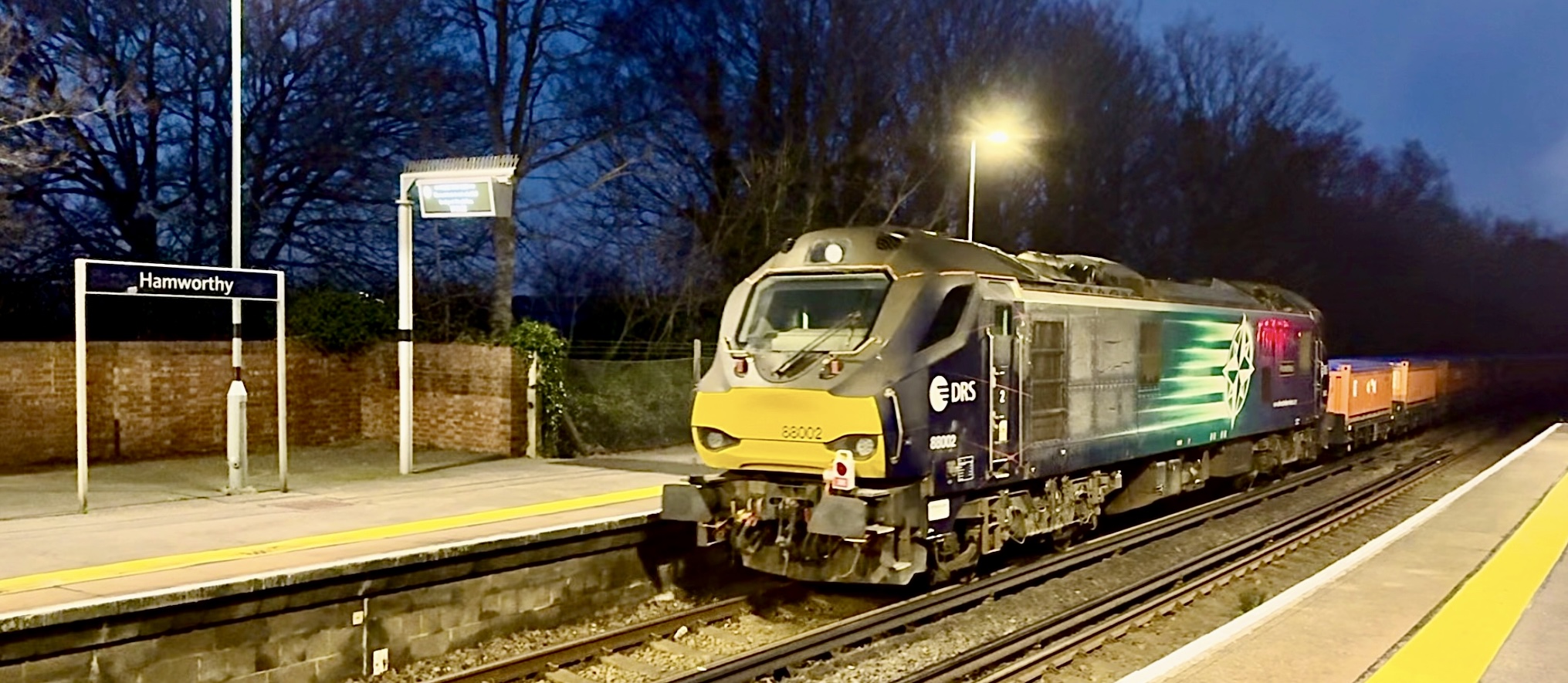
DRS Class 68 No. 68003 ‘Astute’ with Class 88 No. 88002 ‘Prometheus’ working the empties to Winfrith as 6Z62 0100 Crewe Coal Sidings (DRS) to Winfrith Sidings through Hamworthy – 09/01/2024DRS Class 68 No. 68003 ‘Astute’ leads the return 6Z95 1551 Winfrith Sdgs to Crewe Coal Sidings (DRS) at Hamworthy – 09/01/2024Class 88 No. 88002 ‘Prometheus’ at the rear of 6Z62 0100 Crewe Coal Sidings (DRS) to Winfrith Sidings having cleared Hamworthy railway station. Class 68 No. 68003 ‘Astute’ leads – 09/01/2024
The Class 88 is a mixed traffic electro-diesel locomotive manufactured by Stadler Rail and is part of the Stadler Euro Dual family.
Class 88 No. 88002 ‘Prometheus’ remained at the rear for the return 6Z95 1551 Winfrith Sidings to Crewe Coal Sidings (DRS) – 09/01/2024
During the development of the Class 68 diesel locomotive for DRS which was first announced in January 2012, the design team at Stadler proposed the concept of a dual-mode locomotive that could be alternatively powered by an onboard diesel engine or via electricity supplied from overhead lines (OHLE). In comparison to conventional diesel locomotives, this arrangement enables operational costs to be significantly reduced when diagrammed on routes partially or entirely under OHLE, under which the diesel engine can be deactivated.In September 2013, DRS placed an order for ten such locomitives which would become the Class 88. Having been developed alongside the Class 68, considerable similarities are shared between the two locomotive types, with an approximate 70% share of components.
Video of January 9th 2024 Winfrith run (additional video courtesy of G E Barrett)
The Class 88 is the first dual-mode locomotive type in the UK to use the 25 kV AC electrification, as the only other electro-diesel locomotives to have entered service with British Railways are the Class 73’s and Class 74’s, which operated on the Southern Region using third rail electrification, and we’ve reached back into the archives to find some images to share:
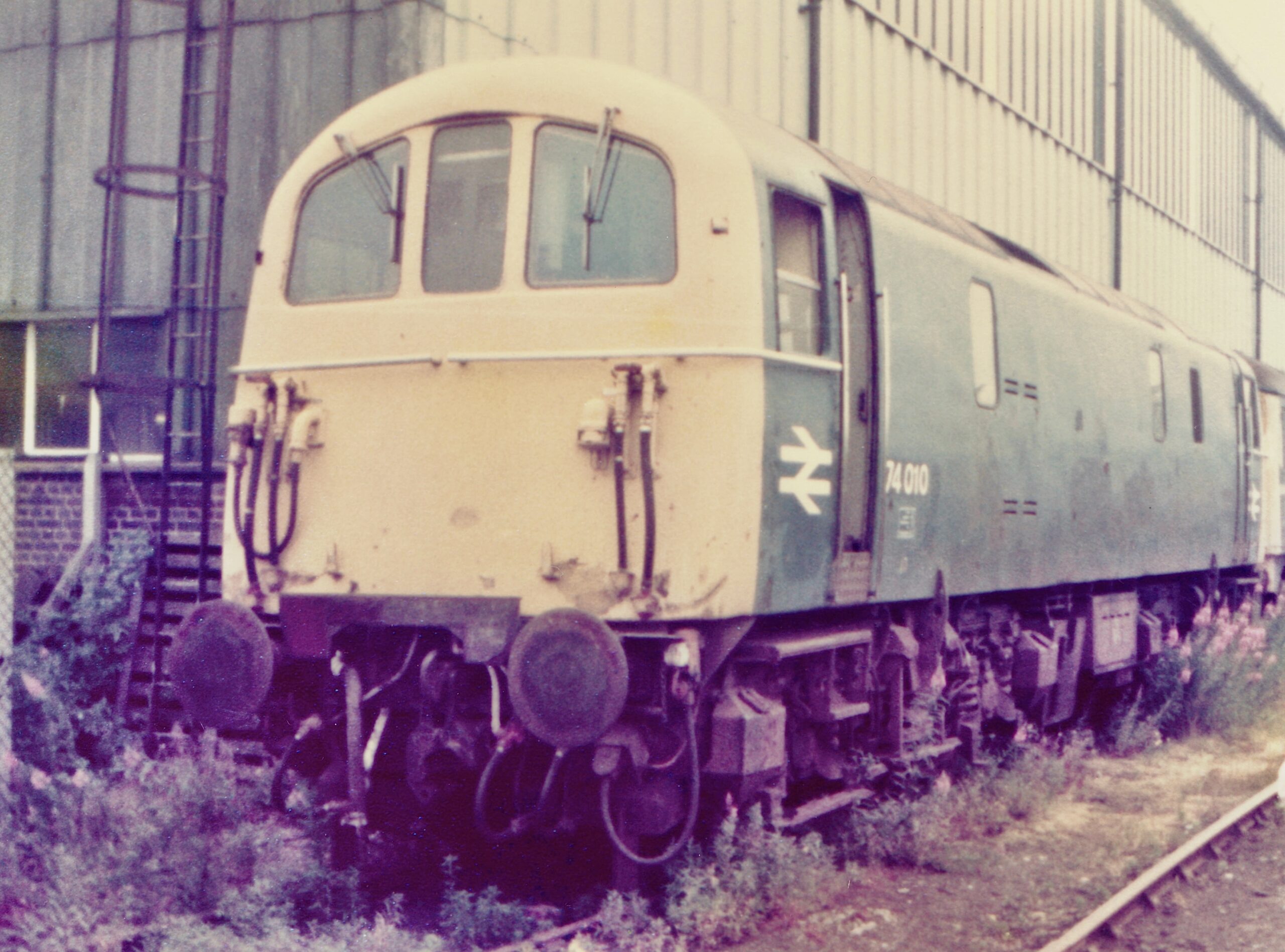
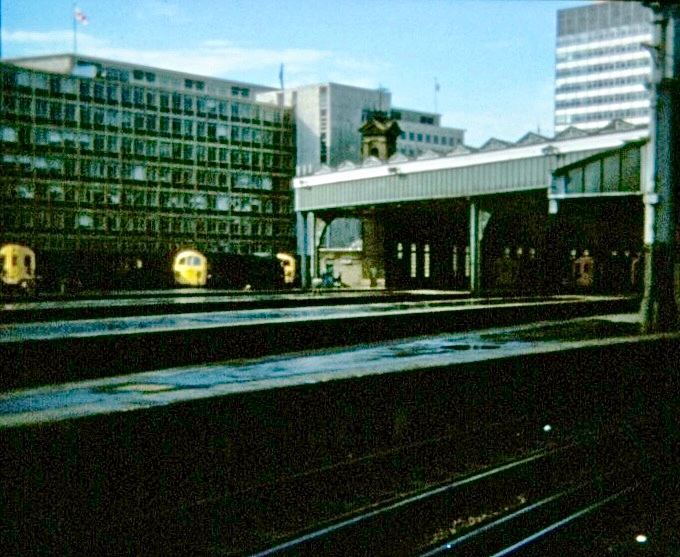
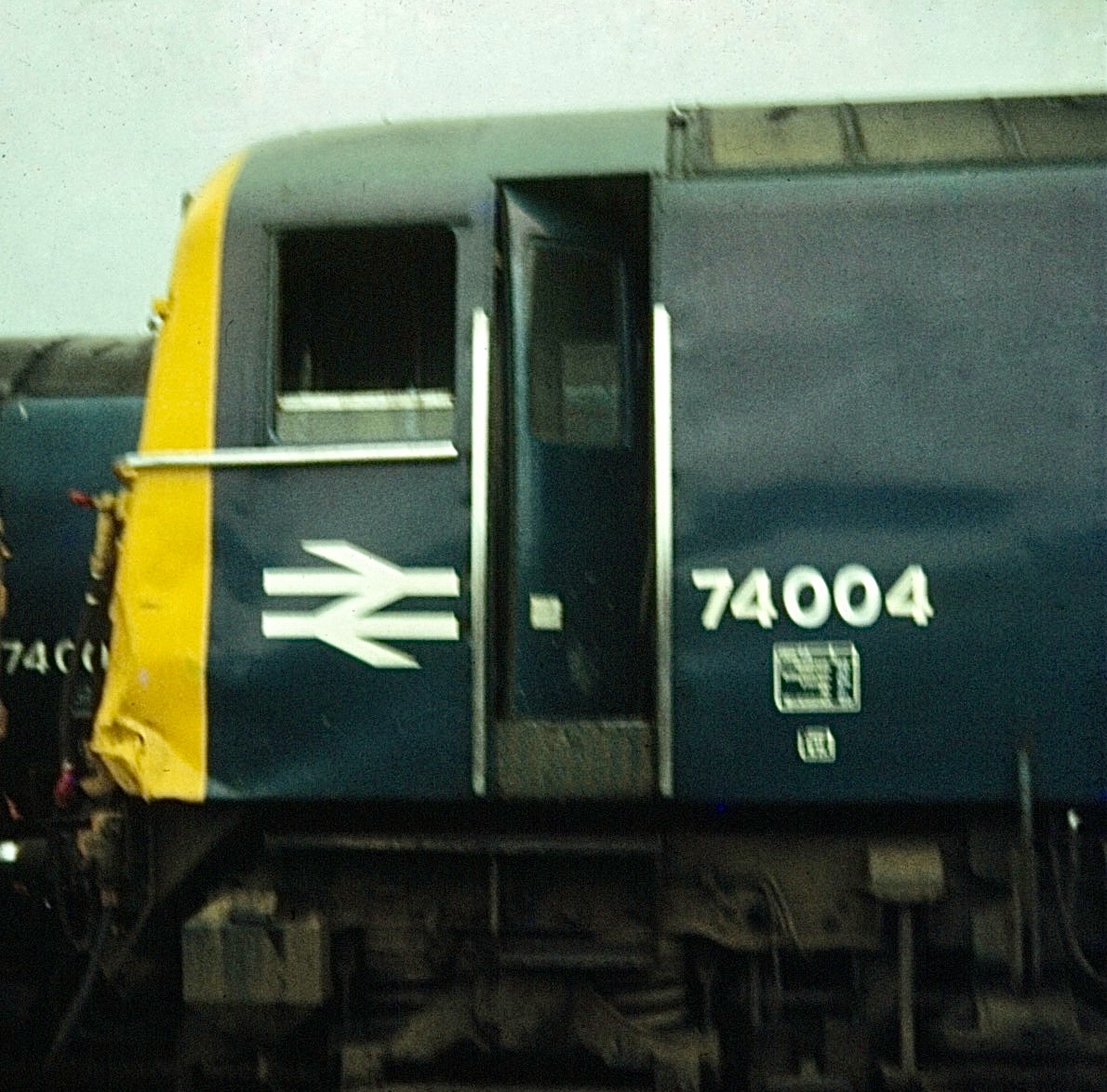
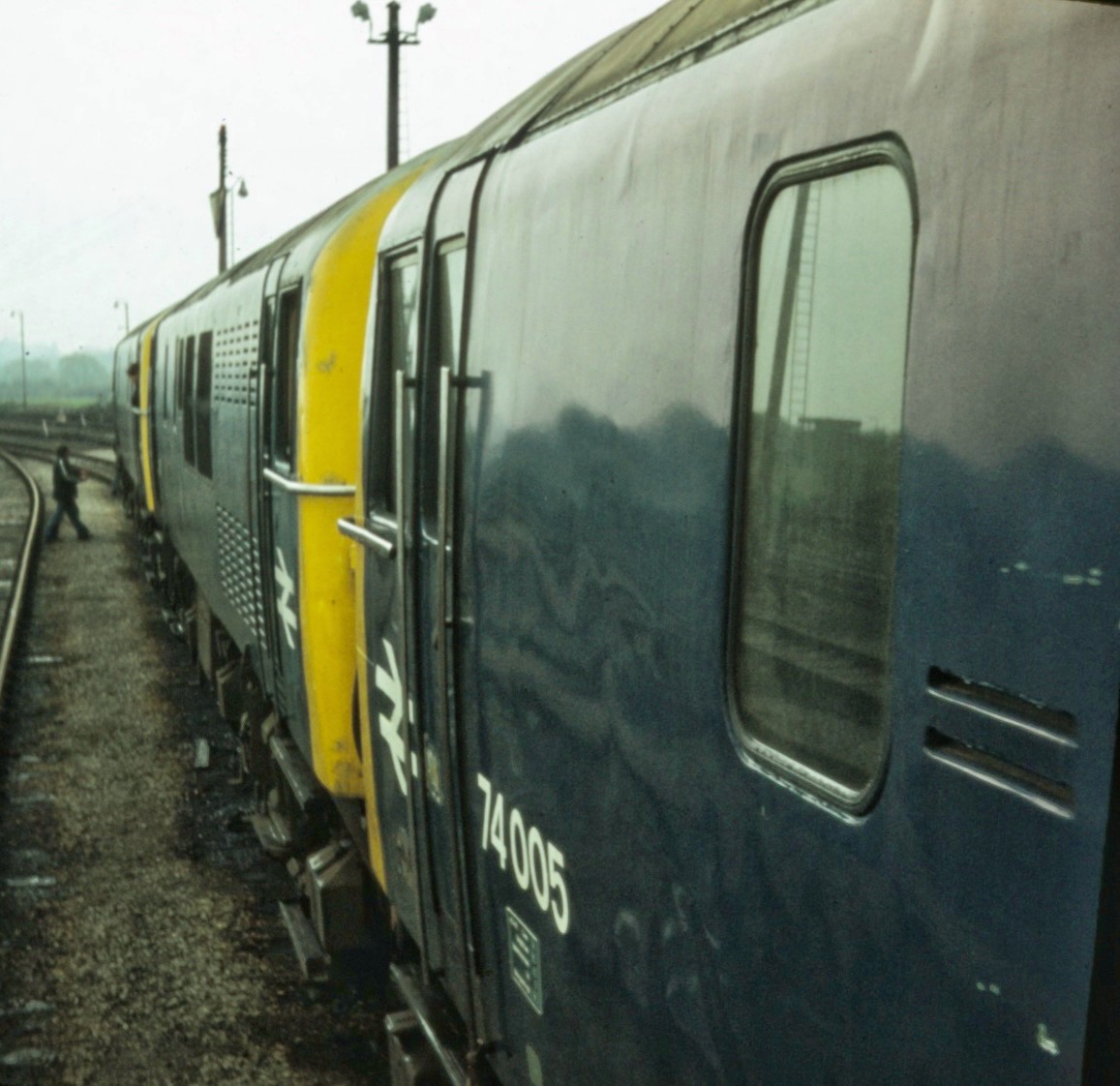
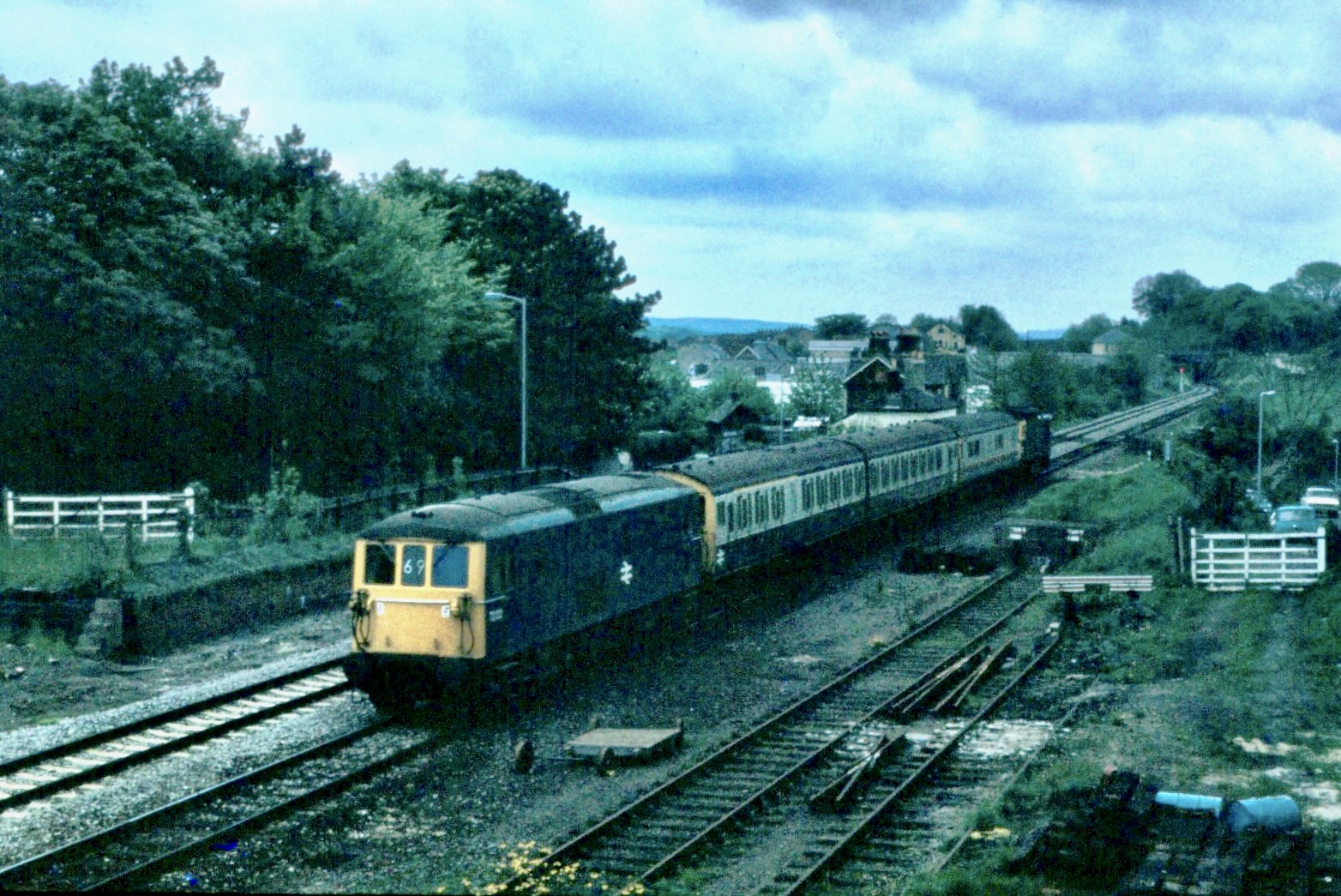
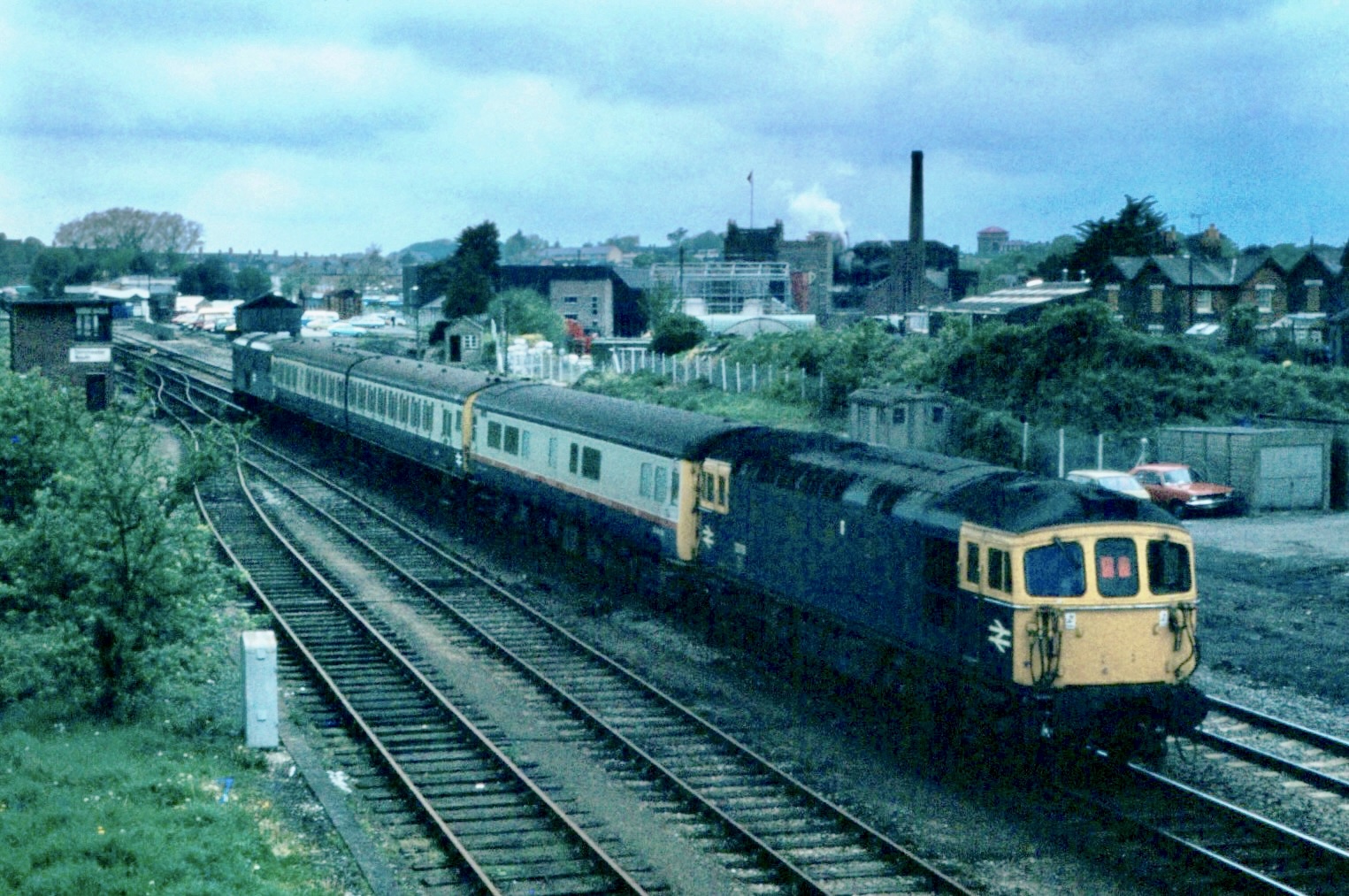
Class 74 No. 74010 at Doncaster Works. Withdrawn from service in December 1977, the locomotive was cut up here in October 1979 after being given a brief reprieve so that it could be for evaluated for departmental use by the Railway Technical Centre (RTC) in Derby. It was given a light overhaul at Eastleigh before being towed to Derby, where it was eventually deemed to be unsuitable and taken to Doncaster for scrapping – 22/07/1979A hastily taken photo of Class 74’s at London Waterloo taken from a departing train bound for Weymouth. This side of the station later became Waterloo International between 1994 and 2007 – July 1977Class 74 No. 74004 has had a bit of a bump (not helped by my camera shake!) as it stands forlorn at Eastleigh Diesel Depot during the 1978 Open Day. This locomotive was withdrawn from service in December 1977 and cut up at Birds in Long Marston. She was originally built as the pioneer Class 71 and numbered E5000 – 30/04/1978Withdrawn Class 74’s at Eastleigh Diesel Depot Open Day including No.’s 74005 and 74009 – 30/04/1978
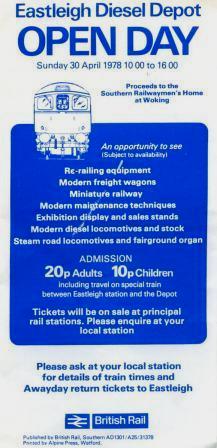
Eastleigh Open Day 1978 flyerClass 73 No. 73122 and 2-HAP Unit No. 6103 with a third unidentified carriage and Class 33 No. 33116 working a test train towards Dorchester South – 13/05/1981The same test train as in the image above focussing on Class 33 No. 33116 on the approach to Dorchester South – 13/05/1981
For The Record:
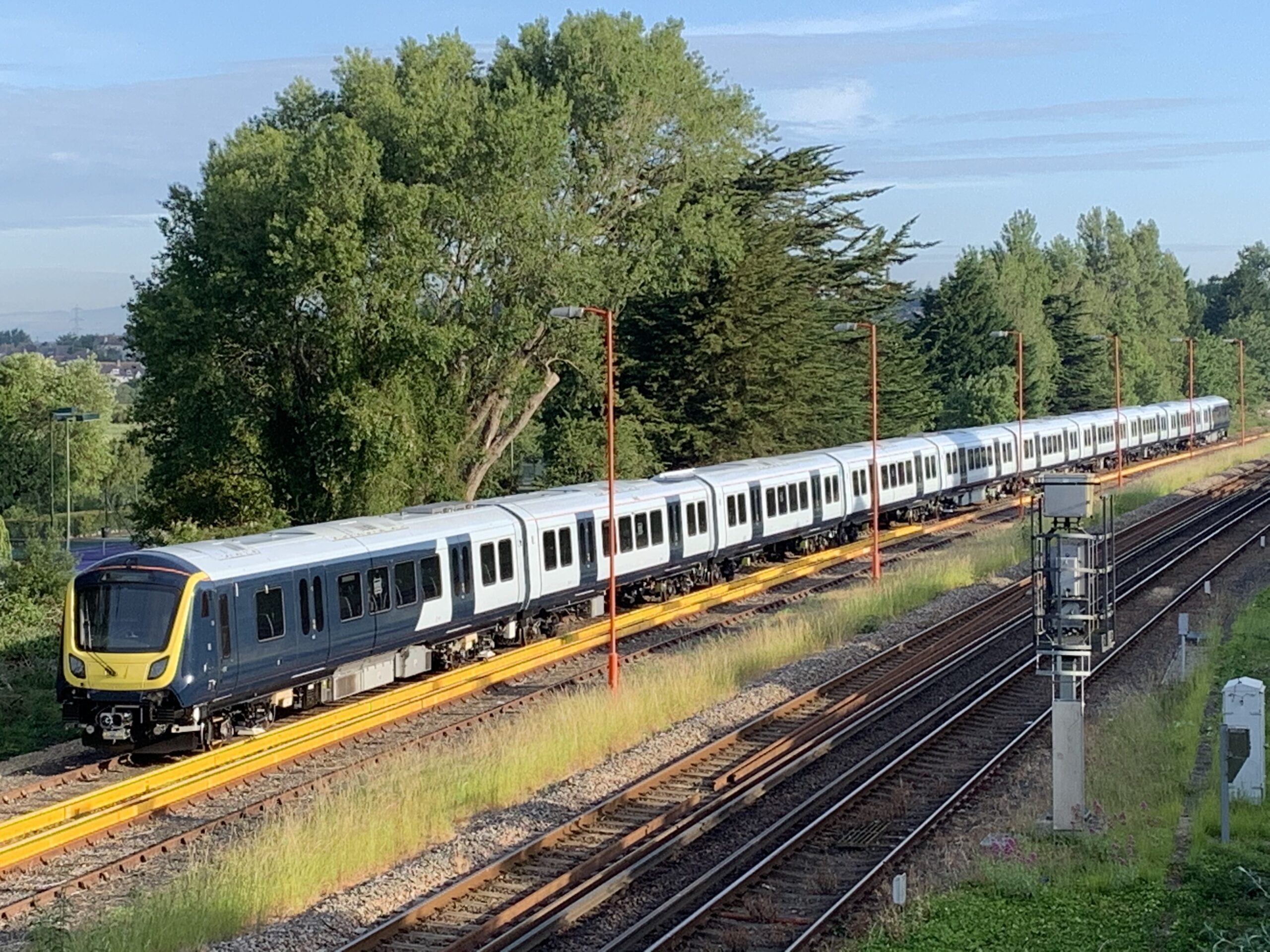
In other news, the SWR Class 701 Electric Multiple Units (EMU’s) finally entered revenue earning service on Tuesday 9th January 2024 when No. 701037 worked a single round trip between Waterloo and Windsor Eton Riverside. The Derby-built trains had been due to enter service in 2019. SWR have since promised the rolling stock would enter passenger service in 2023 – a promise echoed by the Department for Transport (DaFT) in a statement issued in May 2023, which said the trains would run “this calendar year”. It is intended a Class 701 will continue to run off-peak Monday to Friday between London Waterloo and Windsor, in order to fulfil that commitment, making one single round trip each day, or working between 1000 and 1600. The phased entry into service of the Class 701’s – which continue test runs to Poole and Bournemouth – will eventually allow for the withdrawal of SWR’s Class 455 units and the cascade of the Class 458 fleet to longer distance services.
Back in 2020, the first Class 701 to be delivered, No. 701002, was delivered to South Western Railway and somehow made its way to Weymouth where it is seen here in Jersey Sidings awaiting commissioning tests. Yoshi and I stumbled across it while out for our morning walkies – 16/06/200
The North Dorset NMT ran on Thursday 11th January 2024 – a week earlier than I expected – in the hands of HST Class 43 power cars No.’s 43013 and 43257.
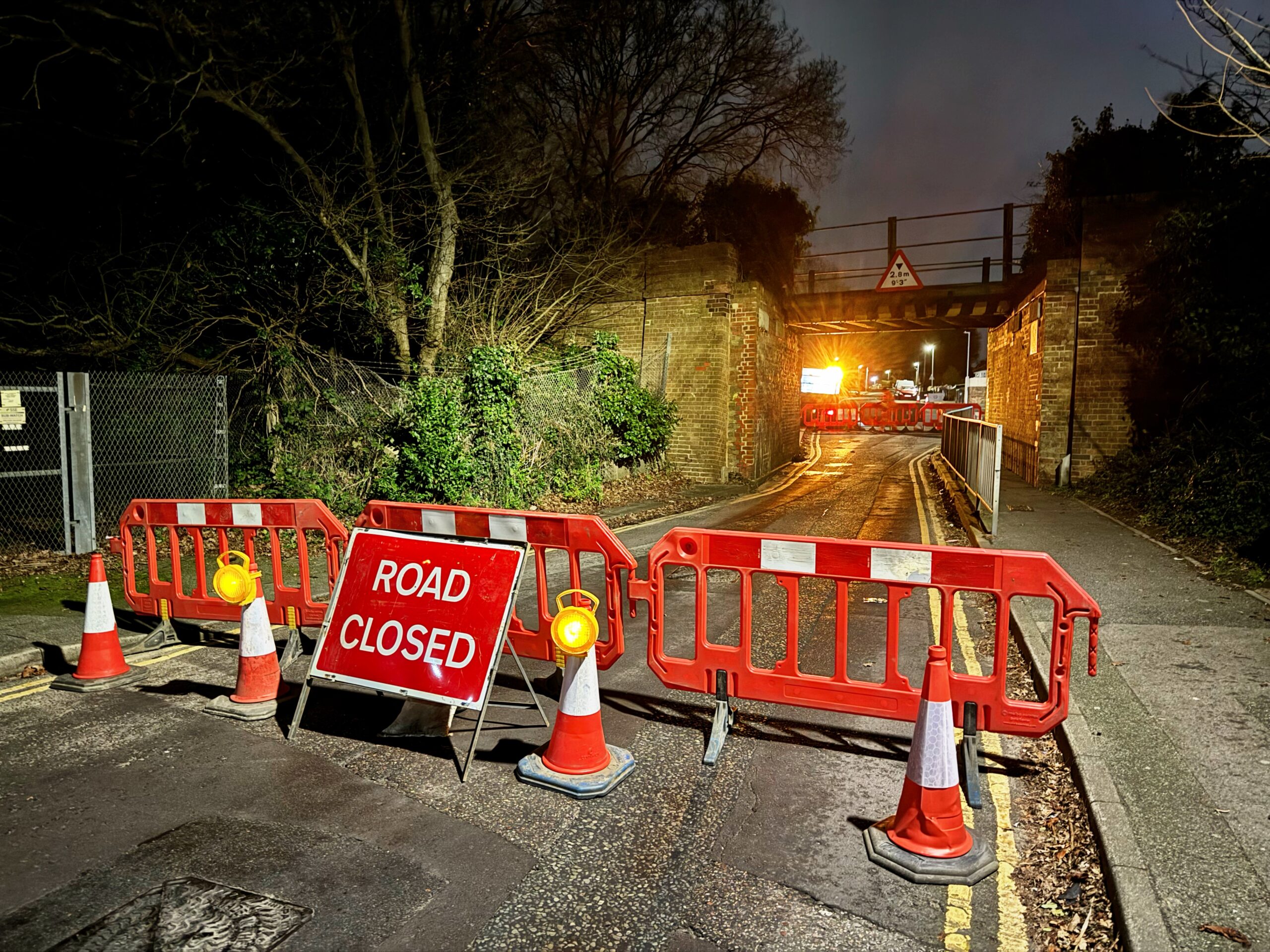
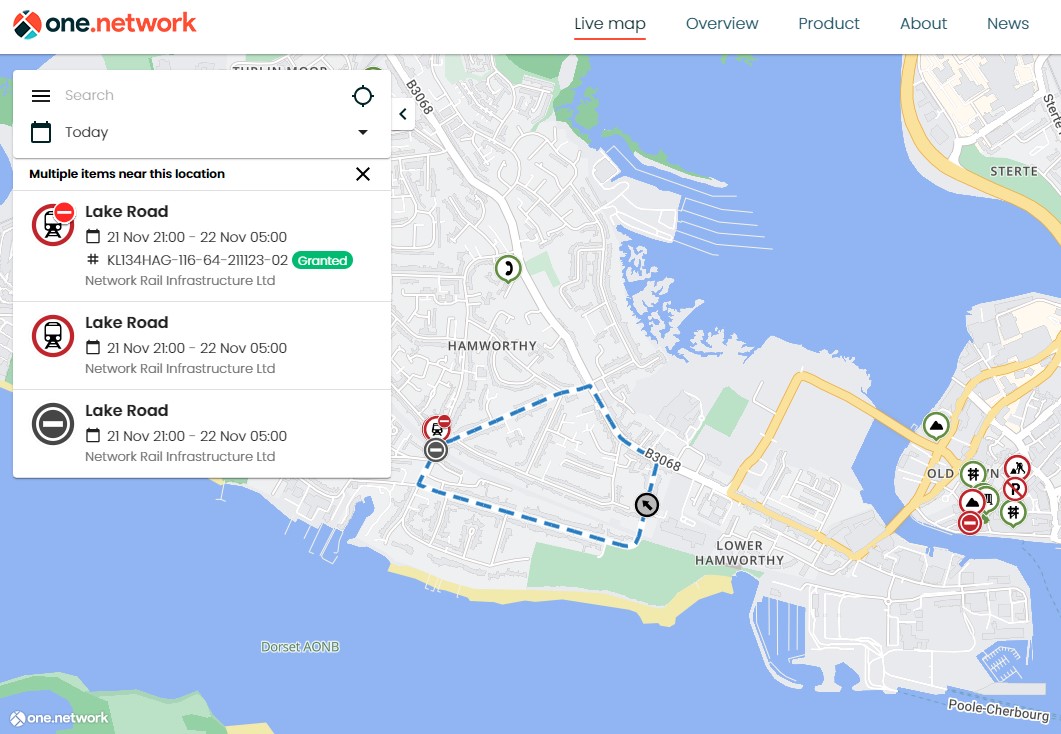
Lake Road was closed to road traffic from its junction with Lake Drive to its junction with Coles Avenue from Monday 8th January up to and including Friday 12th January 2024 – 2200 to 0600 daily to facilitate removal of material from a bridge strike and replace missing signage on Lake Road Bridge situated on the Hamworthy Branch. We popped by a couple of times, and although the road was indeed closed, there didn’t seem to be any activity taking place with regards to bridge repairs, which is disappointing to say the least.
Road closure at Lake Road bridge – but little sign of any repairs taking place – 08/01/2024Yoshi had his first grooming session of 2024 on Monday 8th January and couldn’t wait to show off his new cut to his grandmama – 08/01/2024
That brings us to the end of another blog entry. Next week, we’ll celebrate Yoshi’s birthday and hopefully have some more Dorset based railway images and video to bring you. Thank you for reading and for your comments, corrections and amendments. All very much appreciated. We’ll leave you with a couple of shots from that early morning trip to Durdle Door! Be seeing you!
Sunrise at Durdle Door – 06/01/2024Sunrise at Durdle Door – 06/01/2024
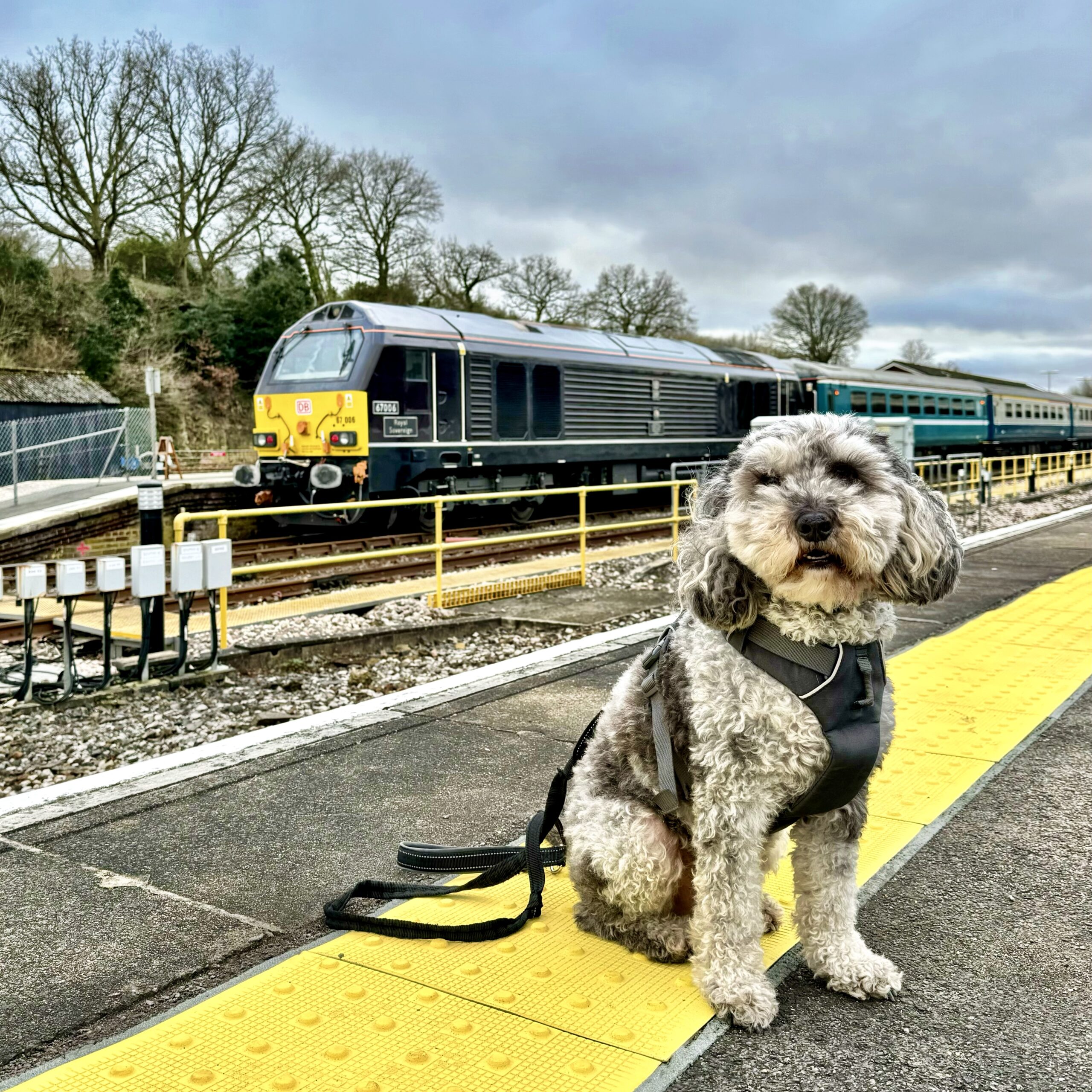
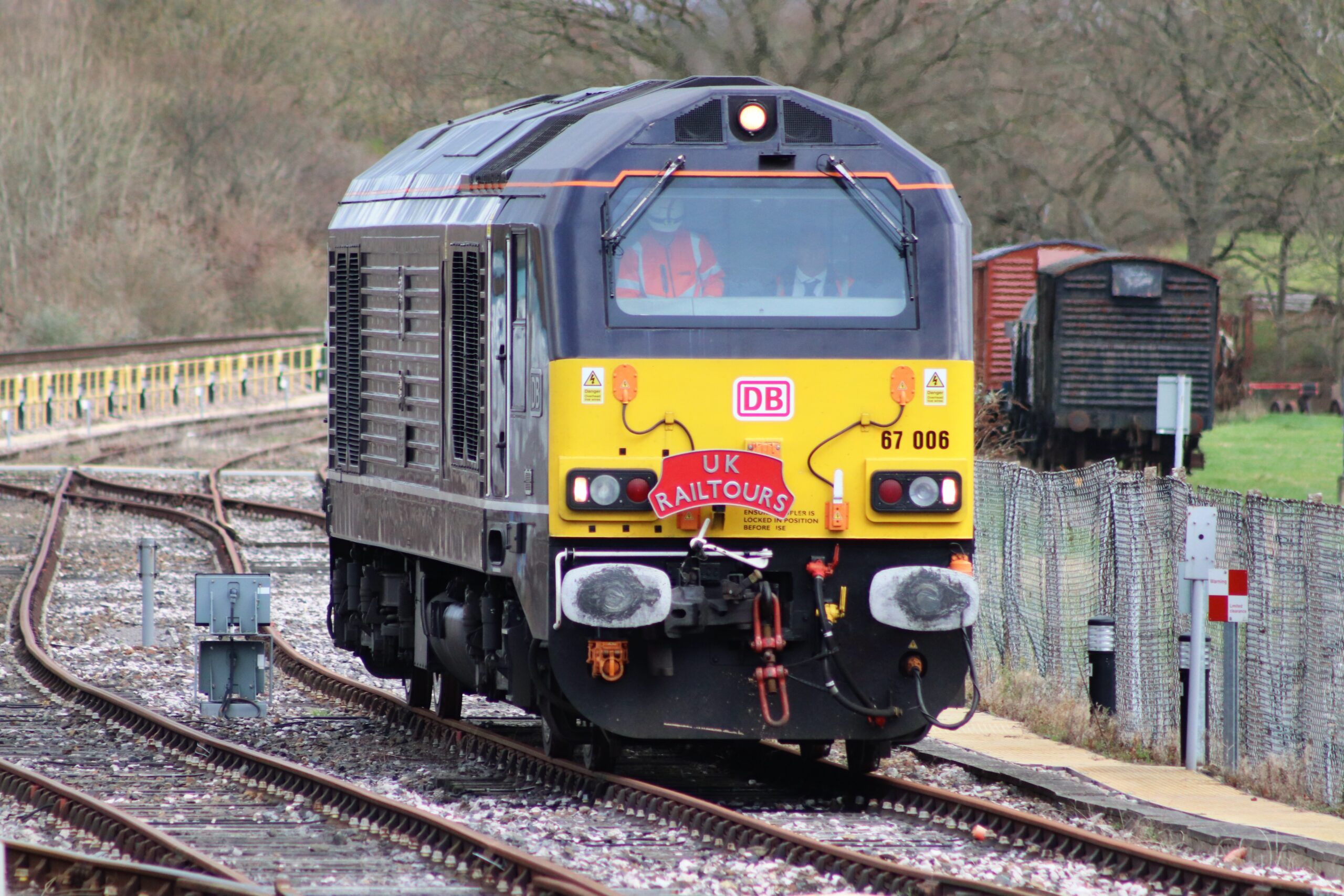
Yoshi at Yeovil Junction with Class 67 No. 67006 ‘Royal Sovereign’ was in charge of UK Railtours “Carols At Sherborne Abbey” 1Z15 0715 Peterborough to Yeovil Jn Heritage Platform. The Class 67 locomotives are a class of Bo-Bo diesel electric mainline locomotives which were built for the English, Welsh and Scottish Railway between 1999 to 2000 by Alstom at Meinfesa in Valencia, Spain with drive components (engine and transmission) from General Motors Diesel. Yoshi is a cockapoo dog, a miniature poodle and cocker spaniel mix produced in Wiltshire – 23/12/2023
December 11th 2023 to December 31st 2023
The second part of our December blog is finally here! After our trip to the North, we didn’t have to wait long for some local railway themed action as another Class 458 EMU drag from Widnes Transport Tech to Bournemouth depot took place on Wednesday 13th running as 5X73 0722 Wembley Receptions 1-7 to Bournemouth TRSMD. I kept one eye on its movement via the live maps available on the Open Time Trains website, and at one point almost left home early as the train was running well ahead of time.
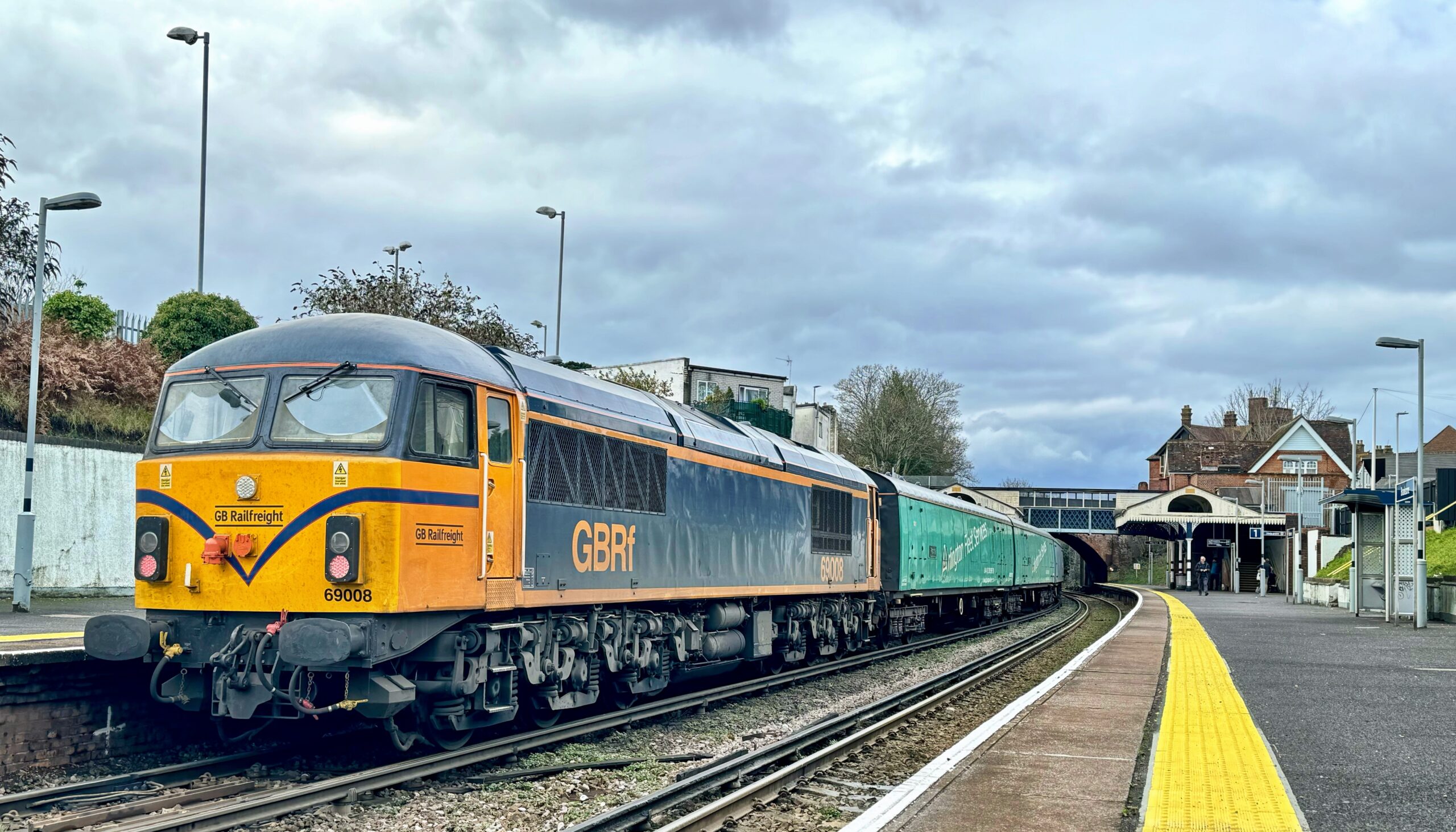
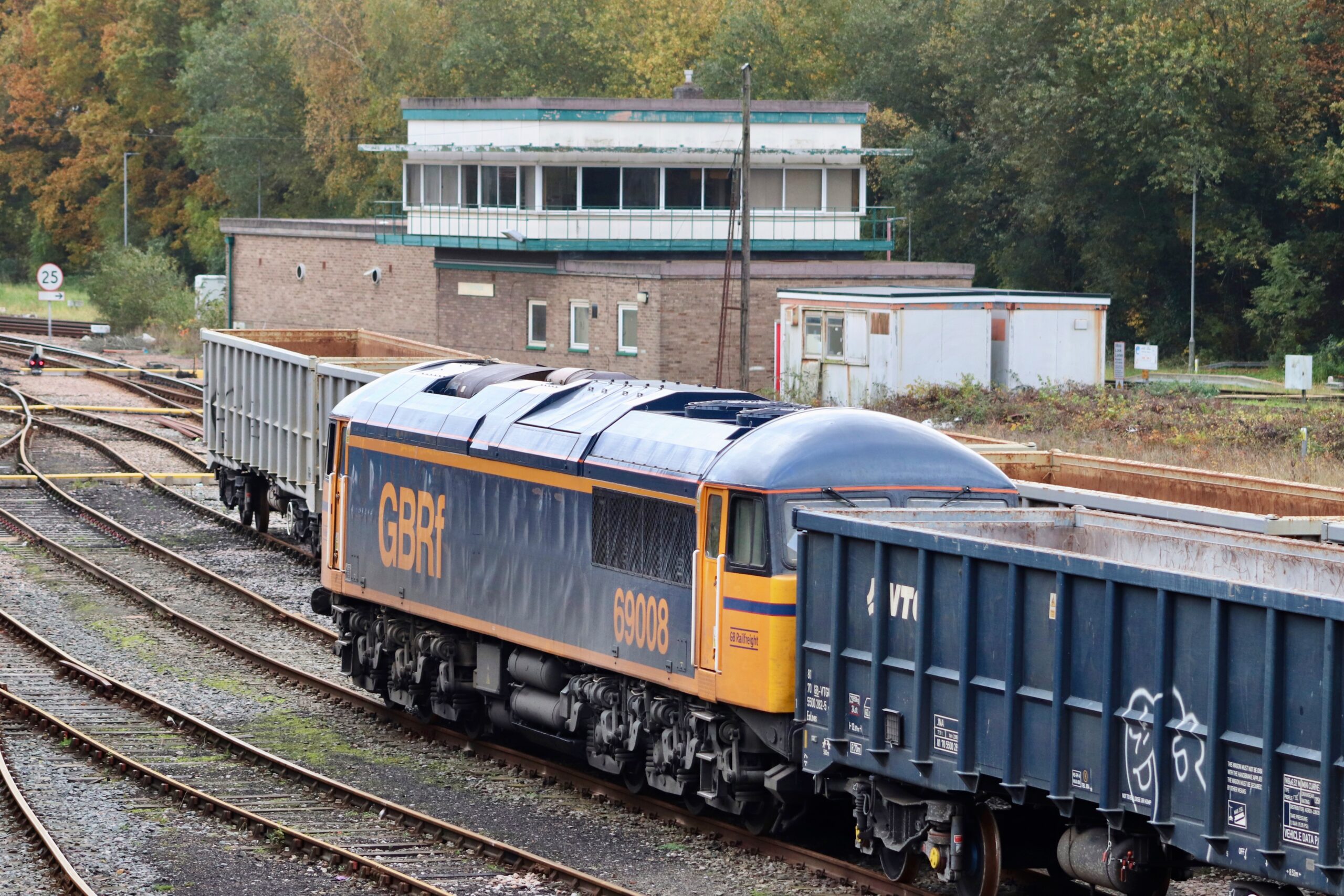
GBRf Class 69 No.69008 at Branksome preparing to reverse into the depot with 5X73 0722 Wembley Receptions 1-7 to Bournemouth TRSMD – 13/12/2023
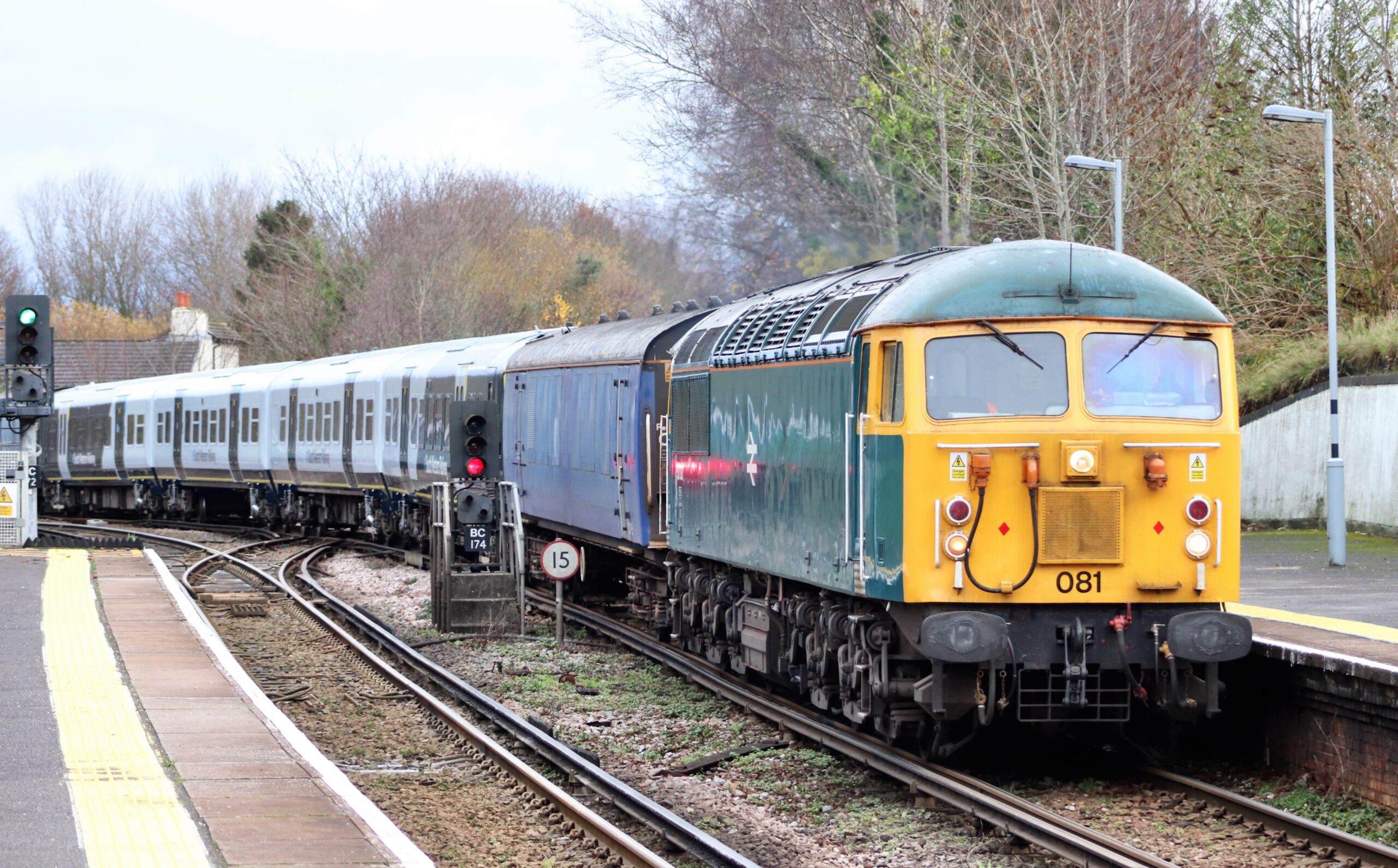
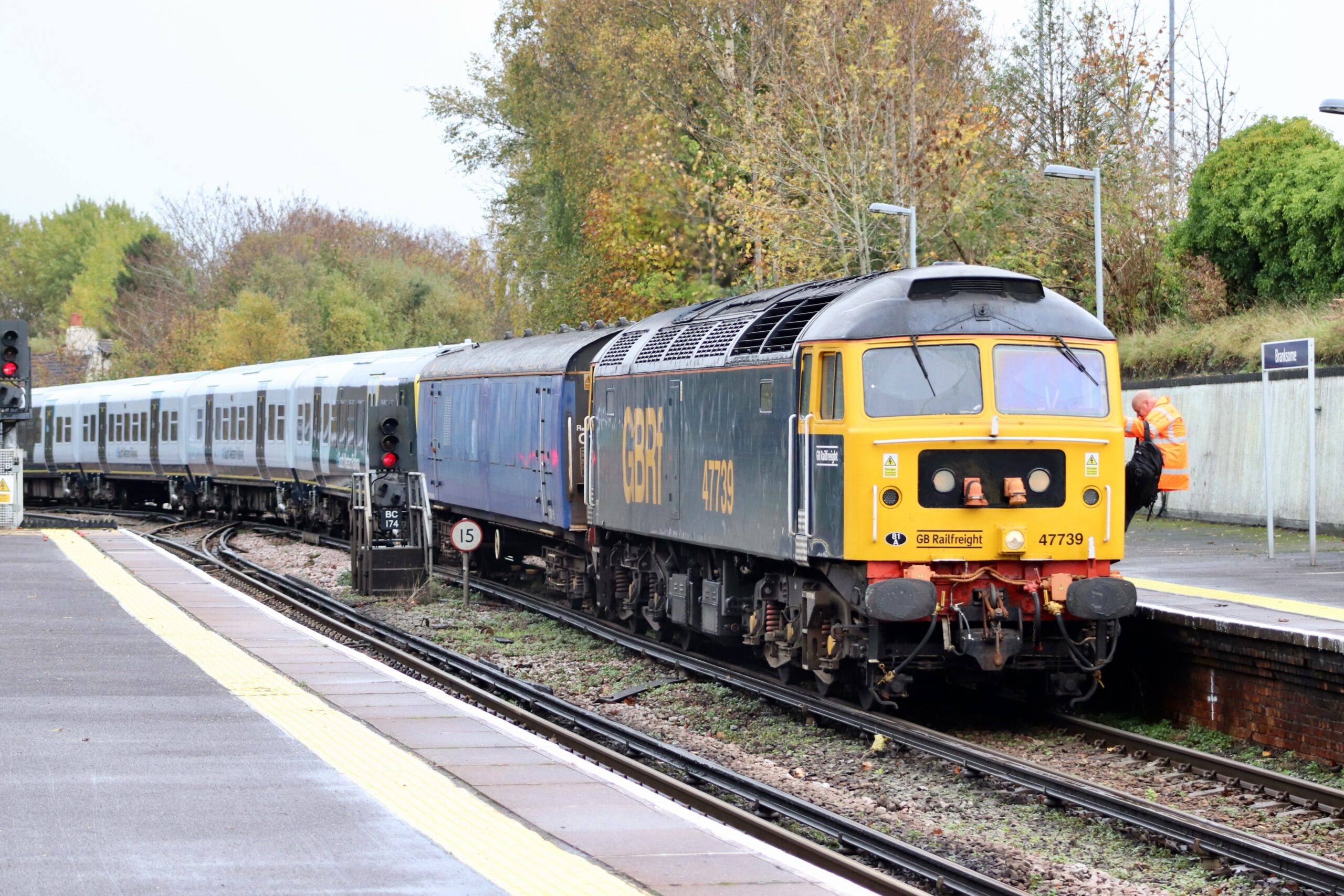
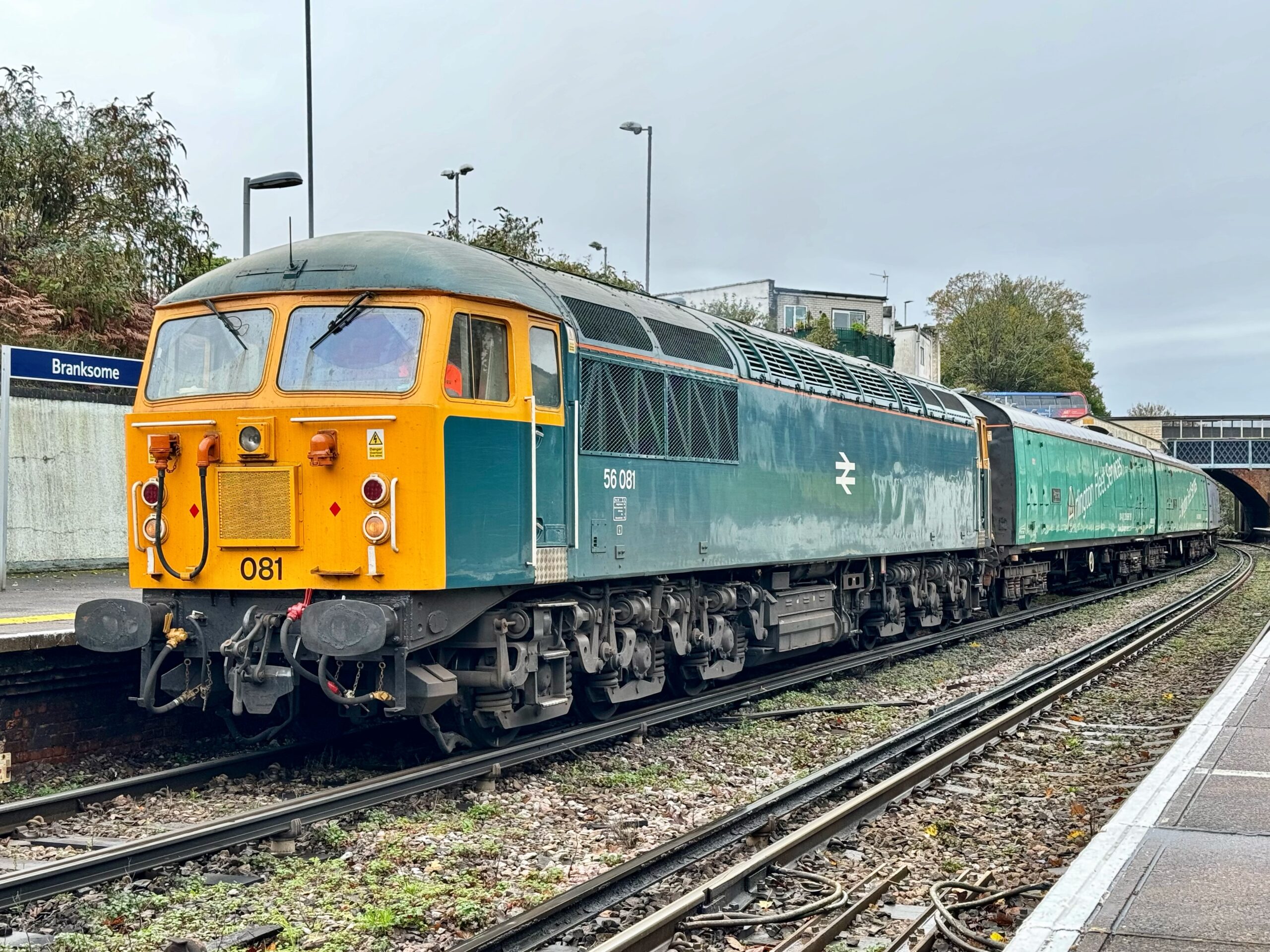
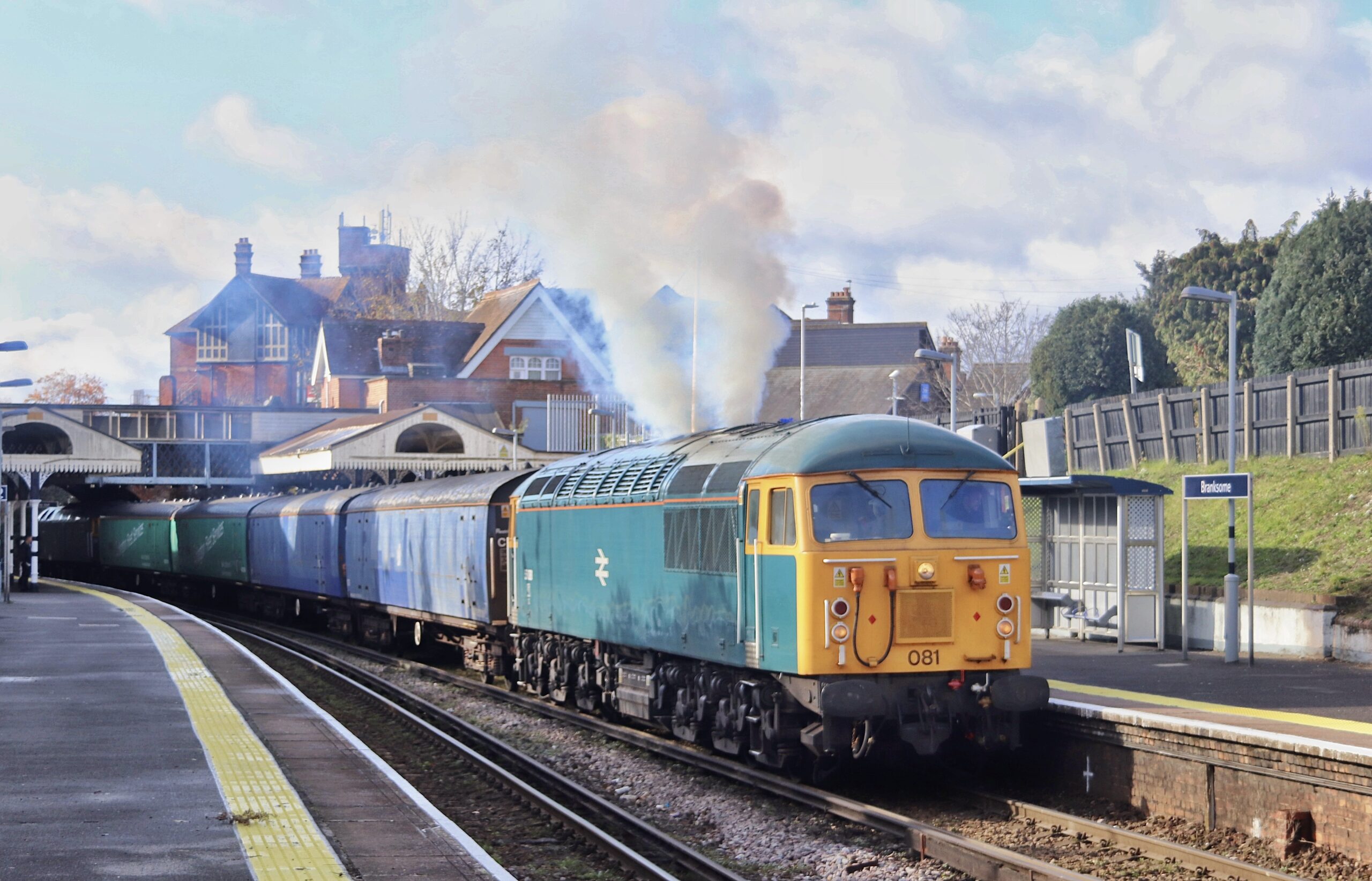
However, the train was held outside of Eastleigh for a while so I was able to get to Branksome on the train as planned just prior to the arrival of GBRf Class 56 No. 56081 and Class 69 No. 69008 with South Western Railway (SWR) Class 458 No. 458424 sandwiched in-between barrier coaches. The return run taking another Class 458 for refurbishment in Widnes was set for departure the afternoon of the same day, but was afforded three different paths out of the depot. Avoiding the possibility of picking the wrong working and either missing the departure or having a lengthy wait I decided just to remain at home instead!
GBRf Class 56 No. 56081 with SWR Class 458 No. 458424 in tow arrives at Branksome heading 5X73 0722 Wembley Receptions 1-7 to Bournemouth TRSMD – 13/12/2023
No. 56081 is to to be retired to Longport in the New Year. While the option for additional Class 69 conversions doesn’t appear to have been taken yet, the planned despatch of the Class 56 to Longport certainly places it in position for potential conversion to No. 69017.
Later on the same day, the Snow & Ice Treatment Train (SITT) ran from Totton to Dorchester South and back as 3Y89 2211 Totton Yard to Totton Yard with Class 66 No.’s 66743 and 66772 ‘Maria’. I toyed briefly with the notion of driving to Dorchester to get a photo of No. 66743 in its Belmond Royal Scotsman livery, but decided against it on this occasion.
GBRf Class 66 No.’s 66743 and 66772 ‘Maria’ passing Hamworthy with 3Y89 2211 Totton Yard to Totton Yard – 13/12/2023
Saturday 16th December was a bit of a road trip so I could see what could well be the final DB Cargo (DBC) Class 60 hauled railtour as the class are to be ‘retired’ in April 2024 by the Deutsche Bahn owned freight operator following an announcement it is to eliminate the use of its Class 60 locomotives by re-gearing ten of its Class 66 loco’s to provide an enhanced tractive effort. As most of its services are operated by Class 66 locomotives, with the Class 60’s only seeing limited use, DB Cargo concluded that if services operated by its Class 60 locomotives could be transferred to Class 66’s with a higher tractive effort, it would benefit its customers and the company.
DB Cargo has also said that in the future they are going to focus on contractual railtour operations, with the likes of the Belmond British Pullman trains, and less on the ‘ad hoc’ operations for other tour promoters, such as Pathfinder Railtours who were running “The Festive Midland-Ian” which was promoted as an attempt to try and cover as many freight lines, loops and locations as possible in the West Midlands, featuring some “rare track”. The requested motive power had been Top & Tail DBC Class 60’s but, due to the low numbers of the class remaining in service, on the day DBC were forced to substitute a Class 66 for one of them.
Pathfinder named the railtour “The Festive Midland-Ian” after Ian Loveday who devises and helps with many enthusiast rail based excursions. Ian often advises and assists with access to heavily sought after lines including this 16th December charter.
The route for the tour was confirmed as: GLOUCESTER, CHELTENHAM SPA, WORCESTER SHRUB HILL, Kidderminster DGL, STOURBRIDGE JUNCTION, Stourbridge DGL, Rowley Regis UGL, BIRMINGHAM SNOW HILL, Up & Down Small Health Goods, Caledonia Yard, Up & Down Small Heath Goods, Tyseley Up Through Siding, Dorridge UPL, Leamington Spa UCV, Fenny Compton UGL, Banbury DGL, Banbury Reservoir Sdgs – BANBURY (Break), Fenny Compton DGL, Kineton Branch NR Limit, Leamington Spa DCV, Hatton DGL, Dorridge UDGL, Birmingham New Street (non-stop), Wolverhampton Logistics Centre, Bescot Stadium, Bushbury DGL, Stafford RMT, Oxley Chord, Wolverhampton, Bescot Stadium, Bescot DGL, Aston, BIRMINGHAM NEW STREET, Rowley Regis DGL, STOURBRIDGE JUNCTION, WORCESTER SHRUB HILL, CHELTENHAM SPA, GLOUCESTER
I decided to head to Banbury as I remembered an accesible road bridge close to the Tarmac works which in turn is adjacent to Banbury Resevoir sidings. “The Festive Midland-Ian” is believed to be the first passenger train to visit to the Reservoir stone terminal sidings at Banbury. On the way, I took a slight detour so I could pick up @smithy.377 and looking at the timings available to us on real Time Trains, we realised we’d have a few passes of the train as it worked its way along Banbury Goods Loop and back before tackling the stone terminal sidings. We also enjoyed a few other passing passenger trains and a couple of freights.
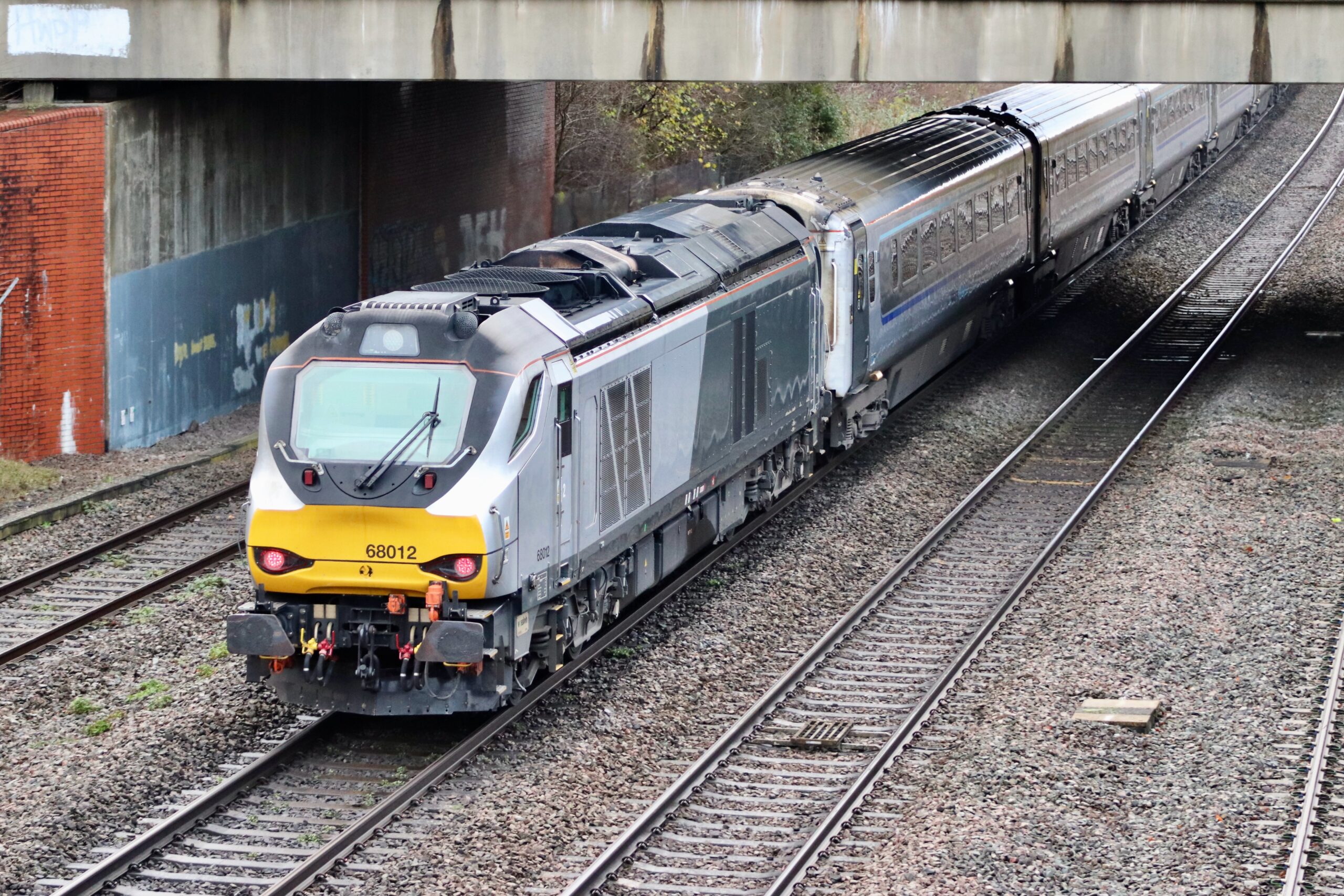
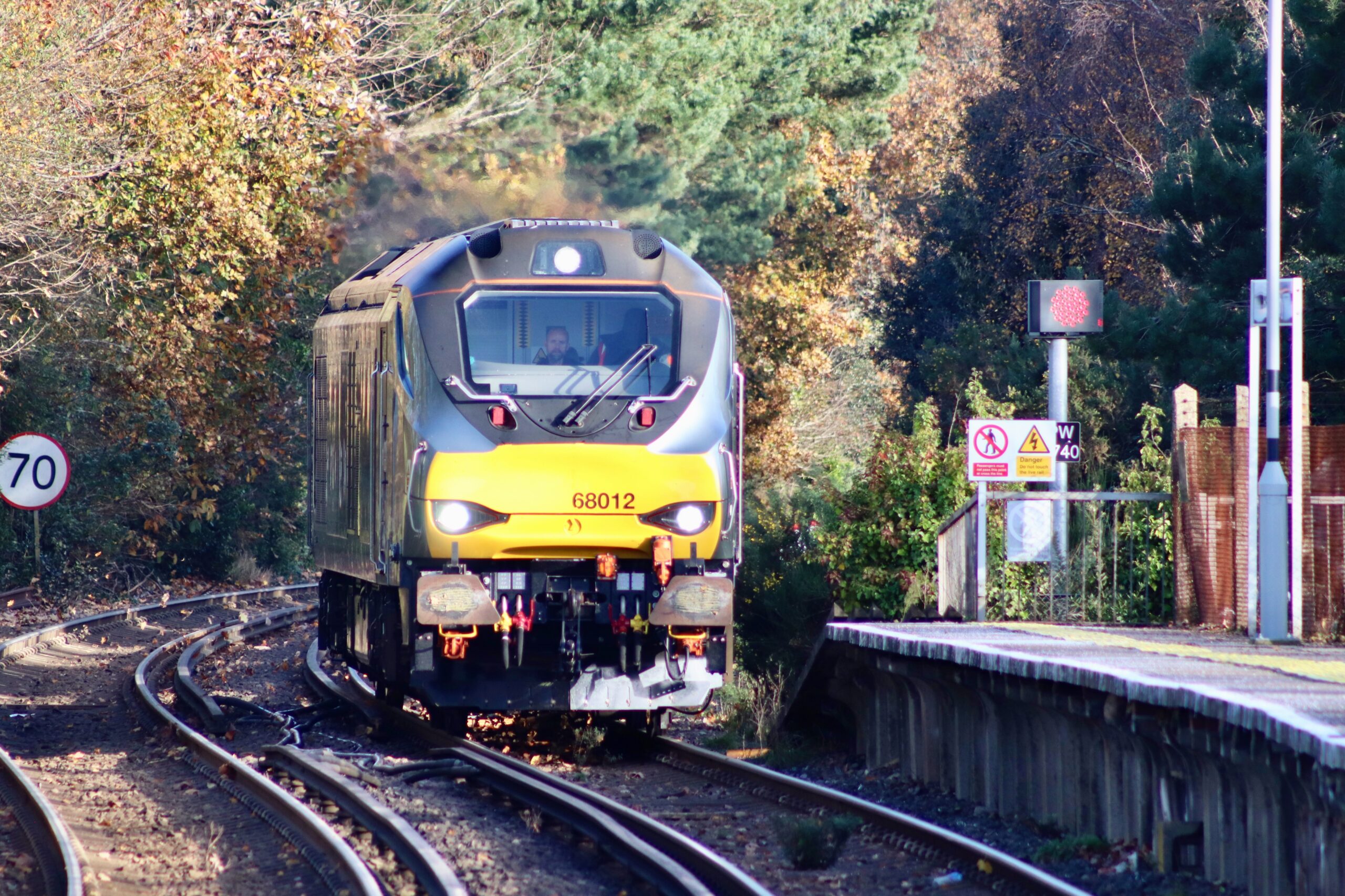
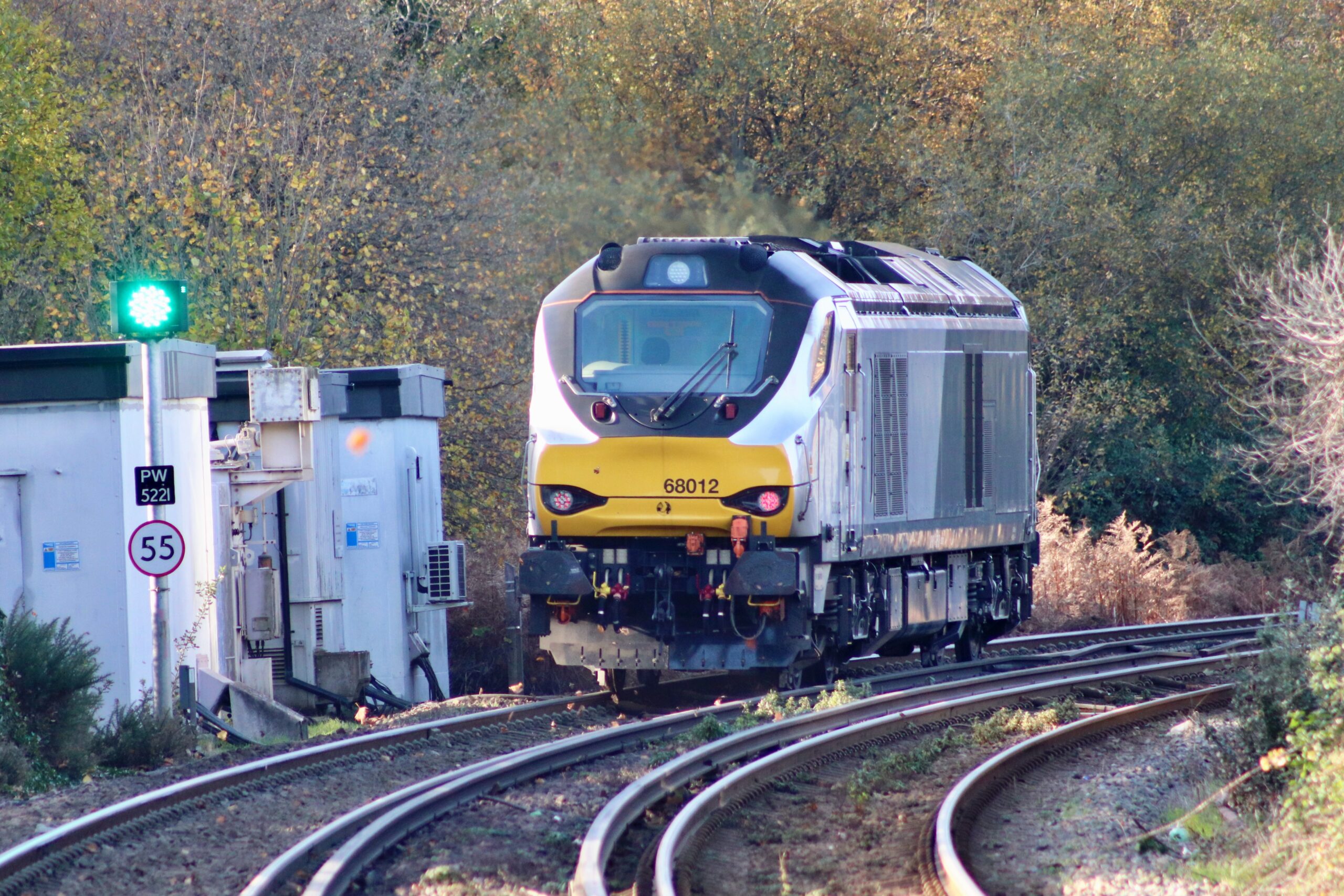
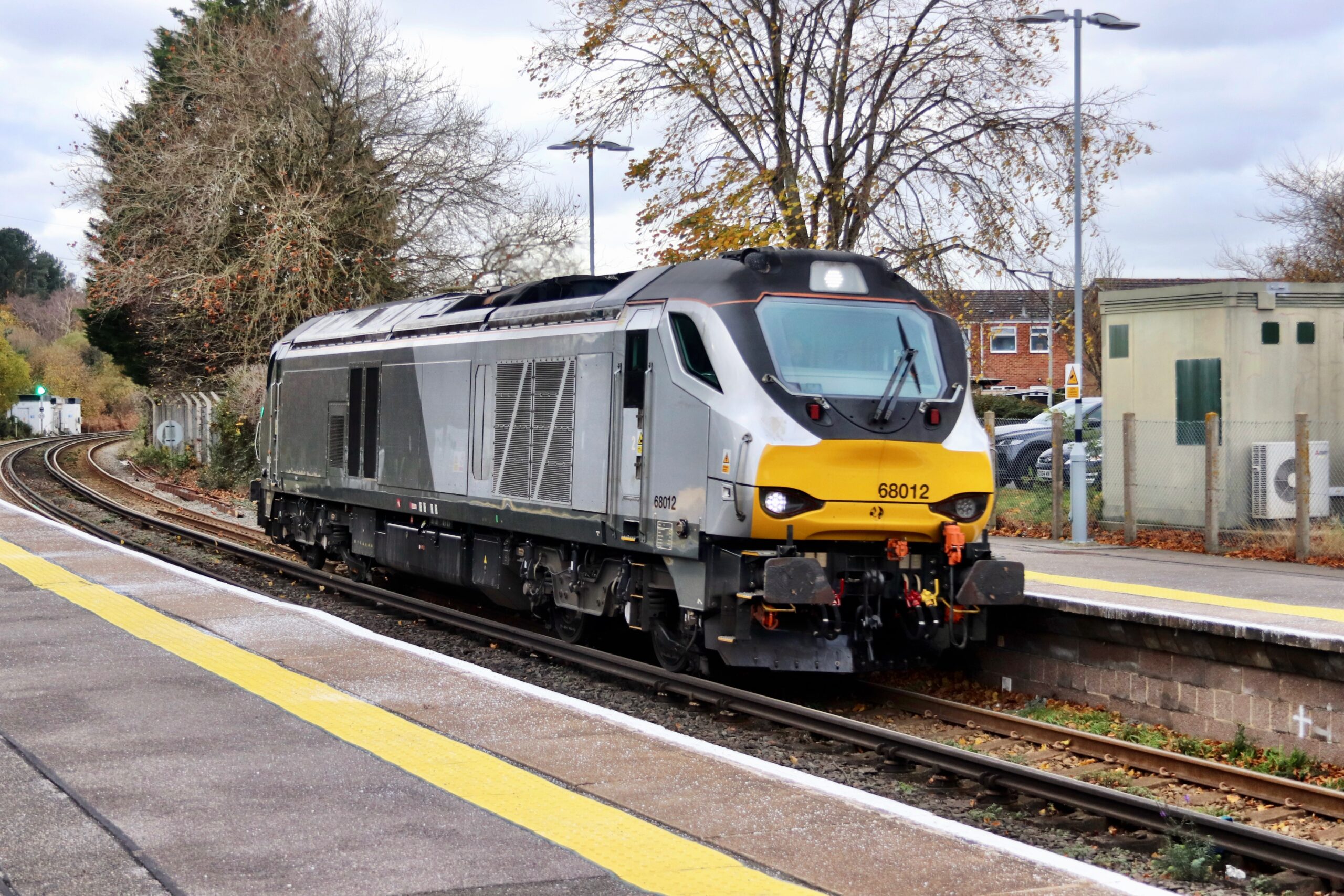
Chiltern Class 58 No. 68012 (set AL04/ DVT 82309) propels 1H27 08:19 Stourbridge Junction to Marylebone towards Banbury railway station – 16/12/2023Freightliner Class 70 No. 70014 working 4O27 06:49 Crewe Basford Hall SSM to Southampton Marine Container Terminal nears Banbury – 16/12/2023
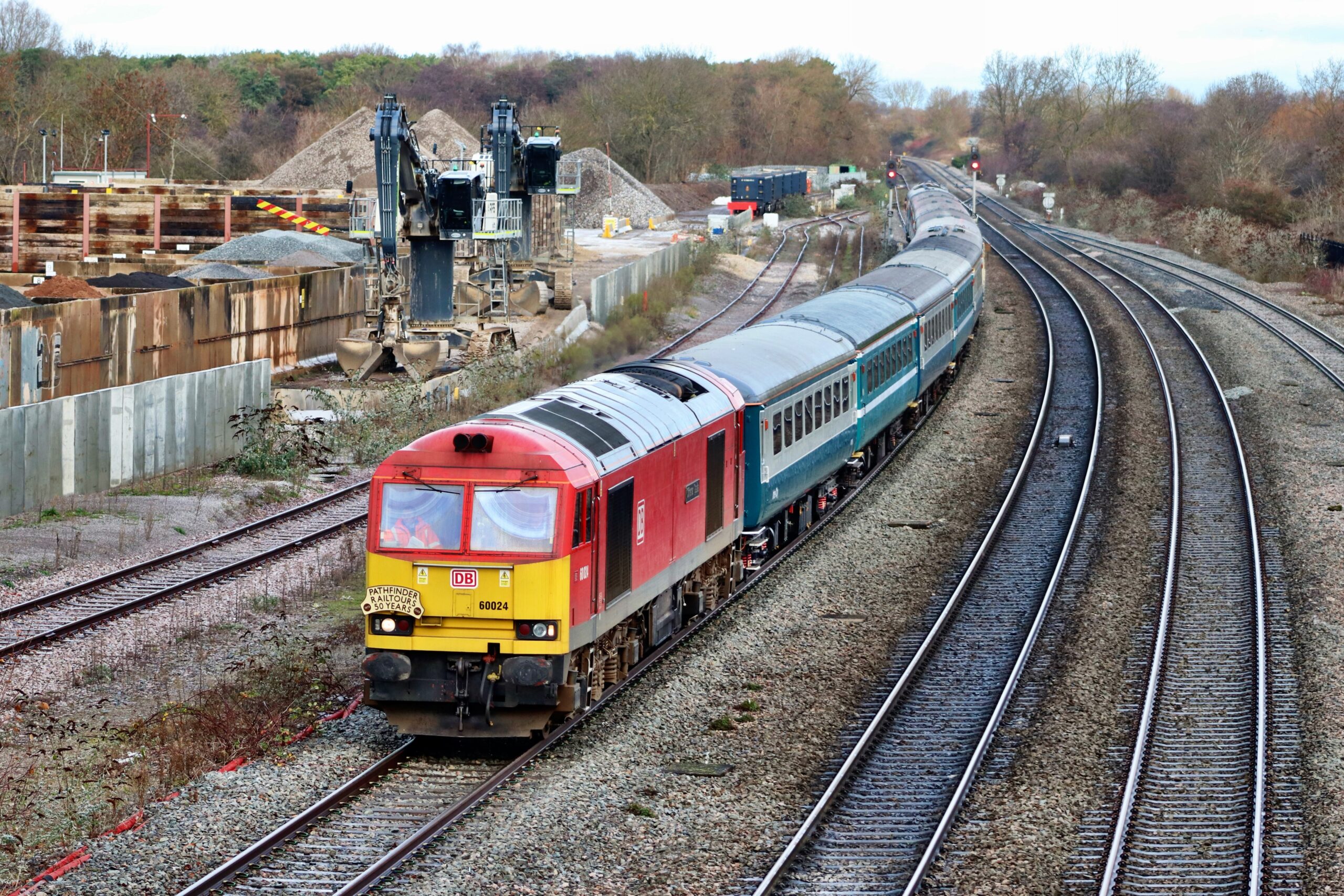
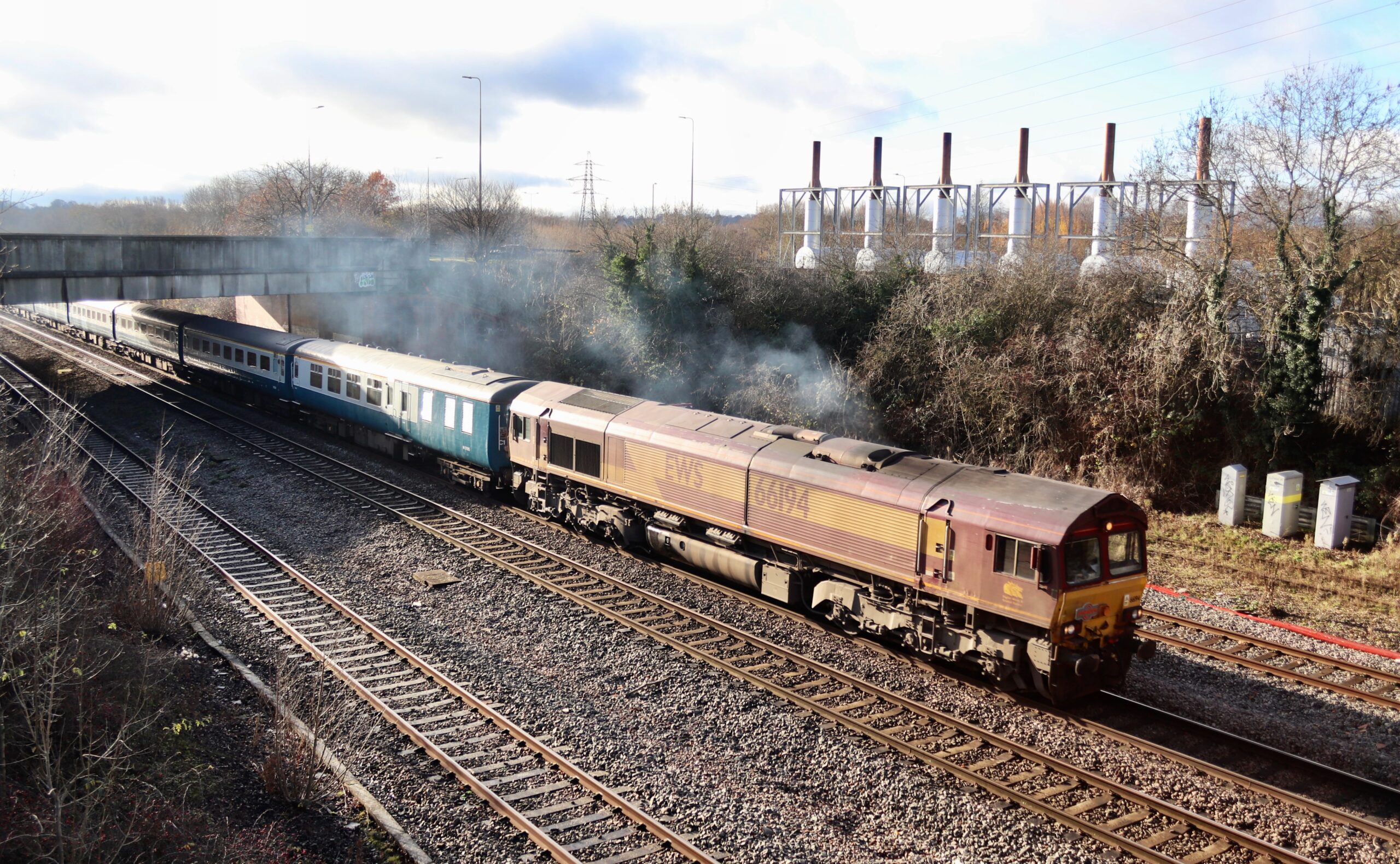
The railtour had to arrive at Resevoir Sidings prior to the arrival of a scheduled GBRf stone train which was confirmed as running on the 16th. The Pathfinder tour was then diagrammed to head into Banbury for a brief layover before heading back up the mainline towards Wolverhampton. I had read the previous day that the Class 66 would be leading towards Banbury, but I was very pleased to see the Class 60 at the front as it rounded the distant curve heading for down goods loop. This meant that we managed to get numerous shots of the leading locomotive and led me to abandon any thoughts of chasing the train up to Fenny Compton and possibly beyond.
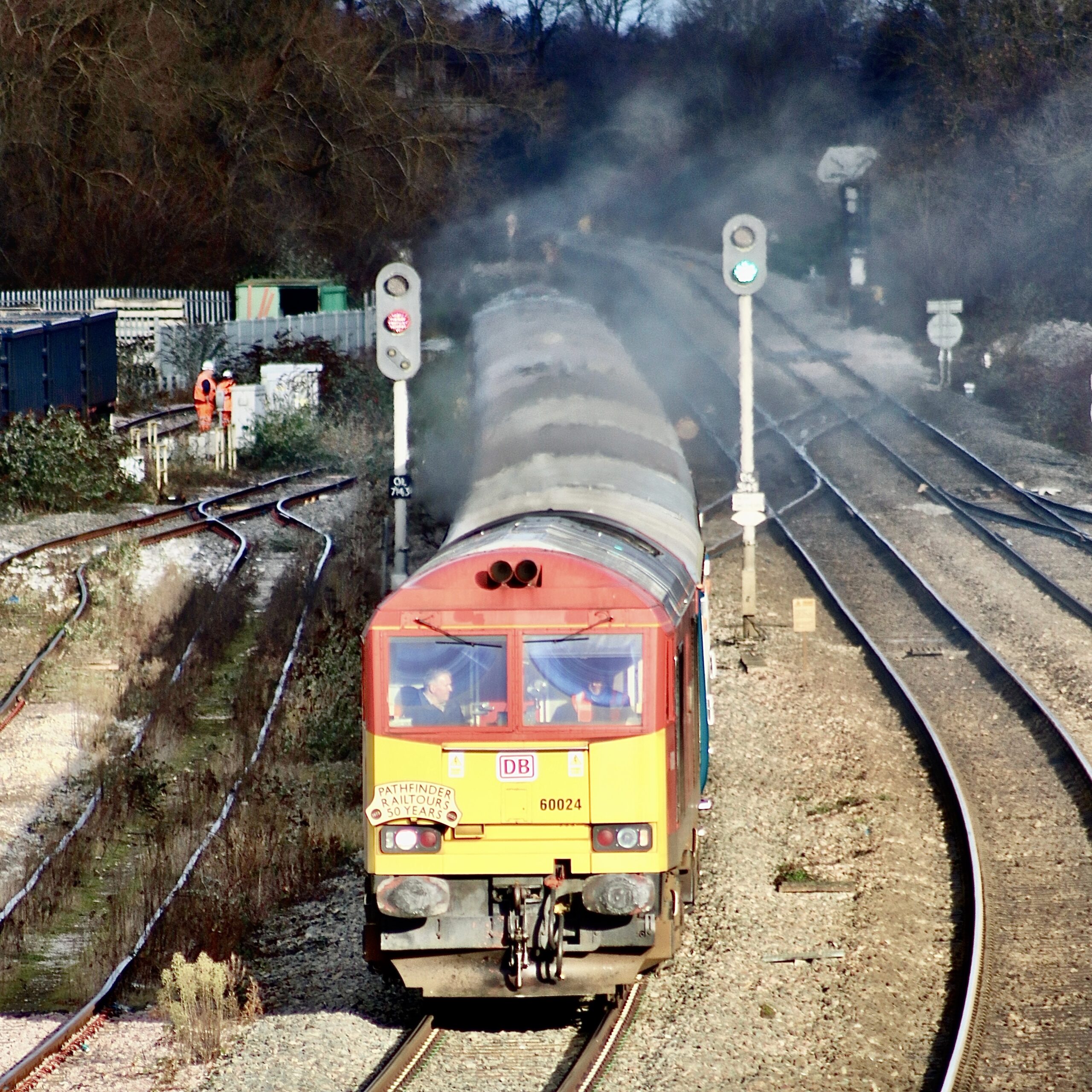
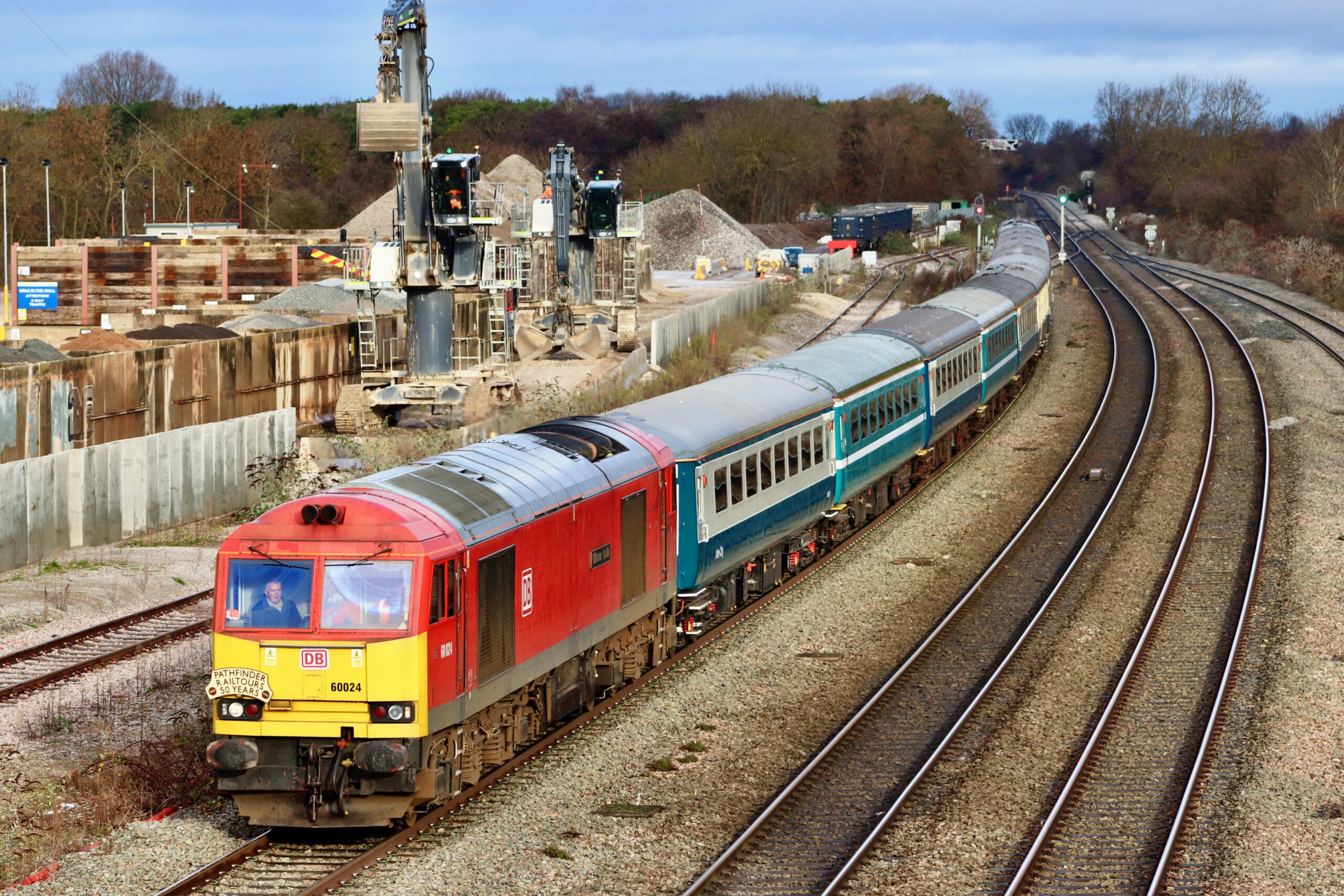
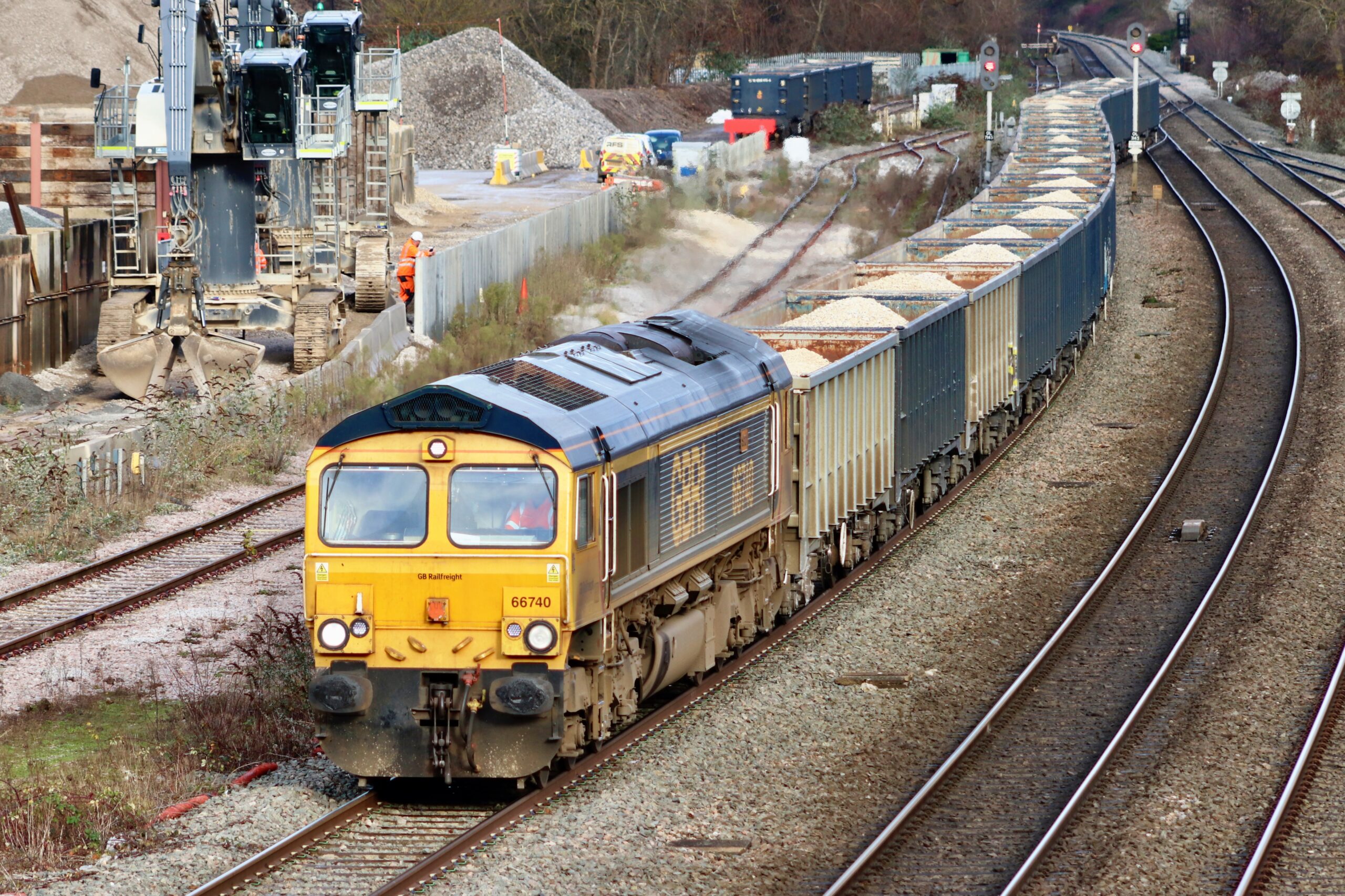
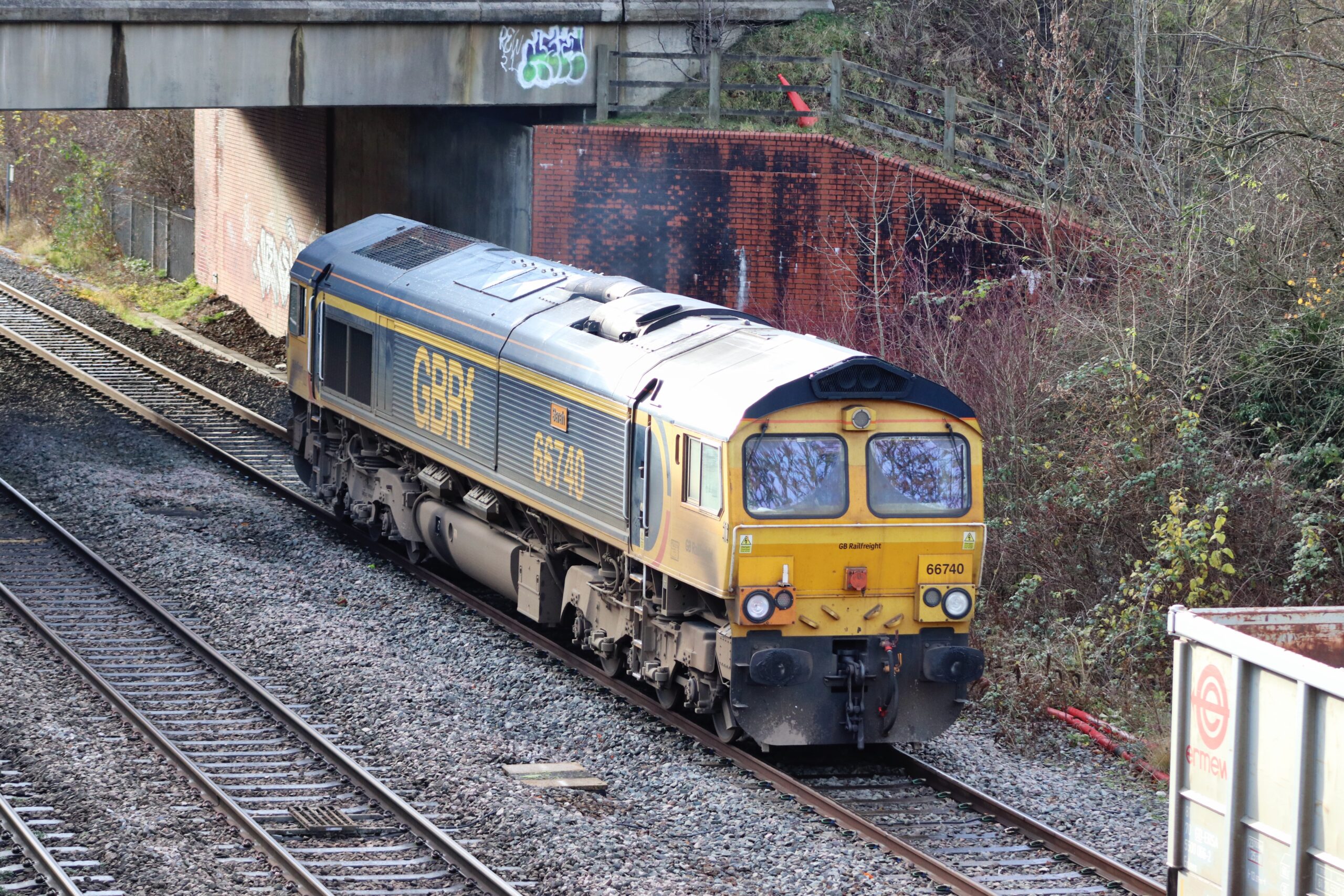
DB Cargo Class 60 No. 60024 hauling “The Festive Midland-Ian” 1Z60 0545 Gloucester to Banbury towards Banbury on the Down Goods Loop – 16/12/2023DB Cargo Class 60 No. 60024 hauling “The Festive Midland-Ian” 1Z60 0545 Gloucester to Banbury – 16/12/2023DB Cargo Class 60 No. 60024 hauling “The Festive Midland-Ian” 1Z60 0545 Gloucester to Banbury towards Banbury on the Down Goods Loop – 16/12/2023GBRf Class 66 No. 66740 ‘Sarah’ arrives with 6G34 02:59 HINDLOW GBRF to Banbury Reservoir Redland Aggregates – 16/12/2023GBRf Class 66 No. 66740 ‘Sarah’ prepares to run around her train; 6G34 02:59 HINDLOW GBRF to Banbury Reservoir Redland Aggregates – 16/12/2023Class 66 No. 66194 takes charge of the second leg of “The Festive Midland-Ian” 1Z61 1211 Banbury to Wolverhampton Walsall Street Steel Terminal – 16/12/2023
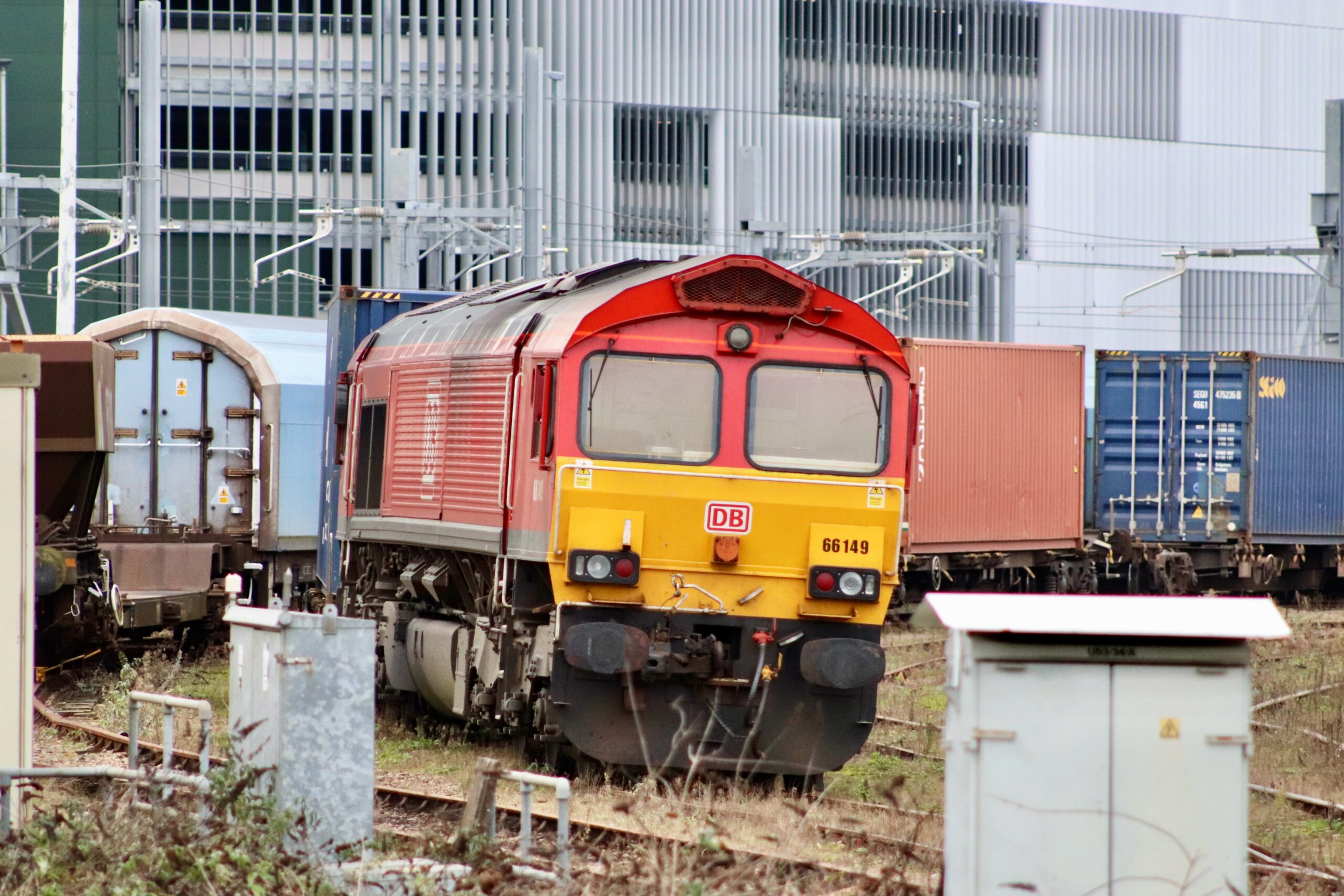
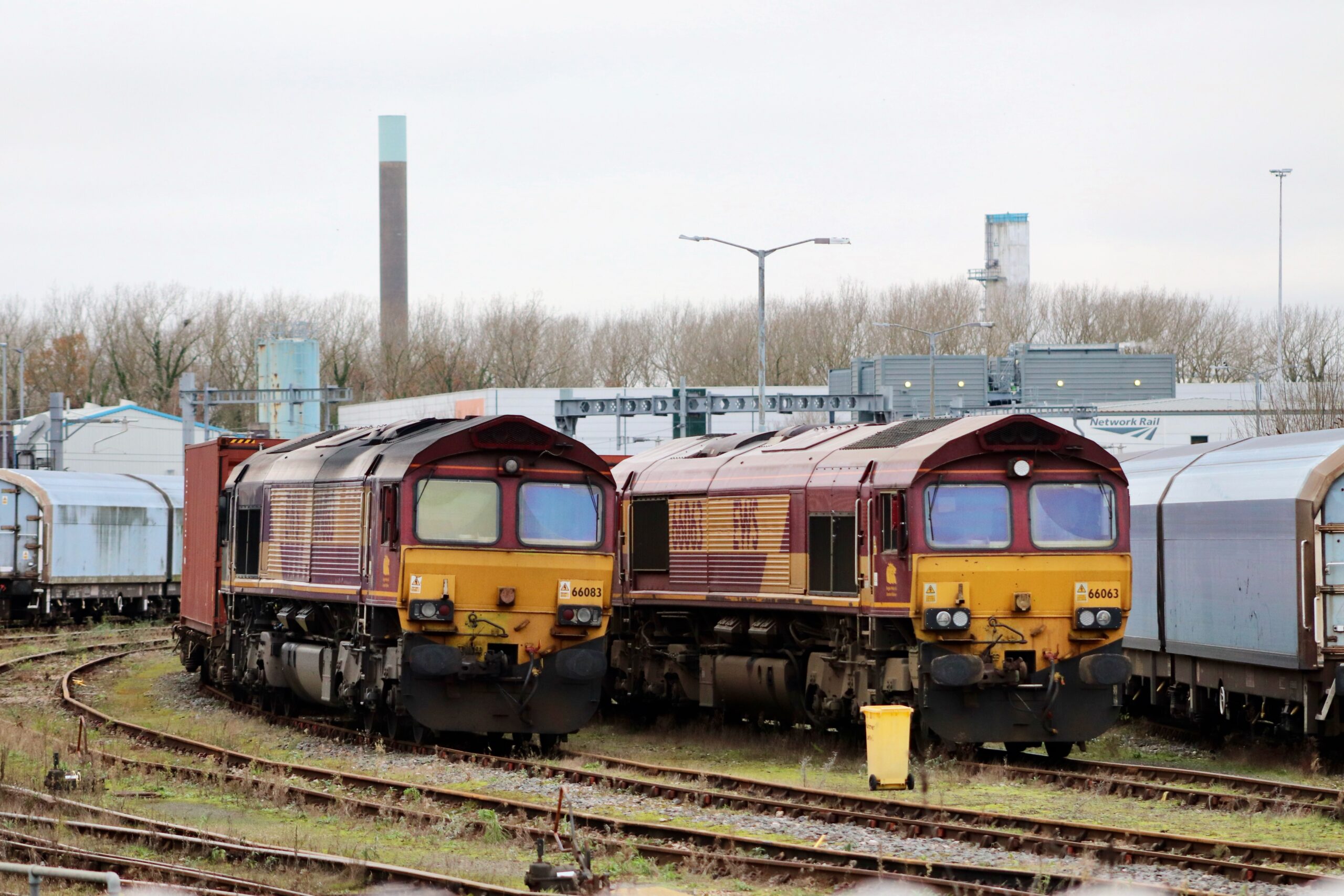
After seeing the Class 66 No. 66194 taking “The Festive Midland-Ian” back towards Wolverhampton, I opted to return home via Didcot in the hope that I could get a photo of special King Prince Charles Coronation liveried Class 66 No. 66023 which had been showing as being on Didcot Fuelling Point. On arrival at Didcot railway station, we were allowed up onto the platforms by Great Western Railway gateline staff, but unfortunately, the No. 66023 was nowhere to be seen. @smithy.377 later discovered the locomotive was inside a shed and therefore out of sight of our cameras. We were able to photograph a few other DBC Class 66 locomotives however.
In red DB Cargo livery Class 66 NO. 66149 in Didcot Yard – 16/12/2023Still carrying EWS livery, DB Cargo Class 66 locomotives No.’s 66083 and 66063 at Didcot – 16/12/2023
Video from Banbury on 16th December 2023 featuring DB Cargo Class 60 No. 60024 and Class 66 No. 66194 top and tail working “The Festive Midland-Ian” from Pathfinder Railtours; 1Z60 0545 Gloucester to Banbury & 1Z61 1211 Banbury to Wolverhampton Walsall Street Steel Terminal. Other trains featured include: 68012 (set AL04/ DVT 82309) – 1H27 08:19 Stourbridge Junction to Marylebone 221139 – 1M30 07:45 Bournemouth to Manchester Piccadilly 221137 – 1O08 07:25 Manchester Piccadilly to Bournemouth 70014 – 4O27 06:49 Crewe Basford Hall SSM to Southampton Marine Container Terminal 168108/168106 – 1R17 09:02 Marylebone to Birmingham Moor Street 168218/168328 – 1H28 09:13 Birmingham Moor Street to Marylebone 220031 – 1V83 06:23 Newcastle to Reading 168004 / 168xxx – 1H30 09:43 Birmingham Moor Street to Marylebone 168xxx/ 168107 – 1R19 09:32 Marylebone to Birmingham Moor Street 168xxx/ 168217 – 1R21 10:02 Marylebone to Birmingham Moor Street 66740 ‘Sarah’ – 6G34 02:59 HINDLOW GBRF to Banbury Reservoir Redland Aggregates 168001 ‘Adrian Shooter’/168xxx – 1H33 10:43 Birmingham Moor Street to Marylebone 220027 – 1O12 09:25 Manchester Piccadilly to Bournemouth 220033 – 1M38 09:45 Bournemouth to Manchester Piccadilly 168322/168215 – 1R25 11:02 Marylebone to Birmingham Moor Street
Engineering works at Middle Stream Bridge near Wool on Sunday 17th December meant there were no trains running in the area. Yoshi and I had a little “family” trip out to Weymouth and I grabbed a couple of photographs of track machines resting between duties on our way home.
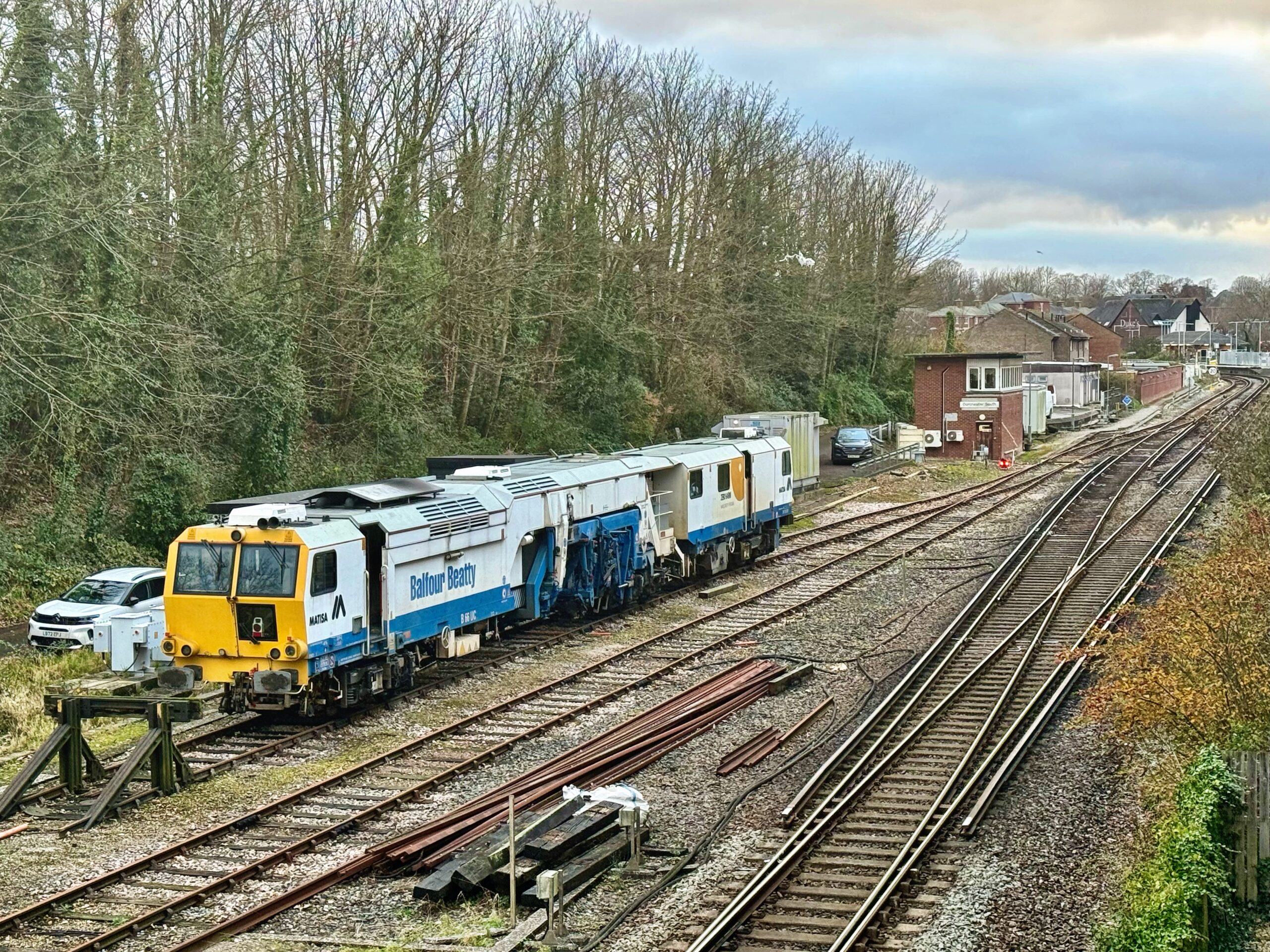
Balfour Beatty Matisa B66UC Tamper No. DR75501 in the sidings at Dorchester South prior to working the following days 6Q66 05:00 Dorchester Junction to Eastleigh East Yard – 17/12/2023
A tamping machine or ballast tamper, informally simply a tamper, is a self-propelled, rail-mounted machine used to pack (or tamp) the track ballast under railway tracks to make the tracks and roadbed more durable and level. Prior to the introduction of mechanical tampers, this task was done by manual labour with the help of beaters. As well as being faster, more accurate, more efficient and less labour-intensive, tamping machines are essential for the use of concrete sleepers since they are too heavy to be lifted by hand.
At its most basic, a tamping machine only packs the ballast. Some modern machines, sometimes known as tamper-liners or tamping and lining machines, also correct the alignment of the rails to make them parallel and level, in order to achieve a more comfortable ride for passengers and freight and to reduce the mechanical strain applied to the rails by passing trains. This is done by finding places where the sleepers have sunk from the weight of the passing trains or frost action, causing the track to sag.
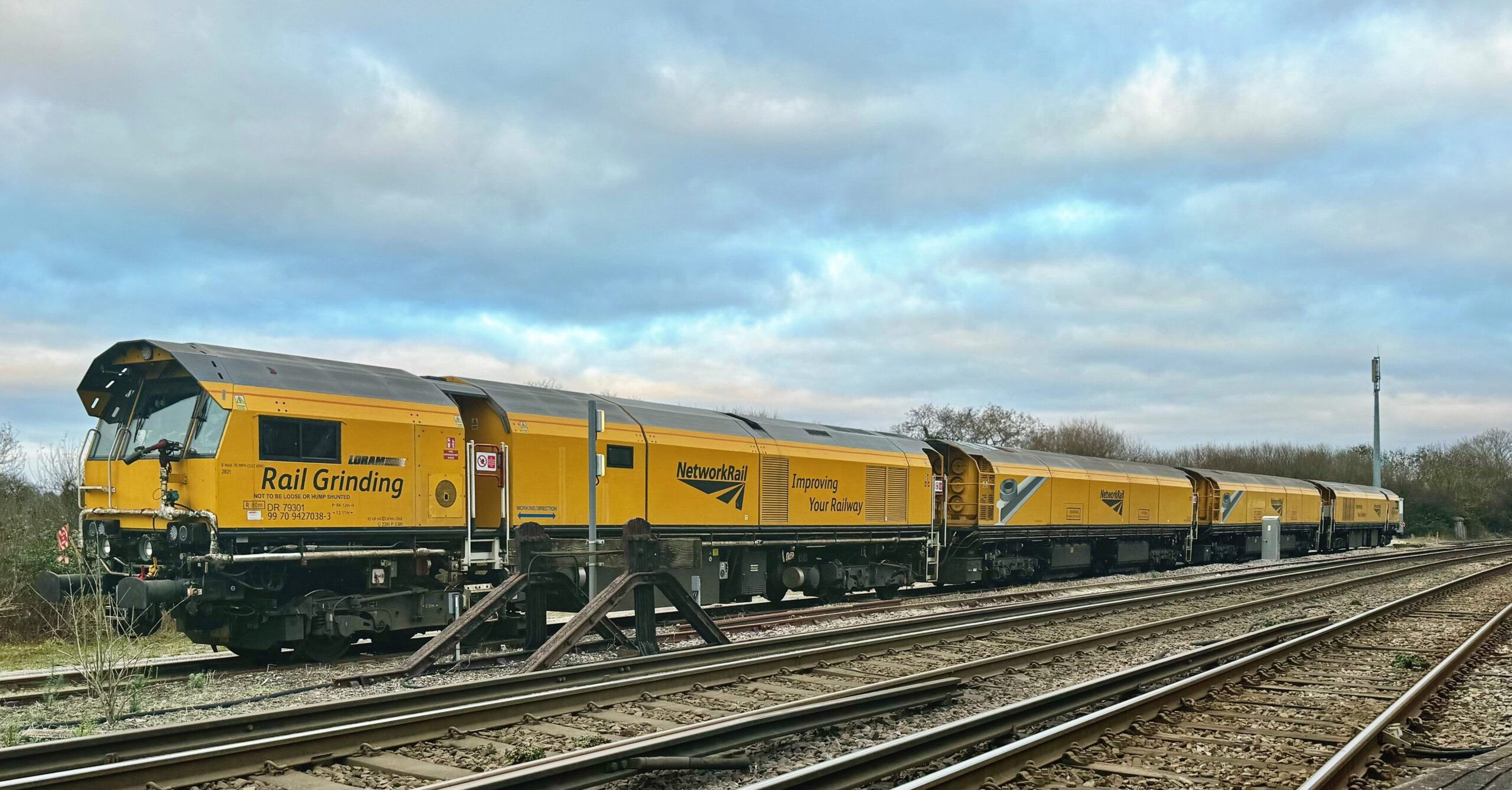
The B 66 UC is a high-performance universal continuous action tamping machine designed for normal and high-speed lines. In addition to the plain line, it can handle the heaviest switches and crossings, especially those with concrete sleepers. This machine has a tamping shuttle fitted with four tamping units and a lifting and slewing clamp. In addition to these tools, telescopic diverging track lifting devices can be used when handling heavy switches and crossings. The very responsive shuttle allows a substantial output on plain line despite the fact that this is a single-head machine. The longitudinal stroke of the tamping units is long enough to position the units in a way to easily and quickly tamp Y shaped sleepers. Located in the centre of the machine, the tamping cabin provides an excellent visibility on the tools and the track. Thanks to the machine’s user-friendliness and its ergonomic controls, only two operators are needed to operate the B 66 UC to its full potential. Loram C44 Rail Grinding Machine No. DR79301 in Wool Sidings. It will depart for Poole on 19/12/2023 as 4Q01 23:44 Wool MOD Siding Freightliner Heavy Haul to Poole – 17/12/2023
A railgrinder is a permanent way maintenance train used to restore the profile and remove irregularities from worn tracks to extend tracklife and to improve the ride of trains using it.
The C44 Series Rail Grinder is designed with advanced technology features that also meets stringent international standards, weights and clearances. The C44 Series complies with the W6A clearance diagram and the axle weights of international commuter lines and freight rail applications.
Loram’s C44 rail grinder delivers high-efficiency re-profiling of the railhead, removing or reducing rail corrugations, corrosion, joint mismatches and other railhead surface irregularities with industry-leading productivity.
Monday 18th December and with all lines re-opened, it was the turn of the monthly Colas test train from Derby RTC to Eastleigh East Yard via Weymouth running as 1Q51 1115 Derby R.T.C.(Network Rail) to Eastleigh East Yard employing the usual traction of GBRf Class 73 locomotives. This time it was the turn of No.’s 73964 ‘Jeanette’ and 73962 ‘Dick Mabbutt’.
GBRf Class 73’s No.’s 73964 ‘Jeanette’ and 73962 ‘Dick Mabbutt’ passing through Hamworthy working 1Q51 11:15 Derby RTC Serco to Eastleigh East Yard – 18/12/2023
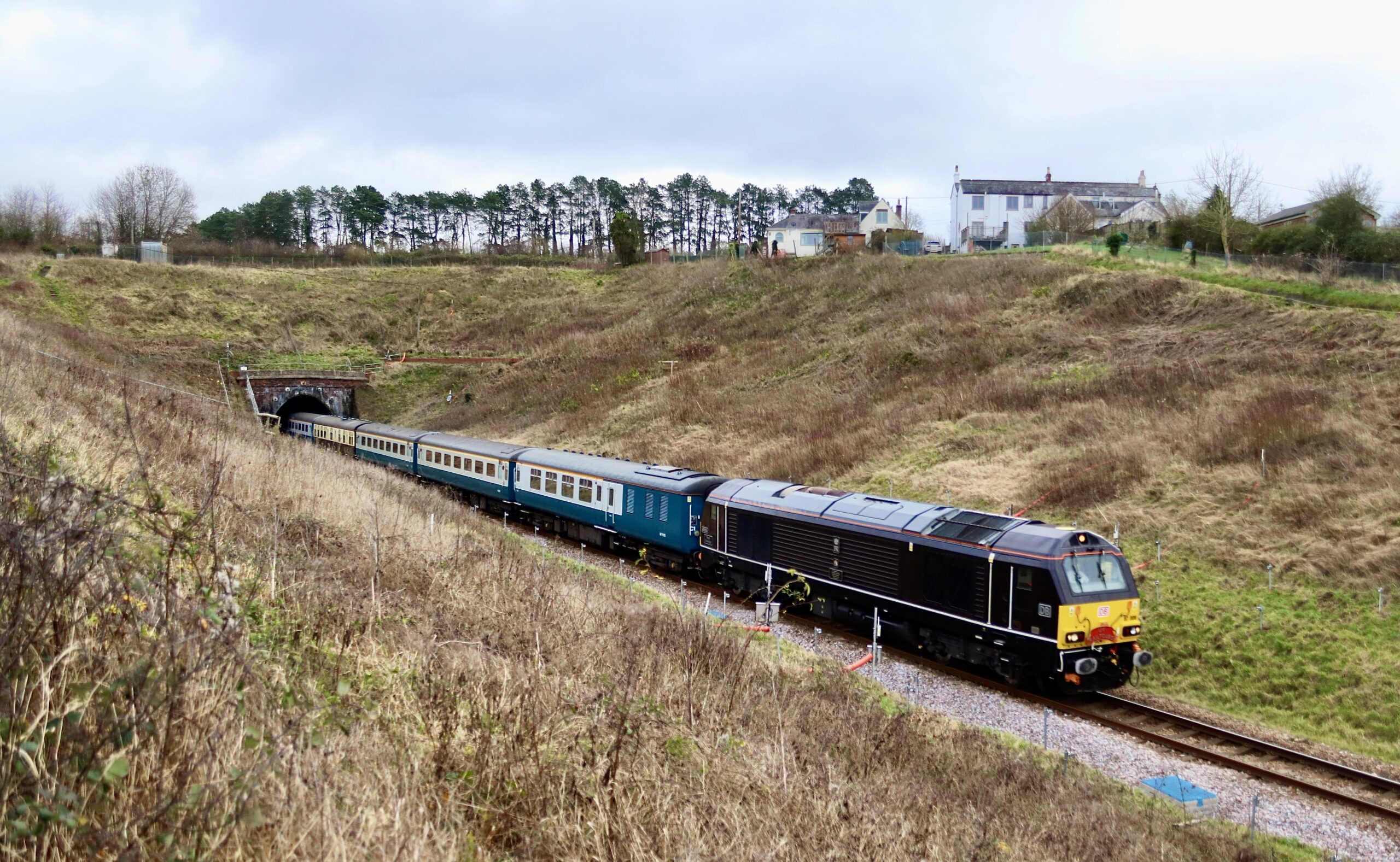
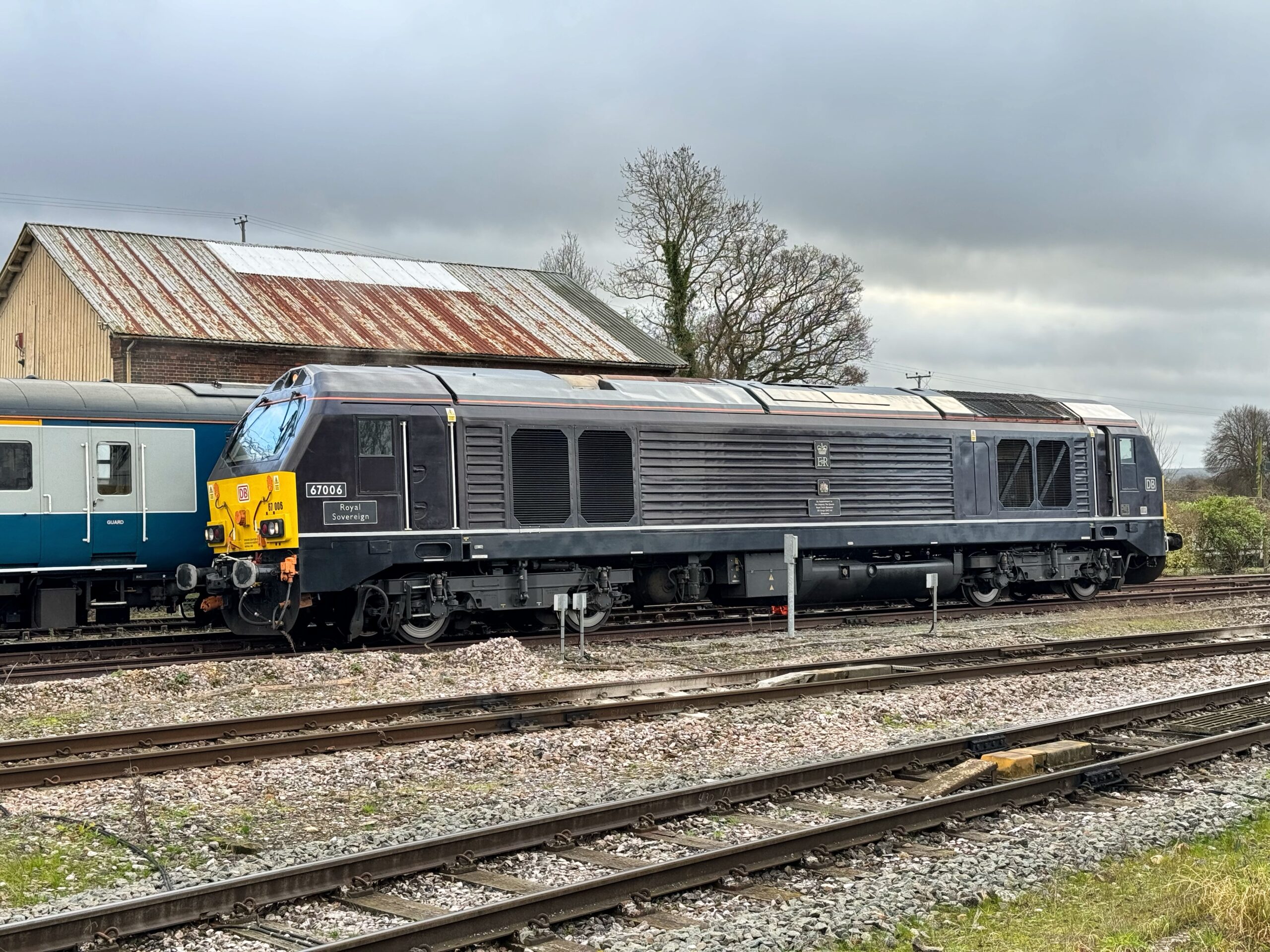
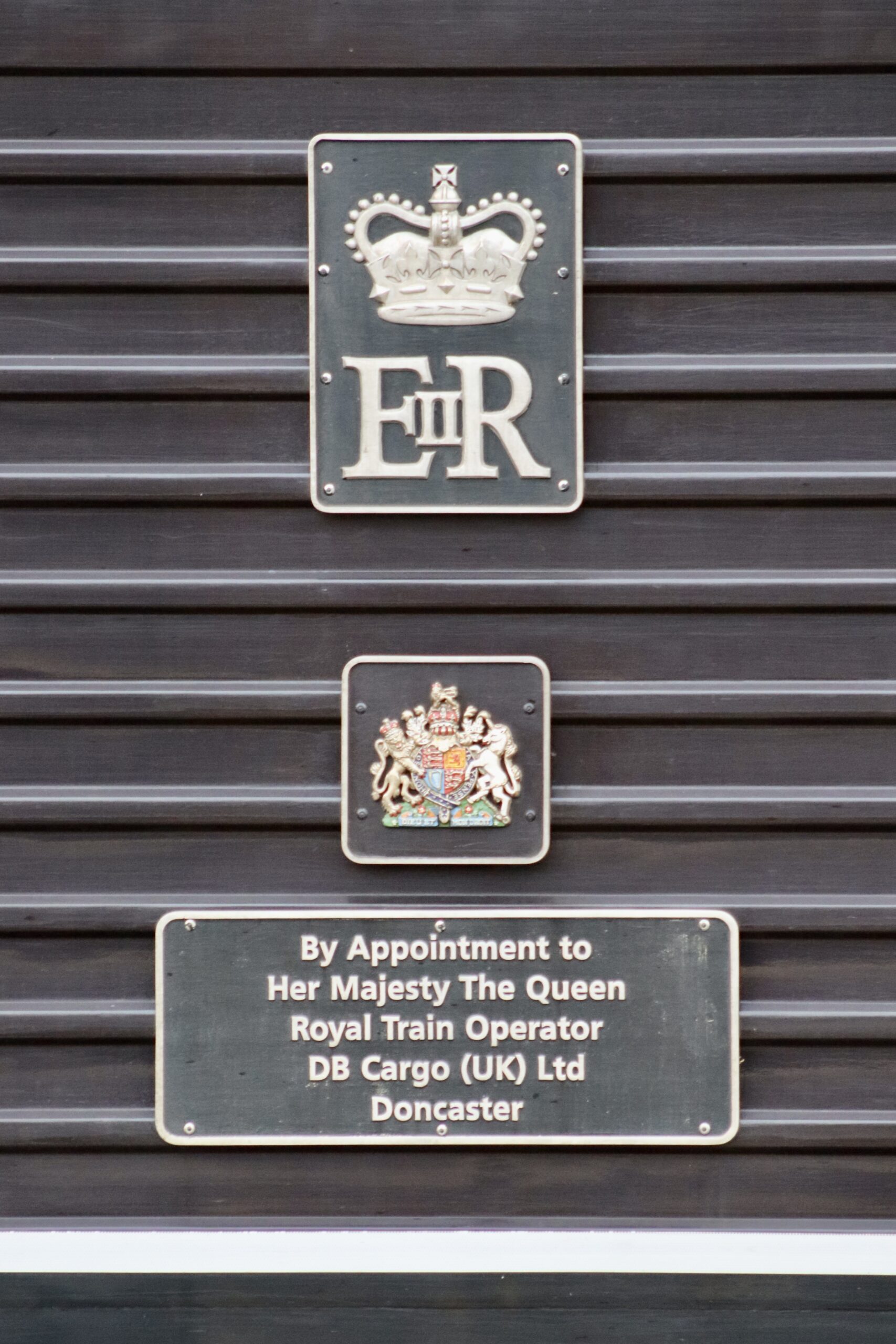
Another day out to see a railtour took place on Saturday 23rd December, this time closer to home as DB Cargo Class 67 No. 67006 ‘Royal Sovereign’ was in charge of UK Railtours “Carols At Sherborne Abbey” 1Z15 0715 Peterborough to Yeovil Jn Heritage Platform. No. 67006 is one of two class members painted in a special Royal Claret livery and as such would be primarily tasked with working the Royal Train. However, the locomotive is often used for special charter trains and other occasional passenger services when not fulfilling her Royal duties. We took a roundabout route to see the railtour, taking in Totton Yard so I could finally get a clear photograph of GBRf Class 66 No. 66743 in Belmond Royal Scotsman livery as it is was still being employed on the SITT along with No. 66772 ‘Maria’. I also popped in on Freightliner Southampton Maritime and Eastleigh (which admittedly was rather quiet!)
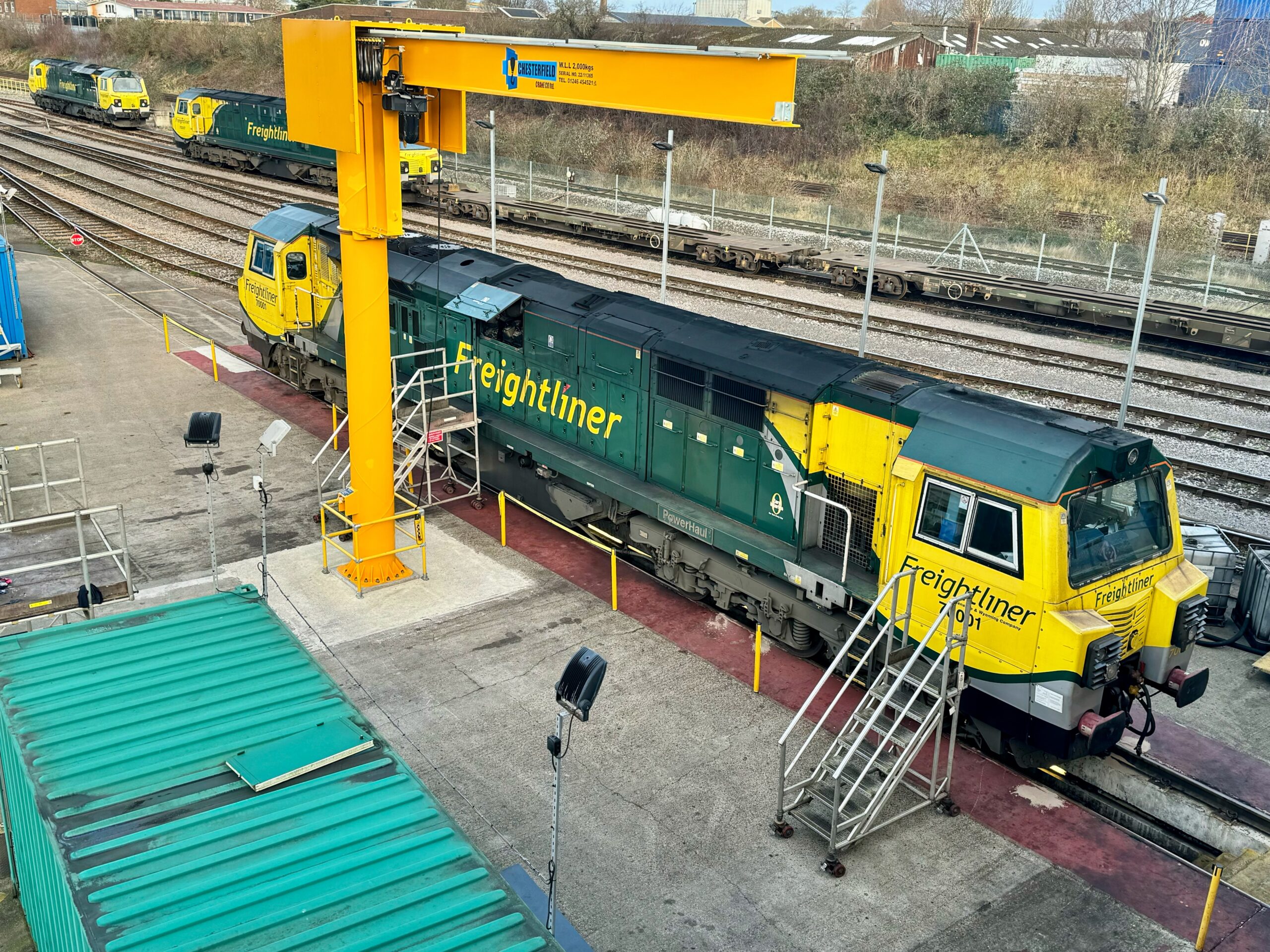
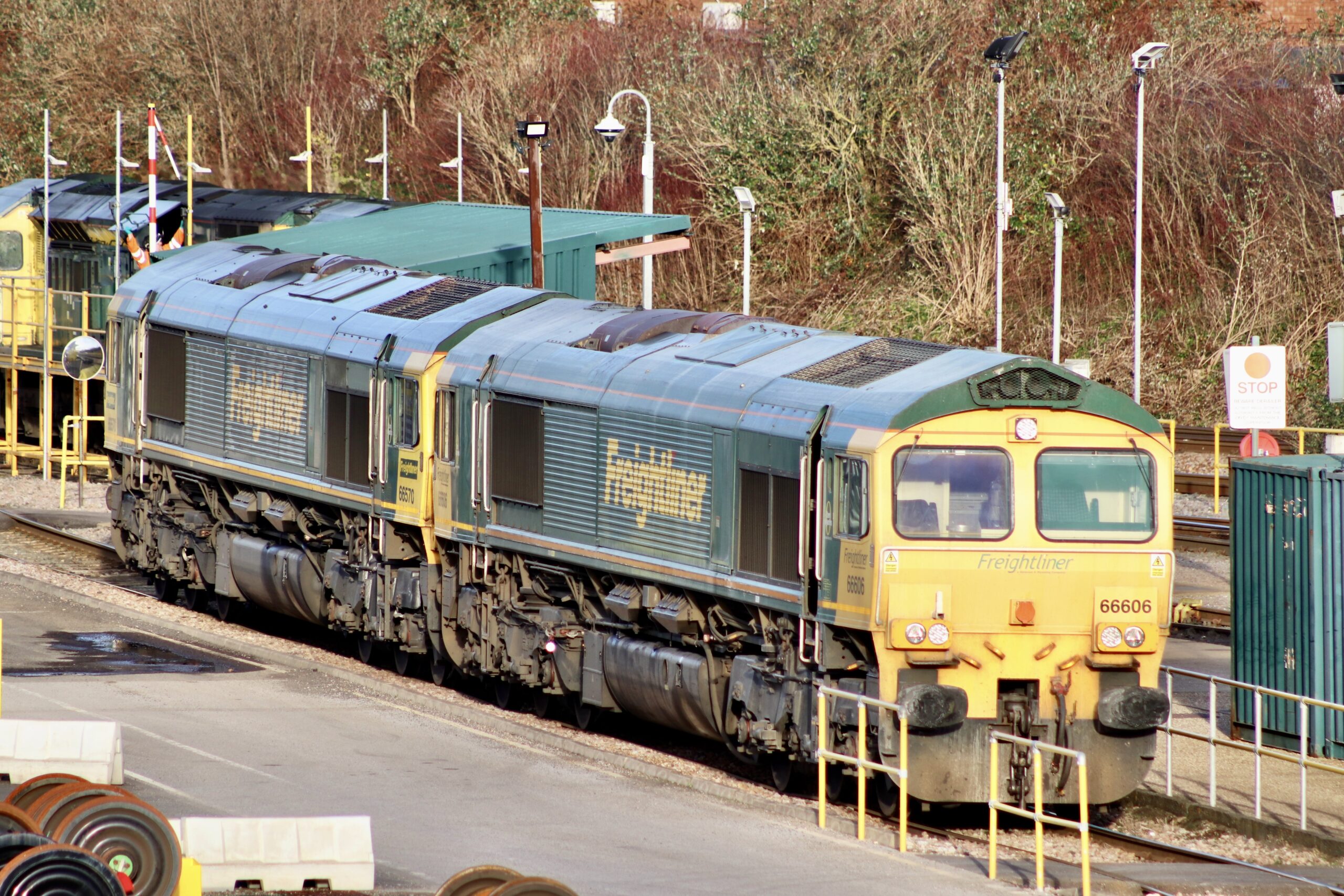
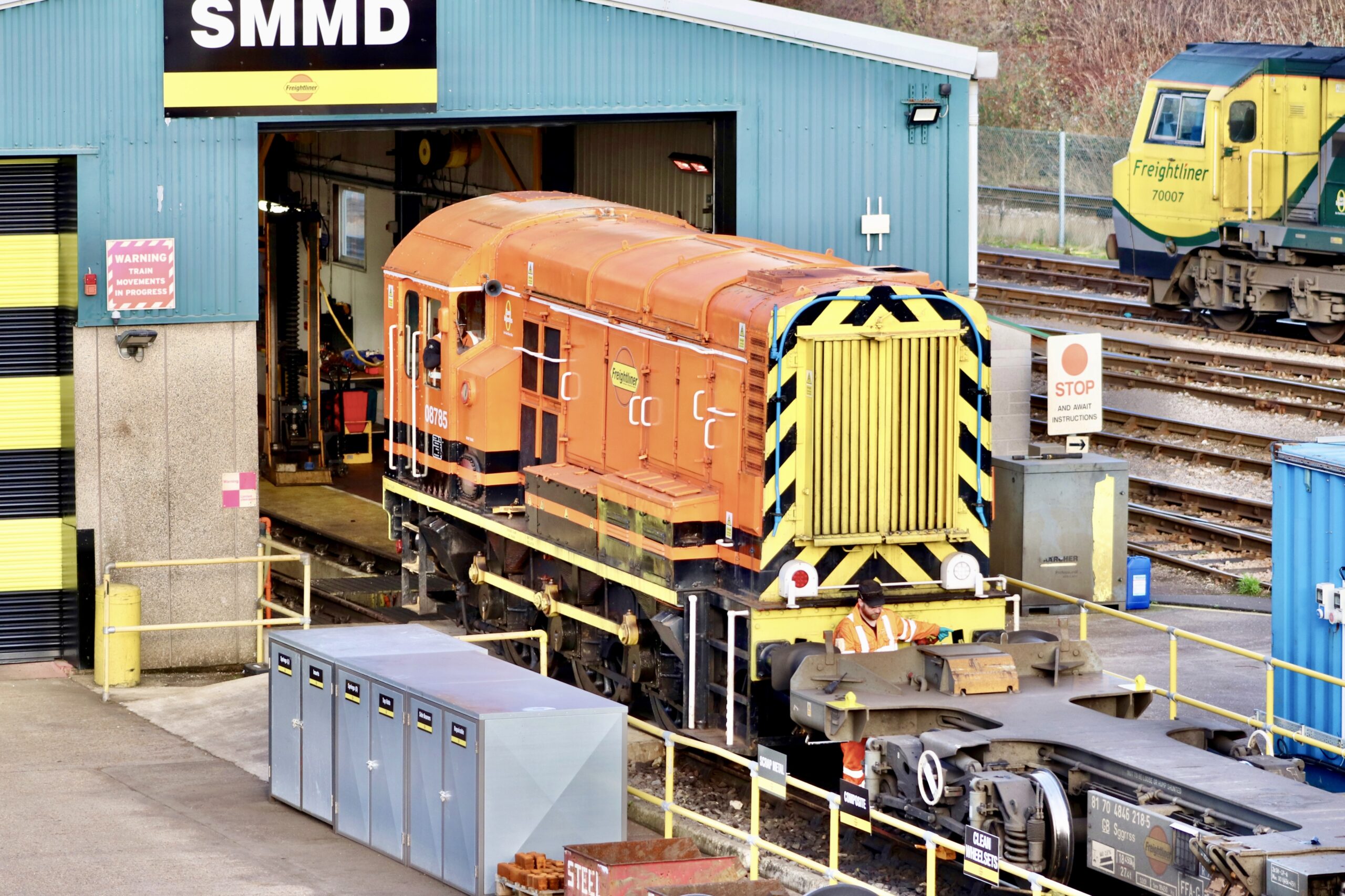
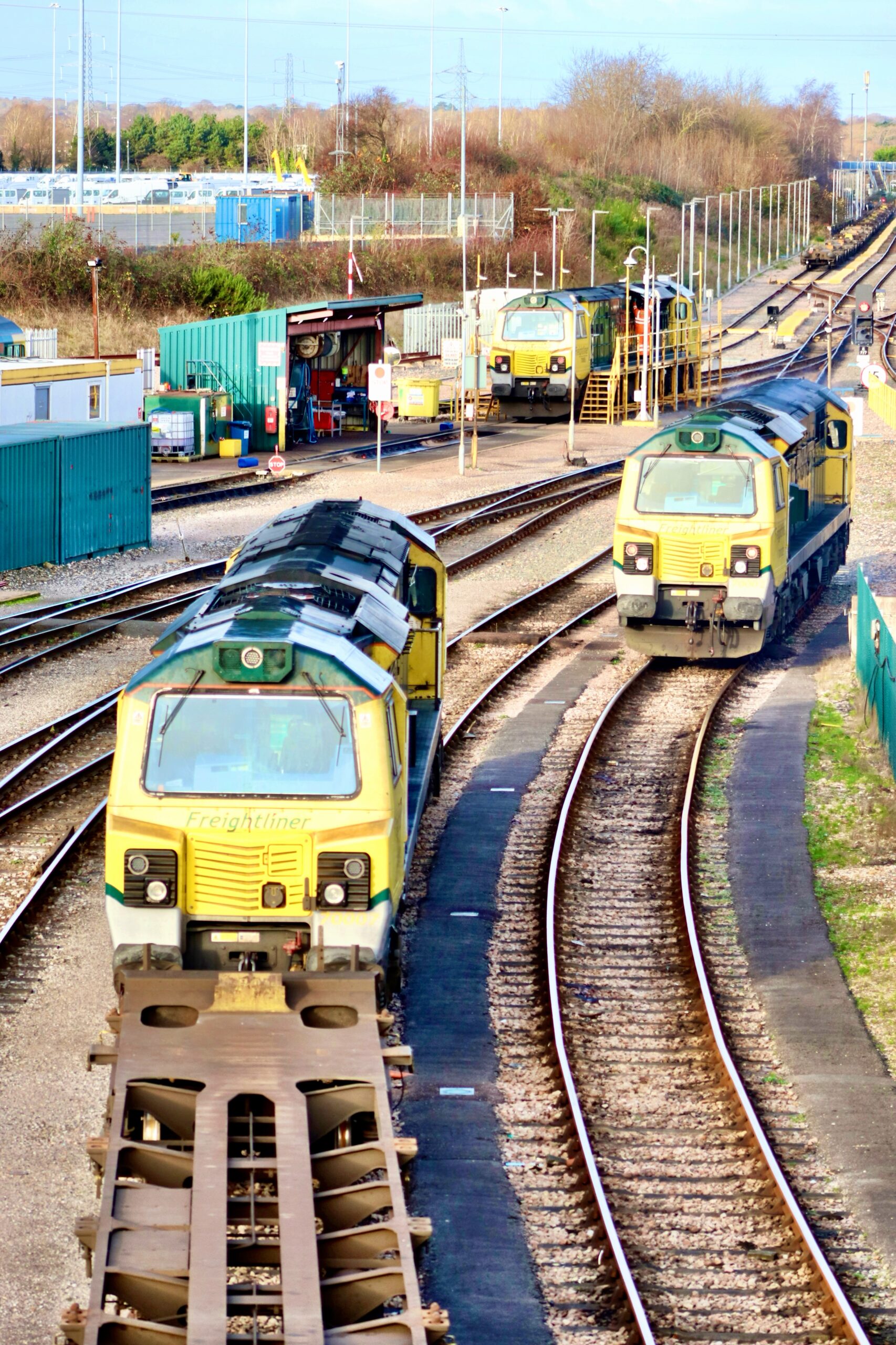
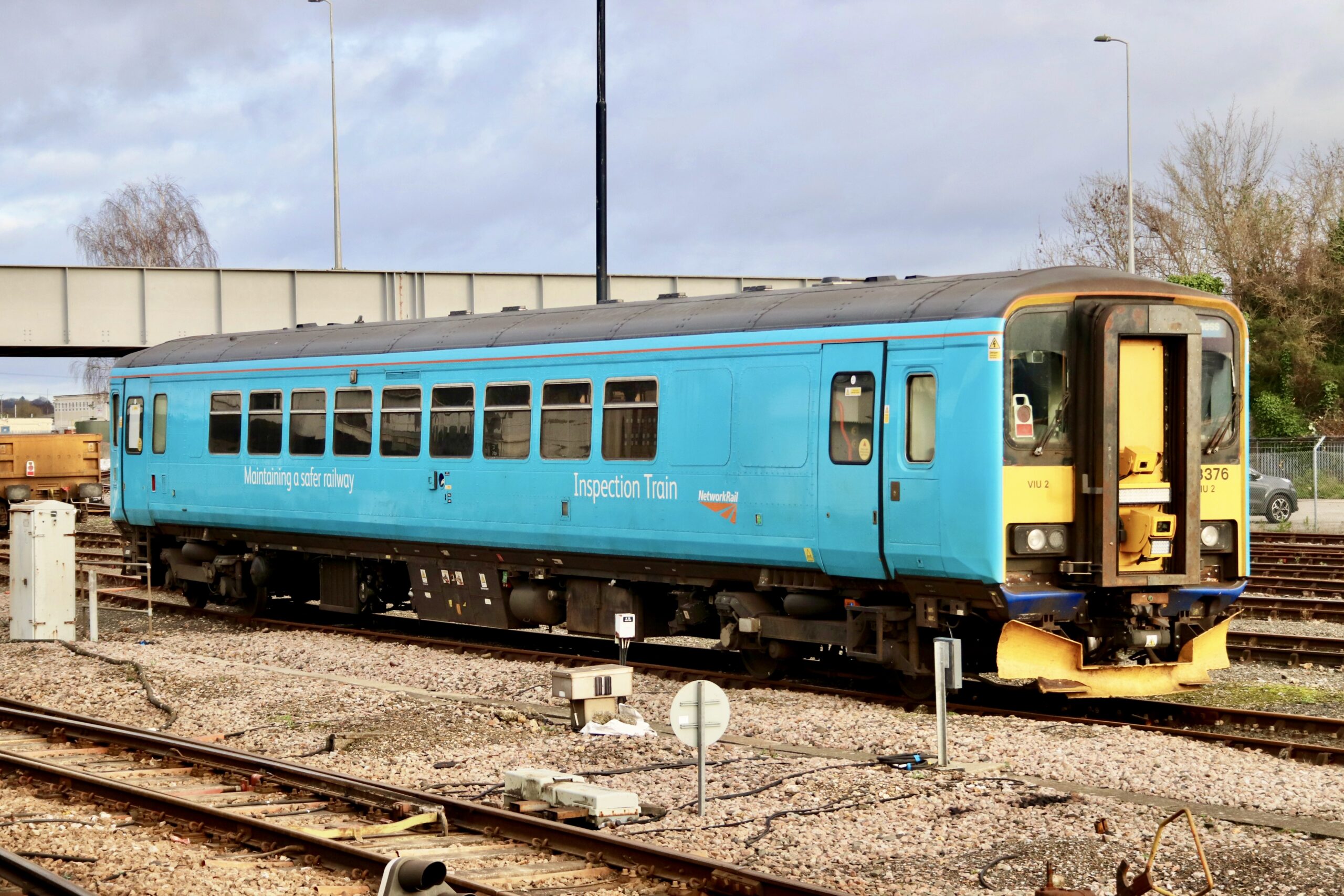
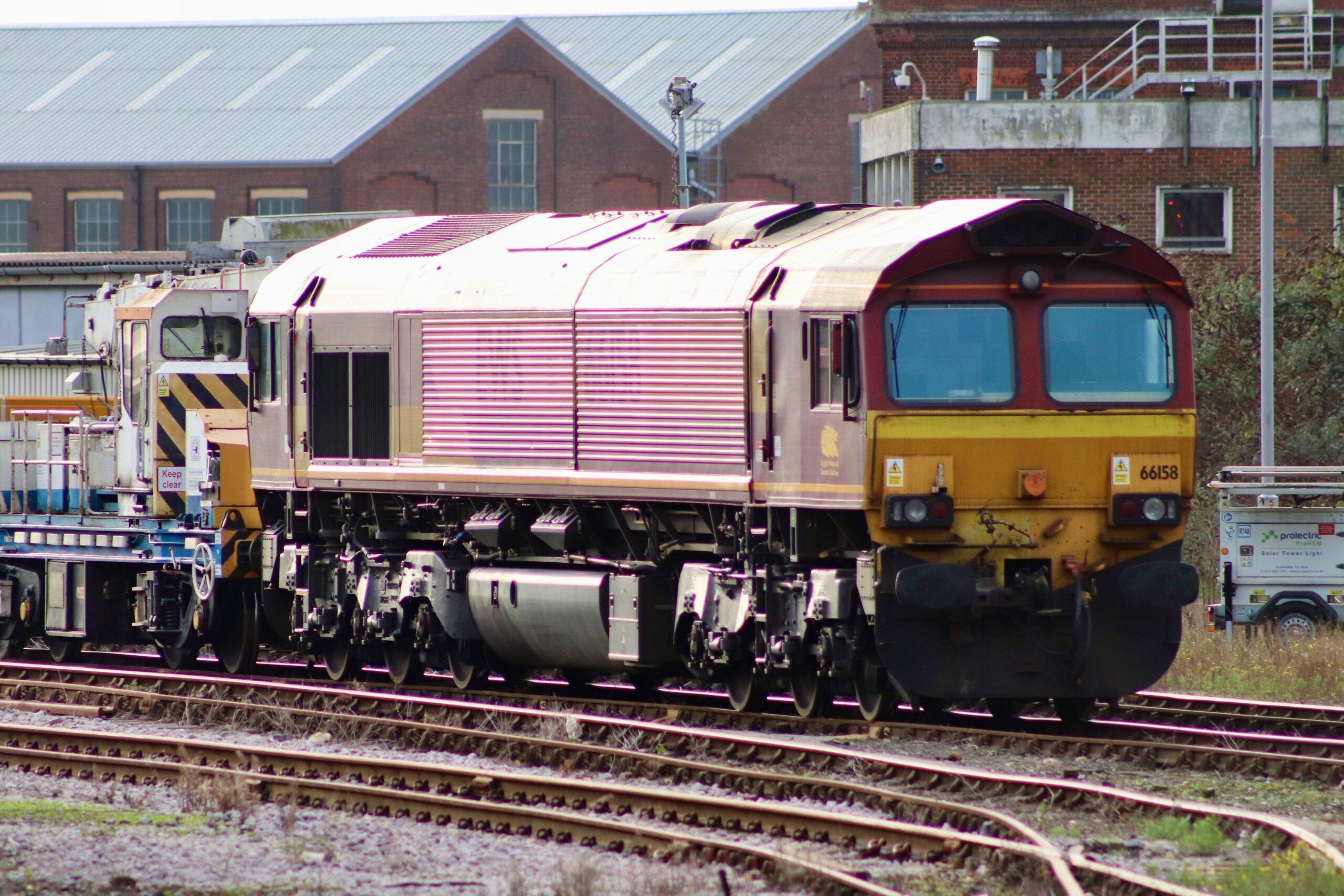
GBRf Class 66 No. 66743 at Totton Yard – 23/12/2023GBRf Class 66 No.66772 ‘Maria’ on the rear of the SITT at Totton Yard – 23/12/2023GBRf Class 66 No. 66743 and No.66772 ‘Maria’ in Totton Yard on the SITT. The train was scheduled to head to Eastleigh East Yard later that evening where it would remain over the Christmas period – 23/12/2023Freightliner Class 70 No. 70001 at Southampton Maritime – 23/12/2023FL Class 66 No.’s 66606 and 66570 at Southampton Maritime – 23/12/2023Class 08 diesel shunter No. 08785 at Southampton Maritime – 23/12/2023A trio of FL Class 70’s at Southampton Maritime; 70007, 70002 and 70005 – 23/12/2023Class 153 Video Inspection Unit (VIU2) No. 153376 at Eastleigh – 23/12/2023DB Cargo Class 66 No. 66158 on a DB Infrastructure Train destined for Abbey Street Junction for work over the Christmas period at Eastleigh – 23/12/2023
Always looking for a new photographic location, I had time to scout out the western portal of Gillingham tunnel. After parking up at the side of the road above the tunnel, Yoshi and I made our way along a public footpath through fields which are adjacent to the railway track. A trio of sheep were not too sure about our arrival and took off to the opposite corner to watch us from afar. Yoshi, thankfully, showed little interest in the ovine beasts and settled down at my feet as we waited for the Class 67 to turn up hauling its train.
Class 67 No. 67006 ‘Royal Sovereign’ emerges from Gillingham Tunnel hauling 1Z15 0715 Peterborough to Yeovil Jn Heritage Platform – 23/12/2023
After seeing the train at Gillingham tunnel, I popped into Yeovil Junction in time to see the locomotive running around her train which was being serviced after dropping off the passengers in Sherborne for the festive carol service at the Abbey the tour was named after.
Class 67 No. 67006 ‘Royal Sovereign’ runs around its train at Yeovil Junction – 23/12/2023Crests applied to Class 67 No. 67006 ‘Royal Sovereign’ – 23/12/2023Class 67 No. 67006 ‘Royal Sovereign’ reversing back onto the coaching stock to form the return leg of the “Carols At Sherborne Abbey” railtour – 23/12/2023Class 67 No. 67006 ‘Royal Sovereign’ at Yeovil Junction whilst the coaching stock employed on the “Carols At Sherborne Abbey” railtour is serviced – 23/12/2023
Video of 67006 ‘Royal Sovereign’ working “Carols At Sherborne Abbey” 1Z15 0715 Peterborough to Yeovil Jn Heritage Platform Also includes the following passing trains: Gillingham Tunnel: 159020/159013 – 1L25 1021 London Waterloo to Exeter St Davids 159012/159105 – 1L44 1125 Exeter St Davids to London Waterloo Yeovil Junction: 159003/159015 1L29 1120 London Waterloo to Exeter St Davids
On my way home from Yeovil, I made another slight detour to take a look at the Swanage Railway’s “Polar Express” operation, this years seasonal offering from the Purbeck Heritage line, which I had so far not managed to see in 2023. “Polar Express” trains started running on 17th December and continued through to 30th December. With failing light which rendered photography of moving trains difficult, I waited for the late running 1445 trip from Swanage to show at Corfe Castle with resident Class 33 No. 33012 (D6515) ‘Lt Jenny Lewis RN’ hauling the outward run and Southern Railway 4-6-2 West Country Class No. 34028 ‘Eddystone’ with “Polar Express” emblazoned on her tender, working the return. I followed the train down to Swanage and as darkness fell this only enhanced the colourful lights within the carriages.
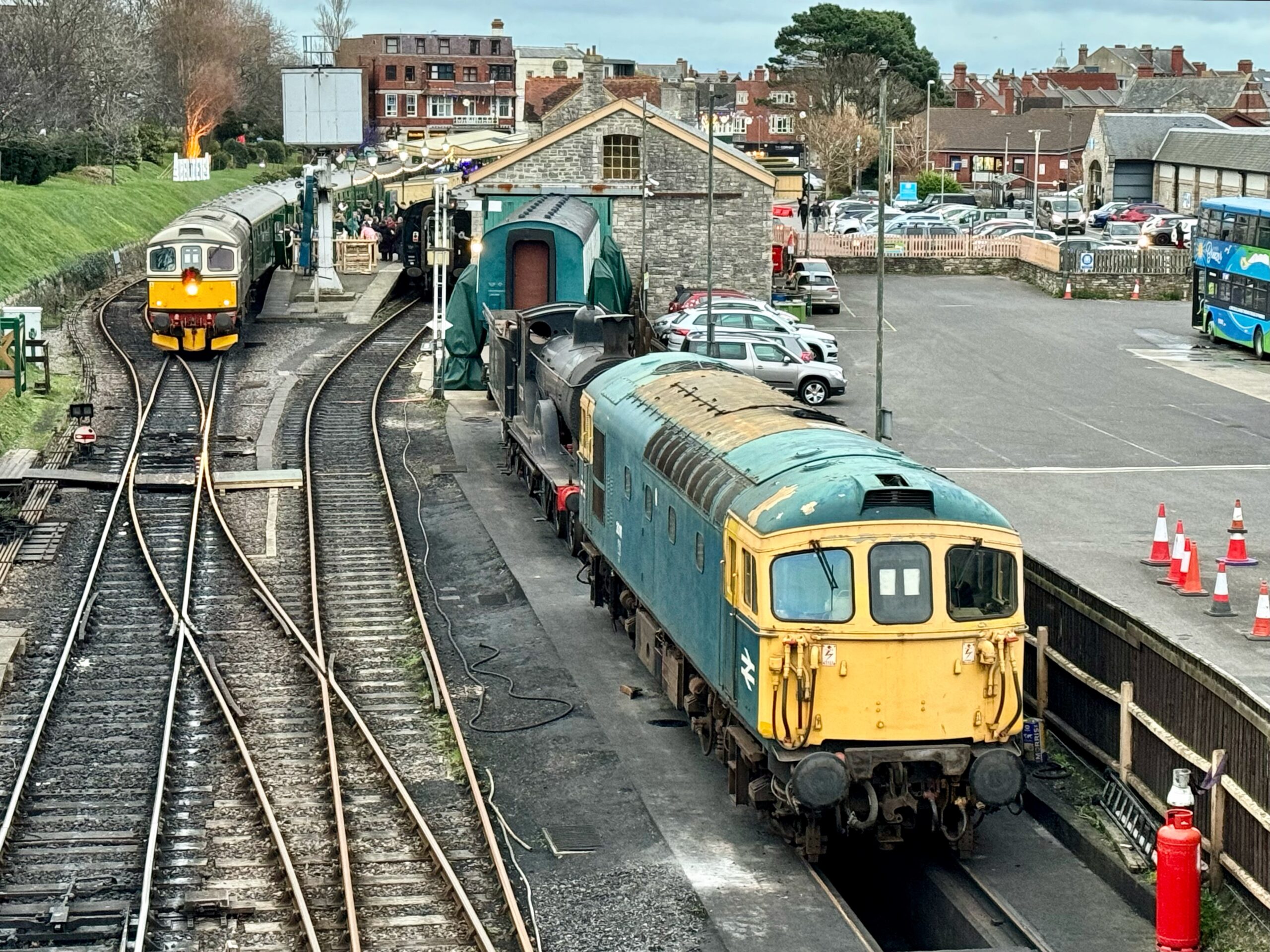
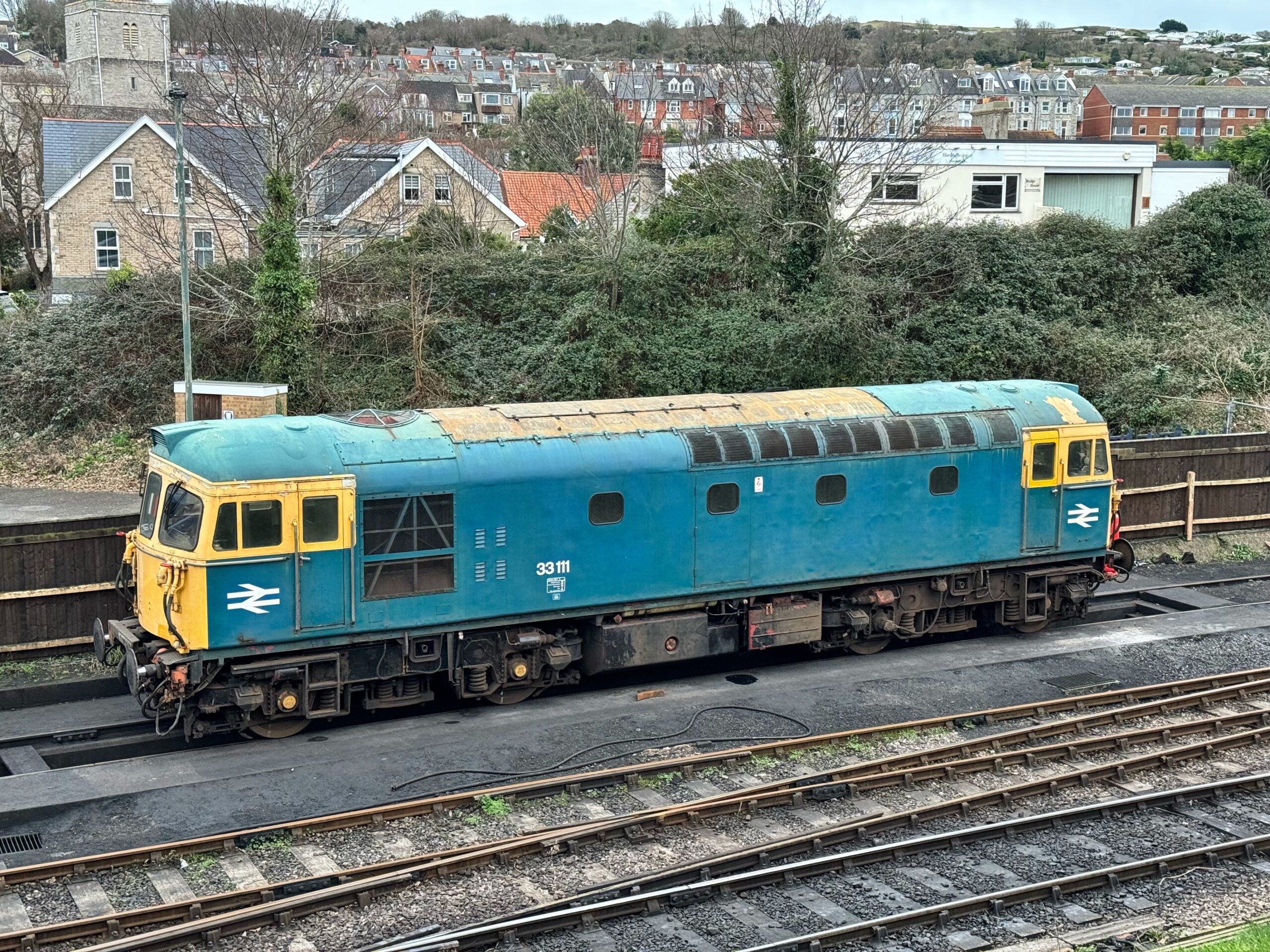
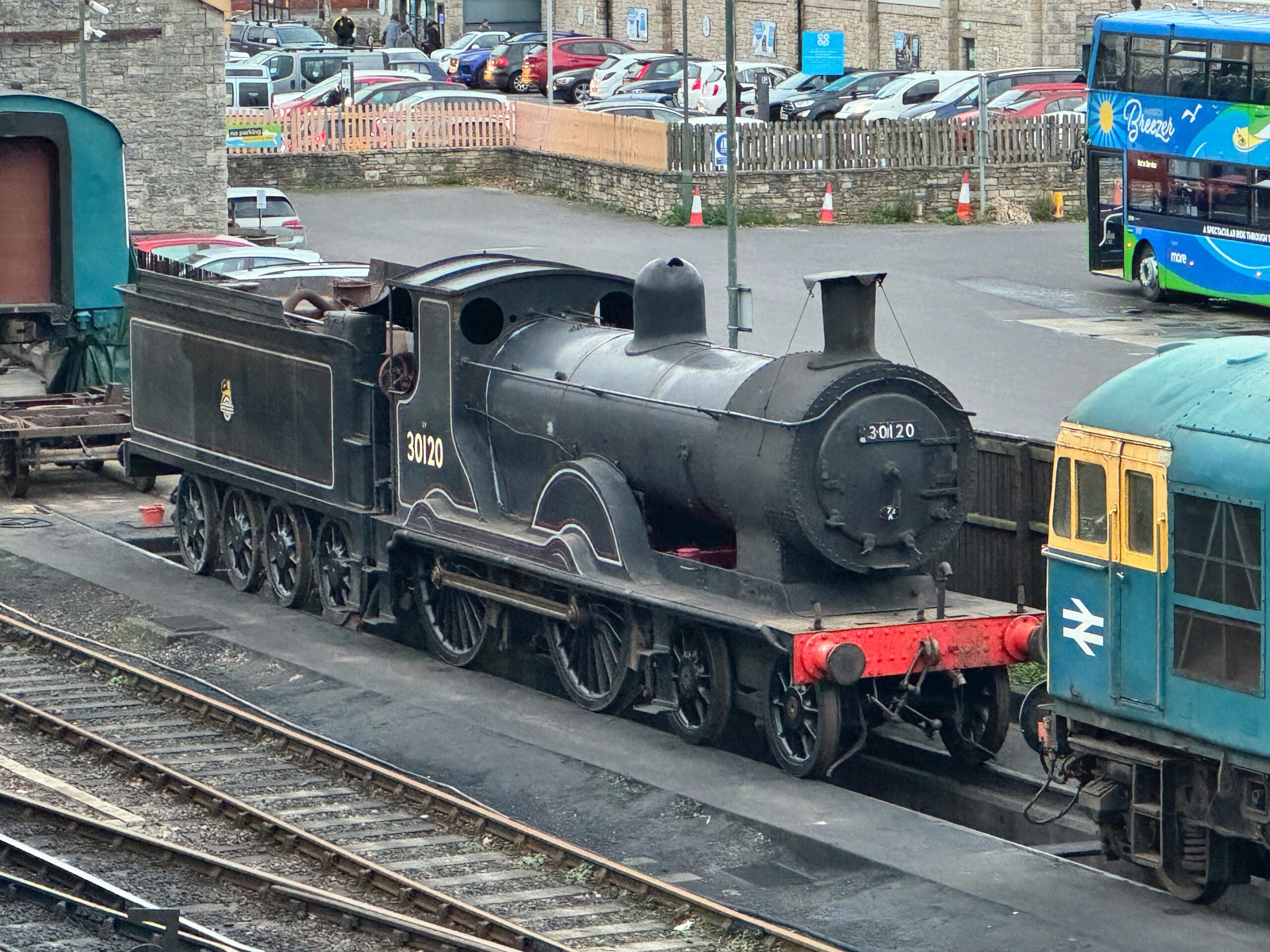
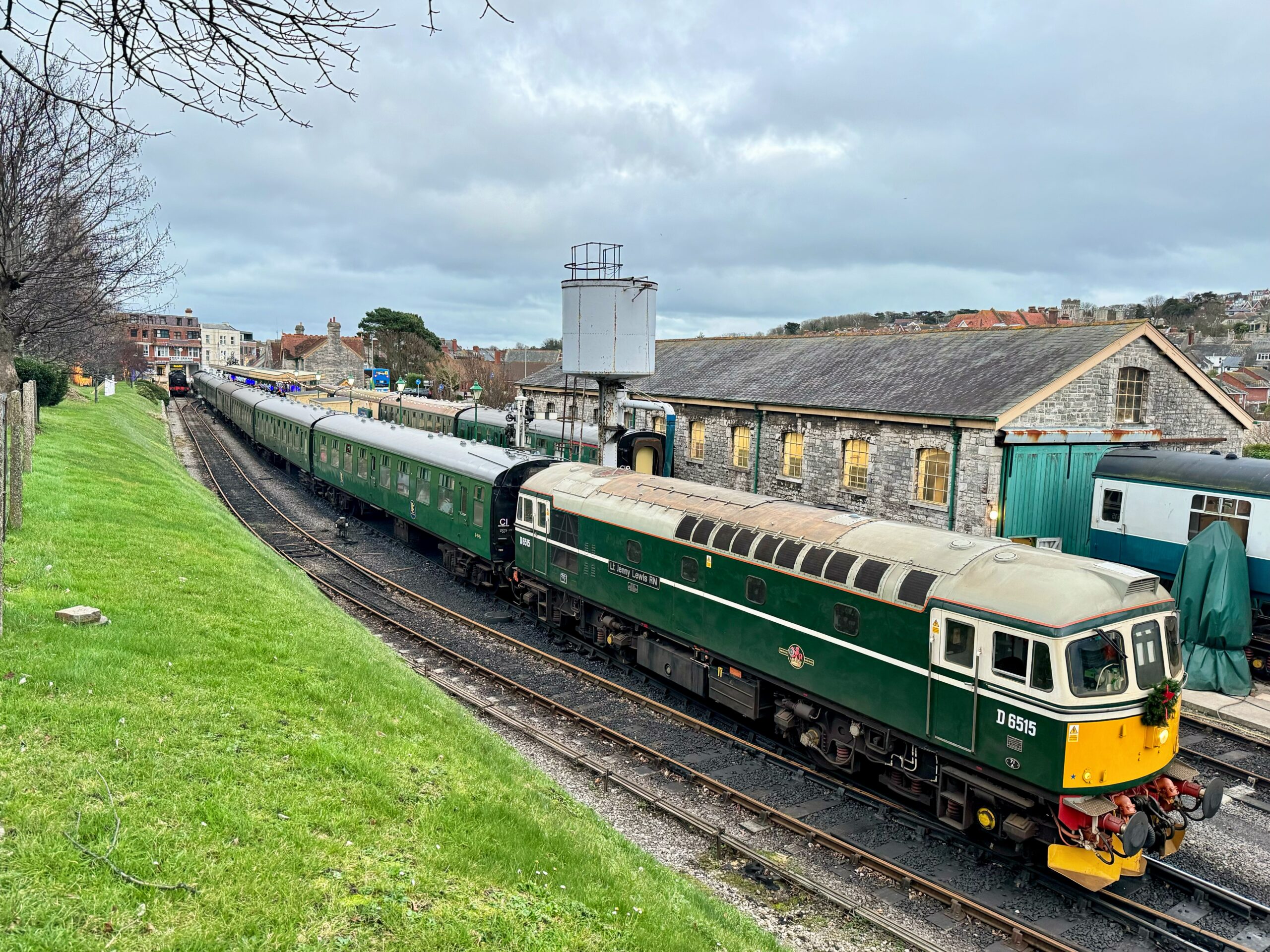
Class 33 No. 33012 (D6515) ‘Lt Jenny Lewis RN’ heads up the 1445 “Polar Express” service from Swanage – 23/12/2023SR 4-6-2 West Country Class No. 34028 ‘Eddystone’ heads towards Swanage after stopping at The North Pole (Norden) with a “Polar Express” train – 23/12/2023Class 33 No. 33111 and LSWR 4-4-0 T9 Class No. 30120 in the sidings at Swanage while Class 33 No. 33012 (D6515) ‘Lt Jenny Lewis RN’ waits with a “Polar Express” service in the station – 23/12/2023Class 33 No. 33111 at Swanage – 23/12/2023LSWR 4-4-0 T9 Class No. 30120 at Swanage – 23/12/2023Class 33 No. 33012 (D6515) ‘Lt Jenny Lewis RN’ awaits departure of the 1645 “Polar Express” service from Swanage – 23/12/2023Darkness falls on Class 33 No. 33012 (D6515) ‘Lt Jenny Lewis RN’ as she awaits departure of the 1645 “Polar Express” service from Swanage – 23/12/2023
Swanage Railway’s “Polar Express” – 23/12/2023
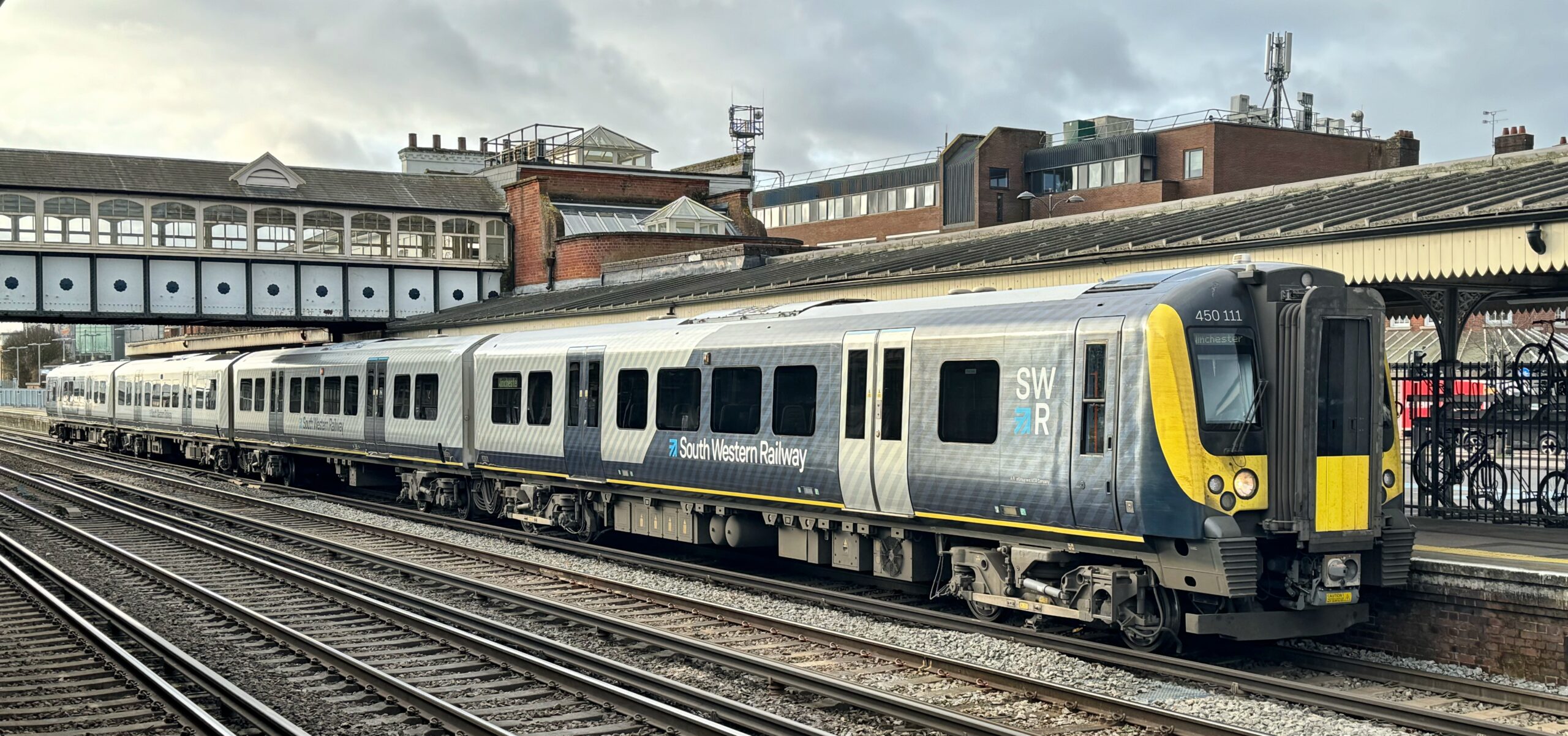
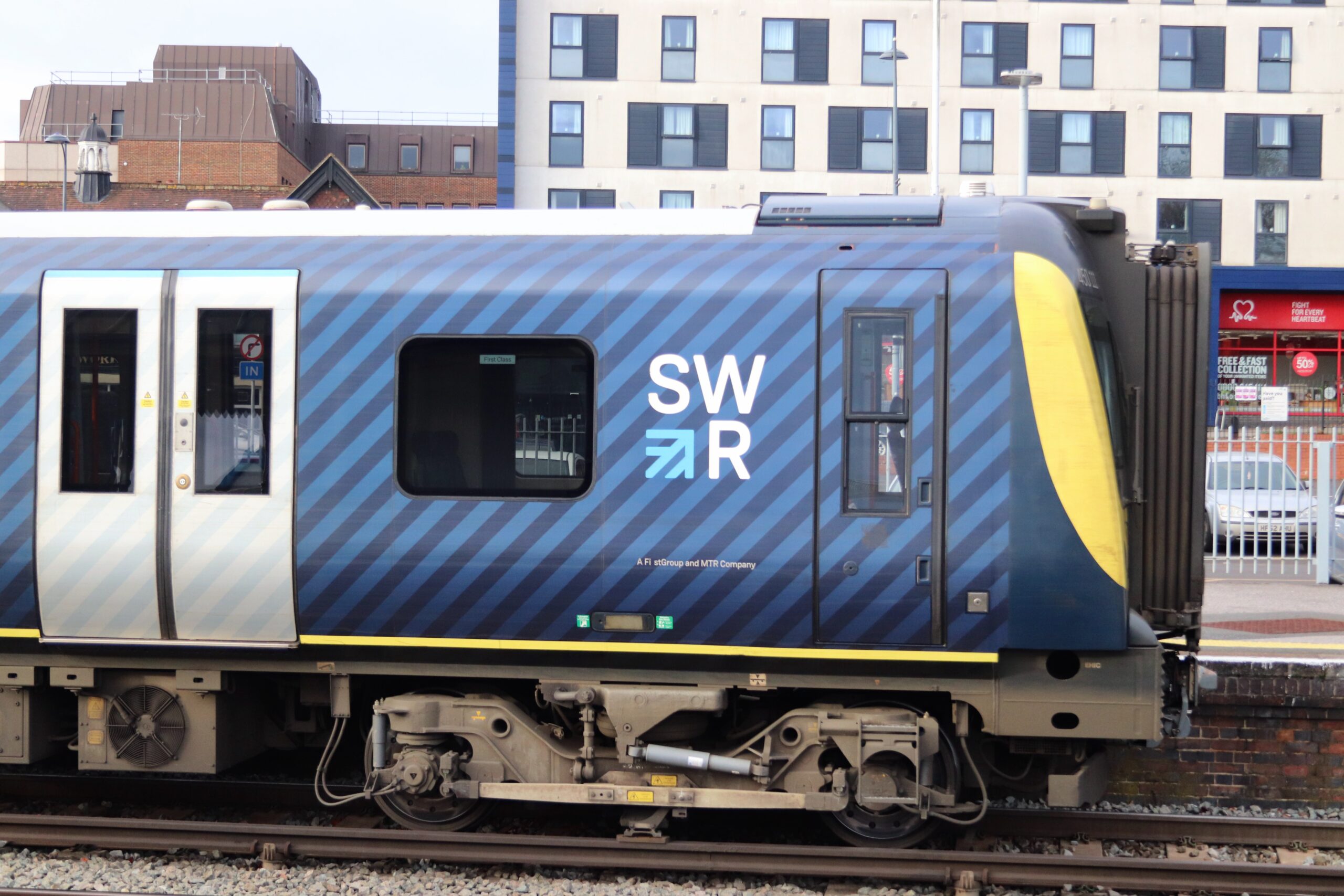
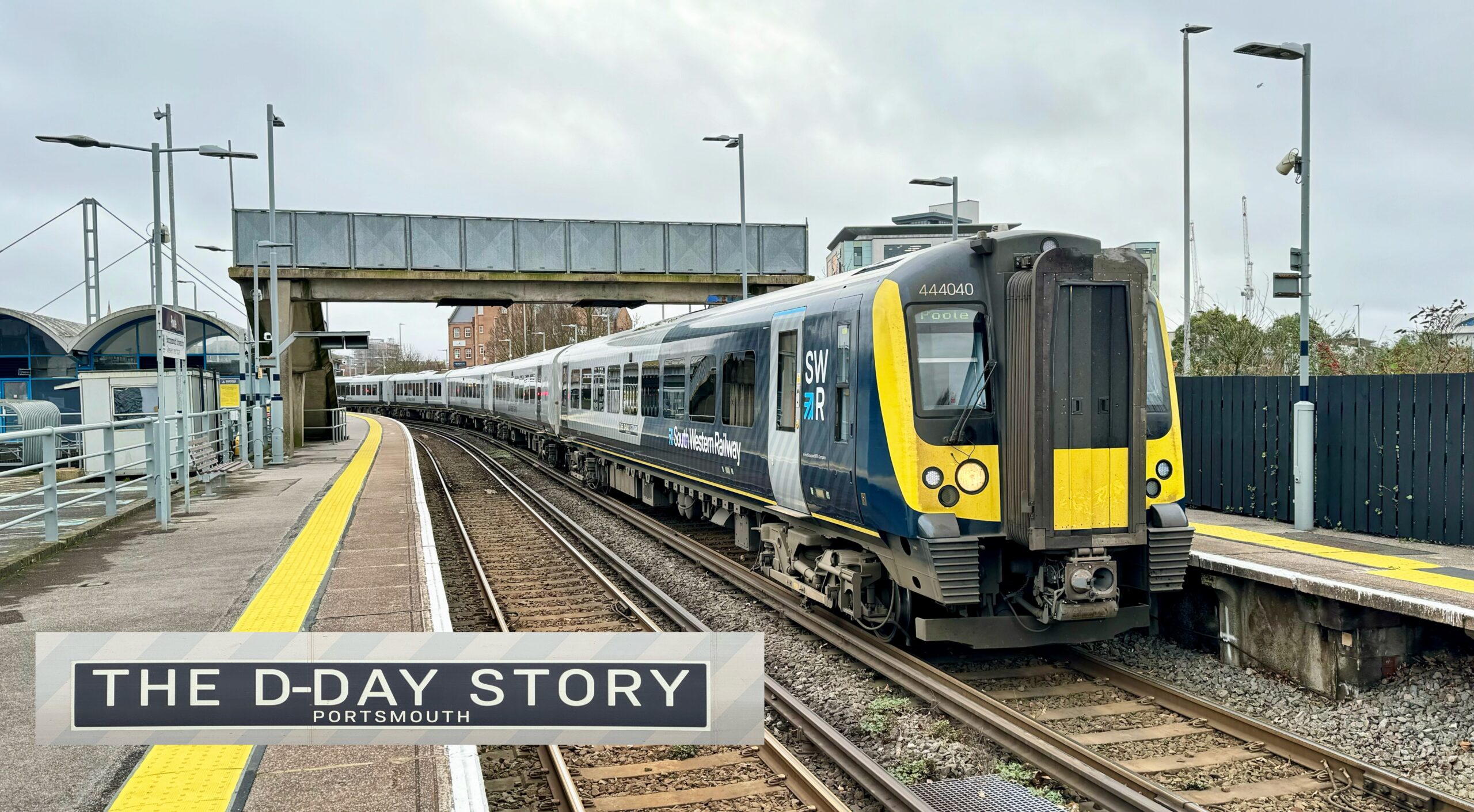
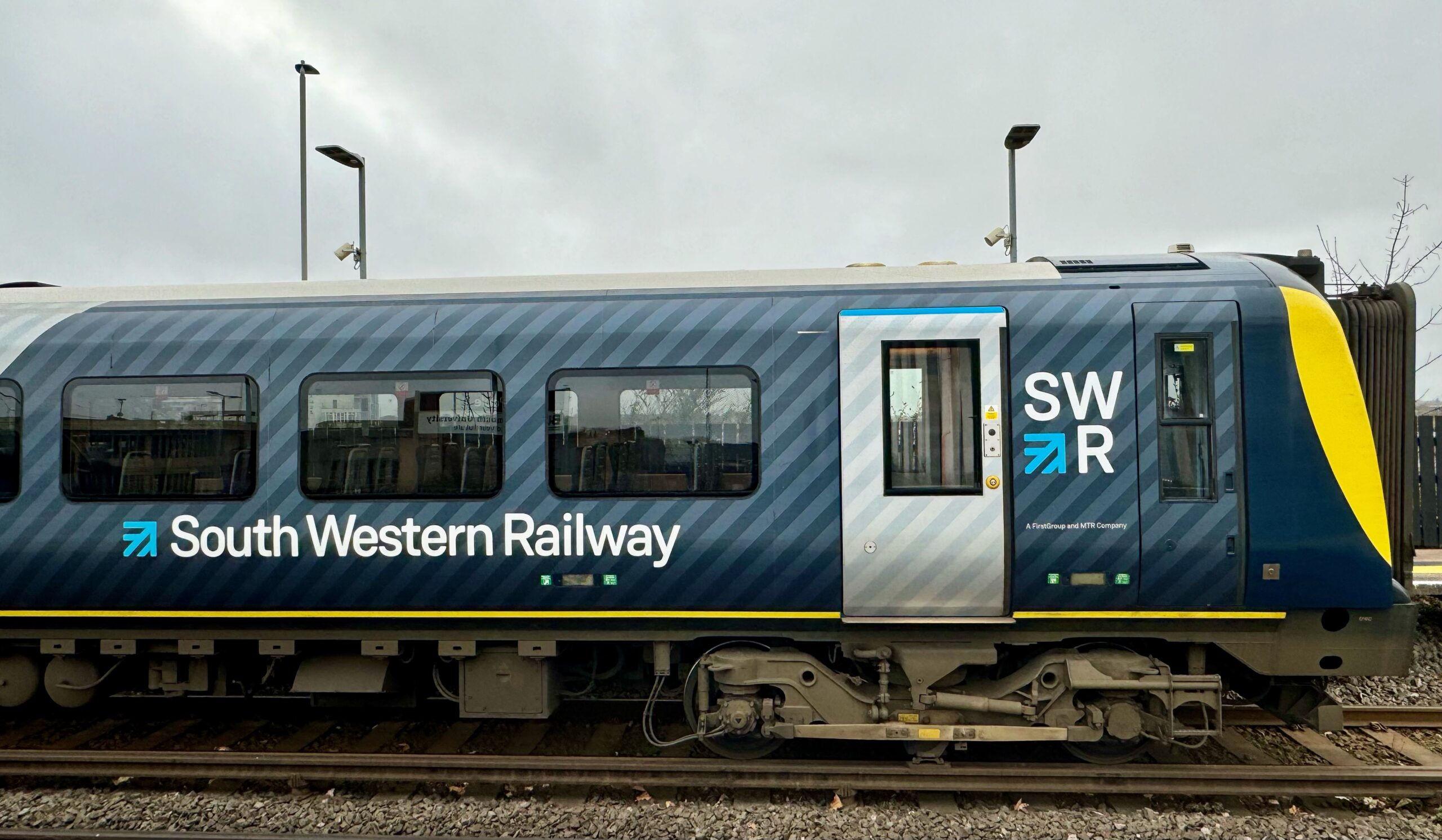
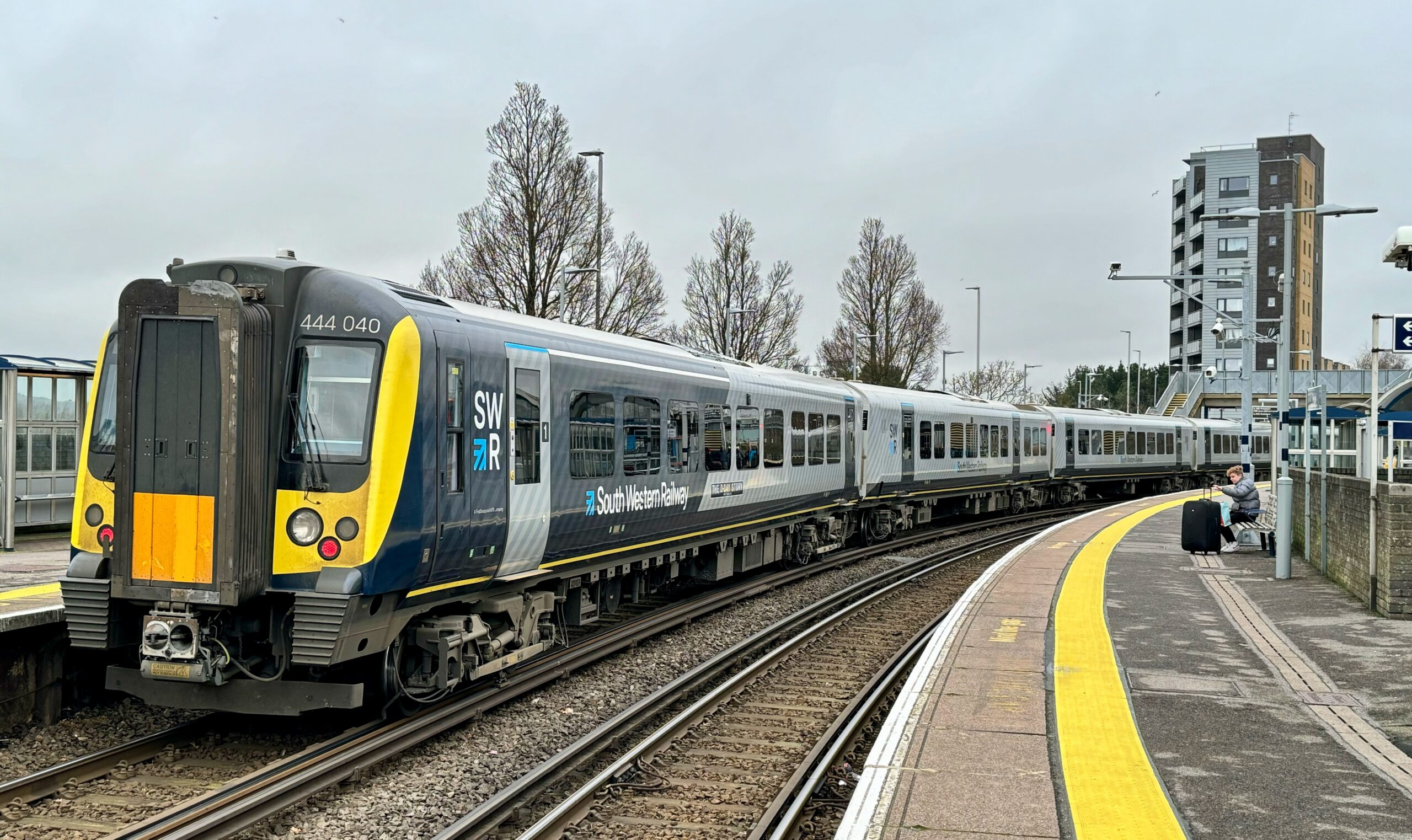
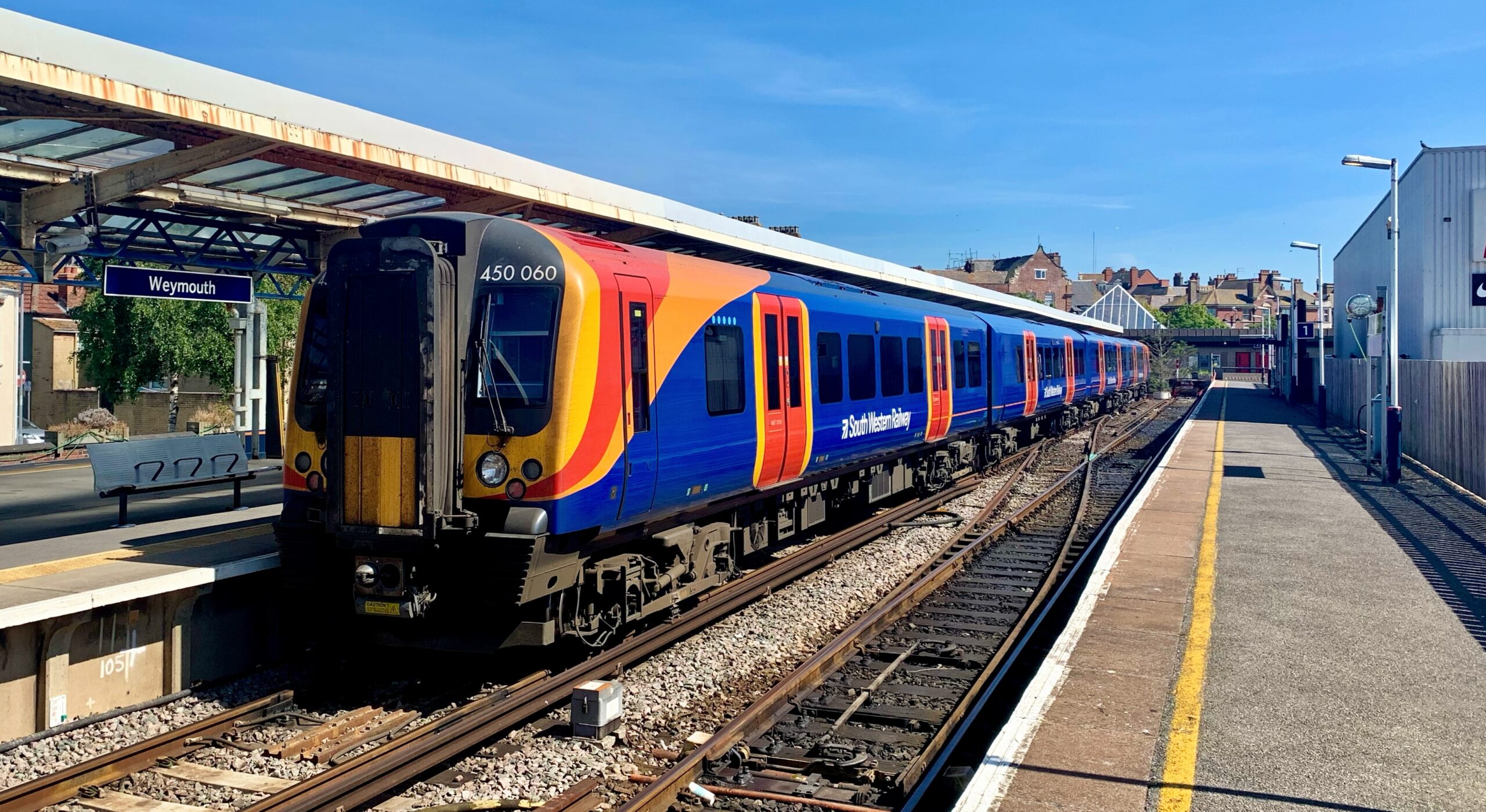
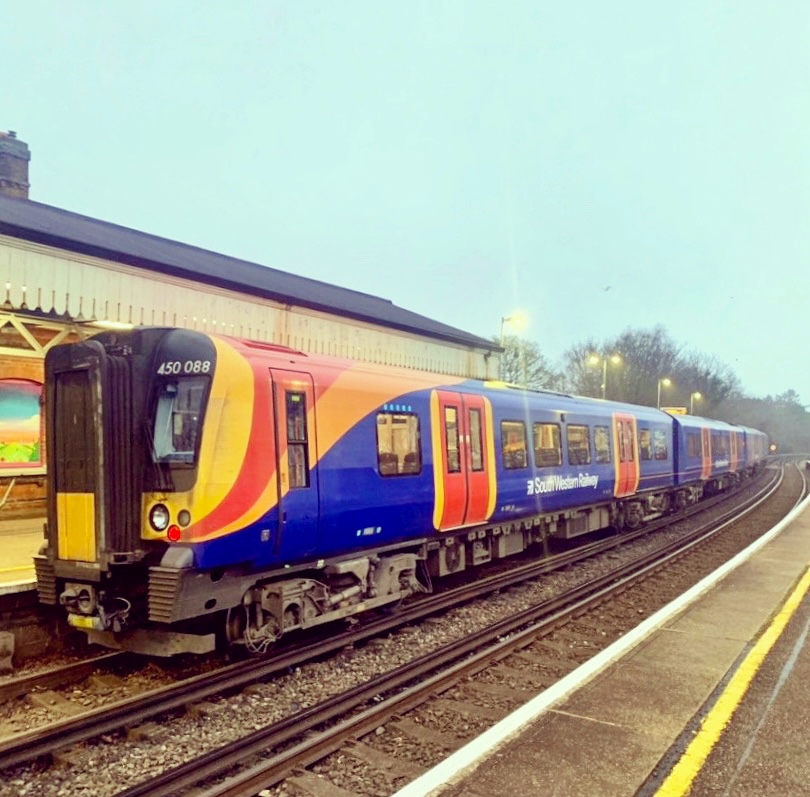
With SWR Desiro Electric Multiple Unit’s (EMU’s) remaining in the old South West Trains (SWT) livery now in single figures, it has been reported that Class 450 No. 450111 and Class 444 No. 444040 ‘The D-Day Experience Portsmouth’, both wrapped in a striped form of the South Western Railway grey livery, will be the last two units to be painted into standard SWR colours.
Class 450 No. 450111 at Eastleigh working 2B32 0902 Bournemouth to Winchester – 23/12/2023Side view showing the “stripey” South Western Railway livery carried by Class 450 No. 450111 at EastleighClass 444 No. 444040 ‘The D-Day Experience Portsmouth’ at Poole having arrived with 1B31 1357 Brockenhurst to Poole – 24/12/2023Side view of Class 444 No. 444040 ‘The D-Day Experience Portsmouth’ – 24/12/2023Bodyside detail of Class 444 No. 444040 ‘The D-Day Experience Portsmouth’ – 24/12/2023Class 444 No. 444040 ‘The D-Day Experience Portsmouth’ at Poole forming the 5B31 1437 Poole to Poole Storage Sidings ECS – 24/12/2023
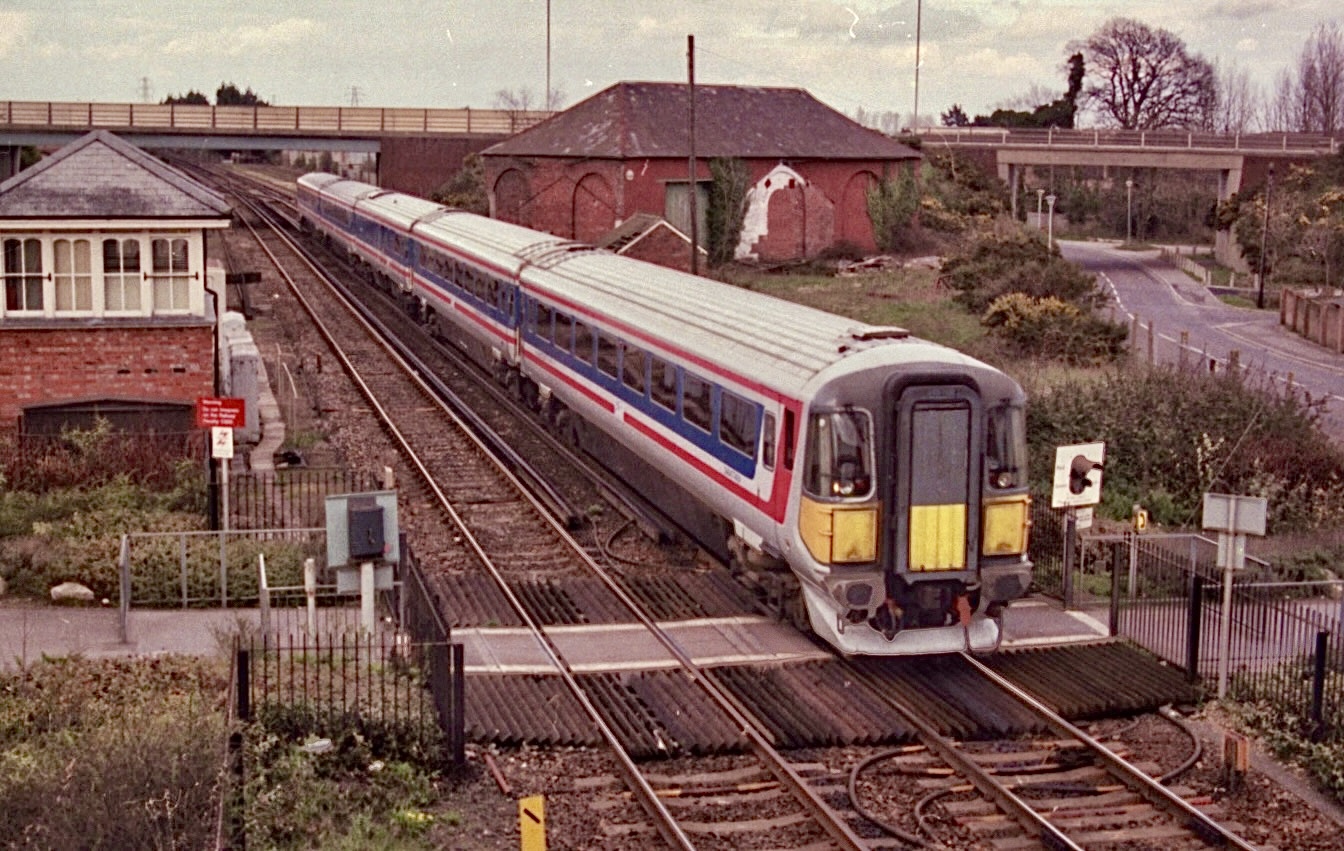
The original South West Trains train livery used the Stagecoach Group colours – red, blue and orange – in a similar style to the Network South East (NSE) livery. Some detail variations were introduced before a major updating of the group’s design identity in 2000. New logos and typefaces were developed, as well as new bus and train liveries.
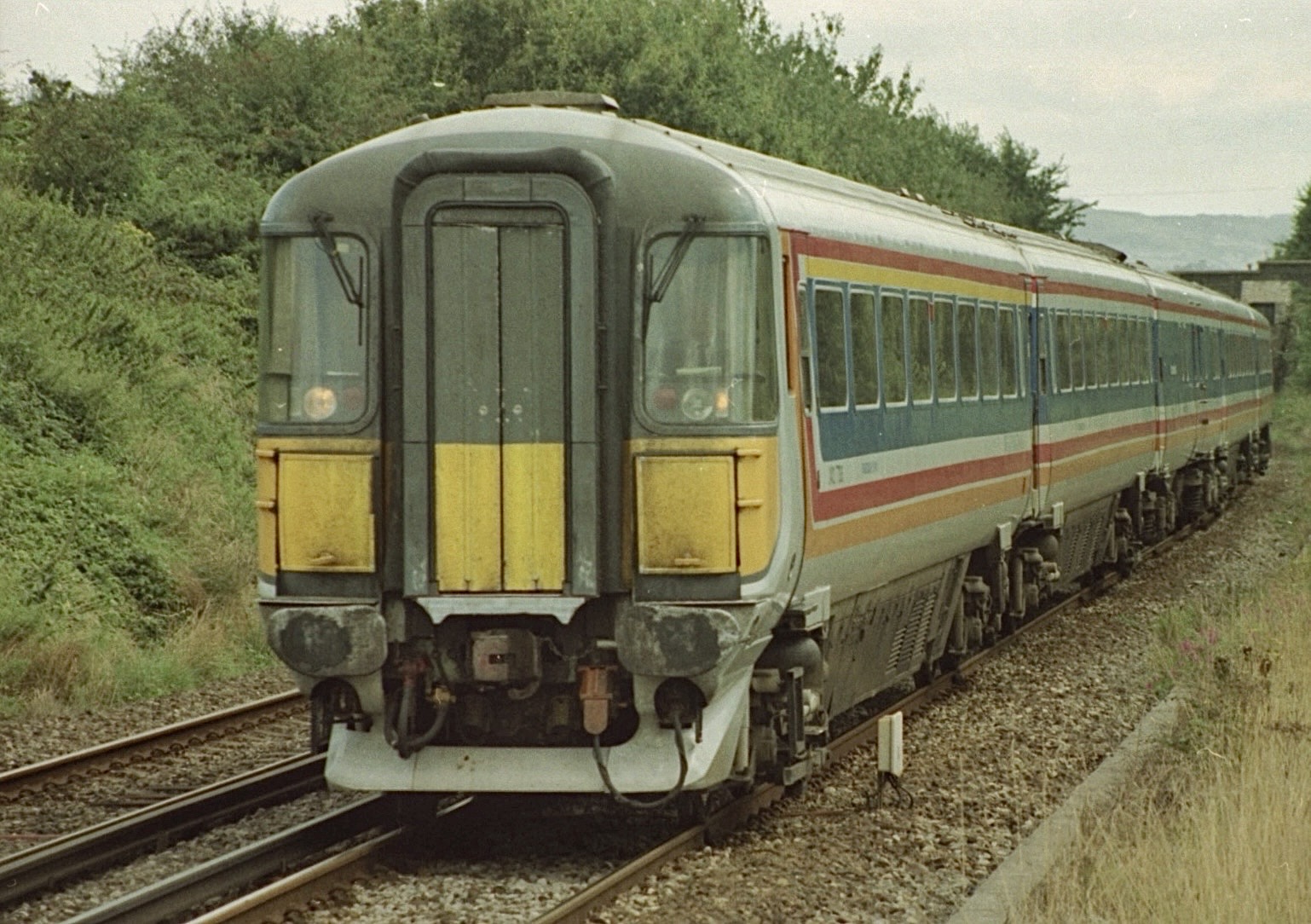
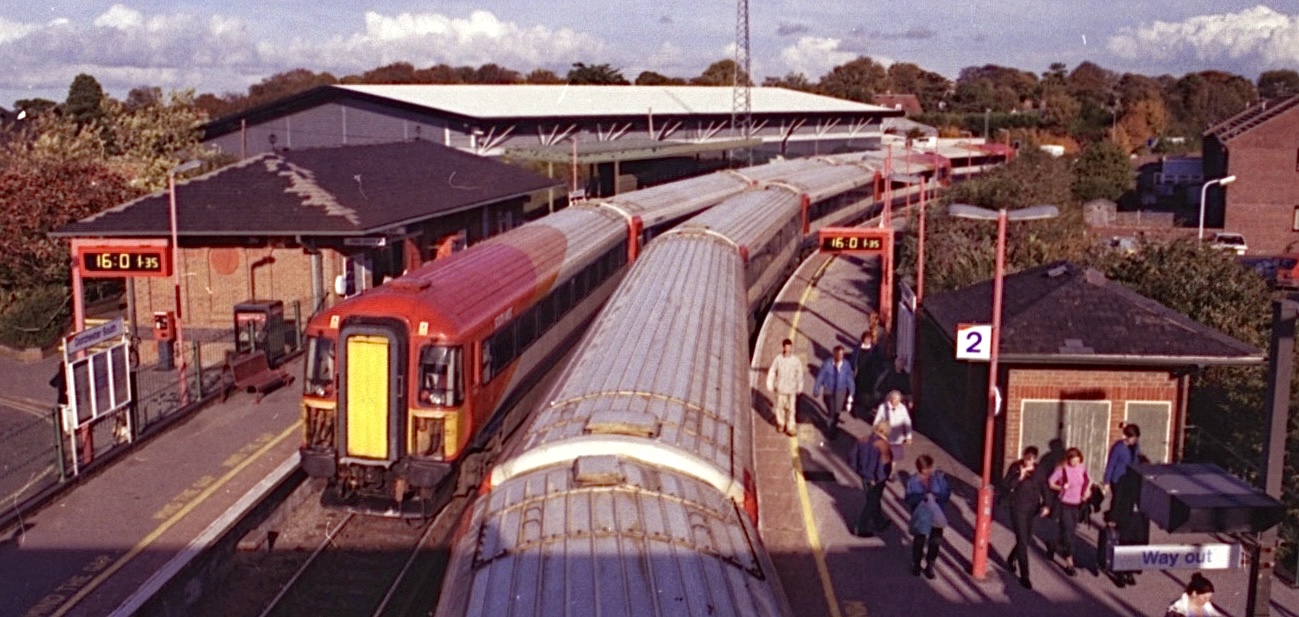
An unidentified Class 442 “Wessex Electric” EMU on the approach to Wareham in Network South East Livery at some point in the late 1990’sAnother unidentified Class 442 “Wessex Electric” EMU, carrying the original South West Trains livery based on the NSE style previously carried by the trains, nearing Upwey station – 05/09/1998Class 442’s at Dorchester South in the revised SWT livery in the early 2000’s
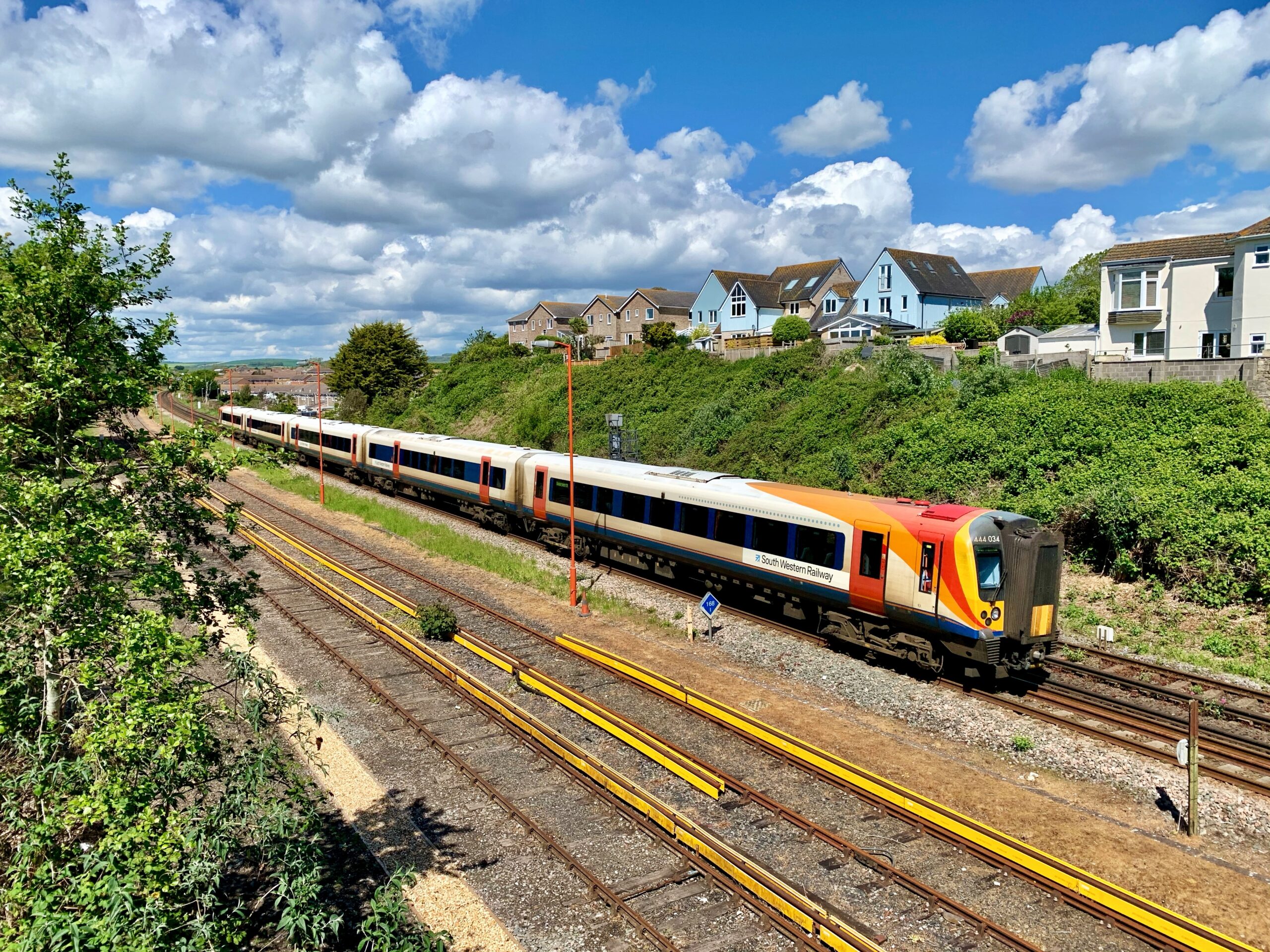
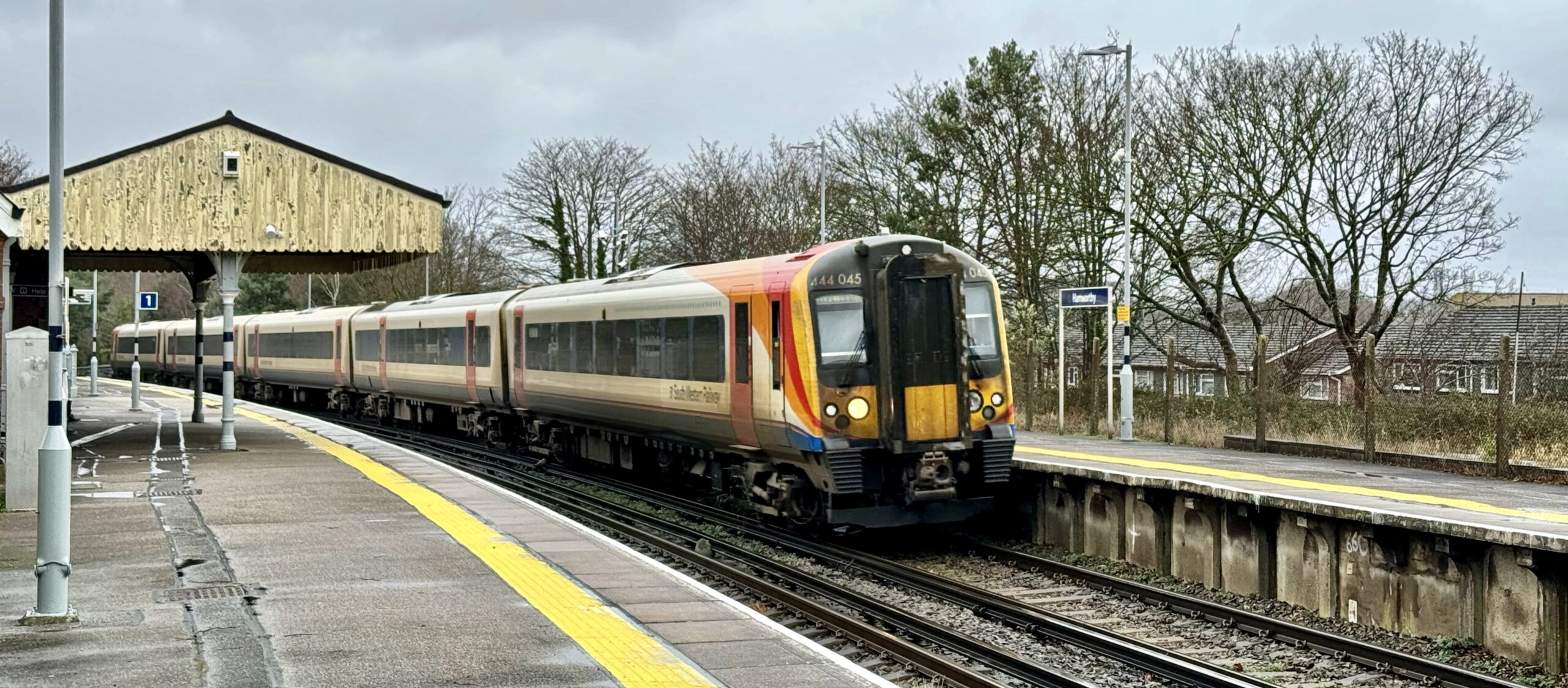
The second-generation South West Trains liveries, designed by industry specialist Best Impressions, have swooshes of the Stagecoach colours, which sweep back from the nose of the train to give an impression of movement. There were three versions of the livery employed – white on the Class 444 and 159 trains used on many longer-distance services, red on Class 455 and 456, and blue used on Class 458 and 450 trains.
SWR Class 444 No. 444034 on the approach to Weymouth showing the colours of its former operator SWT – 01/05/2020The final South Western Railway Class 444 in South Western Trains livery No. 444045 arrives at Hamworthy working 1W55 0735 London Waterloo to Weymouth – 30/12/2023SWR Class 450 No. 450060 in blue SWT colours at Weymouth – 20/05/2020Class 450 No. 450088 departing Hamworthy with an early morning Weymouth to Brockenhurst stopping service – 23/12/2021
The final Desiro’s to be re-liveried from former SWT colours into SWR grey are No.’s 450031, 450099, 450116 and 444045.
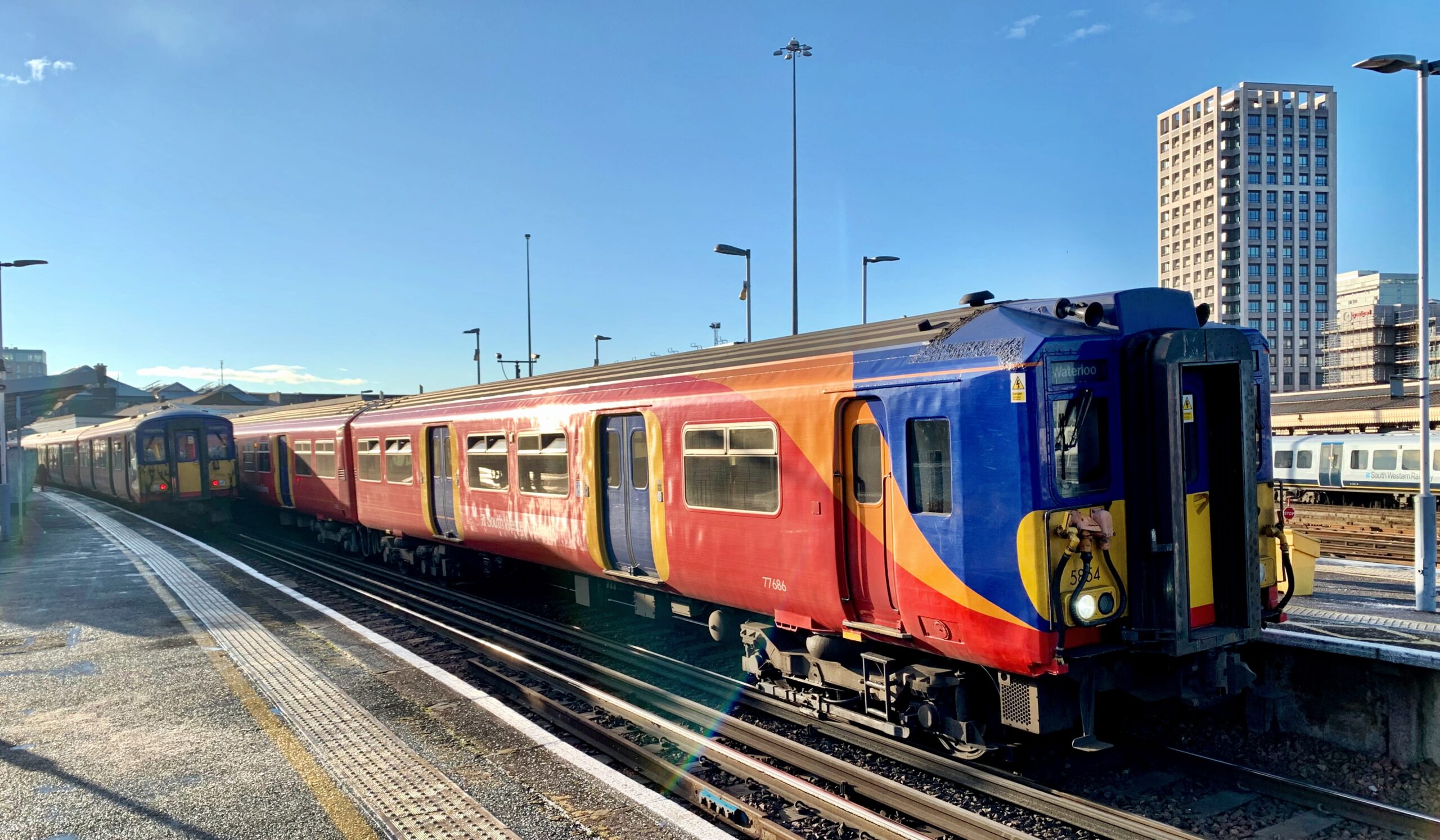
For completion: a Class 455 No. 455854 in the SWT red livery with a London Waterloo bound service at Clapham Junction – 10/12/2022
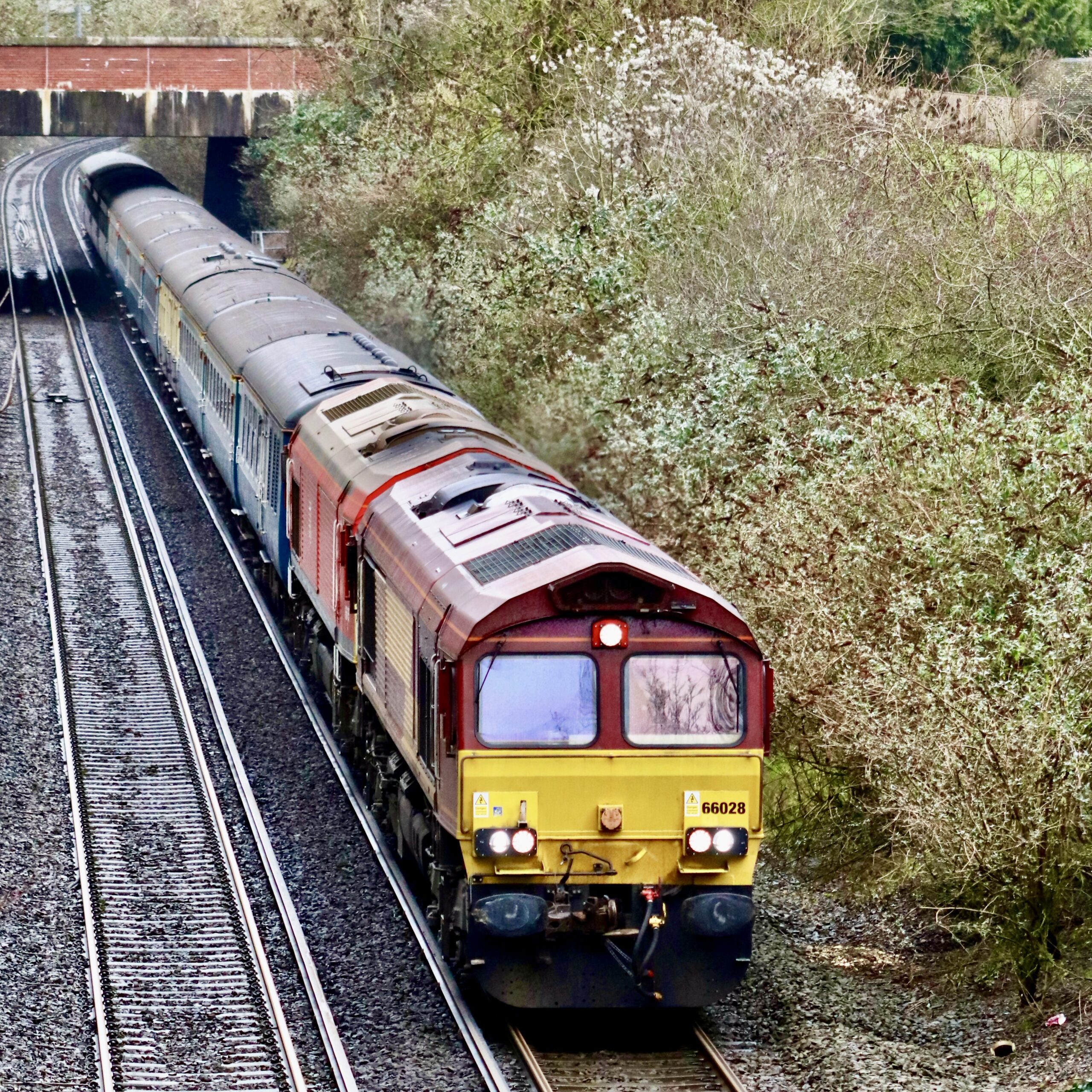
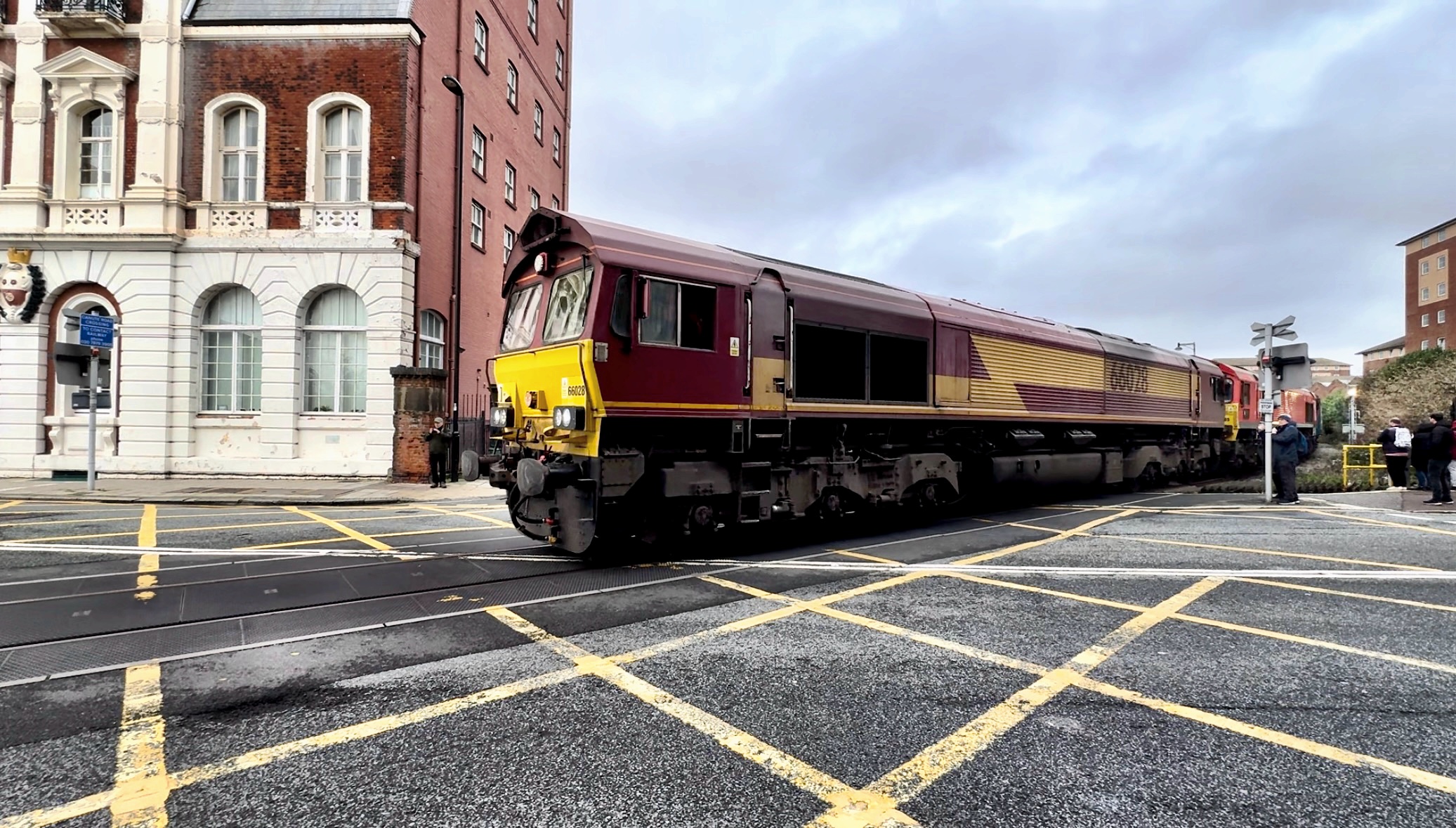
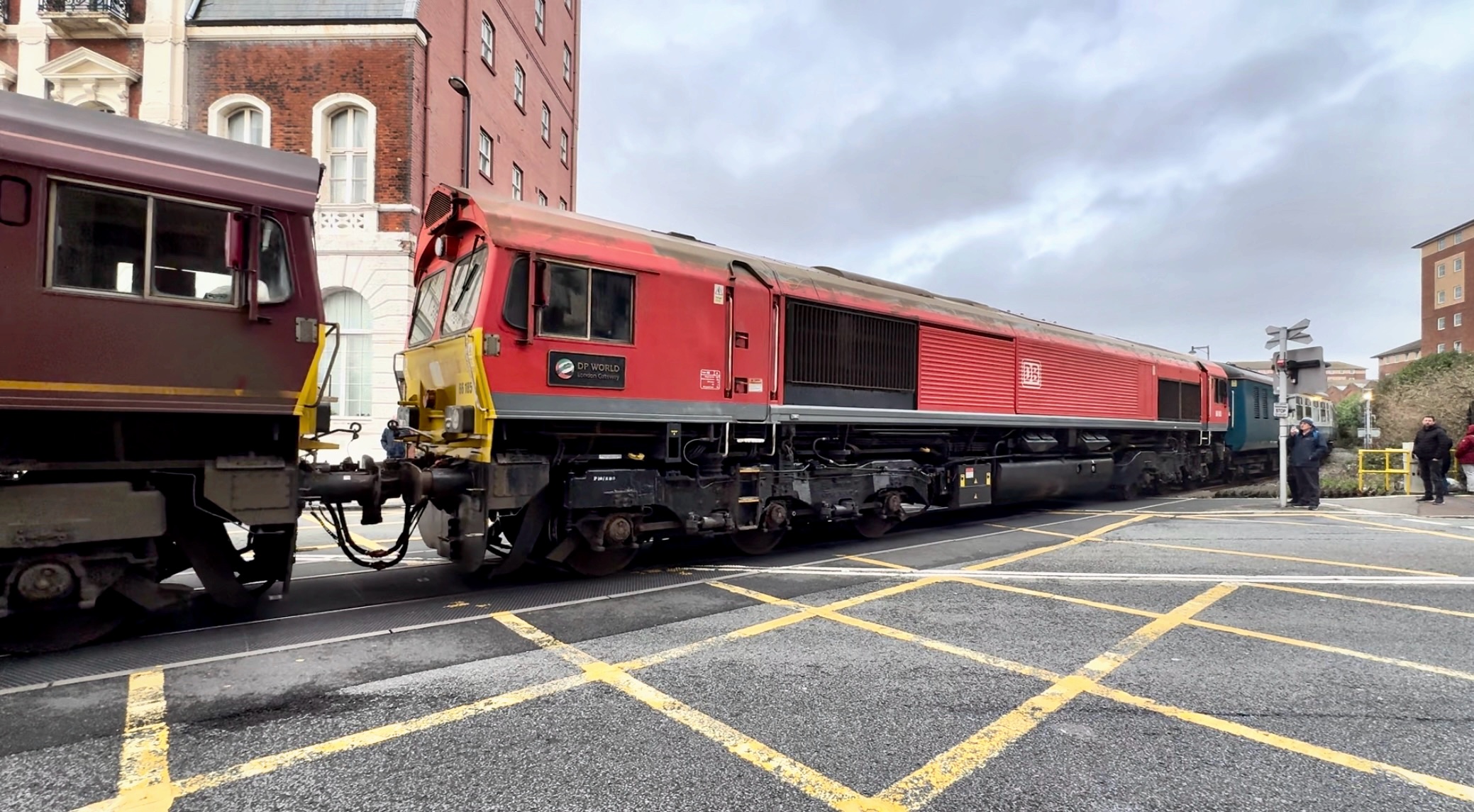
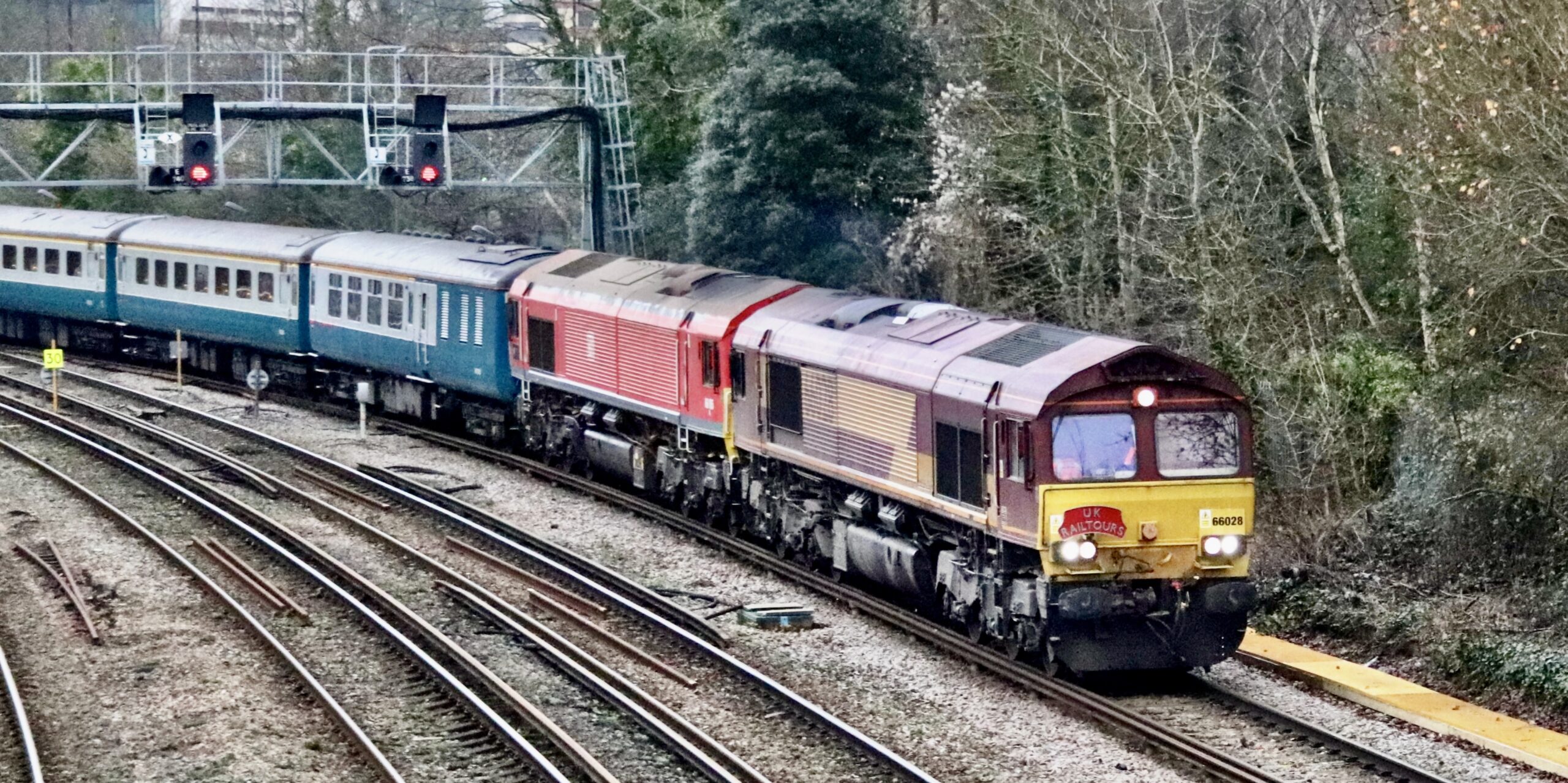
The final railtour of 2023 bordering on the Dorset area was run by UK Railtours employing DB Cargo Class 66 locomotives booked for use in a top and tail formation. “Another Awkward Week Adventure”, named because of those so called awkward days between Christmas and New Year originated in Peterborough. Problems with one of the locomotives; No. 66185 meant the railtour left 60 minutes late from its originating station after No. 66028, which had been the rear locomotive, was removed from the back of the train and re-attached to the front with No. 66185 remaining inside. This was how Yoshi and I saw the train after it had passed through Winchester on its way to Eastleigh. Here passengers had the option to detrain and take a bus to the National Motor Museum at Beaulieu or remain onboard for some rare track miles into Southampton Eastern and Western Docks.
DB Cargo Class 66 No.’s 66028 and 66185 ‘DP WORLD London Gateway’ double heading 1Z66 0730 Peterborough to Southampton Eastern Docks “Another Awkward Week Adventure” railtour west of Winchester – 30/12/2023
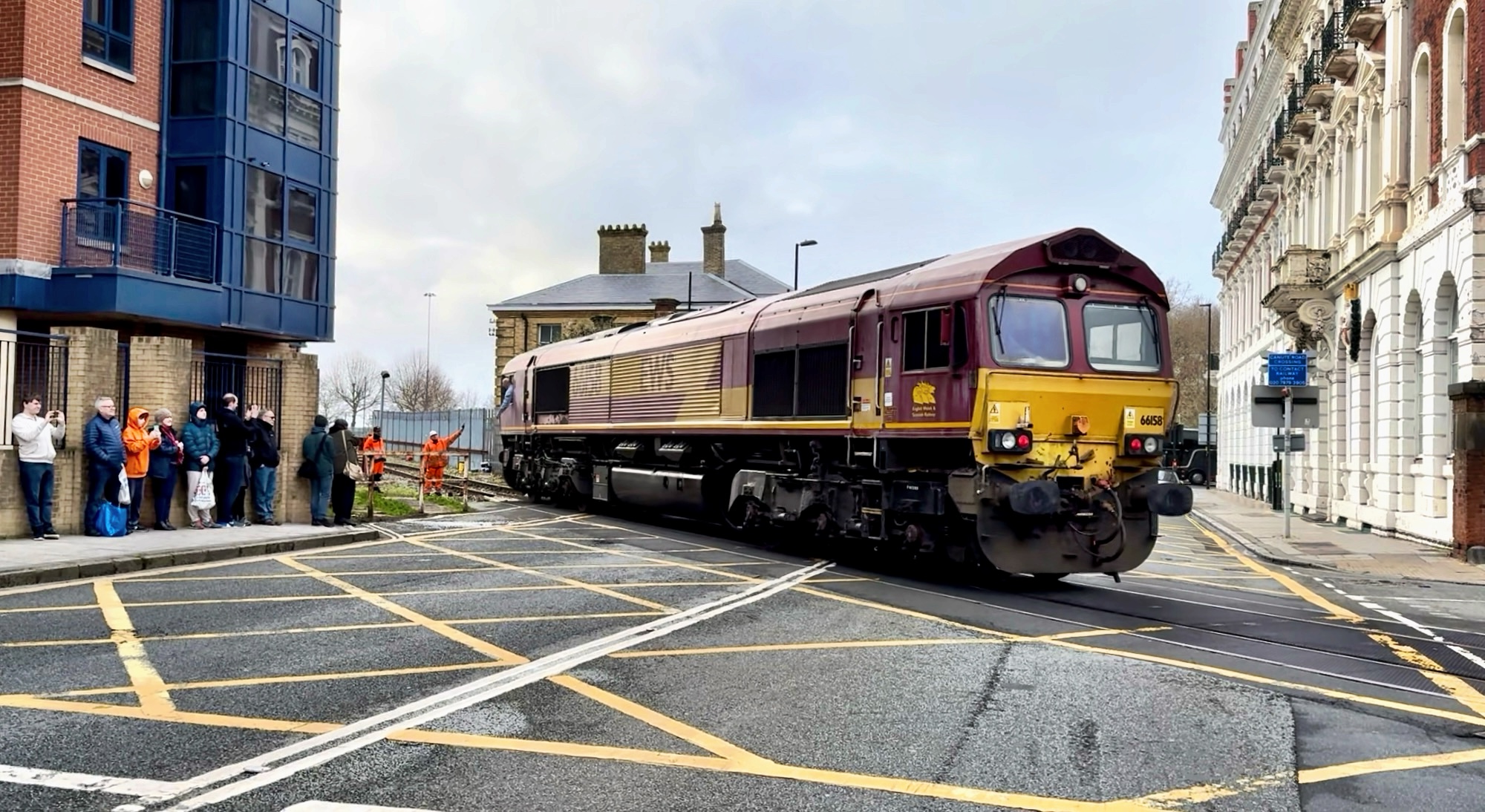
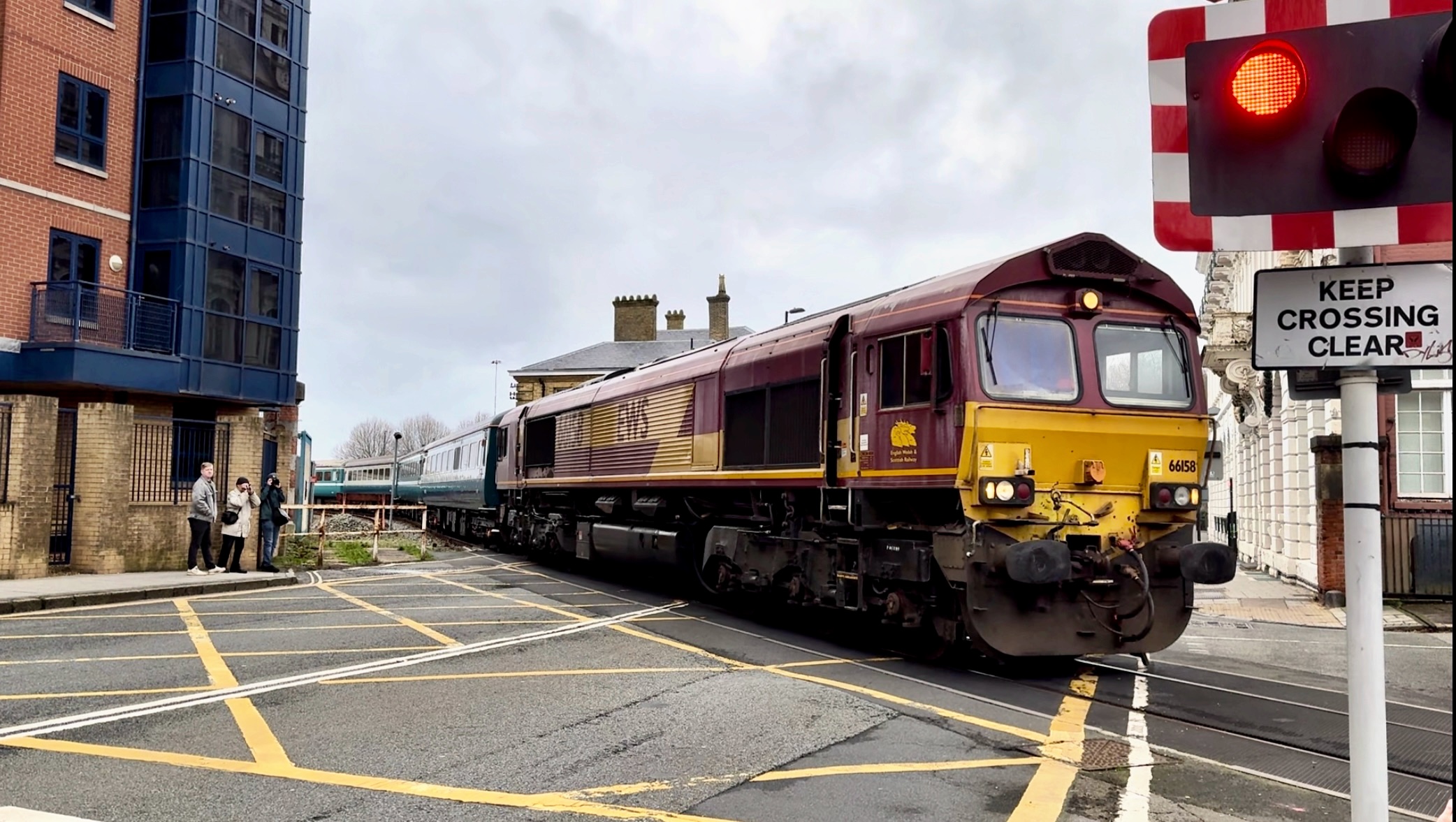
I next moved onto Southampton where I fancied filming the excursion crossing Canute Road which is adjacent to the former Southampton Terminus railway station which served the Port of Southampton and Southampton City Centre from 1839 until 1966. The former Terminus station building is now a casino and The South Western Hotel opened by the LSWR in 1872 has been converted into private apartments. Of the station platforms, all that remains is the glass canopy and a single line that runs from Northam junction to the Queen Elizabeth II Cruise Terminal. The private road into where the platforms once stood is now a car park.
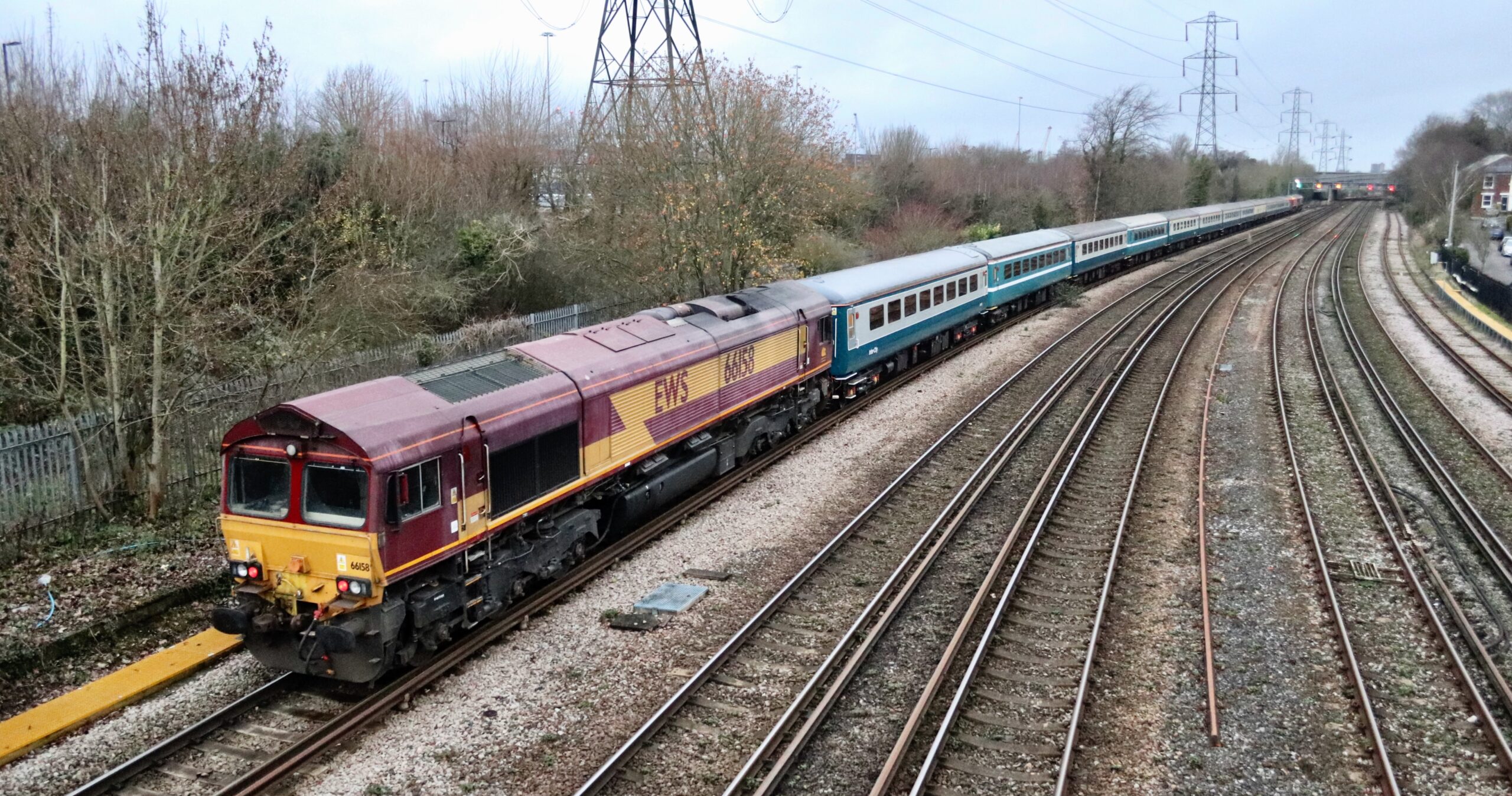
DB Cargo Class 66 No. 66028 crossing Canute Road, Southampton with 1Z66 0730 Peterborough to Southampton Eastern Docks – 30/12/2023Disgraced DB Cargo Class 66 No. 66185 ‘DP WORLD London Gateway’ dead in the consist of 1Z66 0730 Peterborough to Southampton Eastern Docks – 30/12/2023DB Cargo Class 66 No. 66158 runs light engine across Canute Road, Southampton as 0Z66 1340 Eastleigh Down Carriage Shed to Southampton Eastern Docks – 30/12/2023After running light into the docks, DB Cargo Class 66 No. 66158 leads out working 1Z67 1402 Southampton Eastern Docks to Southampton Western Docks – 30/12/2023
Our final location was the footbridge over the railway line between Southampton Central and Millbrook ready to catch the train head towards Western Docks and out again Yoshi waited in the car as the weather, already very windy, turned increasingly wet! I photographed the railtour on its outward leg into Western Docks, but by the time it returned (running late) the light had gone and I didn’t want another DSLR to fall foul of water damage in 2023! Instead I managed some dodgy video which can be seen lower down the page.
Back leading the tour again; DB Cargo Class 66 No.’s 66028 and 66185 ‘DP WORLD London Gateway’ on the approach to Millbrook heading up 1Z67 1402 Southampton Eastern Docks to Southampton Western Docks – 30/12/2023DB Cargo Class 66 No. 66158 at the rear of 1Z67 1402 Southampton Eastern Docks to Southampton Western Docks on the approach to Millbrook – 30/12/2023
“Another Awkward Week Adventure” DB Cargo Class 66 No.’s 66028 and 66185 ‘DP WORLD London Gateway’ and 66158: 1Z66 0730 Peterborough to Southampton Eastern Docks / 0Z66 1340 Eastleigh Down Carriage Shed to Southampton Eastern Docks / 1Z67 1402 Southampton Eastern Docks to Southampton Western Docks / 1Z68 1531 Southampton Western Docks to Eastleigh – 30/12/2023
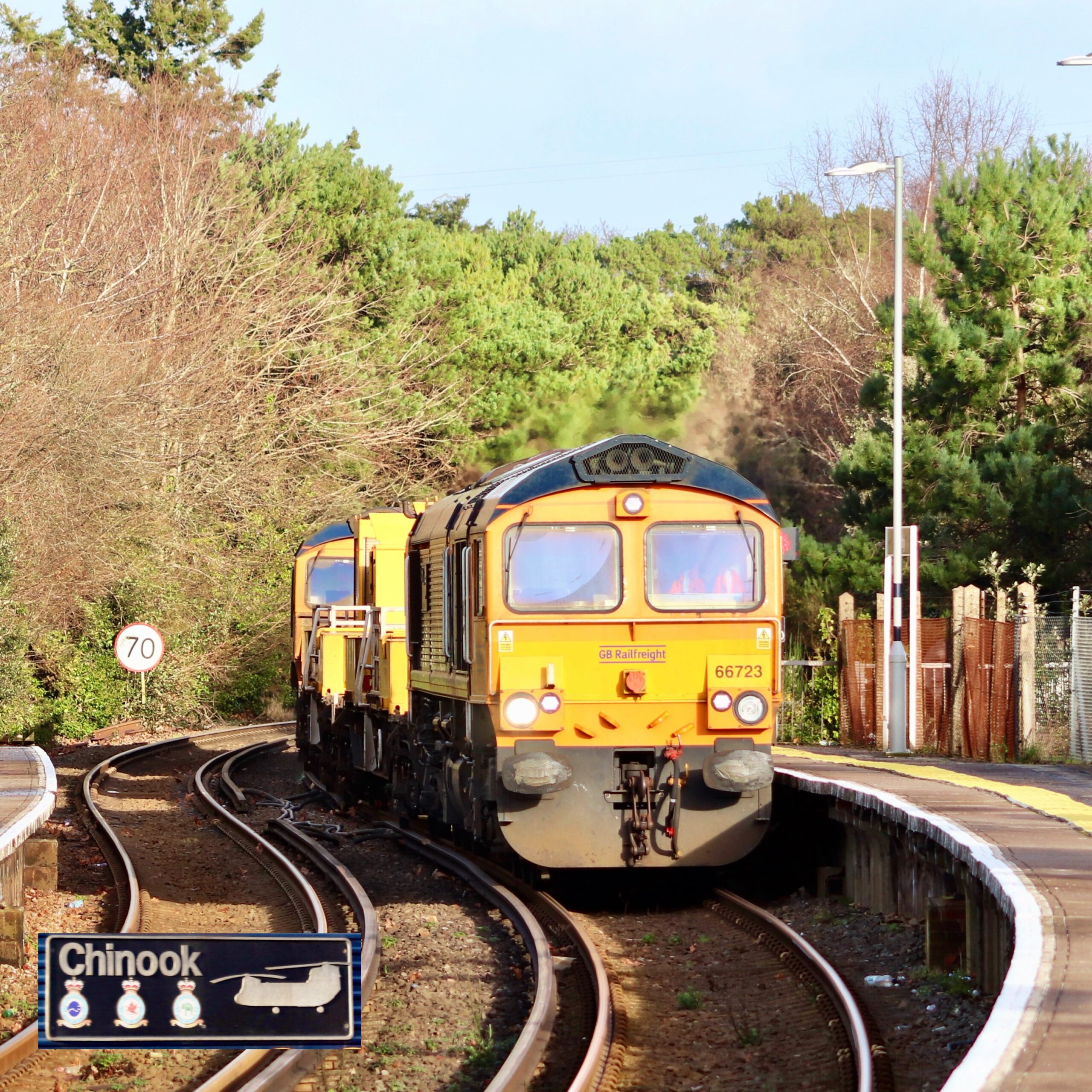
One final festive gift courtesy of GB Railfreight saw the SITT run to Weymouth on New Years Eve as 3Y88 1200 Totton Yard to Totton Yard, top and tailed by Class 66 locomotives No.’s 66723 ‘Chinook’ and 66772 ‘Maria’. The SITT with the same two Class 66’s in charge was also the first locomotive hauled train into Dorset early on New Years Day 2024 when it returned as far as Bournemouth in the early hours working as 3Y89 0100 Totton Yard to Totton Yard.
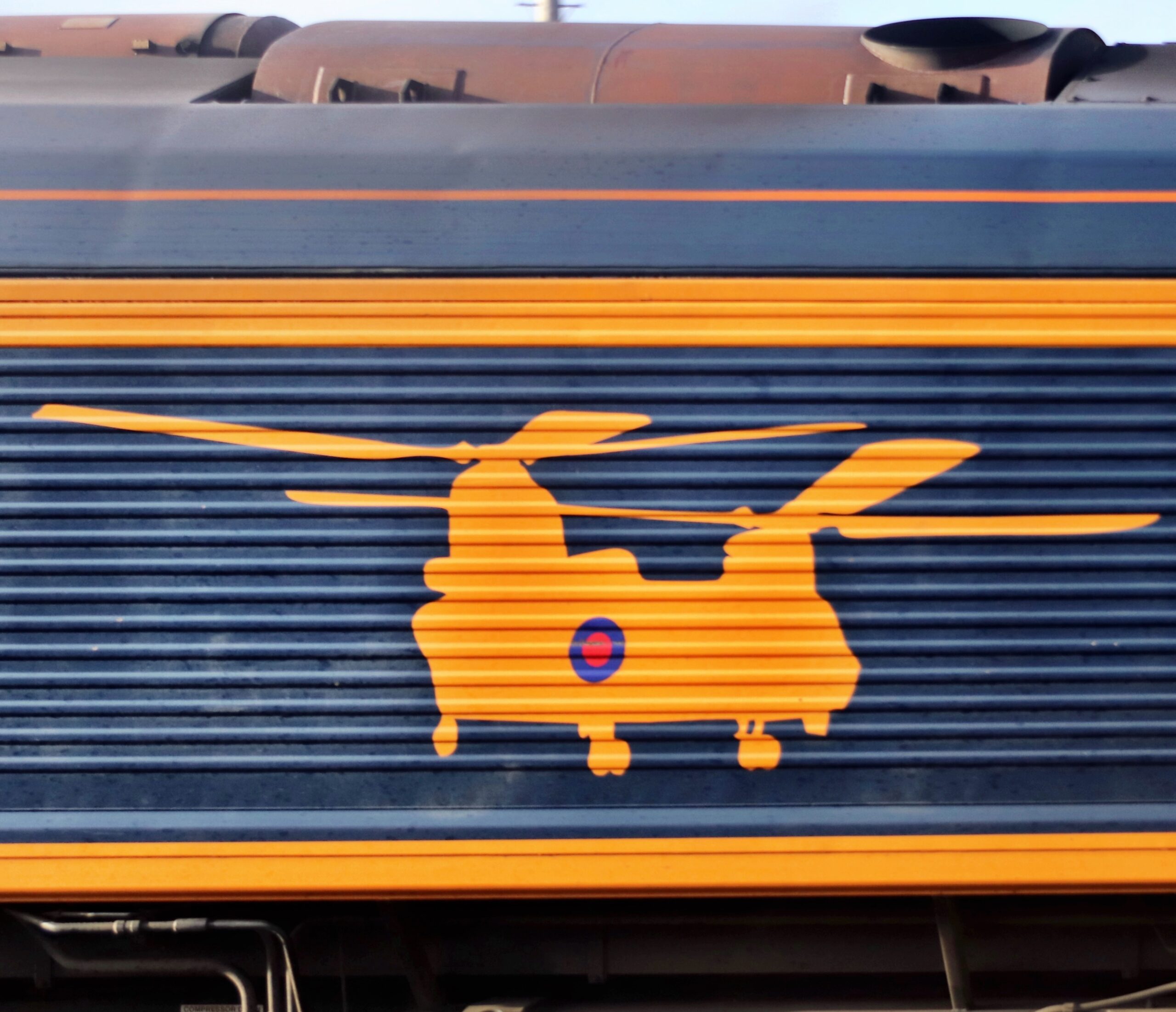
GBRf Class 66 No.’s 66723 ‘Chinook’ and 66772 ‘Maria’ at Hamworthy on SITT 3Y88 1200 Totton Yard to Totton Yard – 31/12/2023Close up of the helicopter decal on the side of GBRf Class 66 No. 66723 ‘Chinook’ – 31/12/2023GBRf Class 66 No. 66772 ‘Maria’ at the rear of the SITT 3Y88 1200 Totton Yard to Totton Yard. Classmate No. 66723 ‘Chinook’ leads – 31/12/2023GBRf Class 66 No.’s 66772 ‘Maria’ 66723 ‘Chinook’ passing Hamworthy working the return SITT 3Y88 1200 Totton Yard to Totton Yard – 31/12/2023
GBRf Class 66 No.’s 66772 ‘Maria’ 66723 ‘Chinook’ working the return SITT 3Y88 1200 Totton Yard to Totton Yard (Dorchester South video courtesy of G E Barrett) – 31/12/2023
For The Record
Following 16 days closure for engineering work on the West of England Line, the line between Salisbury and Yeovil Junction re-opened on Monday 11th December while landslip repairs were affected by flooding at Crewkerne tunnel which extended the duration required for work to be completed with SWR advising customers not to attempt to travel between Yeovil Junction and Exeter St David’s until Wednesday 13th December.
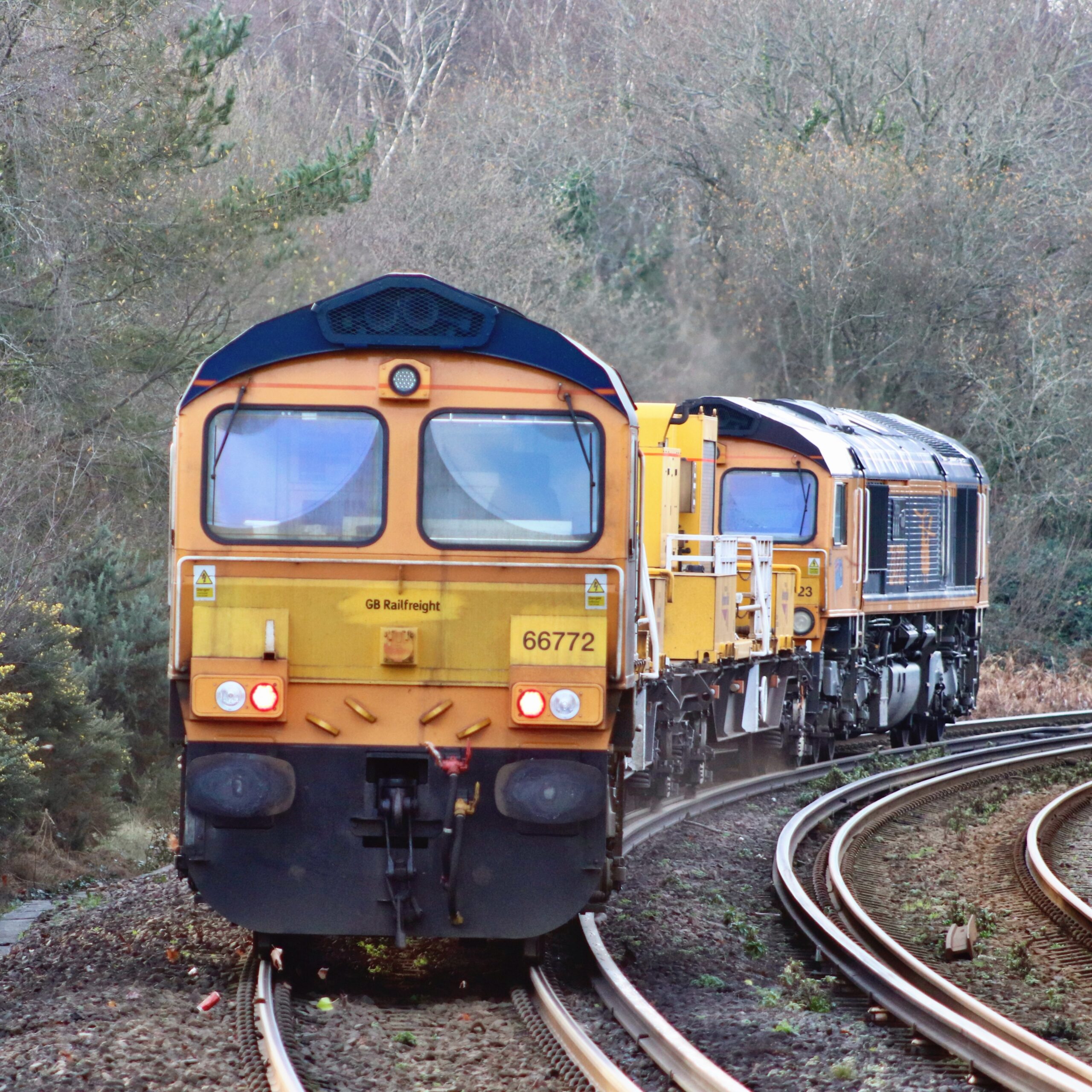
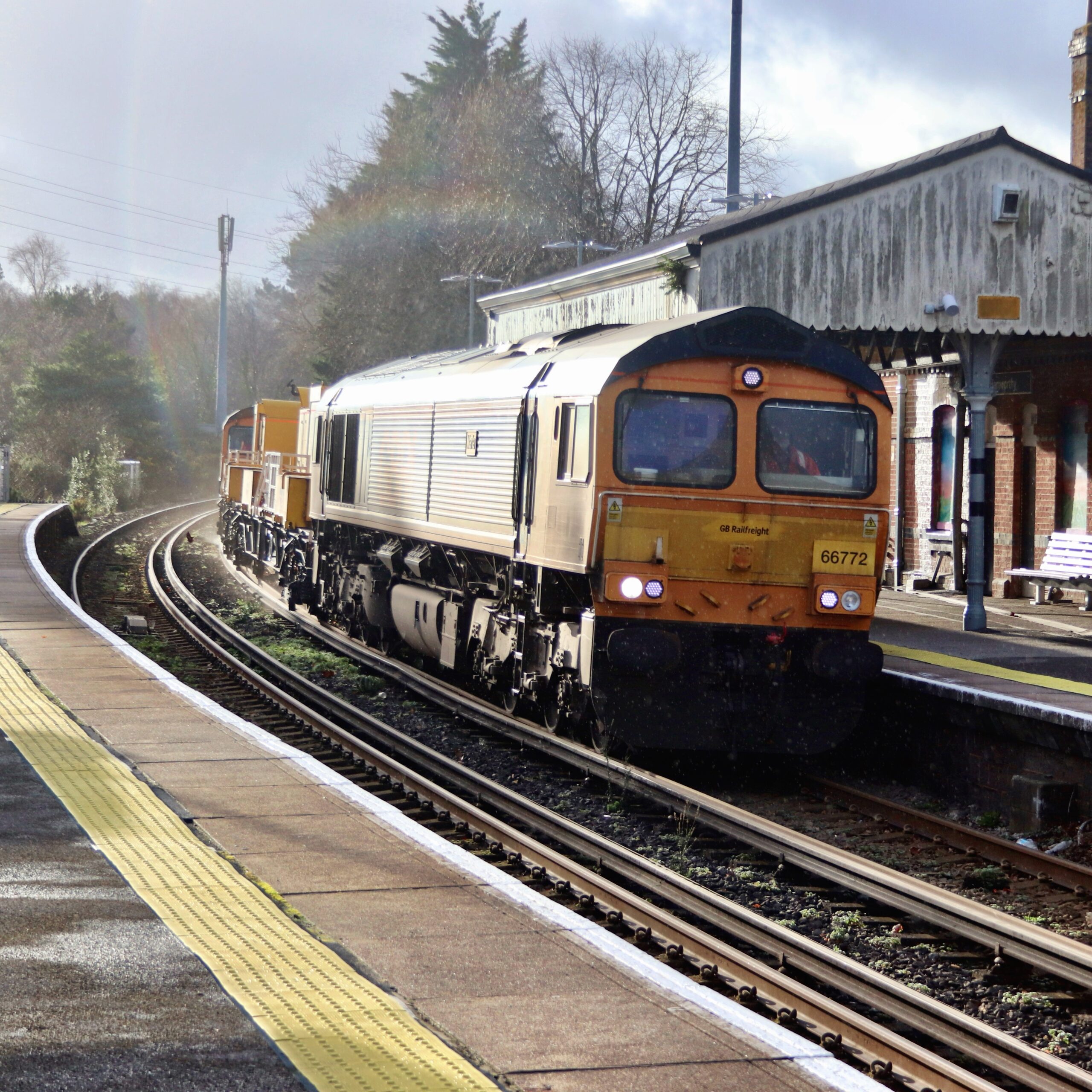
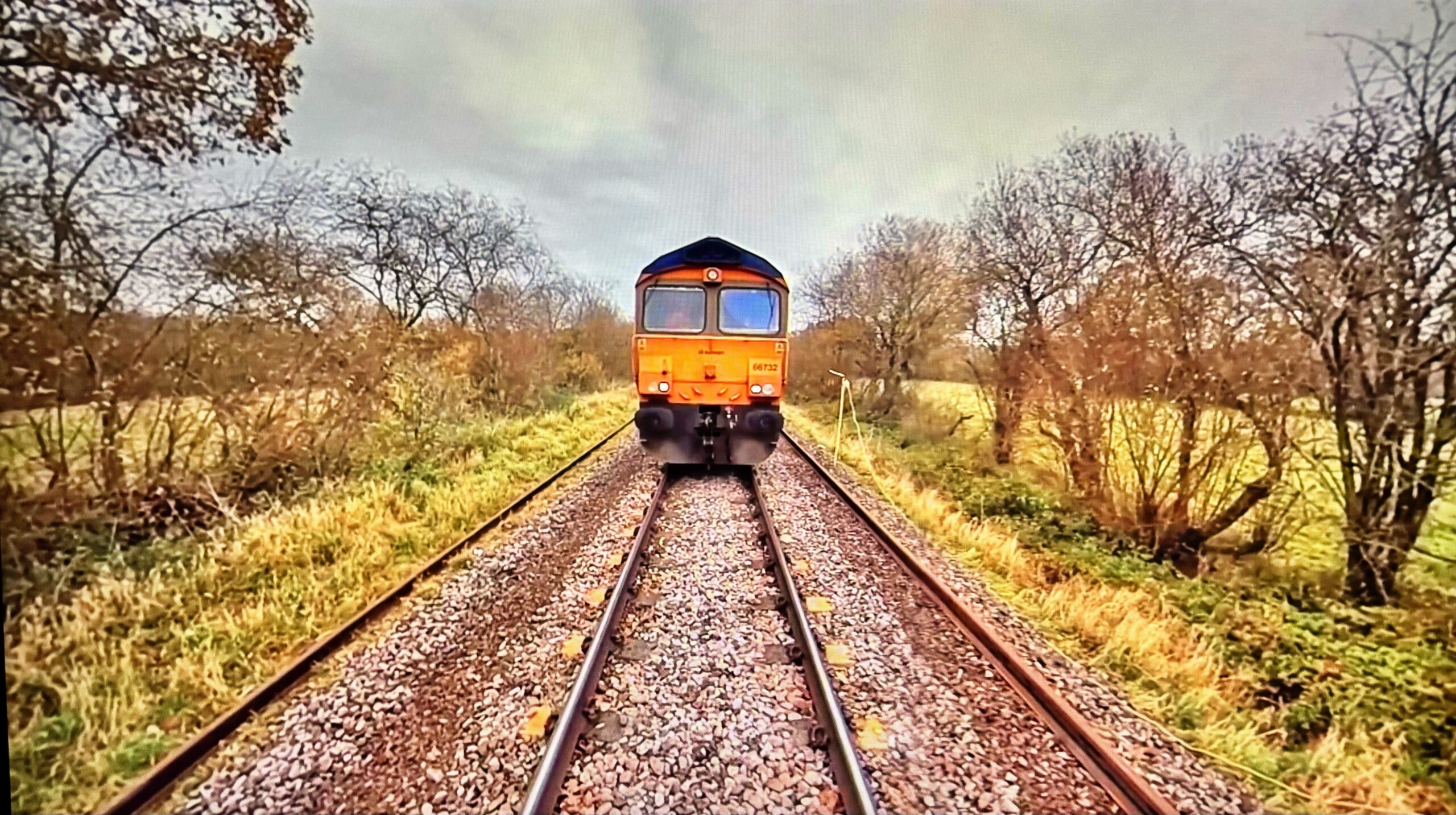
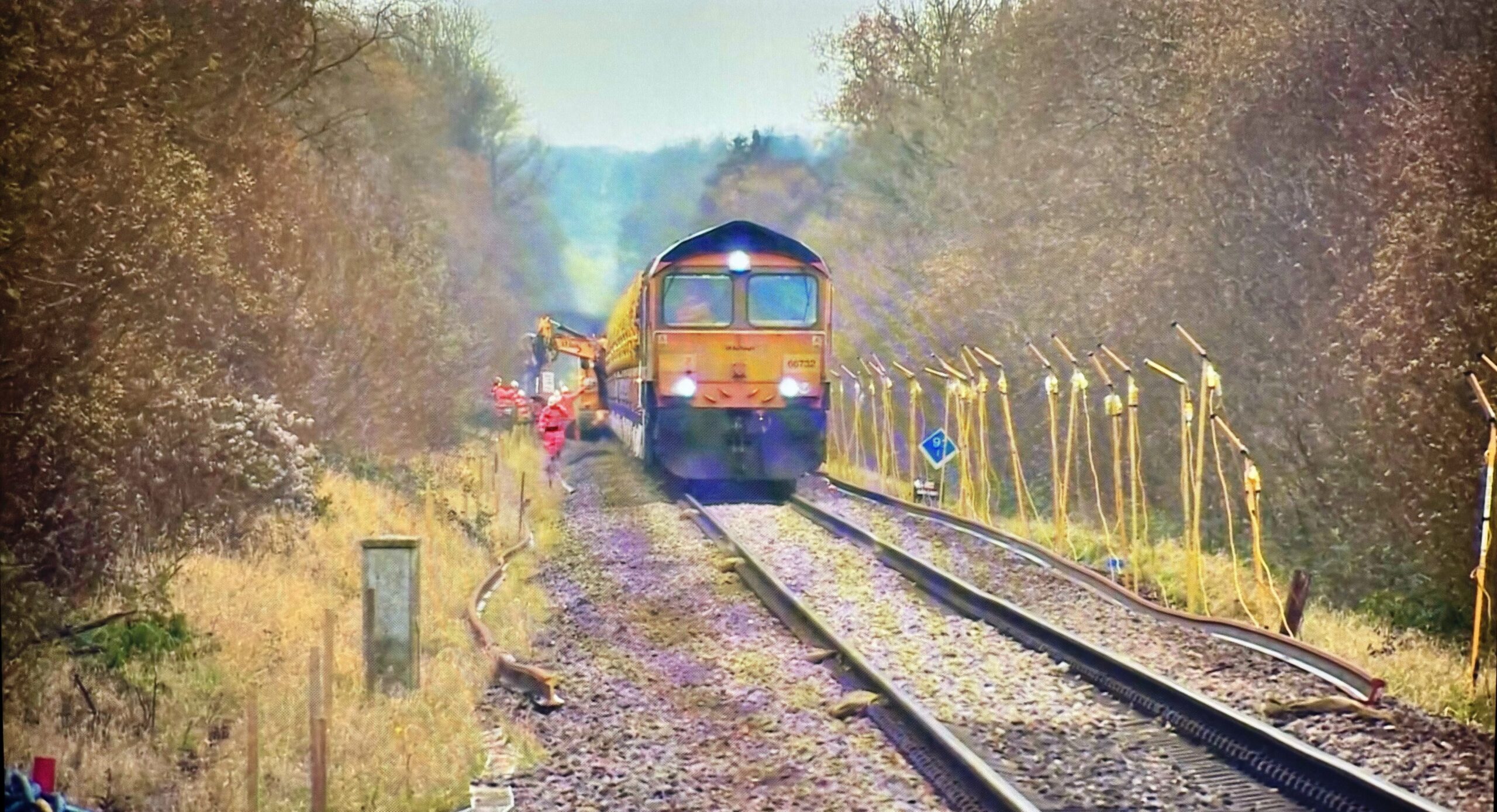
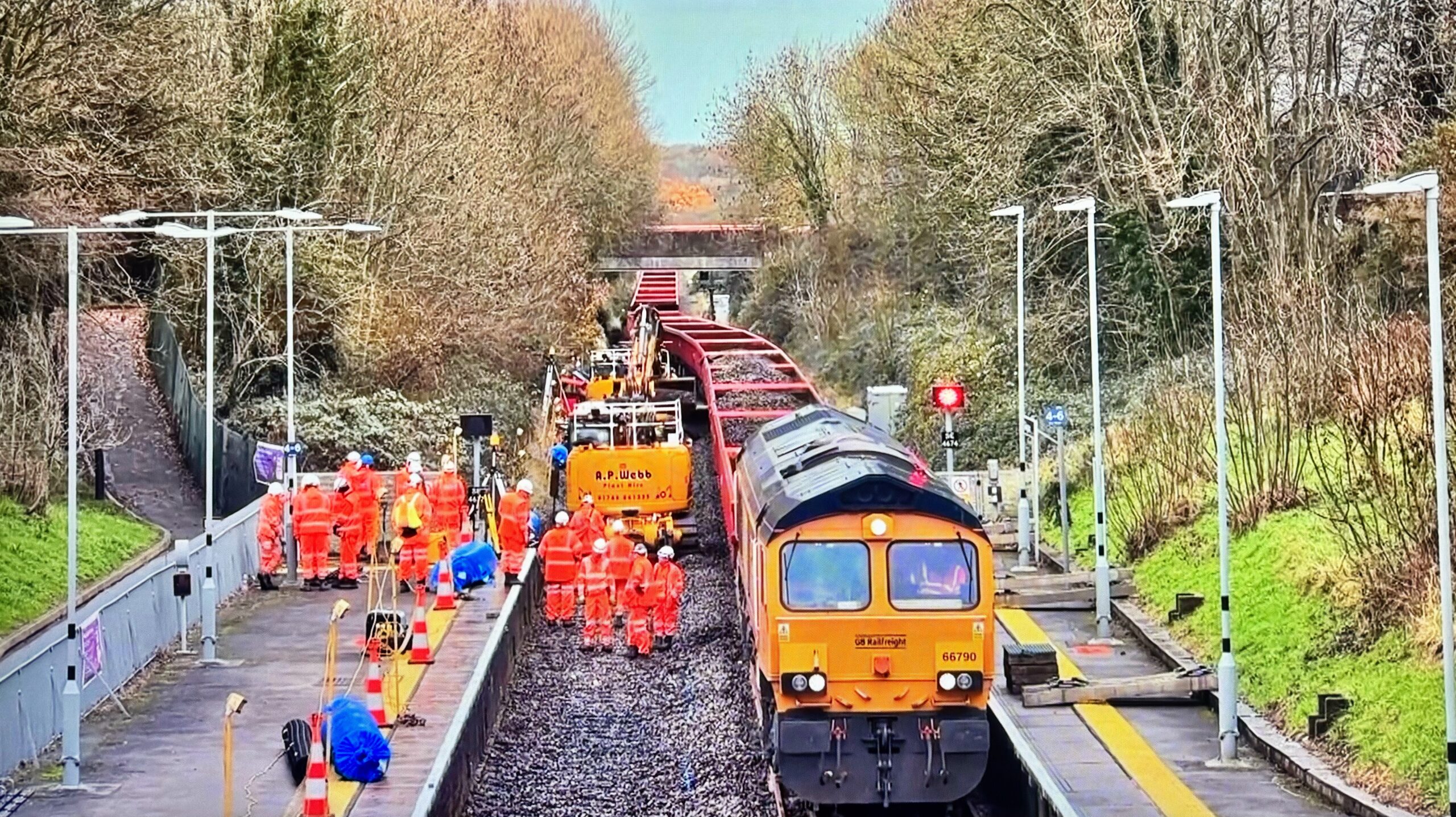
Class 66 No. 66732 ‘GBRf The First Decade 1999-2009 John Smith – MD’ at Dinton near Salisbury during the 16 day engineering possession. TV screen grab from BBC South Today – 01/12/2023Class 66 No. 66732 ‘GBRf The First Decade 1999-2009 John Smith – MD’ at Dinton near Salisbury. TV screen grab from BBC South Today – 01/12/2023Class 66 No. 66790 ‘Louise’ at Gillingham. TV screen grab from BBC South Today – 01/12/2023
Thanks for reading, that’s it for 2023! Wishing everyone a very Happy New Year. We’ll leave you with a pic of Yoshi at Durdle Door. Be seeing you!
Yoshi took an early morning trip to Durdle Door to see the sunrise – 22/12/2023
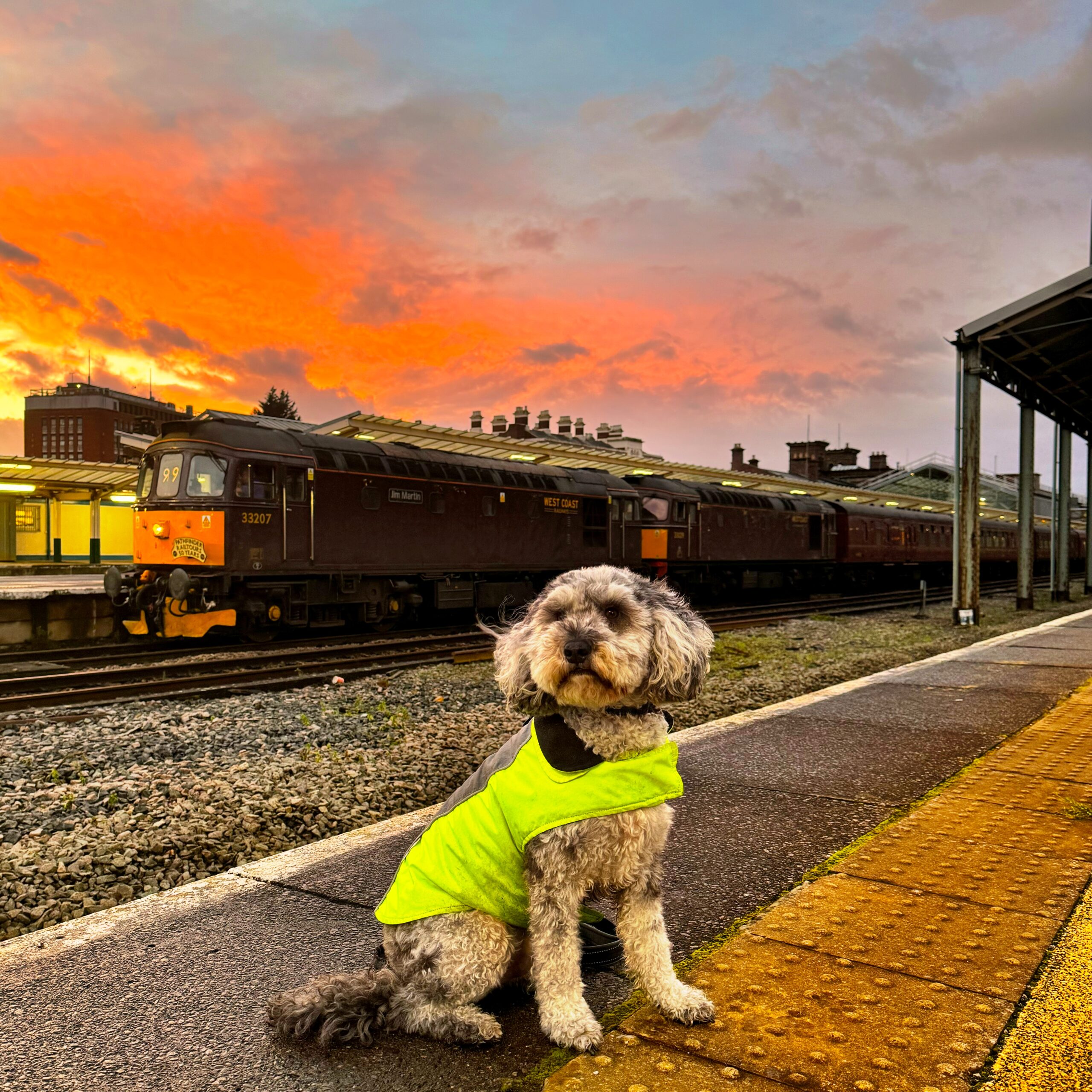
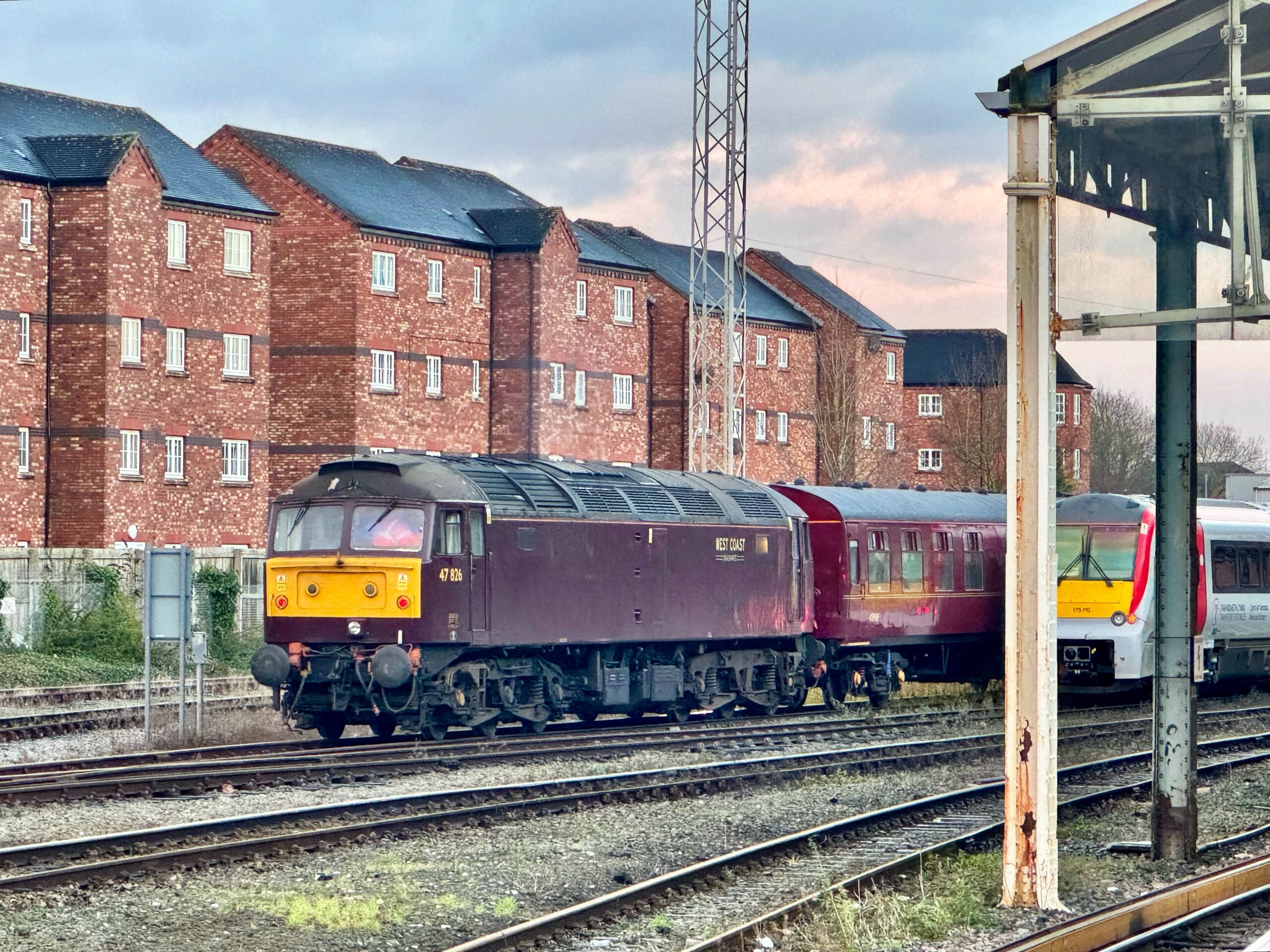
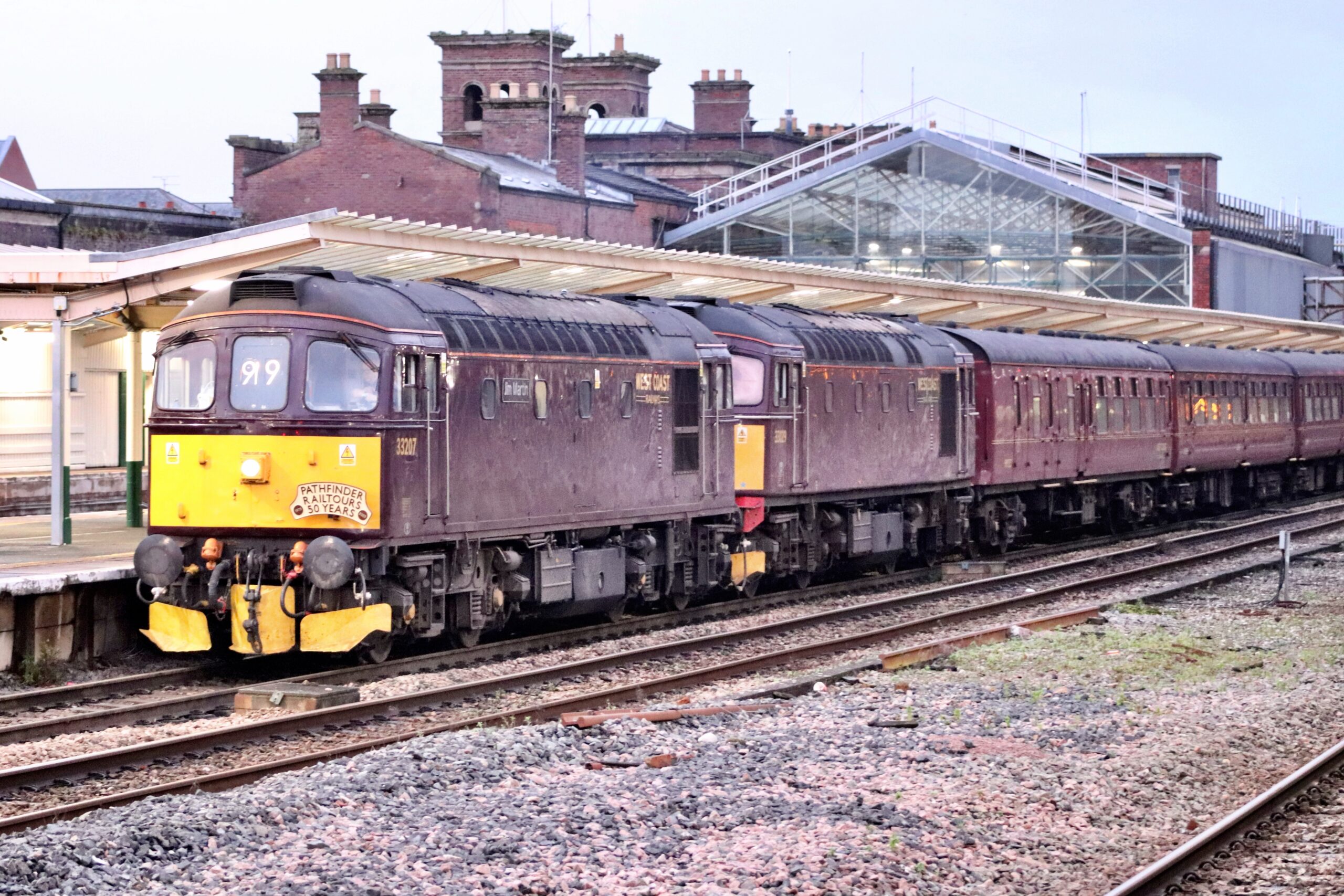
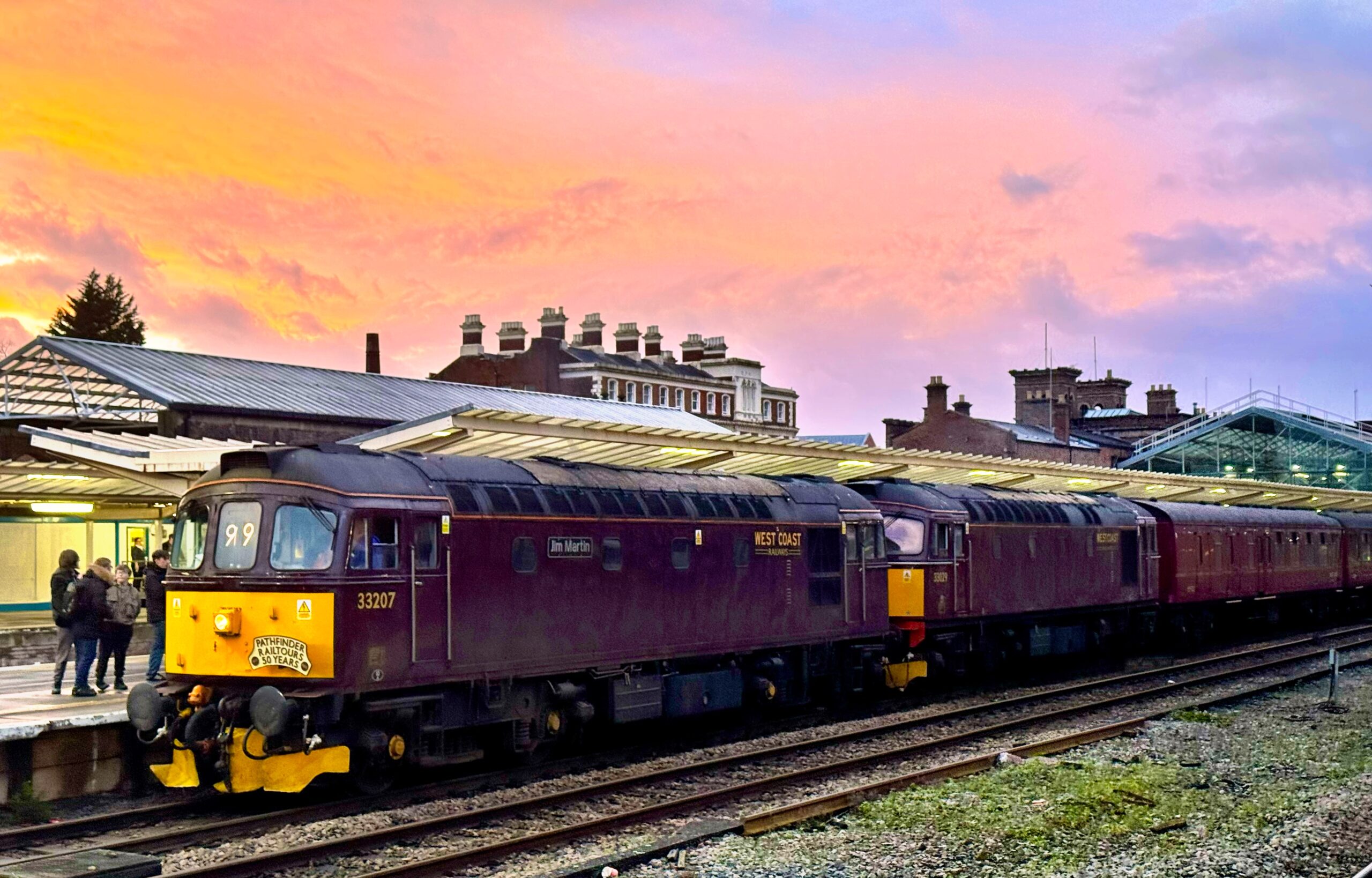
Yoshi at Chester with West Coast Railways (WCR) Class 33 No.’s 33207 ‘Jim Martin’ and 33029 behind him awaiting departure of Pathfinder Tours “Chester Christmas Cromptons” 1Z35 1610 Chester to Eastleigh – 09/12/2023
December 1st 2023 to December 10th 2023
Lots of catching up to do before we reach the end of 2023 – so here is part one of Yoshi’s December adventures. More next week!
Winter Is Coming
The first Snow & Ice Treatment Train (SITT) of the 2023/24 season ran over the Bournemouth to Weymouth line on Saturday 2nd December 2023. Because of a points failure at Brockenhurst, this was running over 30 minutes late on the outward leg and was delayed over an hour on its return to Eastleigh East Yard.
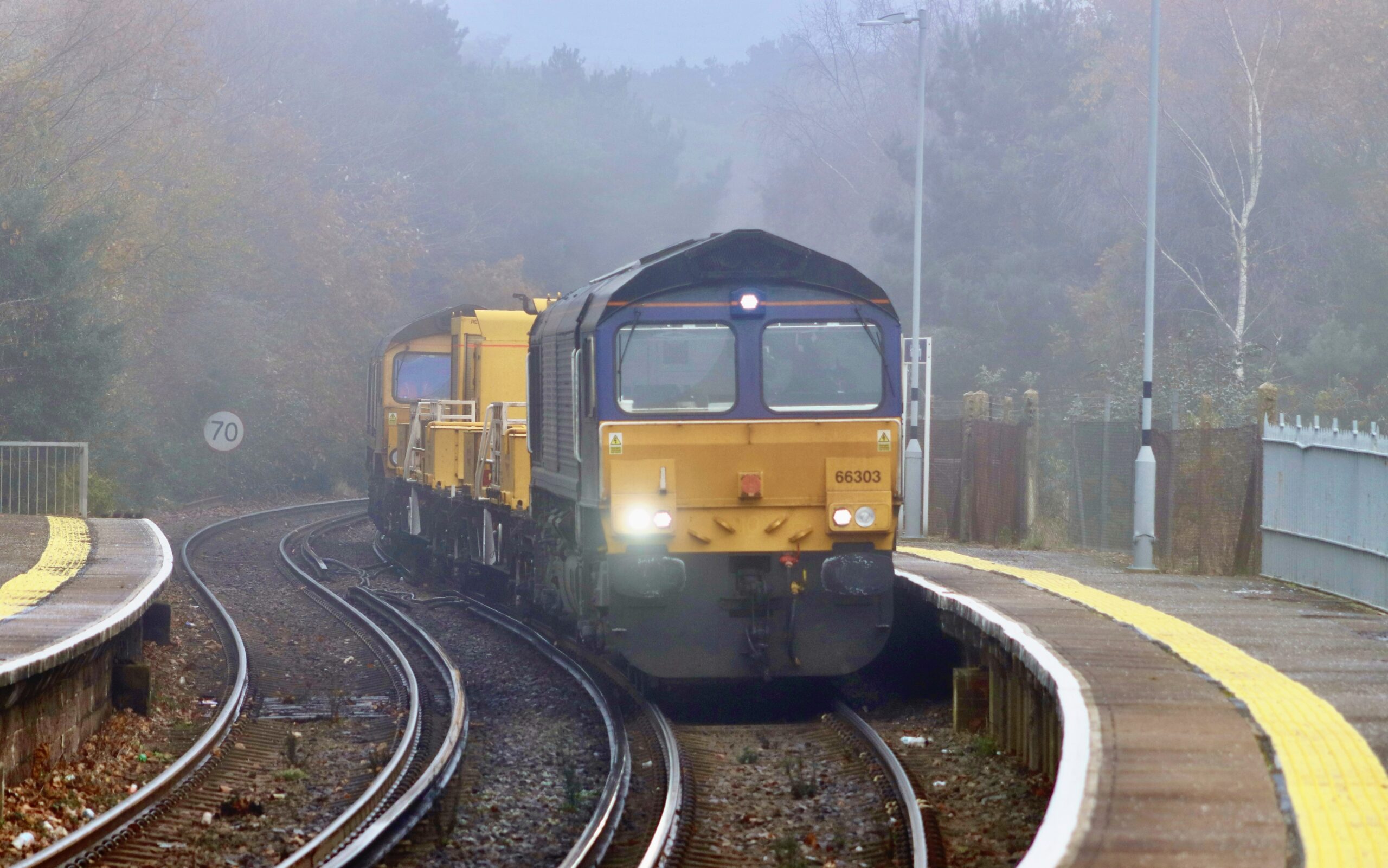
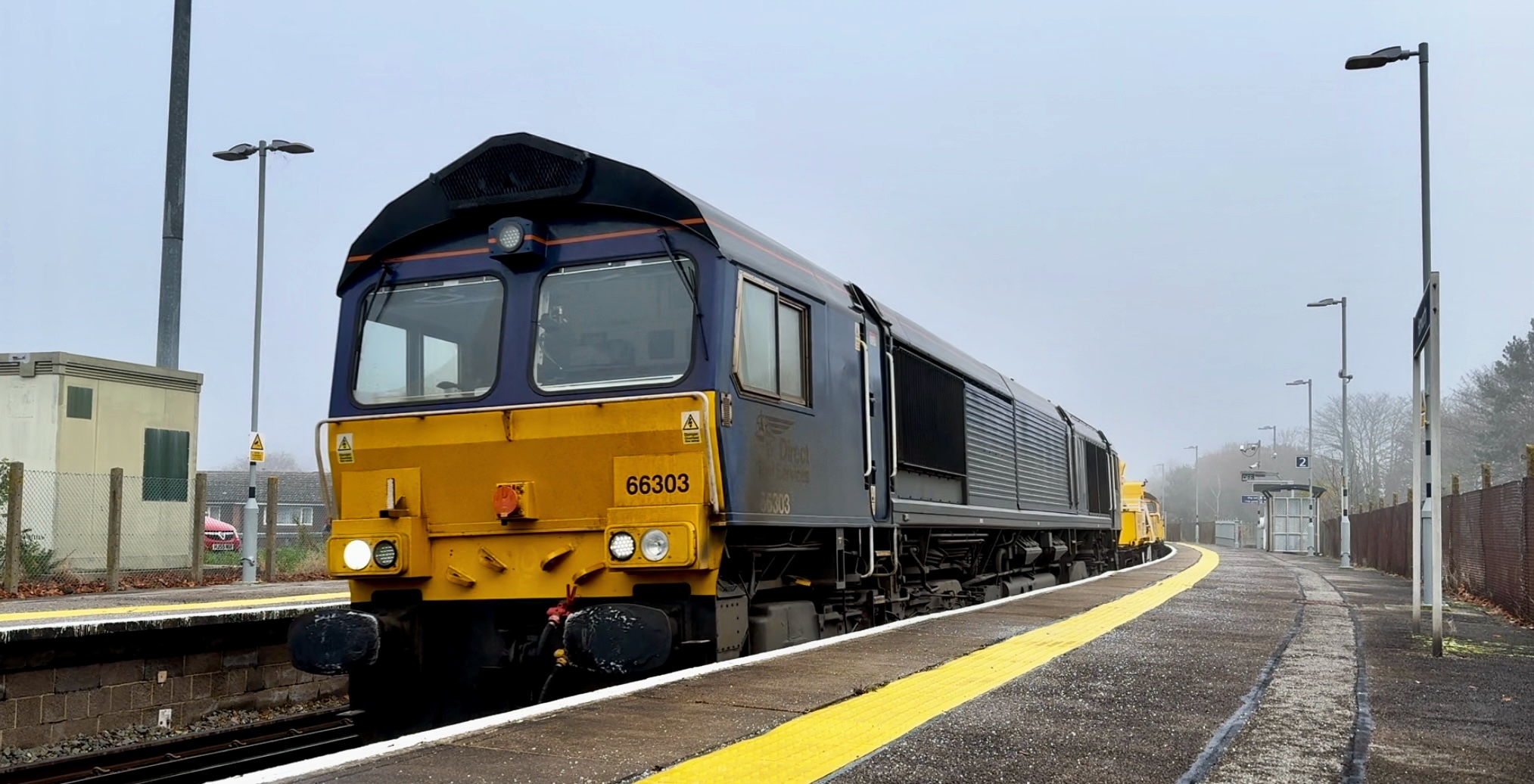
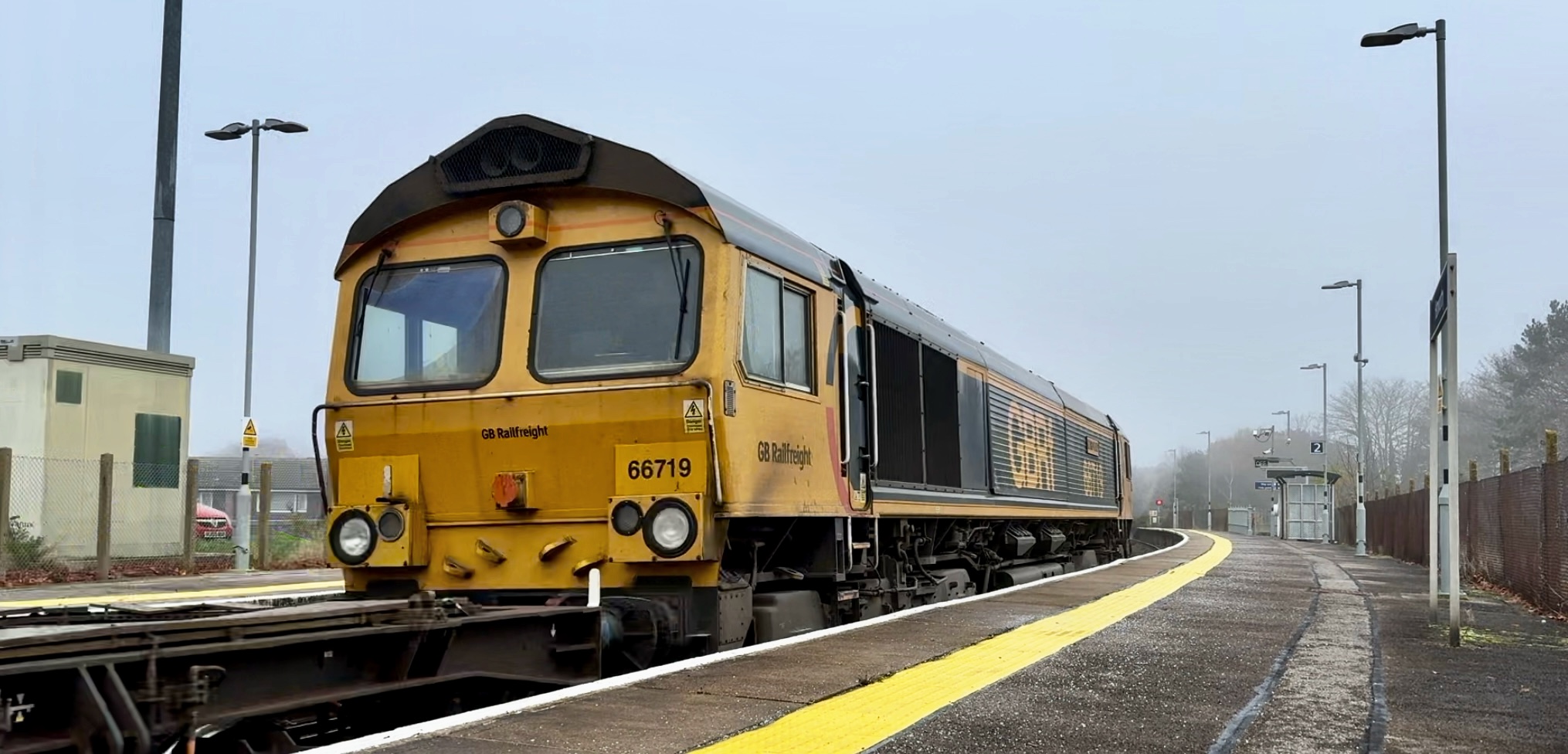
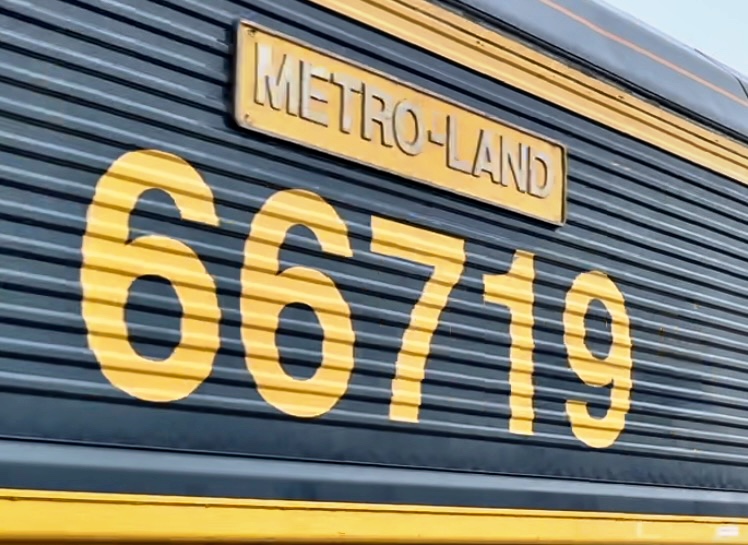
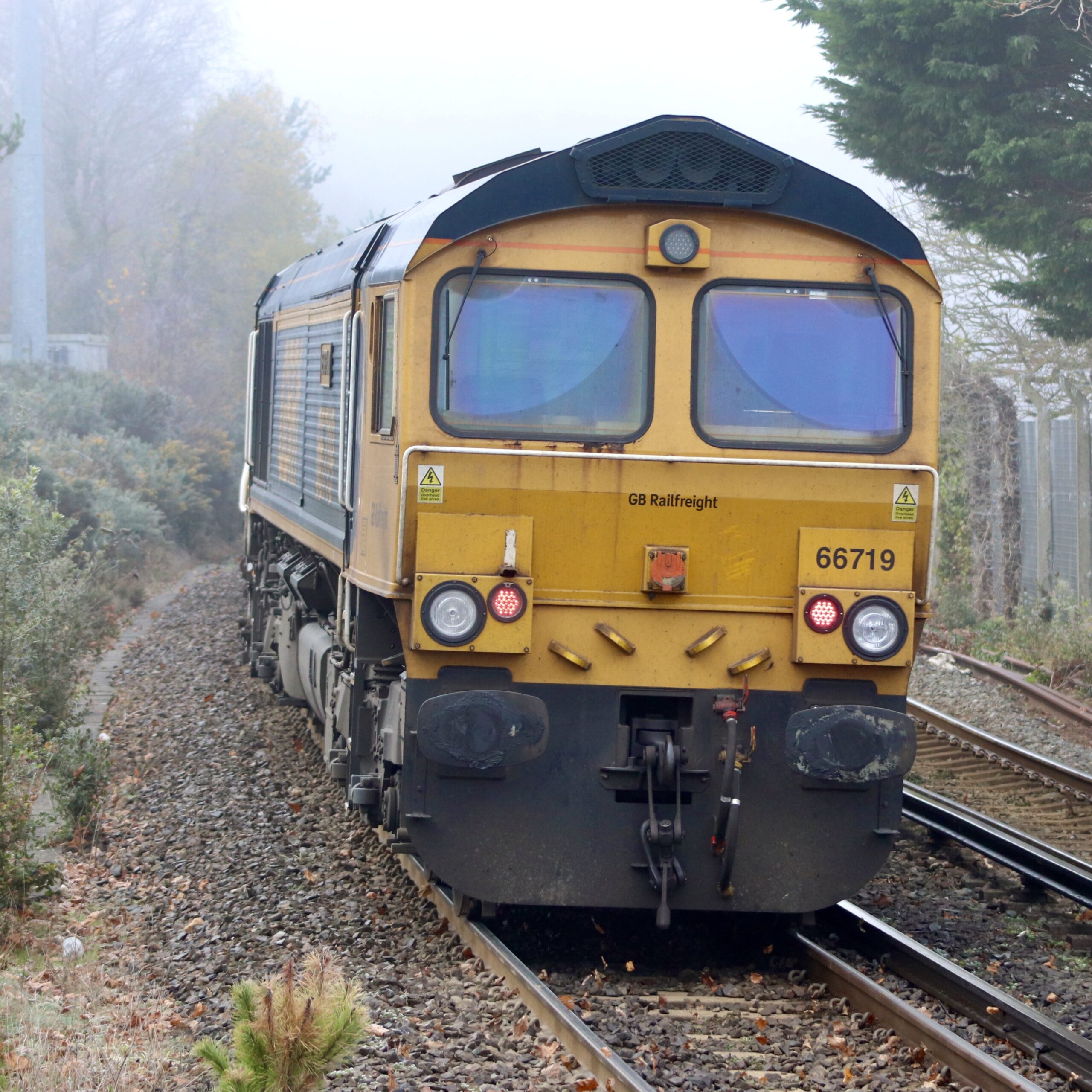
The first Snow & Ice Treatment Train of the 2023/24 season saw GBRf Class 66 No.s 66303 and 66719 ‘Metro-Land’ working 3Y88 0900 Eastleigh East Yard to Eastleigh East Yard via Weymouth. The SITT is seen here at Hamworthy – 02/12/2023GBRf Class 66 No. 66303 leading on 3Y88 0900 Eastleigh East Yard to Eastleigh East Yard via Weymouth passing Hamworthy – 02/12/2023GBRf Class 66 No. 66719 ‘Metro-Land’ bringing up the rear of the outward working of 3Y88 0900 Eastleigh East Yard to Eastleigh East Yard via Weymouth at Hamworthy – 02/12/2023Nameplate of No. 66719 ‘Metro-Land’ – 02/12/2023GBRf Class 66 No. 66719 ‘Metro-Land’ at the rear of 3Y88 0900 Eastleigh East Yard to Eastleigh East Yard via Weymouth SITT at Hamworthy – 02/12/2023
Snow & Ice Treatment Train (SITT) in Dorset – 02/12/2023 (Additional video clips courtesy of G Barrett and @da_buckley967)
Yoshi’s Northern Adventure
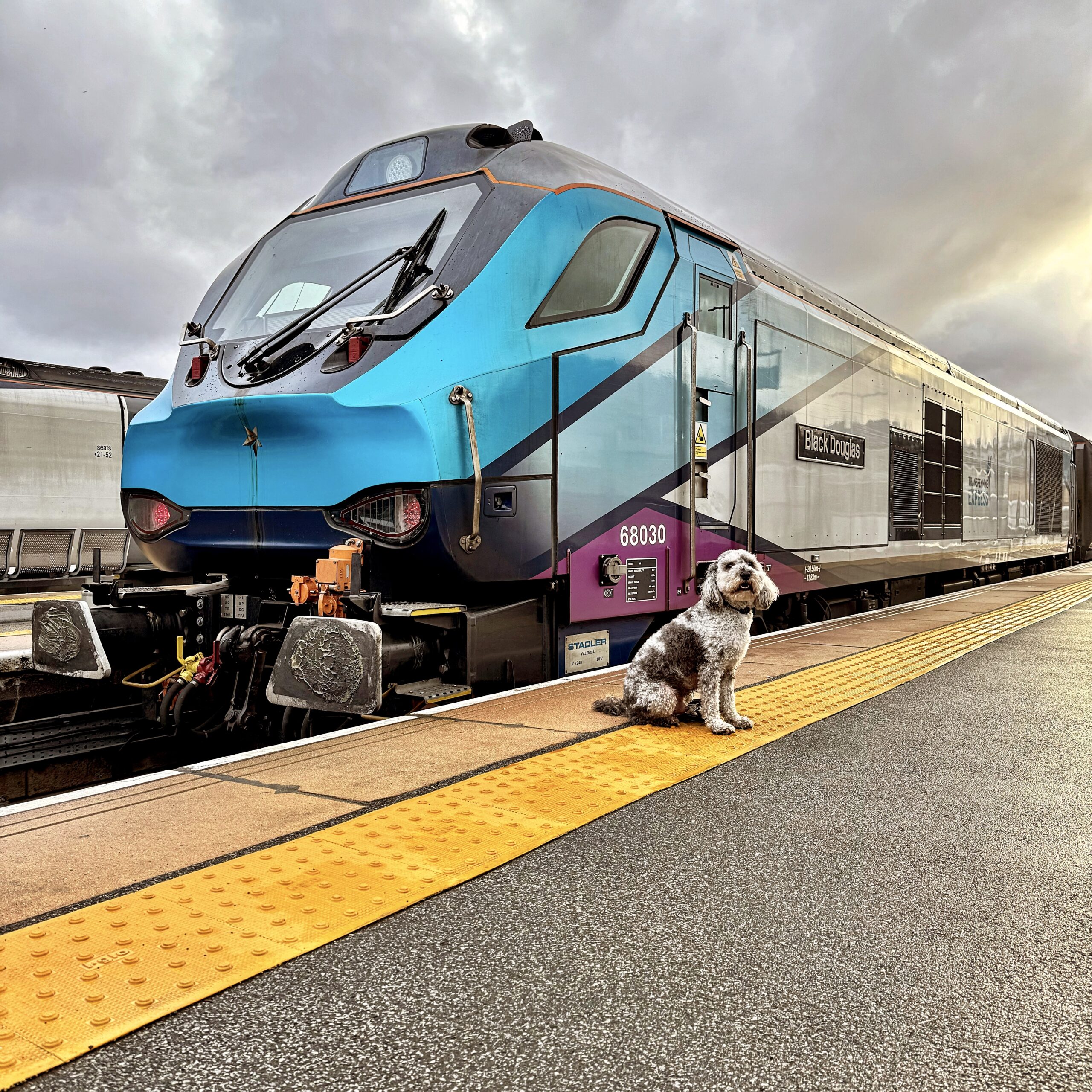
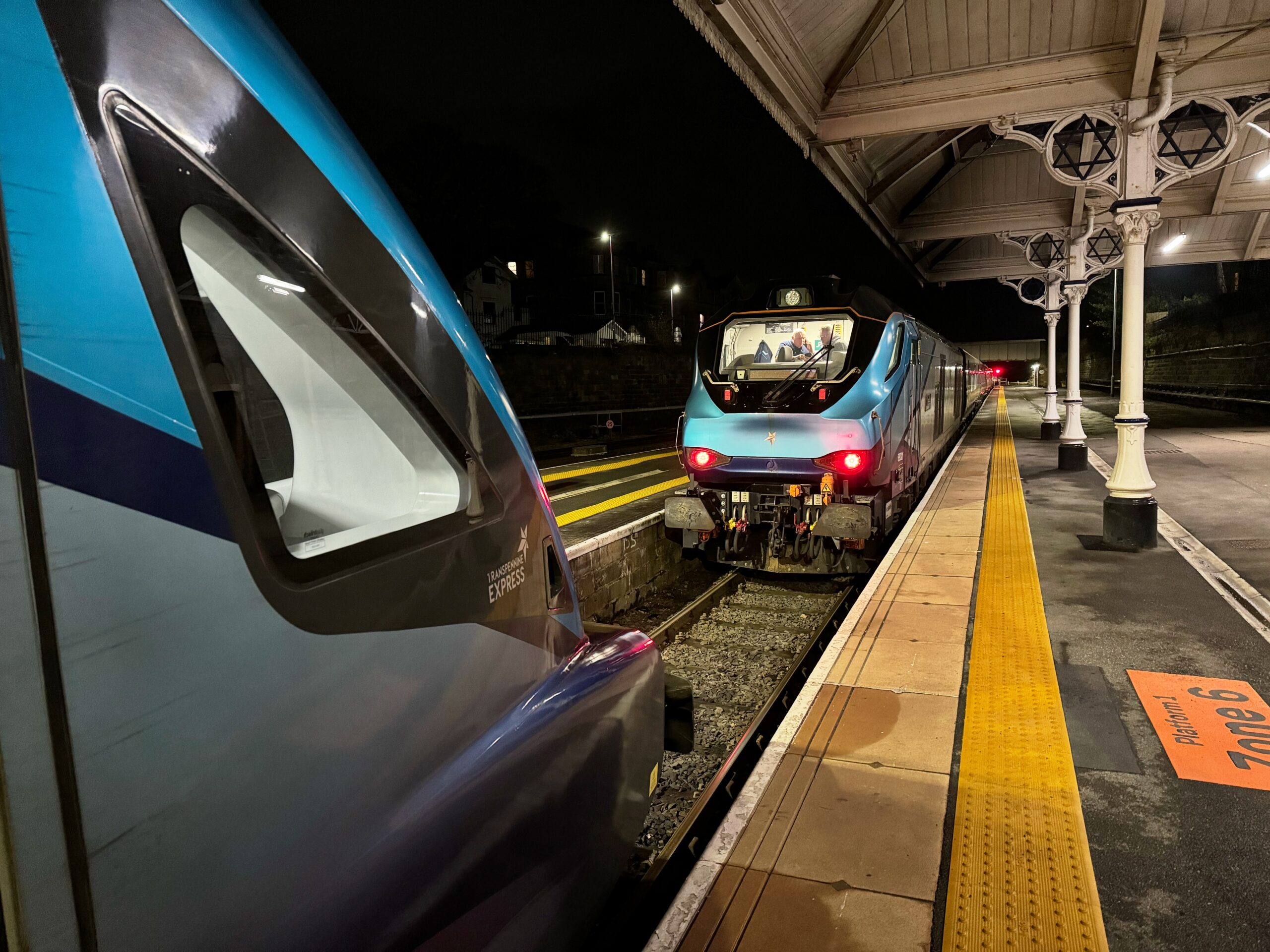
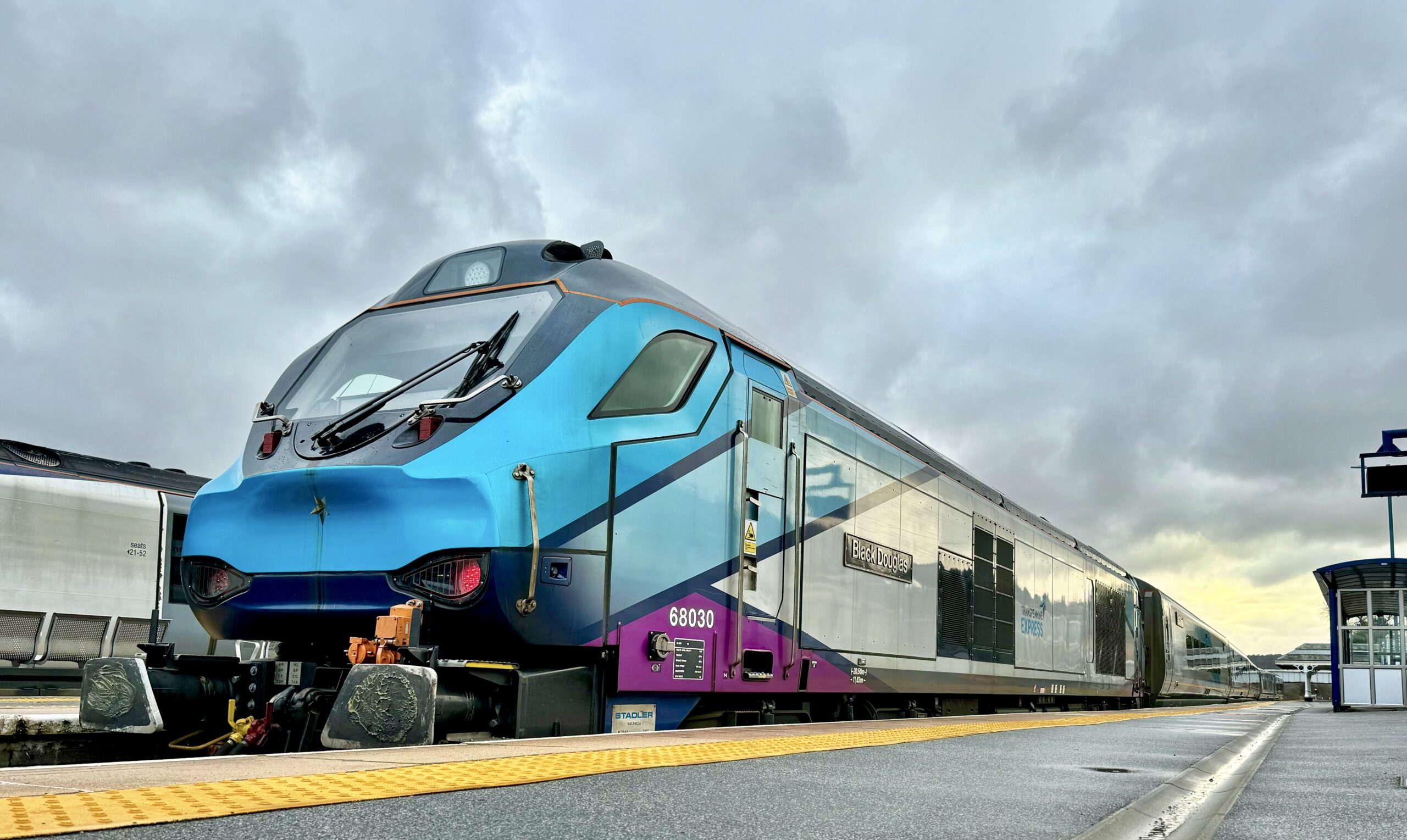
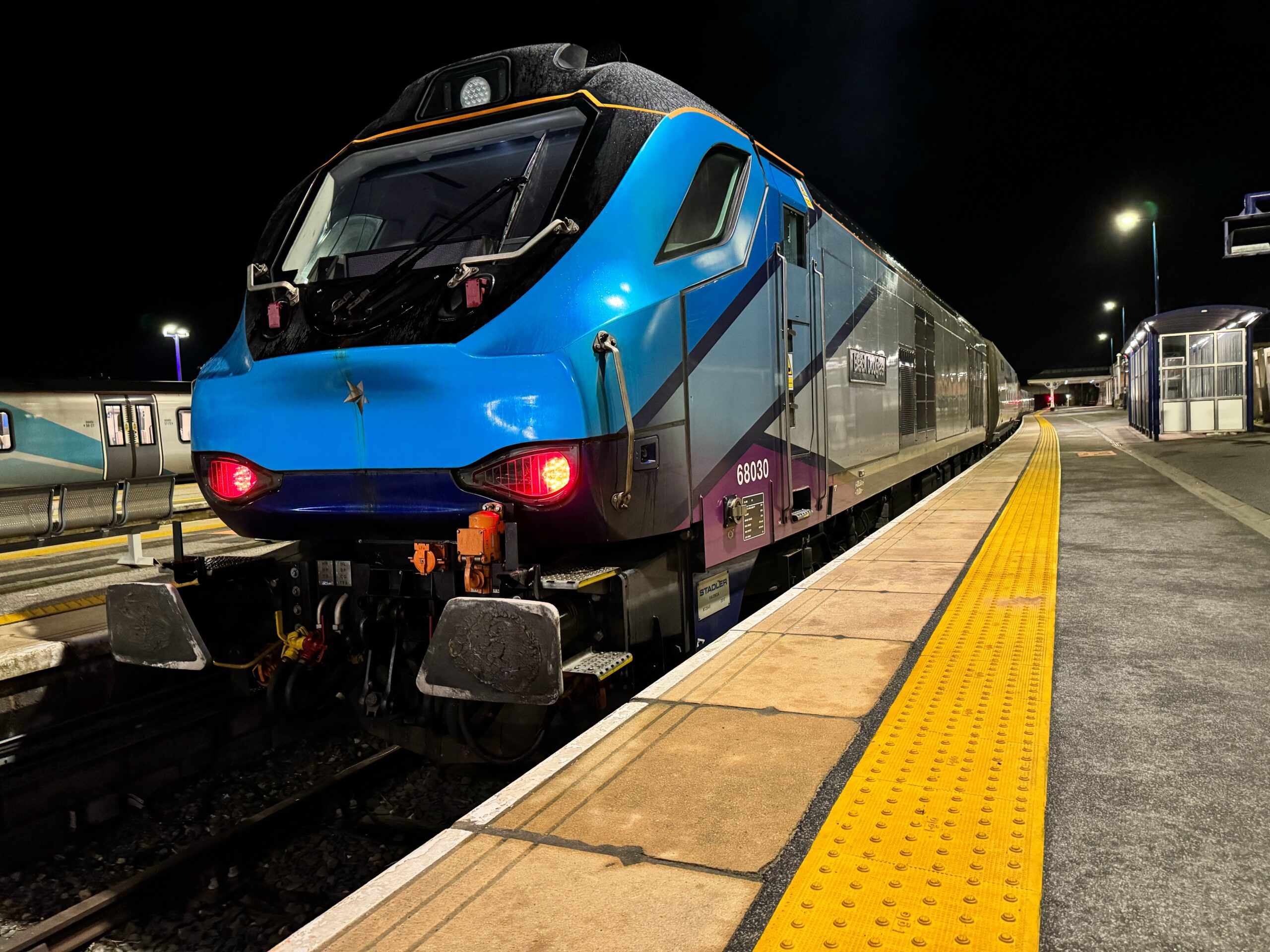
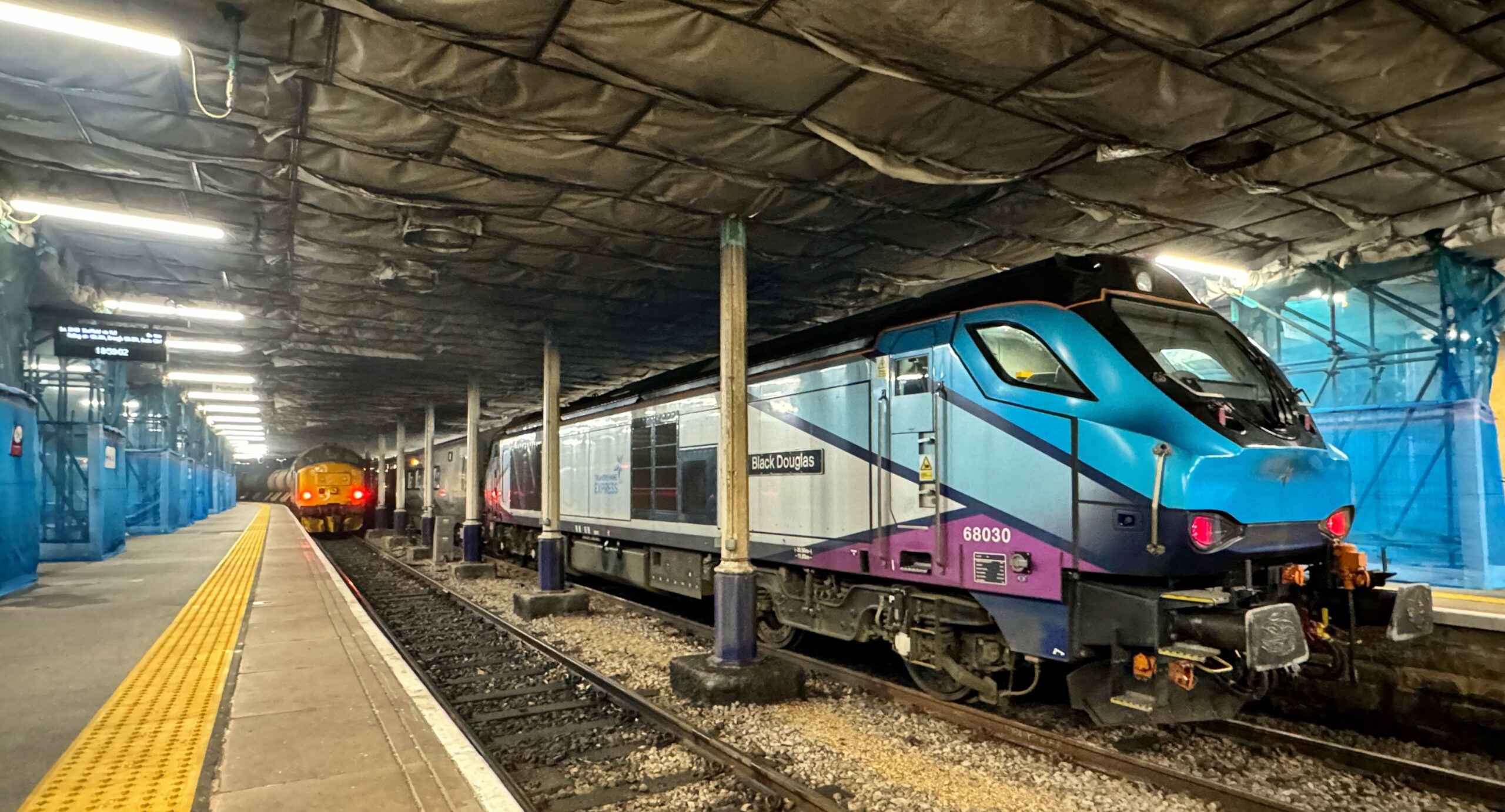
Yoshi with Class 68 No. 68030 ‘Black Douglas’ at Scarborough – 05/12/2023
Back in June this year, Caroline arranged to meet up with her old school friends in Liverpool on Saturday 9th December for a pre-Christmas reunion. I was, of course, happy to volunteer my services as chaffeur as I envisaged a day of watching trains in the North West while Caroline caught up with her chums. As we got closer to the date and with announcements from TransPennine Express (TPE) confirming their decision to discontinue the use of its “Nova 3” locomotive-hauled train sets – comprised of a Class 68 locomotive and Mk5a coaches – effective from the December 2023 timetable change, my brain started working overtime at the possibility of getting one last chance of seeing these trains. If we were heading to the north west, why not take a slight detour!
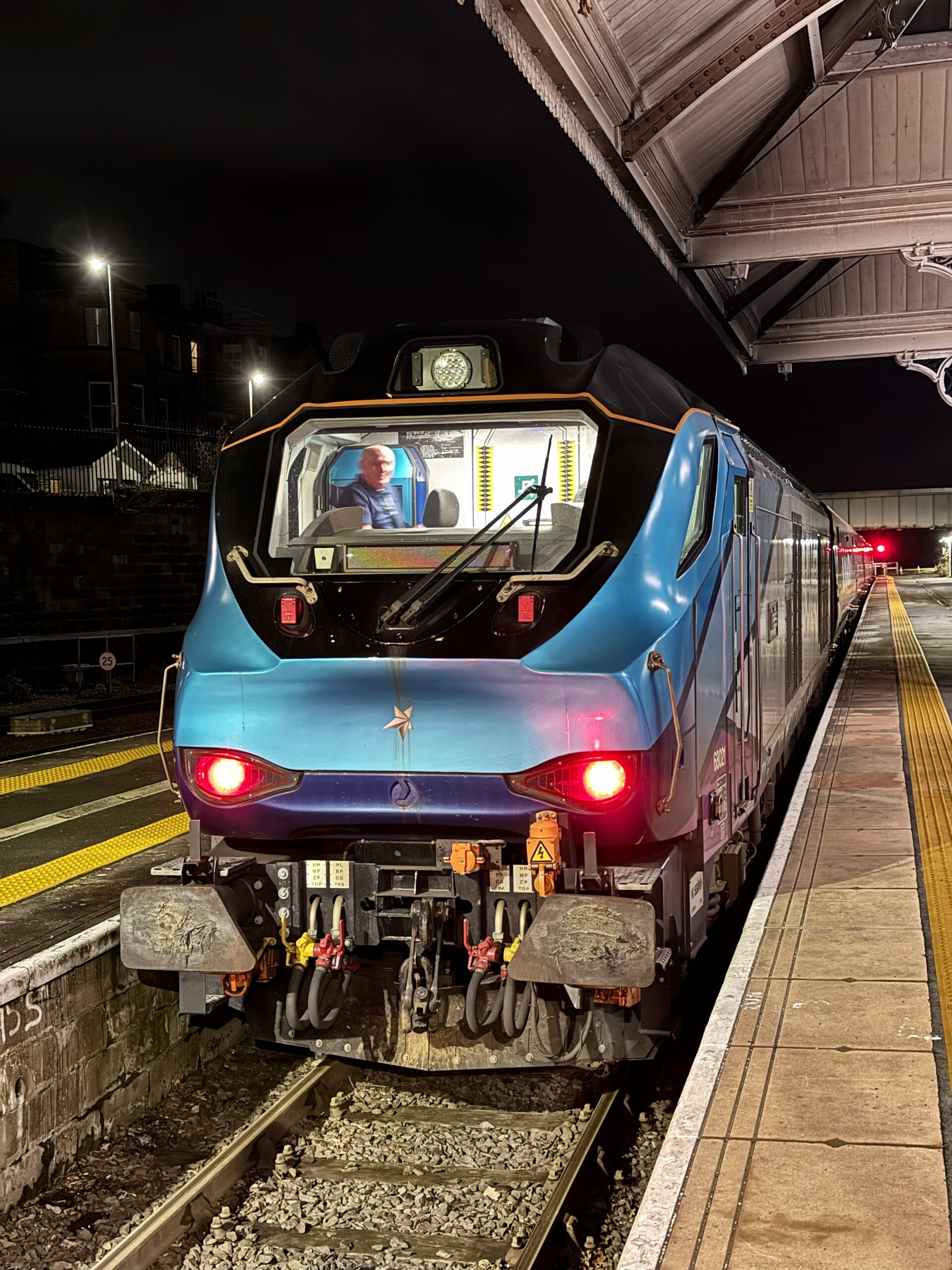
Class 68 No. 68021 ‘Tireless’ having arrived at Scarborough working 1U63 1703 York to Scarborough (set TP10) – 05/12/2023
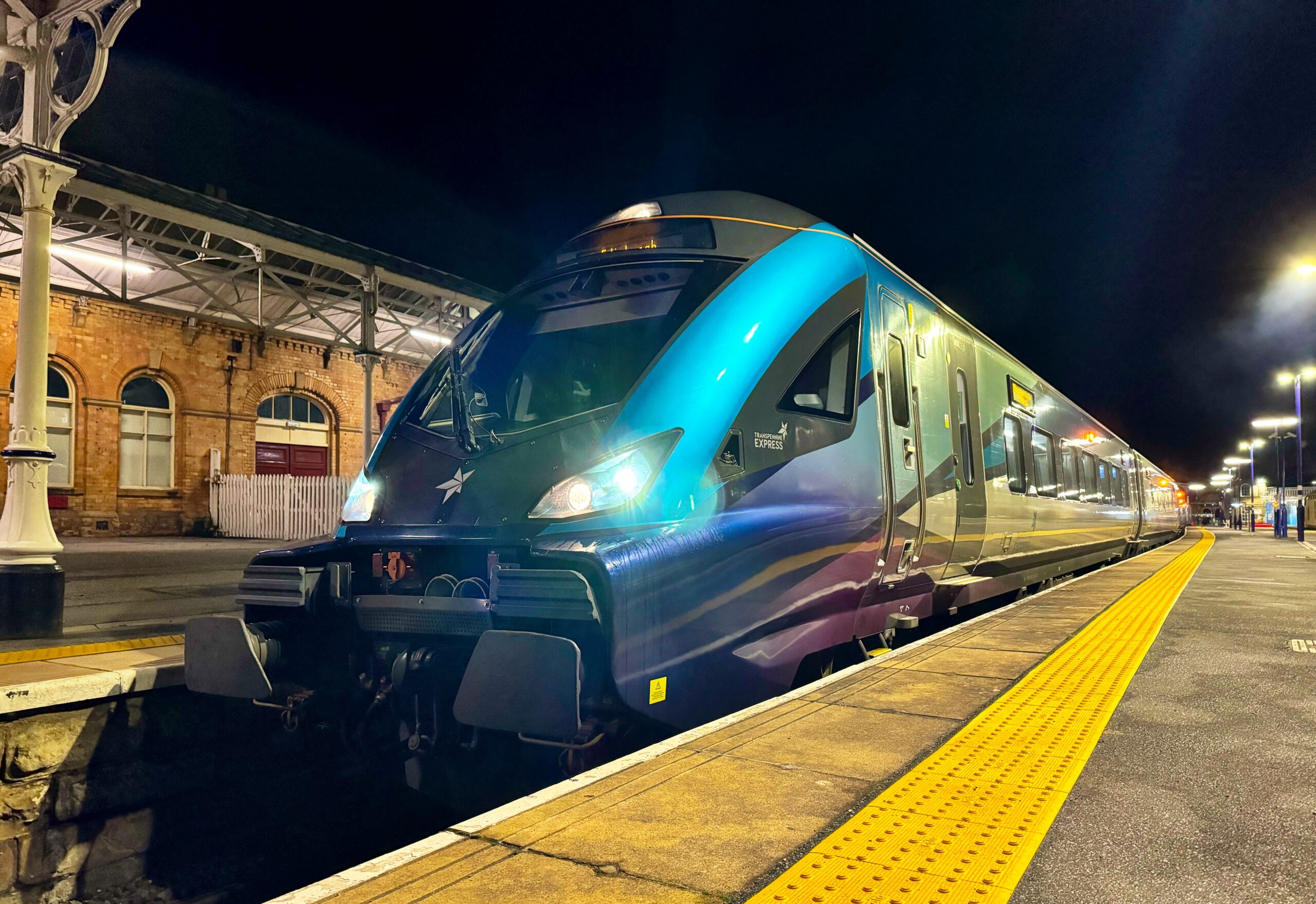
The story of the “Nova 3” programme dates back to the original tender invitation for the TPE franchise, where the Department for Transport (DafT) had initially specified the procurement of coaches, expecting the future operator to repurpose redundant five-car third-rail Electric Multiple Units (EMU) for use with diesel locomotives. However, in December 2015, FirstGroup, the eventual winner of the franchise process, opted to order brand new train sets from Spanish manufacturer Construcciones y Auxiliar de Ferrocarriles (CAF). These became the “Nova 3” sets; 52 standard Mk5a carriages and 14 Driving Trailers were built which were formed into thirteen 5-carriage sets (65 coaches intended for regular service, with the 66th coach being a spare Driving Trailer). The trains commenced service on the Liverpool – Scarborough route on 24th August 2019, powered by modified Class 68 locomotives subleased from Direct Rail Services (DRS).
Class 68 No. 68030 ‘Black Douglas’ stands at platform 1 Scarborough awaiting time to depart with 1U64 1548 Scarborough to York (set TP06) – 05/12/2023
From their introduction, the “Nova 3″ sets were beset with multiple challenges, including technical issues, slow driver training progress, the impact of Covid-19, and noise complaints from local residents living near the maintenance facility in Scarborough. In July 2023 it was widely reported that faults were discovered in some of the Mk5a coaches, including body cracks around the yaw damper and anti-rollbar bracket area. All these issues limited the fleet’s usage, with very few sets being in service on a daily basis and much of the fleet remaining in storage. FirstGroup’s management of the TPE franchise faced scrutiny and controversy, particularly over the high level of cancelled services and abuse of an operational accounting process, widely deemed to have been used to conceal the true level of missed services. These revelations eventually led to the UK government taking control of the service through their Operator of Last Resort provision. Subsequently, an extensive review of TPE’s operations was conducted, leading to the decision to terminate the “Nova 3” programme prematurely. From December 10th 2023, the Mk5a train sets will be placed into warm storage by TPE until April 2024 at which point they will be returned to their leasing agent. It is hoped that another operator might express an interest in taking over the vehicles.
“None 3” Driving Car of set TP06 leading 1K42 2043 Scarborough to York – 06/12/2023
So, early on Tuesday 5th December, with Yoshi safely secured in the back seat of the car, we set off North and destination Scarborough. I had hoped that five “Nova 3” sets would be in operation during our stay in the North Yorkshire seaside town, but alongside TPE clearly running down the trains and the Aslef union drivers overtime ban meant that on most days only two sets were working.
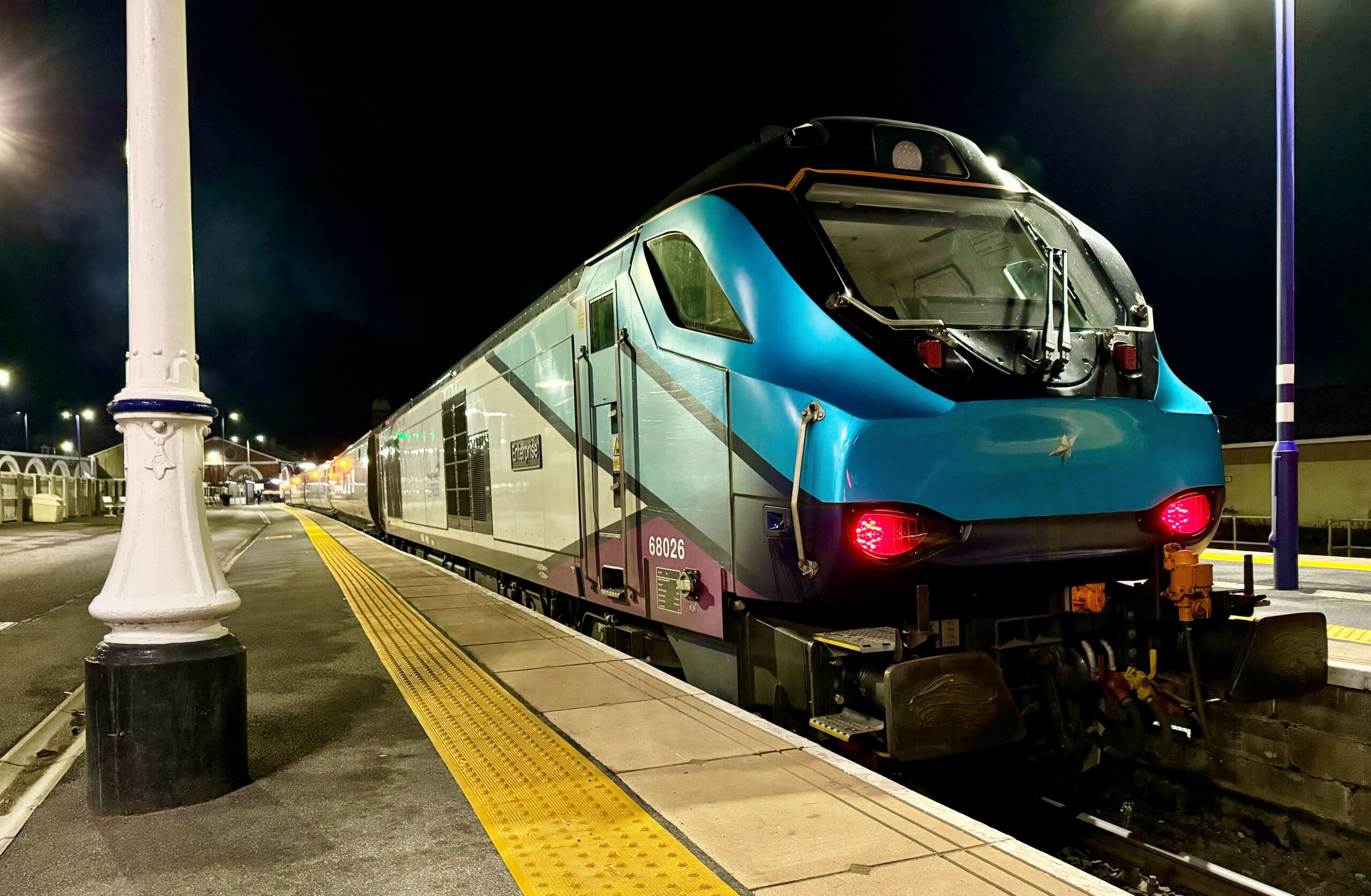
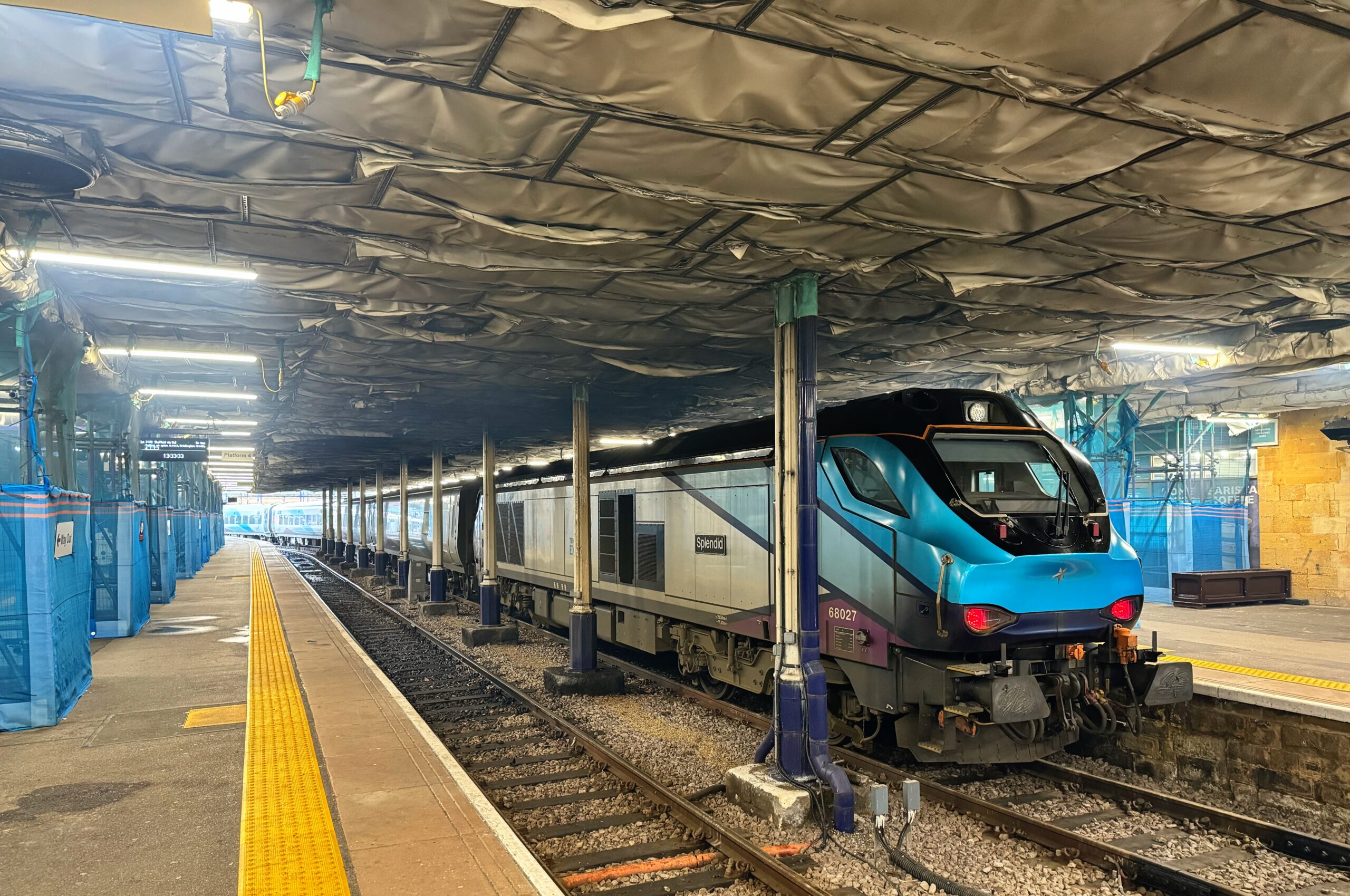
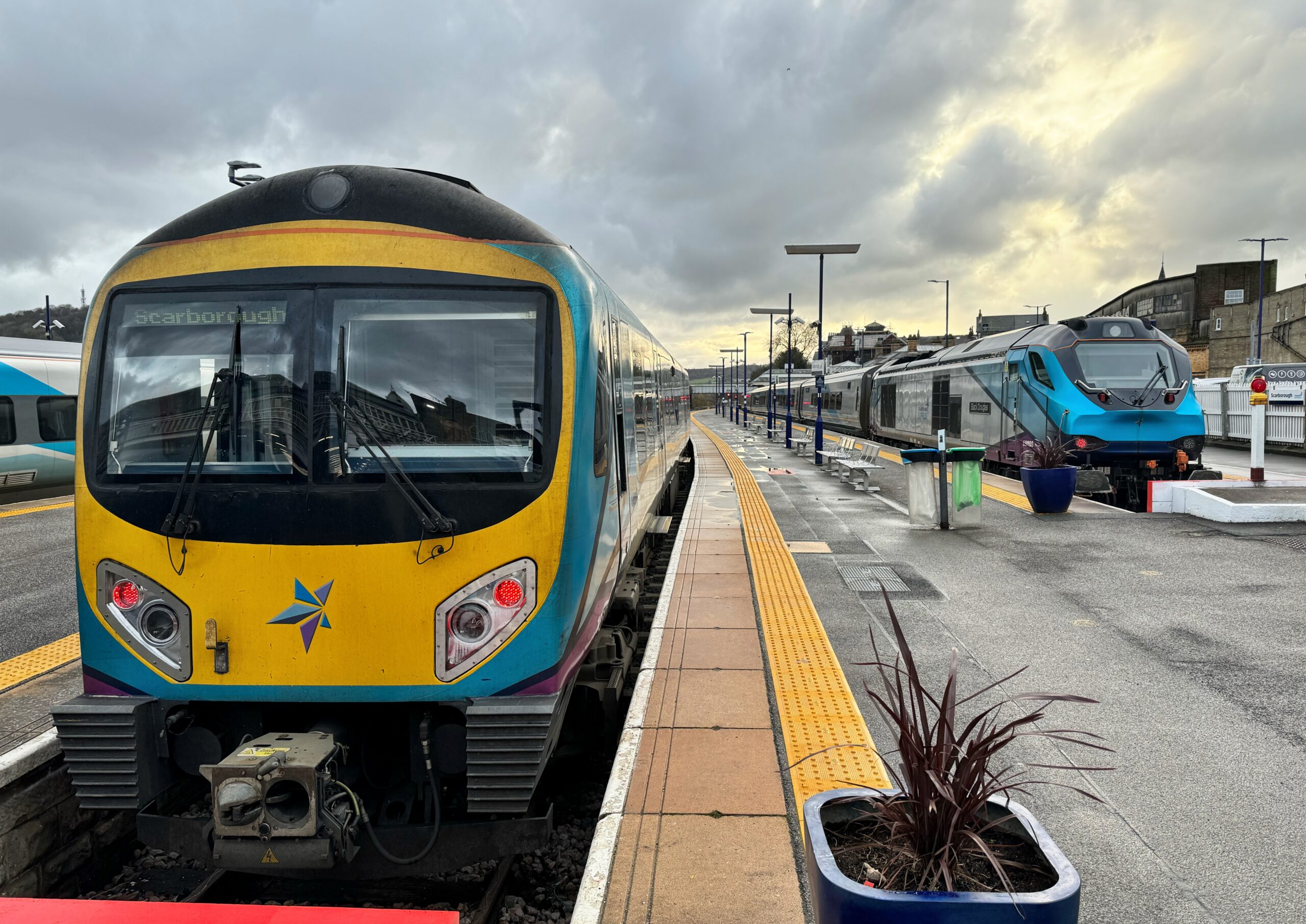
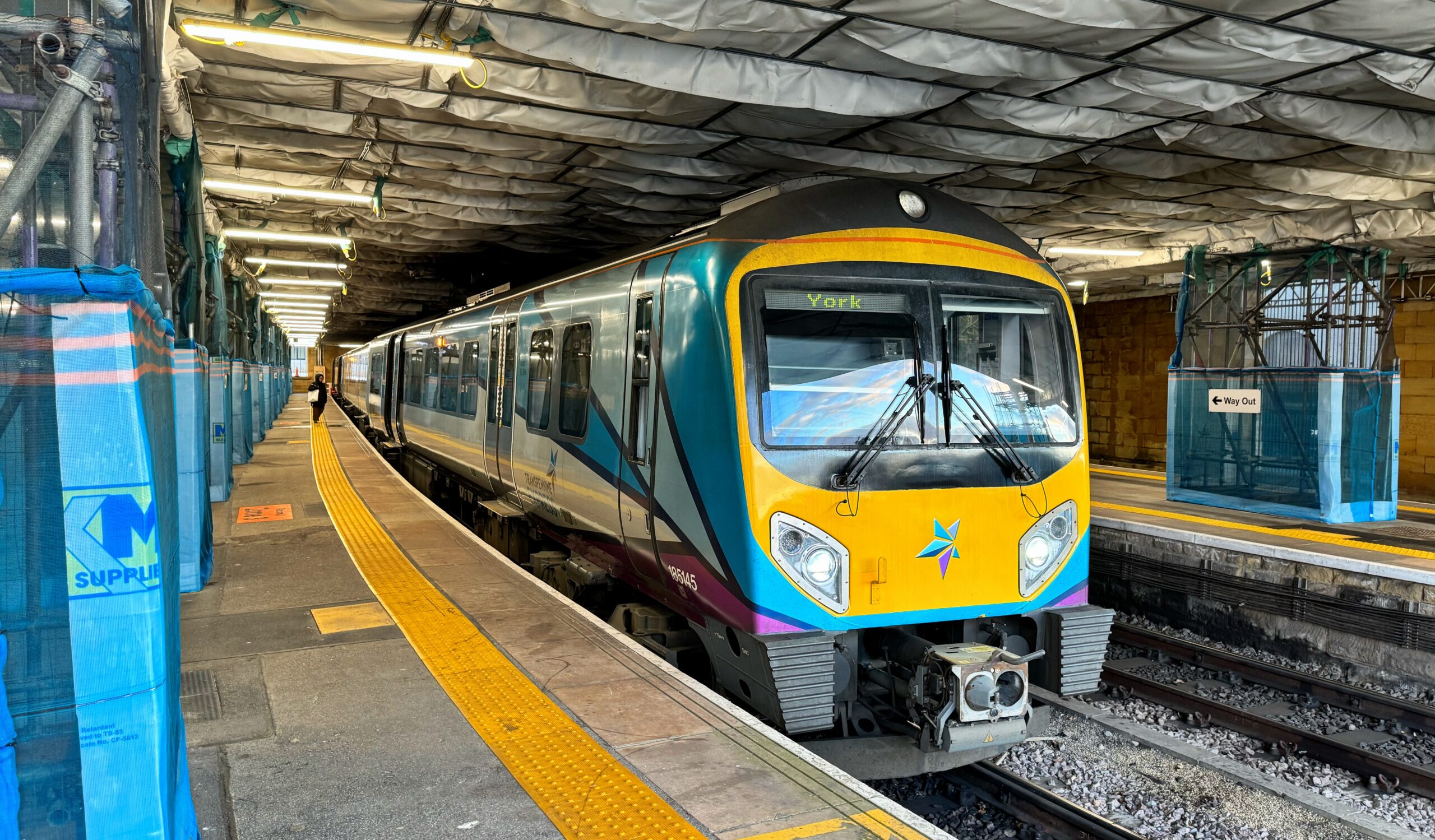
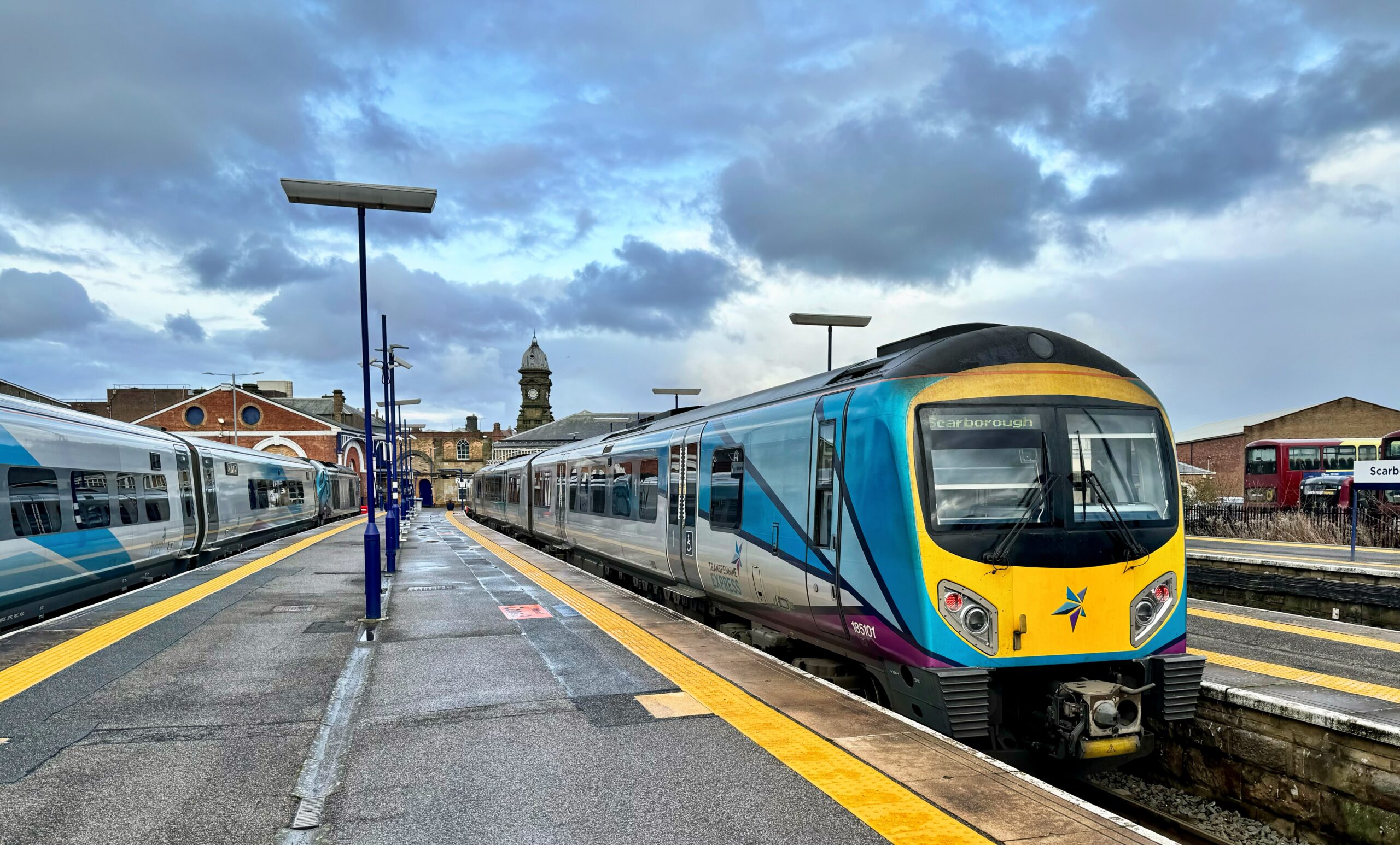
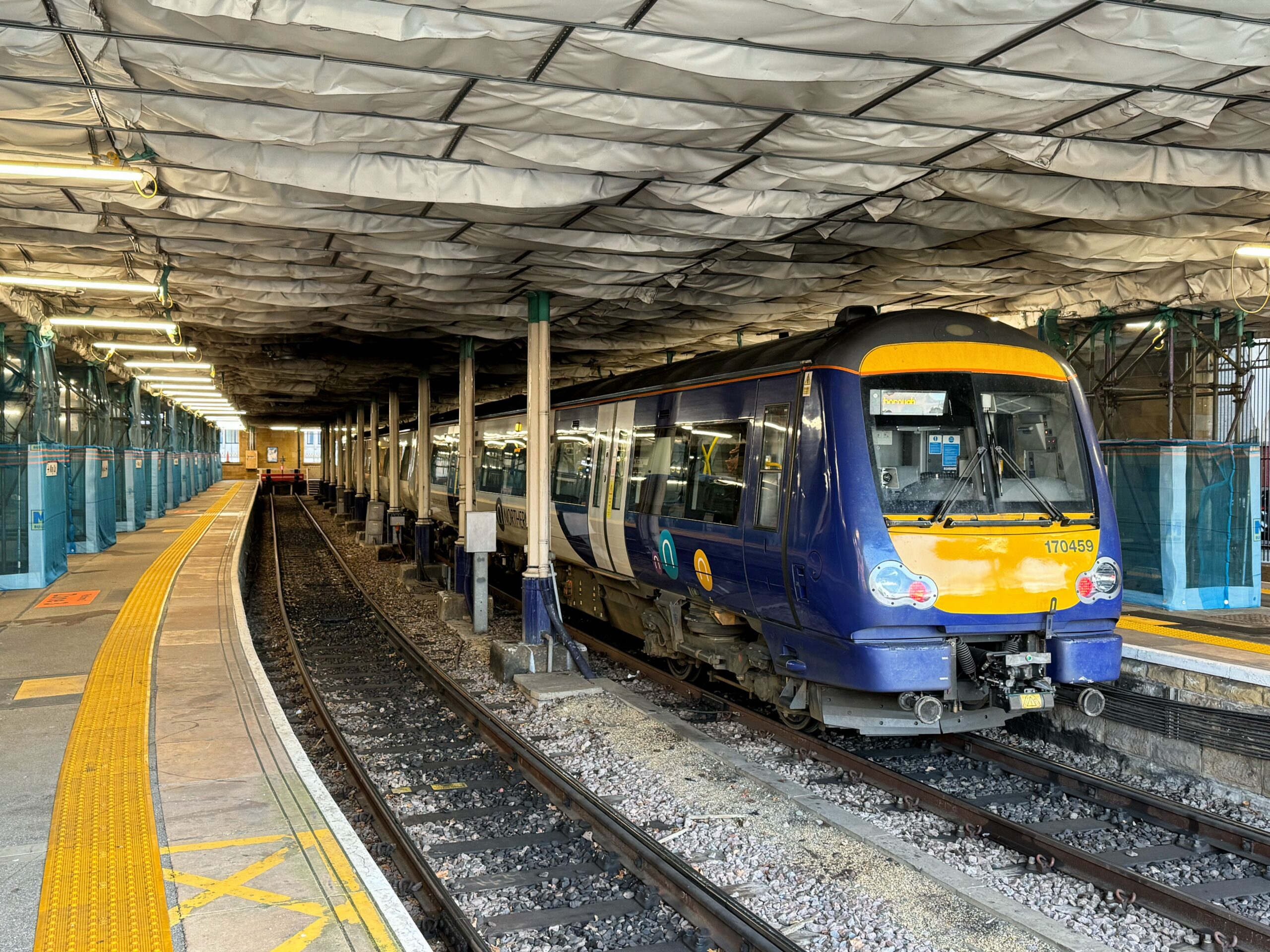
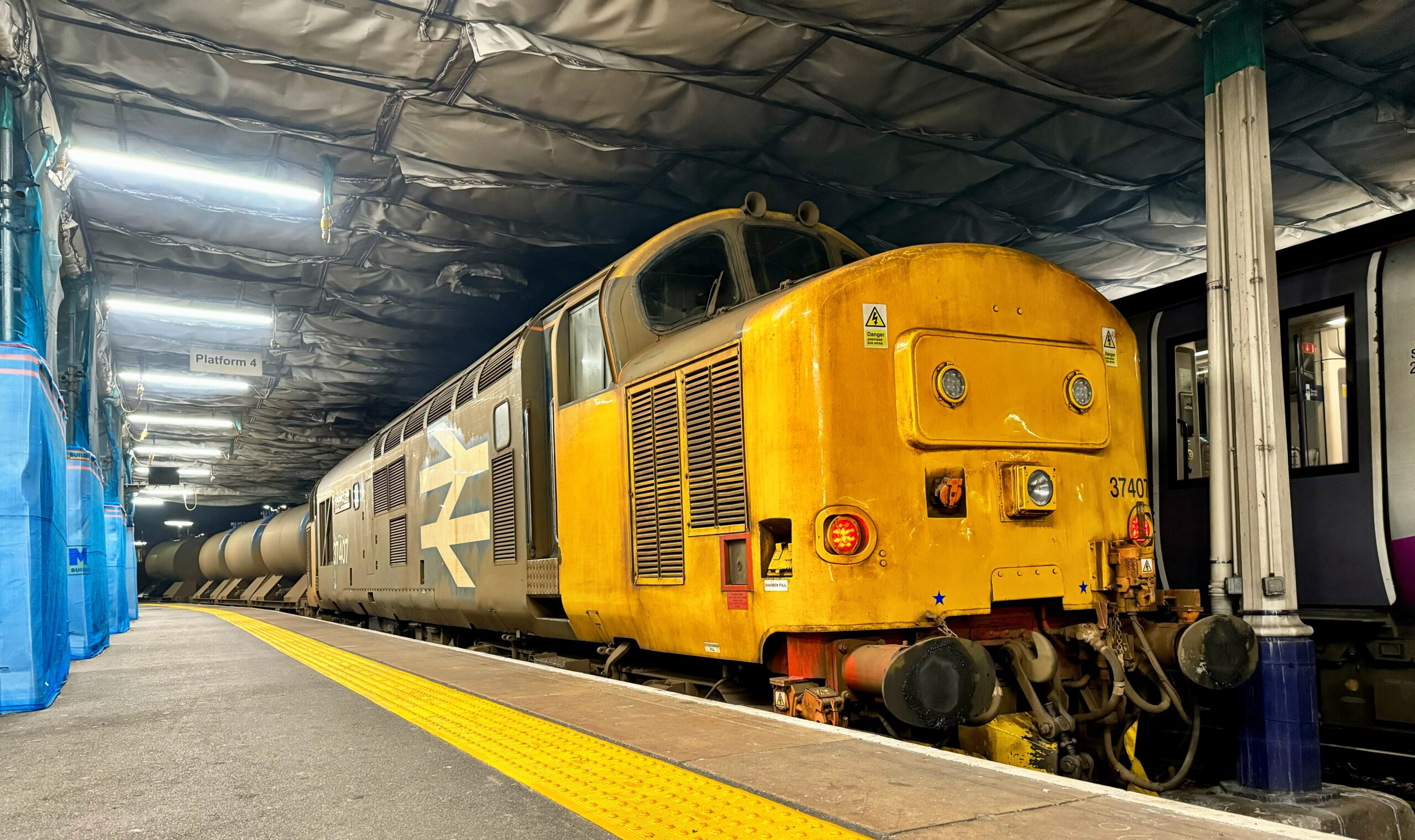
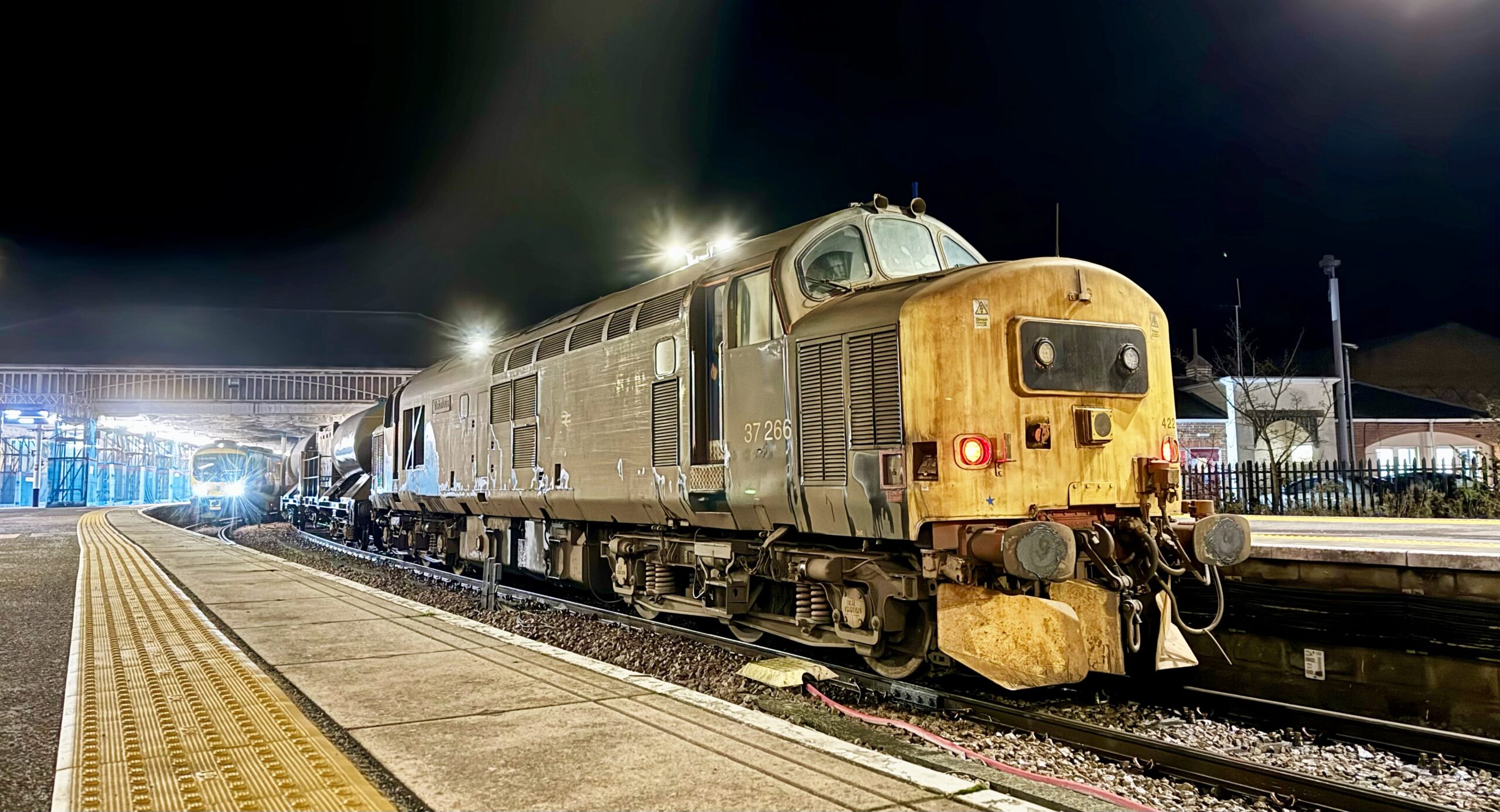
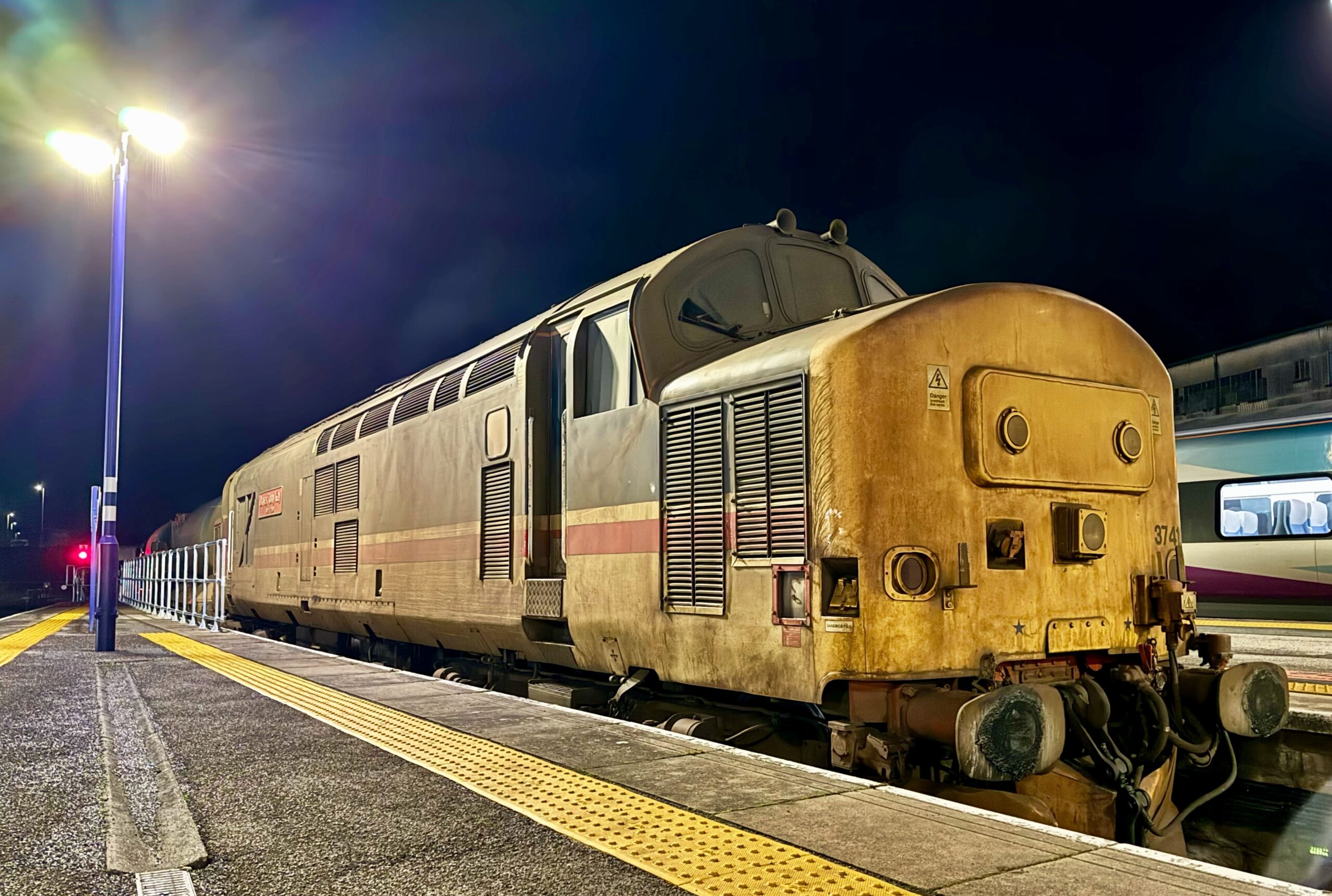
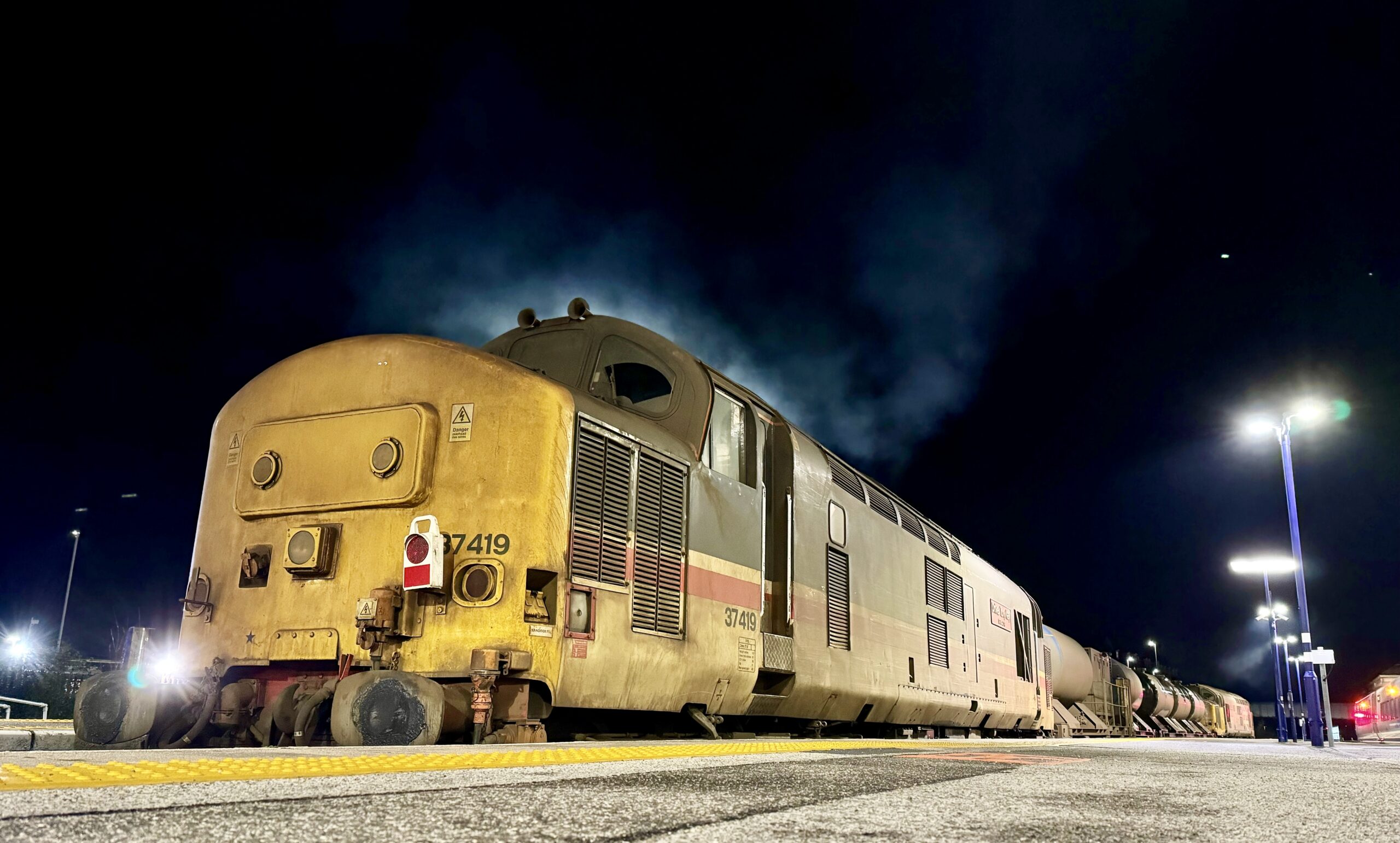
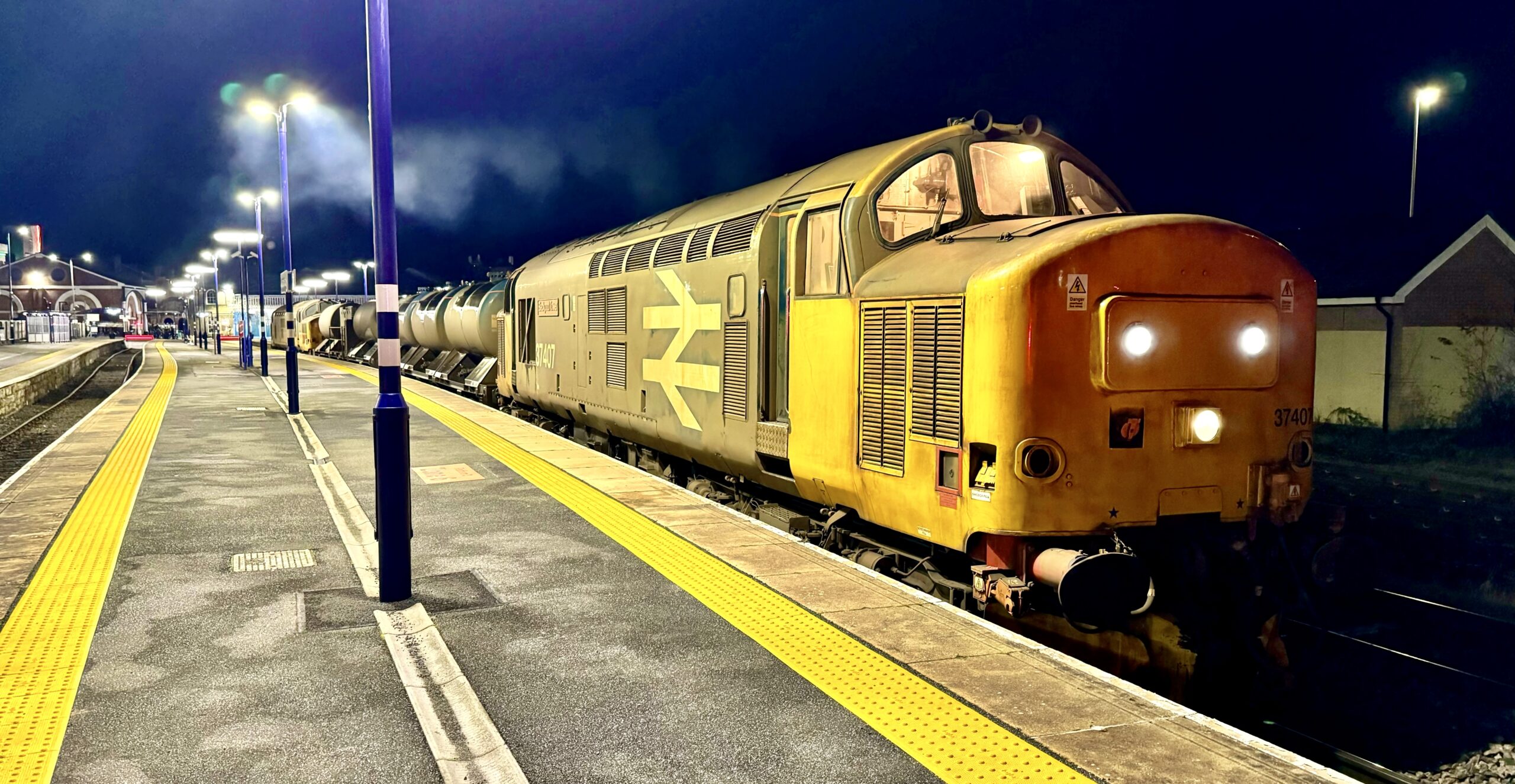
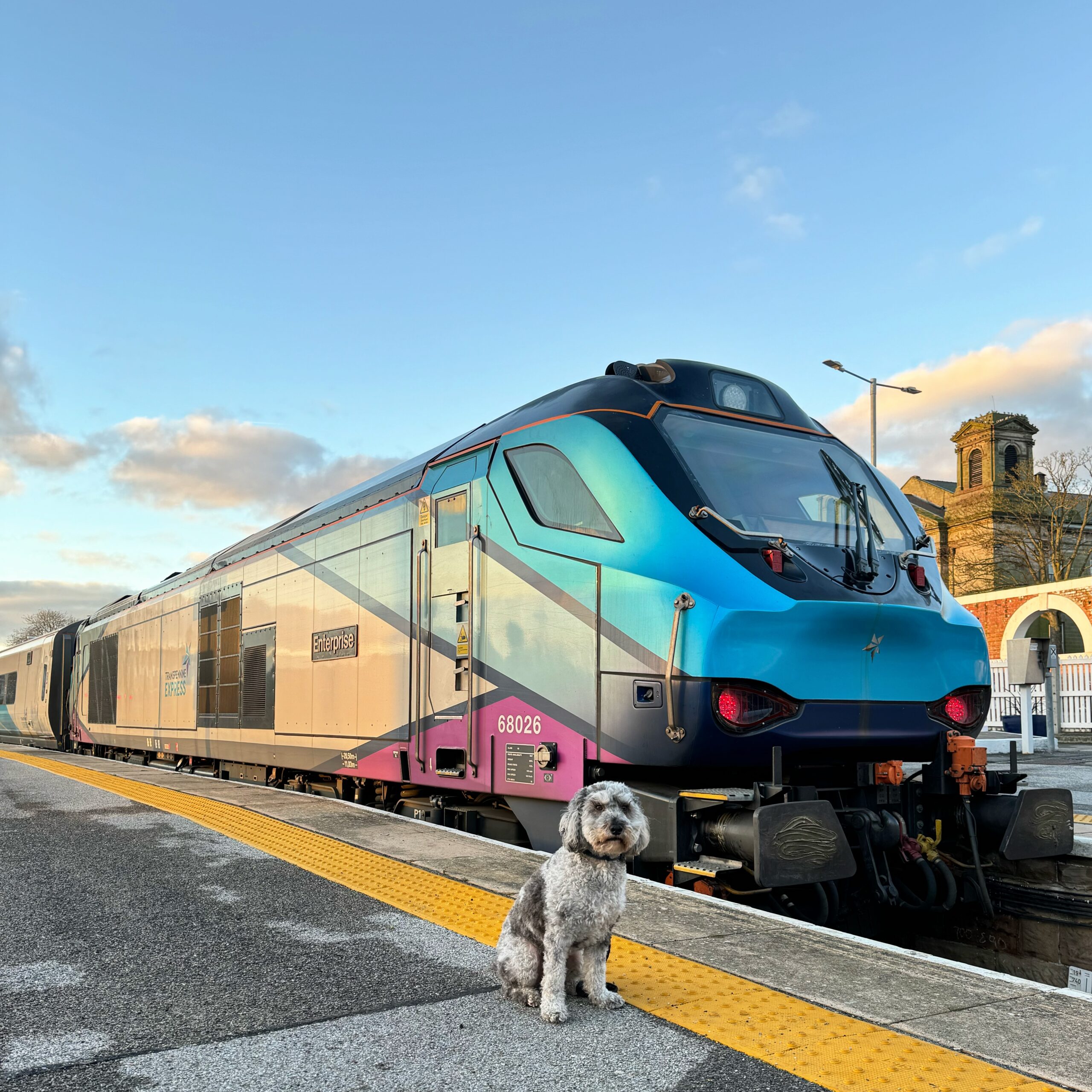
Class 68 No. 68026 ‘Enterprise’ 1U75 1934 Leeds to Scarborough (set TP11) – 06/12/2023Class 68 No. 68030 ‘Black Douglas’ 5K42 1956 Scarborough TMD to Scarborough forming 1K42 2043 Scarborough to York (set TP06) – 06/12/2023Class 68 No. 68021 ‘Tireless’ having arrived at Scarborough working 1U63 1703 York to Scarborough (set TP10) – 05/12/2023Class 68 No. 68027 ‘Splendid’ at Scarborough at the rear of 1U56 1348 Scarborough to York (set TP13) – 05/12/2023Class 185 DMU No. 185101 the following days (06/12/2023) 1U24 0548 Scarborough to Leeds with 68030 ‘Black Douglas’ standing at platform 1 awaiting time to depart with 1U64 1548 Scarborough to York (TP06)- 05/12/2023What should have been a Class 68 working, Class 185 DMU No. 185145 awaits departure working 1U36 0845 Scarborough to York – 06/12/2023Class 185 No. 185101 out of use awaiting the following days (06/12/2023) 1U24 0548 Scarborough to Leeds – 05/12/2023Northern Trains Class 170 DMU No. 170459 having arrived with 2C00 0542 Sheffield to Scarborough – 06/12/2023Class 68 No. 68030 ‘Black Douglas’ having arrived with 1U67 1803 York to Scarborough (set TP06). Class 37 No. 37407 ‘Blackpool Tower’ at the rear of RHTT 3J51 0950 York Thrall Europa to York Thrall Europa – 05/12/202337407 ‘Blackpool Tower’ on RHTT duties working 3J51 0950 York Thrall Europa to York Thrall Europa – 05/12/202337266 ‘Victorious’ on RHTT working 3J51 0950 York Thrall Europa to York Thrall Europa which reverses at Scarborough – 05/12/202337419 ‘Driver Tony Kay 1974 – 2019’ 3J51 0950 York Thrall Europa to York Thrall Europa – 06/12/202337419 ‘Driver Tony Kay 1974 – 2019’ 3J51 0950 York Thrall Europa to York Thrall Europa – 06/12/2023DRS Class 37 No. 37407 ‘Blackpool Tower’ getting ready to depart with 3J51 0950 York Thrall Europa to York Thrall Europa – 06/12/2023
We stayed in Scarborough until Thursday, but before departing for pastures new, we enjoyed a trip over to York in order to sample the “Nova 3” coaching stock, which we found very comfortable and I was impressed with the acceleration of the Class 68 locomotive in charge of the train. I asked a number of TPE staff, from drivers, despatch, ticket office and train guards if they would miss the Class 68’s and Mk5a carriages and was quite surprised that only 10% expressed any disappointment of their impending demise. The phrase “more trouble than they are worth” cropped up numerous times!
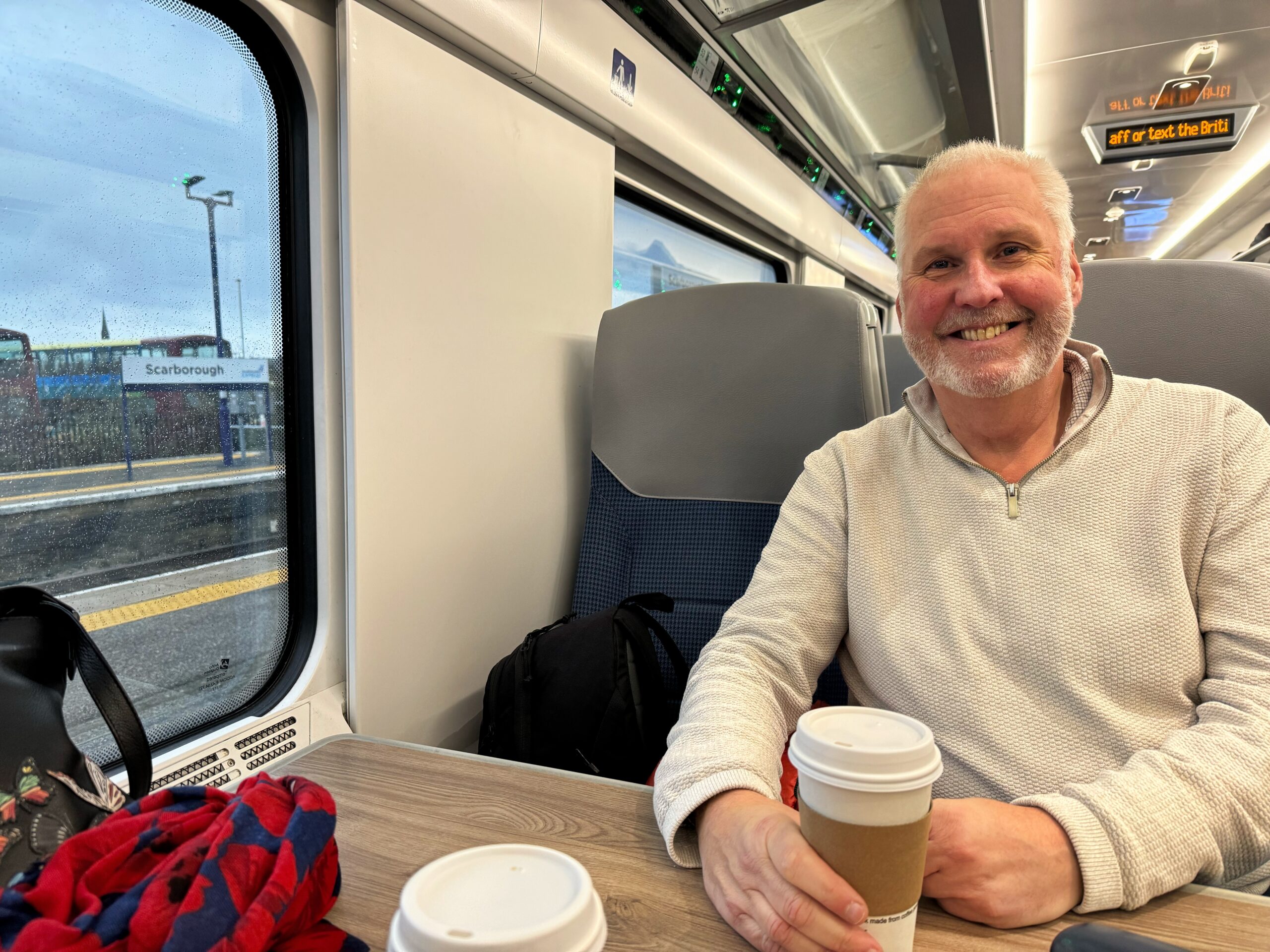
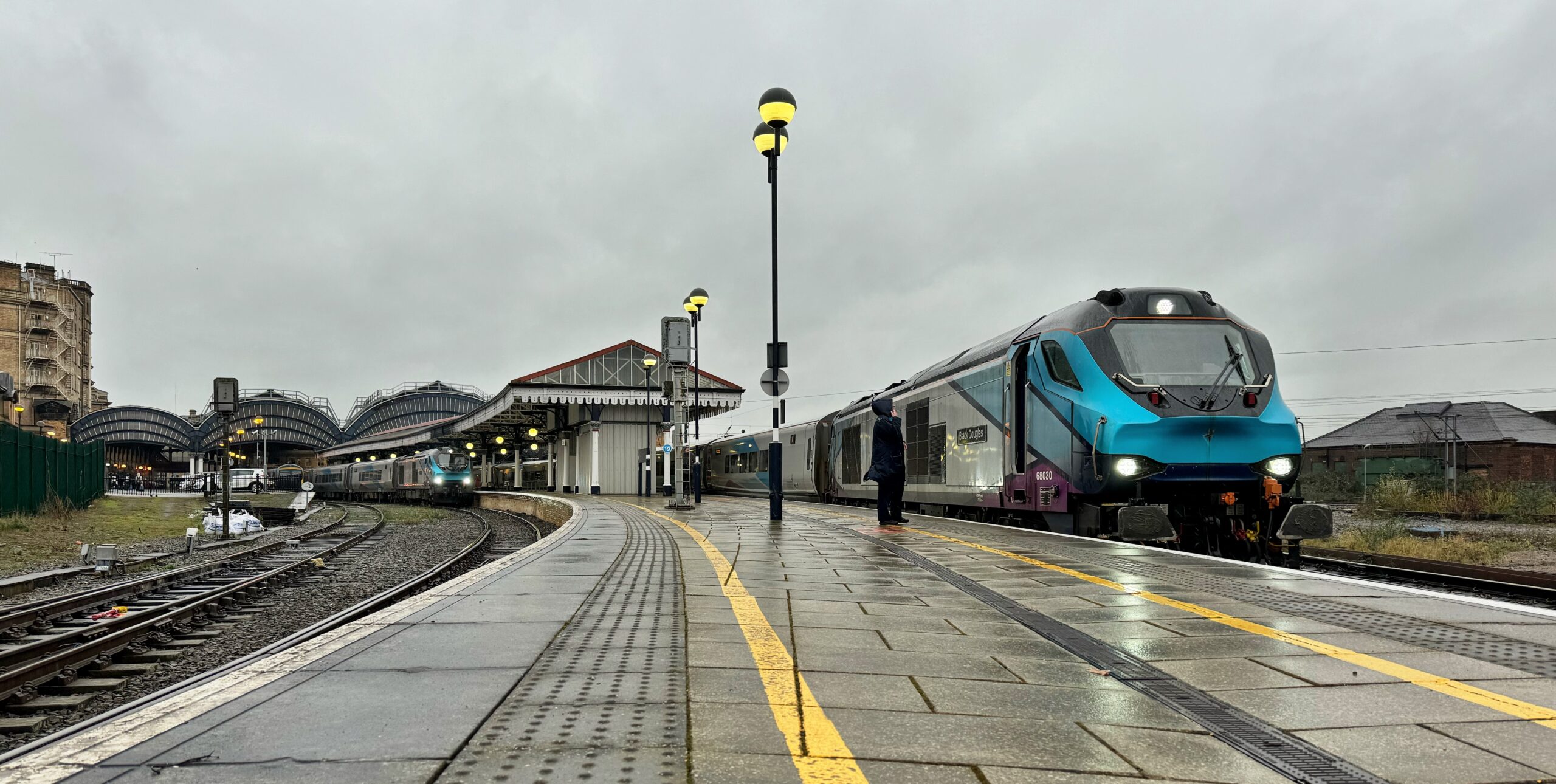
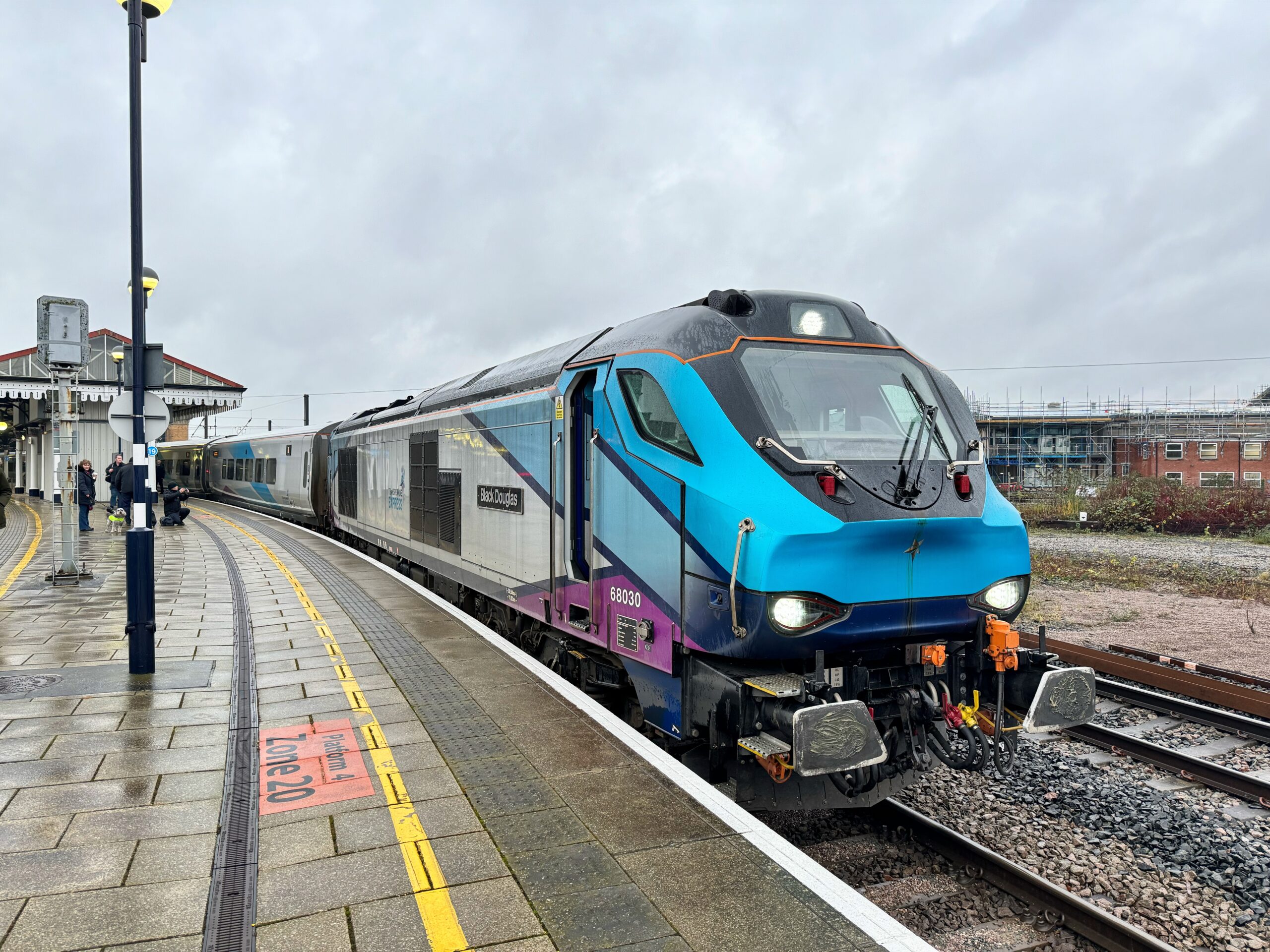
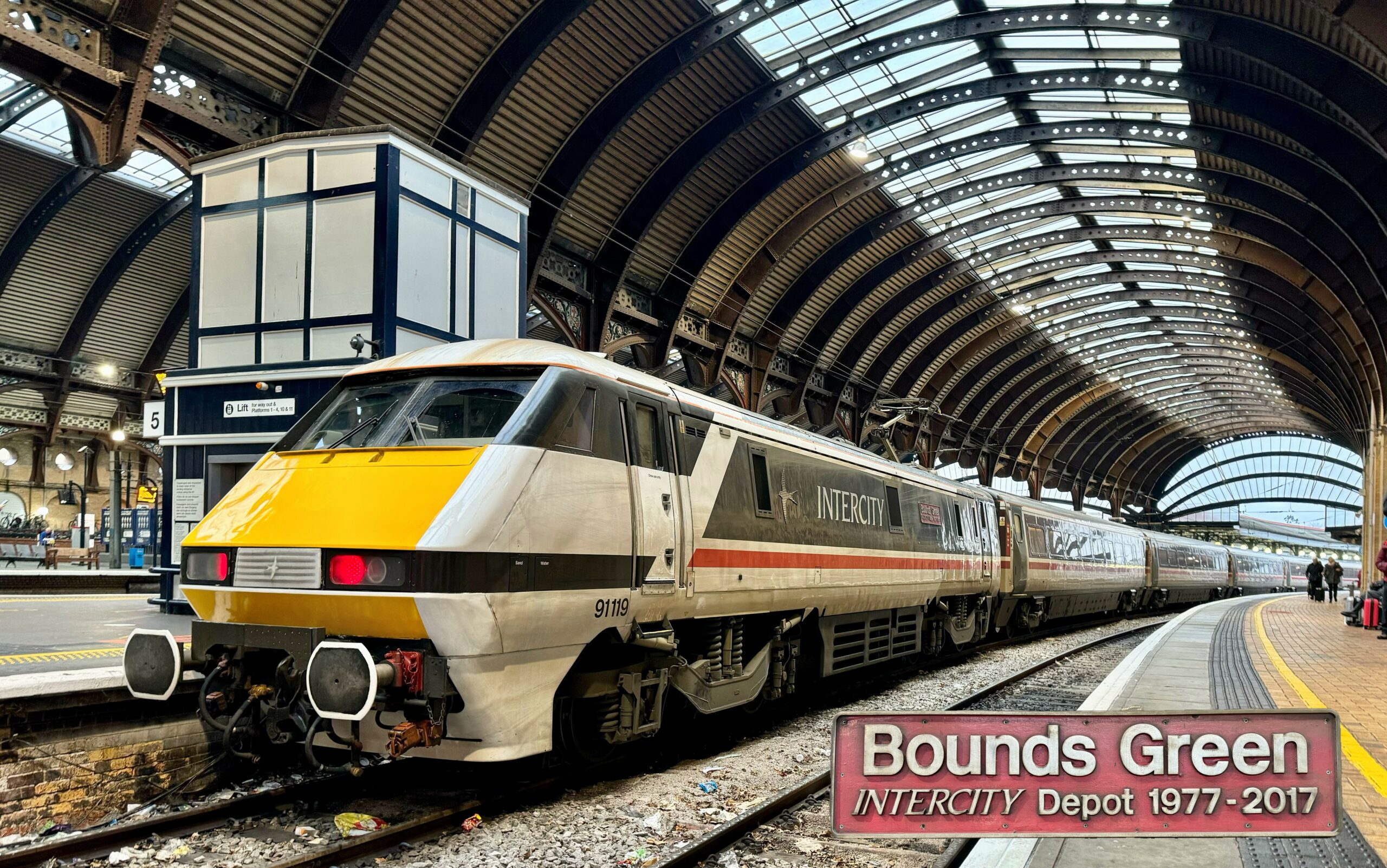
Settling down with a latte for a train journey from Scarborough to York – 07/12/2023Class 68 No. 68030 ‘Black Douglas’ at York at the head of 1U39 1103 York to Scarborough (set TP06) with No. 68026 ‘Enterprise’ 1U40 0948 Scarborough to York (set TP11) in the background – 07/12/2023Class 68 No. 68030 ‘Black Douglas’ at York working 1U39 1103 York to Scarborough (set TP06) – 07/12/2023LNER Class 91 No. 91119 ‘Bounds Green InterCity Depot 1977 – 2017’ in bay platform 6 at York having arrived with 1N81 0906 London Kings Cross to York (set NL13) – 07/12/2023
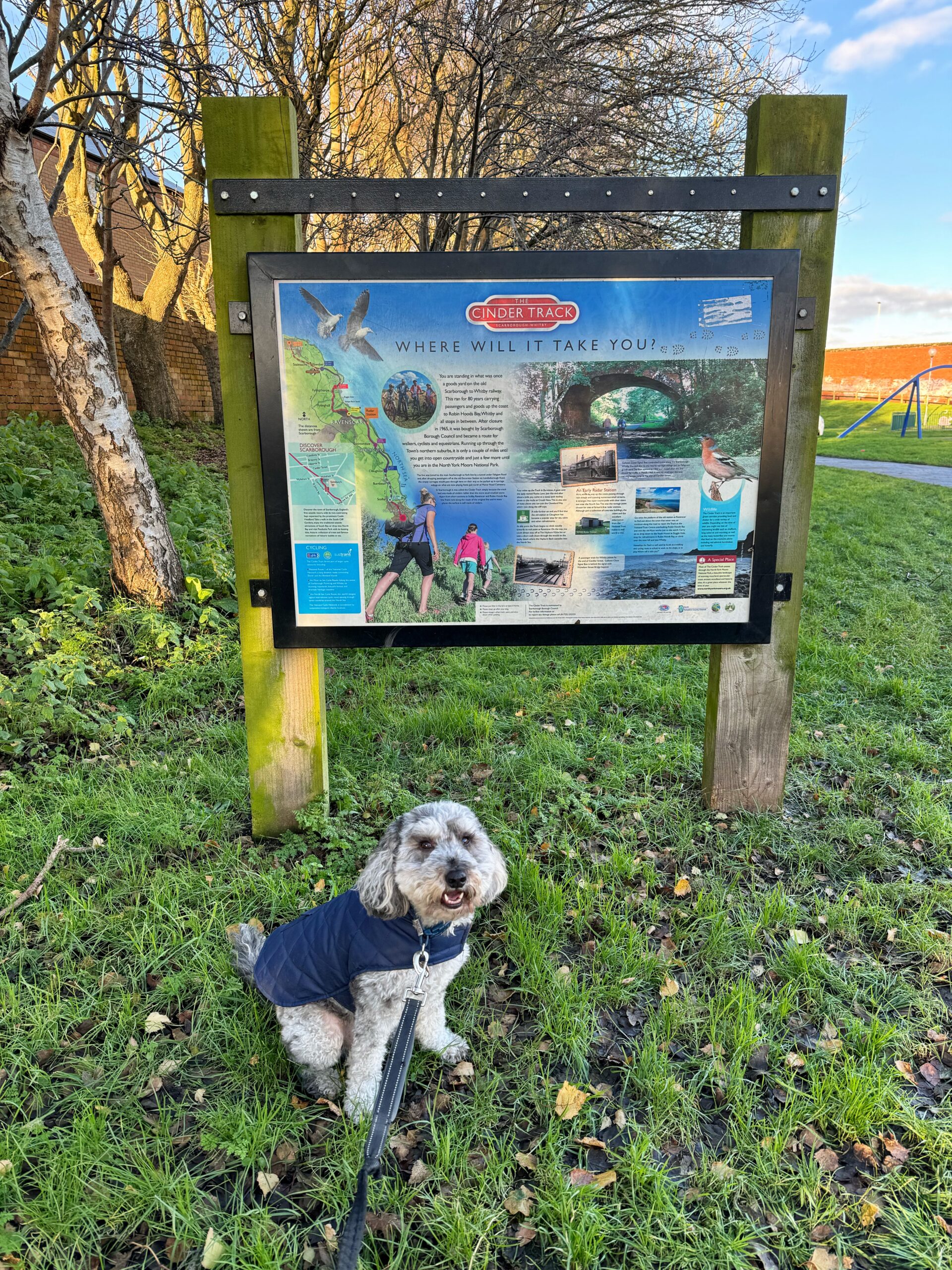
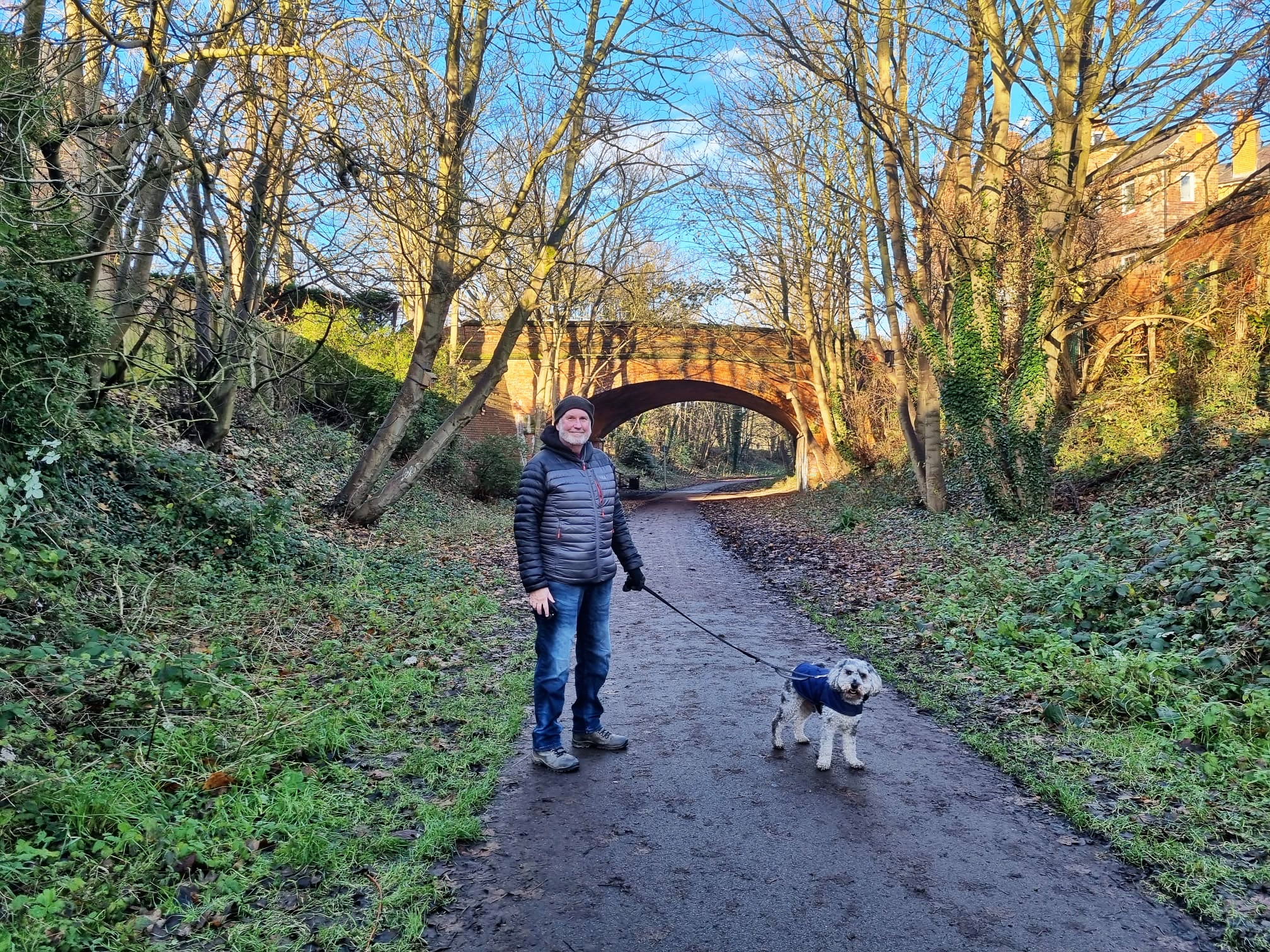
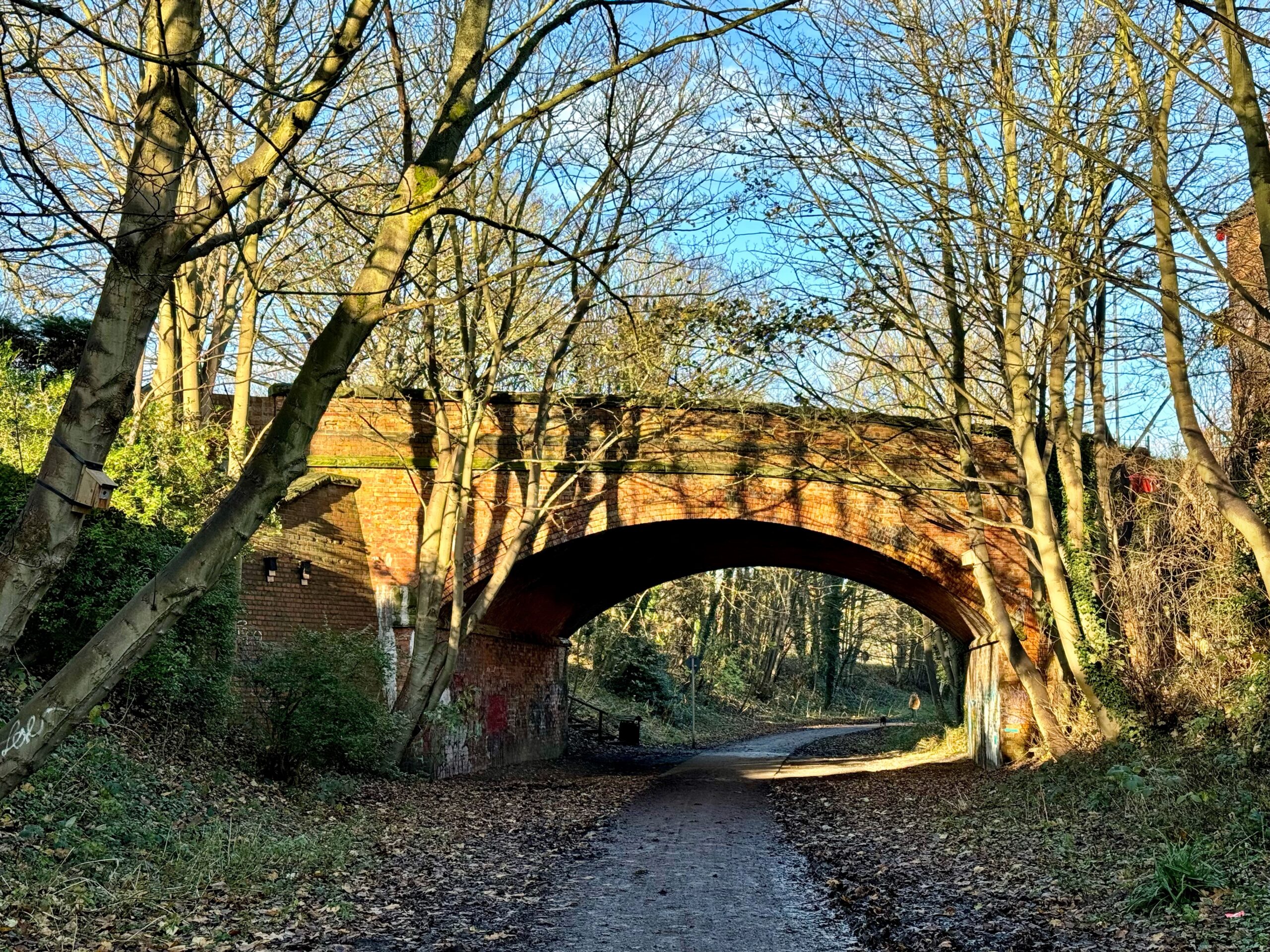
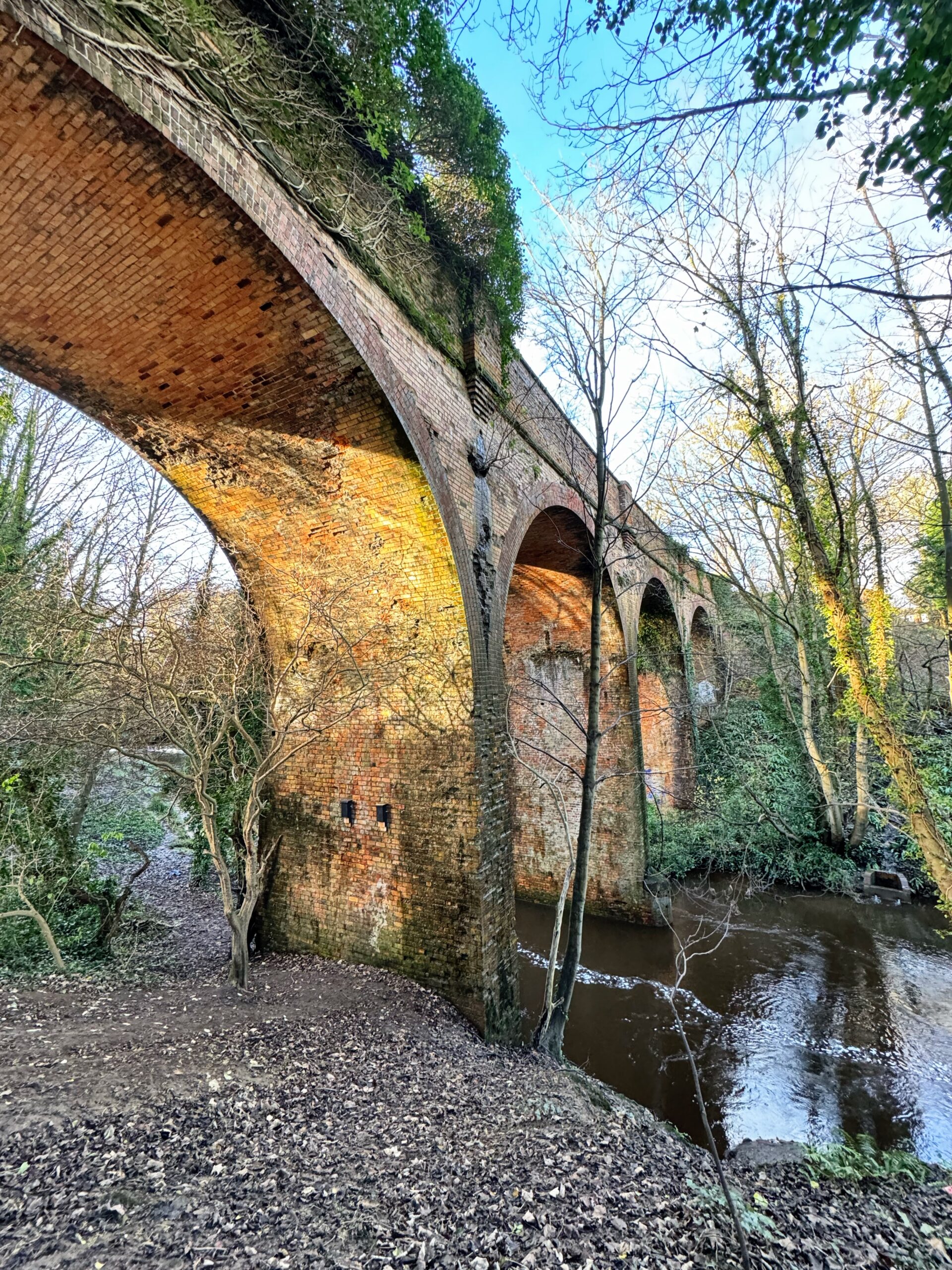
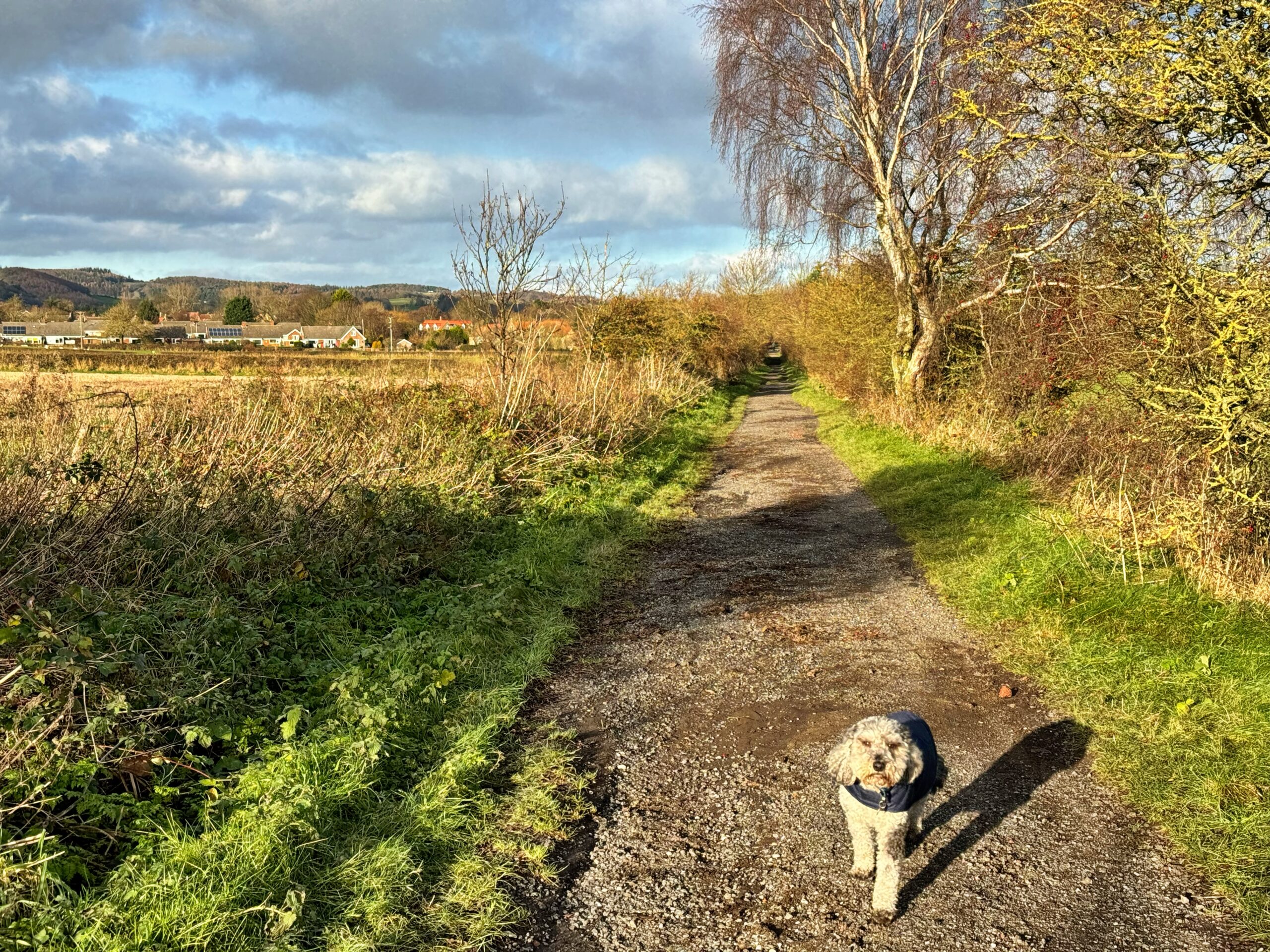
Wednesday was probably our best day where the weather was concerned and we took the opportunity to walk a section of the closed Scarborough & Whitby Railway. The line opened in July 1885 and closed in March 1965 as part of the Beeching Axe. The 21 miles of line traversed the picturesque coast between the two towns serving eight stations. The route, now a multi-use path, is known as “The Cinder Track”.
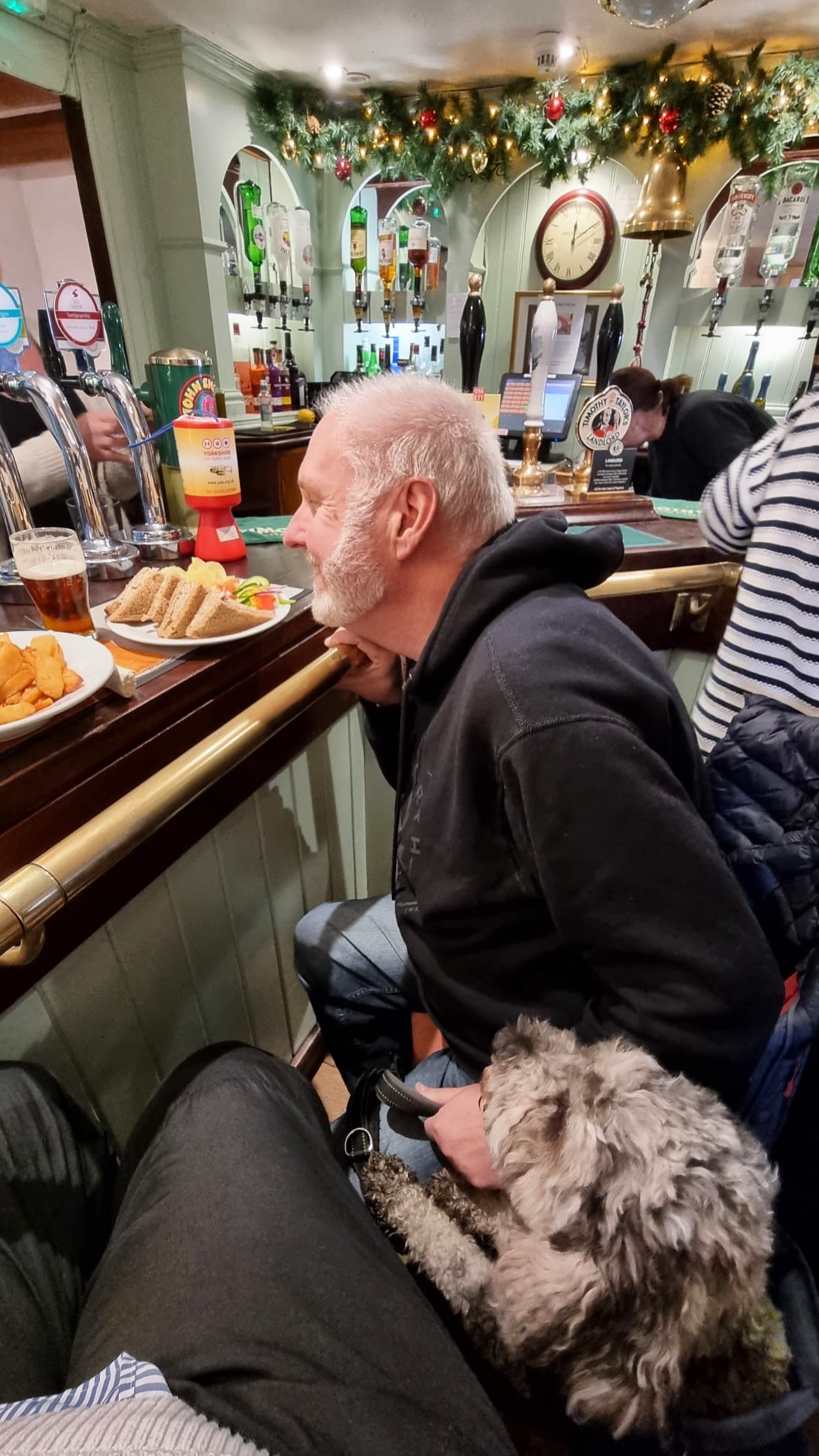
The start of the Cinder Track at the Scarborough end of the trail which is located next to a Sainsbury’s supermarket – 06/12/2023The Trail sets off north through a series of cuttings, passing under several bridges, into suburbia, before skirting alongside the playing fields, at the site of the former Northstead Carriage Sidings – 06/12/2023 (CS)By 1972 all of the railway track had been removed, however, the route remains as a designated trail for walking, cycling and even horse riding. The pathway was made from cinders rather than crushed stone which gives the route its name the Cinder Track. – 06/12/2023The bridge which once carried the railway over Scalby Beck – 06/12/2023We walked as far as the village of Burniston where we were pleased to find “The Three Jolly Sailors”, a Grade II listed pub which was previously a farmhouse dating back to the early 19th century, where, although packed out with pensioners enjoying early Christmas dinners, the staff found us space at the bar for eagerly anticipated refreshments – 06/12/2023There was only one bar stool in the pub, but I was very kindly allowed to use a broken chair (at my own risk) alongside from which I enjoyed my sandwiches and most excellent bowl of chips which I begrudgingly shared with Caroline. Yoshi was served sausages in his own little dish. He may also have had a chip or three – 06/12/2023 (CS)
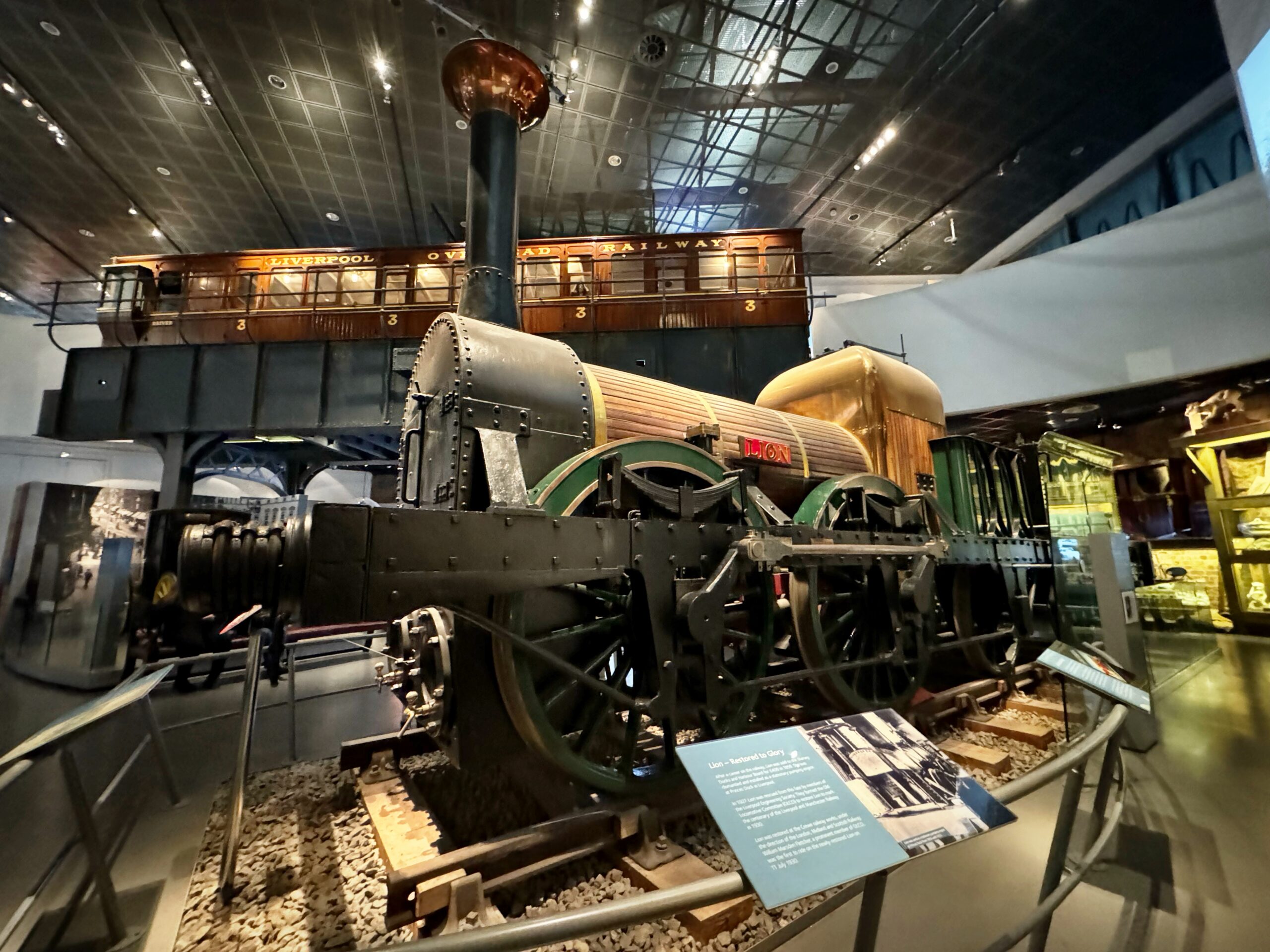
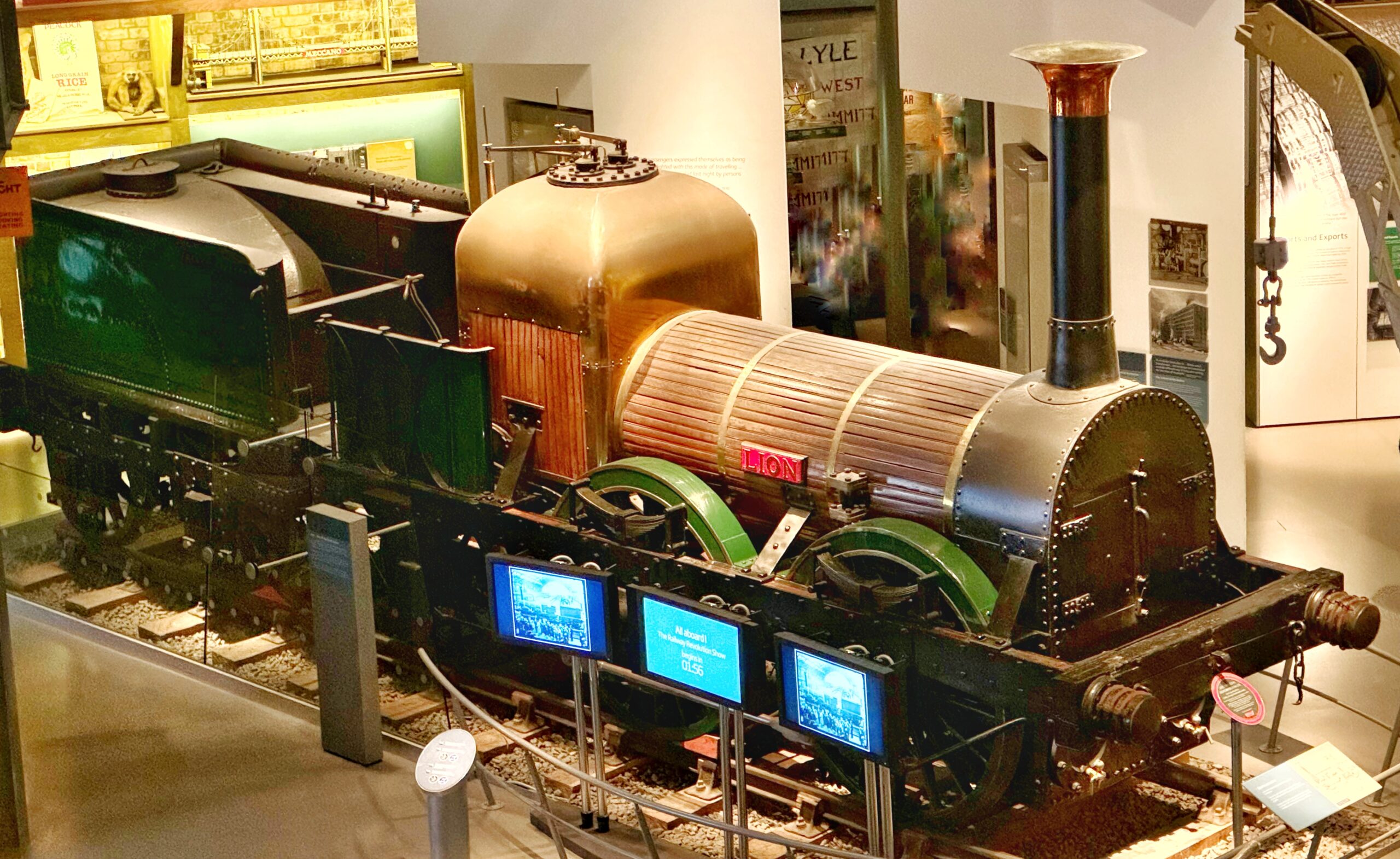
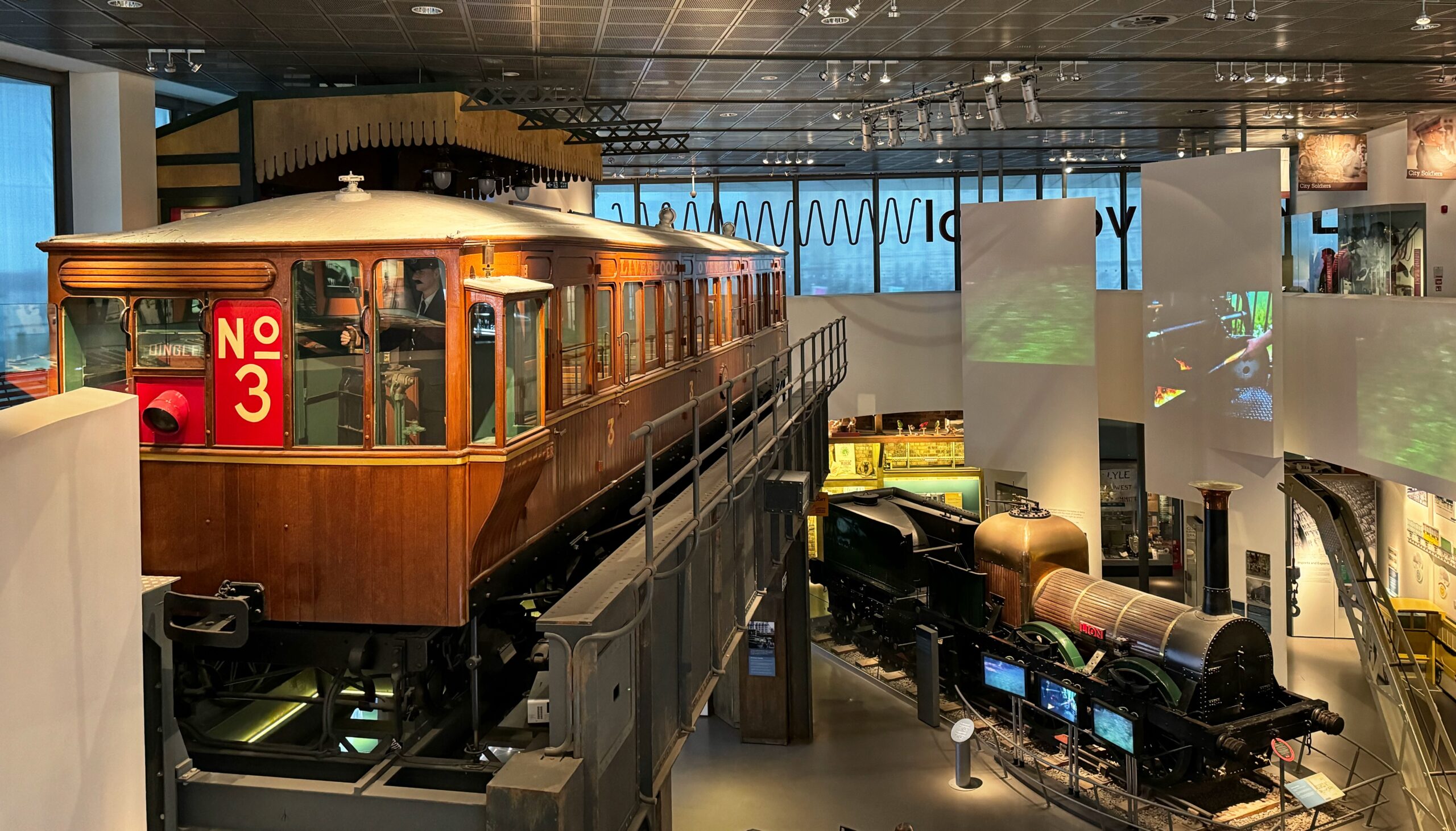
We arrived in Liverpool on Saturday morning after spending a couple of nights with friends near Holmfirth, West Yorkshire. Our first port of call was the Museum of Liverpool and its Land Transport section which is home to Liverpool & Manchester Railway (LMR) 0-4-2 No. 57 ‘Lion’ built by Todd, Kitson & Laird of Leeds. We wrote about this particular locomotives’ starring role in one of my favourite films “The Titfield Thunderbolt” (1953) in March this year and I enjoyed seeing her again. ‘Lion’ actually appeared in three films, the other two being “Victoria the Great” (1937) and “The Lady with the Lamp” (1951).
The Museum of Liverpool, designed by architects 3XN and engineers Buro Happold and built by Galliford Try at a cost of £72 million, opened to the public on 19th June 2011 – 10/12/2023‘Lion’ on display at the Museum of Liverpool with a carriage from the Liverpool Overhead Railway behind which is fixed at the exact height of the original railway – 16 feet above the ground. – 09/12/2023
The LMR ordered two locomotives to haul luggage trains in 1837 as part of a larger order of 6 steam engines, which were named ‘Lion’ and ‘Tiger’. In 1859 ‘Lion’ was sold to the Mersey Docks and Harbour Board and installed as a stationary pumping engine at Princes Dock. She was rescued by members of the Liverpool Engineering Society in 1928 and after restoration at the Crewe railway works she took part in the centenary celebrations of the LMR in 1930, hauling a replica train. During the period prior to the Second World War, ‘Lion’ stood on a plinth at Liverpool Lime Street railway station but was removed in 1941 and placed in storage at Crewe railway works, out of sight apart from her film appearances and railway publicity events. In 1967 she was loaned to the Liverpool Museum by the Liverpool Engineering Society. This was changed to an outright gift in 1970.
‘Lion’ at the Museum of Liverpool – 09/12/2023
In 1980 ‘Lion’ took part in the 150th anniversary celebrations of the Liverpool and Manchester Railway at Rainhill under her own steam. Afterwards, she made a number of working appearances at railway heritage centres and museums until 1989 when ‘Lion’ was withdrawn from steaming for conservation reasons. Following a survey in 1992 which showed that her original structure would need substantial modification if she were to be steamed again, the Trustees of National Museums Liverpool decided, on the basis of her internationally important status, to conserve her for static display only.
A view of the Liverpool Overhead Railway carriage on display at the Museum of Liverpool with Liverpool & Manchester Railway 0-4-2 locomotive No. 57 ‘Lion’ below – 09/12/2023
I really enjoyed the visit to the Museum of Liverpool and learning about the Liverpool Overhead Railway, the world’s first electric elevated railway, built in 1893 to ease congestion along seven miles of Liverpool’s docks. After saying goodbye to Caroline as she went off to meet her friends, Yoshi and I headed to Liverpool James Street Merseyrail station as I had ambitions to catch up with Class 507 EMU No. 507001 which has recently been outshopped in a retro British Rail blue livery wrap as a special project celebrating 45 years of service from the Class 507 and Class 508 trains in a collaboration between Merseyrail, Liverpool City Region Combined Authority, Angel Trains, and Stadler. The first Class 507 arrived at Birkenhead North Depot in 1978 with No. 507001 commencing revenue earning service with the very first Merseyrail train working the 0739 departure from Southport to Liverpool Central in November of that year.
The Class 507/508’s are being replaced by new Class 777 units and rail enthusiast Robert Hampton is aiming to save one of the iconic units for future generations to enjoy by starting The Class 507 Preservation Project.
Yoshi and I availed ourselves to a Merseyrail All Area Daysave ticket for the bargain price of £5.95. Having determined which diagram No. 507001 was working we sat at Liverpool James Street for the unit to pass through. Yoshi was often quite vocal at the passing trains and as we were there for a little while, having just missed 001 on our arrival at the station, a friendly Merseyrail station employee checked we were OK, which was kind. He instantly appreciated why we were waiting and told us all about the services No. 507001 had been running that week.
Class 508 EMU No. 508120 at Liverpool James Street working the 2N30 1407 service to New Brighton – 09/12/2023Class 507 EMU No. 507023 forms the 2W27 1342 departure from Liverpool James Street to West Kirby – 09/12/2023Class 777 No. 777005 pauses at Liverpool James Street as the delayed 2C28 departure for Chester – 09/12/2023Class 507 No. 507001 in retro BR Blue / Merseyrail wrap stands at Liverpool James Street forming 2N31 service to New Brighton – 09/12/2023
After photographing No. 507001 we jumped on the next train to Chester as another of our objectives that day was to record the return departure of Pathfinder Tours “The Chester Christmas Cromptons” headed up by West Coast Railway Co.’s (WCRC) Class 33 Bo-Bo diesel-electric locomotives No.’s 33207 ‘Jim Martin’ and 33029 which were bound for Eastleigh.
Class 507 No. 507018 at Chester having arrived with 2C31 Chester to Chester service via Liverpool – 09/12/2023West Coast Railways Class 33 No.’s 33207 ‘Jim Martin’ and 33029 at rest in Chester sidings having arrived with Pathfinder Tours “Chester Christmas Cromptons” from Eastleigh – 09/12/2023West Coast Railways Class 47 No.47826 at the rear of Pathfinder Tours “Chester Christmas Cromptons” waiting to run ECS into platform 3 for the return run to Eastleigh – 09/12/2023Class 197 DMU No. 197101 at Chester working 1H90 1443 Llandudno to Manchester International Airport. uilt by CAF, based on its “Civity” platform. They are currently operated by Transport for Wales (TfW), split into 51 two-car units and 26 three-car units. – 09/12/2023Class 221 Voyager DMU in Avanti West Coast livery No. 221108 (once named ‘Sir Ernest Shackleton’ while with Virgin Trains) at Chester working 1A64 1438 Llandudno Junction to Crewe – 09/12/2023Northern Trains Class 195 DMU No. 195117 forms 1E68 1529 Chester to Leeds. from the Civity family manufactured by CAF, owned by Eversholt Rail Group and currently operated by Northern Trains. A total of 58 units have been built; 25 two-car units and 33 three-car units – 09/12/2023Class 150 DMU No. 150131 works Northern Trains 2H32 1556 Chester to Manchester Piccadilly service. The 150’s were developed and constructed by British Rail Engineering Limited at York Carriage Works between 1984 and 1987 for use on regional services across the UK – 09/12/2023West Coast Railways Class 33 No.’s 33207 ‘Jim Martin’ and 33029 at Chester awaiting departure of Pathfinder Tours “Chester Christmas Cromptons” 1Z35 1610 Chester to Eastleigh – 09/12/2023With the sun setting behind them, West Coast Railways Class 33 No.’s 33207 ‘Jim Martin’ and 33029 at Chester awaiting departure of Pathfinder Tours “Chester Christmas Cromptons” 1Z35 1610 Chester to Eastleigh – 09/12/2023
After watching the Crompton’s heading South, we returned to Liverpool on one of the new Class 777 units.
Class 507 No.507001 was on the New Brighton circuit on the day of our visit, so we couldn’t resist taking an evening trip from Liverpool to New Brighton and back. The unit is seen having arrived with 2N43 16:53 New Brighton to New Brighton and formed the subsequent departure 2N47 17:53 New Brighton to New Brighton – 09/12/2023Yoshi appreciated the retro British Rail /Merseyrail livery of Class 507 No. 507001 at New Brighton – 09/12/2023Class 507 No. 507001 at Liverpool James Street platform 1 arriving with 2N43 16:53 New Brighton to New Brighton – 09/12/2023 Class 319 EMU’s first introduced by British rail in 1987 are currently being phased out. Originally their last day of service with Northern Trains was to be 9th December 2023, but they have a slight reprieve as the planed withdrawal of the NT Class 319 fleet has be delayed until January 2024. No. 319385 is stood out of service at Liverpool Lime Street. It should have been working service to Wigan – 09/12/2023Yoshi with Northern Trains Class 319 No. 319385 at Liverpool Lime Street – 09/12/2023London North Western Railway Class 350403 ready to depart Liverpool with 1G65 1833 Liverpool Lime Street High Level to Birmingham New Street. The Class 350’s are members of the Desiro family and were built by Siemens Transportation Systems between 2004 and 2014 – 09/12/2023TPE Class 185 No. 185125 awaiting departure from Liverpool Lime Street with the 1K33 1854 service to Hull. Because of disruption on the network due to high winds that evening, the service left 51 minutes late – 09/12/2023Yoshi with the Royal Liver Building behind. Opened in 1911, the building was once the purpose-built home of the Royal Liver Assurance group, which had been set up in the city in 1850 to provide locals with assistance related to losing a wage-earning relative. One of the first buildings in the world to be built using reinforced concrete, the Royal Liver Building is one of the most recognisable landmarks in the city of Liverpool with its two fabled Liver Birds, which watch over the city and the sea. Legend has it that if the two birds were to fly away, the city would cease to exist – 10/12/2023The Fab Five! The Beatles statue, by artist Andrew Edwards, on the Pier Head in Liverpool depicts the larger-than-life Fab Four casually strolling along the River Mersey. The Beatles Statue was donated by the musical group’s home venue, The Cavern Club, and was unveiled in 2015 on the 50th anniversary of their final public appearance in the city – 09/12/2023The Great Western Railway (GWR) warehouse and offices at Liverpool. The GWR never ran trains to Liverpool though it offered through passenger fares to the city via the Birkenhead Railway (which it operated jointly with the London & North Western Railway (LNWR), in competition with the Cheshire Lines) and connecting ferries from its terminus at Woodside. Goods were transported by barge across the River Mersey from Morpeth Dock and landed at the Manchester Dock where this warehouse was built around 1890, incorporating earlier offices from the 1850’s. The Manchester Dock was filled in during 1928 using spoil from the construction of the Kingsway road tunnel leaving the GWR buildings high and dry beside the Canning graving docks, inaccessible by rail or water. Once restored to their former splendour, the buildings form part of Liverpool’s World Heritage site – 10/12/2023
On our way home, we had a planned stop in Shrewsbury for a visit to the Christmas Market being held in the prison, which was closed in 2013 and is now a visitor attraction. The prison is located adjacent to Shrewsbury railway station, and I couldn’t resist a quick visit!
TfW Class 153 DMU No. 153353 arriving at Shrewsbury with 1W55 0856 Swansea to Manchester Piccadilly – 10/12/2023MPV No. DR98955 arrives at Shrewsbury as the 3S02 0940 Kings Norton On Track Plant Depot to Kings Norton On Track Plant Depot RHTT working – 10/12/2023Shrewsbury Severn Bridge Signal Box (1903) built in LNWR style, the impressive Grade 2-listed three-storey redbrick building is a marvel of Edwardian engineering, standing imposingly at the south end of Shrewsbury station where lines to Hereford and Wolverhampton diverge. It is the largest surviving mechanical signal box in Great Britain and is rail-locked within a triangular site that will make access difficult for any future reuse. However, Network Rail currently believes replacing the current mechanical semaphore signalling system in the area with colour-light signals would not be economical and envisages it remaining in operation until at least 2030, and possibly as long as 2050 on current plans. We shall be back! – 10/12/2023
VIDEO CLIPS
Video clips from our recent travels:
Class 68 locomotives on the TPE Scarborough / York diagram during their final week of service – December 2023
An hour at York watching; 68026 ‘Enterprise’ 1U40 0948 Scarborough to York (set TP11) 68030 ‘Black Douglas’ 1U39 1103 York to Scarborough (set TP06) 801207 (LNER) 1E07 0832 Edinburgh to London Kings Cross 802203 (TP) 9M10 1001 Newcastle to Liverpool Lime Street 66118 6M16 0540 Wilton EFW Terminal to Knowsley Freight Terminal 170460 2C33 1110 York to Leeds 195129 1B25 1123 York to Blackpool North 91119 ‘Bounds Green InterCity Depot 1977 – 2017’ 1N81 0906 London Kings Cross to York (set NL13) 802219 9E09 0924 Liverpool Lime Street to Newcastle / 180105 1A64 0954 Sunderland to London Kings Cross 185112 1P68 0951 Saltburn to Manchester Airport 800201 5Z60 1050 Doncaster Carr Iep Depot to Newcastle 802219 1S10 0930 London Kings Cross to Edinburgh 801229 1E08 0900 Edinburgh to London Kings Cross 170472 2C85 1142 York to Leeds 68026 ‘Enterprise’ 1U43 1203 York to Scarborough (set TP11) – 07/12/2023
Rail Head Treatment Trains at Scarborough and Shrewsbury during the final days of operation in 2023
“The Chester Christmas Cromptons” railtour departing Chester -09/12/2023
For The Record
06/12/2023 and 07/12/2023 – DB Cargo Class 66 No.’s 66111 and 66192 worked 6N70 2304 Eastleigh East Yard to Branksome and the associated return 6N70 0410 Bournemouth to Eastleigh East Yard. A further engineers possession train scheduled for the following night run by GBRf was cancelled.
10/12/2023 – Network Rail Video Inspection Unit VIU3 No. 153385 worked 2Q30 1540 Eastleigh East Yard to Westbury Down T.C via Bournemouth
That’s all folks! All that remains is for Yoshi and I to thank you for visiting our page and wish you a very Merry Christmas 2023. We plan on being back for our final blog entry of the year next week. So, until then – Be seeing you!
Yoshi and Class 68 No. 68026 ‘Enterprise’. The “Nova 3” set was scheduled to hang about at Scarborough all day before working 1U72 1748 Scarborough to Leeds (set TP11) – 06/12/2023
Yoshi with English Electric Class 40 No. D345 (40145) in Salisbury awaiting departure of 1Z42 Salisbury to Burton On Trent “Winchester Christmas Excursion” – 25/11/2023
November 24th 2023 to November 30th 2023
DRS Class 68 No. 68012 at Hamworthy working driver training move 0Z67 0917 Southampton Central to Winfrith Sidings – 24/11/2023
The morning of Friday November 24th produced an early Christmas present when Direct Rail Services (DRS) ran what is believed to be a driver training / route learner light engine move to Winfrith as 0Z67 0917 Southampton Central to Winfrith Sidings and its associated return 0Z68 1140 Winfrith Sidings to Willesden Brent DRS with Chiltern liveried Class 68 No. 68012, which is as far as I know, the first locomotive in this livery to make it to Dorset. Chiltern Class 68 hauled services operate out of London Marylebone.
DRS Class 68 No. 68012 having passed through Hamworthy as 0Z67 0917 Southampton Central to Winfrith Sidings – 24/11/2023DRS Class 68 No. 68012 at Dorchester South working 0Z68 1140 Winfrith Sidings to Willesden Brent DRS – 24/11/2023 (G E Barrett)DRS Class 68 No. 68012 runs light engine through Hamworthy as 0Z68 1140 Winfrith Sidings to Willesden Brent DRS – 24/11/2023
On Saturday we took another trip to Swindon in a bid to see English Electric Type 4 Class 40 No. D345 (40145) hauling Pathfinders Tours “Winchester Christmas Excursion” which originated from Burton upon Trent and was bound for Salisbury. I’d chosen Swindon in the hope that I’d get another chance of getting a photo of the Class 67 top and tailed Rail Head Treatment Train (RHTT) which is operating out of Swindon Transfer Yard. But once again , due to my lack of checking on how the train was running, I managed to miss it by a matter of moments as I was unaware it was 150 minutes ahead of time! I also failed to get a photograph of the Class 40 storming through Swindon because the train was helpfully blocked from my view by a fellow enthusiast at the critical time. However friend of this blog @da_buckley967 has kindly shared some images from the day which can be seen below.
Class 40 No. D345 (40145) on the approach to Swindon with the outward “Winchester Christmas Excursion” 1Z40 0707 Burton On Trent to Salisbury – 25/11/2023 (@da_buckley967)Class 47 No. D1935 (47805) ‘Roger Hosking MA 1925 – 2013’ approaches Swindon working “The Bath Christmas Statesman” 1Z88 0543 Chesterfield to Bath Spa rail tour – 25/11/2023 (@da_buckley967)Class 47 No. D1935 (47805) ‘Roger Hosking MA 1925-2013’ at the head of “The Bath Christmas Statesman” 1Z88 0543 Chesterfield to Bath Spa rail tour at Swindon – 25/11/2023Class 47 No. 47712 ‘Lady Diana Spencer’ at the rear of “The Bath Christmas Statesman” 1Z88 0543 Chesterfield to Bath Spa rail tour at Swindon – 25/11/2023DB Cargo Class 66 No. 66005 ‘Maritime Intermodal One’ waits in Swindon East Loop with 6C03 0928 Northolt Sidings to Severnside SITA at Swindon as Class 800 IET No. 800031 approaches Swindon working the 1B13 1148 London Paddington to Swansea service – 25/11/2023 (@da_buckley967)DB Cargo Class 66 No. 66005 ‘Maritime Intermodal One’ hauls 6C03 0928 Northolt Sidings to Severnside SITA at Swindon – 25/11/2023 (@da_buckley967)DB Cargo Class 66 No. 66005 ‘Maritime Intermodal One’ hauls 6C03 0928 Northolt Sidings to Severnside SITA at Swindon – 25/11/2023Freightliner Class 66 No. 66622 stands in Swindon East Loop working 6V28 1306 West Drayton Frays Sidings to Whatley Quarry Freightliner Heavy Haul as IET Class 800 No. 800316 passes with 1C13 1200 London Paddington to Bristol Temple Meads – 25/11/2023 (@da_buckley967)Freightliner Class 66 No. 66622 running 230 minutes early on the approach to Swindon working 6V28 1306 West Drayton Frays Sidings to Whatley Quarry Freightliner Heavy Haul – 25/11/2023 (@da_buckley967)Freightliner Class 66 No. 66622 running 230 minutes early at Swindon working 6V28 1306 West Drayton Frays Sidings to Whatley Quarry Freightliner Heavy Haul – 25/11/2023
We found the Class 67’s and its RHTT train parked up in Swindon Transfer Yard as we popped to Tesco to fill the car with petrol for the journey home. Some rather desperate shots over a fence are posted below:
Colas Class 67 No. 67027 at Swindon Transfer Yard – 25/11/2023Colas Class 67 No.’s 67027 and 67023 ‘Stella’ at Swindon Transfer Yard having arrived 150 minutes early with the 3S32 RHTT working from Cheltenham – 25/11/2023Colas Class 67 No. 67023 ‘Stella’ at Swindon Transfer Yard – 25/11/2023
We decided on another attempt at capturing the Class 40, so on our way back to Dorset, our next port of call was Salisbury where the excursion train was due to depart at 1540.
Class 40 No. D345 (40145) at platform in Salisbury awaiting departure of 1Z42 Salisbury to Burton On Trent “Winchester Christmas Excursion” – 25/11/2023
For the Record
Colas Class 37 No. 37607 worked test train 3Q07 2031 Exeter Riverside N.Y. to Exeter Riverside N.Y.through North Dorset in the early hours of 24th November 2023.
Tuesday 28th November was scheduled for another DRS run to Winfrith for the collection of more low level nuclear waste. However, due to driver sickness, the train was cancelled shortly before its timed departure from Crewe in the early hours of the morning. Scheduled locomotives on the associated workings 6Z62 0100 Crewe Coal Sidings (DRS) to Winfrith Sdgs / 6Z95 1551 Winfrith Sdgs to Crewe Coal Sidings (DRS) were Class 68 No.’s 68006 and 68034. No. 68006 carries a green livery which aims to showcase the environmental benefits of rail freight and how a diesel locomotive can reduce emissions by using Hydrotreated Vegetable Oil (HVO) fuel and would have been the locomotives first visit to Dorset.
Class 68 No. 68006 in its special green livery at Crewe Gresty Road during the 2022 DRS Open Day – 16/07/2022
The recent HST farewell railtour to Swanage from Leeds raised almost £65,000 for The Brain Tumour Charity in memory of CrossCountry colleague Jo Taylor.
XC Class 43 No. 43008 crosses Corfe Viaduct working “The Bournemouth Belle” 1Z25 1310 Swanage to Bournemouth part of the CrossCountry HST Farewell celebrations – 26/09/2023
Train services between Bournemouth and Woking will be significantly reduced from Friday 8th December 2023 to Sunday 10th December due to emergency works to repair a landslip adjacent the railway near Woking following the discovery of cracks up to 148ft long and 3ft deep.
Members of the RMT union have voted to accept a pay deal from 14 train operating companies, ending their involvement in a series of long running strikes. Train drivers, represented by the union Aslef, will continue with their rolling programme of walkouts between 2nd and 8th December however, with different train companies affected on each day. Drivers will also enforce an overtime ban from 1st to the 9th December which will also cause disruption to railway timetables.
From the Archive
Friend of this blog @smithy.377 has very kindly sent us the following images and video of Colas Class 67’s on the RHTT circuit from a couple of years ago, just so I could see what it might look like in operation having narrowly missed this formation twice now!
Class 67 No. 67023 at Gloucester leading on RHTT 3S33 Cheltenham Lansdown Loop to Swindon Transfer – 23/11/2021 (@smithy.377)Class 67 No. 67023 top and tails 3S33 Cheltenham Lansdown Loop to Swindon Transfer with classmate No. 67027 at Gloucester – 23/11/2021 (@smithy.377)Class 67 No. 67027 at the rear of 3S33 Cheltenham Lansdown Loop to Swindon Transfer departing Gloucester – 23/11/2021 (@smithy.377)Class 67 No.’s 67027 and 67023 work 3S33 Cheltenham Lansdown Loop to Swindon Transfer through Gloucester – 23/11/2021 (@smithy.377)
Video of Class 67’s working an RHTT at Gloucester in November 2021 courtesy of @smithy.377
Mainline steam at Swindon:
After working Santa and Mince Pie specials in the West London area in December 1994, Ivatt Class 2 No. 46521 and BR Standard Class 4 2-6-4T No. 80079 worked a railtour from London back to the Severn Valley Railway. The pair are seen at Swindon on 1st January 1995
Class 47/7 No. 47712 then named ‘Artemis’ working Steam Dreams “The Sunny South Special” in August 2005:
Steam Dreams “The Sunny South Special” with Class 47 No. 47712 and unique BR Standard Class 8 4-6-2 Pacific locomotive No. 71000 ‘Duke of Gloucester’ at Bournemouth working 1Z91 0836 Kensington Olympia to Weymouth. The Duke had failed at Totton on the outward leg and was rescued by the Class 47 which worked the return 1Z92 1825 Weymouth to Kensington Olympia solo – 03/08/2005
Thank you for reading and as always for your commments and corrections. We are taking a short break and will be back in a couple of weeks. Be seeing you!
GBRf Class 57 No.’s 57306 ‘Her Majesty’s Railway Inspectorate’ and 57310 ‘Pride of Cumbria’ head into the yard after reversing in Tonbridge station working 3W01 0907 Tonbridge West Yard GBRf to Tonbridge West Yard GBRf – 19/11/2023
November 18th 2023 to November 23rd 2023
I may have mentioned previously that I have a list of locomotives or unit trains I would very much like to photograph. These include named examples to livery variations. One such loco is GB Railfreight’s (GBRf) Class 66 No. 66743 which can be usually found North of The Border operating the luxury Belmond Royal Scotsman train along with sister locomotive No. 66746. GBRf took over the running of these excursion trains from West Coast Railways (WCR) in 2016. Outside the Scottish railtour season, the Royal Scotsman locos have to earn their keep on more mundane tasks, and last week No. 66743 was shuttling backwards and forwards from Scunthorpe or Doncaster to Eastleigh East Yard on freight or engineers related workings. At least until the weekend when she ended up on one of the engineering trains involved in the 16 day closure of the railway line between Salisbury and Yeovil Junction. This, I observed, meant she was stabled at Eastleigh East Yard on Sunday following her outing to Wiltshire. So with hopeful abandon, off I set at 0730 thinking the locomotive might well be parked in an advantageous position for a photo. Unfortunately, this was not to be the case with No. 66743 being somewhat obscured by a row wagons. It’s like that, this hobby, you win some and you lose some. The trick is not to be disheartened because next time, things may well go your way.
Belmond Royal Scotsman liveried Class 66 No. 66743 partially hidden behind wagons in Eastleigh East Yard – 19/11/2023
While I was in Eastleigh I took advantage of the lull in between rain showers to walk Yoshi and photograph other trains parked up.
Class 66 No. 66303 stands in Eastleigh East Yard – 19/11/2023Class 66 No. 66730 ‘Whitemoor’ alongside stablemate No. 66303 at Eastleigh East Yard – 19/11/2023GBRf Class 66 No. 66740 ‘Sarah’ stands at Eastleigh CTT Forwardings – 19/11/2023A view across to Eastleigh East Yard – with Class 66 locomotives No.’s 66730/66303/66740 resting between duties – 19/11/2023Class 66 No. 66782 at Eastleigh East Yard alongside a Class 08 shunter – 19/11/2023Class 08 No. 08511 in Eastleigh East Yard – 19/11/2023Colas Class 70 No. 70810 at Eastleigh – 19/11/2023Class 153 DMU Network Rail Video Inspection Unit No. 153385, Eastleigh – 19/11/2023
Eschewing a FatMacs breakfast (I’m on a diet, don’t you know), I decided to press on and drive over to Tonbridge in the hope that the Rail Head Treatment Trains (RHTT) based there would be engaged in leaf clearing as runs were scheduled across the day to and from Tonbridge West Yard. These are dependant on requirements and don’t always run however. Coincidentally, we started this blog two years ago on November 22nd 2021 with a brief clip of a steam hauled Belmond British Pullman tour through Tonbridge taken the previous day. I’d forgotten just how short those early blog entries were – something to be mindful of now, perhaps! We made another visit to Tonbridge on 12th November 2022, so this is becoming rather like an annual tradition. I felt the visit this year was one of diminishing returns, although we were able to capture an assortment of Class 57’s and Class 73’s!
Class 57’s have been employed on the Tonbridge circuit RHTT this year. No.’s 57305 and 57003 are seen in-between duties at Tonbridge West Yard – 19/11/2023Class 73 No.’s 73964 ‘Jeanette’ and 73128 ‘O.V.S. Bulleid CBE’ with Class 57 No.’s 57305 and 57003 in Tonbridge West Yard – 19/11/2023Class 73 No.’s 73964 ‘Jeanette’ and 73128 ‘O.V.S. Bulleid CBE’ at Tonbridge West Yard. A new GBRf shed can be seen during construction in the background – 19/11/2023Class 73 No. 73109 ‘Battle of Britain 80th Anniversary’ in seasonal RHTT livery in Tonbridge West Yard – 19/11/2023Class 73’s No.’s 73965 and 73961 at the rear of 1Z01 1300 Tonbridge West Yard to Derby RTC in Tonbridge West Yard with two unidentified Class 66 locomotives at the head of aggregate trains – 19/11/2023Class 73 No. 73136 ‘Mhairi’ in Tonbridge West Yard – 19/11/2023GBRf Class 73 No. 73963 ‘Janice’ at the head of 1Z01 1300 Tonbridge West Yard to Derby RTC awaits departure – 19/11/2023GBRf Class 69 No. 69008 was the only member of the class in evidence at Tonbridge West Yard during this visit – 19/11/2023GBRf Class 73’s No.’s 73961 ‘Alison’ and 73965 ‘Des O’Brien’ at the rear 1Z01 1300 Tonbridge West Yard to Derby RTC depart Tonbridge West Yard. No.’s 73963 ‘Janice’ and 73962 ‘Dick Mabbutt’ are leading – 19/11/2023 With four GBRf Class 73’s attached, Colas test train 1Z01 1300 Tonbridge West Yard to Derby RTC departs Tonbridge West Yard. No. 73961 ‘Alison’ is the trailing locomotive along with No.’s 73965 ‘Des O’Brien’, 73962 ‘Dick Mabbutt’ and 73963 ‘Janice’ – 19/11/2023 GBRf Class 73 No. 73963 ‘Janice’ and 73962 ‘Dick Mabbutt’ leading 1Z01 1300 Tonbridge West Yard to Derby RTC out of the yard while RHTT 3W01 0907 Tonbridge West Yard GBRf to Tonbridge West Yard GBRf top and tailed by GBRf Class 57 No.’s 57306 ‘Her Majesty’s Railway Inspectorate’ and 57310 ‘Pride of Cumbria’ arrive at Tonbridge station where the train reverses – 19/11/2023GBRf Class 57 No.’s 57306 ‘Her Majesty’s Railway Inspectorate’ and 57310 ‘Pride of Cumbria’ pause as they enter Tonbridge West Yard working 3W01 0907 Tonbridge West Yard GBRf to Tonbridge West Yard GBRf – 19/11/2023GBRf Class 73 No. 73119 ‘Paul Taylor’ arrives at Tonbridge West Yard working 3W91 1026 Tonbridge West Yard GBRf to Tonbridge West Yard GBRf, with No. 73212 ‘Stephen Eaves’ at the rear – 19/11/2023GBRf Class 73 No. 73212 ‘Stephen Eaves’ at the rear of 3W91 1026 Tonbridge West Yard GBRf to Tonbridge West Yard GBRf – 19/11/2023GBRf Class 73 No. 73119 ‘Paul Taylor’ in retro BR ‘Dutch’ Civil Engineers livery at Tonbridge West Yard having arrived with RHTT working 3W91 1026 Tonbridge West Yard GBRf to Tonbridge West Yard GBRf – 19/11/2023
On leaving Tonbridge, Yoshi and I had planned on seeing one more RHTT, this time passing through at Edenbridge Town Station as it was in the direction of home.
Edenbridge Town railway station on the Uckfield branch, one of two stations serving Edenbridge in Kent, was opened in January 1888 – 19/11/2023
We parked up in the station car park and checked Real Time Trains (RTT) to see that the train; 3W90 0715 Tonbridge West Yard to Tonbridge West Yard via the South East of England, top and tailed by GBRf Class 73 No.’s 73107 and 73213, was at Uckfield and had been for 20 minutes or so beyond its scheduled departure time. Passenger trains into Uckfield (which is a terminus station) were being turned around at Crowborough as the line beyond was effectively blocked.
RTT information regarding partially cancelled passenger trains on the Uckfield branch – 19/11/2023
I hung around in Edenbridge for a little while, but soon came to the conclusion that this RHTT was not going to be heading our way while there was still a decent amount of daylight left to photograph it. I briefly contemplated driving to Uckfield, but Google Maps informed me it was at least a 30 minute drive away and would substantially delay my arrival home, so instead made the decision to head for Dorset. Had I known there would be delays on the M25 caused by pedestrians “being loose on the carriageway”, I might well have taken the Uckfield option and returned home via the South Coast route!
Video from our visit to Tonbridge – 19/11/2023
Monday 20th November saw another attempt to collect South Western Railway (SWR) Class 458 Electric Multiple Unit (EMU) No. 458524 for onward transit to Alstom Widnes Transport Tech where it is to undergo refurbishment. Our regular reader may recall an abortive attempt a couple of weeks ago when the brakes on the EMU curtailed the train in Christchurch station. With the associated locomotives and barrier coaches due to arrive at Bournemouth depot mid-morning, I chose to head out to see the train pass through Bournemouth railway station as I felt I’d photographed and videoed these workings at Branksome where they reverse into the depot many times, so was looking for something different. The change of location was well rewarded as Class 56 No. 56081, leading on 5O58 0520 Leicester L.I.P. to Bournemouth T&R.S.M.D, made a fine sight and sound as she opened up passing through the station with the sound of her 3,250 brake horsepower (bhp) Ruston-Paxman power unit echoing around the glass roofed building.
GBRf Class 56 No. 56081 opens up as she arrives at Bournemouth station working 5058 0520 Leicester LIP to Bournemouth T&RSMD passing SWR Class 444 No. 444015 which has arrived on 2W54 1000 Poole to London Waterloo – 20/11/2023GBRf Class 56 No. 56081 thunders through Bournemouth station on 5058 0520 Leicester LIP to Bournemouth T&RSMD. Class 47 No. 47727 ‘Edinburgh Castle’ is at the rear, while SWR Class 444 No. 444015 awaits the arrival of a Weymouth service before coupling up and departing for London Waterloo – 20/11/2023Class 47 No. 47727 ‘Edinburgh Castle / Caisteal Dhun Eideann’ passing Bournemouth at the rear of 5058 0520 Leicester LIP to Bournemouth T&RSMD – 20/11/2023
I had also planned on seeing the return working from Branksome, due to arrive at 1715 running as 5Q58 17:11 Bournemouth Traction & Rolling Stock Maintenance Depot to Widnes Transport Tech. However, unbeknown to me – and most of the other local rail enthusiasts – the train left the depot, unheralded, at around 1300. You win some…..
While I was in Bournemouth, I took the opportunity of capturing some images and video of everyday operations, which I mostly forget to do.
CrossCountry Class 220 Voyager DMU No. 220001 in Bournemouth Middle Sidings waiting to move forward to form a service to Manchester – 20/11/2023 SWR Class 450 No. 450034 at Bournemouth platform 1 awaiting departure on 2B36 1002 Bournemouth to Winchester while Class 444 No. 444001 stands at platform 3 with the short formed 1W08 0903 Weymouth to London Waterloo – 20/11/2023SWR Class 444 No. 444024 waits at platform forming 2W57 0805 London Waterloo to Poole as fellow class member No. 444017 departs with the front five coaches of 1W57 0805 London Waterloo to Weymouth – 20/11/2023
Video from Bournemouth station, including GBRf Class 56 No. 56081, captured on 20/11/2023
Later Monday evening the regular monthly Colas test train from Derby RTC to Eastleigh East Yard via Weymouth ran as 1Q51 1115 Derby R.T.C.(Network Rail) to Eastleigh East Yard employing the usual traction of GBRf Class 73 locomotives. This time is was the turn of No.’s 73963 ‘Janice’ and 73965 ‘Des O’Brien’ – two locomotives we had seen the previous day departing Tonbridge bound for Derby.
Video screen grab of GBRf Class 73 No. 73963 ‘Janice’ at the head of 1Q51 1115 Derby RTC to Eastleigh East Yard via Weymouth passing through Poole – 20/11/2023Video screen grab of Class 73 No. 73965 ‘Des O’Brien’ passing Poole at the rear of 1Q51 1115 Derby RTC to Eastleigh East Yard via Weymouth – 20/11/2023
Video of 1Q51 1115 Derby RTC to Eastleigh East Yard via Weymouth passing through Poole – 20/11/2023Notification of BCP roadworks for 21st November 2023
The railway bridge over Lake Road on the Hamworthy Branch was subject to an inspection this week. A small group of Highway Maintenance engineers were on site for a few hours from 2100 on Tuesday 21st November.
Inspection of Lake Road bridge on the Hamworthy Branch – 21/11/2023Inspection of Lake Road bridge on the Hamworthy Branch – 21/11/2023Inspection of Lake Road bridge on the Hamworthy Branch – 21/11/2023Inspection of Lake Road bridge on the Hamworthy Branch – 21/11/2023
The guy we spoke to from the team was very enamoured with Yoshi, but wasn’t able to give us an inside scoop of what might happen at the bridge in the future. Further road closures described as “Works for Rail Purposes” are scheduled at the location in January 2024.
BCP roadworks map detailing roadworks at Lake Road bridge in January 2024
For The Record:
Poster giving customer information for the, clearly over-running, Weymouth Station Gateway Project in May 2022 – 22/05/2022
The Weymouth Station Gateway project (WSP), designed to create a more welcoming and user-friendly space for residents, businesses, and visitors to Weymouth railway station has won two trophies at the Institution of Civil Engineers (ICE) South West Civil Engineering Awards 2023. The £1.2m project led by Dorset Coast Forum in partnership with Dorset Council, using funding from South Western Railway, was designed by WSP to open up the layout of the station forecourt, promoting sustainable transport options and reducing anti-social behaviour. The scheme also involved the creation of Pocket Park from a disused section of track on the former Weymouth Harbour Branch. As well as being presented with the Community Award, Weymouth Station Gateway was also given the Judges’ Special Award. The judging panel was impressed with the collaborative, respectful partnership behind the scheme, bringing together the local community, the rail company and the transport authority to improve the public realm. The judges described the project as an outstanding example of infrastructure that unites communities and improves people’s daily lives.
Works during the Weymouth Station Gateway Project – 23/07/2022Works during the Weymouth Station Gateway Project – 22/05/2022
Ten project awards and two individual trophies were presented at the ICE South West Civil Engineering Awards in association with Kier BAM on Friday 10th November 2023 at a gala ceremony in Bristol hosted by TV presenter, Rob Bell. The awards are held annually to recognise achievement among regional engineers and project teams.
…. and relax. Thanks for visiting our page and for your comments and corrections, which are always gratefully received! We’ll be back next week all being well! Be seeing you!
Yoshi celebrating not only this blog’s second birthday, but the 60th Anniversary of Doctor Whoof – 23/11/2023
Yoshi visited STEAM: The Museum of the Great Western Railway and saw GWR King Class 4-6-0 No. 6000 ‘King George V’ – 11/11/2023
November 10th 2023 to November 17th 2023
Having not seen any of the locomotive operated Rail Head Treatment Trains (RHTT) this year, we decided to combine a visit to the McArthur Glen Designer Outlet in Swindon with a visit to STEAM Museum and the chance of photographing an RHTT or two. The railways of Dorset are serviced by Multi Purpose Vehicles (MPV) during leaf fall season with leaves on the railway line causing problems.
An early morning MPV RHTT working crosses Upton Viaduct on the Holes Bay Causeway, Poole as 3S81 0547 Totton Yard to Totton Yard – 07/11/2023
Windy conditions can cause heavy leaf fall in a short space of time and rain means they are more likely to stick to the rails. When trains pass over leaves, the heat and weight of the trains bake them into a thin, slippery layer on the rail. This is equivalent to black ice on the roads. This can create operational issues for the signalling system (track circuits) and reduce a trains grip – which can change the ability of a train to start from a station, accelerate and climb hills, or stop at stations and signals. Across the GB Rail Network, there are 32 MultiPurpose Vehicles and 29 locomotive hauled RHTT’s. Both types of train are equipped with a high-pressure water pump delivering 1,500 Bar and, if required, can apply adhesion modifier – a mixture of suspension gel (so it can be pumped), sand (to help train wheels grip the rail), and steel or iron shot that is pushed through contamination (compressed leaves and debris) on the rail head to help the track circuits work correctly – to each running rail. If the track circuits fail to identify, or ‘lose’ a train (because the leaf and debris contamination is preventing this) then the signalling system is designed to automatically stop all the trains to prevent an accident.
Colas Class 66 No.’s 66848 & 66850 ‘David Maidment OBE www.railwaychildren.org.uk’ on the approach to Swindon working 3S59 09:00 Hereford to Swindon Transfer Yard Rail Head Treatment Train – 11/11/2023
Swindon has been synonymous with railways, and in particular the Great Western Railway (GWR) since the 1840’s, when Daniel Gooch – working under Isambard Kingdom Brunel – picked the Wiltshire town as the location for a central repair works with the site opening on 2nd January 1843. The Works transformed Swindon from a small market town with a population of 2,500 into a bustling railway themed hive of industry. Built to the north of the main town centre, Swindon works had a need for locally accessible housing and services for the men and women who worked there. The development of the railway village was on the lines of similar Victorian-era model village lifestyle concepts, such as Bournville near Birmingham, and architect/builder Rigby’s were given license to create a commercially viable development by the GWR. The completed village provided the town with medical and educational facilities that had been previously sorely lacking, together with the large St Mark’s Church and the Bakers Arms public house, all completed before 1850.
The first locomotive constructed at Swindon Works, emerging in 1846 having taken less than two weeks to build, was the ‘Premier’, originally built with a 2-2-2 wheel arrangement but later converted to 4-2-2 and renamed ‘Great Western’ becoming part of the Iron Duke Class of broad gauge locomotives. She was joined by six more engines, with the Iron Dukes being considered the fastest broad gauge engine of its day. By 1851, the works employed over 2,000 people and were producing about one locomotive a week, with the first standard gauge engine being built in 1855. In addition to locomotive building standardised goods vehicles were produced, and in 1867 Swindon was made the central workshop for the construction of carriages and wagons.
In its heyday, Swindon works employed 14,000 people as Charles Collett (GWR’s Chief Mechanical Engineer from 1921 to 1941) greatly improved boiler making and facilities for working heavy gauge sheet metal. In 1927 the GWR’s most powerful and largest class of locomotive, the King’s, were introduced becoming the flagship of the GWR fleet. The King’s had been developed from the Castle Class which, along with the Hall Class, helped cement GWR’s reputation and image.
At the nationalisation of British Railways (BR) in 1948, the works was producing 60 new locomotives a year, with this number reducing to 42 in 1954. From 1948 to 1956, the works made 452 steam engines to GWR designs and between 1951 and 1960 200 BR standard classes. When the decision was made to transition the railways from steam to diesel and electric motive power, the works produced BR’s last steam locomotive; No. 92220 ‘Evening Star’. By this time the works employed 5,000 people and had become the regional hub for the storage and scrapping of steam locomotives and rolling stock.
BR Standard Class 9F 2-10-0 No. 92220 ‘Evening Star’ at the National Railway Museum, York 03/07/2012Nameplate and commemorative plaque commemorating No. 92220’s status as the final steam locomotive built for BR at Swindon – 03/07/2012
As part of its Modernisation Plan, BR Western Region opted to develop and build diesel hydraulic locomotives rather than the diesel electric varieties employed across the rest of the network. From 1957 the works produced 38 “Warship” class D800’s and 30 “Western” class D1000’s.
Class 42 Warship Diesel Hydraulic No. D818 ‘Glory’ at Swindon Works. This locomotive entered traffic on 30th March 1960 and was withdrawn on 1st November 1972. She was cut up in November 1985. ‘Glory’ was a static exhibit at Swindon longer than she was in revenue earning service. Although No. D818 donated much needed parts to fellow classmate No. D821 ‘Greyhound’, it is still sad that this third candidate for preservation was lost – 06/06/1981Class 52 Western Diesel Hydraulic No. D1023 ‘Western Fusilier’ at Swindon where she had been built in September 1963. She was withdrawn in February 1977 having operated various runs including the last ever Western hauled rail tour; the ‘Western Tribute’. In 1973 she was the last ever hydraulic to have a general repair at Swindon. The locomotive was preserved as part of The National Collection and placed on display in the National Railway Museum at York in 1977. No. D1023 has been placed on loan to the Didcot Railway Centre for a period of five years commencing January 2023 – 06/06/1981Class 14 0-6-0 650hp diesel hydraulic No. D9551 in non-original ‘golden ochre’ livery at Kidderminster on the Severn Valley Railway. 56 of these locomotives were built by BR’s Swindon Works between 1964 and 1965. Locomotives of the class were given the nickname “Teddy Bears”, after a comment by Swindon Works foreman George Cole, “We’ve built the Great Bear, now we’re going to build a Teddy Bear!” – 15/05/2021
Locomotive building ceased at Swindon in 1965 following the construction of the Class 14 “Teddy Bear’s” after which the works became a heavy repair facility. In the 1970’s it was decided that the diesel hydraulic’s were non-standard and were withdrawn in favour of the diesel electric classes. The works were absorbed into British Rail Engineering Ltd (BREL) but won less and less maintenance business against the internal competition of Crewe and Derby Works. With the town of Swindon expanding and needing land close to its centre for development, the decision was made to close the works with the final day of operation being 26nd March 1986.
The redevelopment of the works took account of the listed building status of the original core infrastructure. The engineers’ office is now the headquarters of English Heritage, with most of the remaining buildings redeveloped as part of the Designer Outlet Village. The rest of the site’s extensive railway yard was used for housing and commercial buildings including purpose built storage for the English Heritage Archive and the National Trust’s central office building, known as “Heelis”, the married name of Beatrix Potter, one of the key figures in the early history of the organisation.
Another original works building houses STEAM: The Museum of the Great Western Railway, which “tells the story of the men and women who built, operated and travelled on the GWR, a network that, through the pioneering vision and genius of Isambard Kingdom Brunel, set the standard for rail travel. The story is brought to life with famous GWR locomotives, story-telling displays, videos – mixing rare archive film footage with the stories of ex-railway workers – hands-on exhibits, interactive displays and a large number of rare GWR objects and memorabilia.”
The folk at STEAM had very kindly given Yoshi permission to accompany me on my visit to the museum and we are very grateful for the team in extending the hand of friendship and being very helpful during our time there, which coincided with the National Trust’s AGM being held at the venue, so everyone was already very busy indeed.
King Class 4-6-0 No 6000 ‘King George V‘
GWR King Class 4-6-0 No. 6000 ‘King George V’ on display at STEAM 11/11/2023
Charles Collett, Chief Mechanical Engineer at Swindon Works 1922 – 1941, designed the King Class to be the most powerful express passenger steam locomotive in Britain.
In 1927, King George V was the first of the King locomotives to be built. The engine was named after the reigning monarch and later locos were named after previous kings of England.
The King locos were much heavier than previous engines. A number of bridges and platforms had to be strengthened to accommodate them. The Kings weren’t used in Cornwall because the Royal Albert Bridge was too weak to support their weight.
In 1927, No. 6000 ‘King George V’ was sent to the USA to take part in the centenary celebrations for the Baltimore and Ohio Railroad. While there, it was presented with the brass bell which is still attached to the front of the locomotive.
In 1947, the GWR began experiments leading to a number of modifications to ensure the King locomotives continued to perform well. By the time ‘King George V’ was retired in 1962, it had travelled nearly two million miles. But this wasn’t the end of the story as No. 6000 was preserved as part of the national collection and restored to main line running order at the Bulmer’s Railway Centre in Hereford. In 1971 ‘KGV’ became the first steam locomotive to break the British Rail mainline steam ban that had been in place since the completion of the “Fifteen Guinea Special” – the last main line passenger train to be hauled by steam locomotives over BR metals on 11th August 1968. No. 6000’s restoration to main line service and subsequent operation is often credited with opening the door for the return of steam to the mainlines of the UK.
Back in the 1980’s when I could afford to travel on steam hauled excursion trains, “run-pasts” were a feature where passengers would de-train and the locomotive would back up the stock and then go hell for leather through the station to enable travellers to get photographs of the steam locomotive as here with No. 6000 ‘King George V’ at Craven Arms during a “Welsh Marshes Pullman” tour – 21/11/1981GWR King Class 4-6-0 No. 6000 ‘King George V’ at Shrewsbury – 21/11/1981GWR King Class 4-6-0 No. 6000 ‘King George V arrives at Bristol Temple Meads at the head of “The Brunel Pullman” – 12/06/1983GWR King Class 4-6-0 No. 6000 ‘King George V’ pauses under the Royal Mail conveyor which was situated at the northern end of Bristol Temple Meads railway station. Built in the 1970’s to convey mail to the sorting office situated adjacent to the eastern edge of the station, use of the conveyor was stopped after closure of the sorting office on the transfer of Royal Mail’s activities to the West of England Mail Centre at Filton. It has now been removed – 12/06/1983GWR King Class 4-6-0 No. 6000 ‘King George V’ at Bristol Bath Road diesel depot – 12/06/1983GWR King Class 4-6-0 No. 6000 ‘King George V’ runs light engine through Bristol Temple Meads – 12/06/1983
2800 Class 2-8-0 No 2818
No. 2818 was built at Swindon Works in 1905 and has bee resident at STEAM since 2018 – 11/11/2023
George Jackson Churchward, Chief Mechanical Engineer at Swindon Works 1902 – 1921, designed the 2800 class of heavy freight locos – a completely new design and not based on any previous loco type. Churchward’s design proved to be so successful that they were built from 1903 until 1942. During the 60 years that they were in service, they only underwent minor changes to their original build.
The original paint livery was black with red lining. This was changed to green during the First World War. Once the locomotive was under British Railways ownership, it was given the standard unlined black livery.
No. 2818 was allocated to work in South Wales where she hauled heavy coal trains. During the First World War, the loco, along with most others in the class, hauled the Jellicoe Specials, transporting coal to the Royal Navy’s fleet of ships based in Scapa Flow. Unusually for freight locos, the 2800’s were also used on Bank Holiday passenger special trains, where they demonstrated both their strength and their speed.
City Class 4-4-0 No 3717 ‘City of Truro‘
Yoshi meest ‘City of Truro’ at STEAM – 11/11/2023
George Jackson Churchward also designed the City Class of locomotive. For the City locos, he used initial designs prepared by his predecessor, William Dean. The GWR built ten City Class locomotives between 1903 and 1907. They also converted ten GWR Atbara Class locos into the City Class.
‘City of Truro’ nameplate – 11/11/2023City Class 4-4-0 No 3717 ‘City of Truro’ at STEAM, Swindon – 11/11/2023
In 1903, No. 3440 ‘City of Truro’ became the 2,000th loco built at Swindon Works. She was re-numbered No. 3717 by GWR in 1912. This meant that locos of the same class all had consecutive numbers.
On 9th May 1904, ‘City of Truro’ laid claim at being the first steam locomotive to reach over 100 miles an hour. She was travelling between Plymouth and London Paddington, hauling the “Ocean Mails” consisting of a light load of 8-wheeled parcels vans with 1,300 bags of mail onboard giving a total weight of 148 tonnes. ‘City of Truro’ was timed as taking 8.8 seconds to travel a quarter of a mile; equal to 102.3 miles an hour. This was while descending Whiteball in Somerset and can only ever be a claim. It was recorded by railway journalist Charles Rous-Marten, but there was no second timekeeper to confirm his reading. ‘City of Truro’s record has therefore always been a matter of dispute, however if Rous-Marten’s timings are accurate they would indeed correspond to a speed of 102.3mph.
No. 3440 ‘City of Truro’ in readiness to work the RCTS “North Somerset Rail Tour” – 28/04/1957 (Photo courtesy of Chris Bancroft)No. 3440 ‘City of Truro’ at Reading on the RCTS “North Somerset Rail Tour”. This tour was the first one for the RCTS that used ‘City of Truro’- 28/04/1957 (Photo courtesy of Chris Bancroft)Video screen grab of No. 3440 ‘City of Truro’ working the return leg of Pathfinders Tours “The Ocean Mail 100” celebrating the oft disputed record run of 9th May 1904 when Charles Rous-Marten claimed the locomotive exceeded 100mph. The loco is seen on the Exeter to Taunton section of the GW main line on which the controversial speed record was recorded – 10/05/2004
Video of No. 3440 ‘City of Truro’ working the return leg of Pathfinders Tours “The Ocean Mail 100”. Ian Riley Engineering Ltd Electric owned Type Three Class 37/0 No. 37197 diesel-electric followed the steam hauled train ready to provide support if required – 10/05/2004
City of Truro was withdrawn from service in 1931. Although she was later returned to heritage railway service and continued operating until 2011.
Castle Class 4-6-0 No 4073 ‘Caerphilly Castle‘
Yoshi poses with Castle Class 4-6-0 No 4073 ‘Caerphilly Castle’. The Castle Class celebrate their centenary in 2023 – 11/11/2023
Charles Collett, Chief Mechanical Engineer at Swindon Works 1922 – 1941, designed the Castle Class of locomotive. He based the designs for the Castle Class locos on the earlier Star Class.
Who built, Castle class loconotives were Britain’s most powerful express passenger loco. Castle Class locos had larger boilers, and were designed to pull heavier loads.
Nameplate of Castle Class 4-6-0 No 4073 ‘Caerphilly Castle’ – 11/11/2023
Between 1923 and 1950, the GWR built 155 Castle locos at Swindon Works. A further sixteen were converted from other classes. On the 23rd August 1923, No. 4073 ‘Caerphilly Castle’ was the first Castle Class loco to go into service. In 1924 and 1925, ‘Caerphilly Castle’ was exhibited at the British Empire Exhibition at Wembley next to the LNER’s ‘Flying Scotsman’ ( a locomotive we may have mentioned more than once previously).
Visitors to STEAM can see underneath Castle Class 4-6-0 No 4073 ‘Caerphilly Castle’. Yoshi and I declined to take this opportunity – 11/11/2023
Castle Class locos were used on the express route between London Paddington and Cheltenham Spa. The Cheltenham Spa Express was a record breaker. In June 1923, it took just 75 minutes to travel from Swindon to Paddington, at an average speed of 61.8 miles per hour.
In July 1929, it became the world’s fastest train when it achieved an average speed of 66.2mph. On June 6th 1932, the Cheltenham Flyer smashed its own speed record, reaching an average speed of 81.6mph.
Replica of broad gauge engine ‘North Star‘
Yoshi with the replica of broad gauge engine ‘North Star’ – 11/11/2023
North Star is a broad gauge locomotive, built in 1837 for the New Orleans and Carrollton Railroad in the USA by Robert Stephenson and Company.
Replica of broad gauge engine ‘North Star’Replica of broad gauge engine ‘North Star’
The full size replica on display at STEAM was built at Swindon Works in 1926 to the 1837 specification. It was built to celebrate 100 years of the railways. The replica uses some parts from the original locomotive.
2301 Class 0-6-0 No 2516 Dean Goods
2301 Class 0-6-0 No 2516 Dean Goods – 11/11/2023
William Dean, Chief Locomotive Engineer at Swindon Works 1877 – 1902, designed the Dean Goods Class of locomotives. The first locomotive of the class was built in 1883 at Swindon.
During the First World War, 62 of these locos were sent to France and Salonika (Greece). The engines were lightweight, strong, and reliable, making them ideal for war work. Inexperienced crews also found them easy to drive. During the Second World War, 108 of these locos were requisitioned. Of these, 32 had already seen service during the First World War. Most were sent to France and many were destroyed in the retreat to Dunkirk or used on the French railways by German forces.
No. 2516 was built in 1897. It spent most of its working life taking goods and passengers up and down the GWR branch lines in Mid-Wales before being withdrawn from service in the 1950’s.
9400 Class 0-6-0T No 9400 Pannier Tank
9400 Class 0-6-0T No 9400 Pannier Tank on display at STEAM – 11/11/2023
Frederick Hawksworth designed the Pannier Tank Locomotives. Hawksworth spent his entire career at Swindon Works. He began as an apprentice in 1905 and rose to become Chief Mechanical Engineer in 1941, before retiring in 1949.
From 1947, GWR built ten Hawksworth Pannier Tan locos at Swindon Works. The loco was called a ‘Pannier Tank’ because the water tanks on either side of the boiler looked like pannier bags carried by horses.
Hawksworth Pannier Tank locos were used all over the rail network for shunting and hauling passenger and goods trains on smaller branch lines. The locos could often be seen taking empty carriages to and from Paddington Station.
In 1947, No 9400 was the first Hawksworth Pannier Tank to be built at Swindon. It was one of the last locos to be built by the GWR before the railways were nationalised in 1948. After nationalisation, private contractors for British Railways built another 200 Hawksworth Pannier Tanks. By 1965, all Hawksworth Pannier Tanks including No. 9400 had been withdrawn from service.
4200 Class 2-8-0T 4248 (skeleton only)
Diorama featuring 4200 Class 2-8-0T No. 4248 – 11/11/2023
No. 4248 was built in 1916 at Swindon Works. It is one of the 4200 class of 2-8-0 tank engines designed by George Jackson Churchward. No. 4248 spent most of its working life hauling coal trains in and around South Wales. After being withdrawn from service in 1963 the engine spent many years in Barry Scrapyard. It was rescued from there in 1986.
No. 4248 was purchased for the Museum with the support of a Museums and Galleries PRISM grant. The engine has been conserved at STEAM and is on display as if it is a locomotive under construction in the Boiler Shop area of the museum.
The collection holds a small but varied selection of Great Western rolling stock, which includes Queen Victoria’s Royal Saloon (above) which was built in 1897 and formed part of the Queen Victoria’s Diamond Jubilee train. Another highlight is the beautiful art deco styled Buffet Car No. 9631 built at Swindon in 1934 (below).
Interior of Buffet Car No. 9631 – 11/11/2023STEAM holds a small collection of road vehicles, ranging from horse drawn carts to motorised vans like this Scammell Tractor and Trailer. Road vehicles were an essential part of Great Western operations and were used in and around Swindon Works, good depots and stations – 11/11/2023 Swindon Trip to Weymouth!Display case showing GWR’s nautical connections – 11/11/2023
After our visit to STEAM we met up with Caroline who had been exploring the Designer Outlet. The shopping centre is located on the site of the long shop which was once responsible for erecting steam and diesel locomotives. One such example is GWR 7800 Class 4-6-0 No. 7821 ‘Ditcheat Manor’ which has been on display at the Designer Outlet centre since 2018 when she was moved from the STEAM museum taking the place of sister locomotive No. 7819 ‘Hinton Manor’.
GWR 7800 Class 4-6-0 No. 7821 ‘Ditcheat Manor’ at Swindon Designer Outlet – 11/11/2023 (CS)Nameplate of GWR 7800 Class 4-6-0 No. 7821 ‘Ditcheat Manor’ GWR 7800 Class 4-6-0 No. 7819 ‘Hinton Manor’ at the Swindon Designer Outlet. The locomotive returned to the Severn Valley Railway in August 2018 – 20/02/2014GWR 7800 Class 4-6-0 No. 7819 ‘Hinton Manor’ at the Swindon Designer Outlet – 20/02/2014GWR 7800 Class 4-6-0 No. 7821 ‘Ditcheat Manor’ when she was resident within STEAM museum – 20/02/2014
My next port of call was destined to be Swindon railway station as I was hoping to see and photograph Colas Class 67’s working the Cheltenham to Swindon Transfer Sidings RHTT. However a rare failing on behalf of Google maps, which directed us to the wrong car park, combined with the early running of the class 67’s meant I missed this particular working by a very thin margin. However, this was more than compensated by the DCR Class 60 which worked through the station on a Tytherington to Willesden DC Rail Sidings freight shortly after I arrived on the platform.
Swindon railway station opened in 1842. Until 1895, every train stopped here for at least 10 minutes to change locomotives. Swindon station hosted the first recorded railway refreshment rooms, divided by class – even the King and Queen of the time took refreshments there – 11/11/2023GWR Class 387157 (with 387167) ready to depart Swindon platform 4 working 1B14 1213 London Paddington to Cardiff Central -11/11/2023Freightliner Class 59 No. 59205 ‘L Keith McNair’ thunders through Swindon working 6C48 1147 Appleford Sidings Freightliner Heavy Haul to Whatley Quarry Freightliner Heavy Haul – 11/11/2023DCR Class 60 No. 60046 working east on the approach to Swindon at the head of 6Z52 10:20 Tytherington to Willesden DC Rail Sidings – 11/11/2023Colas Class 66 No.’s 66848 & 66850 ‘David Maidment OBE www.railwaychildren.org.uk’ on the approach to Swindon railway station working 3S59 09:00 Hereford to Swindon Transfer Yard Rail Head Treatment Train – 11/11/2023GWR IET No. 800320 working 1A20 1132 Taunton to London Paddington nears Swindon – 11/11/2023
Video from Swindon – 11/11/2023
The following day we were off to the Isle of Wight to celebrate our friends 50th Wedding Anniversary in Ryde. We chose to leave the car on the mainland and take the hovercraft from Southsea over to the island. The Hovertravel crossing takes a speedy ten minutes.
Griffon 1200TD Hovercraft GH-2160 ‘Solent Flyer’ in service with Hovertravel arrives at the Southsea HoverPort – 12/11/2023
As we arrived into Ryde, I noticed a number of the railway orange army on the pier. Trains that run to Ryde Pier Head station are currently out of action following extensive damage from Storm Ciarán. The Island Line between Ryde Pier Head and Ryde St Johns Road has been closed since the bad weather on 2nd November and engineers are working to reopen the line. South Western Railway (SWR) hope to have trains running on the pier section again by 20th November. Meanwhile, a minibus service is running between Ryde St Johns Road and Ryde Pier Head to allow passengers to connect with ferries.
The rail line had a £26m upgrade in 2021 which saw Island Line’s old 1938 tube trains replaced by refurbished London Underground District Line trains, and its tracks and platforms upgraded. You can revisit our 2022 IoW trip here
The line remains open between between Ryde St Johns Road and Shanklin with two trains per hour running. On our way to the Wedding Anniversary party, we took a slight detour to see SWR Class 484 No. 484002 depart Ryde St Johns Road with a lunchtime service to Shanklin.
SWR Class 484 No. 484002 awaits departure from Ryde St Johns with the 2D33 1332 service to Shanklin -12/11/2023Class 484 units No.’s 484003 and 484005 at Ryde depot – 12/11/2023SWR Class 484 No. 484002 ready for the off from Ryde St Johns with the 2D33 1332 service to Shanklin -12/11/2023
Isle of Wight – 12/11/2023
For The Record:
The New Measurement Train visited North Dorset on 16th November with High Speed Train Class 43 power cars No.’s 43013 and 43277 running as 1Q23 0556 Reading to Salisbury.
Network Rail has confirmed the successful completion of the first phase of works in a wider half a million-pound project to improve reliability on the mainline between Yeovil Junction and Axminster. A five day closure, which was announced at the end of last month, saw key upgrades carried out by engineers who worked day and night at four different sites and included works to stabilise the cutting at Crewkerne tunnel in Somerset following a landslip in October 2021. New drainage and specialist six metre long nails were installed into the earth just outside the tunnel entrance to help lessen the impact of heavy rainfall.
The second phase of the project will see a 16 day closure from Saturday 25th November to Sunday 10th December between Salisbury and Yeovil Junction, when approximately 0.3 miles of track on platform one at Gillingham in Dorset will be replaced and works to stabilise the ground by Gillingham tunnel will be carried out. A further 0.8 plus miles of track will be replaced between Tisbury, in Wiltshire’s Nadder Valley and Sherborne in Dorset and vegetation between Tisbury and Gillingham will be cleared. Maintenance work at the Wyley and Castleton level crossing is also planned. Rail replacement services will run during the two-week line closure.
A British Railways half-flanged green and white enamel steel Yeovil Pen Mill station totem is up for online auction on Thursday November 30th with Leonard Auction
We rather like this nameplate too!
Class 153 DMU Network Rail Video Inspection Unit No. 153385 ran to Bournemouth on Friday 17th November 2023 as 2Q34 0942 Eastleigh East Yard to Eastleigh East Yard. I was picking Yoshi up from the groomer, so missed it!
Class 153 DMU Network Rail Video Inspection Unit No. 153385 at Eastleigh in 2022 – 06/03/2022Yoshi back from the groomer. Better than a Class 153! – 17/11/2023
ASLEF, the train drivers’ union have set dates for further strikes. In a change to previous industrial action, the strikes will be across a whole week split on different days affecting different Train Operating Companies (TOC’s). Union members will walk out at East Midland Railway and LNER on Saturday 2 December; at Avanti West Coast, Chiltern, Great Northern Thameslink, andWest Midlands Trains on Sunday 3 December; at C2C and Greater Anglia on Tuesday 5 December; at Southeastern, Southern/Gatwick Express, South Western Railway main line, South Western Railway depot drivers, and Island Line on Wednesday 6 December; at CrossCountry and Great Western Railway on Thursday 7 December; and at Northern andTransPennine Trains on Friday 8 December.
You’ve made it to the end of this blog entry, there are no prizes, but well done and thank you for reading. We’ll be back soon. Be seeing you!
Postscript:
Class 52 Western Diesel Hydraulic No. D1028 ‘Western Hussar’ in the scrap line at Swindon Works. Built at Swindon in 1964, the locomotive was withdrawn on October 5th 1976. She was cut up a month after this photograph was taken – 13/05/1979D1041 ‘Western Prince’ at Swindon. She was withdrawn from service in February 1977 but was rescued from being cut up by the East Lancashire Diesel Group and is one of the original diesel locos based at Bury – 13/05/1979
DB Class 66 No. 66013 awaits departure from Bournemouth in the early hours of Saturday working 6N04 0029 Eastleigh East Yard to Sway – 04/11/2023
November 3rd 2023 to November 10th 2023
Engineering work over the weekend in Hampshire meant that a replacement bus service operated between Southampton and Bournemouth with a shuttle train service between Bournemouth and Weymouth. The early hours of Saturday morning saw an engineers train originating from Eastleigh East Yard scheduled to reverse at Bournemouth before working back in the direction it had come towards Sway as 6N04 0029 Eastleigh East Yard to Sway. Despite the last passenger service arriving from London Waterloo yet to arrive, Bournemouth railway station was locked up on my arrival. I had hoped to practice some night photography with the DSLR mounted on a tripod, but had to resort to using the phone camera instead! Thankfully Bournemouth has several gates and fences from which it is possible to see trains arriving and departing and I didn’t have to wait long before Class 66 No. 66034 appeared into view.
Video screen grab of DB Class 66 No. 66134 arriving at Bournemouth with 6N04 0029 Eastleigh East Yard to Sway engineers train – 04/11/2023DB Class 66 No. 66013 at the London end of 6N04 0029 Eastleigh East Yard to Sway – 04/11/2023DB Class 66 No. 66013 which worked into Bournemouth at the rear of 6N04 0029 Eastleigh East Yard to Sway – 04/11/2023
Video of 6N04 0029 Eastleigh East Yard to Sway at Bournemouth – 04/11/2023
I thought it was about time that I caught up with one of the South Western Railway (SWR) Class 458’s which have been on test runs from Bournemouth Traction and Rolling Stock Maintenance Depot (T&RSMD) to Basingstoke, Southampton and Havant over the last few weeks. So, on Friday afternoon I found myself back on Branksome railway station awaiting the arrival of No.’s 458405 and 458407 working 5Q91 1320 Basingstoke to Bournemouth T&R.S.M.D, that days return trip for the units.
SWR Class 458 No. 458405 leads into Branksome with 5Q91 1320 Basingstoke to Bournemouth TRSMD – 03/11/2023SWR Class 458 No. 458407 having arrived at Branksome as the rear unit working 5Q91 1320 Basingstoke to Bournemouth TRSMD about to reverse back into the depot – 03/11/2023
The Class 458 (5-JUP) third-rail electric multiple unit (EMU) belong to the Alstom Coradia Juniper family, built at Washwood Heath, Birmingham between 1998 and 2002 for South West Trains (SWT). The order for the original fleet of 30 four car trains was placed in 1997, and delivery of the first unit followed in October 1998. On introduction the new trains were troubled by several issues, including leaking roofs with water entering the driver’s cabs and passenger areas. Onboard electronics repeatedly failed, affecting the air-conditioning and traction systems, and the Train Management System (TMS) software also proved to be unreliable. Unique amongst the Juniper family of trains, the Class 458’s were provided with end gangways on the driving cars allowing passengers and crew to move between coupled units, however, further frustrations were encountered when it came to coupling the units together which could take up to 30 minutes – a great deal longer than the usual few minutes expected across the network. SWT therefore had no choice but to treat the 458’s as being semi-permanently coupled in pairs. The first Class 458 ran in revenue earning service in February 2000, but even then only two units (No.’s 458004 and 458005) were available for use. The protracted and problematical introduction of these units influenced SWT’s decision in April 2001 to replace the rest of its slam door EMU’s with an order of 785 Siemens Desiro Class 444 and 450 vehicles.
Reliability remained poor and in January 2004 SWT announced that they would withdraw the entire Class 458 fleet at the December 2005 timetable change in readiness to return them to leasing company, Porterbrook, in February 2006. It was later agreed that the Junipers could stay in service on a pay-per-use basis beyond the original end of the lease. In September 2006 the Department for Transport (DafT) awarded SWT a new ten-year contract to operate the South Western franchise, commencing in February 2007. SWT therefore implemented a new rolling stock plan that called for the withdrawal of its 24 Class 442 “Wessex Electric” units with Class 444 and 450 Desiro’s taking over their diagrams, with any short falls in service levels being covered by re-activating the Class 458 fleet. Between 2008 and 2010 the fleet was ‘refreshed’ at Bournemouth Traincare Depot, during which process the units were fitted with CCTV, new seats and tables in first class, and modified Rail Vehicle Accessibility Regulations (RVAR) 1998 compliant lavatories and doorway lights. The interiors were also cleaned and repainted.
How the exterior of the Class 458’s originally looked – No. 458006 stands at Weymouth during a test run – 18/08/2008 (John Chappell)
The first unit to be refreshed No. 458006 was involved in test runs to Weymouth in August 2008. Later the same year trials of regenerative braking were undertaken between Weymouth and Dorchester South and Wareham using No.’s 458027 / 458002 or 458029 as the calibration unit with Gatwick Express Class 460 No. 460001 on passing tests along with slam-door units 3-CIG No. 1497 and 4-VEP No. 3417 as static units. Energy produced by a standard train braking is lost, but a regenerative braking system returns electricity to the third rail system, allowing trains in close proximity to draw on the electrical supply. These and subsequent trials were successful with regenerative braking enabled across all 30 Class 458 units by mid-2011.
Class 460 Gatwick Express EMU No. 460001 at Weymouth during regenerative braking test runs. It’s no surprise these units earned the nickname of “Vaders” – 24/10/2008 (John Chappell)Class 460 No. 460001 at the buffer stops in Weymouth during regenerative braking test runs – 24/10/2008 (John Chappell)Class 458 No. 8029 and Class 460 No. 460001 at Weymouth taking part in regenerative braking tests – 25/10/2008 (John Chappell)
By the end of 2012 the fleet was achieving an average distance of 106,049 miles between significant failures making them the most reliable fleet in the UK with the first to achieve six figure mileages. It was around this time that SWT looked to supplement their fleet with additional Desiro units, but a request for funding was turned down by DafT. Instead a £42 million proposal was accepted from Porterbrook whereby the Class 458 fleet would reconfigured into five car trains for use on suburban services by supplementing the original four carriage units with vehicles extracted from the Class 460 fleet, which Porterbrook also owned and was at that time being released from service with Gatwick Express. The Class 460 cars would be comprehensively rebuilt to match the Class 458 units providing a total fleet of 36 5-car units that would be designated Class 458/5 providing increased capacity on services into London Waterloo. The contract for the conversion work was awarded to Alstom who in turn contracted Westinghouse Air Brake Technologies Corporation (Wabtec) based in Doncaster. The traction motors were re-geared to reduce the train’s maximum speed from 100 mph to 75 mph reducing the likelihood of overheating when making frequent stops and starts, and because the higher speed was deemed unnecessary on suburban services. The first two converted Class 460 units entered into passenger service in March 2014 which enabled SWT to release original Class 458/0 units for rebuilding, the project being completed in March 2016.
Class 458 No. 458503 stands in the shed at Bournemouth TRSMD – 28/01/2023
In August 2017, the South Western franchise became a FirstGroup/MTR joint venture named South Western Railway (SWR) who ordered a new fleet of 750 vehicles to be designated Class 701 from Bombardier Transportation intended as replacements for Class 455, 456, 458, and 707 on South Western suburban services from late 2019 onwards. As regular readers will know, continuing delays to the Class 701 program, with these trains yet to enter passenger carrying service, have kept all four older fleets in use into the 2020’s.
Class 458 No. 458530 adjacent to the train-wash at Bournemouth Depot, once the line to Somerset & Dorset Railway terminus at Bournemouth West – 28/01/2023
In March 2021 SWR announced that 28 Class 458/5 units would be refurbished and redeployed on long-distance services along the Portsmouth Direct line. This was as a result of the company deciding to abandon their original plan to use upgraded Class 442 units for this purpose citing continuing technical difficulties and future problems complying with accessibility regulations. As part of the refurbishment the Class 460 vehicle previously added is being removed and the passenger saloons modified by Alstom at Widnes Transport Tech in Cheshire at a cost of £25 million. The original maximum speed of 100 mph will be restored and the reconfigured units, leased from Porterbrook until 2027 at least, will be based at Bournemouth Traction and Rolling Stock Maintenance Depot. The first two units sent for refurbishment were No.’s 458507 and 458517 which arrived in Widnes during August 2022.
Video of Class 458 No. 458405 and 458407 on test at Branksome – 03/11/2023
5X73 0812 Wembley Receptions 1-7 to Bournemouth T&R.S.M.D ran on Wednesday 8th November consisting of Class 47 No. 47739, Class 56 No. 56081 and refurbished Class 458 No. 458428. I saw the train arriving at Branksome.
GBRf Class 47 No. 47739 slows on arrival at Branksome to allow a driver to climb down from the locomotive ready to take control of Class 56 No. 56081 and lead in to Bournemouth Depot with Class 458 No. 458428 – 08/11/2023Class 56 No. 56081 at Branksome working 5X73 0812 Wembley Receptions 1-7 to Bournemouth T&R.S.M.D into the depot – 08/11/2023
The planned return working as 5Q73 1612½ Bournemouth T&R.S.M.D to Widnes Transport Tech this time with the locomotives transporting un-refurbished Class 458/5 No. 458524 was cancelled as route clearance was withheld because of paperwork issues, the consist actually getting away the following evening as 5Q73 1810 Bournemouth TRSMD to Widnes Transport Tech. With only 20 minutes notice from the train movement being added to Real Time Trains, I was unable to get over to Branksome to see it depart. However, things didn’t go quite to plan as the train came to a stand at Christchurch because the brakes on the Class 458 were found to be on! If the brakes developed a fault in transit, or someone forgot to release them prior to departure is a moment of speculation at present. Eventually, after causing much disruption to passenger services as the up line was effectively blocked, the train reversed wrong line to Bournemouth. It then returned to the depot where the unit was removed from the consist and moved to the maintenance side of the yard. Many thanks to Bob for alerting me to the fact the train had been stopped at Christchurch as well as keeping me updated. Thanks also to Jamie and Nick for updates. I was otherwise occupied watching Heaven 17 at the O2 Academy in Boscombe!
Heaven 17 on stage at the O2 Academy in Bournemouth – 09/11/2023
Opened in 1895 as the Grand Pavilion Theatre it became The Boscombe Grand Theatre in 1899 and renamed Hippodrome in c.1910. First used as a circus, the venue was built as part of a development including the spacious Boscombe Arcade and Salisbury Hotel. Throughout its life the building has experienced several changes including being converted into a dance hall, a Royal Ballroom and was a renowned venue for the disco era of the 70’s, club acts of the 80’s and the dance explosion of the 90’s. It consists basically of three, very tall, mullioned and transomed windows each surmounted by a Flemish gable. The auditorium is beautiful and looks very much like an early music hall. Above the flat main floor is a shallow balcony carried on iron columns with a semi-circular end and straight side arms and an openwork iron balustrade incorporating acanthus leaf decoration. Tall, slender iron columns rise from the front edge of the balcony to support a curved ceiling and lateral arcade, with florid openwork spandrel decoration. A wide promenade runs around the rear of the balcony, above which, carried on a further ring of columns, is a second, shallower balcony set back behind the arcade. The galleries originally ran straight up to the proscenium wall, but in 1910 a range of paired boxes were placed either side, flanked by giant composite columns and decorated with Baroque plasterwork. At the same time the proscenium was reconstructed – a tall plaster frame, straight-headed with rounded corners. In December 1982 it reopened as The Academy night club with a flat floor but with the stage remaining in place. The main auditorium is still the heart of the Grade II listed hall which became a music venue in 2009 following a major refurbishment in 2006.
The Class 56 and the Class 47 finally left Dorset on Friday 10th November taking the barrier coaches with them, but no Class 458/5 for refurbishment. This time I had almost 30 minutes to drive over to Branksome railway station and just made it as No. 47739 crawled out of Bournemouth TRSMD.
Class 56 No. 56081 makes a stirring departure from Branksome working 5M55 1232 Bournemouth T&RSMD to Leicester L.I.P. – 10/11/2023Class 47 No. 47739 at the rear of 5M55 1232 Bournemouth T&RSMD to Leicester L.I.P. departing Branksome – 10/11/2023SWR Class 159 No. 159105 arrives at Branksome forming 5Y14 1141 Salisbury TRSMD to Bournemouth TRSMD – 08/11/2023
Workings at Branksome on 8th and 10th November 2023
For The Record:
In other news, Bournemouth, Christchurch and Poole are to get new dedicated Transport Safety Officers (TSO’s) on public transport to help stamp out anti-social behaviour on buses, trains and trams as part of a £2.5m Department of Transport funded pilot scheme. The TSO’s will patrol targeted routes and locations, working in co-ordination with local police forces and the British Transport Police (BTP). The officers will work to improve safety with an emphasis on engagement and education, however, they will also hold the power to issue fixed penalty notices in response to certain antisocial behaviour. Along with the BCP area, Lancashire, Stoke-on-Trent and Thurrock will also be part of the trial scheme and local authorities will be able to develop and implement approaches that deal with the specific needs of their local area.
Despite a good summer season and a 19% increase in footfall generally, the Swanage Railway is still experiencing lower visitor numbers than before the pandemic while costs have continued to rise, especially in coal and energy costs due to the war in Ukraine, plus unexpected expenditure such as the repairs to Bridge 11. In an attempt to ease the situation, a “Save Your Railway” appeal has been launched with the aim of raising £450,000 to support the heritage line through to the beginning of the 2024 running season. In the meantime a programme of changes are being implemented designed to make the heritage line more efficient and effective, attracting increasing numbers of passengers. To donate, please click through here.
The National Union of Rail, Maritime and Transport Workers union (RMT) and Rail Delivery Group (RDG) have both agreed on a Memorandum of Understanding (MoU) in the ongoing rail dispute over pay and conditions. The MoU sets out how the dispute can be developed with a mutually agreed way forward. Some of the agreements include a backdated payrise for 2022 as well as staff and job security guarantees. This will now be put forward to RMT members employed by each of the Train Operating Companies (TOC’s), including SWR and Great Western Railway (GWR) in a referendum vote. If accepted, the MoU will terminate the national dispute mandate and create a pause in industrial action over the Christmas period and into Spring.
The monthly 1Z22 Derby RTC to Bristol Kingsland Road test train via Weymouth was turned around at Yeovil Pen Mill (again) without reaching the Dorset seaside town on 8th November 2023. This time Class 43 HST power cars No.’s 43257 and 43274 were deprived of sea, sand and ice-cream.
That brings us to the end of another blog entry. Thanks for reading! Be seeing you!
Yoshi enjoyed our morning walk around Holes Bay on 07/11/2023
Definitely not coming to a cinema near you anytime soon! A movie poster created using Microsoft Bing Creator Artificial Intelligence.
October 26th 2023 to November 2nd 2023
It was very quiet around these parts this last week. Nothing much of note to report on the rails of Dorset as far as I’m aware. Storm Ciarán hit the South West in the early hours of Thursday 2nd November with the BBC reporting train lines ground to a halt, with some rail operators telling commuters to work from home – and drivers in the south and west of UK were told to avoid coastal roads. South Western Railway (SWR) ran a revised service during the day and warned of the weather conditions ability to cause flooding, landslips, low adhesion from increased leaf fall and debris on the tracks. Across the South West of England, there were no Great Western Railway (GWR) services in Cornwall because of flooding and fallen trees. The line was also closed between Exeter and Taunton, Salisbury and Southampton, Reading to Gatwick and a reduced service to Heathrow. Locally, SWR Weymouth services terminated at Bournemouth with an hourly shuttle service between Bournemouth to Weymouth providing half the normal frequency. The line between Bournemouth and Hinton Admiral was blocked for a time due to heavy flooding. A pair of two-car SWR Class 158 Diesel Multiple Units No.’s 158884/886 then formed a shuttle service between Bournemouth and Brockenhurst. CrossCountry (XR) services to Bournemouth were also disrupted with several services stopping short at Brockenhurst. Brittany Ferries cancelled most of their services on Wednesday and Thursday, while Condor Ferries suspended all sailings on these two days.
Tuesday evening I was in Winchester visiting the Cathedral to see “Poppy Fields” an immersive light and sound show by Luxmuralis. Billed as a “spectacular light and sound show which takes you on a mesmerising journey of reflection and hope”, the art installation did not disappoint. Developed from the concept of “son et Lumiere” Luxmuralis is a collaborative team combining artists from different backgrounds and artistic disciplines who create works across multimedia and presentation formats whilst exploring the development of fine art tradition through new media ultimately taking the medium onto the streets and providing access to visual artwork in public as well as unexpected places.
Winchester Cathedral – 31/10/2023
“Poppy Fields” was sponsored by South Western Railway and was presented at Winchester Cathedral from 31stOctober to 4th November 2023. Appropriately enough, we took the train for our visit, arriving in the City in good time for our ticketed time of 2000. By good judgement of the stewards in attendance we were allowed early access to the cathedral due to the wet weather and joined a queue of other eager first night attendees.
“Poppy Fields” at Winchester Cathedral created by Luxmuralis – 31/10/2023“Poppy Fields” at Winchester Cathedral created by Luxmuralis – 31/10/2023“Poppy Fields” at Winchester Cathedral created by Luxmuralis – 31/10/2023“Poppy Fields” at Winchester Cathedral created by Luxmuralis – 31/10/2023
Unfortunately our usual good time keeping was lacking for our return journey and this, compounded by our SWR service departing Winchester early meant that we were left on the station platform with the last train west of Poole disappearing into the night. Taking a screen grab from Real Time Trains of evidence, one of our party had the foresight to contact the SWR helpline to advise of the situation with the result that within the hour we were heading home in a taxi (which had come all the way from Southampton to collect us!) provided by the railway company. While our transport was on its way, I obviously took the opportunity to see a couple of freight trains passing through Winchester amongst an assortment of SWR Class 450’s, 444’s and a XR Class 221 Voyager.
CrossCountry Voyager Class 221 No. 221135 working 1O30 1825 Manchester Piccadilly to Winchester. This service would normally run to Bournemouth but on this occasion terminated short at Winchester, the unit moving forward as 5Z30 2228 Winchester to Eastleigh TRSMD empty coaching stock – 31/10/2023
Winchester railway station was opened on 10th June 1839 by the London and Southampton Railway as a temporary terminus for the Winchester to Southampton section. Another station was opened at Basingstoke on the same day, which acted as the temporary terminus of the London to Basingstoke section. The line connecting Winchester and Basingstoke completed in March 1840.
Another line was constructed to run via Guildford, Farnham and Alton, which joined the main line north of Winchester. The present day line runs via Aldershot instead of Guildford, and the line finishes at Alton. British Rail closed the line from Alton to Winchester in 1973 but a section from Alton to Alresford is preserved as the Watercress Line.
The Great Western Railway had their own line having absorbed the Didcot, Newbury and Southampton Railway which opened in stages between 1882 and 1885. This used a separate station on the eastern side of Winchester, when opened called Winchester Cheesehill, which I think is an excellent name but this was later changed to Winchester (Chesil). It was renamed again in 1949 when the brackets were dropped and the station became known as Winchester Chesil, whilst Winchester’s main station was renamed Winchester City. When Chesil closed in 1966, British Rail (BR) changed the station name from Winchester City during the following year to Winchester as it is known today.
SWR Class 450 No. 450119 at Winchester working 1B73 2205 London Waterloo to Bournemouth in tandem with Class 444 No. 444012 – 31/10/2023Class 444 No. 444031 stops at Winchester working 1W82 2100 Weymouth to Woking – 31/10/2023
Video from an hours sojourn at Winchester railway station – 31/10/2023
In other news, the government has cancelled rail industry plans for the mass closure of ticket offices in England, saying they failed to reach the “high threshold of serving passengers”. You may recall The Rail Delivery Group (RDG) had announced over the summer that it intended to shut almost all of the nation’s 1,007 train station ticketing outlets in an effort to reduce costs after a ‘post-COVID fall in passenger numbers’. Following a public outcry over the three week public consultation period running from 5th to 26th July as originally proposed, this was hastily extended to 1st September. Although the cost-cutting proposals were made by the train operators managing the station offices, they were widely understood to have been pushed by a government eager to trim the subsidy for rail. According to the passenger watchdogs managing the survey after receiving over 750,000 responses to the consultation, with what is believed to have been a figure of around 99% of which were objections, the Transport Secretary Mark Harper confirmed he had asked train operators to “withdraw their proposals”.
The government announcement on Tuesday 31st October came after watchdogs Transport Focus and London TravelWatch said they opposed every single planned closure due to concerns over the impact on passenger accessibility. During the previous week a cross-party transport committee of MP’s also warned the plans went “too far, too fast” and described the consultation as lacking in transparency. Prime Minister and private jet enthusiast Rishi Sunak said in September that closing ticket offices was “the right thing for the British public and British taxpayers” because “only one in 10 tickets are sold currently in ticket offices”. However, Mr Harper said in his statement on Tuesday that the government had made clear to the industry throughout the consultation that its proposals “must meet a high threshold of serving passengers”. He added; “We have engaged with accessibility groups throughout this process and listened carefully to passengers as well as my colleagues in parliament. The proposals that have resulted from this process do not meet the high thresholds set by ministers, and so the government has asked train operators to withdraw their proposals. We will continue our work to reform our railways with the expansion of contactless Pay As You Go ticketing, making stations more accessible through our Access for All programme and £350m funding through our Network North plan to improve accessibility at up to 100 stations.”
Another AI generated image from Bing!
A lot of words this week, and not many visuals! Thank you for visiting and for your comments. We’ll be back soon, in the meantime take care and….. be seeing you!
Queen Mary 2 alongside Southampton Mayflower Cruise Terminal – 20/10/2023
October 6th 2023 to October 25th 2023
We had a fabulous couple of weeks away cruising on Cunard’s flagship Queen Mary 2 arriving back in Southampton on 20th October where I was quietly pleased to be shown two class 66 locomotives waiting to have their photo taken alongside the Mayflower Cruise Terminal situated at Western Docks via Dock Gate 10 where our ship had berthed.
Class 66’s at Southampton Western Docks – GBRf No. 66729 ‘Derby County’ and DB No. 66143 – 20/10/2023GBRf Class 66 No. 66729 .Derby County’ having worked into Southampton Docks with 4O59 2343 Ditton (O’Connor) GBRf to Southampton Western Docks GB Railfreight – 20/10/2023DB Class 66 No. 66143 at Southampton Western Docks having arrived working 4O63 Kingsbury Birch Coppice Exchange Sidings to Southampton Western Docks Shed 107 – 20/10/2023
We had a lot to catch up on (not least two weeks of laundry!) and I was interested to see how many out off the ordinary railway workings to Dorset and other events I had missed. First up was the launch of Adams T3 No. 563 into service at the Swanage Railway following weeks of test runs and remedial work.
Railway heritage at its very best! An immaculate 1893 built LSWR T3 No.563 in all its glory crosses the viaduct at Corfe – 21/10/2023
Built in 1893 by the London and South Western Railway (LSWR) William Adams T3 4-4-0 No. 563 hauled her first passenger trains in 75 years on 7th October 2023 during a special day celebrating supporters who donated to the £650,000, six year restoration of the Victorian steam locomotive. Designed to haul express trains between London Waterloo and the south coast of England, No. 563 was destined for scrap in 1939 but the outbreak of World War Two saw her being saved and pressed into wartime service. She once again escaped the cutters torch when she helped mark the centenary of London Waterloo railway station in 1948. No. 563 was donated to Swanage Railway Trust by the National Railway Museum (NRM) in 2017.
Guests at the launch ceremony included Swanage Railway Trust patron Sir Philip Williams whose great-grandfather was on the board of the LSWR, the Lord-Lieutenant of Dorset; Angus Campbell, and Anthony Coulls, senior curator of rail transport and technology at the NRM. The relaunch of the locomotive coincided with the centenary of the Southern Railway (SR) and the 185th anniversary of the formation of the LSWR.
Adams 4-4-0 T3 No.563 departs Swanage with a passenger train bound for Norden – 21/10/2023
The T3 ran public services on the 8th October as well as half-term week 21st – 29th October 2023. We went to see the locomotive in service on Saturday 21st.
T3 No. 563 makes a fine scene passing Harman’s Cross – 21/10/2023Also sharing duties with the T3 was SR U Class 2-6-0 No. 31806, seen here departing Swanage with a member of the footplate crew collecting the token from the signalman – 21/10/2023
Video from the Swanage Railway of T3 No. 563 in action – 21/10/2023
For The Record:
Over the last few weeks, a number of interesting workings have taken place in Dorset. Which is typical as I managed to miss most of them!
GBRf liveried Class 50’s returned to Bournemouth employed on South Western Railway (SWR) Class 458 drags on 11th & 12th October 2023 running as 5X72 1044 Wembley Terminal Complex Wheel Lathe to Bournemouth Traction & Rolling Stock Maintenance Depot / 5Q73 1610 Bournemouth Traction & Rolling Stock Maintenance Depot to Widnes Transport Tech. Locomotives involved were No.’s 50007 ‘Hercules’ and 50049 ‘Defiance’ delivering No. 458425 to Bournemouth and taking No. 458416 to Widnes for conversion. The Class 458 units now based at Bournemouth depot have been out on test runs over the last few weeks.
Engineering work west of Yeovil meant buses replaced trains between Yeovil Pen Mill and Weymouth from Monday 16th to Friday 20th October. Network Rail (NR) engineers renewed just under half a mile of old 1950’s era track between Maiden Newton and Chetnole stations. The track update is said to “help prevent speed restrictions and means smoother passenger journeys”. Work also saw repairs being carried out to brickwork at Evershot tunnel and is part of a long-running programme to improve performance on the Heart of Wessex Line. Network Rail and train operators think it is more efficient to close the route for a whole week rather than to shut it for several weekends.
Sign explaining rail replacement bus operations at Dorchester West (image courtesy of Scott Lewis)
Associated engineers trains were as follows; 15th October 2023: 6C04 2349 Westbury Down T.C. to Yeovil Pen Mill – Class 70 No. 70814 17th October 2023: 6C04 02:00 Yeovil Pen Mill to Westbury Down Yard – No. 70814 / 6G22 0202 Westbury Down T.C. to Yeovil Pen Mill – Class 66 No.’s 66709 and 66774 / 6Y88 0921 Westbury Down T.C. to Yeovil Pen Mill – No.’s 66544 and 66556 18th October 2023: 6G22 0837 Yeovil Pen Mill to Westbury Down T.C. – No.’s 66774 and 66709 / 6Y88 11:40 Yeovil Pen Mill to Westbury Down Yard – No.’s 66544 and 66556 / 6Y90 2156 Westbury Down T.C. to Yeovil Pen Mill – No. 66415. 19th October 2023: 6Y90 2334 Yeovil Pen Mill to Westbury Down T.C. – No. 66415
16th & 17th October 2023: saw a rare visit of inspection saloon ‘Caroline’ to the area working as 5Z01 1102 Derby R.T.C.(Network Rail) to Bournemouth Up Siding / 5Z02 0655 Bournemouth Up Siding to Bournemouth / 2Z02 0735 Bournemouth to Southampton Central via Weymouth all involving Class 37 No. 37418 ‘An Comunn Gaidhealach’ along with No. 975025 ‘Caroline’
Class 37 No. 37418 ‘An Comunn Gaidhealach’ with 975025 ‘Caroline’ working as 2Z02 0735 Bournemouth to Southampton Central via Weymouth – 17/10/2023 (video courtesy of G E Barrett)
19th October 2023 1Q23 0556 Reading to Salisbury New Measurement Train in the charge of Class 43 HST power cars No.’s 43251 and 43274 failed when climbing the bank between Exeter St Davids and Exeter Central. The train returned to Exeter St Davids, departing from there at around 1210 and routed towards Taunton, picking up the timetabled path at Westbury some 114 minutes late.
Two engineers trains also visited the Bournemouth area when the 19th and 20th October 2023 saw 6N70 2254 Eastleigh East Yard to Christchurch /6N70 0502 Bournemouth to Eastleigh East Yard top and tailed by Class 66 No.’s 66007 and 66088 whilst on 21st October 2023 6G17 0032 Eastleigh East Yard to New Milton via Bournemouth operated by No.’s 66755 and 66711
23rd October 2023 and it was the return of Network Rail’s Plain Line Pattern Recognition Train (PLPR) hauled, as usual by GBRf Class 73 electro-diesel locomotives which this month were No. 73965 ‘Des O’Brien’ and No. 73964 ‘Jeanette’. PLPR trains use a variety of tools to measure and detect defects in the track which may have the potential to cause problems. Equipment include a 4 foot camera used to check on track condition and thermal imaging to check rail temperatures.
1Q51 1115 Derby R.T.C.(Network Rail) to Eastleigh East Yard at Hamworthy with 73965 ‘Des O’Brien’ and 73964 ‘Jeanette’ – 23/10/2023
A couple of days later on 25th October 2023 and the Ultrasonic Test Train (UTU) was out and about on our patch as 3Q02 2140 Eastleigh East Yard to Eastleigh East Yard. The UTU is usually comprised of a locomotive at one end and a Driving Brake Standard Open (DBSO) at the other. The DBSO can lead the train and control the locomotive at the other end, which was the case on the outward run of 3Q02 to Weymouth this time around. UTU trains have ground penetrating radar systems to detect voids and deformations up to two metres into the ballast and earth below, and use profile scanners to help identify any issues similar to the PLPR test train.
Colas Class 37 No. 37612 in debranded DRS blue livery at the rear of the Ultrasonic Test Train at Poole – 25/10/2023
Class 37 No. 37612 and DBSO No. 9703 working 3Q02 2140 Eastleigh East Yard to Eastleigh East Yard at Poole – 25/10/2023
In the next few weeks, there is more local rail disruption to come affecting trains in North Dorset on the Waterloo – Exeter route as Network Rail will be closing the line between Salisbury and Axminster for 21 days in November and December 2023.
Firstly, the line between between Yeovil Junction and Axminster will be closed for five days between Monday November 6th to Friday November 10th. A second closure takes place between Salisbury and Yeovil Junction from Saturday November 25th to Sunday December 10th. Engineers will be working around the clock to complete key upgrades at four different worksites and upgrades are part of a wider half a million-pound investment to improve reliability and performance along the line. Work will also take place at Crewkerne Tunnel where engineers will attempt to stabilise the cutting following a landslip in October 2021. There will be an installation of new drainage to help to reduce the impact of heavy rainfall. Additional work will take place with the replacement of the barriers at the Broom and Axe level crossing, and the Weycroft River Bridge will have protective, anti-corrosion paint work applied. Areas of waterlogged track stones will be removed.
The Salisbury-Exeter Rail Users Group (SERUG) accepts the maintenance work to track and earthworks is necessary as it says only 77% of services run on time.
Holton Heath railway station – 07/09/2022
In other news, the Poole Harbour Trails community group have successfully registered a disused railway line as a right of way after spending the last 13 years trying to formalise the footpath at Sandford, Poole. The currently overgrown route follows the railway that serviced the Royal Naval Cordite Factory (RNCF) at Holton Heath that closed in the 1950’s and had been used as a path by locals for many years until it became obstructed in 2010. The Friends of the Cordite Way Clearance group received permission earlier this year to start clearance but had to wait for the nesting season to end, beginning work in September on the first section to the viewpoint overlooking Poole Harbour and Arne peninsular. It is hoped to open this first section in the summer of 2024.
Recent research by the walking charity Ramblers found that more than 49,000 miles of paths in England and Wales did not feature on official maps and were at risk of being permanently lost with the government setting a deadline in England of 2031 to apply to get these paths re-registered, however Ramblers believe this deadline should be withdrawn.
Holton Heath railway station – 07/09/2022
Holton Heath railway station is located near the western shore of Poole Harbour and was opened on 3rd April 1916 for use by workers at the Naval Cordite Works which had been established during the First World War. The station was made available for public use from 14th July 1924. Holton Heath has been unstaffed since 1964, with the signal box being removed on 3rd November 1969.
On 20th April 1989 a fatal accident occurred just beyond the siding on the London side of the station, when a light locomotive, which had just completed shunting duties at Winfrith nuclear power station, collided with the rear of a freight train. The driver of the light locomotive, Clive Brooker, died in the accident. Holton Heath railway station – 07/09/2022
Cordite was an explosive component used as a propellant for shells. The factory was built in 1915-16. It was the first purpose-built site for cordite production in the United Kingdom. One of the main ingredients for cordite was acetone. The factory provided its own supply through an acetone plant, which employed novel fermentation technology using maize as a starch source. The RNCF was effectively self-sufficient and had its own internal rail system with about five miles of standard gauge track and 14 miles of narrow gauge, together with its own rolling stock. During the First World War, cordite was dispatched to a jetty in Poole Harbour by rail where it was loaded onto sailing barges for transport to Priddy’s Hard in Gosport. The factory continued to manufacture cordite until 1946. Production at RNCF finally ended in 1957 but many of the buildings still survive.
SWR Class 444 No. 444002 passes No. 444017 at Holton Heath railway station – 07/09/2022
Grand Central Terminal
Sunrise over Manhatten from the deck of Queen Mary 2 – 13/10/2023
We were able to spend a few hours in New York on Friday 13th October 2023. Having never visited the Big Apple previously, I had a short list of things I was hoping to see and Caroline, who has spent time in the city before, was kind enough to indulge me.
QM2 Brooklyn Cruise Terminal. She is too large to dock on the West Side Piers which means passengers require transit to Manhattan – 13/10/2023The NY Water Ferry approaches Red Hook Atlantic Basin, Brooklyn – 13/10/2023
We disembarked the ship at 0700 and were waved through immigration arriving in good time to catch the first water ferry from Red Hook Atlantic Basin, Brooklyn which was adjacent to QM2’s berth over to Manhattan Island.
A NY water Ferry passes QM2, Red Hook, Brooklyn – 13/10/2023
We needed to change ferries at Wall Street to take us up the East river to East 34th Street and following a 42 minute walk we were able to have “Breakfast outside Tiffany’s” before continuing our journey on foot through Times Square and past the New York Library (which was yet to open, but was on my list for a visit to the Polonsky Exhibition of The New York Public Library’s Treasures) to Grand Central Terminal, located at 42nd Street and Park Avenue in Midtown Manhattan.
The Chrysler Building, at 1,046 ft is the tallest brick building in the world with a steel framework, overlooks Grand Central Terminal – 13/10/2023
Grand Central Terminal was designed in the Beaux-Arts style by Reed and Stem – an American architectural and engineering firm founded in Minnesota in 1891 as a partnership between Charles A. Reed (1858–1911) and Allen H. Stem (1856–1931) – who handled the overall design of the terminal, and Warren and Wetmore – a New York architecture partnership between Whitney Warren (1864–1943) and Charles Delevan Wetmore (1866–1941) – which mainly made cosmetic alterations to the exterior and interior.
“Glory of Commerce”, a sculptural group by Jules-Félix Coutan – 13/10/2023
The Beaux-Arts architecture evolved from the French classicism of the Style Louis XIV, and then French neoclassicism beginning with Style Louis XV and Style Louis XV and was the academic architectural style taught at the École des Beaux-Arts in Paris, particularly from the 1830’s to the end of the 19th century. It drew upon the principles of French neoclassicism, but also incorporated Renaissance and Baroque elements, and used modern materials, such as iron and glass, and later, steel. It was an important style in Europe and the Americas through the end of the 19th century, and into the 20th. Various elements inside the terminal were designed by French architects and artists Jules-Félix Coutan (1848–1939), Sylvain Salières (1865–1920), and Paul César Helleu (1859–1927). Grand Central has monumental spaces as well as meticulously crafted detail, especially on its facade, which is based on an overall exterior design provided by Whitney Warren.
I made it to the trains! Grand Central Terminal – 13/10/2023 (CLS)
The Terminal, built on the site of a former railroad depot and phased in over the course of nearly a decade being completed in 1913, covers 48 acres and has over 40 platforms, more than any other railway station in the world. The platforms are all below ground, serving 30 tracks on the upper level and 26 on the lower. In total, there are 67 tracks, including a rail yard and sidings; of these, 43 tracks are in use for passenger services, while the remaining two dozen or so are used to store trains.
Ramp to the Main Concourse, Grand Central Terminal – 13/10/2023
Grand Central Terminal was built and named by the New York Central Railroad which also served the New York, New Haven and Hartford Railroad. The terminal was built on the site of two previous stations, the first of which originated in 1871. Grand Central Terminal served intercity trains until 1991, when Amtrak began routing its trains through nearby New York Penn Station. Grand Central is now the southern terminus of the Metro-North Railroad’s Harlem, Hudson and New Haven Lines, serving the northern parts of the New York metropolitan area. It also contains a connection to the Long Island Rail Road through the Grand Central Madison station as well as connecting to the New York City Subway at Grand Central–42nd Street station. The terminal is the third-busiest railway station in North America.
The Main Concourse at Grand Central – 13/10/2023
The Main Concourse is located on the upper platform level of Grand Central, in the centre of the station building. The 35,000 square foot area leads directly to most of the terminal’s upper-level tracks. In their design for the station’s interior, Reed & Stem created a circulation system that allowed passengers alighting from trains to enter the Main Concourse, then leave through various passages that branch from it. The Main Concourse, often featured in films and television, is a busy space filled with people hurrying to their destination or onlookers taking in the grandeur of their location.
The four-sided brass clock at Grand Central – 13/10/2023 (CLS)
At the centre of the concourse is an information booth topped with a four sided brass clock, one of Grand Central’s most recognisable icons. The terminal’s main departure boards are located at the south end of the concourse.
The Main Concourse, Grand Central Terminal with the train information boards on the left hand side of the image – 13/10/2023
Grand Central Terminal contains a variety of stores and food vendors, including restaurants and bars, a food hall, and a grocery marketplace. The building is also noted for its library, event hall, tennis club, control centre and offices for the railroad, and sub-basement power station.
Ramp to the Dining Concourse, Grand Central – 13/10/2023The Oyster Bar – 13/10/2023Dining Concourse, Grand Central Terminal – 13/10/2023
Ramps include the Vanderbilt Avenue ramp and the Oyster Bar ramps. The Oyster Bar ramps lead down from the Main Concourse to the Oyster Bar and Dining Concourse.
Jacqueline Kennedy Onassis Foyer – 13/10/2023
The main entrance into the terminal, underneath the Park Avenue Viaduct, opens into the Jacqueline Kennedy Onassis Foyer, so named in 2014 in honour of the former First Lady of the United States, who in the 1970’s helped prevent the demolition of the Main Concourse and the plan to build Grand Central Tower.
Vanderbilt Hall , Grand Central Terminus – 13/10/2023
Vanderbilt Hall is an event space on the south side of the terminal, between the main entrance and the Main Concourse to its north. The north and south walls are divided into five bays, each with large rectangular windows, screened with heavy bronze grills. The room is lit by Beaux-Arts chandeliers, each with 132 bulbs on four tiers. Vanderbilt Hall was formerly the main waiting room for the terminal, used particularly by intercity travellers.
After exploring this wonderful building we headed back out into the streets and walked back to the NY Library to find the original Winnie The Pooh and friends who had been donated in 1987 having been brought to the United States by A.A Milne’s (1882-1956) US publisher; Elliott Macrae (1901-1968) former President of E.P. Dutton in 1947.
The Statue of Liberty stands on Liberty Island in New York Harbour seen behind QM2 – 13/10/2023The Statue of Liberty – 13/10/2023
From the Archive:
A few images from 2020, that strange time when we all spent months staying indoors only going outside for an hours exercise a day. During the Covid pandemic, cruise ships were forced out of work and laid up at anchor in various harbours and ports around the UK, Weymouth being no exception.
RMS Queen Mary 2 in Weymouth Bay – 07/08/2020
RMS Queen Mary 2 introduced in 2003 was, at that time; the largest, longest, widest, tallest grandest and most expensive ocean liner ever built. She replaced the beloved QE2 on the transatlantic run and as flagship of the Cunard line. Queen Mary 2 has a maximum speed of just over 30 knots and a cruising speed of 26 knots which is faster than a contemporary cruise ship. She had the Royal Mail Ship (RMS) prefix conferred on her by the Royal Mail when she entered service in 2004, as a gesture to Cunard’s history. Onboard facilities include fifteen restaurants and bars, five swimming pools, a casino, a ballroom, a theatre, and the first planetarium at sea. Queen Mary 2 is powered primarily by four diesel engines supplemented by two gas turbines which provide extra power as and when required.
QM2 employs a quadruple podded propeller propulsion system which like giant outboard motors hang under the ship replacing the need for traditional propeller shafts. The forward pair of thrusters is fixed, but the aft pair can swivel through 360°, removing the need for a rudder. Queen Mary 2 carries eight spare blades on her foredeck. The ship is also fitted with three bow thrusters which allow the ship to turn in its own length while in port, to conduct more complex docking manoeuvres. The pods fitted to Queen Mary 2 have been prone to failure despite redesigns. In January 2009, Cunard sued the manufacturers Rolls-Royce in the United States claiming the design of the pods were inherently defective, and that Rolls-Royce knew about the design deficiencies and deliberately conspired to mislead, deceive and defraud in the course of winning the contract. In January 2011, the court awarded Carnival US$24 million.
During the pandemic the cruise ships would make regular sorties along the south coast and returning to port for supplies and crew changes, Queen Mary 2 is seen here as she departs Weymouth on one such outing – 06/05/2020
When Covid-19 started to spread across the globe in 2020, Queen Mary 2 was enjoying a world cruise. In early February, Cunard cancelled the Asian leg of the voyage, with the remainder of the journey being cancelled on 15th March. Passengers were disembarked in Fremantle, Western Australia, with the ship returning to Southampton in April.
QM2 arrives into the bay at Weymouth – 17/12/2020A stern view of Queen Mary 2 seen from one of the tourist boats which ran trips around Weymouth Bay for close up encounters with the anchored cruise ships – 07/08/2020Yoshi on Weymouth esplanade with cruise ships in the background – 06/09/2020Cunard’s Queen Victoria, Weymouth Bay – 07/08/2020Queen Elizabeth, Weymouth – 07/08/2020Yoshi enjoyed walks along the beach as we watched the cruise ships. Three Cunard Queens along with P&O and TUI’s Marella vessels are behind him in this image – 07/08/2020Three Cunard Queen’s lined up together in Weymouth Bay – Queen Victoria, Queen Elizabeth and Queen Mary 2. This was the only time I think I managed to photograph the Cunard fleet without any other interlopers between them – 23/08/2023
A bit of a mixed bag on this occasion, but that’s all we have time for! Thanks for reading and hopefully we’ll be back with another instalment soon. Until then, take care. Be seeing You!
It was lovely to be reunited with our boy as we disembarked QM2 last Friday. He was excited to see us again after being separated for over two weeks. A huge thank you to my brother and family for taking such good care of Yoshi xXx
References used for the Grand Central Terminal section:
Charles River Editors Grand Central Station: The History of New York City’s Famous Railroad Terminal, (CreateSpace Independent Publishing Platform 2015)
Metro-North Railroad (2023) Grand Central Retrieved from https://www.grandcentralterminal.com
Wikipedia (October 24, 2023) Grand Central Terminal Rettrieved from https://en.wikipedia.org/wiki/Grand_Central_Terminal