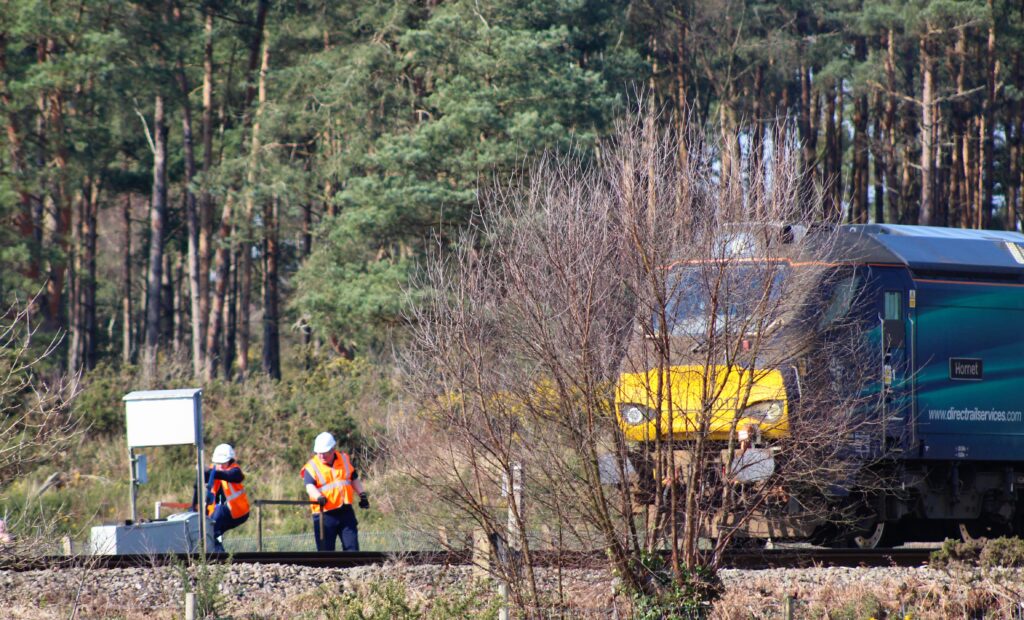
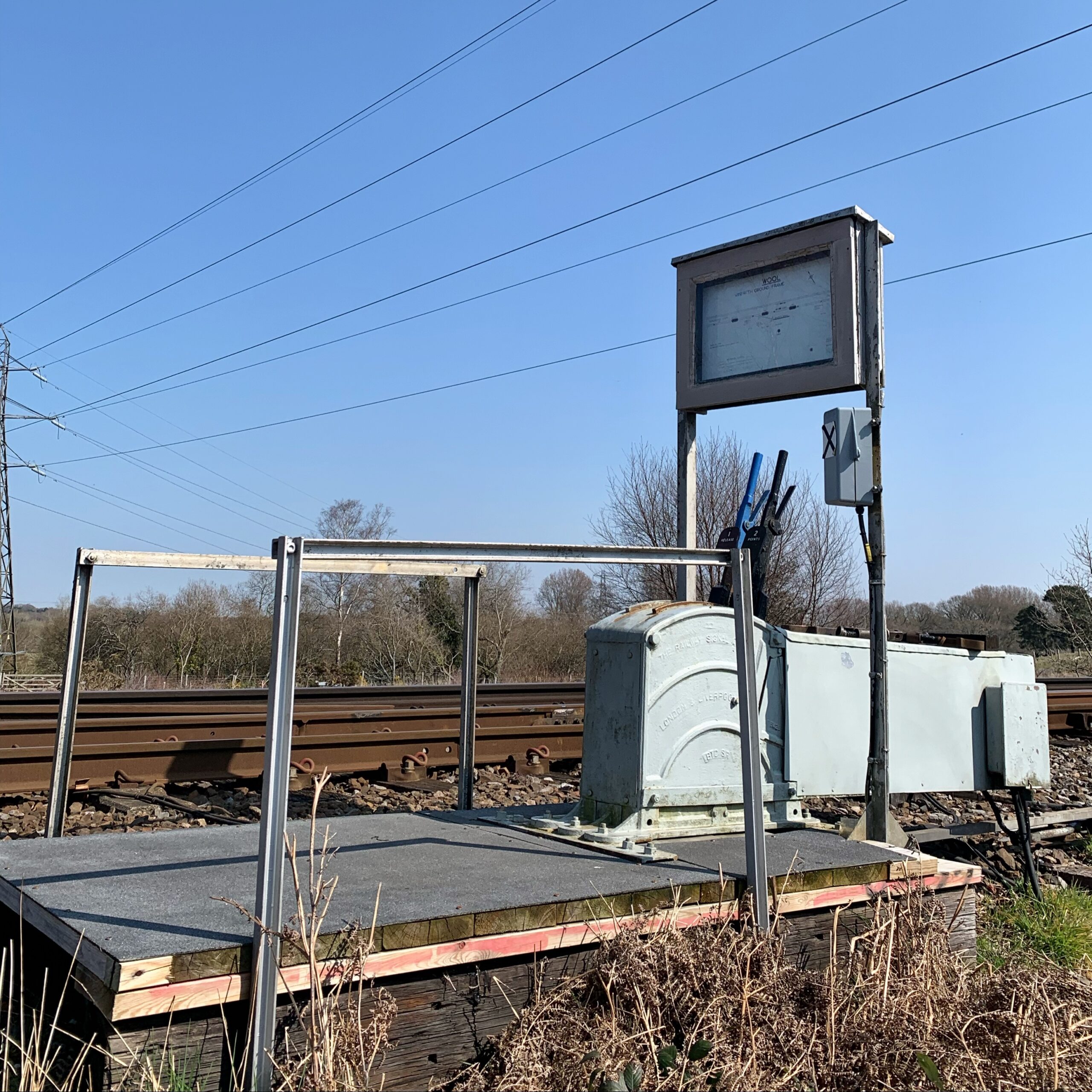
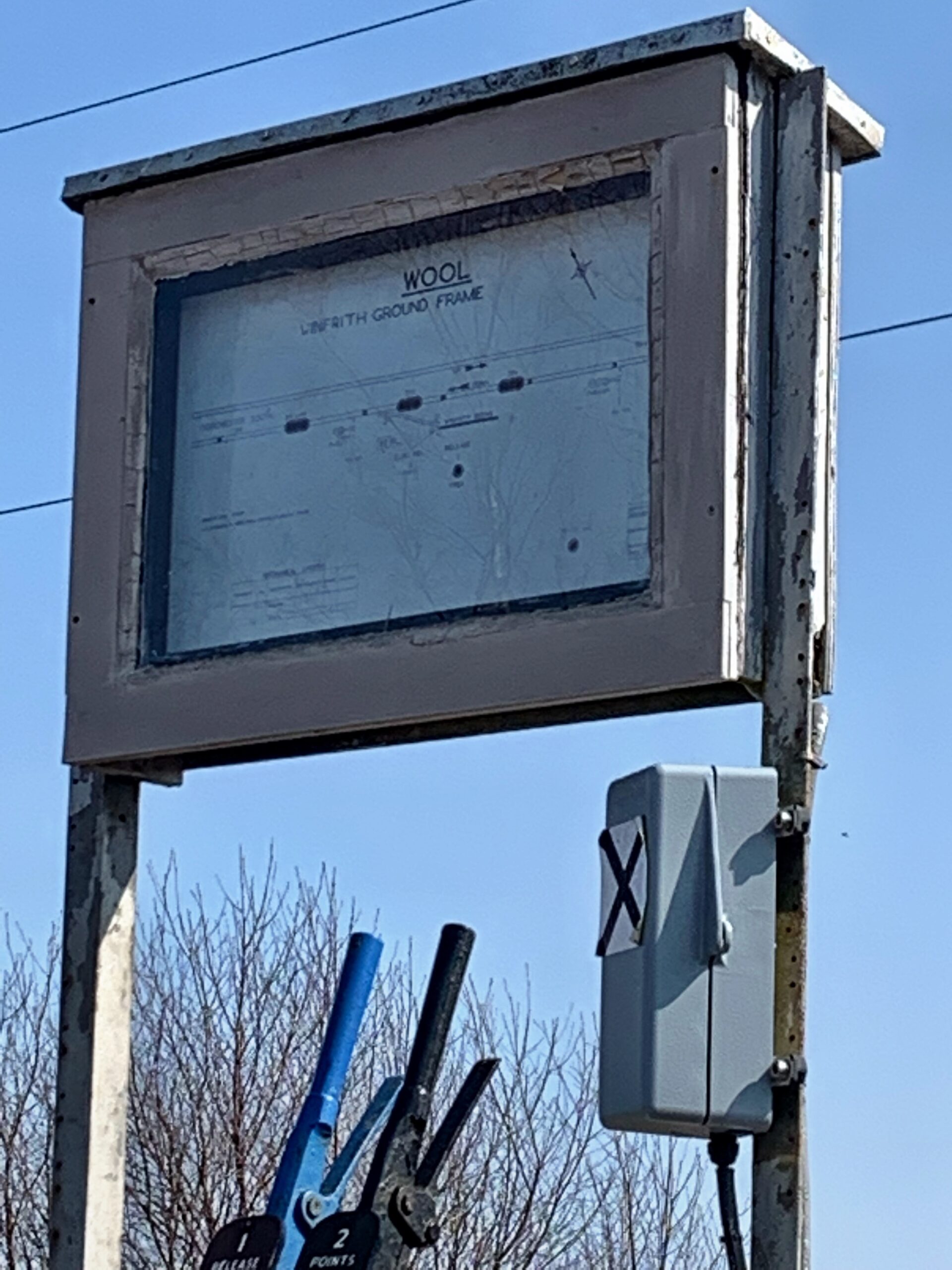
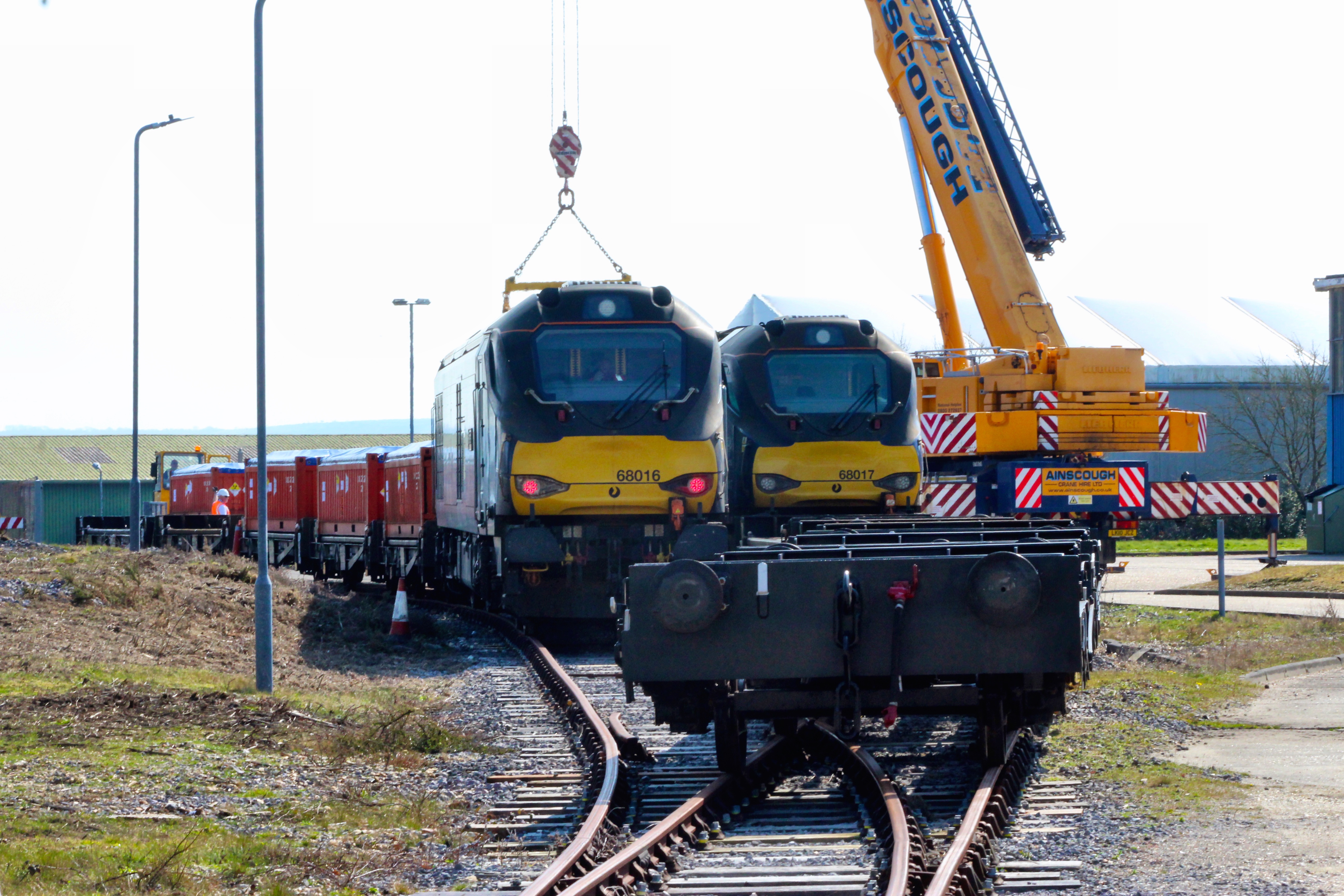
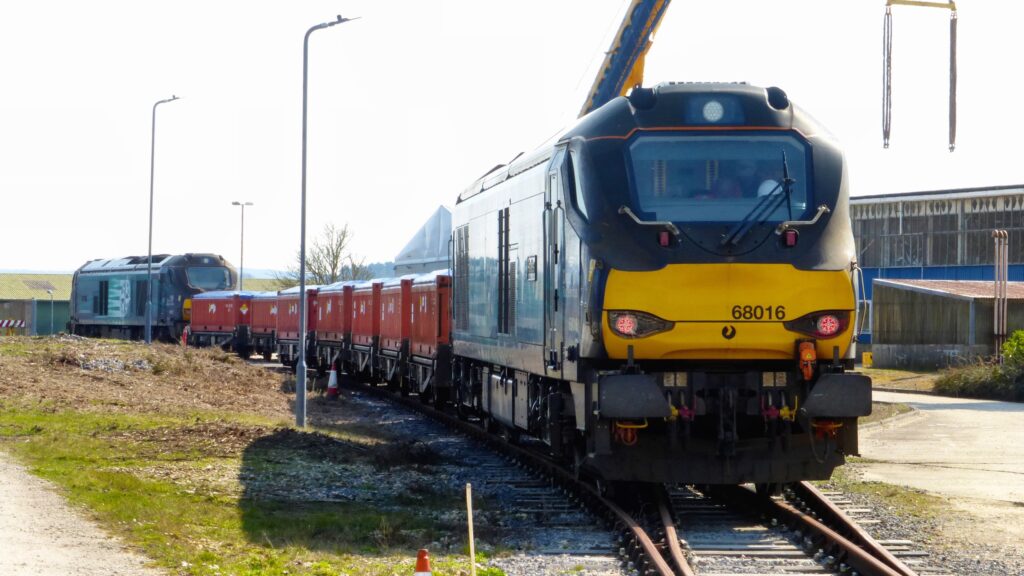
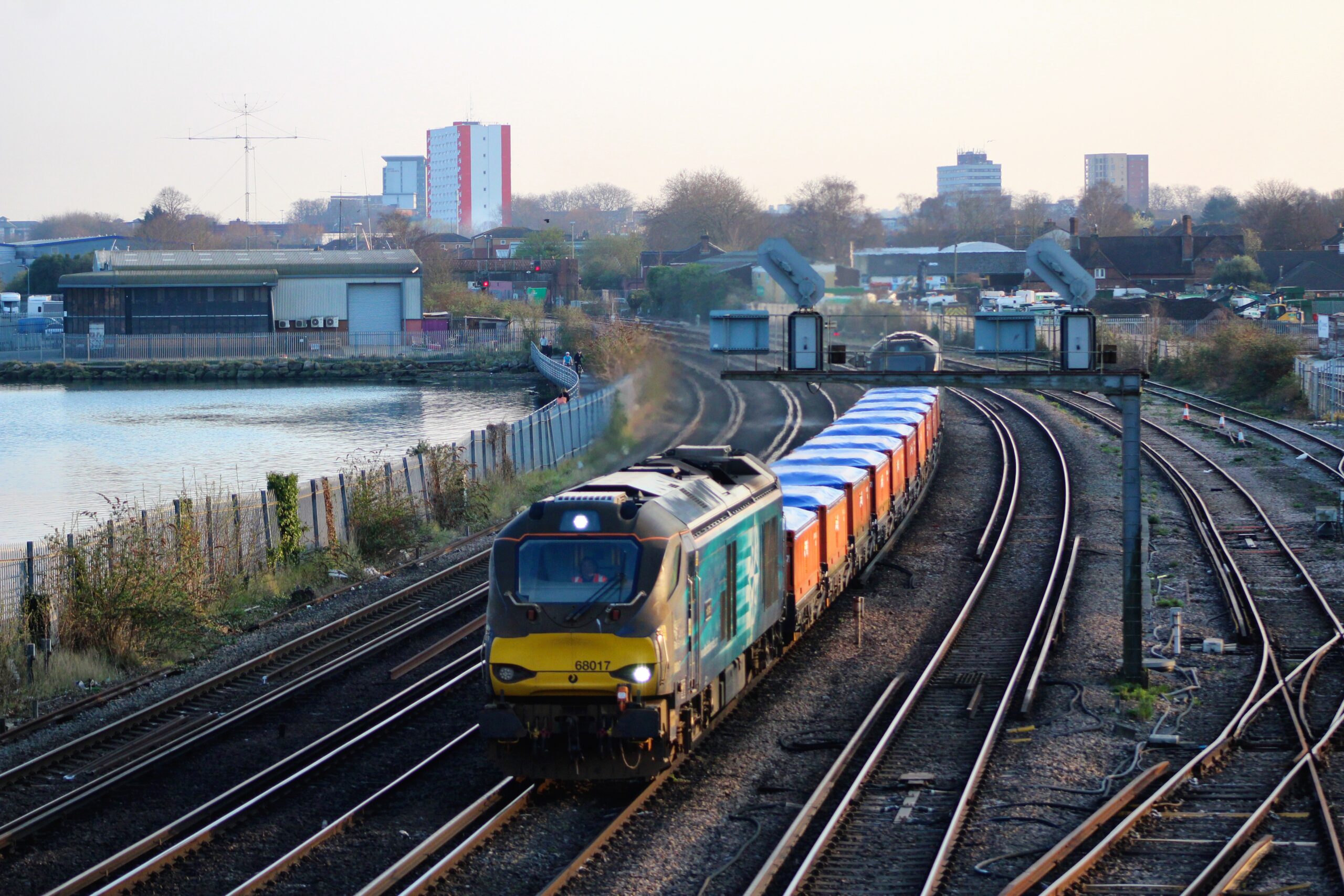
DRS Class 68 No. 68016 “Fearless’ at Winfrith with the first train of waste at Nuclear Waste Services Low Level Waste Repository site at Winfrith Magnox. 68017 ‘Hornet’ is at the rear – 24th March 2022
It has been an interesting week in review with the first of what should be semi-regular visits to Dorset of trains in connection with a project to dispose of of more than 1,000 stainless steel drums of waste at Nuclear Waste Services’ Low Level Waste Repository site from Winfrith Magnox site. Gresley A3 Pacific No. 60103 ‘Flying Scotsman’ made a visit to Hampshire and Wiltshire with a Steam Dreams rail tour to Salisbury which featured an added afternoon circular tour via Southampton before returning to London Victoria. The Bournemouth to Weymouth line saw probably the final Class 66 runs of the Snow and Ice Treatment Train of the season and the New Measurement Train powered by Class 43 power cars visited Dorset via the Bristol to Weymouth route.
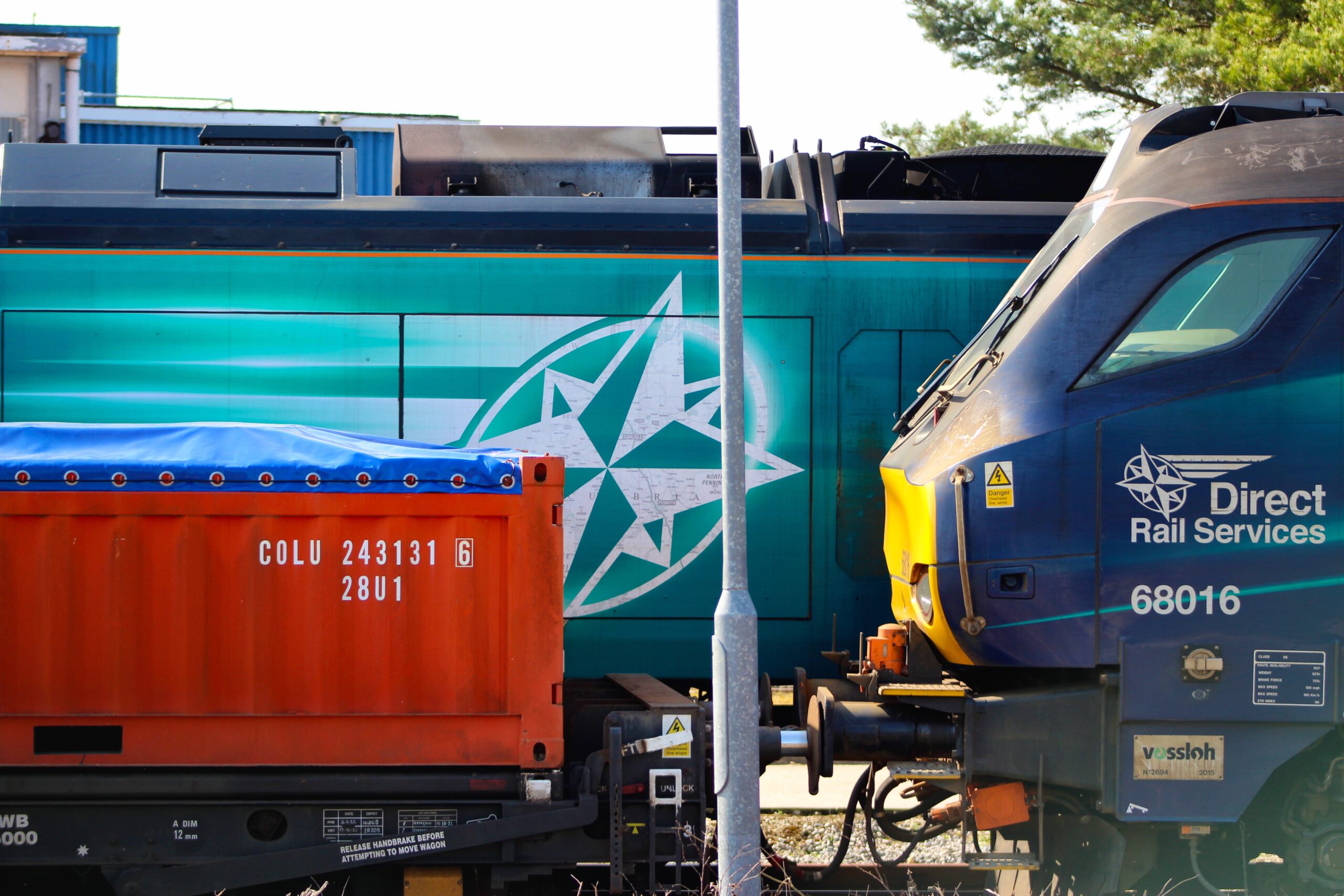
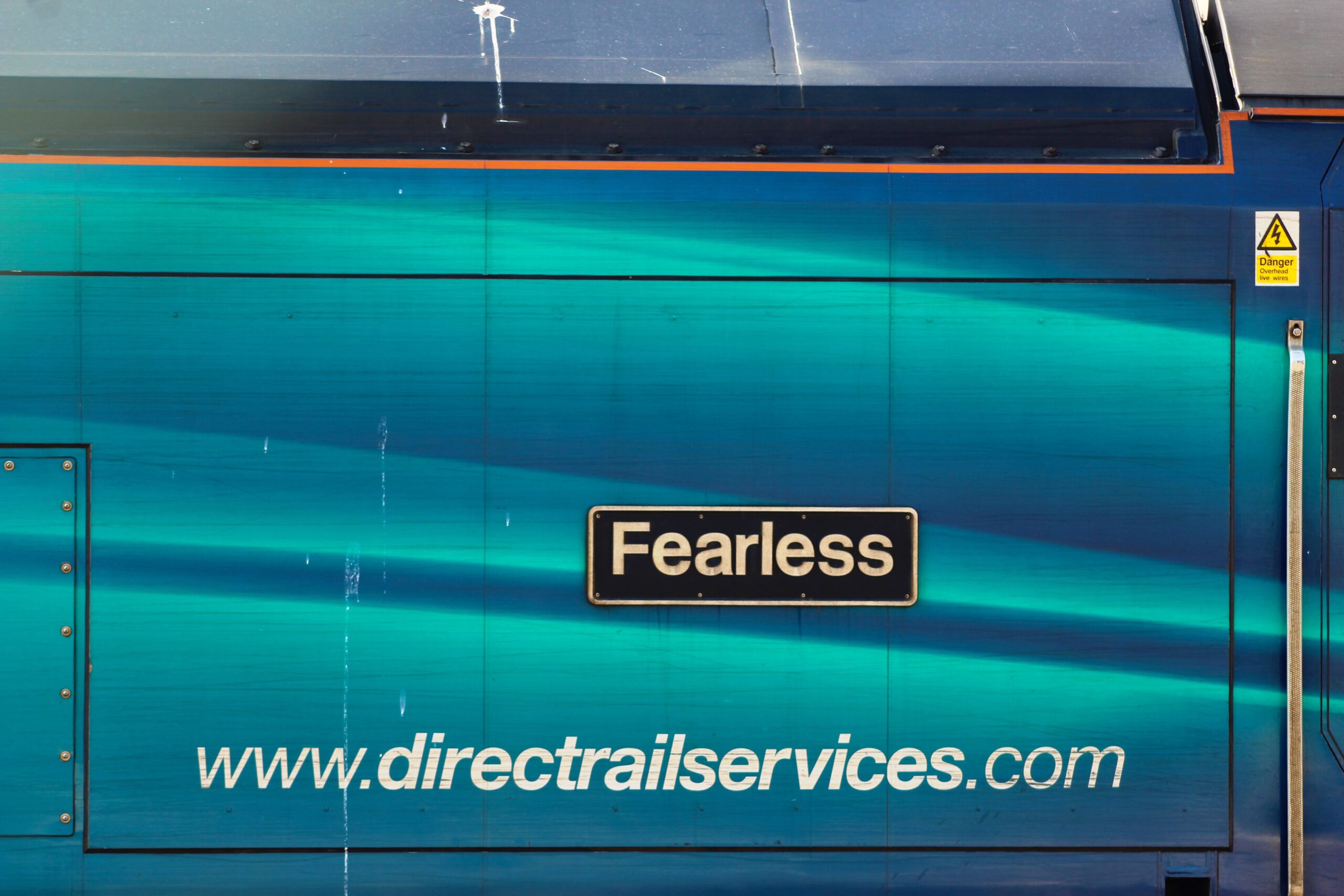
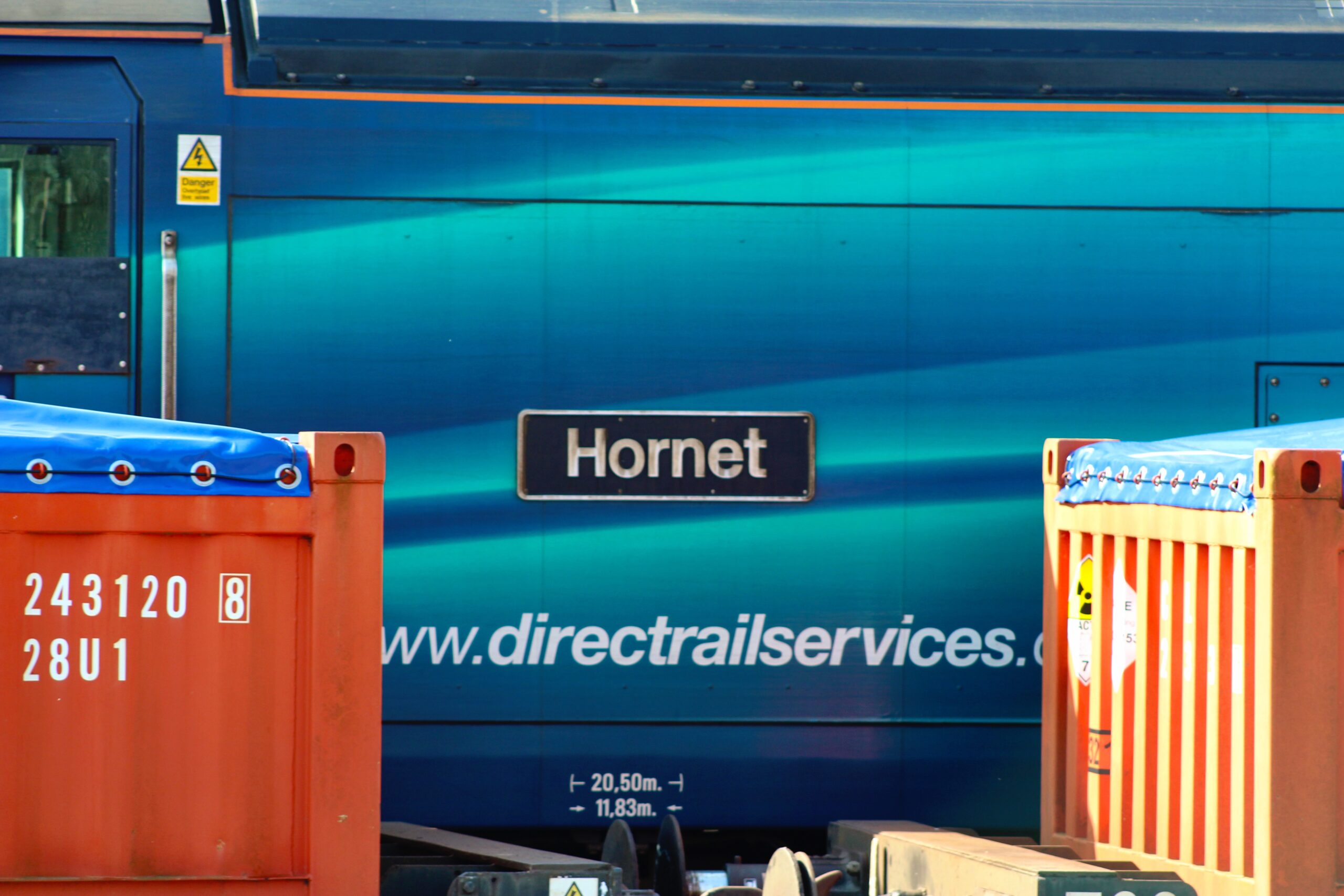
68017 waits the go ahead as the points are changed at Winfrith ground frameWinfrith ground frameWinfrith ground frameDRS Class 68 No.’s 68016 and 68017 at Winfrith Magnox – 24th March 2022DRS Class 68 No. 68016 at Winfrith with the first train being loaded with waste at Nuclear Waste Services Low Level Waste Repository site at Winfrith Magnox. 68017 is at the rear of the photo – 24th March 2022DRS Class 68’s at Winfrith – 24th March 2022Close up of 68016’s nameplateClose up of 68017’s nameplate
Direct Rail Services (DRS) was conceived in 1995 by British Nuclear Fuels Ltd (BNFL) as a wholly-owned subsidiary company for the purpose of transporting nuclear waste after the privatisation of British Rail. The company has since diversified into other areas of freight workings. DRS has been moving nuclear waste for over 25 years. The 24th March 2022 train to Magnox Winfrith marked the first of eleven planned trains over the next couple of years to move the one tonne stainless steel drums of waste. The drums originated from the Winfrith Steam Generating Heavy Water Reactor before being placed in Treated Radwaste Store awaiting their transfer to the Intermediate Level Waste facility at Harwell.
Top and Tailed 68017 and 68016 on a rake of 10 PFA wagons as 6Z96 1540 Winfrith Sidings to Crewe Coal Sidings (DRS) nearing St Denys – 24th March 2022
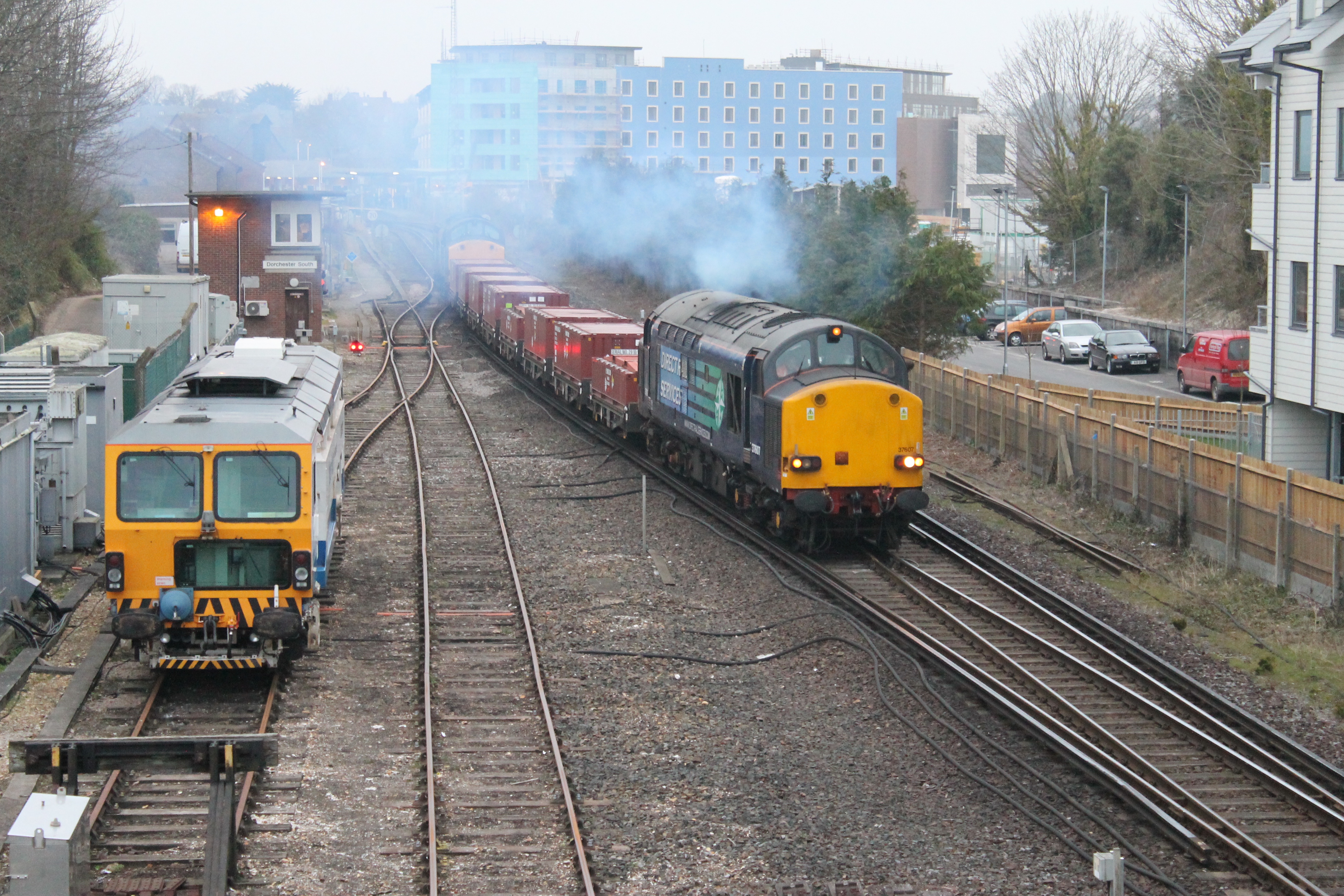
The trial run for the removal of nuclear waste took place on 26th February 2013. DRS Class 37 No.’s 37602 and 37607 top and tailed the train which at that point was the first time a nuclear material train had worked to Dorset in 14 years, the previous visit having taken place in September 1999.
Archive video from 1999 shows Class 37 and Class 20 motive power for the Winfrith flask trains which ran round at Dorchester South:
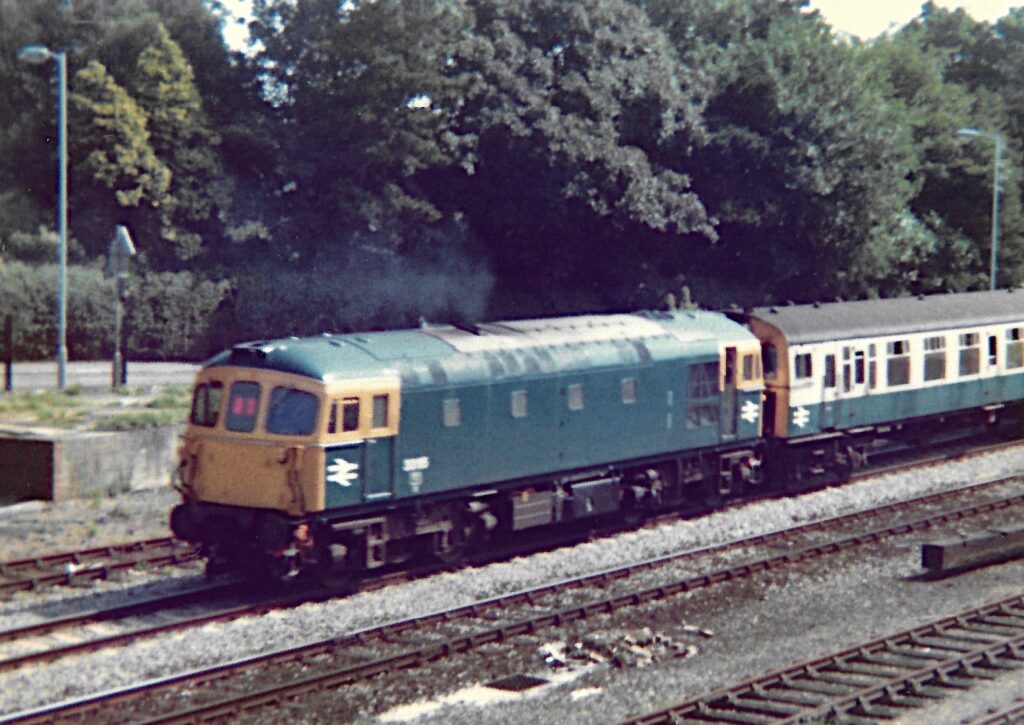
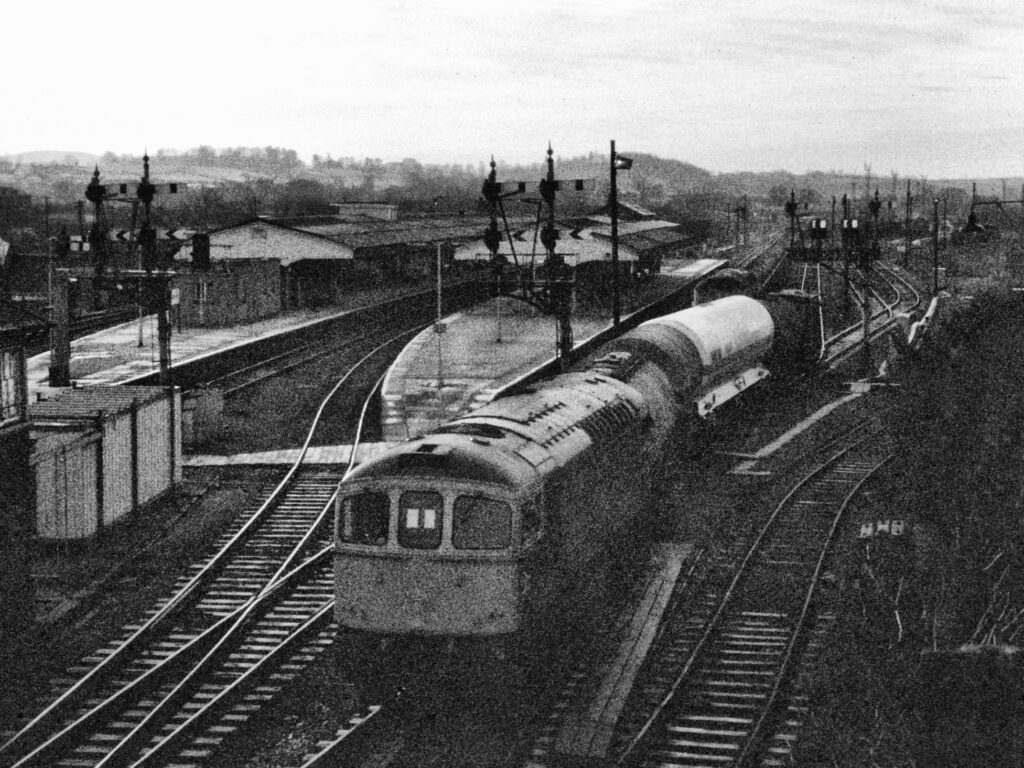
Going further back in time to 21st July 1980, Class 33 No. 33013 runs around a nuclear flask train at Dorchester South. I can recall being chased away from the train, hence the rather distant image taken by my trusty 110 Kodak camera. But it’s interesting to see the sidings which are now covered by the Brewery Square development.
The next video shows a compilation of clips showing the Snow & Ice Treatment Train in Dorset and Hampshire taken between 16th and 25th March. The locomotives are 66799 and 66760 throughout, but the weather is changeable!
The New Measurement Train visited Dorset on 23rd March 2022 formed of Class 43 power cars No.’s 43274 and 43272 working 185Y 0748 Derby RTC (Network Rail) to Bristol Kingsland Road:
43274 about to depart from Maiden Newton having picked up the token to traverse the single line section to Dorchester West – 23rd March 2022
Class 701 test runs are still taking place, as evidenced by 701028 working the 28th March 2022 5Q51 1126 Wimbledon to Woking run:
99 year old Gresley A3 Pacific No.60103 ‘Flying Scotsman’ worked her final rail tour before retiring for an overhaul, which is scheduled to start in April and last up to four months. Scotsman is scheduled to visit the Swanage Railway later in 2022 as well as appearances at the Bluebell and Strathspey railways and a possible static display at London King’s Cross to celebrate 170 years of the Great Northern Railway’s London terminus in October. We’ll devote a whole post to the Nation’s Locomotive in the future, but for now here are some photographs and short video from 24th March 2022:
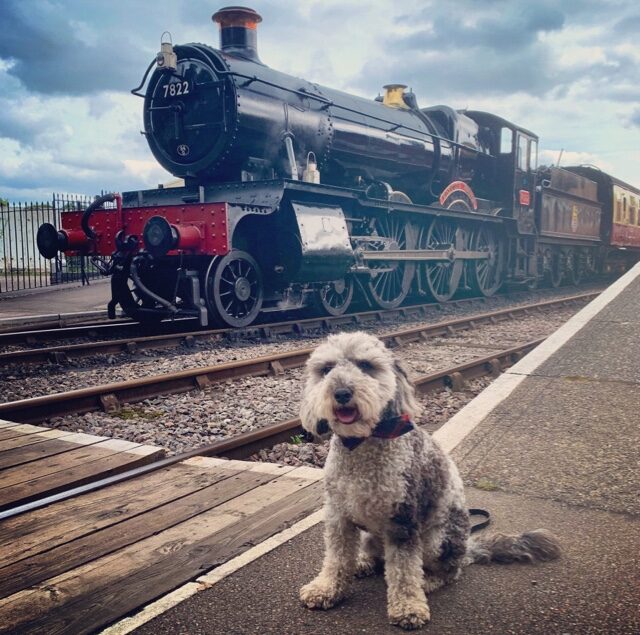
Yoshi looks happy to be in the company of Flying Scotsman, seen on a previous visit to Southampton in June 2021
Thanks for visiting – we’ll hopefully be back again next week, we hope you’ll join us! As always corrections or suggestions welcomed.
A quiet week with out of the ordinary trains in the Bournemouth to Weymouth area this week. The New Measurement Train which was scheduled to have run on Wednesday 23rd February was cancelled. Maybe we’ll get visited by a COLAS HST in March instead.
Sleeper and track replacement at Bournemouth over the weekend saw an engineers train powered by two Freightliner Class 66 locomotives No’s. 66598 and 66512 visit the station. I was asleep when the consist arrived in the early hours of Saturday, but after breakfast, Yoshi and I headed over to Bournemouth to have a quick look at what was going on.
On Sunday, I left Yoshi at home with his mum while I went off to London for the day. At Christmas I was given a fabulous book; ‘Britain’s 100 Best Railway Stations’ by Simon Jenkins, which as the title suggests takes a look at some beautiful railway station architecture across the UK. One of the London Termini included is Marylebone, the smallest railway terminus in the capital. Being in the vicinity, I decided to take a quick look.
Grade II listed Marylebone is the only London terminus not to see electric traction and all services are operated by diesel trains. Despite strong opposition from the Marylebone Cricket Club who objected to the line crossing Lord’s cricket ground which sits to the north, the station opened for passenger traffic on 15th March 1899 having been constructed by the Great Central Railway for their London extension and was the last of London’s main line termini to be built. Sir Edward Watkin who created the GCR and one of the Victorian era’s great Railway Kings hoped that the line would continue south to the coast and cross to France via a Channel Tunnel. The station architect was Henry William Braddock who worked as a civil engineer with the GCR. Because of the fight over Lord’s cricket ground and the agreed solution of a cut and cover tunnel to the east of the hallowed turf, money was tight and this is reflected in the modest design of the station which was originally intended to have eight platforms but only four were built. Marylebone gained two extra platforms in 2006 following rail privatisation. The design utilises attractive red brickwork with terracotta dressings. Over 500 houses were demolished to make way for the railway and those displaced were rehoused by the Great Central. It is currently the southern terminus of Chiltern Railways, but in the 1980’s serious consideration was given to tarmacking the track bed and running buses over a road expressway. I’m rather pleased that this option was not adopted and the railway survives into the 21st Century.
For comparison below is archive footage of Marylebone and Aylesbury from March 1992 recorded by my late friend John Chappell who sadly passed away in 2021. John was an enthusiastic follower of all things transport and a supporter of the Swanage Railway and the Merchant Navy Locomotive Preservation Society and their steam locomotive No. 35028 ‘Clan Line’.
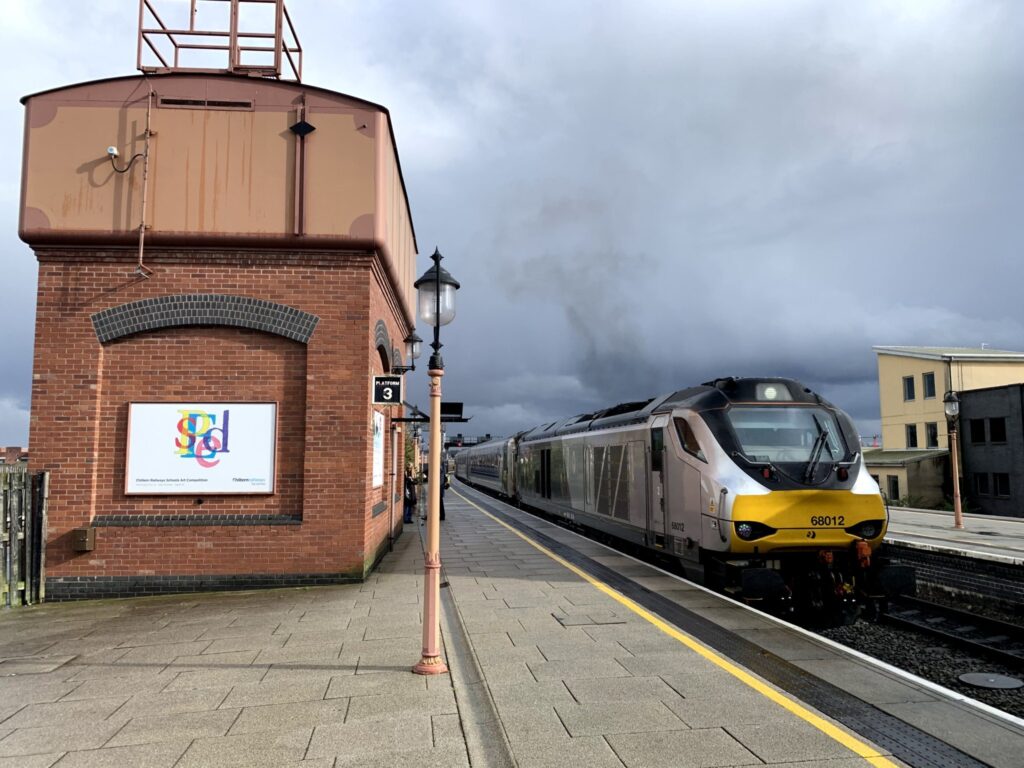
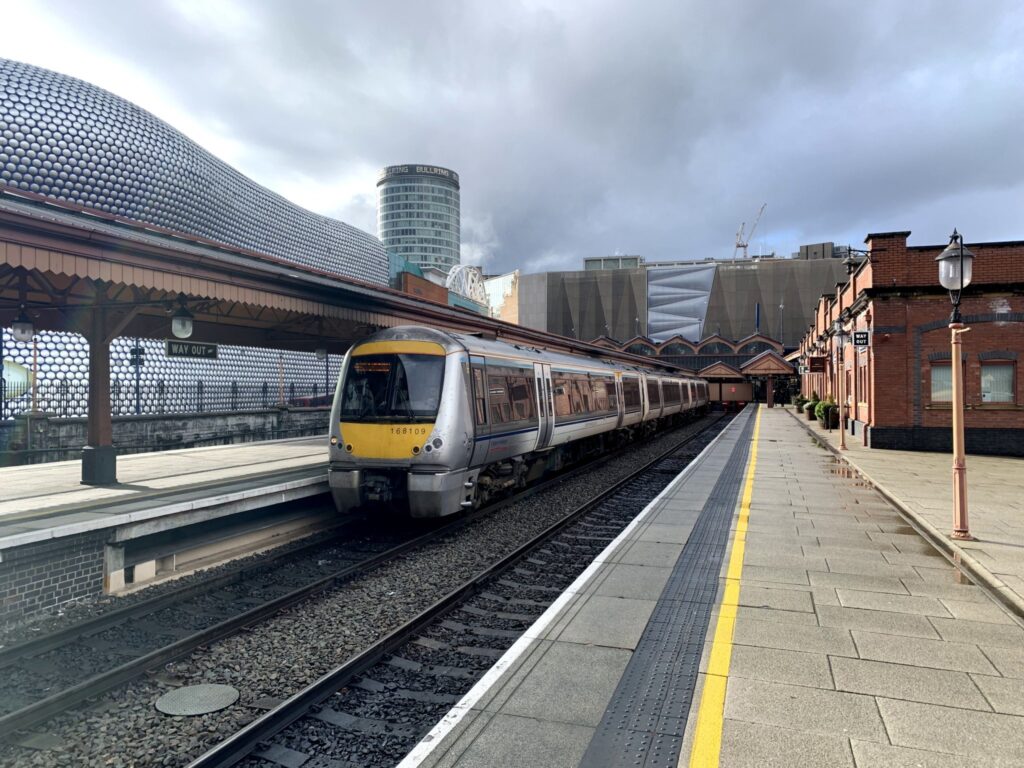
As well as Class 165 and Class 168 diesel multiple units Chiltern Railways also employ Class 68 locomotives on London Marylebone to Birmigham Moor Street services. No.68012 is seen arriving at Birmingham Moor Street on Friday 13th March 2020Chiltern Railways Class 168 No. 168109 at Birmingham Moor Street – 13/03/2020
Another visit to the archives here with video from September 1992. Last week we included photos of newly outcropped Class 69 No. 69004 in Railway Technical Centre livery and the video below, filmed by John Chappell, shows two test train examples of rolling stock painted in this livery.
Of particular interest is the footage of the International Services Test Train passing through Eastleigh. This ensemble was part of the testing employed for the Trans Manche Super Train (TMST) Channel Tunnel stock. In December 1989, an order was placed with GEC-Alsthom for the construction of thirty TGV-style electric train sets which were to operate from London to Paris and Brussels. These trains were required to take electric current from 25 kV overhead wires while passing through the Channel Tunnel and in France, and 3 kV in Belgium. On the British side, however, the trains would be utilising the existing suburban 750 Volt DC 3rd rail track. Sir Edward Watkin of the Great Central Railway would have been proud to have seen his vision finally realised!
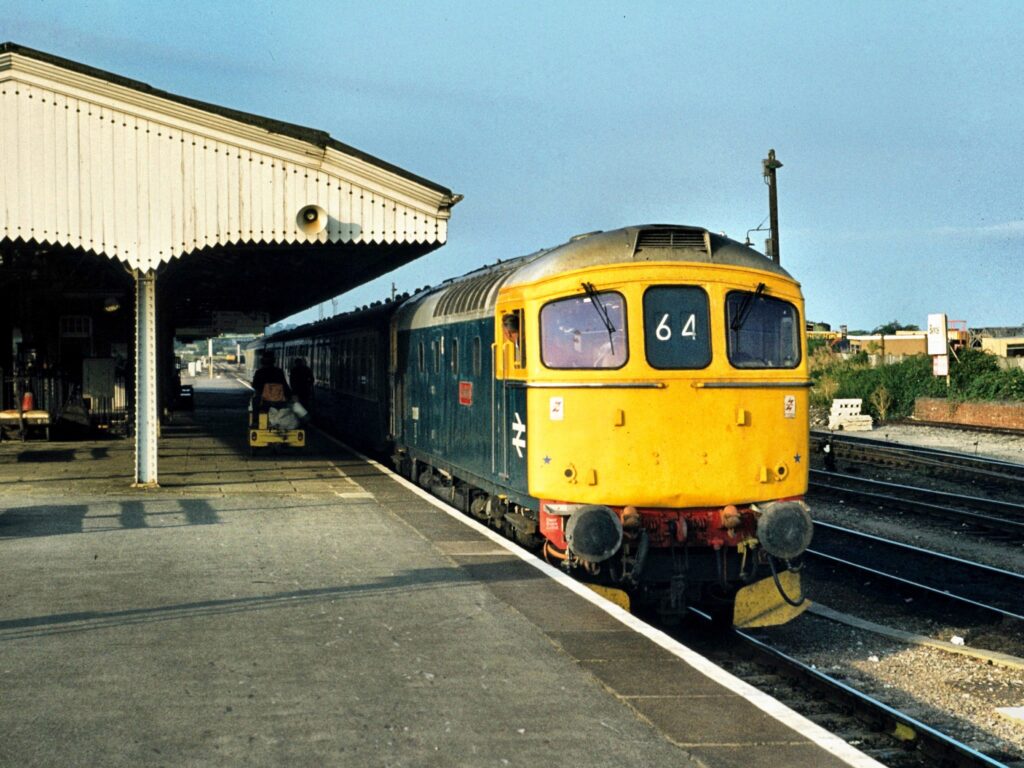
As part of the programme, withdrawn from service Class 33 No. 33115 was converted into a Driving Van Trailer (DVT) at Doncaster Works in 1990 and was given a fresh look in InterCity Executive livery and renumbered 83301. The locomotive had been modified with TGV-type bogies equipped with third rail pick-up shoes. Unpowered, it kept its seized engine as a dead weight. The decal ‘Test Vehicle For International Services’ was added to the lower body sides. The ex Class 33/1 nicknamed ‘Zebedee’ and was paired with Class 73 No. 73205 ‘London Chamber of Commerce’. The two were semi-permanently coupled to each other, 83301 being used to collect electricity from the 3rd rail which was then transferred to the 73 via heavy duty cabling to provide motive power. The remainder of the test train was initially formed of 4TC Class 438 No. 8007 ( coach numbers: 977684-7 ) painted in Railway Technical Centre red and blue but was later supplemented, in 1991, with ex 4TC coaches 977763/4 in Network SouthEast livery.
As seen in the video, the test train was commonly found running between Waterloo and Eastleigh until regular Eurostar services commenced in November 1994, running from Waterloo International to Paris and Brussels. No. 83301 was donated to the Class 33/1 Preservation Company Ltd utilising parts for Swanage railway based classmate No. 33111, the remainder being scrapped at St Leonards depot in 1996. No. 73205 remains in service with GBRf and is now named ‘Jeanette’.
Ten years prior to conversion to DVT No. 83301, Class 33/1 No. 33115 departs Dorchester with a Weymouth to London Waterloo service – 25/07/1980Class 33 No. 33115 propelling a Weymouth to London Waterloo service formed of two 4TC sets near Dorchester – 04/07/1981Class 73 No. 73205 ‘Jeanette’ still in InterCity Executive livery seen working a test train at Weymouth – 17/02/2014 (John Chappell)Yoshi gets up close and personal with Class 33/1 No. 33111 at Corfe Castle. Classmate No. 33115 donated spares to this locomotive via the Class 33 Preservation Company Ltd
That’s all for this week. Join us next time for more of the same, but subtly different.
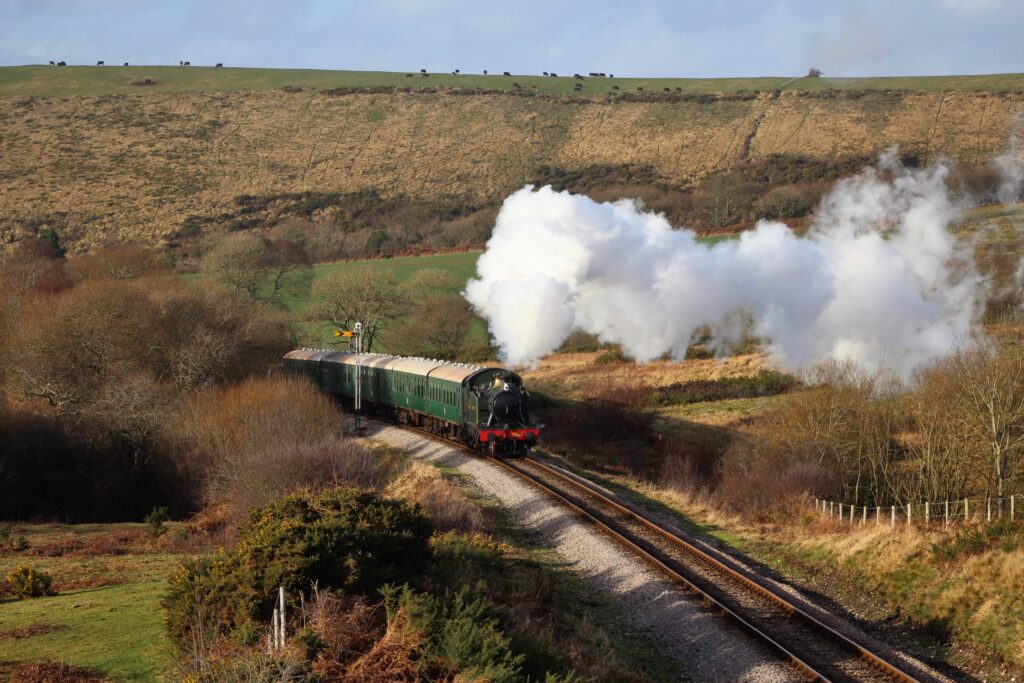
Great Western Railway Small Prairie No. 5526 heads through the Purbeck countryside – 19/02/2022
So this week we’ve all had to contend with the triple onslaught of Storm’s Dudley, Eunice and Franklin. Remember when we had to wait months in-between storms? Now they come along like double decker buses. Hopefully everyone has come through unscathed. We were up late, or was it early….. to be honest, most likely both…. on 16th February 2022 when Class 66 locomotives No.’s 66765 and 66779 top and tailing a rail milling machine paid a visit to the Weymouth line. We caught this interesting ensemble passing through Poole and Hamworthy. It was both wet and cold, a foretaste of things to come.
Later the same day, Yoshi together with his human parents took a trip to Lacock in Wiltshire. Yoshi was able to tick off another location used by the BBC when they were filming the 1995 television adaptation of Jane Austen’s ‘Pride & Prejudice’. Last year he visited Lyme Park in Cheshire which was used as the exterior of Pemberley, Mr. Darcy’s country house. Laycock village portrayed the fictional village of Meryton in the TV miniseries.
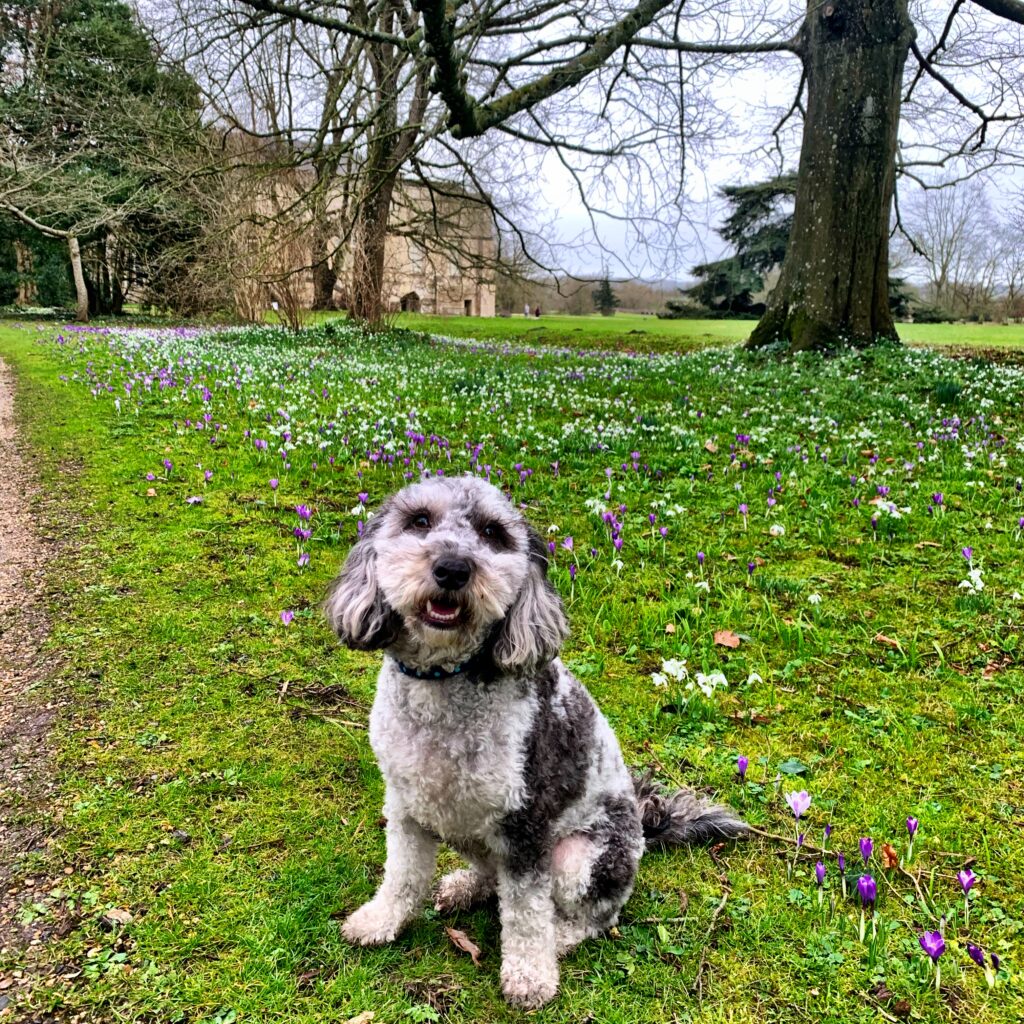
Yoshi striking his best Fitzwilliam Darcy pose at Lyme Park – June 2021Yoshi enjoys the grounds of Lacock Abbey – February 2022
Because of the impending arrival of high winds, the grounds of Lacock Abbey were closed early and we retreated to Westbury for a busy hour of train spotting. We managed to see most workings scheduled to pass through the station in the time we were there with one exception which was routed via the avoiding line at the last minute and the realisation of this change was just too late for me to get in a position in order to photograph the 59 which was at the head of the train.
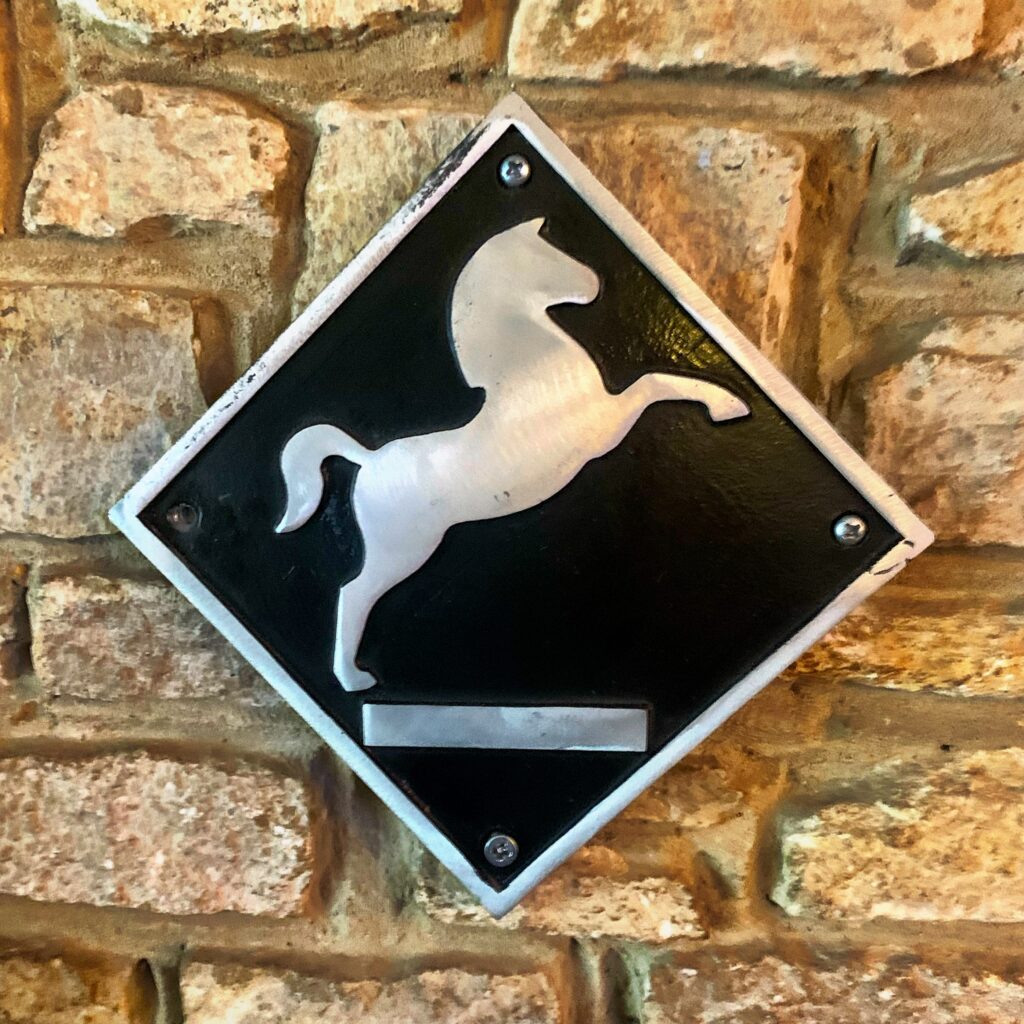
Locomotives in this video include 66606 working 748G 1321 Southampton Up Yard (FL) to Whatley Quarry FL HH, 66509 & 59101 working 752G 1222 Wembley Receptions 1-7 to Merehead Quarry, 66501 working 487H 1329 Wentloog to Southampton MCT, 66617 working 673K Appleford FHH to Whatley Quarry FL HH as well as Great Western Railway and South Western Railway passenger servicesBefore heading home we dried out and enjoyed some refreshment in the Railway Inn where we found this cast aluminium British Rail depot plaque for Westbury which depicts a representation of the White Horse hill figure cut into the escarpment of Salisbury Plain situated east of the town and is visible from afar and a famous local landmark. The plaque would have once adorned the side of a locomotive allocated to Westbury depot.
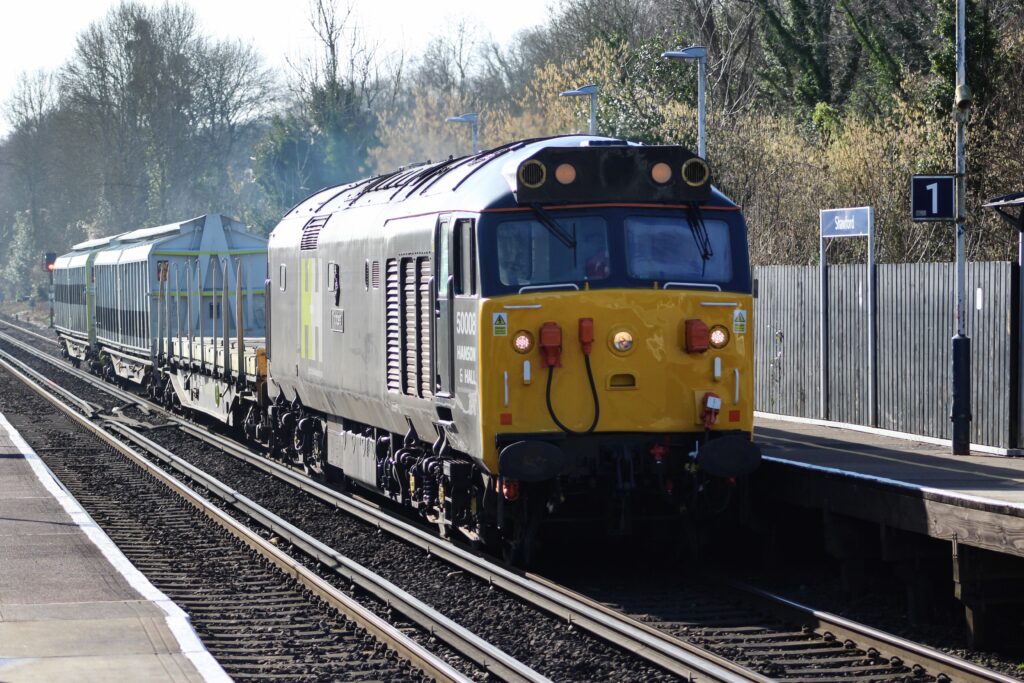
The next day, intrigued by the prospect of catching sight of ‘new’ Class 69 No. 69004 which was rumoured to be leaving the works following a paint job, Yoshi and I headed to Eastleigh. Before the 69’s scheduled departure, we popped in to Shawford station to catch a glimpse of Class 50 No. 50008 ‘Thunderer’ hauling Rail Adventure Ltd. barrier wagons.
50008 with Rail Adventure barrier wagons passing Shawford – 17/02/2022Many years previously the same locomotive; 50008 in British Rail Large Logo livery arrives at Radipole Halt near Weymouth – 16/07/1983
Here’s some video of our brief visit to Shawford for you to bark along to including 50008 working 656S Eastleigh TRSMD to Kings Norton OT Plant Dept:
Arriving in Eastleigh, we were able to observe a few trains as the clock counted down to Class 69 No. 69004’s scheduled departure from the Eastleigh Works paint shop.
Locomotives in this video include: 66738 working 6041 1014 Westbury Down T.C. to Eastleigh East Yard, 66606 working 6320 1409 Fareham Hanson Sidings to Merehead Quarry, 08511 shunting wagons (including new Network Rail / Wascosa ‘Falcons’ ), 66762 working 4M46 1424 Southampton Western Docks to Trafford Park Euro Terminal, 66761 working 4Y19 Mountfield Sidings to Southampton Western Docks along with various South Western Railway and Southern passenger services
Just before 1600, Class 69 No. 69004 emerged from Eastleigh Works in a fine representation of the old British Railways Railway Technical Centre livery. I look forward to seeing how GBRf outshop subsequent locomotives of this class which are being converted from former Class 56 locomotives. We decided against joining the shooting gallery on Eastleigh station and instead took a vantage point from the multi-storey car park overlooking the railway.
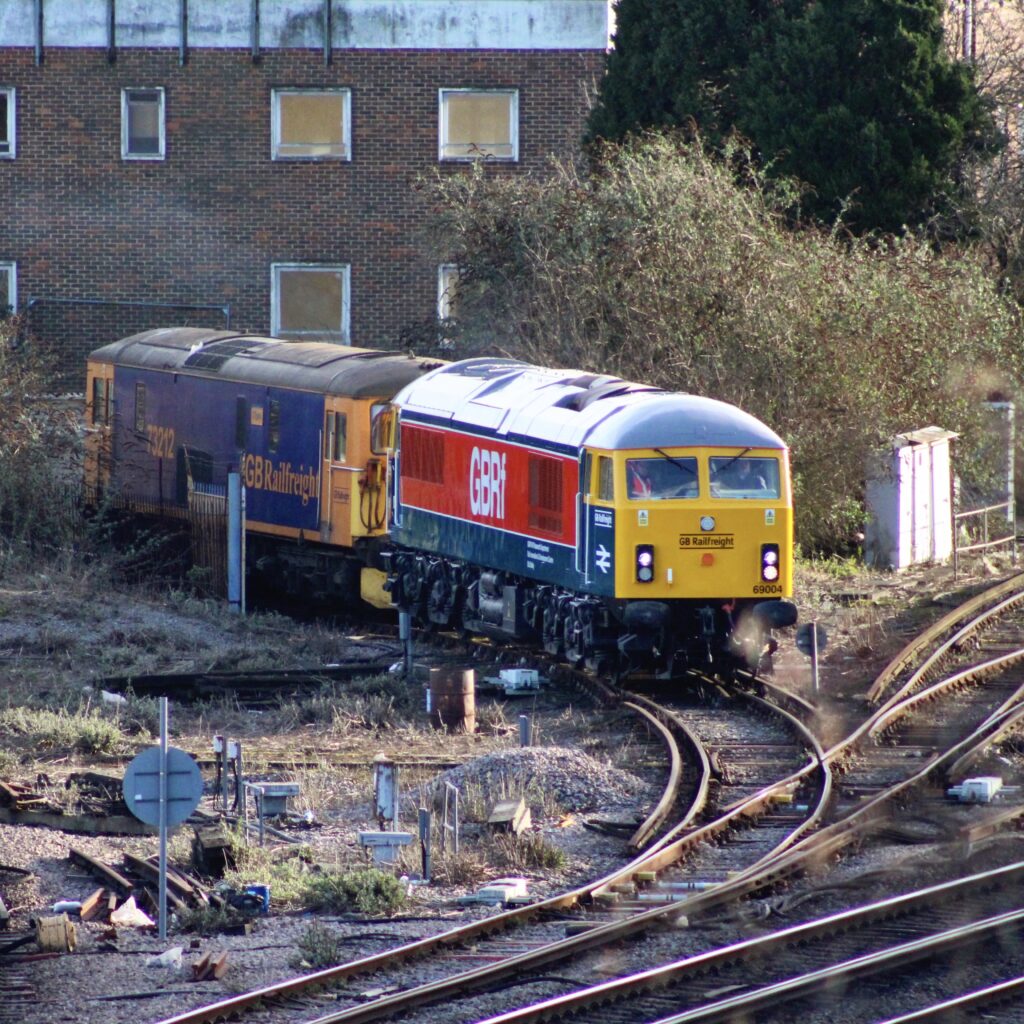
Newly out-shopped Class 69 No. 69004 eases out of Eastleigh Works with Class 73 No. 73212 in support
Class 69 No. 69004 and Class 73 Electro-diesel No. 73212 work 0Y73 1600 Eastleigh Works GBRf to Brighton Wall Sidings
Dorset’s premier heritage line The Swanage Railway is currently being visited by Great Western Railway Class 4575 2-6-2T Small Prairie tank locomotive No. 5526 on loan from its usual home on the South Devon Railway.
Designed by Charles Collett, one hundred of the Class 4575 locomotives were built for passenger and freight train workings by the Great Western Railway at its Swindon locomotive works. No. 5526 emerged in May 1928 at a cost of £3,694 and is one of 14 members of its class to survive into preservation.
Spending its entire life hauling trains in the West Country, No. 5526 was based at St Blazey, Bodmin, Exeter, Plymouth Millbay, Laira and Truro – ending its days at Westbury in Wiltshire.
Withdrawn from service in June 1962, with a mileage of around 900,000 miles, No. 5526 was sold to Woodham’s scrapyard at Barry in South Wales from where she was rescued in 1985 with restoration starting at Swindon before being moved to the South Devon Railway where work was completed by No. 5526’s owners – 5526 Limited – at Buckfastleigh.
We caught No. 5526 on the afternoon of Saturday 19th February 2022 where she looked and sounded fabulous. Unfortunately the locomotive experienced some issues later over the weekend and some services intended to be hauled by No. 5526 were instead handled by resident Bulleid Pacific No. 34072 ‘257 Squadron’. We hope repairs on the Small Prairie are swiftly sorted!
And finally this week, something from the archive as we re-visit Westbury in the 1980’s:
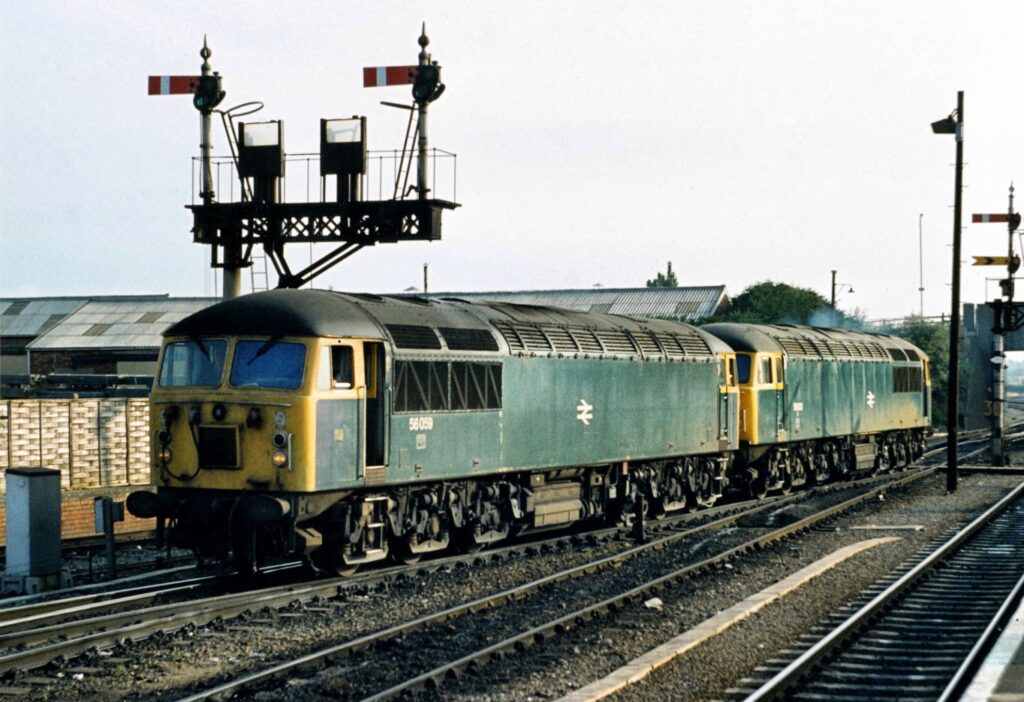
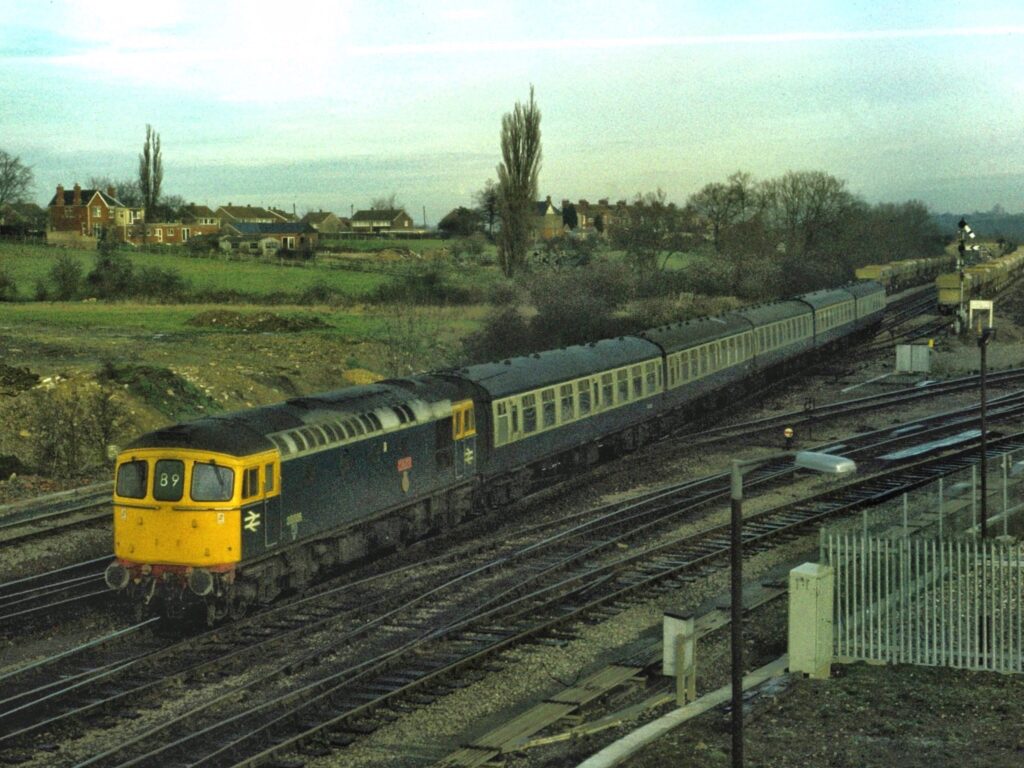
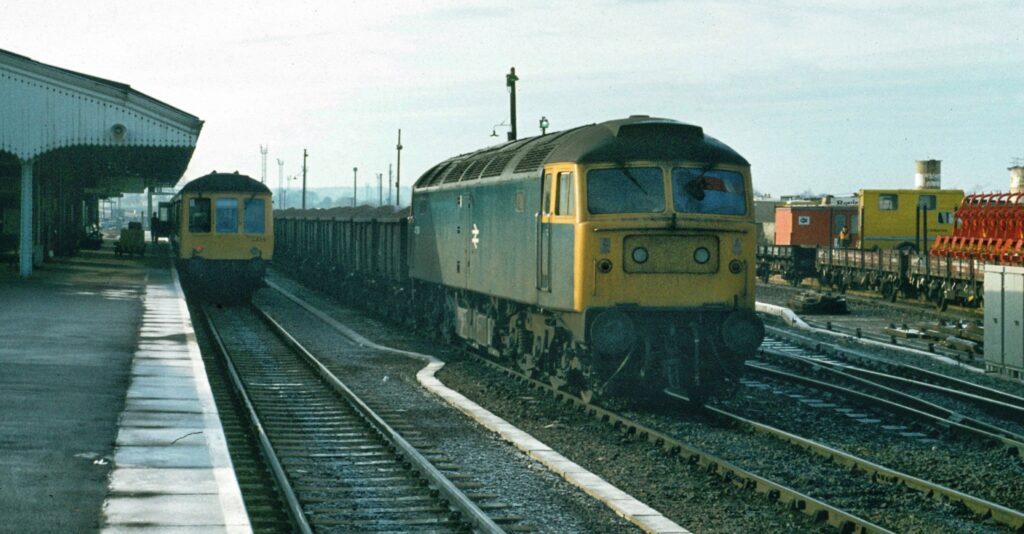
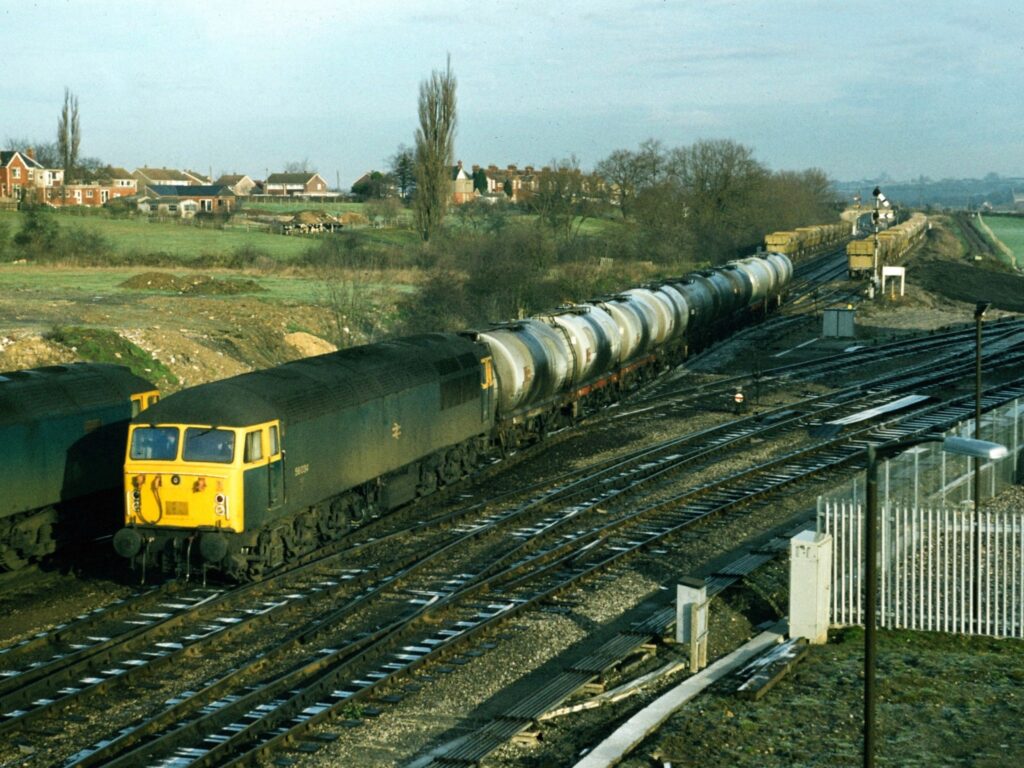
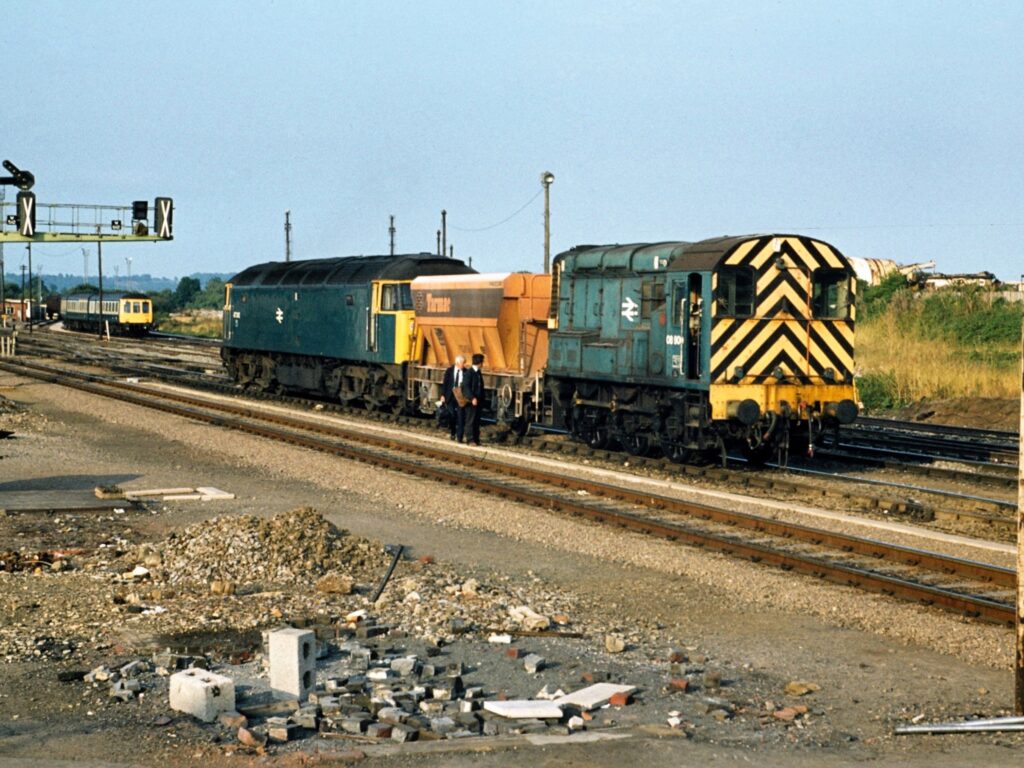
33008 Westbury – date unknownUnidentified Class 33/0 Westbury – date unknown56059 Westbury – date unknown33025 Westbury – 23/12/198247254 & DMU set L429 Westbury – 23/12/1982 56034 Westbury – 23/12/1982Westbury – details unknown
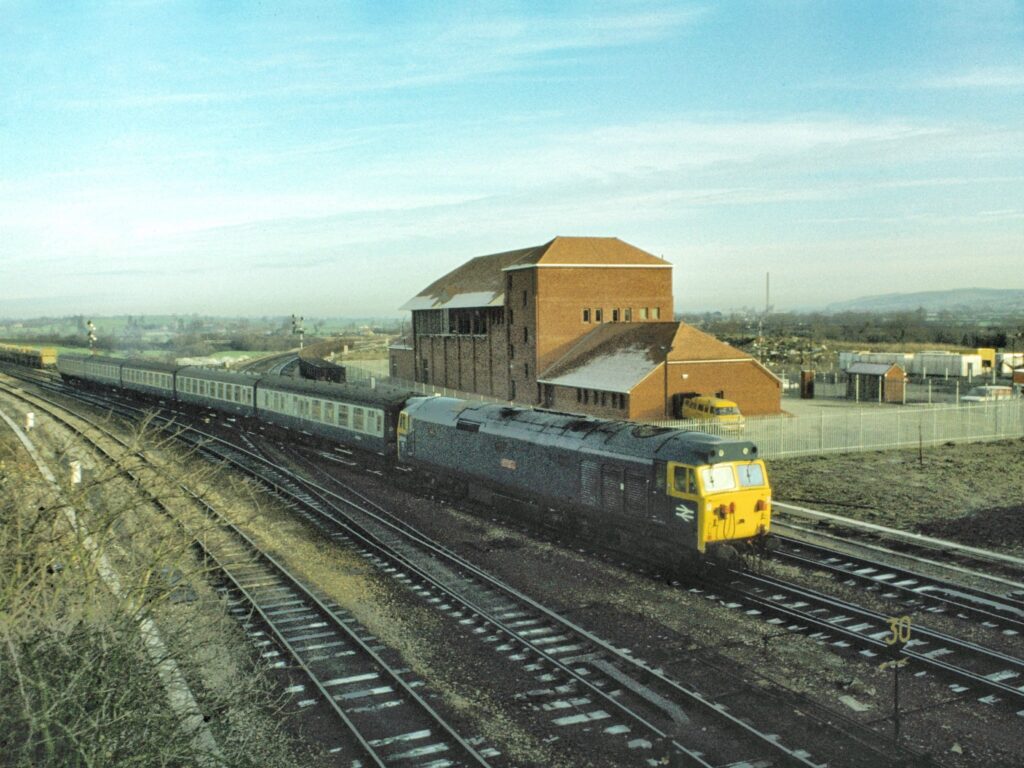
50014 passes the then newly constructed Westbury Signalbox – 23/121982
The Westbury panel signalbox was topped out on December 9 1982 by William Kent, Deputy General Manager of British Railways, Western Region. The ceremony, when Mr. Kent poured the last shovelful of concrete, was organised by the contractors, A. Roberts (Civil Engineering) Limited, of Seend, Melksham, Wilts.
The box, which opened for use on 14th May 1984, formed part of the first stage in a £30m signal modernisation scheme covering 107 miles of track between Westbury and Totnes, Devon. The overall scheme involved replacing all GWR style semaphore signals with multi-aspect colour lights controlled from one box at Westbury and one at Exeter. More than 40 lever-frame boxes were scheduled to be closed.
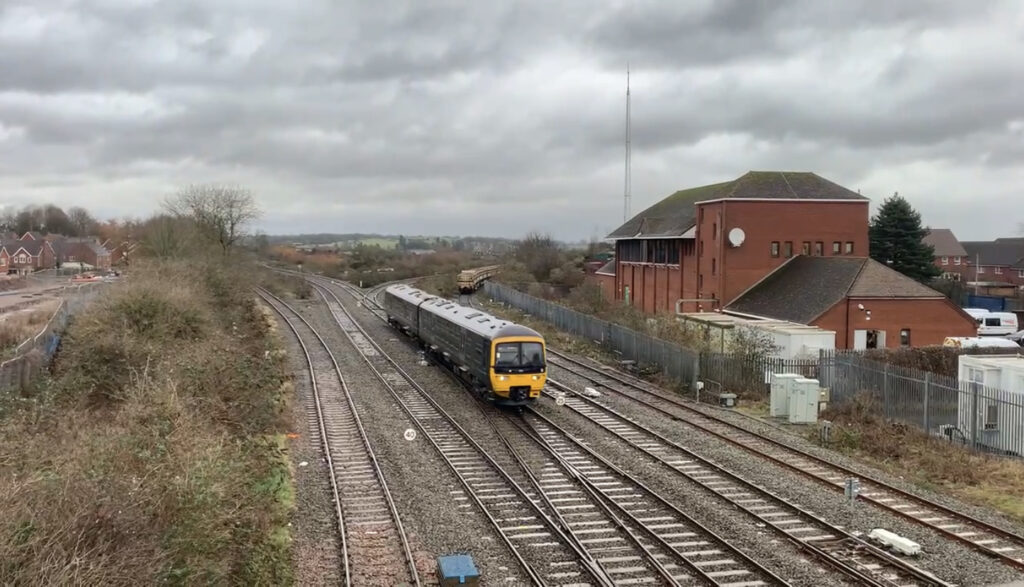
The view of Westbury Box in February 2022 as Class 165 No. 165130 passes with a Swindon to Westbury service. The lines to/ from London curve to the east while the lines to the left head towards Bristol
Thanks for reading, as always comments and suggestions are welcome. Yoshi and I hope to see you again very soon!
This week ( February 8th to 15th 2022 ) has seen the Bournemouth to Weymouth line welcome engineers trains and test trains which has provided an interesting variety and a change from the norm.
Class 701 testing continues and this week it was the turn of unit No. 701032 to run down to Poole.
On Tuesday 8th February 2022, we stopped off at Holton Heath to see GBRf Class 66 locomotives No’s 66786 and 66790 top and tail a handful of wagons on their way to Dorchester South. The following night we were in Dorchester to see 66790 joined by 66774 pull up to the work site near to Culliford Road Bridge where old lengths of rail were piled up ready for collection.
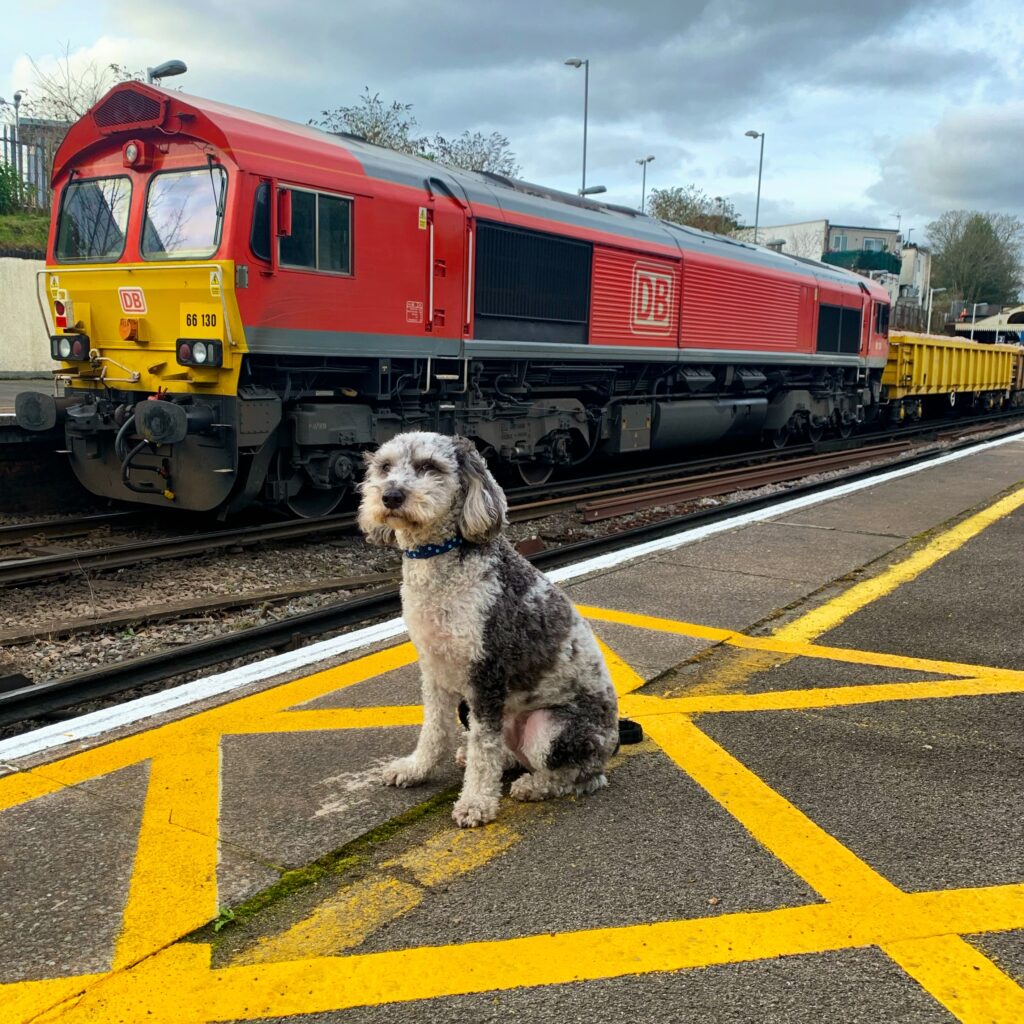
Over the weekend of 12th and 13th February, DB Class 66 locomotives No.’s 66118 and 66130 could be seen at Branksome with an engineers train which had arrived in the early hours of Saturday morning as 616M Eastleigh East Yard to Bournemouth. Work was carried out at the entrance to Bournemouth depot and as can be seen in the photo at the top of this entry, Yoshi went along to ensure things were going smoothly.
After a chat to the driver of the DB train, we made a brief visit to Swanage to take a look at the Swanage Railway Trust 4TC Group’s coaches which they have been busy restoring. The Class 491 unit at Swanage is one of two 4TC sets that were purchased from British Rail by London Underground for use on Metropolitan line excursions. When London Underground decided to dispose of one of its 4TC sets, it was purchased privately with the intent of it being based at Swanage.
In 2016 another DTSO (76275) was offered for sale. This was in much better condition than the other two DTSO’s owned by the Swanage group and needed little more than a new coat of paint largely because 76275 had survived in service as part of a 4VEP unit until 2004. It was decided to acquire this vehicle and use the third DTSO as a spare. DTSO 76275 was restored by its previous owners at St Leonards depot and delivered to Swanage in May 2017.
As can be seen in the images below, three of the unrestored coaches have now been covered with new tarpaulins to help protect them from the elements until their wait in the restoration queue is over. They have been formed into a new unit, and given the unit number 413. The aim is to restore the unit to full running order, based on the Swanage Railway, to run push pull with a class 33/1. There is a possibility of creating a 5 coach unit by including a buffet car. I’m all for that option!
Class 33 No. 33111 was also in evidence alongside the 4TC coaches. In the late 1960’s Class 33/1 and 4TC unit formations were introduced as the staple motive power for the then un-electrified track from Bournemouth to Weymouth. For three decades Weymouth bound trains started out from London Waterloo powered by third-rail electric 4REP units on the rear of unpowered 4TC’s. At Bournemouth the train would divide with at least one four car 4TC being hauled onward by a class 33/1 diesel locomotive. On the return working, the diesel pushed the train as far as Bournemouth where it would be detached and the 4TC(‘s) attached to a waiting 4REP. To commemorate the end of the push-pull era, Hertfordshire Rail Tours ran the Push-Pull Farewell on the 22nd January 1994. The train was formed of two 4TC units 410 and 417 with Class 33 No. 33116 providing motive power. Starting out from London Waterloo, the train ran to Exeter St. Davids via Yeovil before heading to Bristol Temple Meads when the tour ventured to Weymouth where it can be seen in the video below. At Weymouth, 33116 was joined by Class 73 Electro-Diesel No. 73109 and together they propelled the train back to London Waterloo via Southampton and Basingstoke.
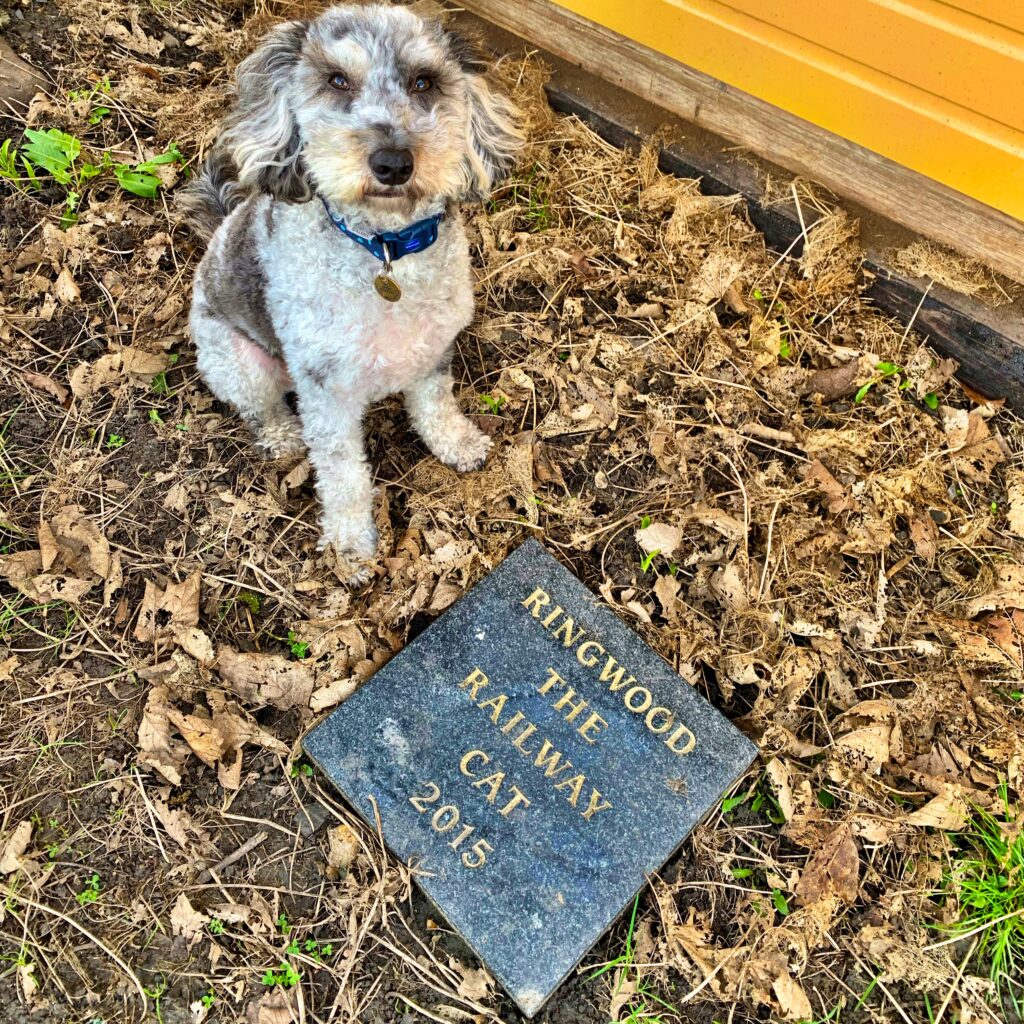
At the locomotive viewing point in Swanage, Yoshi and I paid our respects to Ringwood the Railway Cat who passed away in July 2015. Swanage Railway staff said Ringwood knew the warmest and best places to sleep, occasionally ending up beyond shed limits on an unplanned journey if she was too lazy to wake up! Back in steam days, engine sheds would employ a cat to minimise rodent problems with a small stipend being paid for their upkeep and wellbeing.
On Monday 14th February GBRf Class 73’s No’s 73961 ‘Alison’ and 73962 ‘Dick Mabbutt’ headed for Weymouth working the 120N 1115 Derby RTC to Eastleigh Arlington test train.
Thanks for reading. See you next week for some Westbury and Eastleigh travels, including our first video of the special livery given to 69004:
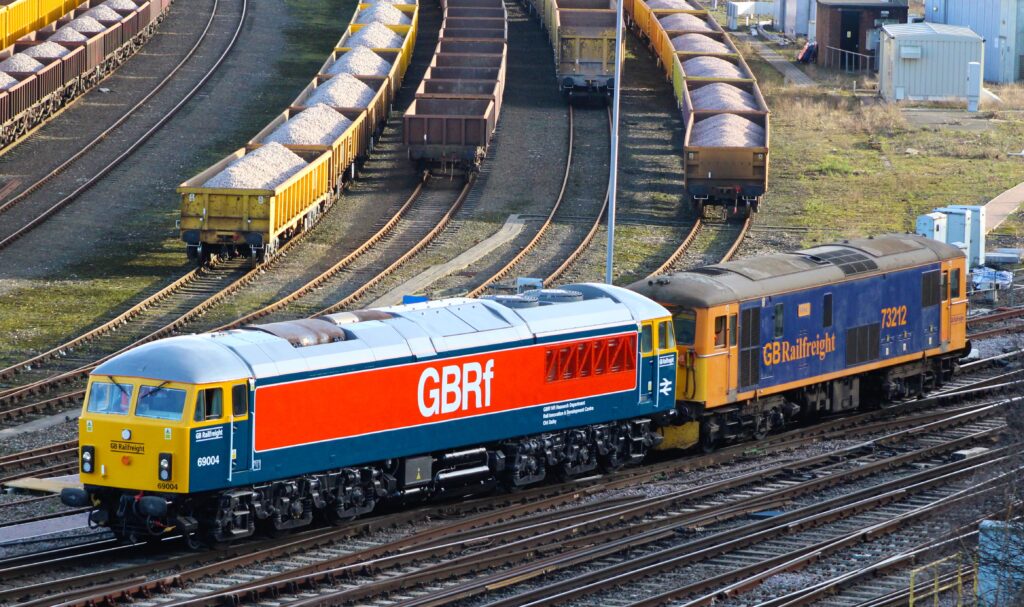
GBRf Class 69 No. 69004 in Railway Technical Centre Livery with Class 73 No. 73212 in tow working 0Y73 Eastleigh Works GBRf to Brighton Wall Siding – 17/02/2022
COLAS operated Network Rail New Measurement Train passes Sutton Bingham Reservoir on 13th January 2022
This week saw Yoshi celebrate his third birthday. That’s 28 in the human years equivalent. Although Yoshi has calmed down a great deal in the last twelve months, he’s still very much a puppy in his attitude and outlook, and with a few minor exceptions, we wouldn’t want it any other way. They say the best parties are the ones you can’t remember, or that may just be our beleaguered Prime Minister’s view on things, and Yoshi marked his special day with a set of new soft play balls, a rope toy and some chew treats and kept the partying to a minimum…
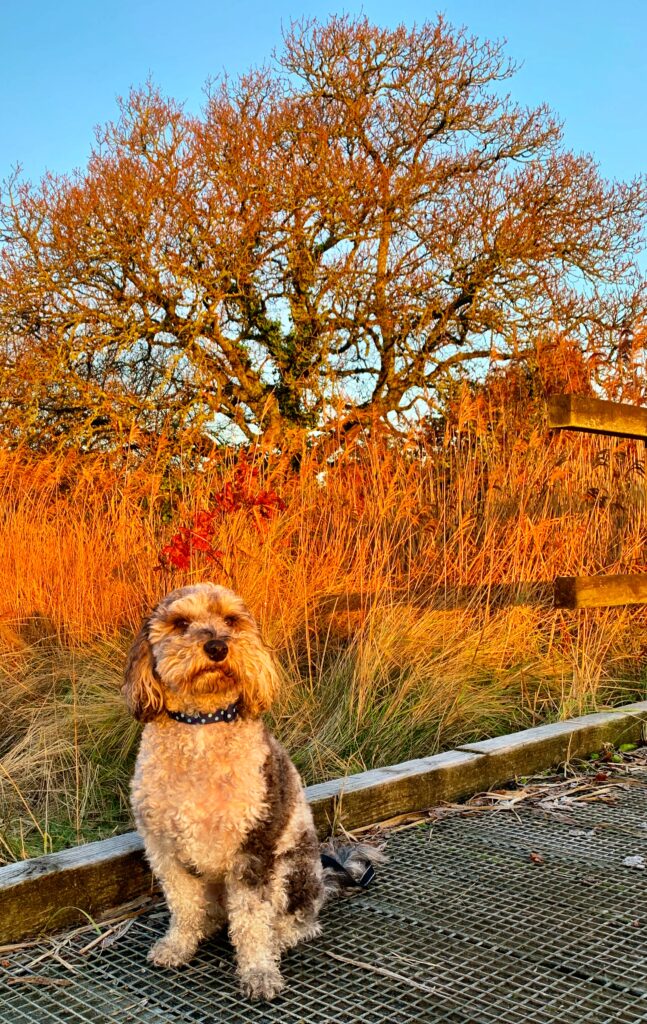
Yoshi, looking all grown up, saw in his birthday with a sunrise walk in the local park and nature reserve
A quick round up of local main line railway activity we’ve managed to catch so far in 2022 kicks off with a visit in the early hours of 11th January to the Bournemouth to Weymouth line of Class 37 No. 37116 on a Network Rail Test Train. The locomotive is seen passing through Hamworthy with 3Q02 2200 Hither Green Pre Assembly Depot (P.A.D.) to Woking Up Carriage Holding Sidings (C.H.S.):
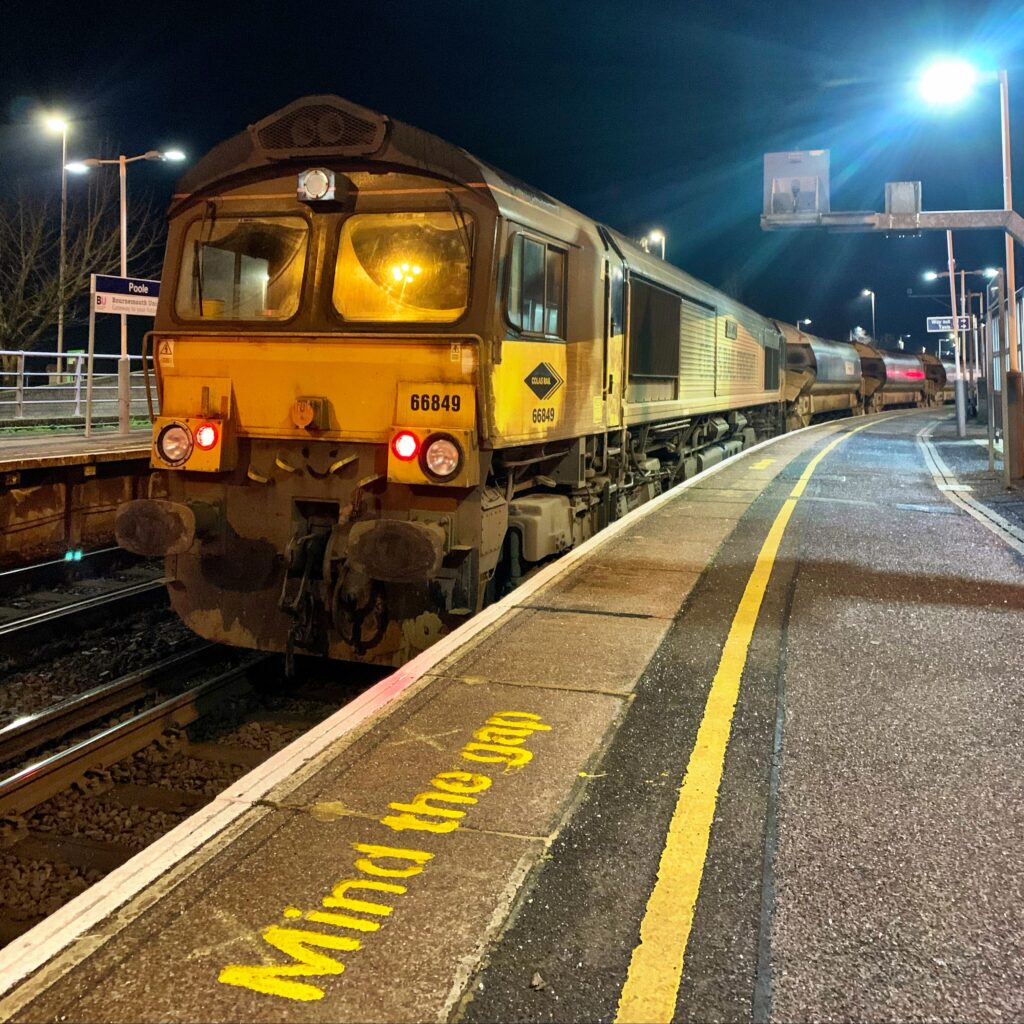
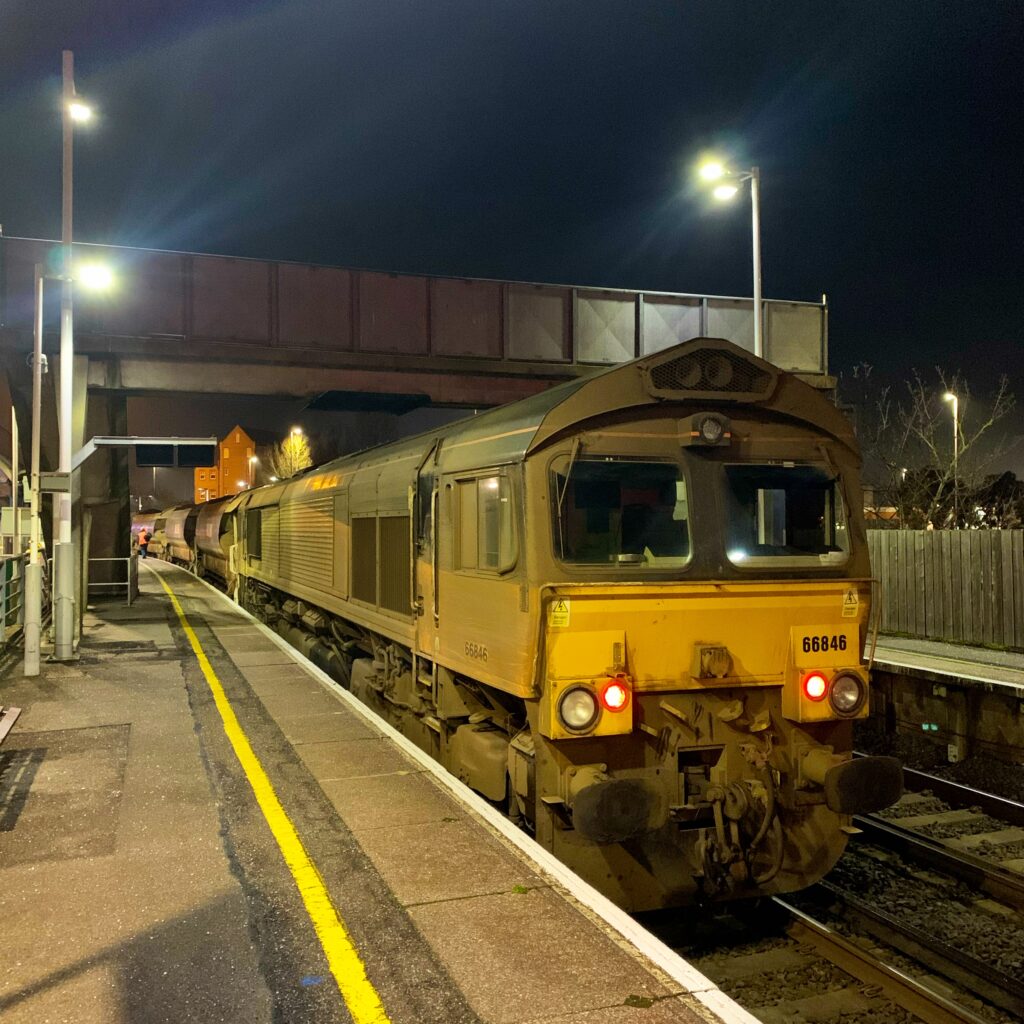
January 12th 2022 – a late evening visit to Branksome to capture Class 66 locomotives No’s. 66846 and 66849 ‘Wylam Dilly’ pass through on their way to Parkstone with a ballast drop.
66849 and 66846 wait to depart Poole for Bournemouth – 12/01/2022
Trains seen in this video: 444042 – 5W83 2228 Bournemouth to BournemouthT&RSMD 444039 – 1B63 2048 Winchester to Poole 66846 & 66849 6C17 Eastleigh East Yard to Bournemouth Balfour Beatty operated MPV – 8Y85 Totton Yard to Totton Yard 444037 – 2W84 2230 Weymouth to Bournemouth
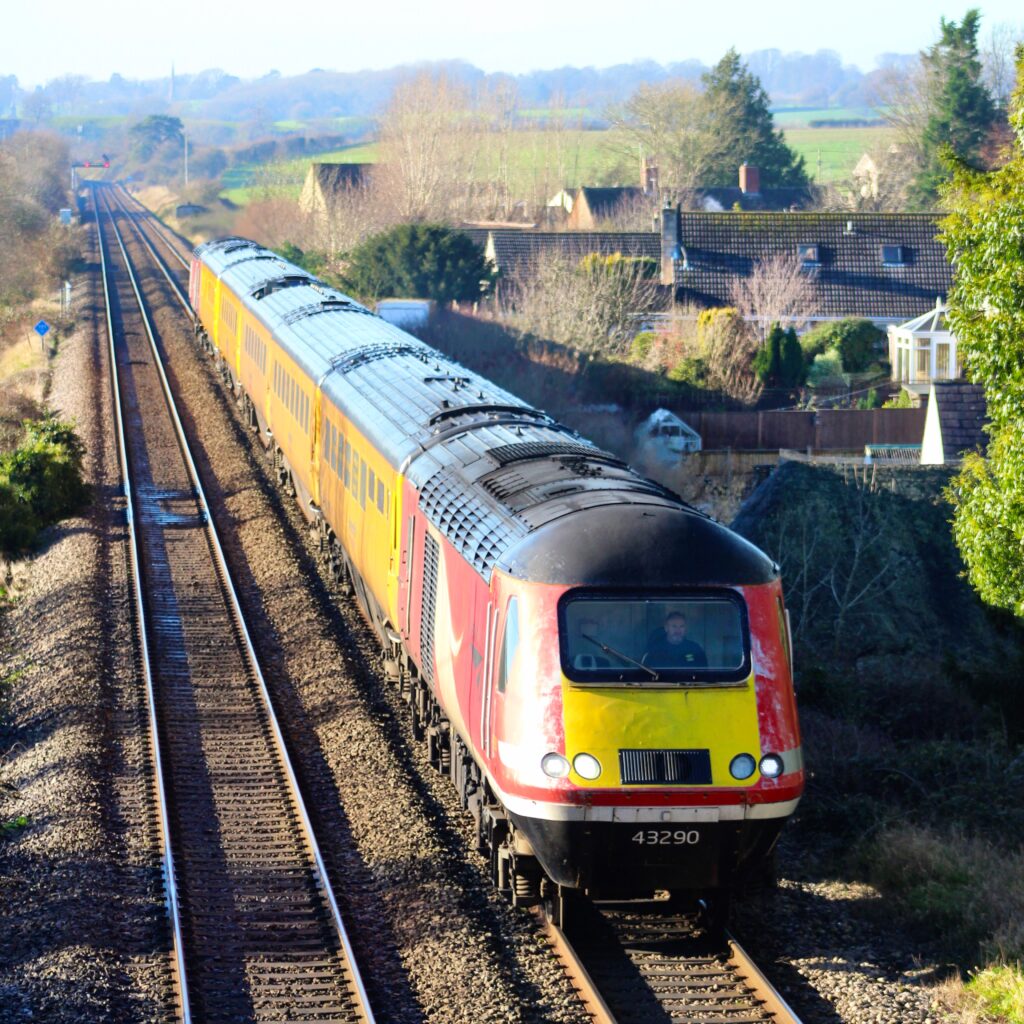
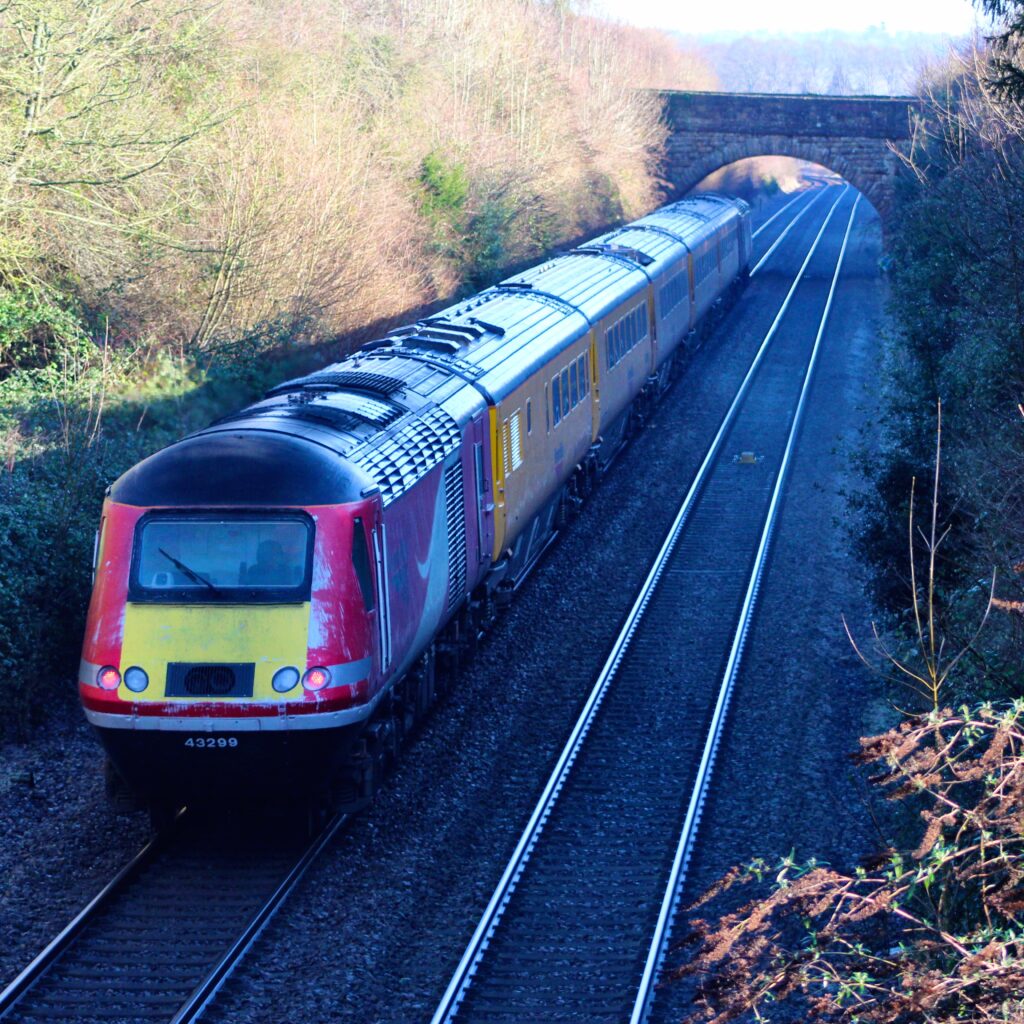
January 13th 2022 – a sunny lunchtime outing to Sutton Bingham, Somerset and Bradford Abbas, Dorset to catch sight of Colas operated New Measurement Train worked by High Speed Train power cars 43290 and 43299.
COLAS Class 43 HST power cars No. 43290 and 43299 with a Network Rail New Measurement Train, Bradford Abbas on 13th January 2022
Trains seen in this video: 159018 – 1L17 0820 London Waterloo to Exeter St. Davids 159001 – 1L40 1025 Exeter St. Davids to Basingstoke 159005 – 1L21 0920 London Waterloo to Exeter St. Davids 43290 & 43299 – 1Q23 0556 Reading to Salisbury via Exeter 159107 & 159018 – 1L25 London Waterloo to Exeter St. Davids 159106 – 1L44 1125 Exeter St. Davids to Basingstoke
Sutton Bingham Reservoir is situated near the village of Sutton Bingham in the civil parish of Closworth, Somerset. The reservoir was built in the 1950’s to supply water to Yeovil. The remains of Sutton Mill are under the water, and close to the shore is the 12th century Church of All Saints. These days the reservoir is home to overwintering wildfowl and migrant birds, a sailing club and fishing. The weather on Thursday January 13th was perfect for watching both birds and trains!
January 14th 2022 – A late addition to the timetable saw GBRf operated Snow & Ice Treatment Train top and tailed by class 66 locomotives make its second visit to the Weymouth line this year.
Trains seen in this video: 444028 – 1B63 2048 Winchester to Poole 66757 ‘West Somerset Railway’ & 66755 ‘Tony Berkeley OBE RFG Chairman 1997 – 2018’ – 3Y89 2212 Totton Yard to Totton Yard
Yoshi also partook in his first shower of the year. The boy seems to quite enjoy his showers and willingly submits. This is the immediate aftermath:
We’ll be back soon for more archive railway features and cockapoo related happenings.
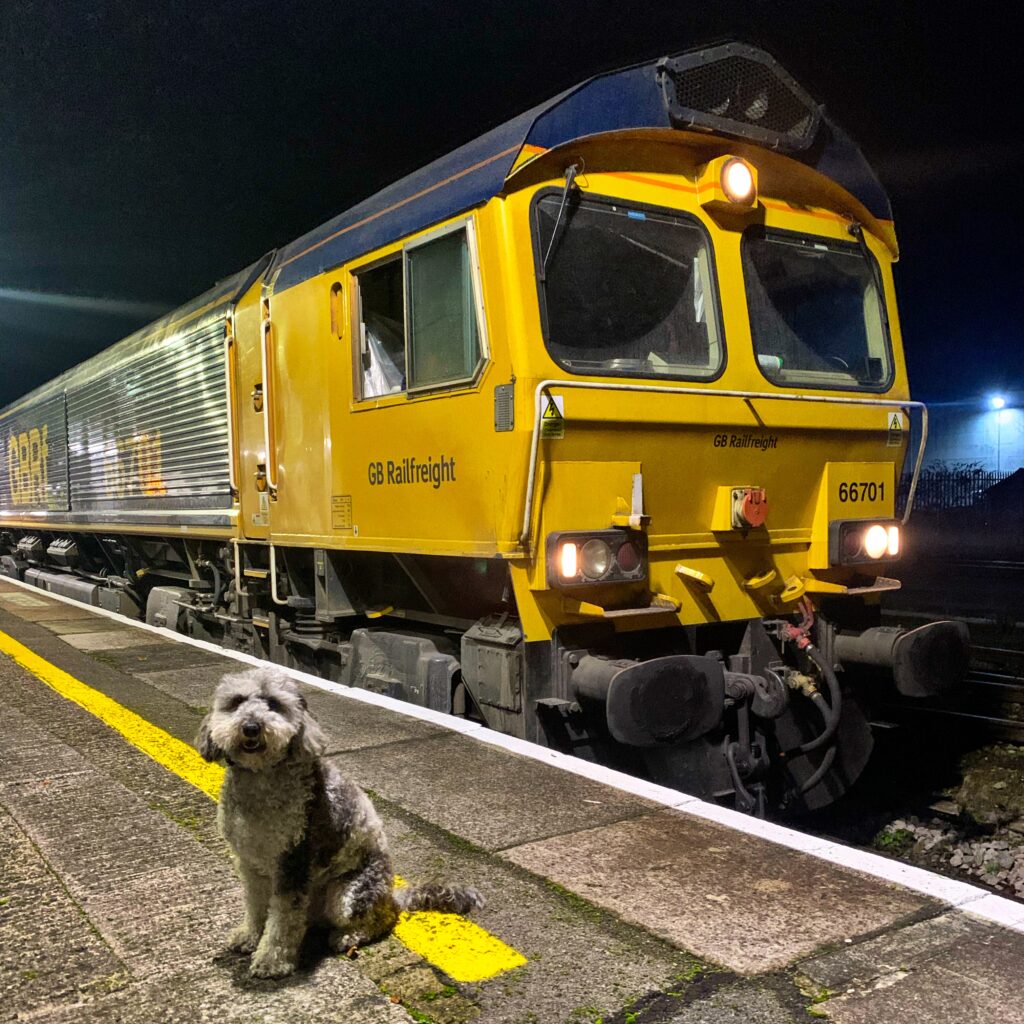
Yoshi at Yeovil Pen Mill waiting for any movement from 66701
At the moment there is a fair bit of work being carried out to provide major improvements to the railway line between Weymouth, Dorchester and Yeovil. Scheduled to take 16 days, the line between Yeovil Pen Mill and Weymouth closed to Great Western Railway services on November 18th. Additionally, on Monday November 22nd South Western Railway trains from Weymouth to Wool were replaced by buses and from Tuesday November 23rd to Friday November 26th buses replaced trains between Weymouth and Dorchester South.
Work is being carried out across eight sites with the main focus being between Yetminster and Maiden Newton which will see four miles of track being replaced. Line improvements between Weymouth, Dorchester South and Wool is designed to keep trains on time and reduce delays.
Since September 2021, engineering trains have been visiting the area delivering materials for use in the upgrade work and Yoshi and I have ventured out in the hope of catching sight of some of these when they ran at sensible ( and some not quite so sensible ) hours.
We’ve had a few late nights waiting at Yeovil Pen Mill, and our perseverance has been rewarded with an interesting array of Class 66’s from EWS, Colas Rail, Freightliner and EWS. On at least one occasion we gave up hope of seeing all the scheduled movements into the work zone as driver shortages imposed unavoidable delays in proceedings.