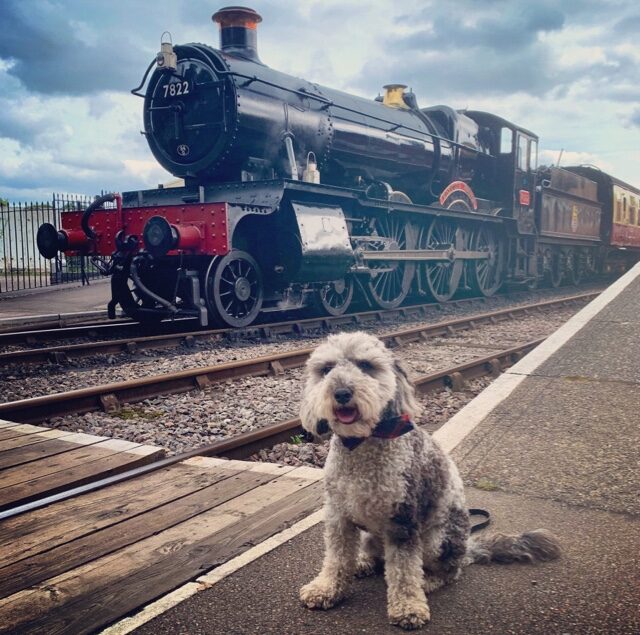
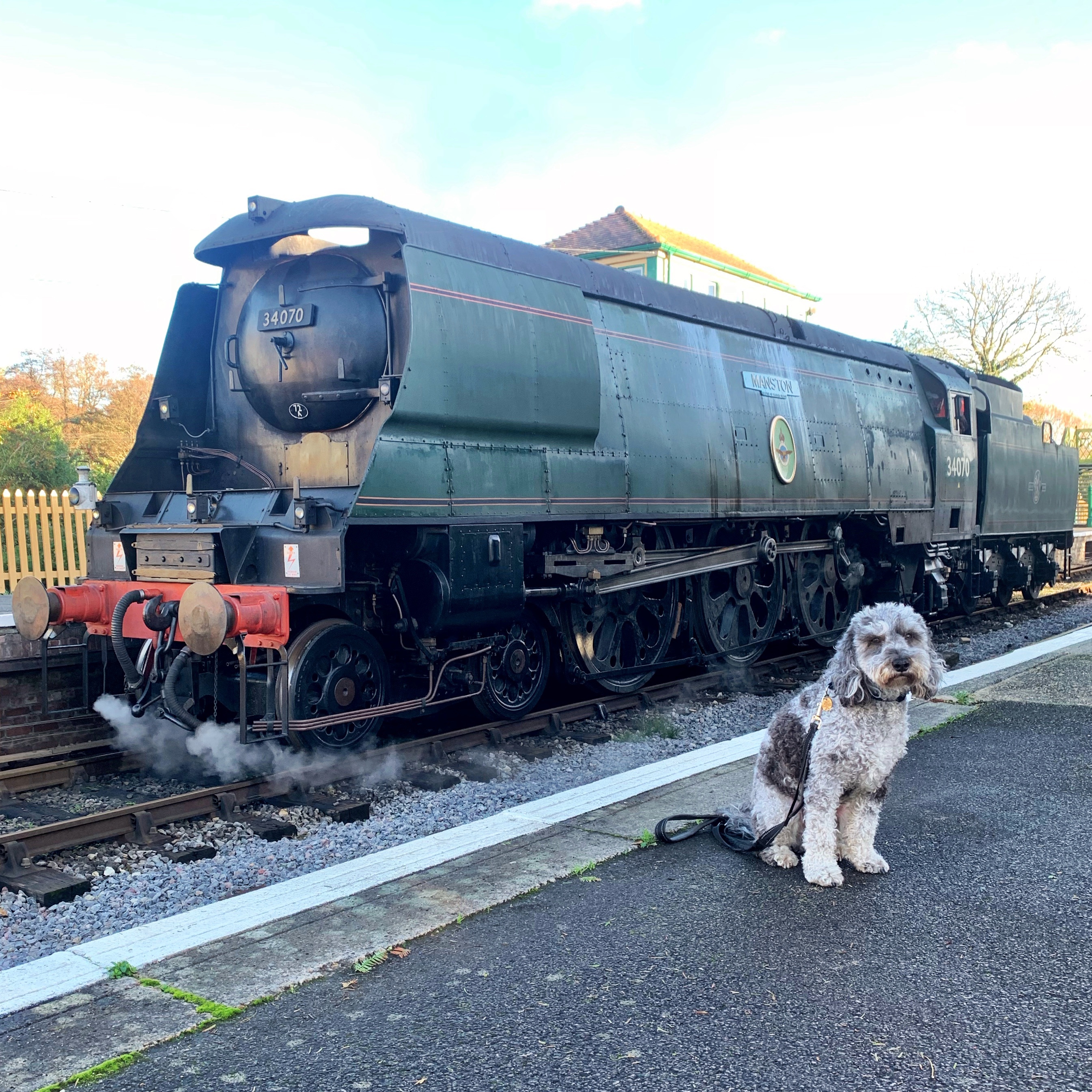
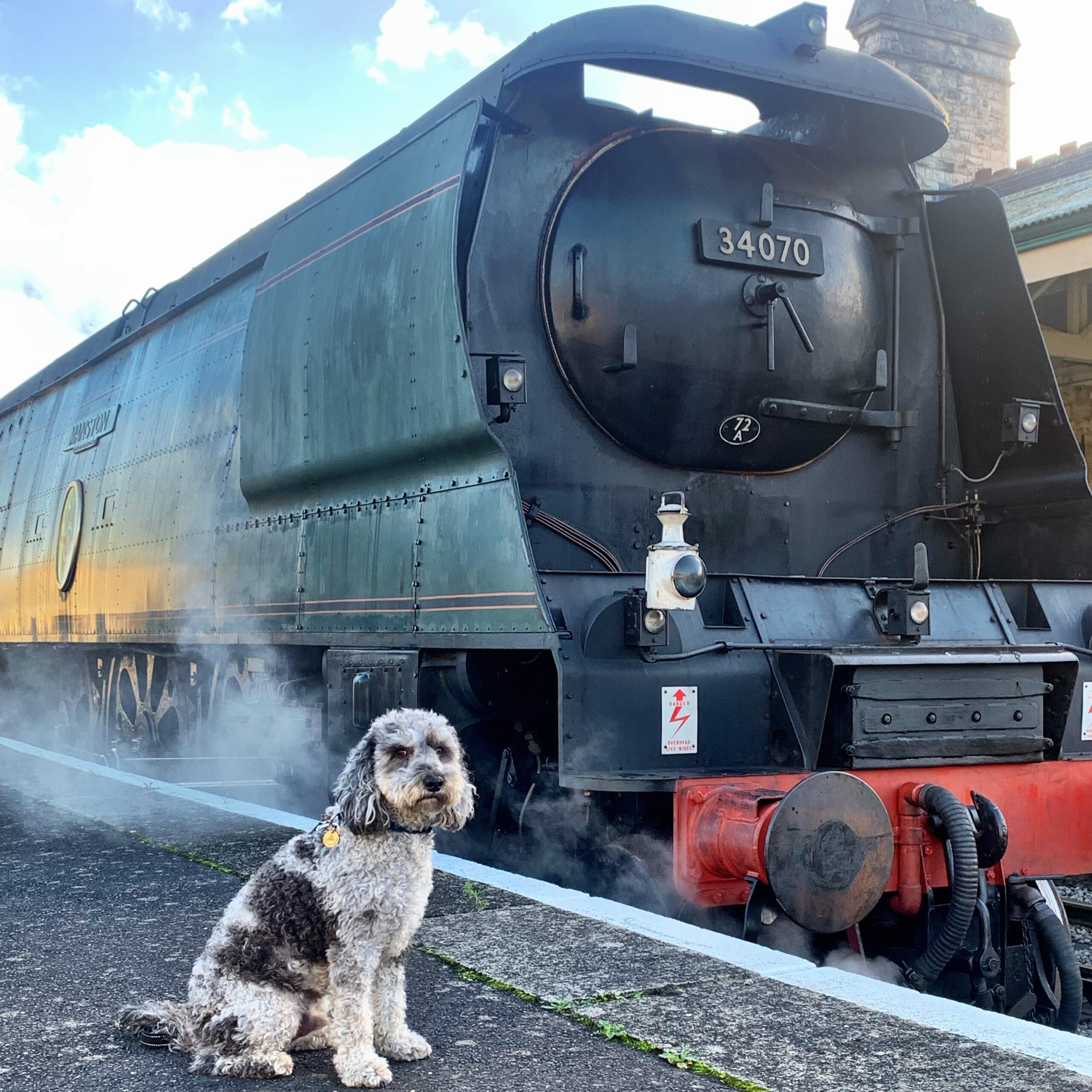
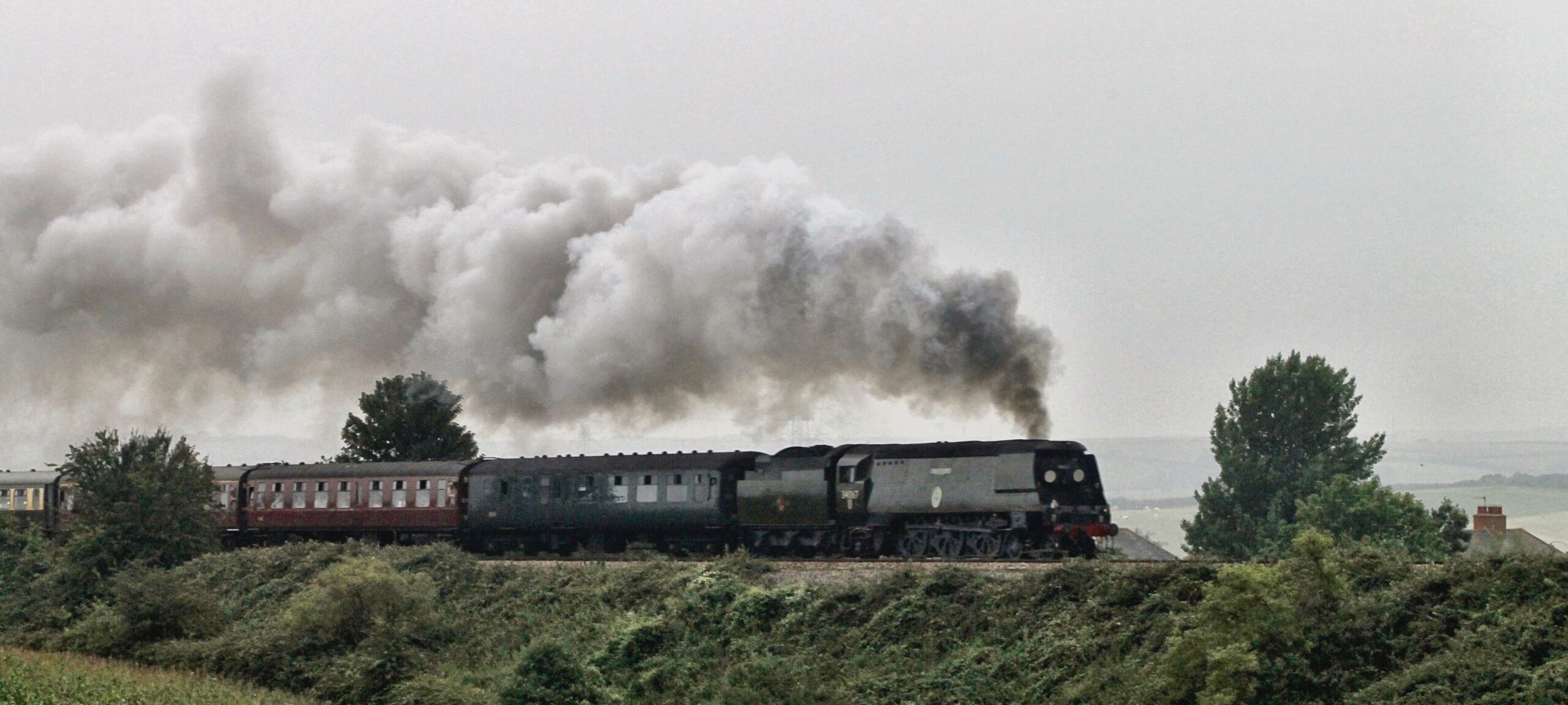
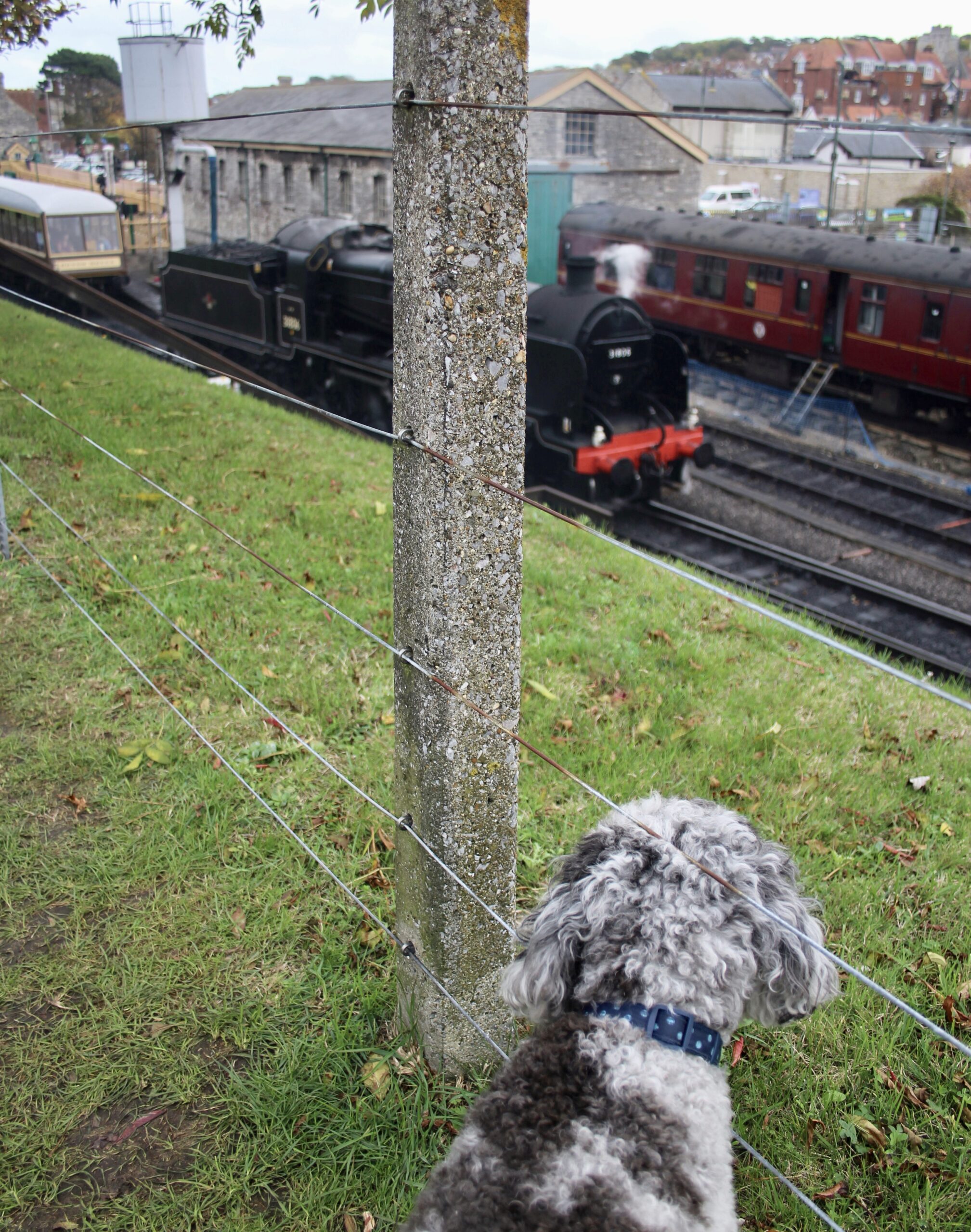
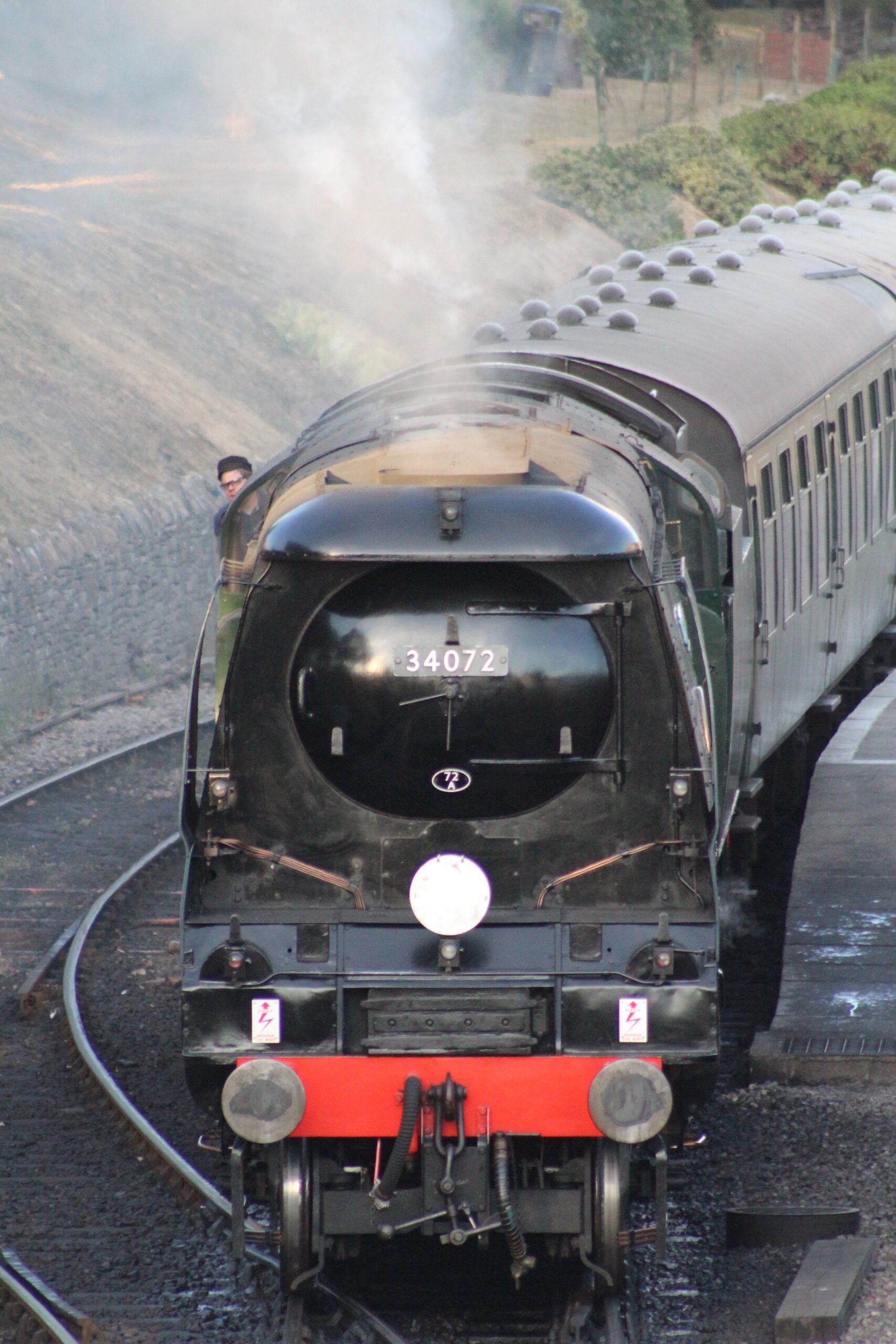
Yoshi with SR Unrebuilt Battle of Britain Class 4-6-2 No. 34070 ‘Manston’ at Corfe Castle railway station on the Swanage Railway – 17/11/2022
We first posted in Yoshi’s blog on 22nd November 2021 so I, for one, am very pleased we have completed a year of entries. Thank you for joining us if this is your first time or your 58th time. We really do appreciate everyone who has taken time out to read our words, look at our pictures or watch our video clips. Thank you for your comments, updates, suggestions and corrections over the past year.
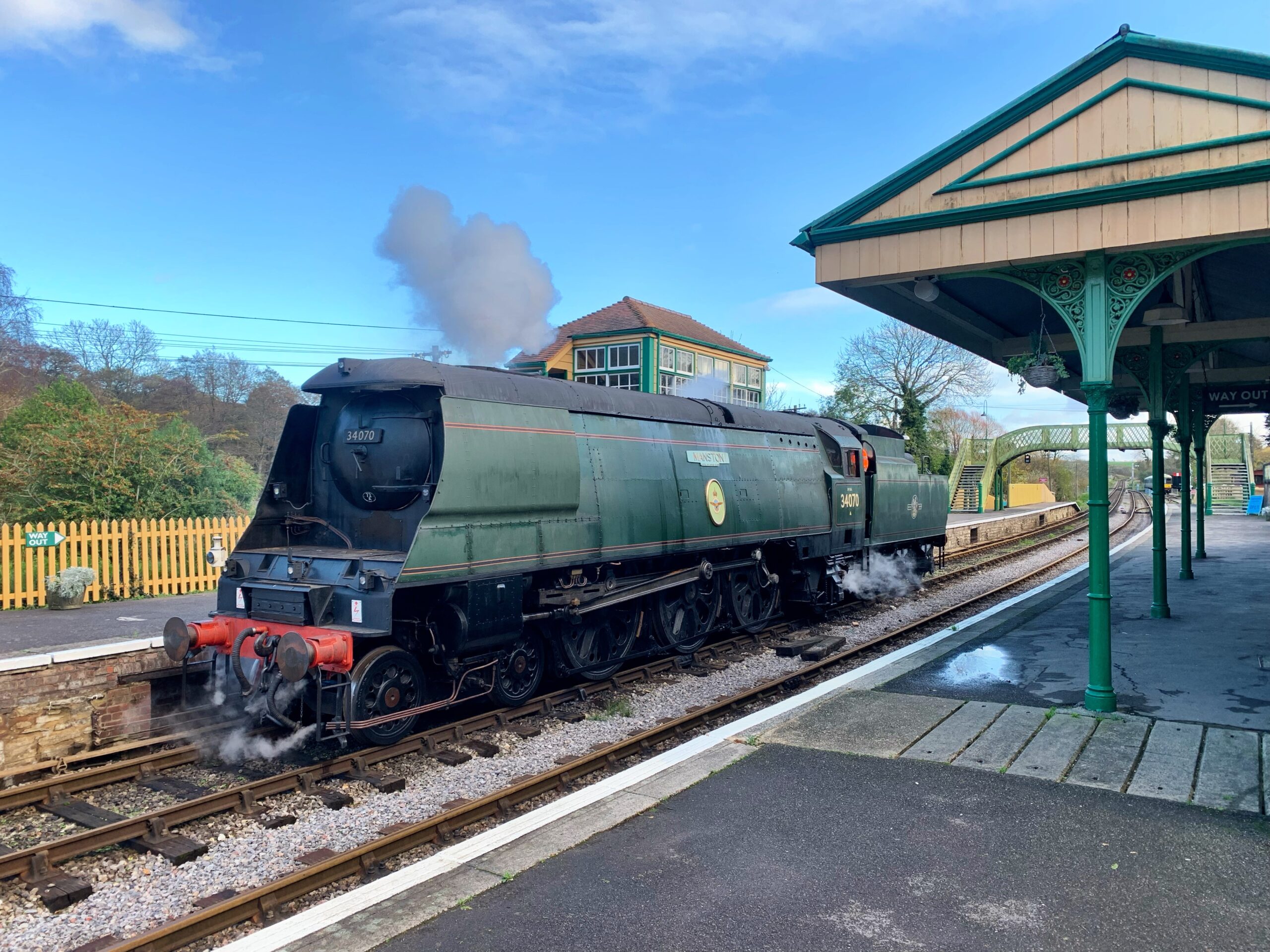
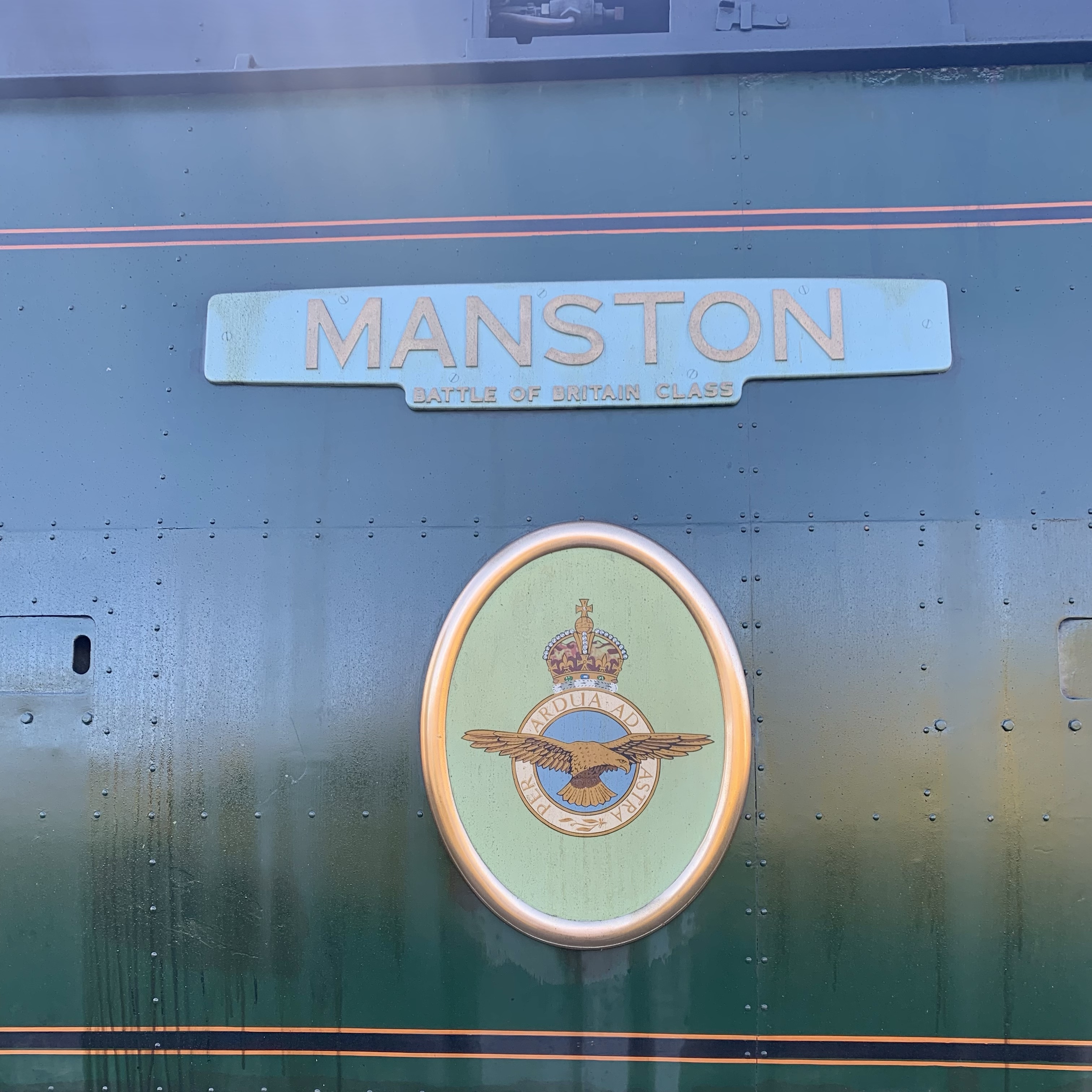
This last week began with a Thursday lunchtime trip to Corfe Castle on the Swanage Railway to see SR Unrebuilt Battle of Britain Class 4-6-2 No. 34070 ‘Manston’ which was out on test running light engine. The locomotive has only recently been returned to traffic and later in the day she also hauled two carriages in a loaded test run from Swanage.
SR Unrebuilt Battle of Britain Class 4-6-2 No. 34070 ‘Manston’ departs Corfe Castle during a running in test run – 17/11/2022SR Unrebuilt Battle of Britain Class 4-6-2 No. 34070 ‘Manston’ at Corfe Castle during a running in test run – 17/11/2022Nameplate and crest detail of SR Unrebuilt Battle of Britain Class 4-6-2 No. 34070 ‘Manston’ – 17/11/2022Yoshi takes a closer look at SR Unrebuilt Battle of Britain Class 4-6-2 No. 34070 ‘Manston’ while at Corfe Castle – 17/11/2022
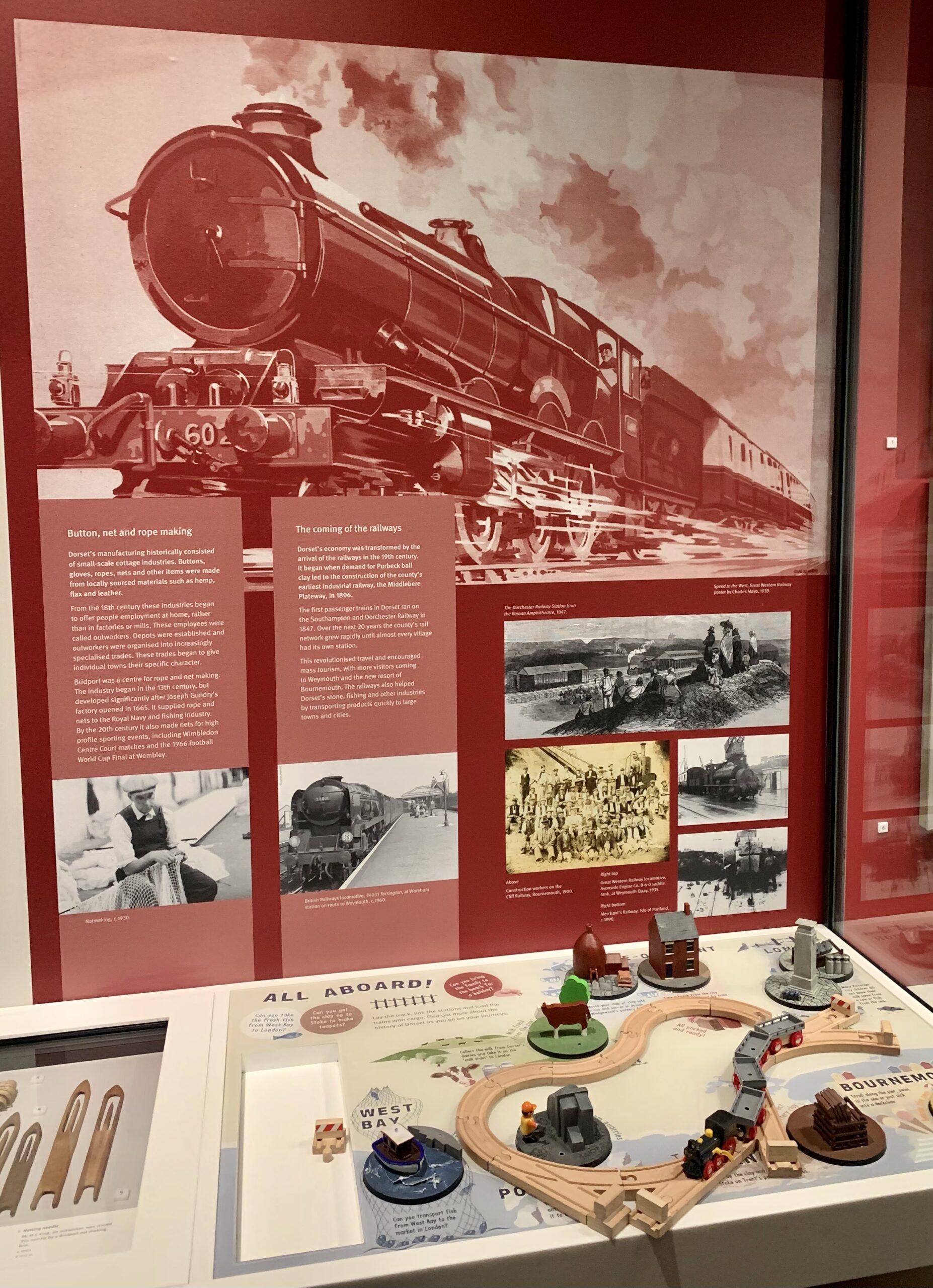
In the evening we went along to the Dorset Museum’s “Museum after Hours” event in Dorchester. It was the first time I had visited the museum since its £16.4m refurbishment and May 2021 re-opening. The new museum galleries are spacious, the displays well thought out with a child friendly leaning. The railways of Dorset are covered by one display panel and a Brio style model track circle as part of the Trade and Industry section within the “People’s Dorset” gallery on the first floor.
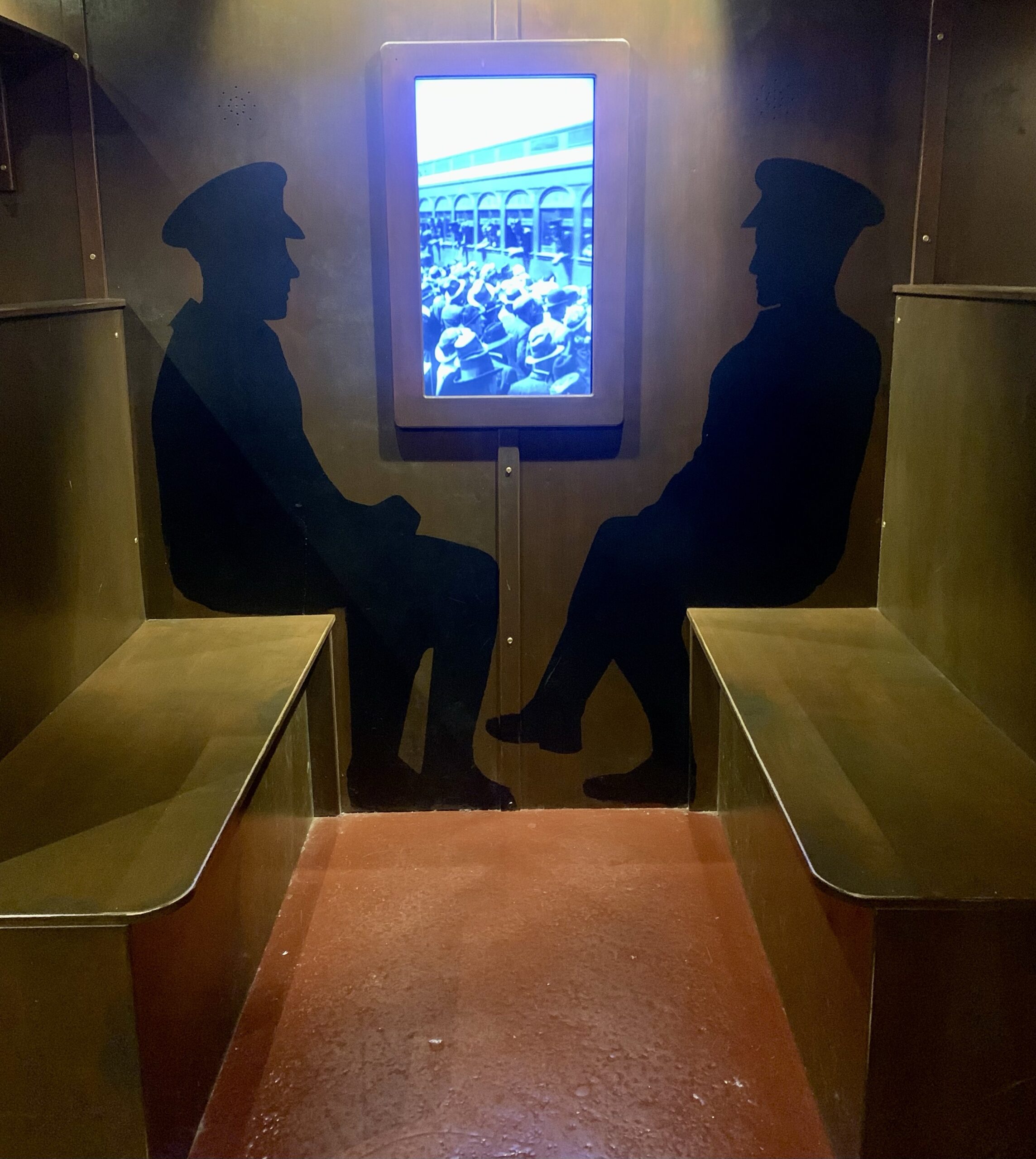
Dorset Museum celebrates the railways in Dorset – 17/11/2022
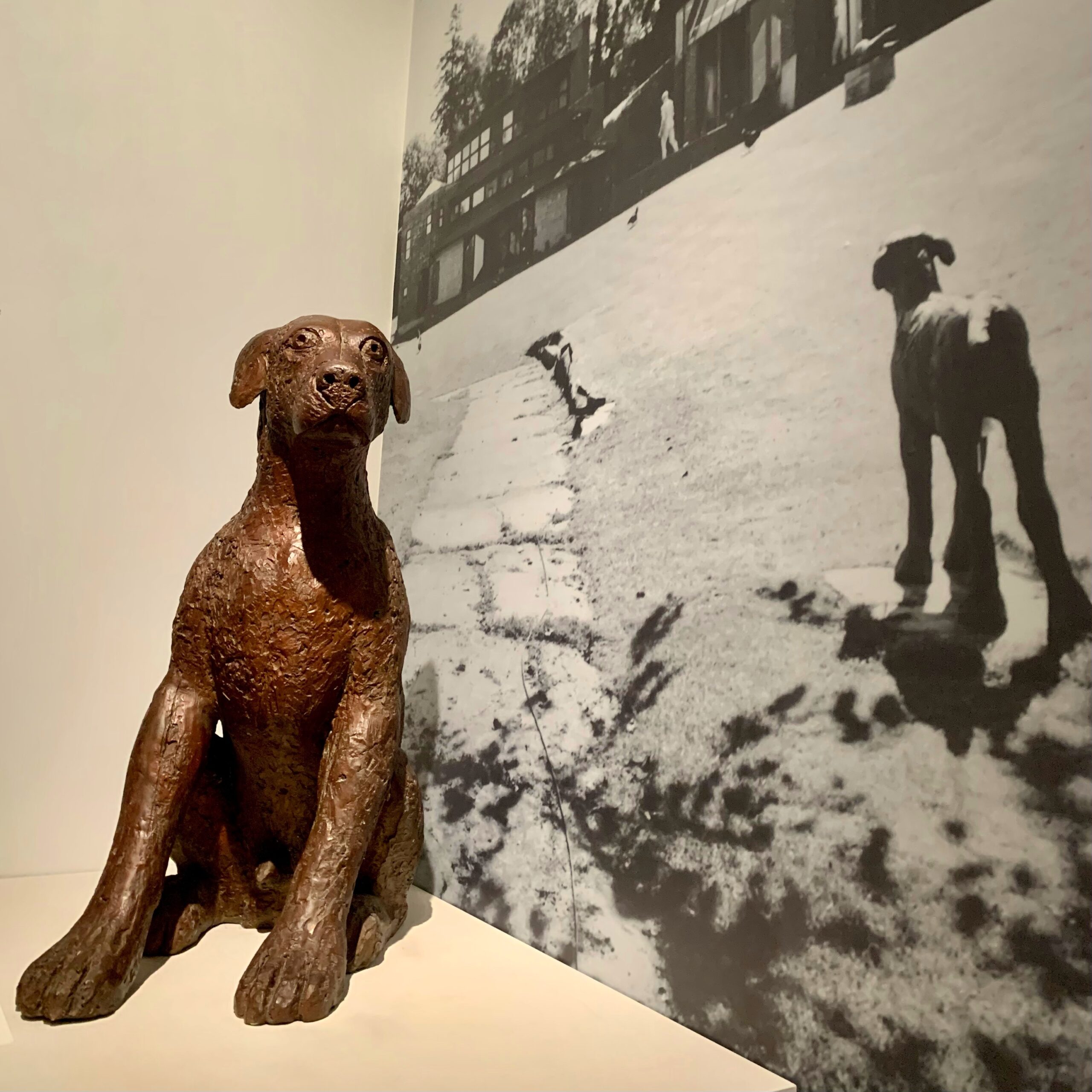
I very much enjoyed seeing a number of sculptures from Dame Elisabeth Frink (1930 – 1993) who I have very fond memories of meeting at the museum many years ago while on a school visit. The “Artists’ Dorset” gallery was perhaps my favourite of what is currently on offer at the museum.
Leonardo’s Dog (Bronze, edition of 6, 1990) – on a visit to the Loire, Dame Elisabeth Frink came across a stone dog at the entrance to Leonardo Da Vinci’s house that inspired her to create this work. Frink admired the traits of loyalty and dignity which she felt were often lacking in humans – 17/11/2022In August 1996 Dame Elisabeth was one of five ‘Women of Achievement’ selected for a set of British stamps
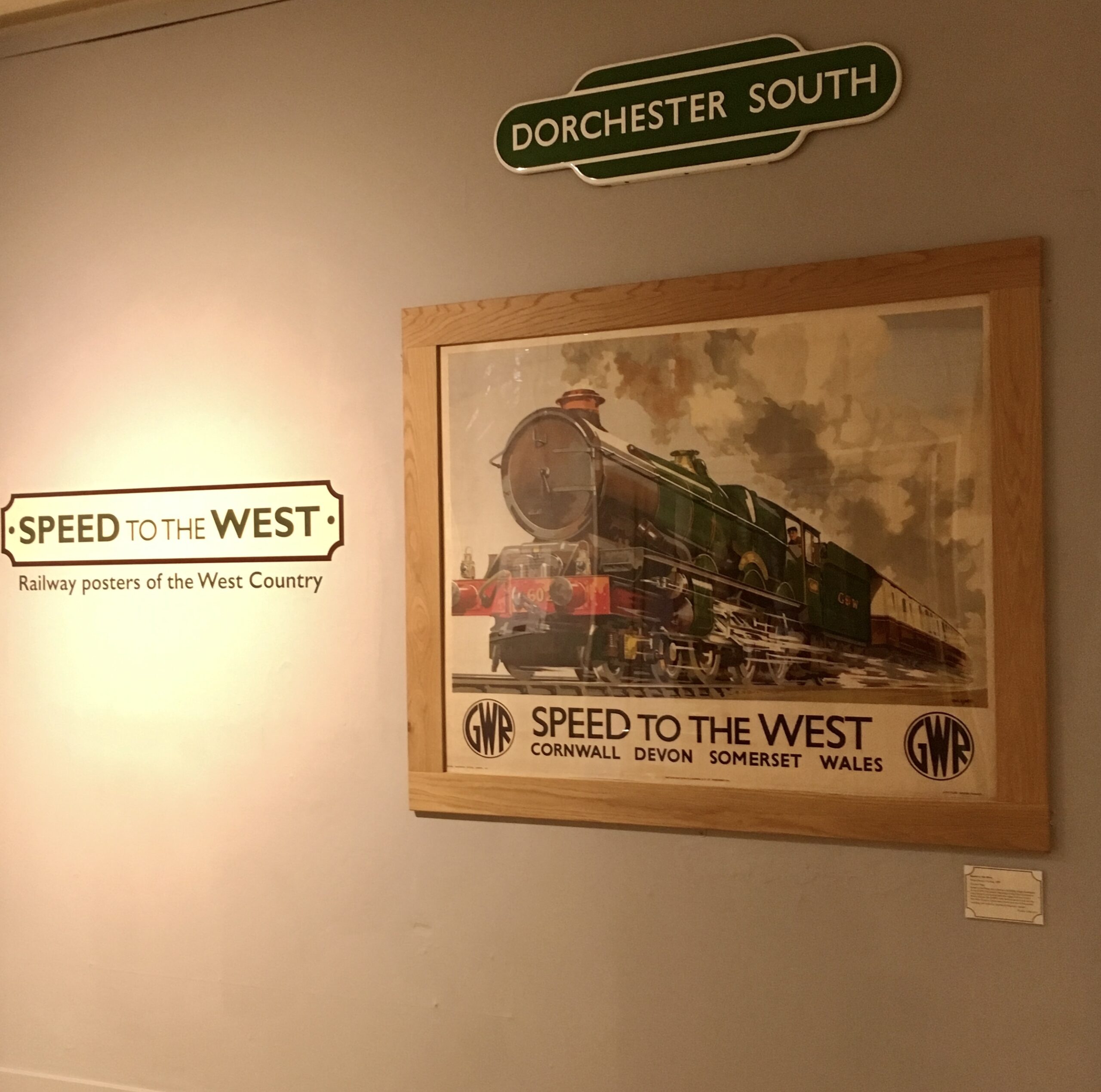
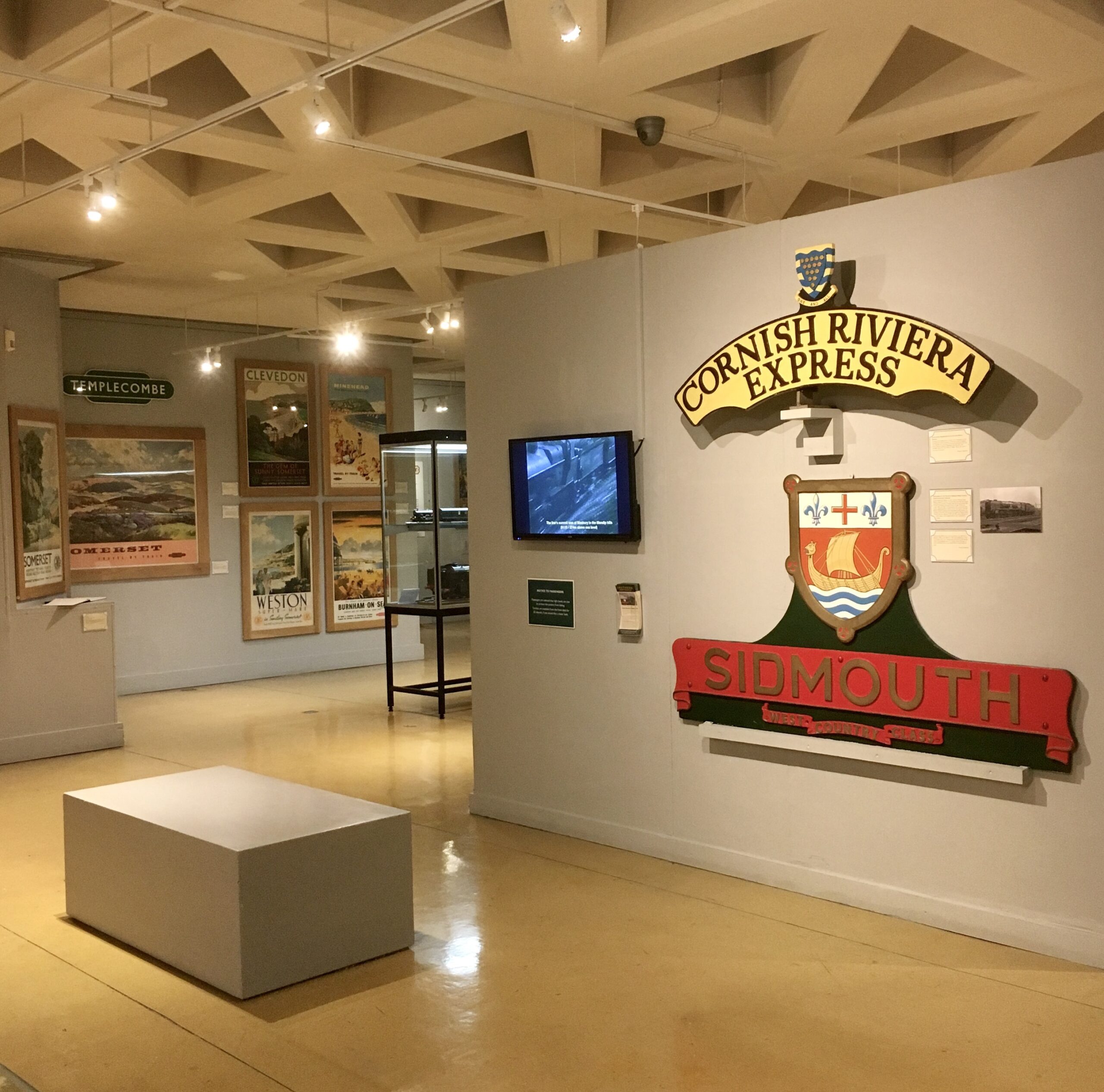
In 2016/17, the Dorset County Museum (as we called it then) held an excellent exhibition of railway posters and station roundels called “Speed to the West” curated by “Antiques Roadshow” expert Paul Atterbury and collector Richard Furness. I was, of course, particularly pleased that some Terrence Cuneo posters were included and I’d be very pleased if the museum did a repeat showing!
Dorset County Museum’s “Speed to the West” curated by Antiques Roadshow expert Paul Atterbury and collector Richard Furness – 19/03/2016Dorset County Museum’s “Speed to the West” curated by Antiques Roadshow expert Paul Atterbury and collector Richard Furness – 19/03/2016Dorset County Museum’s “Speed to the West” curated by Antiques Roadshow expert Paul Atterbury and collector Richard Furness – 19/03/2016
Friday morning was the start of a long weekend with a return trip to the Naval Dockyards at Portsmouth. Our intention this time was to see the Submarine Museum which we didn’t have time for on our previous visit in the summer, but with the special boat which is used to ferry visitors across to Gosport not running, we elected instead to postpone clambering around the submarines and instead visited the ships on show in Portsmouth.
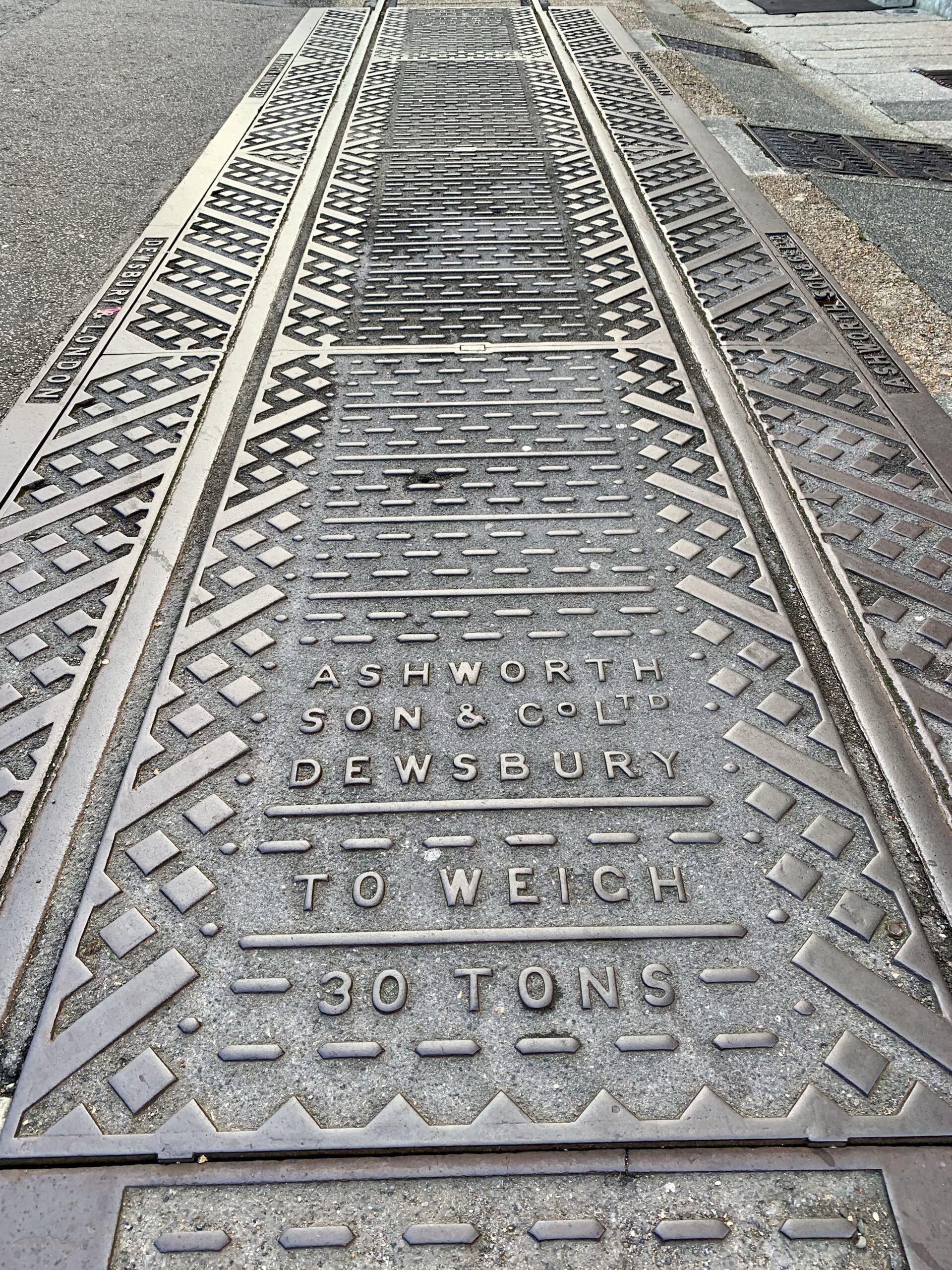
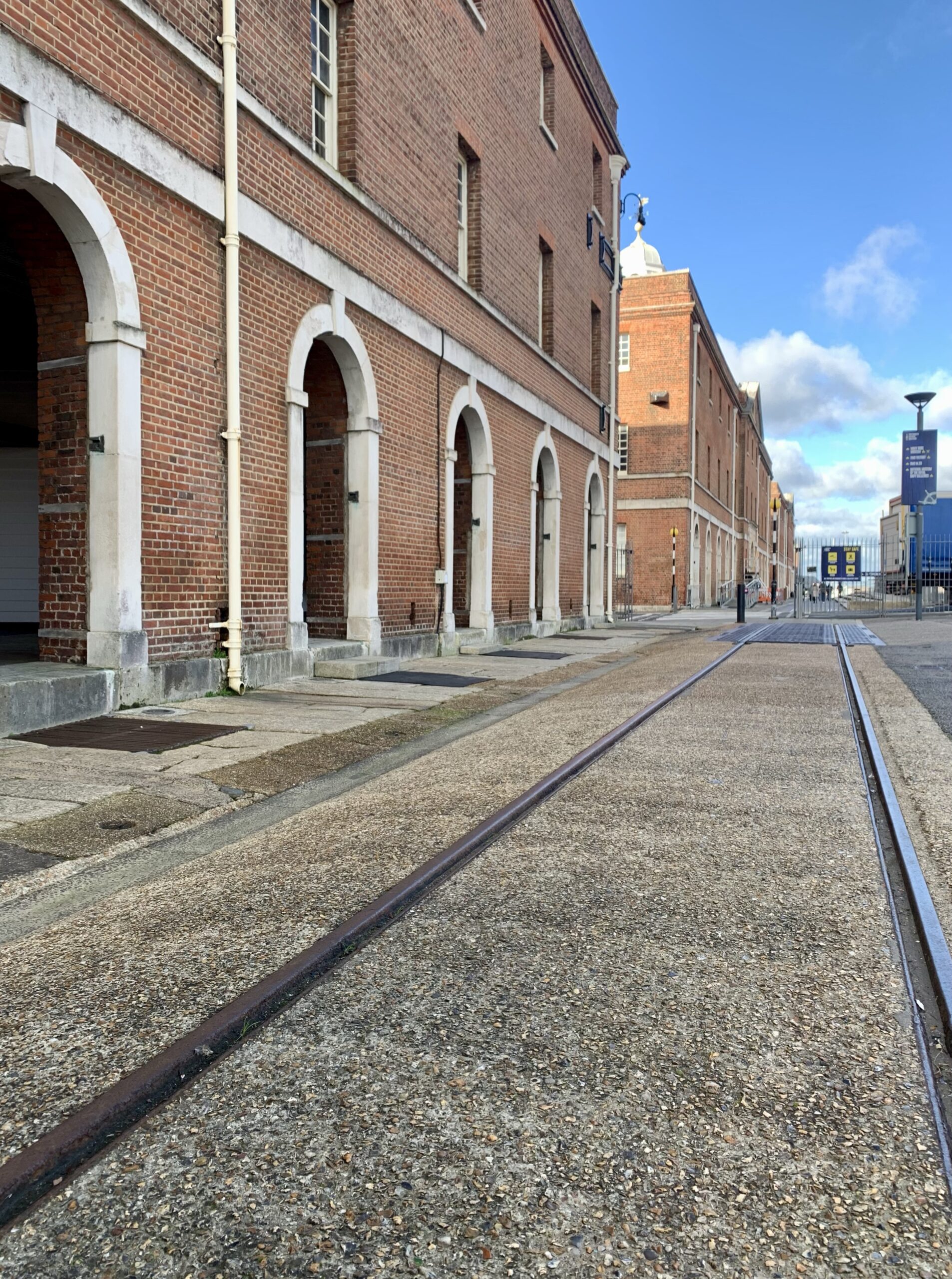
There are still a few remains of the once extensive Portsmouth dockyard railway system still in evidence:
Began in 1843 within the walls of the dockyard, the railway was connected to the national network in 1846 via the “Admiralty Line” between Unicorn Gate and Portsmouth Town station (now Portsmouth & Southsea). By 1952, at its peak, there were around 27 miles of track within the docks used for transporting goods, equipment and personnel. In the 1970’s the railway declined and the link to the main line was closed in 1977 with the dockyard railway closing entirely a year later.
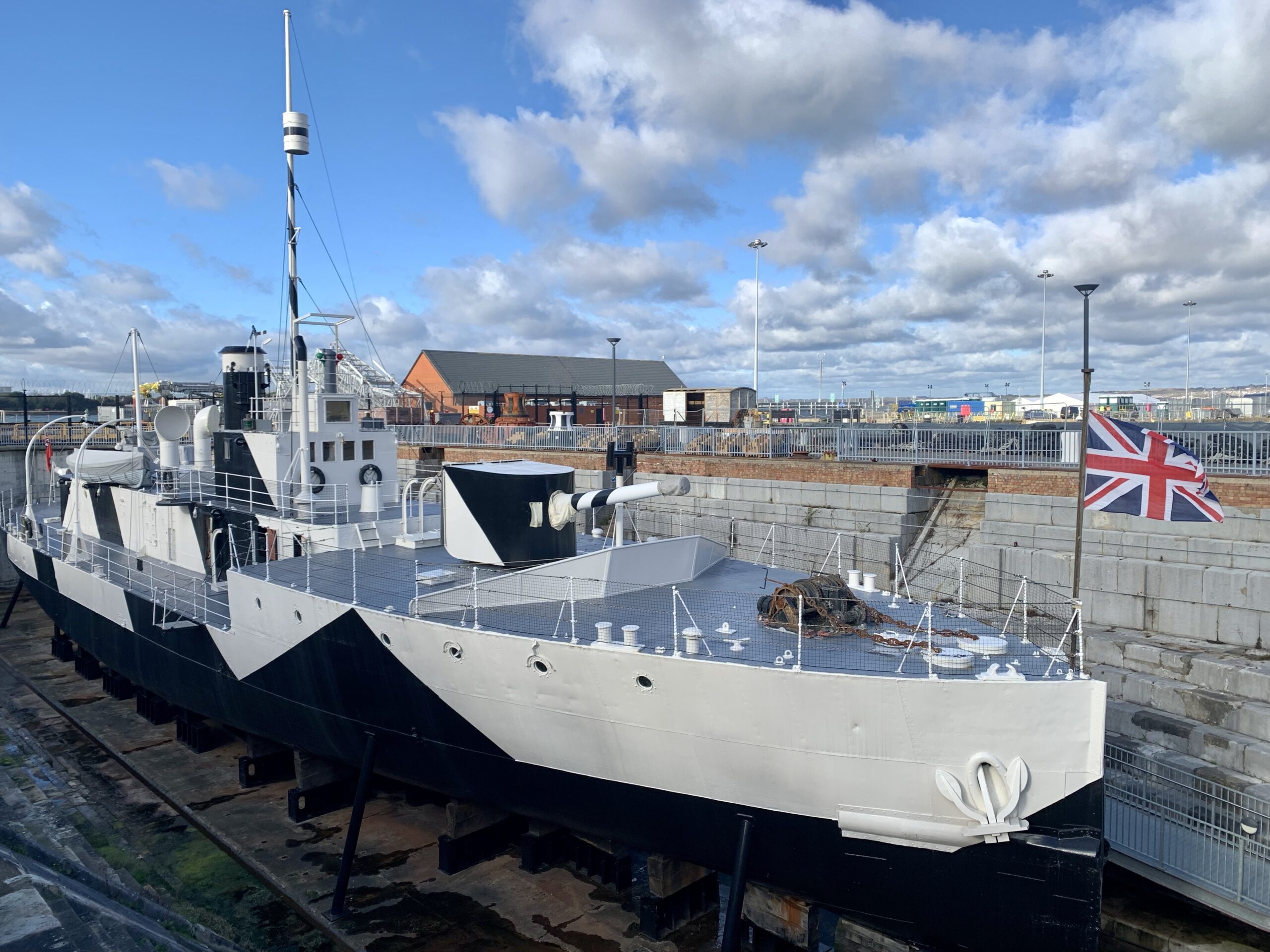
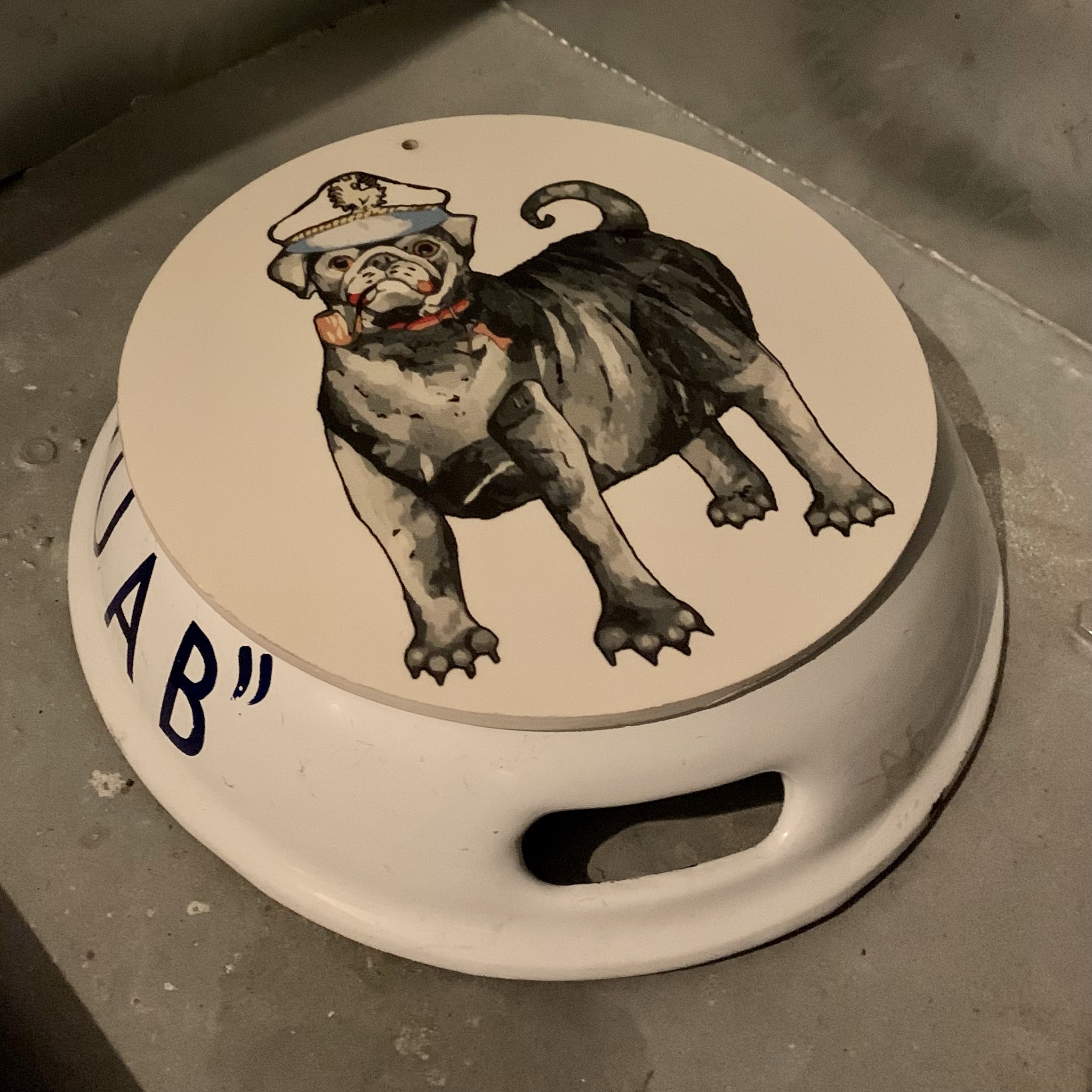
HMS M.33 built in 1915 is not only the sole remaining British veteran of the bloody Dardanelles Campaign of 1915-1916, but also of the Russian Civil War which followed. The ship is one of just three British warships from World War I still in existence. Behind the ship you can see two railway wagons which remain in evidence – 18/11/2022According to a list of crew on board HMS M.33 in 1915, there were two ship’s dogs. Squab belonged to the captain, Preston-Thomas and Nell belonged to the crew. There was also a ship’s cat, Miss Muggins and the wheelhouse had a cat flap – 18/11/2022
I didn’t video many trains on this Portsmouth outing – but this video clip includes DB Class 66 No. 66013 working 4021 0915 Trafford Park Euro Terminal to Southampton Western Docks Berth 109, GWR Class 166 No. 166215 working 1F26 1623 Portsmouth Harbour to Cardiff Central, GWR Class 165 No. 165129 with Class 166 No. 166203 working 1F24 1523 Portsmouth Harbour to Cardiff Central, Southern Class 377 No. 377158 working 1S24 1400 Brighton to Portsmouth Harbour and an RHTT configured MPV working 3S82 0611 Totton Yard to Totton Yard – 18/11/2022
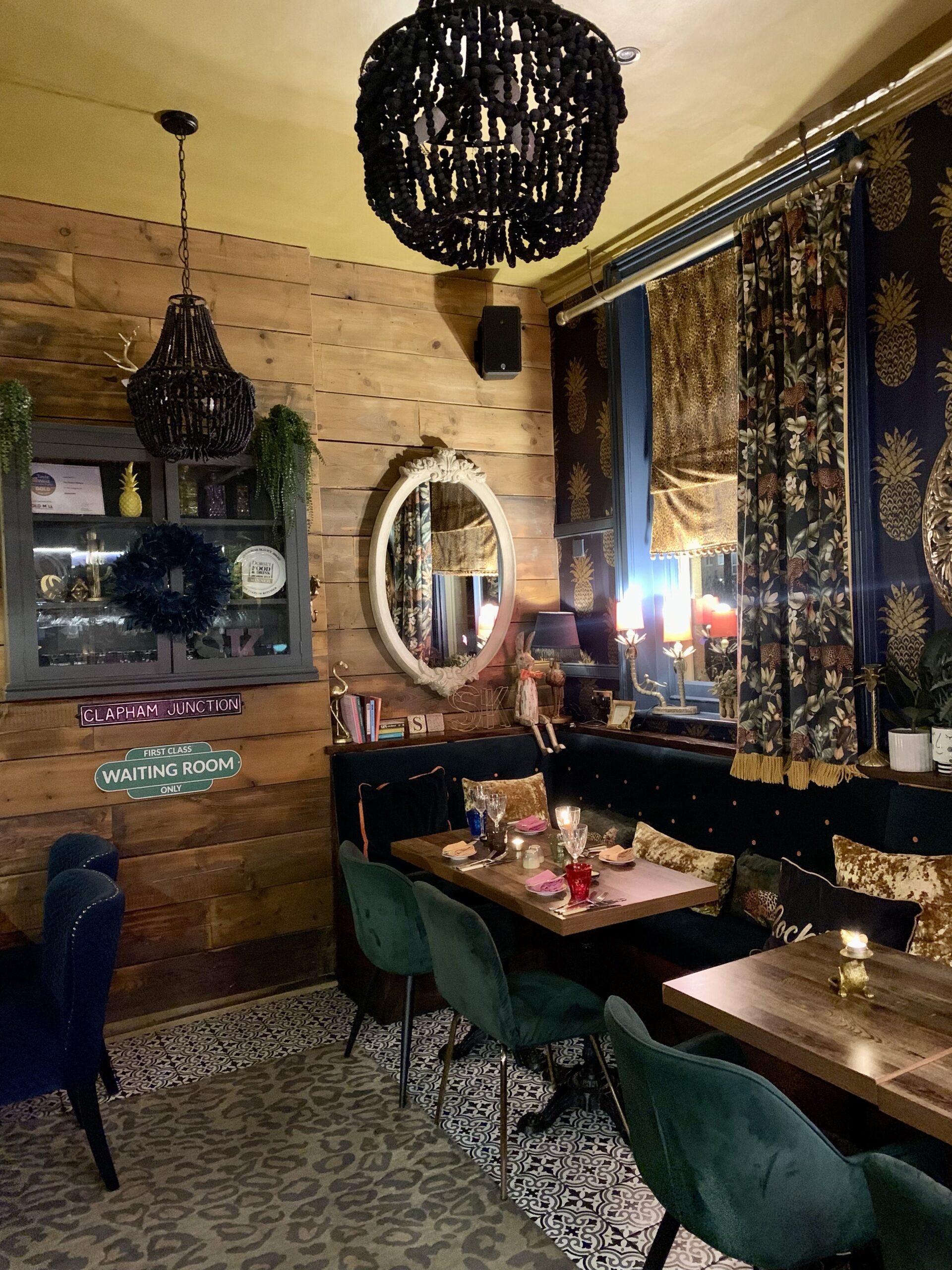
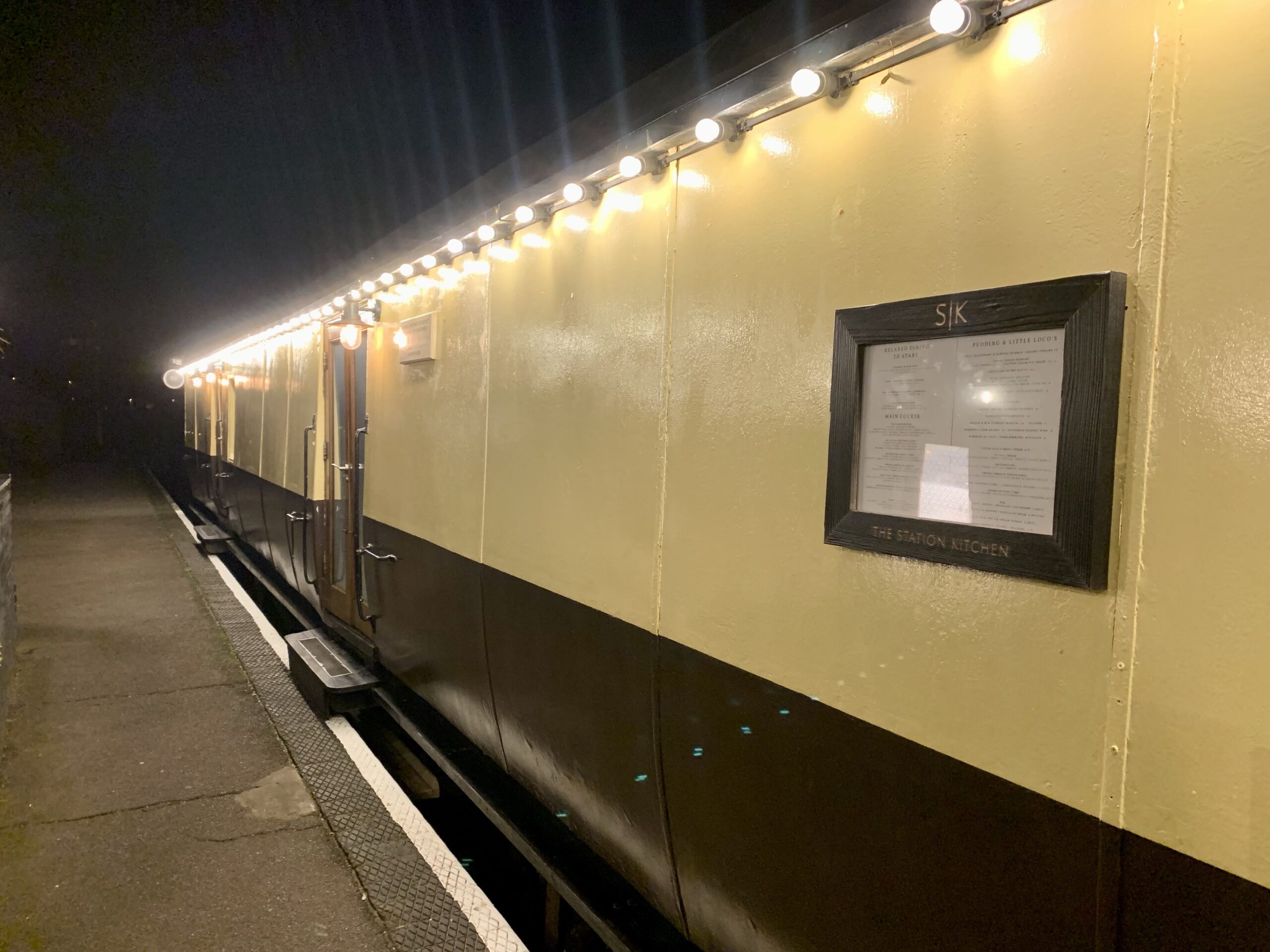
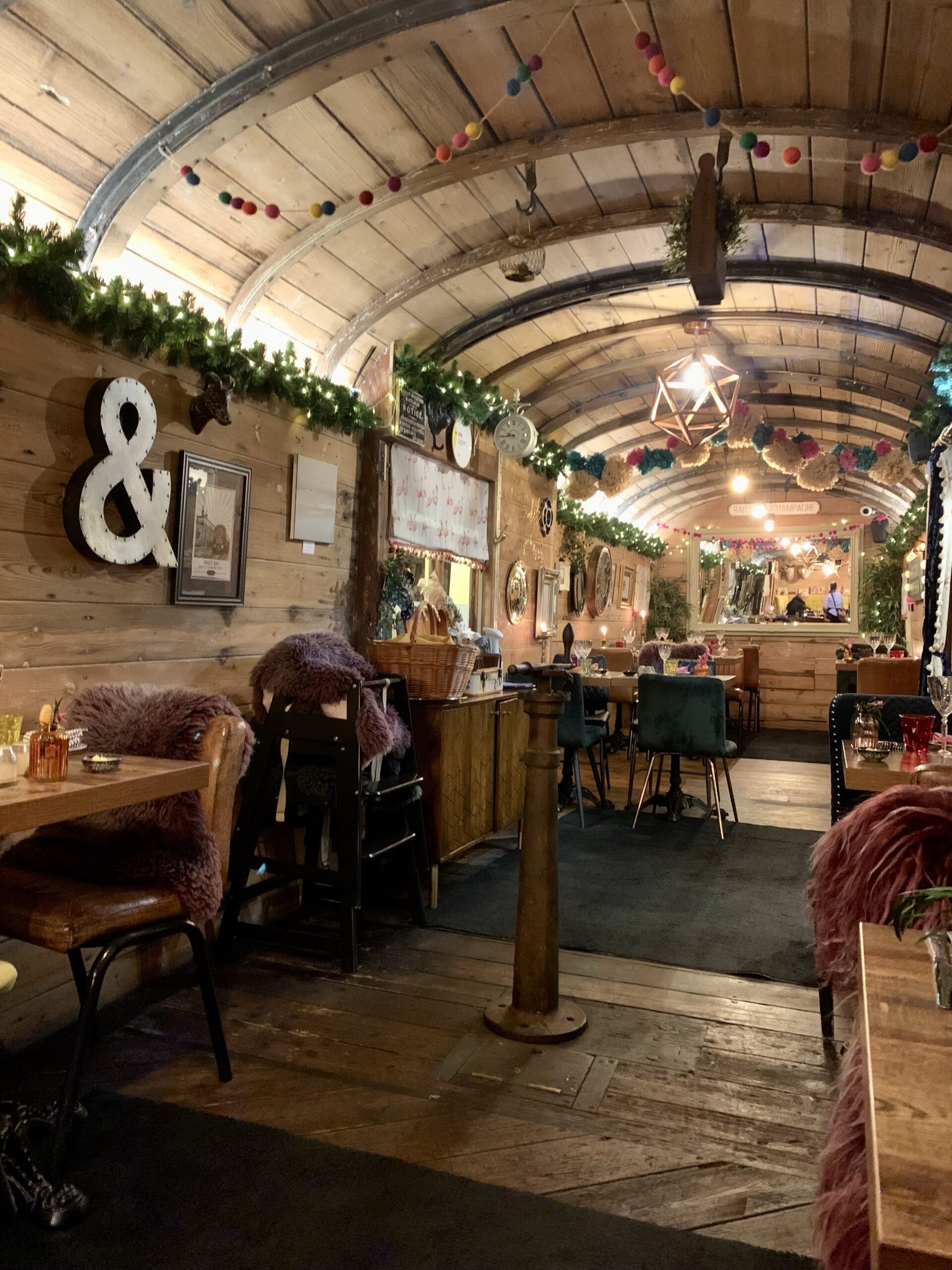
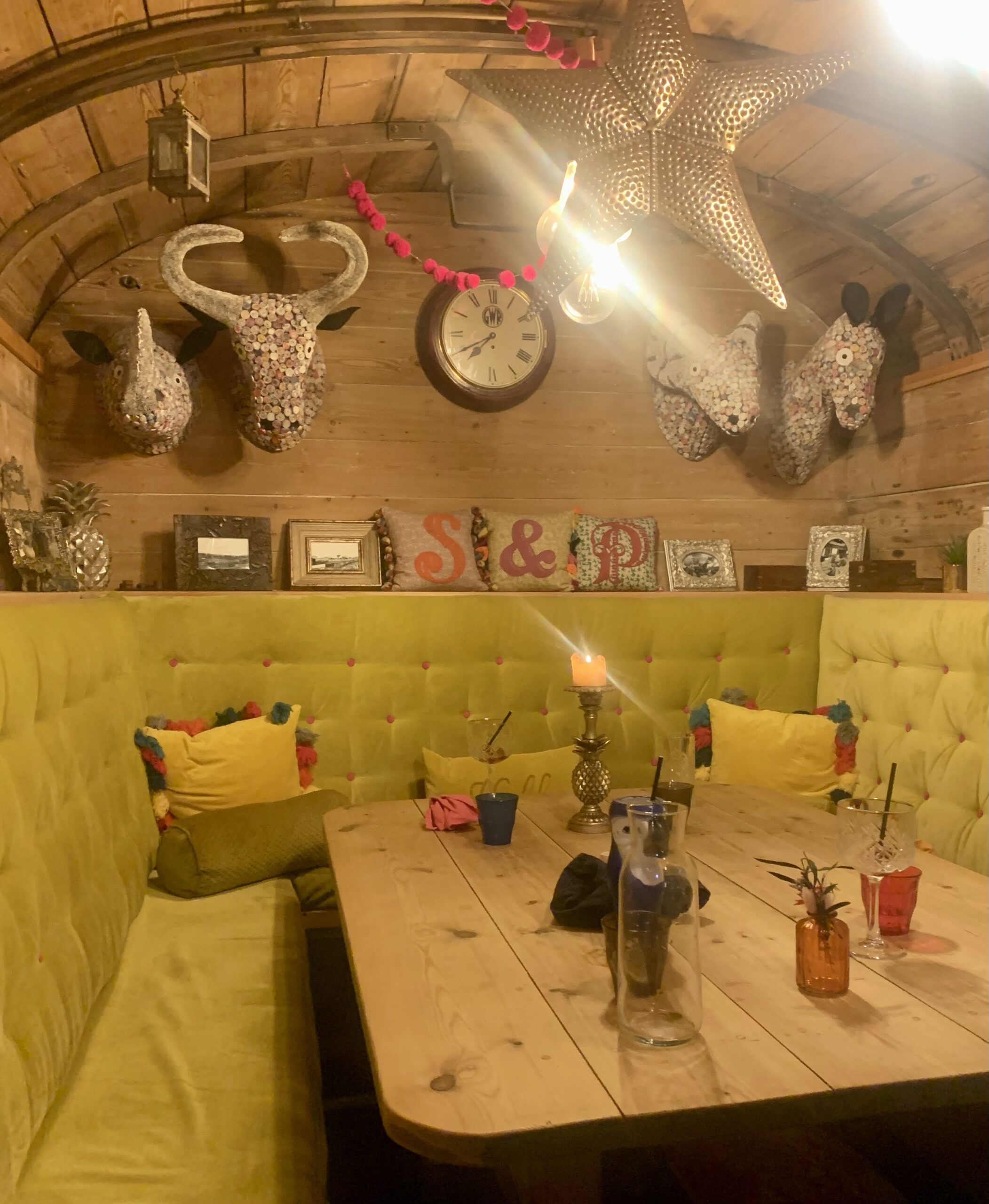
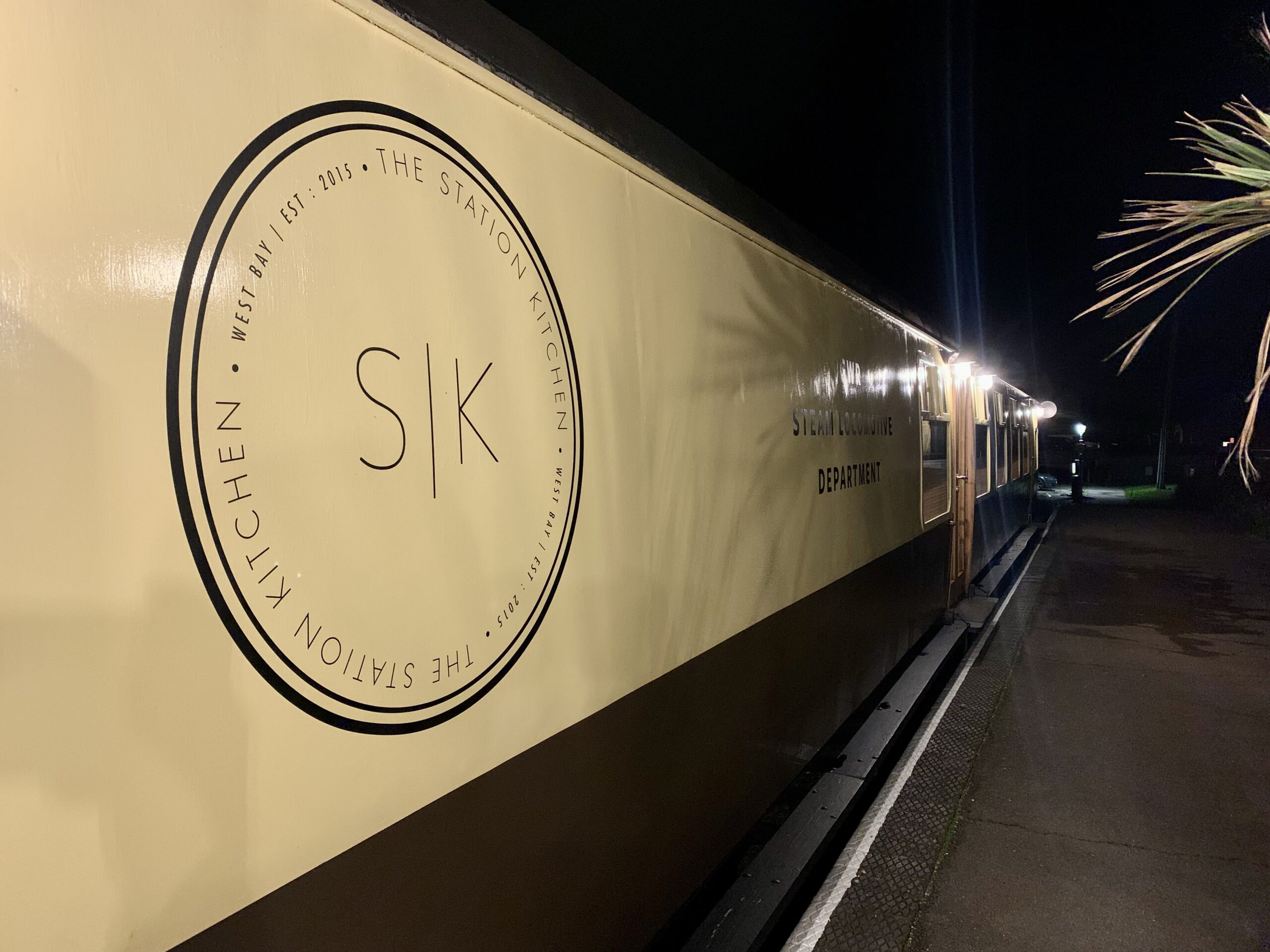
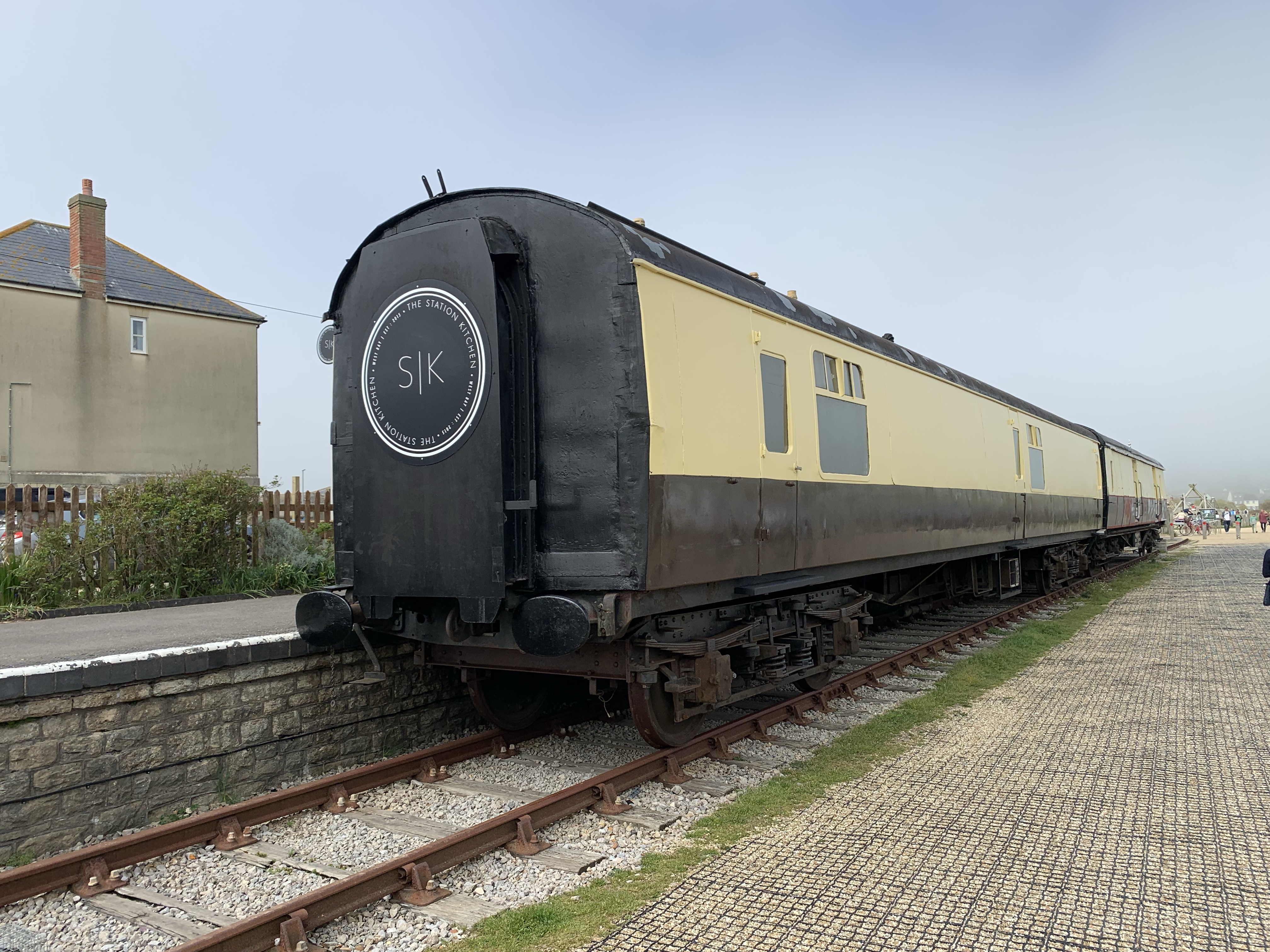
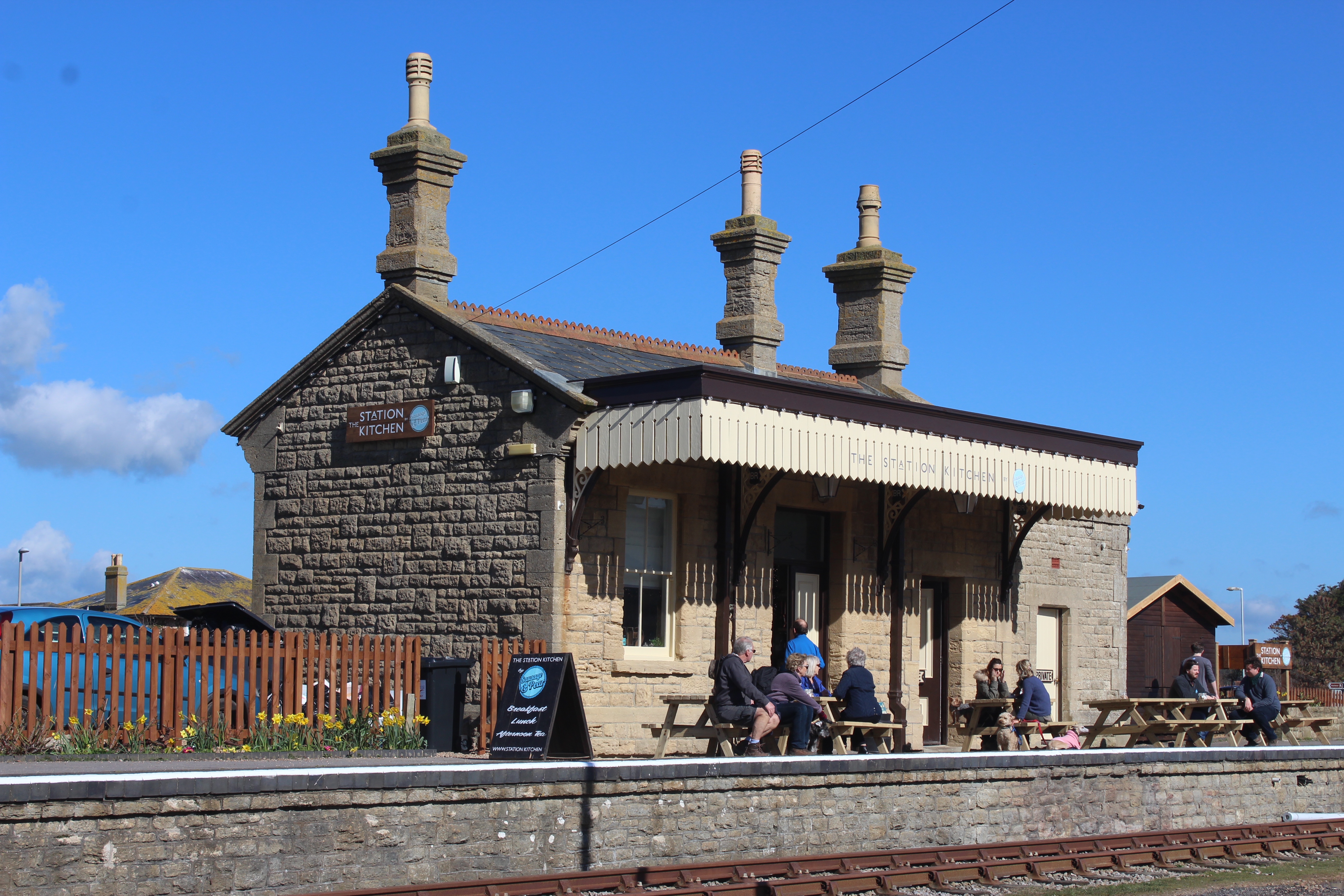
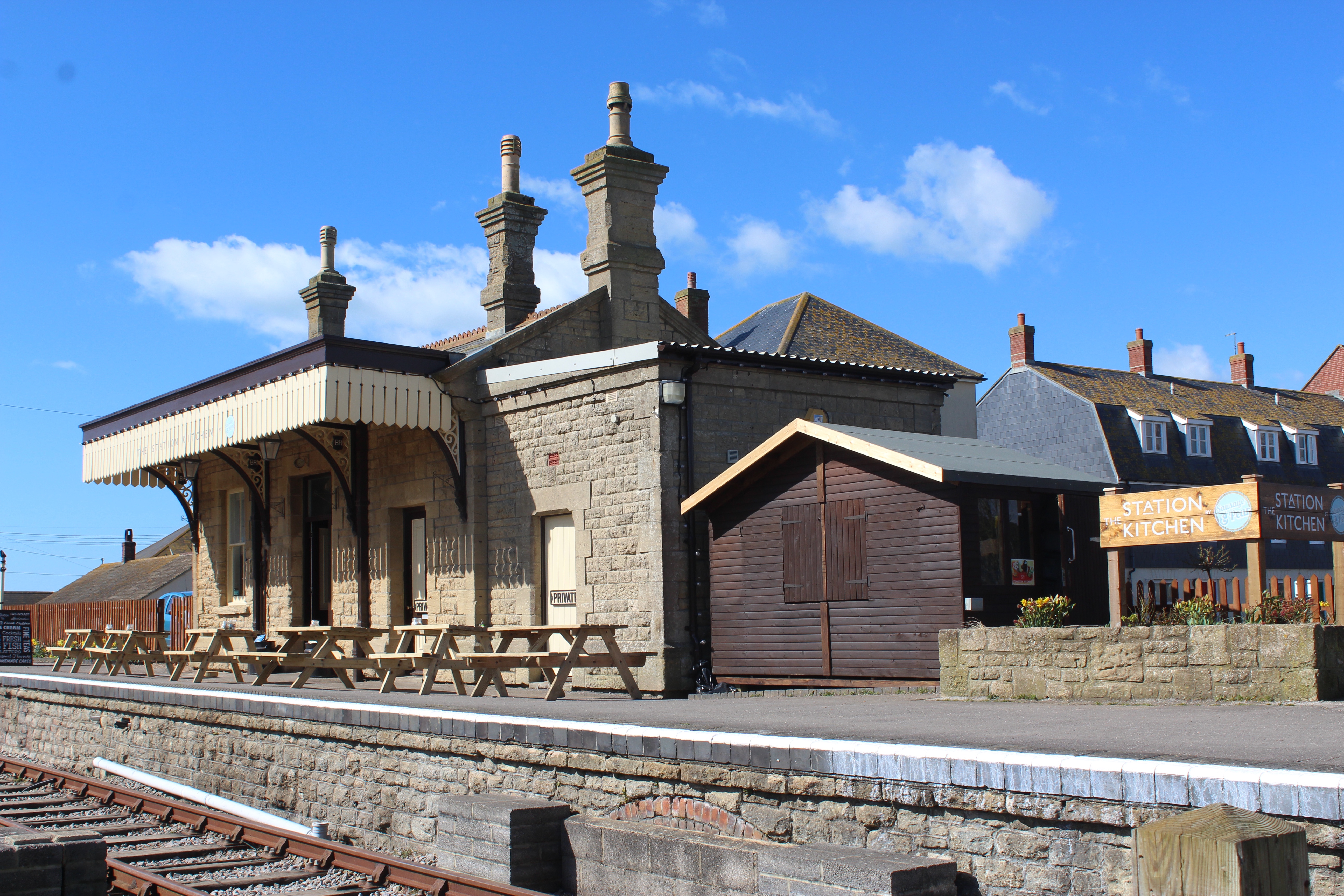
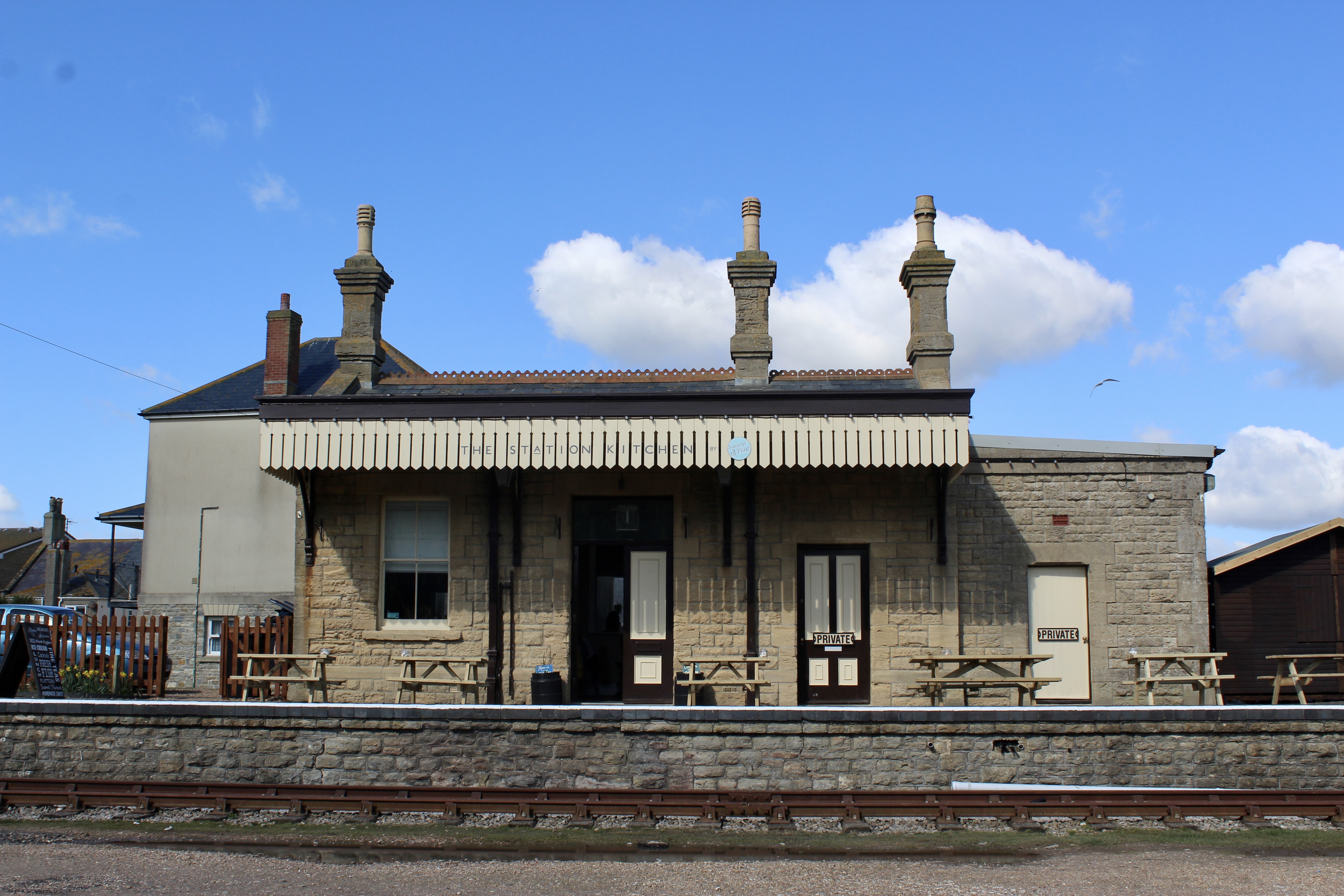
Saturday evening saw Yoshi’s mum and myself in West Bay for dinner at the Station Kitchen which is situated at the former West Bay railway station. Originally called Bridport Harbour, the name was changed by the Great Western Railway to make it sound a more desirable holiday destination. Passenger services between Bridport and West Bay ended in 1930 with goods traffic remaining until closure in 1962. The restaurant comprises the dog-friendly 1884 station building and two railway carriages which have been transported to the site. The first carriage, which we dined in, GWR No. 2370 named ‘Brunel’ is a toplight brake corridor coach built in 1911 and purchased for use by the Station Kitchen in 2015. The carriage has quite a history having been used as a makeshift hospital in France during World War I and a tool coach in Worcester in the 1950’s before its restoration in Oswestry.
The Station Kitchen, West Bay – 19/11/2022Station building interior – The Station Kitchen, West Bay – 19/11/2022‘Brunel’ – The Station Kitchen, West Bay – 19/11/2022‘Brunel’ interior – The Station Kitchen, West Bay – 19/11/2022‘Brunel’ interior – The Station Kitchen, West Bay – 19/11/2022
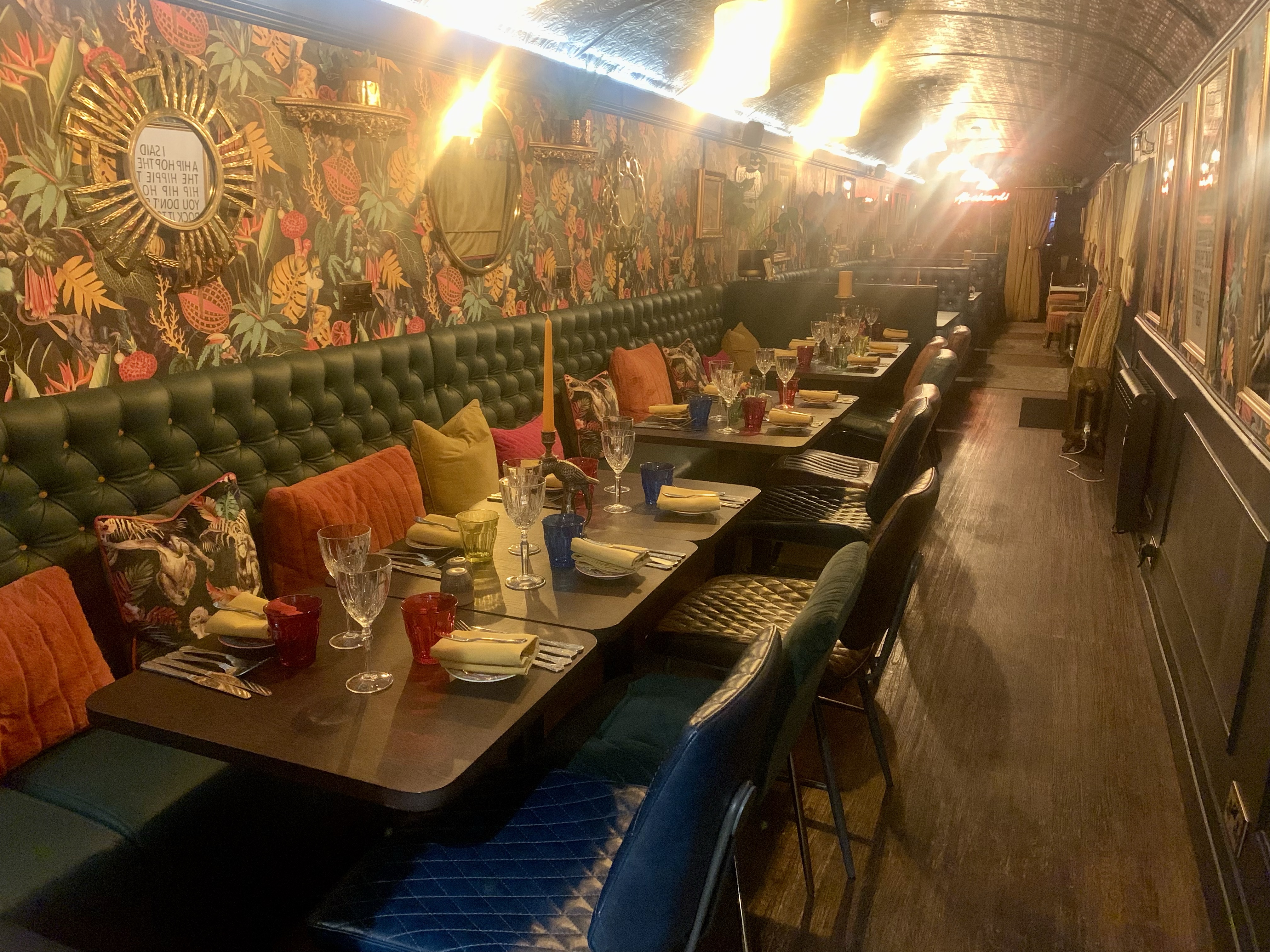
The second coach at West Bay is BR MK1 corridor second No. 25646 built in Gloucester in 1958 and was being used as a mess coach at Toddington when it was purchased for its new life at West Bay. This carriage has been named ‘Beeching’.
‘Beeching’ – The Station Kitchen, West Bay – 19/11/2022‘Beeching’ interior – The Station Kitchen, West Bay – 19/11/2022
The food was amazing, with perhaps the best cheesecake I’ve tasted. The staff were friendly, professional and attentive. If Yoshi had joined us, he would not have hesitated in giving the Station Kitchen five barks out of five.
Yoshi visited The Station Kitchen, West Bay in April – 15/04/2022The Station Kitchen, West Bay – 15/04/2022The Station Kitchen, West Bay before the addition of the carriages – 31/03/2016The Station Kitchen, West Bay – 31/03/2016The Station Kitchen, West Bay – 31/03/2016
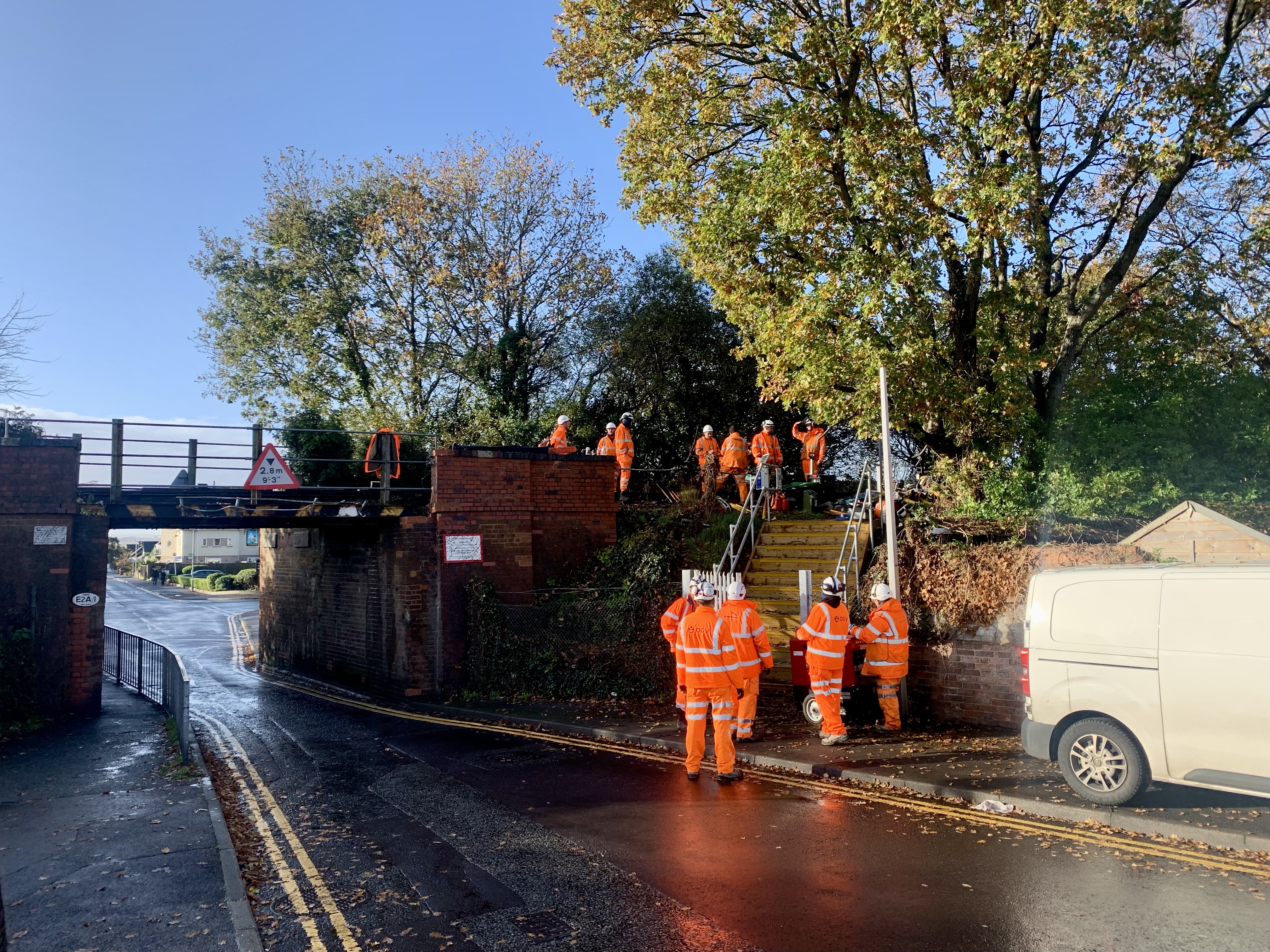
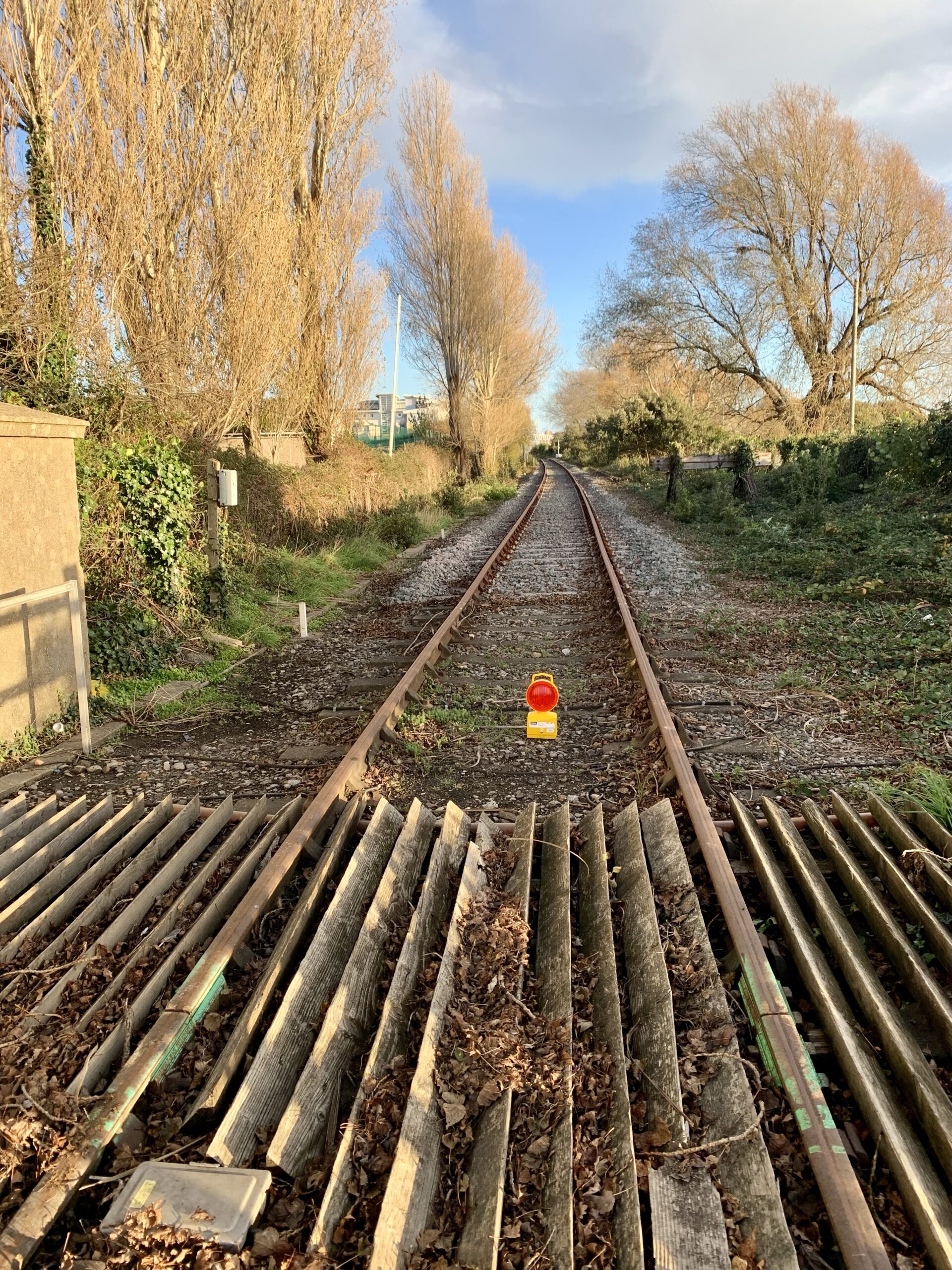
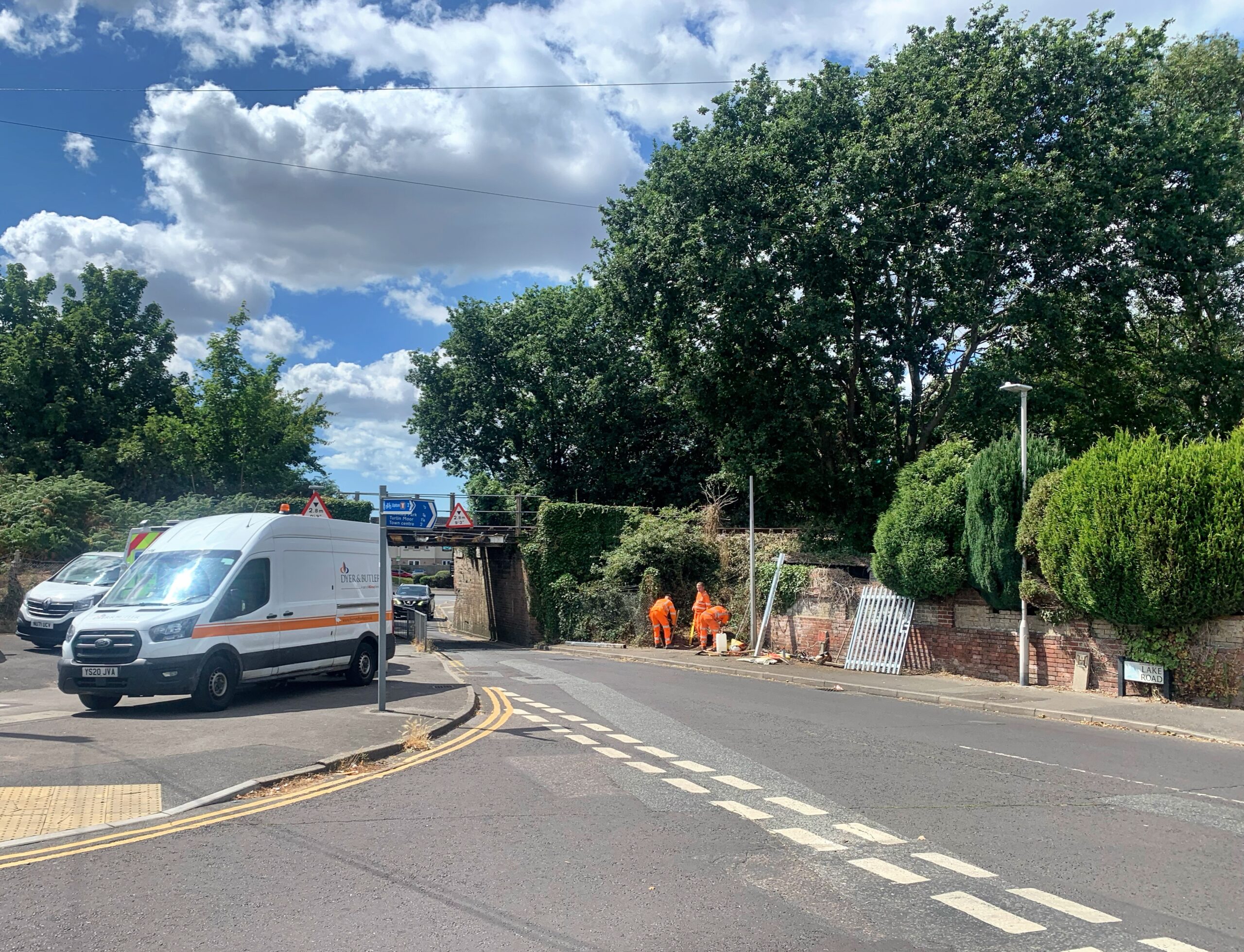
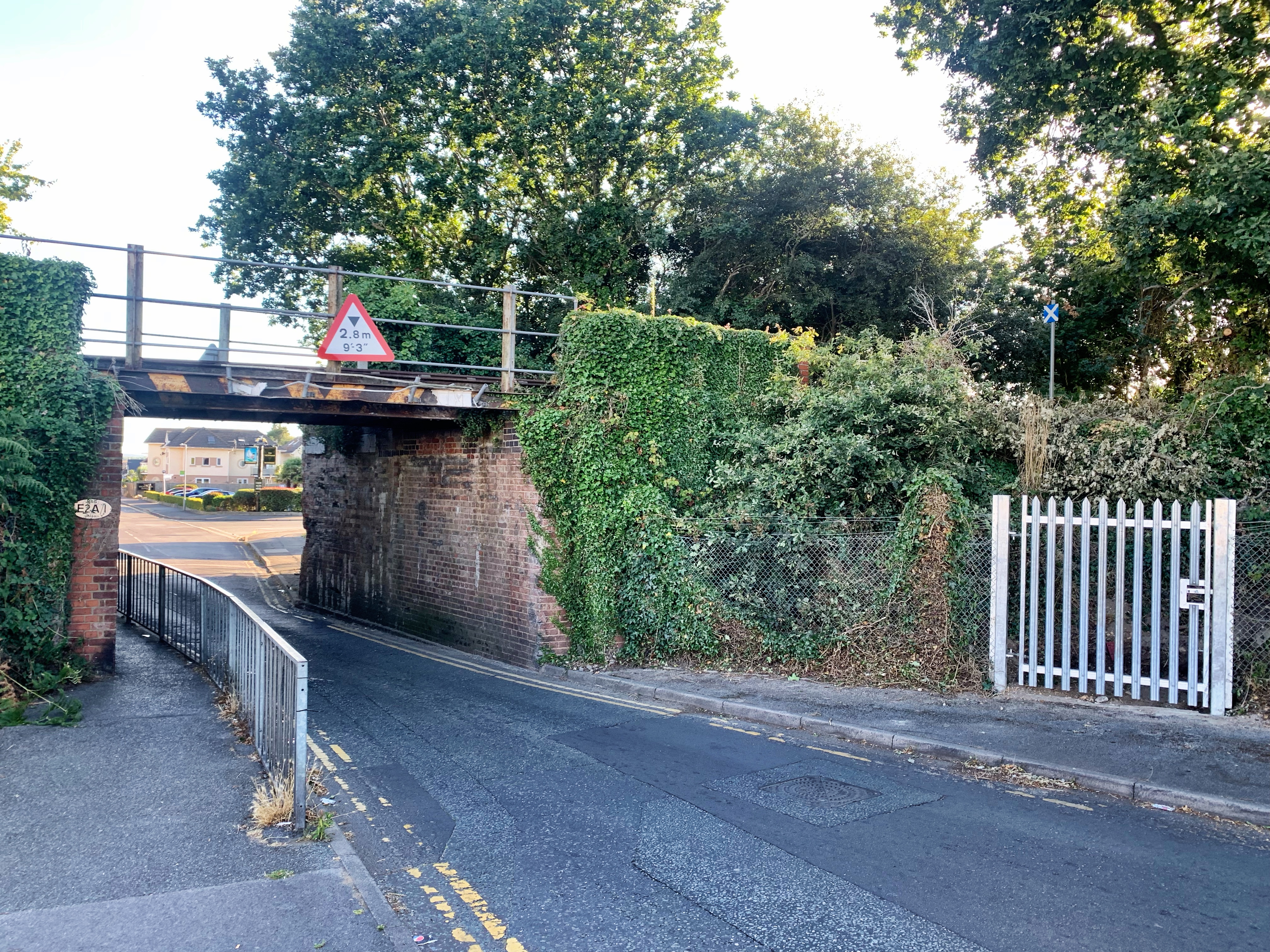
On our Sunday morning walk, Yoshi and I went along to Lake Road in Hamworthy to see work being carried out on the railway bridge. Rotten timbers on which the railway line is carried were replaced and the area re-ballasted involving a team from Sonic Rail Services, who specialise in bridge strengthening and Network Rail. We await news of the first train to make it down the restored Hamworthy Branch with anticipation!
Lake Road bridge works – 20/11/2022 Lake Road bridge works – 20/11/2022The crossing at Ashmore Road looking towards Poole Port was managed by Network Rail staff – 20/11/2022A Network Rail Mercedes-Benz lorry reverses into the compound where the original Poole station was located. This later became Hamworthy Goods. The lorry, from Eastleigh, had arrived to collect the old timbers which had been removed from Lake Road bridge – 20/11/2022
Bridge works at Lake Road – 20/11/2022
Finally, Monday evening once again saw the regular Class 73 hauled track inspection test train heading to Weymouth. We elected to see the train pass through Poole on its outward journey working as 1Q51 1115 Derby RTC to Eastleigh East Yard in the capable charge of GBRf No.’s 73965 ‘Des O’Brien’ and 73961 ‘Alison’.
1Q51 1115 Derby RTC to Eastleigh East Yard – 21/11/2022
That’s it for another week! This entry was brought to you accompanied by the sounds of rainbow frog biscuit, Zeph, Ron Grainer & Delia Derbyshire (happy 59th birthday Doctor Who!). Until next time, remember; “The most affectionate creature in the world is a wet dog” – Ambrose Bierce (1842 – 1914 or thereabouts).
Yoshi visits Tonbridge and barks at all the GBRf Class 69 locomotives introduced to traffic so far – 12/11/2022
On Saturday, Yoshi’s mum was off to London for the weekend to meet up with a friend who had travelled down on the Caledonian sleeper – of which, I was extremely jealous! Travelling on a sleeper train has long been an item on my bucket list. As there are no sleeper services from sleepy Dorset to the big smoke, and as Yoshi’s mum isn’t keen on rail replacement bus services, I volunteered to drive up and drop her off in Greenwich. With this offer accepted, my mind began to formulate a number of plans of things Yoshi and I could do on our way back.
My initial thought was to drive home via Brighton and try and catch Class 313 No. 313201 in its heritage British Rail livery before this particular Class of electric multiple units is withdrawn from service, but planned engineering works meaning no trains running in the area put paid to that idea.
Next up, I thought I could spend the afternoon somewhere on the East Coast Main Line as I was certain London North Eastern Railway (LNER) would roster “celebrity” Class 91 No. 91111 ‘For The Fallen’ in Remembrance Day livery created to mark the contribution of, and the lives lost by regiments along the East Coast route during the First World War. First unveiled in 2014, the special livery depicts soldiers, artefacts, poppies and tributes in honour of those who lost their lives in service to their country. The locomotive had been running turns between London Kings Cross and the North all week, and I was confident it would run over the Remembrance weekend. But on checking the allocations via Real Time Trains on Saturday morning, it was clear that No. 91111 was being rested. It obviously returned to duty the following day.
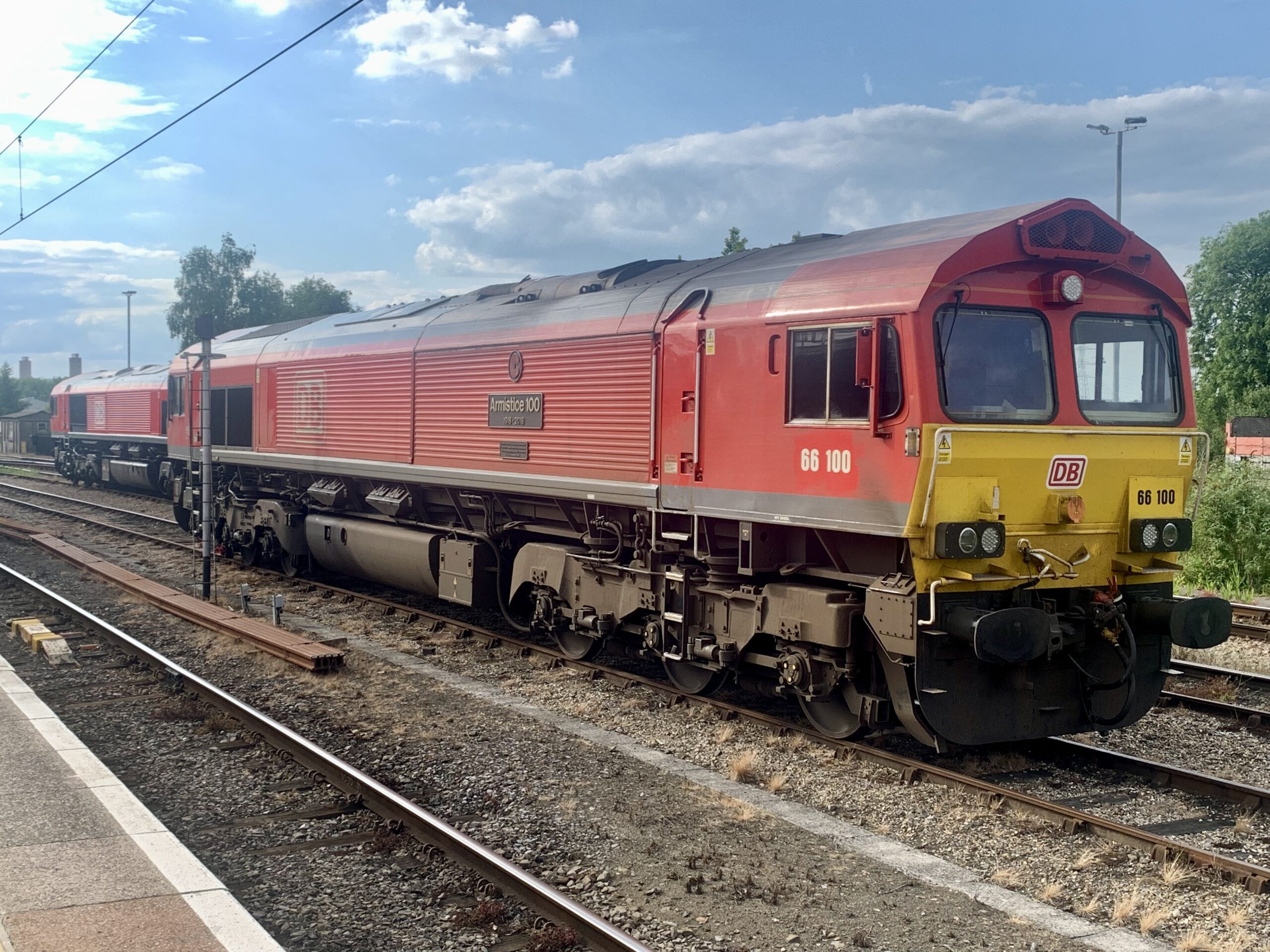
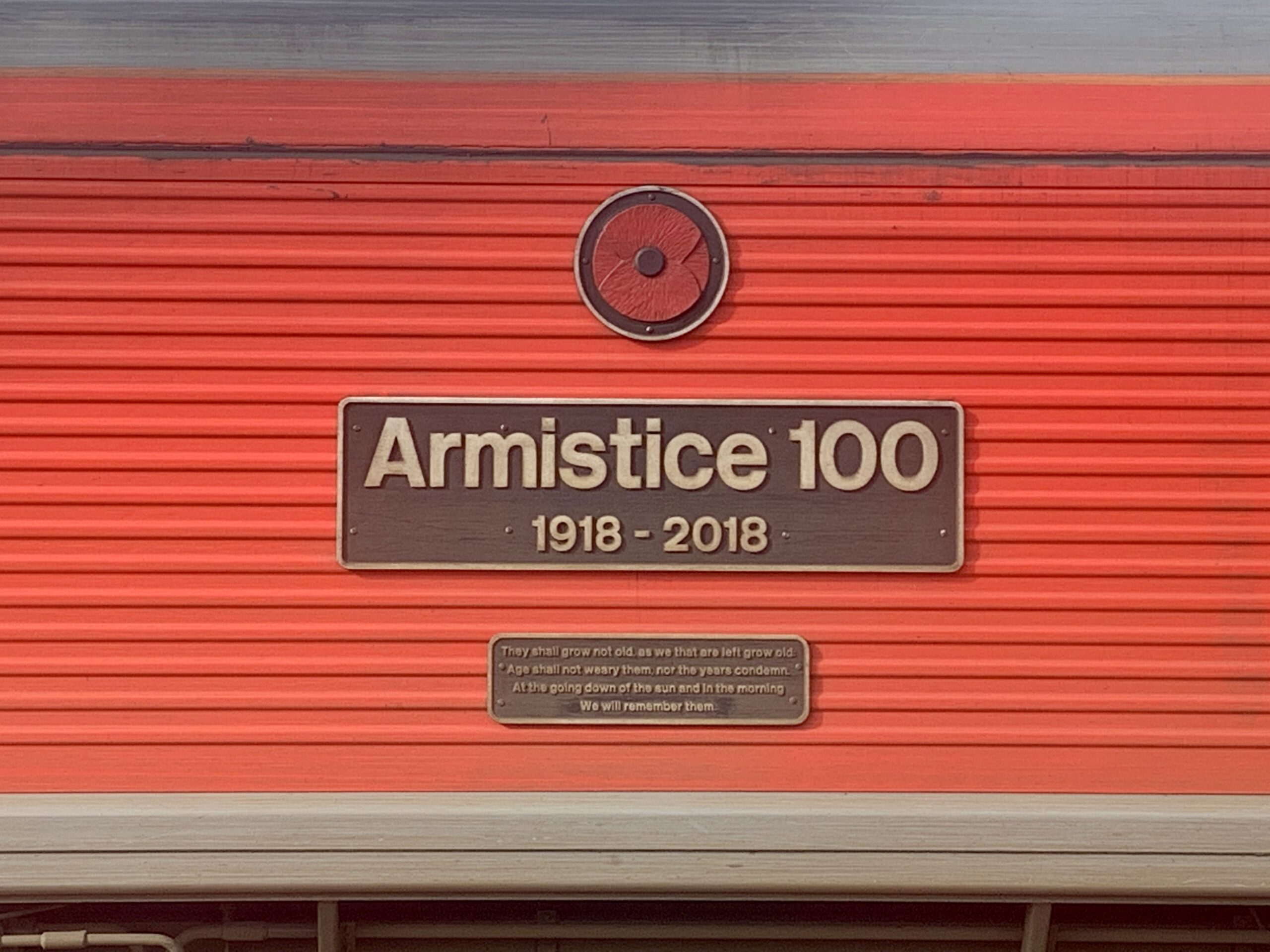
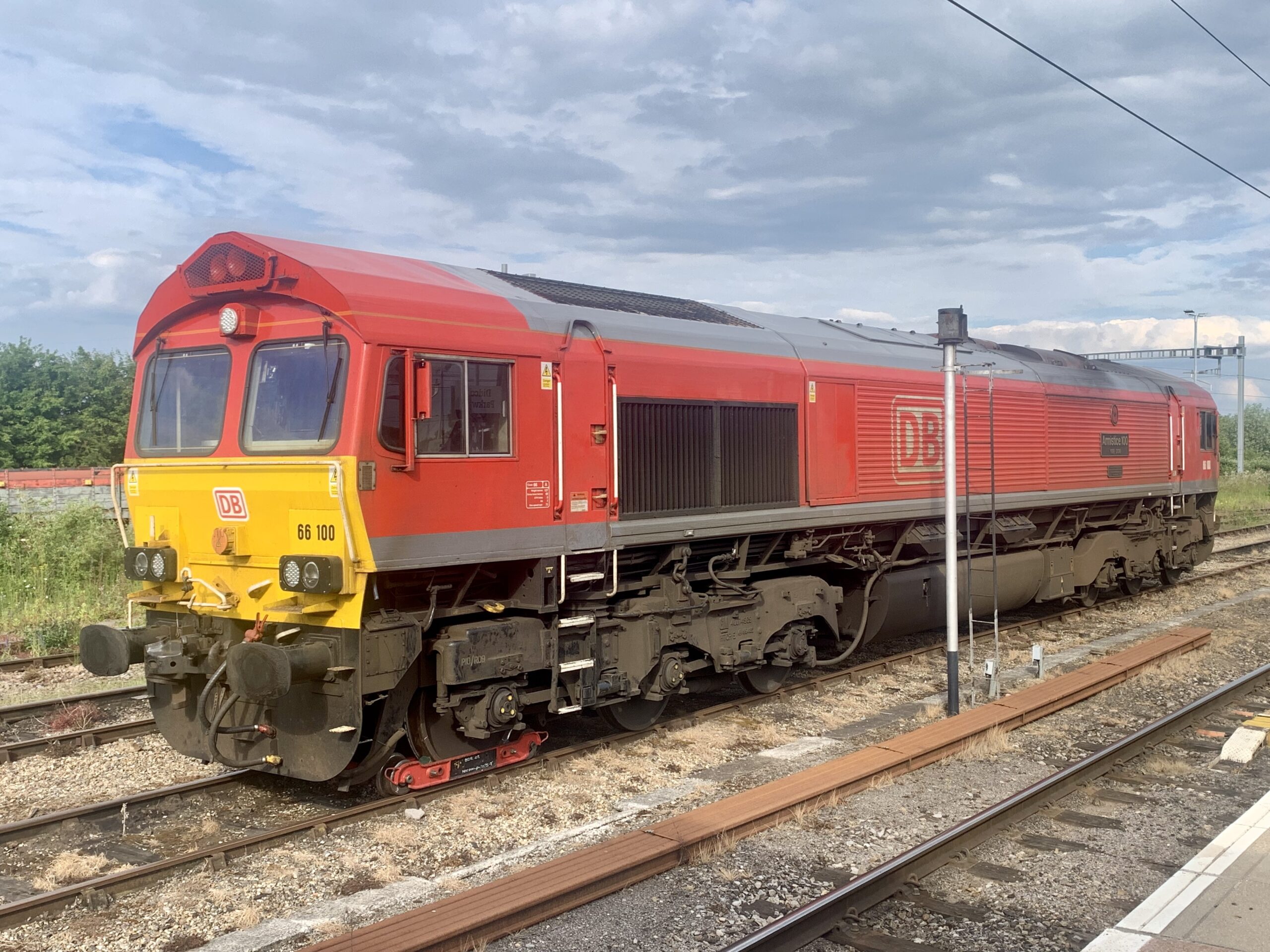
One locomotive named in commemoration of Remembrance I have managed to capture is DB Class 66 No. 66100 ‘Armistice 100 1918 – 2018’ which I saw at Didcot on 2nd June 2022. In the images below, the loco has one of its wheel sets placed in a wheel skate and had been marooned at Didcot since the middle of May 2022, eventually leaving on the back of an Allelys low loader for repairs at Toton weeks later.
DB Class 66 No. 66100 ‘Armistice 100 1918 – 2018’ at Didcot – 02/06/2022Nameplate detail of DB Class 66 No. 66100 ‘Armistice 100 1918 – 2018’ at Didcot – 02/06/2022DB Class 66 No. 66100 ‘Armistice 100 1918 – 2018’ at Didcot. The wheel skate can be seen clearly – 02/06/2022
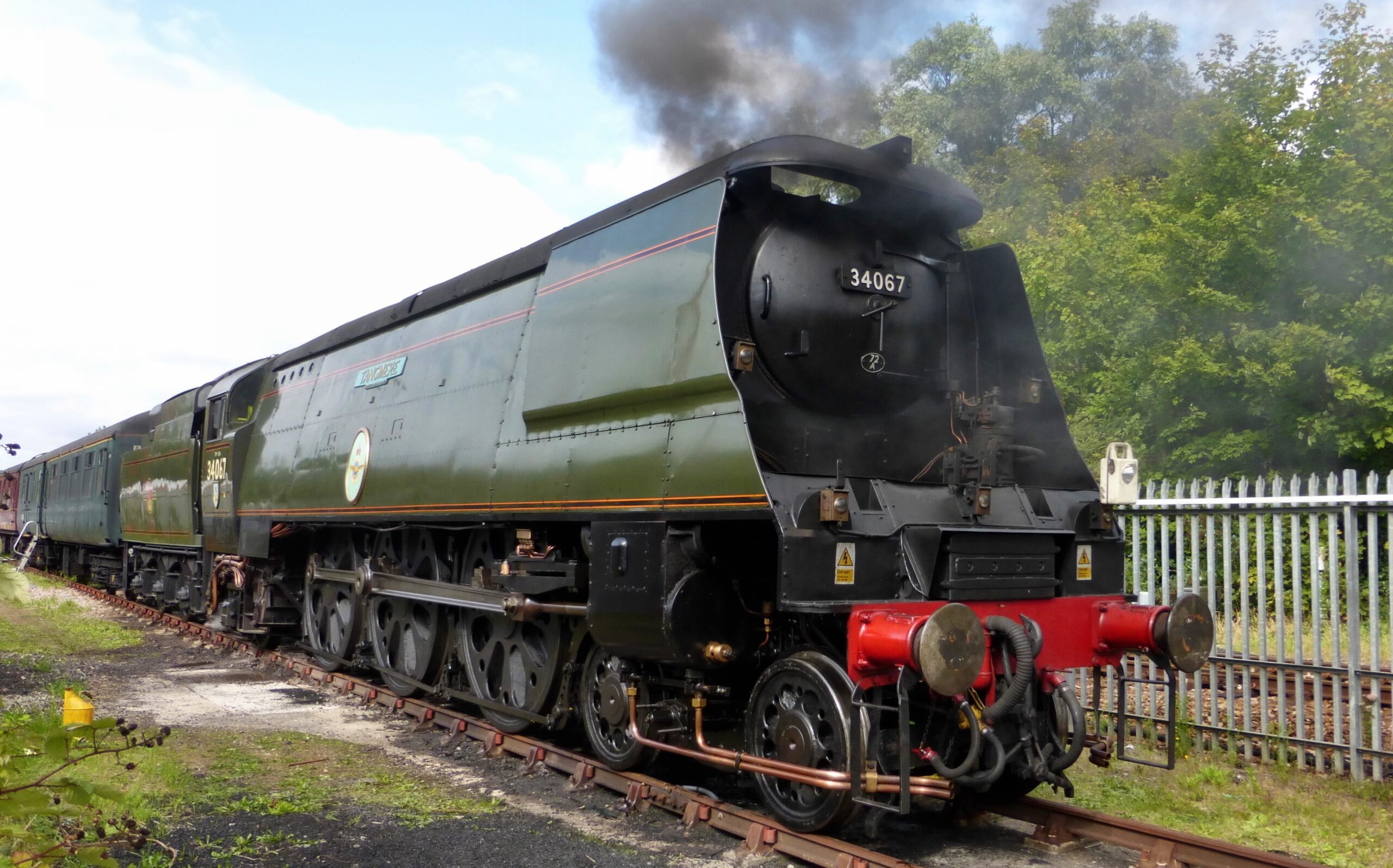
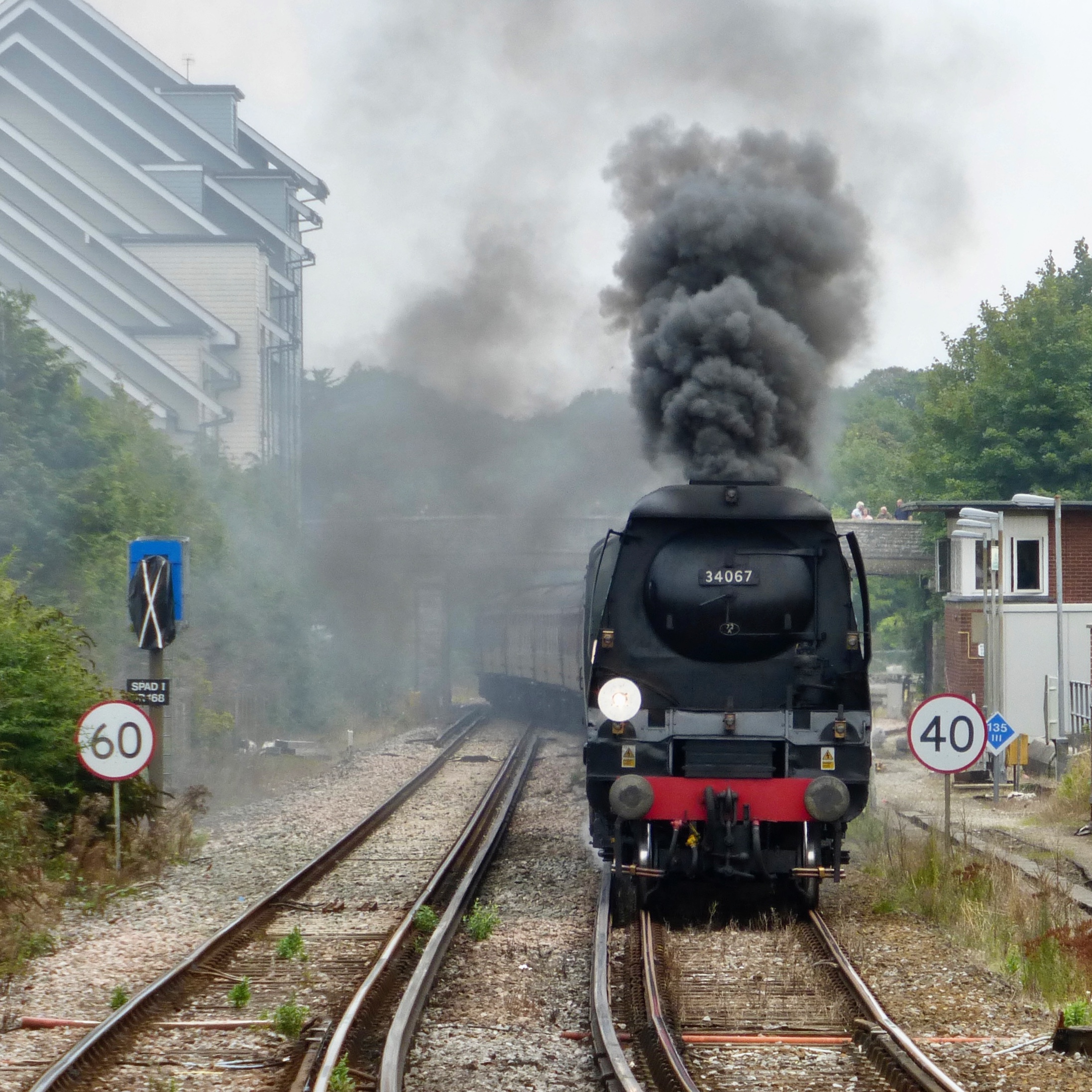
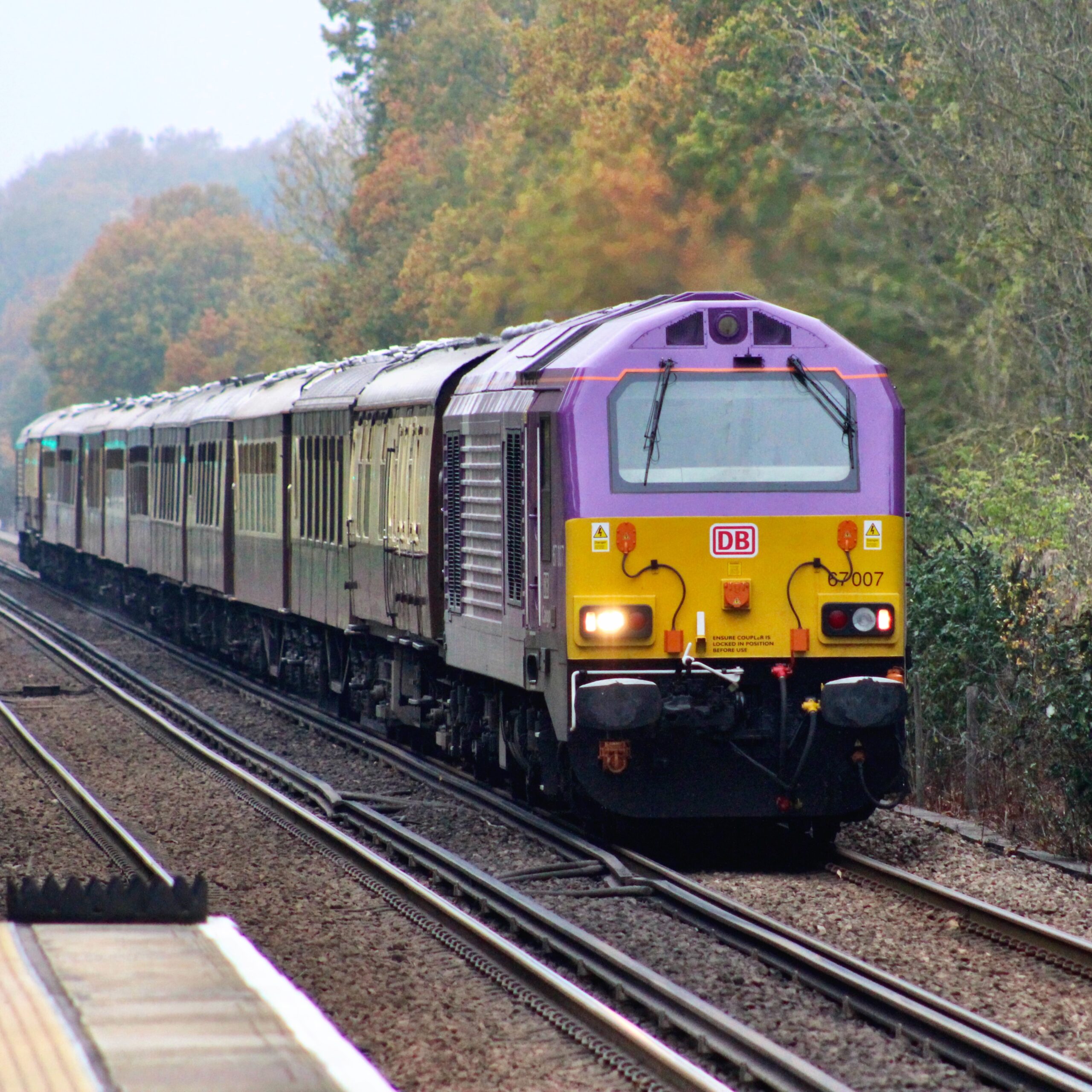
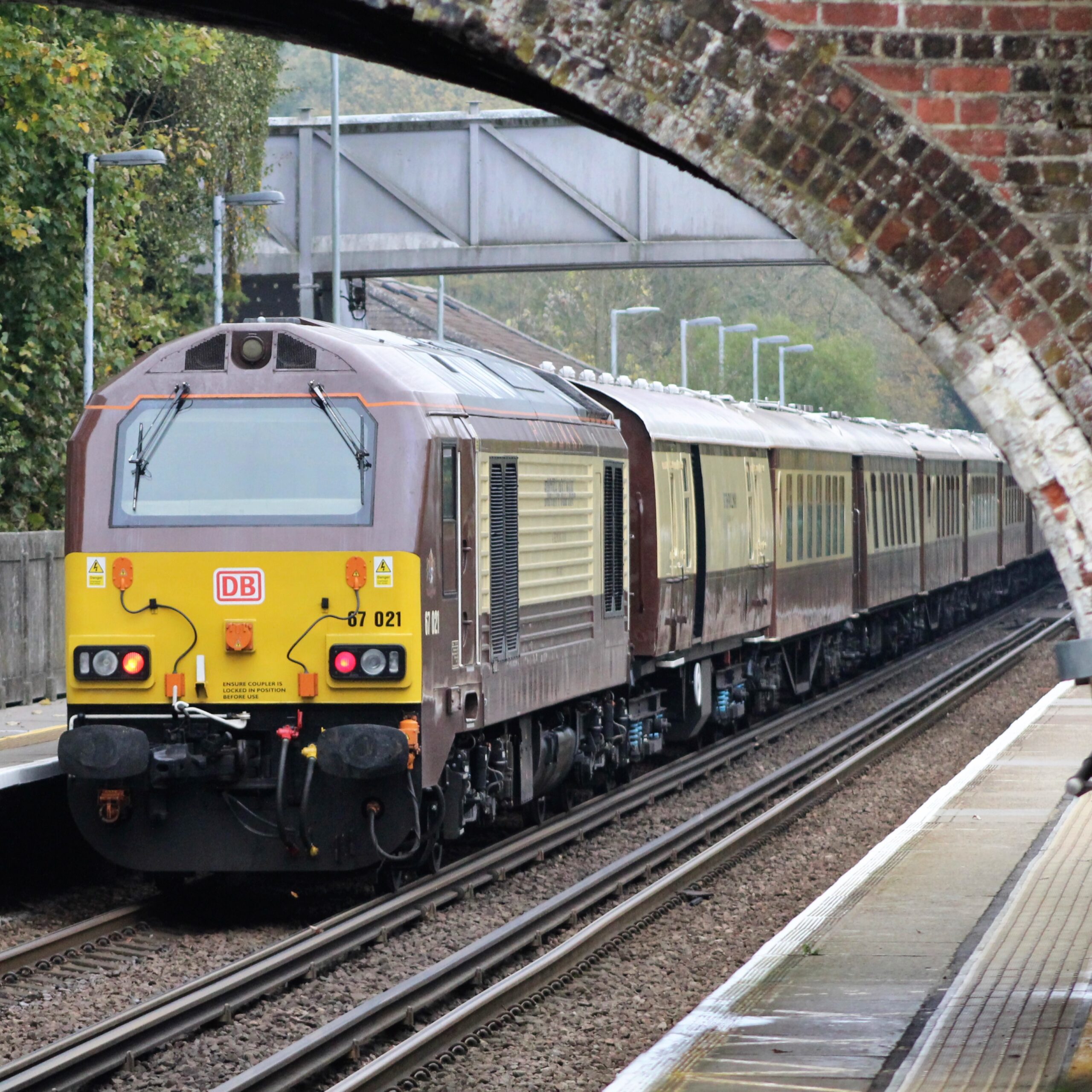
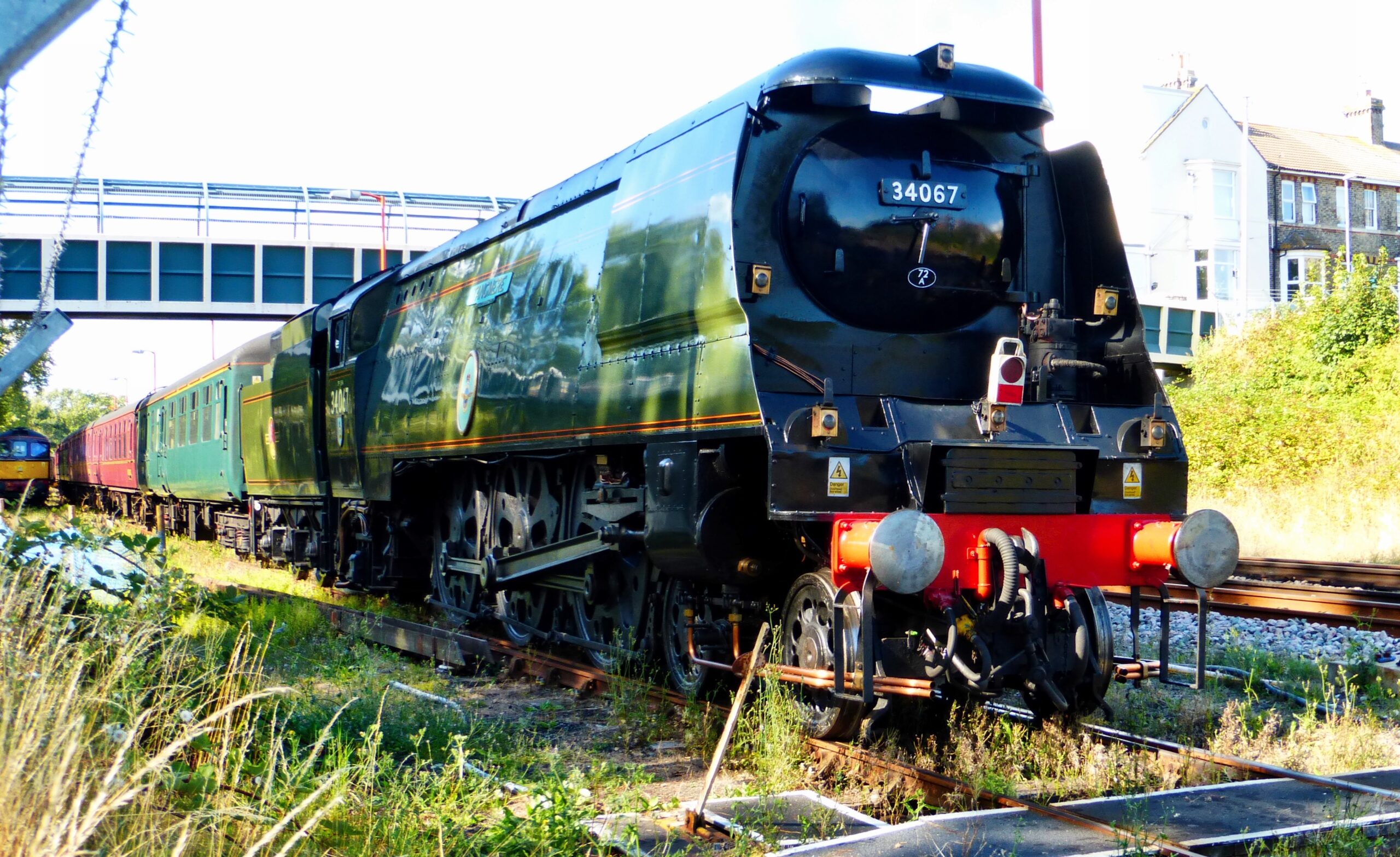
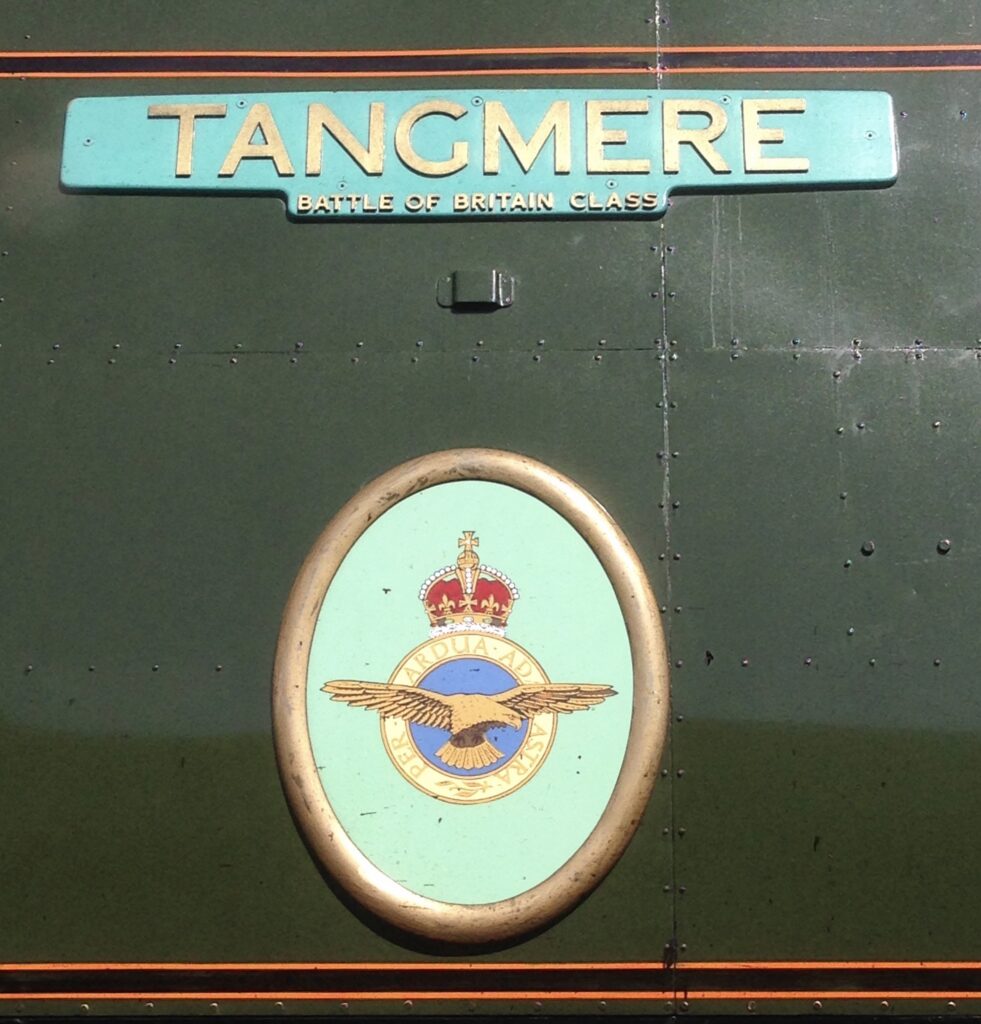
Returning to last Saturday and plan number three which involved heading towards Tonbridge to see SR Unrebuilt West Country Class 4-6-2 No. 34067 ‘Tangmere’ in action heading up Bellmond British Pullman’s “Golden Arrow 50th Anniversary” rail tour running from London Victoria to Canterbury and return, commemorating the final run of this iconic named train which occurred on 30th September 1972. ‘Tangmere’ was deputising for SR Rebuilt Merchant Navy 4-6-2 No. 35028 ‘Clan Line’ but, unbeknownst to me (because I had failed to check) the positioning run which would have taken ‘Tangmere’ south from Carnforth to Southall was cancelled on Friday 11th November 2022 which resulted in the steam traction being substituted by top and tailed Class 67 locomotives.
This is ‘Tangmere’ when she made it south a few years ago:
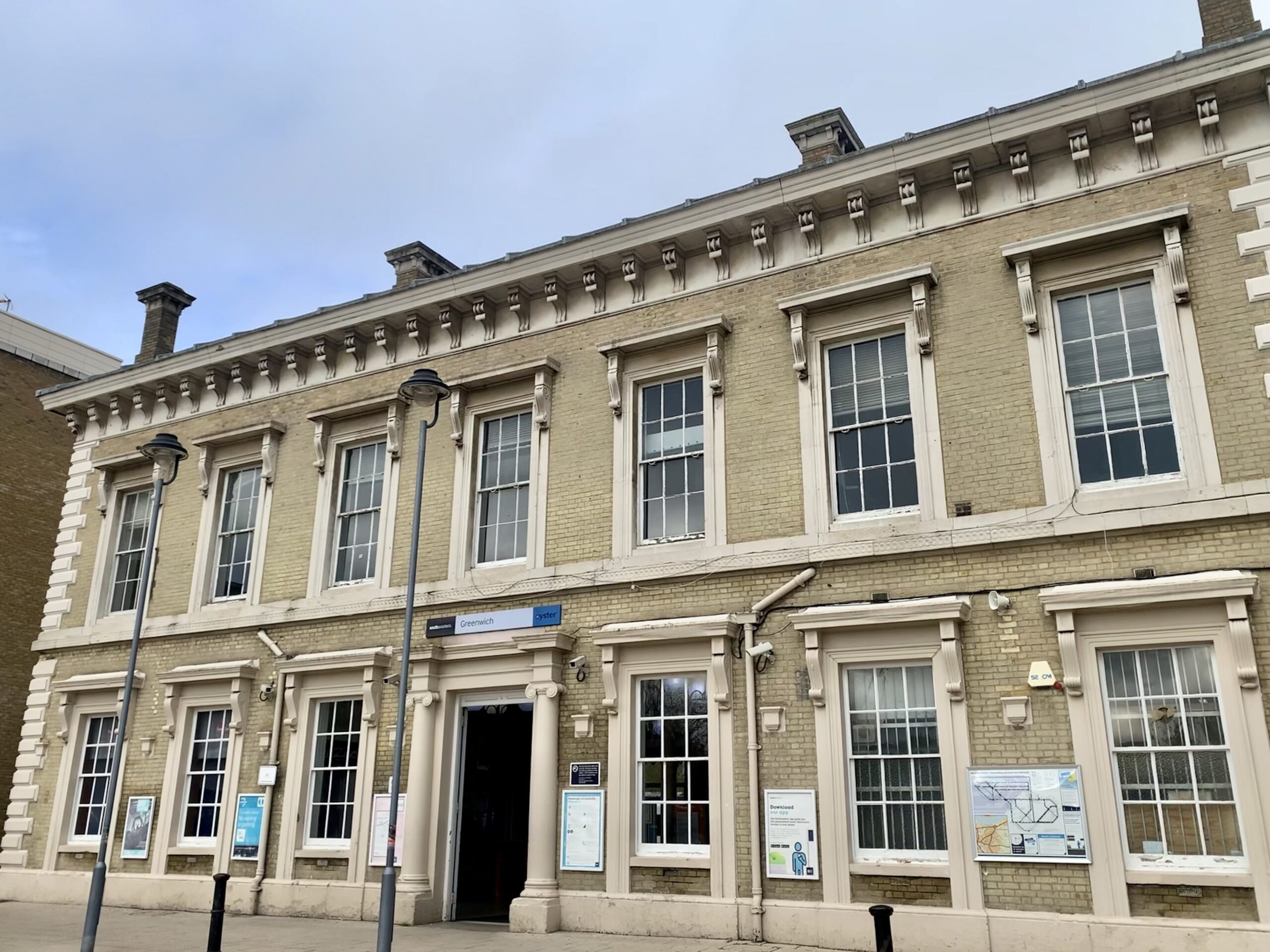
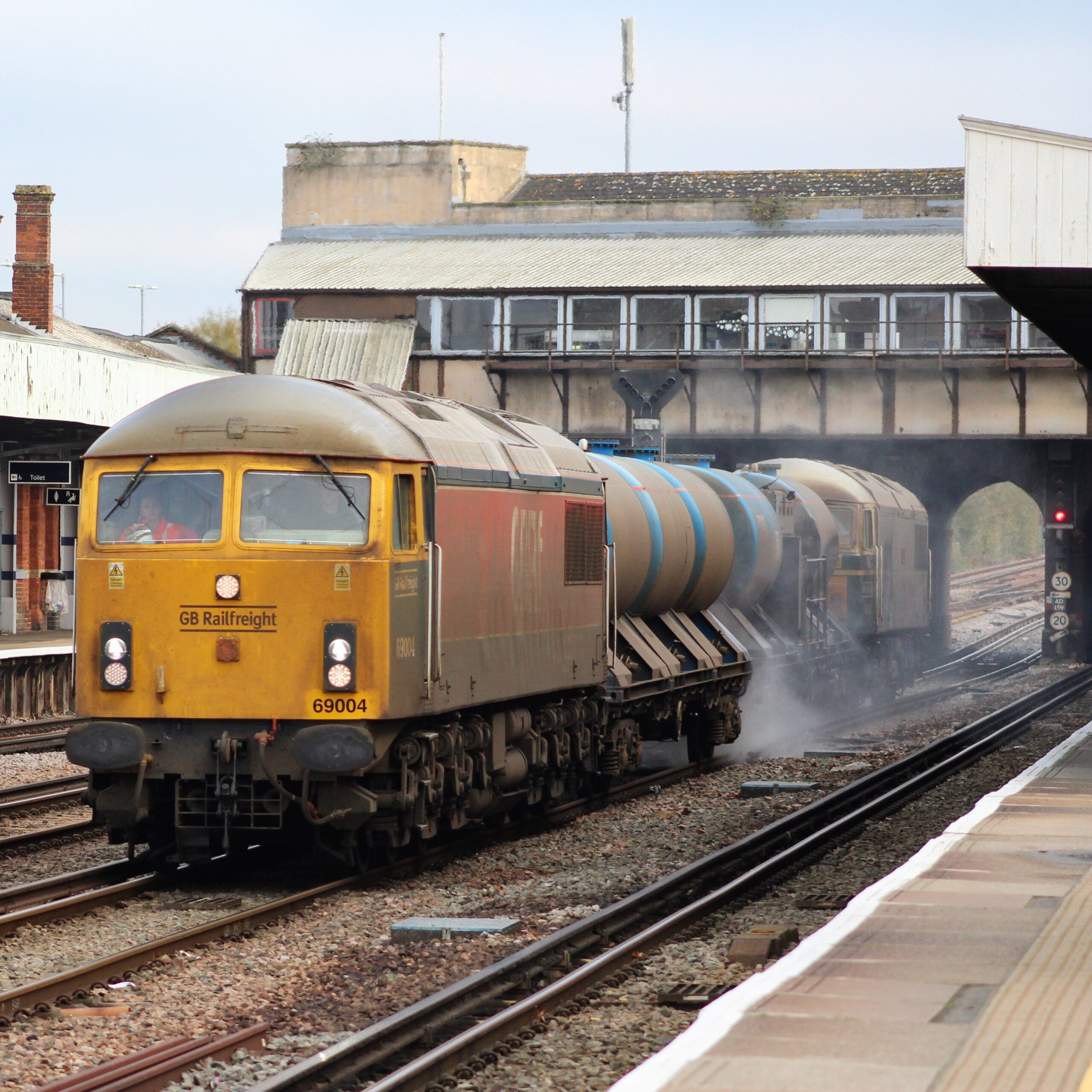
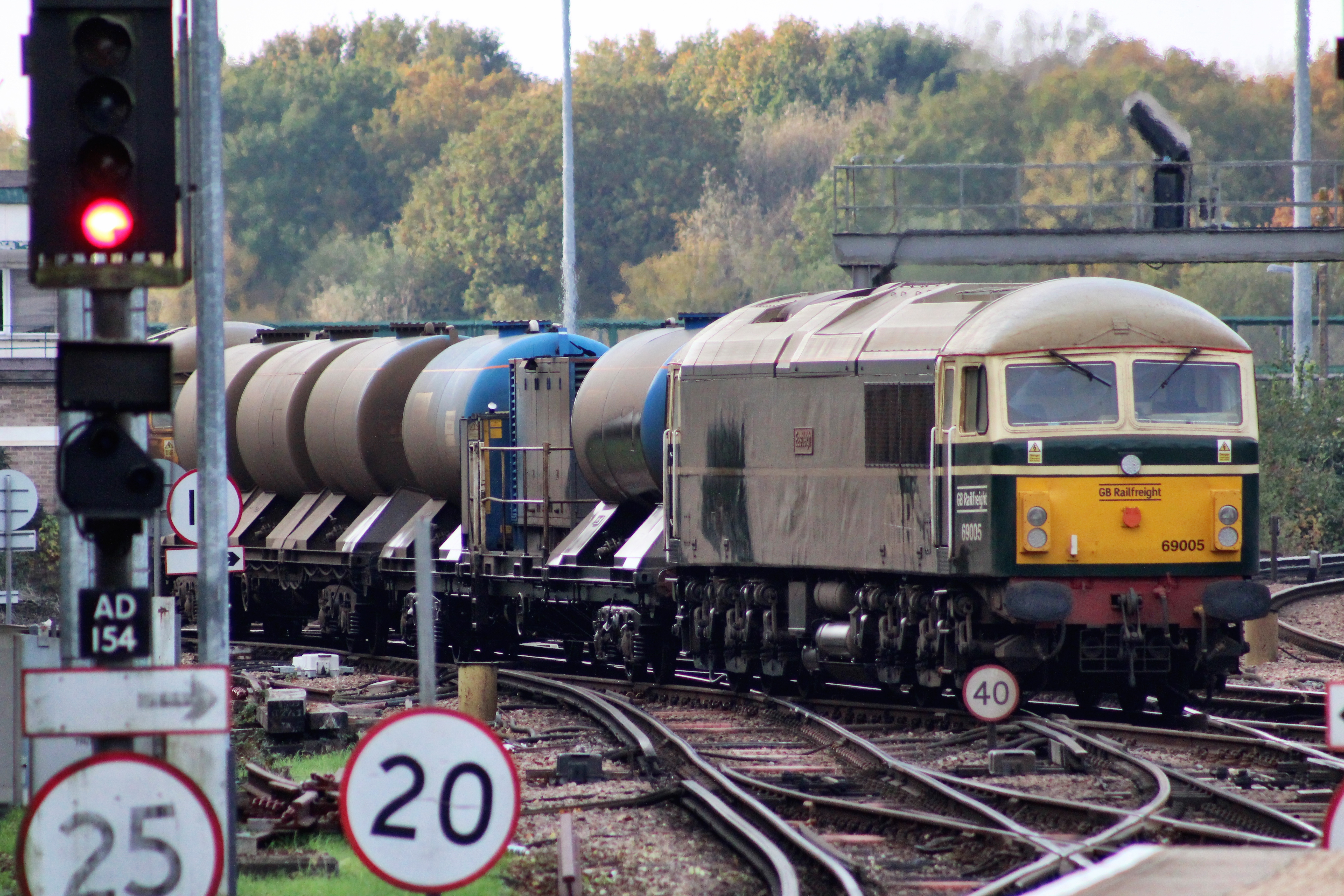
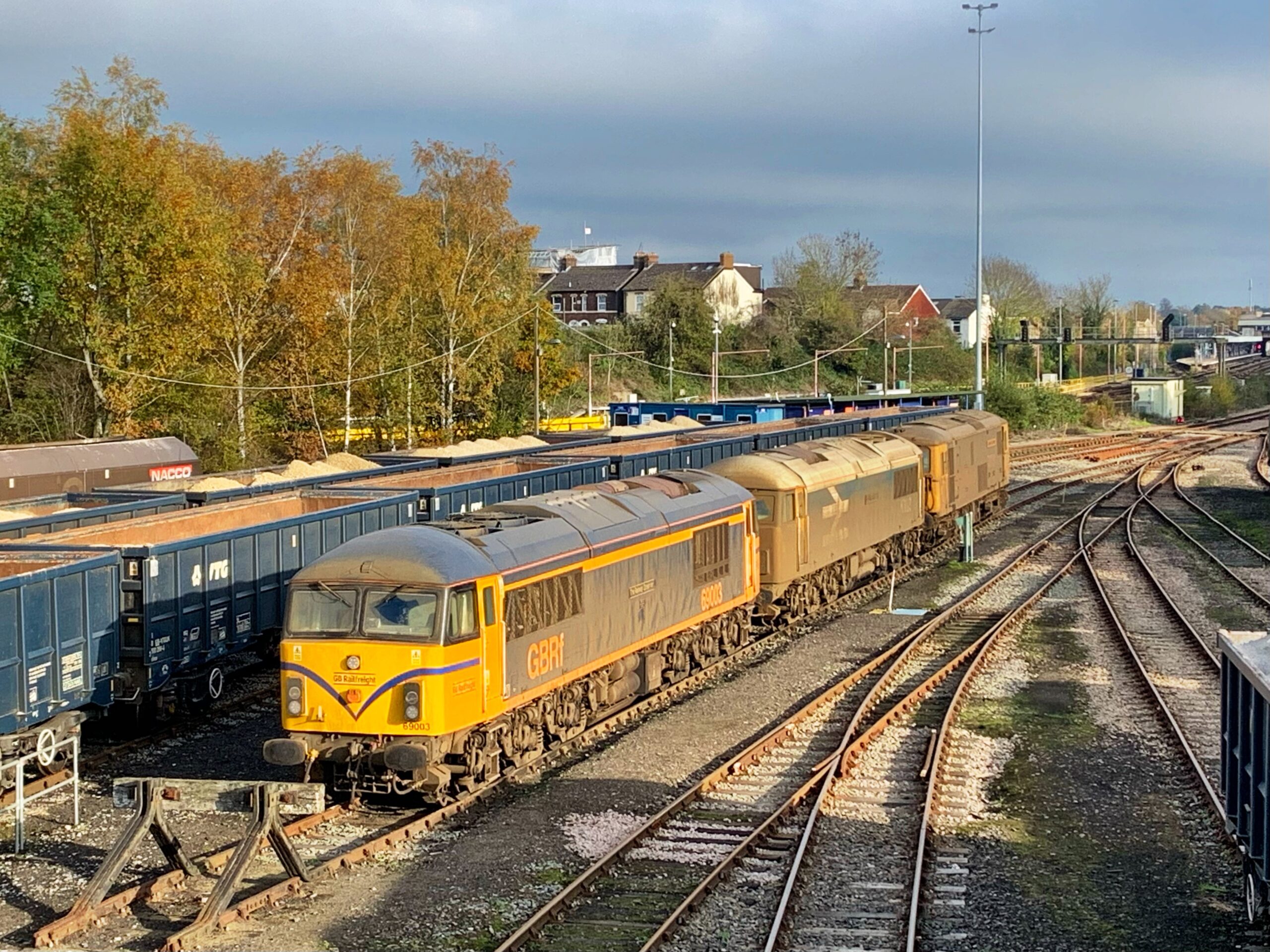
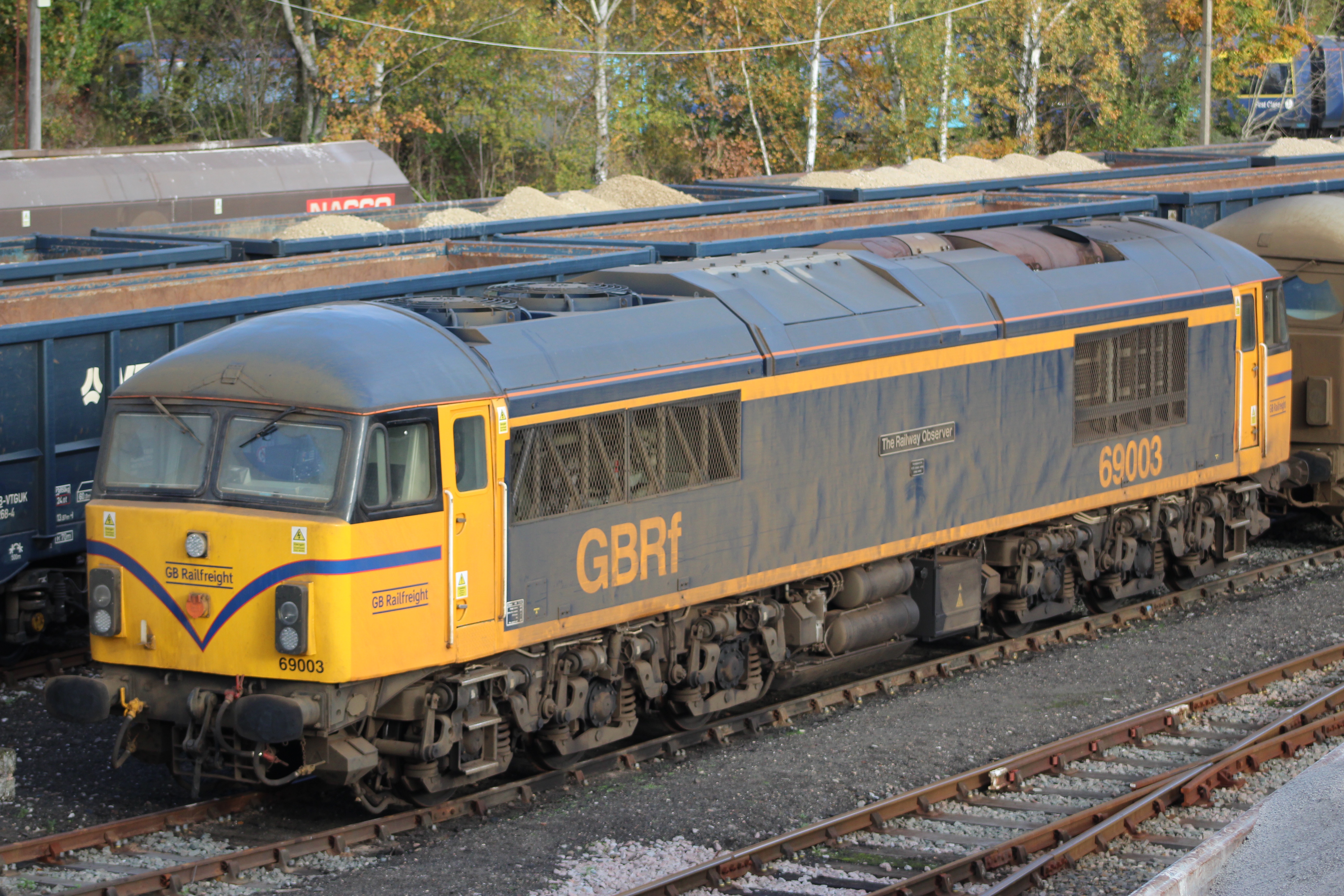
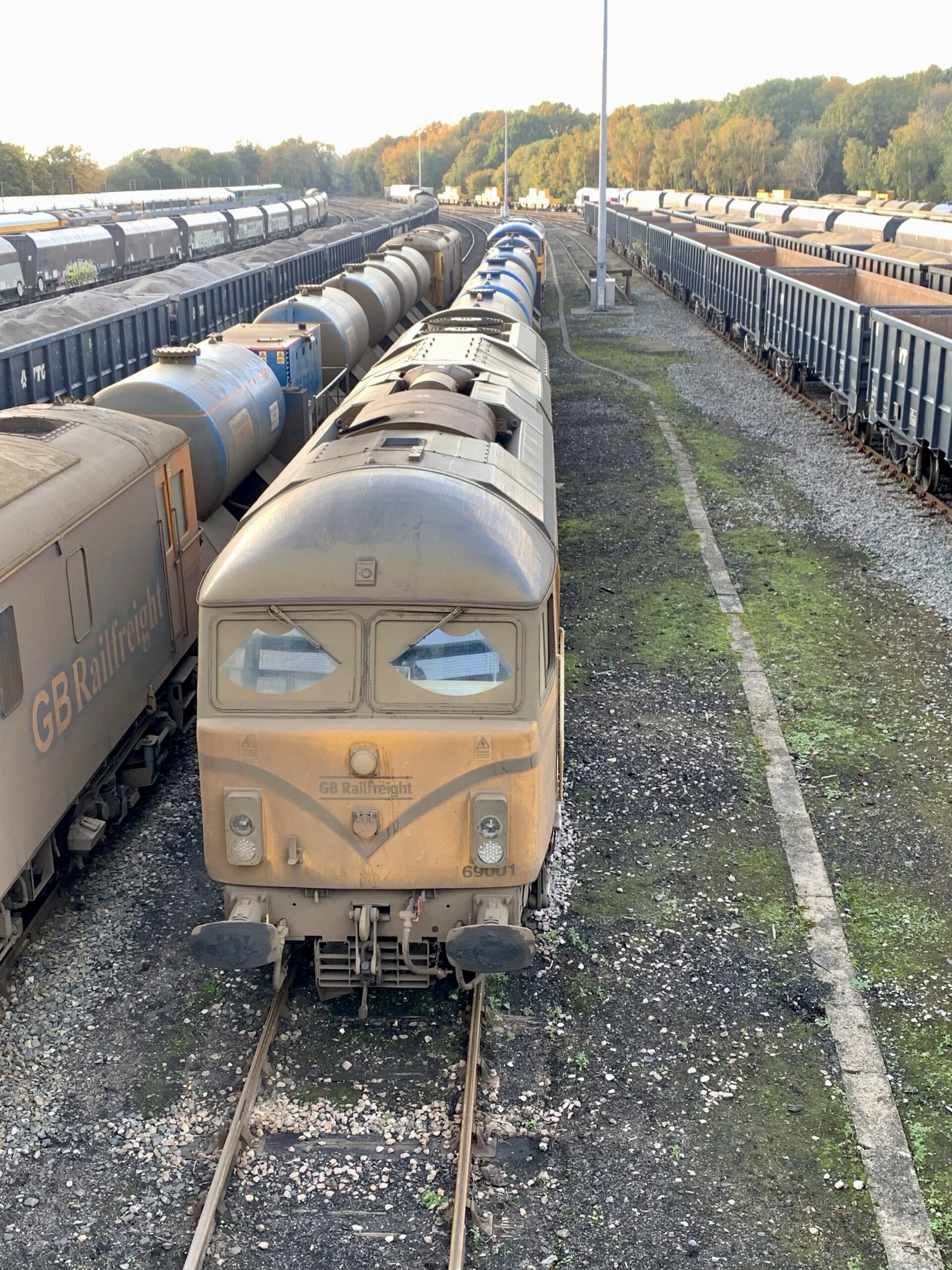
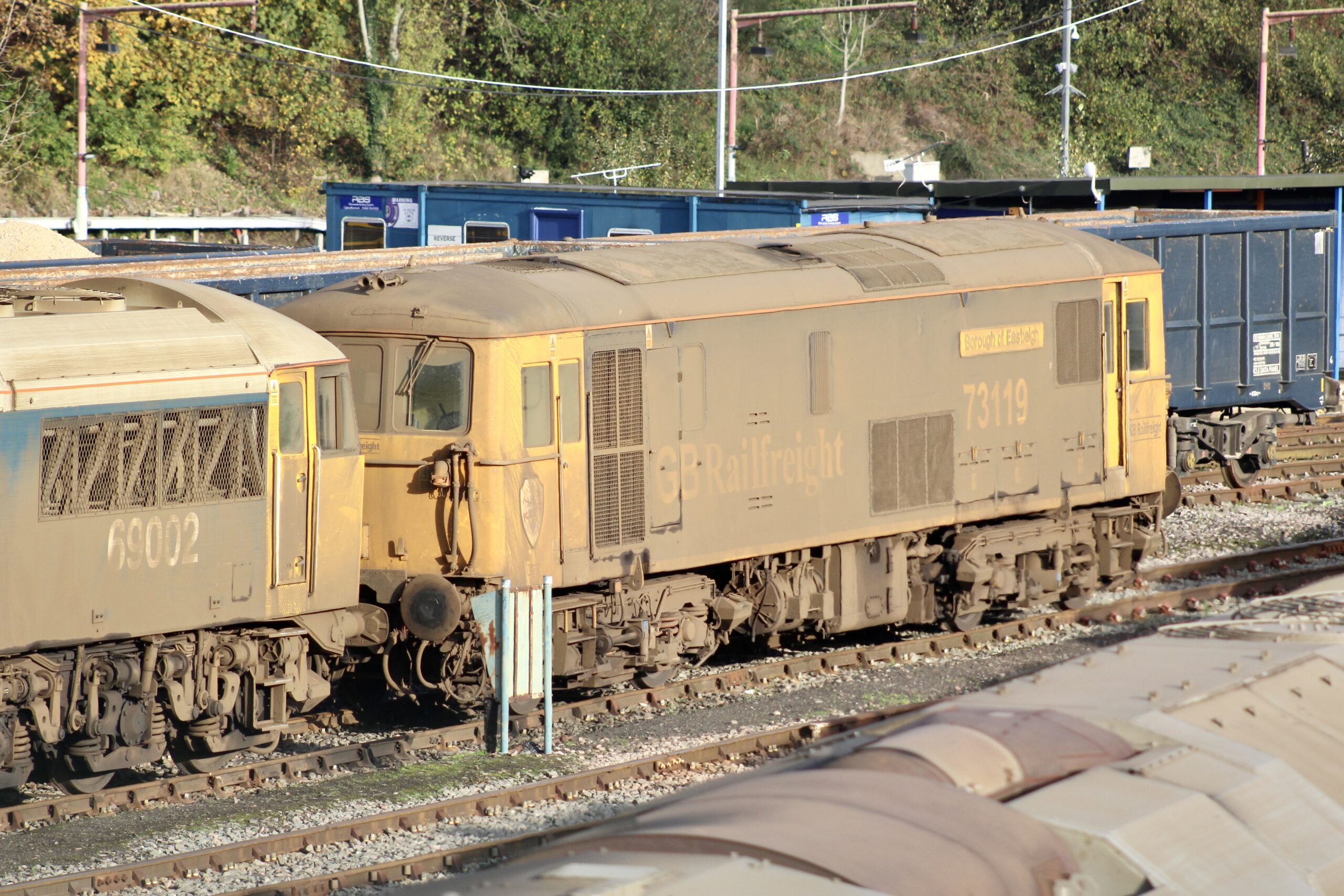
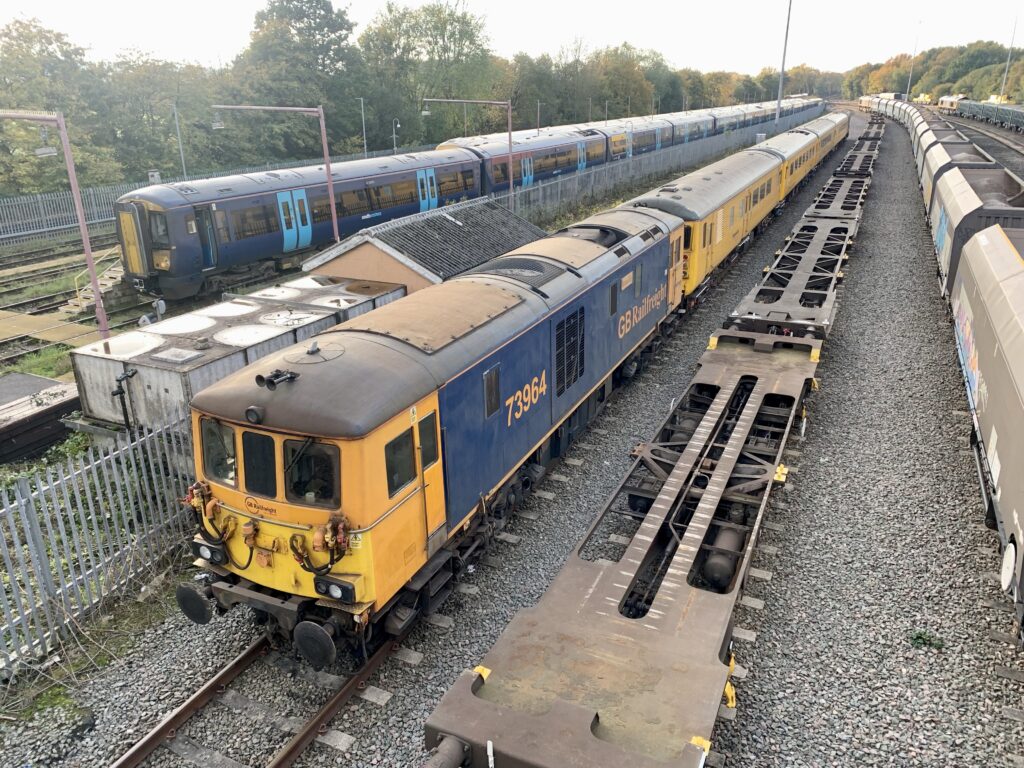
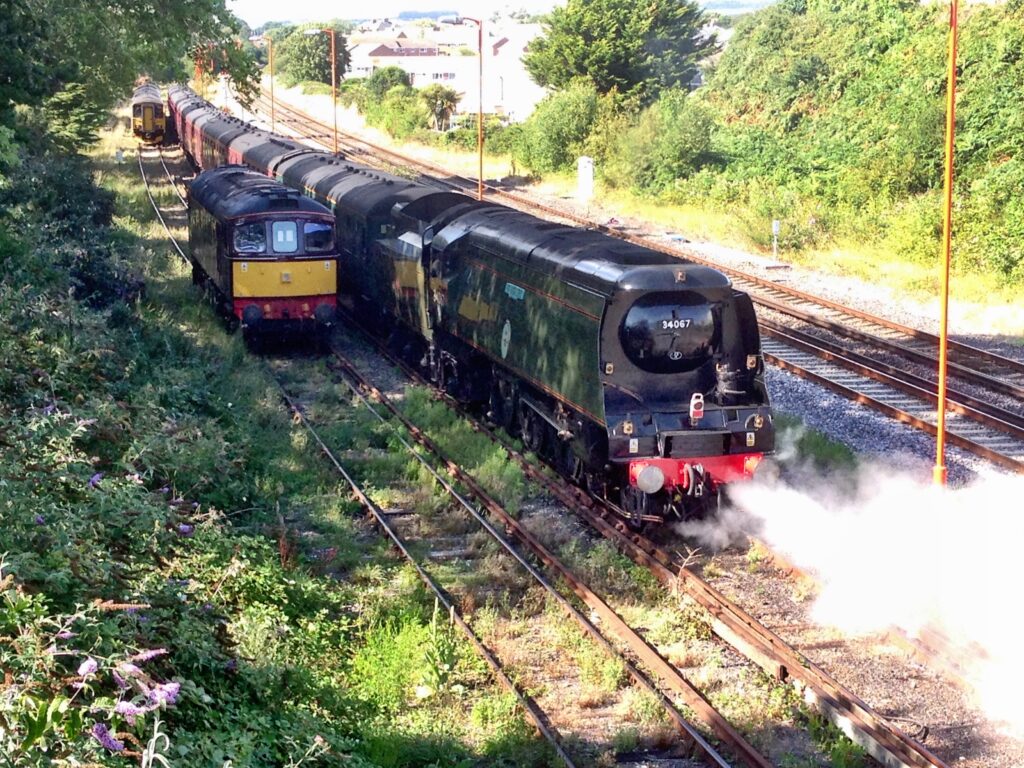
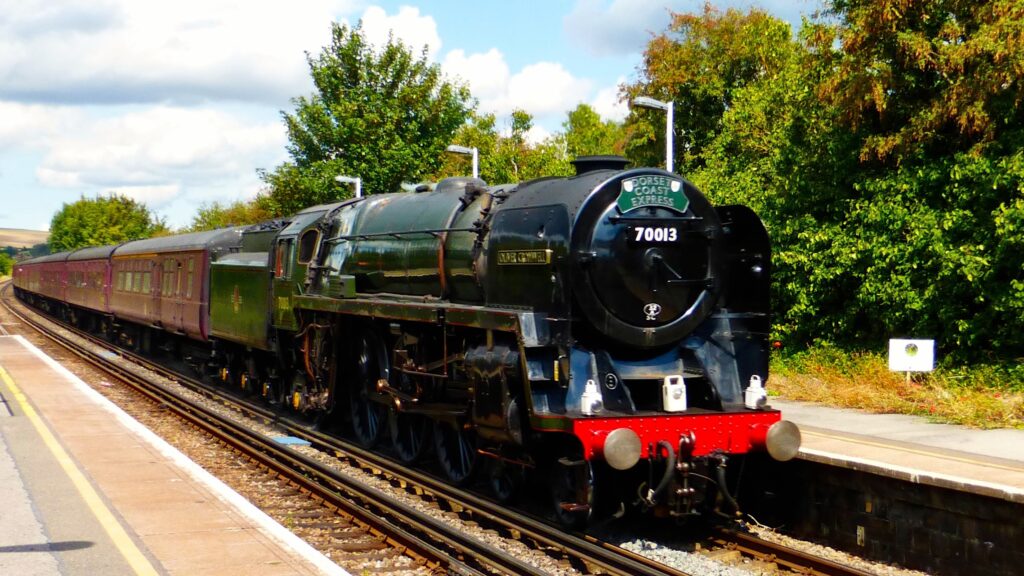
SR Unrebuilt West Country Class 4-6-2 No. 34067 ‘Tangmere’ rests in the EMU compound at Weymouth having worked Railway Touring Company organised “The Royal Wessex”. It was reported that the locomotive hit the buffer stops at Weymouth station – 05/09/2015SR Unrebuilt West Country Class 4-6-2 No. 34067 ‘Tangmere’ puts on quite a display as she nears Dorchester South with “The Dorset Coast Express” – 09/09/2015SR Unrebuilt West Country Class 4-6-2 No. 34067 ‘Tangmere’ climbs Bincombe Bank with the return “Weymouth Seaside Express” – 31/07/2011The wonderful exterior of Greenwich railway station on 12/11/2022 where we deposited Yoshi’s mum. The station was opened in 1840, and the original building still stands, making it one of the oldest surviving station structures in the world. The line that serves Greenwich, the London and Greenwich Railway as it was known when it was built in 1836, was the first steam railway in London and the first to be built specifically for passengers. It began at Tooley Street (now London Bridge) and ran via Deptford to Greenwich on a viaduct of 878 brick arches. It was the first elevated railway in the world. DB Class 67 No. 67007 in Platinum Jubilee livery passing Pluckley hauling Belmond British Pullman’s “Golden Arrow 50th Anniversary” rail tour. The Class 67’s were deputising for SR Unrebuilt West Country Class 4-6-2 No. 34067 ‘Tangmere’ which would have been the first time a Bullied ‘Spam Cam’ had hauled a Pullman train since August 2007 – 12/11/2022DB Class 67 No. 67021 in Belmond Pullman livery at the rear of the “Golden Arrow 50th Anniversary” rail tour. Named in 1929, the “Golden Arrow” was the Southern Railway’s premier connection with Paris, the equivalent train on the French side was “La Flèche d’Or”. The “Golden Arrow” was mainly routed via Dover for the Channel Crossing, although for a number of years the return leg started at Folkestone Harbour – 12/11/2022GBRf Class 69 No. 69004 in traditional RHTT livery passes Tonbridge with No. 69005 ‘Eastleigh’ at the rear working 3W74 0605 Tonbridge West Yard GBRf to Tonbridge West Yard GBRf – 12/11/2022GBRf Class 69 No. 69005 ‘Eastleigh’ at the rear of 3W74 0605 Tonbridge West Yard GBRf to Tonbridge West Yard GBRf. As was pointed out to me by our North Dorset correspondent, there are no tail lights in evidence – 12/11/2022GBRf Class 69 No.’s 69003 ‘The Railway Observer’ / 69002 ‘Bob Tiller CM&REE’ and Class 73 No. 73119 ‘Borough of Eastleigh’ at Tonbridge West Yard – 12/11/2022GBRf Class 69 No. 69003 ‘The Railway Observer’ Tonbridge West Yard – 12/11/2022GBRf Class 69 No. 69001 ‘Mayflower’ with 69006 at the rear at Tonbridge West Yard – 12/11/2022GBRf Class 73 No. 73119 ‘Borough of Eastleigh’ at Tonbridge West Yard – 12/11/2022GBRf Class 73 No. 73964 ‘Jeanette’ rests having worked 1Q85 2356 Tonbridge West Yard to Tonbridge West Yard earlier in the day. Classmate 73962 was on the other end of the test train – 12/11/2022
Our video from 12th November 2022, bark along!
On Sunday 13th November, I visited The Tank Museum at Bovington, near Wool. Unfortunately the museum is not dog friendly, so Yoshi sat this one out. As would be expected, the museum follows the development of the tank from World War One to the modern day and has numerous examples on display. There are a few railway references in the museum:
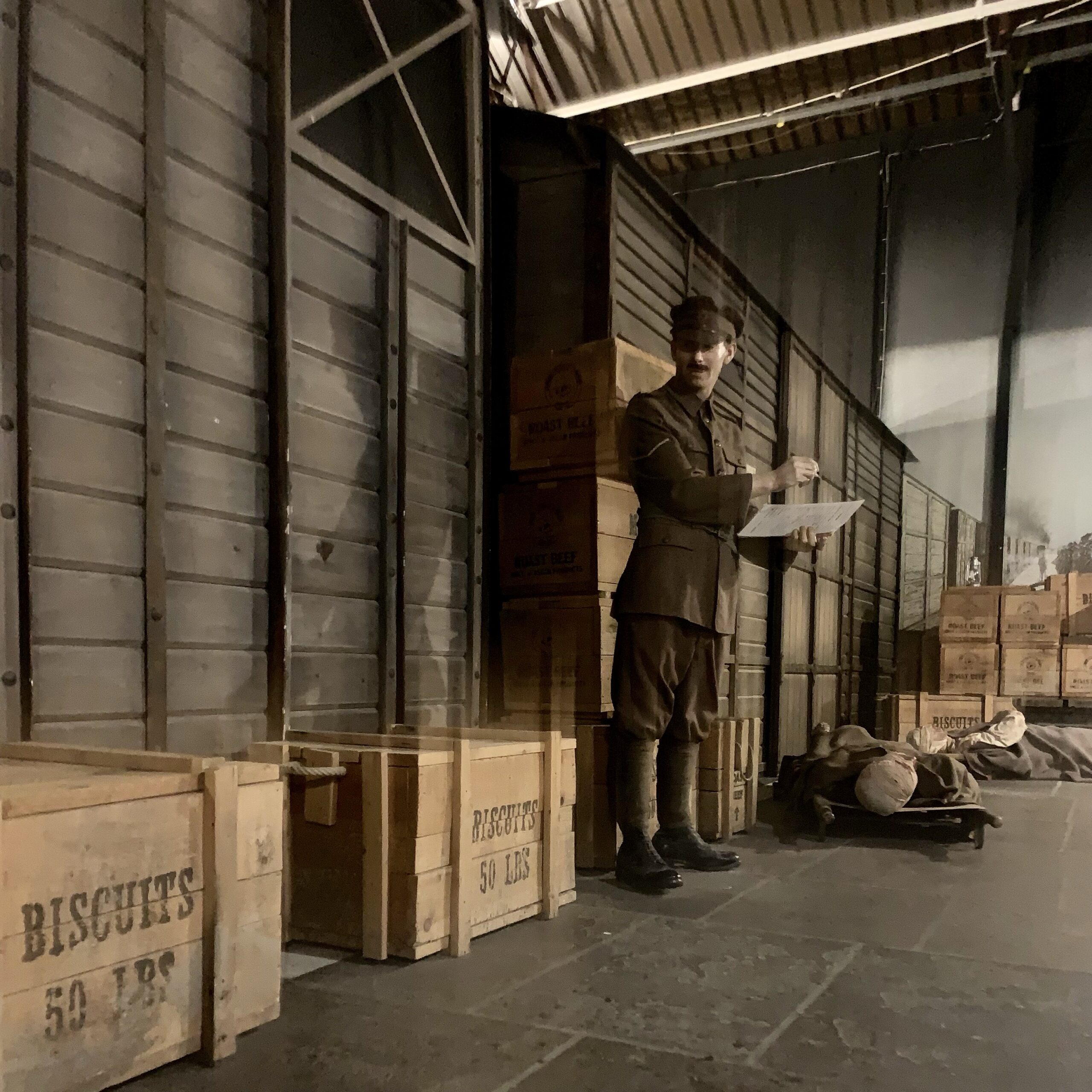
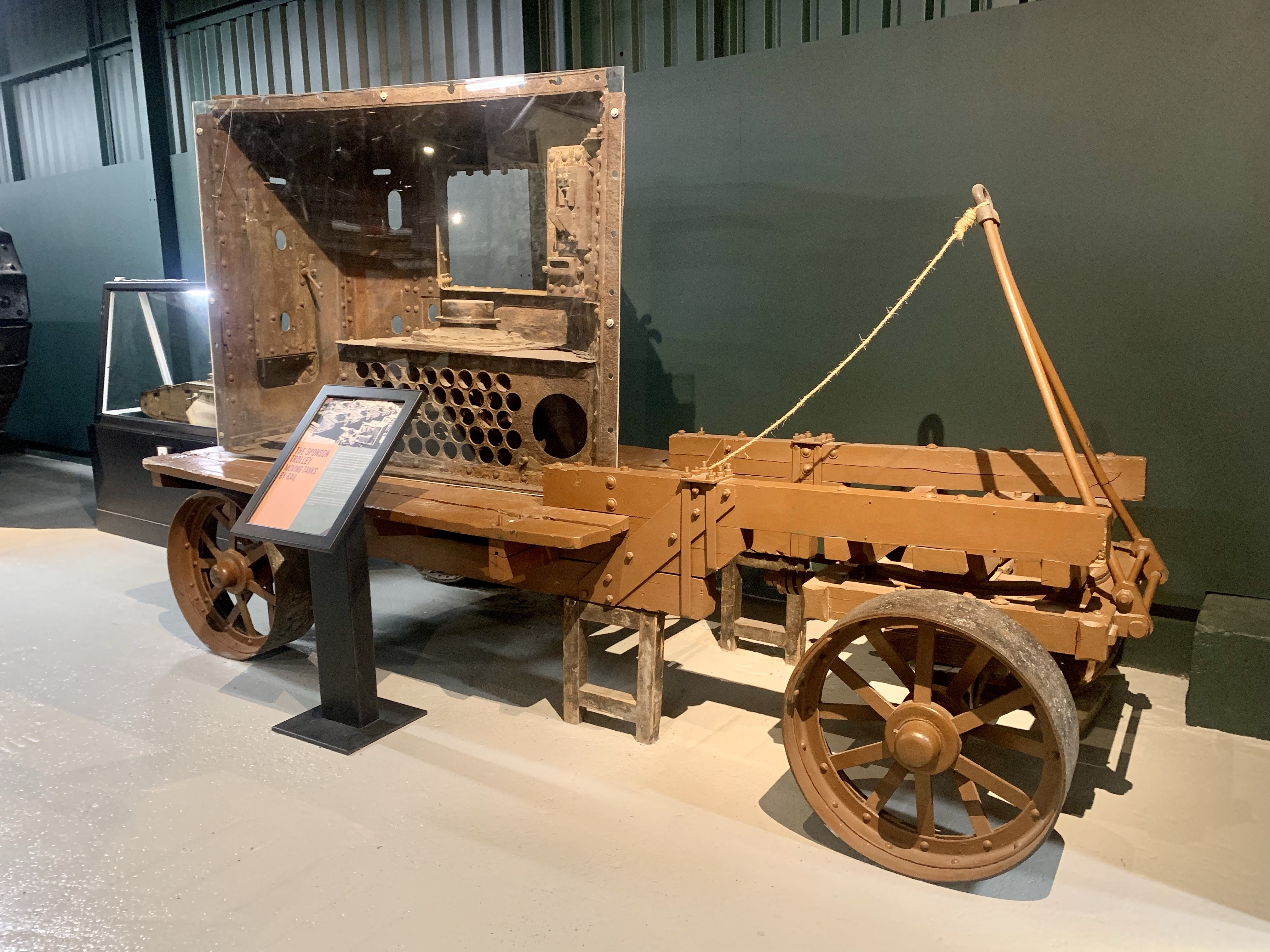
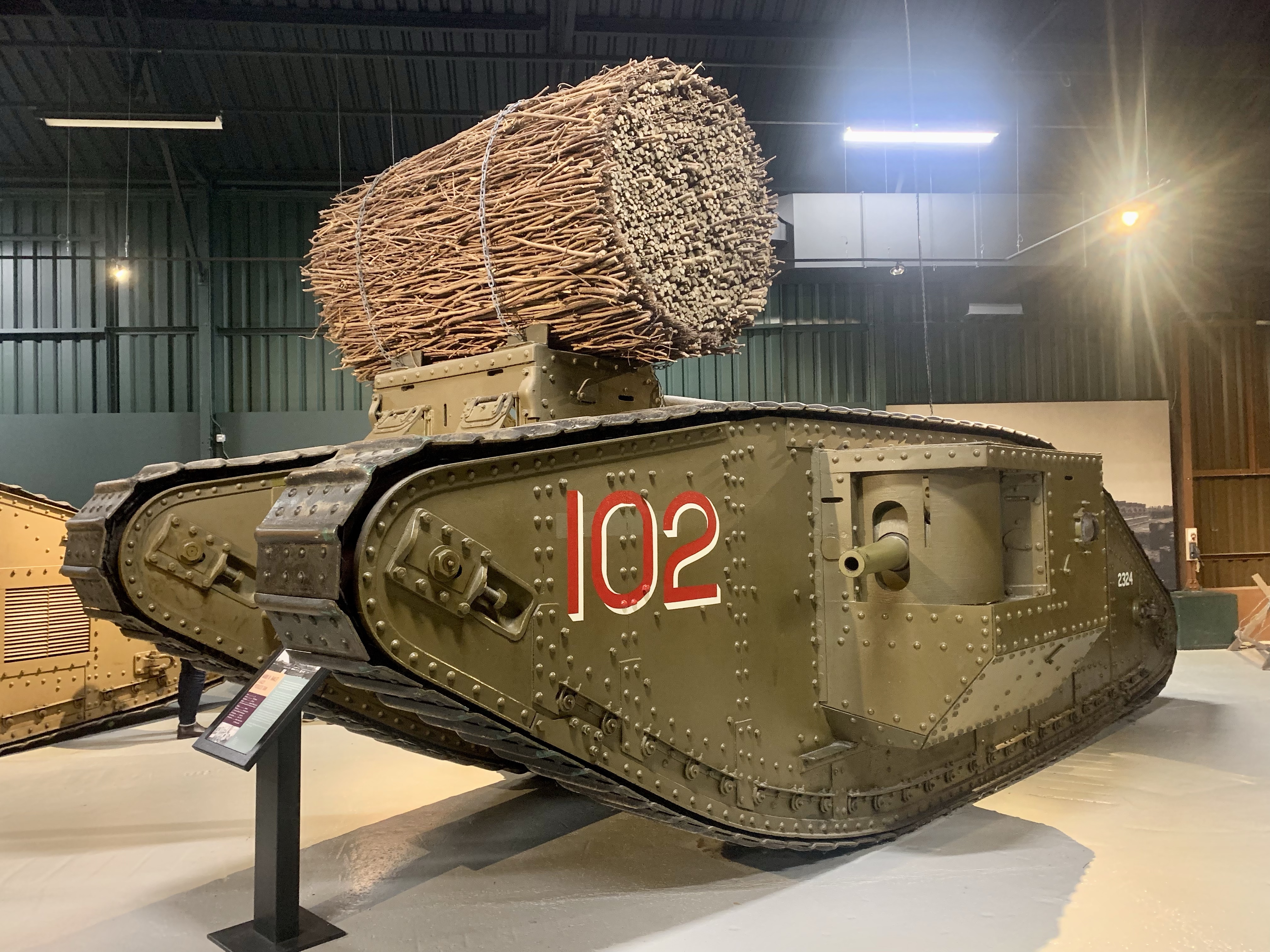
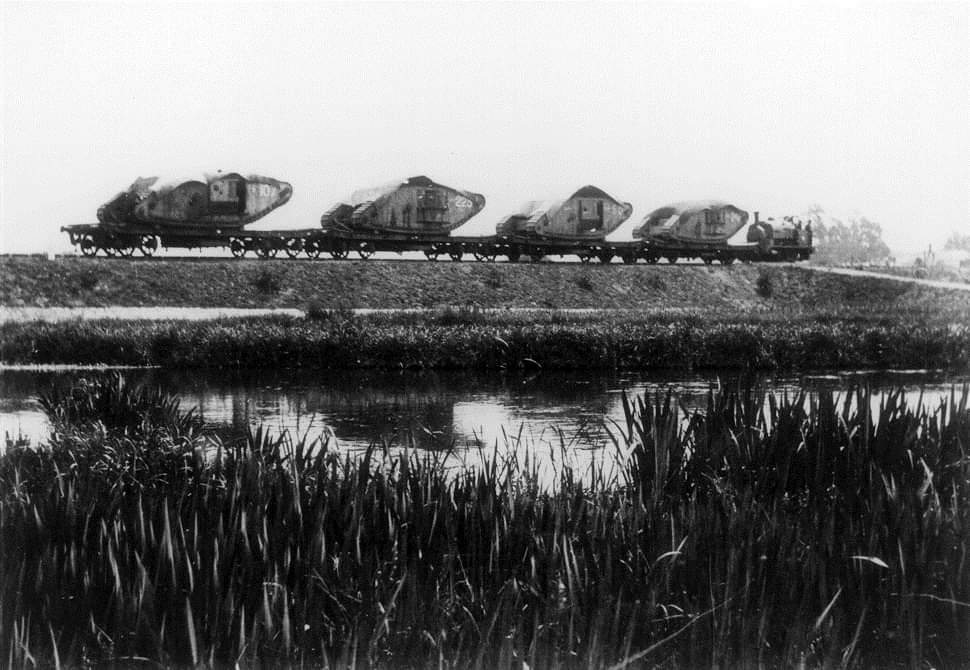
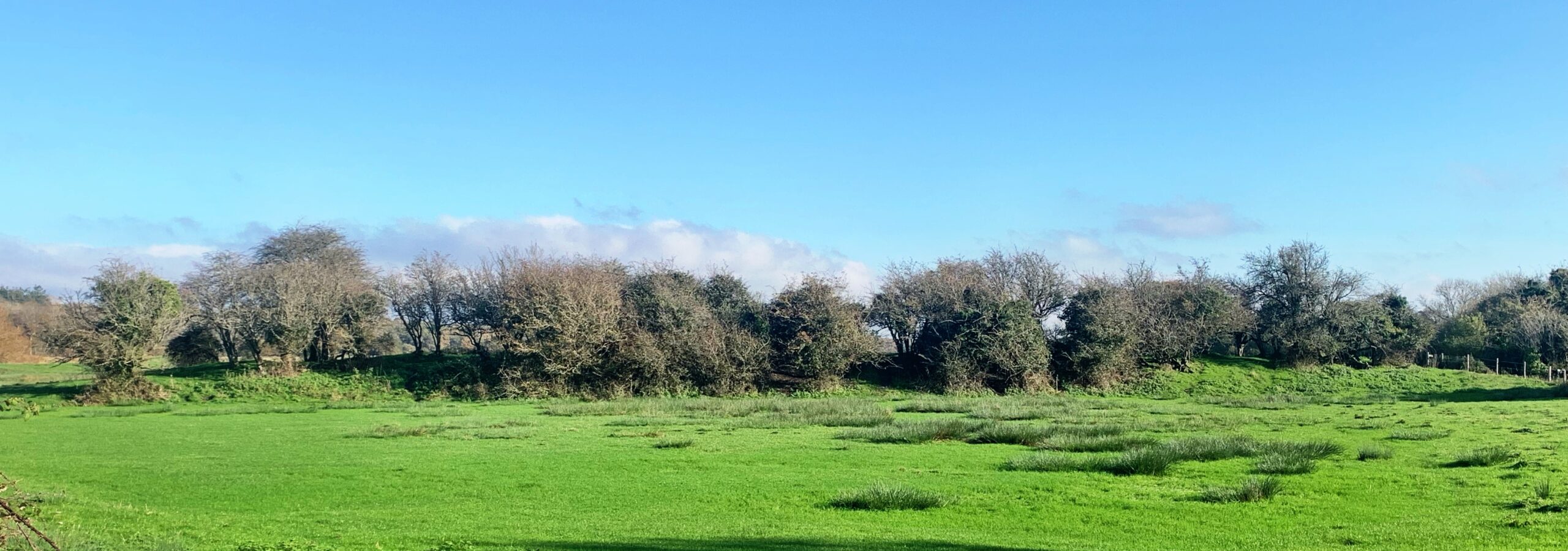
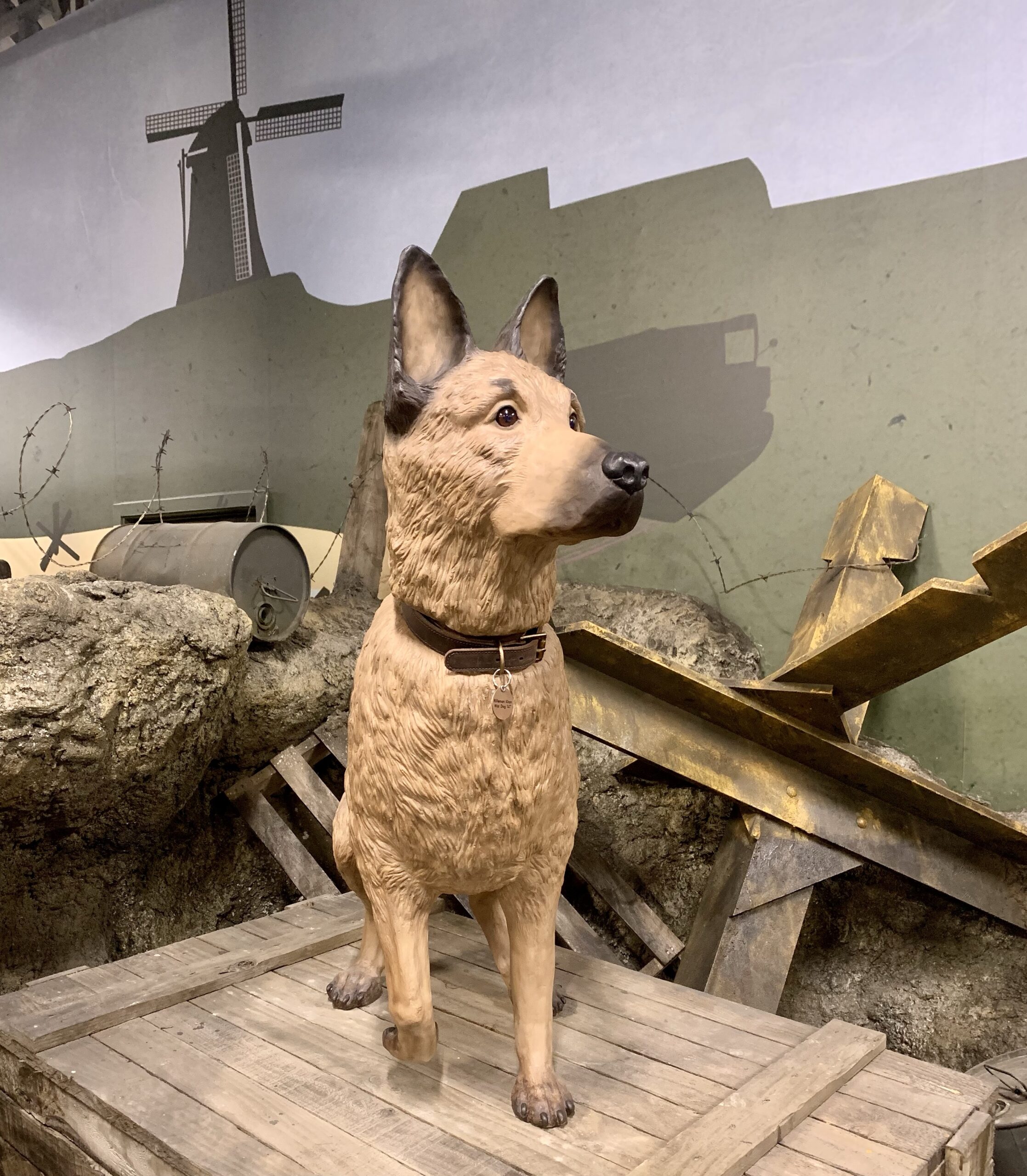
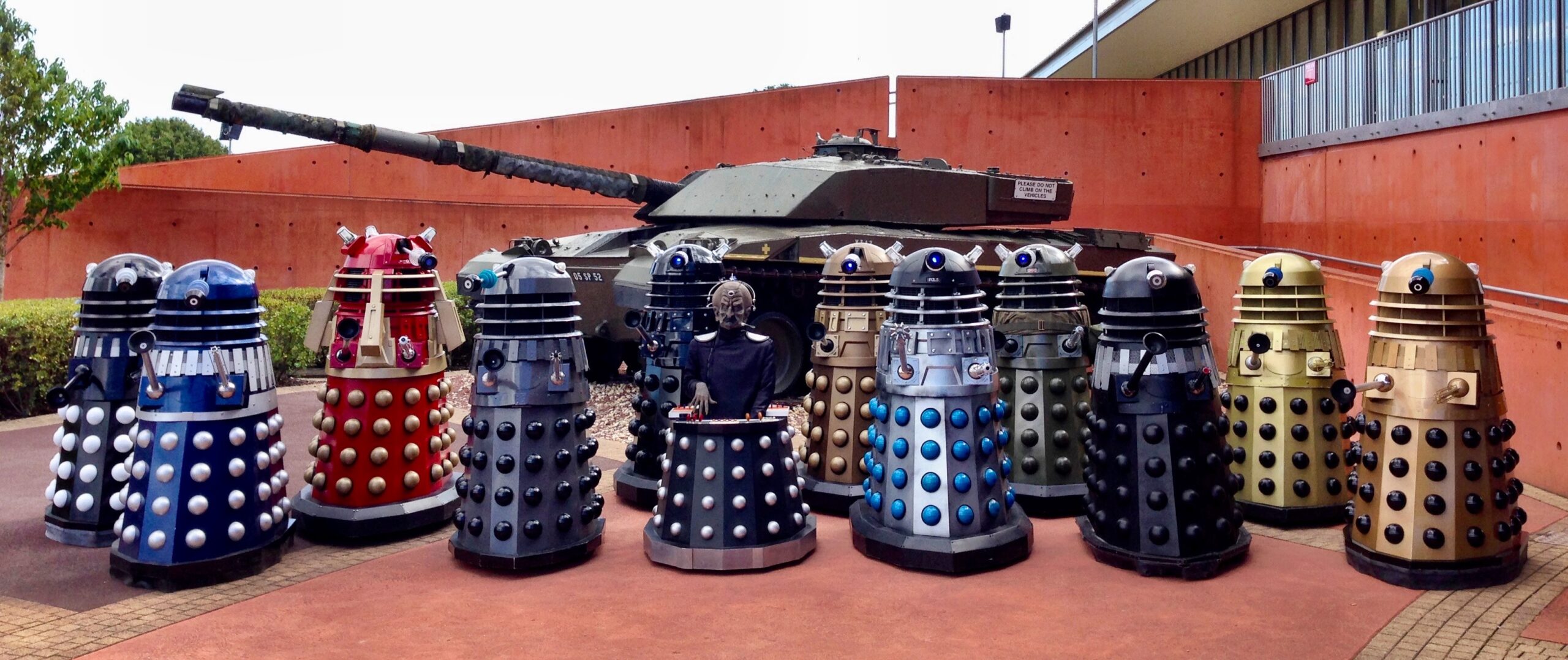
A display showing how railway’s moved troops about the country for embarkation to Europe – The Tank Museum 13/11/2022Checking supplies arriving by train and the injured awaiting repatriation at a railway station diorama – The Tank Museum 13/11/2022Unlike modern armoured vehicles, the first tanks did not have turrets to carry the main gun. Their weapons were instead mounted in special side units known as “sponsons.” An example of a sponson from a Mark II tank is shown on the trolley in the above image. Specially designed trolleys were used in 1916 to move the sponsons around when taken off the tank. This was necessary because tanks would otherwise not be able to travel by rail. The sponsons jutted out and made the tank too wide to fit through tunnels – they may have also knocked down signal posts or injured passengers on platforms. The solution was to unbolt them which took the crew about fifteen minutes and then load them onto the trolleys to be carried separately. With the appearance of the new Mark IV tank in 1917, the trolley became redundant. Its sponsons were smaller and could slide into the hull to allow the whole tank to travel by rail – The Tank Museum 13/11/2022A Mark IV Tank(Male), built in 1917 by William Foster & Co Ltd as part of a batch of 101 tanks numbered from 2300 to 2400. This is one of seven survivors from the 1,220 Mark IV tanks built and is preserved in operational condition, although it is not run to avoid damage from wear and tear – The Tank Museum 13/11/2022A branch line from Wool to Bovington was built . This image courtesy of The Tank Museum shows Mark IV tanks with sponsons pushed inside to meet railway gauge limitations are being shunted towards Bovington. The branch cost an estimated £2,776 which was met by the War department. At just over 2 miles in length, the single track branch line was constructed by the Royal Engineers assisted by German prisoners of war between October 1918 and August 1919Remains of the Bovington Branch railway in 2022; an embankment near Woolbridge – 13/11/2022We’ve looked at the railway element of The Tank Museum, and now a dog feature: Rifleman Khan was a German Shepherd who won the Dickin medal during the Second World War. He was awarded the medal for saving the life of his handler, Lance Corporal Jimmy Muldoon. Khan was volunteered for Army service by the Railton family and given the number 147. After training as a mine detection dog, he was assigned to Jimmy Muldoon, 6th Battalion, The Cameronians. Khan spent the rest of the war in Europe with Jimmy Muldoon. Due to the bond they had developed, Jimmy appealed to the Railton family to keep him. They initially refused, but after a parade organised by ‘The Star’ newspaper in 1947, the family saw them together and allowed Khan to stay with Jimmy, saying, “He is yours, take him home with you!” Jess Lucas, a sculpture student at Arts University Bournemouth, produced the model of Rifleman Khan seen in the image above for her final year project.There are all sorts of tanks on display at the Tank Museum. Sometimes mutated alien creatures encased in tank like bonded polycarbide armour visit for team build events such as this group in 2015 posing for photographs with their creator Davros – 25/07/2015
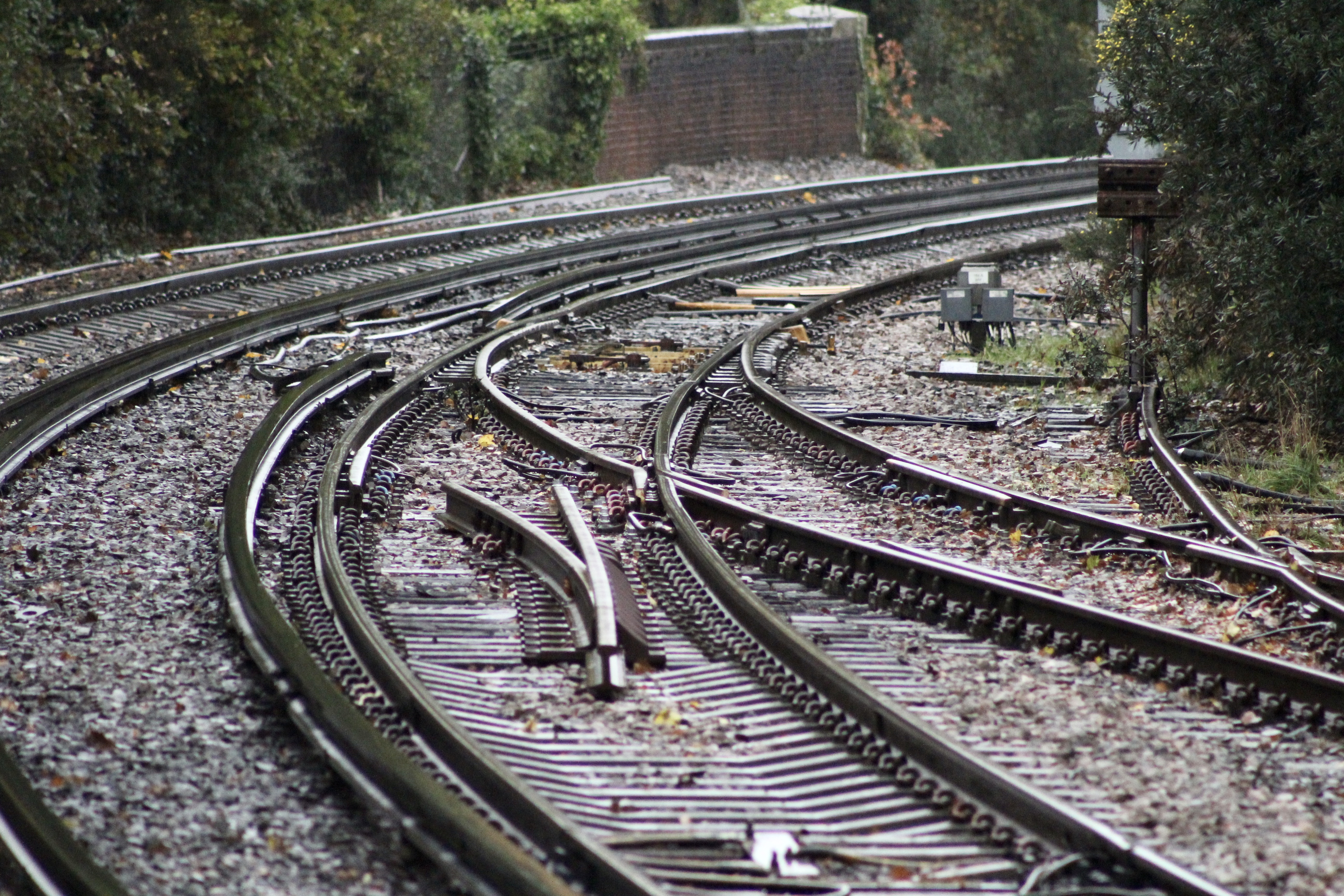
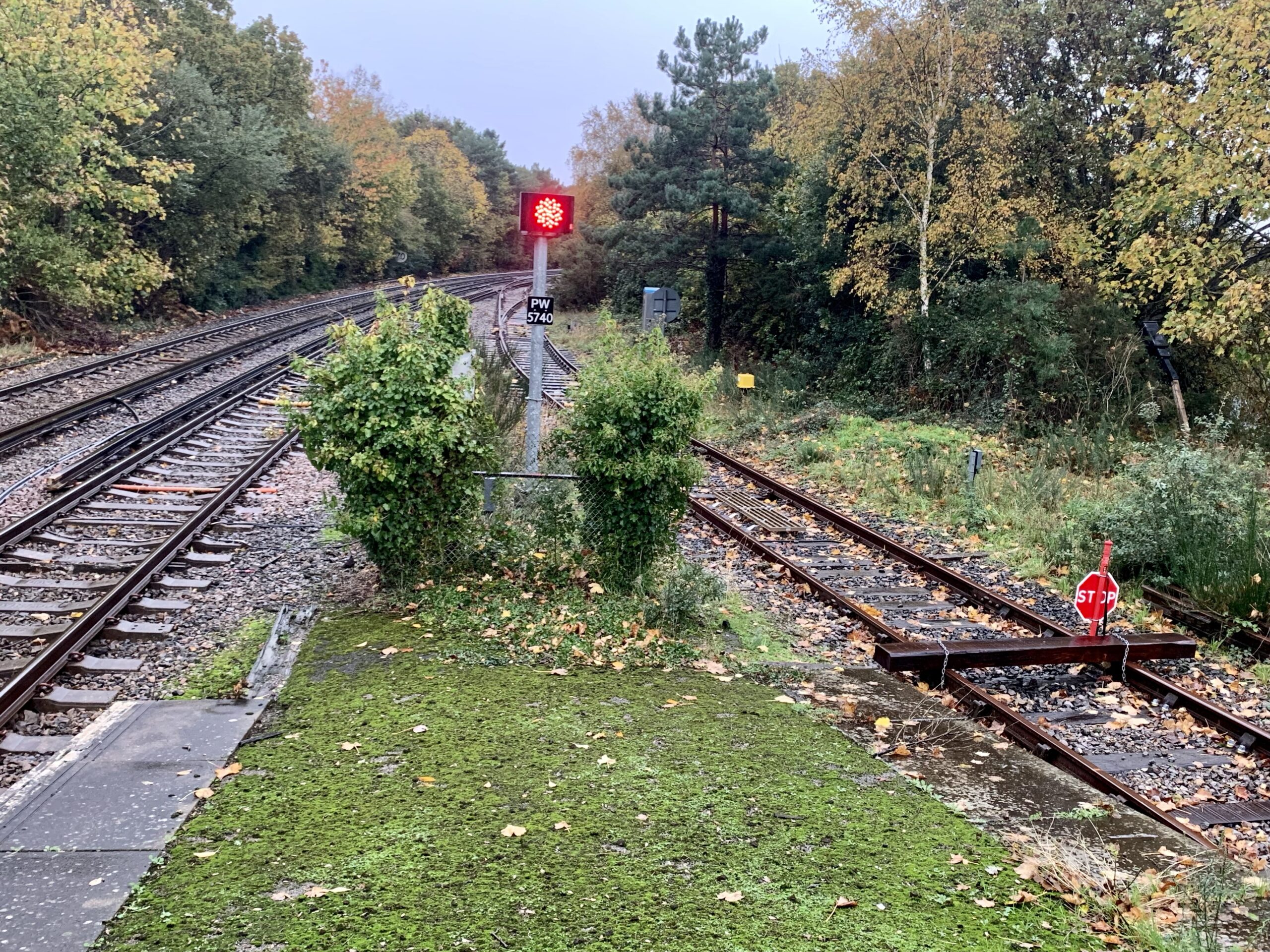
In other news, at some “point” during the past week, the Hamworthy Branch has been reconnected to the main line. Hurrah! The track work crossing Lake Road bridge is scheduled to receive attention w/c 21/11/2022
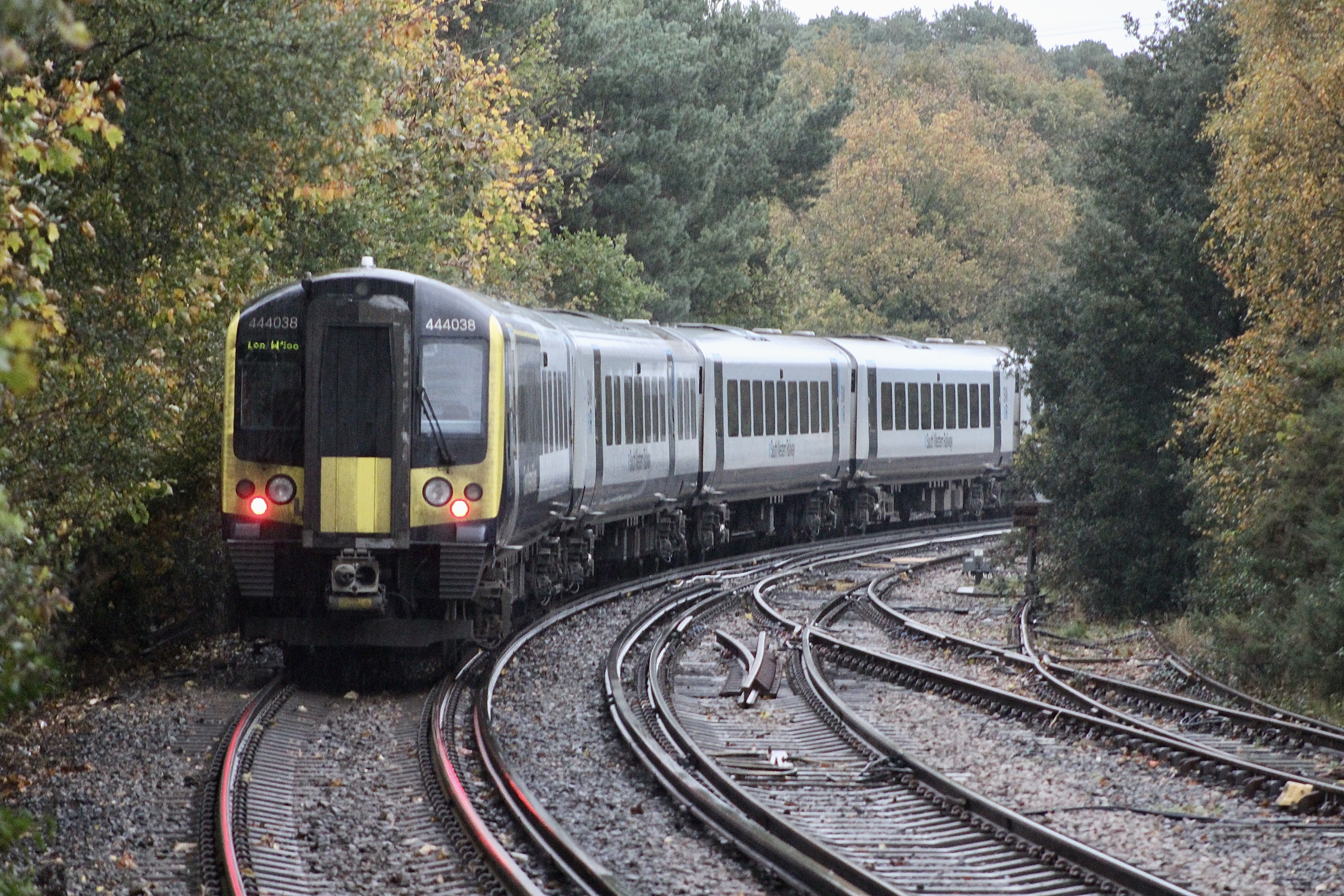
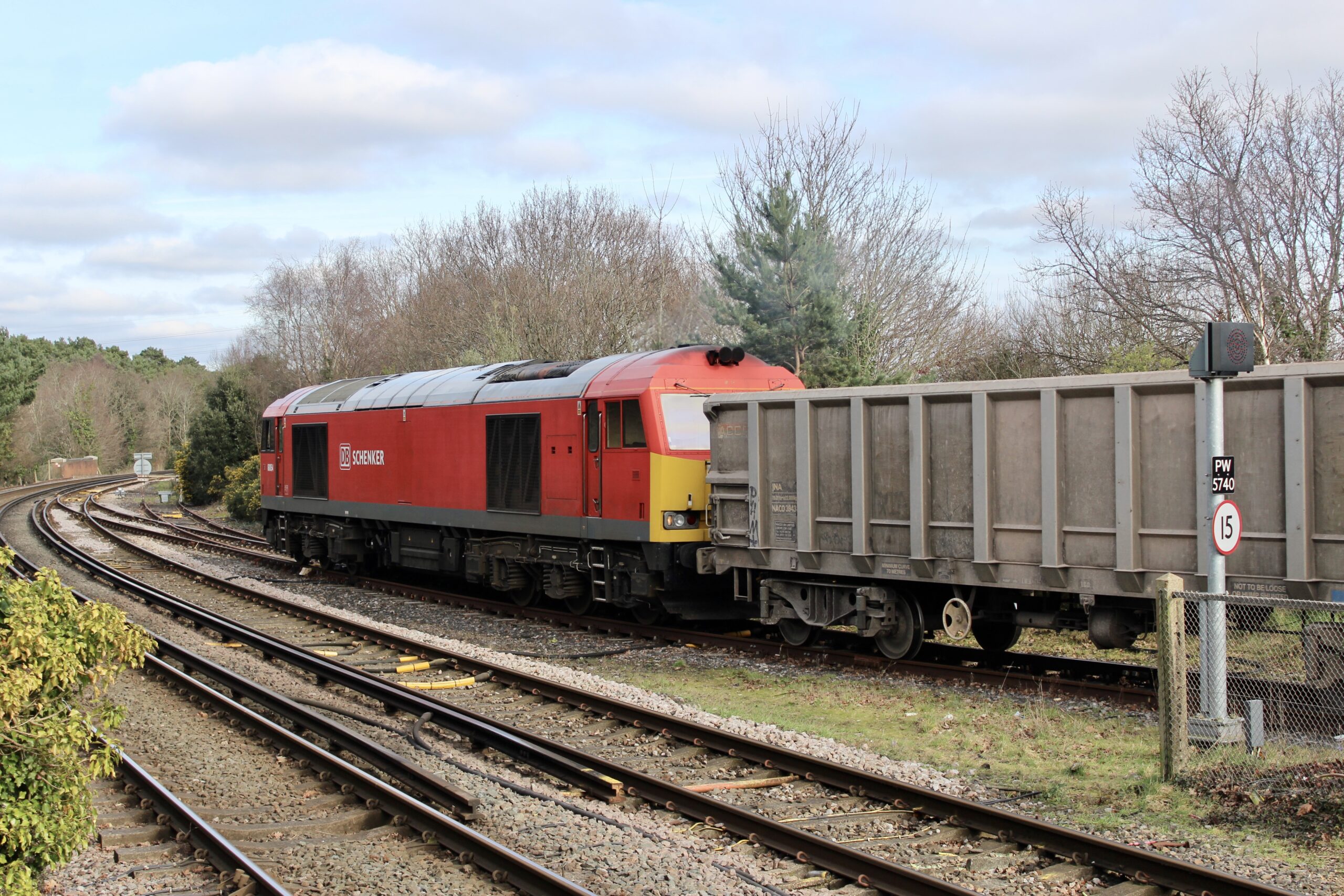
SWR Class 444 No.444038 having departed Hamworthy with 1W64 1420 Weymouth to London Waterloo passes the newly restored point work leading to the Hamworthy Branch – 16/11/2022Closer view of the new point work – 16/11/2022The ‘stop’ sign is still in situ on the Hamworthy Branch – 16/11/2022Maybe a sight we’ll see again? DB Class 60 No. 60054 heads off the Hamworthy Branch – 17/02/2017
If you’ve made it this far dear reader, you have our thanks and gratitude. We really appreciate your comments, observations and corrections. We’ve almost managed a whole year of posts at therailwaydog.co.uk, join us next week for the blogs’ first birthday, There will be cake. Possibly. This week’s post was created to the sounds of Dizzy, John Rutter and Odanata (thanks Milly & Saffy!).
Yoshi following his footplate visit to LNER Gresley A3 4-6-2 No. 60103 ‘Flying Scotsman’ – 06/11/2022
Wednesday 2nd November to Tuesday 8th November 2022
Hello faithful reader, here we are, back again for another railway dog blog entry. Settle down – quiet at the back there – and let me regale you with this weeks tales. Or should that be tails?
Saturday November 5th was scheduled to be a rail strike day, so I had arranged a day out to Weston-super-Mare to visit See Monster, a retired offshore platform which once stood in the North Sea and has now been transformed into one of the largest public art installations in the UK. Located on Weston’s seafront within The Tropicana, the former 1937 lido which once contained an outdoor swimming pool, there is a waterfall, kinetic wind sculptures with a cascade of silvery scales wrapping around the structure. In previous times, the lido has hosted Hollywood legends Laurel and Hardy and more recently- in 2015 – street artist Banksy’s DismalLand, which was the last time I visited Weston-suoer-Mare.
See Monster at Weston-super-Mare – 05/11/2022
The planned rail strike was, of course, called off at the eleventh hour on Friday November 4th, but this was too late for the railways to gear up and run anything like a full timetable. However, one movement which did catch my eye was a Rail Head Treatment Train (RHTT) from Swindon Transfer Yard which was running a circuit taking in Bristol, Bath and Westbury top and tailed by Class 56 diesel locomotives. In fact Swindon was playing host to two pairs of Class 56’s at the weekend, but only one set was timed to cross my path on Saturday. Returning from Weston-Super-Mare we kept tabs on the how the train was running via Real Time Trains and decided that Trowbridge would be a safe bet to see the train as it was due to pass twice on its way to and from Westbury. We arrived at Trowbridge railway station just in time to see the consist running through on its first pass. Undeterred by the wait we positioned ourselves on the southbound platform and awaited the RHTT’s return. We were rewarded with the fine sight of Colas Class 56 No. 56105 with No. 56096 at the rear working 3S32 1002 Swindon Transfer Yard to Swindon Transfer Yard.
Colas Class 56 No. 56105 with 56096 at the rear working 3S32 1002 Swindon Transfer Yard to Swindon Transfer Yard RHTT through Trowbridge – 05/11/2022Colas Class 56 No. 56096 at the rear of 3S32 1002 Swindon Transfer Yard to Swindon Transfer Yard RHTT passes Trowbridge with No. 56105 at the front – 05/11/2022
Trowbridge, like Bradford on Avon which we visited a couple of weeks ago, is another station which was originally opened by the Wilts, Somerset and Weymouth Railway in 1848 as part of their Thingley Junction to Westbury line. It gained a link to Bath and Bristol nine years later thanks to the Great Western Railway which is now the main line, as the original route to Chippenham has been singled and reduced to secondary status. The original station buildings have been replaced with a bland brick structure containing a ticket office on the northbound platform.
Trowbridge railway station – 05/11/2022
Trowbridge, Wiltshire – additional footage courtesy of @dabuckley967 – 05/11/2022
We were spoilt with ‘heritage’ diesel traction on the Bristol to Weymouth line this past week when no less than three Colas Rail Freight operated Class 37 diesels visited the Dorset seaside with test trains.
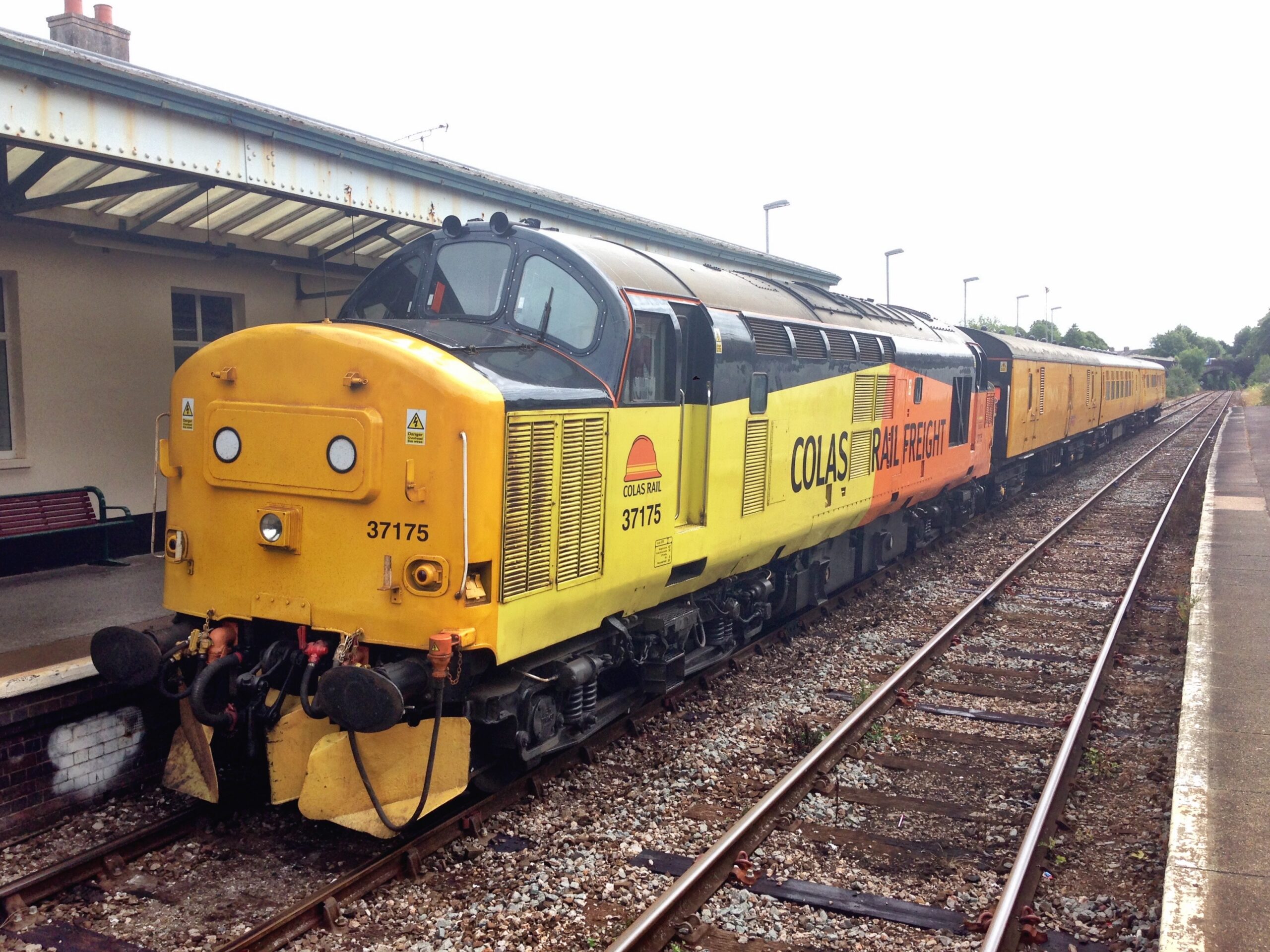
In glorious sunshine, I headed to Upwey on Thursday 3rd November to see 3Q14 1037 Westbury Down TC to Westbury Down TC via Weymouth hauled by Class 37 No. 37175 in the distinctive orange, yellow and black Colas livery. Because of generous timings in the schedule, I had a bit of a wait at Upwey, but enjoyed watching the passing South Western Railway and Great Western trains.
Class 37 No. 37175 nears Upwey in the afternoon sun working 3Q14 1037 Westbury Down TC to Westbury Down TC via Weymouth test train – 03/11/2022
The weather on the previous day, Wednesday 2nd, had been a different story altogether when top and tailed class 37’s No.’s 37421 and 37254 worked the regular Derby Railway Technical Centre to Bristol Kingsland Road via Weymouth New Measurement Train (NMT), which for most of the year has been powered by Class 43 High Speed Train power cars. As heavy rain showers were forecast, I decided to head to Dorchester West where I would be able to take shelter from the elements if need be in order to see the train pass.
Colas Class 37 No. 37421 heads up 1Z22 0644 Derby RTC to Bristol Kingland Road as it eases through Dorchester West – 03/11/2022Colas Class 37 No. 37254 at the rear of 1Z22 0644 Derby RTC to Bristol Kingland Road powers away from Dorchester West – 03/11/2022
Dorset Class 37 test trains – additional footage courtesy of @dabuckley967 – November 2022Earlier in 2022 the New Measurement Train was in the hands of HST Class 43 power car No.’s 43257 and 43251 working as 1Z22 0747 Derby RTC to Bristol Kingland Road seen here at Monkton near Dorchester – 15/06/2022Class 67 No. 67023 ‘Stella’ in Colas Rail Freight livery tops the NMT as it arrives at Weymouth. Thirty General Motors Class 67 locomotives were built in Valencia, Spain in 2000 for English, Welsh & Scottish Railway (EWS), now DB Cargo – 19/06/2019Class 67 No. 67027 ‘Charlotte’ at the rear of the NMT seen at Weymouth. Both No. 67027 and 67023 are now part of the GBRf fleet having previously been sold by DB Cargo to Colas Rail in 2017 – 19/06/2019Class 43 No. 43062 ‘John Armitt’ having arrived at Weymouth with the New Measurement Train in July 2012. The all over yellow livery gave the train the nickname “The Flying Banana”. No. 43062 was built in 1977 at BREL Crewe works and formed part of HST set No. 254004 for use on East Coast Main Line services. Following the East Coast electrification No. 43062 moved to CrossCountry duties in July 1991. In February 2003 No.’s 43013/014 and 062 were all allocated to Network Rail, based at Derby, for use on the then new High Speed National Measurement Train (NMT). No.’s 43013/014 were selected as they were due major exams and could therefore receive all the specialist work whilst being overhauled. No. 43062 was selected as it had been ‘blacked’ by Virgin Trains drivers due to constant vibrations in the cab after a derailment at Coventry. As part of the overhaul she was fitted with a completely new cab and the vibration problem was eliminated. In the summer of 2009 No. 43062 was sent to Brush at Loughborough to be re-engineered and had the original Paxman Valenta engine replaced by an MTU unit, re-entering service with Network Rail in October 2009 and remains active in 2022 as part of the Network Rail Class 43 pool code QCAR – 26/07/2012Nameplate detail Class 43 No. 43062 ‘John Armitt’ – 26/07/2012Weymouth was host to the 2012 Olympic Sailing events and temporary station information boards pointed passengers arriving at the station in the direction of Portland Harbour – 26/07/2012Debranded Network Rail Class 43 No. 43014 prepares to depart Weymouth after the crew have changed ends – 26/07/2012Class 43 No. 43014 powers towards Upwey at the head of Network Rail’s NMT – 17/06/2010
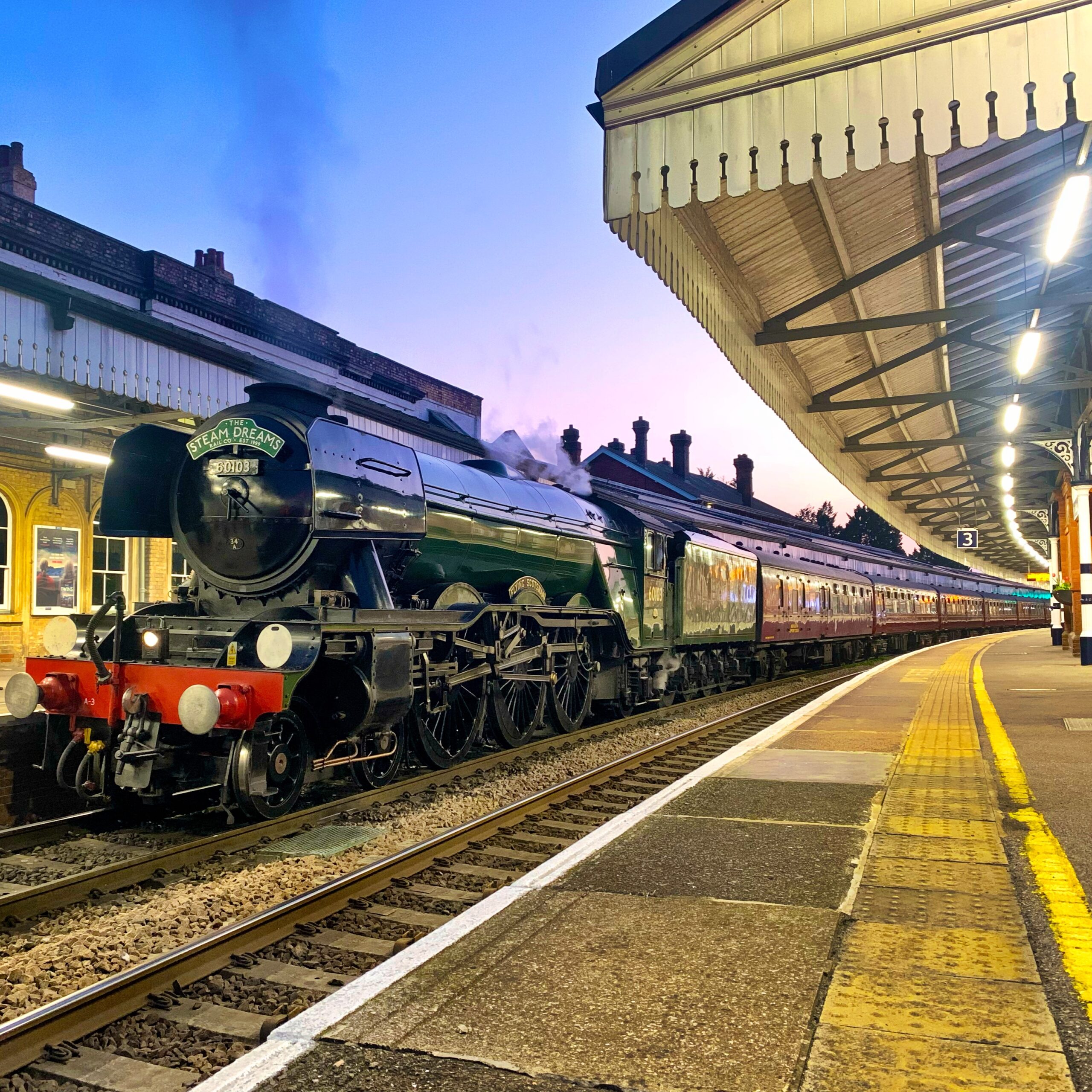
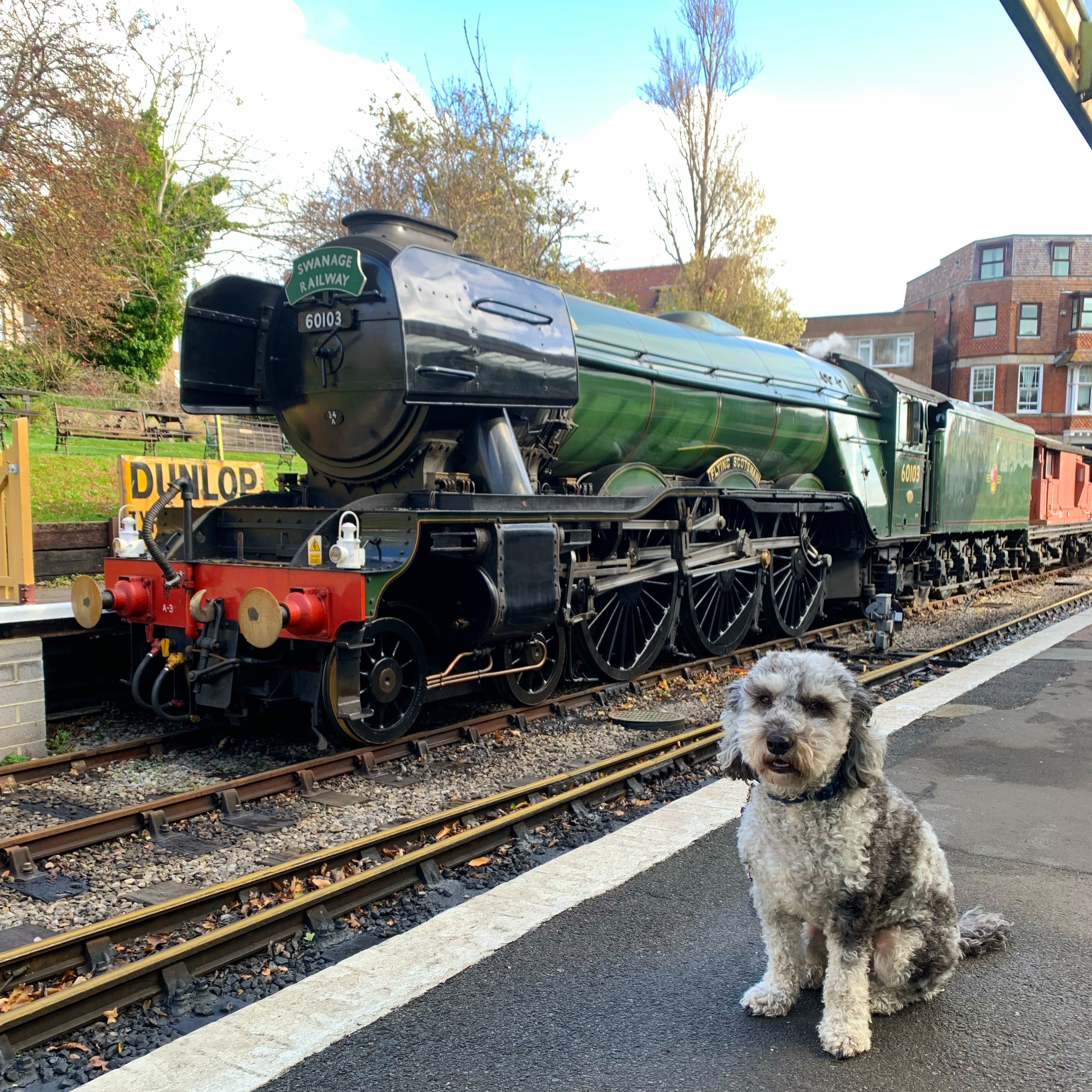
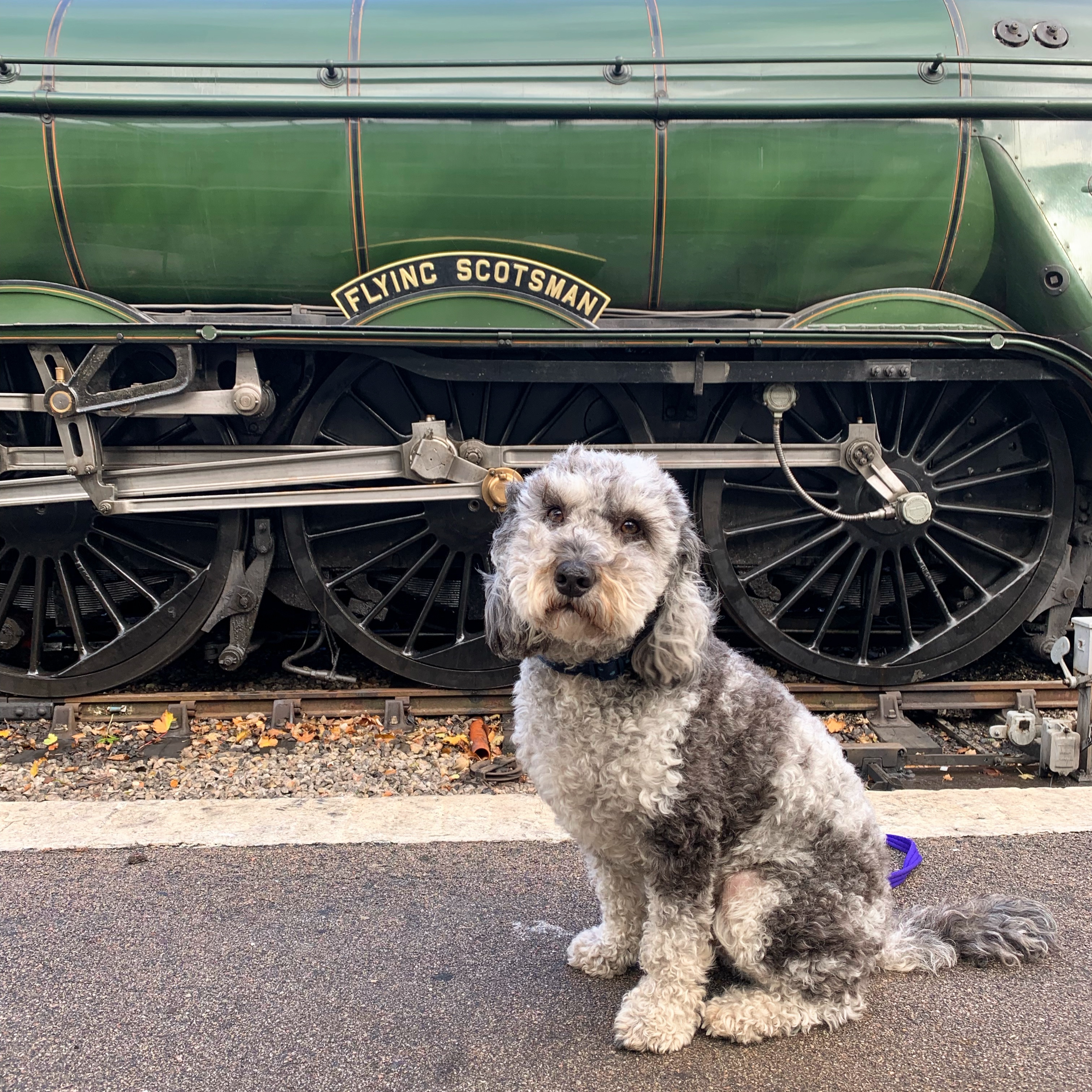
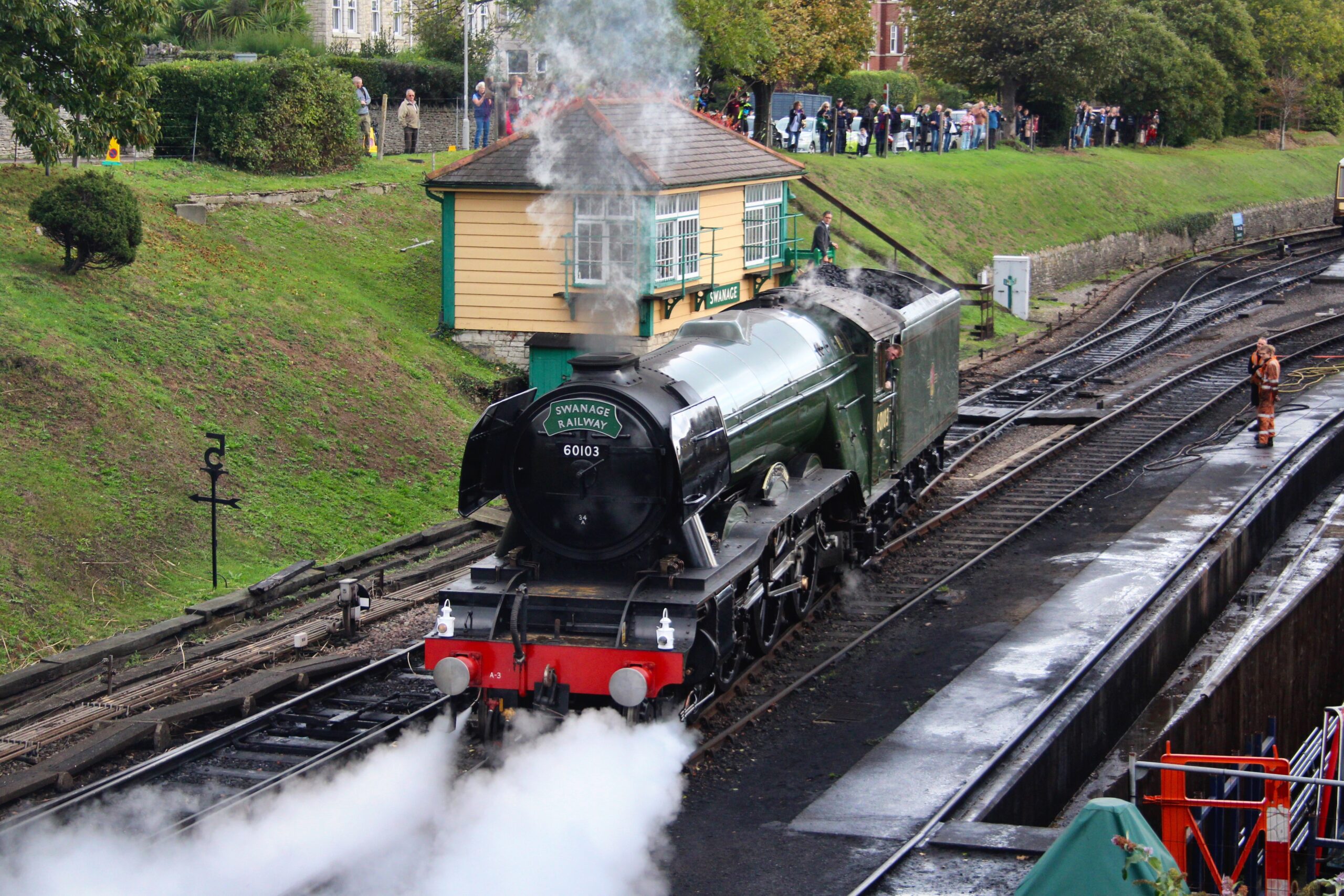
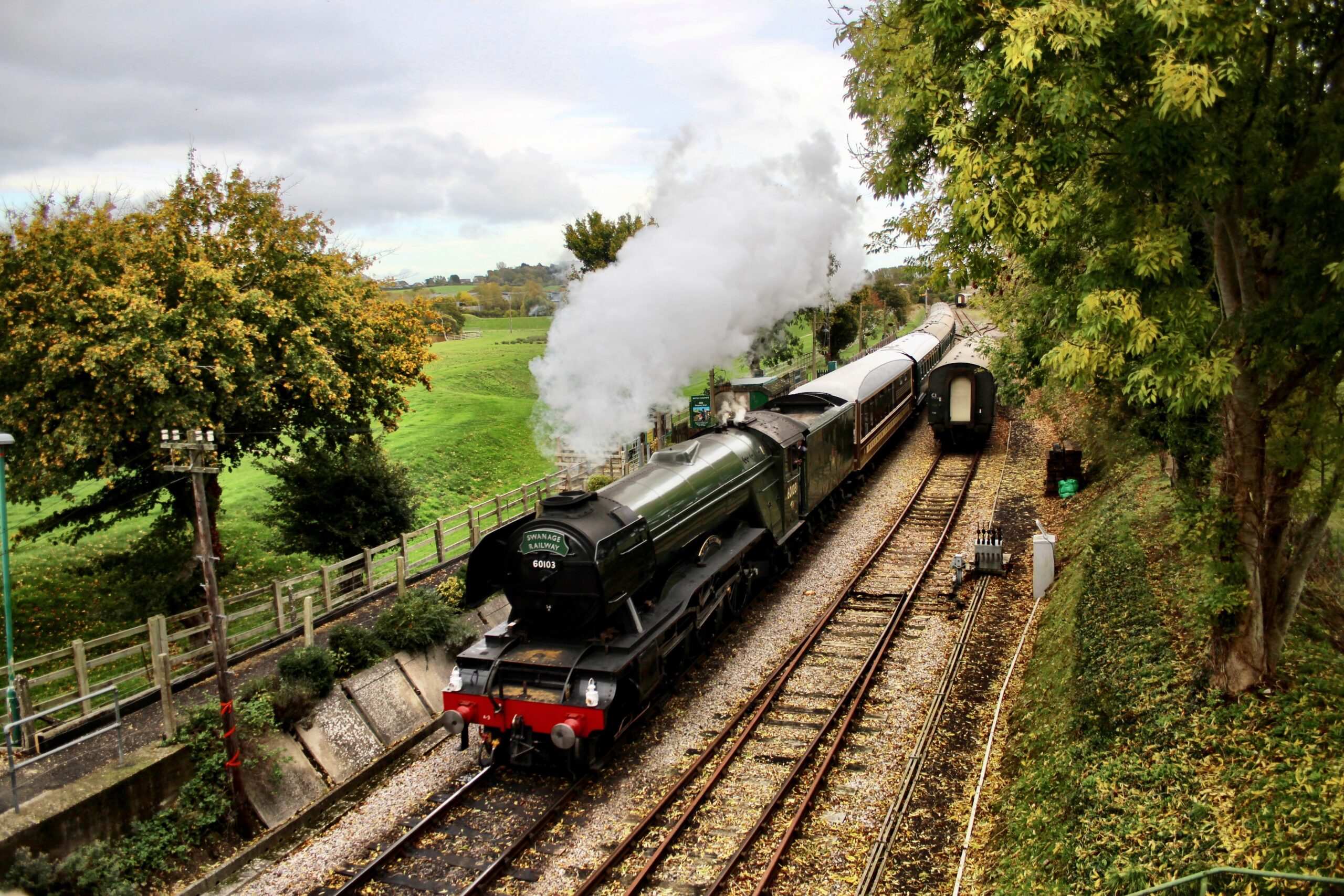
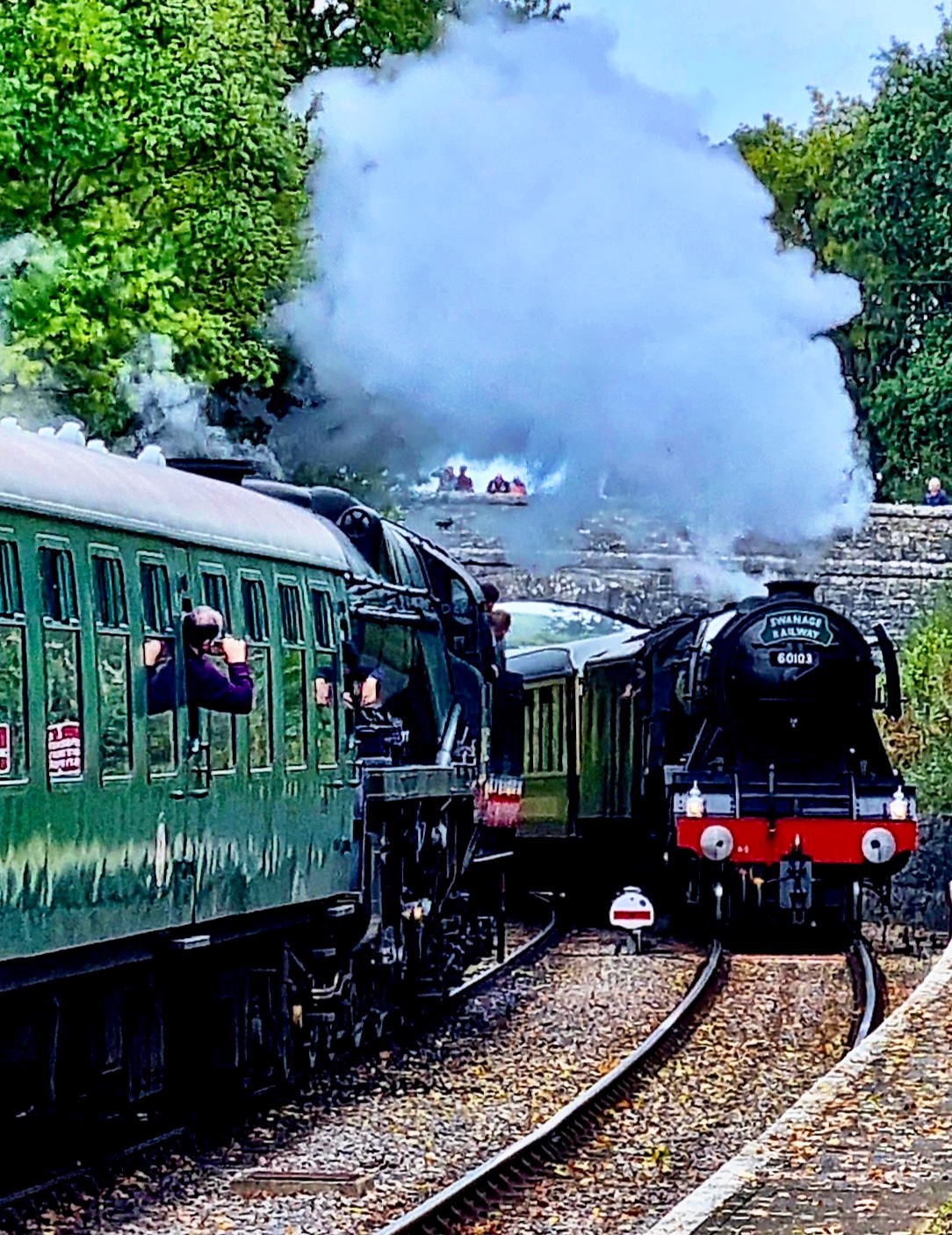
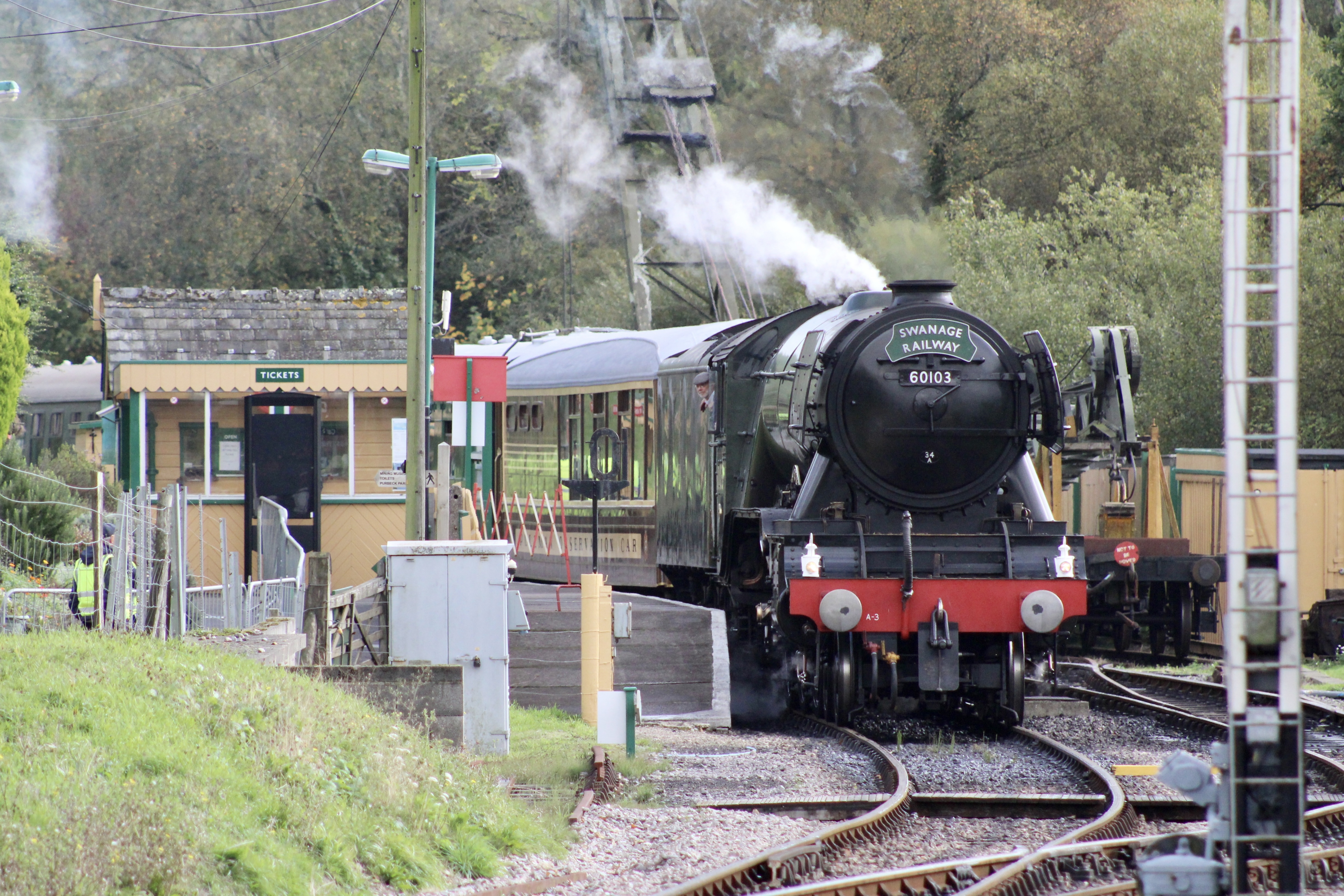
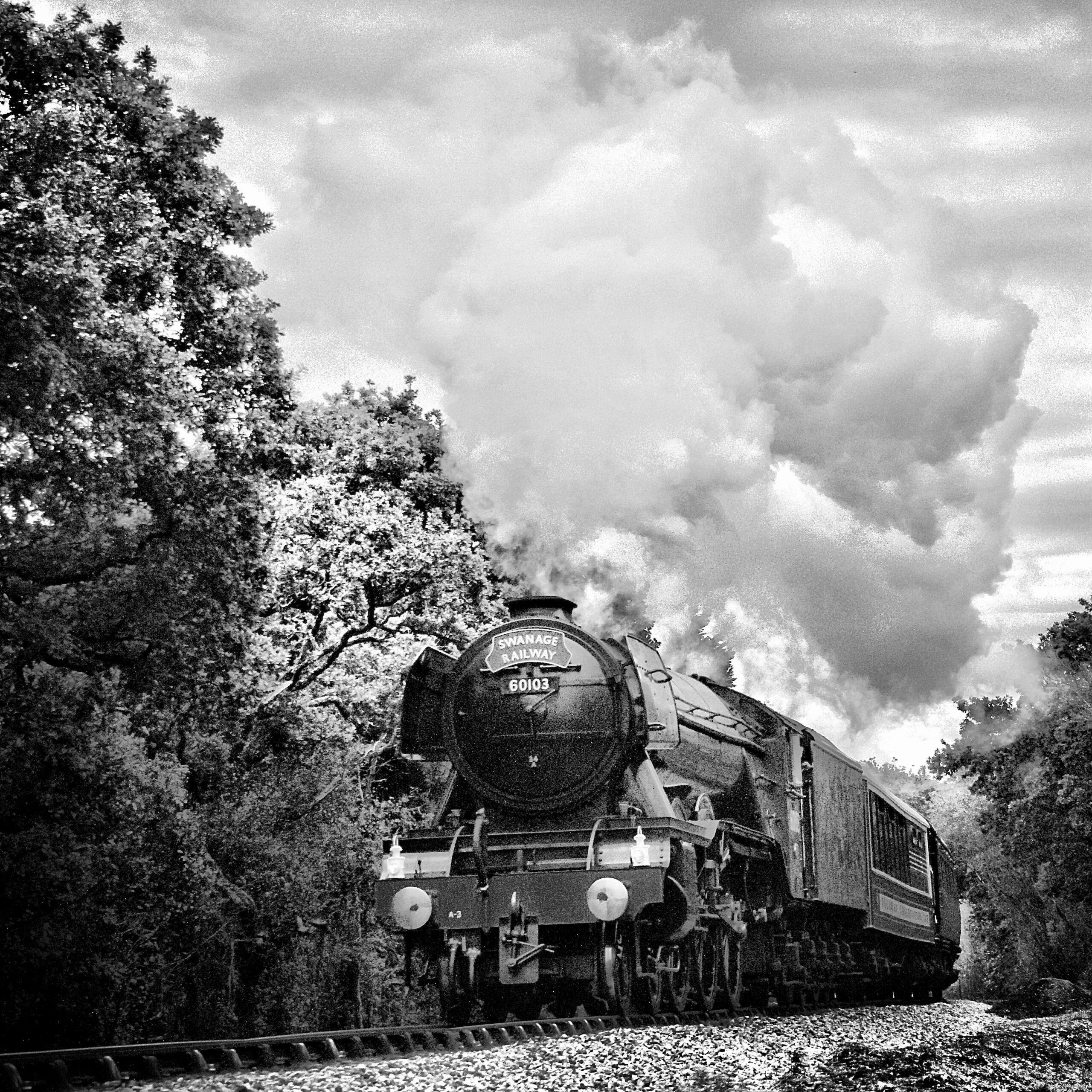
Sunday 6th November dodging the rain once again, we visited the footplate of LNER Gresley A3 Pacific No. 60103 ‘Flying Scotsman’ at Swanage. It was good to see a large turn out on the last day the locomotive was publicly accessable, although this did mean that our visit to the footplate felt a little rushed.
LNER Gresley A3 4-6-2 No. 60103 ‘Flying Scotsman’ in light steam at Swanage – 06/11/2022The tender corridor through which we gained access to the footplate of ‘Flying Scotsman’. This enabled crew changes to take place without the train stopping. Water could be replenished at water troughs set in the railway tracks via a scoop under the locomotives tender – 06/11/2022The firebox and some of the controls on the footplate of ‘Flying Scotsman’ – 06/11/2022Yoshi and I in the driving seat of ‘Flying Scotsman’ (Photo G E Barrett) – 06/11/2022I think everyone was surprised by how small the window through which the driver of ‘Flying Scotsman’ had to view the track ahead at speeds of up to 100mph – photo courtesy of Scott LewisThe drivers seat in the cab of ‘Flying Scotsman’ – photo courtesy of Scott LewisThe view looking out along the locomotive from the cab side – photo courtesy of Scott Lewis
A couple of days later and it was time for No. 60103 ‘Flying Scotsman’ to leave Dorset and head north to Bury. I was up early to witness the 0705 departure from Swanage on a blustery and wet Tuesday 8th November.
With Remembrance Sunday 2022 only a few days away, the following images are from our November 2021 visit to the National Memorial Arboretum at Alrewas (near Lichfield) in East Staffordshire and is the UK’s national site of remembrance. It was inspired by a visit to the Arlington Cemetery in the USA.
The Railway Industry Memorial was unveiled on 22nd May 2012 is situated within sight of the Derby to Birmingham railway line and celebrates the achievements of the railway family, who gave their lives in times of both conflict and peace.
Sumatra Railway WW2 Memorial is formed of a replica section of the Sumatra railway, including wooden sleepers and railway track, set on an embankment and commemorates the c700 Allied Far East Prisoners of War who died in its construction.
The Burma Railway Memorial was created to remember those who were forced to construct the infamous ‘Railway of Death’ during the Second World War. The memorial is constructed from 30 metres of the original track. During the construction of the 258-mile railway over 16,000 Prisoners of War and 100,000 labourers died – one life for every sleeper laid.
In August 1943, Louis Mountbatten became Supreme Allied Commander South East Asia Command and oversaw the recapture of Burma and Singapore from the Japanese by the end of 1945. For his service during the war, in 1946 Mountbatten was made a Knight of the Garter and created Viscount Mountbatten of Burma and in 1947 Earl Mountbatten of Burma. Two BR Southern Region Class 33’s were named in connection with Mountbatten and Burma.
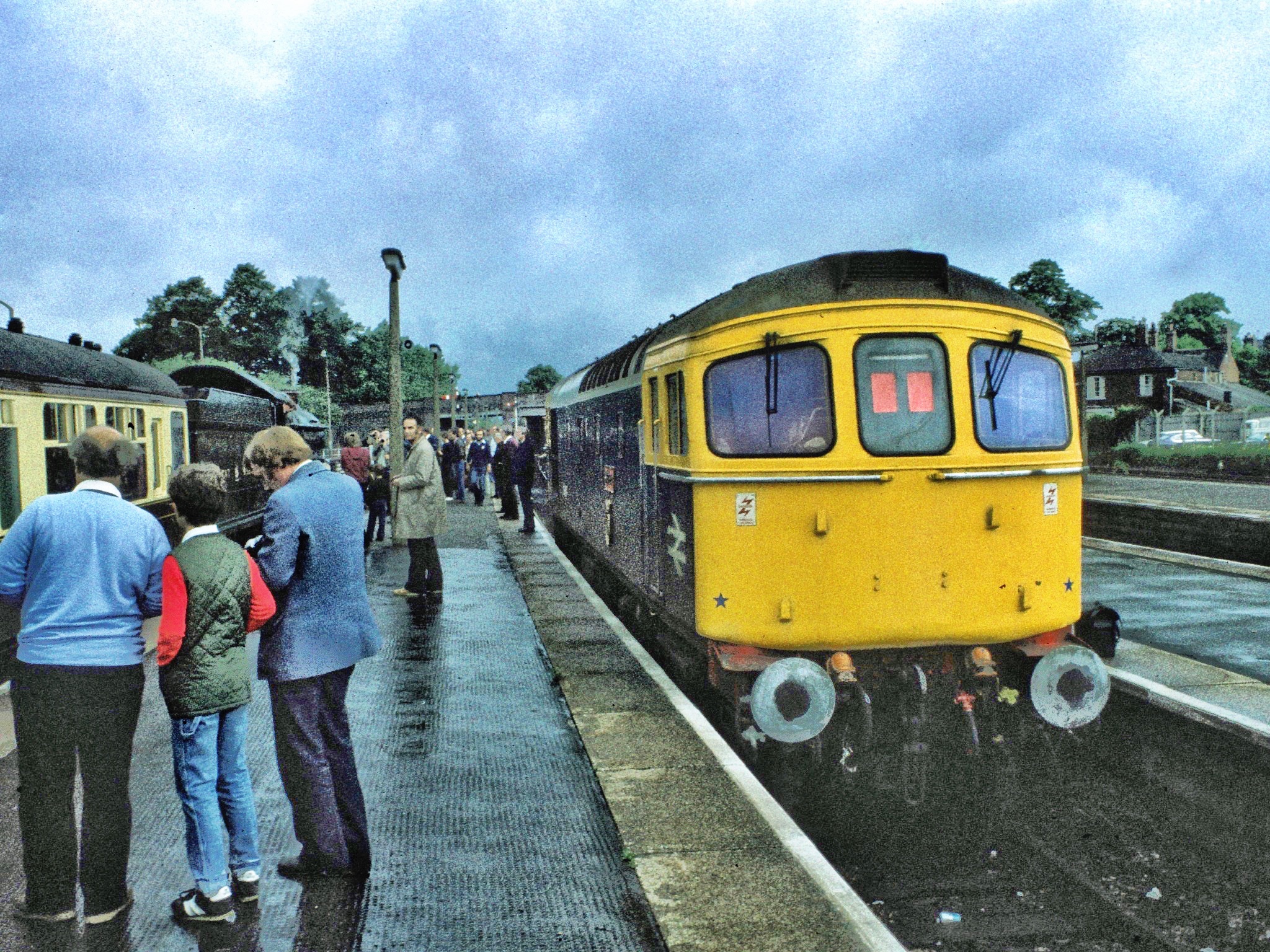
Class 33 No. 33027 ‘Earl Mountbatten of Burma’ on display at Eastleigh T&RSMD open day on 29/05/1983. This locomotive was one of only five Class 33’s which carried names at the time this photograph was taken. No. 33027 along with No. 33056 ‘Burma Star’ received their respective nameplates at London Waterloo on 02/09/1980 having been chosen to carry names after working Lord Mountbatten’s funeral train from London Waterloo to Romsey the previous year on 05/09/1979. Always immaculately turned out by the home depot, No.33027 is seen sporting an “Eastleigh Railway Preservation Society” headboard and the buffers are still wrapped in plastic to keep them clean prior to a charity “tug of war” involving the locomotive being pulled along a siding. No. 33027 was introduced into traffic in 1961 and withdrawn in 1991 before being cut up at Eastleigh East Yard the following yearClass 33 No. 33056 nears Dorchester South on 26/09/1981. No. 33056 was built in 1961 and withdrawn and scrapped in 1991. The Burma Star is a military campaign medal awarded to British and Commonwealth forces who served in the 1941 to 1945 Burma Campaign during World War II
That’s all we have time for this time. All being well, we’ll be back next week with more. Until then, take care and thank you for your comments, suggestions and updates!
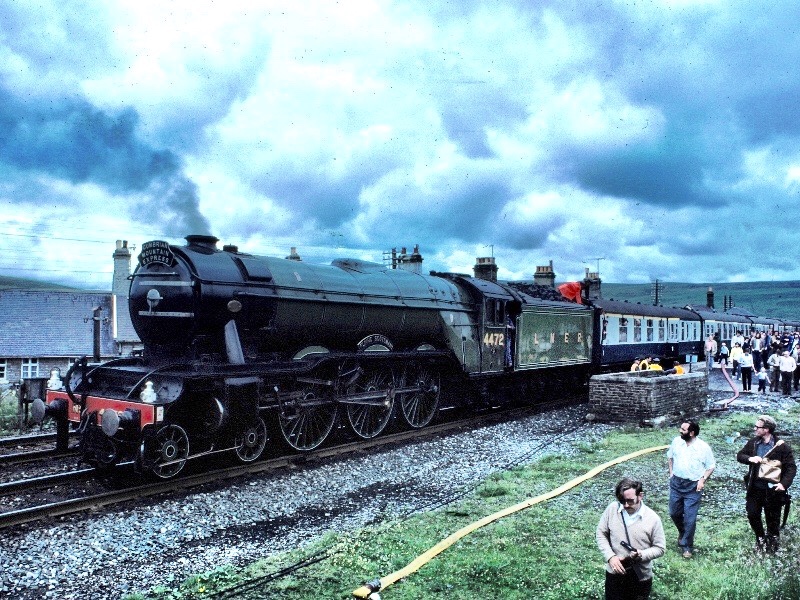
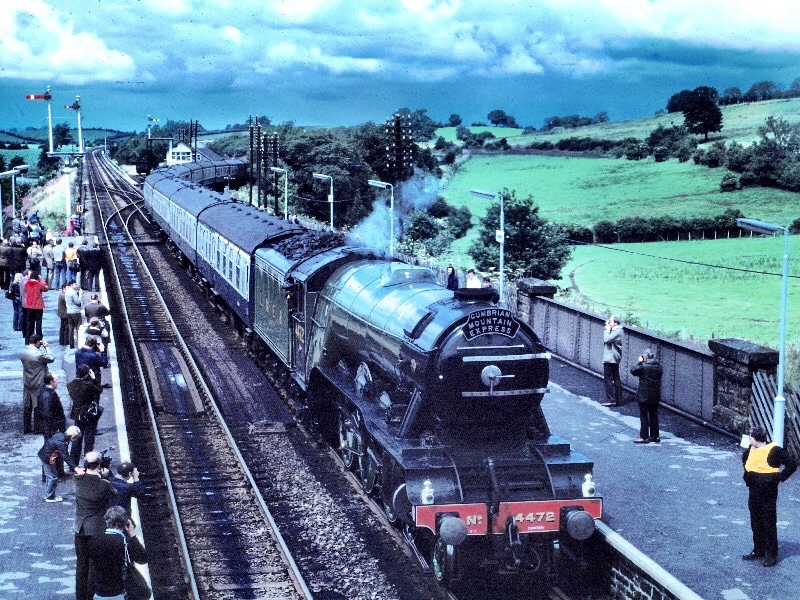
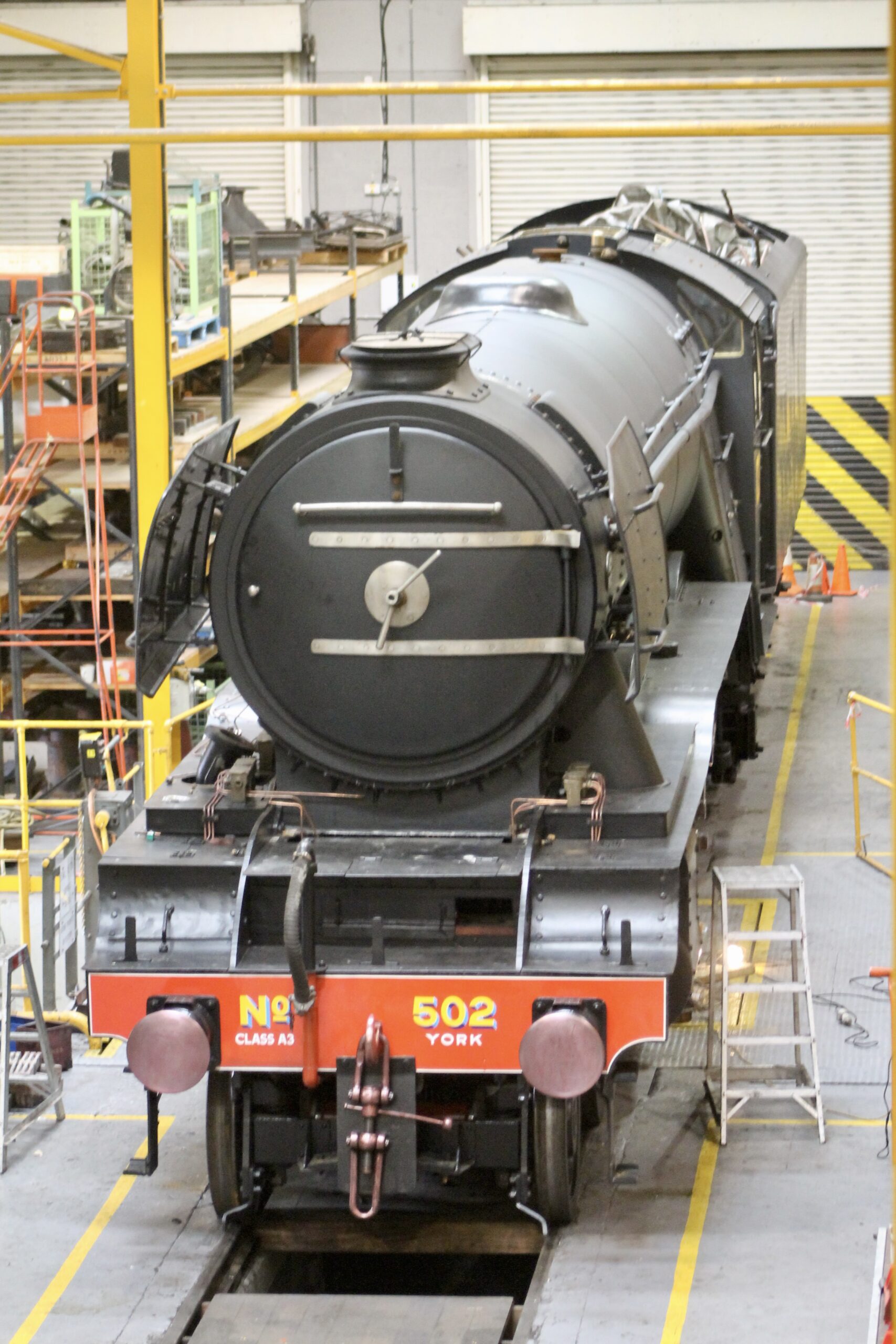
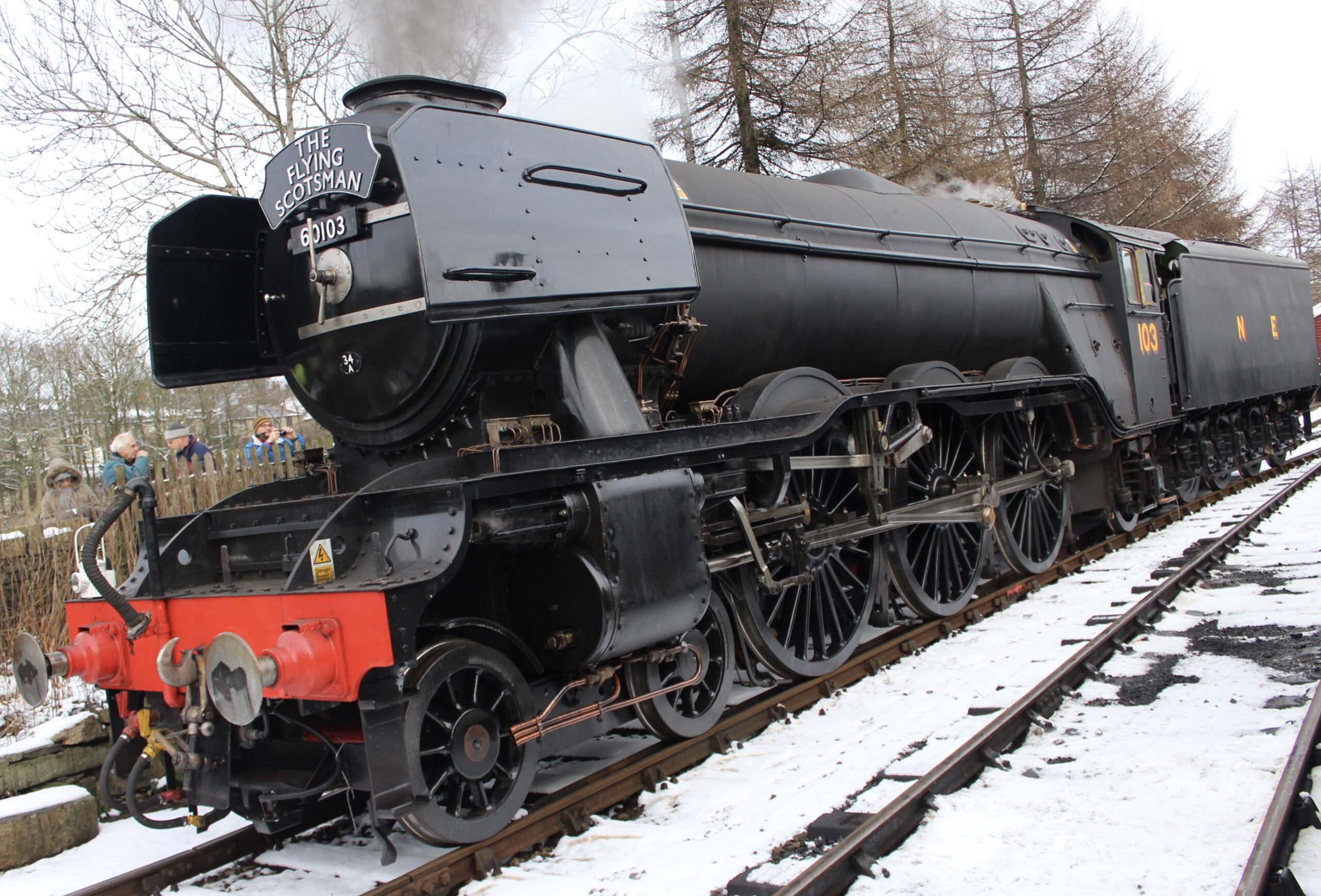
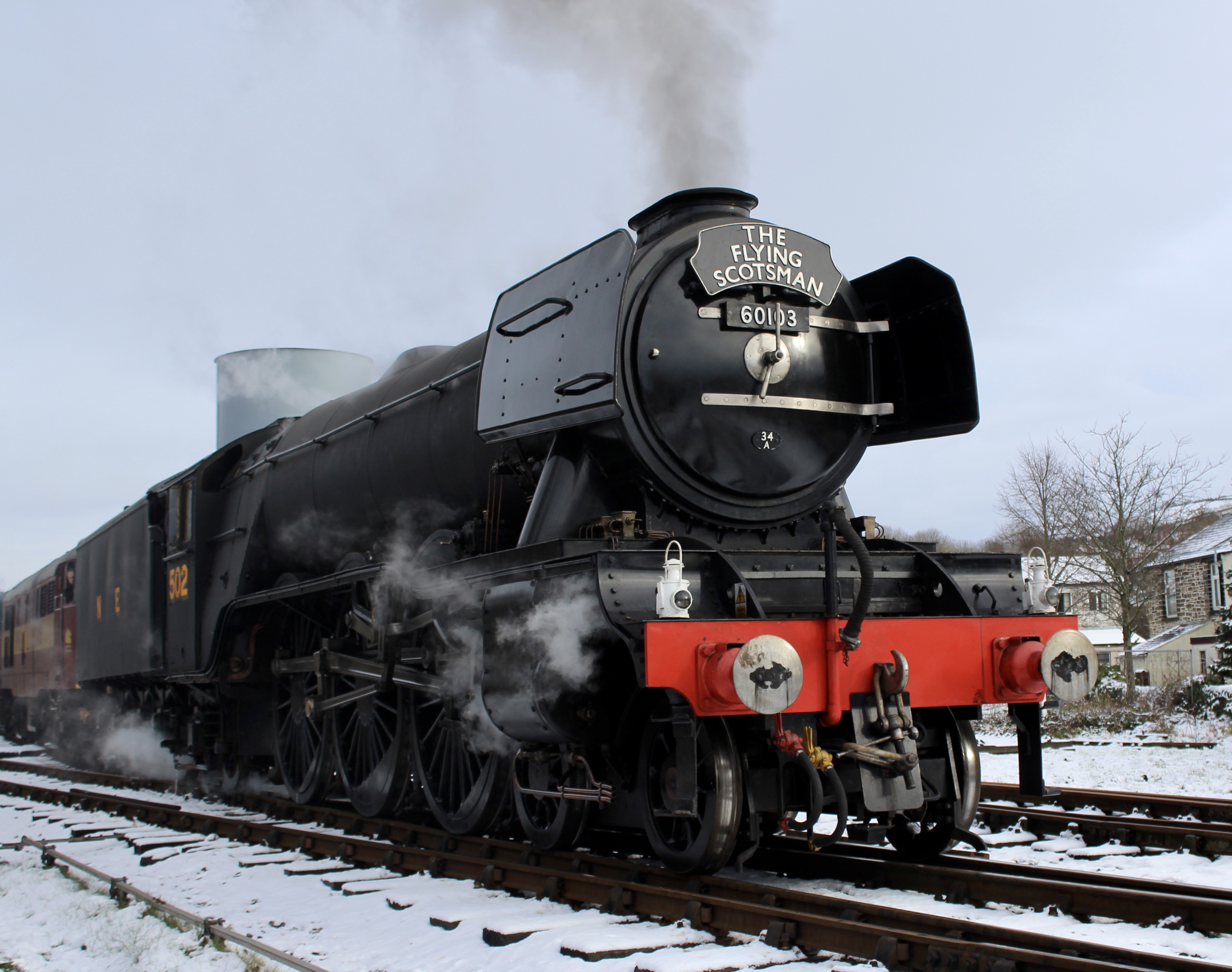
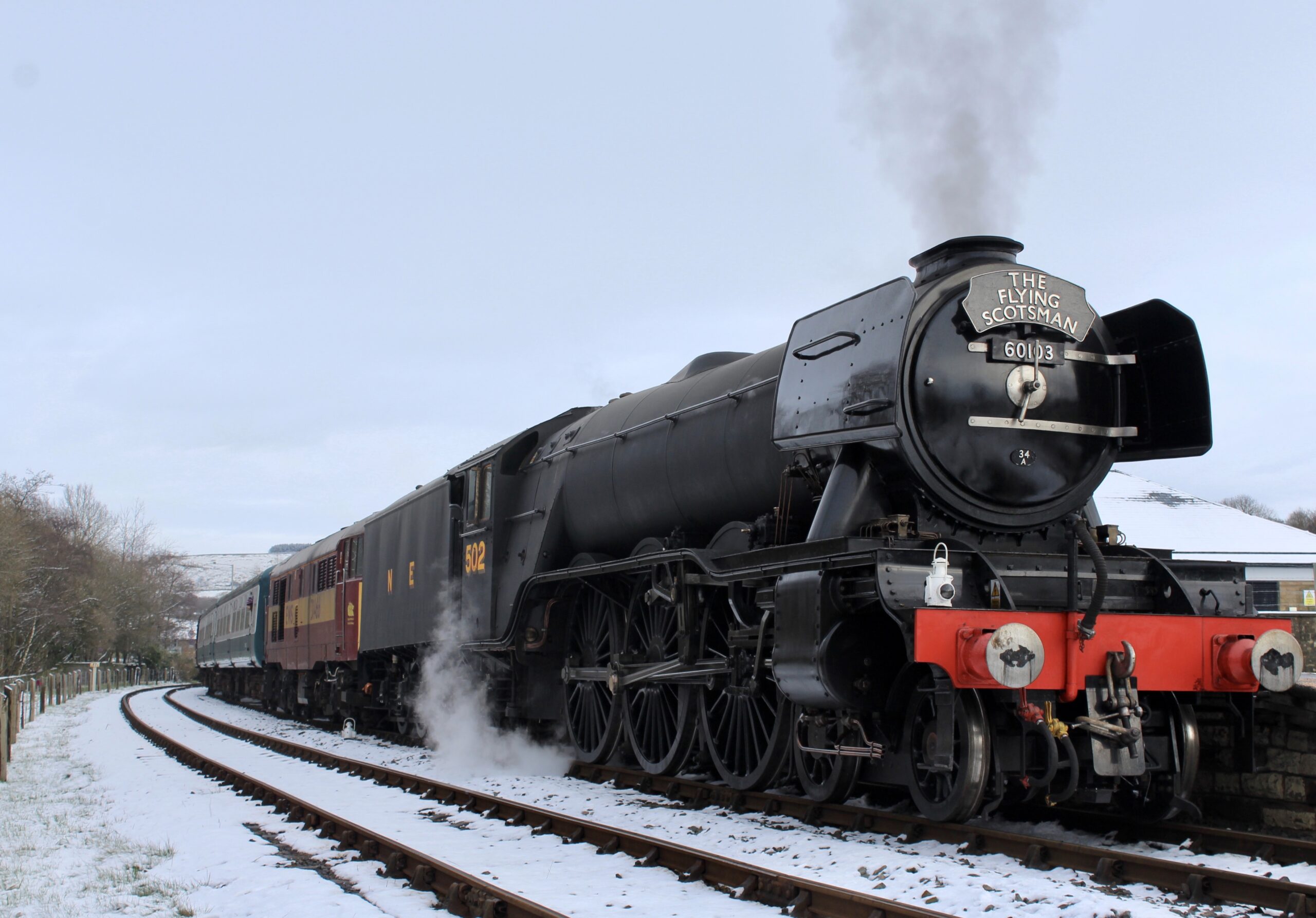
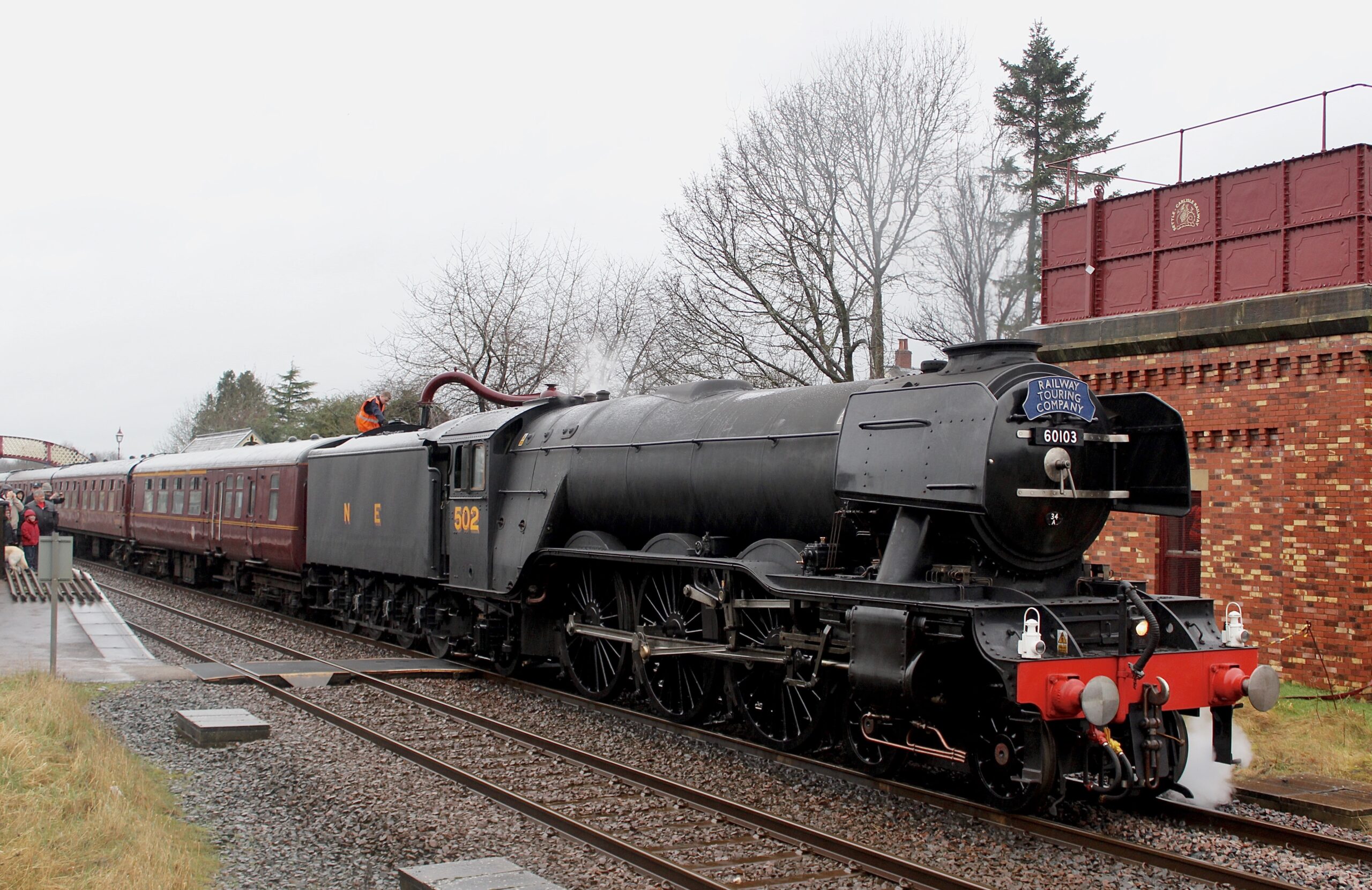
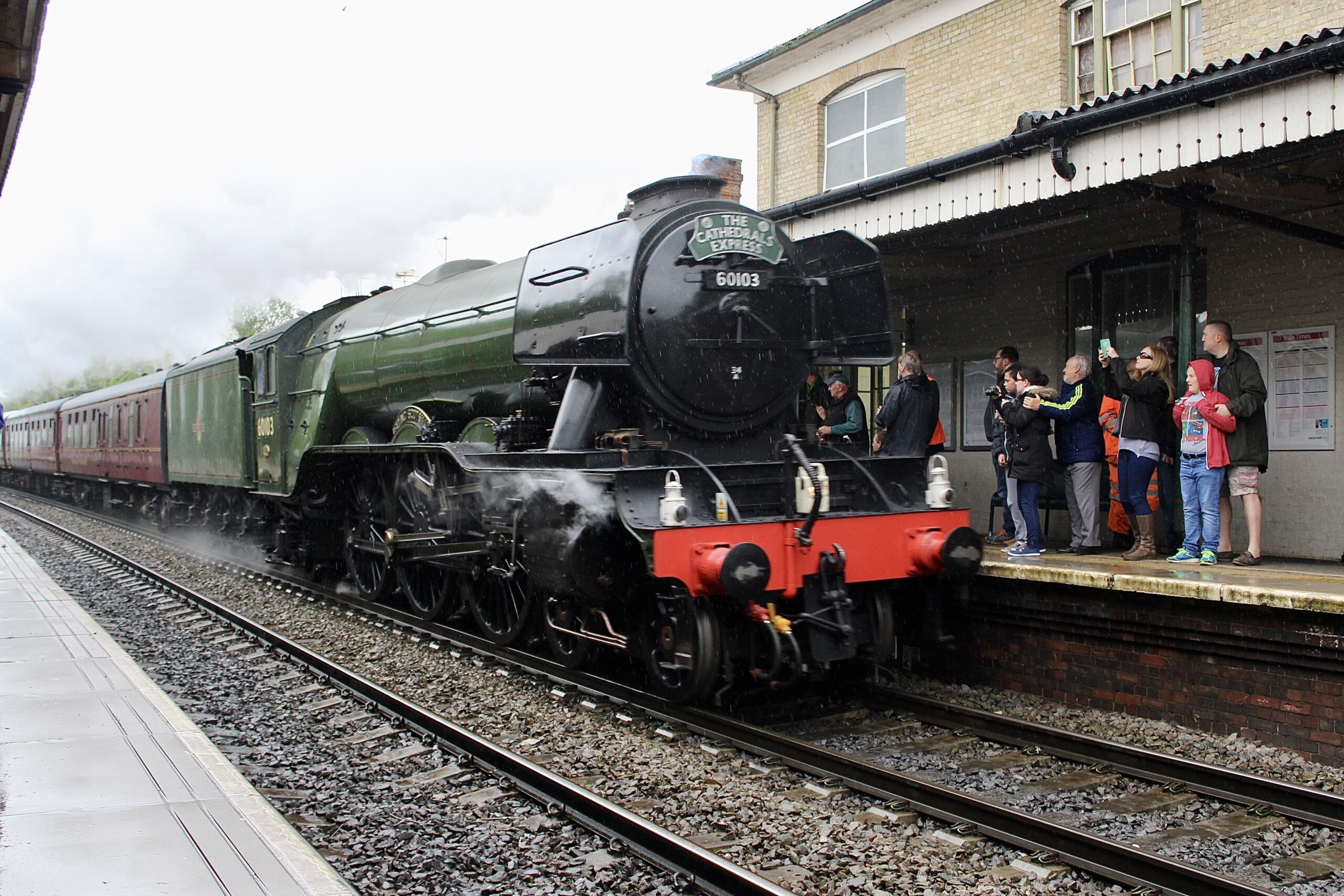
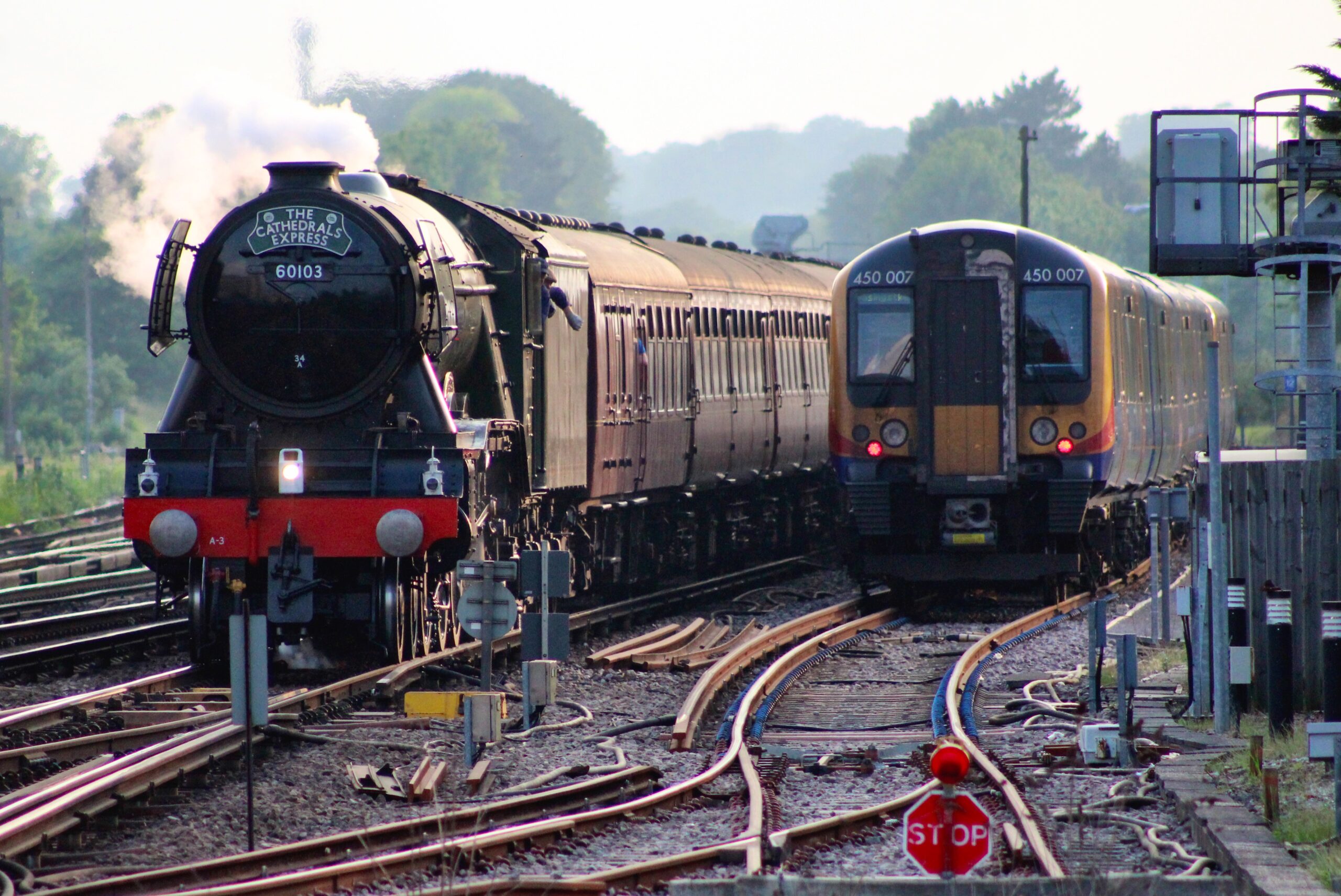
LNER Gresley A3 4-6-2 No. 60103 hauls her last passenger train during her 2022 visit to the Swanage Railway as 1X10 1645 Swanage to Norden crosses Corfe Viaduct – 26/10/2022No. 4472 ‘Flying Scotsman’ alongside Stanier Black Five Class 5MT 4-6-0 No. 5407 at Steamtown which occupied the site of the former London Midland & Scottish Railway Carnforth Motive Power Depot (MPD) opened in 1944. It was hoped that the depot would form part of a preservation scheme involving what is now the Lakeside & Haverthwaite Railway but when this could not be realised due to road modernisation it was developed as major visitor attraction. In 1974 Sir William McAlpine became a shareholder in the company for the purposes of stabling ‘Flying Scotsman’ and he eventually took a controlling interest in the company and purchased the complete site including the track from British Rail. In 1990 McAlpine’s controlling stake in Steamtown Railway Museum Ltd was sold to David Smith, who over the following years has bought out the majority of the minority shareholders. The site closed to the public in 1998 and today it is the base for Smith’s West Coast Railways, which operates heritage steam and diesel trains across the national UK railway network – 18/07/1981The “Cumbrian Mountain Express” departed Crewe at 0940 behind electric traction to Carlisle where No. 4472 ‘Flying Scotsman’ took over and took the train along Settle & Carlisle to Skipton and Carnforth followed by electric haulage to Crewe. Seen here for a water stop at Garsdale – 22/07/1981A feature of CME tours were the run pasts through Appleby where passengers detrained and given the opportunity to photograph the steam locomotive and train in action – 22/07/1981The same view 35 years later and delayed because of single line working imposed by a landslip at Eden Brows near Armathwaite, “The Winter Cumbrian Mountain Express” 1Z87 1436 Carlisle to London Euston arrives at approximately 45 minutes late arrives at Appleby. No. 60103 ‘Flying Scotsman’ replaced LMS Princess Coronation No. 46233 ‘Duchess of Sutherland’ and was 60103’s first main line rail tour following her £4.2 million, 10 year major overhaul. She ran in Wartime black livery and carried the numbers 103 and 502 on either cab side – 06/02/2016No. 502 ‘Flying Scotsman’ in wartime black livery undergoing overhaul and restoration in the works at the National Railway Museum (NRM), York. ‘Flying Scotsman’ was bought for the nation by the NRM in April 2004 at a cost of £2.3million. She ran intermittently until December 2005 (although she was out of action between September 2004 and May 2005 undergoing a ‘heavy intermediate repair’) when she was withdrawn for overhaul. At the time, the NRM said this would take 12 months and cost around £750,000. In 2012 when the above image was taken, she was still not ready to steam again and the cost of the work undertaken had spiralled to over £2.6million. A report at the time, commissioned for the Trustees of the Science Museum Group (of which the NRM is part) to help understand quite why the overhaul had gone over time and over budget, was prepared by a respected steam engineer from Tyseley Locomotive Works, Bob Meanley, assisted by a professor of engineering and found “It is difficult to analyse drift in the project because there was no real plan against which it could be measured and new tasks were added to the workload as new problems were uncovered.” The report confirmed ‘Flying Scotsman’ was in a very worn out condition when acquired by the NRM. To a large degree this had been well known, although reports commissioned at the time seem to have been overly optimistic. The NRM had been clearly under pressure to secure the locomotive amid fears it may have been sold abroad, but is found not to have properly assessed the state of its new acquisition following purchase or to have drawn up a credible refurbishment plan. New faults are noted as having taken staff by surprise five years after purchase. In 2011, the locomotive had to be dismantled again to correct issues many thought would have been identified back in early 2006. – 03/07/2012No. 502 ‘Flying Scotsman’ at the Railway Museum, York. After the release of the 2012 report on the restoration of ‘Flying Scotsman’, the NRM commissioned an independent review to determine the next steps on how to proceed. It was recommended that further work on the locomotives overhaul should be put out to external tender and subsequently it was announced this would be Riley & Son and ‘Flying Scotsman’ was moved to their workshop at Bury. On 8 January 2016, ‘Flying Scotsman’ moved under her own steam for the first time since 2005. The final cost of the restoration was £4.5 million – 03/07/2012Following her ten year overhaul and restoration, ‘Flying Scotsman’ undertook running in tests on the East Lancashire Railway (ELR) and can be seen here at Rawtenstall – 17/01/2016Rawtenstall – 17/01/2016Awaiting the road at Rawtenstall – 17/01/2016Approaching Ramsbottom on the ELR – 17/01/20161Z86 0710 London Euston to Carlisle “The Winter Cumbrian Mountain Express” – No. 60103 ‘Flying Scotsman’ is seen here climbing Shap bank – 06/02/2016“The Winter Cumbrian Mountain Express” water stop at Appleby – 06/02/2016Steam Dreams organised 1Z60 0837 London Paddington to Salisbury “The Cathedrals Express” rail tour hauled by No. 60103 ‘Flying Scotsman’ approaches Dilton Marsh – 21/05/2016No. 60103 ‘Flying Scotsman’ working 1Z82 1502 Salisbury to Salisbury “The Cathedrals Express” passing through Romsey – 21/05/2016“The Cathedrals Express” 1Z62 1828 Salisbury to London Paddington at Grateley – 21/05/2016Delayed by a line side fire in the former British Rail Staff Association building at Salisbury station, “The Cathedrals Express” 1Z62 1856 Salisbury to London Paddington passes Class 450 No. 450007 on the approach Basingstoke – 28/05/2016No. 60103 ‘Flying Scotsman’ working 1Z75 1520 Salisbury to Southampton Central alongside the Lower Test Valley – 06/06/2021No. 60103 ‘Flying Scotsman’ awaits the road at Salisbury with Steam Dreams 1Z83 1852 Salisbury to London Victoria. Following this main line run, ‘Flying Scotsman’ was withdrawn from operation for an overhaul in preparation for her centenary year celebrations – 24/03/2022
Yoshi took the opportunity of ‘Flying Scotsman’ being on static display at Swanage railway station to get up close and personal! Last week we shared video of ‘Flying Scotsman’ during her 1994 visit to the Swanage Railway. This week we move forward to 1999 and 2000 when the locomotive could be found in her famous LNER Apple Green guise and numbered No. 4472, as she appeared when she was owned by Alan Peglar on purchase from British Railways in 1963:
Video of LNER Gresley A3 4-6-2 No. 4472 ‘Flying Scotsman’ on various workings in LNER Apple Green livery: 08/08/1999 Upton Scudamore whilst on a London Paddington – Salisbury – London Paddington rail tour, 27/11/1999 Deputising for GWR 6000 Class King 4-6-0 ‘King Edward I’ No. 6024 on Pathfinder Tours “The Capital King” seen at Bradford Abbas and Sherborne, 06/02/2000 Deputising for SR Merchant Navy 4-6-2 No. 35028 ‘Clan Line’ on a VSOE British Pullman London Victoria to Southampton Docks and return rail tour seen in Southampton Docks, and 16/04/2000 Past Time Rail’s “The Tall Ships” seen in Southampton Docks and light engine turning move passing Eastleigh12th September 1965 and No. 4472 ‘Flying Scotsman’ visited Weymouth and is seen here on Weymouth depot. I was told that I was taken to see the special train organised by The Gainsborough Model Railway Society pass through Dorchester, so perhaps inspiring a lifetime love of railways! – John Chappell 12/09/1965
Wednesday 26th October to Tuesday 1st November
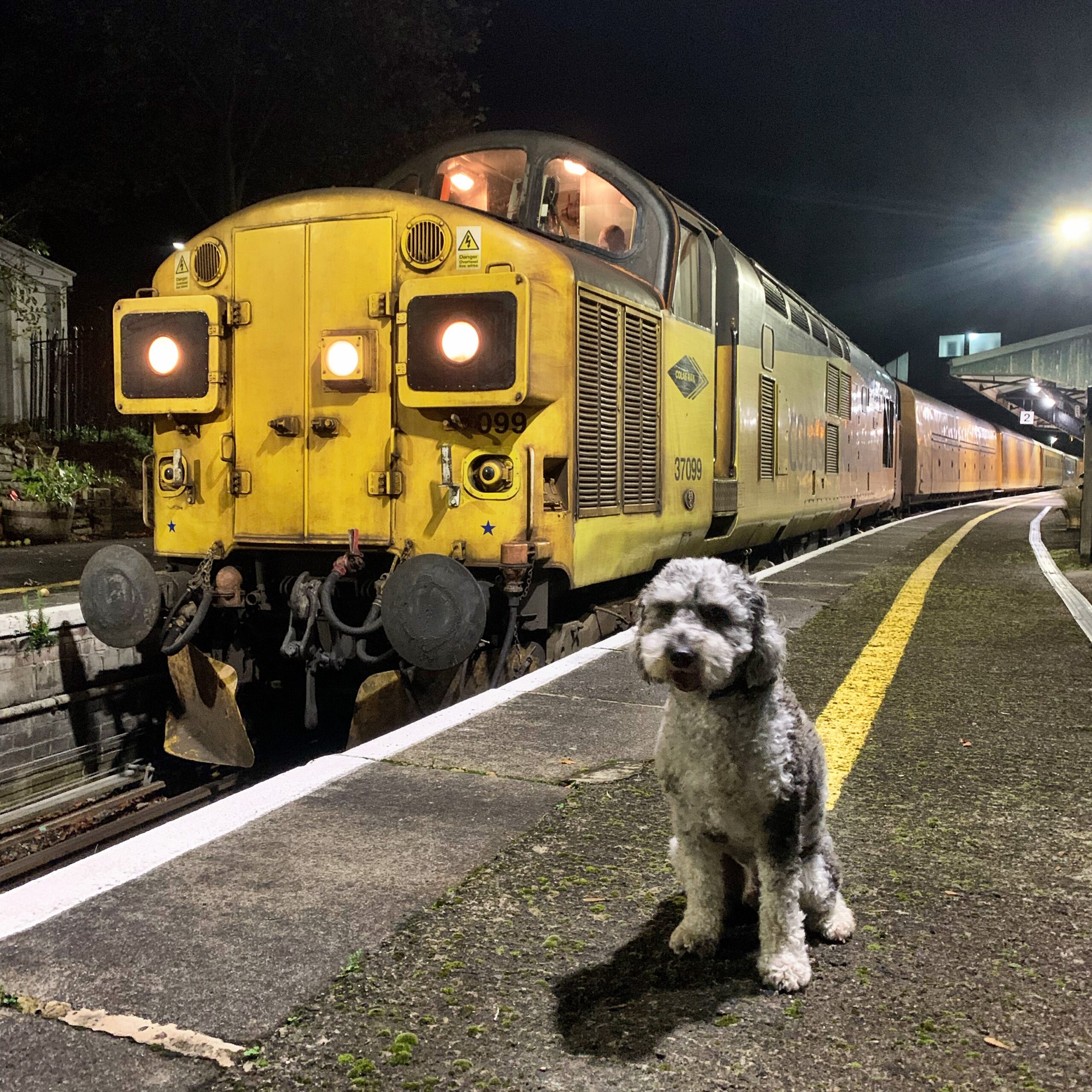
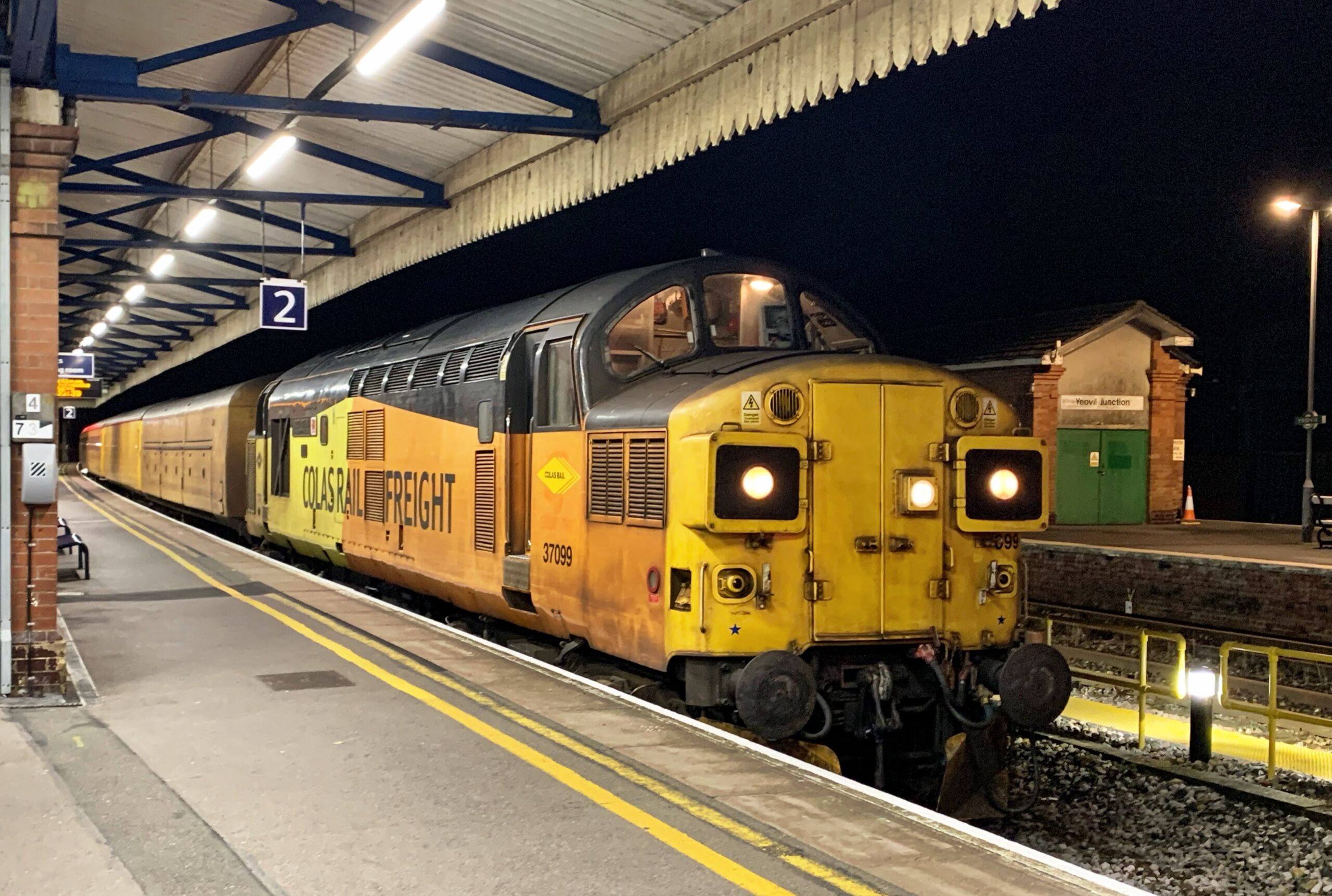
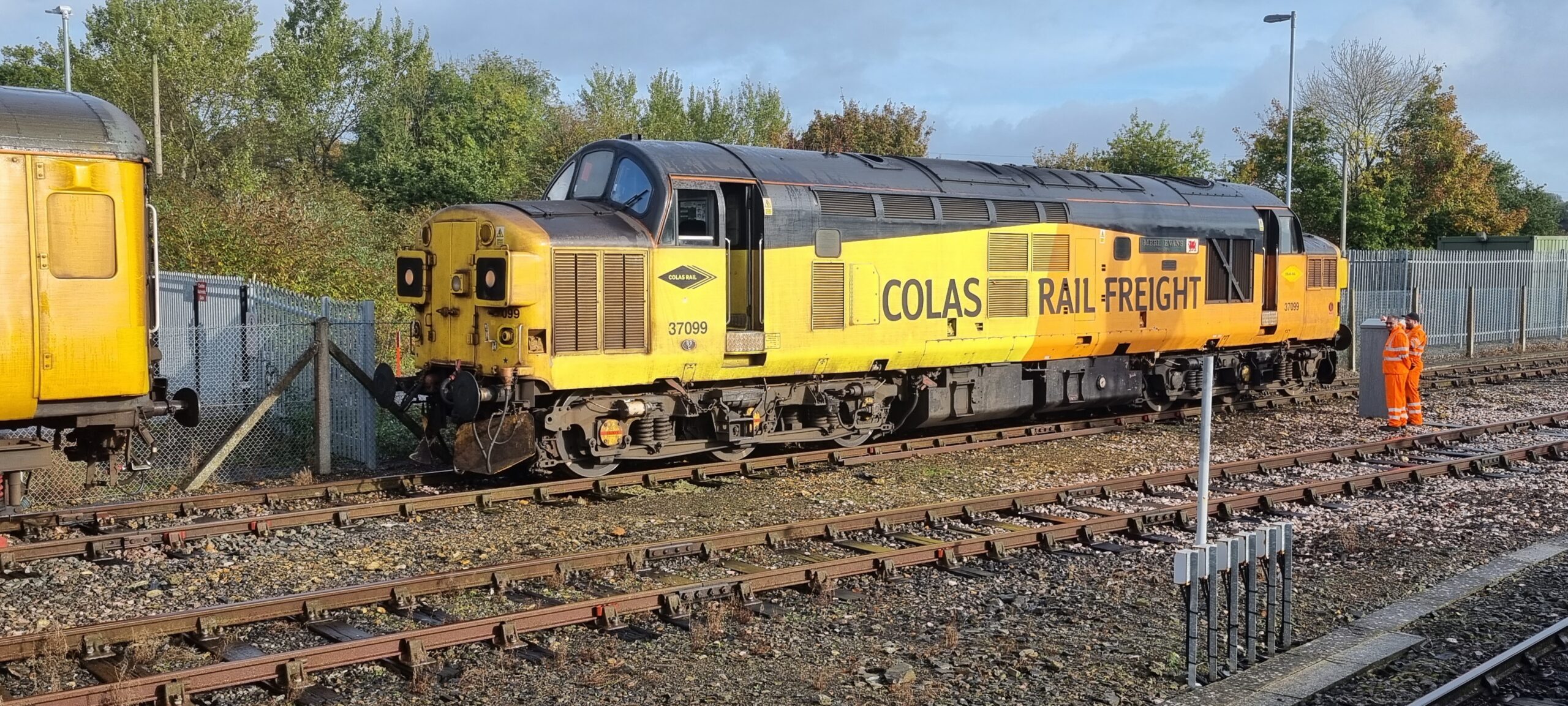
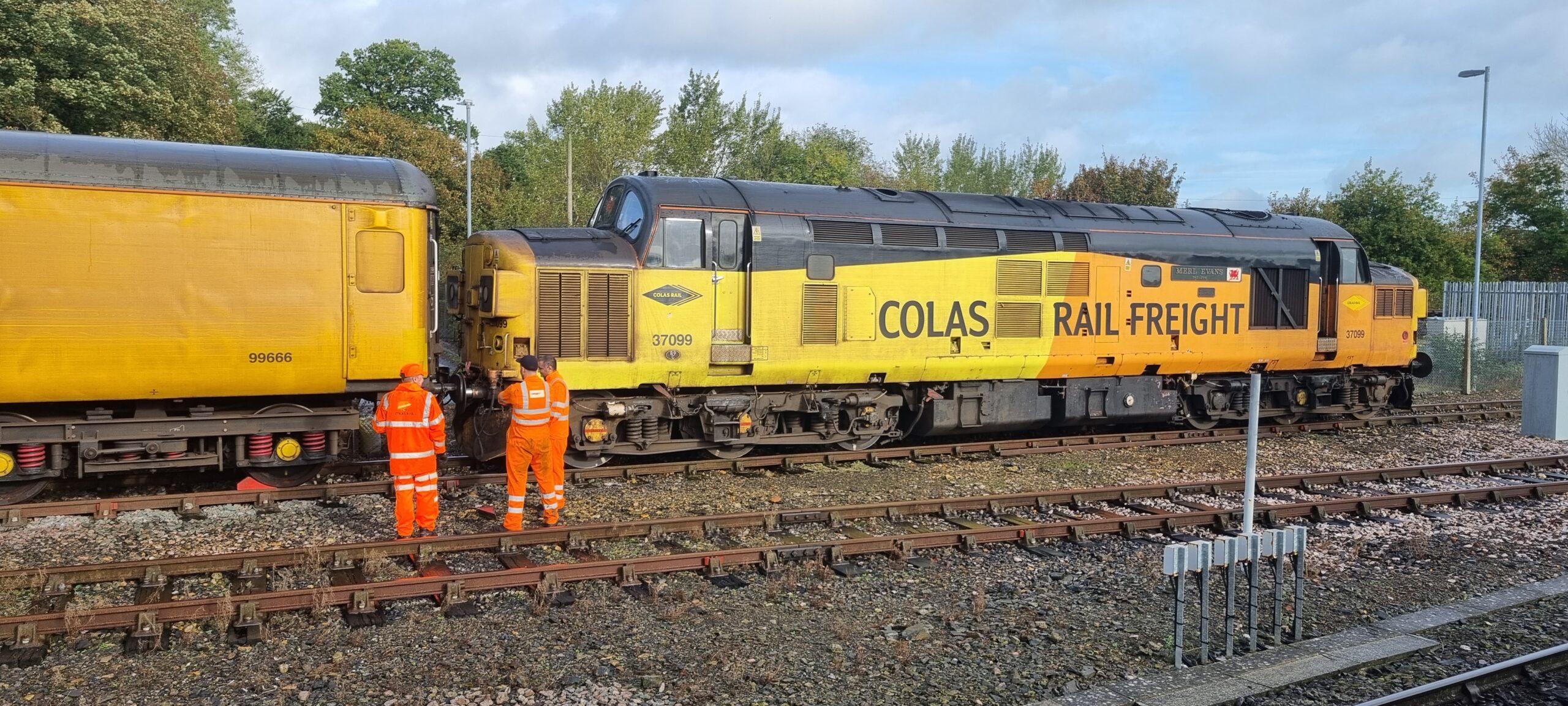
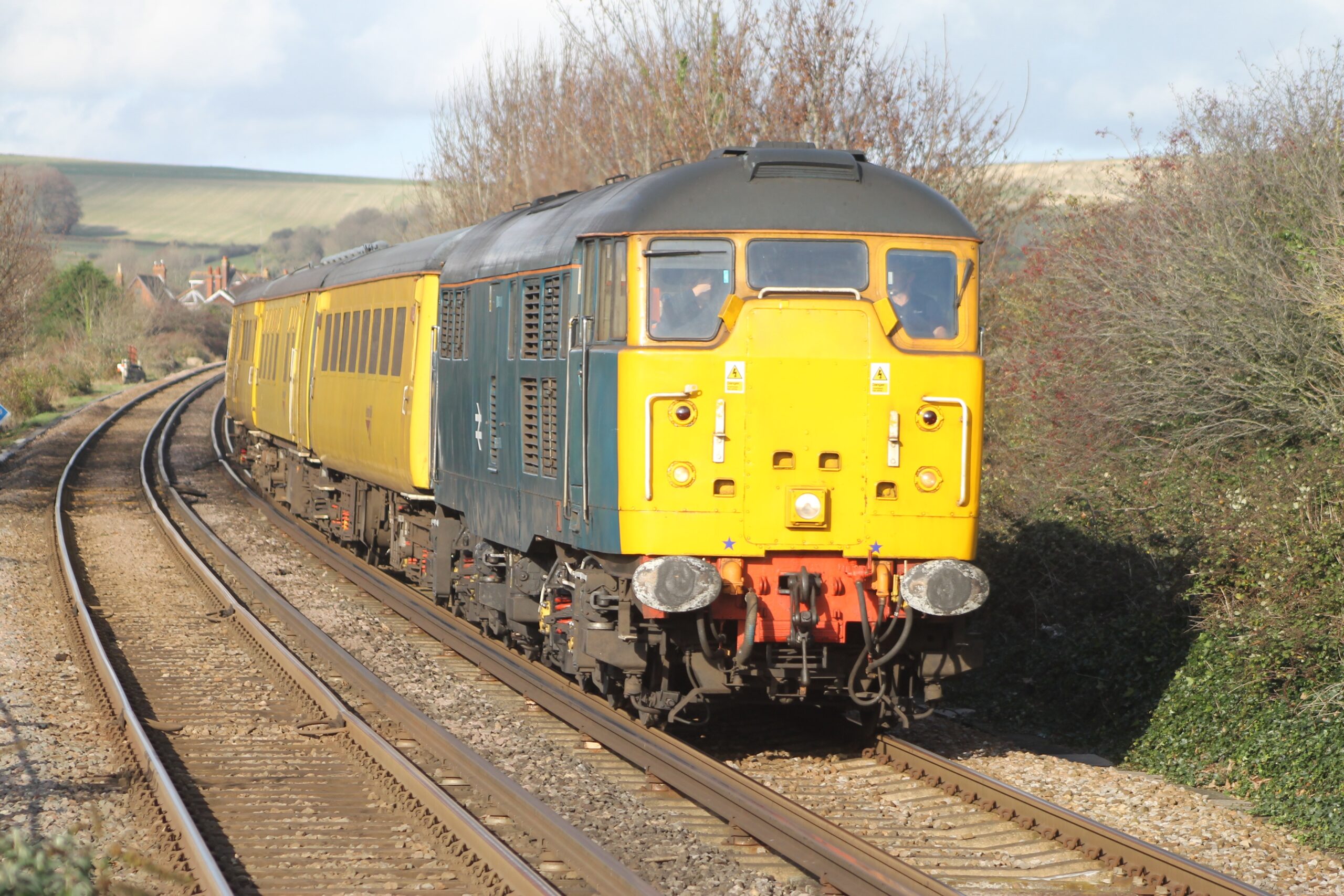
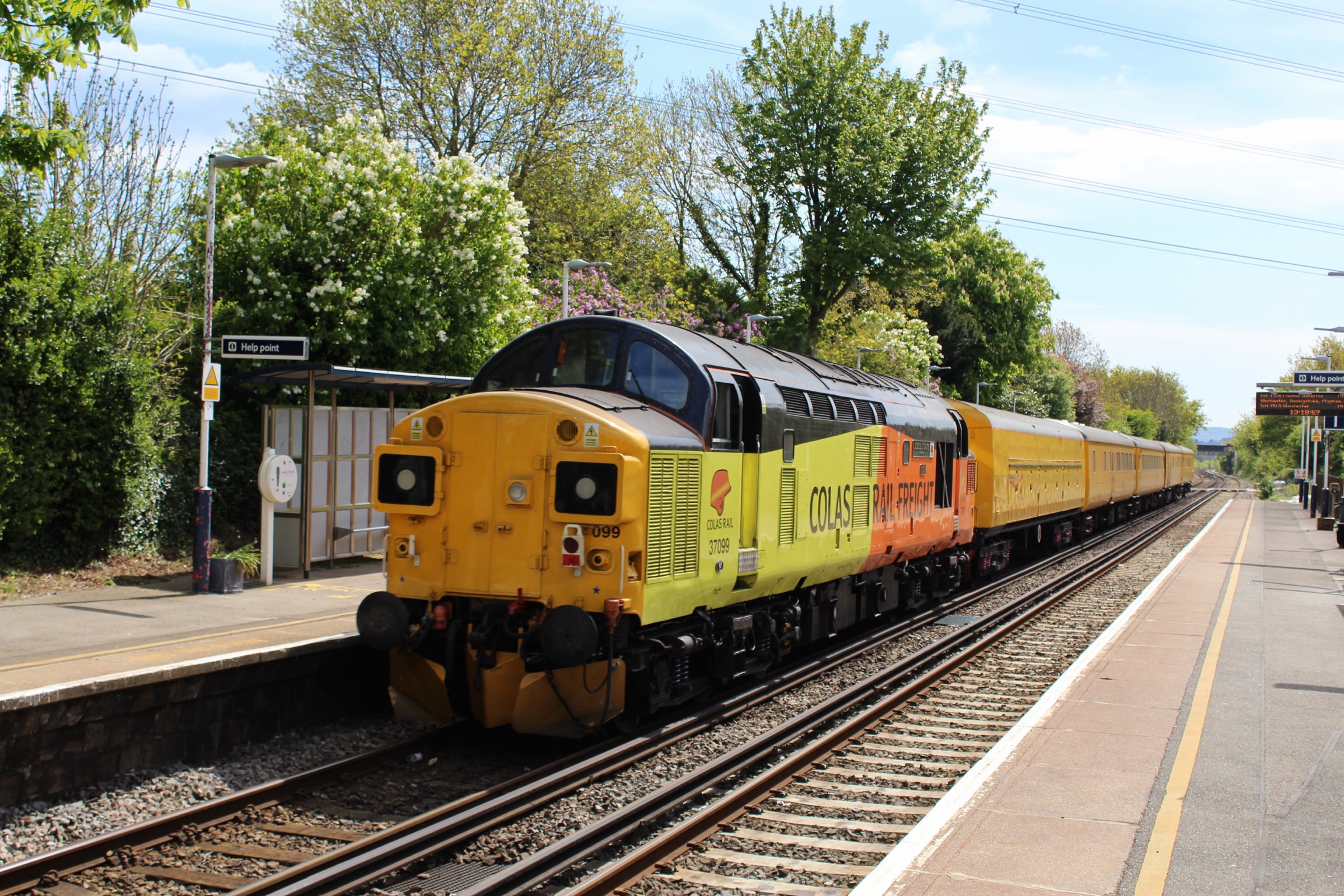
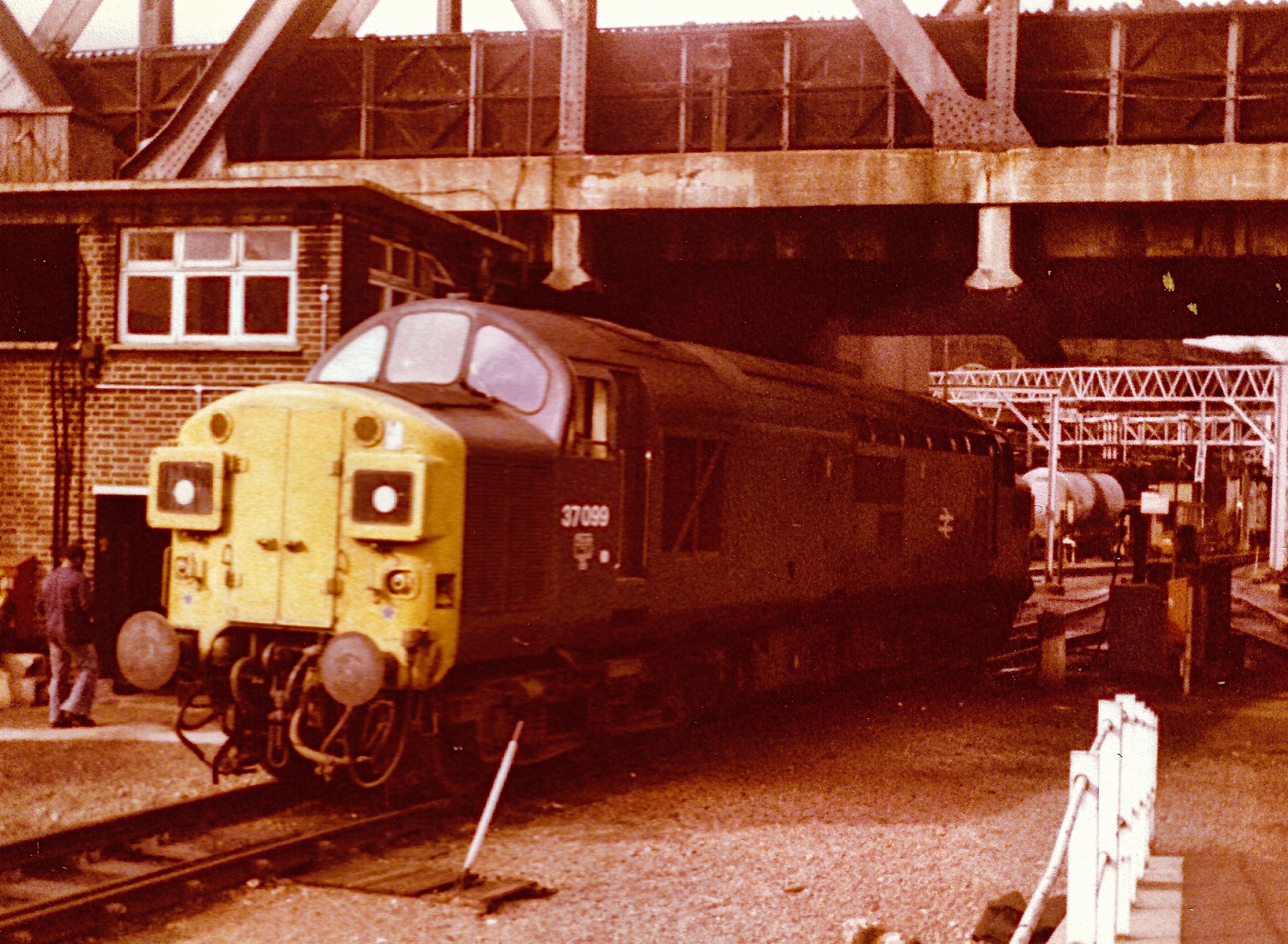
Returning to present day 2022 and Thursday 27th October which saw Yoshi and I travelling to Yeovil to catch sight of Colas Class 37 No. 37099 ‘Merl Evans 1947 – 2016’ working 3Q07 2053 Exeter Riverside New Yard to Exeter Riverside New Yard. This working consisting of a diesel locomotive on one end and a DBSO on the other usually heads off to Sherborne and Salisbury, but this month (possibly due to the speed restrictions on the line in place until 14th November 2022 because a clay embankment between Tisbury and Gillingham had dried out, causing the ground beneath the tracks to shrink) was scheduled to reverse at Yeovil Pen Mill, a station it usually misses out although is always booked to visit. I was 99% sure the train would make it to Pen Mill this time due to its pathing, but as I didn’t fully trust that the train wouldn’t be reversed before reaching here, I hedged my bets and went straight to Yeovil Junction to witness the test train working straight through. I jumped in the car and made it over to Yeovil Pen Mill just as the service arrived into platform 1. Being a glutton for punishment, we then headed back to Yeovil Junction to see the train arrive on the return leg before departure for Exeter at 0023.
Yoshi on a late night barking mission with Colas Class 37 No. 37099 ‘Merl Evans 1947 – 2016’ at Yeovil Pen Mill – 27/10/2022Nameplate detail of Colas Class 37 No. 37099 ‘Merl Evans 1947 – 2016’ named in memory of Mel’s outstanding contribution to British model railways – 27/10/2022Colas Class 37 No. 37099 ‘Merl Evans 1947 – 2016’ awaits the green light on the return path to Exeter at Yeovil Junction – 27/10/2022
Video of Colas Class 37 No. 37099 ‘Merl Evans 1947 – 2016’ working 3Q07 2053 Exeter Riverside New Yard to Exeter Riverside New Yard – 27/10/2022
On Sunday 30th October Yoshi and I visited National Trust’s Stourhead Gardens in Wiltshire. After an initial rain shower on arrival, we had a very pleasant few hours drying out whilst walking around the grounds of the estate and enjoying the autumnal colours of the trees as their leaves fluttered to the ground.
Yoshi enjoys his walks around National Trust Stourhead Gardens – 30/10/2022
Being so close to Westbury, we took the opportunity to pop in and see the 3S59 1554 Swindon Transfer to Loreton-On-Lugg Rail Head Treatment Train in fading light before tucking into a very tasty Sunday roast at The Three Horseshoes at Chapmanslade. Class 66 No. 66846 has returned to traffic after being temporarily replaced by Class 37 No. 37668 which we saw the previous Sunday on the equivalent working as it passed through Bradford on Avon. No 66850 ‘David Maidment’ was once again in evidence.
Colas Class 66 No. 66850 ‘David Maidment’ on the rear of 3S59 1554 Swindon Transfer to Loreton-On-Lugg RHTT having arrived at Westbury. The train reverses here – 30/10/2022
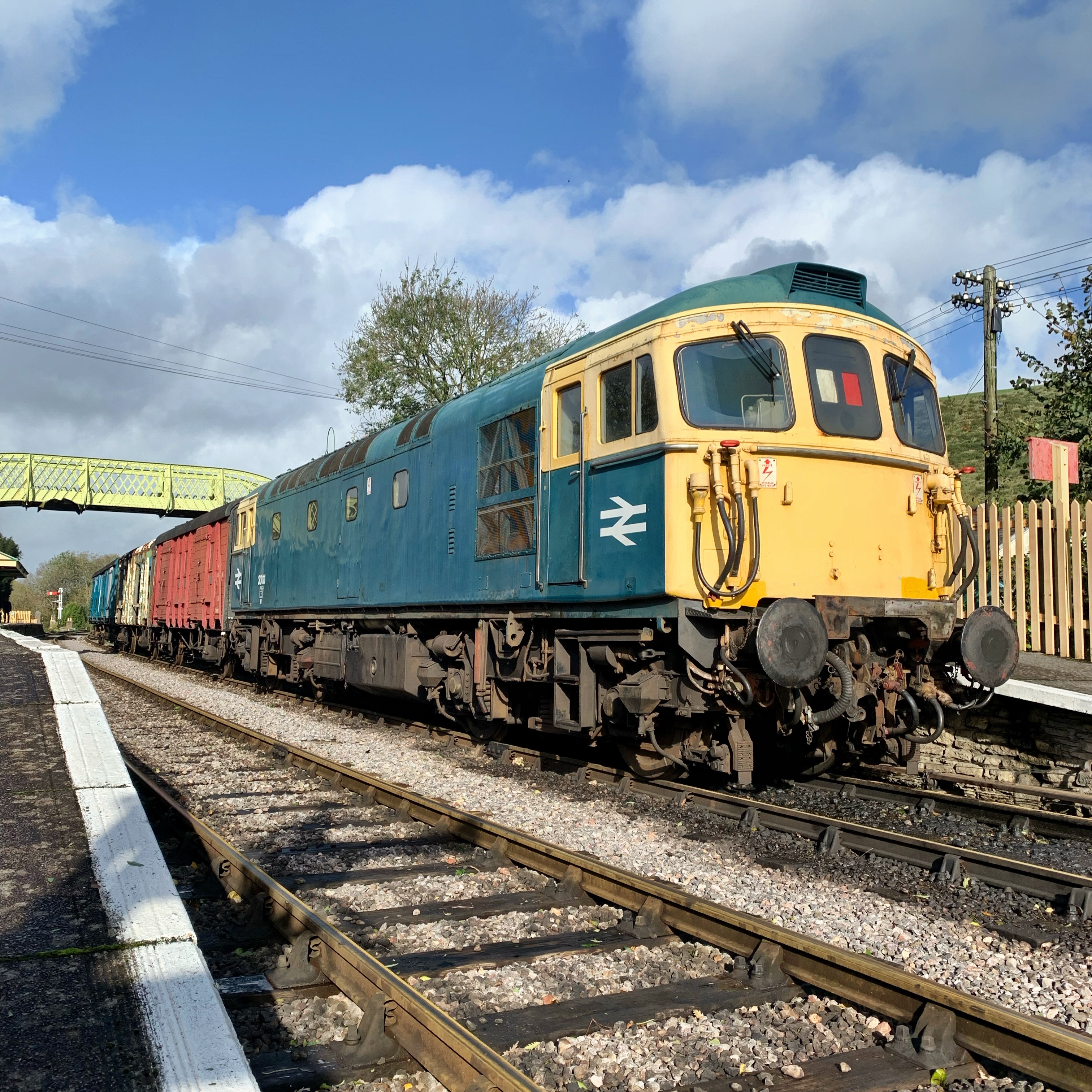
Video of Class 66 No.’s 66846 and 66850 reversing at Westbury with S59 1554 Swindon Transfer to Loreton-On-Lugg RHTT – 30/10/2022SR Battle of Britain Class 4-6-2 No. 34070 ‘Manston’ at Swanage Railway’s Herston Works. The locomotive was waiting in readiness to be collected by low loader and taken to Norden by road where she will undertake running in tests. Her place in the works will be taken by classmate No. 34053 ‘Sir Keith Park’. Many thanks to Jamie for getting permission for our visit to Herston – 01/11/2022The Swanage DMU stock keeping SR Battle of Britain Class 4-6-2 No. 34053 ‘Sir Keith Park’ company in the sidings at Corfe Castle ahead of her move to Herston Works – 01/11/2022BR Class 33 No. 33111 sits at Corfe Castle having removed a consist of wagons from Norden the previous day in readiness for the low loader moves in connection with ‘Manston’, ‘Sir Keith Park’. and ‘257 Squadron’ which is off on holiday to the Spa Valley railway to work Polar Express trains. ‘257 Squadron’ will be back at Swanage in early 2023- 01/11/2022SR West Country Class 4-6-2 No. 34028 ‘Eddystone’ departs Swanage with the 1000 service to Norden. SR U Class 2-6-0 No. 31806 sits in front of the ‘Flying Scotsman’ support coach. Note the fence panels which had blown over onto the coach on the extreme right of the picture – 01/11/2022
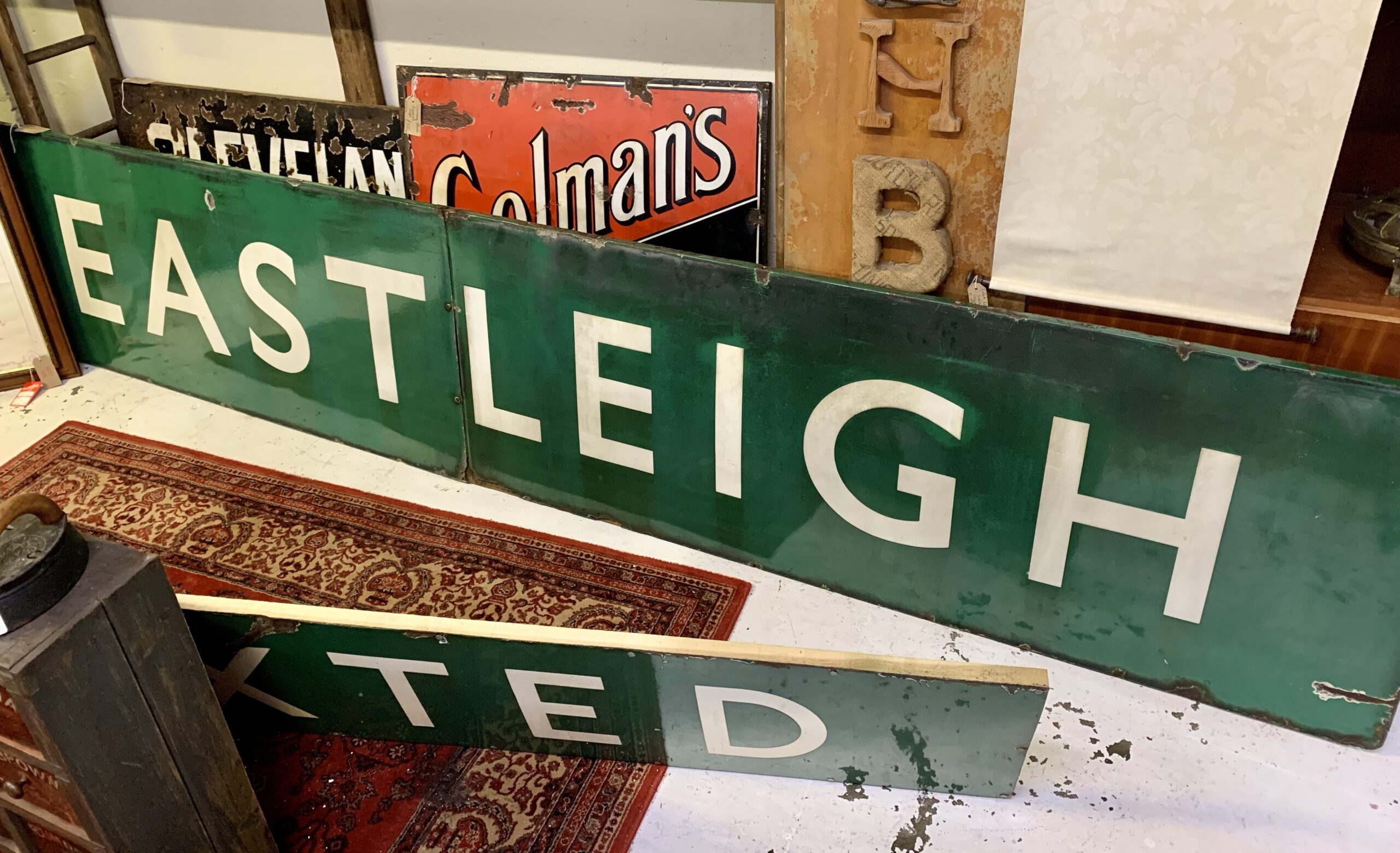
We also came across some interesting railwaymania when we visited the Den antiques emporium over the weekend:
£795 would make you the proud owner of an enamel British Railways Eastleigh station sign
Next, we found a signed Terrence Cuneo “The Night Express” print, an evocative study of a Great Western King Class 4-6-0 working along the sea wall near Teignmouth, painted by the Master in 1975 and issued by Felix Rosenstiels Widow & Sons Ltd. as a single edition of 850 prints signed by the artist in 1977. Terrence Cuneo (1907-1996) CVO, OBE is one of my favourite railway artists. He was also renowned for his military paintings and was the official artist for the coronation of Queen Elizabeth II in 1953. A bronze memorial statue of Terrence Cuneo, unveiled by Princess Anne in 2004, once stood on the concourse at London Waterloo, but was moved to Brompton Barracks in Kent prior to the development of the disused Eurostar platforms at the station. One of my favourite Cuneo paintings can be found at the Railway Museum in York and is of London Waterloo station:
That just about wraps up another week and all that remains is for me to thank you, dear reader, for taking the trouble to visit Yoshi’s blog. We’ve enjoyed having you stop by. As always, please feel free to comment or let me know of any typo’s, gobbledygook or misinformation! May your dog (or cat) go with you.
Wednesday October 19th to Tuesday October 25th2022
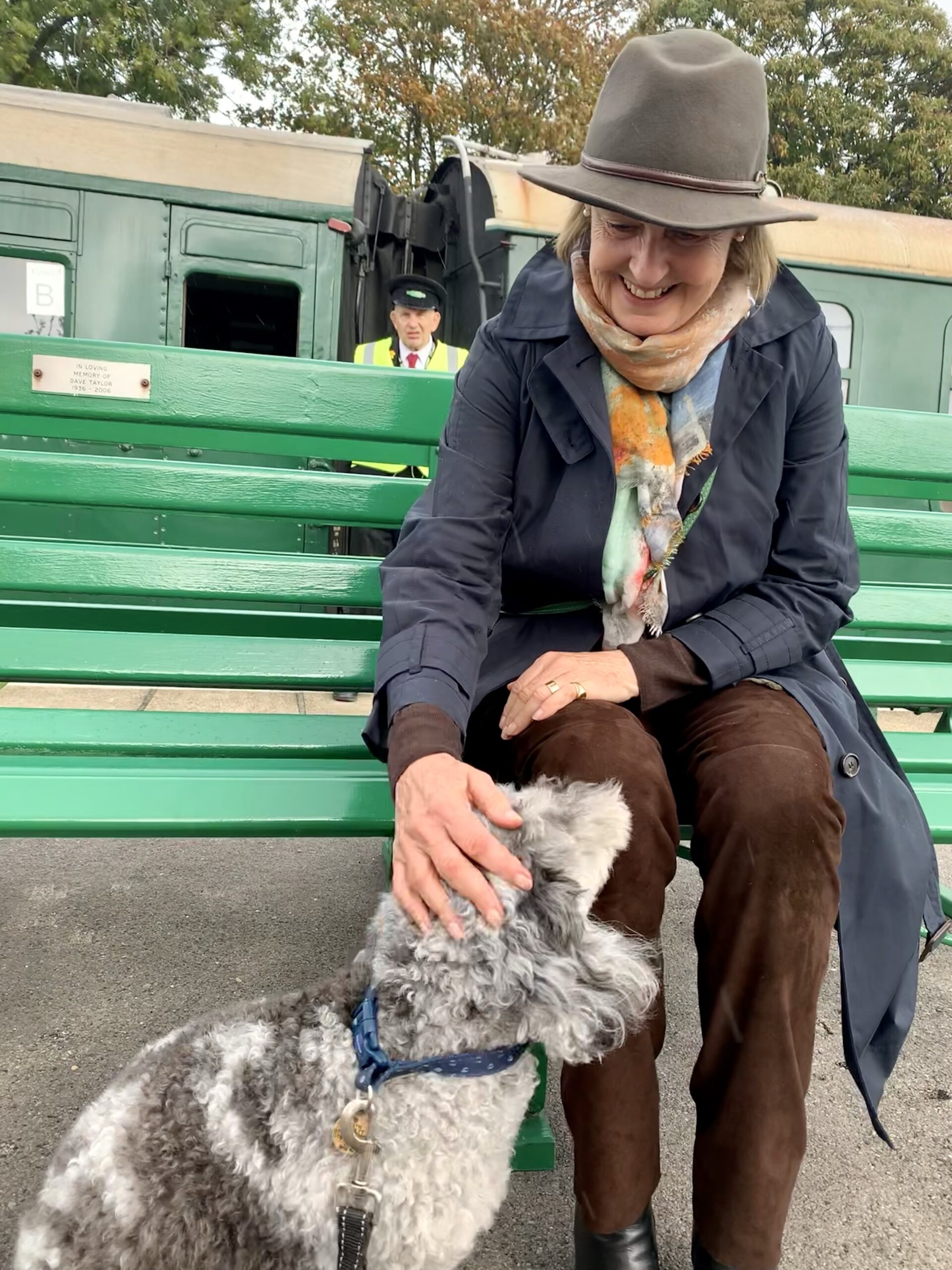
Yoshi meets Penny Peglar, daughter of Alan Peglar who rescued ‘Flying Scotsman’ from the scrapyard in 1963 – 22/10/2022
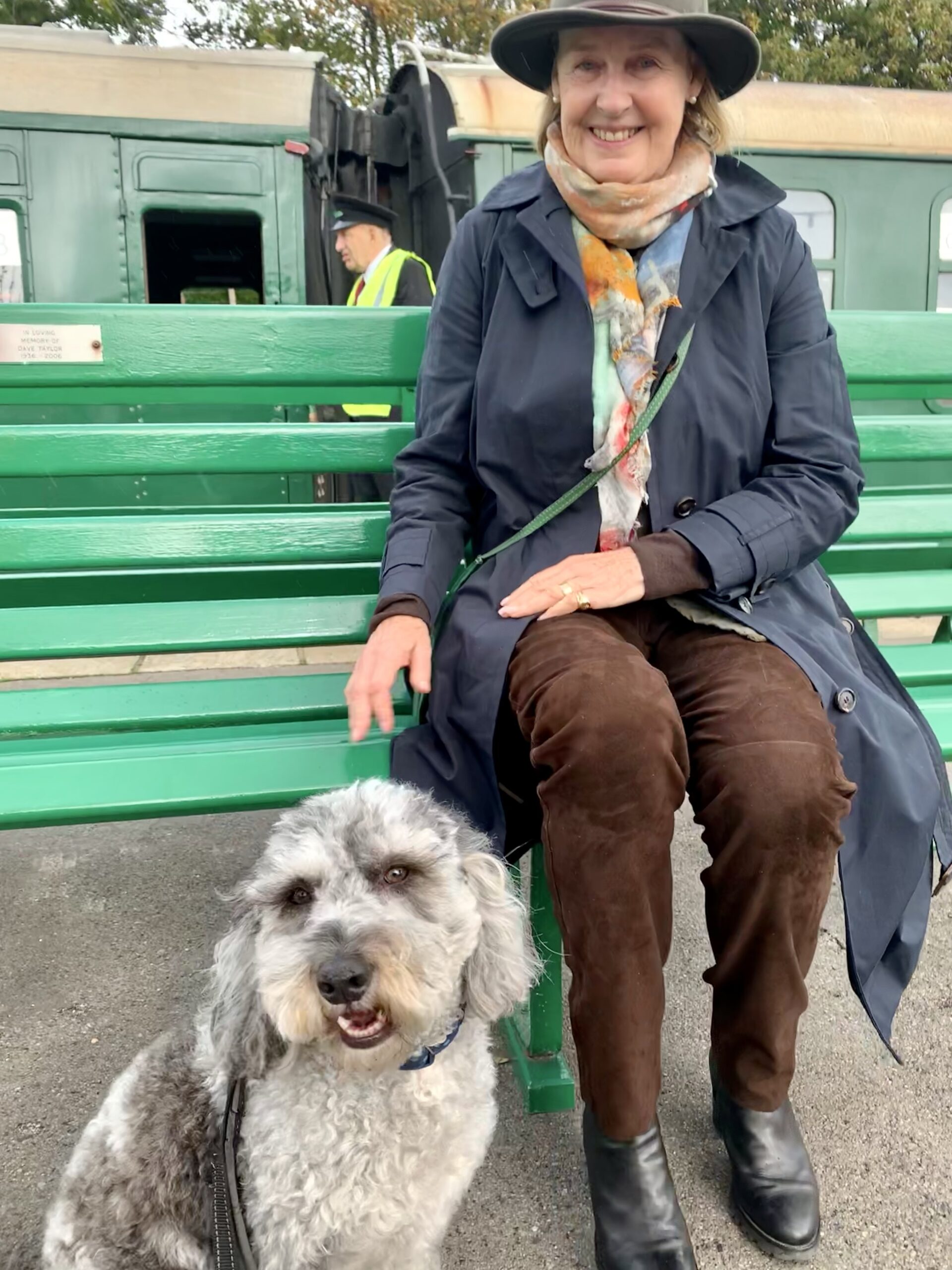
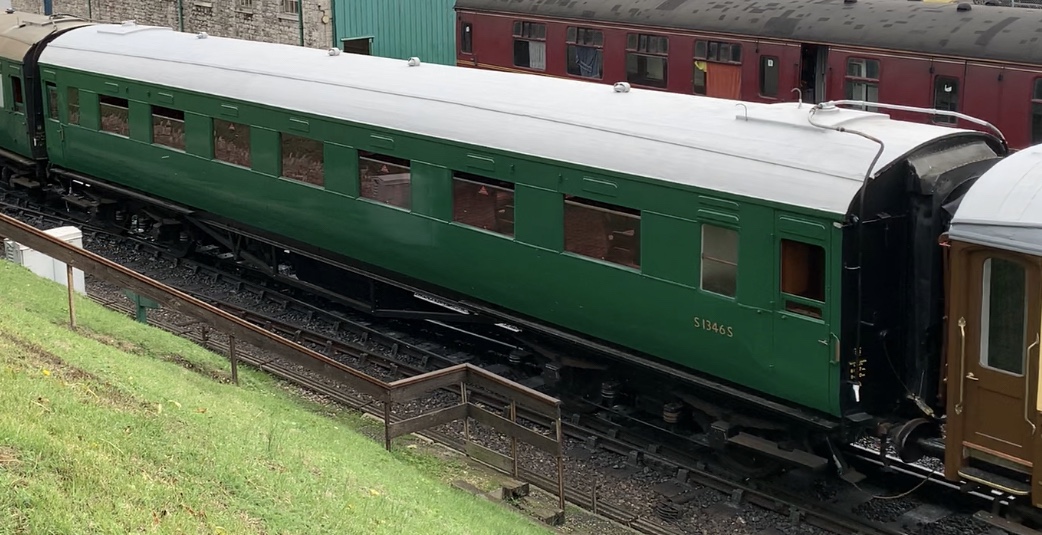
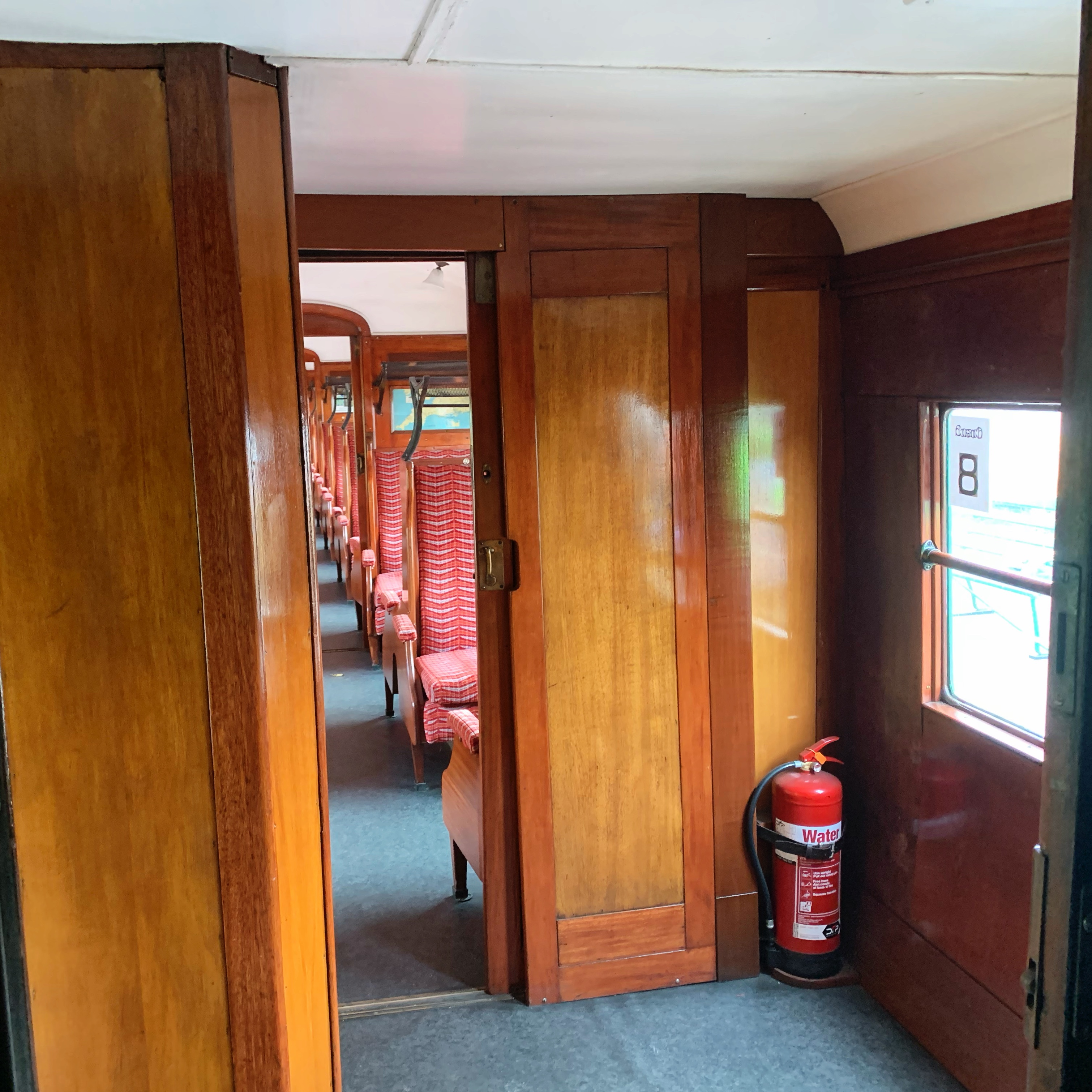
Hello Dear Reader – Yoshi and I had a lovely family day out on the Swanage Railway on Saturday 22nd October when we took a ride in lovingly restored 1933 Maunsell open third carriage No. 1346 behind visiting LNER Gresley A3 Pacific No. 60103 ‘Flying Scotsman’. Having survived a German bomb at Clapham in 1940, the coach ran in traffic until 1961 when it was withdrawn and converted for use as a mobile office and later a classroom. Sold into preservation in 1982 and initially based on the Kent & East Sussex Railway (K&ESR), the coach was purchased privately in 2002 for use on the Swanage Railway. Still awaiting the refitting of tables the restoration has been carried out to the highest standard and it really was a delight to see and travel in.
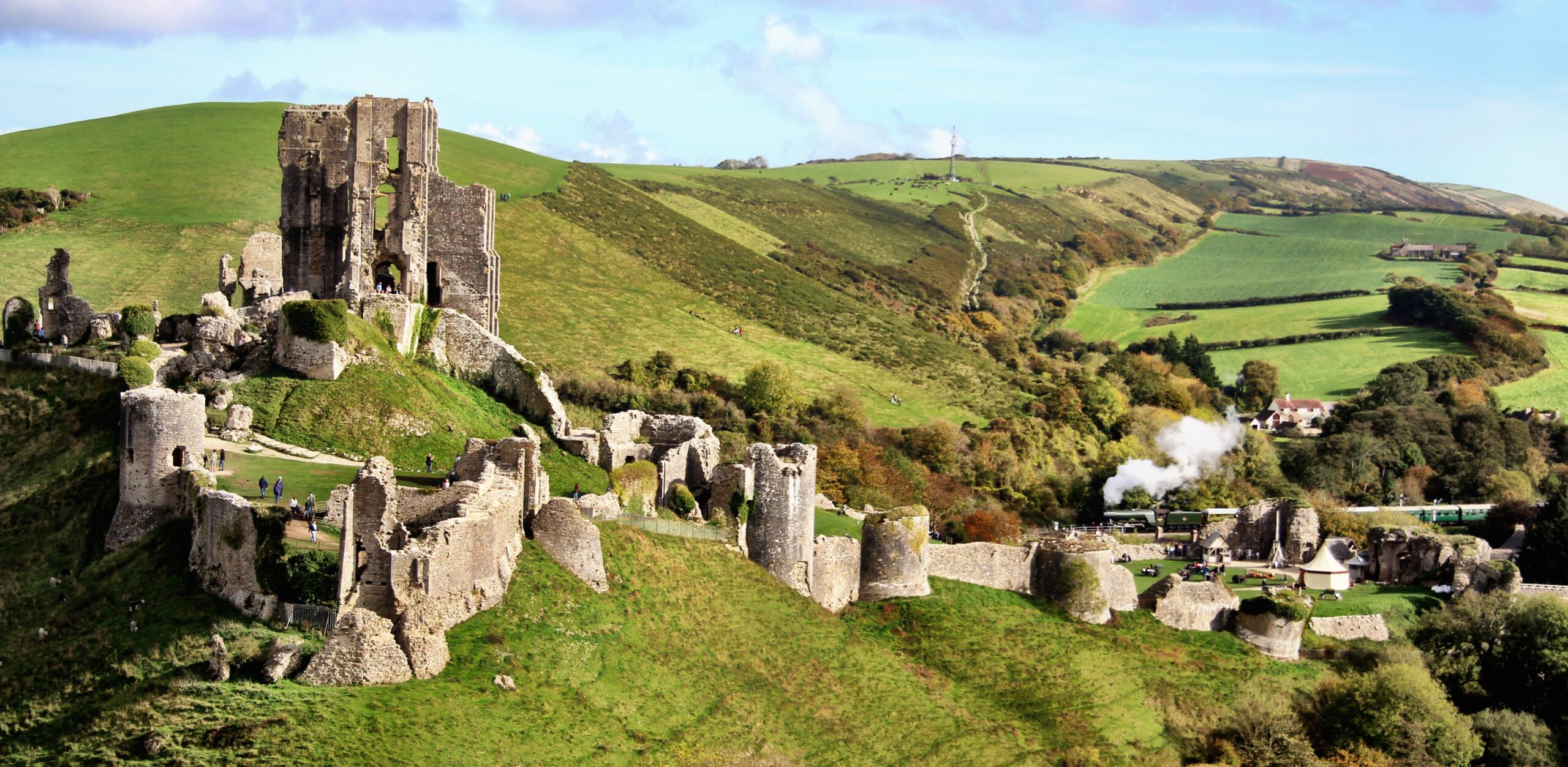
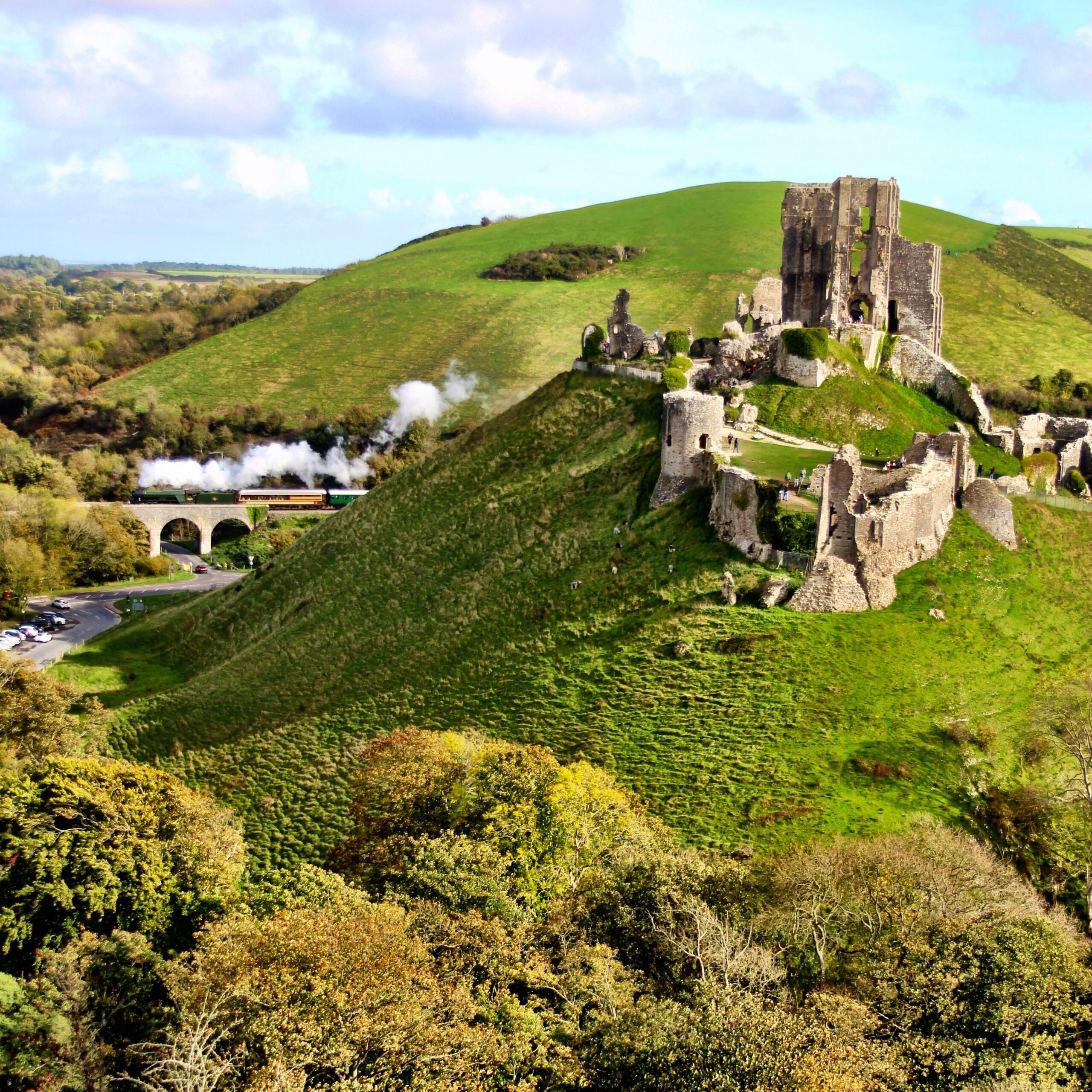
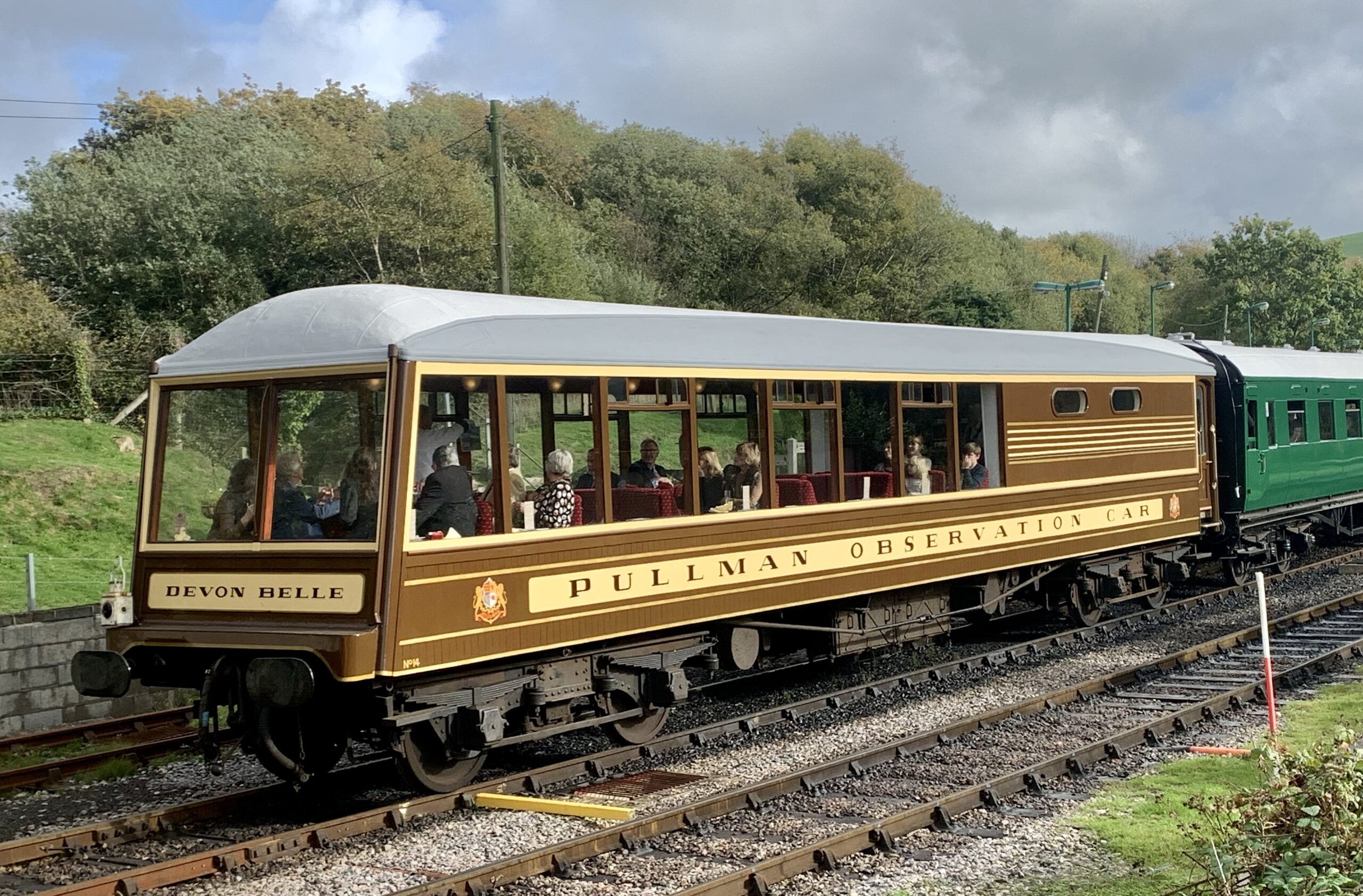
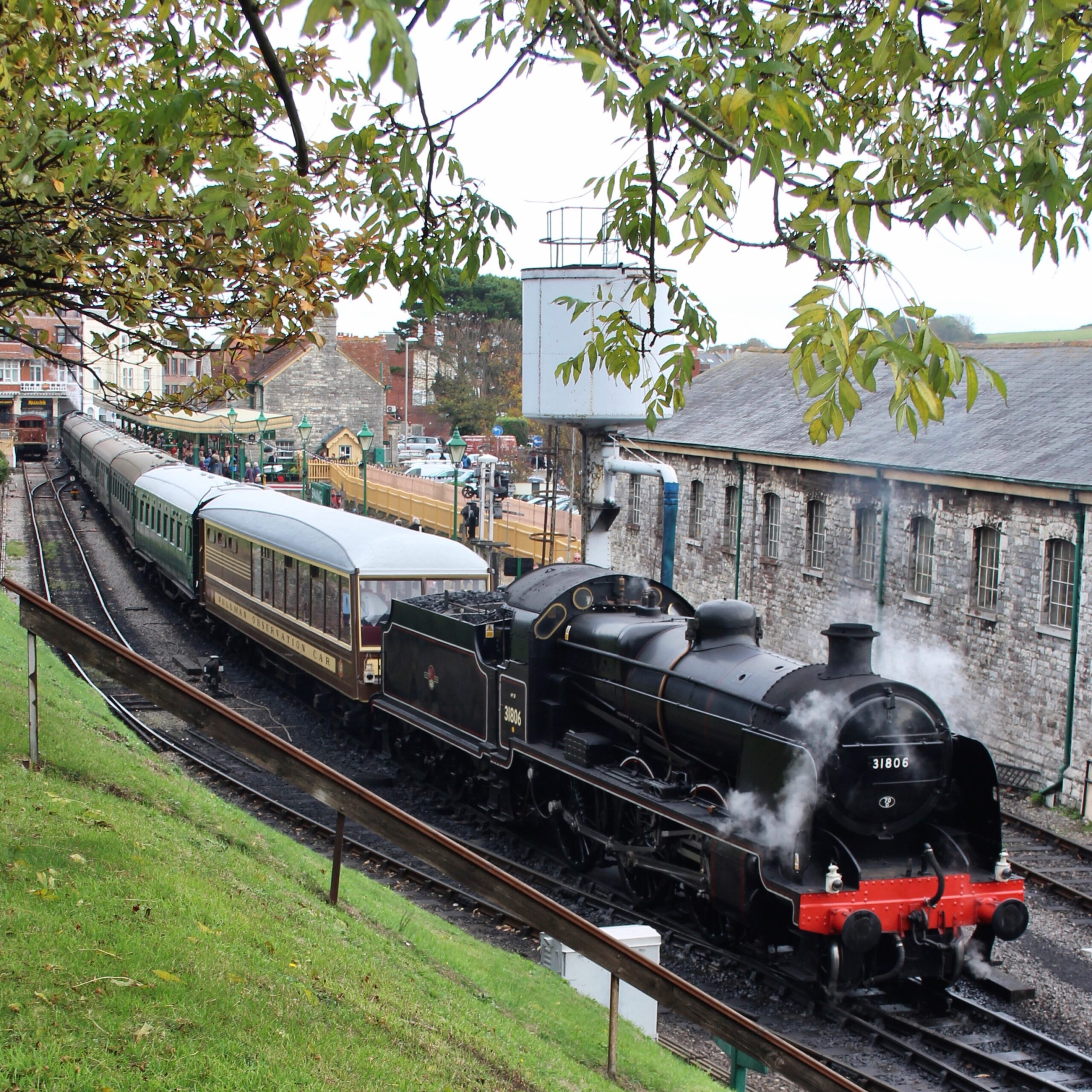
1933 Maunsell open third carriage No. 1346Yoshi and I explore 1933 Maunsell open third carriage No. 1346 (Image courtesy of Caroline Smith)Vestibule of 1933 Maunsell open third carriage No. 1346LNER Gresley A3 No. 60103 ‘Flying Scotsman’ prepares to back on to the seven coach train employed during running days at the Swanage Railway – 22/10/2022LNER Gresley A3 No. 60103 ‘Flying Scotsman’ passes Herston Halt – 25/10/2022LNER Gresley A3 No. 60103 ‘Flying Scotsman’ passes Southern Railway rebuilt West Country Class Bulleid Pacific No. 34028 ‘Eddystone’ at Harmans Cross – 22/10/2022 (Image courtesy of Caroline Smith)LNER Gresley A3 No. 60103 ‘Flying Scotsman’ passes Corfe Castle – 25/10/2022LNER Gresley A3 No. 60103 ‘Flying Scotsman’ crosses Corfe viaduct in the shadow of Corfe Castle – 25/10/2022LNER Gresley A3 No. 60103 ‘Flying Scotsman’ arrives at Norden with the 1X06 1325 service from Swanage – 24/10/2022 Yoshi welcomes a fuss from Penny Pegler, daughter of ‘Flying Scotsman’ saviour Alan Pegler, who visited the Swanage Railway from her home in Portugal and traveled on the 1145 departure on Saturday 22nd October 2022. Penny’s late father purchased ‘Flying Scotsman’ from British Railways in 1963 at the cost of £3,000 – 22/10/20221940’s Pullman “Devon Belle” observation coach Car 14 which accompanied ‘Flying Scotsman’ on tours of Canada and the United States to promote British exports was part of the consist of at Swanage this week. Volunteers with the Swanage Railway Trust carefully restored the wooden carriage after it was rescued from San Francisco where it was in use as a static bar. Norden – 24/10/2022SR U Class 2-6-0 No. 31806 assisted with the shunting of stock during the ‘Flying Scotsman’ running days at Swanage – 25/10/2022Yoshi keeps watch on SR U Class 2-6-0 No. 31806 as she backs onto the empty coaching stock in preparation for shunting – 25/10/2022
Video of Yoshi’s visit to the Swanage Railway and his trip behind ‘Flying Scotsman’. Playing the bagpipes as our train departed Swanage was 15 year old Frederick Sills from Wareham who is a member of Swanage Railway’s Sygnets youth group and a member of the Weymouth Sea Cadets. He did a wonderful job!
‘Flying Scotsman’ will be on static display at Swanage Railway station until the 6th November 2022.
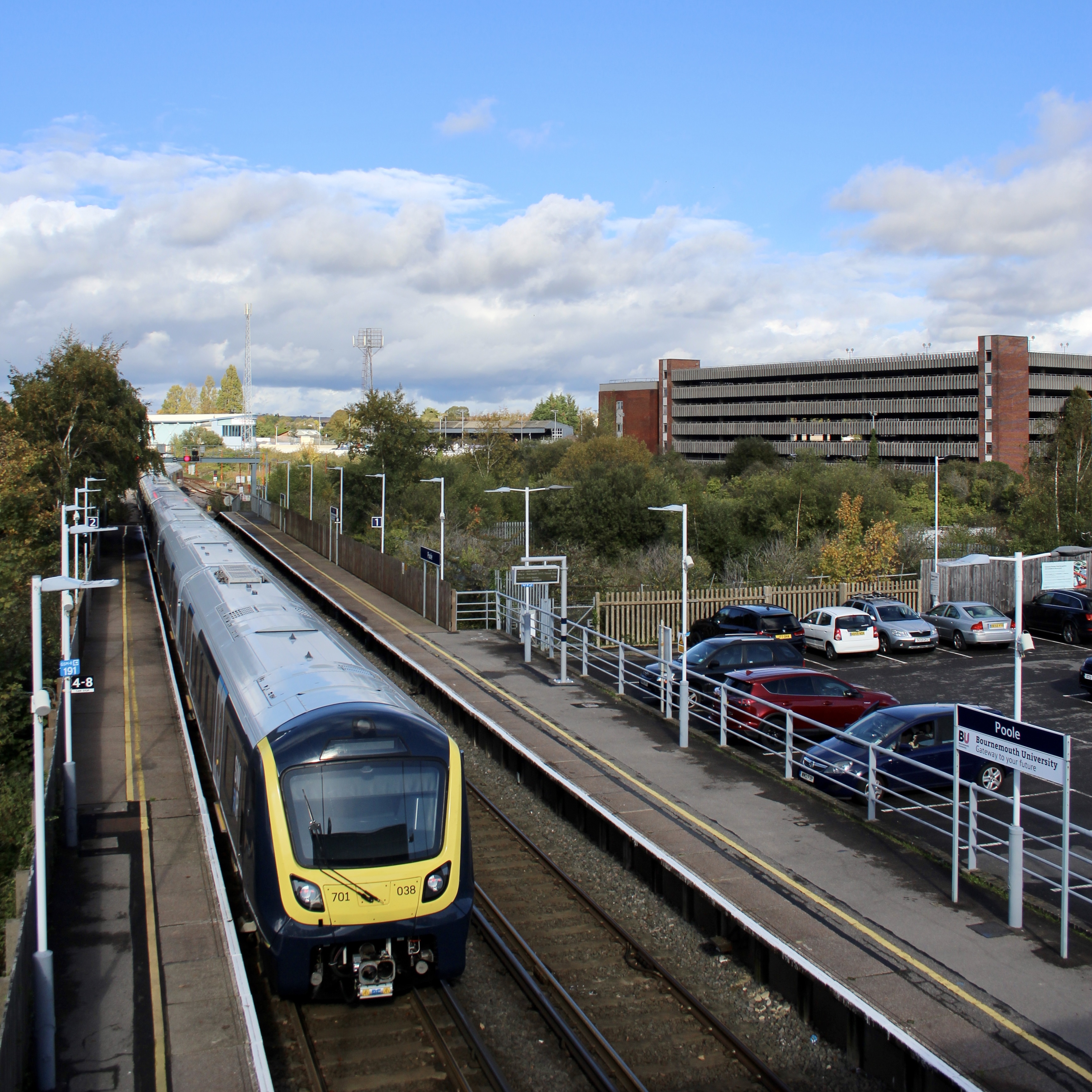
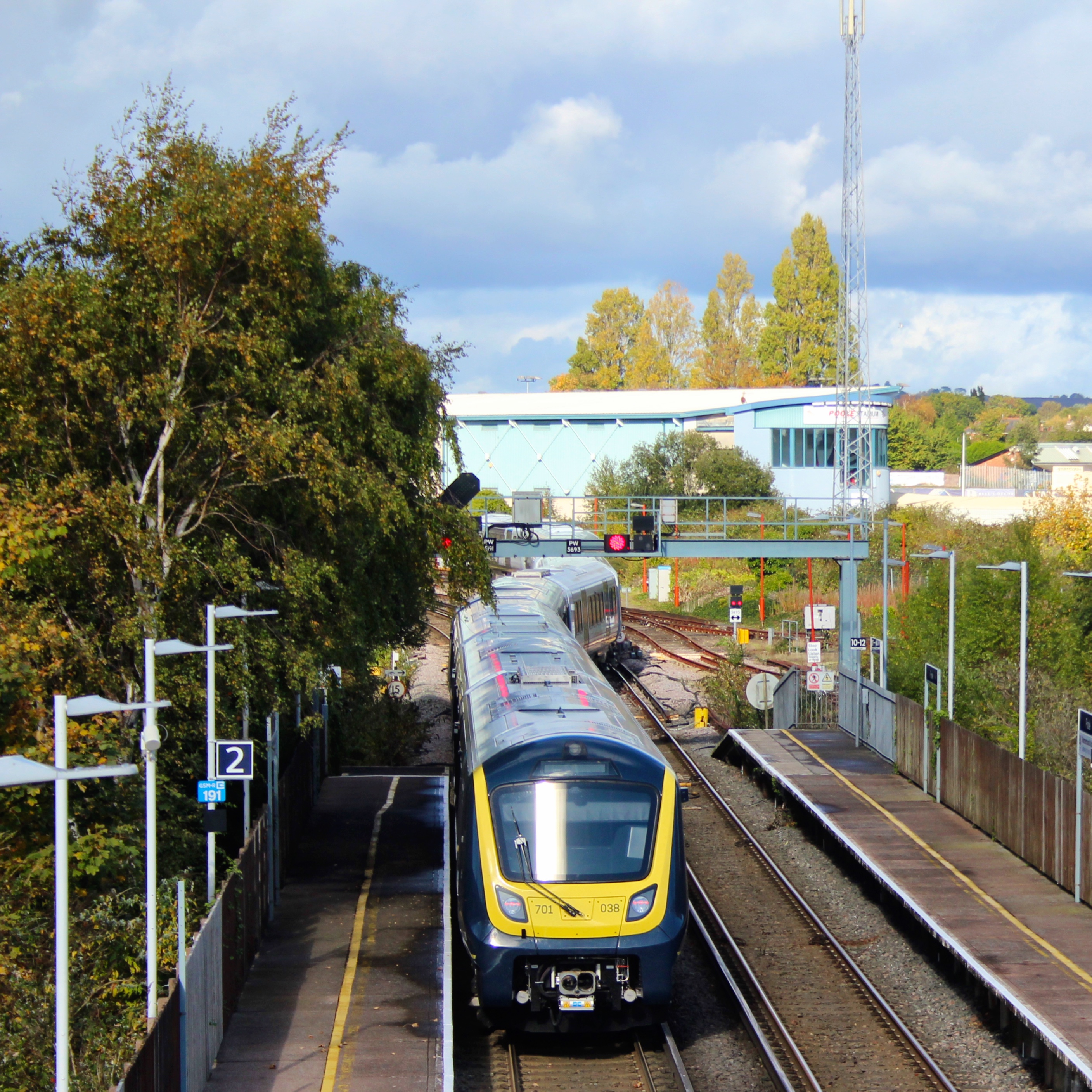
Although there is still no date for their introduction into revenue earning service, South Western Railway (SWR) Class 701 Electric Multiple Units (EMU) continue testing and mileage accumulation runs taking in Poole where they reverse. On Thursday 20th October it was the turn of No. 701038 to have a run out, and we saw the unit passing through Poole:
SWR Class 701 No. 701038 working 5Q51 1115 London Waterloo to Staines Up Loop passing through Poole – 20/10/2022SWR Class 701 No. 701038 working 5Q51 1115 London Waterloo to Staines Up Loop crosses over the Up Line to reach Poole Storage Sidings where the service reverses – 20/10/2022Having reversed in Poole Storage Sidings, SWR Class 701 No. 701038 working 5Q51 1115 London Waterloo to Staines Up Loop passes Class 444 No. 444035 which formed 1W65 1205 London Waterloo to Weymouth at Poole – 20/10/2022
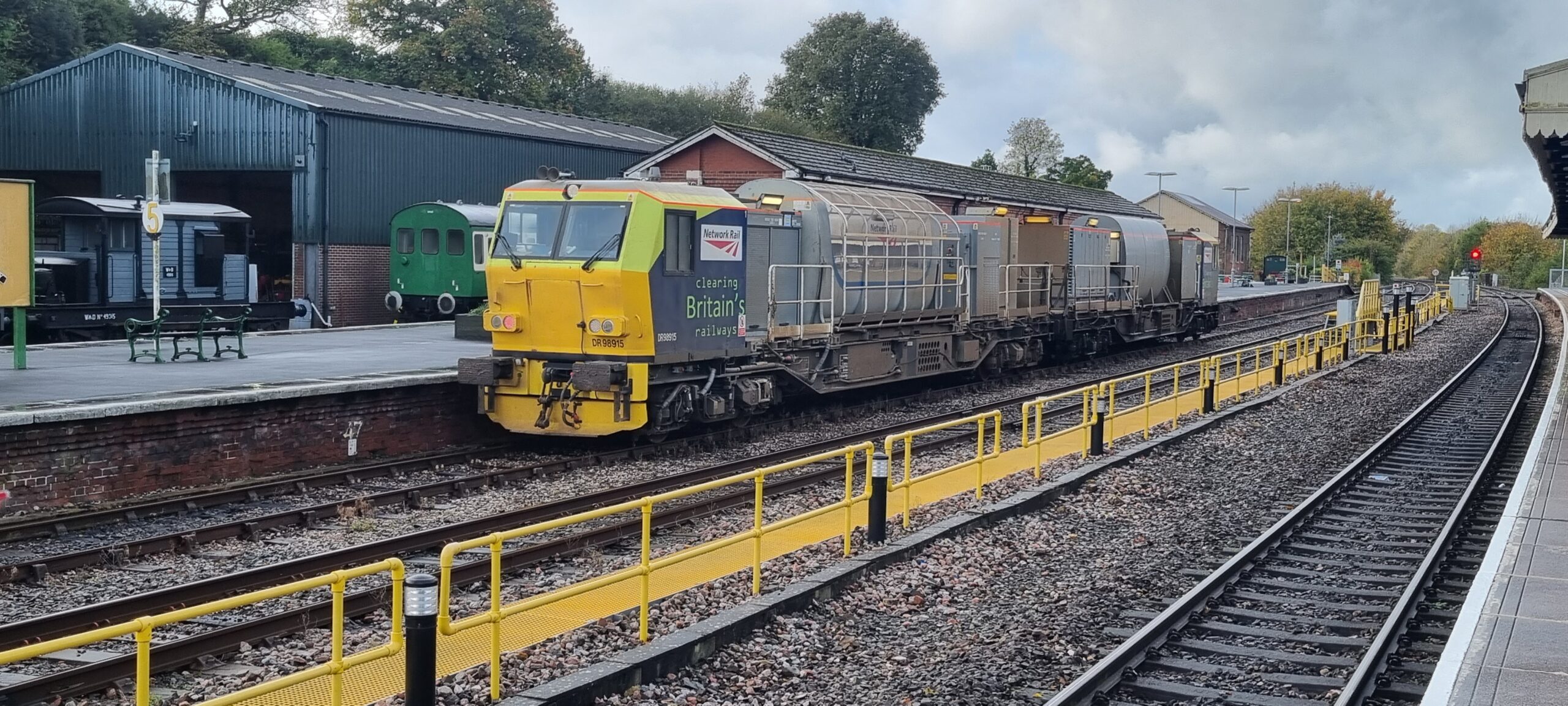
The railways in the UK are well into Rail Head Treatment Train (RHTT) season as the trees shed their leaves which are scattered across the nations railway tracks. This can cause problems for the track circuits and reduce a trans ability to grip to the rails when starting from stations, accelerating, climbing hills or stopping. In our neck of the woods we see regular Multi Purpose Vehicle (MPV) movements spreading adhesion modifier; a mixture of suspension gel (so it can be pumped), sand (to help train wheels grip the rail), and steel or iron shot that is pushed through contamination (compressed leaves and debris).
Multi Purpose Vehicle No. DR98915 at Yeovil Junction – 25/10/2022 (Courtesy of Scott Lewis)An unidentified MPV crosses Holes Bay, Poole working 3S81 0551 Totton Yard to Totton Yard – 25/10/2022
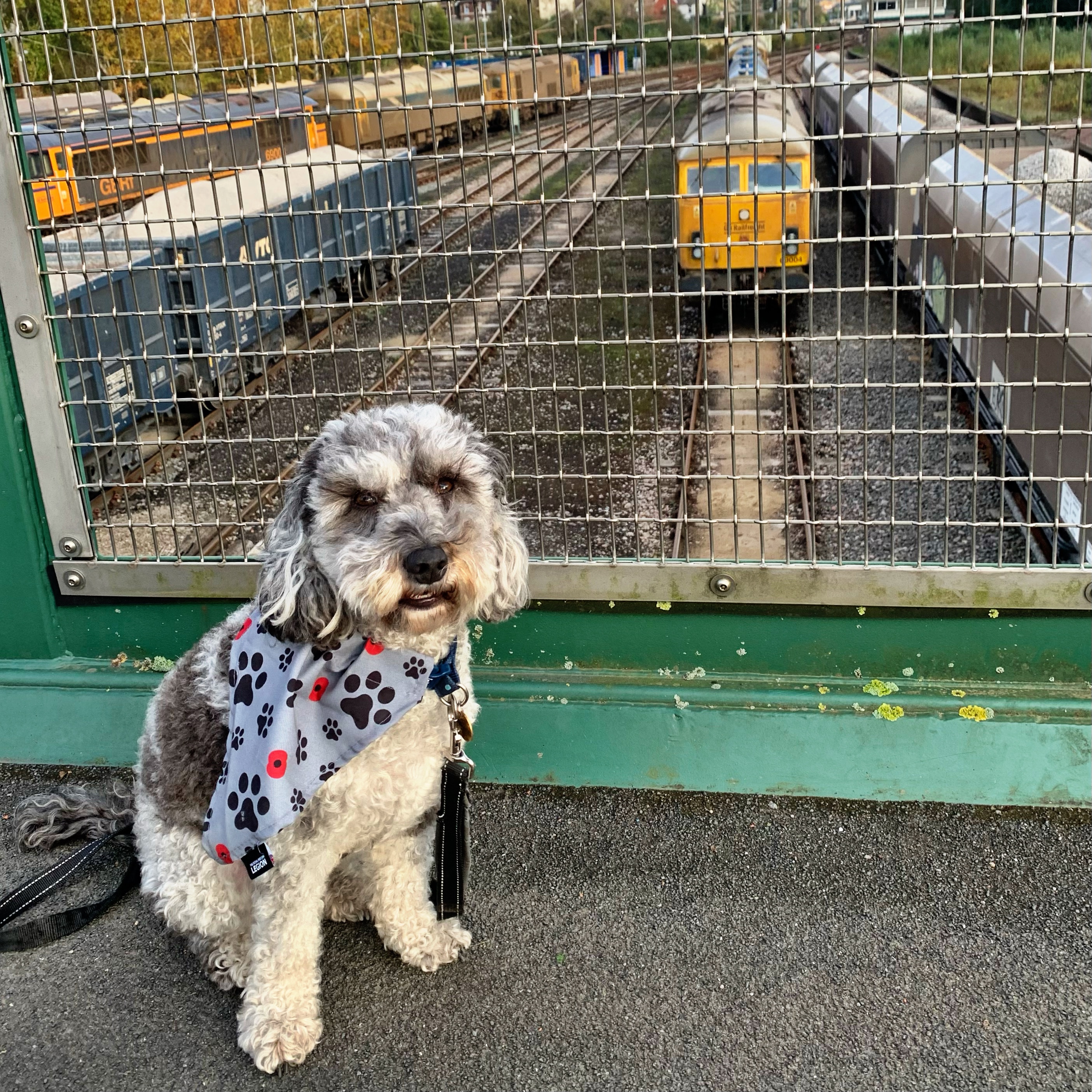
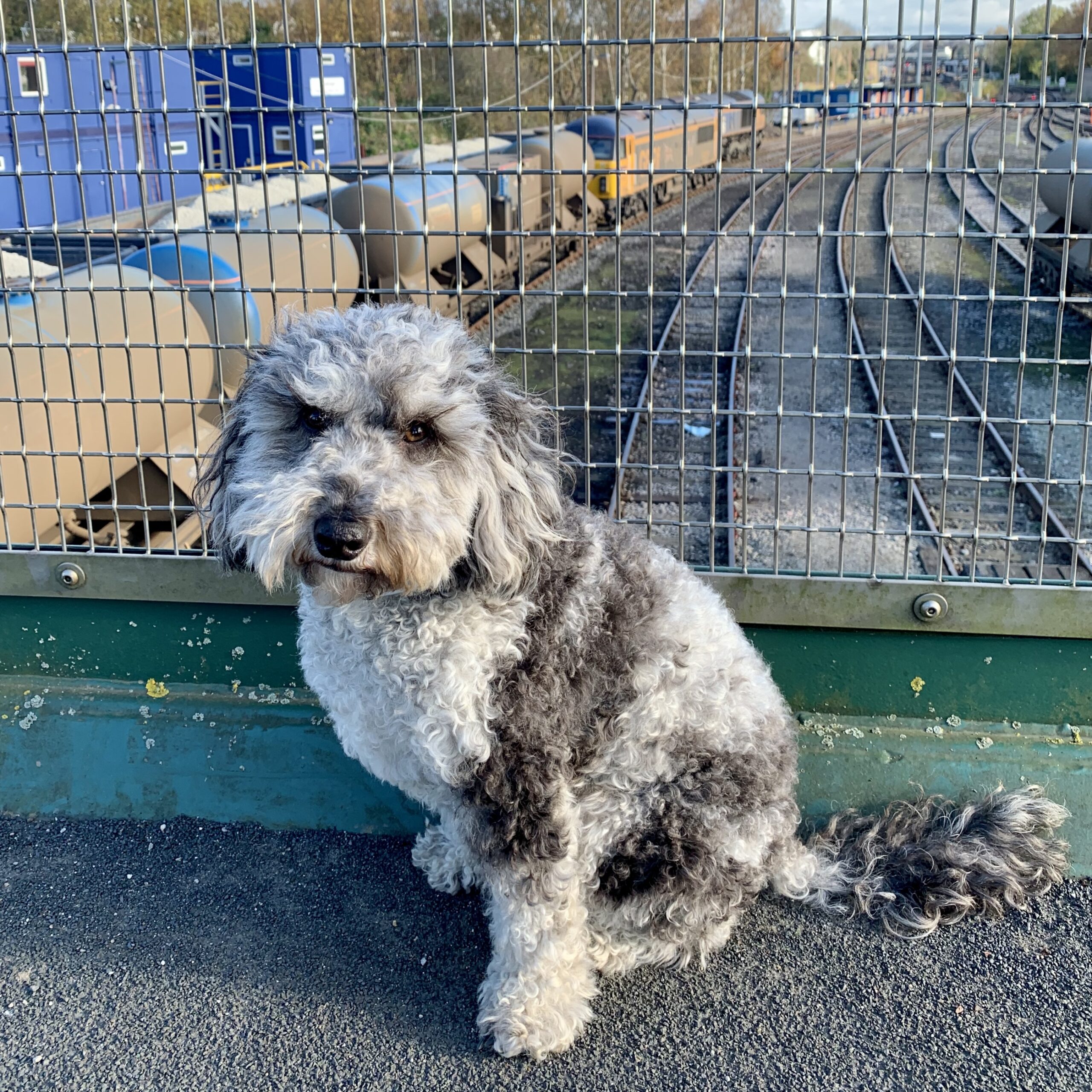
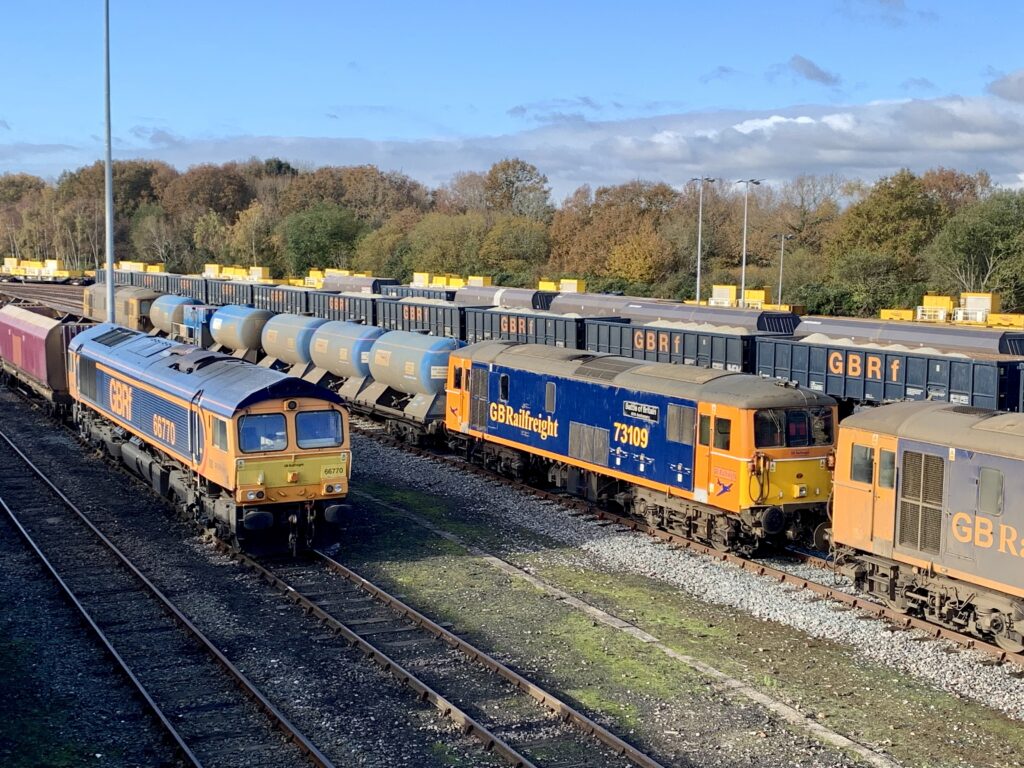
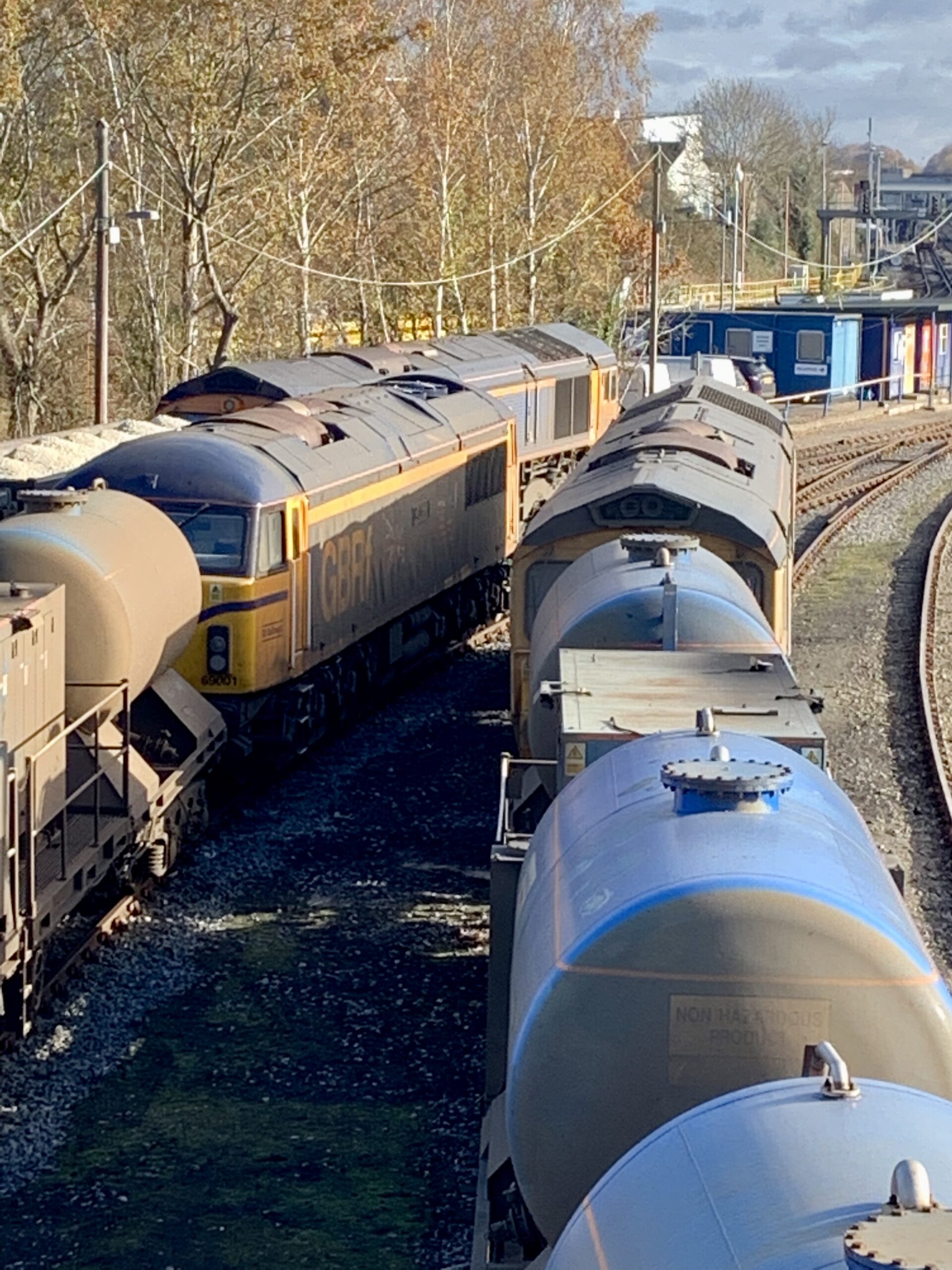
On the 28th October 2021, Direct Rail Services Class 37 No.’s 37218 and 37558 (37424) ‘Avro Vulcan XH558′ (named after a preserved Vulcan bomber) could be found working RHTT 310X 0900 Stowmarket DGI to Stowmarket DGI. The pair are seen passing through Ipswich.Yoshi taking a well earned rest on the lattice footbridge which crosses over Tonbridge West Yard with an RHTT behind. The Southern Railway commissioned the yard in 1941 to help cope with heavy wartime freight traffic – 21/11/2021Class 73 No. 73141, 73109 ‘Battle of Britain – 80th Anniversary’ and an unidentified class member (possibly No. 73119 ‘Borough of Eastleigh’ if a certain kind reader could confirm please?) with Class 66 No. 66770 at Tonbridge West Yard – 21/11/2021From left to right; Class 66 No. 66731 ‘Capt. Tom Moore’, Class 69 No. 69001 ‘Mayflower’ and Class 66 No. 66722 ‘Sir Edward Watkin’ at Tonbridge West Yard – 22/11/2021
Video of Rail Head Treatment Trains at Tonbridge West Yard – 22/11/2021
Network Rail’s website reveals there are 32 MPV and 29 locomotive-hauled RHTT’s which deliver the autumn rail head treatment programme. At the weekend, I was tipped off that a Class 37 diesel loco had been hired in by Colas for the Swindon area locomotive hauled RHTT replacing a Class 66 (No. 66846 which required repairs).
On hire to colas for Rail Head Treatment Train (RHTT) workings, West Coast Rail Class 37 No. 37668 spent the weekend partnering Class 66 No. 66850 ‘David Maidment’ on Swindon based runs. The pair are seen nearing Bradford on Avon in the rain working 3S59 1554 Swindon Transfer Sidings to Moreton on Lugg – 23/10/2022
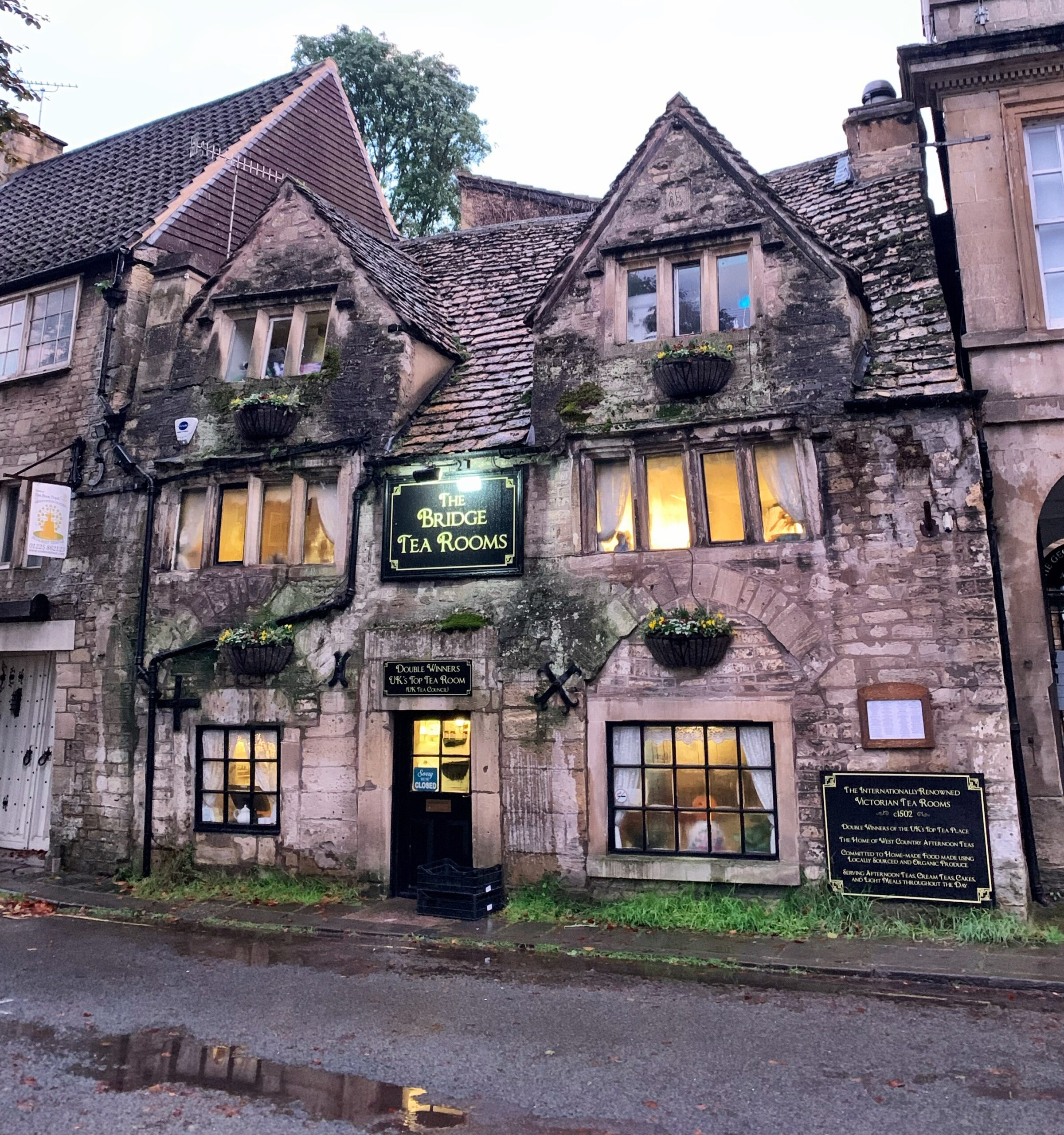
So on Sunday afternoon we found ourselves in Bradford on Avon clinking delicate bone china tea cups and enjoying lunch at The Bridge Tearooms, a former blacksmith’s cottage dating from 1502.
The Bridge Tea Rooms at Bradford on Avon does an excellent Welsh rarebit – 23/10/2022
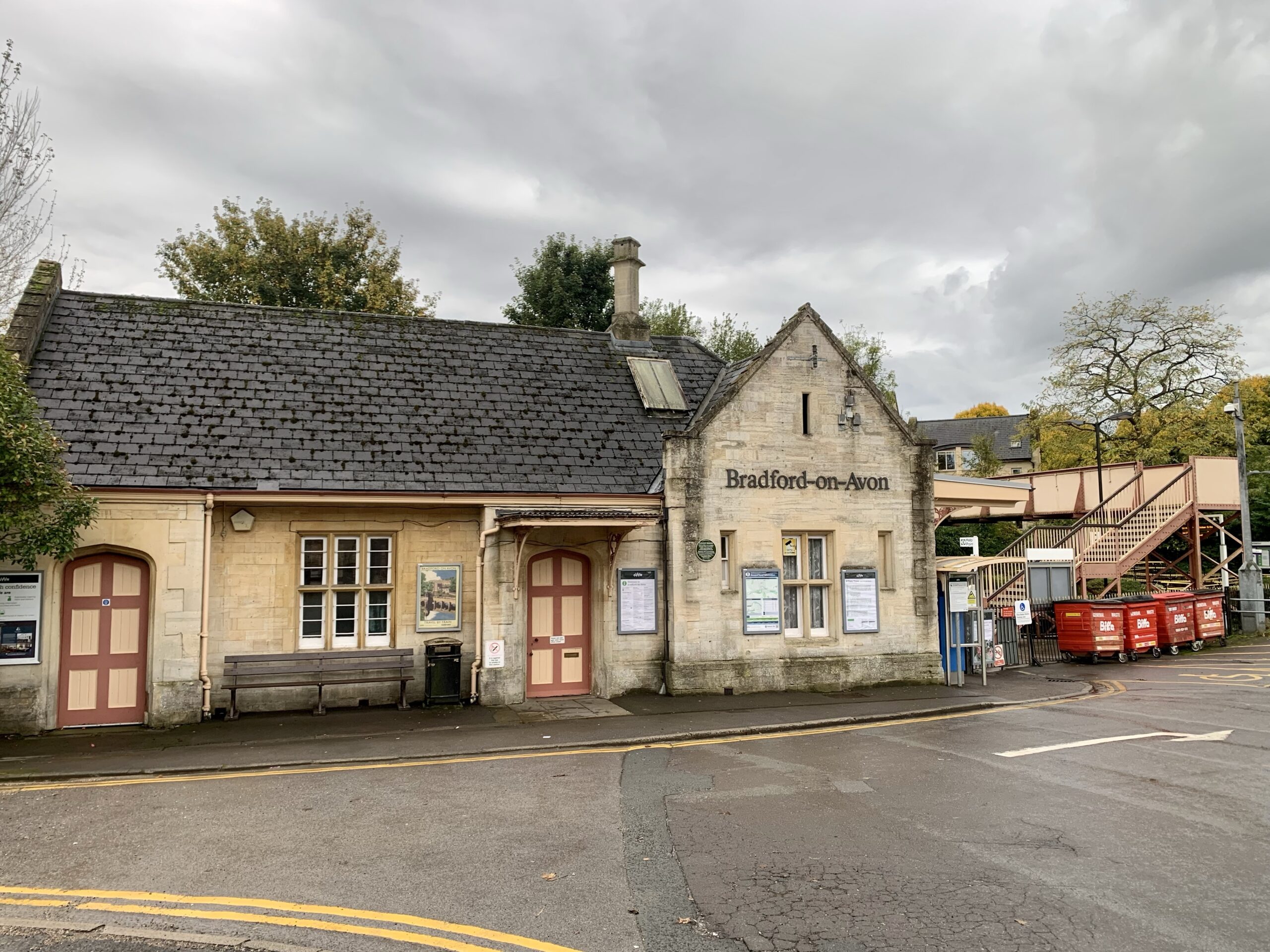
After a walk taking in the ancient Tithe Barn and the Kennet & Avon Canal, I headed to Bradford on Avon railway station while Yoshi and his mum took shelter from the rain in a pub.
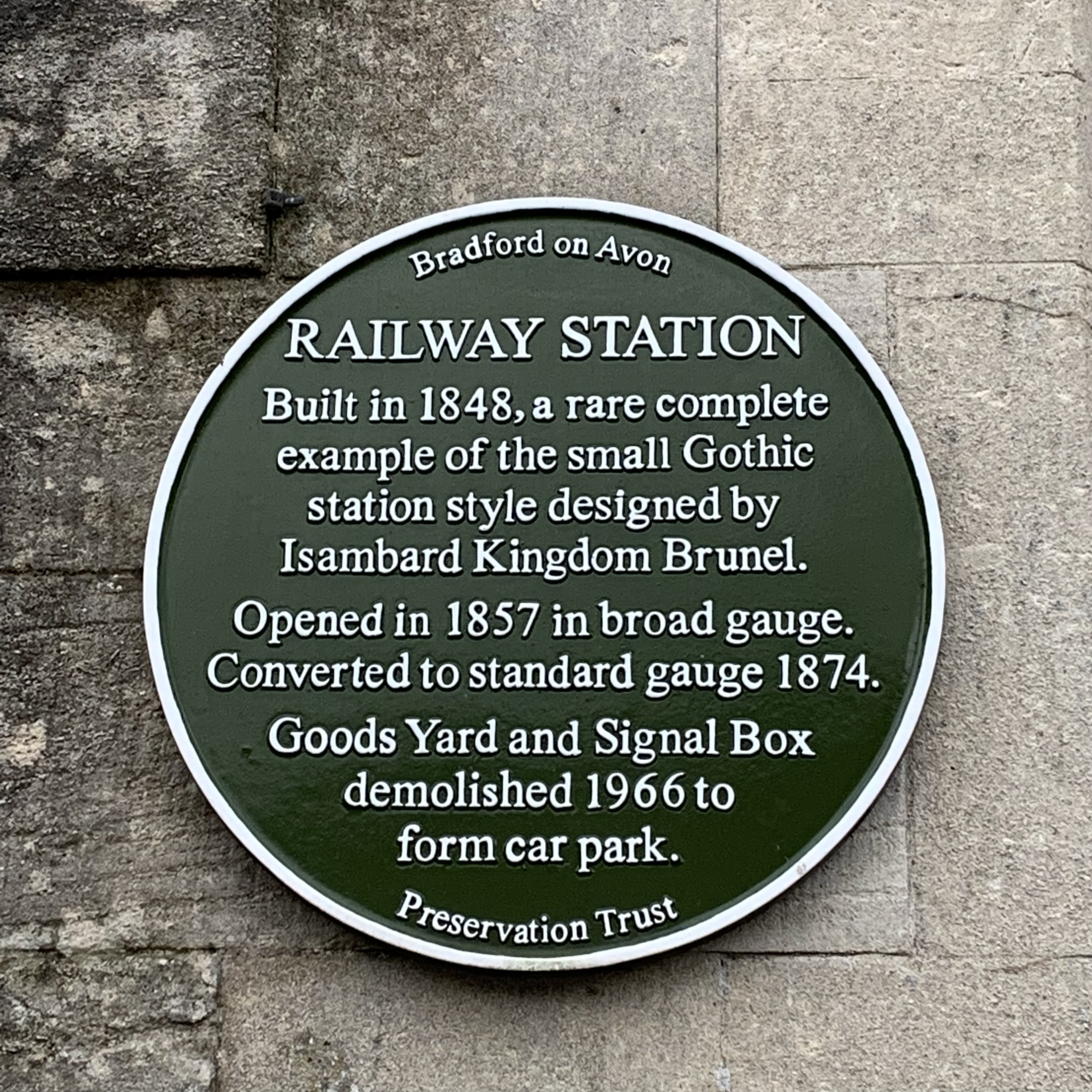
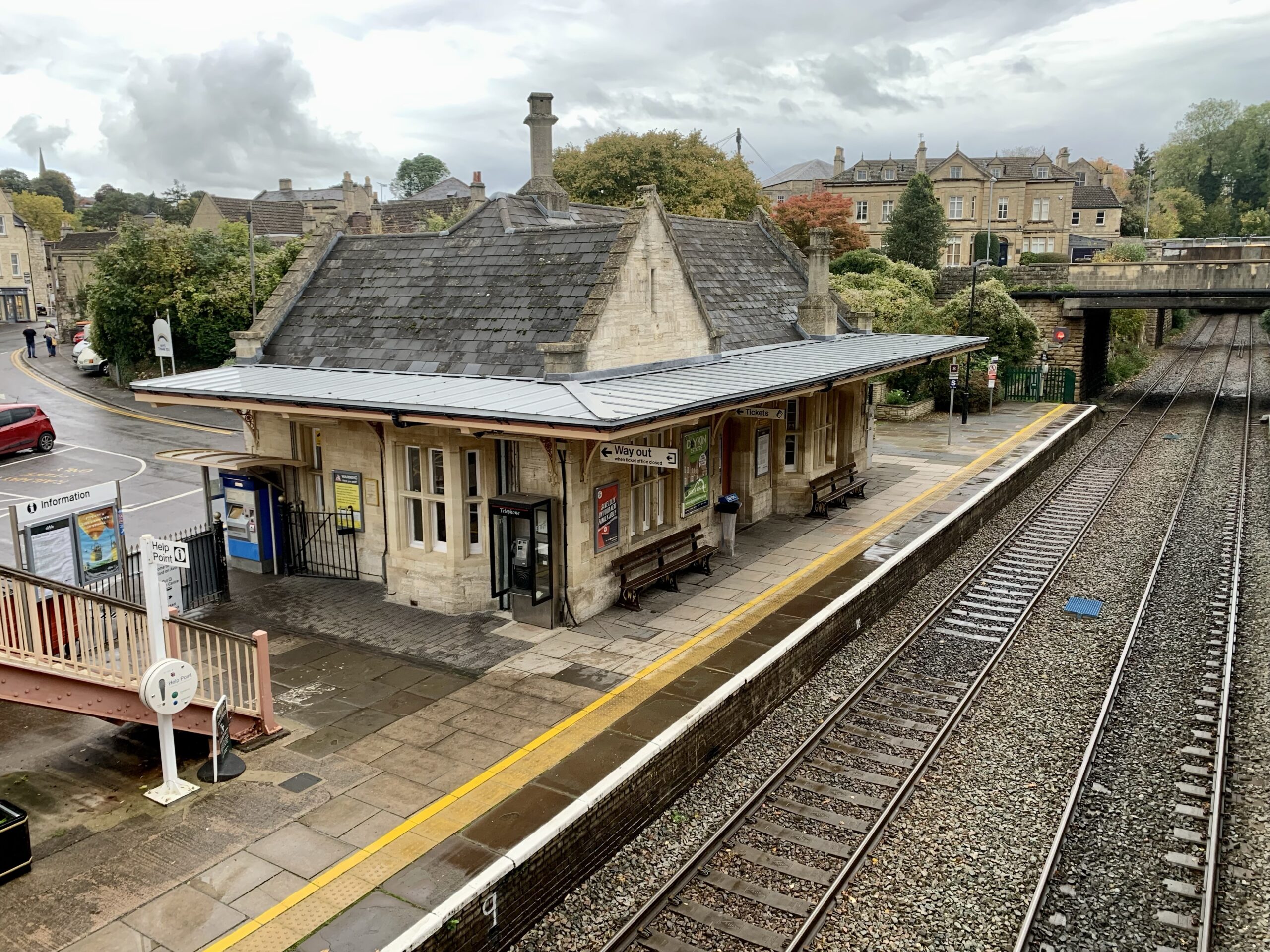
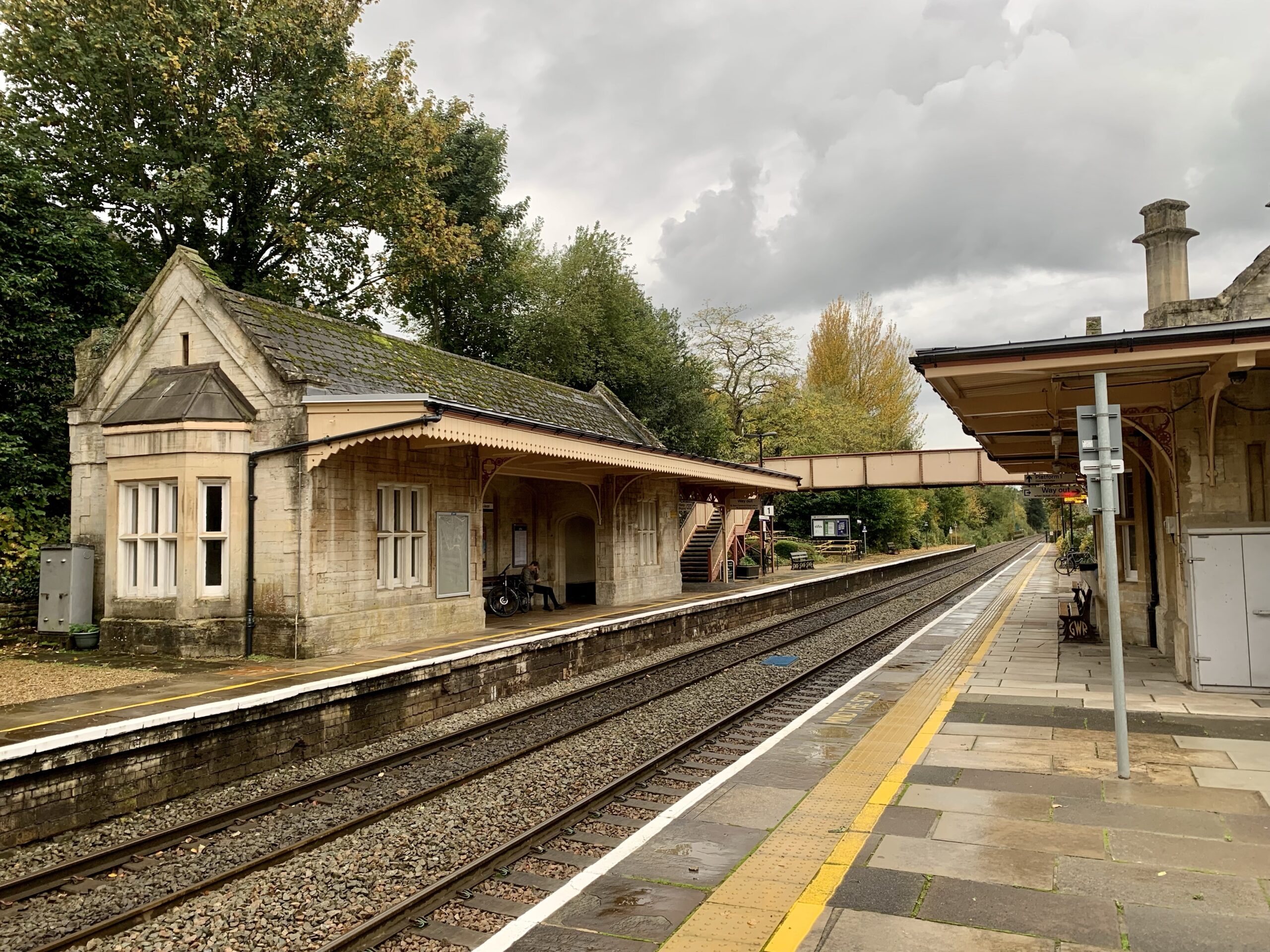
Bradford on Avon railway station exterior – 23/10/2022Bradford on Avon railway station plaque – 23/10/2022Bradford on Avon railway station platform 2 – 23/10/2022Bradford on Avon railway station platform 1 – 23/10/2022
Grade 2 listed Bradford on Avon station, originally planned by The Wilts, Somerset and Weymouth Railway, is situated 15 km south east of Bath between Avoncliff and Trowbridge and is a stop on Weymouth to Bristol services. In the event the station was not opened until 1857 when the line was in the control of The Great Western Railway
(GWR). The station is of a standard Brunel design but utilises local Bath stone rather than the usual bricks and mortar. Originally trains would have been of the seven-foot broad gauge variety, but the track was converted to standard gauge in 1874. Present day services are operated by Great Western Railway (formerly First Great Western and no relation to the old GWR), South Western Railway having withdrawn their direct services to Bristol. Trains are typically operated using Class 165 and Class 166 Networker Turbo trains and Class 158 diesel multiple units. The line is sometimes used as a diversionary route and sees GWR main line and CrossCountry trains, usually at weekends.
The goods yard located on the ‘up’ side of the line was closed to traffic in 1965 and is now home to a car park and health centre. The signal box was demolished in 1966. There is a campaign to reinstate the canopy on the 1899 footbridge, removed in 1964, and which I would have found very useful during my visit in the rain! The Bradford on Avon Footbridge Canopy Project were awarded a £22,000 grant from the Community Rail Development Fund (CDRF) in September 2022.
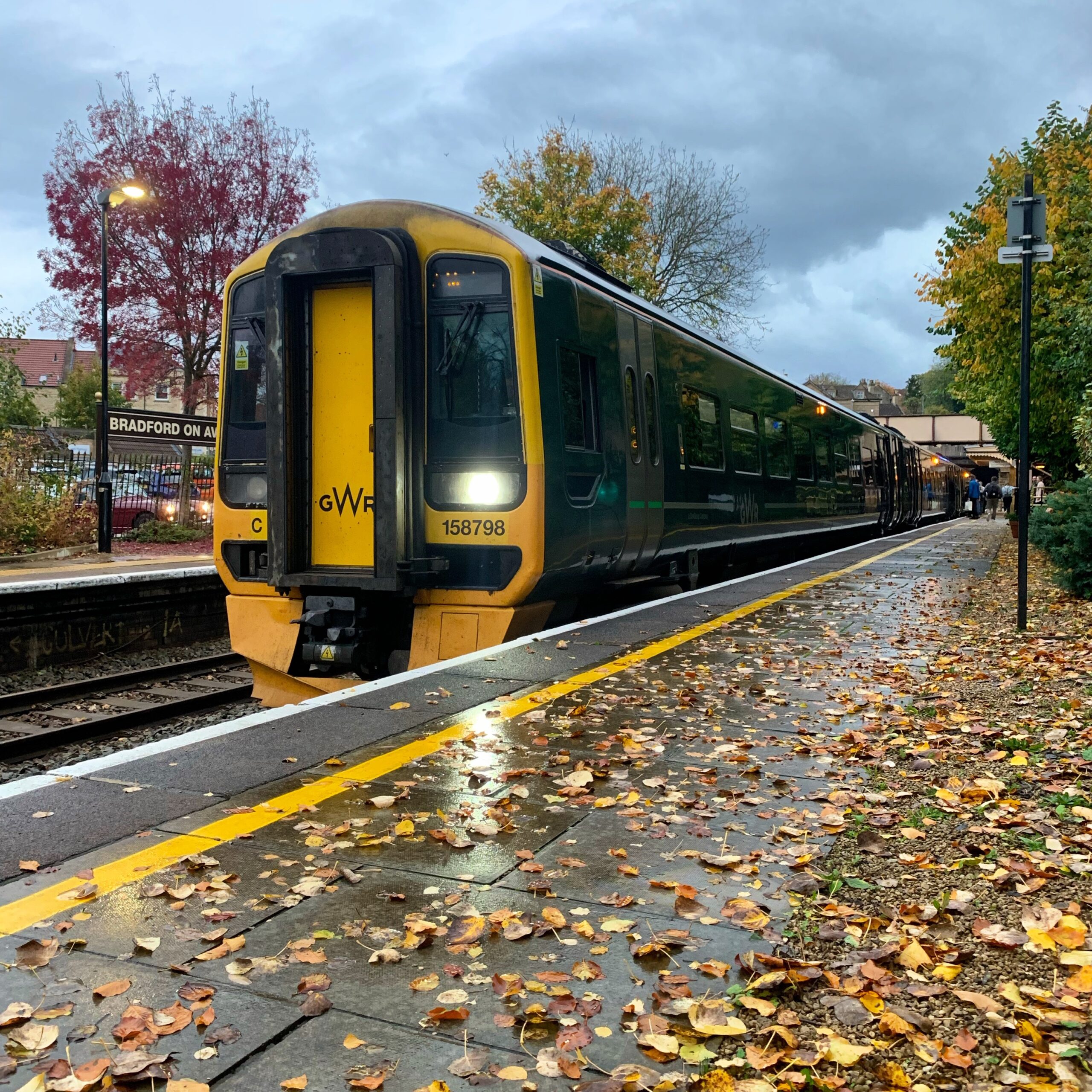
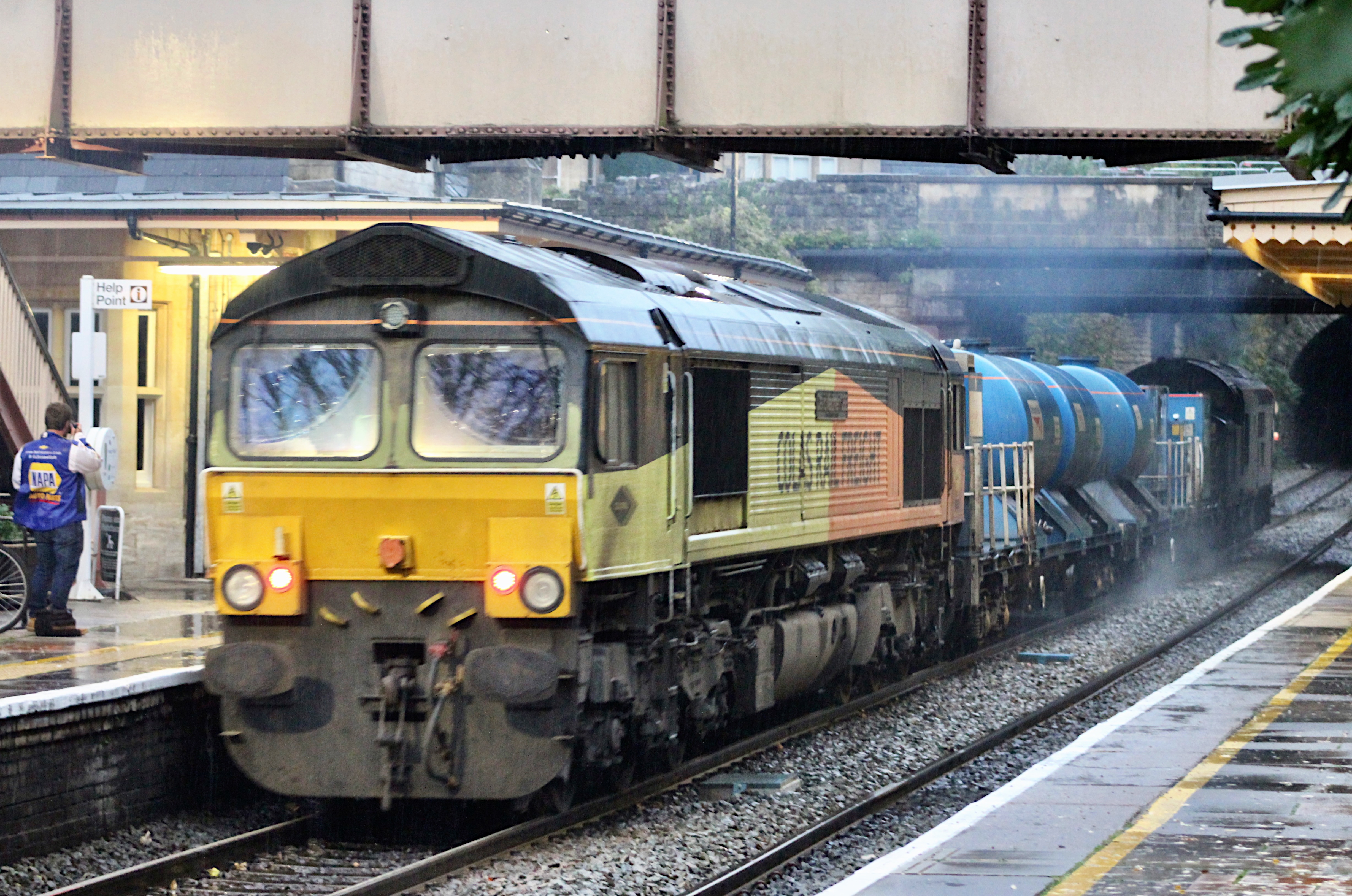
Class 158 No. 158798 pauses at Bradford on Avon working 2C96 1640 Westbury to Bristol Temple Meads. The canopy devoid footbridge can be seen above the rear of the train – 23/10/2022Class 166 No. 166204 ‘Norman Topsom MBE’ and Class 165 No. 165133 arrive at Bradford on Avon working 1F25 1526 Cardiff Central to Portsmouth Harbour which was terminated at Fratton due to an obstruction on the line – 23/10/2022Class 66 No. 66850 ‘David Maidment’ on the rear of 3S59 1554 Swindon Transfer Sidings to Moreton on Lugg RHTT passing Bradford on Avon – 23/10/2022
Video from Bradford on Avon – 23/10/2022
Our North Dorset Correspondent has been out and about in Yeovil over the last few days and has sent Yoshi the video and still images below:
First up are the GWR Sleeper trains crossing at Yeovil Pen Mill while on route diversion during the early hours of Monday 23rd October 2022. The up service 1A50 2115 Penzance to Paddington hauled by Class 57 No. 57602 ‘Restormel Castle’ was running just over an hour late and because of the single track to Castle Cary, was held at Yeovil Pen Mill to allow 57604 ‘Pendennis Castle’ on the down 1C50 2350 London Paddington to Penzance to enter the station. I have been muttering about heading to Yeovil to see the sleepers on diverts for a while now, and as far as I am aware, this is most likely the final opportunity for 2022, so many thanks to Scott for braving the inclement weather!
GWR Sleeper divers at Yeovil Pen Mill 24/10/2022 – courtesy of Scott Lewis
The following day, Scott was back in Yeovil, this time at Yeovil Junction as Colas Class 37 No. 37099 arrived from Exeter Riverside and was engaged in shunting two damaged Network Rail test train coaches into position for recovery by low loader. After loading, there was a problem with one of the escort vehicles so the departure by road was delayed.
Class 37 No. 37099 and Network Rail MK2 coaches at Yeovil Pen Mill – 25/10/2022 (with grateful thanks to Scott Lewis)
Monday 24th October 2022 also saw the regular Class 73 hauled test train visit the Bournemouth to Weymouth line with GBRf Class 73 electro-diesel locomotives No. 73961 ‘Alison’ and 73963 ‘Janice’ top and tailing 1Q51 1115 Derby RTC to Eastleigh East Yard and we popped into Hamworthy station to see it and have a good old bark as it passed by on its outward run.
1Q51 1115 Derby RTC to Eastleigh East Yard passing Hamworthy – 24/10/2022
Thanks for reading and as always, many thanks for your comments, observations and corrections. We’ll leave you with some video footage from the archive of ‘Flying Scotsman’ when she visited the Swanage Railway in 1994:
‘Flying Scotsman’ at Swanage 1994
Endpiece:
LNER Gresley A3 No. 60103 ‘Flying Scotsman’ approaches Harmans Cross with her last turn of the day on Tuesday 25th October 2022
Wednesday September 21st to Tuesday September 27th
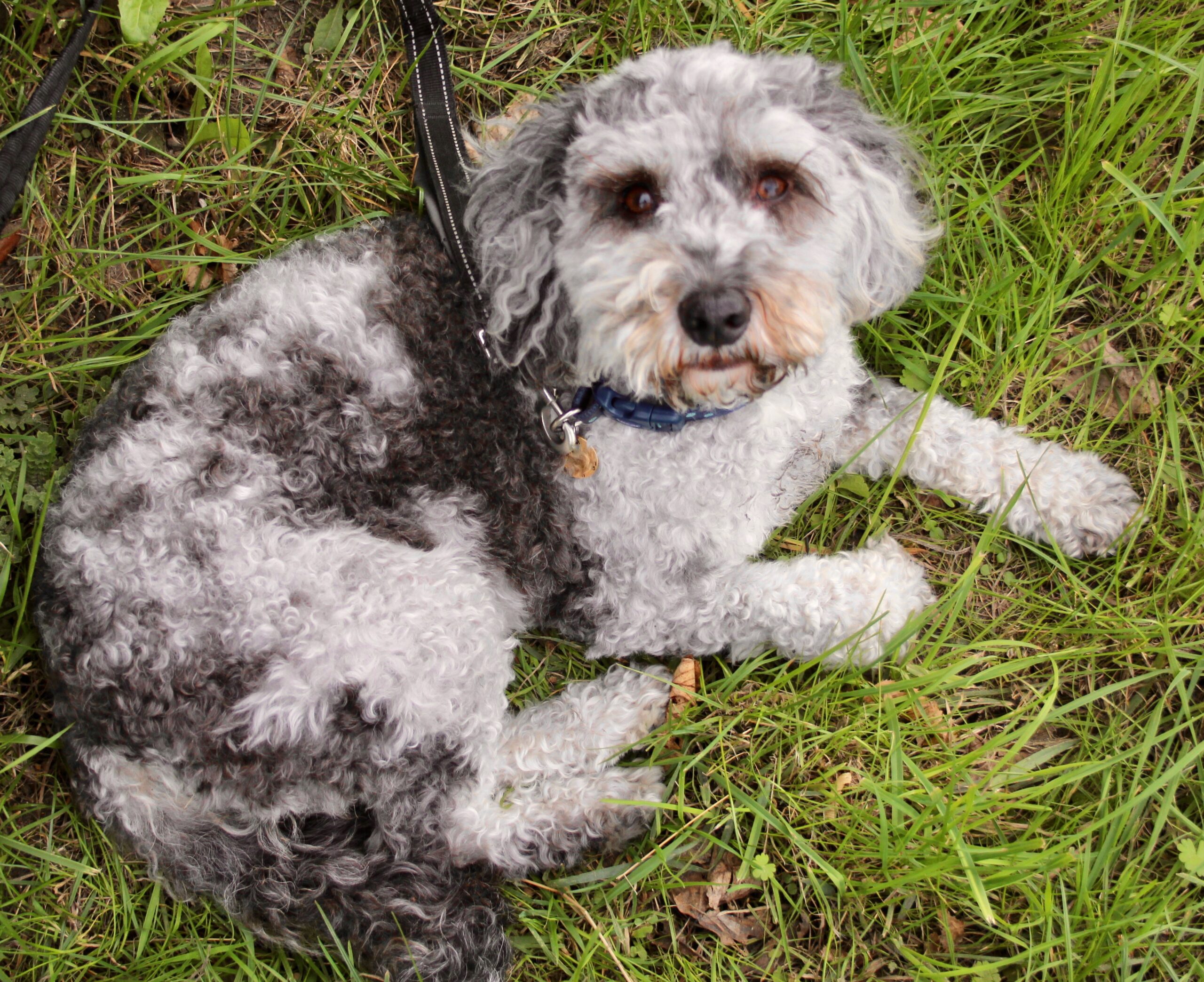
Yoshi pictured in between trains at Cogload Junction, Somerset wondering how much longer he has to wait before getting more treats – 25/09/2022
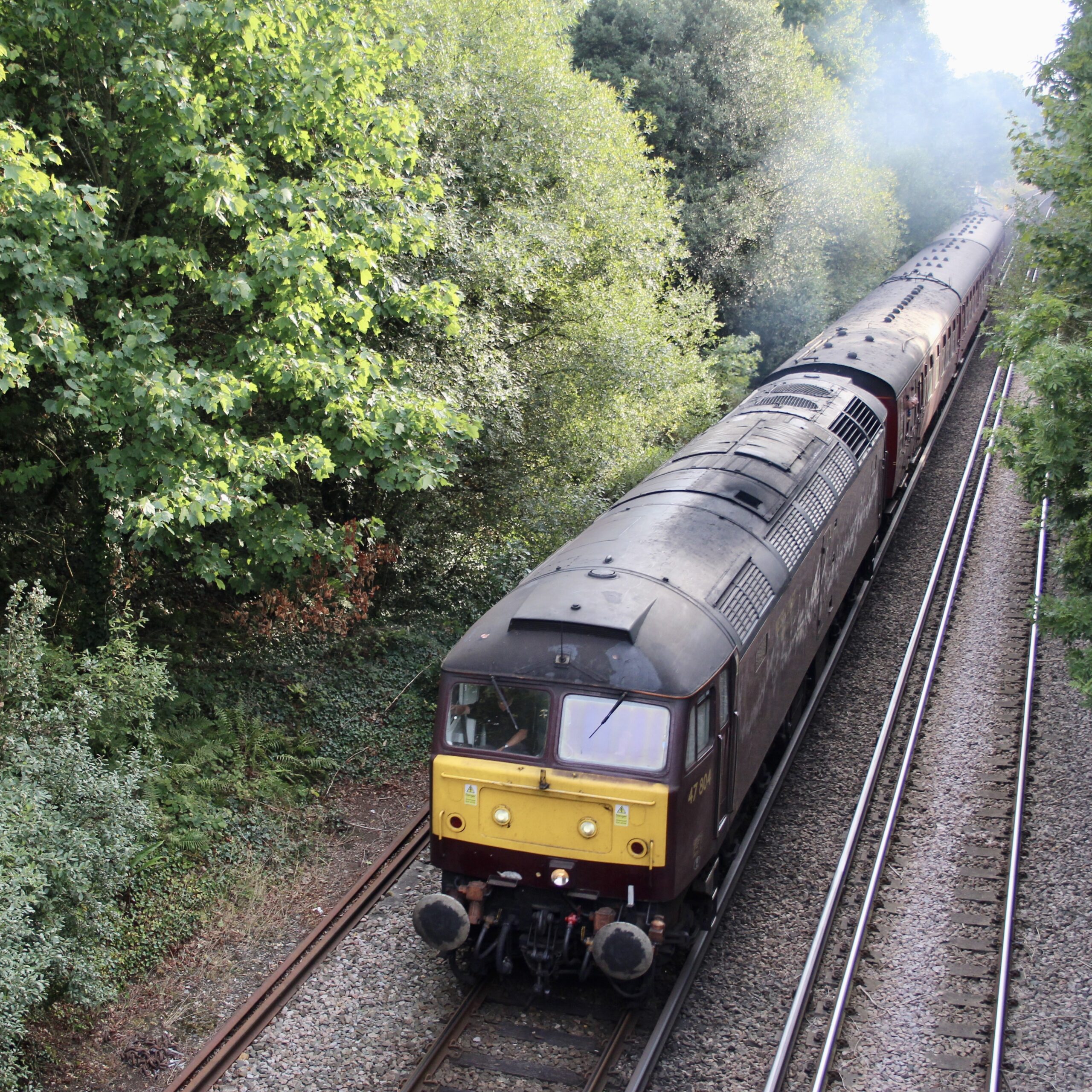
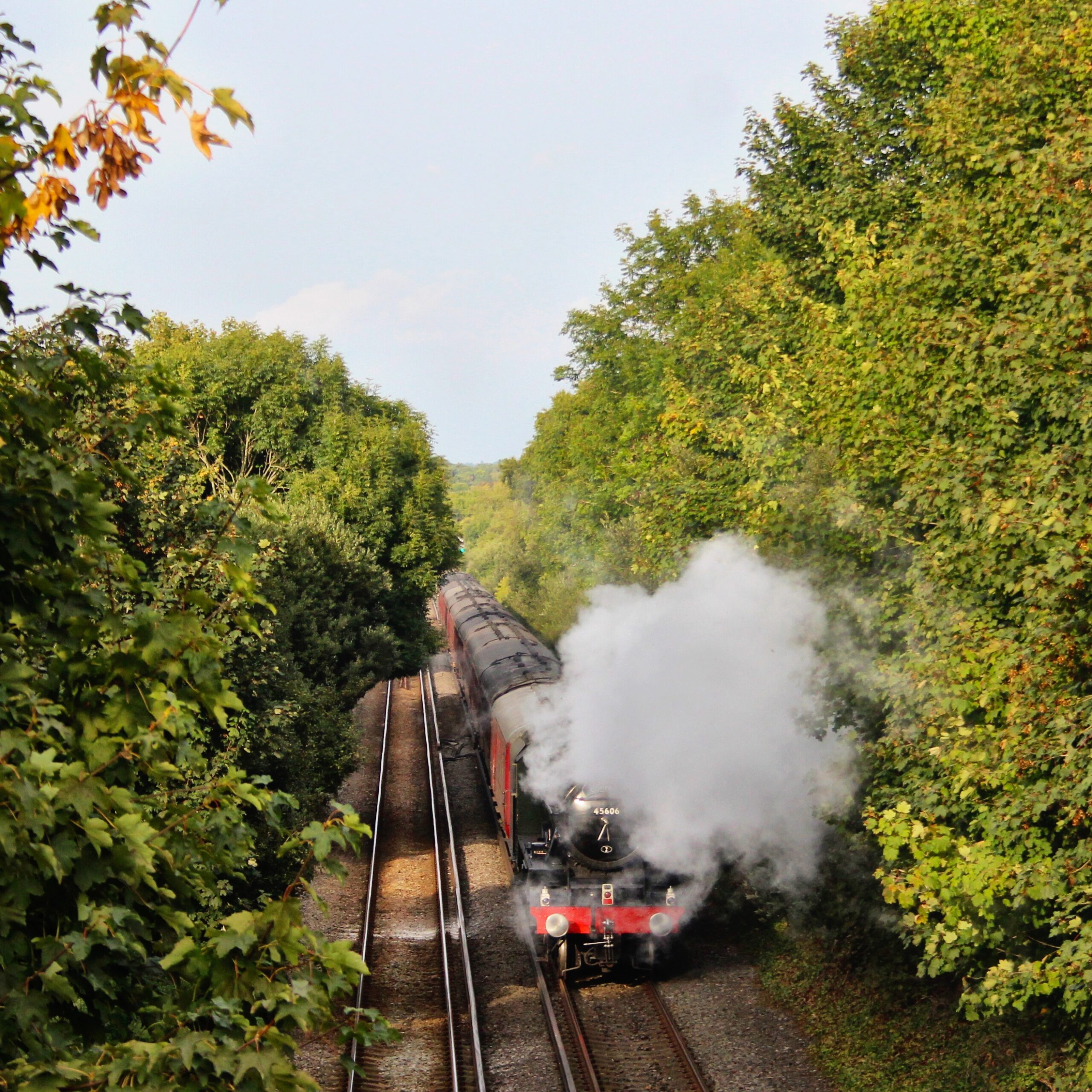
The Swanage Belle – Thursday 22nd September saw the postponed run of The Railway Touring Company organised “The Swanage Belle” headed up by LMS Jubilee 4-6-0 No. 45596 ‘Bahamas’ on the outward run from London Victoria and West Coast Railway Company (WCRC) Class 47 No. 47804 on the return working Swanage as far as Southampton where the steam locomotive once again took control of the train. Premier dining would have set you back £285 and a standard class seat £115 plus £1 for a bag of crisps.
LMS Jubilee 4-6-0 No. 45596 ‘Bahamas’ powers through Hamworthy with “The Swanage Belle” – 22/09/2022Class 47 No. 47804 on the return “The Swanage Belle” rejoins the mainline at Worgret Junction – 22/09/2022
‘Bahamas’ was renumbered and renamed as long scrapped sister locomotive No. 45606 ‘Falkland Islands’ while at Swanage in commemoration of the 40th Anniversary of the Falklands conflict.
Obscured by steam, LMS Jubilee 4-6-0 No. 45596 ‘Bahamas’ running as classmate 45606 ‘Falkland Islands’ on the rear of the return “The Swanage Belle” – 22/09/2022
Video of “The Swanage Belle” – 22/09/2022
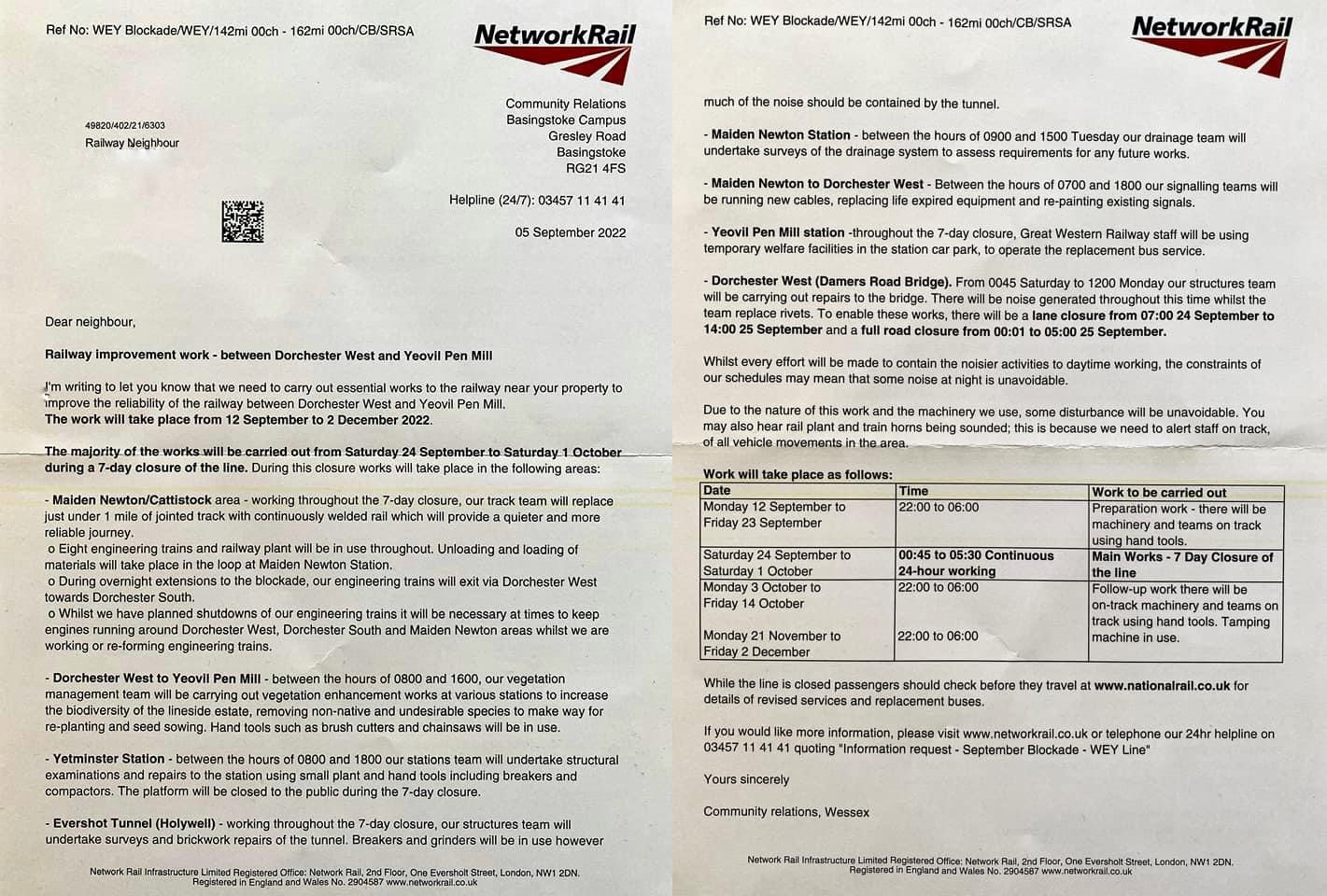
Rail Upgrades – A section of the Bristol to Weymouth “Heart Of Wessex Line” was closed to passenger services on Saturday 24th September through to Friday 30th September 2022 to allow for the replacement of a mile of track between Chetnole and Maiden Newton. At the same time, Yeovil Pen Mill signal box is being overhauled, the platform at Yestminster station is being resurfaced and the road bridge at Dorchester West is being repaired.
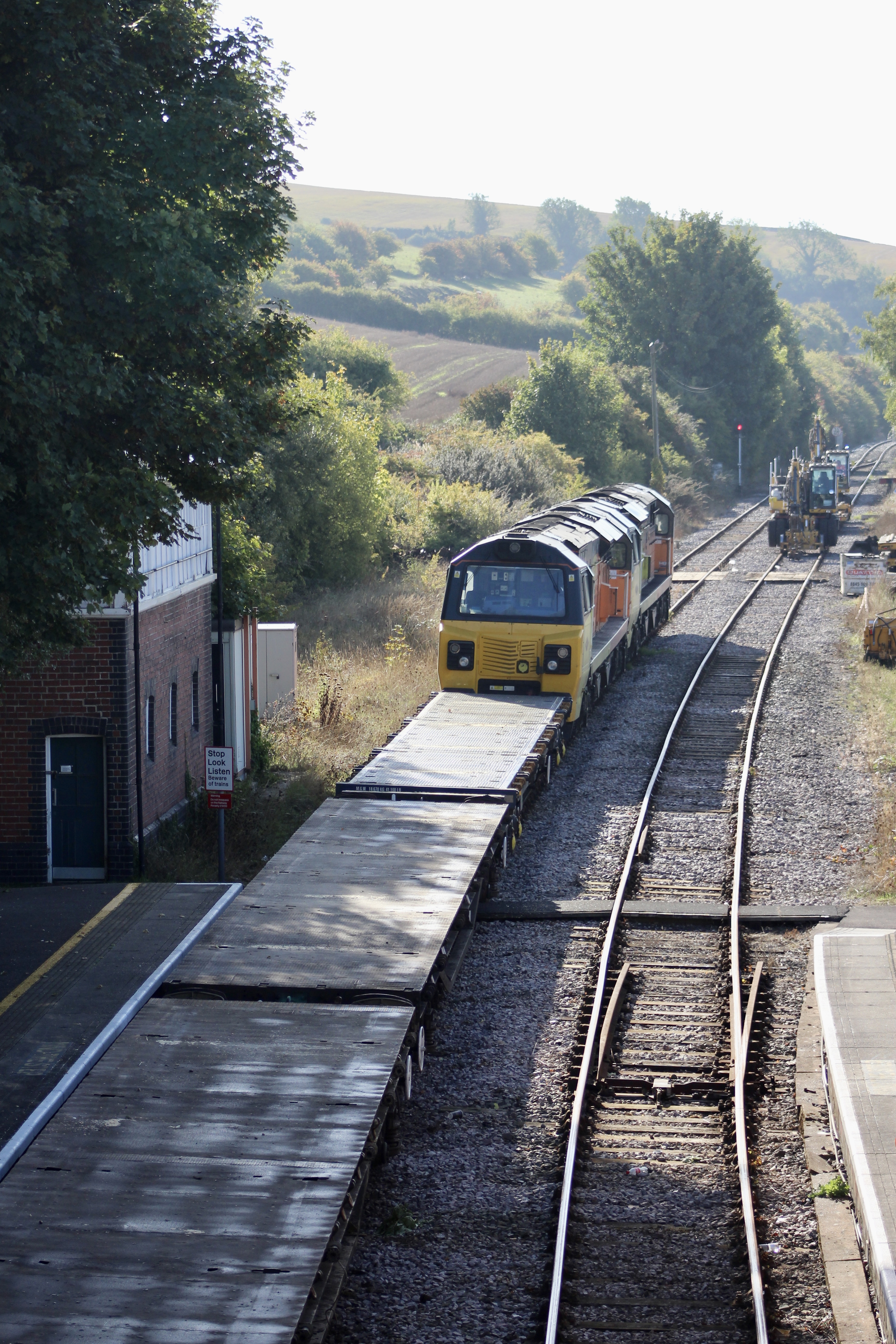
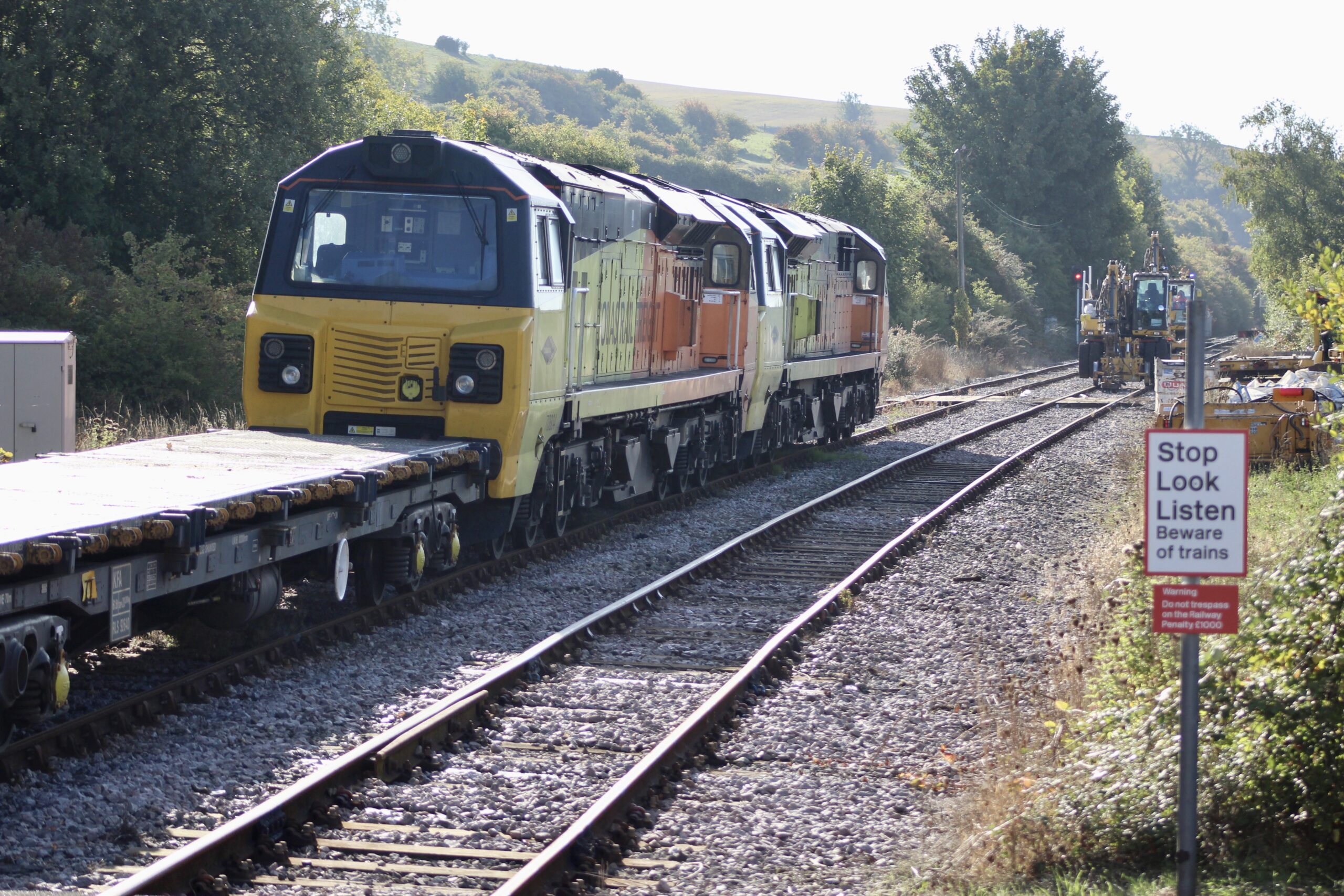
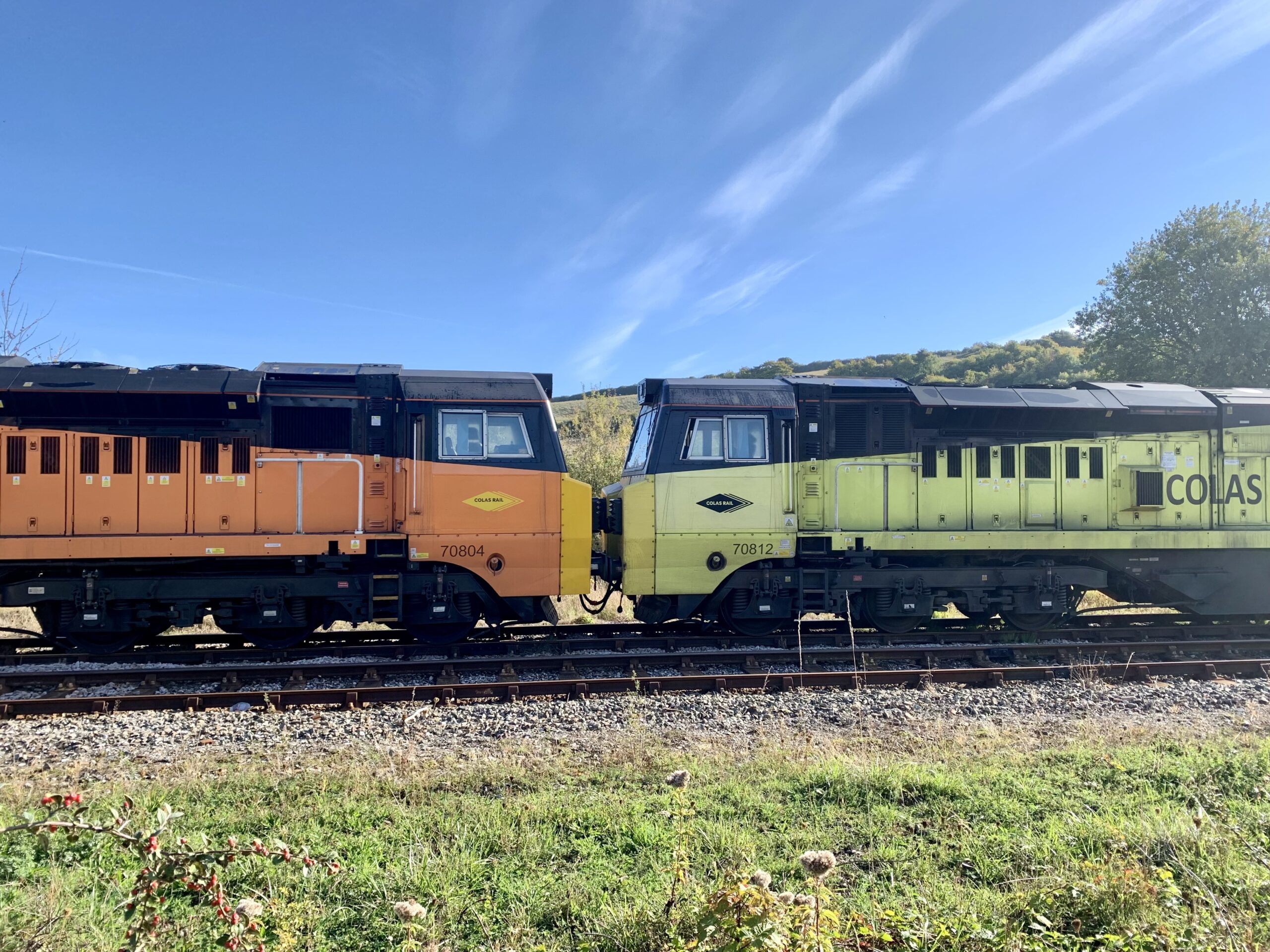
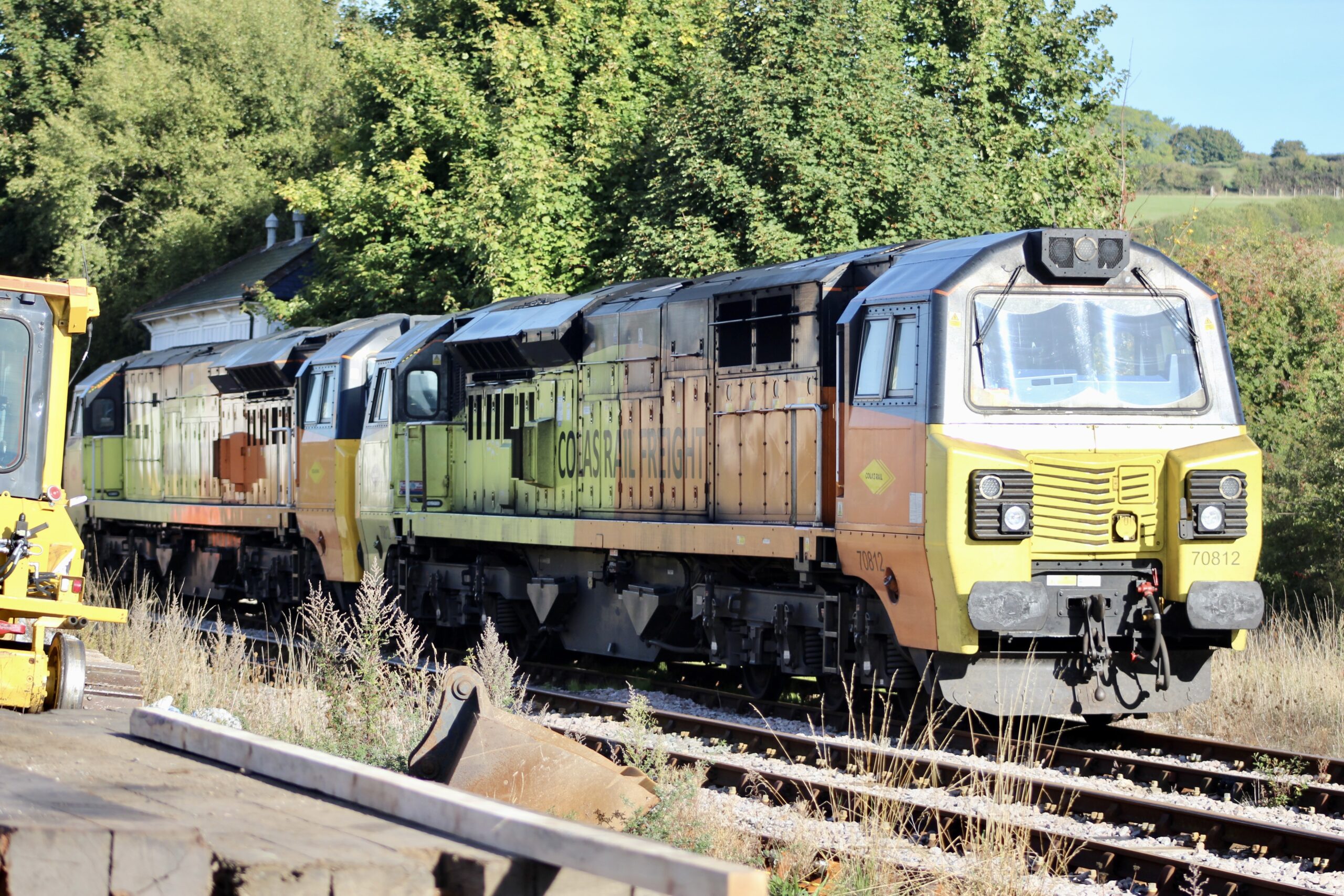
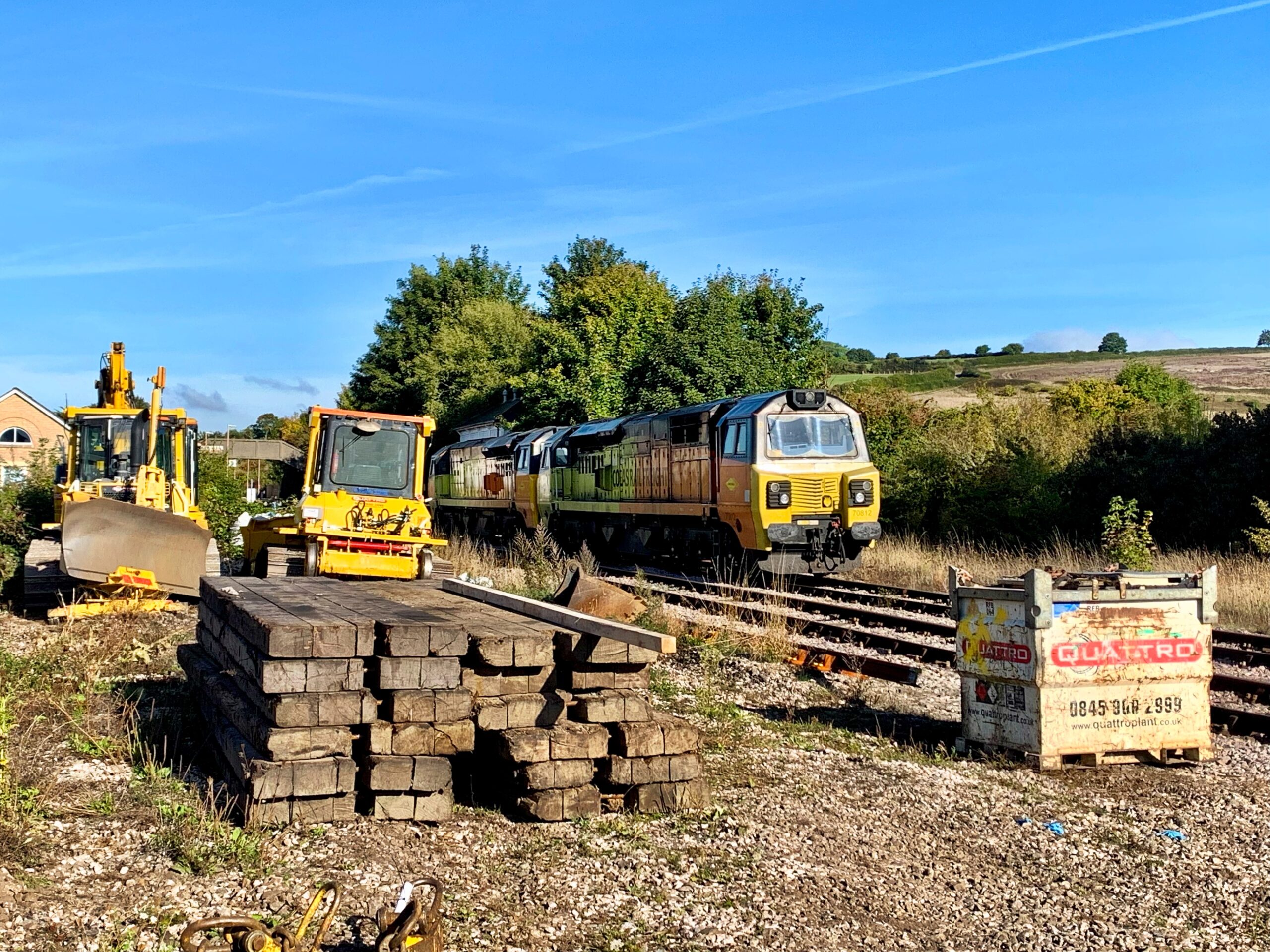
GWR and Network Rail information leafletGWR and Network Rail information leafletColas Rail Class 70 No.’s 70804 and 70812 at Maiden Newton having worked 6C02 2037 Eastleigh East Yard to Maiden Newton, the first of 8 scheduled workings for the upgrade work in the Chetnole area – 25/09/2022Colas Rail Class 70 No.’s 70804 and 70812 at Maiden Newton – 25/09/2022Colas Rail Class 70 No.’s 70804 and 70812 at Maiden Newton – 25/09/2022Colas Rail Class 70 No.’s 70812 and 70804 at Maiden Newton – 25/09/2022Colas Rail Class 70 No.’s 70812 and 70804 at Maiden Newton – 25/09/2022
Further local line closures are scheduled to take place in February 2023 when track renewal takes place in the the Thornford area, the Yeovil Pen Mill to Weymouth route being affected Monday 20th February to Friday 24th February 2023 and again from Monday 27th February to Friday 3d March 2023.
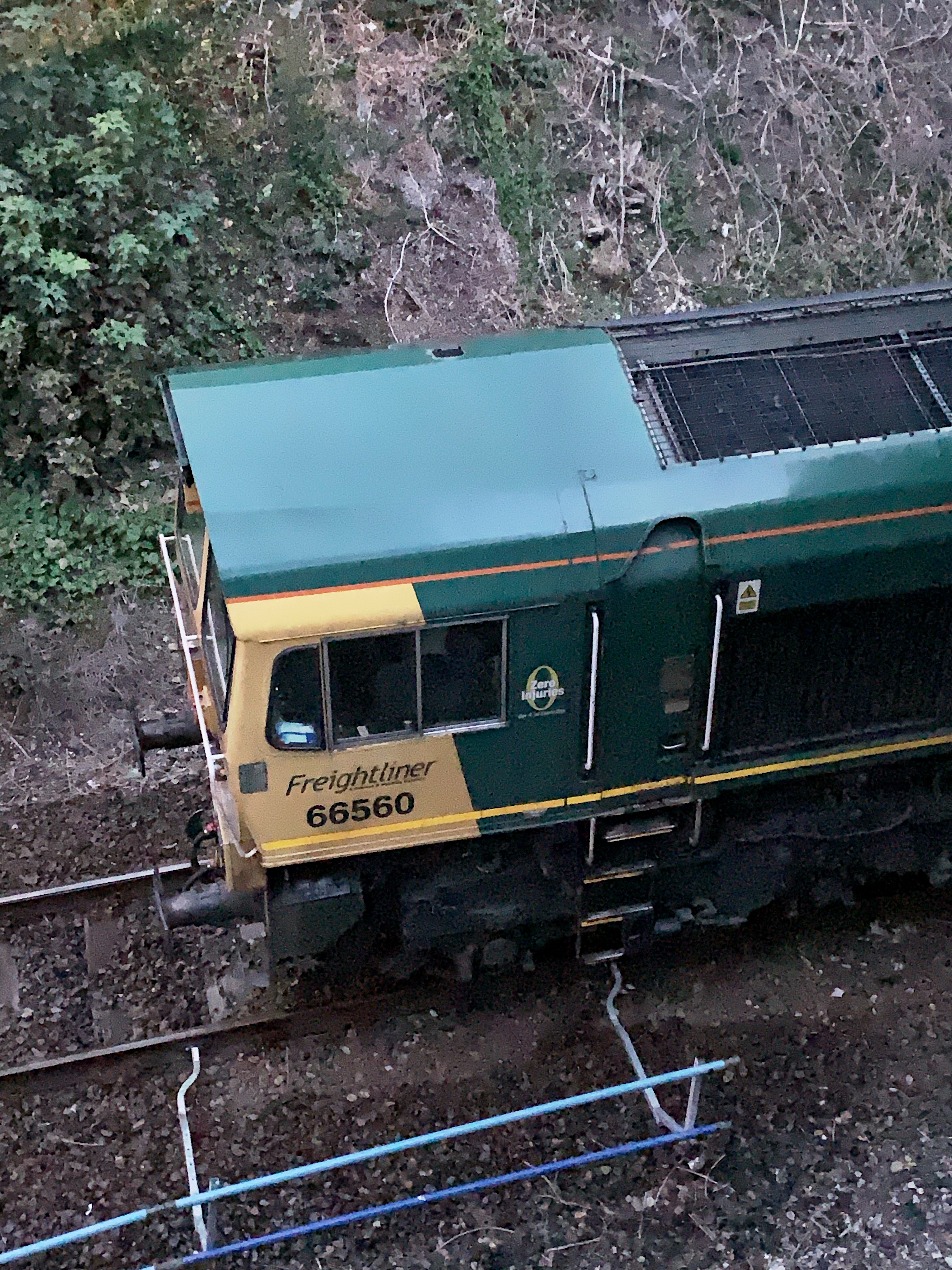
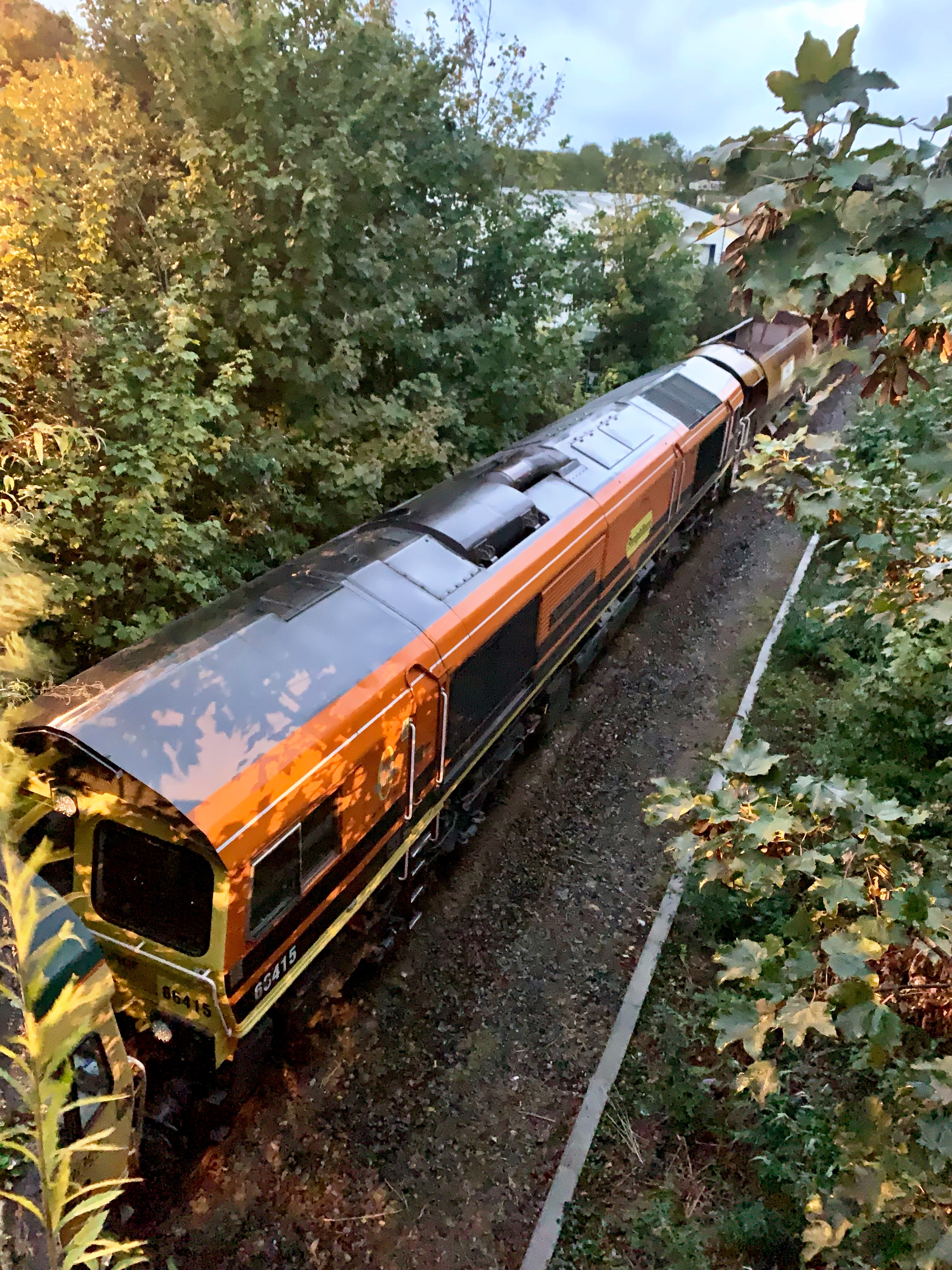
Network Rail “Dear Neighbour” letter detailing the improvement works between Dorchester West and Yeovil Pen Mill – September 2022Yoshi and I popped to Dorchester on the evening of Tuesday 27th September. In fading light, Freightliner Class 66 No.’s 66534 and 66585 stand just outside of Dorchester West with 6Y86 which worked 0438 Eastleigh East Yard to Yeovil Pen Mill and the work site at Maiden Newton on 26th September. The train was scheduled to return to Eastleigh via Dorchester South in the early hours of Wednesday 28th SeptemberIn this view taken from Poundbury Road (Barrack Road) Bridge, Freightliner Class 66 No. 66560 waits in the cutting with 6Y89 (26th September’s 1102 Eastleigh East Yard to Yeovil Pen Mill) while the rear ballast wagons of 6Y86 can be seen protruding from under Bridport Road bridge – 27/09/2022Freightliner Class 66 No. 66560 at the head of 6Y89 near Dorchester West – 27/09/2022In orange and black Genesee & Wyoming livery, Freightliner Class 66 No. 66415 ‘You Are Never Alone’ (named in support of The Samaritans) coupled behind classmate No. 66560 waits at Poundbury Road (Barrack Road) Bridge in Dorchester. The train is scheduled to return to Eastleigh via Dorchester South on 28th September 2022 in the early hours – 27/09/2022
Meanwhile work on the Hamworthy Branch continues with the repointing of the brickwork on the abutments for the over bridge on Lake Road on Monday 26th September 2022.
Bridge work, Lake Road Hamworthy – 26/09/2022Bridge work, Lake Road Hamworthy – 26/09/2022
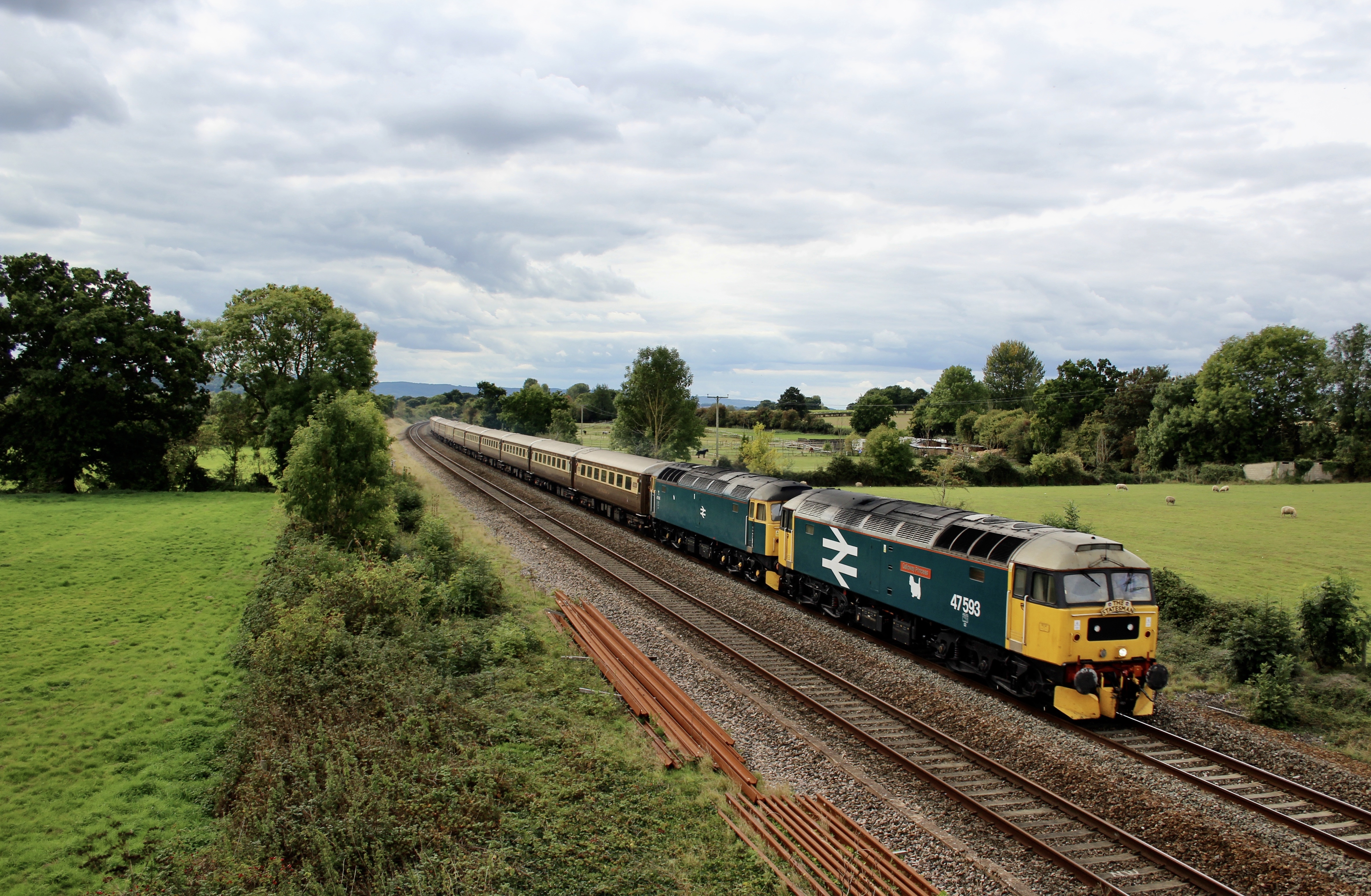
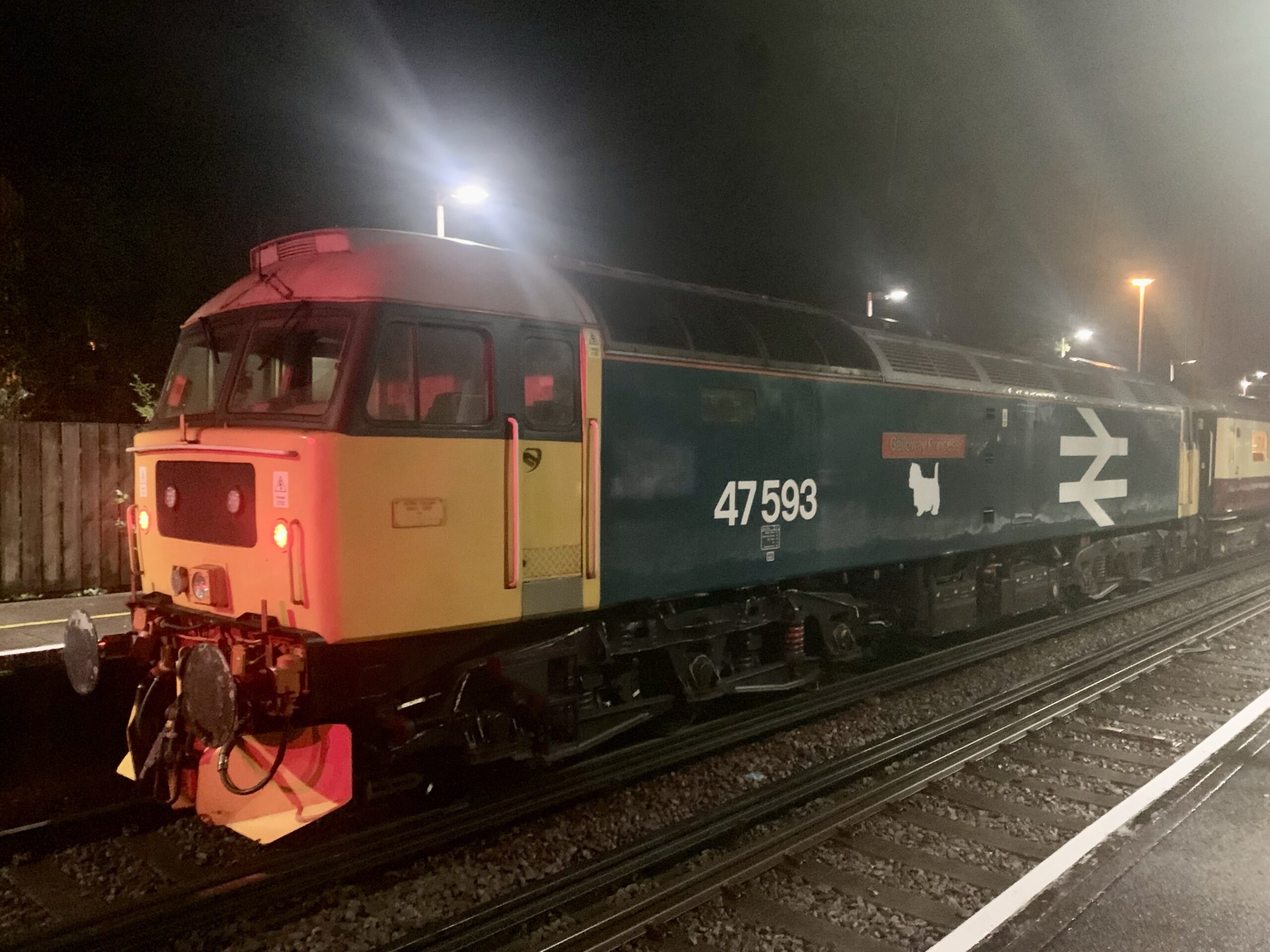
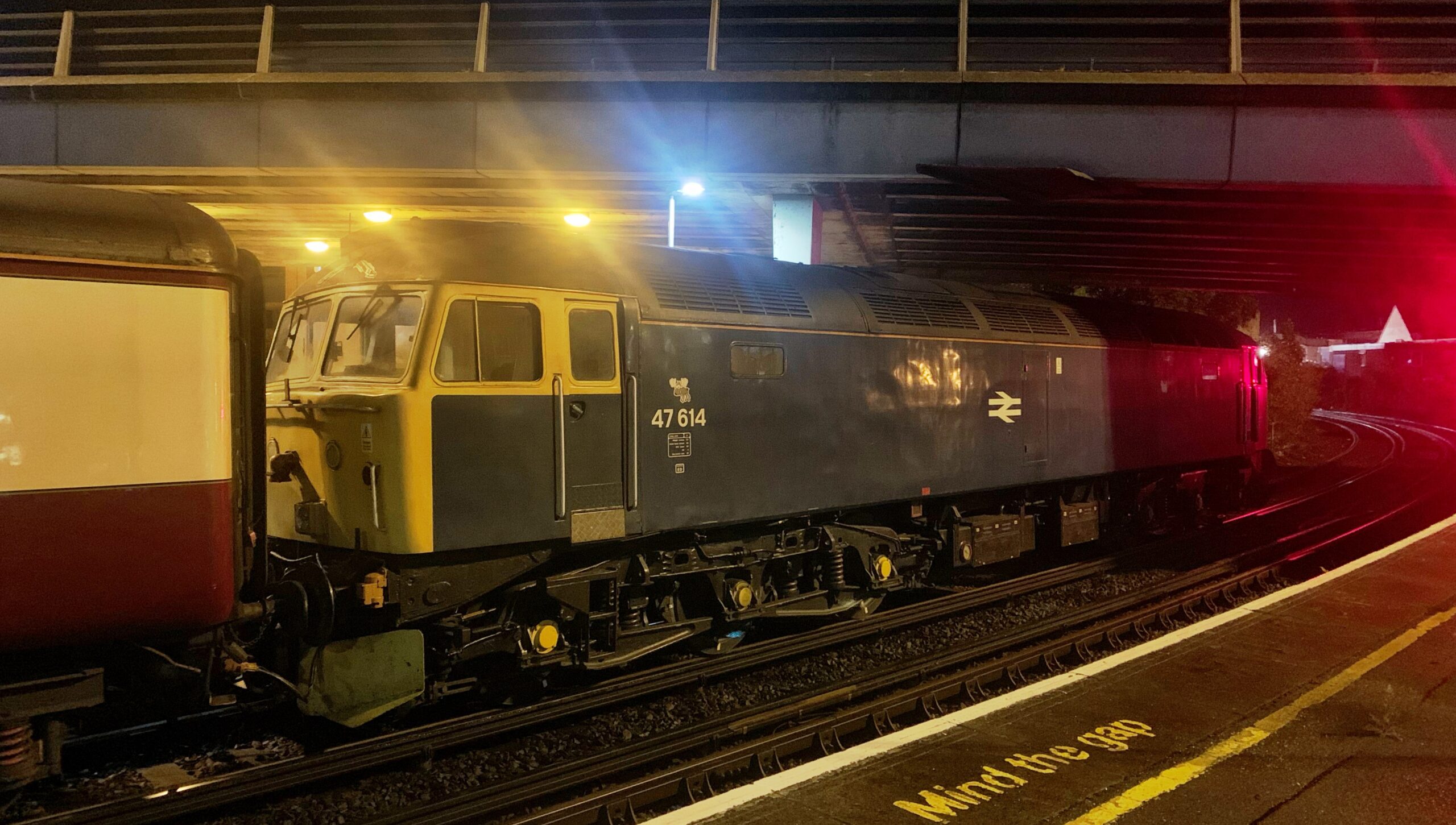
Cogload Junction – After we popped into Maiden Newton on Sunday 25th to see the Colas Rail Class 70’s, Yoshi and I headed off in the direction of Taunton to catch a glimpse of Statesman Rail’s “Cornish Explorer Statesman” which was heading back to York having departed Penzance earlier in the day. The train was headed by double headed Class 47 No.’s 47593 ‘Galloway Princess’ and 47614. We spent an hour or so at Cogload Junction and saw several GWR Castle HST sets, IET’s and a solitary CrossCountry HST working.
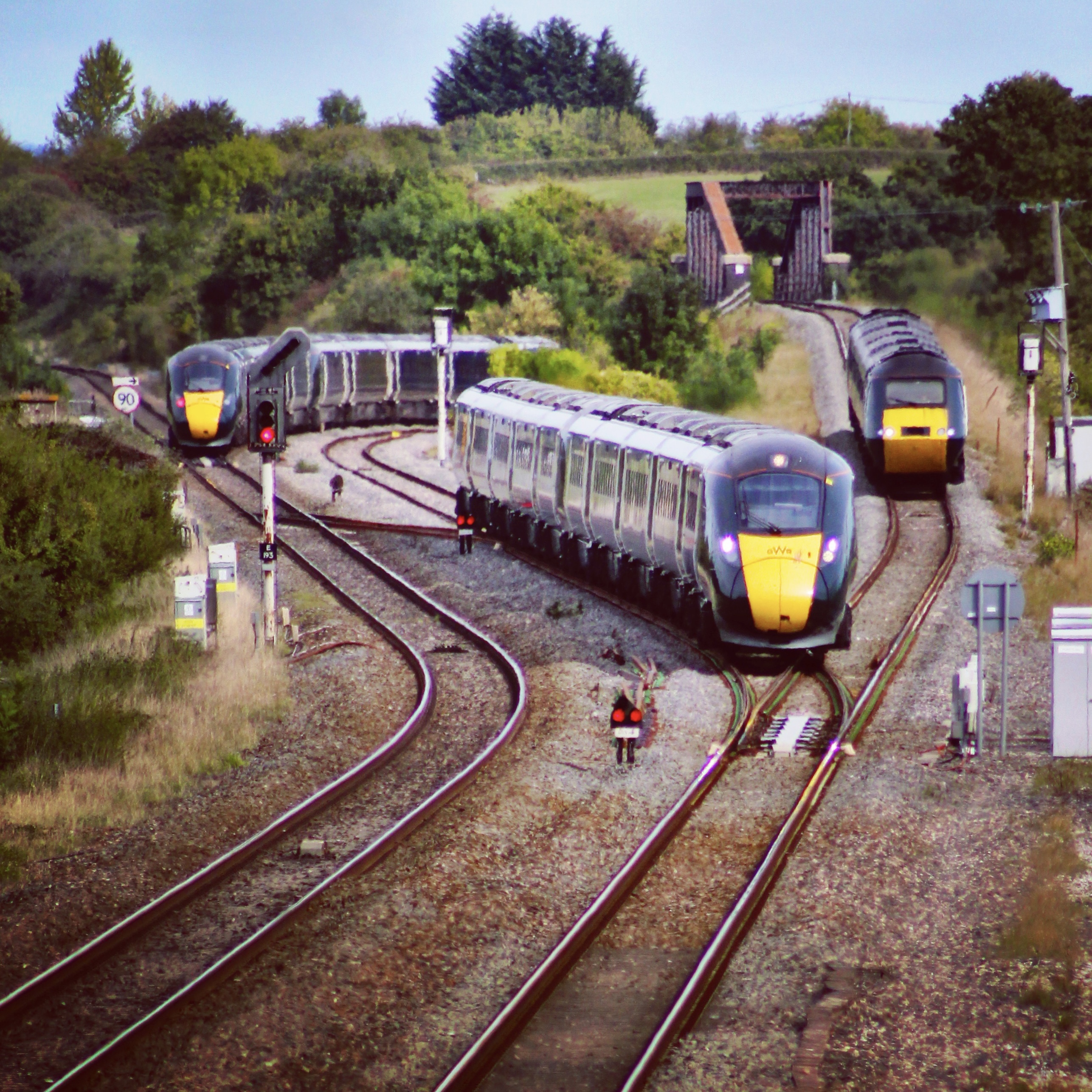
2C71 1102 Bristol Temple Meads to Taunton with Castle Class HST power cars 43171 (leading) and 43194 at the rear about to pass Cogload Junction via the flyover – 25/09/2022Class 47 No.’s 47593 ‘Galloway Princess’ and 47614 working 1Z28 0937 Penzance to York; Statesman Rail’s “Cornish Explorer Statesman” at Cogload – 25/09/2022A busy few minutes as 1C79 1103 London Paddington to Plymouth formed of GWR IET No.’s 800009 and 800027 flanked by 1A82 0918 Penzance to London with No.’s 800015 and 800025 and Castle Class HST with power car No.’s 43042 and 43094 working 2C73 1055 Cardiff Central to Penzance – 25/09/2022
Cogload Junction is located at Durston, Somerset about five miles east of Taunton. It is where the 1906-opened London Paddington to Penzance line via Castle Cary joins the original 1842 GWR line that runs via Bristol Temple Meads. A flyover was constructed in 1931 converting it into a flying junction.
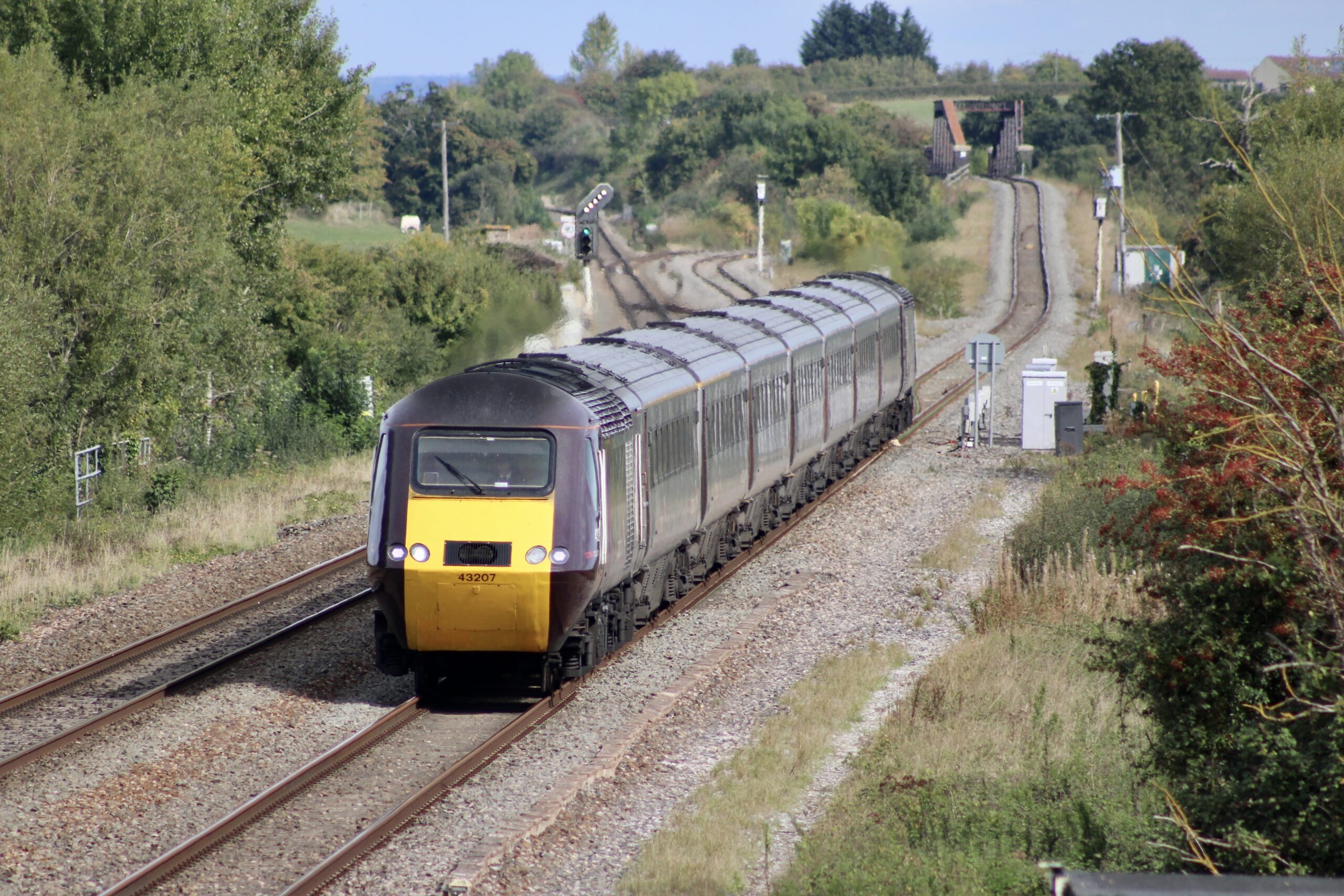
CrossCountry HST 1V48 0811 Leeds to Plymouth worked by Class 43 power car No.’s 43207 and 43321 at Cogload Junction – 25/09/2022
Cogload Junction on 25/09/2022. Trains include: 2U14 0947 Plymouth to Cardiff Central No.’s 43162/ 43160, 2C71 1102 Bristol Temple Meads to Taunton No.’s 43171/43194, 1M45 1049 Paignton to Birmingham New Street No. 220006, 2U16 0850 Penzance to Cardiff Central No.’s 43010/43092, 1V48 0811 Leeds to Plymouth No.’s 43207/43321, 1A82 0918 Penzance to London No.’s 800015/800025, 1C79 1103 London Paddington to Plymouth No.’s 800009/800027, 2C73 1055 Cardiff Central to Penzance No.’s 43042/ 43094, 1S49 0930 Penzance to Newcastle No. 220013, 2U18 1318 Taunton to Cardiff Central No.’s 43194/43171, 1Z28 0937 Penzance to York No.’s 47593/47614
Test Train – Regular test train top and tailed by Class 73 Electro-Diesels No.s 73964 ‘Jeanette’ and 73962 ‘Dick Mabbutt’ visited on Monday 26th September 2022 working 1Q51 Derby RTC to Eastleigh East Yard via Weymouth. Yoshi barked at the consist as it passed through Hamworthy.
1Q51 Derby RTC to Eastleigh East Yard via Weymouth seen at Hamworthy – 26/09/2022
That’s all we have time for this week. We’ll be back in seven days and hope you’ll join us then. Thank you for your comments and corrections, all gratefully received!
Felucca’s, a traditional Egyptian wooden sailing boat, at sunset on the River Nile at Aswan, Egypt – 16/09/2022
Dorset
After last weeks ‘filler’ blog entry on the XP64 livery, we’re back! I’ve been on my hols, as has Yoshi who has been staying with his cousins. I’m sure it was a very happy doggo madhouse for a couple of weeks! Have to admit I missed our boy and it was so very good to see his excited face again when we were all reunited together ready to catch up on Yoshi’s favourite TV programme; “Married At First Sight UK”.
Yoshi takes a break during his walkies
Before we went off on my travels, I was up early on Wednesday September 7th 2022 in order to see the departure of the “Welsh Marshes Express” rail tour from Poole on its way to Shrewsbury. The Dorset part of the tour saw top and tailed Locomotive Services Limited Class 47’s in charge, the working being taken over by steam in the form of BR Standard Class 7 No. 70000 ‘Britannia’ at Bristol where the train was taken forward to Shrewsbury and its return back to Temple Meads before the Class 47’s returned the train back to Poole.
LSL Class 47 No. 47593 ‘Galloway Princess’ having arrived at Poole with the empty coaching stock movement (5z64 0400 Eastleigh Arlington (ZG) to Poole) for Saphos Trains “Welsh Marches Express” – 07/09/2022Class 47 No/ 47614 awaits the green with 1Z65 0508 Poole to Shrewsbury “Welsh Marshes Express” excursion at Poole – 07/09/2022
Early morning video of Class 47 No.’s 47593 and 47614 at Poole. I may have messed up the departure shot! – 07/09/2022
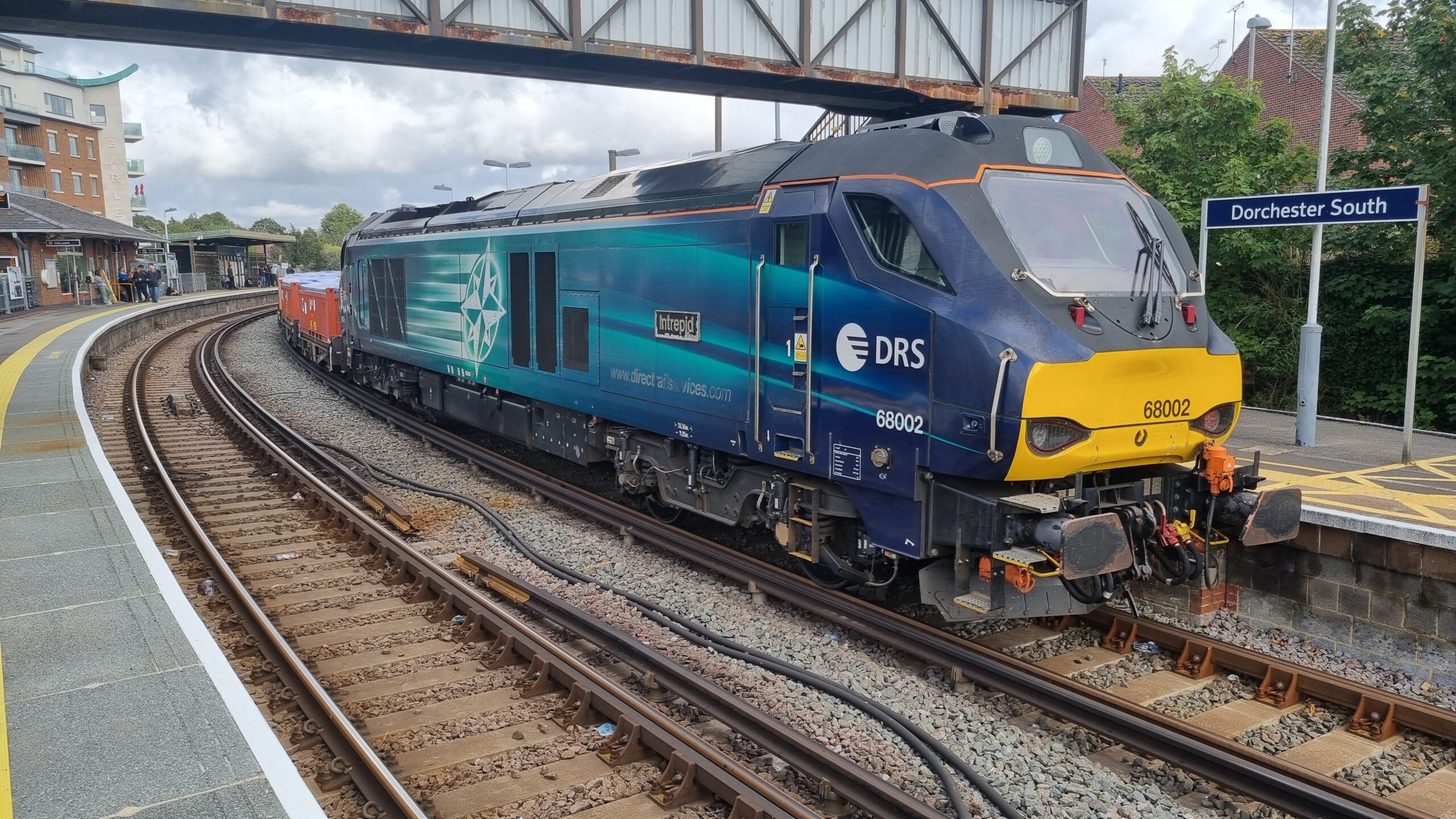
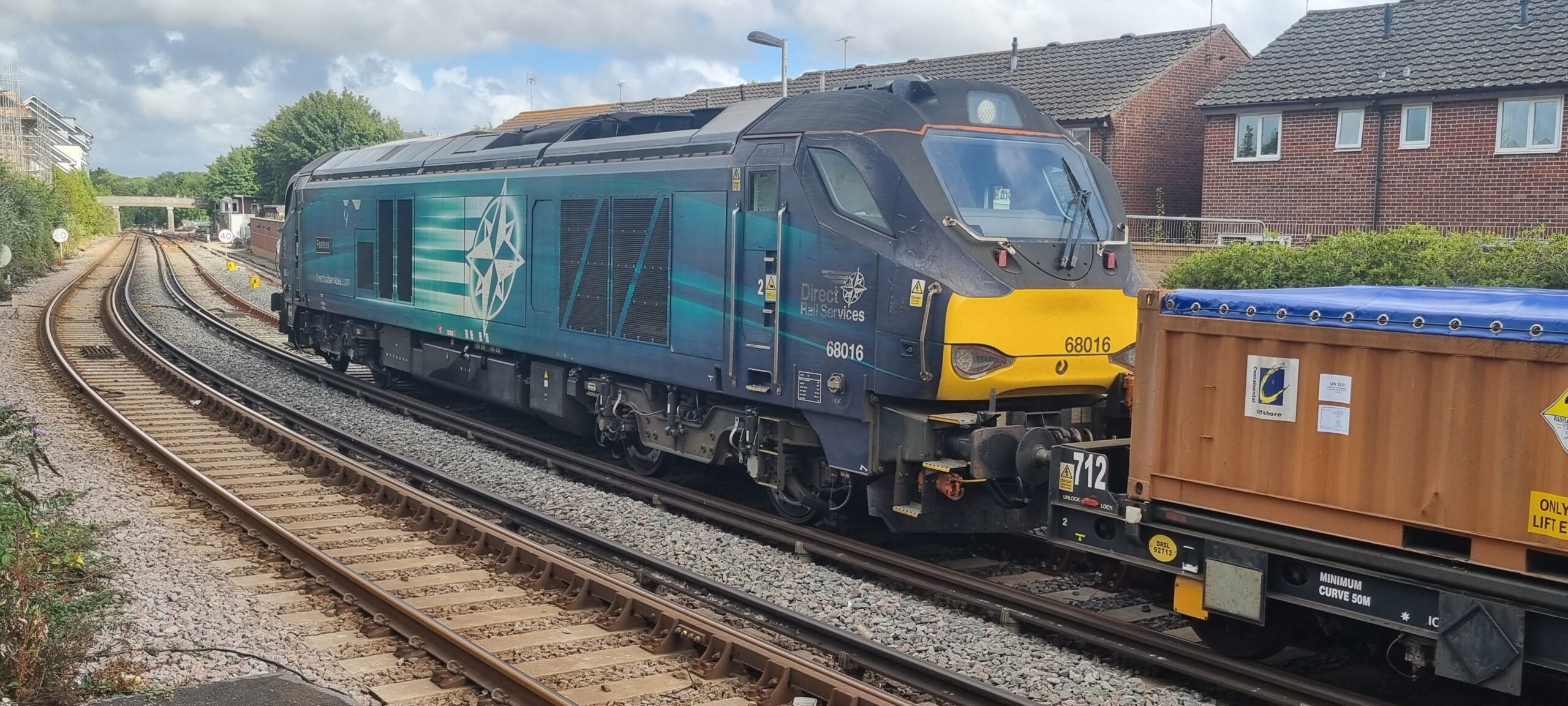
Also the same day was an additional Winfrith working; 6Z62 0103 Crewe Coal Sidings (DRS) to Winfrith Sidings with Class 68’s once again taking a train of empty PFA wagons to collect low level nuclear waste from the Magnox site.
DRS Class 68 No. 68002 ‘Intrepid’ with sister locomotive 68016 at the rear powers through Holton Heath with a train consisting of ten empty PFA wagons bound for Magnox Winfrith – 07/09/202268016 ‘Fearless’ at the tail end of 6Z62 0103 Crewe Coal Sidings (DRS) to Winfrith Sidings having passed through Holton Heath – 07/09/2022
DRS Class 68 No.’s 68002 ‘Intrepid’ and 68016 ‘Fearless’ pass through Holton Heath – 07/09/2022
I was enjoying the hospitality of Heathrow T5 when 2 x Colas Class 37’s were in Weymouth working the New Measurement Train which is normally in the control of former HST power cars, but by kind permission, we can share the video below of the train reversing at Weymouth:
Class 37 No.’s 37219 and 37421 work 1Z22 0729 Derby RTC to Bristol Kingsland Road via Weymouth – 07/09/2022 with many thanks to @da_buckley967
The return working of the Winfrith low level nuclear waste train was occupying Dorchester South at around the same time the Class 37’s were passing through Dorchester West with the return NMT working. I at least didn’t have to make a choice as to which train I would have photographed as at that moment I was boarding my BA flight to Egypt. However, with kind permission, we can share the following images of the loaded DRS train at Dorchester South:
DRS Class 68 No. 68002 ‘Intrepid’ with the return working of the loaded low level nuclear waste train working as 6Z95 Winfrith Sidings to Crewe at Dorchester South where the train reversed – 07/09/2022 with many thanks to Scott LewisDRS Class 68 No. 68016 ‘Fearless’ prepares to depart Dorchester South with the return Winfrith – 07/09/2022 with many thanks to Scott Lewis
Thursday 8th September and Thursday 15th September were scheduled dates for steam hauled excursions into Dorset run by The Railway Touring Company. Unfortunately a passenger falling ill and then sadly passing away at London Victoria on “The Swanage Belle” on the 8th meant the train was cancelled prior to departure. Our condolences to family and friends concerned. “The Dorset Coast Express” due to run on the 15th fell foul of the scheduled rail strike which in the event was itself cancelled following the death of Queen Elizabeth II. Both trains were to have been worked on the outward leg by LMS Jubilee Class 4-6-0 No. 45596 ‘Bahamas’. “The Swanage Belle” was rescheduled for 22nd September 2022.
Egypt
In 1851 Abbas I, Khedive of Egypt, began negotiations with British engineer Robert Stephenson for the construction of a railway from Alexandria to Cairo. This was only the second railway built in the world and the first on the African continent. The 120 mile line to Cairo was completed by 1856 and work began on a southern extension with a 230 mile section to Assiut finished in 1874.
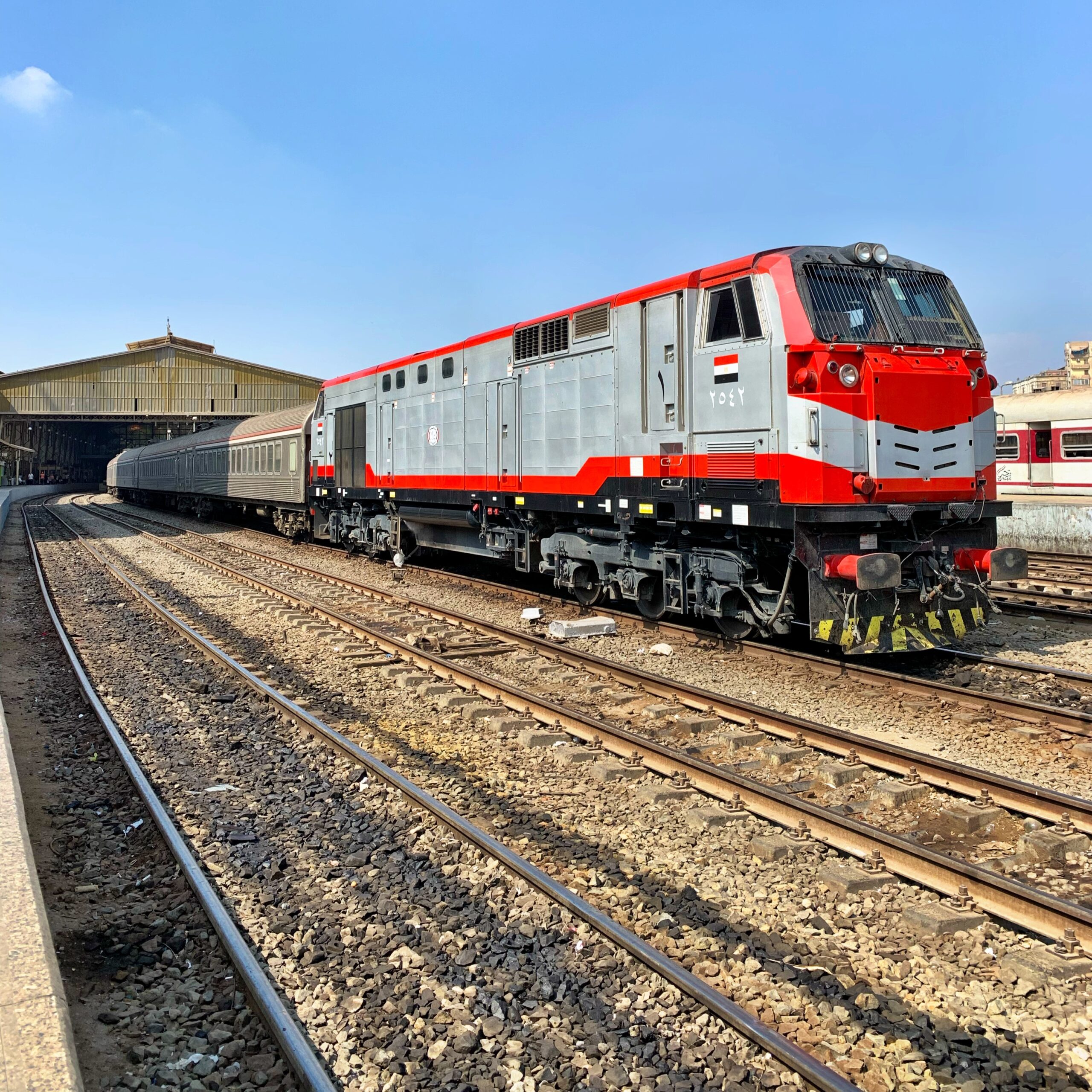
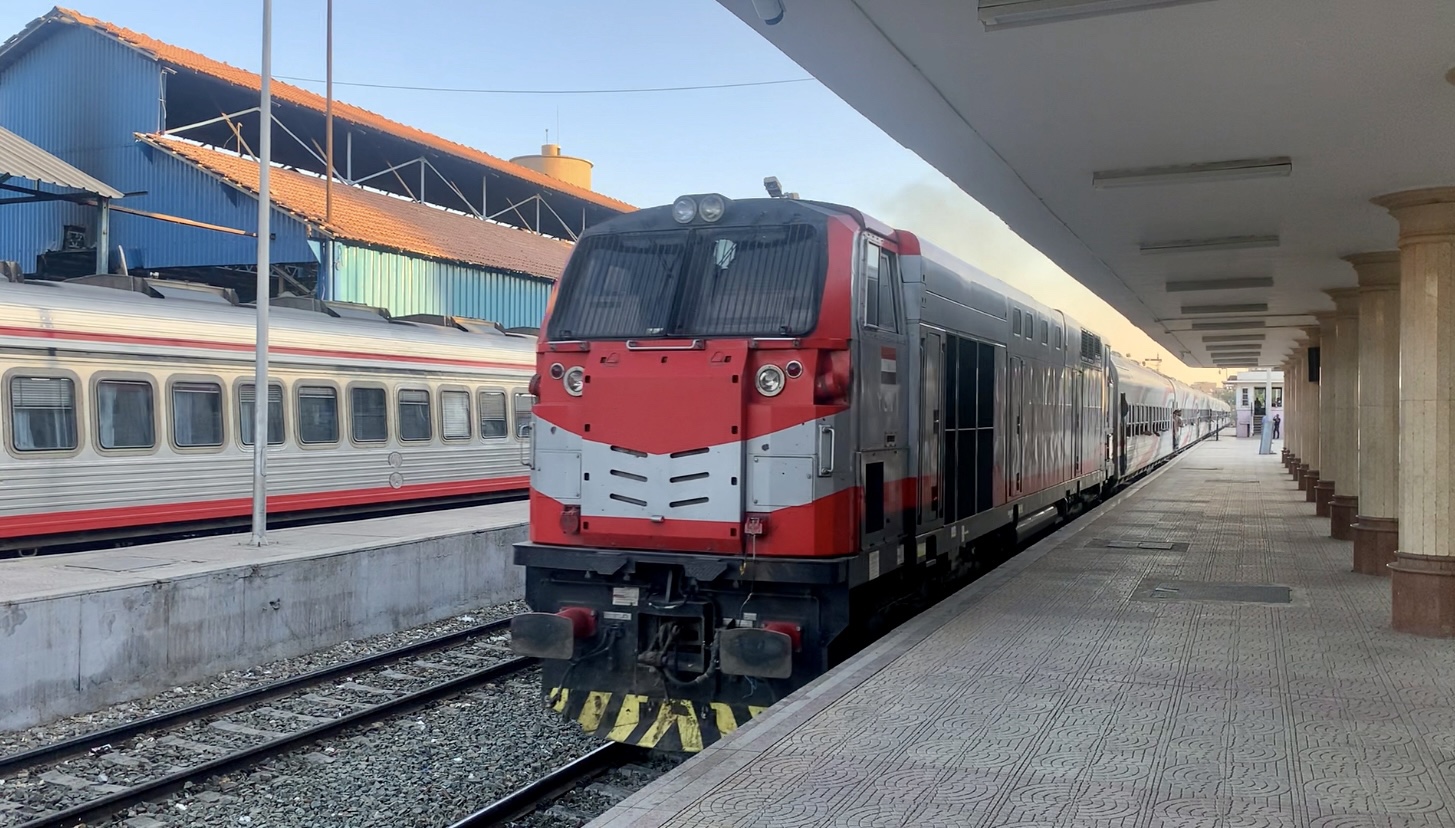
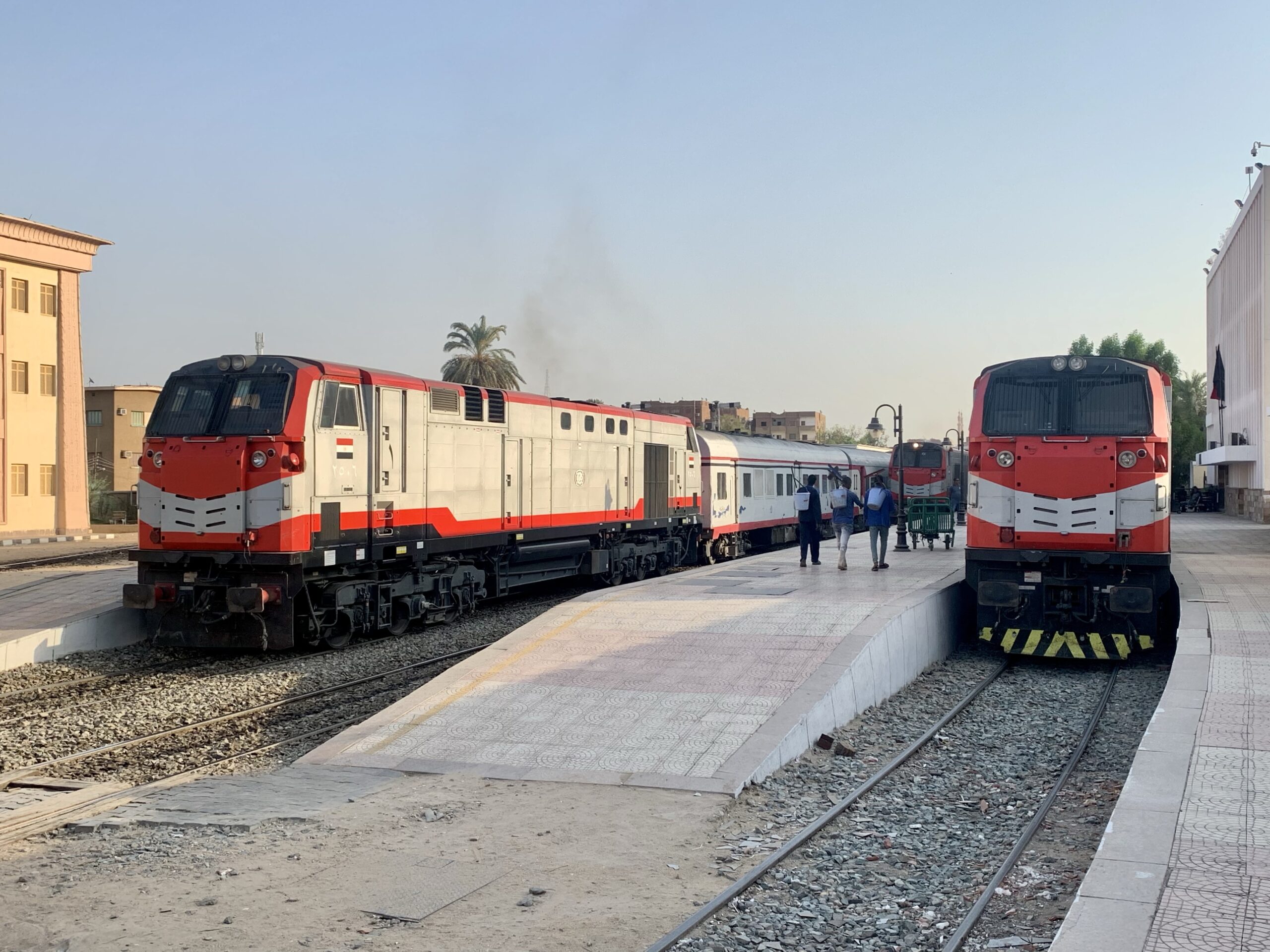
in September 2022, the majority of Egyptian National Railway services we saw during our stay were hauled by the impressive ES30ACi Light Evolution diesel locomotives built by the American GE Transportation Systems (now owned by Wabtec) and are are equipped with a 12-cylinder, 3200 HP GE Evolution Series engine. The locomotives are capable of passenger and freight train duties and 110 were ordered in 2017, the final units being delivered in March 2021.
I was a little concerned about railway photography in Egypt as UK Foreign Office advice noted that British nationals have been arrested for photographing amongst other things, train stations and bridges. So, during my stay I ensured that permission was asked and if possible I was with my guide or a local travel company agent. I’m pleased to report I wasn’t arrested, and was in all instances greeted by friendly waves, enthusiasm and chat.
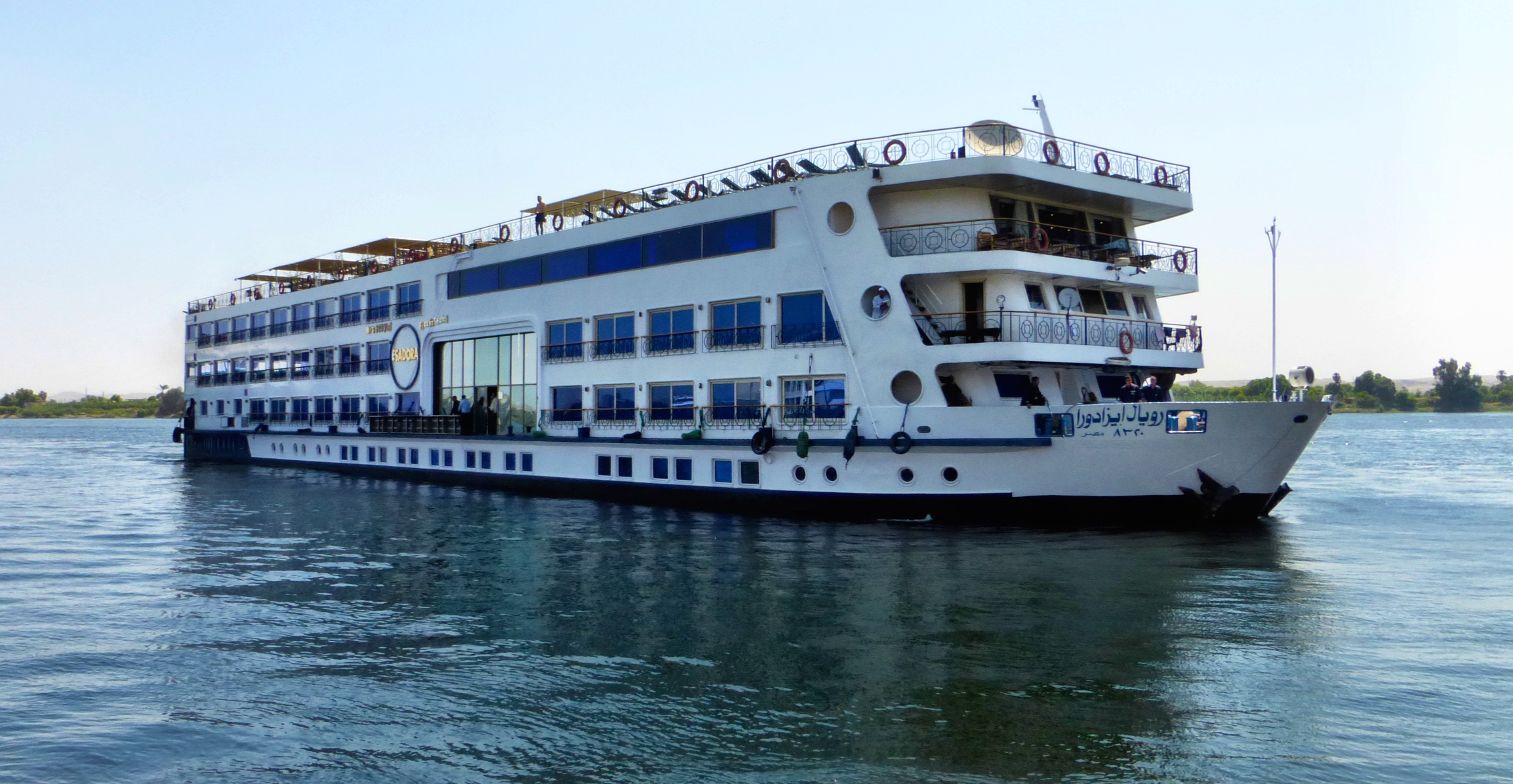
We spent a few days in Cairo before flying to Luxor to board the M/S Royal Esadora which would take us along the River Nile to Aswan and back.
M/S Royal Esadora at Edfu – 14/09/2022
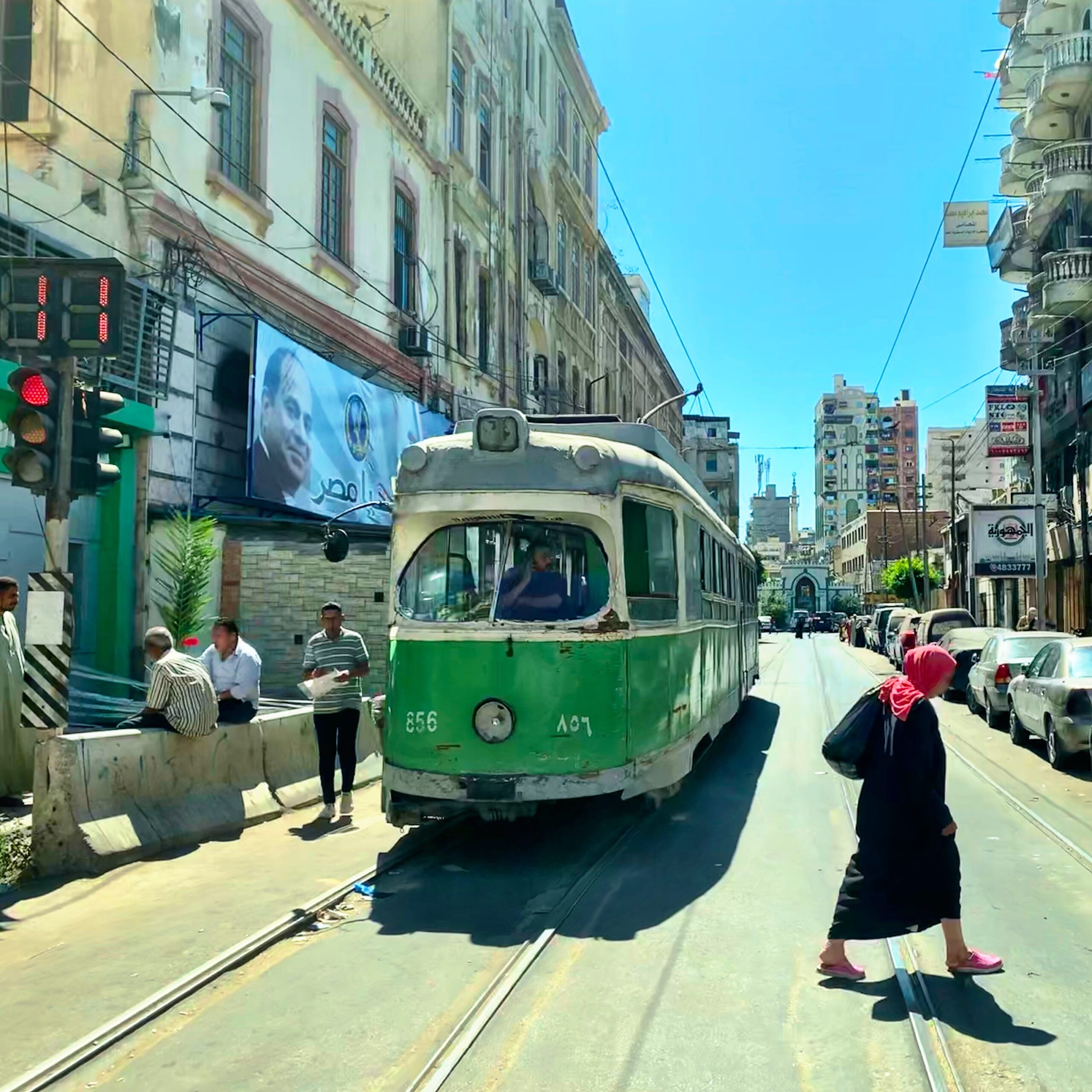
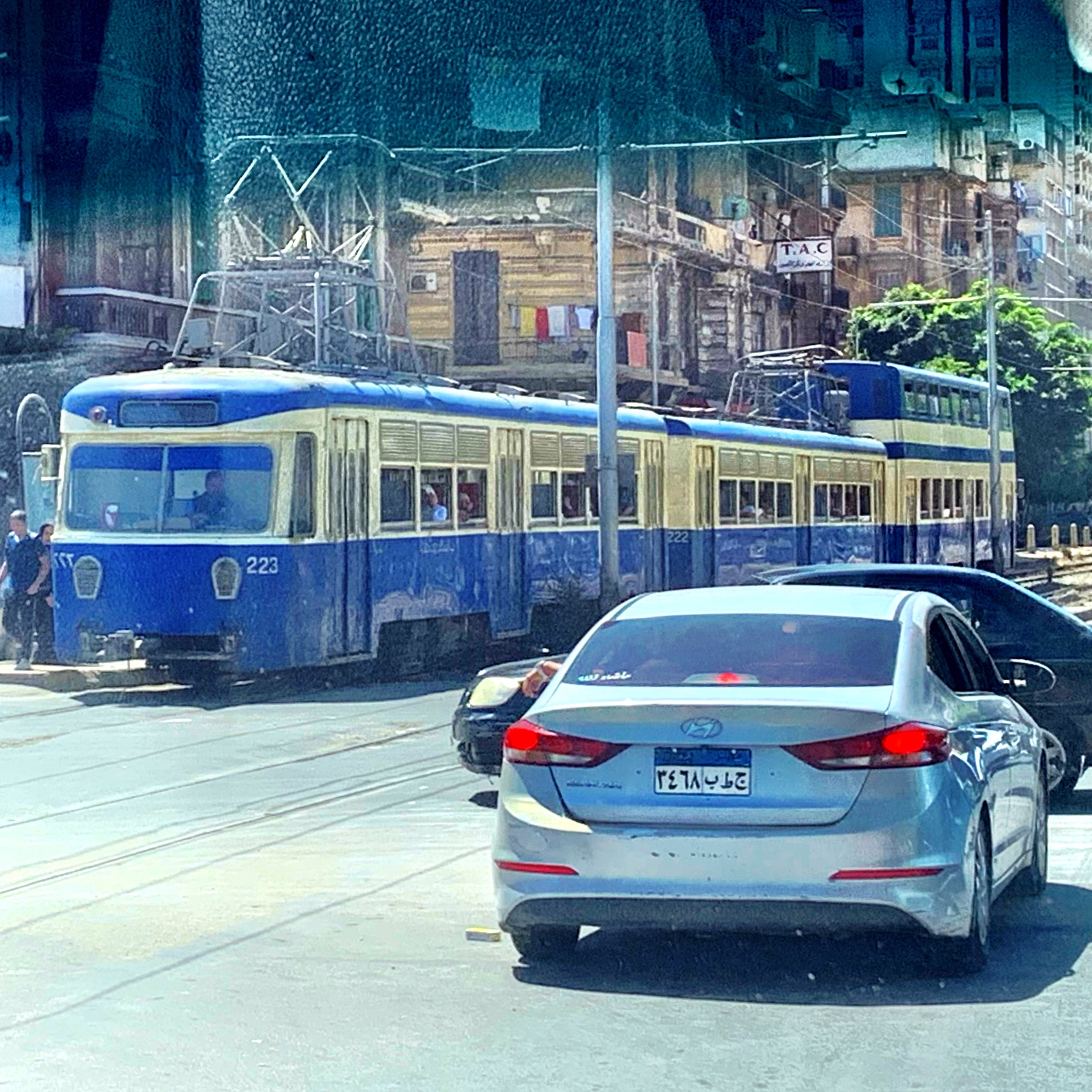
The Alexandria Tramway Network – Alexandria is located on the Nile delta in the north of Egypt. We travelled by car from Cairo for the day and as we drove around, our guide enthused over the wooden trams which still survive. The license to build a tramway system in Alexandria was issued on 16 August 1860, and the first line of the network began operating in on 8 January 1863. The system was electrified in 1902. There is an extensive network of 20 tram lines operating on 32 kilometers of track, serving 140 stops, running in the streets of central and western Alexandria as well as the coastal Al Raml line.
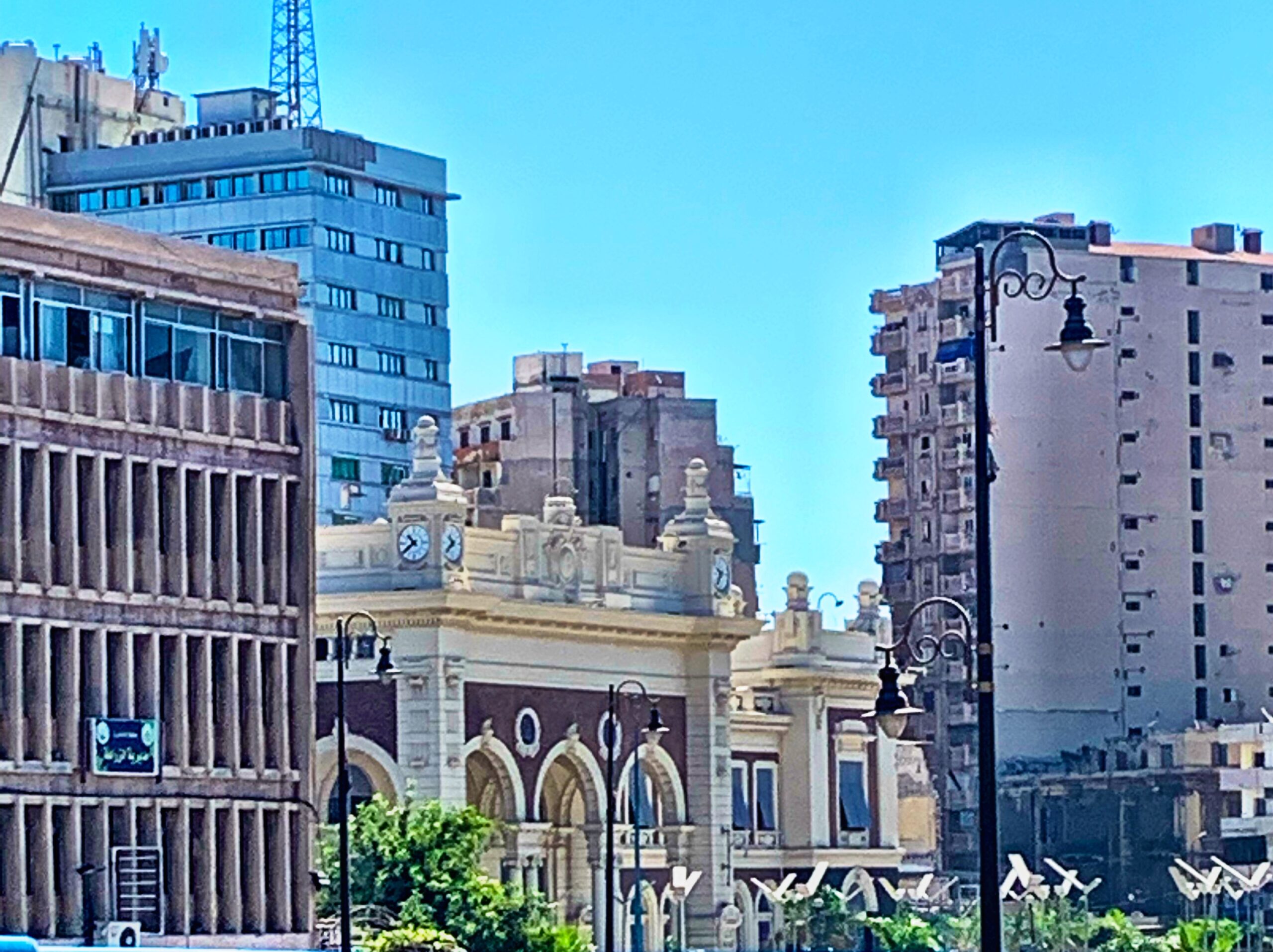
Former Copenhagen DUEWAG GT6 – the vehicles are almost 60 years old – Alexandria 11/09/2022Former Copenhagen DUEWAG GT6 unit which were introduced to Egypt between 1969 and 1972 – Alexandria 11/09/2022Tatra-Yug K-1E6 in service on lines 5/6 on the Ramleh tram – the vehicles are fitted with both standard pantographs and trolley poles in order to be operated on both networks – Alexandria 11/09/2022The Japanese Kinki Sharyo units were built between 1975 to 1995. One of the six double-deck iterations on the Ramleh tram – Alexandria 11/09/2022 A restored single Maschinenfabrik Oerlikon car dating from 1925 – Alexandria 11/09/2022A glimpse of Alexandria Railway Station – 11/09/2022
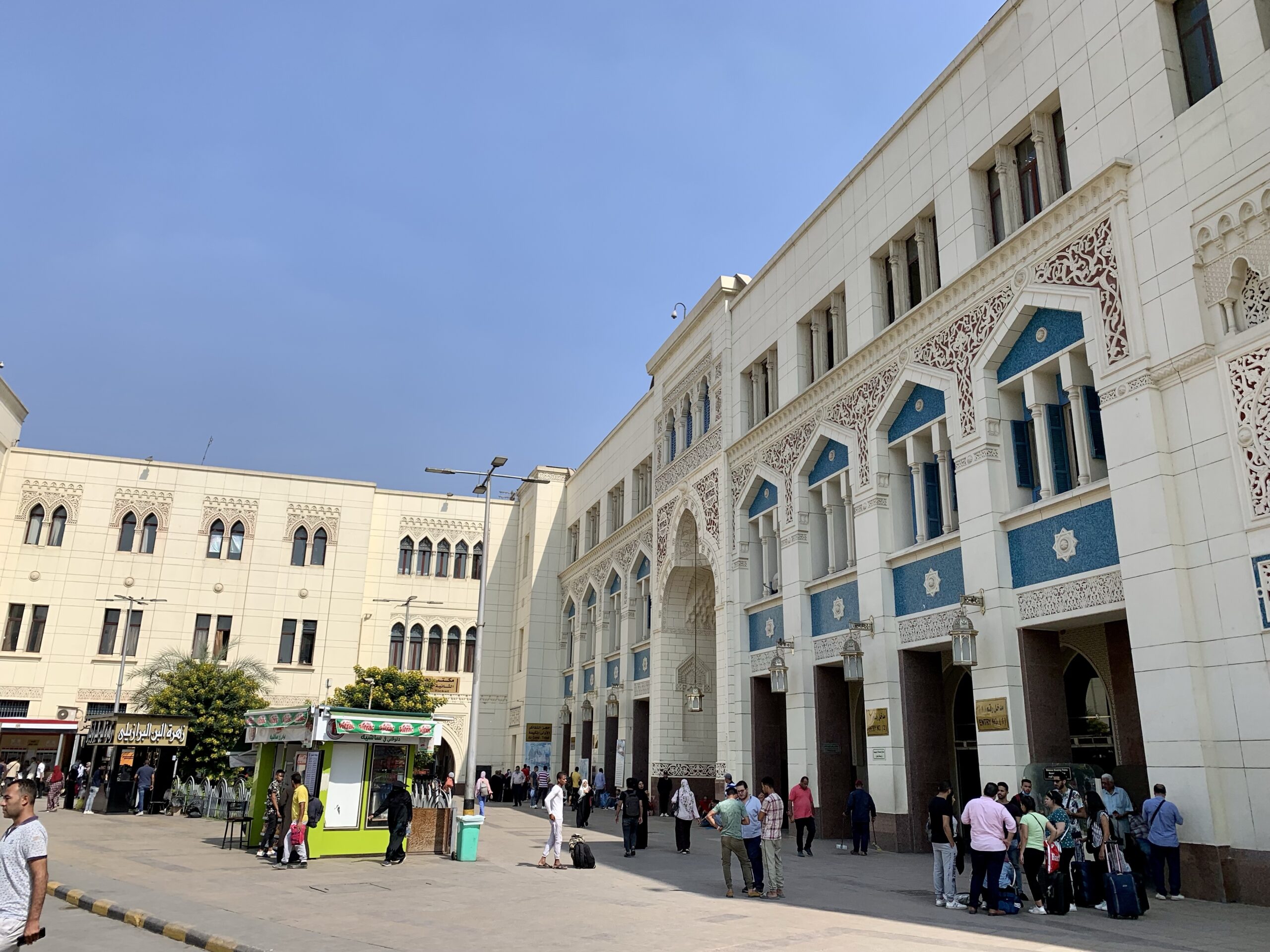
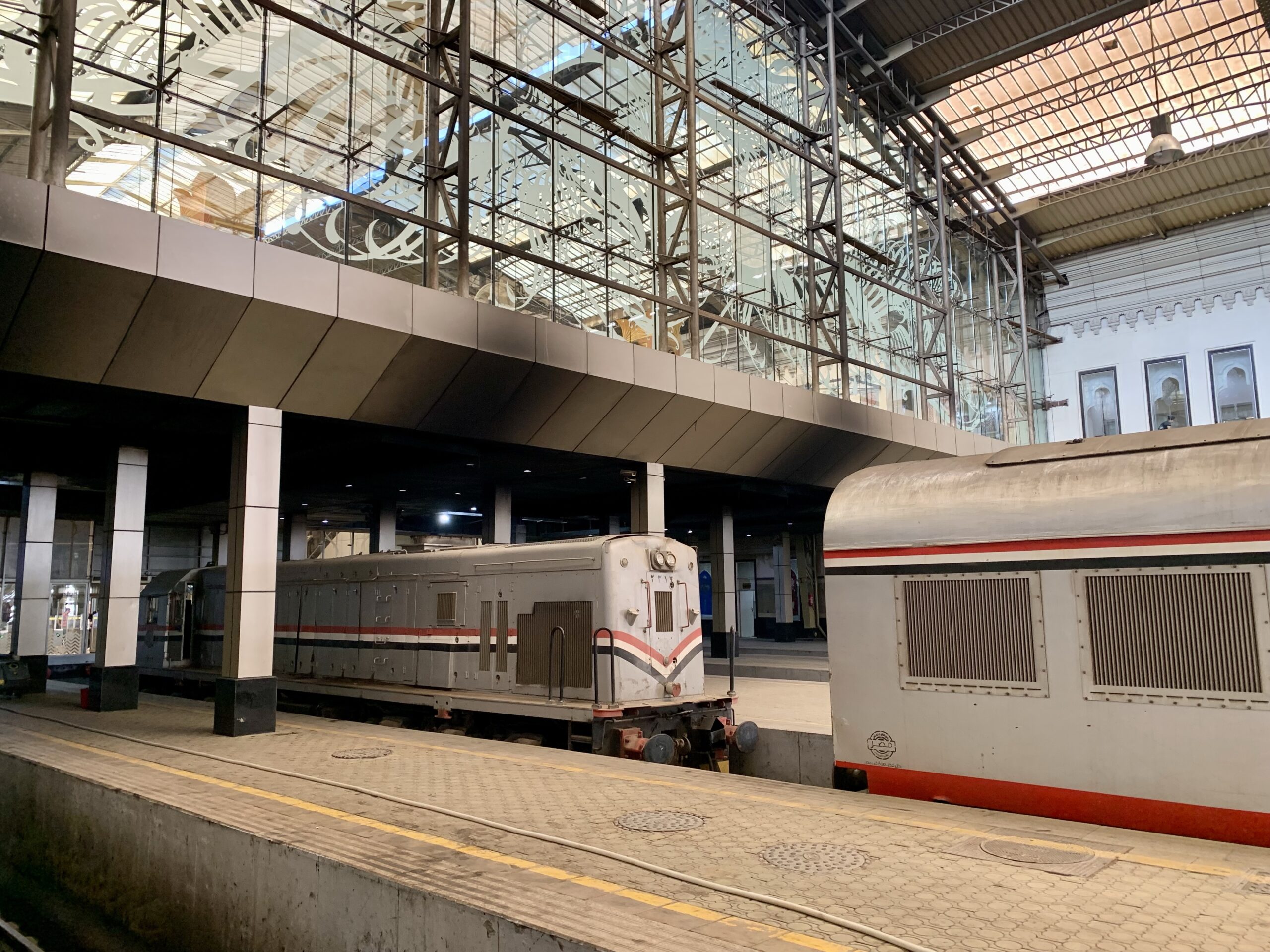
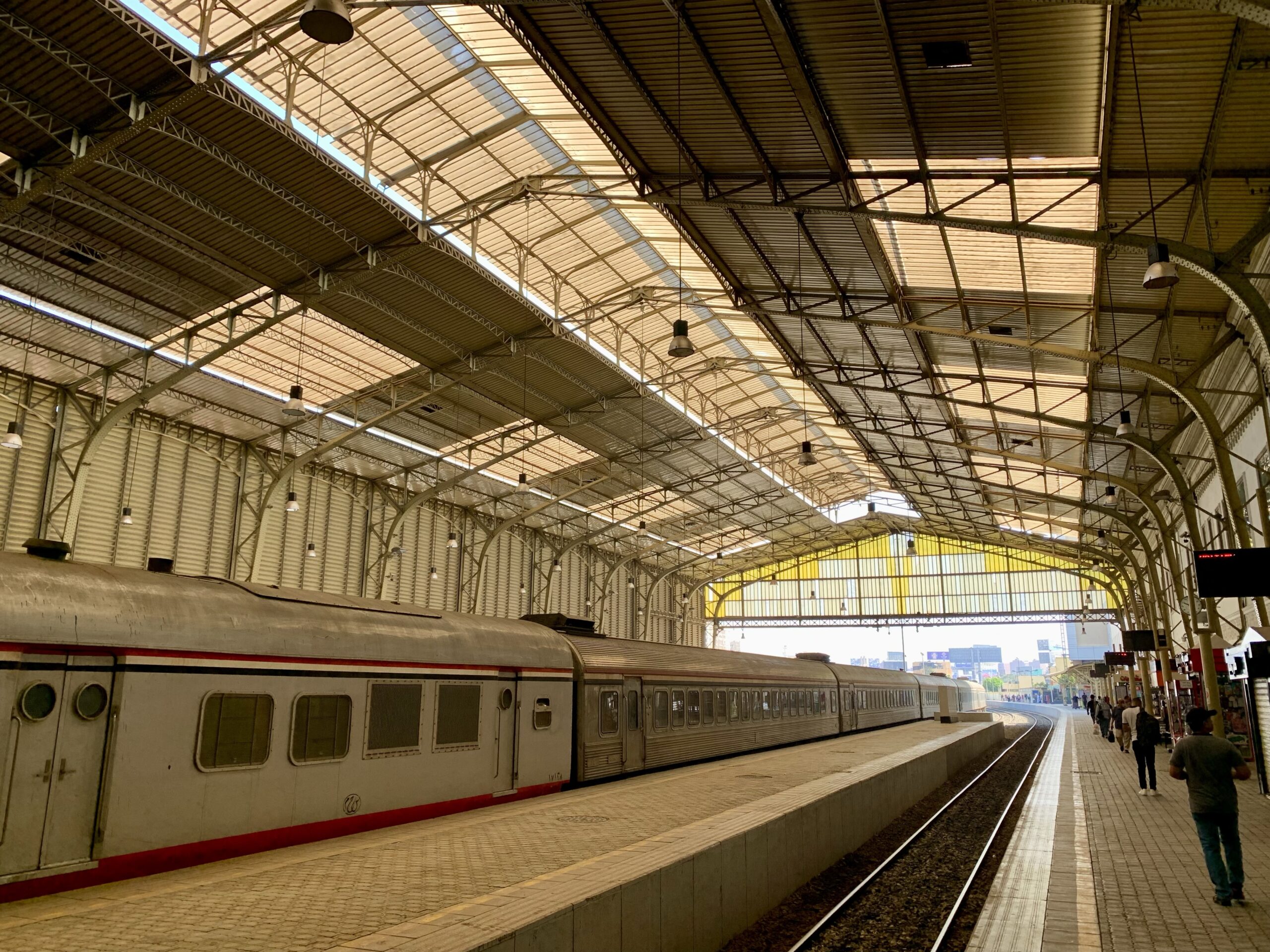
Cairo – Ramsis Railway Station is the main railway station in Cairo and our first glimpse of the lengthy imposing structure was out of the windows of the transfer car taking us from the airport to our hotel on our first night in Egypt. The station is named after Pharaoh Ramses II. We saw a lot about him during our stay in the country!
An older railway station was opened at the site in 1854. Later in 1890 the Egyptian government, driven by a desire to give Cairo a grand entrance way began work on the current, much larger railway station. For most visitors before the advent of air travel, Ramsis station was the entry point into Cairo after arriving in Alexandria by ship. The station is part terminus with some through platforms.
An upgrade to the structure was carried out in 1955 and from January 2001 to early 2011 the station underwent major modernisation being fully upgraded and air conditioned with new marble flooring and the addition of escalators. The railway station has also a connection to the Cairo Metro (which I was unable to photograph), buses, and taxis (although no idea where these were!)
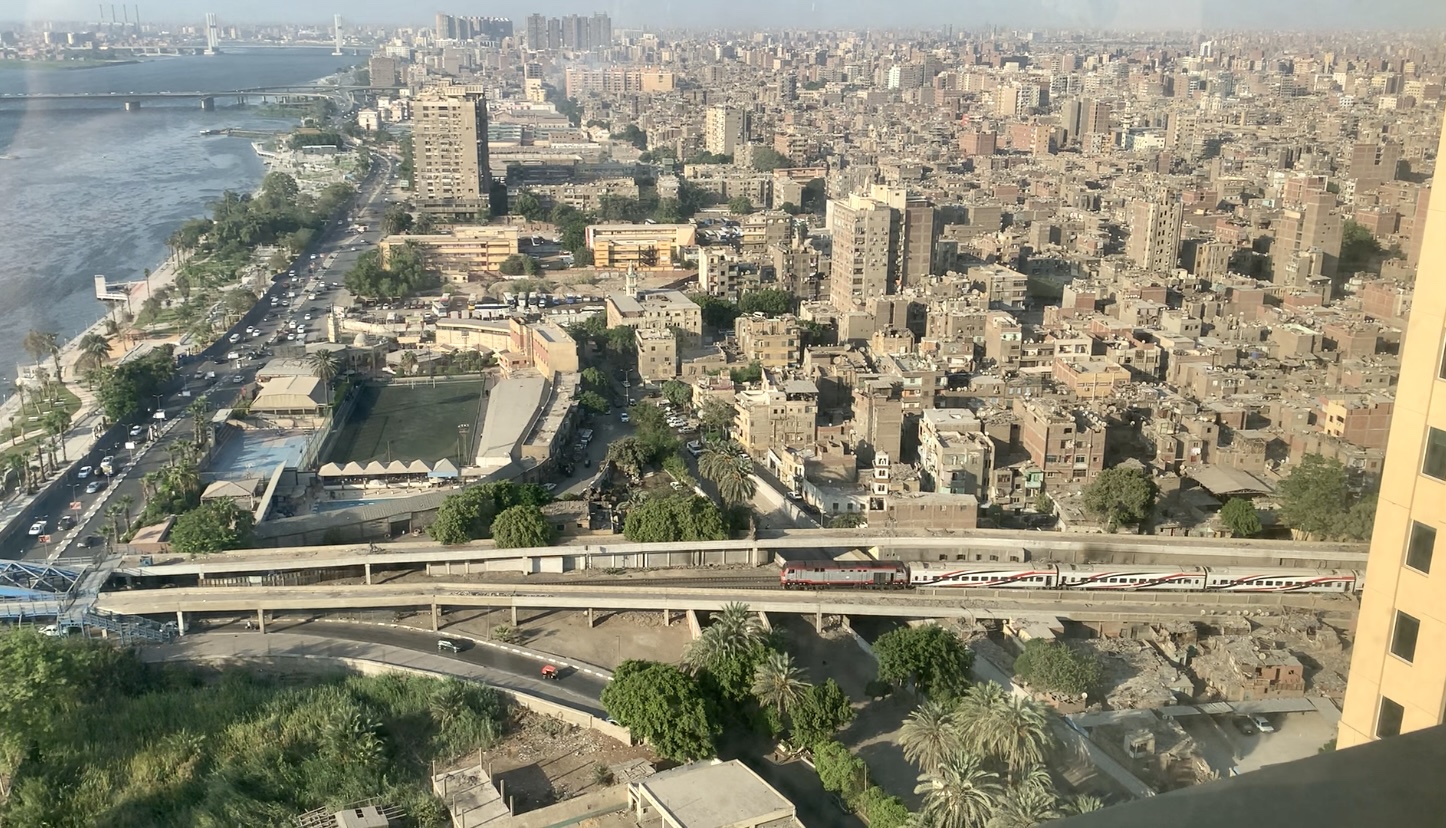
Ramsis railway station exterior, Cairo – 20/09/2022An Egyptian National Railway ES30ACi Light Evolution diesel locomotive having backed onto a rake of coaches at Cairo railway station – 20/09/2022An EMD G16 built by General Motors at Cairo railway station having brought in empty coaching stock. Egyptian National Railway received a total of 111 G16’s in 1960–61 (ER numbers 3301–61) and seventeen G16Ws in 1964–65 (ER numbers 3362–411) – 20/09/2022Cairo Railway Station train shed – 20/09/2022A view from the twenty fifth floor of Fairmont Nile City of an Egyptian National Railways service about to cross the River Nile via the Imbaba Bridge. Just don’t ask what the bar bill was! – 09/09/2022
Luxor – Luxor is a modern city in Upper Egypt which includes the site of the Ancient City of Thebes. The temples of Karnak and Luxor are situated within the city with the Valley of the Kings (which includes the Tomb of Tutankhamun, discovered by Howard Carter almost 100 years ago) and Valley of the Queens located on the opposite west bank of the Nile.
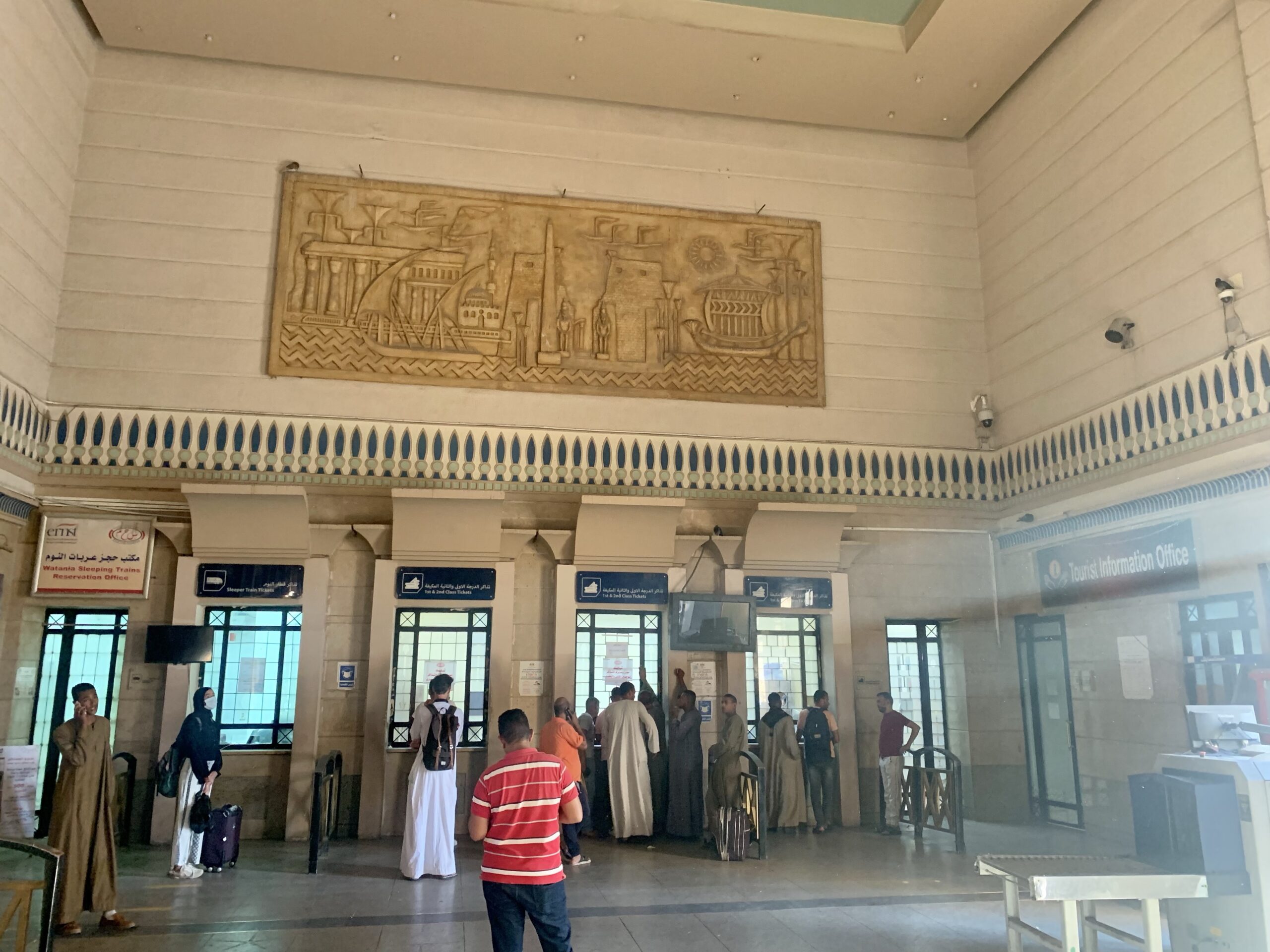
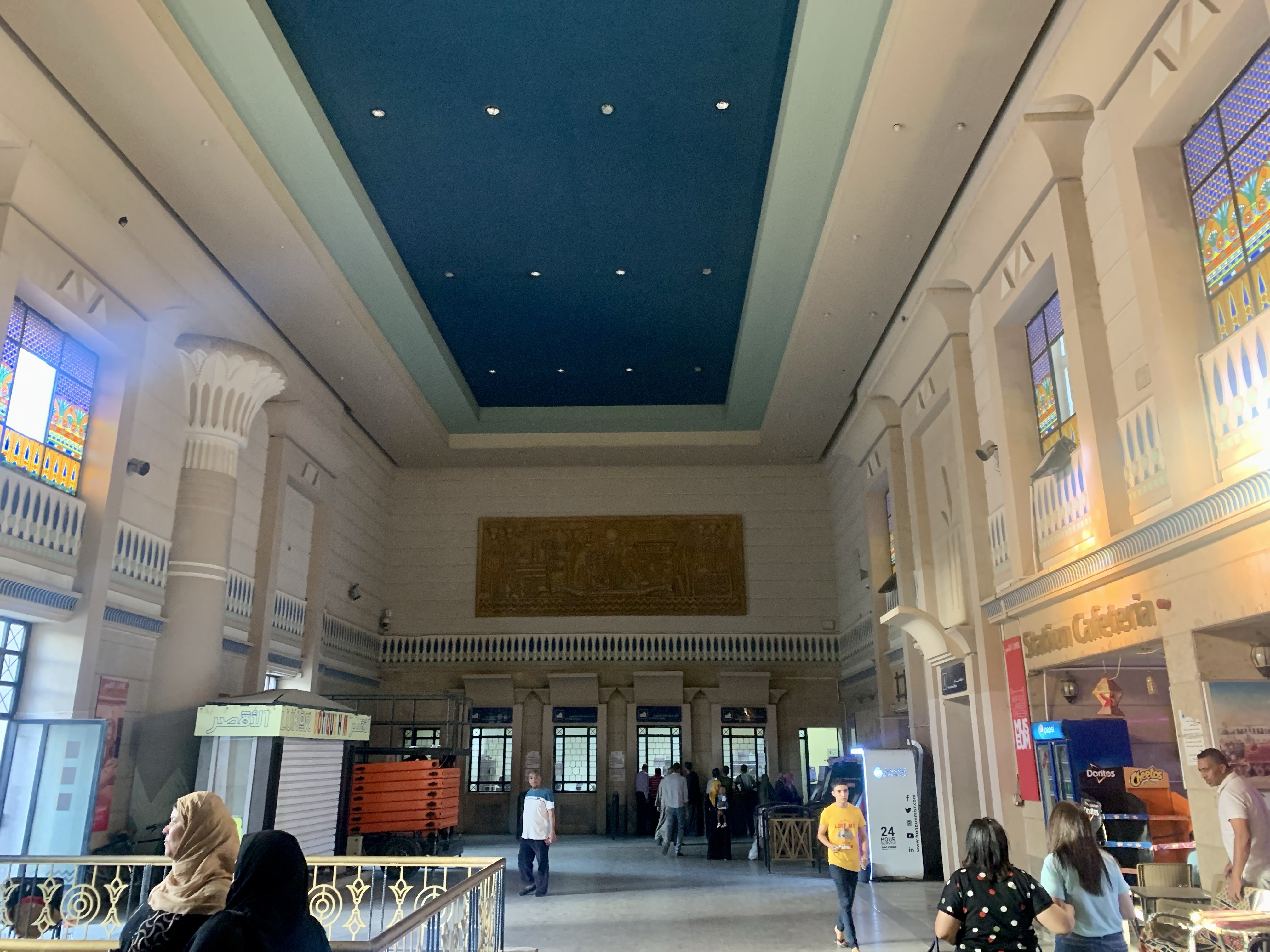
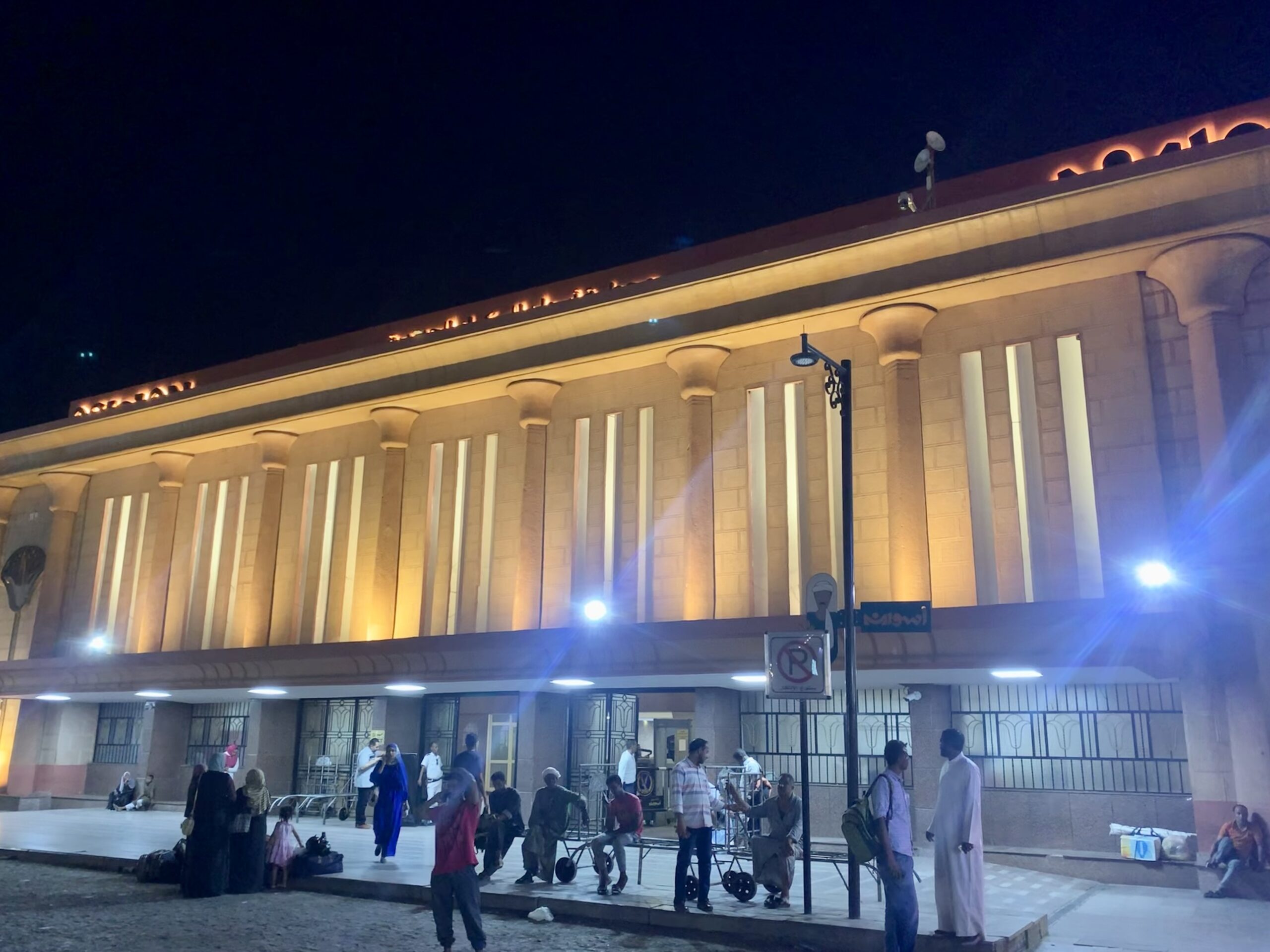
Luxor railway station is located near the centre of the city, the original station having opened in 1898 to accommodate standard gauge trains. The railway between Luxor and Aswan was built to a 3 ft 6 in gauge eventually being converted to standard gauge in 1926. The exterior of the current station is built to reflect the local temples.
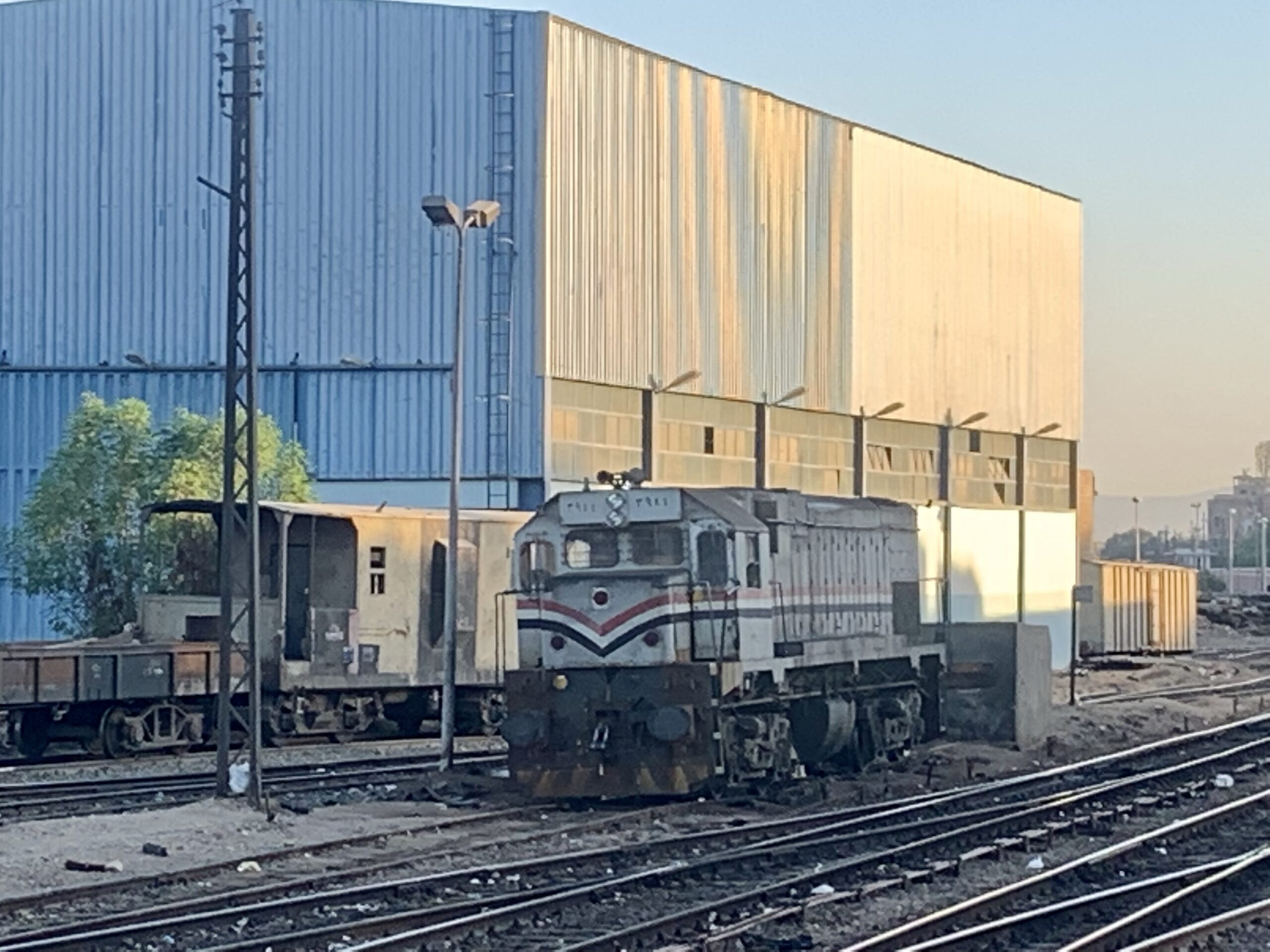
Luxor Railway Station exterior – 18/09/2022Luxor Railway Station booking hall – 18/09/2022Luxor Railway Station booking hall – 18/09/2022A Cairo bound train arrives at Luxor – 18/09/2022An EMD G16 in the yard at Luxor – 18/09/2022
Aswan – Aswan is a busy market and tourist centre located just north of the Aswan Dam on the east bank of the River Nile at the first cataract (shallow lengths of the Nile where the surface of the water is broken by small rocks and boulders jutting out of the river bed). I was taunted by the sound of passing trains out of my view as I spent time in my cabin or on the sun deck whilst catching up on my reading time.
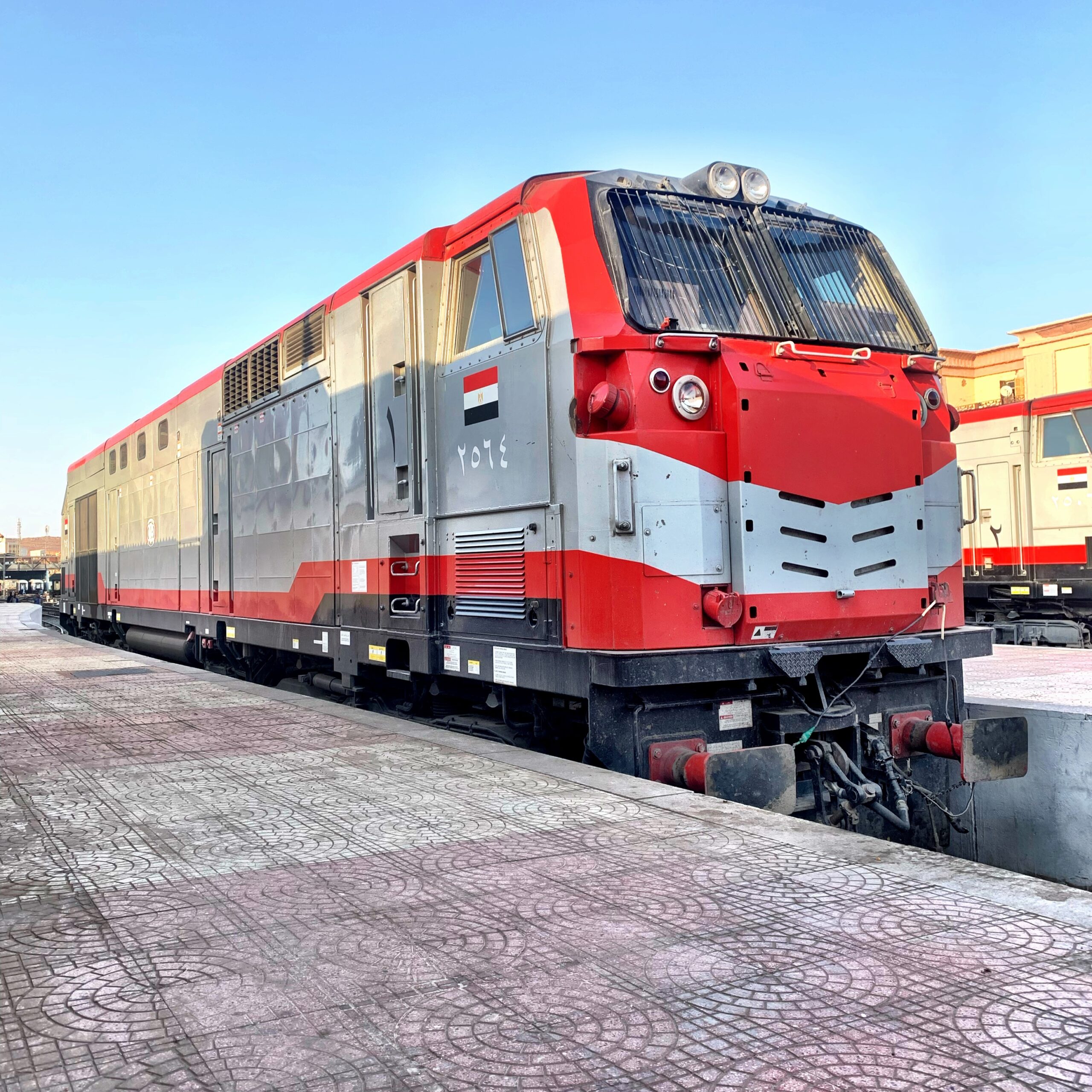
Aswan Railway Station exterior – 15/09/2022Aswan Railway Station booking hall – 15/09/2022Aswan Railway Station booking hall – 15/09/2022ES30ACi Light Evolution No. 2564 in the bay platform at Aswan – 15/09/2022A line up of ES30ACi Light Evolution locomotives at Aswan – 15/09/2022
Video of our railway sightings while in Egypt, September 2022
Egyptian Railway Museum, Cairo – On our last morning in Cairo, Caroline very thoughtfully surprised me by hiring an Uber which took us into the centre of Cairo and the Egyptian Railway Museum which is located in the eastern wing of Ramsis railway station. I’d been whinging on about trying to fit in a visit throughout our stay. Trying to find a taxi to take us back to our hotel in time for our flight home was a bit of an adventure in itself, but Caroline relished the challenge!
The museum first opened in January 1933 and contains over 300 models and exhibits, a collection of documents, maps and statistical data.
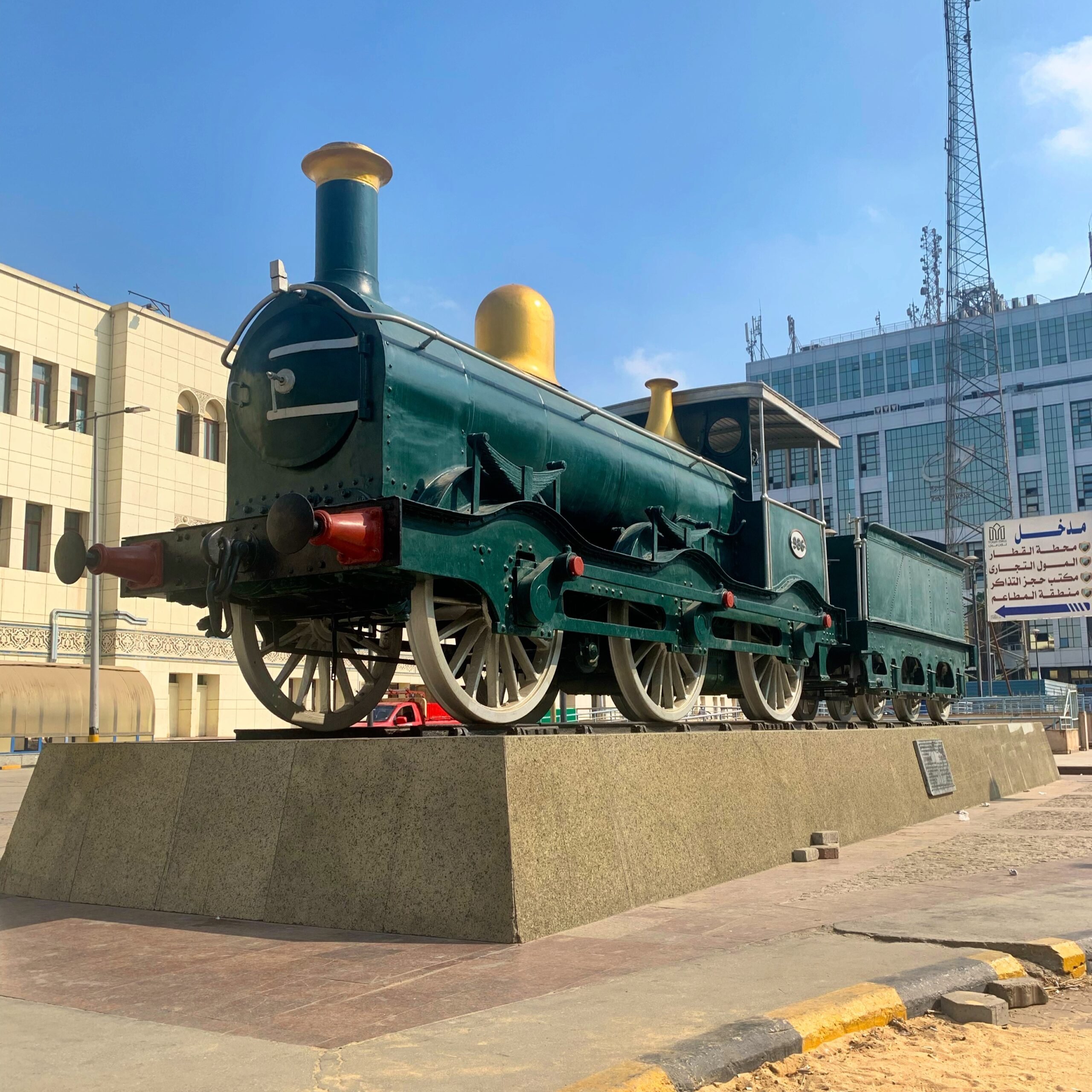
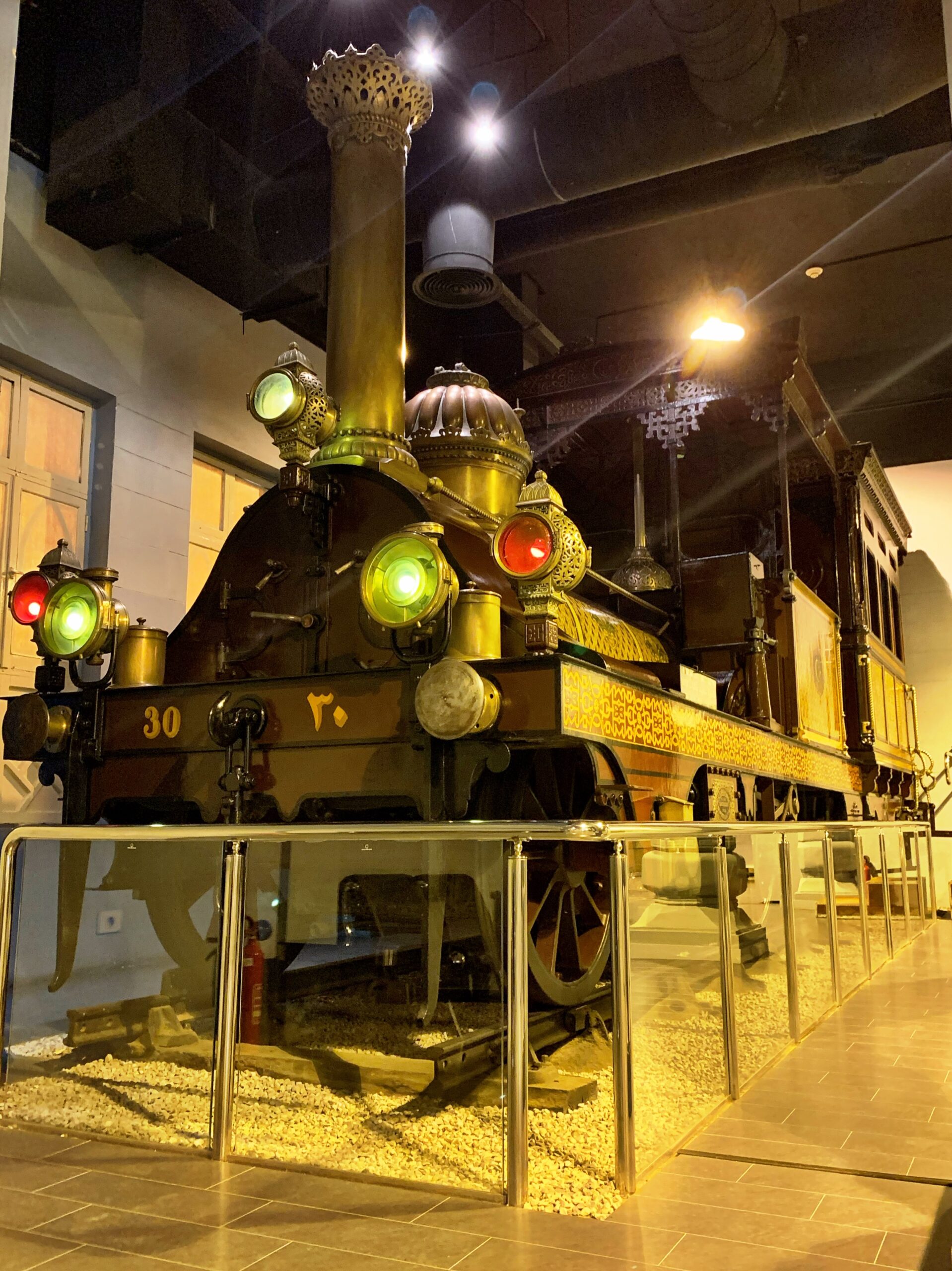
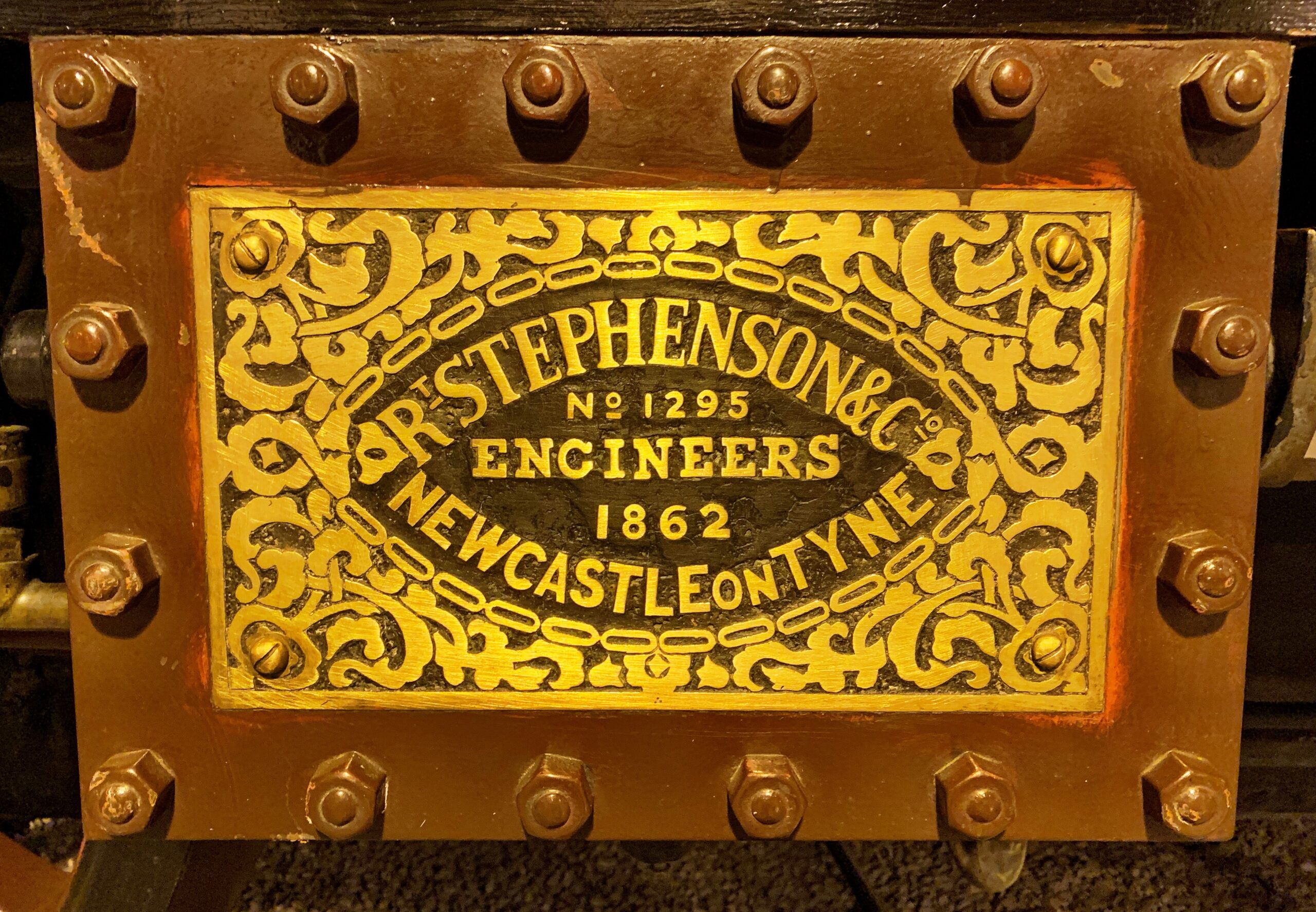
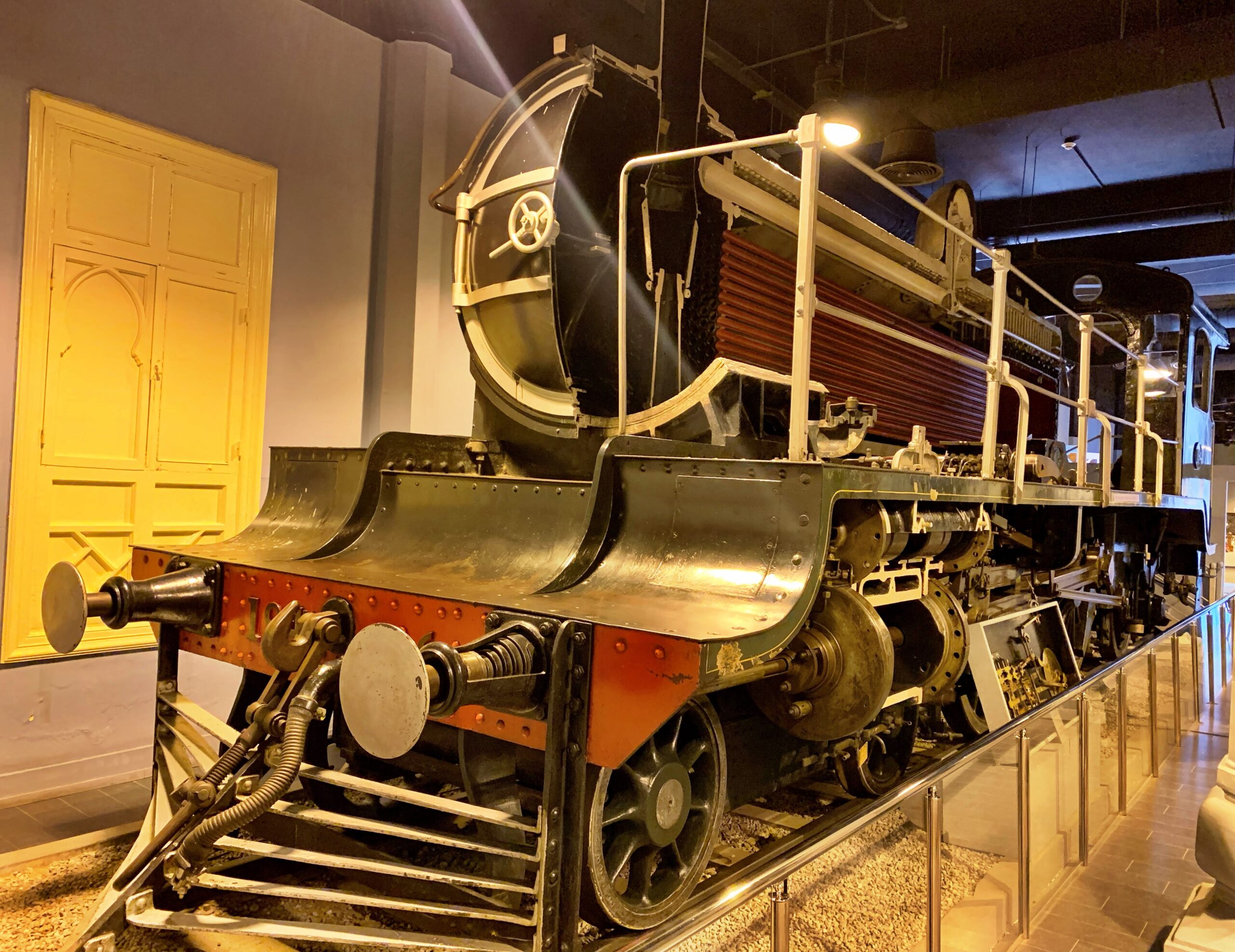
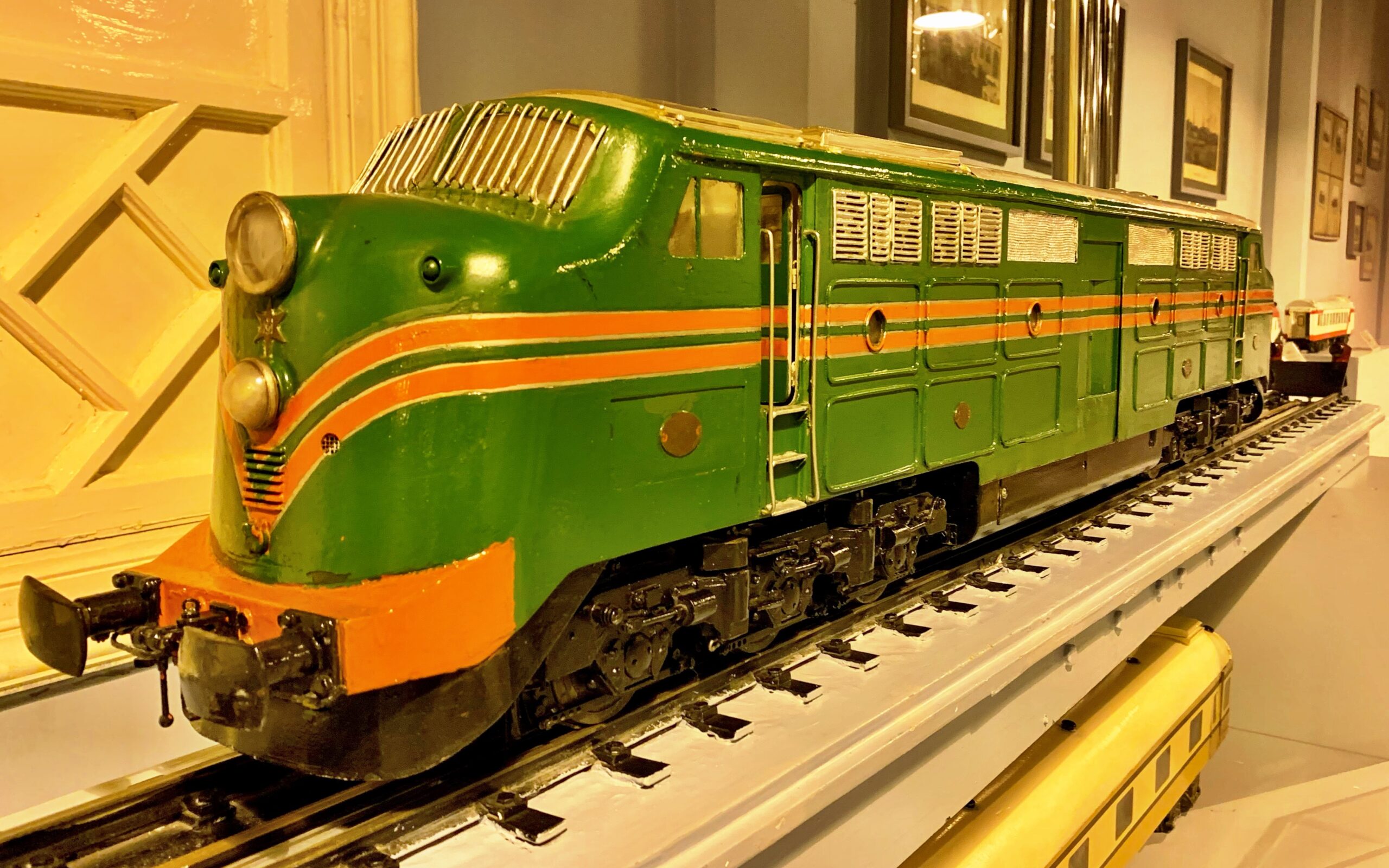
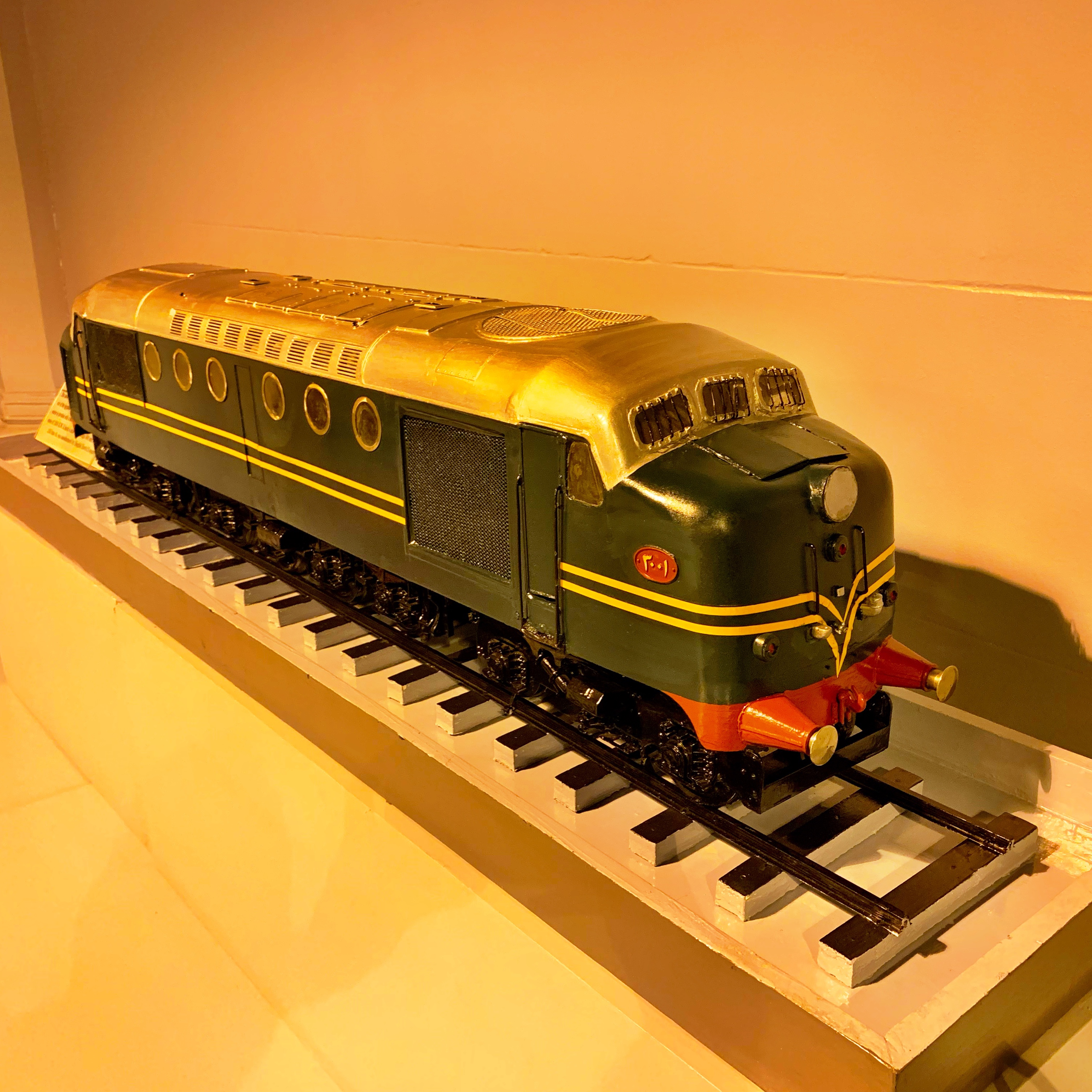
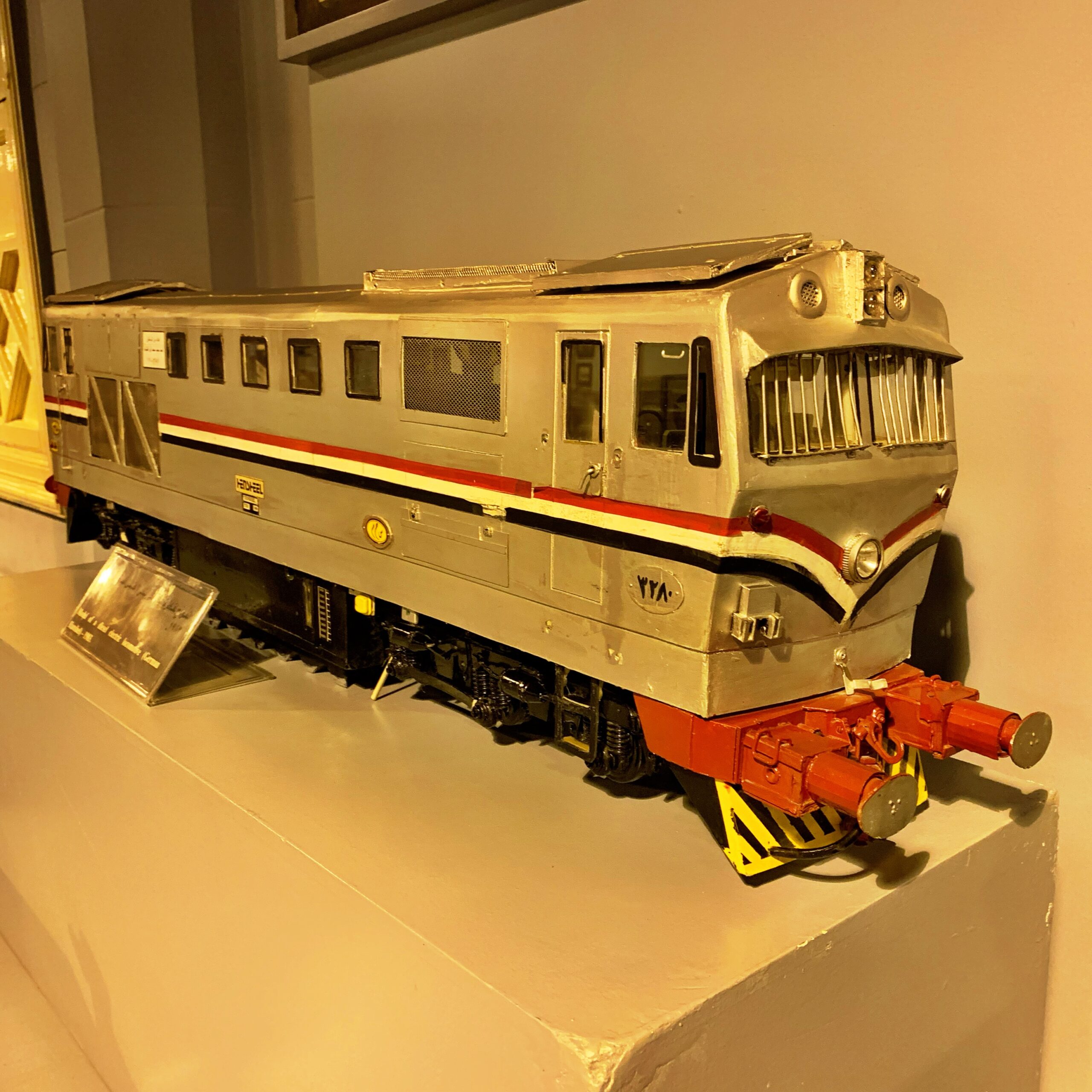
No. 986, fabricated by Robert Stephenson in 1865, on display outside Ramsis Railway Station Cairo – 20/09/2022Saied Pasha locomotive – 1862Saied Pasha locomotive works plate – 1862Sectioned 4-4-2 No. 194 manufactured in 1906 by The North British Locomotive Co. Ltd.Model of the first steam locomotive imported into Egypt – one of six built by Stephenson & Co.Model of a 1957 1700 HP Hanshel diesel electric locomotiveModel of a 1948 1600 HP English Electric Co. diesel electric locomotiveModel of German Hanshel diesel electric locomotive from 1983
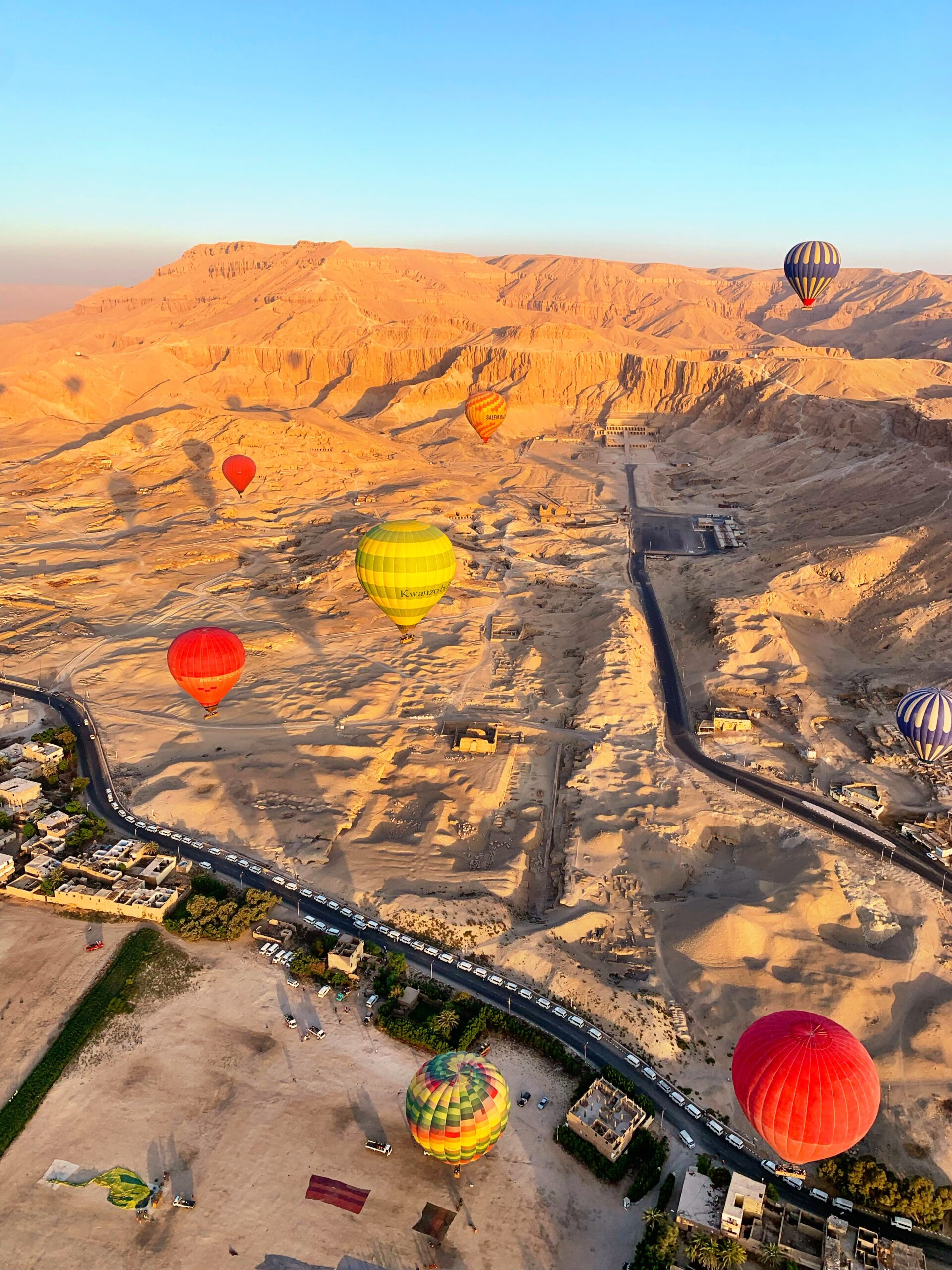
Earlier in the week, we enjoyed another mode of transport in the form of a hot air balloon which gave us an exceptional view of the Mortuary Temple of Queen Hatshepsut in Deir el Bahri near Luxor:
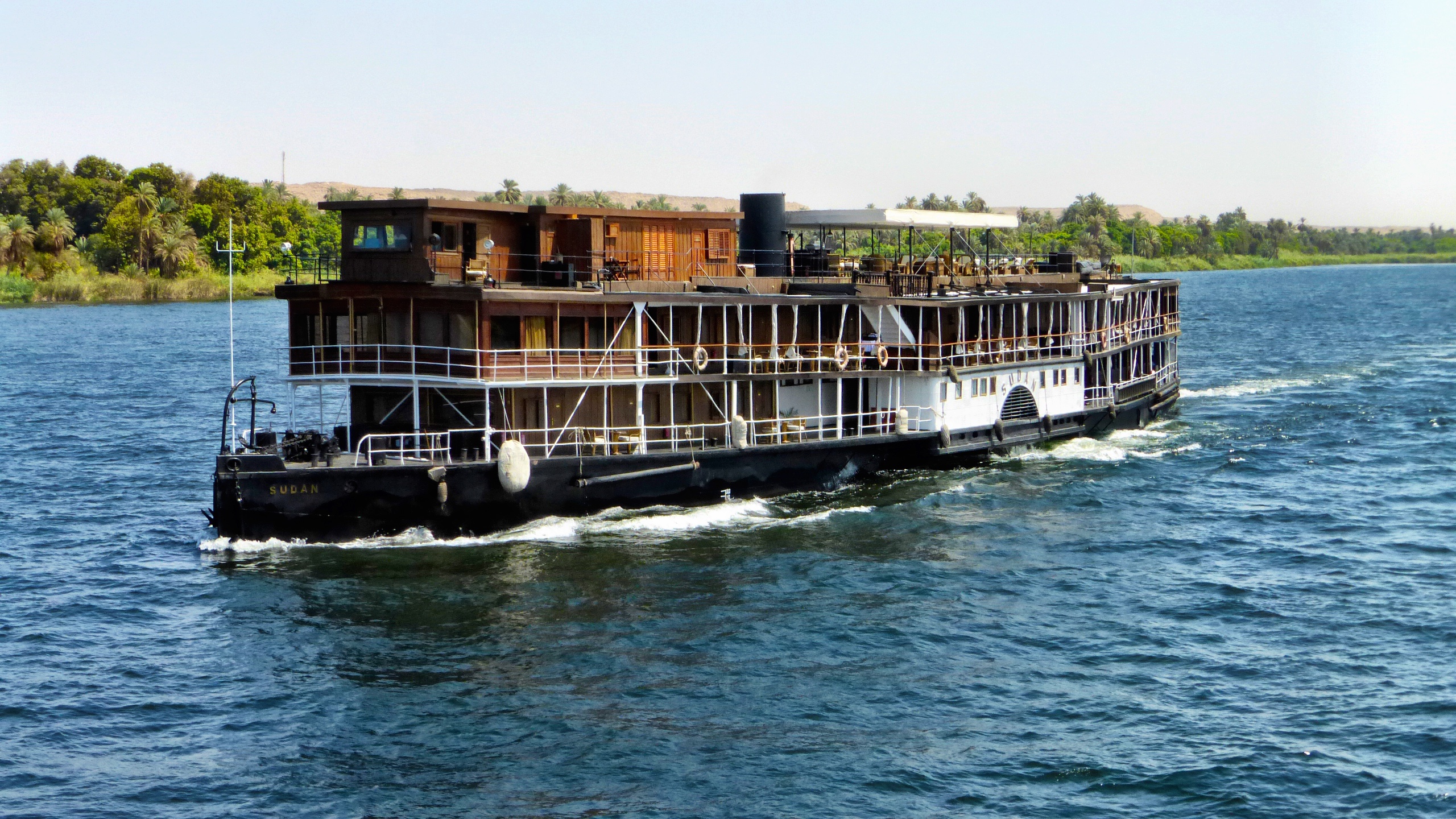
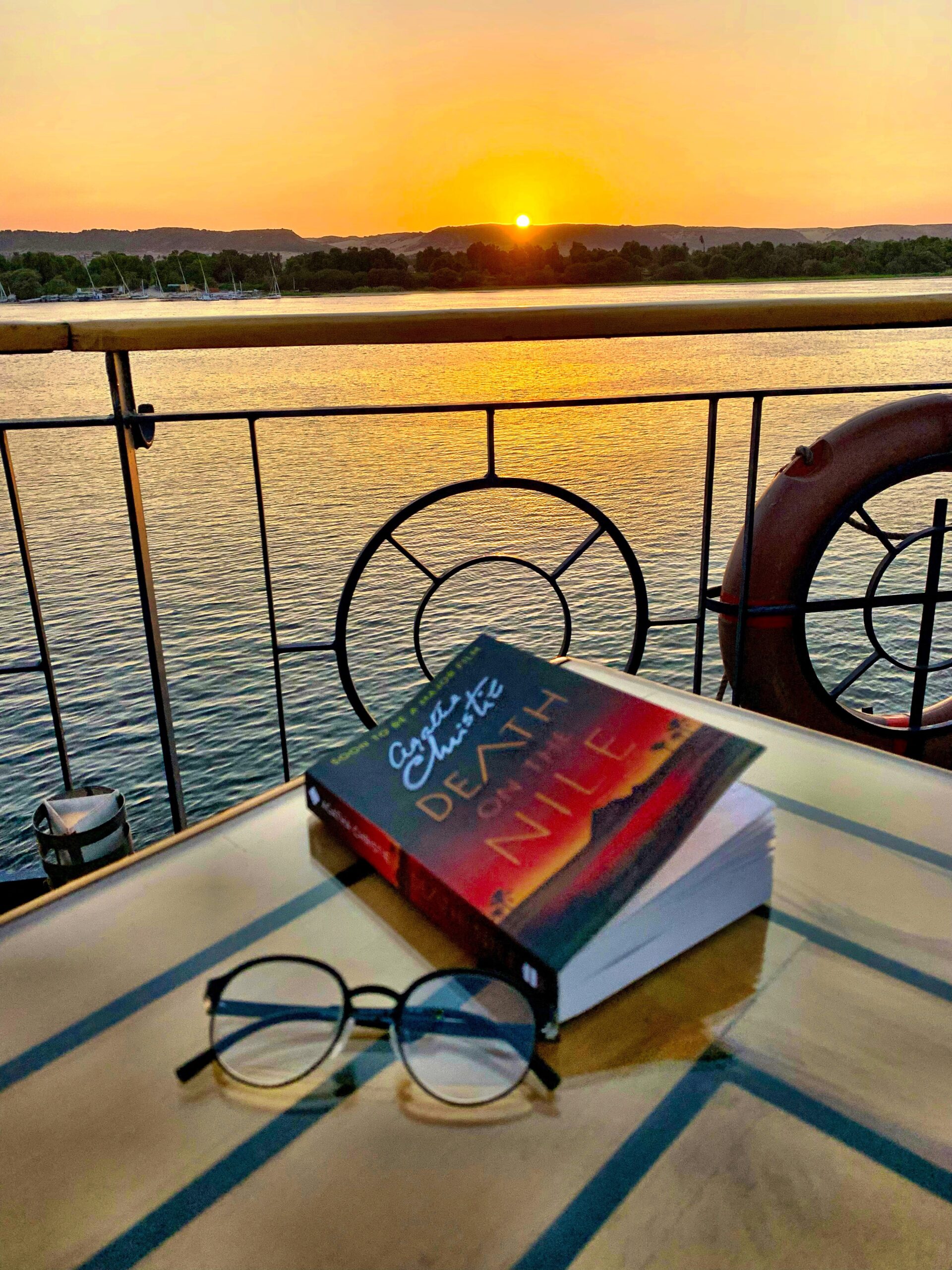
Hot air balloons over the Mortuary Temple of Queen Hatshepsut in Deir el Bahri near Luxor – 13/09/2022SS Sudan, built for the Egyptian Royal Family in 1885 was converted into a cruise liner in 1921 and took Agatha Christie and her husband, archaeologist Max Mallowan, on a trip along the Nile in 1933 and is believed to be the inspiration for her most famous work “Death On The Nile” published in 1937. SS Sudan fell into a state of disrepair following World War II but was restored in 1991 and again in 2000I couldn’t resist reading Christie’s novel onboard our ship on the Nile! While in Aswan, we visited “The Old Cataract Hotel” where Agatha Christie stayed and part of her novel “Death On The Nile” is set
We had a wonderful time visiting ancient Egyptian archaeological sites as well as modern railway stations! Huge thanks to our guides while we were in Egypt; Reda and Ahmed who shared their knowledge and facilitated some of the railway station visits.
This weeks blog was created while listening to Alphaville with Deutsches Filmerchester Babelsberg, Alison Moyet, and Handel’s Passacaglia, Suite no. 7 in G Minor, HWV 432/6 ( Modern Piano Solo Version performed by Johan Halvorsen on repeat). All being well, we’ll be back next week!
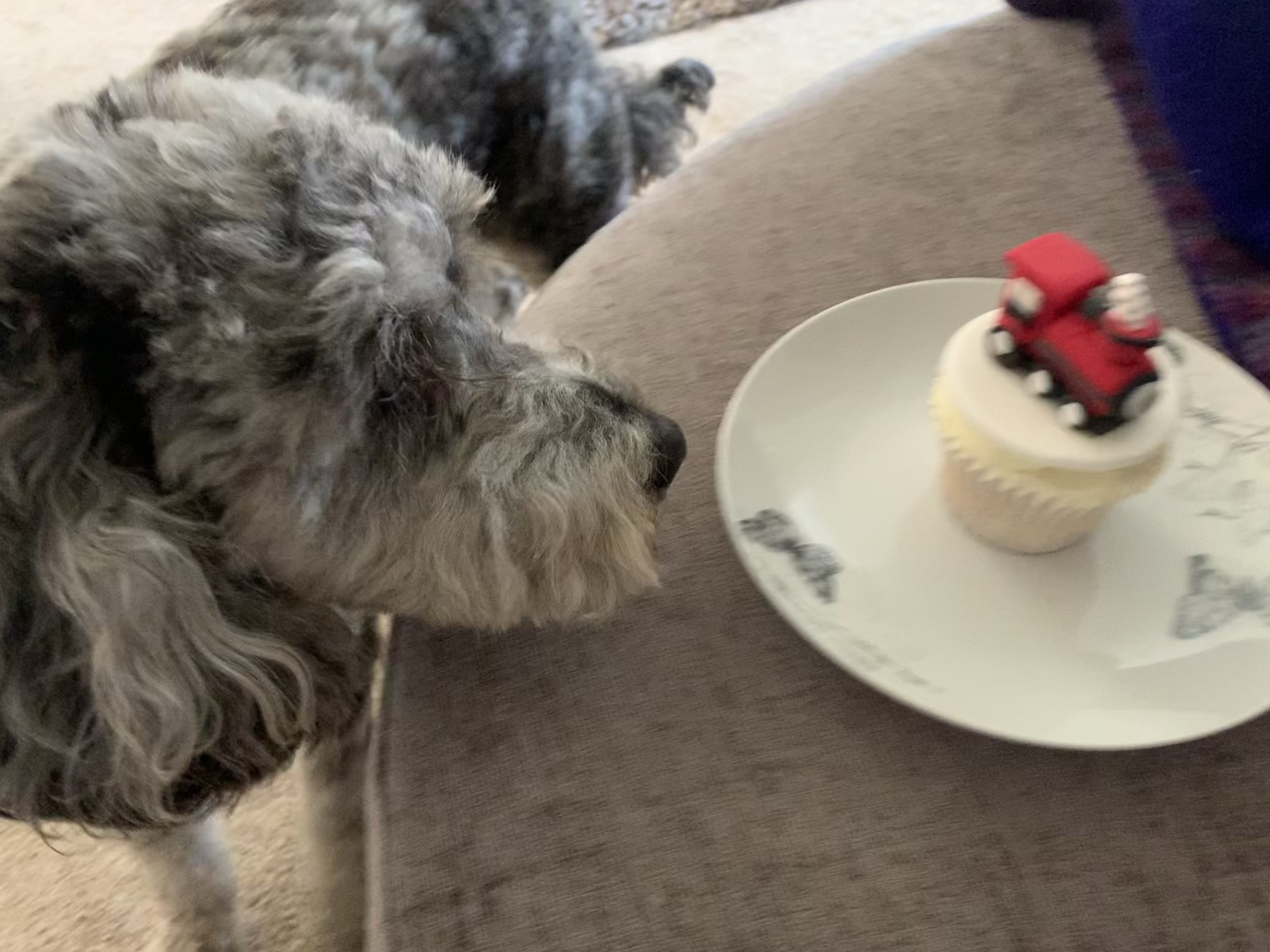
We went to a meal on Saturday evening with friends and as a parting gift, we were all given a personalised cup cake, which was a lovely thought. Mine was a train. No idea why! As responsible paw-rents, we did not allow Yoshi to taste the cup cakes, although as you can see, he was very interested in trying. Look, it’s been a quiet week, humour me!
With two days of strike action by RMT members during this period, there has not been much notable activity on Yoshi’s home patch. A scheduled steam rail tour to Weymouth on Thursday 18th August, the first of the strike days was cancelled.
Work replacing sleepers and re-ballasting continues on the Hamworthy Branch. Although the branch is still cut off, a “stop” sign protecting the main line was in evidence on 18th August 2022
South Western Railway’s recent release of its 2022/23 business plan did not include any plans for the introduction of their long delayed £1 billion fleet of 90 new Class 701 EMU’s, with only the hope that the Arterio trains would see service as soon as possible. The trains, built at Alstom in Derby, had been scheduled to enter traffic in 2019 but have been plagued with faults preventing the start of driver training and train acceptance. Without the new rolling stock, SWR are unable to operate a full pre-COVID timetable and with overall passenger numbers at 70% of pre-COVID levels any previous plans to increase services in December 2022 have been deferred. On Wednesday 17th August, we caught a glimpse of SWR Class 701 No. 701048 on a mileage accumulation run at Poole:
Class 701 No. 701048 at Poole – 17/08/2022
From The Archive
This week in..
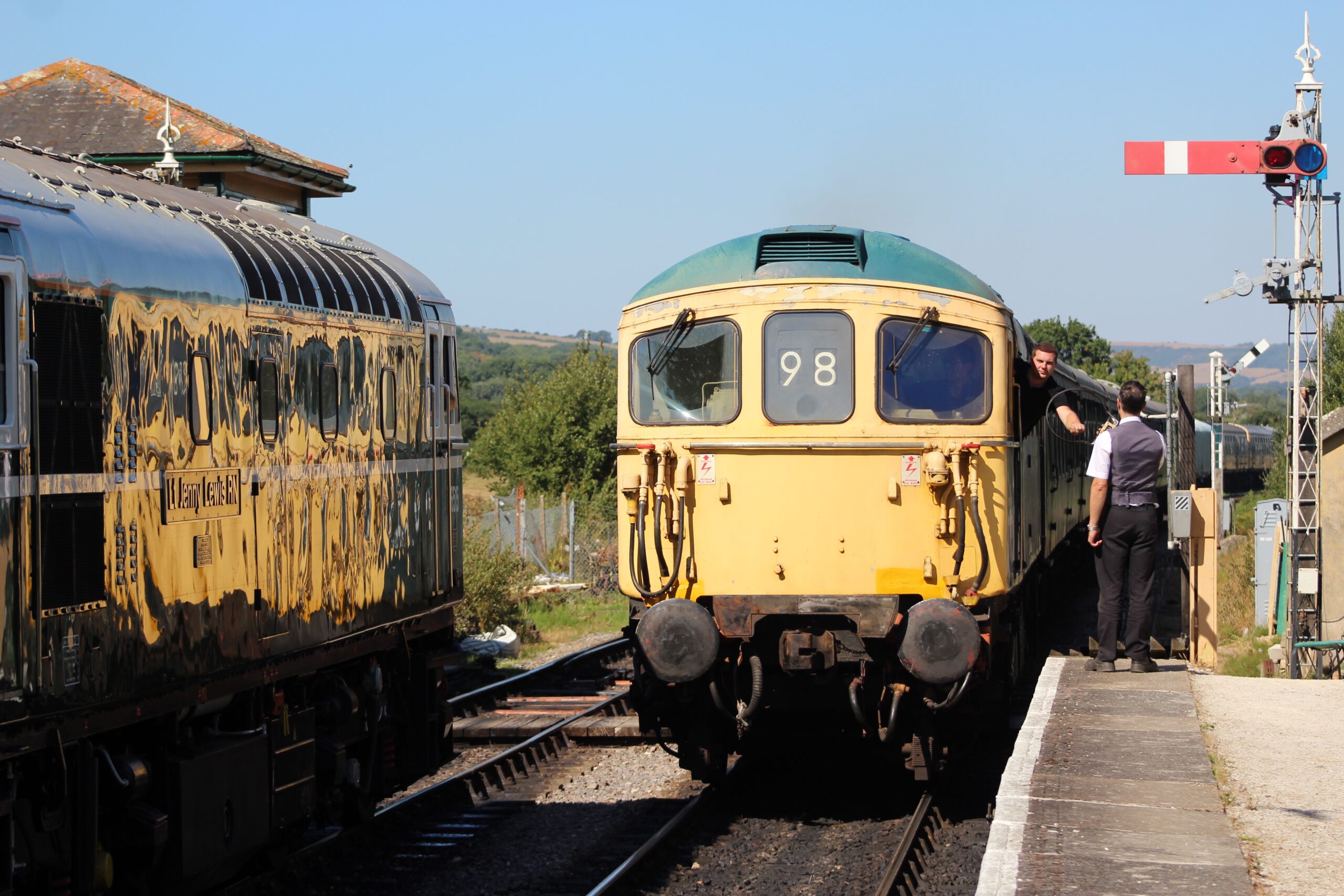
2019: Sunday 18th August 2019 found Class 33/0 D6515 (33012) ‘Lt Jenny Lewis RN’ and GBRf Class 73 No. 73107 ‘Tracey’ top and tail London Underground liveried 4TC working 1Z74 1626 Swanage to London Waterloo “The Swanage Sunday Special No.4”
2016: The Railway Touring Company ran “The Dorset Coast Express” on 17th August 2016 employing LMS Jubilee Class 4-6-0 No. 45699 ‘Galatea’ and Class 33/2 No. 33207 ‘Jim Martin’ in top and tail formation.
LMS Jubilee Class 4-6-0 No. 45699 ‘Galatea’ working 1Z67 0842 London Victoria to Weymouth on the approach to Dorchester South – 17/08/2016Class 33/2 No. 33207 ‘Jim Martin’ on the rear of 1Z67 0842 London Victoria to Weymouth nearing to Dorchester South – 17/08/2016
2014: SR Battle of Britain Class 4-6-2 No. 34067 ‘Tangmere’ and Class 33/0 No. 33029 with the return 17th August 2014 “The Weymouth Seaside Express” – 1Z83 1700 Weymouth to Bristol Temple Meads
SR Battle of Britain Class 4-6-2 No. 34067 ‘Tangmere’ at Weymouth Jersey Sidings – 17/08/2014Nameplate detail of SR Battle of Britain Class 4-6-2 No. 34067 ‘Tangmere’- 17/08/2014SR Battle of Britain Class 4-6-2 No. 34067 ‘Tangmere’ alongside Class 33/0 No. 33029 in Weymouth Jersey Sidings – 17/08/2014
“The Weymouth Seaside Express” – 17/08/2014BR Standard Class 7 4-6-2 No. 70013 ‘Oliver Cromwell’ passing through Upwey with Railway Touring Company organised “The Dorset Coast Express” 1Z67 0844 London Victoria to Weymouth. No. 70013 was one of the four locomotives which worked the farewell to steam rail tour on British Railways in 1968 – 20/08/2014WCRC Class 37 No. 37706 on the rear of “The Dorset Coast Express”. Due to the unavailability of an additional steam locomotive the Class 37 worked the return tour as far as Southampton Central, where the train reversed for the onward journey to London Waterloo via Laverstock once again under the command of No. 70013 ‘Oliver Cromwell’ – 20/08/2014
2013:
DRS Class 37 No. 37402 with inspection saloon No. 975025 ‘Caroline’ departing Dorchester. ‘Caroline’ was converted from the buffet car of a former Hastings DEMU in the late 1960’s for use as a saloon for the General Manager of the Southern Region of BR to entertain VIP guests, but was also used by the engineers for line inspections and assessments. Originally numbered TDB975025 and with a kitchen and catering on board, she became known as the “gin palace” and an invitation to travel became something of a golden ticket. ‘Caroline’ formed the first standard gauge passenger working into the Channel Tunnel on 22nd October 1992. ‘Caroline’ now resides at Derby with LORAM/Network Rail and is widely used for track inspections, line repair assessments and still, occasionally, to entertain VIP’s. ‘Caroline’ has been earmarked for the national collection once her service life is over – 21/08/2013
2012:
SR Battle of Britain Class 4-6-2 No. 34067 ‘Tangmere’ storms up Bincombe Bank at Upwey deputising for No. 5029 ‘Nunney Castle’ with The Railway Touring Company “Weymouth Seaside Express” rail tour. These were a popular series of Sunday excursions which ran from Bristol Temple Meads to Weymouth – 19/08/2012
2011:
Back in August 2011 friends invited me to go along to a book talk and signing being given by author Neil Gaiman (who is currently enjoying success with the Netflix adaption of his “The Sandman” work). This seemed like a great idea, however the location was Edinburgh. Obviously, that’s not a short hop from Dorset being a distance of 548 miles, but after some investigation, I found I could travel from Weymouth to Edinburgh by coach for £9. Which at the time of booking seemed like a real bargain.
The first coach on my journey to Edinburgh ready for loading and departure from Weymouth at 1815. I needed to change coaches at Bournemouth and London Victoria – 15/08/2011The second coach just after arriving at London Victoria Coach Station @2210. This was a very nice coach with plush, comfy leather seats – 15/08/2011The third coach on lease to National Express stands at Charnock Richard Motorway Services during the 0300 driver fag break. This coach reminded me of the ancient vehicles which were employed on school trips all those years ago when the state was trying to educate me. And indeed, all those years ago when schools could organise trips without fear of litigation. My school ran a trip to Woodhams’ Barry Island scrap yard once. Nobody lost a limb and we all came back safe and sound after clambering all over the rusting steam locos. Oh, the memories came flooding back. Uncomfortable seats with harsh fabric made from the short sharp ear hair plucked from goblins, no leg room, defective air-con and the faint smell of sick – 16/08/2011
I thought I’d get some sleep on the coach from London to Edinburgh as the countryside passed by in darkness. I realised it wouldn’t be much of a deep sleep, more likely that light sleep where you’re semi-conscious of the movement of the transport you find yourself traveling in and when you wake up, you discover you’ve dribbled down your front. Or is that just me? Things started badly as we weaved our way through the streets of London and the driver turned on all the interior lights and the radio. The sound of Smooth Radio cut through my own choice of entertainment playing through my earphones making listening to my iPod difficult, and when a section of my fellow passengers started singing along to Simply Red, impossible. Eventually, as a woman a couple of seats in front of me started to wave her arms around in time to Bread’s “Make It With You”, I seriously doubted my decision to travel by coach, although in hindsight, she may have just been trying to get the overhead seating airflow to work.
Eventually, after driving all through the night, we arrived in Edinburgh and I headed off to Waverley railway station to make use of the excellent shower facilities available to weary travellers for the princely sum of £5 – for which you get a shower pack including shower gel and the loan of a towel. I checked Network Rail’s webpage on Edinburgh Waverley just now and the showers still cost £5. How reassuring.
After freshening up, I took a stroll along Princes Street and took in the landscaped gardens in the shadow of Edinburgh Castle – 16/08/2011I took a local bus out to Ocean Terminal to see The Royal Yacht Britannia – 16/08/2011The Royal Yacht Britannia. Again. Taken from the other end to that in the previous picture (someone can remind me of the correct nautical terms in the comments – thanks very much) – 16/08/2011
After visiting the shopping centre at Ocean Terminal, I headed back into the city with the intention of taking some railway photos from Princes Street Gardens, but because of very heavy rain I instead took shelter in the (then) new National Museum of Scotland.
The Wylam Dilly was built in 1813 and is one of the oldest surviving steam locomotives in existence. By strange coincidence, 1813 was the same year the coach I travelled on from London to Edinburgh was built – 16/08/2011The Wylam Dilly is named after the Wylam Colliery where it was used to pull coal wagons along the Wylam Wagonway to the river near Newcastle upon Tyne. A ‘dilly’ was the name used for the coal trucks used on the wagon way. Don’t tell me I don’t set out to educate – 16/08/2011Also in the National Museum of Scotland was Dolly the Sheep, a Finnish Dorset crossbreed and famous for being the first mammal to be cloned. She has to stand really still as she revolves around in her glass box. At night she drives around the museum in cars – 16/08/2011This is Sir Jackie Stewart’s racing car which can be found in the National Museum of Scotland. I observed that there was not much room to take home the weekly shop, but Dolly the Sheep likes how it handles corners – 16/08/2011
After visiting the museum and the rain abated it was time to find the location of the Edinburgh Book Festival and an interesting hour or so in the company of Mr Gaiman. While loitering for my friends to arrive, I inadvertently started a ramshackle queue, so front row seats awaited us. Go me!
A view of the approaches to Edinburgh Waverley – 16/08/2011Following chats, catch ups and pizza with my pals after the Neil Gaiman signing, I headed back south on another coach for the long journey to London. Actually, it was the same rubbish coach I had arrived in Edinburgh on earlier that day. Same drivers, but a different smelly bloke in the seat in front of me. You can imagine my enthusiasm when we met the above sign on the M6 at 4am – 17/08/2011Arrival into London Victoria Coach Station was over an hour late – 17/08/2011As my connecting coach to Bournemouth was due to depart a few hours after my arrival in London, I took the opportunity to stretch my legs and take in LNER A1 Class 4-6-2 No. 60163 ‘Tornado’ and empty coaching stock being moved into London Victoria railway station by EWS liveried Class 67 No. 67008 ready to form “The Cathedrals Express” rail tour to, of all places, Weymouth – 17/08/2011EWS Class 67 No. 67008 with the ecs for “The Cathedrals Express” nears London Victoria – 17/08/2011EWS Class 67 No. 67002 ‘Special Delivery’ and LNER A1 Class 4-6-2 No. 60163 ‘Tornado’ on the rear of the empty coaching stock movement into London Victoria – 17/08/2011LNER A1 Class 4-6-2 No. 60163 ‘Tornado’ departs London Victoria bound for Weymouth piloted by Class 67 No. 67002 ‘Special Delivery’ as the steam locomotive had no fireman at this point of the journey – 17/08/2011Former Wessex Electrics Class 442 No’s 442420 and 442410 on a Gatwick Express service with a SouthEastern Class 465 in the background – 17/08/2011Southern Class 455 No. 455839 with an unidentified SouthEastern Class 465 on the approaches to London Victoria. No. 455839 was one of the first Southern Class 455’s to be sent to Newport Docks for scrap earlier this year (The final journey being hauled by Class 47 No. 47727 along with sister Class 455 No. 455839 on 4th May 2022) – 17/08/2011The start of my own journey from London to Weymouth. However, by the time we reached Bournemouth I couldn’t take any more coach travel and I bailed out and took the train for the remainder of my trip – 17/08/2011SouthWest Trains liveried Class 444 No. 444005 having emerged from Bincombe Tunnel with a London Waterloo to Weymouth service – 17/08/2011 I arrived in Weymouth ahead of the steam tour and was able to see LNER A1 Class 4-6-2 No. 60163 ‘Tornado’ exiting Bincombe Tunnel on the run down into Weymouth with Steam Dreams “The Cathedrals Express” – 17/08/2011LNER Peppercorn Class A1 4-6-2 No. 60163 ‘Tornado’ was built between 1994 and 2008 to an original design by Arthur Peppercorn, the last Chief Mechanical Engineer of the London and North Eastern Railway. She was the first newly built British mainline steam locomotive following the completion of BR Standard 9F Class 2-10-0 No. 92220 ‘Evening Star’ in 1960, and the only Peppercorn Class A1 in existence after all the original locomotives of that class were scrapped. In 2017 No. 60163 became the first steam locomotive to officially reach 100 mph on British tracks for over 50 years – 17/08/2011 Nameplate detail for LNER A1 Class 4-6-2 No. 60163 ‘Tornado’ – 17/08/2022No. 60163 ‘Tornado’ worked “The Cathedrals Express” from London Victoria to Weymouth and then went tender first with her support coach to Yeovil Junction for turning while the train followed with Class 66 No. 66101 in charge. ‘Tornado’ took charge of the rail tour once again on departure from Yeovil on the return journey to London Victoria via Sherborne and Salisbury – 17/08/2011DB Class 66 No. 66101 assists with No. 60163’s support coach in the sidings at Weymouth – 17/08/2022
Video of “The Cathedrals Express” and light engine + support coach movement in the Weymouth area – 17/08/2022
2010:
Class 47 No. 47580 ‘County Of Essex’ heads 1Z62 0614 Shrewsbury to Weymouth “Dorset Coast Statesman” approaching Upwey – 19/08/2010Also at Upwey, Class 47 No. 47826 with Scarborough Spa Express branding works the return “Dorset Coast Statesman” 1Z63 1637 Weymouth to Shrewsbury – 19/08/2010The Railway Touring Company ran “The Dorset Coast Express” from London Victoria to Weymouth and back on Wednesday 18th August 2010. Having assisted at the rear of the main train on its return leg hauled by LNER A4 4-6-2 No. 60019 ‘Bittern’, SR N15 Class 4-6-0 No. 30777 ‘Sir Lamiel’ runs light engine with support coach to Weymouth, before running round and proceeding to Yeovil Junction for servicing at the mainline steam centre – 18/08/2010
Video of LNER A4 4-6-2 No. 60019 ‘Bittern’ during the 2010 summer season of “The Dorset Coast Express” rail tours. This is the result of experimenting with reformatting my 4:3 aspect ratio video footage in 16:9, however I’m not happy with the compression rate. But I’ll post it here at the bottom of the page, so probably nobody will notice!
That’s all for this time. Thanks for reading and for your corrections and comments to previous entries. Hopefully we’ll have our feet firmly back in 2022 for next weeks instalment. Join us again in seven days to find out!
Swanage Railway Class 33 Crompton diesel locomotives were in service from Sunday 7th August 2022 because of the fire risk presented by using steam traction. The driver of No. 33111 hauling the 1030 Norden to Swanage train collects the token to proceed on to Swanage while sister locomotive No. 33012 (D6515) ‘Lt. Jenny Lewis RN’ waits to depart Harmans Cross with the 1030 Swanage service to Norden – 07/08/2022
Ultrasonic Test Train & DBSO’s
Wednesday 3rd August saw a scheduled visit of COLAS Class 37 No. 37099 with an Ultrasonic Test Train visiting the Bournemouth to Weymouth line. Due to pass through Poole around 2315, a late departure from Eastleigh meant the train actually passed at 0009 as it headed to Weymouth. I decided on Poole as my location to see and film the train as a stop of a couple of minutes had been programmed into the schedule and I thought I’d be able to get a couple of quick photographs as well as video. In the event the train sailed straight through the station and to disappoint me even further, the locomotive was at the rear of the train propelling rather than pulling the Network Rail stock.
Class 37 No. 37099 and DBSO No. 9708 working 3Q02 2143 Eastleigh East Yard to Eastleigh East Yard at Poole – 04/08/2022
However, this gives me an opportunity to witter on about the MK2 Driving Brake Second Open (DBSO) coaches currently employed on several test trains which enables a locomotive hauled train to be driven from either end. Famously the Bournemouth to Weymouth route operated a push-pull system for many years following the 1967 electrification of the Waterloo to Bournemouth line with Class 33/1 locomotives paired with unpowered 4-TC units traversing the tracks between Bournemouth to Weymouth. A similar concept was introduced by BR Scottish Region in the late 1970’s / early 1980’s when a number of MK2 brake coaches were modified and fitted with driving cabs, but still retaining their end corridor connections. The motive power was provided by Class 47/7 locomotives which were modified Class 47/4’s to enable push-pull working on Glasgow – Edinburgh services, replacing trains run by top and tailed Class 27 locomotives which were proving costly to run and unreliable.
Push-Pull Class 33/1 No. 33104 propels two 4-TC units away from Dorchester forming the 1533 Weymouth to London Waterloo service. The Class 33 would be removed at Bournemouth and the 4-TC coupled to motorised 4REP units for the onward journey to London Waterloo – 15/04/1983
The DBSO’s were cascaded to the Great Eastern Main Line in the late 1980’s when Glasgow – Edinburgh services began to utilise new Class 158 DMU’s, which doesn’t seem much of an upgrade to me! At this time, the corridor connection was removed enabling a larger cab. They continued to run into the privatisation era becoming part of Anglia Railways and later the One franchise, the last being withdrawn from service by the close of 2006, being replaced by more modern MK3 Driving Van Trailers. At this point Network Rail took ownership of five DBSO vehicles for the purpose of running test trains in push-pull mode.
Class 47/7 No. 47701 ‘St. Andrew’ at Crewe Works – 22/09/1979Scanned from a very dark 110 film negative, Class 47/7 No. 47705 ‘Lothian’ is, er, kick-started at Edinburgh Waverley – 13/08/1980. This locomotive was later converted into Class 57 No. 57303 ( see below )Class 47/7 No. 47707 ‘Holyrood’ at Millerhill depot – 16/08/1982. This locomotive was cut up at CF Booth, Rotherham in February 2010Network Rail DBSO No. 9702 being propelled by COLAS Class 37 No. 37175 into Dorchester West – 16/06/2015Class 37 No. 37175 at the rear of a Network Rail test train at Dorchester West – 16/06/2015DBSO No. 9714 hauled by Class 31 No. 31106 passing through Upwey bound for Weymouth – 17/11/201131106 at the head of a Network Rail test train entering Upwey – 17/11/2011Class 57 No. 57303 ( the former 47705 – see above! ) with One liveried DBSO No. 9710 at Eastleigh – 23/10/2013Another glimpse of Class 37 No. 37099 on the rear of a test train utilising a DBSO passing Upwey – 27/04/2017And here she is again in British Rail days; Class 37 No. 37099 in BR Blue livery seen at Liverpool Street c.1980
The Dorset Coast Explorer
West Coast Railways Class 33/0 No’.s 33029 and 33025 approaches the site of the former Upwey Wishing Well Halt on the climb to Bincombe tunnel with Pathfinder Railtours “The Dorset Explorer” 1Z34 1635 Weymouth to Burton-on-Trent – 06/08/2022
Saturday 6th August saw Pathfinder Tours run a rail tour from Burton-on-Trent to Weymouth via different scenic routes out and back. On the outward run the train made a circular journey through Central Southern England via the Cotswolds, the Vale of White Horse into the Thames Valley and Reading before heading south to Basingstoke, Winchester and Southampton. A run through the New Forest National Park to Bournemouth and Poole followed prior to passing through Dorset heathlands and Dorchester South before arriving at the seaside resort of Weymouth. The return journey went via Dorchester West and through Somerset by way of Yeovil and Castle Cary on to Wiltshire reaching Westbury and the Avon Valley with a stop at Bristol Parkway before heading back Severnside to Cheltenham Spa and the return to Burton-on-Trent. £299 would have gotten you a seat in Premier Dining with a Standard Class ticket costing £125 ( First Class was also available at £185 a seat ). Over the last 20 years or so, Standard Class seating on charter trains has been reduced in favour of more profitable First Class and Premier Dining seating as a result of the changing demographic of passengers.
Displaying the 91 headcode which denoted London Waterloo to Weymouth fast services back in the 1970’s and 1980’s, West Coast Railways Class 33/0 No. 33025 leads classmate No. 33029 on the approach to Wareham with Pathfinder Railtours “The Dorset Explorer” 0545 1Z33 Burton-on-Trent to Weymouth – 06/08/2022
The motive power provided by West Coast Railways of two Class 33/0 locomotives was of particular interest to me as these were a regular sight during my trainspotting days back in the late 1970’s / early 1980’s when 33/1’s hauled everyday passenger services via the South with less frequent visits of 33/0’s and, if extremely lucky Class 33/2’s. Class 33/0’s were regular performers on the Bristol to Weymouth route.
With thanks to @radioc71 and G E Barrett for additional video footageClass 33/0 No. 33025 ‘Sultan’ in BR days approaching Westbury – 23/12/1982Class 33 No. 33025 ‘Sultan’ at Banbury – 19/06/1982Class 33 No. 33029 approaches Dorchester South with an inter-regional service – 20/06/1982
Hamworthy Branch Update
Sadly no video of rail/road vehicles taken from the undergrowth this week, but work continues along the Hamworthy Branch with sleeper renewal, tree clearance and an access gate added to Lake Road.
BR Class 121 ‘Bubble Car’ No. W55028 at the head of the 2100 departure from Corfe Castle. This single car unit replaced one of the driving cars from the three car Class 117 diesel multiple unit which had experienced technical issues – 06/08/2022
Late Saturday afternoon, August 6th, a line side fire broke out on Corfe Common, the smoke of which could be seen from across the harbour in Poole. Consequently it was announced that during the current prolonged spell of dry weather, all Swanage Railway services would be diesel hauled. I was planning on popping down to visit the railway as the resident diesel-multiple unit was running evening trains in conjunction with a fireworks display at Swanage. I was delayed in traffic because emergency services were hard at work extinguishing the fire and damping down, but saw SR Battle of Britain 4-6-2 No. 34072 ‘257 Squadron’ manoeuvring her coaching stock at Swanage after passing the fire damaged area at Corfe prior to the DMU running. Sunday morning, I couldn’t resist seeing the two Swanage Class 33 diesel locos passing each other at Harmans Cross on the first trains of the day.
Video of Saturday 6th and Sunday 7th 2022 at the Swanage Railway SR 4-6-2 Battle of Britain Class No. 34072 ‘257 Squadron’ preparing to move empty coaching stock at Swanage after bringing in the last steam hauled service of the day, and for the foreseeable during the current hot spell – 06/08/2022
Great Train Robbery
Plaque at Crewe Railway Station in memory of driver Jack Mills and second man David Whitby whose Home Depot was Crewe
8th August saw the 59th anniversary of The Great Train Robbery when £2.6 million was stolen from a Glasgow to London mail train. It has always puzzled and frustrated me as to why the gang who perpetrated the crime were often cast as latter day Robin Hood figures and the robbery itself as non-violent and victimless. The assault on driver Jack Mills was brutal and he sustained injuries that he would not recover from, having been beaten over the head with a metal bar. Jack Mills retired from the railways in 1967 and died in 1970 of chronic lymphocytic leukaemia.
Epilogue
Yoshi had a haircut this week, he has really been feeling the heat in the last few days
In other local news, a rail grinder visited Poole in the early hours of Sunday morning top and tailed by GBRf Class 66 locomotives No’s 66776 ‘Joanne’ and 66766 ‘Gail Richardson’. A rail grinder is used to restore the profile and remove irregularities from worn track to extend its life and to improve the ride of trains using the track. No matter how many times I check the schedules on Real Time Trains (RTT) something will invariably sneak through. The train was scheduled to reverse at Hamworthy, but I can’t find any evidence of it having done so, but this isn’t to say it didn’t! To be fair, even I would have probably stayed tucked up in bed at the time this working was scheduled to run.
The RMT strike day called for August 18th ( other strike days / unions are available ) has put paid to another steam hauled rail tour to Weymouth, although the current run of dry weather would have probably done the job. Fingers crossed the September 1st Railway Touring Company organised “Dorset Coast Express” will run – Mick take note!
This weeks The Railway Dog was thrown together while listening to Gerry Beckley, China Crisis, David Bowie and PJ Harvey. Thank you for your kind comments, corrections and updates – I really appreciate them!
SR West Country Class 4-6-2 No. 34028 ‘Eddystone’ pauses at Harmans Cross with the Swanage Railway’s recreation of “The Royal Wessex” 1700 departure from Swanage – 27/07/2022
Swanage Railway recently launched a re-creation of the 1950’s era “Royal Wessex” train including the option to reserve seats in a heritage carriage designed by Richard Maunsell, the chief mechanical engineer of the Southern Railway in the 1930’s, after it was painstakingly restored by a group of volunteers. Maunsell carriages would have been a familiar sight on the Swanage branch line until the 1960’s when they were withdrawn from service. The “Royal Wessex” was introduced in 1951 and departed London Waterloo with portions designated for Swanage, Bournemouth West and Weymouth. Carriages were detached from the main train and attached to a local branch line service to take passengers to their chosen destination. The Swanage portion consisted of two carriages which were separated from, or for the return working; joined to, the main train at Wareham. The Swanage initiative sees the Maunsell carriage carrying “Royal Wessex” name boards with the locomotive hauling the train having a headboard.
“Royal Wessex” name board as carried by the restored 1930’s Maunsell Carriage – July 2022No. 34028 sporting “The Royal Wessex” headboard – July 2022
Swanage Railway ‘The Royal Wessex’ – July 2022
47 On Tour
Class 47 No. 47830 ‘Beeching’s Legacy’ pauses at Gillingham, Dorset to cross with a late running Exeter to Salisbury service while working 0V45 0835 Southampton to Exeter St. Davids – 28/07/2022 (Photograph courtesy of Scott Lewis)
In connection with 19th -23rd September 2022 engineering work scheduled to take place between Axminster and Pinhoe, Freightliner celebrity locomotive Class 47 No. 47830 ‘Beeching’s Legacy’ has been working route learning trips between Southampton Maritime and Exeter St. David’s on selected days over the last couple of weeks, which meant the locomotive briefly visited Dorset. We were very kindly sent the images and video reproduced on this page by Scott Lewis, who I’m now going to call Yoshi’s North Dorset correspondent.
28/07/2022 (Video courtesy of Scott Lewis)Class 47 No. 47830 ‘Beeching’s Legacy’ at Gillingham, Dorset – 28/07/2022 (Photograph courtesy of Scott Lewis)
The engineering work will see a five-day closure of the line with a £5m project undertaken that includes landslip prevention work at Honiton tunnel which will involve the installation of two retaining walls, 32 metres and 16 metres in length accompanied by sheet piles that consist of metal posts with concrete planks for additional support to protect the line from future closures. Weather resilience work will also improve and supplement drainage systems.
Gloucestershire Warwickshire Diesel Gala
I found myself with time on my hands on Friday 29th July, so Yoshi, one of Yoshi’s hoo-man uncles and I took ourselves off to the Gloucestershire Warwickshire, a beautifully striking railway in the Cotswolds. The 2022 diesel gala employed the railways’ home fleet, supplemented by visiting Class 55 Deltic locomotive No. 55019 ‘Royal Highland Fusilier’ – the first ever visit of a locomotive of this iconic class. To be honest, the appearance of the Deltic first attracted me to the notion of attending this gala. The Gloucestershire Warwickshire is a railway I have not visited previously, but I’ll certainly be returning after having a very enjoyable day.
Yoshi at Toddington with Class 55 No. 55019 ‘Royal Highland Fusilier’ – 29/07/2022
The Stratford-Upon-Avon to Cheltenham Railway was constructed between 1902 and 1906 by the Great Western Railway (GWR) for the purpose of achieving a faster and more direct route between the Midlands and the South West, although this necessitated avoiding difficult terrain to allow gentle gradients and sweeping curves enabling high speed running. Extensive cuttings, embankments and a long tunnel at Greet were required, and unfortunately some of the stations were located some distance from the villages they purported to serve. As with many railways, usage began to decline in the 1950’s with passenger services being withdrawn on 7th March 1960. Use for freight and as a diversionary route continued until a derailment outside of Winchcombe station saw a cessation of all traffic with the line finally closed in November 1976, the track being lifted in 1979. Two year later, in 1981, the Gloucestershire Warwickshire Steam Railway plc was formed and they acquired the 14.5 miles of track bed between Cheltenham Racecourse and Broadway. Stations, signal boxes etc. have been reopened or rebuilt from scratch resulting in a very attractive railway.
The diesel gala featured the following locomotives:
Visiting Deltic Class 55 No. 55019 ‘Royal Highland Fusilier’ is owned by The Deltic Preservation Society and its home base is Barrow Hill in Derbyshire. 22 Deltic were constructed for use on the East Coast Mainline, entering traffic between 1961-62.Brush type 4 Class 47 No. 47105 is owned by the Brush Type 4 Fund and a permanent resident on the Gloucestershire Warwickshire Railway. The locomotive was purchased in January 1994 and is seen here approaching Toddington – 29/07/2022Brush type 4 Class 47 No. 47376 s owned by the Brush Type 4 Fund and a permanent resident on the Gloucestershire Warwickshire Railway. The Brush Type 4 Fund was formed in 1992 No. 47376 was purchased in November 2002. The locomotive received a replacement engine from No. 47295 prior to arriving at Toddington in 2003.Sulzer Type 4 Class 45/1 No. 45149 was built at Crewe in 1961 and was withdrawn from British Rail service in 1987. The locomotive is owned by The Cotswold Mainline Diesel Group and is a permanent resident on the Gloucestershire Warwickshire Railway..English Electric Type 3 Class 37/0 No. 37215 was built in 1963 at Newton-le-Willows being preserved in 1994. The locomotive is owned by The Growler Group and is a permanent resident on the Gloucestershire Warwickshire Railway.Sulzer Type 2 Class 24 No. 24081 (D5081) was preserved in 1981 and is a permanent resident on the Gloucestershire Warwickshire Railway having remained operational throughout its preservation years. The locomotive is owned by the 24081 Loco Group.English Electric Type 2 Class 20 No. 20137 was built in 1966 at Newton-le-Willows and was purchased privately from British Rail in 1994, returning to working order in 1995. The locomotive is a permanent resident on the Gloucestershire Warwickshire Railway. (Seen here with class mate No.20228 (D8327) which is undergoing restoration – with their single cabs Class 20’s mostly spent their time coupled nose to nose in pairs to provide 2,000hp and to improve driver visibility).English Electric Type 2 Class 20 No. 20228 (D8327) which is currently undergoing restoration. Sulzzer Type 2 Class 26 No. D5343 (26043) was one of 47 locomotives built by the Birmingham Railway & Carriage Works (BR&CW) in Smethwick, entering service in October 1959. During January 1993, whilst allocated to snow clearance duties between Perth and Blair Atholl, 26043 suffered a power earth fault. Repairs were not authorised and it was withdrawn on 19th January 1993. Initially stored at Perth, it was then moved to MC Metals in Glasgow for asbestos insulation removal, which entailed major dismantling of the cab interiors. The loco was purchased by the Cotswold Mainline Diesel Group in late 1993 and it arrived at Toddington in April 1994.English Electric Type 3 Class 37 No.D6948 (37248) was built by English Electric at the Vulcan Foundry, Newton le Willows, Lancashire and was delivered to British Railways’ Cardiff Canton depot on the 30th October 1964 and withdrawn from service in 2003. After two years in storage at Margam, it was purchased by three Growler Group members in conjunction with West Coast Railways Limited to whom the locomotive was loaned as part of an agreement to restore it to working order for mainline operations, entering WCRC service in 2006. The loan agreement ended in 2009 and the loco entered preservation, becoming a permanent resident on the Gloucestershire Warwickshire Railway in 2010.
Gloucestershire Warwickshire Railway Diesel Gala 2022
It was an extremely hot day and we took every opportunity to keep Yoshi cool, in the shade and hydrated. I have also bought a hat for future railway days out in the sun, because I was told to, and I sometimes do what I am told! All in all an excellent day out, with good company and another heritage railway with friendly, enthusiastic and helpful volunteers. I even got back home in time to watch the last episode of Neighbours.
Test Train Delays
August kicked off with the scheduling of test train 1Q51 running from Derby Railway Technical Centre to Eastleigh via Weymouth. Our regular reader may remember that the July instance of this working didn’t make it to Weymouth, the train being curtailed at Eastleigh. This time, the test train made it as far as Wool before it was reversed, missing out the Wool to Weymouth section. This was because the 1605 departure from Waterloo developed a fault and it ground to a halt at 1829 just before reaching Wool station, blocking the line to Weymouth and causing following services knock on delays and cancellations. The 1Q51 test train was eventually caught up behind the failed service train.
GBRf Class 73 No. 73965 ‘Des O’Brien’ approaching Branksome working 1Q51 1115 Derby R.T.C. to Eastleigh East Yard – 01/08/2022
Unaware of this, I had ventured out to Branksome in order to see the train in daylight as it usually traverses the Bournemouth to Weymouth section in darkness most of the year. However earlier disruption on the network meant that delays to services resulted in late running empty coaching stock from Poole to Bournemouth T&RSMD passing on the up platform where I was stood, obscuring the 73’s from view as they headed down towards Weymouth. I consoled myself with the knowledge I would have another shot at getting some video on the return leg. However, becoming aware that the test train was sat between Wareham and Wool via the Open Train Times webpage, Yoshi and I set off for Wool to investigate.
On arrival at Wool we were able to see the failed Class 444 EMU (No. 444021) sitting just outside of Wool station.
The lights of Class 444 No. 444021 can be seen just up the track from Wool station – 01/08/2022
By the time the ailing 444 was rescued by a fellow Class 444 at 2211 and the train reversed to the Up line via a set of points situated outside of Wool to clear the line, the test train was well behind schedule. The decision was made to cancel the run to Weymouth and to reverse the train in Wool station – as you can see in the video below:
1Q51 1115 Derby R.T.C. to Eastleigh East Yard – 01/08/2022GBRf Class 73 No. 73963 ‘Janice’ at Wool awaiting reversal of 1Q51 1115 Derby R.T.C. to Eastleigh East Yard – 01/08/2022
Hamworthy Branch
More news on the reopening of the Hamworthy Branch, which was finally acknowledged by Network Rail as happening in a mailing to residents living near the railway line:
I will admit to once again failing to get a decent image of a rail/road vehicle on the branch. I’m considering sending in Yoshi with a doggo-cam to get better shots from the trackside, but in the meantime I’ll share the following video of ongoing sleeper replacement near Hercules Road Access Point ( formerly Butts Crossing ) for reference:
Hamworthy Branch Maintenance Work – 27/07/2022
For a far better glimpse of the road / rail traction being employed on the Hamworthy Branch, Kev Scott has kindly given us permission to link to his video of a Komatsu Rail Rider passing over Hamworthy Park Level Crossing. Don’t forget to check out Kev’s other videos on his You Tube page!
https://youtu.be/rKWsWxTmpPI
Class 701 on Test
Class 701 No. 701034 seen running through Hamworthy with test train 5Q56 1612 Eastleigh TRSMD to Weymouth – 02/08/2022
Another week passes by and South Western Railway Class 701 electric multiple units are still undergoing test runs. This week however, unit No. 701034 ran west of Poole to Weymouth and Wareham on Tuesday 2nd August. Two runs took place, the first from Eastleigh TRSMD ran to Weymouth as 5Q56, the unit then forming 5Q57 to Brockenhurst. The driver and any onboard support crew would hopefully have had time for a cup of tea and cake before departing Brockenhurst at 2114 bound for Wareham as 5Q58 before returning to Eastleigh TRSMD as 5Q59 where the unit was then put to bed at around 2330.
Class 701 No. 701034 at Weymouth preparing for departure with 5Q57 1838 Weymouth to Brockenhurst – 02/08/2022 (Photograph courtesy of @da_buckley967 )
Video of Class 701 No. 701034 working evening test runs. With thanks to G E Barrett and @da_buckley967 for their kind permission to use their footage taken at Dorchester South and Weymouth respectively – 02/08/2022
This weeks ‘The Railway Dog’ was written to the accompaniment of Bear’s Den, Pink Floyd and Bernard Cribbins. I’ve enjoyed the collaborative feel to this weeks blog and my thanks to everyone who has agreed to the sharing of their material, it is much appreciated. Thanks again for reading and for corrections and observations. All being well, we’ll be back here next week for more of the same!