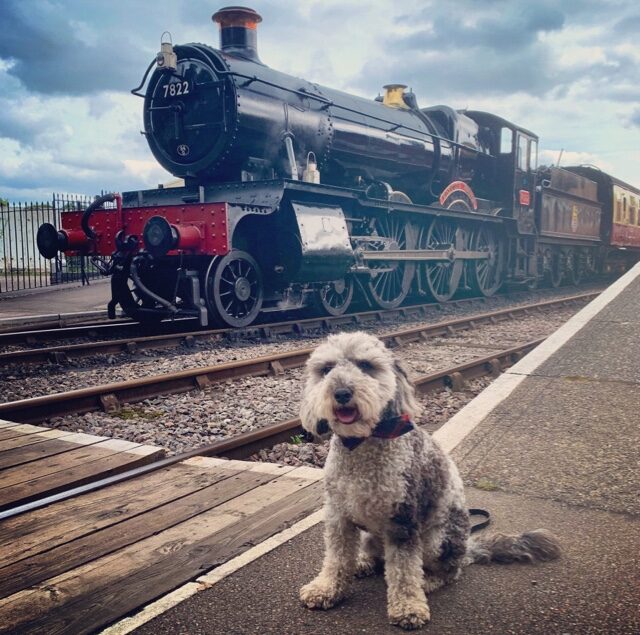

A quiet week with out of the ordinary trains in the Bournemouth to Weymouth area this week. The New Measurement Train which was scheduled to have run on Wednesday 23rd February was cancelled. Maybe we’ll get visited by a COLAS HST in March instead.
Sleeper and track replacement at Bournemouth over the weekend saw an engineers train powered by two Freightliner Class 66 locomotives No’s. 66598 and 66512 visit the station. I was asleep when the consist arrived in the early hours of Saturday, but after breakfast, Yoshi and I headed over to Bournemouth to have a quick look at what was going on.


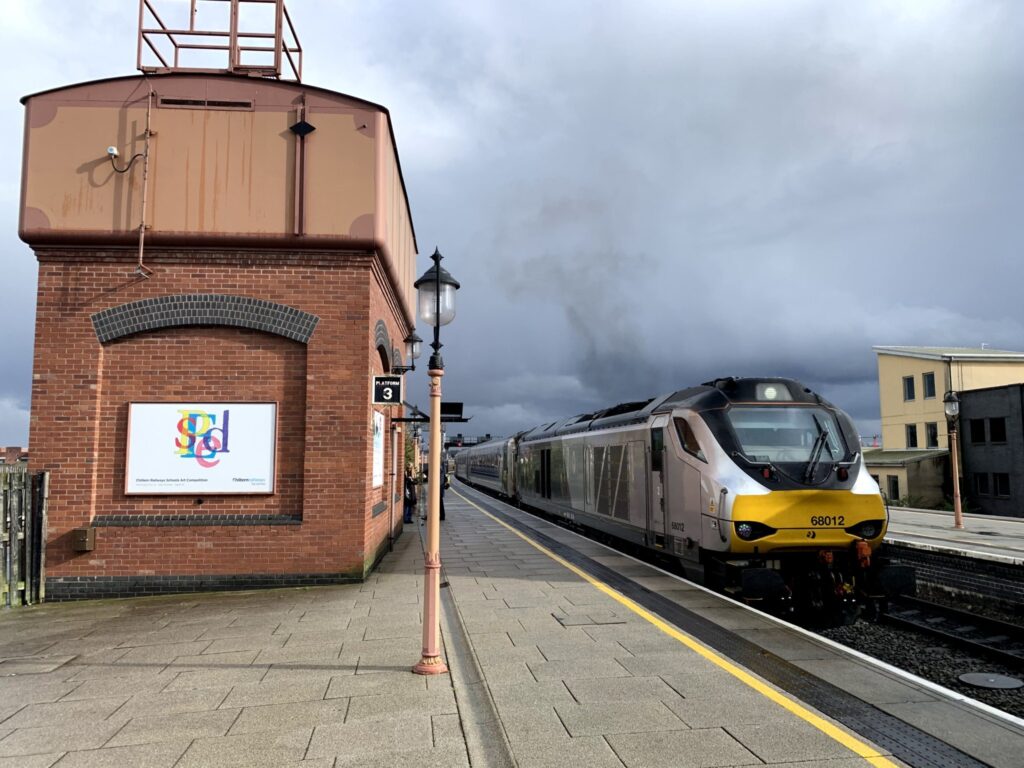
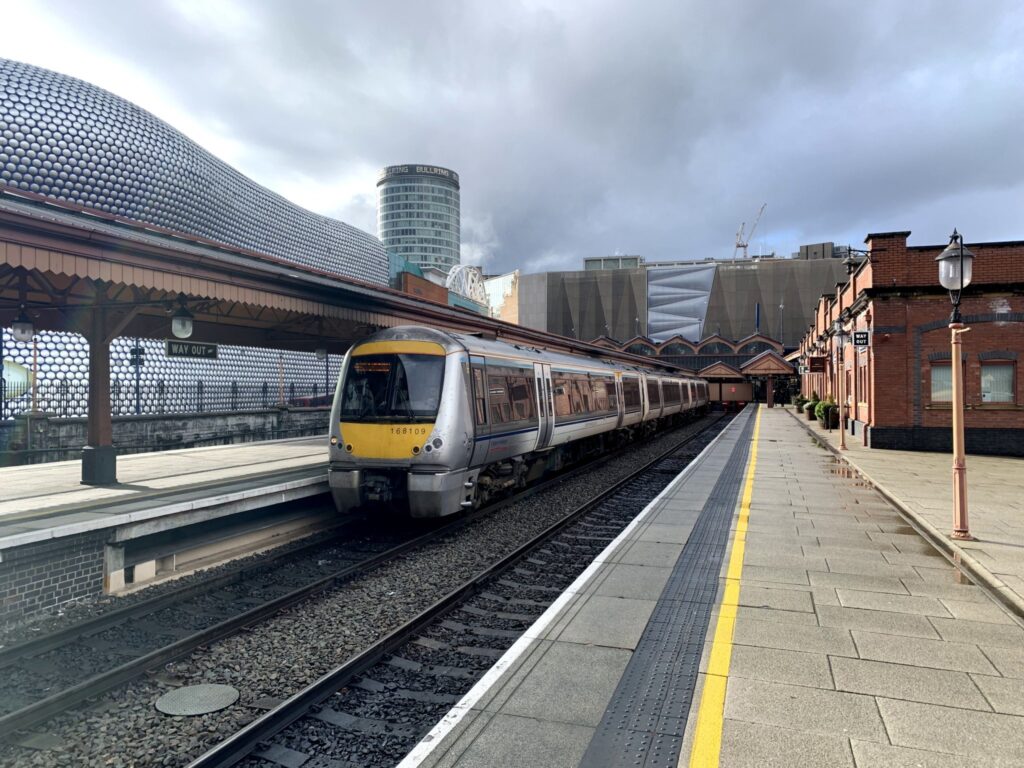
On Sunday, I left Yoshi at home with his mum while I went off to London for the day. At Christmas I was given a fabulous book; ‘Britain’s 100 Best Railway Stations’ by Simon Jenkins, which as the title suggests takes a look at some beautiful railway station architecture across the UK. One of the London Termini included is Marylebone, the smallest railway terminus in the capital. Being in the vicinity, I decided to take a quick look.


Grade II listed Marylebone is the only London terminus not to see electric traction and all services are operated by diesel trains. Despite strong opposition from the Marylebone Cricket Club who objected to the line crossing Lord’s cricket ground which sits to the north, the station opened for passenger traffic on 15th March 1899 having been constructed by the Great Central Railway for their London extension and was the last of London’s main line termini to be built. Sir Edward Watkin who created the GCR and one of the Victorian era’s great Railway Kings hoped that the line would continue south to the coast and cross to France via a Channel Tunnel. The station architect was Henry William Braddock who worked as a civil engineer with the GCR. Because of the fight over Lord’s cricket ground and the agreed solution of a cut and cover tunnel to the east of the hallowed turf, money was tight and this is reflected in the modest design of the station which was originally intended to have eight platforms but only four were built. Marylebone gained two extra platforms in 2006 following rail privatisation. The design utilises attractive red brickwork with terracotta dressings. Over 500 houses were demolished to make way for the railway and those displaced were rehoused by the Great Central. It is currently the southern terminus of Chiltern Railways, but in the 1980’s serious consideration was given to tarmacking the track bed and running buses over a road expressway. I’m rather pleased that this option was not adopted and the railway survives into the 21st Century.
For comparison below is archive footage of Marylebone and Aylesbury from March 1992 recorded by my late friend John Chappell who sadly passed away in 2021. John was an enthusiastic follower of all things transport and a supporter of the Swanage Railway and the Merchant Navy Locomotive Preservation Society and their steam locomotive No. 35028 ‘Clan Line’.
Another visit to the archives here with video from September 1992. Last week we included photos of newly outcropped Class 69 No. 69004 in Railway Technical Centre livery and the video below, filmed by John Chappell, shows two test train examples of rolling stock painted in this livery.
Of particular interest is the footage of the International Services Test Train passing through Eastleigh. This ensemble was part of the testing employed for the Trans Manche Super Train (TMST) Channel Tunnel stock. In December 1989, an order was placed with GEC-Alsthom for the construction of thirty TGV-style electric train sets which were to operate from London to Paris and Brussels. These trains were required to take electric current from 25 kV overhead wires while passing through the Channel Tunnel and in France, and 3 kV in Belgium. On the British side, however, the trains would be utilising the existing suburban 750 Volt DC 3rd rail track. Sir Edward Watkin of the Great Central Railway would have been proud to have seen his vision finally realised!
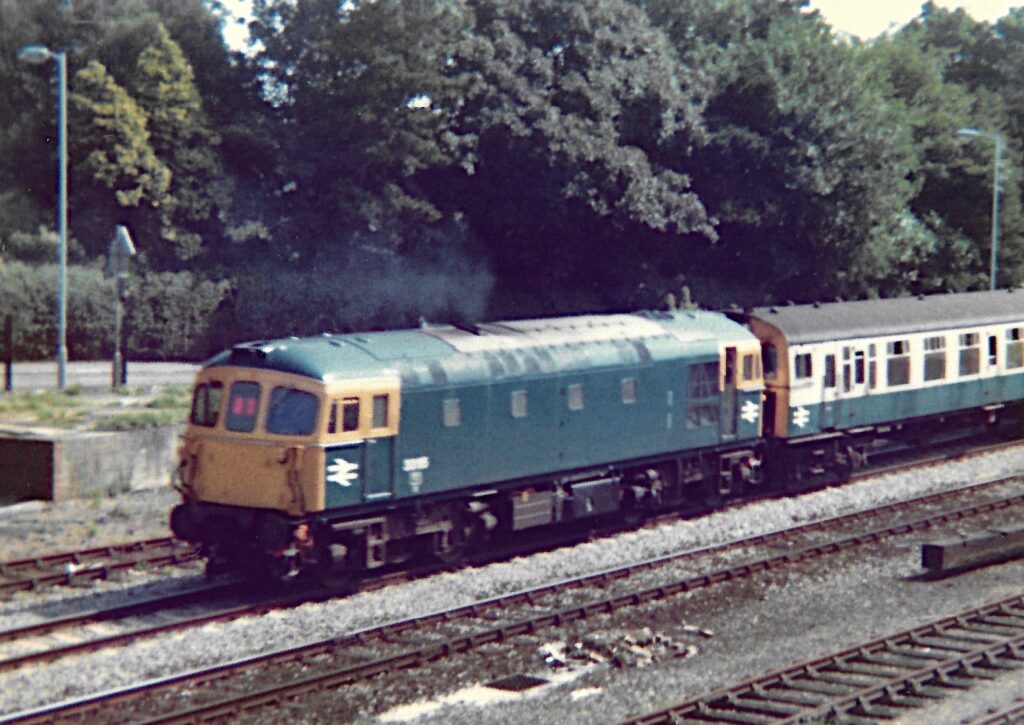
As part of the programme, withdrawn from service Class 33 No. 33115 was converted into a Driving Van Trailer (DVT) at Doncaster Works in 1990 and was given a fresh look in InterCity Executive livery and renumbered 83301. The locomotive had been modified with TGV-type bogies equipped with third rail pick-up shoes. Unpowered, it kept its seized engine as a dead weight. The decal ‘Test Vehicle For International Services’ was added to the lower body sides. The ex Class 33/1 nicknamed ‘Zebedee’ and was paired with Class 73 No. 73205 ‘London Chamber of Commerce’. The two were semi-permanently coupled to each other, 83301 being used to collect electricity from the 3rd rail which was then transferred to the 73 via heavy duty cabling to provide motive power. The remainder of the test train was initially formed of 4TC Class 438 No. 8007 ( coach numbers: 977684-7 ) painted in Railway Technical Centre red and blue but was later supplemented, in 1991, with ex 4TC coaches 977763/4 in Network SouthEast livery.
As seen in the video, the test train was commonly found running between Waterloo and Eastleigh until regular Eurostar services commenced in November 1994, running from Waterloo International to Paris and Brussels. No. 83301 was donated to the Class 33/1 Preservation Company Ltd utilising parts for Swanage railway based classmate No. 33111, the remainder being scrapped at St Leonards depot in 1996. No. 73205 remains in service with GBRf and is now named ‘Jeanette’.


That’s all for this week. Join us next time for more of the same, but subtly different.