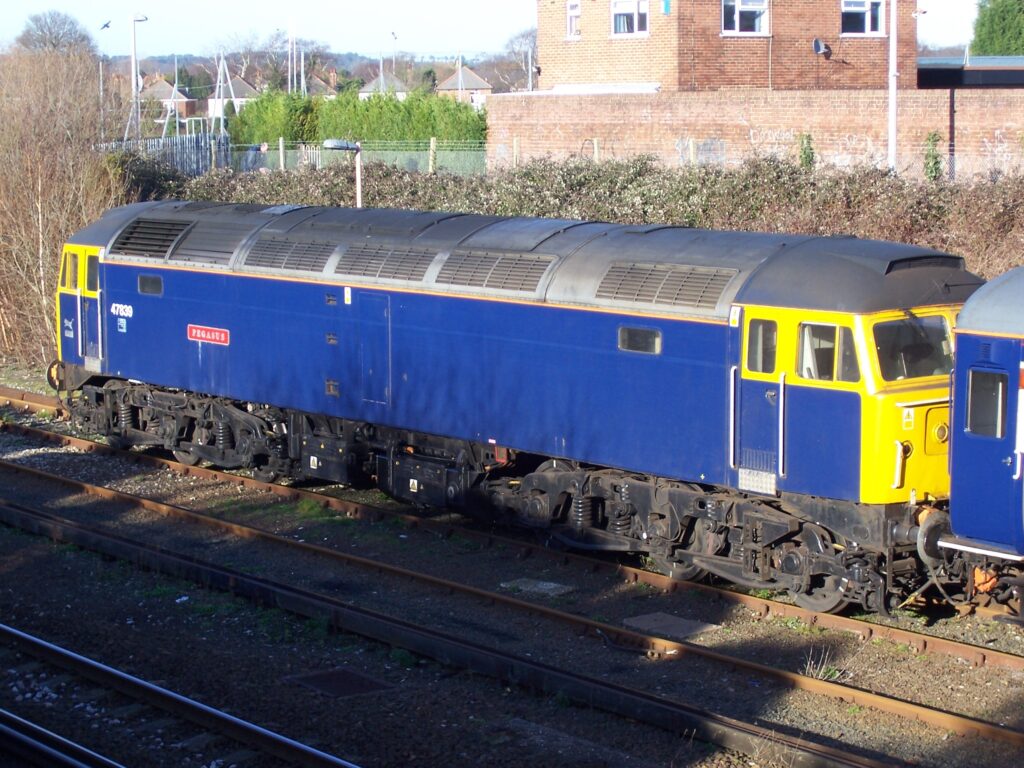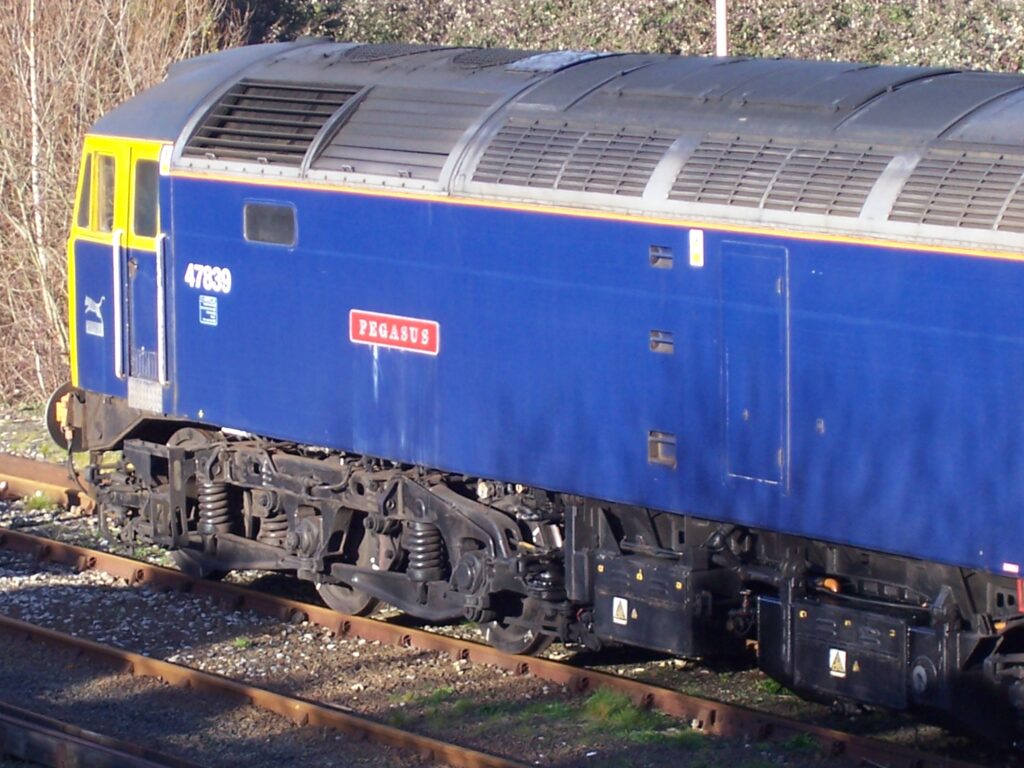

The rebranding of British Railways to British Rail on 1 January 1965 was coupled with the introduction of an entirely new livery for the modern image locomotives and rolling stock. I have a great fondness for the BR Blue era. This is the story of its inception.
A mock-up for the BR Mark 2 carriage was displayed at the Design Centre in London between the 4th to 23rd January 1965 as part of “The New Face of British Railways” exhibition. This included many of the features which were later incorporated in the production Mark 2, and trialled in an experimental train designated XP64 – short for ‘Xpress Passenger 1964 project. This mock-up was shown in an orange and grey livery which never actually appeared on rolling stock in service. The XP64 train was used to test technology and carriage arrangements for the planned Mark 2 coaches. The coaches for the XP64 train were painted in a slightly lighter version of what would eventually become Rail Blue, with a 44-inch-wide Pale Ivory stripe centred on the passenger windows, and brown underframe. One locomotive a Class 47 No. D1733 was selected to be painted to match the coaching stock. This established the broad design parameters for BR’s new corporate identity.
The concept described in period BR literature as “solid blue” for locomotives meant no more two-tone green, white lining or a separate roof colour. Apart from observing compliance with BR’s yellow approach-warning policy, paintwork above the rolling chassis would comprise one block of uninterrupted blue. The shade of blue featured in XP64 had pretty much the same colour mix as Rail Blue, but a higher luminance, which made it a bit paler. The shade was subsequently finalised in 1965 as the darker colour, also known as Monastral Blue, which typifies the UK rail scene of the late 1960’s and 1970’s.
A rounder Helvetica style font for the application of fleet numbers, which was dubbed Rail Alphabet was also employed to accompany a new double-arrow logo which would become the centrepiece of the BR brand and which is recognisably the symbol for a railway station even today. However, at the XP64 stage, no final decision had been made on how the double-arrow logo would be applied on locomotives and carriages. During the promotional period in 1964 No. D1733 ran with temporary stick-on BR logos in white with a bright red backing. After these logos were removed in the early autumn of 1964, No. D1733 continued to run with no logos at all until it received a standard Rail Blue repaint towards the end of 1969. As XP64 prototype, No. D1733 featured hybrid yellow warning panels which curved round onto the bodysides in the same way that the full yellow ends would. Therefore, XP64 blue did not have the full yellow warning ends eventually insisted upon by the British Railways Board’s accident prevention service, but neither did it have the standard small yellow warning panel being applied in the early 1960’s green livery era.
No. D1733 would remain the only blue-liveried BR diesel locomotive for more than two years, during which time new-build Brush Type 4 diesels continued to receive the then familiar two-tone green livery. Beginning in November 1966, however, the Falcon Works at Loughborough produced No.’s D1953-D1961 in BR blue with full yellow ends, the final nine Class 47s from a fleet which totalled 512 locomotives.
Older locomotives began to be repainted in Rail Blue from late 1966 onwards, as well as the final batch of BR/Sulzer Type 2s (later Class 25) No.’s D7660-D7677 were completed in BR blue at Derby in 1967. The last of the English Electric Type 1s, D8178-D8199 and D8300-D8327, followed soon after, also in BR blue from the start.
In October 1967 the first of what would later become the English Electric Class 50’s, D400, entered service in blue, again with full yellow ends. These being the first new diesel class exclusively delivered in BR blue livery.
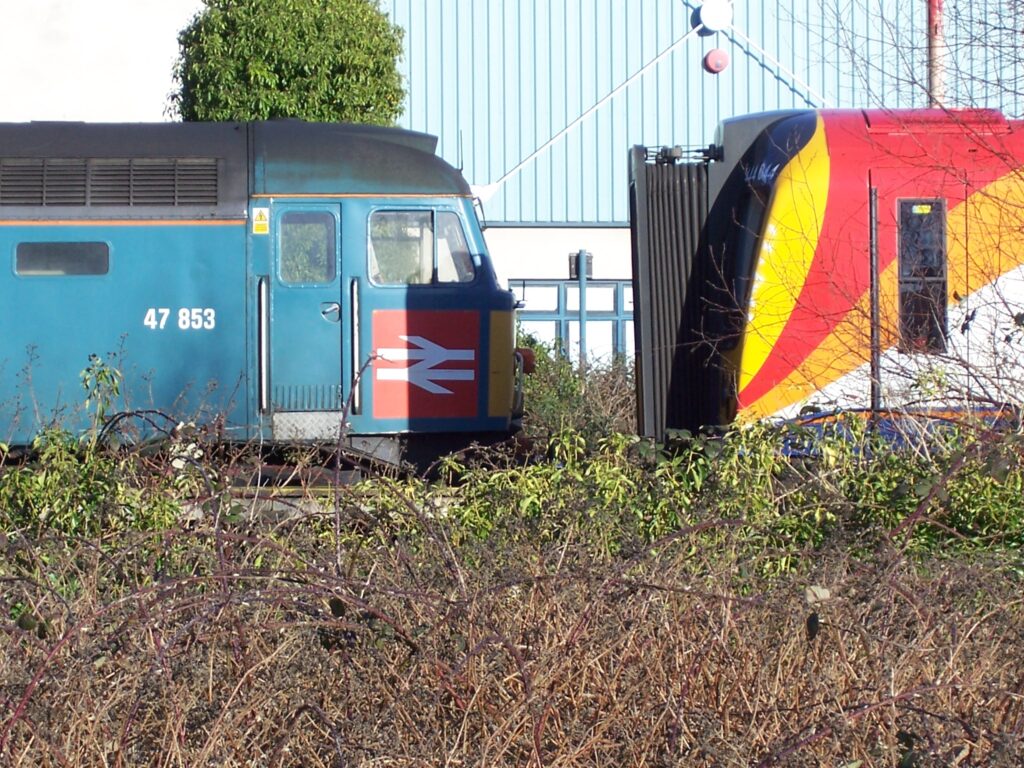
In 2001, as passenger work for diesel locomotives operated by Virgin CrossCountry came to an end, a number of their Class 47s were painted in heritage liveries that they had carried in the past, including the former D1733, now 47853, which once again carried a near-exact copy of the XP64 livery.