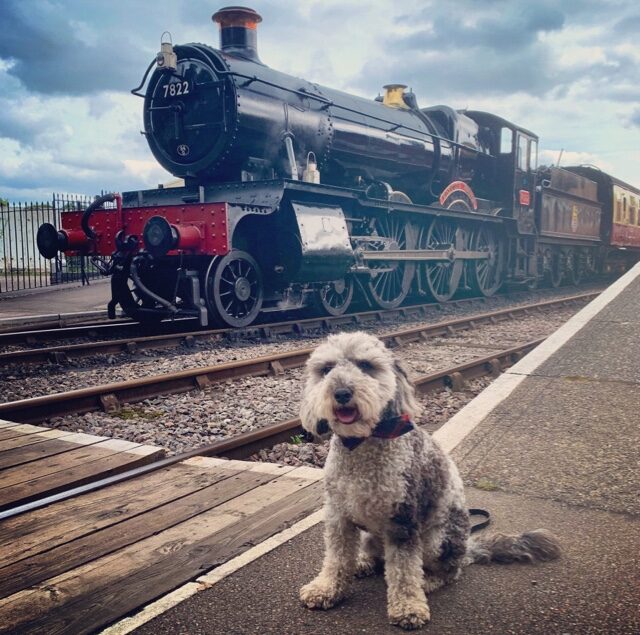
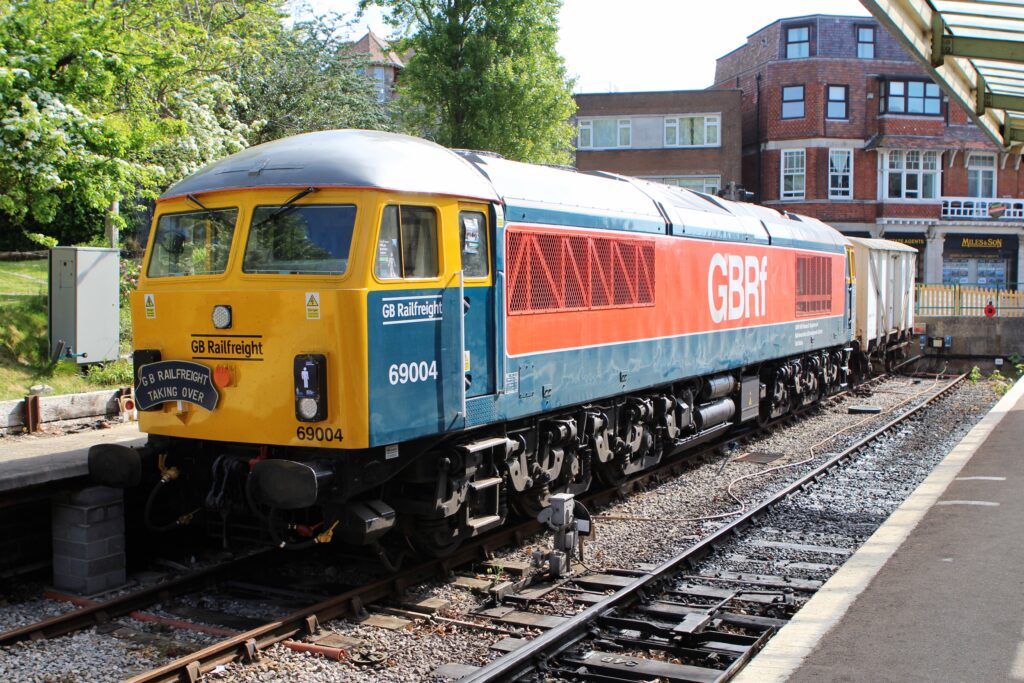
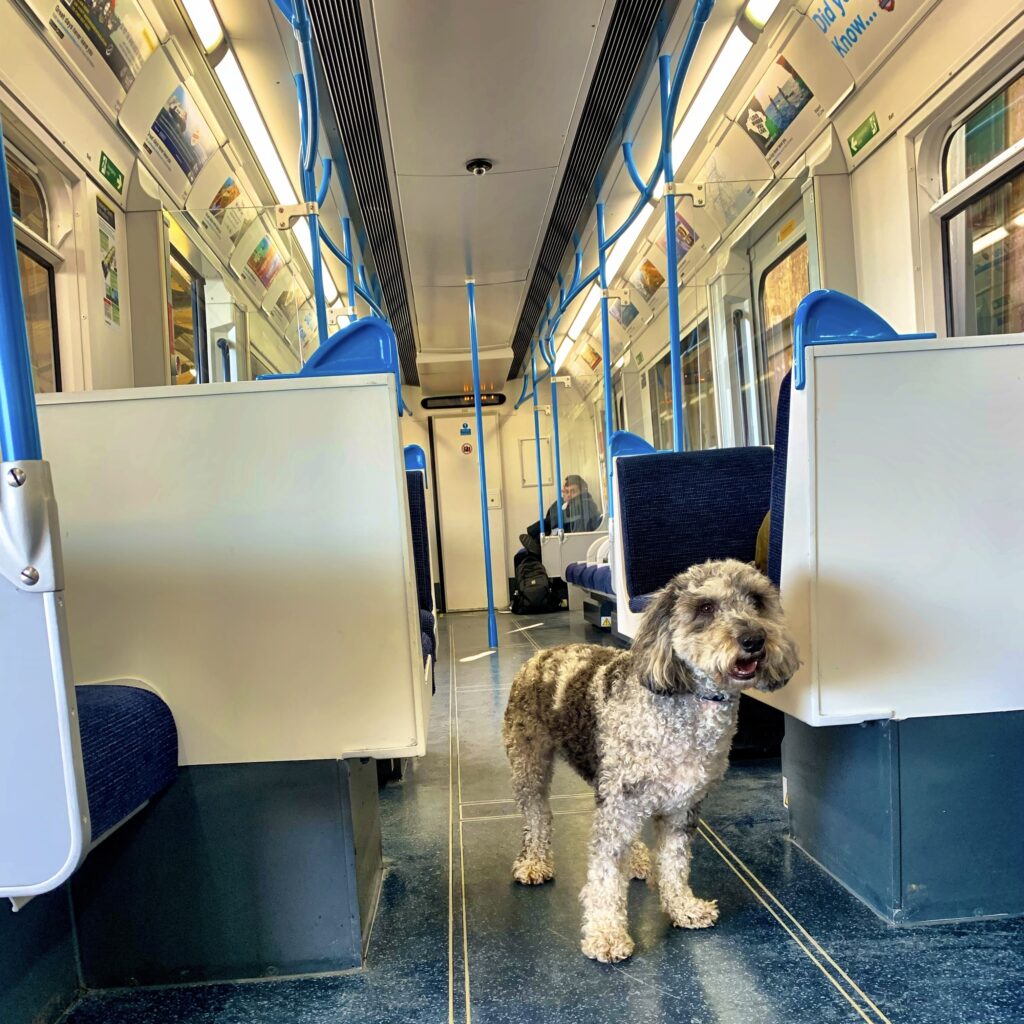
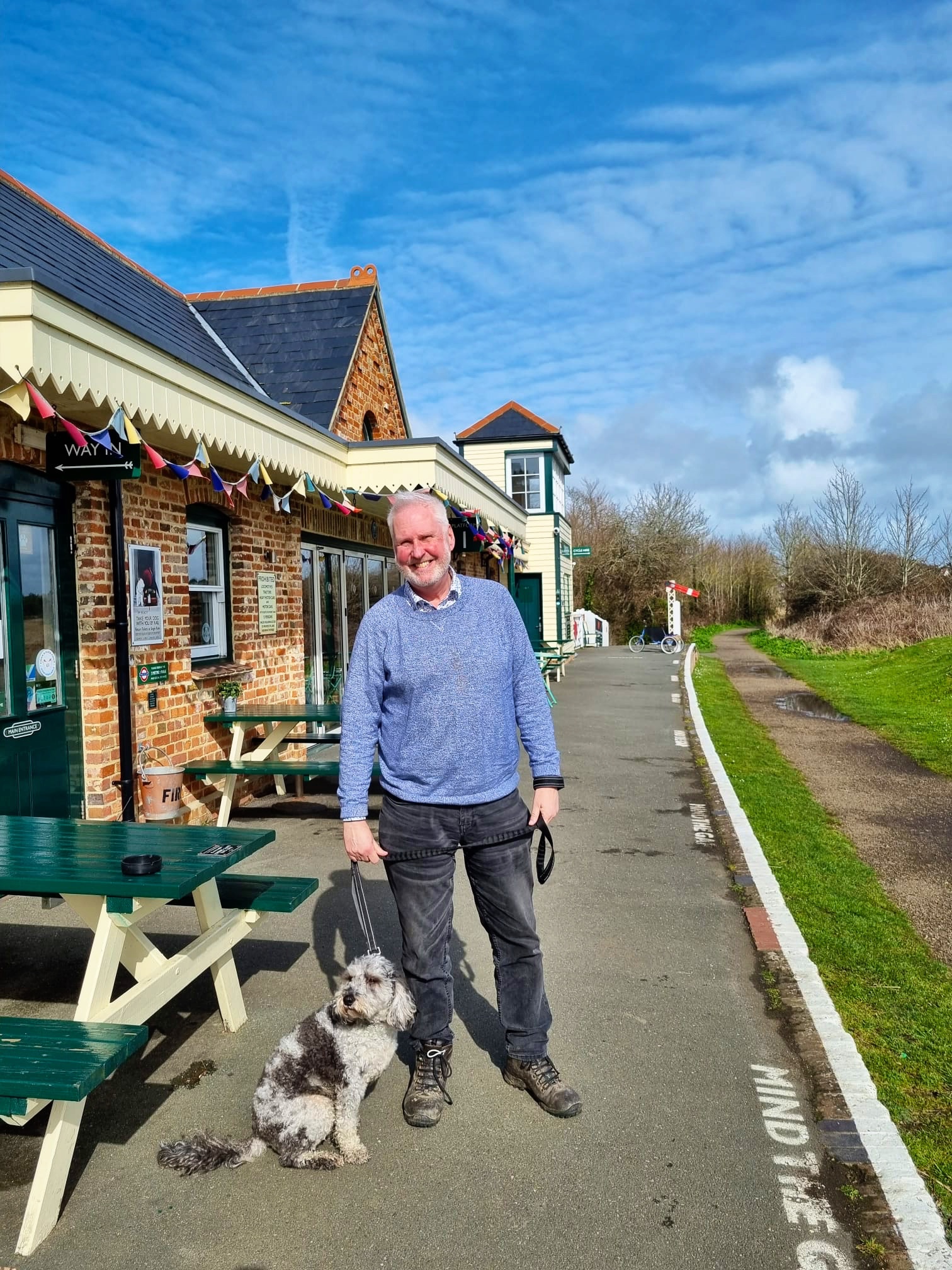
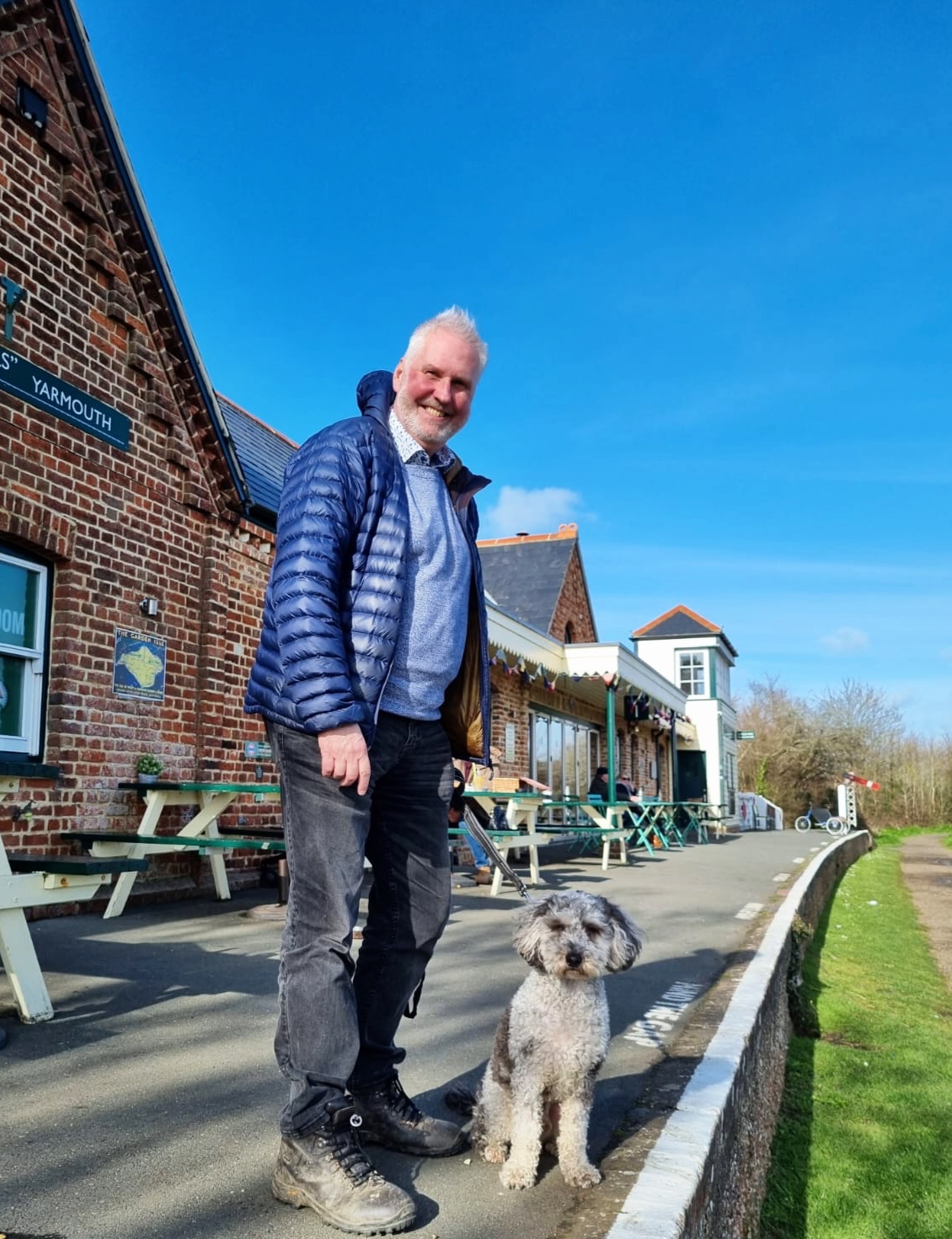
Yoshi takes the opportunity to get up close and personal with GBRf Class 69004 which was on static display at Swanage station during the Swanage Railway Diesel Gala. GBRf were raising funds for Prostrate Cancer
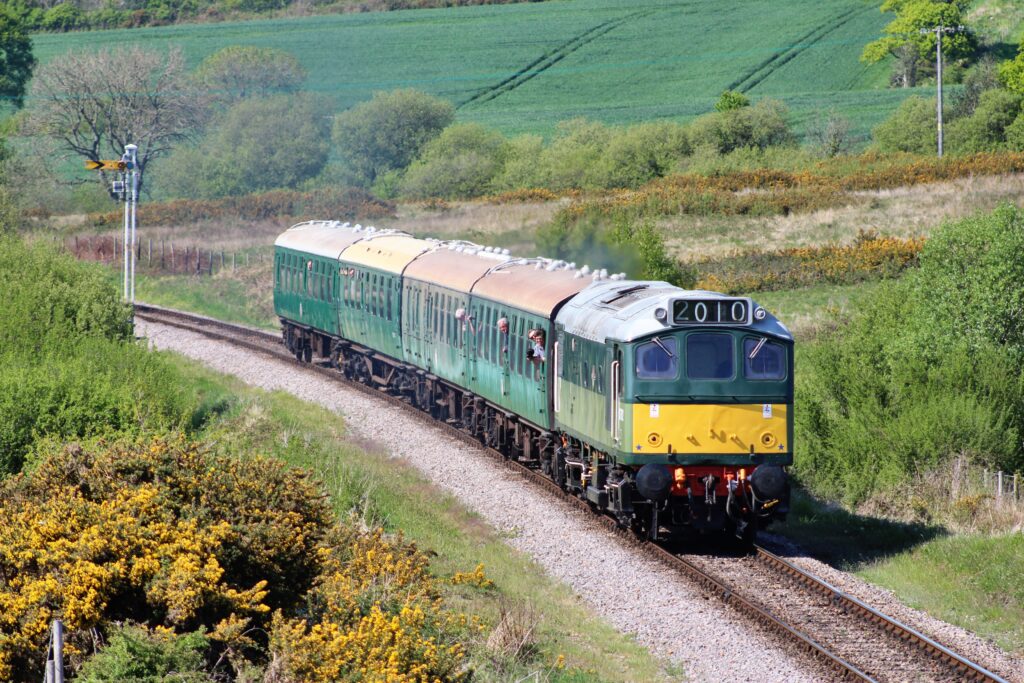
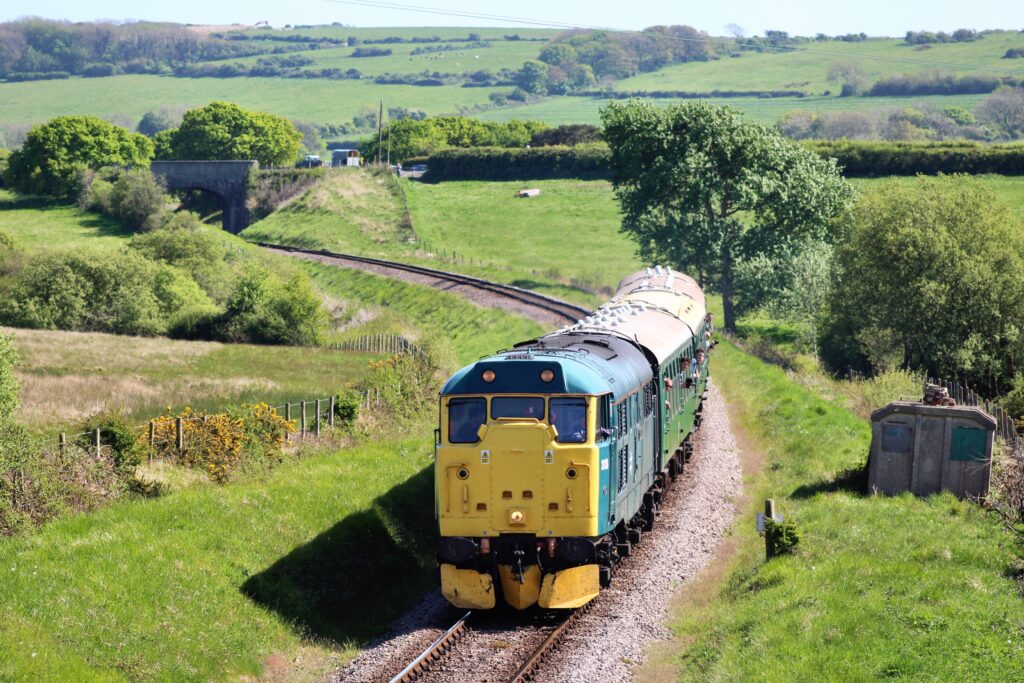
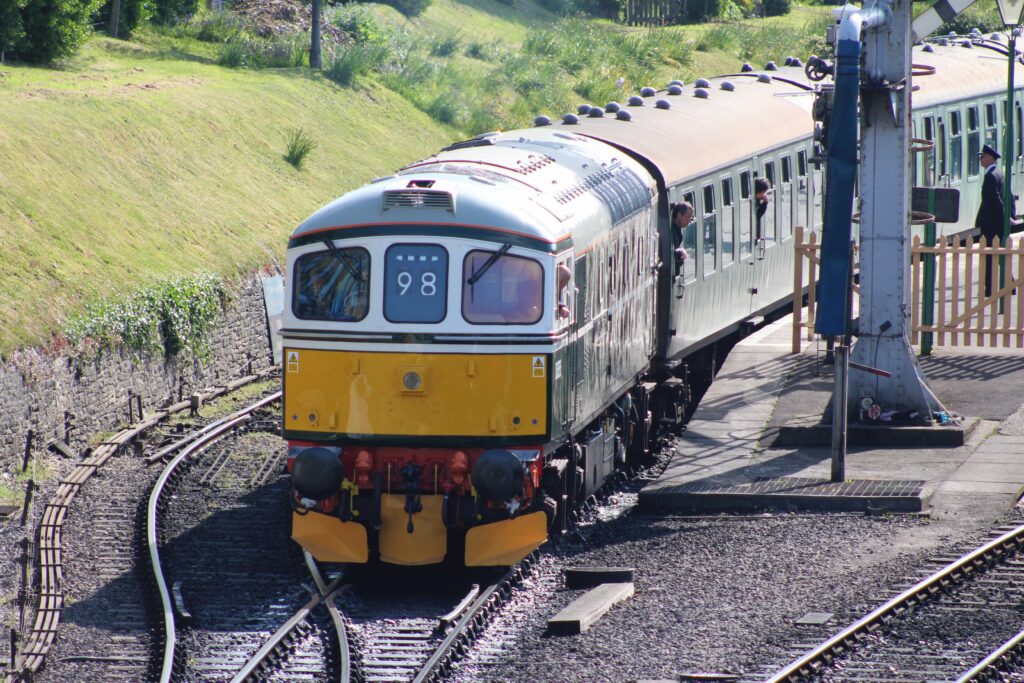
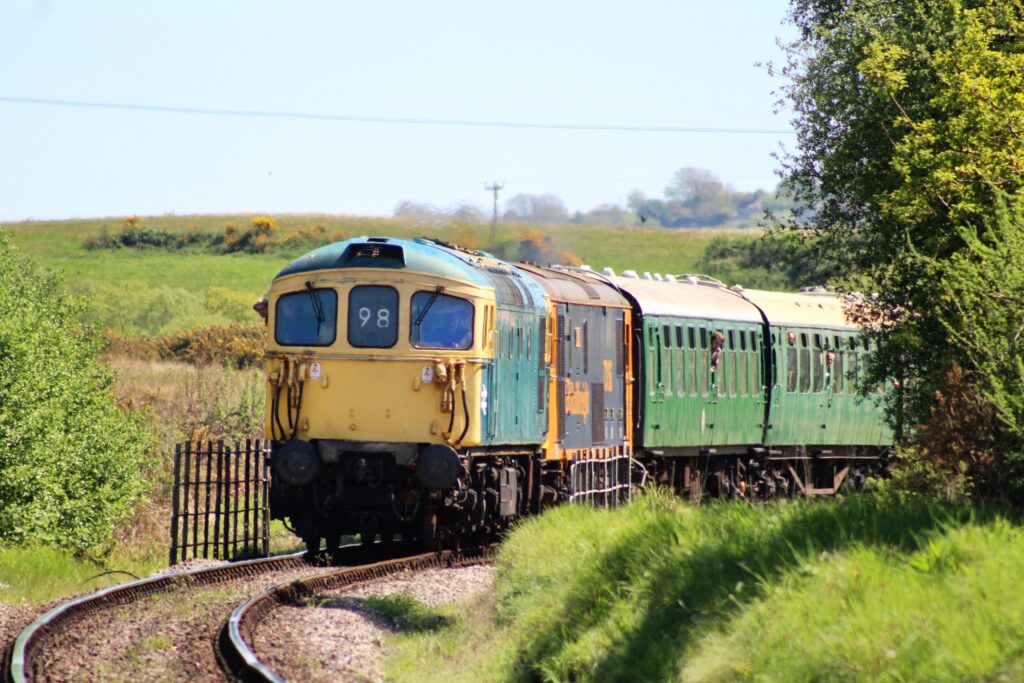
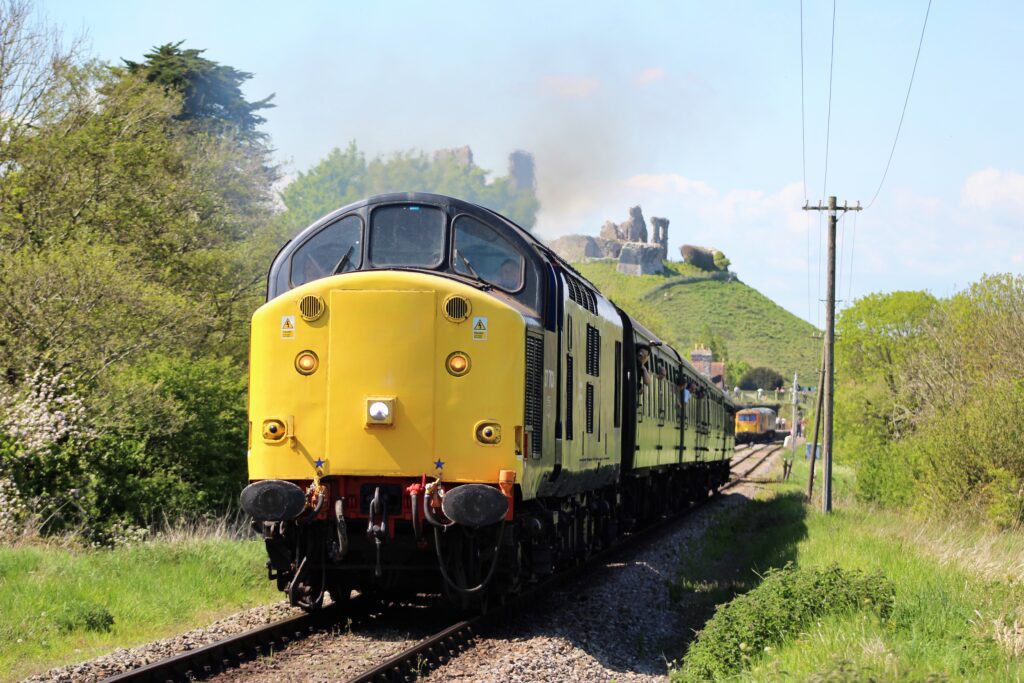
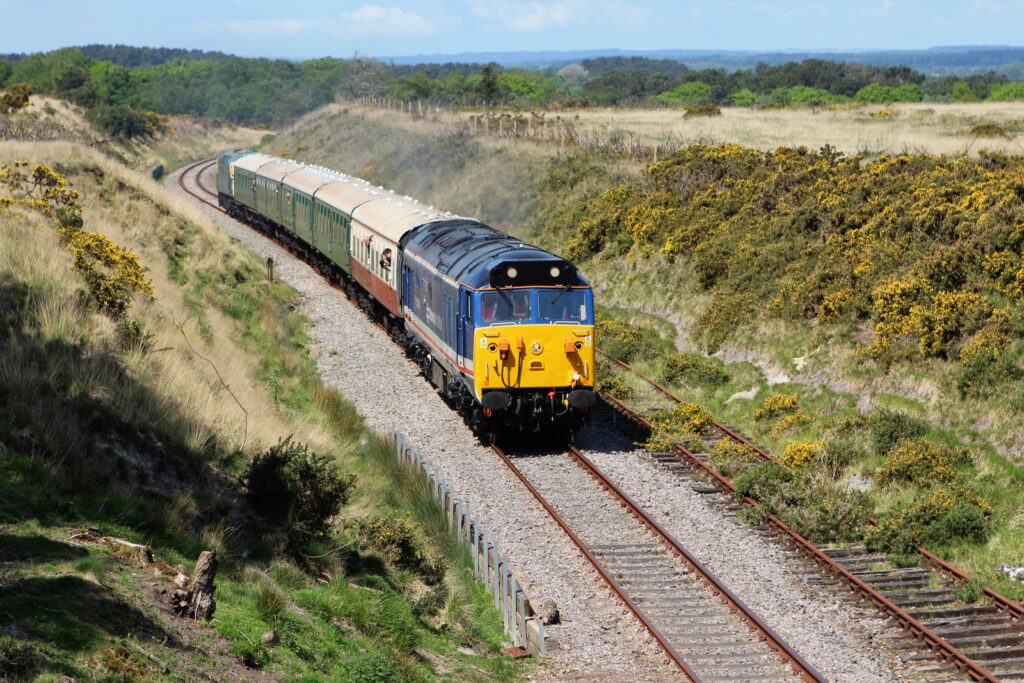
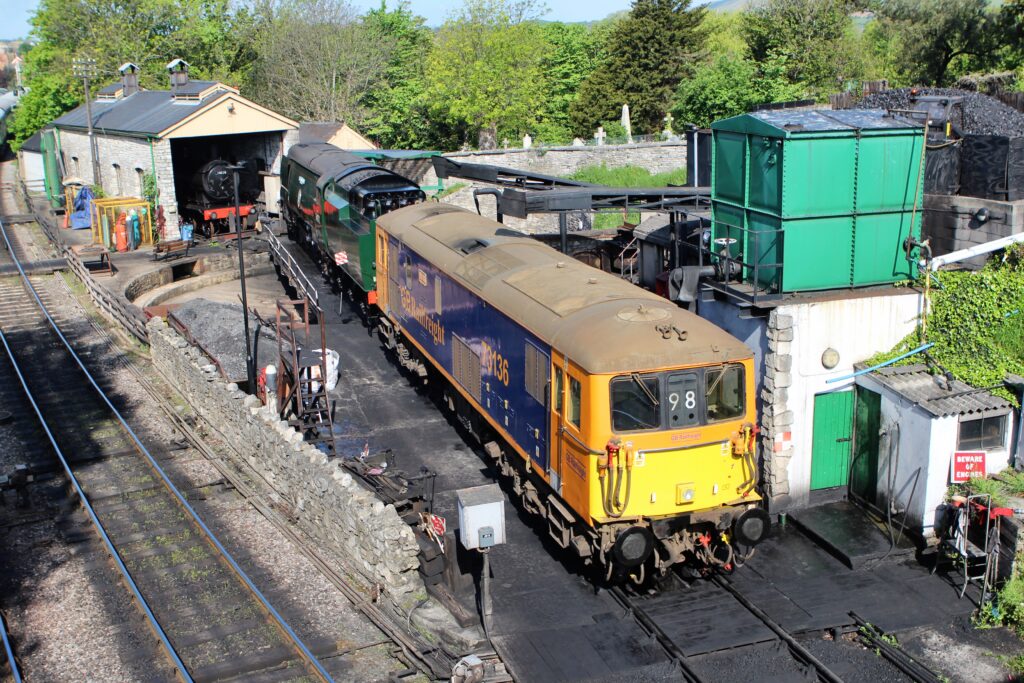
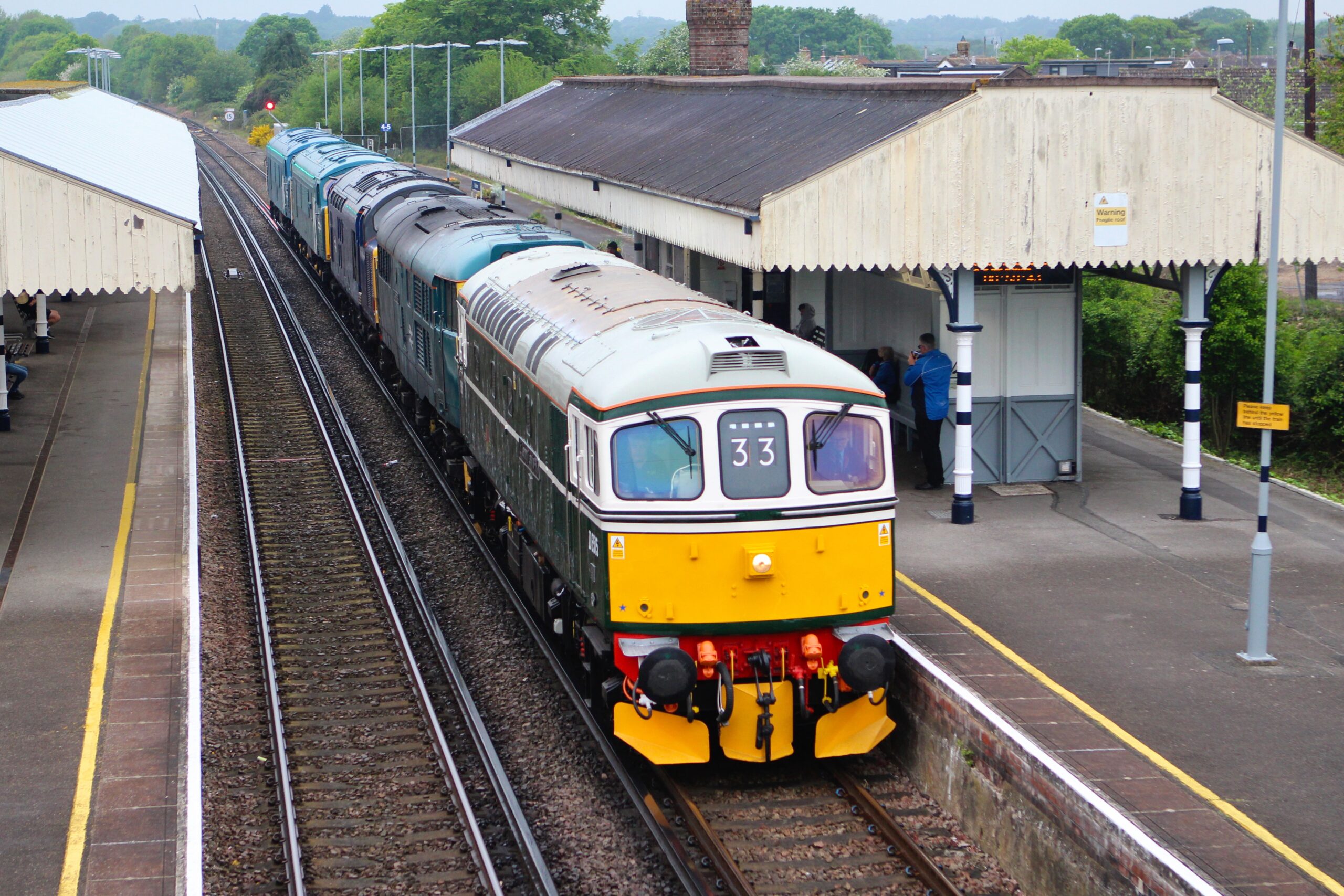
This week we take a look at the Swanage Railway Diesel Gala which was held over the weekend of 6th – 8th May 2022. This was the first event of its type held at Swanage since 2019. A “Thirty-Seven Thursday” preview day with Class 37 No. 37703 in service alongside Bulleid West Country Pacific Class No. 34028 ‘Eddystone’ took place on the 5th May. Alongside the Class 37, other locomotives involved during the gala weekend were home Class 33’s No.’s 33111 and 33012 (D6515) ‘Lt. Jenny Lewis RN’, Class 25 No. D7612, Class 31 No. 31128 ‘Charybdis’, Class 44 No. 44004 (D4) ‘Great Gable’, Class 46 No. 46045 (D182), Class 50 No. 50026 ‘Indomitable’. Class 73 No. 73136 ‘Mhairi’ was a late addition to the roster which worked in multiple with the home Class 33’s and deputised for the Class 31 on a few turns on the Saturday due to the 31 suffering an air leak. Class 69 No. 69004 was on static display at Swanage railway station raising funds for Prostrate Cancer, GBRf’s chosen charity. Trains ran from Swanage to the River Frome, just shy of the national main line network at Worgret Junction. This is beyond the usual reach of current Swanage Railway train services which normally run between Swanage and Norden Park & Ride. The Purbeck Beer Festival also took place over the weekend and evening Beerex trains on the Friday and Saturday were run in association.
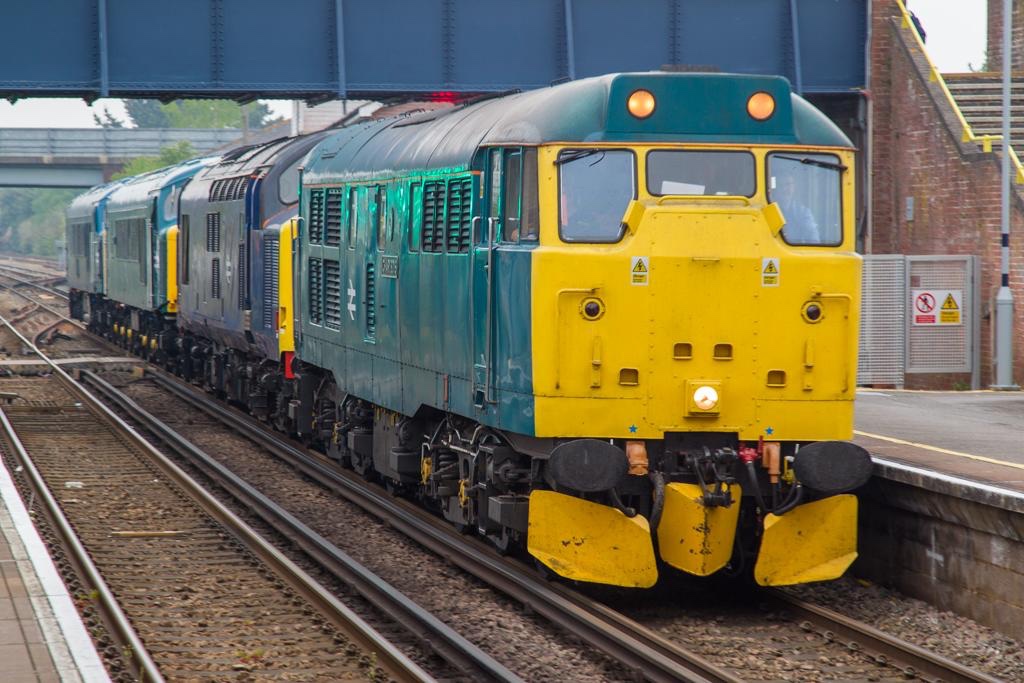
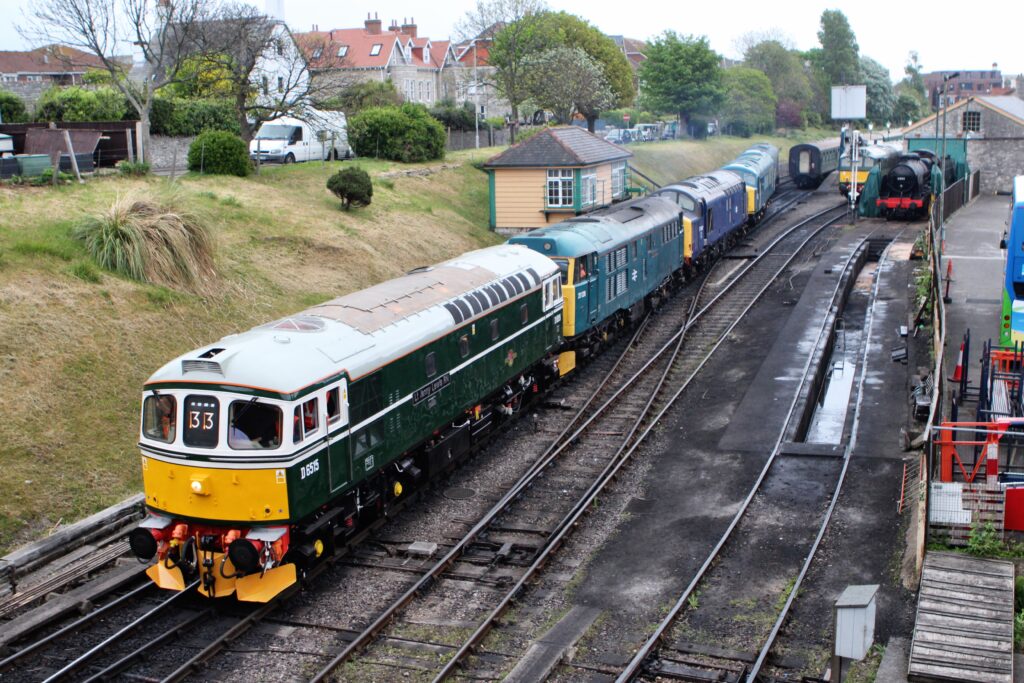
On Tuesday 3rd May, Class 31 No. 31128 hauled a convoy of visiting diesel locomotives from Butterly to Swanage in preparation for the 2022 Gala. The consist was formed of 31128 + 37703 + 44004 (D4) + 46045 (D182) – image courtesy of @da_buckley967
Yoshi and I were only able to attend on the final day of the gala which certainly did not disappoint. As well as the heritage diesel motive power, I particularly liked the new information screens incorporated into traditional style noticeboards at Swanage Station. You can watch a video of our day below:
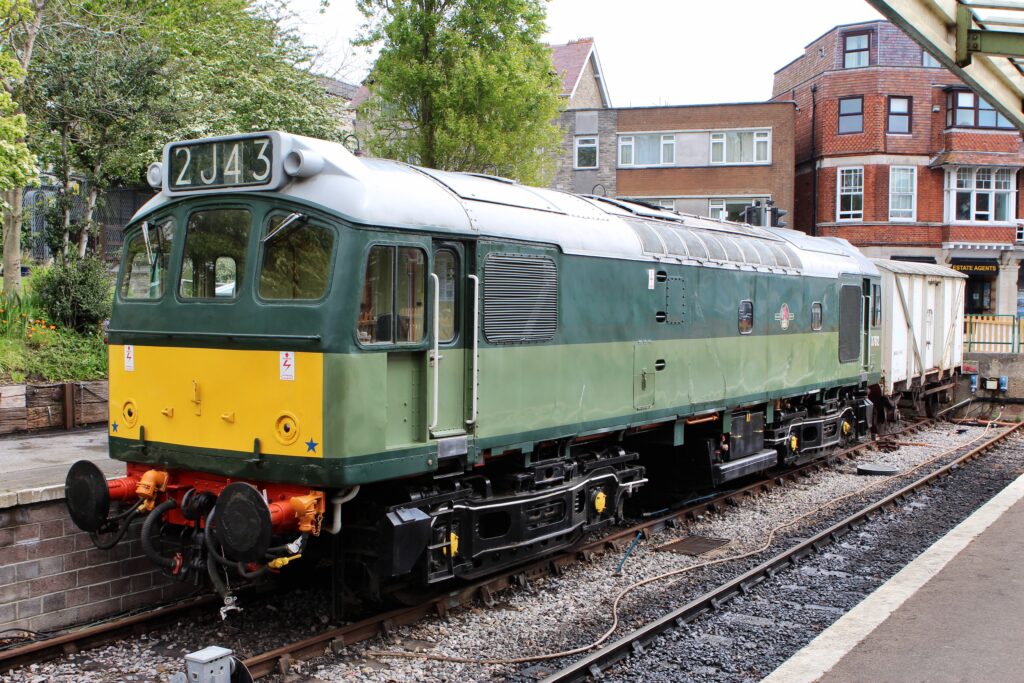
Class 25 No. D7612 approaches Townsend Overbridge at Corfe Castle – 08/05/2022Class 31 No. 31128 heading towards Corfe Castle – 08/05/2022Class 33 No. 33012 (D6515) waits to depart Swanage – 08/05/2022Class 33 No. 33111 and visiting Class 73 No. 73136 double head the 1415 service from Swanage approaching Wurzel Crossing, Corfe Castle – 08/05/2022Class 37 No. 37703 having departed Corfe Castle with a service bound for Swanage – 08/05/2022Class 44 No. 44004 (D4) at Creech – 08/05/2022Class 46 No. 46045 (D182) with the last train of the day to Swanage – 08/05/2022Class 50 No. 50026 approaching Furzebrook – 08/05/2022Class 69 No. 69004 on static display at Swanage in support of the charity Prostrate Cancer – 08/05/2022Class 73 No. 73136 “on shed” at Swanage – 08/05/2022
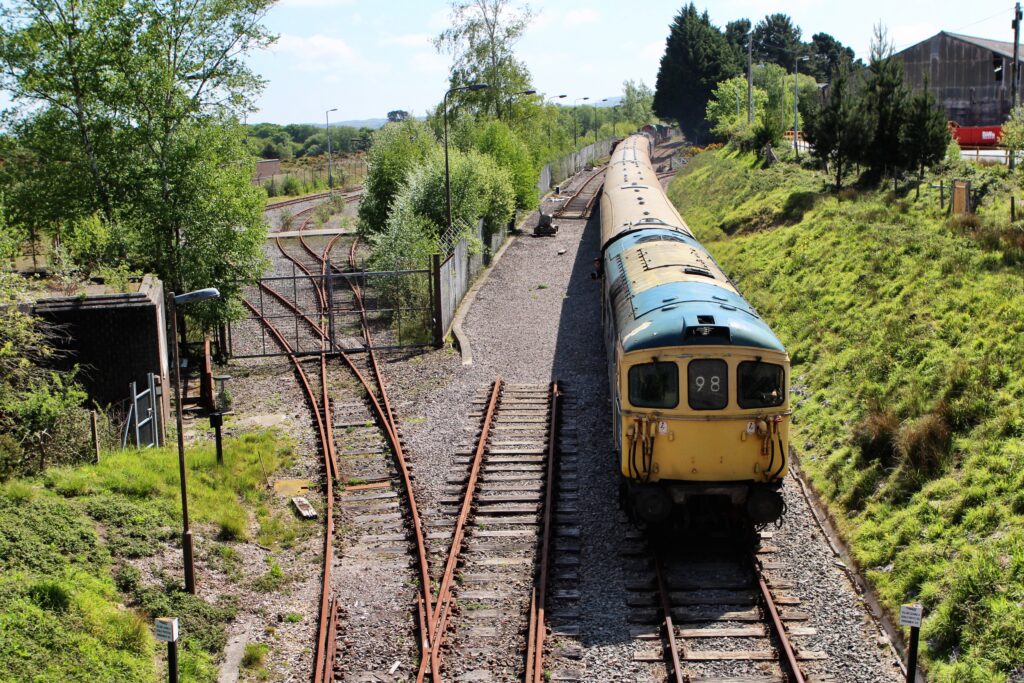
After all the excitement of the gala event, it was time for some of the visiting diesel locomotives to move on to other locations and we popped out see the workings from Swanage starting with the Class 69 / Class 73 combo which ran on Monday 9th May as 0Y98 1135 Swanage to Eastleigh East Yard:
69004 leads 73136 through Hamworthy on 9th May 2022
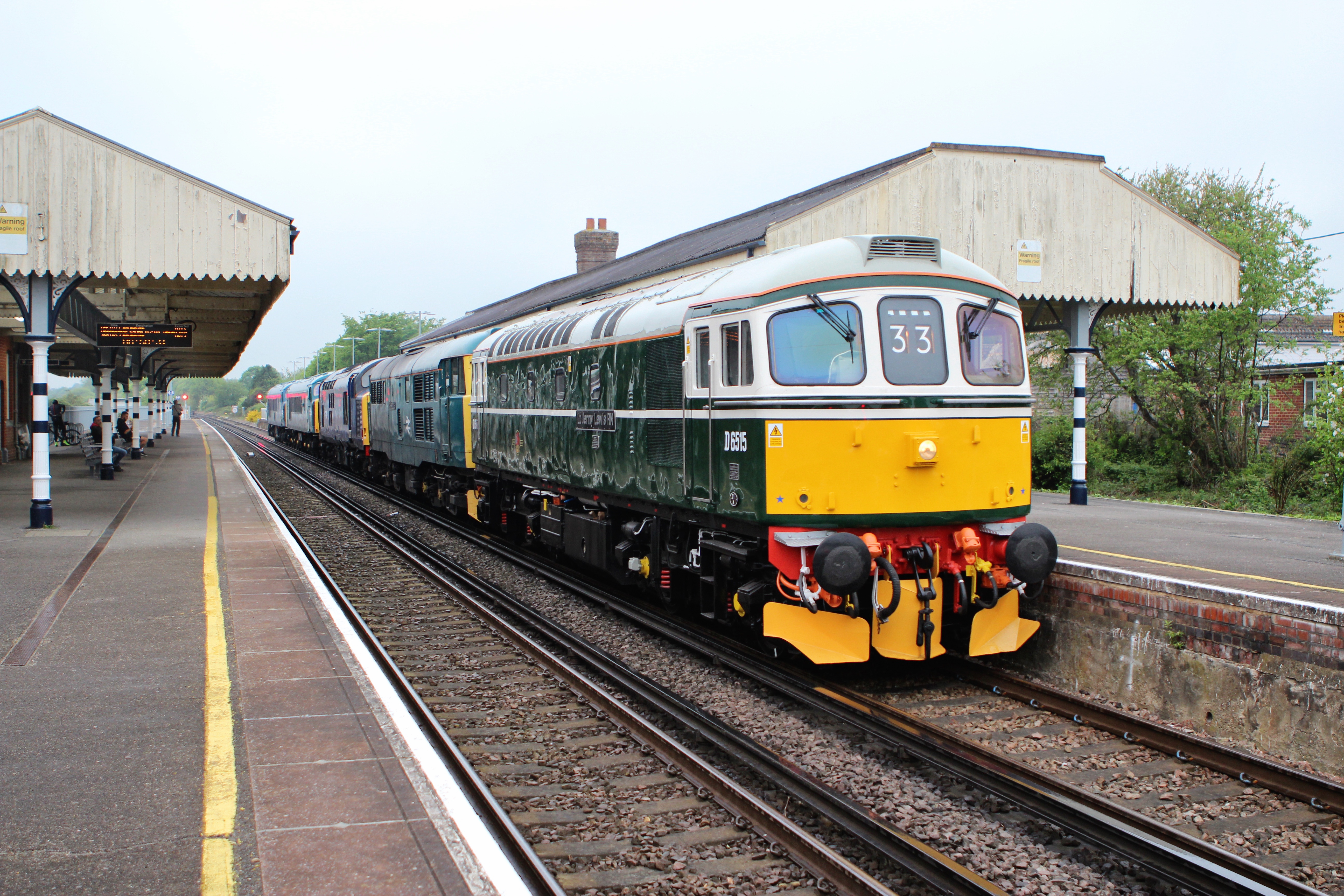
It was an early start on the following day, Tuesday 10th May, when a convoy of locomotives departed Swanage ten minutes late working 0Z33 0610 Swanage to Kidderminster S.V.R.:
33012 + 31128 + 37703 + 44004 + 46045 departing Swanage working 0Z33 0610 Swanage to Kidderminster S.V.R. – 10/05/202233012 + 31128 + 37703 + 44004 + 46045 pause at Wareham working 0Z33 0610 Swanage to Kidderminster S.V.R. – 10/05/202233012 + 31128 + 37703 + 44004 + 46045 about to depart Wareham working 0Z33 0610 Swanage to Kidderminster S.V.R. – 10/05/2022
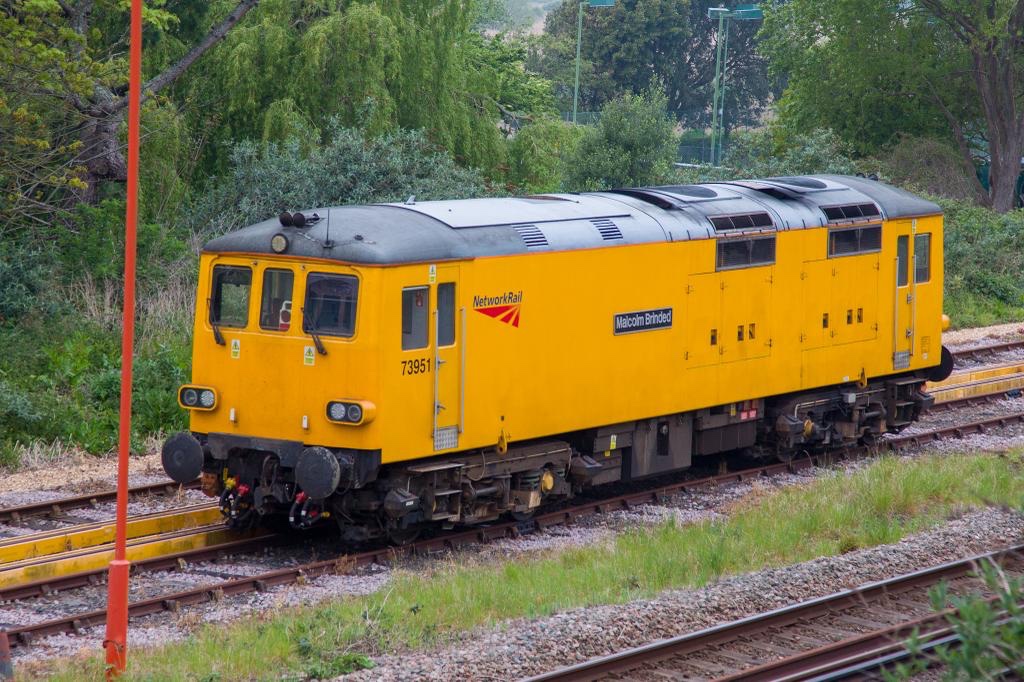
The Swanage gala and associated movements dominated our local rail scene here on the Bournemouth – Weymouth line, however the former Great Western Railway line to Bristol produced several more visits from COLAS route learner formed of Electro-Diesel Class 73 No. 73951 ‘Malcolm Brinded’ which we featured in last weeks blog entry. The locomotive is seen here stabled at Weymouth on Tuesday 3rd May 2022:
Class 73 No. 73951 ‘Malcolm Brinded’ at Weymouth – image courtesy of @da_buckley967
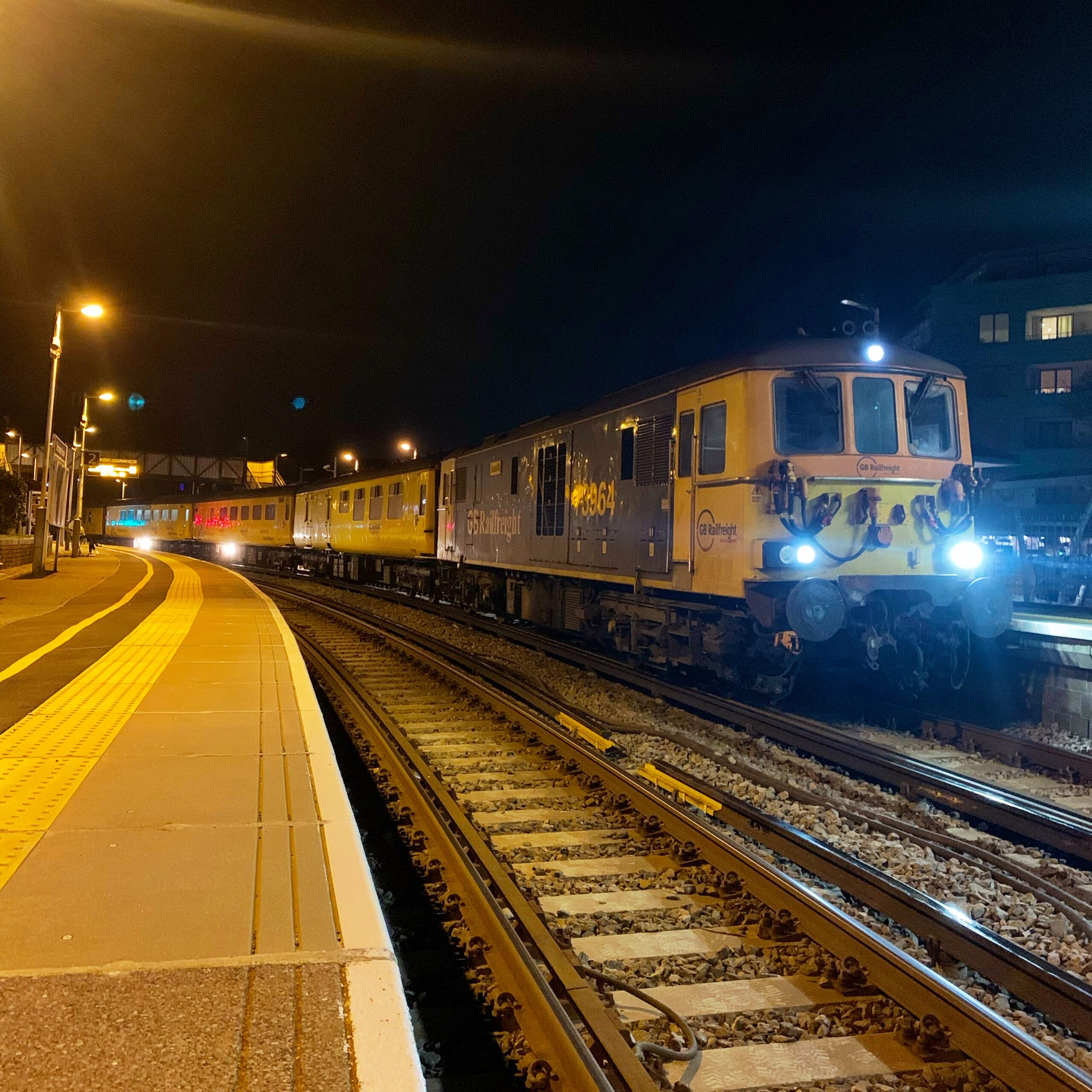
Class 73’s No.’s 73964 and 73962 headed to Weymouth top and tailing a Network Rail Test Train on the evening of Monday 9th May working 1Q51 1115 Derby R.T.C. to Eastleigh East Yard. We saw the pair pass through Poole:
In other news, RAIL Magazine reported on the Department for Transport (DaFT) having “increased confidence” in South Western Railway’s £1 billion order for 90 new Class 701 Arterio trains which continue trials to Bournemouth and Poole, expecting a final entry into service plan by June 30th 2022. Alstom who are building the trains will be delivering additional software upgrades over the forthcoming months with SWR having provisionally accepted the first batch of trains. Driver training is yet to commence and there remain outstanding issues to be resolved with the unions. The 701’s are nearly three years late entering into traffic having been expected to take over suburban and Reading & Windsor line services in 2019. The fleet will be maintained at Wimbledon depot.
Yoshi takes a look at new Class 701 No. 701025 working 5Q51 1126 London Waterloo to Staines Up Loop at Poole on 16th April 2021
We stick with the Swanage Branch for our archive video this week with a look at a diesel gala from the past. But first we turn the clock back to the 1990’s when LPG trains ran to and from Furzebrook.
Wytch Farm oil field is the largest onshore oil field in Western Europe and was discovered by British Gas in 1973. Since 2011 the oil field has been managed by Perenco having taken over from BP who bought Wytch Farm when British Gas was privatised in 1984. Production first commenced in 1979 with crude oil being transported by rail from Furzebrook to Fawley. In the late 1980’s production increased and a pipeline was installed between Wytch Farm and Hamble meaning transportation by rail was no longer required. However, production of natural gas also increased at this time. The gas was liquefied and conveyed by rail from 1990 until 2005 when production decreased. The LPG traffic ran from the Furzebrook railhead to Hallen Marsh near Bristol. Hauled by Class 47’s when the trains commenced, the LPG was later in the charge of Class 60’s and finally Class 58’s. In 2005 the site was transferred to the ownership of Dorset County Council and the Swanage Railway took a step closer at achieving its now completed aim of connecting to the main line near Wareham.
The trains would arrive formed of empty LPG tanks and leave with full ones. The two examples shared below were evening workings and most likely the outward train is 6V29 1929 Furzebrook to Hallen Marsh, the inbound train would have started from Eastleigh Yard.
The locomotives in the videos below belonged to the then Railfreight Petroleum Sector, six sub-Railfreight Sectors having been created in 1987 as a development of the old British Rail Railfreight Division. These sectors existed until the onset of rail privatisation in 1994 when Railfreight was reformed into three Railfreight companies; Loadhaul, Mainline Freight and Transrail, in preparation for selling off.
Compare the scene in the videos above with the view below of Class 33 No. 33111 hauling a Swanage Railway Diesel Gala passenger train past the former Furzebrook Oil Terminal towards the River Frome on 8th May 2022:
Class 33 No. 33111 passes the site of the former Furzebrook Oil Terminal – 08/05/2022
Finally a look back ten years to the 2011 Swanage Diesel Gala which included, amongst other visitors, a Class 52 ‘Western’ diesel-hydraulic and a Class 55 ‘Deltic’:
That’s it for this week – thanks for reading and hopefully we’ll be back next Wednesday with an update from Yoshi HQ!
Sulzer Type 2 Class 25 No. D7612 has arrived at Swanage in advance of the 2022 Diesel Gala
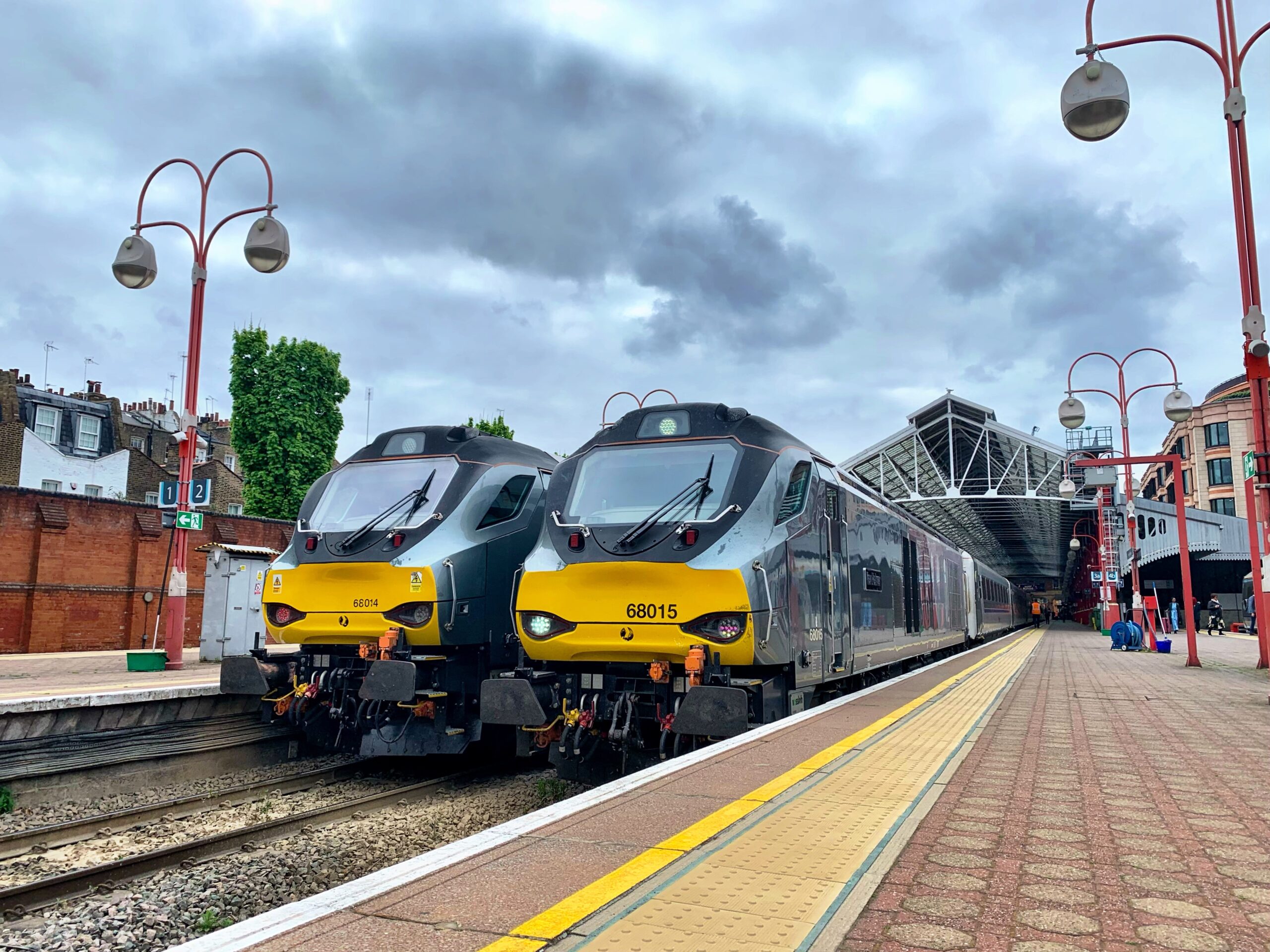
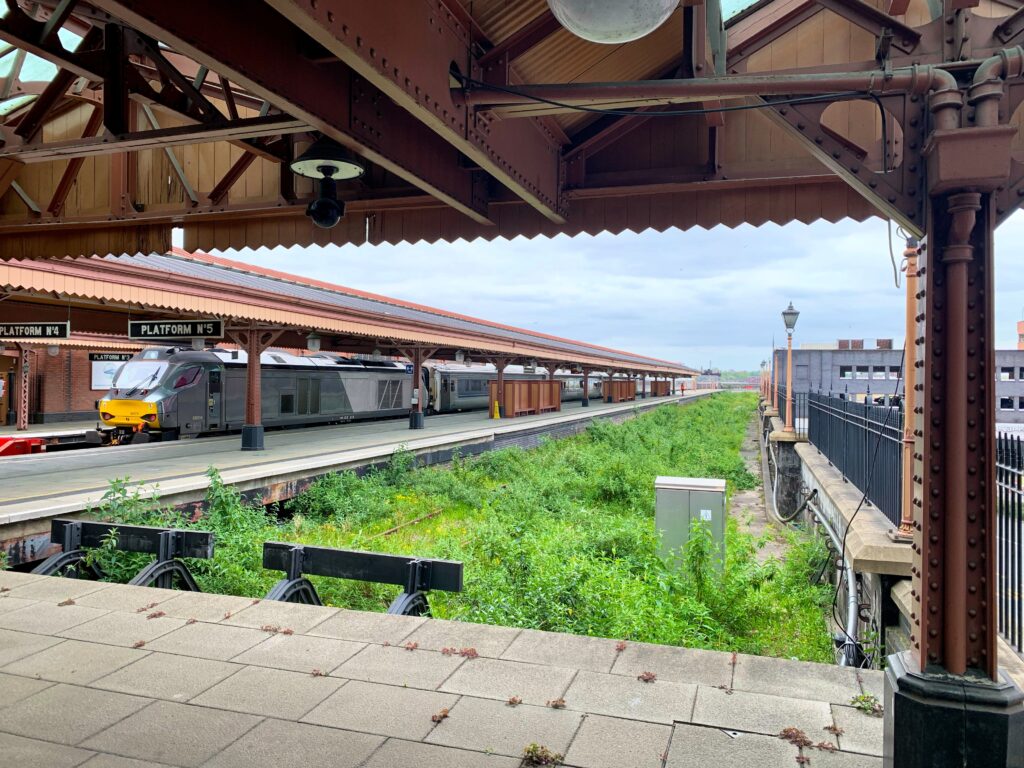
This week I needed to go to Birmingham, so took the opportunity of sampling the Chiltern Railways Class 68 hauled service to and from London Marylebone and Birmingham Moor Street. We visited Marylebone as part of a previous post a few weeks ago, but I didn’t see any loco hauled services on that day. Six Class 68 locomotives are leased by Chiltern Railways from DRS and along with the locomotive, trains were formed of six MK3 carriages and a MK3 Driving Van Trailer (DVT). The DVT’s are modified to work with the power doors that are fitted to the MK3 coaches and have a generator fitted to enable Electric Train Supply and compressed air to be provided to the coaches when the locomotive is not running, such as when in a terminus station and when stabled. There was no buffet car or trolley service available on the trains I travelled on, and as I had left my lovingly prepared sandwiches in the fridge at home I was pleased to find a Greggs open at Marylebone station.
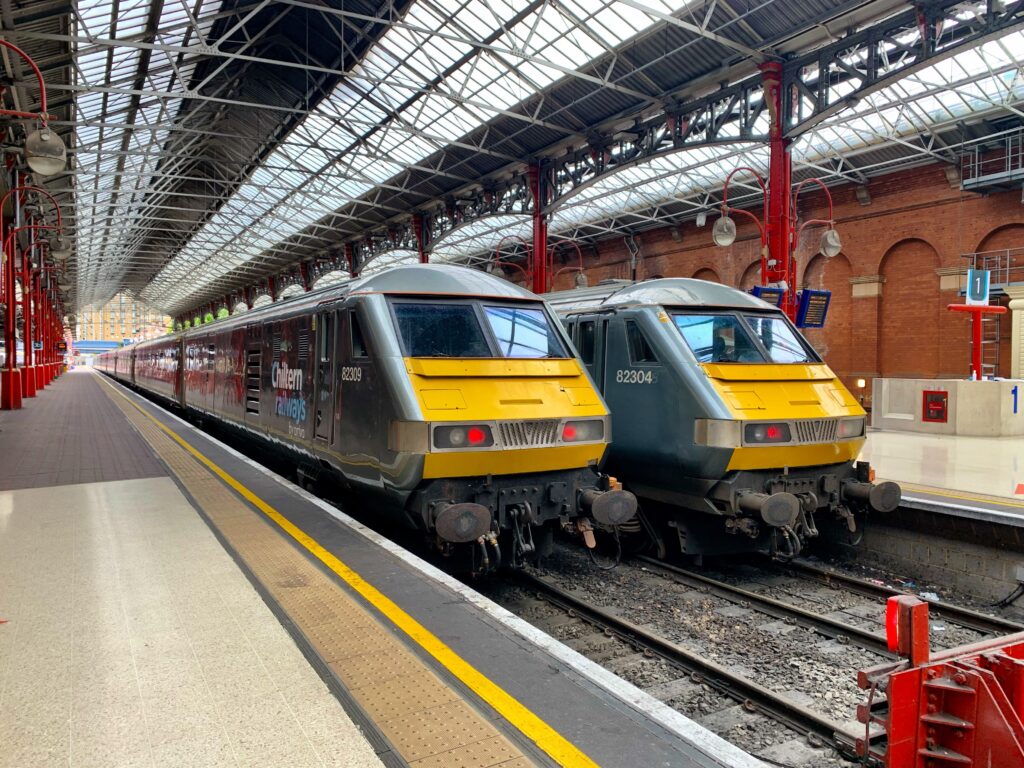
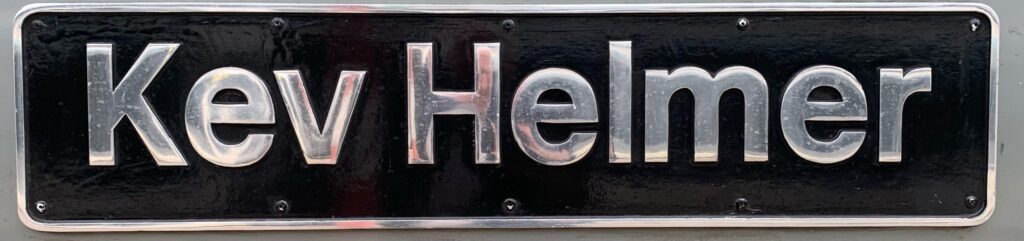
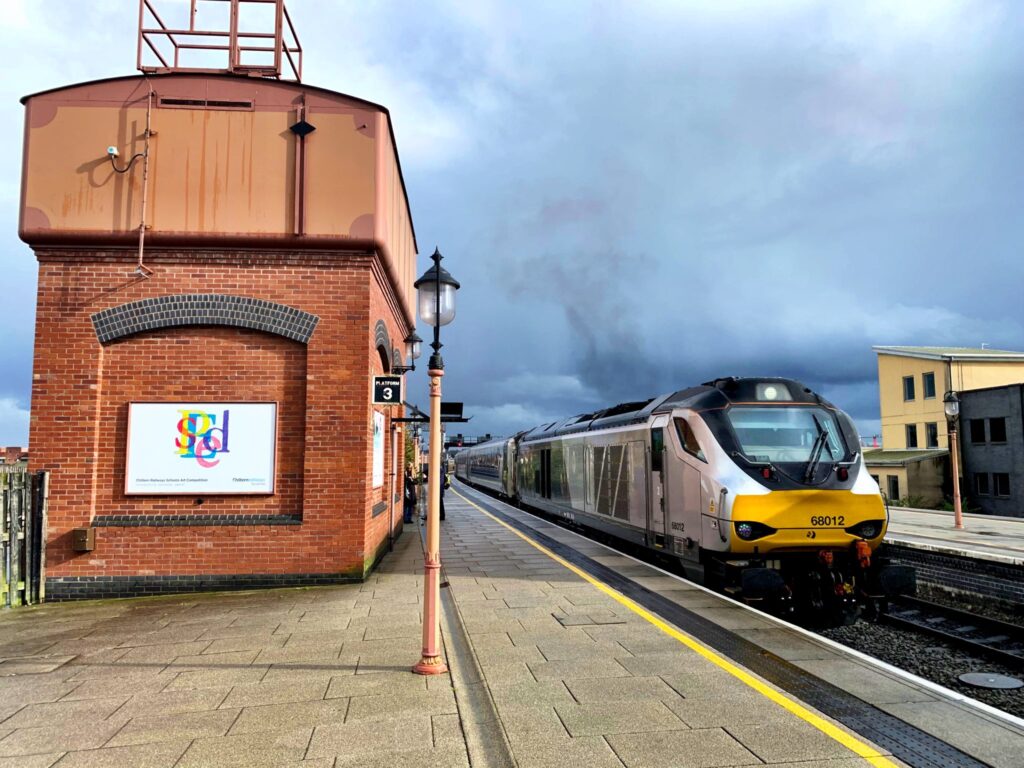
Chiltern Railways Class 68’s No.’s 68014 and 68015 ‘ Kev Helmer’ at London Marylebone – 27/04/2022Chiltern Railways Class 68’s No.’s 68015 ‘ Kev Helmer’ and 68014 at London Marylebone – 27/04/2022MK3 Driving Van Trailer’s at the buffer stops – London MaryleboneClass 68 No. 68014 at Birmingham Moor Street – 27/04/2022MK3 Coach – Birmingham Moor StreetClass 68 No. 68013 ‘Peter Wreford-Bush’ waits departure with the 1455 Birmingham Moor Street to London Marylebone – 28/04/2022Nameplate close-up of 68015 ‘Kev Helmer’. Kev was Birmingham Moor Street driver who lost his life to covid in January 2021Nameplate close-up of 68013 ‘Peter Wreford-Bush. Peter was a popular and long-standing member of the Leamington Spa station staff who sadly died of covid at the early age of 47
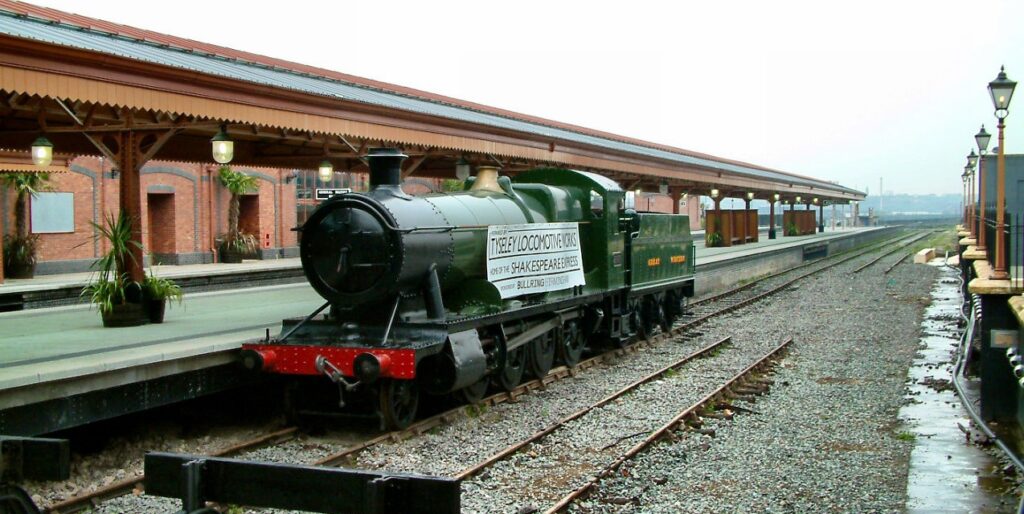
From 2003 to until 2013 GWR Heavy Freight Locomotive 2-8-0 2884 Class No. 2885 stood as a static exhibit at Birmingham Moor Street in an unused platform. The locomotive is currently being restored to working order at Tyseley Locomotive Works by her owners Practical GW Steam Ltd.
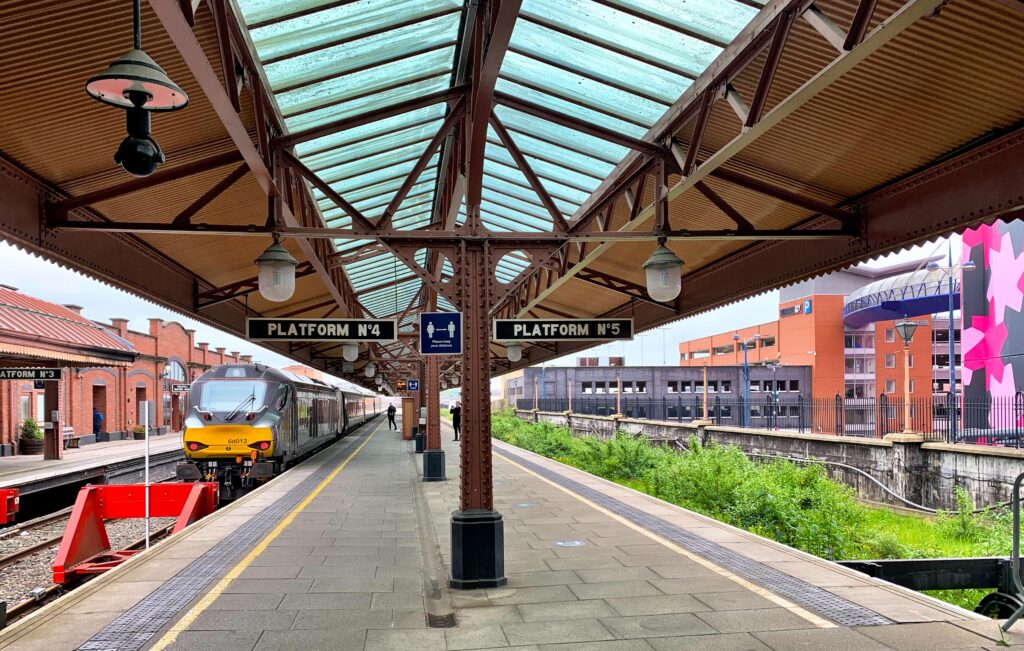
Class 68 No. 68014 and the disused platform once occupied by GWR No. 2885 at Birmingham Moor Street – 27/04/2022
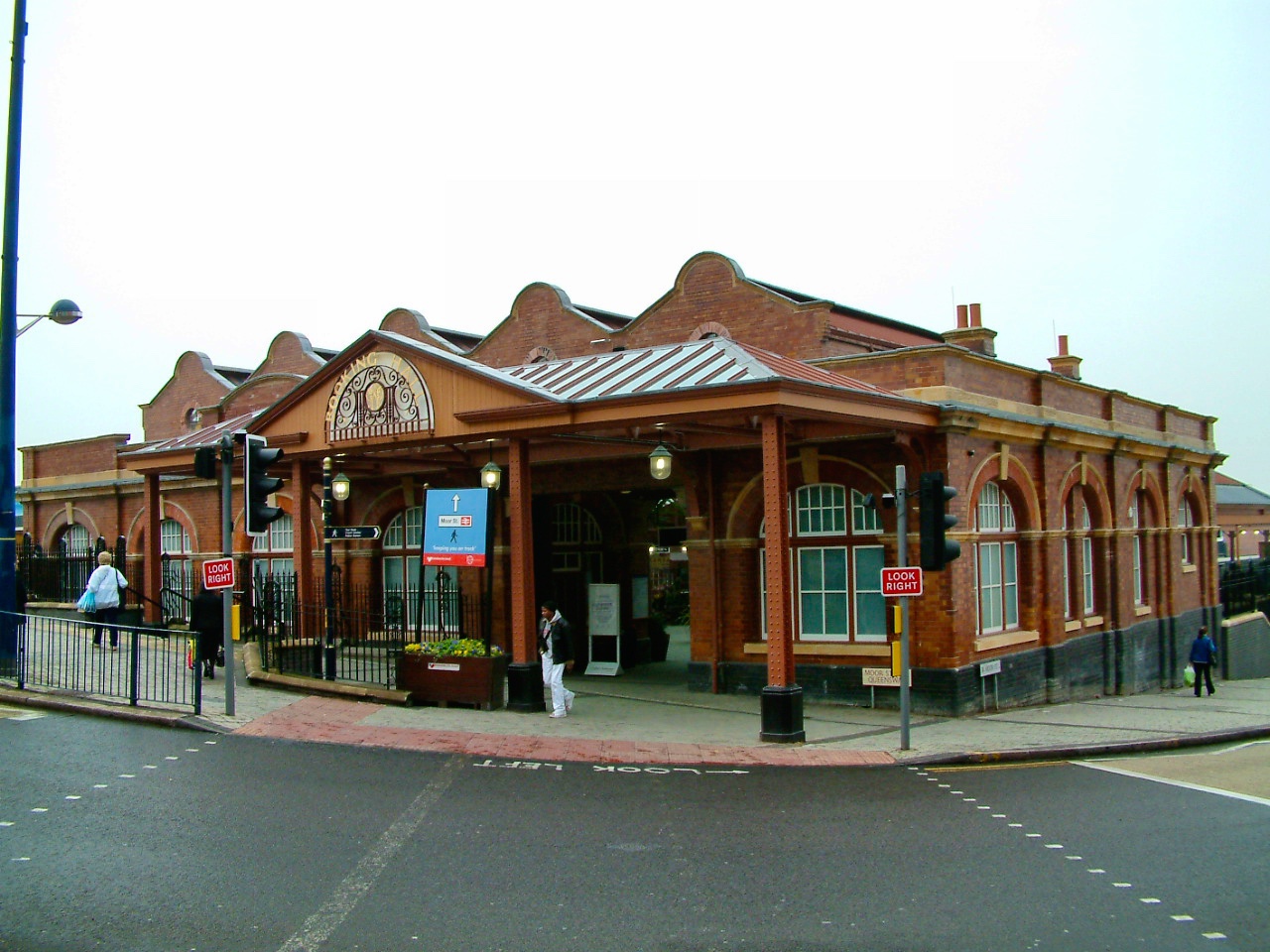
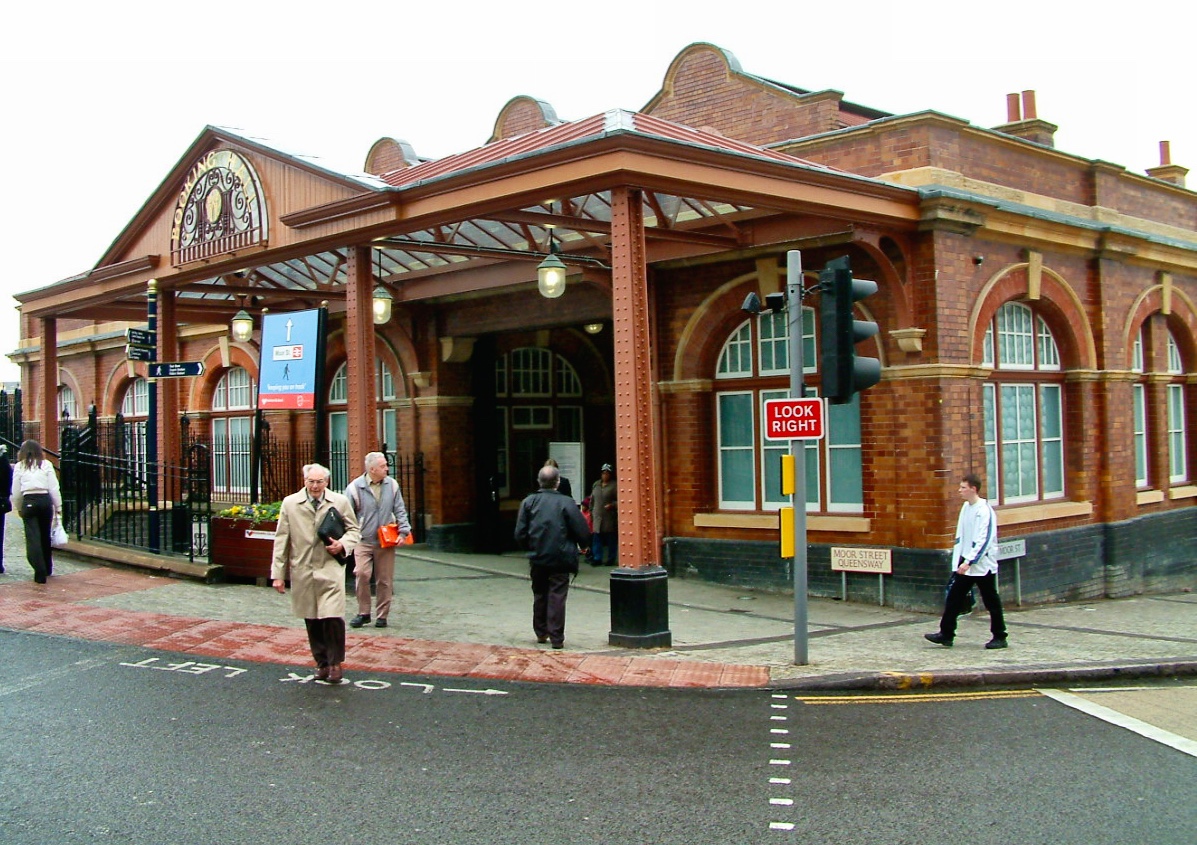
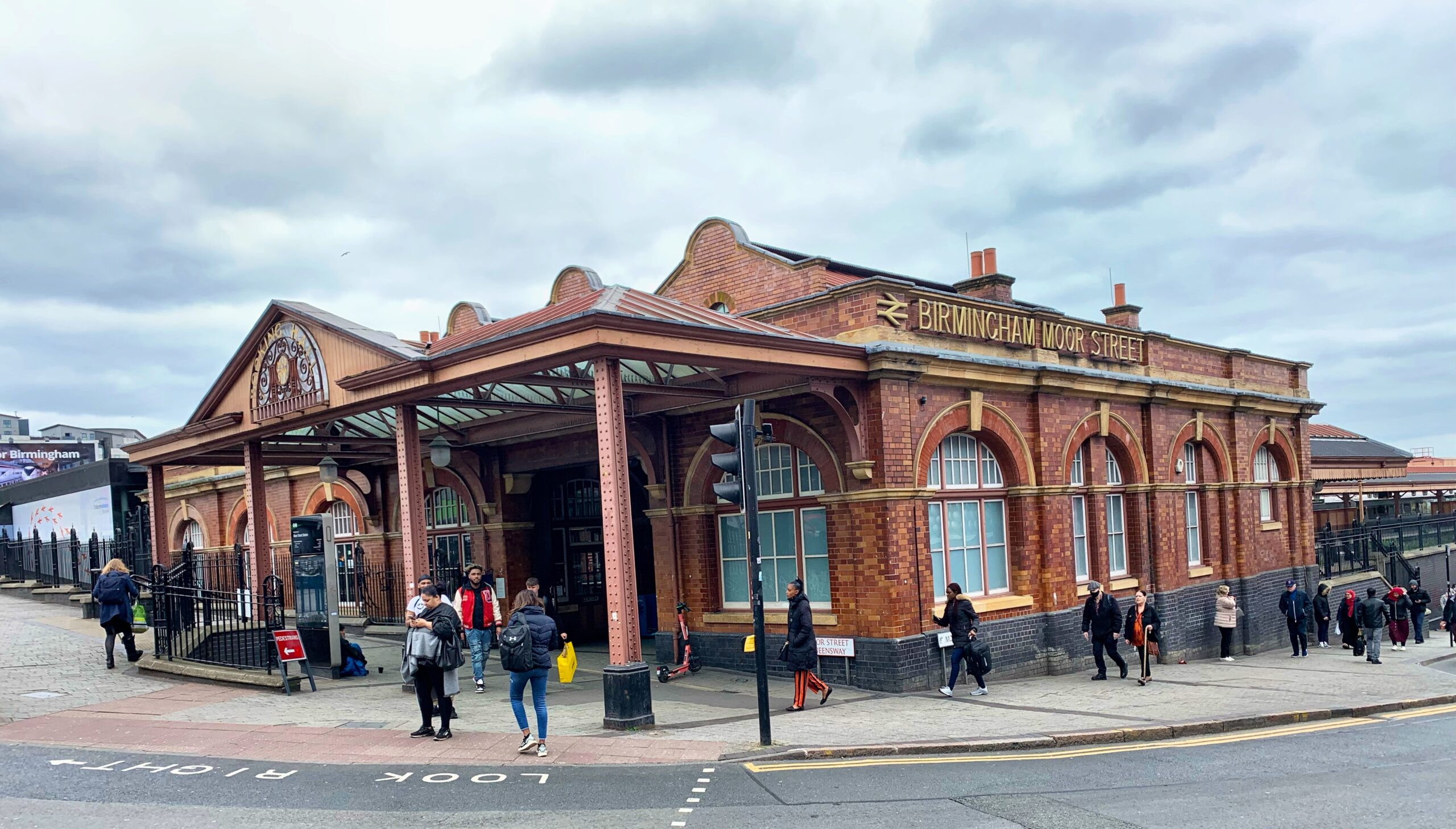
Birmingham Moor Street is one of three mainline railway stations in the city centre of Birmingham along with Birmingham New Street and Birmingham Snowhill. High Speed 2 station Birmingham Curzon Street, the northern terminus of HS2 Phase 1, is currently being built alongside Moor Street. This new Curzon Street will incorporate the 1838 station of the same name’s entrance building and is scheduled to open in 2026.
Birmingham Moor Street
Moor Street is a combination of the original 1909 Great Western Railway terminus and adjacent through platforms which opened in 1987 replacing the original station which was then mothballed. These two were combined in 2002 when the original station was extensively restored in 1930’s style with reproduction lamps, clocks, seating and signage. The 1980’s platforms were rebuilt in a matching style.
Class 68 No. 68012 arrives at Birmingham Moor Street with a service from London Marylebone – 13/03/2020
A video showing my Chiltern Trains Class 68 locomotive hauled experience
Friday April 29th 2022 saw a COLAS route learning working along the Bristol to Weymouth line formed of Electro-Diesel Class 73 No. 73951 ‘Malcolm Brinded’. We saw and barked at the locomotive in Dorchester.
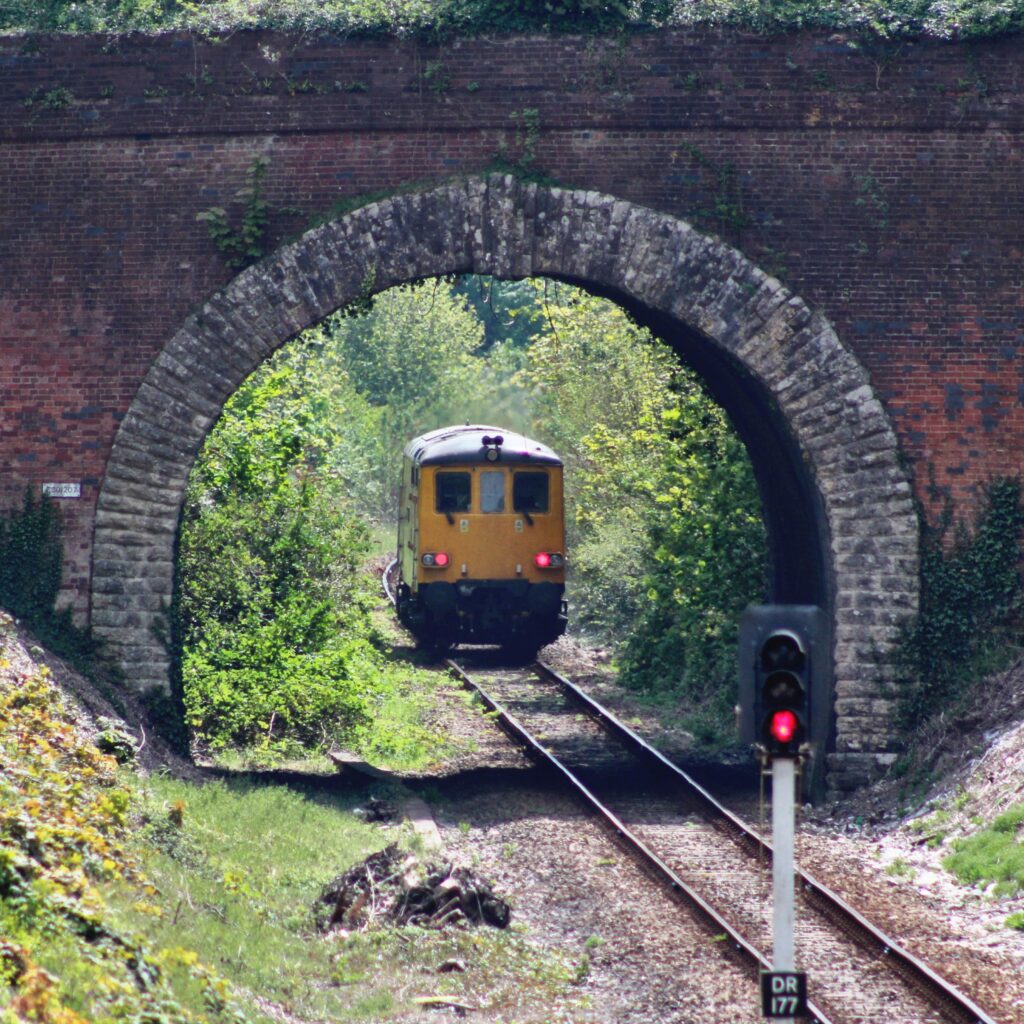
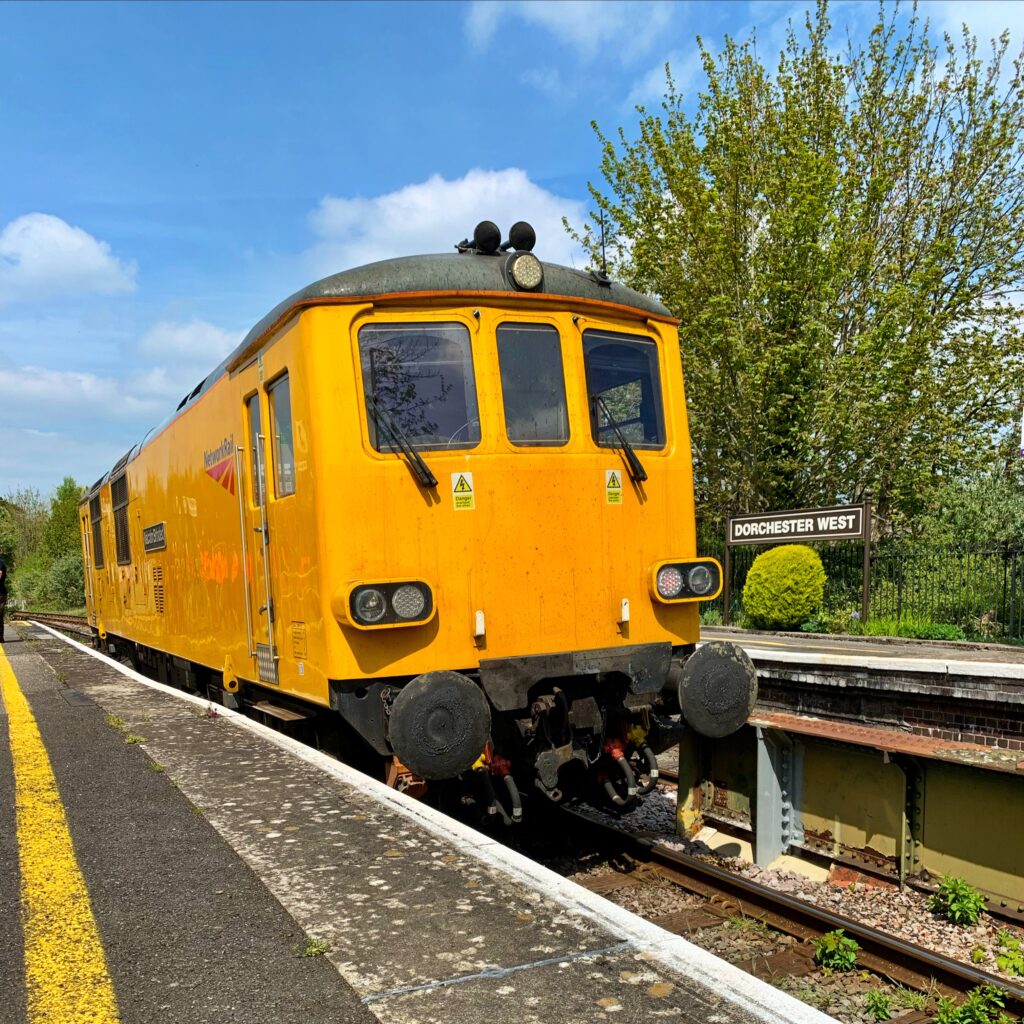
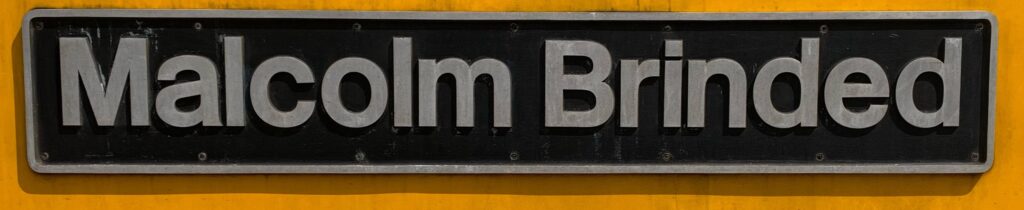
Class 73 No. 73951 ‘Malcolm Brinded’ nears Dorchester West – 29/04/2022Class 73 No. 73951 ‘Malcolm Brinded’ passes under the Bridport Road bridge, Dorchester – 29/04/2022Class 73 No. 73951 ‘Malcolm Brinded’ approaches Dorchester West – 29/04/2022Class 73 No. 73951 ‘Malcolm Brinded’ waits at Dorchester West – 29/04/2022Nameplate detail for 73951
Video of 1008 Bristol TM Platform 2 Motorail to Bristol TM Platform 2 via Weymouth COLAS route learner at Dorchester – 29/04/2022
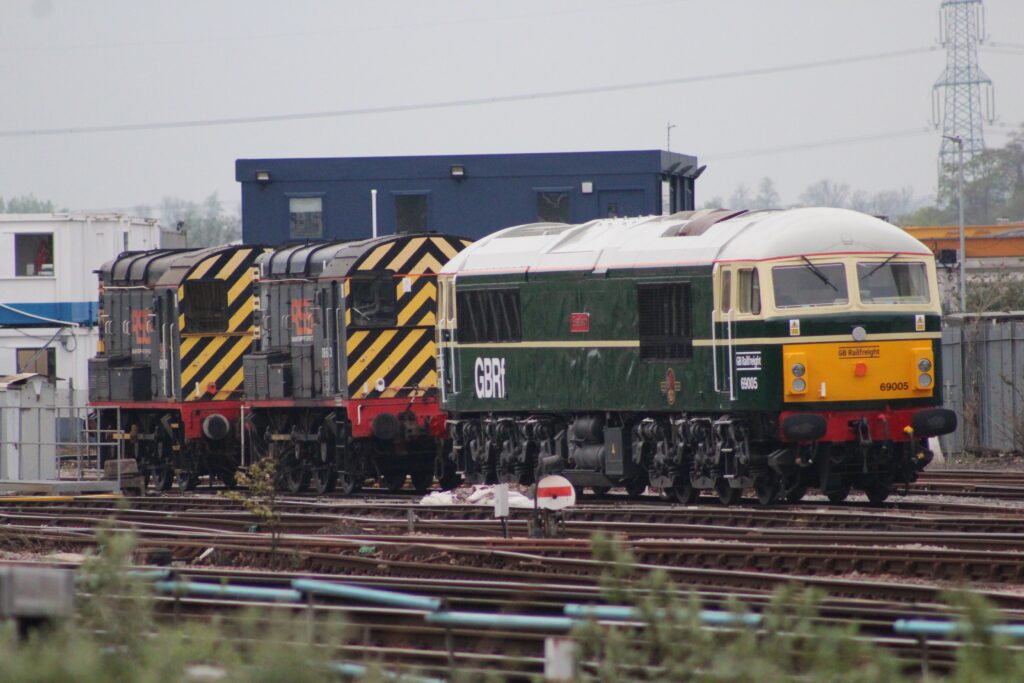
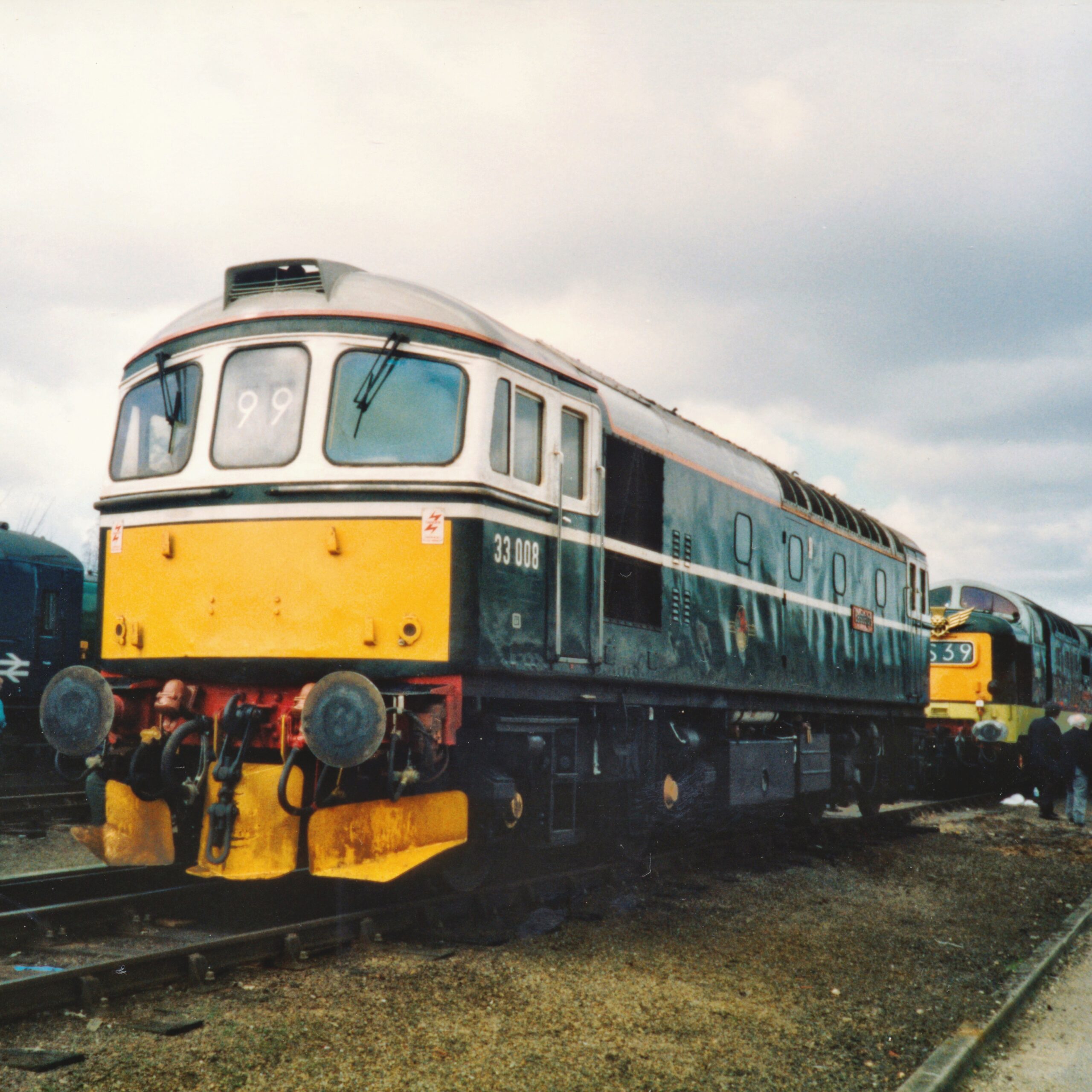
The latest Class 69 rebuild, No. 69005 (ex Class 56 No. 56007) emerged from Eastleigh Arlington on Friday in British Rail green replete with ‘Eastleigh’ nameplates closely resembling the livery that Class 33 No. 33008 once carried. Yoshi and I made a fleeting visit to Eastleigh on Sunday 1st May to get a photo or two of the 69 parked up in East Yard.
Class 69 No. 69005 ‘Eastleigh’ stands on Eastleigh East Yard on the evening of Sunday May 1st 2022Nameplate close-up of 69005 ‘ Eastleigh’Compare 69005 ‘Eastleigh’ with Class 33 No. 33008 ‘Eastleigh’ at Bournemouth Open Day – 26/03/1988
On Bank Holiday Monday, Yoshi and I made a brief visit to the Swanage Railway where two Bullied Pacific locomotives were in action – SR 4-6-2 West Country Class No. 34028 ‘Eddystone’ and SR 4-6-2 Battle of Britain Class No. 34072 ‘257 Squadron’ :
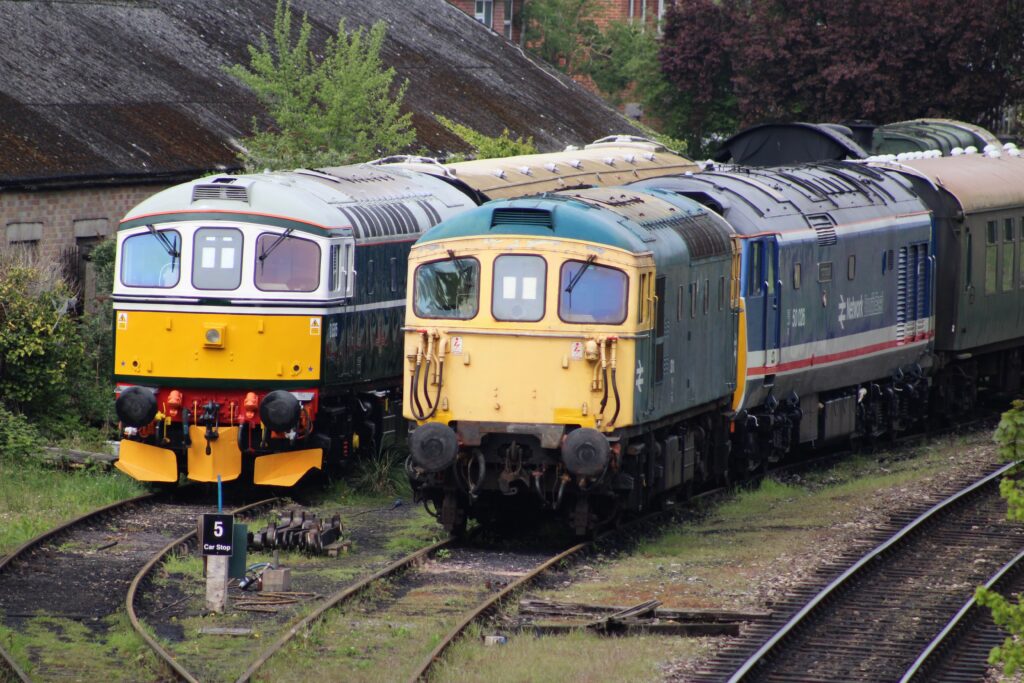
Also at Swanage were a number of diesel locomotives in preparation for the railways 2022 Diesel Gala which takes place next weekend (6th – 8th May)
Class 25 No. D7612 Class 33’s No’s 33012 ‘Lt. Jenny Lewis’ and 33111 with Class 50 No. 50026 ‘Indomitable’
Further diesel locomotives are scheduled to arrive at Swanage on the evening of Tuesday May 3rd 2022.
With the 2022 Swanage Diesel Gala just around the corner, we pop back to May 2008 for our archive video this week and a glimpse of what was running in the Swanage Railway that year:
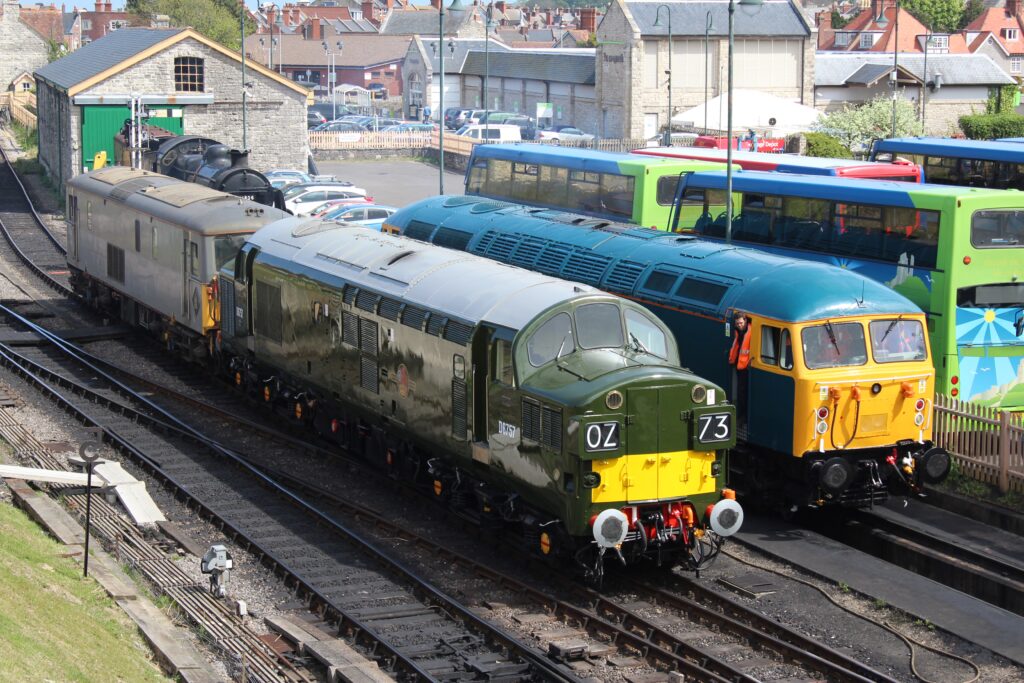
With recent news events, I was going to finish with a humorous Class 37 / Tractor reference at this point – the Class 37’s are known to some railway enthusiasts as “tractors”, a nickname given due to the similarities between the Class 37 engine sound and a tractor. Instead, I’ll just leave a couple of photos of Class 37/0 No. D6757 (37057) which was painstakingly restored at the Barrow Hill Roundhouse near Chesterfield following its purchase from main line service. The loco debuted at the 2015 Swanage Railway Diesel Gala prior to joining COLAS Rail who were seeking a fleet of English Electric Type 3 locomotives for Network Rail test train duties.
No. D6757 alongside Class 56 No. 56006 and Class 73 No. 73107 at Swanage – 10/05/2015No. D6757 at Swanage Railway Diesel Gala – 10/05/2015
Yoshi visits the Severn Valley Railway and gets a glimpse of renumbered and repainted SR West Country Pacific No. 34027 ‘Taw Valley’
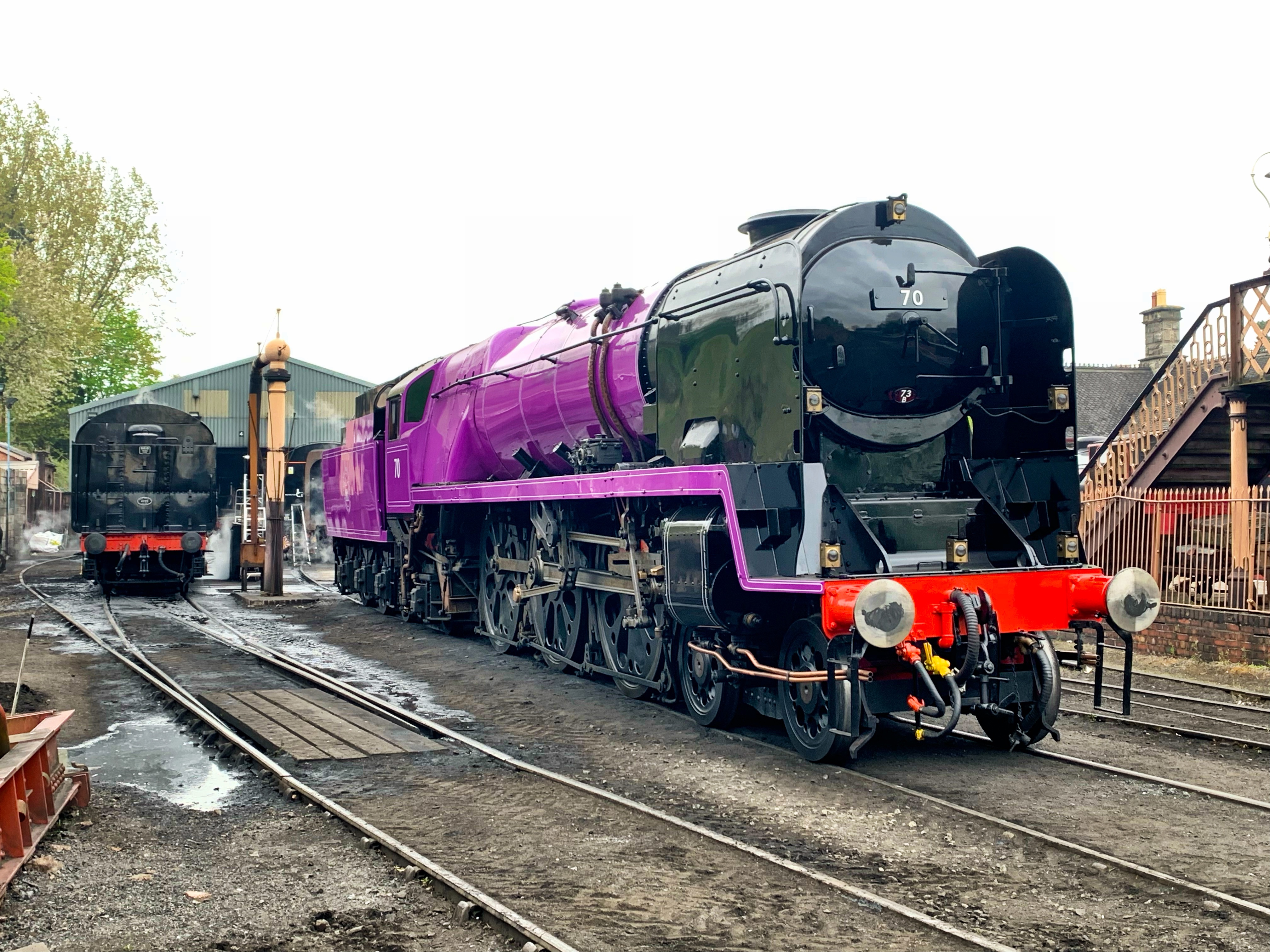
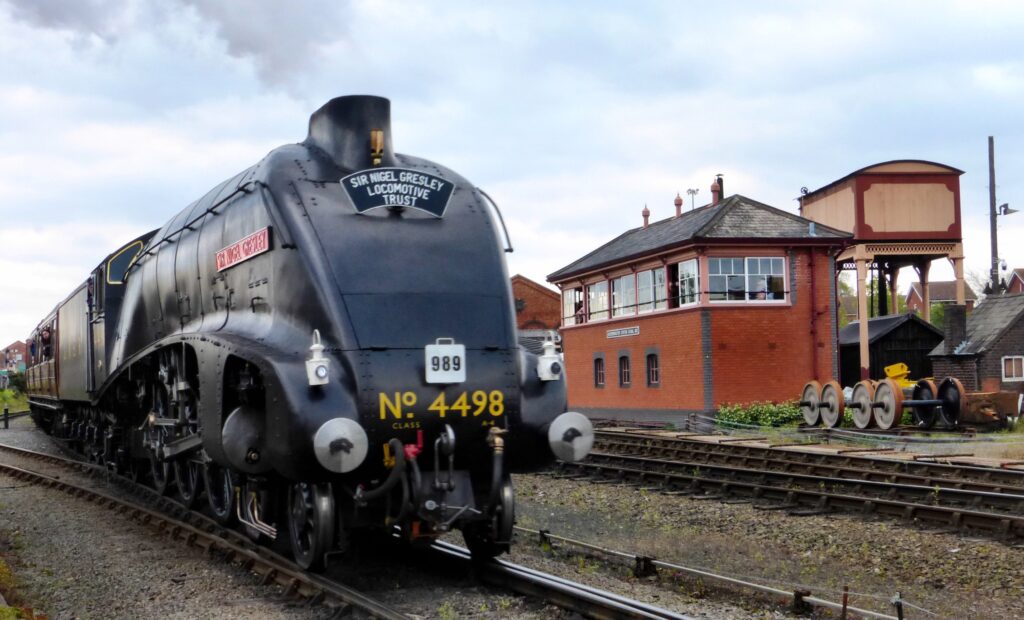
With heritage railway gala season now in full swing, last Saturday we were able to spend the day visiting The Severn Valley Railway as the 2022 Spring Steam Gala was taking place. Big draw for me was Gresley A4 4-6-2 No. 4498 ‘Sir Nigel Gresley’ in austerity black livery, as well as the chance of seeing SR West Country 4-6-2 No. 34027 ‘Taw Valley’ in Platinum Jubilee purple ready to be temporarily renamed ‘Elizabeth II’.
4498 ‘Sir Nigel Gresley’ approaches Highley on the SVR34027 ‘Taw Valley’ in Platinum Jubilee purple livery ready to be temporarily renamed ‘Elizabeth II’ at Bridgnorth
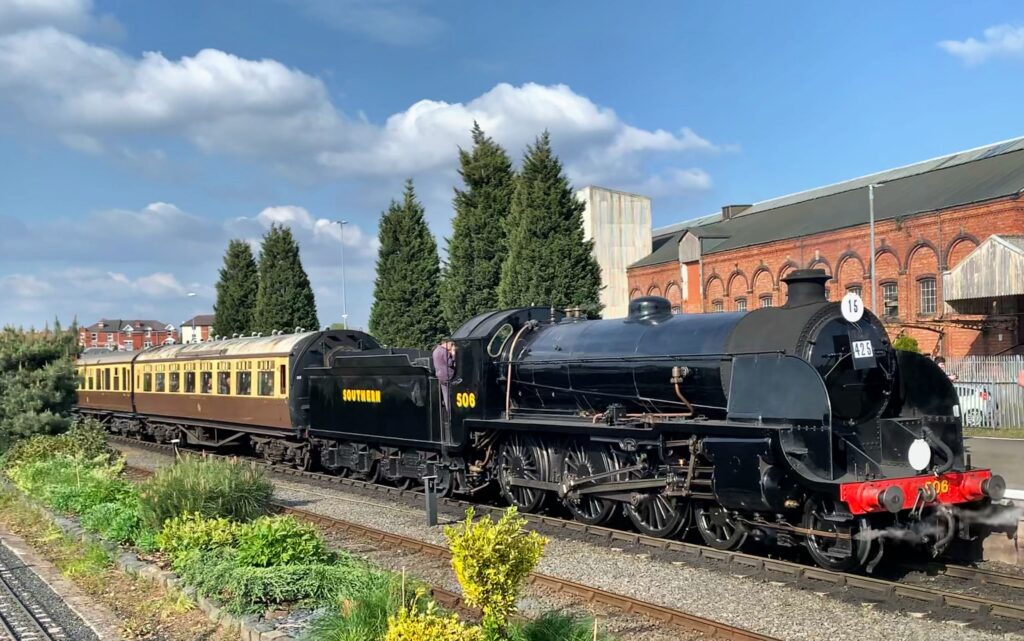
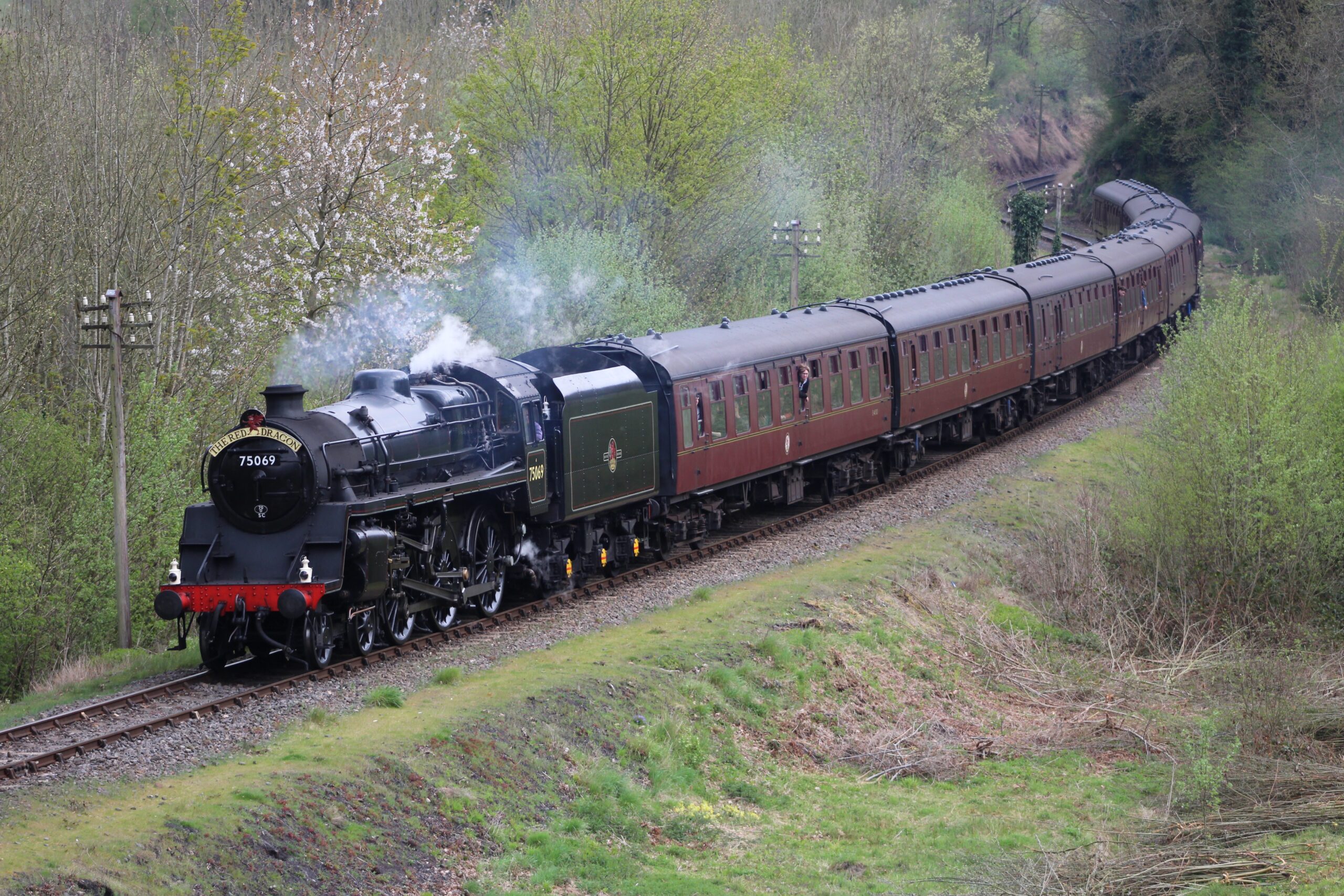
Other locomotives taking part included GWR Saint 4-6-0 new-build No. 2999 ‘Lady Of Legend’, SR S15 4-6-0 No. 506 and SVR home loco BR Standard 4MT 4-6-0 No. 75069.
No. 2999 ‘Lady of Legend’ departs HighleySR Urie S15 No. 506 awaits departure at Kidderminster75069 nearing Highley
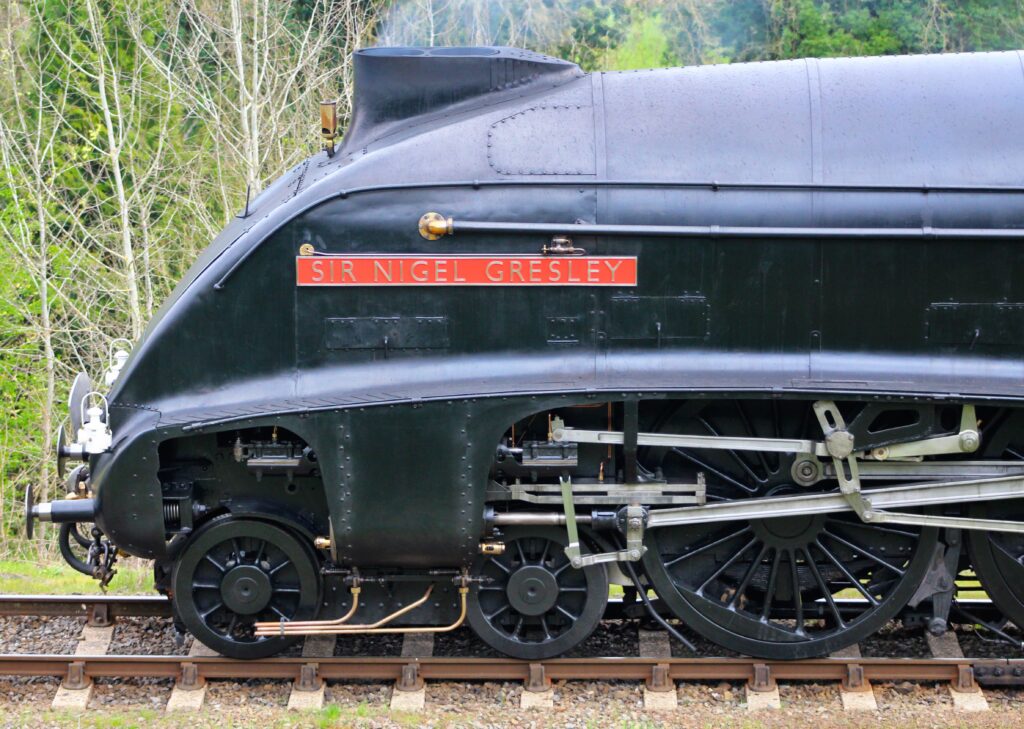
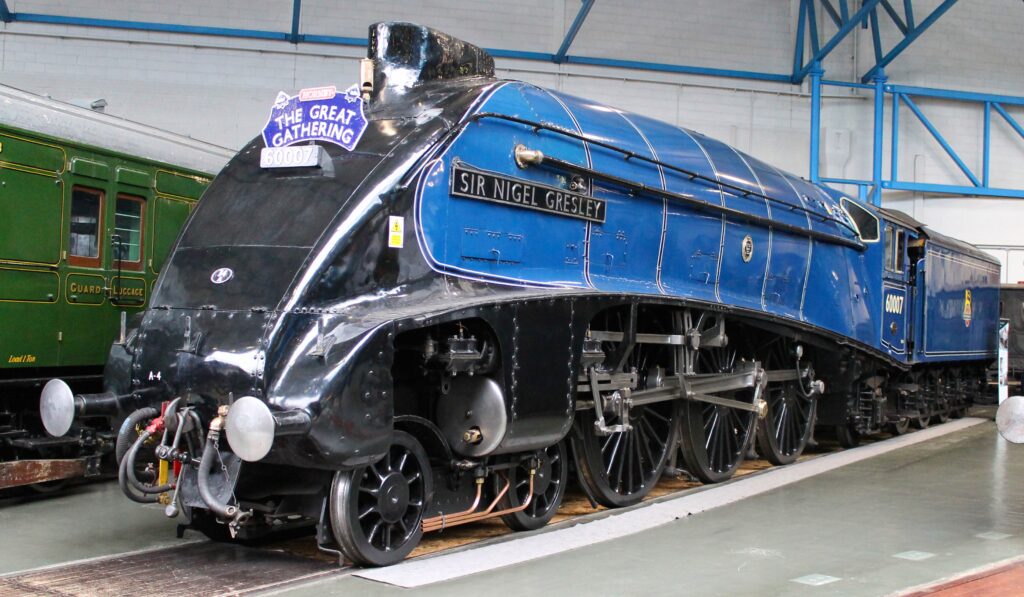
Austerity liveried A4 ‘Sir Nigel Gresley’ was matched with Gresley teak stock on certain trains over the gala weekend. With the locomotive set to be repainted into British Railways express blue and numbered 60007, this was a unique opportunity to see the A4 in its temporary guise as No. 4498.
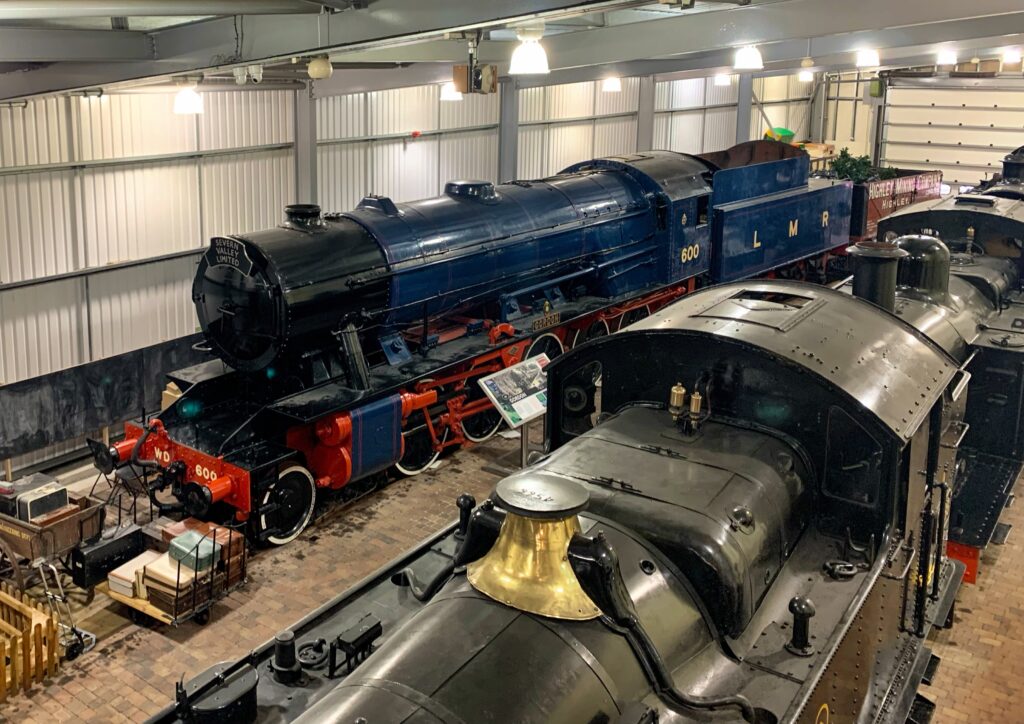
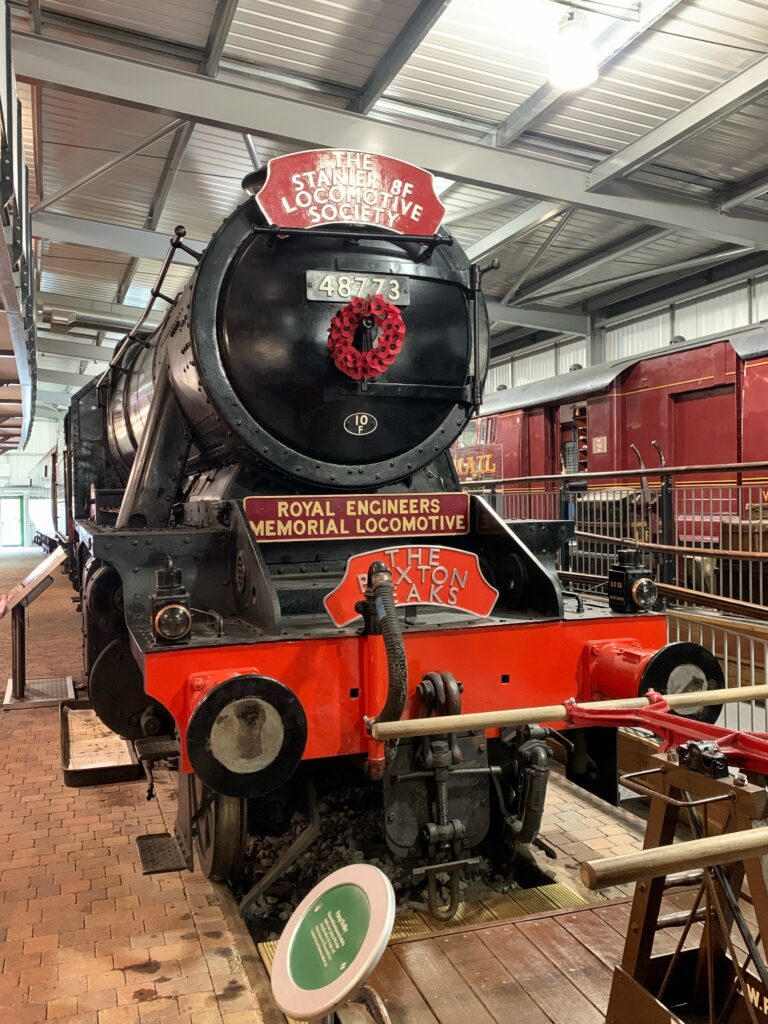
We really enjoyed our day and facilities at Highley in particular have vastly improved since my last visit to that particular location many years ago with the addition of the Engine House visitor centre where you can get up close to various static locomotives, buy a souvenir or tuck into a butternut, spinach and feta pasty – just like Yoshi and I! And until Autumn 2022 there is a photographic exhibition entitled ‘From Railways to Royalty’ featuring images from the very talented Jack Boskett.
LMR No. 600 ‘Gordon’ in The Engine ShedLMS Stanier 8F No. 48773 in The Engine Shed
A special train from London Kings Cross to Kidderminster bringing visitors to the Severn Valley Railway steam gala was top and tailed by Class 67 locomotives No.’s 67010 and 67006 ‘Royal Sovereign’ and we were able to see its departure from the SVR. We’ve put together a short video of our day which you can watch by clicking below:
Closer to home and the Weymouth line was visited by Network Rail’s new weed killing train on 20th April. The train is the result of a cooperation between NR, GBRf, Bayer Environmental Science and a number of start up companies using innovative technology to eliminate potentially dangerous weed infestations with advance precision across the railway network. The trains detect weeds using cameras and then deploy the most appropriate herbicide, thereby improving the environmental footprint. Data is uploaded to a central database to enable future weed control and monitoring. GPS tracking ensures that spray nozzles are automatically shut off when the train approaches a non-treatment zone, such as a river or a bridge. We caught the train working 3Q99 2130 Eastleigh East Yard to Eastleigh East Yard passing through Hamworthy top and tailed by Class 66 locomotives No.’s 66707 ‘Sir Sam Fay’ and 66778 ‘Cambios Depot 25 Years’:
3Q99 2130 Eastleigh East Yard to Eastleigh East Yard passing Hamworthy – 20/04/2022
Class 701 testing continues to visit Bournemouth and Poole as evidenced by No. 701044 on 21st April 2022:
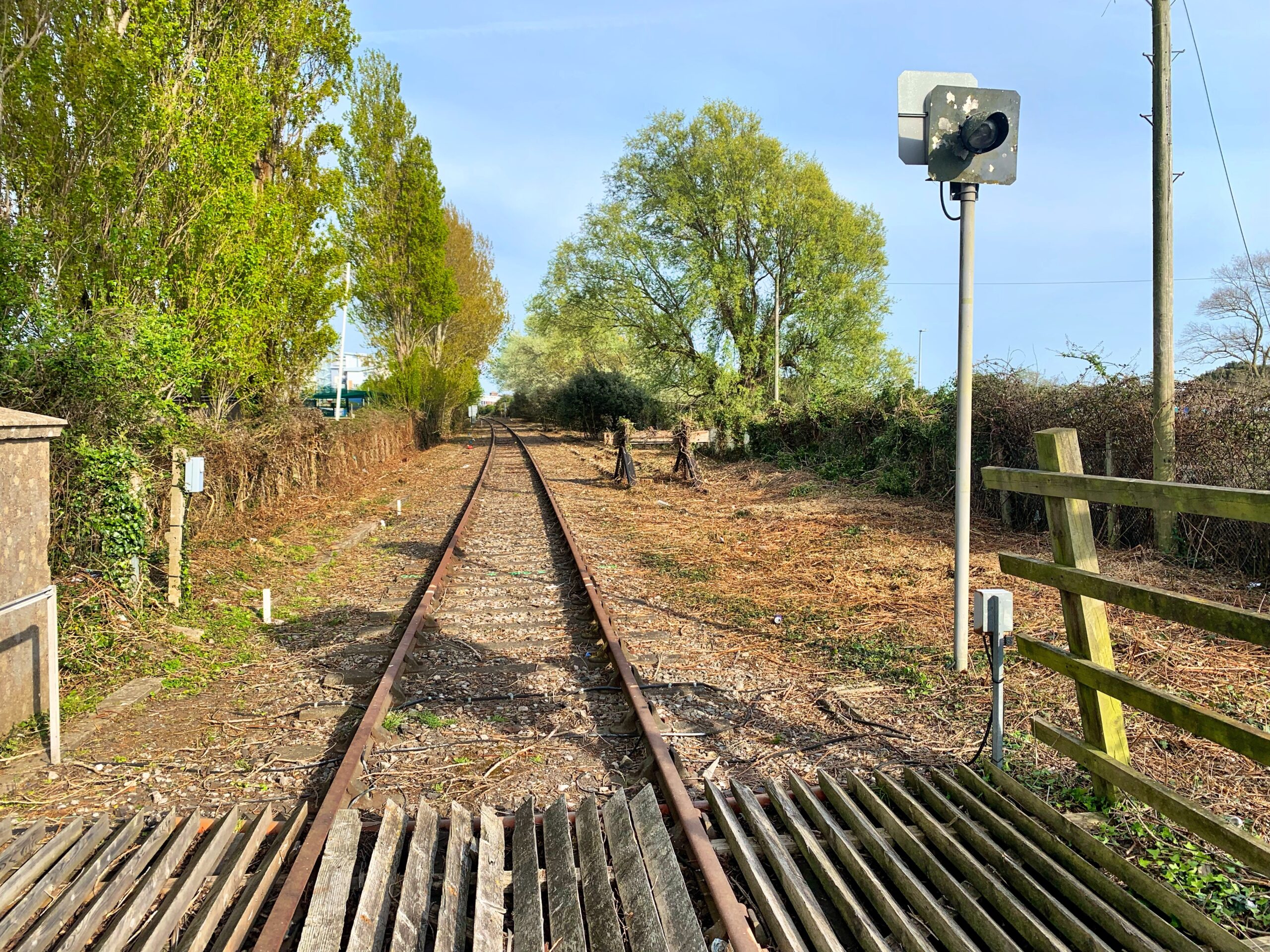
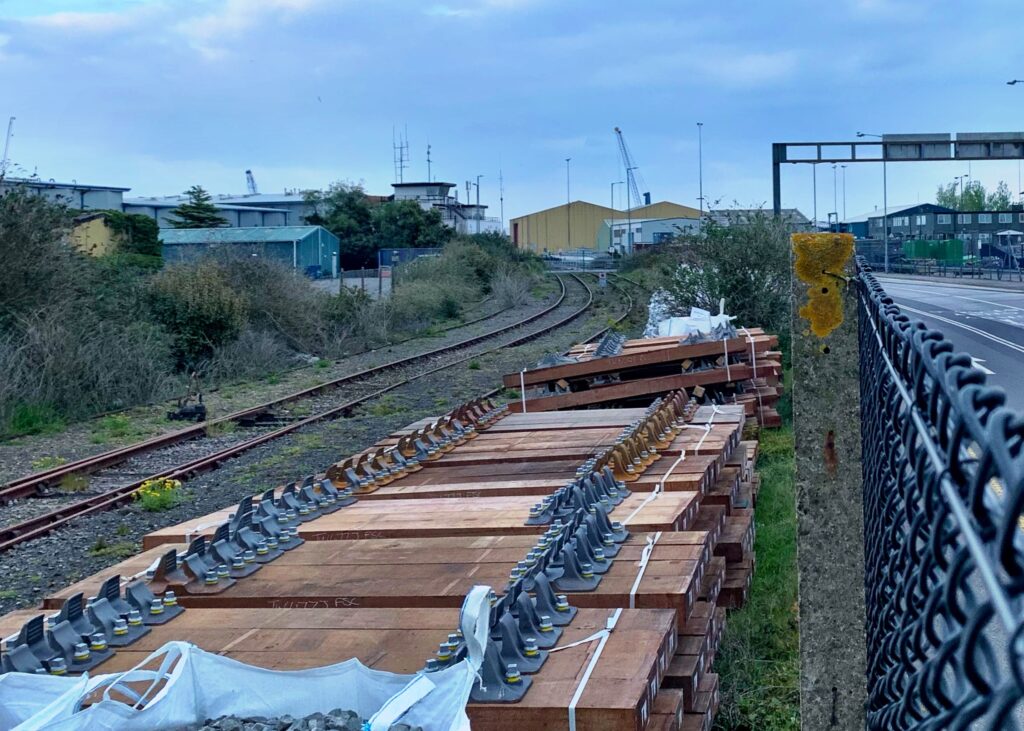
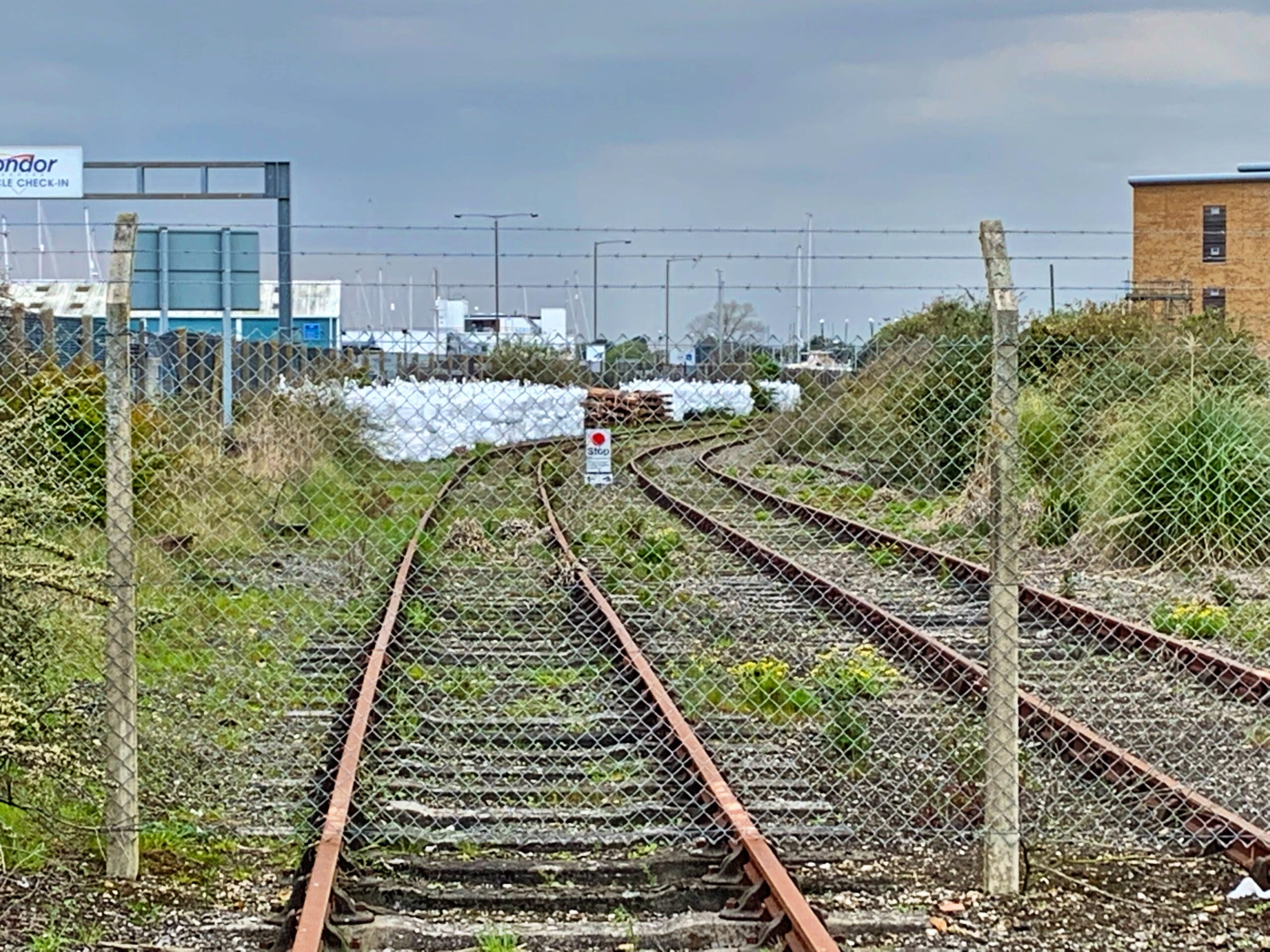
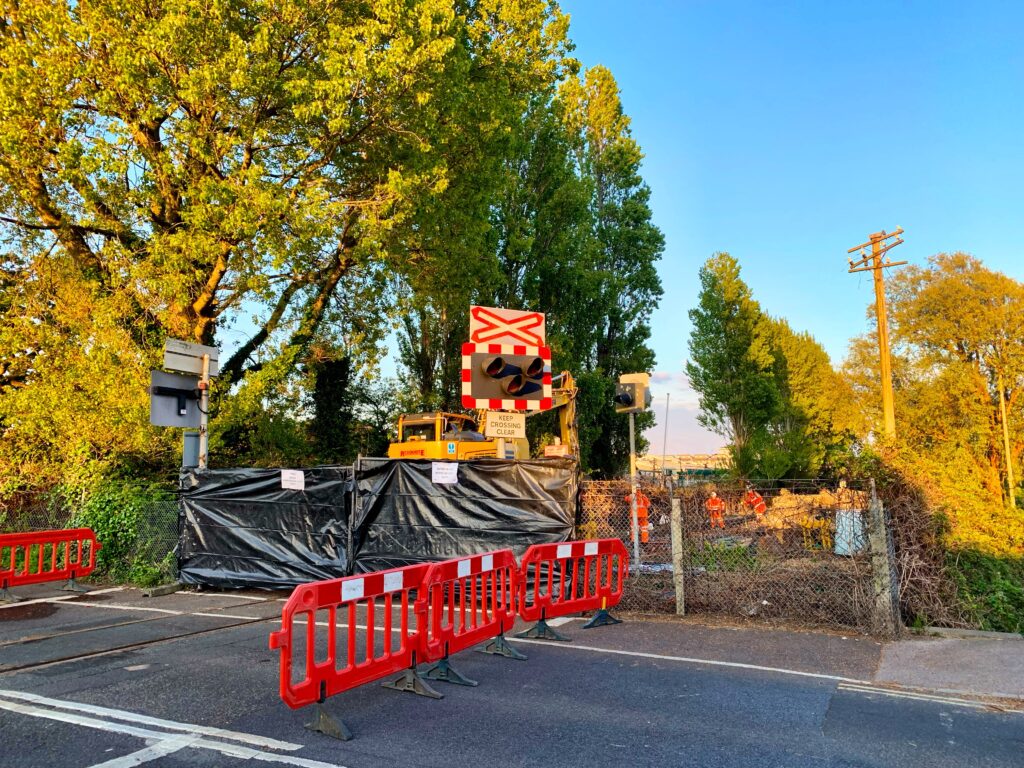
Interesting work commenced on the Hamworthy branch this week with a section of the line adjacent to Hamworthy level crossing receiving attention with the replacing of 212 sleepers. We look forward to hearing more about this new initiative.
Hamworthy Branch having seen preparatory work in advance of the replacement of railway sleepersNew sleepers for the Hamworthy BranchBallast and new sleepers seen at the Poole Port end of the Hamworthy BranchWork at the Level Crossing replacing sleepersHamworthy Branch work to replace sleepersWork well underway installing replacement sleepers on the Hamworthy Branch – April 2022
Our archive footage this week features SR West Country 4-6-2 ‘Taw Valley’ as herself when she visited the Portsmouth area working a VSOE excursion train in February 1997 following the repair of a cracked cylinder liner which had seen her out of service for a few months. The video below shows No. 34027 at Havant and Fratton on 2nd February 1997 amidst some interesting diesel traction movements:
We’ll finish this week with a few more images from the Severn Valley Spring Gala 2022 and a flashback to ‘Sir Nigel Gresley’ in blue:
SR West Country No. 34027 ‘Taw Valley’ as No. 70 ‘Elizabeth II’ on display at Bridgnorth‘Taw Valley’ and ‘Lady of Legend’Yoshi takes another look at No. 70 ‘Elizabeth II’LNER A4 No. 4498 ‘Sir Nigel Gresley’ in black departs Kidderminster with the 1805 service to Bridgnorth – 23/04/2022Nameplate and front end detail of 4498 ‘Sir Nigel Gresley’ in austerity black liveryThe colour of things to come ‘Sir Nigel Gresley’ will revert to her British Railways number; No. 60007 and express locomotive blue livery as seen here at The Great Gathering, York 03/07/2013‘Sir Nigel Gresley’ nameplate detail as seen when in blue livery
Thanks for reading. As always comments or corrections gratefully received. Bye for now!
Yoshi waits for the road with Class 31 No. 31130 at the Avon Valley Railway
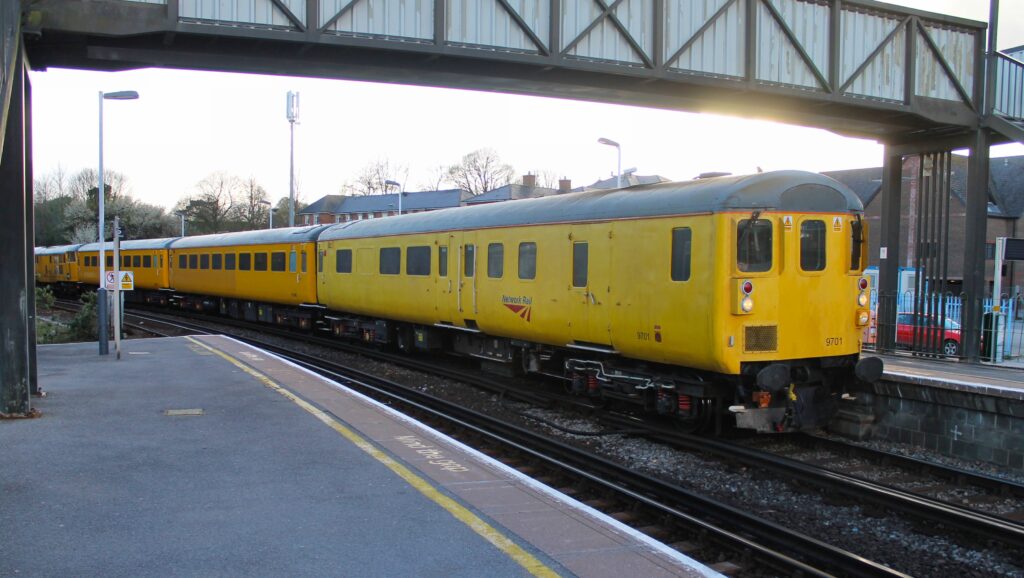
Last week I mentioned the failure of the monthly Class 73 top and tailed COLAS track recording train to make it to Weymouth on Monday 11th April. Well, the same thing happened the next day when the service was rescheduled. This time the train actually set out from Derby, but soon went off route and returned to its originating point due to faulty recording equipment. Things were more successful the following Tuesday – April 19th 2022 – when the 1Q51 Test Train ran from Derby Railway Technical Centre (RTC) to Eastleigh East Yard via Weymouth in the charge of GBRf Class 73 Electro-diesel locomotives No.’s 73961 ‘Alison’ and 73964 ‘Jeanette’.
COLAS Class 73 top and tailed Test Train – 19/04/2022
One test train which did make it to Dorset at the first attempt was the COLAS Ultrasonic Testing Unit, albeit 130 minutes late and its journey truncated at Wool where the service reversed without covering the tracks to and from Weymouth. Ultrasonic Testing Unit trains usually have one locomotive at one end, and a DBSO (Driving Brake Standard Open) at the other, as in the case of this working; 3Q02 Eastleigh East Yard to Eastleigh East Yard with Class 37 No. 37612. The DBSO controls the locomotive at the other end when required and dispenses with the need for the loco to run round the train or have top and tailed locomotives. UTU trains have ground-penetrating radar systems to detect voids and deformations up to 2 meters into the ballast and earth using rail profile scanners to help identify problems or degradation in track profile, comparing it to a template of an ideal track. Having planned to pop over to Poole to see this particular working I initially thought the run had been cancelled as Real Time Trains had given no indication of a departure from Eastleigh at the scheduled time, but two hours later the train was on the move.
3Q02 Eastleigh East Yard to Eastleigh East Yard with Class 37 No. 37612 pauses at Poole – 14/04/2022
Class 37 no. 37612 passes through Poole with an Ultrasonic Testing Unit train – 14/04/2022
Here are a few images of previous test trains utilising DBSO’s which have visited Dorset, in these instances in the charge of Brush Type 2 Class 31 diesel locomotives. These locos were once a common sight on the Bristol to Weymouth line hauling passenger trains, so I was pleased to find one running on the Avon Valley Railway over the Easter Weekend.
Class 31 No. 31602 ‘Driver Dave Green’ at the rear of a test train at Upwey heading to Weymouth – 28/07/2011 Class 31 No. 31106 heading a test train into Upwey – 17/11/2011Class 31 No. 31106 heads a test train through Upwey – 17/11/2011Class 31 No. 31465 propels a test train through Dorchester South – 10/04/2012Class 31 No. 31465 at Dorchester South – 10/04/2012
Later on Thursday 14th April another late runner was the movement of Class 33 No. D6515/ 33012 ‘Lt Jenny Lewis RN’ and Class 50 No. 50026 ‘Indomitable’ from Eastleigh Arlington to Swanage. The locomotives were on their way in preparation for the Swanage Diesel Gala to be held in a few weeks time. Because of the delay departing Eastleigh ( I read this was because of an air leak on the Class 50, but not sure if that is true or someones idea of a joke given the Class 50’s nickname of ‘Hoover’ ). Because of work commitments, I was unable to get to where I had planned to see these two, but I was quite happy with the resulting video and photographs at the location I selected in Parkstone.
Class 33 No. 33012 and Class 50 No. 50026 pass Parkstone heading to Swanage – 14/04/2022
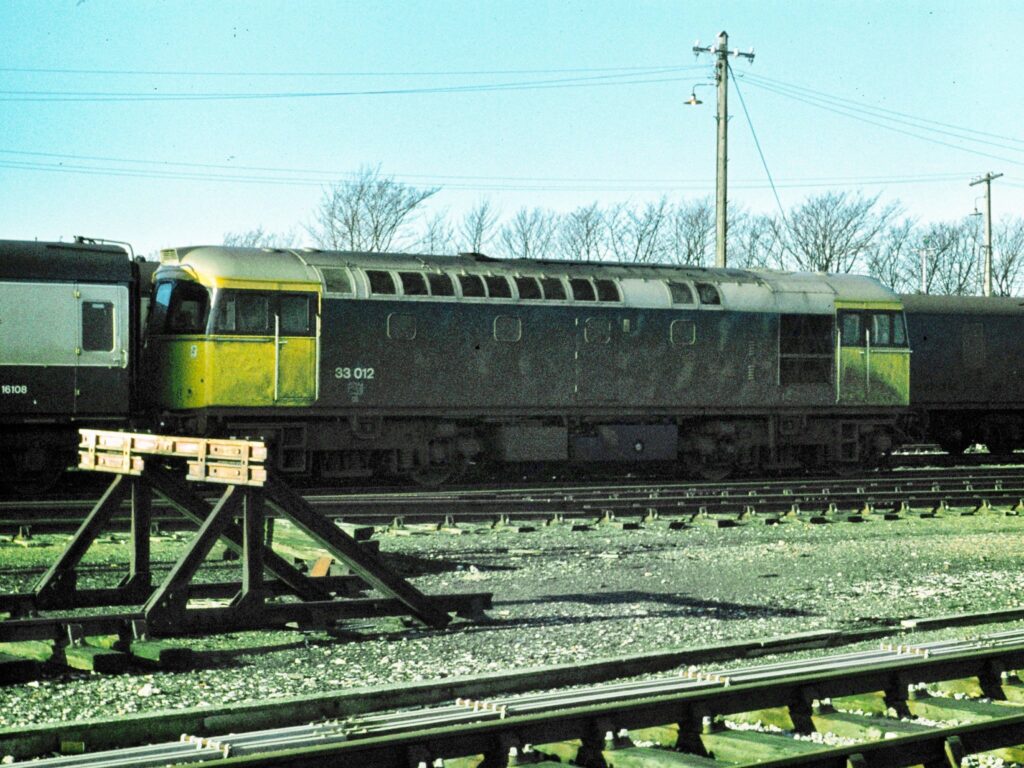
33012 and 50026 heading to Swanage – 14/04/2022Back in British Rail days, class 33 No. 33012 with full yellow cab ends sits in the sidings at Weymouth – 01/01/1982Class 33 No. 33012 with full yellow cab ends sits in the sidings at Weymouth – 01/01/1982Class 33 No. 33012 with a Weymouth to Bristol service at Dorchester West – 09/02/1982. Night photography was never my strong point!
The Easter weekend saw Yoshi and I visit a few railway themed locations, kicking off with a lovely Good Friday afternoon walk around a foggy West Bay where we enjoyed ice-cream.
Yoshi can’t get enough of his Scoops ice-cream for dogs (Photo courtesy of @radioc71 )
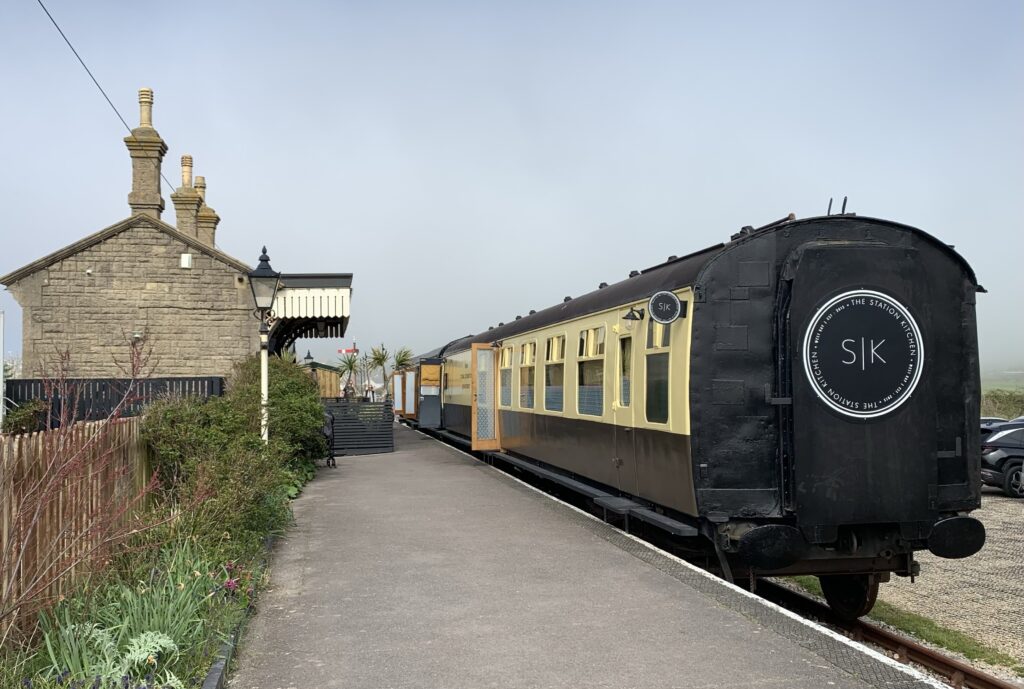
Our visit to West Bay, of course, included a visit to the disused station which is now a restaurant. The owners of The Station Kitchen have placed two carriages on the length of track alongside the station platform and it all looks rather wonderful.
The Station Kitchen, West Bay Yoshi at West Bay Station
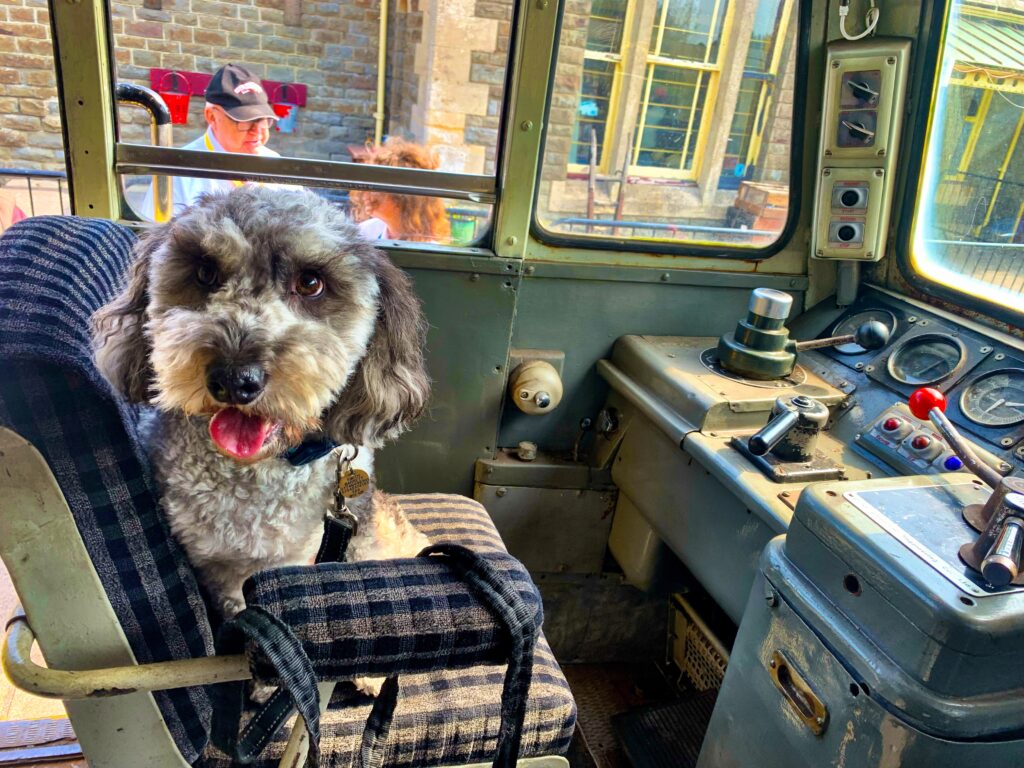
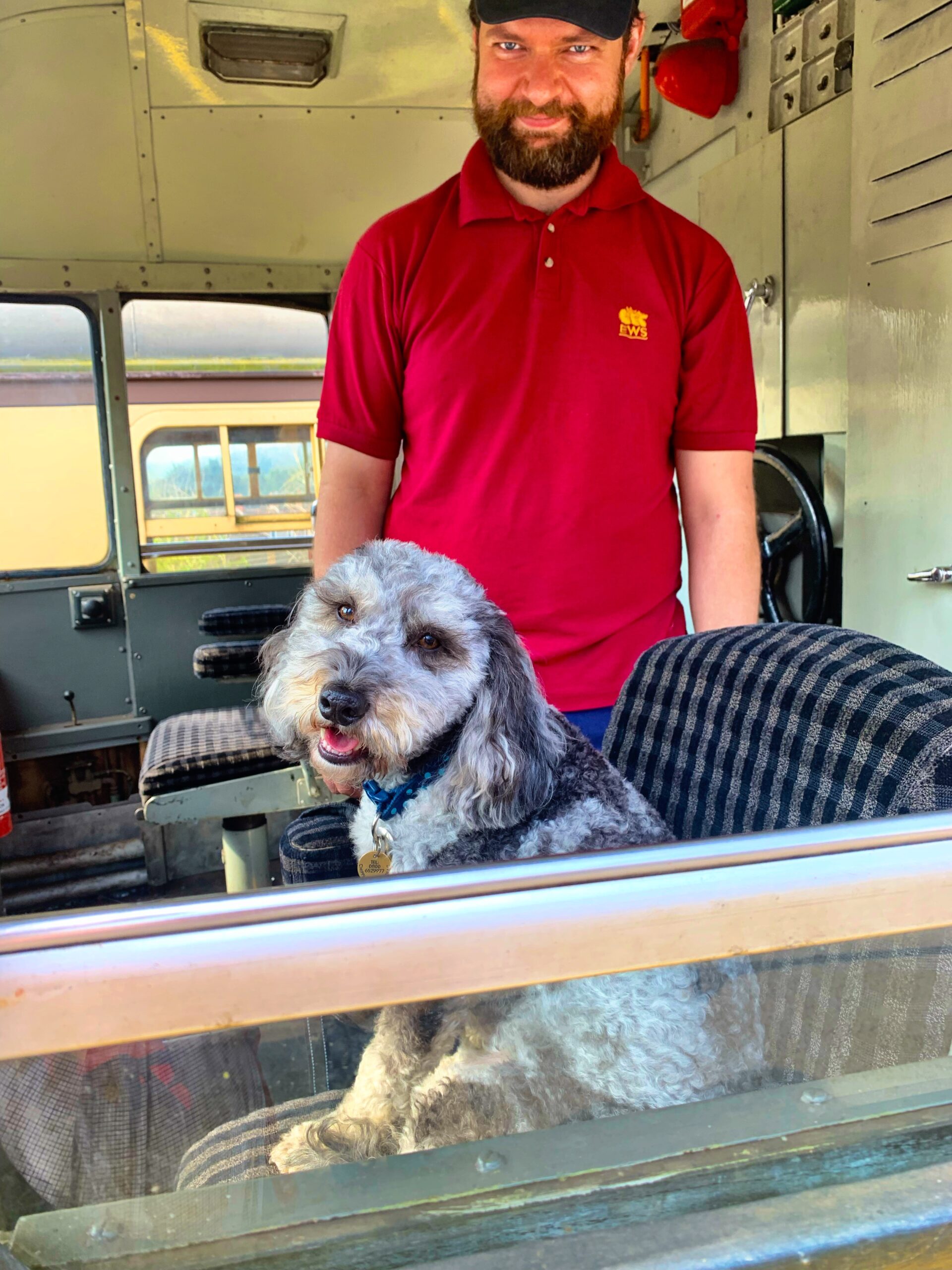
On Saturday we ventured a little further afield to the Avon Valley Railway and enjoyed a trip behind Class 31 No. 31130. I think Yoshi liked that we had our own compartment and enjoyed the ride from Bitton to Oldland Common and back. The track to Avon Riverside is currently closed for upgrade work. The line was originally opened in 1869 by the Midland Railway as a route between the Midlands and the South Coast. The Avon Valley Railway was later linked to the Somerset & Dorset Railway. Closed as part of the Beeching Axe in the 1960’s the line was saved by a group of volunteers and today three miles of track has been re-laid and trains can once again run along the Avon Valley which I can highly recommend. I look forward to a return visit for a walk further alongside the track on the Bristol & Bath Railway Path, a 13 mile off-road route between Bristol and Bath city centres. The staff and volunteers at the railway were amazingly friendly during our visit and Yoshi was made a great fuss of and even visited the cab of the Class 31, although he wasn’t allowed to drive the locomotive, because quite frankly that would have been a bit silly.
Class 31 No. 31130 at Bitton station on the Avon Valley Railway – 16/04/2022Yoshi in the cab of Class 31 No. 31130Yoshi in the cab of Class 31 No. 31130
Yoshi enjoys a trip behind 31130 on the Avon Valley Railway – 16/04/2022
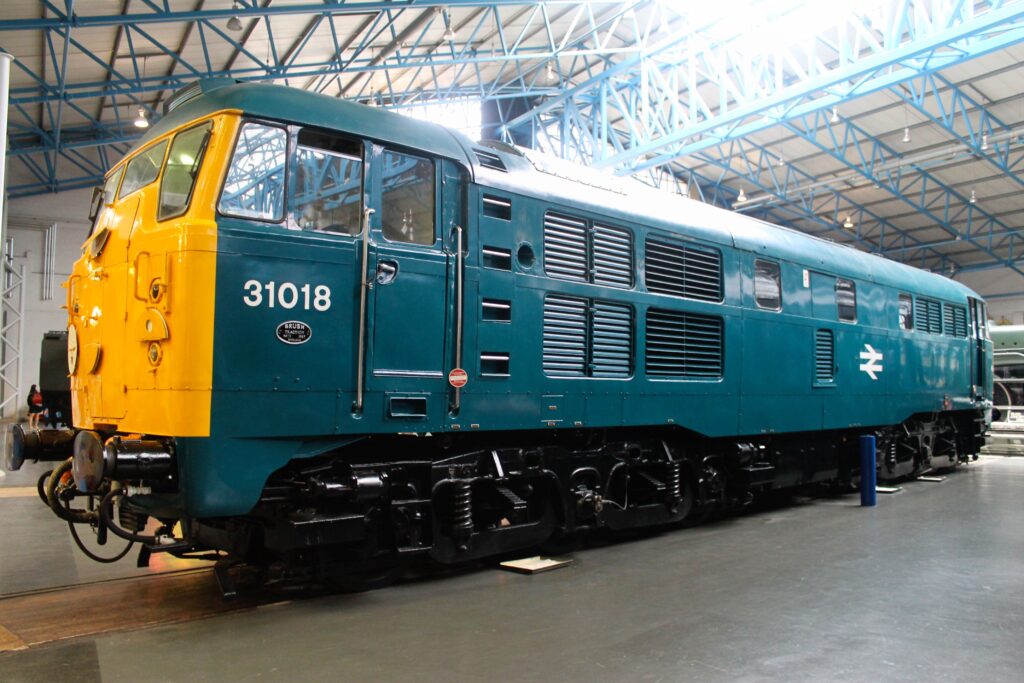
The Class 31 mixed traffic diesels were built by Brush Traction of Loughborough from 1957 – 1962 and were one of the pilot Modernisation Plan locomotive classes ordered by British Rail in the 1950’s to replace steam traction. They were given the nickname ‘Goyles’ by train spotters, this being a reference to gargoyle because of their supposed ugly design. I rather like them and have a fondness for the class and their many variations.
Firstbuild Class 31 No. D5500 which was renumbered as No. 31018 on display at the National Railway Museum in York – 03/07/2012
Our day out was planned around picking up a train shaped flower planter we had ordered and on our way from the Avon Valley Railway we popped into Keynsham to catch a glimpse of passing Class 66 No. 66134 working to Westbury and a couple of Great Western IET’s.
Class 66 No. 66134 working 1101 Margam T.C. to Westbury
Fifteen minutes at Keynsham condensed – 16/04/2022
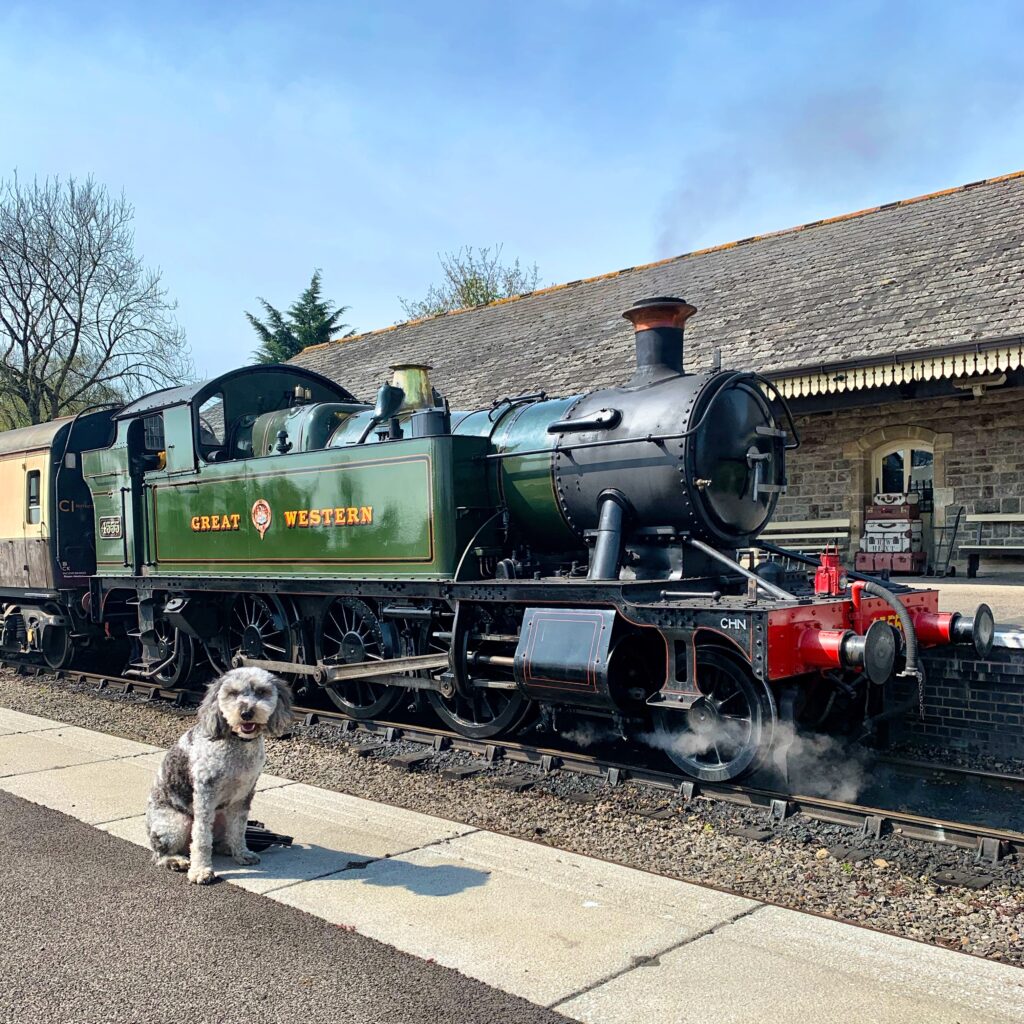
We also had time to pop in at Cranmore for a cuppa and to see GWR 4500 Class 2-6-2T No. 4555 which was working the passenger trains on the East Somerset Railway. Again Yoshi enjoyed all the attention and scritches he received.
GWR 4500 Class 2-6-2T Small Prairie No. 4555 at Cranmore – 16/04/2022
GWR 4500 Class 2-6-2T Small Prairie No. 4555 at Cranmore – 16/04/2022
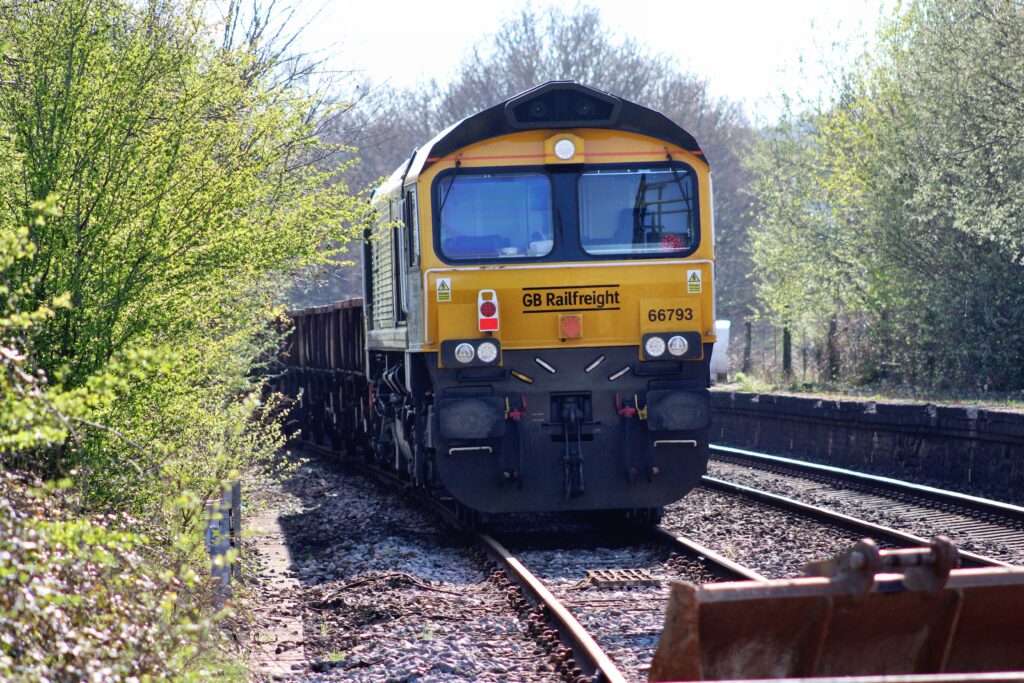
After picking up the planter in Somerset we drove home via Chard as engineering work was taking place over the Easter weekend between Yeovil Junction and Honiton. We were very kindly escorted on to the disused station platform at Chard Junction to take photographs of GBRf Class 66 No. 66793 in British Rail Railfreight Construction livery attached to the engineers train. The station was closed to passenger traffic in March 1966 and there have been many calls, over the years since, to reopen it.
GBRf Class 66 No. 66793 – Chard Junction 16/04/2022GBRf Class 66 No. 66793 – Chard Junction 16/04/2022
GBRf Class 66 No. 66793 – Chard Junction 16/04/2022
Sunday afternoon we popped into Swanage to visit the Swanage Railway who were operating a two train service utilising SR Bullied 4-6-2 West Country Class No. 34028 ‘Eddystone’ and GWR 4575 Class 2-6-2T Small Prairie No. 5526. We also got another glimpse of Class 33 No. 33012 and Class 50 No. 50026 stabled in the sidings close to the engine shed.
Class 33 No. 33012 and Class 50 No. 50026 in the sidings at Swanage – 17/04/2022SR 4-6-2 West Country Class No. 34028 ‘Eddystone’ departs Swanage – 17/04/2022GWR 4575 Class 2-6-2T Small Prairie No. 5526 arrives at Swanage with a service from Norden
Swanage Railway – Easter Sunday 2022
For our first archive video this week, we return to Keynsham ( and Bradford-on-Avon ) for a glimpse of Great Western Railway Castle Class No. 5029 ‘Nunney Castle’. This locomotive was built at Swindon Works in 1934 and takes the name of a small castle near Frome, Somerset. She was withdrawn from service in December 1963 and sold to Woodham Bros. at Barry, arriving at the famous scrap yard in June 1964 being the last steam locomotive delivered to Barry scrap yard by rail. She was rescued after rusting away for 12 years and in May 1976 was the last Castle class locomotive to leave Barry. Throughout the summer season in 2010 ‘Nunney Castle’ hauled the Sunday ‘Weymouth Seaside Express’ trains organised by The Railway Touring Company, departing from the Bristol area bound for Weymouth and I have fond memories of hearing her exhaust beat echo around on her departure from Keynsham, as can be heard in the video below:
Finally, to wrap things up, here is a short video of Class 31’s top and tailing a test train at Upwey in September 2007:
Class 31’s No. 31602 and 31459 ‘Cerberus’ at Upwey – 25/09/2007
Don’t forget if you’re thinking about traveling by rail between 25/04/2022 and 27/05/2022 South Western Railway and Great Western Railway are just two of the rail operators offering up to 50% discounts on advance bookings on off-peak tickets as part of ‘The Great British Rail Sale’ . This comes after the highest increases in rail fares in nine years came into effect last month ( March 2022 ). Vacuous Toby Jug Transport Secretary Grant Shapps ( the name he’s currently using ) announced the promotion in a video on Twitter saying it would ‘help with the cost of living’. Unless you can eat or burn the tickets for heating, I have my doubts about that claim.
Train operators and Network Rail have been told by the Department of Transport ( DafT ) to find cost savings of 10% to 15%, after the Treasury spent an extra £15bn subsidising rail for lost revenue over the past two years during the Covid pandemic. The DafT said reforms to the sector due to be introduced after the Williams-Shapps review plan for Great British Railways (2021) could see more such network-wide sales across rail fares.
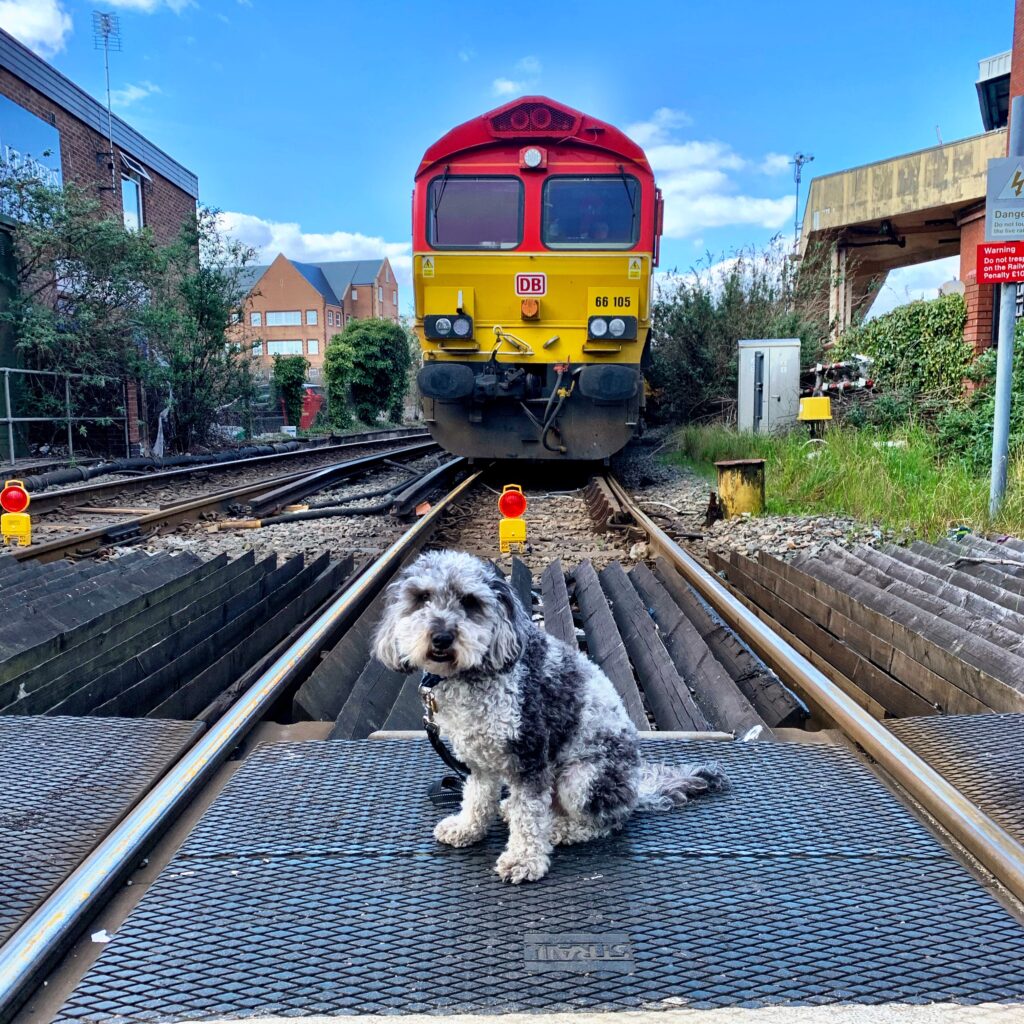
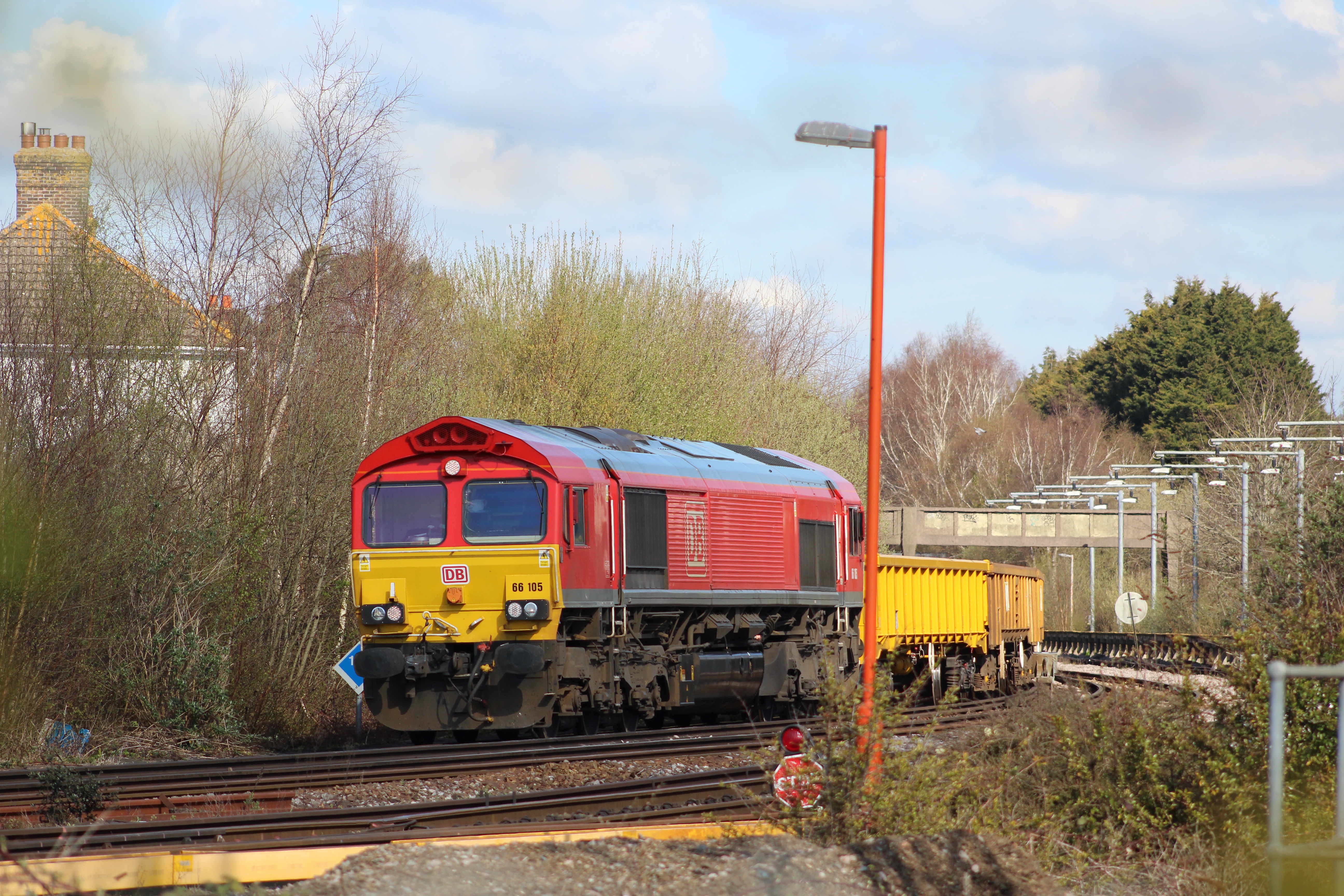
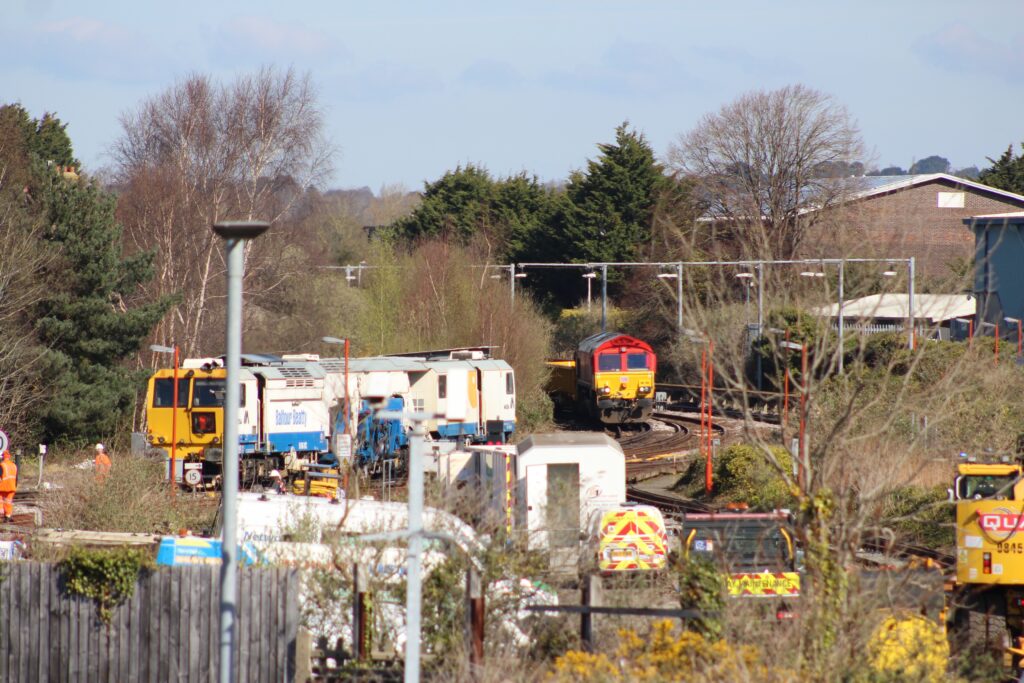
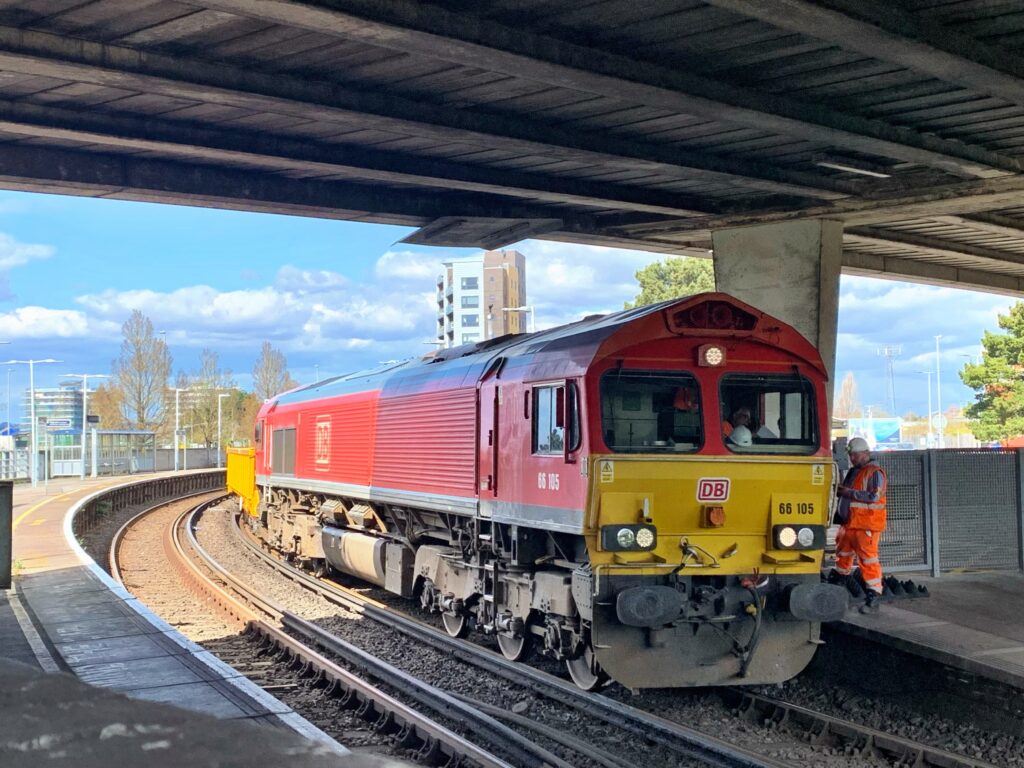
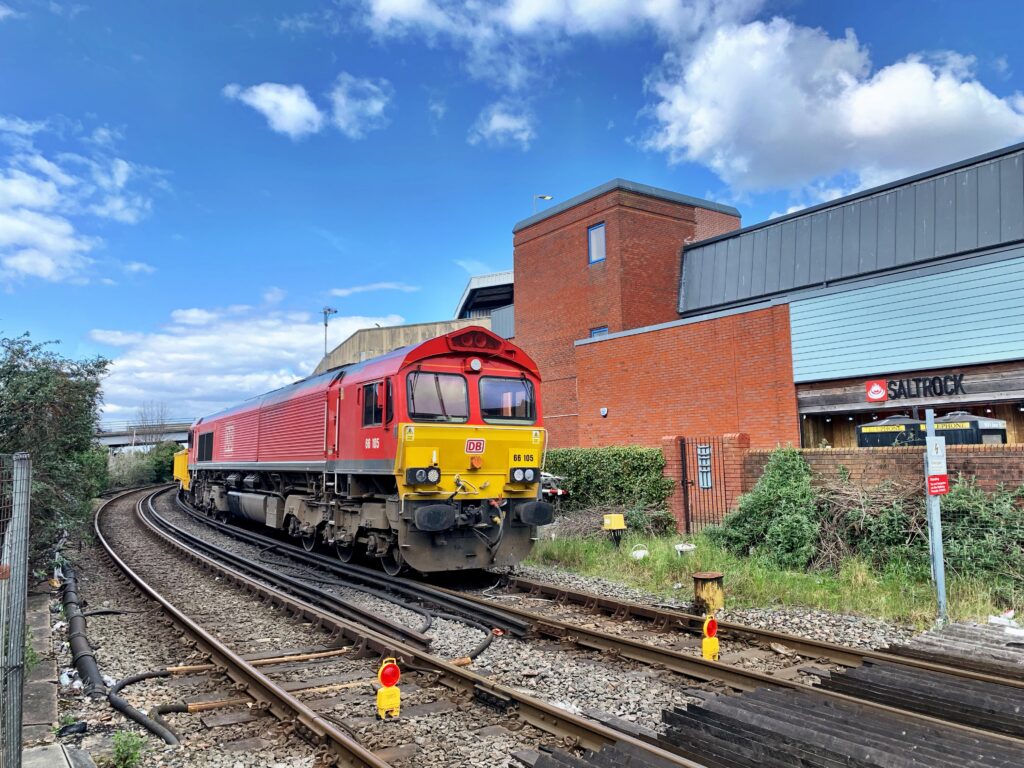
Yoshi takes the opportunity to inspect DB Class 66 No. 66105 at Poole High Street Crossing
It was an early start on Saturday April 2nd, or possibly a late end to Friday 1st when I popped into Poole to catch sight of DB Class 66 No. 66105 arrive with an engineers train from Eastleigh East Yard at 0045 (6N03 2355 Eastleigh East Yard to Poole). The next day, Yoshi and I were fortunate to see the locomotive and consist depart the Poole station area, getting some unusual photographs of the locomotive waiting for the barriers to close at Poole High Street crossing, but more of that later.
Back to Saturday and shortly after breakfast, we set off for the 2022 Steam Railway Magazine Readers’ Heritage Railway Association Award winning Didcot Railway Centre to share in the celebrations of Great Western Railway Castle Class 4-6-0 No. 4079 ‘Pendennis Castle’ being relaunched into traffic after a long absence. We made good time in getting to the car park adjacent to Didcot railway station and made our way across to the concourse where there was some confusion in how to access the subway to the railway centre. Yoshi was extremely excited and waited impatiently to get our tickets scanned before we made our way onto the site. The Great Western Society Didcot Railway Centre really is a marvel – 21 acres covering 200 years of railway heritage. Sadly the Coal Stage which dominates the skyline was recently found in need of urgent repair but conservation work is now underway on the Coal Stage as are repairs to the water tank that supplies the Centre’s steam engines with water.
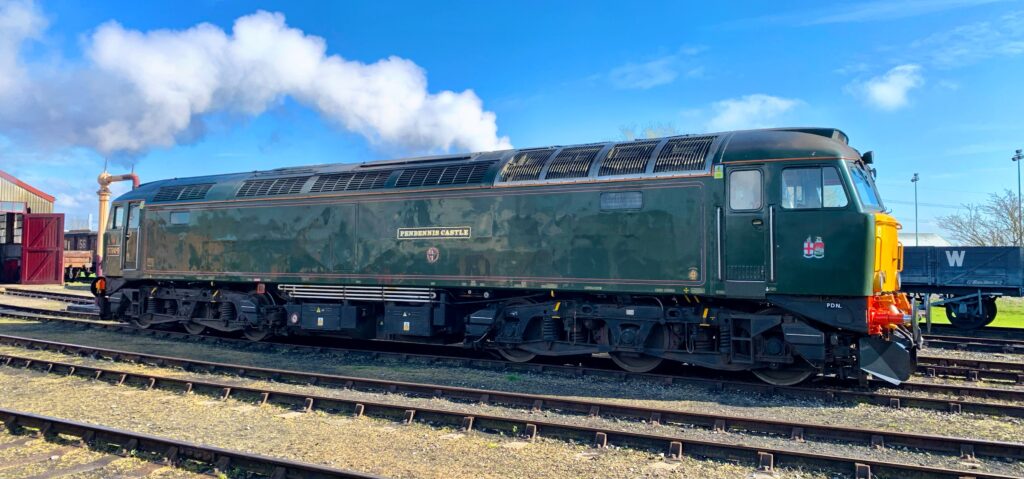
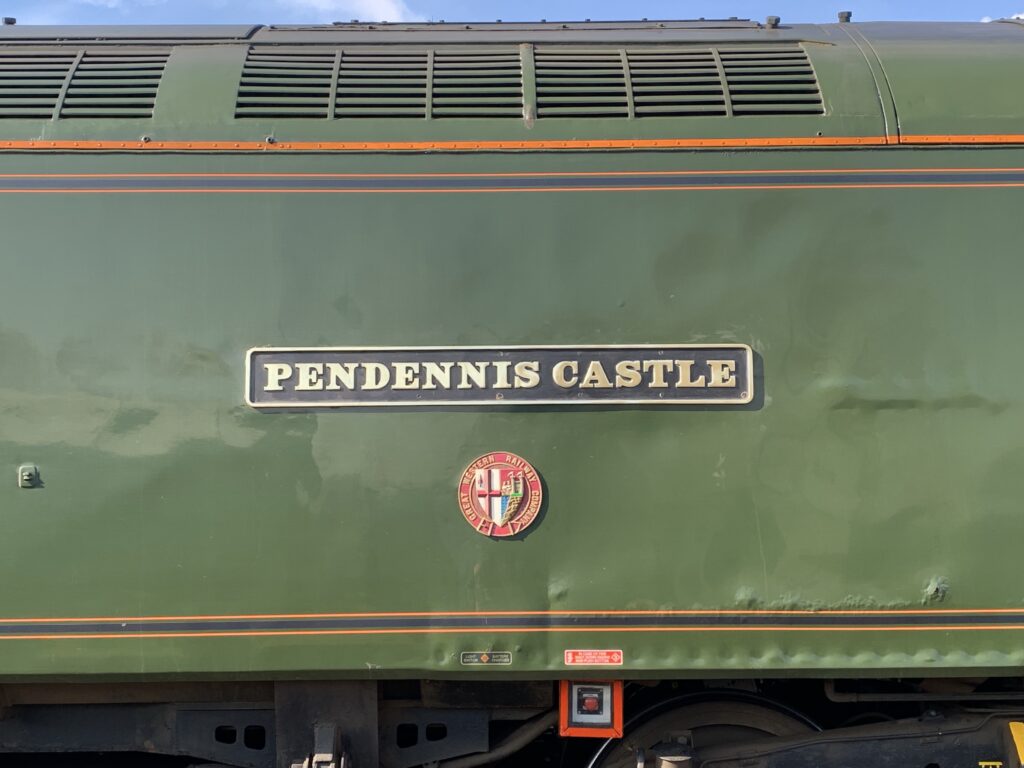
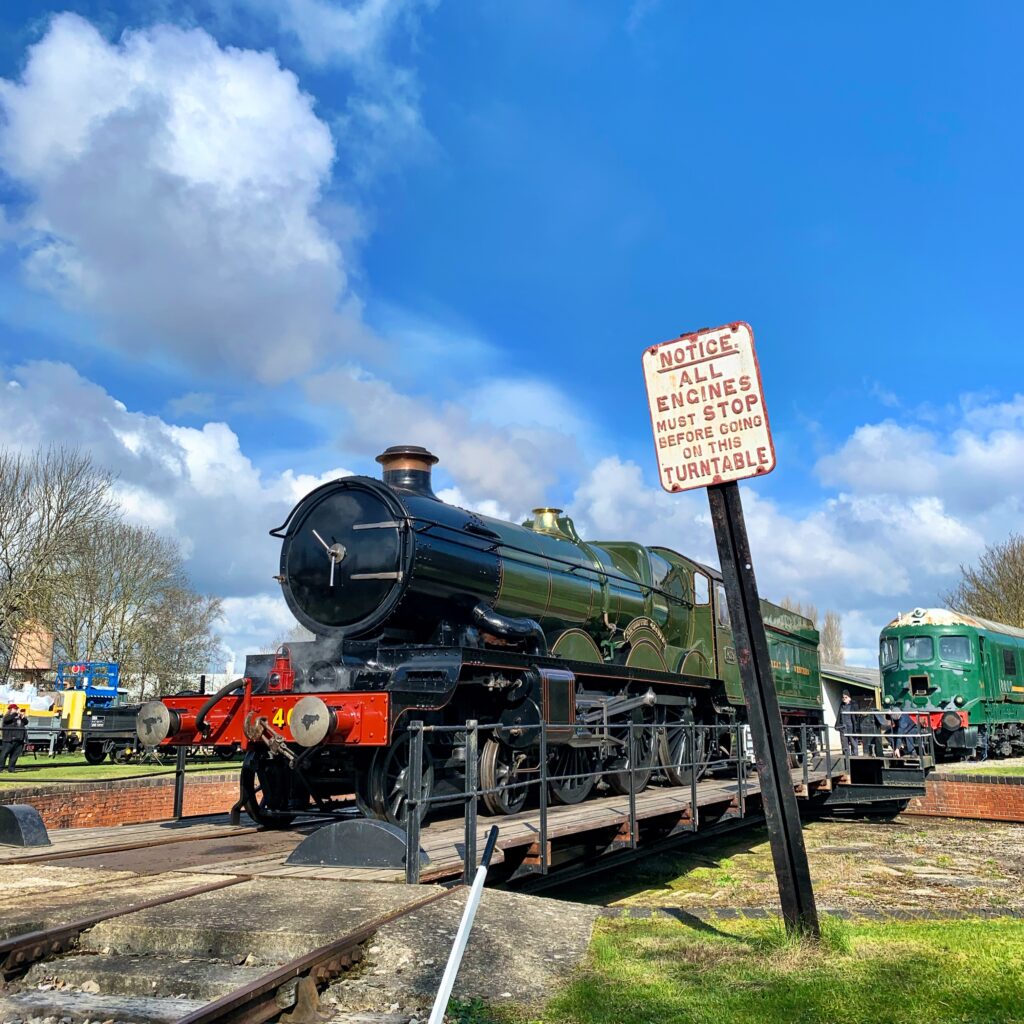
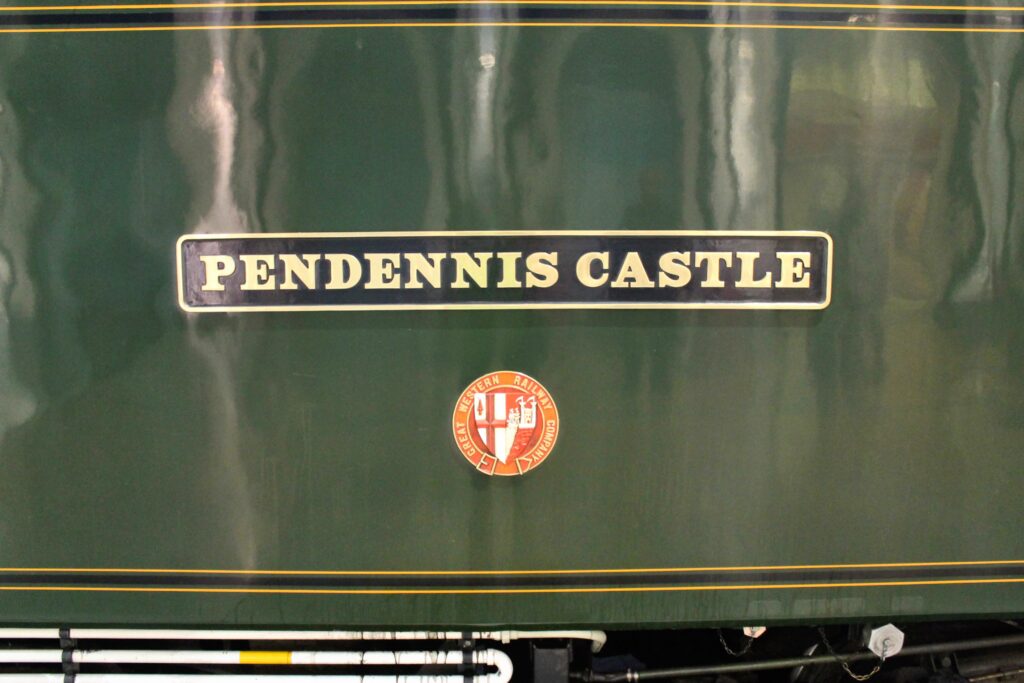
We were greeted by not one, but two Pendennis Castle locomotives. In a lovely touch, current GWR Class 57 No. 57604 ‘Pendennis Castle’ was lined up alongside her early steam namesake No. 4079.
4079 and 57604 both named ‘Pendennis Castle’ in front of the engine shed at DidcotClass 57 No. 57604 ‘Pendennis Castle’ – Didcot 02/04/2022Nameplate of Class 57 No. 57604 ‘Pendennis Castle’
The Castle Class 4-6-0 express passenger engine was first introduced in 1923. No. 4079 ‘Pendennis Castle’was the 7th machine – of an eventual total of 171 – completed in February of 1924. She shot to fame the next year when she triumphed in a series of trials against the LNER Class A1 Pacific locomotives. The most famous of these being the legendary ‘Flying Scotsman’. ‘Pendennis Castle’was rather cheekily sent to be displayed alongside its famous rival in the 1925 Empire Exhibition at Wembley.
No. 4079 worked express passenger trains on the Great Western Railway and later British Rail (Western Region) for forty years, racking up an impressive 1.75 million miles in service. This came to a sudden end in 1964 when travelling on a special train, she sustained severe damage to her rear driving wheel bearings as her fire grate collapsed and almost melted them. She was taken off the train and abandoned on shed at Westbury.
From Westbury, she was rescued by Mike Higson who was then proprietor of Roundhouse Books. He had the locomotive slowly towed back to her birthplace at Swindon and restored to working order. On completion, she was handed over in 1965. Shortly afterwards, Mr Higson sold the locomotive to Lord John Gretton (of the Bass Brewery dynasty) and, Sir William McAlpine who had famously saved ‘Flying Scotsman’from a financially disastrous tour of North America. Initially based at Didcot, No. 4079 eventually moved to the Steamtown Railway Museum in Carnforth.
The story now shifts to 1977 and Hammersley, amid the deserts of North Western Australia, where Sir Russel Madigan was visiting the iron ore mines of the company he worked for; Rio Tinto. Here he encountered a preservation group named The Pilbara Railways Historical Society who were saving diesel locomotives which had once worked the iron ore railways. The society were also keen to obtain a steam locomotive to run on the railway. Sir Russel declared he would “go home and buy them the ‘Flying Scotsman’”. This was not to be as Sir William McAlpine wasn’t prepared to sell ‘Scotsman’. He was, however, willing to part with ‘Pendennis Castle’. After a farewell tour stopping for what was believed to be the last time at Didcot, she went to Southampton Docks, was loaded onto a P&O ship and set sail for ‘Down Under’ via the Suez Canal.
Arriving at Hammersley in 1978, she soon became a firm favourite, pulling trains over the extensive iron ore rail system for pleasure trips. Apparently, it wasn’t unknown for the locomotive to just pull up out of the way somewhere in the desert and for her hot coals to be used to start the barbecue! The highlight of her time in Australia was when her great rival ‘Flying Scotsman’ visited during the country’s bicentennial celebrations in 1988 and they hauled trains together.
By 1994 changes were afoot on the Rio Tinto railway. The introduction of a new in cab signalling system made it very difficult for a 1924 steam engine to pull trains and time was beginning to take its toll on No. 4079. Faced with mounting repair bills and operational difficulties, her last operational trip was made in 1994 and she was retired to await her fate.
It was suggested by the editor of Railway Magazine, Nick Piggott, that ‘Pendennis Castle’ needed to be repatriated into the hands of the Great Western Society at Didcot. Having contacted the society and entered negotiations with then deputy society chair Richard Croucher, the society was donated 120 tons of historic steam locomotive. With one provision; the society had to get her home. Through the efforts of successful fundraising that was match funded by the Heritage Lottery coffers, No. 4079 journeyed 1,000 miles on the roads of Australia, placed on a ship that took her through the Panama Canal, thus completing her circumnavigation of the planet. She arrived back in the UK on the 8th July 2000.
Sadly the engine was in poor condition mechanically. The buckets of red desert sand that permeated the locomotive which were removed had also ground away at her moving parts. Large sections of the structure under her cab was life expired, her cylinder block needed new liners and a serious crack repairing as well as her boiler requiring a thorough overhaul.
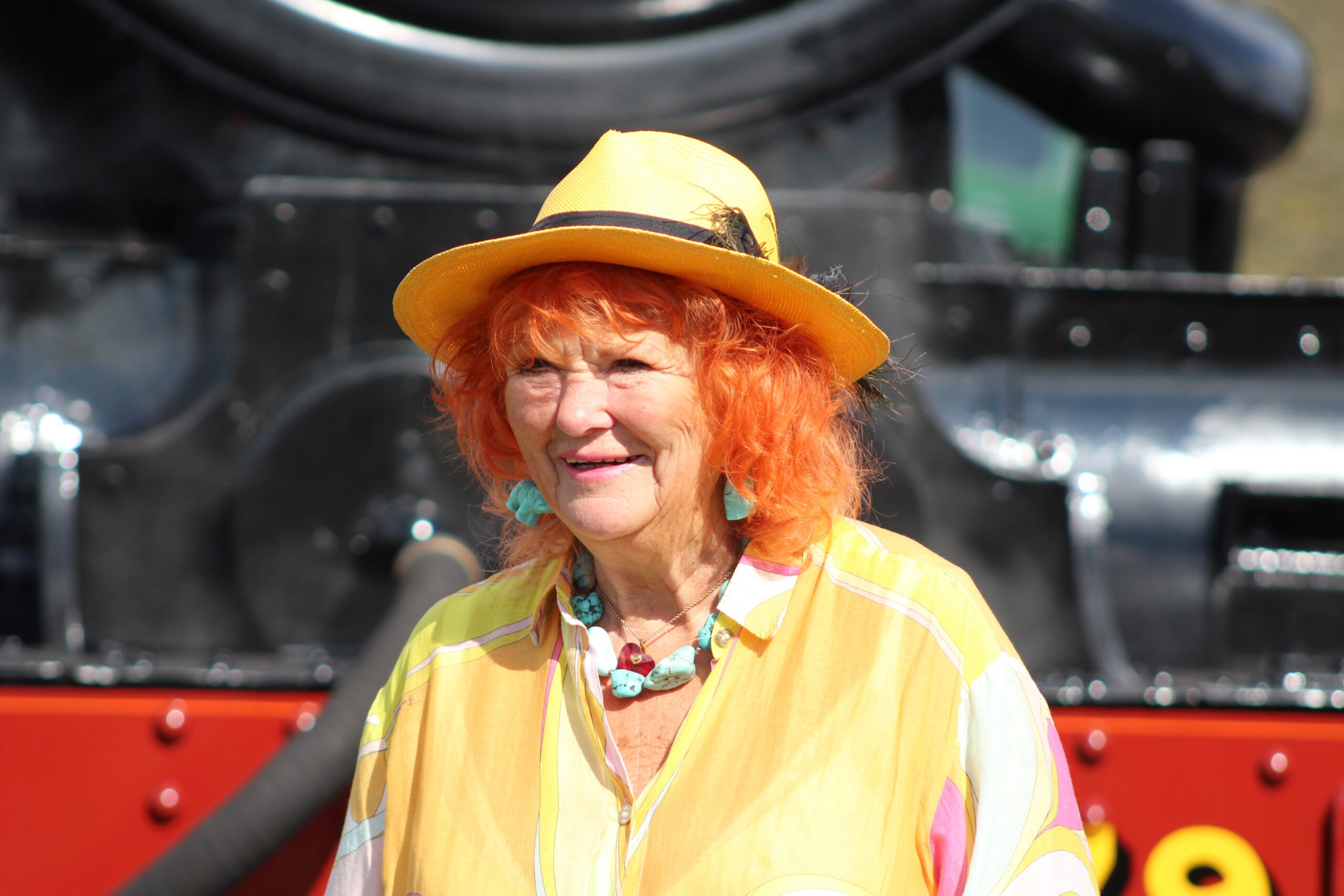
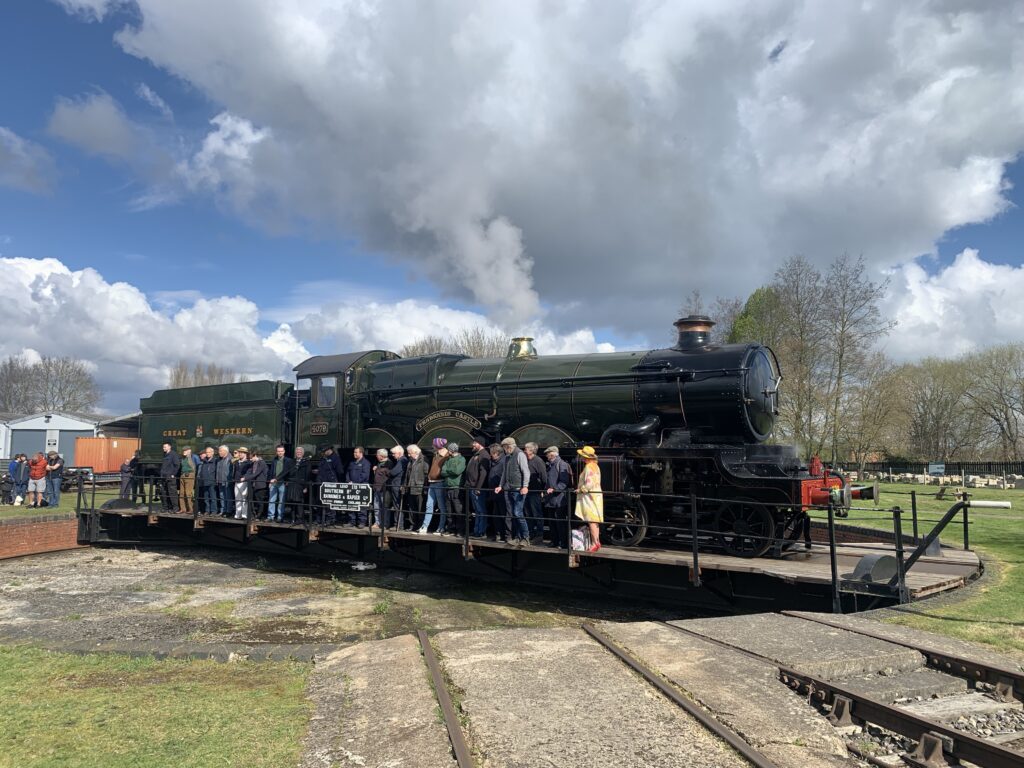
While the original intention was to restore No. 4079 to main line condition, operational changes have resulted in Didcot withdrawing from the main line scene. However, following over twenty years of volunteer work ‘Pendennis Castle’ has been fully restored to a very high standard and after her April 2nd 2022 photoshoot with her more ‘modern’ Class 57 counterpart, No. 4079 soon moved off to the turntable where, following speeches including one from Great Western Society Chair Richard Coucher, the widow of the late Sir William, Lady Judy McAlpine, cut the ribbon officially launching ‘Pendennis Castle’ back into traffic.
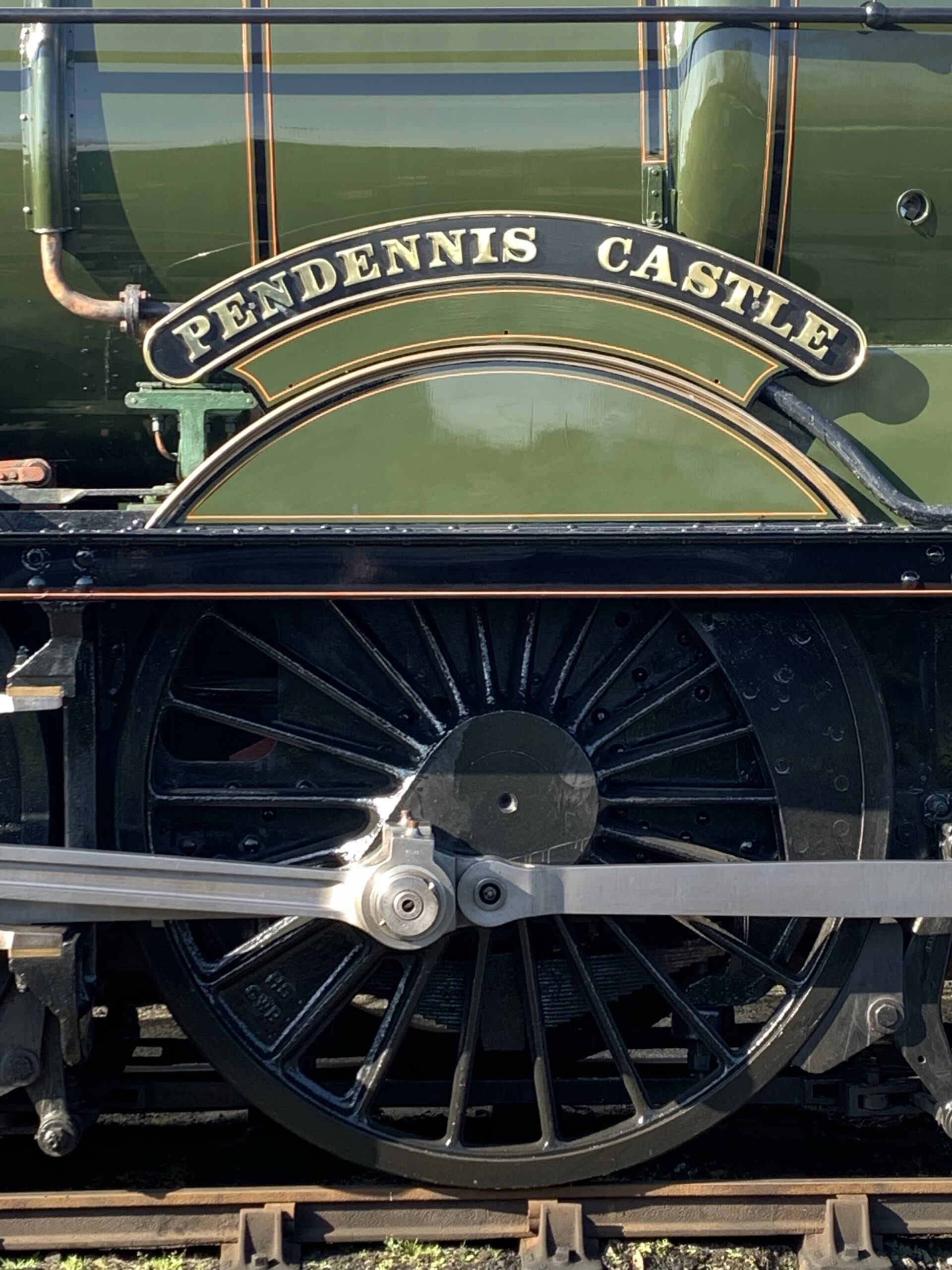
GWR Castle Class 4-6-0 No.4079 ‘Pendennis Castle’ on the turntable at DidcotLady Judy McAlpine launched ‘Pendennis Castle’ into trafficNameplate of No. 4079 ‘Pendennis Castle’GWR Castle Class 4-6-0 No.4079 ‘Pendennis Castle’ with the volunteers who restored her to working condition at Didcot
GWR Castle No.4079 is re-launched at Didcot – 02/04/2022
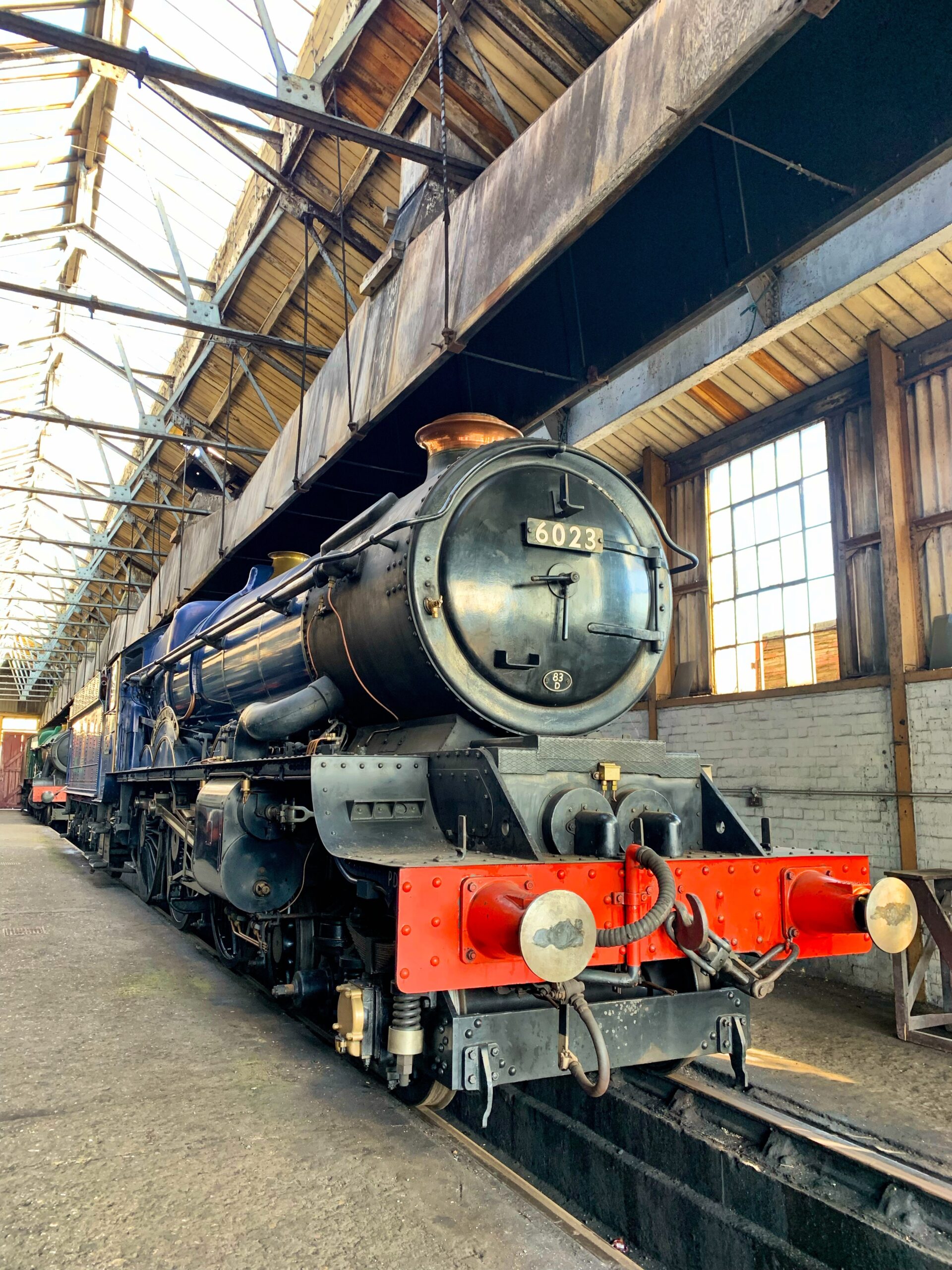
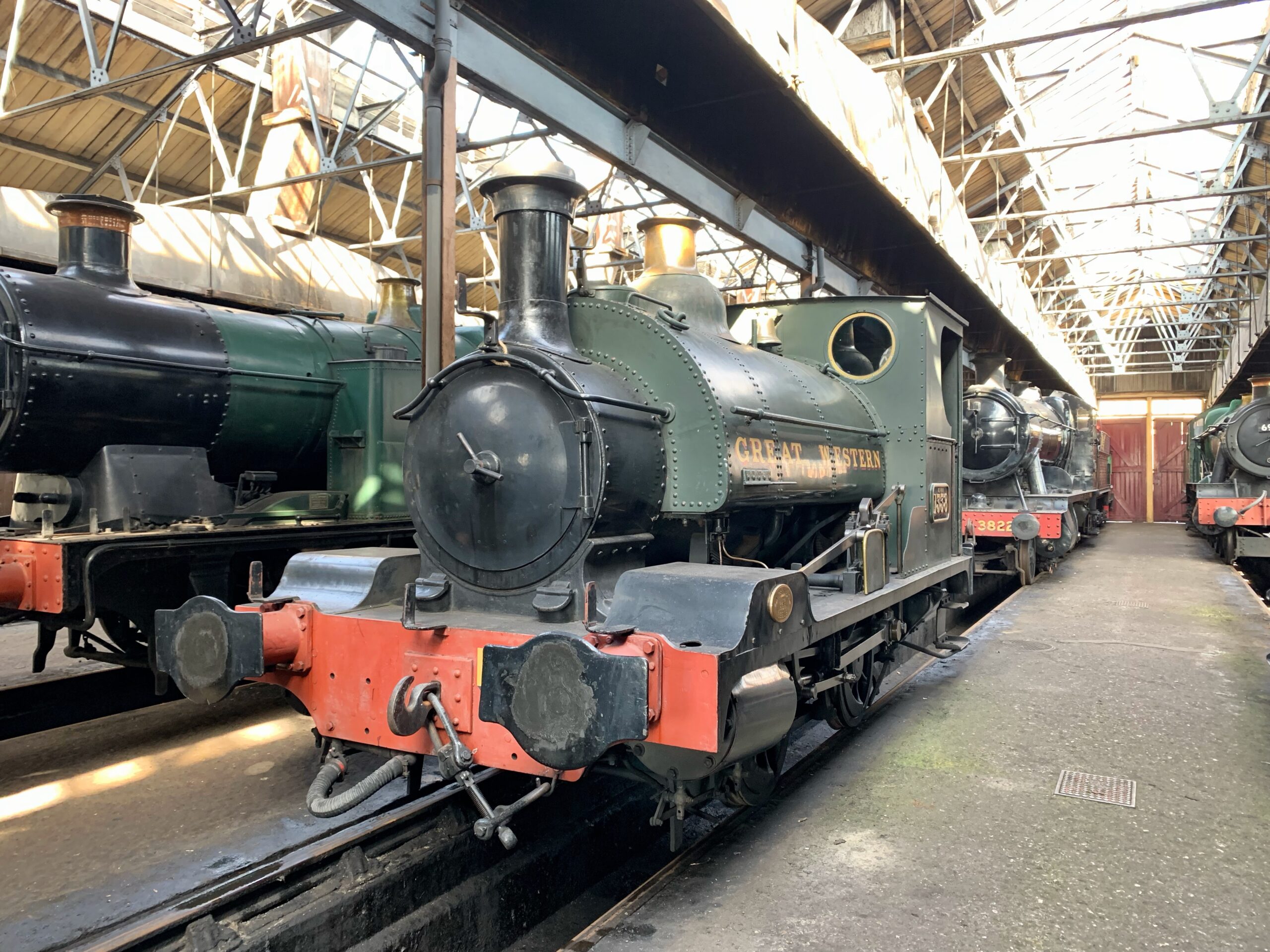
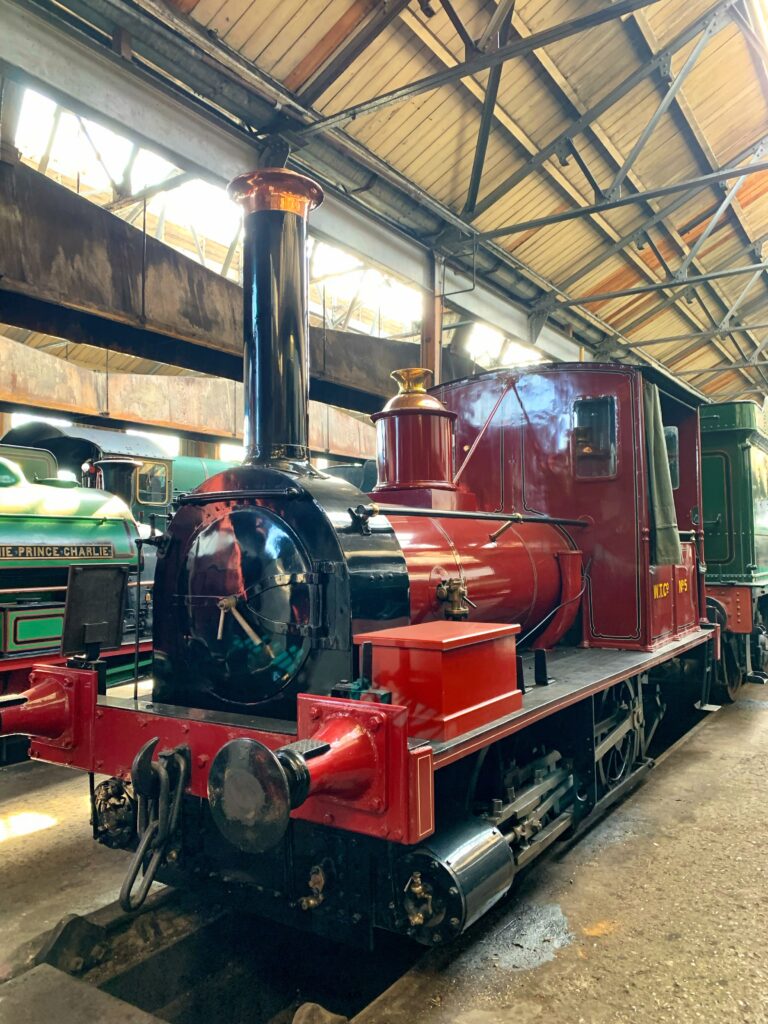
We also had an enjoyable look around the Didcot engine shed:
GWR King Class 4-6-0 No. 6023 ‘King Edward II’ – Didcot 02/04/2022GWR 0-4-0T No. 1338 – Didcot 02/04/2022No. 5 ‘Shannon’ – Didcot 02/04/2022
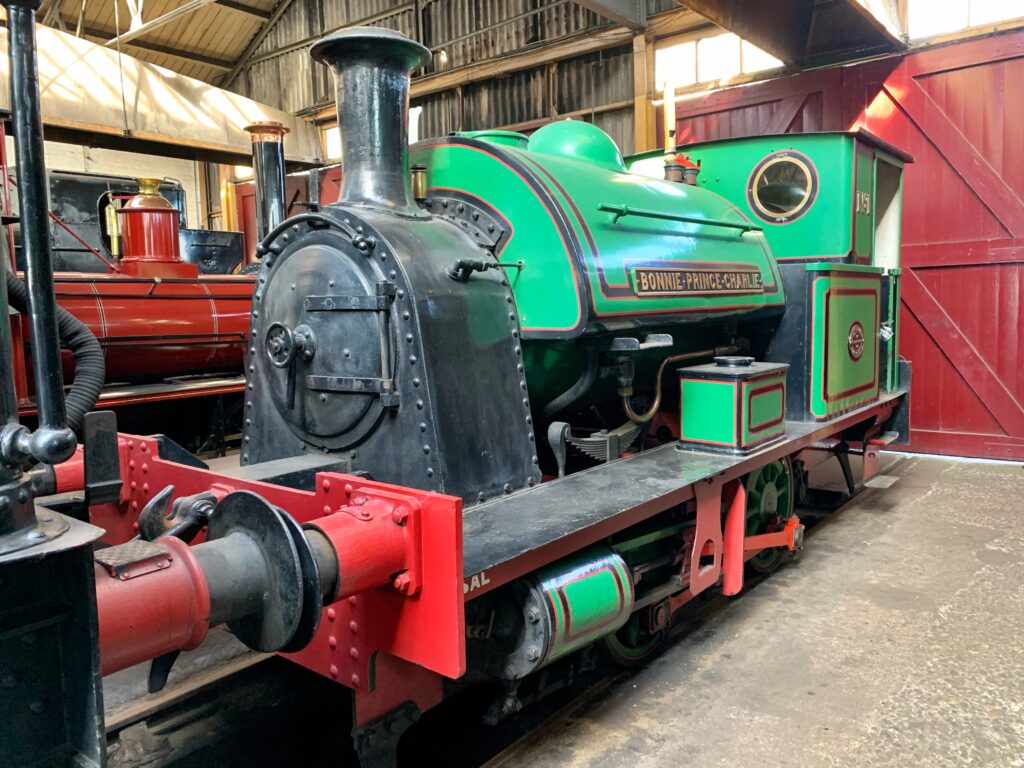
Of local interest for Yoshi and I was ‘Bonnie Prince Charlie’. The locomotive was built by Robert Stephenson and Hawthorns in 1949 (Works No. 7544) and entered service with Messrs. Corrall Ltd, initially in Dorset at Corrall’s Ballast Wharf in Hamworthy and later from 1965, at Corrall’s depot on Dibles Wharf in Southampton. ‘Bonnie Prince Charlie’ was purchased for preservation by the Salisbury Steam Trust in 1969 and arrived at Didcot soon after.
Works No. 7544 ‘Bonnie Prince Charlie’ – Didcot 02/04/2022
Saturday afternoon, Yoshi and I decided to visit the Chinnor & Princes Risborough Railway’s diesel gala. The main draw for me at least ( I’m not sure about Yoshi ) being the visit of two ex East Midlands Trains Class 43 HST power cars which are currently being operated by Rail Operations Group on behalf of Data Acquisition & Testing Services of Long Eaton – try saying that after a few JD and Coke’s – on routine checking of Over Head Line Equipment (OHLE) throughout the network, most recently in the Corby / Kettering area. The intention was for the power cars to work with the resident Southern Region 3-CEP unit, which is currently the C&PRR’s only operational air braked passenger stock. Unfortunately power car No. 43054 failed and was removed from the consist, being replaced with visiting Hanson & Hall Rail Services Solutions Ltd Class 50 No. 50008 ‘Thunderer’ which top and tailed the 3-CEP with working power car No. 43066. Sadly, this was not to be the only locomotive failure of the day as C&PRR’s departmental liveried home Class 31 No. 97205 was also withdrawn from the gala after experiencing issues.
A short video from the Chinnor & Princes Risborough Diesel Gala – 02/04/2022
C&PRR’s ambition is to extend to Aston Rowant which involves crossing a public highway at Kingston Blount in order to create a 14 mile heritage train round trip and to share operations with a public service originating from a large park and ride located near Junction 6 of the M40 to Princes Risborough for onward connections to London and Birmingham.
The next day, we caught up with Class 66 No. 66105 as it waited with its consist of wagons in the Poole area.
66105 in Poole – 03/04/202266105 at Poole with tamper DR75501 – 03/04/202266105 at Poole railway station – 03/04/202266105 at Poole High Street Crossing – 03/04/202266105 at Poole High Street Crossing – 03/04/202266105 waits to return to Eastleigh East Yard at Parkstone the eastern extent of the worksite – 03/04/2022Balfour Beatty Matisa B 66 UC Tamper No. DR75501 in Poole sidings – 03/04/2022
Video of 66105 in Poole – 02 & 03/04/2022
More engineering work is planned for this coming Sunday in the Poole area, although I have yet to see if any engineers trains beyond a tamper will be involved. Network Rail track inspections on the Hamworthy branch necessitate road closure and traffic restrictions as Hamworthy Level Crossing in Ashmore Avenue, Poole is closed for several days w/c 25th April 2022. Interesting times ahead, hopefully!
For our look into the archives this week we are returning to Didcot with a 1992 video from John Chappell, but first a set of photos taken with my ever trusty Kodak 110 camera during a school visit in 1979:
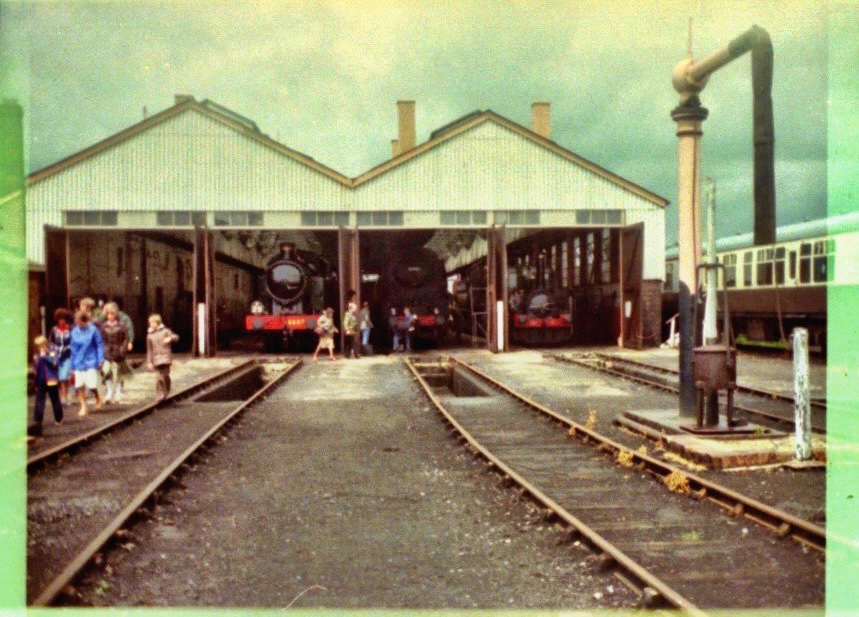
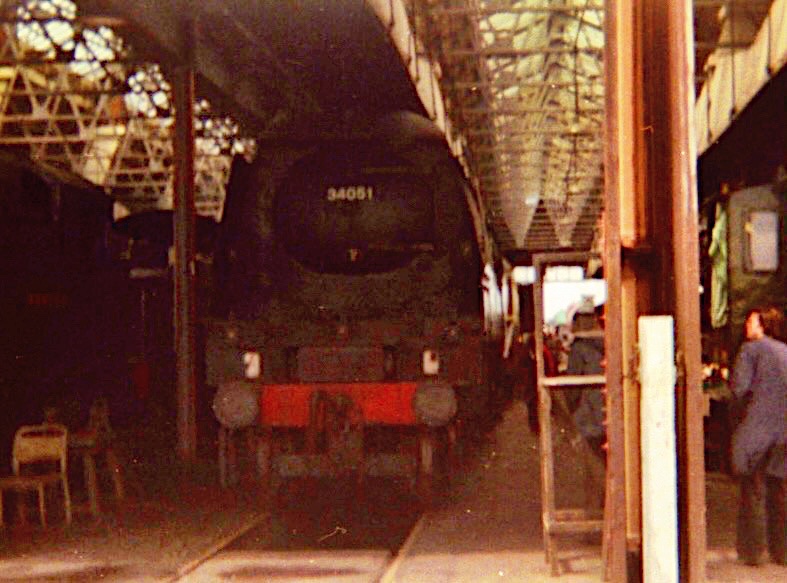
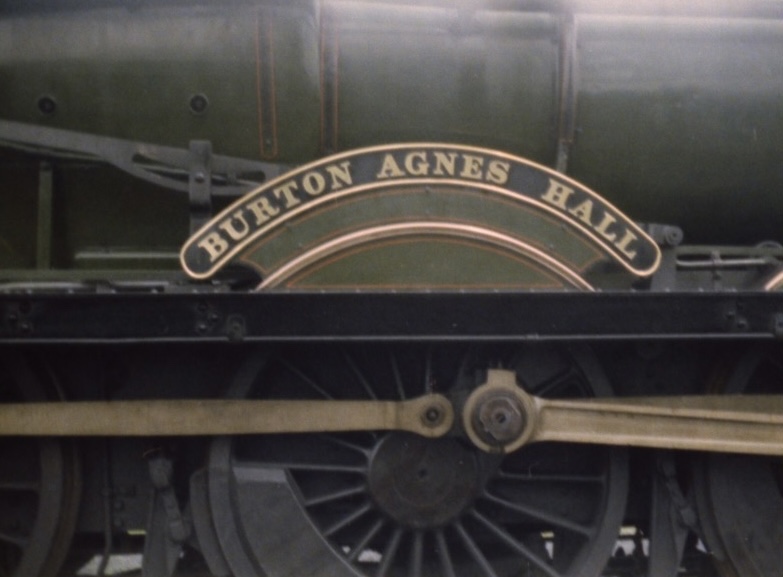
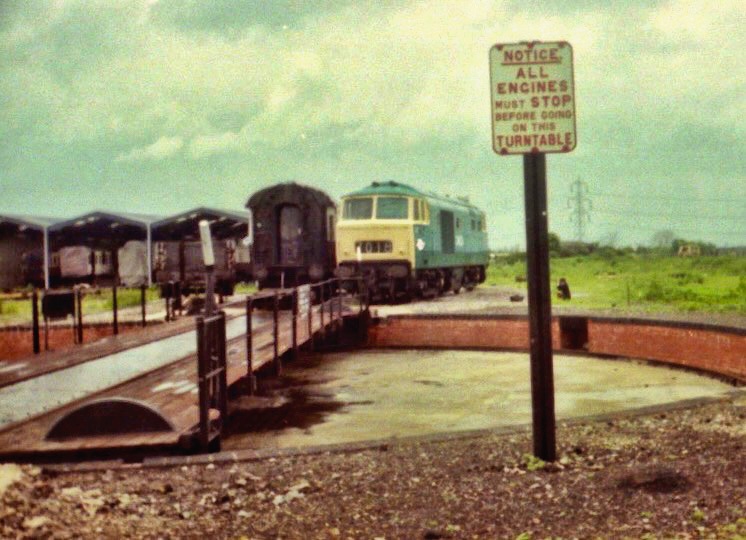
Didcot engine shed featuring GWR Collett 5600 Class 0-6-0T tank engine No. 6697, SR Battle of Britain No. 34051 ‘Sir Winston Churchill’ and No. 5 ‘Shannon’ – 24/06/1979Southern interloper Battle of Britain Class No.34051 ‘Sir Winston Churchill’ on shed at Didcot – 24/06/1979GWR Modified Hall Class 4-6-0 No. 6998 ‘Burton Agnes Hall’ at Didcot – 24/06/1979Nameplate of GWR No. 6998 ‘Burton Agnes Hall Hymek D7018 adjacent the turntable at Didcot – 24/06/1979.Hymek D7018 adjacent the turntable at Didcot – 24/06/1979. Note the now demolished cooling towers of the nearby power station.GWR Class 5700 0-6-0PT Pannier Tank No. 3738 on the demonstration line at Didcot – 24/06/1979Didcot 24/06/1979
During the weekend of 21/22nd November 1992, BR Standard 4-6-2 No. 70000 ‘Britannia’ was joined by unique BR Standard Pacific No. 71000 ‘Duke Of Gloucester’ where both locomotives were in steam working double headed trains on the demonstration line. In the video below, filmed by John Chappell, there is also a glimpse of ex-Corrall’s locomotive ‘Bonnie Prince Charlie’ in a blue livery for comparison to the more recent photo above.
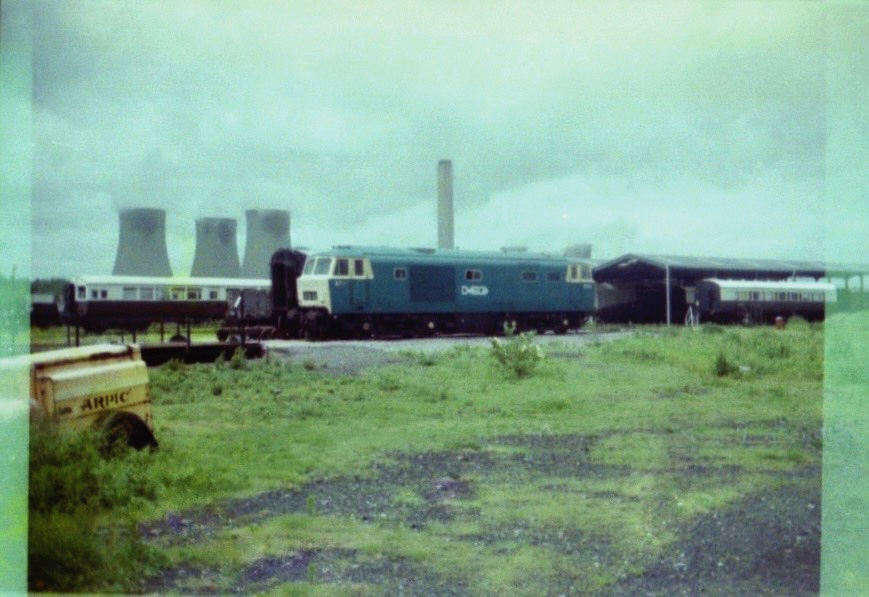
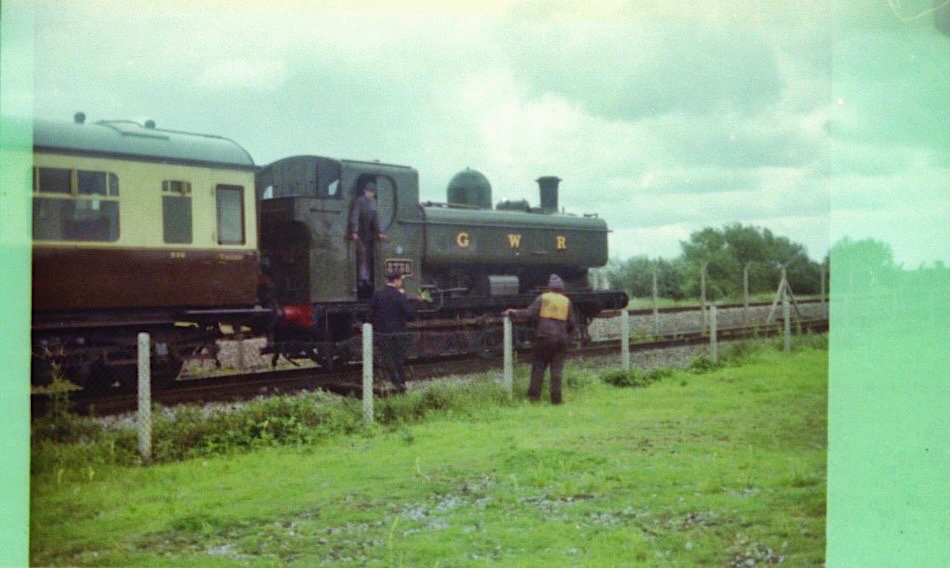
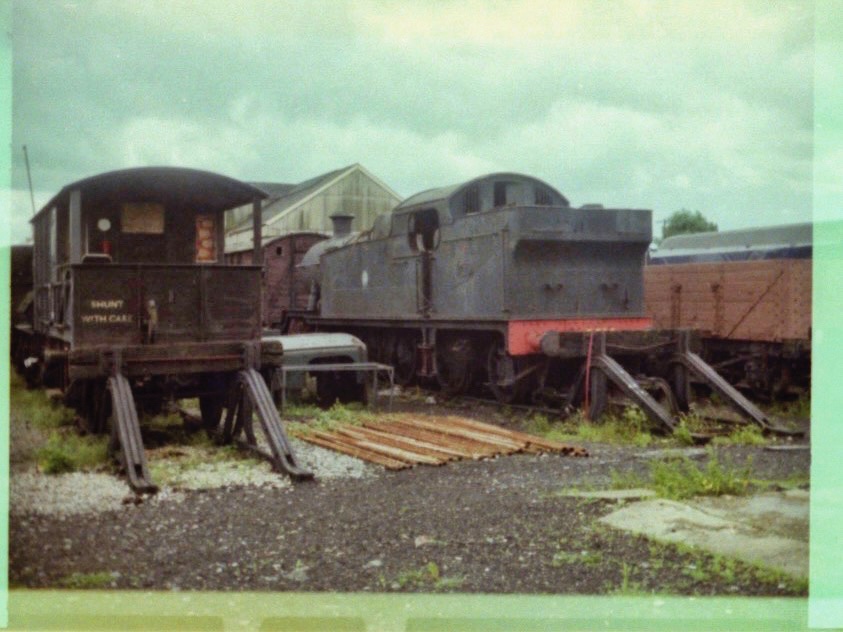
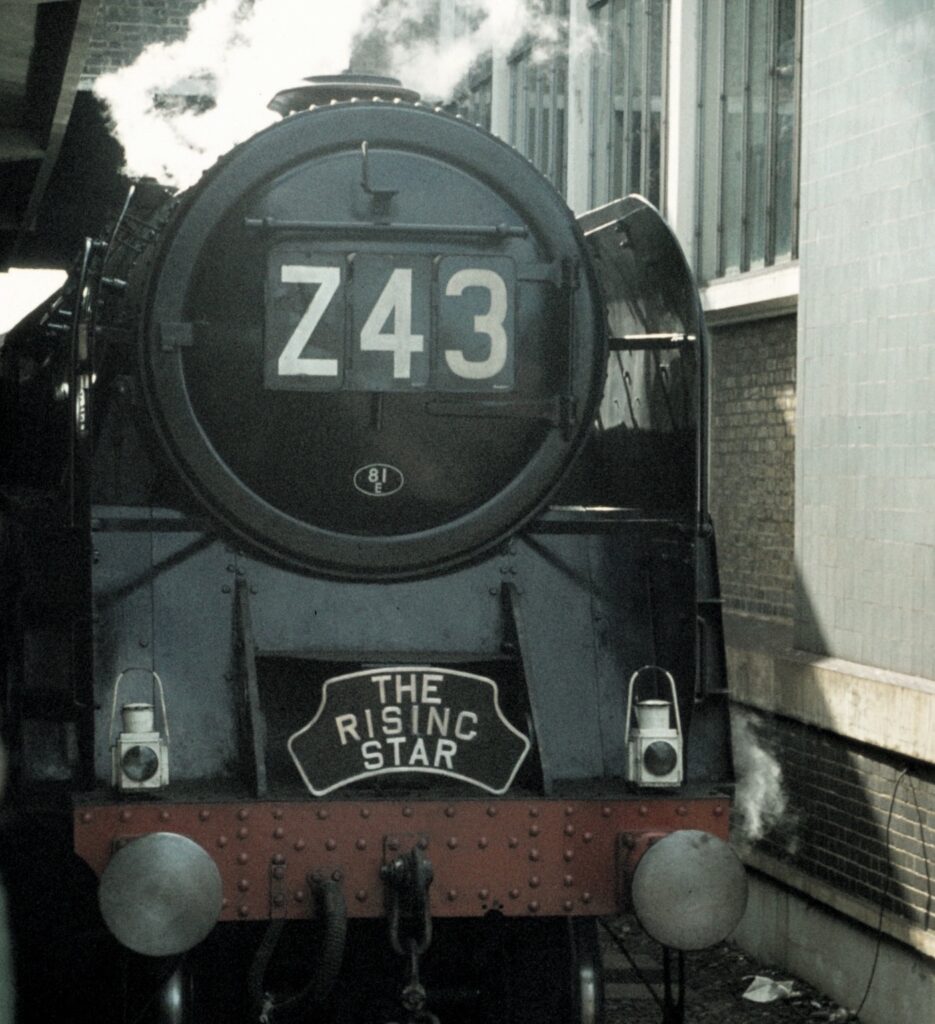
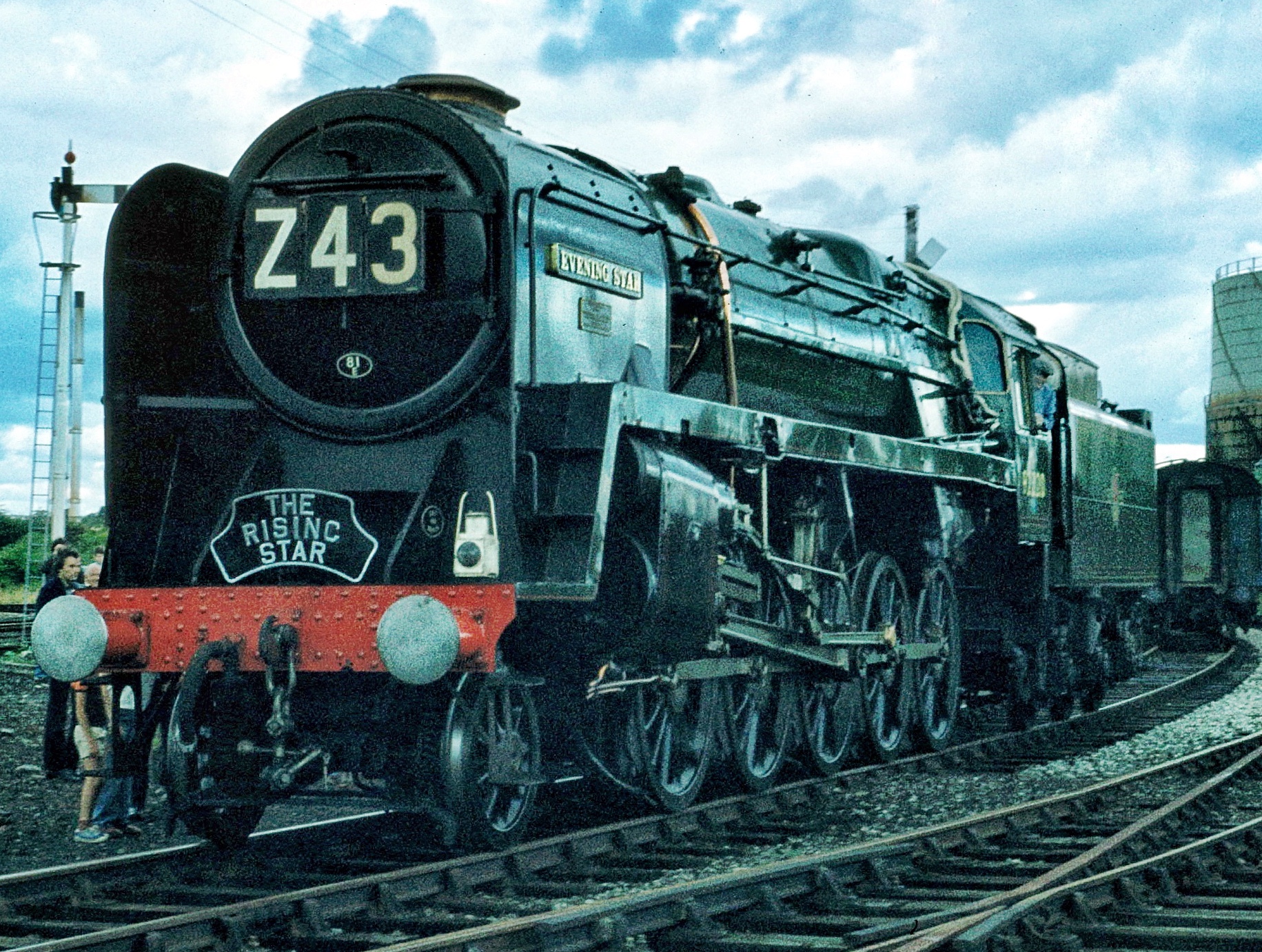
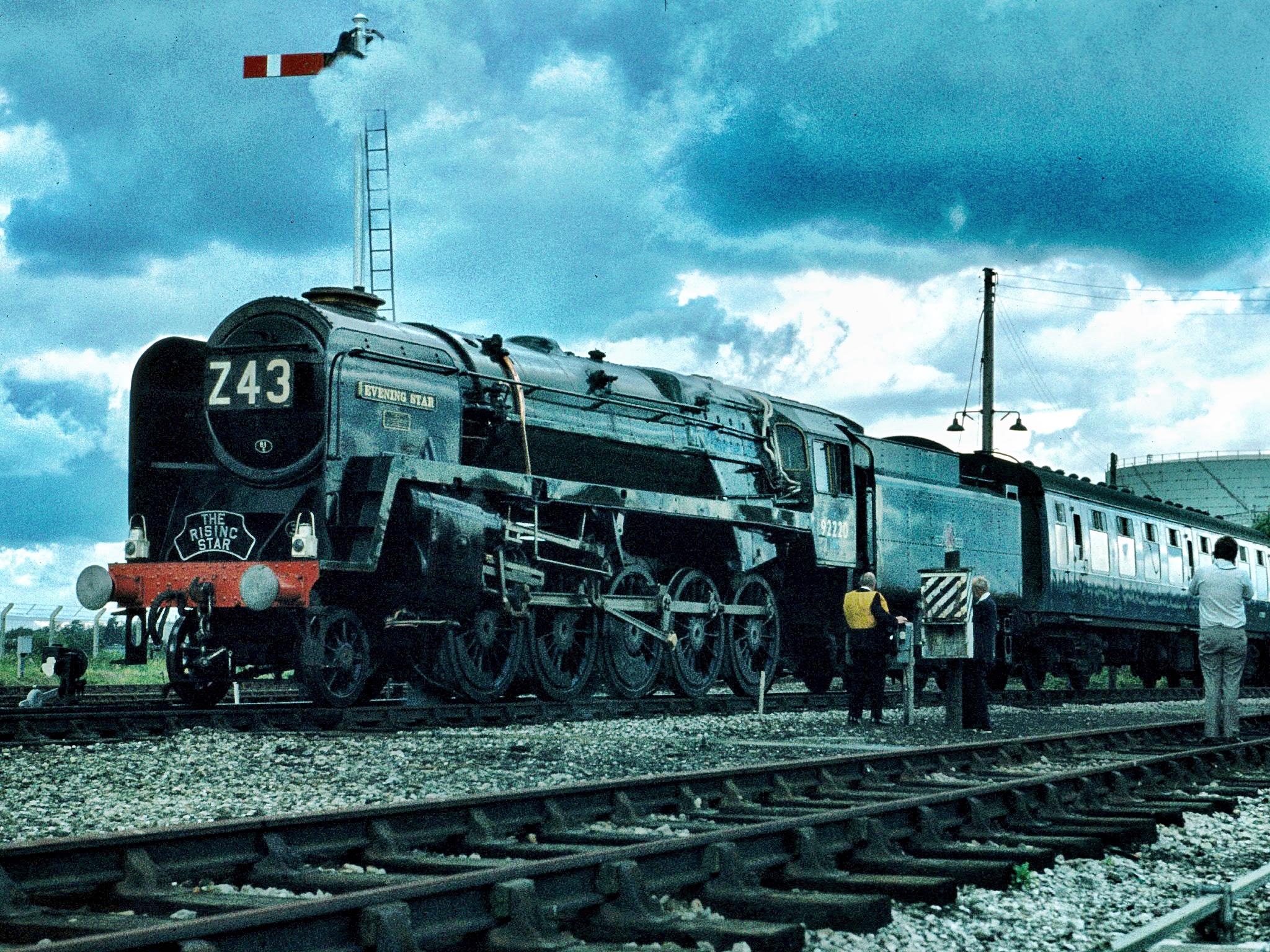
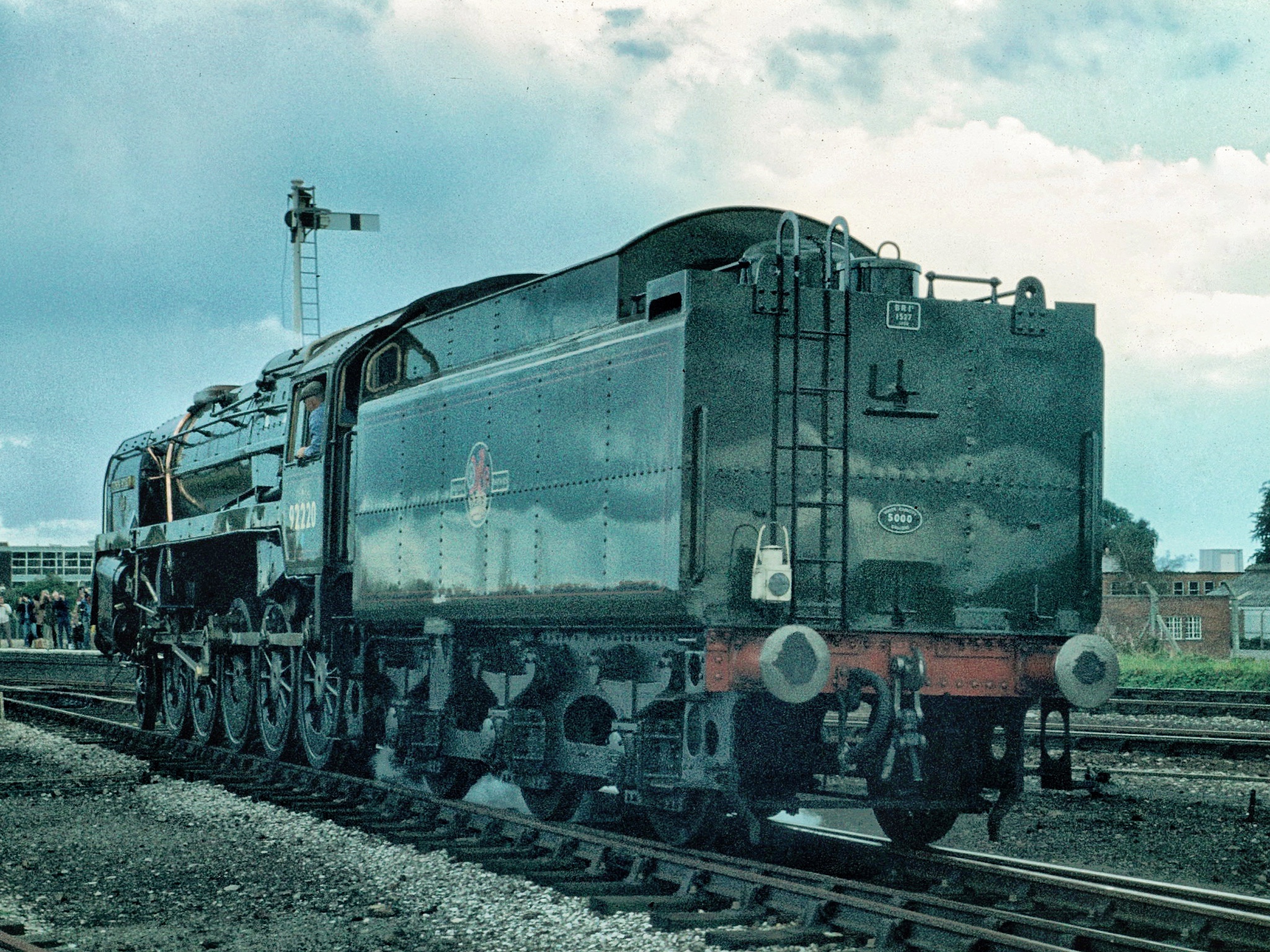
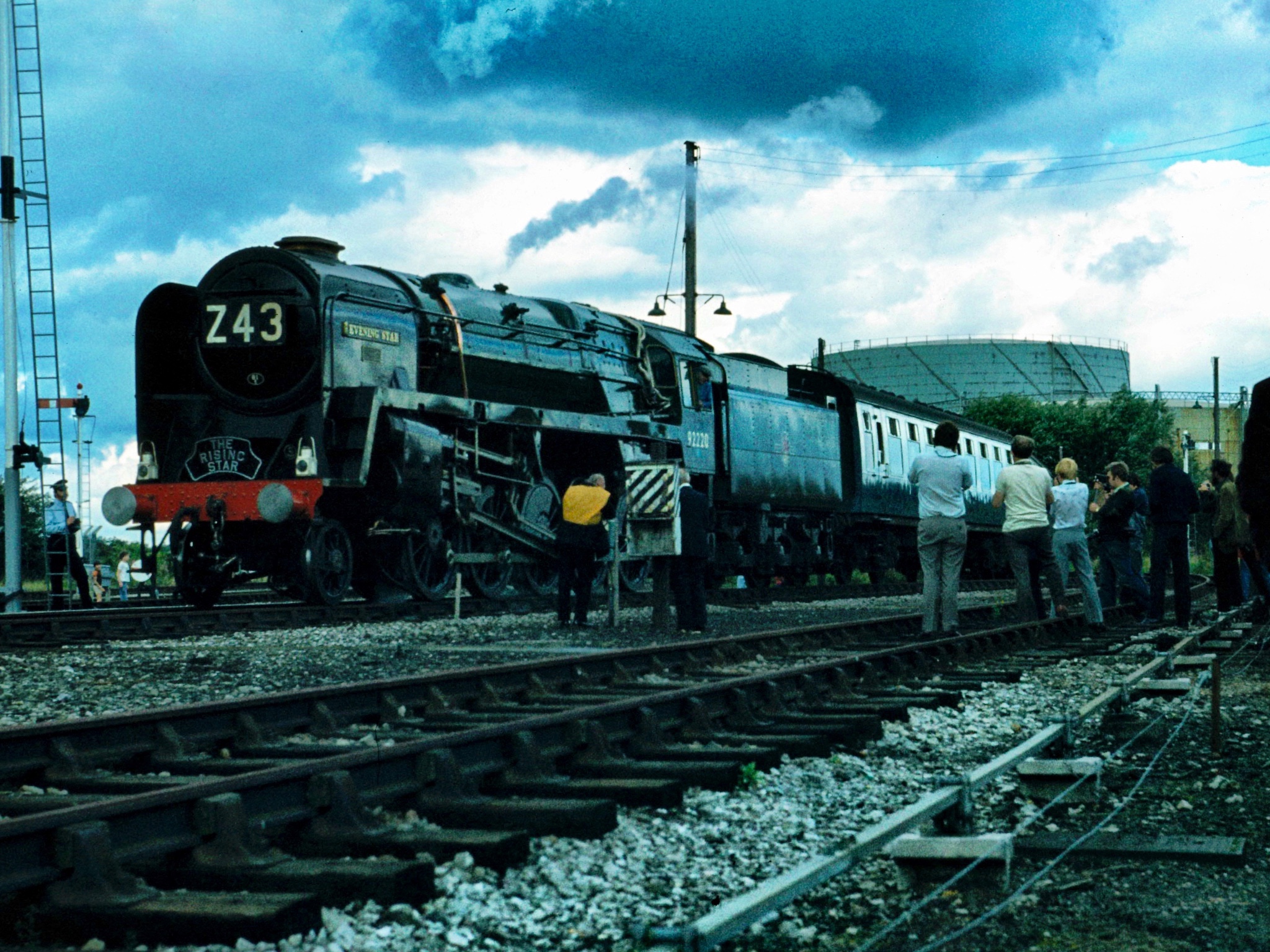
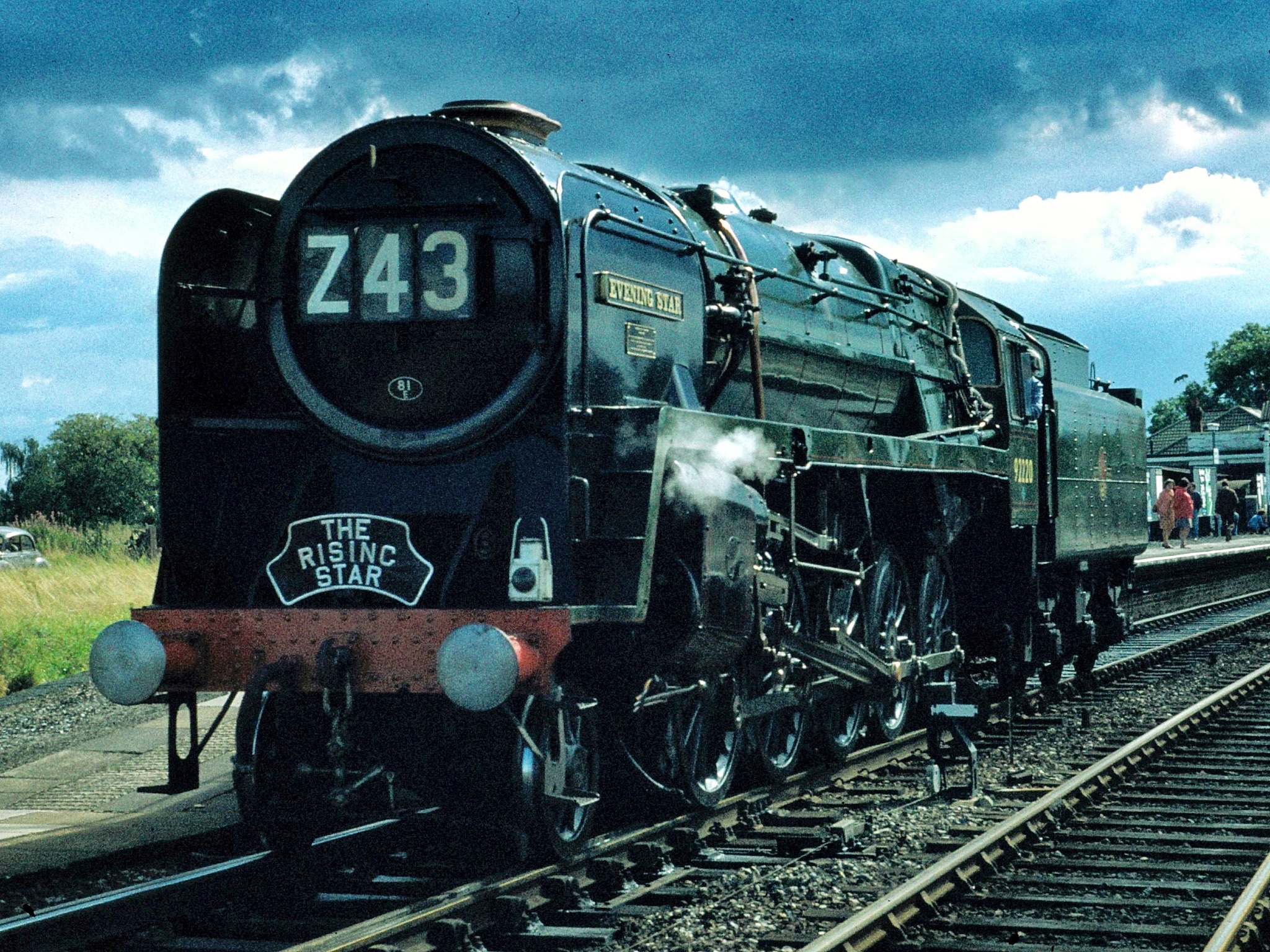
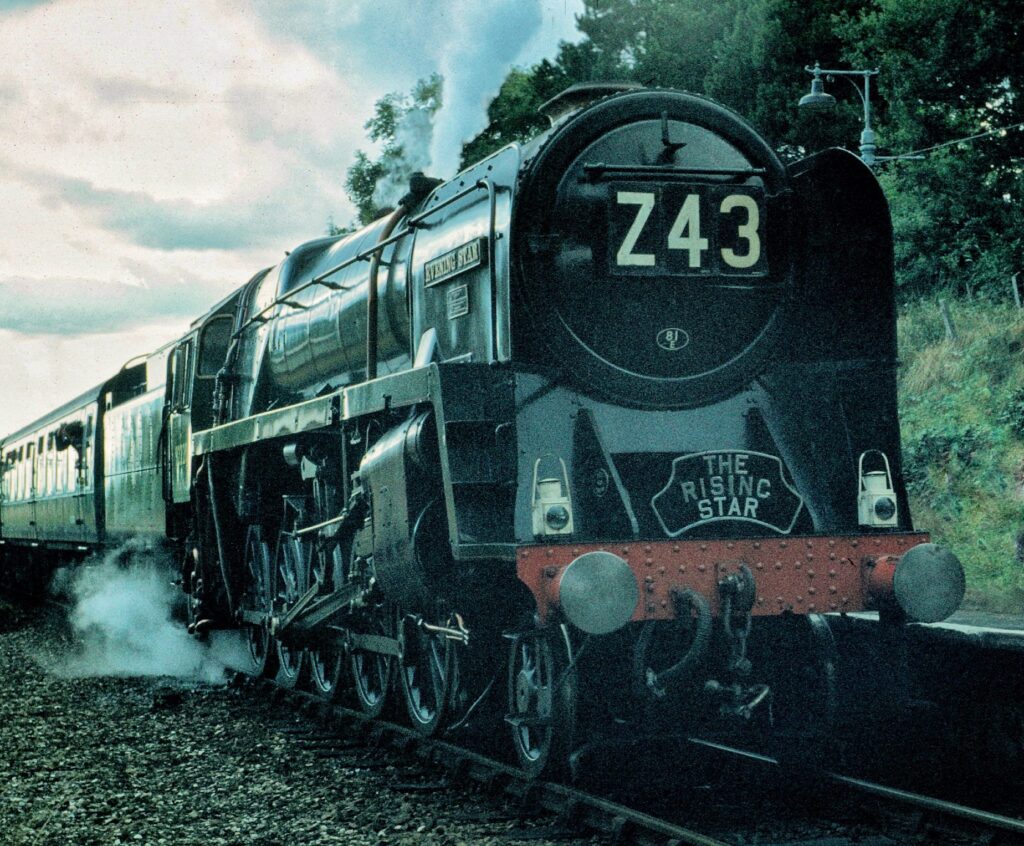
As mentioned previously, the Railway Centre once enabled the servicing of steam locomotives for special main line trains. One example being the Great Western Society’s Rising Star tour which ran from London Paddington to Stratford-upon-Avon and return on 13th September 1981. I have few memories of the trip except for the glorious view of British Railways Standard Class 9F 2-10-0 No. 92220 ‘Evening Star’ setting off light engine to Didcot shed with the setting sun glinting off her side after completing the steam leg of the tour ( Didcot – Stratford-upon-Avon and return ).
BR Standard Class 9F 2-10-0 No. 92220 ‘Evening Star’ having worked the Rising Star railtour runs light engine into Didcot Railway Centre – 13/09/1981BR Standard Class 9F 2-10-0 No. 92220 ‘Evening Star’ working the Rising Star rail tour at Banbury – 13/09/1981
I’m assuming after arriving at Stratford-upon-Avon, ‘Evening Star’ turned on the triangle at Hatton before taking the train on the return journey. The images below are taken at Stratford-upon-Avon:
I recall from the main line steam excursions I travelled on in the 1980’s there was often a photo stop to enable passengers to disembark and fire off a few shots of the train, as in the photograph below:
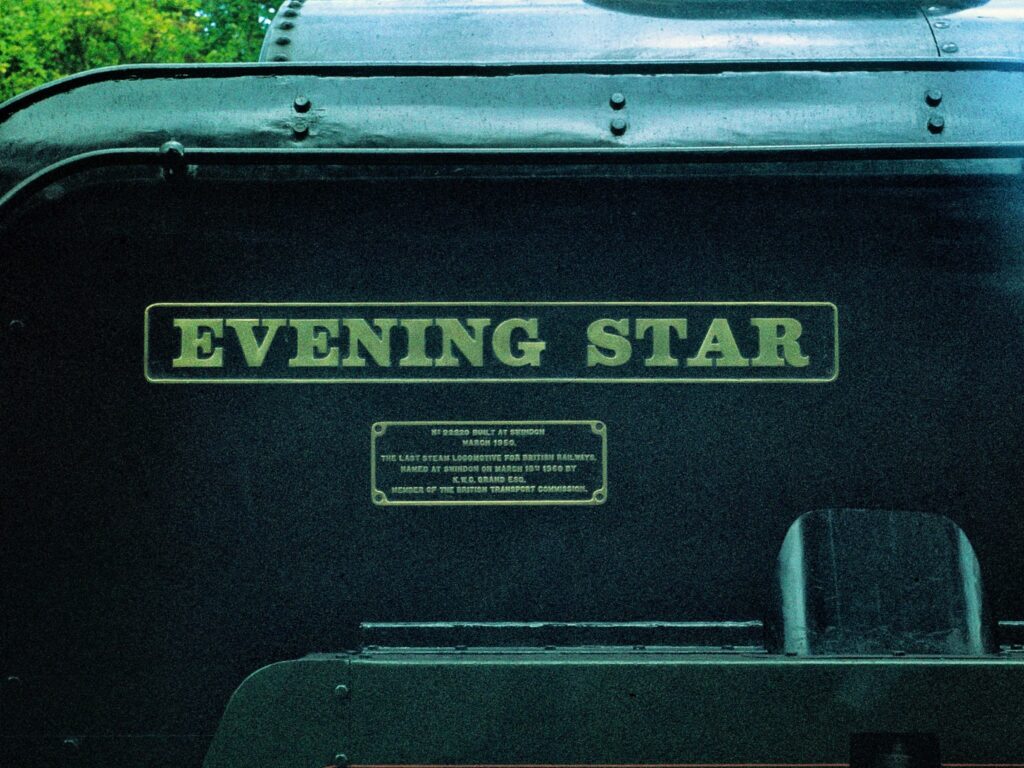
BR Standard Class 9F 2-10-0 No. 92220 ‘Evening Star’ stops for photographs at Claverdon as part of the Rising Star tour – 13/09/1981Nameplate of BR Standard Class 9F 2-10-0 No. 92220 ‘Evening Star’
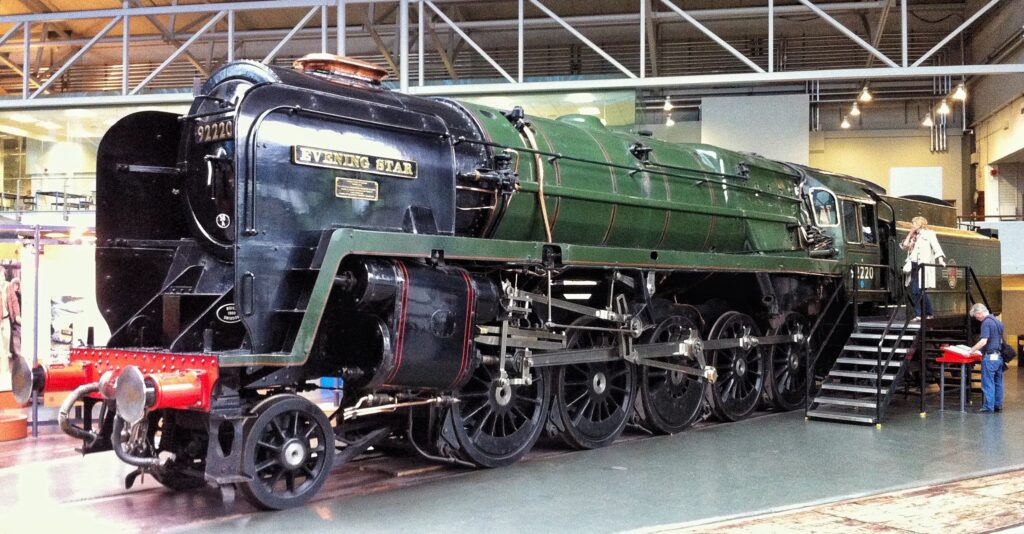
BR Standard Class 9F 2-10-0 No. 92220 ‘Evening Star’ was the last steam locomotive to be built by British Railways and the only main line steam locomotive earmarked for preservation from the date of construction. Built at Swindon Works in 1960, she was the 999th locomotive of the British Railways Standard Classes of locomotives. After a working life of only five years, she was withdrawn from service following an accident where she incurred minor damage at Cardiff Docks. As part of the National Collection, she now resides on static display at the Railway Museum in York
BR Standard Class 9F 2-10-0 No. 92220 ‘Evening Star’ at the National Railway Museum in York – 03/07/2012
Thank you for visiting and for your comments and corrections which are much appreciated. Many thanks to the Great Western Society for use of material from their press release in writing the story of No. 4079 ‘ Pendennis Castle’. Donations to the Water Tower and Coal Stage Conservation Project can be made here.
Yoshi basks in the sun alongside Peckett & Sons 0-4-0T ‘Pectin’ at Yeovil Junction
Every now and then, even in this internet age, a test train or light locomotive working manages to pass me by. Recently it was a top and tailed Class 73 test train which visited our local area when I was tucking into Sunday lunch. Last year I was thwarted in seeing a Class 56 in Dorset due to a traffic queue created by roadworks and because I had dinner in the oven. This last weekend I missed seeing Class 37 No. 37612 heading up a test train from Westbury to Dorchester West and return. I was having a lovely afternoon looking around a National Trust property near Yeovil (and yes, enjoying a cuppa) when the heritage loco passed by a few miles away. We are able to share the following photograph of the Class 37 working with grateful thanks to Jim Smith.
Class 37 No. 37612 at Dorchester West 20/03/2022 ( Image courtesy of Jim Smith )
The following video shows 37612, along with sister locomotive 37610, during a previous visit to Dorchester West on December 2nd 2020 working the 0820 Tyseley L.M.D. to Bristol High Level Siding test train. Last Sunday’s working was in beautiful bright sunlight, whereas this earlier visit clearly wasn’t.
376212 Dorchester West 02/12/2020
As well as visiting stately homes on Sunday, our morning was spent at the Yeovil Railway Centre which is situated on a site covering the turntable and the former Clifton Maybank branch adjacent to Yeovil Junction railway station. The event celebrated Peckett & Sons 0-4-0ST Works No. 1579 Pectin which formally returned to traffic on 20th March 2022. We enjoyed watching turntable displays and taking a train ride along the former Clifton Maybank spur.
The first Yeovil Railway Festival organised by the South Western Main Line Steam Company was held on the 8th and 9th October 1994 and was opened by Jim Morgan, Director of Railtrack South West. Drummond Locomotive Society’s 0-4-4T Class M7 loco 30053 (as 30129) ran shuttles to Yeovil Pen Mill and trips to Maiden Newton while BR Standard Pacific No. 70000 ‘Britannia’ and examples of classes 47 (Lady Godiva from Waterman Railways), 33 and 37 were on display. S15 4-6-0 No. 828 hauled Pathfinder steam excursion, The Exe-Parrett (suitably adorned with parrot toy on the smoke box), through Yeovil from Bristol to Exeter and back to Bristol via Taunton on the Saturday and returned from Bristol for display on the Sunday. Before heading to Yeovil, our first video of the weekend sees 828 first at Westbury but also GWR Castle Class 4073 4-6-0 5029 ‘Nunney Castle’ working the London Paddington – Cranmore Capitals United Express rail tour organised by Flying Scotsman Services. You can also catch a glimpse of one of my favourite railway and wildlife artists David Shepherd with the train.
M7 No. 30053 (as 30129) ran shuttles to Yeovil Pen Mill and trips to Maiden Newton
Things didn’t run quite to plan for Pathfinder on the Sunday when the Dorset Docker rail tour hauled by a pair of Class 20 diesel locomotives en route to Weymouth and Weymouth Quay was deemed a failure at Yeovil Pen Mill when No. 20187 expired. Class 37 No. 37375 which had been on display at Yeovil Junction, working in multiple with 20075, was rostered to work the tour back as far as Westbury. The 37 was substituted for Class 47 No. 47475 which hauled the tour and the Class 20’s onward from Westbury to Wolverhampton. Our next video, filmed mostly on the Sunday captures a glimpse of the Class 37 and Class 20’s at Yeovil Pen Mill.
On 4th and 5th October 1997 the second Yeovil Railway Festival was held, once again opened by Jim Morgan now Director of GB Railways. USA Tank No. 30075 was in the upside sidings whilst S15 No. 828 and M7 No. 30053 joined in once again taking turns at operating a shuttle service to Castle Cary. Class 20 No. D8188 was named “River Yeo” by Murray Brown, editor of Rail Express magazine. Two failed Class 73 locomotives, 73104 and 73128, were unofficially on display with an engineers train. On the second day Hertfordshire Railtours ran The Blackmore Vale 125 Special HST excursion from Paddington with power cars 43006 and 43185.
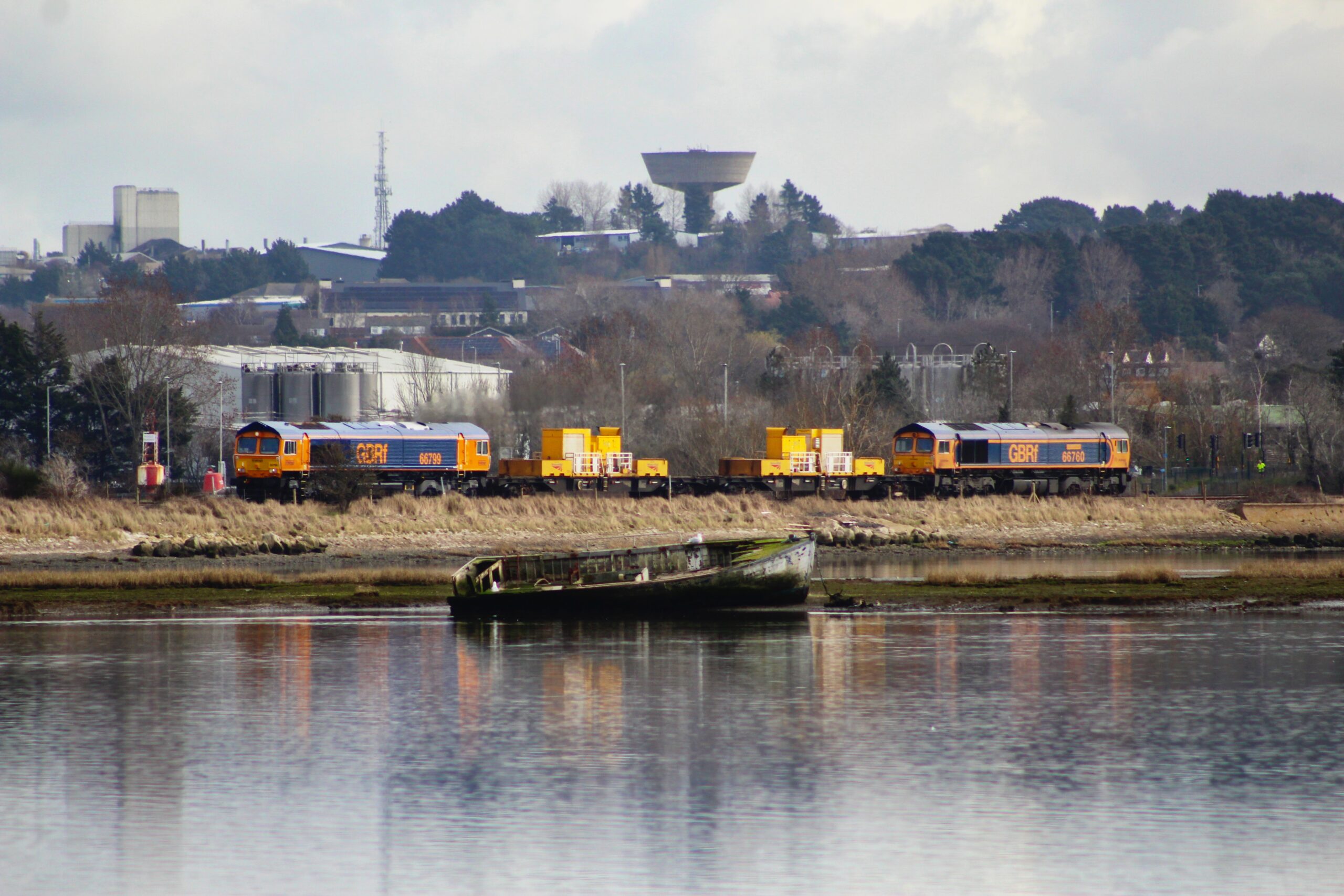
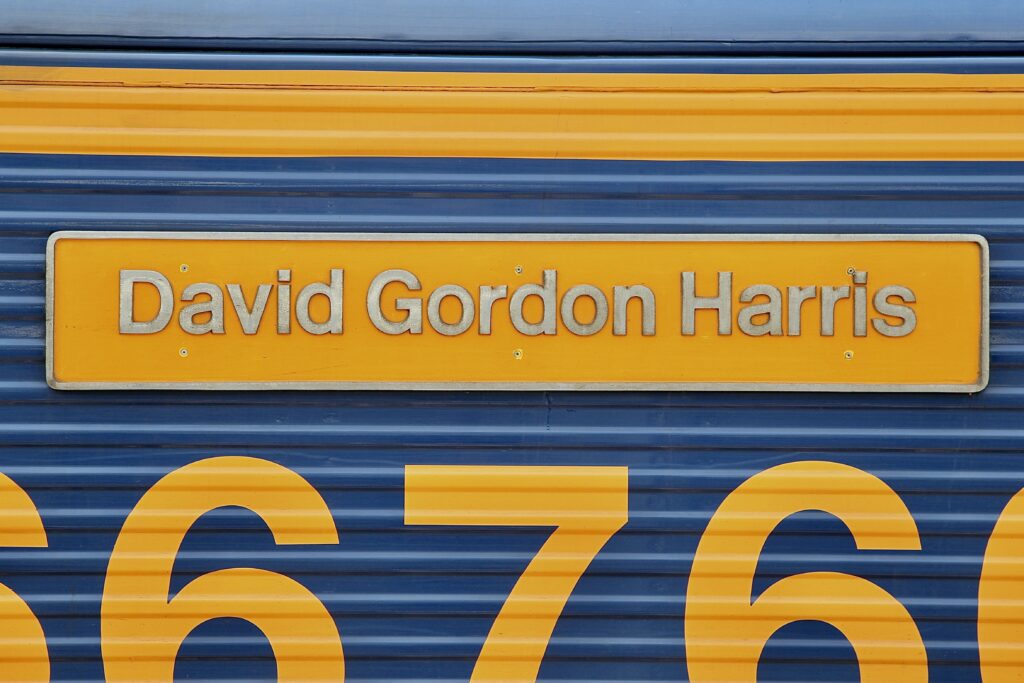
This past week saw the return of the Snow & Ice Treatment Train (SITT) to the Bournemouth – Weymouth line with GBRf Class 66 locomotive No’s 66799 and 66760 ‘David Gordon Harris’ remaining in charge. We’ll share our video of these workings in our next blog.
Class 66 No.’s 66799 and 66760 seen at Poole working the SITT on 21/03/2022Class 66 No.’s 66799 and 66760 seen at Poole working the SITT on 22/03/2022
We saw the SITT leave Totton Yard on Thursday 17th March 2022 before we headed off to Eastleigh to visit an old friend and visit McDonald’s. While there, we took the opportunity to spend a few hours watching trains before and after lunch. There’s a video after this collection of photographs.
Class 59/2 No. 59205 was derailed at Eastleigh for over a week following an incident involving track spread.GBRf Class 66 No. 66764 working 1150 Southampton Western Docks to East Midlands Gateway passes 444036 on a London Waterloo to Weymouth service – Eastleigh 17/03/2022
Class 701 testing continues, as evidenced in the image below as 701037 waits for a clear road before departing from Eastleigh.
Freightliner Class 66 No. 66572working 0536 Garston FLT to Southampton MCT – Eastleigh 17/03/202266095 working 0514 Wakefield Europort to Southampton western Docks Berth 109 – Eastleigh 17/03/2022Class 67008 shunting MK4 stock – Eastleigh 17/03/202266792 working 4Y19 1230 Mountfield Sidings (GBRf) to Southampton Western Docks – Eastleigh 17/03/202266522 working 0931 Crewe Basford Hall SSM to Southampton MCT – Eastleigh 17/03/2022
In other local news, Swanage Railway have announced the postponement of their Summer 2022 planned 90 selected day trial of a Wareham to Swanage and Corfe Castle service using heritage British Railways diesel multiple units because of ‘challenging trading conditions and economic uncertainty. Plans are now being made to run the trial in 2023.
Swanage Railway heritage DMU seen at Norden on 3rd January 2022 with a train celebrating the last BR train on the branch
Fifty historic railway structures originally earmarked for demolition or infilling may be spared after an independent review of National Highways plans found that they could be readily preserved for active travel schemes. The government ordered review carried out by Sustrans concluded that two-thirds of the 75 structures could be useful for use as part of the National Cycle Network (NCN) or as local walking and cycling routes.
One such bridge deemed useful for the NCN is the bridge which carried the former Bridport branch line at Barrowland Lane, Toller Porcorum. Local residents were left angry last year when National Highways felled trees on land next to the disused bridge. The Historical Railways Estate Group, made up of engineers, sustainable transport advocates and greenway developers – want to use the bridge in its ambitious plans to develop a sustainable railway and cycle link from West Bay to Maiden Newton.
The images below show both ends of the proposed cycle / walk way; Maiden Newton and WestBay.
The former Bridport Branch Bay at Maiden NewtonFormer Bridport Branch trackbed, Maiden NewtonFormer Bridport Branch trackbed, Maiden NewtonWest Bay Station – March 2016West Bay Station – March 2016
For our final video clip this time, we have included a brief view of the last day of operation on the Bridport Branch filmed by John Chappell showing a diesel multiple unit formed using No.’s 55033, 51345 + 59497 + 51387 which ran the final services on the line. This silent cine film also offers a glimpse of Southern Electric Group rail tour The Dorset Dawdler which utilised Diesel Electric Multiple Unit No. 1131. Passengers on this tour were able to transfer to the DMU service for a trip to Bridport and back. The SEG DEMU tour also took in the Fawley branch and Weymouth Quay Tramway earlier in the day.
That’s all for this week. Thanks for reading and hopefully we’ll be back with an update in seven days.
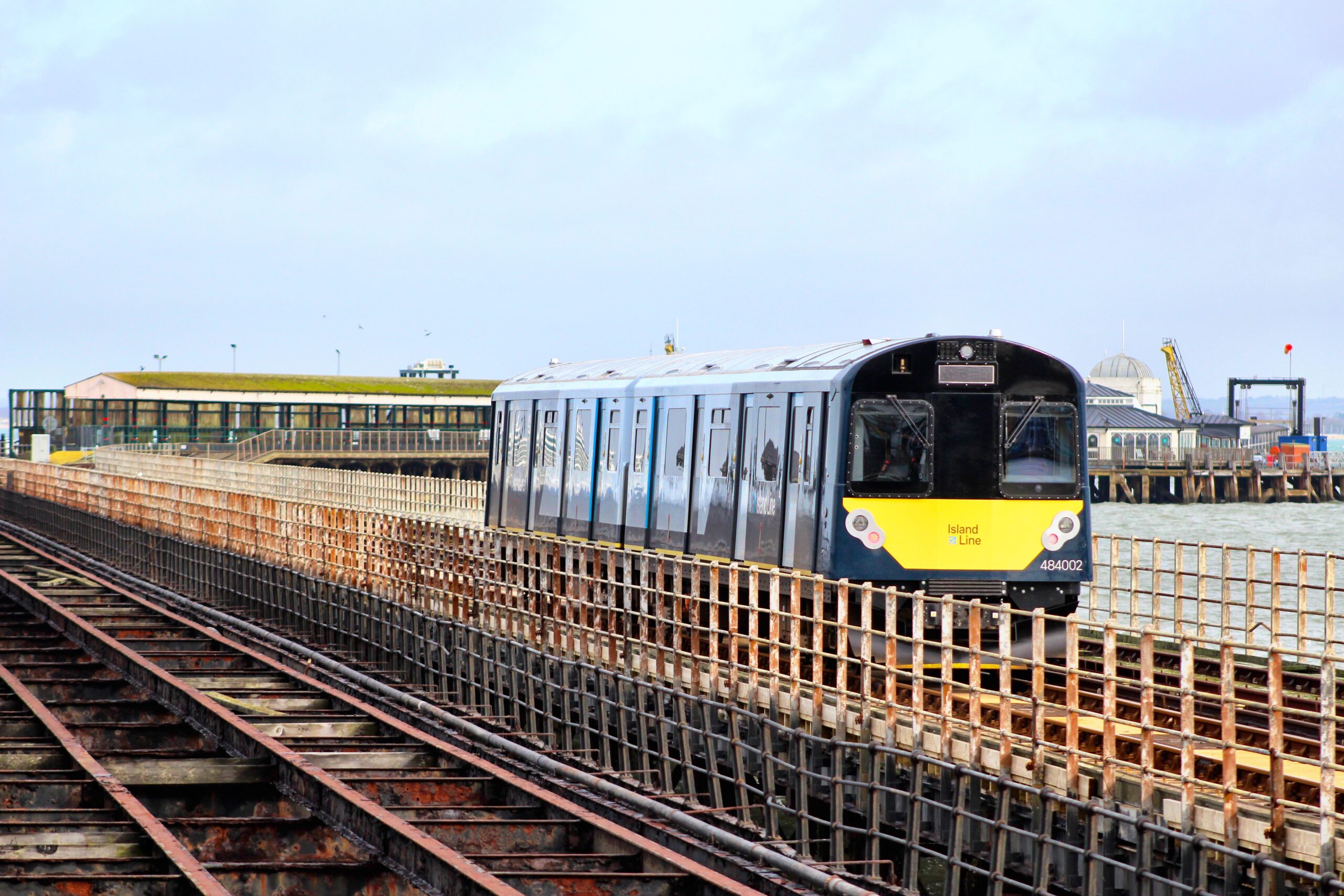
Yoshi at Ryde Pier Head in the company of Class 484 unit No. 484002
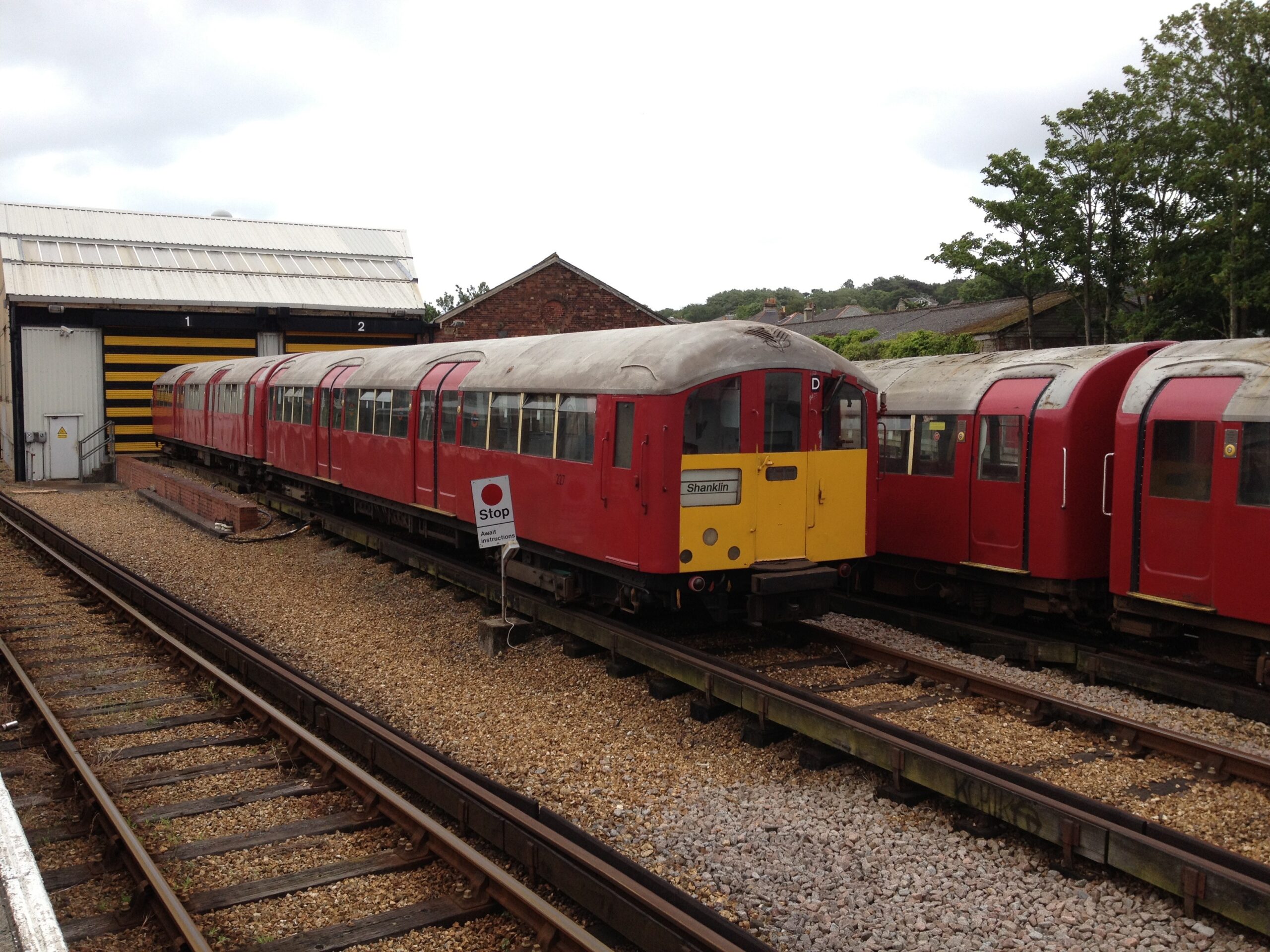
We spent last weekend enjoying the delights of the Isle of Wight. As part of our travels, we took a trip from Shanklin to Ryde Pier Head on the recently upgraded Island Line which is operated by South Western Railway (SWR). The Island Line is 8.5 miles long and runs between Ryde and Shanklin. Because of clearance height issues along the route, notably in Ryde Tunnel, limited locomotives and rolling stock could be employed on this route. I was planning on visiting the Island in 2020/21 prior to the improvement works taking place, but Covid measures prevented travel and I was unable to capture the last days of the Class 483 trains. My previous visit to Ryde St Johns was in June 2013 when I snapped the following images of the ex-1938 London Underground tube stock on the depot. These units were extensively refurbished for use on the Isle of Wight line at Eastleigh Works between 1989 and 1992.
Ryde 22062013Ryde 22062013Ryde 22062013
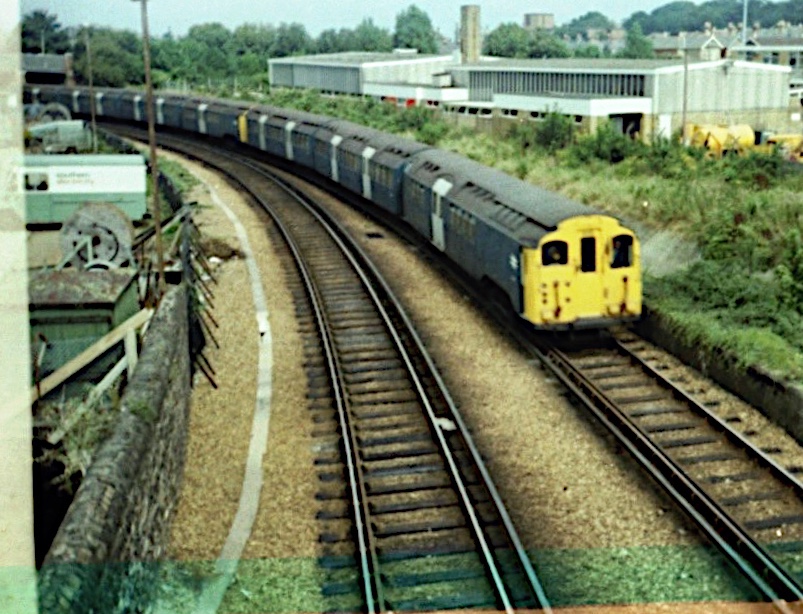
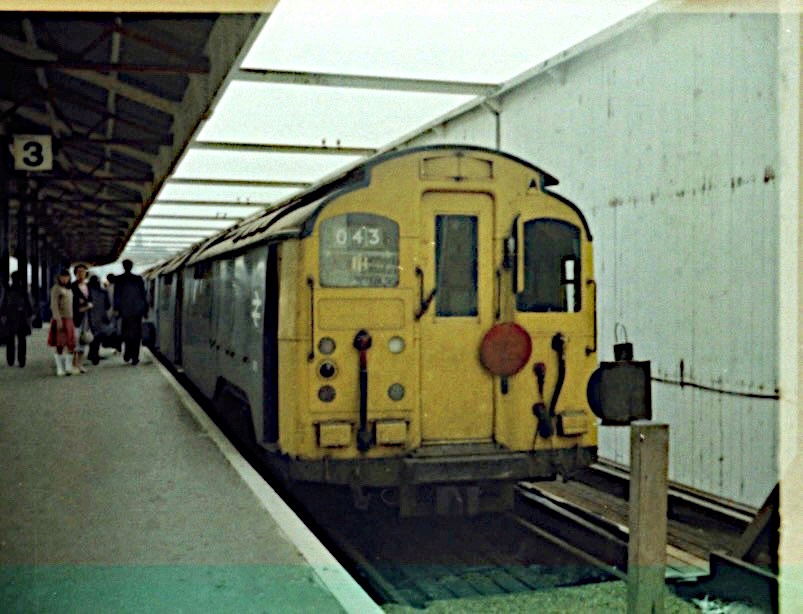
The Class 483’s replaced the even older and life-expired Class 485 ( or 4VEC / 5VEC) and 486 (3TIS / 2TIS) units which were introduced to the island in 1967 and had been converted from 1923 standard tube stock built for use on the London Electric Railway. At the time of their introduction on the Isle of Wight these trains were already over forty years old but allowed for the phasing out of steam locomotives on the line. I travelled on these trains in August 1980 and took these photos with my treasured Kodak 110 camera.
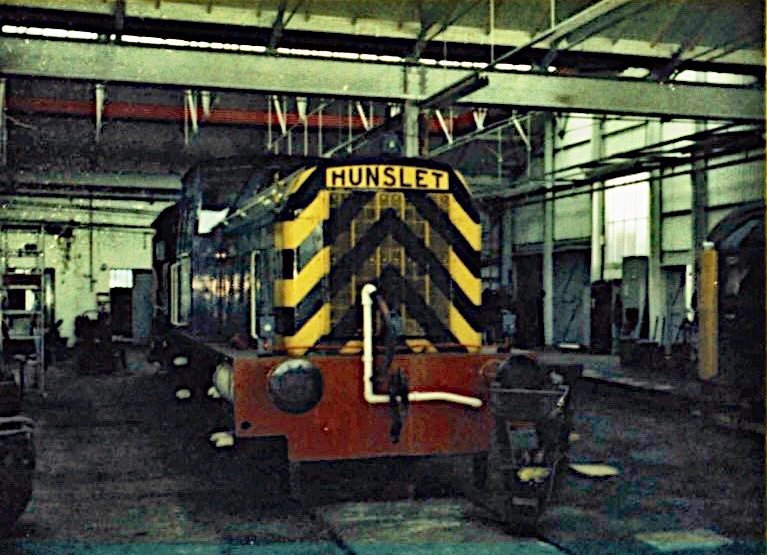
The main purpose of the 1980 trip was to track down the elusive Class 05 shunter which was at that time unique on British Rail. We found it hiding at the back of the shed at Ryde St Johns. The locomotive is now preserved on the Isle of Wight Steam Railway which was unfortunately not open for the 2022 season during our stay on the island.
05001 Ryde 2608198005001 Ryde 26081980
There are five ‘new’ two-car Class 484 trains which were converted by Vivarail using London Underground D78 stock originally built in the late 1970’s / early 1980’s by Metero-Cammell. The 484’s are based on the Class 230 diesel multiple unit.
230004 seen at Bedford 15/05/2021
The Island Line closed in January 2021 for the £26m upgrade to take place. Work was originally scheduled to take until April 2021 for its completion, but because of the Covid pandemic and teething problems with onboard software the line didn’t reopen to passengers until 1st November 2021. As part of the upgrade, platforms were raised or tracks lowered at five stations to improve accessibility and re-engineering of the track considerably improved the standard of travel and ensured a smooth ride. We found the new interiors spacious and clean with charging sockets available at most seats.
Class 484 No. 484002 heading to Ryde Pier Head 13/03/2022
The Isle of Wight has a great deal of railway history and more by accident than design we came across the location of the former railway stations at Newport, Freshwater and Yarmouth.
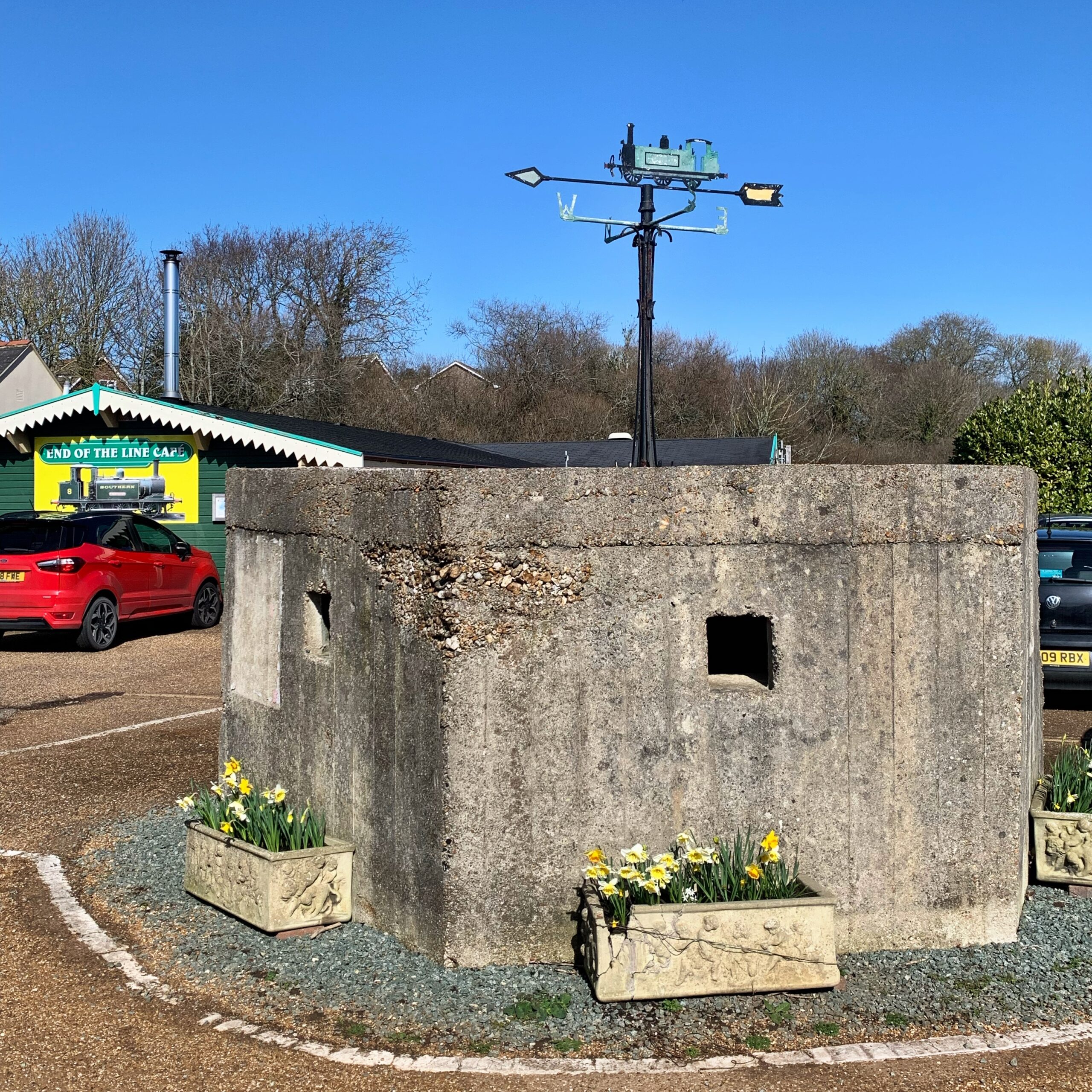
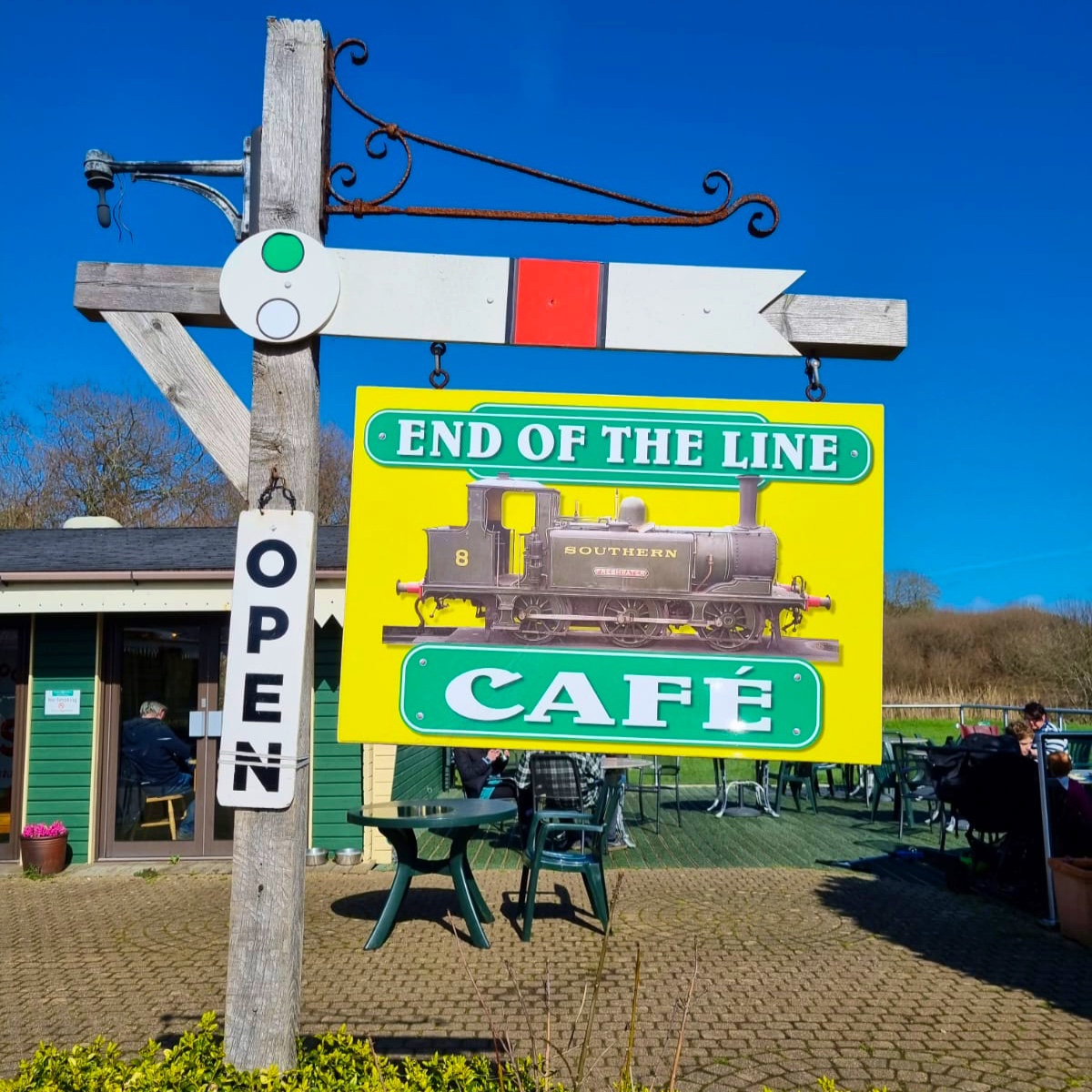
We enjoyed a light lunch at the ‘End Of The Line Cafe’ in Freshwater on Saturday, Yoshi sharing a delicious sausage baguette with his mum while I kept all my vegetable soup to myself.
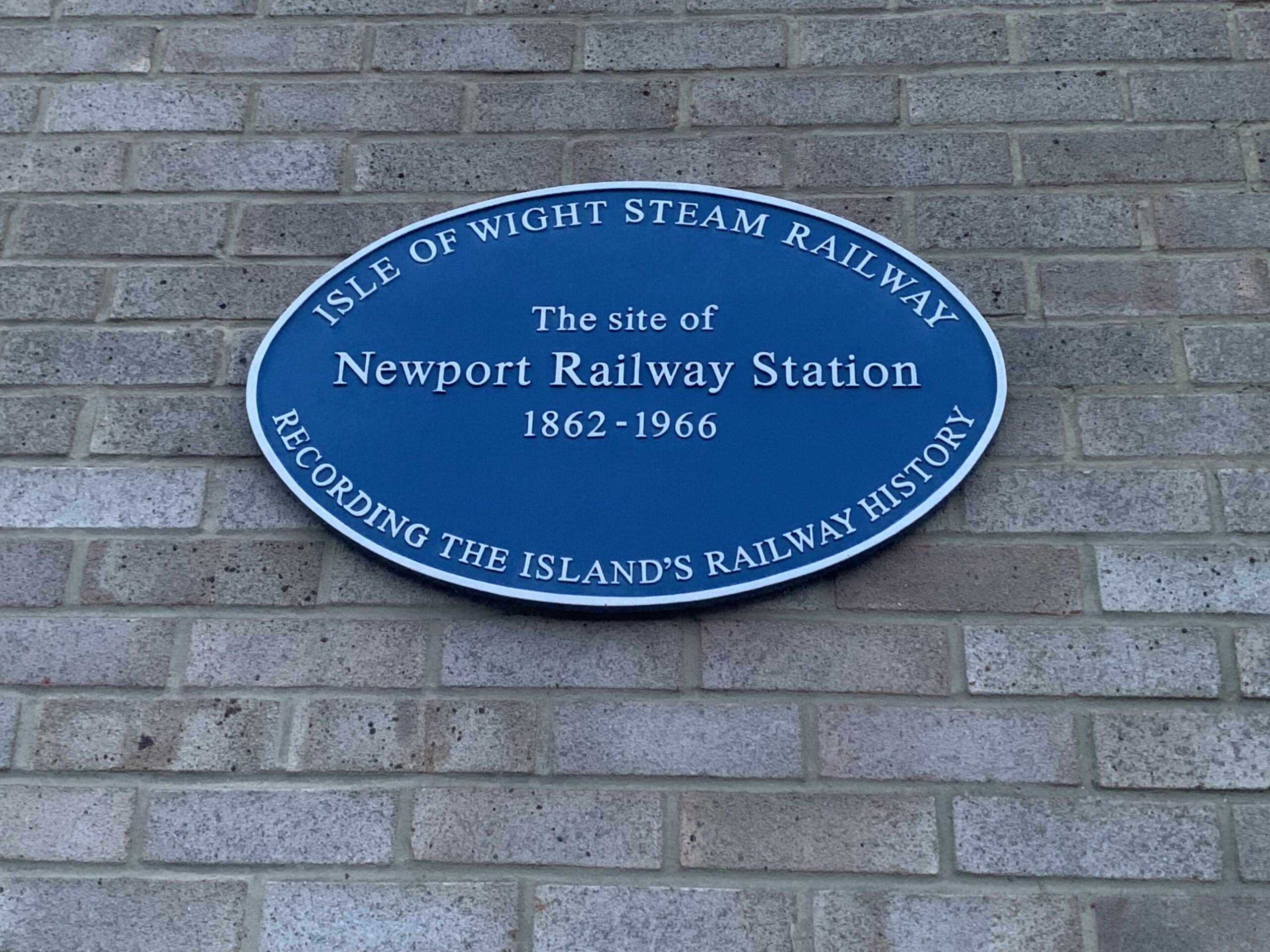
Plaque marking the location of Newport Railway StationThe site of Freshwater Railway StationThe site of Freshwater Railway StationThe site of Freshwater Railway Station
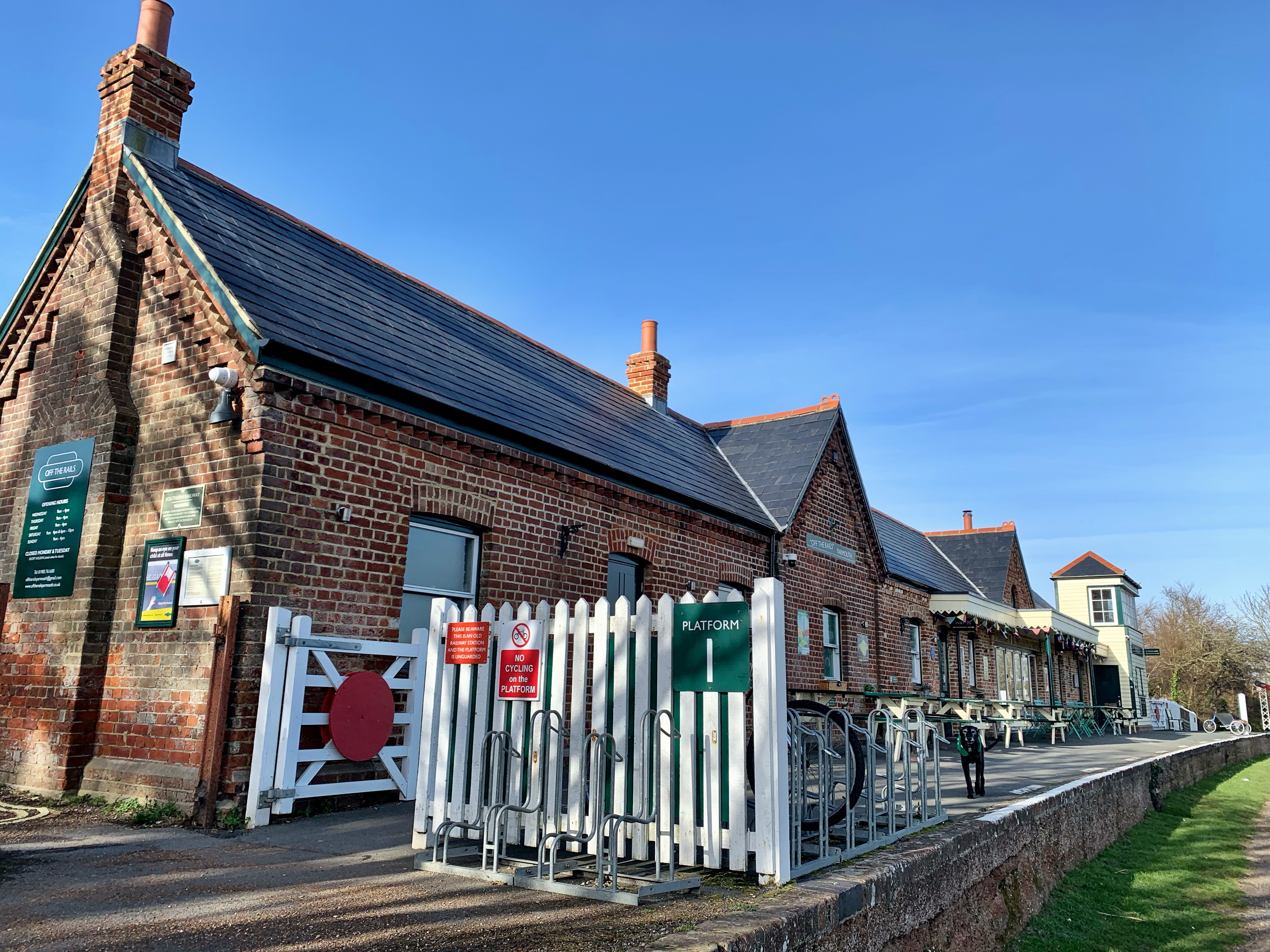
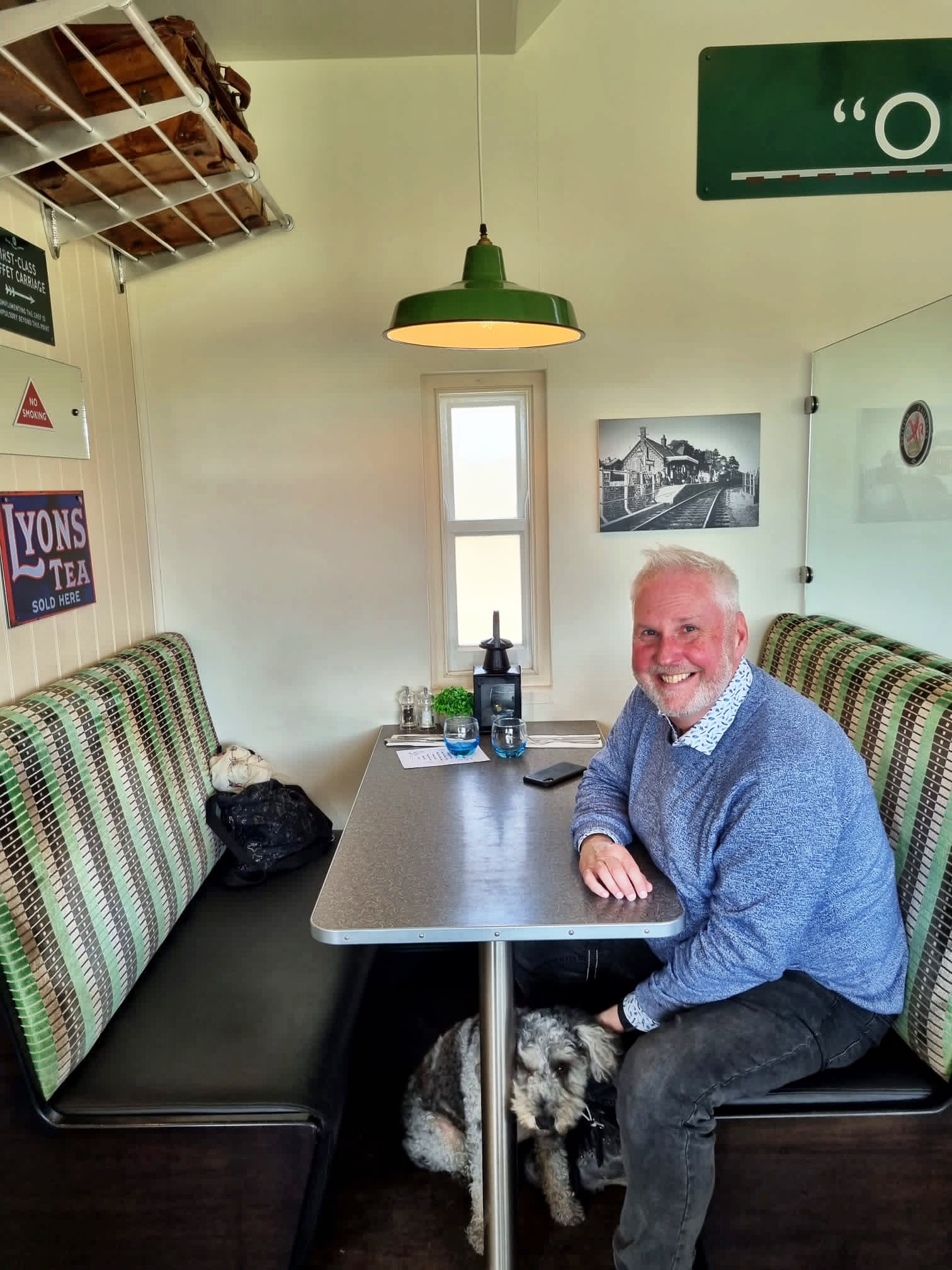
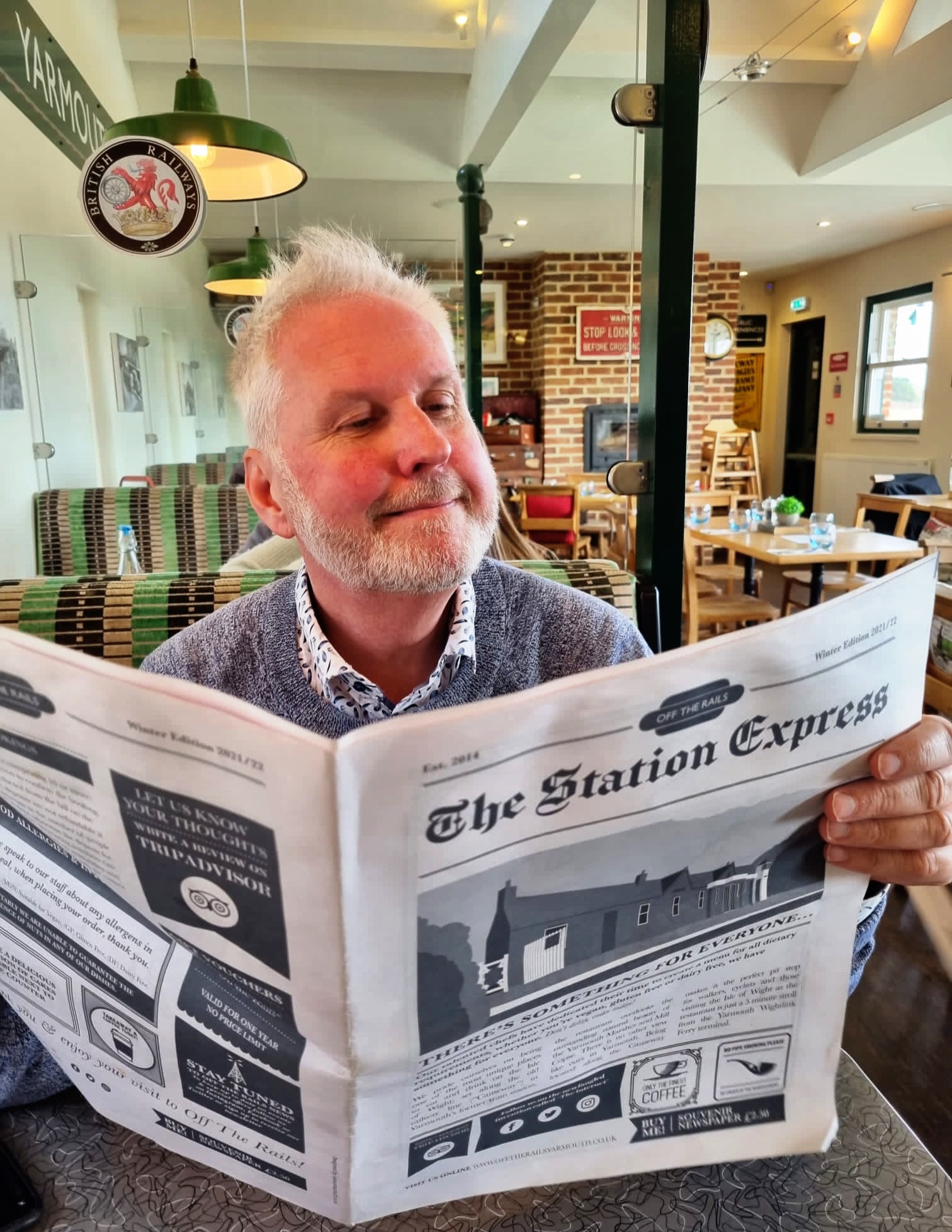
We can totally recommend ‘Off The Rails‘, an award winning restaurant which inhabits the station building at Yarmouth. Our Sunday lunch was exceptional and the dog snack menu was welcomed by Yoshi who enjoyed another tasty sausage.
Afterwards we walked off the calories taking a stroll along the trackbed of the former Newport, Yarmouth and Shanklin railway.
After a slow start to the week in review, Monday 14th March could be described as something of a bumper day for unusual traction on the Bournemouth to Weymouth line.
66799 and 66760 Holes Bay, Poole 14/03/202273964 Dorchester South 14/03/2022Namplate detail of 66760 (photograph courtesy of @da_buckley967)
Our marvellous Monday kicked off with a visit of GBRf Class 66 top and tailed Snow & Ice Treatment Train. Railhead treatment trains are always a favourite in this dog house so it was great to see this working after an absence of a few months.
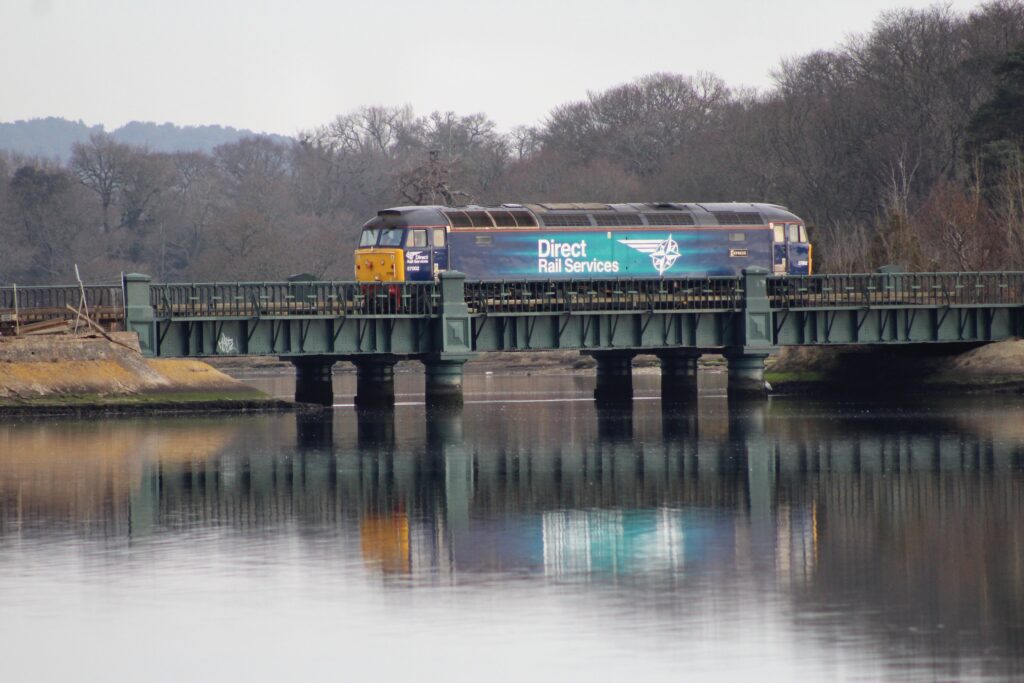
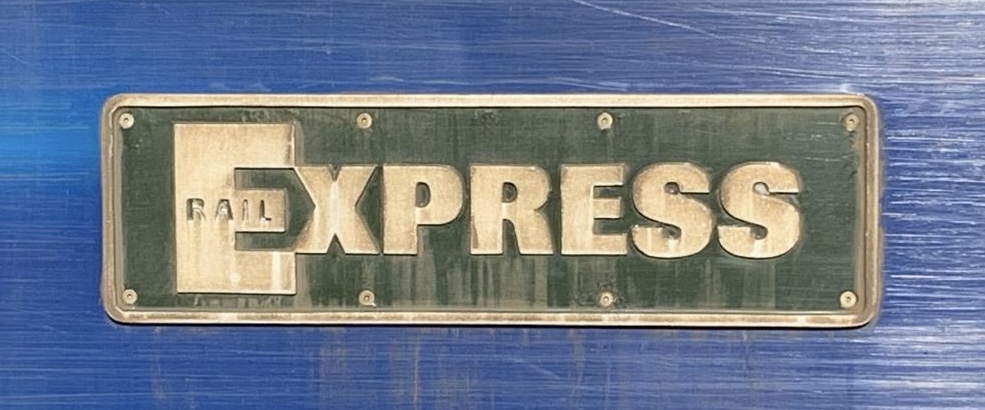
Monday 14th and Tuesday 15th saw an interesting route learning move from Direct Rail Services (DRS) with Class 57 No. 57002 ‘Rail Express’ working from Norwich to Southampton via Weymouth in connection with a few future train movements from the area.
The Class 57 was re-engineered from redundant Class 47 locomotives by Brush Traction of Loughborough between 1998 and 2004. The locos were given reconditioned Electro-Motive Diesel engines and traction alternator’s as fitted to the Class 56 to improve reliability and performance. 57002 is part of the 57/0 variant specifically designed for freight operations. DRS currently have nine Class 57’s on their books.
57002 ‘Rail Express’ Holes Bay, Poole 15/03/2022Namplate detail of 57002 (photograph courtesy of @da_buckley967)
Along with the 57/0’s there are two other sub-classes of Class 57; 57/3 and 57/6 both primarily intended for passenger use.
57005 Cardiff 24/02/2010
Virgin West Coast Trains utilised 16 Class 57’s for rescue duties and for dragging electric locomotives on routes with no overhead wires with the first locomotive leased from Porterbrook delivered in 2002. All were handed back by the end of 2012 as they were no longer required.
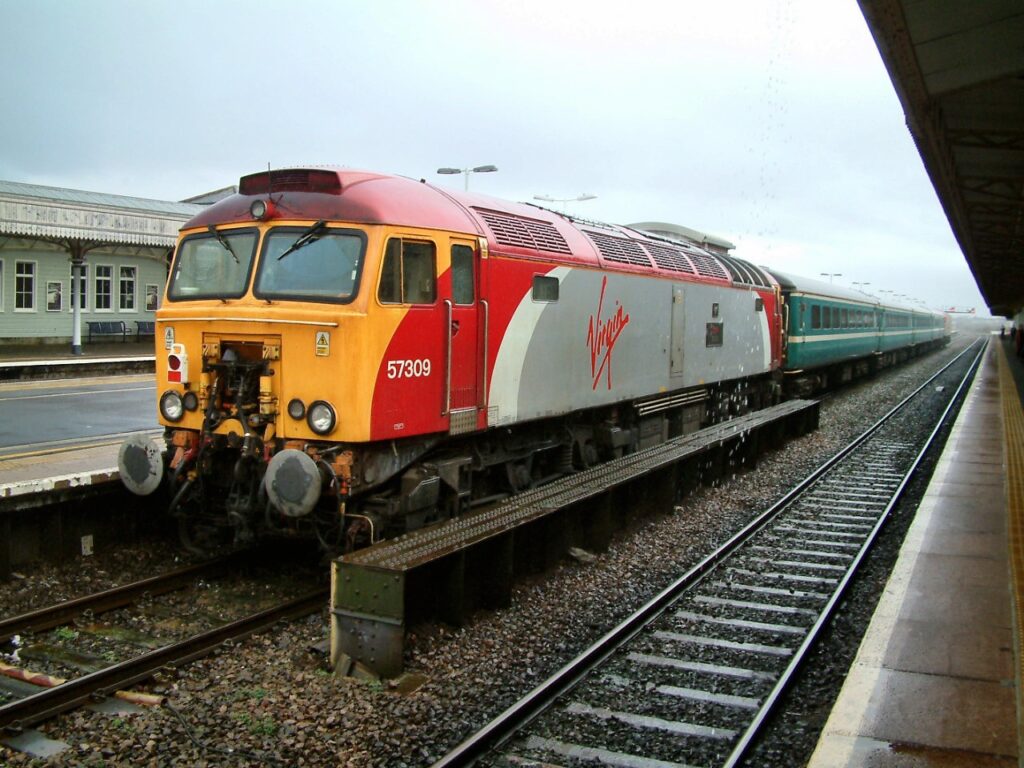
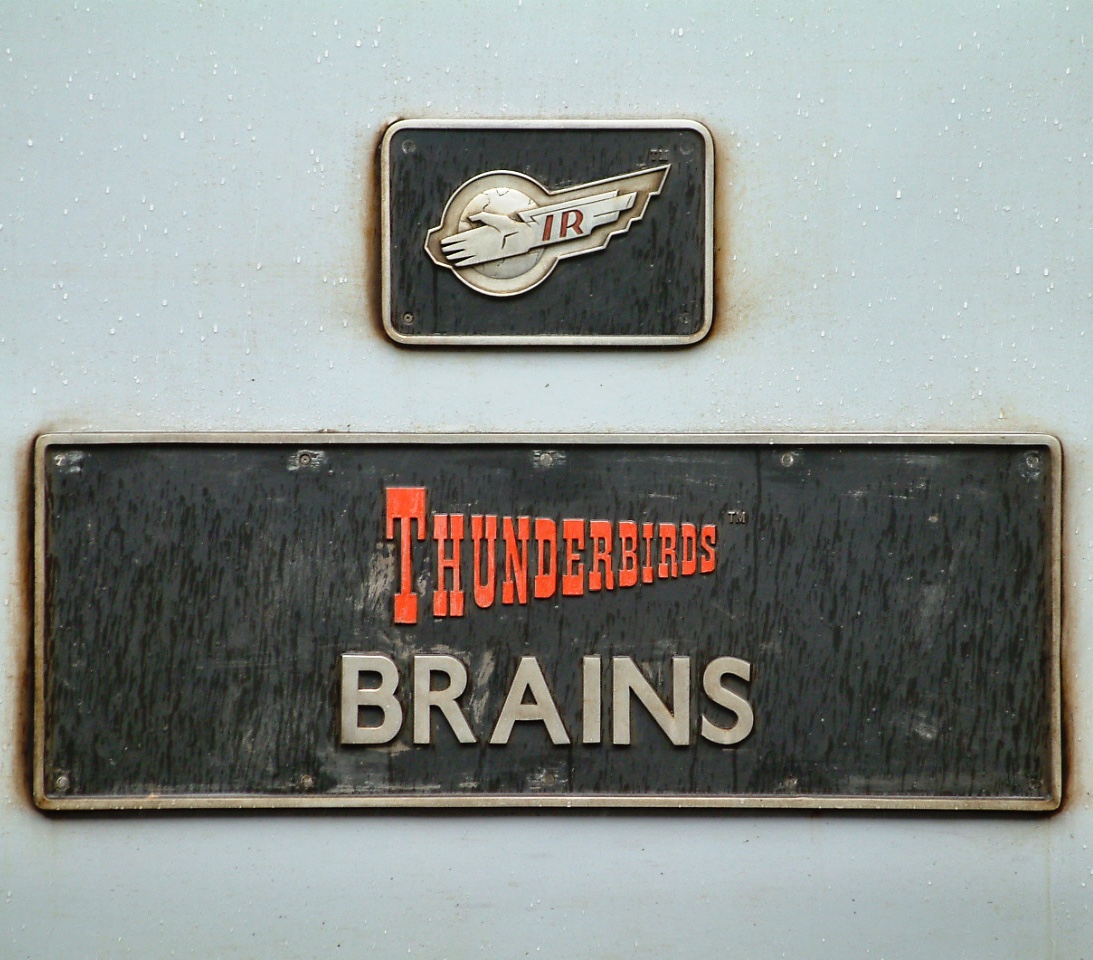
To acknowledge their role as rescue locomotives, Virgin named their Class 57’s after elements from Gerry Anderon’s Thunderbirds TV series and in addition each engine carried an International Rescue logo above the nameplate. The next few images show two of he Thunderbird locomotives which were hired in by First Great Western to work a Taunton to Cardiff Central diagram which commenced in December 2009. The 57’s worked in pairs top and tailing stock sourced from Riviera Trains. The sets were serviced at Bishops Lydeard on the West Somerset Railway on weekdays, returning to Cardiff for maintenance at the weekends. However, the 57’s and coaching stock proved troublesome and the contract ceased in July 2010.
57309 ‘Brains’ Taunton 24/02/201057307 ‘Lady Penelope’ Taunton 24/02/201057309 ‘Brains’ and 57307 ‘Lady Penelope’ at Bristol Temple Meads 24/02/2010Nameplate of 57309 ‘Brains’ 24/02/2010Nameplate of 57307 ‘Lady Penelope’ 24/02/2010
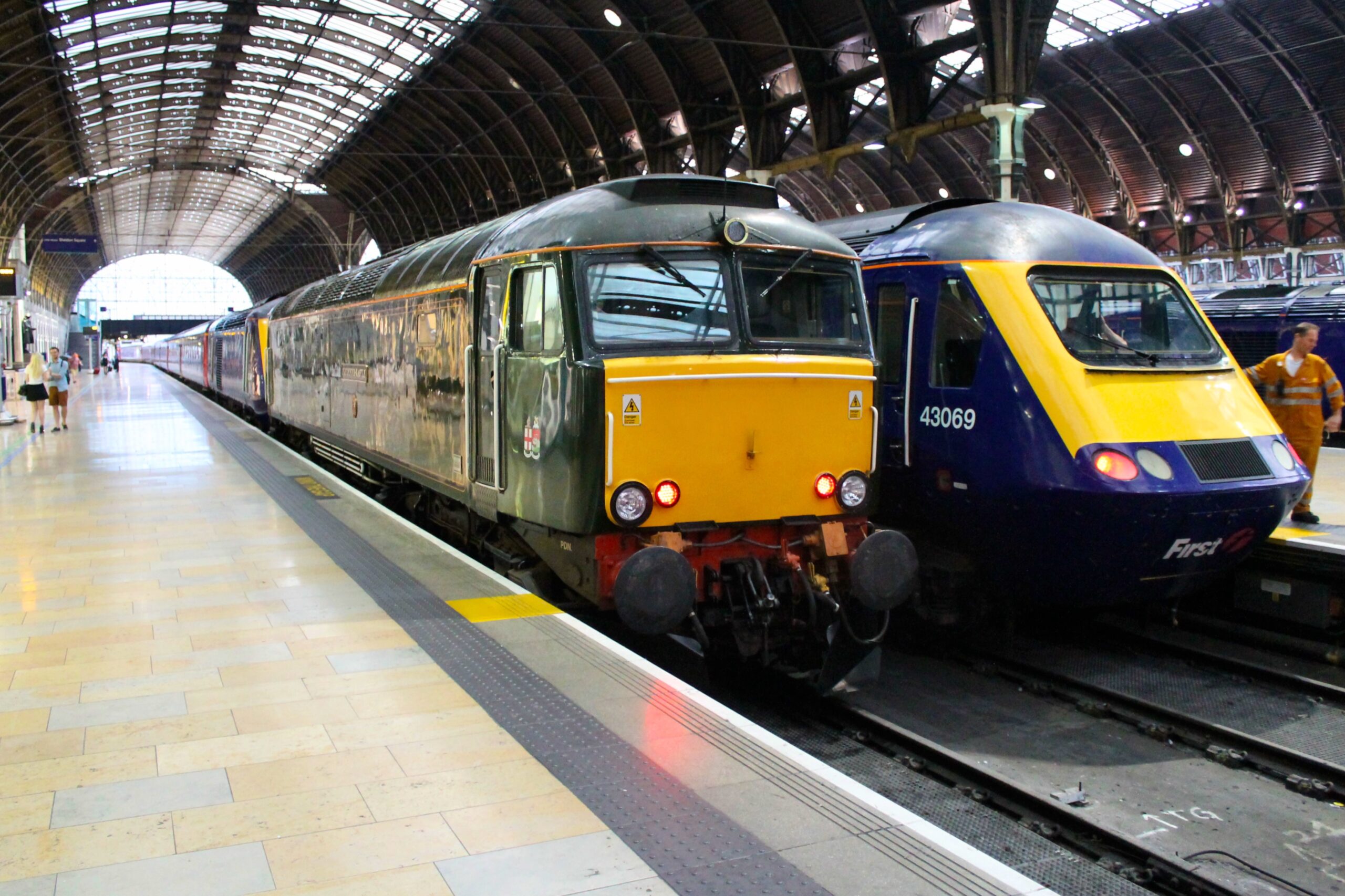
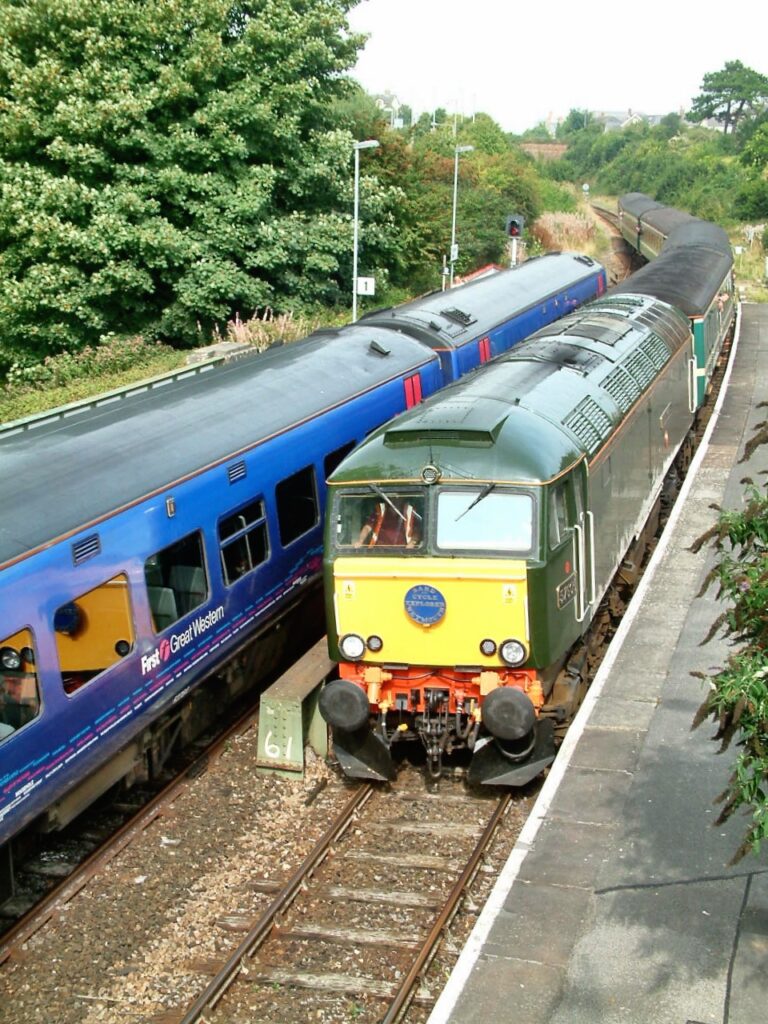
Great Western Railway (GWR) operate four Class 57/6 locomotives which were all named after castles in the Devon and Cornwall area in which they operate, mostly on the Night Riviera sleeper service between London Paddington and Penzance. In June 2010 No. 57604 ‘Pendennis Castle’ was out-shopped in a lined Brunswick green livery to celebrate the 175th anniversary of the original Great Western Railway.
57604 ‘Pendennis Castle’ London Paddington 27/03/201357604 ‘Pendennis Castle’ London Paddington 27/03/201357604 ‘Pendennis Castle’ at Dorchester West 04/09/2010Nameplate of 57604 ‘Pendennis Castle’ London Paddington 27/03/2013
Finally the monthly rail inspection train, this time top and tailed by Class 73 Electro-Diesel locomotives No’s 73963 ‘Janice’ and 73964 ‘Jeanette’, ran to Weymouth this week as 186V 1115 Derby RTC to Eastleigh East Yard.
For the record, my first ever visit to the Isle of Wight was in 1973. I don’t recall travelling by train during that holiday, but I do remember sunny days sat on the top deck of double decker buses touring the island. I also vividly remember the poster campaign for the ecological dystopian thriller film ‘Soylent Green‘. The images of riot control trucks fitted with large hydraulic shovels scooping up people like they were waste has haunted me ever since. Incidentally the film was set in 2022. I suppose I should get around to watching it some day. For this weeks archive feature, we return to the island in the mid 1970’s and a trip along the Isle of Wight steam Railway in a short, silent cine film from the John Chappell Collection.
16th March 2022, the day this blog entry was uploaded, marks the third anniversary of Yoshi picking me as his human dad. It’s been a happy rewarding companionship, made stronger when we found Yoshi’s gorgeous human mum. We both love our boy to bits and try and include him on as many adventures as possible.
That’s it for this week. Thanks for reading. I’m off to find a snack – I’ve heard about a nutritious product made from ocean plankton I should try…..
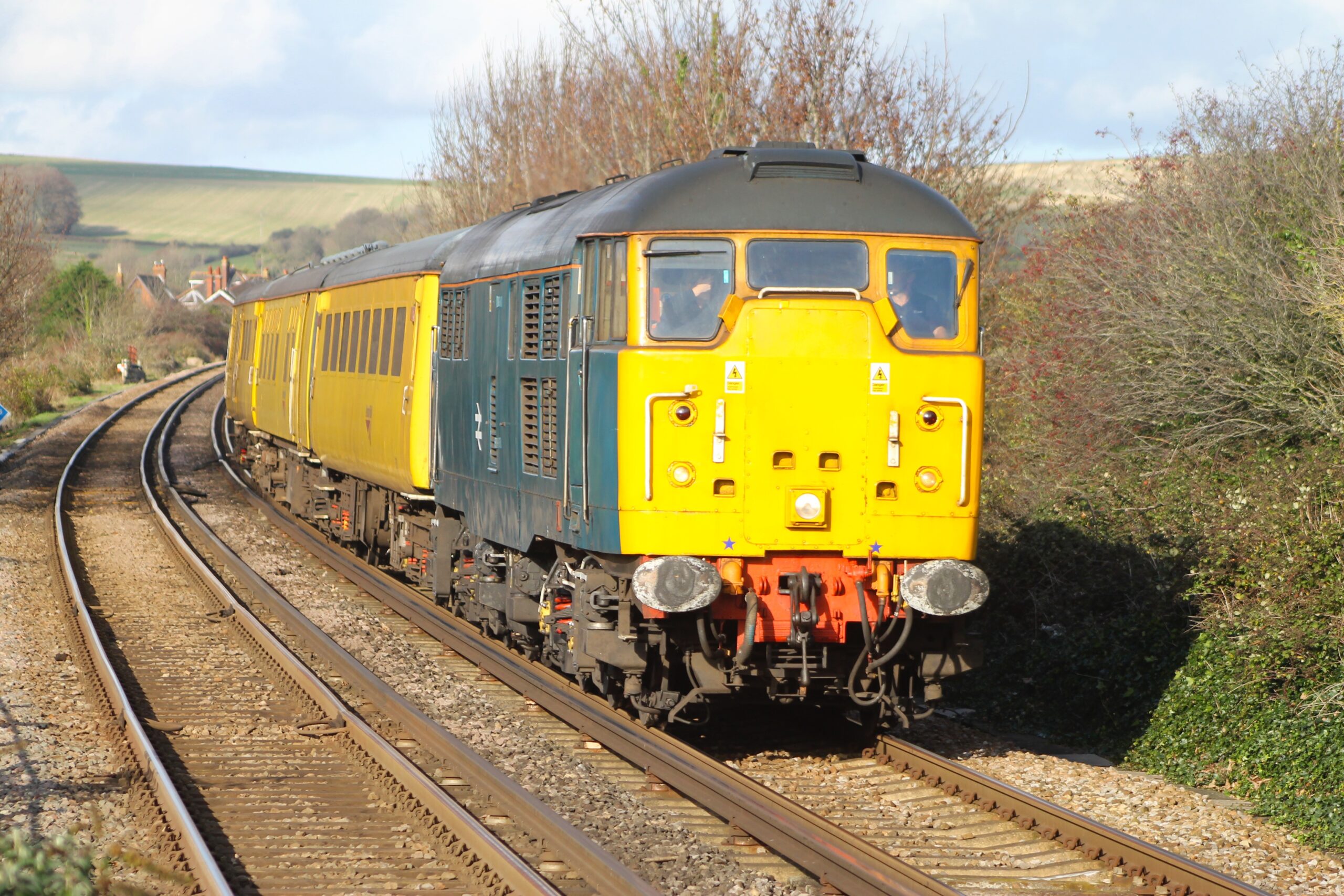
Yoshi sits patiently like the good boy he is at Alresford station awaiting the departure of S&DJR 7F 2-8-0 locomotive No. 53808 with a special train celebrating the 56th anniversary of the end of services on the Somerset & Dorset Joint Railway
A Somerset & Dorset Joint Railway themed feel about this weeks blog. It’s like we plan these things instead of throwing everything together at the last minute. Which of course we’d never do.
Our week in review kicked off last Wednesday, March 2nd 2022, when I noted that the daily booked turn for Class 455 units to journey from Wimbledon to Bournemouth depot actually ran. I normally check Realtime Trains every day for out of the norm movements, but typically on the one day I neglected to look the service was activated. However, I was able to see the return working slightly later on the same day as can be seen in the following video:
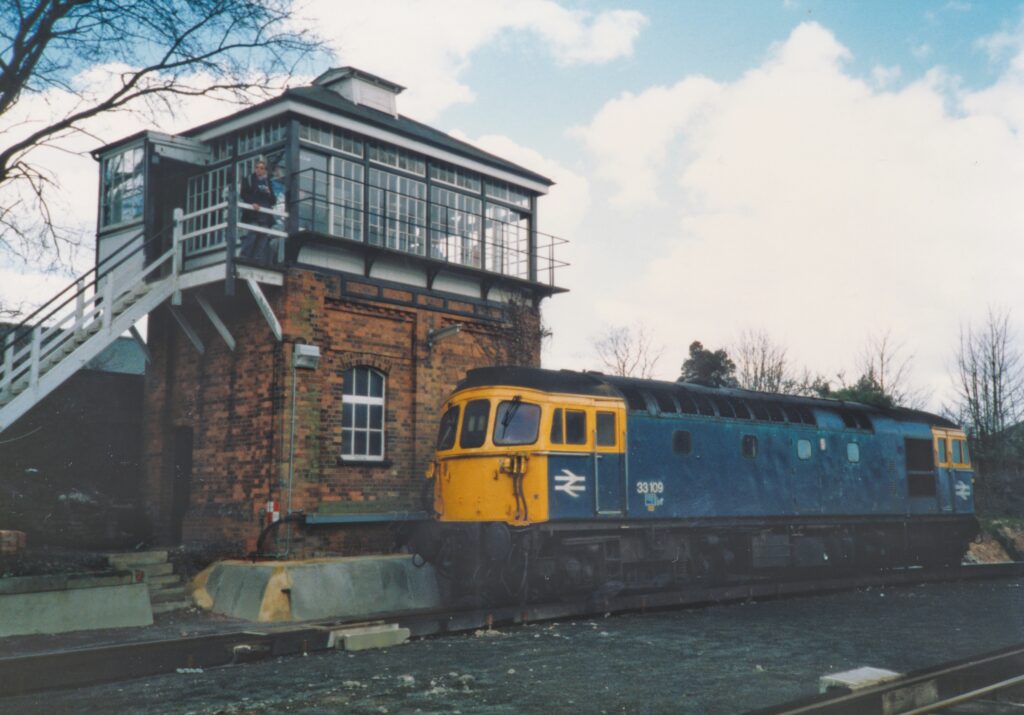
Class 455 units No.’s 455734 and 455708 departing Bournmouth Traction & Rolling Stock depot with 5Y51 1431 service to Wimbledon Depot sidings on Wednesday March 2nd 2022. The video also features Class 444 electric multiple units No.’s 444045 and 444029 at Branksome working 1B25 1235 London Waterloo to Poole. The track into Bournemouth depot was originally the route to Bournemouth West, used as the southern terminus of the S&D. Passenger services along this line ceased on October 4th 1965, the station being demolished and part of the land used for the Wessex Way road. In 1966 work commenced on the construction of a carriage shed, an inspection shed and sidings for electric trains about to be introduced for use with the Bournemouth Electrification of 1967.The former Bournemouth West Junction signal box was retained to control entry to the depot sidings and is seen pictured here with Class 33 No. 33109 on the 26th March 1988 – the date of the first ever Bournemouth depot open day.
Sunday March 6th continued the Slow and Dirty theme when Yoshi and I took a trip to the Mid Hants Railway to see a special train hauled by S&D 7F 2-8-0 steam locomotive No. 53808 in remembrance of the 56th anniversary of the last train on the Somerset and Dorset route. Organised by The Somerset & Dorset Railway Trust and primarily for use of Members and Friends of the Trust, this is intended to be an annual event. Having dropped Yoshi’s mum off for a pampering spa day en-route, we arrived in Alresford in time to see the departure of the second and final train of the day.
The trains ran between Alresford and Alton and on the second return journey it stopped at Ropley where passengers could detrain and observe a run-through of the station at line speed. No. 53808 built in 1925 by Robert Stephenson & Co is owned by The Somerset & Dorset Railway Trust and was purchased for preservation in 1969 returning to service following restoration at the West Somerset Railway in 1987. A second overhaul was completed in February 2016, with the engine emerging in British Railways black livery with the late BR crest. As of autumn 2020 the locomotive is permanently based at the Mid Hants Railway for the remainder of her boiler ticket.
I was pleased to note that the Watercress Line shop and West Country Buffet at Alresford was open on the day along with the S&DRT museum which contains station signs and memorabilia from the former S&D route to Bath Green Park. I can recommend the cheese and onion pasties from the buffet.
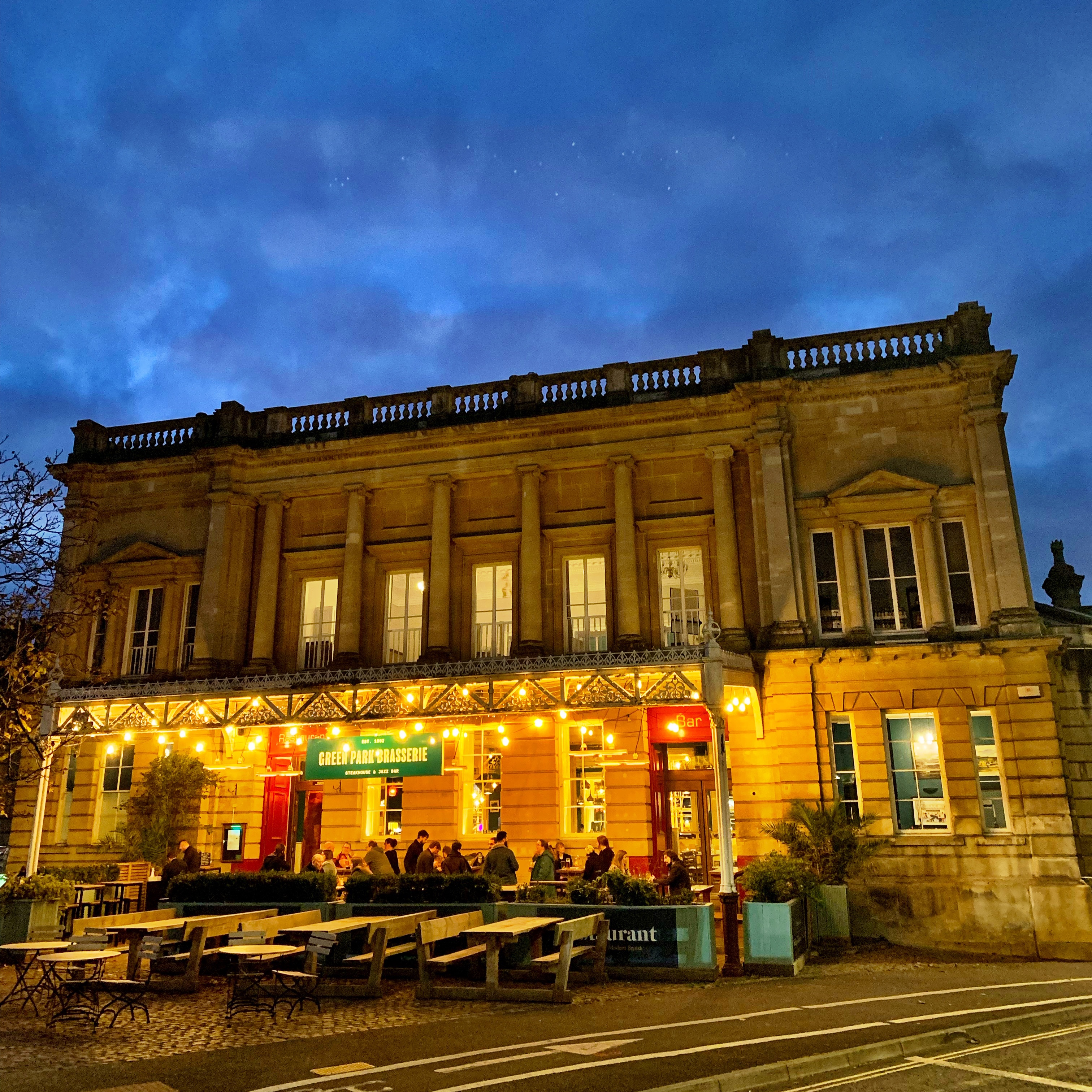
Yoshi visited Bath last November where he enjoyed a couple of sips of water at the Green Park Brasserie located on the former station terminus and goods yard site which also now contains a Sainsbury’s supermarket and associated car park. Sainsbury’s donated substantially towards the £1.5m cost of the restoration of the Grade 2 station building. The train shed lost its glazing during World War 2 and the glass was not replaced until the early 1980’s refurbishment and the roof now protects shoppers from the elements and provides an area for community activities.
Our day was rounded off with stops at Eastleigh, the Southampton Maritime Freightliner depot and Totton Yard.
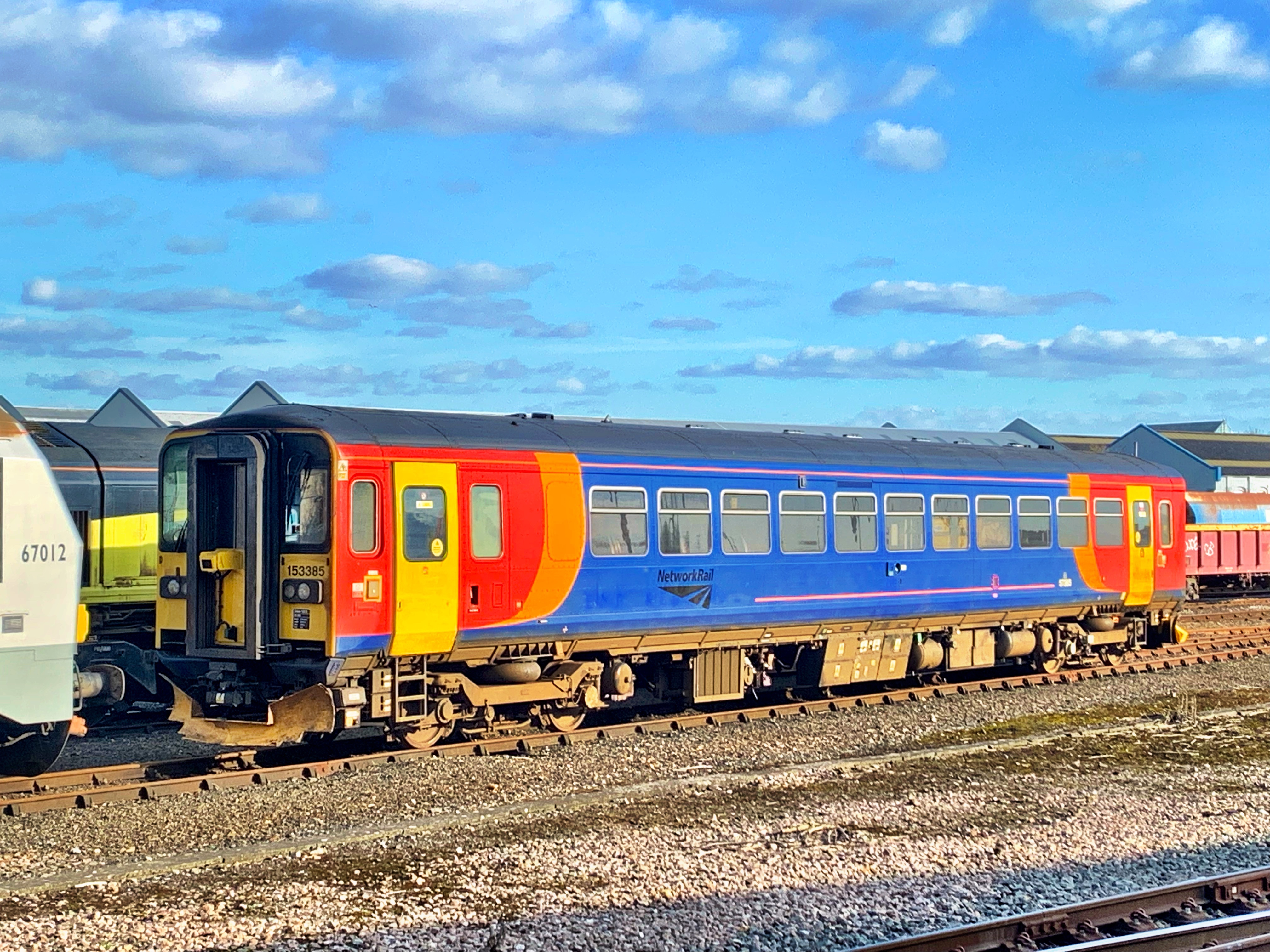
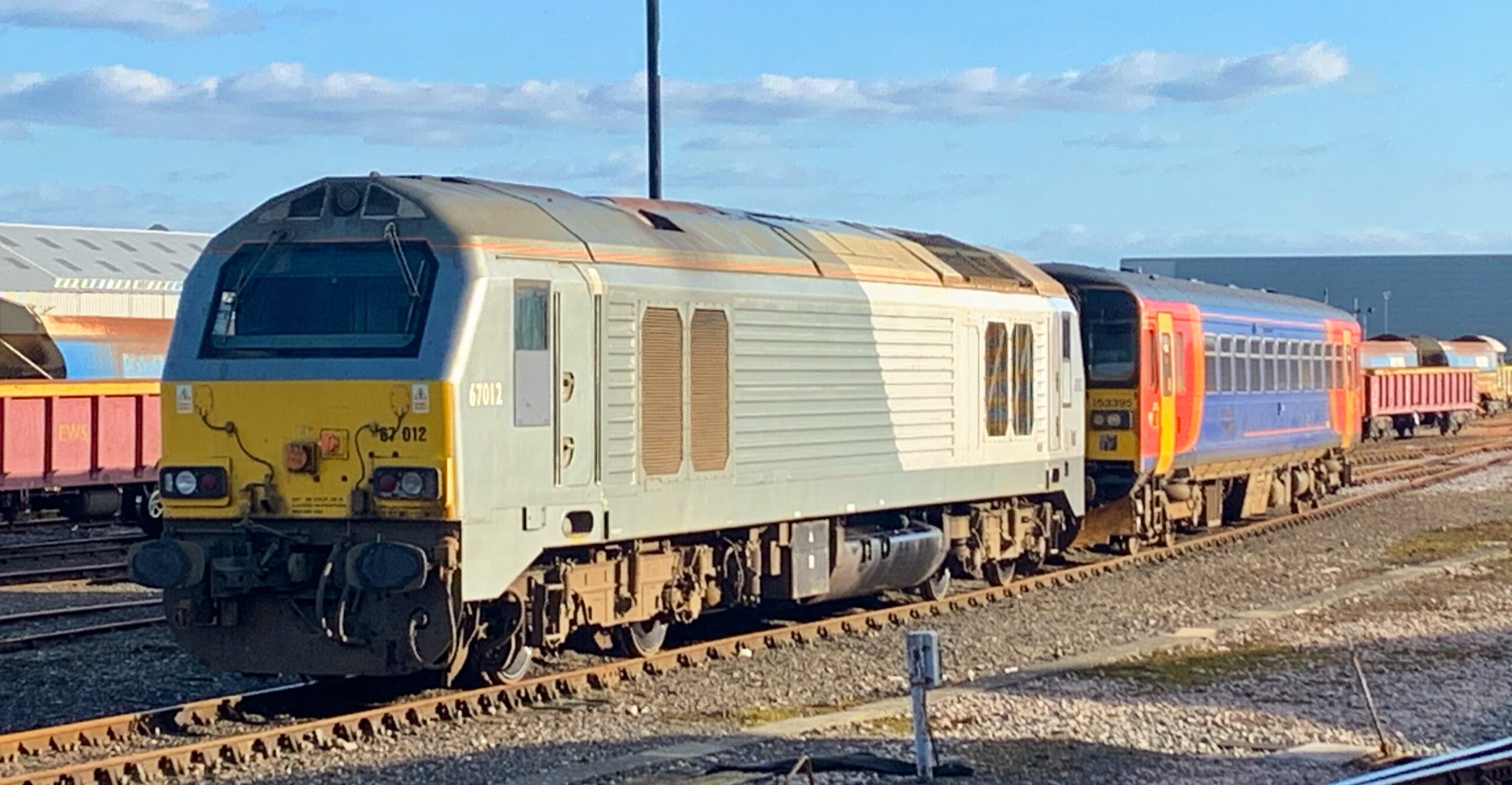
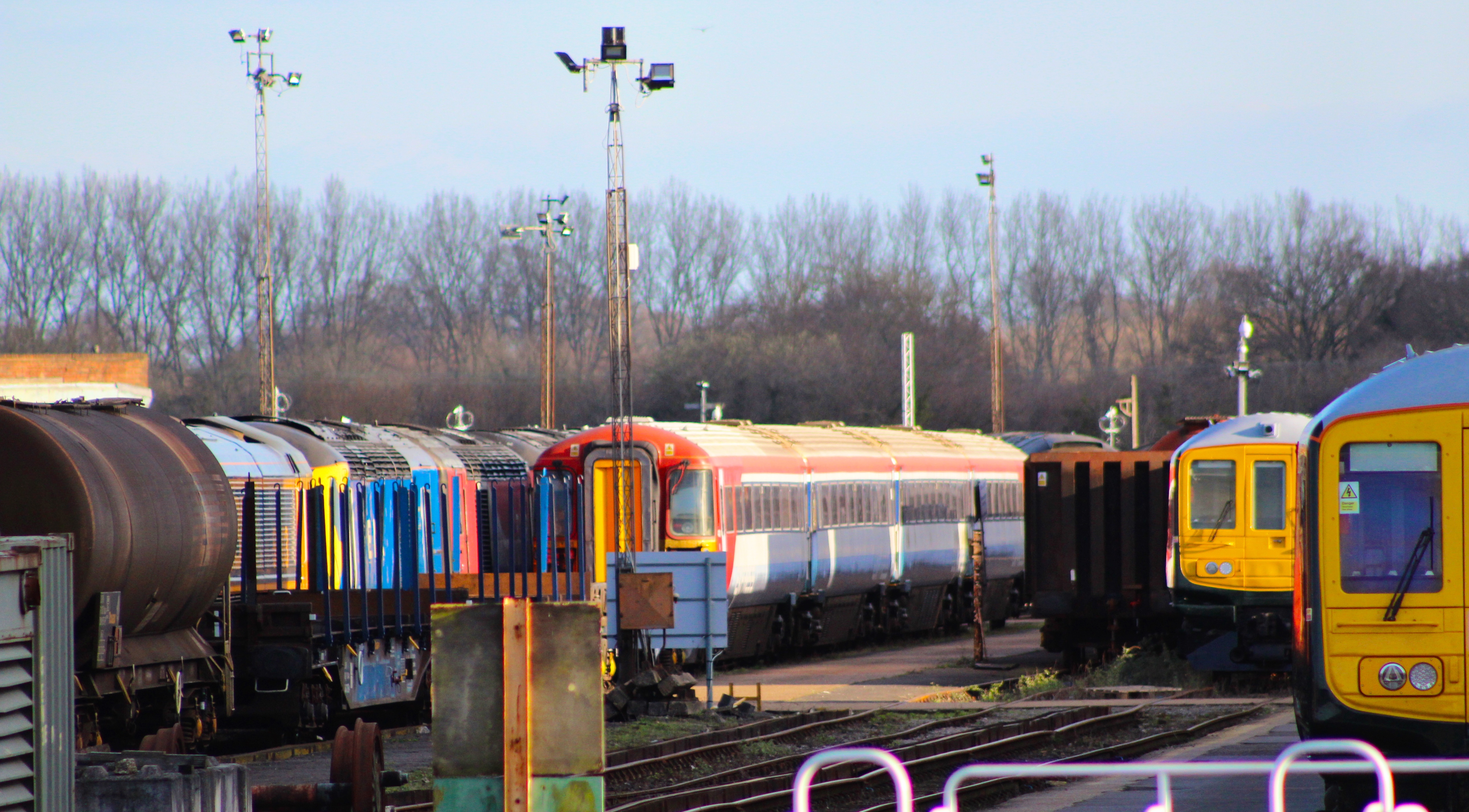
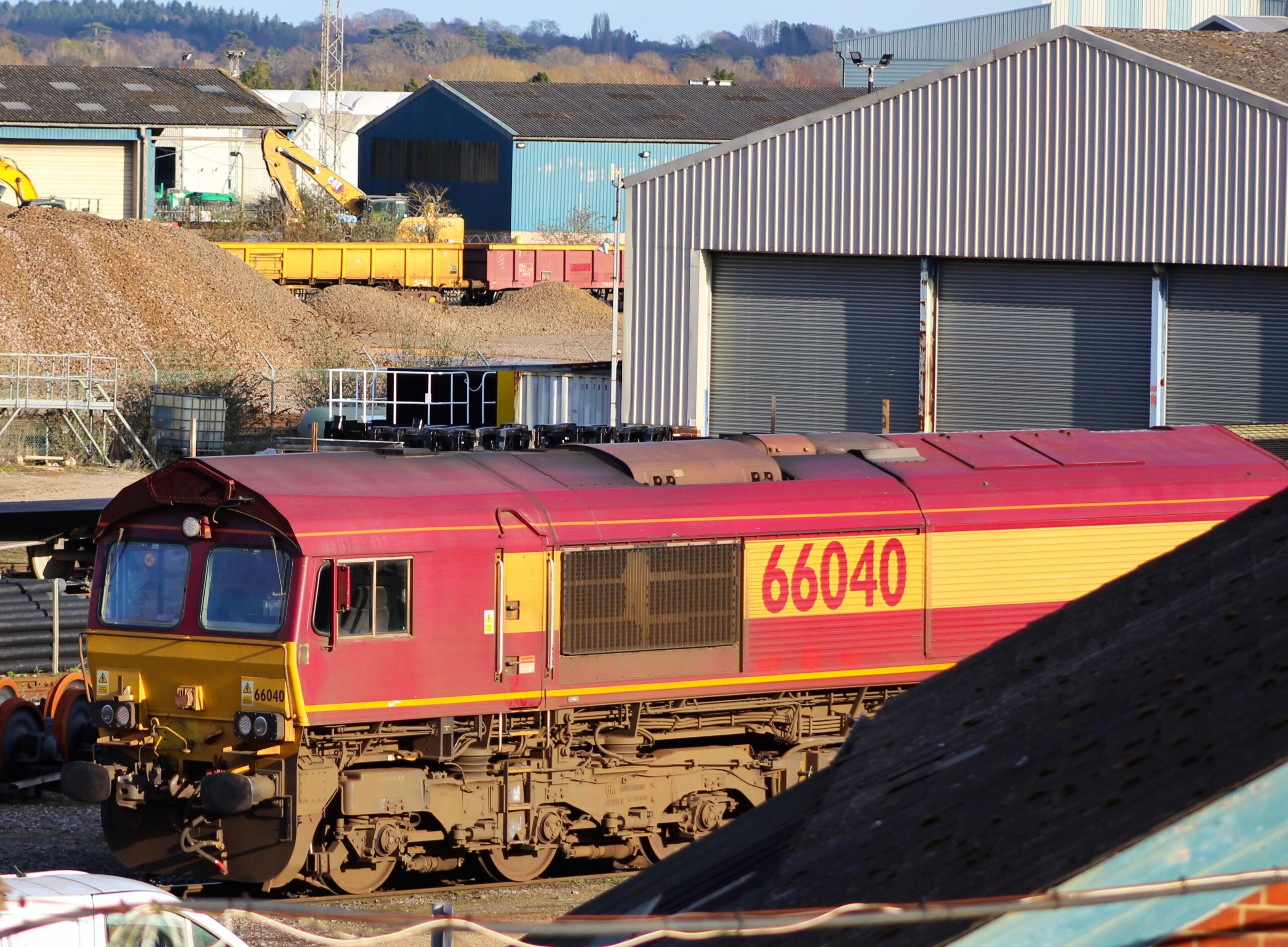
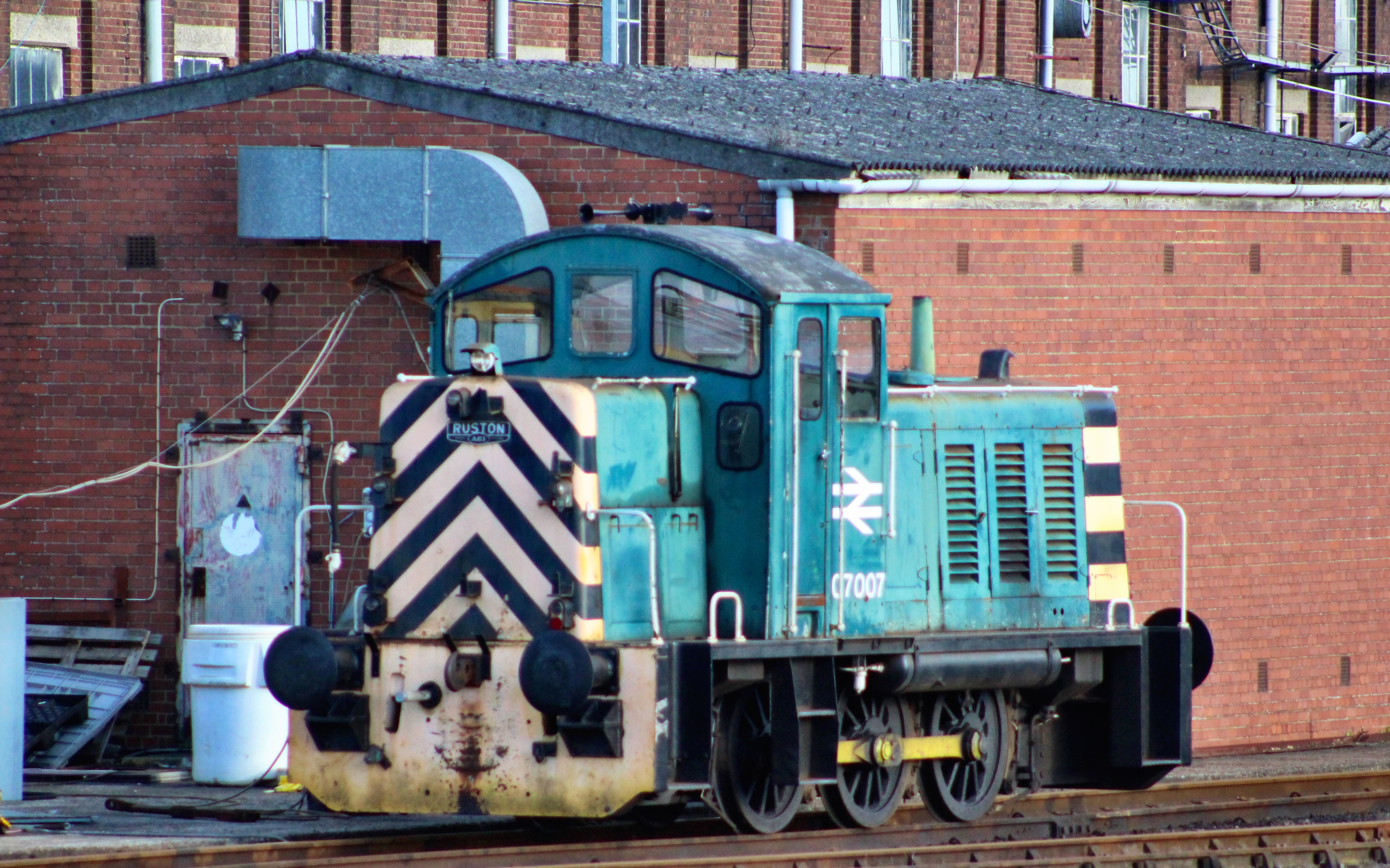
Network Rail Infrastructure Monitoring Vehicle No. 153385 at EastleighDB Cargo UK Class 67 No. 67012 retains its unbranded Chiltern Railways livery sits adjacent to Eastleigh railway stationWithdrawn Class 442 in Gatwick Express livery remains at Eastleigh WorksDB Cargo UK Class 66 No. 66040 – Eastleigh WorksClass 07 shunter No. 07007 owned by Knights Rail Services at Eastleigh Works. 14 members of this class were built by Ruston & Hornsby in 1962 and were primarily used in Southampton Docks and Eastleigh Works.Multiple Freightliner Class 66 and Class 70 locomotives rest at Southampton Maritime GBRf Class 66 No.’s 66799 and 66760 ‘David Gordon Harris’ sit at Totton Yard with a Snow & Ice Treatment Train – 06/03/2022
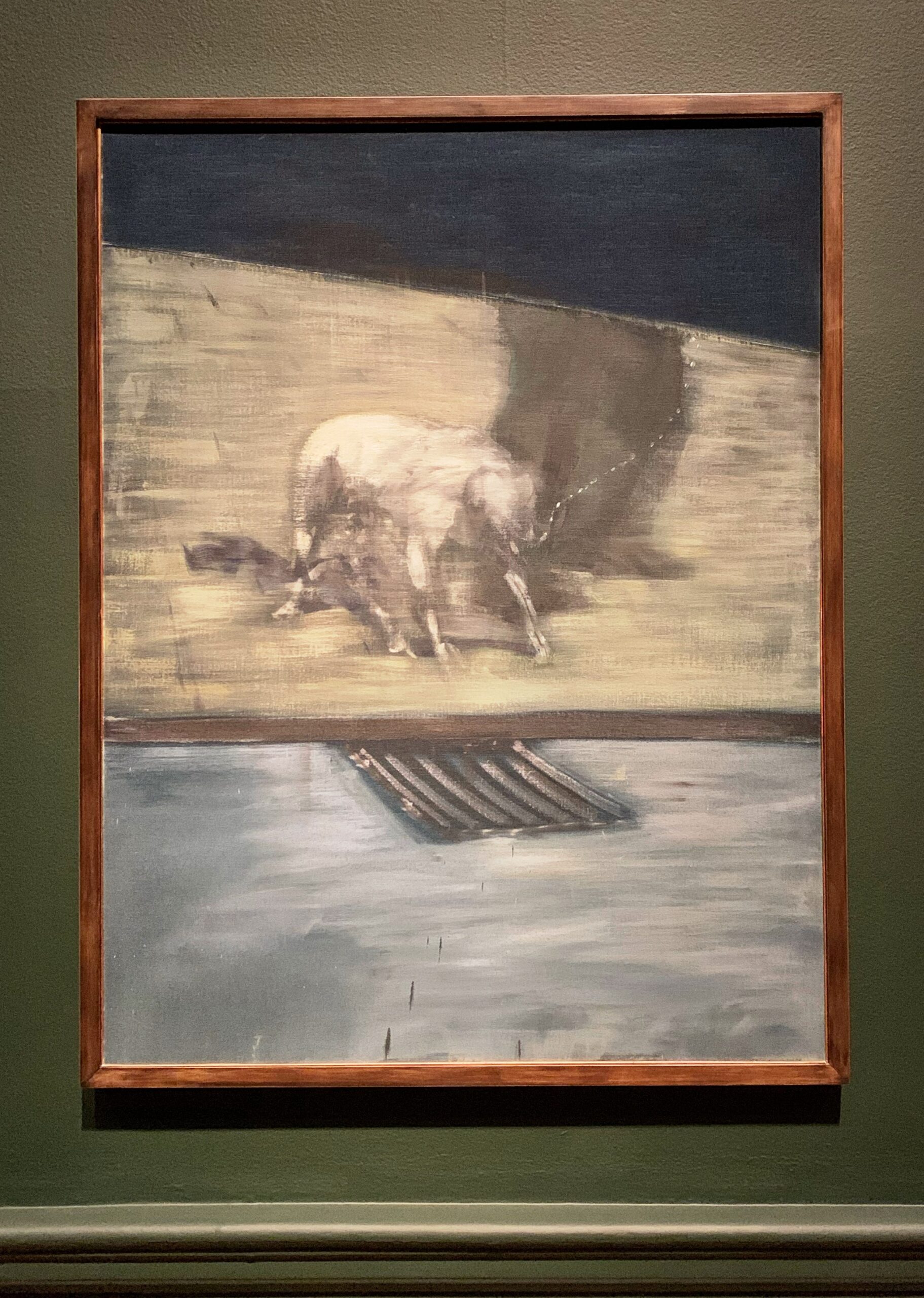
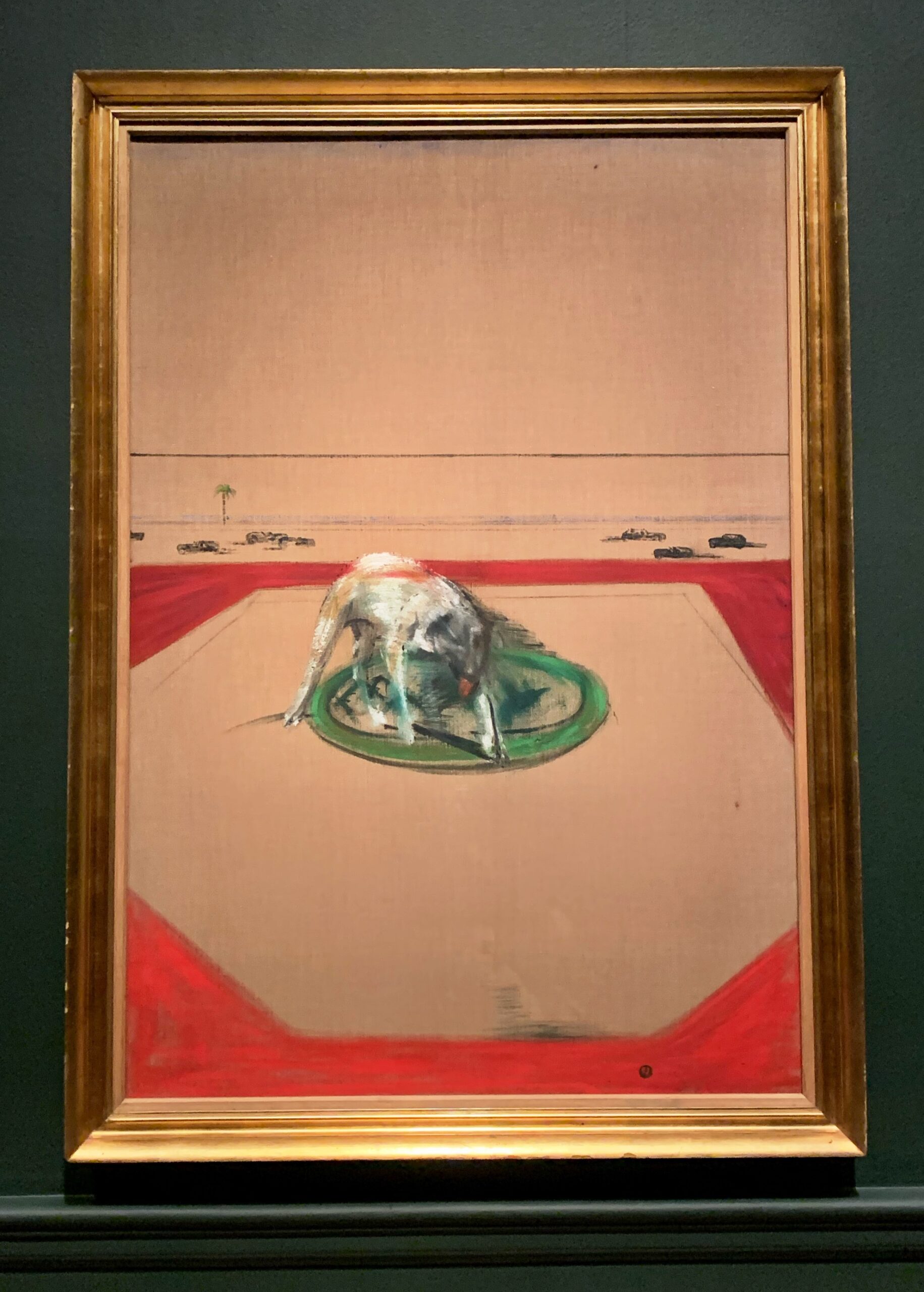
Before our visit to Hampshire, a trip to London on Saturday to view an exhibition of Francis Bacon (1909 – 1992) paintings at the Royal Academy meant Yoshi had a sleep over with his cousins Freya and Rosa. There were no paintings of trains at the gallery, indeed I’m not even aware of Bacon’s opinion of railways. I can however imagine a tortured portrait of Gordon the big blue engine from the Rev. W. Awdry’s Railway Series of books screaming into the abyss frustrated at being overlooked as he was an experimental engine and precursor of Gresley’s A3 Pacific’s for the Great Northern Railway and kept a secret. Also he’d be purple.
There were however, two paintings featuring dogs.
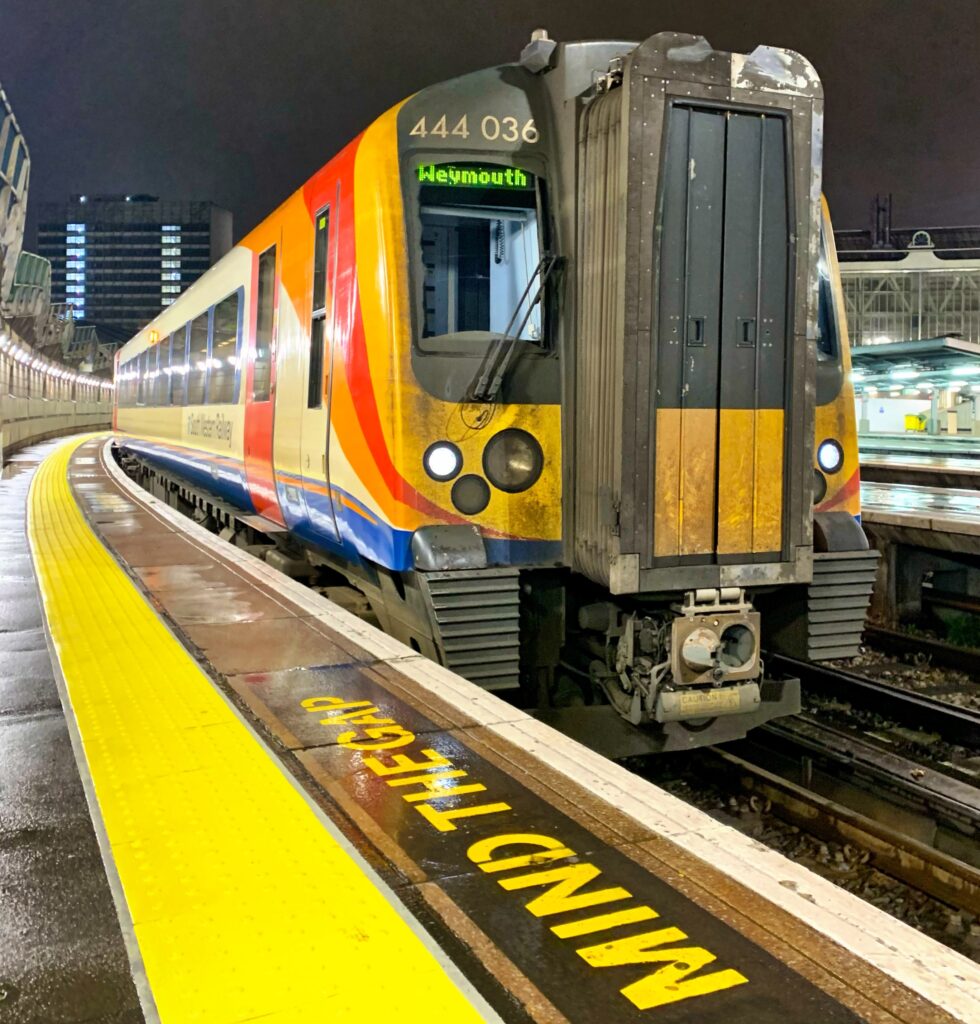
‘Man with Dog’ (1953) on the left, and ‘Dog’ (1952)Class 444 No. 444036 stands at London Waterloo platform 19 with the 1933 service to Weymouth on 5th March 2022
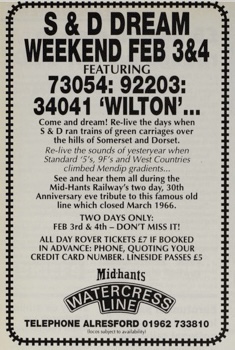
Our first archive segment this week comes from 1996 and another visit to The Watercress Line and their S&D Dream Weekend which commemorated the 30th anniversary of the last train to run over the Somerset and Dorset Railway, albeit a month early!
Advertisement from The Railway Magazine February 1996
On September 2nd 2006 Kingfisher Railtours ran The Somerset & Dorset Remembered tour using Bulleid West Country Pacific No. 34067 ‘Tangmere’ with EWS Class 67 No. 67006 providing assistance at the rear of the train. If the video is anything to go by, I must have arrived at Wareham to film events just as ‘Tangmere’ arrived with the coaching stock ready for the booked 0620 departure. The route of the tour took passengers from Dorset to Salisbury, Bath and Bristol Temple Meads. Later that same day, after the last passengers were dropped off in Wareham on the return leg, the 67 hauled the empty coaching stock to Weymouth where the locomotive ran round before departing.
Finally more Mid Hants action with a flashback to their 2021 Spring Steam Gala filmed on 1st May 2021:
That’s all for this week, thanks for reading. See you next time!
Class 56 No. 56078 stands at the buffer stops adjacent to Horton Road Level Crossing, Gloucester on 30th December 2021
Over the New Year we were lucky enough to spend a few days in the beautiful Forest of Dean in Gloucestershire. On our journey to our hotel we made a slight diversion via Gloucester as COLAS liveried Class 56 No. 56078 had worked 0Z51 Bescot Up Engineers Sidings to Gloucester on 29th December and was sitting at the buffer stops adjacent to Horton Road Level Crossing before her onward journey to Port Talbot on New Year’s Eve. As can be seen in the video below, our brief interlude at Gloucester Railway Station also produced a couple of CrossCountry Voyagers and the Direct Rail Services (DRS) Daventry to Wentloog Tesco service. 221132 can be seen sitting at Gloucester platform 4 with the 1S43 0725 Plymouth to Edinburgh Waverley service which had been terminated at Gloucester because of “severe flooding beyond that which could be mitigated on Network rail infrastructure.” Stablemate 221130 arrives with the 1S47 0927 Plymouth to Edinburgh. Class 66 No. 66427 is working 4V44 Daventry DRS (Tesco ) to Wentloog ( Freightliner ) passing Horton Road Level Crossing, Gloucester on 30th December 2021 and the same loco can also be seen working 4Z36 1530 Wentloog ( Freightliner ) to Daventry DRS (Tesco ) passing through Lydney on 31st December 2021. The wait at Lydney was made all the more interesting chatting to a young rail enthusiast, and his dad, about his love of all things Direct Rail Services. He was visiting the station with a banner wishing DRS a Happy New Year. Fabulous and well received by the driver of 66427 if the deployment of the locomotives’ horn is anything to go by! The CrossCountry Voyager units preceding the Daventry working are 220013 and 221127 forming the 1Z53 1227 Plymouth to Edinburgh service which escaped the disruption to XC services due to industrial action over the role of train guards on New Year’s Eve.
While in Lydney, we made a visit to Lydney Harbour which has contributed to centuries of prosperity to the local economy and also that of Britain. Lydney Harbour was where the vast majority of Forest coal, iron ore and other commodities was loaded into ships bound for Bristol, the West Country and Ireland. In the late 18th and 19th Centuries, a network of horse drawn tramways proliferated the Forest of Dean built to transport coal and ironstone to local ironworks as well as the harbour at Lydney. These tramways were replaced in the mid-nineteenth century which saw the introduction of railways to the Forest.
Yoshi at Lydney Harbour
The Lydney and Lydbrook Railway was authorised by an Act of Parliament in 1809. This became the Severn & Wye Railway and Canal Company and the current canal and basin complex at Lydney was constructed by them between 1810 and 1813, the outer harbour being completed in 1821. A horse drawn tramway was the first evidence of rails at the harbour. This was converted to Great Western Broad Gauge in 1868 and finally to standard gauge in 1872. Where the River Severn narrows is the site of the Severn Rail Bridge which was built 1875 – 1879 and was seriously damaged in an accident on 25th October 1960.
Two river barges hit one of the piers on the bridge, causing two spans to collapse into the Severn. As they fell, parts of the structure hit the barges causing the oil and petrol they were carrying to catch fire. Five people lost their lives in the incident. In the January 1961 edition of The Railway Magazine hopes were expressed that the bridge would be repaired as, in the 1959 British Transport Commission report to the Ministry of Transport on the re-appraisal of the plan for modernising British railways, it was stated the Severn Railway Bridge route would be developed to relieve the congested Severn Tunnel. However, further collisions with the bridge piers in the years following resulted in British Rail demolishing the bridge between 1967 and 1968 as it was felt to be beyond economical repair. A memorial to those who lost their lives in the 1960 accident is situated at Lydney Harbour.
Memorial to those who lost their lives during the Severn & Wye Railway Bridge disaster
For the duration of our visit to the Forest of Dean, we stayed at The Speech House Hotel, a former 17th Century hunting lodge built for King Charles II. Built in 1676 the hotel is situated close to the centre of the Forest on a site used for the holding of the Forest Courts at which the Foresters settled matters of dispute and privilege concerning mining and Forestry Law and custom. The hotel was enlarged in the later part of the 19th Century but nearly all the original building remains and has been refurbished to offer modern facilities and luxurious rooms while retaining its period features. The Speech House Hotel also has dog friendly rooms and our four legged companions are allowed in The Orangery which serves light meals and afternoon tea. We found the menu, devised by Head Chef Gareth Jenkins, varied and interesting showcasing local produce from the Forest of Dean and the Wye Valley. It was also extremely tasty! Our room was clean and comfortable and the New Year’s Eve meal and entertainment enjoyable whilst observing covid guidelines.
Our stay included a guided walk through a part of the Forest which was formerly the track bed of the Severn & Wye Railway Mineral Loop which ran from Drybrook Road near Cinderford to Tufts Junction, just south of Whitecroft. The section from Drybrook Road to New Fancy Colliery / Mallards Pike is now a cycleway and footpath. Construction of the Mineral Loop began in September 1870 and was built to standard gauge as the Great Western Railway was at that time converting from broad gauge. The line was opened to traffic by May 1872. During the Second World War, the Forest of Dean was used for ammunition storage and to facilitate this, the Mineral Loop was severed in May 1942, the track being relaid some 19 months later in December 1943. By the end of the war all the collieries located along the Mineral Loop had closed, the military depot at Moseley tunnel providing the sole traffic for the line. In March 1951 the Mineral Loop was cut at Moseley Green and the line south of this point closed as far as Pillowell. The remainder of the line was closed in June 1953 with the exception of the section between Pillowell and Whitecroft. The Forest of Dean Railway Trail and Mineral Loop is a 6.8 km loop trail located near Cinderford, Gloucestershire that features a river and is rated as moderate. The trail is primarily used for walking, running, and mountain biking and is accessible year-round.
Following our walk and a very welcome spot of lunch, we headed into nearby Coleford primarily to visit The Great Western Railway Museum Coleford, which I had gleaned from their website was open on Fridays and Saturdays. Perfect as our stay coincided with a Friday. However we soon learned, not a Friday which happens to fall on December 31st. Completely understandable, but a pity the website had not been updated to reflect this prior to my email to the museum to enquire about their next scheduled opening sent on 31st December. The museum is housed in one of the last remaining permanent railway buildings in the Forest of Dean on the site of the former Coleford railway yard. Have to say, it looks an interesting location with an exciting collection of artefacts and we will hopefully find time to visit another time in the future.
After spending the evening celebrating the arrival of 2022 we were up early on New Year’s Day as we had booked a steam train ride on the Dean Forest Railway, an 85 minute nine mile round trip starting at Norchard Station. The train heads south to Lydney Junction and north to Parkend before returning to Norchard. The train stops for around 20 minutes at each end of the line where the engine runs around its train which provided ample time for photographs and for anyone who wishes to do so, to visit the footplate of the locomotive, although I’m not sure if dogs are allowed! The Dean Forest Railway started life as a tramroad in 1810 and was retained by British Railways until 1985. Today’s Dean Forest Railway Society began heritage operations on a small siding at Parkend in 1971 with the aim of preserving and operating the last remaining section of the Severn and Wye Railway. They moved to develop the Norchard site in 1978 followed by extensions towards Lydney Junction in 1995 and Parkend in 2006. Everyone we met representing the railway was extremely friendly and helpful. The locomotive for our January 1st trip was 4575 Class small Prairie tank engine No. 5541 which was built by the Great Western Railway at Swindon Works in 1928. She spent much of her working life in Machynlleth having been previously briefly based at Swindon shed and Bristol Bath Road. During 1960 she moved again to Plymouth Laira where she stayed before being withdrawn from service on 10th July 1962 having completed 921,589 miles in revenue earning service. In September 1962 she was sold for scrap and taken to Messrs. Woodham Bros of Barry where she remained until 1971 when 5541 was saved and moved by rail to the Dean Forest Railway at Parkend; the 25th locomotive to leave Barry Scrapyard for preservation. She arrived at her new home on 10th October 1972 in time for the October Gala Day. Restoration was undertaken on the siding behind the down platform at Parkend and was completed, and first steamed on 29th November 1975. On 16th January 1978 in light steam, she joined the movement of stock from Parkend to Norchard and was a regular performer on the short track constructed at the Steam Centre. The 4575 Class were popular engines on the GWR, they were versatile and well-liked by crew. They were an improved version of the 45xx Class engines, the main modification being the larger, sloped tanks and cast motion brackets.
The videos below show a taste of our 2021 visit as well as a previous visit of mine made in 1995:
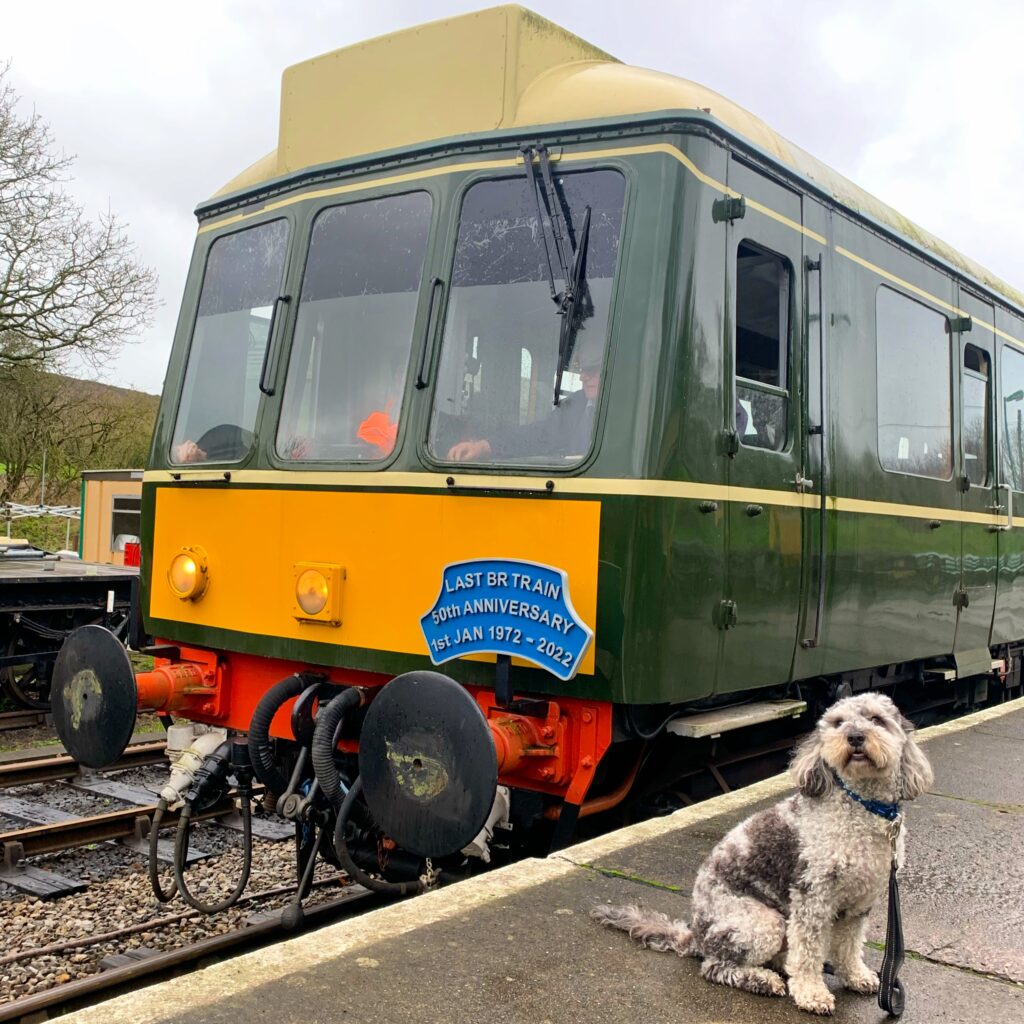
Yoshi waits for the departure of the first train of the day from Norden to Swanage on 3rd January 2022
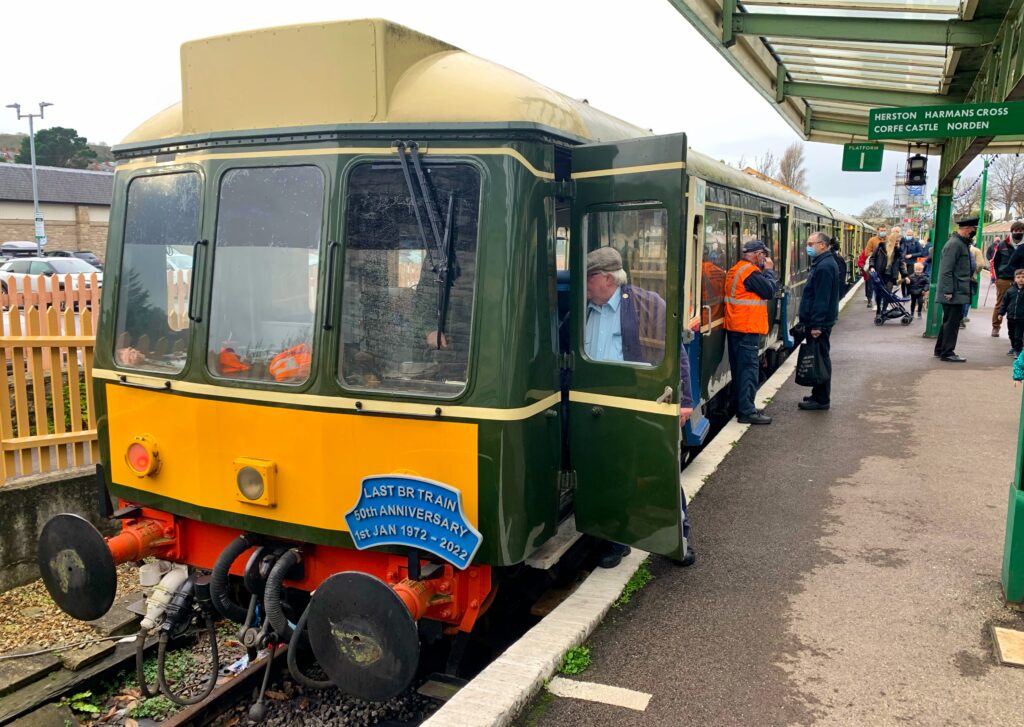
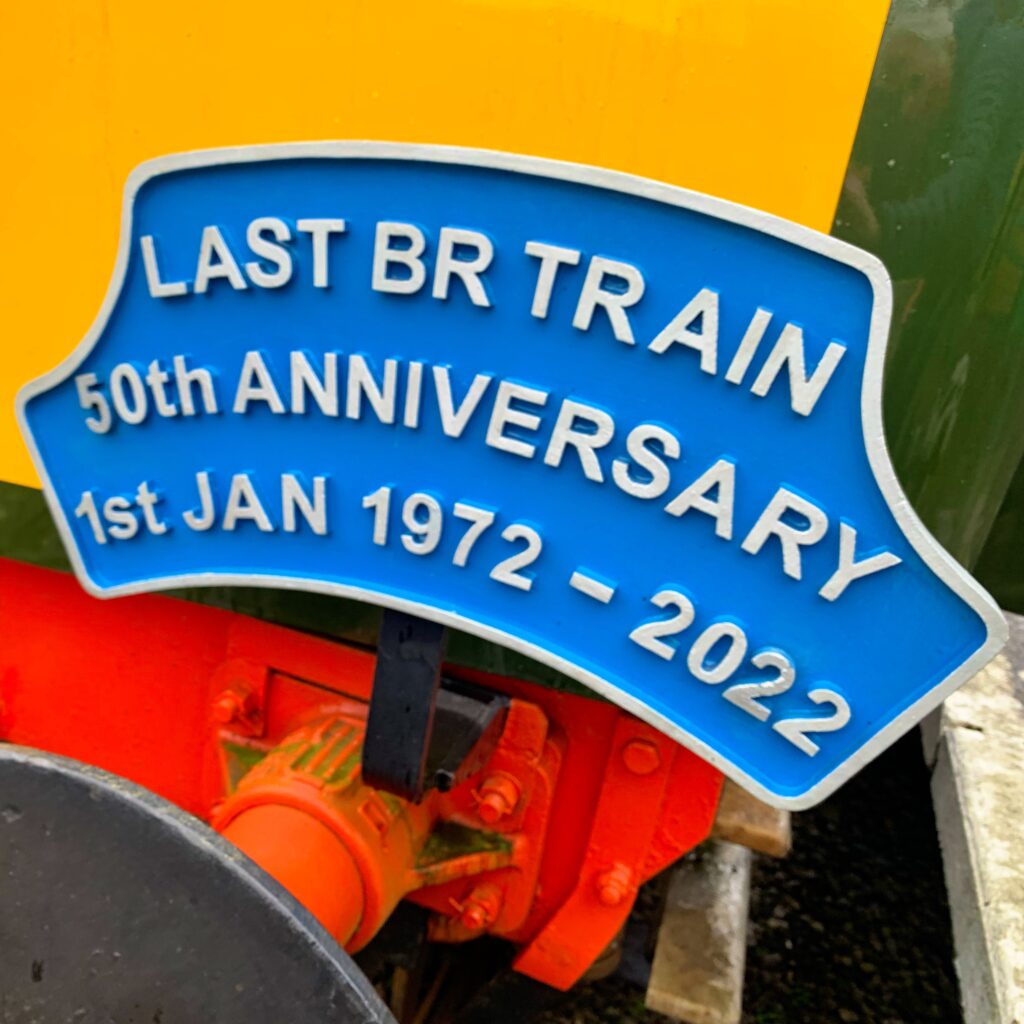
To mark the 50th anniversary of the last scheduled British Rail passenger train from Wareham to Swanage on 1st January 1972 the Swanage Railway held a three day event utilising a heritage diesel-multiple unit (DMU) running between Norden and Swanage.
A Class 117 DMU built in 1960 operated five return trains a day on Saturday 1st January 2022, Sunday 2nd January 2022 and Monday 3rd January 2022. To mark the occasion the first fifty tickets sold online for each of the three days were set at the January 1972 price of 50p per person. A special commemorative Edmondson card ticket was also produced for all ticket holders travelling on these services.
Our tickets alongside the special souvenir Edmundson card ticket produced for the 50th anniversary of the Swanage branch closureThe Class 117 DMU after arrival at Swanage Railway Station
The Dorset branch line from Wareham to Swanage was opened in May 1885 and controversially closed, despite a sustained campaign for its retention by local people and councils, on the morning of Monday January 3rd 1972. Because no services ran to Swanage on a Sunday in the winter timetable the final train ran on New Year’s Day 1972, departing Wareham at 2145 and carrying 500 passengers. The final BR return service from Swanage departed at 2215 and arrived back in Wareham at 2240. The tracks between Swanage and half a mile east of Furzebrook were torn up six months later. The track from Furzebrook being retained for the export of Purbeck ball clay by train.
The special trains carried a commemorative wooden headboard made by Swanage Railway volunteer signalman Malcolm Munro who travelled on the last train in 1972 as a 16 year old
After four years of campaigning the Swanage Railway Society was granted a one year lease of the boarded up Swanage station in 1976 and the rebirth of the Swanage branch began culminating in reconnection to the national railway system at Worgret Junction near Wareham in 2014 thanks to an innovative signalling system linking the heritage railway with Network Rail. During the summer of 2017 the Swanage Railway ran a 60 selected day trial diesel train service to Wareham which saw four trains a day operate from Swanage and Corfe Castle. In 2020 the heritage line won a government grant of up to £50,000 from the ‘Restoring Your Railway Fund’ to pay for an updated feasibility study and business case with the aim of reinstating a train service reconnecting Swanage and Corfe Castle with the main line at Wareham and reversing the 1967 decision by British Rail to close the line following a review of unprofitable branch lines. The Swanage branch was not mentioned by Dr Richard Beeching in his ‘Reshaping of British Railways’ report which decimated much of Britain’s rail network. Dr Beeching was the first chairman of the British Railways Board – the successor to The British Transport Commission – and was hired by Ernest Marples, Conservative Transport Minister who coincidentally happened to be a road construction businessman. Beeching axed 5,500 miles of track, sacked 67,000 workers and shutdown 2,363 railway stations. This was a third of the track network and 55% of stations.